Evaluation – Understanding Of Issues


           Elise Daniels
Who would be the audience for your media product?

During the research and planning stage I knew my target audience for my magazine. I knew
I'd aim my magazine to both genders and target a certain age and above. This age would be
about 15+. I decided to target the audience above this age based on the maturity of my
magazine.


My magazine will also show examples of other Hip-Hop/Rap music. Examples of these
include, Drake, Rihanna, J.Cole, Tyga, Chris Brown etc. I would include a mixture of both
female and male artists to attract both males and females to stop my magazine from
being bias of a certain gender. A mixture of ethnicities will be used. Typical stereotypes
show that people who are black or mixed race normally listen to hip hop or rap or are
artists of this genre. Instead of continuing this stereotype I have used a variety of
ethnicities. White, Asian and Black and Mixed Race.


Fashion would be used based on what my artists wear and other artists to show the genre
of my magazine and the audience it attracts. This would include street clothing, hats,
converse etc. The style of people reflects the genre of music. Therefore this is important to
include these aspects into my magazine.
How did you attract or address your audience?
I attracted audience readers by mentioning other successfully hip hop/rap artists, e.g.
drake, J.Cole, Nicki Minaj, Rita Ora etc. These are successful and popular names within
the music industry.


I attracted my targeted audience by the use of language. This means I was able to use
slang and other typical language related to 'hip-hop' and 'rap'. My magazine title
immediately represents the genre based on the 'Dope' used within 'Dope Beatz'.From
when audiences read the cover they will be aware of the genre. I also made sure my
interview was informal and used words as if my artists would when they speak, making
sure it matched the genre of my magazine. E.g. Words like Y'all, Chick, Ay, Damn etc.
Words like this will connect the readers, as they read the text the way they could imagine
the artists to speak. Formal language would not appropriately match the genre of my
magazine and audience readers would not feel as connected if they are unable to
understand or take the time to read long and complicated words.


The use of colours of have used has been used to attract my audience. Typically the
colour pink attracts girls, where as whites and black attract boys. The use of these three
colours together shows a mixture of gender and attracts both males and females.
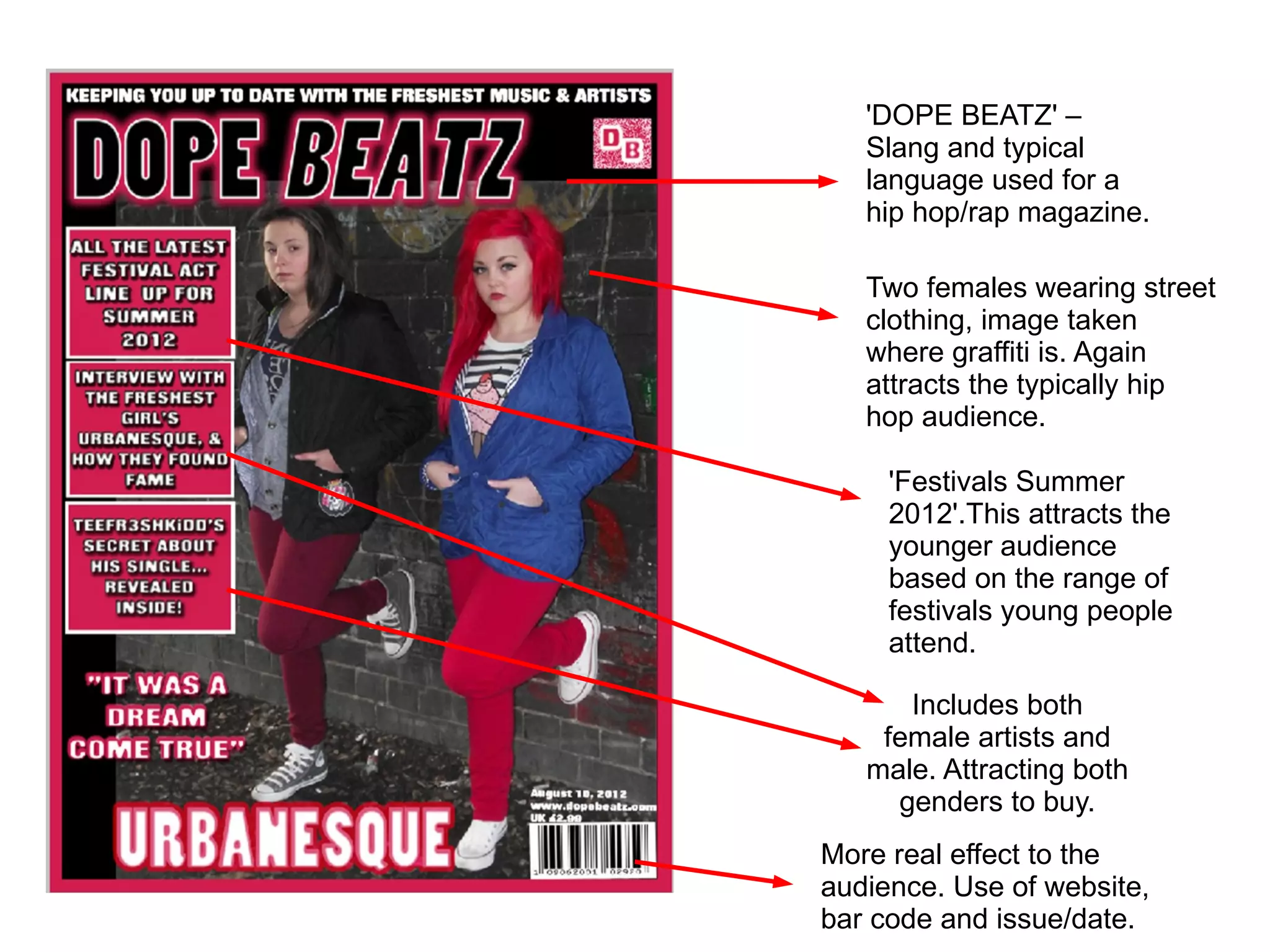
'DOPE BEATZ' –
   Slang and typical
   language used for a
   hip hop/rap magazine.

   Two females wearing street
   clothing, image taken
   where graffiti is. Again
   attracts the typically hip
   hop audience.

     'Festivals Summer
     2012'.This attracts the
     younger audience
     based on the range of
     festivals young people
     attend.

      Includes both
    female artists and
   male. Attracting both
     genders to buy.
More real effect to the
audience. Use of website,
bar code and issue/date.
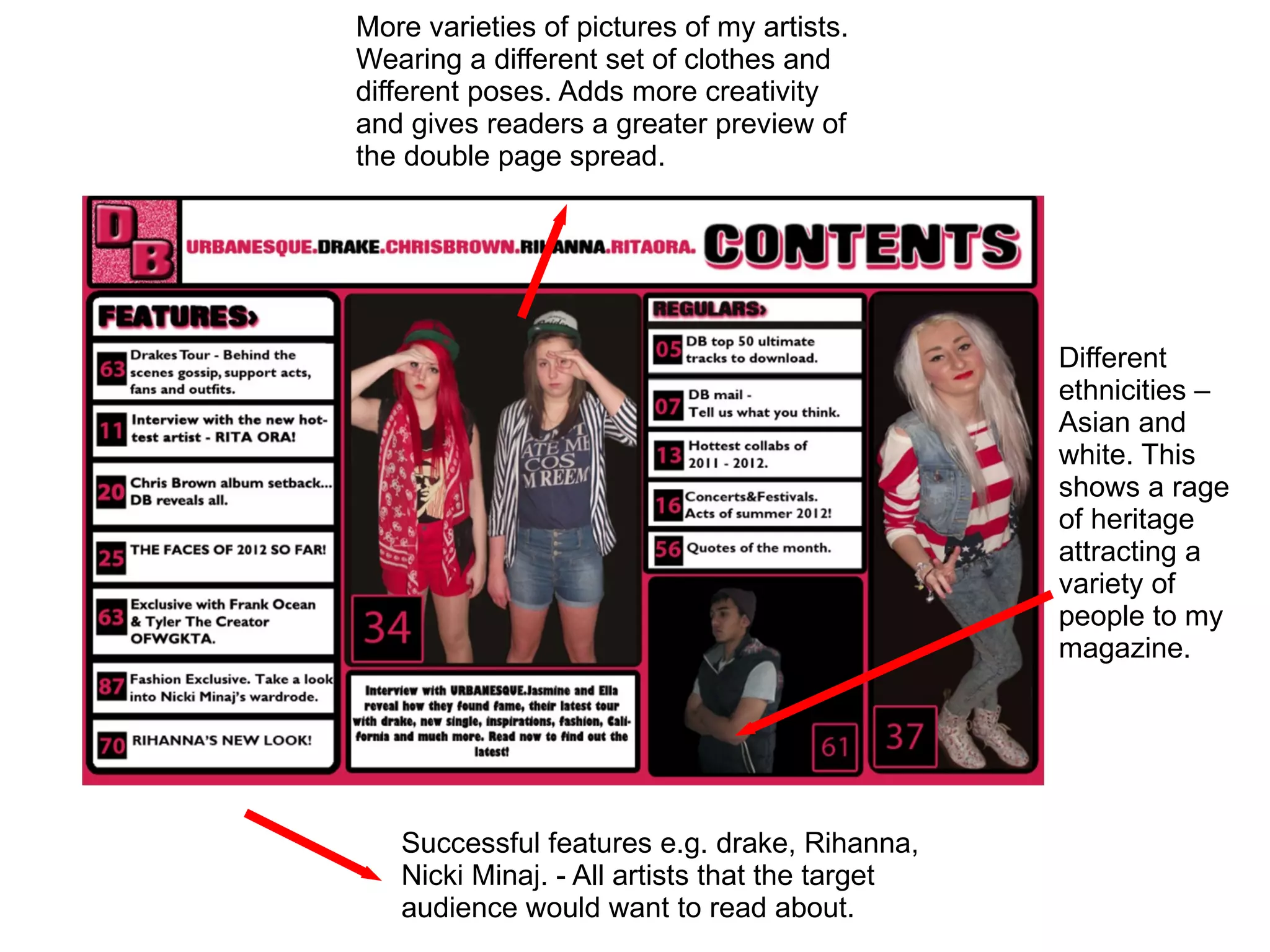
More varieties of pictures of my artists.
Wearing a different set of clothes and
different poses. Adds more creativity
and gives readers a greater preview of
the double page spread.


                                                Different
                                                ethnicities –
                                                Asian and
                                                white. This
                                                shows a rage
                                                of heritage
                                                attracting a
                                                variety of
                                                people to my
                                                magazine.


   Successful features e.g. drake, Rihanna,
   Nicki Minaj. - All artists that the target
   audience would want to read about.
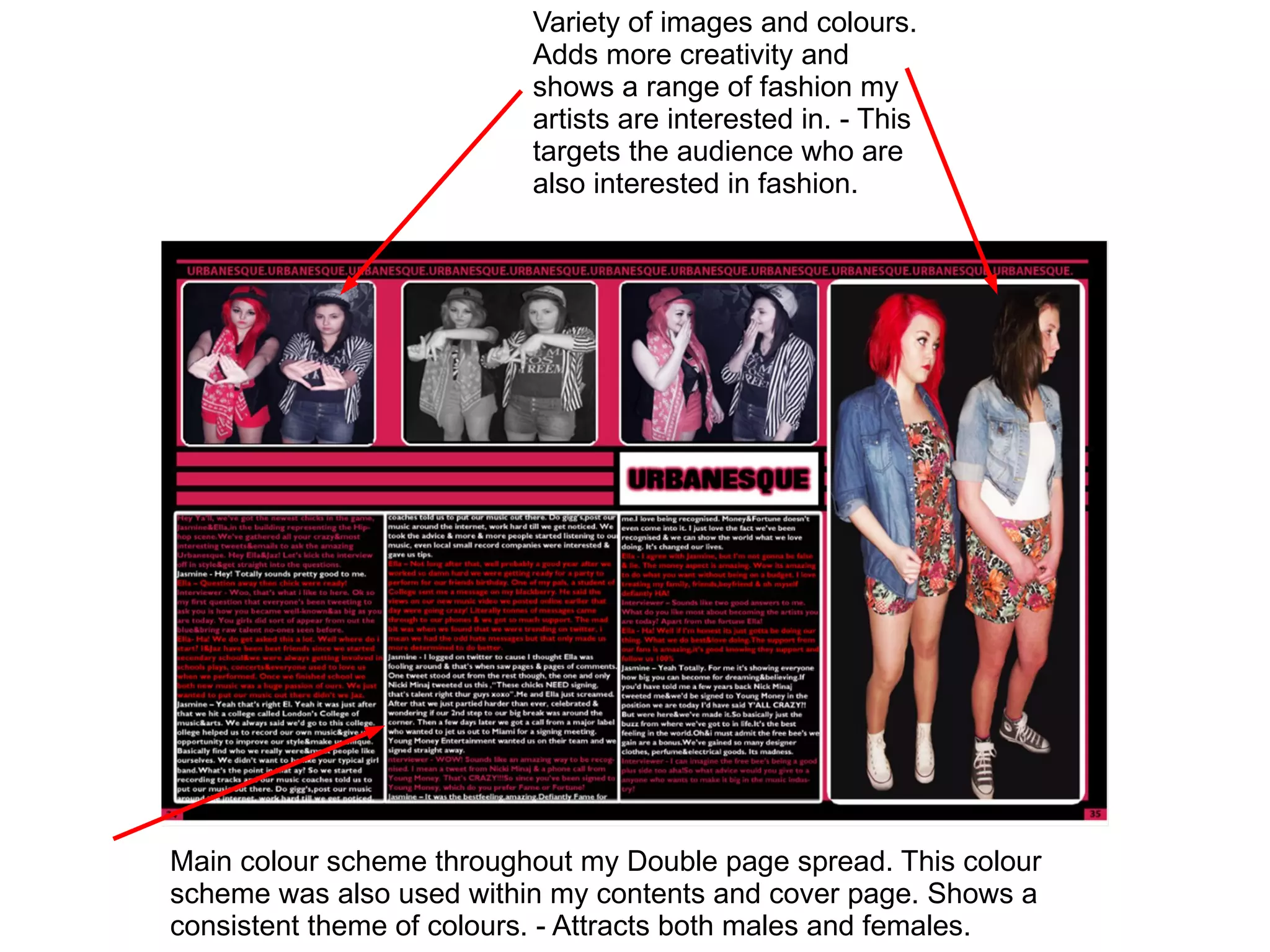
Variety of images and colours.
                          Adds more creativity and
                          shows a range of fashion my
                          artists are interested in. - This
                          targets the audience who are
                          also interested in fashion.


Main colour scheme throughout my Double page spread. This colour
scheme was also used within my contents and cover page. Shows a
consistent theme of colours. - Attracts both males and females.
How does your media product represent particular social
                      groups?

Based on the artists and the language included within my media product evidently
represents particular social groups. My magazine represents an urban/street style
and this is shown within the cover of my magazine. The picture shows how my artists
are based around fashion and street as there is graffiti on the walls.


The social group that would be represented within my media product is based on
the age of 15/16+ and both males and females. This is based on the other artists I
have included into my magazine and some of these artists are known for their
street and explicit music. This social group would be very fashion orientated, street
and their favourite genres would be RnB/HipHop/Rap. This age range would be
most known to purchase my media product based onto this.
In what ways does your media product use, develop or
    challenge forms and conventions of real media products -
Below is a comparison of my own media cover and another magazine who is also the same
hip-hop/rap/rnb genre of my own. I will be comparing the conventions of both products
finding the similarities and differences and justifying why I have chose to do so.
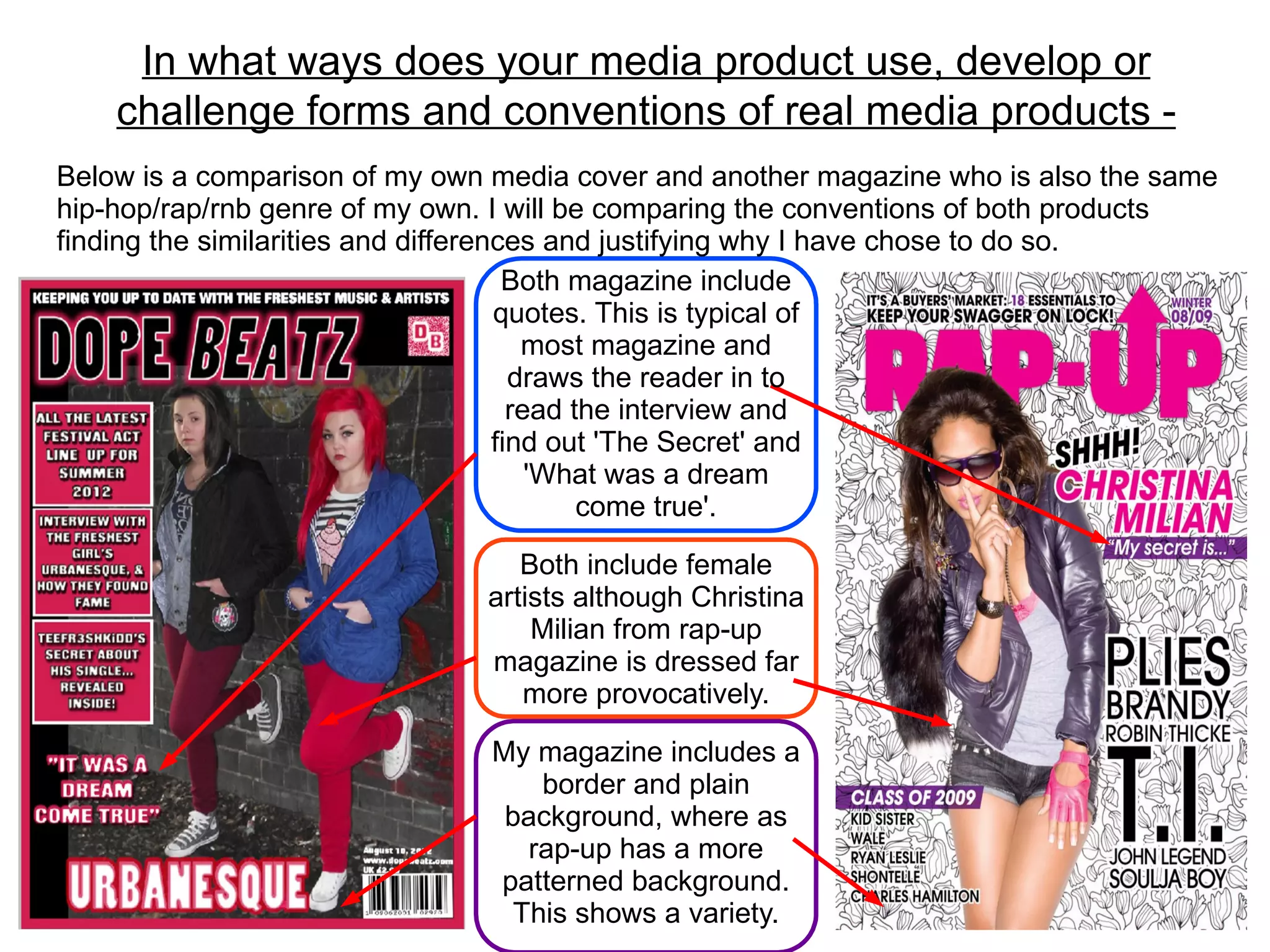
                                      Both magazine include
                                     quotes. This is typical of
                                        most magazine and
                                       draws the reader in to
                                       read the interview and
                                     find out 'The Secret' and
                                         'What was a dream
                                             come true'.

                                  Both include female
                               artists although Christina
                                   Milian from rap-up
                               magazine is dressed far
                                  more provocatively.

                               My magazine includes a
                                   border and plain
                                background, where as
                                  rap-up has a more
                               patterned background.
                                 This shows a variety.
Different aspects of my magazine have showed similarities to other popular magazines.
       Although within my magazine I have added my own originality, something that other
 magazines or very few have done. For example, my cover page includes a border. The reason
 why I have included a simple coloured border is to enable it to stand out further and look more
   interesting. Rap-Up is an example of a hip-hop/rap magazine which does not use a border.
 Although Rap-Up includes a more detailed background. This is something I have not used as I
  did not want to over power the creativity on the cover of my magazine. If there are too many
  colours and designs, pictures and texts it will just put people off buying the magazine. This is
       due to it included to much information and then standing out for the wrong reasons.
      The layout of my features is similar to other magazine although it differs from Rap-Up.
    Different magazines adapt different ways of presenting their information effectively on the
    page. I chose to use simple boxes and variety of colours. This enabled my information to
                                         stand out further.

  Also in comparison to Rap-Up magazine similar colour schemes have been used. Mixtures of
 whites, pinks and black, although there are also purples within Rap-Up. This shows a theme of
  colours, something I also applied to my own magazine. It also shows to the audience that the
magazines are not gender biased. Anyone, of any gender can purchase the magazine. Therefore
  my magazine shows similarities in comparison to other magazines based on colour schemes.
The image is also an important aspect of the magazine. My artists appropriately match the genre
of my magazine based on where the images is taken and what my artists are wearing. It shows a
    more street edge. The colours of the clothing of my artists also match my magazine theme
 colours. The Rap-Up magazine artist also matches their magazine. Although in comparison the
  artist has adapted a different fashion. Christina Milian is wearing a more low cut shop, leather,
gloves, shorts, accessories – bling, sunglasses etc. Although the variety of shots on my contents
and double page spread show a different perspective of my artists, as they also where a different
              variety of clothing. E.g. bolder colours, hats, shorts, leather, denim etc.
What kind of media institution might distribute your media product and why?


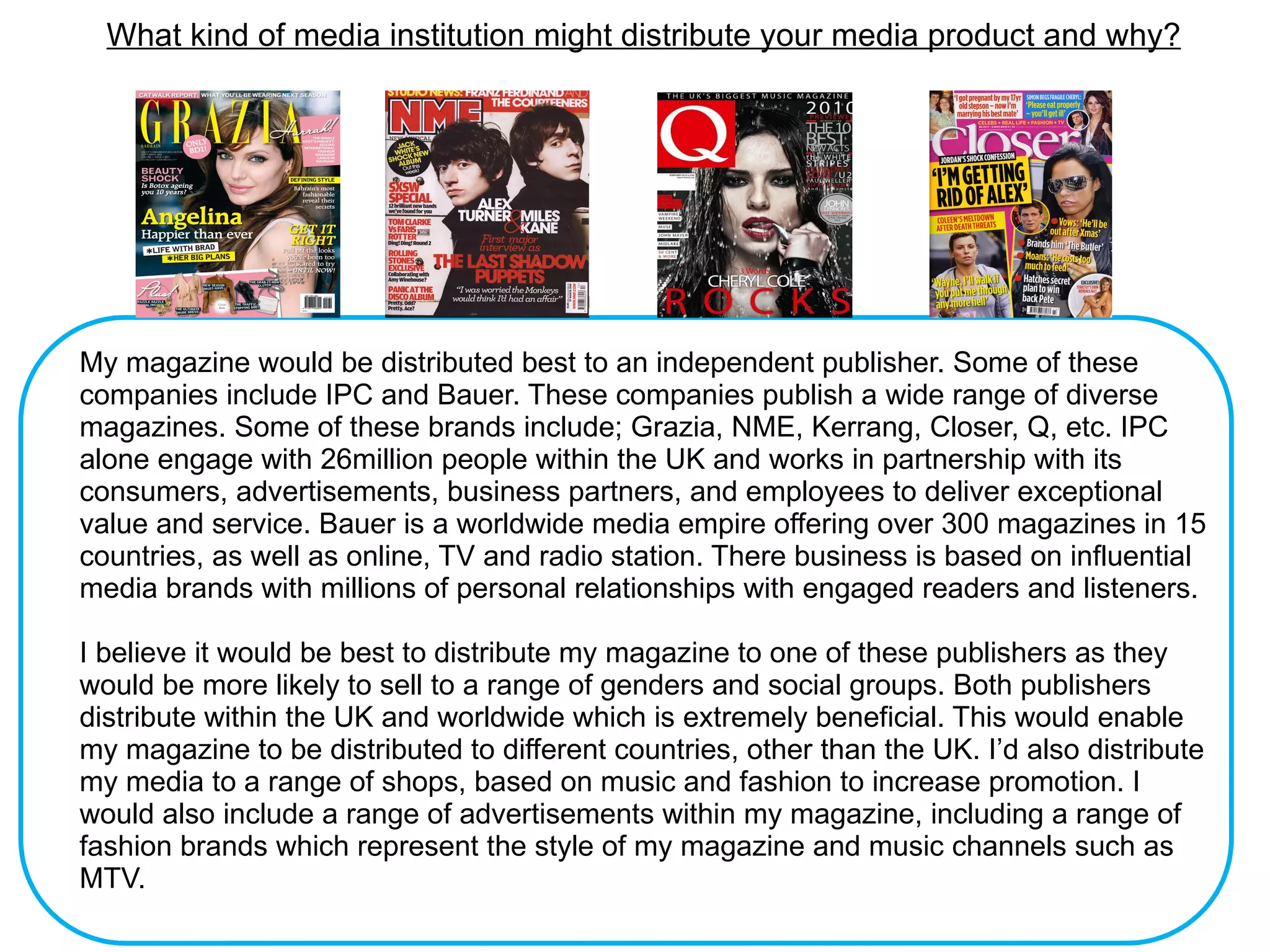
My magazine would be distributed best to an independent publisher. Some of these
companies include IPC and Bauer. These companies publish a wide range of diverse
magazines. Some of these brands include; Grazia, NME, Kerrang, Closer, Q, etc. IPC
alone engage with 26million people within the UK and works in partnership with its
consumers, advertisements, business partners, and employees to deliver exceptional
value and service. Bauer is a worldwide media empire offering over 300 magazines in 15
countries, as well as online, TV and radio station. There business is based on influential
media brands with millions of personal relationships with engaged readers and listeners.

I believe it would be best to distribute my magazine to one of these publishers as they
would be more likely to sell to a range of genders and social groups. Both publishers
distribute within the UK and worldwide which is extremely beneficial. This would enable
my magazine to be distributed to different countries, other than the UK. I’d also distribute
my media to a range of shops, based on music and fashion to increase promotion. I
would also include a range of advertisements within my magazine, including a range of
fashion brands which represent the style of my magazine and music channels such as
MTV.
What have you learnt about technologies from the process of
                 constructing the product?
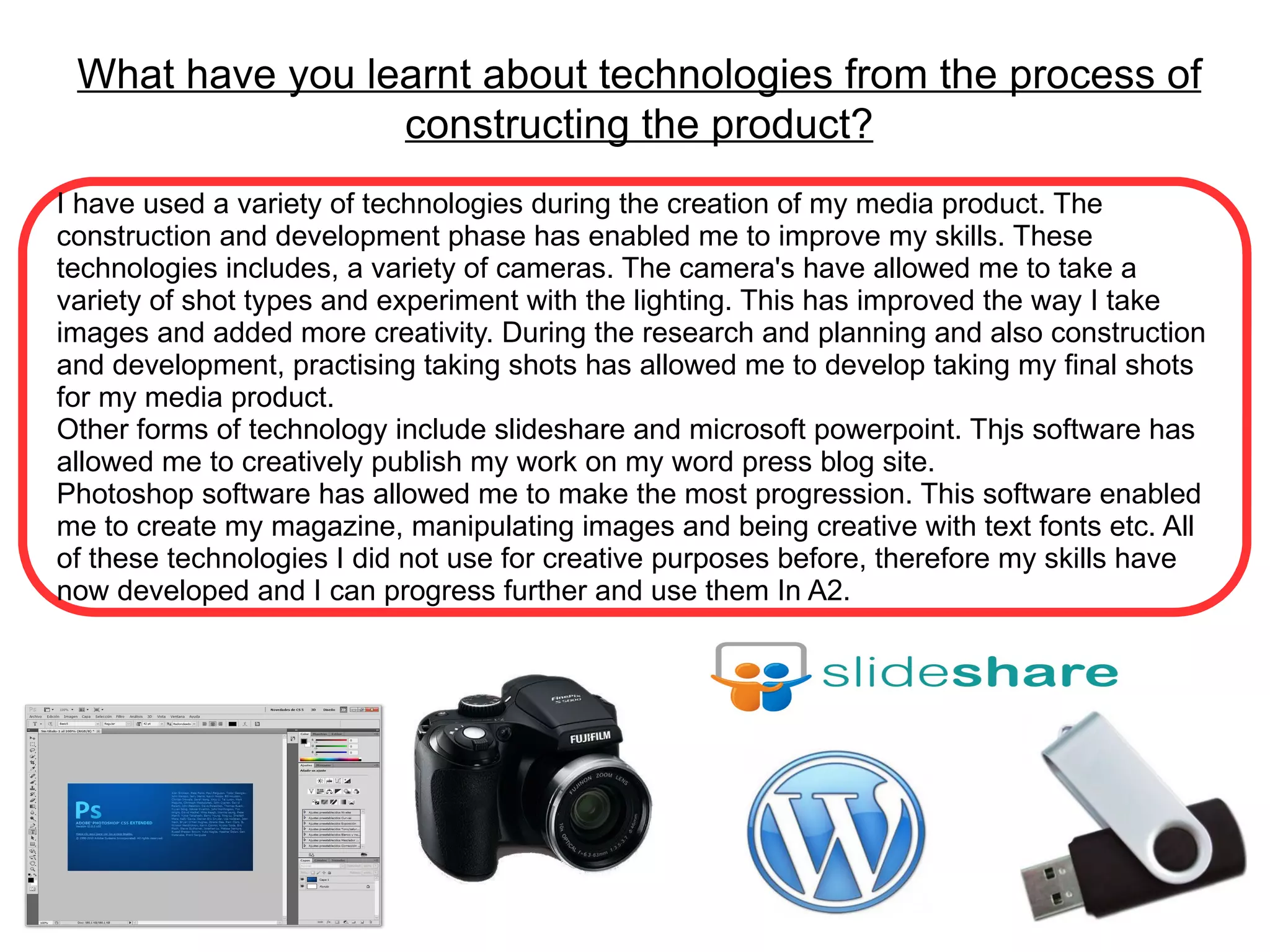
I have used a variety of technologies during the creation of my media product. The
construction and development phase has enabled me to improve my skills. These
technologies includes, a variety of cameras. The camera's have allowed me to take a
variety of shot types and experiment with the lighting. This has improved the way I take
images and added more creativity. During the research and planning and also construction
and development, practising taking shots has allowed me to develop taking my final shots
for my media product.
Other forms of technology include slideshare and microsoft powerpoint. Thjs software has
allowed me to creatively publish my work on my word press blog site.
Photoshop software has allowed me to make the most progression. This software enabled
me to create my magazine, manipulating images and being creative with text fonts etc. All
of these technologies I did not use for creative purposes before, therefore my skills have
now developed and I can progress further and use them In A2.
Looking back at your preliminary task, what do you feel you
   have learnt in the progression from it to the full product?


In comparison to my preliminary task I believe I have made a great deal of progression and
learnt a variety of new skills. Prior to creating my preliminary magazine and my music
magazine I had little experience with the use of photo shop and fireworks. Therefore the
difference from working on fireworks and using a range of skills to create my school
magazine in comparison to my music magazine is more significant. I have now created a
professional standard magazine. For example, I know understand how to work with the
range of layers on photo shop, duplicating layers, re-naming, overlapping and bridging
layers etc. This came as an advantage when creating my magazine. My knowledge of
photo shop has increased considerably since I started using the software. My preliminary
task work looks of a much lower standard in comparison to my music magazine. This
justifies my progression of skills. Although the preliminary task has allowed me to
understand what I was expected to achieve for my final version of my music magazine.

Final Evaluation Slide

  • 1.
    Evaluation – UnderstandingOf Issues Elise Daniels
  • 2.
    Who would bethe audience for your media product? During the research and planning stage I knew my target audience for my magazine. I knew I'd aim my magazine to both genders and target a certain age and above. This age would be about 15+. I decided to target the audience above this age based on the maturity of my magazine. My magazine will also show examples of other Hip-Hop/Rap music. Examples of these include, Drake, Rihanna, J.Cole, Tyga, Chris Brown etc. I would include a mixture of both female and male artists to attract both males and females to stop my magazine from being bias of a certain gender. A mixture of ethnicities will be used. Typical stereotypes show that people who are black or mixed race normally listen to hip hop or rap or are artists of this genre. Instead of continuing this stereotype I have used a variety of ethnicities. White, Asian and Black and Mixed Race. Fashion would be used based on what my artists wear and other artists to show the genre of my magazine and the audience it attracts. This would include street clothing, hats, converse etc. The style of people reflects the genre of music. Therefore this is important to include these aspects into my magazine.
  • 3.
    How did youattract or address your audience? I attracted audience readers by mentioning other successfully hip hop/rap artists, e.g. drake, J.Cole, Nicki Minaj, Rita Ora etc. These are successful and popular names within the music industry. I attracted my targeted audience by the use of language. This means I was able to use slang and other typical language related to 'hip-hop' and 'rap'. My magazine title immediately represents the genre based on the 'Dope' used within 'Dope Beatz'.From when audiences read the cover they will be aware of the genre. I also made sure my interview was informal and used words as if my artists would when they speak, making sure it matched the genre of my magazine. E.g. Words like Y'all, Chick, Ay, Damn etc. Words like this will connect the readers, as they read the text the way they could imagine the artists to speak. Formal language would not appropriately match the genre of my magazine and audience readers would not feel as connected if they are unable to understand or take the time to read long and complicated words. The use of colours of have used has been used to attract my audience. Typically the colour pink attracts girls, where as whites and black attract boys. The use of these three colours together shows a mixture of gender and attracts both males and females.
  • 4.
    'DOPE BEATZ' – Slang and typical language used for a hip hop/rap magazine. Two females wearing street clothing, image taken where graffiti is. Again attracts the typically hip hop audience. 'Festivals Summer 2012'.This attracts the younger audience based on the range of festivals young people attend. Includes both female artists and male. Attracting both genders to buy. More real effect to the audience. Use of website, bar code and issue/date.
  • 5.
    More varieties ofpictures of my artists. Wearing a different set of clothes and different poses. Adds more creativity and gives readers a greater preview of the double page spread. Different ethnicities – Asian and white. This shows a rage of heritage attracting a variety of people to my magazine. Successful features e.g. drake, Rihanna, Nicki Minaj. - All artists that the target audience would want to read about.
  • 6.
    Variety of imagesand colours. Adds more creativity and shows a range of fashion my artists are interested in. - This targets the audience who are also interested in fashion. Main colour scheme throughout my Double page spread. This colour scheme was also used within my contents and cover page. Shows a consistent theme of colours. - Attracts both males and females.
  • 7.
    How does yourmedia product represent particular social groups? Based on the artists and the language included within my media product evidently represents particular social groups. My magazine represents an urban/street style and this is shown within the cover of my magazine. The picture shows how my artists are based around fashion and street as there is graffiti on the walls. The social group that would be represented within my media product is based on the age of 15/16+ and both males and females. This is based on the other artists I have included into my magazine and some of these artists are known for their street and explicit music. This social group would be very fashion orientated, street and their favourite genres would be RnB/HipHop/Rap. This age range would be most known to purchase my media product based onto this.
  • 8.
    In what waysdoes your media product use, develop or challenge forms and conventions of real media products - Below is a comparison of my own media cover and another magazine who is also the same hip-hop/rap/rnb genre of my own. I will be comparing the conventions of both products finding the similarities and differences and justifying why I have chose to do so. Both magazine include quotes. This is typical of most magazine and draws the reader in to read the interview and find out 'The Secret' and 'What was a dream come true'. Both include female artists although Christina Milian from rap-up magazine is dressed far more provocatively. My magazine includes a border and plain background, where as rap-up has a more patterned background. This shows a variety.
  • 9.
    Different aspects ofmy magazine have showed similarities to other popular magazines. Although within my magazine I have added my own originality, something that other magazines or very few have done. For example, my cover page includes a border. The reason why I have included a simple coloured border is to enable it to stand out further and look more interesting. Rap-Up is an example of a hip-hop/rap magazine which does not use a border. Although Rap-Up includes a more detailed background. This is something I have not used as I did not want to over power the creativity on the cover of my magazine. If there are too many colours and designs, pictures and texts it will just put people off buying the magazine. This is due to it included to much information and then standing out for the wrong reasons. The layout of my features is similar to other magazine although it differs from Rap-Up. Different magazines adapt different ways of presenting their information effectively on the page. I chose to use simple boxes and variety of colours. This enabled my information to stand out further. Also in comparison to Rap-Up magazine similar colour schemes have been used. Mixtures of whites, pinks and black, although there are also purples within Rap-Up. This shows a theme of colours, something I also applied to my own magazine. It also shows to the audience that the magazines are not gender biased. Anyone, of any gender can purchase the magazine. Therefore my magazine shows similarities in comparison to other magazines based on colour schemes. The image is also an important aspect of the magazine. My artists appropriately match the genre of my magazine based on where the images is taken and what my artists are wearing. It shows a more street edge. The colours of the clothing of my artists also match my magazine theme colours. The Rap-Up magazine artist also matches their magazine. Although in comparison the artist has adapted a different fashion. Christina Milian is wearing a more low cut shop, leather, gloves, shorts, accessories – bling, sunglasses etc. Although the variety of shots on my contents and double page spread show a different perspective of my artists, as they also where a different variety of clothing. E.g. bolder colours, hats, shorts, leather, denim etc.
  • 10.
    What kind ofmedia institution might distribute your media product and why? My magazine would be distributed best to an independent publisher. Some of these companies include IPC and Bauer. These companies publish a wide range of diverse magazines. Some of these brands include; Grazia, NME, Kerrang, Closer, Q, etc. IPC alone engage with 26million people within the UK and works in partnership with its consumers, advertisements, business partners, and employees to deliver exceptional value and service. Bauer is a worldwide media empire offering over 300 magazines in 15 countries, as well as online, TV and radio station. There business is based on influential media brands with millions of personal relationships with engaged readers and listeners. I believe it would be best to distribute my magazine to one of these publishers as they would be more likely to sell to a range of genders and social groups. Both publishers distribute within the UK and worldwide which is extremely beneficial. This would enable my magazine to be distributed to different countries, other than the UK. I’d also distribute my media to a range of shops, based on music and fashion to increase promotion. I would also include a range of advertisements within my magazine, including a range of fashion brands which represent the style of my magazine and music channels such as MTV.
  • 11.
    What have youlearnt about technologies from the process of constructing the product? I have used a variety of technologies during the creation of my media product. The construction and development phase has enabled me to improve my skills. These technologies includes, a variety of cameras. The camera's have allowed me to take a variety of shot types and experiment with the lighting. This has improved the way I take images and added more creativity. During the research and planning and also construction and development, practising taking shots has allowed me to develop taking my final shots for my media product. Other forms of technology include slideshare and microsoft powerpoint. Thjs software has allowed me to creatively publish my work on my word press blog site. Photoshop software has allowed me to make the most progression. This software enabled me to create my magazine, manipulating images and being creative with text fonts etc. All of these technologies I did not use for creative purposes before, therefore my skills have now developed and I can progress further and use them In A2.
  • 12.
    Looking back atyour preliminary task, what do you feel you have learnt in the progression from it to the full product? In comparison to my preliminary task I believe I have made a great deal of progression and learnt a variety of new skills. Prior to creating my preliminary magazine and my music magazine I had little experience with the use of photo shop and fireworks. Therefore the difference from working on fireworks and using a range of skills to create my school magazine in comparison to my music magazine is more significant. I have now created a professional standard magazine. For example, I know understand how to work with the range of layers on photo shop, duplicating layers, re-naming, overlapping and bridging layers etc. This came as an advantage when creating my magazine. My knowledge of photo shop has increased considerably since I started using the software. My preliminary task work looks of a much lower standard in comparison to my music magazine. This justifies my progression of skills. Although the preliminary task has allowed me to understand what I was expected to achieve for my final version of my music magazine.