By Irfan Abbas
14-Arid-1410
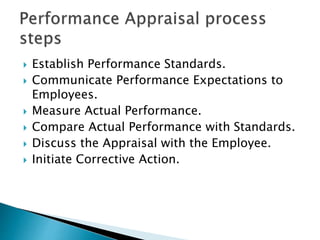
๏ฝ Establish Performance Standards.
๏ฝ Communicate Performance Expectations to
Employees.
๏ฝ Measure Actual Performance.
๏ฝ Compare Actual Performance with Standards.
๏ฝ Discuss the Appraisal with the Employee.
๏ฝ Initiate Corrective Action.
๏ฝ The appraisal process begins with the
establishment of performance standards. The
managers must determine what outputs,
accomplishments and skills will be evaluated.
These standards should have evolved out of
job analysis and job descriptions.
๏ฝ Once the performance standards are
established, this need to be communicated to
the respective employees so that they come
to know what is expected of them. Past
experience indicates that not communicating
standards to the employees compounds the
appraisal problem.
๏ฝ This is the third step involved in the appraisal
process. In this stage, the actual performance
of the employee is measured on the basis of
information available from various sources
such as personal observation, statistical
reports, oral reports, and written reports.
๏ฝ In this stage, the actual performance is
compared with the predetermined standards.
Such a comparison may reveal the deviation
between standard performance and actual
performance and will enable the evaluator to
proceed to the fifth step in the process, i.e.,
the discussion of the appraisal with the
concerned employees.
๏ฝ The fifth step in the appraisal process is to
communicate to and discuss with the
employees the results of the appraisal. This
is, in fact, one of the most challenging tasks
the managerโ€™s face to present an accurate
appraisal to the employees and then make
them accept the appraisal in a constructive
manner.
๏ฝ The final step in the appraisal process is the
initiation of corrective action when it is
necessary. The areas needing improvement
are identified and then, the measures to
correct or improve the performance are
identified and initiated.

Performance appraisal performance

  • 1.
  • 2.
    ๏ฝ Establish PerformanceStandards. ๏ฝ Communicate Performance Expectations to Employees. ๏ฝ Measure Actual Performance. ๏ฝ Compare Actual Performance with Standards. ๏ฝ Discuss the Appraisal with the Employee. ๏ฝ Initiate Corrective Action.
  • 3.
    ๏ฝ The appraisalprocess begins with the establishment of performance standards. The managers must determine what outputs, accomplishments and skills will be evaluated. These standards should have evolved out of job analysis and job descriptions.
  • 4.
    ๏ฝ Once theperformance standards are established, this need to be communicated to the respective employees so that they come to know what is expected of them. Past experience indicates that not communicating standards to the employees compounds the appraisal problem.
  • 5.
    ๏ฝ This isthe third step involved in the appraisal process. In this stage, the actual performance of the employee is measured on the basis of information available from various sources such as personal observation, statistical reports, oral reports, and written reports.
  • 6.
    ๏ฝ In thisstage, the actual performance is compared with the predetermined standards. Such a comparison may reveal the deviation between standard performance and actual performance and will enable the evaluator to proceed to the fifth step in the process, i.e., the discussion of the appraisal with the concerned employees.
  • 7.
    ๏ฝ The fifthstep in the appraisal process is to communicate to and discuss with the employees the results of the appraisal. This is, in fact, one of the most challenging tasks the managerโ€™s face to present an accurate appraisal to the employees and then make them accept the appraisal in a constructive manner.
  • 8.
    ๏ฝ The finalstep in the appraisal process is the initiation of corrective action when it is necessary. The areas needing improvement are identified and then, the measures to correct or improve the performance are identified and initiated.