Filipino Values
System
Presented by: Baldemor, Arriane M.
BSP 3-B
INTRODUCTION
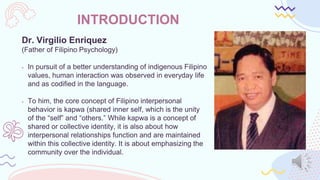
Dr. Virgilio Enriquez
(Father of Filipino Psychology)
- In pursuit of a better understanding of indigenous Filipino
values, human interaction was observed in everyday life
and as codified in the language.
- To him, the core concept of Filipino interpersonal
behavior is kapwa (shared inner self, which is the unity
of the “self” and “others.” While kapwa is a concept of
shared or collective identity, it is also about how
interpersonal relationships function and are maintained
within this collective identity. It is about emphasizing the
community over the individual.
Basic Tenets of Filipino Value System
Core Value Surface Values
Pivotal Interpersonal
Value
Linking Socio-personal
Value
01
03
02
04
Societal Values
05
Core Value or Kapwa Psychology
Kapwa, meaning 'togetherness', is the core construct
of Filipino Psychology. Kapwa has two categories,
Ibang Tao (other people) and Hindi Ibang Tao (not
other people)
Ibang Tao ("outsider")
Pakikitungo: civility
Pakikisalamuha: act of mixing
Pakikilahok: act of joining
Pakikibagay: conformity
Pakikisama: being united
with the group.
Hindi Ibang Tao ("one-of-us")
Pakikipagpalagayang-loob: act of mutual trust
Pakikisangkot: act of joining others
Pakikipagkaisa: being one with others
“People are just people in spite of
their age, clothes, diplomas, color
or affiliations”,
— said one Filipino artist (de Guia 2006)
Surface Values
02
Accommodative & Confrontative
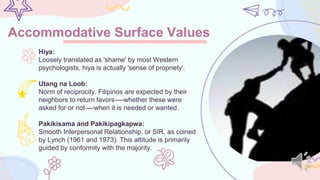
Hiya:
Loosely translated as 'shame' by most Western
psychologists, hiya is actually 'sense of propriety'.
Utang na Loob:
Norm of reciprocity. Filipinos are expected by their
neighbors to return favors-—whether these were
asked for or not—-when it is needed or wanted.
Pakikisama and Pakikipagkapwa:
Smooth Interpersonal Relationship, or SIR, as coined
by Lynch (1961 and 1973). This attitude is primarily
guided by conformity with the majority.
Accommodative Surface Values
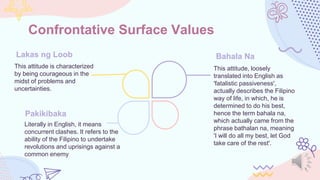
Literally in English, it means
concurrent clashes. It refers to the
ability of the Filipino to undertake
revolutions and uprisings against a
common enemy
Confrontative Surface Values
This attitude is characterized
by being courageous in the
midst of problems and
uncertainties.
This attitude, loosely
translated into English as
'fatalistic passiveness',
actually describes the Filipino
way of life, in which, he is
determined to do his best,
hence the term bahala na,
which actually came from the
phrase bathalan na, meaning
'I will do all my best, let God
take care of the rest'.
Bahala Na
Lakas ng Loob
Pakikibaka
Pivotal Interpersonal
Value
03
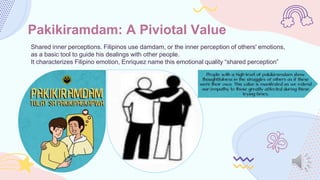
Shared inner perceptions. Filipinos use damdam, or the inner perception of others' emotions,
as a basic tool to guide his dealings with other people.
It characterizes Filipino emotion, Enriquez name this emotional quality “shared perception”
Pakikiramdam: A Piviotal Value
Linking Socio-personal
Value
04
Kagandahang-Loob
Shared humanity. This refers to being able to help other people in dire need due to
a perception of being together as a part of one Filipino humanity
Societal Values
05
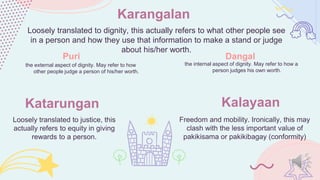
Karangalan
Kalayaan
Katarungan
Loosely translated to dignity, this actually refers to what other people see
in a person and how they use that information to make a stand or judge
about his/her worth.
Freedom and mobility. Ironically, this may
clash with the less important value of
pakikisama or pakikibagay (conformity)
Loosely translated to justice, this
actually refers to equity in giving
rewards to a person.
Puri Dangal
the external aspect of dignity. May refer to how
other people judge a person of his/her worth.
the internal aspect of dignity. May refer to how a
person judges his own worth.
CREDITS: This presentation template was created
by Slidesgo, including icons by Flaticon, infographics
& images by Freepik
END OF PRESENTATION!
Please keep this slide for attribution
Thank you for listening

Filipino Values System.pptx

  • 1.
    Filipino Values System Presented by:Baldemor, Arriane M. BSP 3-B
  • 2.
    INTRODUCTION Dr. Virgilio Enriquez (Fatherof Filipino Psychology) - In pursuit of a better understanding of indigenous Filipino values, human interaction was observed in everyday life and as codified in the language. - To him, the core concept of Filipino interpersonal behavior is kapwa (shared inner self, which is the unity of the “self” and “others.” While kapwa is a concept of shared or collective identity, it is also about how interpersonal relationships function and are maintained within this collective identity. It is about emphasizing the community over the individual.
  • 3.
    Basic Tenets ofFilipino Value System Core Value Surface Values Pivotal Interpersonal Value Linking Socio-personal Value 01 03 02 04 Societal Values 05
  • 4.
    Core Value orKapwa Psychology Kapwa, meaning 'togetherness', is the core construct of Filipino Psychology. Kapwa has two categories, Ibang Tao (other people) and Hindi Ibang Tao (not other people) Ibang Tao ("outsider") Pakikitungo: civility Pakikisalamuha: act of mixing Pakikilahok: act of joining Pakikibagay: conformity Pakikisama: being united with the group. Hindi Ibang Tao ("one-of-us") Pakikipagpalagayang-loob: act of mutual trust Pakikisangkot: act of joining others Pakikipagkaisa: being one with others
  • 5.
    “People are justpeople in spite of their age, clothes, diplomas, color or affiliations”, — said one Filipino artist (de Guia 2006)
  • 6.
  • 7.
    Hiya: Loosely translated as'shame' by most Western psychologists, hiya is actually 'sense of propriety'. Utang na Loob: Norm of reciprocity. Filipinos are expected by their neighbors to return favors-—whether these were asked for or not—-when it is needed or wanted. Pakikisama and Pakikipagkapwa: Smooth Interpersonal Relationship, or SIR, as coined by Lynch (1961 and 1973). This attitude is primarily guided by conformity with the majority. Accommodative Surface Values
  • 8.
    Literally in English,it means concurrent clashes. It refers to the ability of the Filipino to undertake revolutions and uprisings against a common enemy Confrontative Surface Values This attitude is characterized by being courageous in the midst of problems and uncertainties. This attitude, loosely translated into English as 'fatalistic passiveness', actually describes the Filipino way of life, in which, he is determined to do his best, hence the term bahala na, which actually came from the phrase bathalan na, meaning 'I will do all my best, let God take care of the rest'. Bahala Na Lakas ng Loob Pakikibaka
  • 9.
  • 10.
    Shared inner perceptions.Filipinos use damdam, or the inner perception of others' emotions, as a basic tool to guide his dealings with other people. It characterizes Filipino emotion, Enriquez name this emotional quality “shared perception” Pakikiramdam: A Piviotal Value
  • 11.
  • 12.
    Kagandahang-Loob Shared humanity. Thisrefers to being able to help other people in dire need due to a perception of being together as a part of one Filipino humanity
  • 13.
  • 14.
    Karangalan Kalayaan Katarungan Loosely translated todignity, this actually refers to what other people see in a person and how they use that information to make a stand or judge about his/her worth. Freedom and mobility. Ironically, this may clash with the less important value of pakikisama or pakikibagay (conformity) Loosely translated to justice, this actually refers to equity in giving rewards to a person. Puri Dangal the external aspect of dignity. May refer to how other people judge a person of his/her worth. the internal aspect of dignity. May refer to how a person judges his own worth.
  • 15.
    CREDITS: This presentationtemplate was created by Slidesgo, including icons by Flaticon, infographics & images by Freepik END OF PRESENTATION! Please keep this slide for attribution Thank you for listening