Understanding Filipino
Indigenous Psychology through
the Lens of Kapwa and the
Mangyan Community
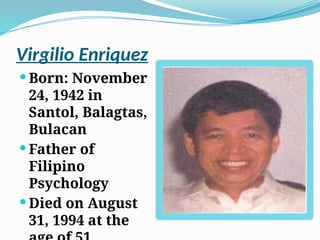
Virgilio Enriquez
 Born: November
24, 1942 in
Santol, Balagtas,
Bulacan
 Father of
Filipino
Psychology
 Died on August
31, 1994 at the
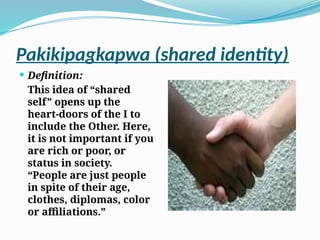
Pakikipagkapwa (shared identity)
 Definition:
This idea of “shared
self” opens up the
heart-doors of the I to
include the Other. Here,
it is not important if you
are rich or poor, or
status in society.
“People are just people
in spite of their age,
clothes, diplomas, color
or affiliations.”
Concept of Pakikipagkapwa
1. Strangers
2. Acquaintances
3. Peers
4. Friend
5. Best friend
6. Soul mate,
Lover
Kapwa
The “unity of the one-of-us-and-the-
other”, according to Virgilio Enriquez
who declared the concept as a
Filipino core value.
Kapwa, meaning ‘togetherness’, is the
core construct of Filipino Psychology.
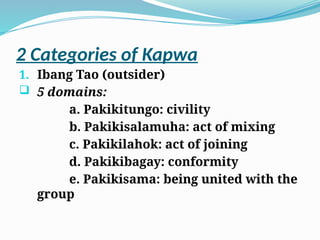
2 Categories of Kapwa
1. Ibang Tao (outsider)
 5 domains:
a. Pakikitungo: civility
b. Pakikisalamuha: act of mixing
c. Pakikilahok: act of joining
d. Pakikibagay: conformity
e. Pakikisama: being united with the
group
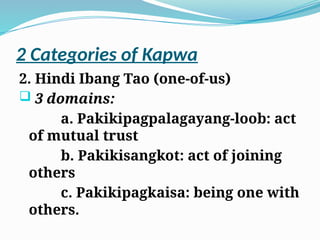
2 Categories of Kapwa
2. Hindi Ibang Tao (one-of-us)
 3 domains:
a. Pakikipagpalagayang-loob: act
of mutual trust
b. Pakikisangkot: act of joining
others
c. Pakikipagkaisa: being one with
others.
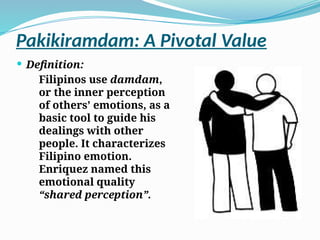
Pakikiramdam: A Pivotal Value
 Definition:
Filipinos use damdam,
or the inner perception
of others’ emotions, as a
basic tool to guide his
dealings with other
people. It characterizes
Filipino emotion.
Enriquez named this
emotional quality
“shared perception”.
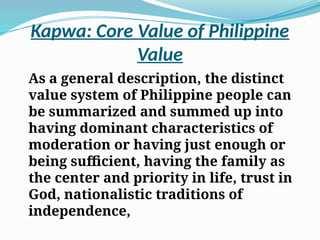
Kapwa: Core Value of Philippine
Value
As a general description, the distinct
value system of Philippine people can
be summarized and summed up into
having dominant characteristics of
moderation or having just enough or
being sufficient, having the family as
the center and priority in life, trust in
God, nationalistic traditions of
independence,
cooperation and unity, charity, heroism,
group participation, friendship and
companionship, sense of justice and
equality, concept of human dignity and
human rights, non-violence, historical
awakening, environmental consciousness,
and the emergence of empowered people
and nation. Filipinos are known to be
hospitable.
Pakikisama/Pakikipagkapwa
To Filipinos, “pakikisama” is a very
important trait. “Pakikisama” is the
ability of a person to get along with
others to maintain good and
harmonious relationships. It implies
camaraderie and togetherness in a
group and the cause of one’s being
socially accepted.
Pakikisama/Pakikipagkapwa
“Pakikisama” requires someone
yielding to group opinion, pressuring
him to do what he can for the
advancement of his group, sacrificing
individual welfare for the general
welfare.
Pakikisama/Pakikipagkapwa
 One good aspect of pakikisama exists
within close family kinship and is
interpreted as helping each other.
Pakikisama is defined as an apathy
towards others with the readiness to
help.
The end..
Reporters:
Diana
Bucacao
Lhea Sajonia Aireen Sinong

kapwapoweSSSSSSSSSSSSSSSrpoint-110319003848-phpapp02.pptx

  • 1.
    Understanding Filipino Indigenous Psychologythrough the Lens of Kapwa and the Mangyan Community
  • 2.
    Virgilio Enriquez  Born:November 24, 1942 in Santol, Balagtas, Bulacan  Father of Filipino Psychology  Died on August 31, 1994 at the
  • 3.
    Pakikipagkapwa (shared identity) Definition: This idea of “shared self” opens up the heart-doors of the I to include the Other. Here, it is not important if you are rich or poor, or status in society. “People are just people in spite of their age, clothes, diplomas, color or affiliations.”
  • 4.
    Concept of Pakikipagkapwa 1.Strangers 2. Acquaintances 3. Peers 4. Friend 5. Best friend 6. Soul mate, Lover
  • 5.
    Kapwa The “unity ofthe one-of-us-and-the- other”, according to Virgilio Enriquez who declared the concept as a Filipino core value. Kapwa, meaning ‘togetherness’, is the core construct of Filipino Psychology.
  • 6.
    2 Categories ofKapwa 1. Ibang Tao (outsider)  5 domains: a. Pakikitungo: civility b. Pakikisalamuha: act of mixing c. Pakikilahok: act of joining d. Pakikibagay: conformity e. Pakikisama: being united with the group
  • 7.
    2 Categories ofKapwa 2. Hindi Ibang Tao (one-of-us)  3 domains: a. Pakikipagpalagayang-loob: act of mutual trust b. Pakikisangkot: act of joining others c. Pakikipagkaisa: being one with others.
  • 8.
    Pakikiramdam: A PivotalValue  Definition: Filipinos use damdam, or the inner perception of others’ emotions, as a basic tool to guide his dealings with other people. It characterizes Filipino emotion. Enriquez named this emotional quality “shared perception”.
  • 9.
    Kapwa: Core Valueof Philippine Value As a general description, the distinct value system of Philippine people can be summarized and summed up into having dominant characteristics of moderation or having just enough or being sufficient, having the family as the center and priority in life, trust in God, nationalistic traditions of independence,
  • 10.
    cooperation and unity,charity, heroism, group participation, friendship and companionship, sense of justice and equality, concept of human dignity and human rights, non-violence, historical awakening, environmental consciousness, and the emergence of empowered people and nation. Filipinos are known to be hospitable.
  • 11.
    Pakikisama/Pakikipagkapwa To Filipinos, “pakikisama”is a very important trait. “Pakikisama” is the ability of a person to get along with others to maintain good and harmonious relationships. It implies camaraderie and togetherness in a group and the cause of one’s being socially accepted.
  • 12.
    Pakikisama/Pakikipagkapwa “Pakikisama” requires someone yieldingto group opinion, pressuring him to do what he can for the advancement of his group, sacrificing individual welfare for the general welfare.
  • 13.
    Pakikisama/Pakikipagkapwa  One goodaspect of pakikisama exists within close family kinship and is interpreted as helping each other. Pakikisama is defined as an apathy towards others with the readiness to help.
  • 14.
  • 15.