VALUES SYSTEM
What we think
determines who we are
Who we are
determines what we do...
“The actions of men are
the best interpreters of
their thoughts.” -John Locke
What are Values?
VALUES ARE WHAT WE VALUE
What are Values?
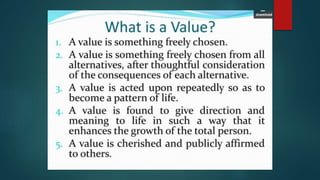
Values: are freely chosen,
enduring beliefs or attitudes
about the worth of a person,
object, idea, or action (e.g.
freedom, family, honesty, hard
work).
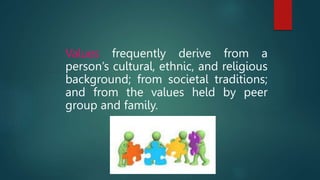
Values frequently derive from a
person’s cultural, ethnic, and religious
background; from societal traditions;
and from the values held by peer
group and family.
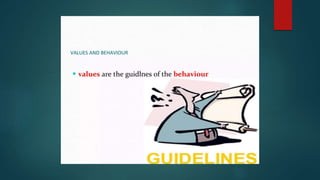
Values form a basic for Behavior
“purposive Behavior”; The
purposive behavior is based on a
person’s decisions/choices, and
these decisions/choices are based
on the person’s underlying values.
Values are learned and are
greatly influenced by a
person’s socio-cultural
environment (e.g.
demonstrate honesty,
sincerity, observation and
experience)
 People need societal values to feel
accepted, and they need personal values
to produce a sense of individuality.
 Professional values often reflect and
expand on personal values
 Once a person becomes aware of his/her
values, they become an internal control
for behavior, thus, a person’s real values
are manifested in consistent pattern of
behavior
According to values clarification,
values are based on three
processes:
(1) choosing;
(2) prizing; and
(3) acting.
Choosing:
(1) freely
(2) from alternatives
(3) after thoughtful consideration of
the consequences of each
alternative
Prizing:
(4) cherishing, being happy with
the choice
(5) willing to affirm the choice
publicly
Acting:
(6) doing something with the choice
(7) repeatedly, in some pattern of life
(Raths, et al., 1930, p. 30).
Filipino Values
Filipino values are social constructs within Filipino
culture which define that which is socially considered to
be desirable. The Filipino value system describes "the
commonly shared and traditionally established system
of values underlying Filipino behavior" within the context
of the larger Filipino cultural system. These relate to the
unique assemblage of consistent ideologies, moral
codes, ethical practices, etiquette and personal and
cultural values that are promoted by Filipino society.
The formal study of Filipino values has been
made difficult by the historical context of the
literature in the field. The early scholarship about
the Filipino value system lacked clear definitions
and organizational frameworks, and were mostly
written by foreigners during the Philippines'
American colonial period. The latter half of the
20th century saw efforts to develop clearer
definitions and properly contextualized
frameworks, but many aspects of the scholarship
require further clarification and consensus.
The distinct value system of Filipinos has
generally been described as rooted
primarily in personal alliance systems,
especially those based in kinship,
obligation, friendship, religion
(particularly Christianity) and commercial
relationships.
Filipino values are, for the most part, centered at maintaining
social harmony, motivated primarily by the desire to be
accepted within a group.[dubious – discuss] The main
sanction against diverging from these values are the concepts
of Tagalog: hiya, roughly translated as 'a sense of shame', and
'amor propio' or 'self-esteem’. Social approval, acceptance by
a group, and belonging to a group are major concerns. Caring
about what others will think, say or do, are strong influences
on social behavior among Filipinos.
According to the anthropologist Leonardo
Mercado, the Filipino worldview is basically
'nondualistic'. Based on his linguistic analyses
of Filipino value terms like loob (Cebuano:
buot), he concludes that Filipinos desire
harmony, not only in interpersonal
relationships, but also with nature and religion,
while still remaining nondichotomous.
"The Filipino wants to harmonize the object and the subject,
while at the same time holding both as distinct."
— Elements of Filipino Philosophy (1974), Leonardo
Mercado, SVD
Florentino Timbreza, a cultural philosopher, concludes in his
book Pilosopiyang Pilipino (1982) that Filipino values are
based on the significance of the world to man. Life
experiences dictate the philosophy of the Filipino,
augmented by other sources like proverbs, folk sayings, folk
tales, and the like.
F. Landa Jocano identified two models of the Filipino
value system. The first is the exogenous model, a
"foreign model", while the second is the indigenous
model, or the "traditional model". The foreign model
is described to be "legal and formal". The indigenous
model is described as a "traditional and non-formal"
model or guide, deeply embedded in the
subconscious of the Filipinos.
Models of the Filipino values
The foreign model was inherited by
Filipinos from Western cultures,
particularly from the Spaniards and the
Americans. An example of a foreign or
exogenous influence is bureaucracy
exhibited in the government of the
Philippines.
Exposition of the Filipino traits as
an ambivalence of positive and
negative aspects:
“Hiya (shame): it contributes to
peace of mind and lack of stress by
not even trying to achieve.”
Filipino Values
“Ningas-cogon (procrastination): in
a way, it makes a person non-chalant,
detached, indifferent, nonplussed
should anything go wrong, and hence
conducive to peace and tranquillity.”
“Pakikisama (group loyalty): one
lives for others; peace or lack of
dissension is a constant goal.”
Filipino Values
“Patigasan (test of strength): it is a
sign that we know our rights and are
not easily cowed into submission. It is
Occidental in spirit, hence in keeping
with Nietzsche’s "will to power."”
Filipino Values
“Bahala na (resignation): one relies
on a superior power rather than on
one’s own. It is conducive to humility,
modesty, and lack of arrogance.”
Filipino Values
“Mañana or Bukas na
(procrastination): one is without
stress and tension; one learns to take
what comes naturally. Like the
Chinese wu-wei, this trait makes one
live naturally and without undue
artificiality.”
Filipino Values
“Kasi (because, i. e., scapegoat):
one can see both sides of the
picture and know exactly where a
project failed. One will never suffer
from guilt or self-recrimination.”
Filipino Values
“Saving Face: one’s psyche is saved
from undue embarrassment, sleepless
nights, remorse of conscience. It saves
one from accountability or responsibility.
This trait enables one to make a graceful
exit from guilt instead of facing the music
and owning responsibility for an
offense.”
Filipino Values
“Sakop (inclusion): one cares for
the family and clan; one stands or
falls with them. This trait makes a
person show concern for the family
to which he belongs. ”
Filipino Values
“Utang na loob (indebtedness): it
is a recognition of one’s
indebtedness. This trait portrays the
spirit behind the Filipino saying, "He
who does not know how to look to
the past will never reach his
destination."”
Filipino Values
“Kanya-kanya (self-
centeredness): one takes care of
oneself and one’s family: "Blood is
thicker than water."”
REFERENCES
Dancel, Francis. (2005). Utang na Loob: A Philosophical Analysis, Filipino Cultural Traits: Claro R. Ceniza Lectures.
Rolando M. Gripaldo, (ed.) Washington, D.C.: Council for Research in Values and Philosophy, 2005. 205p. back to text
Quito, Emerita S. (1994). The Ambivalence of Filipino Traits and Values, Values in Philippine Culture and Education,
Philippine Philosophical Studies I. Manuel B. Dy, Jr., (ed.) Washington, D.C.: Council for Research in Values and
Philosophy, 1994. 205p. back to text
Disclaimer: The posts on this site does not necessarily represent any organization’s positions, strategies or opinions; and unless otherwise expressly stated, are licensed under
a Creative Commons Attribution-Noncommercial-No Derivative Works 3.0 Philippines License.
Traditional Filipino Values
The tradition of bayanihan and
cooperation
The known Filipino hospitality
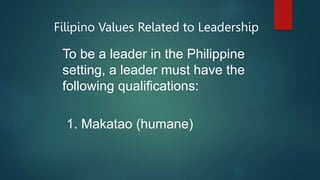
Filipino Values Related to Leadership
To be a leader in the Philippine
setting, a leader must have the
following qualifications:
1. Makatao (humane)
2. Marunong makikipag-kapwa.
“one who took care of his
compnions.”
“isa sa atin”
“para sa lahat”
“pinakamahusay sa lahat”
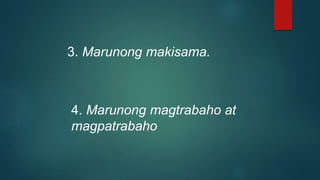
3. Marunong makisama.
4. Marunong magtrabaho at
magpatrabaho
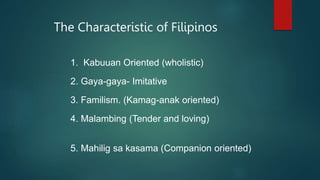
The Characteristic of Filipinos
1. Kabuuan Oriented (wholistic)
2. Gaya-gaya- Imitative
3. Familism. (Kamag-anak oriented)
4. Malambing (Tender and loving)
5. Mahilig sa kasama (Companion oriented)
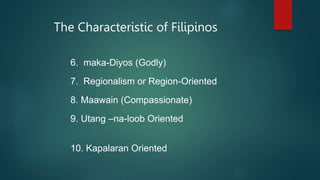
The Characteristic of Filipinos
6. maka-Diyos (Godly)
7. Regionalism or Region-Oriented
8. Maawain (Compassionate)
9. Utang –na-loob Oriented
10. Kapalaran Oriented
The Characteristic of Filipinos
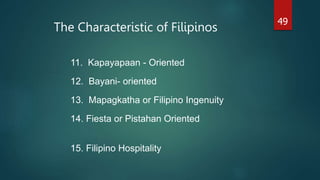
49
11. Kapayapaan - Oriented
12. Bayani- oriented
13. Mapagkatha or Filipino Ingenuity
14. Fiesta or Pistahan Oriented
15. Filipino Hospitality
The Characteristic of Filipinos
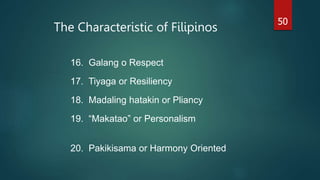
50
16. Galang o Respect
17. Tiyaga or Resiliency
18. Madaling hatakin or Pliancy
19. “Makatao” or Personalism
20. Pakikisama or Harmony Oriented
References
Making Filipino Values Work for You
By: Tomas Quintin D. Andres
END

4-values-sytem.pptx

  • 1.
  • 2.
    What we think determineswho we are Who we are determines what we do... “The actions of men are the best interpreters of their thoughts.” -John Locke
  • 3.
    What are Values? VALUESARE WHAT WE VALUE
  • 4.
    What are Values? Values:are freely chosen, enduring beliefs or attitudes about the worth of a person, object, idea, or action (e.g. freedom, family, honesty, hard work).
  • 5.
    Values frequently derivefrom a person’s cultural, ethnic, and religious background; from societal traditions; and from the values held by peer group and family.
  • 6.
    Values form abasic for Behavior “purposive Behavior”; The purposive behavior is based on a person’s decisions/choices, and these decisions/choices are based on the person’s underlying values.
  • 7.
    Values are learnedand are greatly influenced by a person’s socio-cultural environment (e.g. demonstrate honesty, sincerity, observation and experience)
  • 8.
     People needsocietal values to feel accepted, and they need personal values to produce a sense of individuality.  Professional values often reflect and expand on personal values  Once a person becomes aware of his/her values, they become an internal control for behavior, thus, a person’s real values are manifested in consistent pattern of behavior
  • 10.
    According to valuesclarification, values are based on three processes: (1) choosing; (2) prizing; and (3) acting.
  • 11.
    Choosing: (1) freely (2) fromalternatives (3) after thoughtful consideration of the consequences of each alternative
  • 12.
    Prizing: (4) cherishing, beinghappy with the choice (5) willing to affirm the choice publicly
  • 13.
    Acting: (6) doing somethingwith the choice (7) repeatedly, in some pattern of life (Raths, et al., 1930, p. 30).
  • 25.
    Filipino Values Filipino valuesare social constructs within Filipino culture which define that which is socially considered to be desirable. The Filipino value system describes "the commonly shared and traditionally established system of values underlying Filipino behavior" within the context of the larger Filipino cultural system. These relate to the unique assemblage of consistent ideologies, moral codes, ethical practices, etiquette and personal and cultural values that are promoted by Filipino society.
  • 26.
    The formal studyof Filipino values has been made difficult by the historical context of the literature in the field. The early scholarship about the Filipino value system lacked clear definitions and organizational frameworks, and were mostly written by foreigners during the Philippines' American colonial period. The latter half of the 20th century saw efforts to develop clearer definitions and properly contextualized frameworks, but many aspects of the scholarship require further clarification and consensus.
  • 27.
    The distinct valuesystem of Filipinos has generally been described as rooted primarily in personal alliance systems, especially those based in kinship, obligation, friendship, religion (particularly Christianity) and commercial relationships.
  • 28.
    Filipino values are,for the most part, centered at maintaining social harmony, motivated primarily by the desire to be accepted within a group.[dubious – discuss] The main sanction against diverging from these values are the concepts of Tagalog: hiya, roughly translated as 'a sense of shame', and 'amor propio' or 'self-esteem’. Social approval, acceptance by a group, and belonging to a group are major concerns. Caring about what others will think, say or do, are strong influences on social behavior among Filipinos.
  • 29.
    According to theanthropologist Leonardo Mercado, the Filipino worldview is basically 'nondualistic'. Based on his linguistic analyses of Filipino value terms like loob (Cebuano: buot), he concludes that Filipinos desire harmony, not only in interpersonal relationships, but also with nature and religion, while still remaining nondichotomous.
  • 30.
    "The Filipino wantsto harmonize the object and the subject, while at the same time holding both as distinct." — Elements of Filipino Philosophy (1974), Leonardo Mercado, SVD Florentino Timbreza, a cultural philosopher, concludes in his book Pilosopiyang Pilipino (1982) that Filipino values are based on the significance of the world to man. Life experiences dictate the philosophy of the Filipino, augmented by other sources like proverbs, folk sayings, folk tales, and the like.
  • 31.
    F. Landa Jocanoidentified two models of the Filipino value system. The first is the exogenous model, a "foreign model", while the second is the indigenous model, or the "traditional model". The foreign model is described to be "legal and formal". The indigenous model is described as a "traditional and non-formal" model or guide, deeply embedded in the subconscious of the Filipinos. Models of the Filipino values
  • 32.
    The foreign modelwas inherited by Filipinos from Western cultures, particularly from the Spaniards and the Americans. An example of a foreign or exogenous influence is bureaucracy exhibited in the government of the Philippines.
  • 33.
    Exposition of theFilipino traits as an ambivalence of positive and negative aspects: “Hiya (shame): it contributes to peace of mind and lack of stress by not even trying to achieve.”
  • 34.
    Filipino Values “Ningas-cogon (procrastination):in a way, it makes a person non-chalant, detached, indifferent, nonplussed should anything go wrong, and hence conducive to peace and tranquillity.” “Pakikisama (group loyalty): one lives for others; peace or lack of dissension is a constant goal.”
  • 35.
    Filipino Values “Patigasan (testof strength): it is a sign that we know our rights and are not easily cowed into submission. It is Occidental in spirit, hence in keeping with Nietzsche’s "will to power."”
  • 36.
    Filipino Values “Bahala na(resignation): one relies on a superior power rather than on one’s own. It is conducive to humility, modesty, and lack of arrogance.”
  • 37.
    Filipino Values “Mañana orBukas na (procrastination): one is without stress and tension; one learns to take what comes naturally. Like the Chinese wu-wei, this trait makes one live naturally and without undue artificiality.”
  • 38.
    Filipino Values “Kasi (because,i. e., scapegoat): one can see both sides of the picture and know exactly where a project failed. One will never suffer from guilt or self-recrimination.”
  • 39.
    Filipino Values “Saving Face:one’s psyche is saved from undue embarrassment, sleepless nights, remorse of conscience. It saves one from accountability or responsibility. This trait enables one to make a graceful exit from guilt instead of facing the music and owning responsibility for an offense.”
  • 40.
    Filipino Values “Sakop (inclusion):one cares for the family and clan; one stands or falls with them. This trait makes a person show concern for the family to which he belongs. ”
  • 41.
    Filipino Values “Utang naloob (indebtedness): it is a recognition of one’s indebtedness. This trait portrays the spirit behind the Filipino saying, "He who does not know how to look to the past will never reach his destination."”
  • 42.
    Filipino Values “Kanya-kanya (self- centeredness):one takes care of oneself and one’s family: "Blood is thicker than water."” REFERENCES Dancel, Francis. (2005). Utang na Loob: A Philosophical Analysis, Filipino Cultural Traits: Claro R. Ceniza Lectures. Rolando M. Gripaldo, (ed.) Washington, D.C.: Council for Research in Values and Philosophy, 2005. 205p. back to text Quito, Emerita S. (1994). The Ambivalence of Filipino Traits and Values, Values in Philippine Culture and Education, Philippine Philosophical Studies I. Manuel B. Dy, Jr., (ed.) Washington, D.C.: Council for Research in Values and Philosophy, 1994. 205p. back to text Disclaimer: The posts on this site does not necessarily represent any organization’s positions, strategies or opinions; and unless otherwise expressly stated, are licensed under a Creative Commons Attribution-Noncommercial-No Derivative Works 3.0 Philippines License.
  • 43.
    Traditional Filipino Values Thetradition of bayanihan and cooperation The known Filipino hospitality
  • 44.
    Filipino Values Relatedto Leadership To be a leader in the Philippine setting, a leader must have the following qualifications: 1. Makatao (humane)
  • 45.
    2. Marunong makikipag-kapwa. “onewho took care of his compnions.” “isa sa atin” “para sa lahat” “pinakamahusay sa lahat”
  • 46.
    3. Marunong makisama. 4.Marunong magtrabaho at magpatrabaho
  • 47.
    The Characteristic ofFilipinos 1. Kabuuan Oriented (wholistic) 2. Gaya-gaya- Imitative 3. Familism. (Kamag-anak oriented) 4. Malambing (Tender and loving) 5. Mahilig sa kasama (Companion oriented)
  • 48.
    The Characteristic ofFilipinos 6. maka-Diyos (Godly) 7. Regionalism or Region-Oriented 8. Maawain (Compassionate) 9. Utang –na-loob Oriented 10. Kapalaran Oriented
  • 49.
    The Characteristic ofFilipinos 49 11. Kapayapaan - Oriented 12. Bayani- oriented 13. Mapagkatha or Filipino Ingenuity 14. Fiesta or Pistahan Oriented 15. Filipino Hospitality
  • 50.
    The Characteristic ofFilipinos 50 16. Galang o Respect 17. Tiyaga or Resiliency 18. Madaling hatakin or Pliancy 19. “Makatao” or Personalism 20. Pakikisama or Harmony Oriented
  • 51.
    References Making Filipino ValuesWork for You By: Tomas Quintin D. Andres
  • 52.