Presented by: DEAN RUFFEL R. FLANDEZ
           as a requirement of the course
History 211 – Early to 17th Century Philippine History
Let’s go on a journey to
take a glimpse of the past.
No one is sure when
human beings started
dwelling on Earth…


But there were several
theories that rose to
answer the question.
Popular Theories on
        Peopling the WORLD
• Creationism (Biblical)
• Out of Eden Theory/ Out of Africa
  Theory
JOURNEY OF MAN
(Out of Eden Theory)
160k years ago, Modern man (Homo
      Sapiens) lived in Africa
160k-135k. They populated Africa.
135k-115k, The first exit through Nile.


…but They died out because of the Ice Age, which
  reached up to North Africa from 115k-90k.
90k-85k, Crossing of the Red Sea.
85k-75k, Voyage to the East.


 …super eruption of Mt. Toba in Sumatra and
another Ice Age in 74k resulted to a population
                     crash.
74k-65k onwards was the time of
          repopulation.


 With the dramatic warming of 65k onwards,
Europe and other parts of Asia was populated.
40k-15k and onwards, The Americas and almost all
     parts of the world was also populated….


    …between those times, Ice age and many natural
calamities also happened that decreased the population.
 <see more in http://www.bradshawfoundation.com/journey/>
The Austronesian Migration Theory
• Austronesian Migration Theory propounds on
  the expansion of a group of people called the
  Austronesians from Asia into the Pacific by
  means of Taiwan 6,000 years ago. It was a
  theory proposed by Peter Bellwood a
  professor of Archeology.
The Austronesian Migration Theory
• The Austronesian migrations began from the
  Chinese mainland, reaching Taiwan first in
  3500 BC then the Philippines by 3000 BC. They
  reached Sumatra and Java by 2000 BC,
  Northern New Guinea by 1600 BC, Samoa by
  1200 BC, Hawaii, Easter Island, and
  Madagascar by 500 AD, etc.
The theory largely explains the similarities in culture,
language and physical attributes in different countries
  in the most Asian countries and even Madagascar.
 <see more in http://en.wikipilipinas.org/index.php?title=Austronesian_Migration_Theory>
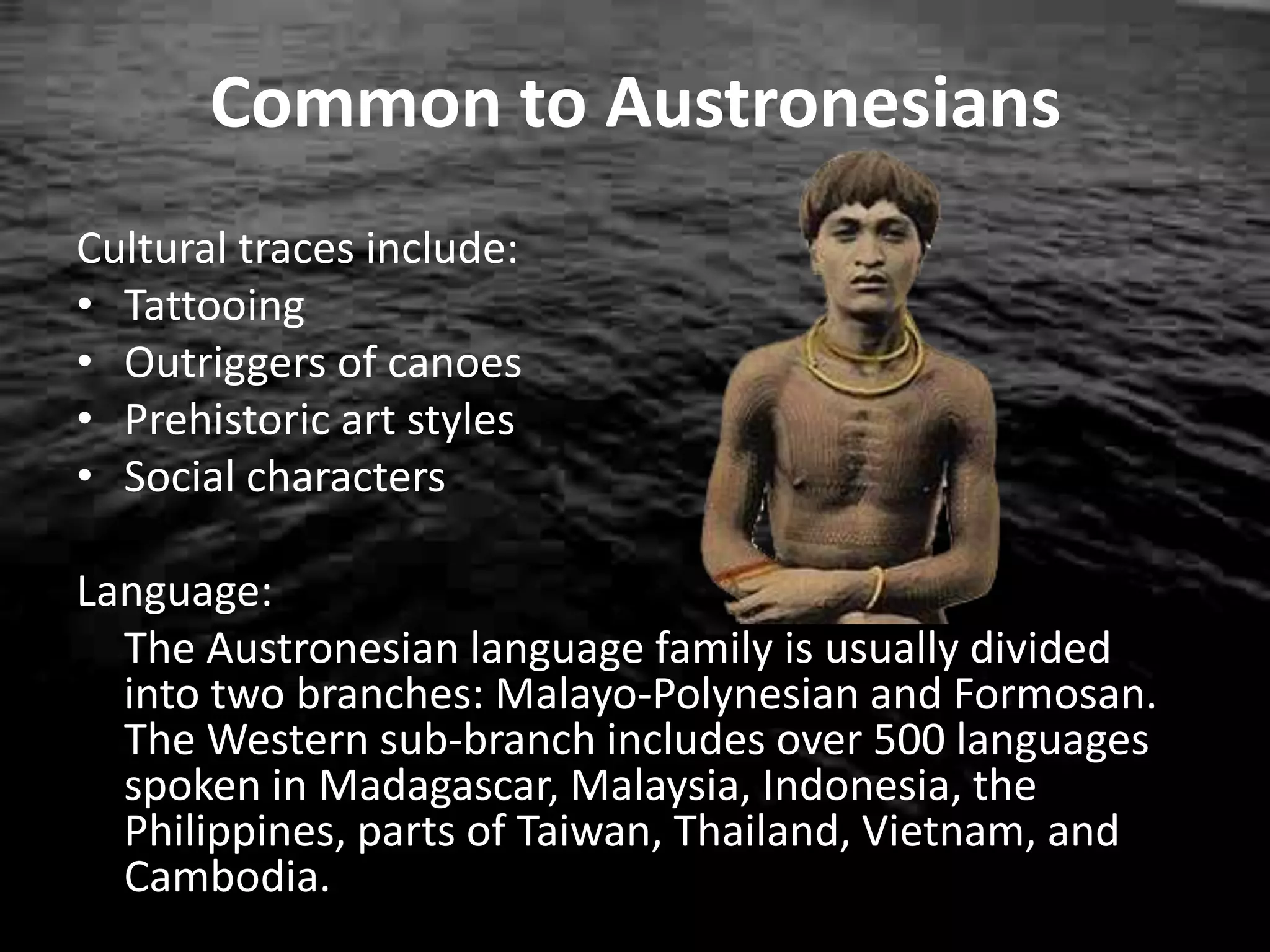
Common to Austronesians
Cultural traces include:
• Tattooing
• Outriggers of canoes
• Prehistoric art styles
• Social characters

Language:
  The Austronesian language family is usually divided
  into two branches: Malayo-Polynesian and Formosan.
  The Western sub-branch includes over 500 languages
  spoken in Madagascar, Malaysia, Indonesia, the
  Philippines, parts of Taiwan, Thailand, Vietnam, and
  Cambodia.
Prof. Otley Beyer’s
         Wave Migration Theory
According to Dr. Beyer, the
ancestors of the Filipinos
came in different "waves of
migration", as follows:
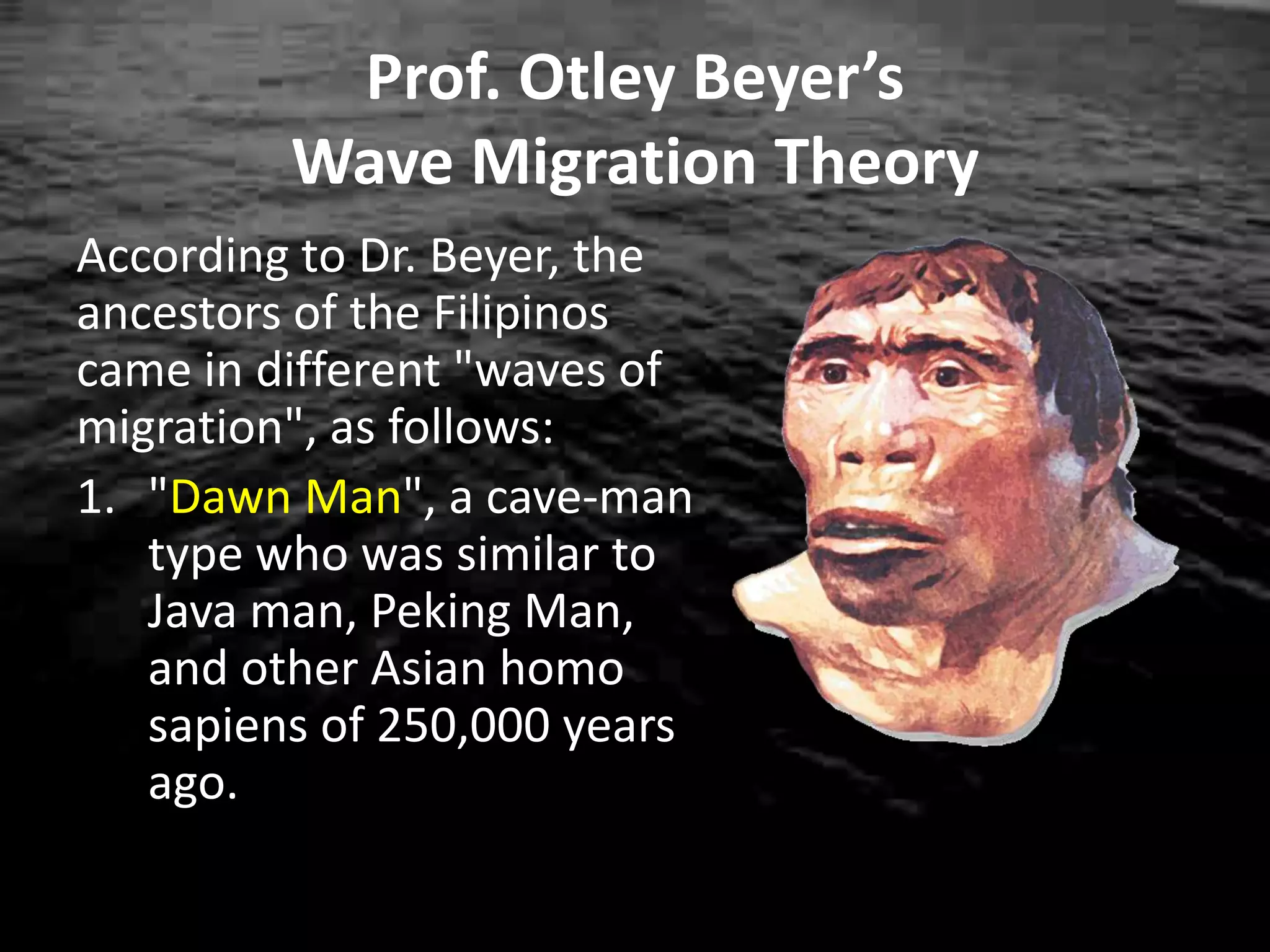
1. "Dawn Man", a cave-man
   type who was similar to
   Java man, Peking Man,
   and other Asian homo
   sapiens of 250,000 years
   ago.
Prof. Otley Beyer’s
         Wave Migration Theory
2. The aboriginal
   pygmy group, the
   Negritos, who
   arrived between
   25,000 and
   30,000 years ago
   via land bridges.
Prof. Otley Beyer’s
         Wave Migration Theory
3. The sea-faring tool-
    using Indonesian group
    who arrived about
    5,000 to 6,000 years
    ago and were the first
    immigrants to reach
    the Philippines by sea.
Prof. Otley Beyer’s
         Wave Migration Theory
4. The seafaring, more civilized Malays who
   brought the Iron age culture and were the
   real colonizers and dominant cultural group
   in the pre-Hispanic Philippines.
Jocano's theory of earlier
         evolution and movement
Anthropologist F. Landa Jocano of the University of
the Philippines contends that what fossil evidence
of ancient men show is that they not only migrated
to the Philippines, but also to New Guinea, Borneo,
and Australia. He says that there is no way of
determining if they were Negritos at all. However,
what is sure is that there is evidence the Philippines
was inhabited as early as 21,000 or 22,000 years
ago. In 1962, a skull cap and a portion of a jaw,
presumed to be those of a human being, were
found in a Tabon Cave in Palawan.
Jocano's theory of earlier
        evolution and movement
The discovery may show that man came earlier
to the Philippines than to the Malay Peninsula. If
this is true, the first inhabitants of the
Philippines did not come from the Malay
Peninsula. Jocano further believes that the
present Filipinos are products of the long
process of evolution and movement of people.
Jocano's theory of earlier
        evolution and movement


Left: Tabon man skull cap remains.
Right: Tabon cave in Palawan
Peopling of Philippines

Peopling of Philippines

  • 1.
    Presented by: DEANRUFFEL R. FLANDEZ as a requirement of the course History 211 – Early to 17th Century Philippine History
  • 2.
    Let’s go ona journey to take a glimpse of the past.
  • 4.
    No one issure when human beings started dwelling on Earth… But there were several theories that rose to answer the question.
  • 5.
    Popular Theories on Peopling the WORLD • Creationism (Biblical) • Out of Eden Theory/ Out of Africa Theory
  • 6.
    JOURNEY OF MAN (Outof Eden Theory)
  • 7.
    160k years ago,Modern man (Homo Sapiens) lived in Africa
  • 8.
  • 9.
    135k-115k, The firstexit through Nile. …but They died out because of the Ice Age, which reached up to North Africa from 115k-90k.
  • 10.
  • 11.
    85k-75k, Voyage tothe East. …super eruption of Mt. Toba in Sumatra and another Ice Age in 74k resulted to a population crash.
  • 12.
    74k-65k onwards wasthe time of repopulation. With the dramatic warming of 65k onwards, Europe and other parts of Asia was populated.
  • 13.
    40k-15k and onwards,The Americas and almost all parts of the world was also populated…. …between those times, Ice age and many natural calamities also happened that decreased the population. <see more in http://www.bradshawfoundation.com/journey/>
  • 15.
  • 16.
    The Austronesian MigrationTheory • Austronesian Migration Theory propounds on the expansion of a group of people called the Austronesians from Asia into the Pacific by means of Taiwan 6,000 years ago. It was a theory proposed by Peter Bellwood a professor of Archeology.
  • 17.
    The Austronesian MigrationTheory • The Austronesian migrations began from the Chinese mainland, reaching Taiwan first in 3500 BC then the Philippines by 3000 BC. They reached Sumatra and Java by 2000 BC, Northern New Guinea by 1600 BC, Samoa by 1200 BC, Hawaii, Easter Island, and Madagascar by 500 AD, etc.
  • 18.
    The theory largelyexplains the similarities in culture, language and physical attributes in different countries in the most Asian countries and even Madagascar. <see more in http://en.wikipilipinas.org/index.php?title=Austronesian_Migration_Theory>
  • 19.
    Common to Austronesians Culturaltraces include: • Tattooing • Outriggers of canoes • Prehistoric art styles • Social characters Language: The Austronesian language family is usually divided into two branches: Malayo-Polynesian and Formosan. The Western sub-branch includes over 500 languages spoken in Madagascar, Malaysia, Indonesia, the Philippines, parts of Taiwan, Thailand, Vietnam, and Cambodia.
  • 21.
    Prof. Otley Beyer’s Wave Migration Theory According to Dr. Beyer, the ancestors of the Filipinos came in different "waves of migration", as follows: 1. "Dawn Man", a cave-man type who was similar to Java man, Peking Man, and other Asian homo sapiens of 250,000 years ago.
  • 22.
    Prof. Otley Beyer’s Wave Migration Theory 2. The aboriginal pygmy group, the Negritos, who arrived between 25,000 and 30,000 years ago via land bridges.
  • 23.
    Prof. Otley Beyer’s Wave Migration Theory 3. The sea-faring tool- using Indonesian group who arrived about 5,000 to 6,000 years ago and were the first immigrants to reach the Philippines by sea.
  • 24.
    Prof. Otley Beyer’s Wave Migration Theory 4. The seafaring, more civilized Malays who brought the Iron age culture and were the real colonizers and dominant cultural group in the pre-Hispanic Philippines.
  • 25.
    Jocano's theory ofearlier evolution and movement Anthropologist F. Landa Jocano of the University of the Philippines contends that what fossil evidence of ancient men show is that they not only migrated to the Philippines, but also to New Guinea, Borneo, and Australia. He says that there is no way of determining if they were Negritos at all. However, what is sure is that there is evidence the Philippines was inhabited as early as 21,000 or 22,000 years ago. In 1962, a skull cap and a portion of a jaw, presumed to be those of a human being, were found in a Tabon Cave in Palawan.
  • 26.
    Jocano's theory ofearlier evolution and movement The discovery may show that man came earlier to the Philippines than to the Malay Peninsula. If this is true, the first inhabitants of the Philippines did not come from the Malay Peninsula. Jocano further believes that the present Filipinos are products of the long process of evolution and movement of people.
  • 27.
    Jocano's theory ofearlier evolution and movement Left: Tabon man skull cap remains. Right: Tabon cave in Palawan

Editor's Notes

  • #7 http://www.constablerobinson.com/images/book/small/9781841198941.jpgOut of Eden by Stephen Oppenheimer &lt;http://www.bradshawfoundation.com/journey/origins2.html&gt;
  • #16 http://abagond.files.wordpress.com/2011/02/austronesia.jpg
  • #17 &lt;http://en.wikipilipinas.org/index.php?title=Austronesian_Migration_Theory&gt;May 17,2011
  • #18 http://en.wikipilipinas.org/index.php?title=Austronesian_Migration_Theory
  • #20 May 17,2011
  • #22 Picture &lt;http://www.wpclipart.com/world_history/ancient_man/java_man.png.html&gt;May 17,2011Text &lt;http://en.wikipedia.org/wiki/Models_of_migration_to_the_Philippines&gt;May 17,2011
  • #26 Text &lt;http://en.wikipedia.org/wiki/Models_of_migration_to_the_Philippines&gt;May 17,2011
  • #27 Text &lt;http://en.wikipedia.org/wiki/Models_of_migration_to_the_Philippines&gt; May 17,2011