Online Cryptography Course                  Dan Boneh


                             Introduction

                             Course Overview


                                                 Dan Boneh
Welcome
Course objectives:
• Learn how crypto primitives work
• Learn how to use them correctly and reason about security

My recommendations:
• Take notes
• Pause video frequently to think about the material
• Answer the in-video questions

                                                              Dan Boneh
Cryptography is everywhere
Secure communication:
   – web traffic: HTTPS
   – wireless traffic: 802.11i WPA2 (and WEP), GSM, Bluetooth

Encrypting files on disk: EFS, TrueCrypt

Content protection (e.g. DVD, Blu-ray): CSS, AACS

User authentication

… and much much more
                                                                Dan Boneh
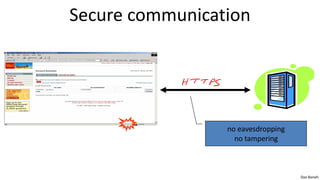
Secure communication


                 no eavesdropping
                   no tampering


                                    Dan Boneh
Secure Sockets Layer / TLS
Two main parts

   1. Handshake Protocol: Establish shared secret key
      using public-key cryptography (2nd part of course)


   2. Record Layer: Transmit data using shared secret key
        Ensure confidentiality and integrity (1st part of course)

                                                                    Dan Boneh
Protected files on disk
                          Disk


   Alice                  File 1                      Alice

                                        No eavesdropping
                                        No tampering
                          File 2


Analogous to secure communication:
      Alice today sends a message to Alice tomorrow
                                                              Dan Boneh
Building block: sym. encryption
      Alice                                         Bob
m               E(k,m)=c                        c         D(k,c)=m
        E                                           D


        k                                           k

E, D: cipher    k: secret key (e.g. 128 bits)
m, c: plaintext, ciphertext

Encryption algorithm is publicly known
   • Never use a proprietary cipher
                                                                 Dan Boneh
Use Cases
Single use key: (one time key)
    • Key is only used to encrypt one message
         • encrypted email: new key generated for every email


Multi use key: (many time key)
  • Key used to encrypt multiple messages
         • encrypted files: same key used to encrypt many files
   • Need more machinery than for one-time key
                                                                  Dan Boneh
Things to remember
Cryptography is:
   – A tremendous tool
   – The basis for many security mechanisms

Cryptography is not:
   – The solution to all security problems
   – Reliable unless implemented and used properly
   – Something you should try to invent yourself
        • many many examples of broken ad-hoc designs

                                                        Dan Boneh
End of Segment


                 Dan Boneh
Online Cryptography Course                     Dan Boneh


                              Introduction

                             What is cryptography?


                                                     Dan Boneh
Crypto core                 Talking
                            to Bob
                                                                       Talking
                                                                       to Alice


Secret key establishment:      Alice
                                                                          Bob


                                          attacker???


Secure communication:          k                   m1
                                                                          k
                                                   m2
                                       confidentiality and integrity
                                                                              Dan Boneh
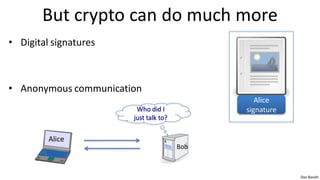
But crypto can do much more
• Digital signatures


• Anonymous communication
                                                Alice
                        Who did I            signature
                       just talk to?


         Alice
                                       Bob


                                                         Dan Boneh
But crypto can do much more
• Digital signatures


• Anonymous communication

• Anonymous digital cash
   – Can I spend a “digital coin” without anyone knowing who I am?
   – How to prevent double spending?
                                                                     Who was
                              1$       Alice                          that?
                                                 Internet
                                               (anon. comm.)
                                                                               Dan Boneh
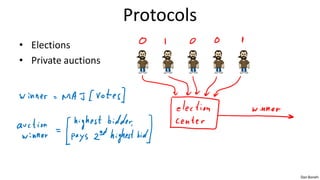
Protocols
• Elections
• Private auctions


                                 Dan Boneh
Protocols
• Elections
• Private auctions


                                         trusted
Goal: compute f(x1, x2, x3, x4)         authority

“Thm:” anything that can done with trusted auth. can also
       be done without

• Secure multi-party computation
                                                            Dan Boneh
Crypto magic
• Privately outsourcing computation                                   What did she
                                                                      search for?
                   search
                   query                         E[ query ]
                              Alice

                                                 E[ results ]
                   results

• Zero knowledge (proof of knowledge)
                                                                ???


                Alice         I know the factors of N !!
   N=p∙q                                                                        N
                                      proof π                         Bob
                                                                                     Dan Boneh
A rigorous science
The three steps in cryptography:

• Precisely specify threat model

• Propose a construction

• Prove that breaking construction under
  threat mode will solve an underlying hard problem

                                                      Dan Boneh
End of Segment


                 Dan Boneh
Online Cryptography Course                    Dan Boneh


                               Introduction

                             History


                                                   Dan Boneh
History

David Kahn, “The code breakers” (1996)


                                         Dan Boneh
Symmetric Ciphers


                    Dan Boneh
Few Historic Examples     (all badly broken)

1. Substitution cipher


                         k :=


                                                Dan Boneh
Caesar Cipher   (no key)


                           Dan Boneh
What is the size of key space in the substitution cipher
assuming 26 letters?


                                                           Dan Boneh
How to break a substitution cipher?

What is the most common letter in English text?

       “X”
       “L”
       “E”
       “H”

                                                  Dan Boneh
How to break a substitution cipher?

(1)    Use frequency of English letters


(2)    Use frequency of pairs of letters (digrams)


                                                     Dan Boneh
An Example
UKBYBIPOUZBCUFEEBORUKBYBHOBBRFESPVKBWFOFERVNBCVBZPRUBOFERVNBCVBPCYYFVUFO
FEIKNWFRFIKJNUPWRFIPOUNVNIPUBRNCUKBEFWWFDNCHXCYBOHOPYXPUBNCUBOYNRVNIWN
CPOJIOFHOPZRVFZIXUBORJRUBZRBCHNCBBONCHRJZSFWNVRJRUBZRPCYZPUKBZPUNVPWPCYVF
ZIXUPUNFCPWRVNBCVBRPYYNUNFCPWWJUKBYBIPOUZBCUIPOUNVNIPUBRNCHOPYXPUBNCUB
OYNRVNIWNCPOJIOFHOPZRNCRVNBCUNENVVFZIXUNCHPCYVFZIXUPUNFCPWZPUKBZPUNVR


 B   36      E             NC   11      IN            UKB    6      THE
 N 34                       PU   10      AT            RVN    6
 U 33        T             UB   10                      FZI   4
 P   32      A             UN   9                      trigrams
 C   26                    digrams
                                                                            Dan Boneh
2. Vigener cipher                   (16’th century, Rome)


k =    C R Y P T O C R Y P T O C R Y P T
                                                               (+ mod 26)
m =   W H A T A N I C E D A Y T O D A Y

c =   Z Z Z J U C L U D T U N W G C Q S


 suppose most common = “H”   first letter of key = “H” – “E” = “C”
                                                                       Dan Boneh
3. Rotor Machines                (1870-1943)


Early example: the Hebern machine (single rotor)


   A               K     E    N
   B               S     K    E
   C               T     S    K
   .               .     T    S
   .               .     .    T
   X               R     .    .
   Y               N     R    .
   Z      key      E     N    R

                                                        Dan Boneh
Rotor Machines                      (cont.)

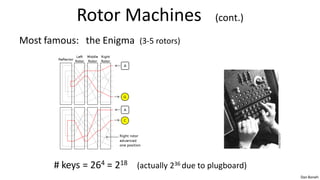
Most famous: the Enigma (3-5 rotors)


       # keys = 264 = 218 (actually 236 due to plugboard)
                                                            Dan Boneh
4. Data Encryption Standard                                  (1974)


DES:     # keys = 256 , block size = 64 bits


Today:    AES (2001), Salsa20 (2008)       (and many others)


                                                                        Dan Boneh
End of Segment


                 Dan Boneh
Online Cryptography Course                                                           Dan Boneh

    See also:   http://en.wikibooks.org/High_School_Mathematics_Extensions/Discrete_Probability


                                            Introduction

                                      Discrete Probability
                                      (crash course, cont.)

                                                                                              Dan Boneh
U: finite set (e.g. U = {0,1}n )

Def: Probability distribution P over U is a function P: U ⟶ [0,1]
       such that        Σ P(x) = 1
                       x∈U


Examples:
1. Uniform distribution:         for all x∈U: P(x) = 1/|U|
2. Point distribution at x0: P(x0) = 1, ∀x≠x0: P(x) = 0


Distribution vector:    (   P(000), P(001), P(010), … , P(111)   )   Dan Boneh
Events
• For a set A ⊆ U:        Pr[A] =   Σ P(x)
                                    x∈A
                                             ∈ [0,1]

                                                       note: Pr[U]=1
• The set A is called an event

Example:     U = {0,1}8
• A = { all x in U such that lsb2(x)=11      }   ⊆U

       for the uniform distribution on {0,1}8 : Pr[A] = 1/4

                                                                       Dan Boneh
The union bound
• For events A1 and A2
                 Pr[ A1 ∪ A2 ] ≤ Pr[A1] + Pr[A2]

                                                       A1
                                                                     A2
Example:
 A1 = { all x in {0,1}n s.t lsb2(x)=11   } ;   A2 = { all x in {0,1}n s.t. msb2(x)=11   }

 Pr[ lsb2(x)=11 or msb2(x)=11 ] = Pr[A1∪A2] ≤ ¼+¼ = ½
                                                                                    Dan Boneh
Random Variables
Def: a random variable X is a function      X:U⟶V

Example: X: {0,1}n ⟶ {0,1} ;         X(y) = lsb(y) ∈{0,1}
                                                       U             V
For the uniform distribution on U:
                                                      lsb=0               0
       Pr[ X=0 ] = 1/2   ,   Pr[ X=1 ] = 1/2
                                                      lsb=1                1

More generally:
  rand. var. X induces a distribution on V:    Pr[ X=v ] := Pr[ X-1(v) ]
                                                                         Dan Boneh
The uniform random variable
Let U be some set, e.g. U = {0,1}n

We write r ⟵ U to denote a uniform random variable over U
            R


       for all a∈U:   Pr[ r = a ] = 1/|U|


( formally, r is the identity function: r(x)=x for all x∈U )

                                                               Dan Boneh
Let r be a uniform random variable on {0,1}2

Define the random variable X = r1 + r2


Then   Pr[X=2] = ¼


       Hint:   Pr[X=2] = Pr[ r=11 ]

                                               Dan Boneh
Randomized algorithms
                                              inputs   outputs
• Deterministic algorithm:   y ⟵ A(m)

                                               m
• Randomized algorithm                                  A(m)

      y ⟵ A( m ; r ) where r ⟵ {0,1}n
                             R


   output is a random variable
              y ⟵ A( m )
                R                              m
                                                        A(m)


Example: A(m ; k) = E(k, m) ,    y ⟵ A( m )
                                   R
                                                           Dan Boneh
End of Segment


                 Dan Boneh
Online Cryptography Course                                                           Dan Boneh

    See also:   http://en.wikibooks.org/High_School_Mathematics_Extensions/Discrete_Probability


                                            Introduction

                                      Discrete Probability
                                      (crash course, cont.)

                                                                                              Dan Boneh
Recap
U: finite set (e.g. U = {0,1}n )

Prob. distr. P over U is a function P: U ⟶ [0,1] s.t.    Σ P(x) = 1
                                                         x∈U

A ⊆ U is called an event   and     Pr[A] =   Σ P(x)
                                             x∈A
                                                      ∈ [0,1]


A random variable is a function X:U⟶V .
       X takes values in V and defines a distribution on V

                                                                      Dan Boneh
Independence
Def: events A and B are independent if Pr[ A and B ] = Pr*A+ ∙ Pr[B]
       random variables X,Y taking values in V are independent if
       ∀a,b∈V: Pr[ X=a and Y=b] = Pr[X=a] ∙ Pr[Y=b]

                     2
Example:    U = {0,1} = {00, 01, 10, 11}    and   r⟵U
                                                   R


  Define r.v. X and Y as:   X = lsb(r) ,   Y = msb(r)

       Pr[ X=0 and Y=0 ] = Pr[ r=00 ] = ¼ = Pr[X=0] ∙ Pr[Y=0]
                                                                  Dan Boneh
Review: XOR
XOR of two strings in {0,1}n is their bit-wise addition mod 2


                                      0 1 1 0 1 1 1
                                                           ⊕
                                      1 0 1 1 0 1 0


                                                                Dan Boneh
An important property of XOR
Thm: Y a rand. var. over {0,1}n , X an indep. uniform var. on {0,1}n
       Then Z := Y⨁X is uniform var. on {0,1}n

Proof: (for n=1)
  Pr[ Z=0 ] =


                                                                  Dan Boneh
The birthday paradox
Let r1, …, rn ∈ U be indep. identically distributed random vars.

Thm: when    n= 1.2 × |U|1/2     then Pr[ ∃i≠j: ri = rj ] ≥ ½

                                           notation: |U| is the size of U


Example:      Let U = {0,1}128

       After sampling about 264 random messages from U,
       some two sampled messages will likely be the same
                                                                            Dan Boneh
|U|=106
   collision probability


                           # samples n
                                         Dan Boneh
End of Segment


                 Dan Boneh

File+upload+test

  • 1.
    Online Cryptography Course Dan Boneh Introduction Course Overview Dan Boneh
  • 2.
    Welcome Course objectives: • Learnhow crypto primitives work • Learn how to use them correctly and reason about security My recommendations: • Take notes • Pause video frequently to think about the material • Answer the in-video questions Dan Boneh
  • 3.
    Cryptography is everywhere Securecommunication: – web traffic: HTTPS – wireless traffic: 802.11i WPA2 (and WEP), GSM, Bluetooth Encrypting files on disk: EFS, TrueCrypt Content protection (e.g. DVD, Blu-ray): CSS, AACS User authentication … and much much more Dan Boneh
  • 4.
    Secure communication no eavesdropping no tampering Dan Boneh
  • 5.
    Secure Sockets Layer/ TLS Two main parts 1. Handshake Protocol: Establish shared secret key using public-key cryptography (2nd part of course) 2. Record Layer: Transmit data using shared secret key Ensure confidentiality and integrity (1st part of course) Dan Boneh
  • 6.
    Protected files ondisk Disk Alice File 1 Alice No eavesdropping No tampering File 2 Analogous to secure communication: Alice today sends a message to Alice tomorrow Dan Boneh
  • 7.
    Building block: sym.encryption Alice Bob m E(k,m)=c c D(k,c)=m E D k k E, D: cipher k: secret key (e.g. 128 bits) m, c: plaintext, ciphertext Encryption algorithm is publicly known • Never use a proprietary cipher Dan Boneh
  • 8.
    Use Cases Single usekey: (one time key) • Key is only used to encrypt one message • encrypted email: new key generated for every email Multi use key: (many time key) • Key used to encrypt multiple messages • encrypted files: same key used to encrypt many files • Need more machinery than for one-time key Dan Boneh
  • 9.
    Things to remember Cryptographyis: – A tremendous tool – The basis for many security mechanisms Cryptography is not: – The solution to all security problems – Reliable unless implemented and used properly – Something you should try to invent yourself • many many examples of broken ad-hoc designs Dan Boneh
  • 10.
    End of Segment Dan Boneh
  • 11.
    Online Cryptography Course Dan Boneh Introduction What is cryptography? Dan Boneh
  • 12.
    Crypto core Talking to Bob Talking to Alice Secret key establishment: Alice Bob attacker??? Secure communication: k m1 k m2 confidentiality and integrity Dan Boneh
  • 13.
    But crypto cando much more • Digital signatures • Anonymous communication Alice Who did I signature just talk to? Alice Bob Dan Boneh
  • 14.
    But crypto cando much more • Digital signatures • Anonymous communication • Anonymous digital cash – Can I spend a “digital coin” without anyone knowing who I am? – How to prevent double spending? Who was 1$ Alice that? Internet (anon. comm.) Dan Boneh
  • 15.
  • 16.
    Protocols • Elections • Privateauctions trusted Goal: compute f(x1, x2, x3, x4) authority “Thm:” anything that can done with trusted auth. can also be done without • Secure multi-party computation Dan Boneh
  • 17.
    Crypto magic • Privatelyoutsourcing computation What did she search for? search query E[ query ] Alice E[ results ] results • Zero knowledge (proof of knowledge) ??? Alice I know the factors of N !! N=p∙q N proof π Bob Dan Boneh
  • 18.
    A rigorous science Thethree steps in cryptography: • Precisely specify threat model • Propose a construction • Prove that breaking construction under threat mode will solve an underlying hard problem Dan Boneh
  • 19.
    End of Segment Dan Boneh
  • 20.
    Online Cryptography Course Dan Boneh Introduction History Dan Boneh
  • 21.
    History David Kahn, “Thecode breakers” (1996) Dan Boneh
  • 22.
  • 23.
    Few Historic Examples (all badly broken) 1. Substitution cipher k := Dan Boneh
  • 24.
    Caesar Cipher (no key) Dan Boneh
  • 25.
    What is thesize of key space in the substitution cipher assuming 26 letters? Dan Boneh
  • 26.
    How to breaka substitution cipher? What is the most common letter in English text? “X” “L” “E” “H” Dan Boneh
  • 27.
    How to breaka substitution cipher? (1) Use frequency of English letters (2) Use frequency of pairs of letters (digrams) Dan Boneh
  • 28.
  • 29.
    2. Vigener cipher (16’th century, Rome) k = C R Y P T O C R Y P T O C R Y P T (+ mod 26) m = W H A T A N I C E D A Y T O D A Y c = Z Z Z J U C L U D T U N W G C Q S suppose most common = “H” first letter of key = “H” – “E” = “C” Dan Boneh
  • 30.
    3. Rotor Machines (1870-1943) Early example: the Hebern machine (single rotor) A K E N B S K E C T S K . . T S . . . T X R . . Y N R . Z key E N R Dan Boneh
  • 31.
    Rotor Machines (cont.) Most famous: the Enigma (3-5 rotors) # keys = 264 = 218 (actually 236 due to plugboard) Dan Boneh
  • 32.
    4. Data EncryptionStandard (1974) DES: # keys = 256 , block size = 64 bits Today: AES (2001), Salsa20 (2008) (and many others) Dan Boneh
  • 33.
    End of Segment Dan Boneh
  • 34.
    Online Cryptography Course Dan Boneh See also: http://en.wikibooks.org/High_School_Mathematics_Extensions/Discrete_Probability Introduction Discrete Probability (crash course, cont.) Dan Boneh
  • 35.
    U: finite set(e.g. U = {0,1}n ) Def: Probability distribution P over U is a function P: U ⟶ [0,1] such that Σ P(x) = 1 x∈U Examples: 1. Uniform distribution: for all x∈U: P(x) = 1/|U| 2. Point distribution at x0: P(x0) = 1, ∀x≠x0: P(x) = 0 Distribution vector: ( P(000), P(001), P(010), … , P(111) ) Dan Boneh
  • 36.
    Events • For aset A ⊆ U: Pr[A] = Σ P(x) x∈A ∈ [0,1] note: Pr[U]=1 • The set A is called an event Example: U = {0,1}8 • A = { all x in U such that lsb2(x)=11 } ⊆U for the uniform distribution on {0,1}8 : Pr[A] = 1/4 Dan Boneh
  • 37.
    The union bound •For events A1 and A2 Pr[ A1 ∪ A2 ] ≤ Pr[A1] + Pr[A2] A1 A2 Example: A1 = { all x in {0,1}n s.t lsb2(x)=11 } ; A2 = { all x in {0,1}n s.t. msb2(x)=11 } Pr[ lsb2(x)=11 or msb2(x)=11 ] = Pr[A1∪A2] ≤ ¼+¼ = ½ Dan Boneh
  • 38.
    Random Variables Def: arandom variable X is a function X:U⟶V Example: X: {0,1}n ⟶ {0,1} ; X(y) = lsb(y) ∈{0,1} U V For the uniform distribution on U: lsb=0 0 Pr[ X=0 ] = 1/2 , Pr[ X=1 ] = 1/2 lsb=1 1 More generally: rand. var. X induces a distribution on V: Pr[ X=v ] := Pr[ X-1(v) ] Dan Boneh
  • 39.
    The uniform randomvariable Let U be some set, e.g. U = {0,1}n We write r ⟵ U to denote a uniform random variable over U R for all a∈U: Pr[ r = a ] = 1/|U| ( formally, r is the identity function: r(x)=x for all x∈U ) Dan Boneh
  • 40.
    Let r bea uniform random variable on {0,1}2 Define the random variable X = r1 + r2 Then Pr[X=2] = ¼ Hint: Pr[X=2] = Pr[ r=11 ] Dan Boneh
  • 41.
    Randomized algorithms inputs outputs • Deterministic algorithm: y ⟵ A(m) m • Randomized algorithm A(m) y ⟵ A( m ; r ) where r ⟵ {0,1}n R output is a random variable y ⟵ A( m ) R m A(m) Example: A(m ; k) = E(k, m) , y ⟵ A( m ) R Dan Boneh
  • 42.
    End of Segment Dan Boneh
  • 43.
    Online Cryptography Course Dan Boneh See also: http://en.wikibooks.org/High_School_Mathematics_Extensions/Discrete_Probability Introduction Discrete Probability (crash course, cont.) Dan Boneh
  • 44.
    Recap U: finite set(e.g. U = {0,1}n ) Prob. distr. P over U is a function P: U ⟶ [0,1] s.t. Σ P(x) = 1 x∈U A ⊆ U is called an event and Pr[A] = Σ P(x) x∈A ∈ [0,1] A random variable is a function X:U⟶V . X takes values in V and defines a distribution on V Dan Boneh
  • 45.
    Independence Def: events Aand B are independent if Pr[ A and B ] = Pr*A+ ∙ Pr[B] random variables X,Y taking values in V are independent if ∀a,b∈V: Pr[ X=a and Y=b] = Pr[X=a] ∙ Pr[Y=b] 2 Example: U = {0,1} = {00, 01, 10, 11} and r⟵U R Define r.v. X and Y as: X = lsb(r) , Y = msb(r) Pr[ X=0 and Y=0 ] = Pr[ r=00 ] = ¼ = Pr[X=0] ∙ Pr[Y=0] Dan Boneh
  • 46.
    Review: XOR XOR oftwo strings in {0,1}n is their bit-wise addition mod 2 0 1 1 0 1 1 1 ⊕ 1 0 1 1 0 1 0 Dan Boneh
  • 47.
    An important propertyof XOR Thm: Y a rand. var. over {0,1}n , X an indep. uniform var. on {0,1}n Then Z := Y⨁X is uniform var. on {0,1}n Proof: (for n=1) Pr[ Z=0 ] = Dan Boneh
  • 48.
    The birthday paradox Letr1, …, rn ∈ U be indep. identically distributed random vars. Thm: when n= 1.2 × |U|1/2 then Pr[ ∃i≠j: ri = rj ] ≥ ½ notation: |U| is the size of U Example: Let U = {0,1}128 After sampling about 264 random messages from U, some two sampled messages will likely be the same Dan Boneh
  • 49.
    |U|=106 collision probability # samples n Dan Boneh
  • 50.
    End of Segment Dan Boneh