WORK IN PROGRESS | PRIVATE USE ONLY


             Basics of Cryptography

             An Introduction to Theory of
                     Cryptography


10/29/2012        © 2012, C.J. Dedduwage, University of Colombo                 1
Section I

   BASIC TERMINOLOGY AND CONCEPTS


               © 2012, C.J. Dedduwage, University of
10/29/2012                                             2
                             Colombo
Terminology
• A Message (M) is a crucial piece of information
• Sender (S) is the party that originates the message
• Recipient (R) is the intended party of receipt for M
• The medium through which M is sent, is called Transmission
  Medium (T)
• Usually this involves a Computer System (or System), composed of
  hardware, software and data
• A Vulnerability is a weakness in the security of the system
• An Attack is an exploitation of a vulnerability, by an Intruder
  (human/machine) who perpetrates (commonly an Outsider O)


    10/29/2012        © 2012, C.J. Dedduwage, University of Colombo   3
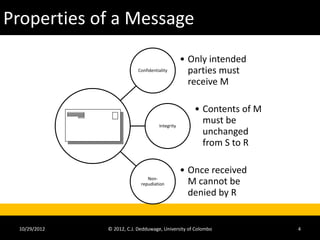
Properties of a Message
                                                 • Only intended
                           Confidentiality         parties must
                                                   receive M

                                                    • Contents of M
                                     Integrity
                                                      must be
                                                      unchanged
                                                      from S to R

                                                 • Once received
                               Non-
                            repudiation            M cannot be
                                                   denied by R


 10/29/2012   © 2012, C.J. Dedduwage, University of Colombo           4
Main Types of Attack
1. Interception
  – Listening to the message while it passes from S to R
  – Does not stop R from getting the message M
  – Causes loss of confidentiality of message M
2. Interruption / Blocking
  – Prevents R from getting message M
  – Causes loss of availability of message M


 10/29/2012       © 2012, C.J. Dedduwage, University of Colombo   5
Main Types of Attack
 3. Modification
      – Alteration of the contents of message M
      – R does not receive the original M sent by S
      – Causes loss of integrity of message M
 4. Fabrication
      – R receives an authentic-looking message, as if it was
        originated by S
      – Causes loss of integrity of message M
Closely related but different scenario is denial of M by S—called repudiation

     10/29/2012                 © 2012, C.J. Dedduwage, University of Colombo   6
Requirements for a Successful Attack
 • Method: tools, knowledge, skills
 • Opportunity: time and access to resources
 • Motivation: a reason to conduct the attack

 • If any of these are denied, attack would not occur
 • But all three lie with the intruder, not system
 • Not practical to target and eliminate these
Method–Opportunity–Motivation: MOM

    10/29/2012             © 2012, C.J. Dedduwage, University of Colombo   7
Control of Attacks
• Control is the means by which an attack is
  stopped / prevented

• Stops a vulnerability from becoming an attack

• Control is a part of the system and is under our
  influence


  10/29/2012     © 2012, C.J. Dedduwage, University of Colombo   8
Cryptology, Cryptography & Cryptanalysis

• Cryptography is the science of (overt) secret
  writing, and its unauthorized decryption
• Cryptology = cryptography + cryptanalysis
• Cryptography is the science of overt secret
  writing
• Cryptanalysis is the science of unauthorized
  decryption of an encrypted message


  10/29/2012     © 2012, C.J. Dedduwage, University of Colombo   9
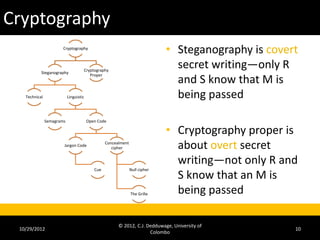
Cryptography
                       Cryptography
                                                                             • Steganography is covert
           Steganography
                                    Cryptography
                                                                               secret writing—only R
                                                                               and S know that M is
                                       Proper


   Technical               Linguistic                                          being passed
               Semagrams                Open Code

                                                                             • Cryptography proper is
                       Jargon Code
                                                 Concealment
                                                    cipher                     about overt secret
                                                                               writing—not only R and
                                                                               S know that an M is
                                           Cue                 Null cipher


                                                               The Grille      being passed

                                                       © 2012, C.J. Dedduwage, University of
 10/29/2012                                                                                          10
                                                                     Colombo
Section II

   MATHEMATICS OF CRYPTOGRAPHY


                © 2012, C.J. Dedduwage, University of
10/29/2012                                              11
                              Colombo
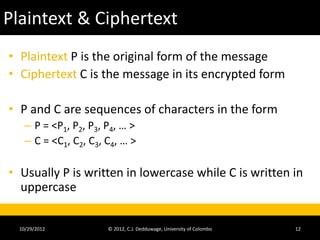
Plaintext & Ciphertext
• Plaintext P is the original form of the message
• Ciphertext C is the message in its encrypted form

• P and C are sequences of characters in the form
    – P = <P1, P2, P3, P4, … >
    – C = <C1, C2, C3, C4, … >

• Usually P is written in lowercase while C is written in
  uppercase

  10/29/2012           © 2012, C.J. Dedduwage, University of Colombo   12
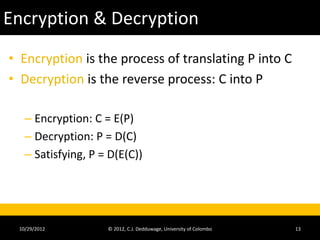
Encryption & Decryption
• Encryption is the process of translating P into C
• Decryption is the reverse process: C into P

   – Encryption: C = E(P)
   – Decryption: P = D(C)
   – Satisfying, P = D(E(C))


 10/29/2012         © 2012, C.J. Dedduwage, University of Colombo   13
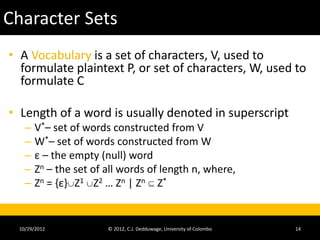
Character Sets
• A Vocabulary is a set of characters, V, used to
  formulate plaintext P, or set of characters, W, used to
  formulate C

• Length of a word is usually denoted in superscript
    –   V*– set of words constructed from V
    –   W*– set of words constructed from W
    –   ε – the empty (null) word
    –   Zn – the set of all words of length n, where,
    –   Zn = {ε}Z1 Z2 … Zn | Zn  Z*


  10/29/2012            © 2012, C.J. Dedduwage, University of Colombo   14
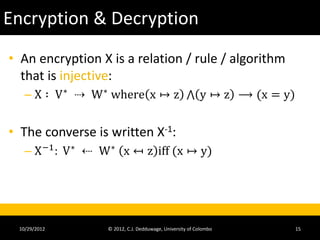
Encryption & Decryption
• An encryption X is a relation / rule / algorithm

   – X ∶ V ∗ ⇢ W ∗ where x ↦ z ⋀ y ↦ z ⟶ (x = y)
  that is injective:


   – X −1 : V ∗ ⇠ W ∗ x ↤ z iff (x ↦ y)
• The converse is written X-1:


 10/29/2012        © 2012, C.J. Dedduwage, University of Colombo   15
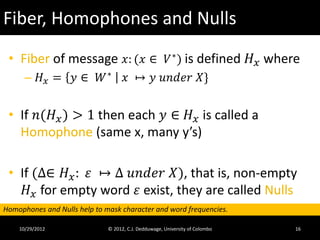
Fiber, Homophones and Nulls
 • Fiber of message 𝑥: (𝑥 ∈ 𝑉 ∗ ) is defined 𝐻 𝑥 where
      – 𝐻 𝑥 = 𝑦 ∈ 𝑊∗                 𝑥 ↦ 𝑦 𝑢𝑢𝑢𝑢𝑢 𝑋}


 • If 𝑛(𝐻 𝑥 ) > 1 then each 𝑦 ∈ 𝐻 𝑥 is called a
   Homophone (same x, many y’s)

 • If (∆∈ 𝐻 𝑥 : 𝜀 ↦ ∆ 𝑢𝑢𝑢𝑢𝑢 𝑋), that is, non-empty
    𝐻 𝑥 for empty word 𝜀 exist, they are called Nulls
Homophones and Nulls help to mask character and word frequencies.

    10/29/2012                © 2012, C.J. Dedduwage, University of Colombo   16
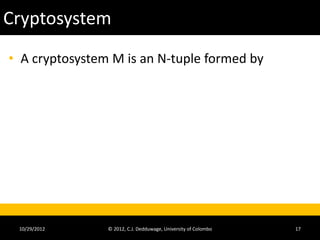
Cryptosystem
• A cryptosystem M is an N-tuple formed by


 10/29/2012     © 2012, C.J. Dedduwage, University of Colombo   17
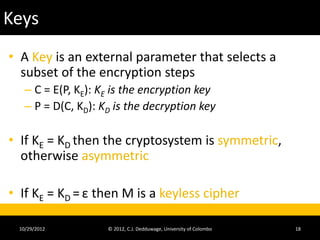
Keys
• A Key is an external parameter that selects a
  subset of the encryption steps
   – C = E(P, KE): KE is the encryption key
   – P = D(C, KD): KD is the decryption key

• If KE = KD then the cryptosystem is symmetric,
  otherwise asymmetric

• If KE = KD = ε then M is a keyless cipher

 10/29/2012         © 2012, C.J. Dedduwage, University of Colombo   18
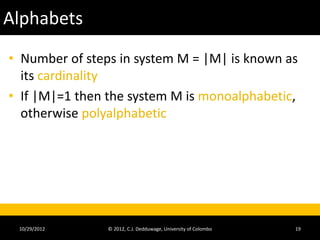
Alphabets
• Number of steps in system M = |M| is known as
  its cardinality
• If |M|=1 then the system M is monoalphabetic,
  otherwise polyalphabetic


 10/29/2012     © 2012, C.J. Dedduwage, University of Colombo   19
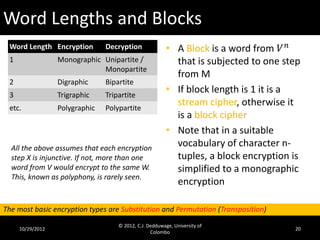
Word Lengths and Blocks
 Word Length Encryption         Decryption               • A Block is a word from 𝑉 𝑛
 1                Monographic Unipartite /                 that is subjected to one step
                              Monopartite
                                                           from M
 2                Digraphic     Bipartite
 3                Trigraphic    Tripartite
                                                         • If block length is 1 it is a
 etc.             Polygraphic   Polypartite
                                                           stream cipher, otherwise it
                                                           is a block cipher
                                                         • Note that in a suitable
  All the above assumes that each encryption
                                                           vocabulary of character n-
  step X is injunctive. If not, more than one              tuples, a block encryption is
  word from V would encrypt to the same W.                 simplified to a monographic
  This, known as polyphony, is rarely seen.
                                                           encryption

The most basic encryption types are Substitution and Permutation (Transposition)
                                    © 2012, C.J. Dedduwage, University of
     10/29/2012                                                                       20
                                                  Colombo
Section III

   CRYPTANALYSIS


                 © 2012, C.J. Dedduwage, University of
10/29/2012                                               21
                               Colombo

Introduction to cryptography

  • 1.
    WORK IN PROGRESS| PRIVATE USE ONLY Basics of Cryptography An Introduction to Theory of Cryptography 10/29/2012 © 2012, C.J. Dedduwage, University of Colombo 1
  • 2.
    Section I BASIC TERMINOLOGY AND CONCEPTS © 2012, C.J. Dedduwage, University of 10/29/2012 2 Colombo
  • 3.
    Terminology • A Message(M) is a crucial piece of information • Sender (S) is the party that originates the message • Recipient (R) is the intended party of receipt for M • The medium through which M is sent, is called Transmission Medium (T) • Usually this involves a Computer System (or System), composed of hardware, software and data • A Vulnerability is a weakness in the security of the system • An Attack is an exploitation of a vulnerability, by an Intruder (human/machine) who perpetrates (commonly an Outsider O) 10/29/2012 © 2012, C.J. Dedduwage, University of Colombo 3
  • 4.
    Properties of aMessage • Only intended Confidentiality parties must receive M • Contents of M Integrity must be unchanged from S to R • Once received Non- repudiation M cannot be denied by R 10/29/2012 © 2012, C.J. Dedduwage, University of Colombo 4
  • 5.
    Main Types ofAttack 1. Interception – Listening to the message while it passes from S to R – Does not stop R from getting the message M – Causes loss of confidentiality of message M 2. Interruption / Blocking – Prevents R from getting message M – Causes loss of availability of message M 10/29/2012 © 2012, C.J. Dedduwage, University of Colombo 5
  • 6.
    Main Types ofAttack 3. Modification – Alteration of the contents of message M – R does not receive the original M sent by S – Causes loss of integrity of message M 4. Fabrication – R receives an authentic-looking message, as if it was originated by S – Causes loss of integrity of message M Closely related but different scenario is denial of M by S—called repudiation 10/29/2012 © 2012, C.J. Dedduwage, University of Colombo 6
  • 7.
    Requirements for aSuccessful Attack • Method: tools, knowledge, skills • Opportunity: time and access to resources • Motivation: a reason to conduct the attack • If any of these are denied, attack would not occur • But all three lie with the intruder, not system • Not practical to target and eliminate these Method–Opportunity–Motivation: MOM 10/29/2012 © 2012, C.J. Dedduwage, University of Colombo 7
  • 8.
    Control of Attacks •Control is the means by which an attack is stopped / prevented • Stops a vulnerability from becoming an attack • Control is a part of the system and is under our influence 10/29/2012 © 2012, C.J. Dedduwage, University of Colombo 8
  • 9.
    Cryptology, Cryptography &Cryptanalysis • Cryptography is the science of (overt) secret writing, and its unauthorized decryption • Cryptology = cryptography + cryptanalysis • Cryptography is the science of overt secret writing • Cryptanalysis is the science of unauthorized decryption of an encrypted message 10/29/2012 © 2012, C.J. Dedduwage, University of Colombo 9
  • 10.
    Cryptography Cryptography • Steganography is covert Steganography Cryptography secret writing—only R and S know that M is Proper Technical Linguistic being passed Semagrams Open Code • Cryptography proper is Jargon Code Concealment cipher about overt secret writing—not only R and S know that an M is Cue Null cipher The Grille being passed © 2012, C.J. Dedduwage, University of 10/29/2012 10 Colombo
  • 11.
    Section II MATHEMATICS OF CRYPTOGRAPHY © 2012, C.J. Dedduwage, University of 10/29/2012 11 Colombo
  • 12.
    Plaintext & Ciphertext •Plaintext P is the original form of the message • Ciphertext C is the message in its encrypted form • P and C are sequences of characters in the form – P = <P1, P2, P3, P4, … > – C = <C1, C2, C3, C4, … > • Usually P is written in lowercase while C is written in uppercase 10/29/2012 © 2012, C.J. Dedduwage, University of Colombo 12
  • 13.
    Encryption & Decryption •Encryption is the process of translating P into C • Decryption is the reverse process: C into P – Encryption: C = E(P) – Decryption: P = D(C) – Satisfying, P = D(E(C)) 10/29/2012 © 2012, C.J. Dedduwage, University of Colombo 13
  • 14.
    Character Sets • AVocabulary is a set of characters, V, used to formulate plaintext P, or set of characters, W, used to formulate C • Length of a word is usually denoted in superscript – V*– set of words constructed from V – W*– set of words constructed from W – ε – the empty (null) word – Zn – the set of all words of length n, where, – Zn = {ε}Z1 Z2 … Zn | Zn  Z* 10/29/2012 © 2012, C.J. Dedduwage, University of Colombo 14
  • 15.
    Encryption & Decryption •An encryption X is a relation / rule / algorithm – X ∶ V ∗ ⇢ W ∗ where x ↦ z ⋀ y ↦ z ⟶ (x = y) that is injective: – X −1 : V ∗ ⇠ W ∗ x ↤ z iff (x ↦ y) • The converse is written X-1: 10/29/2012 © 2012, C.J. Dedduwage, University of Colombo 15
  • 16.
    Fiber, Homophones andNulls • Fiber of message 𝑥: (𝑥 ∈ 𝑉 ∗ ) is defined 𝐻 𝑥 where – 𝐻 𝑥 = 𝑦 ∈ 𝑊∗ 𝑥 ↦ 𝑦 𝑢𝑢𝑢𝑢𝑢 𝑋} • If 𝑛(𝐻 𝑥 ) > 1 then each 𝑦 ∈ 𝐻 𝑥 is called a Homophone (same x, many y’s) • If (∆∈ 𝐻 𝑥 : 𝜀 ↦ ∆ 𝑢𝑢𝑢𝑢𝑢 𝑋), that is, non-empty 𝐻 𝑥 for empty word 𝜀 exist, they are called Nulls Homophones and Nulls help to mask character and word frequencies. 10/29/2012 © 2012, C.J. Dedduwage, University of Colombo 16
  • 17.
    Cryptosystem • A cryptosystemM is an N-tuple formed by 10/29/2012 © 2012, C.J. Dedduwage, University of Colombo 17
  • 18.
    Keys • A Keyis an external parameter that selects a subset of the encryption steps – C = E(P, KE): KE is the encryption key – P = D(C, KD): KD is the decryption key • If KE = KD then the cryptosystem is symmetric, otherwise asymmetric • If KE = KD = ε then M is a keyless cipher 10/29/2012 © 2012, C.J. Dedduwage, University of Colombo 18
  • 19.
    Alphabets • Number ofsteps in system M = |M| is known as its cardinality • If |M|=1 then the system M is monoalphabetic, otherwise polyalphabetic 10/29/2012 © 2012, C.J. Dedduwage, University of Colombo 19
  • 20.
    Word Lengths andBlocks Word Length Encryption Decryption • A Block is a word from 𝑉 𝑛 1 Monographic Unipartite / that is subjected to one step Monopartite from M 2 Digraphic Bipartite 3 Trigraphic Tripartite • If block length is 1 it is a etc. Polygraphic Polypartite stream cipher, otherwise it is a block cipher • Note that in a suitable All the above assumes that each encryption vocabulary of character n- step X is injunctive. If not, more than one tuples, a block encryption is word from V would encrypt to the same W. simplified to a monographic This, known as polyphony, is rarely seen. encryption The most basic encryption types are Substitution and Permutation (Transposition) © 2012, C.J. Dedduwage, University of 10/29/2012 20 Colombo
  • 21.
    Section III CRYPTANALYSIS © 2012, C.J. Dedduwage, University of 10/29/2012 21 Colombo