Promoting Your Cause:Promoting Your Cause:
From Mission to MessageFrom Mission to Message
Facilitator Guide
Professional Development Training Program
 
Facilitator Guide1
Promoting Your Cause:
From Mission To Message
By Zephryn Conte
Facilitator Guide
Facilitator Guide
Promoting Your Cause: From Mission To Message
2
PROMOTING YOUR CAUSE: FROM MISSION TO MESSAGE
Written by: Zephryn Conte
The contents of this publication were developed with funds allocated by The Corporation for National and Community
Service (CNCS) to the Arizona Governor’s Commission on Service and Volunteerism, Governor’s Office of Children,
Youth and Families (GOCYF). The contents do not necessarily represent the policy of the agency, nor should
endorsement by the CNCS be assumed.
SPECIAL THANKS TO:
Environarts, Inc.® Consulting, a professional development resource for best practices in education and training, for
contributing copyrighted participant handouts and training methodologies used throughout this program. (See Page
67 for more information about Environarts programs and services.)
ACKNOWLEDGEMENTS:
John Rosenbum – for his initial work in developing the concept, the training manual, and piloting the concept
Bill Suedmeyer – for his second round of rethinking the concept and for his revision of the pilot training manual
Andrew Doty – for his round of edits on the revised pilot training manual
Linda Devore – for proof reading the final draft of this publication
e-Media Services – and Joan Hale for graphic design and layout
Comcast - for sponsoring the production of the publication
Zephryn Conte and Environarts, Inc.®
– for breathing new life and depth into this major conceptual rework and
rewrite of the final published manual.
About The Author:
Zephryn Conte, owner of Environarts, Inc.®
, is a nationally published author and educator with over fifteen years
of professional development, training and community program experience. Expert in inter-group relations, conflict
resolution, stress management and applied creative arts, she has implemented short and long-term national and
local programs that build leadership and promote personal and organizational growth.
© 2012 All rights reserved:
Reprinting & Usage:
Reproductions of this book may be printed exclusively for the purpose of program training and for use by program
facilitators. Participant handouts may be reproduced solely for instructional use in the "Promoting Your Cause: From
Mission To Message" training program and must retain all copyright and contact information included on each page.
No parts of this book or related participant handouts may be sold, reprinted or used out of context without written
permission.
Environarts, Inc. ®
Facilitator Guide3
Preface / Dedication
The intention of this project is to provide a tool for organizations to help
increase outreach and impact. This work is dedicated to all of those
visionaries at all levels and in all positions that do so much for our country,
our states, our communities, and our citizens.
Facilitator Guide
Promoting Your Cause: From Mission To Message
4
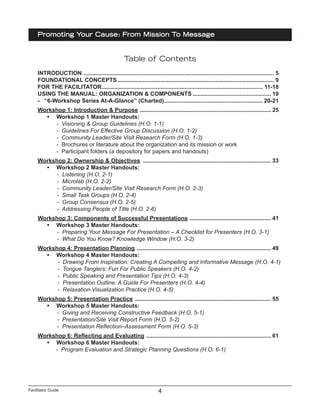
Table of Contents
INTRODUCTION ........................................................................................................................ 5
FOUNDATIONAL CONCEPTS................................................................................................... 9
FOR THE FACILITATOR...................................................................................................... 11-18
USING THE MANUAL: ORGANIZATION & COMPONENTS.................................................. 19
- “6-Workshop Series At-A-Glance” (Charted)............................................................... 20-21
Workshop 1: Introduction & Purpose ................................................................................... 25
•	 Workshop 1 Master Handouts:
- Visioning & Group Guidelines (H.O. 1-1)
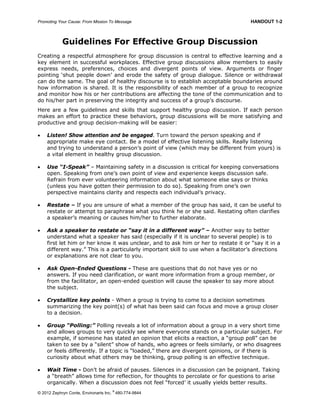
- Guidelines For Effective Group Discussion (H.O. 1-2)
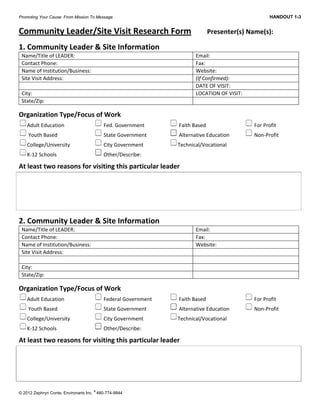
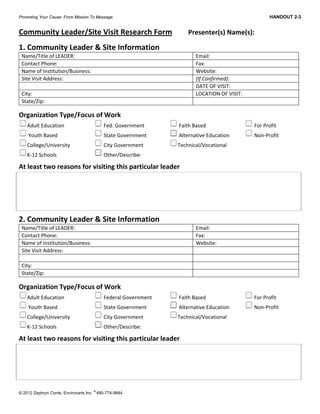
- Community Leader/Site Visit Research Form (H.O. 1-3)
- Brochures or literature about the organization and its mission or work
- Participant folders (a depository for papers and handouts)
Workshop 2: Ownership & Objectives ................................................................................. 33
•	 Workshop 2 Master Handouts:
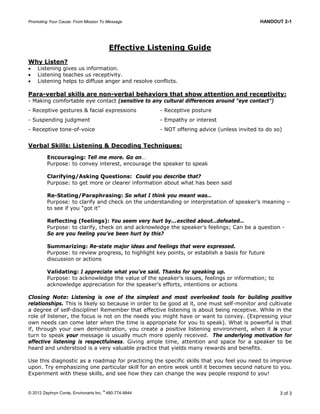
- Listening (H.O. 2-1)
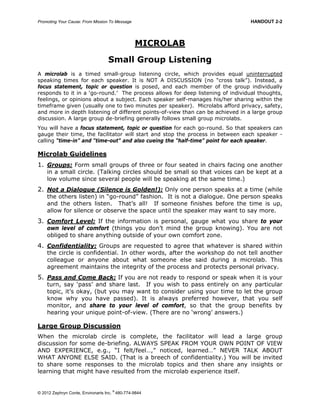
- Microlab (H.O. 2-2)
- Community Leader/Site Visit Research Form (H.O. 2-3)
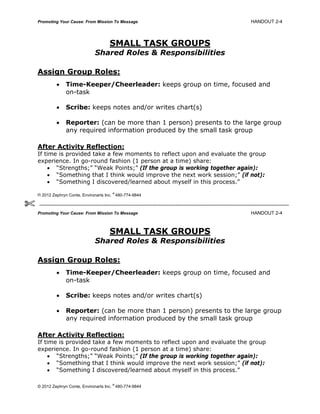
- Small Task Groups (H.O. 2-4)
- Group Consensus (H.O. 2-5)
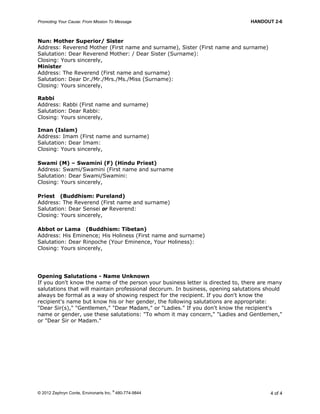
- Addressing People of Title (H.O. 2-6)
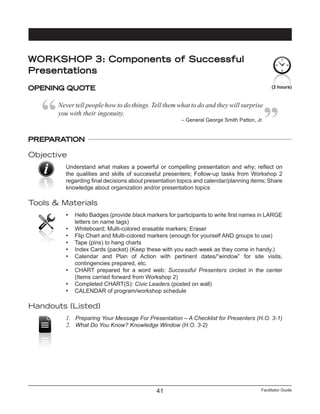
	Workshop 3: Components of Successful Presentations .................................................... 41
•	 Workshop 3 Master Handouts:
- Preparing Your Message For Presentation – A Checklist for Presenters (H.O. 3-1)
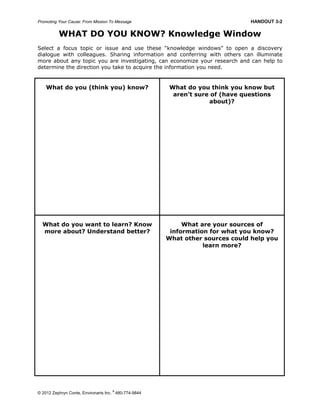
- What Do You Know? Knowledge Window (H.O. 3-2)
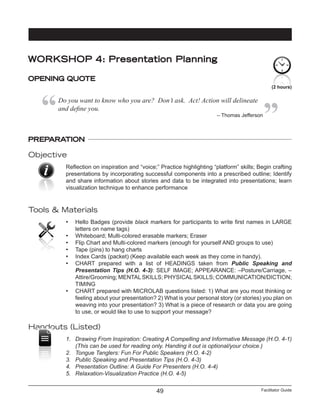
Workshop 4: Presentation Planning ..................................................................................... 49
•	 Workshop 4 Master Handouts:
- Drawing From Inspiration: Creating A Compelling and Informative Message (H.O. 4-1)
- Tongue Tanglers: Fun For Public Speakers (H.O. 4-2)
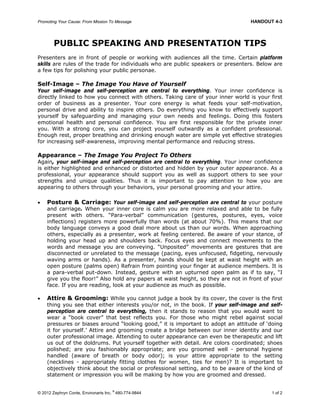
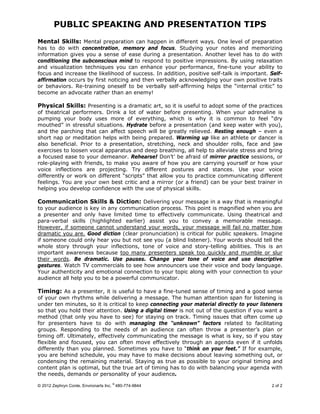
- Public Speaking and Presentation Tips (H.O. 4-3)
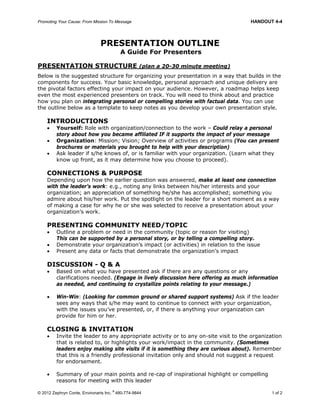
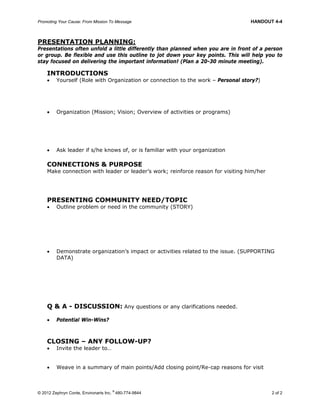
- Presentation Outline: A Guide For Presenters (H.O. 4-4)
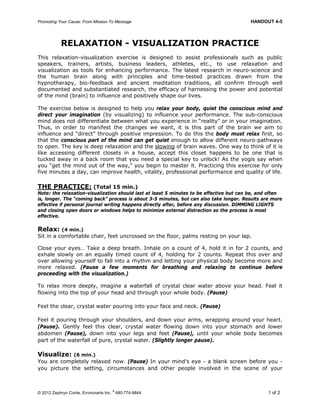
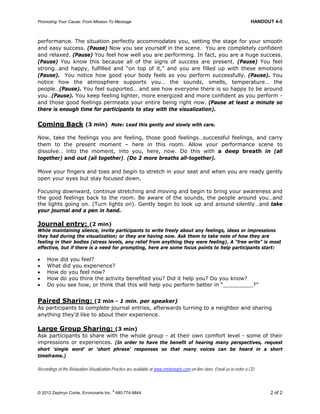
- Relaxation-Visualization Practice (H.O. 4-5)
	Workshop 5: Presentation Practice ...................................................................................... 55
•	 Workshop 5 Master Handouts:
- Giving and Receiving Constructive Feedback (H.O. 5-1)
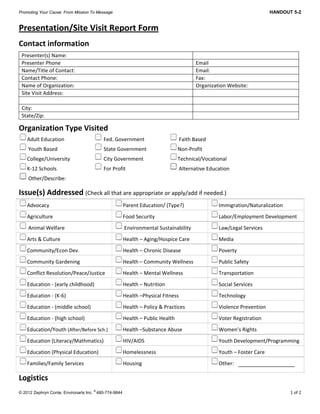
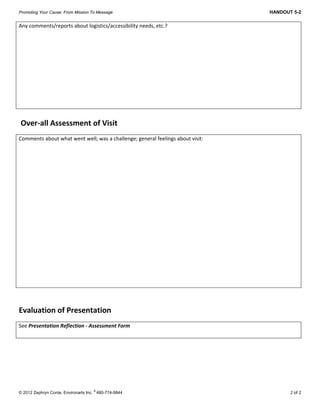
- Presentation/Site Visit Report Form (H.O. 5-2)
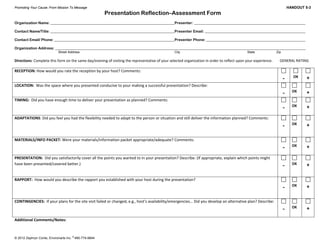
- Presentation Reflection–Assessment Form (H.O. 5-3)
Workshop 6: Reflecting and Evaluating ............................................................................... 61
•	 Workshop 6 Master Handouts:
- Program Evaluation and Strategic Planning Questions (H.O. 6-1)
Facilitator Guide5
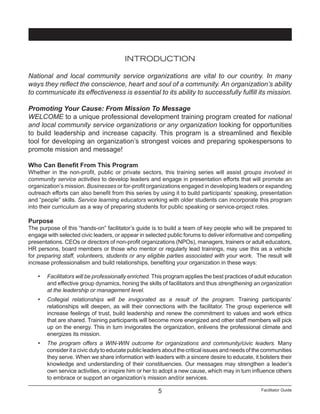
INTRODUCTION
National and local community service organizations are vital to our country. In many
ways they reflect the conscience, heart and soul of a community. An organization’s ability
to communicate its effectiveness is essential to its ability to successfully fulfill its mission.
Promoting Your Cause: From Mission To Message
WELCOME to a unique professional development training program created for national
and local community service organizations or any organization looking for opportunities
to build leadership and increase capacity. This program is a streamlined and flexible
tool for developing an organization’s strongest voices and preparing spokespersons to
promote mission and message!
Who Can Benefit From This Program
Whether in the non-profit, public or private sectors, this training series will assist groups involved in
community service activities to develop leaders and engage in presentation efforts that will promote an
organization’s mission. Businesses or for-profit organizations engaged in developing leaders or expanding
outreach efforts can also benefit from this series by using it to build participants’ speaking, presentation
and “people” skills. Service learning educators working with older students can incorporate this program
into their curriculum as a way of preparing students for public speaking or service-project roles.
Purpose
The purpose of this “hands-on” facilitator’s guide is to build a team of key people who will be prepared to
engage with selected civic leaders, or appear in selected public forums to deliver informative and compelling
presentations. CEOs or directors of non-profit organizations (NPOs), managers, trainers or adult educators,
HR persons, board members or those who mentor or regularly lead trainings, may use this as a vehicle
for preparing staff, volunteers, students or any eligible parties associated with your work. The result will
increase professionalism and build relationships, benefiting your organization in these ways:
•	 Facilitators will be professionally enriched. This program applies the best practices of adult education
and effective group dynamics, honing the skills of facilitators and thus strengthening an organization
at the leadership or management level.
•	 Collegial relationships will be invigorated as a result of the program. Training participants’
relationships will deepen, as will their connections with the facilitator. The group experience will
increase feelings of trust, build leadership and renew the commitment to values and work ethics
that are shared. Training participants will become more energized and other staff members will pick
up on the energy. This in turn invigorates the organization, enlivens the professional climate and
energizes its mission.
•	 The program offers a WIN-WIN outcome for organizations and community/civic leaders. Many
consideritacivicdutytoeducatepublicleadersaboutthecriticalissuesandneedsofthecommunities
they serve. When we share information with leaders with a sincere desire to educate, it bolsters their
knowledge and understanding of their constituencies. Our messages may strengthen a leader’s
own service activities, or inspire him or her to adopt a new cause, which may in turn influence others
to embrace or support an organization’s mission and/or services.
Facilitator Guide
Promoting Your Cause: From Mission To Message
6
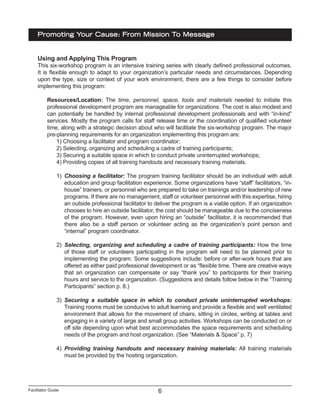
Using and Applying This Program
This six-workshop program is an intensive training series with clearly defined professional outcomes.
It is flexible enough to adapt to your organization’s particular needs and circumstances. Depending
upon the type, size or context of your work environment, there are a few things to consider before
implementing this program:
Resources/Location: The time, personnel, space, tools and materials needed to initiate this
professional development program are manageable for organizations. The cost is also modest and
can potentially be handled by internal professional development professionals and with “in-kind”
services. Mostly the program calls for staff release time or the coordination of qualified volunteer
time, along with a strategic decision about who will facilitate the six-workshop program. The major
pre-planning requirements for an organization implementing this program are:
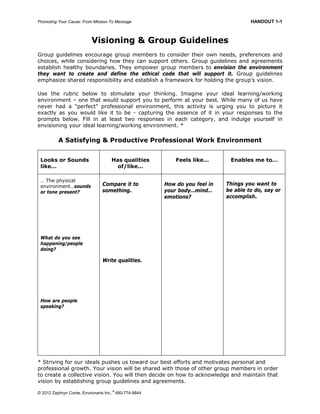
1) Choosing a facilitator and program coordinator;
2) Selecting, organizing and scheduling a cadre of training participants;
3) Securing a suitable space in which to conduct private uninterrupted workshops;
4) Providing copies of all training handouts and necessary training materials.
1)	 Choosing a facilitator: The program training facilitator should be an individual with adult
education and group facilitation experience. Some organizations have “staff” facilitators, “in-
house” trainers, or personnel who are prepared to take on trainings and/or leadership of new
programs. If there are no management, staff or volunteer personnel with this expertise, hiring
an outside professional facilitator to deliver the program is a viable option. If an organization
chooses to hire an outside facilitator, the cost should be manageable due to the conciseness
of the program. However, even upon hiring an “outside” facilitator, it is recommended that
there also be a staff person or volunteer acting as the organization’s point person and
“internal” program coordinator.
2)	 Selecting, organizing and scheduling a cadre of training participants: How the time
of those staff or volunteers participating in the program will need to be planned prior to
implementing the program. Some suggestions include: before or after-work hours that are
offered as either paid professional development or as “flexible time. There are creative ways
that an organization can compensate or say “thank you” to participants for their training
hours and service to the organization. (Suggestions and details follow below in the “Training
Participants” section p. 8.)
3)	 Securing a suitable space in which to conduct private uninterrupted workshops:
Training rooms must be conducive to adult learning and provide a flexible and well ventilated
environment that allows for the movement of chairs, sitting in circles, writing at tables and
engaging in a variety of large and small group activities. Workshops can be conducted on or
off site depending upon what best accommodates the space requirements and scheduling
needs of the program and host organization. (See “Materials & Space” p. 7)
4)	 Providing training handouts and necessary training materials: All training materials
must be provided by the hosting organization.
Facilitator Guide7
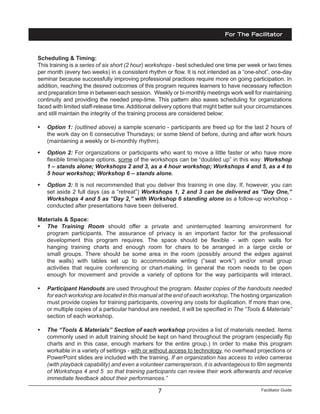
Scheduling & Timing:
This training is a series of six short (2 hour) workshops - best scheduled one time per week or two times
per month (every two weeks) in a consistent rhythm or flow. It is not intended as a “one-shot”, one-day
seminar because successfully improving professional practices require more on going participation. In
addition, reaching the desired outcomes of this program requires learners to have necessary reflection
and preparation time in between each session. Weekly or bi-monthly meetings work well for maintaining
continuity and providing the needed prep-time. This pattern also eases scheduling for organizations
faced with limited staff-release time.Additional delivery options that might better suit your circumstances
and still maintain the integrity of the training process are considered below:
•	 Option 1: (outlined above) a sample scenario - participants are freed up for the last 2 hours of
the work day on 6 consecutive Thursdays; or some blend of before, during and after work hours
(maintaining a weekly or bi-monthly rhythm).
•	 Option 2: For organizations or participants who want to move a little faster or who have more
flexible time/space options, some of the workshops can be “doubled up” in this way: Workshop
1 – stands alone; Workshops 2 and 3, as a 4 hour workshop; Workshops 4 and 5, as a 4 to
5 hour workshop; Workshop 6 – stands alone.
•	 Option 3: It is not recommended that you deliver this training in one day. If, however, you can
set aside 2 full days (as a “retreat”) Workshops 1, 2 and 3 can be delivered as “Day One,”
Workshops 4 and 5 as “Day 2,” with Workshop 6 standing alone as a follow-up workshop -
conducted after presentations have been delivered.
Materials & Space:
•	 The Training Room should offer a private and uninterrupted learning environment for
program participants. The assurance of privacy is an important factor for the professional
development this program requires. The space should be flexible - with open walls for
hanging training charts and enough room for chairs to be arranged in a large circle or
small groups. There should be some area in the room (possibly around the edges against
the walls) with tables set up to accommodate writing (“seat work”) and/or small group
activities that require conferencing or chart-making. In general the room needs to be open
enough for movement and provide a variety of options for the way participants will interact.
•	 Participant Handouts are used throughout the program. Master copies of the handouts needed
for each workshop are located in this manual at the end of each workshop. The hosting organization
must provide copies for training participants, covering any costs for duplication. If more than one,
or multiple copies of a particular handout are needed, it will be specified in The “Tools & Materials”
section of each workshop.
•	 The “Tools & Materials” Section of each workshop provides a list of materials needed. Items
commonly used in adult training should be kept on hand throughout the program (especially flip
charts and in this case, enough markers for the entire group.) In order to make this program
workable in a variety of settings - with or without access to technology, no overhead projections or
PowerPoint slides are included with the training. If an organization has access to video cameras
(with playback capability) and even a volunteer cameraperson, it is advantageous to film segments
of Workshops 4 and 5 so that training participants can review their work afterwards and receive
immediate feedback about their performances.”
For The Facilitator
Facilitator Guide
Promoting Your Cause: From Mission To Message
8
Training Participants:
Effective professional development builds the capacity of an organization by promoting
leadership. The more leaders available to promote and deliver compelling presentations about an
organization’s work, the more an organization’s toolkit broadens. Once you have offered this program
for the first time, and see its value and/or the results, you may consider repeating it (offering it more
than one time) as an on-going professional development opportunity. Repeating the training program
will build capacity “cumulatively,” and increase the value of training efforts. An ideal group size for this
program is up to 10 people. If you wish to exceed that, cap the group size at 16, otherwise there is a
risk of reducing the quality of the training’s impact and as a result, potentially diminishing the success
of desired outcomes.
Begin with a cadre of training participants from among your most talented or interested staff and
or volunteers. You want motivated participants, so recruiting methods that work best are generally
those that emphasize ‘a great professional growth opportunity,’ and stimulate interest or buy-in that
is positively motivated. (Drafting is the least desirable recruiting method). * Here are a few ideas to
start you thinking about ways to recruit a motivated group of training participants:
•	 Select a group based on performance excellence; gather them; tell them about what you have
in mind, and see who says “yes.”
•	 Send out an attractive invitation (sign up/RSVP invitation) describing the attributes you are
looking for, and see who self-selects.
•	 Approach it as a “contest” involving the entire staff, board members and/or volunteers. Explain
the opportunity and the qualities that participants should possess. Then ask staff, board
members or volunteers to elect individuals that they think make talented prospects. (This
is one way to include everyone and stimulate general knowledge and involvement in the
program, which is useful for attracting future participants.)
•	 Train the entire staff, board members and/or volunteers and see who emerges as the most
talented leaders best equipped to carry out program initiatives. This approach benefits the
entire community with the same professional development experience and opportunities to
grow through the training process. (The practicality of this approach depends upon the size of
the group and whether time and space can be arranged to accommodate it.)
* A ‘thank you’ from the organization is a nice way to show appreciation to those who come forward as
leaders. Stipends or overtime payments are one option, or social incentives like dinners, gift cards, etc.
are great ways to value professional initiative.
Take a “train-the-trainer” approach and be looking for leaders or potential leaders who might emerge
as facilitators of the program. Only those who have been through the program should be selected as
facilitators (unless they are professional trainers). The more that this series can be “turn-keyed” within the
organization the more you build your organization’s strength.
Facilitator Guide9
FOUNDATIONAL CONCEPTS
Active Citizenship
Edmond Burke (1729-1797) was an Irish statesman, author and political theorist who, after moving to
England, served for many years in England’s House of Commons. He was remembered for supporting
the cause of the American revolutionaries, and his view about the role of an elected representative sets
the stage for “active citizenship.”
“... it ought to be the happiness and glory of a representative to live in the strictest union, the closest
correspondence, and the most unreserved communication with his constituents. Their wishes ought to
have great weight with him; their opinion, high respect; their business, unmerited attention. It is his duty
to sacrifice his repose, his pleasures, his satisfactions, to theirs; and above all, ever, and in all cases, to
prefer their interest to his own…” - The Works of the Right Honorable Edmund Burke. Volume I. London:
Henry G. Bohn. 1854. pp. 446–8.
Communicating with our elected or civic leaders to let them know about conditions within our community
is valuable and is regarded by many as a civic duty. The law denotes citizenship as a link between an
individual and a state, viewed internationally as our “nationality.” Citizenship status, grants us certain
rights or ethical principles of freedom (legal and social entitlements). Citizenship status also brings
responsibilities, which are our moral, or ethical obligations. Out rights are often clearer to us because they
are written down as part of law, like the right to political participation; to vote; to receive certain protections.
But responsibilities are not as well defined, and so opinions differ as to our civic responsibilities. A good
example is voting. In America we live in a “liberal representative democracy,” a form of government
founded on the principle of freely elected individuals representing a group – their “constituency.” Not all
representative democracies value or respect individual liberties as in ours (a notion stemming from the
concepts of one of our “founding Fathers,” Thomas Jefferson known as “Jeffersonian” Democracy), and
so voting in free elections and having a vote on who represents us and passes laws, or makes policy
decisions that will affect our lives is seen by many as one of our primary responsibilities as Americans.
Yet, because voting it is not compulsory. For any variety of reasons, many do not vote nor view voting
as a civic responsibility.
Active citizenship is the philosophy that citizens are actively involved in working to better their communities.
After all, if a body merits rights and protections to the people, shouldn’t those people uphold certain
responsibilities? The debate over rights versus responsibilities comes to light in the concept of active
citizenship, which implies that an active citizen fulfills both his/her rights and responsibilities equally. Active
citizenship defines some of our responsibilities as: volunteering service or donating to organizations that help
the poor, needy, hungry, disenfranchised, etc.; conservation or eco-friendly activities (recycling); supporting
educational causes; faith-based initiatives; even the volunteering of high-level professional expertise in
such areas as banking, engineering, education and technology. “Citizenship education” is taught in some
schools worldwide, often in response to the declining numbers of young people who are voting. In America
we have an educational movement called “Service-Learning” which links clear academic learning goals with
the development of student generated community-based service projects.
As you think about what your organization is doing to serve your community, consider how you can
communicate its vitality and impact to your civic or community leaders. Thomas Jefferson felt strongly
about the role of the people as the “sole and safe depository of all power, principles and opinions”
Foundational Concepts
Facilitator Guide
Promoting Your Cause: From Mission To Message
10
(paraphrased) to direct the Government. A Frenchman Alexis de Tocqueville (1805-1859) was another
19th century European political thinker and historian who was best known for the book he wrote after
touring America, Democracy In America (New York: A. S. Barnes & Co., 1851). He observed the power of
volunteer efforts to motivate change (paraphrased): Our real power as a people comes through voluntary
associations. Our personal freedoms would be protected if we could voluntarily resolve the problems of
society, rather than permit the heavy hand of government to do it for us. Keep in mind the importance of
your voice and be inspired by the power of exercising both your rights and responsibilities as a citizen.
The Link With “Service-Learning”
“Service-Learning” is an experiential teaching and learning practice that focuses on specific academic
goals while offering students real opportunities to provide community services that meet genuine needs.
Service-learning projects create a much needed link between “real life” and learning, as students become
more invested in their communities and contribute services that offer direct aid. Service-learning education
as a form of “active citizenship” begins with very young children, continuing through high school and into
college years. This active and engaged learning process helps young people to grow individually and
socially as they experience and interpret what it means to be a “responsible citizen” in a “free and civil
society.” Many students report being deeply touched by their service-learning experiences, which has
a reciprocal effect on communities that more readily view their youth as assets. The whole experience
grooms young people in positive ways and develops them into adults who will more directly appreciate
the value of living in a compassionate and caring society.
The “Service-Learning Cycle” is the process by which service-learning programs are developed in
classroom settings. As a sound educational model the cycle is used as a loose framework for this training
series, and is correlated with the workshop objectives (learning outcomes) of each workshop in the
program (See: 6-Workshop Series At-A-Glance on pages 20-21). This correlation should assist any
service-learning educators interested in integrating or using any parts of this work in their programs to do
so with greater ease.
Differentiating Between “Education” and “Advocacy”
For those who may be visiting elected officials, it is important to clarify the difference between education
and advocacy (political lobbying). This is a particularly important distinction for most service organizations,
which are generally prohibited from influencing legislation in any way, or participating in or endorsing political
events or activities. The type of presentation you’ll be developing in this training program is intended to be
educational and informational only. A good way to define this is that “education” about a program is fact-
based and position neutral. It is considered “education” if a presentation is informational and focuses on
a topic directly related to your organization’s work. Examples like handing out materials to the public or
hosting an informational site visit and inviting an elected official, are considered education, as long as the
topics presented focus on your work. “Advocating” on the other hand, would be if you were (educating in
a way that was) taking a position, promoting a cause, or demonstrating an attempt to persuade a political
party to take a particular action or to vote in a particular way. Additionally, staying away from events that
could appear partisan in nature is always recommended in order to avoid any confusion around advocacy.
Facilitator Guide11
FOR THE FACILITATOR
Facilitation is making something easier, moving something forward, or assisting someone’s or something’s
progress. If you are delivering this training you are likely in a leadership role within your organization.
Whether you’re a director, manager, supervisor, board member, volunteer facilitator, HR staff member
or even the president of a small NPO, consider this question: Is taking on the role of facilitator stepping
you out of your comfort zone or customary “leadership personae?” If so, this is an opportunity to adopt
more of a coach or mentor approach. The “art” of facilitation is the ability to effectively and affirmatively
navigate and guide people along their own paths of skill building paths. One of your greatest assets in
this regard, is your willingness to reassure with a smile!
Below are brief explanations of some of the group dynamic concepts and strategies employed throughout
this training series. If you maintain these as standards of practice, you will optimize your success. These
highlights will replace lengthy “notes to the facilitator” in the body of each workshop (too cumbersome to
read while facilitating a group) so they are important for you to read, absorb and refer to when needed,
as guideposts for facilitating this program.
Group Dynamics & Consensus Building
Groups have personalities just like people do, and facilitators deal with both at the same time! Group
dynamics - the correlation between human needs, inspiration, motivation and performance - are important
factors in winning a group’s trust and successfully moving them along their learning continuum toward a
desired goal. When a group trusts a facilitator, much more effective work is accomplished.
In a group, individuals need to be seen and heard; (some more than others…) and all voices are important
to the overall enrichment of a group’s learning. The key is to “even the playing field” by utilizing strategies
that create clear guidelines and equitable parameters that allow both shy and bold personalities to be
heard. In this way, no one is left out nor dominates, because there is a “comfort level” built in to procedures,
which allows every one to find their “zone.” Once comfort or safety is established, people more freely
participate - and even then, facilitators must continue to maintain “equanimity” with group dynamics so
that no one person or group dominates. This over-all awareness regarding “neutrality” is an important
aspect of a facilitator’s role within the group dynamic.
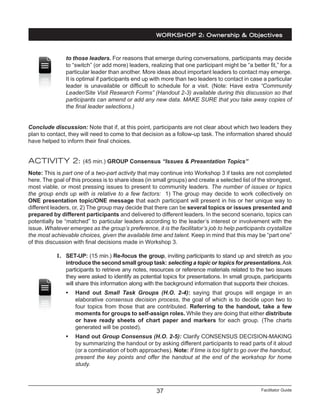
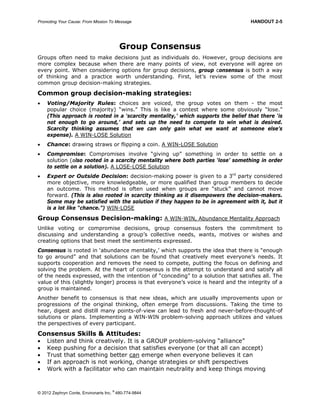
Groups involved in projects often have to make decisions, just as individuals do. Group decision-making
is more of a challenge however, because with many points of view, not everyone will agree on every point.
This is why consensus building is a very important strategy for facilitators, and consensus decision-making
is a concept that needs to be clarified for groups to understand. Here are a few of the most commonly used
group decision-making practices:
•	 Voting/Majority Rules: choices are voiced, the group votes on them - the most popular choice
(majority) “wins.” This is like a contest with someone obviously “losing.”
•	 Chance: a decision is made by drawing straws or flipping a coin
•	 Compromise: a compromise decision involves an agreement to “give up” something that is wanted
in order to settle on a solution the entire group can accept
For The Facilitator
Facilitator Guide
Promoting Your Cause: From Mission To Message
12
Group Consensus: Unlike voting or compromise decisions, group consensus calls for a greater
commitment to discussing and elaborating upon a group’s needs or wants. This is done with the intention
of creating the best options for meeting those needs or wants. In a group consensus, all members of the
group “concede” to a solution that each person can either agree with, or agree to “live with.” The value
of this (slightly longer) process is that everyone’s voice is heard and both individual and group integrity
is maintained.
Correlation Between Needs & Motivation
Psychologists generally acknowledge that our needs are the critical element underlying all healthy
development and learning. This dynamic doesn’t change when we are adults. Our human needs are
“intrinsic,” and are the underlying force driving our feelings and actions, coloring our judgments or
assessments of situations, and influencing our relationships and our ability to learn. Four main areas of
human psychological need include:
•	 Safety (Intellectual/Emotional/Physical)
•	 Belonging/Inclusion
•	 Empowerment/Control/Influence
•	 Pleasure/Freedom/Creativity
A key foundational concept for group facilitators is understanding the correlation between meeting needs
and inspiring self-motivation. When learners’ underlying needs are successfully met or supported, their
internal motivation increases. The most effective way to achieve sustained improvements in behavior,
skill or performance is by inspiring an inner desire. A facilitator’s craft with adult learners is to accomplish
this in ways that are not obvious but are simply built in to the fabric of how activities unfold and operate.
“Needs” often function in the subconscious or unconscious mind, and each adult learner is unique in how
he or she either understands or processes them. How successfully a facilitator “dances the dance” of
meeting a group of unique individuals’ needs and how successfully he or she inspires and motivates them
as participants and learners, determines, “for better or worse,” the quality of a group’s experience and the
amount of effort they put forth. Because each individual in a group is at a different awareness or maturity,
the workshop structure and activities employed in this training utilize techniques and strategies that, when
facilitated appropriately, implicitly meet intrinsic (unconscious) human needs. In addition, try instituting
the “2-hat” idea: Inspire participants to engage wholeheartedly as both participants and observers. This
will enrich the group learning experience with an increased “meta-cognitive” awareness and sensitivity
to the entire process.
Establishing a Positive Learning Environment
Physical Environment:
When you consider meeting basic needs as your baseline for establishing a positive learning
experience, first consider the physical space. Is it accessible? Is it well lit? Is the temperature
comfortable? Are the chairs comfortable? Is the furniture arranged to accommodate both discussion
and writing needs, e.g., tables in a circle, or one area with tables and another area with a circle of
chairs)? Are bathrooms and water nearby? Do you have refreshments? Are your training visuals/
charts clear (use alternating different colors)? Do white-board markers work? Do you have enough
materials for everyone? Do participants have badges so everyone is named? Paying attention to the
physical factors that meet safety, belonging or empowerment needs makes a statement about how
participants are valued. Either they will feel warmly welcomed into the experience, or, if these factors
are not considered you risk creating an uncomfortable learning/social environment, which produces
desensitization or disassociation - both undesirable states for effective learning.
Facilitator Guide13
Human Environment:
One of the most important criteria for a positive learning environment is maintaining an atmosphere of
safety and mutual respect. This would be an environment where no one is put down, and the healthy
expression of ideas is welcomed. Respect is often shown as a heightened ability to listen effectively
to many points of view, which includes communicating from one’s own experience and avoiding
speaking for others. When a respectful group “tone” has been set, and the facilitator successfully
maintains healthy psychological boundaries, safety – belonging - expression and empowerment
needs are satiated. At the beginning of a group endeavor, establishing a group vision for respectful
communication during workshops will strongly establish the group’s identity, acknowledge individual
voices, and reinforce the group’s commitment to collaboration. In this program, you will achieve a
positive learning environment and effective learning both by your own example as facilitator, and
through well-crafted strategies that build in these skills and activities throughout the process.
Group Discussion
Dialogue and discussion are at the heart of adult learning. Lively discussions provide opportunities to
thoughtfully consider different points of view and learn from peers. The power of group discussion should
not be underestimated, and so it must be facilitated to ensure that learning occurs, and that “discussion”
remains discussion, and does not turn into debating, arguing or blaming. Insisting on “I-Speak” (speaking
from one’s own point of view only) and being acutely aware of how both your group members send
and receive information helps to open rather than shut down conversation. With techniques like
restatements or summaries and creative or open-ended questions, you help a group expand their ideas
and understanding, and use discussion as your most effective way to introduce or teach new ideas.
A facilitator’s own listening skills are essential ingredients in successful group discussion.
Effective Group Discussion: Facilitation Techniques
•	 Listen! Show attention and be engaged. Move around the room, toward the person speaking and
make eye contact. Be a model of effective listening skills, leading the group by example. (See:
Guidelines For Effective Group Discussion Handout: Workshop 1, H.O. 1-2)
•	 Restate or “paraphrase” what a member of the group has said before asking a question or before
moving to the next speaker.
•	 Ask open-ended questions. These are questions that do not have a “yes” or “no” answer, causing
the speaker to elaborate or say more.
•	 Crystallize key points. By restating a part of what someone says, and adding important information
(or someone else’s information) to it, you reinforce or expand a point in an affirmative and inclusive
manner.
•	 Ask participants to paraphrase one another. “Cross paraphrasing” is a valuable group discussion
strategy, especially for volatile groups or groups that struggle with listening. If you didn’t understand
someone’s meaning, or you suspect a statement was unclear to other group members, restatement
between speakers can heighten the atmosphere of listening and often crystallize unclear points.
•	 Group “Polling:” When someone states an opinion that you think is important or in some way
loaded, asking the group by a show of hands – “who agrees or feels similarly,” or “who disagrees or
feels differently reveals a lot of information about the group in a very short time. Polling allows for a
silent observation of where people stand on a given subject.
•	 Wait Time. Don’t be afraid of pauses. Silences in a conversation can be poignant. Taking a “breath”
allows time in discussions for reflection, thoughts to percolate, or questions to naturally arise.
For The Facilitator
Facilitator Guide
Promoting Your Cause: From Mission To Message
14
Brainstorming
Brainstorming is an elaborative process – an expansion of ideas - with simple, yet specific guidelines. It
can be led by a facilitator with a large group or can work nicely as a small group activity. Brainstorming
happens within a short prescribed time as an unbiased creative thinking exercise for generating new or
different ideas or solutions to any named issue, topic or problem. *
To focus solely on brainstorming (and so as not to “dilute” the experience or outcome), set a specified
“time-in” for a “think-tank” (4-5 minutes, for a group of 15, is an ample, “but-not-too-long” period). Only
ideas related to the topic are spoken – the rest is silence. Keep ideas flowing with verbal prompts, and if
the group really gets “stuck” (can’t come up with ideas), ask a “crazy” question to help them “think out of
the box.” (E.g., if a Martian was looking at “X/topic” what would she suggest…)
Remember, it isn’t until after a brainstorming session is completed, (when you call “time out”) that you can
then sort, organize, evaluate or use the ideas that were generated for whatever the intended purpose.
Here are some guideposts for facilitating brainstorming sessions:
Brainstorming Facilitation Guideposts
•	 All ideas are accepted; every idea is written down (repeated/similar ideas are checked so as to
acknowledge all who had the same idea).
•	 Evaluating, praising, criticizing (saying anything about) or sorting ideas presented is prohibited (and
are done afterward). Brainstorming comes out of a focused silence –only ideas about the topic are
verbalized.
•	 Participants should say what comes to mind, even if it sounds silly. This can expend or stretch the
thinking on a subject.
•	 It’s OK to contribute ideas that build on the ideas of others.
•	 Push for quantity.
•	 Set a clear time limit and stick to the time. (This pushes the thinking and also defines an end to the
process).
* Word Webbing is a different kind of elaborative process (a form of brainstorming). Word webs (sometimes
called “word clouds”) generate thinking through word/idea associations. A “root” word or idea is placed
in a circle at the center of a page and other words or ideas associated with it are circled and connected
to the root word (or other associated words) with lines. This method is useful for expanding an idea or
gathering perspectives, but not as useful for specific problem solving.
Small Group Work
Small group work is common in adult learning. Cooperative groups are interactive team-building
experiences where responsibilities are shared. With small “task” groups there is one common goal, a
division of labor within the task, and complementary interconnected roles. Roles are usually volunteered,
but sometimes assigned. Small group work is efficient in terms of focus, time and energy (everybody at
work within a condensed timeframe) and is a strategy used in various ways throughout this program.
The facilitator’s role is to help groups successfully reach their goal and keep them “on-task.” The “set-up”
of an activity is critical before starting “time-in” for independent work. When a small group is off task or
socializing during an activity, it distracts and disrespects others and dilutes results. By breaking tasks into
Facilitator Guide15
their smaller parts, e.g., clear directions with clear timing, clear roles, clear benchmarks for accountability,
you assist a small group to work as efficiently as they are able. (If a group is unsuccessful in reaching a
goal, coming to an understanding about why the group was unsuccessful can provide important learning).
Participant handouts are provided for you to organize and set-up small task groups effectively.
Here are a few general facilitative guidelines for Small Task Groups:
•	 Provide tools for coordinating efforts, roles and responsibilities (materials, charts/markers, hand-
outs/board notes with task and roles, timing, check-in points, etc.)
•	 Build in group maintenance methods that you and/or the group can facilitate. Protocols for a
group’s self-monitoring like designating clear management roles greatly help to ensure that a
group can maintain and direct itself independently during task work. Additionally, by building in
group assessment strategies, individuals participating in cooperative group activities can grow
through it by having the opportunity to review and evaluate it.
•	 Be available, monitor and be present in the room to respond to questions or needs for assistance
during small group time.
Throughout the training program participant handouts are provided for small group activities. These will
aid in the facilitation process and help small groups stay focused on the task at hand.
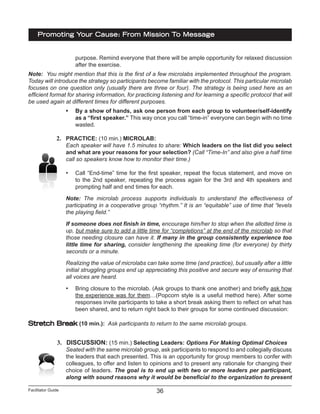
Microlabs
“Microlabs” have a different purpose than “task” groups, and will be used several times throughout this
program. A microlab is a timed, small-group (3-5 people) listening and sharing process, which offers equal
uninterrupted speaking times for each speaker. It is NOT A DISCUSSION (no “cross talk”) and what is
shared in the group remains confidential. A focus statement, topic or question is posed for each member
of the group to respond to in a go-round fashion. The process allows for deep listening of individual
thoughts, feelings, or opinions about a subject. Each speaker self-manages within the timeframe given
(usually 1 to 2 minutes per speaker). Microlabs afford privacy, safety, and more in depth listening of
different points-of-view than can be achieved in a large group discussion.
The goal in facilitating a microlab is to maintain the integrity of uninterrupted speaking (which satisfies
many intrinsic needs). Safeguarding this is important to the effect and impact of this activity (which is
usually powerful). Be clear and concise with directions at each stage of the process, and make sure
you call “time-in” and “time-out” and cue “half-time” for speakers, so that they can gauge themselves
and everyone knows where they are in the process. (See Microlab: Small Group Listening: Handout -
Workshop 2, page 35)
Here is overview of the different stages of a Microlab:
Step 1: (5 min.) Introductory explanation of Microlab, or of topic and purpose (This will be the most
elaborated when you first introduce the Microlab strategy in Workshop 2. Once the protocol is familiar,
only reminders are needed).
Step 2: (5 min.) Transition into small groups (use count off or a fun “up and moving” way to get into
groups).
For The Facilitator
Facilitator Guide
Promoting Your Cause: From Mission To Message
16
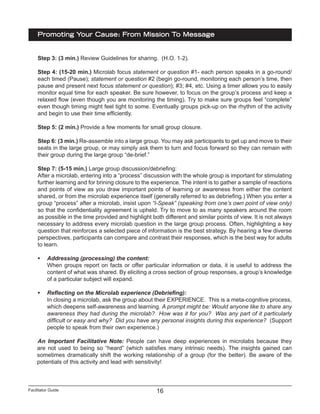
Step 3: (3 min.) Review Guidelines for sharing. (H.O. 1-2).
Step 4: (15-20 min.) Microlab focus statement or question #1- each person speaks in a go-round/
each timed (Pause); statement or question #2 (begin go-round, monitoring each person’s time, then
pause and present next focus statement or question); #3; #4, etc. Using a timer allows you to easily
monitor equal time for each speaker. Be sure however, to focus on the group’s process and keep a
relaxed flow (even though you are monitoring the timing). Try to make sure groups feel “complete”
even though timing might feel tight to some. Eventually groups pick-up on the rhythm of the activity
and begin to use their time efficiently.
Step 5: (2 min.) Provide a few moments for small group closure.
Step 6: (3 min.) Re-assemble into a large group. You may ask participants to get up and move to their
seats in the large group, or may simply ask them to turn and focus forward so they can remain with
their group during the large group “de-brief.”
Step 7: (5-15 min.) Large group discussion/debriefing:
After a microlab, entering into a “process” discussion with the whole group is important for stimulating
further learning and for brining closure to the experience. The intent is to gather a sample of reactions
and points of view as you draw important points of learning or awareness from either the content
shared, or from the microlab experience itself (generally referred to as debriefing.) When you enter a
group “process” after a microlab, insist upon “I-Speak” (speaking from one’s own point of view only)
so that the confidentiality agreement is upheld. Try to move to as many speakers around the room
as possible in the time provided and highlight both different and similar points of view. It is not always
necessary to address every microlab question in the large group process. Often, highlighting a key
question that reinforces a selected piece of information is the best strategy. By hearing a few diverse
perspectives, participants can compare and contrast their responses, which is the best way for adults
to learn.
•	 Addressing (processing) the content:
When groups report on facts or offer particular information or data, it is useful to address the
content of what was shared. By eliciting a cross section of group responses, a group’s knowledge
of a particular subject will expand.
•	 Reflecting on the Microlab experience (Debriefing):
In closing a microlab, ask the group about their EXPERIENCE. This is a meta-cognitive process,
which deepens self-awareness and learning. A prompt might be: Would anyone like to share any
awareness they had during the microlab? How was it for you? Was any part of it particularly
difficult or easy and why? Did you have any personal insights during this experience? (Support
people to speak from their own experience.)
An Important Facilitative Note: People can have deep experiences in microlabs because they
are not used to being so “heard” (which satisfies many intrinsic needs). The insights gained can
sometimes dramatically shift the working relationship of a group (for the better). Be aware of the
potentials of this activity and lead with sensitivity!
Facilitator Guide17
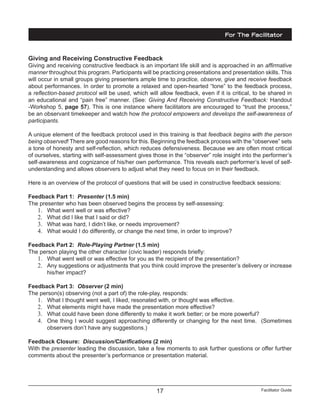
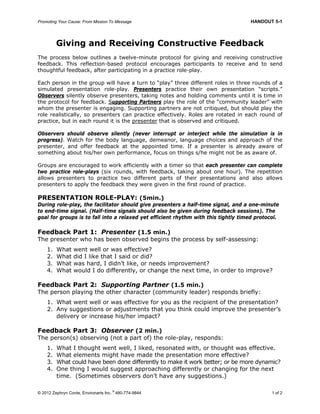
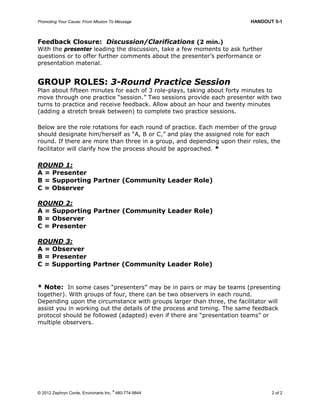
Giving and Receiving Constructive Feedback
Giving and receiving constructive feedback is an important life skill and is approached in an affirmative
manner throughout this program. Participants will be practicing presentations and presentation skills. This
will occur in small groups giving presenters ample time to practice, observe, give and receive feedback
about performances. In order to promote a relaxed and open-hearted “tone” to the feedback process,
a reflection-based protocol will be used, which will allow feedback, even if it is critical, to be shared in
an educational and “pain free” manner. (See: Giving And Receiving Constructive Feedback: Handout
-Workshop 5, page 57). This is one instance where facilitators are encouraged to “trust the process,”
be an observant timekeeper and watch how the protocol empowers and develops the self-awareness of
participants.
A unique element of the feedback protocol used in this training is that feedback begins with the person
being observed! There are good reasons for this. Beginning the feedback process with the “observee” sets
a tone of honesty and self-reflection, which reduces defensiveness. Because we are often most critical
of ourselves, starting with self-assessment gives those in the “observer” role insight into the performer’s
self-awareness and cognizance of his/her own performance. This reveals each performer’s level of self-
understanding and allows observers to adjust what they need to focus on in their feedback.
Here is an overview of the protocol of questions that will be used in constructive feedback sessions:
Feedback Part 1: Presenter (1.5 min)
The presenter who has been observed begins the process by self-assessing:
1.	 What went well or was effective?
2.	 What did I like that I said or did?
3.	 What was hard, I didn’t like, or needs improvement?
4.	 What would I do differently, or change the next time, in order to improve?
Feedback Part 2: Role-Playing Partner (1.5 min)
The person playing the other character (civic leader) responds briefly:
1.	 What went well or was effective for you as the recipient of the presentation?
2.	 Any suggestions or adjustments that you think could improve the presenter’s delivery or increase
his/her impact?
Feedback Part 3: Observer (2 min)
The person(s) observing (not a part of) the role-play, responds:
1.	 What I thought went well, I liked, resonated with, or thought was effective.
2.	 What elements might have made the presentation more effective?
3.	 What could have been done differently to make it work better; or be more powerful?
4.	 One thing I would suggest approaching differently or changing for the next time. (Sometimes
observers don’t have any suggestions.)
Feedback Closure: Discussion/Clarifications (2 min)
With the presenter leading the discussion, take a few moments to ask further questions or offer further
comments about the presenter’s performance or presentation material.
For The Facilitator
Facilitator Guide
Promoting Your Cause: From Mission To Message
18
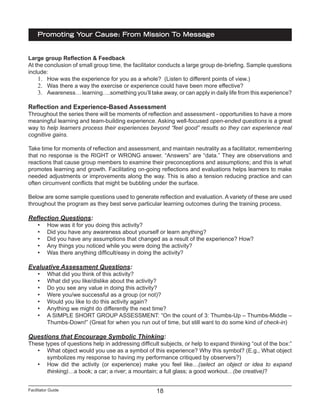
Large group Reflection & Feedback
At the conclusion of small group time, the facilitator conducts a large group de-briefing. Sample questions
include:
1.	 How was the experience for you as a whole? (Listen to different points of view.)
2.	 Was there a way the exercise or experience could have been more effective?
3.	 Awareness… learning….something you’ll take away, or can apply in daily life from this experience?
Reflection and Experience-Based Assessment
Throughout the series there will be moments of reflection and assessment - opportunities to have a more
meaningful learning and team-building experience. Asking well-focused open-ended questions is a great
way to help learners process their experiences beyond “feel good” results so they can experience real
cognitive gains.
Take time for moments of reflection and assessment, and maintain neutrality as a facilitator, remembering
that no response is the RIGHT or WRONG answer. “Answers” are “data.” They are observations and
reactions that cause group members to examine their preconceptions and assumptions; and this is what
promotes learning and growth. Facilitating on-going reflections and evaluations helps learners to make
needed adjustments or improvements along the way. This is also a tension reducing practice and can
often circumvent conflicts that might be bubbling under the surface.
Below are some sample questions used to generate reflection and evaluation. A variety of these are used
throughout the program as they best serve particular learning outcomes during the training process.
Reflection Questions:
•	 How was it for you doing this activity?
•	 Did you have any awareness about yourself or learn anything?
•	 Did you have any assumptions that changed as a result of the experience? How?
•	 Any things you noticed while you were doing the activity?
•	 Was there anything difficult/easy in doing the activity?
Evaluative Assessment Questions:
•	 What did you think of this activity?
•	 What did you like/dislike about the activity?
•	 Do you see any value in doing this activity?
•	 Were you/we successful as a group (or not)?
•	 Would you like to do this activity again?
•	 Anything we might do differently the next time?
•	 A SIMPLE SHORT GROUP ASSESSMENT: “On the count of 3: Thumbs-Up – Thumbs-Middle –
Thumbs-Down!” (Great for when you run out of time, but still want to do some kind of check-in)
Questions that Encourage Symbolic Thinking:
These types of questions help in addressing difficult subjects, or help to expand thinking “out of the box:”
•	 What object would you use as a symbol of this experience? Why this symbol? (E.g., What object
symbolizes my response to having my performance critiqued by observers?)
•	 How did the activity (or experience) make you feel like…(select an object or idea to expand
thinking)…a book; a car; a river; a mountain; a full glass; a good workout…(be creative)?
Facilitator Guide19
USING THE MANUAL: ORGANIZATION & COMPONENTS
Each of the six workshops in this program has its own objectives and learning outcomes. Each workshop
also includes specific follow-up activities that either continue the learning or assist participants in
completing assigned field-based objectives.
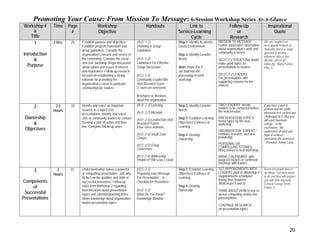
Promoting Your Cause: From Mission To Message: 6-Session Workshop Series At-A-Glance (on
Pages 20-21) provides you with an overview of the program and summarizes the scope, sequence and
core components of each workshop. This comprehensive overview gives you the key information that will
allow you to easily prepare for each session.
Using The Manual
Promoting Your Cause: From Mission To Message: 6-Session Workshop Series At-A-Glance
Workshop #
&
Title
Time Page
#
Workshop
Objective
Handouts Link to
Service-Learning
Cycle
Follow-Up
or
Research
Inspirational
Quote
1
Introduction
&
Purpose
2 Hrs. 25 Establish purpose and objectives;
Establish program framework and
group guidelines; Consider the
organization’s mission and service to
the community; Consider the social
and civic backdrop; Begin discussion
about values and issues of interest
and importance; Follow-up research
focused on establishing a strong
rationale for promoting the
organization’s cause to particular
community/civic leaders
(H.O. 1-1)
Visioning & Group
Guidelines
(H.O. 1-2)
Guidelines For Effective
Group Discussion
(H.O. 1-3)
Community Leader/Site
Visit Research Form
(2 copies per participant)
Brochures or literature
about the organization
Step 1: Identify Academic
Goals/ Environment
Step 2: Identify Genuine
Needs
Note: Steps 8 & 9
are built into the
processing of each
workshop
MISSION TO MESSAGE
Gather data/collect information
about organization’s work and
community it serves
SELECT 2 ISSUES that would
make good topics for
presentations to leaders
SELECT 2 LEADERS
For presentations with
supporting reasons for the
choices
We are caught in an
inescapable network of
mutuality, tied in a single
garment of destiny.
Whatever affects one
directly, affects all
indirectly. –Martin Luther
King, Jr.
2
Ownership
&
Objectives
2.5
Hours
33 Identify and select an important
issue(s) as a topic(s) for
presentations; Identify and select
civic or community leaders to contact;
Develop a plan of action and time-
line; Complete follow-up tasks.
(H.O. 2-1) Listening
(H.O. 2-2) Microlab
(H.O. 2-3) Leader/Site-Visit
Research Forms
(Have extras available)
(H.O. 2-4) Small Task
Groups
(H.O. 2-5) Group
Consensus
(H.O. 2-6) Addressing
People of Title (copy 2 sided)
Step 2: Identify Genuine
Needs
Step 3: Establish Learning
Objectives/ Evidence of
Learning
Step 4: Develop
Ownership
TWO LEADERS: decide
leaders to be contacted before
the next session.
PRESENTATION TOPICS:
Know topics by the next
workshop
ORGANIZATION “EXPERT:”
continue research, increase
knowledge
PERSONAL OR
COMPELLING STORIES:
Bring stories to next workshop
BRING CALENDARS: with
progress reports or confirmed
meetings with leaders
If you have a task to
perform and are vitally
interested in it, excited and
challenged by it, then you
will exert maximum
energy… in the
excitement…the
exuberance of what you
hope to achieve
overcomes the weariness.
– President Jimmy Carter
3
Components
of
Successful
Presentations
2
Hours
41 Understand what makes a powerful
or compelling presentation - and why;
Reflect on the qualities and skills of
successful presenters; Follow-up
tasks from Workshop 2 regarding
final decisions about presentation
topics and calendar/planning items;
Share knowledge about organization
and/or presentation topics
(H.O. 3-1)
Preparing Your Message
For Presentation – A
Checklist for Presenters
(H.O. 3-2)
What Do You Know?
Knowledge Window
Step 3: Establish Learning
Objectives/ Evidence of
Learning
Step 4: Develop
Ownership
SET APPOINTMENTS WITH
LEADERS prior to Workshop 4
(Appointments scheduled
during time between
Workshops 5 and 6)
THINK ABOUT HOW to use or
weave compelling stories into
presentations
CONTINUE RESEARCH
on presentation topics
Never tell people how to
do things. Tell them what
to do and they will surprise
you with their ingenuity. --
General George Smith
Patton, Jr.
20
Promoting Your Cause: From Mission To Message: 6-Session Workshop Series At-A-Glance
Workshop #
&
Title
Time Page
#
Workshop
Objective
Handouts Link to
Service-Learning
Cycle
Follow-Up
or
Research
Inspirational
Quote
4
Presentation
Planning
2
Hours
49 Reflection on inspiration and “voice;”
Practice highlighting “platform” skills;
Begin crafting presentations by
incorporating successful components
into a prescribed outline; Identify and
share information about stories and
data to be integrated into
presentations; Learn visualization
technique to enhance performance
(H.O. 4-1) Drawing From
Inspiration: Creating A
Compelling and Informative
Message
(H.O. 4-2) Tongue
Tanglers: Fun For Public
Speakers
(H.O. 4-3) Public Speaking
and Presentation Tips
(H.O. 4-4) Presentation
Outline: A Guide For
Presenters
(H.O. 4-5) Relaxation-
Visualization Practice
Step 4: Develop
Ownership
Step 5: Plan & Prepare
FINALIZE PRESENTATIONS
and be ready to role-play and
receive feedback from
colleagues during the next
session
Do you want to know who
you are? Don't ask. Act!
Action will delineate and
define you. –Thomas
Jefferson
5
Presentation
Practice
2.5
Hours
55 Rehearsal role-plays of simulated
presentations (to community leaders)
focusing on delivery, style,
presentation dynamics, performance
with observation and feedback (an
integral part of small group rehearsal
process); Primary follow-up task:
Completing (site visit) presentations
to selected community or civic
leaders prior to Workshop 6.
Scheduling Note: More two weeks
(or more if needed) should be
scheduled between Workshops 5 and
6 in order to allow ample time for
completing presentations.
(H.O. 5-1)
Giving and Receiving
Constructive Feedback
(H.O. 5-2)
Presentation/Site Visit
Report Form
(H.O. 5-3)
Presentation Reflection–
Assessment Form
Step 4: Develop
Ownership
Step 5: Plan & Prepare
Step 6: Conduct
Meaningful Service
CONDUCT SITE VISITS to
Civic/ Community Leaders
COMPLETE 2 REPORT
FORMS
COMPLETE THANK YOU
LETTERS (and mail) to
leaders who received
presentations
Program Note: Before
Workshop 6, discuss and
clarify with organization
decision-makers, the efficacy
of continuing this program into
the future. This decision will
affect how you approach
closing activities in Workshop
6.
One isn't necessarily born
with courage, but one is
born with potential. Without
courage, we cannot
practice any other virtue
with consistency. – Maya
Angelou
6
Reflecting
&
Evaluating
2 Hrs. 61 Reflect upon, celebrate and report
about presentations; Develop a plan
to continue to hone skills and conduct
educational meetings with civic or
community leaders; Consider the
need for, or appropriateness of
adjusting presentations to
accommodate different public
speaking opportunities
(H.O. 6-1)
Program Evaluation &
Strategic Planning
Questions
Index Cards
Step 7: Observe the
Impact
Step 8: Evaluate the
Experience
Step 9: Demonstrate New
Understanding
If applicable, assign continuing
roles. If needed, schedule
follow-up meetings. Follow
through with any
contingencies.
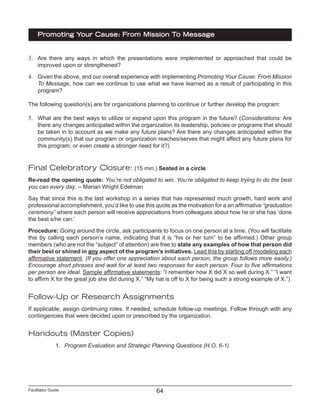
You're not obligated to win.
You're obligated to keep
trying to do the best you
can every day. – Marian
Wright Edelman
21
Facilitator Guide
Promoting Your Cause: From Mission To Message
22
Outline of Workshop Components:
Workshops are 2 to 2 ½ hours long, and all follow the same basic structure, outlined below.
This “template” will be consistent throughout with some variations depending upon a particular
workshop’s content or goals. The learning objectives for each component are the same
throughout, which is why it is a consistent “form” throughout. Every workshop opens with a quote
that is related to the topic; has a prescribed process for moving through activities; includes an
experience-based or evaluative closing; and has follow up activities. Masters of the handouts
used during workshops or as take-home material appear in a section at the end of each workshop.
Here is an outline of the basic workshop structure used throughout:
Opening Quote
Preparation:
- Objective
- Tools & Materials
- Handouts (listed)
- Facilitator Notes
Workshop Agenda:
- Greeting & Warm-Up Activity
- Overview of Workshop & Objectives
- Main Activity(s)
•	Set-Up
•	Practice
•	Reflection
Wrap-Up & Evaluation
Follow-Up or Research Assignments
(Tabbed Section at end of each workshop that includes)
Handouts (Master Copies)
Purpose and Objectives of Workshop Components
The workshop structure takes group dynamics into account and employs inclusive and participatory
methods for reaching both learning and team-building goals. Do not underestimate the importance of
facilitating the “Greeting & Warm-up Activity” before engaging in the “Main” activities. Workshops will
flow more smoothly when you recognize the value and take the time to open workshops in an inclusive
manner. As a facilitator, you can inspire and motivate participants with your own enthusiasm. When
you keep the pace moving (but not rushed), rely on the structure and sequence of the workshops to
propel you and your group, smoothly facilitate transitions between activities, and respond to a group’s
concerns and questions, you establish rapport and earn a group’s trust. These are all the ingredients for
a successful team and successful professional development!
Facilitator Guide23
Opening Quote: Inspirational quotes begin each workshop and expand the meaning or capture the
essence of the workshop. These can be read as an inspirational “quote of the day” and are at times
integrated into workshop activities as the focus for reflection or discussion.
Preparation: The material in this portion is for the facilitator to prepare, have ready or to know – prior to
the workshop.
•	 Objective: the purpose, learning objective or learning outcome of each workshop
•	 Tools & Materials: a list of all materials that will be used or needed
•	 Handouts (listed): a list of all participant handouts (numbered master copies provided in a section
at the end of each workshop)
•	 Facilitator Notes: specific notes for the facilitator about the workshop or particular activities.
Facilitator’s notes will appear throughout. When emphasis is needed the text will be italicized.
Workshop Agenda: (should be posted) A workshop outline should either be posted on a white-board
or chart, or printed as handout so that participants know what is expected, and can share in taking
responsibility for reaching goals.
•	 Greeting & Warm-up Activity: Engaging people first thing in a workshop - as a part of your greeting
process - increases the likelihood of their active participation throughout. The reason is that safety
and inclusion needs are addressed up front. After a brief welcome, before discussing any “business,”
make it a habit to open with a fun “low risk” warm-up activity that invites immediate participation. The
Greeting & Warm-up Activities of each workshop are designed to support the goals of each workshop.
(You may have some of your own that can work as well, or some may emerge as “important to do”
as you move through your process with a group). Light and lively warm-ups with no “right” or “wrong”
answers (e.g., circle go-rounds, paired sharing) increase focus, decrease anxiety and build teamwork.
They function like re-setting a clock, so that participants can transition from outside influences and
gently place their focus on the purpose and work before them.
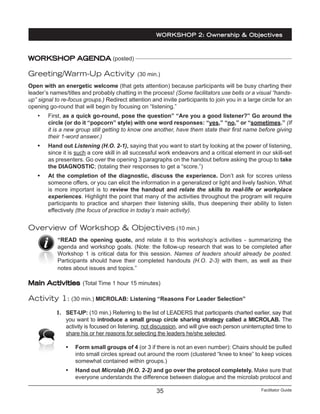
•	 Overview of Workshop & Objectives: It is wise to get everyone ‘on the same page’ with workshop
objectives. Presenting a workshop’s plan and objectives includes participants in sharing those
objectives and satisfies ‘control,’ ‘empowerment’ and ‘belonging’ needs. A simple procedure like doing
a “quick check-in” and getting agreement on the plan (which should be posted with times listed for
each activity), establishes a framework, previews activities and sets a clear and purposeful intention
for the workshop. The “overview” time is also a good place to introduce new concepts or vocabulary
or review previous information. Posting intended activity times helps to focus participants and often
heightens their cooperation. Once you present a plan, make sure “it’s okay” and ask for any questions
before proceeding.
•	 Main Activity(s)
Most of the workshops contain more than one “main activity.” Main activities are usually participatory
or interactive and establish a time where the group accomplishes constructive work. An activity
generally unfolds in three phases that you might think of as “before, during, and after:” Here are the
three phases of an “activity:”
Using The Manual
Facilitator Guide
Promoting Your Cause: From Mission To Message
24
1.	 Set-Up: Provide clear concise directions for the activity, establish the procedure and clarify
participants’ roles. Handle advance preparation(s) beforehand (materials, handouts, timer,
posting of charts, etc.) so that they are ready.
2.	 Practice: When the group is involved in an activity, provide appropriate coaching, time keeping
or intermittent prompts/reminders. During this phase people might be working in pairs or small
groups, so move about the room and be available. An “absent” facilitator can “unnerve” a
group and decrease trust.
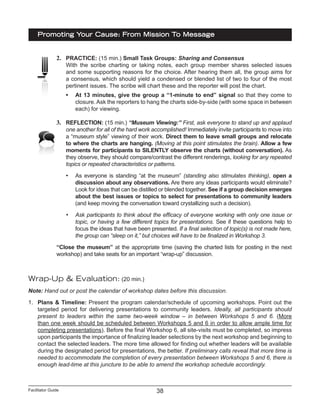
3.	 Reflection: When the activity is completed there are different levels of reflection or evaluation
depending upon what is appropriate for a particular activity. Below are a few sample questions
that assist in opening rich reflective learning discussions. Appropriate reflection questions
are provided in each workshop. The ones below look at the different purposes for reflective
discussion:
•	 Reflecting on Content/Information:
Here’s where you elicit any data or information pertinent to the subject of the activity,
e.g., Share/present/show: the content results of something that was explored, like a list,
research data, a performance, presentation or a brainstorm.
•	 Reflecting on Experiences/Learning (De-briefing):
Here’s where you elicit feelings or awareness gained as a result of being involved in an
activity. These are more evaluative and integrative questions like: “What awareness did
you have?” “What was easy or hard?” “What did you take from this experience that you
can apply in life or at work?”
•	 Wrap-up & Evaluation:
An effective closure to a workshop leaves participants with a sense of accomplishment and
completion. You might establish a regular light and lively closing ritual that ends the workshop with
a quick “thumbs up, thumbs middle, thumbs down” assessment. For a more satisfying closure
elicit feelings or awarenesses that evaluate and integrate the workshop experience. Questions that
reinforce the value or the applicability of what was experienced are useful, for example: “How was
today’s workshop… was it helpful - useful - of value to you or the group?” or, “What did you learn or
take from today that you can apply in life or at work?” Encourage participants to take something and
apply it in their lives or work.
•	 Follow-Up or Research:
Each workshop will have some take-away activity, preparation or research that participants will
need to complete during the time between meetings. Since this is a professional development
opportunity with specific goals and outcomes, participants will have various assignments that will
prepare them to accomplish each “benchmark” of the program’s professional growth.
•	 Handouts (Master Copies):
Master copies of handouts pertinent to each workshop are included in a section at the end of each
workshop. Handouts are labeled and numbered in the order they will be used during the workshop
or at home for follow-up activities. Make sure you make enough copies prior to each workshop so
they are ready for participants.
Facilitator Guide25
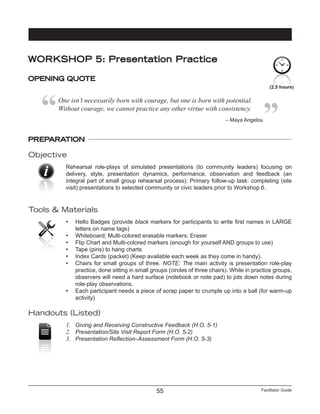
PREPARATION
Objective
Establish purpose and objectives; Establish program framework and group guidelines;
Consider the organization’s mission and service to the community; Consider the social
and civic backdrop; Begin discussion about values and issues of interest and importance;
Follow-up research focused on establishing a strong rationale for promoting the
organization’s cause to particular community/civic leaders
Tools & Materials
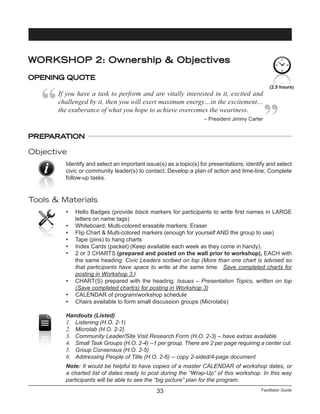
•	 Hello Badges (provide black markers for participants to write first names in LARGE
letters on name tags)
•	 Whiteboard; Multi-colored erasable markers; Eraser
•	 Flip Chart and Multi-colored markers (enough for yourself AND the group to use)
•	 Tape (pins) to hang charts
•	 Index Cards (packet) (Keep available each week as they come in handy.)
•	 2 CHARTS each with 2 columns emulating the Visioning & Group Guidelines (H.O.
1-1) at the top with: [CHART 1: Looks or Sounds like - Has qualities of/like – CHART
2: Feels like - Enables me to]. Two Charts posted side-by side
•	 CHART prepared with heading: Group Safeguards & Agreements at top
•	 CHART prepared: with word web started - “Active Citizenship” circled in the center
•	 CHART prepared with heading: “Inform & Educate Civic Leaders” at top
•	 CHART prepared with heading: Our Organization at top, and 4 columns, each headed:
Character; Values; Community Impact; Main “Message.”
Handouts (Listed)
1.	 Visioning & Group Guidelines (H.O. 1-1)
2.	 Guidelines For Effective Group Discussion (H.O. 1-2)
3.	 Community Leader/Site Visit Research Form (H.O. 1-3) -- 2 copies per participant
The organization provides:
4.	 Brochures or literature about the organization and its mission/work
5.	 Participant folders (a depository for papers and handouts)
(2 hours)
WORKSHOP 1: Introduction & Purpose
OPENING QUOTE
We are caught in an inescapable network of mutuality, tied in a single
garment of destiny. Whatever affects one directly, affects all indirectly.
– Dr. Martin Luther King, Jr.
Facilitator Guide
Promoting Your Cause: From Mission To Message
26
Facilitator Notes
Focusonestablishingpurpose,settingground-rulesandbuildingateamspirit.Greetparticipants
as they enter the room, inviting them to sign in and create name badges. Show appreciation
for them and the fact that they have agreed to take on this challenge on. Approach activities in
a congenial and friendly manner. Allow the group to get to know one another as you establish
clear methods for facilitating “healthy” and respectful communication. Set a positive tone and
establish the workshop structure as protocol for the remainder of the workshops.
Facilitator Guide27
WORKSHOP 1: Introduction & Purpose
WORKSHOP AGENDA (posted)
Greeting/Warm-Up Activity (15 min.)
Warmly welcome everyone and briefly introduce yourself, offering some background about how you came
to be in the role of facilitator. Include housekeeping notes and mention that there will only be a short
break (so participants should take care of their own needs if necessary). Explain that this program creates
the opportunity to become a team and to become immersed as a group in knowledge and skills that will
prepare each participant to successfully present the organization’s mission and message. Today sets the
positive tone and team spirit we want to maintain throughout the program and establishes the framework
we will rely upon and use to support an enriching professional development experience.
Go-Round of Introductions: One at a time, each person shares three things (concisely):
“Name; Role or job within organization; Main reason you are participating”
(Begin the go-round by modeling these three points from your own position and point-of-view.)
Overview of Workshop & Objectives (5 min.)
•	 Read the opening quote to the group (more than once) providing a brief reflection.
Tell them you will come back to it at the end to see how it has related to the groups
experiences.
•	 Review the plan (posted) and ask if there are any questions before proceeding.
Note: The following introductory activity is a “one time” activity, unique to this first
workshop. It is used to set a respectful professional tone and create ground-rules for the
entire program. The material generated here can be reviewed each week and amended
as needed.
Group Visioning Activity Establishing Safeguards and Guidelines (20 min.)
1.	 SET-UP: (2 min.) Say that this will be our first task as a working group: to understand
more about what each of us envisions as optimal for his/her own success, and then to
take that information and mold it into a group contract.
2.	 PRACTICE: (20 min.) HANDOUT “Visioning and Group Guidelines” (H.O. 1-1)
saying that the activity will begin with some individual reflection (writing) time as each
person completes the handout.
•	 (5 min.) Complete Handout: As participants are quietly reflecting and writing,
hang the prepared (correlating) charts somewhere in the room. Leave enough
space between the charts so that participants can easily reach them when they
are all scribing (at the same time).
•	 (5 min.) Charts: When individual reflection/writing time is complete, ask
participants to stand and get markers. On the wall charts, they should write at
least one (the most important) response from each of the categories written on
handouts.
Facilitator Guide
Promoting Your Cause: From Mission To Message
28
•	 (5 min.) Observe lists and assess: Once the wall charts are completed, re-
hang the charts side-by-side (closely together) as if to make one large chart with 4
columns. Ask participants to observe: The 2 left columns look at atmosphere and
qualities, while the two right columns look more at feelings, needs and desires.
Discuss commonalities/differences and what the group notices about what has
been collectively shared.
•	 (5 min.) Create List of Safeguards & Agreements: After observation and
discussion, hang the prepared chart “Group Safeguards &Agreements.” Brainstorm
a list of “positive action statements,” (“we will do,” or “will be”), in order to ensure
that their visions of an optimal learning environment are safeguarded. (e.g., “We
will listen without interrupting;” or “We will maintain a positive mental attitude and
help one another to do so.”) These statements will constitute the group’s “contract.”
Keep this chart and hang it during each meeting as a reminder. Things can be
added or deleted in subsequent weeks if the group agrees.
3.	 REFLECTION: (3 min.) Do a quick “check in” here and take a breath before moving
on. Ask how everyone is doing and take a pulse on how the visioning and agreements
process was received. (Suggest a short bathroom break before the next series of
activities).
Stretch Break (10 min.): Ask participants to come back quickly to the large group. During the break
distribute handouts and hang charts (folded and taped up so that the words on them are not visible). In
this way all of the materials needed for the next segment are ready.
Main Activities (Total Time 50 min.): In order to make sure participants understand the concepts
driving this program the following introductory activities review the material located in the
“Foundational Concepts” section (on page 9) in experiential ways that steer away from lecture and
instead use DISCUSSION and ELABORATION as the primary methods for answering 2 key questions:
1) What does “active citizenship” mean? 2) Why is it important to educate our civic or community
leaders about our work? The practices below should flow together seamlessly as a multi-tiered
exploration of the concepts driving the program.
Preparation: (10 min.) HANDOUT “Guidelines For Effective Group Discussion” (H.O. 1-2).
Because effective discussion is key to any successful group effort, the handout highlights
important skills that we should adopt or strive for as we create the dynamic learning environment
we want. Review the skills and discuss strengths and weakness, defining how the group
intends to apply and/or improve upon these skills as the program progresses.
Facilitator Guide29
Activity 1: (20 min.) “Active Citizenship” Engaging and Educating Civic Leaders
Refer to the Active Citizenship section of Introduction (page 9) for background
1.	 SET-UP: (10 min.) Begin by reading the quote: “... It ought to be the happiness and
glory of a representative to live in the strictest union, the closest correspondence, and the
most unreserved communication with his constituents. Their wishes ought to have great
weight with him; their opinion, high respect; their business, unmerited attention. It is his
duty to sacrifice his repose, his pleasures, his satisfactions, to theirs; and above all, ever,
and in all cases, to prefer their interest to his own…” – The Works of the Right Honorable
Edmund Burke. Volume I. London: Henry G. Bohn. 1854. Pp. 446–8.
•	 Before stating the author, ask if anyone knows who wrote the quote or can guess
when it was written. After some feedback/guesses offer the correct information, (if
anyone did not get it) presenting some history and background about the US, “liberal
representative democracy,” and our “rights and responsibilities” as citizens.
2.	 PRACTICE: (10 min.) “Active Citizenship” Word Web (Post the prepared chart)
As you engage in the above discussion, keeping it conversational, begin writing the
group’s responses on the prepared posted chart. First, capture what they know.
Then ADD INFORMATION by developing a definition of “Active Citizenship.” (from
material on page 9). Some prompts may be: Does what you are saying here look like
what we could define as “active citizenship?” “What do active citizens do?” “How to they
think/feel?” “What motivates them… their values?”)
Complete the Word Web using the group’s responses. Discuss how the idea of “active
citizenship” begins to delineate or define different areas of service, articulating where
or how civic responsibility can be applied and where our contributions, service, time or
talent could be volunteered. Some of these areas can include: organizations that help
the poor, needy, hungry, sick or disenfranchised; conservation or eco-friendly activities
(recycling); educational causes; faith-based initiatives; even the volunteering of high-level
professional expertise in such areas as banking, engineering, education and technology.
ACTIVITY 2: (10 min.) “Brainstorm List:” Importance of Educating Leaders
Hang the chart prepared with the heading “Inform & Educate Civic Leaders.” Discuss what
area of service work your organization specializes in and why the issues you deal with are
important and should be communicated to civic leaders.
Here is a potential list of reasons: (Add your own!)
•	 Inform leaders of situations or conditions within the community about which they may
be unaware (and which may be affecting their work);
•	 Offer leaders new or different perspectives on issues your organization specializes in
(which may be within the leader’s particular scope of influence);
•	 Connect your organization’s work or impact in the community to issues the civic leader
is on record of being pro-active with or caring about;
WORKSHOP 1: Introduction & Purpose
Facilitator Guide
Promoting Your Cause: From Mission To Message
30
•	 Offer leaders data on how your organization’s work is positively changing a condition
in the community;
•	 Reassure leaders that your organization’s presence and the affect of its work are
having a unique impact in (any) areas that are within their scope of influence.
ACTIVITY 3: (15 min.) “Our Organization: Mission & Message” Charting Ideas
After looking at reasons why active citizenship and educating civic and community leaders
are important, engage the group in a discussion that defines your organization’s:
Character; Values; History; Community Impact; Mission; and “Message,” writing
the group’s responses on the correlating CHART (prepared earlier). The responses you
draw from the group will begin a process of establishing a “script” that each presenter will
use to introduce or describe the organization. The chart should highlight points that
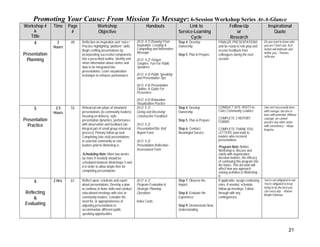
the group agrees accurately portray the organization’s history and mission. These
are the seeds of the message that each presenter will develop into his or her individual
presentation.
NOTE: As a closing this segment, it is very important to clarify the difference between
“Education and Advocacy.” Discuss some of the differences, (page 10, Introduction),
and make sure that the group understands that the purpose of this program is to educate
civic and community leaders.
3.	 CLOSING REFLECTION: (5 min.) Go-Round
As promised at the beginning of the workshop, re-read the opening quote (maybe more
than once). After brief reflection, ask participants to relate the quote to their experiences
of the workshop and to share responses or insights in a word or short phrase. (Note:
This can be facilitated “popcorn style” * or can continue as a discussion aimed at clarifying
the difference between education and advocacy.
* Popcorn style is a technique (used in the next activity) that quickly overviews a group’s
responses to a topic. It is used to elicit multiple short responses (one word, or short phrases)
so that many responses can be polled, in a very short time (a minute or two). This technique
is very effective when time is short or you want to quickly gather feelings, ideas or opinions
(polling). In an atmosphere of silence/listening, participants who have something to share
about the focus topic raise their hands. The facilitator randomly selects as many different
speakers as time provides in order to air a variety of viewpoints. It is not a dialogue, but rather
a stop and listen activity. A facilitator can quickly gather and summarize group data by using
this time-efficient strategy. It is also a great group awareness activity.
Wrap-Up & Evaluation: (5 min.) Popcorn Style: “Responses”
•	 (2.5 min.) Seated in a circle, ask group members to reflect upon the first workshop
experience. Set the timer for 2.5 minutes and in that time people can randomly (popcorn
style) raise a hand and say a word or short phrase describing their feelings, reactions
to, or assessment of the workshop. Only do this activity for 2.5 minutes - and in the
spirit of reflection, allow for silence (offering prompts if needed) - giving control to the
group in how and what they share during the allotted time.
Facilitator Guide31
•	 (5 min.) Close with large group discussion about the process itself, noting the
importance of contributions and sharing as a valuable part of group learning endeavors.
Continue this discussion into an “Experience-based assessment,” by asking how
participants feel about or “rate” their first day together.
Follow-Up or Research Assignments: (10 min.)
NOTE: Take the time to explain clearly the follow-up requested of each person. This can also
include resources that will aid participants to be successful in reaching program goals, like:
computer, phone and internet time, helpful leads or introductions to leaders, or access to any
relevant information about existing relationships with particular community leaders.
Two Research Assignments:
1.	 “From Mission to Message:” Gather data and collect important information about
the organization’s work and the community it serves. This continues the focus on
“mission” initiated in workshop discussions, but invites a deeper understanding about the
organization’s specific areas of concern or need. Participants should explore some of the
“facts and figures” that represent how or if the organization is addressing the needs of the
community it serves, or how the organization is sustaining itself or meeting its own needs.
Based upon the research or data that is collected, participants should select 2 important
issues that would make good topics for presentations to leaders, indicating the
reasons why each issue highlights an important organizational “message.” Keep
notes, and bring them to the next workshop. Ideas can be jotted down on the back of the
Community Leader/Site Visit Research Form (H.O. 1-3).
2.	 Selecting Civic or Community Leaders: Research and find at least two civic or
community leaders that it would be appropriate or optimal to contact for a presentation.
Using the Community Leader/Site Visit Research Form (H.O. 1-3) as an organizing tool,
participants should articulate at least two reasons for their selections, and if possible,
support their choices with research or factual data. Bring completed forms (with each
leader’s contact information included) to the next workshop.
Handouts (Master Copies)
1.	 Visioning & Group Guidelines (H.O. 1-1)
2.	 Guidelines For Effective Group Discussion (H.O. 1-2)
3.	 Leadership Visit Research Form (H.O. 1-3) -- (2 copies per participant)
The organization provides:
4.	 Brochures or literature about the organization and its mission/work
5.	 Participant folders (a depository for papers and handouts)
WORKSHOP 1: Introduction & Purpose
Facilitator Guide
Promoting Your Cause: From Mission To Message
32
Note: The organization is also responsible for all workshop and training supplies for the facilitator and
program participants and any brochures, literature or audio visual materials that will be included in
promotional (PR) packets that will be shared by presenters. This can also include the resources needed
to assist participants to be successful with the program, e.g., computer, phone time and internet access,
access to relevant information about existing relationships with community leaders, and even helpful leads.
All workshop and training supplies for the facilitator and program participants as well as a suitable training
space must be provided by the organization, along with any brochures, literature or audiovisual
materials that would be included in promotional (PR) packets that participant presenters will
leave with community leaders. If administrative input is required for deciding the contents of information
packets, the organization should consider these decisions before the training program begins so that
program participants will have all of the materials they need before start up. Presentations are scheduled
to take place after Workshop 5, (before Workshop 6). At Workshop 5 participants should be able to pick
up the number of PR packets they will need for their respective audiences.
Promoting Your Cause: From Mission To Message HANDOUT 1-1
© 2012 Zephryn Conte, Environarts Inc.
®
480-774-9844
Visioning & Group Guidelines
Group guidelines encourage group members to consider their own needs, preferences and
choices, while considering how they can support others. Group guidelines and agreements
establish healthy boundaries. They empower group members to envision the environment
they want to create and define the ethical code that will support it. Group guidelines
emphasize shared responsibility and establish a framework for holding the group’s vision.
Use the rubric below to stimulate your thinking. Imagine your ideal learning/working
environment – one that would support you to perform at your best. While many of us have
never had a “perfect” professional environment, this activity is urging you to picture it
exactly as you would like it to be - capturing the essence of it in your responses to the
prompts below. Fill in at least two responses in each category, and indulge yourself in
envisioning your ideal learning/working environment. *
A Satisfying & Productive Professional Work Environment
Looks or Sounds
like…
Has qualities
of/like…
Feels like… Enables me to…
… The physical
environment…sounds
or tone present?
What do you see
happening/people
doing?
How are people
speaking?
Compare it to
something.
Write qualities.
How do you feel in
your body…mind…
emotions?
Things you want to
be able to do, say or
accomplish.
* Striving for our ideals pushes us toward our best efforts and motivates personal and
professional growth. Your vision will be shared with those of other group members in order
to create a collective vision. You will then decide on how to acknowledge and maintain that
vision by establishing group guidelines and agreements.
Promoting Your Cause: From Mission To Message HANDOUT 1-2
© 2012 Zephryn Conte, Environarts Inc.
®
480-774-9844
Guidelines For Effective Group Discussion
Creating a respectful atmosphere for group discussion is central to effective learning and a
key element in successful workplaces. Effective group discussions allow members to easily
express needs, preferences, choices and divergent points of view. Arguments or finger
pointing ‘shut people down’ and erode the safety of group dialogue. Silence or withdrawal
can do the same. The goal of healthy discourse is to establish acceptable boundaries around
how information is shared. It is the responsibility of each member of a group to recognize
and monitor how his or her contributions are affecting the tone of the communication and to
do his/her part in preserving the integrity and success of a group’s discourse.
Here are a few guidelines and skills that support healthy group discussion. If each person
makes an effort to practice these behaviors, group discussions will be more satisfying and
productive and group decision-making will be easier:
 Listen! Show attention and be engaged. Turn toward the person speaking and if
appropriate make eye contact. Be a model of effective listening skills. Really listening
and trying to understand a person’s point of view (which may be different from yours) is
a vital element in healthy group discussion.
 Use “I-Speak” – Maintaining safety in a discussion is critical for keeping conversations
open. Speaking from one’s own point of view and experience keeps discussion safe.
Refrain from ever volunteering information about what someone else says or thinks
(unless you have gotten their permission to do so). Speaking from one’s own
perspective maintains clarity and respects each individual’s privacy.
 Restate – If you are unsure of what a member of the group has said, it can be useful to
restate or attempt to paraphrase what you think he or she said. Restating often clarifies
a speaker’s meaning or causes him/her to further elaborate.
 Ask a speaker to restate or “say it in a different way” – Another way to better
understand what a speaker has said (especially if it is unclear to several people) is to
first let him or her know it was unclear, and to ask him or her to restate it or “say it in a
different way.” This is a particularly important skill to use when a facilitator’s directions
or explanations are not clear to you.
 Ask Open-Ended Questions - These are questions that do not have yes or no
answers. If you need clarification, or want more information from a group member, or
from the facilitator, an open-ended question will cause the speaker to say more about
the subject.
 Crystallize key points - When a group is trying to come to a decision sometimes
summarizing the key point(s) of what has been said can focus and move a group closer
to a decision.
 Group “Polling:” Polling reveals a lot of information about a group in a very short time
and allows groups to very quickly see where everyone stands on a particular subject. For
example, if someone has stated an opinion that elicits a reaction, a “group poll” can be
taken to see by a “silent” show of hands, who agrees or feels similarly, or who disagrees
or feels differently. If a topic is “loaded,” there are divergent opinions, or if there is
curiosity about what others may be thinking, group polling is an effective technique.
 Wait Time - Don’t be afraid of pauses. Silences in a discussion can be poignant. Taking
a “breath” allows time for reflection, for thoughts to percolate or for questions to arise
organically. When a discussion does not feel “forced’ it usually yields better results.
Promoting Your Cause: From Mission To Message HANDOUT 1-3
© 2012 Zephryn Conte, Environarts Inc.
®
480-774-9844 
Community Leader/Site Visit Research Form  Presenter(s) Name(s): 
 
1. Community Leader & Site Information 
Name/Title of LEADER:   Email: 
Contact Phone:   Fax: 
Name of Institution/Business:  Website:   
Site Visit Address:  (If Confirmed): 
  DATE OF VISIT: 
City:  LOCATION OF VISIT: 
State/Zip:   
 
Organization Type/Focus of Work 
Adult Education     Fed. Government     Faith Based      For Profit  
 Youth Based     State Government     Alternative Education    Non‐Profit 
College/University     City Government    Technical/Vocational 
K‐12 Schools     Other/Describe:           
 
At least two reasons for visiting this particular leader  
     
 
2. Community Leader & Site Information 
Name/Title of LEADER:   Email: 
Contact Phone:   Fax: 
Name of Institution/Business:  Website:   
Site Visit Address:   
   
City:   
State/Zip:   
 
Organization Type/Focus of Work 
Adult Education     Federal Government   Faith Based      For Profit  
 Youth Based     State Government     Alternative Education    Non‐Profit 
College/University     City Government    Technical/Vocational 
K‐12 Schools     Other/Describe: 
 
At least two reasons for visiting this particular leader  


Facilitator Guide33
PREPARATION
Objective
Identify and select an important issue(s) as a topic(s) for presentations; identify and select
civic or community leader(s) to contact; Develop a plan of action and time-line; Complete
follow-up tasks.
Tools & Materials
•	 Hello Badges (provide black markers for participants to write first names in LARGE
letters on name tags)
•	 Whiteboard; Multi-colored erasable markers; Eraser
•	 Flip Chart & Multi-colored markers (enough for yourself AND the group to use)
•	 Tape (pins) to hang charts
•	 Index Cards (packet) (Keep available each week as they come in handy).
•	 2 or 3 CHARTS (prepared and posted on the wall prior to workshop), EACH with
the same heading: Civic Leaders scribed on top (More than one chart is advised so
that participants have space to write at the same time. Save completed charts for
posting in Workshop 3.)
•	 CHART(S) prepared with the heading: Issues – Presentation Topics, written on top
(Save completed chart(s) for posting in Workshop 3)
•	 CALENDAR of program/workshop schedule
•	 Chairs available to form small discussion groups (Microlabs)
Handouts (Listed)
1.	 Listening (H.O. 2-1)
2.	 Microlab (H.O. 2-2)
3.	 Community Leader/Site Visit Research Form (H.O. 2-3) – have extras available
4.	 Small Task Groups (H.O. 2-4) --1 per group. There are 2 per page requiring a center cut.
5.	 Group Consensus (H.O. 2-5)
6.	 Addressing People of Title (H.O. 2-6) -- copy 2-sided/4-page document
Note: It would be helpful to have copies of a master CALENDAR of workshop dates, or
a charted list of dates ready to post during the “Wrap-Up” of this workshop. In this way
participants will be able to see the “big picture” plan for the program.
(2.5 hours)
WORKSHOP 2: Ownership & Objectives
OPENING QUOTE
If you have a task to perform and are vitally interested in it, excited and
challenged by it, then you will exert maximum energy…in the excitement…
the exuberance of what you hope to achieve overcomes the weariness.
– President Jimmy Carter
Facilitator Guide
Promoting Your Cause: From Mission To Message
34
Facilitator Notes
This second of six workshops generates decisions that will drive the program and shape
the actual presentations that are created. Activities lay the groundwork for developing best
practices in communication and teamwork. A variety of interactive and skill building strategies
accomplish the workshop’s objectives in ways that exercise the interpersonal skills needed to
be successful communicators and presenters.
Note: PRIOR to the workshop, as preparation, read the “Wrap-Up & Evaluation” section.
This will ensure that you understand all of the variables that may effect scheduling. Make sure
that you have a master calendar of the program workshop schedule so that if, due to the
outcome of this workshop or any other concerns, you decide to amend the current schedule,
you will have the information you need to make informed choices along with participants.
IMPORTANT PROCEDURAL NOTE: Greet group members as they enter the room. After they sign in,
direct them to the charts (prepared in advance) that are displayed hanging. Ask participants to
scribe (in dark colored block print large enough to see from a distance) the names and titles of the
community or civic leaders they have selected for presentations. Opening with this focused yet
relaxed social atmosphere is a positive way to begin Workshop 2, as it builds rapport while accomplishing
an important piece of information sharing.
Before the formal start of the workshop, the results of research (homework from Workshop 1) should be
visibly posted so that all can see the preliminary list of selected leaders. There may be repetition – more
than one person selecting the same leader – or other variations that will spark discussion and generate
new ideas during the workshop.
One of this workshop’s goals is to finalize, by the end of the workshop, the list of leaders who will
be contacted for presentations.. Once done, make sure that participants enter their final choices on a
Community Leader/Site Visit Research Form (H.O. 2-3). In this way you can duplicate the forms (before
the workshop’s end) and have an official record of which participants will be calling to make appointments
with which leaders.
Facilitator Guide35
WORKSHOP AGENDA (posted)
Greeting/Warm-Up Activity (30 min.)
Open with an energetic welcome (that gets attention) because participants will be busy charting their
leader’s names/titles and probably chatting in the process! (Some facilitators use bells or a visual “hands-
up” signal to re-focus groups.) Redirect attention and invite participants to join you in a large circle for an
opening go-round that will begin by focusing on “listening.”
•	 First, as a quick go-round, pose the question” “Are you a good listener?” Go around the
circle (or do it “popcorn” style) with one word responses: “yes,” “no,” or “sometimes.” (If
it is a new group still getting to know one another, have them state their first name before giving
their 1-word answer.)
•	 Hand out Listening (H.O. 2-1), saying that you want to start by looking at the power of listening,
since it is such a core skill in all successful work endeavors and a critical element in our skill-set
as presenters. Go over the opening 3 paragraphs on the handout before asking the group to take
the DIAGNOSTIC; (totaling their responses to get a “score.”)
•	 At the completion of the diagnostic, discuss the experience. Don’t ask for scores unless
someone offers, or you can elicit the information in a generalized or light and lively fashion. What
is more important is to review the handout and relate the skills to real-life or workplace
experiences. Highlight the point that many of the activities throughout the program will require
participants to practice and sharpen their listening skills, thus deepening their ability to listen
effectively (the focus of practice in today’s main activity).
Overview of Workshop & Objectives (10 min.)
“READ the opening quote, and relate it to this workshop’s activities - summarizing the
agenda and workshop goals. (Note: the follow-up research that was to be completed after
Workshop 1 is critical data for this session. Names of leaders should already be posted.
Participants should have their completed handouts (H.O. 2-3) with them, as well as their
notes about issues and topics.”
Main Activities (Total Time 1 hour 15 minutes)
Activity 1: (30 min.) MICROLAB: Listening “Reasons For Leader Selection”
1.	 SET-UP: (10 min.) Referring to the list of LEADERS that participants charted earlier, say that
you want to introduce a small group circle sharing strategy called a MICROLAB. The
activity is focused on listening, not discussion, and will give each person uninterrupted time to
share his or her reasons for selecting the leaders he/she selected.
•	 Form small groups of 4 (or 3 if there is not an even number): Chairs should be pulled
into small circles spread out around the room (clustered “knee to knee” to keep voices
somewhat contained within groups.)
•	 Hand out Microlab (H.O. 2-2) and go over the protocol completely. Make sure that
everyone understands the difference between dialogue and the microlab protocol and
WORKSHOP 2: Ownership & Objectives
Facilitator Guide
Promoting Your Cause: From Mission To Message
36
purpose. Remind everyone that there will be ample opportunity for relaxed discussion
after the exercise.
Note: You might mention that this is the first of a few microlabs implemented throughout the program.
Today will introduce the strategy so participants become familiar with the protocol. This particular microlab
focuses on one question only (usually there are three or four). The strategy is being used here as an
efficient format for sharing information, for practicing listening and for learning a specific protocol that will
be used again at different times for different purposes.
•	 By a show of hands, ask one person from each group to volunteer/self-identify
as a “first speaker.” This way once you call “time-in” everyone can begin with no time
wasted.
2.	 PRACTICE: (10 min.) MICROLAB:
Each speaker will have 1.5 minutes to share: Which leaders on the list did you select
and what are your reasons for your selection? (Call “Time-In” and also give a half time
call so speakers know how to monitor their time.)
•	 Call “End-time” time for the first speaker, repeat the focus statement, and move on
to the 2nd speaker, repeating the process again for the 3rd and 4th speakers and
prompting half and end times for each.
Note: The microlab process supports individuals to understand the effectiveness of
participating in a cooperative group “rhythm.” It is an “equitable” use of time that “levels
the playing field.”
If someone does not finish in time, encourage him/her to stop when the allotted time is
up, but make sure to add a little time for “completions” at the end of the microlab so that
those needing closure can have it. If many in the group consistently experience too
little time for sharing, consider lengthening the speaking time (for everyone) by thirty
seconds or a minute.
Realizing the value of microlabs can take some time (and practice), but usually after a little
initial struggling groups end up appreciating this positive and secure way of ensuring that
all voices are heard.
•	 Bring closure to the microlab. (Ask groups to thank one another) and briefly ask how
the experience was for them…(Popcorn style is a useful method here). After some
responses invite participants to take a short break asking them to reflect on what has
been shared, and to return right back to their groups for some continued discussion:
Stretch Break (10 min.): Ask participants to return to the same microlab groups.
3.	 DISCUSSION: (15 min.) Selecting Leaders: Options For Making Optimal Choices
Seated with the same microlab group, ask participants to respond to and collegially discuss
the leaders that each presented. This is an opportunity for group members to confer with
colleagues, to offer and listen to opinions and to present any rationale for changing their
choice of leaders. The goal is to end up with two or more leaders per participant,
along with sound reasons why it would be beneficial to the organization to present
Facilitator Guide37
to those leaders. For reasons that emerge during conversations, participants may decide
to “switch” (or add more) leaders, realizing that one participant might be “a better fit,” for a
particular leader than another. More ideas about important leaders to contact may emerge.
It is optimal if participants end up with more than two leaders to contact in case a particular
leader is unavailable or difficult to schedule for a visit. (Note: Have extra “Community
Leader/Site Visit Research Forms” (Handout 2-3) available during this discussion so that
participants can amend or add any new data. MAKE SURE that you take away copies of
the final leader selections.)
Conclude discussion: Note that if, at this point, participants are not clear about which two leaders they
plan to contact, they will need to come to that decision as a follow-up task. The information shared should
have helped to inform their final choices.
ACTIVITY 2: (45 min.) GROUP Consensus “Issues & Presentation Topics”
Note: This is part one of a two-part activity that may continue into Workshop 3 if tasks are not completed
here. The goal of this process is to share ideas (in small groups) and create a selected list of the strongest,
most viable, or most pressing issues to present to community leaders. The number of issues or topics
the group ends up with is relative to a few factors: 1) The group may decide to work collectively on
ONE presentation topic/ONE message that each participant will present in his or her unique way to
different leaders, or, 2) The group may decide that there can be several topics or issues presented and
prepared by different participants and delivered to different leaders. In the second scenario, topics can
potentially be “matched” to particular leaders according to the leader’s interest or involvement with the
issue. Whatever emerges as the group’s preference, it is the facilitator’s job to help participants crystallize
the most achievable choices, given the available time and talent. Keep in mind that this may be “part one”
of this discussion with final decisions made in Workshop 3.
1.	 SET-UP: (15 min.) Re-focus the group, inviting participants to stand up and stretch as you
introduce the second small group task: selecting a topic or topics for presentations.Ask
participants to retrieve any notes, resources or reference materials related to the two issues
they were asked to identify as potential topics for presentations. In small groups, participants
will share this information along with the background information that supports their choices.
•	 Hand out Small Task Groups (H.O. 2-4): saying that groups will engage in an
elaborative consensus decision process, the goal of which is to decide upon two to
four topics from those that are contributed. Referring to the handout, take a few
moments for groups to self-assign roles. While they are doing that either distribute
or have ready sheets of chart paper and markers for each group. (The charts
generated will be posted).
•	 Hand out Group Consensus (H.O. 2-5): Clarify CONSENSUS DECISION-MAKING
by summarizing the handout or by asking different participants to read parts of it aloud
(or a combination of both approaches). Note: If time is too tight to go over the handout,
present the key points and offer the handout at the end of the workshop for home
study.
WORKSHOP 2: Ownership & Objectives
Facilitator Guide
Promoting Your Cause: From Mission To Message
38
2.	 PRACTICE: (15 min.) Small Task Groups: Sharing and Consensus
With the scribe charting or taking notes, each group member shares selected issues
and some supporting reasons for the choice. After hearing them all, the group aims for
a consensus, which should yield a condensed or blended list of two to four of the most
pertinent issues. The scribe will chart these and the reporter will post the chart.
•	 At 13 minutes, give the group a “1-minute to end” signal so that they come to
closure. Ask the reporters to hang the charts side-by-side (with some space in between
each) for viewing.
3.	 REFLECTION: (15 min.) “Museum Viewing:” First, ask everyone to stand up and applaud
one another for all of the hard work accomplished! Immediately invite participants to move into
a “museum style” viewing of their work. Direct them to leave small groups and relocate
to where the charts are hanging. (Moving at this point stimulates the brain). Allow a few
moments for participants to SILENTLY observe the charts (without conversation). As
they observe, they should compare/contrast the different renderings, looking for any repeated
topics or repeated characteristics or patterns.
•	 As everyone is standing “at the museum” (standing also stimulates thinking), open a
discussion about any observations. Are there any ideas participants would eliminate?
Look for ideas that can be distilled or blended together. See if a group decision emerges
about the best issues or topics to select for presentations to community leaders
(and keep moving the conversation toward crystallizing such a decision).
•	 Ask participants to think about the efficacy of everyone working with only one issue or
topic, or having a few different topics for presentations. See if these questions help to
focus the ideas that have been presented. If a final selection of topic(s) is not made here,
the group can “sleep on it,” but choices will have to be finalized in Workshop 3.
“Close the museum” at the appropriate time (saving the charted lists for posting in the next
workshop) and take seats for an important “wrap-up” discussion.
Wrap-Up & Evaluation: (20 min.)
Note: Hand out or post the calendar of workshop dates before this discussion.
1.	 Plans & Timeline: Present the program calendar/schedule of upcoming workshops. Point out the
targeted period for delivering presentations to community leaders. Ideally, all participants should
present to leaders within the same two-week window – in between Workshops 5 and 6. (More
than one week should be scheduled between Workshops 5 and 6 in order to allow ample time for
completing presentations). Before the final Workshop 6, all site-visits must be completed, so impress
upon participants the importance of finalizing leader selections by the next workshop and beginning to
contact the selected leaders. The more time allowed for finding out whether leaders will be available
during the designated period for presentations, the better. If preliminary calls reveal that more time is
needed to accommodate the completion of every presentation between Workshops 5 and 6, there is
enough lead-time at this juncture to be able to amend the workshop schedule accordingly.
Facilitator Guide39
2.	 Leader Selections & Options: Take a poll of how many participants already know the leaders with
whom they will be seeking an appointment. In some cases, you may feel participants are ready
immediately to begin making their introductory calls. However, if after considering #3 below and the
skill building activities in Workshops 2 and 3, you feel participants might be better off waiting a bit
before making calls to leaders, an optimal time for the entire group to be well prepared for contact
calls is after Workshop 3. Keep in mind that the calendar can be “relaxed” a little to “flex” to your
group’s specific needs or situation. If contact calls are initiated earlier rather than later in the program,
you will know sooner if appointments during the designated period are feasible, or if in some cases
they might be scheduled earlier. In case initial calls do not yield confirmed appointments during the
optimal time, then having the time to select different leaders who are available or who may be more
enthusiastic about receiving a presentation is optimal.
3.	 Addressing Community or Civic Leaders (Decorum): Enter into a preliminary discussion about
the importance of phone decorum, properly formed business letters (written invitations or thank you
letters) and personal etiquette when addressing public persons or community leaders. Hand out
Addressing People of Title (H.O. 2-6) highlighting the importance of respectful formalities. Discuss
and clarify how the organization would like participants to identify themselves to selected leaders and
their staff. Since each presenter will be acting as a spokesperson representing the organization, it is
important that this point be clear before any contact calls are made.
4.	 Review Follow-up Activities & Close: After reviewing the home activities, end with a short “one-
word assessment:” “In one word - or two to three word phrases, how would you evaluate our
day today?” (Do this “popcorn” style).
Follow-Up or Research Assignments
•	 TWO LEADERS: If by the end of the workshop some are not clear about the two leaders they will be
calling for an appointment, they should clarify who the leaders are before the next session.
•	 PRESENTATION TOPICS: If an issue or issues have not emerged clearly as topics, think about
which seem most important and be ready to make decisions at the next workshop.
•	 BE AN ORGANIZATIONAL “EXPERT:” Continue to collect data regarding the effectiveness or impact
of the organization within the community. What you “know” will be shared in an information-sharing
activity so that everyone can compare notes and the group can develop a basic introductory piece (re.
the organization’s work/mission/impact) that everyone will use at the opening of their presentations.
•	 PERSONAL OR COMPELLING STORIES: Begin thinking about (and journaling) any personal or
compelling stories related to work, the organization, or the topics and issues identified. Bring stories
to next session.
•	 Bring calendars to the next workshop. Be ready to report any confirmed appointments with leaders or
to name any new leaders that might have been selected for presentations.
WORKSHOP 2: Ownership & Objectives
Facilitator Guide
Promoting Your Cause: From Mission To Message
40
Note to Facilitator: If an organizational level or administrative decision is involved with
selecting presentation topics, make sure that you clarify this before the next workshop, so that
any additional input is included in the final decision-making. Whether that is the case or not,
be looking at the list of issues already generated and consider how you can help facilitate the
most effective group decision.
Handouts (Master Copies)
1.	 Listening (H.O. 2-1)
2.	 Microlab (H.O. 2-2)
3.	 Community Leader/Site Visit Research Form (H.O. 2-3) – have extras available
4.	 Small Task Groups (H.O. 2-4) --1 per group. There are 2 per page requiring a center cut.
5.	 Group Consensus (H.O. 2-5)
6.	 Addressing People of Title (H.O. 2-6) -- 2-sided copies/4-page document
Promoting Your Cause: From Mission To Message HANDOUT 2-1
© 2012 Zephryn Conte, Environarts Inc.
®
480-774-9844 1 of 3
LISTENING
Do You Really Listen?
For many the answer is “sort of.” How often do you find yourself focusing on your own thoughts,
ideas or judgments (internal voice), or just tuning out while someone is speaking? There are many
factors that affect the strength or weakness of our listening. Being attuned to those factors and
recognizing the benefits of effective listening encourage us to develop and hone our abilities.
When Do We Really Listen?
When we really want to know, learn, or hear something (usually when it satisfies our own
interests) we listen very intently, with an alert focus on understanding. But when someone is truly
an effective listener, he or she is ‘good at it’ regardless of the circumstances, topic or speaker. For
unskilled listeners, interest in the subject or the person that is talking creates a bias that influences
the quality of the listening. However, for skilled listeners, effective listening is not correlated with
interest or bias. It is simply a developed habit of attention that carries through into easy and
stressful listening situations. Focused intentional listening benefits both the listener and the
speaker in many ways.
How Effective Is Your Listening? Check it out
Below is a short diagnostic that will allow you to assess some of your listening strengths and
challenges. Each statement is followed by a number scale of 1 to 5. Use this to rate your frequency
of using each behavior or your skill level (1 as: little use or low skill – 5 as: frequent use or
mastery). * Be honest, as this checklist is intended solely for your own self-learning.
1. Do you stop talking when someone else is speaking? (No, this is not a joke….)
1 2 3 4 5
2. Do you allow the speaker to complete his/her thought or finish his/her sentence?
1 2 3 4 5
3. Do you interrupt, cut speakers off, or finish their sentences?
1 2 3 4 5
4. Do you encourage a speaker to speak by asking him/her to tell you more?
1 2 3 4 5
5. Do you use receptive posture (turn to the speaker, lean toward) in order to convey interest?
1 2 3 4 5
6. Do you look at/make comfortable eye contact with the speaker?
1 2 3 4 5
7. Do you ask the speaker clarifying questions? E.g., Could you describe that?
1 2 3 4 5
8. Do you use receptive gestures (head nods, ah – uh huh) and facial expressions that convey
empathy, caring or interest (expressions reflecting the tone of the speaker’s message)?
1 2 3 4 5
9. Do you ever re-state (paraphrase in your own words) for clarity what the speaker stated?
E.g., So what I think you’re saying is…
1 2 3 4 5
Promoting Your Cause: From Mission To Message HANDOUT 2-1
© 2012 Zephryn Conte, Environarts Inc.
®
480-774-9844 2 of 3
(Diagnostic continued)
10. As a listener, when you do respond to a speaker, do you use a receptive tone-of-voice to
convey interest?
1 2 3 4 5
11. Do you ever reflect a person’s feelings? E.g., It sounds like you are feeling sad about...
1 2 3 4 5
12. As you listen, do you intentionally work to subdue or suspend judgments that may come up
about the speaker or what the speaker is saying?
1 2 3 4 5
13. Do you summarize or re-cap major ideas or feelings expressed by the speaker?
1 2 3 4 5
14. Do you validate the speaker? E.g., I appreciate you/what you’ve said…Thanks for speaking
up/telling me this information/sharing your feelings...
1 2 3 4 5
15. Do you withhold advice, unless you are invited to offer it, or you first ask to give it?
1 2 3 4 5
* Note: A perfect “mastery” score totals 75 points. Even the writer does not score a 75! A low
score is 15. 37½ is a “middle” score, which is an average listener. Most will be in that range.
Listening is an on going practice that requires intention, self-awareness and attention!
Benefits of Effective Listening:
Effective listening is a decision, a skill and an art. It is a choice about the quality of conversation
we want and a key ingredient in successful relationships. We demonstrate a kind of generosity
when we really listen to someone. And since words only account for about 30% of how we make
meaning, listening requires that we engage all of our senses - eyes, ears, mind and heart -
focusing our full attention in order to understand what the speaker is intending to convey.
Listening gives us information and teaches us to be receptive.
When we “give someone the floor,” the focus is on what they have to say - whether we
agree with it, or not. This helps to define a situation, to know where the speaker stands
(and thus ourselves), and allows us to empathize with the speaker’s feelings and
motivations. Intentional active listening supports us to move the focus away from ourselves
and put aside any feelings or biases that might be blocking our ability to fully absorb the
information that is being communicated.
Listening helps to diffuse anger and resolve conflicts.
In conflict situations when differing opinions or angry feelings are present, it is especially
important to use the skill of active listening. Angry people want to be heard. When we “listen-for-
understanding,” we purposefully suspend judgment and try to “hear.” When we acknowledge a
speaker’s feelings and point-of-view, it can greatly diminish and diffuse any anger or hostility.
Effective listening can be a “magic healing balm,” because when feelings are heard and not
judged (which does not mean you have to agree), hostilities tend to decrease. This creates an
opening for discussion rather than setting up an argument, and leads toward understanding and
defining the underlying problem, which increases the likelihood of finding a solution.
Promoting Your Cause: From Mission To Message HANDOUT 2-1
© 2012 Zephryn Conte, Environarts Inc.
®
480-774-9844 3 of 3
Effective Listening Guide
Why Listen?
 Listening gives us information.
 Listening teaches us receptivity.
 Listening helps to diffuse anger and resolve conflicts.
Para-verbal skills are non-verbal behaviors that show attention and receptivity:
- Making comfortable eye contact (sensitive to any cultural differences around “eye contact”)
- Receptive gestures & facial expressions - Receptive posture
- Suspending judgment - Empathy or interest
- Receptive tone-of-voice - NOT offering advice (unless invited to do so)
Verbal Skills: Listening & Decoding Techniques:
Encouraging: Tell me more. Go on…
Purpose: to convey interest, encourage the speaker to speak
Clarifying/Asking Questions: Could you describe that?
Purpose: to get more or clearer information about what has been said
Re-Stating/Paraphrasing: So what I think you meant was…
Purpose: to clarify and check on the understanding or interpretation of speaker’s meaning –
to see if you “got it”
Reflecting (feelings): You seem very hurt by...excited about…defeated…
Purpose: to clarify, check on and acknowledge the speaker’s feelings; Can be a question -
So are you feeling you’ve been hurt by this?
Summarizing: Re-state major ideas and feelings that were expressed.
Purpose: to review progress, to highlight key points, or establish a basis for future
discussion or actions
Validating: I appreciate what you’ve said. Thanks for speaking up.
Purpose: to acknowledge the value of the speaker’s issues, feelings or information; to
acknowledge appreciation for the speaker’s efforts, intentions or actions
Closing Note: Listening is one of the simplest and most overlooked tools for building positive
relationships. This is likely so because in order to be good at it, one must self-monitor and cultivate
a degree of self-discipline! Remember that effective listening is about being receptive. While in the
role of listener, the focus is not on the needs you might have or want to convey. (Expressing your
own needs can come later when the time is appropriate for you to speak). What is powerful is that
if, through your own demonstration, you create a positive listening environment, when it is your
turn to speak your message is usually much more openly received. The underlying motivation for
effective listening is respectfulness. Giving ample time, attention and space for a speaker to be
heard and understood is a very valuable practice that yields many rewards and benefits.
Use this diagnostic as a roadmap for practicing the specific skills that you feel you need to improve
upon. Try emphasizing one particular skill for an entire week until it becomes second nature to you.
Experiment with these skills, and see how they can change the way people respond to you!
Promoting Your Cause: From Mission To Message HANDOUT 2-2
© 2012 Zephryn Conte, Environarts Inc.
®
480-774-9844
MICROLAB
Small Group Listening
A microlab is a timed small-group listening circle, which provides equal uninterrupted
speaking times for each speaker. It is NOT A DISCUSSION (no “cross talk”). Instead, a
focus statement, topic or question is posed, and each member of the group individually
responds to it in a ‘go-round.’ The process allows for deep listening of individual thoughts,
feelings, or opinions about a subject. Each speaker self-manages his/her sharing within the
timeframe given (usually one to two minutes per speaker). Microlabs afford privacy, safety,
and more in depth listening of different points-of-view than can be achieved in a large group
discussion. A large group de-briefing generally follows small group microlabs.
You will have a focus statement, topic or question for each go-round. So that speakers can
gauge their time, the facilitator will start and stop the process in between each speaker -
calling “time-in” and “time-out” and also cueing the “half-time” point for each speaker.
Microlab Guidelines
1. Groups: Form small groups of three or four seated in chairs facing one another
in a small circle. (Talking circles should be small so that voices can be kept at a
low volume since several people will be speaking at the same time.)
2. Not a Dialogue (Silence is Golden!): Only one person speaks at a time (while
the others listen) in “go-round” fashion. It is not a dialogue. One person speaks
and the others listen. That’s all! If someone finishes before the time is up,
allow for silence or observe the space until the speaker may want to say more.
3. Comfort Level: If the information is personal, gauge what you share to your
own level of comfort (things you don’t mind the group knowing). You are not
obliged to share anything outside of your own comfort zone.
4. Confidentiality: Groups are requested to agree that whatever is shared within
the circle is confidential. In other words, after the workshop do not tell another
colleague or anyone about what someone else said during a microlab. This
agreement maintains the integrity of the process and protects personal privacy.
5. Pass and Come Back: If you are not ready to respond or speak when it is your
turn, say ‘pass’ and share last. If you wish to pass entirely on any particular
topic, it’s okay, (but you may want to consider using your time to let the group
know why you have passed). It is always preferred however, that you self
monitor, and share to your level of comfort, so that the group benefits by
hearing your unique point-of-view. (There are no ‘wrong’ answers.)
Large Group Discussion
When the microlab circle is complete, the facilitator will lead a large group
discussion for some de-briefing. ALWAYS SPEAK FROM YOUR OWN POINT OF VIEW
AND EXPERIENCE, e.g., “I felt/feel…,” noticed, learned…” NEVER TALK ABOUT
WHAT ANYONE ELSE SAID. (That is a breech of confidentiality.) You will be invited
to share some responses to the microlab topics and then share any insights or
learning that might have resulted from the microlab experience itself.
Promoting Your Cause: From Mission To Message HANDOUT 2-3
 
© 2012 Zephryn Conte, Environarts Inc.
®
480-774-9844 
Community Leader/Site Visit Research Form  Presenter(s) Name(s): 
 
1. Community Leader & Site Information 
Name/Title of LEADER:   Email: 
Contact Phone:   Fax: 
Name of Institution/Business:  Website:   
Site Visit Address:  (If Confirmed): 
  DATE OF VISIT: 
City:  LOCATION OF VISIT: 
State/Zip:   
 
Organization Type/Focus of Work 
Adult Education     Fed. Government     Faith Based      For Profit  
 Youth Based     State Government     Alternative Education    Non‐Profit 
College/University     City Government    Technical/Vocational 
K‐12 Schools     Other/Describe:           
 
At least two reasons for visiting this particular leader  
     
2. Community Leader & Site Information 
Name/Title of LEADER:   Email: 
Contact Phone:   Fax: 
Name of Institution/Business:  Website:   
Site Visit Address:   
   
City:   
State/Zip:   
 
Organization Type/Focus of Work 
Adult Education     Federal Government   Faith Based      For Profit  
 Youth Based     State Government     Alternative Education    Non‐Profit 
College/University     City Government    Technical/Vocational 
K‐12 Schools     Other/Describe:           
 
At least two reasons for visiting this particular leader  
     
 
Promoting Your Cause: From Mission To Message HANDOUT 2-4
SMALL TASK GROUPS
Shared Roles & Responsibilities
Assign Group Roles:
 Time-Keeper/Cheerleader: keeps group on time, focused and
on-task
 Scribe: keeps notes and/or writes chart(s)
 Reporter: (can be more than 1 person) presents to the large group
any required information produced by the small task group
After Activity Reflection:
If time is provided take a few moments to reflect upon and evaluate the group
experience. In go-round fashion (1 person at a time) share:
 “Strengths;” “Weak Points;” (If the group is working together again):
 “Something that I think would improve the next work session;” (if not):
 “Something I discovered/learned about myself in this process.”
© 2012 Zephryn Conte, Environarts Inc.
®
480-774-9844
Promoting Your Cause: From Mission To Message HANDOUT 2-4
SMALL TASK GROUPS
Shared Roles & Responsibilities
Assign Group Roles:
 Time-Keeper/Cheerleader: keeps group on time, focused and
on-task
 Scribe: keeps notes and/or writes chart(s)
 Reporter: (can be more than 1 person) presents to the large group
any required information produced by the small task group
After Activity Reflection:
If time is provided take a few moments to reflect upon and evaluate the group
experience. In go-round fashion (1 person at a time) share:
 “Strengths;” “Weak Points;” (If the group is working together again):
 “Something that I think would improve the next work session;” (if not):
 “Something I discovered/learned about myself in this process.”
© 2012 Zephryn Conte, Environarts Inc.
®
480-774-9844

Promoting Your Cause: From Mission To Message HANDOUT 2-5
© 2012 Zephryn Conte, Environarts Inc.
®
480-774-9844
Group Consensus
Groups often need to make decisions just as individuals do. However, group decisions are
more complex because when there are many points of view, not everyone will agree on
every point. When considering options for group decisions, group consensus is both a way
of thinking and a practice worth understanding. First, let’s review some of the most
common group decision-making strategies.
Common group decision-making strategies:
 Voting/Majority Rules: choices are voiced, the group votes on them - the most
popular choice (majority) “wins.” This is like a contest where some obviously “lose.”
(This approach is rooted in a ‘scarcity mentality,’ which supports the belief that there ‘is
not enough to go around,’ and sets up the need to compete to win what is desired.
Scarcity thinking assumes that we can only gain what we want at someone else’s
expense). A WIN-LOSE Solution
 Chance: drawing straws or flipping a coin. A WIN-LOSE Solution
 Compromise: Compromises involve “giving up” something in order to settle on a
solution (also rooted in a scarcity mentality where both parties ‘lose’ something in order
to settle on a solution). A LOSE-LOSE Solution
 Expert or Outside Decision: decision-making power is given to a 3rd
party considered
more objective, more knowledgeable, or more qualified than group members to decide
an outcome. This method is often used when groups are “stuck” and cannot move
forward. (This is also rooted in scarcity thinking as it disempowers the decision-makers.
Some may be satisfied with the solution if they happen to be in agreement with it, but it
is a lot like “chance.”) WIN-LOSE
Group Consensus Decision-making: A WIN-WIN, Abundance Mentality Approach
Unlike voting or compromise decisions, group consensus fosters the commitment to
discussing and understanding a group’s collective needs, wants, motives or wishes and
creating options that best meet the sentiments expressed.
Consensus is rooted in ‘abundance mentality,’ which supports the idea that there is “enough
to go around” and that solutions can be found that creatively meet everyone’s needs. It
supports cooperation and removes the need to compete, putting the focus on defining and
solving the problem. At the heart of consensus is the attempt to understand and satisfy all
of the needs expressed, with the intention of “conceding” to a solution that satisfies all. The
value of this (slightly longer) process is that everyone’s voice is heard and the integrity of a
group is maintained.
Another benefit to consensus is that new ideas, which are usually improvements upon or
progressions of the original thinking, often emerge from discussions. Taking the time to
hear, digest and distill many points-of-view can lead to fresh and never-before-thought-of
solutions or plans. Implementing a WIN-WIN problem-solving approach utilizes and values
the perspectives of every participant.
Consensus Skills & Attitudes:
 Listen and think creatively. It is a GROUP problem-solving “alliance”
 Keep pushing for a decision that satisfies everyone (or that all can accept)
 Trust that something better can emerge when everyone believes it can
 If an approach is not working, change strategies or shift perspectives
 Work with a facilitator who can maintain neutrality and keep things moving
Promoting Your Cause: From Mission To Message HANDOUT 2-6
© 2012 Zephryn Conte, Environarts Inc.
®
480-774-9844 1 of 4
Addressing People of Title
When addressing (or writing to) a civic leader or dignitary, certain conventions should be
followed in greeting (or in addressing a letter to) him or her. Knowing a person’s title and
formally addressing him/her shows respect. The sample list below offers the appropriate
salutations for letter writing or for addressing a variety of civic leaders. If you correspond,
make sure you research and use the proper structure for a business letter!
Federal/State/City Leaders
President of the United States
Address: The President
Salutation: Dear Mr./Madam President:
Closing: Respectfully,
Spouse of the President of the United States
Address: Mrs./Mr. (Full Name)
Salutation: Dear Mrs./Mr. (Surname):
Closing: Respectfully,
Former President of the United States
Address: Honorable (First name and surname)
Salutation: Dear President (surname):
Closing: Sincerely,
Vice President of the United States
Address: The Vice President
Salutation: Dear Mr./Madam Vice President:
Closing: Sincerely,
Ambassador
Address: His/Her Excellency (First name and surname), Ambassador of (Country)
Salutation: Dear Ambassador:
Closing: Yours sincerely,
Ambassador – American
Address: Honorable (First name and surname), American Ambassador
Salutation: Mr./Madam Ambassador:
Closing: Yours very truly, or, Sincerely,
High Commissioner
Address: His/Her Excellency (First name and surname), High Commissioner for (Country)
Salutation: Dear High Commissioner:
Closing: Yours sincerely,
U.S. Senator
Address: Honorable (First name and surname), United States Senator
Salutation: Sir/Madam: or Dear Senator (Surname):
Closing: Sincerely yours,
Promoting Your Cause: From Mission To Message HANDOUT 2-6
© 2012 Zephryn Conte, Environarts Inc.
®
480-774-9844 2 of 4
Speaker of the House of Representatives - United States
Address: Honorable (First name and surname), Speaker of the House of Representatives
Salutation: Dear Mr./Madam Speaker:
Closing: Sincerely,
U.S. Congressman
Address: The Honorable (First name and surname), United States Congressman
Salutation: Sir/Madam: or Dear Representative (Surname):
Closing: Sincerely yours,
Governor of State
Address: The Honorable Governor of (State)
Salutation: Sir/Madam: or Dear Governor (Surname):
Closing: Sincerely yours,
Cabinet Minister
Address: The Honorable (First name and surname), Minister of (Name of Department)
Salutation: Dear Minister:
Closing: Yours sincerely
Member of Legislative Assembly
Address: Mr./Mrs./Ms./Miss (First name and surname), M.L.A
Salutation: Dear Mr./Mrs./Ms./Miss (First name and surname):
Closing: Yours sincerely,
Secretary of State
Address: The Honorable (First name and surname), Secretary of State
Salutation: Dear Mr./Madam Secretary:
Closing: Yours sincerely,
State Senator
Address: (Name of State) House Senator, The Honorable (First name and surname)
Salutation: Dear Senator (Surname):
Closing: Yours sincerely,
Mayor - United States
Address: Honorable (First name and surname), Mayor of (City)
Salutation: Dear Mayor (Surname):
Closing: Sincerely yours,
Judge
Address: The Honorable (First name and surname), Chief Judge
Salutation: Dear Chief Judge:
Address: The Honorable (First name and surname), Chief Justice
Salutation: Dear Mr./Madam Chief Justice:
Address: The Honorable (First name and surname), Associate Justice
Salutation: Dear Mr./Madam Justice:
Address: The Honorable (First name and surname), Senior Judge
Salutation: Dear Judge:
Address: The Honorable (First name and surname), Magistrate Judge
Salutation: Dear Judge (Surname):
Address: The Honorable (First name and surname), Bankruptcy Judge
Salutation: Dear Judge (Surname):
Promoting Your Cause: From Mission To Message HANDOUT 2-6
© 2012 Zephryn Conte, Environarts Inc.
®
480-774-9844 3 of 4
Address: The Honorable (First name and surname),
Salutation: Dear Judge (Surname):
Closing (for all above): Sincerely yours,
Tribal Leaders
Indian Chief
Address: Chief (Full Name), Chief of (Tribe/Band)
Salutation: Dear Chief (Name):
Closing: Yours sincerely,
Band Councilor
Address: Mr./Mrs./Ms./Miss (Full Name)
Salutation: Dear Mr./Mrs./Ms./Miss (Name):
Closing: Yours sincerely,
Armed Forces
Rank Address:
Brigadier General (First and Surname); Major General (First and Surname); Lieutenant
General (First and Surname); General (First and Surname)
Salutation: Dear General:
Rank Address:
Colonel (First and Surname); Lieutenant Colonel (First and Surname)
Salutation: Dear Colonel:
Rank Address: Major (First and Surname)
Salutation: Dear Major:
Rank Address: Captain (First and Surname)
Salutation: Dear Captain:
Rank Address: Captain (First and Surname)
Salutation: Dear Captain:
Rank Address: First/Second Lieutenant (First and Surname)
Salutation: Dear Lieutenant:
Closing (for all above): Sincerely yours
Religious Leaders
Archbishop
Address: The Most Reverend (First name and surname), Archbishop of (Name of Diocese)
Salutation: Dear Archbishop (Surname)
Closing: Yours very truly,
Bishop
Address: The Most Reverend (First name and surname), Bishop of (Name of Diocese)
Salutation: Dear Bishop (Surname)
Closing: Yours very truly,
Priest
Address: The Reverend (First name and surname),
Salutation: Dear Father:
Closing: Yours sincerely,
Promoting Your Cause: From Mission To Message HANDOUT 2-6
© 2012 Zephryn Conte, Environarts Inc.
®
480-774-9844 4 of 4
Nun: Mother Superior/ Sister
Address: Reverend Mother (First name and surname), Sister (First name and surname)
Salutation: Dear Reverend Mother: / Dear Sister (Surname):
Closing: Yours sincerely,
Minister
Address: The Reverend (First name and surname)
Salutation: Dear Dr./Mr./Mrs./Ms./Miss (Surname):
Closing: Yours sincerely,
Rabbi
Address: Rabbi (First name and surname)
Salutation: Dear Rabbi:
Closing: Yours sincerely,
Iman (Islam)
Address: Imam (First name and surname)
Salutation: Dear Imam:
Closing: Yours sincerely,
Swami (M) – Swamini (F) (Hindu Priest)
Address: Swami/Swamini (First name and surname
Salutation: Dear Swami/Swamini:
Closing: Yours sincerely,
Priest (Buddhism: Pureland)
Address: The Reverend (First name and surname)
Salutation: Dear Sensei or Reverend:
Closing: Yours sincerely,
Abbot or Lama (Buddhism: Tibetan)
Address: His Eminence; His Holiness (First name and surname)
Salutation: Dear Rinpoche (Your Eminence, Your Holiness):
Closing: Yours sincerely,
Opening Salutations - Name Unknown
If you don't know the name of the person your business letter is directed to, there are many
salutations that will maintain professional decorum. In business, opening salutations should
always be formal as a way of showing respect for the recipient. If you don't know the
recipient's name but know his or her gender, the following salutations are appropriate:
"Dear Sir(s)," "Gentlemen," "Dear Madam," or "Ladies." If you don't know the recipient's
name or gender, use these salutations: "To whom it may concern," "Ladies and Gentlemen,"
or "Dear Sir or Madam."
 
Facilitator Guide41
PREPARATION
Objective
Understand what makes a powerful or compelling presentation and why; reflect on
the qualities and skills of successful presenters; Follow-up tasks from Workshop 2
regarding final decisions about presentation topics and calendar/planning items; Share
knowledge about organization and/or presentation topics
Tools & Materials
•	 Hello Badges (provide black markers for participants to write first names in LARGE
letters on name tags)
•	 Whiteboard; Multi-colored erasable markers; Eraser
•	 Flip Chart and Multi-colored markers (enough for yourself AND groups to use)
•	 Tape (pins) to hang charts
•	 Index Cards (packet) (Keep these with you each week as they come in handy.)
•	 Calendar and Plan of Action with pertinent dates/“window” for site visits,
contingencies prepared, etc.
•	 CHART prepared for a word web: Successful Presenters circled in the center
(Items carried forward from Workshop 2)
•	 Completed CHART(S): Civic Leaders (posted on wall)
•	 CALENDAR of program/workshop schedule
Handouts (Listed)
1.	 Preparing Your Message For Presentation – A Checklist for Presenters (H.O. 3-1)
2.	 What Do You Know? Knowledge Window (H.O. 3-2)
(2 hours)
WORKSHOP 3: Components of Successful
Presentations
OPENING QUOTE
Never tell people how to do things. Tell them what to do and they will surprise
you with their ingenuity.
– General George Smith Patton, Jr.
Facilitator Guide
Promoting Your Cause: From Mission To Message
42
Facilitator Notes
Facilitator Notes: This workshop offers tools for developing participants’ presentation styles.
The aim is to motivate and inspire confidence. BOTH of the CHARTS completed in the
last session: (“…LEADERS” and “…TOPICS,” ) should be displayed for reference. Have the
calendar of pertinent dates available along with any scheduling contingencies you foresee
may be needed.
Note: Time is provided in the agenda for completing any decisions carried over from Workshop 2. If you
do not need this time, you can proceed in a more relaxed manner or well use the time for conferences,
planning or phone calls to selected community leaders.
If not completed already, by the end of this workshop all participants should:
1.	 know what their presentation topic is;
2.	 know which leaders they will be contacting;
3.	 make calls to leaders prior to Workshop 4; successfully booking an appointment for a presentation
within the prescribed window of time between Workshops 5 and 6.
Facilitator Guide43
WORKSHOP AGENDA (posted)
Greeting/Warm-Up Activity (10 min.)
Welcome the group and read the opening quote. Explain that it beautifully summarizes the approach
that will be taken in this workshop. Point out that participants will have some “food for thought” regarding
their own presenting styles, and will be provided with some tools to start the planning process.
“Reporting Go-round:” Say you want to “check in” and begin by completing any decisions hanging from
the last session. In order to collect some data you want to start off with a “Reporting Go-round:”
GO-ROUND TOPIC: Each speaker responds to the following: Did you make any calls to schedule
appointments with leaders? IF SO, with whom, and where are you in the process? (E.g., appointment
set; waiting to hear back; left message, called additional leader…etc.) IF NOT, report why and where you
are in your process.
(Remind speakers to be concise. This is a “pulse-taking” exercise that will enable you to see clearly
where each participant stands in his or her process, confidence and preparedness. The exercise will give
you a “heads-up” on how to proceed and might determine whether it would be effective to assign team
leaders who can mentor or support those who may need it.
Overview of Workshop & Objectives (5 min.)
Review the goals and sequence of the workshop (posted), saying that you want to complete
any decision-making as concisely as possible in order to move on with new material. Ask
if there are any questions before proceeding.
Main Activities (Total Time 1:15 min.)
Activity 1: (20 min.) “Reviewing and Deciding Presentation Topics”
1.	 SET-UP: (10 min.) Move to “museum,” area where presentation topics are posted on
charts. While standing, review the charts and revisit the discussion about which issues are
most worthy as presentation topics. Either decide to work collectively on one final topic, or
decide which few topics are the most important, and identify who will present which ones
(and to whom). REACH CONSENSUS ON TOPICS.
(Process Note: Encourage people to move around during this, and try to keep everyone
standing. It tends to speed up the process, partly because the brain functions differently
while standing, and partly because it gives the sense of “moving somewhere” which can
quicken things. You don’t want to get too bogged down here…)
WORKSHOP 3: Components of Successful Presentations
Facilitator Guide
Promoting Your Cause: From Mission To Message
44
2.	 PRACTICE: (10 min.) Set or review time-line and plan of action: Seat the group and take
out calendars. Make sure that everyone is on track with what they need to do in moving
forward. Make sure the “window” of time for appointments with leaders is clear (in between
Workshops 5 and 6). If that was not confirmed in the last session, you should confirm and
set time-line and dates now. Appointments need to be confirmed before Workshop 5. You/
the organization should have a complete list of participants, leaders they are visiting,
topics, and time-place of visit. Have participants complete a Community Leader/Site
Visit Research Form (H.O. 2-3) with their confirmed appointments.
Activity 2: (25 min.) “Preparing For A Successful Presentation”
The following activities provide different opportunities for addressing some of the qualities and skills of
successful presenters. Activities focus on: participants’ background knowledge; the components of a
successful presentation; and crafting a message – all of which are reinforced by the handouts provided.
This process of skill building continues in Workshop 4.
1.	 SET-UP: (5 min.) “Name-Word Acrostics” This is a creative way to enter into discussion
about successful presentations by reflecting on personal qualities (e.g., what we each
bring to the table) as presenters. Handout index cards saying this activity is a “Name
Acrostic.” Directions: Write first name on card vertically: (Model this form on the white
board or chart).
S
A
M
Using the letters of your first name, find words beginning with those letters that describe
any of your personal qualities that you feel are positive qualities for successful presenters.
Invite some introspection before doing this activity. Here is an example:
S – Steady
A – Attends well (good attention)
M – Meticulous
Note: Some names are longer than others! If someone has a particularly short name invite
him/her to generate more than one word for each letter of the name (like “Sam” above).
As the group is completing the acrostic, hang the prepared chart headed with: Successful
Presenters.
2.	 PRACTICE: (5 min.) Chart Group Responses: When the acrostics are complete, ask
participants to call out some of their descriptive words. (No need to connect the words to
a name or person. It is the qualities you want to capture.) Create a word web with the
responses and ask for any additional qualities or practices of successful presenters.
Facilitator Guide45
3.	 REFLECTION: (15 min.) Hand out “Preparing Your Message For Presentation – A
Checklist for Presenters (H.O. 3-1). Look at the first section of the handout to see if any
of the group’s charted words compare with the “qualities and strategies” on the handout.
Poll the group (by a show of hands) asking:
1.	 How many of the qualities or strategies listed on the handout do you already
experience?
2.	 Are there some that you don’t experience, or would like to know more about?
3.	 Would you like to develop your own skills further in any of areas highlighted? Find
out which ones.
Continue reviewing the second and third sections of the handout: (Presenter/Pre-
Meeting Checklist and Components of Successful Presentations). Point out how the
Presenter/Pre-Meeting Checklist articulates our “homework,” in its outlining of tasks we
need to address as presenters. Invite the group to add any things that might be left out.
Review the Components of Successful Presentations section. Ask participants what these
components mean to them, how they see them “playing out,” and whether they feel that
any one component is more important than the others (and if so, why). This will allow you
to understand more about the styles, preferences or biases of your group. Point out that
all of these components are integral aspects of a successful presentation, and that in
Workshop 4 the focus will be on working with a presentation outline that builds in these
components and organizes the message in ways that keep presenters on track during a
presentation.
Stretch Break (10 min.): Ask participants to return to the large group for the next activity. Have
handouts ready, and be making some decisions about the “note” below as participants are on the
break.
Activity 3: (30 min.) “What Do You Know? Knowledge Window” Activity (H.O. 3-2)
Important Note: Optimizing the Effectiveness of “Knowledge Windows” – This “Knowledge
Window” activity is a useful method for sharing, comparing and deepening knowledge about any
subject. Here, we are using it to share knowledge about the organization, and/or knowledge about
(one or more) presentation topics. How you focus the ‘windows’ depends upon what information
participants most need at this juncture in the training process. An advantage to this activity’s small
group structure is that you have the option of focusing different groups on different topics and thus
addressing multiple subjects during one activity cycle. (E.g., Different subject groups can form to
address their specific presentation topic.) There is an obvious timesaving advantage to working
on many topics in one activity cycle. The disadvantage is that not as many people will be sharing
information on one particular subject, which limits the amount of input given to that subject and
potentially limits the learning. An important factor in this case, is that each presenter needs to have
the same “introductory script” or general introduction describing the organization. Using this activity
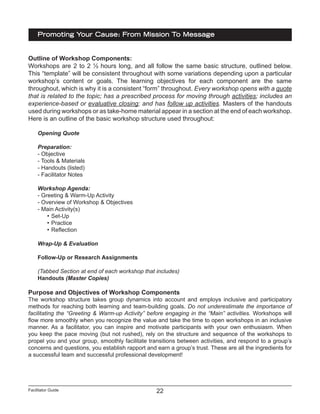
to help crystallize a common message is advantageous. With all of the above in mind, you might
facilitate this activity by dividing focus groups in this way: one or two groups working on general
knowledge about the organization, and another one or two groups working on presentation topics. In
this way the most critical “knowledge needs” are addressed.
WORKSHOP 3: Components of Successful Presentations
Facilitator Guide
Promoting Your Cause: From Mission To Message
46
1.	 SET-UP: (10 min) Distribute What Do You Know? Knowledge Window (H.O. 3-2).Say
that this activity will provide some collegial conference time in small groups where group
members will be able to share what they know or have learned in the course of researching
the organization and/or a selected topic. The purpose of this activity is twofold: 1) to
expand knowledge of the subject by “pooling” information, and 2) to recognize “holes”
or biases in the knowledge and identify areas requiring further research. To begin the
activity, provide five to eight minutes for each participant to individually complete
the handout. If possible include at least two points in each window (preferably more). (If
there are multiple topics being addressed assign the different topics/groups before the
writing process. If there is only one topic, writing can occur before groups are formed.)
Once the individual writing is complete, form topic groups of three to five.
2.	 PRACTICE: (20 min.) Knowledge Window Group Sharing: Assign a Timekeeper
and Reporter. Suggest that it is probably most efficient to share knowledge in quick go-
rounds (time-keeper keeps group on track). Participants should address all 4 sections,
emphasizing the bottom 2 quadrants. Groups can self-regulate their process, but
emphasize the importance of hearing every person’s initial input before entering into
further elaboration. Groups should be mindful of their time and use it well to learn from
one another and identify any needed research. (During the activity, give a “half-time” call,
and a “5 minutes to end” call)
Bring closure to the small group time and ask participants to focus forward for a
large group de-briefing and wrap-up.
Wrap-Up & Evaluation (10 min.)
•	 Ask participants to share any insights from the knowledge-window activity addressing whether the
activity successfully offered them an expanded “window” on information about the focus subject. (If
any did not find it helpful or useful, get at why, and prompt them to offer concrete suggestions for what
might have made it more useful.)
•	 Review/summarize what was accomplished in the workshop and affirms the group for the work
accomplished. Ask how participants would rate today’s workshop. (Thumbs Up/Down, OK – if short
of time)
•	 Go over follow-up tasks and finish up with any business or next steps
Facilitator Guide47
Follow-Up or Research Assignments (5 min.)
•	 Set appointments with leaders prior to Workshop 4 (Appointment should be scheduled during the
prescribed window of time between Workshops 5 and 6).
•	 What is the personal story (or stories) you plan on weaving into your presentation?
•	 Continue researching and gathering resources and data related to presentation topic.
Handouts (Master Copies)
1.	 Preparing Your Message For Presentation – A Checklist for Presenters (H.O. 3-1)
2.	 What Do You Know? Knowledge Window (H.O. 3-2)
WORKSHOP 3: Components of Successful Presentations
Facilitator Guide
Promoting Your Cause: From Mission To Message
48
Notes:
Promoting Your Cause: From Mission To Message HANDOUT 3-1
© 2012 Zephryn Conte, Environarts Inc.
®
480-774-9844
PREPARING YOUR MESSAGE FOR PRESENTATION
A Checklist for Presenters
As you prepare for your upcoming presentation to a civic or community leader, the information
below provides a framework for organizing your thoughts, plans and actions.
Qualities & Strategies of Successful Presenters:
Successful presenters prepare extensively for presentations, often for very long periods and
with attention to every detail. In the preparation process there are certain habits of practice or
qualities that one develops. In general, effective professional presenters:
 Do homework and are prepared with personal notes in order, so as to move easily and
professionally through material;
 Use audio-visual aids when appropriate to enhance their message;
 Use visualization (mental projection/mental pictures) to rehearse successful performances;
 Rehearse in front of the mirror and role-play “rough spots” with friends/colleagues;
 Listen to their own voices, project clearly and use voice modulation to hold interest;
 Are dressed and present themselves in a professional manner or in a manner appropriate
to the context of the presentation;
 Use correct titles (of parties being addressed) and are respectful in their approach;
 Are able to be flexible and adapt their expectations or plan to the situation;
 Are able to crystallize key points from responses or questions within a conversation, so that
pertinent information is communicated effectively;
 Listen well and invite questions in order to make a stronger connection with an audience or
reinforce the interests of the organization or community he or she represents.
Presenter/Pre-Meeting Checklist:
 Know your organization and its mission - its goals, its needs, its work in the community,
and the community it serves. Being prepared with an in-depth history or background will
enable you to effectively answer questions - particularly unexpected ones. Do your
homework and have more information or data ready than you may actually use in your
presentation so that you may speak authoritatively if unexpected questions arise.
 Call contacts the day before a scheduled appointment to confirm its time and location.
 Bring a nicely presented packet of materials from your organization (and possibly a
“keepsake”) that you can leave with your host as a “thank you.”
 Make sure professional attire, presentation notes, transportation, etc., are all in order.
 Bring (or have ready for that evening) the “Presentation/Site Visit Report Form” and the
“Presentation Reflection-Assessment Form” so that you can complete them immediately
after your visit while your memory is fresh.
 Prepare/address a formal thank you note in business letter format, prior to your visit, so it
is ready to mail immediately after your visit.
 Bring your enthusiasm to your host and remember to enjoy the process and the great
opportunity to share your organization’s work!
Components of Successful Presentations:
 Authenticity, enthusiasm and focus
 Clear Purpose and delivery (communicated concisely)
 Making a meaningful connection with listener(s) that relates to their concerns or reality
 Connecting the “HEART and MIND” (e.g., providing compelling stories along with
compelling data, facts or science that support the stories)
 Summary/Recapitulation of what was presented (usually at closing)
 Clear outcomes or clarification of any next steps or follow-up
(Note: A structure for building in these components will be provided)
Promoting Your Cause: From Mission To Message HANDOUT 3-2
© 2012 Zephryn Conte, Environarts Inc.
®
480-774-9844
WHAT DO YOU KNOW? Knowledge Window
Select a focus topic or issue and use these “knowledge windows” to open a discovery
dialogue with colleagues. Sharing information and conferring with others can illuminate
more about any topic you are investigating, can economize your research and can help to
determine the direction you take to acquire the information you need.
What do you (think you) know? What do you think you know but
aren’t sure of (have questions
about)?
What do you want to learn? Know
more about? Understand better?
What are your sources of
information for what you know?
What other sources could help you
learn more?
Facilitator Guide49
(2 hours)
WORKSHOP 4: Presentation Planning
OPENING QUOTE
Do you want to know who you are?  Don’t ask.  Act! Action will delineate
and define you.
– Thomas Jefferson
PREPARATION
Objective
Reflection on inspiration and “voice;” Practice highlighting “platform” skills; Begin crafting
presentations by incorporating successful components into a prescribed outline; Identify
and share information about stories and data to be integrated into presentations; learn
visualization technique to enhance performance
Tools & Materials
•	 Hello Badges (provide black markers for participants to write first names in LARGE
letters on name tags)
•	 Whiteboard; Multi-colored erasable markers; Eraser
•	 Flip Chart and Multi-colored markers (enough for yourself AND groups to use)
•	 Tape (pins) to hang charts
•	 Index Cards (packet) (Keep available each week as they come in handy).
•	 CHART prepared with a list of HEADINGS taken from Public Speaking and
Presentation Tips (H.O. 4-3): SELF IMAGE; APPEARANCE: –Posture/Carriage, –
Attire/Grooming; MENTALSKILLS; PHYSICALSKILLS; COMMUNICATION/DICTION;
TIMING
•	 CHART prepared with MICROLAB questions listed: 1) What are you most thinking or
feeling about your presentation? 2) What is your personal story (or stories) you plan on
weaving into your presentation? 3) What is a piece of research or data you are going
to use, or would like to use to support your message?
Handouts (Listed)
1.	 Drawing From Inspiration: Creating A Compelling and Informative Message (H.O. 4-1)
	 (This can be used for reading only. Handing it out is optional/your choice.)
2.	 Tongue Tanglers: Fun For Public Speakers (H.O. 4-2)
3.	 Public Speaking and Presentation Tips (H.O. 4-3)
4.	 Presentation Outline: A Guide For Presenters (H.O. 4-4)
5.	 Relaxation-Visualization Practice (H.O. 4-5)
Facilitator Guide
Promoting Your Cause: From Mission To Message
50
Facilitator Notes
This workshop is A LOT OF FUN and addresses important public speaking and presenting
concepts in INSPIRATIONAL ways. The workshop covers material that may be challenging
for some - as the group begins crafting, personalizing and finalizing presentations. Don’t
underestimate the potential for “performance-anxiety.” Activities are designed to ease
participants into the role of “public speaker/presenter.” Remember to be a cheerleader.
Bolster confidence - especially during challenging moments. It is important to maintain a light
and lively tone during this workshop so that participants can laugh at themselves while they
self-critique and observe others. The outcome should be that participants feel supported and
better prepared with skills that will help them create and deliver compelling presentations.
Facilitator Guide51
WORKSHOP AGENDA (posted)
Greeting/Warm-Up Activity (10 min.)
Welcome participants, explaining that Workshop 4 offers some FUN ways to begin strengthening skills and
crafting presentations. This workshop introduces a format that builds in all of the components of a powerful
presentation. Say that you want to open with a reading that addresses “inspiration.”
•	 Inspirational Reading: (3 min) Ask participants to listen as you read Drawing From Inspiration:
Creating A Compelling and Informative Message (H.O. 4-1)
•	 Paired sharing: (3 min) Turn to a partner and share any responses. (Call a half time so that both
speakers have equal time to speak). Possible starter prompts: Any feelings; What comes up for you;
Any resistance; Awareness; Questions…?”
•	 Large Group: (4 min) Poll the group. Share any responses.
Facilitation Note – Handling Resistance: The piece about inspiration could “push buttons,” particularly if
some do not feel inspired or think they can be inspiring to someone else. This might expose any feelings of
insecurity or resistance bubbling under the surface. It is good time to air these feelings as “normal” parts of
any growth process. This will help “keep it real” and invite authenticity. It is important to reassure the group
that resistance often represents pushing our comfort zones, so it is important to interpret discomfort as a
signal of growth. KEEP THINGS POSITIVE. If any resistant feelings or dissonance occurs, be attentive and
compassionate, but try not to get bogged down. Always listen, acknowledge feelings and look for ways to
redirect thinking toward the positive. Encourage those who may feel hesitant to just “ride” the workshop
process with a wait-and-see attitude. Maintain the energy and impetus of activities and if necessary, “check
in” privately with particular individuals after the workshop.
Overview of Workshop & Objectives (5 min.)
Read the workshop’s opening quote, which says it all! Review the posted agenda,
saying that today we will look at some presentation “platform skills,” practice a little, and
confer with one another about presentations. The closing is a relaxation-visualization
exercise - one of the strategies listed in Preparing Your Message For Presentation - A
Checklist for Presenters (H.O. 3-1) from the last workshop.
Main Activities (Total Time 60 min.) Practice with diction, story telling and projection
Activity 1: (30 min.) Practice with diction, story telling and projection
1.	 SET-UP: (5 min.) Hand out Tongue Tanglers: Fun For Public Speakers (H.O. 4-2).
Assign at least one speaker to each of the six tanglers. (If you can assign 2 or more
speakers per tangler it is more interesting to hear different “takes.”) Read the directions
and allow time for practice using the following actor’s technique: DICTION must be
practiced OUTLOUD. In order to facilitate this, ask participants to move to various points
around the room, (with some distance between them). They should stand facing a wall
WORKSHOP 4: Presentation Planning
Facilitator Guide
Promoting Your Cause: From Mission To Message
52
and practice their “scripts” aloud by reading “to the wall.” This technique allows
each person to hear his/her voice bouncing back during practice. The “talk to the wall”
technique tremendously heightens awareness to voice intonation and diction. Allow only
3 minutes for practice.
2.	 PRACTICE: (10 min.) Speakers perform for the group. From the edges of the room,
each reader should turn and face the center to read. This will create a need to project the
voice. Encourage speakers to put the words on the “tips of their tongues” articulating the
lips and projecting the sound to the opposite wall so that EVERY WORD is clear. There
will be a lot of stumbling so keep it light and lively and be a cheerleader. Each speaker
should read twice (the second time immediately after feedback). After each first reading,
point out the unique diction challenges of the tangler, offer some tips, and allow the reader
to immediately do a second reading while they are “in the flow” and focused on the tips
you offered. THIS IS GREAT PRACTICE FOR PUBLIC SPEAKING! If there is time after
everyone has performed, repeat the exercise a second and even third time, switching
tanglers with each practice. Experiencing the unique challenges of different tanglers is
beneficial and fun! Make sure to invite applause at the completion of the activity.
3.	 REFLECTION: (10 min.) TAKE SEATS. Hang prepared chart with the outline of
headings from the Public Speaking and Presentation Tips (H.O. 4-3): [SELF IMAGE;
APPEARANCE: –Posture/Carriage, –Attire/Grooming; MENTAL SKILLS; PHYSICAL
SKILLS; COMMUNICATION/DICTION; TIMING]. Use the chart to introduce the
concepts, connecting the group’s own experiences with these areas that are so important
for presenters to consider. Poll the group by a show of hands to see how many of the
areas participants consciously think about, have some experience with, or have skill with
already. Find out how many think they need to pay more attention to, or increase their
awareness in certain areas. Hand out Public Speaking and Presentation Tips (H.O.
4-3) and ask participants to silently read it. Open a brief discussion to clarify or
elaborate any points. (This activity is directly followed by a transition into small groups).
Transition: (5 min.) FORM CONFERENCE GROUPS: Ask participants to stand and walk
around the room – continuing to move until you CLAP THREE TIMES, which is the group’s
signal to stop moving and FREEZE. When the group freezes, the three people standing in
closest proximity to one another form a group of three. Each “triad” should form a small
circle with chairs and bring their notes to their circle. A short break follows, after which
participants come back to their small groups for the next activity. (Note: Groups of two are OK,
but groups of four will be too large for this particular activity).
Stretch Break (10 min.): Ask participants to return to the small groups of three (or two).
Facilitator Guide53
WORKSHOP 4: Presentation Planning
Activity 2: (30 min.) Crafting the Message (Presentation Outlines)
1.	 SET-UP: (10 min.) Once seated in groups of three (or two) say that you will be using the
Microlab format once again to assist presenters with articulating the ideas they are having
about their presentations. Hand out Presentation Outline:AGuide For Presenters (H.O.
4-4). Remind participants that in Workshop 3, time was spent exchanging information that
would serve as presentation “building blocks.” Another important aspect of a compelling
presentation is the use of personal experiences or stories that bring the issues to life. The
presentation outline offers a structure that helps us “put it all together” ensuring that the
components for success are built in. Invite each speaker to use the outline as a guide for
crafting a presentation that will have his or her own unique stamp. With the exception of
the presentation’s basic outline, and the “one voice” everyone will share when introducing
the organization, each person’s presentation will take on his or her own rhythm, personality
and style.
Before beginning the microlab, ask participants to take a few moments to review the
handout and focus their thoughts before any sharing.
2.	 PRACTICE: (15 min.) MICROLAB SHARING
In this microlab each speaker will have a full five minutes to respond to three questions.
This offers each speaker the opportunity to respond to the questions in a fluid manner.
POST THE QUESTIONS so they are visible. Follow MICROLAB protocol; remind the
group about guidelines; call “half times” and “start” and “stop” times for each speaker.
1.	 What are you most thinking or feeling about your presentation?
2.	 What is the personal story(s) that you would like to weave into your presentation?
3.	 What is a piece of research or data you are going to use, or would like to use to support
your message?
Note: If speakers finish their responses to questions before the designated five minutes
are up, the listeners should ask the speaker questions about anything he or she shared.
After that, if time remains, groups can engage in a discussion that keeps the focus on what
the speaker has said. (Call “timeout” and repeat the process for the next two speakers).
3. REFLECTION: (5 min.) Share some responses from the Microlab. Prompts: How was the
microlab? How might you use anything you learned or became aware of today to work on
your presentation?
Wrap-Up & Evaluation (15 min.)
•	 SET-UP: Say that for today’s wrap-up we are going to close with a Relaxation-Visualization
Exercise that will help you to use visualization effectively to enhance your performance (one of the
skills mentioned in the presenter’s checklist). Since some people may not have any background in
how to use visualization as a “science for self-improvement,” this will give us all a common experience
which you can continue using. Continue introducing the activity, READING or paraphrasing the
first 2 paragraphs of Relaxation-Visualization Practice (H.O. 4-5). You may hand it out for all to
read or choose to distribute it after practiceing the exercise.
Facilitator Guide
Promoting Your Cause: From Mission To Message
54
•	 PRACTICE: Have everyone sit comfortably and read aloud the PRACTICE as they experience
it. Your voice should be soothing. Leave ample pauses so that they are able to internalize the
impressions. Breathe deeply as you read.
•	 Invite everyone to sit comfortably and read the handout mindfully as the group experiences the
PRACTICE. Possible Prompt: In what ways do you think practicing in this manner can help you with
your presentations?
Follow-Up or Research Assignments
Participants should finalize their presentations so that they are ready to role-play and receive feedback
from colleagues during the next session (Workshop 5).
Handouts (Master Copies)
1.	 Drawing From Inspiration: Creating A Compelling and Informative Message (H.O. 4-1)
(This can be used for reading only. Handing it out is optional/your choice.)
2.	 Tongue Tanglers: Fun For Public Speakers (H.O. 4-2)
3.	 Public Speaking and Presentation Tips (H.O. 4-3)
4.	 Presentation Outline: A Guide For Presenters (H.O. 4-4)
5.	 Relaxation-Visualization Practice (H.O. 4-5)
Promoting Your Cause: From Mission To Message HANDOUT 4-1
© 2012 Zephryn Conte, Environarts Inc.
®
480-774-9844
Drawing From Inspiration:
Creating A Compelling and Informative Message
Inspiration may be a form of the superconscious, or perhaps of the subconscious – I wouldn’t 
know. But I am sure it is the antithesis of self‐consciousness. ‐‐ Aaron Copeland (Composer) 
Creating A Compelling and Informative Message 
A compelling message weaves together the “heart and the head!” And while the
impact of your message usually comes through the emotional component of your
story, the logical hemisphere of the brain also needs “to be convinced” through the
infusion of important “facts and figures.” No one element is more or less important
in crafting a compelling message – but it is true, that what will engage your listener
will be your story and the energy with which you deliver it.
Find Your Inspiration 
You know better than anyone, how your organization is serving a purpose and
bringing value to your community. That’s why you are here…and because you care
about your world, it is even likely that you feel a passion for your work. You
understand your organization’s mission and the ways in which it uplifts your
community through the services it provides; and this is what feeds the flame of
inspiration – the basic wholesome intent of your organization’s mission to address
important human or community needs.
What Drives You In Your Work? 
If passion for people or community, social consciousness or dedication to service
drive your work, then it stands to reason that any message ABOUT your work will
be most powerful when you allow your own passion and purpose to shine through.
Any audience, particularly the community leader or elected official you intend to
address, can’t help but be influenced by an inspired and compelling story and an
engaging and inspired “story-teller.” So as a speaker, think of your presentation as
“educational story-telling” - an unfolding drama that happens to be real-life.
Reporting the facts through stories that paint a colorful picture of the community
and the service your organization provides, memorably illustrates the good news of
your organization’s mission.
Without your passion and your personal connection, no story or amount of
impressive data will get the message across. You can be an artful presenter - with
preparation and with thought - if you remember that YOU are the most important
link in conveying your organization’s mission into a compelling message.
  
Promoting Your Cause: From Mission To Message HANDOUT 4-2
© 2012 Zephryn Conte, Environarts Inc.
®
480-774-9844
TONGUE TANGLERS: Fun For Public Speakers
Below are a few known and not so known “tongue tanglers.” Have some fun with your
diction and story-telling skills! Because these passages make it so challenging to clearly
enunciate the words or phrases, it’s difficult to get past the pronunciation traps and think
about what the stories mean. The goal is to try and transcend the diction stumbling blocks
and tell the story dramatically, with expression. Taking this approach actually promotes
clear diction. Tongue tanglers provide great practice for public speakers and presenters
because they bring laser-like attention to the importance of speaking clearly and audibly.
Blend good diction with expressive intonation and you will hold your listeners’ attention!
A Tutor Who Tooted
A TUTOR WHO TOOTED A FLUTE
TRIED TO TUTOR TWO TUTORS TO TOOT.
SAID THE TWO TO THE TUTOR IS IT HARDER TO TOOT
OR TO TUTOR TWO TUTORS TO TOOT?
(Note: The vowel “u” should be pronounced like “eeu” (very quickly) in contrast to the “oo”
sound which sounds like the “oo” in “Who.”
Betty Botter
BETTY BOTTER BOUGHT SOME BUTTER BUT SHE SAID, “THIS BUTTER’S BITTER!
IF I PUT IT IN MY BATTER, IT WILL MAKE MY BATTER BITTER,
BUT A BIT OF BETTER BUTTER WILL MAKE MY BAKING BATTER BETTER.”
SO SHE BOUGHT A BIT OF BUTTER AND MADE HER BAKING BATTER BETTER.
SO ‘TWAS BETTER BETTY BOTTER BOUGHT A BIT OF BETTER BUTTER.
Peter Prangle
PETER PRANGLE, ‘THE PRICKLY PRANGLY PEAR-PICKER,’
PICKED THREE PECKS OF PRANGLY PRICKLY PEARS
FROM THE PRICKLY PRANGLY PEAR TREES ON THE PLEASANT PRAIRIES
Washington’s White Woolen Underwear
WHO WASHED WASHINGTON’S WHITE WOOLEN UNDERWEAR
WHEN WASHINGTON’S WASH WOMAN WENT WEST?
WASHINGTON’S WIFE WOULDN’T WASH WASHINGTON’S
WHITE WOOLEN UNDERWEAR
WHEN WASHINGTON’S WASH WOMAN WENT WEST, SO
GEORGE WASHINGTON UNWILLINGLY WASHED WASHINGTON’S
WHITE WOOLEN UNDERWEAR WHEN
WASHINGTON’S WASH WOMAN WENT WEST!
A Flea & A Fly
A FLEA AND A FLY IN A FLUE WERE IMPRISONED.
OH WHAT COULD THEY DO?
SAID THE FLEA LET US FLY! SAID THE FLY LET US FLEE!
SO THEY FLEW THROUGH A FLAW IN THE FLUE.
Amidst The Mists
AMIDST THE MISTS AND COLDEST FROSTS
WHICH BAREST WRISTS AND STOUTEST BOASTS,
HE THRUSTS HIS FISTS AGAINST THE POSTS,
AND STILL INSISTS HE SEES A GHOST!
Promoting Your Cause: From Mission To Message HANDOUT 4-3
© 2012 Zephryn Conte, Environarts Inc.
®
480-774-9844 1 of 2
PUBLIC SPEAKING AND PRESENTATION TIPS
Presenters are in front of people or working with audiences all the time. Certain platform
skills are rules of the trade for individuals who are public speakers or presenters. Below are
a few tips for polishing your public personae.
Self-Image – The Image You Have of Yourself
Your self-image and self-perception are central to everything. Your inner confidence is
directly linked to how you connect with others. Taking care of your inner world is your first
order of business as a presenter. Your core energy is what feeds your self-motivation,
personal drive and ability to inspire others. Do everything you know to effectively support
yourself by safeguarding and managing your own needs and feelings. Doing this fosters
emotional health and personal confidence. You are first responsible for the private inner
you. With a strong core, you can project yourself outwardly as a confident professional.
Enough rest, proper breathing and drinking enough water are simple yet effective strategies
for increasing self-awareness, improving mental performance and reducing stress.
Appearance – The Image You Project To Others
Again, your self-image and self-perception are central to everything. Your inner confidence
is either highlighted and enhanced or distorted and hidden by your outer appearance. As a
professional, your appearance should support you as well as support others to see your
strengths and unique qualities. Thus it is important to pay attention to how you are
appearing to others through your behaviors, your personal grooming and your attire.
 Posture & Carriage: Your self-image and self-perception are central to your posture
and carriage. When your inner core is calm you are more relaxed and able to be fully
present with others. “Para-verbal” communication (gestures, postures, eyes, voice
inflections) registers more powerfully than words (at about 70%). This means that our
body language conveys a good deal more about us than our words. When approaching
others, especially as a presenter, work at feeling centered. Be aware of your stance, of
holding your head up and shoulders back. Focus eyes and connect movements to the
words and message you are conveying. “Unposited” movements are gestures that are
disconnected or unrelated to the message (pacing, eyes unfocused, fidgeting, nervously
waving arms or hands). As a presenter, hands should be kept at waist height with an
open posture (palms open) Refrain from pointing your finger at audience members. It is
a para-verbal put-down. Instead, gesture with an upturned open palm as if to say, “I
give you the floor!” Also hold any papers at waist height, so they are not in front of your
face. If you are reading, look at your audience as much as possible.
 Attire & Grooming: While you cannot judge a book by its cover, the cover is the first
thing you see that either interests you/or not, in the book. If your self-image and self-
perception are central to everything, then it stands to reason that you would want to
wear a “book cover” that best reflects you. For those who might rebel against social
pressures or biases around “looking good,” it is important to adopt an attitude of ‘doing
it for yourself.’ Attire and grooming create a bridge between our inner identity and our
outer professional image. Attending to outer appearance can even be therapeutic and lift
us out of the doldrums. Put yourself together with detail. Are colors coordinated; shoes
polished; are you fashionably appropriate; are you groomed well - personal hygiene
handled (aware of breath or body odor); is your attire appropriate to the setting
(necklines - appropriately fitting clothes for women, ties for men)? It is important to
objectively think about the social or professional setting, and to be aware of the kind of
statement or impression you will be making by how you are groomed and dressed.
PUBLIC SPEAKING AND PRESENTATION TIPS
© 2012 Zephryn Conte, Environarts Inc.
®
480-774-9844 2 of 2
Mental Skills: Mental preparation can happen in different ways. One level of preparation
has to do with concentration, memory and focus. Studying your notes and memorizing
information gives you a sense of ease during a presentation. Another level has to do with
conditioning the subconscious mind to respond to positive impressions. By using relaxation
and visualization techniques you can enhance your performance, fine-tune your ability to
focus and increase the likelihood of success. In addition, positive self-talk is important. Self-
affirmation occurs by first noticing and then verbally acknowledging your own positive traits
or behaviors. Re-training oneself to be verbally self-affirming helps the “internal critic” to
become an advocate rather than an enemy!
Physical Skills: Presenting is a dramatic art, so it is useful to adopt some of the practices
of theatrical performers. Drink a lot of water before presenting. When your adrenaline is
pumping your body uses more of everything, which is why it is common to feel “dry
mouthed” in stressful situations. Hydrate before a presentation (and keep water with you),
and the parching that can affect speech will be greatly relieved. Resting enough – even a
short nap or meditation helps with being prepared. Warming up like an athlete or dancer is
also beneficial. Prior to a presentation, stretching, neck and shoulder rolls, face and jaw
exercises to loosen vocal apparatus and deep breathing, all help to alleviate stress and bring
a focused ease to your demeanor. Rehearse! Don’t’ be afraid of mirror practice sessions, or
role-playing with friends, to make you aware of how you are carrying yourself or how your
voice inflections are projecting. Try different postures and stances. Use your voice
differently or work on different “scripts” that allow you to practice communicating different
feelings. You are your own best critic and a mirror (or a friend) can be your best trainer in
helping you develop confidence with the use of physical skills.
Communication Skills & Diction: Delivering your message in a way that is meaningful
to your audience is key in any communication process. This point is magnified when you are
a presenter and only have limited time to effectively communicate. Using theatrical and
para-verbal skills (highlighted earlier) assist you to convey a memorable message.
However, if someone cannot understand your words, your message will fail no matter how
dramatic you are. Good diction (clear pronunciation) is critical for public speakers. Imagine
if someone could only hear you but not see you (a blind listener). Your words should tell the
whole story through your inflections, tone of voice and story-telling abilities. This is an
important awareness because too many presenters speak too quickly and mumble or slur
their words. Be dramatic. Use pauses. Change your tone of voice and use descriptive
gestures. Watch TV commercials to see how announcers use their voice and body language.
Your authenticity and emotional connection to your topic along with your connection to your
audience all help you to be a powerful communicator.
Timing: As a presenter, it is useful to have a fine-tuned sense of timing and a good sense
of your own rhythms while delivering a message. The human attention span for listening is
under ten minutes, so it is critical to keep connecting your material directly to your listeners
so that you hold their attention. Using a digital timer is not out of the question if you want a
method (that only you have to see) for staying on track. Timing issues that often come up
for presenters have to do with managing the “unknown” factors related to facilitating
groups. Responding to the needs of an audience can often throw a presenter’s plan or
timing off. Ultimately, effectively communicating the message is what is key, so if you stay
flexible and focused, you can often move effectively through an agenda even if it unfolds
differently than you planned. Sometimes you have to “think on your feet.” If for example,
you are behind schedule, you may have to make decisions about leaving something out, or
condensing the remaining material. Staying as true as possible to your original timing and
content plan is optimal, but the true art of timing has to do with balancing your agenda with
the needs, demands or personality of your audience.
Promoting Your Cause: From Mission To Message HANDOUT 4-4
© 2012 Zephryn Conte, Environarts Inc.
®
480-774-9844 1 of 2
PRESENTATION OUTLINE
A Guide For Presenters
PRESENTATION STRUCTURE (plan a 20-30 minute meeting)
Below is the suggested structure for organizing your presentation in a way that builds in the
components for success. Your basic knowledge, personal approach and unique delivery are
the pivotal factors effecting your impact on your audience. However, a roadmap helps keep
even the most experienced presenters on track. You will need to think about and practice
how you plan on integrating personal or compelling stories with factual data. You can use
the outline below as a template to keep notes as you develop your own presentation style.
INTRODUCTIONS
 Yourself: Role with organization/connection to the work – Could relay a personal
story about how you became affiliated IF it supports the impact of your message
 Organization: Mission; Vision; Overview of activities or programs (You can present
brochures or materials you brought to help with your description)
 Ask leader if s/he knows of, or is familiar with your organization. (Learn what they
know up front, as it may determine how you choose to proceed).
CONNECTIONS & PURPOSE
Depending upon how the earlier question was answered, make at least one connection
with the leader’s work: e.g., noting any links between his/her interests and your
organization; an appreciation of something he/she has accomplished; something you
admire about his/her work. Put the spotlight on the leader for a short moment as a way
of making a case for why he or she was selected to receive a presentation about your
organization’s work.
PRESENTING COMMUNITY NEED/TOPIC
 Outline a problem or need in the community (topic or reason for visiting)
This can be supported by a personal story, or by telling a compelling story.
 Demonstrate your organization’s impact (or activities) in relation to the issue
 Present any data or facts that demonstrate the organization’s impact
DISCUSSION - Q & A
 Based on what you have presented ask if there are any questions or any
clarifications needed. (Engage in lively discussion here offering as much information
as needed, and continuing to crystallize points relating to your message.)
 Win-Win: (Looking for common ground or shared support systems) Ask if the leader
sees any ways that s/he may want to continue to connect with your organization,
with the issues you’ve presented, or, if there is anything your organization can
provide for him or her.
CLOSING & INVITATION
 Invite the leader to any appropriate activity or to any on-site visit to the organization
that is related to, or highlights your work/impact in the community. (Sometimes
leaders enjoy making site visits if it is something they are curious about). Remember
that this is a friendly professional invitation only and should not suggest a request
for endorsement.
 Summary of your main points and re-cap of inspirational highlight or compelling
reasons for meeting with this leader
Promoting Your Cause: From Mission To Message HANDOUT 4-4
© 2012 Zephryn Conte, Environarts Inc.
®
480-774-9844 2 of 2
PRESENTATION PLANNING:
Presentations often unfold a little differently than planned when you are in front of a person
or group. Be flexible and use this outline to jot down your key points. This will help you to
stay focused on delivering the important information! (Plan a 20-30 minute meeting).
INTRODUCTIONS
 Yourself (Role with Organization or connection to the work – Personal story?)
 Organization (Mission; Vision; Overview of activities or programs)
 Ask leader if s/he knows of, or is familiar with your organization
CONNECTIONS & PURPOSE
Make connection with leader or leader’s work; reinforce reason for visiting him/her
PRESENTING COMMUNITY NEED/TOPIC
 Outline problem or need in the community (STORY)
 Demonstrate organization’s impact or activities related to the issue. (SUPPORTING
DATA)
Q & A - DISCUSSION: Any questions or any clarifications needed.
 Potential Win-Wins?
CLOSING – ANY FOLLOW-UP?
 Invite the leader to…
 Weave in a summary of main points/Add closing point/Re-cap reasons for visit
Promoting Your Cause: From Mission To Message HANDOUT 4-5
© 2012 Zephryn Conte, Environarts Inc.
®
480-774-9844 1 of 2
RELAXATION - VISUALIZATION PRACTICE
This relaxation-visualization exercise is designed to assist professionals such as public
speakers, trainers, artists, business leaders, athletes, etc., to use relaxation and
visualization as tools for enhancing performance. The latest research in neuro-science and
the human brain along with principles and time-tested practices drawn from the
hypnotherapy, bio-feedback and ancient meditation traditions, all confirm through well
documented and substantiated research, the efficacy of harnessing the power and potential
of the mind (brain) to influence and positively shape our lives.
The exercise below is designed to help you relax your body, quiet the conscious mind and
direct your imagination (by visualizing) to influence your performance. The sub-conscious
mind does not differentiate between what you experience in “reality” or in your imagination.
Thus, in order to manifest the changes we want, it is this part of the brain we aim to
influence and “direct” through positive impression. To do this the body must relax first, so
that the conscious part of the mind can get quiet enough to allow different neuro-pathways
to open. The key is deep relaxation and the slowing of brain waves. One way to think of it is
like accessing different closets in a house, accept this closet happens to be one that is
tucked away in a back room that you need a special key to unlock! As the yogis say when
you “get the mind out of the way,” you begin to master it. Practicing this exercise for only
five minutes a day, can improve health, vitality, professional performance and quality of life.
THE PRACTICE: (Total 15 min.)
Note: the relaxation-visualization should last at least 5 minutes to be effective but can be, and often
is, longer. The “coming back” process is about 3-5 minutes, but can also take longer. Results are more
effective if personal journal writing happens directly after, before any discussion. DIMMING LIGHTS
and closing open doors or windows helps to minimize external distraction so the process is most
effective.
Relax: (4 min.)
Sit in a comfortable chair, feet uncrossed on the floor, palms resting on your lap.
Close your eyes… Take a deep breath. Inhale on a count of 4, hold it in for 2 counts, and
exhale slowly on an equally timed count of 4, holding for 2 counts. Repeat this over and
over allowing yourself to fall into a rhythm and letting your physical body become more and
more relaxed. (Pause a few moments for breathing and relaxing to continue before
proceeding with the visualization.)
To relax more deeply, imagine a waterfall of crystal clear water above your head. Feel it
flowing into the top of your head and through your whole body. (Pause)
Feel the clear, crystal water pouring into your face and neck. (Pause)
Feel it pouring through your shoulders, and down your arms, wrapping around your heart.
(Pause). Gently feel this clear, crystal water flowing down into your stomach and lower
abdomen (Pause), down into your legs and feet (Pause), until your whole body becomes
part of the waterfall of pure, crystal water. (Slightly longer pause).
Visualize: (6 min.)
You are completely relaxed now. (Pause) In your mind’s eye - a blank screen before you -
you picture the setting, circumstances and other people involved in the scene of your
Promoting Your Cause: From Mission To Message HANDOUT 4-5
© 2012 Zephryn Conte, Environarts Inc.
®
480-774-9844 2 of 2
performance. The situation perfectly accommodates you, setting the stage for your smooth
and easy success. (Pause) Now you see yourself in the scene. You are completely confident
and relaxed. (Pause) You feel how well you are performing. In fact, you are a huge success.
(Pause) You know this because all of the signs of success are present. (Pause) You feel
strong…and happy, fulfilled and “on top of it,” and you are filled up with these emotions
(Pause). You notice how good your body feels as you perform successfully. (Pause). You
notice how the atmosphere supports you… the sounds, smells, temperature… the
people…(Pause). You feel supported… and see how everyone there is so happy to be around
you…(Pause). You keep feeling lighter, more energized and more confident as you perform -
and those good feelings permeate your entire being right now. (Pause at least a minute so
there is enough time for participants to stay with the visualization).
Coming Back (3 min) Note: Lead this gently and slowly with care.
Now, take the feelings you are feeling, those good feelings…successful feelings, and carry
them to the present moment – here in this room. Allow your performance scene to
dissolve… into the moment, into you, here, now. Do this with a deep breath in (all
together) and out (all together). (Do 2 more breaths all-together).
Move your fingers and toes and begin to stretch in your seat and when you are ready gently
open your eyes but stay focused down.
Focusing downward, continue stretching and moving and begin to bring your awareness and
the good feelings back to the room. Be aware of the sounds, the people around you…and
the lights going on. (Turn lights on). Gently begin to look up and around silently…and take
your journal and a pen in hand.
Journal entry: (2 min)
While maintaining silence, invite participants to write freely about any feelings, ideas or impressions
they had during the visualization; or they are having now. Ask them to take note of how they are
feeling in their bodies (stress levels, any relief from anything they were feeling). A “free write” is most
effective, but if there is a need for prompting, here are some focus points to help participants start:
 How did you feel?
 What did you experience?
 How do you feel now?
 How do you think the activity benefited you? Did it help you? Do you know?
 Do you see how, or think that this will help you perform better in “_________?”
Paired Sharing: (2 min - 1 min. per speaker)
As participants to complete journal entries, afterwards turning to a neighbor and sharing
anything they’d like to about their experience.
Large Group Sharing: (3 min)
Ask participants to share with the whole group - at their own comfort level - some of their
impressions or experiences. (In order to have the benefit of hearing many perspectives, request
short ‘single word’ or ‘short phrase’ responses so that many voices can be heard in a short
timeframe.)
Recordings of the Relaxation-Visualization Practice are available at www.environarts.com on-line store. Email us to order a CD.
Facilitator Guide55
PREPARATION
Objective
Rehearsal role-plays of simulated presentations (to community leaders) focusing on
delivery, style, presentation dynamics, performance, observation and feedback (an
integral part of small group rehearsal process); Primary follow-up task: completing (site
visit) presentations to selected community or civic leaders prior to Workshop 6.
Tools & Materials
•	 Hello Badges (provide black markers for participants to write first names in LARGE
letters on name tags)
•	 Whiteboard; Multi-colored erasable markers; Eraser
•	 Flip Chart and Multi-colored markers (enough for yourself AND groups to use)
•	 Tape (pins) to hang charts
•	 Index Cards (packet) (Keep available each week as they come in handy).
•	 Chairs for small groups of three. NOTE: The main activity is presentation role-play
practice, done sitting in small groups (circles of three chairs). While in practice groups,
observers will need a hard surface (notebook or note pad) to jots down notes during
role-play observations.
•	 Each participant needs a piece of scrap paper to crumple up into a ball (for warm-up
activity)
Handouts (Listed)
1.	 Giving and Receiving Constructive Feedback (H.O. 5-1)
2.	 Presentation/Site Visit Report Form (H.O. 5-2)
3.	 Presentation Reflection–Assessment Form (H.O. 5-3)
(2.5 hours)
WORKSHOP 5: Presentation Practice
OPENING QUOTE
One isn’t necessarily born with courage, but one is born with potential.
Without courage, we cannot practice any other virtue with consistency.
– Maya Angelou
Facilitator Guide
Promoting Your Cause: From Mission To Message
56
Facilitator Notes
This workshop focuses on the practice of presentations. Set a positive and upbeat tone, and
keep the energy moving in a rhythm. Rely on your timer so your attention is on the group.
Do your best to prevent people from getting bogged down. The strength and precision of
the process allows you to keep practice sessions moving so that there is time for repetition.
Be a precise time-keeper and group monitor during this session so that presenters have
sufficient time for two turns at practice. Make sure that the protocols and timing for task groups
are clearly defined (use handout H.O. 5-1 “Giving and Receiving Constructive Feedback”).
Several groups will be doing role-plays at the same time, so make sure that you CALL HALF-
TIME, START and STOP TIMES for each round of role-playing. In this way, you will be able
to flow easily from one round to the next.
Facilitator Guide57
WORKSHOP AGENDA (posted)
Greeting/Warm-Up Activity (3 min.)
Welcome participants and READ THE OPENING QUOTE, explaining that this workshop is an “intensive
practicum.” Liken it to going to the gym for a workout!
Overview of Workshop & Objectives (2 min.)
Review the workshop agenda (posted) and ask if there are any questions.
Main Activities (Total Time 2 hrs. with break)
Activity 1: (15 min.) WARM-UP GAME “The Wright Family”
1.	 SET-UP: (2 min.) FORM A CIRCLE (STANDING) The group is standing in a
circle and each participant is holding a crumpled-up paper “ball:” Say that since
this workshop involves so much “sitting” (to practice presentation role-plays),
let’s begin with a FUN standing exercise guaranteed to keep everyone alert! As
“narrator,” you will read the following story to the group. Each time the narrator
says the words “right” or “left,” the players pass their paper balls accordingly
- to the right or to the left. At all times, each player should be holding only one
“paper ball.” LISTENING is the key to success along with team synchronicity!
(Don’t read too fast or too slow! You want the challenge to be reasonable and
for the reading to sound natural and expressive! Inevitably it gets confused and
very funny. (Sometimes groups request a “redo.”)
2.	 PRACTICE: (3 min.) THE “WRIGHT FAMILY” STORY
(Call “time-in” before you begin. All are standing in a circle with crumpled paper
balls.)
“The Wright Family was looking forward to their trip out of state. They
loaded up the car and were ready for the ride to the airport when they
realized that Mr. Wright had left the airline tickets right on the dresser.
Mrs. Wright said, “That’s alright dear, I’ll run right upstairs and get them.”
So she left to go get the tickets.
While she was gone, Grandpa Wright asked Grandma Wright to check
and make sure she had all the right medication. She looked in her left
pocket for her heart pills; yep, they were right there, her right pocket for
pills for that nagging pain in her left shoulder. Yes, they were right there.
But when she checked the left side of her purse for her blood pressure
tablets, she realized she had left them upstairs on the left side of the
medicine cabinet.
WORKSHOP 5: Presentation Practice
Facilitator Guide
Promoting Your Cause: From Mission To Message
58
Well, she was upset when she found out that Grandpa Wright had left to
go upstairs. I had better run right upstairs and get Grandpa Wright. With
his bad left eye he won’t be able to find the right key to the right lock on
the door. “Which stairwell did he take?” she asked, “the left or the right?”
“He took the left,” the others replied. “Alright, I’ll be right back.” Well, just
as she left and entered the left stairwell, Grandpa was coming down from
the right stairwell. “Well my dear, here are your pills. They were right
where you left them.” Grandpa then looked around saying, “Now where’s
Luann? If we don’t leave for the airport right now we’re going to be left off
of the flight.” THE END – (Call “time-out.”)
3.	 REFLECTION: (2 min.)
As participants remain standing in the circle, facilitate a reflective discussion. This will
lead nicely into the transition (into small groups) that follows.
•	 How was the activity? What did you experience?
•	 What skills did we have to use/rely upon?
•	 How do you think this relates to, or supports our developing ourselves as presenters?
TRANSITION: Form Groups of 3: (8 min.) Transition the large group (still standing) into
small practice groups of three. The triads should be “cast” so that individuals can receive
the most benefit from their presentation role-play practice. (*See note below.) Small circles of
chairs should be clustered around the room with space between each group so as to control
overlapping sound. Once practice groups are formed, ask participants to gather and move
their personal belongings (presentation notes, pens, paper etc.) to their specified circle, as
they will be working together there for most of the workshop. (Groups will typically be triads.
See #2 in the note below for additional information regarding group size.)
* IMPORTANT NOTES: 1) If there is more than one topic being addressed by different
presenters, make sure practice groups include the people who are working on the
same topic. 2) If there are pairs or teams presenting together, they must practice
together in the same group. This means that potentially some groups may be larger
than three. Notes to the facilitator below give you some tips on how to adjust the
feedback procedure accordingly.
Activity 2: PRESENTATION PRACTICE ROLE-PLAYS (Total time 1:45 min. with break)
1.	 SET-UP: (5 min.) GROUP INSTRUCTIONS
•	 Once small groups of three are formed, explain that this will be the first of two
sessions (about two hours) of simulated presentation role-play practice.
HIGHLIGHT THESE IMPORTANT POINTS ABOUT EFFECTIVE ROLE-PLAYING:
1) Both the Presenter and the Supporting Partner, (the person playing the “leader”)
must play their roles as authentically as possible in order for role-playing to provide
effective learning. If players break character, the practice session loses impetus; so to
effectively prepare for “the real world situation,” role-plays must “play out,” with players
staying in character, for the duration of the time allotted. 2) The goal of this role-
Facilitator Guide59
playing is for “Presenters” to benefit by getting the most they can out of the simulated
practice. The focus should be on providing effective practice for the presenters. Never
deliberately try to “stump” the presenter in a role-play. If challenges naturally occur as
a result of the role-playing dialogue, these can be useful for learning.
•	 Timing: The protocol for simulation role-play practice is very specific and precisely
timed. There are two practice sessions - each consisting of three rounds of role-
play practice. This allows each presenter to have two turns (rounds) of practice with
observation and feedback. A round is 12 minutes (give or take a few minutes), and one
practice session consists of 3 rounds (totaling about 40 minutes). After a 10-minute
stretch break a second practice session provides each presenter with a second
opportunity to practice his or her presentation.
•	 Hand out “Giving and Receiving Constructive Feedback (H.O. 5-1). Use the
handout to explain the procedure, asking group members to self-identify as an “A,” “B”
or “C” (designating the role they will take in each round of role-playing).
2.	 PRACTICE 1: (40 min.) FIRST PRACTICE SESSION (3 Rounds of Role-Play)
(Remember to call “time-in,” half-time” and “time-out” for each segment of each round of
practice.) Follow the instructions on the handout and use a timer so that your attention
can stay on participants.
3.	 REFLECTION: (5 min.) FIRST PRACTICE SESSION
POLL participants before taking a stretch break. (Popcorn style is effective here.)
•	 How was the first practice session (first rounds of practice)?
•	 Any suggestions that would make the next practice session more effective?
Important Note - Re-grouping option: You have the option of interchanging group
members in order to “re-cast” role-plays and allow new combinations of participants to
work together during the Second Practice Session. (For example, all the “B’s” could
“rotate” to a new/different group). Make the determination to switch group members or
not, before the break, so as not to waste any practice time making the decision! If some
groups want to switch and some don’t you can work it out to suit each group (there are
benefits to either choice). Some of the benefits of “re-casting” include: the freshness
and challenge of working with different colleagues; feedback from a new observer bringing
a different point of view; new groupings pique attention and create a little anxiety which can
improve performance. Some of the benefits of maintaining same groups include: an
opportunity for improvement that will be recognized; a reference point for improvements;
moral support and strength of team effort; professional safety (which might not be the case
if someone is not comfortable with the original grouping).
Stretch Break (10 min.): So that the energy and momentum do not dissipate ask participants to
maintain concentration and quickly come back to their ROUND TWO groups. If there has been an re-
grouping for the second practice session, remind participants to make any seating adjustments now,
before the break, so that they can return to the correct group and not lose any practice time.
WORKSHOP 5: Presentation Practice
Facilitator Guide
Promoting Your Cause: From Mission To Message
60
4.	 PRACTICE 2: (40 min.) SECOND PRACTICE SESSION (3 Rounds of Role-Play)
(Remember to call “time-in,” half-time” and “time-out” for each segment of each round of
practice.) Follow the instructions on the handout and use a timer so that your attention
can stay on participants.
5.	 REFLECTION: (5 min.) SECOND PRACTICE SESSION
•	 How were the second practice sessions (second rounds of practice)? Compare or
contrast the first and second practices sessions.
•	 Describe some ways that practicing together with colleagues in his manner supports
one’s learning process or develops professionalism.
Wrap-Up & Evaluation (15 min.)
•	 Workshop 6 is the final workshop of the program, prior to which all presentations (site-visits) must
be completed. ‘Check in’ with presenters about the program calendar as well as their individual
appointments with civic or community leaders. In order to hear details from each presenter, begin
with a go-round. Ask all presenters to briefly report their leader’s name/title/position and when/
where they will be presenting to him/her. The go-round responses should be brief. (Consider
charting a list of presentation dates/locations/leaders.)
•	 Distribute the Presentation/Site Visit Report Form (H.O. 5-2) and the Presentation Reflection–
Assessment Form (H.O. 5-3). Presenters are asked to reflect upon and assess their presentation
experiences as a way of learning from those efforts. The handouts are straightforward and should
be completed directly following, or on the same evening of presentations. (Completed forms must be
returned in Workshop 6).
Follow-Up or Research Assignments (15 min.)
•	 Complete presentations to community/civic leaders (site visits);
•	 Complete two response forms and bring to Workshop 6 along with any materials collected at site
visits;
•	 Complete thank you letters (and mail) to leaders who received presentations (or who may have
supported the program in some way). Review any instructions or information about business letter
writing you think would be helpful to participants.
PROGRAMMATIC NOTE: Before the final sixth workshop, make sure that you discuss and clarify with
the organization’s administrative leaders or decision-makers, the efficacy of continuing with this program
into the future (facilitating another one, or scheduling “on going” programs). This decision will affect how
you approach the closing activities in Workshop 6.
Handouts (Master Copies)
1.	 Giving and Receiving Constructive Feedback (H.O. 5-1)
2.	 Presentation/Site Visit Report Form (H.O. 5-2)
3.	 Presentation Reflection–Assessment Form (H.O. 5-3)
Promoting Your Cause: From Mission To Message HANDOUT 5-1
© 2012 Zephryn Conte, Environarts Inc.
®
480-774-9844 1 of 2
Giving and Receiving Constructive Feedback
The process below outlines a twelve-minute protocol for giving and receiving constructive
feedback. This reflection-based protocol encourages participants to receive and to send
thoughtful feedback, after participating in a practice role-play.
Each person in the group will have a turn to “play” three different roles in three rounds of a
simulated presentation role-play. Presenters practice their own presentation “scripts.”
Observers silently observe presenters, taking notes and holding comments until it is time in
the protocol for feedback. Supporting Partners play the role of the “community leader” with
whom the presenter is engaging. Supporting partners are not critiqued, but should play the
role realistically, so presenters can practice effectively. Roles are rotated in each round of
practice, but in each round it is the presenter that is observed and critiqued.
Observers should observe silently (never interrupt or interject while the simulation is in
progress). Watch for the body language, demeanor, language choices and approach of the
presenter, and offer feedback at the appointed time. If a presenter is already aware of
something about his/her own performance, focus on things s/he might not be as aware of.
Groups are encouraged to work efficiently with a timer so that each presenter can complete
two practice role-plays (six rounds, with feedback, taking about one hour). The repetition
allows presenters to practice two different parts of their presentations and also allows
presenters to apply the feedback they were given in the first round of practice.
PRESENTATION ROLE-PLAY: (5min.)
During role-play, the facilitator should give presenters a half-time signal, and a one-minute
to end-time signal. (Half-time signals should also be given during feedback sessions). The
goal for groups is to fall into a relaxed yet efficient rhythm with this tightly timed protocol.
Feedback Part 1: Presenter (1.5 min.)
The presenter who has been observed begins the process by self-assessing:
1. What went well or was effective?
2. What did I like that I said or did?
3. What was hard, I didn’t like, or needs improvement?
4. What would I do differently, or change the next time, in order to improve?
Feedback Part 2: Supporting Partner (1.5 min.)
The person playing the other character (community leader) responds briefly:
1. What went well or was effective for you as the recipient of the presentation?
2. Any suggestions or adjustments that you think could improve the presenter’s
delivery or increase his/her impact?
Feedback Part 3: Observer (2 min.)
The person(s) observing (not a part of) the role-play, responds:
1. What I thought went well, I liked, resonated with, or thought was effective.
2. What elements might have made the presentation more effective?
3. What could have been done differently to make it work better; or be more dynamic?
4. One thing I would suggest approaching differently or changing for the next
time. (Sometimes observers don’t have any suggestions.)
Promoting Your Cause: From Mission To Message HANDOUT 5-1
© 2012 Zephryn Conte, Environarts Inc.
®
480-774-9844 2 of 2
Feedback Closure: Discussion/Clarifications (2 min.)
With the presenter leading the discussion, take a few moments to ask further
questions or to offer further comments about the presenter’s performance or
presentation material.
GROUP ROLES: 3-Round Practice Session
Plan about fifteen minutes for each of 3 role-plays, taking about forty minutes to
move through one practice “session.” Two sessions provide each presenter with two
turns to practice and receive feedback. Allow about an hour and twenty minutes
(adding a stretch break between) to complete two practice sessions.
Below are the role rotations for each round of practice. Each member of the group
should designate him/herself as “A, B or C,” and play the assigned role for each
round. If there are more than three in a group, and depending upon their roles, the
facilitator will clarify how the process should be approached. *
ROUND 1:
A = Presenter
B = Supporting Partner (Community Leader Role)
C = Observer
ROUND 2:
A = Supporting Partner (Community Leader Role)
B = Observer
C = Presenter
ROUND 3:
A = Observer
B = Presenter
C = Supporting Partner (Community Leader Role)
* Note: In some cases “presenters” may be in pairs or may be teams (presenting
together). With groups of four, there can be two observers in each round.
Depending upon the circumstance with groups larger than three, the facilitator will
assist you in working out the details of the process and timing. The same feedback
protocol should be followed (adapted) even if there are “presentation teams” or
multiple observers.
Promoting Your Cause: From Mission To Message HANDOUT 5-2
 
© 2012 Zephryn Conte, Environarts Inc.
®
480-774-9844 1 of 2
Presentation/Site Visit Report Form 
Contact information 
Presenter(s) Name:   
Presenter Phone   Email 
Name/Title of Contact:   Email: 
Contact Phone:   Fax: 
Name of Organization:  Organization Website:   
Site Visit Address:   
   
City:   
State/Zip:   
Organization Type Visited 
Adult Education     Fed. Government     Faith Based  
 Youth Based     State Government    Non‐Profit 
College/University     City Government    Technical/Vocational 
K‐12 Schools     For Profit       Alternative Education   
 Other/Describe:                   
Issue(s) Addressed (Check all that are appropriate or apply/add if needed.) 
Advocacy      Parent Education/ (Type?)  Immigration/Naturalization 
Agriculture    Food Security    Labor/Employment Development 
 Animal Welfare   Environmental Sustainability  Law/Legal Services 
Arts & Culture  Health – Aging/Hospice Care   Media 
Community/Econ Dev.  Health – Chronic Disease  Poverty 
Community Gardening     Health – Community Wellness  Public Safety 
Conflict Resolution/Peace/Justice  Health – Mental Wellness  Transportation 
Education ‐ (early childhood)               Health – Nutrition  Social Services  
Education ‐ (K‐6)    Health –Physical Fitness  Technology   
Education ‐ (middle school)    Health – Policy & Practices  Violence Prevention 
Education ‐ (high school)    Health – Public Health    Voter Registration 
Education/Youth (After/Before Sch.)  Health –Substance Abuse    Women’s Rights  
Education (Literacy/Mathmatics) HIV/AIDS  Youth Development/Programming 
Education (Physical Education) Homelessness  Youth – Foster Care 
Families/Family Services  Housing  Other:  
Logistics 
Promoting Your Cause: From Mission To Message HANDOUT 5-2
 
© 2012 Zephryn Conte, Environarts Inc.
®
480-774-9844 2 of 2
Any comments/reports about logistics/accessibility needs, etc.?  
 
 Over‐all Assessment of Visit 
Comments about what went well; was a challenge; general feelings about visit: 
 
Evaluation of Presentation 
See Presentation Reflection ‐ Assessment Form  
 
 
Promoting Your Cause: From Mission To Message HANDOUT 5-3 
© 2012 Zephryn Conte, Environarts Inc.
®
480-774-9844  
Presentation Reflection–Assessment Form
Organization Name: Presenter:
Contact Name/Title: Presenter Email:
Contact Email/ Phone: Presenter Phone:
Organization Address:
Street Address City State Zip
Directions: Complete this form on the same day/evening of visiting the representative of your selected organization in order to reflect upon your experience.        GENERAL RATING 
 
RECEPTION: How would you rate the reception by your host? Comments:
‐ 
 
OK 
 
+ 
LOCATION:  Was the space where you presented conducive to your making a successful presentation? Describe: 
‐ 
OK  
 
+ 
TIMING:  Did you have enough time to deliver your presentation as planned? Comments:
‐ 
OK  
 
+ 
ADAPTATIONS: Did you feel you had the flexibility needed to adapt to the person or situation and still deliver the information planned? Comments:
‐ 
OK  
 
+ 
MATERIALS/INFO PACKET: Were your materials/information packet appropriate/adequate? Comments: 
  ‐ 
OK  
 
+ 
PRESENTATION:  Did you satisfactorily cover all the points you wanted to in your presentation? Describe: (If appropriate, explain which points might 
have been presented/covered better.) 
 
‐ 
OK  
 
+ 
RAPPORT:  How would you describe the rapport you established with your host during the presentation?  
‐ 
OK  
 
+ 
CONTINGENCIES:  If your plans for the site visit failed or changed, e.g., host’s availability/emergencies… Did you develop an alternative plan? Describe:
‐ 
OK  
 
+ 
Additional Comments/Notes:  
 
Facilitator Guide61
PREPARATION
Objective
Reflect upon, celebrate and report about presentations; Develop a plan to continue to
hone skills and conduct informational meetings with civic or community leaders; Consider
the need for, or appropriateness of adjusting presentations to accommodate different
public speaking opportunities
Tools & Materials
•	 Hello Badges (provide black markers for participants to write first names in LARGE
letters on name tags)
•	 Whiteboard; Multi-colored erasable markers; Eraser
•	 Flip Chart and Multi-colored markers (enough for yourself AND the group to use)
•	 Tape (pins) to hang charts
•	 Index Cards (packet) (Keep available each week as they come in handy).
•	 CHART prepared with the heading: Group Guidelines scribed on top
Handouts (Listed)
1.	 Program Evaluation and Strategic Planning Questions (H.O. 6-1)
2.	 Index Cards
Facilitator Notes
This final of six program workshops focuses on lessons learned and ways to move forward
with what has been learned. Your organization’s decisions about how or if this program
will continue influence the way you approach the activities provided in Workshop 6. Flow
quickly from one activity to the next, so that all goals are accomplished, and participants can
experience an affirmative and uplifting closure to the program series.
(2 hours)
WORKSHOP 6: Reflecting & Evaluating
OPENING QUOTE
You’re not obligated to win. You’re obligated to keep trying to do the best
you can every day.
– Marian Wright Edelman
Facilitator Guide
Promoting Your Cause: From Mission To Message
62
WORKSHOP AGENDA (posted)
Greeting/Warm-Up Activity (10 min.)
Welcome participants explaining that this final workshop is an opportunity to reflect upon and apply what
has been learned during the program and during site visit presentations.
•	 Hand out Index Cards: Ask participants to WRITE DOWN ONE THING THAT THEY
LEARNED OR A HIGHLIGHT THAT STANDS OUT about their presentation experience.
(Choose only one for this short opening exercise). At the top of the index card they should
write either “Learned” or “Highlight” so you know to which point they are responding.
Explain that you will collect cards and read them anonymously to the group in order to
“take a pulse” on presenters’ experiences. (Note: If it is a large group, randomly select
and read six or so cards as a way of canvassing opinions and feelings).
•	 Collect Index Cards: Read all or a some of the cards as the group listens (without
discussion). Explain that there will be a more in depth opportunity to share in a moment.
Overview of Workshop & Objectives (5 min.)
READ the opening quote, saying that there will be will further reflection upon it at the
closing. Review the workshop agenda (posted), making sure that the workshop’s goals
are clear before proceeding.
Main Activity (55 min.)
Activity 1: (20 min.) MICROLAB: Presentation Reflections
1.	 SET-UP: (5 min.) Form MICROLAB GROUPS, explaining that questions will focus on
presentation experiences and on ways to apply what was learned.
Once groups of three or four are formed, remind groups of the microlab protocol for
listening and speaking. Once microlabs are complete, each small group will have the
task of generating specific data that will be shared for a large group discussion. (Note:
Make sure that enough chart paper for each group is ready for the activity following the
microlab).
2.	 PRACTICE: (15 min.) Do MICROLAB (3 Questions):
•	 What you would describe as your greatest personal accomplishment in completing
your presentation?
•	 Is there anything that you would change (or do differently) in your presentation – or in
any of the steps of planning for, or leading up to your presentation? (Take mental notes
for discussion later).
•	 Can anything you took from the experience of meeting with your “leader” or delivering
your presentation inform or in any way help the organization?
Facilitator Guide63
WORKSHOP 6: Reflecting & Evaluating
Bring closure to the activity. Ask groups to thank one another and invite participants
to take a short break.
Stretch Break (10 min.): Ask participants to return to the same small groups after break.
Activity 2: (35 min.) SMALL GROUPS: Generating Recommendations
1.	 SET-UP: (5 min.) (Same) groups will now continue to work cooperatively on generating
data that will be shared collectively. Ask each group to assign a time-keeper and a scribe
who will generate a chart representing the group’s conclusions.
2.	 PRACTICE: (15 min.) First ask groups to assign task-group roles. Once task-group roles
are decided, ask each group to consider and discuss the second and third microlab
questions. Participants should be highlighting lessons learned that would serve as positive
recommendations for improving upon any aspects of the program or program process. Each
group should select and agree (reach consensus) upon two or three recommendations
that they feel are the most pertinent (no more than three). Each group should chart a list of
recommendations that will be posted and compared with those of other groups.
3.	 REFLECTION: (15 min.) POST CHARTS & REVIEW “Group Recommendations”
As a way of reflecting upon the information generated by groups, POST CHARTS side-by-
side on a wall. Look for commonalities, things that impress or stand out, and see if there
might be a way to further refine or condense the information posted into a shorter “list of
group recommendations” that can be presented to organizational leaders.
Wrap-Up & Evaluation (20 min.)
The following questions are designed to use in assessing over-all program initiatives as well as to open
a discussion focused on planning for or strengthening the success of future endeavors.
Hand out “Program Evaluation and Strategic Planning Questions” (H.O. 6-1). Ask participants to
take a few moments to (individually) jot their responses to the questions. Note that these will be collected
at the end, and that participants can complete them “anonymously” (with no name) so as to feel free to
respond honestly. After writing, proceed with a large group discussion charting any highlights. (If you
wish to condense responses as in the earlier activity, you might re-assemble the previous small groups
and request that participants review their responses with the intent of condensing them down to the two
responses they feel are the most important.
Here are the “Program Evaluation and Strategic Planning Questions” (H.O. 6-1) questions:
(Note: that the fifth question is intended for organizations that plan on continuing to work with or
develop the program further.)
1.	 Relative to our goals, what have been our overall accomplishments and how did we progress toward
or succeed in meeting those goals? (Name some accomplishments or goals reached.)
2.	 Were there stumbling blocks or challenges, and how could we strengthen this program as a result of
what we learned?
Facilitator Guide
Promoting Your Cause: From Mission To Message
64
3.	 Are there any ways in which the presentations were implemented or approached that could be
improved upon or strengthened?
4.	 Given the above, and our overall experience with implementing Promoting Your Cause: From Mission
To Message, how can we continue to use what we have learned as a result of participating in this
program?
The following question(s) are for organizations planning to continue or further develop the program:
5.	 What are the best ways to utilize or expand upon this program in the future? (Considerations: Are
there any changes anticipated within the organization its leadership, policies or programs that should
be taken in to account as we make any future plans? Are there any changes anticipated within the
community(s) that our program or organization reaches/serves that might affect any future plans for
this program; or even create a stronger need for it?)
Final Celebratory Closure: (15 min.) Seated in a circle
Re-read the opening quote: You’re not obligated to win. You’re obligated to keep trying to do the best
you can every day. – Marian Wright Edelman
Say that since this is the last workshop in a series that has represented much growth, hard work and
professional accomplishment, you’d like to use this quote as the motivation for a an affirmative “graduation
ceremony” where each person will receive appreciations from colleagues about how he or she has ‘done
the best s/he can.’
Procedure: Going around the circle, ask participants to focus on one person at a time. (You will facilitate
this by calling each person’s name, indicating that it is “his or her turn” to be affirmed.) Other group
members (who are not the “subject” of attention) are free to state any examples of how that person did
their best or shined in any aspect of the program’s initiatives. Lead this by starting off /modeling each
affirmative statement. (If you offer one appreciation about each person, the group follows more easily.)
Encourage short phrases and wait for at least two responses for each person. Four to five affirmations
per person are ideal. Sample affirmative statements: “I remember how X did X so well during X.” “I want
to affirm X for the great job she did during X.” “My hat is off to X for being such a strong example of X.”)
Follow-Up or Research Assignments
If applicable, assign continuing roles. If needed, schedule follow-up meetings. Follow through with any
contingencies that were decided upon or prescribed by the organization.
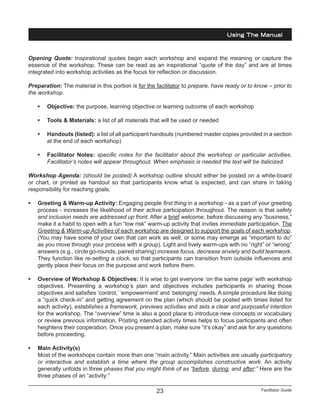
Handouts (Master Copies)
1.	 Program Evaluation and Strategic Planning Questions (H.O. 6-1)
Promoting Your Cause: From Mission To Message HANDOUT 6-1
© 2012 Zephryn Conte, Environarts Inc.
®
480-774-9844
PROGRAM EVALUATION & STRATEGIC PLANNING
QUESTIONS
The following questions open a discussion that will assist with assessing program
initiatives and planning or improving the success of future endeavors.
1. Relative to our goals, what have been our overall accomplishments and
how did we progress toward or succeed in meeting those goals? (Name
some accomplishments or goals reached.)
2. Were there stumbling blocks or challenges, and how could we
strengthen this program as a result of what we learned?
1. Are there any ways in which the presentations were implemented or
approached that could be improved upon or strengthened?
4. Given the above, and our overall experience with implementing
Promoting Your Cause: From Mission To Message, how can we continue
to use what we have learned as a result of participating in this
program?
The following question(s) are for organizations planning to continue or
further develop the program. (Write answers on back):
What are the best ways to utilize or expand upon this program in the
future? (Considerations: Are there any changes anticipated within the
organization its leadership, policies or programs that should be taken in to account
as we make any future plans? Are there any changes anticipated within the
community(s) that our program or organization reaches/serves that might affect
any future plans for this program; or even create a stronger need for it?)
 
Facilitator Guide65
Environarts, Inc.® combines the art and science of healthy human environments to provide programs
and solutions that positively transform people and communities. Founded in 2000 as a ‘school without
walls,’ author, educator and artist Zephryn Conte has advanced the use of creative mediums in several
national education initiatives, branding Environarts as a provider of cutting-edge programs and training that
develop the competencies needed in today’s global environment. Enviromuse Publishing offers a library
of music and ‘edutainment’ that uplifts and fosters personal growth. The US Justice Department, National
Endowment For The Arts and The National Center For Conflict Resolution name Environarts as a resource
for research-driven best practices in education, program design and professional development.
Services:
•	 Program Design: Implementation and Management (long and short term outcome-based training
programs)
•	 Professional Development: Skill Building, Team Building; 1-on-1 and Small Group Coaching
•	 Specialized Workshops: (Professionals and Students) EQ and Cultural Competence Topics
•	 Writing: Education/Entertainment Applications (Curriculum, Media; Broadcast)
Testimonials:
“…[the] belief that successful community environments can be created through group
experiences and training with creative processes, is a powerful new paradigm Environarts is
bringing into the private and business sectors.” [National Center for Conflict Resolution Education]
“You expanded the perceptions of participating business leaders and educators in entertaining
and unexpected ways …your creative methods provided a backdrop for reflecting about
ourselves and our performance as professionals that was truly transformational.”
[International Resource & Innovation Center, Tokyo, Japan]
“…I’d like to thank you for being a part of our youth violence prevention initiative. The response
to your workshops was tremendously positive…educators are truly seeking ways to help their
students practice peace.” [National Basketball Association]
“…contributions to… the Cultural Services Division have been invaluable…[we] continue to
incorporate the character and community building strategies in… various …programs…”
[Cultural Services Division, City of Tempe, AZ]
Contact Information
Zephryn Conte, President
(480) 744-9844
environarts.inc@gmail.com
www.environarts.com
ProcureAZ Vendor #: 000021623
Environarts, Inc. ®
Environarts, Inc.® consulting is a nationally recognized resource for
best practices in education, applied arts, professional development
and community building.
 
Professional Development Training Program

files_resources_promoting_your_cause_facilitator_guide_122412_0

  • 1.
    Promoting Your Cause:PromotingYour Cause: From Mission to MessageFrom Mission to Message Facilitator Guide Professional Development Training Program
  • 2.
  • 3.
    Facilitator Guide1 Promoting YourCause: From Mission To Message By Zephryn Conte Facilitator Guide
  • 4.
    Facilitator Guide Promoting YourCause: From Mission To Message 2 PROMOTING YOUR CAUSE: FROM MISSION TO MESSAGE Written by: Zephryn Conte The contents of this publication were developed with funds allocated by The Corporation for National and Community Service (CNCS) to the Arizona Governor’s Commission on Service and Volunteerism, Governor’s Office of Children, Youth and Families (GOCYF). The contents do not necessarily represent the policy of the agency, nor should endorsement by the CNCS be assumed. SPECIAL THANKS TO: Environarts, Inc.® Consulting, a professional development resource for best practices in education and training, for contributing copyrighted participant handouts and training methodologies used throughout this program. (See Page 67 for more information about Environarts programs and services.) ACKNOWLEDGEMENTS: John Rosenbum – for his initial work in developing the concept, the training manual, and piloting the concept Bill Suedmeyer – for his second round of rethinking the concept and for his revision of the pilot training manual Andrew Doty – for his round of edits on the revised pilot training manual Linda Devore – for proof reading the final draft of this publication e-Media Services – and Joan Hale for graphic design and layout Comcast - for sponsoring the production of the publication Zephryn Conte and Environarts, Inc.® – for breathing new life and depth into this major conceptual rework and rewrite of the final published manual. About The Author: Zephryn Conte, owner of Environarts, Inc.® , is a nationally published author and educator with over fifteen years of professional development, training and community program experience. Expert in inter-group relations, conflict resolution, stress management and applied creative arts, she has implemented short and long-term national and local programs that build leadership and promote personal and organizational growth. © 2012 All rights reserved: Reprinting & Usage: Reproductions of this book may be printed exclusively for the purpose of program training and for use by program facilitators. Participant handouts may be reproduced solely for instructional use in the "Promoting Your Cause: From Mission To Message" training program and must retain all copyright and contact information included on each page. No parts of this book or related participant handouts may be sold, reprinted or used out of context without written permission. Environarts, Inc. ®
  • 5.
    Facilitator Guide3 Preface /Dedication The intention of this project is to provide a tool for organizations to help increase outreach and impact. This work is dedicated to all of those visionaries at all levels and in all positions that do so much for our country, our states, our communities, and our citizens.
  • 6.
    Facilitator Guide Promoting YourCause: From Mission To Message 4 Table of Contents INTRODUCTION ........................................................................................................................ 5 FOUNDATIONAL CONCEPTS................................................................................................... 9 FOR THE FACILITATOR...................................................................................................... 11-18 USING THE MANUAL: ORGANIZATION & COMPONENTS.................................................. 19 - “6-Workshop Series At-A-Glance” (Charted)............................................................... 20-21 Workshop 1: Introduction & Purpose ................................................................................... 25 • Workshop 1 Master Handouts: - Visioning & Group Guidelines (H.O. 1-1) - Guidelines For Effective Group Discussion (H.O. 1-2) - Community Leader/Site Visit Research Form (H.O. 1-3) - Brochures or literature about the organization and its mission or work - Participant folders (a depository for papers and handouts) Workshop 2: Ownership & Objectives ................................................................................. 33 • Workshop 2 Master Handouts: - Listening (H.O. 2-1) - Microlab (H.O. 2-2) - Community Leader/Site Visit Research Form (H.O. 2-3) - Small Task Groups (H.O. 2-4) - Group Consensus (H.O. 2-5) - Addressing People of Title (H.O. 2-6) Workshop 3: Components of Successful Presentations .................................................... 41 • Workshop 3 Master Handouts: - Preparing Your Message For Presentation – A Checklist for Presenters (H.O. 3-1) - What Do You Know? Knowledge Window (H.O. 3-2) Workshop 4: Presentation Planning ..................................................................................... 49 • Workshop 4 Master Handouts: - Drawing From Inspiration: Creating A Compelling and Informative Message (H.O. 4-1) - Tongue Tanglers: Fun For Public Speakers (H.O. 4-2) - Public Speaking and Presentation Tips (H.O. 4-3) - Presentation Outline: A Guide For Presenters (H.O. 4-4) - Relaxation-Visualization Practice (H.O. 4-5) Workshop 5: Presentation Practice ...................................................................................... 55 • Workshop 5 Master Handouts: - Giving and Receiving Constructive Feedback (H.O. 5-1) - Presentation/Site Visit Report Form (H.O. 5-2) - Presentation Reflection–Assessment Form (H.O. 5-3) Workshop 6: Reflecting and Evaluating ............................................................................... 61 • Workshop 6 Master Handouts: - Program Evaluation and Strategic Planning Questions (H.O. 6-1)
  • 7.
    Facilitator Guide5 INTRODUCTION National andlocal community service organizations are vital to our country. In many ways they reflect the conscience, heart and soul of a community. An organization’s ability to communicate its effectiveness is essential to its ability to successfully fulfill its mission. Promoting Your Cause: From Mission To Message WELCOME to a unique professional development training program created for national and local community service organizations or any organization looking for opportunities to build leadership and increase capacity. This program is a streamlined and flexible tool for developing an organization’s strongest voices and preparing spokespersons to promote mission and message! Who Can Benefit From This Program Whether in the non-profit, public or private sectors, this training series will assist groups involved in community service activities to develop leaders and engage in presentation efforts that will promote an organization’s mission. Businesses or for-profit organizations engaged in developing leaders or expanding outreach efforts can also benefit from this series by using it to build participants’ speaking, presentation and “people” skills. Service learning educators working with older students can incorporate this program into their curriculum as a way of preparing students for public speaking or service-project roles. Purpose The purpose of this “hands-on” facilitator’s guide is to build a team of key people who will be prepared to engage with selected civic leaders, or appear in selected public forums to deliver informative and compelling presentations. CEOs or directors of non-profit organizations (NPOs), managers, trainers or adult educators, HR persons, board members or those who mentor or regularly lead trainings, may use this as a vehicle for preparing staff, volunteers, students or any eligible parties associated with your work. The result will increase professionalism and build relationships, benefiting your organization in these ways: • Facilitators will be professionally enriched. This program applies the best practices of adult education and effective group dynamics, honing the skills of facilitators and thus strengthening an organization at the leadership or management level. • Collegial relationships will be invigorated as a result of the program. Training participants’ relationships will deepen, as will their connections with the facilitator. The group experience will increase feelings of trust, build leadership and renew the commitment to values and work ethics that are shared. Training participants will become more energized and other staff members will pick up on the energy. This in turn invigorates the organization, enlivens the professional climate and energizes its mission. • The program offers a WIN-WIN outcome for organizations and community/civic leaders. Many consideritacivicdutytoeducatepublicleadersaboutthecriticalissuesandneedsofthecommunities they serve. When we share information with leaders with a sincere desire to educate, it bolsters their knowledge and understanding of their constituencies. Our messages may strengthen a leader’s own service activities, or inspire him or her to adopt a new cause, which may in turn influence others to embrace or support an organization’s mission and/or services.
  • 8.
    Facilitator Guide Promoting YourCause: From Mission To Message 6 Using and Applying This Program This six-workshop program is an intensive training series with clearly defined professional outcomes. It is flexible enough to adapt to your organization’s particular needs and circumstances. Depending upon the type, size or context of your work environment, there are a few things to consider before implementing this program: Resources/Location: The time, personnel, space, tools and materials needed to initiate this professional development program are manageable for organizations. The cost is also modest and can potentially be handled by internal professional development professionals and with “in-kind” services. Mostly the program calls for staff release time or the coordination of qualified volunteer time, along with a strategic decision about who will facilitate the six-workshop program. The major pre-planning requirements for an organization implementing this program are: 1) Choosing a facilitator and program coordinator; 2) Selecting, organizing and scheduling a cadre of training participants; 3) Securing a suitable space in which to conduct private uninterrupted workshops; 4) Providing copies of all training handouts and necessary training materials. 1) Choosing a facilitator: The program training facilitator should be an individual with adult education and group facilitation experience. Some organizations have “staff” facilitators, “in- house” trainers, or personnel who are prepared to take on trainings and/or leadership of new programs. If there are no management, staff or volunteer personnel with this expertise, hiring an outside professional facilitator to deliver the program is a viable option. If an organization chooses to hire an outside facilitator, the cost should be manageable due to the conciseness of the program. However, even upon hiring an “outside” facilitator, it is recommended that there also be a staff person or volunteer acting as the organization’s point person and “internal” program coordinator. 2) Selecting, organizing and scheduling a cadre of training participants: How the time of those staff or volunteers participating in the program will need to be planned prior to implementing the program. Some suggestions include: before or after-work hours that are offered as either paid professional development or as “flexible time. There are creative ways that an organization can compensate or say “thank you” to participants for their training hours and service to the organization. (Suggestions and details follow below in the “Training Participants” section p. 8.) 3) Securing a suitable space in which to conduct private uninterrupted workshops: Training rooms must be conducive to adult learning and provide a flexible and well ventilated environment that allows for the movement of chairs, sitting in circles, writing at tables and engaging in a variety of large and small group activities. Workshops can be conducted on or off site depending upon what best accommodates the space requirements and scheduling needs of the program and host organization. (See “Materials & Space” p. 7) 4) Providing training handouts and necessary training materials: All training materials must be provided by the hosting organization.
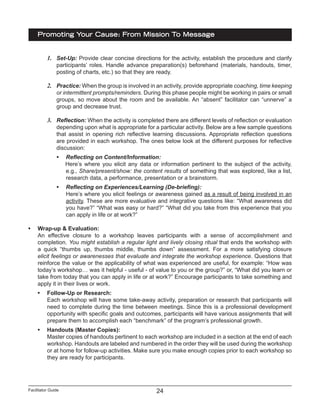
  • 9.
    Facilitator Guide7 Scheduling &Timing: This training is a series of six short (2 hour) workshops - best scheduled one time per week or two times per month (every two weeks) in a consistent rhythm or flow. It is not intended as a “one-shot”, one-day seminar because successfully improving professional practices require more on going participation. In addition, reaching the desired outcomes of this program requires learners to have necessary reflection and preparation time in between each session. Weekly or bi-monthly meetings work well for maintaining continuity and providing the needed prep-time. This pattern also eases scheduling for organizations faced with limited staff-release time.Additional delivery options that might better suit your circumstances and still maintain the integrity of the training process are considered below: • Option 1: (outlined above) a sample scenario - participants are freed up for the last 2 hours of the work day on 6 consecutive Thursdays; or some blend of before, during and after work hours (maintaining a weekly or bi-monthly rhythm). • Option 2: For organizations or participants who want to move a little faster or who have more flexible time/space options, some of the workshops can be “doubled up” in this way: Workshop 1 – stands alone; Workshops 2 and 3, as a 4 hour workshop; Workshops 4 and 5, as a 4 to 5 hour workshop; Workshop 6 – stands alone. • Option 3: It is not recommended that you deliver this training in one day. If, however, you can set aside 2 full days (as a “retreat”) Workshops 1, 2 and 3 can be delivered as “Day One,” Workshops 4 and 5 as “Day 2,” with Workshop 6 standing alone as a follow-up workshop - conducted after presentations have been delivered. Materials & Space: • The Training Room should offer a private and uninterrupted learning environment for program participants. The assurance of privacy is an important factor for the professional development this program requires. The space should be flexible - with open walls for hanging training charts and enough room for chairs to be arranged in a large circle or small groups. There should be some area in the room (possibly around the edges against the walls) with tables set up to accommodate writing (“seat work”) and/or small group activities that require conferencing or chart-making. In general the room needs to be open enough for movement and provide a variety of options for the way participants will interact. • Participant Handouts are used throughout the program. Master copies of the handouts needed for each workshop are located in this manual at the end of each workshop. The hosting organization must provide copies for training participants, covering any costs for duplication. If more than one, or multiple copies of a particular handout are needed, it will be specified in The “Tools & Materials” section of each workshop. • The “Tools & Materials” Section of each workshop provides a list of materials needed. Items commonly used in adult training should be kept on hand throughout the program (especially flip charts and in this case, enough markers for the entire group.) In order to make this program workable in a variety of settings - with or without access to technology, no overhead projections or PowerPoint slides are included with the training. If an organization has access to video cameras (with playback capability) and even a volunteer cameraperson, it is advantageous to film segments of Workshops 4 and 5 so that training participants can review their work afterwards and receive immediate feedback about their performances.” For The Facilitator
  • 10.
    Facilitator Guide Promoting YourCause: From Mission To Message 8 Training Participants: Effective professional development builds the capacity of an organization by promoting leadership. The more leaders available to promote and deliver compelling presentations about an organization’s work, the more an organization’s toolkit broadens. Once you have offered this program for the first time, and see its value and/or the results, you may consider repeating it (offering it more than one time) as an on-going professional development opportunity. Repeating the training program will build capacity “cumulatively,” and increase the value of training efforts. An ideal group size for this program is up to 10 people. If you wish to exceed that, cap the group size at 16, otherwise there is a risk of reducing the quality of the training’s impact and as a result, potentially diminishing the success of desired outcomes. Begin with a cadre of training participants from among your most talented or interested staff and or volunteers. You want motivated participants, so recruiting methods that work best are generally those that emphasize ‘a great professional growth opportunity,’ and stimulate interest or buy-in that is positively motivated. (Drafting is the least desirable recruiting method). * Here are a few ideas to start you thinking about ways to recruit a motivated group of training participants: • Select a group based on performance excellence; gather them; tell them about what you have in mind, and see who says “yes.” • Send out an attractive invitation (sign up/RSVP invitation) describing the attributes you are looking for, and see who self-selects. • Approach it as a “contest” involving the entire staff, board members and/or volunteers. Explain the opportunity and the qualities that participants should possess. Then ask staff, board members or volunteers to elect individuals that they think make talented prospects. (This is one way to include everyone and stimulate general knowledge and involvement in the program, which is useful for attracting future participants.) • Train the entire staff, board members and/or volunteers and see who emerges as the most talented leaders best equipped to carry out program initiatives. This approach benefits the entire community with the same professional development experience and opportunities to grow through the training process. (The practicality of this approach depends upon the size of the group and whether time and space can be arranged to accommodate it.) * A ‘thank you’ from the organization is a nice way to show appreciation to those who come forward as leaders. Stipends or overtime payments are one option, or social incentives like dinners, gift cards, etc. are great ways to value professional initiative. Take a “train-the-trainer” approach and be looking for leaders or potential leaders who might emerge as facilitators of the program. Only those who have been through the program should be selected as facilitators (unless they are professional trainers). The more that this series can be “turn-keyed” within the organization the more you build your organization’s strength.
  • 11.
    Facilitator Guide9 FOUNDATIONAL CONCEPTS ActiveCitizenship Edmond Burke (1729-1797) was an Irish statesman, author and political theorist who, after moving to England, served for many years in England’s House of Commons. He was remembered for supporting the cause of the American revolutionaries, and his view about the role of an elected representative sets the stage for “active citizenship.” “... it ought to be the happiness and glory of a representative to live in the strictest union, the closest correspondence, and the most unreserved communication with his constituents. Their wishes ought to have great weight with him; their opinion, high respect; their business, unmerited attention. It is his duty to sacrifice his repose, his pleasures, his satisfactions, to theirs; and above all, ever, and in all cases, to prefer their interest to his own…” - The Works of the Right Honorable Edmund Burke. Volume I. London: Henry G. Bohn. 1854. pp. 446–8. Communicating with our elected or civic leaders to let them know about conditions within our community is valuable and is regarded by many as a civic duty. The law denotes citizenship as a link between an individual and a state, viewed internationally as our “nationality.” Citizenship status, grants us certain rights or ethical principles of freedom (legal and social entitlements). Citizenship status also brings responsibilities, which are our moral, or ethical obligations. Out rights are often clearer to us because they are written down as part of law, like the right to political participation; to vote; to receive certain protections. But responsibilities are not as well defined, and so opinions differ as to our civic responsibilities. A good example is voting. In America we live in a “liberal representative democracy,” a form of government founded on the principle of freely elected individuals representing a group – their “constituency.” Not all representative democracies value or respect individual liberties as in ours (a notion stemming from the concepts of one of our “founding Fathers,” Thomas Jefferson known as “Jeffersonian” Democracy), and so voting in free elections and having a vote on who represents us and passes laws, or makes policy decisions that will affect our lives is seen by many as one of our primary responsibilities as Americans. Yet, because voting it is not compulsory. For any variety of reasons, many do not vote nor view voting as a civic responsibility. Active citizenship is the philosophy that citizens are actively involved in working to better their communities. After all, if a body merits rights and protections to the people, shouldn’t those people uphold certain responsibilities? The debate over rights versus responsibilities comes to light in the concept of active citizenship, which implies that an active citizen fulfills both his/her rights and responsibilities equally. Active citizenship defines some of our responsibilities as: volunteering service or donating to organizations that help the poor, needy, hungry, disenfranchised, etc.; conservation or eco-friendly activities (recycling); supporting educational causes; faith-based initiatives; even the volunteering of high-level professional expertise in such areas as banking, engineering, education and technology. “Citizenship education” is taught in some schools worldwide, often in response to the declining numbers of young people who are voting. In America we have an educational movement called “Service-Learning” which links clear academic learning goals with the development of student generated community-based service projects. As you think about what your organization is doing to serve your community, consider how you can communicate its vitality and impact to your civic or community leaders. Thomas Jefferson felt strongly about the role of the people as the “sole and safe depository of all power, principles and opinions” Foundational Concepts
  • 12.
    Facilitator Guide Promoting YourCause: From Mission To Message 10 (paraphrased) to direct the Government. A Frenchman Alexis de Tocqueville (1805-1859) was another 19th century European political thinker and historian who was best known for the book he wrote after touring America, Democracy In America (New York: A. S. Barnes & Co., 1851). He observed the power of volunteer efforts to motivate change (paraphrased): Our real power as a people comes through voluntary associations. Our personal freedoms would be protected if we could voluntarily resolve the problems of society, rather than permit the heavy hand of government to do it for us. Keep in mind the importance of your voice and be inspired by the power of exercising both your rights and responsibilities as a citizen. The Link With “Service-Learning” “Service-Learning” is an experiential teaching and learning practice that focuses on specific academic goals while offering students real opportunities to provide community services that meet genuine needs. Service-learning projects create a much needed link between “real life” and learning, as students become more invested in their communities and contribute services that offer direct aid. Service-learning education as a form of “active citizenship” begins with very young children, continuing through high school and into college years. This active and engaged learning process helps young people to grow individually and socially as they experience and interpret what it means to be a “responsible citizen” in a “free and civil society.” Many students report being deeply touched by their service-learning experiences, which has a reciprocal effect on communities that more readily view their youth as assets. The whole experience grooms young people in positive ways and develops them into adults who will more directly appreciate the value of living in a compassionate and caring society. The “Service-Learning Cycle” is the process by which service-learning programs are developed in classroom settings. As a sound educational model the cycle is used as a loose framework for this training series, and is correlated with the workshop objectives (learning outcomes) of each workshop in the program (See: 6-Workshop Series At-A-Glance on pages 20-21). This correlation should assist any service-learning educators interested in integrating or using any parts of this work in their programs to do so with greater ease. Differentiating Between “Education” and “Advocacy” For those who may be visiting elected officials, it is important to clarify the difference between education and advocacy (political lobbying). This is a particularly important distinction for most service organizations, which are generally prohibited from influencing legislation in any way, or participating in or endorsing political events or activities. The type of presentation you’ll be developing in this training program is intended to be educational and informational only. A good way to define this is that “education” about a program is fact- based and position neutral. It is considered “education” if a presentation is informational and focuses on a topic directly related to your organization’s work. Examples like handing out materials to the public or hosting an informational site visit and inviting an elected official, are considered education, as long as the topics presented focus on your work. “Advocating” on the other hand, would be if you were (educating in a way that was) taking a position, promoting a cause, or demonstrating an attempt to persuade a political party to take a particular action or to vote in a particular way. Additionally, staying away from events that could appear partisan in nature is always recommended in order to avoid any confusion around advocacy.
  • 13.
    Facilitator Guide11 FOR THEFACILITATOR Facilitation is making something easier, moving something forward, or assisting someone’s or something’s progress. If you are delivering this training you are likely in a leadership role within your organization. Whether you’re a director, manager, supervisor, board member, volunteer facilitator, HR staff member or even the president of a small NPO, consider this question: Is taking on the role of facilitator stepping you out of your comfort zone or customary “leadership personae?” If so, this is an opportunity to adopt more of a coach or mentor approach. The “art” of facilitation is the ability to effectively and affirmatively navigate and guide people along their own paths of skill building paths. One of your greatest assets in this regard, is your willingness to reassure with a smile! Below are brief explanations of some of the group dynamic concepts and strategies employed throughout this training series. If you maintain these as standards of practice, you will optimize your success. These highlights will replace lengthy “notes to the facilitator” in the body of each workshop (too cumbersome to read while facilitating a group) so they are important for you to read, absorb and refer to when needed, as guideposts for facilitating this program. Group Dynamics & Consensus Building Groups have personalities just like people do, and facilitators deal with both at the same time! Group dynamics - the correlation between human needs, inspiration, motivation and performance - are important factors in winning a group’s trust and successfully moving them along their learning continuum toward a desired goal. When a group trusts a facilitator, much more effective work is accomplished. In a group, individuals need to be seen and heard; (some more than others…) and all voices are important to the overall enrichment of a group’s learning. The key is to “even the playing field” by utilizing strategies that create clear guidelines and equitable parameters that allow both shy and bold personalities to be heard. In this way, no one is left out nor dominates, because there is a “comfort level” built in to procedures, which allows every one to find their “zone.” Once comfort or safety is established, people more freely participate - and even then, facilitators must continue to maintain “equanimity” with group dynamics so that no one person or group dominates. This over-all awareness regarding “neutrality” is an important aspect of a facilitator’s role within the group dynamic. Groups involved in projects often have to make decisions, just as individuals do. Group decision-making is more of a challenge however, because with many points of view, not everyone will agree on every point. This is why consensus building is a very important strategy for facilitators, and consensus decision-making is a concept that needs to be clarified for groups to understand. Here are a few of the most commonly used group decision-making practices: • Voting/Majority Rules: choices are voiced, the group votes on them - the most popular choice (majority) “wins.” This is like a contest with someone obviously “losing.” • Chance: a decision is made by drawing straws or flipping a coin • Compromise: a compromise decision involves an agreement to “give up” something that is wanted in order to settle on a solution the entire group can accept For The Facilitator
  • 14.
    Facilitator Guide Promoting YourCause: From Mission To Message 12 Group Consensus: Unlike voting or compromise decisions, group consensus calls for a greater commitment to discussing and elaborating upon a group’s needs or wants. This is done with the intention of creating the best options for meeting those needs or wants. In a group consensus, all members of the group “concede” to a solution that each person can either agree with, or agree to “live with.” The value of this (slightly longer) process is that everyone’s voice is heard and both individual and group integrity is maintained. Correlation Between Needs & Motivation Psychologists generally acknowledge that our needs are the critical element underlying all healthy development and learning. This dynamic doesn’t change when we are adults. Our human needs are “intrinsic,” and are the underlying force driving our feelings and actions, coloring our judgments or assessments of situations, and influencing our relationships and our ability to learn. Four main areas of human psychological need include: • Safety (Intellectual/Emotional/Physical) • Belonging/Inclusion • Empowerment/Control/Influence • Pleasure/Freedom/Creativity A key foundational concept for group facilitators is understanding the correlation between meeting needs and inspiring self-motivation. When learners’ underlying needs are successfully met or supported, their internal motivation increases. The most effective way to achieve sustained improvements in behavior, skill or performance is by inspiring an inner desire. A facilitator’s craft with adult learners is to accomplish this in ways that are not obvious but are simply built in to the fabric of how activities unfold and operate. “Needs” often function in the subconscious or unconscious mind, and each adult learner is unique in how he or she either understands or processes them. How successfully a facilitator “dances the dance” of meeting a group of unique individuals’ needs and how successfully he or she inspires and motivates them as participants and learners, determines, “for better or worse,” the quality of a group’s experience and the amount of effort they put forth. Because each individual in a group is at a different awareness or maturity, the workshop structure and activities employed in this training utilize techniques and strategies that, when facilitated appropriately, implicitly meet intrinsic (unconscious) human needs. In addition, try instituting the “2-hat” idea: Inspire participants to engage wholeheartedly as both participants and observers. This will enrich the group learning experience with an increased “meta-cognitive” awareness and sensitivity to the entire process. Establishing a Positive Learning Environment Physical Environment: When you consider meeting basic needs as your baseline for establishing a positive learning experience, first consider the physical space. Is it accessible? Is it well lit? Is the temperature comfortable? Are the chairs comfortable? Is the furniture arranged to accommodate both discussion and writing needs, e.g., tables in a circle, or one area with tables and another area with a circle of chairs)? Are bathrooms and water nearby? Do you have refreshments? Are your training visuals/ charts clear (use alternating different colors)? Do white-board markers work? Do you have enough materials for everyone? Do participants have badges so everyone is named? Paying attention to the physical factors that meet safety, belonging or empowerment needs makes a statement about how participants are valued. Either they will feel warmly welcomed into the experience, or, if these factors are not considered you risk creating an uncomfortable learning/social environment, which produces desensitization or disassociation - both undesirable states for effective learning.
  • 15.
    Facilitator Guide13 Human Environment: Oneof the most important criteria for a positive learning environment is maintaining an atmosphere of safety and mutual respect. This would be an environment where no one is put down, and the healthy expression of ideas is welcomed. Respect is often shown as a heightened ability to listen effectively to many points of view, which includes communicating from one’s own experience and avoiding speaking for others. When a respectful group “tone” has been set, and the facilitator successfully maintains healthy psychological boundaries, safety – belonging - expression and empowerment needs are satiated. At the beginning of a group endeavor, establishing a group vision for respectful communication during workshops will strongly establish the group’s identity, acknowledge individual voices, and reinforce the group’s commitment to collaboration. In this program, you will achieve a positive learning environment and effective learning both by your own example as facilitator, and through well-crafted strategies that build in these skills and activities throughout the process. Group Discussion Dialogue and discussion are at the heart of adult learning. Lively discussions provide opportunities to thoughtfully consider different points of view and learn from peers. The power of group discussion should not be underestimated, and so it must be facilitated to ensure that learning occurs, and that “discussion” remains discussion, and does not turn into debating, arguing or blaming. Insisting on “I-Speak” (speaking from one’s own point of view only) and being acutely aware of how both your group members send and receive information helps to open rather than shut down conversation. With techniques like restatements or summaries and creative or open-ended questions, you help a group expand their ideas and understanding, and use discussion as your most effective way to introduce or teach new ideas. A facilitator’s own listening skills are essential ingredients in successful group discussion. Effective Group Discussion: Facilitation Techniques • Listen! Show attention and be engaged. Move around the room, toward the person speaking and make eye contact. Be a model of effective listening skills, leading the group by example. (See: Guidelines For Effective Group Discussion Handout: Workshop 1, H.O. 1-2) • Restate or “paraphrase” what a member of the group has said before asking a question or before moving to the next speaker. • Ask open-ended questions. These are questions that do not have a “yes” or “no” answer, causing the speaker to elaborate or say more. • Crystallize key points. By restating a part of what someone says, and adding important information (or someone else’s information) to it, you reinforce or expand a point in an affirmative and inclusive manner. • Ask participants to paraphrase one another. “Cross paraphrasing” is a valuable group discussion strategy, especially for volatile groups or groups that struggle with listening. If you didn’t understand someone’s meaning, or you suspect a statement was unclear to other group members, restatement between speakers can heighten the atmosphere of listening and often crystallize unclear points. • Group “Polling:” When someone states an opinion that you think is important or in some way loaded, asking the group by a show of hands – “who agrees or feels similarly,” or “who disagrees or feels differently reveals a lot of information about the group in a very short time. Polling allows for a silent observation of where people stand on a given subject. • Wait Time. Don’t be afraid of pauses. Silences in a conversation can be poignant. Taking a “breath” allows time in discussions for reflection, thoughts to percolate, or questions to naturally arise. For The Facilitator
  • 16.
    Facilitator Guide Promoting YourCause: From Mission To Message 14 Brainstorming Brainstorming is an elaborative process – an expansion of ideas - with simple, yet specific guidelines. It can be led by a facilitator with a large group or can work nicely as a small group activity. Brainstorming happens within a short prescribed time as an unbiased creative thinking exercise for generating new or different ideas or solutions to any named issue, topic or problem. * To focus solely on brainstorming (and so as not to “dilute” the experience or outcome), set a specified “time-in” for a “think-tank” (4-5 minutes, for a group of 15, is an ample, “but-not-too-long” period). Only ideas related to the topic are spoken – the rest is silence. Keep ideas flowing with verbal prompts, and if the group really gets “stuck” (can’t come up with ideas), ask a “crazy” question to help them “think out of the box.” (E.g., if a Martian was looking at “X/topic” what would she suggest…) Remember, it isn’t until after a brainstorming session is completed, (when you call “time out”) that you can then sort, organize, evaluate or use the ideas that were generated for whatever the intended purpose. Here are some guideposts for facilitating brainstorming sessions: Brainstorming Facilitation Guideposts • All ideas are accepted; every idea is written down (repeated/similar ideas are checked so as to acknowledge all who had the same idea). • Evaluating, praising, criticizing (saying anything about) or sorting ideas presented is prohibited (and are done afterward). Brainstorming comes out of a focused silence –only ideas about the topic are verbalized. • Participants should say what comes to mind, even if it sounds silly. This can expend or stretch the thinking on a subject. • It’s OK to contribute ideas that build on the ideas of others. • Push for quantity. • Set a clear time limit and stick to the time. (This pushes the thinking and also defines an end to the process). * Word Webbing is a different kind of elaborative process (a form of brainstorming). Word webs (sometimes called “word clouds”) generate thinking through word/idea associations. A “root” word or idea is placed in a circle at the center of a page and other words or ideas associated with it are circled and connected to the root word (or other associated words) with lines. This method is useful for expanding an idea or gathering perspectives, but not as useful for specific problem solving. Small Group Work Small group work is common in adult learning. Cooperative groups are interactive team-building experiences where responsibilities are shared. With small “task” groups there is one common goal, a division of labor within the task, and complementary interconnected roles. Roles are usually volunteered, but sometimes assigned. Small group work is efficient in terms of focus, time and energy (everybody at work within a condensed timeframe) and is a strategy used in various ways throughout this program. The facilitator’s role is to help groups successfully reach their goal and keep them “on-task.” The “set-up” of an activity is critical before starting “time-in” for independent work. When a small group is off task or socializing during an activity, it distracts and disrespects others and dilutes results. By breaking tasks into
  • 17.
    Facilitator Guide15 their smallerparts, e.g., clear directions with clear timing, clear roles, clear benchmarks for accountability, you assist a small group to work as efficiently as they are able. (If a group is unsuccessful in reaching a goal, coming to an understanding about why the group was unsuccessful can provide important learning). Participant handouts are provided for you to organize and set-up small task groups effectively. Here are a few general facilitative guidelines for Small Task Groups: • Provide tools for coordinating efforts, roles and responsibilities (materials, charts/markers, hand- outs/board notes with task and roles, timing, check-in points, etc.) • Build in group maintenance methods that you and/or the group can facilitate. Protocols for a group’s self-monitoring like designating clear management roles greatly help to ensure that a group can maintain and direct itself independently during task work. Additionally, by building in group assessment strategies, individuals participating in cooperative group activities can grow through it by having the opportunity to review and evaluate it. • Be available, monitor and be present in the room to respond to questions or needs for assistance during small group time. Throughout the training program participant handouts are provided for small group activities. These will aid in the facilitation process and help small groups stay focused on the task at hand. Microlabs “Microlabs” have a different purpose than “task” groups, and will be used several times throughout this program. A microlab is a timed, small-group (3-5 people) listening and sharing process, which offers equal uninterrupted speaking times for each speaker. It is NOT A DISCUSSION (no “cross talk”) and what is shared in the group remains confidential. A focus statement, topic or question is posed for each member of the group to respond to in a go-round fashion. The process allows for deep listening of individual thoughts, feelings, or opinions about a subject. Each speaker self-manages within the timeframe given (usually 1 to 2 minutes per speaker). Microlabs afford privacy, safety, and more in depth listening of different points-of-view than can be achieved in a large group discussion. The goal in facilitating a microlab is to maintain the integrity of uninterrupted speaking (which satisfies many intrinsic needs). Safeguarding this is important to the effect and impact of this activity (which is usually powerful). Be clear and concise with directions at each stage of the process, and make sure you call “time-in” and “time-out” and cue “half-time” for speakers, so that they can gauge themselves and everyone knows where they are in the process. (See Microlab: Small Group Listening: Handout - Workshop 2, page 35) Here is overview of the different stages of a Microlab: Step 1: (5 min.) Introductory explanation of Microlab, or of topic and purpose (This will be the most elaborated when you first introduce the Microlab strategy in Workshop 2. Once the protocol is familiar, only reminders are needed). Step 2: (5 min.) Transition into small groups (use count off or a fun “up and moving” way to get into groups). For The Facilitator
  • 18.
    Facilitator Guide Promoting YourCause: From Mission To Message 16 Step 3: (3 min.) Review Guidelines for sharing. (H.O. 1-2). Step 4: (15-20 min.) Microlab focus statement or question #1- each person speaks in a go-round/ each timed (Pause); statement or question #2 (begin go-round, monitoring each person’s time, then pause and present next focus statement or question); #3; #4, etc. Using a timer allows you to easily monitor equal time for each speaker. Be sure however, to focus on the group’s process and keep a relaxed flow (even though you are monitoring the timing). Try to make sure groups feel “complete” even though timing might feel tight to some. Eventually groups pick-up on the rhythm of the activity and begin to use their time efficiently. Step 5: (2 min.) Provide a few moments for small group closure. Step 6: (3 min.) Re-assemble into a large group. You may ask participants to get up and move to their seats in the large group, or may simply ask them to turn and focus forward so they can remain with their group during the large group “de-brief.” Step 7: (5-15 min.) Large group discussion/debriefing: After a microlab, entering into a “process” discussion with the whole group is important for stimulating further learning and for brining closure to the experience. The intent is to gather a sample of reactions and points of view as you draw important points of learning or awareness from either the content shared, or from the microlab experience itself (generally referred to as debriefing.) When you enter a group “process” after a microlab, insist upon “I-Speak” (speaking from one’s own point of view only) so that the confidentiality agreement is upheld. Try to move to as many speakers around the room as possible in the time provided and highlight both different and similar points of view. It is not always necessary to address every microlab question in the large group process. Often, highlighting a key question that reinforces a selected piece of information is the best strategy. By hearing a few diverse perspectives, participants can compare and contrast their responses, which is the best way for adults to learn. • Addressing (processing) the content: When groups report on facts or offer particular information or data, it is useful to address the content of what was shared. By eliciting a cross section of group responses, a group’s knowledge of a particular subject will expand. • Reflecting on the Microlab experience (Debriefing): In closing a microlab, ask the group about their EXPERIENCE. This is a meta-cognitive process, which deepens self-awareness and learning. A prompt might be: Would anyone like to share any awareness they had during the microlab? How was it for you? Was any part of it particularly difficult or easy and why? Did you have any personal insights during this experience? (Support people to speak from their own experience.) An Important Facilitative Note: People can have deep experiences in microlabs because they are not used to being so “heard” (which satisfies many intrinsic needs). The insights gained can sometimes dramatically shift the working relationship of a group (for the better). Be aware of the potentials of this activity and lead with sensitivity!
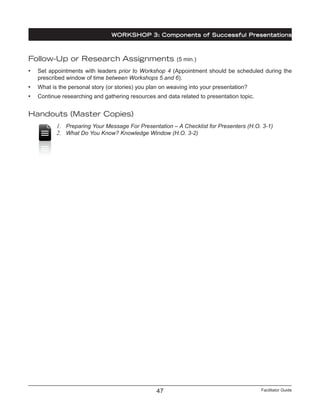
  • 19.
    Facilitator Guide17 Giving andReceiving Constructive Feedback Giving and receiving constructive feedback is an important life skill and is approached in an affirmative manner throughout this program. Participants will be practicing presentations and presentation skills. This will occur in small groups giving presenters ample time to practice, observe, give and receive feedback about performances. In order to promote a relaxed and open-hearted “tone” to the feedback process, a reflection-based protocol will be used, which will allow feedback, even if it is critical, to be shared in an educational and “pain free” manner. (See: Giving And Receiving Constructive Feedback: Handout -Workshop 5, page 57). This is one instance where facilitators are encouraged to “trust the process,” be an observant timekeeper and watch how the protocol empowers and develops the self-awareness of participants. A unique element of the feedback protocol used in this training is that feedback begins with the person being observed! There are good reasons for this. Beginning the feedback process with the “observee” sets a tone of honesty and self-reflection, which reduces defensiveness. Because we are often most critical of ourselves, starting with self-assessment gives those in the “observer” role insight into the performer’s self-awareness and cognizance of his/her own performance. This reveals each performer’s level of self- understanding and allows observers to adjust what they need to focus on in their feedback. Here is an overview of the protocol of questions that will be used in constructive feedback sessions: Feedback Part 1: Presenter (1.5 min) The presenter who has been observed begins the process by self-assessing: 1. What went well or was effective? 2. What did I like that I said or did? 3. What was hard, I didn’t like, or needs improvement? 4. What would I do differently, or change the next time, in order to improve? Feedback Part 2: Role-Playing Partner (1.5 min) The person playing the other character (civic leader) responds briefly: 1. What went well or was effective for you as the recipient of the presentation? 2. Any suggestions or adjustments that you think could improve the presenter’s delivery or increase his/her impact? Feedback Part 3: Observer (2 min) The person(s) observing (not a part of) the role-play, responds: 1. What I thought went well, I liked, resonated with, or thought was effective. 2. What elements might have made the presentation more effective? 3. What could have been done differently to make it work better; or be more powerful? 4. One thing I would suggest approaching differently or changing for the next time. (Sometimes observers don’t have any suggestions.) Feedback Closure: Discussion/Clarifications (2 min) With the presenter leading the discussion, take a few moments to ask further questions or offer further comments about the presenter’s performance or presentation material. For The Facilitator
  • 20.
    Facilitator Guide Promoting YourCause: From Mission To Message 18 Large group Reflection & Feedback At the conclusion of small group time, the facilitator conducts a large group de-briefing. Sample questions include: 1. How was the experience for you as a whole? (Listen to different points of view.) 2. Was there a way the exercise or experience could have been more effective? 3. Awareness… learning….something you’ll take away, or can apply in daily life from this experience? Reflection and Experience-Based Assessment Throughout the series there will be moments of reflection and assessment - opportunities to have a more meaningful learning and team-building experience. Asking well-focused open-ended questions is a great way to help learners process their experiences beyond “feel good” results so they can experience real cognitive gains. Take time for moments of reflection and assessment, and maintain neutrality as a facilitator, remembering that no response is the RIGHT or WRONG answer. “Answers” are “data.” They are observations and reactions that cause group members to examine their preconceptions and assumptions; and this is what promotes learning and growth. Facilitating on-going reflections and evaluations helps learners to make needed adjustments or improvements along the way. This is also a tension reducing practice and can often circumvent conflicts that might be bubbling under the surface. Below are some sample questions used to generate reflection and evaluation. A variety of these are used throughout the program as they best serve particular learning outcomes during the training process. Reflection Questions: • How was it for you doing this activity? • Did you have any awareness about yourself or learn anything? • Did you have any assumptions that changed as a result of the experience? How? • Any things you noticed while you were doing the activity? • Was there anything difficult/easy in doing the activity? Evaluative Assessment Questions: • What did you think of this activity? • What did you like/dislike about the activity? • Do you see any value in doing this activity? • Were you/we successful as a group (or not)? • Would you like to do this activity again? • Anything we might do differently the next time? • A SIMPLE SHORT GROUP ASSESSMENT: “On the count of 3: Thumbs-Up – Thumbs-Middle – Thumbs-Down!” (Great for when you run out of time, but still want to do some kind of check-in) Questions that Encourage Symbolic Thinking: These types of questions help in addressing difficult subjects, or help to expand thinking “out of the box:” • What object would you use as a symbol of this experience? Why this symbol? (E.g., What object symbolizes my response to having my performance critiqued by observers?) • How did the activity (or experience) make you feel like…(select an object or idea to expand thinking)…a book; a car; a river; a mountain; a full glass; a good workout…(be creative)?
  • 21.
    Facilitator Guide19 USING THEMANUAL: ORGANIZATION & COMPONENTS Each of the six workshops in this program has its own objectives and learning outcomes. Each workshop also includes specific follow-up activities that either continue the learning or assist participants in completing assigned field-based objectives. Promoting Your Cause: From Mission To Message: 6-Session Workshop Series At-A-Glance (on Pages 20-21) provides you with an overview of the program and summarizes the scope, sequence and core components of each workshop. This comprehensive overview gives you the key information that will allow you to easily prepare for each session. Using The Manual
  • 22.
    Promoting Your Cause:From Mission To Message: 6-Session Workshop Series At-A-Glance Workshop # & Title Time Page # Workshop Objective Handouts Link to Service-Learning Cycle Follow-Up or Research Inspirational Quote 1 Introduction & Purpose 2 Hrs. 25 Establish purpose and objectives; Establish program framework and group guidelines; Consider the organization’s mission and service to the community; Consider the social and civic backdrop; Begin discussion about values and issues of interest and importance; Follow-up research focused on establishing a strong rationale for promoting the organization’s cause to particular community/civic leaders (H.O. 1-1) Visioning & Group Guidelines (H.O. 1-2) Guidelines For Effective Group Discussion (H.O. 1-3) Community Leader/Site Visit Research Form (2 copies per participant) Brochures or literature about the organization Step 1: Identify Academic Goals/ Environment Step 2: Identify Genuine Needs Note: Steps 8 & 9 are built into the processing of each workshop MISSION TO MESSAGE Gather data/collect information about organization’s work and community it serves SELECT 2 ISSUES that would make good topics for presentations to leaders SELECT 2 LEADERS For presentations with supporting reasons for the choices We are caught in an inescapable network of mutuality, tied in a single garment of destiny. Whatever affects one directly, affects all indirectly. –Martin Luther King, Jr. 2 Ownership & Objectives 2.5 Hours 33 Identify and select an important issue(s) as a topic(s) for presentations; Identify and select civic or community leaders to contact; Develop a plan of action and time- line; Complete follow-up tasks. (H.O. 2-1) Listening (H.O. 2-2) Microlab (H.O. 2-3) Leader/Site-Visit Research Forms (Have extras available) (H.O. 2-4) Small Task Groups (H.O. 2-5) Group Consensus (H.O. 2-6) Addressing People of Title (copy 2 sided) Step 2: Identify Genuine Needs Step 3: Establish Learning Objectives/ Evidence of Learning Step 4: Develop Ownership TWO LEADERS: decide leaders to be contacted before the next session. PRESENTATION TOPICS: Know topics by the next workshop ORGANIZATION “EXPERT:” continue research, increase knowledge PERSONAL OR COMPELLING STORIES: Bring stories to next workshop BRING CALENDARS: with progress reports or confirmed meetings with leaders If you have a task to perform and are vitally interested in it, excited and challenged by it, then you will exert maximum energy… in the excitement…the exuberance of what you hope to achieve overcomes the weariness. – President Jimmy Carter 3 Components of Successful Presentations 2 Hours 41 Understand what makes a powerful or compelling presentation - and why; Reflect on the qualities and skills of successful presenters; Follow-up tasks from Workshop 2 regarding final decisions about presentation topics and calendar/planning items; Share knowledge about organization and/or presentation topics (H.O. 3-1) Preparing Your Message For Presentation – A Checklist for Presenters (H.O. 3-2) What Do You Know? Knowledge Window Step 3: Establish Learning Objectives/ Evidence of Learning Step 4: Develop Ownership SET APPOINTMENTS WITH LEADERS prior to Workshop 4 (Appointments scheduled during time between Workshops 5 and 6) THINK ABOUT HOW to use or weave compelling stories into presentations CONTINUE RESEARCH on presentation topics Never tell people how to do things. Tell them what to do and they will surprise you with their ingenuity. -- General George Smith Patton, Jr. 20
  • 23.
    Promoting Your Cause:From Mission To Message: 6-Session Workshop Series At-A-Glance Workshop # & Title Time Page # Workshop Objective Handouts Link to Service-Learning Cycle Follow-Up or Research Inspirational Quote 4 Presentation Planning 2 Hours 49 Reflection on inspiration and “voice;” Practice highlighting “platform” skills; Begin crafting presentations by incorporating successful components into a prescribed outline; Identify and share information about stories and data to be integrated into presentations; Learn visualization technique to enhance performance (H.O. 4-1) Drawing From Inspiration: Creating A Compelling and Informative Message (H.O. 4-2) Tongue Tanglers: Fun For Public Speakers (H.O. 4-3) Public Speaking and Presentation Tips (H.O. 4-4) Presentation Outline: A Guide For Presenters (H.O. 4-5) Relaxation- Visualization Practice Step 4: Develop Ownership Step 5: Plan & Prepare FINALIZE PRESENTATIONS and be ready to role-play and receive feedback from colleagues during the next session Do you want to know who you are? Don't ask. Act! Action will delineate and define you. –Thomas Jefferson 5 Presentation Practice 2.5 Hours 55 Rehearsal role-plays of simulated presentations (to community leaders) focusing on delivery, style, presentation dynamics, performance with observation and feedback (an integral part of small group rehearsal process); Primary follow-up task: Completing (site visit) presentations to selected community or civic leaders prior to Workshop 6. Scheduling Note: More two weeks (or more if needed) should be scheduled between Workshops 5 and 6 in order to allow ample time for completing presentations. (H.O. 5-1) Giving and Receiving Constructive Feedback (H.O. 5-2) Presentation/Site Visit Report Form (H.O. 5-3) Presentation Reflection– Assessment Form Step 4: Develop Ownership Step 5: Plan & Prepare Step 6: Conduct Meaningful Service CONDUCT SITE VISITS to Civic/ Community Leaders COMPLETE 2 REPORT FORMS COMPLETE THANK YOU LETTERS (and mail) to leaders who received presentations Program Note: Before Workshop 6, discuss and clarify with organization decision-makers, the efficacy of continuing this program into the future. This decision will affect how you approach closing activities in Workshop 6. One isn't necessarily born with courage, but one is born with potential. Without courage, we cannot practice any other virtue with consistency. – Maya Angelou 6 Reflecting & Evaluating 2 Hrs. 61 Reflect upon, celebrate and report about presentations; Develop a plan to continue to hone skills and conduct educational meetings with civic or community leaders; Consider the need for, or appropriateness of adjusting presentations to accommodate different public speaking opportunities (H.O. 6-1) Program Evaluation & Strategic Planning Questions Index Cards Step 7: Observe the Impact Step 8: Evaluate the Experience Step 9: Demonstrate New Understanding If applicable, assign continuing roles. If needed, schedule follow-up meetings. Follow through with any contingencies. You're not obligated to win. You're obligated to keep trying to do the best you can every day. – Marian Wright Edelman 21
  • 24.
    Facilitator Guide Promoting YourCause: From Mission To Message 22 Outline of Workshop Components: Workshops are 2 to 2 ½ hours long, and all follow the same basic structure, outlined below. This “template” will be consistent throughout with some variations depending upon a particular workshop’s content or goals. The learning objectives for each component are the same throughout, which is why it is a consistent “form” throughout. Every workshop opens with a quote that is related to the topic; has a prescribed process for moving through activities; includes an experience-based or evaluative closing; and has follow up activities. Masters of the handouts used during workshops or as take-home material appear in a section at the end of each workshop. Here is an outline of the basic workshop structure used throughout: Opening Quote Preparation: - Objective - Tools & Materials - Handouts (listed) - Facilitator Notes Workshop Agenda: - Greeting & Warm-Up Activity - Overview of Workshop & Objectives - Main Activity(s) • Set-Up • Practice • Reflection Wrap-Up & Evaluation Follow-Up or Research Assignments (Tabbed Section at end of each workshop that includes) Handouts (Master Copies) Purpose and Objectives of Workshop Components The workshop structure takes group dynamics into account and employs inclusive and participatory methods for reaching both learning and team-building goals. Do not underestimate the importance of facilitating the “Greeting & Warm-up Activity” before engaging in the “Main” activities. Workshops will flow more smoothly when you recognize the value and take the time to open workshops in an inclusive manner. As a facilitator, you can inspire and motivate participants with your own enthusiasm. When you keep the pace moving (but not rushed), rely on the structure and sequence of the workshops to propel you and your group, smoothly facilitate transitions between activities, and respond to a group’s concerns and questions, you establish rapport and earn a group’s trust. These are all the ingredients for a successful team and successful professional development!
  • 25.
    Facilitator Guide23 Opening Quote:Inspirational quotes begin each workshop and expand the meaning or capture the essence of the workshop. These can be read as an inspirational “quote of the day” and are at times integrated into workshop activities as the focus for reflection or discussion. Preparation: The material in this portion is for the facilitator to prepare, have ready or to know – prior to the workshop. • Objective: the purpose, learning objective or learning outcome of each workshop • Tools & Materials: a list of all materials that will be used or needed • Handouts (listed): a list of all participant handouts (numbered master copies provided in a section at the end of each workshop) • Facilitator Notes: specific notes for the facilitator about the workshop or particular activities. Facilitator’s notes will appear throughout. When emphasis is needed the text will be italicized. Workshop Agenda: (should be posted) A workshop outline should either be posted on a white-board or chart, or printed as handout so that participants know what is expected, and can share in taking responsibility for reaching goals. • Greeting & Warm-up Activity: Engaging people first thing in a workshop - as a part of your greeting process - increases the likelihood of their active participation throughout. The reason is that safety and inclusion needs are addressed up front. After a brief welcome, before discussing any “business,” make it a habit to open with a fun “low risk” warm-up activity that invites immediate participation. The Greeting & Warm-up Activities of each workshop are designed to support the goals of each workshop. (You may have some of your own that can work as well, or some may emerge as “important to do” as you move through your process with a group). Light and lively warm-ups with no “right” or “wrong” answers (e.g., circle go-rounds, paired sharing) increase focus, decrease anxiety and build teamwork. They function like re-setting a clock, so that participants can transition from outside influences and gently place their focus on the purpose and work before them. • Overview of Workshop & Objectives: It is wise to get everyone ‘on the same page’ with workshop objectives. Presenting a workshop’s plan and objectives includes participants in sharing those objectives and satisfies ‘control,’ ‘empowerment’ and ‘belonging’ needs. A simple procedure like doing a “quick check-in” and getting agreement on the plan (which should be posted with times listed for each activity), establishes a framework, previews activities and sets a clear and purposeful intention for the workshop. The “overview” time is also a good place to introduce new concepts or vocabulary or review previous information. Posting intended activity times helps to focus participants and often heightens their cooperation. Once you present a plan, make sure “it’s okay” and ask for any questions before proceeding. • Main Activity(s) Most of the workshops contain more than one “main activity.” Main activities are usually participatory or interactive and establish a time where the group accomplishes constructive work. An activity generally unfolds in three phases that you might think of as “before, during, and after:” Here are the three phases of an “activity:” Using The Manual
  • 26.
    Facilitator Guide Promoting YourCause: From Mission To Message 24 1. Set-Up: Provide clear concise directions for the activity, establish the procedure and clarify participants’ roles. Handle advance preparation(s) beforehand (materials, handouts, timer, posting of charts, etc.) so that they are ready. 2. Practice: When the group is involved in an activity, provide appropriate coaching, time keeping or intermittent prompts/reminders. During this phase people might be working in pairs or small groups, so move about the room and be available. An “absent” facilitator can “unnerve” a group and decrease trust. 3. Reflection: When the activity is completed there are different levels of reflection or evaluation depending upon what is appropriate for a particular activity. Below are a few sample questions that assist in opening rich reflective learning discussions. Appropriate reflection questions are provided in each workshop. The ones below look at the different purposes for reflective discussion: • Reflecting on Content/Information: Here’s where you elicit any data or information pertinent to the subject of the activity, e.g., Share/present/show: the content results of something that was explored, like a list, research data, a performance, presentation or a brainstorm. • Reflecting on Experiences/Learning (De-briefing): Here’s where you elicit feelings or awareness gained as a result of being involved in an activity. These are more evaluative and integrative questions like: “What awareness did you have?” “What was easy or hard?” “What did you take from this experience that you can apply in life or at work?” • Wrap-up & Evaluation: An effective closure to a workshop leaves participants with a sense of accomplishment and completion. You might establish a regular light and lively closing ritual that ends the workshop with a quick “thumbs up, thumbs middle, thumbs down” assessment. For a more satisfying closure elicit feelings or awarenesses that evaluate and integrate the workshop experience. Questions that reinforce the value or the applicability of what was experienced are useful, for example: “How was today’s workshop… was it helpful - useful - of value to you or the group?” or, “What did you learn or take from today that you can apply in life or at work?” Encourage participants to take something and apply it in their lives or work. • Follow-Up or Research: Each workshop will have some take-away activity, preparation or research that participants will need to complete during the time between meetings. Since this is a professional development opportunity with specific goals and outcomes, participants will have various assignments that will prepare them to accomplish each “benchmark” of the program’s professional growth. • Handouts (Master Copies): Master copies of handouts pertinent to each workshop are included in a section at the end of each workshop. Handouts are labeled and numbered in the order they will be used during the workshop or at home for follow-up activities. Make sure you make enough copies prior to each workshop so they are ready for participants.
  • 27.
    Facilitator Guide25 PREPARATION Objective Establish purposeand objectives; Establish program framework and group guidelines; Consider the organization’s mission and service to the community; Consider the social and civic backdrop; Begin discussion about values and issues of interest and importance; Follow-up research focused on establishing a strong rationale for promoting the organization’s cause to particular community/civic leaders Tools & Materials • Hello Badges (provide black markers for participants to write first names in LARGE letters on name tags) • Whiteboard; Multi-colored erasable markers; Eraser • Flip Chart and Multi-colored markers (enough for yourself AND the group to use) • Tape (pins) to hang charts • Index Cards (packet) (Keep available each week as they come in handy.) • 2 CHARTS each with 2 columns emulating the Visioning & Group Guidelines (H.O. 1-1) at the top with: [CHART 1: Looks or Sounds like - Has qualities of/like – CHART 2: Feels like - Enables me to]. Two Charts posted side-by side • CHART prepared with heading: Group Safeguards & Agreements at top • CHART prepared: with word web started - “Active Citizenship” circled in the center • CHART prepared with heading: “Inform & Educate Civic Leaders” at top • CHART prepared with heading: Our Organization at top, and 4 columns, each headed: Character; Values; Community Impact; Main “Message.” Handouts (Listed) 1. Visioning & Group Guidelines (H.O. 1-1) 2. Guidelines For Effective Group Discussion (H.O. 1-2) 3. Community Leader/Site Visit Research Form (H.O. 1-3) -- 2 copies per participant The organization provides: 4. Brochures or literature about the organization and its mission/work 5. Participant folders (a depository for papers and handouts) (2 hours) WORKSHOP 1: Introduction & Purpose OPENING QUOTE We are caught in an inescapable network of mutuality, tied in a single garment of destiny. Whatever affects one directly, affects all indirectly. – Dr. Martin Luther King, Jr.
  • 28.
    Facilitator Guide Promoting YourCause: From Mission To Message 26 Facilitator Notes Focusonestablishingpurpose,settingground-rulesandbuildingateamspirit.Greetparticipants as they enter the room, inviting them to sign in and create name badges. Show appreciation for them and the fact that they have agreed to take on this challenge on. Approach activities in a congenial and friendly manner. Allow the group to get to know one another as you establish clear methods for facilitating “healthy” and respectful communication. Set a positive tone and establish the workshop structure as protocol for the remainder of the workshops.
  • 29.
    Facilitator Guide27 WORKSHOP 1:Introduction & Purpose WORKSHOP AGENDA (posted) Greeting/Warm-Up Activity (15 min.) Warmly welcome everyone and briefly introduce yourself, offering some background about how you came to be in the role of facilitator. Include housekeeping notes and mention that there will only be a short break (so participants should take care of their own needs if necessary). Explain that this program creates the opportunity to become a team and to become immersed as a group in knowledge and skills that will prepare each participant to successfully present the organization’s mission and message. Today sets the positive tone and team spirit we want to maintain throughout the program and establishes the framework we will rely upon and use to support an enriching professional development experience. Go-Round of Introductions: One at a time, each person shares three things (concisely): “Name; Role or job within organization; Main reason you are participating” (Begin the go-round by modeling these three points from your own position and point-of-view.) Overview of Workshop & Objectives (5 min.) • Read the opening quote to the group (more than once) providing a brief reflection. Tell them you will come back to it at the end to see how it has related to the groups experiences. • Review the plan (posted) and ask if there are any questions before proceeding. Note: The following introductory activity is a “one time” activity, unique to this first workshop. It is used to set a respectful professional tone and create ground-rules for the entire program. The material generated here can be reviewed each week and amended as needed. Group Visioning Activity Establishing Safeguards and Guidelines (20 min.) 1. SET-UP: (2 min.) Say that this will be our first task as a working group: to understand more about what each of us envisions as optimal for his/her own success, and then to take that information and mold it into a group contract. 2. PRACTICE: (20 min.) HANDOUT “Visioning and Group Guidelines” (H.O. 1-1) saying that the activity will begin with some individual reflection (writing) time as each person completes the handout. • (5 min.) Complete Handout: As participants are quietly reflecting and writing, hang the prepared (correlating) charts somewhere in the room. Leave enough space between the charts so that participants can easily reach them when they are all scribing (at the same time). • (5 min.) Charts: When individual reflection/writing time is complete, ask participants to stand and get markers. On the wall charts, they should write at least one (the most important) response from each of the categories written on handouts.
  • 30.
    Facilitator Guide Promoting YourCause: From Mission To Message 28 • (5 min.) Observe lists and assess: Once the wall charts are completed, re- hang the charts side-by-side (closely together) as if to make one large chart with 4 columns. Ask participants to observe: The 2 left columns look at atmosphere and qualities, while the two right columns look more at feelings, needs and desires. Discuss commonalities/differences and what the group notices about what has been collectively shared. • (5 min.) Create List of Safeguards & Agreements: After observation and discussion, hang the prepared chart “Group Safeguards &Agreements.” Brainstorm a list of “positive action statements,” (“we will do,” or “will be”), in order to ensure that their visions of an optimal learning environment are safeguarded. (e.g., “We will listen without interrupting;” or “We will maintain a positive mental attitude and help one another to do so.”) These statements will constitute the group’s “contract.” Keep this chart and hang it during each meeting as a reminder. Things can be added or deleted in subsequent weeks if the group agrees. 3. REFLECTION: (3 min.) Do a quick “check in” here and take a breath before moving on. Ask how everyone is doing and take a pulse on how the visioning and agreements process was received. (Suggest a short bathroom break before the next series of activities). Stretch Break (10 min.): Ask participants to come back quickly to the large group. During the break distribute handouts and hang charts (folded and taped up so that the words on them are not visible). In this way all of the materials needed for the next segment are ready. Main Activities (Total Time 50 min.): In order to make sure participants understand the concepts driving this program the following introductory activities review the material located in the “Foundational Concepts” section (on page 9) in experiential ways that steer away from lecture and instead use DISCUSSION and ELABORATION as the primary methods for answering 2 key questions: 1) What does “active citizenship” mean? 2) Why is it important to educate our civic or community leaders about our work? The practices below should flow together seamlessly as a multi-tiered exploration of the concepts driving the program. Preparation: (10 min.) HANDOUT “Guidelines For Effective Group Discussion” (H.O. 1-2). Because effective discussion is key to any successful group effort, the handout highlights important skills that we should adopt or strive for as we create the dynamic learning environment we want. Review the skills and discuss strengths and weakness, defining how the group intends to apply and/or improve upon these skills as the program progresses.
  • 31.
    Facilitator Guide29 Activity 1:(20 min.) “Active Citizenship” Engaging and Educating Civic Leaders Refer to the Active Citizenship section of Introduction (page 9) for background 1. SET-UP: (10 min.) Begin by reading the quote: “... It ought to be the happiness and glory of a representative to live in the strictest union, the closest correspondence, and the most unreserved communication with his constituents. Their wishes ought to have great weight with him; their opinion, high respect; their business, unmerited attention. It is his duty to sacrifice his repose, his pleasures, his satisfactions, to theirs; and above all, ever, and in all cases, to prefer their interest to his own…” – The Works of the Right Honorable Edmund Burke. Volume I. London: Henry G. Bohn. 1854. Pp. 446–8. • Before stating the author, ask if anyone knows who wrote the quote or can guess when it was written. After some feedback/guesses offer the correct information, (if anyone did not get it) presenting some history and background about the US, “liberal representative democracy,” and our “rights and responsibilities” as citizens. 2. PRACTICE: (10 min.) “Active Citizenship” Word Web (Post the prepared chart) As you engage in the above discussion, keeping it conversational, begin writing the group’s responses on the prepared posted chart. First, capture what they know. Then ADD INFORMATION by developing a definition of “Active Citizenship.” (from material on page 9). Some prompts may be: Does what you are saying here look like what we could define as “active citizenship?” “What do active citizens do?” “How to they think/feel?” “What motivates them… their values?”) Complete the Word Web using the group’s responses. Discuss how the idea of “active citizenship” begins to delineate or define different areas of service, articulating where or how civic responsibility can be applied and where our contributions, service, time or talent could be volunteered. Some of these areas can include: organizations that help the poor, needy, hungry, sick or disenfranchised; conservation or eco-friendly activities (recycling); educational causes; faith-based initiatives; even the volunteering of high-level professional expertise in such areas as banking, engineering, education and technology. ACTIVITY 2: (10 min.) “Brainstorm List:” Importance of Educating Leaders Hang the chart prepared with the heading “Inform & Educate Civic Leaders.” Discuss what area of service work your organization specializes in and why the issues you deal with are important and should be communicated to civic leaders. Here is a potential list of reasons: (Add your own!) • Inform leaders of situations or conditions within the community about which they may be unaware (and which may be affecting their work); • Offer leaders new or different perspectives on issues your organization specializes in (which may be within the leader’s particular scope of influence); • Connect your organization’s work or impact in the community to issues the civic leader is on record of being pro-active with or caring about; WORKSHOP 1: Introduction & Purpose
  • 32.
    Facilitator Guide Promoting YourCause: From Mission To Message 30 • Offer leaders data on how your organization’s work is positively changing a condition in the community; • Reassure leaders that your organization’s presence and the affect of its work are having a unique impact in (any) areas that are within their scope of influence. ACTIVITY 3: (15 min.) “Our Organization: Mission & Message” Charting Ideas After looking at reasons why active citizenship and educating civic and community leaders are important, engage the group in a discussion that defines your organization’s: Character; Values; History; Community Impact; Mission; and “Message,” writing the group’s responses on the correlating CHART (prepared earlier). The responses you draw from the group will begin a process of establishing a “script” that each presenter will use to introduce or describe the organization. The chart should highlight points that the group agrees accurately portray the organization’s history and mission. These are the seeds of the message that each presenter will develop into his or her individual presentation. NOTE: As a closing this segment, it is very important to clarify the difference between “Education and Advocacy.” Discuss some of the differences, (page 10, Introduction), and make sure that the group understands that the purpose of this program is to educate civic and community leaders. 3. CLOSING REFLECTION: (5 min.) Go-Round As promised at the beginning of the workshop, re-read the opening quote (maybe more than once). After brief reflection, ask participants to relate the quote to their experiences of the workshop and to share responses or insights in a word or short phrase. (Note: This can be facilitated “popcorn style” * or can continue as a discussion aimed at clarifying the difference between education and advocacy. * Popcorn style is a technique (used in the next activity) that quickly overviews a group’s responses to a topic. It is used to elicit multiple short responses (one word, or short phrases) so that many responses can be polled, in a very short time (a minute or two). This technique is very effective when time is short or you want to quickly gather feelings, ideas or opinions (polling). In an atmosphere of silence/listening, participants who have something to share about the focus topic raise their hands. The facilitator randomly selects as many different speakers as time provides in order to air a variety of viewpoints. It is not a dialogue, but rather a stop and listen activity. A facilitator can quickly gather and summarize group data by using this time-efficient strategy. It is also a great group awareness activity. Wrap-Up & Evaluation: (5 min.) Popcorn Style: “Responses” • (2.5 min.) Seated in a circle, ask group members to reflect upon the first workshop experience. Set the timer for 2.5 minutes and in that time people can randomly (popcorn style) raise a hand and say a word or short phrase describing their feelings, reactions to, or assessment of the workshop. Only do this activity for 2.5 minutes - and in the spirit of reflection, allow for silence (offering prompts if needed) - giving control to the group in how and what they share during the allotted time.
  • 33.
    Facilitator Guide31 • (5min.) Close with large group discussion about the process itself, noting the importance of contributions and sharing as a valuable part of group learning endeavors. Continue this discussion into an “Experience-based assessment,” by asking how participants feel about or “rate” their first day together. Follow-Up or Research Assignments: (10 min.) NOTE: Take the time to explain clearly the follow-up requested of each person. This can also include resources that will aid participants to be successful in reaching program goals, like: computer, phone and internet time, helpful leads or introductions to leaders, or access to any relevant information about existing relationships with particular community leaders. Two Research Assignments: 1. “From Mission to Message:” Gather data and collect important information about the organization’s work and the community it serves. This continues the focus on “mission” initiated in workshop discussions, but invites a deeper understanding about the organization’s specific areas of concern or need. Participants should explore some of the “facts and figures” that represent how or if the organization is addressing the needs of the community it serves, or how the organization is sustaining itself or meeting its own needs. Based upon the research or data that is collected, participants should select 2 important issues that would make good topics for presentations to leaders, indicating the reasons why each issue highlights an important organizational “message.” Keep notes, and bring them to the next workshop. Ideas can be jotted down on the back of the Community Leader/Site Visit Research Form (H.O. 1-3). 2. Selecting Civic or Community Leaders: Research and find at least two civic or community leaders that it would be appropriate or optimal to contact for a presentation. Using the Community Leader/Site Visit Research Form (H.O. 1-3) as an organizing tool, participants should articulate at least two reasons for their selections, and if possible, support their choices with research or factual data. Bring completed forms (with each leader’s contact information included) to the next workshop. Handouts (Master Copies) 1. Visioning & Group Guidelines (H.O. 1-1) 2. Guidelines For Effective Group Discussion (H.O. 1-2) 3. Leadership Visit Research Form (H.O. 1-3) -- (2 copies per participant) The organization provides: 4. Brochures or literature about the organization and its mission/work 5. Participant folders (a depository for papers and handouts) WORKSHOP 1: Introduction & Purpose
  • 34.
    Facilitator Guide Promoting YourCause: From Mission To Message 32 Note: The organization is also responsible for all workshop and training supplies for the facilitator and program participants and any brochures, literature or audio visual materials that will be included in promotional (PR) packets that will be shared by presenters. This can also include the resources needed to assist participants to be successful with the program, e.g., computer, phone time and internet access, access to relevant information about existing relationships with community leaders, and even helpful leads. All workshop and training supplies for the facilitator and program participants as well as a suitable training space must be provided by the organization, along with any brochures, literature or audiovisual materials that would be included in promotional (PR) packets that participant presenters will leave with community leaders. If administrative input is required for deciding the contents of information packets, the organization should consider these decisions before the training program begins so that program participants will have all of the materials they need before start up. Presentations are scheduled to take place after Workshop 5, (before Workshop 6). At Workshop 5 participants should be able to pick up the number of PR packets they will need for their respective audiences.
  • 35.
    Promoting Your Cause:From Mission To Message HANDOUT 1-1 © 2012 Zephryn Conte, Environarts Inc. ® 480-774-9844 Visioning & Group Guidelines Group guidelines encourage group members to consider their own needs, preferences and choices, while considering how they can support others. Group guidelines and agreements establish healthy boundaries. They empower group members to envision the environment they want to create and define the ethical code that will support it. Group guidelines emphasize shared responsibility and establish a framework for holding the group’s vision. Use the rubric below to stimulate your thinking. Imagine your ideal learning/working environment – one that would support you to perform at your best. While many of us have never had a “perfect” professional environment, this activity is urging you to picture it exactly as you would like it to be - capturing the essence of it in your responses to the prompts below. Fill in at least two responses in each category, and indulge yourself in envisioning your ideal learning/working environment. * A Satisfying & Productive Professional Work Environment Looks or Sounds like… Has qualities of/like… Feels like… Enables me to… … The physical environment…sounds or tone present? What do you see happening/people doing? How are people speaking? Compare it to something. Write qualities. How do you feel in your body…mind… emotions? Things you want to be able to do, say or accomplish. * Striving for our ideals pushes us toward our best efforts and motivates personal and professional growth. Your vision will be shared with those of other group members in order to create a collective vision. You will then decide on how to acknowledge and maintain that vision by establishing group guidelines and agreements.
  • 36.
    Promoting Your Cause:From Mission To Message HANDOUT 1-2 © 2012 Zephryn Conte, Environarts Inc. ® 480-774-9844 Guidelines For Effective Group Discussion Creating a respectful atmosphere for group discussion is central to effective learning and a key element in successful workplaces. Effective group discussions allow members to easily express needs, preferences, choices and divergent points of view. Arguments or finger pointing ‘shut people down’ and erode the safety of group dialogue. Silence or withdrawal can do the same. The goal of healthy discourse is to establish acceptable boundaries around how information is shared. It is the responsibility of each member of a group to recognize and monitor how his or her contributions are affecting the tone of the communication and to do his/her part in preserving the integrity and success of a group’s discourse. Here are a few guidelines and skills that support healthy group discussion. If each person makes an effort to practice these behaviors, group discussions will be more satisfying and productive and group decision-making will be easier:  Listen! Show attention and be engaged. Turn toward the person speaking and if appropriate make eye contact. Be a model of effective listening skills. Really listening and trying to understand a person’s point of view (which may be different from yours) is a vital element in healthy group discussion.  Use “I-Speak” – Maintaining safety in a discussion is critical for keeping conversations open. Speaking from one’s own point of view and experience keeps discussion safe. Refrain from ever volunteering information about what someone else says or thinks (unless you have gotten their permission to do so). Speaking from one’s own perspective maintains clarity and respects each individual’s privacy.  Restate – If you are unsure of what a member of the group has said, it can be useful to restate or attempt to paraphrase what you think he or she said. Restating often clarifies a speaker’s meaning or causes him/her to further elaborate.  Ask a speaker to restate or “say it in a different way” – Another way to better understand what a speaker has said (especially if it is unclear to several people) is to first let him or her know it was unclear, and to ask him or her to restate it or “say it in a different way.” This is a particularly important skill to use when a facilitator’s directions or explanations are not clear to you.  Ask Open-Ended Questions - These are questions that do not have yes or no answers. If you need clarification, or want more information from a group member, or from the facilitator, an open-ended question will cause the speaker to say more about the subject.  Crystallize key points - When a group is trying to come to a decision sometimes summarizing the key point(s) of what has been said can focus and move a group closer to a decision.  Group “Polling:” Polling reveals a lot of information about a group in a very short time and allows groups to very quickly see where everyone stands on a particular subject. For example, if someone has stated an opinion that elicits a reaction, a “group poll” can be taken to see by a “silent” show of hands, who agrees or feels similarly, or who disagrees or feels differently. If a topic is “loaded,” there are divergent opinions, or if there is curiosity about what others may be thinking, group polling is an effective technique.  Wait Time - Don’t be afraid of pauses. Silences in a discussion can be poignant. Taking a “breath” allows time for reflection, for thoughts to percolate or for questions to arise organically. When a discussion does not feel “forced’ it usually yields better results.
  • 37.
    Promoting Your Cause:From Mission To Message HANDOUT 1-3 © 2012 Zephryn Conte, Environarts Inc. ® 480-774-9844  Community Leader/Site Visit Research Form  Presenter(s) Name(s):    1. Community Leader & Site Information  Name/Title of LEADER:   Email:  Contact Phone:   Fax:  Name of Institution/Business:  Website:    Site Visit Address:  (If Confirmed):    DATE OF VISIT:  City:  LOCATION OF VISIT:  State/Zip:      Organization Type/Focus of Work  Adult Education     Fed. Government     Faith Based      For Profit    Youth Based     State Government     Alternative Education    Non‐Profit  College/University     City Government    Technical/Vocational  K‐12 Schools     Other/Describe:              At least two reasons for visiting this particular leader           2. Community Leader & Site Information  Name/Title of LEADER:   Email:  Contact Phone:   Fax:  Name of Institution/Business:  Website:    Site Visit Address:        City:    State/Zip:      Organization Type/Focus of Work  Adult Education     Federal Government   Faith Based      For Profit    Youth Based     State Government     Alternative Education    Non‐Profit  College/University     City Government    Technical/Vocational  K‐12 Schools     Other/Describe:    At least two reasons for visiting this particular leader          
  • 38.
  • 39.
    Facilitator Guide33 PREPARATION Objective Identify andselect an important issue(s) as a topic(s) for presentations; identify and select civic or community leader(s) to contact; Develop a plan of action and time-line; Complete follow-up tasks. Tools & Materials • Hello Badges (provide black markers for participants to write first names in LARGE letters on name tags) • Whiteboard; Multi-colored erasable markers; Eraser • Flip Chart & Multi-colored markers (enough for yourself AND the group to use) • Tape (pins) to hang charts • Index Cards (packet) (Keep available each week as they come in handy). • 2 or 3 CHARTS (prepared and posted on the wall prior to workshop), EACH with the same heading: Civic Leaders scribed on top (More than one chart is advised so that participants have space to write at the same time. Save completed charts for posting in Workshop 3.) • CHART(S) prepared with the heading: Issues – Presentation Topics, written on top (Save completed chart(s) for posting in Workshop 3) • CALENDAR of program/workshop schedule • Chairs available to form small discussion groups (Microlabs) Handouts (Listed) 1. Listening (H.O. 2-1) 2. Microlab (H.O. 2-2) 3. Community Leader/Site Visit Research Form (H.O. 2-3) – have extras available 4. Small Task Groups (H.O. 2-4) --1 per group. There are 2 per page requiring a center cut. 5. Group Consensus (H.O. 2-5) 6. Addressing People of Title (H.O. 2-6) -- copy 2-sided/4-page document Note: It would be helpful to have copies of a master CALENDAR of workshop dates, or a charted list of dates ready to post during the “Wrap-Up” of this workshop. In this way participants will be able to see the “big picture” plan for the program. (2.5 hours) WORKSHOP 2: Ownership & Objectives OPENING QUOTE If you have a task to perform and are vitally interested in it, excited and challenged by it, then you will exert maximum energy…in the excitement… the exuberance of what you hope to achieve overcomes the weariness. – President Jimmy Carter
  • 40.
    Facilitator Guide Promoting YourCause: From Mission To Message 34 Facilitator Notes This second of six workshops generates decisions that will drive the program and shape the actual presentations that are created. Activities lay the groundwork for developing best practices in communication and teamwork. A variety of interactive and skill building strategies accomplish the workshop’s objectives in ways that exercise the interpersonal skills needed to be successful communicators and presenters. Note: PRIOR to the workshop, as preparation, read the “Wrap-Up & Evaluation” section. This will ensure that you understand all of the variables that may effect scheduling. Make sure that you have a master calendar of the program workshop schedule so that if, due to the outcome of this workshop or any other concerns, you decide to amend the current schedule, you will have the information you need to make informed choices along with participants. IMPORTANT PROCEDURAL NOTE: Greet group members as they enter the room. After they sign in, direct them to the charts (prepared in advance) that are displayed hanging. Ask participants to scribe (in dark colored block print large enough to see from a distance) the names and titles of the community or civic leaders they have selected for presentations. Opening with this focused yet relaxed social atmosphere is a positive way to begin Workshop 2, as it builds rapport while accomplishing an important piece of information sharing. Before the formal start of the workshop, the results of research (homework from Workshop 1) should be visibly posted so that all can see the preliminary list of selected leaders. There may be repetition – more than one person selecting the same leader – or other variations that will spark discussion and generate new ideas during the workshop. One of this workshop’s goals is to finalize, by the end of the workshop, the list of leaders who will be contacted for presentations.. Once done, make sure that participants enter their final choices on a Community Leader/Site Visit Research Form (H.O. 2-3). In this way you can duplicate the forms (before the workshop’s end) and have an official record of which participants will be calling to make appointments with which leaders.
  • 41.
    Facilitator Guide35 WORKSHOP AGENDA(posted) Greeting/Warm-Up Activity (30 min.) Open with an energetic welcome (that gets attention) because participants will be busy charting their leader’s names/titles and probably chatting in the process! (Some facilitators use bells or a visual “hands- up” signal to re-focus groups.) Redirect attention and invite participants to join you in a large circle for an opening go-round that will begin by focusing on “listening.” • First, as a quick go-round, pose the question” “Are you a good listener?” Go around the circle (or do it “popcorn” style) with one word responses: “yes,” “no,” or “sometimes.” (If it is a new group still getting to know one another, have them state their first name before giving their 1-word answer.) • Hand out Listening (H.O. 2-1), saying that you want to start by looking at the power of listening, since it is such a core skill in all successful work endeavors and a critical element in our skill-set as presenters. Go over the opening 3 paragraphs on the handout before asking the group to take the DIAGNOSTIC; (totaling their responses to get a “score.”) • At the completion of the diagnostic, discuss the experience. Don’t ask for scores unless someone offers, or you can elicit the information in a generalized or light and lively fashion. What is more important is to review the handout and relate the skills to real-life or workplace experiences. Highlight the point that many of the activities throughout the program will require participants to practice and sharpen their listening skills, thus deepening their ability to listen effectively (the focus of practice in today’s main activity). Overview of Workshop & Objectives (10 min.) “READ the opening quote, and relate it to this workshop’s activities - summarizing the agenda and workshop goals. (Note: the follow-up research that was to be completed after Workshop 1 is critical data for this session. Names of leaders should already be posted. Participants should have their completed handouts (H.O. 2-3) with them, as well as their notes about issues and topics.” Main Activities (Total Time 1 hour 15 minutes) Activity 1: (30 min.) MICROLAB: Listening “Reasons For Leader Selection” 1. SET-UP: (10 min.) Referring to the list of LEADERS that participants charted earlier, say that you want to introduce a small group circle sharing strategy called a MICROLAB. The activity is focused on listening, not discussion, and will give each person uninterrupted time to share his or her reasons for selecting the leaders he/she selected. • Form small groups of 4 (or 3 if there is not an even number): Chairs should be pulled into small circles spread out around the room (clustered “knee to knee” to keep voices somewhat contained within groups.) • Hand out Microlab (H.O. 2-2) and go over the protocol completely. Make sure that everyone understands the difference between dialogue and the microlab protocol and WORKSHOP 2: Ownership & Objectives
  • 42.
    Facilitator Guide Promoting YourCause: From Mission To Message 36 purpose. Remind everyone that there will be ample opportunity for relaxed discussion after the exercise. Note: You might mention that this is the first of a few microlabs implemented throughout the program. Today will introduce the strategy so participants become familiar with the protocol. This particular microlab focuses on one question only (usually there are three or four). The strategy is being used here as an efficient format for sharing information, for practicing listening and for learning a specific protocol that will be used again at different times for different purposes. • By a show of hands, ask one person from each group to volunteer/self-identify as a “first speaker.” This way once you call “time-in” everyone can begin with no time wasted. 2. PRACTICE: (10 min.) MICROLAB: Each speaker will have 1.5 minutes to share: Which leaders on the list did you select and what are your reasons for your selection? (Call “Time-In” and also give a half time call so speakers know how to monitor their time.) • Call “End-time” time for the first speaker, repeat the focus statement, and move on to the 2nd speaker, repeating the process again for the 3rd and 4th speakers and prompting half and end times for each. Note: The microlab process supports individuals to understand the effectiveness of participating in a cooperative group “rhythm.” It is an “equitable” use of time that “levels the playing field.” If someone does not finish in time, encourage him/her to stop when the allotted time is up, but make sure to add a little time for “completions” at the end of the microlab so that those needing closure can have it. If many in the group consistently experience too little time for sharing, consider lengthening the speaking time (for everyone) by thirty seconds or a minute. Realizing the value of microlabs can take some time (and practice), but usually after a little initial struggling groups end up appreciating this positive and secure way of ensuring that all voices are heard. • Bring closure to the microlab. (Ask groups to thank one another) and briefly ask how the experience was for them…(Popcorn style is a useful method here). After some responses invite participants to take a short break asking them to reflect on what has been shared, and to return right back to their groups for some continued discussion: Stretch Break (10 min.): Ask participants to return to the same microlab groups. 3. DISCUSSION: (15 min.) Selecting Leaders: Options For Making Optimal Choices Seated with the same microlab group, ask participants to respond to and collegially discuss the leaders that each presented. This is an opportunity for group members to confer with colleagues, to offer and listen to opinions and to present any rationale for changing their choice of leaders. The goal is to end up with two or more leaders per participant, along with sound reasons why it would be beneficial to the organization to present
  • 43.
    Facilitator Guide37 to thoseleaders. For reasons that emerge during conversations, participants may decide to “switch” (or add more) leaders, realizing that one participant might be “a better fit,” for a particular leader than another. More ideas about important leaders to contact may emerge. It is optimal if participants end up with more than two leaders to contact in case a particular leader is unavailable or difficult to schedule for a visit. (Note: Have extra “Community Leader/Site Visit Research Forms” (Handout 2-3) available during this discussion so that participants can amend or add any new data. MAKE SURE that you take away copies of the final leader selections.) Conclude discussion: Note that if, at this point, participants are not clear about which two leaders they plan to contact, they will need to come to that decision as a follow-up task. The information shared should have helped to inform their final choices. ACTIVITY 2: (45 min.) GROUP Consensus “Issues & Presentation Topics” Note: This is part one of a two-part activity that may continue into Workshop 3 if tasks are not completed here. The goal of this process is to share ideas (in small groups) and create a selected list of the strongest, most viable, or most pressing issues to present to community leaders. The number of issues or topics the group ends up with is relative to a few factors: 1) The group may decide to work collectively on ONE presentation topic/ONE message that each participant will present in his or her unique way to different leaders, or, 2) The group may decide that there can be several topics or issues presented and prepared by different participants and delivered to different leaders. In the second scenario, topics can potentially be “matched” to particular leaders according to the leader’s interest or involvement with the issue. Whatever emerges as the group’s preference, it is the facilitator’s job to help participants crystallize the most achievable choices, given the available time and talent. Keep in mind that this may be “part one” of this discussion with final decisions made in Workshop 3. 1. SET-UP: (15 min.) Re-focus the group, inviting participants to stand up and stretch as you introduce the second small group task: selecting a topic or topics for presentations.Ask participants to retrieve any notes, resources or reference materials related to the two issues they were asked to identify as potential topics for presentations. In small groups, participants will share this information along with the background information that supports their choices. • Hand out Small Task Groups (H.O. 2-4): saying that groups will engage in an elaborative consensus decision process, the goal of which is to decide upon two to four topics from those that are contributed. Referring to the handout, take a few moments for groups to self-assign roles. While they are doing that either distribute or have ready sheets of chart paper and markers for each group. (The charts generated will be posted). • Hand out Group Consensus (H.O. 2-5): Clarify CONSENSUS DECISION-MAKING by summarizing the handout or by asking different participants to read parts of it aloud (or a combination of both approaches). Note: If time is too tight to go over the handout, present the key points and offer the handout at the end of the workshop for home study. WORKSHOP 2: Ownership & Objectives
  • 44.
    Facilitator Guide Promoting YourCause: From Mission To Message 38 2. PRACTICE: (15 min.) Small Task Groups: Sharing and Consensus With the scribe charting or taking notes, each group member shares selected issues and some supporting reasons for the choice. After hearing them all, the group aims for a consensus, which should yield a condensed or blended list of two to four of the most pertinent issues. The scribe will chart these and the reporter will post the chart. • At 13 minutes, give the group a “1-minute to end” signal so that they come to closure. Ask the reporters to hang the charts side-by-side (with some space in between each) for viewing. 3. REFLECTION: (15 min.) “Museum Viewing:” First, ask everyone to stand up and applaud one another for all of the hard work accomplished! Immediately invite participants to move into a “museum style” viewing of their work. Direct them to leave small groups and relocate to where the charts are hanging. (Moving at this point stimulates the brain). Allow a few moments for participants to SILENTLY observe the charts (without conversation). As they observe, they should compare/contrast the different renderings, looking for any repeated topics or repeated characteristics or patterns. • As everyone is standing “at the museum” (standing also stimulates thinking), open a discussion about any observations. Are there any ideas participants would eliminate? Look for ideas that can be distilled or blended together. See if a group decision emerges about the best issues or topics to select for presentations to community leaders (and keep moving the conversation toward crystallizing such a decision). • Ask participants to think about the efficacy of everyone working with only one issue or topic, or having a few different topics for presentations. See if these questions help to focus the ideas that have been presented. If a final selection of topic(s) is not made here, the group can “sleep on it,” but choices will have to be finalized in Workshop 3. “Close the museum” at the appropriate time (saving the charted lists for posting in the next workshop) and take seats for an important “wrap-up” discussion. Wrap-Up & Evaluation: (20 min.) Note: Hand out or post the calendar of workshop dates before this discussion. 1. Plans & Timeline: Present the program calendar/schedule of upcoming workshops. Point out the targeted period for delivering presentations to community leaders. Ideally, all participants should present to leaders within the same two-week window – in between Workshops 5 and 6. (More than one week should be scheduled between Workshops 5 and 6 in order to allow ample time for completing presentations). Before the final Workshop 6, all site-visits must be completed, so impress upon participants the importance of finalizing leader selections by the next workshop and beginning to contact the selected leaders. The more time allowed for finding out whether leaders will be available during the designated period for presentations, the better. If preliminary calls reveal that more time is needed to accommodate the completion of every presentation between Workshops 5 and 6, there is enough lead-time at this juncture to be able to amend the workshop schedule accordingly.
  • 45.
    Facilitator Guide39 2. LeaderSelections & Options: Take a poll of how many participants already know the leaders with whom they will be seeking an appointment. In some cases, you may feel participants are ready immediately to begin making their introductory calls. However, if after considering #3 below and the skill building activities in Workshops 2 and 3, you feel participants might be better off waiting a bit before making calls to leaders, an optimal time for the entire group to be well prepared for contact calls is after Workshop 3. Keep in mind that the calendar can be “relaxed” a little to “flex” to your group’s specific needs or situation. If contact calls are initiated earlier rather than later in the program, you will know sooner if appointments during the designated period are feasible, or if in some cases they might be scheduled earlier. In case initial calls do not yield confirmed appointments during the optimal time, then having the time to select different leaders who are available or who may be more enthusiastic about receiving a presentation is optimal. 3. Addressing Community or Civic Leaders (Decorum): Enter into a preliminary discussion about the importance of phone decorum, properly formed business letters (written invitations or thank you letters) and personal etiquette when addressing public persons or community leaders. Hand out Addressing People of Title (H.O. 2-6) highlighting the importance of respectful formalities. Discuss and clarify how the organization would like participants to identify themselves to selected leaders and their staff. Since each presenter will be acting as a spokesperson representing the organization, it is important that this point be clear before any contact calls are made. 4. Review Follow-up Activities & Close: After reviewing the home activities, end with a short “one- word assessment:” “In one word - or two to three word phrases, how would you evaluate our day today?” (Do this “popcorn” style). Follow-Up or Research Assignments • TWO LEADERS: If by the end of the workshop some are not clear about the two leaders they will be calling for an appointment, they should clarify who the leaders are before the next session. • PRESENTATION TOPICS: If an issue or issues have not emerged clearly as topics, think about which seem most important and be ready to make decisions at the next workshop. • BE AN ORGANIZATIONAL “EXPERT:” Continue to collect data regarding the effectiveness or impact of the organization within the community. What you “know” will be shared in an information-sharing activity so that everyone can compare notes and the group can develop a basic introductory piece (re. the organization’s work/mission/impact) that everyone will use at the opening of their presentations. • PERSONAL OR COMPELLING STORIES: Begin thinking about (and journaling) any personal or compelling stories related to work, the organization, or the topics and issues identified. Bring stories to next session. • Bring calendars to the next workshop. Be ready to report any confirmed appointments with leaders or to name any new leaders that might have been selected for presentations. WORKSHOP 2: Ownership & Objectives
  • 46.
    Facilitator Guide Promoting YourCause: From Mission To Message 40 Note to Facilitator: If an organizational level or administrative decision is involved with selecting presentation topics, make sure that you clarify this before the next workshop, so that any additional input is included in the final decision-making. Whether that is the case or not, be looking at the list of issues already generated and consider how you can help facilitate the most effective group decision. Handouts (Master Copies) 1. Listening (H.O. 2-1) 2. Microlab (H.O. 2-2) 3. Community Leader/Site Visit Research Form (H.O. 2-3) – have extras available 4. Small Task Groups (H.O. 2-4) --1 per group. There are 2 per page requiring a center cut. 5. Group Consensus (H.O. 2-5) 6. Addressing People of Title (H.O. 2-6) -- 2-sided copies/4-page document
  • 47.
    Promoting Your Cause:From Mission To Message HANDOUT 2-1 © 2012 Zephryn Conte, Environarts Inc. ® 480-774-9844 1 of 3 LISTENING Do You Really Listen? For many the answer is “sort of.” How often do you find yourself focusing on your own thoughts, ideas or judgments (internal voice), or just tuning out while someone is speaking? There are many factors that affect the strength or weakness of our listening. Being attuned to those factors and recognizing the benefits of effective listening encourage us to develop and hone our abilities. When Do We Really Listen? When we really want to know, learn, or hear something (usually when it satisfies our own interests) we listen very intently, with an alert focus on understanding. But when someone is truly an effective listener, he or she is ‘good at it’ regardless of the circumstances, topic or speaker. For unskilled listeners, interest in the subject or the person that is talking creates a bias that influences the quality of the listening. However, for skilled listeners, effective listening is not correlated with interest or bias. It is simply a developed habit of attention that carries through into easy and stressful listening situations. Focused intentional listening benefits both the listener and the speaker in many ways. How Effective Is Your Listening? Check it out Below is a short diagnostic that will allow you to assess some of your listening strengths and challenges. Each statement is followed by a number scale of 1 to 5. Use this to rate your frequency of using each behavior or your skill level (1 as: little use or low skill – 5 as: frequent use or mastery). * Be honest, as this checklist is intended solely for your own self-learning. 1. Do you stop talking when someone else is speaking? (No, this is not a joke….) 1 2 3 4 5 2. Do you allow the speaker to complete his/her thought or finish his/her sentence? 1 2 3 4 5 3. Do you interrupt, cut speakers off, or finish their sentences? 1 2 3 4 5 4. Do you encourage a speaker to speak by asking him/her to tell you more? 1 2 3 4 5 5. Do you use receptive posture (turn to the speaker, lean toward) in order to convey interest? 1 2 3 4 5 6. Do you look at/make comfortable eye contact with the speaker? 1 2 3 4 5 7. Do you ask the speaker clarifying questions? E.g., Could you describe that? 1 2 3 4 5 8. Do you use receptive gestures (head nods, ah – uh huh) and facial expressions that convey empathy, caring or interest (expressions reflecting the tone of the speaker’s message)? 1 2 3 4 5 9. Do you ever re-state (paraphrase in your own words) for clarity what the speaker stated? E.g., So what I think you’re saying is… 1 2 3 4 5
  • 48.
    Promoting Your Cause:From Mission To Message HANDOUT 2-1 © 2012 Zephryn Conte, Environarts Inc. ® 480-774-9844 2 of 3 (Diagnostic continued) 10. As a listener, when you do respond to a speaker, do you use a receptive tone-of-voice to convey interest? 1 2 3 4 5 11. Do you ever reflect a person’s feelings? E.g., It sounds like you are feeling sad about... 1 2 3 4 5 12. As you listen, do you intentionally work to subdue or suspend judgments that may come up about the speaker or what the speaker is saying? 1 2 3 4 5 13. Do you summarize or re-cap major ideas or feelings expressed by the speaker? 1 2 3 4 5 14. Do you validate the speaker? E.g., I appreciate you/what you’ve said…Thanks for speaking up/telling me this information/sharing your feelings... 1 2 3 4 5 15. Do you withhold advice, unless you are invited to offer it, or you first ask to give it? 1 2 3 4 5 * Note: A perfect “mastery” score totals 75 points. Even the writer does not score a 75! A low score is 15. 37½ is a “middle” score, which is an average listener. Most will be in that range. Listening is an on going practice that requires intention, self-awareness and attention! Benefits of Effective Listening: Effective listening is a decision, a skill and an art. It is a choice about the quality of conversation we want and a key ingredient in successful relationships. We demonstrate a kind of generosity when we really listen to someone. And since words only account for about 30% of how we make meaning, listening requires that we engage all of our senses - eyes, ears, mind and heart - focusing our full attention in order to understand what the speaker is intending to convey. Listening gives us information and teaches us to be receptive. When we “give someone the floor,” the focus is on what they have to say - whether we agree with it, or not. This helps to define a situation, to know where the speaker stands (and thus ourselves), and allows us to empathize with the speaker’s feelings and motivations. Intentional active listening supports us to move the focus away from ourselves and put aside any feelings or biases that might be blocking our ability to fully absorb the information that is being communicated. Listening helps to diffuse anger and resolve conflicts. In conflict situations when differing opinions or angry feelings are present, it is especially important to use the skill of active listening. Angry people want to be heard. When we “listen-for- understanding,” we purposefully suspend judgment and try to “hear.” When we acknowledge a speaker’s feelings and point-of-view, it can greatly diminish and diffuse any anger or hostility. Effective listening can be a “magic healing balm,” because when feelings are heard and not judged (which does not mean you have to agree), hostilities tend to decrease. This creates an opening for discussion rather than setting up an argument, and leads toward understanding and defining the underlying problem, which increases the likelihood of finding a solution.
  • 49.
    Promoting Your Cause:From Mission To Message HANDOUT 2-1 © 2012 Zephryn Conte, Environarts Inc. ® 480-774-9844 3 of 3 Effective Listening Guide Why Listen?  Listening gives us information.  Listening teaches us receptivity.  Listening helps to diffuse anger and resolve conflicts. Para-verbal skills are non-verbal behaviors that show attention and receptivity: - Making comfortable eye contact (sensitive to any cultural differences around “eye contact”) - Receptive gestures & facial expressions - Receptive posture - Suspending judgment - Empathy or interest - Receptive tone-of-voice - NOT offering advice (unless invited to do so) Verbal Skills: Listening & Decoding Techniques: Encouraging: Tell me more. Go on… Purpose: to convey interest, encourage the speaker to speak Clarifying/Asking Questions: Could you describe that? Purpose: to get more or clearer information about what has been said Re-Stating/Paraphrasing: So what I think you meant was… Purpose: to clarify and check on the understanding or interpretation of speaker’s meaning – to see if you “got it” Reflecting (feelings): You seem very hurt by...excited about…defeated… Purpose: to clarify, check on and acknowledge the speaker’s feelings; Can be a question - So are you feeling you’ve been hurt by this? Summarizing: Re-state major ideas and feelings that were expressed. Purpose: to review progress, to highlight key points, or establish a basis for future discussion or actions Validating: I appreciate what you’ve said. Thanks for speaking up. Purpose: to acknowledge the value of the speaker’s issues, feelings or information; to acknowledge appreciation for the speaker’s efforts, intentions or actions Closing Note: Listening is one of the simplest and most overlooked tools for building positive relationships. This is likely so because in order to be good at it, one must self-monitor and cultivate a degree of self-discipline! Remember that effective listening is about being receptive. While in the role of listener, the focus is not on the needs you might have or want to convey. (Expressing your own needs can come later when the time is appropriate for you to speak). What is powerful is that if, through your own demonstration, you create a positive listening environment, when it is your turn to speak your message is usually much more openly received. The underlying motivation for effective listening is respectfulness. Giving ample time, attention and space for a speaker to be heard and understood is a very valuable practice that yields many rewards and benefits. Use this diagnostic as a roadmap for practicing the specific skills that you feel you need to improve upon. Try emphasizing one particular skill for an entire week until it becomes second nature to you. Experiment with these skills, and see how they can change the way people respond to you!
  • 50.
    Promoting Your Cause:From Mission To Message HANDOUT 2-2 © 2012 Zephryn Conte, Environarts Inc. ® 480-774-9844 MICROLAB Small Group Listening A microlab is a timed small-group listening circle, which provides equal uninterrupted speaking times for each speaker. It is NOT A DISCUSSION (no “cross talk”). Instead, a focus statement, topic or question is posed, and each member of the group individually responds to it in a ‘go-round.’ The process allows for deep listening of individual thoughts, feelings, or opinions about a subject. Each speaker self-manages his/her sharing within the timeframe given (usually one to two minutes per speaker). Microlabs afford privacy, safety, and more in depth listening of different points-of-view than can be achieved in a large group discussion. A large group de-briefing generally follows small group microlabs. You will have a focus statement, topic or question for each go-round. So that speakers can gauge their time, the facilitator will start and stop the process in between each speaker - calling “time-in” and “time-out” and also cueing the “half-time” point for each speaker. Microlab Guidelines 1. Groups: Form small groups of three or four seated in chairs facing one another in a small circle. (Talking circles should be small so that voices can be kept at a low volume since several people will be speaking at the same time.) 2. Not a Dialogue (Silence is Golden!): Only one person speaks at a time (while the others listen) in “go-round” fashion. It is not a dialogue. One person speaks and the others listen. That’s all! If someone finishes before the time is up, allow for silence or observe the space until the speaker may want to say more. 3. Comfort Level: If the information is personal, gauge what you share to your own level of comfort (things you don’t mind the group knowing). You are not obliged to share anything outside of your own comfort zone. 4. Confidentiality: Groups are requested to agree that whatever is shared within the circle is confidential. In other words, after the workshop do not tell another colleague or anyone about what someone else said during a microlab. This agreement maintains the integrity of the process and protects personal privacy. 5. Pass and Come Back: If you are not ready to respond or speak when it is your turn, say ‘pass’ and share last. If you wish to pass entirely on any particular topic, it’s okay, (but you may want to consider using your time to let the group know why you have passed). It is always preferred however, that you self monitor, and share to your level of comfort, so that the group benefits by hearing your unique point-of-view. (There are no ‘wrong’ answers.) Large Group Discussion When the microlab circle is complete, the facilitator will lead a large group discussion for some de-briefing. ALWAYS SPEAK FROM YOUR OWN POINT OF VIEW AND EXPERIENCE, e.g., “I felt/feel…,” noticed, learned…” NEVER TALK ABOUT WHAT ANYONE ELSE SAID. (That is a breech of confidentiality.) You will be invited to share some responses to the microlab topics and then share any insights or learning that might have resulted from the microlab experience itself.
  • 51.
    Promoting Your Cause:From Mission To Message HANDOUT 2-3   © 2012 Zephryn Conte, Environarts Inc. ® 480-774-9844  Community Leader/Site Visit Research Form  Presenter(s) Name(s):    1. Community Leader & Site Information  Name/Title of LEADER:   Email:  Contact Phone:   Fax:  Name of Institution/Business:  Website:    Site Visit Address:  (If Confirmed):    DATE OF VISIT:  City:  LOCATION OF VISIT:  State/Zip:      Organization Type/Focus of Work  Adult Education     Fed. Government     Faith Based      For Profit    Youth Based     State Government     Alternative Education    Non‐Profit  College/University     City Government    Technical/Vocational  K‐12 Schools     Other/Describe:              At least two reasons for visiting this particular leader         2. Community Leader & Site Information  Name/Title of LEADER:   Email:  Contact Phone:   Fax:  Name of Institution/Business:  Website:    Site Visit Address:        City:    State/Zip:      Organization Type/Focus of Work  Adult Education     Federal Government   Faith Based      For Profit    Youth Based     State Government     Alternative Education    Non‐Profit  College/University     City Government    Technical/Vocational  K‐12 Schools     Other/Describe:              At least two reasons for visiting this particular leader          
  • 52.
    Promoting Your Cause:From Mission To Message HANDOUT 2-4 SMALL TASK GROUPS Shared Roles & Responsibilities Assign Group Roles:  Time-Keeper/Cheerleader: keeps group on time, focused and on-task  Scribe: keeps notes and/or writes chart(s)  Reporter: (can be more than 1 person) presents to the large group any required information produced by the small task group After Activity Reflection: If time is provided take a few moments to reflect upon and evaluate the group experience. In go-round fashion (1 person at a time) share:  “Strengths;” “Weak Points;” (If the group is working together again):  “Something that I think would improve the next work session;” (if not):  “Something I discovered/learned about myself in this process.” © 2012 Zephryn Conte, Environarts Inc. ® 480-774-9844 Promoting Your Cause: From Mission To Message HANDOUT 2-4 SMALL TASK GROUPS Shared Roles & Responsibilities Assign Group Roles:  Time-Keeper/Cheerleader: keeps group on time, focused and on-task  Scribe: keeps notes and/or writes chart(s)  Reporter: (can be more than 1 person) presents to the large group any required information produced by the small task group After Activity Reflection: If time is provided take a few moments to reflect upon and evaluate the group experience. In go-round fashion (1 person at a time) share:  “Strengths;” “Weak Points;” (If the group is working together again):  “Something that I think would improve the next work session;” (if not):  “Something I discovered/learned about myself in this process.” © 2012 Zephryn Conte, Environarts Inc. ® 480-774-9844 
  • 53.
    Promoting Your Cause:From Mission To Message HANDOUT 2-5 © 2012 Zephryn Conte, Environarts Inc. ® 480-774-9844 Group Consensus Groups often need to make decisions just as individuals do. However, group decisions are more complex because when there are many points of view, not everyone will agree on every point. When considering options for group decisions, group consensus is both a way of thinking and a practice worth understanding. First, let’s review some of the most common group decision-making strategies. Common group decision-making strategies:  Voting/Majority Rules: choices are voiced, the group votes on them - the most popular choice (majority) “wins.” This is like a contest where some obviously “lose.” (This approach is rooted in a ‘scarcity mentality,’ which supports the belief that there ‘is not enough to go around,’ and sets up the need to compete to win what is desired. Scarcity thinking assumes that we can only gain what we want at someone else’s expense). A WIN-LOSE Solution  Chance: drawing straws or flipping a coin. A WIN-LOSE Solution  Compromise: Compromises involve “giving up” something in order to settle on a solution (also rooted in a scarcity mentality where both parties ‘lose’ something in order to settle on a solution). A LOSE-LOSE Solution  Expert or Outside Decision: decision-making power is given to a 3rd party considered more objective, more knowledgeable, or more qualified than group members to decide an outcome. This method is often used when groups are “stuck” and cannot move forward. (This is also rooted in scarcity thinking as it disempowers the decision-makers. Some may be satisfied with the solution if they happen to be in agreement with it, but it is a lot like “chance.”) WIN-LOSE Group Consensus Decision-making: A WIN-WIN, Abundance Mentality Approach Unlike voting or compromise decisions, group consensus fosters the commitment to discussing and understanding a group’s collective needs, wants, motives or wishes and creating options that best meet the sentiments expressed. Consensus is rooted in ‘abundance mentality,’ which supports the idea that there is “enough to go around” and that solutions can be found that creatively meet everyone’s needs. It supports cooperation and removes the need to compete, putting the focus on defining and solving the problem. At the heart of consensus is the attempt to understand and satisfy all of the needs expressed, with the intention of “conceding” to a solution that satisfies all. The value of this (slightly longer) process is that everyone’s voice is heard and the integrity of a group is maintained. Another benefit to consensus is that new ideas, which are usually improvements upon or progressions of the original thinking, often emerge from discussions. Taking the time to hear, digest and distill many points-of-view can lead to fresh and never-before-thought-of solutions or plans. Implementing a WIN-WIN problem-solving approach utilizes and values the perspectives of every participant. Consensus Skills & Attitudes:  Listen and think creatively. It is a GROUP problem-solving “alliance”  Keep pushing for a decision that satisfies everyone (or that all can accept)  Trust that something better can emerge when everyone believes it can  If an approach is not working, change strategies or shift perspectives  Work with a facilitator who can maintain neutrality and keep things moving
  • 54.
    Promoting Your Cause:From Mission To Message HANDOUT 2-6 © 2012 Zephryn Conte, Environarts Inc. ® 480-774-9844 1 of 4 Addressing People of Title When addressing (or writing to) a civic leader or dignitary, certain conventions should be followed in greeting (or in addressing a letter to) him or her. Knowing a person’s title and formally addressing him/her shows respect. The sample list below offers the appropriate salutations for letter writing or for addressing a variety of civic leaders. If you correspond, make sure you research and use the proper structure for a business letter! Federal/State/City Leaders President of the United States Address: The President Salutation: Dear Mr./Madam President: Closing: Respectfully, Spouse of the President of the United States Address: Mrs./Mr. (Full Name) Salutation: Dear Mrs./Mr. (Surname): Closing: Respectfully, Former President of the United States Address: Honorable (First name and surname) Salutation: Dear President (surname): Closing: Sincerely, Vice President of the United States Address: The Vice President Salutation: Dear Mr./Madam Vice President: Closing: Sincerely, Ambassador Address: His/Her Excellency (First name and surname), Ambassador of (Country) Salutation: Dear Ambassador: Closing: Yours sincerely, Ambassador – American Address: Honorable (First name and surname), American Ambassador Salutation: Mr./Madam Ambassador: Closing: Yours very truly, or, Sincerely, High Commissioner Address: His/Her Excellency (First name and surname), High Commissioner for (Country) Salutation: Dear High Commissioner: Closing: Yours sincerely, U.S. Senator Address: Honorable (First name and surname), United States Senator Salutation: Sir/Madam: or Dear Senator (Surname): Closing: Sincerely yours,
  • 55.
    Promoting Your Cause:From Mission To Message HANDOUT 2-6 © 2012 Zephryn Conte, Environarts Inc. ® 480-774-9844 2 of 4 Speaker of the House of Representatives - United States Address: Honorable (First name and surname), Speaker of the House of Representatives Salutation: Dear Mr./Madam Speaker: Closing: Sincerely, U.S. Congressman Address: The Honorable (First name and surname), United States Congressman Salutation: Sir/Madam: or Dear Representative (Surname): Closing: Sincerely yours, Governor of State Address: The Honorable Governor of (State) Salutation: Sir/Madam: or Dear Governor (Surname): Closing: Sincerely yours, Cabinet Minister Address: The Honorable (First name and surname), Minister of (Name of Department) Salutation: Dear Minister: Closing: Yours sincerely Member of Legislative Assembly Address: Mr./Mrs./Ms./Miss (First name and surname), M.L.A Salutation: Dear Mr./Mrs./Ms./Miss (First name and surname): Closing: Yours sincerely, Secretary of State Address: The Honorable (First name and surname), Secretary of State Salutation: Dear Mr./Madam Secretary: Closing: Yours sincerely, State Senator Address: (Name of State) House Senator, The Honorable (First name and surname) Salutation: Dear Senator (Surname): Closing: Yours sincerely, Mayor - United States Address: Honorable (First name and surname), Mayor of (City) Salutation: Dear Mayor (Surname): Closing: Sincerely yours, Judge Address: The Honorable (First name and surname), Chief Judge Salutation: Dear Chief Judge: Address: The Honorable (First name and surname), Chief Justice Salutation: Dear Mr./Madam Chief Justice: Address: The Honorable (First name and surname), Associate Justice Salutation: Dear Mr./Madam Justice: Address: The Honorable (First name and surname), Senior Judge Salutation: Dear Judge: Address: The Honorable (First name and surname), Magistrate Judge Salutation: Dear Judge (Surname): Address: The Honorable (First name and surname), Bankruptcy Judge Salutation: Dear Judge (Surname):
  • 56.
    Promoting Your Cause:From Mission To Message HANDOUT 2-6 © 2012 Zephryn Conte, Environarts Inc. ® 480-774-9844 3 of 4 Address: The Honorable (First name and surname), Salutation: Dear Judge (Surname): Closing (for all above): Sincerely yours, Tribal Leaders Indian Chief Address: Chief (Full Name), Chief of (Tribe/Band) Salutation: Dear Chief (Name): Closing: Yours sincerely, Band Councilor Address: Mr./Mrs./Ms./Miss (Full Name) Salutation: Dear Mr./Mrs./Ms./Miss (Name): Closing: Yours sincerely, Armed Forces Rank Address: Brigadier General (First and Surname); Major General (First and Surname); Lieutenant General (First and Surname); General (First and Surname) Salutation: Dear General: Rank Address: Colonel (First and Surname); Lieutenant Colonel (First and Surname) Salutation: Dear Colonel: Rank Address: Major (First and Surname) Salutation: Dear Major: Rank Address: Captain (First and Surname) Salutation: Dear Captain: Rank Address: Captain (First and Surname) Salutation: Dear Captain: Rank Address: First/Second Lieutenant (First and Surname) Salutation: Dear Lieutenant: Closing (for all above): Sincerely yours Religious Leaders Archbishop Address: The Most Reverend (First name and surname), Archbishop of (Name of Diocese) Salutation: Dear Archbishop (Surname) Closing: Yours very truly, Bishop Address: The Most Reverend (First name and surname), Bishop of (Name of Diocese) Salutation: Dear Bishop (Surname) Closing: Yours very truly, Priest Address: The Reverend (First name and surname), Salutation: Dear Father: Closing: Yours sincerely,
  • 57.
    Promoting Your Cause:From Mission To Message HANDOUT 2-6 © 2012 Zephryn Conte, Environarts Inc. ® 480-774-9844 4 of 4 Nun: Mother Superior/ Sister Address: Reverend Mother (First name and surname), Sister (First name and surname) Salutation: Dear Reverend Mother: / Dear Sister (Surname): Closing: Yours sincerely, Minister Address: The Reverend (First name and surname) Salutation: Dear Dr./Mr./Mrs./Ms./Miss (Surname): Closing: Yours sincerely, Rabbi Address: Rabbi (First name and surname) Salutation: Dear Rabbi: Closing: Yours sincerely, Iman (Islam) Address: Imam (First name and surname) Salutation: Dear Imam: Closing: Yours sincerely, Swami (M) – Swamini (F) (Hindu Priest) Address: Swami/Swamini (First name and surname Salutation: Dear Swami/Swamini: Closing: Yours sincerely, Priest (Buddhism: Pureland) Address: The Reverend (First name and surname) Salutation: Dear Sensei or Reverend: Closing: Yours sincerely, Abbot or Lama (Buddhism: Tibetan) Address: His Eminence; His Holiness (First name and surname) Salutation: Dear Rinpoche (Your Eminence, Your Holiness): Closing: Yours sincerely, Opening Salutations - Name Unknown If you don't know the name of the person your business letter is directed to, there are many salutations that will maintain professional decorum. In business, opening salutations should always be formal as a way of showing respect for the recipient. If you don't know the recipient's name but know his or her gender, the following salutations are appropriate: "Dear Sir(s)," "Gentlemen," "Dear Madam," or "Ladies." If you don't know the recipient's name or gender, use these salutations: "To whom it may concern," "Ladies and Gentlemen," or "Dear Sir or Madam."
  • 58.
  • 59.
    Facilitator Guide41 PREPARATION Objective Understand whatmakes a powerful or compelling presentation and why; reflect on the qualities and skills of successful presenters; Follow-up tasks from Workshop 2 regarding final decisions about presentation topics and calendar/planning items; Share knowledge about organization and/or presentation topics Tools & Materials • Hello Badges (provide black markers for participants to write first names in LARGE letters on name tags) • Whiteboard; Multi-colored erasable markers; Eraser • Flip Chart and Multi-colored markers (enough for yourself AND groups to use) • Tape (pins) to hang charts • Index Cards (packet) (Keep these with you each week as they come in handy.) • Calendar and Plan of Action with pertinent dates/“window” for site visits, contingencies prepared, etc. • CHART prepared for a word web: Successful Presenters circled in the center (Items carried forward from Workshop 2) • Completed CHART(S): Civic Leaders (posted on wall) • CALENDAR of program/workshop schedule Handouts (Listed) 1. Preparing Your Message For Presentation – A Checklist for Presenters (H.O. 3-1) 2. What Do You Know? Knowledge Window (H.O. 3-2) (2 hours) WORKSHOP 3: Components of Successful Presentations OPENING QUOTE Never tell people how to do things. Tell them what to do and they will surprise you with their ingenuity. – General George Smith Patton, Jr.
  • 60.
    Facilitator Guide Promoting YourCause: From Mission To Message 42 Facilitator Notes Facilitator Notes: This workshop offers tools for developing participants’ presentation styles. The aim is to motivate and inspire confidence. BOTH of the CHARTS completed in the last session: (“…LEADERS” and “…TOPICS,” ) should be displayed for reference. Have the calendar of pertinent dates available along with any scheduling contingencies you foresee may be needed. Note: Time is provided in the agenda for completing any decisions carried over from Workshop 2. If you do not need this time, you can proceed in a more relaxed manner or well use the time for conferences, planning or phone calls to selected community leaders. If not completed already, by the end of this workshop all participants should: 1. know what their presentation topic is; 2. know which leaders they will be contacting; 3. make calls to leaders prior to Workshop 4; successfully booking an appointment for a presentation within the prescribed window of time between Workshops 5 and 6.
  • 61.
    Facilitator Guide43 WORKSHOP AGENDA(posted) Greeting/Warm-Up Activity (10 min.) Welcome the group and read the opening quote. Explain that it beautifully summarizes the approach that will be taken in this workshop. Point out that participants will have some “food for thought” regarding their own presenting styles, and will be provided with some tools to start the planning process. “Reporting Go-round:” Say you want to “check in” and begin by completing any decisions hanging from the last session. In order to collect some data you want to start off with a “Reporting Go-round:” GO-ROUND TOPIC: Each speaker responds to the following: Did you make any calls to schedule appointments with leaders? IF SO, with whom, and where are you in the process? (E.g., appointment set; waiting to hear back; left message, called additional leader…etc.) IF NOT, report why and where you are in your process. (Remind speakers to be concise. This is a “pulse-taking” exercise that will enable you to see clearly where each participant stands in his or her process, confidence and preparedness. The exercise will give you a “heads-up” on how to proceed and might determine whether it would be effective to assign team leaders who can mentor or support those who may need it. Overview of Workshop & Objectives (5 min.) Review the goals and sequence of the workshop (posted), saying that you want to complete any decision-making as concisely as possible in order to move on with new material. Ask if there are any questions before proceeding. Main Activities (Total Time 1:15 min.) Activity 1: (20 min.) “Reviewing and Deciding Presentation Topics” 1. SET-UP: (10 min.) Move to “museum,” area where presentation topics are posted on charts. While standing, review the charts and revisit the discussion about which issues are most worthy as presentation topics. Either decide to work collectively on one final topic, or decide which few topics are the most important, and identify who will present which ones (and to whom). REACH CONSENSUS ON TOPICS. (Process Note: Encourage people to move around during this, and try to keep everyone standing. It tends to speed up the process, partly because the brain functions differently while standing, and partly because it gives the sense of “moving somewhere” which can quicken things. You don’t want to get too bogged down here…) WORKSHOP 3: Components of Successful Presentations
  • 62.
    Facilitator Guide Promoting YourCause: From Mission To Message 44 2. PRACTICE: (10 min.) Set or review time-line and plan of action: Seat the group and take out calendars. Make sure that everyone is on track with what they need to do in moving forward. Make sure the “window” of time for appointments with leaders is clear (in between Workshops 5 and 6). If that was not confirmed in the last session, you should confirm and set time-line and dates now. Appointments need to be confirmed before Workshop 5. You/ the organization should have a complete list of participants, leaders they are visiting, topics, and time-place of visit. Have participants complete a Community Leader/Site Visit Research Form (H.O. 2-3) with their confirmed appointments. Activity 2: (25 min.) “Preparing For A Successful Presentation” The following activities provide different opportunities for addressing some of the qualities and skills of successful presenters. Activities focus on: participants’ background knowledge; the components of a successful presentation; and crafting a message – all of which are reinforced by the handouts provided. This process of skill building continues in Workshop 4. 1. SET-UP: (5 min.) “Name-Word Acrostics” This is a creative way to enter into discussion about successful presentations by reflecting on personal qualities (e.g., what we each bring to the table) as presenters. Handout index cards saying this activity is a “Name Acrostic.” Directions: Write first name on card vertically: (Model this form on the white board or chart). S A M Using the letters of your first name, find words beginning with those letters that describe any of your personal qualities that you feel are positive qualities for successful presenters. Invite some introspection before doing this activity. Here is an example: S – Steady A – Attends well (good attention) M – Meticulous Note: Some names are longer than others! If someone has a particularly short name invite him/her to generate more than one word for each letter of the name (like “Sam” above). As the group is completing the acrostic, hang the prepared chart headed with: Successful Presenters. 2. PRACTICE: (5 min.) Chart Group Responses: When the acrostics are complete, ask participants to call out some of their descriptive words. (No need to connect the words to a name or person. It is the qualities you want to capture.) Create a word web with the responses and ask for any additional qualities or practices of successful presenters.
  • 63.
    Facilitator Guide45 3. REFLECTION:(15 min.) Hand out “Preparing Your Message For Presentation – A Checklist for Presenters (H.O. 3-1). Look at the first section of the handout to see if any of the group’s charted words compare with the “qualities and strategies” on the handout. Poll the group (by a show of hands) asking: 1. How many of the qualities or strategies listed on the handout do you already experience? 2. Are there some that you don’t experience, or would like to know more about? 3. Would you like to develop your own skills further in any of areas highlighted? Find out which ones. Continue reviewing the second and third sections of the handout: (Presenter/Pre- Meeting Checklist and Components of Successful Presentations). Point out how the Presenter/Pre-Meeting Checklist articulates our “homework,” in its outlining of tasks we need to address as presenters. Invite the group to add any things that might be left out. Review the Components of Successful Presentations section. Ask participants what these components mean to them, how they see them “playing out,” and whether they feel that any one component is more important than the others (and if so, why). This will allow you to understand more about the styles, preferences or biases of your group. Point out that all of these components are integral aspects of a successful presentation, and that in Workshop 4 the focus will be on working with a presentation outline that builds in these components and organizes the message in ways that keep presenters on track during a presentation. Stretch Break (10 min.): Ask participants to return to the large group for the next activity. Have handouts ready, and be making some decisions about the “note” below as participants are on the break. Activity 3: (30 min.) “What Do You Know? Knowledge Window” Activity (H.O. 3-2) Important Note: Optimizing the Effectiveness of “Knowledge Windows” – This “Knowledge Window” activity is a useful method for sharing, comparing and deepening knowledge about any subject. Here, we are using it to share knowledge about the organization, and/or knowledge about (one or more) presentation topics. How you focus the ‘windows’ depends upon what information participants most need at this juncture in the training process. An advantage to this activity’s small group structure is that you have the option of focusing different groups on different topics and thus addressing multiple subjects during one activity cycle. (E.g., Different subject groups can form to address their specific presentation topic.) There is an obvious timesaving advantage to working on many topics in one activity cycle. The disadvantage is that not as many people will be sharing information on one particular subject, which limits the amount of input given to that subject and potentially limits the learning. An important factor in this case, is that each presenter needs to have the same “introductory script” or general introduction describing the organization. Using this activity to help crystallize a common message is advantageous. With all of the above in mind, you might facilitate this activity by dividing focus groups in this way: one or two groups working on general knowledge about the organization, and another one or two groups working on presentation topics. In this way the most critical “knowledge needs” are addressed. WORKSHOP 3: Components of Successful Presentations
  • 64.
    Facilitator Guide Promoting YourCause: From Mission To Message 46 1. SET-UP: (10 min) Distribute What Do You Know? Knowledge Window (H.O. 3-2).Say that this activity will provide some collegial conference time in small groups where group members will be able to share what they know or have learned in the course of researching the organization and/or a selected topic. The purpose of this activity is twofold: 1) to expand knowledge of the subject by “pooling” information, and 2) to recognize “holes” or biases in the knowledge and identify areas requiring further research. To begin the activity, provide five to eight minutes for each participant to individually complete the handout. If possible include at least two points in each window (preferably more). (If there are multiple topics being addressed assign the different topics/groups before the writing process. If there is only one topic, writing can occur before groups are formed.) Once the individual writing is complete, form topic groups of three to five. 2. PRACTICE: (20 min.) Knowledge Window Group Sharing: Assign a Timekeeper and Reporter. Suggest that it is probably most efficient to share knowledge in quick go- rounds (time-keeper keeps group on track). Participants should address all 4 sections, emphasizing the bottom 2 quadrants. Groups can self-regulate their process, but emphasize the importance of hearing every person’s initial input before entering into further elaboration. Groups should be mindful of their time and use it well to learn from one another and identify any needed research. (During the activity, give a “half-time” call, and a “5 minutes to end” call) Bring closure to the small group time and ask participants to focus forward for a large group de-briefing and wrap-up. Wrap-Up & Evaluation (10 min.) • Ask participants to share any insights from the knowledge-window activity addressing whether the activity successfully offered them an expanded “window” on information about the focus subject. (If any did not find it helpful or useful, get at why, and prompt them to offer concrete suggestions for what might have made it more useful.) • Review/summarize what was accomplished in the workshop and affirms the group for the work accomplished. Ask how participants would rate today’s workshop. (Thumbs Up/Down, OK – if short of time) • Go over follow-up tasks and finish up with any business or next steps
  • 65.
    Facilitator Guide47 Follow-Up orResearch Assignments (5 min.) • Set appointments with leaders prior to Workshop 4 (Appointment should be scheduled during the prescribed window of time between Workshops 5 and 6). • What is the personal story (or stories) you plan on weaving into your presentation? • Continue researching and gathering resources and data related to presentation topic. Handouts (Master Copies) 1. Preparing Your Message For Presentation – A Checklist for Presenters (H.O. 3-1) 2. What Do You Know? Knowledge Window (H.O. 3-2) WORKSHOP 3: Components of Successful Presentations
  • 66.
    Facilitator Guide Promoting YourCause: From Mission To Message 48 Notes:
  • 67.
    Promoting Your Cause:From Mission To Message HANDOUT 3-1 © 2012 Zephryn Conte, Environarts Inc. ® 480-774-9844 PREPARING YOUR MESSAGE FOR PRESENTATION A Checklist for Presenters As you prepare for your upcoming presentation to a civic or community leader, the information below provides a framework for organizing your thoughts, plans and actions. Qualities & Strategies of Successful Presenters: Successful presenters prepare extensively for presentations, often for very long periods and with attention to every detail. In the preparation process there are certain habits of practice or qualities that one develops. In general, effective professional presenters:  Do homework and are prepared with personal notes in order, so as to move easily and professionally through material;  Use audio-visual aids when appropriate to enhance their message;  Use visualization (mental projection/mental pictures) to rehearse successful performances;  Rehearse in front of the mirror and role-play “rough spots” with friends/colleagues;  Listen to their own voices, project clearly and use voice modulation to hold interest;  Are dressed and present themselves in a professional manner or in a manner appropriate to the context of the presentation;  Use correct titles (of parties being addressed) and are respectful in their approach;  Are able to be flexible and adapt their expectations or plan to the situation;  Are able to crystallize key points from responses or questions within a conversation, so that pertinent information is communicated effectively;  Listen well and invite questions in order to make a stronger connection with an audience or reinforce the interests of the organization or community he or she represents. Presenter/Pre-Meeting Checklist:  Know your organization and its mission - its goals, its needs, its work in the community, and the community it serves. Being prepared with an in-depth history or background will enable you to effectively answer questions - particularly unexpected ones. Do your homework and have more information or data ready than you may actually use in your presentation so that you may speak authoritatively if unexpected questions arise.  Call contacts the day before a scheduled appointment to confirm its time and location.  Bring a nicely presented packet of materials from your organization (and possibly a “keepsake”) that you can leave with your host as a “thank you.”  Make sure professional attire, presentation notes, transportation, etc., are all in order.  Bring (or have ready for that evening) the “Presentation/Site Visit Report Form” and the “Presentation Reflection-Assessment Form” so that you can complete them immediately after your visit while your memory is fresh.  Prepare/address a formal thank you note in business letter format, prior to your visit, so it is ready to mail immediately after your visit.  Bring your enthusiasm to your host and remember to enjoy the process and the great opportunity to share your organization’s work! Components of Successful Presentations:  Authenticity, enthusiasm and focus  Clear Purpose and delivery (communicated concisely)  Making a meaningful connection with listener(s) that relates to their concerns or reality  Connecting the “HEART and MIND” (e.g., providing compelling stories along with compelling data, facts or science that support the stories)  Summary/Recapitulation of what was presented (usually at closing)  Clear outcomes or clarification of any next steps or follow-up (Note: A structure for building in these components will be provided)
  • 68.
    Promoting Your Cause:From Mission To Message HANDOUT 3-2 © 2012 Zephryn Conte, Environarts Inc. ® 480-774-9844 WHAT DO YOU KNOW? Knowledge Window Select a focus topic or issue and use these “knowledge windows” to open a discovery dialogue with colleagues. Sharing information and conferring with others can illuminate more about any topic you are investigating, can economize your research and can help to determine the direction you take to acquire the information you need. What do you (think you) know? What do you think you know but aren’t sure of (have questions about)? What do you want to learn? Know more about? Understand better? What are your sources of information for what you know? What other sources could help you learn more?
  • 69.
    Facilitator Guide49 (2 hours) WORKSHOP4: Presentation Planning OPENING QUOTE Do you want to know who you are? Don’t ask. Act! Action will delineate and define you. – Thomas Jefferson PREPARATION Objective Reflection on inspiration and “voice;” Practice highlighting “platform” skills; Begin crafting presentations by incorporating successful components into a prescribed outline; Identify and share information about stories and data to be integrated into presentations; learn visualization technique to enhance performance Tools & Materials • Hello Badges (provide black markers for participants to write first names in LARGE letters on name tags) • Whiteboard; Multi-colored erasable markers; Eraser • Flip Chart and Multi-colored markers (enough for yourself AND groups to use) • Tape (pins) to hang charts • Index Cards (packet) (Keep available each week as they come in handy). • CHART prepared with a list of HEADINGS taken from Public Speaking and Presentation Tips (H.O. 4-3): SELF IMAGE; APPEARANCE: –Posture/Carriage, – Attire/Grooming; MENTALSKILLS; PHYSICALSKILLS; COMMUNICATION/DICTION; TIMING • CHART prepared with MICROLAB questions listed: 1) What are you most thinking or feeling about your presentation? 2) What is your personal story (or stories) you plan on weaving into your presentation? 3) What is a piece of research or data you are going to use, or would like to use to support your message? Handouts (Listed) 1. Drawing From Inspiration: Creating A Compelling and Informative Message (H.O. 4-1) (This can be used for reading only. Handing it out is optional/your choice.) 2. Tongue Tanglers: Fun For Public Speakers (H.O. 4-2) 3. Public Speaking and Presentation Tips (H.O. 4-3) 4. Presentation Outline: A Guide For Presenters (H.O. 4-4) 5. Relaxation-Visualization Practice (H.O. 4-5)
  • 70.
    Facilitator Guide Promoting YourCause: From Mission To Message 50 Facilitator Notes This workshop is A LOT OF FUN and addresses important public speaking and presenting concepts in INSPIRATIONAL ways. The workshop covers material that may be challenging for some - as the group begins crafting, personalizing and finalizing presentations. Don’t underestimate the potential for “performance-anxiety.” Activities are designed to ease participants into the role of “public speaker/presenter.” Remember to be a cheerleader. Bolster confidence - especially during challenging moments. It is important to maintain a light and lively tone during this workshop so that participants can laugh at themselves while they self-critique and observe others. The outcome should be that participants feel supported and better prepared with skills that will help them create and deliver compelling presentations.
  • 71.
    Facilitator Guide51 WORKSHOP AGENDA(posted) Greeting/Warm-Up Activity (10 min.) Welcome participants, explaining that Workshop 4 offers some FUN ways to begin strengthening skills and crafting presentations. This workshop introduces a format that builds in all of the components of a powerful presentation. Say that you want to open with a reading that addresses “inspiration.” • Inspirational Reading: (3 min) Ask participants to listen as you read Drawing From Inspiration: Creating A Compelling and Informative Message (H.O. 4-1) • Paired sharing: (3 min) Turn to a partner and share any responses. (Call a half time so that both speakers have equal time to speak). Possible starter prompts: Any feelings; What comes up for you; Any resistance; Awareness; Questions…?” • Large Group: (4 min) Poll the group. Share any responses. Facilitation Note – Handling Resistance: The piece about inspiration could “push buttons,” particularly if some do not feel inspired or think they can be inspiring to someone else. This might expose any feelings of insecurity or resistance bubbling under the surface. It is good time to air these feelings as “normal” parts of any growth process. This will help “keep it real” and invite authenticity. It is important to reassure the group that resistance often represents pushing our comfort zones, so it is important to interpret discomfort as a signal of growth. KEEP THINGS POSITIVE. If any resistant feelings or dissonance occurs, be attentive and compassionate, but try not to get bogged down. Always listen, acknowledge feelings and look for ways to redirect thinking toward the positive. Encourage those who may feel hesitant to just “ride” the workshop process with a wait-and-see attitude. Maintain the energy and impetus of activities and if necessary, “check in” privately with particular individuals after the workshop. Overview of Workshop & Objectives (5 min.) Read the workshop’s opening quote, which says it all! Review the posted agenda, saying that today we will look at some presentation “platform skills,” practice a little, and confer with one another about presentations. The closing is a relaxation-visualization exercise - one of the strategies listed in Preparing Your Message For Presentation - A Checklist for Presenters (H.O. 3-1) from the last workshop. Main Activities (Total Time 60 min.) Practice with diction, story telling and projection Activity 1: (30 min.) Practice with diction, story telling and projection 1. SET-UP: (5 min.) Hand out Tongue Tanglers: Fun For Public Speakers (H.O. 4-2). Assign at least one speaker to each of the six tanglers. (If you can assign 2 or more speakers per tangler it is more interesting to hear different “takes.”) Read the directions and allow time for practice using the following actor’s technique: DICTION must be practiced OUTLOUD. In order to facilitate this, ask participants to move to various points around the room, (with some distance between them). They should stand facing a wall WORKSHOP 4: Presentation Planning
  • 72.
    Facilitator Guide Promoting YourCause: From Mission To Message 52 and practice their “scripts” aloud by reading “to the wall.” This technique allows each person to hear his/her voice bouncing back during practice. The “talk to the wall” technique tremendously heightens awareness to voice intonation and diction. Allow only 3 minutes for practice. 2. PRACTICE: (10 min.) Speakers perform for the group. From the edges of the room, each reader should turn and face the center to read. This will create a need to project the voice. Encourage speakers to put the words on the “tips of their tongues” articulating the lips and projecting the sound to the opposite wall so that EVERY WORD is clear. There will be a lot of stumbling so keep it light and lively and be a cheerleader. Each speaker should read twice (the second time immediately after feedback). After each first reading, point out the unique diction challenges of the tangler, offer some tips, and allow the reader to immediately do a second reading while they are “in the flow” and focused on the tips you offered. THIS IS GREAT PRACTICE FOR PUBLIC SPEAKING! If there is time after everyone has performed, repeat the exercise a second and even third time, switching tanglers with each practice. Experiencing the unique challenges of different tanglers is beneficial and fun! Make sure to invite applause at the completion of the activity. 3. REFLECTION: (10 min.) TAKE SEATS. Hang prepared chart with the outline of headings from the Public Speaking and Presentation Tips (H.O. 4-3): [SELF IMAGE; APPEARANCE: –Posture/Carriage, –Attire/Grooming; MENTAL SKILLS; PHYSICAL SKILLS; COMMUNICATION/DICTION; TIMING]. Use the chart to introduce the concepts, connecting the group’s own experiences with these areas that are so important for presenters to consider. Poll the group by a show of hands to see how many of the areas participants consciously think about, have some experience with, or have skill with already. Find out how many think they need to pay more attention to, or increase their awareness in certain areas. Hand out Public Speaking and Presentation Tips (H.O. 4-3) and ask participants to silently read it. Open a brief discussion to clarify or elaborate any points. (This activity is directly followed by a transition into small groups). Transition: (5 min.) FORM CONFERENCE GROUPS: Ask participants to stand and walk around the room – continuing to move until you CLAP THREE TIMES, which is the group’s signal to stop moving and FREEZE. When the group freezes, the three people standing in closest proximity to one another form a group of three. Each “triad” should form a small circle with chairs and bring their notes to their circle. A short break follows, after which participants come back to their small groups for the next activity. (Note: Groups of two are OK, but groups of four will be too large for this particular activity). Stretch Break (10 min.): Ask participants to return to the small groups of three (or two).
  • 73.
    Facilitator Guide53 WORKSHOP 4:Presentation Planning Activity 2: (30 min.) Crafting the Message (Presentation Outlines) 1. SET-UP: (10 min.) Once seated in groups of three (or two) say that you will be using the Microlab format once again to assist presenters with articulating the ideas they are having about their presentations. Hand out Presentation Outline:AGuide For Presenters (H.O. 4-4). Remind participants that in Workshop 3, time was spent exchanging information that would serve as presentation “building blocks.” Another important aspect of a compelling presentation is the use of personal experiences or stories that bring the issues to life. The presentation outline offers a structure that helps us “put it all together” ensuring that the components for success are built in. Invite each speaker to use the outline as a guide for crafting a presentation that will have his or her own unique stamp. With the exception of the presentation’s basic outline, and the “one voice” everyone will share when introducing the organization, each person’s presentation will take on his or her own rhythm, personality and style. Before beginning the microlab, ask participants to take a few moments to review the handout and focus their thoughts before any sharing. 2. PRACTICE: (15 min.) MICROLAB SHARING In this microlab each speaker will have a full five minutes to respond to three questions. This offers each speaker the opportunity to respond to the questions in a fluid manner. POST THE QUESTIONS so they are visible. Follow MICROLAB protocol; remind the group about guidelines; call “half times” and “start” and “stop” times for each speaker. 1. What are you most thinking or feeling about your presentation? 2. What is the personal story(s) that you would like to weave into your presentation? 3. What is a piece of research or data you are going to use, or would like to use to support your message? Note: If speakers finish their responses to questions before the designated five minutes are up, the listeners should ask the speaker questions about anything he or she shared. After that, if time remains, groups can engage in a discussion that keeps the focus on what the speaker has said. (Call “timeout” and repeat the process for the next two speakers). 3. REFLECTION: (5 min.) Share some responses from the Microlab. Prompts: How was the microlab? How might you use anything you learned or became aware of today to work on your presentation? Wrap-Up & Evaluation (15 min.) • SET-UP: Say that for today’s wrap-up we are going to close with a Relaxation-Visualization Exercise that will help you to use visualization effectively to enhance your performance (one of the skills mentioned in the presenter’s checklist). Since some people may not have any background in how to use visualization as a “science for self-improvement,” this will give us all a common experience which you can continue using. Continue introducing the activity, READING or paraphrasing the first 2 paragraphs of Relaxation-Visualization Practice (H.O. 4-5). You may hand it out for all to read or choose to distribute it after practiceing the exercise.
  • 74.
    Facilitator Guide Promoting YourCause: From Mission To Message 54 • PRACTICE: Have everyone sit comfortably and read aloud the PRACTICE as they experience it. Your voice should be soothing. Leave ample pauses so that they are able to internalize the impressions. Breathe deeply as you read. • Invite everyone to sit comfortably and read the handout mindfully as the group experiences the PRACTICE. Possible Prompt: In what ways do you think practicing in this manner can help you with your presentations? Follow-Up or Research Assignments Participants should finalize their presentations so that they are ready to role-play and receive feedback from colleagues during the next session (Workshop 5). Handouts (Master Copies) 1. Drawing From Inspiration: Creating A Compelling and Informative Message (H.O. 4-1) (This can be used for reading only. Handing it out is optional/your choice.) 2. Tongue Tanglers: Fun For Public Speakers (H.O. 4-2) 3. Public Speaking and Presentation Tips (H.O. 4-3) 4. Presentation Outline: A Guide For Presenters (H.O. 4-4) 5. Relaxation-Visualization Practice (H.O. 4-5)
  • 75.
    Promoting Your Cause:From Mission To Message HANDOUT 4-1 © 2012 Zephryn Conte, Environarts Inc. ® 480-774-9844 Drawing From Inspiration: Creating A Compelling and Informative Message Inspiration may be a form of the superconscious, or perhaps of the subconscious – I wouldn’t  know. But I am sure it is the antithesis of self‐consciousness. ‐‐ Aaron Copeland (Composer)  Creating A Compelling and Informative Message  A compelling message weaves together the “heart and the head!” And while the impact of your message usually comes through the emotional component of your story, the logical hemisphere of the brain also needs “to be convinced” through the infusion of important “facts and figures.” No one element is more or less important in crafting a compelling message – but it is true, that what will engage your listener will be your story and the energy with which you deliver it. Find Your Inspiration  You know better than anyone, how your organization is serving a purpose and bringing value to your community. That’s why you are here…and because you care about your world, it is even likely that you feel a passion for your work. You understand your organization’s mission and the ways in which it uplifts your community through the services it provides; and this is what feeds the flame of inspiration – the basic wholesome intent of your organization’s mission to address important human or community needs. What Drives You In Your Work?  If passion for people or community, social consciousness or dedication to service drive your work, then it stands to reason that any message ABOUT your work will be most powerful when you allow your own passion and purpose to shine through. Any audience, particularly the community leader or elected official you intend to address, can’t help but be influenced by an inspired and compelling story and an engaging and inspired “story-teller.” So as a speaker, think of your presentation as “educational story-telling” - an unfolding drama that happens to be real-life. Reporting the facts through stories that paint a colorful picture of the community and the service your organization provides, memorably illustrates the good news of your organization’s mission. Without your passion and your personal connection, no story or amount of impressive data will get the message across. You can be an artful presenter - with preparation and with thought - if you remember that YOU are the most important link in conveying your organization’s mission into a compelling message.   
  • 76.
    Promoting Your Cause:From Mission To Message HANDOUT 4-2 © 2012 Zephryn Conte, Environarts Inc. ® 480-774-9844 TONGUE TANGLERS: Fun For Public Speakers Below are a few known and not so known “tongue tanglers.” Have some fun with your diction and story-telling skills! Because these passages make it so challenging to clearly enunciate the words or phrases, it’s difficult to get past the pronunciation traps and think about what the stories mean. The goal is to try and transcend the diction stumbling blocks and tell the story dramatically, with expression. Taking this approach actually promotes clear diction. Tongue tanglers provide great practice for public speakers and presenters because they bring laser-like attention to the importance of speaking clearly and audibly. Blend good diction with expressive intonation and you will hold your listeners’ attention! A Tutor Who Tooted A TUTOR WHO TOOTED A FLUTE TRIED TO TUTOR TWO TUTORS TO TOOT. SAID THE TWO TO THE TUTOR IS IT HARDER TO TOOT OR TO TUTOR TWO TUTORS TO TOOT? (Note: The vowel “u” should be pronounced like “eeu” (very quickly) in contrast to the “oo” sound which sounds like the “oo” in “Who.” Betty Botter BETTY BOTTER BOUGHT SOME BUTTER BUT SHE SAID, “THIS BUTTER’S BITTER! IF I PUT IT IN MY BATTER, IT WILL MAKE MY BATTER BITTER, BUT A BIT OF BETTER BUTTER WILL MAKE MY BAKING BATTER BETTER.” SO SHE BOUGHT A BIT OF BUTTER AND MADE HER BAKING BATTER BETTER. SO ‘TWAS BETTER BETTY BOTTER BOUGHT A BIT OF BETTER BUTTER. Peter Prangle PETER PRANGLE, ‘THE PRICKLY PRANGLY PEAR-PICKER,’ PICKED THREE PECKS OF PRANGLY PRICKLY PEARS FROM THE PRICKLY PRANGLY PEAR TREES ON THE PLEASANT PRAIRIES Washington’s White Woolen Underwear WHO WASHED WASHINGTON’S WHITE WOOLEN UNDERWEAR WHEN WASHINGTON’S WASH WOMAN WENT WEST? WASHINGTON’S WIFE WOULDN’T WASH WASHINGTON’S WHITE WOOLEN UNDERWEAR WHEN WASHINGTON’S WASH WOMAN WENT WEST, SO GEORGE WASHINGTON UNWILLINGLY WASHED WASHINGTON’S WHITE WOOLEN UNDERWEAR WHEN WASHINGTON’S WASH WOMAN WENT WEST! A Flea & A Fly A FLEA AND A FLY IN A FLUE WERE IMPRISONED. OH WHAT COULD THEY DO? SAID THE FLEA LET US FLY! SAID THE FLY LET US FLEE! SO THEY FLEW THROUGH A FLAW IN THE FLUE. Amidst The Mists AMIDST THE MISTS AND COLDEST FROSTS WHICH BAREST WRISTS AND STOUTEST BOASTS, HE THRUSTS HIS FISTS AGAINST THE POSTS, AND STILL INSISTS HE SEES A GHOST!
  • 77.
    Promoting Your Cause:From Mission To Message HANDOUT 4-3 © 2012 Zephryn Conte, Environarts Inc. ® 480-774-9844 1 of 2 PUBLIC SPEAKING AND PRESENTATION TIPS Presenters are in front of people or working with audiences all the time. Certain platform skills are rules of the trade for individuals who are public speakers or presenters. Below are a few tips for polishing your public personae. Self-Image – The Image You Have of Yourself Your self-image and self-perception are central to everything. Your inner confidence is directly linked to how you connect with others. Taking care of your inner world is your first order of business as a presenter. Your core energy is what feeds your self-motivation, personal drive and ability to inspire others. Do everything you know to effectively support yourself by safeguarding and managing your own needs and feelings. Doing this fosters emotional health and personal confidence. You are first responsible for the private inner you. With a strong core, you can project yourself outwardly as a confident professional. Enough rest, proper breathing and drinking enough water are simple yet effective strategies for increasing self-awareness, improving mental performance and reducing stress. Appearance – The Image You Project To Others Again, your self-image and self-perception are central to everything. Your inner confidence is either highlighted and enhanced or distorted and hidden by your outer appearance. As a professional, your appearance should support you as well as support others to see your strengths and unique qualities. Thus it is important to pay attention to how you are appearing to others through your behaviors, your personal grooming and your attire.  Posture & Carriage: Your self-image and self-perception are central to your posture and carriage. When your inner core is calm you are more relaxed and able to be fully present with others. “Para-verbal” communication (gestures, postures, eyes, voice inflections) registers more powerfully than words (at about 70%). This means that our body language conveys a good deal more about us than our words. When approaching others, especially as a presenter, work at feeling centered. Be aware of your stance, of holding your head up and shoulders back. Focus eyes and connect movements to the words and message you are conveying. “Unposited” movements are gestures that are disconnected or unrelated to the message (pacing, eyes unfocused, fidgeting, nervously waving arms or hands). As a presenter, hands should be kept at waist height with an open posture (palms open) Refrain from pointing your finger at audience members. It is a para-verbal put-down. Instead, gesture with an upturned open palm as if to say, “I give you the floor!” Also hold any papers at waist height, so they are not in front of your face. If you are reading, look at your audience as much as possible.  Attire & Grooming: While you cannot judge a book by its cover, the cover is the first thing you see that either interests you/or not, in the book. If your self-image and self- perception are central to everything, then it stands to reason that you would want to wear a “book cover” that best reflects you. For those who might rebel against social pressures or biases around “looking good,” it is important to adopt an attitude of ‘doing it for yourself.’ Attire and grooming create a bridge between our inner identity and our outer professional image. Attending to outer appearance can even be therapeutic and lift us out of the doldrums. Put yourself together with detail. Are colors coordinated; shoes polished; are you fashionably appropriate; are you groomed well - personal hygiene handled (aware of breath or body odor); is your attire appropriate to the setting (necklines - appropriately fitting clothes for women, ties for men)? It is important to objectively think about the social or professional setting, and to be aware of the kind of statement or impression you will be making by how you are groomed and dressed.
  • 78.
    PUBLIC SPEAKING ANDPRESENTATION TIPS © 2012 Zephryn Conte, Environarts Inc. ® 480-774-9844 2 of 2 Mental Skills: Mental preparation can happen in different ways. One level of preparation has to do with concentration, memory and focus. Studying your notes and memorizing information gives you a sense of ease during a presentation. Another level has to do with conditioning the subconscious mind to respond to positive impressions. By using relaxation and visualization techniques you can enhance your performance, fine-tune your ability to focus and increase the likelihood of success. In addition, positive self-talk is important. Self- affirmation occurs by first noticing and then verbally acknowledging your own positive traits or behaviors. Re-training oneself to be verbally self-affirming helps the “internal critic” to become an advocate rather than an enemy! Physical Skills: Presenting is a dramatic art, so it is useful to adopt some of the practices of theatrical performers. Drink a lot of water before presenting. When your adrenaline is pumping your body uses more of everything, which is why it is common to feel “dry mouthed” in stressful situations. Hydrate before a presentation (and keep water with you), and the parching that can affect speech will be greatly relieved. Resting enough – even a short nap or meditation helps with being prepared. Warming up like an athlete or dancer is also beneficial. Prior to a presentation, stretching, neck and shoulder rolls, face and jaw exercises to loosen vocal apparatus and deep breathing, all help to alleviate stress and bring a focused ease to your demeanor. Rehearse! Don’t’ be afraid of mirror practice sessions, or role-playing with friends, to make you aware of how you are carrying yourself or how your voice inflections are projecting. Try different postures and stances. Use your voice differently or work on different “scripts” that allow you to practice communicating different feelings. You are your own best critic and a mirror (or a friend) can be your best trainer in helping you develop confidence with the use of physical skills. Communication Skills & Diction: Delivering your message in a way that is meaningful to your audience is key in any communication process. This point is magnified when you are a presenter and only have limited time to effectively communicate. Using theatrical and para-verbal skills (highlighted earlier) assist you to convey a memorable message. However, if someone cannot understand your words, your message will fail no matter how dramatic you are. Good diction (clear pronunciation) is critical for public speakers. Imagine if someone could only hear you but not see you (a blind listener). Your words should tell the whole story through your inflections, tone of voice and story-telling abilities. This is an important awareness because too many presenters speak too quickly and mumble or slur their words. Be dramatic. Use pauses. Change your tone of voice and use descriptive gestures. Watch TV commercials to see how announcers use their voice and body language. Your authenticity and emotional connection to your topic along with your connection to your audience all help you to be a powerful communicator. Timing: As a presenter, it is useful to have a fine-tuned sense of timing and a good sense of your own rhythms while delivering a message. The human attention span for listening is under ten minutes, so it is critical to keep connecting your material directly to your listeners so that you hold their attention. Using a digital timer is not out of the question if you want a method (that only you have to see) for staying on track. Timing issues that often come up for presenters have to do with managing the “unknown” factors related to facilitating groups. Responding to the needs of an audience can often throw a presenter’s plan or timing off. Ultimately, effectively communicating the message is what is key, so if you stay flexible and focused, you can often move effectively through an agenda even if it unfolds differently than you planned. Sometimes you have to “think on your feet.” If for example, you are behind schedule, you may have to make decisions about leaving something out, or condensing the remaining material. Staying as true as possible to your original timing and content plan is optimal, but the true art of timing has to do with balancing your agenda with the needs, demands or personality of your audience.
  • 79.
    Promoting Your Cause:From Mission To Message HANDOUT 4-4 © 2012 Zephryn Conte, Environarts Inc. ® 480-774-9844 1 of 2 PRESENTATION OUTLINE A Guide For Presenters PRESENTATION STRUCTURE (plan a 20-30 minute meeting) Below is the suggested structure for organizing your presentation in a way that builds in the components for success. Your basic knowledge, personal approach and unique delivery are the pivotal factors effecting your impact on your audience. However, a roadmap helps keep even the most experienced presenters on track. You will need to think about and practice how you plan on integrating personal or compelling stories with factual data. You can use the outline below as a template to keep notes as you develop your own presentation style. INTRODUCTIONS  Yourself: Role with organization/connection to the work – Could relay a personal story about how you became affiliated IF it supports the impact of your message  Organization: Mission; Vision; Overview of activities or programs (You can present brochures or materials you brought to help with your description)  Ask leader if s/he knows of, or is familiar with your organization. (Learn what they know up front, as it may determine how you choose to proceed). CONNECTIONS & PURPOSE Depending upon how the earlier question was answered, make at least one connection with the leader’s work: e.g., noting any links between his/her interests and your organization; an appreciation of something he/she has accomplished; something you admire about his/her work. Put the spotlight on the leader for a short moment as a way of making a case for why he or she was selected to receive a presentation about your organization’s work. PRESENTING COMMUNITY NEED/TOPIC  Outline a problem or need in the community (topic or reason for visiting) This can be supported by a personal story, or by telling a compelling story.  Demonstrate your organization’s impact (or activities) in relation to the issue  Present any data or facts that demonstrate the organization’s impact DISCUSSION - Q & A  Based on what you have presented ask if there are any questions or any clarifications needed. (Engage in lively discussion here offering as much information as needed, and continuing to crystallize points relating to your message.)  Win-Win: (Looking for common ground or shared support systems) Ask if the leader sees any ways that s/he may want to continue to connect with your organization, with the issues you’ve presented, or, if there is anything your organization can provide for him or her. CLOSING & INVITATION  Invite the leader to any appropriate activity or to any on-site visit to the organization that is related to, or highlights your work/impact in the community. (Sometimes leaders enjoy making site visits if it is something they are curious about). Remember that this is a friendly professional invitation only and should not suggest a request for endorsement.  Summary of your main points and re-cap of inspirational highlight or compelling reasons for meeting with this leader
  • 80.
    Promoting Your Cause:From Mission To Message HANDOUT 4-4 © 2012 Zephryn Conte, Environarts Inc. ® 480-774-9844 2 of 2 PRESENTATION PLANNING: Presentations often unfold a little differently than planned when you are in front of a person or group. Be flexible and use this outline to jot down your key points. This will help you to stay focused on delivering the important information! (Plan a 20-30 minute meeting). INTRODUCTIONS  Yourself (Role with Organization or connection to the work – Personal story?)  Organization (Mission; Vision; Overview of activities or programs)  Ask leader if s/he knows of, or is familiar with your organization CONNECTIONS & PURPOSE Make connection with leader or leader’s work; reinforce reason for visiting him/her PRESENTING COMMUNITY NEED/TOPIC  Outline problem or need in the community (STORY)  Demonstrate organization’s impact or activities related to the issue. (SUPPORTING DATA) Q & A - DISCUSSION: Any questions or any clarifications needed.  Potential Win-Wins? CLOSING – ANY FOLLOW-UP?  Invite the leader to…  Weave in a summary of main points/Add closing point/Re-cap reasons for visit
  • 81.
    Promoting Your Cause:From Mission To Message HANDOUT 4-5 © 2012 Zephryn Conte, Environarts Inc. ® 480-774-9844 1 of 2 RELAXATION - VISUALIZATION PRACTICE This relaxation-visualization exercise is designed to assist professionals such as public speakers, trainers, artists, business leaders, athletes, etc., to use relaxation and visualization as tools for enhancing performance. The latest research in neuro-science and the human brain along with principles and time-tested practices drawn from the hypnotherapy, bio-feedback and ancient meditation traditions, all confirm through well documented and substantiated research, the efficacy of harnessing the power and potential of the mind (brain) to influence and positively shape our lives. The exercise below is designed to help you relax your body, quiet the conscious mind and direct your imagination (by visualizing) to influence your performance. The sub-conscious mind does not differentiate between what you experience in “reality” or in your imagination. Thus, in order to manifest the changes we want, it is this part of the brain we aim to influence and “direct” through positive impression. To do this the body must relax first, so that the conscious part of the mind can get quiet enough to allow different neuro-pathways to open. The key is deep relaxation and the slowing of brain waves. One way to think of it is like accessing different closets in a house, accept this closet happens to be one that is tucked away in a back room that you need a special key to unlock! As the yogis say when you “get the mind out of the way,” you begin to master it. Practicing this exercise for only five minutes a day, can improve health, vitality, professional performance and quality of life. THE PRACTICE: (Total 15 min.) Note: the relaxation-visualization should last at least 5 minutes to be effective but can be, and often is, longer. The “coming back” process is about 3-5 minutes, but can also take longer. Results are more effective if personal journal writing happens directly after, before any discussion. DIMMING LIGHTS and closing open doors or windows helps to minimize external distraction so the process is most effective. Relax: (4 min.) Sit in a comfortable chair, feet uncrossed on the floor, palms resting on your lap. Close your eyes… Take a deep breath. Inhale on a count of 4, hold it in for 2 counts, and exhale slowly on an equally timed count of 4, holding for 2 counts. Repeat this over and over allowing yourself to fall into a rhythm and letting your physical body become more and more relaxed. (Pause a few moments for breathing and relaxing to continue before proceeding with the visualization.) To relax more deeply, imagine a waterfall of crystal clear water above your head. Feel it flowing into the top of your head and through your whole body. (Pause) Feel the clear, crystal water pouring into your face and neck. (Pause) Feel it pouring through your shoulders, and down your arms, wrapping around your heart. (Pause). Gently feel this clear, crystal water flowing down into your stomach and lower abdomen (Pause), down into your legs and feet (Pause), until your whole body becomes part of the waterfall of pure, crystal water. (Slightly longer pause). Visualize: (6 min.) You are completely relaxed now. (Pause) In your mind’s eye - a blank screen before you - you picture the setting, circumstances and other people involved in the scene of your
  • 82.
    Promoting Your Cause:From Mission To Message HANDOUT 4-5 © 2012 Zephryn Conte, Environarts Inc. ® 480-774-9844 2 of 2 performance. The situation perfectly accommodates you, setting the stage for your smooth and easy success. (Pause) Now you see yourself in the scene. You are completely confident and relaxed. (Pause) You feel how well you are performing. In fact, you are a huge success. (Pause) You know this because all of the signs of success are present. (Pause) You feel strong…and happy, fulfilled and “on top of it,” and you are filled up with these emotions (Pause). You notice how good your body feels as you perform successfully. (Pause). You notice how the atmosphere supports you… the sounds, smells, temperature… the people…(Pause). You feel supported… and see how everyone there is so happy to be around you…(Pause). You keep feeling lighter, more energized and more confident as you perform - and those good feelings permeate your entire being right now. (Pause at least a minute so there is enough time for participants to stay with the visualization). Coming Back (3 min) Note: Lead this gently and slowly with care. Now, take the feelings you are feeling, those good feelings…successful feelings, and carry them to the present moment – here in this room. Allow your performance scene to dissolve… into the moment, into you, here, now. Do this with a deep breath in (all together) and out (all together). (Do 2 more breaths all-together). Move your fingers and toes and begin to stretch in your seat and when you are ready gently open your eyes but stay focused down. Focusing downward, continue stretching and moving and begin to bring your awareness and the good feelings back to the room. Be aware of the sounds, the people around you…and the lights going on. (Turn lights on). Gently begin to look up and around silently…and take your journal and a pen in hand. Journal entry: (2 min) While maintaining silence, invite participants to write freely about any feelings, ideas or impressions they had during the visualization; or they are having now. Ask them to take note of how they are feeling in their bodies (stress levels, any relief from anything they were feeling). A “free write” is most effective, but if there is a need for prompting, here are some focus points to help participants start:  How did you feel?  What did you experience?  How do you feel now?  How do you think the activity benefited you? Did it help you? Do you know?  Do you see how, or think that this will help you perform better in “_________?” Paired Sharing: (2 min - 1 min. per speaker) As participants to complete journal entries, afterwards turning to a neighbor and sharing anything they’d like to about their experience. Large Group Sharing: (3 min) Ask participants to share with the whole group - at their own comfort level - some of their impressions or experiences. (In order to have the benefit of hearing many perspectives, request short ‘single word’ or ‘short phrase’ responses so that many voices can be heard in a short timeframe.) Recordings of the Relaxation-Visualization Practice are available at www.environarts.com on-line store. Email us to order a CD.
  • 83.
    Facilitator Guide55 PREPARATION Objective Rehearsal role-playsof simulated presentations (to community leaders) focusing on delivery, style, presentation dynamics, performance, observation and feedback (an integral part of small group rehearsal process); Primary follow-up task: completing (site visit) presentations to selected community or civic leaders prior to Workshop 6. Tools & Materials • Hello Badges (provide black markers for participants to write first names in LARGE letters on name tags) • Whiteboard; Multi-colored erasable markers; Eraser • Flip Chart and Multi-colored markers (enough for yourself AND groups to use) • Tape (pins) to hang charts • Index Cards (packet) (Keep available each week as they come in handy). • Chairs for small groups of three. NOTE: The main activity is presentation role-play practice, done sitting in small groups (circles of three chairs). While in practice groups, observers will need a hard surface (notebook or note pad) to jots down notes during role-play observations. • Each participant needs a piece of scrap paper to crumple up into a ball (for warm-up activity) Handouts (Listed) 1. Giving and Receiving Constructive Feedback (H.O. 5-1) 2. Presentation/Site Visit Report Form (H.O. 5-2) 3. Presentation Reflection–Assessment Form (H.O. 5-3) (2.5 hours) WORKSHOP 5: Presentation Practice OPENING QUOTE One isn’t necessarily born with courage, but one is born with potential. Without courage, we cannot practice any other virtue with consistency. – Maya Angelou
  • 84.
    Facilitator Guide Promoting YourCause: From Mission To Message 56 Facilitator Notes This workshop focuses on the practice of presentations. Set a positive and upbeat tone, and keep the energy moving in a rhythm. Rely on your timer so your attention is on the group. Do your best to prevent people from getting bogged down. The strength and precision of the process allows you to keep practice sessions moving so that there is time for repetition. Be a precise time-keeper and group monitor during this session so that presenters have sufficient time for two turns at practice. Make sure that the protocols and timing for task groups are clearly defined (use handout H.O. 5-1 “Giving and Receiving Constructive Feedback”). Several groups will be doing role-plays at the same time, so make sure that you CALL HALF- TIME, START and STOP TIMES for each round of role-playing. In this way, you will be able to flow easily from one round to the next.
  • 85.
    Facilitator Guide57 WORKSHOP AGENDA(posted) Greeting/Warm-Up Activity (3 min.) Welcome participants and READ THE OPENING QUOTE, explaining that this workshop is an “intensive practicum.” Liken it to going to the gym for a workout! Overview of Workshop & Objectives (2 min.) Review the workshop agenda (posted) and ask if there are any questions. Main Activities (Total Time 2 hrs. with break) Activity 1: (15 min.) WARM-UP GAME “The Wright Family” 1. SET-UP: (2 min.) FORM A CIRCLE (STANDING) The group is standing in a circle and each participant is holding a crumpled-up paper “ball:” Say that since this workshop involves so much “sitting” (to practice presentation role-plays), let’s begin with a FUN standing exercise guaranteed to keep everyone alert! As “narrator,” you will read the following story to the group. Each time the narrator says the words “right” or “left,” the players pass their paper balls accordingly - to the right or to the left. At all times, each player should be holding only one “paper ball.” LISTENING is the key to success along with team synchronicity! (Don’t read too fast or too slow! You want the challenge to be reasonable and for the reading to sound natural and expressive! Inevitably it gets confused and very funny. (Sometimes groups request a “redo.”) 2. PRACTICE: (3 min.) THE “WRIGHT FAMILY” STORY (Call “time-in” before you begin. All are standing in a circle with crumpled paper balls.) “The Wright Family was looking forward to their trip out of state. They loaded up the car and were ready for the ride to the airport when they realized that Mr. Wright had left the airline tickets right on the dresser. Mrs. Wright said, “That’s alright dear, I’ll run right upstairs and get them.” So she left to go get the tickets. While she was gone, Grandpa Wright asked Grandma Wright to check and make sure she had all the right medication. She looked in her left pocket for her heart pills; yep, they were right there, her right pocket for pills for that nagging pain in her left shoulder. Yes, they were right there. But when she checked the left side of her purse for her blood pressure tablets, she realized she had left them upstairs on the left side of the medicine cabinet. WORKSHOP 5: Presentation Practice
  • 86.
    Facilitator Guide Promoting YourCause: From Mission To Message 58 Well, she was upset when she found out that Grandpa Wright had left to go upstairs. I had better run right upstairs and get Grandpa Wright. With his bad left eye he won’t be able to find the right key to the right lock on the door. “Which stairwell did he take?” she asked, “the left or the right?” “He took the left,” the others replied. “Alright, I’ll be right back.” Well, just as she left and entered the left stairwell, Grandpa was coming down from the right stairwell. “Well my dear, here are your pills. They were right where you left them.” Grandpa then looked around saying, “Now where’s Luann? If we don’t leave for the airport right now we’re going to be left off of the flight.” THE END – (Call “time-out.”) 3. REFLECTION: (2 min.) As participants remain standing in the circle, facilitate a reflective discussion. This will lead nicely into the transition (into small groups) that follows. • How was the activity? What did you experience? • What skills did we have to use/rely upon? • How do you think this relates to, or supports our developing ourselves as presenters? TRANSITION: Form Groups of 3: (8 min.) Transition the large group (still standing) into small practice groups of three. The triads should be “cast” so that individuals can receive the most benefit from their presentation role-play practice. (*See note below.) Small circles of chairs should be clustered around the room with space between each group so as to control overlapping sound. Once practice groups are formed, ask participants to gather and move their personal belongings (presentation notes, pens, paper etc.) to their specified circle, as they will be working together there for most of the workshop. (Groups will typically be triads. See #2 in the note below for additional information regarding group size.) * IMPORTANT NOTES: 1) If there is more than one topic being addressed by different presenters, make sure practice groups include the people who are working on the same topic. 2) If there are pairs or teams presenting together, they must practice together in the same group. This means that potentially some groups may be larger than three. Notes to the facilitator below give you some tips on how to adjust the feedback procedure accordingly. Activity 2: PRESENTATION PRACTICE ROLE-PLAYS (Total time 1:45 min. with break) 1. SET-UP: (5 min.) GROUP INSTRUCTIONS • Once small groups of three are formed, explain that this will be the first of two sessions (about two hours) of simulated presentation role-play practice. HIGHLIGHT THESE IMPORTANT POINTS ABOUT EFFECTIVE ROLE-PLAYING: 1) Both the Presenter and the Supporting Partner, (the person playing the “leader”) must play their roles as authentically as possible in order for role-playing to provide effective learning. If players break character, the practice session loses impetus; so to effectively prepare for “the real world situation,” role-plays must “play out,” with players staying in character, for the duration of the time allotted. 2) The goal of this role-
  • 87.
    Facilitator Guide59 playing isfor “Presenters” to benefit by getting the most they can out of the simulated practice. The focus should be on providing effective practice for the presenters. Never deliberately try to “stump” the presenter in a role-play. If challenges naturally occur as a result of the role-playing dialogue, these can be useful for learning. • Timing: The protocol for simulation role-play practice is very specific and precisely timed. There are two practice sessions - each consisting of three rounds of role- play practice. This allows each presenter to have two turns (rounds) of practice with observation and feedback. A round is 12 minutes (give or take a few minutes), and one practice session consists of 3 rounds (totaling about 40 minutes). After a 10-minute stretch break a second practice session provides each presenter with a second opportunity to practice his or her presentation. • Hand out “Giving and Receiving Constructive Feedback (H.O. 5-1). Use the handout to explain the procedure, asking group members to self-identify as an “A,” “B” or “C” (designating the role they will take in each round of role-playing). 2. PRACTICE 1: (40 min.) FIRST PRACTICE SESSION (3 Rounds of Role-Play) (Remember to call “time-in,” half-time” and “time-out” for each segment of each round of practice.) Follow the instructions on the handout and use a timer so that your attention can stay on participants. 3. REFLECTION: (5 min.) FIRST PRACTICE SESSION POLL participants before taking a stretch break. (Popcorn style is effective here.) • How was the first practice session (first rounds of practice)? • Any suggestions that would make the next practice session more effective? Important Note - Re-grouping option: You have the option of interchanging group members in order to “re-cast” role-plays and allow new combinations of participants to work together during the Second Practice Session. (For example, all the “B’s” could “rotate” to a new/different group). Make the determination to switch group members or not, before the break, so as not to waste any practice time making the decision! If some groups want to switch and some don’t you can work it out to suit each group (there are benefits to either choice). Some of the benefits of “re-casting” include: the freshness and challenge of working with different colleagues; feedback from a new observer bringing a different point of view; new groupings pique attention and create a little anxiety which can improve performance. Some of the benefits of maintaining same groups include: an opportunity for improvement that will be recognized; a reference point for improvements; moral support and strength of team effort; professional safety (which might not be the case if someone is not comfortable with the original grouping). Stretch Break (10 min.): So that the energy and momentum do not dissipate ask participants to maintain concentration and quickly come back to their ROUND TWO groups. If there has been an re- grouping for the second practice session, remind participants to make any seating adjustments now, before the break, so that they can return to the correct group and not lose any practice time. WORKSHOP 5: Presentation Practice
  • 88.
    Facilitator Guide Promoting YourCause: From Mission To Message 60 4. PRACTICE 2: (40 min.) SECOND PRACTICE SESSION (3 Rounds of Role-Play) (Remember to call “time-in,” half-time” and “time-out” for each segment of each round of practice.) Follow the instructions on the handout and use a timer so that your attention can stay on participants. 5. REFLECTION: (5 min.) SECOND PRACTICE SESSION • How were the second practice sessions (second rounds of practice)? Compare or contrast the first and second practices sessions. • Describe some ways that practicing together with colleagues in his manner supports one’s learning process or develops professionalism. Wrap-Up & Evaluation (15 min.) • Workshop 6 is the final workshop of the program, prior to which all presentations (site-visits) must be completed. ‘Check in’ with presenters about the program calendar as well as their individual appointments with civic or community leaders. In order to hear details from each presenter, begin with a go-round. Ask all presenters to briefly report their leader’s name/title/position and when/ where they will be presenting to him/her. The go-round responses should be brief. (Consider charting a list of presentation dates/locations/leaders.) • Distribute the Presentation/Site Visit Report Form (H.O. 5-2) and the Presentation Reflection– Assessment Form (H.O. 5-3). Presenters are asked to reflect upon and assess their presentation experiences as a way of learning from those efforts. The handouts are straightforward and should be completed directly following, or on the same evening of presentations. (Completed forms must be returned in Workshop 6). Follow-Up or Research Assignments (15 min.) • Complete presentations to community/civic leaders (site visits); • Complete two response forms and bring to Workshop 6 along with any materials collected at site visits; • Complete thank you letters (and mail) to leaders who received presentations (or who may have supported the program in some way). Review any instructions or information about business letter writing you think would be helpful to participants. PROGRAMMATIC NOTE: Before the final sixth workshop, make sure that you discuss and clarify with the organization’s administrative leaders or decision-makers, the efficacy of continuing with this program into the future (facilitating another one, or scheduling “on going” programs). This decision will affect how you approach the closing activities in Workshop 6. Handouts (Master Copies) 1. Giving and Receiving Constructive Feedback (H.O. 5-1) 2. Presentation/Site Visit Report Form (H.O. 5-2) 3. Presentation Reflection–Assessment Form (H.O. 5-3)
  • 89.
    Promoting Your Cause:From Mission To Message HANDOUT 5-1 © 2012 Zephryn Conte, Environarts Inc. ® 480-774-9844 1 of 2 Giving and Receiving Constructive Feedback The process below outlines a twelve-minute protocol for giving and receiving constructive feedback. This reflection-based protocol encourages participants to receive and to send thoughtful feedback, after participating in a practice role-play. Each person in the group will have a turn to “play” three different roles in three rounds of a simulated presentation role-play. Presenters practice their own presentation “scripts.” Observers silently observe presenters, taking notes and holding comments until it is time in the protocol for feedback. Supporting Partners play the role of the “community leader” with whom the presenter is engaging. Supporting partners are not critiqued, but should play the role realistically, so presenters can practice effectively. Roles are rotated in each round of practice, but in each round it is the presenter that is observed and critiqued. Observers should observe silently (never interrupt or interject while the simulation is in progress). Watch for the body language, demeanor, language choices and approach of the presenter, and offer feedback at the appointed time. If a presenter is already aware of something about his/her own performance, focus on things s/he might not be as aware of. Groups are encouraged to work efficiently with a timer so that each presenter can complete two practice role-plays (six rounds, with feedback, taking about one hour). The repetition allows presenters to practice two different parts of their presentations and also allows presenters to apply the feedback they were given in the first round of practice. PRESENTATION ROLE-PLAY: (5min.) During role-play, the facilitator should give presenters a half-time signal, and a one-minute to end-time signal. (Half-time signals should also be given during feedback sessions). The goal for groups is to fall into a relaxed yet efficient rhythm with this tightly timed protocol. Feedback Part 1: Presenter (1.5 min.) The presenter who has been observed begins the process by self-assessing: 1. What went well or was effective? 2. What did I like that I said or did? 3. What was hard, I didn’t like, or needs improvement? 4. What would I do differently, or change the next time, in order to improve? Feedback Part 2: Supporting Partner (1.5 min.) The person playing the other character (community leader) responds briefly: 1. What went well or was effective for you as the recipient of the presentation? 2. Any suggestions or adjustments that you think could improve the presenter’s delivery or increase his/her impact? Feedback Part 3: Observer (2 min.) The person(s) observing (not a part of) the role-play, responds: 1. What I thought went well, I liked, resonated with, or thought was effective. 2. What elements might have made the presentation more effective? 3. What could have been done differently to make it work better; or be more dynamic? 4. One thing I would suggest approaching differently or changing for the next time. (Sometimes observers don’t have any suggestions.)
  • 90.
    Promoting Your Cause:From Mission To Message HANDOUT 5-1 © 2012 Zephryn Conte, Environarts Inc. ® 480-774-9844 2 of 2 Feedback Closure: Discussion/Clarifications (2 min.) With the presenter leading the discussion, take a few moments to ask further questions or to offer further comments about the presenter’s performance or presentation material. GROUP ROLES: 3-Round Practice Session Plan about fifteen minutes for each of 3 role-plays, taking about forty minutes to move through one practice “session.” Two sessions provide each presenter with two turns to practice and receive feedback. Allow about an hour and twenty minutes (adding a stretch break between) to complete two practice sessions. Below are the role rotations for each round of practice. Each member of the group should designate him/herself as “A, B or C,” and play the assigned role for each round. If there are more than three in a group, and depending upon their roles, the facilitator will clarify how the process should be approached. * ROUND 1: A = Presenter B = Supporting Partner (Community Leader Role) C = Observer ROUND 2: A = Supporting Partner (Community Leader Role) B = Observer C = Presenter ROUND 3: A = Observer B = Presenter C = Supporting Partner (Community Leader Role) * Note: In some cases “presenters” may be in pairs or may be teams (presenting together). With groups of four, there can be two observers in each round. Depending upon the circumstance with groups larger than three, the facilitator will assist you in working out the details of the process and timing. The same feedback protocol should be followed (adapted) even if there are “presentation teams” or multiple observers.
  • 91.
    Promoting Your Cause:From Mission To Message HANDOUT 5-2   © 2012 Zephryn Conte, Environarts Inc. ® 480-774-9844 1 of 2 Presentation/Site Visit Report Form  Contact information  Presenter(s) Name:    Presenter Phone   Email  Name/Title of Contact:   Email:  Contact Phone:   Fax:  Name of Organization:  Organization Website:    Site Visit Address:        City:    State/Zip:    Organization Type Visited  Adult Education     Fed. Government     Faith Based    Youth Based     State Government    Non‐Profit  College/University     City Government    Technical/Vocational  K‐12 Schools     For Profit       Alternative Education     Other/Describe:                    Issue(s) Addressed (Check all that are appropriate or apply/add if needed.)  Advocacy      Parent Education/ (Type?)  Immigration/Naturalization  Agriculture    Food Security    Labor/Employment Development   Animal Welfare   Environmental Sustainability  Law/Legal Services  Arts & Culture  Health – Aging/Hospice Care   Media  Community/Econ Dev.  Health – Chronic Disease  Poverty  Community Gardening     Health – Community Wellness  Public Safety  Conflict Resolution/Peace/Justice  Health – Mental Wellness  Transportation  Education ‐ (early childhood)               Health – Nutrition  Social Services   Education ‐ (K‐6)    Health –Physical Fitness  Technology    Education ‐ (middle school)    Health – Policy & Practices  Violence Prevention  Education ‐ (high school)    Health – Public Health    Voter Registration  Education/Youth (After/Before Sch.)  Health –Substance Abuse    Women’s Rights   Education (Literacy/Mathmatics) HIV/AIDS  Youth Development/Programming  Education (Physical Education) Homelessness  Youth – Foster Care  Families/Family Services  Housing  Other:   Logistics 
  • 92.
    Promoting Your Cause:From Mission To Message HANDOUT 5-2   © 2012 Zephryn Conte, Environarts Inc. ® 480-774-9844 2 of 2 Any comments/reports about logistics/accessibility needs, etc.?      Over‐all Assessment of Visit  Comments about what went well; was a challenge; general feelings about visit:    Evaluation of Presentation  See Presentation Reflection ‐ Assessment Form      
  • 93.
    Promoting Your Cause:From Mission To Message HANDOUT 5-3  © 2012 Zephryn Conte, Environarts Inc. ® 480-774-9844   Presentation Reflection–Assessment Form Organization Name: Presenter: Contact Name/Title: Presenter Email: Contact Email/ Phone: Presenter Phone: Organization Address: Street Address City State Zip Directions: Complete this form on the same day/evening of visiting the representative of your selected organization in order to reflect upon your experience.        GENERAL RATING    RECEPTION: How would you rate the reception by your host? Comments: ‐    OK    +  LOCATION:  Was the space where you presented conducive to your making a successful presentation? Describe:  ‐  OK     +  TIMING:  Did you have enough time to deliver your presentation as planned? Comments: ‐  OK     +  ADAPTATIONS: Did you feel you had the flexibility needed to adapt to the person or situation and still deliver the information planned? Comments: ‐  OK     +  MATERIALS/INFO PACKET: Were your materials/information packet appropriate/adequate? Comments:    ‐  OK     +  PRESENTATION:  Did you satisfactorily cover all the points you wanted to in your presentation? Describe: (If appropriate, explain which points might  have been presented/covered better.)    ‐  OK     +  RAPPORT:  How would you describe the rapport you established with your host during the presentation?   ‐  OK     +  CONTINGENCIES:  If your plans for the site visit failed or changed, e.g., host’s availability/emergencies… Did you develop an alternative plan? Describe: ‐  OK     +  Additional Comments/Notes:  
  • 94.
  • 95.
    Facilitator Guide61 PREPARATION Objective Reflect upon,celebrate and report about presentations; Develop a plan to continue to hone skills and conduct informational meetings with civic or community leaders; Consider the need for, or appropriateness of adjusting presentations to accommodate different public speaking opportunities Tools & Materials • Hello Badges (provide black markers for participants to write first names in LARGE letters on name tags) • Whiteboard; Multi-colored erasable markers; Eraser • Flip Chart and Multi-colored markers (enough for yourself AND the group to use) • Tape (pins) to hang charts • Index Cards (packet) (Keep available each week as they come in handy). • CHART prepared with the heading: Group Guidelines scribed on top Handouts (Listed) 1. Program Evaluation and Strategic Planning Questions (H.O. 6-1) 2. Index Cards Facilitator Notes This final of six program workshops focuses on lessons learned and ways to move forward with what has been learned. Your organization’s decisions about how or if this program will continue influence the way you approach the activities provided in Workshop 6. Flow quickly from one activity to the next, so that all goals are accomplished, and participants can experience an affirmative and uplifting closure to the program series. (2 hours) WORKSHOP 6: Reflecting & Evaluating OPENING QUOTE You’re not obligated to win. You’re obligated to keep trying to do the best you can every day. – Marian Wright Edelman
  • 96.
    Facilitator Guide Promoting YourCause: From Mission To Message 62 WORKSHOP AGENDA (posted) Greeting/Warm-Up Activity (10 min.) Welcome participants explaining that this final workshop is an opportunity to reflect upon and apply what has been learned during the program and during site visit presentations. • Hand out Index Cards: Ask participants to WRITE DOWN ONE THING THAT THEY LEARNED OR A HIGHLIGHT THAT STANDS OUT about their presentation experience. (Choose only one for this short opening exercise). At the top of the index card they should write either “Learned” or “Highlight” so you know to which point they are responding. Explain that you will collect cards and read them anonymously to the group in order to “take a pulse” on presenters’ experiences. (Note: If it is a large group, randomly select and read six or so cards as a way of canvassing opinions and feelings). • Collect Index Cards: Read all or a some of the cards as the group listens (without discussion). Explain that there will be a more in depth opportunity to share in a moment. Overview of Workshop & Objectives (5 min.) READ the opening quote, saying that there will be will further reflection upon it at the closing. Review the workshop agenda (posted), making sure that the workshop’s goals are clear before proceeding. Main Activity (55 min.) Activity 1: (20 min.) MICROLAB: Presentation Reflections 1. SET-UP: (5 min.) Form MICROLAB GROUPS, explaining that questions will focus on presentation experiences and on ways to apply what was learned. Once groups of three or four are formed, remind groups of the microlab protocol for listening and speaking. Once microlabs are complete, each small group will have the task of generating specific data that will be shared for a large group discussion. (Note: Make sure that enough chart paper for each group is ready for the activity following the microlab). 2. PRACTICE: (15 min.) Do MICROLAB (3 Questions): • What you would describe as your greatest personal accomplishment in completing your presentation? • Is there anything that you would change (or do differently) in your presentation – or in any of the steps of planning for, or leading up to your presentation? (Take mental notes for discussion later). • Can anything you took from the experience of meeting with your “leader” or delivering your presentation inform or in any way help the organization?
  • 97.
    Facilitator Guide63 WORKSHOP 6:Reflecting & Evaluating Bring closure to the activity. Ask groups to thank one another and invite participants to take a short break. Stretch Break (10 min.): Ask participants to return to the same small groups after break. Activity 2: (35 min.) SMALL GROUPS: Generating Recommendations 1. SET-UP: (5 min.) (Same) groups will now continue to work cooperatively on generating data that will be shared collectively. Ask each group to assign a time-keeper and a scribe who will generate a chart representing the group’s conclusions. 2. PRACTICE: (15 min.) First ask groups to assign task-group roles. Once task-group roles are decided, ask each group to consider and discuss the second and third microlab questions. Participants should be highlighting lessons learned that would serve as positive recommendations for improving upon any aspects of the program or program process. Each group should select and agree (reach consensus) upon two or three recommendations that they feel are the most pertinent (no more than three). Each group should chart a list of recommendations that will be posted and compared with those of other groups. 3. REFLECTION: (15 min.) POST CHARTS & REVIEW “Group Recommendations” As a way of reflecting upon the information generated by groups, POST CHARTS side-by- side on a wall. Look for commonalities, things that impress or stand out, and see if there might be a way to further refine or condense the information posted into a shorter “list of group recommendations” that can be presented to organizational leaders. Wrap-Up & Evaluation (20 min.) The following questions are designed to use in assessing over-all program initiatives as well as to open a discussion focused on planning for or strengthening the success of future endeavors. Hand out “Program Evaluation and Strategic Planning Questions” (H.O. 6-1). Ask participants to take a few moments to (individually) jot their responses to the questions. Note that these will be collected at the end, and that participants can complete them “anonymously” (with no name) so as to feel free to respond honestly. After writing, proceed with a large group discussion charting any highlights. (If you wish to condense responses as in the earlier activity, you might re-assemble the previous small groups and request that participants review their responses with the intent of condensing them down to the two responses they feel are the most important. Here are the “Program Evaluation and Strategic Planning Questions” (H.O. 6-1) questions: (Note: that the fifth question is intended for organizations that plan on continuing to work with or develop the program further.) 1. Relative to our goals, what have been our overall accomplishments and how did we progress toward or succeed in meeting those goals? (Name some accomplishments or goals reached.) 2. Were there stumbling blocks or challenges, and how could we strengthen this program as a result of what we learned?
  • 98.
    Facilitator Guide Promoting YourCause: From Mission To Message 64 3. Are there any ways in which the presentations were implemented or approached that could be improved upon or strengthened? 4. Given the above, and our overall experience with implementing Promoting Your Cause: From Mission To Message, how can we continue to use what we have learned as a result of participating in this program? The following question(s) are for organizations planning to continue or further develop the program: 5. What are the best ways to utilize or expand upon this program in the future? (Considerations: Are there any changes anticipated within the organization its leadership, policies or programs that should be taken in to account as we make any future plans? Are there any changes anticipated within the community(s) that our program or organization reaches/serves that might affect any future plans for this program; or even create a stronger need for it?) Final Celebratory Closure: (15 min.) Seated in a circle Re-read the opening quote: You’re not obligated to win. You’re obligated to keep trying to do the best you can every day. – Marian Wright Edelman Say that since this is the last workshop in a series that has represented much growth, hard work and professional accomplishment, you’d like to use this quote as the motivation for a an affirmative “graduation ceremony” where each person will receive appreciations from colleagues about how he or she has ‘done the best s/he can.’ Procedure: Going around the circle, ask participants to focus on one person at a time. (You will facilitate this by calling each person’s name, indicating that it is “his or her turn” to be affirmed.) Other group members (who are not the “subject” of attention) are free to state any examples of how that person did their best or shined in any aspect of the program’s initiatives. Lead this by starting off /modeling each affirmative statement. (If you offer one appreciation about each person, the group follows more easily.) Encourage short phrases and wait for at least two responses for each person. Four to five affirmations per person are ideal. Sample affirmative statements: “I remember how X did X so well during X.” “I want to affirm X for the great job she did during X.” “My hat is off to X for being such a strong example of X.”) Follow-Up or Research Assignments If applicable, assign continuing roles. If needed, schedule follow-up meetings. Follow through with any contingencies that were decided upon or prescribed by the organization. Handouts (Master Copies) 1. Program Evaluation and Strategic Planning Questions (H.O. 6-1)
  • 99.
    Promoting Your Cause:From Mission To Message HANDOUT 6-1 © 2012 Zephryn Conte, Environarts Inc. ® 480-774-9844 PROGRAM EVALUATION & STRATEGIC PLANNING QUESTIONS The following questions open a discussion that will assist with assessing program initiatives and planning or improving the success of future endeavors. 1. Relative to our goals, what have been our overall accomplishments and how did we progress toward or succeed in meeting those goals? (Name some accomplishments or goals reached.) 2. Were there stumbling blocks or challenges, and how could we strengthen this program as a result of what we learned? 1. Are there any ways in which the presentations were implemented or approached that could be improved upon or strengthened? 4. Given the above, and our overall experience with implementing Promoting Your Cause: From Mission To Message, how can we continue to use what we have learned as a result of participating in this program? The following question(s) are for organizations planning to continue or further develop the program. (Write answers on back): What are the best ways to utilize or expand upon this program in the future? (Considerations: Are there any changes anticipated within the organization its leadership, policies or programs that should be taken in to account as we make any future plans? Are there any changes anticipated within the community(s) that our program or organization reaches/serves that might affect any future plans for this program; or even create a stronger need for it?)
  • 100.
  • 101.
    Facilitator Guide65 Environarts, Inc.®combines the art and science of healthy human environments to provide programs and solutions that positively transform people and communities. Founded in 2000 as a ‘school without walls,’ author, educator and artist Zephryn Conte has advanced the use of creative mediums in several national education initiatives, branding Environarts as a provider of cutting-edge programs and training that develop the competencies needed in today’s global environment. Enviromuse Publishing offers a library of music and ‘edutainment’ that uplifts and fosters personal growth. The US Justice Department, National Endowment For The Arts and The National Center For Conflict Resolution name Environarts as a resource for research-driven best practices in education, program design and professional development. Services: • Program Design: Implementation and Management (long and short term outcome-based training programs) • Professional Development: Skill Building, Team Building; 1-on-1 and Small Group Coaching • Specialized Workshops: (Professionals and Students) EQ and Cultural Competence Topics • Writing: Education/Entertainment Applications (Curriculum, Media; Broadcast) Testimonials: “…[the] belief that successful community environments can be created through group experiences and training with creative processes, is a powerful new paradigm Environarts is bringing into the private and business sectors.” [National Center for Conflict Resolution Education] “You expanded the perceptions of participating business leaders and educators in entertaining and unexpected ways …your creative methods provided a backdrop for reflecting about ourselves and our performance as professionals that was truly transformational.” [International Resource & Innovation Center, Tokyo, Japan] “…I’d like to thank you for being a part of our youth violence prevention initiative. The response to your workshops was tremendously positive…educators are truly seeking ways to help their students practice peace.” [National Basketball Association] “…contributions to… the Cultural Services Division have been invaluable…[we] continue to incorporate the character and community building strategies in… various …programs…” [Cultural Services Division, City of Tempe, AZ] Contact Information Zephryn Conte, President (480) 744-9844 environarts.inc@gmail.com www.environarts.com ProcureAZ Vendor #: 000021623 Environarts, Inc. ® Environarts, Inc.® consulting is a nationally recognized resource for best practices in education, applied arts, professional development and community building.
  • 102.
  • 103.