Capturing and
communicating impact
HOW TO SEE THE DIFFERENCE YOU MAKE
IN THE LIVES OF UTAHNS
EVA WITESMAN, PH.D.
ASSISTANT PROFESSOR OF PUBLIC MANAGEMENT
BRIGHAM YOUNG UNIVERSITY
EVA_WITESMAN@BYU.EDU
Prepared for the 2014 UTAH OPS Conference presented by Governor Gary R. Herbert
How can we capture
and communicate the
impact of the activities
we do on a day-to-day
basis?
See and communicate your impact
Use a meaningful mission to inspire and communicate purpose
Use a purposeful plan to link every activity to the meaningful mission, eliminating activities that
do not ultimately lead to the mission
Use empowering evaluation to demonstrate effectiveness in accomplishing the mission, to
inspire innovative change, and eliminate practices that don’t work
Meaningful Mission
Meaningful Mission
WHAT IS OUR PURPOSE?
“I’m helping
to put a man
on the moon.”
A meaningful mission has these characteristics:
It identifies your core purpose—describing why your job or agency exists.
It is aspirational and inspirational.
It is succinct (20 words or less), though a mission statement may articulate both the mission and
the key objectives of the organization.
It guides action, aligning resources and activities and allowing you to identify and eliminate
activities that don’t fit.
Some exemplary mission statements
USO lifts the spirits of America’s troops and their families.
The Humane Society: Celebrating Animals, Confronting Cruelty.
Wounded Warrior Project: To honor and empower wounded warriors.
Oxfam: To create lasting solutions to poverty, hunger, and social injustice.
Public Broadcasting System (PBS): To create content that educates, informs and inspires.
March of Dimes: We help moms have full-term pregnancies and research the problems that
threaten the health of babies.
Monterey Bay Aquarium: The mission of the non-profit Monterey Bay Aquarium is to inspire
conservation of the oceans.
National Parks Conservation Association: to protect and enhance America’s National Park
System for present and future generations.
Activity #1
Write a mission statement for a position, program, or for your department or agency.
◦ Be sure that it identifies your core purpose,
◦ is aspirational and inspirational,
◦ is succinct,
◦ And that it guides action.
Share your mission statement with the person next to you.
With a meaningful mission statement…
We can remind ourselves about why we are here and what we are trying to accomplish—we can
be inspired to work harder.
We can feel greater fulfillment in each step we take toward achieving our mission and
objectives.
We can articulate our purpose and objectives to key stakeholders.
We can make strategic decisions that encourage innovation and eliminate waste.
Purposeful Plan
Purposeful Plan
HOW DO OUR ACTIVITIES ACHIEVE OUR
OBJECTIVES?
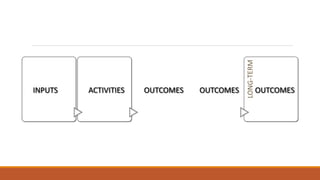
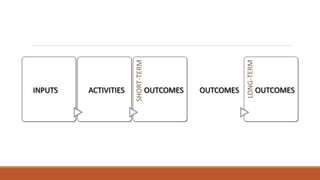
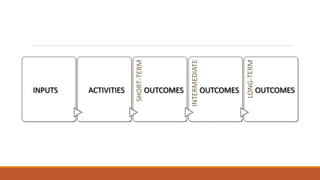
A purposeful plan has these characteristics:
It identifies the day-to-day activities you carry out.
It identifies the resources that you need to effectively carry out these activities.
It links your daily activities to your mission through a series of outcomes.
It logically maps your resources, activities, and mission together through a string of “if-then”
statements.
INPUTS ACTIVITIES OUTCOMES OUTCOMES MISSION
INPUTS ACTIVITIES OUTCOMES OUTCOMES
LONG-TERM
OUTCOMES
INPUTS ACTIVITIES OUTCOMES OUTCOMES
LONG-TERM
OUTCOMES
INPUTS ACTIVITIES
SHORT-TERM
OUTCOMES OUTCOMES
LONG-TERM
OUTCOMES
INPUTS ACTIVITIES
SHORT-TERM
OUTCOMES
INTERMEDIATE
OUTCOMES
LONG-TERM
OUTCOMES
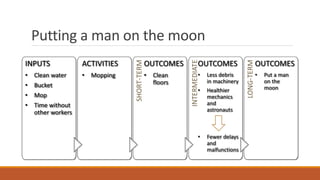
Putting a man on the moon
INPUTS
• Clean water
• Bucket
• Mop
• Time without
other workers
ACTIVITIES
• Mopping
SHORT-TERM
OUTCOMES
• Clean
floors
INTERMEDIATE
OUTCOMES
• Less debris
in machinery
• Healthier
mechanics
and
astronauts
• Fewer delays
and
malfunctions
LONG-TERM
OUTCOMES
• Put a man
on the
moon
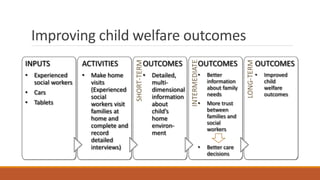
Improving child welfare outcomes
INPUTS
• Experienced
social workers
• Cars
• Tablets
ACTIVITIES
• Make home
visits
(Experienced
social
workers visit
families at
home and
complete and
record
detailed
interviews)
SHORT-TERM
OUTCOMES
• Detailed,
multi-
dimensional
information
about
child’s
home
environ-
ment
INTERMEDIATE
OUTCOMES
• Better
information
about family
needs
• More trust
between
families and
social
workers
• Better care
decisions
LONG-TERM
OUTCOMES
• Improved
child
welfare
outcomes
Activity # 2
Create a purposeful plan for your position or organization.
◦ Identify the mission of the position or organization.
◦ Identify one specific activity within that position or organization.
◦ Identify the inputs (resources) needed to carry out that activity.
◦ Identify the immediate results (short-term outcomes) resulting from carrying out the activity.
◦ Create an outcome chain, including intermediate outcomes as needed, linking the activity to the
mission.
Share your purposeful plan with the person next to you.
With a purposeful plan…
We can clearly communicate the resources needed by the organization and quickly and clearly
justify those resources in terms of the organization’s greater mission.
We can identify the specific purposes of each activity of the organization as it relates to the
mission of the organization.
We can identify the intermediate steps between carrying out an activity and achieving the
mission.
We can identify and remedy any logical flaws or missing links in the plan of the organization.
We can link every activity to the broader, aspirational mission.
We can stop wasting resources on activities that do not ultimately serve the mission.
Empowering
Evaluation
Empowering
Evaluation
DOES THE PLAN WORK?
Probabilityof National School Graduationin Kenya
Basedon qualityof secondaryschool
(Usingstandardizedscorecutoff)
Empowering Evaluation has the
following characteristics:
Measures program outcomes.
Compares program outcomes with what would have happened if the program didn’t exist.
Where possible, links activities to outcomes.
Is honest, transparent, and based on the best data available.
8 ways to create an alternative reality
1. When you cannot provide service to everyone who wants it, use lotteries to determine who
gets the service, and compare their outcomes with those who do not receive the service.
2. When you cannot provide service to everyone at once, track outcomes for potential
participants at different points in time, even if they have not yet received the service.
3. When you can pilot test an innovation in one location before rolling it out to all locations,
track differences across locations as well as over time within the location with the
innovation.
4. When people have no preference among alternatives, randomly assign some to receive one
version of the service and others to receive the alternative.
8 ways to create an alternative reality
5. When levels of the outcome are steady, track changes in outcome levels over time after you
implement the change.
6. When there is a clear cutoff point for eligibility, compare people who are barely eligible with
people who are barely ineligible.
7. When people choose for themselves whether to participate in a program or not, measure
differences in outcomes but also other characteristics that might impact their participation
levels, attitudes, opinions, etc. so you can compare likes with likes.
8. When you can gather before-and-after data for the same people, compare the values of an
outcome before the intervention and compare them with outcomes after the intervention.
Activity #3
Create a mini-evaluation plan.
◦ Select one outcome resulting from activities in your purposeful plan. This can be a short-term,
intermediate, or long-term outcome.
◦ Identify data you already have or could collect to measure achievement of this outcome.
◦ Identify how you could demonstrate what would have happened if you were not carrying out the
activity in your plan. What is the alternate reality? How could it be measured and compared?
Share your mini-evaluation plan with the person next to you.
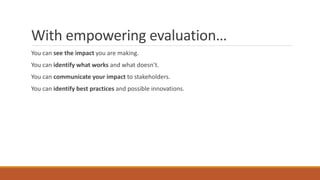
With empowering evaluation…
You can see the impact you are making.
You can identify what works and what doesn’t.
You can communicate your impact to stakeholders.
You can identify best practices and possible innovations.
Conclusion
Conclusion
CAPTURING AND COMMUNICATING IMPACT
Capture and communicate your impact
Use a meaningful mission to inspire and communicate purpose.
Use a purposeful plan to link every activity to the meaningful mission, eliminating activities that
do not ultimately lead to the mission.
Use empowering evaluation to demonstrate effectiveness in accomplishing the mission, to
inspire innovative change, and eliminate practices that don’t work.

Capturing and communicating impact

  • 1.
    Capturing and communicating impact HOWTO SEE THE DIFFERENCE YOU MAKE IN THE LIVES OF UTAHNS EVA WITESMAN, PH.D. ASSISTANT PROFESSOR OF PUBLIC MANAGEMENT BRIGHAM YOUNG UNIVERSITY EVA_WITESMAN@BYU.EDU Prepared for the 2014 UTAH OPS Conference presented by Governor Gary R. Herbert
  • 8.
    How can wecapture and communicate the impact of the activities we do on a day-to-day basis?
  • 9.
    See and communicateyour impact Use a meaningful mission to inspire and communicate purpose Use a purposeful plan to link every activity to the meaningful mission, eliminating activities that do not ultimately lead to the mission Use empowering evaluation to demonstrate effectiveness in accomplishing the mission, to inspire innovative change, and eliminate practices that don’t work
  • 10.
  • 11.
  • 13.
    “I’m helping to puta man on the moon.”
  • 14.
    A meaningful missionhas these characteristics: It identifies your core purpose—describing why your job or agency exists. It is aspirational and inspirational. It is succinct (20 words or less), though a mission statement may articulate both the mission and the key objectives of the organization. It guides action, aligning resources and activities and allowing you to identify and eliminate activities that don’t fit.
  • 15.
    Some exemplary missionstatements USO lifts the spirits of America’s troops and their families. The Humane Society: Celebrating Animals, Confronting Cruelty. Wounded Warrior Project: To honor and empower wounded warriors. Oxfam: To create lasting solutions to poverty, hunger, and social injustice. Public Broadcasting System (PBS): To create content that educates, informs and inspires. March of Dimes: We help moms have full-term pregnancies and research the problems that threaten the health of babies. Monterey Bay Aquarium: The mission of the non-profit Monterey Bay Aquarium is to inspire conservation of the oceans. National Parks Conservation Association: to protect and enhance America’s National Park System for present and future generations.
  • 16.
    Activity #1 Write amission statement for a position, program, or for your department or agency. ◦ Be sure that it identifies your core purpose, ◦ is aspirational and inspirational, ◦ is succinct, ◦ And that it guides action. Share your mission statement with the person next to you.
  • 17.
    With a meaningfulmission statement… We can remind ourselves about why we are here and what we are trying to accomplish—we can be inspired to work harder. We can feel greater fulfillment in each step we take toward achieving our mission and objectives. We can articulate our purpose and objectives to key stakeholders. We can make strategic decisions that encourage innovation and eliminate waste.
  • 18.
  • 19.
    Purposeful Plan HOW DOOUR ACTIVITIES ACHIEVE OUR OBJECTIVES?
  • 21.
    A purposeful planhas these characteristics: It identifies the day-to-day activities you carry out. It identifies the resources that you need to effectively carry out these activities. It links your daily activities to your mission through a series of outcomes. It logically maps your resources, activities, and mission together through a string of “if-then” statements.
  • 22.
  • 23.
    INPUTS ACTIVITIES OUTCOMESOUTCOMES LONG-TERM OUTCOMES
  • 24.
    INPUTS ACTIVITIES OUTCOMESOUTCOMES LONG-TERM OUTCOMES
  • 25.
  • 26.
  • 27.
    Putting a manon the moon INPUTS • Clean water • Bucket • Mop • Time without other workers ACTIVITIES • Mopping SHORT-TERM OUTCOMES • Clean floors INTERMEDIATE OUTCOMES • Less debris in machinery • Healthier mechanics and astronauts • Fewer delays and malfunctions LONG-TERM OUTCOMES • Put a man on the moon
  • 28.
    Improving child welfareoutcomes INPUTS • Experienced social workers • Cars • Tablets ACTIVITIES • Make home visits (Experienced social workers visit families at home and complete and record detailed interviews) SHORT-TERM OUTCOMES • Detailed, multi- dimensional information about child’s home environ- ment INTERMEDIATE OUTCOMES • Better information about family needs • More trust between families and social workers • Better care decisions LONG-TERM OUTCOMES • Improved child welfare outcomes
  • 29.
    Activity # 2 Createa purposeful plan for your position or organization. ◦ Identify the mission of the position or organization. ◦ Identify one specific activity within that position or organization. ◦ Identify the inputs (resources) needed to carry out that activity. ◦ Identify the immediate results (short-term outcomes) resulting from carrying out the activity. ◦ Create an outcome chain, including intermediate outcomes as needed, linking the activity to the mission. Share your purposeful plan with the person next to you.
  • 30.
    With a purposefulplan… We can clearly communicate the resources needed by the organization and quickly and clearly justify those resources in terms of the organization’s greater mission. We can identify the specific purposes of each activity of the organization as it relates to the mission of the organization. We can identify the intermediate steps between carrying out an activity and achieving the mission. We can identify and remedy any logical flaws or missing links in the plan of the organization. We can link every activity to the broader, aspirational mission. We can stop wasting resources on activities that do not ultimately serve the mission.
  • 31.
  • 32.
  • 35.
    Probabilityof National SchoolGraduationin Kenya Basedon qualityof secondaryschool (Usingstandardizedscorecutoff)
  • 37.
    Empowering Evaluation hasthe following characteristics: Measures program outcomes. Compares program outcomes with what would have happened if the program didn’t exist. Where possible, links activities to outcomes. Is honest, transparent, and based on the best data available.
  • 38.
    8 ways tocreate an alternative reality 1. When you cannot provide service to everyone who wants it, use lotteries to determine who gets the service, and compare their outcomes with those who do not receive the service. 2. When you cannot provide service to everyone at once, track outcomes for potential participants at different points in time, even if they have not yet received the service. 3. When you can pilot test an innovation in one location before rolling it out to all locations, track differences across locations as well as over time within the location with the innovation. 4. When people have no preference among alternatives, randomly assign some to receive one version of the service and others to receive the alternative.
  • 39.
    8 ways tocreate an alternative reality 5. When levels of the outcome are steady, track changes in outcome levels over time after you implement the change. 6. When there is a clear cutoff point for eligibility, compare people who are barely eligible with people who are barely ineligible. 7. When people choose for themselves whether to participate in a program or not, measure differences in outcomes but also other characteristics that might impact their participation levels, attitudes, opinions, etc. so you can compare likes with likes. 8. When you can gather before-and-after data for the same people, compare the values of an outcome before the intervention and compare them with outcomes after the intervention.
  • 40.
    Activity #3 Create amini-evaluation plan. ◦ Select one outcome resulting from activities in your purposeful plan. This can be a short-term, intermediate, or long-term outcome. ◦ Identify data you already have or could collect to measure achievement of this outcome. ◦ Identify how you could demonstrate what would have happened if you were not carrying out the activity in your plan. What is the alternate reality? How could it be measured and compared? Share your mini-evaluation plan with the person next to you.
  • 41.
    With empowering evaluation… Youcan see the impact you are making. You can identify what works and what doesn’t. You can communicate your impact to stakeholders. You can identify best practices and possible innovations.
  • 42.
  • 43.
  • 44.
    Capture and communicateyour impact Use a meaningful mission to inspire and communicate purpose. Use a purposeful plan to link every activity to the meaningful mission, eliminating activities that do not ultimately lead to the mission. Use empowering evaluation to demonstrate effectiveness in accomplishing the mission, to inspire innovative change, and eliminate practices that don’t work.

Editor's Notes

  • #2 State employees have an incredible opportunity to achieve real and lasting positive influences on the lives of those they serve, but the impact of their work is often lost in the day-to-day minutiae of government employment. This workshop is focused on helping to reinvigorate the passion for public service by empowering public servants to capture, visualize, and manipulate the impact they make, both in the short-term and the long-term. We will also discuss how to communicate our positive impact to supervisors, legislators, and citizens, and how to replace poor practices and programs with innovations that will help us to achieve our ultimate goals.
  • #3 Why did you pursue this avenue? What drew you to this career? This job? This field?
  • #4 Think about the experience of children: What do they want to be when they grow up? What types of jobs and careers impact them the most?
  • #5 Many public servants are interested in changing the world and/or helping people. For many of us, this is what drives us.
  • #6 It’s easier to be motivated by public service when you are doing direct service and seeing the immediate impact of the work you are doing.
  • #7 It can be difficult to see the impact of your day-to-day activities. This is particularly true the further removed we become from direct service. We may be impacting more lives and making more of a difference, but our impact is more difficult to capture and communicate.
  • #8 This leads us to a fundamental question that should be central to every public servant no matter what level:
  • #11 First thing is meaningful mission
  • #12 First thing is meaningful mission
  • #13 John F. Kennedy and janitor at NASA story
  • #16 Source: http://topnonprofits.com/examples/nonprofit-mission-statements/
  • #21 It is easier to see where we fit in when we can see the bigger picture. But the bigger picture requires that each piece be in place.
  • #23 Mission and activities may seem disconnected if you don’t have a good, purposeful plan. Activities can seem entirely removed from the grander purpose of the organization or even role/position.
  • #24 The type of purposeful plan we are about to create is called a “logic model.” In a logic model, we refer to the overall mission or objective of an activity or set of activities as “long-term outcomes.”
  • #25 The first part of a purposeful plan that is essential for linking activities to outcomes is identifying the inputs needed to actually carry out those activities successfully. Inputs identify the resources needed to carry out the key activities of an organization. An activity that is improperly resourced will be less effective at carrying out its activities and ultimately less likely to achieve the long-term outcomes.
  • #26 The next step to creating a purposeful plan is to identify what the immediate results, or short-term outcomes, of activities are expected to be. It is almost never the case that doing an activity automatically results in achieving the aspirational mission of a position or agency. Instead, there is usually a logical chain of events that occurs over some period of time to achieve the mission. Each of these links should be an “if-then” statement. Short-term outcomes are the immediate observable results of carrying out an activity. For example, the immediate result of mopping the floor should be clean floors. For attending a meeting, should either be some decision or level of understanding that has been reached.
  • #27 There may be various intermediate steps between the immediate results of an activity (short term outcomes) and achievement of the mission (long-term outcomes). All of these intermediate steps are called intermediate outcomes. Intermediate outcomes should be if-thens eventually linking the short-term outcomes to the long-term outcomes. Note: most logic models also include “outputs” which are measures of activities. However, we should be employing measures of all elements of the logic model, and this approach maintains the if-then continuity from element to element.
  • #28 First example
  • #29 Second example
  • #31 Reflect on what is accomplished by activity and how it can help us better realize and communicate impact
  • #34 Source: http://Incredibleyears.com/for-researchers/evaluation/
  • #35 Source: http://www.huffingtonpost.com/2013/12/09/pisa-scores-preschool-test-american_n_4401037.html
  • #36 Source: Mbiti & Lucas (2013) test the impact of secondary school quality on student achievement in Kenya, using the cut-off on the primary exit exam required to get into better secondary schools. Located from: http://blogs.worldbank.org/impactevaluations/trade/regression-discontinuity-porn
  • #37 Source: http://www.dhs.state.il.us/page.aspx?item=54736
  • #39 Adapted liberally from Shadish, Cook and Campbell (2002). Experimental and Quasi-Experimental Designs for Generalized Causal Inference.
  • #40 Adapted liberally from Shadish, Cook and Campbell (2002). Experimental and Quasi-Experimental Designs for Generalized Causal Inference.
  • #42 Reflect on what is accomplished by activity and how it can help us better realize and communicate impact
  • #45 State employees have an incredible opportunity to achieve real and lasting positive influences on the lives of those they serve, but the impact of their work is often lost in the day-to-day minutiae of government employment. This workshop is focused on helping to reinvigorate the passion for public service by empowering public servants to capture, visualize, and manipulate the impact they make, both in the short-term and the long-term. We will also discuss how to communicate our positive impact to supervisors, legislators, and citizens, and how to replace poor practices and programs with innovations that will help us to achieve our ultimate goals. This has bigger implications than just making you feel good about your job. It can inspire you to innovate, help you to eliminate practices that do not support the ultimate goals, and communicate your value, your program’s value, and your agency’s value to other people, including legislators, taxpayers, your superiors, and collaborators.