Witnessing Slavery:
The Development of Ante-
Bellum Slave Narratives
By Frances Smith Foster
Wesport, CT: Greenwood Press,
1979
THE ELEMENTS OF THE
JUDEO-CHRISTIAN MYTH
One of Smith’s main arguments is that the plot of slave narratives
generally can be seen as a variation on the Judeo-Christian myth
following a five point structure that appeared in Christian conversion
narratives and had parallels with the experiences of the Israelites in the
Old Testament.
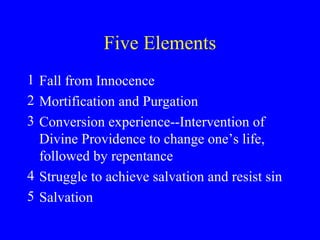
Five Elements
1 Fall from Innocence
2 Mortification and Purgation
3 Conversion experience--Intervention of
Divine Providence to change one’s life,
followed by repentance
4 Struggle to achieve salvation and resist sin
5 Salvation
Elements Applied to Israelites
• Fall from Innocence- Sin and Expulsion from Eden
• Mortification and Purgation-slavery in Egypt
• Conversion experience—Moses frees the people and they
repent and follow Yahweh
• Struggle to achieve salvation and resist sin-years of
wandering in the desert
• Salvation—They reach the promised land, Caanan
Conversion narratives
• A conversion narrative is an autobiographical
account that relates the experience of religious
conversion, moving from a life of sin and error to
one of salvation and enlightenment.
• One classic Christian example is the confessions
of Saint Augustine
• It was an important genre in Puritan literature
• Foster shows how the J-C myth structure applies
to these narratives
The Elements in Christian
narratives
• Fall—narrator is born into a sinful world
• Mortification- experiences a sinful youth
and suffers God’s punishments
• Conversion experience—sees error of his
ways and repents (sometimes after a vision)
• Struggle- Continues to struggle with
temptation
• Salvation--Redeemed by Christ
18th
century slave narratives
• Many 18th
century narratives were also conversion
narratives. Equiano’s is an example.
• They had a strong theocentric emphasis and told
of how the slave (usually African born) was
converted to Christianity and how Providence
helped him gain freedom.
• They mostly attack slavery from a
moral/philosophical point of view as incompatible
with Christian principles rather than stressing
abuses.
19th
century narratives
• Featured American born narrators with a more secular
focus though still some attention to how divine providence
guided escape.
• Emphasis on violence and brutality of slavery as well as
moral philosophical problems with slavery
• “Christian” slaveholders attacked for their false religion.
• Instead of focusing solely on the individual narrator’s
experience, experiences of others were also included.
J-C myth in Slave Narratives
1 Fall from innocence: Initiation into slavery
after comparatively free childhood
2 Mortification and purgation: Sufferings
under slavery
3 Conversion =Decision to flee, commitment
to escape slavery
4 Struggle=Escape and hardships of escape
5 Freedom
Initiation into slavery
• Childhood phase gets little attention because slave
childhoods were little different from all but richest
whites.
• Some emphasis on neglect and child having no
supervision
• Observation of whipping of another slave is
common feature.
• So is auction or valuation upon the death of a
kind master with subsequent transfer to a cruel
owner.
Mortification: Suffering under
Slavery
• Neglect of food, clothing and hours of labor
mentioned but not stressed because not
worse than many non-slaves.
• Cruelty and barbarity of physical
punishments stressed as well as sexual
abuse.
• Negative effect on both master and slave
emphasized.
• Usually longest phase of the narrative.
Decision to Flee
• Slave becomes aware of alternatives--
sometimes gradually, sometimes suddenly
• Usually some dramatic moment precipitates
decision to flee or fight--example fight
with Covey or Flint’s decision to bring the
children to plantation or possibility that
Jenny saw Linda
• This is generally the climax of the narrative
Escape
• Sometimes slave is manumitted or buys
freedom; most run away.
• In either case account includes “trials and
tribulations, failures and progress before
goal is reached.”
• In many narratives this phase is short, but
there are exceptions.
Freedom
• Change of chattel into human being.
• Promise or hope of happiness for fugitives.
• Remembrance of those still in slavery.
• Often ends abruptly; a few dare to expose
prejudice in the North.
Before you turn to the next slide
think about how these patterns
can apply to
Narrative of the Life of Frederick Douglass
an American Slave, written by Himself
and Incidents in the Life of a Slave Girl
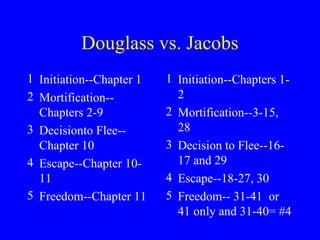
Douglass vs. Jacobs
1 Initiation--Chapter 1
2 Mortification--
Chapters 2-9
3 Decisionto Flee--
Chapter 10
4 Escape--Chapter 10-
11
5 Freedom--Chapter 11
1 Initiation--Chapters 1-
2
2 Mortification--3-15,
28
3 Decision to Flee--16-
17 and 29
4 Escape--18-27, 30
5 Freedom-- 31-41 or
41 only and 31-40= #4
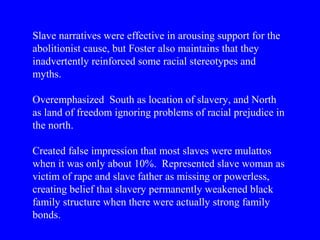
Slave narratives were effective in arousing support for the
abolitionist cause, but Foster also maintains that they
inadvertently reinforced some racial stereotypes and
myths.
Overemphasized South as location of slavery, and North
as land of freedom ignoring problems of racial prejudice in
the north.
Created false impression that most slaves were mulattos
when it was only about 10%. Represented slave woman as
victim of rape and slave father as missing or powerless,
creating belief that slavery permanently weakened black
family structure when there were actually strong family
bonds.

Witnessing Slavery

  • 1.
    Witnessing Slavery: The Developmentof Ante- Bellum Slave Narratives By Frances Smith Foster Wesport, CT: Greenwood Press, 1979
  • 2.
    THE ELEMENTS OFTHE JUDEO-CHRISTIAN MYTH One of Smith’s main arguments is that the plot of slave narratives generally can be seen as a variation on the Judeo-Christian myth following a five point structure that appeared in Christian conversion narratives and had parallels with the experiences of the Israelites in the Old Testament.
  • 3.
    Five Elements 1 Fallfrom Innocence 2 Mortification and Purgation 3 Conversion experience--Intervention of Divine Providence to change one’s life, followed by repentance 4 Struggle to achieve salvation and resist sin 5 Salvation
  • 4.
    Elements Applied toIsraelites • Fall from Innocence- Sin and Expulsion from Eden • Mortification and Purgation-slavery in Egypt • Conversion experience—Moses frees the people and they repent and follow Yahweh • Struggle to achieve salvation and resist sin-years of wandering in the desert • Salvation—They reach the promised land, Caanan
  • 5.
    Conversion narratives • Aconversion narrative is an autobiographical account that relates the experience of religious conversion, moving from a life of sin and error to one of salvation and enlightenment. • One classic Christian example is the confessions of Saint Augustine • It was an important genre in Puritan literature • Foster shows how the J-C myth structure applies to these narratives
  • 6.
    The Elements inChristian narratives • Fall—narrator is born into a sinful world • Mortification- experiences a sinful youth and suffers God’s punishments • Conversion experience—sees error of his ways and repents (sometimes after a vision) • Struggle- Continues to struggle with temptation • Salvation--Redeemed by Christ
  • 7.
    18th century slave narratives •Many 18th century narratives were also conversion narratives. Equiano’s is an example. • They had a strong theocentric emphasis and told of how the slave (usually African born) was converted to Christianity and how Providence helped him gain freedom. • They mostly attack slavery from a moral/philosophical point of view as incompatible with Christian principles rather than stressing abuses.
  • 8.
    19th century narratives • FeaturedAmerican born narrators with a more secular focus though still some attention to how divine providence guided escape. • Emphasis on violence and brutality of slavery as well as moral philosophical problems with slavery • “Christian” slaveholders attacked for their false religion. • Instead of focusing solely on the individual narrator’s experience, experiences of others were also included.
  • 9.
    J-C myth inSlave Narratives 1 Fall from innocence: Initiation into slavery after comparatively free childhood 2 Mortification and purgation: Sufferings under slavery 3 Conversion =Decision to flee, commitment to escape slavery 4 Struggle=Escape and hardships of escape 5 Freedom
  • 10.
    Initiation into slavery •Childhood phase gets little attention because slave childhoods were little different from all but richest whites. • Some emphasis on neglect and child having no supervision • Observation of whipping of another slave is common feature. • So is auction or valuation upon the death of a kind master with subsequent transfer to a cruel owner.
  • 11.
    Mortification: Suffering under Slavery •Neglect of food, clothing and hours of labor mentioned but not stressed because not worse than many non-slaves. • Cruelty and barbarity of physical punishments stressed as well as sexual abuse. • Negative effect on both master and slave emphasized. • Usually longest phase of the narrative.
  • 12.
    Decision to Flee •Slave becomes aware of alternatives-- sometimes gradually, sometimes suddenly • Usually some dramatic moment precipitates decision to flee or fight--example fight with Covey or Flint’s decision to bring the children to plantation or possibility that Jenny saw Linda • This is generally the climax of the narrative
  • 13.
    Escape • Sometimes slaveis manumitted or buys freedom; most run away. • In either case account includes “trials and tribulations, failures and progress before goal is reached.” • In many narratives this phase is short, but there are exceptions.
  • 14.
    Freedom • Change ofchattel into human being. • Promise or hope of happiness for fugitives. • Remembrance of those still in slavery. • Often ends abruptly; a few dare to expose prejudice in the North.
  • 15.
    Before you turnto the next slide think about how these patterns can apply to Narrative of the Life of Frederick Douglass an American Slave, written by Himself and Incidents in the Life of a Slave Girl
  • 16.
    Douglass vs. Jacobs 1Initiation--Chapter 1 2 Mortification-- Chapters 2-9 3 Decisionto Flee-- Chapter 10 4 Escape--Chapter 10- 11 5 Freedom--Chapter 11 1 Initiation--Chapters 1- 2 2 Mortification--3-15, 28 3 Decision to Flee--16- 17 and 29 4 Escape--18-27, 30 5 Freedom-- 31-41 or 41 only and 31-40= #4
  • 17.
    Slave narratives wereeffective in arousing support for the abolitionist cause, but Foster also maintains that they inadvertently reinforced some racial stereotypes and myths. Overemphasized South as location of slavery, and North as land of freedom ignoring problems of racial prejudice in the north. Created false impression that most slaves were mulattos when it was only about 10%. Represented slave woman as victim of rape and slave father as missing or powerless, creating belief that slavery permanently weakened black family structure when there were actually strong family bonds.