FIELD
REPORTS
HOW TO BEGIN?
 FIELD REPORTS- are often
assigned in disciplines of the applied
social sciences, social work,
anthropology, criminal justice,
education, law etc. where it is
important to build a bridge of
relevancy between the theoretical
concepts learned in the classroom
and the practice of actually doing the
FIELD REPORTS
 Are common in certain science disciplines
but these reports are organized differently
and serve a different purpose than what is
described.
 It facilitate the development of data collection
techniques and observation skills and they
help you to understand how theory applies o
real world situations.
 Also an opportunity to obtain evidence
through methods of observing professional
practice that contribute to or challenge
FIELD REPORTS
 We are all observers of people, their
interactions, places and events;
however your responsibility when
writing a field report is to create a
research study based on data
generated by the act of designing a
specific data, deliberate observation,
a synthesis of key findings and an
interpretation of their meaning.
When writing a field
report you need to:
1. Systematically observe and
accurately record the varying aspects
of a situation.
 Always approach your field study with
a detailed plan about what you will
observe, where you should conduct
your observations and the method to
collect and record your data.
2. Continuously analyze your
observations.
 Always look for the meaning
underlying the actions you observe.
Note that this an on-going process of
reflection and analysis taking place
for the duration of your field research.
3. Keep the report’s aim in mind while
you are observing.
 In recording you must be focused and
pay attention to details. Enter the
observation site with a clear plan
about what you are intending to
observe and record being prepared to
adapt to changing environment.
4. Consciously observe, record and
analyze what you hear and see in the
context of a theoretical framework.
 The theoretical framework guiding
you field research should determine
what, when and how you observe
and act as the foundation from which
you interpret your findings.
TECHNIQUES TO RECORD
OBSERVATION
Note Taking
This is the most commonly
used and easiest method of
recording your observations.
Photography
It can help capture an important
moment in time as well as
document details about the
space where your observation
takes place. It can also save
time for documenting the details
of space that would otherwise
require extensive note taking.
Audio and Video Recordings
 This can be particularly helpful as you
gather additional information or insights
during your research. These techniques
have the negative effect of increasing how
intrusive you are as an observer and will
often not be practical or even allowed
under certain circumstances and in certain
organizational settings.
Illustrations and Drawings
 This does not refer to an artistic endeavor
but, rather, refers to possible need, for
example, to draw a map of the
observation setting or illustrating objects in
relation to people’s behavior.
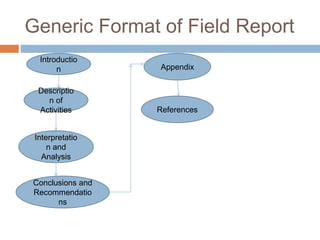
Generic Format of Field Report
Introductio
n
Descriptio
n of
Activities
Interpretatio
n and
Analysis
Conclusions and
Recommendatio
ns
Appendix
References
I-Introduction
 It describe the research problem.
 The objectives of the problem.
 You should also include a review of pertinent
literature related to the problem, especially if
similar methods were used in prior studies.
 Conclude your introduction with a statement
about how the rest of the paper is organized.
II-Description of Activities
 This is similar to a well written piece of journalism.
Five W’s of Investigative reporting. These are the
following:
 WHAT- describe what you observed. Physical and
social boundaries you imposed to limit the
observations you made.
 WHEN- record factual data about the day and the
beginning and ending time of observation.
 WHO- note background and demographic
information about the individuals being observed
(age, gender, who is doing or saying that)
 WHY- describe the reasons for selecting particular
situations to observe .
III-Interpretation and Analysis
 Always place the analysis and interpretations of
your field observations within the larger context of
the theories and issues you described in the
introduction. Analyze the data which observations
are worthy of comment and interpretation, which
observations are more general in nature. It is
your theoretical framework that allows you to
make your decisions.
 Interpretations must be based on what you have
actually observed. Do not speculate or manipulate
your data to fit into your study’s theoretical
framework.
III-Interpretation and Analysis
 Questions you have to consider in analyzing your
observations:
 What is the meaning of what you have observed?
 Why do you think what you observed happened?
What evidence do you have for your reasoning?
 Do you see any connections or patterns in what you
observed?
 What were the strengths and weaknesses of the
observations you recorded?
 Do you see connections between what you observed
and the findings of similar studies indentified from
your review of the literature?
 Have you learned anything from what you have
observed?
IV- Conclusions and
Recommendations
 It should briefly recap the entire study,
reiterating the importance or significance of
your observations. Avoid including any
information.
 You should state any recommendations if you
have.
 The conclusion should not be more than two
or three paragraphs.
V- Appendix
 This is where you would place information that
is not essential to explaining your findings, but
that supports your analysis that validates your
conclusions or that contextualizes a related
point that helps the reader understand the
overall report.
 Examples:
figures/tables/graphs/pictures/maps/drawings
or if applicable transcripts of interview.
VI- References
 List all sources that you consulted
and obtained your information from
while writing your field report. Be sure
to write them in the preferred citation
style of your discipline.
General Considerations
 Comprehensible- needs to be understood by a
range of potential audiences-including staff of
other agencies not expert in the subject and
local communities. Use simple, clear language-
avoid highly technical terms & flowery
description.
 Comprehensive- must include all the facts and
information of any relevance and include notes
on checks made which did not uncover
irregularities
 Concise- It adds clarity. Helps to keep facts or
conclusions in main body, but
calculations/analysis and list of annexes.

field-reports_ppt 11.ppt

  • 1.
  • 2.
    HOW TO BEGIN? FIELD REPORTS- are often assigned in disciplines of the applied social sciences, social work, anthropology, criminal justice, education, law etc. where it is important to build a bridge of relevancy between the theoretical concepts learned in the classroom and the practice of actually doing the
  • 3.
    FIELD REPORTS  Arecommon in certain science disciplines but these reports are organized differently and serve a different purpose than what is described.  It facilitate the development of data collection techniques and observation skills and they help you to understand how theory applies o real world situations.  Also an opportunity to obtain evidence through methods of observing professional practice that contribute to or challenge
  • 4.
    FIELD REPORTS  Weare all observers of people, their interactions, places and events; however your responsibility when writing a field report is to create a research study based on data generated by the act of designing a specific data, deliberate observation, a synthesis of key findings and an interpretation of their meaning.
  • 5.
    When writing afield report you need to:
  • 6.
    1. Systematically observeand accurately record the varying aspects of a situation.  Always approach your field study with a detailed plan about what you will observe, where you should conduct your observations and the method to collect and record your data.
  • 7.
    2. Continuously analyzeyour observations.  Always look for the meaning underlying the actions you observe. Note that this an on-going process of reflection and analysis taking place for the duration of your field research.
  • 8.
    3. Keep thereport’s aim in mind while you are observing.  In recording you must be focused and pay attention to details. Enter the observation site with a clear plan about what you are intending to observe and record being prepared to adapt to changing environment.
  • 9.
    4. Consciously observe,record and analyze what you hear and see in the context of a theoretical framework.  The theoretical framework guiding you field research should determine what, when and how you observe and act as the foundation from which you interpret your findings.
  • 10.
  • 11.
    Note Taking This isthe most commonly used and easiest method of recording your observations.
  • 12.
    Photography It can helpcapture an important moment in time as well as document details about the space where your observation takes place. It can also save time for documenting the details of space that would otherwise require extensive note taking.
  • 13.
    Audio and VideoRecordings  This can be particularly helpful as you gather additional information or insights during your research. These techniques have the negative effect of increasing how intrusive you are as an observer and will often not be practical or even allowed under certain circumstances and in certain organizational settings.
  • 14.
    Illustrations and Drawings This does not refer to an artistic endeavor but, rather, refers to possible need, for example, to draw a map of the observation setting or illustrating objects in relation to people’s behavior.
  • 15.
    Generic Format ofField Report Introductio n Descriptio n of Activities Interpretatio n and Analysis Conclusions and Recommendatio ns Appendix References
  • 16.
    I-Introduction  It describethe research problem.  The objectives of the problem.  You should also include a review of pertinent literature related to the problem, especially if similar methods were used in prior studies.  Conclude your introduction with a statement about how the rest of the paper is organized.
  • 17.
    II-Description of Activities This is similar to a well written piece of journalism. Five W’s of Investigative reporting. These are the following:  WHAT- describe what you observed. Physical and social boundaries you imposed to limit the observations you made.  WHEN- record factual data about the day and the beginning and ending time of observation.  WHO- note background and demographic information about the individuals being observed (age, gender, who is doing or saying that)  WHY- describe the reasons for selecting particular situations to observe .
  • 18.
    III-Interpretation and Analysis Always place the analysis and interpretations of your field observations within the larger context of the theories and issues you described in the introduction. Analyze the data which observations are worthy of comment and interpretation, which observations are more general in nature. It is your theoretical framework that allows you to make your decisions.  Interpretations must be based on what you have actually observed. Do not speculate or manipulate your data to fit into your study’s theoretical framework.
  • 19.
    III-Interpretation and Analysis Questions you have to consider in analyzing your observations:  What is the meaning of what you have observed?  Why do you think what you observed happened? What evidence do you have for your reasoning?  Do you see any connections or patterns in what you observed?  What were the strengths and weaknesses of the observations you recorded?  Do you see connections between what you observed and the findings of similar studies indentified from your review of the literature?  Have you learned anything from what you have observed?
  • 20.
    IV- Conclusions and Recommendations It should briefly recap the entire study, reiterating the importance or significance of your observations. Avoid including any information.  You should state any recommendations if you have.  The conclusion should not be more than two or three paragraphs.
  • 21.
    V- Appendix  Thisis where you would place information that is not essential to explaining your findings, but that supports your analysis that validates your conclusions or that contextualizes a related point that helps the reader understand the overall report.  Examples: figures/tables/graphs/pictures/maps/drawings or if applicable transcripts of interview.
  • 22.
    VI- References  Listall sources that you consulted and obtained your information from while writing your field report. Be sure to write them in the preferred citation style of your discipline.
  • 23.
    General Considerations  Comprehensible-needs to be understood by a range of potential audiences-including staff of other agencies not expert in the subject and local communities. Use simple, clear language- avoid highly technical terms & flowery description.  Comprehensive- must include all the facts and information of any relevance and include notes on checks made which did not uncover irregularities  Concise- It adds clarity. Helps to keep facts or conclusions in main body, but calculations/analysis and list of annexes.