Phonemic Awareness Skill:
Onset and Rimes
By: Ms. Chrisdyana Morgan
Let’s Use Our Time Wisely!
1. Agenda
2. Meeting outcome
3. Student Work
4. What is Phonological Awareness?
5. Development
6. Classroom /Connection
Cluster Meeting Outcome
By the end of the cluster
meeting, Pre- K and Kindergarten
teachers will develop Chunk 3
lesson, onset and rime resulting
in students being able to
segment a word into an onset
and rime as measured by criteria
of student work and teacher’s
proficiency in presenting
instructional.
10. min. Student Work
We will discus students work
using Qualitative Trackers and
Quantitative Trackers.
5 min. Identify Need
• Student needs
• Master Teacher Field Testing Data for
Chunk 3
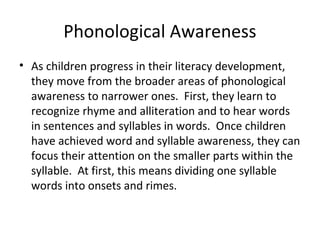
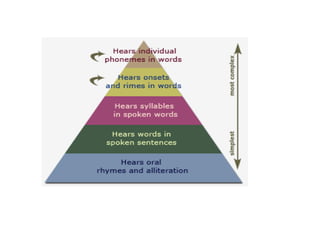
Phonological Awareness
• As children progress in their literacy development,
they move from the broader areas of phonological
awareness to narrower ones. First, they learn to
recognize rhyme and alliteration and to hear words
in sentences and syllables in words. Once children
have achieved word and syllable awareness, they can
focus their attention on the smaller parts within the
syllable. At first, this means dividing one syllable
words into onsets and rimes.
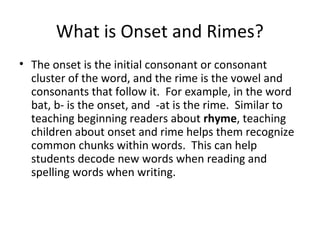
What is Onset and Rimes?
• The onset is the initial consonant or consonant
cluster of the word, and the rime is the vowel and
consonants that follow it. For example, in the word
bat, b- is the onset, and -at is the rime. Similar to
teaching beginning readers about rhyme, teaching
children about onset and rime helps them recognize
common chunks within words. This can help
students decode new words when reading and
spelling words when writing.
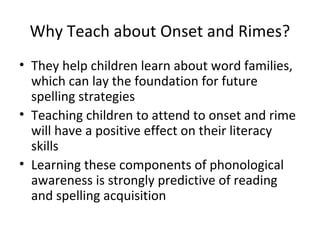
Why Teach about Onset and Rimes?
• They help children learn about word families,
which can lay the foundation for future
spelling strategies
• Teaching children to attend to onset and rime
will have a positive effect on their literacy
skills
• Learning these components of phonological
awareness is strongly predictive of reading
and spelling acquisition
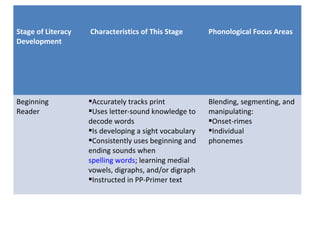
Stage of Literacy
Development
Characteristics of This Stage Phonological Focus Areas
Beginning
Reader
Accurately tracks print
Uses letter-sound knowledge to
decode words
Is developing a sight vocabulary
Consistently uses beginning and
ending sounds when
spelling words; learning medial
vowels, digraphs, and/or digraph
Instructed in PP-Primer text
Blending, segmenting, and
manipulating:
Onset-rimes
Individual
phonemes
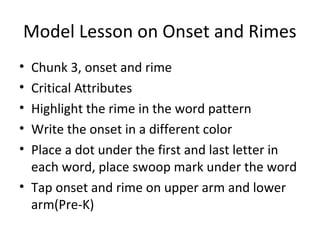
Model Lesson on Onset and Rimes
• Chunk 3, onset and rime
• Critical Attributes
• Highlight the rime in the word pattern
• Write the onset in a different color
• Place a dot under the first and last letter in
each word, place swoop mark under the word
• Tap onset and rime on upper arm and lower
arm(Pre-K)
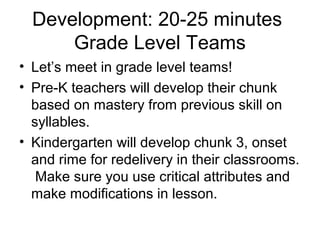
Development: 20-25 minutes
Grade Level Teams
• Let’s meet in grade level teams!
• Pre-K teachers will develop their chunk
based on mastery from previous skill on
syllables.
• Kindergarten will develop chunk 3, onset
and rime for redelivery in their classrooms.
Make sure you use critical attributes and
make modifications in lesson.
Evaluation
• Journal: Reflect on today’s new learning.
Closure/Classroom Application
• Teach chunk 3, onset and rime in a future
lesson.
• See Master Teacher for follow-up support

Onset and rime powerpoint

  • 1.
    Phonemic Awareness Skill: Onsetand Rimes By: Ms. Chrisdyana Morgan
  • 2.
    Let’s Use OurTime Wisely! 1. Agenda 2. Meeting outcome 3. Student Work 4. What is Phonological Awareness? 5. Development 6. Classroom /Connection
  • 3.
    Cluster Meeting Outcome Bythe end of the cluster meeting, Pre- K and Kindergarten teachers will develop Chunk 3 lesson, onset and rime resulting in students being able to segment a word into an onset and rime as measured by criteria of student work and teacher’s proficiency in presenting instructional.
  • 4.
    10. min. StudentWork We will discus students work using Qualitative Trackers and Quantitative Trackers.
  • 5.
    5 min. IdentifyNeed • Student needs • Master Teacher Field Testing Data for Chunk 3
  • 6.
    Phonological Awareness • Aschildren progress in their literacy development, they move from the broader areas of phonological awareness to narrower ones. First, they learn to recognize rhyme and alliteration and to hear words in sentences and syllables in words. Once children have achieved word and syllable awareness, they can focus their attention on the smaller parts within the syllable. At first, this means dividing one syllable words into onsets and rimes.
  • 7.
    What is Onsetand Rimes? • The onset is the initial consonant or consonant cluster of the word, and the rime is the vowel and consonants that follow it. For example, in the word bat, b- is the onset, and -at is the rime. Similar to teaching beginning readers about rhyme, teaching children about onset and rime helps them recognize common chunks within words. This can help students decode new words when reading and spelling words when writing.
  • 8.
    Why Teach aboutOnset and Rimes? • They help children learn about word families, which can lay the foundation for future spelling strategies • Teaching children to attend to onset and rime will have a positive effect on their literacy skills • Learning these components of phonological awareness is strongly predictive of reading and spelling acquisition
  • 10.
    Stage of Literacy Development Characteristicsof This Stage Phonological Focus Areas Beginning Reader Accurately tracks print Uses letter-sound knowledge to decode words Is developing a sight vocabulary Consistently uses beginning and ending sounds when spelling words; learning medial vowels, digraphs, and/or digraph Instructed in PP-Primer text Blending, segmenting, and manipulating: Onset-rimes Individual phonemes
  • 11.
    Model Lesson onOnset and Rimes • Chunk 3, onset and rime • Critical Attributes • Highlight the rime in the word pattern • Write the onset in a different color • Place a dot under the first and last letter in each word, place swoop mark under the word • Tap onset and rime on upper arm and lower arm(Pre-K)
  • 12.
    Development: 20-25 minutes GradeLevel Teams • Let’s meet in grade level teams! • Pre-K teachers will develop their chunk based on mastery from previous skill on syllables. • Kindergarten will develop chunk 3, onset and rime for redelivery in their classrooms. Make sure you use critical attributes and make modifications in lesson.
  • 13.
    Evaluation • Journal: Reflecton today’s new learning.
  • 14.
    Closure/Classroom Application • Teachchunk 3, onset and rime in a future lesson. • See Master Teacher for follow-up support