Desabandu Dr. G.H.K.K. Gunawardana
M.B.B.S.,M.S.(Obs & Gyn), F.R.C.O.G.,F.C.O.C.(S.L )
Consultant Obstetrician and Gynaecologist
Teaching Hospital,
Peradeniya.
Contents
 Introduction
 Epidemiology
 Pathology
 Classification
 Clinical features
 Differential Diagnoses
 Complications
 Diagnosis
 Treatments
 Prevention
Leiomyomas (fibroids)
 Benign smooth muscle tumors of the uterus
 Commonly called “fibroids”
 Estrogen dependent
 Rarely occur before menarche or after menopause
 Grow larger during pregnancy
 Rarely malignant
 Most common indication for pelvic surgery in
women
Epidemiology of Leiomyomas
 Develop from smooth muscle cells by means of
hyperplasia
 Occurs in 20% of women of reproductive age
 Most often occurs among
 Nulliparous women
 Women older than 35
 Nonsmokers
 Oral contraceptive or IUD users
 Obese
 Positive family history
 African American women
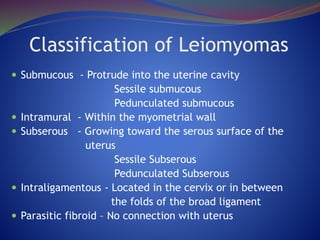
Classification of Leiomyomas
 Submucous - Protrude into the uterine cavity
Sessile submucous
Pedunculated submucous
 Intramural - Within the myometrial wall
 Subserous - Growing toward the serous surface of the
uterus
Sessile Subserous
Pedunculated Subserous
 Intraligamentous - Located in the cervix or in between
the folds of the broad ligament
 Parasitic fibroid – No connection with uterus
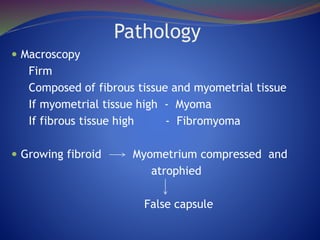
Pathology
 Macroscopy
Firm
Composed of fibrous tissue and myometrial tissue
If myometrial tissue high - Myoma
If fibrous tissue high - Fibromyoma
 Growing fibroid Myometrium compressed and
atrophied
False capsule
Leiomyomas:Symptoms
 Usually asymptomatic
 Symptoms increase as tumors grow
 Common symptoms
 Menstrual disturbance Pressure symptoms
Menorrhagia Feeling of “heaviness”
Dysmenorrhea Bloating
Spotting between periods Pelvic congestion, Varicose veins
Urinary retention, frequency,
dysurea
 Dyspareunia
 Back pain
 A lump or swelling in the lower abdomen
 Subfertility
Leiomyomas
Physical Examination
 Abdomino pelvic lump
Firm
Non tender
Irregular
Mobile in transverse direction
Mobility restricted in longitudinal direction except
in pedunculated fibroids
 Absence of ascites
 Normal bowel sounds
 May be mistaken for adnexal mass if situated laterally
 If mass moves with the uterus, likely to be a leiomyoma
Leiomyomas:
Differential Diagnoses
 Ovarian neoplasm
 Tubo-ovarian inflammatory mass
 Diverticular inflammatory mass
 Pregnancy
 Ectopic pregnancy
 Adenomyosis
 Pelvic kidney
 Malignancy
Complications
 Anaemia - Excessive menstrual blood loss can cause
anaemia
 Urinary tract obstruction
 Infertility
 Red degeneration - Very painful and tender
 Infection
 Malignant change ( < 1% )
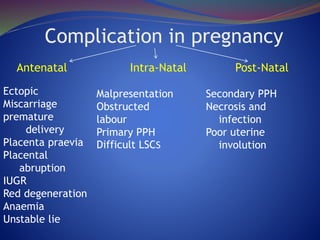
Complication in pregnancy
Antenatal Intra-Natal Post-Natal
Ectopic
Miscarriage
premature
delivery
Placenta praevia
Placental
abruption
IUGR
Red degeneration
Anaemia
Unstable lie
Malpresentation
Obstructed
labour
Primary PPH
Difficult LSCS
Secondary PPH
Necrosis and
infection
Poor uterine
involution
Fibroid in pregnancy
Diagnosis
 USS
Characteristically appears hypoechogenic and well
defined lesions
 Hysteroscopy
Pedunculated and submucous myomas can be
identified
 Laparoscopy
 Operative diagnosis
HysteroscopyUSS
Uterus with big
Myoma
laparoscopic view
Laparoscopy
Management
 Depends on
Symptoms
The location of fibroids
Size and number of the fibroid
Fertility wishes
Patient’s wishes
Facilities of the unit and the experience of the
operator
Management cont…
1. Monitoring
If the fibroids are causing no symptoms and are
not large,
‘wait and see’ approach
Re-evaluate every 3-6 months
Pelvic ultrasound as needed
Monitor Hb frequently
Management cont…
2.Medical treatment
Drugs
 Oral contraceptive pills, either combination pills or
progestin-only, in an effort to manage symptoms
 Hormones, used in combination to shrink the
fibroids prior to surgery
Long term progesterone
GnRH - analogues
Danazole
Gestrinone
Mifepristone
Letrazole
Management cont…
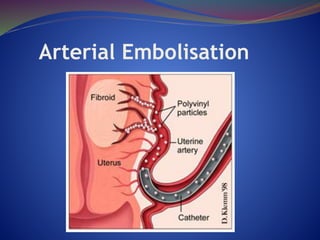
3.Arterial embolisation
 Under local anaesthesia, a fine tube is passed via an
artery in the arm or leg into the main artery
supplying the fibroid with blood
 The whole process is monitored by x-ray
 Fine particles (like sand) are injected into the artery
to block the blood supply to the fibroid
 The fibroid slowly dies and symptoms should settle
over a few months
Arterial Embolisation
Management cont…
4.Ablation Therapy
 HIFU (High intensity focused ultrasound), (Magnetic
Resonance guided Focused Ultrasound)
Non-invasive intervention
Uses high intensity focused ultrasound waves
to ablate (destroy) tissue in combination with
Magnetic Resonance Imaging (MRI)
 Laser ablation
Management cont…
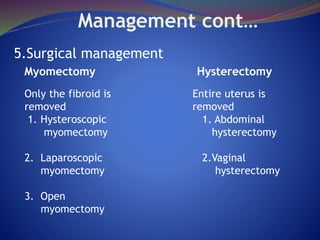
5.Surgical management
Myomectomy Hysterectomy
Only the fibroid is
removed
1. Hysteroscopic
myomectomy
2. Laparoscopic
myomectomy
3. Open
myomectomy
Entire uterus is
removed
1. Abdominal
hysterectomy
2.Vaginal
hysterectomy
Management cont…
 Myomectomy is indicated when,
 Solitary pedunculated myoma
 Nature or location of the myoma
appears to be interfering with fertility – sub
serous myoma or myomatous polyps
 Myoma is causing pregnancy loss
 Preservation of fertility is required
Myomectomy
 Hysteroscopic myomectomy
Fibroids are removed via the cervix, using a hysteroscope
Recommended for submucosal fibroids
 Laparoscopic myomectomy
Myomectomy through laparoscopy
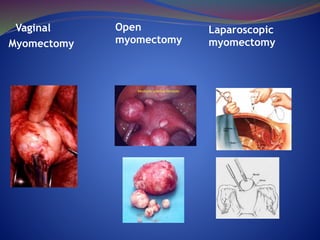
 Open myomectomy (Laparotomy & myomectomy)
Larger fibroids removed via an abdominal incision.
This weakens the uterine wall and makes Caesarean
sections for subsequent pregnancies more likely
Management cont…
Vaginal
Myomectomy
Laparoscopic
myomectomy
Open
myomectomy
Management cont…
Hysterectomy
Hysterectomy will indicated in,
 Rapid enlargement of the uterus may mean possible
malignancy
 Abnormal uterine bleeding not responding to other
methods of treatment and that may lead to anaemia
 Pelvic pain
 Secondary dysmenorrhea
 Urinary symptoms
 Uterine growth after menopause
 Patient has completed childbearing
Management cont…
Hysterectomy
Abdominal Vaginal
hysterectomy hysterectomy
Type of hysterectomy depend on
The size of the lump
Previous abdominal surgeries
Fibroids — prevention
 As the cause of fibroids is still unknown, there are no clear
guidelines for preventing them
There are some things you could do that may help to
reduce the risk
 Keep your weight in check. This will minimize oestrogen
levels in body
 Eat green vegetables and fruit, and avoid red meat
 Some studies suggest the combined pill may protect
against fibroids by keeping hormone levels from peaking
and falling
Fibroids

Fibroids

  • 1.
    Desabandu Dr. G.H.K.K.Gunawardana M.B.B.S.,M.S.(Obs & Gyn), F.R.C.O.G.,F.C.O.C.(S.L ) Consultant Obstetrician and Gynaecologist Teaching Hospital, Peradeniya.
  • 2.
    Contents  Introduction  Epidemiology Pathology  Classification  Clinical features  Differential Diagnoses  Complications  Diagnosis  Treatments  Prevention
  • 3.
    Leiomyomas (fibroids)  Benignsmooth muscle tumors of the uterus  Commonly called “fibroids”  Estrogen dependent  Rarely occur before menarche or after menopause  Grow larger during pregnancy  Rarely malignant  Most common indication for pelvic surgery in women
  • 4.
    Epidemiology of Leiomyomas Develop from smooth muscle cells by means of hyperplasia  Occurs in 20% of women of reproductive age  Most often occurs among  Nulliparous women  Women older than 35  Nonsmokers  Oral contraceptive or IUD users  Obese  Positive family history  African American women
  • 5.
    Classification of Leiomyomas Submucous - Protrude into the uterine cavity Sessile submucous Pedunculated submucous  Intramural - Within the myometrial wall  Subserous - Growing toward the serous surface of the uterus Sessile Subserous Pedunculated Subserous  Intraligamentous - Located in the cervix or in between the folds of the broad ligament  Parasitic fibroid – No connection with uterus
  • 6.
    Pathology  Macroscopy Firm Composed offibrous tissue and myometrial tissue If myometrial tissue high - Myoma If fibrous tissue high - Fibromyoma  Growing fibroid Myometrium compressed and atrophied False capsule
  • 8.
    Leiomyomas:Symptoms  Usually asymptomatic Symptoms increase as tumors grow  Common symptoms  Menstrual disturbance Pressure symptoms Menorrhagia Feeling of “heaviness” Dysmenorrhea Bloating Spotting between periods Pelvic congestion, Varicose veins Urinary retention, frequency, dysurea  Dyspareunia  Back pain  A lump or swelling in the lower abdomen  Subfertility
  • 9.
    Leiomyomas Physical Examination  Abdominopelvic lump Firm Non tender Irregular Mobile in transverse direction Mobility restricted in longitudinal direction except in pedunculated fibroids  Absence of ascites  Normal bowel sounds  May be mistaken for adnexal mass if situated laterally  If mass moves with the uterus, likely to be a leiomyoma
  • 10.
    Leiomyomas: Differential Diagnoses  Ovarianneoplasm  Tubo-ovarian inflammatory mass  Diverticular inflammatory mass  Pregnancy  Ectopic pregnancy  Adenomyosis  Pelvic kidney  Malignancy
  • 11.
    Complications  Anaemia -Excessive menstrual blood loss can cause anaemia  Urinary tract obstruction  Infertility  Red degeneration - Very painful and tender  Infection  Malignant change ( < 1% )
  • 12.
    Complication in pregnancy AntenatalIntra-Natal Post-Natal Ectopic Miscarriage premature delivery Placenta praevia Placental abruption IUGR Red degeneration Anaemia Unstable lie Malpresentation Obstructed labour Primary PPH Difficult LSCS Secondary PPH Necrosis and infection Poor uterine involution
  • 13.
  • 14.
    Diagnosis  USS Characteristically appearshypoechogenic and well defined lesions  Hysteroscopy Pedunculated and submucous myomas can be identified  Laparoscopy  Operative diagnosis
  • 15.
  • 16.
  • 17.
    Management  Depends on Symptoms Thelocation of fibroids Size and number of the fibroid Fertility wishes Patient’s wishes Facilities of the unit and the experience of the operator
  • 18.
    Management cont… 1. Monitoring Ifthe fibroids are causing no symptoms and are not large, ‘wait and see’ approach Re-evaluate every 3-6 months Pelvic ultrasound as needed Monitor Hb frequently
  • 19.
    Management cont… 2.Medical treatment Drugs Oral contraceptive pills, either combination pills or progestin-only, in an effort to manage symptoms  Hormones, used in combination to shrink the fibroids prior to surgery Long term progesterone GnRH - analogues Danazole Gestrinone Mifepristone Letrazole
  • 20.
    Management cont… 3.Arterial embolisation Under local anaesthesia, a fine tube is passed via an artery in the arm or leg into the main artery supplying the fibroid with blood  The whole process is monitored by x-ray  Fine particles (like sand) are injected into the artery to block the blood supply to the fibroid  The fibroid slowly dies and symptoms should settle over a few months
  • 21.
  • 22.
    Management cont… 4.Ablation Therapy HIFU (High intensity focused ultrasound), (Magnetic Resonance guided Focused Ultrasound) Non-invasive intervention Uses high intensity focused ultrasound waves to ablate (destroy) tissue in combination with Magnetic Resonance Imaging (MRI)  Laser ablation
  • 23.
    Management cont… 5.Surgical management MyomectomyHysterectomy Only the fibroid is removed 1. Hysteroscopic myomectomy 2. Laparoscopic myomectomy 3. Open myomectomy Entire uterus is removed 1. Abdominal hysterectomy 2.Vaginal hysterectomy
  • 24.
    Management cont…  Myomectomyis indicated when,  Solitary pedunculated myoma  Nature or location of the myoma appears to be interfering with fertility – sub serous myoma or myomatous polyps  Myoma is causing pregnancy loss  Preservation of fertility is required
  • 25.
    Myomectomy  Hysteroscopic myomectomy Fibroidsare removed via the cervix, using a hysteroscope Recommended for submucosal fibroids  Laparoscopic myomectomy Myomectomy through laparoscopy  Open myomectomy (Laparotomy & myomectomy) Larger fibroids removed via an abdominal incision. This weakens the uterine wall and makes Caesarean sections for subsequent pregnancies more likely Management cont…
  • 26.
  • 27.
    Management cont… Hysterectomy Hysterectomy willindicated in,  Rapid enlargement of the uterus may mean possible malignancy  Abnormal uterine bleeding not responding to other methods of treatment and that may lead to anaemia  Pelvic pain  Secondary dysmenorrhea  Urinary symptoms  Uterine growth after menopause  Patient has completed childbearing
  • 28.
    Management cont… Hysterectomy Abdominal Vaginal hysterectomyhysterectomy Type of hysterectomy depend on The size of the lump Previous abdominal surgeries
  • 29.
    Fibroids — prevention As the cause of fibroids is still unknown, there are no clear guidelines for preventing them There are some things you could do that may help to reduce the risk  Keep your weight in check. This will minimize oestrogen levels in body  Eat green vegetables and fruit, and avoid red meat  Some studies suggest the combined pill may protect against fibroids by keeping hormone levels from peaking and falling