1
DEEP EUTECTIC SOLVENTS FOR
BIOMASS ACTIVATION
Sauli Vuoti, Jaakko Hiltunen et. al
sauli.vuoti@vtt.fi
2
11/08/2015 2
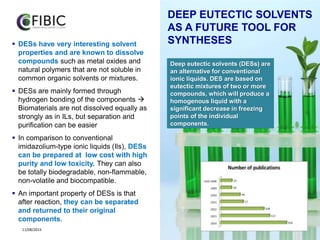
 DESs have very interesting solvent
properties and are known to dissolve
compounds such as metal oxides and
natural polymers that are not soluble in
common organic solvents or mixtures.
 DESs are mainly formed through
hydrogen bonding of the components 
Biomaterials are not dissolved equally as
strongly as in ILs, but separation and
purification can be easier
 In comparison to conventional
imidazolium-type ionic liquids (Ils), DESs
can be prepared at low cost with high
purity and low toxicity. They can also
be totally biodegradable, non-flammable,
non-volatile and biocompatible.
 An important property of DESs is that
after reaction, they can be separated
and returned to their original
components.
DEEP EUTECTIC SOLVENTS
AS A FUTURE TOOL FOR
SYNTHESES
Deep eutectic solvents (DESs) are
an alternative for conventional
ionic liquids. DES are based on
eutectic mixtures of two or more
compounds, which will produce a
homogenous liquid with a
significant decrease in freezing
points of the individual
components.
3
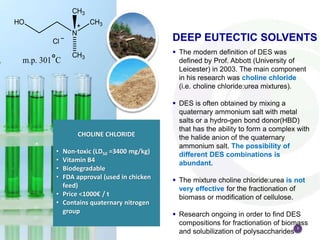
 The modern definition of DES was
defined by Prof. Abbott (University of
Leicester) in 2003. The main component
in his research was choline chloride
(i.e. choline chloride:urea mixtures).
 DES is often obtained by mixing a
quaternary ammonium salt with metal
salts or a hydro-gen bond donor(HBD)
that has the ability to form a complex with
the halide anion of the quaternary
ammonium salt. The possibility of
different DES combinations is
abundant.
 The mixture choline chloride:urea is not
very effective for the fractionation of
biomass or modification of cellulose.
 Research ongoing in order to find DES
compositions for fractionation of biomass
and solubilization of polysaccharides
DEEP EUTECTIC SOLVENTS
CHOLINE CHLORIDE
• Non-toxic (LD50 =3400 mg/kg)
• Vitamin B4
• Biodegradable
• FDA approval (used in chicken
feed)
• Price <1000€ / t
• Contains quaternary nitrogen
group
4
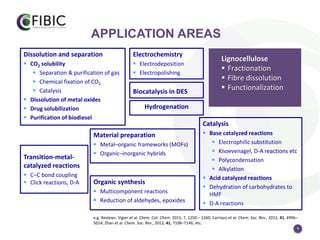
Lignocellulose
 Fractionation
 Fibre dissolution
 Functionalization
e.g. Reviews: Vigier et al. Chem. Cat. Chem. 2015, 7, 1250 – 1260; Carriazo et al. Chem. Soc. Rev., 2012, 41, 4996–
5014; Zhan et al. Chem. Soc. Rev., 2012, 41, 7108–7146; etc.
Dissolution and separation
 CO2 solubility
 Separation & purification of gas
 Chemical fixation of CO2
 Catalysis
 Dissolution of metal oxides
 Drug solubilization
 Purification of biodiesel
Biocatalysis in DES
Catalysis
 Base catalyzed reactions
 Electrophilic substitution
 Knoevenagel, D-A reactions etc
 Polycondensation
 Alkylation
 Acid catalyzed reactions
 Dehydration of carbohydrates to
HMF
 D-A reactions
Transition-metal-
catalyzed reactions
 C–C bond coupling
 Click reactions, D-A
Hydrogenation
Organic synthesis
 Multicomponent reactions
 Reduction of aldehydes, epoxides
Electrochemistry
 Electrodeposition
 Electropolishing
Material preparation
 Metal–organic frameworks (MOFs)
 Organic–inorganic hybrids
APPLICATION AREAS
5
DESs ENABLE THE REPLACEMENT OF
PETROLEUM BASED CHEMICALS
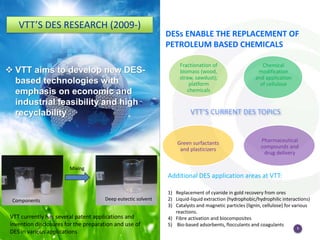
 VTT aims to develop new DES-
based technologies with
emphasis on economic and
industrial feasibility and high
recyclability
Components
Mixing
Deep eutectic solvent
VTT’S DES RESEARCH (2009-)
Fractionation of
biomass (wood,
straw, sawdust);
platform
chemicals
Green surfactants
and plasticizers
Pharmaceutical
compounds and
drug delivery
VTT’S CURRENT DES TOPICS
VTT currently has several patent applications and
invention disclosures for the preparation and use of
DES in various applications
Additional DES application areas at VTT:
1) Replacement of cyanide in gold recovery from ores
2) Liquid-liquid extraction (hydrophobic/hydrophilic interactions)
3) Catalysts and magnetic particles (lignin, cellulose) for various
reactions.
4) Fibre activation and biocomposites
5) Bio-based adsorbents, flocculants and coagulants
Chemical
modification
and application
of cellulose
6
DESS CAN PROVIDE ECONOMICALLY
VIABLE SOLUTIONS FOR BIOMASS
CONVERSION AND FRACTIONATION
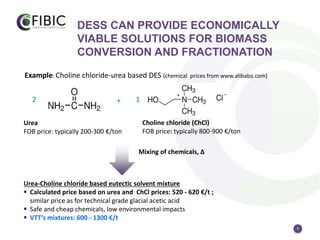
Urea
FOB price: typically 200-300 €/ton
Choline chloride (ChCl)
FOB price: typically 800-900 €/ton
Example: Choline chloride-urea based DES (chemical prices from www.alibaba.com)
2 1+
Mixing of chemicals, ∆
Urea-Choline chloride based eutectic solvent mixture
 Calculated price based on urea and ChCl prices: 520 - 620 €/t ;
similar price as for technical grade glacial acetic acid
 Safe and cheap chemicals, low environmental impacts
 VTT’s mixtures: 600 - 1300 €/t
7
11/08/2015 7
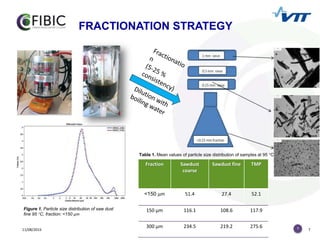
Figure 1. Particle size distribution of saw dust
fine 95 °C, fraction: <150 µm
Fraction Sawdust
coarse
Sawdust fine TMP
<150 µm 51.4 27.4 52.1
150 µm 116.1 108.6 117.9
300 µm 234.5 219.2 275.6
Table 1. Mean values of particle size distribution of samples at 95 °C
FRACTIONATION STRATEGY
8
11/08/2015 8
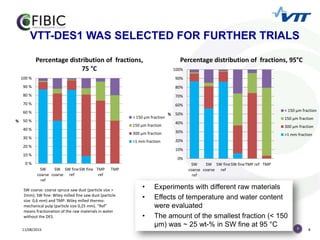
• Experiments with different raw materials
• Effects of temperature and water content
were evaluated
• The amount of the smallest fraction (< 150
µm) was ~ 25 wt-% in SW fine at 95 °C
0 %
10 %
20 %
30 %
40 %
50 %
60 %
70 %
80 %
90 %
100 %
SW
coarse
ref
SW
coarse
SW fine
ref
SW fine TMP
ref
TMP
%
Percentage distribution of fractions,
75 °C
< 150 µm fraction
150 µm fraction
300 µm fraction
>1 mm fraction
SW coarse: coarse spruce saw dust (particle size >
2mm); SW fine: Wiley milled fine saw dust (particle
size 0,6 mm) and TMP: Wiley milled thermo-
mechanical pulp (particle size 0,25 mm). “Ref”
means fractionation of the raw materials in water
without the DES.
0%
10%
20%
30%
40%
50%
60%
70%
80%
90%
100%
SW
coarse
ref
SW
coarse
SW fine
ref
SW fineTMP ref TMP
%
Percentage distribution of fractions, 95°C
< 150 µm fraction
150 µm fraction
300 µm fraction
>1 mm fraction
VTT-DES1 WAS SELECTED FOR FURTHER TRIALS
9
11/08/2015 9
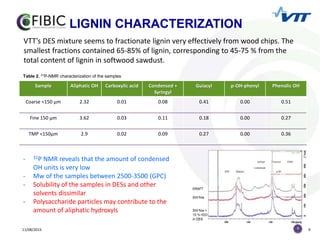
VTT’s DES mixture seems to fractionate lignin very effectively from wood chips. The
smallest fractions contained 65-85% of lignin, corresponding to 45-75 % from the
total content of lignin in softwood sawdust.
- 31P NMR reveals that the amount of condensed
OH units is very low
- Mw of the samples between 2500-3500 (GPC)
- Solubility of the samples in DESs and other
solvents dissimilar
- Polysaccharide particles may contribute to the
amount of aliphatic hydroxyls
Sample Aliphatic OH Carboxylic acid Condensed +
Syringyl
Guiacyl p-OH-phenyl Phenolic OH
Coarse <150 µm 2.32 0.01 0.08 0.41 0.00 0.51
Fine 150 µm 3.62 0.03 0.11 0.18 0.00 0.27
TMP <150µm 2.9 0.02 0.09 0.27 0.00 0.36
Table 2. 31P-NMR characterization of the samples
LIGNIN CHARACTERIZATION
10
CELLULOSE SOLUBILIZATION AND
MODIFICATION
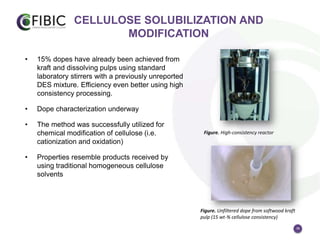
• 15% dopes have already been achieved from
kraft and dissolving pulps using standard
laboratory stirrers with a previously unreported
DES mixture. Efficiency even better using high
consistency processing.
• Dope characterization underway
• The method was successfully utilized for
chemical modification of cellulose (i.e.
cationization and oxidation)
• Properties resemble products received by
using traditional homogeneous cellulose
solvents
Figure. Unfiltered dope from softwood kraft
pulp (15 wt-% cellulose consistency)
Figure. High-consistency reactor
11
THANK YOU!
Finnish Bioeconomy Cluster FIBIC Oy 11.8.2015
VTT’s “DES team”: Adina Anghelescu-Hakala, Jaakko
Hiltunen, Tuomas Hänninen, Minna Kalliosaari, Lauri Kuutti,
Leena Nurmi, Eini Puhakka, Jarmo Ropponen, Stella Rovio,
Eija Silvast, Ronny Wahlström, Pia Willberg-Keyriläinen and
Sauli Vuoti

FIBIC ACel Programme Seminar: Deep Eutetic Solvents for Biomass Activation

  • 1.
    1 DEEP EUTECTIC SOLVENTSFOR BIOMASS ACTIVATION Sauli Vuoti, Jaakko Hiltunen et. al sauli.vuoti@vtt.fi
  • 2.
    2 11/08/2015 2  DESshave very interesting solvent properties and are known to dissolve compounds such as metal oxides and natural polymers that are not soluble in common organic solvents or mixtures.  DESs are mainly formed through hydrogen bonding of the components  Biomaterials are not dissolved equally as strongly as in ILs, but separation and purification can be easier  In comparison to conventional imidazolium-type ionic liquids (Ils), DESs can be prepared at low cost with high purity and low toxicity. They can also be totally biodegradable, non-flammable, non-volatile and biocompatible.  An important property of DESs is that after reaction, they can be separated and returned to their original components. DEEP EUTECTIC SOLVENTS AS A FUTURE TOOL FOR SYNTHESES Deep eutectic solvents (DESs) are an alternative for conventional ionic liquids. DES are based on eutectic mixtures of two or more compounds, which will produce a homogenous liquid with a significant decrease in freezing points of the individual components.
  • 3.
    3  The moderndefinition of DES was defined by Prof. Abbott (University of Leicester) in 2003. The main component in his research was choline chloride (i.e. choline chloride:urea mixtures).  DES is often obtained by mixing a quaternary ammonium salt with metal salts or a hydro-gen bond donor(HBD) that has the ability to form a complex with the halide anion of the quaternary ammonium salt. The possibility of different DES combinations is abundant.  The mixture choline chloride:urea is not very effective for the fractionation of biomass or modification of cellulose.  Research ongoing in order to find DES compositions for fractionation of biomass and solubilization of polysaccharides DEEP EUTECTIC SOLVENTS CHOLINE CHLORIDE • Non-toxic (LD50 =3400 mg/kg) • Vitamin B4 • Biodegradable • FDA approval (used in chicken feed) • Price <1000€ / t • Contains quaternary nitrogen group
  • 4.
    4 Lignocellulose  Fractionation  Fibredissolution  Functionalization e.g. Reviews: Vigier et al. Chem. Cat. Chem. 2015, 7, 1250 – 1260; Carriazo et al. Chem. Soc. Rev., 2012, 41, 4996– 5014; Zhan et al. Chem. Soc. Rev., 2012, 41, 7108–7146; etc. Dissolution and separation  CO2 solubility  Separation & purification of gas  Chemical fixation of CO2  Catalysis  Dissolution of metal oxides  Drug solubilization  Purification of biodiesel Biocatalysis in DES Catalysis  Base catalyzed reactions  Electrophilic substitution  Knoevenagel, D-A reactions etc  Polycondensation  Alkylation  Acid catalyzed reactions  Dehydration of carbohydrates to HMF  D-A reactions Transition-metal- catalyzed reactions  C–C bond coupling  Click reactions, D-A Hydrogenation Organic synthesis  Multicomponent reactions  Reduction of aldehydes, epoxides Electrochemistry  Electrodeposition  Electropolishing Material preparation  Metal–organic frameworks (MOFs)  Organic–inorganic hybrids APPLICATION AREAS
  • 5.
    5 DESs ENABLE THEREPLACEMENT OF PETROLEUM BASED CHEMICALS  VTT aims to develop new DES- based technologies with emphasis on economic and industrial feasibility and high recyclability Components Mixing Deep eutectic solvent VTT’S DES RESEARCH (2009-) Fractionation of biomass (wood, straw, sawdust); platform chemicals Green surfactants and plasticizers Pharmaceutical compounds and drug delivery VTT’S CURRENT DES TOPICS VTT currently has several patent applications and invention disclosures for the preparation and use of DES in various applications Additional DES application areas at VTT: 1) Replacement of cyanide in gold recovery from ores 2) Liquid-liquid extraction (hydrophobic/hydrophilic interactions) 3) Catalysts and magnetic particles (lignin, cellulose) for various reactions. 4) Fibre activation and biocomposites 5) Bio-based adsorbents, flocculants and coagulants Chemical modification and application of cellulose
  • 6.
    6 DESS CAN PROVIDEECONOMICALLY VIABLE SOLUTIONS FOR BIOMASS CONVERSION AND FRACTIONATION Urea FOB price: typically 200-300 €/ton Choline chloride (ChCl) FOB price: typically 800-900 €/ton Example: Choline chloride-urea based DES (chemical prices from www.alibaba.com) 2 1+ Mixing of chemicals, ∆ Urea-Choline chloride based eutectic solvent mixture  Calculated price based on urea and ChCl prices: 520 - 620 €/t ; similar price as for technical grade glacial acetic acid  Safe and cheap chemicals, low environmental impacts  VTT’s mixtures: 600 - 1300 €/t
  • 7.
    7 11/08/2015 7 Figure 1.Particle size distribution of saw dust fine 95 °C, fraction: <150 µm Fraction Sawdust coarse Sawdust fine TMP <150 µm 51.4 27.4 52.1 150 µm 116.1 108.6 117.9 300 µm 234.5 219.2 275.6 Table 1. Mean values of particle size distribution of samples at 95 °C FRACTIONATION STRATEGY
  • 8.
    8 11/08/2015 8 • Experimentswith different raw materials • Effects of temperature and water content were evaluated • The amount of the smallest fraction (< 150 µm) was ~ 25 wt-% in SW fine at 95 °C 0 % 10 % 20 % 30 % 40 % 50 % 60 % 70 % 80 % 90 % 100 % SW coarse ref SW coarse SW fine ref SW fine TMP ref TMP % Percentage distribution of fractions, 75 °C < 150 µm fraction 150 µm fraction 300 µm fraction >1 mm fraction SW coarse: coarse spruce saw dust (particle size > 2mm); SW fine: Wiley milled fine saw dust (particle size 0,6 mm) and TMP: Wiley milled thermo- mechanical pulp (particle size 0,25 mm). “Ref” means fractionation of the raw materials in water without the DES. 0% 10% 20% 30% 40% 50% 60% 70% 80% 90% 100% SW coarse ref SW coarse SW fine ref SW fineTMP ref TMP % Percentage distribution of fractions, 95°C < 150 µm fraction 150 µm fraction 300 µm fraction >1 mm fraction VTT-DES1 WAS SELECTED FOR FURTHER TRIALS
  • 9.
    9 11/08/2015 9 VTT’s DESmixture seems to fractionate lignin very effectively from wood chips. The smallest fractions contained 65-85% of lignin, corresponding to 45-75 % from the total content of lignin in softwood sawdust. - 31P NMR reveals that the amount of condensed OH units is very low - Mw of the samples between 2500-3500 (GPC) - Solubility of the samples in DESs and other solvents dissimilar - Polysaccharide particles may contribute to the amount of aliphatic hydroxyls Sample Aliphatic OH Carboxylic acid Condensed + Syringyl Guiacyl p-OH-phenyl Phenolic OH Coarse <150 µm 2.32 0.01 0.08 0.41 0.00 0.51 Fine 150 µm 3.62 0.03 0.11 0.18 0.00 0.27 TMP <150µm 2.9 0.02 0.09 0.27 0.00 0.36 Table 2. 31P-NMR characterization of the samples LIGNIN CHARACTERIZATION
  • 10.
    10 CELLULOSE SOLUBILIZATION AND MODIFICATION •15% dopes have already been achieved from kraft and dissolving pulps using standard laboratory stirrers with a previously unreported DES mixture. Efficiency even better using high consistency processing. • Dope characterization underway • The method was successfully utilized for chemical modification of cellulose (i.e. cationization and oxidation) • Properties resemble products received by using traditional homogeneous cellulose solvents Figure. Unfiltered dope from softwood kraft pulp (15 wt-% cellulose consistency) Figure. High-consistency reactor
  • 11.
    11 THANK YOU! Finnish BioeconomyCluster FIBIC Oy 11.8.2015 VTT’s “DES team”: Adina Anghelescu-Hakala, Jaakko Hiltunen, Tuomas Hänninen, Minna Kalliosaari, Lauri Kuutti, Leena Nurmi, Eini Puhakka, Jarmo Ropponen, Stella Rovio, Eija Silvast, Ronny Wahlström, Pia Willberg-Keyriläinen and Sauli Vuoti