Concept evaluations
FuBio Seminar
28.8.2013
Eemeli Hytönen, Lotta Sorsamäki, Marja Nappa, Juha Leppävuori
(VTT Technical Research Center of Finland)
Hanna Kalanne, Jukka Seppänen, Jari Aittakari (GloCell Oy)
216.5.2013
Eemeli Hytönen, Concept evaluations, FuBio Seminar, 27.8.2013
Motivation
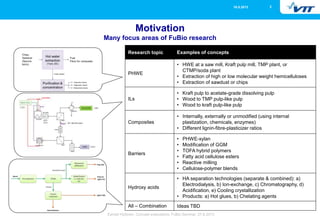
Many focus areas of FuBio research
Research topic
PHWE
ILs
Composites
Barriers
Hydroxy acids
All – Combination
Examples of concepts
• HWE at a saw mill, Kraft pulp mill, TMP plant, or
CTMP/soda plant
• Extraction of high or low molecular weight hemicelluloses
• Extraction of sawdust or chips
• Kraft pulp to acetate-grade dissolving pulp
• Wood to TMP pulp-like pulp
• Wood to kraft pulp-like pulp
• Internally, externally or unmodified (using internal
plastization, chemicals, enzymes)
• Different lignin-fibre-plasticizer ratios
• PHWE-xylan
• Modification of GGM
• TOFA hybrid polymers
• Fatty acid cellulose esters
• Reactive milling
• Cellulose-polymer blends
• HA separation technologies (separate & combined): a)
Electrodialysis, b) Ion-exchange, c) Chromatography, d)
Acidification, e) Cooling crystallization
• Products: a) Hot glues, b) Chelating agents
Ideas TBD
316.5.2013
Eemeli Hytönen, Concept evaluations, FuBio Seminar, 27.8.2013
Motivation
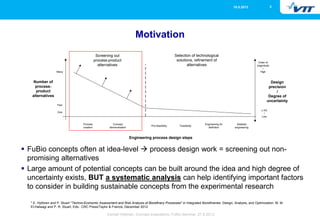
 FuBio concepts often at idea-level  process design work = screening out non-
promising alternatives
 Large amount of potential concepts can be built around the idea and high degree of
uncertainty exists, BUT a systematic analysis can help identifying important factors
to consider in building sustainable concepts from the experimental research
Concept
demonstration
Pre-feasibility Feasibility
Engineering for
definition
Detailed
engineering
Engineering process design steps
Screening out
process-product
alternatives
Number of
process-
product
alternatives
Process
creation
Many
Few
One
Selection of technological
solutions, refinement of
alternatives
Order of
magnitude
/
High
+ 5%
/
Low
Design
precision
/
Degree of
uncertainty
* E. Hytönen and P. Stuart "Techno-Economic Assessment and Risk Analysis of Biorefinery Processes" in Integrated Biorefineries: Design, Analysis, and Optimization. M. M.
El-Halwagi and P. R. Stuart, Eds.: CRC Press/Taylor & Francis, December 2012
416.5.2013
Eemeli Hytönen, Concept evaluations, FuBio Seminar, 27.8.2013
Outline
 Motivation
 Objective
 Methods
 Overall concept evaluation approach of FuBio JR2
 Preliminary screening of ideas – Light techno-economic analysis
 Quantitative economic modelling of concepts
 Example results
 Preliminary screening process
 Hot water extraction
 Ionic liquids fractionation
 Preliminary screening and quantitative economic modelling
 Hydroxy acids separation from black liquor
 Conclusions
 Acknowledgements
516.5.2013
Eemeli Hytönen, Concept evaluations, FuBio Seminar, 27.8.2013
Objective
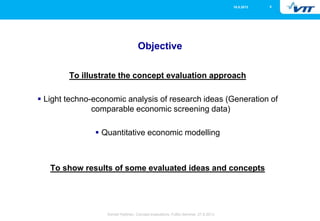
To illustrate the concept evaluation approach
 Light techno-economic analysis of research ideas (Generation of
comparable economic screening data)
 Quantitative economic modelling
To show results of some evaluated ideas and concepts
616.5.2013
Eemeli Hytönen, Concept evaluations, FuBio Seminar, 27.8.2013
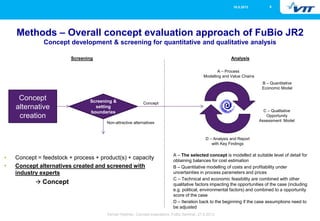
Methods – Overall concept evaluation approach of FuBio JR2
Concept development & screening for quantitative and qualitative analysis
• Concept = feedstock + process + product(s) + capacity
• Concept alternatives created and screened with
industry experts
 Concept
Concept
alternative
creation
Screening &
setting
boundaries
A – Process
Modelling and Value Chains
C – Qualitative
Opportunity
Assessment Model
B – Quantitative
Economic Model
D – Analysis and Report
with Key Findings
A – The selected concept is modelled at suitable level of detail for
obtaining balances for cost estimation
B – Quantitative modelling of costs and profitability under
uncertainties in process parameters and prices
C – Technical and economic feasibility are combined with other
qualitative factors impacting the opportunities of the case (including
e.g. political, environmental factors) and combined to a opportunity
score of the case
D – Iteration back to the beginning if the case assumptions need to
be adjusted
Concept
Non-attractive alternatives
Screening Analysis
716.5.2013
Eemeli Hytönen, Concept evaluations, FuBio Seminar, 27.8.2013
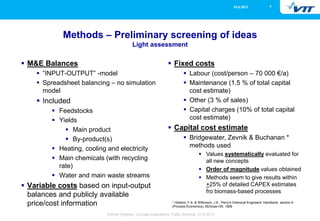
Methods – Preliminary screening of ideas
Light assessment
 M&E Balances
 ”INPUT-OUTPUT” -model
 Spreadsheet balancing – no simulation
model
 Included
 Feedstocks
 Yields
 Main product
 By-product(s)
 Heating, cooling and electricity
 Main chemicals (with recycling
rate)
 Water and main waste streams
 Variable costs based on input-output
balances and publicly available
price/cost information
 Fixed costs
 Labour (cost/person – 70 000 €/a)
 Maintenance (1.5 % of total capital
cost estimate)
 Other (3 % of sales)
 Capital charges (10% of total capital
cost estimate)
 Capital cost estimate
 Bridgewater, Zevnik & Buchanan *
methods used
 Values systematically evaluated for
all new concepts
 Order of magnitude values obtained
 Methods seem to give results within
+25% of detailed CAPEX estimates
fro biomass-based processes
* Holland, F.A. & Wilkinson, J.K., Perry's Chemical Engineers' Handbook, section 9
(Process Economics), McGraw-Hill, 1999
816.5.2013
Eemeli Hytönen, Concept evaluations, FuBio Seminar, 27.8.2013
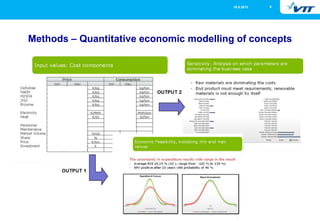
Methods – Quantitative economic modelling of concepts
916.5.2013
Eemeli Hytönen, Concept evaluations, FuBio Seminar, 27.8.2013
Outline
 Motivation
 Objective
 Methods
 Overall concept evaluation approach of FuBio JR2
 Preliminary screening of concepts – Light techno-economic analysis
 Quantitative economic modelling of concepts
 Example results
 Preliminary screening process
 Hot water extraction
 Ionic liquids fractionation
 Preliminary screening and quantitative economic modelling
 Hydroxy acids separation from black liquor
 Conclusions
 Acknowledgements
1016.5.2013
Eemeli Hytönen, Concept evaluations, FuBio Seminar, 27.8.2013
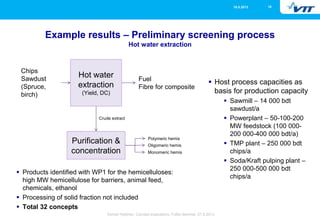
Example results – Preliminary screening process
Hot water extraction
 Products identified with WP1 for the hemicelluloses:
high MW hemicellulose for barriers, animal feed,
chemicals, ethanol
 Processing of solid fraction not included
 Total 32 concepts
Hot water
extraction
(Yield, DC)
Purification &
concentration
Chips
Sawdust
(Spruce,
birch)
Crude extract
Fuel
Fibre for composite
Polymeric hemis
Oligomeric hemis
Monomeric hemis
 Host process capacities as
basis for production capacity
 Sawmill – 14 000 bdt
sawdust/a
 Powerplant – 50-100-200
MW feedstock (100 000-
200 000-400 000 bdt/a)
 TMP plant – 250 000 bdt
chips/a
 Soda/Kraft pulping plant –
250 000-500 000 bdt
chips/a
1116.5.2013
Eemeli Hytönen, Concept evaluations, FuBio Seminar, 27.8.2013
-4000
-2000
0
2000
4000
6000
8000 838t/ahemi(15%yield),Fuel
838t/ahemi(15%yield),Feed
3974t/ahemi(10%yield),Fuel
7949t/ahemi(10%yield),Fuel
15898t/ahemi(10%yield),Fuel
9930t/ahemi(10%yield),WW
14341t/ahemi(15%yield),WW
14341t/ahemi(15%yield),Feed
14341t/ahemi(15%yield),WW
28682t/ahemi(15%yield),WW
28682t/ahemi(15%yield),Feed
670t/ahemi(15%yield),Fuel
670t/ahemi(15%yield),Feed
3180t/ahemi(10%yield),Fuel
6359t/ahemi(10%yield),Fuel
12718t/ahemi(10%yield),Fuel
7944t/ahemi(10%yield),WW
11473t/ahemi(15%yield),WW
11473t/ahemi(15%yield),Feed
11473t/ahemi(15%yield),WW
22946t/ahemi(15%yield),WW
22946t/ahemi(15%yield),Feed
3074t/ahemi(25%yield),Sawmill
85469t/ahemi(20%yield),Powerplant
52638t/ahemi(25%yield),TMP
105276t/ahemi(25%yield),Soda
2951t/ahemi(30%yield),Sawmill
55657t/ahemi(20%yield),Powerplant
50523t/ahemi(30%yield),TMP
101045t/ahemi(30%yield),Soda
Sawdust Sawdust Chip Chip Chip Sawdust Sawdust Chip Chip Chip Sawdust Chip Sawdust Chip
Sawmill Powerplant TMP Soda Sawmill Powerplant TMP Soda
Spruce Birch Spruce Birch
High MW hemicellulose Sugar
Costsandby-productcredits(€/bdtmainproduct)
Credits
from by-prod
Other fixed
Labour
Capital charges
Wastes
Energy
Chemicals
Water
Feedstock
total
Selling price
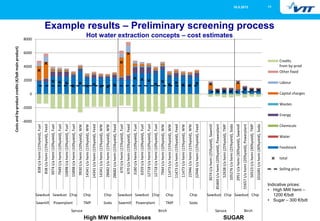
Example results – Preliminary screening process
Hot water extraction concepts – cost estimates
Indicative prices:
• High MW hemi –
1200 €/bdt
• Sugar – 300 €/bdt
SUGARHigh MW hemicelluloses
1216.5.2013
Eemeli Hytönen, Concept evaluations, FuBio Seminar, 27.8.2013
Example results – Preliminary screening process
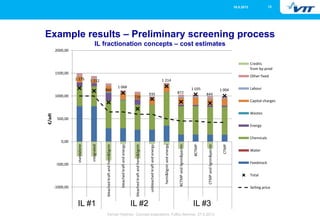
IL fractionation methods
IL #1 IL #2 IL #3
Raw material Birch kraft pulp birch spruce
Products Dissolving pulp 76% "kraft-like” pulp 57% ”CTMP-like” pulp 90-95%
Hemicellulose 24 % lignin, hemi 43% Pectin, hemi, lignin 5-10%
Ionic liquid [Emim]OAc Switchable ionic liquid [Emim]Me2PO4
(and water) DBU, MEA, CO2/SO2
Antisolvent water ethanol Isopropanol
Antisolvent recovery
method evaporation distillation evaporation
Production scale 150 000 adt/a 700 000 adt/a 250 000 adt/a
• Total 11 concepts
1316.5.2013
Eemeli Hytönen, Concept evaluations, FuBio Seminar, 27.8.2013
Example results – Preliminary screening process
IL fractionation concepts – cost estimates
1 175 1 112
860
1 068
720
935
1 214
872
1 035
844
1 004
-1000,00
-500,00
0,00
500,00
1000,00
1500,00
2000,00
standalone
integrated
bleachedkraftandhemi&lignin
bleachedkraftandenergy
unbleachedkraftandhemi&lignin
unbleachedkraftandenergy
hemi&ligninandenergy
BCTMPandlignin&pectin
BCTMP
CTMPandlignin&pectin
CTMP
IONCELL SIL pulping IL fibrillation
€/adt
Credits
from by-prod
Other fixed
Labour
Capital charges
Wastes
Energy
Chemicals
Water
Feedstock
Total
Selling price
IL #1 IL #2 IL #3
1416.5.2013
Eemeli Hytönen, Concept evaluations, FuBio Seminar, 27.8.2013
Outline
 Motivation
 Objective
 Methods
 Overall concept evaluation approach of FuBio JR2
 Preliminary screening of concepts – Light techno-economic analysis
 Quantitative economic modelling of concepts
 Example results
 Preliminary screening process
 Hot water extraction
 Ionic liquids fractionation
 Preliminary screening and quantitative economic modelling
 Hydroxy acids separation from black liquor
 Conclusions
 Acknowledgements
1516.5.2013
Eemeli Hytönen, Concept evaluations, FuBio Seminar, 27.8.2013
Example results – Preliminary screening and quantitative economic modelling
Hydroxy acids separation from black liquor – Case definition
 Pulp mill production capacity 700 000 adt/a
 Theoretical hydroxy acids (HA) yield 15 % of pulping raw material (includes
mono and dihydroxyacids)
 1/3rd of BL processed  HA production 35 000 t/a (50 kg/adt), 50% DC
 Volatile (formic and acetic) acids yield 7% of pulping raw material
 H2S handling and volatile acids recovery excluded
 Pulp mill integration
 Cooking variables (effective alkali and sulfidity) kept constant by NaOH makeup
and fly ash purge
 Black liquor (25% TDS) is taken to HA separation
 Liquor from separation is fed back to evaporation plant (including added water
and chemicals)
 HA product is concentrated in a separate evaporator
1616.5.2013
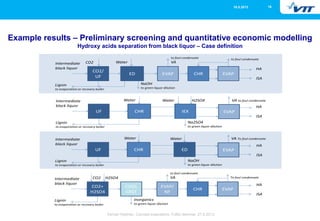
Eemeli Hytönen, Concept evaluations, FuBio Seminar, 27.8.2013
ED
CO2/
UF
NaOH
to green liquor dilution
Water
Lignin
to evaporation or recovery boiler
to foul condensate
VA
EVAP CHR
HA
EVAP
Intermediate
black liquor
to foul condensate
UF
Lignin
to evaporation or recovery boiler
Intermediate
black liquor
CHR
Water
IEX
H2SO4
EVAP
VA to foul condensateWater
Na2SO4
to green liquor dilution
UF
Lignin
to evaporation or recovery boiler
Intermediate
black liquor
CHR
Water
EVAP
VA To foul condensate
ED
Water
NaOH
to green liquor dilution
CO2+
H2SO4
Lignin
to evaporation or recovery boiler
Intermediate
black liquor
COOL
CRST
Inorganics
to green liquor dilution
EVAP/
NF
CHR EVAP
To foul condensate
ISA
HA
ISA
HA
ISA
HA
ISA
to foul condensate
VA
CO2
H2SO4CO2
Example results – Preliminary screening and quantitative economic modelling
Hydroxy acids separation from black liquor – Case definition
1716.5.2013
Eemeli Hytönen, Concept evaluations, FuBio Seminar, 27.8.2013
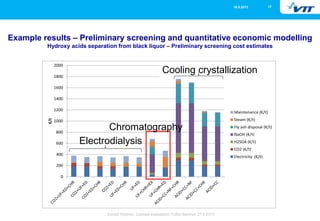
0
200
400
600
800
1000
1200
1400
1600
1800
2000
€/t
Maintenance (€/t)
Steam (€/t)
Fly ash disposal (€/t)
NaOH (€/t)
H2SO4 (€/t)
CO2 (€/t)
Electricity (€/t)
Electrodialysis
Chromatography
Cooling crystallization
Example results – Preliminary screening and quantitative economic modelling
Hydroxy acids separation from black liquor – Preliminary screening cost estimates
1816.5.2013
Eemeli Hytönen, Concept evaluations, FuBio Seminar, 27.8.2013
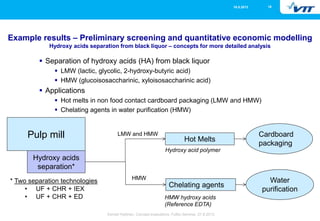
 Separation of hydroxy acids (HA) from black liquor
 LMW (lactic, glycolic, 2-hydroxy-butyric acid)
 HMW (glucoisosaccharinic, xyloisosaccharinic acid)
 Applications
 Hot melts in non food contact cardboard packaging (LMW and HMW)
 Chelating agents in water purification (HMW)
Pulp mill
Hydroxy acids
separation*
HMW
LMW and HMW
Hot Melts
Chelating agents
Cardboard
packaging
Water
purification
* Two separation technologies
• UF + CHR + IEX
• UF + CHR + ED
Hydroxy acid polymer
HMW hydroxy acids
(Reference EDTA)
Example results – Preliminary screening and quantitative economic modelling
Hydroxy acids separation from black liquor – concepts for more detailed analysis
1916.5.2013
Eemeli Hytönen, Concept evaluations, FuBio Seminar, 27.8.2013
Example results – Preliminary screening and quantitative economic modelling
Hydroxy acids separation from black liquor – Integration impact assessment
 Pulp mill reference
model (WinGems-
simulation software) *
 Capacity 700 000 adt/a.
Process water usage ~
15 m3/adt. Based on
BAT technologies
SPLIT
dust dump
141
M IX
M i x30
30
M IX
M i x26
26
BLEACHING
Bl eachi ng
25
WW-T REAT
Ef f l uent
tr eatment
24
ST ORE
Par ameter s
23
DEBARKIN
Debar ki ng
22
M IX
21
SUM
Steam 4.2 bar
20
T RACOM P
Addi ng of
tr ace
components
16
M IX
15
PID
Pi d14
14
SUM
Steam 13 bar
13
ST ORE
Pr oducti on
12
DRYEND
Dr yer secti on
11
SPLIT
Spl i t1010
T URB_PLANT
T ur bi ne pl ant
6
EVAPO
Evapor ati on
5
BOILERS
Boi l er pl ant
4
ST ORE
Wood
par am
i nput
3
RECOVERY_SK
Whi te l i quor pr epar ati on
2
DELIGNIFICA
Cooki ng and oxygen d
1
348t/h
42 t/h
123 t/h
Effluent 1740 t/h
0 t/h
Shaft power 95.1 MW
Floor channel 120 t/h, TDS 5 g/l
Wood properties:
1) I:Wood temp.[C]15
2) I:Dry contentofwood [%]50
3) I:Cellulose in wood [%]44.1
4) I:Hemicellulose in wood [%]30.7
5) I:Lignin in wood [%]23.9
6) I:Extractives in wood [%]1.6
102 t/h
Water 100 t/h
Pyrolysis gas
properties
69 t/h
71 t/h
Bark 46 t/h,
30 °C, 40 %
104 t/h, TDS 11 g/l
Wood 404 t/h,
15 °C, 49 %
Sootblowing steam 16 t/h, 30 bar
LP 6 t/h
MP 71 t/h
MP 76 t/h
195 t/h
LP 91 t/h
MP 32 t/h
MP 16 t/h
LP 26 t/h
227 t/h
Acidic filtrate 867 t/h, TDS 4 g/l
Cond. B 278 t/h
Saltcake 5 t/h
Bio-sludge 0 t/h
0 %
Alkaline filtrate 649 t/h, TDS 8 g/l
900 t/h
636 t/h
Air 695 t/h
24 °C
CTO 0 t/h
Water 351 t/h
BL 933 t/h,
TDS 132 kg/t
Pulp 100 t/h, 75 °C, 90 %
1:Bark contentofwood:10 w-%
2:Wood LHV:19.35 MJ/kgDS
3:Wood HHV:19.3 MJ/kgDS
4:Notin use
5:Bark Dry content:40 %
6:Carbon fraction in bark:0.5159
7:Oxygen fraction in bark:0.4069
8:Hydrogen fract.in bark:0.0577
9:Sulfur fraction in bark:3.000E-04
10:Ash fraction in bark:0.0192
11:Gasification lost:6 %
Water
LP 104 t/h
Cond. A 421 t/h
Boiler blow-down 6 t/h, 103 bar, 313 °C
BFW 604 t/h, 120 bar, 187 °C
13bar
4.2bar
7bar0t/h
Chips 355 t/h, 15 °C, 50 %
Saltcake 1.4 t/h
LP-condensate 267 t/h
Pyrolysis gas
180 t/h, 66 °C, 50 %
HP -steam 598 t/h, 103 bar, 505 °C
Flue gas 806 t/h
183 °C
Smelt 63 t/h
Bark parameters
Oxidised WL
WL 346 t/h, AA 113 g/l
BL156t/h,
TDS822kg/t
MP-condensate 140 t/h
* Kangas, Kaijaluoto and Määttänen (2013), Evaluation of Future Pulp Mill Concepts – Reference Model of Modern Nordic Kraft Pulp Mill, to be submitted to NPPRJ
2016.5.2013
Eemeli Hytönen, Concept evaluations, FuBio Seminar, 27.8.2013
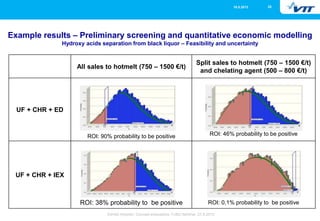
All sales to hotmelt (750 – 1500 €/t)
Split sales to hotmelt (750 – 1500 €/t)
and chelating agent (500 – 800 €/t)
UF + CHR + ED
ROI: 90% probability to be positive ROI: 46% probability to be positive
UF + CHR + IEX
ROI: 38% probability to be positive ROI: 0,1% probability to be positive
Example results – Preliminary screening and quantitative economic modelling
Hydroxy acids separation from black liquor – Feasibility and uncertainty
2116.5.2013
Eemeli Hytönen, Concept evaluations, FuBio Seminar, 27.8.2013
Outline
 Motivation
 Objective
 Methods
 Overall concept evaluation approach of FuBio JR2
 Preliminary screening of concepts – Light techno-economic analysis
 Quantitative economic modelling of concepts
 Example results
 Preliminary screening process
 Hot water extraction
 Ionic liquids fractionation
 Preliminary screening and quantitative economic modelling
 Hydroxy acids separation from black liquor
 Conclusions
 Acknowledgements
2216.5.2013
Eemeli Hytönen, Concept evaluations, FuBio Seminar, 27.8.2013
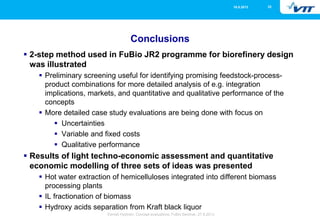
Conclusions
 2-step method used in FuBio JR2 programme for biorefinery design
was illustrated
 Preliminary screening useful for identifying promising feedstock-process-
product combinations for more detailed analysis of e.g. integration
implications, markets, and quantitative and qualitative performance of the
concepts
 More detailed case study evaluations are being done with focus on
 Uncertainties
 Variable and fixed costs
 Qualitative performance
 Results of light techno-economic assessment and quantitative
economic modelling of three sets of ideas was presented
 Hot water extraction of hemicelluloses integrated into different biomass
processing plants
 IL fractionation of biomass
 Hydroxy acids separation from Kraft black liquor
2316.5.2013
Eemeli Hytönen, Concept evaluations, FuBio Seminar, 27.8.2013
Acknowledgements
 FIBIC Ltd.
 Industrial tutors of FuBio Joint Research 2 –programme
 Research groups involved in the experimental research of the
concepts in FuBio Joint Research 2 –programme
 Researchers involved in the concept evaluation
2416.5.2013
Eemeli Hytönen, Concept evaluations, FuBio Seminar, 27.8.2013
VTT creates business from technology
2516.5.2013
Eemeli Hytönen, Concept evaluations, FuBio Seminar, 27.8.2013
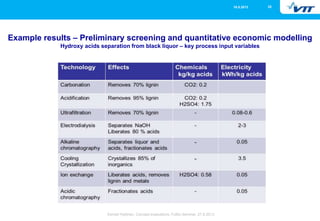
Example results – Preliminary screening and quantitative economic modelling
Hydroxy acids separation from black liquor – key process input variables
2616.5.2013
Eemeli Hytönen, Concept evaluations, FuBio Seminar, 27.8.2013
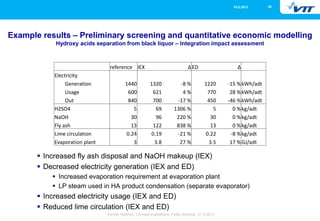
 Increased fly ash disposal and NaOH makeup (IEX)
 Decreased electricity generation (IEX and ED)
 Increased evaporation requirement at evaporation plant
 LP steam used in HA product condensation (separate evaporator)
 Increased electricity usage (IEX and ED)
 Reduced lime circulation (IEX and ED)
reference IEX ∆ED ∆
Electricity
Generation 1440 1320 -8 % 1220 -15 %kWh/adt
Usage 600 621 4 % 770 28 %kWh/adt
Out 840 700 -17 % 450 -46 %kWh/adt
H2SO4 5 69 1306 % 5 0 %kg/adt
NaOH 30 96 220 % 30 0 %kg/adt
Fly ash 13 122 838 % 13 0 %kg/adt
Lime circulation 0.24 0.19 -21 % 0.22 -8 %kg/adt
Evaporation plant 3 3.8 27 % 3.5 17 %GJ/adt
Example results – Preliminary screening and quantitative economic modelling
Hydroxy acids separation from black liquor – Integration impact assessment

Concept evaluations

  • 1.
    Concept evaluations FuBio Seminar 28.8.2013 EemeliHytönen, Lotta Sorsamäki, Marja Nappa, Juha Leppävuori (VTT Technical Research Center of Finland) Hanna Kalanne, Jukka Seppänen, Jari Aittakari (GloCell Oy)
  • 2.
    216.5.2013 Eemeli Hytönen, Conceptevaluations, FuBio Seminar, 27.8.2013 Motivation Many focus areas of FuBio research Research topic PHWE ILs Composites Barriers Hydroxy acids All – Combination Examples of concepts • HWE at a saw mill, Kraft pulp mill, TMP plant, or CTMP/soda plant • Extraction of high or low molecular weight hemicelluloses • Extraction of sawdust or chips • Kraft pulp to acetate-grade dissolving pulp • Wood to TMP pulp-like pulp • Wood to kraft pulp-like pulp • Internally, externally or unmodified (using internal plastization, chemicals, enzymes) • Different lignin-fibre-plasticizer ratios • PHWE-xylan • Modification of GGM • TOFA hybrid polymers • Fatty acid cellulose esters • Reactive milling • Cellulose-polymer blends • HA separation technologies (separate & combined): a) Electrodialysis, b) Ion-exchange, c) Chromatography, d) Acidification, e) Cooling crystallization • Products: a) Hot glues, b) Chelating agents Ideas TBD
  • 3.
    316.5.2013 Eemeli Hytönen, Conceptevaluations, FuBio Seminar, 27.8.2013 Motivation  FuBio concepts often at idea-level  process design work = screening out non- promising alternatives  Large amount of potential concepts can be built around the idea and high degree of uncertainty exists, BUT a systematic analysis can help identifying important factors to consider in building sustainable concepts from the experimental research Concept demonstration Pre-feasibility Feasibility Engineering for definition Detailed engineering Engineering process design steps Screening out process-product alternatives Number of process- product alternatives Process creation Many Few One Selection of technological solutions, refinement of alternatives Order of magnitude / High + 5% / Low Design precision / Degree of uncertainty * E. Hytönen and P. Stuart "Techno-Economic Assessment and Risk Analysis of Biorefinery Processes" in Integrated Biorefineries: Design, Analysis, and Optimization. M. M. El-Halwagi and P. R. Stuart, Eds.: CRC Press/Taylor & Francis, December 2012
  • 4.
    416.5.2013 Eemeli Hytönen, Conceptevaluations, FuBio Seminar, 27.8.2013 Outline  Motivation  Objective  Methods  Overall concept evaluation approach of FuBio JR2  Preliminary screening of ideas – Light techno-economic analysis  Quantitative economic modelling of concepts  Example results  Preliminary screening process  Hot water extraction  Ionic liquids fractionation  Preliminary screening and quantitative economic modelling  Hydroxy acids separation from black liquor  Conclusions  Acknowledgements
  • 5.
    516.5.2013 Eemeli Hytönen, Conceptevaluations, FuBio Seminar, 27.8.2013 Objective To illustrate the concept evaluation approach  Light techno-economic analysis of research ideas (Generation of comparable economic screening data)  Quantitative economic modelling To show results of some evaluated ideas and concepts
  • 6.
    616.5.2013 Eemeli Hytönen, Conceptevaluations, FuBio Seminar, 27.8.2013 Methods – Overall concept evaluation approach of FuBio JR2 Concept development & screening for quantitative and qualitative analysis • Concept = feedstock + process + product(s) + capacity • Concept alternatives created and screened with industry experts  Concept Concept alternative creation Screening & setting boundaries A – Process Modelling and Value Chains C – Qualitative Opportunity Assessment Model B – Quantitative Economic Model D – Analysis and Report with Key Findings A – The selected concept is modelled at suitable level of detail for obtaining balances for cost estimation B – Quantitative modelling of costs and profitability under uncertainties in process parameters and prices C – Technical and economic feasibility are combined with other qualitative factors impacting the opportunities of the case (including e.g. political, environmental factors) and combined to a opportunity score of the case D – Iteration back to the beginning if the case assumptions need to be adjusted Concept Non-attractive alternatives Screening Analysis
  • 7.
    716.5.2013 Eemeli Hytönen, Conceptevaluations, FuBio Seminar, 27.8.2013 Methods – Preliminary screening of ideas Light assessment  M&E Balances  ”INPUT-OUTPUT” -model  Spreadsheet balancing – no simulation model  Included  Feedstocks  Yields  Main product  By-product(s)  Heating, cooling and electricity  Main chemicals (with recycling rate)  Water and main waste streams  Variable costs based on input-output balances and publicly available price/cost information  Fixed costs  Labour (cost/person – 70 000 €/a)  Maintenance (1.5 % of total capital cost estimate)  Other (3 % of sales)  Capital charges (10% of total capital cost estimate)  Capital cost estimate  Bridgewater, Zevnik & Buchanan * methods used  Values systematically evaluated for all new concepts  Order of magnitude values obtained  Methods seem to give results within +25% of detailed CAPEX estimates fro biomass-based processes * Holland, F.A. & Wilkinson, J.K., Perry's Chemical Engineers' Handbook, section 9 (Process Economics), McGraw-Hill, 1999
  • 8.
    816.5.2013 Eemeli Hytönen, Conceptevaluations, FuBio Seminar, 27.8.2013 Methods – Quantitative economic modelling of concepts
  • 9.
    916.5.2013 Eemeli Hytönen, Conceptevaluations, FuBio Seminar, 27.8.2013 Outline  Motivation  Objective  Methods  Overall concept evaluation approach of FuBio JR2  Preliminary screening of concepts – Light techno-economic analysis  Quantitative economic modelling of concepts  Example results  Preliminary screening process  Hot water extraction  Ionic liquids fractionation  Preliminary screening and quantitative economic modelling  Hydroxy acids separation from black liquor  Conclusions  Acknowledgements
  • 10.
    1016.5.2013 Eemeli Hytönen, Conceptevaluations, FuBio Seminar, 27.8.2013 Example results – Preliminary screening process Hot water extraction  Products identified with WP1 for the hemicelluloses: high MW hemicellulose for barriers, animal feed, chemicals, ethanol  Processing of solid fraction not included  Total 32 concepts Hot water extraction (Yield, DC) Purification & concentration Chips Sawdust (Spruce, birch) Crude extract Fuel Fibre for composite Polymeric hemis Oligomeric hemis Monomeric hemis  Host process capacities as basis for production capacity  Sawmill – 14 000 bdt sawdust/a  Powerplant – 50-100-200 MW feedstock (100 000- 200 000-400 000 bdt/a)  TMP plant – 250 000 bdt chips/a  Soda/Kraft pulping plant – 250 000-500 000 bdt chips/a
  • 11.
    1116.5.2013 Eemeli Hytönen, Conceptevaluations, FuBio Seminar, 27.8.2013 -4000 -2000 0 2000 4000 6000 8000 838t/ahemi(15%yield),Fuel 838t/ahemi(15%yield),Feed 3974t/ahemi(10%yield),Fuel 7949t/ahemi(10%yield),Fuel 15898t/ahemi(10%yield),Fuel 15898t/ahemi(10%yield),Fuel 9930t/ahemi(10%yield),WW 14341t/ahemi(15%yield),WW 14341t/ahemi(15%yield),Feed 14341t/ahemi(15%yield),WW 28682t/ahemi(15%yield),WW 28682t/ahemi(15%yield),Feed 670t/ahemi(15%yield),Fuel 670t/ahemi(15%yield),Feed 3180t/ahemi(10%yield),Fuel 6359t/ahemi(10%yield),Fuel 12718t/ahemi(10%yield),Fuel 12718t/ahemi(10%yield),Fuel 7944t/ahemi(10%yield),WW 11473t/ahemi(15%yield),WW 11473t/ahemi(15%yield),Feed 11473t/ahemi(15%yield),WW 22946t/ahemi(15%yield),WW 22946t/ahemi(15%yield),Feed 3074t/ahemi(25%yield),Sawmill 85469t/ahemi(20%yield),Powerplant 52638t/ahemi(25%yield),TMP 105276t/ahemi(25%yield),Soda 2951t/ahemi(30%yield),Sawmill 55657t/ahemi(20%yield),Powerplant 50523t/ahemi(30%yield),TMP 101045t/ahemi(30%yield),Soda Sawdust Sawdust Chip Chip Chip Sawdust Sawdust Chip Chip Chip Sawdust Chip Sawdust Chip Sawmill Powerplant TMP Soda Sawmill Powerplant TMP Soda Spruce Birch Spruce Birch High MW hemicellulose Sugar Costsandby-productcredits(€/bdtmainproduct) Credits from by-prod Other fixed Labour Capital charges Wastes Energy Chemicals Water Feedstock total Selling price Example results – Preliminary screening process Hot water extraction concepts – cost estimates Indicative prices: • High MW hemi – 1200 €/bdt • Sugar – 300 €/bdt SUGARHigh MW hemicelluloses
  • 12.
    1216.5.2013 Eemeli Hytönen, Conceptevaluations, FuBio Seminar, 27.8.2013 Example results – Preliminary screening process IL fractionation methods IL #1 IL #2 IL #3 Raw material Birch kraft pulp birch spruce Products Dissolving pulp 76% "kraft-like” pulp 57% ”CTMP-like” pulp 90-95% Hemicellulose 24 % lignin, hemi 43% Pectin, hemi, lignin 5-10% Ionic liquid [Emim]OAc Switchable ionic liquid [Emim]Me2PO4 (and water) DBU, MEA, CO2/SO2 Antisolvent water ethanol Isopropanol Antisolvent recovery method evaporation distillation evaporation Production scale 150 000 adt/a 700 000 adt/a 250 000 adt/a • Total 11 concepts
  • 13.
    1316.5.2013 Eemeli Hytönen, Conceptevaluations, FuBio Seminar, 27.8.2013 Example results – Preliminary screening process IL fractionation concepts – cost estimates 1 175 1 112 860 1 068 720 935 1 214 872 1 035 844 1 004 -1000,00 -500,00 0,00 500,00 1000,00 1500,00 2000,00 standalone integrated bleachedkraftandhemi&lignin bleachedkraftandenergy unbleachedkraftandhemi&lignin unbleachedkraftandenergy hemi&ligninandenergy BCTMPandlignin&pectin BCTMP CTMPandlignin&pectin CTMP IONCELL SIL pulping IL fibrillation €/adt Credits from by-prod Other fixed Labour Capital charges Wastes Energy Chemicals Water Feedstock Total Selling price IL #1 IL #2 IL #3
  • 14.
    1416.5.2013 Eemeli Hytönen, Conceptevaluations, FuBio Seminar, 27.8.2013 Outline  Motivation  Objective  Methods  Overall concept evaluation approach of FuBio JR2  Preliminary screening of concepts – Light techno-economic analysis  Quantitative economic modelling of concepts  Example results  Preliminary screening process  Hot water extraction  Ionic liquids fractionation  Preliminary screening and quantitative economic modelling  Hydroxy acids separation from black liquor  Conclusions  Acknowledgements
  • 15.
    1516.5.2013 Eemeli Hytönen, Conceptevaluations, FuBio Seminar, 27.8.2013 Example results – Preliminary screening and quantitative economic modelling Hydroxy acids separation from black liquor – Case definition  Pulp mill production capacity 700 000 adt/a  Theoretical hydroxy acids (HA) yield 15 % of pulping raw material (includes mono and dihydroxyacids)  1/3rd of BL processed  HA production 35 000 t/a (50 kg/adt), 50% DC  Volatile (formic and acetic) acids yield 7% of pulping raw material  H2S handling and volatile acids recovery excluded  Pulp mill integration  Cooking variables (effective alkali and sulfidity) kept constant by NaOH makeup and fly ash purge  Black liquor (25% TDS) is taken to HA separation  Liquor from separation is fed back to evaporation plant (including added water and chemicals)  HA product is concentrated in a separate evaporator
  • 16.
    1616.5.2013 Eemeli Hytönen, Conceptevaluations, FuBio Seminar, 27.8.2013 ED CO2/ UF NaOH to green liquor dilution Water Lignin to evaporation or recovery boiler to foul condensate VA EVAP CHR HA EVAP Intermediate black liquor to foul condensate UF Lignin to evaporation or recovery boiler Intermediate black liquor CHR Water IEX H2SO4 EVAP VA to foul condensateWater Na2SO4 to green liquor dilution UF Lignin to evaporation or recovery boiler Intermediate black liquor CHR Water EVAP VA To foul condensate ED Water NaOH to green liquor dilution CO2+ H2SO4 Lignin to evaporation or recovery boiler Intermediate black liquor COOL CRST Inorganics to green liquor dilution EVAP/ NF CHR EVAP To foul condensate ISA HA ISA HA ISA HA ISA to foul condensate VA CO2 H2SO4CO2 Example results – Preliminary screening and quantitative economic modelling Hydroxy acids separation from black liquor – Case definition
  • 17.
    1716.5.2013 Eemeli Hytönen, Conceptevaluations, FuBio Seminar, 27.8.2013 0 200 400 600 800 1000 1200 1400 1600 1800 2000 €/t Maintenance (€/t) Steam (€/t) Fly ash disposal (€/t) NaOH (€/t) H2SO4 (€/t) CO2 (€/t) Electricity (€/t) Electrodialysis Chromatography Cooling crystallization Example results – Preliminary screening and quantitative economic modelling Hydroxy acids separation from black liquor – Preliminary screening cost estimates
  • 18.
    1816.5.2013 Eemeli Hytönen, Conceptevaluations, FuBio Seminar, 27.8.2013  Separation of hydroxy acids (HA) from black liquor  LMW (lactic, glycolic, 2-hydroxy-butyric acid)  HMW (glucoisosaccharinic, xyloisosaccharinic acid)  Applications  Hot melts in non food contact cardboard packaging (LMW and HMW)  Chelating agents in water purification (HMW) Pulp mill Hydroxy acids separation* HMW LMW and HMW Hot Melts Chelating agents Cardboard packaging Water purification * Two separation technologies • UF + CHR + IEX • UF + CHR + ED Hydroxy acid polymer HMW hydroxy acids (Reference EDTA) Example results – Preliminary screening and quantitative economic modelling Hydroxy acids separation from black liquor – concepts for more detailed analysis
  • 19.
    1916.5.2013 Eemeli Hytönen, Conceptevaluations, FuBio Seminar, 27.8.2013 Example results – Preliminary screening and quantitative economic modelling Hydroxy acids separation from black liquor – Integration impact assessment  Pulp mill reference model (WinGems- simulation software) *  Capacity 700 000 adt/a. Process water usage ~ 15 m3/adt. Based on BAT technologies SPLIT dust dump 141 M IX M i x30 30 M IX M i x26 26 BLEACHING Bl eachi ng 25 WW-T REAT Ef f l uent tr eatment 24 ST ORE Par ameter s 23 DEBARKIN Debar ki ng 22 M IX 21 SUM Steam 4.2 bar 20 T RACOM P Addi ng of tr ace components 16 M IX 15 PID Pi d14 14 SUM Steam 13 bar 13 ST ORE Pr oducti on 12 DRYEND Dr yer secti on 11 SPLIT Spl i t1010 T URB_PLANT T ur bi ne pl ant 6 EVAPO Evapor ati on 5 BOILERS Boi l er pl ant 4 ST ORE Wood par am i nput 3 RECOVERY_SK Whi te l i quor pr epar ati on 2 DELIGNIFICA Cooki ng and oxygen d 1 348t/h 42 t/h 123 t/h Effluent 1740 t/h 0 t/h Shaft power 95.1 MW Floor channel 120 t/h, TDS 5 g/l Wood properties: 1) I:Wood temp.[C]15 2) I:Dry contentofwood [%]50 3) I:Cellulose in wood [%]44.1 4) I:Hemicellulose in wood [%]30.7 5) I:Lignin in wood [%]23.9 6) I:Extractives in wood [%]1.6 102 t/h Water 100 t/h Pyrolysis gas properties 69 t/h 71 t/h Bark 46 t/h, 30 °C, 40 % 104 t/h, TDS 11 g/l Wood 404 t/h, 15 °C, 49 % Sootblowing steam 16 t/h, 30 bar LP 6 t/h MP 71 t/h MP 76 t/h 195 t/h LP 91 t/h MP 32 t/h MP 16 t/h LP 26 t/h 227 t/h Acidic filtrate 867 t/h, TDS 4 g/l Cond. B 278 t/h Saltcake 5 t/h Bio-sludge 0 t/h 0 % Alkaline filtrate 649 t/h, TDS 8 g/l 900 t/h 636 t/h Air 695 t/h 24 °C CTO 0 t/h Water 351 t/h BL 933 t/h, TDS 132 kg/t Pulp 100 t/h, 75 °C, 90 % 1:Bark contentofwood:10 w-% 2:Wood LHV:19.35 MJ/kgDS 3:Wood HHV:19.3 MJ/kgDS 4:Notin use 5:Bark Dry content:40 % 6:Carbon fraction in bark:0.5159 7:Oxygen fraction in bark:0.4069 8:Hydrogen fract.in bark:0.0577 9:Sulfur fraction in bark:3.000E-04 10:Ash fraction in bark:0.0192 11:Gasification lost:6 % Water LP 104 t/h Cond. A 421 t/h Boiler blow-down 6 t/h, 103 bar, 313 °C BFW 604 t/h, 120 bar, 187 °C 13bar 4.2bar 7bar0t/h Chips 355 t/h, 15 °C, 50 % Saltcake 1.4 t/h LP-condensate 267 t/h Pyrolysis gas 180 t/h, 66 °C, 50 % HP -steam 598 t/h, 103 bar, 505 °C Flue gas 806 t/h 183 °C Smelt 63 t/h Bark parameters Oxidised WL WL 346 t/h, AA 113 g/l BL156t/h, TDS822kg/t MP-condensate 140 t/h * Kangas, Kaijaluoto and Määttänen (2013), Evaluation of Future Pulp Mill Concepts – Reference Model of Modern Nordic Kraft Pulp Mill, to be submitted to NPPRJ
  • 20.
    2016.5.2013 Eemeli Hytönen, Conceptevaluations, FuBio Seminar, 27.8.2013 All sales to hotmelt (750 – 1500 €/t) Split sales to hotmelt (750 – 1500 €/t) and chelating agent (500 – 800 €/t) UF + CHR + ED ROI: 90% probability to be positive ROI: 46% probability to be positive UF + CHR + IEX ROI: 38% probability to be positive ROI: 0,1% probability to be positive Example results – Preliminary screening and quantitative economic modelling Hydroxy acids separation from black liquor – Feasibility and uncertainty
  • 21.
    2116.5.2013 Eemeli Hytönen, Conceptevaluations, FuBio Seminar, 27.8.2013 Outline  Motivation  Objective  Methods  Overall concept evaluation approach of FuBio JR2  Preliminary screening of concepts – Light techno-economic analysis  Quantitative economic modelling of concepts  Example results  Preliminary screening process  Hot water extraction  Ionic liquids fractionation  Preliminary screening and quantitative economic modelling  Hydroxy acids separation from black liquor  Conclusions  Acknowledgements
  • 22.
    2216.5.2013 Eemeli Hytönen, Conceptevaluations, FuBio Seminar, 27.8.2013 Conclusions  2-step method used in FuBio JR2 programme for biorefinery design was illustrated  Preliminary screening useful for identifying promising feedstock-process- product combinations for more detailed analysis of e.g. integration implications, markets, and quantitative and qualitative performance of the concepts  More detailed case study evaluations are being done with focus on  Uncertainties  Variable and fixed costs  Qualitative performance  Results of light techno-economic assessment and quantitative economic modelling of three sets of ideas was presented  Hot water extraction of hemicelluloses integrated into different biomass processing plants  IL fractionation of biomass  Hydroxy acids separation from Kraft black liquor
  • 23.
    2316.5.2013 Eemeli Hytönen, Conceptevaluations, FuBio Seminar, 27.8.2013 Acknowledgements  FIBIC Ltd.  Industrial tutors of FuBio Joint Research 2 –programme  Research groups involved in the experimental research of the concepts in FuBio Joint Research 2 –programme  Researchers involved in the concept evaluation
  • 24.
    2416.5.2013 Eemeli Hytönen, Conceptevaluations, FuBio Seminar, 27.8.2013 VTT creates business from technology
  • 25.
    2516.5.2013 Eemeli Hytönen, Conceptevaluations, FuBio Seminar, 27.8.2013 Example results – Preliminary screening and quantitative economic modelling Hydroxy acids separation from black liquor – key process input variables
  • 26.
    2616.5.2013 Eemeli Hytönen, Conceptevaluations, FuBio Seminar, 27.8.2013  Increased fly ash disposal and NaOH makeup (IEX)  Decreased electricity generation (IEX and ED)  Increased evaporation requirement at evaporation plant  LP steam used in HA product condensation (separate evaporator)  Increased electricity usage (IEX and ED)  Reduced lime circulation (IEX and ED) reference IEX ∆ED ∆ Electricity Generation 1440 1320 -8 % 1220 -15 %kWh/adt Usage 600 621 4 % 770 28 %kWh/adt Out 840 700 -17 % 450 -46 %kWh/adt H2SO4 5 69 1306 % 5 0 %kg/adt NaOH 30 96 220 % 30 0 %kg/adt Fly ash 13 122 838 % 13 0 %kg/adt Lime circulation 0.24 0.19 -21 % 0.22 -8 %kg/adt Evaporation plant 3 3.8 27 % 3.5 17 %GJ/adt Example results – Preliminary screening and quantitative economic modelling Hydroxy acids separation from black liquor – Integration impact assessment