Introduction into HL7 FHIR 
Igor Bossenko 
@Lithuanian Centre of Registers 
17.12.2013
Nortal experience in healthcare 
! HL7 V2 
! 14+ years 
! Estonia Image Bank architecture and development 
! HL7 V3 
! 9+ years 
! Estonian NHR HL7 V3&CDA architecture and standard 
development 
! Estonian eLaboratory standard architecture and development 
! HL7 FHIR („fire“) 
! EMIR integrated web component (in progress)
Why FHIR? 
! FHIR stands for Fast Healthcare Interoperable 
Resource 
! FHIR combines the best features of HL7 V2, HL7 
V3, and CDA, while leveraging the latest web 
service technologies. 
! The design of FHIR is based on RESTful web 
services. 
! FHIR is based on modular components called 
“resources,” and these resources can be combined 
together to solve clinical and administrative 
problems in a practical way. 
! Free
Grahame Grieve, Original Architect of 
HL7 FHIR 
! Q: Can you explain your decision to create HL7 
FHIR using modern protocols? How would you 
compare this decision to the history of HL7 Version 
2 and 3? 
! R: FHIR was born out of frustration with the overall 
direction of HL7 (i.e. v2, v3, and CDA). V2 has been 
great, but has come to the end of the road. V3 has 
tremendous strengths but in the end it failed — too 
much too soon, I think. CDA fixes only some of v3′s 
problems, but is a document, not a data interchange 
specification.
Standards difference (semantic) 
! HL/ V2 (plain text with pipes) 
MSH|^~&|MegaReg|XYZHospC|SuperOE|XYZImgCtr|20060529090131-0500||ADT^A01^ADT_A01|01052901|P|2.5 
EVN||200605290901||||200605290900 
PID|||56782445^^^UAReg^PI||KLEINSAMPLE^BARRY^Q^JR||19620910|M||2028-9^^HL70005^RA99113^^XYZ|260 GOODWIN CREST 
DRIVE^^BIRMINGHAM^AL^35 209^^M~NICKELL’S PICKLES^10000 W 100TH 
! HL7 V3 (XML with namespaces) 
<subject typeCode="SUBJ"> 
<combinedMedicationRequest xmlns:ext="urn:hl7-EE-DL-Ext:v1" classCode="SBADM" moodCode="RQO" 
xsi:type="ext:PORX_IN060360UV_Extension.PORX_MT060160UV.CombinedMedicationRequest" ext:HL7-ClassName="SBADM" ext:HL7-Domain="PORX_RM000000UV" ext:realmCode="EE"> 
<id root="1.3.6.1.4.1.28284.6.2.4.48" extension="1000025189"/> 
<statusCode code="new"/> 
<confidentialityCode codeSystem="1.3.6.1.4.1.28284.6.2.2.43.1" codeSystemName="Volituse liik" code=""/> 
<subject typeCode="SBJ"> 
<patient classCode="PAT"> 
<id root="1.3.6.1.4.1.28284.6.2.2.1" extension="37712092729"/> 
<id root="TTOMaaratudIsikuIdOIDnr" extension=""/> 
! HL7 FHIR (XML w/o namespaces or JSON) 
<Patient xmlns="http://hl7.org/fhir"> 
<!-- Peter James Chalmers, but called &quot;Jim&quot; --> 
<name> 
<use value="official"/> 
<family value="Chalmers"/> 
<given value="Peter"/> 
<given value="James"/> 
</name> 
<name> 
<use value="usual"/> 
<given value="Jim"/> 
</name> 
{ 
"resourceType": "Patient", 
"name": [ 
{ 
"use": "official", 
"family": [ "Chalmers " ], 
"given": [ "Peter", "James" ] 
}, 
{ 
"use": "usual", 
"given": [ "Jim" ] 
} 
] 
}
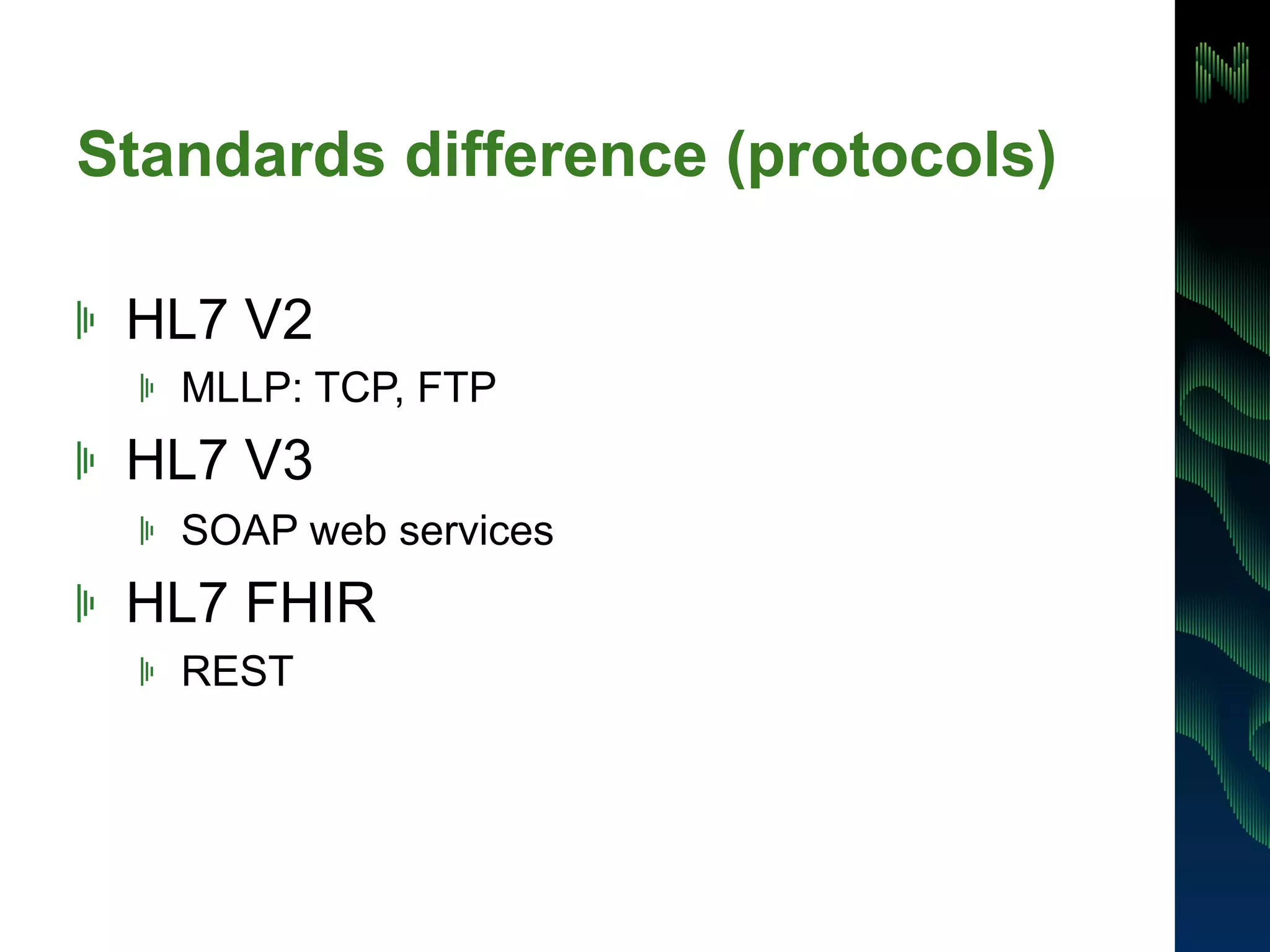
Standards difference (protocols) 
! HL7 V2 
! MLLP: TCP, FTP 
! HL7 V3 
! SOAP web services 
! HL7 FHIR 
! REST
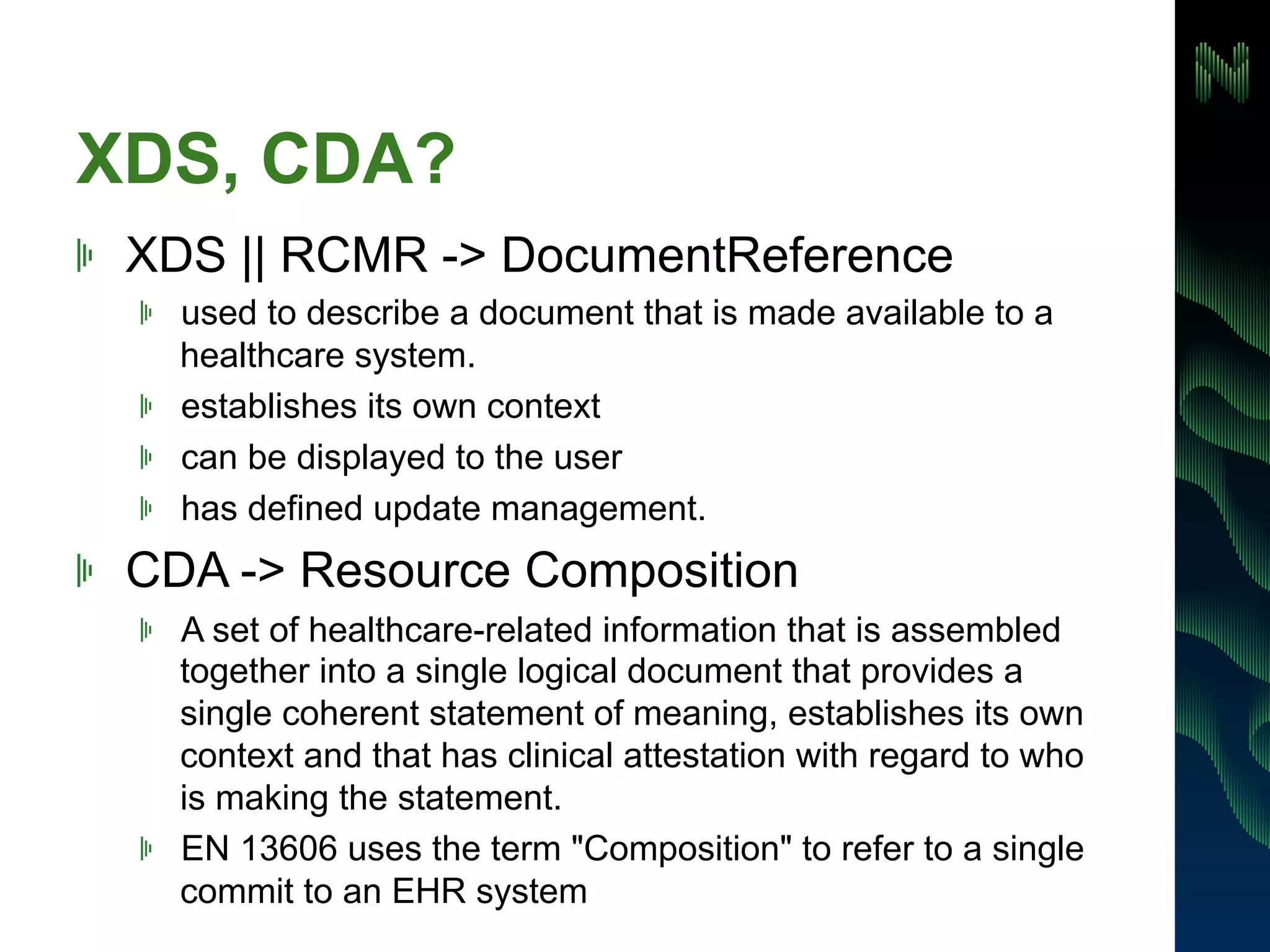
XDS, CDA? 
! XDS || RCMR -> DocumentReference 
! used to describe a document that is made available to a 
healthcare system. 
! establishes its own context 
! can be displayed to the user 
! has defined update management. 
! CDA -> Resource Composition 
! A set of healthcare-related information that is assembled 
together into a single logical document that provides a 
single coherent statement of meaning, establishes its own 
context and that has clinical attestation with regard to who 
is making the statement. 
! EN 13606 uses the term "Composition" to refer to a single 
commit to an EHR system
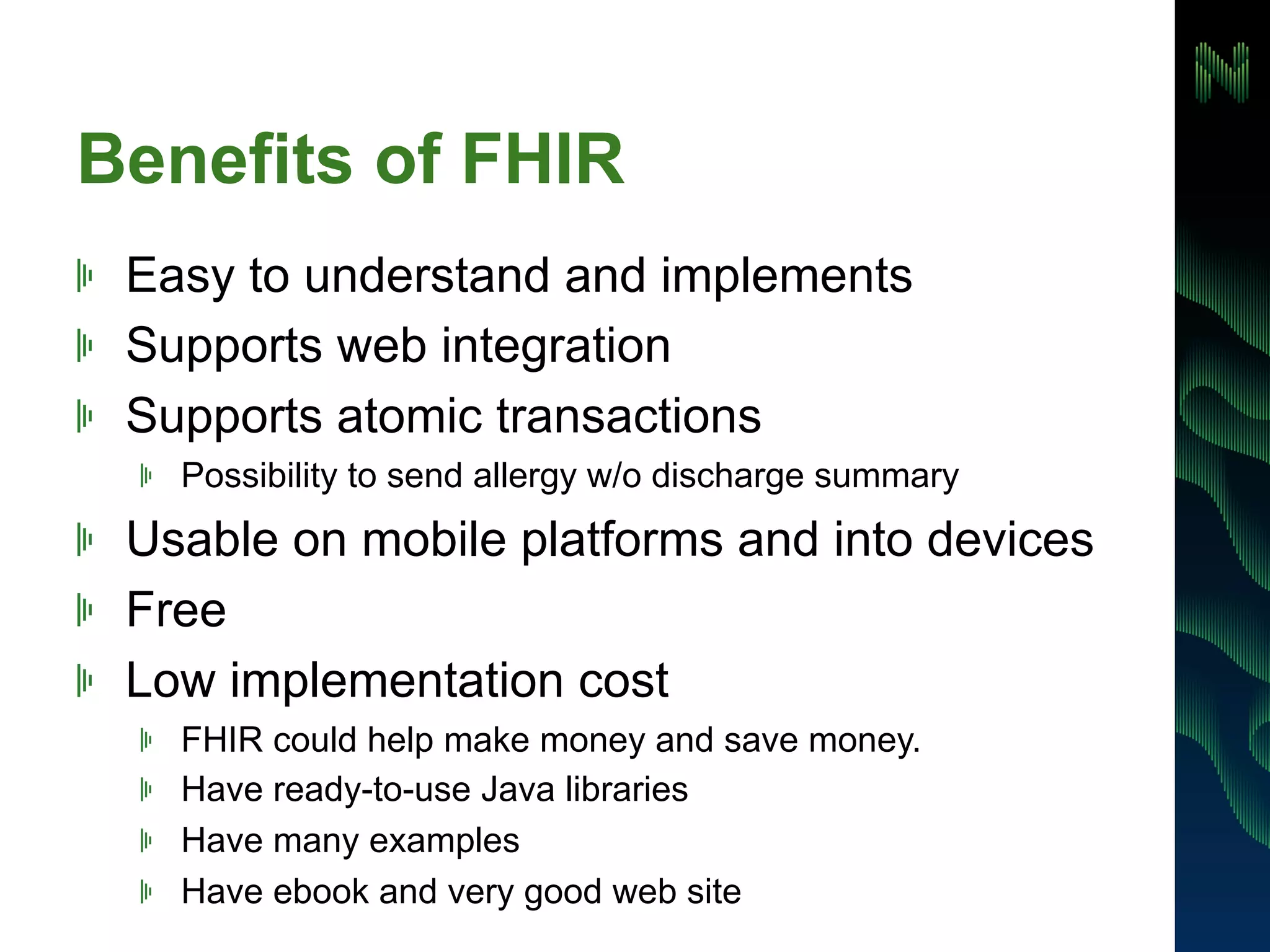
Benefits of FHIR 
! Easy to understand and implements 
! Supports web integration 
! Supports atomic transactions 
! Possibility to send allergy w/o discharge summary 
! Usable on mobile platforms and into devices 
! Free 
! Low implementation cost 
! FHIR could help make money and save money. 
! Have ready-to-use Java libraries 
! Have many examples 
! Have ebook and very good web site
Links 
! http://hl7.org/implement/standards/fhir/ 
! http://www.hl7standards.com/blog/2013/06/11/5- 
qs-grahame-grieve/ 
! http://www.hl7standards.com/blog/2013/05/14/ 
interoperability-paradigms-of-fhir/ 
! http://www.healthcareimc.com/node/515 
! http://www.slideshare.net/HINZ/hay-introduction-to- 
hl7-fhir 
! http://blog.interfaceware.com/hl7/what-is-fhir-and- 
why-should-you-care/
Past 
! Estonia is first country in the world who 
used HL7 V3 in NHR implementation
Future with FHIR 
! Lithuania will be first country in 
the world who will use HL7 
FHIR in NHR implementation 
! Lithuania will be country with 
most innovative and modern 
NHR in the world

Introduction to HL7 FHIR

  • 1.
    Introduction into HL7FHIR Igor Bossenko @Lithuanian Centre of Registers 17.12.2013
  • 2.
    Nortal experience inhealthcare ! HL7 V2 ! 14+ years ! Estonia Image Bank architecture and development ! HL7 V3 ! 9+ years ! Estonian NHR HL7 V3&CDA architecture and standard development ! Estonian eLaboratory standard architecture and development ! HL7 FHIR („fire“) ! EMIR integrated web component (in progress)
  • 3.
    Why FHIR? !FHIR stands for Fast Healthcare Interoperable Resource ! FHIR combines the best features of HL7 V2, HL7 V3, and CDA, while leveraging the latest web service technologies. ! The design of FHIR is based on RESTful web services. ! FHIR is based on modular components called “resources,” and these resources can be combined together to solve clinical and administrative problems in a practical way. ! Free
  • 4.
    Grahame Grieve, OriginalArchitect of HL7 FHIR ! Q: Can you explain your decision to create HL7 FHIR using modern protocols? How would you compare this decision to the history of HL7 Version 2 and 3? ! R: FHIR was born out of frustration with the overall direction of HL7 (i.e. v2, v3, and CDA). V2 has been great, but has come to the end of the road. V3 has tremendous strengths but in the end it failed — too much too soon, I think. CDA fixes only some of v3′s problems, but is a document, not a data interchange specification.
  • 5.
    Standards difference (semantic) ! HL/ V2 (plain text with pipes) MSH|^~&|MegaReg|XYZHospC|SuperOE|XYZImgCtr|20060529090131-0500||ADT^A01^ADT_A01|01052901|P|2.5 EVN||200605290901||||200605290900 PID|||56782445^^^UAReg^PI||KLEINSAMPLE^BARRY^Q^JR||19620910|M||2028-9^^HL70005^RA99113^^XYZ|260 GOODWIN CREST DRIVE^^BIRMINGHAM^AL^35 209^^M~NICKELL’S PICKLES^10000 W 100TH ! HL7 V3 (XML with namespaces) <subject typeCode="SUBJ"> <combinedMedicationRequest xmlns:ext="urn:hl7-EE-DL-Ext:v1" classCode="SBADM" moodCode="RQO" xsi:type="ext:PORX_IN060360UV_Extension.PORX_MT060160UV.CombinedMedicationRequest" ext:HL7-ClassName="SBADM" ext:HL7-Domain="PORX_RM000000UV" ext:realmCode="EE"> <id root="1.3.6.1.4.1.28284.6.2.4.48" extension="1000025189"/> <statusCode code="new"/> <confidentialityCode codeSystem="1.3.6.1.4.1.28284.6.2.2.43.1" codeSystemName="Volituse liik" code=""/> <subject typeCode="SBJ"> <patient classCode="PAT"> <id root="1.3.6.1.4.1.28284.6.2.2.1" extension="37712092729"/> <id root="TTOMaaratudIsikuIdOIDnr" extension=""/> ! HL7 FHIR (XML w/o namespaces or JSON) <Patient xmlns="http://hl7.org/fhir"> <!-- Peter James Chalmers, but called &quot;Jim&quot; --> <name> <use value="official"/> <family value="Chalmers"/> <given value="Peter"/> <given value="James"/> </name> <name> <use value="usual"/> <given value="Jim"/> </name> { "resourceType": "Patient", "name": [ { "use": "official", "family": [ "Chalmers " ], "given": [ "Peter", "James" ] }, { "use": "usual", "given": [ "Jim" ] } ] }
  • 6.
    Standards difference (protocols) ! HL7 V2 ! MLLP: TCP, FTP ! HL7 V3 ! SOAP web services ! HL7 FHIR ! REST
  • 7.
    XDS, CDA? !XDS || RCMR -> DocumentReference ! used to describe a document that is made available to a healthcare system. ! establishes its own context ! can be displayed to the user ! has defined update management. ! CDA -> Resource Composition ! A set of healthcare-related information that is assembled together into a single logical document that provides a single coherent statement of meaning, establishes its own context and that has clinical attestation with regard to who is making the statement. ! EN 13606 uses the term "Composition" to refer to a single commit to an EHR system
  • 8.
    Benefits of FHIR ! Easy to understand and implements ! Supports web integration ! Supports atomic transactions ! Possibility to send allergy w/o discharge summary ! Usable on mobile platforms and into devices ! Free ! Low implementation cost ! FHIR could help make money and save money. ! Have ready-to-use Java libraries ! Have many examples ! Have ebook and very good web site
  • 9.
    Links ! http://hl7.org/implement/standards/fhir/ ! http://www.hl7standards.com/blog/2013/06/11/5- qs-grahame-grieve/ ! http://www.hl7standards.com/blog/2013/05/14/ interoperability-paradigms-of-fhir/ ! http://www.healthcareimc.com/node/515 ! http://www.slideshare.net/HINZ/hay-introduction-to- hl7-fhir ! http://blog.interfaceware.com/hl7/what-is-fhir-and- why-should-you-care/
  • 10.
    Past ! Estoniais first country in the world who used HL7 V3 in NHR implementation
  • 11.
    Future with FHIR ! Lithuania will be first country in the world who will use HL7 FHIR in NHR implementation ! Lithuania will be country with most innovative and modern NHR in the world