Nortal NHS in Lithuania - study on DB
implementations for FHIR server
Igor Bossenko, Jan Jasinski
Nortal
19.11.2015
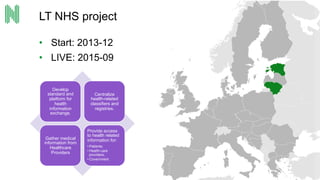
•  Start: 2013-12
•  LIVE: 2015-09
LT NHS project
Develop
standard and
platform for
health
information
exchange.
Centralize
health-related
classifiers and
registries.
Gather medical
information from
Healthcare
Providers
Provide access
to health related
information for:
• Patients;
• Health-care
providers;
• Covernment.
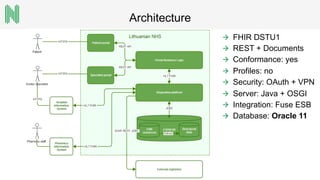
Architecture
  FHIR DSTU1
  REST + Documents
  Conformance: yes
  Profiles: no
  Security: OAuth + VPN
  Server: Java + OSGI
  Integration: Fuse ESB
  Database: Oracle 11
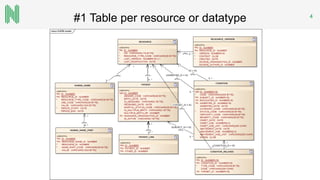
#1 Table per resource or datatype 4
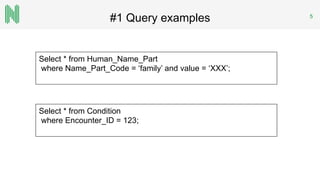
#1 Query examples 5
Select * from Condition
where Encounter_ID = 123;
Select * from Human_Name_Part
where Name_Part_Code = ‘family’ and value = ‘XXX’;
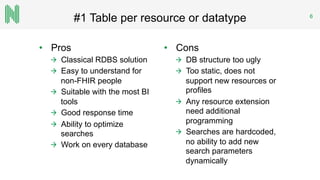
#1 Table per resource or datatype 6
•  Pros
  Classical RDBS solution
  Easy to understand for
non-FHIR people
  Suitable with the most BI
tools
  Good response time
  Ability to optimize
searches
  Work on every database
•  Cons
  DB structure too ugly
  Too static, does not
support new resources or
profiles
  Any resource extension
need additional
programming
  Searches are hardcoded,
no ability to add new
search parameters
dynamically
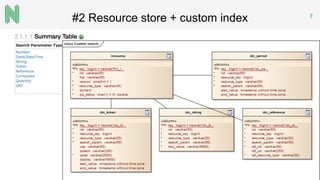
#2 Resource store + custom index 7
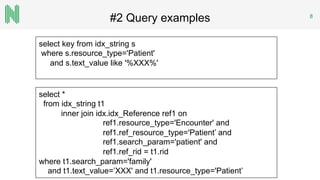
#2 Query examples 8
select *
from idx_string t1
inner join idx.idx_Reference ref1 on
ref1.resource_type='Encounter' and
ref1.ref_resource_type='Patient’ and
ref1.search_param='patient' and
ref1.ref_rid = t1.rid
where t1.search_param='family'
and t1.text_value=’XXX' and t1.resource_type='Patient’
select key from idx_string s
where s.resource_type='Patient'
and s.text_value like '%XXX%'
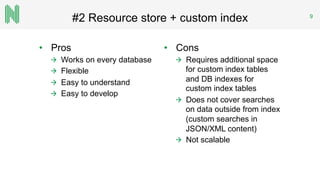
#2 Resource store + custom index 9
•  Pros
  Works on every database
  Flexible
  Easy to understand
  Easy to develop
•  Cons
  Requires additional space
for custom index tables
and DB indexes for
custom index tables
  Does not cover searches
on data outside from index
(custom searches in
JSON/XML content)
  Not scalable
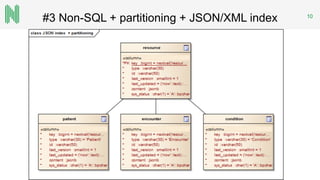
#3 Non-SQL + partitioning + JSON/XML index 10
#3 PostgreSQL JSONB query examples 11
select id from fhir.patient
where content @> '{"name":[{"use":"official", "family":[”XXX"]}]}'
select c.id
from practitioner p
inner join condition c on
c.content -> 'asserter' ->> 'reference' = p.id
where p.content ->> 'name' ~ '"family":[ []*”XXX"*[ ]]'
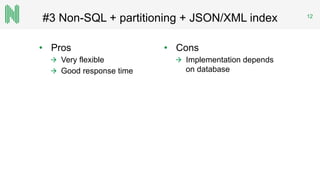
#3 Non-SQL + partitioning + JSON/XML index 12
•  Pros
  Very flexible
  Good response time
•  Cons
  Implementation depends
on database
#4 BigData 13
•  Apache HBase
•  Apache Phoenix
•  Custom indexes on JSON content for simple queries
•  Work In Progress on complex queries
#4 BigData 14
•  Pros
  Very scalable
  Index-based search is
very quick
•  Cons
  Environment installation is
more complex
  Too new (for me)
  Currently we don’t have
solution for complex
queries (WIP)
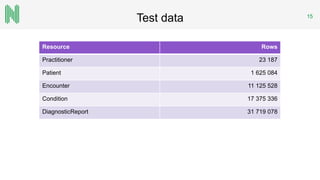
Test data 15
Resource Rows
Practitioner 23 187
Patient 1 625 084
Encounter 11 125 528
Condition 17 375 336
DiagnosticReport 31 719 078
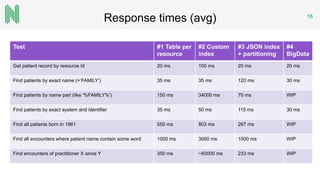
Response times (avg) 16
Test #1 Table per
resource
#2 Custom
index
#3 JSON index
+ partitioning
#4
BigData
Get patient record by resource Id 20 ms 100 ms 20 ms 20 ms
Find patients by exact name (=‘FAMILY’) 35 ms 35 ms 120 ms 30 ms
Find patients by name part (like '%FAMILY%') 150 ms 34000 ms 70 ms WIP
Find patients by exact system and identifier 35 ms 50 ms 115 ms 30 ms
Find all patients born in 1961 550 ms 803 ms 267 ms WIP
Find all encounters where patient name contain some word 1000 ms 3000 ms 1000 ms WIP
Find encounters of practitioner X since Y 350 ms ~60000 ms 233 ms WIP
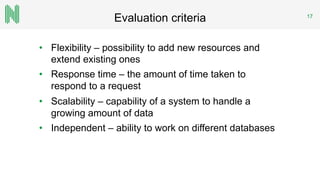
Evaluation criteria 17
•  Flexibility – possibility to add new resources and
extend existing ones
•  Response time – the amount of time taken to
respond to a request
•  Scalability – capability of a system to handle a
growing amount of data
•  Independent – ability to work on different databases
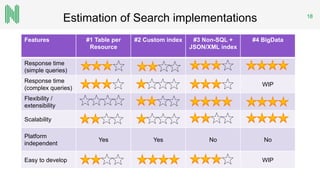
Estimation of Search implementations 18
Features #1 Table per
Resource
#2 Custom index #3 Non-SQL +
JSON/XML index
#4 BigData
Response time
(simple queries)
Response time
(complex queries)
WIP
Flexibility /
extensibility
Scalability
Platform
independent
Yes Yes No No
Easy to develop WIP
nortal.com
Contact us
Igor.Bossenko@gmail.com
Jan.Jasinski@nortal.com
19

FHIR Developer Days 2015. Study on db implementations for FHIR server

  • 1.
    Nortal NHS inLithuania - study on DB implementations for FHIR server Igor Bossenko, Jan Jasinski Nortal 19.11.2015
  • 2.
    •  Start: 2013-12 • LIVE: 2015-09 LT NHS project Develop standard and platform for health information exchange. Centralize health-related classifiers and registries. Gather medical information from Healthcare Providers Provide access to health related information for: • Patients; • Health-care providers; • Covernment.
  • 3.
    Architecture   FHIR DSTU1  REST + Documents   Conformance: yes   Profiles: no   Security: OAuth + VPN   Server: Java + OSGI   Integration: Fuse ESB   Database: Oracle 11
  • 4.
    #1 Table perresource or datatype 4
  • 5.
    #1 Query examples5 Select * from Condition where Encounter_ID = 123; Select * from Human_Name_Part where Name_Part_Code = ‘family’ and value = ‘XXX’;
  • 6.
    #1 Table perresource or datatype 6 •  Pros   Classical RDBS solution   Easy to understand for non-FHIR people   Suitable with the most BI tools   Good response time   Ability to optimize searches   Work on every database •  Cons   DB structure too ugly   Too static, does not support new resources or profiles   Any resource extension need additional programming   Searches are hardcoded, no ability to add new search parameters dynamically
  • 7.
    #2 Resource store+ custom index 7
  • 8.
    #2 Query examples8 select * from idx_string t1 inner join idx.idx_Reference ref1 on ref1.resource_type='Encounter' and ref1.ref_resource_type='Patient’ and ref1.search_param='patient' and ref1.ref_rid = t1.rid where t1.search_param='family' and t1.text_value=’XXX' and t1.resource_type='Patient’ select key from idx_string s where s.resource_type='Patient' and s.text_value like '%XXX%'
  • 9.
    #2 Resource store+ custom index 9 •  Pros   Works on every database   Flexible   Easy to understand   Easy to develop •  Cons   Requires additional space for custom index tables and DB indexes for custom index tables   Does not cover searches on data outside from index (custom searches in JSON/XML content)   Not scalable
  • 10.
    #3 Non-SQL +partitioning + JSON/XML index 10
  • 11.
    #3 PostgreSQL JSONBquery examples 11 select id from fhir.patient where content @> '{"name":[{"use":"official", "family":[”XXX"]}]}' select c.id from practitioner p inner join condition c on c.content -> 'asserter' ->> 'reference' = p.id where p.content ->> 'name' ~ '"family":[ []*”XXX"*[ ]]'
  • 12.
    #3 Non-SQL +partitioning + JSON/XML index 12 •  Pros   Very flexible   Good response time •  Cons   Implementation depends on database
  • 13.
    #4 BigData 13 • Apache HBase •  Apache Phoenix •  Custom indexes on JSON content for simple queries •  Work In Progress on complex queries
  • 14.
    #4 BigData 14 • Pros   Very scalable   Index-based search is very quick •  Cons   Environment installation is more complex   Too new (for me)   Currently we don’t have solution for complex queries (WIP)
  • 15.
    Test data 15 ResourceRows Practitioner 23 187 Patient 1 625 084 Encounter 11 125 528 Condition 17 375 336 DiagnosticReport 31 719 078
  • 16.
    Response times (avg)16 Test #1 Table per resource #2 Custom index #3 JSON index + partitioning #4 BigData Get patient record by resource Id 20 ms 100 ms 20 ms 20 ms Find patients by exact name (=‘FAMILY’) 35 ms 35 ms 120 ms 30 ms Find patients by name part (like '%FAMILY%') 150 ms 34000 ms 70 ms WIP Find patients by exact system and identifier 35 ms 50 ms 115 ms 30 ms Find all patients born in 1961 550 ms 803 ms 267 ms WIP Find all encounters where patient name contain some word 1000 ms 3000 ms 1000 ms WIP Find encounters of practitioner X since Y 350 ms ~60000 ms 233 ms WIP
  • 17.
    Evaluation criteria 17 • Flexibility – possibility to add new resources and extend existing ones •  Response time – the amount of time taken to respond to a request •  Scalability – capability of a system to handle a growing amount of data •  Independent – ability to work on different databases
  • 18.
    Estimation of Searchimplementations 18 Features #1 Table per Resource #2 Custom index #3 Non-SQL + JSON/XML index #4 BigData Response time (simple queries) Response time (complex queries) WIP Flexibility / extensibility Scalability Platform independent Yes Yes No No Easy to develop WIP
  • 19.