
FHIRinNew Zealand:
Establishinga solidfoundation
Dr.DavidHay,MBChB,July2015
Page 2
Today
• Agenda
– Why FHIR
– Where can we use FHIR in NZ
– A FHIR primer
– Clinician Tooling (ClinFHIR)
– Terminology
– Profiling
– Where can we use FHIR in NZ
– Next steps for New Zealand
• Desired Outcome
– You can see where FHIR fits in
New Zealand
– You want to learn more
• Seminars
• Connectathons
– We think about infrastructure
– We plan some pilots
Page 3
• Name: David Hay
• Company: Orion Health
• Background:
– Ex Clinician
– Product Strategist
– Involved in FHIR almost from beginning
– Co-Chair FHIR Management Group
– Chair HL7 New Zealand
– Member HISO Committee
– Blog: FHIRBlog.com
Who am I?
Why FHIR
Page 5
Drivers
• Interoperability requirements increasing
– Increasing collaborative care – need for co-ordination
– Changing Payment models
– Clinical Care delivery to an aging population
– Decision support
– Involving the patient – raising the bar
• Need for real time access (API)
– Mobile
• Vast increase in the amount, type and source of data
– Devices, Mobile
– Genomics
• Analytics, population health
– Need to collect from many different sources
• Implementer expectations
– Expect a modern standard
Current standards don’t cut it - these led to
FHIR…
Page 6
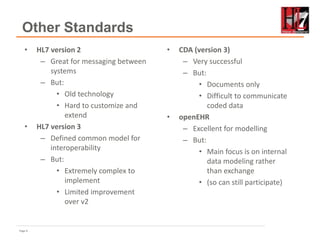
• HL7 version 2
– Great for messaging between
systems
– But:
• Old technology
• Hard to customize and
extend
• HL7 version 3
– Defined common model for
interoperability
– But:
• Extremely complex to
implement
• Limited improvement
over v2
• CDA (version 3)
– Very successful
– But:
• Documents only
• Difficult to communicate
coded data
• openEHR
– Excellent for modelling
– But:
• Main focus is on internal
data modeling rather
than exchange
• (so can still participate)
Other Standards
Page 8
Business Case for FHIR
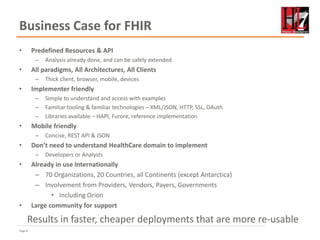
• Predefined Resources & API
– Analysis already done, and can be safely extended
• All paradigms, All Architectures, All Clients
– Thick client, browser, mobile, devices
• Implementer friendly
– Simple to understand and access with examples
– Familiar tooling & familiar technologies – XML/JSON, HTTP, SSL, OAuth
– Libraries available – HAPI, Furore, reference implementation
• Mobile friendly
– Concise, REST API & JSON
• Don’t need to understand HealthCare domain to implement
– Developers or Analysts
• Already in use Internationally
– 70 Organizations, 20 Countries, all Continents (except Antarctica)
– Involvement from Providers, Vendors, Payers, Governments
• Including Orion
• Large community for support
Results in faster, cheaper deployments that are more re-usable
Page 9
Fast Healthcare Interoperability Resources (FHIR)
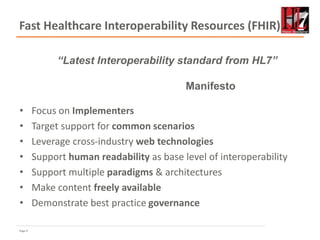
• Focus on Implementers
• Target support for common scenarios
• Leverage cross-industry web technologies
• Support human readability as base level of interoperability
• Support multiple paradigms & architectures
• Make content freely available
• Demonstrate best practice governance
“Latest Interoperability standard from HL7”
Manifesto
Page 10
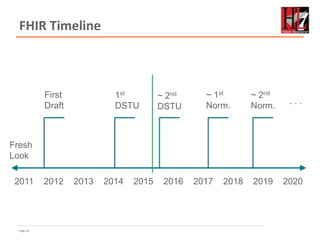
FHIR Timeline
2012 20162014 2018 2020
First
Draft
2011 20152013 2017 2019
1st
DSTU
~ 2nd
DSTU
~ 1st
Norm.
~ 2nd
Norm.
. . .
Fresh
Look
Page 11
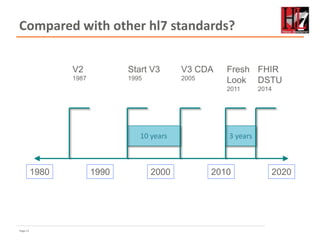
Compared with other hl7 standards?
3 years10 years
1980 20001990 2010 2020
V2
1987
Fresh
Look
2011
V3 CDA
2005
FHIR
DSTU
2014
Start V3
1995
Page 13
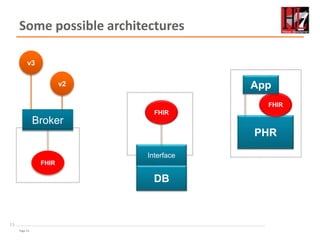
Some possible architectures
13
FHIR
Broker
v3
v2
PHR
FHIR
App
Interface
DB
FHIR
Page 14
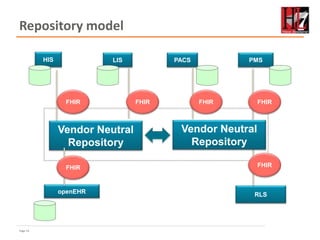
Repository model
Vendor Neutral
Repository
FHIR
HIS LIS PACS PMS
RLS
FHIR
FHIR
FHIRFHIR
openEHR
FHIR
Vendor Neutral
Repository
Where could we use FHIR in New Zealand?
Page 17
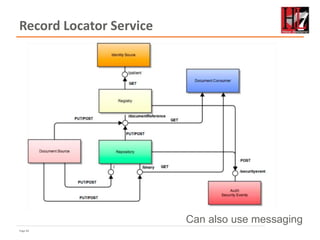
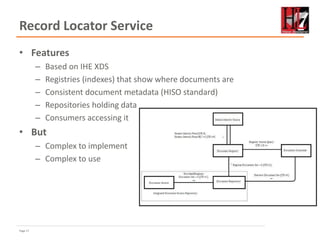
Record Locator Service
• Features
– Based on IHE XDS
– Registries (indexes) that show where documents are
– Consistent document metadata (HISO standard)
– Repositories holding data
– Consumers accessing it
• But
– Complex to implement
– Complex to use
Page 18
Patient Portals
• Access to Primary Care/Community data
– Vendor agnostic
• Access to Secondary Care Data
– Vendor agnostic
• Access to other Portal data
– Or the repositories behind them
• Patient access / review of Shared data repositories
– Medications, allergies, encounters, documents
– Annotate
– Who has accessed data
• Patient data entry
– Devices
– Other observations
Page 19
Primary Care EMR Integration
• Incoming
– Access to appointments
– Patient Messaging
• Repeat prescriptions
• Advice
– Notifications
– Documents
• Record Locator Integration
• Outgoing
– Access/Maintain shared Repositories – eg medications
– Update consultation summaries
• Consistent coding
Page 21
Mobile Devices
• Very common access medium
– Huge growth area for medical applications
– Clinician and especially Patient
• Needs Real-time API
• Structured data
– Not just document display
• Limitations
– Bandwidth
– Performance
– Processor / memory
Page 22
Models on the wire / CDA
• Current Standards
– HL7 CDA
– HL7 version 2
• Where does FHIR fit in?
A Primer in FHIR
Page 26
2 aspects to FHIR
• Content
– Resources (the model)
– Informed by much past work inside & outside of HL7
• HL7: version 2, version 3 (RIM), CDA
• Other SDO: openEHR, CIMI, ISO 13606
• Others: IHE, DICOM
– Profiling & the 80%
• Exchange protocols - Paradigms
– API
– Other paradigms
• Message, Document
Page 27
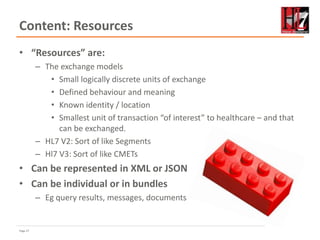
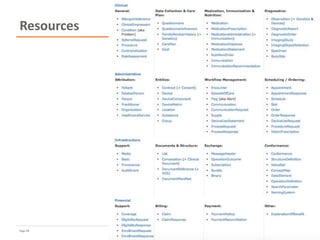
Content: Resources
• “Resources” are:
– The exchange models
• Small logically discrete units of exchange
• Defined behaviour and meaning
• Known identity / location
• Smallest unit of transaction “of interest” to healthcare – and that
can be exchanged.
– HL7 V2: Sort of like Segments
– Hl7 V3: Sort of like CMETs
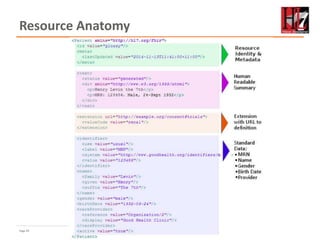
• Can be represented in XML or JSON
• Can be individual or in bundles
– Eg query results, messages, documents
Page 28
Resources
Page 29
Resource Anatomy
Page 30
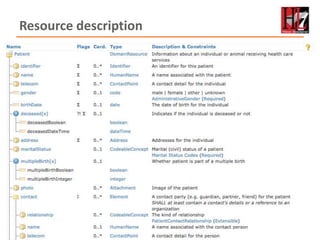
Resource description
Page 31
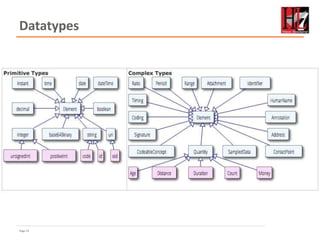
Datatypes
Page 32
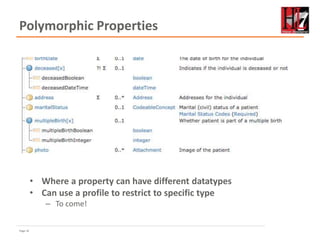
Polymorphic Properties
• Where a property can have different datatypes
• Can use a profile to restrict to specific type
– To come!
Page 33
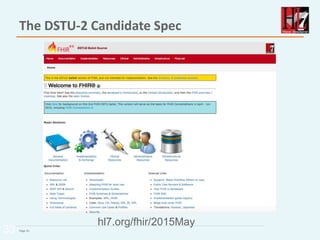
The DSTU-2 Candidate Spec
33
hl7.org/fhir/2015May
Page 34
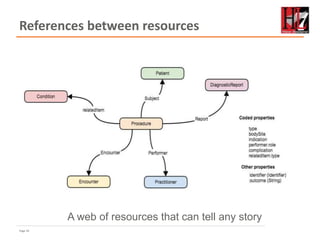
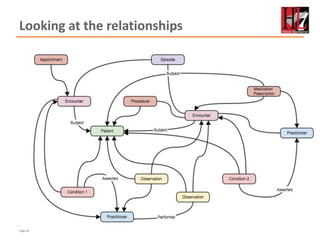
References between resources
A web of resources that can tell any story
Page 35
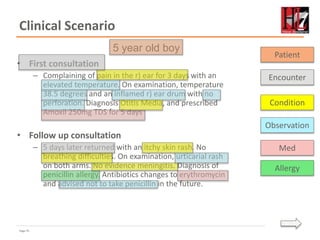
Clinical Scenario
• First consultation
– Complaining of pain in the r) ear for 3 days with an
elevated temperature. On examination, temperature
38.5 degrees and an inflamed r) ear drum with no
perforation. Diagnosis Otitis Media, and prescribed
Amoxil 250mg TDS for 5 days
• Follow up consultation
– 5 days later returned with an itchy skin rash. No
breathing difficulties. On examination, urticarial rash
on both arms. No evidence meningitis. Diagnosis of
penicillin allergy. Antibiotics changes to erythromycin
and advised not to take penicillin in the future.
Condition
Observation
Med
Allergy
Encounter
5 year old boy
Patient
Page 36
Looking at the relationships
Page 37
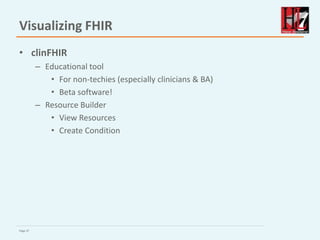
Visualizing FHIR
• clinFHIR
– Educational tool
• For non-techies (especially clinicians & BA)
• Beta software!
– Resource Builder
• View Resources
• Create Condition
Page 38
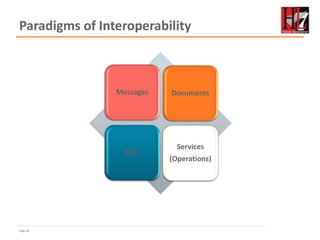
Paradigms of Interoperability
REST
DocumentsMessages
Services
(Operations)
Page 39
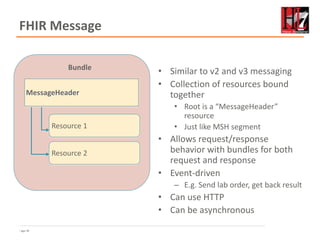
FHIR Message
39
Bundle
Resource 1
Resource 2
MessageHeader
• Similar to v2 and v3 messaging
• Collection of resources bound
together
• Root is a “MessageHeader”
resource
• Just like MSH segment
• Allows request/response
behavior with bundles for both
request and response
• Event-driven
– E.g. Send lab order, get back result
• Can use HTTP
• Can be asynchronous
Page 40
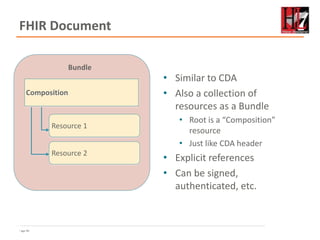
FHIR Document
40
• Similar to CDA
• Also a collection of
resources as a Bundle
• Root is a “Composition”
resource
• Just like CDA header
• Explicit references
• Can be signed,
authenticated, etc.
Bundle
Resource 1
Resource 2
Composition
Page 41
API – REST & Services
• Real-time interaction
– Application to Application
• Eg within enterprise systems
– Person to Application
• Eg Mobile access to data
• Increasingly common (ubiquitous?) outside of healthcare
– Twitter, Facebook, SalesForce
• Simple REST calls (CRUD)
• More complex Operations (RPC)
• One of the ‘selling points’ for FHIR
Page 42
FHIR RESTful Interactions
• Instance
– Read GET [base]/Patient/100
– Vread GET [base]/Patient/100/{vid}
– Update PUT [base]/Patient/100
– Delete DELETE [base]/Patient/100
– History GET [base]/Patient/100/_history
• Type
– Create POST [base]/Patient
– Search GET [base]/Patient?name=eve
– History GET [base]/Patient/_history
– Validate POST [base]/Patient/100/_validate/{id}
• System
– Conformance GET [base]/metadata
– Transaction POST bundle to root
– History GET [base]/_history
– Search GET [base]/Patient?name=eve
Page 43
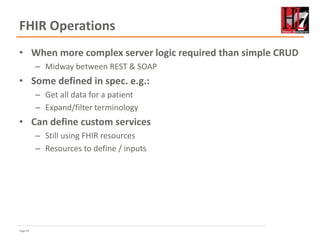
FHIR Operations
• When more complex server logic required than simple CRUD
– Midway between REST & SOAP
• Some defined in spec. e.g.:
– Get all data for a patient
– Expand/filter terminology
• Can define custom services
– Still using FHIR resources
– Resources to define / inputs
Page 44
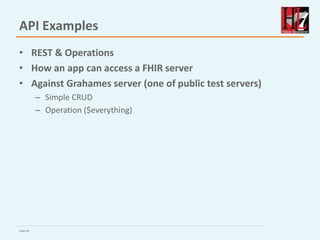
API Examples
• REST & Operations
• How an app can access a FHIR server
• Against Grahames server (one of public test servers)
– Simple CRUD
– Operation ($everything)
Page 45
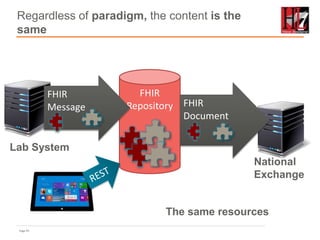
FHIR
Repository
Regardless of paradigm, the content is the
same
Lab System
FHIR
Message FHIR
Document
National
Exchange
The same resources
Terminology
Page 47
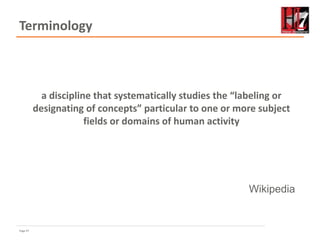
Terminology
a discipline that systematically studies the “labeling or
designating of concepts” particular to one or more subject
fields or domains of human activity
Wikipedia
Page 48
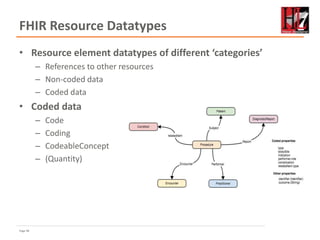
FHIR Resource Datatypes
• Resource element datatypes of different ‘categories’
– References to other resources
– Non-coded data
– Coded data
• Coded data
– Code
– Coding
– CodeableConcept
– (Quantity)
Page 49
Examples
• Code: "status" : "confirmed"
• Coding: {
"system": "http://www.nlm.nih.gov/research/umls/rxnorm",
"code": "C3214954",
"display": "cashew nut allergenic extract Injectable"
}
• CodeableConcept: {
"coding": [{
"system": "http://snomed.info/sct",
"code": "39579001",
"display": "Anaphylactic reaction“
}],
"text" : "Anaphylaxis"
}
Page 50
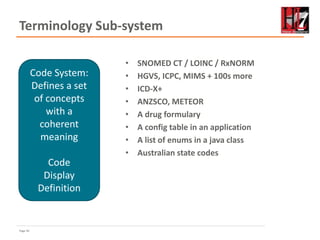
Terminology Sub-system
• SNOMED CT / LOINC / RxNORM
• HGVS, ICPC, MIMS + 100s more
• ICD-X+
• ANZSCO, METEOR
• A drug formulary
• A config table in an application
• A list of enums in a java class
• Australian state codes
Code System:
Defines a set
of concepts
with a
coherent
meaning
Code
Display
Definition
Page 51
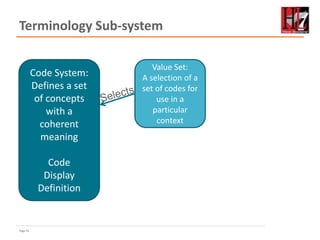
Terminology Sub-system
Value Set:
A selection of a
set of codes for
use in a
particular
context
Code System:
Defines a set
of concepts
with a
coherent
meaning
Code
Display
Definition
Page 52
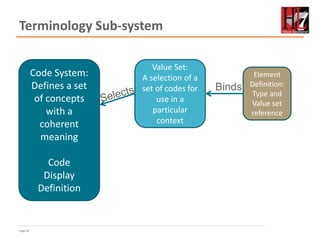
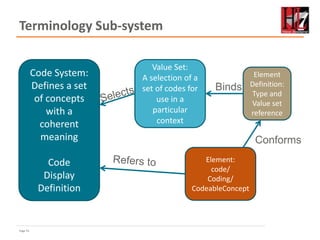
Terminology Sub-system
Code System:
Defines a set
of concepts
with a
coherent
meaning
Code
Display
Definition
Element
Definition:
Type and
Value set
reference
Value Set:
A selection of a
set of codes for
use in a
particular
context
Binds
Page 53
Terminology Sub-system
Code System:
Defines a set
of concepts
with a
coherent
meaning
Code
Display
Definition
Element
Definition:
Type and
Value set
reference
Value Set:
A selection of a
set of codes for
use in a
particular
context
Binds
Element:
code/
Coding/
CodeableConcept
Conforms
Page 54
NamingSystem resource
• A coded element needs to
indicate the terminology
– How to know which ‘system’
value to use?
• Some standard ones defined
in the spec
– SNOMED, LOINC etc.
• Other datatypes need the
same
– Identifier
• Can define own ones
– Using NamingSystem resource
– uniqueId is key
{
"resourceType": "NamingSystem",
"id": "nznhi",
"meta": {
"versionId": "2",
"lastUpdated": "2015-07-21T19:58:39Z"
},
"text": {
"status": "generated",
"div": "<div xmlns="http://www.w3.org/1999/xhtml">New Zealand
NHI</div>"
},
"type": "identifier",
"name": "NZ NHI",
"date": "2014-12-13",
"status": "active",
"description": "The New Zealand NHI system",
"uniqueId": [
{
"type": "uri",
"value": "http://hl7.org.nz/ns/nhi"
}
],
"contact": [
{
"telecom": [
{
"system": "email",
"value": "nhiteam@moh.co.nz"
}
]
}
]
}
Page 55
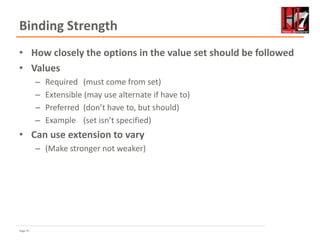
Binding Strength
• How closely the options in the value set should be followed
• Values
– Required (must come from set)
– Extensible (may use alternate if have to)
– Preferred (don’t have to, but should)
– Example (set isn’t specified)
• Can use extension to vary
– (Make stronger not weaker)
Page 56
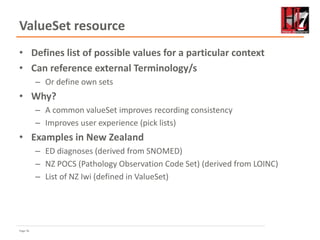
ValueSet resource
• Defines list of possible values for a particular context
• Can reference external Terminology/s
– Or define own sets
• Why?
– A common valueSet improves recording consistency
– Improves user experience (pick lists)
• Examples in New Zealand
– ED diagnoses (derived from SNOMED)
– NZ POCS (Pathology Observation Code Set) (derived from LOINC)
– List of NZ Iwi (defined in ValueSet)
Page 57
ValueSet for condition.code
{
"resourceType": "ValueSet",
"id": "valueset-condition-code",
"meta": {
"versionId": "1",
"lastUpdated": "2015-05-08T16:18:23Z",
},
"text": {
"status": "generated",
"div": ”Condition.code sample ValueSet"
},
"url": "http://hl7.org/fhir/vs/condition-code",
"version": "0.5.0",
"name": "Condition/Problem/Diagnosis Codes",
"publisher": "FHIR Project team",
"contact": [
{
"telecom": [
{
"system": "url",
"value": "http://hl7.org/fhir"
}
]
}
],
"description": "Example value set for
Condition/Problem/Diagnosis codes",
"copyright": "This value set includes content
from SNOMED CT, which is copyright © 2002+
International Health Terminology Standards
Development Organisation (IHTSDO), and
distributed by agreement between IHTSDO and
HL7. Implementer use of SNOMED CT is not
covered by this agreement",
"status": "draft",
"experimental": true,
"compose": {
"include": [
{
"system": "http://snomed.info/sct",
"filter": [
{
"property": "concept",
"op": "is-a",
"value": "404684003"
}
]
}
]
}
}
Page 58
Valueset for NZ Iwi
{
"resourceType": "ValueSet",
"id": "nziwi",
"meta": {
"versionId": "4",
"lastUpdated": "2015-07-18T19:29:40Z"
},
"text": {
"status": "generated",
"div": "<div xmlns="http://www.w3.org/1999/xhtml">&#xA;
<p>Valueset for Iwi</p>&#xA; </div>"
},
"url": "http://fhir-dev.healthintersections.com.au/open/ValueSet/nziwi",
"version": "1",
"name": "New Zealand Iwi",
"publisher": "HL7 New Zealand",
"contact": [ {
"telecom": [
{
"system": "email",
"value": "david.hay25@gmail.com"
}
]
} ],
"description": "The list of possible Iwi (tribes) for New Zealand",
"requirements": "Needed for an extension on Patient",
"status": "draft",
"experimental": true,
"date": "2015-06-13",
"define": {
"system": "fhir.hl7.org.nz/valueset/nziwi",
"concept": [
{
"code": "kt",
"display": "Kai Tahu"
},
{
"code": "np",
"display": "Ngāti Porou"
},
{
"code": "nt",
"display": "Ngāi Tahu"
},
{
"code": "np1",
"display": "Ngā Puhi"
},
{
"code": "nk",
"display": "Ngāti Kahungunu"
},
{
"code": "th",
"display": "Tūhoe"
}
]
}
}
Page 59
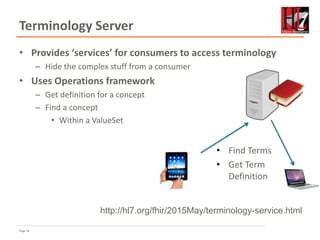
Terminology Server
• Provides ‘services’ for consumers to access terminology
– Hide the complex stuff from a consumer
• Uses Operations framework
– Get definition for a concept
– Find a concept
• Within a ValueSet
http://hl7.org/fhir/2015May/terminology-service.html
• Find Terms
• Get Term
Definition
Page 60
Exercise: Using a Terminology Server
• clinFHIR
– Resource builder (Condition)
– Condition.code
• Explore data set
– Direct REST query from filter
Profiling
Page 62
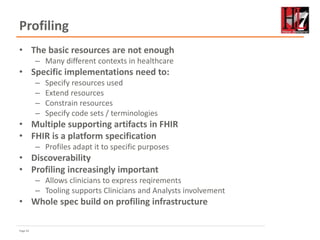
Profiling
• The basic resources are not enough
– Many different contexts in healthcare
• Specific implementations need to:
– Specify resources used
– Extend resources
– Constrain resources
– Specify code sets / terminologies
• Multiple supporting artifacts in FHIR
• FHIR is a platform specification
– Profiles adapt it to specific purposes
• Discoverability
• Profiling increasingly important
– Allows clinicians to express reqirements
– Tooling supports Clinicians and Analysts involvement
• Whole spec build on profiling infrastructure
Page 63
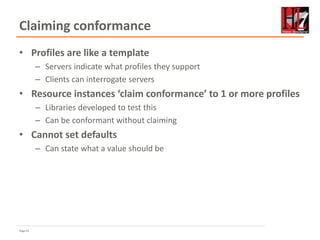
Claiming conformance
• Profiles are like a template
– Servers indicate what profiles they support
– Clients can interrogate servers
• Resource instances ‘claim conformance’ to 1 or more profiles
– Libraries developed to test this
– Can be conformant without claiming
• Cannot set defaults
– Can state what a value should be
Page 64
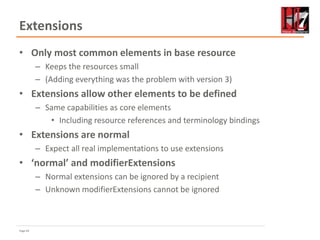
Extensions
• Only most common elements in base resource
– Keeps the resources small
– (Adding everything was the problem with version 3)
• Extensions allow other elements to be defined
– Same capabilities as core elements
• Including resource references and terminology bindings
• Extensions are normal
– Expect all real implementations to use extensions
• ‘normal’ and modifierExtensions
– Normal extensions can be ignored by a recipient
– Unknown modifierExtensions cannot be ignored
Page 65
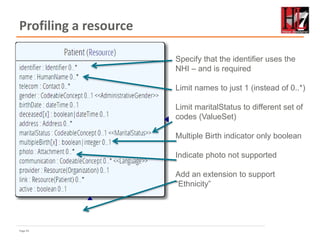
Profiling a resource
Specify that the identifier uses the
NHI – and is required
Limit names to just 1 (instead of 0..*)
Limit maritalStatus to different set of
codes (ValueSet)
Multiple Birth indicator only boolean
Indicate photo not supported
Add an extension to support
“Ethnicity”
Note: hardly any mandatory elements
in the core spec!
Page 66
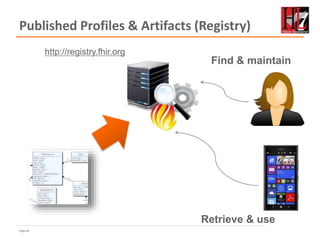
Published Profiles & Artifacts (Registry)
http://registry.fhir.org
Find & maintain
Retrieve & use
Page 67
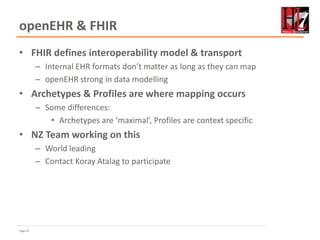
openEHR & FHIR
• FHIR defines interoperability model & transport
– Internal EHR formats don’t matter as long as they can map
– openEHR strong in data modelling
• Archetypes & Profiles are where mapping occurs
– Some differences:
• Archetypes are ‘maximal’, Profiles are context specific
• NZ Team working on this
– World leading
– Contact Koray Atalag to participate
Exercise
Page 69
Exercise: Creating a profile
• Profile on Patient – make the New Zealand Patient
– Add an extension for iwi
– Remove Photo (& some others)
– Make identifier single only, required and fixed to the NHI
• Then, create a resource based on that profile
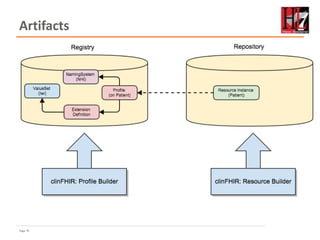
• Will need:
– A ValueSet for Iwi codes
• (to hold the list of values)
– An Extension Definition (StructureDefinition) for iwi in Patient
• To define what it is
– A profile (StructureDefinition) for NZ Patient
Page 70
Artifacts
Page 71
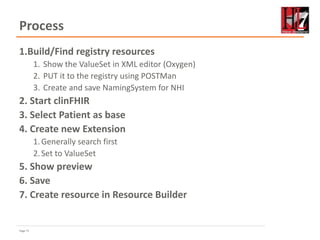
Process
1.Build/Find registry resources
1. Show the ValueSet in XML editor (Oxygen)
2. PUT it to the registry using POSTMan
3. Create and save NamingSystem for NHI
2. Start clinFHIR
3. Select Patient as base
4. Create new Extension
1.Generally search first
2.Set to ValueSet
5. Show preview
6. Save
7. Create resource in Resource Builder
Page 72
Exercise: Create a Profile
• Then use it to create a resource…
Page 73
Conformance resource
• Indicate Server capability
– Also a desired solution or software capabilities
• API Details
– REST Interfaces
• Supported Resources
– Query Parameters
– Operations
• Messaging / Document Capability
• Supported Profiles
Page 74
Implementation Guide
• Pull together all the artifacts for an implementation
– Eg New Zealand Patient
• Computable and directly renderable
• These include (eg from our exercise):
– Resources
• ValueSet
• StructureDefinition
• Conformance
• NamingSystem
– Documentation / other
• example resources
• pages
• Images
• Under active development
Page 75
A Digital Ecosystem supported by FHIR
• Many independent systems
• Common understanding of things, and ways to share them
• FHIR is the way of organizing and sharing
A digital ecosystem is a distributed, adaptive, open
socio-technical system with properties of self-
organisation, scalability and sustainability inspired from
natural ecosystems.
Wikipedia
Page 76
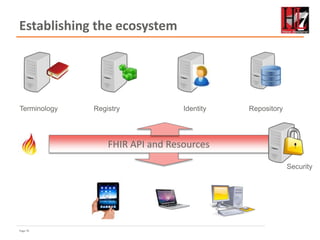
Establishing the ecosystem
Terminology
Security
Identity Repository
FHIR API and Resources
Registry
Page 77
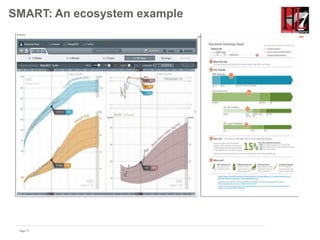
SMART: An ecosystem example
Included in project Argonaut
Page 78
FHIR supporting the Ecosystem
• A common way to represent data
– Building blocks (resources)
– Rules for connecting them (references)
• Defines ways to move data around
– API (Simple & Complex)
– Messages
– Documents
• Links to supporting infrastructure
– Terminology
– Identity
– Security
• A large supporting community
Page 79
Tooling
• Demo Servers
– Open Source
• Libraries
– Client & Server
– Java, c#, python
• Reference Implementations
• clinFHIR
Page 80
The community
• Heaps of open source software
– Clients and servers
• Specification feedback welcomed
– Including update requests – tracker.
• Training events
– On-line webinars (eg FHIR academy)
– Connectathons – at WGMs and elsewhere – eg Aus
– ?demand in New Zealand
• Support channels
– Skype
– Stack Overflow
– Blogs
– Email / List servers
Where can we use FHIR: Revisited
Page 82
Record Locator Service
Can also use messaging
Page 83
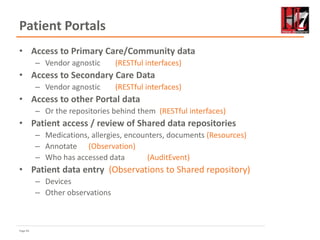
Patient Portals
• Access to Primary Care/Community data
– Vendor agnostic (RESTful interfaces)
• Access to Secondary Care Data
– Vendor agnostic (RESTful interfaces)
• Access to other Portal data
– Or the repositories behind them (RESTful interfaces)
• Patient access / review of Shared data repositories
– Medications, allergies, encounters, documents (Resources)
– Annotate (Observation)
– Who has accessed data (AuditEvent)
• Patient data entry (Observations to Shared repository)
– Devices
– Other observations
Page 84
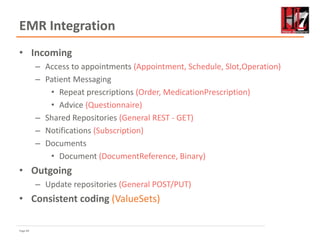
EMR Integration
• Incoming
– Access to appointments (Appointment, Schedule, Slot,Operation)
– Patient Messaging
• Repeat prescriptions (Order, MedicationPrescription)
• Advice (Questionnaire)
– Shared Repositories (General REST - GET)
– Notifications (Subscription)
– Documents
• Document (DocumentReference, Binary)
• Outgoing
– Update repositories (General POST/PUT)
• Consistent coding (ValueSets)
Page 85
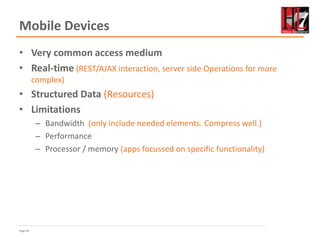
Mobile Devices
• Very common access medium
• Real-time (REST/AJAX interaction, server side Operations for more
complex)
• Structured Data (Resources)
• Limitations
– Bandwidth (only include needed elements. Compress well.)
– Performance
– Processor / memory (apps focussed on specific functionality)
Page 87
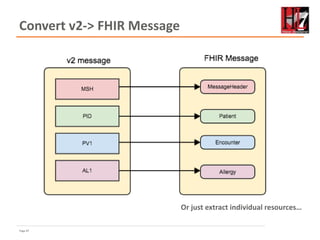
Convert v2-> FHIR Message
Or just extract individual resources…
Page 88
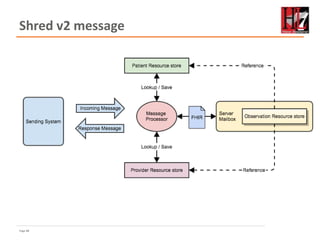
Shred v2 message
Page 89
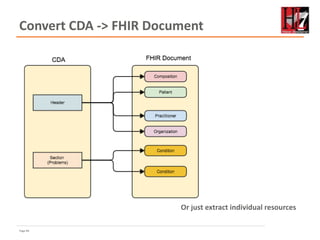
Convert CDA -> FHIR Document
Or just extract individual resources
Wrapping up
Page 91
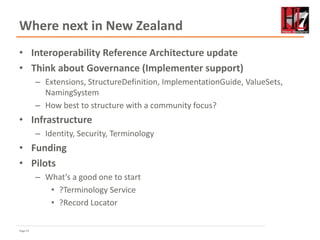
Where next in New Zealand
• Interoperability Reference Architecture update
• Think about Governance (Implementer support)
– Extensions, StructureDefinition, ImplementationGuide, ValueSets,
NamingSystem
– How best to structure with a community focus?
• Infrastructure
– Identity, Security, Terminology
• Funding
• Pilots
– What’s a good one to start
• ?Terminology Service
• ?Record Locator
Page 92
Success Markers
• I’ve stirred your interest in FHIR
– Review the spec on the web
– Consider FHIR in your own projects
• FHIR features prominently in the Interoperability
Architecture refresh
• We have demand for more training or connectathons
• We have real pilots
• The MOH starts to think about FHIR in key interfaces
– NHI, NPI
• We consider a FHIR based national terminology service
• We start to think about the other ecosystem services

FHIR & Ice

  • 1.
  • 2.
    Page 2 Today • Agenda –Why FHIR – Where can we use FHIR in NZ – A FHIR primer – Clinician Tooling (ClinFHIR) – Terminology – Profiling – Where can we use FHIR in NZ – Next steps for New Zealand • Desired Outcome – You can see where FHIR fits in New Zealand – You want to learn more • Seminars • Connectathons – We think about infrastructure – We plan some pilots
  • 3.
    Page 3 • Name:David Hay • Company: Orion Health • Background: – Ex Clinician – Product Strategist – Involved in FHIR almost from beginning – Co-Chair FHIR Management Group – Chair HL7 New Zealand – Member HISO Committee – Blog: FHIRBlog.com Who am I?
  • 4.
  • 5.
    Page 5 Drivers • Interoperabilityrequirements increasing – Increasing collaborative care – need for co-ordination – Changing Payment models – Clinical Care delivery to an aging population – Decision support – Involving the patient – raising the bar • Need for real time access (API) – Mobile • Vast increase in the amount, type and source of data – Devices, Mobile – Genomics • Analytics, population health – Need to collect from many different sources • Implementer expectations – Expect a modern standard Current standards don’t cut it - these led to FHIR…
  • 6.
    Page 6 • HL7version 2 – Great for messaging between systems – But: • Old technology • Hard to customize and extend • HL7 version 3 – Defined common model for interoperability – But: • Extremely complex to implement • Limited improvement over v2 • CDA (version 3) – Very successful – But: • Documents only • Difficult to communicate coded data • openEHR – Excellent for modelling – But: • Main focus is on internal data modeling rather than exchange • (so can still participate) Other Standards
  • 7.
    Page 8 Business Casefor FHIR • Predefined Resources & API – Analysis already done, and can be safely extended • All paradigms, All Architectures, All Clients – Thick client, browser, mobile, devices • Implementer friendly – Simple to understand and access with examples – Familiar tooling & familiar technologies – XML/JSON, HTTP, SSL, OAuth – Libraries available – HAPI, Furore, reference implementation • Mobile friendly – Concise, REST API & JSON • Don’t need to understand HealthCare domain to implement – Developers or Analysts • Already in use Internationally – 70 Organizations, 20 Countries, all Continents (except Antarctica) – Involvement from Providers, Vendors, Payers, Governments • Including Orion • Large community for support Results in faster, cheaper deployments that are more re-usable
  • 8.
    Page 9 Fast HealthcareInteroperability Resources (FHIR) • Focus on Implementers • Target support for common scenarios • Leverage cross-industry web technologies • Support human readability as base level of interoperability • Support multiple paradigms & architectures • Make content freely available • Demonstrate best practice governance “Latest Interoperability standard from HL7” Manifesto
  • 9.
    Page 10 FHIR Timeline 201220162014 2018 2020 First Draft 2011 20152013 2017 2019 1st DSTU ~ 2nd DSTU ~ 1st Norm. ~ 2nd Norm. . . . Fresh Look
  • 10.
    Page 11 Compared withother hl7 standards? 3 years10 years 1980 20001990 2010 2020 V2 1987 Fresh Look 2011 V3 CDA 2005 FHIR DSTU 2014 Start V3 1995
  • 11.
    Page 13 Some possiblearchitectures 13 FHIR Broker v3 v2 PHR FHIR App Interface DB FHIR
  • 12.
    Page 14 Repository model VendorNeutral Repository FHIR HIS LIS PACS PMS RLS FHIR FHIR FHIRFHIR openEHR FHIR Vendor Neutral Repository
  • 13.
    Where could weuse FHIR in New Zealand?
  • 14.
    Page 17 Record LocatorService • Features – Based on IHE XDS – Registries (indexes) that show where documents are – Consistent document metadata (HISO standard) – Repositories holding data – Consumers accessing it • But – Complex to implement – Complex to use
  • 15.
    Page 18 Patient Portals •Access to Primary Care/Community data – Vendor agnostic • Access to Secondary Care Data – Vendor agnostic • Access to other Portal data – Or the repositories behind them • Patient access / review of Shared data repositories – Medications, allergies, encounters, documents – Annotate – Who has accessed data • Patient data entry – Devices – Other observations
  • 16.
    Page 19 Primary CareEMR Integration • Incoming – Access to appointments – Patient Messaging • Repeat prescriptions • Advice – Notifications – Documents • Record Locator Integration • Outgoing – Access/Maintain shared Repositories – eg medications – Update consultation summaries • Consistent coding
  • 17.
    Page 21 Mobile Devices •Very common access medium – Huge growth area for medical applications – Clinician and especially Patient • Needs Real-time API • Structured data – Not just document display • Limitations – Bandwidth – Performance – Processor / memory
  • 18.
    Page 22 Models onthe wire / CDA • Current Standards – HL7 CDA – HL7 version 2 • Where does FHIR fit in?
  • 19.
  • 20.
    Page 26 2 aspectsto FHIR • Content – Resources (the model) – Informed by much past work inside & outside of HL7 • HL7: version 2, version 3 (RIM), CDA • Other SDO: openEHR, CIMI, ISO 13606 • Others: IHE, DICOM – Profiling & the 80% • Exchange protocols - Paradigms – API – Other paradigms • Message, Document
  • 21.
    Page 27 Content: Resources •“Resources” are: – The exchange models • Small logically discrete units of exchange • Defined behaviour and meaning • Known identity / location • Smallest unit of transaction “of interest” to healthcare – and that can be exchanged. – HL7 V2: Sort of like Segments – Hl7 V3: Sort of like CMETs • Can be represented in XML or JSON • Can be individual or in bundles – Eg query results, messages, documents
  • 22.
  • 23.
  • 24.
  • 25.
  • 26.
    Page 32 Polymorphic Properties •Where a property can have different datatypes • Can use a profile to restrict to specific type – To come!
  • 27.
    Page 33 The DSTU-2Candidate Spec 33 hl7.org/fhir/2015May
  • 28.
    Page 34 References betweenresources A web of resources that can tell any story
  • 29.
    Page 35 Clinical Scenario •First consultation – Complaining of pain in the r) ear for 3 days with an elevated temperature. On examination, temperature 38.5 degrees and an inflamed r) ear drum with no perforation. Diagnosis Otitis Media, and prescribed Amoxil 250mg TDS for 5 days • Follow up consultation – 5 days later returned with an itchy skin rash. No breathing difficulties. On examination, urticarial rash on both arms. No evidence meningitis. Diagnosis of penicillin allergy. Antibiotics changes to erythromycin and advised not to take penicillin in the future. Condition Observation Med Allergy Encounter 5 year old boy Patient
  • 30.
    Page 36 Looking atthe relationships
  • 31.
    Page 37 Visualizing FHIR •clinFHIR – Educational tool • For non-techies (especially clinicians & BA) • Beta software! – Resource Builder • View Resources • Create Condition
  • 32.
    Page 38 Paradigms ofInteroperability REST DocumentsMessages Services (Operations)
  • 33.
    Page 39 FHIR Message 39 Bundle Resource1 Resource 2 MessageHeader • Similar to v2 and v3 messaging • Collection of resources bound together • Root is a “MessageHeader” resource • Just like MSH segment • Allows request/response behavior with bundles for both request and response • Event-driven – E.g. Send lab order, get back result • Can use HTTP • Can be asynchronous
  • 34.
    Page 40 FHIR Document 40 •Similar to CDA • Also a collection of resources as a Bundle • Root is a “Composition” resource • Just like CDA header • Explicit references • Can be signed, authenticated, etc. Bundle Resource 1 Resource 2 Composition
  • 35.
    Page 41 API –REST & Services • Real-time interaction – Application to Application • Eg within enterprise systems – Person to Application • Eg Mobile access to data • Increasingly common (ubiquitous?) outside of healthcare – Twitter, Facebook, SalesForce • Simple REST calls (CRUD) • More complex Operations (RPC) • One of the ‘selling points’ for FHIR
  • 36.
    Page 42 FHIR RESTfulInteractions • Instance – Read GET [base]/Patient/100 – Vread GET [base]/Patient/100/{vid} – Update PUT [base]/Patient/100 – Delete DELETE [base]/Patient/100 – History GET [base]/Patient/100/_history • Type – Create POST [base]/Patient – Search GET [base]/Patient?name=eve – History GET [base]/Patient/_history – Validate POST [base]/Patient/100/_validate/{id} • System – Conformance GET [base]/metadata – Transaction POST bundle to root – History GET [base]/_history – Search GET [base]/Patient?name=eve
  • 37.
    Page 43 FHIR Operations •When more complex server logic required than simple CRUD – Midway between REST & SOAP • Some defined in spec. e.g.: – Get all data for a patient – Expand/filter terminology • Can define custom services – Still using FHIR resources – Resources to define / inputs
  • 38.
    Page 44 API Examples •REST & Operations • How an app can access a FHIR server • Against Grahames server (one of public test servers) – Simple CRUD – Operation ($everything)
  • 39.
    Page 45 FHIR Repository Regardless ofparadigm, the content is the same Lab System FHIR Message FHIR Document National Exchange The same resources
  • 40.
  • 41.
    Page 47 Terminology a disciplinethat systematically studies the “labeling or designating of concepts” particular to one or more subject fields or domains of human activity Wikipedia
  • 42.
    Page 48 FHIR ResourceDatatypes • Resource element datatypes of different ‘categories’ – References to other resources – Non-coded data – Coded data • Coded data – Code – Coding – CodeableConcept – (Quantity)
  • 43.
    Page 49 Examples • Code:"status" : "confirmed" • Coding: { "system": "http://www.nlm.nih.gov/research/umls/rxnorm", "code": "C3214954", "display": "cashew nut allergenic extract Injectable" } • CodeableConcept: { "coding": [{ "system": "http://snomed.info/sct", "code": "39579001", "display": "Anaphylactic reaction“ }], "text" : "Anaphylaxis" }
  • 44.
    Page 50 Terminology Sub-system •SNOMED CT / LOINC / RxNORM • HGVS, ICPC, MIMS + 100s more • ICD-X+ • ANZSCO, METEOR • A drug formulary • A config table in an application • A list of enums in a java class • Australian state codes Code System: Defines a set of concepts with a coherent meaning Code Display Definition
  • 45.
    Page 51 Terminology Sub-system ValueSet: A selection of a set of codes for use in a particular context Code System: Defines a set of concepts with a coherent meaning Code Display Definition
  • 46.
    Page 52 Terminology Sub-system CodeSystem: Defines a set of concepts with a coherent meaning Code Display Definition Element Definition: Type and Value set reference Value Set: A selection of a set of codes for use in a particular context Binds
  • 47.
    Page 53 Terminology Sub-system CodeSystem: Defines a set of concepts with a coherent meaning Code Display Definition Element Definition: Type and Value set reference Value Set: A selection of a set of codes for use in a particular context Binds Element: code/ Coding/ CodeableConcept Conforms
  • 48.
    Page 54 NamingSystem resource •A coded element needs to indicate the terminology – How to know which ‘system’ value to use? • Some standard ones defined in the spec – SNOMED, LOINC etc. • Other datatypes need the same – Identifier • Can define own ones – Using NamingSystem resource – uniqueId is key { "resourceType": "NamingSystem", "id": "nznhi", "meta": { "versionId": "2", "lastUpdated": "2015-07-21T19:58:39Z" }, "text": { "status": "generated", "div": "<div xmlns="http://www.w3.org/1999/xhtml">New Zealand NHI</div>" }, "type": "identifier", "name": "NZ NHI", "date": "2014-12-13", "status": "active", "description": "The New Zealand NHI system", "uniqueId": [ { "type": "uri", "value": "http://hl7.org.nz/ns/nhi" } ], "contact": [ { "telecom": [ { "system": "email", "value": "nhiteam@moh.co.nz" } ] } ] }
  • 49.
    Page 55 Binding Strength •How closely the options in the value set should be followed • Values – Required (must come from set) – Extensible (may use alternate if have to) – Preferred (don’t have to, but should) – Example (set isn’t specified) • Can use extension to vary – (Make stronger not weaker)
  • 50.
    Page 56 ValueSet resource •Defines list of possible values for a particular context • Can reference external Terminology/s – Or define own sets • Why? – A common valueSet improves recording consistency – Improves user experience (pick lists) • Examples in New Zealand – ED diagnoses (derived from SNOMED) – NZ POCS (Pathology Observation Code Set) (derived from LOINC) – List of NZ Iwi (defined in ValueSet)
  • 51.
    Page 57 ValueSet forcondition.code { "resourceType": "ValueSet", "id": "valueset-condition-code", "meta": { "versionId": "1", "lastUpdated": "2015-05-08T16:18:23Z", }, "text": { "status": "generated", "div": ”Condition.code sample ValueSet" }, "url": "http://hl7.org/fhir/vs/condition-code", "version": "0.5.0", "name": "Condition/Problem/Diagnosis Codes", "publisher": "FHIR Project team", "contact": [ { "telecom": [ { "system": "url", "value": "http://hl7.org/fhir" } ] } ], "description": "Example value set for Condition/Problem/Diagnosis codes", "copyright": "This value set includes content from SNOMED CT, which is copyright © 2002+ International Health Terminology Standards Development Organisation (IHTSDO), and distributed by agreement between IHTSDO and HL7. Implementer use of SNOMED CT is not covered by this agreement", "status": "draft", "experimental": true, "compose": { "include": [ { "system": "http://snomed.info/sct", "filter": [ { "property": "concept", "op": "is-a", "value": "404684003" } ] } ] } }
  • 52.
    Page 58 Valueset forNZ Iwi { "resourceType": "ValueSet", "id": "nziwi", "meta": { "versionId": "4", "lastUpdated": "2015-07-18T19:29:40Z" }, "text": { "status": "generated", "div": "<div xmlns="http://www.w3.org/1999/xhtml">&#xA; <p>Valueset for Iwi</p>&#xA; </div>" }, "url": "http://fhir-dev.healthintersections.com.au/open/ValueSet/nziwi", "version": "1", "name": "New Zealand Iwi", "publisher": "HL7 New Zealand", "contact": [ { "telecom": [ { "system": "email", "value": "david.hay25@gmail.com" } ] } ], "description": "The list of possible Iwi (tribes) for New Zealand", "requirements": "Needed for an extension on Patient", "status": "draft", "experimental": true, "date": "2015-06-13", "define": { "system": "fhir.hl7.org.nz/valueset/nziwi", "concept": [ { "code": "kt", "display": "Kai Tahu" }, { "code": "np", "display": "Ngāti Porou" }, { "code": "nt", "display": "Ngāi Tahu" }, { "code": "np1", "display": "Ngā Puhi" }, { "code": "nk", "display": "Ngāti Kahungunu" }, { "code": "th", "display": "Tūhoe" } ] } }
  • 53.
    Page 59 Terminology Server •Provides ‘services’ for consumers to access terminology – Hide the complex stuff from a consumer • Uses Operations framework – Get definition for a concept – Find a concept • Within a ValueSet http://hl7.org/fhir/2015May/terminology-service.html • Find Terms • Get Term Definition
  • 54.
    Page 60 Exercise: Usinga Terminology Server • clinFHIR – Resource builder (Condition) – Condition.code • Explore data set – Direct REST query from filter
  • 55.
  • 56.
    Page 62 Profiling • Thebasic resources are not enough – Many different contexts in healthcare • Specific implementations need to: – Specify resources used – Extend resources – Constrain resources – Specify code sets / terminologies • Multiple supporting artifacts in FHIR • FHIR is a platform specification – Profiles adapt it to specific purposes • Discoverability • Profiling increasingly important – Allows clinicians to express reqirements – Tooling supports Clinicians and Analysts involvement • Whole spec build on profiling infrastructure
  • 57.
    Page 63 Claiming conformance •Profiles are like a template – Servers indicate what profiles they support – Clients can interrogate servers • Resource instances ‘claim conformance’ to 1 or more profiles – Libraries developed to test this – Can be conformant without claiming • Cannot set defaults – Can state what a value should be
  • 58.
    Page 64 Extensions • Onlymost common elements in base resource – Keeps the resources small – (Adding everything was the problem with version 3) • Extensions allow other elements to be defined – Same capabilities as core elements • Including resource references and terminology bindings • Extensions are normal – Expect all real implementations to use extensions • ‘normal’ and modifierExtensions – Normal extensions can be ignored by a recipient – Unknown modifierExtensions cannot be ignored
  • 59.
    Page 65 Profiling aresource Specify that the identifier uses the NHI – and is required Limit names to just 1 (instead of 0..*) Limit maritalStatus to different set of codes (ValueSet) Multiple Birth indicator only boolean Indicate photo not supported Add an extension to support “Ethnicity” Note: hardly any mandatory elements in the core spec!
  • 60.
    Page 66 Published Profiles& Artifacts (Registry) http://registry.fhir.org Find & maintain Retrieve & use
  • 61.
    Page 67 openEHR &FHIR • FHIR defines interoperability model & transport – Internal EHR formats don’t matter as long as they can map – openEHR strong in data modelling • Archetypes & Profiles are where mapping occurs – Some differences: • Archetypes are ‘maximal’, Profiles are context specific • NZ Team working on this – World leading – Contact Koray Atalag to participate
  • 62.
  • 63.
    Page 69 Exercise: Creatinga profile • Profile on Patient – make the New Zealand Patient – Add an extension for iwi – Remove Photo (& some others) – Make identifier single only, required and fixed to the NHI • Then, create a resource based on that profile • Will need: – A ValueSet for Iwi codes • (to hold the list of values) – An Extension Definition (StructureDefinition) for iwi in Patient • To define what it is – A profile (StructureDefinition) for NZ Patient
  • 64.
  • 65.
    Page 71 Process 1.Build/Find registryresources 1. Show the ValueSet in XML editor (Oxygen) 2. PUT it to the registry using POSTMan 3. Create and save NamingSystem for NHI 2. Start clinFHIR 3. Select Patient as base 4. Create new Extension 1.Generally search first 2.Set to ValueSet 5. Show preview 6. Save 7. Create resource in Resource Builder
  • 66.
    Page 72 Exercise: Createa Profile • Then use it to create a resource…
  • 67.
    Page 73 Conformance resource •Indicate Server capability – Also a desired solution or software capabilities • API Details – REST Interfaces • Supported Resources – Query Parameters – Operations • Messaging / Document Capability • Supported Profiles
  • 68.
    Page 74 Implementation Guide •Pull together all the artifacts for an implementation – Eg New Zealand Patient • Computable and directly renderable • These include (eg from our exercise): – Resources • ValueSet • StructureDefinition • Conformance • NamingSystem – Documentation / other • example resources • pages • Images • Under active development
  • 69.
    Page 75 A DigitalEcosystem supported by FHIR • Many independent systems • Common understanding of things, and ways to share them • FHIR is the way of organizing and sharing A digital ecosystem is a distributed, adaptive, open socio-technical system with properties of self- organisation, scalability and sustainability inspired from natural ecosystems. Wikipedia
  • 70.
    Page 76 Establishing theecosystem Terminology Security Identity Repository FHIR API and Resources Registry
  • 71.
    Page 77 SMART: Anecosystem example Included in project Argonaut
  • 72.
    Page 78 FHIR supportingthe Ecosystem • A common way to represent data – Building blocks (resources) – Rules for connecting them (references) • Defines ways to move data around – API (Simple & Complex) – Messages – Documents • Links to supporting infrastructure – Terminology – Identity – Security • A large supporting community
  • 73.
    Page 79 Tooling • DemoServers – Open Source • Libraries – Client & Server – Java, c#, python • Reference Implementations • clinFHIR
  • 74.
    Page 80 The community •Heaps of open source software – Clients and servers • Specification feedback welcomed – Including update requests – tracker. • Training events – On-line webinars (eg FHIR academy) – Connectathons – at WGMs and elsewhere – eg Aus – ?demand in New Zealand • Support channels – Skype – Stack Overflow – Blogs – Email / List servers
  • 75.
    Where can weuse FHIR: Revisited
  • 76.
    Page 82 Record LocatorService Can also use messaging
  • 77.
    Page 83 Patient Portals •Access to Primary Care/Community data – Vendor agnostic (RESTful interfaces) • Access to Secondary Care Data – Vendor agnostic (RESTful interfaces) • Access to other Portal data – Or the repositories behind them (RESTful interfaces) • Patient access / review of Shared data repositories – Medications, allergies, encounters, documents (Resources) – Annotate (Observation) – Who has accessed data (AuditEvent) • Patient data entry (Observations to Shared repository) – Devices – Other observations
  • 78.
    Page 84 EMR Integration •Incoming – Access to appointments (Appointment, Schedule, Slot,Operation) – Patient Messaging • Repeat prescriptions (Order, MedicationPrescription) • Advice (Questionnaire) – Shared Repositories (General REST - GET) – Notifications (Subscription) – Documents • Document (DocumentReference, Binary) • Outgoing – Update repositories (General POST/PUT) • Consistent coding (ValueSets)
  • 79.
    Page 85 Mobile Devices •Very common access medium • Real-time (REST/AJAX interaction, server side Operations for more complex) • Structured Data (Resources) • Limitations – Bandwidth (only include needed elements. Compress well.) – Performance – Processor / memory (apps focussed on specific functionality)
  • 80.
    Page 87 Convert v2->FHIR Message Or just extract individual resources…
  • 81.
  • 82.
    Page 89 Convert CDA-> FHIR Document Or just extract individual resources
  • 83.
  • 84.
    Page 91 Where nextin New Zealand • Interoperability Reference Architecture update • Think about Governance (Implementer support) – Extensions, StructureDefinition, ImplementationGuide, ValueSets, NamingSystem – How best to structure with a community focus? • Infrastructure – Identity, Security, Terminology • Funding • Pilots – What’s a good one to start • ?Terminology Service • ?Record Locator
  • 85.
    Page 92 Success Markers •I’ve stirred your interest in FHIR – Review the spec on the web – Consider FHIR in your own projects • FHIR features prominently in the Interoperability Architecture refresh • We have demand for more training or connectathons • We have real pilots • The MOH starts to think about FHIR in key interfaces – NHI, NPI • We consider a FHIR based national terminology service • We start to think about the other ecosystem services