

Advance CDA -
Clinical Document
Architecture
AbdulMalik Shakir
® Health Level Seven and HL7 are registered trademarks of Health Level Seven International, registered with the United States Patent and Trademark Office.
05/22/2019 – 05/23/2019
AbdulMalik Shakir
I am an experienced healthcare informatics
standards expert.
I specialize in the application of health information
technology standards for use in:
• health information exchange,
• clinical decision support, and
• semantic interoperability.
My primary area of interest is facilitating the
discovery and application of evidence based best
practices in health care.
® Health Level Seven and HL7 are registered trademarks of Health Level Seven International,
registered with the United States Patent and Trademark Office. 2
AbdulMalik Shakir
• President and Chief Informatics Scientist, Hi3 Solutions
• Active member of HL7 since September 1991
• Co-chair of the HL7 Modeling and Methodology Workgroup
• HL7 Milestones:
• Chaired the HL7 Education Workgroup from 1996 to 2010.
• Received the HL7 volunteer of the year award in 1997
• Served on the HL7 Board of Directors from 2000 to 2005
• Received the HL7 Fellowship award in 2012
• Grandfather of Malika Power Shakir since April 2019
® Health Level Seven and HL7 are registered trademarks of Health Level Seven International,
registered with the United States Patent and Trademark Office. 3
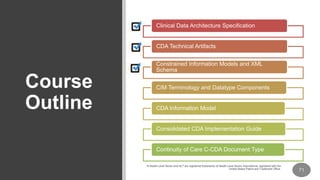
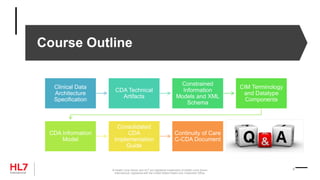
Course Outline
® Health Level Seven and HL7 are registered trademarks of Health Level Seven
International, registered with the United States Patent and Trademark Office.
4
Clinical Data
Architecture
Specification
CDA Technical
Artifacts
Constrained
Information
Models and XML
Schema
CIM Terminology
and Datatype
Components
CDA Information
Model
Consolidated
CDA
Implementation
Guide
Continuity of Care
C-CDA Document
Deep Dive
Advanced
Perspectives
• UML Class Diagram
• XML Schema
• RMIM Design
• Clinical Terminologies
• V3 Templates
Learning Objectives
Upon completion of this
tutorial the participant shall:
1. Understand the components and
features of the CDA standard.
2. Be able to apply the CDA standard
conformance rules when evaluating
the validity of a CDA implementation.
3. Be able to create templates to
constrain the CDA standard for use in
support of a particular use case.
® Health Level Seven and HL7 are registered trademarks of Health Level Seven International, registered with the United States Patent and Trademark Office. 6
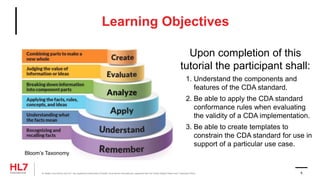
Bloom’s Taxonomy
CDA STANDARD SPECIFICATION
® Health Level Seven and HL7 are registered trademarks of Health Level Seven International, registered with the United States Patent and Trademark Office. 7
https://www.hl7.org/implement/standards/product_brief.cfm?product_id=7
HL7 Clinical Document Architecture (CDA)
• The HL7 Clinical Document Architecture (CDA) is a document markup standard that specifies the
structure and semantics of "clinical documents" for the purpose of exchange.
• The CDA is a constrained refinement of the HL7 v3 Reference Information Model (RIM) specific to the
purpose of clinical document exchange.
• The CDA standard is further constrained via the specification of implementation guides for specific
document types, clinical domains, and document exchange scenarios.
• The CDA is one of the initial set of standards, implementation specifications, and certification criteria
for Electronic Health Record technology specified in USA Meaningful Use legislation.
• The collection of implementation guides developed for CDA are widely adopted by EMR vendors;
secondary users of EMR data are aligning their information requirements with these guides in
anticipation of these data becoming more readily assessable.
® Health Level Seven and HL7 are registered trademarks of Health Level Seven International, registered with the United States Patent and Trademark Office. 8
Clinical Document
• A clinical document is a documentation of clinical observations and services, with the
following characteristics:
 Persistence – A clinical document continues to exist in an unaltered state, for a time period defined by local
and regulatory requirements.
 Stewardship – A clinical document is maintained by an organization entrusted with its care (custodian).
 Potential for authentication - A clinical document is an assemblage of information that can be legally
authenticated.
 Context - A clinical document establishes the default context for its contents.
 Wholeness - Authentication of a clinical document applies to the whole and does not apply to portions of the
document without the full context of the document.
 Human readability – A clinical document is human readable.
• A CDA document is a defined and complete information object that can include text,
images, sounds, and other multimedia content.
® Health Level Seven and HL7 are registered trademarks of Health Level Seven International, registered with the United States Patent and Trademark Office. 9
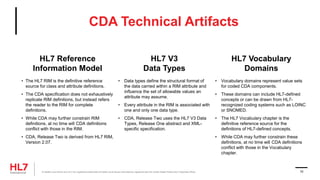
CDA Technical Artifacts
HL7 Reference
Information Model
• The HL7 RIM is the definitive reference
source for class and attribute definitions.
• The CDA specification does not exhaustively
replicate RIM definitions, but instead refers
the reader to the RIM for complete
definitions.
• While CDA may further constrain RIM
definitions, at no time will CDA definitions
conflict with those in the RIM.
• CDA, Release Two is derived from HL7 RIM,
Version 2.07.
HL7 Vocabulary
Domains
• Vocabulary domains represent value sets
for coded CDA components.
• These domains can include HL7-defined
concepts or can be drawn from HL7-
recognized coding systems such as LOINC
or SNOMED.
• The HL7 Vocabulary chapter is the
definitive reference source for the
definitions of HL7-defined concepts.
• While CDA may further constrain these
definitions, at no time will CDA definitions
conflict with those in the Vocabulary
chapter.
HL7 V3
Data Types
• Data types define the structural format of
the data carried within a RIM attribute and
influence the set of allowable values an
attribute may assume.
• Every attribute in the RIM is associated with
one and only one data type.
• CDA, Release Two uses the HL7 V3 Data
Types, Release One abstract and XML-
specific specification.
® Health Level Seven and HL7 are registered trademarks of Health Level Seven International, registered with the United States Patent and Trademark Office. 10
CDA TECHNICAL ARTIFACTS
® Health Level Seven and HL7 are registered trademarks of Health Level Seven International, registered with the United States Patent and Trademark Office. 11
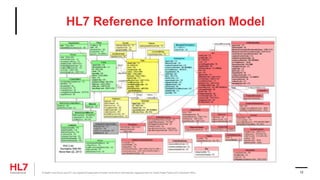
HL7 Reference Information Model
® Health Level Seven and HL7 are registered trademarks of Health Level Seven International, registered with the United States Patent and Trademark Office. 12
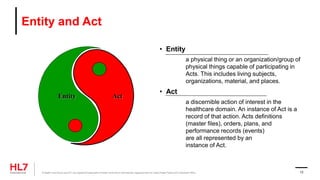
Entity and Act
• Entity
a physical thing or an organization/group of
physical things capable of participating in
Acts. This includes living subjects,
organizations, material, and places.
• Act
a discernible action of interest in the
healthcare domain. An instance of Act is a
record of that action. Acts definitions
(master files), orders, plans, and
performance records (events)
are all represented by an
instance of Act.
Entity Act
® Health Level Seven and HL7 are registered trademarks of Health Level Seven International, registered with the United States Patent and Trademark Office. 13
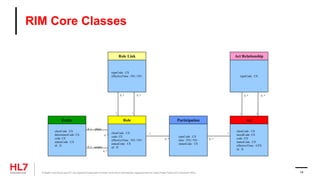
Entity
classCode : CS
determinerCode: CS
code: CE
statusCode : CS
id : II
Role
classCode : CS
code: CE
effectiveTime : IVL<TS>
statusCode : CS
id : II
Participation
typeCode : CS
time : IVL<TS>
statusCode : CS
Act
classCode : CS
moodCode: CS
code: CD
statusCode : CS
effectiveTime : GTS
id : II
0..1
0..*
1
0..*
1
0..*
Role Link
typeCode : CS
effectiveTime : IVL<TS>
Act Relationship
typeCode : CS
RIM Core Classes
0..1
0..*
plays
scopes
1 1
0..* 0..*
1 1
0..* 0..*
® Health Level Seven and HL7 are registered trademarks of Health Level Seven International, registered with the United States Patent and Trademark Office. 14
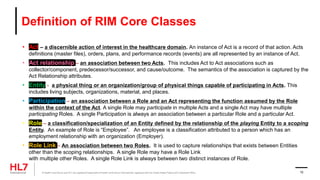
Definition of RIM Core Classes
• Act – a discernible action of interest in the healthcare domain. An instance of Act is a record of that action. Acts
definitions (master files), orders, plans, and performance records (events) are all represented by an instance of Act.
• Act relationship – an association between two Acts. This includes Act to Act associations such as
collector/component, predecessor/successor, and cause/outcome. The semantics of the association is captured by the
Act Relationship attributes.
• Entity - a physical thing or an organization/group of physical things capable of participating in Acts. This
includes living subjects, organizations, material, and places.
• Participation – an association between a Role and an Act representing the function assumed by the Role
within the context of the Act. A single Role may participate in multiple Acts and a single Act may have multiple
participating Roles. A single Participation is always an association between a particular Role and a particular Act.
• Role – a classification/specialization of an Entity defined by the relationship of the playing Entity to a scoping
Entity. An example of Role is “Employee”. An employee is a classification attributed to a person which has an
employment relationship with an organization (Employer).
• Role Link – An association between two Roles. It is used to capture relationships that exists between Entities
other than the scoping relationships. A single Role may have a Role Link
with multiple other Roles. A single Role Link is always between two distinct instances of Role.
® Health Level Seven and HL7 are registered trademarks of Health Level Seven International, registered with the United States Patent and Trademark Office. 15
HL7 V3 Message Design Information Models
• RIM: Reference Information Model
• D-MIM: Domain Message Information Model
• R-MIM: Refined Message Information Model
• HMD: Hierarchical Message Definition
RIM
Restrict
R-MIM
Serialize
HMD
D-MIM
Derive
PatientIncident
classCode*: <= ENC
moodCode*: <= EVN
id: [1..*] (RegistNum)
code: CV CNE [0..1] <= ExternallyDefinedActCodes (PatientType)
statusCode: LIST<CS> CNE <= ActStatus (IDPHStatus)
activityTime: TS (EDDate)
Injury
classCode*: <= ACT
moodCode*: <= EVN
activityTime: TS (InjuryDate)
0..1 pertinentInjury
typeCode*: <= PERT
pertinentInformation1
TraumaRegistryExport
(IDPH_RM00001)
Data content of HL7
messages used to export
data from the IDPH Trauma
Registry.
PatientPerson
classCode*: <= PSN
determinerCode*: <= INSTANCE
name: PN [0..1] (*Name)
existenceTime: (Age)
administrativeGenderCode: CV CWE <= AdministrativeGender
(GenderID)
birthTime: (DateOfBirth)
addr: AD [0..1] (AddressHome)
raceCode: CV CWE [0..1] <= Race (RaceID)
ethnicGroupCode: CV CWE [0..1] <= Ethnicity (EthnicID)
1..1 patientPatientPerson
1..1 providerTraumaParticipant
Patient
classCode*: <= PAT
id: II [0..1] (MedicaRecordNum)
TraumaParticipant
classCode*: <= ORG
determinerCode*: <= INSTANCE
id: [1..1] (HospitNum)
code: CV CWE [0..1] <= EntityCode
name: ON [0..1] (HospitName)
statusCode: CS CNE [0..1] <= EntityStatus (ActiveFacili)
addr: AD [0..1] (HospitCity)
1..1 patient
typeCode*: <= SBJ
subject
InjuryLocation
classCode*: <= PLC
determinerCode*: <= INSTANCE
code: CV CWE [0..1] <= EntityCode (InjuryPlaceID)
addr: AD [0..1] (AddressScene)
0..1 playingInjuryLocation
Role
classCode*: <= ROL
1..1 participant
typeCode*: <= LOC
location
InjuryRelatedObservation
classCode*: <= OBS
moodCode*: <= EVN
code: <= ExternallyDefinedActCodes
priorityCode: CV CWE [0..1] <= ActPriority
value: [0..1]
0..* pertinentInjuryRelatedObservation
typeCode*: <= PERT
sequenceNumber: INT [0..1] (InjurySequen)
pertinentInformation
Procedure
classCode*: <= PROC
moodCode*: <= EVN
code: CV CWE <= ActCode (ICDCodeID)
activityTime: TS (ProcedDate)
0..* pertinentProcedure
typeCode*: <= PERT
pertinentInformation7
0..1 medicalStaff
typeCode*: <= PRF
performer
MedicalStaff
classCode*: <= PROV
id: II [0..1] (MedicalStaffID)
0..1 procedureLocation
typeCode*: <= LOC
location
ProcedureLocation
classCode*: <= SDLOC
code: <= RoleCode (ProcedLocateID)
PatientIncidentRelatedObservation
classCode*: <= OBS
moodCode*: <= EVN
code: <= ActCode
reasonCode: CV CWE [0..1] <= ActReason
value: ANY [0..1]
0..* pertinentPatientIncidentRelatedObservation
typeCode*: <= PERT
pertinentInformation2
PatientTransfer
classCode*: <= TRNS
moodCode*: <= EVN
activityTime: IVL<TS> (DischaDate to ArriveDate)
reasonCode: CV CWE [0..1] <= TransferActReason (REASONTRANSFID)
1..1 arrivalPatientTransfer
typeCode*: <= ARR
arrivedBy
0..* aRole
typeCode*: <= ORG
origin
0..1 playingTraumaParticipant
aRole
classCode*: <= ROL
TransferRelatedObservation
classCode*: <= OBS
moodCode*: <= EVN
code: CV CWE <= ExternallyDefinedActCodes
value: PQ [0..1]
methodCode: CV CWE [0..1] <= ObservationMethod
1..* pertinentTransferRelatedObservation
typeCode*: <= PERT
pertinentInformation
1..1 transferVehicle
typeCode*: <= VIA
via
1..1 owningVehicleProvider
TransferVehicle
classCode*: <= OWN
id: II [0..1] (VehiclNum)
code: <= RoleCode (VehiclLevelID)
VehicleProvider
classCode*: <= ORG
determinerCode*: <= INSTANCE
id: II [0..1] (VehiclProvide)
code: <= EntityCode (MaxVehiclLevelID)
name: ON [0..1] (VehiclProvidName)
HospitalVisit
classCode*: <= ENC
moodCode*: <= EVN
code: CV CWE <= ActCode (AdmitServicID)
activityTime: TS (DischaDate)
dischargeDispositionCode: CV CWE [0..1]
<= EncounterDischargeDisposition
1..1 pertinentHospitalVisit
typeCode*: <= PERT
pertinentInformation5
HospitalVisitRelatedObservation
classCode*: <= OBS
moodCode*: <= EVN
code: CV CWE <= ExternallyDefinedActCodes
value: [0..1]
0..* pertinentHospitalVisitRelatedObservation
typeCode*: <= PERT
pertinentInformation
1..1 admittingProvider
typeCode*: <= ADM
admitter
0..1 healthCareMedicalStaffPerson
AdmittingProvider
classCode*: <= PROV
id: II [0..1] (ADMITMEDICASTAFFID)
code: CV CWE <= RoleCode (StaffTypeID)
0..* hospitalVisitPhysician
typeCode*: <= RESP
time: TS
responsibleParty
0..1 healthCareMedicalStaffPerson
HospitalVisitPhysician
classCode*: <= PROV
id: II [0..1]
code: CV CWE <= RoleCode (StaffTypeID)
MedicalStaffPerson
classCode*: <= PSN
determinerCode*: <= INSTANCE
name: PN [0..1] (MedicaStaffName)
0..1 licensedEntity
typeCode*: <= DST
destination
0..1 subjectChoice
LicensedEntity
classCode*: <= LIC
id: II [0..1]
Choice
Facility
classCode*: <= ORG
determinerCode*: <= INSTANCE
id:
code*: CS CNE <= EntityCode "FAC"
name:
Hospital
classCode*: <= ORG
determinerCode*: <= INSTANCE
id:
code*: CS CNE <= EntityCode "HOSP"
name:
EmergencyDepartmentEncounter
classCode*: <= ENC
moodCode*: <= EVN
activityTime: IVL<TS>
dischargeDispositionCode: CV CWE <= EncounterDischargeDisposition
0..1 pertinentEmergencyDepartmentEncounter
typeCode*: <= PERT
pertinentInformation3
EmergencyDepartmentRelatedObservation
classCode*: <= OBS
moodCode*: <= EVN
code: CV CWE <= ExternallyDefinedActCodes
text:
activityTime: TS
reasonCode: <= ActReason
value: [0..1]
methodCode: CV CWE [0..1] <= ObservationMethod
targetSiteCode: CV CWE [0..1] <= HumanActSite
0..* pertinentEmergencyDepartmentRelatedObservation
typeCode*: <= PERT
pertinentInformation
0..* emergencyDepartmentPhysician
typeCode*: <= PRF
performer
0..1 healthCareMedicalStaffPerson EmergencyDepartmentPhysician
classCode*: <= PROV
id: II [0..1]
code: CE CWE [0..1] <= RoleCode (StaffTypeID)
PreHospitalEncounter
classCode*: <= ENC
moodCode*: <= EVN
id: II [0..1] (crashNum)
activityTime: IVL<TS>
0..1 priorPreHospitalEncounter
typeCode*: <= PREV
predecessor
PreHosptialRelatedObservation
classCode*: <= OBS
moodCode*: <= EVN
code: <= ExternallyDefinedActCodes
value: ANY [0..1]
0..* pertinentPreHosptialRelatedObservation
typeCode*: <= PERT
pertinentInformation
1..1 preHospitalVehicle
typeCode*: <= ParticipationType
participant
1..1 owningVehicleProvider
PreHospitalVehicle
classCode*: <= OWN
id: II [0..1] (VehiclNum)
code: <= RoleCode (VehiclLevelID)
0..* emergencyDepartmentPhysicianAct
typeCode*: <= COMP
component
EmergencyDepartmentPhysicianAct
classCode*: <= ACT
moodCode*: <= EVN
code: CS CNE [0..1] <= ExternallyDefinedActCodes
activityTime*: TS [0..1]
component
0..* patientIncidentRelatedObservation
typeCode*: <= COMP
VehicleProvider
MedicalStaffPerson
TraumaParticipant
A_AbnormalityAssessment
(COCT_RM420000UV)
Description: assessment of clinical findings, including lab test results,
for indications of the presence and severity of abnormal conditions
AbnormalityAssessment
classCode*: = "OBS"
moodCode*: = "EVN"
code*: CD CWE [1..1] <= V:ObservationType ("ADVERSE_REACTION")
statusCode*: CS CNE [1..1] <= V:ActStatusAbortedCancelledCompleted
activityTime*: TS.DATETIME [1..1]
value: CD CWE [0..1] <= V:AbnormalityAssessmentValue
methodCode: SET<CE> CWE [0..*] <= V:AbnormalityAssessmentMethod
1..* assessmentOutcome *
typeCode*: = "OUTC"
contextConductionInd*: BL [1..1] ="true"
outcome
AssessmentException
classCode*: = "OBS"
moodCode*: = "EVN"
code*: CD CWE [1..1] <= V:ObservationType ("ASSERTION")
value*: SC CWE [1..1] <= V:AssessmentExceptionValue
AbnormalityGrade
classCode*: = "OBS"
moodCode*: = "EVN"
code*: CD CWE [1..1] <= V:ObservationType ("SEV")
uncertaintyCode: CE CNE [0..1] <= V:ActUncertainty
value*: CD CWE [1..1] <= V:AbnormalityGradeValue
AssessmentOutcome
0..* assessmentOutcomeAnnotation
typeCode*: = "APND"
contextConductionInd*: BL [1..1] ="true"
appendageOf
AssessmentOutcomeAnnotation
classCode*: = "OBS"
moodCode*: = "EVN"
code*: CD CWE [1..1] <= V:ObservationType ("ASSERTION")
value*: SC CWE [1..1] <= V:AssessmentOutcomeAnnotationValue
® Health Level Seven and HL7 are registered trademarks of Health Level Seven International, registered with the United States Patent and Trademark Office. 16
HL7 CDA R-MIM
• HL7 specifications derived from the HL7 RIM use a process known as "cloning" to refine domain specific models from
the base HL7 RIM.
• When a refined model makes use of a specialization of an HL7 RIM class, the new class in the refined model is known
as a clone of the HL7 RIM class.
• These specializations may further constrain the base class, for example, by specifying more restrictive attribute
cardinality or by further constraints on the allowed vocabulary values.
• Multiple clones of a particular HL7 RIM class may appear in a refined model, each representing a different
specialization.
• The CDA R-MIM is a graphical representation of the CDA specification. It is presented using diagramming conventions
and notations that were developed by HL7 to represent the specific semantic constructs contained in the critical, "back-
bone" classes of the RIM.
• Although it could be represented in UML notation, as the RIM is, the HL7 notation provides more details about the
specific constraints and class clones being represented.
• The HL7 diagramming convention abbreviates some relationship conventions, enabling diagrams to be smaller and
more concise and to convey more information visually.
® Health Level Seven and HL7 are registered trademarks of Health Level Seven International, registered with the United States Patent and Trademark Office. 17
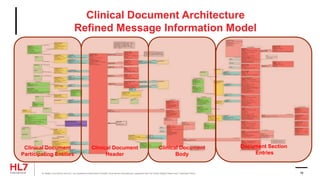
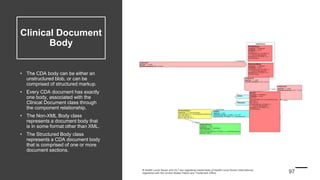
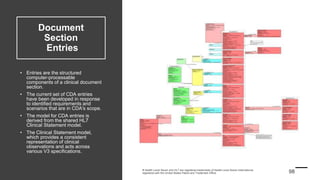
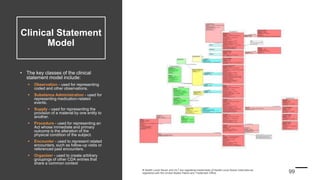
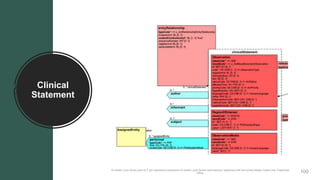
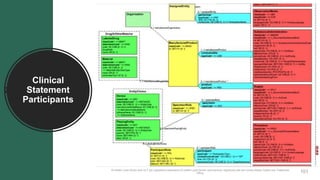
Clinical Document Architecture
Refined Message Information Model
® Health Level Seven and HL7 are registered trademarks of Health Level Seven International, registered with the United States Patent and Trademark Office. 18
Clinical Document
Participating Entities
Clinical Document
Header
Clinical Document
Body
Document Section
Entries
• Constrained Information Model (CIM)
HL7 V3 Contrained Information Models
• RIM: Reference Information Model
• D-MIM: Domain Message Information Model
• R-MIM: Refined Message Information Model
• HMD: Hierarchical Message Definition
RIM
Restrict
R-MIM
Serialize
HMD
D-MIM
Derive
PatientIncident
classCode*: <= ENC
moodCode*: <= EVN
id: [1..*] (RegistNum)
code: CV CNE [0..1] <= ExternallyDefinedActCodes (PatientType)
statusCode: LIST<CS> CNE <= ActStatus (IDPHStatus)
activityTime: TS (EDDate)
Injury
classCode*: <= ACT
moodCode*: <= EVN
activityTime: TS (InjuryDate)
0..1 pertinentInjury
typeCode*: <= PERT
pertinentInformation1
TraumaRegistryExport
(IDPH_RM00001)
Data content of HL7
messages used to export
data from the IDPH Trauma
Registry.
PatientPerson
classCode*: <= PSN
determinerCode*: <= INSTANCE
name: PN [0..1] (*Name)
existenceTime: (Age)
administrativeGenderCode: CV CWE <= AdministrativeGender
(GenderID)
birthTime: (DateOfBirth)
addr: AD [0..1] (AddressHome)
raceCode: CV CWE [0..1] <= Race (RaceID)
ethnicGroupCode: CV CWE [0..1] <= Ethnicity (EthnicID)
1..1 patientPatientPerson
1..1 providerTraumaParticipant
Patient
classCode*: <= PAT
id: II [0..1] (MedicaRecordNum)
TraumaParticipant
classCode*: <= ORG
determinerCode*: <= INSTANCE
id: [1..1] (HospitNum)
code: CV CWE [0..1] <= EntityCode
name: ON [0..1] (HospitName)
statusCode: CS CNE [0..1] <= EntityStatus (ActiveFacili)
addr: AD [0..1] (HospitCity)
1..1 patient
typeCode*: <= SBJ
subject
InjuryLocation
classCode*: <= PLC
determinerCode*: <= INSTANCE
code: CV CWE [0..1] <= EntityCode (InjuryPlaceID)
addr: AD [0..1] (AddressScene)
0..1 playingInjuryLocation
Role
classCode*: <= ROL
1..1 participant
typeCode*: <= LOC
location
InjuryRelatedObservation
classCode*: <= OBS
moodCode*: <= EVN
code: <= ExternallyDefinedActCodes
priorityCode: CV CWE [0..1] <= ActPriority
value: [0..1]
0..* pertinentInjuryRelatedObservation
typeCode*: <= PERT
sequenceNumber: INT [0..1] (InjurySequen)
pertinentInformation
Procedure
classCode*: <= PROC
moodCode*: <= EVN
code: CV CWE <= ActCode (ICDCodeID)
activityTime: TS (ProcedDate)
0..* pertinentProcedure
typeCode*: <= PERT
pertinentInformation7
0..1 medicalStaff
typeCode*: <= PRF
performer
MedicalStaff
classCode*: <= PROV
id: II [0..1] (MedicalStaffID)
0..1 procedureLocation
typeCode*: <= LOC
location
ProcedureLocation
classCode*: <= SDLOC
code: <= RoleCode (ProcedLocateID)
PatientIncidentRelatedObservation
classCode*: <= OBS
moodCode*: <= EVN
code: <= ActCode
reasonCode: CV CWE [0..1] <= ActReason
value: ANY [0..1]
0..* pertinentPatientIncidentRelatedObservation
typeCode*: <= PERT
pertinentInformation2
PatientTransfer
classCode*: <= TRNS
moodCode*: <= EVN
activityTime: IVL<TS> (DischaDate to ArriveDate)
reasonCode: CV CWE [0..1] <= TransferActReason (REASONTRANSFID)
1..1 arrivalPatientTransfer
typeCode*: <= ARR
arrivedBy
0..* aRole
typeCode*: <= ORG
origin
0..1 playingTraumaParticipant
aRole
classCode*: <= ROL
TransferRelatedObservation
classCode*: <= OBS
moodCode*: <= EVN
code: CV CWE <= ExternallyDefinedActCodes
value: PQ [0..1]
methodCode: CV CWE [0..1] <= ObservationMethod
1..* pertinentTransferRelatedObservation
typeCode*: <= PERT
pertinentInformation
1..1 transferVehicle
typeCode*: <= VIA
via
1..1 owningVehicleProvider
TransferVehicle
classCode*: <= OWN
id: II [0..1] (VehiclNum)
code: <= RoleCode (VehiclLevelID)
VehicleProvider
classCode*: <= ORG
determinerCode*: <= INSTANCE
id: II [0..1] (VehiclProvide)
code: <= EntityCode (MaxVehiclLevelID)
name: ON [0..1] (VehiclProvidName)
HospitalVisit
classCode*: <= ENC
moodCode*: <= EVN
code: CV CWE <= ActCode (AdmitServicID)
activityTime: TS (DischaDate)
dischargeDispositionCode: CV CWE [0..1]
<= EncounterDischargeDisposition
1..1 pertinentHospitalVisit
typeCode*: <= PERT
pertinentInformation5
HospitalVisitRelatedObservation
classCode*: <= OBS
moodCode*: <= EVN
code: CV CWE <= ExternallyDefinedActCodes
value: [0..1]
0..* pertinentHospitalVisitRelatedObservation
typeCode*: <= PERT
pertinentInformation
1..1 admittingProvider
typeCode*: <= ADM
admitter
0..1 healthCareMedicalStaffPerson
AdmittingProvider
classCode*: <= PROV
id: II [0..1] (ADMITMEDICASTAFFID)
code: CV CWE <= RoleCode (StaffTypeID)
0..* hospitalVisitPhysician
typeCode*: <= RESP
time: TS
responsibleParty
0..1 healthCareMedicalStaffPerson
HospitalVisitPhysician
classCode*: <= PROV
id: II [0..1]
code: CV CWE <= RoleCode (StaffTypeID)
MedicalStaffPerson
classCode*: <= PSN
determinerCode*: <= INSTANCE
name: PN [0..1] (MedicaStaffName)
0..1 licensedEntity
typeCode*: <= DST
destination
0..1 subjectChoice
LicensedEntity
classCode*: <= LIC
id: II [0..1]
Choice
Facility
classCode*: <= ORG
determinerCode*: <= INSTANCE
id:
code*: CS CNE <= EntityCode "FAC"
name:
Hospital
classCode*: <= ORG
determinerCode*: <= INSTANCE
id:
code*: CS CNE <= EntityCode "HOSP"
name:
EmergencyDepartmentEncounter
classCode*: <= ENC
moodCode*: <= EVN
activityTime: IVL<TS>
dischargeDispositionCode: CV CWE <= EncounterDischargeDisposition
0..1 pertinentEmergencyDepartmentEncounter
typeCode*: <= PERT
pertinentInformation3
EmergencyDepartmentRelatedObservation
classCode*: <= OBS
moodCode*: <= EVN
code: CV CWE <= ExternallyDefinedActCodes
text:
activityTime: TS
reasonCode: <= ActReason
value: [0..1]
methodCode: CV CWE [0..1] <= ObservationMethod
targetSiteCode: CV CWE [0..1] <= HumanActSite
0..* pertinentEmergencyDepartmentRelatedObservation
typeCode*: <= PERT
pertinentInformation
0..* emergencyDepartmentPhysician
typeCode*: <= PRF
performer
0..1 healthCareMedicalStaffPerson EmergencyDepartmentPhysician
classCode*: <= PROV
id: II [0..1]
code: CE CWE [0..1] <= RoleCode (StaffTypeID)
PreHospitalEncounter
classCode*: <= ENC
moodCode*: <= EVN
id: II [0..1] (crashNum)
activityTime: IVL<TS>
0..1 priorPreHospitalEncounter
typeCode*: <= PREV
predecessor
PreHosptialRelatedObservation
classCode*: <= OBS
moodCode*: <= EVN
code: <= ExternallyDefinedActCodes
value: ANY [0..1]
0..* pertinentPreHosptialRelatedObservation
typeCode*: <= PERT
pertinentInformation
1..1 preHospitalVehicle
typeCode*: <= ParticipationType
participant
1..1 owningVehicleProvider
PreHospitalVehicle
classCode*: <= OWN
id: II [0..1] (VehiclNum)
code: <= RoleCode (VehiclLevelID)
0..* emergencyDepartmentPhysicianAct
typeCode*: <= COMP
component
EmergencyDepartmentPhysicianAct
classCode*: <= ACT
moodCode*: <= EVN
code: CS CNE [0..1] <= ExternallyDefinedActCodes
activityTime*: TS [0..1]
component
0..* patientIncidentRelatedObservation
typeCode*: <= COMP
VehicleProvider
MedicalStaffPerson
TraumaParticipant
A_AbnormalityAssessment
(COCT_RM420000UV)
Description: assessment of clinical findings, including lab test results,
for indications of the presence and severity of abnormal conditions
AbnormalityAssessment
classCode*: = "OBS"
moodCode*: = "EVN"
code*: CD CWE [1..1] <= V:ObservationType ("ADVERSE_REACTION")
statusCode*: CS CNE [1..1] <= V:ActStatusAbortedCancelledCompleted
activityTime*: TS.DATETIME [1..1]
value: CD CWE [0..1] <= V:AbnormalityAssessmentValue
methodCode: SET<CE> CWE [0..*] <= V:AbnormalityAssessmentMethod
1..* assessmentOutcome *
typeCode*: = "OUTC"
contextConductionInd*: BL [1..1] ="true"
outcome
AssessmentException
classCode*: = "OBS"
moodCode*: = "EVN"
code*: CD CWE [1..1] <= V:ObservationType ("ASSERTION")
value*: SC CWE [1..1] <= V:AssessmentExceptionValue
AbnormalityGrade
classCode*: = "OBS"
moodCode*: = "EVN"
code*: CD CWE [1..1] <= V:ObservationType ("SEV")
uncertaintyCode: CE CNE [0..1] <= V:ActUncertainty
value*: CD CWE [1..1] <= V:AbnormalityGradeValue
AssessmentOutcome
0..* assessmentOutcomeAnnotation
typeCode*: = "APND"
contextConductionInd*: BL [1..1] ="true"
appendageOf
AssessmentOutcomeAnnotation
classCode*: = "OBS"
moodCode*: = "EVN"
code*: CD CWE [1..1] <= V:ObservationType ("ASSERTION")
value*: SC CWE [1..1] <= V:AssessmentOutcomeAnnotationValue
® Health Level Seven and HL7 are registered trademarks of Health Level Seven International, registered with the United States Patent and Trademark Office. 19
HL7 V3 CONSTRAINED INFORMATION
MODEL
® Health Level Seven and HL7 are registered trademarks of Health Level Seven International, registered with the United States Patent and Trademark Office. 20
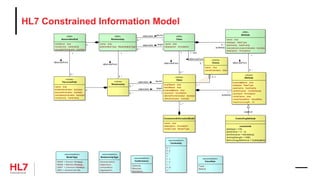
Components of an HL7 Constrained Information Model
• The HL7 v3 methodology specifies the information content of transport datasets (messages or
documents) as constrained information models (CIM).
• Each CIM is comprised of clone classes derived from HL7 RIM classes.
• Clone classes are associated with attributes and relationships also derived from corresponding
RIM model elements.
• A CIM may include a choice structure derived from a root RIM class and its specializations.
• Relationships in the CIM are composed of two traversal paths, each derived from association
ends in RIM class relationships.
• Controlling attributes in clone classes are used to identify the specific specialization of the RIM
class used to derive the CIM clone class.
HL7 Constrained Information Model
«clone»
Class
localName: char
fixedName: char
businessName: char
comment: Annotation
isEntryPointIndicator: boolean
isStubIndicator: boolean
«RIM»
Class
name: char
description: Annotation
«clone»
Attribute
businessName: char
datatype: DataType
cardinality: Cardinality
conformance: Conformance
comment: Annotation
initialValue: char
initialValueRole: ValueRole
maximumLength: int
«RIM»
Attribute
name: char
datatype: DataType
cardinality: Cardinality
mandatoryInclusionIndicator: boolean
description: Annotation
«RIM»
Relationship
name: char
relationshipType: RelationshipType
«clone»
Relationship
ConstrainedInformationModel
name: char
description: Annotation
modelType: ModelType
ControllingAttribute
constraints
{datatype = CS}
{cardinality = (1..1)}
{conformance = Mandatory}
{codingStrength = CNE}
{terminologyReference = CodeSystem}
«RIM»
AssociationEnd
roleName: char
multiplicity: Cardinality
navigabilityIndicator: boolean
«clone»
TraversalPath
name: char
enabledIndicator: boolean
requiredIndicator: boolean
mandatoryIndicator: boolean
multiplicity: Cardinality
«enumeration»
Cardinality
0..1
0..n
0..*
1
1..1
1..n
1..*
n..m
n..*
«enumeration»
RelationshipType
Generalization
Association
Composition
Aggregation
«clone»
Choice
name: char
nameExtension: char
«enumeration»
Conformance
Optional
Required
Mandatory
«enumeration»
ValueRole
Fixed
Default
«enumeration»
ModelType
DMIM = Domain Message ...
RMIM = Refined Message...
CMET = Common Message ...
HMD = Hierarchical Me...
0..*
associates source
1
«restrict»
1..*
0..*
associates target
1
0..*
associates target
1
0..*
associates source
1
0..*
isDerivedFrom
1
0..*
{ordered}
1..*
{ordered}
0..*
isDerivedFrom
1
0..*
isDerivedFrom
1
0..*
isDerivedFrom
root1
1..*
0..1
0..*
isDerivedFrom
1
2
2
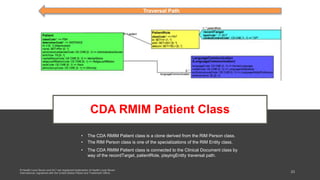
CDA RMIM Patient Class
• The CDA RMIM Patient class is a clone derived from the RIM Person class.
• The RIM Person class is one of the specializations of the RIM Entity class.
• The CDA RMIM Patient class is connected to the Clinical Document class by
way of the recordTarget, patientRole, playingEntity traversal path.
Traversal Path
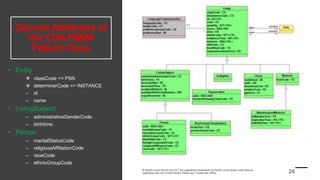
Derived Attributes of
the CDA RMIM
Patient Class
• Entity
 classCode <= PSN
 determinerCode <= INSTANCE
– id
– name
• LivingSubject
– administrativeGenderCode
– birthtime
• Person
– maritalStatusCode
– religiousAffiliationCode
– raceCode
– ethnicGroupCode
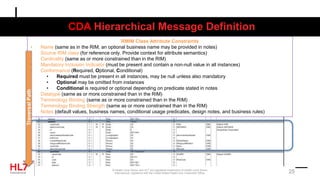
CDA Hierarchical Message Definition
® Health Level Seven and HL7 are registered trademarks of Health Level Seven
International, registered with the United States Patent and Trademark Office. 25
RMIM Class Attribute Constraints
• Name (same as in the RIM, an optional business name may be provided in notes)
• Source RIM class (for reference only. Provide context for attribute semantics)
• Cardinality (same as or more constrained than in the RIM)
• Mandatory Inclusion Indicator (must be present and contain a non-null value in all instances)
• Conformance (Required, Optional, Conditional)
• Required must be present in all instances, may be null unless also mandatory
• Optional may be omitted from instances
• Conditional is required or optional depending on predicate stated in notes
• Datatype (same as or more constrained than in the RIM)
• Terminology Binding (same as or more constrained than in the RIM)
• Terminology Binding Strength (same as or more constrained than in the RIM)
• Notes (default values, business names, conditional usage predicates, design notes, and business rules)
TraversalPath
HL7 V3 XML SCHEMA GENERATOR
® Health Level Seven and HL7 are registered trademarks of Health Level Seven International, registered with the United States Patent and Trademark Office. 26
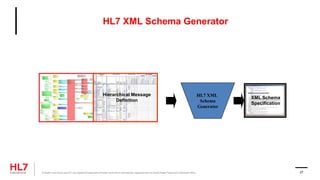
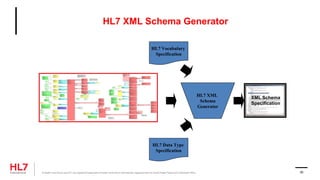
HL7 XML Schema Generator
HL7 XML
Schema
Generator
XML Schema
Specification
Hierarchical Message
Definition
® Health Level Seven and HL7 are registered trademarks of Health Level Seven International, registered with the United States Patent and Trademark Office. 27
Essential XML ITS Transformation Rules
• All XML elements and attributes are to be represented in the namespace defined by "urn:hl7-org:v3".
• The XML representation for the members of a class will be a sequence of child elements, one for each
attribute followed by one for each outbound association.
• Where the HL7 static model allows for an association to a choice of classes, the representation of the
XML shall be the same as would be the case if there had been no choice, and only the class
corresponding to the information items in the HL7 instances were included in the specification.
• All HL7 RIM structural attributes are represented as XML attributes. All other HL7 RIM attributes are
represented as XML elements.
• The type of the HL7 attribute will be one of the types defined in the ISO datatypes. That specification
includes a definition of the XML serialization to be used.
• When included in an instance local extensions MUST be in a namespace other than the HL7v3
namespace.
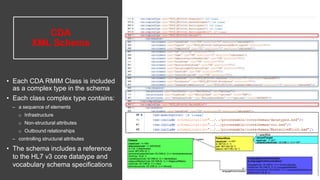
CDA
XML Schema
• Each CDA RMIM Class is included
as a complex type in the schema
• Each class complex type contains:
– a sequence of elements
o Infrastructure
o Non-structural attributes
o Outbound relationships
– controlling structural attributes
• The schema includes a reference
to the HL7 v3 core datatype and
vocabulary schema specifications
HL7 XML Schema Generator
HL7 XML
Schema
Generator
HL7 Data Type
Specification
HL7 Vocabulary
Specification
XML Schema
Specification
® Health Level Seven and HL7 are registered trademarks of Health Level Seven International, registered with the United States Patent and Trademark Office. 30
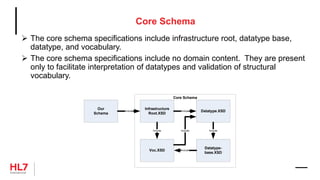
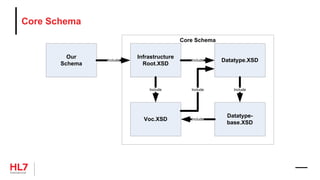
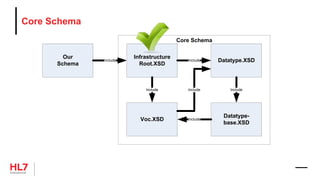
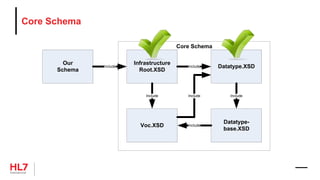
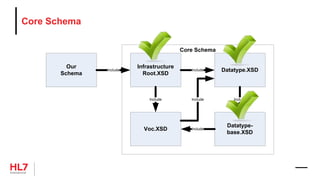
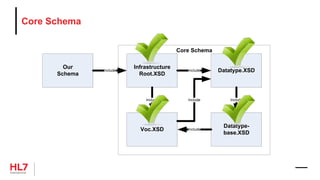
Core Schema
 The core schema specifications include infrastructure root, datatype base,
datatype, and vocabulary.
 The core schema specifications include no domain content. They are present
only to facilitate interpretation of datatypes and validation of structural
vocabulary.
Our
Schema
Infrastructure
Root.XSD
Datatype.XSD
Datatype-
base.XSD
Voc.XSD
Include Include
Include Include Include
Include
Core Schema
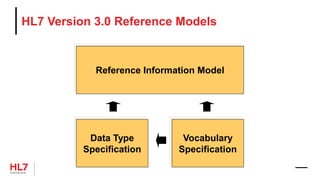
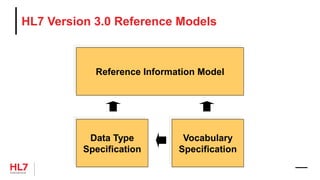
HL7 Version 3.0 Reference Models
Reference Information Model
Data Type
Specification
Vocabulary
Specification
HL7 VERSION 3.0
DATA TYPE SPECIFICATION
The HL7 v3 Abstract Datatype Specification defines the
structural format of the data carried in an attribute and
influences the set of allowable values an attribute may assume.
HL7 Version 3.0 Data Types
• HL7 data types define the structure and constrain the allowable values of attributes in the
RIM.
• The HL7 v3 abstract data type specification declares the set of data types, identifies
components of complex types, and defines relationships between data types.
• The HL7 data type implementation technology specification defines constraints and
operations for data types and describes how data types are to be represented in XML.
• Data types are reusable atomic building blocks used to create all HL7 V3 information
structures.
• Each RIM attribute is assigned one data type; each data type is assigned to zero, one, or
more RIM attribute.
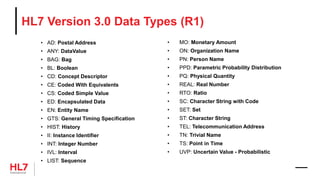
HL7 Version 3.0 Data Types (R1)
• AD: Postal Address
• ANY: DataValue
• BAG: Bag
• BL: Boolean
• CD: Concept Descriptor
• CE: Coded With Equivalents
• CS: Coded Simple Value
• ED: Encapsulated Data
• EN: Entity Name
• GTS: General Timing Specification
• HIST: History
• II: Instance Identifier
• INT: Integer Number
• IVL: Interval
• LIST: Sequence
• MO: Monetary Amount
• ON: Organization Name
• PN: Person Name
• PPD: Parametric Probability Distribution
• PQ: Physical Quantity
• REAL: Real Number
• RTO: Ratio
• SC: Character String with Code
• SET: Set
• ST: Character String
• TEL: Telecommunication Address
• TN: Trivial Name
• TS: Point in Time
• UVP: Uncertain Value - Probabilistic
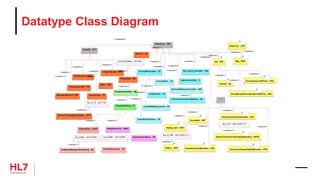
Datatype Class Diagram
T
Sequence : LIST
T
Set : SET
T
Bag : BAG
Quantity : QTY
IntegerNumber : INT
RealNumber : REAL
PhysicalQuantity : PQ
MonetaryAmount : MO
Ratio : RTO
PointInTime : TS
Boolean : BL
CharacterString : ST
ConceptDescriptor : CD
CodedValue : CV
InstanceIdentifier : II
TelecommunicationAddress : TEL
T
Interval : IVL
DataValue : ANY
BinaryData : BIN
List_of_Boolean : LIST<BL>
<<extends>>
EncapsulatedData : ED
<<extends>>
ConceptRole : CR
CodedSimpleValue : CS
<<restricts>>
CodedWithEquivalents : CE
ISO_object_identifier : OID
List_ADXP : LIST<ADXP>
PostalAndResidentialAddress : AD
<<extends>>
AddressPart : ADXP
PersonNameType : PN
List_ENXP : LIST<ENXP>
EntityNamePart : ENXP
T
PeriodicIntervalOfTime : PIVL
T
EventRelatedPeriodicIntervalOfTime : EIVL
GeneralTimingSpecification : GTS
Set_of_TS : SET<TS>
<<extends>>
T : T
T
Annotated : ANT
T
History_item : HXIT
T
History : HIST
Set_of_HXIT : SET<HXIT<T>>
T
UncertainValueNarrative : UVN
<<extends>>
T
UncertainValueProbabilistic : UVP
T
NonParametricProbabilityDistribution : NPPD
Set_UVP : SET<UVP<T>>
T
ParametricProbabilityDistribution : PPD
UniversalResourceLocator : URL
<<extends>>
OrganizationName : ON
<<extends>>
<<extends>><<extends>>
<<extends>>
<<extends>>
<<extends>>
<<extends>>
<<extends>>
<<extends>>
<<extends>>
<<extends>>
<<restricts>>
<<restricts>>
<<restricts>>
<<extends>>
<<extends>>
<<extends>><<extends>>
<<extends>>
<<extends>>
<<extends>>
<<extends>>
<<extends>><<extends>>
<<restricts>>
<<extends>>
<<extends>>
<<extends>>
<<extends>> <<extends>>
<<extends>>
AddressDataTypes
+ AddressPart : ADXP
+ PostalAndResidentialAddress : AD
+ TelecommunicationAddress : TEL
+ UniversalResourceLocator : URL
CharacterStringDatatypes
+ CharacterString : ST
+ EncapsulatedData : ED
+ StringWithCode : SC
ConceptDescriptorDataTypes
+ CodedSimpleValue : CS
+ CodedValue : CV
+ CodedWithEquivalents : CE
+ ConceptDescriptor : CD
+ ConceptRole : CR
AnyDataType
+ DataValue : ANY
ParameterizedDataTypes
+ Bag : BAG
+ Interval : IVL
+ Sequence : LIST
+ Set : SET
IdentifierDataTypes
+ ISOObjectIdentifier : OID
+ InstanceIdentifier : II
EntityNameDataTypes
+ EntityName : EN
+ EntityNamePart : ENXP
+ OrganizationName : ON
+ PersonNameType : PN
+ TrivialName : TN
QuantityDataTypes
+ BinaryData : BIN
+ Boolean : BL
+ IntegerNumber : INT
+ MonetaryAmount : MO
+ PhysicalQuantity : PQ
+ Quantity : QTY
+ Ratio : RTO
+ RealNumber : REAL
TimingExpressionDatatypes
+ GeneralTimingSpecification : GTS
+ GeneralTimingSpecificationTerm
+ PointInTime : TS
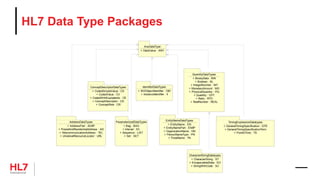
HL7 Data Type Packages
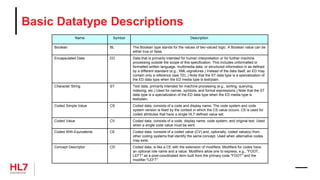
Basic Datatype Descriptions
Name Symbol Description
Boolean BL The Boolean type stands for the values of two-valued logic. A Boolean value can be
either true or false.
Encapsulated Data ED Data that is primarily intended for human interpretation or for further machine
processing outside the scope of this specification. This includes unformatted or
formatted written language, multimedia data, or structured information in as defined
by a different standard (e.g., XML-signatures.) Instead of the data itself, an ED may
contain only a reference (see TEL.) Note that the ST data type is a specialization of
the ED data type when the ED media type is text/plain.
Character String ST Text data, primarily intended for machine processing (e.g., sorting, querying,
indexing, etc.) Used for names, symbols, and formal expressions.) Note that the ST
data type is a specialization of the ED data type when the ED media type is
text/plain.
Coded Simple Value CS Coded data, consists of a code and display name. The code system and code
system version is fixed by the context in which the CS value occurs. CS is used for
coded attributes that have a single HL7-defined value set.
Coded Value CV Coded data, consists of a code, display name, code system, and original text. Used
when a single code value must be sent.
Coded With Equivalents CE Coded data, consists of a coded value (CV) and, optionally, coded value(s) from
other coding systems that identify the same concept. Used when alternative codes
may exist.
Concept Descriptor CD Coded data, is like a CE with the extension of modifiers. Modifiers for codes have
an optional role name and a value. Modifiers allow one to express, e.g., "FOOT,
LEFT" as a post-coordinated term built from the primary code "FOOT" and the
modifier "LEFT".
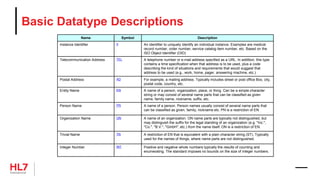
Basic Datatype Descriptions
Name Symbol Description
Instance Identifier II An identifier to uniquely identify an individual instance. Examples are medical
record number, order number, service catalog item number, etc. Based on the
ISO Object Identifier (OID)
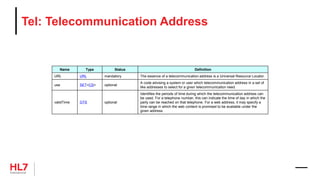
Telecommunication Address TEL A telephone number or e-mail address specified as a URL. In addition, this type
contains a time specification when that address is to be used, plus a code
describing the kind of situations and requirements that would suggest that
address to be used (e.g., work, home, pager, answering machine, etc.)
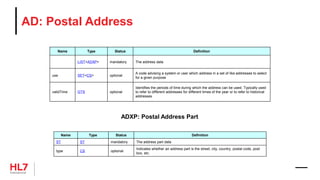
Postal Address AD For example, a mailing address. Typically includes street or post office Box, city,
postal code, country, etc.
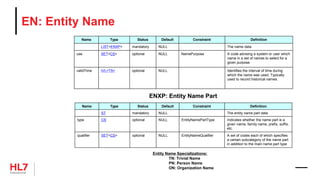
Entity Name EN A name of a person, organization, place, or thing. Can be a simple character
string or may consist of several name parts that can be classified as given
name, family name, nickname, suffix, etc.
Person Name PN A name of a person. Person names usually consist of several name parts that
can be classified as given, family, nickname etc. PN is a restriction of EN.
Organization Name ON A name of an organization. ON name parts are typically not distinguished, but
may distinguish the suffix for the legal standing of an organization (e.g. "Inc.",
"Co.", "B.V.", "GmbH", etc.) from the name itself. ON is a restriction of EN.
Trivial Name TN A restriction of EN that is equivalent with a plain character string (ST). Typically
used for the names of things, where name parts are not distinguished.
Integer Number INT Positive and negative whole numbers typically the results of counting and
enumerating. The standard imposes no bounds on the size of integer numbers.
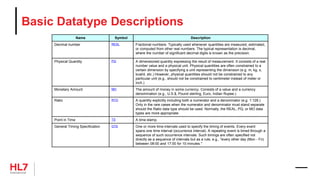
Basic Datatype Descriptions
Name Symbol Description
Decimal number REAL Fractional numbers. Typically used whenever quantities are measured, estimated,
or computed from other real numbers. The typical representation is decimal,
where the number of significant decimal digits is known as the precision.
Physical Quantity PQ A dimensioned quantity expressing the result of measurement. It consists of a real
number value and a physical unit. Physical quantities are often constrained to a
certain dimension by specifying a unit representing the dimension (e.g. m, kg, s,
kcal/d, etc.) However, physical quantities should not be constrained to any
particular unit (e.g., should not be constrained to centimeter instead of meter or
inch.)
Monetary Amount MO The amount of money in some currency. Consists of a value and a currency
denomination (e.g., U.S.$, Pound sterling, Euro, Indian Rupee.)
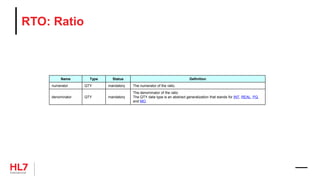
Ratio RTO A quantity explicitly including both a numerator and a denominator (e.g. 1:128.)
Only in the rare cases when the numerator and denominator must stand separate
should the Ratio data type should be used. Normally, the REAL, PQ, or MO data
types are more appropriate.
Point in Time TS A time stamp.
General Timing Specification GTS One or more time intervals used to specify the timing of events. Every event
spans one time interval (occurrence interval). A repeating event is timed through a
sequence of such occurrence intervals. Such timings are often specified not
directly as a sequence of intervals but as a rule, e.g., "every other day (Mon - Fri)
between 08:00 and 17:00 for 10 minutes."
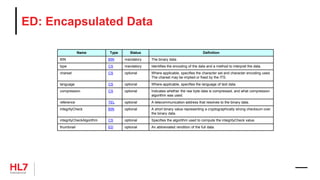
ED: Encapsulated Data
Name Type Status Definition
BIN BIN mandatory The binary data.
type CS mandatory Identifies the encoding of the data and a method to interpret the data.
charset CS optional Where applicable, specifies the character set and character encoding used.
The charset may be implied or fixed by the ITS.
language CS optional Where applicable, specifies the language of text data.
compression CS optional Indicates whether the raw byte data is compressed, and what compression
algorithm was used.
reference TEL optional A telecommunication address that resolves to the binary data.
integrityCheck BIN optional A short binary value representing a cryptographically strong checksum over
the binary data.
integrityCheckAlgorithm CS optional Specifies the algorithm used to compute the integrityCheck value.
thumbnail ED optional An abbreviated rendition of the full data.
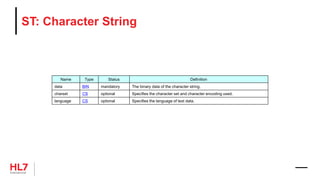
ST: Character String
Name Type Status Definition
data BIN mandatory The binary data of the character string.
charset CS optional Specifies the character set and character encoding used.
language CS optional Specifies the language of text data.
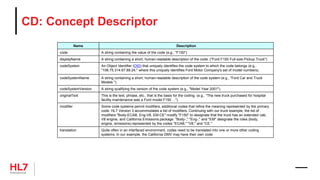
CD: Concept Descriptor
Name Description
code A string containing the value of the code (e.g., "F150")
displayName A string containing a short, human-readable description of the code. ("Ford F150 Full-size Pickup Truck")
codeSystem An Object Identifier (OID) that uniquely identifies the code system to which the code belongs (e.g.,
"106.75.314.67.89.24," where this uniquely identifies Ford Motor Company's set of model numbers).
codeSystemName A string containing a short, human-readable description of the code system (e.g., "Ford Car and Truck
Models ").
codeSystemVersion A string qualifying the version of the code system (e.g., "Model Year 2001").
originalText This is the text, phrase, etc., that is the basis for the coding. (e.g., "The new truck purchased for hospital
facility maintenance was a Ford model F150 ...").
modifier Some code systems permit modifiers, additional codes that refine the meaning represented by the primary
code. HL7 Version 3 accommodates a list of modifiers. Continuing with our truck example, the list of
modifiers "Body-ECAB, Eng-V8, EM-CE" modify "F150" to designate that the truck has an extended cab,
V8 engine, and California Emissions package. "Body-," "Eng-," and "EM" designate the roles (body,
engine, emissions) represented by the codes "ECAB," "V8," and "CE."
translation Quite often in an interfaced environment, codes need to be translated into one or more other coding
systems. In our example, the California DMV may have their own code
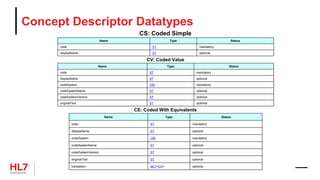
Concept Descriptor Datatypes
Name Type Status
code ST mandatory
displayName ST optional
Name Type Status
code ST mandatory
displayName ST optional
codeSystem OID mandatory
codeSystemName ST optional
codeSystemVersion ST optional
originalText ST optional
Name Type Status
code ST mandatory
displayName ST optional
codeSystem OID mandatory
codeSystemName ST optional
codeSystemVersion ST optional
originalText ST optional
translation SET<CV> optional
CS: Coded Simple
CV: Coded Value
CE: Coded With Equivalents
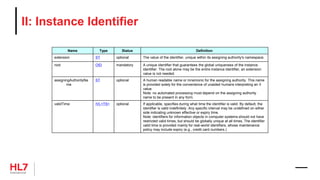
II: Instance Identifier
Name Type Status Definition
extension ST optional The value of the identifier, unique within its assigning authority's namespace.
root OID mandatory A unique identifier that guarantees the global uniqueness of the instance
identifier. The root alone may be the entire instance identifier, an extension
value is not needed.
assigningAuthorityNa
me
ST optional A human readable name or mnemonic for the assigning authority. This name
is provided solely for the convenience of unaided humans interpreting an II
value.
Note: no automated processing must depend on the assigning authority
name to be present in any form.
validTime IVL<TS> optional If applicable, specifies during what time the identifier is valid. By default, the
identifier is valid indefinitely. Any specific interval may be undefined on either
side indicating unknown effective or expiry time.
Note: identifiers for information objects in computer systems should not have
restricted valid times, but should be globally unique at all times. The identifier
valid time is provided mainly for real-world identifiers, whose maintenance
policy may include expiry (e.g., credit card numbers.)
Tel: Telecommunication Address
Name Type Status Definition
URL URL mandatory The essence of a telecommunication address is a Universal Resource Locator.
use SET<CS> optional
A code advising a system or user which telecommunication address in a set of
like addresses to select for a given telecommunication need.
validTime GTS optional
Identifies the periods of time during which the telecommunication address can
be used. For a telephone number, this can indicate the time of day in which the
party can be reached on that telephone. For a web address, it may specify a
time range in which the web content is promised to be available under the
given address.
AD: Postal Address
Name Type Status Definition
LIST<ADXP> mandatory The address data
use SET<CS> optional
A code advising a system or user which address in a set of like addresses to select
for a given purpose
validTime GTS optional
Identifies the periods of time during which the address can be used. Typically used
to refer to different addresses for different times of the year or to refer to historical
addresses.
Name Type Status Definition
ST ST mandatory The address part data
type CS optional
Indicates whether an address part is the street, city, country, postal code, post
box, etc.
ADXP: Postal Address Part
EN: Entity Name
Name Type Status Default Constraint Definition
ST mandatory NULL The entity name part data
type CS optional NULL EntityNamePartType Indicates whether the name part is a
given name, family name, prefix, suffix,
etc.
qualifier SET<CS> optional NULL EntityNameQualifier A set of codes each of which specifies
a certain subcategory of the name part
in addition to the main name part type
Name Type Status Default Constraint Definition
LIST<ENXP> mandatory NULL The name data
use SET<CS> optional NULL NamePurpose A code advising a system or user which
name in a set of names to select for a
given purpose
validTime IVL<TS> optional NULL Identifies the interval of time during
which the name was used. Typically
used to record historical names.
ENXP: Entity Name Part
Entity Name Specializations:
TN: Trivial Name
PN: Person Name
ON: Organization Name
RTO: Ratio
Name Type Status Definition
numerator QTY mandatory The numerator of the ratio.
denominator QTY mandatory
The denominator of the ratio
The QTY data type is an abstract generalization that stands for INT, REAL, PQ,
and MO.
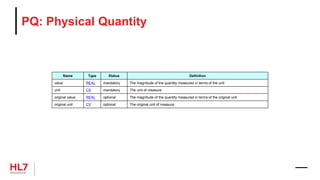
PQ: Physical Quantity
Name Type Status Definition
value REAL mandatory The magnitude of the quantity measured in terms of the unit
unit CS mandatory The unit of measure
original value REAL optional The magnitude of the quantity measured in terms of the original unit.
original unit CV optional The original unit of measure.
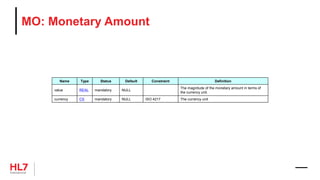
MO: Monetary Amount
Name Type Status Default Constraint Definition
value REAL mandatory NULL
The magnitude of the monetary amount in terms of
the currency unit.
currency CS mandatory NULL ISO 4217 The currency unit
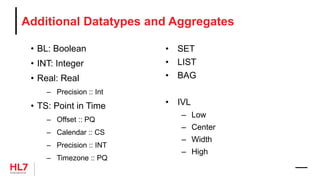
Additional Datatypes and Aggregates
• BL: Boolean
• INT: Integer
• Real: Real
– Precision :: Int
• TS: Point in Time
– Offset :: PQ
– Calendar :: CS
– Precision :: INT
– Timezone :: PQ
• SET
• LIST
• BAG
• IVL
– Low
– Center
– Width
– High
HL7 VERSION 3.0
VOCABULARY SPECIFICATION
The HL7 Vocabulary Specification defines the set of
all concepts that can be taken as valid values in an
instance of a coded attribute or message element.
HL7 V3 Vocabulary Specification
• The HL7 V3 Vocabulary Specification defines vocabulary domains used in RIM coded
Attributes and coded data type properties.
• A vocabulary domain is an abstract collection of interrelated concepts. It describes the purpose
or intent of a coded attribute.
• A value set is a collection of coded concepts drawn from one or more code systems. A
vocabulary domain may be associated with many value sets (e.g. for use in different countries).
• A context expression provides a means of designating which value set for a given domain are
applicable for a given usage context.
• A coded concept has a concept code assigned by the coding system and a concept
designation which names the referenced concept.
• A coded concept may be a parent concept for a collection of additional concepts within the
same code system.
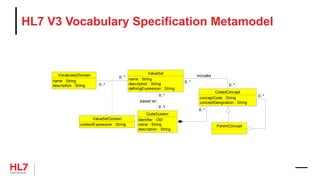
HL7 V3 Vocabulary Specification Metamodel
ParentConcept
VocabularyDomain
name : String
description : String
CodedConcept
conceptCode : String
conceptDesignation : String
0..*0..*
ValueSet
name : String
description : String
definingExpression : String
0..*
0..*
0..*
0..*
0..*
0..*
0..*
0..*
includes
CodeSystem
identifier : OID
name : String
description : String
0..*0..*
0..*
0..1
0..*
0..1
based on
ValueSetContext
contextExpression : String
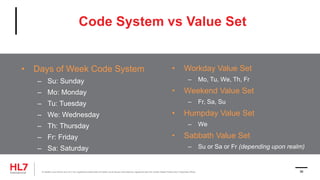
Code System vs Value Set
• Days of Week Code System
– Su: Sunday
– Mo: Monday
– Tu: Tuesday
– We: Wednesday
– Th: Thursday
– Fr: Friday
– Sa: Saturday
• Workday Value Set
– Mo, Tu, We, Th, Fr
• Weekend Value Set
– Fr, Sa, Su
• Humpday Value Set
– We
• Sabbath Value Set
– Su or Sa or Fr (depending upon realm)
® Health Level Seven and HL7 are registered trademarks of Health Level Seven International, registered with the United States Patent and Trademark Office. 56
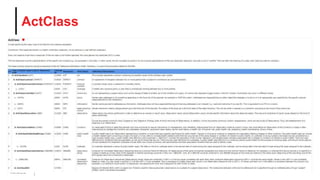
ActClass
ActMood
® Health Level Seven and HL7 are registered trademarks of Health Level Seven International, registered with the United States Patent and Trademark Office. 58
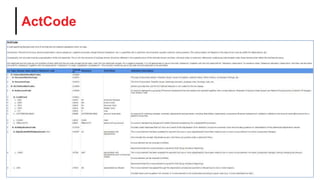
ActCode
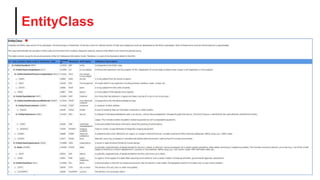
EntityClass
® Health Level Seven and HL7 are registered trademarks of Health Level Seven International, registered with the United States Patent and Trademark Office. 60
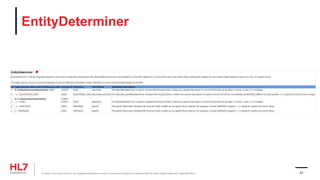
EntityDeterminer
® Health Level Seven and HL7 are registered trademarks of Health Level Seven International, registered with the United States Patent and Trademark Office. 61
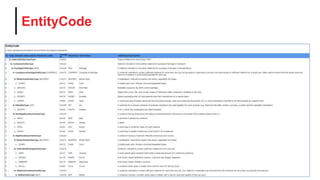
EntityCode
® Health Level Seven and HL7 are registered trademarks of Health Level Seven International, registered with the United States Patent and Trademark Office. 62
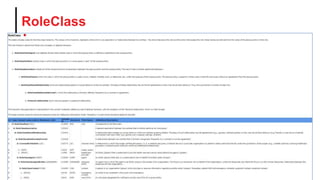
RoleClass
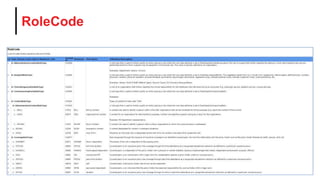
RoleCode
® Health Level Seven and HL7 are registered trademarks of Health Level Seven International, registered with the United States Patent and Trademark Office. 64
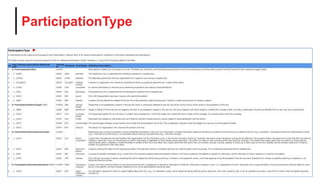
ParticipationType
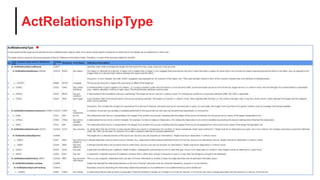
ActRelationshipType
® Health Level Seven and HL7 are registered trademarks of Health Level Seven International, registered with the United States Patent and Trademark Office. 66
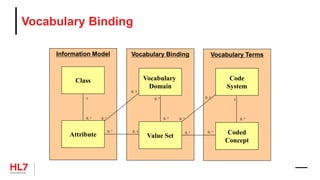
Vocabulary TermsVocabulary BindingInformation Model
Vocabulary Binding
Class
Attribute
Vocabulary
Domain
Value Set Coded
Concept
Code
System
1
0..* 0..*
0..1
0..10..*
0..*
0..*
0..* 0..*
0..*
1
0..*
0..1
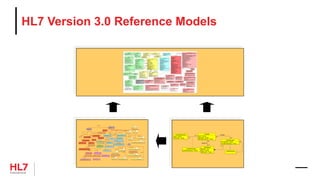
HL7 Version 3.0 Reference Models
Reference Information Model
Data Type
Specification
Vocabulary
Specification
HL7 Version 3.0 Reference Models
ParentConcept
VocabularyDomain
name : String
description : String
CodedConcept
conceptCode : String
conceptDesignation : String
0..*0..*
ValueSet
name : String
description : String
definingExpression : String
0..*
0..*
0..*
0..*
0..*
0..*
0..*
0..*
includes
CodeSystem
identifier : OID
name : String
description : String
0..*0..*
0..*
0..1
0..*
0..1
based on
ValueSetContext
contextExpression : String
T
Sequence : LIST
T
Set : SET
T
Bag : BAG
Quantity : QTY
IntegerNumber : INT
RealNumber : REAL
PhysicalQuantity : PQ
MonetaryAmount : MO
Ratio : RTO
PointInTime : TS
Boolean : BL
CharacterString : ST
ConceptDescriptor : CD
CodedValue : CV
InstanceIdentifier : II
TelecommunicationAddress : TEL
T
Interval : IVL
DataValue : ANY
BinaryData : BIN
List_of_Boolean : LIST<BL>
<<extends>>
EncapsulatedData : ED
<<extends>>
ConceptRole : CR
CodedSimpleValue : CS
<<restricts>>
CodedWithEquivalents : CE
ISO_object_identifier : OID
List_ADXP : LIST<ADXP>
PostalAndResidentialAddress : AD
<<extends>>
AddressPart : ADXP
PersonNameType : PN
List_ENXP : LIST<ENXP>
EntityNamePart : ENXP
T
PeriodicIntervalOfTime : PIVL
T
EventRelatedPeriodicIntervalOfTime : EIVL
GeneralTimingSpecification : GTS
Set_of_TS : SET<TS>
<<extends>>
T : T
T
Annotated : ANT
T
History_item : HXIT
T
History : HIST
Set_of_HXIT : SET<HXIT<T>>
T
UncertainValueNarrative : UVN
<<extends>>
T
UncertainValueProbabilistic : UVP
T
NonParametricProbabilityDistribution : NPPD
Set_UVP : SET<UVP<T>>
T
ParametricProbabilityDistribution : PPD
UniversalResourceLocator : URL
<<extends>>
OrganizationName : ON
<<extends>>
<<extends>><<extends>>
<<extends>>
<<extends>>
<<extends>>
<<extends>>
<<extends>>
<<extends>>
<<extends>>
<<extends>>
<<restricts>>
<<restricts>>
<<restricts>>
<<extends>>
<<extends>>
<<extends>><<extends>>
<<extends>>
<<extends>>
<<extends>>
<<extends>>
<<extends>><<extends>>
<<restricts>>
<<extends>>
<<extends>>
<<extends>>
<<extends>> <<extends>>
<<extends>>
® Health Level Seven and HL7 are registered trademarks of Health Level Seven
International, registered with the United States Patent and Trademark Office. 70
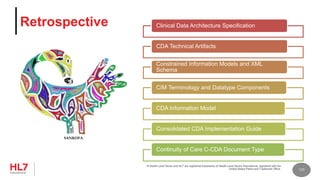
Course
Outline
Clinical Data Architecture Specification
CDA Technical Artifacts
Constrained Information Models and XML
Schema
CIM Terminology and Datatype Components
CDA Information Model
Consolidated CDA Implementation Guide
Continuity of Care C-CDA Document Type
® Health Level Seven and HL7 are registered trademarks of Health Level Seven International,
registered with the United States Patent and Trademark Office. 72
CIM TERMINOLOGY AND DATATYPE
COMPONENTS
® Health Level Seven and HL7 are registered trademarks of Health Level Seven International, registered with the United States Patent and Trademark Office. 73
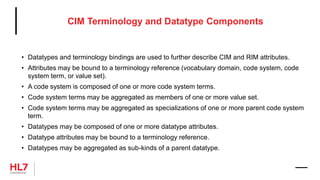
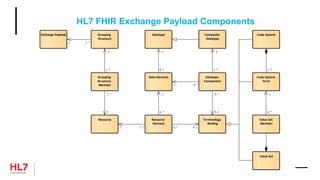
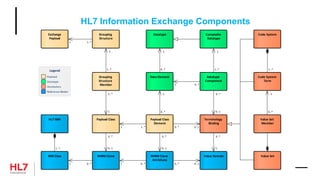
CIM Terminology and Datatype Components
• Datatypes and terminology bindings are used to further describe CIM and RIM attributes.
• Attributes may be bound to a terminology reference (vocabulary domain, code system, code
system term, or value set).
• A code system is composed of one or more code system terms.
• Code system terms may be aggregated as members of one or more value set.
• Code system terms may be aggregated as specializations of one or more parent code system
term.
• Datatypes may be composed of one or more datatype attributes.
• Datatype attributes may be bound to a terminology reference.
• Datatypes may be aggregated as sub-kinds of a parent datatype.
HL7 CIM Terminology and Datatype
«clone»
Attribute
businessName: char
datatype: DataType
cardinality: Cardinality
conformance: Conformance
comment: Annotation
initialValue: char
initialValueRole: ValueRole
maximumLength: int
«RIM»
Attribute
name: char
datatype: DataType
cardinality: Cardinality
mandatoryInclusionIndicator: boolean
description: Annotation
ControllingAttribute
constraints
{datatype = CS}
{cardinality = (1..1)}
{conformance = Mandatory}
{codingStrength = CNE}
{terminologyReference = CodeSystem}
«RIM»
TerminologyBinding
codingStrength: CodingStrength
«clone»
TerminologyBinding
codingStrength: CodingStrength
TerminologyReference
{abstract}
name: char
description: Annotation
VocabularyDomain
ValueSet
conceptIdentifier: char
CodeSystem
objectIdentifier: char
releaseIdentifier: char
isExternalIndicator: boolean
CodeSystemTerm
code: char [0..1]
designation: char
description: Annotation
internalIdentifier: char
DataType
longName: char
shortName: char
description: Annotation
DatatypeAttribute
name: char
datatype: DataType
description: Annotation
ParentDatatype
«datatype»
TerminologyBinding
codingStrength: CodingStrength
Annotation
{abstract}
«enumeration»
CodingStrength
CNE
CWE
ParentCodeSystemTerm
AnnotationSection
sectionRole: AnnotationSectionRole
sectionText: char
«enumeration»
AnnotationSectionRole
Description
Rationale
Design Comment
Issue
Implementation Note
History
Mapping
0..*
binds
1
0..1
binds
1
0..1
binds
1
0..*
isDerivedFrom
1
«restrict»
0..*
isDerivedFrom
1
0..*
binds
1
1..*
subkind
1..*
0..*
0..*
binds
1
0..1
binds
1
0..*
0..*
isBoundTo
1
member
1..*0..*
1..*
subkind
1..*
0..1
Core Schema
Our
Schema
Infrastructure
Root.XSD
Datatype.XSD
Datatype-
base.XSD
Voc.XSD
Include Include
Include Include Include
Include
Core Schema
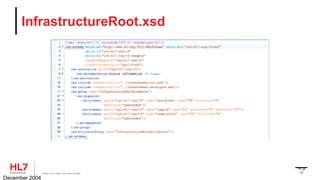
InfrastructureRoot.xsd
Design-Level Static Information Models
77 of
77
December 2004
Core Schema
Our
Schema
Infrastructure
Root.XSD
Datatype.XSD
Datatype-
base.XSD
Voc.XSD
Include Include
Include Include Include
Include
Core Schema
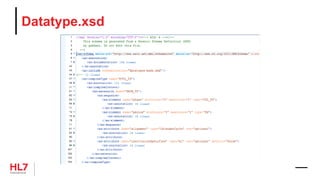
Datatype.xsd
Core Schema
Our
Schema
Infrastructure
Root.XSD
Datatype.XSD
Datatype-
base.XSD
Voc.XSD
Include Include
Include Include Include
Include
Core Schema
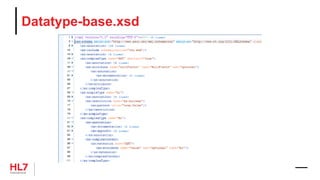
Datatype-base.xsd
Core Schema
Our
Schema
Infrastructure
Root.XSD
Datatype.XSD
Datatype-
base.XSD
Voc.XSD
Include Include
Include Include Include
Include
Core Schema
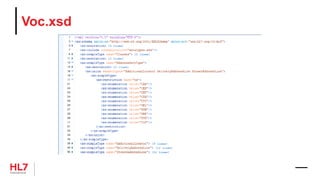
Voc.xsd
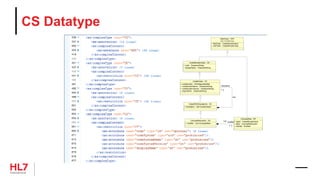
CS Datatype
CodedSimpleValue : CS
+ code : CharacterString
+ displayName : CharacterString
DataValue : ANY
+ dataType : CodedSimpleValue
+ nullFlavor : CodedSimpleValue
(from AnyDataType)
ConceptRole : CR
+ name : CodedSimpleValue
+ value : ConceptDescriptor
+ inverted : Boolean
ConceptDescriptor : CD
+ modifier : List<ConceptRole>
1..n
modifier
1..n
List
CodedValue : CV
+ codeSystem : ISOObjectIdentifier
+ codeSystemName : CharacterString
+ codeSystemVersion : CharacterString
+ originalText : CharacterString
CodedWithEquivalents : CE
+ translation : Set<CodedValue>
1..n
translation
1..n
Set
Core Schema
Our
Schema
Infrastructure
Root.XSD
Datatype.XSD
Datatype-
base.XSD
Voc.XSD
Include Include
Include Include Include
Include
Core Schema
CDA Conformance
• A conformant CDA document is one that at a minimum validates against the CDA Schema, and
that restricts its use of coded vocabulary to values allowable within the specified vocabulary
domains.
• A document originator is an application role that creates a CDA document. The document
originator is responsible for ensuring that generated CDA documents are fully conformant.
• A document recipient is an application role that receives status updates and documents from a
document originator or document management system. The document recipient is responsible
for ensuring that received CDA documents are rendered properly.
• CDA is an exchange standard. There are no persistent storage requirements for CDA
documents defined in the standard.
® Health Level Seven and HL7 are registered trademarks of Health Level Seven International, registered with the United States Patent and Trademark Office. 86
CDA INFORMATION MODEL
® Health Level Seven and HL7 are registered trademarks of Health Level Seven International, registered with the United States Patent and Trademark Office. 87
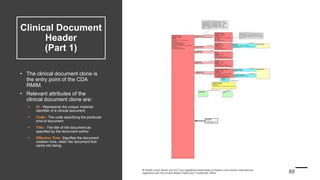
Clinical Document
Header
(Part 1)
• The clinical document clone is
the entry point of the CDA
RMIM.
• Relevant attributes of the
clinical document clone are:
 ID - Represents the unique instance
identifier of a clinical document
 Code - The code specifying the particular
kind of document
 Title - The title of the document as
specified by the document author
 Effective Time -Signifies the document
creation time, when the document first
came into being
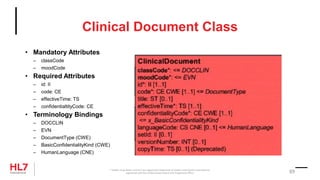
Clinical Document Class
• Mandatory Attributes
– classCode
– moodCode
• Required Attributes
– id: II
– code: CE
– effectiveTime: TS
– confidentialtityCode: CE
• Terminology Bindings
– DOCCLIN
– EVN
– DocumentType (CWE)
– BasicConfidentialityKind (CWE)
– HumanLanguage (CNE)
® Health Level Seven and HL7 are registered trademarks of Health Level Seven International,
registered with the United States Patent and Trademark Office. 89
Clinical Document Attribute Descriptions
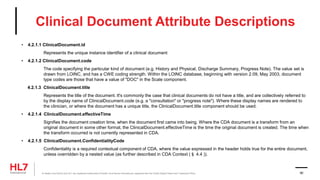
• 4.2.1.1 ClinicalDocument.id
Represents the unique instance identifier of a clinical document
• 4.2.1.2 ClinicalDocument.code
The code specifying the particular kind of document (e.g. History and Physical, Discharge Summary, Progress Note). The value set is
drawn from LOINC, and has a CWE coding strength. Within the LOINC database, beginning with version 2.09, May 2003, document
type codes are those that have a value of "DOC" in the Scale component.
4.2.1.3 ClinicalDocument.title
Represents the title of the document. It's commonly the case that clinical documents do not have a title, and are collectively referred to
by the display name of ClinicalDocument.code (e.g. a "consultation" or "progress note"). Where these display names are rendered to
the clinician, or where the document has a unique title, the ClinicalDocument.title component should be used.
• 4.2.1.4 ClinicalDocument.effectiveTime
Signifies the document creation time, when the document first came into being. Where the CDA document is a transform from an
original document in some other format, the ClinicalDocument.effectiveTime is the time the original document is created. The time when
the transform occurred is not currently represented in CDA.
• 4.2.1.5 ClinicalDocument.ConfidentialityCode
Confidentiality is a required contextual component of CDA, where the value expressed in the header holds true for the entire document,
unless overridden by a nested value (as further described in CDA Context (§ 4.4 )).
® Health Level Seven and HL7 are registered trademarks of Health Level Seven International, registered with the United States Patent and Trademark Office. 90
BasicConfidentialityKind Value Set
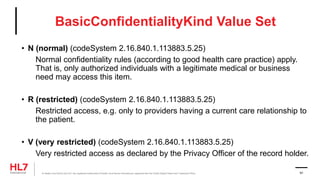
• N (normal) (codeSystem 2.16.840.1.113883.5.25)
Normal confidentiality rules (according to good health care practice) apply.
That is, only authorized individuals with a legitimate medical or business
need may access this item.
• R (restricted) (codeSystem 2.16.840.1.113883.5.25)
Restricted access, e.g. only to providers having a current care relationship to
the patient.
• V (very restricted) (codeSystem 2.16.840.1.113883.5.25)
Very restricted access as declared by the Privacy Officer of the record holder.
® Health Level Seven and HL7 are registered trademarks of Health Level Seven International, registered with the United States Patent and Trademark Office. 91
® Health Level Seven and HL7 are registered trademarks of Health Level Seven International, registered with the United States Patent and
Trademark Office. 92
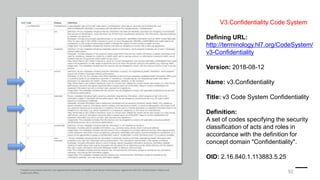
V3.Confidentiality Code System
Defining URL:
http://terminology.hl7.org/CodeSystem/
v3-Confidentiality
Version: 2018-08-12
Name: v3.Confidentiality
Title: v3 Code System Confidentiality
Definition:
A set of codes specifying the security
classification of acts and roles in
accordance with the definition for
concept domain "Confidentiality".
OID: 2.16.840.1.113883.5.25
Clinical Document
Header
(Part 2)
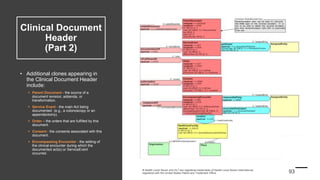
• Additional clones appearing in
the Clinical Document Header
include:
 Parent Document - the source of a
document revision, addenda, or
transformation.
 Service Event - the main Act being
documented (e.g., a colonoscopy or an
appendectomy).
 Order – the orders that are fulfilled by this
document.
 Consent - the consents associated with this
document.
 Encompassing Encounter - the setting of
the clinical encounter during which the
documented act(s) or ServiceEvent
occurred.
Clinical Document
Participating
Entities
• This section includes clones of
entities and roles related as
participants of the clinical
document.
• Key participations include:
 Record Target - the medical record that the
clinical document belongs to.
 Author - the humans and/or machines that
authored the document.
 Custodian - the organization that is in charge of
maintaining the document.
 Information Recipient - an entity to whom a
copy of a document is directed, at the time of
document authorship.
 Lesser participation types include:
 Authenticator, Legal Authenticator, Data
Enterer, and Informant.
 Participant - other participants not explicitly
mentioned by other cloned, that were somehow
involved in the documented acts.
Record Target (aka Patient)
® Health Level Seven and HL7 are registered trademarks of Health Level Seven
International, registered with the United States Patent and Trademark Office. 95
Author, Custodian, and Information Recipient
® Health Level Seven and HL7 are registered trademarks of Health Level Seven
International, registered with the United States Patent and Trademark Office. 96
Clinical Document
Body
• The CDA body can be either an
unstructured blob, or can be
comprised of structured markup.
• Every CDA document has exactly
one body, associated with the
Clinical Document class through
the component relationship.
• The Non-XML Body class
represents a document body that
is in some format other than XML.
• The Structured Body class
represents a CDA document body
that is comprised of one or more
document sections.
Document
Section
Entries
• Entries are the structured
computer-processable
components of a clinical document
section.
• The current set of CDA entries
have been developed in response
to identified requirements and
scenarios that are in CDA's scope.
• The model for CDA entries is
derived from the shared HL7
Clinical Statement model.
• The Clinical Statement model,
which provides a consistent
representation of clinical
observations and acts across
various V3 specifications.
Clinical Statement
Model
• The key classes of the clinical
statement model include:
 Observation - used for representing
coded and other observations.
 Substance Administration - used for
representing medication-related
events.
 Supply - used for representing the
provision of a material by one entity to
another.
 Procedure - used for representing an
Act whose immediate and primary
outcome is the alteration of the
physical condition of the subject.
 Encounter - used to represent related
encounters, such as follow-up visits or
referenced past encounters.
 Organizer - used to create arbitrary
groupings of other CDA entries that
share a common context
Clinical
Statement
® Health Level Seven and HL7 are registered trademarks of Health Level Seven International, registered with the United States Patent and Trademark
Office. 100
Clinical
Statement
Participants
® Health Level Seven and HL7 are registered trademarks of Health Level Seven International, registered with the United States Patent and Trademark
Office. 101
Document Header Example
® Health Level Seven and HL7 are registered trademarks of Health Level Seven International,
registered with the United States Patent and Trademark Office. 102
Structured Body Example
® Health Level Seven and HL7 are registered trademarks of Health Level Seven International,
registered with the United States Patent and Trademark Office. 103
Section Entry Example
® Health Level Seven and HL7 are registered trademarks of Health Level Seven International,
registered with the United States Patent and Trademark Office. 104
CDA TEMPLATE PROFILES
® Health Level Seven and HL7 are registered trademarks of Health Level Seven International, registered with the United States Patent and Trademark Office. 105
Template Conformance Statement
SHALL contain exactly one [1..1] @classCode="OBS" Observation
(CodeSystem: HL7ActClass 2.16.840.1.113883.5.6 STATIC)
 Element: @classCode
 Usage: SHALL contain
 Cardinality: exactly one [1..1]
 Terminology Binding: ="OBS" Observation
(CodeSystem: HL7ActClass 2.16.840.1.113883.5.6 STATIC)
® Health Level Seven and HL7 are registered trademarks of Health Level Seven International, registered with the United States Patent and Trademark Office. 106
CDA Template Profiles
Usage
• Shall
• Should
• May
Terminology
• Code System
• Code System Term
• Value Set
Cardinality
• Min: O, 1, N
• Max: 1, N, *
® Health Level Seven and HL7 are registered trademarks of Health Level Seven International, registered with the United States Patent and Trademark Office. 107
• A template is a collection of conformance statements
• A conformance statement is a collection of constraints
CONSOLIDATED CDA
IMPLEMENTATION GUIDE
® Health Level Seven and HL7 are registered trademarks of Health Level Seven International, registered with the United States Patent and Trademark Office. 108
C-CDA Sections and Entry Templates
Clinical Document Lego Blocks
® Health Level Seven and HL7 are registered trademarks of Health Level Seven International, registered with the United States Patent and Trademark Office. 109
US Realm Header Template
1. realmCode
2. typeId
3. templateId
4. id
5. code
6. title
7. effectiveDateTime
8. confidentialityCode
9. languageCode
10. setId
11. versionNumber
® Health Level Seven and HL7 are registered trademarks of Health Level Seven International, registered with the United States Patent and Trademark Office. 110
Document Types
1. Continuity of Care Document (CCD)
2. Consultation Notes
3. Discharge Summary
4. Diagnostic Imaging Reports (DIR)
5. History and Physical (H&P)
6. Operative Note
7. Progress Note
8. Procedure Note
9. Unstructured Documents
® Health Level Seven and HL7 are registered trademarks of Health Level Seven International, registered with the United States Patent and Trademark Office. 111
CONTINUITY OF CARE C-CDA
DOCUMENT TYPE
® Health Level Seven and HL7 are registered trademarks of Health Level Seven International, registered with the United States Patent and Trademark Office. 112
Continuity of Care Document (CCD)
• The Continuity of Care Document (CCD) represents a core data set of the most relevant
administrative, demographic, and clinical information facts about a patient's healthcare,
covering one or more healthcare encounters.
• It provides a means for one healthcare practitioner, system, or setting to aggregate all of the
pertinent data about a patient and forward it to another to support the continuity of care.
• The primary use case for the CCD is to provide a snapshot in time containing the germane
clinical, demographic, and administrative data for a specific patient.
• The key characteristic of a CCD is that the ServiceEvent is constrained to "PCPR". This means
it does not function to report new ServiceEvents associated with performing care. It reports on
care that has already been provided.
• The CCD provides a historical tally of the care over a range of time and is not a record of new
services in the process of being delivered.
® Health Level Seven and HL7 are registered trademarks of Health Level Seven International, registered with the United States Patent and Trademark Office. 113
CCD v3 Section Templates
Continuity of
Care Document
34133-9
2.16.840.1.113883.10.20.22.2.21 Advance Directives Section (entries optional) (V3) "42348-3" Advance Directives O
2.16.840.1.113883.10.20.22.2.6.1 Allergies and Intolerances Section (entries required) (V3)"48765-2" Allergies, adverse reactions, alerts R
2.16.840.1.113883.10.20.22.2.22 Encounters Section (entries optional) (V3) "46240-8" Encounters O
2.16.840.1.113883.10.20.22.2.15 Family History Section (V3) "10157-6" Family History O
2.16.840.1.113883.10.20.22.2.14 Functional Status Section (V2) "47420-5" Functional Status O
2.16.840.1.113883.10.20.22.2.2.1 Immunizations Section (entries required) (V3) "11369-6" Immunizations O
2.16.840.1.113883.10.20.22.2.23 Medical Equipment Section (V2) "46264-8" Medical Equipment O
2.16.840.1.113883.10.20.22.2.1.1 Medications Section (entries required) (V2) "10160-0" History of medication use R
2.16.840.1.113883.10.20.22.2.56 Mental Status Section (V2) "10190-7" Mental Status O
2.16.840.1.113883.10.20.22.2.57 Nutrition Section "61144-2" Diet and nutrition O
2.16.840.1.113883.10.20.22.2.18 Payers Section (V3) "48768-6" Payers O
2.16.840.1.113883.10.20.22.2.10 Plan of Treatment Section (V2) "18776-5" Plan of Treatment O
2.16.840.1.113883.10.20.22.2.5.1 Problem Section (entries required) (V3) "11450-4" Problem List R
2.16.840.1.113883.10.20.22.2.7.1 Procedures Section (entries required) (V2) "47519-4" History of Procedures R
2.16.840.1.113883.10.20.22.2.3.1 Results Section (entries required) (V3) "30954-2" Relevant diagnostic tests and/or laboratory data R
2.16.840.1.113883.10.20.22.2.17 Social History Section (V3) "29762-2" Social History R
2.16.840.1.113883.10.20.22.2.4.1 Vital Signs Section (entries required) (V3) "8716-3" Vital Signs R
Template OID Template Title Section Code
® Health Level Seven and HL7 are registered trademarks of Health Level Seven International, registered with the United States Patent and Trademark Office. 114
Allergies
® Health Level Seven and HL7 are registered trademarks of Health Level Seven International, registered with the United States Patent and Trademark Office. 115
Allergies and
Intolerances
Section
® Health Level Seven and HL7 are registered trademarks of Health Level Seven
International, registered with the United States Patent and Trademark Office.
Allergy Concern
Act Entry
® Health Level Seven and HL7 are registered trademarks of Health Level Seven
International, registered with the United States Patent and Trademark Office.
® Health Level Seven and HL7 are registered trademarks of Health Level Seven
International, registered with the United States Patent and Trademark Office. 118
Allergy
Intolerance
Observation
Medications
® Health Level Seven and HL7 are registered trademarks of Health Level Seven International, registered with the United States Patent and Trademark Office. 119
® Health Level Seven and HL7 are registered trademarks of Health Level Seven
International, registered with the United States Patent and Trademark Office. 120
Medication
Activity Entry
Medication Activity
Entry Template
(required elements only)
• SHALL contain exactly one [1..1] @classCode="SBADM".
• SHALL contain exactly one [1..1] @moodCode=MoodCodeEvnInt.
• SHALL contain exactly one [1..1] templateId.
• @root=“2.16.840.1.113883.10.20.22.4.16”
• @extension=“2014-06-09”
• SHALL contain at least one [1..*] id.
• SHALL contain exactly one [1..1] statusCode=Medication Status.
• SHALL contain exactly one [1..1] effectiveTime.
• SHOULD contain zero or one [0..1] @value.
• SHOULD contain zero or one [0..1] low.
• MAY contain zero or one [0..1] high.
• SHALL contain either a low or a @value but not both.
• SHALL contain exactly one [1..1] doseQuantity.
• SHALL contain exactly one [1..1] consumable
(Medication Information).
«Substance Administration»
Medication Activity
- @classCode: CD ="SBADM"
- @moodCode: CD =MoodCodeEvnInt
- templateID.@root: ST=“2.16.840.1.113...
- templateID.@extension: ST=“2014-06-09”
- id: II
- statusCode: CD =MedicationStatus
- effectiveTime.@value: TS [0..1]
- effectiveTime.low: TS [0..1]
- effectiveTime.high: TS [0..1]
- doseQuantity: PQ
«Participation»
Consumable
- typeCode: CD ="CSM"
«Role»
Manufactured Product
- @classCode: CD ="MANU"
- id: II [0..*](SET)
«Manufactured Material»
Material
- @classCode: CD ="MMAT"
- @determinerCode: CD ="KIND"
- code: CD =MedicationClini...
- name: EN [0..1]
- lotNumberText: ST[0..1]
«Organization»
Manufacturer Organization
- @classCode: CD ="ORG"
- @determinerCode: CD ="Instance"
- id: II [1..*](SET)
- name: EN.ON
1..11..1
player
+manufacturedDrugOrOtherMaterial 1..1
scoper
+manufacturer 0..1
® Health Level Seven and HL7 are registered trademarks of Health Level Seven
International, registered with the United States Patent and Trademark Office. 122
Problems
® Health Level Seven and HL7 are registered trademarks of Health Level Seven International, registered with the United States Patent and Trademark Office. 123
Procedures
® Health Level Seven and HL7 are registered trademarks of Health Level Seven International, registered with the United States Patent and Trademark Office. 124
Results
® Health Level Seven and HL7 are registered trademarks of Health Level Seven International, registered with the United States Patent and Trademark Office. 125
Social History
® Health Level Seven and HL7 are registered trademarks of Health Level Seven International, registered with the United States Patent and Trademark Office. 126
Vital Signs
® Health Level Seven and HL7 are registered trademarks of Health Level Seven International, registered with the United States Patent and Trademark Office. 127
Sections of the CCD
® Health Level Seven and HL7 are registered trademarks of Health Level Seven International, registered with the United States Patent and Trademark Office. 128
Required Sections Optional Sections
Course
Outline
Clinical Data Architecture Specification
CDA Technical Artifacts
Constrained Information Models and XML
Schema
CIM Terminology and Datatype Components
CDA Information Model
Consolidated CDA Implementation Guide
Continuity of Care C-CDA Document Type
SANKOFA
Retrospective
Questions / Discussion / Feedback
® Health Level Seven and HL7 are registered trademarks of Health Level Seven International, registered with the United States Patent and Trademark Office. 130
BONUS TRACK - HL7 INFORMATION
EXCHANGE COMPONENTS
® Health Level Seven and HL7 are registered trademarks of Health Level Seven International, registered with the United States Patent and Trademark Office. 131
HL7 v2 Message ComponentsMessage
Segment Group
Segment Group
Segment
Segment Field
Data Element
Datatype Composite
Datatype
Datatype
Component
Code Table Code Table Item
Code System
Term
Code System
1..*1
1..*
1
1..*
1
0..*1
0..* 0..1
0..*
1
0..*
1
1..*1..*
1
1..*
1
0..*
10..*
0..1
1..*1
HMD
RMIM
RMIM Clone
RIM Class Attribute
Data Element
Datatype Composite
Datatype
Datatype
Component
Terminology
Binding
Value Set
Member
Code System
Term
Code System
HL7 RIM Value SetValue Domain
1..*
1
1..*
1
0..*1
0..* 0..1
0..*
1
0..*
1
1..*1..*
1
1..*
1
0..*
1
0..*
1
0..*
0..1
0..*
0..1
1..*1
HL7 v3 Message Components
Document Section
Section Entry
Entry Entry
Element
Data Element
Datatype Composite
Datatype
Datatype
Component
Terminology
Binding
Value Set
Member
Code System
Term
Code System
Value SetCDA RMIM CloneRIM Class
HL7 RIM
RMIM Clone
Attrbitute
Value Domain
0..*1
1..*
1
1..*
1
0..*
1
0..*1
0..* 0..1
0..*
1
0..*
1
1..*
1..*
1..*
1
1..*1
0..*
1
0..* 0..10..*1
0..*
1
0..*
0..1
1..*1
0..*
1
HL7 CDA Document Components
Exchange Payload Grouping
Structure
Grouping
Structure
Member
Resource Resource
Element
Data Element
Datatype Composite
Datatype
Datatype
Component
Terminology
Binding
Value Set
Member
Code System
Term
Code System
Value Set
1..*
1
1..*
1
0..*1
0..* 0..1
0..*
1
0..*
1
1..*1..*
1
1..*1
0..*
10..*
0..1
1..*1
HL7 FHIR Exchange Payload Components
HL7 Information Exchange Components
Exchange
Payload
Grouping
Structure
Grouping
Structure
Member
Payload Class Payload Class
Element
Data Element
Datatype Composite
Datatype
Datatype
Component
Terminology
Binding
Value Set
Member
Code System
Term
Code System
Value SetRMIM CloneRIM Class
HL7 RIM
RMIM Clone
Attrbitute
Value Domain
Payload
Datatype
Vocabulary
Reference Model
Legend
0..*1
1..*
1
1..*
1
0..*
0..1
0..*1
0..* 0..1
0..*
1
0..*
1
1..*
1..*
1..*
1
1..*1
0..*
1
0..* 0..10..*1
0..*
1
0..*
0..1
1..*1
0..*
0..1
Thank You! Please keep in touch.
AbdulMalik Shakir
President and Chief Informatics Scientist
Hi3 Solutions
your healthcare standards conformance partner
1407 Foothill Blvd., Suite 145
La Verne, CA 91750
AbdulMalik.Shakir@Hi3Solutions.com
Mobile: 626.644.4491
www.linkedin.com/in/ashakir/
® Health Level Seven and HL7 are registered trademarks of Health Level Seven International, registered with the United States Patent and Trademark Office. 137
Malika Power
Shakir
dob: 04/10/2019
13
8

Hl7 advance cda may 2019 webinar

  • 1.
    Advance CDA - ClinicalDocument Architecture AbdulMalik Shakir ® Health Level Seven and HL7 are registered trademarks of Health Level Seven International, registered with the United States Patent and Trademark Office. 05/22/2019 – 05/23/2019
  • 2.
    AbdulMalik Shakir I aman experienced healthcare informatics standards expert. I specialize in the application of health information technology standards for use in: • health information exchange, • clinical decision support, and • semantic interoperability. My primary area of interest is facilitating the discovery and application of evidence based best practices in health care. ® Health Level Seven and HL7 are registered trademarks of Health Level Seven International, registered with the United States Patent and Trademark Office. 2
  • 3.
    AbdulMalik Shakir • Presidentand Chief Informatics Scientist, Hi3 Solutions • Active member of HL7 since September 1991 • Co-chair of the HL7 Modeling and Methodology Workgroup • HL7 Milestones: • Chaired the HL7 Education Workgroup from 1996 to 2010. • Received the HL7 volunteer of the year award in 1997 • Served on the HL7 Board of Directors from 2000 to 2005 • Received the HL7 Fellowship award in 2012 • Grandfather of Malika Power Shakir since April 2019 ® Health Level Seven and HL7 are registered trademarks of Health Level Seven International, registered with the United States Patent and Trademark Office. 3
  • 4.
    Course Outline ® HealthLevel Seven and HL7 are registered trademarks of Health Level Seven International, registered with the United States Patent and Trademark Office. 4 Clinical Data Architecture Specification CDA Technical Artifacts Constrained Information Models and XML Schema CIM Terminology and Datatype Components CDA Information Model Consolidated CDA Implementation Guide Continuity of Care C-CDA Document
  • 5.
    Deep Dive Advanced Perspectives • UMLClass Diagram • XML Schema • RMIM Design • Clinical Terminologies • V3 Templates
  • 6.
    Learning Objectives Upon completionof this tutorial the participant shall: 1. Understand the components and features of the CDA standard. 2. Be able to apply the CDA standard conformance rules when evaluating the validity of a CDA implementation. 3. Be able to create templates to constrain the CDA standard for use in support of a particular use case. ® Health Level Seven and HL7 are registered trademarks of Health Level Seven International, registered with the United States Patent and Trademark Office. 6 Bloom’s Taxonomy
  • 7.
    CDA STANDARD SPECIFICATION ®Health Level Seven and HL7 are registered trademarks of Health Level Seven International, registered with the United States Patent and Trademark Office. 7 https://www.hl7.org/implement/standards/product_brief.cfm?product_id=7
  • 8.
    HL7 Clinical DocumentArchitecture (CDA) • The HL7 Clinical Document Architecture (CDA) is a document markup standard that specifies the structure and semantics of "clinical documents" for the purpose of exchange. • The CDA is a constrained refinement of the HL7 v3 Reference Information Model (RIM) specific to the purpose of clinical document exchange. • The CDA standard is further constrained via the specification of implementation guides for specific document types, clinical domains, and document exchange scenarios. • The CDA is one of the initial set of standards, implementation specifications, and certification criteria for Electronic Health Record technology specified in USA Meaningful Use legislation. • The collection of implementation guides developed for CDA are widely adopted by EMR vendors; secondary users of EMR data are aligning their information requirements with these guides in anticipation of these data becoming more readily assessable. ® Health Level Seven and HL7 are registered trademarks of Health Level Seven International, registered with the United States Patent and Trademark Office. 8
  • 9.
    Clinical Document • Aclinical document is a documentation of clinical observations and services, with the following characteristics:  Persistence – A clinical document continues to exist in an unaltered state, for a time period defined by local and regulatory requirements.  Stewardship – A clinical document is maintained by an organization entrusted with its care (custodian).  Potential for authentication - A clinical document is an assemblage of information that can be legally authenticated.  Context - A clinical document establishes the default context for its contents.  Wholeness - Authentication of a clinical document applies to the whole and does not apply to portions of the document without the full context of the document.  Human readability – A clinical document is human readable. • A CDA document is a defined and complete information object that can include text, images, sounds, and other multimedia content. ® Health Level Seven and HL7 are registered trademarks of Health Level Seven International, registered with the United States Patent and Trademark Office. 9
  • 10.
    CDA Technical Artifacts HL7Reference Information Model • The HL7 RIM is the definitive reference source for class and attribute definitions. • The CDA specification does not exhaustively replicate RIM definitions, but instead refers the reader to the RIM for complete definitions. • While CDA may further constrain RIM definitions, at no time will CDA definitions conflict with those in the RIM. • CDA, Release Two is derived from HL7 RIM, Version 2.07. HL7 Vocabulary Domains • Vocabulary domains represent value sets for coded CDA components. • These domains can include HL7-defined concepts or can be drawn from HL7- recognized coding systems such as LOINC or SNOMED. • The HL7 Vocabulary chapter is the definitive reference source for the definitions of HL7-defined concepts. • While CDA may further constrain these definitions, at no time will CDA definitions conflict with those in the Vocabulary chapter. HL7 V3 Data Types • Data types define the structural format of the data carried within a RIM attribute and influence the set of allowable values an attribute may assume. • Every attribute in the RIM is associated with one and only one data type. • CDA, Release Two uses the HL7 V3 Data Types, Release One abstract and XML- specific specification. ® Health Level Seven and HL7 are registered trademarks of Health Level Seven International, registered with the United States Patent and Trademark Office. 10
  • 11.
    CDA TECHNICAL ARTIFACTS ®Health Level Seven and HL7 are registered trademarks of Health Level Seven International, registered with the United States Patent and Trademark Office. 11
  • 12.
    HL7 Reference InformationModel ® Health Level Seven and HL7 are registered trademarks of Health Level Seven International, registered with the United States Patent and Trademark Office. 12
  • 13.
    Entity and Act •Entity a physical thing or an organization/group of physical things capable of participating in Acts. This includes living subjects, organizations, material, and places. • Act a discernible action of interest in the healthcare domain. An instance of Act is a record of that action. Acts definitions (master files), orders, plans, and performance records (events) are all represented by an instance of Act. Entity Act ® Health Level Seven and HL7 are registered trademarks of Health Level Seven International, registered with the United States Patent and Trademark Office. 13
  • 14.
    Entity classCode : CS determinerCode:CS code: CE statusCode : CS id : II Role classCode : CS code: CE effectiveTime : IVL<TS> statusCode : CS id : II Participation typeCode : CS time : IVL<TS> statusCode : CS Act classCode : CS moodCode: CS code: CD statusCode : CS effectiveTime : GTS id : II 0..1 0..* 1 0..* 1 0..* Role Link typeCode : CS effectiveTime : IVL<TS> Act Relationship typeCode : CS RIM Core Classes 0..1 0..* plays scopes 1 1 0..* 0..* 1 1 0..* 0..* ® Health Level Seven and HL7 are registered trademarks of Health Level Seven International, registered with the United States Patent and Trademark Office. 14
  • 15.
    Definition of RIMCore Classes • Act – a discernible action of interest in the healthcare domain. An instance of Act is a record of that action. Acts definitions (master files), orders, plans, and performance records (events) are all represented by an instance of Act. • Act relationship – an association between two Acts. This includes Act to Act associations such as collector/component, predecessor/successor, and cause/outcome. The semantics of the association is captured by the Act Relationship attributes. • Entity - a physical thing or an organization/group of physical things capable of participating in Acts. This includes living subjects, organizations, material, and places. • Participation – an association between a Role and an Act representing the function assumed by the Role within the context of the Act. A single Role may participate in multiple Acts and a single Act may have multiple participating Roles. A single Participation is always an association between a particular Role and a particular Act. • Role – a classification/specialization of an Entity defined by the relationship of the playing Entity to a scoping Entity. An example of Role is “Employee”. An employee is a classification attributed to a person which has an employment relationship with an organization (Employer). • Role Link – An association between two Roles. It is used to capture relationships that exists between Entities other than the scoping relationships. A single Role may have a Role Link with multiple other Roles. A single Role Link is always between two distinct instances of Role. ® Health Level Seven and HL7 are registered trademarks of Health Level Seven International, registered with the United States Patent and Trademark Office. 15
  • 16.
    HL7 V3 MessageDesign Information Models • RIM: Reference Information Model • D-MIM: Domain Message Information Model • R-MIM: Refined Message Information Model • HMD: Hierarchical Message Definition RIM Restrict R-MIM Serialize HMD D-MIM Derive PatientIncident classCode*: <= ENC moodCode*: <= EVN id: [1..*] (RegistNum) code: CV CNE [0..1] <= ExternallyDefinedActCodes (PatientType) statusCode: LIST<CS> CNE <= ActStatus (IDPHStatus) activityTime: TS (EDDate) Injury classCode*: <= ACT moodCode*: <= EVN activityTime: TS (InjuryDate) 0..1 pertinentInjury typeCode*: <= PERT pertinentInformation1 TraumaRegistryExport (IDPH_RM00001) Data content of HL7 messages used to export data from the IDPH Trauma Registry. PatientPerson classCode*: <= PSN determinerCode*: <= INSTANCE name: PN [0..1] (*Name) existenceTime: (Age) administrativeGenderCode: CV CWE <= AdministrativeGender (GenderID) birthTime: (DateOfBirth) addr: AD [0..1] (AddressHome) raceCode: CV CWE [0..1] <= Race (RaceID) ethnicGroupCode: CV CWE [0..1] <= Ethnicity (EthnicID) 1..1 patientPatientPerson 1..1 providerTraumaParticipant Patient classCode*: <= PAT id: II [0..1] (MedicaRecordNum) TraumaParticipant classCode*: <= ORG determinerCode*: <= INSTANCE id: [1..1] (HospitNum) code: CV CWE [0..1] <= EntityCode name: ON [0..1] (HospitName) statusCode: CS CNE [0..1] <= EntityStatus (ActiveFacili) addr: AD [0..1] (HospitCity) 1..1 patient typeCode*: <= SBJ subject InjuryLocation classCode*: <= PLC determinerCode*: <= INSTANCE code: CV CWE [0..1] <= EntityCode (InjuryPlaceID) addr: AD [0..1] (AddressScene) 0..1 playingInjuryLocation Role classCode*: <= ROL 1..1 participant typeCode*: <= LOC location InjuryRelatedObservation classCode*: <= OBS moodCode*: <= EVN code: <= ExternallyDefinedActCodes priorityCode: CV CWE [0..1] <= ActPriority value: [0..1] 0..* pertinentInjuryRelatedObservation typeCode*: <= PERT sequenceNumber: INT [0..1] (InjurySequen) pertinentInformation Procedure classCode*: <= PROC moodCode*: <= EVN code: CV CWE <= ActCode (ICDCodeID) activityTime: TS (ProcedDate) 0..* pertinentProcedure typeCode*: <= PERT pertinentInformation7 0..1 medicalStaff typeCode*: <= PRF performer MedicalStaff classCode*: <= PROV id: II [0..1] (MedicalStaffID) 0..1 procedureLocation typeCode*: <= LOC location ProcedureLocation classCode*: <= SDLOC code: <= RoleCode (ProcedLocateID) PatientIncidentRelatedObservation classCode*: <= OBS moodCode*: <= EVN code: <= ActCode reasonCode: CV CWE [0..1] <= ActReason value: ANY [0..1] 0..* pertinentPatientIncidentRelatedObservation typeCode*: <= PERT pertinentInformation2 PatientTransfer classCode*: <= TRNS moodCode*: <= EVN activityTime: IVL<TS> (DischaDate to ArriveDate) reasonCode: CV CWE [0..1] <= TransferActReason (REASONTRANSFID) 1..1 arrivalPatientTransfer typeCode*: <= ARR arrivedBy 0..* aRole typeCode*: <= ORG origin 0..1 playingTraumaParticipant aRole classCode*: <= ROL TransferRelatedObservation classCode*: <= OBS moodCode*: <= EVN code: CV CWE <= ExternallyDefinedActCodes value: PQ [0..1] methodCode: CV CWE [0..1] <= ObservationMethod 1..* pertinentTransferRelatedObservation typeCode*: <= PERT pertinentInformation 1..1 transferVehicle typeCode*: <= VIA via 1..1 owningVehicleProvider TransferVehicle classCode*: <= OWN id: II [0..1] (VehiclNum) code: <= RoleCode (VehiclLevelID) VehicleProvider classCode*: <= ORG determinerCode*: <= INSTANCE id: II [0..1] (VehiclProvide) code: <= EntityCode (MaxVehiclLevelID) name: ON [0..1] (VehiclProvidName) HospitalVisit classCode*: <= ENC moodCode*: <= EVN code: CV CWE <= ActCode (AdmitServicID) activityTime: TS (DischaDate) dischargeDispositionCode: CV CWE [0..1] <= EncounterDischargeDisposition 1..1 pertinentHospitalVisit typeCode*: <= PERT pertinentInformation5 HospitalVisitRelatedObservation classCode*: <= OBS moodCode*: <= EVN code: CV CWE <= ExternallyDefinedActCodes value: [0..1] 0..* pertinentHospitalVisitRelatedObservation typeCode*: <= PERT pertinentInformation 1..1 admittingProvider typeCode*: <= ADM admitter 0..1 healthCareMedicalStaffPerson AdmittingProvider classCode*: <= PROV id: II [0..1] (ADMITMEDICASTAFFID) code: CV CWE <= RoleCode (StaffTypeID) 0..* hospitalVisitPhysician typeCode*: <= RESP time: TS responsibleParty 0..1 healthCareMedicalStaffPerson HospitalVisitPhysician classCode*: <= PROV id: II [0..1] code: CV CWE <= RoleCode (StaffTypeID) MedicalStaffPerson classCode*: <= PSN determinerCode*: <= INSTANCE name: PN [0..1] (MedicaStaffName) 0..1 licensedEntity typeCode*: <= DST destination 0..1 subjectChoice LicensedEntity classCode*: <= LIC id: II [0..1] Choice Facility classCode*: <= ORG determinerCode*: <= INSTANCE id: code*: CS CNE <= EntityCode "FAC" name: Hospital classCode*: <= ORG determinerCode*: <= INSTANCE id: code*: CS CNE <= EntityCode "HOSP" name: EmergencyDepartmentEncounter classCode*: <= ENC moodCode*: <= EVN activityTime: IVL<TS> dischargeDispositionCode: CV CWE <= EncounterDischargeDisposition 0..1 pertinentEmergencyDepartmentEncounter typeCode*: <= PERT pertinentInformation3 EmergencyDepartmentRelatedObservation classCode*: <= OBS moodCode*: <= EVN code: CV CWE <= ExternallyDefinedActCodes text: activityTime: TS reasonCode: <= ActReason value: [0..1] methodCode: CV CWE [0..1] <= ObservationMethod targetSiteCode: CV CWE [0..1] <= HumanActSite 0..* pertinentEmergencyDepartmentRelatedObservation typeCode*: <= PERT pertinentInformation 0..* emergencyDepartmentPhysician typeCode*: <= PRF performer 0..1 healthCareMedicalStaffPerson EmergencyDepartmentPhysician classCode*: <= PROV id: II [0..1] code: CE CWE [0..1] <= RoleCode (StaffTypeID) PreHospitalEncounter classCode*: <= ENC moodCode*: <= EVN id: II [0..1] (crashNum) activityTime: IVL<TS> 0..1 priorPreHospitalEncounter typeCode*: <= PREV predecessor PreHosptialRelatedObservation classCode*: <= OBS moodCode*: <= EVN code: <= ExternallyDefinedActCodes value: ANY [0..1] 0..* pertinentPreHosptialRelatedObservation typeCode*: <= PERT pertinentInformation 1..1 preHospitalVehicle typeCode*: <= ParticipationType participant 1..1 owningVehicleProvider PreHospitalVehicle classCode*: <= OWN id: II [0..1] (VehiclNum) code: <= RoleCode (VehiclLevelID) 0..* emergencyDepartmentPhysicianAct typeCode*: <= COMP component EmergencyDepartmentPhysicianAct classCode*: <= ACT moodCode*: <= EVN code: CS CNE [0..1] <= ExternallyDefinedActCodes activityTime*: TS [0..1] component 0..* patientIncidentRelatedObservation typeCode*: <= COMP VehicleProvider MedicalStaffPerson TraumaParticipant A_AbnormalityAssessment (COCT_RM420000UV) Description: assessment of clinical findings, including lab test results, for indications of the presence and severity of abnormal conditions AbnormalityAssessment classCode*: = "OBS" moodCode*: = "EVN" code*: CD CWE [1..1] <= V:ObservationType ("ADVERSE_REACTION") statusCode*: CS CNE [1..1] <= V:ActStatusAbortedCancelledCompleted activityTime*: TS.DATETIME [1..1] value: CD CWE [0..1] <= V:AbnormalityAssessmentValue methodCode: SET<CE> CWE [0..*] <= V:AbnormalityAssessmentMethod 1..* assessmentOutcome * typeCode*: = "OUTC" contextConductionInd*: BL [1..1] ="true" outcome AssessmentException classCode*: = "OBS" moodCode*: = "EVN" code*: CD CWE [1..1] <= V:ObservationType ("ASSERTION") value*: SC CWE [1..1] <= V:AssessmentExceptionValue AbnormalityGrade classCode*: = "OBS" moodCode*: = "EVN" code*: CD CWE [1..1] <= V:ObservationType ("SEV") uncertaintyCode: CE CNE [0..1] <= V:ActUncertainty value*: CD CWE [1..1] <= V:AbnormalityGradeValue AssessmentOutcome 0..* assessmentOutcomeAnnotation typeCode*: = "APND" contextConductionInd*: BL [1..1] ="true" appendageOf AssessmentOutcomeAnnotation classCode*: = "OBS" moodCode*: = "EVN" code*: CD CWE [1..1] <= V:ObservationType ("ASSERTION") value*: SC CWE [1..1] <= V:AssessmentOutcomeAnnotationValue ® Health Level Seven and HL7 are registered trademarks of Health Level Seven International, registered with the United States Patent and Trademark Office. 16
  • 17.
    HL7 CDA R-MIM •HL7 specifications derived from the HL7 RIM use a process known as "cloning" to refine domain specific models from the base HL7 RIM. • When a refined model makes use of a specialization of an HL7 RIM class, the new class in the refined model is known as a clone of the HL7 RIM class. • These specializations may further constrain the base class, for example, by specifying more restrictive attribute cardinality or by further constraints on the allowed vocabulary values. • Multiple clones of a particular HL7 RIM class may appear in a refined model, each representing a different specialization. • The CDA R-MIM is a graphical representation of the CDA specification. It is presented using diagramming conventions and notations that were developed by HL7 to represent the specific semantic constructs contained in the critical, "back- bone" classes of the RIM. • Although it could be represented in UML notation, as the RIM is, the HL7 notation provides more details about the specific constraints and class clones being represented. • The HL7 diagramming convention abbreviates some relationship conventions, enabling diagrams to be smaller and more concise and to convey more information visually. ® Health Level Seven and HL7 are registered trademarks of Health Level Seven International, registered with the United States Patent and Trademark Office. 17
  • 18.
    Clinical Document Architecture RefinedMessage Information Model ® Health Level Seven and HL7 are registered trademarks of Health Level Seven International, registered with the United States Patent and Trademark Office. 18 Clinical Document Participating Entities Clinical Document Header Clinical Document Body Document Section Entries
  • 19.
    • Constrained InformationModel (CIM) HL7 V3 Contrained Information Models • RIM: Reference Information Model • D-MIM: Domain Message Information Model • R-MIM: Refined Message Information Model • HMD: Hierarchical Message Definition RIM Restrict R-MIM Serialize HMD D-MIM Derive PatientIncident classCode*: <= ENC moodCode*: <= EVN id: [1..*] (RegistNum) code: CV CNE [0..1] <= ExternallyDefinedActCodes (PatientType) statusCode: LIST<CS> CNE <= ActStatus (IDPHStatus) activityTime: TS (EDDate) Injury classCode*: <= ACT moodCode*: <= EVN activityTime: TS (InjuryDate) 0..1 pertinentInjury typeCode*: <= PERT pertinentInformation1 TraumaRegistryExport (IDPH_RM00001) Data content of HL7 messages used to export data from the IDPH Trauma Registry. PatientPerson classCode*: <= PSN determinerCode*: <= INSTANCE name: PN [0..1] (*Name) existenceTime: (Age) administrativeGenderCode: CV CWE <= AdministrativeGender (GenderID) birthTime: (DateOfBirth) addr: AD [0..1] (AddressHome) raceCode: CV CWE [0..1] <= Race (RaceID) ethnicGroupCode: CV CWE [0..1] <= Ethnicity (EthnicID) 1..1 patientPatientPerson 1..1 providerTraumaParticipant Patient classCode*: <= PAT id: II [0..1] (MedicaRecordNum) TraumaParticipant classCode*: <= ORG determinerCode*: <= INSTANCE id: [1..1] (HospitNum) code: CV CWE [0..1] <= EntityCode name: ON [0..1] (HospitName) statusCode: CS CNE [0..1] <= EntityStatus (ActiveFacili) addr: AD [0..1] (HospitCity) 1..1 patient typeCode*: <= SBJ subject InjuryLocation classCode*: <= PLC determinerCode*: <= INSTANCE code: CV CWE [0..1] <= EntityCode (InjuryPlaceID) addr: AD [0..1] (AddressScene) 0..1 playingInjuryLocation Role classCode*: <= ROL 1..1 participant typeCode*: <= LOC location InjuryRelatedObservation classCode*: <= OBS moodCode*: <= EVN code: <= ExternallyDefinedActCodes priorityCode: CV CWE [0..1] <= ActPriority value: [0..1] 0..* pertinentInjuryRelatedObservation typeCode*: <= PERT sequenceNumber: INT [0..1] (InjurySequen) pertinentInformation Procedure classCode*: <= PROC moodCode*: <= EVN code: CV CWE <= ActCode (ICDCodeID) activityTime: TS (ProcedDate) 0..* pertinentProcedure typeCode*: <= PERT pertinentInformation7 0..1 medicalStaff typeCode*: <= PRF performer MedicalStaff classCode*: <= PROV id: II [0..1] (MedicalStaffID) 0..1 procedureLocation typeCode*: <= LOC location ProcedureLocation classCode*: <= SDLOC code: <= RoleCode (ProcedLocateID) PatientIncidentRelatedObservation classCode*: <= OBS moodCode*: <= EVN code: <= ActCode reasonCode: CV CWE [0..1] <= ActReason value: ANY [0..1] 0..* pertinentPatientIncidentRelatedObservation typeCode*: <= PERT pertinentInformation2 PatientTransfer classCode*: <= TRNS moodCode*: <= EVN activityTime: IVL<TS> (DischaDate to ArriveDate) reasonCode: CV CWE [0..1] <= TransferActReason (REASONTRANSFID) 1..1 arrivalPatientTransfer typeCode*: <= ARR arrivedBy 0..* aRole typeCode*: <= ORG origin 0..1 playingTraumaParticipant aRole classCode*: <= ROL TransferRelatedObservation classCode*: <= OBS moodCode*: <= EVN code: CV CWE <= ExternallyDefinedActCodes value: PQ [0..1] methodCode: CV CWE [0..1] <= ObservationMethod 1..* pertinentTransferRelatedObservation typeCode*: <= PERT pertinentInformation 1..1 transferVehicle typeCode*: <= VIA via 1..1 owningVehicleProvider TransferVehicle classCode*: <= OWN id: II [0..1] (VehiclNum) code: <= RoleCode (VehiclLevelID) VehicleProvider classCode*: <= ORG determinerCode*: <= INSTANCE id: II [0..1] (VehiclProvide) code: <= EntityCode (MaxVehiclLevelID) name: ON [0..1] (VehiclProvidName) HospitalVisit classCode*: <= ENC moodCode*: <= EVN code: CV CWE <= ActCode (AdmitServicID) activityTime: TS (DischaDate) dischargeDispositionCode: CV CWE [0..1] <= EncounterDischargeDisposition 1..1 pertinentHospitalVisit typeCode*: <= PERT pertinentInformation5 HospitalVisitRelatedObservation classCode*: <= OBS moodCode*: <= EVN code: CV CWE <= ExternallyDefinedActCodes value: [0..1] 0..* pertinentHospitalVisitRelatedObservation typeCode*: <= PERT pertinentInformation 1..1 admittingProvider typeCode*: <= ADM admitter 0..1 healthCareMedicalStaffPerson AdmittingProvider classCode*: <= PROV id: II [0..1] (ADMITMEDICASTAFFID) code: CV CWE <= RoleCode (StaffTypeID) 0..* hospitalVisitPhysician typeCode*: <= RESP time: TS responsibleParty 0..1 healthCareMedicalStaffPerson HospitalVisitPhysician classCode*: <= PROV id: II [0..1] code: CV CWE <= RoleCode (StaffTypeID) MedicalStaffPerson classCode*: <= PSN determinerCode*: <= INSTANCE name: PN [0..1] (MedicaStaffName) 0..1 licensedEntity typeCode*: <= DST destination 0..1 subjectChoice LicensedEntity classCode*: <= LIC id: II [0..1] Choice Facility classCode*: <= ORG determinerCode*: <= INSTANCE id: code*: CS CNE <= EntityCode "FAC" name: Hospital classCode*: <= ORG determinerCode*: <= INSTANCE id: code*: CS CNE <= EntityCode "HOSP" name: EmergencyDepartmentEncounter classCode*: <= ENC moodCode*: <= EVN activityTime: IVL<TS> dischargeDispositionCode: CV CWE <= EncounterDischargeDisposition 0..1 pertinentEmergencyDepartmentEncounter typeCode*: <= PERT pertinentInformation3 EmergencyDepartmentRelatedObservation classCode*: <= OBS moodCode*: <= EVN code: CV CWE <= ExternallyDefinedActCodes text: activityTime: TS reasonCode: <= ActReason value: [0..1] methodCode: CV CWE [0..1] <= ObservationMethod targetSiteCode: CV CWE [0..1] <= HumanActSite 0..* pertinentEmergencyDepartmentRelatedObservation typeCode*: <= PERT pertinentInformation 0..* emergencyDepartmentPhysician typeCode*: <= PRF performer 0..1 healthCareMedicalStaffPerson EmergencyDepartmentPhysician classCode*: <= PROV id: II [0..1] code: CE CWE [0..1] <= RoleCode (StaffTypeID) PreHospitalEncounter classCode*: <= ENC moodCode*: <= EVN id: II [0..1] (crashNum) activityTime: IVL<TS> 0..1 priorPreHospitalEncounter typeCode*: <= PREV predecessor PreHosptialRelatedObservation classCode*: <= OBS moodCode*: <= EVN code: <= ExternallyDefinedActCodes value: ANY [0..1] 0..* pertinentPreHosptialRelatedObservation typeCode*: <= PERT pertinentInformation 1..1 preHospitalVehicle typeCode*: <= ParticipationType participant 1..1 owningVehicleProvider PreHospitalVehicle classCode*: <= OWN id: II [0..1] (VehiclNum) code: <= RoleCode (VehiclLevelID) 0..* emergencyDepartmentPhysicianAct typeCode*: <= COMP component EmergencyDepartmentPhysicianAct classCode*: <= ACT moodCode*: <= EVN code: CS CNE [0..1] <= ExternallyDefinedActCodes activityTime*: TS [0..1] component 0..* patientIncidentRelatedObservation typeCode*: <= COMP VehicleProvider MedicalStaffPerson TraumaParticipant A_AbnormalityAssessment (COCT_RM420000UV) Description: assessment of clinical findings, including lab test results, for indications of the presence and severity of abnormal conditions AbnormalityAssessment classCode*: = "OBS" moodCode*: = "EVN" code*: CD CWE [1..1] <= V:ObservationType ("ADVERSE_REACTION") statusCode*: CS CNE [1..1] <= V:ActStatusAbortedCancelledCompleted activityTime*: TS.DATETIME [1..1] value: CD CWE [0..1] <= V:AbnormalityAssessmentValue methodCode: SET<CE> CWE [0..*] <= V:AbnormalityAssessmentMethod 1..* assessmentOutcome * typeCode*: = "OUTC" contextConductionInd*: BL [1..1] ="true" outcome AssessmentException classCode*: = "OBS" moodCode*: = "EVN" code*: CD CWE [1..1] <= V:ObservationType ("ASSERTION") value*: SC CWE [1..1] <= V:AssessmentExceptionValue AbnormalityGrade classCode*: = "OBS" moodCode*: = "EVN" code*: CD CWE [1..1] <= V:ObservationType ("SEV") uncertaintyCode: CE CNE [0..1] <= V:ActUncertainty value*: CD CWE [1..1] <= V:AbnormalityGradeValue AssessmentOutcome 0..* assessmentOutcomeAnnotation typeCode*: = "APND" contextConductionInd*: BL [1..1] ="true" appendageOf AssessmentOutcomeAnnotation classCode*: = "OBS" moodCode*: = "EVN" code*: CD CWE [1..1] <= V:ObservationType ("ASSERTION") value*: SC CWE [1..1] <= V:AssessmentOutcomeAnnotationValue ® Health Level Seven and HL7 are registered trademarks of Health Level Seven International, registered with the United States Patent and Trademark Office. 19
  • 20.
    HL7 V3 CONSTRAINEDINFORMATION MODEL ® Health Level Seven and HL7 are registered trademarks of Health Level Seven International, registered with the United States Patent and Trademark Office. 20
  • 21.
    Components of anHL7 Constrained Information Model • The HL7 v3 methodology specifies the information content of transport datasets (messages or documents) as constrained information models (CIM). • Each CIM is comprised of clone classes derived from HL7 RIM classes. • Clone classes are associated with attributes and relationships also derived from corresponding RIM model elements. • A CIM may include a choice structure derived from a root RIM class and its specializations. • Relationships in the CIM are composed of two traversal paths, each derived from association ends in RIM class relationships. • Controlling attributes in clone classes are used to identify the specific specialization of the RIM class used to derive the CIM clone class.
  • 22.
    HL7 Constrained InformationModel «clone» Class localName: char fixedName: char businessName: char comment: Annotation isEntryPointIndicator: boolean isStubIndicator: boolean «RIM» Class name: char description: Annotation «clone» Attribute businessName: char datatype: DataType cardinality: Cardinality conformance: Conformance comment: Annotation initialValue: char initialValueRole: ValueRole maximumLength: int «RIM» Attribute name: char datatype: DataType cardinality: Cardinality mandatoryInclusionIndicator: boolean description: Annotation «RIM» Relationship name: char relationshipType: RelationshipType «clone» Relationship ConstrainedInformationModel name: char description: Annotation modelType: ModelType ControllingAttribute constraints {datatype = CS} {cardinality = (1..1)} {conformance = Mandatory} {codingStrength = CNE} {terminologyReference = CodeSystem} «RIM» AssociationEnd roleName: char multiplicity: Cardinality navigabilityIndicator: boolean «clone» TraversalPath name: char enabledIndicator: boolean requiredIndicator: boolean mandatoryIndicator: boolean multiplicity: Cardinality «enumeration» Cardinality 0..1 0..n 0..* 1 1..1 1..n 1..* n..m n..* «enumeration» RelationshipType Generalization Association Composition Aggregation «clone» Choice name: char nameExtension: char «enumeration» Conformance Optional Required Mandatory «enumeration» ValueRole Fixed Default «enumeration» ModelType DMIM = Domain Message ... RMIM = Refined Message... CMET = Common Message ... HMD = Hierarchical Me... 0..* associates source 1 «restrict» 1..* 0..* associates target 1 0..* associates target 1 0..* associates source 1 0..* isDerivedFrom 1 0..* {ordered} 1..* {ordered} 0..* isDerivedFrom 1 0..* isDerivedFrom 1 0..* isDerivedFrom root1 1..* 0..1 0..* isDerivedFrom 1 2 2
  • 23.
    CDA RMIM PatientClass • The CDA RMIM Patient class is a clone derived from the RIM Person class. • The RIM Person class is one of the specializations of the RIM Entity class. • The CDA RMIM Patient class is connected to the Clinical Document class by way of the recordTarget, patientRole, playingEntity traversal path. Traversal Path
  • 24.
    Derived Attributes of theCDA RMIM Patient Class • Entity  classCode <= PSN  determinerCode <= INSTANCE – id – name • LivingSubject – administrativeGenderCode – birthtime • Person – maritalStatusCode – religiousAffiliationCode – raceCode – ethnicGroupCode
  • 25.
    CDA Hierarchical MessageDefinition ® Health Level Seven and HL7 are registered trademarks of Health Level Seven International, registered with the United States Patent and Trademark Office. 25 RMIM Class Attribute Constraints • Name (same as in the RIM, an optional business name may be provided in notes) • Source RIM class (for reference only. Provide context for attribute semantics) • Cardinality (same as or more constrained than in the RIM) • Mandatory Inclusion Indicator (must be present and contain a non-null value in all instances) • Conformance (Required, Optional, Conditional) • Required must be present in all instances, may be null unless also mandatory • Optional may be omitted from instances • Conditional is required or optional depending on predicate stated in notes • Datatype (same as or more constrained than in the RIM) • Terminology Binding (same as or more constrained than in the RIM) • Terminology Binding Strength (same as or more constrained than in the RIM) • Notes (default values, business names, conditional usage predicates, design notes, and business rules) TraversalPath
  • 26.
    HL7 V3 XMLSCHEMA GENERATOR ® Health Level Seven and HL7 are registered trademarks of Health Level Seven International, registered with the United States Patent and Trademark Office. 26
  • 27.
    HL7 XML SchemaGenerator HL7 XML Schema Generator XML Schema Specification Hierarchical Message Definition ® Health Level Seven and HL7 are registered trademarks of Health Level Seven International, registered with the United States Patent and Trademark Office. 27
  • 28.
    Essential XML ITSTransformation Rules • All XML elements and attributes are to be represented in the namespace defined by "urn:hl7-org:v3". • The XML representation for the members of a class will be a sequence of child elements, one for each attribute followed by one for each outbound association. • Where the HL7 static model allows for an association to a choice of classes, the representation of the XML shall be the same as would be the case if there had been no choice, and only the class corresponding to the information items in the HL7 instances were included in the specification. • All HL7 RIM structural attributes are represented as XML attributes. All other HL7 RIM attributes are represented as XML elements. • The type of the HL7 attribute will be one of the types defined in the ISO datatypes. That specification includes a definition of the XML serialization to be used. • When included in an instance local extensions MUST be in a namespace other than the HL7v3 namespace.
  • 29.
    CDA XML Schema • EachCDA RMIM Class is included as a complex type in the schema • Each class complex type contains: – a sequence of elements o Infrastructure o Non-structural attributes o Outbound relationships – controlling structural attributes • The schema includes a reference to the HL7 v3 core datatype and vocabulary schema specifications
  • 30.
    HL7 XML SchemaGenerator HL7 XML Schema Generator HL7 Data Type Specification HL7 Vocabulary Specification XML Schema Specification ® Health Level Seven and HL7 are registered trademarks of Health Level Seven International, registered with the United States Patent and Trademark Office. 30
  • 31.
    Core Schema  Thecore schema specifications include infrastructure root, datatype base, datatype, and vocabulary.  The core schema specifications include no domain content. They are present only to facilitate interpretation of datatypes and validation of structural vocabulary. Our Schema Infrastructure Root.XSD Datatype.XSD Datatype- base.XSD Voc.XSD Include Include Include Include Include Include Core Schema
  • 32.
    HL7 Version 3.0Reference Models Reference Information Model Data Type Specification Vocabulary Specification
  • 33.
    HL7 VERSION 3.0 DATATYPE SPECIFICATION The HL7 v3 Abstract Datatype Specification defines the structural format of the data carried in an attribute and influences the set of allowable values an attribute may assume.
  • 34.
    HL7 Version 3.0Data Types • HL7 data types define the structure and constrain the allowable values of attributes in the RIM. • The HL7 v3 abstract data type specification declares the set of data types, identifies components of complex types, and defines relationships between data types. • The HL7 data type implementation technology specification defines constraints and operations for data types and describes how data types are to be represented in XML. • Data types are reusable atomic building blocks used to create all HL7 V3 information structures. • Each RIM attribute is assigned one data type; each data type is assigned to zero, one, or more RIM attribute.
  • 35.
    HL7 Version 3.0Data Types (R1) • AD: Postal Address • ANY: DataValue • BAG: Bag • BL: Boolean • CD: Concept Descriptor • CE: Coded With Equivalents • CS: Coded Simple Value • ED: Encapsulated Data • EN: Entity Name • GTS: General Timing Specification • HIST: History • II: Instance Identifier • INT: Integer Number • IVL: Interval • LIST: Sequence • MO: Monetary Amount • ON: Organization Name • PN: Person Name • PPD: Parametric Probability Distribution • PQ: Physical Quantity • REAL: Real Number • RTO: Ratio • SC: Character String with Code • SET: Set • ST: Character String • TEL: Telecommunication Address • TN: Trivial Name • TS: Point in Time • UVP: Uncertain Value - Probabilistic
  • 36.
    Datatype Class Diagram T Sequence: LIST T Set : SET T Bag : BAG Quantity : QTY IntegerNumber : INT RealNumber : REAL PhysicalQuantity : PQ MonetaryAmount : MO Ratio : RTO PointInTime : TS Boolean : BL CharacterString : ST ConceptDescriptor : CD CodedValue : CV InstanceIdentifier : II TelecommunicationAddress : TEL T Interval : IVL DataValue : ANY BinaryData : BIN List_of_Boolean : LIST<BL> <<extends>> EncapsulatedData : ED <<extends>> ConceptRole : CR CodedSimpleValue : CS <<restricts>> CodedWithEquivalents : CE ISO_object_identifier : OID List_ADXP : LIST<ADXP> PostalAndResidentialAddress : AD <<extends>> AddressPart : ADXP PersonNameType : PN List_ENXP : LIST<ENXP> EntityNamePart : ENXP T PeriodicIntervalOfTime : PIVL T EventRelatedPeriodicIntervalOfTime : EIVL GeneralTimingSpecification : GTS Set_of_TS : SET<TS> <<extends>> T : T T Annotated : ANT T History_item : HXIT T History : HIST Set_of_HXIT : SET<HXIT<T>> T UncertainValueNarrative : UVN <<extends>> T UncertainValueProbabilistic : UVP T NonParametricProbabilityDistribution : NPPD Set_UVP : SET<UVP<T>> T ParametricProbabilityDistribution : PPD UniversalResourceLocator : URL <<extends>> OrganizationName : ON <<extends>> <<extends>><<extends>> <<extends>> <<extends>> <<extends>> <<extends>> <<extends>> <<extends>> <<extends>> <<extends>> <<restricts>> <<restricts>> <<restricts>> <<extends>> <<extends>> <<extends>><<extends>> <<extends>> <<extends>> <<extends>> <<extends>> <<extends>><<extends>> <<restricts>> <<extends>> <<extends>> <<extends>> <<extends>> <<extends>> <<extends>>
  • 37.
    AddressDataTypes + AddressPart :ADXP + PostalAndResidentialAddress : AD + TelecommunicationAddress : TEL + UniversalResourceLocator : URL CharacterStringDatatypes + CharacterString : ST + EncapsulatedData : ED + StringWithCode : SC ConceptDescriptorDataTypes + CodedSimpleValue : CS + CodedValue : CV + CodedWithEquivalents : CE + ConceptDescriptor : CD + ConceptRole : CR AnyDataType + DataValue : ANY ParameterizedDataTypes + Bag : BAG + Interval : IVL + Sequence : LIST + Set : SET IdentifierDataTypes + ISOObjectIdentifier : OID + InstanceIdentifier : II EntityNameDataTypes + EntityName : EN + EntityNamePart : ENXP + OrganizationName : ON + PersonNameType : PN + TrivialName : TN QuantityDataTypes + BinaryData : BIN + Boolean : BL + IntegerNumber : INT + MonetaryAmount : MO + PhysicalQuantity : PQ + Quantity : QTY + Ratio : RTO + RealNumber : REAL TimingExpressionDatatypes + GeneralTimingSpecification : GTS + GeneralTimingSpecificationTerm + PointInTime : TS HL7 Data Type Packages
  • 38.
    Basic Datatype Descriptions NameSymbol Description Boolean BL The Boolean type stands for the values of two-valued logic. A Boolean value can be either true or false. Encapsulated Data ED Data that is primarily intended for human interpretation or for further machine processing outside the scope of this specification. This includes unformatted or formatted written language, multimedia data, or structured information in as defined by a different standard (e.g., XML-signatures.) Instead of the data itself, an ED may contain only a reference (see TEL.) Note that the ST data type is a specialization of the ED data type when the ED media type is text/plain. Character String ST Text data, primarily intended for machine processing (e.g., sorting, querying, indexing, etc.) Used for names, symbols, and formal expressions.) Note that the ST data type is a specialization of the ED data type when the ED media type is text/plain. Coded Simple Value CS Coded data, consists of a code and display name. The code system and code system version is fixed by the context in which the CS value occurs. CS is used for coded attributes that have a single HL7-defined value set. Coded Value CV Coded data, consists of a code, display name, code system, and original text. Used when a single code value must be sent. Coded With Equivalents CE Coded data, consists of a coded value (CV) and, optionally, coded value(s) from other coding systems that identify the same concept. Used when alternative codes may exist. Concept Descriptor CD Coded data, is like a CE with the extension of modifiers. Modifiers for codes have an optional role name and a value. Modifiers allow one to express, e.g., "FOOT, LEFT" as a post-coordinated term built from the primary code "FOOT" and the modifier "LEFT".
  • 39.
    Basic Datatype Descriptions NameSymbol Description Instance Identifier II An identifier to uniquely identify an individual instance. Examples are medical record number, order number, service catalog item number, etc. Based on the ISO Object Identifier (OID) Telecommunication Address TEL A telephone number or e-mail address specified as a URL. In addition, this type contains a time specification when that address is to be used, plus a code describing the kind of situations and requirements that would suggest that address to be used (e.g., work, home, pager, answering machine, etc.) Postal Address AD For example, a mailing address. Typically includes street or post office Box, city, postal code, country, etc. Entity Name EN A name of a person, organization, place, or thing. Can be a simple character string or may consist of several name parts that can be classified as given name, family name, nickname, suffix, etc. Person Name PN A name of a person. Person names usually consist of several name parts that can be classified as given, family, nickname etc. PN is a restriction of EN. Organization Name ON A name of an organization. ON name parts are typically not distinguished, but may distinguish the suffix for the legal standing of an organization (e.g. "Inc.", "Co.", "B.V.", "GmbH", etc.) from the name itself. ON is a restriction of EN. Trivial Name TN A restriction of EN that is equivalent with a plain character string (ST). Typically used for the names of things, where name parts are not distinguished. Integer Number INT Positive and negative whole numbers typically the results of counting and enumerating. The standard imposes no bounds on the size of integer numbers.
  • 40.
    Basic Datatype Descriptions NameSymbol Description Decimal number REAL Fractional numbers. Typically used whenever quantities are measured, estimated, or computed from other real numbers. The typical representation is decimal, where the number of significant decimal digits is known as the precision. Physical Quantity PQ A dimensioned quantity expressing the result of measurement. It consists of a real number value and a physical unit. Physical quantities are often constrained to a certain dimension by specifying a unit representing the dimension (e.g. m, kg, s, kcal/d, etc.) However, physical quantities should not be constrained to any particular unit (e.g., should not be constrained to centimeter instead of meter or inch.) Monetary Amount MO The amount of money in some currency. Consists of a value and a currency denomination (e.g., U.S.$, Pound sterling, Euro, Indian Rupee.) Ratio RTO A quantity explicitly including both a numerator and a denominator (e.g. 1:128.) Only in the rare cases when the numerator and denominator must stand separate should the Ratio data type should be used. Normally, the REAL, PQ, or MO data types are more appropriate. Point in Time TS A time stamp. General Timing Specification GTS One or more time intervals used to specify the timing of events. Every event spans one time interval (occurrence interval). A repeating event is timed through a sequence of such occurrence intervals. Such timings are often specified not directly as a sequence of intervals but as a rule, e.g., "every other day (Mon - Fri) between 08:00 and 17:00 for 10 minutes."
  • 41.
    ED: Encapsulated Data NameType Status Definition BIN BIN mandatory The binary data. type CS mandatory Identifies the encoding of the data and a method to interpret the data. charset CS optional Where applicable, specifies the character set and character encoding used. The charset may be implied or fixed by the ITS. language CS optional Where applicable, specifies the language of text data. compression CS optional Indicates whether the raw byte data is compressed, and what compression algorithm was used. reference TEL optional A telecommunication address that resolves to the binary data. integrityCheck BIN optional A short binary value representing a cryptographically strong checksum over the binary data. integrityCheckAlgorithm CS optional Specifies the algorithm used to compute the integrityCheck value. thumbnail ED optional An abbreviated rendition of the full data.
  • 42.
    ST: Character String NameType Status Definition data BIN mandatory The binary data of the character string. charset CS optional Specifies the character set and character encoding used. language CS optional Specifies the language of text data.
  • 43.
    CD: Concept Descriptor NameDescription code A string containing the value of the code (e.g., "F150") displayName A string containing a short, human-readable description of the code. ("Ford F150 Full-size Pickup Truck") codeSystem An Object Identifier (OID) that uniquely identifies the code system to which the code belongs (e.g., "106.75.314.67.89.24," where this uniquely identifies Ford Motor Company's set of model numbers). codeSystemName A string containing a short, human-readable description of the code system (e.g., "Ford Car and Truck Models "). codeSystemVersion A string qualifying the version of the code system (e.g., "Model Year 2001"). originalText This is the text, phrase, etc., that is the basis for the coding. (e.g., "The new truck purchased for hospital facility maintenance was a Ford model F150 ..."). modifier Some code systems permit modifiers, additional codes that refine the meaning represented by the primary code. HL7 Version 3 accommodates a list of modifiers. Continuing with our truck example, the list of modifiers "Body-ECAB, Eng-V8, EM-CE" modify "F150" to designate that the truck has an extended cab, V8 engine, and California Emissions package. "Body-," "Eng-," and "EM" designate the roles (body, engine, emissions) represented by the codes "ECAB," "V8," and "CE." translation Quite often in an interfaced environment, codes need to be translated into one or more other coding systems. In our example, the California DMV may have their own code
  • 44.
    Concept Descriptor Datatypes NameType Status code ST mandatory displayName ST optional Name Type Status code ST mandatory displayName ST optional codeSystem OID mandatory codeSystemName ST optional codeSystemVersion ST optional originalText ST optional Name Type Status code ST mandatory displayName ST optional codeSystem OID mandatory codeSystemName ST optional codeSystemVersion ST optional originalText ST optional translation SET<CV> optional CS: Coded Simple CV: Coded Value CE: Coded With Equivalents
  • 45.
    II: Instance Identifier NameType Status Definition extension ST optional The value of the identifier, unique within its assigning authority's namespace. root OID mandatory A unique identifier that guarantees the global uniqueness of the instance identifier. The root alone may be the entire instance identifier, an extension value is not needed. assigningAuthorityNa me ST optional A human readable name or mnemonic for the assigning authority. This name is provided solely for the convenience of unaided humans interpreting an II value. Note: no automated processing must depend on the assigning authority name to be present in any form. validTime IVL<TS> optional If applicable, specifies during what time the identifier is valid. By default, the identifier is valid indefinitely. Any specific interval may be undefined on either side indicating unknown effective or expiry time. Note: identifiers for information objects in computer systems should not have restricted valid times, but should be globally unique at all times. The identifier valid time is provided mainly for real-world identifiers, whose maintenance policy may include expiry (e.g., credit card numbers.)
  • 46.
    Tel: Telecommunication Address NameType Status Definition URL URL mandatory The essence of a telecommunication address is a Universal Resource Locator. use SET<CS> optional A code advising a system or user which telecommunication address in a set of like addresses to select for a given telecommunication need. validTime GTS optional Identifies the periods of time during which the telecommunication address can be used. For a telephone number, this can indicate the time of day in which the party can be reached on that telephone. For a web address, it may specify a time range in which the web content is promised to be available under the given address.
  • 47.
    AD: Postal Address NameType Status Definition LIST<ADXP> mandatory The address data use SET<CS> optional A code advising a system or user which address in a set of like addresses to select for a given purpose validTime GTS optional Identifies the periods of time during which the address can be used. Typically used to refer to different addresses for different times of the year or to refer to historical addresses. Name Type Status Definition ST ST mandatory The address part data type CS optional Indicates whether an address part is the street, city, country, postal code, post box, etc. ADXP: Postal Address Part
  • 48.
    EN: Entity Name NameType Status Default Constraint Definition ST mandatory NULL The entity name part data type CS optional NULL EntityNamePartType Indicates whether the name part is a given name, family name, prefix, suffix, etc. qualifier SET<CS> optional NULL EntityNameQualifier A set of codes each of which specifies a certain subcategory of the name part in addition to the main name part type Name Type Status Default Constraint Definition LIST<ENXP> mandatory NULL The name data use SET<CS> optional NULL NamePurpose A code advising a system or user which name in a set of names to select for a given purpose validTime IVL<TS> optional NULL Identifies the interval of time during which the name was used. Typically used to record historical names. ENXP: Entity Name Part Entity Name Specializations: TN: Trivial Name PN: Person Name ON: Organization Name
  • 49.
    RTO: Ratio Name TypeStatus Definition numerator QTY mandatory The numerator of the ratio. denominator QTY mandatory The denominator of the ratio The QTY data type is an abstract generalization that stands for INT, REAL, PQ, and MO.
  • 50.
    PQ: Physical Quantity NameType Status Definition value REAL mandatory The magnitude of the quantity measured in terms of the unit unit CS mandatory The unit of measure original value REAL optional The magnitude of the quantity measured in terms of the original unit. original unit CV optional The original unit of measure.
  • 51.
    MO: Monetary Amount NameType Status Default Constraint Definition value REAL mandatory NULL The magnitude of the monetary amount in terms of the currency unit. currency CS mandatory NULL ISO 4217 The currency unit
  • 52.
    Additional Datatypes andAggregates • BL: Boolean • INT: Integer • Real: Real – Precision :: Int • TS: Point in Time – Offset :: PQ – Calendar :: CS – Precision :: INT – Timezone :: PQ • SET • LIST • BAG • IVL – Low – Center – Width – High
  • 53.
    HL7 VERSION 3.0 VOCABULARYSPECIFICATION The HL7 Vocabulary Specification defines the set of all concepts that can be taken as valid values in an instance of a coded attribute or message element.
  • 54.
    HL7 V3 VocabularySpecification • The HL7 V3 Vocabulary Specification defines vocabulary domains used in RIM coded Attributes and coded data type properties. • A vocabulary domain is an abstract collection of interrelated concepts. It describes the purpose or intent of a coded attribute. • A value set is a collection of coded concepts drawn from one or more code systems. A vocabulary domain may be associated with many value sets (e.g. for use in different countries). • A context expression provides a means of designating which value set for a given domain are applicable for a given usage context. • A coded concept has a concept code assigned by the coding system and a concept designation which names the referenced concept. • A coded concept may be a parent concept for a collection of additional concepts within the same code system.
  • 55.
    HL7 V3 VocabularySpecification Metamodel ParentConcept VocabularyDomain name : String description : String CodedConcept conceptCode : String conceptDesignation : String 0..*0..* ValueSet name : String description : String definingExpression : String 0..* 0..* 0..* 0..* 0..* 0..* 0..* 0..* includes CodeSystem identifier : OID name : String description : String 0..*0..* 0..* 0..1 0..* 0..1 based on ValueSetContext contextExpression : String
  • 56.
    Code System vsValue Set • Days of Week Code System – Su: Sunday – Mo: Monday – Tu: Tuesday – We: Wednesday – Th: Thursday – Fr: Friday – Sa: Saturday • Workday Value Set – Mo, Tu, We, Th, Fr • Weekend Value Set – Fr, Sa, Su • Humpday Value Set – We • Sabbath Value Set – Su or Sa or Fr (depending upon realm) ® Health Level Seven and HL7 are registered trademarks of Health Level Seven International, registered with the United States Patent and Trademark Office. 56
  • 57.
  • 58.
    ActMood ® Health LevelSeven and HL7 are registered trademarks of Health Level Seven International, registered with the United States Patent and Trademark Office. 58
  • 59.
  • 60.
    EntityClass ® Health LevelSeven and HL7 are registered trademarks of Health Level Seven International, registered with the United States Patent and Trademark Office. 60
  • 61.
    EntityDeterminer ® Health LevelSeven and HL7 are registered trademarks of Health Level Seven International, registered with the United States Patent and Trademark Office. 61
  • 62.
    EntityCode ® Health LevelSeven and HL7 are registered trademarks of Health Level Seven International, registered with the United States Patent and Trademark Office. 62
  • 63.
  • 64.
    RoleCode ® Health LevelSeven and HL7 are registered trademarks of Health Level Seven International, registered with the United States Patent and Trademark Office. 64
  • 65.
  • 66.
    ActRelationshipType ® Health LevelSeven and HL7 are registered trademarks of Health Level Seven International, registered with the United States Patent and Trademark Office. 66
  • 67.
    Vocabulary TermsVocabulary BindingInformationModel Vocabulary Binding Class Attribute Vocabulary Domain Value Set Coded Concept Code System 1 0..* 0..* 0..1 0..10..* 0..* 0..* 0..* 0..* 0..* 1 0..* 0..1
  • 68.
    HL7 Version 3.0Reference Models Reference Information Model Data Type Specification Vocabulary Specification
  • 69.
    HL7 Version 3.0Reference Models ParentConcept VocabularyDomain name : String description : String CodedConcept conceptCode : String conceptDesignation : String 0..*0..* ValueSet name : String description : String definingExpression : String 0..* 0..* 0..* 0..* 0..* 0..* 0..* 0..* includes CodeSystem identifier : OID name : String description : String 0..*0..* 0..* 0..1 0..* 0..1 based on ValueSetContext contextExpression : String T Sequence : LIST T Set : SET T Bag : BAG Quantity : QTY IntegerNumber : INT RealNumber : REAL PhysicalQuantity : PQ MonetaryAmount : MO Ratio : RTO PointInTime : TS Boolean : BL CharacterString : ST ConceptDescriptor : CD CodedValue : CV InstanceIdentifier : II TelecommunicationAddress : TEL T Interval : IVL DataValue : ANY BinaryData : BIN List_of_Boolean : LIST<BL> <<extends>> EncapsulatedData : ED <<extends>> ConceptRole : CR CodedSimpleValue : CS <<restricts>> CodedWithEquivalents : CE ISO_object_identifier : OID List_ADXP : LIST<ADXP> PostalAndResidentialAddress : AD <<extends>> AddressPart : ADXP PersonNameType : PN List_ENXP : LIST<ENXP> EntityNamePart : ENXP T PeriodicIntervalOfTime : PIVL T EventRelatedPeriodicIntervalOfTime : EIVL GeneralTimingSpecification : GTS Set_of_TS : SET<TS> <<extends>> T : T T Annotated : ANT T History_item : HXIT T History : HIST Set_of_HXIT : SET<HXIT<T>> T UncertainValueNarrative : UVN <<extends>> T UncertainValueProbabilistic : UVP T NonParametricProbabilityDistribution : NPPD Set_UVP : SET<UVP<T>> T ParametricProbabilityDistribution : PPD UniversalResourceLocator : URL <<extends>> OrganizationName : ON <<extends>> <<extends>><<extends>> <<extends>> <<extends>> <<extends>> <<extends>> <<extends>> <<extends>> <<extends>> <<extends>> <<restricts>> <<restricts>> <<restricts>> <<extends>> <<extends>> <<extends>><<extends>> <<extends>> <<extends>> <<extends>> <<extends>> <<extends>><<extends>> <<restricts>> <<extends>> <<extends>> <<extends>> <<extends>> <<extends>> <<extends>>
  • 70.
    ® Health LevelSeven and HL7 are registered trademarks of Health Level Seven International, registered with the United States Patent and Trademark Office. 70
  • 71.
    Course Outline Clinical Data ArchitectureSpecification CDA Technical Artifacts Constrained Information Models and XML Schema CIM Terminology and Datatype Components CDA Information Model Consolidated CDA Implementation Guide Continuity of Care C-CDA Document Type
  • 72.
    ® Health LevelSeven and HL7 are registered trademarks of Health Level Seven International, registered with the United States Patent and Trademark Office. 72
  • 73.
    CIM TERMINOLOGY ANDDATATYPE COMPONENTS ® Health Level Seven and HL7 are registered trademarks of Health Level Seven International, registered with the United States Patent and Trademark Office. 73
  • 74.
    CIM Terminology andDatatype Components • Datatypes and terminology bindings are used to further describe CIM and RIM attributes. • Attributes may be bound to a terminology reference (vocabulary domain, code system, code system term, or value set). • A code system is composed of one or more code system terms. • Code system terms may be aggregated as members of one or more value set. • Code system terms may be aggregated as specializations of one or more parent code system term. • Datatypes may be composed of one or more datatype attributes. • Datatype attributes may be bound to a terminology reference. • Datatypes may be aggregated as sub-kinds of a parent datatype.
  • 75.
    HL7 CIM Terminologyand Datatype «clone» Attribute businessName: char datatype: DataType cardinality: Cardinality conformance: Conformance comment: Annotation initialValue: char initialValueRole: ValueRole maximumLength: int «RIM» Attribute name: char datatype: DataType cardinality: Cardinality mandatoryInclusionIndicator: boolean description: Annotation ControllingAttribute constraints {datatype = CS} {cardinality = (1..1)} {conformance = Mandatory} {codingStrength = CNE} {terminologyReference = CodeSystem} «RIM» TerminologyBinding codingStrength: CodingStrength «clone» TerminologyBinding codingStrength: CodingStrength TerminologyReference {abstract} name: char description: Annotation VocabularyDomain ValueSet conceptIdentifier: char CodeSystem objectIdentifier: char releaseIdentifier: char isExternalIndicator: boolean CodeSystemTerm code: char [0..1] designation: char description: Annotation internalIdentifier: char DataType longName: char shortName: char description: Annotation DatatypeAttribute name: char datatype: DataType description: Annotation ParentDatatype «datatype» TerminologyBinding codingStrength: CodingStrength Annotation {abstract} «enumeration» CodingStrength CNE CWE ParentCodeSystemTerm AnnotationSection sectionRole: AnnotationSectionRole sectionText: char «enumeration» AnnotationSectionRole Description Rationale Design Comment Issue Implementation Note History Mapping 0..* binds 1 0..1 binds 1 0..1 binds 1 0..* isDerivedFrom 1 «restrict» 0..* isDerivedFrom 1 0..* binds 1 1..* subkind 1..* 0..* 0..* binds 1 0..1 binds 1 0..* 0..* isBoundTo 1 member 1..*0..* 1..* subkind 1..* 0..1
  • 76.
  • 77.
  • 78.
  • 79.
  • 80.
  • 81.
  • 82.
  • 83.
  • 84.
    CS Datatype CodedSimpleValue :CS + code : CharacterString + displayName : CharacterString DataValue : ANY + dataType : CodedSimpleValue + nullFlavor : CodedSimpleValue (from AnyDataType) ConceptRole : CR + name : CodedSimpleValue + value : ConceptDescriptor + inverted : Boolean ConceptDescriptor : CD + modifier : List<ConceptRole> 1..n modifier 1..n List CodedValue : CV + codeSystem : ISOObjectIdentifier + codeSystemName : CharacterString + codeSystemVersion : CharacterString + originalText : CharacterString CodedWithEquivalents : CE + translation : Set<CodedValue> 1..n translation 1..n Set
  • 85.
  • 86.
    CDA Conformance • Aconformant CDA document is one that at a minimum validates against the CDA Schema, and that restricts its use of coded vocabulary to values allowable within the specified vocabulary domains. • A document originator is an application role that creates a CDA document. The document originator is responsible for ensuring that generated CDA documents are fully conformant. • A document recipient is an application role that receives status updates and documents from a document originator or document management system. The document recipient is responsible for ensuring that received CDA documents are rendered properly. • CDA is an exchange standard. There are no persistent storage requirements for CDA documents defined in the standard. ® Health Level Seven and HL7 are registered trademarks of Health Level Seven International, registered with the United States Patent and Trademark Office. 86
  • 87.
    CDA INFORMATION MODEL ®Health Level Seven and HL7 are registered trademarks of Health Level Seven International, registered with the United States Patent and Trademark Office. 87
  • 88.
    Clinical Document Header (Part 1) •The clinical document clone is the entry point of the CDA RMIM. • Relevant attributes of the clinical document clone are:  ID - Represents the unique instance identifier of a clinical document  Code - The code specifying the particular kind of document  Title - The title of the document as specified by the document author  Effective Time -Signifies the document creation time, when the document first came into being
  • 89.
    Clinical Document Class •Mandatory Attributes – classCode – moodCode • Required Attributes – id: II – code: CE – effectiveTime: TS – confidentialtityCode: CE • Terminology Bindings – DOCCLIN – EVN – DocumentType (CWE) – BasicConfidentialityKind (CWE) – HumanLanguage (CNE) ® Health Level Seven and HL7 are registered trademarks of Health Level Seven International, registered with the United States Patent and Trademark Office. 89
  • 90.
    Clinical Document AttributeDescriptions • 4.2.1.1 ClinicalDocument.id Represents the unique instance identifier of a clinical document • 4.2.1.2 ClinicalDocument.code The code specifying the particular kind of document (e.g. History and Physical, Discharge Summary, Progress Note). The value set is drawn from LOINC, and has a CWE coding strength. Within the LOINC database, beginning with version 2.09, May 2003, document type codes are those that have a value of "DOC" in the Scale component. 4.2.1.3 ClinicalDocument.title Represents the title of the document. It's commonly the case that clinical documents do not have a title, and are collectively referred to by the display name of ClinicalDocument.code (e.g. a "consultation" or "progress note"). Where these display names are rendered to the clinician, or where the document has a unique title, the ClinicalDocument.title component should be used. • 4.2.1.4 ClinicalDocument.effectiveTime Signifies the document creation time, when the document first came into being. Where the CDA document is a transform from an original document in some other format, the ClinicalDocument.effectiveTime is the time the original document is created. The time when the transform occurred is not currently represented in CDA. • 4.2.1.5 ClinicalDocument.ConfidentialityCode Confidentiality is a required contextual component of CDA, where the value expressed in the header holds true for the entire document, unless overridden by a nested value (as further described in CDA Context (§ 4.4 )). ® Health Level Seven and HL7 are registered trademarks of Health Level Seven International, registered with the United States Patent and Trademark Office. 90
  • 91.
    BasicConfidentialityKind Value Set •N (normal) (codeSystem 2.16.840.1.113883.5.25) Normal confidentiality rules (according to good health care practice) apply. That is, only authorized individuals with a legitimate medical or business need may access this item. • R (restricted) (codeSystem 2.16.840.1.113883.5.25) Restricted access, e.g. only to providers having a current care relationship to the patient. • V (very restricted) (codeSystem 2.16.840.1.113883.5.25) Very restricted access as declared by the Privacy Officer of the record holder. ® Health Level Seven and HL7 are registered trademarks of Health Level Seven International, registered with the United States Patent and Trademark Office. 91
  • 92.
    ® Health LevelSeven and HL7 are registered trademarks of Health Level Seven International, registered with the United States Patent and Trademark Office. 92 V3.Confidentiality Code System Defining URL: http://terminology.hl7.org/CodeSystem/ v3-Confidentiality Version: 2018-08-12 Name: v3.Confidentiality Title: v3 Code System Confidentiality Definition: A set of codes specifying the security classification of acts and roles in accordance with the definition for concept domain "Confidentiality". OID: 2.16.840.1.113883.5.25
  • 93.
    Clinical Document Header (Part 2) •Additional clones appearing in the Clinical Document Header include:  Parent Document - the source of a document revision, addenda, or transformation.  Service Event - the main Act being documented (e.g., a colonoscopy or an appendectomy).  Order – the orders that are fulfilled by this document.  Consent - the consents associated with this document.  Encompassing Encounter - the setting of the clinical encounter during which the documented act(s) or ServiceEvent occurred.
  • 94.
    Clinical Document Participating Entities • Thissection includes clones of entities and roles related as participants of the clinical document. • Key participations include:  Record Target - the medical record that the clinical document belongs to.  Author - the humans and/or machines that authored the document.  Custodian - the organization that is in charge of maintaining the document.  Information Recipient - an entity to whom a copy of a document is directed, at the time of document authorship.  Lesser participation types include:  Authenticator, Legal Authenticator, Data Enterer, and Informant.  Participant - other participants not explicitly mentioned by other cloned, that were somehow involved in the documented acts.
  • 95.
    Record Target (akaPatient) ® Health Level Seven and HL7 are registered trademarks of Health Level Seven International, registered with the United States Patent and Trademark Office. 95
  • 96.
    Author, Custodian, andInformation Recipient ® Health Level Seven and HL7 are registered trademarks of Health Level Seven International, registered with the United States Patent and Trademark Office. 96
  • 97.
    Clinical Document Body • TheCDA body can be either an unstructured blob, or can be comprised of structured markup. • Every CDA document has exactly one body, associated with the Clinical Document class through the component relationship. • The Non-XML Body class represents a document body that is in some format other than XML. • The Structured Body class represents a CDA document body that is comprised of one or more document sections.
  • 98.
    Document Section Entries • Entries arethe structured computer-processable components of a clinical document section. • The current set of CDA entries have been developed in response to identified requirements and scenarios that are in CDA's scope. • The model for CDA entries is derived from the shared HL7 Clinical Statement model. • The Clinical Statement model, which provides a consistent representation of clinical observations and acts across various V3 specifications.
  • 99.
    Clinical Statement Model • Thekey classes of the clinical statement model include:  Observation - used for representing coded and other observations.  Substance Administration - used for representing medication-related events.  Supply - used for representing the provision of a material by one entity to another.  Procedure - used for representing an Act whose immediate and primary outcome is the alteration of the physical condition of the subject.  Encounter - used to represent related encounters, such as follow-up visits or referenced past encounters.  Organizer - used to create arbitrary groupings of other CDA entries that share a common context
  • 100.
    Clinical Statement ® Health LevelSeven and HL7 are registered trademarks of Health Level Seven International, registered with the United States Patent and Trademark Office. 100
  • 101.
    Clinical Statement Participants ® Health LevelSeven and HL7 are registered trademarks of Health Level Seven International, registered with the United States Patent and Trademark Office. 101
  • 102.
    Document Header Example ®Health Level Seven and HL7 are registered trademarks of Health Level Seven International, registered with the United States Patent and Trademark Office. 102
  • 103.
    Structured Body Example ®Health Level Seven and HL7 are registered trademarks of Health Level Seven International, registered with the United States Patent and Trademark Office. 103
  • 104.
    Section Entry Example ®Health Level Seven and HL7 are registered trademarks of Health Level Seven International, registered with the United States Patent and Trademark Office. 104
  • 105.
    CDA TEMPLATE PROFILES ®Health Level Seven and HL7 are registered trademarks of Health Level Seven International, registered with the United States Patent and Trademark Office. 105
  • 106.
    Template Conformance Statement SHALLcontain exactly one [1..1] @classCode="OBS" Observation (CodeSystem: HL7ActClass 2.16.840.1.113883.5.6 STATIC)  Element: @classCode  Usage: SHALL contain  Cardinality: exactly one [1..1]  Terminology Binding: ="OBS" Observation (CodeSystem: HL7ActClass 2.16.840.1.113883.5.6 STATIC) ® Health Level Seven and HL7 are registered trademarks of Health Level Seven International, registered with the United States Patent and Trademark Office. 106
  • 107.
    CDA Template Profiles Usage •Shall • Should • May Terminology • Code System • Code System Term • Value Set Cardinality • Min: O, 1, N • Max: 1, N, * ® Health Level Seven and HL7 are registered trademarks of Health Level Seven International, registered with the United States Patent and Trademark Office. 107 • A template is a collection of conformance statements • A conformance statement is a collection of constraints
  • 108.
    CONSOLIDATED CDA IMPLEMENTATION GUIDE ®Health Level Seven and HL7 are registered trademarks of Health Level Seven International, registered with the United States Patent and Trademark Office. 108
  • 109.
    C-CDA Sections andEntry Templates Clinical Document Lego Blocks ® Health Level Seven and HL7 are registered trademarks of Health Level Seven International, registered with the United States Patent and Trademark Office. 109
  • 110.
    US Realm HeaderTemplate 1. realmCode 2. typeId 3. templateId 4. id 5. code 6. title 7. effectiveDateTime 8. confidentialityCode 9. languageCode 10. setId 11. versionNumber ® Health Level Seven and HL7 are registered trademarks of Health Level Seven International, registered with the United States Patent and Trademark Office. 110
  • 111.
    Document Types 1. Continuityof Care Document (CCD) 2. Consultation Notes 3. Discharge Summary 4. Diagnostic Imaging Reports (DIR) 5. History and Physical (H&P) 6. Operative Note 7. Progress Note 8. Procedure Note 9. Unstructured Documents ® Health Level Seven and HL7 are registered trademarks of Health Level Seven International, registered with the United States Patent and Trademark Office. 111
  • 112.
    CONTINUITY OF CAREC-CDA DOCUMENT TYPE ® Health Level Seven and HL7 are registered trademarks of Health Level Seven International, registered with the United States Patent and Trademark Office. 112
  • 113.
    Continuity of CareDocument (CCD) • The Continuity of Care Document (CCD) represents a core data set of the most relevant administrative, demographic, and clinical information facts about a patient's healthcare, covering one or more healthcare encounters. • It provides a means for one healthcare practitioner, system, or setting to aggregate all of the pertinent data about a patient and forward it to another to support the continuity of care. • The primary use case for the CCD is to provide a snapshot in time containing the germane clinical, demographic, and administrative data for a specific patient. • The key characteristic of a CCD is that the ServiceEvent is constrained to "PCPR". This means it does not function to report new ServiceEvents associated with performing care. It reports on care that has already been provided. • The CCD provides a historical tally of the care over a range of time and is not a record of new services in the process of being delivered. ® Health Level Seven and HL7 are registered trademarks of Health Level Seven International, registered with the United States Patent and Trademark Office. 113
  • 114.
    CCD v3 SectionTemplates Continuity of Care Document 34133-9 2.16.840.1.113883.10.20.22.2.21 Advance Directives Section (entries optional) (V3) "42348-3" Advance Directives O 2.16.840.1.113883.10.20.22.2.6.1 Allergies and Intolerances Section (entries required) (V3)"48765-2" Allergies, adverse reactions, alerts R 2.16.840.1.113883.10.20.22.2.22 Encounters Section (entries optional) (V3) "46240-8" Encounters O 2.16.840.1.113883.10.20.22.2.15 Family History Section (V3) "10157-6" Family History O 2.16.840.1.113883.10.20.22.2.14 Functional Status Section (V2) "47420-5" Functional Status O 2.16.840.1.113883.10.20.22.2.2.1 Immunizations Section (entries required) (V3) "11369-6" Immunizations O 2.16.840.1.113883.10.20.22.2.23 Medical Equipment Section (V2) "46264-8" Medical Equipment O 2.16.840.1.113883.10.20.22.2.1.1 Medications Section (entries required) (V2) "10160-0" History of medication use R 2.16.840.1.113883.10.20.22.2.56 Mental Status Section (V2) "10190-7" Mental Status O 2.16.840.1.113883.10.20.22.2.57 Nutrition Section "61144-2" Diet and nutrition O 2.16.840.1.113883.10.20.22.2.18 Payers Section (V3) "48768-6" Payers O 2.16.840.1.113883.10.20.22.2.10 Plan of Treatment Section (V2) "18776-5" Plan of Treatment O 2.16.840.1.113883.10.20.22.2.5.1 Problem Section (entries required) (V3) "11450-4" Problem List R 2.16.840.1.113883.10.20.22.2.7.1 Procedures Section (entries required) (V2) "47519-4" History of Procedures R 2.16.840.1.113883.10.20.22.2.3.1 Results Section (entries required) (V3) "30954-2" Relevant diagnostic tests and/or laboratory data R 2.16.840.1.113883.10.20.22.2.17 Social History Section (V3) "29762-2" Social History R 2.16.840.1.113883.10.20.22.2.4.1 Vital Signs Section (entries required) (V3) "8716-3" Vital Signs R Template OID Template Title Section Code ® Health Level Seven and HL7 are registered trademarks of Health Level Seven International, registered with the United States Patent and Trademark Office. 114
  • 115.
    Allergies ® Health LevelSeven and HL7 are registered trademarks of Health Level Seven International, registered with the United States Patent and Trademark Office. 115
  • 116.
    Allergies and Intolerances Section ® HealthLevel Seven and HL7 are registered trademarks of Health Level Seven International, registered with the United States Patent and Trademark Office.
  • 117.
    Allergy Concern Act Entry ®Health Level Seven and HL7 are registered trademarks of Health Level Seven International, registered with the United States Patent and Trademark Office.
  • 118.
    ® Health LevelSeven and HL7 are registered trademarks of Health Level Seven International, registered with the United States Patent and Trademark Office. 118 Allergy Intolerance Observation
  • 119.
    Medications ® Health LevelSeven and HL7 are registered trademarks of Health Level Seven International, registered with the United States Patent and Trademark Office. 119
  • 120.
    ® Health LevelSeven and HL7 are registered trademarks of Health Level Seven International, registered with the United States Patent and Trademark Office. 120 Medication Activity Entry
  • 121.
    Medication Activity Entry Template (requiredelements only) • SHALL contain exactly one [1..1] @classCode="SBADM". • SHALL contain exactly one [1..1] @moodCode=MoodCodeEvnInt. • SHALL contain exactly one [1..1] templateId. • @root=“2.16.840.1.113883.10.20.22.4.16” • @extension=“2014-06-09” • SHALL contain at least one [1..*] id. • SHALL contain exactly one [1..1] statusCode=Medication Status. • SHALL contain exactly one [1..1] effectiveTime. • SHOULD contain zero or one [0..1] @value. • SHOULD contain zero or one [0..1] low. • MAY contain zero or one [0..1] high. • SHALL contain either a low or a @value but not both. • SHALL contain exactly one [1..1] doseQuantity. • SHALL contain exactly one [1..1] consumable (Medication Information). «Substance Administration» Medication Activity - @classCode: CD ="SBADM" - @moodCode: CD =MoodCodeEvnInt - templateID.@root: ST=“2.16.840.1.113... - templateID.@extension: ST=“2014-06-09” - id: II - statusCode: CD =MedicationStatus - effectiveTime.@value: TS [0..1] - effectiveTime.low: TS [0..1] - effectiveTime.high: TS [0..1] - doseQuantity: PQ «Participation» Consumable - typeCode: CD ="CSM" «Role» Manufactured Product - @classCode: CD ="MANU" - id: II [0..*](SET) «Manufactured Material» Material - @classCode: CD ="MMAT" - @determinerCode: CD ="KIND" - code: CD =MedicationClini... - name: EN [0..1] - lotNumberText: ST[0..1] «Organization» Manufacturer Organization - @classCode: CD ="ORG" - @determinerCode: CD ="Instance" - id: II [1..*](SET) - name: EN.ON 1..11..1 player +manufacturedDrugOrOtherMaterial 1..1 scoper +manufacturer 0..1
  • 122.
    ® Health LevelSeven and HL7 are registered trademarks of Health Level Seven International, registered with the United States Patent and Trademark Office. 122
  • 123.
    Problems ® Health LevelSeven and HL7 are registered trademarks of Health Level Seven International, registered with the United States Patent and Trademark Office. 123
  • 124.
    Procedures ® Health LevelSeven and HL7 are registered trademarks of Health Level Seven International, registered with the United States Patent and Trademark Office. 124
  • 125.
    Results ® Health LevelSeven and HL7 are registered trademarks of Health Level Seven International, registered with the United States Patent and Trademark Office. 125
  • 126.
    Social History ® HealthLevel Seven and HL7 are registered trademarks of Health Level Seven International, registered with the United States Patent and Trademark Office. 126
  • 127.
    Vital Signs ® HealthLevel Seven and HL7 are registered trademarks of Health Level Seven International, registered with the United States Patent and Trademark Office. 127
  • 128.
    Sections of theCCD ® Health Level Seven and HL7 are registered trademarks of Health Level Seven International, registered with the United States Patent and Trademark Office. 128 Required Sections Optional Sections
  • 129.
    Course Outline Clinical Data ArchitectureSpecification CDA Technical Artifacts Constrained Information Models and XML Schema CIM Terminology and Datatype Components CDA Information Model Consolidated CDA Implementation Guide Continuity of Care C-CDA Document Type SANKOFA Retrospective
  • 130.
    Questions / Discussion/ Feedback ® Health Level Seven and HL7 are registered trademarks of Health Level Seven International, registered with the United States Patent and Trademark Office. 130
  • 131.
    BONUS TRACK -HL7 INFORMATION EXCHANGE COMPONENTS ® Health Level Seven and HL7 are registered trademarks of Health Level Seven International, registered with the United States Patent and Trademark Office. 131
  • 132.
    HL7 v2 MessageComponentsMessage Segment Group Segment Group Segment Segment Field Data Element Datatype Composite Datatype Datatype Component Code Table Code Table Item Code System Term Code System 1..*1 1..* 1 1..* 1 0..*1 0..* 0..1 0..* 1 0..* 1 1..*1..* 1 1..* 1 0..* 10..* 0..1 1..*1
  • 133.
    HMD RMIM RMIM Clone RIM ClassAttribute Data Element Datatype Composite Datatype Datatype Component Terminology Binding Value Set Member Code System Term Code System HL7 RIM Value SetValue Domain 1..* 1 1..* 1 0..*1 0..* 0..1 0..* 1 0..* 1 1..*1..* 1 1..* 1 0..* 1 0..* 1 0..* 0..1 0..* 0..1 1..*1 HL7 v3 Message Components
  • 134.
    Document Section Section Entry EntryEntry Element Data Element Datatype Composite Datatype Datatype Component Terminology Binding Value Set Member Code System Term Code System Value SetCDA RMIM CloneRIM Class HL7 RIM RMIM Clone Attrbitute Value Domain 0..*1 1..* 1 1..* 1 0..* 1 0..*1 0..* 0..1 0..* 1 0..* 1 1..* 1..* 1..* 1 1..*1 0..* 1 0..* 0..10..*1 0..* 1 0..* 0..1 1..*1 0..* 1 HL7 CDA Document Components
  • 135.
    Exchange Payload Grouping Structure Grouping Structure Member ResourceResource Element Data Element Datatype Composite Datatype Datatype Component Terminology Binding Value Set Member Code System Term Code System Value Set 1..* 1 1..* 1 0..*1 0..* 0..1 0..* 1 0..* 1 1..*1..* 1 1..*1 0..* 10..* 0..1 1..*1 HL7 FHIR Exchange Payload Components
  • 136.
    HL7 Information ExchangeComponents Exchange Payload Grouping Structure Grouping Structure Member Payload Class Payload Class Element Data Element Datatype Composite Datatype Datatype Component Terminology Binding Value Set Member Code System Term Code System Value SetRMIM CloneRIM Class HL7 RIM RMIM Clone Attrbitute Value Domain Payload Datatype Vocabulary Reference Model Legend 0..*1 1..* 1 1..* 1 0..* 0..1 0..*1 0..* 0..1 0..* 1 0..* 1 1..* 1..* 1..* 1 1..*1 0..* 1 0..* 0..10..*1 0..* 1 0..* 0..1 1..*1 0..* 0..1
  • 137.
    Thank You! Pleasekeep in touch. AbdulMalik Shakir President and Chief Informatics Scientist Hi3 Solutions your healthcare standards conformance partner 1407 Foothill Blvd., Suite 145 La Verne, CA 91750 AbdulMalik.Shakir@Hi3Solutions.com Mobile: 626.644.4491 www.linkedin.com/in/ashakir/ ® Health Level Seven and HL7 are registered trademarks of Health Level Seven International, registered with the United States Patent and Trademark Office. 137
  • 138.