Beyond regulatory
submission -
Standards
Metadata
Management
Kevin Lee
CDISC NJ Meeting at
06/17/2015
We help our Clients deliver better
outcomes, so they can improve
the quality of people’s lives.
2© 2015 Accenture All Rights Reserved.
Agenda
Regulatory Requirement on Clinical Data
Standards(i.e., CDISC)
Standards driven process
Standards Metadata Management
Final Thoughts
3© 2015 Accenture All Rights Reserved.
Standards?
What do we think first about Standards?
4© 2015 Accenture All Rights Reserved.
Standards driven electronic submission
of clinical trial data
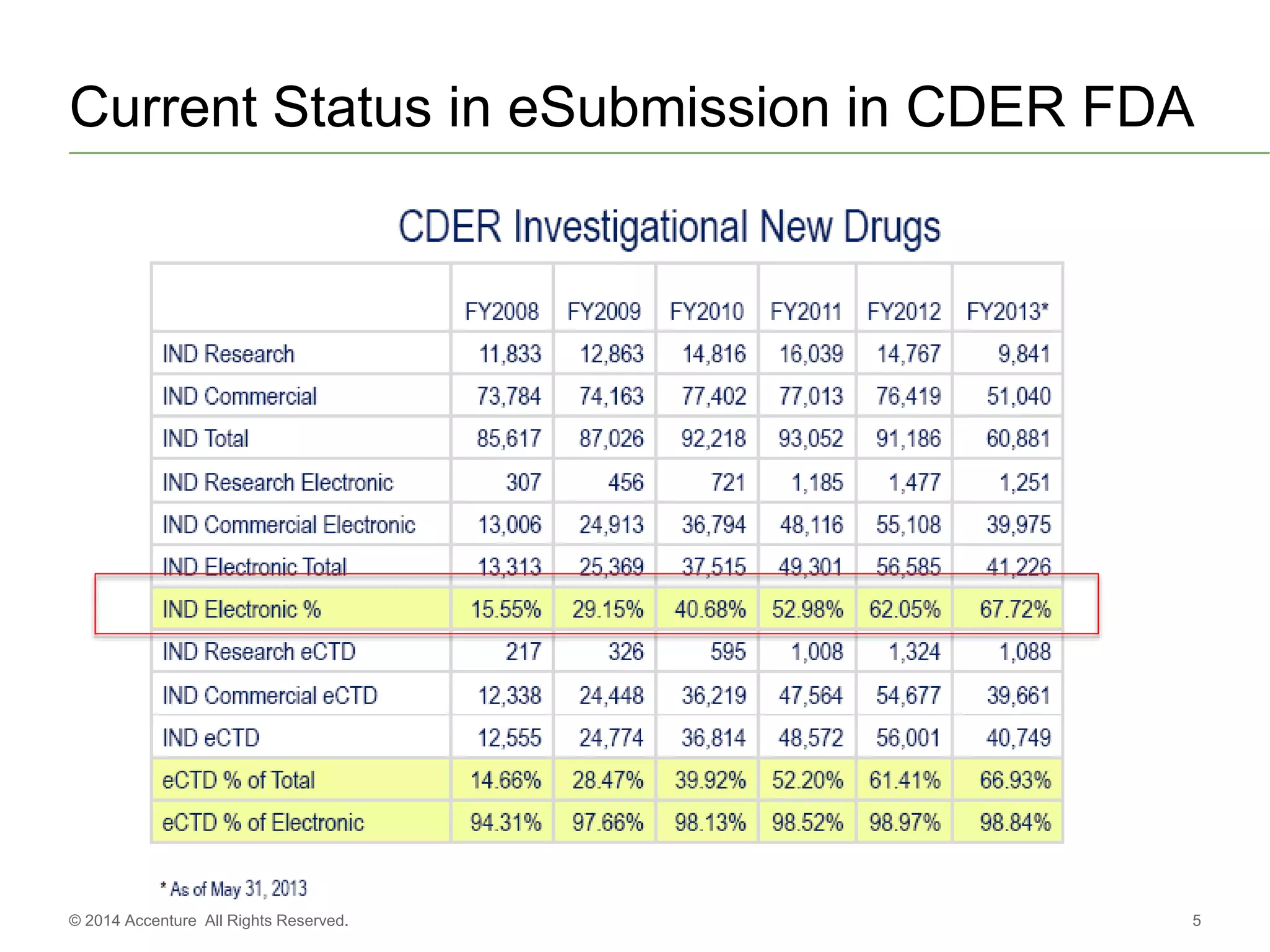
Current Status in eSubmission in CDER FDA
5© 2014 Accenture All Rights Reserved.
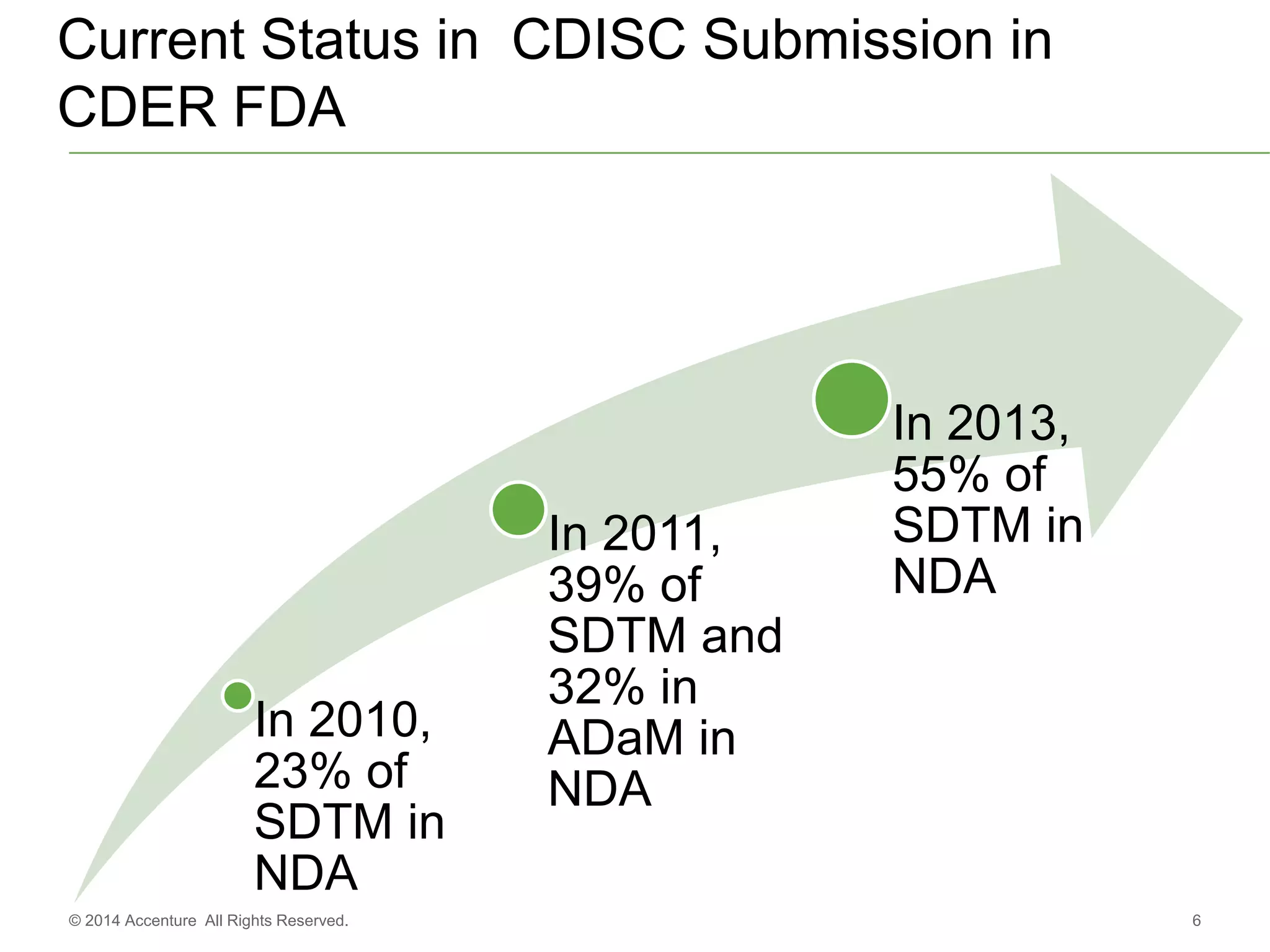
Current Status in CDISC Submission in
CDER FDA
6© 2014 Accenture All Rights Reserved.
In 2010,
23% of
SDTM in
NDA
In 2011,
39% of
SDTM and
32% in
ADaM in
NDA
In 2013,
55% of
SDTM in
NDA
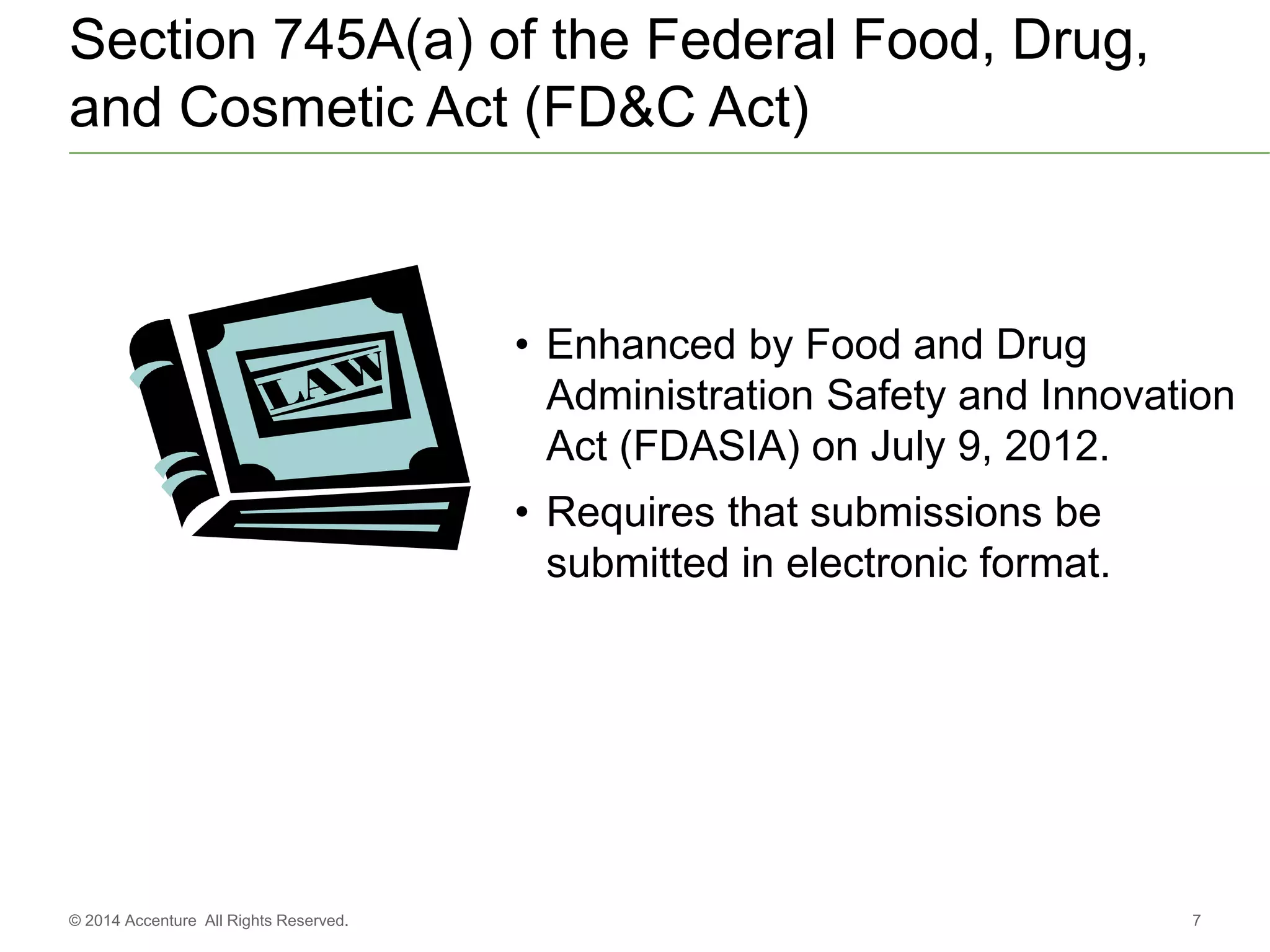
Section 745A(a) of the Federal Food, Drug,
and Cosmetic Act (FD&C Act)
7© 2014 Accenture All Rights Reserved.
• Enhanced by Food and Drug
Administration Safety and Innovation
Act (FDASIA) on July 9, 2012.
• Requires that submissions be
submitted in electronic format.
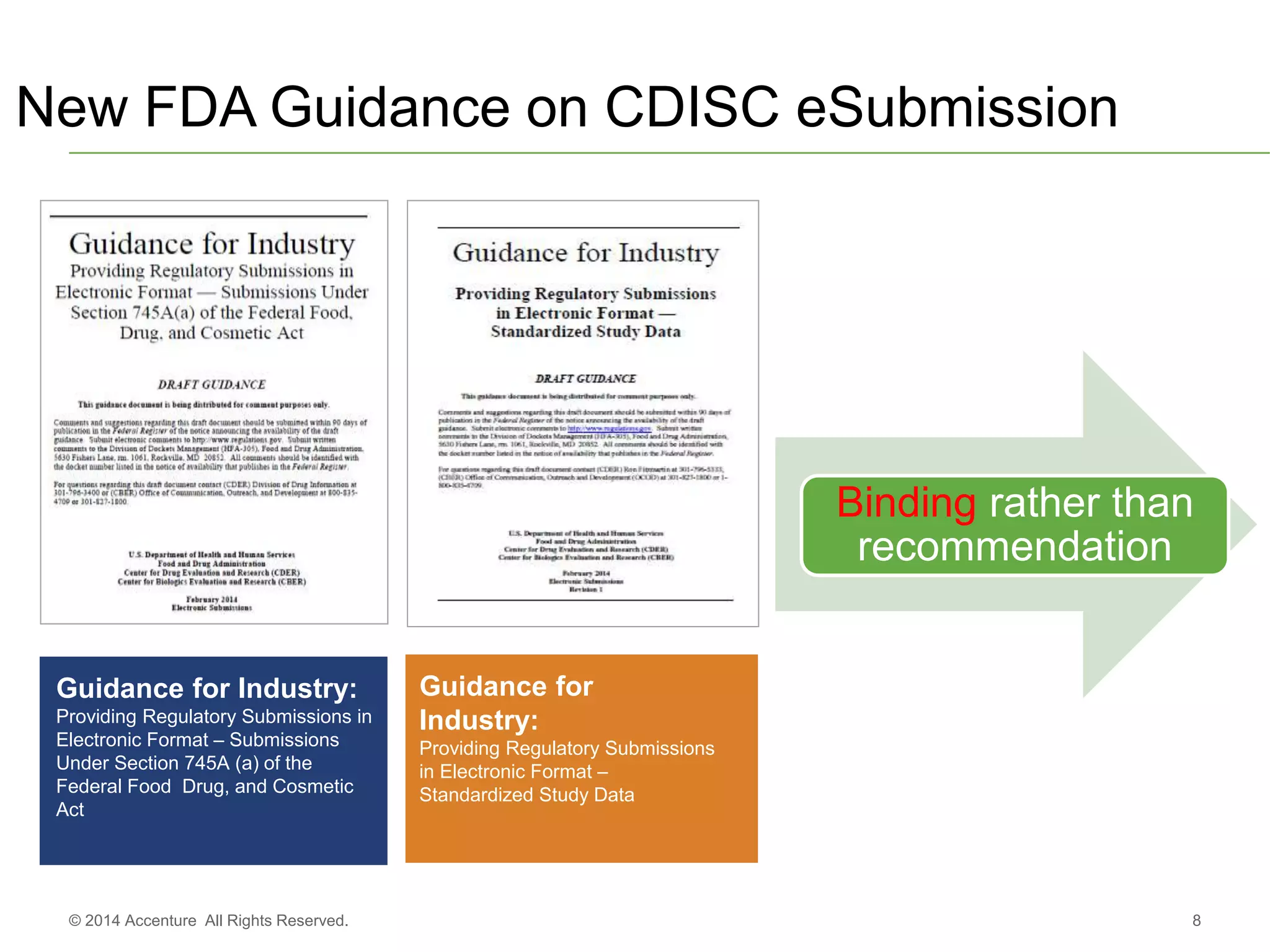
New FDA Guidance on CDISC eSubmission
8© 2014 Accenture All Rights Reserved.
Guidance for
Industry:
Providing Regulatory Submissions
in Electronic Format –
Standardized Study Data
Guidance for Industry:
Providing Regulatory Submissions in
Electronic Format – Submissions
Under Section 745A (a) of the
Federal Food Drug, and Cosmetic
Act
Binding rather than
recommendation
9© 2015 Accenture All Rights Reserved.
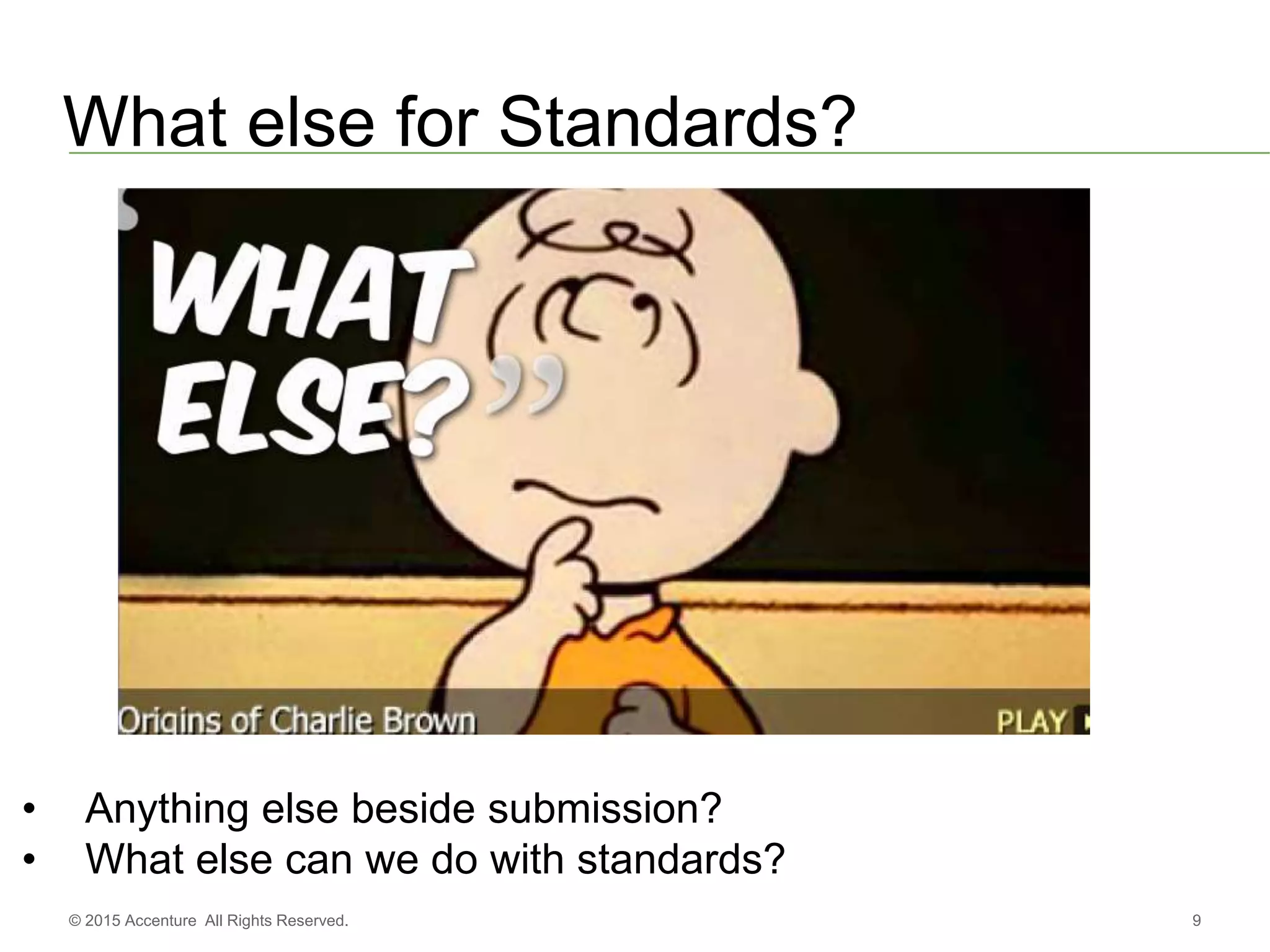
What else for Standards?
• Anything else beside submission?
• What else can we do with standards?
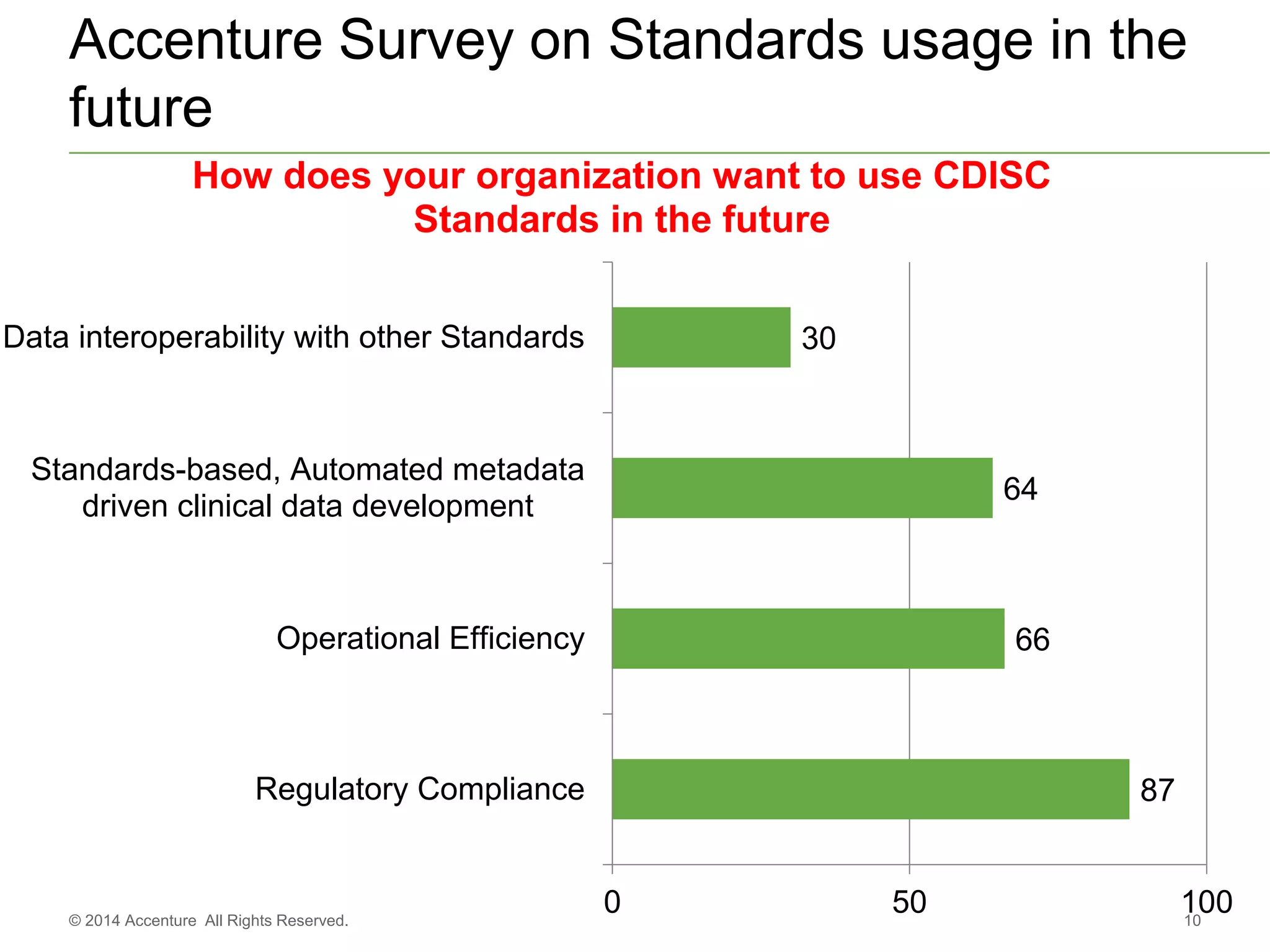
Accenture Survey on Standards usage in the
future
10© 2014 Accenture All Rights Reserved.
87
66
64
30
0 50 100
Regulatory Compliance
Operational Efficiency
Standards-based, Automated metadata
driven clinical data development
Data interoperability with other Standards
How does your organization want to use CDISC
Standards in the future
11© 2015 Accenture All Rights Reserved.
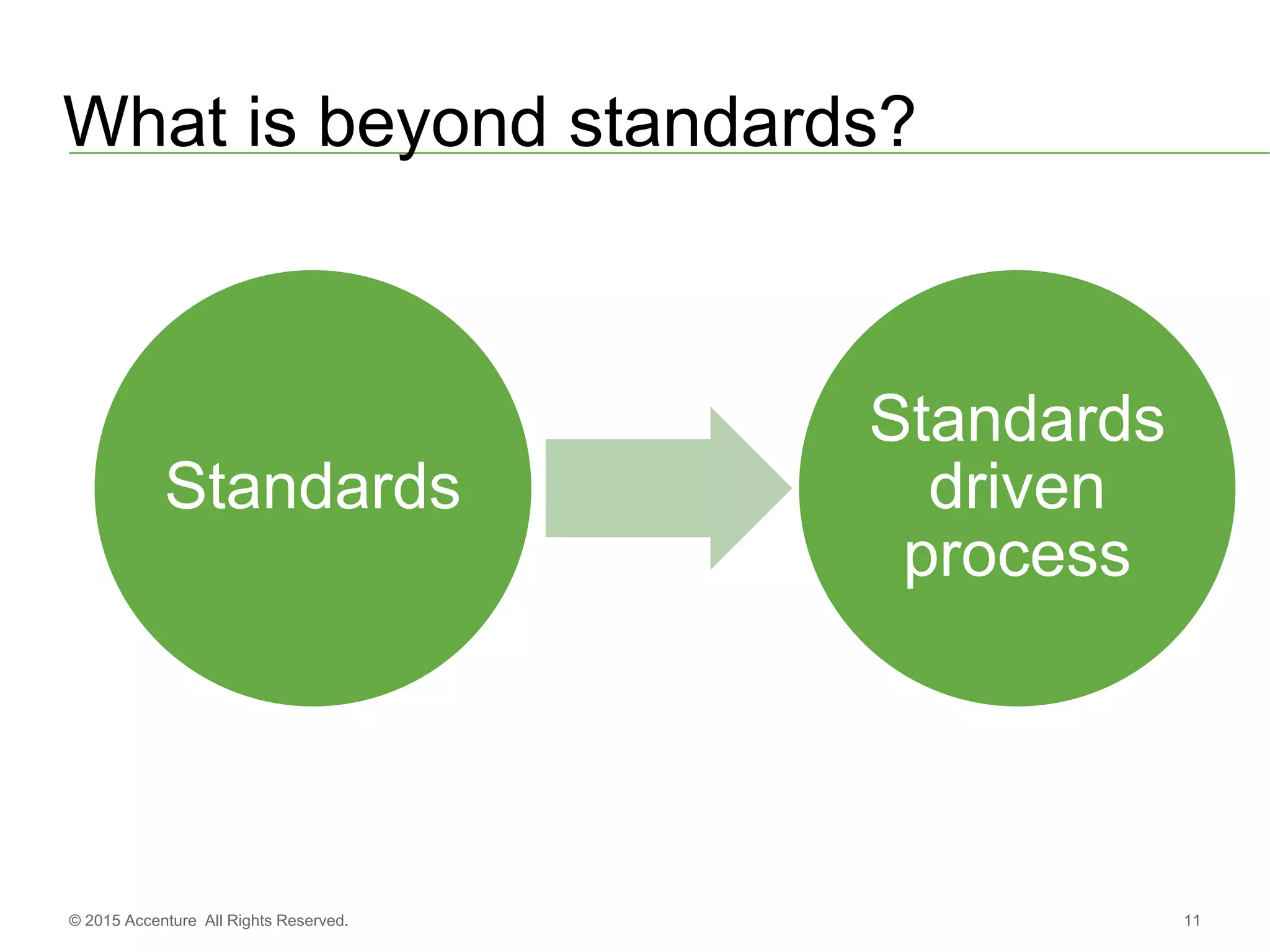
What is beyond standards?
Standards
Standards
driven
process
12© 2015 Accenture All Rights Reserved.
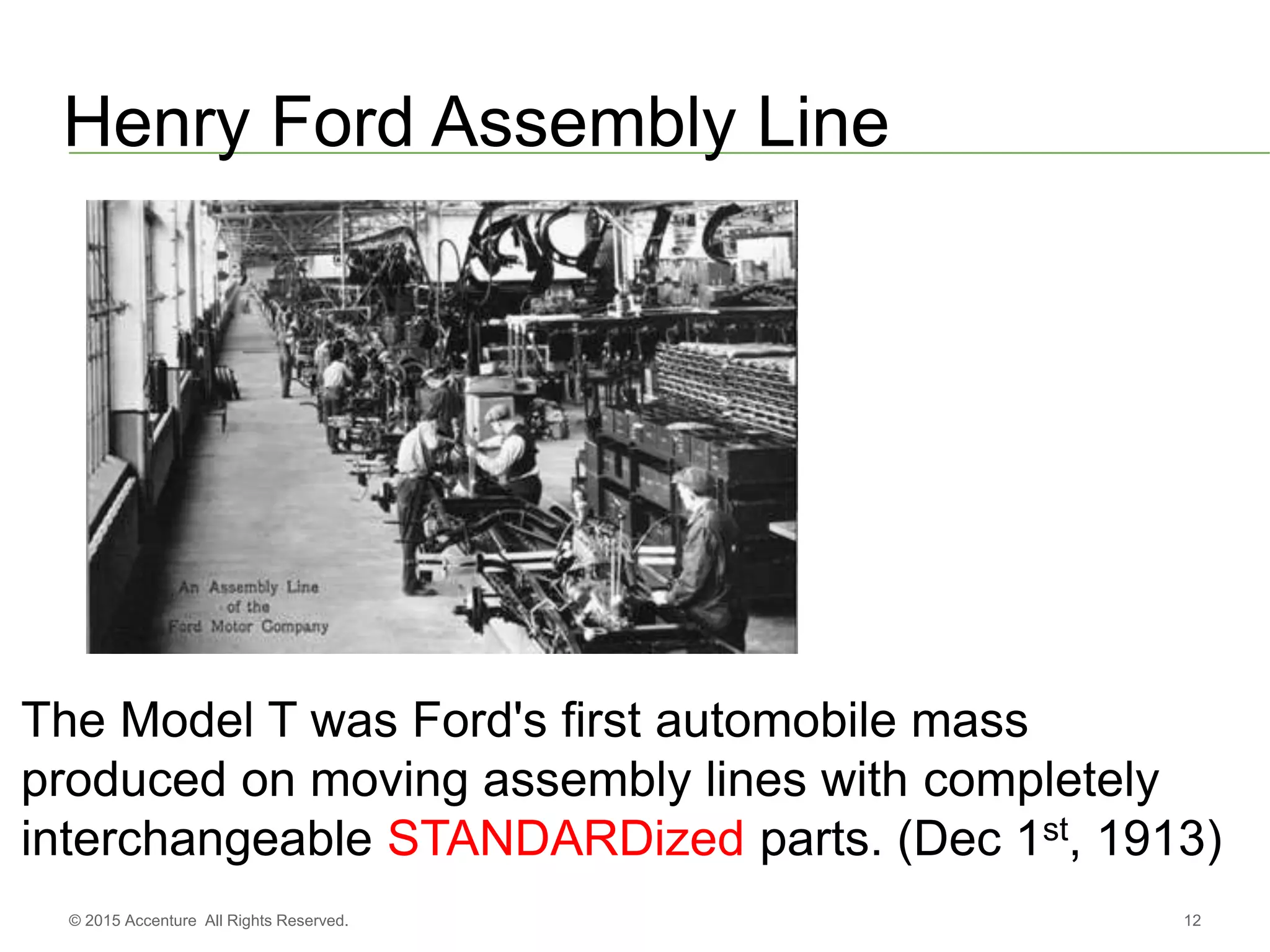
Henry Ford Assembly Line
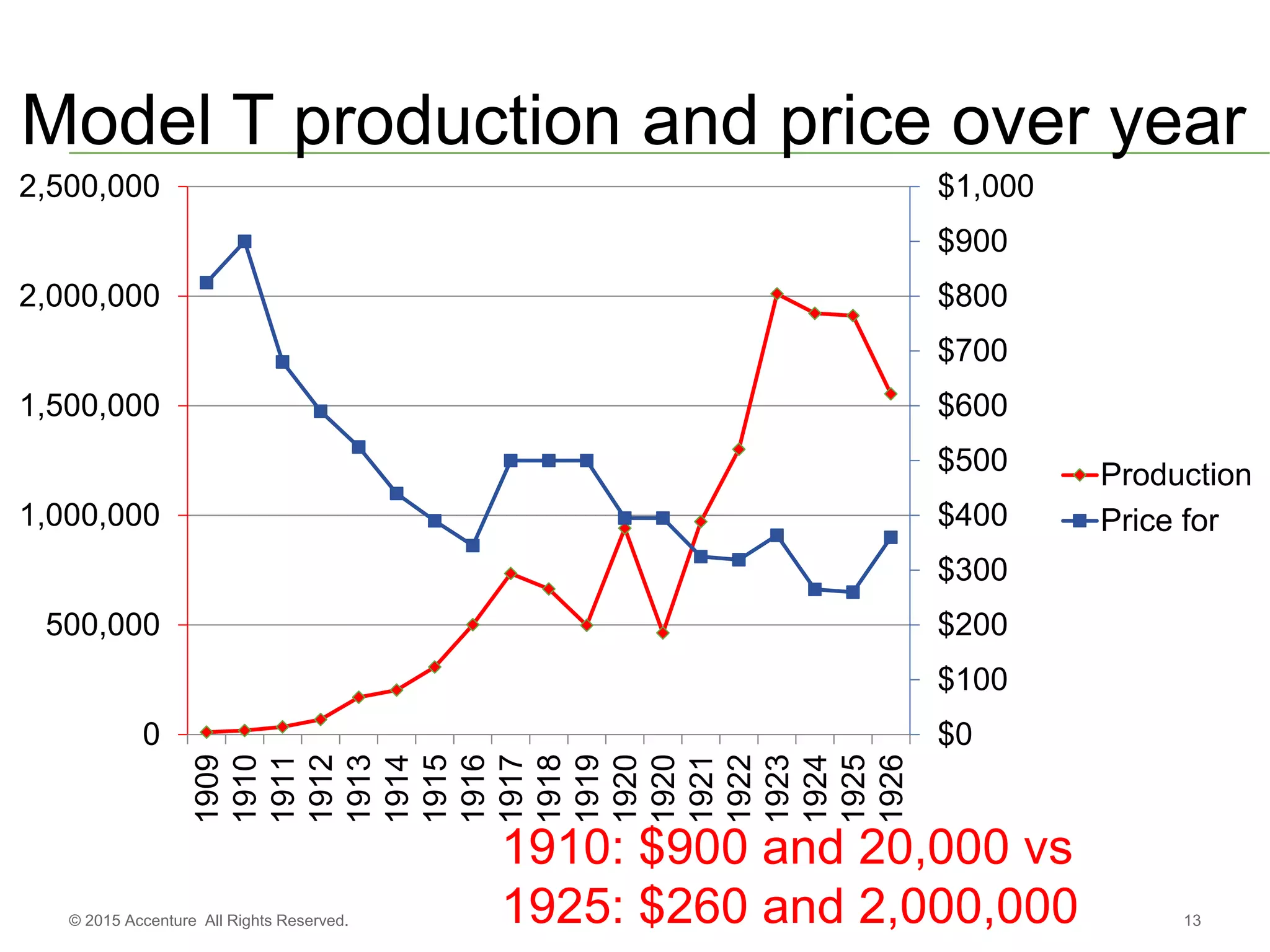
The Model T was Ford's first automobile mass
produced on moving assembly lines with completely
interchangeable STANDARDized parts. (Dec 1st, 1913)
13© 2015 Accenture All Rights Reserved.
Model T production and price over year
$0
$100
$200
$300
$400
$500
$600
$700
$800
$900
$1,000
0
500,000
1,000,000
1,500,000
2,000,000
2,500,000
1909
1910
1911
1912
1913
1914
1915
1916
1917
1918
1919
1920
1920
1921
1922
1923
1924
1925
1926
Production
Price for
1910: $900 and 20,000 vs
1925: $260 and 2,000,000
14© 2015 Accenture All Rights Reserved.
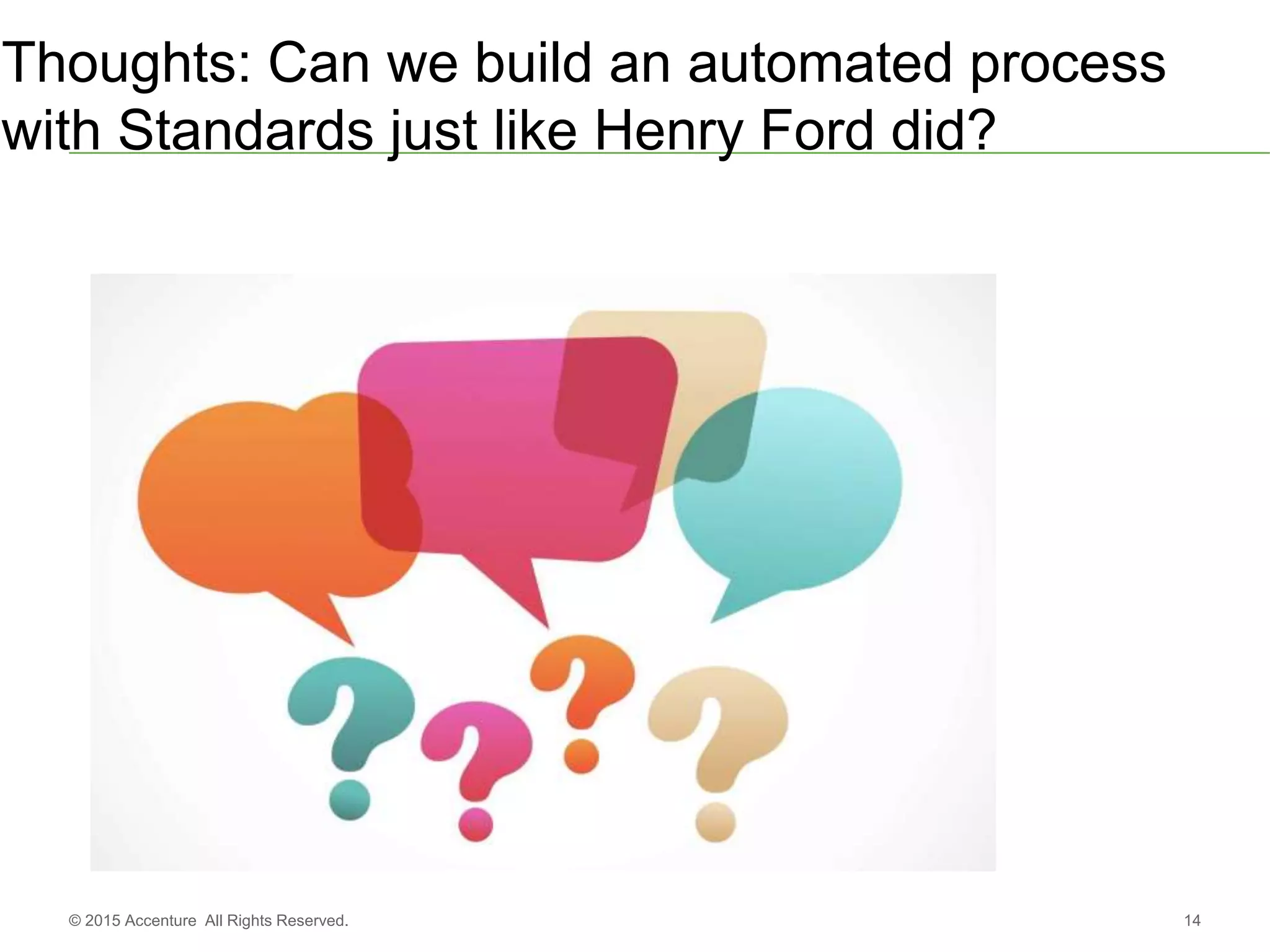
Thoughts: Can we build an automated process
with Standards just like Henry Ford did?
15© 2015 Accenture All Rights Reserved.
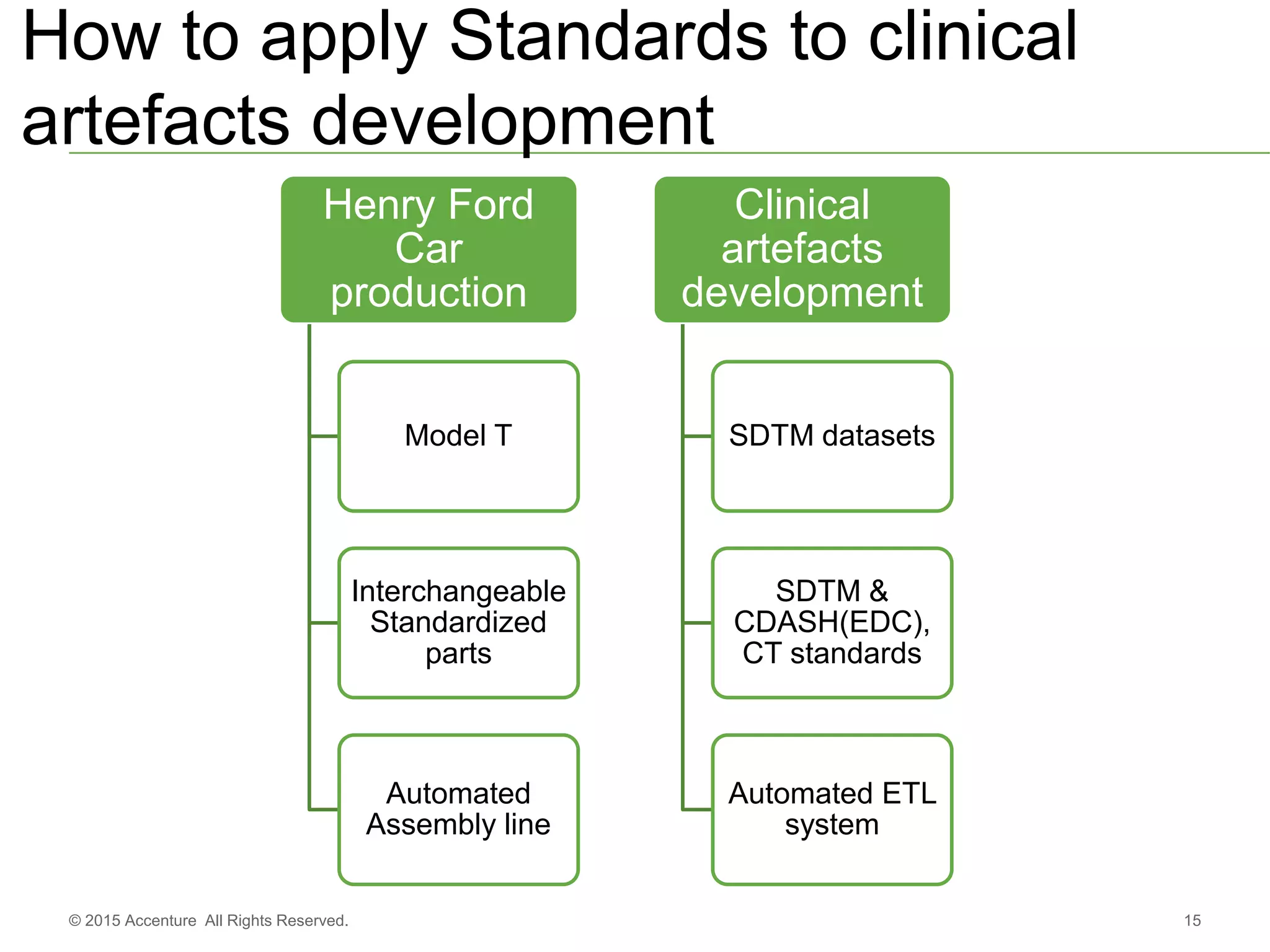
How to apply Standards to clinical
artefacts development
Henry Ford
Car
production
Model T
Interchangeable
Standardized
parts
Automated
Assembly line
Clinical
artefacts
development
SDTM datasets
SDTM &
CDASH(EDC),
CT standards
Automated ETL
system
16© 2015 Accenture All Rights Reserved.
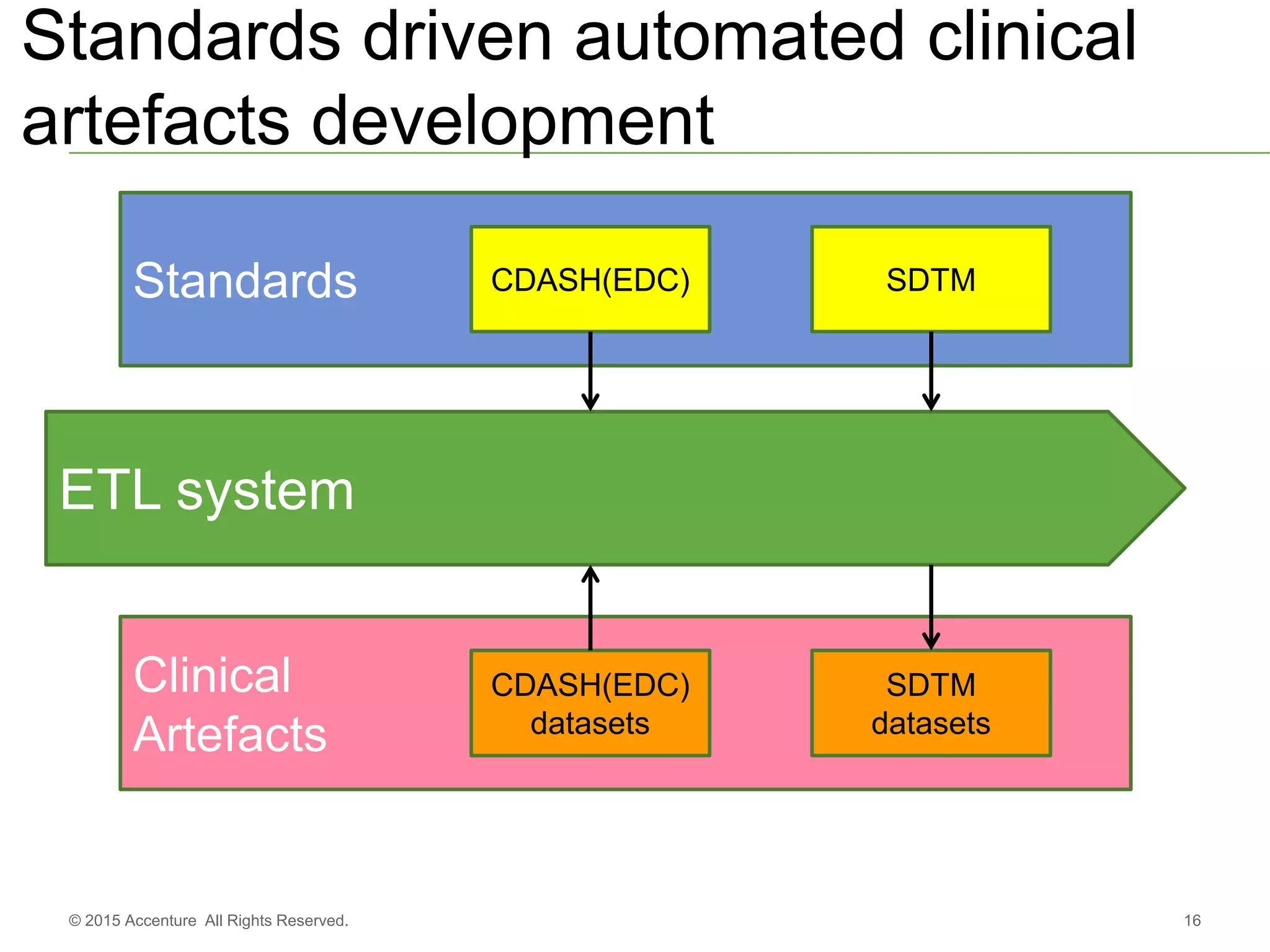
Standards driven automated clinical
artefacts development
ETL system
Standards CDASH(EDC) SDTM
Clinical
Artefacts
CDASH(EDC)
datasets
SDTM
datasets
17© 2015 Accenture All Rights Reserved.
Questions
What are needed for automated clinical artefacts
development?
18© 2015 Accenture All Rights Reserved.
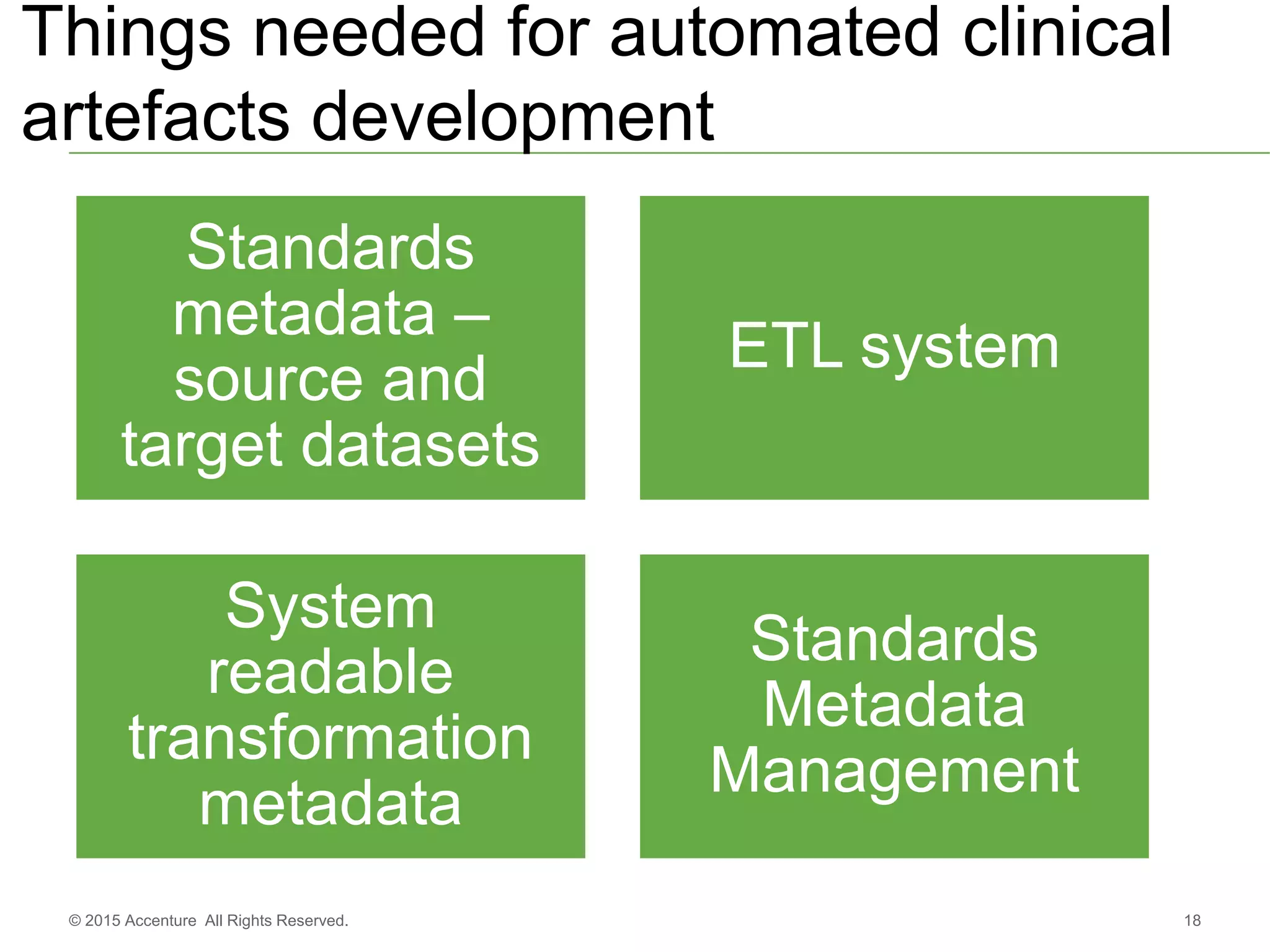
Things needed for automated clinical
artefacts development
Standards
metadata –
source and
target datasets
ETL system
System
readable
transformation
metadata
Standards
Metadata
Management
19© 2015 Accenture All Rights Reserved.
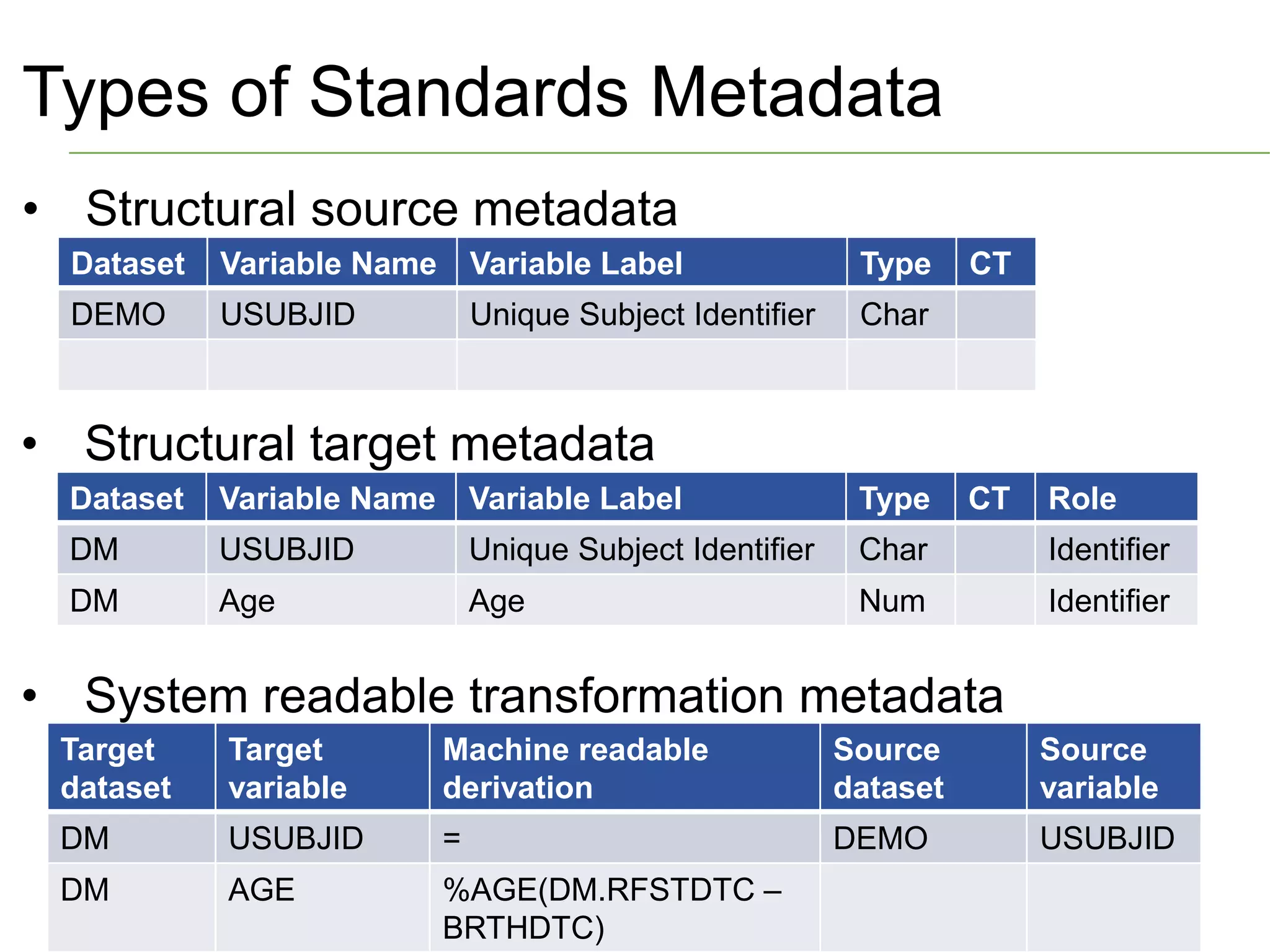
Types of Standards Metadata
Target
dataset
Target
variable
Machine readable
derivation
Source
dataset
Source
variable
DM USUBJID = DEMO USUBJID
DM AGE %AGE(DM.RFSTDTC –
BRTHDTC)
• System readable transformation metadata
• Structural target metadata
Dataset Variable Name Variable Label Type CT Role
DM USUBJID Unique Subject Identifier Char Identifier
DM Age Age Num Identifier
• Structural source metadata
Dataset Variable Name Variable Label Type CT
DEMO USUBJID Unique Subject Identifier Char
20© 2015 Accenture All Rights Reserved.
Questions
What if Standards change or evolve?
21© 2015 Accenture All Rights Reserved.
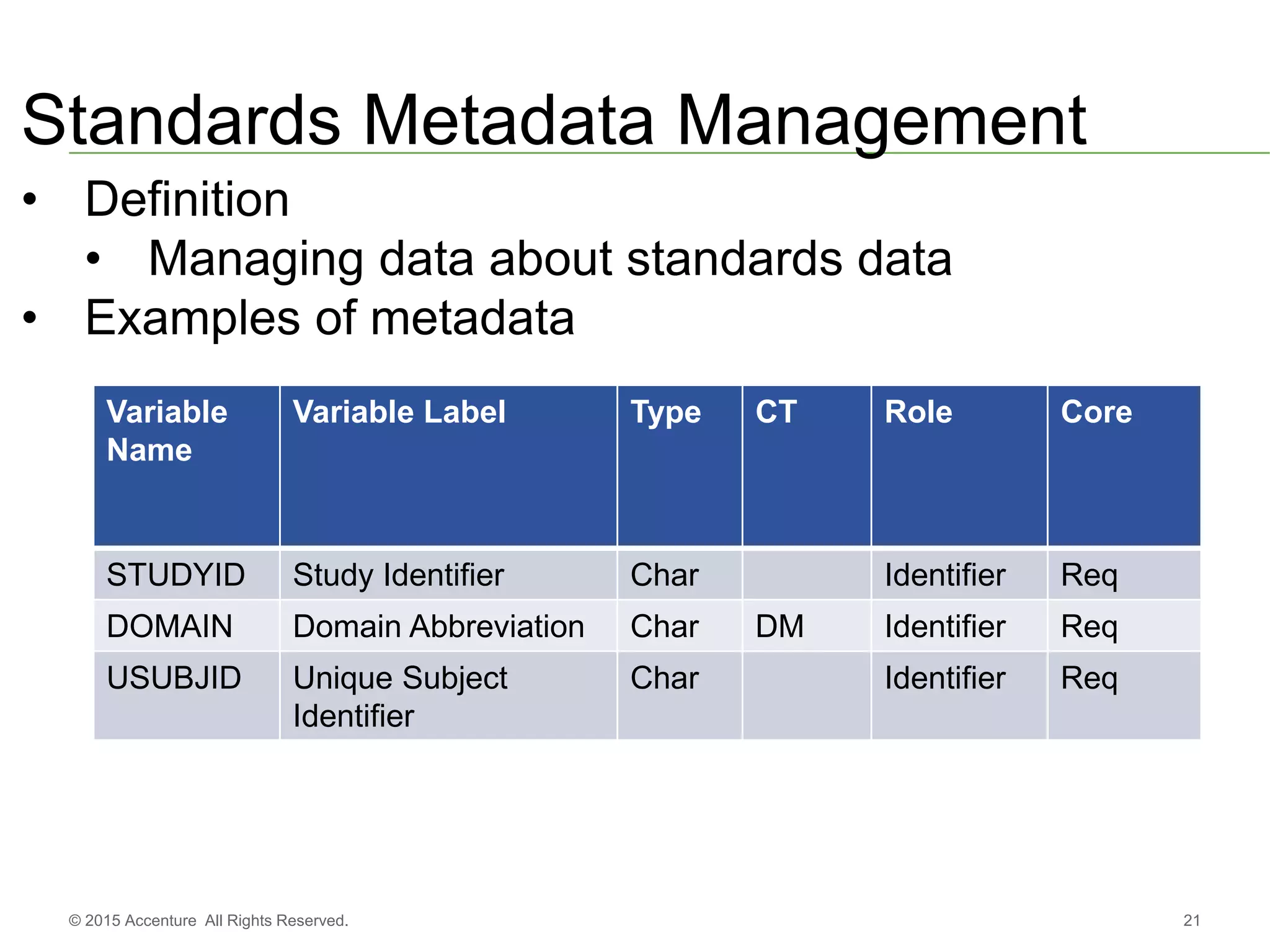
Standards Metadata Management
• Definition
• Managing data about standards data
• Examples of metadata
Variable
Name
Variable Label Type CT Role Core
STUDYID Study Identifier Char Identifier Req
DOMAIN Domain Abbreviation Char DM Identifier Req
USUBJID Unique Subject
Identifier
Char Identifier Req
22© 2015 Accenture All Rights Reserved.
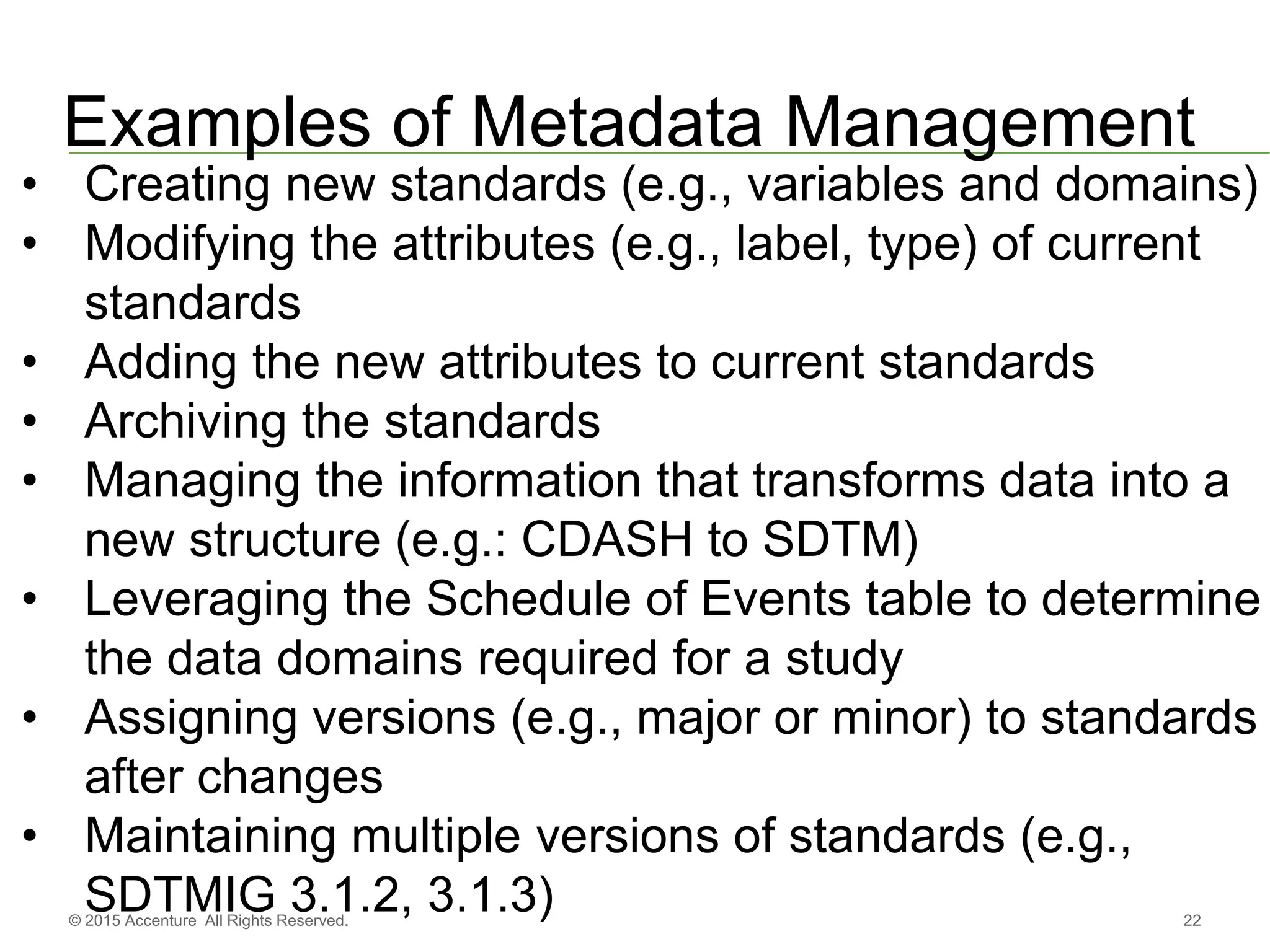
Examples of Metadata Management
• Creating new standards (e.g., variables and domains)
• Modifying the attributes (e.g., label, type) of current
standards
• Adding the new attributes to current standards
• Archiving the standards
• Managing the information that transforms data into a
new structure (e.g.: CDASH to SDTM)
• Leveraging the Schedule of Events table to determine
the data domains required for a study
• Assigning versions (e.g., major or minor) to standards
after changes
• Maintaining multiple versions of standards (e.g.,
SDTMIG 3.1.2, 3.1.3)
23© 2014 Accenture All Rights Reserved.
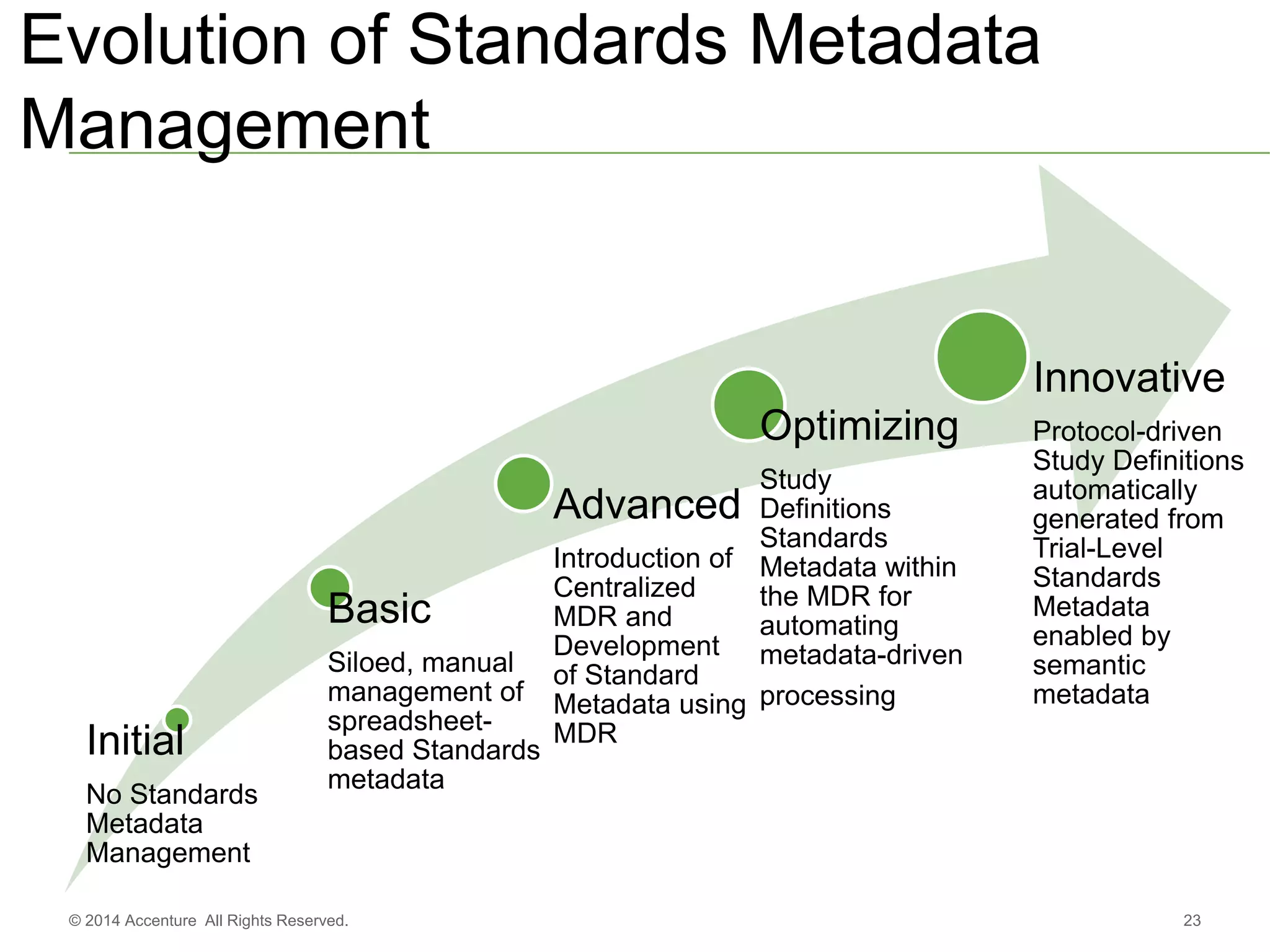
Evolution of Standards Metadata
Management
Initial
No Standards
Metadata
Management
Basic
Siloed, manual
management of
spreadsheet-
based Standards
metadata
Advanced
Introduction of
Centralized
MDR and
Development
of Standard
Metadata using
MDR
Optimizing
Study
Definitions
Standards
Metadata within
the MDR for
automating
metadata-driven
processing
Innovative
Protocol-driven
Study Definitions
automatically
generated from
Trial-Level
Standards
Metadata
enabled by
semantic
metadata
24© 2015 Accenture All Rights Reserved.
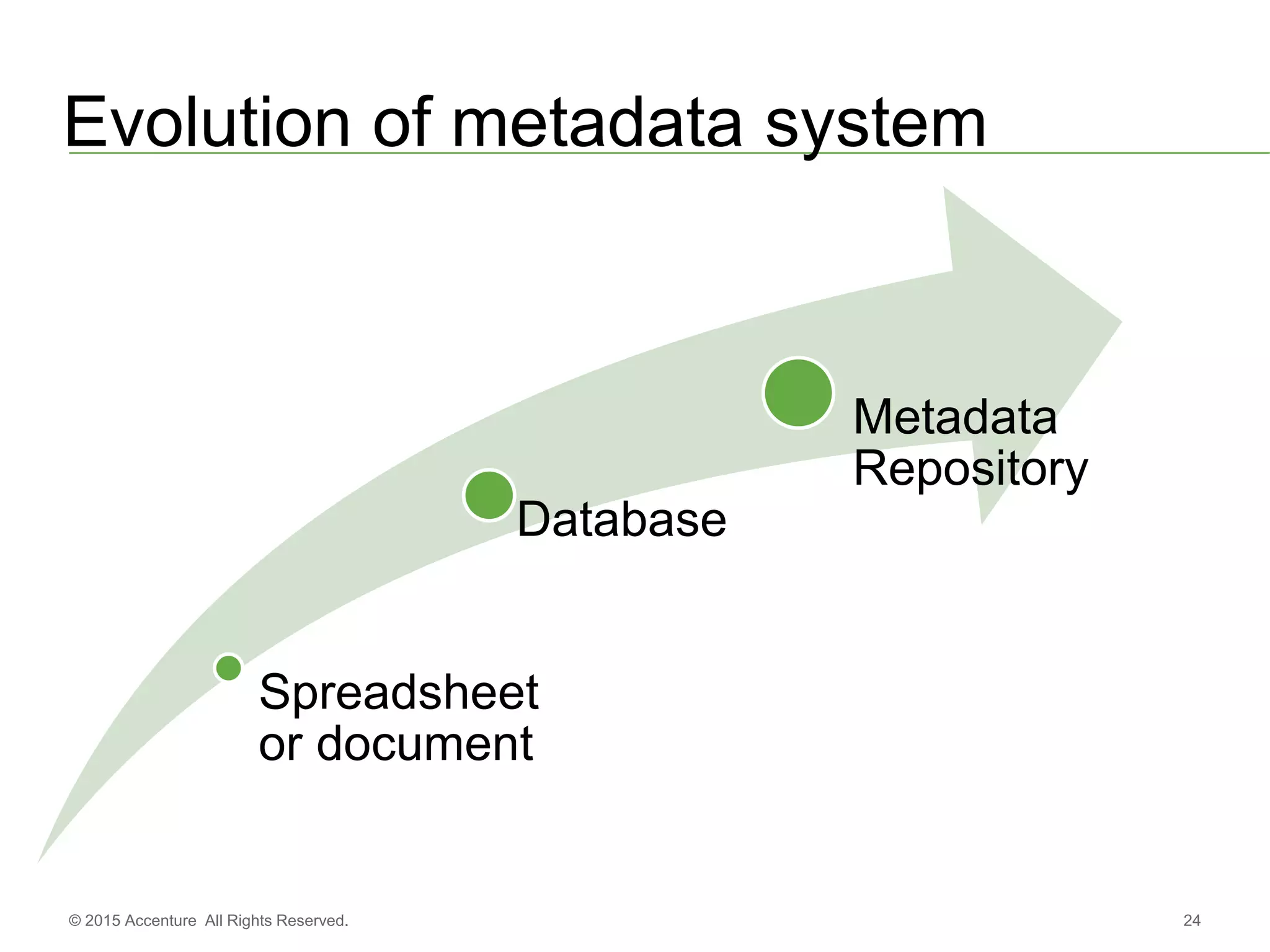
Evolution of metadata system
Spreadsheet
or document
Database
Metadata
Repository
25© 2015 Accenture All Rights Reserved.
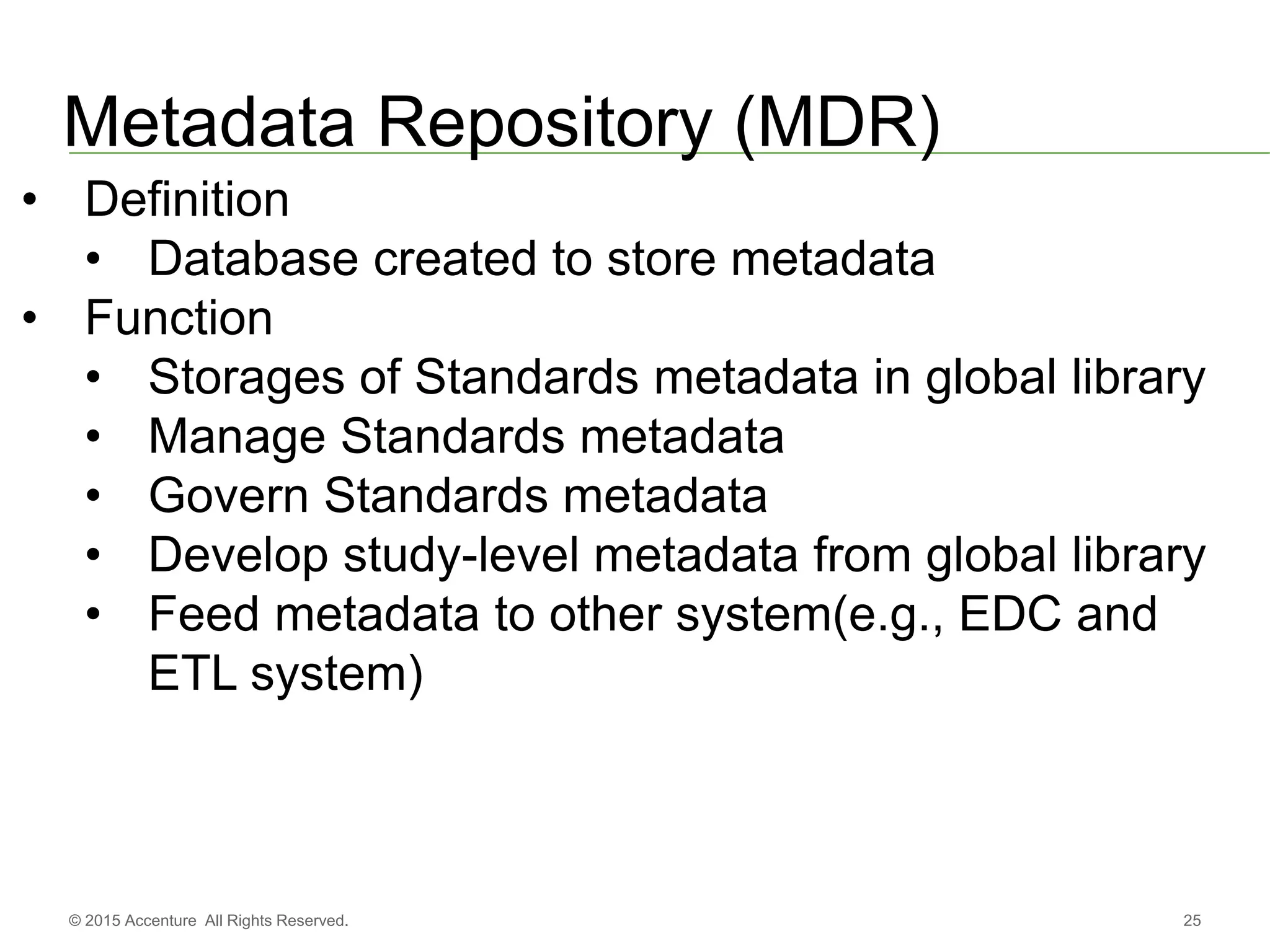
Metadata Repository (MDR)
• Definition
• Database created to store metadata
• Function
• Storages of Standards metadata in global library
• Manage Standards metadata
• Govern Standards metadata
• Develop study-level metadata from global library
• Feed metadata to other system(e.g., EDC and
ETL system)
26© 2015 Accenture All Rights Reserved.
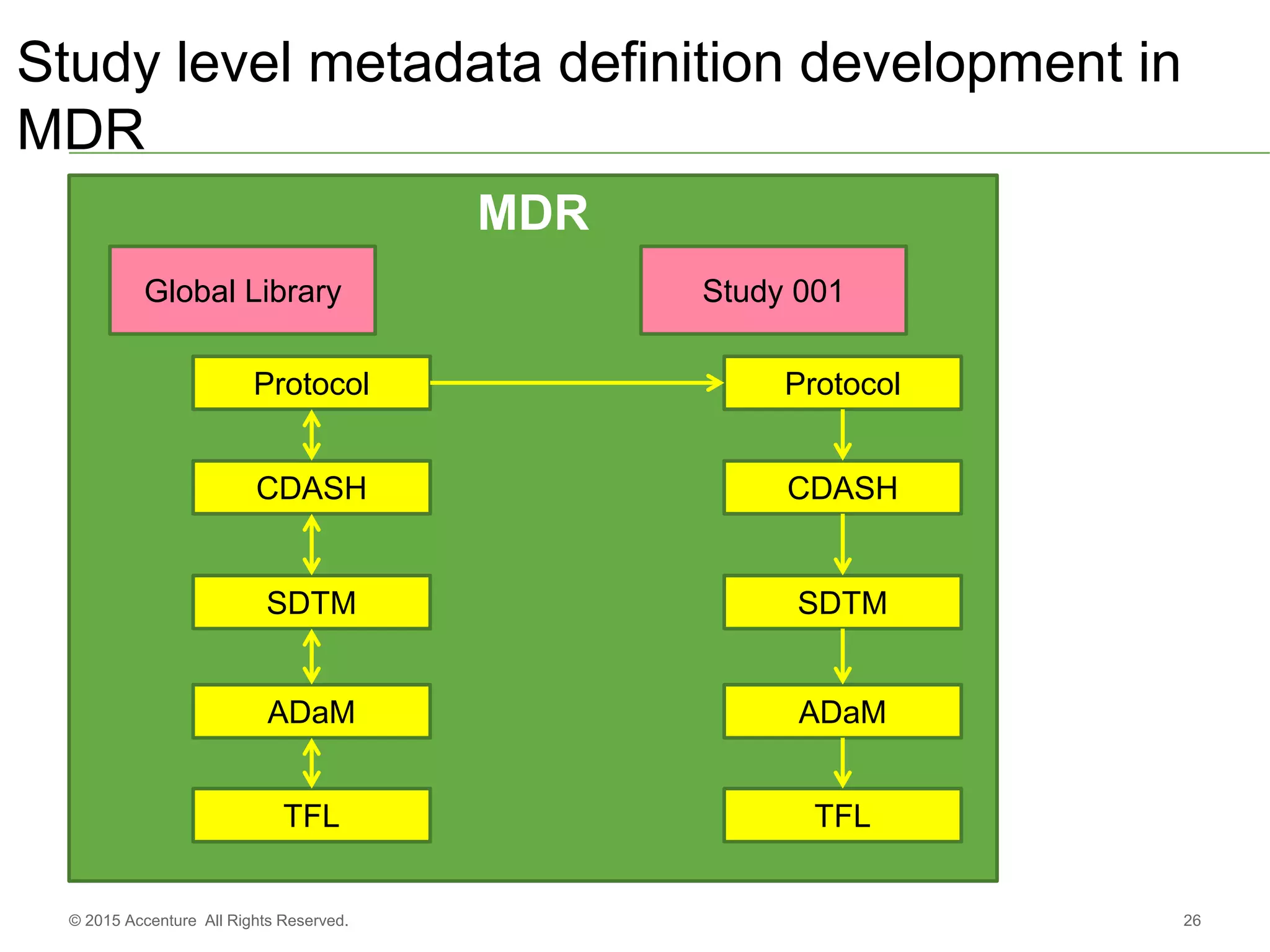
MDR
Protocol
Global Library
CDASH
TFL
ADaM
SDTM
Protocol
Study 001
CDASH
TFL
ADaM
SDTM
Study level metadata definition development in
MDR
27© 2015 Accenture All Rights Reserved.
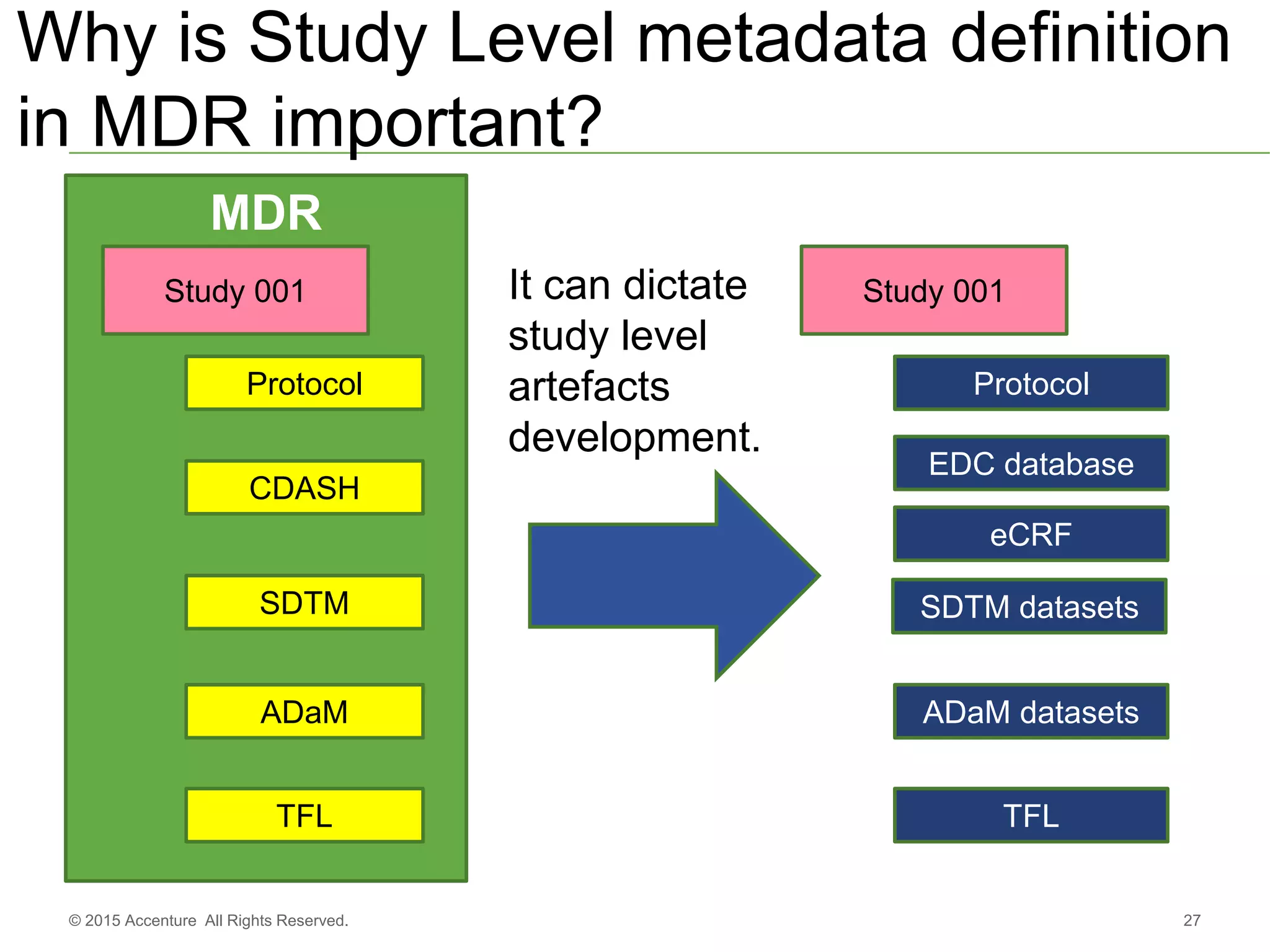
Why is Study Level metadata definition
in MDR important?
MDR
Protocol
Study 001
CDASH
TFL
ADaM
SDTM
Protocol
EDC database
eCRF
SDTM datasets
ADaM datasets
TFL
It can dictate
study level
artefacts
development.
Study 001
© 2015 Accenture All Rights Reserved.
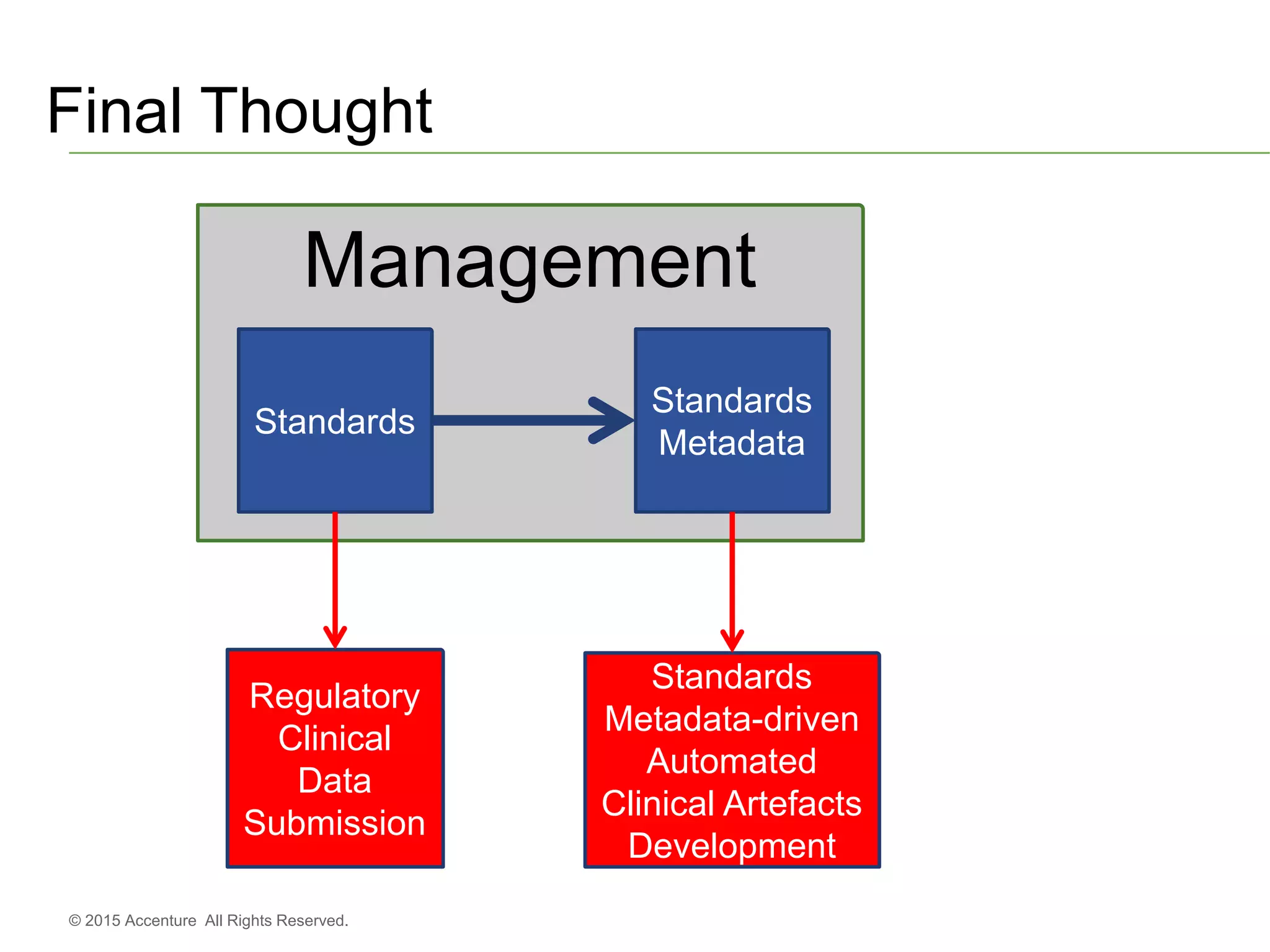
Final Thought
Management
Standards
Metadata
Standards
Regulatory
Clinical
Data
Submission
Standards
Metadata-driven
Automated
Clinical Artefacts
Development
29© 2015 Accenture All Rights Reserved.
Contacts and Questions
Kevin Lee
Email:
kevin.s.lee@accenture.com
LinkedIn:
www.linkedin.com/in/HelloKev
inLee
Slides:
www.slideshare.net/KevinLee
56
Tweet: @HelloKevinLee
Blogs: HiKevinLee.tumblr.com

Beyond regulatory submission - standards metadata management

  • 1.
    Beyond regulatory submission - Standards Metadata Management KevinLee CDISC NJ Meeting at 06/17/2015 We help our Clients deliver better outcomes, so they can improve the quality of people’s lives.
  • 2.
    2© 2015 AccentureAll Rights Reserved. Agenda Regulatory Requirement on Clinical Data Standards(i.e., CDISC) Standards driven process Standards Metadata Management Final Thoughts
  • 3.
    3© 2015 AccentureAll Rights Reserved. Standards? What do we think first about Standards?
  • 4.
    4© 2015 AccentureAll Rights Reserved. Standards driven electronic submission of clinical trial data
  • 5.
    Current Status ineSubmission in CDER FDA 5© 2014 Accenture All Rights Reserved.
  • 6.
    Current Status inCDISC Submission in CDER FDA 6© 2014 Accenture All Rights Reserved. In 2010, 23% of SDTM in NDA In 2011, 39% of SDTM and 32% in ADaM in NDA In 2013, 55% of SDTM in NDA
  • 7.
    Section 745A(a) ofthe Federal Food, Drug, and Cosmetic Act (FD&C Act) 7© 2014 Accenture All Rights Reserved. • Enhanced by Food and Drug Administration Safety and Innovation Act (FDASIA) on July 9, 2012. • Requires that submissions be submitted in electronic format.
  • 8.
    New FDA Guidanceon CDISC eSubmission 8© 2014 Accenture All Rights Reserved. Guidance for Industry: Providing Regulatory Submissions in Electronic Format – Standardized Study Data Guidance for Industry: Providing Regulatory Submissions in Electronic Format – Submissions Under Section 745A (a) of the Federal Food Drug, and Cosmetic Act Binding rather than recommendation
  • 9.
    9© 2015 AccentureAll Rights Reserved. What else for Standards? • Anything else beside submission? • What else can we do with standards?
  • 10.
    Accenture Survey onStandards usage in the future 10© 2014 Accenture All Rights Reserved. 87 66 64 30 0 50 100 Regulatory Compliance Operational Efficiency Standards-based, Automated metadata driven clinical data development Data interoperability with other Standards How does your organization want to use CDISC Standards in the future
  • 11.
    11© 2015 AccentureAll Rights Reserved. What is beyond standards? Standards Standards driven process
  • 12.
    12© 2015 AccentureAll Rights Reserved. Henry Ford Assembly Line The Model T was Ford's first automobile mass produced on moving assembly lines with completely interchangeable STANDARDized parts. (Dec 1st, 1913)
  • 13.
    13© 2015 AccentureAll Rights Reserved. Model T production and price over year $0 $100 $200 $300 $400 $500 $600 $700 $800 $900 $1,000 0 500,000 1,000,000 1,500,000 2,000,000 2,500,000 1909 1910 1911 1912 1913 1914 1915 1916 1917 1918 1919 1920 1920 1921 1922 1923 1924 1925 1926 Production Price for 1910: $900 and 20,000 vs 1925: $260 and 2,000,000
  • 14.
    14© 2015 AccentureAll Rights Reserved. Thoughts: Can we build an automated process with Standards just like Henry Ford did?
  • 15.
    15© 2015 AccentureAll Rights Reserved. How to apply Standards to clinical artefacts development Henry Ford Car production Model T Interchangeable Standardized parts Automated Assembly line Clinical artefacts development SDTM datasets SDTM & CDASH(EDC), CT standards Automated ETL system
  • 16.
    16© 2015 AccentureAll Rights Reserved. Standards driven automated clinical artefacts development ETL system Standards CDASH(EDC) SDTM Clinical Artefacts CDASH(EDC) datasets SDTM datasets
  • 17.
    17© 2015 AccentureAll Rights Reserved. Questions What are needed for automated clinical artefacts development?
  • 18.
    18© 2015 AccentureAll Rights Reserved. Things needed for automated clinical artefacts development Standards metadata – source and target datasets ETL system System readable transformation metadata Standards Metadata Management
  • 19.
    19© 2015 AccentureAll Rights Reserved. Types of Standards Metadata Target dataset Target variable Machine readable derivation Source dataset Source variable DM USUBJID = DEMO USUBJID DM AGE %AGE(DM.RFSTDTC – BRTHDTC) • System readable transformation metadata • Structural target metadata Dataset Variable Name Variable Label Type CT Role DM USUBJID Unique Subject Identifier Char Identifier DM Age Age Num Identifier • Structural source metadata Dataset Variable Name Variable Label Type CT DEMO USUBJID Unique Subject Identifier Char
  • 20.
    20© 2015 AccentureAll Rights Reserved. Questions What if Standards change or evolve?
  • 21.
    21© 2015 AccentureAll Rights Reserved. Standards Metadata Management • Definition • Managing data about standards data • Examples of metadata Variable Name Variable Label Type CT Role Core STUDYID Study Identifier Char Identifier Req DOMAIN Domain Abbreviation Char DM Identifier Req USUBJID Unique Subject Identifier Char Identifier Req
  • 22.
    22© 2015 AccentureAll Rights Reserved. Examples of Metadata Management • Creating new standards (e.g., variables and domains) • Modifying the attributes (e.g., label, type) of current standards • Adding the new attributes to current standards • Archiving the standards • Managing the information that transforms data into a new structure (e.g.: CDASH to SDTM) • Leveraging the Schedule of Events table to determine the data domains required for a study • Assigning versions (e.g., major or minor) to standards after changes • Maintaining multiple versions of standards (e.g., SDTMIG 3.1.2, 3.1.3)
  • 23.
    23© 2014 AccentureAll Rights Reserved. Evolution of Standards Metadata Management Initial No Standards Metadata Management Basic Siloed, manual management of spreadsheet- based Standards metadata Advanced Introduction of Centralized MDR and Development of Standard Metadata using MDR Optimizing Study Definitions Standards Metadata within the MDR for automating metadata-driven processing Innovative Protocol-driven Study Definitions automatically generated from Trial-Level Standards Metadata enabled by semantic metadata
  • 24.
    24© 2015 AccentureAll Rights Reserved. Evolution of metadata system Spreadsheet or document Database Metadata Repository
  • 25.
    25© 2015 AccentureAll Rights Reserved. Metadata Repository (MDR) • Definition • Database created to store metadata • Function • Storages of Standards metadata in global library • Manage Standards metadata • Govern Standards metadata • Develop study-level metadata from global library • Feed metadata to other system(e.g., EDC and ETL system)
  • 26.
    26© 2015 AccentureAll Rights Reserved. MDR Protocol Global Library CDASH TFL ADaM SDTM Protocol Study 001 CDASH TFL ADaM SDTM Study level metadata definition development in MDR
  • 27.
    27© 2015 AccentureAll Rights Reserved. Why is Study Level metadata definition in MDR important? MDR Protocol Study 001 CDASH TFL ADaM SDTM Protocol EDC database eCRF SDTM datasets ADaM datasets TFL It can dictate study level artefacts development. Study 001
  • 28.
    © 2015 AccentureAll Rights Reserved. Final Thought Management Standards Metadata Standards Regulatory Clinical Data Submission Standards Metadata-driven Automated Clinical Artefacts Development
  • 29.
    29© 2015 AccentureAll Rights Reserved. Contacts and Questions Kevin Lee Email: kevin.s.lee@accenture.com LinkedIn: www.linkedin.com/in/HelloKev inLee Slides: www.slideshare.net/KevinLee 56 Tweet: @HelloKevinLee Blogs: HiKevinLee.tumblr.com

Editor's Notes

  • #6 First, let’s us take a look at current status in electronic submission.
  • #7 And, if we look at CDISC submission, FDA is also getting more of CDISC data.
  • #9 The FDA Guidance document, once finalized, will be binding rather than recommendation.
  • #24 So, let’s look at partnerships in Pharmaceutical industry. In 2012 Avoca Report, 50% of Drug companies are using partnerships and about 70% of CRO are using partnerships.