4/13/2012


                    Fertilization
Why Fertilize?
• Replenish plant nutrients to sustain optimum
growth and health of the plant.

• Losses of nutrients occur through leaching,
clipping removal, irrigation,rainfall, and volatilization

• Essential nutrients for plant growth: C, H, O, P, K,
N, S, Ca, Fe, Mg, B, Cl, Cu, Mn, Mo, and Zn.

• Turfgrass requires nitrogen more than any other
nutrient


Way to Remember the Elements…
    ~Mnemonic Devices~
    Macronutrients: C, H, O, P, K, N, S, Ca,
     Fe, Mg
    C HOPK'NS CaFé Management

Micronutrients: B, Mo, Cu, Cl, Mn, Zn
B     Mo        Cu     Cl       Mn     Zn
Bob’s Mom and Cousin Clio will manage soon


Turfgrasses require 16
(some now say 17)
essential elements to
grow and complete
their life cycle
C, H, O from air and
water
Remaining 13-14 from
          13-
growing media


                                                                   1
4/13/2012


•Most standard turf fertilizers contain N-P-K
and often minors such as Fe, Mg, Ca, etc.

Before fertilizing you should have knowledge
of:
• species requirement
• air temperature
• soil moisture
• precipitation in forecast?
• type of fertilizer being applied


     Importance of Nutrients to Turfgrass
     Growth and Development
                                  N     P   K
     Rooting                            X
     Shoot growth (tillers.       X
        rhizomes, stolons)
     Leaf growth                  X
     Color                        X
     Establishment                      X
        (germination and
        seedlings)
     Hardiness
        drought                             X
        heat                                X
        cold                                X
     Disease susceptibility       X
     Wear tolerance               X         X
     Recuperative potential       X
     Composition of turf          X     X
        community


                                                       2
4/13/2012


                                            USGA Greens
                                            Record
                                            Sept./Oct 2003
                                            Jim Skorulski


Many different types of Fertilizer- discussed here are
the more common types of fertilizers used in golf
course management!
Important characteristics or facts you need to know
when purchasing fertilizer:
a) burn potential
b) release rates -water soluble or water insoluble
c) analysis
d) safety of product i.e. NH4 NO3
e) cost of product
f) environmental concerns ( i.e. leaching)
g) ease of handling
h) spreadability


                HIGHER SALT INDEX


                                                                    3
4/13/2012


                Nitrogen Fertilizers:

There are three types we will discuss:
I) synthetic inorganic
II) synthetic organic
IIb) Coated synthetic organics
III) natural organic
• Nitrogen taken up in two forms: NH4+ or     NO3-
• NO3- mostly
•Nitrification of ammonia to nitrites to nitrates
NH4+                  NO2                   NO3-
       nitrosomas             nitrobacter


I) Synthetic inorganic (don't contain C) - In
general characteristics of these fertilizers
are:
     a) readily soluble in water
     b) available to plant almost immediately
     c) can cause growth flushes
     d) leach and or volatilize
     e) high burn potential
     f) are usually cheaper than coated or
       controlled release types


Examples of synthetic inorganics are:
 1) Ammonium Nitrate NH4N03
     - 33%N
     - handle with care-very explosive
     - high salt index
  2) Ammonium sulfate NH4SO4
     - 21% N
     - high salt index
     - used if careful
     - may be used to help lower pH
  3) Potassium Nitrate KNO3
     -13% K
     - 37%N
     -Product K power
     -good to use in fall for hardening off


                                                            4
4/13/2012


II) Synthetic organics- group contains both:
i) water soluble and ii) water insoluble forms
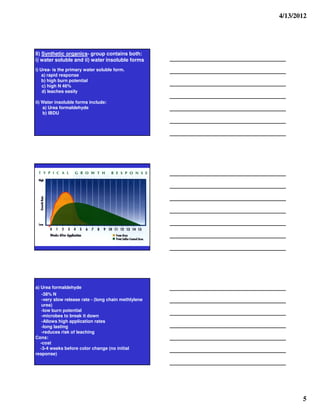
i) Urea- is the primary water soluble form.
    a) rapid response
    b) high burn potential
    c) high N 46%
    d) leaches easily

ii) Water insoluble forms include:
    a) Urea formaldehyde
    b) IBDU


a) Urea formaldehyde
   -38% N
   -very slow release rate - (long chain methlylene
   urea)
   -low burn potential
   -microbes to break it down
   -Allows high application rates
   -long lasting
   -reduces risk of leaching
Cons:
  -cost
  -3-4 weeks before color change (no initial
response)


                                                             5
4/13/2012


b) IBDU
 -made by reacting urea with isobutyraldehyde
 -31% N
 -slow release rate
 -2-4 weeks delay in response
 -very expensive
 -microbes have minimal effect on release rate
 -soil moisture particle size, and temperature
influence release rate
 -be careful if excessive rainfall ie. July


IIb) Coated synthetic organic fertilizers- provide
good initial response compared to IBDU and UF
   •Two types - sulfur coated and polymer coated.

Advantages coated materials:
a) low burn potential
b) no surge-release rates gradual
c) ease of handling
d) Minimal loss to leaching
e) Long or timed duration of feeding
g) Reduced labor due to reducing frequency of
applications
Cons
a) cost
b) mowers or traffic can break coating


Two types:
  1) Sulfur Coated Urea (SCU)
     -coating = wax prill
     -release rates dependent on:
        •soil temperature and water
        •coating thickness and size of prill
     -20-30% released in first 2 weeks

    2) Polymer Coated Urea (http://harrells.com/focus/polyon/)
     -urea coated in polymers (plastic)
     -nutrients release by diffusion and need soil
      moisture
     -soil temperature effects release rates
     -warmer the temperatures the faster the
       release-be careful in summer
     -Poly-on or osmocote are examples!


                                                                        6
4/13/2012


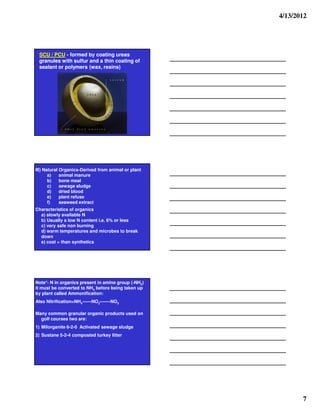
 SCU / PCU - formed by coating ureas
 granules with sulfur and a thin coating of
 sealant or polymers (wax, resins)


III) Natural Organics-Derived from animal or plant
       a)    animal manure
       b)    bone meal
       c)    sewage sludge
       d)    dried blood
       e)    plant refuse
       f)    seaweed extract
Characteristics of organics
  a) slowly available N
  b) Usually a low N content i.e. 6% or less
  c) very safe non burning
  d) warm temperatures and microbes to break
  down
  e) cost > than synthetics


Note*- N in organics present in amine group (-NH2)
it must be converted to NH4 before being taken up
by plant called Ammonification:
Also Nitrification=NH4------NO2-------NO3

Many common granular organic products used on
  golf courses two are:
1) Milorganite 6-2-0 Activated sewage sludge
2) Sustane 5-2-4 composted turkey litter


                                                            7
4/13/2012


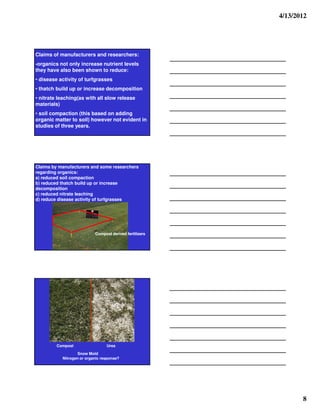
Claims of manufacturers and researchers:
-organics not only increase nutrient levels
they have also been shown to reduce:
• disease activity of turfgrasses
• thatch build up or increase decomposition
• nitrate leaching(as with all slow release
materials)
• soil compaction (this based on adding
organic matter to soil) however not evident in
studies of three years.


Claims by manufacturers and some researchers
regarding organics:
a) reduced soil compaction
b) reduced thatch build up or increase
decomposition
c) reduced nitrate leaching
d) reduce disease activity of turfgrasses


                           Compost derived fertilizers


         Compost                 Urea

                   Snow Mold
           Nitrogen or organic response?


                                                                8
9
                  • deficiencies show up in older leaves
               growth
               • found in greatest quantities in new cell
                                               • mobile in plant
                    • Component of many plant proteins
            P.S.
            • Involved in metabolic processes including
                                                      Phosphorous:
                           0-05-02 etahpsohP mumuinommaiD )2
                                     P %84-02 etapsohprepuS )1
                                   :era secruos P nommoc owT
                                      Hp lios yb detceffa si P •
                                          li o s ni eli b o m t o n P
                                          li o s ni eli b o m t o n P
                                          li o s ni eli b o m t o n P •
                                                     :stcaf surohpsohP
                                                     :stcaf surohpsohP
                                                     :stcaf surohpsohP
                                                     :stcaf surohpsohP
                 .tnempoleved rewolf dna dees ,tnemhsilbatse – P-
                 .tnempoleved rewolf dna dees ,tnemhsilbatse – P-
                 .tnempoleved rewolf dna dees ,tnemhsilbatse – P-
                 .tnempoleved rewolf dna dees ,tnemhsilbatse – P-
                                            .smelborp detaler sserts
            dna snoitatsefni deew ,esaesid ot enorp frut tneicifed P-
             N sa citamard sa ton era suorohpsohp ni seicneicifeD-
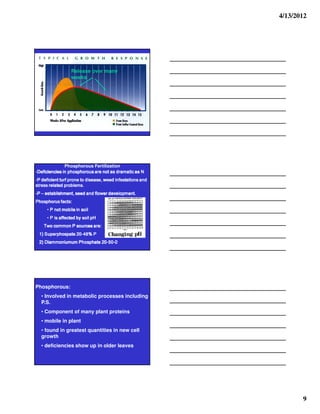
                         Phosphorous Fertilization
                          weeks
                          Release over many
4/13/2012
4/13/2012


                  Potassium Fertilization

Potassium facts:
• Needed in the plant second to Nitrogen
• Leaches readily from sandy soils
• Increase wear tolerance
• Increase drought and heat tolerance
• Increase cold tolerance
• Increase disease tolerance


   :srez tref K tsom n desu secruos eerhT
   :srez tref K tsom n desu secruos eerhT
   :sreziiiilllliiiitref K tsom niiii desu secruos eerhT
   :srez tref K tsom n desu secruos eerhT
 411 =.I.S O2K %06 hsatop fo etairum-lCK
                         2
6 4 = x e d nI t a S
64 = xednI tllllaS
6 4 = x e d nI t a S             O K %05
                                 O2K %05
                                 O K %05
                                 O K %05            OSK
                                                   4OSK
                                                    OSK
                                                    OSK
47 = xednI t aS
47 = xednI tllllaS
47 = xednI t aS
47 = xednI t aS                  O2K %44
                                 O2K %44
                                 O2K %44
                                 O2K %44          -3ONK
                                                  -3ONK
                                                  -3ONK
                                                  -3ONK


                          Silicon?
Silicon the second most abundant mineral element
in soil after oxygen.

       Recent research with Si has shown:
   • Positive effect on relieving stress
   • Foliar spray potassium silicate reduced
   injury to wear
   • Improved turf growth, drought and heat
   resistance
   • Quality, Color, and Density increased
   • Disease suppression


                                                                 10
4/13/2012


Silicon continued:

Comments:
    • More research needs to be done before
    recommendations of Si can be made
    • Analytical tools utilized to exam soil and
    tissue nutrient levels for other nutrients are
    not readily available for Si.
    • If future studies indicate positive
    responses, improving plant performance,
    disease reduction… then Si could be a
    useful tool in IPM practices in turf.


noitazilitreF
n
eb nac srezilitref ylppa ot nehw dna etar eht gninimreteD
:srotcaf fo yteirav a no tnedneped

• Species
• Length of growing season-ie. Me. vs. N.J.
• Level of quality desired.
• Purpose turf used for (wear factors). i.e. tees v.s.
fairways
• Cultural practices- i.e. Irrigation and clipping
collection reduces nutrient reservoir in soil


Determining fertilizer rate continued:


•Soil texture i.e sand
• Time of year
• Soil tests
• Type and form of fertilizer- Slow release or fast
release. (Slow release can be applied in greater
quantities while soluble should be applied in lesser
amounts but more frequent)
• Grade and SGN


                                                                  11
4/13/2012


   Determining Rates and Reading the Label
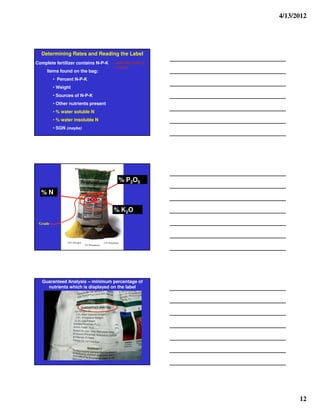
Complete fertilizer contains N-P-K – called the grade or
                                        analysis
     Items found on the bag:
         • Percent N-P-K
         • Weight
         • Sources of N-P-K
         • Other nutrients present
         • % water soluble N
         • % water insoluble N
         • SGN (maybe)


                                          % P2O5
  %N

                                       % K2O

 Grade


   Guaranteed Analysis – minimum percentage of
     nutrients which is displayed on the label


                                                                 12
4/13/2012


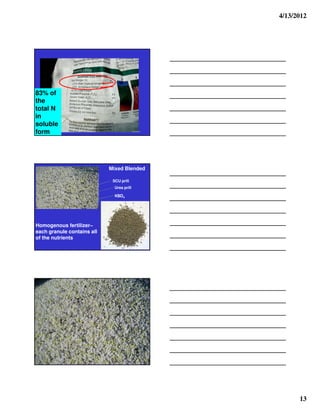
83% of
the
total N
in
soluble
form                                       Calculations


                            Mixed Blended

                             SCU prill
                              Urea prill

                              OSK
                              OSK
                              OSK
                              OSK 4


Homogenous fertilizer–
each granule contains all
of the nutrients


                                                                13
4/13/2012


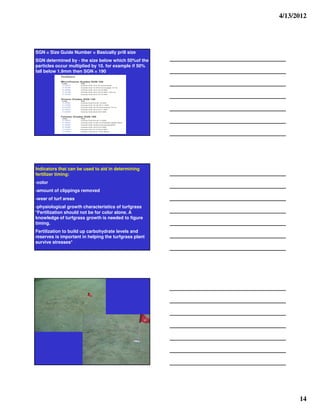
SGN = Size Guide Number = Basically prill size
SGN determined by - the size below which 50%of the
particles occur multiplied by 10. for example if 50%
fall below 1.9mm then SGN = 190


Indicators that can be used to aid in determining
fertilizer timing:
-color
-amount of clippings removed
-wear of turf areas
-physiological growth characteristics of turfgrass
*Fertilization should not be for color alone. A
knowledge of turfgrass growth is needed to figure
timing.
Fertilization to build up carbohydrate levels and
reserves is important in helping the turfgrass plant
survive stresses*


                                                             14
4/13/2012


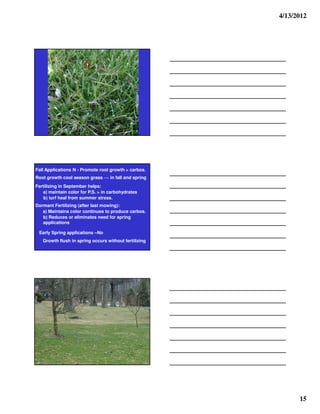
Fall Applications N - Promote root growth > carbos.
Root growth cool season grass      in fall and spring
Fertilizing in September helps:
   a) maintain color for P.S. > in carbohydrates
    b) turf heal from summer stress.
Dormant Fertilizing (after last mowing):
   a) Maintains color continues to produce carbos.
   b) Reduces or eliminates need for spring
   applications

 Early Spring applications –No
   Growth flush in spring occurs without fertilizing


                                                              15
4/13/2012


• Supplemental K fertilization will aid in hardening
off turf before winter and helps “toughen” the plant
in summer.
• Supplemental Fe will provide color while not
pushing growth (usually “short lived”)
               Fertilizer Applications


                        Granular
                       Applications


                  Types of Seeders
Broadcast- rotary
type.

 Pros
•quick and easy

 Cons
•wind carries seed /
fertilizer
•harder to get
uniform coverage.


                                                             16
4/13/2012


Drop spreaders

 - Pros - good for small areas
with borders
-applies precise application


- Cons - slow and can lead to skips or over laps


1) Granular materials are available in different sizes
or grades:
   •Smaller grades are used on low cut turf this
   reduces mower pickup
   •After applying water in
   •At next mowing mow without buckets if possible


2) Liquid Applications
   •applied through sprayer using a boom or gun
   •usually light frequent applications
   •most foliar absorbed


                                                               17
4/13/2012


Advantages of foliar feeding:
  • Reduces leaching
  • Reduces total amount of fert. Require
  • Quick plant response
  • The applicator is in control-reduces
     surges if weather conditions change ie.
     IBDU
  • Full range of products applied at once I.e.
     Pana sea® and Pro Sol®!
  • Mix with pesticides
  • No irrigation needed
  • Uniform Coverage
Disadvantage-Short lived need frequent
applications


                 Spreader Calibration
With granular fertilizers, initial settings on bags.
Set spreader at setting listed-This is the starting
                                 This
point. Then:

1) Measure and mark out a known area (say 100’)
2) Place a weighed amount of fertilizer in the
spreader
3) Start walking and open hopper at start line and
close hopper at finish line.
4) Pour material left into bucket and weigh
5) Solve Equation


                                                             18
4/13/2012


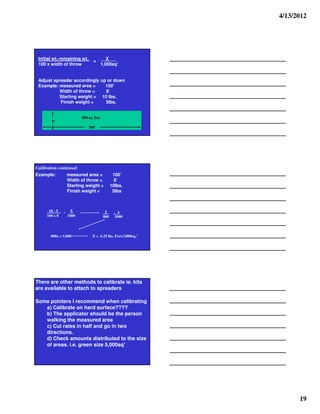
 Initial wt.-remaining wt.               __X___
                                 =
 100 x width of throw                    1,000sq’


 Adjust spreader accordingly up or down
 Example: measured area =      100’
          Width of throw =     8’
          Starting weight = 10 lbs.
           Finish weight =     5lbs.


                          800 sq. feet
        8’
                              100’


Calibration continued:
Example:           measured area =               100’
                   Width of throw =               8’
                   Starting weight =            10lbs.
                   Finish weight =               5lbs


      10 - 5   =    X                      5     =  x
     100 x 8       1000                   800     1000


        800x = 5,000            X = 6.25 lbs. Fert./1000sq.’


There are other methods to calibrate ie. kits
are available to attach to spreaders

Some pointers I recommend when calibrating
   a) Calibrate on hard surface????
   b) The applicator should be the person
   walking the measured area
   c) Cut rates in half and go in two
   directions.
   d) Check amounts distributed to the size
   of areas. i.e. green size 5,000sq’


                                                                     19
4/13/2012


                     W.C.C. Practices
Fairways-
  •Late spring-with a polycoated nitrogen source
  50% polyon 50%urea. A 20-5-20 at rate of
  1.25lbs./1000sq’.
  •Late Sept.- 50% SCU and 50%urea 20-5-20 at rate
  of .75lbs/1000sq’
  •Last Mowing- 50% SCU 50%urea 20-5-20 at rate
  of 1.00lbs./1000sq’
  •Soluble used when spraying

Roughs and surrounds-
    Granular applications spring and fall


Tees-
Granular Fertilizer at the rate of .5-.75 lbs./1000 /
month
Materials used are either coated or methylene ureas
Iron as well as seaweed extracts often added to
spray tank

Greens-
Granulars in the spring and fall total 1.5lbs./yr
1/8 lb. foliar every 10-14 days throughout growing
season
Organics, Fe, added to spray mix


                                                              20

Fertelizer

  • 1.
    4/13/2012 Fertilization Why Fertilize? • Replenish plant nutrients to sustain optimum growth and health of the plant. • Losses of nutrients occur through leaching, clipping removal, irrigation,rainfall, and volatilization • Essential nutrients for plant growth: C, H, O, P, K, N, S, Ca, Fe, Mg, B, Cl, Cu, Mn, Mo, and Zn. • Turfgrass requires nitrogen more than any other nutrient Way to Remember the Elements… ~Mnemonic Devices~ Macronutrients: C, H, O, P, K, N, S, Ca, Fe, Mg C HOPK'NS CaFé Management Micronutrients: B, Mo, Cu, Cl, Mn, Zn B Mo Cu Cl Mn Zn Bob’s Mom and Cousin Clio will manage soon Turfgrasses require 16 (some now say 17) essential elements to grow and complete their life cycle C, H, O from air and water Remaining 13-14 from 13- growing media 1
  • 2.
    4/13/2012 •Most standard turffertilizers contain N-P-K and often minors such as Fe, Mg, Ca, etc. Before fertilizing you should have knowledge of: • species requirement • air temperature • soil moisture • precipitation in forecast? • type of fertilizer being applied Importance of Nutrients to Turfgrass Growth and Development N P K Rooting X Shoot growth (tillers. X rhizomes, stolons) Leaf growth X Color X Establishment X (germination and seedlings) Hardiness drought X heat X cold X Disease susceptibility X Wear tolerance X X Recuperative potential X Composition of turf X X community 2
  • 3.
    4/13/2012 USGA Greens Record Sept./Oct 2003 Jim Skorulski Many different types of Fertilizer- discussed here are the more common types of fertilizers used in golf course management! Important characteristics or facts you need to know when purchasing fertilizer: a) burn potential b) release rates -water soluble or water insoluble c) analysis d) safety of product i.e. NH4 NO3 e) cost of product f) environmental concerns ( i.e. leaching) g) ease of handling h) spreadability HIGHER SALT INDEX 3
  • 4.
    4/13/2012 Nitrogen Fertilizers: There are three types we will discuss: I) synthetic inorganic II) synthetic organic IIb) Coated synthetic organics III) natural organic • Nitrogen taken up in two forms: NH4+ or NO3- • NO3- mostly •Nitrification of ammonia to nitrites to nitrates NH4+ NO2 NO3- nitrosomas nitrobacter I) Synthetic inorganic (don't contain C) - In general characteristics of these fertilizers are: a) readily soluble in water b) available to plant almost immediately c) can cause growth flushes d) leach and or volatilize e) high burn potential f) are usually cheaper than coated or controlled release types Examples of synthetic inorganics are: 1) Ammonium Nitrate NH4N03 - 33%N - handle with care-very explosive - high salt index 2) Ammonium sulfate NH4SO4 - 21% N - high salt index - used if careful - may be used to help lower pH 3) Potassium Nitrate KNO3 -13% K - 37%N -Product K power -good to use in fall for hardening off 4
  • 5.
    4/13/2012 II) Synthetic organics-group contains both: i) water soluble and ii) water insoluble forms i) Urea- is the primary water soluble form. a) rapid response b) high burn potential c) high N 46% d) leaches easily ii) Water insoluble forms include: a) Urea formaldehyde b) IBDU a) Urea formaldehyde -38% N -very slow release rate - (long chain methlylene urea) -low burn potential -microbes to break it down -Allows high application rates -long lasting -reduces risk of leaching Cons: -cost -3-4 weeks before color change (no initial response) 5
  • 6.
    4/13/2012 b) IBDU -madeby reacting urea with isobutyraldehyde -31% N -slow release rate -2-4 weeks delay in response -very expensive -microbes have minimal effect on release rate -soil moisture particle size, and temperature influence release rate -be careful if excessive rainfall ie. July IIb) Coated synthetic organic fertilizers- provide good initial response compared to IBDU and UF •Two types - sulfur coated and polymer coated. Advantages coated materials: a) low burn potential b) no surge-release rates gradual c) ease of handling d) Minimal loss to leaching e) Long or timed duration of feeding g) Reduced labor due to reducing frequency of applications Cons a) cost b) mowers or traffic can break coating Two types: 1) Sulfur Coated Urea (SCU) -coating = wax prill -release rates dependent on: •soil temperature and water •coating thickness and size of prill -20-30% released in first 2 weeks 2) Polymer Coated Urea (http://harrells.com/focus/polyon/) -urea coated in polymers (plastic) -nutrients release by diffusion and need soil moisture -soil temperature effects release rates -warmer the temperatures the faster the release-be careful in summer -Poly-on or osmocote are examples! 6
  • 7.
    4/13/2012 SCU /PCU - formed by coating ureas granules with sulfur and a thin coating of sealant or polymers (wax, resins) III) Natural Organics-Derived from animal or plant a) animal manure b) bone meal c) sewage sludge d) dried blood e) plant refuse f) seaweed extract Characteristics of organics a) slowly available N b) Usually a low N content i.e. 6% or less c) very safe non burning d) warm temperatures and microbes to break down e) cost > than synthetics Note*- N in organics present in amine group (-NH2) it must be converted to NH4 before being taken up by plant called Ammonification: Also Nitrification=NH4------NO2-------NO3 Many common granular organic products used on golf courses two are: 1) Milorganite 6-2-0 Activated sewage sludge 2) Sustane 5-2-4 composted turkey litter 7
  • 8.
    4/13/2012 Claims of manufacturersand researchers: -organics not only increase nutrient levels they have also been shown to reduce: • disease activity of turfgrasses • thatch build up or increase decomposition • nitrate leaching(as with all slow release materials) • soil compaction (this based on adding organic matter to soil) however not evident in studies of three years. Claims by manufacturers and some researchers regarding organics: a) reduced soil compaction b) reduced thatch build up or increase decomposition c) reduced nitrate leaching d) reduce disease activity of turfgrasses Compost derived fertilizers Compost Urea Snow Mold Nitrogen or organic response? 8
  • 9.
    9 • deficiencies show up in older leaves growth • found in greatest quantities in new cell • mobile in plant • Component of many plant proteins P.S. • Involved in metabolic processes including Phosphorous: 0-05-02 etahpsohP mumuinommaiD )2 P %84-02 etapsohprepuS )1 :era secruos P nommoc owT Hp lios yb detceffa si P • li o s ni eli b o m t o n P li o s ni eli b o m t o n P li o s ni eli b o m t o n P • :stcaf surohpsohP :stcaf surohpsohP :stcaf surohpsohP :stcaf surohpsohP .tnempoleved rewolf dna dees ,tnemhsilbatse – P- .tnempoleved rewolf dna dees ,tnemhsilbatse – P- .tnempoleved rewolf dna dees ,tnemhsilbatse – P- .tnempoleved rewolf dna dees ,tnemhsilbatse – P- .smelborp detaler sserts dna snoitatsefni deew ,esaesid ot enorp frut tneicifed P- N sa citamard sa ton era suorohpsohp ni seicneicifeD- Phosphorous Fertilization weeks Release over many 4/13/2012
  • 10.
    4/13/2012 Potassium Fertilization Potassium facts: • Needed in the plant second to Nitrogen • Leaches readily from sandy soils • Increase wear tolerance • Increase drought and heat tolerance • Increase cold tolerance • Increase disease tolerance :srez tref K tsom n desu secruos eerhT :srez tref K tsom n desu secruos eerhT :sreziiiilllliiiitref K tsom niiii desu secruos eerhT :srez tref K tsom n desu secruos eerhT 411 =.I.S O2K %06 hsatop fo etairum-lCK 2 6 4 = x e d nI t a S 6 4 = x e d nI t a S 64 = xednI tllllaS 6 4 = x e d nI t a S O K %05 O2K %05 O K %05 O K %05 OSK 4OSK OSK OSK 47 = xednI t aS 47 = xednI tllllaS 47 = xednI t aS 47 = xednI t aS O2K %44 O2K %44 O2K %44 O2K %44 -3ONK -3ONK -3ONK -3ONK Silicon? Silicon the second most abundant mineral element in soil after oxygen. Recent research with Si has shown: • Positive effect on relieving stress • Foliar spray potassium silicate reduced injury to wear • Improved turf growth, drought and heat resistance • Quality, Color, and Density increased • Disease suppression 10
  • 11.
    4/13/2012 Silicon continued: Comments: • More research needs to be done before recommendations of Si can be made • Analytical tools utilized to exam soil and tissue nutrient levels for other nutrients are not readily available for Si. • If future studies indicate positive responses, improving plant performance, disease reduction… then Si could be a useful tool in IPM practices in turf. noitazilitreF n eb nac srezilitref ylppa ot nehw dna etar eht gninimreteD :srotcaf fo yteirav a no tnedneped :srotcaf fo yteirav a no tnedneped :srotcaf fo yteirav a no tnedneped :srotcaf fo yteirav a no tnedneped • Species • Length of growing season-ie. Me. vs. N.J. • Level of quality desired. • Purpose turf used for (wear factors). i.e. tees v.s. fairways • Cultural practices- i.e. Irrigation and clipping collection reduces nutrient reservoir in soil Determining fertilizer rate continued: •Soil texture i.e sand • Time of year • Soil tests • Type and form of fertilizer- Slow release or fast release. (Slow release can be applied in greater quantities while soluble should be applied in lesser amounts but more frequent) • Grade and SGN 11
  • 12.
    4/13/2012 Determining Rates and Reading the Label Complete fertilizer contains N-P-K – called the grade or analysis Items found on the bag: • Percent N-P-K • Weight • Sources of N-P-K • Other nutrients present • % water soluble N • % water insoluble N • SGN (maybe) % P2O5 %N % K2O Grade Guaranteed Analysis – minimum percentage of nutrients which is displayed on the label 12
  • 13.
    4/13/2012 83% of the total N in soluble form Calculations Mixed Blended SCU prill Urea prill OSK OSK OSK OSK 4 Homogenous fertilizer– each granule contains all of the nutrients 13
  • 14.
    4/13/2012 SGN = SizeGuide Number = Basically prill size SGN determined by - the size below which 50%of the particles occur multiplied by 10. for example if 50% fall below 1.9mm then SGN = 190 Indicators that can be used to aid in determining fertilizer timing: -color -amount of clippings removed -wear of turf areas -physiological growth characteristics of turfgrass *Fertilization should not be for color alone. A knowledge of turfgrass growth is needed to figure timing. Fertilization to build up carbohydrate levels and reserves is important in helping the turfgrass plant survive stresses* 14
  • 15.
    4/13/2012 Fall Applications N- Promote root growth > carbos. Root growth cool season grass in fall and spring Fertilizing in September helps: a) maintain color for P.S. > in carbohydrates b) turf heal from summer stress. Dormant Fertilizing (after last mowing): a) Maintains color continues to produce carbos. b) Reduces or eliminates need for spring applications Early Spring applications –No Growth flush in spring occurs without fertilizing 15
  • 16.
    4/13/2012 • Supplemental Kfertilization will aid in hardening off turf before winter and helps “toughen” the plant in summer. • Supplemental Fe will provide color while not pushing growth (usually “short lived”) Fertilizer Applications Granular Applications Types of Seeders Broadcast- rotary type. Pros •quick and easy Cons •wind carries seed / fertilizer •harder to get uniform coverage. 16
  • 17.
    4/13/2012 Drop spreaders -Pros - good for small areas with borders -applies precise application - Cons - slow and can lead to skips or over laps 1) Granular materials are available in different sizes or grades: •Smaller grades are used on low cut turf this reduces mower pickup •After applying water in •At next mowing mow without buckets if possible 2) Liquid Applications •applied through sprayer using a boom or gun •usually light frequent applications •most foliar absorbed 17
  • 18.
    4/13/2012 Advantages of foliarfeeding: • Reduces leaching • Reduces total amount of fert. Require • Quick plant response • The applicator is in control-reduces surges if weather conditions change ie. IBDU • Full range of products applied at once I.e. Pana sea® and Pro Sol®! • Mix with pesticides • No irrigation needed • Uniform Coverage Disadvantage-Short lived need frequent applications Spreader Calibration With granular fertilizers, initial settings on bags. Set spreader at setting listed-This is the starting This point. Then: 1) Measure and mark out a known area (say 100’) 2) Place a weighed amount of fertilizer in the spreader 3) Start walking and open hopper at start line and close hopper at finish line. 4) Pour material left into bucket and weigh 5) Solve Equation 18
  • 19.
    4/13/2012 Initial wt.-remainingwt. __X___ = 100 x width of throw 1,000sq’ Adjust spreader accordingly up or down Example: measured area = 100’ Width of throw = 8’ Starting weight = 10 lbs. Finish weight = 5lbs. 800 sq. feet 8’ 100’ Calibration continued: Example: measured area = 100’ Width of throw = 8’ Starting weight = 10lbs. Finish weight = 5lbs 10 - 5 = X 5 = x 100 x 8 1000 800 1000 800x = 5,000 X = 6.25 lbs. Fert./1000sq.’ There are other methods to calibrate ie. kits are available to attach to spreaders Some pointers I recommend when calibrating a) Calibrate on hard surface???? b) The applicator should be the person walking the measured area c) Cut rates in half and go in two directions. d) Check amounts distributed to the size of areas. i.e. green size 5,000sq’ 19
  • 20.
    4/13/2012 W.C.C. Practices Fairways- •Late spring-with a polycoated nitrogen source 50% polyon 50%urea. A 20-5-20 at rate of 1.25lbs./1000sq’. •Late Sept.- 50% SCU and 50%urea 20-5-20 at rate of .75lbs/1000sq’ •Last Mowing- 50% SCU 50%urea 20-5-20 at rate of 1.00lbs./1000sq’ •Soluble used when spraying Roughs and surrounds- Granular applications spring and fall Tees- Granular Fertilizer at the rate of .5-.75 lbs./1000 / month Materials used are either coated or methylene ureas Iron as well as seaweed extracts often added to spray tank Greens- Granulars in the spring and fall total 1.5lbs./yr 1/8 lb. foliar every 10-14 days throughout growing season Organics, Fe, added to spray mix 20