For recognizing andquantifying
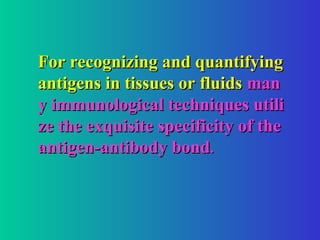
For recognizing and quantifying
antigens in tissues or fluids
antigens in tissues or fluids man
man
y immunological techniques utili
y immunological techniques utili
ze the exquisite specificity of the
ze the exquisite specificity of the
antigen-antibody bond
antigen-antibody bond.
.
3.
Cell populations canbe identified
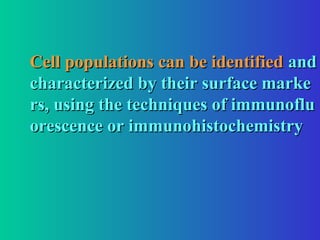
Cell populations can be identified and
and
characterized by their surface marke
characterized by their surface marke
rs, using the techniques of immunoflu
rs, using the techniques of immunoflu
orescence or immunohistochemistry
orescence or immunohistochemistry
4.
Cell populations canbe
Cell populations can be
isolated
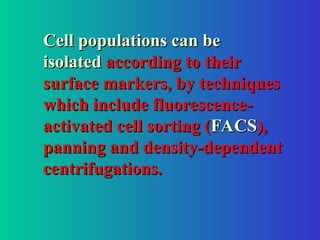
isolated according to their
according to their
surface markers, by techniques
surface markers, by techniques
which include fluorescence-
which include fluorescence-
activated cell sorting (
activated cell sorting (FACS
FACS),
),
panning and density-dependent
panning and density-dependent
centrifugations.
centrifugations.
5.
The principle assaysfor lympho
The principle assays for lympho
cyte function
cyte function are by antibody or
are by antibody or
cytokine production, by prolifer
cytokine production, by prolifer
ation in response to antigen, or
ation in response to antigen, or
by cytotoxicity.
by cytotoxicity.
6.
*ANTIGEN-ANTIBODY INTERACTION
ANTIGEN-ANTIBODY INTERACTION
1.Precipitation reactions
1. Precipitation reactions
2. Haemagglutination and complement
2. Haemagglutination and complement fix
fix
ation
ation
3. Direct and indirect
3. Direct and indirect immunofluorescence
immunofluorescence
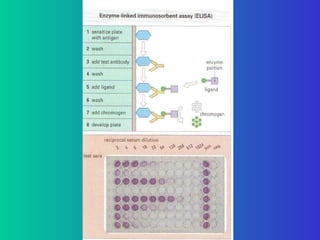
4. Immunoassay
4. Immunoassay
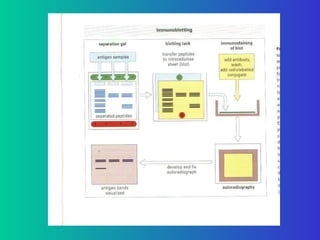
5. Immunoblotting
5. Immunoblotting and immunoprecipitation
and immunoprecipitation
7.
Immunochemical techniques
Immunochemical techniques
Thestudy of antibodies(and some ot
The study of antibodies(and some ot
her immunologically important molecule
her immunologically important molecule
s such as complement components) is kno
s such as complement components) is kno
wn as immunochemistry
wn as immunochemistry.
.Such methods a
Such methods a
re known as immunochemical techniques.
re known as immunochemical techniques.
8.
Antibodies
Antibodies
Antibodies are agroup of globular proteins know
Antibodies are a group of globular proteins know
n as immunoglobulins.
n as immunoglobulins.
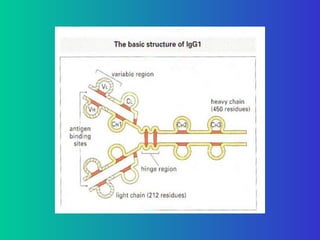
The basic four-chain model for immunoglobulin
The basic four-chain model for immunoglobulin
molecules is based on two distinct types of polypeptide
molecules is based on two distinct types of polypeptide
chain.
chain. The smaller(light) chain has a molecular weight
The smaller(light) chain has a molecular weight
of 25,000 and is common to all classes, whereas the larg
of 25,000 and is common to all classes, whereas the larg
er(heavy) chain has a molecular weight of 50,000-77,00
er(heavy) chain has a molecular weight of 50,000-77,00
0 and is structurally distinct for each class or subclass.
0 and is structurally distinct for each class or subclass.
The polypeptide chains are linked together by covalent
The polypeptide chains are linked together by covalent
and non-covalent forces
and non-covalent forces.
10.
Fab.(Fragment-antigen binding):
Fab.(Fragment-antigen binding):
Thepart of an antibody molecule which conta
The part of an antibody molecule which conta
ins the antigen-binding site, consisting of a light ch
ins the antigen-binding site, consisting of a light ch
ain and part of the heavy chain; it is produced by e
ain and part of the heavy chain; it is produced by e
nzymatic digestion. (papain, pepsin)
nzymatic digestion. (papain, pepsin)
Fc.(Fragment crystallisable):
Fc.(Fragment crystallisable):
The portion of an antibody that is responsible
The portion of an antibody that is responsible
for binding to antibody receptors on cells and the C
for binding to antibody receptors on cells and the C
1q component of complement.
1q component of complement.
12.
Complement
Complement
The complement systemis part of the innate
The complement system is part of the innate
immune system. There are two main pathways
immune system. There are two main pathways
for complement activation, the classical and
for complement activation, the classical and
alternative pathway.
alternative pathway. The classical pathway
The classical pathway links
links
the adaptive immune system, antibody, to the
the adaptive immune system, antibody, to the
innate immune system, complement, by the
innate immune system, complement, by the
binding to immune complexes of C1q.
binding to immune complexes of C1q.
Alternative pathway
Alternative pathway activation is initiated when
activation is initiated when
C3, activated by the ‘tick-over’pathway, deposits
C3, activated by the ‘tick-over’pathway, deposits
on foreign surfaces, lacking regulatory molecules.
on foreign surfaces, lacking regulatory molecules.
14.
Further reading:
Further reading:
PorterRR, Reid, KBM. The biochemistry of com
Porter RR, Reid, KBM. The biochemistry of com
plement.
plement. Nature
Nature 1978;
1978; 275
275: 699-704.
: 699-704.
Reid KBM, Porter RR. The proteolytic activatio
Reid KBM, Porter RR. The proteolytic activatio
n systems of complement.
n systems of complement. Annu Rev Biochem
Annu Rev Biochem 198
198
1;
1; 50:
50: 433-464.
433-464.
Reid KBM, Day AJ. Structure-function relations
Reid KBM, Day AJ. Structure-function relations
hips of the complement components.
hips of the complement components. Immunol To
Immunol To
day
day, 1989;
, 1989; 10:
10: 177-180.
177-180.
Campbell RD, Law SKA, Reid KBM, Sim RB. St
Campbell RD, Law SKA, Reid KBM, Sim RB. St
ructure, organisation, and regulation of the comp
ructure, organisation, and regulation of the comp
lement genes.
lement genes. Annu Rev Immunol
Annu Rev Immunol 1988;
1988; 6:
6: 161-19
161-19
5
5.
15.
Polyclonal and monoclonalantibodies
Polyclonal and monoclonal antibodies
Usually, many different antibodies,
Usually, many different antibodies, recognising sever
recognising sever
al different epitopes
al different epitopes on each antigen are present. Such a re
on each antigen are present. Such a re
sponse is described as polyclonal, as antibody is derived fr
sponse is described as polyclonal, as antibody is derived fr
om more than one clone of B lymphocytes and shows heter
om more than one clone of B lymphocytes and shows heter
ogeneity in the amino acid sequences of the antigen-bindin
ogeneity in the amino acid sequences of the antigen-bindin
g immunoglobulins present.
g immunoglobulins present.
However, more recently, methods have been develop
However, more recently, methods have been develop
ed for deriving monoclonal antibodies, which are derived f
ed for deriving monoclonal antibodies, which are derived f
rom a single B cell clone and show identical amino acid seq
rom a single B cell clone and show identical amino acid seq
uence. Monoclonal antibody preparations show homogene
uence. Monoclonal antibody preparations show homogene
ous characteristics(including specificity and avidity for ant
ous characteristics(including specificity and avidity for ant
igen, i.e. they
igen, i.e. they recognise a single epitope
recognise a single epitope).
).
16.
Production of antibodies
Productionof antibodies
Production of polyclonal antibodies(antisera)
Production of polyclonal antibodies(antisera)
In general, most immunochemical methods
In general, most immunochemical methods
are devised for use with antibodies that
are devised for use with antibodies that recognis
recognis
e proteins and peptides
e proteins and peptides.
.
In some cases, particular parts of the antige
In some cases, particular parts of the antige
n produce very potent immune responses and su
n produce very potent immune responses and su
ch epitopes are known as immunodominant. Im
ch epitopes are known as immunodominant. Im
munogenicity tends to increase with size;
munogenicity tends to increase with size; protein
protein
s with a molecular weight > 10,000
s with a molecular weight > 10,000 are usually i
are usually i
mmunogenic as long as they are recognised as fo
mmunogenic as long as they are recognised as fo
reign in responding animals.
reign in responding animals.
17.
For production ofpotent antibodies t
For production of potent antibodies t
hat perform well in immunochemical tech
hat perform well in immunochemical tech
niques, it is usually necessary to use an
niques, it is usually necessary to use an ad
ad
juvant
juvant as part of the immunogen. Such su
as part of the immunogen. Such su
bstances potentiate the immune response
bstances potentiate the immune response
by
by forming a slow-release depot of antigen
forming a slow-release depot of antigen,
,
by stimulating T cell help or by aiding an
by stimulating T cell help or by aiding an
tigen presentation.
tigen presentation.
18.
Some commonly usedadjuvants
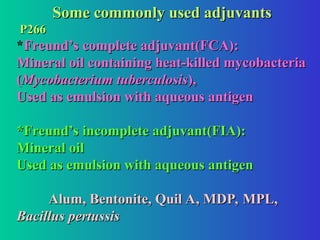
Some commonly used adjuvants
P266
P266
*Freund’s complete adjuvant(FCA):
Freund’s complete adjuvant(FCA):
Mineral oil containing heat-killed mycobacteria
Mineral oil containing heat-killed mycobacteria
(
(Mycobacterium tuberculosis
Mycobacterium tuberculosis),
),
Used as emulsion with aqueous antigen
Used as emulsion with aqueous antigen
*Freund’s incomplete adjuvant(FIA):
*Freund’s incomplete adjuvant(FIA):
Mineral oil
Mineral oil
Used as emulsion with aqueous antigen
Used as emulsion with aqueous antigen
Alum, Bentonite, Quil A, MDP, MPL,
Alum, Bentonite, Quil A, MDP, MPL,
Bacillus pertussis
Bacillus pertussis
19.
Examples of immunizationprotocols that
Examples of immunization protocols that
have been used successfully
have been used successfully
P267
P267
i.p., intraperitoneally;
i.p., intraperitoneally;
s.c., subcutaneously;
s.c., subcutaneously;
i.m., intramuscularly;
i.m., intramuscularly;
i.v., intravenously;
i.v., intravenously;
i.d., intradermally.
i.d., intradermally.
Source
Source: Reproduced from M.A.Kerr and R.Thorpe,
: Reproduced from M.A.Kerr and R.Thorpe, I
I
mmunochemistry Labfax
mmunochemistry Labfax(1994), Bios Scientific, Oxfor
(1994), Bios Scientific, Oxfor
d.
d.
20.
Antibodies and sera
Antibodiesand sera
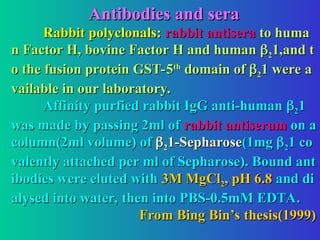
Rabbit polyclonals:
Rabbit polyclonals: rabbit antisera
rabbit antisera to huma
to huma
n Factor H, bovine Factor H and human
n Factor H, bovine Factor H and human
2
21,and t
1,and t
o the fusion protein GST-5
o the fusion protein GST-5th
th
domain of
domain of
2
21 were a
1 were a
vailable in our laboratory.
vailable in our laboratory.
Affinity purfied rabbit IgG anti-human
Affinity purfied rabbit IgG anti-human
2
21
1
was made by passing 2ml of
was made by passing 2ml of rabbit antiserum
rabbit antiserum on a
on a
column(2ml volume) of
column(2ml volume) of
2
21-Sepharose
1-Sepharose(1mg
(1mg
2
21 co
1 co
valently attached per ml of Sepharose). Bound ant
valently attached per ml of Sepharose). Bound ant
ibodies were eluted with
ibodies were eluted with 3M MgCl
3M MgCl2
2, pH 6.8
, pH 6.8 and di
and di
alysed into water, then into PBS-0.5mM EDTA.
alysed into water, then into PBS-0.5mM EDTA.
From Bing Bin’s thesis(1999)
From Bing Bin’s thesis(1999)
21.
Production of monoclonalantibodies
Production of monoclonal antibodies
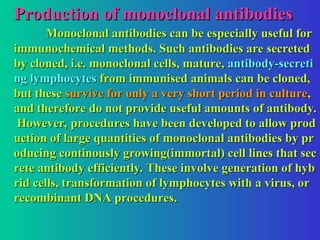
Monoclonal antibodies can be especially useful for
Monoclonal antibodies can be especially useful for
immunochemical methods. Such antibodies are secreted
immunochemical methods. Such antibodies are secreted
by cloned, i.e. monoclonal cells, mature,
by cloned, i.e. monoclonal cells, mature, antibody-secreti
antibody-secreti
ng lymphocytes
ng lymphocytes from immunised animals can be cloned,
from immunised animals can be cloned,
but these
but these survive for only a very short period in culture
survive for only a very short period in culture,
,
and therefore do not provide useful amounts of antibody.
and therefore do not provide useful amounts of antibody.
However, procedures have been developed to allow prod
However, procedures have been developed to allow prod
uction of large quantities of monoclonal antibodies by pr
uction of large quantities of monoclonal antibodies by pr
oducing continously growing(immortal) cell lines that sec
oducing continously growing(immortal) cell lines that sec
rete antibody efficiently. These involve generation of hyb
rete antibody efficiently. These involve generation of hyb
rid cells, transformation of lymphocytes with a virus, or
rid cells, transformation of lymphocytes with a virus, or
recombinant DNA procedures.
recombinant DNA procedures.
22.
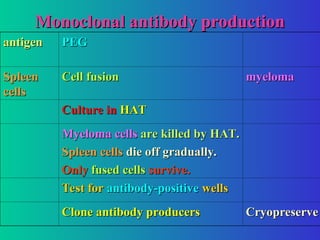
Monoclonal antibody production
Monoclonalantibody production
antigen
antigen PEG
PEG
Spleen
Spleen
cells
cells
Cell fusion
Cell fusion myeloma
myeloma
Culture in
Culture in HAT
HAT
Myeloma cells
Myeloma cells are killed by HAT.
are killed by HAT.
Spleen cells
Spleen cells die off gradually.
die off gradually.
Only
Only fused cells
fused cells survive.
survive.
Test for
Test for antibody-positive
antibody-positive wells
wells
Clone antibody producers
Clone antibody producers Cryopreserve
Cryopreserve
23.
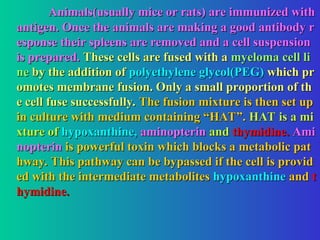
Animals(usually mice orrats) are immunized with
Animals(usually mice or rats) are immunized with
antigen. Once the animals are making a good antibody r
antigen. Once the animals are making a good antibody r
esponse their spleens are removed and a cell suspension
esponse their spleens are removed and a cell suspension
is prepared.
is prepared. These cells are fused with a
These cells are fused with a myeloma cell li
myeloma cell li
ne
ne by the addition of
by the addition of polyethylene glycol(PEG)
polyethylene glycol(PEG) which pr
which pr
omotes membrane fusion. Only a small proportion of th
omotes membrane fusion. Only a small proportion of th
e cell fuse successfully.
e cell fuse successfully. The fusion mixture is then set up
The fusion mixture is then set up
in culture with medium containing “HAT”.
in culture with medium containing “HAT”. HAT is a mi
HAT is a mi
xture of
xture of hypoxanthine,
hypoxanthine, aminopterin
aminopterin and
and thymidine
thymidine.
. Ami
Ami
nopterin
nopterin is powerful toxin which blocks a metabolic pat
is powerful toxin which blocks a metabolic pat
hway. This pathway can be bypassed if the cell is provid
hway. This pathway can be bypassed if the cell is provid
ed with the intermediate metabolites
ed with the intermediate metabolites hypoxanthine
hypoxanthine and
and t
t
hymidine.
hymidine.
24.
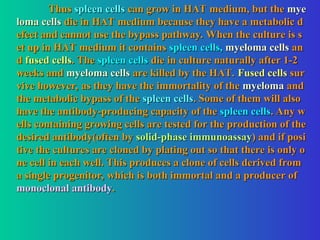
Thus
Thus spleen cells
spleencells can grow in HAT medium, but the
can grow in HAT medium, but the mye
mye
loma cells
loma cells die in HAT medium because they have a metabolic d
die in HAT medium because they have a metabolic d
efect and cannot use the bypass pathway. When the culture is s
efect and cannot use the bypass pathway. When the culture is s
et up in HAT medium it contains
et up in HAT medium it contains spleen cells,
spleen cells, myeloma cells
myeloma cells an
an
d
d fused cells
fused cells. The
. The spleen cells
spleen cells die in culture naturally after 1-2
die in culture naturally after 1-2
weeks and
weeks and myeloma cells
myeloma cells are killed by the HAT.
are killed by the HAT. Fused cells
Fused cells sur
sur
vive however, as they have the immortality of the
vive however, as they have the immortality of the myeloma
myeloma and
and
the metabolic bypass of the
the metabolic bypass of the spleen cells
spleen cells. Some of them will also
. Some of them will also
have the antibody-producing capacity of the
have the antibody-producing capacity of the spleen cells
spleen cells. Any w
. Any w
ells containing growing cells are tested for the production of the
ells containing growing cells are tested for the production of the
desired antibody(often by
desired antibody(often by solid-phase immunoassay
solid-phase immunoassay) and if posi
) and if posi
tive the cultures are cloned by plating out so that there is only o
tive the cultures are cloned by plating out so that there is only o
ne cell in each well. This produces a clone of cells derived from
ne cell in each well. This produces a clone of cells derived from
a single progenitor, which is both immortal and a producer of
a single progenitor, which is both immortal and a producer of
monoclonal antibody
monoclonal antibody.
.
25.
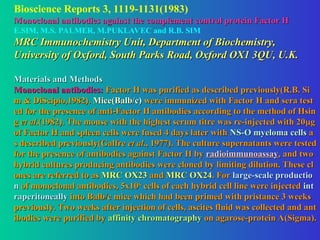
Bioscience Reports 3,1119-1131(1983)
Monoclonal antibodies against the complement control protein Factor H
Monoclonal antibodies against the complement control protein Factor H
E.SIM, M.S. PALMER, M.PUKLAVEC and R.B. SIM
MRC Immunochemistry Unit, Department of Biochemistry,
MRC Immunochemistry Unit, Department of Biochemistry,
University of Oxford, South Parks Road, Oxford OX1 3QU, U.K.
University of Oxford, South Parks Road, Oxford OX1 3QU, U.K.
Materials and Methods
Materials and Methods
Monoclonal antibodies:
Monoclonal antibodies: Factor H was purified as described previously(R.B. Si
Factor H was purified as described previously(R.B. Si
m & DiScipio,1982).
m & DiScipio,1982). Mice(Balb/c)
Mice(Balb/c) were immunized with Factor H and sera test
were immunized with Factor H and sera test
ed for the presence of anti-Factor H antibodies according to the method of Hsin
ed for the presence of anti-Factor H antibodies according to the method of Hsin
g
g et al
et al.(1982). The mouse with the highest serum titre was re-injected with 20
.(1982). The mouse with the highest serum titre was re-injected with 20
g
g
of Factor H and spleen cells were fused 4 days later with
of Factor H and spleen cells were fused 4 days later with NS-O myeloma cells
NS-O myeloma cells a
a
s described previously(Galfre
s described previously(Galfre et al
et al., 1977). The culture supernatants were tested
., 1977). The culture supernatants were tested
for the presence of antibodies against Factor H by
for the presence of antibodies against Factor H by radioimmunoassay
radioimmunoassay, and two
, and two
hybrid cultures producing antibodies were cloned by limiting dilution. These cl
hybrid cultures producing antibodies were cloned by limiting dilution. These cl
ones are referred to as
ones are referred to as MRC OX23
MRC OX23 and
and MRC OX24
MRC OX24. For
. For large-scale productio
large-scale productio
n
n of monoclonal antibodies, 5x10
of monoclonal antibodies, 5x10⁶
6
cells of each hybrid cell line were injected
cells of each hybrid cell line were injected int
int
raperitoneally
raperitoneally into Balb/c mice which had been primed with pristance 3 weeks
into Balb/c mice which had been primed with pristance 3 weeks
previously. Two weeks after injection of cells, ascites fluid was collected and ant
previously. Two weeks after injection of cells, ascites fluid was collected and ant
ibodies were purified by
ibodies were purified by affinity chromatography
affinity chromatography on agarose-protein A(Sigma).
on agarose-protein A(Sigma).
27.
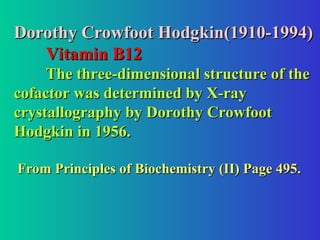
Dorothy Crowfoot Hodgkin(1910-1994)
DorothyCrowfoot Hodgkin(1910-1994)
Vitamin B12
Vitamin B12
The three-dimensional structure of the
The three-dimensional structure of the
cofactor was determined by X-ray
cofactor was determined by X-ray
crystallography by Dorothy Crowfoot
crystallography by Dorothy Crowfoot
Hodgkin in 1956.
Hodgkin in 1956.
From Principles of Biochemistry (II) Page 495.
From Principles of Biochemistry (II) Page 495.
32.
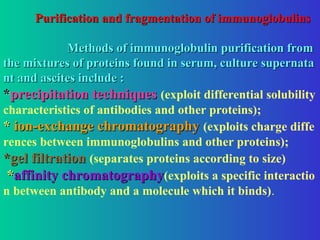
Purification and fragmentationof immunoglobulins
Purification and fragmentation of immunoglobulins
Methods of immunoglobulin purification from
Methods of immunoglobulin purification from
the mixtures of proteins found in serum, culture supernata
the mixtures of proteins found in serum, culture supernata
nt and ascites include :
nt and ascites include :
*
*precipitation techniques
precipitation techniques (exploit differential solubility
characteristics of antibodies and other proteins);
*
* ion-exchange chromatography
ion-exchange chromatography (exploits charge diffe
rences between immunoglobulins and other proteins);
*gel filtration
*gel filtration (separates proteins according to size)
*
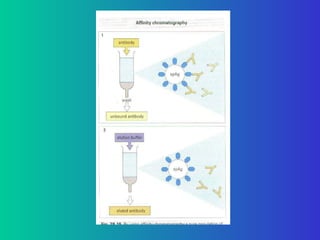
*affinity chromatography
affinity chromatography(exploits a specific interactio
n between antibody and a molecule which it binds).
34.
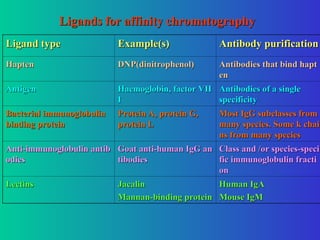
Ligands for affinitychromatography
Ligands for affinity chromatography
Ligand type
Ligand type Example(s)
Example(s) Antibody purification
Antibody purification
Hapten
Hapten DNP(dinitrophenol)
DNP(dinitrophenol) Antibodies that bind hapt
Antibodies that bind hapt
en
en
Antigen
Antigen Haemoglobin, factor VII
Haemoglobin, factor VII
I
I
Antibodies of a single
Antibodies of a single
specificity
specificity
Bacterial immunoglobulin
Bacterial immunoglobulin
binding protein
binding protein
Protein A, protein G,
Protein A, protein G,
protein L
protein L
Most IgG subclasses from
Most IgG subclasses from
many species. Some k chai
many species. Some k chai
ns from many species
ns from many species
Anti-immunoglobulin antib
Anti-immunoglobulin antib
odies
odies
Goat anti-human IgG an
Goat anti-human IgG an
tibodies
tibodies
Class and /or species-speci
Class and /or species-speci
fic immunoglobulin fracti
fic immunoglobulin fracti
on
on
Lectins
Lectins Jacalin
Jacalin
Mannan-binding protein
Mannan-binding protein
Human IgA
Human IgA
Mouse IgM
Mouse IgM
36.
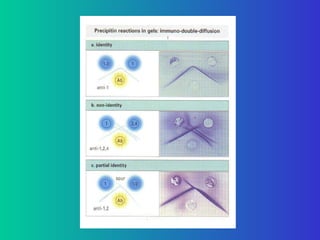
The immuno-double-diffusion technique
Theimmuno-double-diffusion technique
By performing these reactions in agar gels
By performing these reactions in agar gels
it is possible to distinguish separate
it is possible to distinguish separate antigen-anti
antigen-anti
body
body reactions produced by different populatio
reactions produced by different populatio
ns of antibody which are present in a
ns of antibody which are present in a serum
serum. Th
. Th
is technique has been extended to the examinati
is technique has been extended to the examinati
on of the relationship between different antigen
on of the relationship between different antigen
s.
s.
Immunoblotting
Immunoblotting
The methods describedso far are parti
The methods described so far are parti
cularly useful for measuring levels of certai
cularly useful for measuring levels of certai
n known antigens or antibodies, but often it
n known antigens or antibodies, but often it
is necessary to identify and characterize pr
is necessary to identify and characterize pr
eviously
eviously unknown antigens
unknown antigens from a
from a complex
complex
mixture
mixture, in which case
, in which case immunoblotting
immunoblotting is v
is v
ery useful.
ery useful.







![Immunochemical techniques]](https://cdn.slidesharecdn.com/ss_thumbnails/immunochemicaltechniques1-200402171215-thumbnail.jpg?width=640&height=640&fit=bounds)


![Polymer [ बहुलक ] Chemistry Notes PDF - Irfanullah Mehar - JJ Sir Chemistry.pdf](https://cdn.slidesharecdn.com/ss_thumbnails/polymerchemistrynotespdf-irfanullahmehar-jjsirchemistry-260210172118-3f9b37f7-thumbnail.jpg?width=640&height=640&fit=bounds)


