ELIT 46C
Day 6
VICTORIAN FEMINISM (WITH A SPECIAL APPEARANCE BY GOBLINS).
Paper 1
DUE FRIDAY, MAY 5, BY NOON
Participation for today
Three points possible today.
One individual point for something you say in
full discussion.
Two points if you participate in our group
activity AND your group says something to the
class.
Be sure to clearly claim both types of points in
your participation self-report at the end of
class.
What would it mean for a Victorian novel
to be feminist?
In other words, what would a Victorian novel
have to do for us to consider it feminist?
Victorian Women’s History: Legal Terrain
Custody of Infants Act 1839: allowed a woman to petition the court for custody of children under the
age of 7 (in the case of divorce or separation).
Matrimonial Causes Act 1857:
◦ prior: divorce had to be undertaken through individual Act of Parliament.
◦ now could be pursued under common law.
◦ men could divorce for adultery; women could divorce for adultery + some other offense (cruelty, incest,
bigamy, etc.)
Married Women’s Property Act 1870: Women could keep the wages they earned
after marriage.
Matrimonial Causes Act 1878. Allowed women who are victims of violence in
marriage to obtain separations.
Married Women’s Property Act 1882: Women now become separate legal entities
from their husbands who can then own property/wages before and after marriage.
1918: women’s suffrage (age 30+ only).
Educational Opportunities
1848: Queen’s College in London founded to provide secondary education to women (age 12-
20).
1869: Girton College for women established at Cambridge.
1879: Somerville College for women established at Oxford.
1880: Women allowed to take degrees at the University of London.
1920-21: Women allowed to take degrees at Cambridge and Oxford
Cultural Condition of Women
Could not participate in commercial or intellectual life:
◦ middle and upper class women barred from any kind of employment.
Respectable women who really needed the money could be schoolmistresses, governesses, or
potentially writers. That’s the list.
Domestic sphere: woman as “angel in the house.”
Sex:
◦ sex only within the context of marriage
◦ lack of sexual desire (always) assumed
◦ virginity until marriage demanded (and assumed).
A story…
We start with a little girl who resists.
She refuses to accept her (lowly) place in the world.
Desires, above all, freedom from constraint—certainly economic, but also, importantly, from the
constraints placed on her gender.
Though occasionally tempted to be “tied down,” she continues to escape from situations in
which she would be constrained.
Until—finally—she is rewarded:
◦ money enough to make herself independent
◦ free of any need to subordinate herself to a man in marriage or to unpleasant employment.
◦ has the opportunity to build a community of “sisters” by rescuing them from similar predicaments.
So what does she do?
“Reader, I married him.” (517; Ch 38)
And what are we to make of this?
“I have now been married ten years. I know what it is to live entirely for and
with what I love best on earth. I hold myself supremely blest—blest beyond
what language can express; because I am my husband’s life as fully as he is mine.
No woman was ever nearer to her mate than I am: ever more absolutely bone of
his bone and flesh of his flesh. I know no weariness of my Edward’s society: he
knows none of mine, any more than we each do of the pulsation of the heart
that beats in our separate bosoms; consequently, we are ever together. To be
together is for us to be at once as free as in solitude, as gay as in company. We
talk, I believe, all day long: to talk to each other is but a more animated and an
audible thinking” (519; Ch 38).
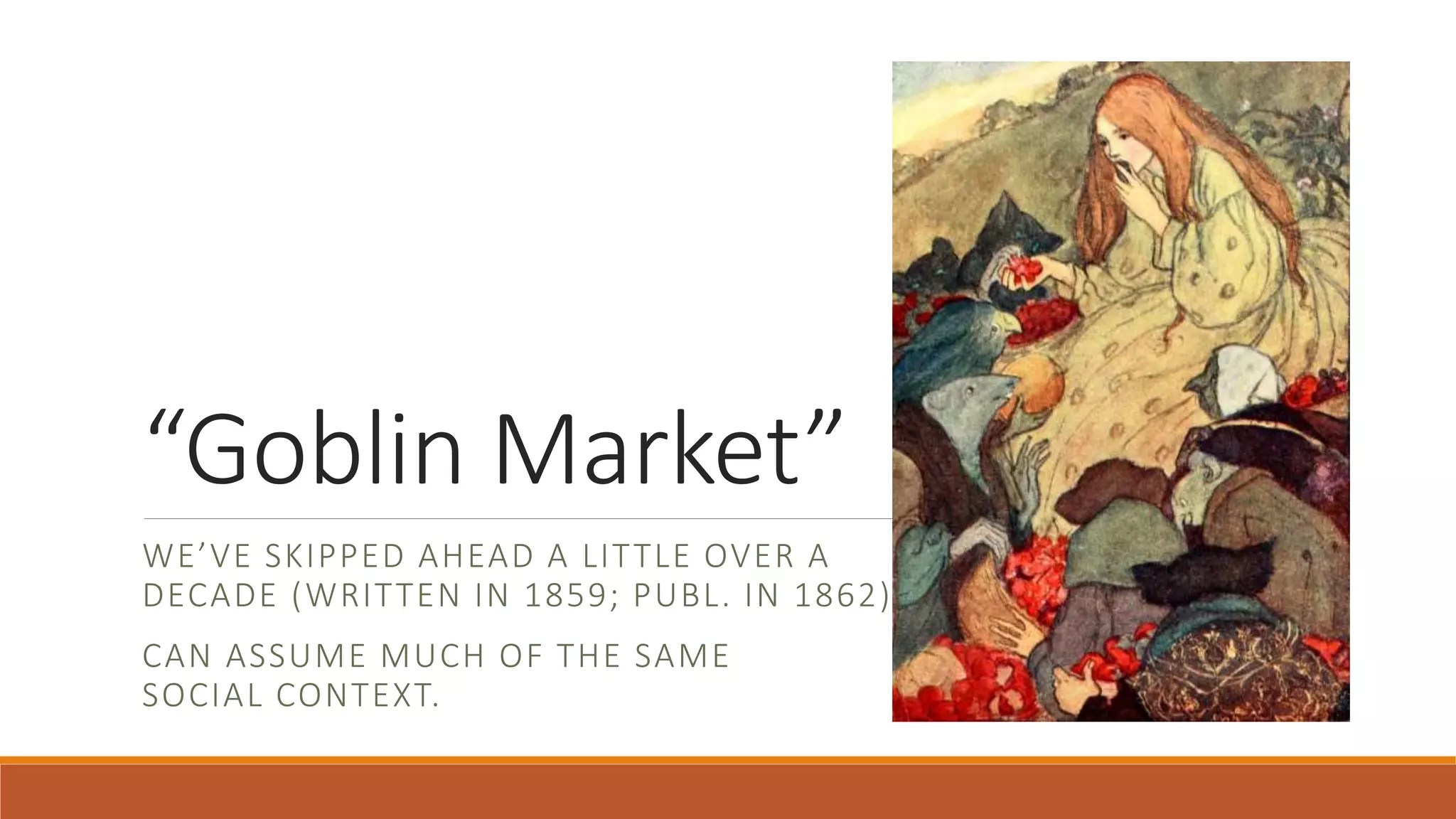
“Goblin Market”
WE’VE SKIPPED AHEAD A LITTLE OVER A
DECADE (WRITTEN IN 1859; PUBL. IN 1862).
CAN ASSUME MUCH OF THE SAME
SOCIAL CONTEXT.
Christina Rosetti (1830-1894)
Italian-English family (father was exiled Italian
patriot).
Brother (Dante Gabriel) became famous
painter and leader of an art movement called
the Pre-Raphaelite Brotherhood.
Very religious. Anglo-Catholic. Tended toward
asceticism (gave up theater, opera, chess).
Refused a number of marriage proposals;
remained single.
Volunteered, at one point, at a house for
“fallen women.” (Hmmm. Might be relevant.)
Gilbert & Gubar: “aesthetics of renunciation”
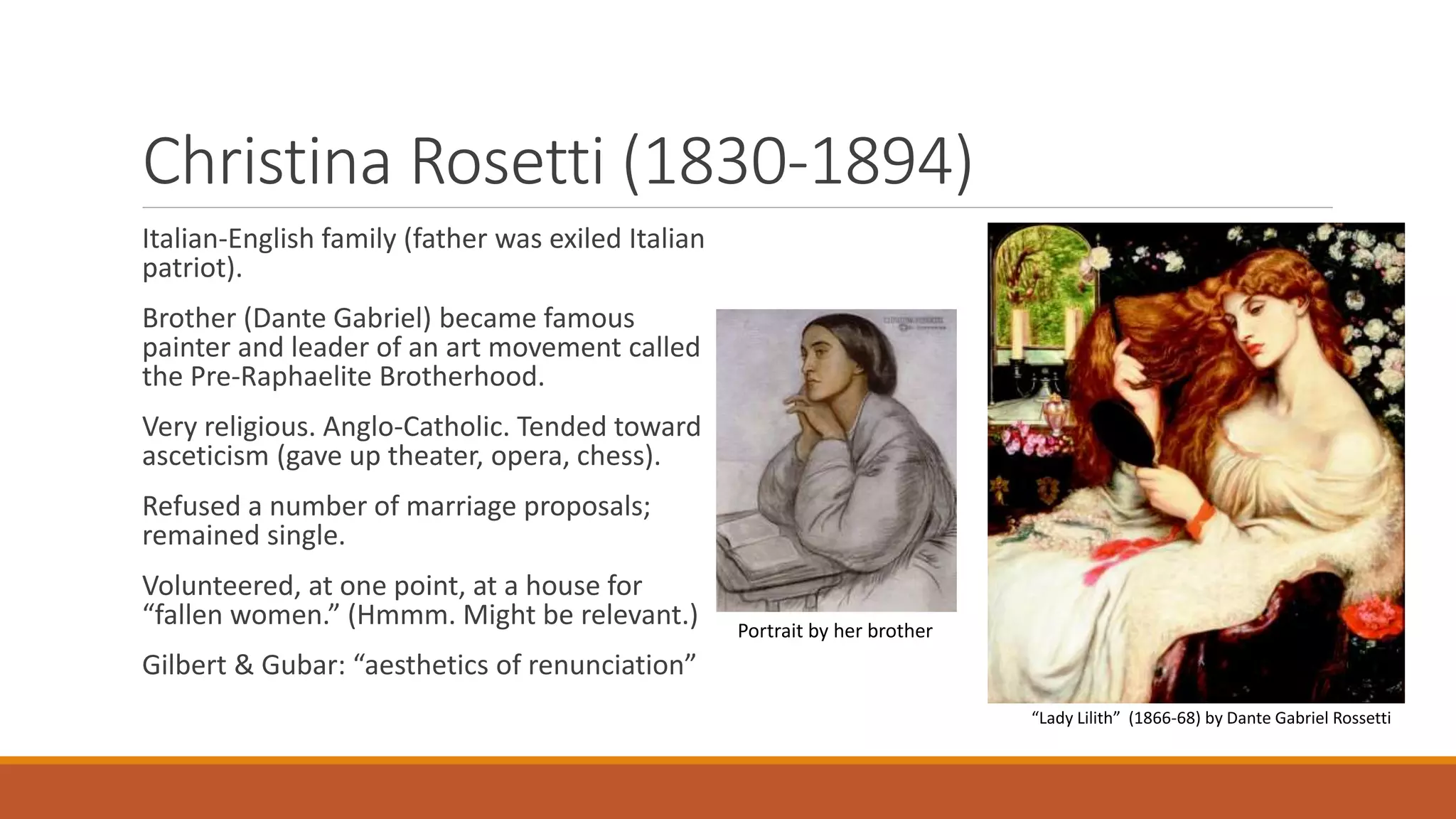
“Lady Lilith” (1866-68) by Dante Gabriel Rossetti
Portrait by her brother
Lenses for reading
Spiritual / religious
Sexual / erotic / sensual
Economic
Political / social
Femininity
Group Activity
Break into 6-person groups (no larger).
You’ll be assigned a number on today’s
discussion worksheet:
1. Discuss those lines in the poem.
2. Answer the questions.
3. Bring up new ideas.
4. Choose one or two things you want to
share with the class about the lines you
were assigned.
Homework
1. CAREFULLY read the Paper 1 assignment on
Canvas. If you have ANY questions, you should
email me.
I’ve also made a Discussion Forum for anyone
who voluntarily wants to discuss the assignment
with your classmates (and me). You are not
required to post in this forum.
2. Read at least half of A Christmas Carol for
Tuesday.
PLEEEEEEEEEEEEEEEEEEEEEEEEEEEEAAAASE
try to bracket your previous knowledge of this
text (especially any contemporary adaptations—
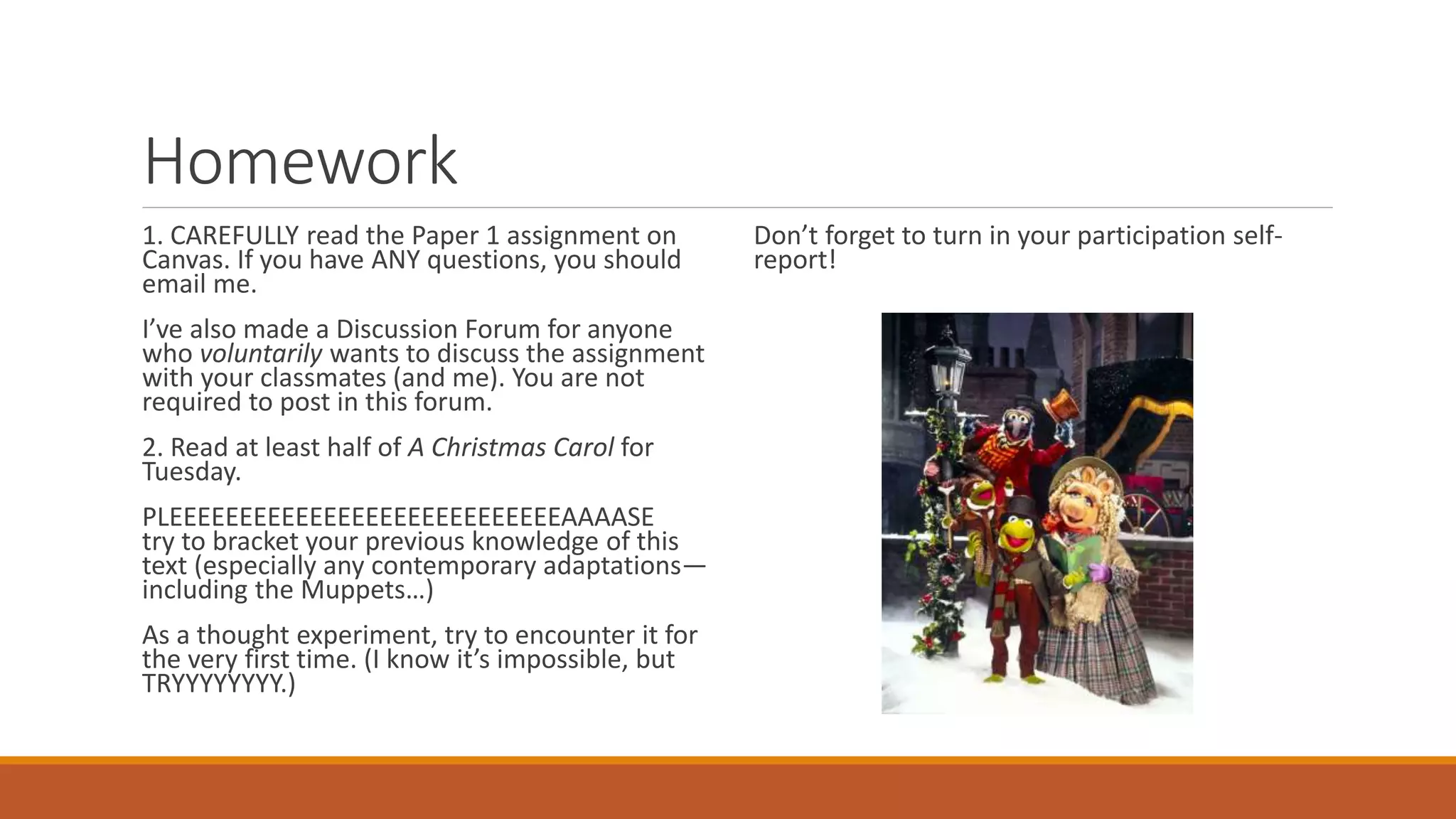
including the Muppets…)
As a thought experiment, try to encounter it for
the very first time. (I know it’s impossible, but
TRYYYYYYYY.)
Don’t forget to turn in your participation self-
report!

Day 6-ELIT 46C

  • 1.
    ELIT 46C Day 6 VICTORIANFEMINISM (WITH A SPECIAL APPEARANCE BY GOBLINS).
  • 2.
    Paper 1 DUE FRIDAY,MAY 5, BY NOON
  • 3.
    Participation for today Threepoints possible today. One individual point for something you say in full discussion. Two points if you participate in our group activity AND your group says something to the class. Be sure to clearly claim both types of points in your participation self-report at the end of class.
  • 4.
    What would itmean for a Victorian novel to be feminist? In other words, what would a Victorian novel have to do for us to consider it feminist?
  • 5.
    Victorian Women’s History:Legal Terrain Custody of Infants Act 1839: allowed a woman to petition the court for custody of children under the age of 7 (in the case of divorce or separation). Matrimonial Causes Act 1857: ◦ prior: divorce had to be undertaken through individual Act of Parliament. ◦ now could be pursued under common law. ◦ men could divorce for adultery; women could divorce for adultery + some other offense (cruelty, incest, bigamy, etc.) Married Women’s Property Act 1870: Women could keep the wages they earned after marriage. Matrimonial Causes Act 1878. Allowed women who are victims of violence in marriage to obtain separations. Married Women’s Property Act 1882: Women now become separate legal entities from their husbands who can then own property/wages before and after marriage. 1918: women’s suffrage (age 30+ only).
  • 6.
    Educational Opportunities 1848: Queen’sCollege in London founded to provide secondary education to women (age 12- 20). 1869: Girton College for women established at Cambridge. 1879: Somerville College for women established at Oxford. 1880: Women allowed to take degrees at the University of London. 1920-21: Women allowed to take degrees at Cambridge and Oxford
  • 7.
    Cultural Condition ofWomen Could not participate in commercial or intellectual life: ◦ middle and upper class women barred from any kind of employment. Respectable women who really needed the money could be schoolmistresses, governesses, or potentially writers. That’s the list. Domestic sphere: woman as “angel in the house.” Sex: ◦ sex only within the context of marriage ◦ lack of sexual desire (always) assumed ◦ virginity until marriage demanded (and assumed).
  • 8.
    A story… We startwith a little girl who resists. She refuses to accept her (lowly) place in the world. Desires, above all, freedom from constraint—certainly economic, but also, importantly, from the constraints placed on her gender. Though occasionally tempted to be “tied down,” she continues to escape from situations in which she would be constrained. Until—finally—she is rewarded: ◦ money enough to make herself independent ◦ free of any need to subordinate herself to a man in marriage or to unpleasant employment. ◦ has the opportunity to build a community of “sisters” by rescuing them from similar predicaments. So what does she do?
  • 9.
    “Reader, I marriedhim.” (517; Ch 38)
  • 10.
    And what arewe to make of this? “I have now been married ten years. I know what it is to live entirely for and with what I love best on earth. I hold myself supremely blest—blest beyond what language can express; because I am my husband’s life as fully as he is mine. No woman was ever nearer to her mate than I am: ever more absolutely bone of his bone and flesh of his flesh. I know no weariness of my Edward’s society: he knows none of mine, any more than we each do of the pulsation of the heart that beats in our separate bosoms; consequently, we are ever together. To be together is for us to be at once as free as in solitude, as gay as in company. We talk, I believe, all day long: to talk to each other is but a more animated and an audible thinking” (519; Ch 38).
  • 11.
    “Goblin Market” WE’VE SKIPPEDAHEAD A LITTLE OVER A DECADE (WRITTEN IN 1859; PUBL. IN 1862). CAN ASSUME MUCH OF THE SAME SOCIAL CONTEXT.
  • 12.
    Christina Rosetti (1830-1894) Italian-Englishfamily (father was exiled Italian patriot). Brother (Dante Gabriel) became famous painter and leader of an art movement called the Pre-Raphaelite Brotherhood. Very religious. Anglo-Catholic. Tended toward asceticism (gave up theater, opera, chess). Refused a number of marriage proposals; remained single. Volunteered, at one point, at a house for “fallen women.” (Hmmm. Might be relevant.) Gilbert & Gubar: “aesthetics of renunciation” “Lady Lilith” (1866-68) by Dante Gabriel Rossetti Portrait by her brother
  • 13.
    Lenses for reading Spiritual/ religious Sexual / erotic / sensual Economic Political / social Femininity Group Activity Break into 6-person groups (no larger). You’ll be assigned a number on today’s discussion worksheet: 1. Discuss those lines in the poem. 2. Answer the questions. 3. Bring up new ideas. 4. Choose one or two things you want to share with the class about the lines you were assigned.
  • 14.
    Homework 1. CAREFULLY readthe Paper 1 assignment on Canvas. If you have ANY questions, you should email me. I’ve also made a Discussion Forum for anyone who voluntarily wants to discuss the assignment with your classmates (and me). You are not required to post in this forum. 2. Read at least half of A Christmas Carol for Tuesday. PLEEEEEEEEEEEEEEEEEEEEEEEEEEEEAAAASE try to bracket your previous knowledge of this text (especially any contemporary adaptations— including the Muppets…) As a thought experiment, try to encounter it for the very first time. (I know it’s impossible, but TRYYYYYYYY.) Don’t forget to turn in your participation self- report!