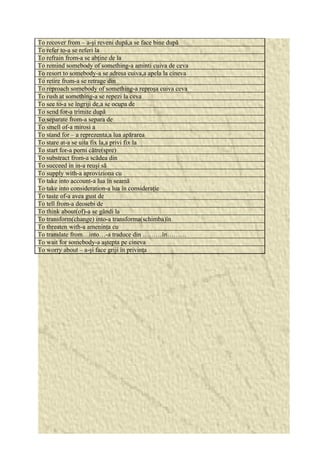
CUPRINS 
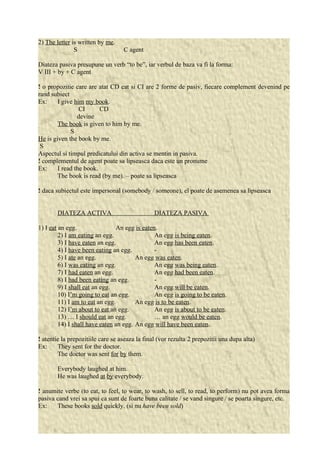
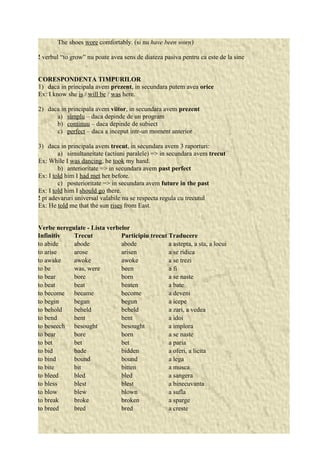
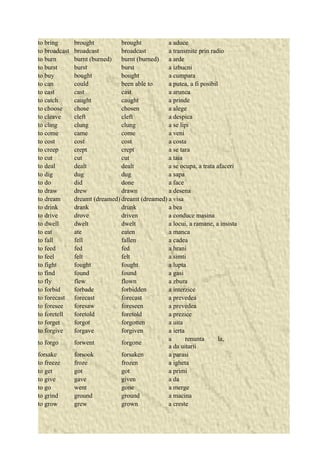
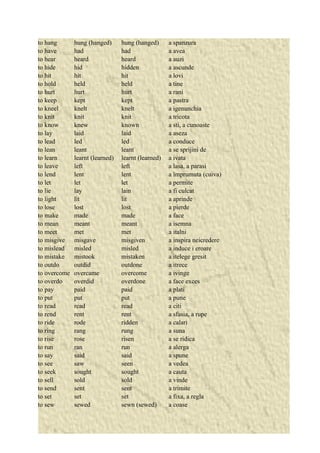
Alfabetul limbii engleze … … … … … … … … … … … … … … … … … … … … … … 3 
Vocalele limbii engleze … … … … … … … … … … … … … … … … … … … … … … 4 
Consoanele limbii engleze … … … … … … … … … … … … … … … … … … … … … 5 
Substantivul … … … … … … … … … … … … … … … … … … … … … … … … … ... 6 
Articolul … … … … … … … … … … … … … … … … … … … … … … … … … … … 9 
Prepozitia ... ... ... ... ... ... ... ... ... ... ... ... ... ... ... ... ... ... ... ... ... ... ... ... ... ... ... ... ... ... ... ... ... 13 
Conjunctia ... ... ... ... ... ... ... ... ... ... ... ... ... ... ... ... ... ... ... ... ... ... ... ... ... ... ... ... ... ... ... ... 21 
Adverbul ... ... ... ... ... ... ... ... ... ... ... ... ... ... ... ... ... ... ... ... ... ... ... ... ... ... ... ... ... ... ... ... ... 23 
Adejectivul ... ... ... ... ... ... ... ... ... ... ... ... ... ... ... ... ... ... ... ... ... ... ... ... ... ... ... ... ... ... ... ... 30 
Numeralul ... ... ... ... ... ... ... ... ... ... ... ... ... ... ... ... ... ... ... ... ... ... ... ... ... ... ... ... ... ... ... ... ... 38 
Pronumele ... ... ... ... ... ... ... ... ... ... ... ... ... ... ... ... ... ... ... ... ... ... ... ... ... ... ... ... ... ... ... ... ... 43 
Verbul ... ... ... ... ... ... ... ... ... ... ... ... ... ... ... ... ... ... ... ... ... ... ... ... ... ... ... ... ... ... ... ... ... ... 47 
2
Alfabetului Limbii Engleze 
Engleza foloseste un alfabet latin cu literele cunoscute si in alte limbi straine de origine 
indo-europeana dar cunoaste grupuri de litere care se pronunta diferit. De exemplu, "th" este 
grupul cel mai cunoscut. 
Ceea ce este mai interesant in alfabetul englez este ca adesea "y" si "w" devin vocale si 
astfel intervin schimbarile necesare (articolul nehotarat "a" se transforma in "an" daca cuvintele 
incep cu una dintre aceste litere). 
Engleza este o limba tonala in care intonatia este importanta. De aceea, adesea, vocea 
ajuta sa transmita ironia sau surpriza, afirmatia sau interogatia. Spre exemplu, intrebarea poate fi 
formata cu ajutorul inversiunii subiectului cu auxiliarul verbului dar exista si posibilitatea 
mentinerii afirmatiei si a schimbarii intonatiei. 
Diacriticele apar destul de rar in limba engleza, in special in cuvintele imprmutate 
(appliqué, attaché, crêpe, élite) si pronuntia lor este identica cu cea din limba din care provin, in 
mare parte din franceza. 
Vocalele Limbii Engleze 
(the voewls) 
Limba engleza are 12 
vocale, lungi (mai lungi decat 
in limba romana, pe care le 
indicam in transcrierea 
fonemica prin doua puncte 
[:]), si scurte (mai scurte 
decat in limba romana): 
a scurt, intre "a" anterior si 
"o", ex.: nut [nat] nuca 
a: mai lunga decat vocala 
romaneasca, urmata de obicei 
de "r" (care nu se pronunta, 
doar daca urmatorul cuvant 
incape cu o vocala!), ex.: 
arm [a:m] brat, car [ca:] 
masina 
Litera Transcriere fonetica 
a [ei] 
b [bi:] 
c [si:] 
d [di:] 
e [i:] 
f [ef] 
g [dji:] 
h [eitch] 
i [ai] 
j [gei] 
k [kei] 
l [el] 
m [em] 
n [en] 
o [ou] 
p [pi:] 
q [kju:] 
r [a:] 
s [es] 
t [ti:] 
u [ju:] 
v [vi:] 
w ['dablju:] 
x [eks] 
y [wai] 
z [zed] 
[a] a cu barcuta deasupra, e scurt, si intalnit in silabe neaccentuate, ex.: a pen [ a pen] un 
stilou, at home [at haum] acasa, after [a:fta] dupa, England [ingland] Anglia 
3
[a: ] a cu barcuta deasupra, prelungit si pronuntat printre dinti, intr-un zambet larg, ex.: girl 
[ga:l] fata, learn [la:n] a invata 
[ae] este un sunet intermediar intre "e" si "a", pronuntat cu gura foarte mult deschisa, ex.: Ann 
[aen] Ana, has [haez] (el, ea) are 
e similar cu vocala romaneasca, ex.: men [men] barbati, many [meni] multi, multe 
i scurt, intre "i" si "e" 
it [it] el, ea (pentru substantive ce denumesc obiecte, animale si notiuni abstracte), ex: big [big] 
mare 
i: vocala lunga, intalnita in exclamatiile din limba romana!, ex: be [bi:] a fi, see [si:] a vedea 
o intermediara intre o si a, ex: dog [dog] caine, not [not] nu (adverb) 
o: lung, intre "u" si "o", ex: all [o:l] toti, toate, door [do:] usa 
u scurt, intre "u" si "o", ex: good [gud] bun 
u: lung, ex: you [iu:] tu, voi, do [du:] a face 
4
Consoanele Lmbii Egleze 
Unele consoane englezesti sunt deosebite de cele din limba romana: 
a. urmate de aspiratie, de un "h" usor, cand sunt folosite la inceputul cuvintelor 
k come [cham] a veni (de regula, "e"-ul din pozitie finala nu se citeste!) 
p pen [phen] stilou 
t ten [then] zece 
b. alveolare; varful limbii se sprijina pe alveolele incisivilor superiori 
d did [did] facut 
t ten [ten] zece 
n not [not] nu 
c. interdentale, tine varful limbii intre dinti si rosteste "s" (consoana surda) sau "z" 
(consoana sonora) 
["s"] thank ["s"aenc] multumesc 
["z"] then ["z"en] atunci 
d. "l" velar, pozitie finala / "l" clar, apare inainte de vocale 
tell [tel] a povesti like [laic] a place 
e. "n" velar / "n" clar 
sun [san] soare English [inglish] englez 
f. "r" fricativ, nu se pronunta in pozitie finala, decat daca urmatorul cuvant incepe cu o 
vocala 
Henry 
g. "s"-ul dintre doua vocale, sau uneori cel aflat la sfarsitul cuvantului se pronunta "z" 
please [pli:z] va rog (adu-ti aminte ca "e" final, dupa consoana, nu se citeste!) 
his [hiz] al lui 
h. "sh" are ca echivalent "sh"-ul romanesc: shogun 
English [inglish] englez 
i. "ts" indentic cu "ts"-ul romanesc 
nuts [nats] nuci 
5
Substantivul (the noun) 
Felul substantivelor 
Substantivele în limba engleza se pot împarti în patru categorii: 
 substantive comune: cat, girl, lamp 
 substantive proprii: England, London, Mr Smith, Mary 
 substantive abstracte: beauty, love, courage, fear, joy 
 substantive colective: crowd, group, team 
Genul 
Substantive de genul masculin sunt fiintele si animalele de sex masculin: 
Ex.: man, boy, lion, dog 
Substantivele de genul feminin sunt fiintele si animalele de sex feminin: 
Ex.: woman, girl, cat, giraffe 
Substantive de genul neutru sunt lucrurile, plantele, animale sau fiinte al caror sex nu 
este cunoscut (pronume: it/they): 
Ex.: world, peace, house, mouse, baby 
Exceptii: tarile, navele, în majoritatea cazurilor si autovehiculele sau alte vehicule 
sunt de genul feminin. 
Substantivele de genul comun sunt o particularitate a limbii engleze. Substantivele care 
intra în aceasta categorie au aceeasi forma pentru ambele sexe: 
Ex.: child (copil, copila), cook (bucatar, bucatareasa), teacher (profesor, 
profesoara). 
Unele substantive au forme diferite pentru genul masculin si cel feminin: 
Ex.: boy - girl, husband - wife, brother - sister, father - mother, son - daughter, 
uncle - aunt, dog - bitch, bull - cow, king - queen 
Numarul 
Numarul este forma pe care o ia un substantiv pentru a arata ca ne referim la unul sau mai 
multe obiecte sau fiinte. 
 Singularul coincide cu forma de baza a unui substantiv: dog, girl, wife, world, storm 
 Pluralul substantivelor se formeaza prin adaugarea unui s la forma de singular: 
Ex.: cat+s=cats, day+s=days, world+s=worlds 
 Pluralul substantivelor teminate în ch, o, sh, s, x se formeaza adaugând es la singular. 
Ex.: church+es=churches, bush+es=bushes, class+es=classes, 
potato+es=potatoes, bush+es=bushes, box+es=boxes 
Pluralul neregulat 
 Substantive terminate în consoana+y fac pluralul în ies: 
Ex.: company - companies, factory - factories, baby - babies 
 Unele substantive terminate în o fac plural prin adaugarea unui s. 
Ex.: soprano - sopranos, piano - pianos, photo - photos 
 Unele substantive terminate în f sau fe vor suferi la plural schimbarea în ves. 
Ex.: leaf - leaves, half - halves, wife - wives, life - lives, self - selves, wolf – wolves 
Exceptii: roof - roofs, handkerchief - handkerchiefs, gulf - gulfs, wharf - wharfs/ wharves 
 Câteva substantive formeaza pluralul prin schimbarea unei vocale interne 
Ex.: foot - feet, man - men, tooth - teeth 
 Pluralul substantivului child este children. 
 Unele substantive ramân identice la plural Ex.: aircraft, deer, series, sheep, species, fish 
6
Pluralul substantivelor compuse 
 În cazul substantivelor compuse numai ultimul cuvânt va trece la plural. 
Ex.: boy-friends, break-ins, travel agents 
 Exceptii: substantivele compuse al caror prim element este man sau woman vor primi semnul 
pluralului pentru ambele substantive componente. 
Ex.: men drivers, women teachers, men servants 
 În cazul substantivelor compuse formate din constructii de genul substantiv + prepozitie / 
adverb + substantiv, substantivul de baza va primi semnul pluralului. 
Ex.: sisters-in-law, passers-by, men-of-war, hangers-on, lookers-on, runners-up 
 Abrevierile sau initialele vor forma pluralul prin adaugarea unui s 
Ex.: MPs (Members of Parliament), VIPs (very important persons) 
Substantivele unice (uncountable nouns) 
Sunt substantive care nu se pot numara (uncountable) deoarece reprezinta fie unicate, obiecte 
puternic individualizate, notiuni abstracte. 
 Nume de substante: bread, coffee, gold, paper, cloth, glass, oil, stone, wood 
 Abstractiuni: earth, paradise, nature, the present, advice, death, help, information, news, 
beauty, experience, horror, knowledge, friendship, theory, literature 
 Alte substantive: baggage, damage, shopping, reading, luggage, parking, weather 
Substantivele unice sunt întotdeana la singular si vor lua un verb la singular: 
Ex.: This coffee is cold. The weather was dreadful. 
Nu sunt precedate de a/an; pentru a exprima o unitate din aceste substantive se foloseste: 
some, any, no, a little, bit, piece of, slice of, etc. 
Ex.: I do not want any help. I need some information. This slice of bread is hard. The piece 
of advice you gave me helped. 
Nota: Multe dintre substantivele unice pot avea si sensuri care se pot numara, astfel 
devenind substantive comune si comportându-se ca atare (primes a/an la singular, pot avea 
plural). 
Sens Unic / Sens Comun 
Her hair is black. (Parul ei este negru.) 
She found a hair in the milk. (A gasit un fir de par în lapte.) 
Their house was made of wood. (Casa lor este din lemn.) 
We picnicked in the woods. (Am mers la picnic în padure.) 
1.5. Forma posesiva 
 Se adauga 's la forma de singular a substantivelor care nu se termina în s: 
Ex.: a child's voice, the people's choice, a horse's mouth, women's clothes 
 Vom folosi doar apostroful (') cu formele de plural ale substantivelor care se termina în s. 
Ex.: a boys' school, the Johnsons' residence 
 Numele proprii terminate în s vor primi fie doar apostrof ('), fie 's 
Ex.: Mr Jones's / Mr Jones' car, Yeats's / Yeats' poems 
 În cazul substantivelor compuse si a titlurilor ultimul cuvânt va primi 's 
Ex.: My father-in-law's guitar, Henry the Eighth's wives 
 's se foloseste si dupa initiale sau abrevieri. 
Ex.: The CEO's assistant, the PM's speech 
 Forma posesiva se foloseste în general când vorbim de oameni, animale, tari. Se foloseste de 
asemenea în urmatoarele cazuri: 
 În expresii temporale 
7
Ex.: yesterday's newspaper, in five years' time, ten minutes' break 
 În expresii construite dupa modelul bani + worth 
Ex.: ten dollars' worth of bananas, a shilling's worth of stamps 
 În alte expresii uzuale: 
Ex.: for heaven's sake, a winter's day, the water's edge, the plane's wings, the 
train's departure 
 În cazul anumitor substantive folosite la posesiv, este uzuala omisiunea substantivului 
urmator atunci când sensul comunicarii este clar (magazine, birouri, oficii, casa, locuinta). 
Ex.: You can buy this at the baker's (shop). Mary bought her tickets at the travel agent's 
(office). The kids went to Bobby's (house). 
 Ideea de posesie se poate exprima si cu ajutorul constructiei of+substantiv. Aceasta 
constructie se foloseste mai ales pentru lucruri sau fiinte umane sau animale atunci cand 
acestea sunt urmate de o propozitie subordonata. 
Ex.: the walls of the town, the roof of the church, the keys of the house 
I took the advice of the girl I met on the bus and went to buy the book. 
8
Articolul (the article) 
Pentru ca un substantiv sa capete înteles într-o propozitie oarecare, acesta trebuie sa fie 
însotit de un determinant substantival. Cel mai des folosit determinant substantival este 
articolul. Articolele se pot clasifica dupa cum urmeaza: 
 Articolul hotarât - the 
 Articolul nehotarât - a / an 
 Articolul zero (forma implicita sau neexprimata) 
Articolele sunt forme invariabile, adica nu se schimba în functie de numarul sau genul 
substantivului si se aseaza în fata substantivului determinat. 
Articolul hotarât ( the ) se foloseste: 
1. inaintea unui substantiv singular numarabil sau nenumarabil sau a unui substantiv plural 
numarabil pentru a face o noua referire la ceva ce a fost deja sau la care s-a facut deja 
aluzie: 
He wanted to go to the bank to change some money, but all the banks were on 
strike. 
Dave had a nasty accident when he was young. You can still see the scar. 
Do you remember the fun we had when we were at school together? 
2. pentru a face referire la cineva sau ceva anume: 
The American economy is suffering at the moment. 
The people I work with are very friendly. 
I don’t like the president of that company. 
3. in fata unui substantiv reprezentand o anume persoana sau un lucru sau un grup de 
persoane sau lucruri: 
I don’t feel well. Can you call the doctor? (= medicul personal) 
The kids aren’t at home. (= proprii tai copii) 
Can you pass me the butter, please? (= untul de pe aceasta masa) 
Shall I drive the car? (= aceasta masina) 
Maria Callas sang so beautifully that the audience threw flowers onto the stage. 
(= publicul care o urmarea a aruncat flori pe scena pe care canta ea) 
4. cu referire la ceva unic in mod absolut: 
The sun rises in the East and sets in the West. 
The weather at the North Pole is very cold. 
The President of the United States visited the Pope last May. 
5. in fata adjectivelor pentru a face referire la un anumit grup sau clasa de oameni. In acest 
caz NU este nevoie de substantiv: 
Only the strong survive. (= oamenii puternici in general) 
The question of the unemployed came up again. 
Robin Hood stole from the rich and gave to the poor. 
6. in fata unui substantiv la singular pentru a se referi la un anume grup de oameni, animale 
sau obiecte: 
The Indian elephant is smaller than the African elephant. 
The dolphin is said to be a very intelligent animal. 
Henry Ford invented the automobile. 
The customer is always right. 
7. inaintea unor substantive proprii pentru a denumi zone geografice, nume de mari si rauri, 
lanturi muntoase, grupuri de insule, nume la plural de tari si deserturi: 
the Middle East, the North of England, the Ivory Coast 
9
the Atlantic, the Mediterranean Sea, the English Channel, the River Thames, the 
Straits of Gibraltar 
the Himalayas, the Alps, the Carpathians 
the Hawaiian Islands, the Falklands 
the United States of America, the Netherlands, the Philippines 
the Arizona Desert, the Mojave Desert 
NOTA: THE nu se foloseste cu nume de munti izolati. 
Ben Nevis is the highest mountain in Scotland. 
THE nu se foloseste cu nume de lacuri. 
Lake Superior, Lake Victoria, Lake Ontario 
8. in fata numelor de instruente muzicale: 
Rachmaninov began to play the piano when he was only 4 years old. 
The guitar has always been my favourite instrument. 
9. in fata unor adjective – nationalitati cu referire la oameni dintr-o anumita tara. Aici se 
foloseste un verb la plural: 
The Swiss have decided not to join the EU. 
The Spanish are doing very well in this year’s Olympics. 
NOTA: In anumite cazuri, se pot folosi numai substantive la plural. 
The Germans were upset about losing the WW II. 
The Americans hosted the 1994 World Football Championship. 
10. inaintea adjectivelor superlative si a numeralelor ordinale: 
Neil Armstrong was the first man to walk on the moon. 
Laura is the most beautiful in my class. 
That is the silliest thing I have ever heard. 
NOTA: Uneori numeralele oridinale pot fi folosite fara THE atunci cand se face 
referire la ordinea in care se petrec evenimentele. 
Brendan came first ad Colin second at 100 meters. 
We went to Manhattan first, then on to Brooklyn. 
Articolul nehotarât ( a / a n). 
Se foloseste a înaintea substantivelor care încep cu o consoana si an înaintea substantivelor 
care încep cu o vocala (a, e, i, o, u). Articolul nehotarât se foloseste: 
1. inaintea unui substantiv pentru a ne referi la ceva sau cineva pentru prima data: 
I’ve received a postcard from a friend of mine in the US. 
After months of searching, my brother found a job. 
The Jacksons live in a bungalow. 
2. pentru a exprima ce este ceva sau cineva, inclusiv slujbe sau profesii: 
My neighbour is a sociologist and his wife is an architect. 
Jenny doesn’t eat meat; she’s a vegetarian. 
There is a man at the door who says he is a detective. 
That was a kind thing to say. 
3. dupa verbul be sau alte verbele copulative, cand dupa ele urmeaza locutiuni 
prepozitionala sau propozitii relative care ofera mai multa informatie despre cineva sau 
ceva: 
I read an interesting article about pollution in yesterday’s paper. 
Jack’s son is a talented artist. 
He studied law at University and became a judge. 
I bought a painting that reminded me of my childhood home. 
John Smith wrote an interesting article on Education in the ‘Times’ yesterday. 
10
4. cu unele expresii numerice insemnand “unu” sau su expresii ale pretului, vitezei, 
raportului si cantitatii: 
A hundred guests were invited. 
Petrol costs £ 1.50 a litre in England. 
He’s crazy driving at 190 kilometres an hour. 
You must take this medicine four times a day if you want to get better. 
There was a great deal of noise coming form the house next door. 
5. cu substantive numarabile la singular pentru a da definitii, a face afirmatii generale, 
exclamatii sau cand ne exprimam dorinte: 
A thesaurus is a dictionary of synonyms. 
A house built of stone is stronger than a house built of wood. 
An apple a day keeps the doctor away. (proverb) 
Wow! What a pretty girl walked by just now. 
I’d like a nice cool glass of beer. 
Articolul a / an si one 
1. Atunci când numeri sau masori timpul, distanta, greutatea, etc. se poate folosi fie 
a/an fie one pentru singular: 
Ex.: a / one pound, a / one million pounds 
You can take an/ one hour for lunch. 
2. Dar a/an si one nu înseamna întotdeauna acelasi lucru: 
Ex.: A box is no good. (We need a crate not a box). 
One box is no good, we need two boxes. 
Articolul zero. Nu se foloseste articol în urmatoarele cazuri: 
1. in fata substantivelor nenumarabile sau numarabile la plural cand se face o afirmatie 
generala (adesea precedate de determinanti ca: some, any, a piece of, a lot of etc.): 
Water quenches thirst on a hot day. 
Pollution in big cities is very worrying. 
Dogs make good companions. 
There is some luggage to be taken upstairs. 
Is there any bread in the kitchen? 
2. in fata substativelor abstracte cand sunt folosite in mod generic: beauty, happiness, fear, 
hope, knowledge, intelligence etc.; cu exceptia cazurilor cand sunt folosite cu sens mai 
bine specificat: 
Knowledge comes to us through our senses. DAR: She got the job because she 
has a knowledge of English. 
Beauty is in the eye of the beholder. DAR: What a beauty! 
3. in fata substantivelor proprii, nume de persoane si numele unei companii, cu exceptia 
situatiilor cand se vorbeste de familie ca un tot: 
He works for Microsoft. 
Helen and George Parker are coming to dinner tonight. DAR: The Parkers are 
coming to dinner tonight. 
4. pentru a vorbi despre sporturi, in fata numelor de echipe etc: 
He loves football and supports Manchester Utd. 
5. inaintea meselor zilei: 
Where did you have breakfast / lunch / dinner? 
6. inaintea cuvintelor home, church, university, prison, hospital, market etc. atunci cand 
ele reprezinta o institutie sau o idee generala. THE se foloseste totusi atunci cand se face 
o referire speciala la locul respectiv: 
11
Al Capone was arrested and put in prison for tax evasion. (ne referim nu la o 
anumita inchisoare, ci la institutie) 
His mother went to the prison once a week to visit him. (aici ne referim la acea 
inchisoare unde se afla Al Capone) 
My mother goes to church every Sunday. (biserica in sensul de institutie, serviciu 
religios) 
She sometimes goes to the church near the Royal Palace. (acea biserica anume). 
Our University is 150 years old. (institutia universitatii) 
Emma and Ben often go to the university to talk to their professor. (la o 
universitate anume, in cladirea ei) 
12
Prepozitia 
1. Prepozitia de loc - s e foloseste cu verbe statice: to be/to stay/to exist/to stand, etc. 
 in – in, la, pentru spatii mari Ex: I live in Bucharest. 
 at – in, la, pentru spatii reduse Ex: I live at Sinaia. 
 within – in cadrul, pentru suprafete restranse Ex: A lot of words have been said within 
these walls. 
 against – rezemat Ex: The man is against the wall. 
 – impotriva Ex: We are against them. 
 on – pe (pozitia pe o suprafata) Ex: The book is on the table. 
 Pentru apropiere: 
 imediata: next to, close to, beside 
 apropiere: near, near by, by 
 Pozitia pe verticala: 
 over – deasupra 
 under – dedesubt (fara raportare la un punct fix) 
 above – deasupra 
 below – dedesubt (cu raportare la un punct fix) Ex: above zero, below the water 
level 
 underneath – punctul cel mai de jos 
 on top of – punctul cel mai de sus (prin atingere) Ex: The green book is underneath. 
(este cea mai de jos carte) 
 Pozitia pe orizontala: 
 in front of – in fata 
 behind – in spate (pentru lucruri pentru a indica pozitia) Ex: The tree is in front of the 
house. 
 after – dupa 
 before – inainte (pentru oameni, pentru a indica ordinea) Ex: I’m before you at the 
queue. 
 between – intre 2 
 among – printre (mai mult de 2) 
2. Prepozitia de miscare - se foloseste numai cu verbe de miscare 
 to – la, catre (pp atingerea punctului) Ex: I go to school. 
 towards – la, catre (nu pp atingerea punctului) Ex: I go towards office. 
 Into – in (pp patrunderea intr-un spatiu) Ex: Put the bag into the house. 
 Onto – pe (pp miscarea pe o suprafata orizontala;se pune “on”daca sta)The cat is running 
onto the floor. 
 along – de-a lungul (pp miscarea pe o suprafata plana si lunga) Ex: I’m walking along the 
beech. 
 through – prin (pp traversare si patrundere) Ex: I walk through the park. 
 across – traversare (nu si patrundere) Ex: I run across the street. 
 about – prin (arata o miscare nedefinita) Ex: I walk about town (prin oras, fara un tel 
precis) 
 around – in jurul (pp o miscare circulara) Ex: I dance around the fire. 
 out of – pp iesirea dintr-un volum Ex: Get out of my house. 
 off – pp desprinderea de o suprafata Ex: The plane takes off. 
 up-and-down – in sus si in jos pe un plan vertical Ex: The children run up-and-down the 
stairs. 
13
 from – de la, de pe, din Ex: Take it from my bag. 
 past – langa (pp apropierea imediata prin miscare) Ex: I drive past the university (si nu 
near the university!, pt ca sunt in miscare) 
3. Prepozitia de timp 
 in – pentru ani, lunile anului, anotimpuri, perioade ale vietii (in my childhood), 
 in anumite momente ale zilei (in the morning, in the afternoon, in the evening) 
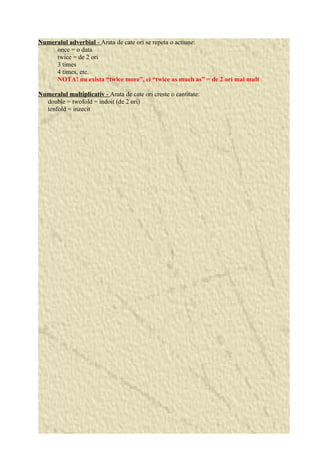
 at – pentru ora (at 10 o’clock), in anumite momente ale zilei (at noon, at midday, at 
midnight, at dusk), pentru varsta (at the age of 15), mesele zilei (at lunch time), cu week-end 
(at the week-end) si in sarbatori (at Christmas) 
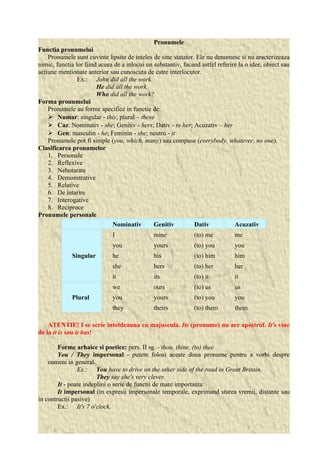
 on – cu zilele saptamanii (on Sunday), data (on the 15th of June) si 
sarbatorile (on Christmas day – cand este vorba de ziua de Craciun, nu de toata perioada) 
 before si after – inainte si dupa, cu raportare la un punct fix 
 by – nu mai tarziu de Ex: Try to arrive by ten. 
 during – in timpul 
 over – in timpul, dar pe perioade scurte Ex: Read it over the week-end. 
 throughout / althrough – de-a lungul, dar pe o prioada lunga de timp Ex: Althrough the 
years. 
4. Diferentiere intre prepozitii 
 in time on time 
cu ceva timp inainte la fix 
 in the end at the end 
finally, in cele din urma la capatul (urmeaza un substantiv) 
 in with 
pentru ceva cu care esti imbracat pentru o trasatura fizica 
Ex: A woman in trousers. A woman with long hair. 
 as like 
pentru rol, functie, pozitie pentru comparatie 
Ex: I work as a teacher. Ex: I talk like a teacher. 
(I am a teacher) (I am an engineer) 
 on about 
in legatura cu, folosit academic despre 
Ex: Give me a book on Economics. Ex: Let’s talk about sex. 
 due to owing to 
datorita (doar dupa “to be”) datorita (restul inafara de “to be”) 
Ex: My success is due to her. Ex: Owing to my work I succeeded. 
 over across 
pp traversarea peste un obstacol traversare pe jos 
Ex: I’m over the ocean. (cu avionul) Ex: I’m across the ocean. (cu barca) 
 despite in spite of 
dupa urmeaza CD (niciodata sub.) dupa urmeaza genitiv 
Ex: Despite the bad weather I left. Ex: In spite of the bad weather I left. 
 made of – recunosc materialul Ex: made of gold 
 made from – deduc ceva elemente Ex: the cake is made from cocoa 
 made with – recunosc 1 element Ex: a chocolate made with milk (dar laptele nu este 
elementul de baza) 
 in – in the morning, in the afternoon, in the evening 
 at – at dawn, at midnight 
14
 on – pentru orice moment al zilei atunci cand exista un atribut 
Ex: In the morning dar On a fine day 
At night dar On a starry night 
5. Pentru mijloace de locomotie 
 by – cu orice mijloc de transport, daca nu este determinat 
Ex: by car, by bus, by plane (dar on foot!) 
 in – pentru autovehicule, daca sunt determinate 
Ex: in my father’s car, in the car that you bought me 
 on – pentru toate celelalte in afara de autovehicule daca sunt determinate 
Ex: on my father’s plane, on the tube/subway/underground 
6. Expresii cu Prepoziţii 
Prepozitia Expresii 
About (despre) About the town-prin oraş 
About six o‘clock-în jurul orei şase 
A journey about the world-o călătorie prin lume 
About my head-deasupra capului meu 
About all-mai presus de orice,în primul rând 
Across (de-a curmezişul sau de-a 
latul) 
To walk across the street-a traversa strada 
Across the road-peste drum 
After (după) After dark-după lăsarea întunericului 
After breakfast-după micul dejun 
After five o‘clock-după ora cinci 
Day after day-zi de zi,zi după zi 
Time after time-deseori,foarte adesea 
After theat-după aceea 
The day after tomorrow-poimâine 
Against-împotrivă,contra Against the laws-împotriva legilor 
A race against time-o cursă contra cronometru 
To lean against a wall-a se sprijini de un perete 
Along-de-a lungul Along a valley-de.a lungul unei văi 
Along the sea shore-de-a lungul ţărmului 
Among-între Among us-între noi(când este vorba de 3 sau mai multe persoane) 
Among his friends-printre(între) prietenii lui 
Among the most important reasons-printre cele m.imp.cauze(motive) 
Around-împrejur A trip around the contry-o călătorie prin ţară 
To sit around the table-a şedea în jurul mesei 
I will come around ten-o să vin pe la zece (în jur de ora zece) 
At –la At noon-la prânz 
At day break-la revărsatul zorilor 
At sunset-la apusul soarelui,la asfinţit 
At rondom-la intâmplare 
At work-la lucru 
At the door-la uşă 
At the beginning-la început 
At the end-la sfârşit 
At the same time-în acelaşi timp 
At the age of-la vârsta de 
At first-la început 
15
At last-la sfârşit,în cele din urmă 
At full speed-la viteză maximă,cu toată viteza 
At first sight-la prima vedere 
At what time?-la ce oră? 
At once-imediat 
At least-cel puţin 
At my disposal-la dispoziţia mea 
Byfore-înainte Byfore my eyes-înaintea ochilor mei 
Byfore one a‘clock-înainte de ora unu 
To sail byfore the wind-a naviga cu vântul în spate 
Behind(bihaind)-în spate Behind the clouds-în spatele norilor 
To hide behind the door-a se ascunde în spatele uşii 
Below(bilou)-sub To strike below the belt-a lovi sub centură 
Below sea level-sub nivelul mării 
Below the ground-sub pământ 
Below the average-sub nivelul mediu 
Beneath-sub,mai jos de Beneath one‘s dignity-sub demnitatea cuiva 
Besides-în afară de He has two cars besides this-el are două maşini în afară de aceasta 
Between-între, se foloseşte când este 
Between the two world wars-între cele două războaie mondiale 
vorba de două elemente sau două 
An understanding between us-o înţelegere între noi 
persoane 
Beyond-dincolo de Beyond doubt(deaut)-fără îndoială 
Beyond the sea-dincolo de mare 
Beyond limits-peste limită 
By-de,de către,prin To open by force-a deschide cu forţa 
To travel by train-a călători cu trenul 
To go by car-a merge cu maşina 
Day by day-zi de zi 
Step by step-pas cu pas 
Drop by drop-strop cu strop 
Piece by piece-bucată cu bucată 
One by one-unul câte unul 
Two by two-doi câte doi 
To learn by heart-a învăţa pe de rost 
To go by the post-office-a trece pe lângă poştă 
By force of circunstances-prin forţa împrejurărilor 
To sleep side by side-a dormi unul lângă altul 
For-pentru Good for food-comestibil 
To leave for school-a pleca la şcoală 
To look for help-a căuta ajutor 
To cry for help-a striga după ajutor 
For a time-un timp,pentru un timp 
To go for a walk-a merge la plimbare 
To read for pleasure-a citi de plăcere 
What is this good for?-la ce este bun ăsta? 
For all the world-pentru nimic în lume 
To have a taste for art-a avea gust artistic 
For this reason-pentru(din) acest motiv 
For the sake of peace-în numele păcii 
Enough(inagh) for the present-suficient deocamdată 
16
I‘m sorry for you-îmi pare rău de tine(pentru tine) 
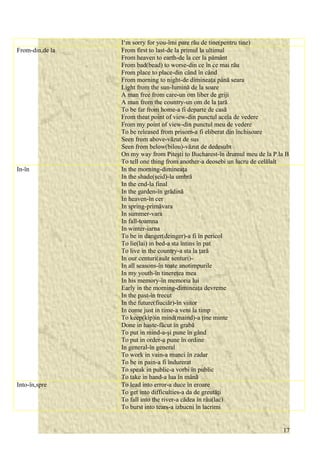
From-din,de la From first to last-de la primul la ultimul 
From heaven to earth-de la cer la pământ 
From bad(bead) to worse-din ce în ce mai rău 
From place to place-din când în când 
From morning to night-de dimineaţa până seara 
Light from the sun-lumină de la soare 
A man free from care-un om liber de griji 
A man from the country-un om de la ţară 
To be far from home-a fi departe de casă 
From theat point of view-din punctul acela de vedere 
From my point of view-din punctul meu de vedere 
To be released from prisom-a fi eliberat din închisoare 
Seen from above-văzut de sus 
Seen from below(bilou)-văzut de dedesubt 
On my way from Piteşti to Bucharest-în drumul meu de la P.la B 
To tell one thing from another-a deosebi un lucru de celălalt 
In-în In the morning-dimineaţa 
In the shade(şeid)-la umbră 
In the end-la final 
In the garden-în grădină 
In heaven-în cer 
In spring-primăvara 
In summer-vara 
In fall-toamna 
In winter-iarna 
To be in danger(deinger)-a fi în pericol 
To lie(lai) in bed-a sta întins în pat 
To live in the country-a sta la ţară 
In our centuri(auăr senturi)- 
In all seasons-în toate anotimpurile 
In my youth-în tinereţea mea 
In his memory-în memoria lui 
Early in the morning-dimineaţa devreme 
In the past-în trecut 
In the future(fiuciăr)-în viitor 
In come just in time-a veni la timp 
To keep(kip)in mind(maind)-a ţine minte 
Done in haste-făcut în grabă 
To put in mind-a-şi pune în gând 
To put in order-a pune în ordine 
In general-în general 
To work in vain-a munci în zadar 
To be in pain-a fi îndurerat 
To speak in public-a vorbi în public 
To take in hand-a lua în mână 
Into-în,spre To lead into error-a duce în eroare 
To get into difficulties-a da de greutăţi 
To fall into the river-a cădea în râu(lac) 
To burst into tears-a izbucni în lacrimi 
17
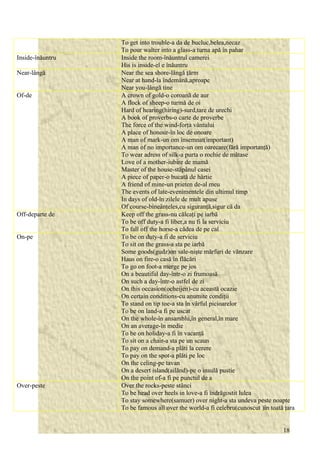
To get into trouble-a da de bucluc,belea,necaz 
To pour walter into a glass-a turna apă în pahar 
Inside-înăuntru Inside the room-înăuntrul camerei 
His is inside-el e înăuntru 
Near-lângă Near the sea shore-lângă ţărm 
Near at hand-la îndemână,aproape 
Near you-lângă tine 
Of-de A crown of gold-o coroană de aur 
A flock of sheep-o turmă de oi 
Hard of hearing(hiring)-surd,tare de urechi 
A book of proverbs-o carte de proverbe 
The force of the wind-forţa vântului 
A place of honour-în loc de onoare 
A man of mark-un om însemnat(important) 
A man of no importance-un om oarecare(fără importanţă) 
To wear adress of silk-a purta o rochie de mătase 
Love of a mother-iubire de mamă 
Master of the house-stăpânul casei 
A piece of paper-o bucată de hârtie 
A friend of mine-un prieten de-al meu 
The events of late-evenimentele din ultimul timp 
In days of old-în zilele de mult apuse 
Of course-bineânţeles,cu siguranţă,sigur că da 
Off-departe de Keep off the grass-nu călcaţi pe iarbă 
To be off duty-a fi liber,a nu fi la serviciu 
To fall off the horse-a cădea de pe cal 
On-pe To be on duty-a fi de serviciu 
To sit on the grass-a sta pe iarbă 
Some goods(gudz)on sale-nişte mărfuri de vănzare 
Haus on fire-o casă în flăcări 
To go on foot-a merge pe jos 
On a beautiful day-într-o zi frumoasă 
On such a day-într-o astfel de zi 
On this occasion(ocheijen)-cu această ocazie 
On certain conditions-cu anumite condiţii 
To stand on tip toe-a sta în vârful picioarelor 
To be on land-a fi pe uscat 
On the whole-în ansamblu,în general,în mare 
On an average-în medie 
To be on holiday-a fi în vacanţă 
To sit on a chair-a sta pe un scaun 
To pay on demand-a plăti la cerere 
To pay on the spot-a plăti pe loc 
On the celing-pe tavan 
On a desert island(ailănd)-pe o insulă pustie 
On the point of-a fi pe punctul de a 
Over-peste Over the rocks-peste stânci 
To be head over heels in love-a fi îndrăgostit lulea 
To stay somewhere(samuer) over night-a sta undeva peste noapte 
To be famous all over the world-a fi celebru(cunoscut )în toată ţara 
18
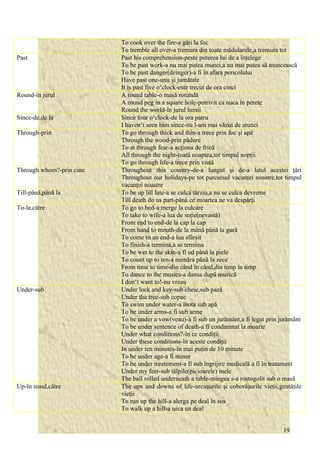
To cook over the fire-a găti la foc 
To tremble all over-a tremura din toate mădularele,a tremura tot 
Past Past his comprehension-peste puterea lui de a înţelege 
To be past work-a nu mai putea munci,a nu mai putea să muncească 
To be past danger(deinger)-a fi în afara pericolului 
Have past one-unu şi jumătate 
It is past five o‘clock-este trecut de ora cinci 
Round-în jurul A round table-o masă rotundă 
A round peg in a square hole-potrivit ca nuca în perete 
Round the world-în jurul lumii 
Since-de,de la Since four o‘clock-de la ora patru 
I haven‘t seen him since-nu l-am mai văzut de atunci 
Through-prin To go through thick and thin-a trece prin foc şi apă 
Through the wood-prin pădure 
To at through fear-a acţiona de frică 
All through the night-toată noaptea,tot timpul nopţii 
To go through life-a trece prin viaţă 
Through whom?-prin cine Throughout this country-de-a lungul şi de-a latul acestei ţări 
Throughout our holidays-pe tot parcursul vacanţei noastre,tot timpul 
vacanţei noastre 
Till-până,până la To be up lill late-a se culca târziu,a nu se culca devreme 
Till death do us part-până ce moartea ne va despărţi 
To-la,către To go to bed-a merge la culcare 
To take to wife-a lua de soţie(nevastă) 
From end to end-de la cap la cap 
From hand to mouth-de la mână până la gură 
To come to an end-a lua sfârşit 
To finish-a termina,a se termina 
To be wet to the skin-a fi ud până la piele 
To count up to ten-a număra până la zece 
From time to time-din când în când,din timp în timp 
To dance to the musics-a dansa după muzică 
I don‘t want to!-nu vreau 
Under-sub Under lock and key-sub cheie,sub pază 
Under the tree-sub copac 
To swim under water-a înota sub apă 
To be under arms-a fi sub arme 
To be under a vow(veau)-a fi sub un jurământ,a fi legat prin jurământ 
To be under sentence of death-a fi condamnat la moarte 
Under what conditions?-în ce condiţii 
Under these conditions-în aceste condiţii 
In under ten minutes-în mai puţin de 10 minute 
To be under age-a fi minor 
To be under treatement-a fi sub îngrijire medicală a fi în tratament 
Under my feet-sub tălpile(picioarele) mele 
The ball rolled underneath a table-mingea s-a rostogolit sub o masă 
Up-în susul,către The ups and downs of life-urcuşurile şi coborâşurile vieţii,geutăţile 
vieţii 
To run up the hill-a alerga pe deal în sus 
To walk up a hill-a urca un deal 
19
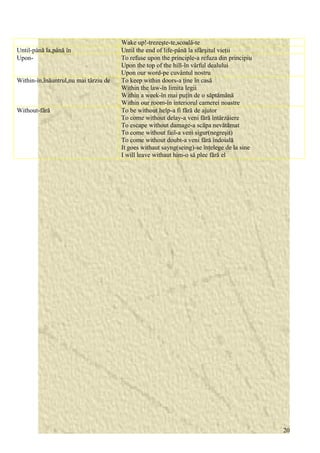
Wake up!-trezeşte-te,scoală-te 
Until-până la,până în Until the end of life-până la sfârşitul vieţii 
Upon- To refuse upon the principle-a refuza din principiu 
Upon the top of the hill-în vârful dealului 
Upon our word-pe cuvântul nostru 
Within-în,înăuntrul,nu mai târziu de To keep within doors-a ţine în casă 
Within the law-în limita legii 
Within a week-în mai puţin de o săptămână 
Within our room-în interiorul camerei noastre 
Without-fără To be without help-a fi fără de ajutor 
To come without delay-a veni fără întârzâiere 
To escape without damage-a scăpa nevătămat 
To come without fail-a veni sigur(negreşit) 
To come without doubt-a veni fără îndoială 
It goes withaut sayng(seing)-se înţelege de la sine 
I will leave withaut him-o să plec fără el 
20
Conjunctia 
A. Dupa aspect 
1. Simple: but, if, and. 
2. Compuse: however, unless, otherwise. 
3. De legatura: as…as, both…and, either…or, neither…nor, not only…but also, whether…or . 
4. Locutiuni: as well as, as if (de parca), as though (de parca), for instance, that’s why, so long 
as (atata timp cat). 
B. Dupa functie 
1. De coordonare 
a) “and” - care leaga - propozitii intre ele 
- parti de vorbire de acelasi fel 
Ex: I go and stay there for a week 
b) “as well as” 
Ex: I work in a school as well as at home. 
c) “neither…nor” 
Ex: I am neither in the kitchen nor in the bathroom. 
d) “not only…but also…” 
Ex: I am not only intelligent but also pretty. 
e) “as well” 
Ex: He is calm and good as well. 
f) “either…or” 
Ex: They are either brother and sister or husband and wife. 
g) “furthermore” (cu atat mai mult) 
Ex: I speak English, furthermore I wood like to visit England. 
h) conjunctii adversative: but, while, whereas (pe cata vreme, tinand seama de) – 
contrasteaza cu propozitia principala. 
Ex: I am tall but fat. 
I am talking while you are righting. 
k) conjunctii disjunctive: or, else, or else (ori, cu alte cuvinte), otherwise (altfel). 
Ex: Would you prefer coffee or tea? 
Please put your coat else you get whet. 
Learn your lesson otherwise you fail. 
i) conjunctiile concluzive: consequently, on that account, so, then, that is why (iata de 
ce), therefore (de aceea). 
Ex: I haven’t slept therefore/that is why I am tired. 
j) conjunctii explicative: for example, for instance, namely, that is to say. 
Ex: Only one friend of mine left Romania, namely Ela. 
I like do a lot of thinks for instance/example reading, dancing, … 
2. De subordonare – acelea care introduc o propozitie secundara. Unele dintre ele sunt 
specializate pe anumite tipuri de propozitii. 
Ex: pt. concesive: through, although (desi) 
pt. conditionale: if 
pt. comparative: as if (de parca), as though 
pt. predicative sau pt. subiective, completive directe, attributive 
 Subordonate predicative – introduse prin: 
a) “what” - Ex: The question is what I must read. 
21
b) “who” - Ex: The question is who is he. 
c) “where” - Ex: The question is were I go. 
d) “when” - Ex: The question is when I can come. 
e…) whatever, whoever, that, why – 
 Subordonate subiective – introduse prin: 
a) “that” - Ex: It is necessary that you should understand this rule. 
b) “what” Ex: It doesn’t matter what you believe. 
c) “who” Ex: It hasn’t be decided who is the leader of the team. 
d) which, whoever, whatever, whichever, when, how, why, where, if, whether. 
 Subordonate completive directe (cele cu forma de complement): if, that, whether, 
whatever, whoever, wherever, why, whichever. 
Ex: She sad that she was tired. 
I don’t know if you leave Romania. 
I don’t know whoever want’s my dog. 
I do whatever you want me to do. 
I may take whatever book you want. 
 Subordonate indirecte – introduse prin: to whom, to what, to anyone, whoever. 
Ex: I may give the flowers to whom you want. 
You interpret whatever she says. 
 Subordonate prepozitionale – introduse prin: who, whom, whoever, whichever, how daca 
sunt precedate de o prepoziitie. 
Ex: You depend on what I say. 
You must approved of whatever she says. 
 Subordonate atributive – introduse prin: whose, which, whom, were, why, when, that. 
Ex: This is the woman who loves me. 
This is the man whose wife is pretty. 
This is the boy whom I greeted. 
 Subordonate adverbiale – introduse prin: as, like, much as, how, in the manner, as if, as 
though, just. 
Ex: No one speaks like you do. 
They acted much as I told them. (respectand majoritatea celor spuse de 
mine) 
 Subordonate conditionale – introduse prin: if, on condition that, only if. 
Ex: I shall come soon if/on condition that I find my passport. 
22
Adverbul 
Adverbele sunt cuvinte care ne spun mai multe despre cum , unde, când, cât de frecvent 
sau în ce măsura are loc o actiune. 
Functia adverbelor 
Astfel, adverbele determina în general verbe: 
Ex.: The bus moved slowly. (cum?) 
I am going home tomorrow. (când?) 
Adverbele pot determina: 
 adjective: You look absolutely fabulous! 
 adverbe: She played the violin extremely well. You're speaking too quietly. 
 propozitii intregi: Perhaps we'll see you again next year. 
In general adverbul este terminat in “ly”, dar nu tot ce are “ly” este adverb. De regula se 
formeaza din adjectiv + “ly”. 
Modificari ortografice: 
1. daca adjectivul se termina in “e”, acesta se pastreaza “ely” 
Ex: nice – nicely 
Exceptii: due – duly (datorat) 
true – truly 
whole – wholly 
2. daca adjectivul se termina in “le”, se transforma “e” in “y”/ “ly” 
Ex: capable – capably 
3. daca adjectivul se termina in “ll”, se adauga doar “lly” 
Ex: full – fully 
4. daca adjectivul se termina in “ic”, se adauga “ally” 
Ex: automatic – automatically 
5. daca adjectivul se termina in “y”, indiferent daca este precedat de vocala sau de 
consoana, se transforma in “i” si se adauga “ily” 
Ex: pretty – prettily 
gay – gaily 
Exceptii: shy – shyly 
wry – wryly 
coy – coyly (sfios) 
6. adjectivul “good” face adverbul “well” 
NOTA: ca sa verific L-urile unui adverb, il desfac in adjectiv + ly 
Ex: usually = usual + ly 
bitterly = bitter + ly 
awfully = awful + ly 
Adverbe care au 2 forme cu acelasi inteles (oricare din ele este corect) 
1. bright = brightly 
2. sound = soundly 
3. fair = fairly 
4. tight = tightly (sunt echivalente) 
5. dear = dearly 
23
6. dead = deadly 
7. cheap = cheaply 
Ex: The sun shines bright / brightly. 
NOTA: forma in “ly” se va prefera totusi cand adverbul determina un adjectiv 
Ex: He is deadly tired. (si nu “he is dead tired”). 
Adverbul cheap se va folosi in loc de cheaply doar pentru a caracteriza activitati 
comerciale (to buy, to sell, to get) 
Ex: She bought it cheap. 
dar 
We traveled cheaply. 
Adverbe cu 2 forme cu 2 intelesuri diferite 
clean = complet 
cleanly = intr-o maniera curata 
clear = exact 
clearly = intr-o maniera clara 
close = apropiat 
closely = indeaproape 
deep = adanc 
deeply = profund 
direct = direct 
directly = imediat 
due = spre (la busola) Ex: They went due South. 
duly = punctual 
easy = usor Ex: Take it easy! 
easily = intr-o maniera lejera 
free = gratis 
freely = pe sleau, deschis 
full = complet 
fully = pe scara larga, intr-o maniera extinsa 
hard = greu 
hardly = de-abia, cu greu, aproape deloc 
high = sus 
highly = foarte 
just = tocmai 
justly = asa cum se cuvine 
late = tarziu 
lately = in ultima vreme 
24
large = extins 
largely = pe scara larga 
most = majoritatea 
mostly = cu precadere 
near = langa 
nearly = aproape ca 
pretty = foarte 
prettily = intr-o maniera draguta 
right = exact 
rightly = cu precizie, clar 
sharp = fix 
sharply = intr-o maniera taioasa 
short = brusc 
shortly = imediat 
Adverbe si adjective cu aceeasi forma si inteles 
fast 
far 
early 
alike 
alone 
past 
solo 
straight 
next 
little 
outside 
NOTA: daca adjectivul se termina in “ly”, el devine adverb prin contructia 
in a + adj + manner 
Ex: He is a friendly person. 
adj 
He speaks to me in a friendly way / manner. 
adv 
coward = las (substantiv) 
cowardly = las (adjectiv) 
in a cowardly manner = cu lasitate (adverb) 
Gradele de comparatie - se construiesc astfel: 
 daca adjectivul si adverbul au aceeasi forma, se comporta ca un adjectiv scurt (gradele se 
fac cu “er” si “est”) 
Ex: I run fast / not so fast as / as fast as / faster than / the fastest of all / very fast 
 daca adverbul se obtine din adjectiv + ly, face gradele de comparatie ca un adjectiv lung 
(cu “more” si “the most”) 
25
Ex: He runs quickly / less quickly than / as quickly as / more quickly than / the most 
quickly of all / very quickly 
Comparatia regulata 
 well – better – the best 
 badly – worse – the worst 
 much – more – the most 
 far – farther – the farthest 
– further – the furthest 
 near – nearer – the next 
 little – less – the least 
 late – later – the last 
Clasificarea adverbelor 
1. Adverbe de mod 
2. Adverbe de loc si directie 
3. Adverbe de timp, durata si frecventa 
4. Adverbe de probabilitate 
5. Adverbe de grad 
Adverbe de mod 
Adverbele de mod ne arata cum, in ce mod are loc o actiune. Ele se aseaza in propozitie 
dupa verb sau dupa complementul acestuia. 
 fairly – foarte, dar nu extraordinary. Fairly se cupleaza intotdeauna cu adjectivul 
la gradul pozitiv. 
Ex: Your story is fairly interesting. 
 quite – este mai puternic decat fairly. Se foloseste cand vreau sa fac o apreciere 
favorabila. 
Ex: This car is quite cheap. 
NOTA : cand se refera la adjective sau adverbe care nu au grade de comparatie, 
“quite” capata sensul de absolut, complet, de-a dreptul. 
Ex: Your dress is quite unique. 
 rather – se foloseste cand am de facut o apreciere nefavorabila si sensul este = 
foarte, neasteptat de. Se foloseste numai cu caracteristici negative. Poate fi 
precedat si urmat de articolul “a” 
Ex: This car is rather expensive. 
Ex: This is a rather difficult exercise. 
This is rather a difficult exercise. 
 pretty – foarte (familiar, intre prieteni) 
Ex: I’m pretty tired. 
 very – Este cel mai cunoscut si se cupleaza cu orice (pozitiv, comparativ sau 
superlativ) 
Ex: I do my very best. 
He is very much faster than I am. 
 much / a lot = se cupleaza cu comparativul 
Ex: He is much faster than I am. 
 by far = se cupleaza cu superlativul 
Ex: He is by far the fastest of all. 
26
 too – se cupleaza cu pozitivul 
Ex: He is too fast. 
 enough – se cupleaza cu pozitivul, dar se aseaza dupa el 
Ex: He is fast enough for a champion. 
 so – se cupleaza - cu much, many, little, few + substantiv 
- cu adjectiv / adverb la pozitiv 
Ex: It is so difficult. 
I have so many friends / so much money. 
There is so little time left. 
 such – urmat de - substantiv numarabil la sg precedat de “a” 
- de constructia adjectiv + substantiv la pl 
Ex: He is such a man. 
They are such interesting persons. 
Adverbe de loc si directie 
Ne arata unde are loc actiunea verbului. Se aseaza in general dupa verbul principal sau 
complementul sau. 
Ex: 
Dupa verb: 
I looked everywhere. 
John looked ...away, up, down, around... 
I'm going ...home, out, back... 
Dupa complement: 
They built a house nearby. 
She took the child outside. 
A. Here / there. Cu verbe de miscare, here exprima ideea de înspre/ cu / împreuna cu 
vorbitorul, iar there contrariul, departe, fara participarea vorbitorului: 
Ex.: Come here (= spre mine) 
It's in here (= vino impreuna cu mine sa vezi) 
Put it there (= departe de mine) 
It's in there (= du-te singur sa vezi) 
Expresii cu here/ there: down here, down there, over here, over there, under here, under 
there, up here, up there. 
B. Adverbele de loc terminate în -wards - exprima ideea de miscare într-o anumita 
directie: 
Ex.: backwards, forwards, downwards, upwards, inwards, outwards, northwards, southwards, 
eastwards, westwards, homewards, onwards. 
Cats don't usually walk backwards. 
The ship sailed westwards. 
De retinut! Towards este prepozitie, nu adverb, astfel încât va fi întotdeauna urmat 
de un substantiv sau pronume: 
Ex.: He walked towards the car. She ran towards me. 
C. Adverbe care exprima atât locul cât si directia: ahead, abroad, overseas, uphill, 
downhill, sideways, indoors, outdoors. 
Adverbe de timp, durata si frecventa 
Arata cand a avut loc o actiune dar si durata sau frecventa actiunii. 
 Când: today, yesterday, later, now, last year 
 Durata, pentru cât timp: all day, not long, for a while, since last year 
27
 Cât de frecvent: sometimes, frequently, never, often, yearly 
De obicei, adverbele de timp se aseaza la sfârsitul propozitiei sau emfatic, la începutul ei: 
Ex.: One of my children wrote to me yesterday. 
Later the boy understood the story. 
Adverbele care indica durata se aseaza la sfarsitul propozitiei: 
Ex.: She stayed in the house all day. 
My mother lived in France for a year. 
Adverbele de frecventa exprima frecventa unei actiuni si se aseaza de obicei in fata 
verbului principal, dar dupa verbele auxiliare (cum ar fi be, have, may, must): 
I often eat vegetarian food. (in fata verbului principal) 
You must always fasten your seat belt. (dupa verbul auxiliar must) 
I have never forgotten my first kiss. (dupa verbul auxiliar have si in fata verbului 
principal forgotten) 
Unele adverbe de frecventa exprima regularitatea incidentei unei actiuni si se plaseaza la 
sfarsitul prepozitiei: 
This magazine is published monthly. 
He visits his mother once a week. 
Adverbe de fecventa: frequently, generally, normally, occasionally, often, regularly, 
sometimes, usually. 
De retinut! Yet se foloseste in propozitii interogative sau negative. 
Have you finished your work yet? No, not yet. 
They haven't met him yet. 
Still exprima ideea de continuitate. Se foloseste in propozitii pozitive sau 
interogative. 
I am still hungry. 
Do you still work for the BBC? 
Adverbe de timp usuale: 
 ago – se foloseste cand raportarea se face fata de un moment prezent 
Ex: I saw her one hour ago. 
NOTA! daca raportarea se face fata de un moment trecut, in loc de ago se pune before 
Ex: I told her that I had met her one hour before. 
 for – arata durata unei actiuni fara a prezenta momentul de inceput si sfarsit al 
actiunii. Este specific prezentului perfect simplu si continuu si trecutului perfect 
continuu. 
Ex: I haven’t met her for two years. 
NOTA! se poate intalni si cu timpul trecut 
Ex: I was a student for two years (I’m no longer a student). 
NOTA! pentru perioade lungi de timp (for ages, for centuries) 
ATENTIE! nu se pune “for” dupa verbele: 
to last 
to take 
to wait 
to spend 
to stay 
Ex: I’ve been waiting ten minutes, (si nu I’ve been waiting for ten minutes). 
It lasts five seconds, (si nu it lasts for five seconds). 
 since – arata inceputul perioadei fara a preciza durata si momentul final. Este specific 
prezentului perfect simplu si continuu si trecutului continuu. 
28
Ex: I haven’t met her since Monday. 
Adverbe de siguranta si probabilitate 
Acestea exprima cat de sigur este vorbitorul de actiunea sau evenimentul pe care il 
relateaza: certainly, definitely, probably, undoubtedly, surely, maybe, obviously, perhaps, 
possibly, really. Se aseaza in propozitie intre verbul auxiliar si verbul principal. 
Ex.: He has certainly forgotten the meeting. 
Pentru o formulare emfatica sau o reliefare a afirmatiilor, se aseaza în debutul frazei: 
Ex.: Undoubtedly, Winston Churchill was a great politician. 
De retinut! Surely asezat la inceputul propozitiei inseamna ca vorbitorul este 
convins de adevarul unei afirmatii, dar incearca sa obtina o confirmare: Surely you've got a 
bicycle? 
Adverbe de grad 
Aceastea exprima intensitatea sau gradul de indeplinire a actiunii unui verb, adjectiv sau 
adverb: almost, nearly, quite, just, too, enough, hardly, scarcely, completely, very, extremely. 
Locul lor in propozitie este fie in fata adjectivului sau adverbului pe care il determina, fie 
in fata verbului principal: 
Ex.: The water was extremely cold. 
He was just leaving. 
She has almost finished. 
 Enough, very, too 
Enough inseamna "pana la punctul necesar pentru a..." si se plaseaza dupa adjectiv sau 
adverb: 
Is your coffee hot enough? (adjectiv) 
He didn't work hard enough. (adverb) 
Too = "mai mult decat este necesar pentru..." si se aseaza in fata adjectivului sau adverbului: 
This coffee is too hot. (adjective) 
He works too hard. (adverb) 
Very intareste sensul unui adjectiv sau adverb si se aseaza in fata acestora: 
The girl was very beautiful. (adjectiv) 
He worked very quickly. (adverb) 
De retinut! Exista o diferenta importanta intre too si very: Very exprima un fapt: He 
speaks very quickly. Too sugereaza existenta unei probleme: He speaks too quickly (for me to 
understand). 
Alte adverbe asemanatoare lui very: extremely, especially, particularly, pretty, rather, quite, 
fairly, rather, not especially, not particularly. 
Locutiuni adverbiale 
 subst + after + subst 
day after day 
year after year 
month after month 
 during – urmat intotdeauna de substantiv. A nu se confunda cu while (in timp ce), care 
presupune actiuni paralele. During poate fi inlocuit cu “in” daca se refera la perioade de 
timp 
Ex: during my life = in my life 
 from … to – poate fi inlocuit cu till, dar niciodata cu until, pentru ca until nu presupune 
cunoasterea momentului de sfarsit al actiunii 
Ex: I work until I die. (nu stiu cand) 
29
I get up at 8 o’clock and work till 10 o’clock. 
NOTA! until nu poate fi cuprins in expresia from … to in loc de “to” 
30
Adjectivul (the adjective) 
Forma adjectivului 
Adjectivele sunt invariabile. Ele nu îsi schimba forma în functie de gen sau numar. 
Ex.: A hot potato, some hot potatoes. 
Pentru a sublinia sau accentua sensul unui adjectiv se pot folosi very, really: 
Ex.: A very hot potato, some really hot potatoes. 
Pozitia adjectivului 
 De obicei adjectivul se aseaza în fata substantivului determinat: 
Ex.: A good movie. 
 Dupa verbe auxiliare ca to be, to become, to seem, to look, to taste, to appear, to feel, to 
keep, to make, to smell, to sound, to turn, etc: 
Ex.: The movie is good. 
You seem upset. 
This cheese tastes different. 
 Dupa substantiv în expresii fixe: 
Ex.: the Princess Royal, the President elect, the court martial 
 Câteva adjective, ca de exemplu chief, main, poor (=unfortunate) stau numai în fata 
substantivului determinat: 
Ex.: This is the main purpose of the meeting. 
That poor woman was living in a garage. 
 Altele pot sta numai dupa un verb auxiliar: asleep, upset, awake, afraid, alike, alive, 
alone, annoyed, ill, well, sorry 
Ex.: He's asleep. 
I'm alone. 
 Unele adjective îsi schimba sensul în functie de pozitia pe care o ocupa. Adjectivele 
involved, present, concerned au sens diferit daca sunt plasate în fata substantivului sau 
dupa acesta. 
Ex.: These are the people involved / concerned. (the people who have 
something to do with the matter) 
They had an involved discussion on the matter. (detailed, complex) 
I am a concerned mother. (worried, anxious) 
The list of the students present is outside, on the door. (students who were 
there) 
The present status of the matter requires urgent attention. (current) 
Functiile adjectivului 
Adjectivul ne spune mai multe despre calitatile substantivul determinat. Pot exprima: 
 Sentimente sau calitati: 
Ex.: They make an original couple. 
She is a single mother. 
 Nationalitatea sau originea: 
Ex.: Ricardo is Spanish. His mother is Argentinean and his father is Canadian. 
I bought him a Swiss watch for Christmas. 
 Diferite caracteristici ale unui obiect: 
Ex.: The table is long.
The steel tray was a gift. 
 Vârsta: 
Ex.: My hat is too old. I will buy another one. 
He is still very young, almost a boy. 
 Dimensiuni, marime si masuri: 
Ex.: "Gone with the Wind" is a very long film. 
That boy is too tall. 
 Culoarea: 
Ex.: I have a red jacket to go with my new white skirt. 
 Materie / material: 
Ex.: He wore a cotton shirt. 
It was a silver tray, not a steel tray. 
 Forma: 
Ex.: A rectangular envelope. 
A round table. 
 Judecati, pareri sau opinii: 
Ex.: Grammar is fascinating. 
The show was entertaining. 
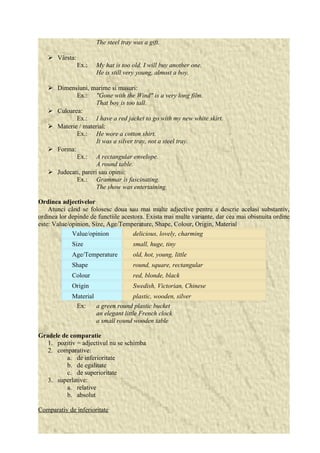
Ordinea adjectivelor 
Atunci când se folosesc doua sau mai multe adjective pentru a descrie acelasi substantiv, 
ordinea lor depinde de functiile acestora. Exista mai multe variante, dar cea mai obisnuita ordine 
este: Value/opinion, Size, Age/Temperature, Shape, Colour, Origin, Material 
Value/opinion delicious, lovely, charming 
Size small, huge, tiny 
Age/Temperature old, hot, young, little 
Shape round, square, rectangular 
Colour red, blonde, black 
Origin Swedish, Victorian, Chinese 
Material plastic, wooden, silver 
Ex: a green round plastic bucket 
an elegant little French clock 
a small round wooden table 
Gradele de comparatie 
1. pozitiv = adjectivul nu se schimba 
2. comparative: 
a. de inferioritate 
b. de egalitate 
c. de superioritate 
3. superlative: 
a. relative 
b. absolut 
Comparativ de inferioritate
 adj scurte (mono si bisilabice) se formeaza din: not so/not as + adj + as 
Ex: This room is not so big as the bedroom. 
This room is not as big as the bedroom. 
 adj lungi se formeaza: less + adj + than 
Ex: The chair is less comfortable than the bed. 
Comparativ de egalitate 
Atat pt adj scurte cat si pt lungi: as + adj + as. 
Ex: The bed is as good as the chair. 
Ideea de egalitate mai poate fi sugerata si prin constructia: the same + subst + as 
NOTA! as si nu like !!! 
Ex: This room is the same size as the other one. 
Schimbare de valoare gramaticala 
Adjectiv Substantiv 
big, small size (masura) 
long, short length (lungime) 
broad, narrow breadth (largime pt ceva concret) 
wide, narrow width (largime pt ceva abstract) 
high, low height (inaltime) 
deep, shallow depth (adancime) 
heavy, light weight (greutate) 
strong, weak strength (putere)……..etc. 
Constructii cu comparativul de egalitate: 
as brave as a lion 
as blind as a bat 
as black as coal 
as busy as a bee 
as cool as a cucumber 
as clear as daylight 
as dry as a bone 
as easy as ABC 
as fresh as a daisy 
as hairy as a gorilla 
as mad as a hatter (palarier) 
as poor as a church-mouse 
as silent as a grave 
as wise as Solomon 
as soft as silk 
as smooth as grass 
as gentle as a lamb…….etc. 
Comparativul de superioritate 
 adj scurte: adj + er + than. Modificari ortografice: 
 daca adj se termina in “e”, se adauga doar “r” Ex: nice – nicer 
 daca adj se termina in “y” precedat de consoana, se transforma “y” in “ier” Ex: pretty 
– prettier 
Exceptii: shy – shyer 
sly – slyer
wry – wryer (stramb) 
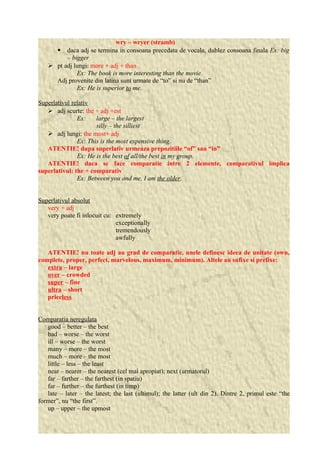
 daca adj se termina in consoana precedata de vocala, dublez consoana finala Ex: big 
– bigger 
 pt adj lungi: more + adj + than 
Ex: The book is more interesting than the movie. 
Adj provenite din latina sunt urmate de “to” si nu de “than” 
Ex: He is superior to me. 
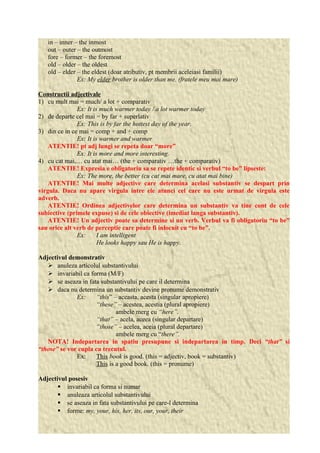
Superlativul relativ 
 adj scurte: the + adj +est 
Ex: large – the largest 
silly – the silliest 
 adj lungi: the most+ adj 
Ex: This is the most expensive thing. 
ATENTIE! dupa superlativ urmeaza prepozitiile “of” sau “in” 
Ex: He is the best of all/the best in my group. 
ATENTIE! daca se face comparatie intre 2 elemente, comparativul implica 
superlativul: the + comparativ 
Ex: Between you and me, I am the older. 
Superlativul absolut 
very + adj 
very poate fi inlocuit cu: extremely 
exceptionally 
tremendously 
awfully 
ATENTIE! nu toate adj au grad de comparatie, unele definesc ideea de unitate (own, 
complete, proper, perfect, marvelous, maximum, minimum). Altele au sufixe si prefixe: 
extra – large 
over – crowded 
super – fine 
ultra – short 
priceless 
Comparatia neregulata 
good – better – the best 
bad – worse – the worst 
ill – worse – the worst 
many – more – the most 
much – more – the most 
little – less – the least 
near – nearer – the nearest (cel mai apropiat); next (urmatorul) 
far – farther – the farthest (in spatiu) 
far – further – the furthest (in timp) 
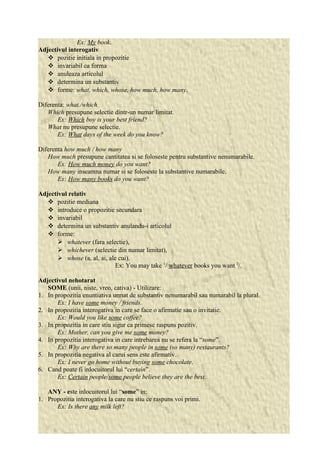
late – later – the latest; the last (ultimul); the latter (ult din 2). Dintre 2, primul este “the 
former”, nu “the first”. 
up – upper – the upmost
in – inner – the inmost 
out – outer – the outmost 
fore – former – the foremost 
old – older – the oldest 
old – elder – the eldest (doar atributiv, pt membrii aceleiasi familii) 
Ex: My elder brother is older than me. (fratele meu mai mare) 
Constructii adjectivale 
1) cu mult mai = much/ a lot + comparativ 
Ex: It is much warmer today / a lot warmer today 
2) de departe cel mai = by far + superlativ 
Ex: This is by far the hottest day of the year. 
3) din ce in ce mai = comp + and + comp 
Ex: It is warmer and warmer 
ATENTIE! pt adj lungi se repeta doar “more” 
Ex: It is more and more interesting. 
4) cu cat mai,… cu atat mai… (the + comparativ …the + comparativ) 
ATENTIE! Expresia e obligatoriu sa se repete identic si verbul “to be” lipseste: 
Ex: The more, the better (cu cat mai mare, cu atat mai bine) 
ATENTIE! Mai multe adjective care determina acelasi substantiv se despart prin 
virgula. Daca nu apare virgula intre ele atunci cel care nu este urmat de virgula este 
adverb. 
ATENTIE! Ordinea adjectivelor care determina un substantiv va tine cont de cele 
subiective (primele expuse) si de cele obiective (imediat langa substantiv). 
ATENTIE! Un adjectiv poate sa determine si un verb. Verbul va fi obligatoriu “to be” 
sau orice alt verb de perceptie care poate fi inlocuit cu “to be”. 
Ex: I am intelligent 
He looks happy sau He is happy. 
Adjectivul demonstrativ 
 anuleza articolul substantivului 
 invariabil ca forma (M/F) 
 se aseaza in fata substantivului pe care il determina 
 daca nu determina un substantiv devine pronume demonstrativ 
Ex: “this” – aceasta, acesta (singular apropiere) 
“these” – acestea, acestia (plural apropiere) 
ambele merg cu “here”. 
“that” – acela, aceea (singular departare) 
“those” – acelea, aceia (plural departare) 
ambele merg cu “there”. 
NOTA! Indepartarea in spatiu presupune si indepartarea in timp. Deci “that” si 
“those” se vor cupla cu trecutul. 
Ex: This book is good. (this = adjectiv, book = substantiv) 
This is a good book. (this = pronume) 
Adjectivul posesiv 
 invariabil ca forma si numar 
 anuleaza articolul substantivului 
 se aseaza in fata substantivului pe care-l determina 
 forme: my, your, his, her, its, our, your, their
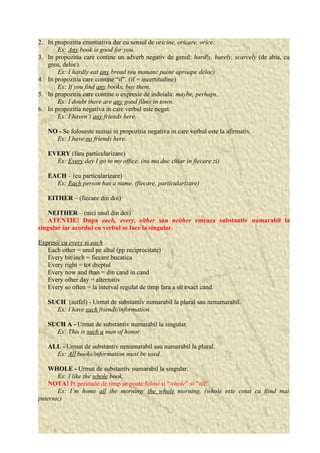
Ex: My book. 
Adjectivul interogativ 
 pozitie initiala in propozitie 
 invariabil ca forma 
 anuleaza articolul 
 determina un substantiv 
 forme: what, which, whose, how much, how many. 
Diferenta: what./which 
Which presupune selectie dintr-un numar limitat. 
Ex: Which boy is your best friend? 
What nu presupune selectie. 
Ex: What days of the week do you know? 
Diferenta how much / how many 
How much presupune cantitatea si se foloseste pentru substantive nenumarabile. 
Ex: How much money do you want? 
How many inseamna numar si se foloseste la substantive numarabile. 
Ex: How many books do you want? 
Adjectivul relativ 
 pozitie mediana 
 introduce o propozitie secundara 
 invariabil 
 determina un substantiv anulandu-i articolul 
 forme: 
 whatever (fara selectie), 
 whichever (selectie din numar limitat), 
 whose (a, al, ai, ale cui). 
Ex: You may take 1/ whatever books you want 2/. 
Adjectivul nehotarat 
SOME (unii, niste, vreo, cativa) - Utilizare: 
1. In propozitia enuntiativa urmat de substantiv nenumarabil sau numarabil la plural. 
Ex: I have some money / friends. 
2. In propozitia interogativa in care se face o afirmatie sau o invitatie. 
Ex: Would you like some coffee? 
3. In propozitia in care stiu sigur ca primesc raspuns pozitiv. 
Ex: Mother, can you give me some money? 
4. In propozitia interogativa in care intrebarea nu se refera la “some”. 
Ex: Why are there so many people in some (so many) restaurants? 
5. In propozitia negativa al carui sens este afirmativ. 
Ex: I never go home without buying some chocolate. 
6. Cand poate fi inlocuitorul lui “certain”. 
Ex: Certain people/some people believe they are the best. 
ANY - este inlocuitorul lui “some” in: 
1. Propozitia interogativa la care nu stiu ce raspuns voi primi. 
Ex: Is there any milk left?
2. In propozitia enuntiativa dar cu sensul de oricine, oricare, orice. 
Ex: Any book is good for you. 
3. In propozitia care contine un adverb negativ de genul: hardly, barely, scarcely (de abia, cu 
greu, deloc). 
Ex: I hardly eat any bread (nu mananc paine aproape deloc) 
4. In propozitia care contine “if”. (if = incertitudine) 
Ex: If you find any books, buy them. 
5. In propozitia care contine o expresie de indoiala: maybe, perhaps. 
Ex: I doubt there are any good films in town. 
6. In propozitia negativa in care verbul este negat. 
Ex: I haven’t any friends here. 
NO - Se foloseste numai in propozitia negativa in care verbul este la afirmativ. 
Ex: I have no friends here. 
EVERY (fara particularizare) 
Ex: Every day I go to my office. (nu ma duc chiar in fiecare zi) 
EACH – (cu particularizare) 
Ex: Each person has a name. (fiecare, particularizare) 
EITHER – (fiecare din doi) 
NEITHER – (nici unul din doi) 
ATENTIE! Dupa each, every, either sau neither rmeaza substantiv numarabil la 
singular iar acordul cu verbul se face la singular. 
Expresii cu every si each 
Each other = unul pe altul (pp reciprocitate) 
Every bit/inch = fiecare bucatica 
Every right = tot dreptul 
Every now and than = din cand in cand 
Every other day = alternativ 
Every so often = la interval regulat de timp fara a sti exact cand. 
SUCH (astfel) - Urmat de substantiv numarabil la plural sau nenumarabil. 
Ex: I have such friends/information. 
SUCH A - Urmat de substantiv numarabil la singular. 
Ex: This is such a man of honor. 
ALL - Urmat de substantiv nenumarabil sau numarabil la plural. 
Ex: All books/information must be used. 
WHOLE - Urmat de substantiv numarabil la singular. 
Ex: I like the whole book. 
NOTA! Pt perioade de timp se poate folosi si “whole” si “all” 
Ex: I’m home all the morning/ the whole morning. (whole este cotat ca fiind mai 
puternic)
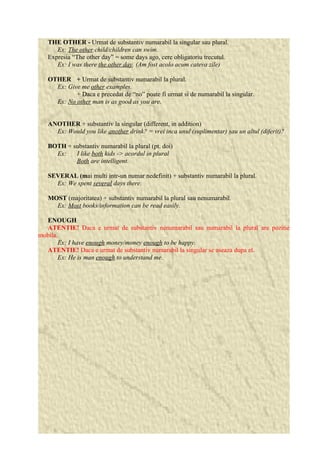
THE OTHER - Urmat de substantiv numarabil la singular sau plural. 
Ex: The other child/children can swim. 
Expresia “The other day” = some days ago, cere obligatoriu trecutul. 
Ex: I was there the other day. (Am fost acolo acum cateva zile) 
OTHER + Urmat de substantiv numarabil la plural. 
Ex: Give me other examples. 
+ Daca e precedat de “no” poate fi urmat si de numarabil la singular. 
Ex: No other man is as good as you are. 
ANOTHER + substantiv la singular (different, in addition) 
Ex: Would you like another drink? = vrei inca unul (suplimentar) sau un altul (diferit)? 
BOTH + substantiv numarabil la plural (pt. doi) 
Ex: I like both kids -> acordul in plural 
Both are intelligent. 
SEVERAL (mai multi intr-un numar nedefinit) + substantiv numarabil la plural. 
Ex: We spent several days there. 
MOST (majoritatea) + substantiv numarabil la plural sau nenumarabil. 
Ex: Most books/information can be read easily. 
ENOUGH 
ATENTIE! Daca e urmat de substantiv nenumarabil sau numarabil la plural are pozitie 
mobila. 
Ex: I have enough money/money enough to be happy. 
ATENTIE! Daca e urmat de substantiv numarabil la singular se aseaza dupa el. 
Ex: He is man enough to understand me.
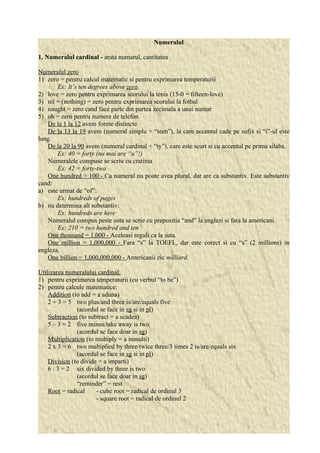
Numeralul 
1. Numeralul cardinal - arata numarul, cantitatea 
Numeralul zero 
1) zero = pentru calcul matematic si pentru exprimarea temperaturii 
Ex: It’s ten degrees above zero. 
2) love = zero pentru exprimarea scorului la tenis (15-0 = fifteen-love) 
3) nil = (nothing) = zero pentru exprimarea scorului la fotbal 
4) naught = zero cand face parte din partea zecimala a unui numar 
5) oh = zero pentru numere de telefon 
De la 1 la 12 avem forme distincte 
De la 13 la 19 avem (numeral simplu + “teen”), la care accentul cade pe sufix si “i”-ul este 
lung. 
De la 20 la 90 avem (numeral cardinal + “ty”), care este scurt si cu accentul pe prima silaba. 
Ex: 40 = forty (nu mai are “u”!) 
Numeralele compuse se scriu cu cratima 
Ex: 42 = forty-two 
One hundred = 100 - Ca numeral nu poate avea plural, dar are ca substantiv. Este substantiv 
cand: 
a) este urmat de “of”: 
Ex: hundreds of pages 
b) nu determina alt substantiv: 
Ex: hundreds are here 
Numeralul compus peste suta se scrie cu prepozitia “and” la englezi si fara la americani. 
Ex: 210 = two hundred and ten 
One thousand = 1,000 - Aceleasi reguli ca la suta. 
One million = 1,000,000 - Fara “s” la TOEFL, dar este corect si cu “s” (2 millions) in 
engleza. 
One billion = 1,000,000,000 - Americanii zic milliard. 
Utilizarea numeralului cardinal: 
1) pentru exprimarea temperaturii (cu verbul “to be”) 
2) pentru calcule matematice: 
Addition (to add = a aduna) 
2 + 3 = 5 two plus/and three is/are/equals five 
(acordul se face in sg si in pl) 
Subtraction (to subtract = a scadea) 
5 – 3 = 2 five minus/take away is two 
(acordul se face doar in sg) 
Multiplication (to multiply = a inmulti) 
2 x 3 = 6 two multiplied by three/twice three/3 times 2 is/are/equals six 
(acordul se face in sg si in pl) 
Division (to divide = a imparti) 
6 : 3 = 2 six divided by three is two 
(acordul se face doar in sg) 
“reminder” = rest 
Root = radical - cube root = radical de ordinul 3 
- square root = radical de ordinul 2
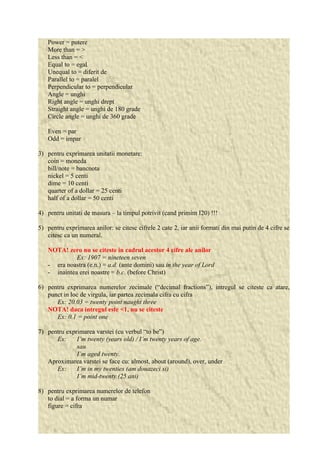
Power = putere 
More than = > 
Less than = < 
Equal to = egal 
Unequal to = diferit de 
Parallel to = paralel 
Perpendicular to = perpendicular 
Angle = unghi 
Right angle = unghi drept 
Straight angle = unghi de 180 grade 
Circle angle = unghi de 360 grade 
Even = par 
Odd = impar 
3) pentru exprimarea unitatii monetare: 
coin = moneda 
bill/note = bancnota 
nickel = 5 centi 
dime = 10 centi 
quarter of a dollar = 25 centi 
half of a dollar = 50 centi 
4) pentru unitati de masura – la timpul potrivit (cand primim I20) !!! 
5) pentru exprimarea anilor: se citesc cifrele 2 cate 2, iar anii formati din mai putin de 4 cifre se 
citesc ca un numeral. 
NOTA! zero nu se citeste in cadrul acestor 4 cifre ale anilor 
Ex: 1907 = nineteen seven 
- era noastra (e.n.) = a.d. (ante domini) sau in the year of Lord 
- inaintea erei noastre = b.c. (before Christ) 
6) pentru exprimarea numerelor zecimale (“decimal fractions”), intregul se citeste ca atare, 
punct in loc de virgula, iar partea zecimala cifra cu cifra 
Ex: 20.03 = twenty point naught three 
NOTA! daca intregul este <1, nu se citeste 
Ex: 0.1 = point one 
7) pentru exprimarea varstei (cu verbul “to be”) 
Ex: I’m twenty (years old) / I’m twenty years of age. 
sau 
I’m aged twenty. 
Aproximarea varstei se face cu: almost, about (around), over, under 
Ex: I’m in my twenties (am douazeci si) 
I’m mid-twenty (25 ani) 
8) pentru exprimarea numerelor de telefon 
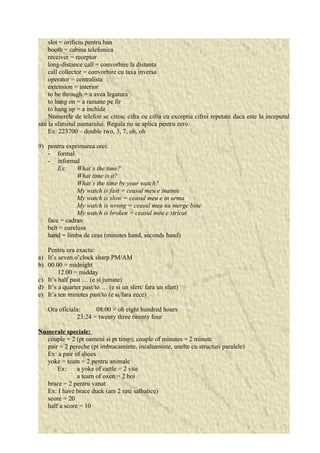
to dial = a forma un numar 
figure = cifra
slot = orificiu pentru ban 
booth = cabina telefonica 
receiver = receptor 
long-distance call = convorbire la distanta 
call collector = convorbire cu taxa inversa 
operator = centralista 
extension = interior 
to be through = a avea legatura 
to hang on = a ramane pe fir 
to hang up = a inchide 
Numerele de telefon se citesc cifra cu cifra cu exceptia cifrei repetate daca este la inceputul 
sau la sfarsitul numarului. Regula nu se aplica pentru zero. 
Ex: 223700 – double two, 3, 7, oh, oh 
9) pentru exprimarea orei: 
- formal 
- informal 
Ex: What’s the time? 
What time is it? 
What’s the time by your watch? 
My watch is fast = ceasul meu e inainte 
My watch is slow = ceasul meu e in urma 
My watch is wrong = ceasul meu nu merge bine 
My watch is broken = ceasul meu e stricat 
face = cadran 
belt = curelusa 
hand = limba de ceas (minutes hand, seconds hand) 
Pentru ora exacta: 
a) It’s seven o’clock sharp PM/AM 
b) 00.00 = midnight 
12.00 = midday 
c) It’s half past … (e si jumate) 
d) It’s a quarter past/to … (e si un sfert/ fara un sfert) 
e) It’s ten minutes past/to (e si/fara zece) 
Ora oficiala: 08:00 = oh eight hundred hours 
23:24 = twenty three twenty four 
Numerale speciale: 
couple = 2 (pt oameni si pt timp); couple of minutes = 2 minute 
pair = 2 pereche (pt imbracaminte, incaltaminte, unelte cu structuri paralele) 
Ex: a pair of shoes 
yoke = team = 2 pentru animale 
Ex: a yoke of cattle = 2 vite 
a team of oxen = 2 boi 
brace = 2 pentru vanat 
Ex: I have brace duck (am 2 rate salbatice) 
score = 20 
half a score = 10
dozen = 12 
gross = 144 (12 duzini) 
2. Numeralul ordinal 
Se formeaza din: the + numeral cardinal + th 
Exceptii: the first (primul) 
the second (al doilea) 
the third (al treilea) 
+ 
toate celelalte numerale compuse care contin una din aceste exceptii 
(21, 22, 23, 31, 32, 33, … 101, 102, 1001, 1002, etc) 
Prescurtari: 1st, 2nd, 3rd, 4th, …21st, 22nd, etc. 
NOTA! “th” se aplica doar ultimei cifre ! 
Modificari ortografice: 
five – the fifth 
eight – the eighth 
nine – the ninth 
twelve – the twelfth 
twenty – the twentieth (+ toate cele terminate in “ty”) 
Utilizarea numeralului ordinal: 
1) exprimarea datei (in 2 forme) 
a) luna/zi/an 
b) zi/luna/an 
2) exprimarea ordinii intr-o insiruire 
Ex: Henry the eighth 
the first floor 
the second World War 
3) pentru numeralul fractionar (common fraction/vulgar fraction) 
numerator = numaratorul (cardinal) 
denominator = numitorul (ordinal) 
Ex: 1/3 = one third 
NOTA! daca numaratorul > 1, numitorul va fi in plural 
Ex: 2/3 = two thirds 
Intregul = the whole 
Fractia pe 100 = per cent 
Procentaj = percentage 
Numeralul distributiv - Arata distributia lucrurilor: 
One by one = unul cate unul 
Two at a time = 2 odata 
By twos / in twos = cate 2
Numeralul adverbial - Arata de cate ori se repeta o actiune: 
once = o data 
twice = de 2 ori 
3 times 
4 times, etc. 
NOTA! nu exista “twice more”, ci “twice as much as” = de 2 ori mai mult 
Numeralul multiplicativ - Arata de cate ori creste o cantitate: 
double = twofold = indoit (de 2 ori) 
tenfold = inzecit
Pronumele 
Functia pronumelui 
Pronumele sunt cuvinte lipsite de inteles de sine statator. Ele nu denumesc si nu aracterizeaza 
nimic, functia lor fiind aceea de a inlocui un substantiv, facand astfel referire la o idee, obiect sau 
actiune mentionate anterior sau cunoscuta de catre interlocutor. 
Ex.: John did all the work. 
He did all the work. 
Who did all the work? 
Forma pronumelui 
Pronumele au forme specifice in functie de: 
 Numar: singular - this; plural – these 
 Caz: Nominativ - she; Genitiv - hers; Dativ - to her; Acuzativ – her 
 Gen: masculin - he; Feminin - she; neutru - it 
Pronumele pot fi simple (you, which, many) sau compuse (everybody, whatever, no one). 
Clasificarea pronumelor 
1. Personale 
2. Reflexive 
3. Nehotarate 
4. Demonstrative 
5. Relative 
6. De întarire 
7. Interogative 
8. Reciproce 
Pronumele personale 
Nominativ Genitiv Dativ Acuzativ 
Singular 
I mine (to) me me 
you yours (to) you you 
he his (to) him him 
she hers (to) her her 
it its (to) it it 
Plural 
we ours (to) us us 
you yours (to) you you 
they theirs (to) them them 
ATENTIE! I se scrie intotdeauna cu majuscula. Its (pronume) nu are apostrof. It's vine 
de la it is sau it has! 
Forme arhaice si poetice: pers. II sg. - thou, thine, (to) thee 
You / They impersonal - putem folosi aceste doua pronume pentru a vorbi despre 
oameni in general. 
Ex.: You have to drive on the other side of the road in Great Britain. 
They say she's very clever. 
It - poate indeplini o serie de functii de mare importanta: 
It impersonal (in expresii impersonale temporale, exprimand starea vremii, distante sau 
in contructii pasive) 
Ex.: It's 7 o'clock.
It was spring. 
Is it Monday? 
How hot it is! 
How far is it to the station? 
It demostrativ 
Ex.: Who is it? It's the postman. 
It's the children. 
Pronumele reflexive 
Acestea insotesc un verb si se refera la subiect. Se folosesc atunci cand subiectul si 
complementul direct se refera la aceeasi persoana. 
Forme: Singular: myself, yourself, himself, herself, itself 
Plural: ourselves, yourselves, themselves 
Ex.: I wanted to do it myself but he insisted on helping me. 
he fell off the ladder and injured herself. 
Pronumele nehotarate 
Some, any, every se pot combina cu -one, -body, -thing pentru a obtine pronumele nehotarate: 
anyone, anybody, anything, someone, somebody, something, everyone, everybody, everything. 
No poate forma impreuna cu -body sau -one pronumele: nobody, no-one. 
NOTA! Atat in engleza britanica cat si in cea americana, pronumele nehotarate 
anyone, anybody, someone, somebody, everyone, everybody, no-one sunt din punct de vedere 
gramatical la singular si trebuie folosite cu un verb la singular. 
Alte pronume nehotarate: enough, few, fewer, less, little, many, much, several, more, most, 
all, both, every, each, any, either, neither, none, some. 
De retinut! Daca acestea forme preceda un substantiv nu mai sunt pronume, ci 
determinanti substantivali. 
Ex.: Few will be chosen; fewer will finish, Little is expected. 
Pronumele demonstrativ 
Pronumele demostrative: this, these, that, those, such pot functiona atat ca pronume, cat si ca 
determinanti substantivali. 
Ex.: That is incredible! (referring to something you just saw) 
I will never forget this. (referring to a recent experience) 
Such is my belief. (referring to an explanation just made) 
This si these sugereaza ideea de apropiere temporala sau spatiala, pe cand that si those 
sugereaza ideea de departare. 
Ex.: These (pancakes sitting here now on my plate) are delicious. Those (pancakes that I 
had yesterday morning) were even better. 
This (book in my hand) is well written; that (book that I'm pointing to, over there, on 
the table) is trash. 
Aceasta idee de departare se poate transforma chiar in dispret sau instrainare afectiva: 
Ex.: Are you going to wear these? (They are awful. I do not like them at all.) 
Can you belive I would have bought that? 
Pronumele relative 
Pronumele relativ face referire la un substantiv sau inlocuitor substantival mentionat in 
contextul aterior (antecedent) si leaga propozitia sau grupul de cuvinte care explica sau da mai 
multe detalii despre substantivul antecedent de propozitia continand substantivul determinat. 
Pronumele relative sunt : who, whoever, which, that.
Ex.: The student who studies hardest usually does the best. 
Alegerea corecta dintre which si that se inscrie printre cele mai frecvente nelamuriri ale 
studentilor la limba engleza. In general, which se foloseste pentru a introduce propozitii care au 
natura de paranteze, explicatii suplimentare dar care pot fi inlaturate sau omise fara a schimba 
intelesul frazei. Din acest motiv propozitiile introduse prin which sunt in general intre virgule. 
Din contra propozitiile introduse de that sunt considerate indispensabile sensului frazei si nu se 
vor pune intre virgule. 
Who si formele sale se refera la persoane, which se refera la lucruri, iar that poate face 
referire la ambele. 
Ex.: The man who hijacked the plane wanted to get to Cuba 
The couple who live next door have the radio on all night. 
The team that won the championship received a great reception. 
This is the program which won the prize. 
We'll plant new trees to replace those which fell. 
Pronumele de intarire 
Insoteste substantive sau pronume personale pentru a le sublinia. Ca forma sunt identice cu 
pronumele reflexive: Singular: myself, yourself, himself, herself, itself 
Plural: ourselves, yourselves, themselves 
Ex.: I myself don't know the answer. 
Mary did all this herself. 
Mary herself did all this. 
Expresii: by myself = singur, de unul singur Ex.: I worked by myself. 
Pronumele interogativ 
Pronumele interogative introduc intrebari, propozitii interogative directe sau indirecte. 
Forme: who? what? which? whose? (to) whom? 
Ex.: Who said that? 
Whose are those books? 
I do not remember to whom I gave my sweater. 
What happened? 
What's the weather like? 
Pronumele reciproce 
Forme: each other si one another. Se folosesc pentru a exprima relatii de reciprocitate intre 
fiinte, idei, lucruri. 
Ex.: If Bob gave Alicia a book for Christmas and Alicia gave Bob a book for Christmas, 
we can say that they gave each other books. 
My mother and I give each other a hard time. 
They borrowed each other's ideas. 
De retinut! Each other se refera la doua obiecte, pe cand one another face referire la 
mai mult de doua obiecte sau fiinte. 
Ex.: The scientists in this lab often use one another's equipment. 
Hockey players hit one another quite frequently. 
Pronumele “IT” – functii: 
1. Pronume personal, persoana a treia sg.,gen neutru – folosit pentru obiecte şi noţiuni 
abstracte, nepersonificate, animale nepersonificate şi cărora nu li se cunosc sexul sau sunt 
luate în sens generic. 
Ex: Here is a book. It is very interesting.
How ould is your baby? It is five months ould. 
2. Pronume personal-folosit pentru a indica: 
a. Timpul după calendar sau ceas : It is six o‘clock on the 4th of February. 
b. Scurgerea timpului: It is getting lake –se face târziu 
c. Starea atmosferică: It is getting dark –se întunericeşte; It‘s rather cloudy –mai 
degrabă e înorat 
d. Fenomene meteorologice şi naturale: It is raining cats and dogs –plouă cu 
găleata(torenţial); It thunders –tună; It lightens –fulgeră; It is ten degrees above 
zero –sunt +10º 
f. Distanţele: It‘snearly ten kilometres to Albota-sunt aproape 10 km până la Albota. 
g. Starea lucrurilor în general: It‘s ok sau it‘s all right! 
3. Pronume demonstrativ (echivalent cu That sau Which rsferindu-se la ceva văzut sau 
menţionat înainte) 
Ex : He expressed his sympathies –şi-a prezentat condoleanţele 
It was nice of him (to do that) –drăguţ din partea lui (să facă asta) 
4. Pronume introductiv 
a. Introductiv anticipativ - are rolul de a introduce propoyiţia printr-un subiect formal 
deoarece subiectul real este deplasat după numele predicativ pentru a-l scoate în evidenţă. 
Ex: It‘s nice to see /seeing such a garden –este o plăcere să vezi o asmenea 
grădină. 
Subiectul real se poate exprima prin: 
 Infinitivul lung –‘to see‘ 
 Construcţii gerumviale 
 O propoziţie subiectivă,de obicei introdusă prin conjuncţia That. 
b. Introductiv de întărire sau subliniere având rolul de a sublinia foarte puternic sau de a 
scoate în evidenţă oricare parte a propoziţiei cu excepţia predicatului. 
Ex: It‘s Peter who/that solved all the problems.- Peter este cel care a rezolvat 
toate problemele. 
5. Pronume nesemnificativ –folosit ca, complement direct formal mai ales al unor verbe 
intranzitive. Acest tip de pronume apare frecvent în engleza vorbită. 
Ex: Shall we cab it to the station ? –Să luăm taxiul până la staţie. 
No,I‘ would rather foot it. –Nu,prefer să merg pe jos.
Verbul (the verb) 
A. Verbele auxiliare ( to be, to do , to have ) 
 Sunt verbe deosebit de puternice 
 Au forme distincte pt. prezent si trecut 
 Intra in alcatuirea altor timpuri verbale: 
 to be la toate formele de continuu 
 to have la toate timpurile perfecte 
 Nu-si pot forma participiul nedefinit (forma in “ing”) cu exceptia situatiei cand verbul “to 
have” pierde sensul de a avea, a poseda si intra in alcatuirea alocutiunilor verbale (to have a 
bath, to have a shower, to have a rest, to have talk, to have a walk, to have lunch). 
 Isi fac singure interogativul prin inversarea cu subiectul 
 Isi fac negativul prin adaugarea negatiei “not” 
 Isi fac singure intrebarea disjunctiva si raspunsul scurt 
Ex: He has a car. Hasn’t he? Yes, he has. 
 Trecutul verbelor auxiliareŞ 
 Pt. to be – was la pers I si a II-a singular, were pt. toate celelalte 
 Pt. to have – had 
VERBUL BE 
BE – WAS – BEEN 
Utilizare: 
1. pentru construirea timpurilor continue si a formei pasive: 
The old man is taking an afternoon nap. 
The bridge was destroyed by the earthquake. 
2. pentru a exprima existenta, starea fizica sau mentala sau alte informatii despre o persoana 
sau un lucru: 
Dr. Johnson is a dentist. He is calm and patient. 
3. pentru a exprima varsta: 
The baby is two months old. How old are you? 
4. BE TO + INFINITIV: pentru a da ordine/instructiuni sau pentru a comunica un plan: 
You are to finish your homework before dinner. (= You must finish…) 
The chairman is to give his annual speech tomorrow. (= He plans to give…) 
5. BE ABOUT TO + INFINITIV: pentru a indica viitorul imediat: 
Meg is about to leave. (= Meg is on the point of leaving.) 
6. THERE + BE + SUBSTANTIV: pentru a indica existenta unei fiinte sau a unui lucru: 
There are two pieces of cake left in the fridge. 
There is a person outside the door. 
VERBUL DO 
DO – DID – DONE 
Utilizare: DO se foloseste atat ca verb auxiliar cat si ca verb propriu-zis. 
A. DO ca verb auxiliar: 
1. pentru a forma negativul si interogativul prezentului simplu so trecutului simplu: 
The kitten doesn’t play with strangers. 
Did they go to the opera yesterday? 
2. pentru a evita repetarea aceluiasi verb sau aceleiasi expresii: 
My company made a profit last year but IBM did not.
Mary typed that letter very badly. She certainly did! 
3. pentru a sublinia un afirmativ sau imperativ: 
Do eat your vegetables! 
You’re wrong: I did pay you! 
B. DO ca verb propriu-zis – are sensul general de a duce la bun sfarsit, a realiza, a executa, a 
administra, a pune in practica: 
Students should do the exercises at the end of each unit. 
He always does the job well. 
The office clerk did the transaction yesterday. 
NOTA: A nu se confunda DO cu MAKE! Verbul MAKE are sensul general de a crea, a 
produce, a construi, a cauza, a face sa fie sau a prepara. Comparati: 
to do someone a favour to make a friend 
to do one’s best to make the bed 
to do good to make money 
to do the dishes to make a rule 
to do the shopping to make a mistake 
to do one’s homework to make a mess 
to do a crossword puzzle to make a living 
to do one’s duty to make fun of someone 
to do well/badly to make oneself at home 
VERBUL HAVE 
HAVE – HAD – HAD 
Utilizare: HAVE se foloseste atat ca verb auxiliar cat si ca verb propriu-zis. 
A. HAVE ca verb auxiliar: 
1. pentru a forma alte timpuri: 
Present perfect: I have worked. 
Past perfect: I had worked. 
Future perfect: I will have worked. 
Past conditional: I would have worked. 
2. HAD BETTER + INFINITIV fara TO (short INFINITIVE): 
They had better study hard from the first day of school. (It would be a good idea 
if they studied hard from…) 
You’d better go home. (It would be a good idea if you went home.) 
3. I WON’T HAVE + COMPLEMENT + -ING: 
I won’t have that dog sleeping on my bed! (I won’t permit that dog to sleep on my 
bed!) 
B. HAVE ca verb propriu-zis: 
1. posesia: 
Anne always has a cold. 
Anne doesn’t always have a cold. 
Does Anne always have a cold? 
Cand HAVE este urmat de GOT, se intareste sensul posesiv. 
Debbie’s got a lovely voice. 
Have you got a computer?
2. a manca, a bea sau a organiza: 
The twins usually have dinner early. 
My aunt Mary doesn’t have coffee often. 
Our neighbours had a cocktail party last week. 
3. HAVE + COMPLEMENT + PAST PARTICIPLE: 
Mrs. Riley had her house painted. (Mrs. Riley got someone to paint her house.) 
My best friend has his hair trimmed every Friday. (My best friend has someone to 
cut his hair every Friday.) 
B. Verbele modale 
 Verbe puternice 
 Au forme distincte pt. prezent si trecut 
 Nu au infinitiv lung (adica cu to in fata) 
Ex: I can (fara to) go 
 Nu permit dupa ele verbe la infinitiv lung 
 Nu apar niciodata singure, cu exceptia raspunsului scurt 
 Nu pot avea forma in “ing” 
 Nu isi pot forma toate timpurile 
 Au inlocuitori 
 Isi fac interogativul prin inversare cu subiectul 
 Isi fac negativul prin adaugarea negatiei “not” 
 Isi fac singure intrebarea disjuncta si raspunsul scurt 
CAN 
Utilizare: 
1. pentru a cere, a acorda sau a refuza permisiunea, similar cu may, dar mai putin formal: 
You can drive at seventeen in the UK. 
Can I borrow your pen, please? I’ve left mine at home. 
You cannot go hunting out of season. 
NOTA: forme alternative: You are permitted / are allowed to / may drive ar 
seventeen in the UK. 
ATENTIE: la negativ, could si might au sensuri diferite. 
Ex: Ken could not be building the house by himself. (It is impossible, it is too 
much work.) 
Ken might not be building thehouse by himself. (He is building the house 
himself, he probably has help.) 
2. pentru a face referire la probabilitate, posibilitate sau imposibilitate in prezent, in trecut 
sau la conditional: 
Look, there’s plenty of snow, we can go skiing today. 
Let’s try his office, he could be there. 
Bill cannot drive for a few weeks, he’s broken his leg. 
3. pentru a face referire la abilitate sau indemanare in prezent, in trecut sau la conditional: 
She is a great secretary; she can type ninety words a minute. 
Can you speak English? 
Tim is hopeless. He can’t even fry and egg. 
If he studied harder, he could pass the exam.
NOTA: pentru alte timpuri, se foloseste be able to: 
She will be able to / has been able to type 100 words a minute. 
4. could + INFINITIV perfect, pentru a se referi la o actiune care nu a avut loc: 
You could have hurt your back lifting that heavy table. 
I could have driven you to the airport, but I didn’t have my car. 
· cand nu stim daca actiunea s-a petrecut sau nu: 
Have you seen my umbrella? Dad could have taken it. 
NOTA: forme alternative: 
You might have hurt your back lifting that heavy table. 
You would probably have hurt your back lifting that heavy table. 
Inlocuitori: to be able to, to be capable to 
MAY 
Utilizare: 
1. cu referire la evenimente sau actiuni posibile sau probabile in prezent, adesea cu sens de 
viitor. Might poate fi folosit pentru a sublinia o foarte redusa posibilitate: 
There’s a black cloud above us. It may rain. 
Alice may get angry if you tell her. 
If you try hard enough, you might convince him to come. 
· si cu forma continua: 
Call me after eight I may be working hard late tonight. 
Alex says he might be going on holiday without his parents this year. 
NOTA: formele alternative sunt: 
Maybe it wil rain. It is likely to rain. 
Maybe Alice will get angry if you tell her. Alice is likely to get angry if you tell her. 
2. pentru a cere, a oferi sau a refuza permisiunea politicos: 
May I open the window? It is very hot in this office. 
You may go in to see the doctor now. 
You may not smoke in my car. 
NOTA: forme alternative: 
Am I allowed to open the window? 
You are not permitted to smoke in my car. 
Can I open the window? (can poate fi si el folosit, dar este considerat mai putin politicos) 
3. cu well pentru a indica o foarte mare probabilitate: 
I think it may well rain today, look at those black clouds. 
The Government may well decide to raise the price of gas again. 
NOTA: forme alternative: 
I think it is very likely to rain today. 
The Government is very likely to deicde to raise the price of gas. 
ATENTIE: may / might as well are alt sens: 
There is nothing interesting on TV this evening, I may / might as well have an early night. 
(= Din moment ce nu este nimic interesant la TV, e mai bine sa ma duc devreme la 
culcare.)
4. cu o constructie perfecta pentru a face referire la o presupunere in trecut: 
Bill isn’t at his office, he may have gone home early. 
Brian might not have been killed by Sally. 
5. cu o constructie perfecta pentru a face referire la ceva care s-ar fi putut petrece in trecut, 
dar nu s-a petrecut; se poate folosi numai might: 
You might have burnt your hand while taking that hot tray out of the oven (but 
you didn’t). 
A lot of people, who might have been saved, died when the Titanic sank. 
6. Exprimarea unei interdictii 
Ex: People may not bring dogs into the hotel. 
7. Exprimarea unei urari 
Ex: May all your dreams come true. 
8. Dupa verbele “to hope” si “to trust” 
Ex: I hope you may find tickets for the cinema. 
9. La forma negativa are doar forma “may not” (nu exista forma contrasa mayn’t) 
10. La trecut are forma may have+participiu trecut si “might” – mai ales pt conditional. 
11. Inlocuitori: “to be allowed to”, “to be permitted to” 
MUST 
1. = trebuie, arata obligativitatea 
Ex: I must go now. 
2. Arata o deductie logica 
Ex: As she left at four she must be at home now. 
3. Negativ: mustn’t (nu trebuie), needn’t (nu este necesar). 
4. Trecut: must + have + participiu trecut si had to. 
5. Inlocuitori: to have to, to be obliged to, to be compelled to (toate = a fi obligat) 
6. Diferenta dintre must si have to. 
Must => arata obligativitatea din punctul meu de vedere; 
Have to => arata obligativitatea impusa de altii. 
Ex: I must go now. 
I have to wear uniform. 
NEED 
1. Are 2 valori: (a) verb lexical, (b) verb modal. 
(a) Verb lexical - este un verb regulat 
Ex: I need a new car. Do I need a new car? 
(b) Verb modal – se foloseste numai in propozitii interogative si negative. 
Ex:Need she get up early? 
She needn’t go there. 
Atentie! Totusi “need” se poate intalni si in afirmative ca modal – propozitii in care 
exista de regula never, hardly, barely, scarcely 
Ex: He hardly need mention his name. 
2. Exista 2 constructii cu “need” considerate arhaice. 
a) Must needs 
Ex: I must needs see your teacher.
b) Needs must – sugereaza ideea de sarcasm 
Ex: She needs must bring me now when I have … 
OUGHT TO 
1. Arata obligativitatea morala de a-si face datoria 
Ex: I ought to go (nu are acelasi nuanta cu “must”) 
2. Daca e urmat de have si verb la participiul trecut exprima o datorie care s-a indeplinit 
Ex: You ought to have waited till 2 o’clock. 
3. Nu are forma de sine statatoare de trecut. Se formeaza: ought + have + participiu trecut + to 
Ex: Ought have invited to join the party. 
4. Negativ: “oughtn’t” 
SHOULD - Este mai moale ca ought to 
1. Arata o datorie ca recomandare, e cel mai slab din cele care = trebuie 
Ex: You should read this book. 
2. Pt exprimarea supozitiei 
Ex: For his age he should be taller. 
3. Folosit daca e precedat de verbe ca: to suggest, to propose, to insist, to recommend, to advice 
Ex: I suggest that you should learn English. 
4. Folosit cand este precedat de o constructie impersonala: it is important/ necessary/ natural/ 
better 
Ex: It is important that you should understand. 
5. Folosit dupa constructii ca: so that, in order that, for fear that, lest (ca sa nu). 
Ex: I got up early for fear that/ lest/ so that I should arrive in time. 
6. Dupa verbe de stari emotionale: to feel sorry for, to be delighted, to be annoyed (uimit). 
Ex: I feel sorry that he should go back. Imi pare rau ca trebuie sa se intoarca. 
7. Dupa expresiile: don’t know why, can’t think why, see no reason why 
Ex: I don’t know why you should ask me that. 
WOULD 
1. Folosit pt. o cerere politicoasa 
Ex: Would you give me your tel. number? 
2. Urmat de like ca sa aiba inteles mai politicos 
Ex: I would like to meet you. 
3. Poate fi urmat de “rather” sau “sooner” pentru a exprima preferinta 
Ex: I would rather sleep than go for a walk. 
4. Pt. a exprima un obicei, actiune repetata in trecut 
Ex: I would meet you whenever I crossed the road. 
5. Pt a exprima probabilitatea 
Ex: The man would be his neighbor. 
USED TO 
1. Arata un obicei trecut 
Ex: I used to visit my grand parents when I was child. 
2. A nu se confunda cu “to be used to” care cere dupa ea verbul in “ing” 
Ex: I am used to getting up early. (sunt obisnuit cu sculatul de dimineata) 
DARE
1. Are 2 valori: (a) modala; (b) lexicala. 
(a) Valoarea modala – in propozitii negative si interogative. 
Ex: Dare you say this? (indraznesti sa spui asta) 
I daren’t go there (nu indraznesc sa merg acolo) 
(b) valoare ca verb lexical in propozitii afirmative fiind verb regulat. 
Ex: I dare to ask you about my dog. 
I dare say = I suppose 
I dare say I will invite them to dinner. 
I daresay = I accept 
I daresay you are right again. 
NOTA! Pt a exprima indignarea se foloseste expresia: “How dare you” 
Ex: How dare you come so late? 
C. Verbe lexicale 
Modurile predicative (pot sa fie predicat in propozitie): 
a) indicativ 
b) conditional 
c) subjonctiv 
d) imperativ 
(1) Modurile nepredicative: 
a) infinitivul 
b) participiul 
c) gerund 
MODUL INDICATIV 
Are 3 timpuri: - prezent 
- trecut 
- viitor 
Prezentul are 4 aspecte: - Simplu 
- Continuu 
- Perfect 
- Perfect continuu 
PREZENTUL SIMPLU 
1. Desemneaza o actiune repetata ce devine o obisnuinta 
2. Adverbe specifice: usually, often, always, every, never 
Ex: Every day I go to my office. 
3. Desemneaza un adevar universal valabil, o lege 
Ex. Fish swim. 
4. Cu valoare de viitor cand actiunea depinde de un program. 
Ex: The train arrives tonight.
5. Pt actiuni pas cu pas (instructiuni de utilizare, indicatii regizorale, comentarii sportive) 
6. In naratiune 
Ex: The boy enters the room, takes the ball and goes out. 
7. Pt actiuni care, desi se desfasoara in momentul vorbirii, nu au durata (verbe nondurative): to 
start, to end, to finish, to stop, to quite, to cancel, to kill, to die, to shoot. 
8. Cu verbe de perceptie senzoriala: to see, to hear, to taste, to smell, to sound, to feel etc. 
9. Cu verbe de perceptie mentala: to think, to realize, to remember, to forget, to remind, to 
suppose. 
10. Cu verbe de perceptie afectiva: to like, to enjoy, to hate, to dislike. 
11. Se formeaza din subiect + verb la infinitiv scurt ; pentru pers III sg se adauga “s” 
12. Modificari ortografice la persoana a III-a: 
a) Daca verbul se termina in “s”, “ss”, “sh”, “ch”, “tch”, “x”, “z” sau “o” se adauga “es” 
Ex: to go => goes 
wash => washes 
b) Daca verbul se termina in “y” precedat de consoana se transforma “y” in “i” si se adauga “es”. 
Ex: cry => cries 
13. Interogativul do/does + subiect + verb la infinitiv scurt 
Ex: She cries a lot. Does she cry a lot? 
13. Negativ subiect + don’t/doesn’t + verb la infinitiv scurt 
Ex: She doesn’t cry. 
PREZENTUL CONTINUU 
1. Desemneaza o actiune ce se desfasoara in momentul vorbirii (in this very moment/now/right 
now) 
Ex: I am speaking now. 
2. Se foloseste in descrieri 
Ex: The sun is shinning. 
3. Cu valoare de viitor cand actiunea depinde de subiect 
Ex: I am leaving soon. 
4. Pt. actiuni prezente paralele in desfasurare (when, while). 
Ex: While I am talking he is sleeping. 
5. Pentru actiuni care, desi nu se desfasoara in momentul vorbirii, constituie o rupere de ritm. 
Ex: Every day I get up at 7, but on Sunday I am getting up at 9. 
6. Pt. actiuni repetate care ma enerveaza
Ex: She always eats fruits before soup. (constatare obisnuita) 
dar 
She is always eating fruits before soup. (enervare) 
7. Se formeaza din subiect + verbul to be + verb in “ing”. (se conjuga doar “to be”) 
Verbul in “ing” = participiu prezent si are urmatoarele modificari ortografice.: 
a) Daca verbul se termina in “e” acesta cade inaintea lui “ing” 
Ex: to dance => dancing 
b) Verbele terminate in “ie” transforma “ie” in “y” 
Ex: to lie => lying 
c) verbele terminate in consoana precedata de vocala moale dubleaza consoana finala 
Ex: to sit => sitting 
! Sufixul “ing” nu afecteaza “y” si “i” final al verbului 
Ex: to play => playing 
to ski => skiing 
8. Interogativul - se formeaza prin inversarea auxiliarului cu subiectul 
Ex: Am I sleeping? 
9. Negativul - se formeaza prin adaugarea negatiei “not” la verbul “to be” 
Ex: I am not drinking. 
PREZENTUL PERFECT 
1) desemneaza o actiune trecuta, care fie tocmai s-a incheiat, fie ca se desfasoara intr-un timp 
deschis, nedeterminat. Spre deosebire de trecut, care desemneaza tot o actiune trecuta, la prezent 
perfect momentul incheierii actiunii nu trebuie sa fie cunoscut 
Ex: I saw her yesterday. (stiu cand => trecut) 
dar 
I have seen her lately. (nu stiu cand => prezent perfect) 
Ex: Did you see “Gone with the wind”? (nu mai poti sa-l vezi) 
dar 
Have you seen “American Pie”? (mai poti sa-l vezi) 
! de multe ori la o intrebare in prezent perfect raspunsul vine in trecut daca precizez momentul 
cand a avut loc actiunea 
Ex: Have you met her? 
Yes, I have. I met her an hour ago. 
(raspunsul trebuie sa contina “have”-ul din intrebare, dar trebuie sa precizez momentul, si atunci 
intra pe trecut). 
Se formeaza din 
have / has + verb III (participiu trecut)
Verbele se impart in: - regulate (a) 
- neregulate (b) 
(a) Verbele regulate 
Au forma II si forma III identice, se formeaza cu sufixul “ed” adaugata la forma infinitivului 
scurt 
Modificari ortografice: 
1) daca verbul se termina in “e”, adauga doar “d” 
2) daca verbul se termina in “y” precedat de consoana, transforma y in i si adauga “ed” 
Ex: cry – cried 
3) daca verbul se termina in “l”, il dubleaza mereu 
Ex: travel – travelled 
cancel – cancelled 
4) daca verbul se termina in “ic”, adauga “ked” 
Ex: panic – panicked 
5) daca verbul se termina in consoana precedata de vocala moale (vocala intre 2 consoane), 
dubleaza consoana si adauga “ed” 
Ex: to stop – stopped 
(b) Verbele neregulate 
Au forma II si forma III diferite. 
Adverbele specifice prezentului perfect 
Intre cele 2 verbe (auxiliar si verb) avem 
- adverbe de frecventa definita: (often, seldom, ever, never, usually, sometimes) 
- adverbe de frecventa indefinita: (just, recently, already) 
Ex: I have just met her. 
yet – se aseaza doar pe finalul propozitiei si numai in propozitii interogative si negative. In 
interogative are sensul de “deja”: 
Ex: Have you met her yet? (daca ar trebui transpusa in propozitie afirmativa, “yet” ar deveni 
“already”) => I have already met her. 
In negativa are sensul de “inca”: 
Ex: I haven’t met her yet. 
for – timp de (arata durata actiunii, fara a preciza momentul de inceput si de final). In propozitie 
are pozitie aproape finala. 
Ex: I haven’t met her for 2 years. 
since – incepand din (arata momentul de inceput, fara a preciza durata sau momentul de final). 
Pozitia este spre finalul propozitiei. 
Ex: I haven’t met you since Monday. 
! dupa “since” urmeaza intotdeauna trecut daca mai urmeaza o propozitie
Ex: I haven’t met her since I came. (este o actiune mai trecuta decat cea cu intalnirea) 
Pe pozitia finala mai avem adv de timp deschis (lately, today, this year / month / week). 
! prezentul perfect corespunde in romana trecutului (perfectul compus) 
Ex: A nins = It has snowed (nu stiu cand) 
dar 
A nins acum o ora = It snowed an hour ago. 
Interogativul – avand in constructie auxiliarul “to be”, se obtine prin inversia acestuia cu 
subiectul 
Ex: Has it snowed? 
Negativul – prin adaugarea negatiei “not” la auxiliarul “have” 
Ex: It hasn’t snowed. 
PREZENT PERFECT CONTINUU 
- corespunde in romana prezentului 
Ex: Ninge de 2 zile. (ninge = prezent; de 2 zile = actiunea a inceput in trecut si continua pana in 
prezent) 
have / has + been + V-ing 
- desemneaza o actiune trecuta care s-a desfasurat necontenit si care fie tocmai s-a incheiat, fie se 
desfasoara intr-un timp nedeterminat 
Ex: It has been snowing for 2 days. 
! se foloseste doar cu verbe durative – care au o durata de actiune (nu poti sa spui ca moare de 2 
ore) 
! se foloseste cu verbe meteo 
! are caracter subiectiv (nu pot spune despre altul ca doarme de 2 ore) 
! cu: to work 
to live 
to study nu se poate folosi forma continua decat daca precizez anumite 
conditii 
Ex: NU ! – I have been working all my life. (verb existential = pleonasm) 
DA – I have been working in this company all my life. 
! daca precizez de cate ori s-a desfasurat o actiune, nu mai pot folosi forma continua, pentru ca 
practic se fragmenteaza actiunea. 
Ex: Citesc cartea asta de cand am venit (nu stiu de cate ori) 
I have been reading this book since I came. 
dar 
Am citit cartea asta de 2 ori de cand am venit. 
I have read this book twice since I came. (am inceput, am terminat, iar am inceput, etc.) 
Adverbe specifice – sunt de continuitate (since si for)
Interogativul si negativul – cu auxiliarul “have” 
TRECUTUL 
Timpul trecut are 4 forme: - simplu (I) 
- continuu (II) 
- perfect (III) 
- perfect continuu (IV) 
I. Trecutul simplu 
Forma: verbul la forma II 
1) desemneaza o actiune trecuta, repetata, devenita obisnuinta (in romana corespunde cu 
perfectul compus) 
Ex: I used to visit my grandparents last year. 
2) desemneaza o actiune la care momentul incheierii ei este bine precizat 
Adverbe specifice – yesterday, the day before yesterday, 3 days ago, last year / month, the other 
day, when, etc. 
Ex: I visited them yesterday. 
3) are valoare de prezent la trecerea de la vorbirea directa la vorbirea indirecta 
Ex: She said, “I want to win”. 
devine 
She told me that she wanted to win. 
(Virgula are valoare de 2 puncte inainte de cuvintele cuiva si nu exista linie de dialog, ci 
ghilimelele de sus). 
Interogativ – Did + (S) + V infinitiv scurt 
Ex: Did you watch TV? 
Negativ – (S) + didn’t + V infinitiv scurt 
Ex: I didn’t watch TV. 
II. Trecutul continuu 
Corespunde imperfectului in romana (vorbeam, scriam, citeam) 
Forma: was / were + V-ing 
1) desemneaza o actiune trecuta ce se desfasoara intr-un anumit moment bine definit sau intr-un 
moment trecut raportat momentului vorbirii (ieri pe vremea asta = this time yesterday) 
Ex: I was writing this time yesterday / yesterday at 5 o’clock. 
2) se foloseste in descrierile pe trecut 
Ex: That day the wind was blowing hard. 
! pentru naratiune se foloseste trecutul simplu.
Ex: The child got the ball and put it into the box. 
3) desemneaza actiunile trecute paralele in desfasurare (cu “when” si “while”) 
Ex: While I was talking, you came. 
4) desemneaza o actiune trecuta, repetata, care ma enerva 
Ex: He was always asking me to help him! 
Interogativul si negativul – prin auxiliarul “to be” 
Ex: Was I dancing when you came? 
III. Trecutul perfect 
Corespunde in romana cu mai mult ca perfectul (cantasem, vorbisem, citisem). 
Forma: had + verb III 
1) desemneaza o actiune trecuta, incheiata inaintea unei alte actiuni trecute 
Ex: O vazusem inainte sa plece = (inainte am vazut-o si dupa aceea a plecat) 
I had seen her before she left. 
2) desemneaza o actiune trecuta, incheiata inaintea unui moment trecut 
Ex: O vazusem inainte de 1989. 
I had seen her before 1989. 
3) este specifica constructiilor cu hardly, barely, scarcely, no sooner, mai ales in inversie. 
Ex: I had met her before she left. 
cu inversie devine 
Hardly had I met her when she left. 
Adv specifice – after, before, hardly, barely, scarcely, just, already, by the time, for, since 
Ex: I had just invited her to dinner when you arrived. 
Interogativul si negativul – cu auxiliarul “had” 
IV. Trecut perfect continuu 
Forma: had + been + V-ing 
Desemneaza o actiune trecuta desfasurata necontenit si incheiata inaintea unei alte actiuni trecute 
sau al unui moment trecut 
Ex: I had been waiting for you 2 hours before you came. 
Adverbe specifice – for, since, after si before 
! nu se foloseste decat cu verbe durative, are caracter subiectiv doar cand actiunea are o 
specificatie de genul 
Ex: I had been living in this house for 5 years before we moved. 
! daca precizez de cate ori s-a desfasurat o actiune, nu se mai poate folosi forma continua
Interogativul si negativul – cu auxiliarul “had” 
VIITORUL 
Viitorul simplu 
Forma: shall (I sg, pl) / will + V infinitiv scurt (in SUA – will la toate persoanele) 
Prescurtare: ‘ll 
Ex: You’ll be home soon. 
1) desemneaza o actiune viitoare ce se va desfasura intr-un moment bine definit 
Adverbe specifice – tomorrow, the day after tomorrow, next …, the following … 
2) desemneaza o actiune viitoare desfasurata in mod repetat, devenita obisnuinta 
Adverbe specifice – always, usually, often 
Ex: I shall always think of you. 
! daca in propozitia principala am viitor, in secundara nu pot avea decat prezent. Acest prezent 
poate sa fie: 
a) simplu – daca depinde de un program 
Ex: I shall come when the train arrives. 
b) continuu – daca depinde de subiect 
Ex: I shall come when I am finding the ticket. 
c) prezent perfect – cand actiunea este anterioara momentului viitor 
Ex: I shall come when I have saved enough money. 
! propozitiile secundara introduse prin temporale (when, while, before, after, as soon as, till, 
until, etc.) si if, nu pot sa contina viitor si contin prezent. 
Interogativul – prin inversia auxiliarului shall / will 
Ex: Will you take this car? 
Negativul – shall + not = shan’t 
will + not = won’t 
Viitorul continuu 
Forma: shall / will + be + V-ing 
1) desemneaza o actiune viitoare ce se va desfasura intr-un moment viitor raportat momentului 
vorbirii sau intr-un moment viitor raportat momentului precizat (tomorrow this time / tomorrow 
between 3 and 5). 
2) actiuni viitoare in desfasurare (paralele) – when, while 
Ex: While I’m watching TV you will be sleeping. 
! atentie, nu pot avea viitor in ambele (when si while nu permit viitor) 
Interogativul si negativul – cu auxiliarul viitor “shall / will”
Viitorul de intentie 
Forma: to be going to + V infinitiv scurt 
(se conjuga doar verbul “to be”) 
1) desemneaza intentia (am de gand sa, intentionez sa), o actiune viitoare ce urmeaza sa aiba loc 
intr-un moment viitor apropiat 
Ex: I think it’s going to rain. 
! nu se poate folosi cu verbul “to go” si “to come”, ci cu “to leave” si “to return” 
Interogativul si negativul – cu auxiliarul “to be” 
Viitorul apropiat 
Desemneaza o actiune viitoare ce se va desfasura datorita unei porunci, ordin, rugaminte, sau 
intr-un moment imediat urmator. 
Are 2 forme: a) to be to + V infinitiv scurt (folosit pt ordine, comenzi) 
Ex: You are to read the book before midnight. 
b) to be about to + V infinitiv scurt (= a fi pe punctul de a) 
Ex: He is about to cry. 
Interogativul si negativul – cu auxiliarul “to be” 
Viitorul in trecut 
Forma: should / would + V infinitiv scurt 
Este un timp sintetic care nu poate sa apara in propozitia principala, ci in secundara atunci cand 
in propozitia principala am un verb la timpul trecut si vreau sa sugerez o actiune ulterioara acelui 
moment trecut. 
Ex: I-am spus ca ma voi duce la film. 
(trecut) viitor (in rom) 
I told her that I should go to the movie. 
! daca actiunea ce urmeaza sa se desfasoare in propozitia secundara are durata, voi folosi forma 
continua => should / would + be + V-ing 
Ex: I told him that I should be waiting for him. 
Celelalte forme de viitor in trecut (viitor de intentie in trecut / viitor apropiat in trecut) apar cand 
am un verb la trecut in principala, iar in secundara trebuie sa sugerez o actiune ulterioara. In 
acest caz verbul “to be” apare la trecut. 
Ex: I-am spus ca am de gand sa cumpar masina. 
I told him that I was going to buy the car.
Viitorul perfect 
Forma: shall / will + have + verb III 
Este o actiune viitoare desfasurata intr-un moment viitor anterior inceput. 
Ex: Pana la sfarsitul anului voi fi invatat toate verbele. (incep sa invat mai de mult si pana la 
momentul viitor de reper, actiunea va fi terminata). 
I shall have learned all the verbs by the end of the year. 
! daca exista actiune cu desfasurare necontenita, folosesc o forma continua 
shall / will + have + been + V-ing 
Ex: Te voi fi asteptat 2 ore pana la sfarsitul zilei. 
I shall have been waiting for you 2 hours by the end of the day. 
Viitorul perfect si viitorul perfect continuu nu se folosesc decat in vorbire (nu le intalnim in 
TOEFL decat la listening !!!) 
Interogativul si negativul – cu auxiliarul 
CONDITIONALUL 
Are 3 forme: 1) viitor (conditie reala, posibil de realizat in viitor) 
In principala – conditional viitor (shall / will + V inf scurt) 
In secundara – prezent simplu (daca depinde de un program) 
Ex: I shall come if the plane lands on time. 
– prezent continuu (daca actiunea depinde de mine) 
Ex: I shall come if I am desiring this. 
– prezent perfect (daca actiunea este anterioara) 
Ex: I shall come if I have done my homework. 
Acest conditional corespunde regulii de la viitor (viitor in principala – prezent in secundara), 
diferenta constand in faptul ca am conjunctia “if”. 
2) prezent (actiune ireala, dar posibil de realizat in prezent sau viitor) 
In principala – conditional prezent (should / would + V inf scurt) 
In secundara – subjonctiv trecut / trecut simplu 
(diferenta subj – trecut este ca “to be” are la subj. forma identica were) 
Ex: As veni daca as avea timp. 
I should come if I had time. 
Daca as fi in locul tau as citi cartea. 
If I were you I should read the book. 
3) trecut (actiune ireala si imposibil de realizat, tine de un moment trecut) 
In principala – conditional perfect (should / would + have + V III) 
In secundara – subjonctiv trecut perfect / trecut perfect 
Ex: M-as fi dus acolo daca as fi stiut adresa. 
I should have gone there if I had known the address. 
! “if” poate fi omis pentru cazurile 2 si 3. Omisiunea se face prin aducerea propozitiei secundare 
in fata si inversia subiectului cu predicatul.
Pentru conditionalul 2: 
I should go there if I had time. 
devine 
Had I time should I go there. 
Pentru conditionalul 3: 
I should have gone there if I had known the address. 
devine 
Had I known the address I should have gone there. 
! daca in conditionalul 2 nu am un verb auxiliar sau modal care sa poata face inversia cu 
subiectul, ma voi folosi de “should”. 
Ex: I should go there if I knew the address. 
devine 
Should I know the address, I should go there. 
! (este singura data cand avem 2 de “should”) 
If poate fi inlocuit prin alte expresii ca: 
unless 
but for 
in case 
so long as 
providing that 
provided that 
supposing that 
suppose that 
unless (=daca nu) - se foloseste pt propozitii negative 
Ex: I shouldn’t go there if I didn’t know the address. 
I shouldn’t go there unless I knew the address. 
but for – se foloseste atunci cand in propozitia secundara am verbul “to be” cu valoare de 
predicat verbal la sensul negativ (il y a). But for nu se poate folosi decat pentru conditionalul 2 si 
3. 
Ex condit. 2: I should go for a walk if it weren’t for the rain. 
pred verbal neg 
But for the rain, I should go for a walk. 
Ex condit. 3: I should have invited them if it hadn’t been their choice. 
pred verbal neg 
But for their chioce, I should have invited them. 
in case – se foloseste numai cu conditional viitor 
Ex: I shall return if I find the ticket. 
In case I find the ticket I shall return. 
so / as long as – se foloseste cand sugerez ideea de restrictionare
Ex: I shall give you the book if you take care of it. 
So /as long as you take care of the book, I shall give it to you. 
providing that / provided that – tot pentru restrictie 
supposing that / suppose that – (presupunand ca) 
SUBJONCTIVUL 
Subjonctivul are 2 forme: - sintetic (1) a) prezent 
b) trecut (simplu si perfect) 
- analitic (2) 
1.a) Subjonctivul sintetic prezent 
Identic ca forma cu infinitivul scurt; foarte folosit in engleza americana 
1) se foloseste in urari 
Ex: May all your dreams come true. 
Long live the Queen. 
2) la injuraturi 
Ex: Damn you! 
Curse this rain! 
God bless you! 
3) in propozitii secundare introduse prin “that” daca in principala am o dorinta, o obligatie, o 
necesitate: 
to suggest 
to recommend 
to order 
to demand 
to urge 
Ex: I urged that she sit down. 
4) in propozitii care contin urmatoare;e expresii impersonale: 
it is necessary 
it is essential 
it is important 
Ex: It is impossible that he arrive in time. 
1.b) Subjonctivul sintetic trecut 
Simplu 
Este forma a II-a a verbului, numai ca verbul “to be” are mereu forma “were”. 
Utilizare: 
1) in propozitiile conditionalului 2 
Ex: I should take it if I were you. 
2) dupa verbul “wish” 
Ex: I wish you were here.
3) dupa constructiile 
it’s time 
it’s high time 
as if 
as though 
even if 
even though 
would rather 
would sooner 
suppose that 
Ex: It’s time you went there. 
I would rather didn’t go there. 
I talk as if I didn’t know you. 
Perfect 
Identic ca forma cu trecutul perfect (had + verb III) 
Utilizare: 
1) in conditionalul 3 
Ex: You would have invited them if you had found enough space. 
2) dupa verbul “wish” atunci cand actiunea este trecuta si regretata (sensul propozitiei trebuie se 
fie negativ) 
Ex: I wish I hadn’t said that. 
2. Subjonctivul analitic 
Se formeaza dintr-un verb modal (should / would / might / could) + V infinitiv scurt. El a luat 
oarecum locul subjonctivului sintetic prezent; este intalnit atat in propozitia principala, cat si in 
cea secundara. 
Forma shall + V infinitiv scurt 
- se foloseste in principala cu sensul de “vrei?” 
Ex: Shall I help you? (sa te ajut?) 
- se foloseste in secundara cu sensul de “trebuie” 
Ex: I have decided that they shall help her. 
Forma should + V infinitiv scurt 
- se foloseste in principala cu sensul de “daca e necesar” 
Ex: Why should you come so early? 
- se foloseste in secundara dupa: 
a) expresiile impersonale: 
it is important 
it is necessary 
it is essential 
Ex: It is necessary that you should understand the problem. 
b) in propozitiile care contin constructiile: 
for fear that (de teama ca)
lest (ca sa nu) 
in case 
Ex: I got up early lest I should miss the train. 
c) cu urmatoarele verbe: 
to demand 
to command 
to suggest 
to recommend 
to request 
to insist 
Ex: I insisted that you should learn this lesson. 
d) atunci cand sunt introduse de: 
although 
whatever 
though 
Ex: Whatever she should say don’t interrupt her. 
Forma may / might + V infinitiv scurt 
1) se foloseste cand se exprima o urare 
Ex: May your dreams come true! 
2) in subjonctive introduse prin: 
it is likely 
it is probable 
it is possible 
Ex: It is possible that they might invite us to dinner. 
3) in propozitii introduse prin: 
so that 
that 
in order that 
Ex: I put the perfume in front of you so that you might smell it. 
Forma would + V infinitiv scurt 
- se foloseste dupa “wish” 
Ex: I wish you would call on you. (to call on = a vizita) 
Forma could + V infinitiv scurt 
- se foloseste pentru a exprima o certitudine 
Ex: We studied a lot so that we could pass TOEFL. 
PASSIVE VOICE (DIATEZA PASIVA) 
- in diateza activa, subiectul face actiunea 
- in diateza pasiva, actiunea facuta de subiect se repercuteaza asupra acestuia 
Subiectul din diateza activa devine complement de agent, iar CD din diateza activa devine 
subiect in pasiva. 
Ex: 1) I write the letter. 
S CD
2) The letter is written by me. 
S C agent 
Diateza pasiva presupune un verb “to be”, iar verbul de baza va fi la forma: 
V III + by + C agent 
! o propozitie care are atat CD cat si CI are 2 forme de pasiv, fiecare complement devenind pe 
rand subiect 
Ex: I give him my book. 
CI CD 
devine 
The book is given to him by me. 
S 
He is given the book by me. 
S 
Aspectul si timpul predicatului din activa se mentin in pasiva. 
! complementul de agent poate sa lipseasca daca este un pronume 
Ex: I read the book. 
The book is read (by me). – poate sa lipseasca 
! daca subiectul este impersonal (somebody / someone), el poate de asemenea sa lipseasca 
DIATEZA ACTIVA DIATEZA PASIVA 
1) I eat an egg. An egg is eaten. 
2) I am eating an egg. An egg is being eaten. 
3) I have eaten an egg. An egg has been eaten. 
4) I have been eating an egg. - 
5) I ate an egg. An egg was eaten. 
6) I was eating an egg. An egg was being eaten. 
7) I had eaten an egg. An egg had been eaten. 
8) I had been eating an egg. - 
9) I shall eat an egg. An egg will be eaten. 
10) I’m going to eat an egg. An egg is going to be eaten. 
11) I am to eat an egg. An egg is to be eaten. 
12) I’m about to eat an egg. An egg is about to be eaten. 
13) … I should eat an egg. … an egg would be eaten. 
14) I shall have eaten an egg. An egg will have been eaten. 
! atentie la prepozitiile care se aseaza la final (vor rezulta 2 prepozitii una dupa alta) 
Ex: They sent for the doctor. 
The doctor was sent for by them. 
Everybody laughed at him. 
He was laughed at by everybody. 
! anumite verbe (to eat, to feel, to wear, to wash, to sell, to read, to perform) nu pot avea forma 
pasiva cand vrei sa spui ca sunt de foarte buna calitate / se vand singure / se poarta singure, etc. 
Ex: These books sold quickly. (si nu have been sold)
The shoes wore comfortably. (si nu have been worn) 
! verbul “to grow” nu poate avea sens de diateza pasiva pentru ca este de la sine 
CORESPONDENTA TIMPURILOR 
1) daca in principala avem prezent, in secundara putem avea orice 
Ex: I know she is / will be / was here. 
2) daca in principala avem viitor, in secundara avem prezent 
a) simplu – daca depinde de un program 
b) continuu – daca depinde de subiect 
c) perfect – daca a inceput intr-un moment anterior 
3) daca in principala avem trecut, in secundara avem 3 raporturi: 
a) simultaneitate (actiuni paralele) => in secundara avem trecut 
Ex: While I was dancing, he took my hand. 
b) anterioritate => in secundara avem past perfect 
Ex: I told him I had met her before. 
c) posterioritate => in secundara avem future in the past 
Ex: I told him I should go there. 
! pt adevaruri universal valabile nu se respecta regula cu trecutul 
Ex: He told me that the sun rises from East. 
Verbe neregulate - Lista verbelor 
Infinitiv Trecut Participiu trecut Traducere 
to abide abode abode a astepta, a sta, a locui 
to arise arose arisen a se ridica 
to awake awoke awoke a se trezi 
to be was, were been a fi 
to bear bore born a se naste 
to beat beat beaten a bate 
to become became become a deveni 
to begin began begun a icepe 
to behold beheld beheld a zari, a vedea 
to bend bent bent a idoi 
to beseech besought besought a implora 
to bear bore born a se naste 
to bet bet bet a paria 
to bid bade bidden a oferi, a licita 
to bind bound bound a lega 
to bite bit bitten a musca 
to bleed bled bled a sangera 
to bless blest blest a binecuvanta 
to blow blew blown a sufla 
to break broke broken a sparge 
to breed bred bred a creste
to bring brought brought a aduce 
to broadcast broadcast broadcast a transmite prin radio 
to burn burnt (burned) burnt (burned) a arde 
to burst burst burst a izbucni 
to buy bought bought a cumpara 
to can could been able to a putea, a fi posibil 
to cast cast cast a arunca 
to catch caught caught a prinde 
to choose chose chosen a alege 
to cleave cleft cleft a despica 
to cling clung clung a se lipi 
to come came come a veni 
to cost cost cost a costa 
to creep crept crept a se tara 
to cut cut cut a taia 
to deal dealt dealt a se ocupa, a trata afaceri 
to dig dug dug a sapa 
to do did done a face 
to draw drew drawn a desena 
to dream dreamt (dreamed) dreamt (dreamed) a visa 
to drink drank drunk a bea 
to drive drove driven a conduce masina 
to dwell dwelt dwelt a locui, a ramane, a insista 
to eat ate eaten a manca 
to fall fell fallen a cadea 
to feed fed fed a hrani 
to feel felt felt a simti 
to fight fought fought a lupta 
to find found found a gasi 
to fly flew flown a zbura 
to forbid forbade forbidden a interzice 
to forecast forecast forecast a prevedea 
to foresee foresaw foreseen a prevedea 
to foretell foretold foretold a prezice 
to forget forgot forgotten a uita 
to forgive forgave forgiven a ierta 
to forgo forwent forgone a renunta la, 
a da uitarii 
forsake forsook forsaken a parasi 
to freeze froze frozen a igheta 
to get got got a primi 
to give gave given a da 
to go went gone a merge 
to grind ground ground a macina 
to grow grew grown a creste
to hang hung (hanged) hung (hanged) a spanzura 
to have had had a avea 
to hear heard heard a auzi 
to hide hid hidden a ascunde 
to hit hit hit a lovi 
to hold held held a tine 
to hurt hurt hurt a rani 
to keep kept kept a pastra 
to kneel knelt knelt a igenunchia 
to knit knit knit a tricota 
to know knew known a sti, a cunoaste 
to lay laid laid a aseza 
to lead led led a conduce 
to lean leant leant a se sprijini de 
to learn learnt (learned) learnt (learned) a ivata 
to leave left left a lasa, a parasi 
to lend lent lent a împrumuta (cuiva) 
to let let let a permite 
to lie lay lain a fi culcat 
to light lit lit a aprinde 
to lose lost lost a pierde 
to make made made a face 
to mean meant meant a isemna 
to meet met met a italni 
to misgive misgave misgiven a inspira neicredere 
to mislead misled misled a induce i eroare 
to mistake mistook mistaken a itelege gresit 
to outdo outdid outdone a itrece 
to overcome overcame overcome a ivinge 
to overdo overdid overdone a face exces 
to pay paid paid a plati 
to put put put a pune 
to read read read a citi 
to rend rent rent a sfasia, a rupe 
to ride rode ridden a calari 
to ring rang rung a suna 
to rise rose risen a se ridica 
to run ran run a alerga 
to say said said a spune 
to see saw seen a vedea 
to seek sought sought a cauta 
to sell sold sold a vinde 
to send sent sent a trimite 
to set set set a fixa, a regla 
to sew sewed sewn (sewed) a coase
to shake shook shaken a scutura, 
a clatina 
to shave shaved shaven a se barbieri 
to shed shed shed a varsa (lacrimi) 
to shine shone shone a straluci 
to shoe shod shod a icalta, 
a potcovi 
to shoot shot shot a împusca 
to show showed shown a arata 
to shrink shrank shrunk a se strange 
to shut shut shut a ichide 
to sing sang sung a canta 
to sink sank sunk a se scufunda 
to sit sat sat a sta (pe scaun) 
to slay slew slain a ucide 
to sleep slept slept a dormi 
to slide slid slid a aluneca 
to sling slung slung a azvarli 
to slit slit slit a crapa, 
a despica 
to smell smelt (smelled) smelt (smelled) a mirosi 
to smite smote smitten a lovi 
to sow sowed sown a semana 
to speak spoke spoken a vorbi 
to speed sped sped a accelera, 
a goni 
to spell spelt (spelled) spelt (spelled) a pronunta litera cu litera 
to spend spent spent a petrece, 
a cheltui 
to spill spilt spilt a varsa 
to spin spun spun a toarce, 
a se roti 
to spit spat spat a scuipa 
to split split split a despica 
to spoil spoilt spoilt a strica 
to spread spread spread a itinde 
to spring sprang sprung a sari, a tasni 
to stand stood stodd a sta i picioare 
to steal stole stolen a fura 
to stick stuck stuck a ifige, a se lipi 
to sting stung stung a itepa 
to stink stank stunk a mirosi urat 
to strike struck struck a lovi 
to string strung strung a isira, 
a icorda 
to strive strove striven a se stradui
to swear swore sworn a jura 
to sweep swept swept a matura 
to swim swam swum a inota 
to swing swung swung a se legana 
to take took taken a lua 
to teach taught taught a ivata, a preda 
to tear tore torn a rupe, a sfasia 
to tell told told a spune 
to think thought thought a gandi, a crede 
to throw threw thrown a arunca 
to thrust thrust thrust a îmbranci 
to tread trod trodden a calca 
to underlie underlay underlain a sustine 
to understand understood understood a itelge 
to upset upset upset a supara 
to wake woke woken a se trezi 
to wear wore worn a purta 
to weave wove woven a tese 
to wet wet wet a uda 
to win won won a castiga 
to wind wound wound a se rasuci 
to wring wrung wrung a frange, 
a smulge 
to write wrote written a scrie 
VERBE CU PREPOZIŢII 
To accuse of-a acuza de 
To agree with-a fi de acord cu 
To agree on-a fi de acord asupra 
To apologize for-a.şi cere iertare pentru 
To approve of something-a aproba ceva 
To arrive at-a ajunge la 
To ask for something-a cere ceva 
To be accustomed to something-a fi familiar cu ceva 
To be acquainted with-a cunoaşte,a fi obişnuit cu 
To be afreid of something-a se teme de ceva 
To be afreid of somebody-a se teme de cineva 
To be angry with somebody-a fi supărat pe cineva 
To be anxious about something-a fi îngrijorat de ceva 
To be astonished at-a fi uimit(uluit) de 
To be aware of – a-şi da seama de,a fi conştient de 
To be characteristic of-a fi caracteristic pentru 
To be close to-a fi aproape de,a fi alături de 
To be confident of-a fi încrezător în 
To be crauy about-a fi nebun după 
To be cruel to-a fi crud cu,a fi rău faţă de,a fi crud faţă de
To be dependent on / upon-a fi dependent de 
To be deprived(dipraiv) of-a fi lipsit de,a fi deposedat de 
To be different(difrent)from-a fi diferit de 
To be fond of-a fi legat de 
To be good at-a fi bun la,a se pricepe la 
To be good(kind)to-a fi amabil cu 
To be grateful to-a fi recunoscător faţă de 
To be indignant at-a fi indignat de 
To be of opinia on that-a fi de părere că 
To be bent on /upon-a fi hotărât să 
To be on the move-a fi în mişcare 
To be impressed by-a fi impresionat de 
To be independent of-a fi independent de 
To be indifferent to-a fi indiferent faţă de 
To be intent on-a fi absolvit de 
To be interested in-a fi interesat de 
Tu be jealous of-a fi gelos pe 
To be patient with-a fi răbdător cu 
To be polite to-a fi politicos(civilizat)cu 
To be preoccupied by-a fi preocupat de 
To be proud of-a fi mândru(ă) de 
To be satisfied with-a fi mulţumit cu(de) 
To be sated with-a fi sătul(dezgustat)de 
To be seized with-a fi prins de 
To be similar to-a fi asmănător cu 
To be sorry for-a-I părea rău pentru,a-şi cere scuze 
To be superior to-a fi superior 
To be surprised at-a fi surprins de 
To be typical of-a fi caracteristic pentru 
To beg for-a cerşi,a implora 
To begin by-a începe prin 
To belong to-a aparţine 
To beware of-a se feri de,a se păzi 
To boast of-a se lăuda cu,a se făli cu 
To borrow from-a împrumuta de la 
To call for-a cere,a necesita 
To call on somebody-a vizita pe cineva 
To call at a place-a trece printr-un loc 
To care for-a ţine la,a-I plăcea 
To compare with(to)-a compara cu 
To complain of-a se plânge(văita)de 
To conceal from-a se ascunde de 
To congratulate on-a felicita pentru 
To contribute to-a contribui la 
To count /rely on upon-a se bizui /baza pe 
To cure of-a vindeca de 
To deal with-a se ocupa de (cu) 
To defend from-a apăra de
To depend on(upond)-a depinde de 
To die of-a muri de 
To differ from-a diferi de 
To do withaut-a face fără,a se lipsi de 
To doubt of –a se îndoi de 
To embark on –a participa la,a o porni într-o direcţie 
To escape from-a scăpa de 
To feedon-a hrăni cu 
To fill with-a umple cu 
To forgivefor-a ierta pentru 
To glanceat-a arunca o privire la 
To go to-a merge la,a se duce la 
To go in for-a se prezenta la 
To hope for-a spera la 
To indulge in-a se deda la,a se complace în,a îndemna să 
To insist on-a insista asupra 
To interfere in –a interveni(amesteca) în 
To intrudeon-a deranja,atulbura 
To knock at-a bate la 
To laugh at-a râde de 
To laughwith joy-a râde de bucurie 
To leavefor-a pleca la 
To lend to somebody-a da împrumut cuiva 
To live on-a trăi din,a trăi cu 
To long for-a tânji după 
To look at-a privi la 
To look after-a avea grijă de,a îngriji de 
To look for-a căuta 
To look into-a examina 
To look like-a semăna cu 
To look on-a considera 
To look to-a se îngriji de 
To meet with-a întâmpina 
To mistake for-a confunda cu,a lua drept 
To move from………to………-a se muta din……….la………. 
To object to-a obiecta asupra(împotriva) 
To part with-a se despărţi de 
To participate in-a participa la 
To pass for-a trece drept 
To peep at-a privi pe furiş la 
To pine for-a tânji după 
To play at-a se juca de-a 
To prevent from-a împiedica să,a opri să 
To profit by something-a profita de ceva 
To protect from-a proteja de,a apăra de 
To provide with-a înzestra cu 
To pull at-a trage la 
To put in practice-a pune în practică
To recover from – a-şi reveni după,a se face bine după 
To refer to-a se referi la 
To refrain from-a se abţine de la 
To remind somebody of something-a aminti cuiva de ceva 
To resort to somebody-a se adresa cuiva,a apela la cineva 
To retire from-a se retrage din 
To reproach somebody of something-a reproşa cuiva ceva 
To rush at something-a se repezi la ceva 
To see to-a se îngriji de,a se ocupa de 
To send for-a trimite după 
To separate from-a separa de 
To smell of-a mirosi a 
To stand for – a reprezenta,a lua apărarea 
To stare at-a se uita fix la,a privi fix la 
To start for-a porni către(spre) 
To substract from-a scădea din 
To succeed in in-a reuşi să 
To supply with-a aproviziona cu 
To take into account-a lua în seamă 
To take into consideration-a lua în consideraţie 
To taste of-a avea gust de 
To tell from-a deosebi de 
To think about(of)-a se gândi la 
To transform(change) into-a transforma(schimba)în 
To threaten with-a ameninţa cu 
To translate from…into…-a traduce din ………în……… 
To wait for somebody-a aştepta pe cineva 
To worry about – a-şi face griji în privinţa

21690779 gramatica-limbii-engleze

  • 2.
    CUPRINS Alfabetul limbiiengleze … … … … … … … … … … … … … … … … … … … … … … 3 Vocalele limbii engleze … … … … … … … … … … … … … … … … … … … … … … 4 Consoanele limbii engleze … … … … … … … … … … … … … … … … … … … … … 5 Substantivul … … … … … … … … … … … … … … … … … … … … … … … … … ... 6 Articolul … … … … … … … … … … … … … … … … … … … … … … … … … … … 9 Prepozitia ... ... ... ... ... ... ... ... ... ... ... ... ... ... ... ... ... ... ... ... ... ... ... ... ... ... ... ... ... ... ... ... ... 13 Conjunctia ... ... ... ... ... ... ... ... ... ... ... ... ... ... ... ... ... ... ... ... ... ... ... ... ... ... ... ... ... ... ... ... 21 Adverbul ... ... ... ... ... ... ... ... ... ... ... ... ... ... ... ... ... ... ... ... ... ... ... ... ... ... ... ... ... ... ... ... ... 23 Adejectivul ... ... ... ... ... ... ... ... ... ... ... ... ... ... ... ... ... ... ... ... ... ... ... ... ... ... ... ... ... ... ... ... 30 Numeralul ... ... ... ... ... ... ... ... ... ... ... ... ... ... ... ... ... ... ... ... ... ... ... ... ... ... ... ... ... ... ... ... ... 38 Pronumele ... ... ... ... ... ... ... ... ... ... ... ... ... ... ... ... ... ... ... ... ... ... ... ... ... ... ... ... ... ... ... ... ... 43 Verbul ... ... ... ... ... ... ... ... ... ... ... ... ... ... ... ... ... ... ... ... ... ... ... ... ... ... ... ... ... ... ... ... ... ... 47 2
  • 3.
    Alfabetului Limbii Engleze Engleza foloseste un alfabet latin cu literele cunoscute si in alte limbi straine de origine indo-europeana dar cunoaste grupuri de litere care se pronunta diferit. De exemplu, "th" este grupul cel mai cunoscut. Ceea ce este mai interesant in alfabetul englez este ca adesea "y" si "w" devin vocale si astfel intervin schimbarile necesare (articolul nehotarat "a" se transforma in "an" daca cuvintele incep cu una dintre aceste litere). Engleza este o limba tonala in care intonatia este importanta. De aceea, adesea, vocea ajuta sa transmita ironia sau surpriza, afirmatia sau interogatia. Spre exemplu, intrebarea poate fi formata cu ajutorul inversiunii subiectului cu auxiliarul verbului dar exista si posibilitatea mentinerii afirmatiei si a schimbarii intonatiei. Diacriticele apar destul de rar in limba engleza, in special in cuvintele imprmutate (appliqué, attaché, crêpe, élite) si pronuntia lor este identica cu cea din limba din care provin, in mare parte din franceza. Vocalele Limbii Engleze (the voewls) Limba engleza are 12 vocale, lungi (mai lungi decat in limba romana, pe care le indicam in transcrierea fonemica prin doua puncte [:]), si scurte (mai scurte decat in limba romana): a scurt, intre "a" anterior si "o", ex.: nut [nat] nuca a: mai lunga decat vocala romaneasca, urmata de obicei de "r" (care nu se pronunta, doar daca urmatorul cuvant incape cu o vocala!), ex.: arm [a:m] brat, car [ca:] masina Litera Transcriere fonetica a [ei] b [bi:] c [si:] d [di:] e [i:] f [ef] g [dji:] h [eitch] i [ai] j [gei] k [kei] l [el] m [em] n [en] o [ou] p [pi:] q [kju:] r [a:] s [es] t [ti:] u [ju:] v [vi:] w ['dablju:] x [eks] y [wai] z [zed] [a] a cu barcuta deasupra, e scurt, si intalnit in silabe neaccentuate, ex.: a pen [ a pen] un stilou, at home [at haum] acasa, after [a:fta] dupa, England [ingland] Anglia 3
  • 4.
    [a: ] acu barcuta deasupra, prelungit si pronuntat printre dinti, intr-un zambet larg, ex.: girl [ga:l] fata, learn [la:n] a invata [ae] este un sunet intermediar intre "e" si "a", pronuntat cu gura foarte mult deschisa, ex.: Ann [aen] Ana, has [haez] (el, ea) are e similar cu vocala romaneasca, ex.: men [men] barbati, many [meni] multi, multe i scurt, intre "i" si "e" it [it] el, ea (pentru substantive ce denumesc obiecte, animale si notiuni abstracte), ex: big [big] mare i: vocala lunga, intalnita in exclamatiile din limba romana!, ex: be [bi:] a fi, see [si:] a vedea o intermediara intre o si a, ex: dog [dog] caine, not [not] nu (adverb) o: lung, intre "u" si "o", ex: all [o:l] toti, toate, door [do:] usa u scurt, intre "u" si "o", ex: good [gud] bun u: lung, ex: you [iu:] tu, voi, do [du:] a face 4
  • 5.
    Consoanele Lmbii Egleze Unele consoane englezesti sunt deosebite de cele din limba romana: a. urmate de aspiratie, de un "h" usor, cand sunt folosite la inceputul cuvintelor k come [cham] a veni (de regula, "e"-ul din pozitie finala nu se citeste!) p pen [phen] stilou t ten [then] zece b. alveolare; varful limbii se sprijina pe alveolele incisivilor superiori d did [did] facut t ten [ten] zece n not [not] nu c. interdentale, tine varful limbii intre dinti si rosteste "s" (consoana surda) sau "z" (consoana sonora) ["s"] thank ["s"aenc] multumesc ["z"] then ["z"en] atunci d. "l" velar, pozitie finala / "l" clar, apare inainte de vocale tell [tel] a povesti like [laic] a place e. "n" velar / "n" clar sun [san] soare English [inglish] englez f. "r" fricativ, nu se pronunta in pozitie finala, decat daca urmatorul cuvant incepe cu o vocala Henry g. "s"-ul dintre doua vocale, sau uneori cel aflat la sfarsitul cuvantului se pronunta "z" please [pli:z] va rog (adu-ti aminte ca "e" final, dupa consoana, nu se citeste!) his [hiz] al lui h. "sh" are ca echivalent "sh"-ul romanesc: shogun English [inglish] englez i. "ts" indentic cu "ts"-ul romanesc nuts [nats] nuci 5
  • 6.
    Substantivul (the noun) Felul substantivelor Substantivele în limba engleza se pot împarti în patru categorii:  substantive comune: cat, girl, lamp  substantive proprii: England, London, Mr Smith, Mary  substantive abstracte: beauty, love, courage, fear, joy  substantive colective: crowd, group, team Genul Substantive de genul masculin sunt fiintele si animalele de sex masculin: Ex.: man, boy, lion, dog Substantivele de genul feminin sunt fiintele si animalele de sex feminin: Ex.: woman, girl, cat, giraffe Substantive de genul neutru sunt lucrurile, plantele, animale sau fiinte al caror sex nu este cunoscut (pronume: it/they): Ex.: world, peace, house, mouse, baby Exceptii: tarile, navele, în majoritatea cazurilor si autovehiculele sau alte vehicule sunt de genul feminin. Substantivele de genul comun sunt o particularitate a limbii engleze. Substantivele care intra în aceasta categorie au aceeasi forma pentru ambele sexe: Ex.: child (copil, copila), cook (bucatar, bucatareasa), teacher (profesor, profesoara). Unele substantive au forme diferite pentru genul masculin si cel feminin: Ex.: boy - girl, husband - wife, brother - sister, father - mother, son - daughter, uncle - aunt, dog - bitch, bull - cow, king - queen Numarul Numarul este forma pe care o ia un substantiv pentru a arata ca ne referim la unul sau mai multe obiecte sau fiinte.  Singularul coincide cu forma de baza a unui substantiv: dog, girl, wife, world, storm  Pluralul substantivelor se formeaza prin adaugarea unui s la forma de singular: Ex.: cat+s=cats, day+s=days, world+s=worlds  Pluralul substantivelor teminate în ch, o, sh, s, x se formeaza adaugând es la singular. Ex.: church+es=churches, bush+es=bushes, class+es=classes, potato+es=potatoes, bush+es=bushes, box+es=boxes Pluralul neregulat  Substantive terminate în consoana+y fac pluralul în ies: Ex.: company - companies, factory - factories, baby - babies  Unele substantive terminate în o fac plural prin adaugarea unui s. Ex.: soprano - sopranos, piano - pianos, photo - photos  Unele substantive terminate în f sau fe vor suferi la plural schimbarea în ves. Ex.: leaf - leaves, half - halves, wife - wives, life - lives, self - selves, wolf – wolves Exceptii: roof - roofs, handkerchief - handkerchiefs, gulf - gulfs, wharf - wharfs/ wharves  Câteva substantive formeaza pluralul prin schimbarea unei vocale interne Ex.: foot - feet, man - men, tooth - teeth  Pluralul substantivului child este children.  Unele substantive ramân identice la plural Ex.: aircraft, deer, series, sheep, species, fish 6
  • 7.
    Pluralul substantivelor compuse  În cazul substantivelor compuse numai ultimul cuvânt va trece la plural. Ex.: boy-friends, break-ins, travel agents  Exceptii: substantivele compuse al caror prim element este man sau woman vor primi semnul pluralului pentru ambele substantive componente. Ex.: men drivers, women teachers, men servants  În cazul substantivelor compuse formate din constructii de genul substantiv + prepozitie / adverb + substantiv, substantivul de baza va primi semnul pluralului. Ex.: sisters-in-law, passers-by, men-of-war, hangers-on, lookers-on, runners-up  Abrevierile sau initialele vor forma pluralul prin adaugarea unui s Ex.: MPs (Members of Parliament), VIPs (very important persons) Substantivele unice (uncountable nouns) Sunt substantive care nu se pot numara (uncountable) deoarece reprezinta fie unicate, obiecte puternic individualizate, notiuni abstracte.  Nume de substante: bread, coffee, gold, paper, cloth, glass, oil, stone, wood  Abstractiuni: earth, paradise, nature, the present, advice, death, help, information, news, beauty, experience, horror, knowledge, friendship, theory, literature  Alte substantive: baggage, damage, shopping, reading, luggage, parking, weather Substantivele unice sunt întotdeana la singular si vor lua un verb la singular: Ex.: This coffee is cold. The weather was dreadful. Nu sunt precedate de a/an; pentru a exprima o unitate din aceste substantive se foloseste: some, any, no, a little, bit, piece of, slice of, etc. Ex.: I do not want any help. I need some information. This slice of bread is hard. The piece of advice you gave me helped. Nota: Multe dintre substantivele unice pot avea si sensuri care se pot numara, astfel devenind substantive comune si comportându-se ca atare (primes a/an la singular, pot avea plural). Sens Unic / Sens Comun Her hair is black. (Parul ei este negru.) She found a hair in the milk. (A gasit un fir de par în lapte.) Their house was made of wood. (Casa lor este din lemn.) We picnicked in the woods. (Am mers la picnic în padure.) 1.5. Forma posesiva  Se adauga 's la forma de singular a substantivelor care nu se termina în s: Ex.: a child's voice, the people's choice, a horse's mouth, women's clothes  Vom folosi doar apostroful (') cu formele de plural ale substantivelor care se termina în s. Ex.: a boys' school, the Johnsons' residence  Numele proprii terminate în s vor primi fie doar apostrof ('), fie 's Ex.: Mr Jones's / Mr Jones' car, Yeats's / Yeats' poems  În cazul substantivelor compuse si a titlurilor ultimul cuvânt va primi 's Ex.: My father-in-law's guitar, Henry the Eighth's wives  's se foloseste si dupa initiale sau abrevieri. Ex.: The CEO's assistant, the PM's speech  Forma posesiva se foloseste în general când vorbim de oameni, animale, tari. Se foloseste de asemenea în urmatoarele cazuri:  În expresii temporale 7
  • 8.
    Ex.: yesterday's newspaper,in five years' time, ten minutes' break  În expresii construite dupa modelul bani + worth Ex.: ten dollars' worth of bananas, a shilling's worth of stamps  În alte expresii uzuale: Ex.: for heaven's sake, a winter's day, the water's edge, the plane's wings, the train's departure  În cazul anumitor substantive folosite la posesiv, este uzuala omisiunea substantivului urmator atunci când sensul comunicarii este clar (magazine, birouri, oficii, casa, locuinta). Ex.: You can buy this at the baker's (shop). Mary bought her tickets at the travel agent's (office). The kids went to Bobby's (house).  Ideea de posesie se poate exprima si cu ajutorul constructiei of+substantiv. Aceasta constructie se foloseste mai ales pentru lucruri sau fiinte umane sau animale atunci cand acestea sunt urmate de o propozitie subordonata. Ex.: the walls of the town, the roof of the church, the keys of the house I took the advice of the girl I met on the bus and went to buy the book. 8
  • 9.
    Articolul (the article) Pentru ca un substantiv sa capete înteles într-o propozitie oarecare, acesta trebuie sa fie însotit de un determinant substantival. Cel mai des folosit determinant substantival este articolul. Articolele se pot clasifica dupa cum urmeaza:  Articolul hotarât - the  Articolul nehotarât - a / an  Articolul zero (forma implicita sau neexprimata) Articolele sunt forme invariabile, adica nu se schimba în functie de numarul sau genul substantivului si se aseaza în fata substantivului determinat. Articolul hotarât ( the ) se foloseste: 1. inaintea unui substantiv singular numarabil sau nenumarabil sau a unui substantiv plural numarabil pentru a face o noua referire la ceva ce a fost deja sau la care s-a facut deja aluzie: He wanted to go to the bank to change some money, but all the banks were on strike. Dave had a nasty accident when he was young. You can still see the scar. Do you remember the fun we had when we were at school together? 2. pentru a face referire la cineva sau ceva anume: The American economy is suffering at the moment. The people I work with are very friendly. I don’t like the president of that company. 3. in fata unui substantiv reprezentand o anume persoana sau un lucru sau un grup de persoane sau lucruri: I don’t feel well. Can you call the doctor? (= medicul personal) The kids aren’t at home. (= proprii tai copii) Can you pass me the butter, please? (= untul de pe aceasta masa) Shall I drive the car? (= aceasta masina) Maria Callas sang so beautifully that the audience threw flowers onto the stage. (= publicul care o urmarea a aruncat flori pe scena pe care canta ea) 4. cu referire la ceva unic in mod absolut: The sun rises in the East and sets in the West. The weather at the North Pole is very cold. The President of the United States visited the Pope last May. 5. in fata adjectivelor pentru a face referire la un anumit grup sau clasa de oameni. In acest caz NU este nevoie de substantiv: Only the strong survive. (= oamenii puternici in general) The question of the unemployed came up again. Robin Hood stole from the rich and gave to the poor. 6. in fata unui substantiv la singular pentru a se referi la un anume grup de oameni, animale sau obiecte: The Indian elephant is smaller than the African elephant. The dolphin is said to be a very intelligent animal. Henry Ford invented the automobile. The customer is always right. 7. inaintea unor substantive proprii pentru a denumi zone geografice, nume de mari si rauri, lanturi muntoase, grupuri de insule, nume la plural de tari si deserturi: the Middle East, the North of England, the Ivory Coast 9
  • 10.
    the Atlantic, theMediterranean Sea, the English Channel, the River Thames, the Straits of Gibraltar the Himalayas, the Alps, the Carpathians the Hawaiian Islands, the Falklands the United States of America, the Netherlands, the Philippines the Arizona Desert, the Mojave Desert NOTA: THE nu se foloseste cu nume de munti izolati. Ben Nevis is the highest mountain in Scotland. THE nu se foloseste cu nume de lacuri. Lake Superior, Lake Victoria, Lake Ontario 8. in fata numelor de instruente muzicale: Rachmaninov began to play the piano when he was only 4 years old. The guitar has always been my favourite instrument. 9. in fata unor adjective – nationalitati cu referire la oameni dintr-o anumita tara. Aici se foloseste un verb la plural: The Swiss have decided not to join the EU. The Spanish are doing very well in this year’s Olympics. NOTA: In anumite cazuri, se pot folosi numai substantive la plural. The Germans were upset about losing the WW II. The Americans hosted the 1994 World Football Championship. 10. inaintea adjectivelor superlative si a numeralelor ordinale: Neil Armstrong was the first man to walk on the moon. Laura is the most beautiful in my class. That is the silliest thing I have ever heard. NOTA: Uneori numeralele oridinale pot fi folosite fara THE atunci cand se face referire la ordinea in care se petrec evenimentele. Brendan came first ad Colin second at 100 meters. We went to Manhattan first, then on to Brooklyn. Articolul nehotarât ( a / a n). Se foloseste a înaintea substantivelor care încep cu o consoana si an înaintea substantivelor care încep cu o vocala (a, e, i, o, u). Articolul nehotarât se foloseste: 1. inaintea unui substantiv pentru a ne referi la ceva sau cineva pentru prima data: I’ve received a postcard from a friend of mine in the US. After months of searching, my brother found a job. The Jacksons live in a bungalow. 2. pentru a exprima ce este ceva sau cineva, inclusiv slujbe sau profesii: My neighbour is a sociologist and his wife is an architect. Jenny doesn’t eat meat; she’s a vegetarian. There is a man at the door who says he is a detective. That was a kind thing to say. 3. dupa verbul be sau alte verbele copulative, cand dupa ele urmeaza locutiuni prepozitionala sau propozitii relative care ofera mai multa informatie despre cineva sau ceva: I read an interesting article about pollution in yesterday’s paper. Jack’s son is a talented artist. He studied law at University and became a judge. I bought a painting that reminded me of my childhood home. John Smith wrote an interesting article on Education in the ‘Times’ yesterday. 10
  • 11.
    4. cu uneleexpresii numerice insemnand “unu” sau su expresii ale pretului, vitezei, raportului si cantitatii: A hundred guests were invited. Petrol costs £ 1.50 a litre in England. He’s crazy driving at 190 kilometres an hour. You must take this medicine four times a day if you want to get better. There was a great deal of noise coming form the house next door. 5. cu substantive numarabile la singular pentru a da definitii, a face afirmatii generale, exclamatii sau cand ne exprimam dorinte: A thesaurus is a dictionary of synonyms. A house built of stone is stronger than a house built of wood. An apple a day keeps the doctor away. (proverb) Wow! What a pretty girl walked by just now. I’d like a nice cool glass of beer. Articolul a / an si one 1. Atunci când numeri sau masori timpul, distanta, greutatea, etc. se poate folosi fie a/an fie one pentru singular: Ex.: a / one pound, a / one million pounds You can take an/ one hour for lunch. 2. Dar a/an si one nu înseamna întotdeauna acelasi lucru: Ex.: A box is no good. (We need a crate not a box). One box is no good, we need two boxes. Articolul zero. Nu se foloseste articol în urmatoarele cazuri: 1. in fata substantivelor nenumarabile sau numarabile la plural cand se face o afirmatie generala (adesea precedate de determinanti ca: some, any, a piece of, a lot of etc.): Water quenches thirst on a hot day. Pollution in big cities is very worrying. Dogs make good companions. There is some luggage to be taken upstairs. Is there any bread in the kitchen? 2. in fata substativelor abstracte cand sunt folosite in mod generic: beauty, happiness, fear, hope, knowledge, intelligence etc.; cu exceptia cazurilor cand sunt folosite cu sens mai bine specificat: Knowledge comes to us through our senses. DAR: She got the job because she has a knowledge of English. Beauty is in the eye of the beholder. DAR: What a beauty! 3. in fata substantivelor proprii, nume de persoane si numele unei companii, cu exceptia situatiilor cand se vorbeste de familie ca un tot: He works for Microsoft. Helen and George Parker are coming to dinner tonight. DAR: The Parkers are coming to dinner tonight. 4. pentru a vorbi despre sporturi, in fata numelor de echipe etc: He loves football and supports Manchester Utd. 5. inaintea meselor zilei: Where did you have breakfast / lunch / dinner? 6. inaintea cuvintelor home, church, university, prison, hospital, market etc. atunci cand ele reprezinta o institutie sau o idee generala. THE se foloseste totusi atunci cand se face o referire speciala la locul respectiv: 11
  • 12.
    Al Capone wasarrested and put in prison for tax evasion. (ne referim nu la o anumita inchisoare, ci la institutie) His mother went to the prison once a week to visit him. (aici ne referim la acea inchisoare unde se afla Al Capone) My mother goes to church every Sunday. (biserica in sensul de institutie, serviciu religios) She sometimes goes to the church near the Royal Palace. (acea biserica anume). Our University is 150 years old. (institutia universitatii) Emma and Ben often go to the university to talk to their professor. (la o universitate anume, in cladirea ei) 12
  • 13.
    Prepozitia 1. Prepozitiade loc - s e foloseste cu verbe statice: to be/to stay/to exist/to stand, etc.  in – in, la, pentru spatii mari Ex: I live in Bucharest.  at – in, la, pentru spatii reduse Ex: I live at Sinaia.  within – in cadrul, pentru suprafete restranse Ex: A lot of words have been said within these walls.  against – rezemat Ex: The man is against the wall.  – impotriva Ex: We are against them.  on – pe (pozitia pe o suprafata) Ex: The book is on the table.  Pentru apropiere:  imediata: next to, close to, beside  apropiere: near, near by, by  Pozitia pe verticala:  over – deasupra  under – dedesubt (fara raportare la un punct fix)  above – deasupra  below – dedesubt (cu raportare la un punct fix) Ex: above zero, below the water level  underneath – punctul cel mai de jos  on top of – punctul cel mai de sus (prin atingere) Ex: The green book is underneath. (este cea mai de jos carte)  Pozitia pe orizontala:  in front of – in fata  behind – in spate (pentru lucruri pentru a indica pozitia) Ex: The tree is in front of the house.  after – dupa  before – inainte (pentru oameni, pentru a indica ordinea) Ex: I’m before you at the queue.  between – intre 2  among – printre (mai mult de 2) 2. Prepozitia de miscare - se foloseste numai cu verbe de miscare  to – la, catre (pp atingerea punctului) Ex: I go to school.  towards – la, catre (nu pp atingerea punctului) Ex: I go towards office.  Into – in (pp patrunderea intr-un spatiu) Ex: Put the bag into the house.  Onto – pe (pp miscarea pe o suprafata orizontala;se pune “on”daca sta)The cat is running onto the floor.  along – de-a lungul (pp miscarea pe o suprafata plana si lunga) Ex: I’m walking along the beech.  through – prin (pp traversare si patrundere) Ex: I walk through the park.  across – traversare (nu si patrundere) Ex: I run across the street.  about – prin (arata o miscare nedefinita) Ex: I walk about town (prin oras, fara un tel precis)  around – in jurul (pp o miscare circulara) Ex: I dance around the fire.  out of – pp iesirea dintr-un volum Ex: Get out of my house.  off – pp desprinderea de o suprafata Ex: The plane takes off.  up-and-down – in sus si in jos pe un plan vertical Ex: The children run up-and-down the stairs. 13
  • 14.
     from –de la, de pe, din Ex: Take it from my bag.  past – langa (pp apropierea imediata prin miscare) Ex: I drive past the university (si nu near the university!, pt ca sunt in miscare) 3. Prepozitia de timp  in – pentru ani, lunile anului, anotimpuri, perioade ale vietii (in my childhood),  in anumite momente ale zilei (in the morning, in the afternoon, in the evening)  at – pentru ora (at 10 o’clock), in anumite momente ale zilei (at noon, at midday, at midnight, at dusk), pentru varsta (at the age of 15), mesele zilei (at lunch time), cu week-end (at the week-end) si in sarbatori (at Christmas)  on – cu zilele saptamanii (on Sunday), data (on the 15th of June) si sarbatorile (on Christmas day – cand este vorba de ziua de Craciun, nu de toata perioada)  before si after – inainte si dupa, cu raportare la un punct fix  by – nu mai tarziu de Ex: Try to arrive by ten.  during – in timpul  over – in timpul, dar pe perioade scurte Ex: Read it over the week-end.  throughout / althrough – de-a lungul, dar pe o prioada lunga de timp Ex: Althrough the years. 4. Diferentiere intre prepozitii  in time on time cu ceva timp inainte la fix  in the end at the end finally, in cele din urma la capatul (urmeaza un substantiv)  in with pentru ceva cu care esti imbracat pentru o trasatura fizica Ex: A woman in trousers. A woman with long hair.  as like pentru rol, functie, pozitie pentru comparatie Ex: I work as a teacher. Ex: I talk like a teacher. (I am a teacher) (I am an engineer)  on about in legatura cu, folosit academic despre Ex: Give me a book on Economics. Ex: Let’s talk about sex.  due to owing to datorita (doar dupa “to be”) datorita (restul inafara de “to be”) Ex: My success is due to her. Ex: Owing to my work I succeeded.  over across pp traversarea peste un obstacol traversare pe jos Ex: I’m over the ocean. (cu avionul) Ex: I’m across the ocean. (cu barca)  despite in spite of dupa urmeaza CD (niciodata sub.) dupa urmeaza genitiv Ex: Despite the bad weather I left. Ex: In spite of the bad weather I left.  made of – recunosc materialul Ex: made of gold  made from – deduc ceva elemente Ex: the cake is made from cocoa  made with – recunosc 1 element Ex: a chocolate made with milk (dar laptele nu este elementul de baza)  in – in the morning, in the afternoon, in the evening  at – at dawn, at midnight 14
  • 15.
     on –pentru orice moment al zilei atunci cand exista un atribut Ex: In the morning dar On a fine day At night dar On a starry night 5. Pentru mijloace de locomotie  by – cu orice mijloc de transport, daca nu este determinat Ex: by car, by bus, by plane (dar on foot!)  in – pentru autovehicule, daca sunt determinate Ex: in my father’s car, in the car that you bought me  on – pentru toate celelalte in afara de autovehicule daca sunt determinate Ex: on my father’s plane, on the tube/subway/underground 6. Expresii cu Prepoziţii Prepozitia Expresii About (despre) About the town-prin oraş About six o‘clock-în jurul orei şase A journey about the world-o călătorie prin lume About my head-deasupra capului meu About all-mai presus de orice,în primul rând Across (de-a curmezişul sau de-a latul) To walk across the street-a traversa strada Across the road-peste drum After (după) After dark-după lăsarea întunericului After breakfast-după micul dejun After five o‘clock-după ora cinci Day after day-zi de zi,zi după zi Time after time-deseori,foarte adesea After theat-după aceea The day after tomorrow-poimâine Against-împotrivă,contra Against the laws-împotriva legilor A race against time-o cursă contra cronometru To lean against a wall-a se sprijini de un perete Along-de-a lungul Along a valley-de.a lungul unei văi Along the sea shore-de-a lungul ţărmului Among-între Among us-între noi(când este vorba de 3 sau mai multe persoane) Among his friends-printre(între) prietenii lui Among the most important reasons-printre cele m.imp.cauze(motive) Around-împrejur A trip around the contry-o călătorie prin ţară To sit around the table-a şedea în jurul mesei I will come around ten-o să vin pe la zece (în jur de ora zece) At –la At noon-la prânz At day break-la revărsatul zorilor At sunset-la apusul soarelui,la asfinţit At rondom-la intâmplare At work-la lucru At the door-la uşă At the beginning-la început At the end-la sfârşit At the same time-în acelaşi timp At the age of-la vârsta de At first-la început 15
  • 16.
    At last-la sfârşit,încele din urmă At full speed-la viteză maximă,cu toată viteza At first sight-la prima vedere At what time?-la ce oră? At once-imediat At least-cel puţin At my disposal-la dispoziţia mea Byfore-înainte Byfore my eyes-înaintea ochilor mei Byfore one a‘clock-înainte de ora unu To sail byfore the wind-a naviga cu vântul în spate Behind(bihaind)-în spate Behind the clouds-în spatele norilor To hide behind the door-a se ascunde în spatele uşii Below(bilou)-sub To strike below the belt-a lovi sub centură Below sea level-sub nivelul mării Below the ground-sub pământ Below the average-sub nivelul mediu Beneath-sub,mai jos de Beneath one‘s dignity-sub demnitatea cuiva Besides-în afară de He has two cars besides this-el are două maşini în afară de aceasta Between-între, se foloseşte când este Between the two world wars-între cele două războaie mondiale vorba de două elemente sau două An understanding between us-o înţelegere între noi persoane Beyond-dincolo de Beyond doubt(deaut)-fără îndoială Beyond the sea-dincolo de mare Beyond limits-peste limită By-de,de către,prin To open by force-a deschide cu forţa To travel by train-a călători cu trenul To go by car-a merge cu maşina Day by day-zi de zi Step by step-pas cu pas Drop by drop-strop cu strop Piece by piece-bucată cu bucată One by one-unul câte unul Two by two-doi câte doi To learn by heart-a învăţa pe de rost To go by the post-office-a trece pe lângă poştă By force of circunstances-prin forţa împrejurărilor To sleep side by side-a dormi unul lângă altul For-pentru Good for food-comestibil To leave for school-a pleca la şcoală To look for help-a căuta ajutor To cry for help-a striga după ajutor For a time-un timp,pentru un timp To go for a walk-a merge la plimbare To read for pleasure-a citi de plăcere What is this good for?-la ce este bun ăsta? For all the world-pentru nimic în lume To have a taste for art-a avea gust artistic For this reason-pentru(din) acest motiv For the sake of peace-în numele păcii Enough(inagh) for the present-suficient deocamdată 16
  • 17.
    I‘m sorry foryou-îmi pare rău de tine(pentru tine) From-din,de la From first to last-de la primul la ultimul From heaven to earth-de la cer la pământ From bad(bead) to worse-din ce în ce mai rău From place to place-din când în când From morning to night-de dimineaţa până seara Light from the sun-lumină de la soare A man free from care-un om liber de griji A man from the country-un om de la ţară To be far from home-a fi departe de casă From theat point of view-din punctul acela de vedere From my point of view-din punctul meu de vedere To be released from prisom-a fi eliberat din închisoare Seen from above-văzut de sus Seen from below(bilou)-văzut de dedesubt On my way from Piteşti to Bucharest-în drumul meu de la P.la B To tell one thing from another-a deosebi un lucru de celălalt In-în In the morning-dimineaţa In the shade(şeid)-la umbră In the end-la final In the garden-în grădină In heaven-în cer In spring-primăvara In summer-vara In fall-toamna In winter-iarna To be in danger(deinger)-a fi în pericol To lie(lai) in bed-a sta întins în pat To live in the country-a sta la ţară In our centuri(auăr senturi)- In all seasons-în toate anotimpurile In my youth-în tinereţea mea In his memory-în memoria lui Early in the morning-dimineaţa devreme In the past-în trecut In the future(fiuciăr)-în viitor In come just in time-a veni la timp To keep(kip)in mind(maind)-a ţine minte Done in haste-făcut în grabă To put in mind-a-şi pune în gând To put in order-a pune în ordine In general-în general To work in vain-a munci în zadar To be in pain-a fi îndurerat To speak in public-a vorbi în public To take in hand-a lua în mână Into-în,spre To lead into error-a duce în eroare To get into difficulties-a da de greutăţi To fall into the river-a cădea în râu(lac) To burst into tears-a izbucni în lacrimi 17
  • 18.
    To get intotrouble-a da de bucluc,belea,necaz To pour walter into a glass-a turna apă în pahar Inside-înăuntru Inside the room-înăuntrul camerei His is inside-el e înăuntru Near-lângă Near the sea shore-lângă ţărm Near at hand-la îndemână,aproape Near you-lângă tine Of-de A crown of gold-o coroană de aur A flock of sheep-o turmă de oi Hard of hearing(hiring)-surd,tare de urechi A book of proverbs-o carte de proverbe The force of the wind-forţa vântului A place of honour-în loc de onoare A man of mark-un om însemnat(important) A man of no importance-un om oarecare(fără importanţă) To wear adress of silk-a purta o rochie de mătase Love of a mother-iubire de mamă Master of the house-stăpânul casei A piece of paper-o bucată de hârtie A friend of mine-un prieten de-al meu The events of late-evenimentele din ultimul timp In days of old-în zilele de mult apuse Of course-bineânţeles,cu siguranţă,sigur că da Off-departe de Keep off the grass-nu călcaţi pe iarbă To be off duty-a fi liber,a nu fi la serviciu To fall off the horse-a cădea de pe cal On-pe To be on duty-a fi de serviciu To sit on the grass-a sta pe iarbă Some goods(gudz)on sale-nişte mărfuri de vănzare Haus on fire-o casă în flăcări To go on foot-a merge pe jos On a beautiful day-într-o zi frumoasă On such a day-într-o astfel de zi On this occasion(ocheijen)-cu această ocazie On certain conditions-cu anumite condiţii To stand on tip toe-a sta în vârful picioarelor To be on land-a fi pe uscat On the whole-în ansamblu,în general,în mare On an average-în medie To be on holiday-a fi în vacanţă To sit on a chair-a sta pe un scaun To pay on demand-a plăti la cerere To pay on the spot-a plăti pe loc On the celing-pe tavan On a desert island(ailănd)-pe o insulă pustie On the point of-a fi pe punctul de a Over-peste Over the rocks-peste stânci To be head over heels in love-a fi îndrăgostit lulea To stay somewhere(samuer) over night-a sta undeva peste noapte To be famous all over the world-a fi celebru(cunoscut )în toată ţara 18
  • 19.
    To cook overthe fire-a găti la foc To tremble all over-a tremura din toate mădularele,a tremura tot Past Past his comprehension-peste puterea lui de a înţelege To be past work-a nu mai putea munci,a nu mai putea să muncească To be past danger(deinger)-a fi în afara pericolului Have past one-unu şi jumătate It is past five o‘clock-este trecut de ora cinci Round-în jurul A round table-o masă rotundă A round peg in a square hole-potrivit ca nuca în perete Round the world-în jurul lumii Since-de,de la Since four o‘clock-de la ora patru I haven‘t seen him since-nu l-am mai văzut de atunci Through-prin To go through thick and thin-a trece prin foc şi apă Through the wood-prin pădure To at through fear-a acţiona de frică All through the night-toată noaptea,tot timpul nopţii To go through life-a trece prin viaţă Through whom?-prin cine Throughout this country-de-a lungul şi de-a latul acestei ţări Throughout our holidays-pe tot parcursul vacanţei noastre,tot timpul vacanţei noastre Till-până,până la To be up lill late-a se culca târziu,a nu se culca devreme Till death do us part-până ce moartea ne va despărţi To-la,către To go to bed-a merge la culcare To take to wife-a lua de soţie(nevastă) From end to end-de la cap la cap From hand to mouth-de la mână până la gură To come to an end-a lua sfârşit To finish-a termina,a se termina To be wet to the skin-a fi ud până la piele To count up to ten-a număra până la zece From time to time-din când în când,din timp în timp To dance to the musics-a dansa după muzică I don‘t want to!-nu vreau Under-sub Under lock and key-sub cheie,sub pază Under the tree-sub copac To swim under water-a înota sub apă To be under arms-a fi sub arme To be under a vow(veau)-a fi sub un jurământ,a fi legat prin jurământ To be under sentence of death-a fi condamnat la moarte Under what conditions?-în ce condiţii Under these conditions-în aceste condiţii In under ten minutes-în mai puţin de 10 minute To be under age-a fi minor To be under treatement-a fi sub îngrijire medicală a fi în tratament Under my feet-sub tălpile(picioarele) mele The ball rolled underneath a table-mingea s-a rostogolit sub o masă Up-în susul,către The ups and downs of life-urcuşurile şi coborâşurile vieţii,geutăţile vieţii To run up the hill-a alerga pe deal în sus To walk up a hill-a urca un deal 19
  • 20.
    Wake up!-trezeşte-te,scoală-te Until-pânăla,până în Until the end of life-până la sfârşitul vieţii Upon- To refuse upon the principle-a refuza din principiu Upon the top of the hill-în vârful dealului Upon our word-pe cuvântul nostru Within-în,înăuntrul,nu mai târziu de To keep within doors-a ţine în casă Within the law-în limita legii Within a week-în mai puţin de o săptămână Within our room-în interiorul camerei noastre Without-fără To be without help-a fi fără de ajutor To come without delay-a veni fără întârzâiere To escape without damage-a scăpa nevătămat To come without fail-a veni sigur(negreşit) To come without doubt-a veni fără îndoială It goes withaut sayng(seing)-se înţelege de la sine I will leave withaut him-o să plec fără el 20
  • 21.
    Conjunctia A. Dupaaspect 1. Simple: but, if, and. 2. Compuse: however, unless, otherwise. 3. De legatura: as…as, both…and, either…or, neither…nor, not only…but also, whether…or . 4. Locutiuni: as well as, as if (de parca), as though (de parca), for instance, that’s why, so long as (atata timp cat). B. Dupa functie 1. De coordonare a) “and” - care leaga - propozitii intre ele - parti de vorbire de acelasi fel Ex: I go and stay there for a week b) “as well as” Ex: I work in a school as well as at home. c) “neither…nor” Ex: I am neither in the kitchen nor in the bathroom. d) “not only…but also…” Ex: I am not only intelligent but also pretty. e) “as well” Ex: He is calm and good as well. f) “either…or” Ex: They are either brother and sister or husband and wife. g) “furthermore” (cu atat mai mult) Ex: I speak English, furthermore I wood like to visit England. h) conjunctii adversative: but, while, whereas (pe cata vreme, tinand seama de) – contrasteaza cu propozitia principala. Ex: I am tall but fat. I am talking while you are righting. k) conjunctii disjunctive: or, else, or else (ori, cu alte cuvinte), otherwise (altfel). Ex: Would you prefer coffee or tea? Please put your coat else you get whet. Learn your lesson otherwise you fail. i) conjunctiile concluzive: consequently, on that account, so, then, that is why (iata de ce), therefore (de aceea). Ex: I haven’t slept therefore/that is why I am tired. j) conjunctii explicative: for example, for instance, namely, that is to say. Ex: Only one friend of mine left Romania, namely Ela. I like do a lot of thinks for instance/example reading, dancing, … 2. De subordonare – acelea care introduc o propozitie secundara. Unele dintre ele sunt specializate pe anumite tipuri de propozitii. Ex: pt. concesive: through, although (desi) pt. conditionale: if pt. comparative: as if (de parca), as though pt. predicative sau pt. subiective, completive directe, attributive  Subordonate predicative – introduse prin: a) “what” - Ex: The question is what I must read. 21
  • 22.
    b) “who” -Ex: The question is who is he. c) “where” - Ex: The question is were I go. d) “when” - Ex: The question is when I can come. e…) whatever, whoever, that, why –  Subordonate subiective – introduse prin: a) “that” - Ex: It is necessary that you should understand this rule. b) “what” Ex: It doesn’t matter what you believe. c) “who” Ex: It hasn’t be decided who is the leader of the team. d) which, whoever, whatever, whichever, when, how, why, where, if, whether.  Subordonate completive directe (cele cu forma de complement): if, that, whether, whatever, whoever, wherever, why, whichever. Ex: She sad that she was tired. I don’t know if you leave Romania. I don’t know whoever want’s my dog. I do whatever you want me to do. I may take whatever book you want.  Subordonate indirecte – introduse prin: to whom, to what, to anyone, whoever. Ex: I may give the flowers to whom you want. You interpret whatever she says.  Subordonate prepozitionale – introduse prin: who, whom, whoever, whichever, how daca sunt precedate de o prepoziitie. Ex: You depend on what I say. You must approved of whatever she says.  Subordonate atributive – introduse prin: whose, which, whom, were, why, when, that. Ex: This is the woman who loves me. This is the man whose wife is pretty. This is the boy whom I greeted.  Subordonate adverbiale – introduse prin: as, like, much as, how, in the manner, as if, as though, just. Ex: No one speaks like you do. They acted much as I told them. (respectand majoritatea celor spuse de mine)  Subordonate conditionale – introduse prin: if, on condition that, only if. Ex: I shall come soon if/on condition that I find my passport. 22
  • 23.
    Adverbul Adverbele suntcuvinte care ne spun mai multe despre cum , unde, când, cât de frecvent sau în ce măsura are loc o actiune. Functia adverbelor Astfel, adverbele determina în general verbe: Ex.: The bus moved slowly. (cum?) I am going home tomorrow. (când?) Adverbele pot determina:  adjective: You look absolutely fabulous!  adverbe: She played the violin extremely well. You're speaking too quietly.  propozitii intregi: Perhaps we'll see you again next year. In general adverbul este terminat in “ly”, dar nu tot ce are “ly” este adverb. De regula se formeaza din adjectiv + “ly”. Modificari ortografice: 1. daca adjectivul se termina in “e”, acesta se pastreaza “ely” Ex: nice – nicely Exceptii: due – duly (datorat) true – truly whole – wholly 2. daca adjectivul se termina in “le”, se transforma “e” in “y”/ “ly” Ex: capable – capably 3. daca adjectivul se termina in “ll”, se adauga doar “lly” Ex: full – fully 4. daca adjectivul se termina in “ic”, se adauga “ally” Ex: automatic – automatically 5. daca adjectivul se termina in “y”, indiferent daca este precedat de vocala sau de consoana, se transforma in “i” si se adauga “ily” Ex: pretty – prettily gay – gaily Exceptii: shy – shyly wry – wryly coy – coyly (sfios) 6. adjectivul “good” face adverbul “well” NOTA: ca sa verific L-urile unui adverb, il desfac in adjectiv + ly Ex: usually = usual + ly bitterly = bitter + ly awfully = awful + ly Adverbe care au 2 forme cu acelasi inteles (oricare din ele este corect) 1. bright = brightly 2. sound = soundly 3. fair = fairly 4. tight = tightly (sunt echivalente) 5. dear = dearly 23
  • 24.
    6. dead =deadly 7. cheap = cheaply Ex: The sun shines bright / brightly. NOTA: forma in “ly” se va prefera totusi cand adverbul determina un adjectiv Ex: He is deadly tired. (si nu “he is dead tired”). Adverbul cheap se va folosi in loc de cheaply doar pentru a caracteriza activitati comerciale (to buy, to sell, to get) Ex: She bought it cheap. dar We traveled cheaply. Adverbe cu 2 forme cu 2 intelesuri diferite clean = complet cleanly = intr-o maniera curata clear = exact clearly = intr-o maniera clara close = apropiat closely = indeaproape deep = adanc deeply = profund direct = direct directly = imediat due = spre (la busola) Ex: They went due South. duly = punctual easy = usor Ex: Take it easy! easily = intr-o maniera lejera free = gratis freely = pe sleau, deschis full = complet fully = pe scara larga, intr-o maniera extinsa hard = greu hardly = de-abia, cu greu, aproape deloc high = sus highly = foarte just = tocmai justly = asa cum se cuvine late = tarziu lately = in ultima vreme 24
  • 25.
    large = extins largely = pe scara larga most = majoritatea mostly = cu precadere near = langa nearly = aproape ca pretty = foarte prettily = intr-o maniera draguta right = exact rightly = cu precizie, clar sharp = fix sharply = intr-o maniera taioasa short = brusc shortly = imediat Adverbe si adjective cu aceeasi forma si inteles fast far early alike alone past solo straight next little outside NOTA: daca adjectivul se termina in “ly”, el devine adverb prin contructia in a + adj + manner Ex: He is a friendly person. adj He speaks to me in a friendly way / manner. adv coward = las (substantiv) cowardly = las (adjectiv) in a cowardly manner = cu lasitate (adverb) Gradele de comparatie - se construiesc astfel:  daca adjectivul si adverbul au aceeasi forma, se comporta ca un adjectiv scurt (gradele se fac cu “er” si “est”) Ex: I run fast / not so fast as / as fast as / faster than / the fastest of all / very fast  daca adverbul se obtine din adjectiv + ly, face gradele de comparatie ca un adjectiv lung (cu “more” si “the most”) 25
  • 26.
    Ex: He runsquickly / less quickly than / as quickly as / more quickly than / the most quickly of all / very quickly Comparatia regulata  well – better – the best  badly – worse – the worst  much – more – the most  far – farther – the farthest – further – the furthest  near – nearer – the next  little – less – the least  late – later – the last Clasificarea adverbelor 1. Adverbe de mod 2. Adverbe de loc si directie 3. Adverbe de timp, durata si frecventa 4. Adverbe de probabilitate 5. Adverbe de grad Adverbe de mod Adverbele de mod ne arata cum, in ce mod are loc o actiune. Ele se aseaza in propozitie dupa verb sau dupa complementul acestuia.  fairly – foarte, dar nu extraordinary. Fairly se cupleaza intotdeauna cu adjectivul la gradul pozitiv. Ex: Your story is fairly interesting.  quite – este mai puternic decat fairly. Se foloseste cand vreau sa fac o apreciere favorabila. Ex: This car is quite cheap. NOTA : cand se refera la adjective sau adverbe care nu au grade de comparatie, “quite” capata sensul de absolut, complet, de-a dreptul. Ex: Your dress is quite unique.  rather – se foloseste cand am de facut o apreciere nefavorabila si sensul este = foarte, neasteptat de. Se foloseste numai cu caracteristici negative. Poate fi precedat si urmat de articolul “a” Ex: This car is rather expensive. Ex: This is a rather difficult exercise. This is rather a difficult exercise.  pretty – foarte (familiar, intre prieteni) Ex: I’m pretty tired.  very – Este cel mai cunoscut si se cupleaza cu orice (pozitiv, comparativ sau superlativ) Ex: I do my very best. He is very much faster than I am.  much / a lot = se cupleaza cu comparativul Ex: He is much faster than I am.  by far = se cupleaza cu superlativul Ex: He is by far the fastest of all. 26
  • 27.
     too –se cupleaza cu pozitivul Ex: He is too fast.  enough – se cupleaza cu pozitivul, dar se aseaza dupa el Ex: He is fast enough for a champion.  so – se cupleaza - cu much, many, little, few + substantiv - cu adjectiv / adverb la pozitiv Ex: It is so difficult. I have so many friends / so much money. There is so little time left.  such – urmat de - substantiv numarabil la sg precedat de “a” - de constructia adjectiv + substantiv la pl Ex: He is such a man. They are such interesting persons. Adverbe de loc si directie Ne arata unde are loc actiunea verbului. Se aseaza in general dupa verbul principal sau complementul sau. Ex: Dupa verb: I looked everywhere. John looked ...away, up, down, around... I'm going ...home, out, back... Dupa complement: They built a house nearby. She took the child outside. A. Here / there. Cu verbe de miscare, here exprima ideea de înspre/ cu / împreuna cu vorbitorul, iar there contrariul, departe, fara participarea vorbitorului: Ex.: Come here (= spre mine) It's in here (= vino impreuna cu mine sa vezi) Put it there (= departe de mine) It's in there (= du-te singur sa vezi) Expresii cu here/ there: down here, down there, over here, over there, under here, under there, up here, up there. B. Adverbele de loc terminate în -wards - exprima ideea de miscare într-o anumita directie: Ex.: backwards, forwards, downwards, upwards, inwards, outwards, northwards, southwards, eastwards, westwards, homewards, onwards. Cats don't usually walk backwards. The ship sailed westwards. De retinut! Towards este prepozitie, nu adverb, astfel încât va fi întotdeauna urmat de un substantiv sau pronume: Ex.: He walked towards the car. She ran towards me. C. Adverbe care exprima atât locul cât si directia: ahead, abroad, overseas, uphill, downhill, sideways, indoors, outdoors. Adverbe de timp, durata si frecventa Arata cand a avut loc o actiune dar si durata sau frecventa actiunii.  Când: today, yesterday, later, now, last year  Durata, pentru cât timp: all day, not long, for a while, since last year 27
  • 28.
     Cât defrecvent: sometimes, frequently, never, often, yearly De obicei, adverbele de timp se aseaza la sfârsitul propozitiei sau emfatic, la începutul ei: Ex.: One of my children wrote to me yesterday. Later the boy understood the story. Adverbele care indica durata se aseaza la sfarsitul propozitiei: Ex.: She stayed in the house all day. My mother lived in France for a year. Adverbele de frecventa exprima frecventa unei actiuni si se aseaza de obicei in fata verbului principal, dar dupa verbele auxiliare (cum ar fi be, have, may, must): I often eat vegetarian food. (in fata verbului principal) You must always fasten your seat belt. (dupa verbul auxiliar must) I have never forgotten my first kiss. (dupa verbul auxiliar have si in fata verbului principal forgotten) Unele adverbe de frecventa exprima regularitatea incidentei unei actiuni si se plaseaza la sfarsitul prepozitiei: This magazine is published monthly. He visits his mother once a week. Adverbe de fecventa: frequently, generally, normally, occasionally, often, regularly, sometimes, usually. De retinut! Yet se foloseste in propozitii interogative sau negative. Have you finished your work yet? No, not yet. They haven't met him yet. Still exprima ideea de continuitate. Se foloseste in propozitii pozitive sau interogative. I am still hungry. Do you still work for the BBC? Adverbe de timp usuale:  ago – se foloseste cand raportarea se face fata de un moment prezent Ex: I saw her one hour ago. NOTA! daca raportarea se face fata de un moment trecut, in loc de ago se pune before Ex: I told her that I had met her one hour before.  for – arata durata unei actiuni fara a prezenta momentul de inceput si sfarsit al actiunii. Este specific prezentului perfect simplu si continuu si trecutului perfect continuu. Ex: I haven’t met her for two years. NOTA! se poate intalni si cu timpul trecut Ex: I was a student for two years (I’m no longer a student). NOTA! pentru perioade lungi de timp (for ages, for centuries) ATENTIE! nu se pune “for” dupa verbele: to last to take to wait to spend to stay Ex: I’ve been waiting ten minutes, (si nu I’ve been waiting for ten minutes). It lasts five seconds, (si nu it lasts for five seconds).  since – arata inceputul perioadei fara a preciza durata si momentul final. Este specific prezentului perfect simplu si continuu si trecutului continuu. 28
  • 29.
    Ex: I haven’tmet her since Monday. Adverbe de siguranta si probabilitate Acestea exprima cat de sigur este vorbitorul de actiunea sau evenimentul pe care il relateaza: certainly, definitely, probably, undoubtedly, surely, maybe, obviously, perhaps, possibly, really. Se aseaza in propozitie intre verbul auxiliar si verbul principal. Ex.: He has certainly forgotten the meeting. Pentru o formulare emfatica sau o reliefare a afirmatiilor, se aseaza în debutul frazei: Ex.: Undoubtedly, Winston Churchill was a great politician. De retinut! Surely asezat la inceputul propozitiei inseamna ca vorbitorul este convins de adevarul unei afirmatii, dar incearca sa obtina o confirmare: Surely you've got a bicycle? Adverbe de grad Aceastea exprima intensitatea sau gradul de indeplinire a actiunii unui verb, adjectiv sau adverb: almost, nearly, quite, just, too, enough, hardly, scarcely, completely, very, extremely. Locul lor in propozitie este fie in fata adjectivului sau adverbului pe care il determina, fie in fata verbului principal: Ex.: The water was extremely cold. He was just leaving. She has almost finished.  Enough, very, too Enough inseamna "pana la punctul necesar pentru a..." si se plaseaza dupa adjectiv sau adverb: Is your coffee hot enough? (adjectiv) He didn't work hard enough. (adverb) Too = "mai mult decat este necesar pentru..." si se aseaza in fata adjectivului sau adverbului: This coffee is too hot. (adjective) He works too hard. (adverb) Very intareste sensul unui adjectiv sau adverb si se aseaza in fata acestora: The girl was very beautiful. (adjectiv) He worked very quickly. (adverb) De retinut! Exista o diferenta importanta intre too si very: Very exprima un fapt: He speaks very quickly. Too sugereaza existenta unei probleme: He speaks too quickly (for me to understand). Alte adverbe asemanatoare lui very: extremely, especially, particularly, pretty, rather, quite, fairly, rather, not especially, not particularly. Locutiuni adverbiale  subst + after + subst day after day year after year month after month  during – urmat intotdeauna de substantiv. A nu se confunda cu while (in timp ce), care presupune actiuni paralele. During poate fi inlocuit cu “in” daca se refera la perioade de timp Ex: during my life = in my life  from … to – poate fi inlocuit cu till, dar niciodata cu until, pentru ca until nu presupune cunoasterea momentului de sfarsit al actiunii Ex: I work until I die. (nu stiu cand) 29
  • 30.
    I get upat 8 o’clock and work till 10 o’clock. NOTA! until nu poate fi cuprins in expresia from … to in loc de “to” 30
  • 31.
    Adjectivul (the adjective) Forma adjectivului Adjectivele sunt invariabile. Ele nu îsi schimba forma în functie de gen sau numar. Ex.: A hot potato, some hot potatoes. Pentru a sublinia sau accentua sensul unui adjectiv se pot folosi very, really: Ex.: A very hot potato, some really hot potatoes. Pozitia adjectivului  De obicei adjectivul se aseaza în fata substantivului determinat: Ex.: A good movie.  Dupa verbe auxiliare ca to be, to become, to seem, to look, to taste, to appear, to feel, to keep, to make, to smell, to sound, to turn, etc: Ex.: The movie is good. You seem upset. This cheese tastes different.  Dupa substantiv în expresii fixe: Ex.: the Princess Royal, the President elect, the court martial  Câteva adjective, ca de exemplu chief, main, poor (=unfortunate) stau numai în fata substantivului determinat: Ex.: This is the main purpose of the meeting. That poor woman was living in a garage.  Altele pot sta numai dupa un verb auxiliar: asleep, upset, awake, afraid, alike, alive, alone, annoyed, ill, well, sorry Ex.: He's asleep. I'm alone.  Unele adjective îsi schimba sensul în functie de pozitia pe care o ocupa. Adjectivele involved, present, concerned au sens diferit daca sunt plasate în fata substantivului sau dupa acesta. Ex.: These are the people involved / concerned. (the people who have something to do with the matter) They had an involved discussion on the matter. (detailed, complex) I am a concerned mother. (worried, anxious) The list of the students present is outside, on the door. (students who were there) The present status of the matter requires urgent attention. (current) Functiile adjectivului Adjectivul ne spune mai multe despre calitatile substantivul determinat. Pot exprima:  Sentimente sau calitati: Ex.: They make an original couple. She is a single mother.  Nationalitatea sau originea: Ex.: Ricardo is Spanish. His mother is Argentinean and his father is Canadian. I bought him a Swiss watch for Christmas.  Diferite caracteristici ale unui obiect: Ex.: The table is long.
  • 32.
    The steel traywas a gift.  Vârsta: Ex.: My hat is too old. I will buy another one. He is still very young, almost a boy.  Dimensiuni, marime si masuri: Ex.: "Gone with the Wind" is a very long film. That boy is too tall.  Culoarea: Ex.: I have a red jacket to go with my new white skirt.  Materie / material: Ex.: He wore a cotton shirt. It was a silver tray, not a steel tray.  Forma: Ex.: A rectangular envelope. A round table.  Judecati, pareri sau opinii: Ex.: Grammar is fascinating. The show was entertaining. Ordinea adjectivelor Atunci când se folosesc doua sau mai multe adjective pentru a descrie acelasi substantiv, ordinea lor depinde de functiile acestora. Exista mai multe variante, dar cea mai obisnuita ordine este: Value/opinion, Size, Age/Temperature, Shape, Colour, Origin, Material Value/opinion delicious, lovely, charming Size small, huge, tiny Age/Temperature old, hot, young, little Shape round, square, rectangular Colour red, blonde, black Origin Swedish, Victorian, Chinese Material plastic, wooden, silver Ex: a green round plastic bucket an elegant little French clock a small round wooden table Gradele de comparatie 1. pozitiv = adjectivul nu se schimba 2. comparative: a. de inferioritate b. de egalitate c. de superioritate 3. superlative: a. relative b. absolut Comparativ de inferioritate
  • 33.
     adj scurte(mono si bisilabice) se formeaza din: not so/not as + adj + as Ex: This room is not so big as the bedroom. This room is not as big as the bedroom.  adj lungi se formeaza: less + adj + than Ex: The chair is less comfortable than the bed. Comparativ de egalitate Atat pt adj scurte cat si pt lungi: as + adj + as. Ex: The bed is as good as the chair. Ideea de egalitate mai poate fi sugerata si prin constructia: the same + subst + as NOTA! as si nu like !!! Ex: This room is the same size as the other one. Schimbare de valoare gramaticala Adjectiv Substantiv big, small size (masura) long, short length (lungime) broad, narrow breadth (largime pt ceva concret) wide, narrow width (largime pt ceva abstract) high, low height (inaltime) deep, shallow depth (adancime) heavy, light weight (greutate) strong, weak strength (putere)……..etc. Constructii cu comparativul de egalitate: as brave as a lion as blind as a bat as black as coal as busy as a bee as cool as a cucumber as clear as daylight as dry as a bone as easy as ABC as fresh as a daisy as hairy as a gorilla as mad as a hatter (palarier) as poor as a church-mouse as silent as a grave as wise as Solomon as soft as silk as smooth as grass as gentle as a lamb…….etc. Comparativul de superioritate  adj scurte: adj + er + than. Modificari ortografice:  daca adj se termina in “e”, se adauga doar “r” Ex: nice – nicer  daca adj se termina in “y” precedat de consoana, se transforma “y” in “ier” Ex: pretty – prettier Exceptii: shy – shyer sly – slyer
  • 34.
    wry – wryer(stramb)  daca adj se termina in consoana precedata de vocala, dublez consoana finala Ex: big – bigger  pt adj lungi: more + adj + than Ex: The book is more interesting than the movie. Adj provenite din latina sunt urmate de “to” si nu de “than” Ex: He is superior to me. Superlativul relativ  adj scurte: the + adj +est Ex: large – the largest silly – the silliest  adj lungi: the most+ adj Ex: This is the most expensive thing. ATENTIE! dupa superlativ urmeaza prepozitiile “of” sau “in” Ex: He is the best of all/the best in my group. ATENTIE! daca se face comparatie intre 2 elemente, comparativul implica superlativul: the + comparativ Ex: Between you and me, I am the older. Superlativul absolut very + adj very poate fi inlocuit cu: extremely exceptionally tremendously awfully ATENTIE! nu toate adj au grad de comparatie, unele definesc ideea de unitate (own, complete, proper, perfect, marvelous, maximum, minimum). Altele au sufixe si prefixe: extra – large over – crowded super – fine ultra – short priceless Comparatia neregulata good – better – the best bad – worse – the worst ill – worse – the worst many – more – the most much – more – the most little – less – the least near – nearer – the nearest (cel mai apropiat); next (urmatorul) far – farther – the farthest (in spatiu) far – further – the furthest (in timp) late – later – the latest; the last (ultimul); the latter (ult din 2). Dintre 2, primul este “the former”, nu “the first”. up – upper – the upmost
  • 35.
    in – inner– the inmost out – outer – the outmost fore – former – the foremost old – older – the oldest old – elder – the eldest (doar atributiv, pt membrii aceleiasi familii) Ex: My elder brother is older than me. (fratele meu mai mare) Constructii adjectivale 1) cu mult mai = much/ a lot + comparativ Ex: It is much warmer today / a lot warmer today 2) de departe cel mai = by far + superlativ Ex: This is by far the hottest day of the year. 3) din ce in ce mai = comp + and + comp Ex: It is warmer and warmer ATENTIE! pt adj lungi se repeta doar “more” Ex: It is more and more interesting. 4) cu cat mai,… cu atat mai… (the + comparativ …the + comparativ) ATENTIE! Expresia e obligatoriu sa se repete identic si verbul “to be” lipseste: Ex: The more, the better (cu cat mai mare, cu atat mai bine) ATENTIE! Mai multe adjective care determina acelasi substantiv se despart prin virgula. Daca nu apare virgula intre ele atunci cel care nu este urmat de virgula este adverb. ATENTIE! Ordinea adjectivelor care determina un substantiv va tine cont de cele subiective (primele expuse) si de cele obiective (imediat langa substantiv). ATENTIE! Un adjectiv poate sa determine si un verb. Verbul va fi obligatoriu “to be” sau orice alt verb de perceptie care poate fi inlocuit cu “to be”. Ex: I am intelligent He looks happy sau He is happy. Adjectivul demonstrativ  anuleza articolul substantivului  invariabil ca forma (M/F)  se aseaza in fata substantivului pe care il determina  daca nu determina un substantiv devine pronume demonstrativ Ex: “this” – aceasta, acesta (singular apropiere) “these” – acestea, acestia (plural apropiere) ambele merg cu “here”. “that” – acela, aceea (singular departare) “those” – acelea, aceia (plural departare) ambele merg cu “there”. NOTA! Indepartarea in spatiu presupune si indepartarea in timp. Deci “that” si “those” se vor cupla cu trecutul. Ex: This book is good. (this = adjectiv, book = substantiv) This is a good book. (this = pronume) Adjectivul posesiv  invariabil ca forma si numar  anuleaza articolul substantivului  se aseaza in fata substantivului pe care-l determina  forme: my, your, his, her, its, our, your, their
  • 36.
    Ex: My book. Adjectivul interogativ  pozitie initiala in propozitie  invariabil ca forma  anuleaza articolul  determina un substantiv  forme: what, which, whose, how much, how many. Diferenta: what./which Which presupune selectie dintr-un numar limitat. Ex: Which boy is your best friend? What nu presupune selectie. Ex: What days of the week do you know? Diferenta how much / how many How much presupune cantitatea si se foloseste pentru substantive nenumarabile. Ex: How much money do you want? How many inseamna numar si se foloseste la substantive numarabile. Ex: How many books do you want? Adjectivul relativ  pozitie mediana  introduce o propozitie secundara  invariabil  determina un substantiv anulandu-i articolul  forme:  whatever (fara selectie),  whichever (selectie din numar limitat),  whose (a, al, ai, ale cui). Ex: You may take 1/ whatever books you want 2/. Adjectivul nehotarat SOME (unii, niste, vreo, cativa) - Utilizare: 1. In propozitia enuntiativa urmat de substantiv nenumarabil sau numarabil la plural. Ex: I have some money / friends. 2. In propozitia interogativa in care se face o afirmatie sau o invitatie. Ex: Would you like some coffee? 3. In propozitia in care stiu sigur ca primesc raspuns pozitiv. Ex: Mother, can you give me some money? 4. In propozitia interogativa in care intrebarea nu se refera la “some”. Ex: Why are there so many people in some (so many) restaurants? 5. In propozitia negativa al carui sens este afirmativ. Ex: I never go home without buying some chocolate. 6. Cand poate fi inlocuitorul lui “certain”. Ex: Certain people/some people believe they are the best. ANY - este inlocuitorul lui “some” in: 1. Propozitia interogativa la care nu stiu ce raspuns voi primi. Ex: Is there any milk left?
  • 37.
    2. In propozitiaenuntiativa dar cu sensul de oricine, oricare, orice. Ex: Any book is good for you. 3. In propozitia care contine un adverb negativ de genul: hardly, barely, scarcely (de abia, cu greu, deloc). Ex: I hardly eat any bread (nu mananc paine aproape deloc) 4. In propozitia care contine “if”. (if = incertitudine) Ex: If you find any books, buy them. 5. In propozitia care contine o expresie de indoiala: maybe, perhaps. Ex: I doubt there are any good films in town. 6. In propozitia negativa in care verbul este negat. Ex: I haven’t any friends here. NO - Se foloseste numai in propozitia negativa in care verbul este la afirmativ. Ex: I have no friends here. EVERY (fara particularizare) Ex: Every day I go to my office. (nu ma duc chiar in fiecare zi) EACH – (cu particularizare) Ex: Each person has a name. (fiecare, particularizare) EITHER – (fiecare din doi) NEITHER – (nici unul din doi) ATENTIE! Dupa each, every, either sau neither rmeaza substantiv numarabil la singular iar acordul cu verbul se face la singular. Expresii cu every si each Each other = unul pe altul (pp reciprocitate) Every bit/inch = fiecare bucatica Every right = tot dreptul Every now and than = din cand in cand Every other day = alternativ Every so often = la interval regulat de timp fara a sti exact cand. SUCH (astfel) - Urmat de substantiv numarabil la plural sau nenumarabil. Ex: I have such friends/information. SUCH A - Urmat de substantiv numarabil la singular. Ex: This is such a man of honor. ALL - Urmat de substantiv nenumarabil sau numarabil la plural. Ex: All books/information must be used. WHOLE - Urmat de substantiv numarabil la singular. Ex: I like the whole book. NOTA! Pt perioade de timp se poate folosi si “whole” si “all” Ex: I’m home all the morning/ the whole morning. (whole este cotat ca fiind mai puternic)
  • 38.
    THE OTHER -Urmat de substantiv numarabil la singular sau plural. Ex: The other child/children can swim. Expresia “The other day” = some days ago, cere obligatoriu trecutul. Ex: I was there the other day. (Am fost acolo acum cateva zile) OTHER + Urmat de substantiv numarabil la plural. Ex: Give me other examples. + Daca e precedat de “no” poate fi urmat si de numarabil la singular. Ex: No other man is as good as you are. ANOTHER + substantiv la singular (different, in addition) Ex: Would you like another drink? = vrei inca unul (suplimentar) sau un altul (diferit)? BOTH + substantiv numarabil la plural (pt. doi) Ex: I like both kids -> acordul in plural Both are intelligent. SEVERAL (mai multi intr-un numar nedefinit) + substantiv numarabil la plural. Ex: We spent several days there. MOST (majoritatea) + substantiv numarabil la plural sau nenumarabil. Ex: Most books/information can be read easily. ENOUGH ATENTIE! Daca e urmat de substantiv nenumarabil sau numarabil la plural are pozitie mobila. Ex: I have enough money/money enough to be happy. ATENTIE! Daca e urmat de substantiv numarabil la singular se aseaza dupa el. Ex: He is man enough to understand me.
  • 39.
    Numeralul 1. Numeralulcardinal - arata numarul, cantitatea Numeralul zero 1) zero = pentru calcul matematic si pentru exprimarea temperaturii Ex: It’s ten degrees above zero. 2) love = zero pentru exprimarea scorului la tenis (15-0 = fifteen-love) 3) nil = (nothing) = zero pentru exprimarea scorului la fotbal 4) naught = zero cand face parte din partea zecimala a unui numar 5) oh = zero pentru numere de telefon De la 1 la 12 avem forme distincte De la 13 la 19 avem (numeral simplu + “teen”), la care accentul cade pe sufix si “i”-ul este lung. De la 20 la 90 avem (numeral cardinal + “ty”), care este scurt si cu accentul pe prima silaba. Ex: 40 = forty (nu mai are “u”!) Numeralele compuse se scriu cu cratima Ex: 42 = forty-two One hundred = 100 - Ca numeral nu poate avea plural, dar are ca substantiv. Este substantiv cand: a) este urmat de “of”: Ex: hundreds of pages b) nu determina alt substantiv: Ex: hundreds are here Numeralul compus peste suta se scrie cu prepozitia “and” la englezi si fara la americani. Ex: 210 = two hundred and ten One thousand = 1,000 - Aceleasi reguli ca la suta. One million = 1,000,000 - Fara “s” la TOEFL, dar este corect si cu “s” (2 millions) in engleza. One billion = 1,000,000,000 - Americanii zic milliard. Utilizarea numeralului cardinal: 1) pentru exprimarea temperaturii (cu verbul “to be”) 2) pentru calcule matematice: Addition (to add = a aduna) 2 + 3 = 5 two plus/and three is/are/equals five (acordul se face in sg si in pl) Subtraction (to subtract = a scadea) 5 – 3 = 2 five minus/take away is two (acordul se face doar in sg) Multiplication (to multiply = a inmulti) 2 x 3 = 6 two multiplied by three/twice three/3 times 2 is/are/equals six (acordul se face in sg si in pl) Division (to divide = a imparti) 6 : 3 = 2 six divided by three is two (acordul se face doar in sg) “reminder” = rest Root = radical - cube root = radical de ordinul 3 - square root = radical de ordinul 2
  • 40.
    Power = putere More than = > Less than = < Equal to = egal Unequal to = diferit de Parallel to = paralel Perpendicular to = perpendicular Angle = unghi Right angle = unghi drept Straight angle = unghi de 180 grade Circle angle = unghi de 360 grade Even = par Odd = impar 3) pentru exprimarea unitatii monetare: coin = moneda bill/note = bancnota nickel = 5 centi dime = 10 centi quarter of a dollar = 25 centi half of a dollar = 50 centi 4) pentru unitati de masura – la timpul potrivit (cand primim I20) !!! 5) pentru exprimarea anilor: se citesc cifrele 2 cate 2, iar anii formati din mai putin de 4 cifre se citesc ca un numeral. NOTA! zero nu se citeste in cadrul acestor 4 cifre ale anilor Ex: 1907 = nineteen seven - era noastra (e.n.) = a.d. (ante domini) sau in the year of Lord - inaintea erei noastre = b.c. (before Christ) 6) pentru exprimarea numerelor zecimale (“decimal fractions”), intregul se citeste ca atare, punct in loc de virgula, iar partea zecimala cifra cu cifra Ex: 20.03 = twenty point naught three NOTA! daca intregul este <1, nu se citeste Ex: 0.1 = point one 7) pentru exprimarea varstei (cu verbul “to be”) Ex: I’m twenty (years old) / I’m twenty years of age. sau I’m aged twenty. Aproximarea varstei se face cu: almost, about (around), over, under Ex: I’m in my twenties (am douazeci si) I’m mid-twenty (25 ani) 8) pentru exprimarea numerelor de telefon to dial = a forma un numar figure = cifra
  • 41.
    slot = orificiupentru ban booth = cabina telefonica receiver = receptor long-distance call = convorbire la distanta call collector = convorbire cu taxa inversa operator = centralista extension = interior to be through = a avea legatura to hang on = a ramane pe fir to hang up = a inchide Numerele de telefon se citesc cifra cu cifra cu exceptia cifrei repetate daca este la inceputul sau la sfarsitul numarului. Regula nu se aplica pentru zero. Ex: 223700 – double two, 3, 7, oh, oh 9) pentru exprimarea orei: - formal - informal Ex: What’s the time? What time is it? What’s the time by your watch? My watch is fast = ceasul meu e inainte My watch is slow = ceasul meu e in urma My watch is wrong = ceasul meu nu merge bine My watch is broken = ceasul meu e stricat face = cadran belt = curelusa hand = limba de ceas (minutes hand, seconds hand) Pentru ora exacta: a) It’s seven o’clock sharp PM/AM b) 00.00 = midnight 12.00 = midday c) It’s half past … (e si jumate) d) It’s a quarter past/to … (e si un sfert/ fara un sfert) e) It’s ten minutes past/to (e si/fara zece) Ora oficiala: 08:00 = oh eight hundred hours 23:24 = twenty three twenty four Numerale speciale: couple = 2 (pt oameni si pt timp); couple of minutes = 2 minute pair = 2 pereche (pt imbracaminte, incaltaminte, unelte cu structuri paralele) Ex: a pair of shoes yoke = team = 2 pentru animale Ex: a yoke of cattle = 2 vite a team of oxen = 2 boi brace = 2 pentru vanat Ex: I have brace duck (am 2 rate salbatice) score = 20 half a score = 10
  • 42.
    dozen = 12 gross = 144 (12 duzini) 2. Numeralul ordinal Se formeaza din: the + numeral cardinal + th Exceptii: the first (primul) the second (al doilea) the third (al treilea) + toate celelalte numerale compuse care contin una din aceste exceptii (21, 22, 23, 31, 32, 33, … 101, 102, 1001, 1002, etc) Prescurtari: 1st, 2nd, 3rd, 4th, …21st, 22nd, etc. NOTA! “th” se aplica doar ultimei cifre ! Modificari ortografice: five – the fifth eight – the eighth nine – the ninth twelve – the twelfth twenty – the twentieth (+ toate cele terminate in “ty”) Utilizarea numeralului ordinal: 1) exprimarea datei (in 2 forme) a) luna/zi/an b) zi/luna/an 2) exprimarea ordinii intr-o insiruire Ex: Henry the eighth the first floor the second World War 3) pentru numeralul fractionar (common fraction/vulgar fraction) numerator = numaratorul (cardinal) denominator = numitorul (ordinal) Ex: 1/3 = one third NOTA! daca numaratorul > 1, numitorul va fi in plural Ex: 2/3 = two thirds Intregul = the whole Fractia pe 100 = per cent Procentaj = percentage Numeralul distributiv - Arata distributia lucrurilor: One by one = unul cate unul Two at a time = 2 odata By twos / in twos = cate 2
  • 43.
    Numeralul adverbial -Arata de cate ori se repeta o actiune: once = o data twice = de 2 ori 3 times 4 times, etc. NOTA! nu exista “twice more”, ci “twice as much as” = de 2 ori mai mult Numeralul multiplicativ - Arata de cate ori creste o cantitate: double = twofold = indoit (de 2 ori) tenfold = inzecit
  • 44.
    Pronumele Functia pronumelui Pronumele sunt cuvinte lipsite de inteles de sine statator. Ele nu denumesc si nu aracterizeaza nimic, functia lor fiind aceea de a inlocui un substantiv, facand astfel referire la o idee, obiect sau actiune mentionate anterior sau cunoscuta de catre interlocutor. Ex.: John did all the work. He did all the work. Who did all the work? Forma pronumelui Pronumele au forme specifice in functie de:  Numar: singular - this; plural – these  Caz: Nominativ - she; Genitiv - hers; Dativ - to her; Acuzativ – her  Gen: masculin - he; Feminin - she; neutru - it Pronumele pot fi simple (you, which, many) sau compuse (everybody, whatever, no one). Clasificarea pronumelor 1. Personale 2. Reflexive 3. Nehotarate 4. Demonstrative 5. Relative 6. De întarire 7. Interogative 8. Reciproce Pronumele personale Nominativ Genitiv Dativ Acuzativ Singular I mine (to) me me you yours (to) you you he his (to) him him she hers (to) her her it its (to) it it Plural we ours (to) us us you yours (to) you you they theirs (to) them them ATENTIE! I se scrie intotdeauna cu majuscula. Its (pronume) nu are apostrof. It's vine de la it is sau it has! Forme arhaice si poetice: pers. II sg. - thou, thine, (to) thee You / They impersonal - putem folosi aceste doua pronume pentru a vorbi despre oameni in general. Ex.: You have to drive on the other side of the road in Great Britain. They say she's very clever. It - poate indeplini o serie de functii de mare importanta: It impersonal (in expresii impersonale temporale, exprimand starea vremii, distante sau in contructii pasive) Ex.: It's 7 o'clock.
  • 45.
    It was spring. Is it Monday? How hot it is! How far is it to the station? It demostrativ Ex.: Who is it? It's the postman. It's the children. Pronumele reflexive Acestea insotesc un verb si se refera la subiect. Se folosesc atunci cand subiectul si complementul direct se refera la aceeasi persoana. Forme: Singular: myself, yourself, himself, herself, itself Plural: ourselves, yourselves, themselves Ex.: I wanted to do it myself but he insisted on helping me. he fell off the ladder and injured herself. Pronumele nehotarate Some, any, every se pot combina cu -one, -body, -thing pentru a obtine pronumele nehotarate: anyone, anybody, anything, someone, somebody, something, everyone, everybody, everything. No poate forma impreuna cu -body sau -one pronumele: nobody, no-one. NOTA! Atat in engleza britanica cat si in cea americana, pronumele nehotarate anyone, anybody, someone, somebody, everyone, everybody, no-one sunt din punct de vedere gramatical la singular si trebuie folosite cu un verb la singular. Alte pronume nehotarate: enough, few, fewer, less, little, many, much, several, more, most, all, both, every, each, any, either, neither, none, some. De retinut! Daca acestea forme preceda un substantiv nu mai sunt pronume, ci determinanti substantivali. Ex.: Few will be chosen; fewer will finish, Little is expected. Pronumele demonstrativ Pronumele demostrative: this, these, that, those, such pot functiona atat ca pronume, cat si ca determinanti substantivali. Ex.: That is incredible! (referring to something you just saw) I will never forget this. (referring to a recent experience) Such is my belief. (referring to an explanation just made) This si these sugereaza ideea de apropiere temporala sau spatiala, pe cand that si those sugereaza ideea de departare. Ex.: These (pancakes sitting here now on my plate) are delicious. Those (pancakes that I had yesterday morning) were even better. This (book in my hand) is well written; that (book that I'm pointing to, over there, on the table) is trash. Aceasta idee de departare se poate transforma chiar in dispret sau instrainare afectiva: Ex.: Are you going to wear these? (They are awful. I do not like them at all.) Can you belive I would have bought that? Pronumele relative Pronumele relativ face referire la un substantiv sau inlocuitor substantival mentionat in contextul aterior (antecedent) si leaga propozitia sau grupul de cuvinte care explica sau da mai multe detalii despre substantivul antecedent de propozitia continand substantivul determinat. Pronumele relative sunt : who, whoever, which, that.
  • 46.
    Ex.: The studentwho studies hardest usually does the best. Alegerea corecta dintre which si that se inscrie printre cele mai frecvente nelamuriri ale studentilor la limba engleza. In general, which se foloseste pentru a introduce propozitii care au natura de paranteze, explicatii suplimentare dar care pot fi inlaturate sau omise fara a schimba intelesul frazei. Din acest motiv propozitiile introduse prin which sunt in general intre virgule. Din contra propozitiile introduse de that sunt considerate indispensabile sensului frazei si nu se vor pune intre virgule. Who si formele sale se refera la persoane, which se refera la lucruri, iar that poate face referire la ambele. Ex.: The man who hijacked the plane wanted to get to Cuba The couple who live next door have the radio on all night. The team that won the championship received a great reception. This is the program which won the prize. We'll plant new trees to replace those which fell. Pronumele de intarire Insoteste substantive sau pronume personale pentru a le sublinia. Ca forma sunt identice cu pronumele reflexive: Singular: myself, yourself, himself, herself, itself Plural: ourselves, yourselves, themselves Ex.: I myself don't know the answer. Mary did all this herself. Mary herself did all this. Expresii: by myself = singur, de unul singur Ex.: I worked by myself. Pronumele interogativ Pronumele interogative introduc intrebari, propozitii interogative directe sau indirecte. Forme: who? what? which? whose? (to) whom? Ex.: Who said that? Whose are those books? I do not remember to whom I gave my sweater. What happened? What's the weather like? Pronumele reciproce Forme: each other si one another. Se folosesc pentru a exprima relatii de reciprocitate intre fiinte, idei, lucruri. Ex.: If Bob gave Alicia a book for Christmas and Alicia gave Bob a book for Christmas, we can say that they gave each other books. My mother and I give each other a hard time. They borrowed each other's ideas. De retinut! Each other se refera la doua obiecte, pe cand one another face referire la mai mult de doua obiecte sau fiinte. Ex.: The scientists in this lab often use one another's equipment. Hockey players hit one another quite frequently. Pronumele “IT” – functii: 1. Pronume personal, persoana a treia sg.,gen neutru – folosit pentru obiecte şi noţiuni abstracte, nepersonificate, animale nepersonificate şi cărora nu li se cunosc sexul sau sunt luate în sens generic. Ex: Here is a book. It is very interesting.
  • 47.
    How ould isyour baby? It is five months ould. 2. Pronume personal-folosit pentru a indica: a. Timpul după calendar sau ceas : It is six o‘clock on the 4th of February. b. Scurgerea timpului: It is getting lake –se face târziu c. Starea atmosferică: It is getting dark –se întunericeşte; It‘s rather cloudy –mai degrabă e înorat d. Fenomene meteorologice şi naturale: It is raining cats and dogs –plouă cu găleata(torenţial); It thunders –tună; It lightens –fulgeră; It is ten degrees above zero –sunt +10º f. Distanţele: It‘snearly ten kilometres to Albota-sunt aproape 10 km până la Albota. g. Starea lucrurilor în general: It‘s ok sau it‘s all right! 3. Pronume demonstrativ (echivalent cu That sau Which rsferindu-se la ceva văzut sau menţionat înainte) Ex : He expressed his sympathies –şi-a prezentat condoleanţele It was nice of him (to do that) –drăguţ din partea lui (să facă asta) 4. Pronume introductiv a. Introductiv anticipativ - are rolul de a introduce propoyiţia printr-un subiect formal deoarece subiectul real este deplasat după numele predicativ pentru a-l scoate în evidenţă. Ex: It‘s nice to see /seeing such a garden –este o plăcere să vezi o asmenea grădină. Subiectul real se poate exprima prin:  Infinitivul lung –‘to see‘  Construcţii gerumviale  O propoziţie subiectivă,de obicei introdusă prin conjuncţia That. b. Introductiv de întărire sau subliniere având rolul de a sublinia foarte puternic sau de a scoate în evidenţă oricare parte a propoziţiei cu excepţia predicatului. Ex: It‘s Peter who/that solved all the problems.- Peter este cel care a rezolvat toate problemele. 5. Pronume nesemnificativ –folosit ca, complement direct formal mai ales al unor verbe intranzitive. Acest tip de pronume apare frecvent în engleza vorbită. Ex: Shall we cab it to the station ? –Să luăm taxiul până la staţie. No,I‘ would rather foot it. –Nu,prefer să merg pe jos.
  • 48.
    Verbul (the verb) A. Verbele auxiliare ( to be, to do , to have )  Sunt verbe deosebit de puternice  Au forme distincte pt. prezent si trecut  Intra in alcatuirea altor timpuri verbale:  to be la toate formele de continuu  to have la toate timpurile perfecte  Nu-si pot forma participiul nedefinit (forma in “ing”) cu exceptia situatiei cand verbul “to have” pierde sensul de a avea, a poseda si intra in alcatuirea alocutiunilor verbale (to have a bath, to have a shower, to have a rest, to have talk, to have a walk, to have lunch).  Isi fac singure interogativul prin inversarea cu subiectul  Isi fac negativul prin adaugarea negatiei “not”  Isi fac singure intrebarea disjunctiva si raspunsul scurt Ex: He has a car. Hasn’t he? Yes, he has.  Trecutul verbelor auxiliareŞ  Pt. to be – was la pers I si a II-a singular, were pt. toate celelalte  Pt. to have – had VERBUL BE BE – WAS – BEEN Utilizare: 1. pentru construirea timpurilor continue si a formei pasive: The old man is taking an afternoon nap. The bridge was destroyed by the earthquake. 2. pentru a exprima existenta, starea fizica sau mentala sau alte informatii despre o persoana sau un lucru: Dr. Johnson is a dentist. He is calm and patient. 3. pentru a exprima varsta: The baby is two months old. How old are you? 4. BE TO + INFINITIV: pentru a da ordine/instructiuni sau pentru a comunica un plan: You are to finish your homework before dinner. (= You must finish…) The chairman is to give his annual speech tomorrow. (= He plans to give…) 5. BE ABOUT TO + INFINITIV: pentru a indica viitorul imediat: Meg is about to leave. (= Meg is on the point of leaving.) 6. THERE + BE + SUBSTANTIV: pentru a indica existenta unei fiinte sau a unui lucru: There are two pieces of cake left in the fridge. There is a person outside the door. VERBUL DO DO – DID – DONE Utilizare: DO se foloseste atat ca verb auxiliar cat si ca verb propriu-zis. A. DO ca verb auxiliar: 1. pentru a forma negativul si interogativul prezentului simplu so trecutului simplu: The kitten doesn’t play with strangers. Did they go to the opera yesterday? 2. pentru a evita repetarea aceluiasi verb sau aceleiasi expresii: My company made a profit last year but IBM did not.
  • 49.
    Mary typed thatletter very badly. She certainly did! 3. pentru a sublinia un afirmativ sau imperativ: Do eat your vegetables! You’re wrong: I did pay you! B. DO ca verb propriu-zis – are sensul general de a duce la bun sfarsit, a realiza, a executa, a administra, a pune in practica: Students should do the exercises at the end of each unit. He always does the job well. The office clerk did the transaction yesterday. NOTA: A nu se confunda DO cu MAKE! Verbul MAKE are sensul general de a crea, a produce, a construi, a cauza, a face sa fie sau a prepara. Comparati: to do someone a favour to make a friend to do one’s best to make the bed to do good to make money to do the dishes to make a rule to do the shopping to make a mistake to do one’s homework to make a mess to do a crossword puzzle to make a living to do one’s duty to make fun of someone to do well/badly to make oneself at home VERBUL HAVE HAVE – HAD – HAD Utilizare: HAVE se foloseste atat ca verb auxiliar cat si ca verb propriu-zis. A. HAVE ca verb auxiliar: 1. pentru a forma alte timpuri: Present perfect: I have worked. Past perfect: I had worked. Future perfect: I will have worked. Past conditional: I would have worked. 2. HAD BETTER + INFINITIV fara TO (short INFINITIVE): They had better study hard from the first day of school. (It would be a good idea if they studied hard from…) You’d better go home. (It would be a good idea if you went home.) 3. I WON’T HAVE + COMPLEMENT + -ING: I won’t have that dog sleeping on my bed! (I won’t permit that dog to sleep on my bed!) B. HAVE ca verb propriu-zis: 1. posesia: Anne always has a cold. Anne doesn’t always have a cold. Does Anne always have a cold? Cand HAVE este urmat de GOT, se intareste sensul posesiv. Debbie’s got a lovely voice. Have you got a computer?
  • 50.
    2. a manca,a bea sau a organiza: The twins usually have dinner early. My aunt Mary doesn’t have coffee often. Our neighbours had a cocktail party last week. 3. HAVE + COMPLEMENT + PAST PARTICIPLE: Mrs. Riley had her house painted. (Mrs. Riley got someone to paint her house.) My best friend has his hair trimmed every Friday. (My best friend has someone to cut his hair every Friday.) B. Verbele modale  Verbe puternice  Au forme distincte pt. prezent si trecut  Nu au infinitiv lung (adica cu to in fata) Ex: I can (fara to) go  Nu permit dupa ele verbe la infinitiv lung  Nu apar niciodata singure, cu exceptia raspunsului scurt  Nu pot avea forma in “ing”  Nu isi pot forma toate timpurile  Au inlocuitori  Isi fac interogativul prin inversare cu subiectul  Isi fac negativul prin adaugarea negatiei “not”  Isi fac singure intrebarea disjuncta si raspunsul scurt CAN Utilizare: 1. pentru a cere, a acorda sau a refuza permisiunea, similar cu may, dar mai putin formal: You can drive at seventeen in the UK. Can I borrow your pen, please? I’ve left mine at home. You cannot go hunting out of season. NOTA: forme alternative: You are permitted / are allowed to / may drive ar seventeen in the UK. ATENTIE: la negativ, could si might au sensuri diferite. Ex: Ken could not be building the house by himself. (It is impossible, it is too much work.) Ken might not be building thehouse by himself. (He is building the house himself, he probably has help.) 2. pentru a face referire la probabilitate, posibilitate sau imposibilitate in prezent, in trecut sau la conditional: Look, there’s plenty of snow, we can go skiing today. Let’s try his office, he could be there. Bill cannot drive for a few weeks, he’s broken his leg. 3. pentru a face referire la abilitate sau indemanare in prezent, in trecut sau la conditional: She is a great secretary; she can type ninety words a minute. Can you speak English? Tim is hopeless. He can’t even fry and egg. If he studied harder, he could pass the exam.
  • 51.
    NOTA: pentru altetimpuri, se foloseste be able to: She will be able to / has been able to type 100 words a minute. 4. could + INFINITIV perfect, pentru a se referi la o actiune care nu a avut loc: You could have hurt your back lifting that heavy table. I could have driven you to the airport, but I didn’t have my car. · cand nu stim daca actiunea s-a petrecut sau nu: Have you seen my umbrella? Dad could have taken it. NOTA: forme alternative: You might have hurt your back lifting that heavy table. You would probably have hurt your back lifting that heavy table. Inlocuitori: to be able to, to be capable to MAY Utilizare: 1. cu referire la evenimente sau actiuni posibile sau probabile in prezent, adesea cu sens de viitor. Might poate fi folosit pentru a sublinia o foarte redusa posibilitate: There’s a black cloud above us. It may rain. Alice may get angry if you tell her. If you try hard enough, you might convince him to come. · si cu forma continua: Call me after eight I may be working hard late tonight. Alex says he might be going on holiday without his parents this year. NOTA: formele alternative sunt: Maybe it wil rain. It is likely to rain. Maybe Alice will get angry if you tell her. Alice is likely to get angry if you tell her. 2. pentru a cere, a oferi sau a refuza permisiunea politicos: May I open the window? It is very hot in this office. You may go in to see the doctor now. You may not smoke in my car. NOTA: forme alternative: Am I allowed to open the window? You are not permitted to smoke in my car. Can I open the window? (can poate fi si el folosit, dar este considerat mai putin politicos) 3. cu well pentru a indica o foarte mare probabilitate: I think it may well rain today, look at those black clouds. The Government may well decide to raise the price of gas again. NOTA: forme alternative: I think it is very likely to rain today. The Government is very likely to deicde to raise the price of gas. ATENTIE: may / might as well are alt sens: There is nothing interesting on TV this evening, I may / might as well have an early night. (= Din moment ce nu este nimic interesant la TV, e mai bine sa ma duc devreme la culcare.)
  • 52.
    4. cu oconstructie perfecta pentru a face referire la o presupunere in trecut: Bill isn’t at his office, he may have gone home early. Brian might not have been killed by Sally. 5. cu o constructie perfecta pentru a face referire la ceva care s-ar fi putut petrece in trecut, dar nu s-a petrecut; se poate folosi numai might: You might have burnt your hand while taking that hot tray out of the oven (but you didn’t). A lot of people, who might have been saved, died when the Titanic sank. 6. Exprimarea unei interdictii Ex: People may not bring dogs into the hotel. 7. Exprimarea unei urari Ex: May all your dreams come true. 8. Dupa verbele “to hope” si “to trust” Ex: I hope you may find tickets for the cinema. 9. La forma negativa are doar forma “may not” (nu exista forma contrasa mayn’t) 10. La trecut are forma may have+participiu trecut si “might” – mai ales pt conditional. 11. Inlocuitori: “to be allowed to”, “to be permitted to” MUST 1. = trebuie, arata obligativitatea Ex: I must go now. 2. Arata o deductie logica Ex: As she left at four she must be at home now. 3. Negativ: mustn’t (nu trebuie), needn’t (nu este necesar). 4. Trecut: must + have + participiu trecut si had to. 5. Inlocuitori: to have to, to be obliged to, to be compelled to (toate = a fi obligat) 6. Diferenta dintre must si have to. Must => arata obligativitatea din punctul meu de vedere; Have to => arata obligativitatea impusa de altii. Ex: I must go now. I have to wear uniform. NEED 1. Are 2 valori: (a) verb lexical, (b) verb modal. (a) Verb lexical - este un verb regulat Ex: I need a new car. Do I need a new car? (b) Verb modal – se foloseste numai in propozitii interogative si negative. Ex:Need she get up early? She needn’t go there. Atentie! Totusi “need” se poate intalni si in afirmative ca modal – propozitii in care exista de regula never, hardly, barely, scarcely Ex: He hardly need mention his name. 2. Exista 2 constructii cu “need” considerate arhaice. a) Must needs Ex: I must needs see your teacher.
  • 53.
    b) Needs must– sugereaza ideea de sarcasm Ex: She needs must bring me now when I have … OUGHT TO 1. Arata obligativitatea morala de a-si face datoria Ex: I ought to go (nu are acelasi nuanta cu “must”) 2. Daca e urmat de have si verb la participiul trecut exprima o datorie care s-a indeplinit Ex: You ought to have waited till 2 o’clock. 3. Nu are forma de sine statatoare de trecut. Se formeaza: ought + have + participiu trecut + to Ex: Ought have invited to join the party. 4. Negativ: “oughtn’t” SHOULD - Este mai moale ca ought to 1. Arata o datorie ca recomandare, e cel mai slab din cele care = trebuie Ex: You should read this book. 2. Pt exprimarea supozitiei Ex: For his age he should be taller. 3. Folosit daca e precedat de verbe ca: to suggest, to propose, to insist, to recommend, to advice Ex: I suggest that you should learn English. 4. Folosit cand este precedat de o constructie impersonala: it is important/ necessary/ natural/ better Ex: It is important that you should understand. 5. Folosit dupa constructii ca: so that, in order that, for fear that, lest (ca sa nu). Ex: I got up early for fear that/ lest/ so that I should arrive in time. 6. Dupa verbe de stari emotionale: to feel sorry for, to be delighted, to be annoyed (uimit). Ex: I feel sorry that he should go back. Imi pare rau ca trebuie sa se intoarca. 7. Dupa expresiile: don’t know why, can’t think why, see no reason why Ex: I don’t know why you should ask me that. WOULD 1. Folosit pt. o cerere politicoasa Ex: Would you give me your tel. number? 2. Urmat de like ca sa aiba inteles mai politicos Ex: I would like to meet you. 3. Poate fi urmat de “rather” sau “sooner” pentru a exprima preferinta Ex: I would rather sleep than go for a walk. 4. Pt. a exprima un obicei, actiune repetata in trecut Ex: I would meet you whenever I crossed the road. 5. Pt a exprima probabilitatea Ex: The man would be his neighbor. USED TO 1. Arata un obicei trecut Ex: I used to visit my grand parents when I was child. 2. A nu se confunda cu “to be used to” care cere dupa ea verbul in “ing” Ex: I am used to getting up early. (sunt obisnuit cu sculatul de dimineata) DARE
  • 54.
    1. Are 2valori: (a) modala; (b) lexicala. (a) Valoarea modala – in propozitii negative si interogative. Ex: Dare you say this? (indraznesti sa spui asta) I daren’t go there (nu indraznesc sa merg acolo) (b) valoare ca verb lexical in propozitii afirmative fiind verb regulat. Ex: I dare to ask you about my dog. I dare say = I suppose I dare say I will invite them to dinner. I daresay = I accept I daresay you are right again. NOTA! Pt a exprima indignarea se foloseste expresia: “How dare you” Ex: How dare you come so late? C. Verbe lexicale Modurile predicative (pot sa fie predicat in propozitie): a) indicativ b) conditional c) subjonctiv d) imperativ (1) Modurile nepredicative: a) infinitivul b) participiul c) gerund MODUL INDICATIV Are 3 timpuri: - prezent - trecut - viitor Prezentul are 4 aspecte: - Simplu - Continuu - Perfect - Perfect continuu PREZENTUL SIMPLU 1. Desemneaza o actiune repetata ce devine o obisnuinta 2. Adverbe specifice: usually, often, always, every, never Ex: Every day I go to my office. 3. Desemneaza un adevar universal valabil, o lege Ex. Fish swim. 4. Cu valoare de viitor cand actiunea depinde de un program. Ex: The train arrives tonight.
  • 55.
    5. Pt actiunipas cu pas (instructiuni de utilizare, indicatii regizorale, comentarii sportive) 6. In naratiune Ex: The boy enters the room, takes the ball and goes out. 7. Pt actiuni care, desi se desfasoara in momentul vorbirii, nu au durata (verbe nondurative): to start, to end, to finish, to stop, to quite, to cancel, to kill, to die, to shoot. 8. Cu verbe de perceptie senzoriala: to see, to hear, to taste, to smell, to sound, to feel etc. 9. Cu verbe de perceptie mentala: to think, to realize, to remember, to forget, to remind, to suppose. 10. Cu verbe de perceptie afectiva: to like, to enjoy, to hate, to dislike. 11. Se formeaza din subiect + verb la infinitiv scurt ; pentru pers III sg se adauga “s” 12. Modificari ortografice la persoana a III-a: a) Daca verbul se termina in “s”, “ss”, “sh”, “ch”, “tch”, “x”, “z” sau “o” se adauga “es” Ex: to go => goes wash => washes b) Daca verbul se termina in “y” precedat de consoana se transforma “y” in “i” si se adauga “es”. Ex: cry => cries 13. Interogativul do/does + subiect + verb la infinitiv scurt Ex: She cries a lot. Does she cry a lot? 13. Negativ subiect + don’t/doesn’t + verb la infinitiv scurt Ex: She doesn’t cry. PREZENTUL CONTINUU 1. Desemneaza o actiune ce se desfasoara in momentul vorbirii (in this very moment/now/right now) Ex: I am speaking now. 2. Se foloseste in descrieri Ex: The sun is shinning. 3. Cu valoare de viitor cand actiunea depinde de subiect Ex: I am leaving soon. 4. Pt. actiuni prezente paralele in desfasurare (when, while). Ex: While I am talking he is sleeping. 5. Pentru actiuni care, desi nu se desfasoara in momentul vorbirii, constituie o rupere de ritm. Ex: Every day I get up at 7, but on Sunday I am getting up at 9. 6. Pt. actiuni repetate care ma enerveaza
  • 56.
    Ex: She alwayseats fruits before soup. (constatare obisnuita) dar She is always eating fruits before soup. (enervare) 7. Se formeaza din subiect + verbul to be + verb in “ing”. (se conjuga doar “to be”) Verbul in “ing” = participiu prezent si are urmatoarele modificari ortografice.: a) Daca verbul se termina in “e” acesta cade inaintea lui “ing” Ex: to dance => dancing b) Verbele terminate in “ie” transforma “ie” in “y” Ex: to lie => lying c) verbele terminate in consoana precedata de vocala moale dubleaza consoana finala Ex: to sit => sitting ! Sufixul “ing” nu afecteaza “y” si “i” final al verbului Ex: to play => playing to ski => skiing 8. Interogativul - se formeaza prin inversarea auxiliarului cu subiectul Ex: Am I sleeping? 9. Negativul - se formeaza prin adaugarea negatiei “not” la verbul “to be” Ex: I am not drinking. PREZENTUL PERFECT 1) desemneaza o actiune trecuta, care fie tocmai s-a incheiat, fie ca se desfasoara intr-un timp deschis, nedeterminat. Spre deosebire de trecut, care desemneaza tot o actiune trecuta, la prezent perfect momentul incheierii actiunii nu trebuie sa fie cunoscut Ex: I saw her yesterday. (stiu cand => trecut) dar I have seen her lately. (nu stiu cand => prezent perfect) Ex: Did you see “Gone with the wind”? (nu mai poti sa-l vezi) dar Have you seen “American Pie”? (mai poti sa-l vezi) ! de multe ori la o intrebare in prezent perfect raspunsul vine in trecut daca precizez momentul cand a avut loc actiunea Ex: Have you met her? Yes, I have. I met her an hour ago. (raspunsul trebuie sa contina “have”-ul din intrebare, dar trebuie sa precizez momentul, si atunci intra pe trecut). Se formeaza din have / has + verb III (participiu trecut)
  • 57.
    Verbele se impartin: - regulate (a) - neregulate (b) (a) Verbele regulate Au forma II si forma III identice, se formeaza cu sufixul “ed” adaugata la forma infinitivului scurt Modificari ortografice: 1) daca verbul se termina in “e”, adauga doar “d” 2) daca verbul se termina in “y” precedat de consoana, transforma y in i si adauga “ed” Ex: cry – cried 3) daca verbul se termina in “l”, il dubleaza mereu Ex: travel – travelled cancel – cancelled 4) daca verbul se termina in “ic”, adauga “ked” Ex: panic – panicked 5) daca verbul se termina in consoana precedata de vocala moale (vocala intre 2 consoane), dubleaza consoana si adauga “ed” Ex: to stop – stopped (b) Verbele neregulate Au forma II si forma III diferite. Adverbele specifice prezentului perfect Intre cele 2 verbe (auxiliar si verb) avem - adverbe de frecventa definita: (often, seldom, ever, never, usually, sometimes) - adverbe de frecventa indefinita: (just, recently, already) Ex: I have just met her. yet – se aseaza doar pe finalul propozitiei si numai in propozitii interogative si negative. In interogative are sensul de “deja”: Ex: Have you met her yet? (daca ar trebui transpusa in propozitie afirmativa, “yet” ar deveni “already”) => I have already met her. In negativa are sensul de “inca”: Ex: I haven’t met her yet. for – timp de (arata durata actiunii, fara a preciza momentul de inceput si de final). In propozitie are pozitie aproape finala. Ex: I haven’t met her for 2 years. since – incepand din (arata momentul de inceput, fara a preciza durata sau momentul de final). Pozitia este spre finalul propozitiei. Ex: I haven’t met you since Monday. ! dupa “since” urmeaza intotdeauna trecut daca mai urmeaza o propozitie
  • 58.
    Ex: I haven’tmet her since I came. (este o actiune mai trecuta decat cea cu intalnirea) Pe pozitia finala mai avem adv de timp deschis (lately, today, this year / month / week). ! prezentul perfect corespunde in romana trecutului (perfectul compus) Ex: A nins = It has snowed (nu stiu cand) dar A nins acum o ora = It snowed an hour ago. Interogativul – avand in constructie auxiliarul “to be”, se obtine prin inversia acestuia cu subiectul Ex: Has it snowed? Negativul – prin adaugarea negatiei “not” la auxiliarul “have” Ex: It hasn’t snowed. PREZENT PERFECT CONTINUU - corespunde in romana prezentului Ex: Ninge de 2 zile. (ninge = prezent; de 2 zile = actiunea a inceput in trecut si continua pana in prezent) have / has + been + V-ing - desemneaza o actiune trecuta care s-a desfasurat necontenit si care fie tocmai s-a incheiat, fie se desfasoara intr-un timp nedeterminat Ex: It has been snowing for 2 days. ! se foloseste doar cu verbe durative – care au o durata de actiune (nu poti sa spui ca moare de 2 ore) ! se foloseste cu verbe meteo ! are caracter subiectiv (nu pot spune despre altul ca doarme de 2 ore) ! cu: to work to live to study nu se poate folosi forma continua decat daca precizez anumite conditii Ex: NU ! – I have been working all my life. (verb existential = pleonasm) DA – I have been working in this company all my life. ! daca precizez de cate ori s-a desfasurat o actiune, nu mai pot folosi forma continua, pentru ca practic se fragmenteaza actiunea. Ex: Citesc cartea asta de cand am venit (nu stiu de cate ori) I have been reading this book since I came. dar Am citit cartea asta de 2 ori de cand am venit. I have read this book twice since I came. (am inceput, am terminat, iar am inceput, etc.) Adverbe specifice – sunt de continuitate (since si for)
  • 59.
    Interogativul si negativul– cu auxiliarul “have” TRECUTUL Timpul trecut are 4 forme: - simplu (I) - continuu (II) - perfect (III) - perfect continuu (IV) I. Trecutul simplu Forma: verbul la forma II 1) desemneaza o actiune trecuta, repetata, devenita obisnuinta (in romana corespunde cu perfectul compus) Ex: I used to visit my grandparents last year. 2) desemneaza o actiune la care momentul incheierii ei este bine precizat Adverbe specifice – yesterday, the day before yesterday, 3 days ago, last year / month, the other day, when, etc. Ex: I visited them yesterday. 3) are valoare de prezent la trecerea de la vorbirea directa la vorbirea indirecta Ex: She said, “I want to win”. devine She told me that she wanted to win. (Virgula are valoare de 2 puncte inainte de cuvintele cuiva si nu exista linie de dialog, ci ghilimelele de sus). Interogativ – Did + (S) + V infinitiv scurt Ex: Did you watch TV? Negativ – (S) + didn’t + V infinitiv scurt Ex: I didn’t watch TV. II. Trecutul continuu Corespunde imperfectului in romana (vorbeam, scriam, citeam) Forma: was / were + V-ing 1) desemneaza o actiune trecuta ce se desfasoara intr-un anumit moment bine definit sau intr-un moment trecut raportat momentului vorbirii (ieri pe vremea asta = this time yesterday) Ex: I was writing this time yesterday / yesterday at 5 o’clock. 2) se foloseste in descrierile pe trecut Ex: That day the wind was blowing hard. ! pentru naratiune se foloseste trecutul simplu.
  • 60.
    Ex: The childgot the ball and put it into the box. 3) desemneaza actiunile trecute paralele in desfasurare (cu “when” si “while”) Ex: While I was talking, you came. 4) desemneaza o actiune trecuta, repetata, care ma enerva Ex: He was always asking me to help him! Interogativul si negativul – prin auxiliarul “to be” Ex: Was I dancing when you came? III. Trecutul perfect Corespunde in romana cu mai mult ca perfectul (cantasem, vorbisem, citisem). Forma: had + verb III 1) desemneaza o actiune trecuta, incheiata inaintea unei alte actiuni trecute Ex: O vazusem inainte sa plece = (inainte am vazut-o si dupa aceea a plecat) I had seen her before she left. 2) desemneaza o actiune trecuta, incheiata inaintea unui moment trecut Ex: O vazusem inainte de 1989. I had seen her before 1989. 3) este specifica constructiilor cu hardly, barely, scarcely, no sooner, mai ales in inversie. Ex: I had met her before she left. cu inversie devine Hardly had I met her when she left. Adv specifice – after, before, hardly, barely, scarcely, just, already, by the time, for, since Ex: I had just invited her to dinner when you arrived. Interogativul si negativul – cu auxiliarul “had” IV. Trecut perfect continuu Forma: had + been + V-ing Desemneaza o actiune trecuta desfasurata necontenit si incheiata inaintea unei alte actiuni trecute sau al unui moment trecut Ex: I had been waiting for you 2 hours before you came. Adverbe specifice – for, since, after si before ! nu se foloseste decat cu verbe durative, are caracter subiectiv doar cand actiunea are o specificatie de genul Ex: I had been living in this house for 5 years before we moved. ! daca precizez de cate ori s-a desfasurat o actiune, nu se mai poate folosi forma continua
  • 61.
    Interogativul si negativul– cu auxiliarul “had” VIITORUL Viitorul simplu Forma: shall (I sg, pl) / will + V infinitiv scurt (in SUA – will la toate persoanele) Prescurtare: ‘ll Ex: You’ll be home soon. 1) desemneaza o actiune viitoare ce se va desfasura intr-un moment bine definit Adverbe specifice – tomorrow, the day after tomorrow, next …, the following … 2) desemneaza o actiune viitoare desfasurata in mod repetat, devenita obisnuinta Adverbe specifice – always, usually, often Ex: I shall always think of you. ! daca in propozitia principala am viitor, in secundara nu pot avea decat prezent. Acest prezent poate sa fie: a) simplu – daca depinde de un program Ex: I shall come when the train arrives. b) continuu – daca depinde de subiect Ex: I shall come when I am finding the ticket. c) prezent perfect – cand actiunea este anterioara momentului viitor Ex: I shall come when I have saved enough money. ! propozitiile secundara introduse prin temporale (when, while, before, after, as soon as, till, until, etc.) si if, nu pot sa contina viitor si contin prezent. Interogativul – prin inversia auxiliarului shall / will Ex: Will you take this car? Negativul – shall + not = shan’t will + not = won’t Viitorul continuu Forma: shall / will + be + V-ing 1) desemneaza o actiune viitoare ce se va desfasura intr-un moment viitor raportat momentului vorbirii sau intr-un moment viitor raportat momentului precizat (tomorrow this time / tomorrow between 3 and 5). 2) actiuni viitoare in desfasurare (paralele) – when, while Ex: While I’m watching TV you will be sleeping. ! atentie, nu pot avea viitor in ambele (when si while nu permit viitor) Interogativul si negativul – cu auxiliarul viitor “shall / will”
  • 62.
    Viitorul de intentie Forma: to be going to + V infinitiv scurt (se conjuga doar verbul “to be”) 1) desemneaza intentia (am de gand sa, intentionez sa), o actiune viitoare ce urmeaza sa aiba loc intr-un moment viitor apropiat Ex: I think it’s going to rain. ! nu se poate folosi cu verbul “to go” si “to come”, ci cu “to leave” si “to return” Interogativul si negativul – cu auxiliarul “to be” Viitorul apropiat Desemneaza o actiune viitoare ce se va desfasura datorita unei porunci, ordin, rugaminte, sau intr-un moment imediat urmator. Are 2 forme: a) to be to + V infinitiv scurt (folosit pt ordine, comenzi) Ex: You are to read the book before midnight. b) to be about to + V infinitiv scurt (= a fi pe punctul de a) Ex: He is about to cry. Interogativul si negativul – cu auxiliarul “to be” Viitorul in trecut Forma: should / would + V infinitiv scurt Este un timp sintetic care nu poate sa apara in propozitia principala, ci in secundara atunci cand in propozitia principala am un verb la timpul trecut si vreau sa sugerez o actiune ulterioara acelui moment trecut. Ex: I-am spus ca ma voi duce la film. (trecut) viitor (in rom) I told her that I should go to the movie. ! daca actiunea ce urmeaza sa se desfasoare in propozitia secundara are durata, voi folosi forma continua => should / would + be + V-ing Ex: I told him that I should be waiting for him. Celelalte forme de viitor in trecut (viitor de intentie in trecut / viitor apropiat in trecut) apar cand am un verb la trecut in principala, iar in secundara trebuie sa sugerez o actiune ulterioara. In acest caz verbul “to be” apare la trecut. Ex: I-am spus ca am de gand sa cumpar masina. I told him that I was going to buy the car.
  • 63.
    Viitorul perfect Forma:shall / will + have + verb III Este o actiune viitoare desfasurata intr-un moment viitor anterior inceput. Ex: Pana la sfarsitul anului voi fi invatat toate verbele. (incep sa invat mai de mult si pana la momentul viitor de reper, actiunea va fi terminata). I shall have learned all the verbs by the end of the year. ! daca exista actiune cu desfasurare necontenita, folosesc o forma continua shall / will + have + been + V-ing Ex: Te voi fi asteptat 2 ore pana la sfarsitul zilei. I shall have been waiting for you 2 hours by the end of the day. Viitorul perfect si viitorul perfect continuu nu se folosesc decat in vorbire (nu le intalnim in TOEFL decat la listening !!!) Interogativul si negativul – cu auxiliarul CONDITIONALUL Are 3 forme: 1) viitor (conditie reala, posibil de realizat in viitor) In principala – conditional viitor (shall / will + V inf scurt) In secundara – prezent simplu (daca depinde de un program) Ex: I shall come if the plane lands on time. – prezent continuu (daca actiunea depinde de mine) Ex: I shall come if I am desiring this. – prezent perfect (daca actiunea este anterioara) Ex: I shall come if I have done my homework. Acest conditional corespunde regulii de la viitor (viitor in principala – prezent in secundara), diferenta constand in faptul ca am conjunctia “if”. 2) prezent (actiune ireala, dar posibil de realizat in prezent sau viitor) In principala – conditional prezent (should / would + V inf scurt) In secundara – subjonctiv trecut / trecut simplu (diferenta subj – trecut este ca “to be” are la subj. forma identica were) Ex: As veni daca as avea timp. I should come if I had time. Daca as fi in locul tau as citi cartea. If I were you I should read the book. 3) trecut (actiune ireala si imposibil de realizat, tine de un moment trecut) In principala – conditional perfect (should / would + have + V III) In secundara – subjonctiv trecut perfect / trecut perfect Ex: M-as fi dus acolo daca as fi stiut adresa. I should have gone there if I had known the address. ! “if” poate fi omis pentru cazurile 2 si 3. Omisiunea se face prin aducerea propozitiei secundare in fata si inversia subiectului cu predicatul.
  • 64.
    Pentru conditionalul 2: I should go there if I had time. devine Had I time should I go there. Pentru conditionalul 3: I should have gone there if I had known the address. devine Had I known the address I should have gone there. ! daca in conditionalul 2 nu am un verb auxiliar sau modal care sa poata face inversia cu subiectul, ma voi folosi de “should”. Ex: I should go there if I knew the address. devine Should I know the address, I should go there. ! (este singura data cand avem 2 de “should”) If poate fi inlocuit prin alte expresii ca: unless but for in case so long as providing that provided that supposing that suppose that unless (=daca nu) - se foloseste pt propozitii negative Ex: I shouldn’t go there if I didn’t know the address. I shouldn’t go there unless I knew the address. but for – se foloseste atunci cand in propozitia secundara am verbul “to be” cu valoare de predicat verbal la sensul negativ (il y a). But for nu se poate folosi decat pentru conditionalul 2 si 3. Ex condit. 2: I should go for a walk if it weren’t for the rain. pred verbal neg But for the rain, I should go for a walk. Ex condit. 3: I should have invited them if it hadn’t been their choice. pred verbal neg But for their chioce, I should have invited them. in case – se foloseste numai cu conditional viitor Ex: I shall return if I find the ticket. In case I find the ticket I shall return. so / as long as – se foloseste cand sugerez ideea de restrictionare
  • 65.
    Ex: I shallgive you the book if you take care of it. So /as long as you take care of the book, I shall give it to you. providing that / provided that – tot pentru restrictie supposing that / suppose that – (presupunand ca) SUBJONCTIVUL Subjonctivul are 2 forme: - sintetic (1) a) prezent b) trecut (simplu si perfect) - analitic (2) 1.a) Subjonctivul sintetic prezent Identic ca forma cu infinitivul scurt; foarte folosit in engleza americana 1) se foloseste in urari Ex: May all your dreams come true. Long live the Queen. 2) la injuraturi Ex: Damn you! Curse this rain! God bless you! 3) in propozitii secundare introduse prin “that” daca in principala am o dorinta, o obligatie, o necesitate: to suggest to recommend to order to demand to urge Ex: I urged that she sit down. 4) in propozitii care contin urmatoare;e expresii impersonale: it is necessary it is essential it is important Ex: It is impossible that he arrive in time. 1.b) Subjonctivul sintetic trecut Simplu Este forma a II-a a verbului, numai ca verbul “to be” are mereu forma “were”. Utilizare: 1) in propozitiile conditionalului 2 Ex: I should take it if I were you. 2) dupa verbul “wish” Ex: I wish you were here.
  • 66.
    3) dupa constructiile it’s time it’s high time as if as though even if even though would rather would sooner suppose that Ex: It’s time you went there. I would rather didn’t go there. I talk as if I didn’t know you. Perfect Identic ca forma cu trecutul perfect (had + verb III) Utilizare: 1) in conditionalul 3 Ex: You would have invited them if you had found enough space. 2) dupa verbul “wish” atunci cand actiunea este trecuta si regretata (sensul propozitiei trebuie se fie negativ) Ex: I wish I hadn’t said that. 2. Subjonctivul analitic Se formeaza dintr-un verb modal (should / would / might / could) + V infinitiv scurt. El a luat oarecum locul subjonctivului sintetic prezent; este intalnit atat in propozitia principala, cat si in cea secundara. Forma shall + V infinitiv scurt - se foloseste in principala cu sensul de “vrei?” Ex: Shall I help you? (sa te ajut?) - se foloseste in secundara cu sensul de “trebuie” Ex: I have decided that they shall help her. Forma should + V infinitiv scurt - se foloseste in principala cu sensul de “daca e necesar” Ex: Why should you come so early? - se foloseste in secundara dupa: a) expresiile impersonale: it is important it is necessary it is essential Ex: It is necessary that you should understand the problem. b) in propozitiile care contin constructiile: for fear that (de teama ca)
  • 67.
    lest (ca sanu) in case Ex: I got up early lest I should miss the train. c) cu urmatoarele verbe: to demand to command to suggest to recommend to request to insist Ex: I insisted that you should learn this lesson. d) atunci cand sunt introduse de: although whatever though Ex: Whatever she should say don’t interrupt her. Forma may / might + V infinitiv scurt 1) se foloseste cand se exprima o urare Ex: May your dreams come true! 2) in subjonctive introduse prin: it is likely it is probable it is possible Ex: It is possible that they might invite us to dinner. 3) in propozitii introduse prin: so that that in order that Ex: I put the perfume in front of you so that you might smell it. Forma would + V infinitiv scurt - se foloseste dupa “wish” Ex: I wish you would call on you. (to call on = a vizita) Forma could + V infinitiv scurt - se foloseste pentru a exprima o certitudine Ex: We studied a lot so that we could pass TOEFL. PASSIVE VOICE (DIATEZA PASIVA) - in diateza activa, subiectul face actiunea - in diateza pasiva, actiunea facuta de subiect se repercuteaza asupra acestuia Subiectul din diateza activa devine complement de agent, iar CD din diateza activa devine subiect in pasiva. Ex: 1) I write the letter. S CD
  • 68.
    2) The letteris written by me. S C agent Diateza pasiva presupune un verb “to be”, iar verbul de baza va fi la forma: V III + by + C agent ! o propozitie care are atat CD cat si CI are 2 forme de pasiv, fiecare complement devenind pe rand subiect Ex: I give him my book. CI CD devine The book is given to him by me. S He is given the book by me. S Aspectul si timpul predicatului din activa se mentin in pasiva. ! complementul de agent poate sa lipseasca daca este un pronume Ex: I read the book. The book is read (by me). – poate sa lipseasca ! daca subiectul este impersonal (somebody / someone), el poate de asemenea sa lipseasca DIATEZA ACTIVA DIATEZA PASIVA 1) I eat an egg. An egg is eaten. 2) I am eating an egg. An egg is being eaten. 3) I have eaten an egg. An egg has been eaten. 4) I have been eating an egg. - 5) I ate an egg. An egg was eaten. 6) I was eating an egg. An egg was being eaten. 7) I had eaten an egg. An egg had been eaten. 8) I had been eating an egg. - 9) I shall eat an egg. An egg will be eaten. 10) I’m going to eat an egg. An egg is going to be eaten. 11) I am to eat an egg. An egg is to be eaten. 12) I’m about to eat an egg. An egg is about to be eaten. 13) … I should eat an egg. … an egg would be eaten. 14) I shall have eaten an egg. An egg will have been eaten. ! atentie la prepozitiile care se aseaza la final (vor rezulta 2 prepozitii una dupa alta) Ex: They sent for the doctor. The doctor was sent for by them. Everybody laughed at him. He was laughed at by everybody. ! anumite verbe (to eat, to feel, to wear, to wash, to sell, to read, to perform) nu pot avea forma pasiva cand vrei sa spui ca sunt de foarte buna calitate / se vand singure / se poarta singure, etc. Ex: These books sold quickly. (si nu have been sold)
  • 69.
    The shoes worecomfortably. (si nu have been worn) ! verbul “to grow” nu poate avea sens de diateza pasiva pentru ca este de la sine CORESPONDENTA TIMPURILOR 1) daca in principala avem prezent, in secundara putem avea orice Ex: I know she is / will be / was here. 2) daca in principala avem viitor, in secundara avem prezent a) simplu – daca depinde de un program b) continuu – daca depinde de subiect c) perfect – daca a inceput intr-un moment anterior 3) daca in principala avem trecut, in secundara avem 3 raporturi: a) simultaneitate (actiuni paralele) => in secundara avem trecut Ex: While I was dancing, he took my hand. b) anterioritate => in secundara avem past perfect Ex: I told him I had met her before. c) posterioritate => in secundara avem future in the past Ex: I told him I should go there. ! pt adevaruri universal valabile nu se respecta regula cu trecutul Ex: He told me that the sun rises from East. Verbe neregulate - Lista verbelor Infinitiv Trecut Participiu trecut Traducere to abide abode abode a astepta, a sta, a locui to arise arose arisen a se ridica to awake awoke awoke a se trezi to be was, were been a fi to bear bore born a se naste to beat beat beaten a bate to become became become a deveni to begin began begun a icepe to behold beheld beheld a zari, a vedea to bend bent bent a idoi to beseech besought besought a implora to bear bore born a se naste to bet bet bet a paria to bid bade bidden a oferi, a licita to bind bound bound a lega to bite bit bitten a musca to bleed bled bled a sangera to bless blest blest a binecuvanta to blow blew blown a sufla to break broke broken a sparge to breed bred bred a creste
  • 70.
    to bring broughtbrought a aduce to broadcast broadcast broadcast a transmite prin radio to burn burnt (burned) burnt (burned) a arde to burst burst burst a izbucni to buy bought bought a cumpara to can could been able to a putea, a fi posibil to cast cast cast a arunca to catch caught caught a prinde to choose chose chosen a alege to cleave cleft cleft a despica to cling clung clung a se lipi to come came come a veni to cost cost cost a costa to creep crept crept a se tara to cut cut cut a taia to deal dealt dealt a se ocupa, a trata afaceri to dig dug dug a sapa to do did done a face to draw drew drawn a desena to dream dreamt (dreamed) dreamt (dreamed) a visa to drink drank drunk a bea to drive drove driven a conduce masina to dwell dwelt dwelt a locui, a ramane, a insista to eat ate eaten a manca to fall fell fallen a cadea to feed fed fed a hrani to feel felt felt a simti to fight fought fought a lupta to find found found a gasi to fly flew flown a zbura to forbid forbade forbidden a interzice to forecast forecast forecast a prevedea to foresee foresaw foreseen a prevedea to foretell foretold foretold a prezice to forget forgot forgotten a uita to forgive forgave forgiven a ierta to forgo forwent forgone a renunta la, a da uitarii forsake forsook forsaken a parasi to freeze froze frozen a igheta to get got got a primi to give gave given a da to go went gone a merge to grind ground ground a macina to grow grew grown a creste
  • 71.
    to hang hung(hanged) hung (hanged) a spanzura to have had had a avea to hear heard heard a auzi to hide hid hidden a ascunde to hit hit hit a lovi to hold held held a tine to hurt hurt hurt a rani to keep kept kept a pastra to kneel knelt knelt a igenunchia to knit knit knit a tricota to know knew known a sti, a cunoaste to lay laid laid a aseza to lead led led a conduce to lean leant leant a se sprijini de to learn learnt (learned) learnt (learned) a ivata to leave left left a lasa, a parasi to lend lent lent a împrumuta (cuiva) to let let let a permite to lie lay lain a fi culcat to light lit lit a aprinde to lose lost lost a pierde to make made made a face to mean meant meant a isemna to meet met met a italni to misgive misgave misgiven a inspira neicredere to mislead misled misled a induce i eroare to mistake mistook mistaken a itelege gresit to outdo outdid outdone a itrece to overcome overcame overcome a ivinge to overdo overdid overdone a face exces to pay paid paid a plati to put put put a pune to read read read a citi to rend rent rent a sfasia, a rupe to ride rode ridden a calari to ring rang rung a suna to rise rose risen a se ridica to run ran run a alerga to say said said a spune to see saw seen a vedea to seek sought sought a cauta to sell sold sold a vinde to send sent sent a trimite to set set set a fixa, a regla to sew sewed sewn (sewed) a coase
  • 72.
    to shake shookshaken a scutura, a clatina to shave shaved shaven a se barbieri to shed shed shed a varsa (lacrimi) to shine shone shone a straluci to shoe shod shod a icalta, a potcovi to shoot shot shot a împusca to show showed shown a arata to shrink shrank shrunk a se strange to shut shut shut a ichide to sing sang sung a canta to sink sank sunk a se scufunda to sit sat sat a sta (pe scaun) to slay slew slain a ucide to sleep slept slept a dormi to slide slid slid a aluneca to sling slung slung a azvarli to slit slit slit a crapa, a despica to smell smelt (smelled) smelt (smelled) a mirosi to smite smote smitten a lovi to sow sowed sown a semana to speak spoke spoken a vorbi to speed sped sped a accelera, a goni to spell spelt (spelled) spelt (spelled) a pronunta litera cu litera to spend spent spent a petrece, a cheltui to spill spilt spilt a varsa to spin spun spun a toarce, a se roti to spit spat spat a scuipa to split split split a despica to spoil spoilt spoilt a strica to spread spread spread a itinde to spring sprang sprung a sari, a tasni to stand stood stodd a sta i picioare to steal stole stolen a fura to stick stuck stuck a ifige, a se lipi to sting stung stung a itepa to stink stank stunk a mirosi urat to strike struck struck a lovi to string strung strung a isira, a icorda to strive strove striven a se stradui
  • 73.
    to swear sworesworn a jura to sweep swept swept a matura to swim swam swum a inota to swing swung swung a se legana to take took taken a lua to teach taught taught a ivata, a preda to tear tore torn a rupe, a sfasia to tell told told a spune to think thought thought a gandi, a crede to throw threw thrown a arunca to thrust thrust thrust a îmbranci to tread trod trodden a calca to underlie underlay underlain a sustine to understand understood understood a itelge to upset upset upset a supara to wake woke woken a se trezi to wear wore worn a purta to weave wove woven a tese to wet wet wet a uda to win won won a castiga to wind wound wound a se rasuci to wring wrung wrung a frange, a smulge to write wrote written a scrie VERBE CU PREPOZIŢII To accuse of-a acuza de To agree with-a fi de acord cu To agree on-a fi de acord asupra To apologize for-a.şi cere iertare pentru To approve of something-a aproba ceva To arrive at-a ajunge la To ask for something-a cere ceva To be accustomed to something-a fi familiar cu ceva To be acquainted with-a cunoaşte,a fi obişnuit cu To be afreid of something-a se teme de ceva To be afreid of somebody-a se teme de cineva To be angry with somebody-a fi supărat pe cineva To be anxious about something-a fi îngrijorat de ceva To be astonished at-a fi uimit(uluit) de To be aware of – a-şi da seama de,a fi conştient de To be characteristic of-a fi caracteristic pentru To be close to-a fi aproape de,a fi alături de To be confident of-a fi încrezător în To be crauy about-a fi nebun după To be cruel to-a fi crud cu,a fi rău faţă de,a fi crud faţă de
  • 74.
    To be dependenton / upon-a fi dependent de To be deprived(dipraiv) of-a fi lipsit de,a fi deposedat de To be different(difrent)from-a fi diferit de To be fond of-a fi legat de To be good at-a fi bun la,a se pricepe la To be good(kind)to-a fi amabil cu To be grateful to-a fi recunoscător faţă de To be indignant at-a fi indignat de To be of opinia on that-a fi de părere că To be bent on /upon-a fi hotărât să To be on the move-a fi în mişcare To be impressed by-a fi impresionat de To be independent of-a fi independent de To be indifferent to-a fi indiferent faţă de To be intent on-a fi absolvit de To be interested in-a fi interesat de Tu be jealous of-a fi gelos pe To be patient with-a fi răbdător cu To be polite to-a fi politicos(civilizat)cu To be preoccupied by-a fi preocupat de To be proud of-a fi mândru(ă) de To be satisfied with-a fi mulţumit cu(de) To be sated with-a fi sătul(dezgustat)de To be seized with-a fi prins de To be similar to-a fi asmănător cu To be sorry for-a-I părea rău pentru,a-şi cere scuze To be superior to-a fi superior To be surprised at-a fi surprins de To be typical of-a fi caracteristic pentru To beg for-a cerşi,a implora To begin by-a începe prin To belong to-a aparţine To beware of-a se feri de,a se păzi To boast of-a se lăuda cu,a se făli cu To borrow from-a împrumuta de la To call for-a cere,a necesita To call on somebody-a vizita pe cineva To call at a place-a trece printr-un loc To care for-a ţine la,a-I plăcea To compare with(to)-a compara cu To complain of-a se plânge(văita)de To conceal from-a se ascunde de To congratulate on-a felicita pentru To contribute to-a contribui la To count /rely on upon-a se bizui /baza pe To cure of-a vindeca de To deal with-a se ocupa de (cu) To defend from-a apăra de
  • 75.
    To depend on(upond)-adepinde de To die of-a muri de To differ from-a diferi de To do withaut-a face fără,a se lipsi de To doubt of –a se îndoi de To embark on –a participa la,a o porni într-o direcţie To escape from-a scăpa de To feedon-a hrăni cu To fill with-a umple cu To forgivefor-a ierta pentru To glanceat-a arunca o privire la To go to-a merge la,a se duce la To go in for-a se prezenta la To hope for-a spera la To indulge in-a se deda la,a se complace în,a îndemna să To insist on-a insista asupra To interfere in –a interveni(amesteca) în To intrudeon-a deranja,atulbura To knock at-a bate la To laugh at-a râde de To laughwith joy-a râde de bucurie To leavefor-a pleca la To lend to somebody-a da împrumut cuiva To live on-a trăi din,a trăi cu To long for-a tânji după To look at-a privi la To look after-a avea grijă de,a îngriji de To look for-a căuta To look into-a examina To look like-a semăna cu To look on-a considera To look to-a se îngriji de To meet with-a întâmpina To mistake for-a confunda cu,a lua drept To move from………to………-a se muta din……….la………. To object to-a obiecta asupra(împotriva) To part with-a se despărţi de To participate in-a participa la To pass for-a trece drept To peep at-a privi pe furiş la To pine for-a tânji după To play at-a se juca de-a To prevent from-a împiedica să,a opri să To profit by something-a profita de ceva To protect from-a proteja de,a apăra de To provide with-a înzestra cu To pull at-a trage la To put in practice-a pune în practică
  • 76.
    To recover from– a-şi reveni după,a se face bine după To refer to-a se referi la To refrain from-a se abţine de la To remind somebody of something-a aminti cuiva de ceva To resort to somebody-a se adresa cuiva,a apela la cineva To retire from-a se retrage din To reproach somebody of something-a reproşa cuiva ceva To rush at something-a se repezi la ceva To see to-a se îngriji de,a se ocupa de To send for-a trimite după To separate from-a separa de To smell of-a mirosi a To stand for – a reprezenta,a lua apărarea To stare at-a se uita fix la,a privi fix la To start for-a porni către(spre) To substract from-a scădea din To succeed in in-a reuşi să To supply with-a aproviziona cu To take into account-a lua în seamă To take into consideration-a lua în consideraţie To taste of-a avea gust de To tell from-a deosebi de To think about(of)-a se gândi la To transform(change) into-a transforma(schimba)în To threaten with-a ameninţa cu To translate from…into…-a traduce din ………în……… To wait for somebody-a aştepta pe cineva To worry about – a-şi face griji în privinţa