Feedstuffs ReprintFeedstuffs, May 9, 2016
© 2015 Feedstuffs. Reprinted with permission from Vol. 88, No. 05, May 9, 2016
By JANE M. CALDWELL*
T
HANKS to television ads for yogurt
beginning in the 1970s, it’s com-
mon knowledge that a probiotic is
a live bacterium found in fermented milk
that, when eaten, confers health benefits
to the host (Fuller, 1989). The take-home
message: Yogurt improves gut health and
overall wellness due to beneficial bacteria
such as lactobacillus in the culture.
Next, nutritionists discovered the use-
fulness of prebiotics — dietary fiber that
nourishes probiotics and helps them grow
in the gut (Gibson and Roberfroid, 1995).
“Synbiotic” is a term that describes the
useful collaboration between the probi-
otic and the prebiotic — the synergy be-
tween beneficial bacteria and fermentable
fiber.
Previously, “abiotic” was defined as
“non-living chemical and physical parts of
the environment that affect living organ-
isms.” Beginning in the late 20th century,
academic researchers in microbiology
and public health recognized and report-
ed that non-viable bacteria and their fer-
mentates could also confer health benefits
to the host when consumed.
In peer-reviewed literature, abiotic was
redefined as “non-viable probiotic organ-
isms or cellular components ... (that)
may be efficacious in specific situations”
(Shortt, 1999), that “mediate a physiologic
benefit” (Reid et al., 2003) and that “exert
beneficial effects on health or well-being”
(Klaenhammer, 2007).
The new academic definition of abiotic
is: non-viable bacteria and their fermen-
tates that confer health benefits to the
host.
Immunity in livestock
The scientific literature has documented
that many probiotic benefits from viable
cells can also be obtained from popula-
tions of dead, or abiotic, bacteria (Adams,
2010). Abiotic bacteria, when ingested,
can have significant effects on animal im-
munity. This is due to their cell wall com-
ponents stimulating monitoring systems
in the gut, serving as an adjuvant to in-
crease the hosts’ immune response to for-
eign particles or antigens.
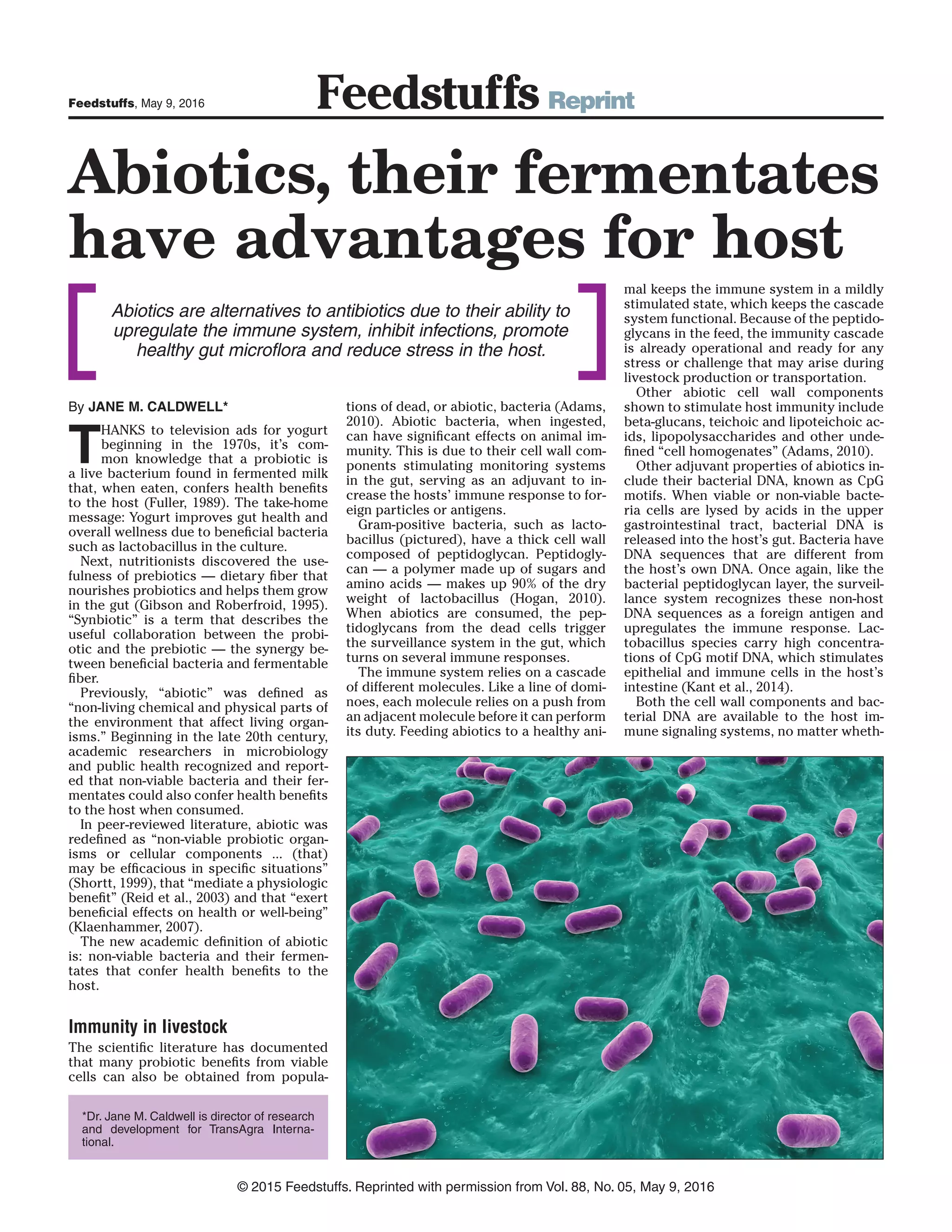
Gram-positive bacteria, such as lacto-
bacillus (pictured), have a thick cell wall
composed of peptidoglycan. Peptidogly-
can — a polymer made up of sugars and
amino acids — makes up 90% of the dry
weight of lactobacillus (Hogan, 2010).
When abiotics are consumed, the pep-
tidoglycans from the dead cells trigger
the surveillance system in the gut, which
turns on several immune responses.
The immune system relies on a cascade
of different molecules. Like a line of domi-
noes, each molecule relies on a push from
an adjacent molecule before it can perform
its duty. Feeding abiotics to a healthy ani-
mal keeps the immune system in a mildly
stimulated state, which keeps the cascade
system functional. Because of the peptido-
glycans in the feed, the immunity cascade
is already operational and ready for any
stress or challenge that may arise during
livestock production or transportation.
Other abiotic cell wall components
shown to stimulate host immunity include
beta-glucans, teichoic and lipoteichoic ac-
ids, lipopolysaccharides and other unde-
fined “cell homogenates” (Adams, 2010).
Other adjuvant properties of abiotics in-
clude their bacterial DNA, known as CpG
motifs. When viable or non-viable bacte-
ria cells are lysed by acids in the upper
gastrointestinal tract, bacterial DNA is
released into the host’s gut. Bacteria have
DNA sequences that are different from
the host’s own DNA. Once again, like the
bacterial peptidoglycan layer, the surveil-
lance system recognizes these non-host
DNA sequences as a foreign antigen and
upregulates the immune response. Lac-
tobacillus species carry high concentra-
tions of CpG motif DNA, which stimulates
epithelial and immune cells in the host’s
intestine (Kant et al., 2014).
Both the cell wall components and bac-
terial DNA are available to the host im-
mune signaling systems, no matter wheth-
Abiotics, their fermentates
have advantages for host
*Dr. Jane M. Caldwell is director of research
and development for TransAgra Interna-
tional.
Abiotics are alternatives to antibiotics due to their ability to
upregulate the immune system, inhibit infections, promote
healthy gut microflora and reduce stress in the host.
Reprint2 Feedstuffs, May 9, 2016
er the ingested bacteria are alive or dead,
probiotic or abiotic.
Abiotic metabolites
An abiotic differs from a probiotic bacte-
rium in that it is rendered non-viable af-
ter fermentation by heat, acidification or
some other stabilization process. During
fermentation, abiotic metabolites are pro-
duced and released when bacteria break
down the substrate they are fed. If the fer-
mentation uses milk or milk proteins as a
substrate, proteolysis by certain probiotic
bacteria can produce bioactive peptides.
Bioactive peptides are short sequences
of amino acids that perform non-nutritive
functions in the host. These nutraceutical
peptides include angiotensin I-converting
enzyme inhibitors, which dilate blood
vessels, exert a hypotensive effect, lower
blood pressure and reduce stress in the
host (Meisel, 2005; Clare and Swaisgood,
2000).
Bioactive milk peptides increase absorp-
tion of minerals — especially calcium — in
the gut (Meisel, 2005). They also have an-
tioxidant activities, function to stimulate
the host immune system, inhibit cancer
cell growth (Clare and Swaisgood, 2000)
and have antimicrobial properties derived
from the whey protein lactoferrin (Meisel,
2005). Other health-promoting abiotic
metabolites produced include B vitamins
(Vinderola, 2008).
Advantages over probiotics
Abiotics, while using some similar modes
of action in the host, have several advan-
tages over probiotics.
Ease of use and longevity. An abiotic
does not contain live bacteria, so it does
not require refrigeration or a cold chain
during shipment. It has a longer shelf life
at any temperature. Chemicals, medica-
tions in feed or physical processes that
kill live bacteria do not reduce the efficacy
of an abiotic. Therefore, abiotics can be
successfully incorporated into total mixed
rations that have been heat processed or
extruded.
Researchers have reported finding vi-
able probiotic bacteria (Bifidobacterium
spp.) in high quantities in the host’s gut
while the bacteria were constantly con-
sumed, but these were no longer detect-
able eight days after consumption ceased
(Bouhnik et al., 1992). They concluded
that outside sources of probiotics would
not permanently colonize the host colon.
Non-specific hosts. An abiotic enhanc-
es the growth of the naturally occurring,
beneficial bacteria already present in the
host gut. Many beneficial gut bacteria are
fastidious organisms that require an en-
vironment filled with nutritional building
blocks such as amino acids, sugars and
vitamins. They are totally dependent on
the host organism for nutrients. Due to
evolutionary genome shrinkage, they lost
the genes needed for nutrient synthesis.
Instead, they developed rapid, multiple
transport systems.
The fastidious beneficial bacteria are
able to outcompete pathogens introduced
from outside the gut by having superior
cellular transport systems that can quick-
ly move these nutrients from the outside
to the inside of the cell, where they are
consumed. An abiotic provides lunch for
the native beneficial bacteria in the form
of cellular components rich in amino ac-
ids, energy and metabolites such as B vi-
tamins.
Since an abiotic feeds the host’s native
beneficial microbes, it is not species spe-
cific and can benefit many different animal
hosts, including ruminants, monogastrics,
avian or hind-gut fermenters.
Probiotic bacteria are adapted to a par-
ticular host species; there is little cross-
attachment to other species. With a few
exceptions, lactobacillus isolates adhere
to the cells of the animal from which they
were obtained (Lin and Savage, 1984; Sav-
age, 1984). Even if a probiotic can attach
to the gut of a host, that does not guaran-
tee colonization or proliferation (Savage,
1984; Sellwood, 1984).
Probiotics are grown in fermentation
vessels made of steel or glass. They can
adapt to growth in this manmade environ-
ment and lose their ability to thrive in the
gut of the host. After many generations
of growth in artificial culture media, bac-
terial cell surfaces diverge from those of
strains grown in the host (Savage, 1984).
Similar modes of action. Both probi-
otics and abiotics have been found to
shorten the effects of or eliminate viral
infection and inhibit colonization of the
gut by disease-causing bacteria such as
pathogenic Escherichia coli strains. Abiot-
ics or cell-free extracts of lactobacillus fer-
mentations have reduced the duration of
rotavirus diarrhea (Salminen et al., 1999),
protected mice against influenza virus
infection (Hori et al., 2001), reduced vis-
ceral pain (Kamiya et al., 2006), enhanced
immune response to pneumococcal in-
fection in malnourished mice (Villena et
al., 2009), suppressed E. coli counts in
artificially reared piglets (Pollmann et al.,
1982), inhibited E. coli adhesion in the pig-
let gut (Blomberg et al., 1993) and reduced
scours while increasing the digestion of
crude fiber in growing/finishing pigs (Hale
and Newton, 1979).
In aquatic species, non-viable lacto-
bacilli were not found to be effective in
improving growth parameters but signifi-
cantly improved immunity and disease
resistance in freshwater prawns (Dash et
al., 2015).
Probiotics and abiotics both must be ca-
pable of being prepared on an industrial
scale. Both must be able to pass through
the high-acid environment of the upper
gastrointestinal tract of the host to reach
the colon. However, the probiotic’s modes
of action are dependent on viable organ-
isms attaching to the host gut. An abiotic
dose is more dependable since it cannot
be killed by acid or bile salts.
The cell wall components and CpG mo-
tif DNA are contained in the non-viable
husk of the abiotic and are less affected
by chemical or enzymatic assaults than
the viable bacteria are. These cell compo-
nents do not depend on viability to work.
Many bioactive peptides are produced by
hydrolysis or cleavage of abiotic metabo-
lites from milk fermentations in the acidic
host gut (Clare and Swaisgood, 2000).
One might argue that many probiot-
ics become abiotic due to low stability
or chemical death. It is the burden of the
probiotic manufacturer to prove abiotic
modes of action with the product.
Safety issues. Probiotics are living bac-
teria. Living organisms are dynamic —
constantly changing and evolving for the
sake of survival. To this end, probiotics
can exchange DNA with other bacteria,
including pathogenic bacteria or those
with antibiotic-resistance genes. This can
cause probiotic bacteria to acquire toxin
genes or antibiotic resistance. While these
are rare events, mutations by genetic
transfers are noted risk factors when feed-
ing probiotics (Salminen et al., 1999).
Animals that are immune-compromised
due to either young or advanced age, preg-
nancy or disease can be infected by any
viable microbe. When an infection occurs
with a normally non-pathogenic microbe,
this is termed an opportunistic infection.
Abiotics are non-viable and cannot
cause infection in weakened animals. Even
though approved probiotics are consid-
ered safe for use and the risk of infection
is small, abiotics raise fewer safety con-
cerns (Salminen et al., 1999).
Bio-containment. Lactobacilli have
been identified as one variety of bacteria
that may provide health benefits when
ingested. However, it is important to note
that not all lactobacillus species have pro-
biotic or abiotic capabilities. These claims
cannot be made without rigorous test-
ing to prove efficacy with positive health
results. Of course, research and testing
are expensive. Once probiotic or abiotic
strains are identified and validated, they
are closely guarded intellectual property.
Abiotics have another practical advan-
tage over probiotics in that they cannot
be cultured from the commercial product
and pirated by unscrupulous parties.
One final safety advantage: Abiotics, be-
cause they are non-viable, cannot be ac-
cidentally released into the environment,
including homes, water supplies, fields,
farms or sewage systems.
BINDING. Abiotic lactobacilli were found
to bind and remove aflatoxin B1 — a po-
tent feed toxin — from contaminated me-
dia (Bovo et al., 2014). Heat- or acid-killed
bacteria were found to be more effective
than live bacteria in binding aflatoxin (El-
Nezami et al., 1998).
Helicobacter pylori, a bacterium that
causes numerous gastrointestinal diseas-
es, was bound and deactivated by abiotics
Reprint Feedstuffs, May 9, 2016
3
(Mehling and Bushajn, 2013). This aggre-
gation was cited as a possible antibiotic-
free therapy in human medicine (Holz et
al., 2015).
Advantages over prebiotics
Prebiotics are fiber — starches like cellu-
lose and inulin that are indigestible to the
host but can feed the probiotic bacteria
in the gut (Gibson and Roberfroid, 1995).
Like abiotics, prebiotics are non-viable
sources of nutrients for beneficial gut bac-
teria.
This is the major mode of action for
prebiotics. They do not, by themselves,
stimulate immunity, inhibit pathogens,
bind toxins or reduce the effects of stress
as abiotics do.
Abiotics feed the native beneficial mi-
crobes but offer more than energy in the
form of inulin or cellulose. Abiotics also
offer structural building blocks such as
proteins and amino acids, enzymes need-
ed for metabolic functions, vitamins and
minerals — all in forms specific for bacte-
rial transport and use.
Summary
Probiotics and abiotics are alternatives to
antibiotics due to their ability to upregu-
late the immune system, inhibit bacterial
and viral infections, promote healthy gut
microflora and reduce stress in the host.
Treated animals show significant im-
provement over controls when they are
not reaching their full genetic potential
due to environmental stressors such as
suboptimal feeding or management, birth,
weaning, transportation, lactation, heat,
dehydration, changes in rations or any
conditions that could disturb or inhibit
ideal gut microflora.
However, abiotics offer many advantag-
es over viable direct-fed microbials and
fiber supplementation, including:
• No refrigeration or cold chain ship-
ment is required.
• They have greater stability and longer
shelf life.
• They can withstand further processing
such as heat and extrusion.
• They are not host specific.
• They can bind toxins and pathogens.
• They cannot mutate and acquire anti-
biotic resistance.
• They cannot become opportunistic
pathogens.
• They cannot be cultured by others
from the product line.
• They cannot escape into the environ-
ment.
• The dosage delivery is safe and de-
pendable.
References
Adams, C.A. 2010.The probiotic paradox: Live
and dead cells are biological response modi-
fiers. Nutrition Research Reviews. 23:37-46.
Blomberg, L., A. Henriksson and P.L. Con-
way. 1993. Inhibition of adhesion of Escheri-
chia coli K88 to piglet ileal mucus by Lactoba-
cillus spp. Appl. Environ. Microbiol. 59:34-39.
Bouhnik, Y., P. Pochart, P. Marteau, G. Arlet,
I. Goderel and J.C. Rambaud. 1992. Fecal
recovery in humans of viable Bifidobacterium
sp. ingested in fermented milk. Gastroent.
102:875-878.
Bovo, F., L.T. Franco, R.E. Rosim, C.S.F.
Trindade and C.A.F. de Oliveira. 2014. The
ability of Lactobacillus rhamnosus in solution,
spray-dried or lyophilized to bind aflatoxin B1.
J. Food Res. 3:35-42.
Clare, D.A., and H.E. Swaisgood. 2000.
Bioactive milk peptides: A prospectus. J. Dairy
Sci. 83:1187-1195.
Dash, G., R.P. Raman, K.P. Prasad, M.
Makesh, M.A. Pradeep and S. Sen. 2015.
Evaluation of paraprobiotic applicability of
Lactobacillus plantarum in improving the
immune response and disease protection
in giant freshwater prawn, Macrobrachium
rosenbergii (de Man, 1879). Fish & Shellfish
Immunol. 43:167-174.
El-Nezami, H., P. Kankaanpaa, S. Salminen
and J. Ahokas. 1998. Physicochemical altera-
tions enhance the ability of dairy strains of
lactic acid bacteria to remove aflatoxin from
contaminated media. J. Food Prot. 61:466-
468.
Fuller, R. 1989. Probiotics in man and ani-
mals. J. Appl. Bacteriol. 66:365-378.
Gibson, G.R., and M.B. Roberfroid. 1995.
Dietary modulation of the human colonic
microbiota: Introducing the concept of prebiot-
ics. J. Nutr. 125:1401-1412.
Hale, O.M., and G.L. Newton. 1979. Effects
of a nonviable Lactobacillus species fermen-
tation product on performance of pigs. J. Ani-
mal Sci. 48:770-775.
Hamilton-Miller, J.M.T., S. Shah and J.T.
Winkler. 1999. Public health issues arising
from microbiological and labelling quality of
foods and supplements containing probiot-
ic microorganisms. Public Health Nutrition
2:223-229.
Hogan, C.M. 2010. Bacteria. In: S. Drag-
gan and C.J. Cleveland (eds.). Encyclopedia
of Earth. National Council for Science & the
Environment, Washington D.C.
Holz, C., A. Busjahn, H. Mehling, S. Arya,
M. Boettner, H. Habibi and C. Lang. 2015.
Significant reduction in Helicobacter pylori
load in humans with non-viable Lactobacillus
reuteri DSM17648: A pilot study. Probiotics &
Antimicro. Prot. 7:91-100.
Hori, T., J. Kiyoshima, K. Shida and H.Yasui.
2001. Effect of intranasal administration of
Lactobacillus casei Shirota on influenza virus
infection of upper respiratory tract in mice.
Clin. Diag. Lab. Immunol. 8:593-597.
Kamiya, T., L. Wang, P. Forsythe, G. Goe-
ttsche, Y. Mao, Y. Wang, G. Tougas and J.
Bienenstock. 2006. Inhibitory effects of Lact-
bacillus reuteri on visceral pain induced by
colorectal distension in Sprague-Dawley rats.
Gut 55:191-196.
Kant, R., W.M. deVos, A. Palva and R.
Satokari. 2014. Immunostimulatory CpG
motifs in the genomes of gut bacteria and
their role in human health and disease. J. Med.
Microbiol. 63:293-308.
Klaenhammer, T.R. 2007. Probiotics and
prebiotics. In: M.P. Doyle and L.R. Beuchat
(eds.). Food Microbiology: Fundamentals &
Frontiers, 3rd Ed. ASM Press, Washington,
D.C., p. 891-907.
Lin, J.H., and D.C. Savage. 1984. Host
specificity of the colonization of murine gastric
epithelium by Lactobacilli. FEMS Microbiol.
Lett. 24:67-71.
Mehling, H., and A. Busjahn. 2013. Non-
viable Lactobacillus reuteri DSMZ 17648
(PylopassM) as a new approach to Helico-
bacter pylori control in humans. Nutrients
5:3062-3073.
Meisel, H. 2005. Biochemical properties of
peptides encrypted in bovine milk proteins.
Curr. Med. Chem. 12:1905-1919.
Pollman, D.S., G.A. Kennedy, B.A. Koch
and G.L. Allee. 1982. Influence of nonviable
Lactobacillus fermentation product in arti-
ficially reared pigs challenged with E. coli.
Conference Paper, Swine Day, Manhattan,
Kan., Nov. 11, 1982. Kansas State University.
p. 86-91.
Reid, G., M.E. Sanders, H.R. Gaskins, G.R.
Gibson, A. Mercenier, R. Rastall, M. Rober-
froid, I. Rowland, C. Cherbut and T.R. Klaen-
hammer. 2003. New scientific paradigms for
probiotics and prebiotics. J. Clin. Gastroen-
terol. 37:105-118.
Salminen, S., A. Ouwehand, Y. Benno and
Y.K. Lee. 1999. Probiotics: How should they
be defined? Trends in Food Sci. Technol.
10:107-110.
Savage, D.C. 1984. Adherence of the nor-
mal flora. In: E.C. Boedeker (ed.). Attachment
of organisms to the gut mucosa, Vol. I. CRC
Press Inc. Boca Raton, Fla.
Sellwood, R. 1984. The K88 adherence sys-
tem in swine. In: E.C. Boedeker (ed.). Attach-
ment of organisms to the gut mucosa, Vol. I.
CRC Press Inc. Boca Raton, Fla.
Shortt, C. 1999. The probiotic century: His-
torical and current perspective.Trends in Food
Sci. Technol. 10:411-417.
Villena, J., N. Barbieri, S. Salva, M. Her-
rera and S. Alvarez. 2009. Enhanced immune
response to pneumococcal infection in mal-
nourished mice nasally treated with heat-
killed Lactobacillus casei. Microbiol Immunol.
53:636-646.
Vinderola, G. 2008. Dried cell-free fraction
of fermented milks: New functional additives
for the food industry.Trends Food Sci.Technol.
19:40-46. ■

FeedstuffsReprint_May 9 2016_pg30-32.indd

  • 1.
    Feedstuffs ReprintFeedstuffs, May9, 2016 © 2015 Feedstuffs. Reprinted with permission from Vol. 88, No. 05, May 9, 2016 By JANE M. CALDWELL* T HANKS to television ads for yogurt beginning in the 1970s, it’s com- mon knowledge that a probiotic is a live bacterium found in fermented milk that, when eaten, confers health benefits to the host (Fuller, 1989). The take-home message: Yogurt improves gut health and overall wellness due to beneficial bacteria such as lactobacillus in the culture. Next, nutritionists discovered the use- fulness of prebiotics — dietary fiber that nourishes probiotics and helps them grow in the gut (Gibson and Roberfroid, 1995). “Synbiotic” is a term that describes the useful collaboration between the probi- otic and the prebiotic — the synergy be- tween beneficial bacteria and fermentable fiber. Previously, “abiotic” was defined as “non-living chemical and physical parts of the environment that affect living organ- isms.” Beginning in the late 20th century, academic researchers in microbiology and public health recognized and report- ed that non-viable bacteria and their fer- mentates could also confer health benefits to the host when consumed. In peer-reviewed literature, abiotic was redefined as “non-viable probiotic organ- isms or cellular components ... (that) may be efficacious in specific situations” (Shortt, 1999), that “mediate a physiologic benefit” (Reid et al., 2003) and that “exert beneficial effects on health or well-being” (Klaenhammer, 2007). The new academic definition of abiotic is: non-viable bacteria and their fermen- tates that confer health benefits to the host. Immunity in livestock The scientific literature has documented that many probiotic benefits from viable cells can also be obtained from popula- tions of dead, or abiotic, bacteria (Adams, 2010). Abiotic bacteria, when ingested, can have significant effects on animal im- munity. This is due to their cell wall com- ponents stimulating monitoring systems in the gut, serving as an adjuvant to in- crease the hosts’ immune response to for- eign particles or antigens. Gram-positive bacteria, such as lacto- bacillus (pictured), have a thick cell wall composed of peptidoglycan. Peptidogly- can — a polymer made up of sugars and amino acids — makes up 90% of the dry weight of lactobacillus (Hogan, 2010). When abiotics are consumed, the pep- tidoglycans from the dead cells trigger the surveillance system in the gut, which turns on several immune responses. The immune system relies on a cascade of different molecules. Like a line of domi- noes, each molecule relies on a push from an adjacent molecule before it can perform its duty. Feeding abiotics to a healthy ani- mal keeps the immune system in a mildly stimulated state, which keeps the cascade system functional. Because of the peptido- glycans in the feed, the immunity cascade is already operational and ready for any stress or challenge that may arise during livestock production or transportation. Other abiotic cell wall components shown to stimulate host immunity include beta-glucans, teichoic and lipoteichoic ac- ids, lipopolysaccharides and other unde- fined “cell homogenates” (Adams, 2010). Other adjuvant properties of abiotics in- clude their bacterial DNA, known as CpG motifs. When viable or non-viable bacte- ria cells are lysed by acids in the upper gastrointestinal tract, bacterial DNA is released into the host’s gut. Bacteria have DNA sequences that are different from the host’s own DNA. Once again, like the bacterial peptidoglycan layer, the surveil- lance system recognizes these non-host DNA sequences as a foreign antigen and upregulates the immune response. Lac- tobacillus species carry high concentra- tions of CpG motif DNA, which stimulates epithelial and immune cells in the host’s intestine (Kant et al., 2014). Both the cell wall components and bac- terial DNA are available to the host im- mune signaling systems, no matter wheth- Abiotics, their fermentates have advantages for host *Dr. Jane M. Caldwell is director of research and development for TransAgra Interna- tional. Abiotics are alternatives to antibiotics due to their ability to upregulate the immune system, inhibit infections, promote healthy gut microflora and reduce stress in the host.
  • 2.
    Reprint2 Feedstuffs, May9, 2016 er the ingested bacteria are alive or dead, probiotic or abiotic. Abiotic metabolites An abiotic differs from a probiotic bacte- rium in that it is rendered non-viable af- ter fermentation by heat, acidification or some other stabilization process. During fermentation, abiotic metabolites are pro- duced and released when bacteria break down the substrate they are fed. If the fer- mentation uses milk or milk proteins as a substrate, proteolysis by certain probiotic bacteria can produce bioactive peptides. Bioactive peptides are short sequences of amino acids that perform non-nutritive functions in the host. These nutraceutical peptides include angiotensin I-converting enzyme inhibitors, which dilate blood vessels, exert a hypotensive effect, lower blood pressure and reduce stress in the host (Meisel, 2005; Clare and Swaisgood, 2000). Bioactive milk peptides increase absorp- tion of minerals — especially calcium — in the gut (Meisel, 2005). They also have an- tioxidant activities, function to stimulate the host immune system, inhibit cancer cell growth (Clare and Swaisgood, 2000) and have antimicrobial properties derived from the whey protein lactoferrin (Meisel, 2005). Other health-promoting abiotic metabolites produced include B vitamins (Vinderola, 2008). Advantages over probiotics Abiotics, while using some similar modes of action in the host, have several advan- tages over probiotics. Ease of use and longevity. An abiotic does not contain live bacteria, so it does not require refrigeration or a cold chain during shipment. It has a longer shelf life at any temperature. Chemicals, medica- tions in feed or physical processes that kill live bacteria do not reduce the efficacy of an abiotic. Therefore, abiotics can be successfully incorporated into total mixed rations that have been heat processed or extruded. Researchers have reported finding vi- able probiotic bacteria (Bifidobacterium spp.) in high quantities in the host’s gut while the bacteria were constantly con- sumed, but these were no longer detect- able eight days after consumption ceased (Bouhnik et al., 1992). They concluded that outside sources of probiotics would not permanently colonize the host colon. Non-specific hosts. An abiotic enhanc- es the growth of the naturally occurring, beneficial bacteria already present in the host gut. Many beneficial gut bacteria are fastidious organisms that require an en- vironment filled with nutritional building blocks such as amino acids, sugars and vitamins. They are totally dependent on the host organism for nutrients. Due to evolutionary genome shrinkage, they lost the genes needed for nutrient synthesis. Instead, they developed rapid, multiple transport systems. The fastidious beneficial bacteria are able to outcompete pathogens introduced from outside the gut by having superior cellular transport systems that can quick- ly move these nutrients from the outside to the inside of the cell, where they are consumed. An abiotic provides lunch for the native beneficial bacteria in the form of cellular components rich in amino ac- ids, energy and metabolites such as B vi- tamins. Since an abiotic feeds the host’s native beneficial microbes, it is not species spe- cific and can benefit many different animal hosts, including ruminants, monogastrics, avian or hind-gut fermenters. Probiotic bacteria are adapted to a par- ticular host species; there is little cross- attachment to other species. With a few exceptions, lactobacillus isolates adhere to the cells of the animal from which they were obtained (Lin and Savage, 1984; Sav- age, 1984). Even if a probiotic can attach to the gut of a host, that does not guaran- tee colonization or proliferation (Savage, 1984; Sellwood, 1984). Probiotics are grown in fermentation vessels made of steel or glass. They can adapt to growth in this manmade environ- ment and lose their ability to thrive in the gut of the host. After many generations of growth in artificial culture media, bac- terial cell surfaces diverge from those of strains grown in the host (Savage, 1984). Similar modes of action. Both probi- otics and abiotics have been found to shorten the effects of or eliminate viral infection and inhibit colonization of the gut by disease-causing bacteria such as pathogenic Escherichia coli strains. Abiot- ics or cell-free extracts of lactobacillus fer- mentations have reduced the duration of rotavirus diarrhea (Salminen et al., 1999), protected mice against influenza virus infection (Hori et al., 2001), reduced vis- ceral pain (Kamiya et al., 2006), enhanced immune response to pneumococcal in- fection in malnourished mice (Villena et al., 2009), suppressed E. coli counts in artificially reared piglets (Pollmann et al., 1982), inhibited E. coli adhesion in the pig- let gut (Blomberg et al., 1993) and reduced scours while increasing the digestion of crude fiber in growing/finishing pigs (Hale and Newton, 1979). In aquatic species, non-viable lacto- bacilli were not found to be effective in improving growth parameters but signifi- cantly improved immunity and disease resistance in freshwater prawns (Dash et al., 2015). Probiotics and abiotics both must be ca- pable of being prepared on an industrial scale. Both must be able to pass through the high-acid environment of the upper gastrointestinal tract of the host to reach the colon. However, the probiotic’s modes of action are dependent on viable organ- isms attaching to the host gut. An abiotic dose is more dependable since it cannot be killed by acid or bile salts. The cell wall components and CpG mo- tif DNA are contained in the non-viable husk of the abiotic and are less affected by chemical or enzymatic assaults than the viable bacteria are. These cell compo- nents do not depend on viability to work. Many bioactive peptides are produced by hydrolysis or cleavage of abiotic metabo- lites from milk fermentations in the acidic host gut (Clare and Swaisgood, 2000). One might argue that many probiot- ics become abiotic due to low stability or chemical death. It is the burden of the probiotic manufacturer to prove abiotic modes of action with the product. Safety issues. Probiotics are living bac- teria. Living organisms are dynamic — constantly changing and evolving for the sake of survival. To this end, probiotics can exchange DNA with other bacteria, including pathogenic bacteria or those with antibiotic-resistance genes. This can cause probiotic bacteria to acquire toxin genes or antibiotic resistance. While these are rare events, mutations by genetic transfers are noted risk factors when feed- ing probiotics (Salminen et al., 1999). Animals that are immune-compromised due to either young or advanced age, preg- nancy or disease can be infected by any viable microbe. When an infection occurs with a normally non-pathogenic microbe, this is termed an opportunistic infection. Abiotics are non-viable and cannot cause infection in weakened animals. Even though approved probiotics are consid- ered safe for use and the risk of infection is small, abiotics raise fewer safety con- cerns (Salminen et al., 1999). Bio-containment. Lactobacilli have been identified as one variety of bacteria that may provide health benefits when ingested. However, it is important to note that not all lactobacillus species have pro- biotic or abiotic capabilities. These claims cannot be made without rigorous test- ing to prove efficacy with positive health results. Of course, research and testing are expensive. Once probiotic or abiotic strains are identified and validated, they are closely guarded intellectual property. Abiotics have another practical advan- tage over probiotics in that they cannot be cultured from the commercial product and pirated by unscrupulous parties. One final safety advantage: Abiotics, be- cause they are non-viable, cannot be ac- cidentally released into the environment, including homes, water supplies, fields, farms or sewage systems. BINDING. Abiotic lactobacilli were found to bind and remove aflatoxin B1 — a po- tent feed toxin — from contaminated me- dia (Bovo et al., 2014). Heat- or acid-killed bacteria were found to be more effective than live bacteria in binding aflatoxin (El- Nezami et al., 1998). Helicobacter pylori, a bacterium that causes numerous gastrointestinal diseas- es, was bound and deactivated by abiotics
  • 3.
    Reprint Feedstuffs, May9, 2016 3 (Mehling and Bushajn, 2013). This aggre- gation was cited as a possible antibiotic- free therapy in human medicine (Holz et al., 2015). Advantages over prebiotics Prebiotics are fiber — starches like cellu- lose and inulin that are indigestible to the host but can feed the probiotic bacteria in the gut (Gibson and Roberfroid, 1995). Like abiotics, prebiotics are non-viable sources of nutrients for beneficial gut bac- teria. This is the major mode of action for prebiotics. They do not, by themselves, stimulate immunity, inhibit pathogens, bind toxins or reduce the effects of stress as abiotics do. Abiotics feed the native beneficial mi- crobes but offer more than energy in the form of inulin or cellulose. Abiotics also offer structural building blocks such as proteins and amino acids, enzymes need- ed for metabolic functions, vitamins and minerals — all in forms specific for bacte- rial transport and use. Summary Probiotics and abiotics are alternatives to antibiotics due to their ability to upregu- late the immune system, inhibit bacterial and viral infections, promote healthy gut microflora and reduce stress in the host. Treated animals show significant im- provement over controls when they are not reaching their full genetic potential due to environmental stressors such as suboptimal feeding or management, birth, weaning, transportation, lactation, heat, dehydration, changes in rations or any conditions that could disturb or inhibit ideal gut microflora. However, abiotics offer many advantag- es over viable direct-fed microbials and fiber supplementation, including: • No refrigeration or cold chain ship- ment is required. • They have greater stability and longer shelf life. • They can withstand further processing such as heat and extrusion. • They are not host specific. • They can bind toxins and pathogens. • They cannot mutate and acquire anti- biotic resistance. • They cannot become opportunistic pathogens. • They cannot be cultured by others from the product line. • They cannot escape into the environ- ment. • The dosage delivery is safe and de- pendable. References Adams, C.A. 2010.The probiotic paradox: Live and dead cells are biological response modi- fiers. Nutrition Research Reviews. 23:37-46. Blomberg, L., A. Henriksson and P.L. Con- way. 1993. Inhibition of adhesion of Escheri- chia coli K88 to piglet ileal mucus by Lactoba- cillus spp. Appl. Environ. Microbiol. 59:34-39. Bouhnik, Y., P. Pochart, P. Marteau, G. Arlet, I. Goderel and J.C. Rambaud. 1992. Fecal recovery in humans of viable Bifidobacterium sp. ingested in fermented milk. Gastroent. 102:875-878. Bovo, F., L.T. Franco, R.E. Rosim, C.S.F. Trindade and C.A.F. de Oliveira. 2014. The ability of Lactobacillus rhamnosus in solution, spray-dried or lyophilized to bind aflatoxin B1. J. Food Res. 3:35-42. Clare, D.A., and H.E. Swaisgood. 2000. Bioactive milk peptides: A prospectus. J. Dairy Sci. 83:1187-1195. Dash, G., R.P. Raman, K.P. Prasad, M. Makesh, M.A. Pradeep and S. Sen. 2015. Evaluation of paraprobiotic applicability of Lactobacillus plantarum in improving the immune response and disease protection in giant freshwater prawn, Macrobrachium rosenbergii (de Man, 1879). Fish & Shellfish Immunol. 43:167-174. El-Nezami, H., P. Kankaanpaa, S. Salminen and J. Ahokas. 1998. Physicochemical altera- tions enhance the ability of dairy strains of lactic acid bacteria to remove aflatoxin from contaminated media. J. Food Prot. 61:466- 468. Fuller, R. 1989. Probiotics in man and ani- mals. J. Appl. Bacteriol. 66:365-378. Gibson, G.R., and M.B. Roberfroid. 1995. Dietary modulation of the human colonic microbiota: Introducing the concept of prebiot- ics. J. Nutr. 125:1401-1412. Hale, O.M., and G.L. Newton. 1979. Effects of a nonviable Lactobacillus species fermen- tation product on performance of pigs. J. Ani- mal Sci. 48:770-775. Hamilton-Miller, J.M.T., S. Shah and J.T. Winkler. 1999. Public health issues arising from microbiological and labelling quality of foods and supplements containing probiot- ic microorganisms. Public Health Nutrition 2:223-229. Hogan, C.M. 2010. Bacteria. In: S. Drag- gan and C.J. Cleveland (eds.). Encyclopedia of Earth. National Council for Science & the Environment, Washington D.C. Holz, C., A. Busjahn, H. Mehling, S. Arya, M. Boettner, H. Habibi and C. Lang. 2015. Significant reduction in Helicobacter pylori load in humans with non-viable Lactobacillus reuteri DSM17648: A pilot study. Probiotics & Antimicro. Prot. 7:91-100. Hori, T., J. Kiyoshima, K. Shida and H.Yasui. 2001. Effect of intranasal administration of Lactobacillus casei Shirota on influenza virus infection of upper respiratory tract in mice. Clin. Diag. Lab. Immunol. 8:593-597. Kamiya, T., L. Wang, P. Forsythe, G. Goe- ttsche, Y. Mao, Y. Wang, G. Tougas and J. Bienenstock. 2006. Inhibitory effects of Lact- bacillus reuteri on visceral pain induced by colorectal distension in Sprague-Dawley rats. Gut 55:191-196. Kant, R., W.M. deVos, A. Palva and R. Satokari. 2014. Immunostimulatory CpG motifs in the genomes of gut bacteria and their role in human health and disease. J. Med. Microbiol. 63:293-308. Klaenhammer, T.R. 2007. Probiotics and prebiotics. In: M.P. Doyle and L.R. Beuchat (eds.). Food Microbiology: Fundamentals & Frontiers, 3rd Ed. ASM Press, Washington, D.C., p. 891-907. Lin, J.H., and D.C. Savage. 1984. Host specificity of the colonization of murine gastric epithelium by Lactobacilli. FEMS Microbiol. Lett. 24:67-71. Mehling, H., and A. Busjahn. 2013. Non- viable Lactobacillus reuteri DSMZ 17648 (PylopassM) as a new approach to Helico- bacter pylori control in humans. Nutrients 5:3062-3073. Meisel, H. 2005. Biochemical properties of peptides encrypted in bovine milk proteins. Curr. Med. Chem. 12:1905-1919. Pollman, D.S., G.A. Kennedy, B.A. Koch and G.L. Allee. 1982. Influence of nonviable Lactobacillus fermentation product in arti- ficially reared pigs challenged with E. coli. Conference Paper, Swine Day, Manhattan, Kan., Nov. 11, 1982. Kansas State University. p. 86-91. Reid, G., M.E. Sanders, H.R. Gaskins, G.R. Gibson, A. Mercenier, R. Rastall, M. Rober- froid, I. Rowland, C. Cherbut and T.R. Klaen- hammer. 2003. New scientific paradigms for probiotics and prebiotics. J. Clin. Gastroen- terol. 37:105-118. Salminen, S., A. Ouwehand, Y. Benno and Y.K. Lee. 1999. Probiotics: How should they be defined? Trends in Food Sci. Technol. 10:107-110. Savage, D.C. 1984. Adherence of the nor- mal flora. In: E.C. Boedeker (ed.). Attachment of organisms to the gut mucosa, Vol. I. CRC Press Inc. Boca Raton, Fla. Sellwood, R. 1984. The K88 adherence sys- tem in swine. In: E.C. Boedeker (ed.). Attach- ment of organisms to the gut mucosa, Vol. I. CRC Press Inc. Boca Raton, Fla. Shortt, C. 1999. The probiotic century: His- torical and current perspective.Trends in Food Sci. Technol. 10:411-417. Villena, J., N. Barbieri, S. Salva, M. Her- rera and S. Alvarez. 2009. Enhanced immune response to pneumococcal infection in mal- nourished mice nasally treated with heat- killed Lactobacillus casei. Microbiol Immunol. 53:636-646. Vinderola, G. 2008. Dried cell-free fraction of fermented milks: New functional additives for the food industry.Trends Food Sci.Technol. 19:40-46. ■