Department of Fisheries science
B.F.Sc. 2nd year 4th Semester
Course: Fish Nutrition and
Feed Technology
Topic: Feeding Devices and
Methods
Presented by (UID): 05,06,07
Submitted to: Dr. Ujjwala Upreti
Agenda
 Introduction
 Methods of Feeding
 Hand feeding or manual feeding
 Mechanized feeding
 Electrically operated automated feeders
 Pneumatic type automatic feeder
 Hydraulic Type Automatic Feeders
 Feeding carts
 Feeding Boats
2
25/04/2023 Feeding Devices and Methods
Introduction
In fish and shellfish farming, feed accounts for more than 60% of the operational cost and thus
different feeding methods can be adopted to avoid wastage of feed.
The widespread availability of durable dry feeds and rapid advances in control technology has led
to the introduction of numerous types of automated systems for delivering fish feeds.
Options for fish farmers range from traditional hand feeding methods to the use of automatic,
computer- controlled systems.
This decision is based on labour cost, scale of farm operation, species being farmed, types of
holding system, hatchery or grow out operation etc.
25/04/2023 Feeding Devices and Methods 3
Methods of feeding
There are two broad methods of feeding practices viz.
 Hand feeding or manual feeding
 Mechanized feeding
1. Stationary feeding equipment
2. Mobile feeding equipment
25/04/2023 Feeding Devices and Methods 4
Hand feeding or manual feeding
25/04/2023 Feeding Devices and Methods 5
 Hand feeding refers to distribution of feed by hand which allows dose observation of the appetite
and feeding behaviour of cultured fish species, which feed actively at the surface and grown in
clear water system.
 Effective hand feeding necessitates some initial training and experience if food wastage is to be
avoided.
 Dry pellets, granules and crumbles for fish could be broadcasted.
 For small ponds (less than 0.50 ha), broadcasting is quite adequate.
 For larger ponds, broadcasting should be supplemented by distribution in slightly interior areas
using a small boat.
Advantage or Disadvantage
6
Advantage-
 Behaviour of fish is regularly observed
Disadvantage-
 Labour intensive
 More time consuming
 Limited in application on large farms
25/04/2023 Feeding Devices and Methods
Mechanized Feeding
At present, there are different types of feeding equipment being used. Fish feeders can be divided
into two major groups, as follows:
1. Stationary feeding equipment
i)Without supplied energy - Example: demand feeders
ii)with supplied energy -Example: automatic feeders (electric, pneumatic, hydraulic)
2. Mobile feeding equipment i)feeding carts ii)feeding boats
25/04/2023 Feeding Devices and Methods 7
Electrically operated automated
feeders
8
Model-1
Movement of the slug 'A' is controlled by an electro-magnet. The space 'B' governs the
amount of feed released at each movement of 'A’.
25/04/2023 Feeding Devices and Methods
Electrically operated automated
feeders
9
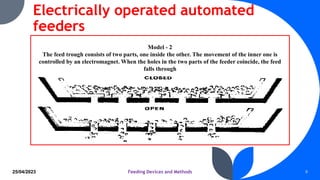
Model - 2
The feed trough consists of two parts, one inside the other. The movement of the inner one is
controlled by an electromagnet. When the holes in the two parts of the feeder coincide, the feed
falls through
25/04/2023 Feeding Devices and Methods
Electrically operated automated
feeders
10
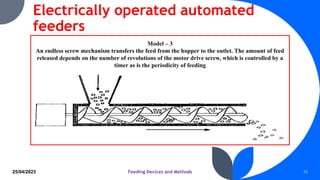
Model – 3
An endless screw mechanism transfers the feed from the hopper to the outlet. The amount of feed
released depends on the number of revolutions of the motor drive screw, which is controlled by a
timer as is the periodicity of feeding
25/04/2023 Feeding Devices and Methods
Electrically operated automated
feeders
11
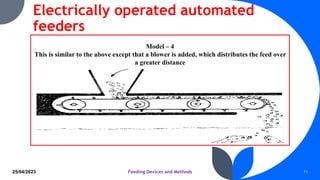
Model – 4
This is similar to the above except that a blower is added, which distributes the feed over
a greater distance
25/04/2023 Feeding Devices and Methods
Electrically operated automated
feeders
12
Model – 5
In type 7, a series of spikes on a revolving spindle overturn a row of feed containers in
turn. The frequency depends on the speed of revolution of the spindle.
25/04/2023 Feeding Devices and Methods
Pneumatic-type automatic feeders
13
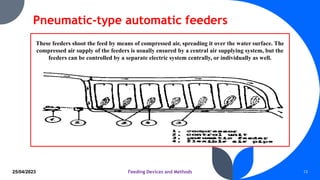
These feeders shoot the feed by means of compressed air, spreading it over the water surface. The
compressed air supply of the feeders is usually ensured by a central air supplying system, but the
feeders can be controlled by a separate electric system centrally, or individually as well.
25/04/2023 Feeding Devices and Methods
Hydraulic Type Automatic Feeders
14
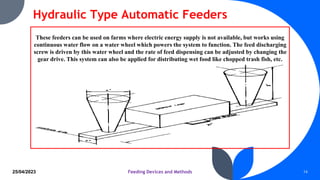
These feeders can be used on farms where electric energy supply is not available, but works using
continuous water flow on a water wheel which powers the system to function. The feed discharging
screw is driven by this water wheel and the rate of feed dispensing can be adjusted by changing the
gear drive. This system can also be applied for distributing wet food like chopped trash fish, etc.
25/04/2023 Feeding Devices and Methods
Feeding carts
15
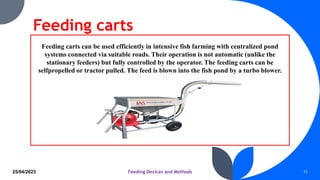
Feeding carts can be used efficiently in intensive fish farming with centralized pond
systems connected via suitable roads. Their operation is not automatic (unlike the
stationary feeders) but fully controlled by the operator. The feeding carts can be
selfpropelled or tractor pulled. The feed is blown into the fish pond by a turbo blower.
25/04/2023 Feeding Devices and Methods
Feeding Boats
16
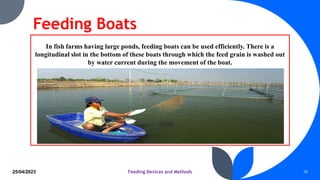
In fish farms having large ponds, feeding boats can be used efficiently. There is a
longitudinal slot in the bottom of these boats through which the feed grain is washed out
by water current during the movement of the boat.
25/04/2023 Feeding Devices and Methods
Feeding devices for wet or moist
feeds
17
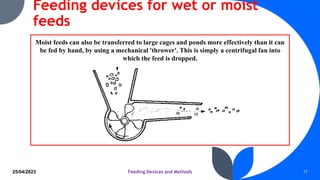
Moist feeds can also be transferred to large cages and ponds more effectively than it can
be fed by hand, by using a mechanical 'thrower'. This is simply a centrifugal fan into
which the feed is dropped.
25/04/2023 Feeding Devices and Methods
Thank you
Subhadip Bar
subhadip.bar@tnu.in
Somnath Adhikary
Somnath.adhikary@tnu.in
Sudip Jana
Sudip.jana@tnu.in

Fish Feeding device and methods , Feed technology.pptx

  • 1.
    Department of Fisheriesscience B.F.Sc. 2nd year 4th Semester Course: Fish Nutrition and Feed Technology Topic: Feeding Devices and Methods Presented by (UID): 05,06,07 Submitted to: Dr. Ujjwala Upreti
  • 2.
    Agenda  Introduction  Methodsof Feeding  Hand feeding or manual feeding  Mechanized feeding  Electrically operated automated feeders  Pneumatic type automatic feeder  Hydraulic Type Automatic Feeders  Feeding carts  Feeding Boats 2 25/04/2023 Feeding Devices and Methods
  • 3.
    Introduction In fish andshellfish farming, feed accounts for more than 60% of the operational cost and thus different feeding methods can be adopted to avoid wastage of feed. The widespread availability of durable dry feeds and rapid advances in control technology has led to the introduction of numerous types of automated systems for delivering fish feeds. Options for fish farmers range from traditional hand feeding methods to the use of automatic, computer- controlled systems. This decision is based on labour cost, scale of farm operation, species being farmed, types of holding system, hatchery or grow out operation etc. 25/04/2023 Feeding Devices and Methods 3
  • 4.
    Methods of feeding Thereare two broad methods of feeding practices viz.  Hand feeding or manual feeding  Mechanized feeding 1. Stationary feeding equipment 2. Mobile feeding equipment 25/04/2023 Feeding Devices and Methods 4
  • 5.
    Hand feeding ormanual feeding 25/04/2023 Feeding Devices and Methods 5  Hand feeding refers to distribution of feed by hand which allows dose observation of the appetite and feeding behaviour of cultured fish species, which feed actively at the surface and grown in clear water system.  Effective hand feeding necessitates some initial training and experience if food wastage is to be avoided.  Dry pellets, granules and crumbles for fish could be broadcasted.  For small ponds (less than 0.50 ha), broadcasting is quite adequate.  For larger ponds, broadcasting should be supplemented by distribution in slightly interior areas using a small boat.
  • 6.
    Advantage or Disadvantage 6 Advantage- Behaviour of fish is regularly observed Disadvantage-  Labour intensive  More time consuming  Limited in application on large farms 25/04/2023 Feeding Devices and Methods
  • 7.
    Mechanized Feeding At present,there are different types of feeding equipment being used. Fish feeders can be divided into two major groups, as follows: 1. Stationary feeding equipment i)Without supplied energy - Example: demand feeders ii)with supplied energy -Example: automatic feeders (electric, pneumatic, hydraulic) 2. Mobile feeding equipment i)feeding carts ii)feeding boats 25/04/2023 Feeding Devices and Methods 7
  • 8.
    Electrically operated automated feeders 8 Model-1 Movementof the slug 'A' is controlled by an electro-magnet. The space 'B' governs the amount of feed released at each movement of 'A’. 25/04/2023 Feeding Devices and Methods
  • 9.
    Electrically operated automated feeders 9 Model- 2 The feed trough consists of two parts, one inside the other. The movement of the inner one is controlled by an electromagnet. When the holes in the two parts of the feeder coincide, the feed falls through 25/04/2023 Feeding Devices and Methods
  • 10.
    Electrically operated automated feeders 10 Model– 3 An endless screw mechanism transfers the feed from the hopper to the outlet. The amount of feed released depends on the number of revolutions of the motor drive screw, which is controlled by a timer as is the periodicity of feeding 25/04/2023 Feeding Devices and Methods
  • 11.
    Electrically operated automated feeders 11 Model– 4 This is similar to the above except that a blower is added, which distributes the feed over a greater distance 25/04/2023 Feeding Devices and Methods
  • 12.
    Electrically operated automated feeders 12 Model– 5 In type 7, a series of spikes on a revolving spindle overturn a row of feed containers in turn. The frequency depends on the speed of revolution of the spindle. 25/04/2023 Feeding Devices and Methods
  • 13.
    Pneumatic-type automatic feeders 13 Thesefeeders shoot the feed by means of compressed air, spreading it over the water surface. The compressed air supply of the feeders is usually ensured by a central air supplying system, but the feeders can be controlled by a separate electric system centrally, or individually as well. 25/04/2023 Feeding Devices and Methods
  • 14.
    Hydraulic Type AutomaticFeeders 14 These feeders can be used on farms where electric energy supply is not available, but works using continuous water flow on a water wheel which powers the system to function. The feed discharging screw is driven by this water wheel and the rate of feed dispensing can be adjusted by changing the gear drive. This system can also be applied for distributing wet food like chopped trash fish, etc. 25/04/2023 Feeding Devices and Methods
  • 15.
    Feeding carts 15 Feeding cartscan be used efficiently in intensive fish farming with centralized pond systems connected via suitable roads. Their operation is not automatic (unlike the stationary feeders) but fully controlled by the operator. The feeding carts can be selfpropelled or tractor pulled. The feed is blown into the fish pond by a turbo blower. 25/04/2023 Feeding Devices and Methods
  • 16.
    Feeding Boats 16 In fishfarms having large ponds, feeding boats can be used efficiently. There is a longitudinal slot in the bottom of these boats through which the feed grain is washed out by water current during the movement of the boat. 25/04/2023 Feeding Devices and Methods
  • 17.
    Feeding devices forwet or moist feeds 17 Moist feeds can also be transferred to large cages and ponds more effectively than it can be fed by hand, by using a mechanical 'thrower'. This is simply a centrifugal fan into which the feed is dropped. 25/04/2023 Feeding Devices and Methods
  • 18.
    Thank you Subhadip Bar subhadip.bar@tnu.in SomnathAdhikary Somnath.adhikary@tnu.in Sudip Jana Sudip.jana@tnu.in