FEATURES OF AN
EFFECTIVE
COMMUNICATION
FEATURES OF AN EFFECTIVE COMMUNICATION
In their pioneer book Effective Public Relations,
Professors Broom, Cutlip, and Center (2012) list the 7 Cs
of Effective Communication. This list is widely used
today, especially in public relations and advertising.
FEATURES OF AN EFFECTIVE COMMUNICATION
1. Completeness
• Complete communication is essential to the quality of the communication process
in general. Hence, communication should include everything that the receiver
needs to hear for him/ her to respond, react, or evaluate properly.
2. Conciseness
• Conciseness does not mean keeping the message short, but making it direct or
straight to the point. Insignificant or redundant information should be eliminated
from the communication that will be sent to the recipient.
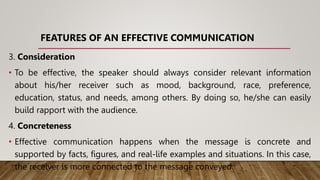
FEATURES OF AN EFFECTIVE COMMUNICATION
3. Consideration
• To be effective, the speaker should always consider relevant information
about his/her receiver such as mood, background, race, preference,
education, status, and needs, among others. By doing so, he/she can easily
build rapport with the audience.
4. Concreteness
• Effective communication happens when the message is concrete and
supported by facts, figures, and real-life examples and situations. In this case,
the receiver is more connected to the message conveyed.
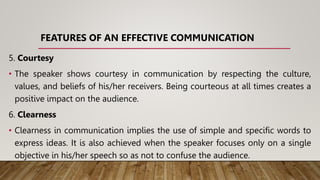
FEATURES OF AN EFFECTIVE COMMUNICATION
5. Courtesy
• The speaker shows courtesy in communication by respecting the culture,
values, and beliefs of his/her receivers. Being courteous at all times creates a
positive impact on the audience.
6. Clearness
• Clearness in communication implies the use of simple and specific words to
express ideas. It is also achieved when the speaker focuses only on a single
objective in his/her speech so as not to confuse the audience.
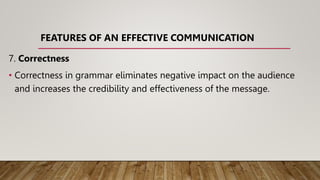
FEATURES OF AN EFFECTIVE COMMUNICATION
7. Correctness
• Correctness in grammar eliminates negative impact on the audience
and increases the credibility and effectiveness of the message.
Features of Effective Communication-1.pptx

Features of Effective Communication-1.pptx

  • 1.
  • 2.
    FEATURES OF ANEFFECTIVE COMMUNICATION In their pioneer book Effective Public Relations, Professors Broom, Cutlip, and Center (2012) list the 7 Cs of Effective Communication. This list is widely used today, especially in public relations and advertising.
  • 3.
    FEATURES OF ANEFFECTIVE COMMUNICATION 1. Completeness • Complete communication is essential to the quality of the communication process in general. Hence, communication should include everything that the receiver needs to hear for him/ her to respond, react, or evaluate properly. 2. Conciseness • Conciseness does not mean keeping the message short, but making it direct or straight to the point. Insignificant or redundant information should be eliminated from the communication that will be sent to the recipient.
  • 4.
    FEATURES OF ANEFFECTIVE COMMUNICATION 3. Consideration • To be effective, the speaker should always consider relevant information about his/her receiver such as mood, background, race, preference, education, status, and needs, among others. By doing so, he/she can easily build rapport with the audience. 4. Concreteness • Effective communication happens when the message is concrete and supported by facts, figures, and real-life examples and situations. In this case, the receiver is more connected to the message conveyed.
  • 5.
    FEATURES OF ANEFFECTIVE COMMUNICATION 5. Courtesy • The speaker shows courtesy in communication by respecting the culture, values, and beliefs of his/her receivers. Being courteous at all times creates a positive impact on the audience. 6. Clearness • Clearness in communication implies the use of simple and specific words to express ideas. It is also achieved when the speaker focuses only on a single objective in his/her speech so as not to confuse the audience.
  • 6.
    FEATURES OF ANEFFECTIVE COMMUNICATION 7. Correctness • Correctness in grammar eliminates negative impact on the audience and increases the credibility and effectiveness of the message.