An effective way to
write a FEATURE
ARTICLE
Francis Earl Cueto
09272264152
09062077756
kikocueto@gmail.com
OBJECTIVE
 To instill in the minds of the young writers the importance of
feature writing
 To enable the students to write good leads and sustain it
 To ensure that the students be reminded of the basics
according to the “real world” and what feature writing is
outside the four corners of the school
 To make the teachers and advisers understand about the
scope and realities of feature writing when it comes to
competitions
 To give tips on what judges expect in group competitions and
individual contests
What is a FEATURE
ARTICLE
 First and foremost, feature stories actually
concentrate more on the human angle rather
than on news events themselves.
 Second, feature articles does not usually carry a
specific style and are usually structured less
rigidly and written from a more personalized
point of view than hard-news stories.
 Third and the most important, a features editor
plays a key role in helping the writer focus,
organize and maintain consistent voice and
tone in a story.
Planning the FEATURE STORY
Key questions :
 What is the purpose of your article?
 What does the writer want to say?
 What is the best way of saying it?
 Who will be your intended
readers/audience?
Things Feature writers need to keep an eye on:
 The lead should draw the audience forcefully into the story;
the story must deliver what the lead promises.
 The audience should know exactly what the story is about
within five to six paragraphs.
 The story should not overly written, either in length or in tone.
While feature writing makes allowances for secondary color,
anecdotes and interpretations that would be cut from a hard-
news story, every feature should avoid dead ends and mounds
of pointless detail. Overt statements of opinion by the writer
are permissible only in columns and reviews.
 The feature, like every news story, should be balanced. While
it may focus on one point of view, it should place that point of
view in a larger context.
GENERAL REMINDER
Feature Writers :
Always consider
your story’s
accuracy, clarity
and appeal.
Further Tips:
 Language should be simple, clear, direct and free of jargon.
 Paragraph should be reasonably short – generally no more
than three or four sentences each.
 Quotes should be used generously. Many features emphasize
human-interest angles and conversational approaches.
 Story organization should be logical, moving the audience
effortlessly from beginning to end. Transitions between
topics, paragraphs and sections should be fluid and
unobtrusive.
 Every question raised in the story should be answered quickly.
 While prominence and audience interest have a clear place in
feature writing’s value, the most powerful and compelling
stories of all are the ones about everyday people, not the
celebrities of the moment.
Important VALUES
 IMPACT – Feature stories focus attention
on things that people do not usually think
about because they are either too
mundane or too distant to receive much
daily attention.
i.e. Why are there tiny red and violet
threads in peso bills?
What leads someone to be a tree
surgeon?
 PROXIMITY – Features tend to have
more appeal when they are about
people and events close to home.
Other well-written compelling features
can transcend place in the same way
that good literature does.
i.e. How obstinate Agtas refused to
leave the crater of Mt. Pinatubo at the
height of its eruption.
 TIMELINESS – In features, it
involves anticipating what the
audience is interested in at a
particular moment.
i.e. A contest on the most romantic
marriage proposal you have
received timed for the opening of
the movie Sweet Home Alabama.
 CONFLICT – a degree of conflict engages
the audience by giving them a vested
interest in the people involved and the
ways their problems ar resolved.
i.e. A recovering drug abuser’s struggle
against his habit.
Treatments for snoring explain-
ing how a wife endured his husband’s
snoring for twenty years.
 NOVELTY – Features often focus on the
offbeat, the inspirational, the funny and
the exotic – people and situations that
are interesting simply because there is
nothing else quite like them.
i.e. The blind summa cum laude of the
Ateneo de Manila
Lead and language in
Features
 Make sure the lead works – that is does
justice to the story and appeals to the
audience.
Does the lead stand on its own?
Does the lead match the story?
Does the lead need Attribution?
Does the lead reflect one or
more of the new values?
Types of feature leads at
work
 DESCRIPTIVE LEADS – They describe an
event, a person or a process. They work
when what is being described is likely to
catch the audience’s attention on its own
and does not require immediate
explanation.
 i.e. At the end of a day’s work, like many of us, Via Dolores
sits down and takes her shoes off. Unlike most of us, however
Dolores brings bandages and a bottle of antiseptic to the task.
She carefully cleans and dresses several new blisters,
checks to see how old ones are healing, and finally slips a
clean pair of socks over her swollen feet, “Comes with the
territory,” she says with a grin.
Dolores’ territory is the Philippines, She’s walking from
Batanes to Jolo for peace.
 DRAMATIC LEADS – They drop the
audience in the middle of action without
explanation or context. Also called
narrative leads, they work when they are
exciting and the audience has some of
what is going on.
 i.e. Officer Ben Aguas glimpsed the suspect two blocks from the
grocery store and stepped on the gas. When the man sprinted
down a driveway. Bon leaped from his patrol car and followed,
drawing his gun.
He did not need it. The man had tried to climb the chain-link
fence at the end of the driveway and caught his foot. He hung
suspended over the top of the fence, screaming in agony from a
broken ankle.
Even through the fence upside down, Bon knew his brother’s
face.
 ANECDOTAL LEAD – They are very much like
dramatic leads. They beckon the audience into
the story with a shorter story. But where
dramatic leads emphasize action and intensity,
anecdotal leads emphasize the theme or
meaning of what is to follow.
 i.e. Cesar Ramos remembers the day 30 years ago when his young neighbor got
her first 85. He was painting the front porch of his Dupay house when Anita Lapuz
got off the jeepney in tears, report card in hand.
“I asked what was wrong and she told me she didn’t get her 90 in science,”
said Ramos, now 86. “I told her an 85 was nothing to be ashamed of. And I’ll never
forget what she said.”
She said, “Where I want to go Mr. Ramos, 85 doesn’t get you there.” She
must have been about 11, 12 years old.
Lapuz, 42, a UP physics professor, will become president of the state
university this afternoon. She is the first woman and the first Bagobo native to
hold that position.
 AUDIENCE-IDENTIFICATION LEADS – They encourage
the readers or viewers to imagine themselves as
participants in the story. By putting the audience on
the front lines of an issue, such leads can underscore
an impact that is otherwise hidden. Because they are
written in the second person, they are unique enough
to grab attention.
 i.e. You are at the basketball game or at the concert and you want a
burger. You wait for a slow moment and head for food stand with the
shortest line.
You find it and take your place, hoping you don’t miss your
favorite song or Asi Taulava rainbow.. When you get to the counter 10
minutes later, you ask for a bigger with everything, fries, large drink.
“Sorry,” the guy in the paper hat says. Non-animal products at
this stand. Care for a soy burger?”
The Body
 What is important in the body is that
you maintain your readers attention.
 Sustaining the interest of the reader is
the most essential thing after the lead.
 A way of maintaining a readers
attention is to slowly roll out each bits
and pieces
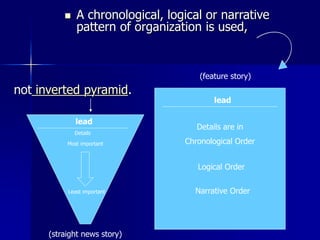
 A chronological, logical or narrative
pattern of organization is used,
lead
Details
(straight news story)
lead
Details are in
Chronological Order
not inverted pyramid.
(feature story)
Logical Order
Narrative Order
Most important
Least important
 The final paragraph should complete the story.
 The best ways to do this are to refer back to
the lead or use a quote to refer to the future.
The story should reflect the subject's
character and personality.
Feature stories should contain
many direct quotes.
At minimum, features should be
one-half direct quotes.
Write creatively,
use color and imagination,
make people come ALIVE
with your feature writing.
Be careful to avoid
becoming too sugar-coated
or editorializing, however.
What do WE want?
 For Group Contests: It is important that
both the teachers and the writers develop
stories that are not just within the school.
 It means develop stories outside of the
school such as events or festivals or tourist
spots
 Don’t overshadow the article with pictures,
we read, we just don’t look.
 Please do try not to write any more about
the principal etc., etc.
 For Individual: Don’t overdo it. Meaning
don’t try to use so many flowery words.
 Try to maintain focus on the story and
article
 Sustain the development of the story
 Don’t rely on what the teacher has prepared
for you (i.e. patterned story) simply trust
your writer’s instinct and imagination.
Thank You, hope
you understood our
short lecture…

Feature Writing 1.ppt

  • 1.
    An effective wayto write a FEATURE ARTICLE Francis Earl Cueto 09272264152 09062077756 kikocueto@gmail.com
  • 2.
    OBJECTIVE  To instillin the minds of the young writers the importance of feature writing  To enable the students to write good leads and sustain it  To ensure that the students be reminded of the basics according to the “real world” and what feature writing is outside the four corners of the school  To make the teachers and advisers understand about the scope and realities of feature writing when it comes to competitions  To give tips on what judges expect in group competitions and individual contests
  • 3.
    What is aFEATURE ARTICLE  First and foremost, feature stories actually concentrate more on the human angle rather than on news events themselves.  Second, feature articles does not usually carry a specific style and are usually structured less rigidly and written from a more personalized point of view than hard-news stories.  Third and the most important, a features editor plays a key role in helping the writer focus, organize and maintain consistent voice and tone in a story.
  • 4.
    Planning the FEATURESTORY Key questions :  What is the purpose of your article?  What does the writer want to say?  What is the best way of saying it?  Who will be your intended readers/audience?
  • 5.
    Things Feature writersneed to keep an eye on:  The lead should draw the audience forcefully into the story; the story must deliver what the lead promises.  The audience should know exactly what the story is about within five to six paragraphs.  The story should not overly written, either in length or in tone. While feature writing makes allowances for secondary color, anecdotes and interpretations that would be cut from a hard- news story, every feature should avoid dead ends and mounds of pointless detail. Overt statements of opinion by the writer are permissible only in columns and reviews.  The feature, like every news story, should be balanced. While it may focus on one point of view, it should place that point of view in a larger context.
  • 6.
    GENERAL REMINDER Feature Writers: Always consider your story’s accuracy, clarity and appeal.
  • 7.
    Further Tips:  Languageshould be simple, clear, direct and free of jargon.  Paragraph should be reasonably short – generally no more than three or four sentences each.  Quotes should be used generously. Many features emphasize human-interest angles and conversational approaches.  Story organization should be logical, moving the audience effortlessly from beginning to end. Transitions between topics, paragraphs and sections should be fluid and unobtrusive.  Every question raised in the story should be answered quickly.  While prominence and audience interest have a clear place in feature writing’s value, the most powerful and compelling stories of all are the ones about everyday people, not the celebrities of the moment.
  • 8.
    Important VALUES  IMPACT– Feature stories focus attention on things that people do not usually think about because they are either too mundane or too distant to receive much daily attention. i.e. Why are there tiny red and violet threads in peso bills? What leads someone to be a tree surgeon?
  • 9.
     PROXIMITY –Features tend to have more appeal when they are about people and events close to home. Other well-written compelling features can transcend place in the same way that good literature does. i.e. How obstinate Agtas refused to leave the crater of Mt. Pinatubo at the height of its eruption.
  • 10.
     TIMELINESS –In features, it involves anticipating what the audience is interested in at a particular moment. i.e. A contest on the most romantic marriage proposal you have received timed for the opening of the movie Sweet Home Alabama.
  • 11.
     CONFLICT –a degree of conflict engages the audience by giving them a vested interest in the people involved and the ways their problems ar resolved. i.e. A recovering drug abuser’s struggle against his habit. Treatments for snoring explain- ing how a wife endured his husband’s snoring for twenty years.
  • 12.
     NOVELTY –Features often focus on the offbeat, the inspirational, the funny and the exotic – people and situations that are interesting simply because there is nothing else quite like them. i.e. The blind summa cum laude of the Ateneo de Manila
  • 13.
    Lead and languagein Features  Make sure the lead works – that is does justice to the story and appeals to the audience. Does the lead stand on its own? Does the lead match the story? Does the lead need Attribution? Does the lead reflect one or more of the new values?
  • 14.
    Types of featureleads at work  DESCRIPTIVE LEADS – They describe an event, a person or a process. They work when what is being described is likely to catch the audience’s attention on its own and does not require immediate explanation.  i.e. At the end of a day’s work, like many of us, Via Dolores sits down and takes her shoes off. Unlike most of us, however Dolores brings bandages and a bottle of antiseptic to the task. She carefully cleans and dresses several new blisters, checks to see how old ones are healing, and finally slips a clean pair of socks over her swollen feet, “Comes with the territory,” she says with a grin. Dolores’ territory is the Philippines, She’s walking from Batanes to Jolo for peace.
  • 15.
     DRAMATIC LEADS– They drop the audience in the middle of action without explanation or context. Also called narrative leads, they work when they are exciting and the audience has some of what is going on.  i.e. Officer Ben Aguas glimpsed the suspect two blocks from the grocery store and stepped on the gas. When the man sprinted down a driveway. Bon leaped from his patrol car and followed, drawing his gun. He did not need it. The man had tried to climb the chain-link fence at the end of the driveway and caught his foot. He hung suspended over the top of the fence, screaming in agony from a broken ankle. Even through the fence upside down, Bon knew his brother’s face.
  • 16.
     ANECDOTAL LEAD– They are very much like dramatic leads. They beckon the audience into the story with a shorter story. But where dramatic leads emphasize action and intensity, anecdotal leads emphasize the theme or meaning of what is to follow.  i.e. Cesar Ramos remembers the day 30 years ago when his young neighbor got her first 85. He was painting the front porch of his Dupay house when Anita Lapuz got off the jeepney in tears, report card in hand. “I asked what was wrong and she told me she didn’t get her 90 in science,” said Ramos, now 86. “I told her an 85 was nothing to be ashamed of. And I’ll never forget what she said.” She said, “Where I want to go Mr. Ramos, 85 doesn’t get you there.” She must have been about 11, 12 years old. Lapuz, 42, a UP physics professor, will become president of the state university this afternoon. She is the first woman and the first Bagobo native to hold that position.
  • 17.
     AUDIENCE-IDENTIFICATION LEADS– They encourage the readers or viewers to imagine themselves as participants in the story. By putting the audience on the front lines of an issue, such leads can underscore an impact that is otherwise hidden. Because they are written in the second person, they are unique enough to grab attention.  i.e. You are at the basketball game or at the concert and you want a burger. You wait for a slow moment and head for food stand with the shortest line. You find it and take your place, hoping you don’t miss your favorite song or Asi Taulava rainbow.. When you get to the counter 10 minutes later, you ask for a bigger with everything, fries, large drink. “Sorry,” the guy in the paper hat says. Non-animal products at this stand. Care for a soy burger?”
  • 18.
    The Body  Whatis important in the body is that you maintain your readers attention.  Sustaining the interest of the reader is the most essential thing after the lead.  A way of maintaining a readers attention is to slowly roll out each bits and pieces
  • 19.
     A chronological,logical or narrative pattern of organization is used, lead Details (straight news story) lead Details are in Chronological Order not inverted pyramid. (feature story) Logical Order Narrative Order Most important Least important
  • 20.
     The finalparagraph should complete the story.  The best ways to do this are to refer back to the lead or use a quote to refer to the future.
  • 21.
    The story shouldreflect the subject's character and personality. Feature stories should contain many direct quotes. At minimum, features should be one-half direct quotes.
  • 22.
    Write creatively, use colorand imagination, make people come ALIVE with your feature writing. Be careful to avoid becoming too sugar-coated or editorializing, however.
  • 23.
    What do WEwant?  For Group Contests: It is important that both the teachers and the writers develop stories that are not just within the school.  It means develop stories outside of the school such as events or festivals or tourist spots  Don’t overshadow the article with pictures, we read, we just don’t look.  Please do try not to write any more about the principal etc., etc.
  • 24.
     For Individual:Don’t overdo it. Meaning don’t try to use so many flowery words.  Try to maintain focus on the story and article  Sustain the development of the story  Don’t rely on what the teacher has prepared for you (i.e. patterned story) simply trust your writer’s instinct and imagination.
  • 25.
    Thank You, hope youunderstood our short lecture…