 The main objective of writing
feature stories is to entertain.
It has anything under the sun
as its subject. Among the
different categories on Campus
Journalism, the feature has the
widest source of subject.
 A feature story may explain or
supplement the news. Yet,
although it may explain, it is not
opinionated.
 The feature story is the most varied
in scope, purpose or style. Features
add life and vitality to any paper.
1. Creativity – Feature stories give the
writer a free hand to write anything.
From the most ordinary to the bizarre
or most unimaginable subjects.
Creative presentation and the use of
language counts a lot. But however
creative feature articles maybe, they
must be based on date gathered, not
merely on the imagination of the
writer.
2. Human Interest – Feature stories are
best when written on the first person
accounts. Through the imaginative
treatment of the material, coupled by
the writer’s own thoughts and
emotions, feature story become
entertaining.
3. Factual Content – What has not been
covered by the hard news is provided by
the feature story.
4. Entertainment Value – It provides the break in
the monotony and gruesomeness of war,
murder, rape, scandal, disaster, corruption,
political bickering, controversy, and other
grisly news that fill the news page of the paper.
The paper gives color, life, or mood to the
event or subject. In talking to people of
different walks of life, the feature writer
produces a highly entertaining material about
the people around him, their thoughts, their
emotions, their feelings, giving the material
the needed ingredients for humaneness that
appeal for a greater readership
5. Timeliness or Imperishability - Feature
stories, unlike news stories, do not
loose their usefulness.
6. Entirety – Feature stories are read up
to the end so the writer can place the
climax (the highest point of interest)
at the end unlike news where the most
significant information is in the lead.
7. Variety of tone and style – Most feature
stories begin with the novelty lead. They
barely start with the summary lead.
8. Organization – To achieve unity,
coherence and emphasis, apply the
principle of creative writing. Feature
writing allows the use of colorful
phrases and figurative language. The
writer may employ these provided they
add up to the beauty of the article.
 It has the title, the introduction, the
body, and the conclusion.
 The Introduction – The introduction or
lead should out rightly attract the
attention and interest of the reader. It
should be an astonisher. It is very
important to draw the interest of the
reader in the very first paragraph so
that they will continue reading the
article.
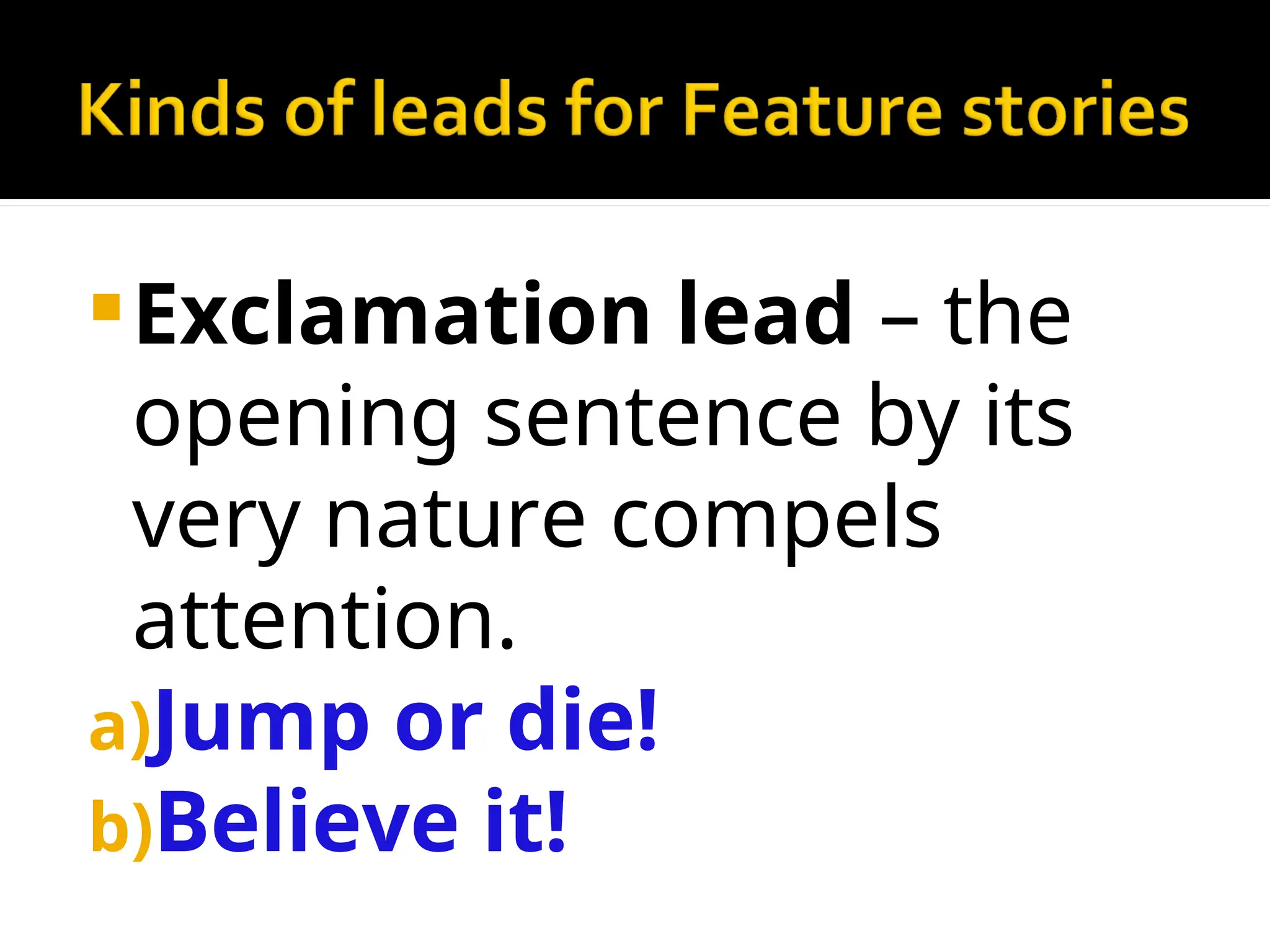
Exclamation lead – the
opening sentence by its
very nature compels
attention.
a)Jump or die!
b)Believe it!
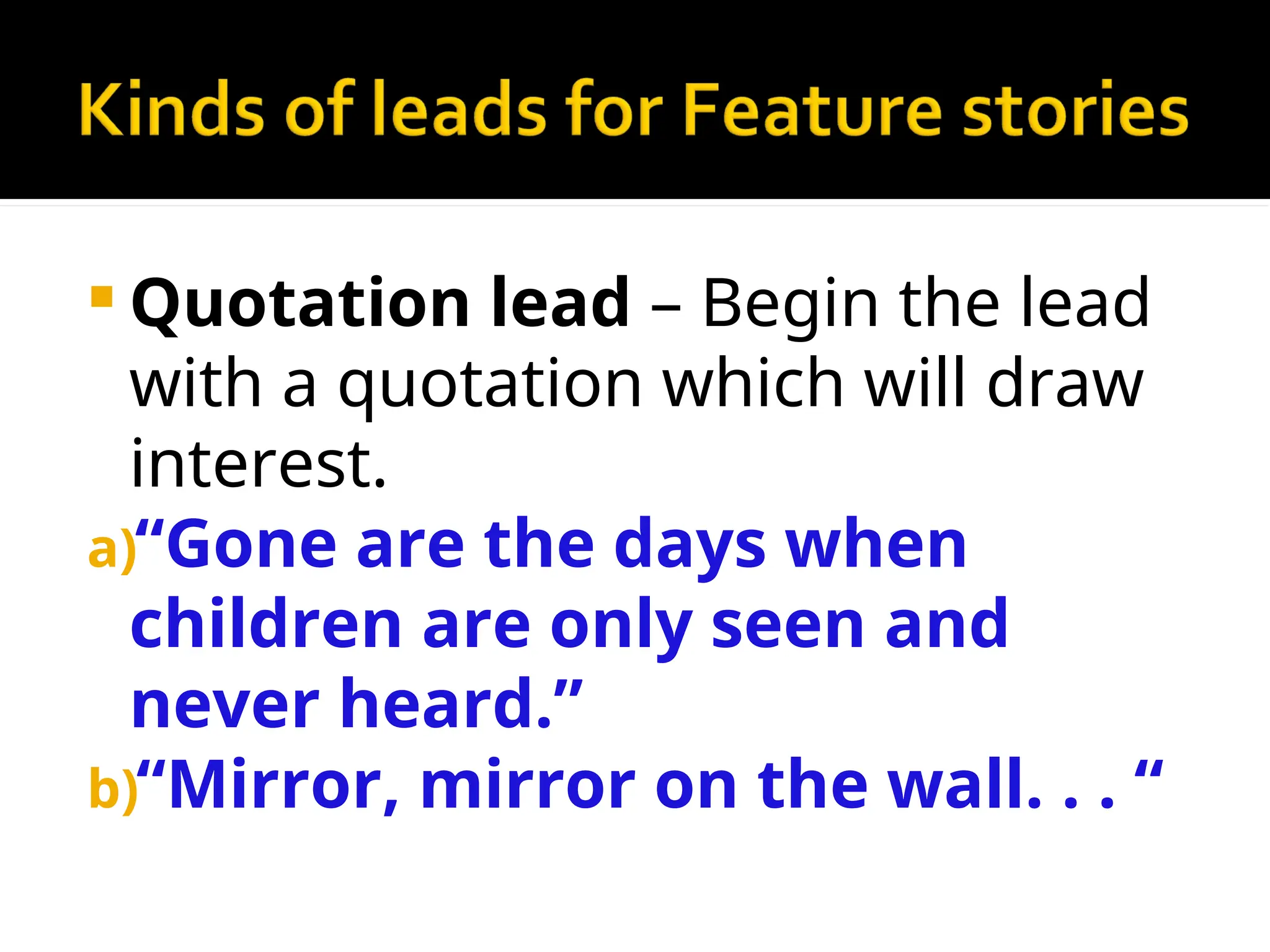
 Quotation lead – Begin the lead
with a quotation which will draw
interest.
a)“Gone are the days when
children are only seen and
never heard.”
b)“Mirror, mirror on the wall. . . “
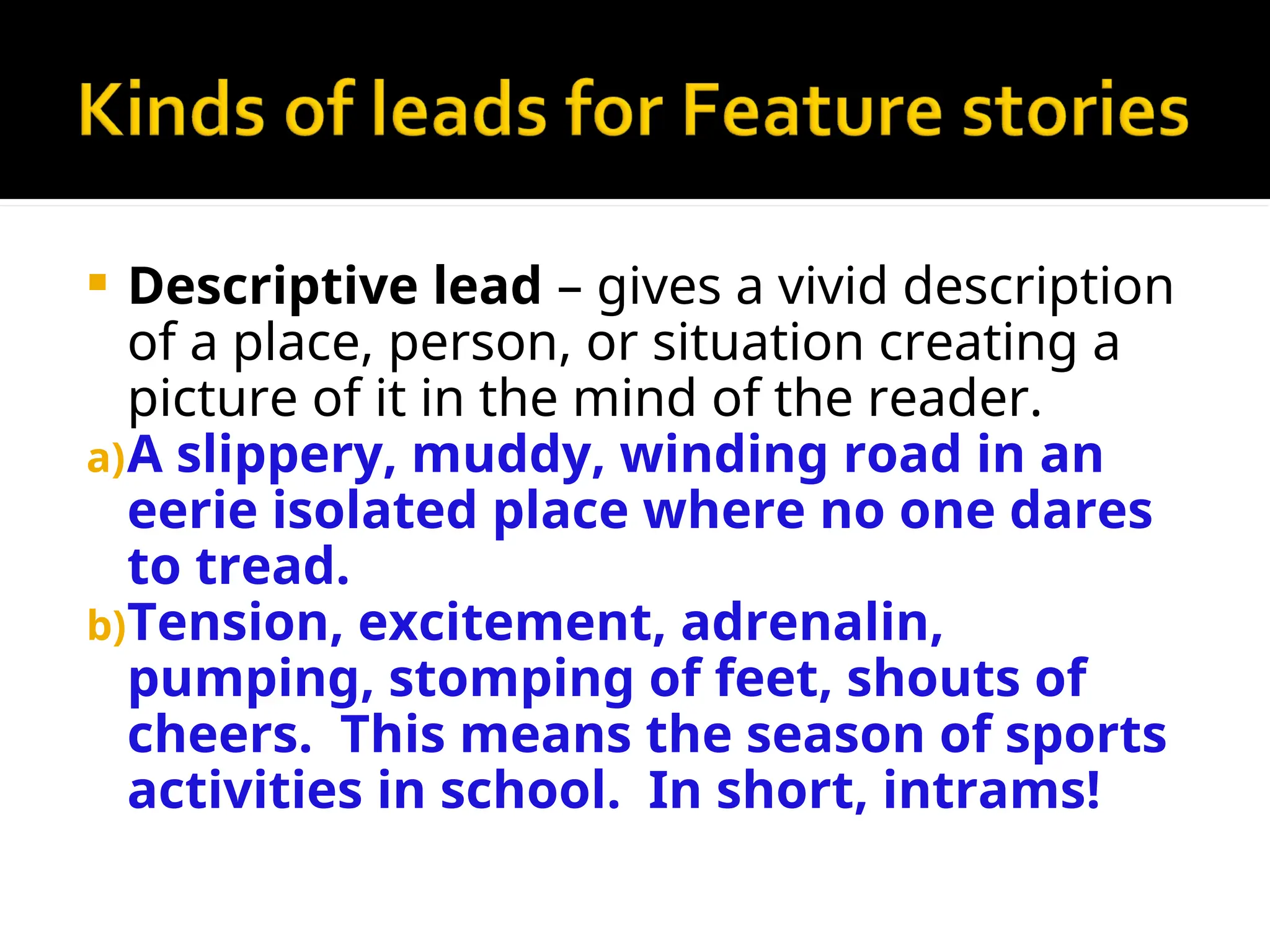
 Descriptive lead – gives a vivid description
of a place, person, or situation creating a
picture of it in the mind of the reader.
a)A slippery, muddy, winding road in an
eerie isolated place where no one dares
to tread.
b)Tension, excitement, adrenalin,
pumping, stomping of feet, shouts of
cheers. This means the season of sports
activities in school. In short, intrams!
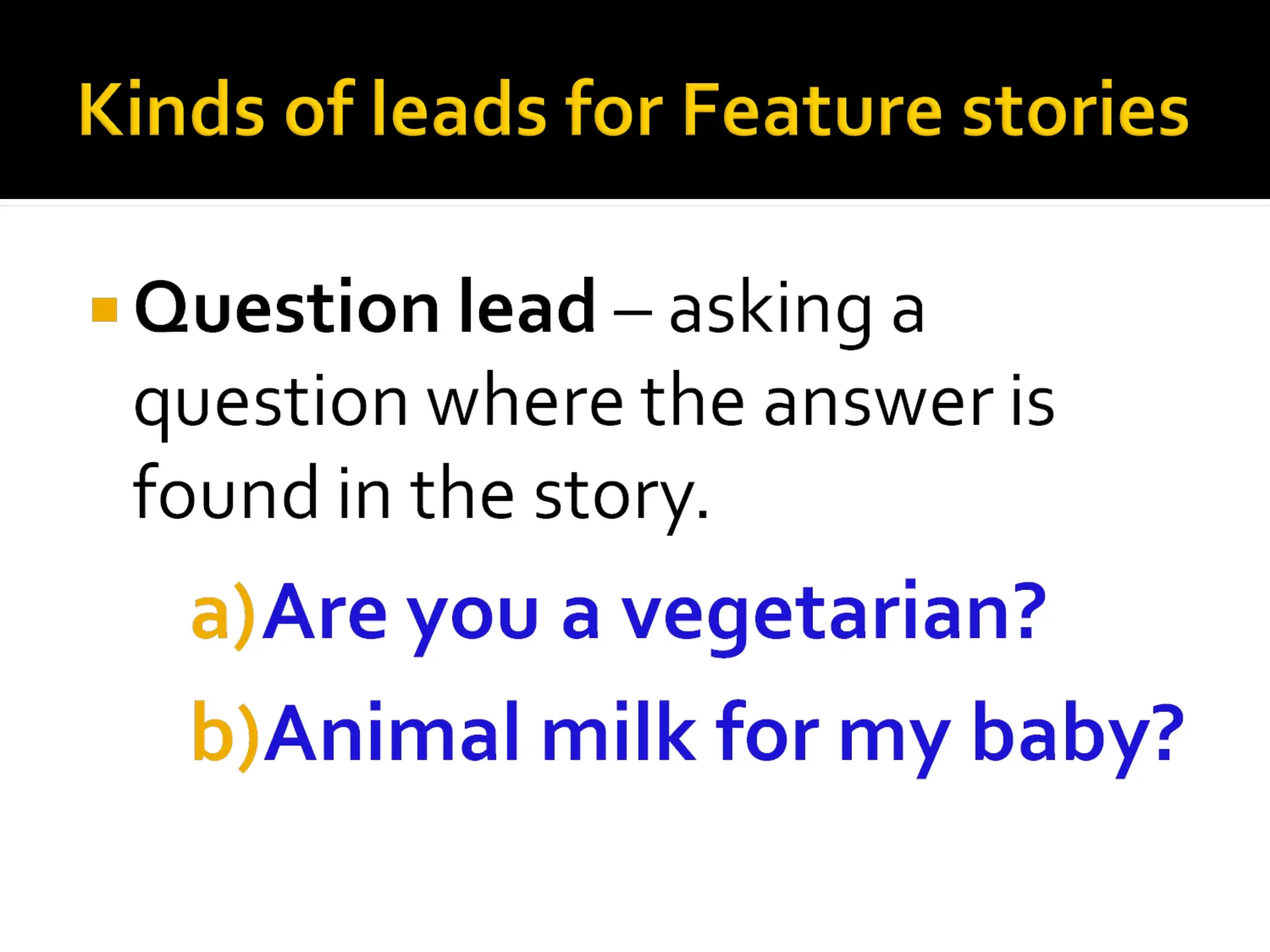
Striking statement – A
short snappy statement set
off in a paragraph by itself.
a)Hope at last to the
people of Malauli.
b)Eva Gracia, mother at 12
 Contrast lead – The lead points out the
opposites and extremes that are sharp
and witty.
a)They were given a new house, P
50,000 richer a full scholarship grants
to all the three children but they
could not get over the death of their
parents in the fire their gutted their
house.
 Narration lead – the lead is written in the
form of a narration.
a)The day started with a parade of
students in colorful costumes and
uniform. From the school quadrangle
and around the community then back to
the school covered court for the opening
program. The school is celebrating its
38th
foundation anniversary.
 The body of a feature story must
have unity, coherence and emphasis.
It must be able to hold and sustain
the interest of the readers
 Feature stories have shorter
paragraphs than those of literary
short stories but longer than
paragraphs in a news story.
 In the body, the writer makes use of
descriptions, narrations, figures of
speech, idiomatic expressions,
quotations, surveys, statistics,
anecdotes and other expressions that
give color to the story.
 Set aside unnecessary details not
directly related to the main subject. A
theme (main idea) must be carried all
throughout the story.
 The conclusion maybe written
in a condensed summary or
state the important points in
the story. Or give the highest
point of interest (climax). Be
sure to leave an impact to the
reader for them to remember.
1. Choose an interesting subject.
2. Slim down your topic to just one
specific area.
3. Give it a tentative title. (This will keep
you within the circle of your topic.)
4. Prepare your outline.
5. Highlight important things you wish to
feature.
6. Concentrate on the most important
feature with specific details. Use data
gathered from interviews, research,
and personal experiences.
7. Use the different devices that will make
your story interesting to read. Devices
such as figures of speech, idiomatic
expressions, quotations, passages and
the like will add up to the beauty of your
story.
8. Review what you have written. Delete
what is not needed, check if some things
were omitted.
9. Rewrite your piece.
10. Check you title (head). Is it catchy
enough to attract reader’s interest?
11. Make the final copy.
1. Informative feature – Gives information on
subject of current interest. This feature is
usually based on interview and research.
2. Human Interest Feature – It deals with minor
incidents that deserve attention because of
dramatic, humorous, tragic, sensational, or
unusual (odd) angle of the story.
This kind of feature story appeals to the
emotion, it may have a lesser news value but it
enjoy wide readership because of its human
appeal.
3. News Feature – It gets its
materials from current events,
covering details that were
omitted by the news.
4. How–to– feature – It gives
information on the process of
doing things and how certain
products are made.
6. Personal Experience – This tell of some
unusual true – to life experiences
written in the first person account.
7. Humorous Feature – The primary
objective of feature stories is too
entertain and what is more fitting than
making people laugh and be relieve of
the stress of life while reading your
article.
9.Seasonal or Holiday Feature –
Subject are events celebrated
once a year.
10.Travelogue – An account of one’s
travel experience and a vivid
description of places visited
How to Write Feature Articles for Campus Journalism

How to Write Feature Articles for Campus Journalism

  • 2.
     The mainobjective of writing feature stories is to entertain. It has anything under the sun as its subject. Among the different categories on Campus Journalism, the feature has the widest source of subject.
  • 3.
     A featurestory may explain or supplement the news. Yet, although it may explain, it is not opinionated.  The feature story is the most varied in scope, purpose or style. Features add life and vitality to any paper.
  • 4.
    1. Creativity –Feature stories give the writer a free hand to write anything. From the most ordinary to the bizarre or most unimaginable subjects. Creative presentation and the use of language counts a lot. But however creative feature articles maybe, they must be based on date gathered, not merely on the imagination of the writer.
  • 5.
    2. Human Interest– Feature stories are best when written on the first person accounts. Through the imaginative treatment of the material, coupled by the writer’s own thoughts and emotions, feature story become entertaining. 3. Factual Content – What has not been covered by the hard news is provided by the feature story.
  • 6.
    4. Entertainment Value– It provides the break in the monotony and gruesomeness of war, murder, rape, scandal, disaster, corruption, political bickering, controversy, and other grisly news that fill the news page of the paper. The paper gives color, life, or mood to the event or subject. In talking to people of different walks of life, the feature writer produces a highly entertaining material about the people around him, their thoughts, their emotions, their feelings, giving the material the needed ingredients for humaneness that appeal for a greater readership
  • 7.
    5. Timeliness orImperishability - Feature stories, unlike news stories, do not loose their usefulness. 6. Entirety – Feature stories are read up to the end so the writer can place the climax (the highest point of interest) at the end unlike news where the most significant information is in the lead.
  • 8.
    7. Variety oftone and style – Most feature stories begin with the novelty lead. They barely start with the summary lead. 8. Organization – To achieve unity, coherence and emphasis, apply the principle of creative writing. Feature writing allows the use of colorful phrases and figurative language. The writer may employ these provided they add up to the beauty of the article.
  • 9.
     It hasthe title, the introduction, the body, and the conclusion.  The Introduction – The introduction or lead should out rightly attract the attention and interest of the reader. It should be an astonisher. It is very important to draw the interest of the reader in the very first paragraph so that they will continue reading the article.
  • 11.
    Exclamation lead –the opening sentence by its very nature compels attention. a)Jump or die! b)Believe it!
  • 12.
     Quotation lead– Begin the lead with a quotation which will draw interest. a)“Gone are the days when children are only seen and never heard.” b)“Mirror, mirror on the wall. . . “
  • 13.
     Descriptive lead– gives a vivid description of a place, person, or situation creating a picture of it in the mind of the reader. a)A slippery, muddy, winding road in an eerie isolated place where no one dares to tread. b)Tension, excitement, adrenalin, pumping, stomping of feet, shouts of cheers. This means the season of sports activities in school. In short, intrams!
  • 14.
    Striking statement –A short snappy statement set off in a paragraph by itself. a)Hope at last to the people of Malauli. b)Eva Gracia, mother at 12
  • 15.
     Contrast lead– The lead points out the opposites and extremes that are sharp and witty. a)They were given a new house, P 50,000 richer a full scholarship grants to all the three children but they could not get over the death of their parents in the fire their gutted their house.
  • 16.
     Narration lead– the lead is written in the form of a narration. a)The day started with a parade of students in colorful costumes and uniform. From the school quadrangle and around the community then back to the school covered court for the opening program. The school is celebrating its 38th foundation anniversary.
  • 17.
     The bodyof a feature story must have unity, coherence and emphasis. It must be able to hold and sustain the interest of the readers  Feature stories have shorter paragraphs than those of literary short stories but longer than paragraphs in a news story.
  • 18.
     In thebody, the writer makes use of descriptions, narrations, figures of speech, idiomatic expressions, quotations, surveys, statistics, anecdotes and other expressions that give color to the story.  Set aside unnecessary details not directly related to the main subject. A theme (main idea) must be carried all throughout the story.
  • 19.
     The conclusionmaybe written in a condensed summary or state the important points in the story. Or give the highest point of interest (climax). Be sure to leave an impact to the reader for them to remember.
  • 20.
    1. Choose aninteresting subject. 2. Slim down your topic to just one specific area. 3. Give it a tentative title. (This will keep you within the circle of your topic.) 4. Prepare your outline. 5. Highlight important things you wish to feature. 6. Concentrate on the most important feature with specific details. Use data gathered from interviews, research, and personal experiences.
  • 21.
    7. Use thedifferent devices that will make your story interesting to read. Devices such as figures of speech, idiomatic expressions, quotations, passages and the like will add up to the beauty of your story. 8. Review what you have written. Delete what is not needed, check if some things were omitted. 9. Rewrite your piece. 10. Check you title (head). Is it catchy enough to attract reader’s interest? 11. Make the final copy.
  • 22.
    1. Informative feature– Gives information on subject of current interest. This feature is usually based on interview and research. 2. Human Interest Feature – It deals with minor incidents that deserve attention because of dramatic, humorous, tragic, sensational, or unusual (odd) angle of the story. This kind of feature story appeals to the emotion, it may have a lesser news value but it enjoy wide readership because of its human appeal.
  • 23.
    3. News Feature– It gets its materials from current events, covering details that were omitted by the news. 4. How–to– feature – It gives information on the process of doing things and how certain products are made.
  • 25.
    6. Personal Experience– This tell of some unusual true – to life experiences written in the first person account. 7. Humorous Feature – The primary objective of feature stories is too entertain and what is more fitting than making people laugh and be relieve of the stress of life while reading your article.
  • 27.
    9.Seasonal or HolidayFeature – Subject are events celebrated once a year. 10.Travelogue – An account of one’s travel experience and a vivid description of places visited