By
Santhosh.Golla
121411672032
Project guide:Dhanam Theresa
Chapter 1 : Introduction
Introduction
India is the third most attractive foreign direct
investment destination in the world.
Due to the growing demand for insurance, more and
more insurance companies are now emerging in the
Indian insurance sector.
In fact, FDI provides a win – win situation to the host
and the home countries. Both countries are directly
interested in inviting FDI, because they benefit a lot
from such type of investment.
Definition
Foreign direct investment (FDI) is direct investment
into production in a country by a company in another
country, either by buying a company in the target country
or by expanding operations of an existing business in that
country.
The investing company may make its overseas investment
in a number of ways - either by setting up a subsidiary or
associate company in the foreign country, by acquiring
shares of an overseas company, or through a merger or
joint venture.
Need for the Study
It is important to know the different source of capital as
well as a source of advanced and developed technologies
that are involved in FDI.
To know the investors who bring along best global
practices of management.
To study its influence in increasing employment.
To study how FDI helps in promoting international trade
and to understand the reasons how the host country
undergoes development with FDI.
Objectives
To Study the pattern of FDI in Insurance Sector and
the Government regulation involved in them.
To study the current trend in Insurance sector, the
challenges and the prospects ahead.
To study the Effect of FDI on Indian Insurance Sector.
To analyze the significance of Foreign Direct
Investment for Indian Insurance Industry.
Research Methodology
RESEARCH DESIGN
This project provides a plan of the study, which include
statement of the problem, need for study, review of the
previous studies, objectives, definition of concepts, scope,
methodology, sample design, sources of data, tool and
techniques for data collection, limitations and an overview
of chapter scheme
Scope
The study aims to understand the fundamental analysis
and its impact on insurance sector. It provides the relevant
information about the economy, industry, and different
companies in insurance sector.
The study entitled ” A study on fundamental analysis
and its impaction insurance sector” is undertaken with
an intention to study the fundamentals analysis on
insurance sector and will find the problems in insurance
sector and performance of insurance sector
Data Collection
SECONDARY DATA:
Secondary data refers to those data that has already been
collected and analyzed by someone else. In other words
secondary data is the information that already exists
somewhere having been collected for another purpose.
Secondary data is collected through-
Published data
Journals
web sources
Chapter 2 : Review of Literature
Foreign Direct Investment
Foreign direct investment (FDI) is a measure of
foreign ownership of productive assets, such as
factories, mines and land.
Increasing foreign investment can be used as one
measure of growing economic globalization.
The largest flows of foreign investment occur
between the industrialized countries ( North America,
Western Europe and Japan).But flows to non-
industrialized countries are increasing sharply.
Methods
The foreign direct investor may acquire voting power
of an enterprise in an economy through any of the
following methods:
by incorporating a wholly owned subsidiary or
company
by acquiring shares in an associated enterprise
through a merger or an acquisition of an unrelated
enterprise
participating in an equity joint venture with another
investor or enterprise
Benefits of FDI
Increase investment level and thereby income &
employment.
Increase tax revenue of government.
Facilitates transfer of technology.
Encourage managerial revolution through
professional management.
Increase exports and reduce import requirements.
Increase competition and break domestic
monopolies.
Improves quality and reduces cost of inputs.
Factors affecting FDI
Profitability: Attract where return on investment is
higher.
Costs of production: Encouraged by lower costs of
production like raw materials, labour .
Economic Conditions: Market potential, infrastructure,
size of population, income level etc
Government policies: Policies like foreign investment,
foreign collaboration, remittances, profits, taxation,
foreign exchange control, tariffs etc.
Political factors: Political stability, nature of important
political parties and relations with other countries.
Chapter 3 : Industry Profile
Introduction of the Industry
Insurance in India started without any regulations in the
nineteenth century.
After the independence, the Life Insurance Company was
nationalized in 1956, and then the general insurance business
was nationalized in 1972.
Only in 1999 private insurance companies were allowed back
into the business of insurance with a maximum of 26 per cent of
foreign holding (World Bank Economic Review 2000).
Government of India now decided to move ahead with its
proposal to hike foreign investment ceiling in the insurance
sector to 49 percent from the present 26 percent.
Firstly, domestic private-sector companies were
permitted to enter both life and non-life insurance
business .
Secondly, foreign Companies were allowed to
participate, albe it with a cap on shareholding at
49%.Since its inception IRDA has been taking steps to
promote insurance sector and also protect interest of
people.
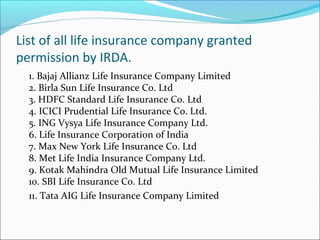
List of all life insurance company granted
permission by IRDA.
1. Bajaj Allianz Life Insurance Company Limited
2. Birla Sun Life Insurance Co. Ltd
3. HDFC Standard Life Insurance Co. Ltd
4. ICICI Prudential Life Insurance Co. Ltd.
5. ING Vysya Life Insurance Company Ltd.
6. Life Insurance Corporation of India
7. Max New York Life Insurance Co. Ltd
8. Met Life India Insurance Company Ltd.
9. Kotak Mahindra Old Mutual Life Insurance Limited
10. SBI Life Insurance Co. Ltd
11. Tata AIG Life Insurance Company Limited
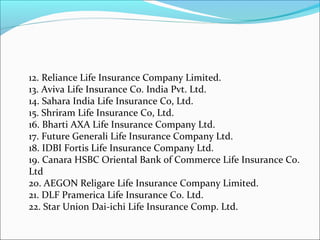
12. Reliance Life Insurance Company Limited.
13. Aviva Life Insurance Co. India Pvt. Ltd.
14. Sahara India Life Insurance Co, Ltd.
15. Shriram Life Insurance Co, Ltd.
16. Bharti AXA Life Insurance Company Ltd.
17. Future Generali Life Insurance Company Ltd.
18. IDBI Fortis Life Insurance Company Ltd.
19. Canara HSBC Oriental Bank of Commerce Life Insurance Co.
Ltd
20. AEGON Religare Life Insurance Company Limited.
21. DLF Pramerica Life Insurance Co. Ltd.
22. Star Union Dai-ichi Life Insurance Comp. Ltd.

 CHAPTER-4
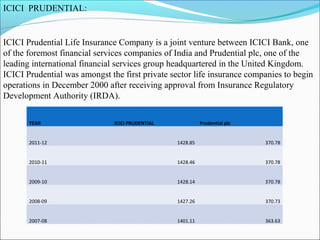
ICICI PRUDENTIAL:
ICICI Prudential Life Insurance Company is a joint venture between ICICI Bank, one
of the foremost financial services companies of India and Prudential plc, one of the
leading international financial services group headquartered in the United Kingdom.
ICICI Prudential was amongst the first private sector life insurance companies to begin
operations in December 2000 after receiving approval from Insurance Regulatory
Development Authority (IRDA).
YEAR ICICI PRUDENTIAL Prudential plc
2011-12 1428.85 370.78
2010-11 1428.46 370.78
2009-10 1428.14 370.78
2008-09 1427.26 370.73
2007-08 1401.11 363.63
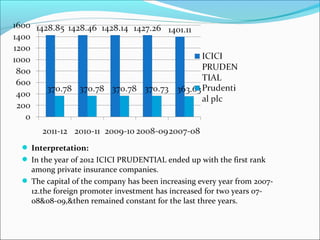
 Interpretation:
 In the year of 2012 ICICI PRUDENTIAL ended up with the first rank
among private insurance companies.
 The capital of the company has been increasing every year from 2007-
12.the foreign promoter investment has increased for two years 07-
08&08-09,&then remained constant for the last three years.
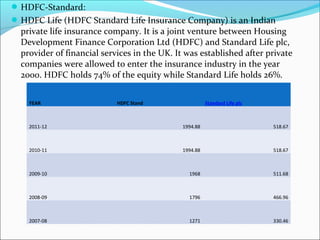
HDFC-Standard:
HDFC Life (HDFC Standard Life Insurance Company) is an Indian
private life insurance company. It is a joint venture between Housing
Development Finance Corporation Ltd (HDFC) and Standard Life plc,
provider of financial services in the UK. It was established after private
companies were allowed to enter the insurance industry in the year
2000. HDFC holds 74% of the equity while Standard Life holds 26%.
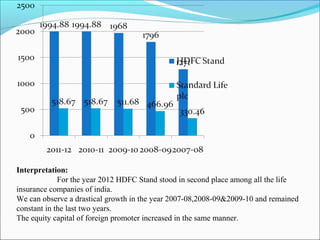
YEAR HDFC Stand Standard Life plc
2011-12 1994.88 518.67
2010-11 1994.88 518.67
2009-10 1968 511.68
2008-09 1796 466.96
2007-08 1271 330.46
Interpretation:
For the year 2012 HDFC Stand stood in second place among all the life
insurance companies of india.
We can observe a drastical growth in the year 2007-08,2008-09&2009-10 and remained
constant in the last two years.
The equity capital of foreign promoter increased in the same manner.
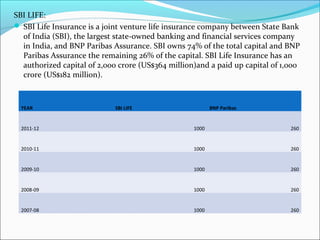
SBI LIFE:
 SBI Life Insurance is a joint venture life insurance company between State Bank
of India (SBI), the largest state-owned banking and financial services company
in India, and BNP Paribas Assurance. SBI owns 74% of the total capital and BNP
Paribas Assurance the remaining 26% of the capital. SBI Life Insurance has an
authorized capital of 2,000 crore (US$364 million)and a paid up capital of 1,000
crore (US$182 million).
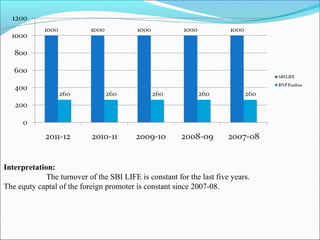
YEAR SBI LIFE BNP Paribas
2011-12 1000 260
2010-11 1000 260
2009-10 1000 260
2008-09 1000 260
2007-08 1000 260
Interpretation:
The turnover of the SBI LIFE is constant for the last five years.
The equty captal of the foreign promoter is constant since 2007-08.
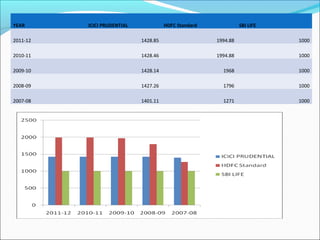
YEAR ICICI PRUDENTIAL HDFC Standard SBI LIFE
2011-12 1428.85 1994.88 1000
2010-11 1428.46 1994.88 1000
2009-10 1428.14 1968 1000
2008-09 1427.26 1796 1000
2007-08 1401.11 1271 1000
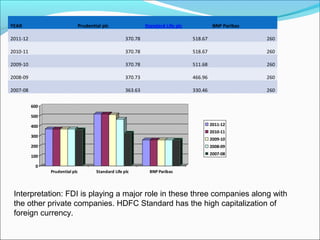
YEAR Prudential plc Standard Life plc BNP Paribas
2011-12 370.78 518.67 260
2010-11 370.78 518.67 260
2009-10 370.78 511.68 260
2008-09 370.73 466.96 260
2007-08 363.63 330.46 260
0
100
200
300
400
500
600
Prudential plc Standard Life plc BNP Paribas
2011-12
2010-11
2009-10
2008-09
2007-08
Interpretation: FDI is playing a major role in these three companies along with
the other private companies. HDFC Standard has the high capitalization of
foreign currency.
CHAPTER-5
FINDINGS:
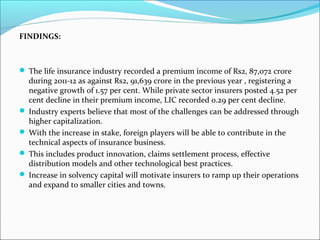
 The life insurance industry recorded a premium income of Rs2, 87,072 crore
during 2011-12 as against Rs2, 91,639 crore in the previous year , registering a
negative growth of 1.57 per cent. While private sector insurers posted 4.52 per
cent decline in their premium income, LIC recorded 0.29 per cent decline.
 Industry experts believe that most of the challenges can be addressed through
higher capitalization.
 With the increase in stake, foreign players will be able to contribute in the
technical aspects of insurance business.
 This includes product innovation, claims settlement process, effective
distribution models and other technological best practices.
 Increase in solvency capital will motivate insurers to ramp up their operations
and expand to smaller cities and towns.
CONCLUSIONS:
•This is a very capital intensive industry. Already about Rs33,000 crore has been
invested as capital and a further Rs50,000-60,000 crore is required before companies
actually breakeven and start making profits.
•A well-developed and evolved insurance sector is a boon for economic development as
it provides long-term funds for infrastructure development at the same time
strengthening the risk taking ability of the country.
•Nearly 80% of the Indian population is without life, health and non-life insurance. The
insurance sector in India is a colossal one and is growing at a rate of 15-20%. Together
with banking services, insurance services add about 7% to the country’s Gross domestic
product (GDP)
LIMITATIONS:
I narrowed down my study to FDI in insurance sector.
I again narrowed it to life insurance companies.
Since, to study the whole 24 life insurance companies becomes a big task, so i
took three companies to analyse the data.
BIBILIOGRAPHY:
International finance-Avadhani
International business-Subbarao
www.irda.gov.in/
Web sources

Impact of FDI on Indian Life Insurance Sector

  • 1.
  • 2.
    Chapter 1 :Introduction
  • 3.
    Introduction India is thethird most attractive foreign direct investment destination in the world. Due to the growing demand for insurance, more and more insurance companies are now emerging in the Indian insurance sector. In fact, FDI provides a win – win situation to the host and the home countries. Both countries are directly interested in inviting FDI, because they benefit a lot from such type of investment.
  • 4.
    Definition Foreign direct investment(FDI) is direct investment into production in a country by a company in another country, either by buying a company in the target country or by expanding operations of an existing business in that country. The investing company may make its overseas investment in a number of ways - either by setting up a subsidiary or associate company in the foreign country, by acquiring shares of an overseas company, or through a merger or joint venture.
  • 5.
    Need for theStudy It is important to know the different source of capital as well as a source of advanced and developed technologies that are involved in FDI. To know the investors who bring along best global practices of management. To study its influence in increasing employment. To study how FDI helps in promoting international trade and to understand the reasons how the host country undergoes development with FDI.
  • 6.
    Objectives To Study thepattern of FDI in Insurance Sector and the Government regulation involved in them. To study the current trend in Insurance sector, the challenges and the prospects ahead. To study the Effect of FDI on Indian Insurance Sector. To analyze the significance of Foreign Direct Investment for Indian Insurance Industry.
  • 7.
    Research Methodology RESEARCH DESIGN Thisproject provides a plan of the study, which include statement of the problem, need for study, review of the previous studies, objectives, definition of concepts, scope, methodology, sample design, sources of data, tool and techniques for data collection, limitations and an overview of chapter scheme
  • 8.
    Scope The study aimsto understand the fundamental analysis and its impact on insurance sector. It provides the relevant information about the economy, industry, and different companies in insurance sector. The study entitled ” A study on fundamental analysis and its impaction insurance sector” is undertaken with an intention to study the fundamentals analysis on insurance sector and will find the problems in insurance sector and performance of insurance sector
  • 9.
    Data Collection SECONDARY DATA: Secondarydata refers to those data that has already been collected and analyzed by someone else. In other words secondary data is the information that already exists somewhere having been collected for another purpose. Secondary data is collected through- Published data Journals web sources
  • 10.
    Chapter 2 :Review of Literature
  • 11.
    Foreign Direct Investment Foreigndirect investment (FDI) is a measure of foreign ownership of productive assets, such as factories, mines and land. Increasing foreign investment can be used as one measure of growing economic globalization. The largest flows of foreign investment occur between the industrialized countries ( North America, Western Europe and Japan).But flows to non- industrialized countries are increasing sharply.
  • 13.
    Methods The foreign directinvestor may acquire voting power of an enterprise in an economy through any of the following methods: by incorporating a wholly owned subsidiary or company by acquiring shares in an associated enterprise through a merger or an acquisition of an unrelated enterprise participating in an equity joint venture with another investor or enterprise
  • 14.
    Benefits of FDI Increaseinvestment level and thereby income & employment. Increase tax revenue of government. Facilitates transfer of technology. Encourage managerial revolution through professional management. Increase exports and reduce import requirements. Increase competition and break domestic monopolies. Improves quality and reduces cost of inputs.
  • 15.
    Factors affecting FDI Profitability:Attract where return on investment is higher. Costs of production: Encouraged by lower costs of production like raw materials, labour . Economic Conditions: Market potential, infrastructure, size of population, income level etc Government policies: Policies like foreign investment, foreign collaboration, remittances, profits, taxation, foreign exchange control, tariffs etc. Political factors: Political stability, nature of important political parties and relations with other countries.
  • 16.
    Chapter 3 :Industry Profile
  • 17.
    Introduction of theIndustry Insurance in India started without any regulations in the nineteenth century. After the independence, the Life Insurance Company was nationalized in 1956, and then the general insurance business was nationalized in 1972. Only in 1999 private insurance companies were allowed back into the business of insurance with a maximum of 26 per cent of foreign holding (World Bank Economic Review 2000). Government of India now decided to move ahead with its proposal to hike foreign investment ceiling in the insurance sector to 49 percent from the present 26 percent.
  • 18.
    Firstly, domestic private-sectorcompanies were permitted to enter both life and non-life insurance business . Secondly, foreign Companies were allowed to participate, albe it with a cap on shareholding at 49%.Since its inception IRDA has been taking steps to promote insurance sector and also protect interest of people.
  • 19.
    List of alllife insurance company granted permission by IRDA. 1. Bajaj Allianz Life Insurance Company Limited 2. Birla Sun Life Insurance Co. Ltd 3. HDFC Standard Life Insurance Co. Ltd 4. ICICI Prudential Life Insurance Co. Ltd. 5. ING Vysya Life Insurance Company Ltd. 6. Life Insurance Corporation of India 7. Max New York Life Insurance Co. Ltd 8. Met Life India Insurance Company Ltd. 9. Kotak Mahindra Old Mutual Life Insurance Limited 10. SBI Life Insurance Co. Ltd 11. Tata AIG Life Insurance Company Limited
  • 20.
    12. Reliance LifeInsurance Company Limited. 13. Aviva Life Insurance Co. India Pvt. Ltd. 14. Sahara India Life Insurance Co, Ltd. 15. Shriram Life Insurance Co, Ltd. 16. Bharti AXA Life Insurance Company Ltd. 17. Future Generali Life Insurance Company Ltd. 18. IDBI Fortis Life Insurance Company Ltd. 19. Canara HSBC Oriental Bank of Commerce Life Insurance Co. Ltd 20. AEGON Religare Life Insurance Company Limited. 21. DLF Pramerica Life Insurance Co. Ltd. 22. Star Union Dai-ichi Life Insurance Comp. Ltd.
  • 21.
  • 22.
    ICICI PRUDENTIAL: ICICI PrudentialLife Insurance Company is a joint venture between ICICI Bank, one of the foremost financial services companies of India and Prudential plc, one of the leading international financial services group headquartered in the United Kingdom. ICICI Prudential was amongst the first private sector life insurance companies to begin operations in December 2000 after receiving approval from Insurance Regulatory Development Authority (IRDA). YEAR ICICI PRUDENTIAL Prudential plc 2011-12 1428.85 370.78 2010-11 1428.46 370.78 2009-10 1428.14 370.78 2008-09 1427.26 370.73 2007-08 1401.11 363.63
  • 23.
     Interpretation:  Inthe year of 2012 ICICI PRUDENTIAL ended up with the first rank among private insurance companies.  The capital of the company has been increasing every year from 2007- 12.the foreign promoter investment has increased for two years 07- 08&08-09,&then remained constant for the last three years.
  • 24.
    HDFC-Standard: HDFC Life (HDFCStandard Life Insurance Company) is an Indian private life insurance company. It is a joint venture between Housing Development Finance Corporation Ltd (HDFC) and Standard Life plc, provider of financial services in the UK. It was established after private companies were allowed to enter the insurance industry in the year 2000. HDFC holds 74% of the equity while Standard Life holds 26%. YEAR HDFC Stand Standard Life plc 2011-12 1994.88 518.67 2010-11 1994.88 518.67 2009-10 1968 511.68 2008-09 1796 466.96 2007-08 1271 330.46
  • 25.
    Interpretation: For the year2012 HDFC Stand stood in second place among all the life insurance companies of india. We can observe a drastical growth in the year 2007-08,2008-09&2009-10 and remained constant in the last two years. The equity capital of foreign promoter increased in the same manner.
  • 26.
    SBI LIFE:  SBILife Insurance is a joint venture life insurance company between State Bank of India (SBI), the largest state-owned banking and financial services company in India, and BNP Paribas Assurance. SBI owns 74% of the total capital and BNP Paribas Assurance the remaining 26% of the capital. SBI Life Insurance has an authorized capital of 2,000 crore (US$364 million)and a paid up capital of 1,000 crore (US$182 million). YEAR SBI LIFE BNP Paribas 2011-12 1000 260 2010-11 1000 260 2009-10 1000 260 2008-09 1000 260 2007-08 1000 260
  • 27.
    Interpretation: The turnover ofthe SBI LIFE is constant for the last five years. The equty captal of the foreign promoter is constant since 2007-08.
  • 28.
    YEAR ICICI PRUDENTIALHDFC Standard SBI LIFE 2011-12 1428.85 1994.88 1000 2010-11 1428.46 1994.88 1000 2009-10 1428.14 1968 1000 2008-09 1427.26 1796 1000 2007-08 1401.11 1271 1000
  • 29.
    YEAR Prudential plcStandard Life plc BNP Paribas 2011-12 370.78 518.67 260 2010-11 370.78 518.67 260 2009-10 370.78 511.68 260 2008-09 370.73 466.96 260 2007-08 363.63 330.46 260 0 100 200 300 400 500 600 Prudential plc Standard Life plc BNP Paribas 2011-12 2010-11 2009-10 2008-09 2007-08 Interpretation: FDI is playing a major role in these three companies along with the other private companies. HDFC Standard has the high capitalization of foreign currency.
  • 30.
  • 31.
    FINDINGS:  The lifeinsurance industry recorded a premium income of Rs2, 87,072 crore during 2011-12 as against Rs2, 91,639 crore in the previous year , registering a negative growth of 1.57 per cent. While private sector insurers posted 4.52 per cent decline in their premium income, LIC recorded 0.29 per cent decline.  Industry experts believe that most of the challenges can be addressed through higher capitalization.  With the increase in stake, foreign players will be able to contribute in the technical aspects of insurance business.  This includes product innovation, claims settlement process, effective distribution models and other technological best practices.  Increase in solvency capital will motivate insurers to ramp up their operations and expand to smaller cities and towns.
  • 32.
    CONCLUSIONS: •This is avery capital intensive industry. Already about Rs33,000 crore has been invested as capital and a further Rs50,000-60,000 crore is required before companies actually breakeven and start making profits. •A well-developed and evolved insurance sector is a boon for economic development as it provides long-term funds for infrastructure development at the same time strengthening the risk taking ability of the country. •Nearly 80% of the Indian population is without life, health and non-life insurance. The insurance sector in India is a colossal one and is growing at a rate of 15-20%. Together with banking services, insurance services add about 7% to the country’s Gross domestic product (GDP) LIMITATIONS: I narrowed down my study to FDI in insurance sector. I again narrowed it to life insurance companies. Since, to study the whole 24 life insurance companies becomes a big task, so i took three companies to analyse the data.
  • 33.