Present & Relative Position & Prospects
in Global Context of Indian Insurance
Sector
Flow of Presentation
Introduction
History
Current Scenario
Global Scenario
India in the international context
Relative Position of India
Major Driving Force
Issues, Trends & Opportunities
Solutions
Introduction
An insurance policy protects the buyer at some cost against
financial loss arising from a specified risk.
Different situation and different people require different mix of
risk – cost combinations
Insurance-as a security measure
Milestones in Life Insurance Business in India
1818
Oriental Life Insurance Company started by Europeans in Kolkata
for European community
1870
Bombay Mutual Life Assurance Society, the first Indian life
insurance company started its business.
1912
The Indian Life Assurance Companies Act enacted as the first
statute to regulate the life insurance business.
1938
Legislation consolidated and amended by the Insurance Act with
the objective of protecting the interests of the insuring public.
1956
245 Indian and foreign insurers and provident societies are taken
over by the central government and nationalized. LIC formed by
an Act of Parliament
Milestones in General Insurance Business in India
1907
The Indian Mercantile Insurance Ltd. sets up first company to transact all classes of
general insurance business.
1968
The Insurance Act amended to regulate investments and set minimum solvency margins
and the Tariff Advisory Committee set up.
1972
The General Insurance Business (Nationalisation) Act, 1972 nationalised the general
insurance business in India with effect from 1st January 1973.
1999
107 insurers amalgamated and grouped into four companies viz.
•The National Insurance Company Ltd.
•The New India Assurance Company Ltd.,
• The Oriental Insurance Company Ltd
•The United India Insurance Company Ltd.
GIC incorporated as a company.
Acts related to Insurance
The Insurance Act, 1938
Life Insurance Corporation Act, 1956
General Insurance Business (Nationalization) Act, 1972
Insurance Regulatory and Development Authority (IRDA) Act,
1999
INSURANCE SECTOR
REFORMS
Headed by former Finance Secretary and RBI Governor R.N.
Malhotra in year 1993.
The objective was to complement the reforms initiated in the
financial sector.
The reforms were aimed at creating a more efficient and
competitive financial system suitable for the requirements of
the economy.
Key Recommendations
STRUCTURE
Government stake in the Insurance Companies to be brought down to 50%.
Government should take over the holdings of GIC and its subsidiaries so that
these subsidiaries can act as independent corporations.
All the insurance companies should be given greater freedom to operate
COMPETETION
Private Companies with minimum paid up capital of Rs.1 bn should be
allowed to enter the industry.
No Company should deal in both Life and General Insurance through a
single entry.
Foreign Companies may be allowed to enter the industry in collaboration
with the domestic companies.
Postal Life Insurance should be allowed to operate in the rural market. Only
one State Level Life Insurance Company should be allowed to operate in
each state.
Continued….
 REGULATORY BODY
 The Insurance Act should be changed.
 An Insurance Regulatory Body should be set up.
 Controller of Insurance (Currently a part from the Finance Ministry)should be made
independent .
 INVESMENTS
 Mandatory Investments of LIC Life Fund in government securities to be reduced
from 75% to 50%.
 GIC and its subsidiaries are not to hold more than 5% in any company (There
current holdings to be brought down to this level over a period of time) .
 CUSTOMER SERVICE
 LIC should pay interest on delays on payments beyond 30 days.
 Insurance Companies must be encouraged to set up unit linked pension plans.
 Computerisation of operations and updating of technology to be carried out in the
insurance industry.
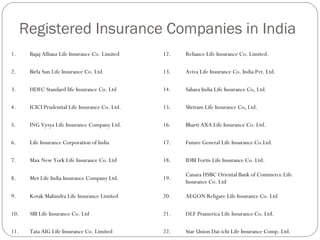
Registered Insurance Companies in India
1. Bajaj Allianz Life Insurance Co. Limited 12. Reliance Life Insurance Co. Limited.
2. Birla Sun Life Insurance Co. Ltd 13. Aviva Life Insurance Co. India Pvt. Ltd.
3. HDFC Standard life Insurance Co. Ltd 14. Sahara India Life Insurance Co, Ltd.
4. ICICI Prudential Life Insurance Co. Ltd. 15. Shriram Life Insurance Co, Ltd.
5. ING Vysya Life Insurance Company Ltd. 16. Bharti AXA Life Insurance Co. Ltd.
6. Life Insurance Corporation of India 17. Future General Life Insurance Co.Ltd.
7. Max New York Life Insurance Co. Ltd 18. IDBI Fortis Life Insurance Co. Ltd.
8. Met Life India Insurance Company Ltd. 19.
Canara HSBC Oriental Bank of Commerce Life
Insurance Co. Ltd
9. Kotak Mahindra Life Insurance Limited 20. AEGON Religare Life Insurance Co. Ltd
10. SBI Life Insurance Co. Ltd 21. DLF Pramerica Life Insurance Co. Ltd.
11. Tata AIG Life Insurance Co. Limited 22. Star Union Dai-ichi Life Insurance Comp. Ltd.
Various Insurance Covered
Life Insurance
Health insurance
Non-life insurance
 Home or House Insurance
 Property insurance
 Auto Insurance
 Infrastructure Projects Insurance
 Travel Insurance
 Real Estate insurance
 Mobile insurance, etc.
• Reinsurance (for insurance companies)
India’s Current Scenario
Most populous country in the world after China.
4th
largest economy based on PPP basis.
Insurance sector in India has gone through no. of phases.
Private companies allowed FDI up to 26%.
Life & General Insurance in India at infancy stage.
Life Insurance : 4.1 % of GDP
General Insurance : 0.6 % of GDP
Continued..
Market size went up to US$ 47.89 billion in 2007 from US$
21.71 billion in 2000.
Between 2000 and 2007, overall premiums sustained an average
growth rate of 11.96 %.
Health insurance sector (both life and general insurance) is
growing currently at 50 per cent.
Expected to grow by 17 % in the current financial year.
Continued..
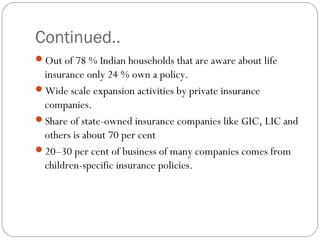
Out of 78 % Indian households that are aware about life
insurance only 24 % own a policy.
Wide scale expansion activities by private insurance
companies.
Share of state-owned insurance companies like GIC, LIC and
others is about 70 per cent
20–30 per cent of business of many companies comes from
children-specific insurance policies.
Major Life Insurance Companies in India
LIC
Largest Institutional Investor in India
Operates in Mauritius, Fiji, the UK, Sri Lanka, Nepal
Assets as on 31.03.2008 : $ 185 billion
No. of policies : 250 million
No. of employees : 1,13,000
No. of agents : 1.2 million
• ICICI Prudential
 Market Share: 9.1 %
Bajaj Allianz
 Market Share: 4.2 %
• Other companies contribute 16 %
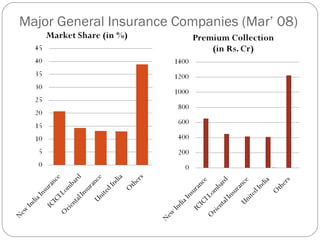
Major General Insurance Companies (Mar’ 08)
Global Scenario
Global insurance premiums grew by 9.7% & reached $4.2
trillion by 2007.
NA is the most important region with premium income of
$1,600 billion in 2007. More than 75 % of popln in USA is
insured.
EU (at $1,198 billion) & Japan (at $492 billion.)
The United States & Japan account for a half of world insurance
premiums.
Emerging markets accounted for over 85% of the world’s
population but generated only 10% of premium.
Major Players in World
India in the international context
The Indian insurance market is the 19th largest globally.
Ranks 5th in Asia, after Japan, South Korea, China and Taiwan.
Total gross premiums collected is under 2.0 % of world
premiums.
In 2003, India had the 11th highest insurance penetration in Asia
and ranked 54th worldwide.
The following chart depicts the current position of
different emerging markets as well as their
expected position by 2013.
Insurance density in Asia 2007 (USD)
Penetration rate of P & C insurance
as a % of GDP in 2007
Major Driving Factors
Globalization
Deregulation which is opening up the markets
Cheaper and more effective distribution channels
Ongoing industry consolidation
Increment in the policy holder firms
Boost in Merger and Acquisitions activities
Changing socio-economic dynamics
Market offering wider margins
Unique combination of size, age profile and growth prospects
Major Issues
Need for diversification in the income streams
Insurance companies create products and go out to find
customers.
Lack of proper agent quality
Risk management concerns in insurance companies
Impact of sub-prime
Regulatory and market obstacles in the emerging markets
Trends and Opportunities
Continuous increment in intra-Asian trade
Drastic increment in marine and cargo insurance sectors
Developments in countries, who are closely regulated by their
government
Global Expansion.
Unit–linked Insurance Plans.
Healthcare Sector.
Rural Market.
Solutions
India needs to further liberalize investment
regulations.
Price structures should reflect product risk.
Provide flexible products suited to the customers
requirements
Application of information technology in insurance sector.
Conclusion
Insurance sector today has become a mainstay of any market
economy since it offers plenty of scope for garnering large
sums of money for long periods of time.
A well-regulated life insurance industry which moves with
the times by offering its customers tailor-made products to
satisfy their financial needs is, therefore, essential if we
desire to progress towards a worry-free future.
Thanks!!!!!!
About us
Federation of Chamber of Commerce is a Non-Profit-Non-Governmental
organization (NGO), Registered with Department of Charity Commissioner.
Our mission is to promote commercial interests and promote the development
of trade, commerce and industry. Federation is a not for profit bilateral
business Chamber which fosters and promotes mutually beneficial relations
between various states and overseas through channels of trade and industry.
The Federation constantly strives to identify new areas of mutual co-operation
and ensure the smooth flow of trade, investment joint ventures and
technology. We endeavor to provide a platform for facilitating business and
networking opportunities between companies, to promote our members’
interests to key decision makers and to help develop economic and
commercial relations between themselves. It provides a dynamic institutional
link for the promotion of commercial and economic relations.
visit us @: www.foccin.org
Contact us @: federationofchamberofcommerce@gmail.com
Be with us in twitter: https://twitter.com/foccin
Join us face to face us in
facebook: http://www.facebook.com/federationofchamberofcommerce

India & insurance

  • 1.
    Present & RelativePosition & Prospects in Global Context of Indian Insurance Sector
  • 2.
    Flow of Presentation Introduction History CurrentScenario Global Scenario India in the international context Relative Position of India Major Driving Force Issues, Trends & Opportunities Solutions
  • 3.
    Introduction An insurance policyprotects the buyer at some cost against financial loss arising from a specified risk. Different situation and different people require different mix of risk – cost combinations Insurance-as a security measure
  • 4.
    Milestones in LifeInsurance Business in India 1818 Oriental Life Insurance Company started by Europeans in Kolkata for European community 1870 Bombay Mutual Life Assurance Society, the first Indian life insurance company started its business. 1912 The Indian Life Assurance Companies Act enacted as the first statute to regulate the life insurance business. 1938 Legislation consolidated and amended by the Insurance Act with the objective of protecting the interests of the insuring public. 1956 245 Indian and foreign insurers and provident societies are taken over by the central government and nationalized. LIC formed by an Act of Parliament
  • 5.
    Milestones in GeneralInsurance Business in India 1907 The Indian Mercantile Insurance Ltd. sets up first company to transact all classes of general insurance business. 1968 The Insurance Act amended to regulate investments and set minimum solvency margins and the Tariff Advisory Committee set up. 1972 The General Insurance Business (Nationalisation) Act, 1972 nationalised the general insurance business in India with effect from 1st January 1973. 1999 107 insurers amalgamated and grouped into four companies viz. •The National Insurance Company Ltd. •The New India Assurance Company Ltd., • The Oriental Insurance Company Ltd •The United India Insurance Company Ltd. GIC incorporated as a company.
  • 6.
    Acts related toInsurance The Insurance Act, 1938 Life Insurance Corporation Act, 1956 General Insurance Business (Nationalization) Act, 1972 Insurance Regulatory and Development Authority (IRDA) Act, 1999
  • 7.
    INSURANCE SECTOR REFORMS Headed byformer Finance Secretary and RBI Governor R.N. Malhotra in year 1993. The objective was to complement the reforms initiated in the financial sector. The reforms were aimed at creating a more efficient and competitive financial system suitable for the requirements of the economy.
  • 8.
    Key Recommendations STRUCTURE Government stakein the Insurance Companies to be brought down to 50%. Government should take over the holdings of GIC and its subsidiaries so that these subsidiaries can act as independent corporations. All the insurance companies should be given greater freedom to operate COMPETETION Private Companies with minimum paid up capital of Rs.1 bn should be allowed to enter the industry. No Company should deal in both Life and General Insurance through a single entry. Foreign Companies may be allowed to enter the industry in collaboration with the domestic companies. Postal Life Insurance should be allowed to operate in the rural market. Only one State Level Life Insurance Company should be allowed to operate in each state.
  • 9.
    Continued….  REGULATORY BODY The Insurance Act should be changed.  An Insurance Regulatory Body should be set up.  Controller of Insurance (Currently a part from the Finance Ministry)should be made independent .  INVESMENTS  Mandatory Investments of LIC Life Fund in government securities to be reduced from 75% to 50%.  GIC and its subsidiaries are not to hold more than 5% in any company (There current holdings to be brought down to this level over a period of time) .  CUSTOMER SERVICE  LIC should pay interest on delays on payments beyond 30 days.  Insurance Companies must be encouraged to set up unit linked pension plans.  Computerisation of operations and updating of technology to be carried out in the insurance industry.
  • 10.
    Registered Insurance Companiesin India 1. Bajaj Allianz Life Insurance Co. Limited 12. Reliance Life Insurance Co. Limited. 2. Birla Sun Life Insurance Co. Ltd 13. Aviva Life Insurance Co. India Pvt. Ltd. 3. HDFC Standard life Insurance Co. Ltd 14. Sahara India Life Insurance Co, Ltd. 4. ICICI Prudential Life Insurance Co. Ltd. 15. Shriram Life Insurance Co, Ltd. 5. ING Vysya Life Insurance Company Ltd. 16. Bharti AXA Life Insurance Co. Ltd. 6. Life Insurance Corporation of India 17. Future General Life Insurance Co.Ltd. 7. Max New York Life Insurance Co. Ltd 18. IDBI Fortis Life Insurance Co. Ltd. 8. Met Life India Insurance Company Ltd. 19. Canara HSBC Oriental Bank of Commerce Life Insurance Co. Ltd 9. Kotak Mahindra Life Insurance Limited 20. AEGON Religare Life Insurance Co. Ltd 10. SBI Life Insurance Co. Ltd 21. DLF Pramerica Life Insurance Co. Ltd. 11. Tata AIG Life Insurance Co. Limited 22. Star Union Dai-ichi Life Insurance Comp. Ltd.
  • 11.
    Various Insurance Covered LifeInsurance Health insurance Non-life insurance  Home or House Insurance  Property insurance  Auto Insurance  Infrastructure Projects Insurance  Travel Insurance  Real Estate insurance  Mobile insurance, etc. • Reinsurance (for insurance companies)
  • 12.
    India’s Current Scenario Mostpopulous country in the world after China. 4th largest economy based on PPP basis. Insurance sector in India has gone through no. of phases. Private companies allowed FDI up to 26%. Life & General Insurance in India at infancy stage. Life Insurance : 4.1 % of GDP General Insurance : 0.6 % of GDP
  • 13.
    Continued.. Market size wentup to US$ 47.89 billion in 2007 from US$ 21.71 billion in 2000. Between 2000 and 2007, overall premiums sustained an average growth rate of 11.96 %. Health insurance sector (both life and general insurance) is growing currently at 50 per cent. Expected to grow by 17 % in the current financial year.
  • 14.
    Continued.. Out of 78% Indian households that are aware about life insurance only 24 % own a policy. Wide scale expansion activities by private insurance companies. Share of state-owned insurance companies like GIC, LIC and others is about 70 per cent 20–30 per cent of business of many companies comes from children-specific insurance policies.
  • 15.
    Major Life InsuranceCompanies in India LIC Largest Institutional Investor in India Operates in Mauritius, Fiji, the UK, Sri Lanka, Nepal Assets as on 31.03.2008 : $ 185 billion No. of policies : 250 million No. of employees : 1,13,000 No. of agents : 1.2 million • ICICI Prudential  Market Share: 9.1 % Bajaj Allianz  Market Share: 4.2 % • Other companies contribute 16 %
  • 16.
    Major General InsuranceCompanies (Mar’ 08)
  • 17.
    Global Scenario Global insurancepremiums grew by 9.7% & reached $4.2 trillion by 2007. NA is the most important region with premium income of $1,600 billion in 2007. More than 75 % of popln in USA is insured. EU (at $1,198 billion) & Japan (at $492 billion.) The United States & Japan account for a half of world insurance premiums. Emerging markets accounted for over 85% of the world’s population but generated only 10% of premium.
  • 18.
  • 20.
    India in theinternational context The Indian insurance market is the 19th largest globally. Ranks 5th in Asia, after Japan, South Korea, China and Taiwan. Total gross premiums collected is under 2.0 % of world premiums. In 2003, India had the 11th highest insurance penetration in Asia and ranked 54th worldwide.
  • 21.
    The following chartdepicts the current position of different emerging markets as well as their expected position by 2013.
  • 22.
    Insurance density inAsia 2007 (USD)
  • 23.
    Penetration rate ofP & C insurance as a % of GDP in 2007
  • 24.
    Major Driving Factors Globalization Deregulationwhich is opening up the markets Cheaper and more effective distribution channels Ongoing industry consolidation Increment in the policy holder firms Boost in Merger and Acquisitions activities Changing socio-economic dynamics Market offering wider margins Unique combination of size, age profile and growth prospects
  • 25.
    Major Issues Need fordiversification in the income streams Insurance companies create products and go out to find customers. Lack of proper agent quality Risk management concerns in insurance companies Impact of sub-prime Regulatory and market obstacles in the emerging markets
  • 26.
    Trends and Opportunities Continuousincrement in intra-Asian trade Drastic increment in marine and cargo insurance sectors Developments in countries, who are closely regulated by their government Global Expansion. Unit–linked Insurance Plans. Healthcare Sector. Rural Market.
  • 27.
    Solutions India needs tofurther liberalize investment regulations. Price structures should reflect product risk. Provide flexible products suited to the customers requirements Application of information technology in insurance sector.
  • 28.
    Conclusion Insurance sector todayhas become a mainstay of any market economy since it offers plenty of scope for garnering large sums of money for long periods of time. A well-regulated life insurance industry which moves with the times by offering its customers tailor-made products to satisfy their financial needs is, therefore, essential if we desire to progress towards a worry-free future.
  • 29.
  • 30.
    About us Federation ofChamber of Commerce is a Non-Profit-Non-Governmental organization (NGO), Registered with Department of Charity Commissioner. Our mission is to promote commercial interests and promote the development of trade, commerce and industry. Federation is a not for profit bilateral business Chamber which fosters and promotes mutually beneficial relations between various states and overseas through channels of trade and industry. The Federation constantly strives to identify new areas of mutual co-operation and ensure the smooth flow of trade, investment joint ventures and technology. We endeavor to provide a platform for facilitating business and networking opportunities between companies, to promote our members’ interests to key decision makers and to help develop economic and commercial relations between themselves. It provides a dynamic institutional link for the promotion of commercial and economic relations. visit us @: www.foccin.org Contact us @: federationofchamberofcommerce@gmail.com Be with us in twitter: https://twitter.com/foccin Join us face to face us in facebook: http://www.facebook.com/federationofchamberofcommerce