Welcome to
     the Presentation on
FDI in Bangladesh: Problems &
          Prospects
Prepared for:
   Dr. Khondoker Bazlul Hoque
            Professor
Department of International Business
        University of Dhaka

          Prepared by:
      MD. Mushfiqur Rahman
              Roll: 05
          BBA 2nd Batch
Department of International Business
       University of Dhaka
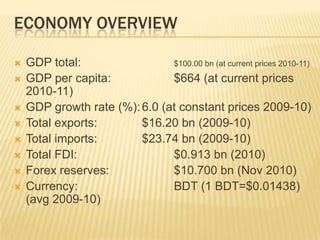
ECONOMY OVERVIEW

   GDP total:                 $100.00 bn (at current prices 2010-11)
   GDP per capita:            $664 (at current prices
    2010-11)
   GDP growth rate (%): 6.0 (at constant prices 2009-10)
   Total exports:       $16.20 bn (2009-10)
   Total imports:       $23.74 bn (2009-10)
   Total FDI:                 $0.913 bn (2010)
   Forex reserves:            $10.700 bn (Nov 2010)
   Currency:                  BDT (1 BDT=$0.01438)
    (avg 2009-10)
GDP AND GNI RELATED DATA OF LAST FIVE
FISCAL YEARS:
GDP data                2006-07         2007-08       2008-09    2009-10    2010-11
                                                                            (p*)
GDP (bn taka)            4,724.77        5,458.22     6,147.95   6,943.20   7875.00

GNI* (bn taka)           5,077.52        5,942.12     6,706.96   7,589.28   8528.22

Per capita GDP             33607           38330       42628      47536     53236
(in taka)

Per capita GNI             36116           41728       46504      51959     57652
(in taka)

Per capita GDP              487             559         620        687      755
(in US$)

Per capita GNI              523             608         676        751      818
(in US$)

 Table 1: GDP & GNI data of last five fiscal years.

 *P=provisional

 GNI=Gross National Income

 [Source: Bangladesh Economic Review-2011 (Bangla version), Ministry of Finance.]
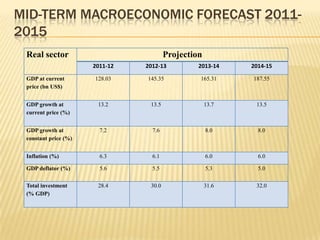
MID-TERM MACROECONOMIC FORECAST 2011-
2015
 Real sector                            Projection
                      2011-12   2012-13          2013-14    2014-15

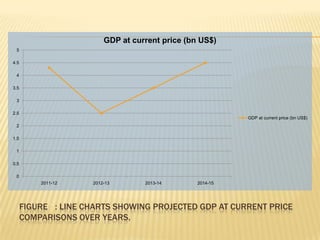
 GDP at current       128.03    145.35           165.31     187.55
 price (bn US$)


 GDP growth at         13.2      13.5                13.7    13.5
 current price (%)


 GDP growth at          7.2       7.6                8.0      8.0
 constant price (%)


 Inflation (%)          6.3       6.1                6.0      6.0

 GDP deflator (%)       5.6       5.5                5.3      5.0

 Total investment      28.4      30.0                31.6    32.0
 (% GDP)
GDP at current price (bn US$)
 5

4.5

 4

3.5

 3

2.5
                                                            GDP at current price (bn US$)
 2

1.5

 1

0.5

 0
          2011-12     2012-13       2013-14       2014-15


      FIGURE 3: LINE CHARTS SHOWING PROJECTED GDP AT CURRENT PRICE
      COMPARISONS OVER YEARS.
35


30


25


20                                                         GDP growth at current price (%)
                                                           GDP growth at constant price (%)
                                                           Inflation (%)
15
                                                           GDP deflator (%)
                                                           Total investment (% GDP)

10


 5


 0
       2011-12      2012-13      2013-14      2014-15


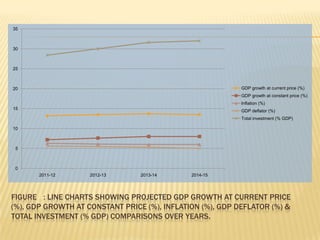
FIGURE 4: LINE CHARTS SHOWING PROJECTED GDP GROWTH AT CURRENT PRICE
(%), GDP GROWTH AT CONSTANT PRICE (%), INFLATION (%), GDP DEFLATOR (%) &
TOTAL INVESTMENT (% GDP) COMPARISONS OVER YEARS.
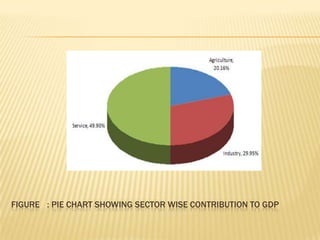
FIGURE 5: PIE CHART SHOWING SECTOR WISE CONTRIBUTION TO GDP
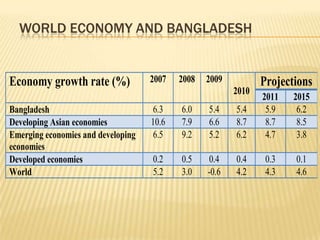
WORLD ECONOMY AND BANGLADESH


Economy growth rate (%)             2007   2008   2009          Projections
                                                         2010
                                                                2011   2015
Bangladesh                          6.3    6.0    5.4    5.4     5.9    6.2
Developing Asian economies          10.6   7.9    6.6    8.7     8.7    8.5
Emerging economies and developing   6.5    9.2    5.2    6.2     4.7    3.8
economies
Developed economies                 0.2    0.5     0.4   0.4     0.3   0.1
World                               5.2    3.0    -0.6   4.2     4.3   4.6
YEAR WISE INVESTMENT
                                           Investment in USD million
    3500


    3000


    2500


    2000


                                                                                                  Investment in USD million
    1500


    1000


     500


       0
           199019911992199319941995199619971998199920002001200220032004200520062007200820092010


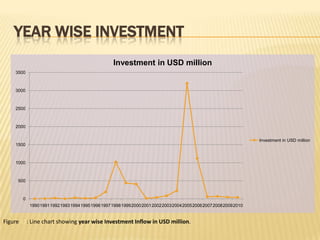
Figure 12: Line chart showing year wise Investment Inflow in USD million.
25000


     20000


     15000


                                                                                        Employment opportunities (person)
     10000


       5000


          0


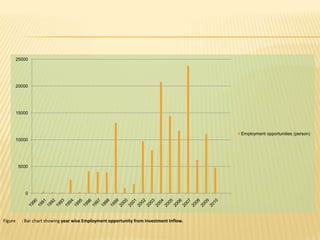
Figure 13: Bar chart showing year wise Employment opportunity from Investment Inflow.
KEY SECTORS:


   Agribusiness
    Ceramics
    Electronics
    Frozen Foods
    Garments and Textiles
    ICT and Business Services
    Leather and Leather Goods
    Life Sciences
    Light Engineering
    Power Industry
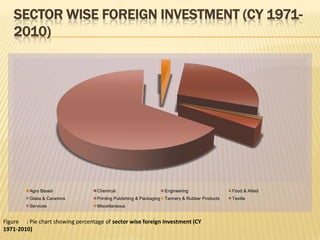
SECTOR WISE FOREIGN INVESTMENT (CY 1971-
    2010)


          Agro Based                Chemical                          Engineering                 Food & Allied
          Glass & Ceramics          Printing Publishing & Packaging   Tannery & Rubber Products   Textile
          Services                  Miscellaneous


Figure 14: Pie chart showing percentage of sector wise foreign Investment (CY
1971-2010)
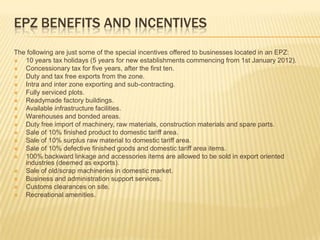
EPZ BENEFITS AND INCENTIVES
The following are just some of the special incentives offered to businesses located in an EPZ:
  10 years tax holidays (5 years for new establishments commencing from 1st January 2012).
  Concessionary tax for five years, after the first ten.
  Duty and tax free exports from the zone.
  Intra and inter zone exporting and sub-contracting.
  Fully serviced plots.
  Readymade factory buildings.
  Available infrastructure facilities.
  Warehouses and bonded areas.
  Duty free import of machinery, raw materials, construction materials and spare parts.
  Sale of 10% finished product to domestic tariff area.
  Sale of 10% surplus raw material to domestic tariff area.
  Sale of 10% defective finished goods and domestic tariff area items.
  100% backward linkage and accessories items are allowed to be sold in export oriented
   industries (deemed as exports).
  Sale of old/scrap machineries in domestic market.
  Business and administration support services.
  Customs clearances on site.
  Recreational amenities.
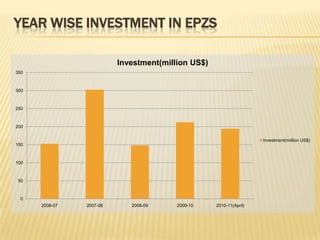
YEAR WISE INVESTMENT IN EPZS

                          Investment(million US$)
350


300


250


200


                                                                     Investment(million US$)
150


100


 50


  0
      2006-07   2007-08      2008-09     2009-10    2010-11(April)
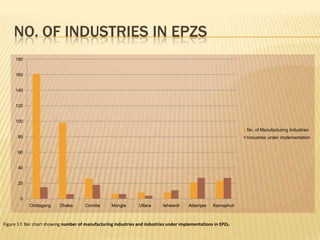
NO. OF INDUSTRIES IN EPZS
     180


     160


     140


     120


     100
                                                                                                                  No. of Manufacturing Industries
       80                                                                                                         Industries under implementation


       60


       40


       20


        0
            Chittagong     Dhaka       Comilla      Mongla       Uttara     Ishwardi     Adamjee     Karnaphuli


Figure 17: Bar chart showing number of manufacturing industries and industries under implementations in EPZs.
SOME IMPORTANT INDICES FOR ATTRACTING
FDI :

 Doing Business Report Indices
 Human Development Report Indices

 Global Competitiveness Report Indices
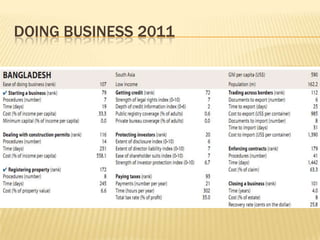
DOING BUSINESS 2011
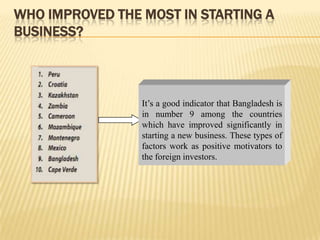
WHO IMPROVED THE MOST IN STARTING A
BUSINESS?


                 It’s a good indicator that Bangladesh is
                 in number 9 among the countries
                 which have improved significantly in
                 starting a new business. These types of
                 factors work as positive motivators to
                 the foreign investors.
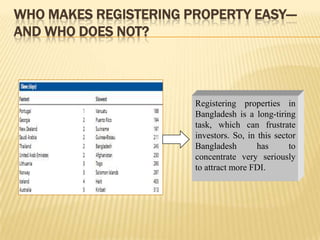
WHO MAKES REGISTERING PROPERTY EASY—
AND WHO DOES NOT?


                       Registering properties in
                       Bangladesh is a long-tiring
                       task, which can frustrate
                       investors. So, in this sector
                       Bangladesh        has      to
                       concentrate very seriously
                       to attract more FDI.
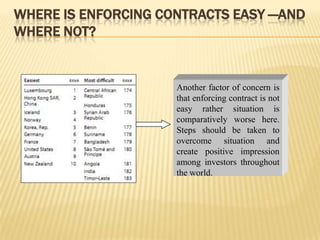
WHERE IS ENFORCING CONTRACTS EASY —AND
WHERE NOT?


                     Another factor of concern is
                     that enforcing contract is not
                     easy rather situation is
                     comparatively worse here.
                     Steps should be taken to
                     overcome situation and
                     create positive impression
                     among investors throughout
                     the world.
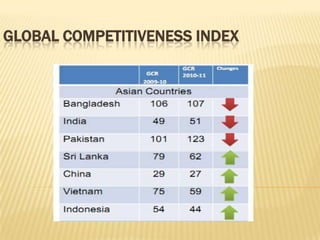
GLOBAL COMPETITIVENESS INDEX
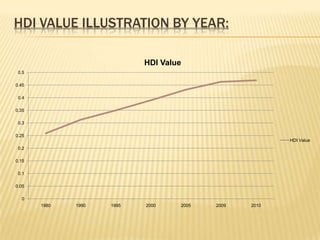
HDI VALUE ILLUSTRATION BY YEAR:

                            HDI Value
 0.5

0.45

 0.4

0.35

 0.3

0.25
                                                         HDI Value
 0.2

0.15

 0.1

0.05

  0
       1980   1990   1995   2000    2005   2009   2010
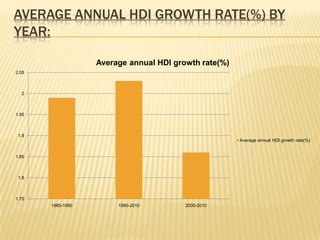
AVERAGE ANNUAL HDI GROWTH RATE(%) BY
YEAR:

                   Average annual HDI growth rate(%)
2.05


  2


1.95


 1.9
                                                       Average annual HDI growth rate(%)


1.85


 1.8


1.75
       1980-1990        1990-2010        2000-2010
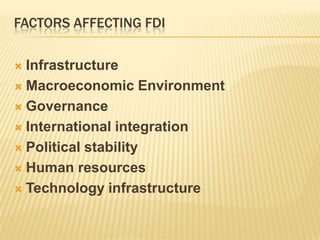
FACTORS AFFECTING FDI

 Infrastructure
 Macroeconomic Environment

 Governance

 International integration

 Political stability

 Human resources

 Technology infrastructure
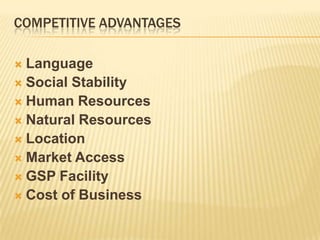
COMPETITIVE ADVANTAGES

 Language
 Social Stability
 Human Resources
 Natural Resources
 Location
 Market Access
 GSP Facility
 Cost of Business
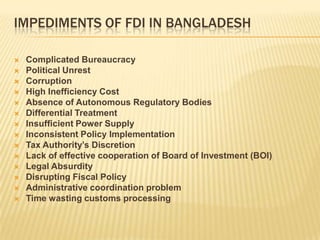
IMPEDIMENTS OF FDI IN BANGLADESH

   Complicated Bureaucracy
   Political Unrest
   Corruption
   High Inefficiency Cost
   Absence of Autonomous Regulatory Bodies
   Differential Treatment
   Insufficient Power Supply
   Inconsistent Policy Implementation
   Tax Authority’s Discretion
   Lack of effective cooperation of Board of Investment (BOI)
   Legal Absurdity
   Disrupting Fiscal Policy
   Administrative coordination problem
   Time wasting customs processing
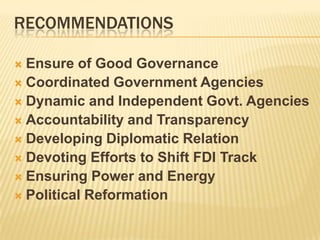
RECOMMENDATIONS

 Ensure of Good Governance
 Coordinated Government Agencies
 Dynamic and Independent Govt. Agencies
 Accountability and Transparency
 Developing Diplomatic Relation
 Devoting Efforts to Shift FDI Track
 Ensuring Power and Energy
 Political Reformation
THANK YOU

Fdi in bangladesh problems & prospects

  • 1.
    Welcome to the Presentation on FDI in Bangladesh: Problems & Prospects
  • 2.
    Prepared for: Dr. Khondoker Bazlul Hoque Professor Department of International Business University of Dhaka Prepared by: MD. Mushfiqur Rahman Roll: 05 BBA 2nd Batch Department of International Business University of Dhaka
  • 3.
    ECONOMY OVERVIEW  GDP total: $100.00 bn (at current prices 2010-11)  GDP per capita: $664 (at current prices 2010-11)  GDP growth rate (%): 6.0 (at constant prices 2009-10)  Total exports: $16.20 bn (2009-10)  Total imports: $23.74 bn (2009-10)  Total FDI: $0.913 bn (2010)  Forex reserves: $10.700 bn (Nov 2010)  Currency: BDT (1 BDT=$0.01438) (avg 2009-10)
  • 4.
    GDP AND GNIRELATED DATA OF LAST FIVE FISCAL YEARS: GDP data 2006-07 2007-08 2008-09 2009-10 2010-11 (p*) GDP (bn taka) 4,724.77 5,458.22 6,147.95 6,943.20 7875.00 GNI* (bn taka) 5,077.52 5,942.12 6,706.96 7,589.28 8528.22 Per capita GDP 33607 38330 42628 47536 53236 (in taka) Per capita GNI 36116 41728 46504 51959 57652 (in taka) Per capita GDP 487 559 620 687 755 (in US$) Per capita GNI 523 608 676 751 818 (in US$) Table 1: GDP & GNI data of last five fiscal years. *P=provisional GNI=Gross National Income [Source: Bangladesh Economic Review-2011 (Bangla version), Ministry of Finance.]
  • 5.
    MID-TERM MACROECONOMIC FORECAST2011- 2015 Real sector Projection 2011-12 2012-13 2013-14 2014-15 GDP at current 128.03 145.35 165.31 187.55 price (bn US$) GDP growth at 13.2 13.5 13.7 13.5 current price (%) GDP growth at 7.2 7.6 8.0 8.0 constant price (%) Inflation (%) 6.3 6.1 6.0 6.0 GDP deflator (%) 5.6 5.5 5.3 5.0 Total investment 28.4 30.0 31.6 32.0 (% GDP)
  • 6.
    GDP at currentprice (bn US$) 5 4.5 4 3.5 3 2.5 GDP at current price (bn US$) 2 1.5 1 0.5 0 2011-12 2012-13 2013-14 2014-15 FIGURE 3: LINE CHARTS SHOWING PROJECTED GDP AT CURRENT PRICE COMPARISONS OVER YEARS.
  • 7.
    35 30 25 20 GDP growth at current price (%) GDP growth at constant price (%) Inflation (%) 15 GDP deflator (%) Total investment (% GDP) 10 5 0 2011-12 2012-13 2013-14 2014-15 FIGURE 4: LINE CHARTS SHOWING PROJECTED GDP GROWTH AT CURRENT PRICE (%), GDP GROWTH AT CONSTANT PRICE (%), INFLATION (%), GDP DEFLATOR (%) & TOTAL INVESTMENT (% GDP) COMPARISONS OVER YEARS.
  • 8.
    FIGURE 5: PIECHART SHOWING SECTOR WISE CONTRIBUTION TO GDP
  • 9.
    WORLD ECONOMY ANDBANGLADESH Economy growth rate (%) 2007 2008 2009 Projections 2010 2011 2015 Bangladesh 6.3 6.0 5.4 5.4 5.9 6.2 Developing Asian economies 10.6 7.9 6.6 8.7 8.7 8.5 Emerging economies and developing 6.5 9.2 5.2 6.2 4.7 3.8 economies Developed economies 0.2 0.5 0.4 0.4 0.3 0.1 World 5.2 3.0 -0.6 4.2 4.3 4.6
  • 10.
    YEAR WISE INVESTMENT Investment in USD million 3500 3000 2500 2000 Investment in USD million 1500 1000 500 0 199019911992199319941995199619971998199920002001200220032004200520062007200820092010 Figure 12: Line chart showing year wise Investment Inflow in USD million.
  • 11.
    25000 20000 15000 Employment opportunities (person) 10000 5000 0 Figure 13: Bar chart showing year wise Employment opportunity from Investment Inflow.
  • 12.
    KEY SECTORS:  Agribusiness Ceramics Electronics Frozen Foods Garments and Textiles ICT and Business Services Leather and Leather Goods Life Sciences Light Engineering Power Industry
  • 13.
    SECTOR WISE FOREIGNINVESTMENT (CY 1971- 2010) Agro Based Chemical Engineering Food & Allied Glass & Ceramics Printing Publishing & Packaging Tannery & Rubber Products Textile Services Miscellaneous Figure 14: Pie chart showing percentage of sector wise foreign Investment (CY 1971-2010)
  • 14.
    EPZ BENEFITS ANDINCENTIVES The following are just some of the special incentives offered to businesses located in an EPZ:  10 years tax holidays (5 years for new establishments commencing from 1st January 2012).  Concessionary tax for five years, after the first ten.  Duty and tax free exports from the zone.  Intra and inter zone exporting and sub-contracting.  Fully serviced plots.  Readymade factory buildings.  Available infrastructure facilities.  Warehouses and bonded areas.  Duty free import of machinery, raw materials, construction materials and spare parts.  Sale of 10% finished product to domestic tariff area.  Sale of 10% surplus raw material to domestic tariff area.  Sale of 10% defective finished goods and domestic tariff area items.  100% backward linkage and accessories items are allowed to be sold in export oriented industries (deemed as exports).  Sale of old/scrap machineries in domestic market.  Business and administration support services.  Customs clearances on site.  Recreational amenities.
  • 15.
    YEAR WISE INVESTMENTIN EPZS Investment(million US$) 350 300 250 200 Investment(million US$) 150 100 50 0 2006-07 2007-08 2008-09 2009-10 2010-11(April)
  • 16.
    NO. OF INDUSTRIESIN EPZS 180 160 140 120 100 No. of Manufacturing Industries 80 Industries under implementation 60 40 20 0 Chittagong Dhaka Comilla Mongla Uttara Ishwardi Adamjee Karnaphuli Figure 17: Bar chart showing number of manufacturing industries and industries under implementations in EPZs.
  • 17.
    SOME IMPORTANT INDICESFOR ATTRACTING FDI :  Doing Business Report Indices  Human Development Report Indices  Global Competitiveness Report Indices
  • 18.
  • 19.
    WHO IMPROVED THEMOST IN STARTING A BUSINESS? It’s a good indicator that Bangladesh is in number 9 among the countries which have improved significantly in starting a new business. These types of factors work as positive motivators to the foreign investors.
  • 20.
    WHO MAKES REGISTERINGPROPERTY EASY— AND WHO DOES NOT? Registering properties in Bangladesh is a long-tiring task, which can frustrate investors. So, in this sector Bangladesh has to concentrate very seriously to attract more FDI.
  • 21.
    WHERE IS ENFORCINGCONTRACTS EASY —AND WHERE NOT? Another factor of concern is that enforcing contract is not easy rather situation is comparatively worse here. Steps should be taken to overcome situation and create positive impression among investors throughout the world.
  • 22.
  • 23.
    HDI VALUE ILLUSTRATIONBY YEAR: HDI Value 0.5 0.45 0.4 0.35 0.3 0.25 HDI Value 0.2 0.15 0.1 0.05 0 1980 1990 1995 2000 2005 2009 2010
  • 24.
    AVERAGE ANNUAL HDIGROWTH RATE(%) BY YEAR: Average annual HDI growth rate(%) 2.05 2 1.95 1.9 Average annual HDI growth rate(%) 1.85 1.8 1.75 1980-1990 1990-2010 2000-2010
  • 25.
    FACTORS AFFECTING FDI Infrastructure  Macroeconomic Environment  Governance  International integration  Political stability  Human resources  Technology infrastructure
  • 26.
    COMPETITIVE ADVANTAGES  Language Social Stability  Human Resources  Natural Resources  Location  Market Access  GSP Facility  Cost of Business
  • 27.
    IMPEDIMENTS OF FDIIN BANGLADESH  Complicated Bureaucracy  Political Unrest  Corruption  High Inefficiency Cost  Absence of Autonomous Regulatory Bodies  Differential Treatment  Insufficient Power Supply  Inconsistent Policy Implementation  Tax Authority’s Discretion  Lack of effective cooperation of Board of Investment (BOI)  Legal Absurdity  Disrupting Fiscal Policy  Administrative coordination problem  Time wasting customs processing
  • 28.
    RECOMMENDATIONS  Ensure ofGood Governance  Coordinated Government Agencies  Dynamic and Independent Govt. Agencies  Accountability and Transparency  Developing Diplomatic Relation  Devoting Efforts to Shift FDI Track  Ensuring Power and Energy  Political Reformation
  • 29.