India | Investment Patterns


               Abhishek Anand | Kunal Ahuja
Group 7         Amit Mirchandani | Nihit Jain
              Vaibhav Kukreja | Vaibhav Sathe
Agenda
 Problem statement
 Investment – definition & role
 India – Trends & Policies
 India – Lesson from China
 India - Recommendations
Problem Statement
 To analyze various forms of investment
 across two dimensions- trends and
 governing policies and suggest ways to
 improve FDI in India
Investment |
Definition & Role
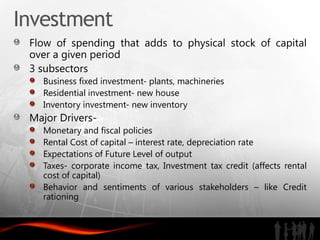
Investment
 Flow of spending that adds to physical stock of capital
 over a given period
 3 subsectors
   Business fixed investment- plants, machineries
   Residential investment- new house
   Inventory investment- new inventory
 Major Drivers-
   Monetary and fiscal policies
   Rental Cost of capital – interest rate, depreciation rate
   Expectations of Future Level of output
   Taxes- corporate income tax, Investment tax credit (affects rental
   cost of capital)
   Behavior and sentiments of various stakeholders – like Credit
   rationing
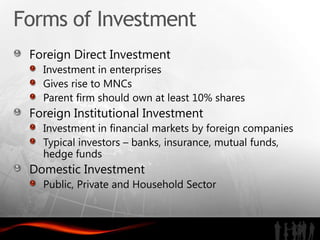
Forms of Investment
 Foreign Direct Investment
   Investment in enterprises
   Gives rise to MNCs
   Parent firm should own at least 10% shares
 Foreign Institutional Investment
   Investment in financial markets by foreign companies
   Typical investors – banks, insurance, mutual funds,
   hedge funds
 Domestic Investment
   Public, Private and Household Sector
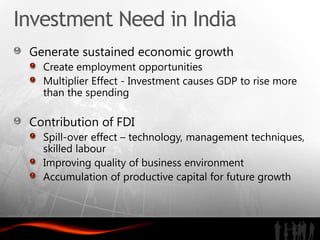
Investment Need in India
 Generate sustained economic growth
   Create employment opportunities
   Multiplier Effect - Investment causes GDP to rise more
   than the spending

 Contribution of FDI
   Spill-over effect – technology, management techniques,
   skilled labour
   Improving quality of business environment
   Accumulation of productive capital for future growth
India |
Trends & Policies
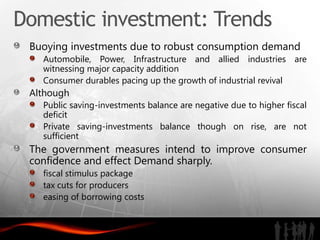
Domestic investment: Trends
 Buoying investments due to robust consumption demand
   Automobile, Power, Infrastructure and allied industries are
   witnessing major capacity addition
   Consumer durables pacing up the growth of industrial revival
 Although
   Public saving-investments balance are negative due to higher fiscal
   deficit
   Private saving-investments balance though on rise, are not
   sufficient
 The government measures intend to improve consumer
 confidence and effect Demand sharply.
   fiscal stimulus package
   tax cuts for producers
   easing of borrowing costs
Domestic Investment: Policies
 Budgetary Policy measures              in   small    and    medium
 enterprises (MSME):
    Enhancing allocation by US$ 535.8 million
    Increasing the limit for presumptive taxation
    Raising the threshold for compulsory auditing
    Extension of interest subvention for exports in certain sectors
    Exemption from capital gains tax to facilitate conversion of small
    businesses to limited liability partnership (LLP) format
  Other Policy Initiative
    Govt. approved six proposals for setting up of SEZs, tax-free zones,
    Food Parks, IT/ITeS tax-free zone
    State Investment Promotion Board (SIPB) of states like AP has
    approved fast tracked industries aiming to generate jobs
    SIPB has also announced to give nearly 50 per cent VAT/CST or
    SGST reimbursement for the next 5 years
FDI: Policies
 Prior to 1991, highly regulated environment

 Post liberalization, deregulated regime

 FERA amended and consolidated to FEMA

 FEMA: less stringent and investor friendly

 Consolidated FDI Policy 2010 - FDI permitted in almost all
 sectors
FDI: Policies
 Three primary institutions in India that handle FDI-related
 issues

 Foreign Investment Promotion Board (FIPB), the Secretariat
 for Industrial Assistance (SIA), and Foreign Investment
 Implementation Authority (FIIA)

 Two other institutions-Investment Commission and India
 Brand Equity Foundation also work for the same
FDI: Trends
 Grew steadily through first half of 1990s

 Stagnated between 1996-97 and 2003-04 (3-5%)

 Grew at a rapid rate from 2004-05 to 2007-08 (7-9%)
    Reasons were liberal policies and growing domestic market of India

 Global recession slowed down FDI inflow growth in 2008-09

 Following economic recovery, FDI inflows of $30.25 billion
 in 2009-10

 Brown field investment more than green field
FDI: Trends
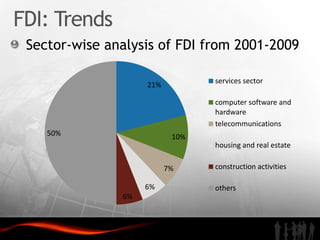
 Sector-wise analysis of FDI from 2001-2009

                                 services sector
                    21%

                                 computer software and
                                 hardware
                                 telecommunications
    50%                    10%
                                 housing and real estate

                          7%     construction activities

                    6%           others
               6%
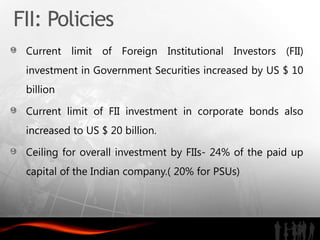
FII: Policies
 Current limit of Foreign Institutional Investors (FII)
 investment in Government Securities increased by US $ 10
 billion

 Current limit of FII investment in corporate bonds also
 increased to US $ 20 billion.

 Ceiling for overall investment by FIIs- 24% of the paid up
 capital of the Indian company.( 20% for PSUs)
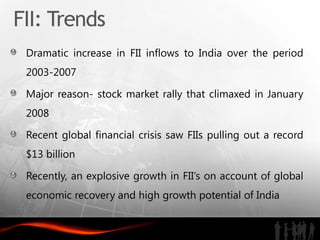
FII: Trends
 Dramatic increase in FII inflows to India over the period
 2003-2007

 Major reason- stock market rally that climaxed in January
 2008

 Recent global financial crisis saw FIIs pulling out a record
 $13 billion

 Recently, an explosive growth in FII’s on account of global
 economic recovery and high growth potential of India
India |
Lesson from China
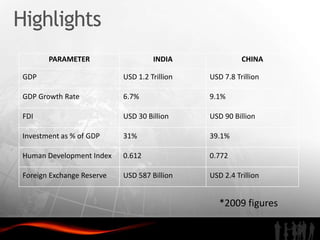
Highlights
        PARAMETER                    INDIA               CHINA

 GDP                        USD 1.2 Trillion   USD 7.8 Trillion

 GDP Growth Rate            6.7%               9.1%

 FDI                        USD 30 Billion     USD 90 Billion

 Investment as % of GDP     31%                39.1%

 Human Development Index    0.612              0.772

 Foreign Exchange Reserve   USD 587 Billion    USD 2.4 Trillion


                                                  *2009 figures
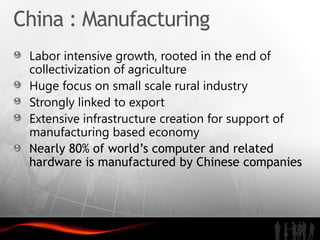
China : Manufacturing
 Labor intensive growth, rooted in the end of
 collectivization of agriculture
 Huge focus on small scale rural industry
 Strongly linked to export
 Extensive infrastructure creation for support of
 manufacturing based economy
 Nearly 80% of world’s computer and related
 hardware is manufactured by Chinese companies
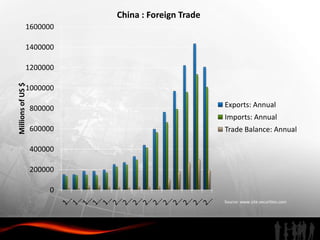
China : Foreign Trade
              1600000

              1400000

              1200000
Millions of US $


              1000000

                   800000                           Exports: Annual
                                                    Imports: Annual
                   600000                           Trade Balance: Annual

                   400000

                   200000

                        0
                                                    Source: www.site.securities.com
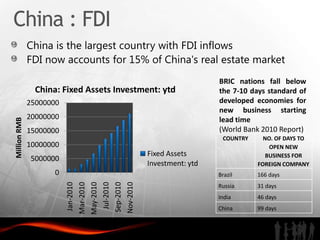
China : FDI
              China is the largest country with FDI inflows
              FDI now accounts for 15% of China's real estate market
                                                                                                             BRIC nations fall below
                China: Fixed Assets Investment: ytd                                                          the 7-10 days standard of
              25000000                                                                                       developed economies for
                                                                                                             new business starting
              20000000                                                                                       lead time
Million RMB


              15000000                                                                                       (World Bank 2010 Report)
                                                                                                              COUNTRY     NO. OF DAYS TO
              10000000                                                                                                      OPEN NEW
                                                                                           Fixed Assets                    BUSINESS FOR
              5000000
                                                                                           Investment: ytd              FOREIGN COMPANY
                     0                                                                                       Brazil     166 days
                         Jan-2010


                                                                     Sep-2010
                                                          Jul-2010


                                                                                Nov-2010
                                               May-2010
                                    Mar-2010


                                                                                                             Russia     31 days
                                                                                                             India      46 days
                                                                                                             China      99 days
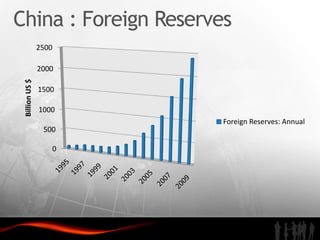
China : Foreign Reserves
                2500

                2000
 Billion US $


                1500

                1000
                       Foreign Reserves: Annual
                 500

                   0
Regional Disparity
 India –
    State government policies – stability, SEZ impact

    Maharashtra, Gujarat, Karnataka and Andhra Pradesh attracting more

    U.P./Bihar less – Per capita income 50% below national average

 China
    Similar problem existed in Western China which was addressed by China
    Western Development Program

    Govt.      initiated     massive       infrastructure    investment    in
    agriculture, technology, health and education

    Xinjiang GDP increased from 220 Billion RMB in 2004 to 430 Billion RMB in
    2009
Why India lags in FDI
 Poor state of India’s infrastructure

 Many towns and villages face daily blackouts averaging 8
 hours a day

 Ports and airports lag when compared to world-class ports
 or airports

 Road network insufficient in India

 Acute labour market rigidities

 Lack of sufficient number of skilled labor
India |
Recommendations
Recommendations
 Uniform SEZ development
   Establishment of SEZs in strategic locations
 Quality of FDI Inflows
   A large portion of the new inflows in the form of M&As.
   Does not necessarily imply new capital infusion
   Maximize spill-over benefits from FDI on a sustained
   basis
 Investment promotion strategy
   Effectiveness of Foreign Investment Implementation
   Authority (FIIA) to be enhanced
Recommendations
 Image branding for manufacturing
   Need to get rid of the tag that India can only do
   services and not manufacturing
   Government can play a significant role
 Workforce Quality Development
   Necessary to monitor the quality of students and of
   teachers in educational institutions
 Coordination between Union and States
 Efficient Financial Markets
   Development of a deep and liquid corporate debt
   market
Recommendations
 Intellectual Property
   Attracting greater FDI into R&D strengthens India’s
   technological prowess and competitiveness
   Inadequate safeguards for protection of IPRs cause a
   diversion of investment from technology intensive
   industries
   Hence, needs for strengthening intellectual property
   rights or IPRs
Thanks |
Any Questions?

Investment Patterns in India

  • 1.
    India | InvestmentPatterns Abhishek Anand | Kunal Ahuja Group 7 Amit Mirchandani | Nihit Jain Vaibhav Kukreja | Vaibhav Sathe
  • 2.
    Agenda Problem statement Investment – definition & role India – Trends & Policies India – Lesson from China India - Recommendations
  • 3.
    Problem Statement Toanalyze various forms of investment across two dimensions- trends and governing policies and suggest ways to improve FDI in India
  • 4.
  • 5.
    Investment Flow ofspending that adds to physical stock of capital over a given period 3 subsectors Business fixed investment- plants, machineries Residential investment- new house Inventory investment- new inventory Major Drivers- Monetary and fiscal policies Rental Cost of capital – interest rate, depreciation rate Expectations of Future Level of output Taxes- corporate income tax, Investment tax credit (affects rental cost of capital) Behavior and sentiments of various stakeholders – like Credit rationing
  • 6.
    Forms of Investment Foreign Direct Investment Investment in enterprises Gives rise to MNCs Parent firm should own at least 10% shares Foreign Institutional Investment Investment in financial markets by foreign companies Typical investors – banks, insurance, mutual funds, hedge funds Domestic Investment Public, Private and Household Sector
  • 7.
    Investment Need inIndia Generate sustained economic growth Create employment opportunities Multiplier Effect - Investment causes GDP to rise more than the spending Contribution of FDI Spill-over effect – technology, management techniques, skilled labour Improving quality of business environment Accumulation of productive capital for future growth
  • 8.
  • 9.
    Domestic investment: Trends Buoying investments due to robust consumption demand Automobile, Power, Infrastructure and allied industries are witnessing major capacity addition Consumer durables pacing up the growth of industrial revival Although Public saving-investments balance are negative due to higher fiscal deficit Private saving-investments balance though on rise, are not sufficient The government measures intend to improve consumer confidence and effect Demand sharply. fiscal stimulus package tax cuts for producers easing of borrowing costs
  • 10.
    Domestic Investment: Policies Budgetary Policy measures in small and medium enterprises (MSME): Enhancing allocation by US$ 535.8 million Increasing the limit for presumptive taxation Raising the threshold for compulsory auditing Extension of interest subvention for exports in certain sectors Exemption from capital gains tax to facilitate conversion of small businesses to limited liability partnership (LLP) format Other Policy Initiative Govt. approved six proposals for setting up of SEZs, tax-free zones, Food Parks, IT/ITeS tax-free zone State Investment Promotion Board (SIPB) of states like AP has approved fast tracked industries aiming to generate jobs SIPB has also announced to give nearly 50 per cent VAT/CST or SGST reimbursement for the next 5 years
  • 11.
    FDI: Policies Priorto 1991, highly regulated environment Post liberalization, deregulated regime FERA amended and consolidated to FEMA FEMA: less stringent and investor friendly Consolidated FDI Policy 2010 - FDI permitted in almost all sectors
  • 12.
    FDI: Policies Threeprimary institutions in India that handle FDI-related issues Foreign Investment Promotion Board (FIPB), the Secretariat for Industrial Assistance (SIA), and Foreign Investment Implementation Authority (FIIA) Two other institutions-Investment Commission and India Brand Equity Foundation also work for the same
  • 13.
    FDI: Trends Grewsteadily through first half of 1990s Stagnated between 1996-97 and 2003-04 (3-5%) Grew at a rapid rate from 2004-05 to 2007-08 (7-9%) Reasons were liberal policies and growing domestic market of India Global recession slowed down FDI inflow growth in 2008-09 Following economic recovery, FDI inflows of $30.25 billion in 2009-10 Brown field investment more than green field
  • 14.
    FDI: Trends Sector-wiseanalysis of FDI from 2001-2009 services sector 21% computer software and hardware telecommunications 50% 10% housing and real estate 7% construction activities 6% others 6%
  • 15.
    FII: Policies Currentlimit of Foreign Institutional Investors (FII) investment in Government Securities increased by US $ 10 billion Current limit of FII investment in corporate bonds also increased to US $ 20 billion. Ceiling for overall investment by FIIs- 24% of the paid up capital of the Indian company.( 20% for PSUs)
  • 16.
    FII: Trends Dramaticincrease in FII inflows to India over the period 2003-2007 Major reason- stock market rally that climaxed in January 2008 Recent global financial crisis saw FIIs pulling out a record $13 billion Recently, an explosive growth in FII’s on account of global economic recovery and high growth potential of India
  • 17.
  • 18.
    Highlights PARAMETER INDIA CHINA GDP USD 1.2 Trillion USD 7.8 Trillion GDP Growth Rate 6.7% 9.1% FDI USD 30 Billion USD 90 Billion Investment as % of GDP 31% 39.1% Human Development Index 0.612 0.772 Foreign Exchange Reserve USD 587 Billion USD 2.4 Trillion *2009 figures
  • 19.
    China : Manufacturing Labor intensive growth, rooted in the end of collectivization of agriculture Huge focus on small scale rural industry Strongly linked to export Extensive infrastructure creation for support of manufacturing based economy Nearly 80% of world’s computer and related hardware is manufactured by Chinese companies
  • 20.
    China : ForeignTrade 1600000 1400000 1200000 Millions of US $ 1000000 800000 Exports: Annual Imports: Annual 600000 Trade Balance: Annual 400000 200000 0 Source: www.site.securities.com
  • 21.
    China : FDI China is the largest country with FDI inflows FDI now accounts for 15% of China's real estate market BRIC nations fall below China: Fixed Assets Investment: ytd the 7-10 days standard of 25000000 developed economies for new business starting 20000000 lead time Million RMB 15000000 (World Bank 2010 Report) COUNTRY NO. OF DAYS TO 10000000 OPEN NEW Fixed Assets BUSINESS FOR 5000000 Investment: ytd FOREIGN COMPANY 0 Brazil 166 days Jan-2010 Sep-2010 Jul-2010 Nov-2010 May-2010 Mar-2010 Russia 31 days India 46 days China 99 days
  • 22.
    China : ForeignReserves 2500 2000 Billion US $ 1500 1000 Foreign Reserves: Annual 500 0
  • 23.
    Regional Disparity India– State government policies – stability, SEZ impact Maharashtra, Gujarat, Karnataka and Andhra Pradesh attracting more U.P./Bihar less – Per capita income 50% below national average China Similar problem existed in Western China which was addressed by China Western Development Program Govt. initiated massive infrastructure investment in agriculture, technology, health and education Xinjiang GDP increased from 220 Billion RMB in 2004 to 430 Billion RMB in 2009
  • 24.
    Why India lagsin FDI Poor state of India’s infrastructure Many towns and villages face daily blackouts averaging 8 hours a day Ports and airports lag when compared to world-class ports or airports Road network insufficient in India Acute labour market rigidities Lack of sufficient number of skilled labor
  • 25.
  • 26.
    Recommendations Uniform SEZdevelopment Establishment of SEZs in strategic locations Quality of FDI Inflows A large portion of the new inflows in the form of M&As. Does not necessarily imply new capital infusion Maximize spill-over benefits from FDI on a sustained basis Investment promotion strategy Effectiveness of Foreign Investment Implementation Authority (FIIA) to be enhanced
  • 27.
    Recommendations Image brandingfor manufacturing Need to get rid of the tag that India can only do services and not manufacturing Government can play a significant role Workforce Quality Development Necessary to monitor the quality of students and of teachers in educational institutions Coordination between Union and States Efficient Financial Markets Development of a deep and liquid corporate debt market
  • 28.
    Recommendations Intellectual Property Attracting greater FDI into R&D strengthens India’s technological prowess and competitiveness Inadequate safeguards for protection of IPRs cause a diversion of investment from technology intensive industries Hence, needs for strengthening intellectual property rights or IPRs
  • 29.

Editor's Notes

  • #8 Presence of FDI from powerful countries increasing stability and thereby improving the quality of the business environment
  • #10 This is an example of what a content slide would look like. It also gives sample fill colors for graphics that coordinate with the template colors and displays the designated hyperlink color.
  • #11 This is an example of what a content slide would look like. It also gives sample fill colors for graphics that coordinate with the template colors and displays the designated hyperlink color.
  • #12 This is an example of what a content slide would look like. It also gives sample fill colors for graphics that coordinate with the template colors and displays the designated hyperlink color.
  • #13 This is an example of what a content slide would look like. It also gives sample fill colors for graphics that coordinate with the template colors and displays the designated hyperlink color.
  • #14 This is an example of what a content slide would look like. It also gives sample fill colors for graphics that coordinate with the template colors and displays the designated hyperlink color.
  • #15 This is an example of what a content slide would look like. It also gives sample fill colors for graphics that coordinate with the template colors and displays the designated hyperlink color.
  • #16 This is an example of what a content slide would look like. It also gives sample fill colors for graphics that coordinate with the template colors and displays the designated hyperlink color.
  • #19 This is an example of what a content slide would look like. It also gives sample fill colors for graphics that coordinate with the template colors and displays the designated hyperlink color.
  • #20 This is an example of what a content slide would look like. It also gives sample fill colors for graphics that coordinate with the template colors and displays the designated hyperlink color.
  • #25 This is an example of what a content slide would look like. It also gives sample fill colors for graphics that coordinate with the template colors and displays the designated hyperlink color.
  • #27 This is an example of what a content slide would look like. It also gives sample fill colors for graphics that coordinate with the template colors and displays the designated hyperlink color.
  • #28 This is an example of what a content slide would look like. It also gives sample fill colors for graphics that coordinate with the template colors and displays the designated hyperlink color.
  • #29 This is an example of what a content slide would look like. It also gives sample fill colors for graphics that coordinate with the template colors and displays the designated hyperlink color.