
FDI in India and its
  Determinants
     Group V , FMS PT
FDI


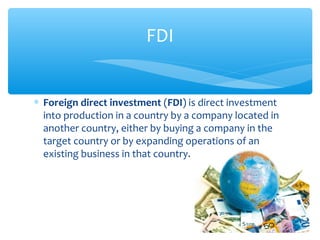
∗ Foreign direct investment (FDI) is direct investment
  into production in a country by a company located in
  another country, either by buying a company in the
  target country or by expanding operations of an
  existing business in that country.
FDI
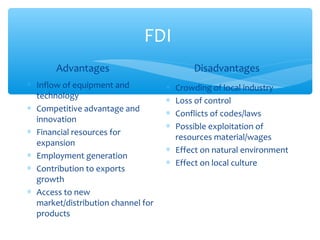
       Advantages                          Disadvantages
∗ Inflow of equipment and           ∗ Crowding of local industry
  technology
                                    ∗ Loss of control
∗ Competitive advantage and
                                    ∗ Conflicts of codes/laws
  innovation
                                    ∗ Possible exploitation of
∗ Financial resources for
                                      resources material/wages
  expansion
                                    ∗ Effect on natural environment
∗ Employment generation
                                    ∗ Effect on local culture
∗ Contribution to exports
  growth
∗ Access to new
  market/distribution channel for
  products
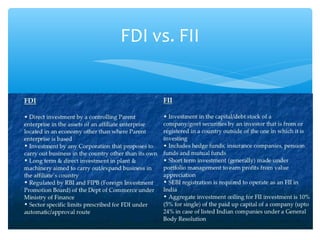
FDI vs. FII


FDI                 FII
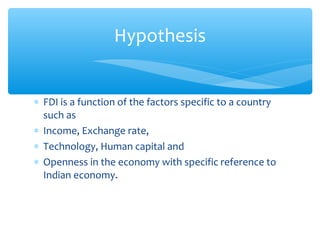
Hypothesis


∗ FDI is a function of the factors specific to a country
  such as
∗ Income, Exchange rate,
∗ Technology, Human capital and
∗ Openness in the economy with specific reference to
  Indian economy.
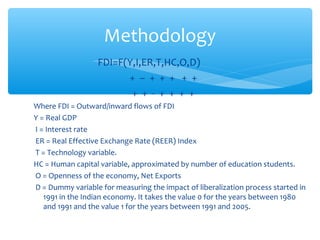
Methodology
                  FDI=F(Y,I,ER,T,HC,O,D)
                        + – + + + + +
                         + + - + + + +
Where FDI = Outward/inward flows of FDI
Y = Real GDP
I = Interest rate
ER = Real Effective Exchange Rate (REER) Index
T = Technology variable.
HC = Human capital variable, approximated by number of education students.
O = Openness of the economy, Net Exports
D = Dummy variable for measuring the impact of liberalization process started in
   1991 in the Indian economy. It takes the value 0 for the years between 1980
   and 1991 and the value 1 for the years between 1991 and 2005.
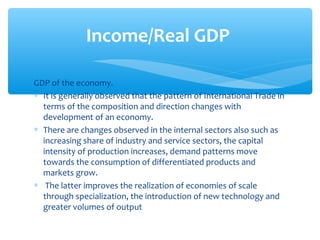
Income/Real GDP

GDP of the economy.
∗ It is generally observed that the pattern of International Trade in
  terms of the composition and direction changes with
  development of an economy.
∗ There are changes observed in the internal sectors also such as
  increasing share of industry and service sectors, the capital
  intensity of production increases, demand patterns move
  towards the consumption of differentiated products and
  markets grow.
∗ The latter improves the realization of economies of scale
  through specialization, the introduction of new technology and
  greater volumes of output
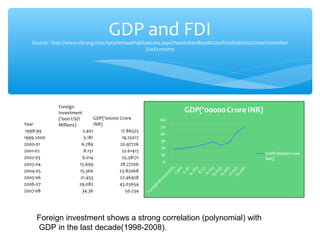
GDP and FDI
   Source: http://www.rbi.org.in/scripts/AnnualPublications.aspx?head=Handbook%20of%20Statistics%20on%20Indian
                                                     %20Economy


              Foreign
              Investment
              ('000 USD        GDP('00000 Crore
Year          Millions)        INR)
 1998-99                2.401              17.86525
1999-2000                5.181             19.25017
2000-01                6.789              20.97726
2001-02                  8.151             22.61415
2002-03                 6.014               25.38171
2003-04               15.699              28.77706
2004-05               15.366              23.82068
2005-06                21.453             27.46928
2006-07               29.082              43.03654
2007-08                 34.36                50.234


     Foreign investment shows a strong correlation (polynomial) with
     GDP in the last decade(1998-2008).
Exchange rate


∗ The appreciation and depreciation of currency does have an
  impact on the price of exports and imports making their
  comparative position and competitiveness in international
  markets fluctuate sometimes towards advantage to the home
  country and sometimes disadvantage.
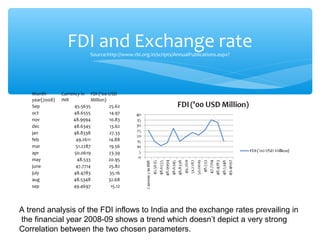
FDI and Exchange rate
                              Source:http://www.rbi.org.in/scripts/AnnualPublications.aspx?


   Month-       Currency in FDI ('00 USD
   year(2008)   INR            Million)
   Sep                45.5635           25.62
   oct                48.6555           14.97
   nov               48.9994            10.83
   dec               48.6345            13.62
   jan               48.8338            27.33
   feb                 49.2611          14.88
   mar                 51.2287          19.56
   apr                50.0619           23.39
   may                 48.533           20.95
   june                47.7714          25.82
   july               48.4783           35.16
   aug               48.5348            32.68
   sep               49.4697             15.12


A trend analysis of the FDI inflows to India and the exchange rates prevailing in
the financial year 2008-09 shows a trend which doesn’t depict a very strong
Correlation between the two chosen parameters.
Interest rate

∗ Foreign operations require significant commitment in capital,
  especially if they are undertaken in capital intensive sectors
  where production is characterized by extensive economies of
  scale, as the case is for most FDI.
∗ If there is abundant capital in the home country, that may
  become one of the primary reasons for going in for foreign
  investment by large firms. Such firms would have adequate
  financial means and they would also be able to access the capital
  markets much more efficiently than small capital starved firms.
  The opportunity cost of capital for such firms also comes down
  due to relatively low interest rate which occurs as a result of
  capital abundance.
Technology

∗ This factor is widely recognized as one factor that
  does have a sure and great impact on FDI, in fact the
  FDI sometimes may be the cause for increasing
  technological progress as it also gets influenced by
  the level of technological progress of the economy
∗ The ability of firms to generate technological inputs
  of a country is approximated by the number of
  patents issued. Thus higher the patents issued higher
  would be the outward FDI propensity of the country
Human Capital

∗ The availability of the human resources is one factor that plays
  an important role in determining the FDI; however the sheer
  number does not affect the inflow as the quality of the human
  resource does.
∗ The size of labour force may be instrumental in determining the
  price of the factor, as low labour cost may increase the cost
  competitiveness of the firm.
∗ But in a skill intensive industry, the quality of the labour force
  determined by the number of people who are educated and the
  number of science and technology professionals that exist
  matters. The human capital supply varies depends largely on the
  education systems and also the government policies.
The Openness of the Economy


∗ The FDI activities of the firms are constrained when
  there is protectionist policy followed; therefore these
  activities are encouraged when the country embarks
  on the path of liberalization.
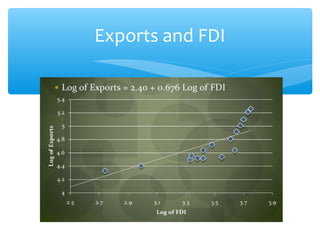
Exports and FDI
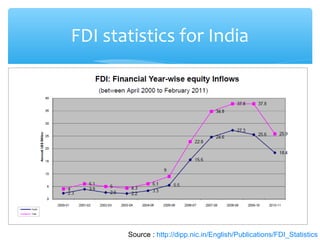
FDI statistics for India


       Source : http://dipp.nic.in/English/Publications/FDI_Statistics
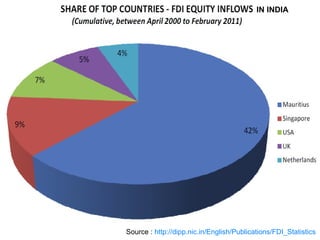
IN INDIA


Source : http://dipp.nic.in/English/Publications/FDI_Statistics
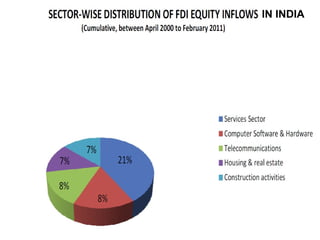
IN INDIA
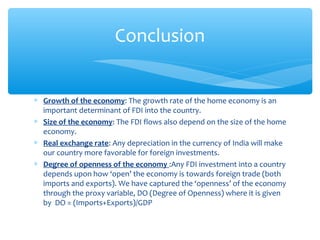
Conclusion


∗ Growth of the economy: The growth rate of the home economy is an
  important determinant of FDI into the country.
∗ Size of the economy: The FDI flows also depend on the size of the home
  economy.
∗ Real exchange rate: Any depreciation in the currency of India will make
  our country more favorable for foreign investments.
∗ Degree of openness of the economy :Any FDI investment into a country
  depends upon how ‘open’ the economy is towards foreign trade (both
  imports and exports). We have captured the ‘openness’ of the economy
  through the proxy variable, DO (Degree of Openness) where it is given
  by DO = (Imports+Exports)/GDP
Thanks

FDI

  • 1.
    FDI in Indiaand its Determinants Group V , FMS PT
  • 2.
    FDI ∗ Foreign directinvestment (FDI) is direct investment into production in a country by a company located in another country, either by buying a company in the target country or by expanding operations of an existing business in that country.
  • 4.
    FDI Advantages Disadvantages ∗ Inflow of equipment and ∗ Crowding of local industry technology ∗ Loss of control ∗ Competitive advantage and ∗ Conflicts of codes/laws innovation ∗ Possible exploitation of ∗ Financial resources for resources material/wages expansion ∗ Effect on natural environment ∗ Employment generation ∗ Effect on local culture ∗ Contribution to exports growth ∗ Access to new market/distribution channel for products
  • 5.
  • 6.
    Hypothesis ∗ FDI isa function of the factors specific to a country such as ∗ Income, Exchange rate, ∗ Technology, Human capital and ∗ Openness in the economy with specific reference to Indian economy.
  • 7.
    Methodology FDI=F(Y,I,ER,T,HC,O,D) + – + + + + + + + - + + + + Where FDI = Outward/inward flows of FDI Y = Real GDP I = Interest rate ER = Real Effective Exchange Rate (REER) Index T = Technology variable. HC = Human capital variable, approximated by number of education students. O = Openness of the economy, Net Exports D = Dummy variable for measuring the impact of liberalization process started in 1991 in the Indian economy. It takes the value 0 for the years between 1980 and 1991 and the value 1 for the years between 1991 and 2005.
  • 8.
    Income/Real GDP GDP ofthe economy. ∗ It is generally observed that the pattern of International Trade in terms of the composition and direction changes with development of an economy. ∗ There are changes observed in the internal sectors also such as increasing share of industry and service sectors, the capital intensity of production increases, demand patterns move towards the consumption of differentiated products and markets grow. ∗ The latter improves the realization of economies of scale through specialization, the introduction of new technology and greater volumes of output
  • 9.
    GDP and FDI Source: http://www.rbi.org.in/scripts/AnnualPublications.aspx?head=Handbook%20of%20Statistics%20on%20Indian %20Economy Foreign Investment ('000 USD GDP('00000 Crore Year Millions) INR) 1998-99 2.401 17.86525 1999-2000 5.181 19.25017 2000-01 6.789 20.97726 2001-02 8.151 22.61415 2002-03 6.014 25.38171 2003-04 15.699 28.77706 2004-05 15.366 23.82068 2005-06 21.453 27.46928 2006-07 29.082 43.03654 2007-08 34.36 50.234 Foreign investment shows a strong correlation (polynomial) with GDP in the last decade(1998-2008).
  • 10.
    Exchange rate ∗ Theappreciation and depreciation of currency does have an impact on the price of exports and imports making their comparative position and competitiveness in international markets fluctuate sometimes towards advantage to the home country and sometimes disadvantage.
  • 11.
    FDI and Exchangerate Source:http://www.rbi.org.in/scripts/AnnualPublications.aspx? Month- Currency in FDI ('00 USD year(2008) INR Million) Sep 45.5635 25.62 oct 48.6555 14.97 nov 48.9994 10.83 dec 48.6345 13.62 jan 48.8338 27.33 feb 49.2611 14.88 mar 51.2287 19.56 apr 50.0619 23.39 may 48.533 20.95 june 47.7714 25.82 july 48.4783 35.16 aug 48.5348 32.68 sep 49.4697 15.12 A trend analysis of the FDI inflows to India and the exchange rates prevailing in the financial year 2008-09 shows a trend which doesn’t depict a very strong Correlation between the two chosen parameters.
  • 12.
    Interest rate ∗ Foreignoperations require significant commitment in capital, especially if they are undertaken in capital intensive sectors where production is characterized by extensive economies of scale, as the case is for most FDI. ∗ If there is abundant capital in the home country, that may become one of the primary reasons for going in for foreign investment by large firms. Such firms would have adequate financial means and they would also be able to access the capital markets much more efficiently than small capital starved firms. The opportunity cost of capital for such firms also comes down due to relatively low interest rate which occurs as a result of capital abundance.
  • 13.
    Technology ∗ This factoris widely recognized as one factor that does have a sure and great impact on FDI, in fact the FDI sometimes may be the cause for increasing technological progress as it also gets influenced by the level of technological progress of the economy ∗ The ability of firms to generate technological inputs of a country is approximated by the number of patents issued. Thus higher the patents issued higher would be the outward FDI propensity of the country
  • 14.
    Human Capital ∗ Theavailability of the human resources is one factor that plays an important role in determining the FDI; however the sheer number does not affect the inflow as the quality of the human resource does. ∗ The size of labour force may be instrumental in determining the price of the factor, as low labour cost may increase the cost competitiveness of the firm. ∗ But in a skill intensive industry, the quality of the labour force determined by the number of people who are educated and the number of science and technology professionals that exist matters. The human capital supply varies depends largely on the education systems and also the government policies.
  • 15.
    The Openness ofthe Economy ∗ The FDI activities of the firms are constrained when there is protectionist policy followed; therefore these activities are encouraged when the country embarks on the path of liberalization.
  • 16.
  • 17.
    FDI statistics forIndia Source : http://dipp.nic.in/English/Publications/FDI_Statistics
  • 18.
    IN INDIA Source :http://dipp.nic.in/English/Publications/FDI_Statistics
  • 19.
  • 20.
    Conclusion ∗ Growth ofthe economy: The growth rate of the home economy is an important determinant of FDI into the country. ∗ Size of the economy: The FDI flows also depend on the size of the home economy. ∗ Real exchange rate: Any depreciation in the currency of India will make our country more favorable for foreign investments. ∗ Degree of openness of the economy :Any FDI investment into a country depends upon how ‘open’ the economy is towards foreign trade (both imports and exports). We have captured the ‘openness’ of the economy through the proxy variable, DO (Degree of Openness) where it is given by DO = (Imports+Exports)/GDP
  • 21.