Foreign Direct Investment
in India
By
Dr.D.Ravinder
MBA,MCom,MHRM,Mphil,PhD.
31-10-2019
Dr.D.Ravinder, Associate Professor, Department of MBA, Vaagdevi College of Engineering,WGL. (ravinder.d17@gmail.com)
1
Foreign Direct Investment (FDI)
 A foreign direct investment (FDI) is an investment in the form of a controlling
ownership in a business in one country by an entity based in another country.
It is thus distinguished from a foreign portfolio investment by a notion of
direct control.
 Generally, the investor will acquire assets of the business or establishes
business operations to get a controlling interest in the business in a foreign
country. This is distinctly separate than buying the equity of foreign
companies, i.e. portfolio investment.
31-10-2019Dr.D.Ravinder, Associate Professor, Department of MBA, Vaagdevi College of Engineering,WGL. (ravinder.d17@gmail.com) 2
Foreign Direct Investment (FDI)
Now, there are mainly three types of Foreign Direct Investments –
 Horizontal (The same business in a foreign country)
 vertical and (a slightly differentiated business is established in a foreign
country)
 conglomerate. (The business is unrelated)
31-10-2019Dr.D.Ravinder, Associate Professor, Department of MBA, Vaagdevi College of Engineering,WGL. (ravinder.d17@gmail.com) 3
Government Initiatives
 The Government of India has amended FDI policy to increase FDI inflow. In
2014, (26% to 49% in insurance sector).
 It also launched Make in India initiative in September 2014 under which FDI
policy for 25 sectors was liberalised further. As of April 2015, FDI inflow in
India increased by 48% since the launch of "Make in India" initiative.
 India was ranking 15th in the world in 2013 in terms of FDI inflow, it rose up
to 9th position in 2014[unreliable source?] while in 2015 India became top
destination for foreign direct investment.
 The Department for Promotion of Industry and Internal Trade and Invest India
has developed the India Investment Grid (IIG) which provides a pan-India
database of projects from Indian promoters for promoting and facilitating
foreign investments.
31-10-2019Dr.D.Ravinder, Associate Professor, Department of MBA, Vaagdevi College of Engineering,WGL. (ravinder.d17@gmail.com) 4
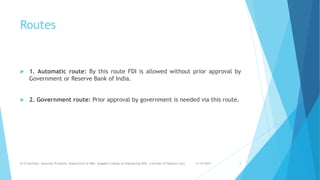
Routes
 1. Automatic route: By this route FDI is allowed without prior approval by
Government or Reserve Bank of India.
 2. Government route: Prior approval by government is needed via this route.
31-10-2019Dr.D.Ravinder, Associate Professor, Department of MBA, Vaagdevi College of Engineering,WGL. (ravinder.d17@gmail.com) 5
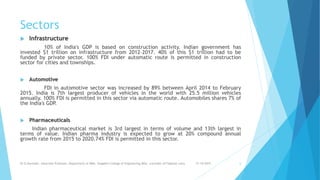
Sectors
 Infrastructure
10% of India's GDP is based on construction activity. Indian government has
invested $1 trillion on infrastructure from 2012–2017. 40% of this $1 trillion had to be
funded by private sector. 100% FDI under automatic route is permitted in construction
sector for cities and townships.
 Automotive
FDI in automotive sector was increased by 89% between April 2014 to February
2015. India is 7th largest producer of vehicles in the world with 25.5 million vehicles
annually. 100% FDI is permitted in this sector via automatic route. Automobiles shares 7% of
the India's GDP.
 Pharmaceuticals
Indian pharmaceutical market is 3rd largest in terms of volume and 13th largest in
terms of value. Indian pharma industry is expected to grow at 20% compound annual
growth rate from 2015 to 2020.74% FDI is permitted in this sector.
31-10-2019Dr.D.Ravinder, Associate Professor, Department of MBA, Vaagdevi College of Engineering,WGL. (ravinder.d17@gmail.com) 6
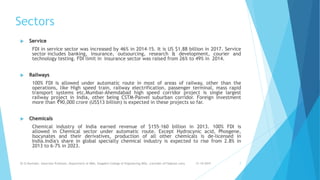
Sectors
 Service
FDI in service sector was increased by 46% in 2014–15. It is US $1.88 billion in 2017. Service
sector includes banking, insurance, outsourcing, research & development, courier and
technology testing. FDI limit in insurance sector was raised from 26% to 49% in 2014.
 Railways
100% FDI is allowed under automatic route in most of areas of railway, other than the
operations, like High speed train, railway electrification, passenger terminal, mass rapid
transport systems etc.Mumbai-Ahemdabad high speed corridor project is single largest
railway project in India, other being CSTM-Panvel suburban corridor. Foreign investment
more than ₹90,000 crore (US$13 billion) is expected in these projects so far.
 Chemicals
Chemical industry of India earned revenue of $155–160 billion in 2013. 100% FDI is
allowed in Chemical sector under automatic route. Except Hydrocynic acid, Phosgene,
Isocynates and their derivatives, production of all other chemicals is de-licensed in
India.India's share in global specialty chemical industry is expected to rise from 2.8% in
2013 to 6–7% in 2023.
31-10-2019Dr.D.Ravinder, Associate Professor, Department of MBA, Vaagdevi College of Engineering,WGL. (ravinder.d17@gmail.com) 7
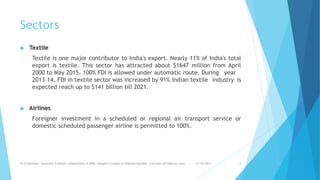
Sectors
 Textile
Textile is one major contributor to India's export. Nearly 11% of India's total
export is textile. This sector has attracted about $1647 million from April
2000 to May 2015. 100% FDI is allowed under automatic route. During year
2013–14, FDI in textile sector was increased by 91%.Indian textile industry is
expected reach up to $141 billion till 2021.
 Airlines
Foreigner investment in a scheduled or regional air transport service or
domestic scheduled passenger airline is permitted to 100%.
31-10-2019Dr.D.Ravinder, Associate Professor, Department of MBA, Vaagdevi College of Engineering,WGL. (ravinder.d17@gmail.com) 8
Thank U
31-10-2019
Dr.D.Ravinder, Associate Professor, Department of MBA, Vaagdevi College of Engineering,WGL.
(ravinder.d17@gmail.com)
9

Fdi and india

  • 1.
    Foreign Direct Investment inIndia By Dr.D.Ravinder MBA,MCom,MHRM,Mphil,PhD. 31-10-2019 Dr.D.Ravinder, Associate Professor, Department of MBA, Vaagdevi College of Engineering,WGL. (ravinder.d17@gmail.com) 1
  • 2.
    Foreign Direct Investment(FDI)  A foreign direct investment (FDI) is an investment in the form of a controlling ownership in a business in one country by an entity based in another country. It is thus distinguished from a foreign portfolio investment by a notion of direct control.  Generally, the investor will acquire assets of the business or establishes business operations to get a controlling interest in the business in a foreign country. This is distinctly separate than buying the equity of foreign companies, i.e. portfolio investment. 31-10-2019Dr.D.Ravinder, Associate Professor, Department of MBA, Vaagdevi College of Engineering,WGL. (ravinder.d17@gmail.com) 2
  • 3.
    Foreign Direct Investment(FDI) Now, there are mainly three types of Foreign Direct Investments –  Horizontal (The same business in a foreign country)  vertical and (a slightly differentiated business is established in a foreign country)  conglomerate. (The business is unrelated) 31-10-2019Dr.D.Ravinder, Associate Professor, Department of MBA, Vaagdevi College of Engineering,WGL. (ravinder.d17@gmail.com) 3
  • 4.
    Government Initiatives  TheGovernment of India has amended FDI policy to increase FDI inflow. In 2014, (26% to 49% in insurance sector).  It also launched Make in India initiative in September 2014 under which FDI policy for 25 sectors was liberalised further. As of April 2015, FDI inflow in India increased by 48% since the launch of "Make in India" initiative.  India was ranking 15th in the world in 2013 in terms of FDI inflow, it rose up to 9th position in 2014[unreliable source?] while in 2015 India became top destination for foreign direct investment.  The Department for Promotion of Industry and Internal Trade and Invest India has developed the India Investment Grid (IIG) which provides a pan-India database of projects from Indian promoters for promoting and facilitating foreign investments. 31-10-2019Dr.D.Ravinder, Associate Professor, Department of MBA, Vaagdevi College of Engineering,WGL. (ravinder.d17@gmail.com) 4
  • 5.
    Routes  1. Automaticroute: By this route FDI is allowed without prior approval by Government or Reserve Bank of India.  2. Government route: Prior approval by government is needed via this route. 31-10-2019Dr.D.Ravinder, Associate Professor, Department of MBA, Vaagdevi College of Engineering,WGL. (ravinder.d17@gmail.com) 5
  • 6.
    Sectors  Infrastructure 10% ofIndia's GDP is based on construction activity. Indian government has invested $1 trillion on infrastructure from 2012–2017. 40% of this $1 trillion had to be funded by private sector. 100% FDI under automatic route is permitted in construction sector for cities and townships.  Automotive FDI in automotive sector was increased by 89% between April 2014 to February 2015. India is 7th largest producer of vehicles in the world with 25.5 million vehicles annually. 100% FDI is permitted in this sector via automatic route. Automobiles shares 7% of the India's GDP.  Pharmaceuticals Indian pharmaceutical market is 3rd largest in terms of volume and 13th largest in terms of value. Indian pharma industry is expected to grow at 20% compound annual growth rate from 2015 to 2020.74% FDI is permitted in this sector. 31-10-2019Dr.D.Ravinder, Associate Professor, Department of MBA, Vaagdevi College of Engineering,WGL. (ravinder.d17@gmail.com) 6
  • 7.
    Sectors  Service FDI inservice sector was increased by 46% in 2014–15. It is US $1.88 billion in 2017. Service sector includes banking, insurance, outsourcing, research & development, courier and technology testing. FDI limit in insurance sector was raised from 26% to 49% in 2014.  Railways 100% FDI is allowed under automatic route in most of areas of railway, other than the operations, like High speed train, railway electrification, passenger terminal, mass rapid transport systems etc.Mumbai-Ahemdabad high speed corridor project is single largest railway project in India, other being CSTM-Panvel suburban corridor. Foreign investment more than ₹90,000 crore (US$13 billion) is expected in these projects so far.  Chemicals Chemical industry of India earned revenue of $155–160 billion in 2013. 100% FDI is allowed in Chemical sector under automatic route. Except Hydrocynic acid, Phosgene, Isocynates and their derivatives, production of all other chemicals is de-licensed in India.India's share in global specialty chemical industry is expected to rise from 2.8% in 2013 to 6–7% in 2023. 31-10-2019Dr.D.Ravinder, Associate Professor, Department of MBA, Vaagdevi College of Engineering,WGL. (ravinder.d17@gmail.com) 7
  • 8.
    Sectors  Textile Textile isone major contributor to India's export. Nearly 11% of India's total export is textile. This sector has attracted about $1647 million from April 2000 to May 2015. 100% FDI is allowed under automatic route. During year 2013–14, FDI in textile sector was increased by 91%.Indian textile industry is expected reach up to $141 billion till 2021.  Airlines Foreigner investment in a scheduled or regional air transport service or domestic scheduled passenger airline is permitted to 100%. 31-10-2019Dr.D.Ravinder, Associate Professor, Department of MBA, Vaagdevi College of Engineering,WGL. (ravinder.d17@gmail.com) 8
  • 9.
    Thank U 31-10-2019 Dr.D.Ravinder, AssociateProfessor, Department of MBA, Vaagdevi College of Engineering,WGL. (ravinder.d17@gmail.com) 9