
The cabinet said OK for 51% FDI in multi-
brand retail sector & 100% FDI in single
brand. On one hand farmers will benefit
from it but on the other hand small traders
feel they will not be able to withstand the
competition. Will India in general benefit
from this step?
INTRODUCTION
Foreign Direct Investment, or FDI, is a type of
investment that involves the injection of
foreign funds into an enterprise that operates
in a different country of origin from the
investor.
It usually involves participation in
management, joint venture, transfer of
technology and expertise.
FDI can be classified:
Inward FDI and Outward FDI
India ranks third in the list of most attractive FDI
destinations as per Ernst &Young's 2012 European
attractiveness survey
India is fast gaining importance world-wide as the country
has become an investment hub over the last decade. Global
investors have retained their faith in the resilient Indian
economy even during the toughest of the times. As a result,
India enjoyed high foreign inflows and investments when
rest of the world was struggling to even survive.
According to a UN report, foreign investments in India could
increase by more than 20 per cent in 2012-13.
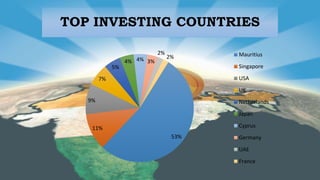
TOP INVESTING COUNTRIES
53%
11%
9%
7%
5%
4% 4% 3%
2%
2% Mauritius
Singapore
USA
UK
Netherlands
Japan
Cyprus
Germany
UAE
France
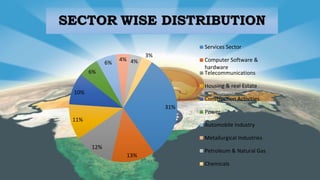
SECTOR WISE DISTRIBUTION
31%
13%
12%
11%
10%
6%
6%
4% 4%
3%
Services Sector
Computer Software &
hardware
Telecommunications
Housing & real Estate
Construction Activities
Power
Automobile Industry
Metallurgical Industries
Petroleum & Natural Gas
Chemicals
FDI AND ECONOMIC
DEVELOPMENT
FDI has an important impact on country’s trade balance,
increasing labour standards and skills, transfer of
technology, skills and the general business climate.
FDI also provides an opportunity for technological transfer
and up gradation, access to global managerial skills and
practices ,optimal utilization of human capabilities and
natural resources, making industry internationally
competitive,opening up export markets,access to
international quality goods and services and augmenting
employment opportunities.
India’s share in global FDI has increased considerably,
but the pace of FDI inflows has been slower than
China, Singapore, Brazil, and Russia.
Indian economy is largely agriculture based andt here
is plenty of scope in food processing, agriculture
services and agriculture machinery. FDI in this sector
should be encouraged.
Research and Development expenditure shows
unexpected negative sign. This could be attributed to
the fact that R&D sector is not receiving enough FDI
as per its requirement. but this sector is gaining more
attention in recent years.
MODES
Foreign Direct Investment (FDI) is permitted as under
the following forms of investments-
• Through financial collaborations.
• Through joint ventures and technical collaborations.
• Through capital markets via Euro issues.
• Through private placements or preferential allotments.
WHY FDI ?
1. Gain a foothold in a new geographic market.
2. Increase a firm’s global competitiveness and
positioning.
3. Fill gaps in a company’s product lines in a global
industry.
4. Reduce costs in areas such as R&D, production, and
distribution.
5. Competition :
-Catalysts to spur competition & innovation in retail
industry
WHY FDI ?...
6. Consumers:
-Improved product availability, quality & reduce
wastages
-Consumers to get best products and services at
reasonable price
7. Back End & Supply Chain Improvement :
- Inadequate storage facilities cause heavy losses to
farmers
- 25%-30% of F&V and 5%-7% of food grain in
India are wasted
- Food inflation and fluctuation in food prices can be
controlled
WHY FDI ?...
• Back End & Supply Chain Improvement :
• Inadequate storage facilities cause heavy losses to
farmers
• 25%-30% of F&V and 5%-7% of food grain in India
are wasted
• Food inflation and fluctuation in food prices can be
controlled
FACTORS REQUIRED TO ATTRACT
FDI
• Low cost BUT Qualified, Educated/Skilled Labor Pool.
• Long-term Market Potential OR Yields greater than can
be achieved Domestically.
• Access to Natural Resources.
• Geography
• Stability of the economic and Political Environment.
• Size of the Market
• Legal and Regulatory Framework
• Access to Basic Inputs
CONTINUE…
• Cost factors
• Labor costs
• Transpiration/ logistic cost
• Low cost of raw materials
• Return on investment
• Market factor
• Large size of host markets
• Demand in host country
• Level of competition in host market
• Economic stability
• Infrastructure and technological factors
CONTINUE…
• Level of infrastructure
• High industrial concentration (Clustering)
• Availability of well qualify of work force
• Access to reliable and corporative suppliers
• Political and legal factors
• Political stability
• International trade agreements
• Tax reduction in host country
• Benign environmental legislation towards FDI
• Social & Cultural factors
• Cultural distance
• Attitude of the local community toward the firm
Multinational companies and Chinese goods will flood the
market at cheaper rates and there will be no takers for local
products
Entry of MNC supermarket and hypermarket chains would
cause severe displacement of small and unorganised
shopkeepers and traders
MNC retailers will push prices paid to farmers and
manufacturers down rather than raising them, and producers
unable to accept such concessions would simply go out of
business
Improvement in the supply chain: FDI allows end-to-end
integration in the farm to folk supply chain. With that
investment wastage levels can go down significantly
The technology transfer that will happen because of the
integration between the retail chain and the farmer will
ultimately lead to a productivity improvement
Employment creation
Conclusion
• After considering all the aspects related to FDI,
we can conclude that, though there are slight
disadvantages of it, but it is very important or
we can say life blood for a developing country
for there economic growth and stability and for
developed country, to continue their stability.

FDI IN INDIA

  • 2.
    The cabinet saidOK for 51% FDI in multi- brand retail sector & 100% FDI in single brand. On one hand farmers will benefit from it but on the other hand small traders feel they will not be able to withstand the competition. Will India in general benefit from this step?
  • 3.
    INTRODUCTION Foreign Direct Investment,or FDI, is a type of investment that involves the injection of foreign funds into an enterprise that operates in a different country of origin from the investor. It usually involves participation in management, joint venture, transfer of technology and expertise. FDI can be classified: Inward FDI and Outward FDI
  • 4.
    India ranks thirdin the list of most attractive FDI destinations as per Ernst &Young's 2012 European attractiveness survey India is fast gaining importance world-wide as the country has become an investment hub over the last decade. Global investors have retained their faith in the resilient Indian economy even during the toughest of the times. As a result, India enjoyed high foreign inflows and investments when rest of the world was struggling to even survive. According to a UN report, foreign investments in India could increase by more than 20 per cent in 2012-13.
  • 5.
    TOP INVESTING COUNTRIES 53% 11% 9% 7% 5% 4%4% 3% 2% 2% Mauritius Singapore USA UK Netherlands Japan Cyprus Germany UAE France
  • 6.
    SECTOR WISE DISTRIBUTION 31% 13% 12% 11% 10% 6% 6% 4%4% 3% Services Sector Computer Software & hardware Telecommunications Housing & real Estate Construction Activities Power Automobile Industry Metallurgical Industries Petroleum & Natural Gas Chemicals
  • 7.
    FDI AND ECONOMIC DEVELOPMENT FDIhas an important impact on country’s trade balance, increasing labour standards and skills, transfer of technology, skills and the general business climate. FDI also provides an opportunity for technological transfer and up gradation, access to global managerial skills and practices ,optimal utilization of human capabilities and natural resources, making industry internationally competitive,opening up export markets,access to international quality goods and services and augmenting employment opportunities.
  • 8.
    India’s share inglobal FDI has increased considerably, but the pace of FDI inflows has been slower than China, Singapore, Brazil, and Russia. Indian economy is largely agriculture based andt here is plenty of scope in food processing, agriculture services and agriculture machinery. FDI in this sector should be encouraged. Research and Development expenditure shows unexpected negative sign. This could be attributed to the fact that R&D sector is not receiving enough FDI as per its requirement. but this sector is gaining more attention in recent years.
  • 9.
    MODES Foreign Direct Investment(FDI) is permitted as under the following forms of investments- • Through financial collaborations. • Through joint ventures and technical collaborations. • Through capital markets via Euro issues. • Through private placements or preferential allotments.
  • 10.
    WHY FDI ? 1.Gain a foothold in a new geographic market. 2. Increase a firm’s global competitiveness and positioning. 3. Fill gaps in a company’s product lines in a global industry. 4. Reduce costs in areas such as R&D, production, and distribution. 5. Competition : -Catalysts to spur competition & innovation in retail industry
  • 11.
    WHY FDI ?... 6.Consumers: -Improved product availability, quality & reduce wastages -Consumers to get best products and services at reasonable price 7. Back End & Supply Chain Improvement : - Inadequate storage facilities cause heavy losses to farmers - 25%-30% of F&V and 5%-7% of food grain in India are wasted - Food inflation and fluctuation in food prices can be controlled
  • 12.
    WHY FDI ?... •Back End & Supply Chain Improvement : • Inadequate storage facilities cause heavy losses to farmers • 25%-30% of F&V and 5%-7% of food grain in India are wasted • Food inflation and fluctuation in food prices can be controlled
  • 13.
    FACTORS REQUIRED TOATTRACT FDI • Low cost BUT Qualified, Educated/Skilled Labor Pool. • Long-term Market Potential OR Yields greater than can be achieved Domestically. • Access to Natural Resources. • Geography • Stability of the economic and Political Environment. • Size of the Market • Legal and Regulatory Framework • Access to Basic Inputs
  • 14.
    CONTINUE… • Cost factors •Labor costs • Transpiration/ logistic cost • Low cost of raw materials • Return on investment • Market factor • Large size of host markets • Demand in host country • Level of competition in host market • Economic stability • Infrastructure and technological factors
  • 15.
    CONTINUE… • Level ofinfrastructure • High industrial concentration (Clustering) • Availability of well qualify of work force • Access to reliable and corporative suppliers • Political and legal factors • Political stability • International trade agreements • Tax reduction in host country • Benign environmental legislation towards FDI • Social & Cultural factors • Cultural distance • Attitude of the local community toward the firm
  • 16.
    Multinational companies andChinese goods will flood the market at cheaper rates and there will be no takers for local products Entry of MNC supermarket and hypermarket chains would cause severe displacement of small and unorganised shopkeepers and traders MNC retailers will push prices paid to farmers and manufacturers down rather than raising them, and producers unable to accept such concessions would simply go out of business
  • 17.
    Improvement in thesupply chain: FDI allows end-to-end integration in the farm to folk supply chain. With that investment wastage levels can go down significantly The technology transfer that will happen because of the integration between the retail chain and the farmer will ultimately lead to a productivity improvement Employment creation
  • 18.
    Conclusion • After consideringall the aspects related to FDI, we can conclude that, though there are slight disadvantages of it, but it is very important or we can say life blood for a developing country for there economic growth and stability and for developed country, to continue their stability.