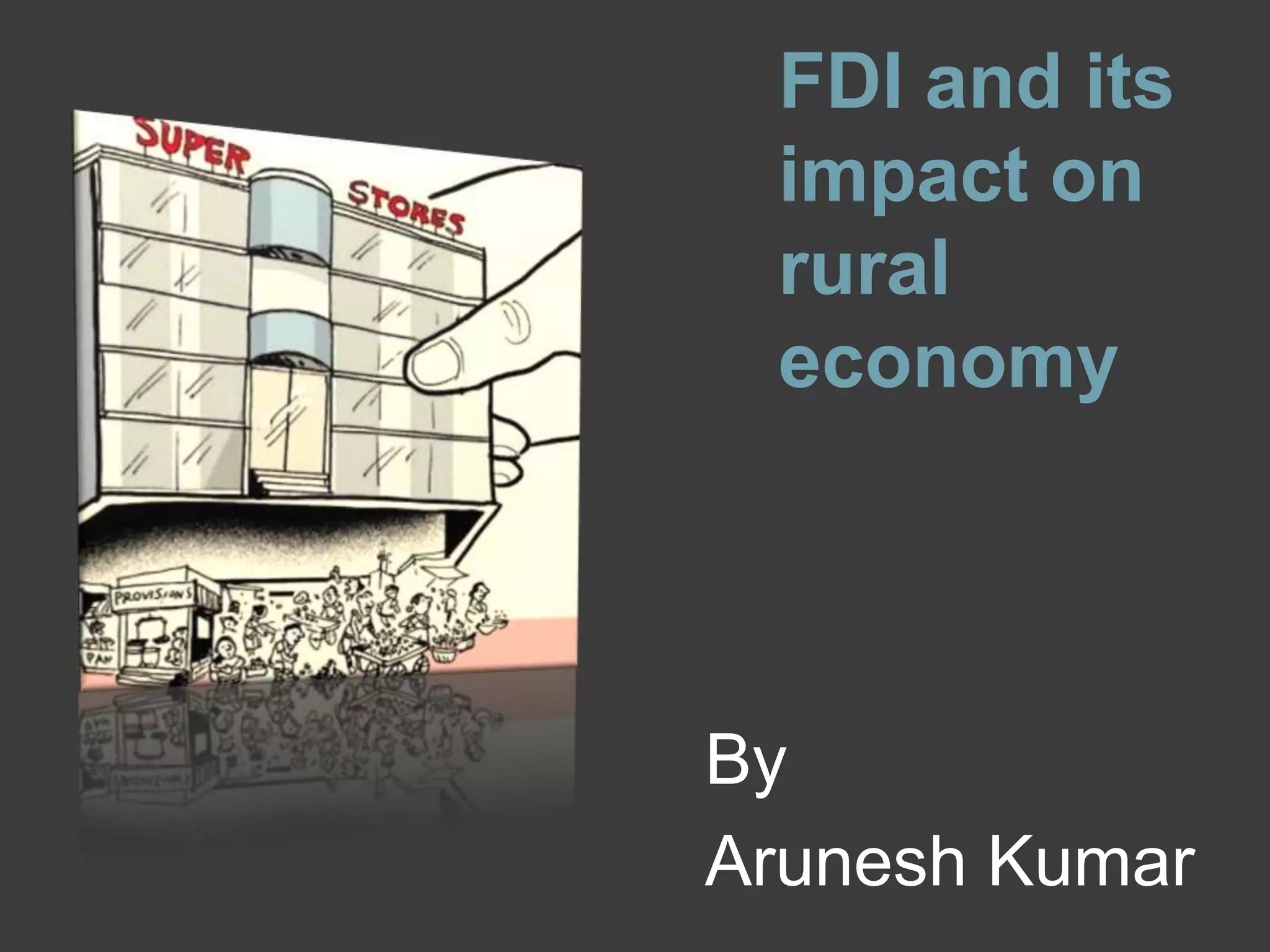
FDI and its
impact on
rural
economy
By
Arunesh Kumar
Introduction
Foreign Direct Investment (FDI) broadly
encompasses any long-term investments
by an entity that is not a resident of the
host country. Basic idea behind FDI is to
leverage the host country’s advantage in
form of access to cheaper resources,
access to a consumer market and access
to talent specific to the host country.
Through it both the investors and host
country are mutually benefited.
History of FDI in India
Prior to 1991 India was a closed economy
and GOI followed socialist model of
development. There had been “license
raj” and growth of different sectors of
economy were controlled by Govt.
The coming decade begun with
replacement of FERA by FEMA and
LPG. And India witnessed an increase in
FDI from 1991 onwards.
Sources of FDI in India [2012]
Countries % of FDI Countries % of FDI
Mauritius 38 Netherland 4
Singapore 10 Cyprus 4
U.K. 9 Germany 3
Japan 7 France 2
U.S.A. 6 U.A.E. 1
Destinations of FDI in India [2012]
SECTOR % of total
FDI inflow
Service Sector 20
Construction activities 12
Telecommunication 7
Computer & Software 6
Drug & Pharmaceutical 5
Chemical 5
Power 4
Automobile 4
SECTORS % of total
FDI
inflow
Agri. Services 0.9
Food Processing 0.86
Textile 0.69
Mining 0.59
Paper & Pulp 0.46
Vegetable oil &
Vanaspati
0.17
Fertilizers 0.16
Agri. Machinery 0.13
Tea & Coffee 0.06
GOI policies regarding FDI
India's foreign investment policy has been
formulated with a view to inviting and
encouraging FDI into India. The process
of regulation and approval has been
substantially liberalized. FDI under
automatic route is permitted in most
activities/sectors, except a few where
prior approval of the Government is
required.
Entry route for FDI
 Automatic route
 Through Govt. approval
 By way of share acquisition
 Investment through existing
collaboration in India
 General permission of RBI under FEMA
 Participation by IFI
FDI in Agriculture Sector
 Fertilizer- 100% FDI is allowed in fertilizers under the
automatic route in India. FDI inflows to fertilizers are beneficial for
the expansion of the fertilizer industry in India.
 Agri-Machinery- A corpus of ` 8000 crores to Rural
Infrastructure Development Fund (RIDF)have been extended
 Timber Product- The FDI in Timber products industry of India
have facilitated in setting up of new units in India.
 Tea and Coffee- 100% FDI is allowed in Tea and Coffee in
India under the automatic route. FDI inflows to tea and coffee are
expected to make the industry more competitive in the international
arena.
Cont..
 Agri services -The FDI Inflows to Agriculture Services
are allowed up to 100% and allowed through the automatic
route covering horticulture, floriculture, development of
seeds, animal husbandry, pisciculture, aqua culture,
cultivation of vegetables, mushroom and services related to
agro and allied sectors.
 Textile -Foreign Direct Investments (FDI) up to 100% is
allowed in this sector through the automatic route by the
Reserve Bank of India . In order to facilitate the technological
advancement in the textile industry, the Technology
Upgradation Fund Scheme (TUFS) was set up.
Negative Impacts On Rural Economy
 FDI will lead to job losses.
 Jobs in manufacturing sector will be lost.
 Freedom of farmers will also be curtailed.
 Wage Inequality & Wealth Disparity.
Political Corruption.
Disbalance in Ecology and Environment.
Positive arguments:
 Because of the investment of foreign companies,
job opportunities will increase in areas like
marketing, agro-processing, packaging,
transportation, etc.
 Because of FDI, the post of exploitative
middlemen in India will be removed,
Cont…
 Foreign companies will invest around $100 million in
India. Because of that there are lots of developmental
activities.
 According to the Indian Government’s conditions,
foreign companies have to source a minimum of 30%
of their goods from Indian micro and small industries.
This will provide the scales to encourage domestic
manufacturing, by creating a big effect for employment
and to upgrade the technology.
Cont..
 Foreign companies will also create a supply-chain
in the India market. Because of that, food which
perishes due to bad infrastructure facilities and
refrigeration will not be wasted.
Challenges
 Resource challenge:
India is known to have huge amount of
resources. Acquiring those resources and
utilising them effectively and efficiently is
important
 Equity challenge
The development in rural and urban area is
uneven. The poor have always suffered. So a
big challenge is fostering social equality and at
the same time, a balanced economic growth.
Contd…
 Political challenge:
Indian political environment is not
constant. Business policies are affected
with the change of political environment. It
will create constraints in smooth and fine
running of FDI policies.
 FDI favours only urban regions for the
investment and neglect rural & backward
regions.
 Lastly, there are no provisions for the
improvement of handicraft industries
and there are few provisions for the
small scale industries under FDI in India.
Suggestions
 The government should design such
policies under FDI which must be related
with agriculture base industry. It will
important step in reducing unemployment
from rural region because 60% human
resources lives in rural area.
 Give maximum reward to the farmers for
their agricultural crops and try to increase
the wages level of the skilled and unskilled
labour.
Cont..
 Emphasis must be given on the survival of
small industries and handicraft business.
Theses industries should get benefit from
the FDI projects for their existence. The
policy makers must consider these
industries while making FDI policy.
 Finally, it is insisted that hard punishment
should be given to investors or responsible
persons about the wastage of natural
resources under FDI in India.
Conclusion
96% of workforce in India is engaged in
unorganized sector, in which agricultural
farmers, labors and retailers form major share.
Whether FDI is supposed to support the formal
sector. Moreover it is likely to benefit those
people who already have professional skills.
Though it will also benefit farmers and rural
economy, but still there are many
apprehensions regarding worthiness of FDI.
So only strong mechanism can do justice to
achieve full and comprehensive benefits of
FDI in India.
hank

FDI Impact on Rural India

  • 1.
    FDI and its impacton rural economy By Arunesh Kumar
  • 2.
    Introduction Foreign Direct Investment(FDI) broadly encompasses any long-term investments by an entity that is not a resident of the host country. Basic idea behind FDI is to leverage the host country’s advantage in form of access to cheaper resources, access to a consumer market and access to talent specific to the host country. Through it both the investors and host country are mutually benefited.
  • 3.
    History of FDIin India Prior to 1991 India was a closed economy and GOI followed socialist model of development. There had been “license raj” and growth of different sectors of economy were controlled by Govt. The coming decade begun with replacement of FERA by FEMA and LPG. And India witnessed an increase in FDI from 1991 onwards.
  • 4.
    Sources of FDIin India [2012] Countries % of FDI Countries % of FDI Mauritius 38 Netherland 4 Singapore 10 Cyprus 4 U.K. 9 Germany 3 Japan 7 France 2 U.S.A. 6 U.A.E. 1
  • 5.
    Destinations of FDIin India [2012] SECTOR % of total FDI inflow Service Sector 20 Construction activities 12 Telecommunication 7 Computer & Software 6 Drug & Pharmaceutical 5 Chemical 5 Power 4 Automobile 4 SECTORS % of total FDI inflow Agri. Services 0.9 Food Processing 0.86 Textile 0.69 Mining 0.59 Paper & Pulp 0.46 Vegetable oil & Vanaspati 0.17 Fertilizers 0.16 Agri. Machinery 0.13 Tea & Coffee 0.06
  • 6.
    GOI policies regardingFDI India's foreign investment policy has been formulated with a view to inviting and encouraging FDI into India. The process of regulation and approval has been substantially liberalized. FDI under automatic route is permitted in most activities/sectors, except a few where prior approval of the Government is required.
  • 7.
    Entry route forFDI  Automatic route  Through Govt. approval  By way of share acquisition  Investment through existing collaboration in India  General permission of RBI under FEMA  Participation by IFI
  • 8.
    FDI in AgricultureSector  Fertilizer- 100% FDI is allowed in fertilizers under the automatic route in India. FDI inflows to fertilizers are beneficial for the expansion of the fertilizer industry in India.  Agri-Machinery- A corpus of ` 8000 crores to Rural Infrastructure Development Fund (RIDF)have been extended  Timber Product- The FDI in Timber products industry of India have facilitated in setting up of new units in India.  Tea and Coffee- 100% FDI is allowed in Tea and Coffee in India under the automatic route. FDI inflows to tea and coffee are expected to make the industry more competitive in the international arena.
  • 9.
    Cont..  Agri services-The FDI Inflows to Agriculture Services are allowed up to 100% and allowed through the automatic route covering horticulture, floriculture, development of seeds, animal husbandry, pisciculture, aqua culture, cultivation of vegetables, mushroom and services related to agro and allied sectors.  Textile -Foreign Direct Investments (FDI) up to 100% is allowed in this sector through the automatic route by the Reserve Bank of India . In order to facilitate the technological advancement in the textile industry, the Technology Upgradation Fund Scheme (TUFS) was set up.
  • 10.
    Negative Impacts OnRural Economy  FDI will lead to job losses.  Jobs in manufacturing sector will be lost.  Freedom of farmers will also be curtailed.  Wage Inequality & Wealth Disparity. Political Corruption. Disbalance in Ecology and Environment.
  • 11.
    Positive arguments:  Becauseof the investment of foreign companies, job opportunities will increase in areas like marketing, agro-processing, packaging, transportation, etc.  Because of FDI, the post of exploitative middlemen in India will be removed,
  • 12.
    Cont…  Foreign companieswill invest around $100 million in India. Because of that there are lots of developmental activities.  According to the Indian Government’s conditions, foreign companies have to source a minimum of 30% of their goods from Indian micro and small industries. This will provide the scales to encourage domestic manufacturing, by creating a big effect for employment and to upgrade the technology.
  • 13.
    Cont..  Foreign companieswill also create a supply-chain in the India market. Because of that, food which perishes due to bad infrastructure facilities and refrigeration will not be wasted.
  • 14.
    Challenges  Resource challenge: Indiais known to have huge amount of resources. Acquiring those resources and utilising them effectively and efficiently is important  Equity challenge The development in rural and urban area is uneven. The poor have always suffered. So a big challenge is fostering social equality and at the same time, a balanced economic growth.
  • 15.
    Contd…  Political challenge: Indianpolitical environment is not constant. Business policies are affected with the change of political environment. It will create constraints in smooth and fine running of FDI policies.  FDI favours only urban regions for the investment and neglect rural & backward regions.
  • 16.
     Lastly, thereare no provisions for the improvement of handicraft industries and there are few provisions for the small scale industries under FDI in India.
  • 17.
    Suggestions  The governmentshould design such policies under FDI which must be related with agriculture base industry. It will important step in reducing unemployment from rural region because 60% human resources lives in rural area.  Give maximum reward to the farmers for their agricultural crops and try to increase the wages level of the skilled and unskilled labour.
  • 18.
    Cont..  Emphasis mustbe given on the survival of small industries and handicraft business. Theses industries should get benefit from the FDI projects for their existence. The policy makers must consider these industries while making FDI policy.  Finally, it is insisted that hard punishment should be given to investors or responsible persons about the wastage of natural resources under FDI in India.
  • 19.
    Conclusion 96% of workforcein India is engaged in unorganized sector, in which agricultural farmers, labors and retailers form major share. Whether FDI is supposed to support the formal sector. Moreover it is likely to benefit those people who already have professional skills. Though it will also benefit farmers and rural economy, but still there are many apprehensions regarding worthiness of FDI. So only strong mechanism can do justice to achieve full and comprehensive benefits of FDI in India.
  • 20.