FCAT Family Night
   2012-2013
Objectives:
•   What is FCAT 2.0?
•   Who takes the test?
•   When is the test?
•   How is the test designed?
•   Helpful Resources
What is FCAT 2.0?
• The FCAT 2.0 is a test that measures student
  achievement of the Next Generation Sunshine State
  Standards (NGSSS) in reading, mathematics, and
  science.
• More information about NGSSS go to
  www.floridastandards.org
• Benchmark Example:
Benchmark: MA.3.A.6.1
Represent, compute, estimate, and solve problems using
numbers through hundred thousands.
Who is tested?

• All public school students in Florida , including English
  language learner (ELL) and exceptional student
  education (ESE) students, enrolled in grades 3-5
  participate in the FCAT 2.0 administration.
  Administration accommodations are provided to
  eligible ELL and ESE students.
Who is tested?

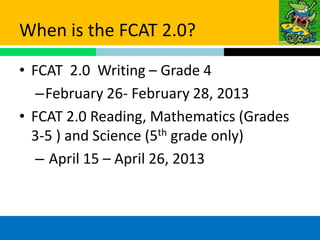
• Grade 3: reading and math
• Grade 4: reading, math, and writing
• Grade 5: reading, math, and science
When is the FCAT 2.0?
• FCAT 2.0 Writing – Grade 4
   –February 26- February 28, 2013
• FCAT 2.0 Reading, Mathematics (Grades
  3-5 ) and Science (5th grade only)
   – April 15 – April 26, 2013
How is the FCAT 2.0 Reading designed?
Content Categories and approximate percentage of raw-score points for each category
• FCAT 2.0 Reading

                                                             Literary Analysis: Fiction &   Informational & Research
        Grade             Vocabulary   Reading Application
                                                                      Nonfiction                    Process
        3-5
50-55 Multiple Choice
                           15-25%           25-35%                    25-35%                       15-25%
  Time: 2- 70 minute
sessions, tested over 2
         days.
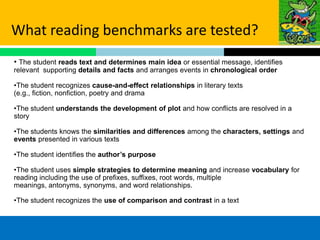
What reading benchmarks are tested?
• The student reads text and determines main idea or essential message, identifies
relevant supporting details and facts and arranges events in chronological order

•The student recognizes cause-and-effect relationships in literary texts
(e.g., fiction, nonfiction, poetry and drama

•The student understands the development of plot and how conflicts are resolved in a
story

•The students knows the similarities and differences among the characters, settings and
events presented in various texts

•The student identifies the author’s purpose

•The student uses simple strategies to determine meaning and increase vocabulary for
reading including the use of prefixes, suffixes, root words, multiple
meanings, antonyms, synonyms, and word relationships.

•The student recognizes the use of comparison and contrast in a text
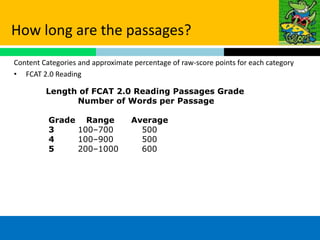
How long are the passages?
Content Categories and approximate percentage of raw-score points for each category
• FCAT 2.0 Reading

         Length of FCAT 2.0 Reading Passages Grade
               Number of Words per Passage

          Grade Range             Average
          3    100–700              500
          4    100–900              500
          5    200–1000             600
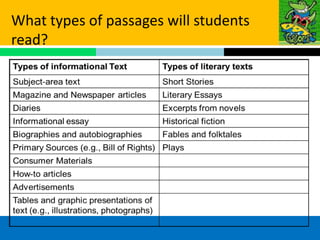
What types of passages will students
read?
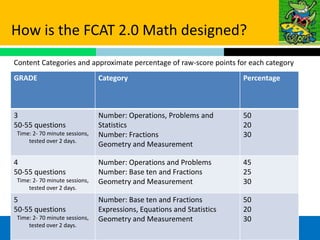
How is the FCAT 2.0 Math designed?
Content Categories and approximate percentage of raw-score points for each category
• FCAT 2.0 Math
GRADE                    Category                                   Percentage


3                              Number: Operations, Problems and        50
50-55 questions                Statistics                              20
Time: 2- 70 minute sessions,   Number: Fractions                       30
    tested over 2 days.
                               Geometry and Measurement

4                              Number: Operations and Problems         45
50-55 questions                Number: Base ten and Fractions          25
Time: 2- 70 minute sessions,   Geometry and Measurement                30
    tested over 2 days.
5                              Number: Base ten and Fractions          50
50-55 questions                Expressions, Equations and Statistics   20
Time: 2- 70 minute sessions,   Geometry and Measurement                30
    tested over 2 days.
What Math Benchmarks are tested?
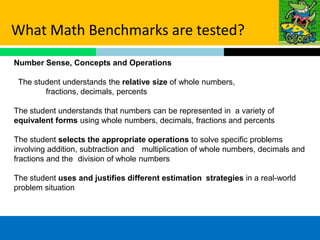
Number Sense, Concepts and Operations

 The student understands the relative size of whole numbers,
        fractions, decimals, percents

The student understands that numbers can be represented in a variety of
equivalent forms using whole numbers, decimals, fractions and percents

The student selects the appropriate operations to solve specific problems
involving addition, subtraction and multiplication of whole numbers, decimals and
fractions and the division of whole numbers

The student uses and justifies different estimation strategies in a real-world
problem situation
What Math Benchmarks are tested?
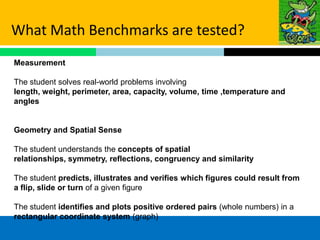
Measurement

The student solves real-world problems involving
length, weight, perimeter, area, capacity, volume, time ,temperature and
angles


Geometry and Spatial Sense

The student understands the concepts of spatial
relationships, symmetry, reflections, congruency and similarity

The student predicts, illustrates and verifies which figures could result from
a flip, slide or turn of a given figure

The student identifies and plots positive ordered pairs (whole numbers) in a
rectangular coordinate system (graph)
What Math Benchmarks are tested?
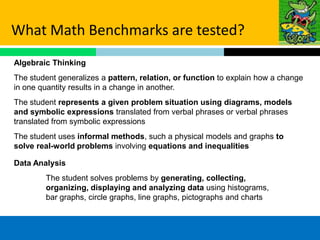
Algebraic Thinking
The student generalizes a pattern, relation, or function to explain how a change
in one quantity results in a change in another.
The student represents a given problem situation using diagrams, models
and symbolic expressions translated from verbal phrases or verbal phrases
translated from symbolic expressions
The student uses informal methods, such a physical models and graphs to
solve real-world problems involving equations and inequalities

Data Analysis
        The student solves problems by generating, collecting,
        organizing, displaying and analyzing data using histograms,
        bar graphs, circle graphs, line graphs, pictographs and charts
How is the FCAT 2.0 Science designed?
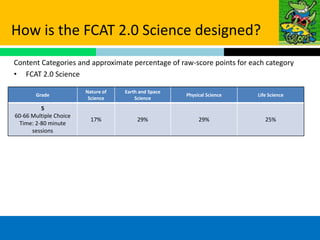
Content Categories and approximate percentage of raw-score points for each category
• FCAT 2.0 Science

                        Nature of   Earth and Space
       Grade                                          Physical Science   Life Science
                         Science        Science
         5
60-66 Multiple Choice
                          17%            29%               29%              25%
 Time: 2-80 minute
      sessions
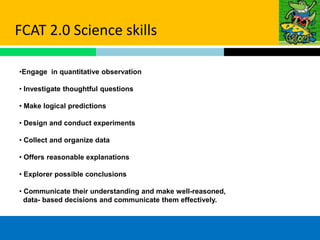
FCAT 2.0 Science skills

•Engage in quantitative observation

• Investigate thoughtful questions

• Make logical predictions

• Design and conduct experiments

• Collect and organize data

• Offers reasonable explanations

• Explorer possible conclusions

• Communicate their understanding and make well-reasoned,
  data- based decisions and communicate them effectively.
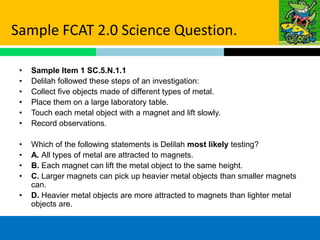
Sample FCAT 2.0 Science Question.

 •   Sample Item 1 SC.5.N.1.1
 •   Delilah followed these steps of an investigation:
 •   Collect five objects made of different types of metal.
 •   Place them on a large laboratory table.
 •   Touch each metal object with a magnet and lift slowly.
 •   Record observations.

 •   Which of the following statements is Delilah most likely testing?
 •   A. All types of metal are attracted to magnets.
 •   B. Each magnet can lift the metal object to the same height.
 •   C. Larger magnets can pick up heavier metal objects than smaller magnets
     can.
 •   D. Heavier metal objects are more attracted to magnets than lighter metal
     objects are.
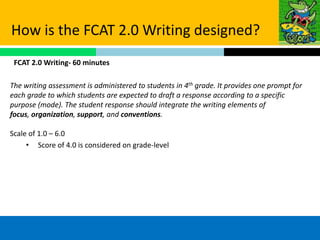
How is the FCAT 2.0 Writing designed?
 FCAT 2.0 Writing- 60 minutes

The writing assessment is administered to students in 4th grade. It provides one prompt for
each grade to which students are expected to draft a response according to a specific
purpose (mode). The student response should integrate the writing elements of
focus, organization, support, and conventions.

Scale of 1.0 – 6.0
     • Score of 4.0 is considered on grade-level
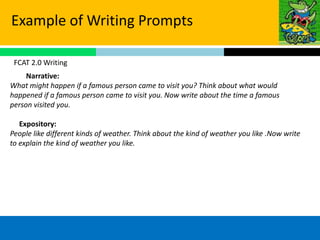
Example of Writing Prompts

 FCAT 2.0 Writing
     Narrative:
What might happen if a famous person came to visit you? Think about what would
happened if a famous person came to visit you. Now write about the time a famous
person visited you.

   Expository:
People like different kinds of weather. Think about the kind of weather you like .Now write
to explain the kind of weather you like.
How difficult are the questions?
• Low :Low complexity items rely heavily on recall and
  recognition. More than 70% of students are likely to respond
  correctly.

• Moderate: Moderate complexity items require more flexible
  thinking and may require basic reasoning or problem solving.
  Between 40- 70% of students are likely to respond correctly.

• High: High complexity items are written to elicit analysis and
  abstract reasoning. Less than 40% of students are likely to
  respond correctly.
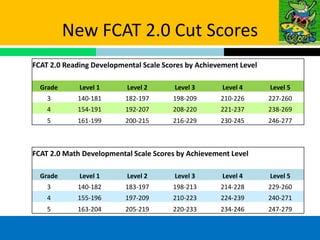
New FCAT 2.0 Cut Scores
FCAT 2.0 Reading Developmental Scale Scores by Achievement Level

  Grade      Level 1       Level 2      Level 3       Level 4      Level 5
    3       140-181       182-197       198-209      210-226       227-260
    4       154-191       192-207       208-220      221-237       238-269
    5       161-199       200-215       216-229      230-245       246-277


FCAT 2.0 Math Developmental Scale Scores by Achievement Level

  Grade      Level 1       Level 2      Level 3       Level 4      Level 5
    3       140-182       183-197       198-213      214-228       229-260
    4       155-196       197-209       210-223      224-239       240-271
    5       163-204       205-219       220-233      234-246       247-279
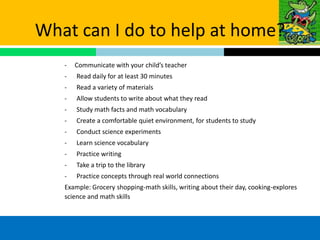
What can I do to help at home?
   -   Communicate with your child’s teacher
   -   Read daily for at least 30 minutes
   -   Read a variety of materials
   -   Allow students to write about what they read
   -   Study math facts and math vocabulary
   -   Create a comfortable quiet environment, for students to study
   -   Conduct science experiments
   -   Learn science vocabulary
   -   Practice writing
   -   Take a trip to the library
   -   Practice concepts through real world connections
   Example: Grocery shopping-math skills, writing about their day, cooking-explores
   science and math skills
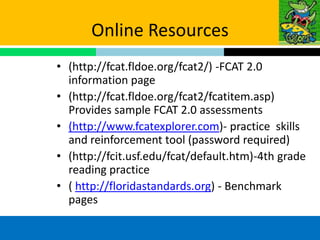
Online Resources
• (http://fcat.fldoe.org/fcat2/) -FCAT 2.0
  information page
• (http://fcat.fldoe.org/fcat2/fcatitem.asp)
  Provides sample FCAT 2.0 assessments
• (http://www.fcatexplorer.com)- practice skills
  and reinforcement tool (password required)
• (http://fcit.usf.edu/fcat/default.htm)-4th grade
  reading practice
• ( http://floridastandards.org) - Benchmark
  pages
References
• http://fcat.fldoe.org/fcat2/pdf/FL09G5Sci.pdf
• http://fcat.fldoe.org/pdf/designsummary.pdf
• http://fcat.fldoe.org/fcat2/wcsg.asp
• http://teachercenter.scps.k12.fl.us/education/
  components/scrapbook/default.php?sectiond
  etailid=85283&&PHPSESSID=9941122bab70b4
  ec360decff7b71b200
• http://paula-downey.blogspot.com/p/fcat-
  writing-prompts-practice.html

FCAT Night

  • 1.
  • 2.
    Objectives: • What is FCAT 2.0? • Who takes the test? • When is the test? • How is the test designed? • Helpful Resources
  • 3.
    What is FCAT2.0? • The FCAT 2.0 is a test that measures student achievement of the Next Generation Sunshine State Standards (NGSSS) in reading, mathematics, and science. • More information about NGSSS go to www.floridastandards.org • Benchmark Example: Benchmark: MA.3.A.6.1 Represent, compute, estimate, and solve problems using numbers through hundred thousands.
  • 4.
    Who is tested? •All public school students in Florida , including English language learner (ELL) and exceptional student education (ESE) students, enrolled in grades 3-5 participate in the FCAT 2.0 administration. Administration accommodations are provided to eligible ELL and ESE students.
  • 5.
    Who is tested? •Grade 3: reading and math • Grade 4: reading, math, and writing • Grade 5: reading, math, and science
  • 6.
    When is theFCAT 2.0? • FCAT 2.0 Writing – Grade 4 –February 26- February 28, 2013 • FCAT 2.0 Reading, Mathematics (Grades 3-5 ) and Science (5th grade only) – April 15 – April 26, 2013
  • 7.
    How is theFCAT 2.0 Reading designed? Content Categories and approximate percentage of raw-score points for each category • FCAT 2.0 Reading Literary Analysis: Fiction & Informational & Research Grade Vocabulary Reading Application Nonfiction Process 3-5 50-55 Multiple Choice 15-25% 25-35% 25-35% 15-25% Time: 2- 70 minute sessions, tested over 2 days.
  • 8.
    What reading benchmarksare tested? • The student reads text and determines main idea or essential message, identifies relevant supporting details and facts and arranges events in chronological order •The student recognizes cause-and-effect relationships in literary texts (e.g., fiction, nonfiction, poetry and drama •The student understands the development of plot and how conflicts are resolved in a story •The students knows the similarities and differences among the characters, settings and events presented in various texts •The student identifies the author’s purpose •The student uses simple strategies to determine meaning and increase vocabulary for reading including the use of prefixes, suffixes, root words, multiple meanings, antonyms, synonyms, and word relationships. •The student recognizes the use of comparison and contrast in a text
  • 9.
    How long arethe passages? Content Categories and approximate percentage of raw-score points for each category • FCAT 2.0 Reading Length of FCAT 2.0 Reading Passages Grade Number of Words per Passage Grade Range Average 3 100–700 500 4 100–900 500 5 200–1000 600
  • 10.
    What types ofpassages will students read?
  • 11.
    How is theFCAT 2.0 Math designed? Content Categories and approximate percentage of raw-score points for each category • FCAT 2.0 Math GRADE Category Percentage 3 Number: Operations, Problems and 50 50-55 questions Statistics 20 Time: 2- 70 minute sessions, Number: Fractions 30 tested over 2 days. Geometry and Measurement 4 Number: Operations and Problems 45 50-55 questions Number: Base ten and Fractions 25 Time: 2- 70 minute sessions, Geometry and Measurement 30 tested over 2 days. 5 Number: Base ten and Fractions 50 50-55 questions Expressions, Equations and Statistics 20 Time: 2- 70 minute sessions, Geometry and Measurement 30 tested over 2 days.
  • 12.
    What Math Benchmarksare tested? Number Sense, Concepts and Operations The student understands the relative size of whole numbers, fractions, decimals, percents The student understands that numbers can be represented in a variety of equivalent forms using whole numbers, decimals, fractions and percents The student selects the appropriate operations to solve specific problems involving addition, subtraction and multiplication of whole numbers, decimals and fractions and the division of whole numbers The student uses and justifies different estimation strategies in a real-world problem situation
  • 13.
    What Math Benchmarksare tested? Measurement The student solves real-world problems involving length, weight, perimeter, area, capacity, volume, time ,temperature and angles Geometry and Spatial Sense The student understands the concepts of spatial relationships, symmetry, reflections, congruency and similarity The student predicts, illustrates and verifies which figures could result from a flip, slide or turn of a given figure The student identifies and plots positive ordered pairs (whole numbers) in a rectangular coordinate system (graph)
  • 14.
    What Math Benchmarksare tested? Algebraic Thinking The student generalizes a pattern, relation, or function to explain how a change in one quantity results in a change in another. The student represents a given problem situation using diagrams, models and symbolic expressions translated from verbal phrases or verbal phrases translated from symbolic expressions The student uses informal methods, such a physical models and graphs to solve real-world problems involving equations and inequalities Data Analysis The student solves problems by generating, collecting, organizing, displaying and analyzing data using histograms, bar graphs, circle graphs, line graphs, pictographs and charts
  • 15.
    How is theFCAT 2.0 Science designed? Content Categories and approximate percentage of raw-score points for each category • FCAT 2.0 Science Nature of Earth and Space Grade Physical Science Life Science Science Science 5 60-66 Multiple Choice 17% 29% 29% 25% Time: 2-80 minute sessions
  • 16.
    FCAT 2.0 Scienceskills •Engage in quantitative observation • Investigate thoughtful questions • Make logical predictions • Design and conduct experiments • Collect and organize data • Offers reasonable explanations • Explorer possible conclusions • Communicate their understanding and make well-reasoned, data- based decisions and communicate them effectively.
  • 17.
    Sample FCAT 2.0Science Question. • Sample Item 1 SC.5.N.1.1 • Delilah followed these steps of an investigation: • Collect five objects made of different types of metal. • Place them on a large laboratory table. • Touch each metal object with a magnet and lift slowly. • Record observations. • Which of the following statements is Delilah most likely testing? • A. All types of metal are attracted to magnets. • B. Each magnet can lift the metal object to the same height. • C. Larger magnets can pick up heavier metal objects than smaller magnets can. • D. Heavier metal objects are more attracted to magnets than lighter metal objects are.
  • 18.
    How is theFCAT 2.0 Writing designed? FCAT 2.0 Writing- 60 minutes The writing assessment is administered to students in 4th grade. It provides one prompt for each grade to which students are expected to draft a response according to a specific purpose (mode). The student response should integrate the writing elements of focus, organization, support, and conventions. Scale of 1.0 – 6.0 • Score of 4.0 is considered on grade-level
  • 19.
    Example of WritingPrompts FCAT 2.0 Writing Narrative: What might happen if a famous person came to visit you? Think about what would happened if a famous person came to visit you. Now write about the time a famous person visited you. Expository: People like different kinds of weather. Think about the kind of weather you like .Now write to explain the kind of weather you like.
  • 20.
    How difficult arethe questions? • Low :Low complexity items rely heavily on recall and recognition. More than 70% of students are likely to respond correctly. • Moderate: Moderate complexity items require more flexible thinking and may require basic reasoning or problem solving. Between 40- 70% of students are likely to respond correctly. • High: High complexity items are written to elicit analysis and abstract reasoning. Less than 40% of students are likely to respond correctly.
  • 21.
    New FCAT 2.0Cut Scores FCAT 2.0 Reading Developmental Scale Scores by Achievement Level Grade Level 1 Level 2 Level 3 Level 4 Level 5 3 140-181 182-197 198-209 210-226 227-260 4 154-191 192-207 208-220 221-237 238-269 5 161-199 200-215 216-229 230-245 246-277 FCAT 2.0 Math Developmental Scale Scores by Achievement Level Grade Level 1 Level 2 Level 3 Level 4 Level 5 3 140-182 183-197 198-213 214-228 229-260 4 155-196 197-209 210-223 224-239 240-271 5 163-204 205-219 220-233 234-246 247-279
  • 22.
    What can Ido to help at home? - Communicate with your child’s teacher - Read daily for at least 30 minutes - Read a variety of materials - Allow students to write about what they read - Study math facts and math vocabulary - Create a comfortable quiet environment, for students to study - Conduct science experiments - Learn science vocabulary - Practice writing - Take a trip to the library - Practice concepts through real world connections Example: Grocery shopping-math skills, writing about their day, cooking-explores science and math skills
  • 23.
    Online Resources • (http://fcat.fldoe.org/fcat2/)-FCAT 2.0 information page • (http://fcat.fldoe.org/fcat2/fcatitem.asp) Provides sample FCAT 2.0 assessments • (http://www.fcatexplorer.com)- practice skills and reinforcement tool (password required) • (http://fcit.usf.edu/fcat/default.htm)-4th grade reading practice • ( http://floridastandards.org) - Benchmark pages
  • 24.
    References • http://fcat.fldoe.org/fcat2/pdf/FL09G5Sci.pdf • http://fcat.fldoe.org/pdf/designsummary.pdf •http://fcat.fldoe.org/fcat2/wcsg.asp • http://teachercenter.scps.k12.fl.us/education/ components/scrapbook/default.php?sectiond etailid=85283&&PHPSESSID=9941122bab70b4 ec360decff7b71b200 • http://paula-downey.blogspot.com/p/fcat- writing-prompts-practice.html

Editor's Notes

  • #11 3rd grade 60/40 4th/5th- 50/50
  • #18 Answer is A