The Water Framework Directive
and the catchment based
approach in your area
Teresa Brown Catchment Co-ordinator
For the Upper and Bedford Ouse, Old Bedford and Middle Level
UNCLASSIFIED
The Water Framework Directive
Member states must plan and deliver a better water
environment with a focus on:
Ecology
Chemical standards
And protect all parts of the water environment:
Groundwater, rivers, lakes, estuaries, coastal waters
Six yearly planning cycles 2009, 2015, 2021 and 2027.
Brings together or replaces several other EU Directives.
Habitats Directive site objectives can over-ride WFD.
Prevent deterioration and improve the water
environment, including ground water
Promote sustainable water use
Reduce pollution
Help reduce the effects of floods and
droughts
3
Water Framework Directive
- key objectives
Classification
Nationally defined for 2009 baseline (Cycle 1)
Waterbody areas
Type – river, lake, canal, transitional & coastal,
groundwater
Artificial or heavily modified
Status – based on data from three preceding years –
2006, 2007, 2008
• Surface water – high, good, moderate, poor bad
• Groundwater – good, bad
UNCLASSIFIED 4
UNCLASSIFIED
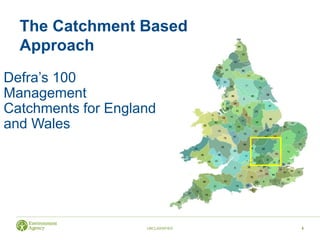
Defra’s 100
Management
Catchments for England
and Wales
5
The Catchment Based
Approach
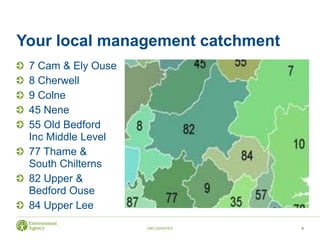
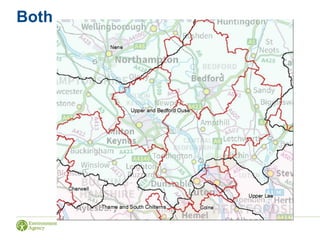
Your local management catchment
7 Cam & Ely Ouse
8 Cherwell
9 Colne
45 Nene
55 Old Bedford
Inc Middle Level
77 Thame &
South Chilterns
82 Upper &
Bedford Ouse
84 Upper Lee
UNCLASSIFIED 6
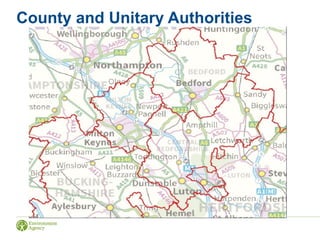
County and Unitary Authorities
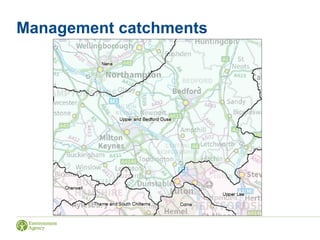
Management catchments
Both
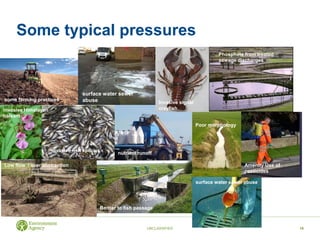
Some typical pressures
UNCLASSIFIED 10
some farming practices
surface water sewer
abuse Invasive signal
crayfish
Phosphate from treated
sewage discharges
invasive Himalayan
balsam
Invasive fish species
nutrient runoff
surface water sewer abuse
Poor morphology
Amenity Use of
pesticides
Low flow / over abstraction
Barrier to fish passage
What are the main issues?
Everywhere:
Rising demand for water resources – ground and surface water
Point source discharges - treated sewage effluent – phosphate
Man-made structures and modifications – for flood defence, land drainage,
navigation , water supply, amenity
Rural areas:
Diffuse pollution from agriculture:
• Soil - sediment / phosphates / nitrates / pesticides – drinking water
Straight, over deep and wide channels
Urban areas:
Diffuse pollution - poor quality surface water runoff, misconnections
Concrete channels, culverts
ssUNCLASSIF 11
What you can do to help
‘Water friendly’ farming
Reduce water use - store / conserve where
you can
Provide and manage features for water
dependent wildlife
Keep soil on the field – follow good practice
Install and use ‘sustainable drainage’ features
and techniques
Exemplary nutrient planning and application
Exemplary crop protection procedures
Keep livestock out of water
UNCLASSIFIED 12
UNCLASSIFIED 13
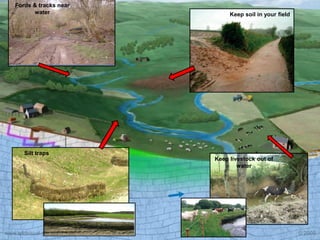
Keep soil in your field
Fords & tracks near
water
Silt traps
Keep livestock out of
water
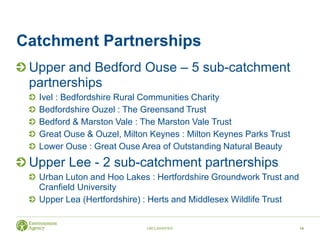
Catchment Partnerships
Upper and Bedford Ouse – 5 sub-catchment
partnerships
Ivel : Bedfordshire Rural Communities Charity
Bedfordshire Ouzel : The Greensand Trust
Bedford & Marston Vale : The Marston Vale Trust
Great Ouse & Ouzel, Milton Keynes : Milton Keynes Parks Trust
Lower Ouse : Great Ouse Area of Outstanding Natural Beauty
Upper Lee - 2 sub-catchment partnerships
Urban Luton and Hoo Lakes : Hertfordshire Groundwork Trust and
Cranfield University
Upper Lea (Hertfordshire) : Herts and Middlesex Wildlife Trust
UNCLASSIFIED 14
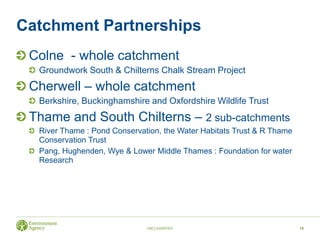
Catchment Partnerships
Colne - whole catchment
Groundwork South & Chilterns Chalk Stream Project
Cherwell – whole catchment
Berkshire, Buckinghamshire and Oxfordshire Wildlife Trust
Thame and South Chilterns – 2 sub-catchments
River Thame : Pond Conservation, the Water Habitats Trust & R Thame
Conservation Trust
Pang, Hughenden, Wye & Lower Middle Thames : Foundation for water
Research
UNCLASSIFIED 15
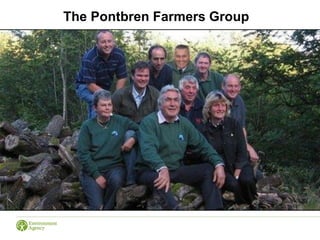
The Pontbren Farmers Group
Summary
In your area:
Get involved with your local catchment
partnership, CSF, FAS
Work together with your ‘land management’
neighbours
Make a difference: manage soil, land and
water sustainably
Protect your resources and safeguard your
business
Key Actions: our key messages
in one place

Farm Business Update 2014: Forest Centre, Environment Agency and Water Framework Directive

  • 1.
    The Water FrameworkDirective and the catchment based approach in your area Teresa Brown Catchment Co-ordinator For the Upper and Bedford Ouse, Old Bedford and Middle Level
  • 2.
    UNCLASSIFIED The Water FrameworkDirective Member states must plan and deliver a better water environment with a focus on: Ecology Chemical standards And protect all parts of the water environment: Groundwater, rivers, lakes, estuaries, coastal waters Six yearly planning cycles 2009, 2015, 2021 and 2027. Brings together or replaces several other EU Directives. Habitats Directive site objectives can over-ride WFD.
  • 3.
    Prevent deterioration andimprove the water environment, including ground water Promote sustainable water use Reduce pollution Help reduce the effects of floods and droughts 3 Water Framework Directive - key objectives
  • 4.
    Classification Nationally defined for2009 baseline (Cycle 1) Waterbody areas Type – river, lake, canal, transitional & coastal, groundwater Artificial or heavily modified Status – based on data from three preceding years – 2006, 2007, 2008 • Surface water – high, good, moderate, poor bad • Groundwater – good, bad UNCLASSIFIED 4
  • 5.
    UNCLASSIFIED Defra’s 100 Management Catchments forEngland and Wales 5 The Catchment Based Approach
  • 6.
    Your local managementcatchment 7 Cam & Ely Ouse 8 Cherwell 9 Colne 45 Nene 55 Old Bedford Inc Middle Level 77 Thame & South Chilterns 82 Upper & Bedford Ouse 84 Upper Lee UNCLASSIFIED 6
  • 7.
    County and UnitaryAuthorities
  • 8.
  • 9.
  • 10.
    Some typical pressures UNCLASSIFIED10 some farming practices surface water sewer abuse Invasive signal crayfish Phosphate from treated sewage discharges invasive Himalayan balsam Invasive fish species nutrient runoff surface water sewer abuse Poor morphology Amenity Use of pesticides Low flow / over abstraction Barrier to fish passage
  • 11.
    What are themain issues? Everywhere: Rising demand for water resources – ground and surface water Point source discharges - treated sewage effluent – phosphate Man-made structures and modifications – for flood defence, land drainage, navigation , water supply, amenity Rural areas: Diffuse pollution from agriculture: • Soil - sediment / phosphates / nitrates / pesticides – drinking water Straight, over deep and wide channels Urban areas: Diffuse pollution - poor quality surface water runoff, misconnections Concrete channels, culverts ssUNCLASSIF 11
  • 12.
    What you cando to help ‘Water friendly’ farming Reduce water use - store / conserve where you can Provide and manage features for water dependent wildlife Keep soil on the field – follow good practice Install and use ‘sustainable drainage’ features and techniques Exemplary nutrient planning and application Exemplary crop protection procedures Keep livestock out of water UNCLASSIFIED 12
  • 13.
    UNCLASSIFIED 13 Keep soilin your field Fords & tracks near water Silt traps Keep livestock out of water
  • 14.
    Catchment Partnerships Upper andBedford Ouse – 5 sub-catchment partnerships Ivel : Bedfordshire Rural Communities Charity Bedfordshire Ouzel : The Greensand Trust Bedford & Marston Vale : The Marston Vale Trust Great Ouse & Ouzel, Milton Keynes : Milton Keynes Parks Trust Lower Ouse : Great Ouse Area of Outstanding Natural Beauty Upper Lee - 2 sub-catchment partnerships Urban Luton and Hoo Lakes : Hertfordshire Groundwork Trust and Cranfield University Upper Lea (Hertfordshire) : Herts and Middlesex Wildlife Trust UNCLASSIFIED 14
  • 15.
    Catchment Partnerships Colne -whole catchment Groundwork South & Chilterns Chalk Stream Project Cherwell – whole catchment Berkshire, Buckinghamshire and Oxfordshire Wildlife Trust Thame and South Chilterns – 2 sub-catchments River Thame : Pond Conservation, the Water Habitats Trust & R Thame Conservation Trust Pang, Hughenden, Wye & Lower Middle Thames : Foundation for water Research UNCLASSIFIED 15
  • 16.
  • 17.
    Summary In your area: Getinvolved with your local catchment partnership, CSF, FAS Work together with your ‘land management’ neighbours Make a difference: manage soil, land and water sustainably Protect your resources and safeguard your business Key Actions: our key messages in one place