The Foreign Account Tax
Compliance Act (FATCA)
Regulatory Framework
SESSION 1
TRAINING COURSE
FATCA AND THE OECD COMMON REPORTING STANDARD
2016
Rodrigo Zepeda
ManagingDirector, Storm-7 COnsulting
© Copyright 2016 | Storm-7 Consulting | All Rights Reserved
Section 1:
FATCA Definitions
Section 2:
FATCA Aims, Objectives and Timelines
Section 3:
The Three Pillars of FATCA (Classification,
Reporting, Withholding)
FATCA Definitions and
Terminology
SECTION 1
3
FATCA Definitions
 FFI: Foreign Financial Institution means a foreign entity that is a financial institution as defined
in the United States (US) FATCA Final Regulations. It generally includes any one of five
categories of FFI, namely specified: (1) depositary institutions; (2) custodial institutions; (3)
investment entities; (4) insurance companies or holding companies of insurance companies that
issue cash value insurance or annuity contracts; and (5) holding companies and treasury centres
of groups that include another financial entity.
 Prima Facie FFI: is an entity that is designated in the WA’s electronic database (searchable) as an
account holder, that is a Qualified or Non-Qualified Intermediary, or documented or presumed
to be, a foreign account holder, and assigned a set of industry codes indicating that the entity is
a type of financial intermediary (for US maintained accounts).
 P-FFI: Participating Foreign Financial Institution means an FFI (including a Reporting Model 2
FFI (RM2-FFI)) that has voluntarily agreed to comply with the terms of a Foreign Financial
Institution Agreement (FFI Agreement) entered into with the US IRS.
 DC-FFI: Deemed-Compliant Foreign Financial Institution means any of three specified types of
FFI: (1) Registered Deemed-Compliant FFI (RDC-FFI); (2) Certified Deemed-Compliant FFI (CDC-
FFI) ; and (3) Owner-Documented FFI (OD-FFI).
4
FATCA Definitions (cont)
 IRS: Internal Revenue Service means a government agency which is a bureau of the US
Department of Treasury, and which is the revenue service for the US Federal Government
responsible for collecting taxes and administering the US Internal Revenue Code 1986 (IRC) (as
amended).
 GIIN: Global Intermediary Identification Number means a specified and unique identification
number that is assigned to a P-FFI or a RDC-FFI by the US Internal Revenue Service (IRS).
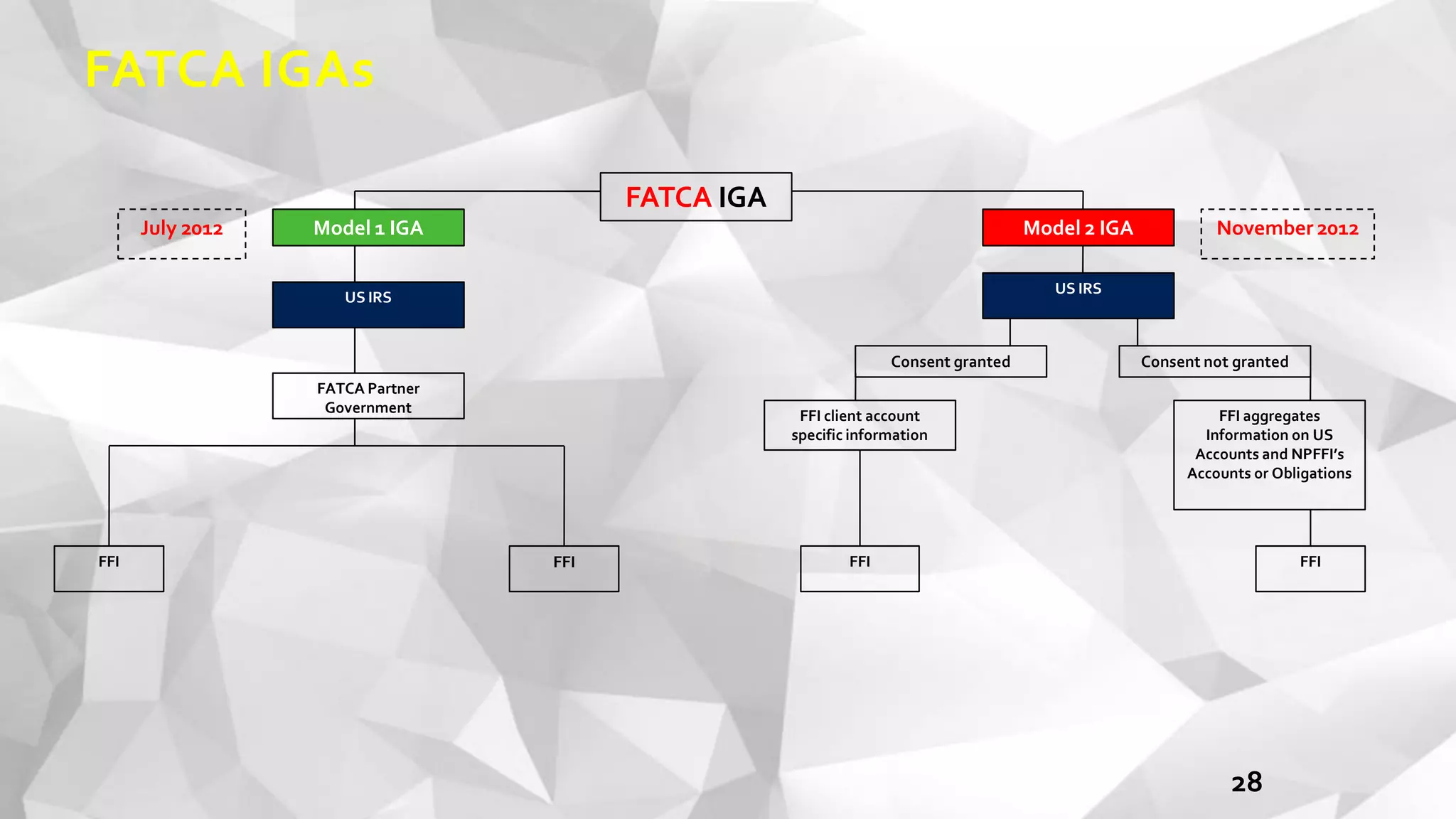
 IGA: Intergovernmental Agreement means a partnership agreement based on a Model
Intergovernmental Agreement template, between the US and a FATCA Partner Jurisdiction,
which allows FFIs in FATCA Partner Jurisdictions to either report information on US account
holders: (1) directly to their national tax authorities who will then report to the IRS (Model 1
IGA); or (2) directly to the IRS by entering into a FFIAgreement with the IRS (Model 2 IGA).
 NFFE: Non-Financial Foreign Entity means any non-US entity that is not treated as a Financial
Institution. NFFEs are sub-classified as either an 'Active NFFE' (A-NFFE) or a 'Passive NFFE' (P-
NFFE).
5
FATCA Definitions (cont)
6
 RO: Responsible Officer means an individual who is appointed as the official Responsible
Officer of an institution, who is sufficiently authorised to act on behalf of that institution, and
will periodically provide certifications to the IRS about the institution's ongoing compliance
with its FATCA obligations.
 USWAs: United States Withholding Agents means a US or foreign person that has control,
receipt, custody, disposal, or payment of any item of income of a foreign person that is subject
to withholding on US source income. A withholding agent may be an individual, corporation,
partnership, trust, association, or any other entity, including any foreign intermediary, foreign
partnership, or US branch of certain foreign banks and insurance companies.
 FDAP Income (‘Fixed or Determinable Annual or Periodic’): Income is an acronym for Fixed or
Determinable, Annual or Periodic US source passive income. Some of the more common
expenses paid by US withholding agents which would result in FDAP income to their vendors
and other service providers are interest, royalties, compensation for personal services, rents,
pensions or annuities and gains from the sale or exchange of the patents, copyrights and
similar intangibles expressly specified in the US Internal Revenue Code 1986 (IRC) (as
amended).
FATCA Definitions (cont)
 Material Failures: are failures of the P-FFI to fulfil obligations under FFI Agreement if failure
arose because of: (1) an error attributable to a failure of P-FFI to implement sufficient controls;
or (2) deliberate actions to avoid FFI Agreement obligations by one or more P-FFI employees
(or its agent, sponsor, or compliance financial institution).
 Events of Default: are when a P-FFI fails to perform material obligations of the FFI Agreement
(due diligence, reporting, withholding), or if the IRS determines P-FFI has failed to
substantially comply with the FFI Agreement obligations.
 Active Non-Financial Foreign Entity is any entity that is not a Foreign Financial Institution, and
that has less than 50% of its gross income for the preceding calendar year as Passive Income,
and less than 50% of the weighted average percentage of assets held by it, are assets that
produce or are held for the production of Passive Income (tested on a quarterly basis).
 Passive Non-Foreign Financial Entity: is a Non-Financial Foreign Entity that is not an Active
Non-Financial Foreign Entity, or a withholding foreign partnership or withholding foreign trust
pursuant to the FATCA Regulations.
7
FATCA Definitions (cont)
8
 Grandfathered Obligations (GOs): generally refers to eligible debt instruments (including interest
obligations) classified as debt for US tax purposes and with stated maturities issued on or before 1
July 2014 (including gross proceeds from the disposition of grandfathered obligations).
 Obligations that are legally binding and outstanding as of 1 July 2014 that produce or could
produce a withholdable payment or foreign passthru payment, as well as the gross proceeds from
the disposition of such an obligation.
Grandfathered Obligations Excluded
 Instruments treated as equity for US tax purposes.
 Instruments that lack a stated expiration, term, or maturity date.
 Brokerage, custodial, or other similar agreements to hold financial assets for the account of
others.
 Derivatives (ISDA) Master Agreements that set forth general terms (not individual MA
Confirmations).
FATCA Definitions (cont)
9
Grandfathered Obligations Examples
 Examples include: debt instruments; lines of credit; revolving credit agreements (fixed maturity
and material terms); term annuity contract; and derivatives transactions.
ModifiedGOs
 GO’s that are subject to "material modification" will be treated as newly issued on the date of
modification and will not benefit from FATCA exemptions any more.
 Material modification includes a significant amendment of terms of obligation, such as changes
in the underlying obligor or security, timing of payments leading to a material deferral of
scheduled payments, the yield (by more than the greater of 5% annual yield or 25 basis points).
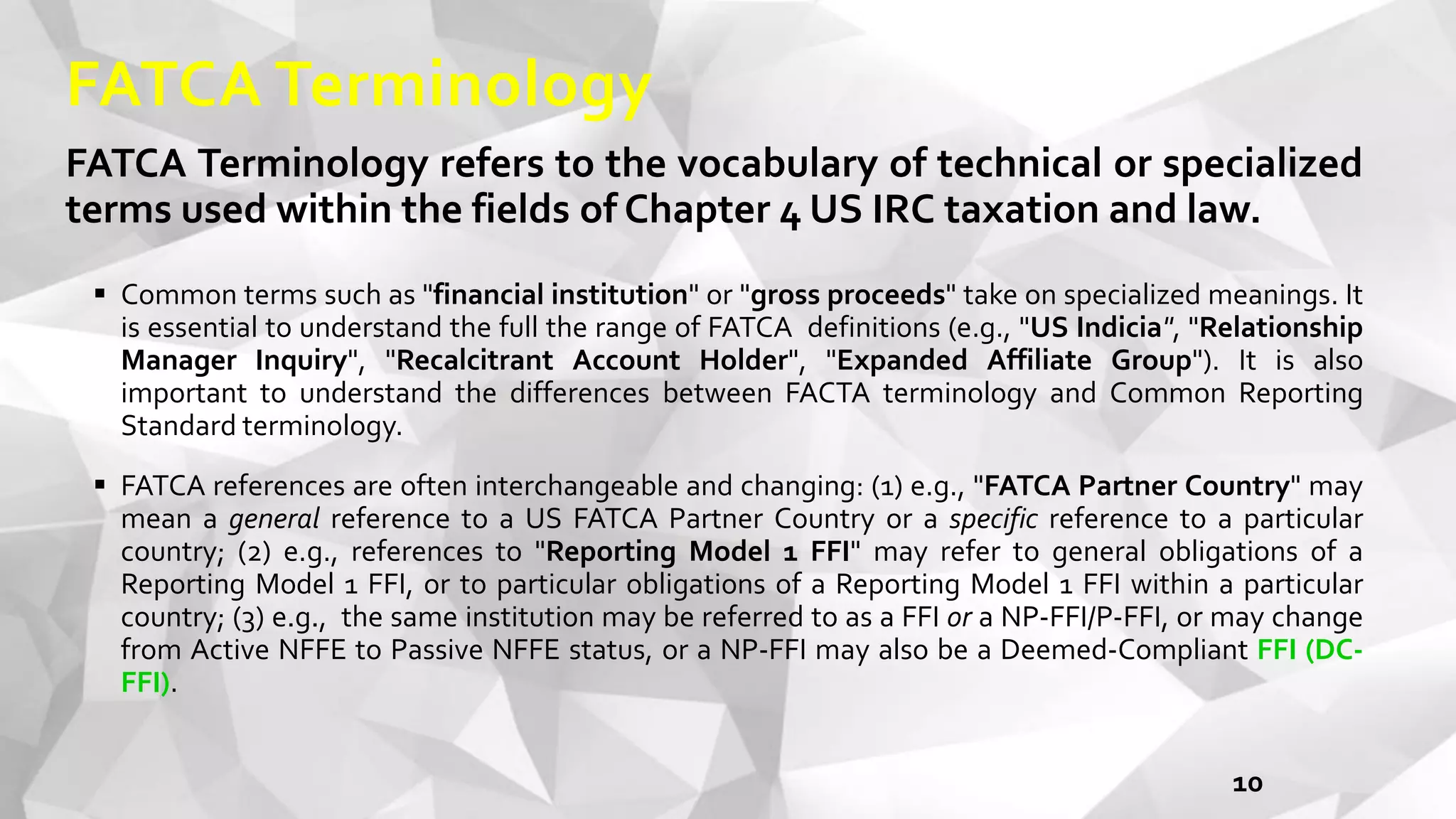
FATCA Terminology
FATCA Terminology refers to the vocabulary of technical or specialized
terms used within the fields of Chapter 4 US IRC taxation and law.
 Common terms such as "financial institution" or "gross proceeds" take on specialized meanings. It
is essential to understand the full the range of FATCA definitions (e.g., "US Indicia", "Relationship
Manager Inquiry", "Recalcitrant Account Holder", "Expanded Affiliate Group"). It is also
important to understand the differences between FACTA terminology and Common Reporting
Standard terminology.
 FATCA references are often interchangeable and changing: (1) e.g., "FATCA Partner Country" may
mean a general reference to a US FATCA Partner Country or a specific reference to a particular
country; (2) e.g., references to "Reporting Model 1 FFI" may refer to general obligations of a
Reporting Model 1 FFI, or to particular obligations of a Reporting Model 1 FFI within a particular
country; (3) e.g., the same institution may be referred to as a FFI or a NP-FFI/P-FFI, or may change
from Active NFFE to Passive NFFE status, or a NP-FFI may also be a Deemed-Compliant FFI (DC-
FFI).
10
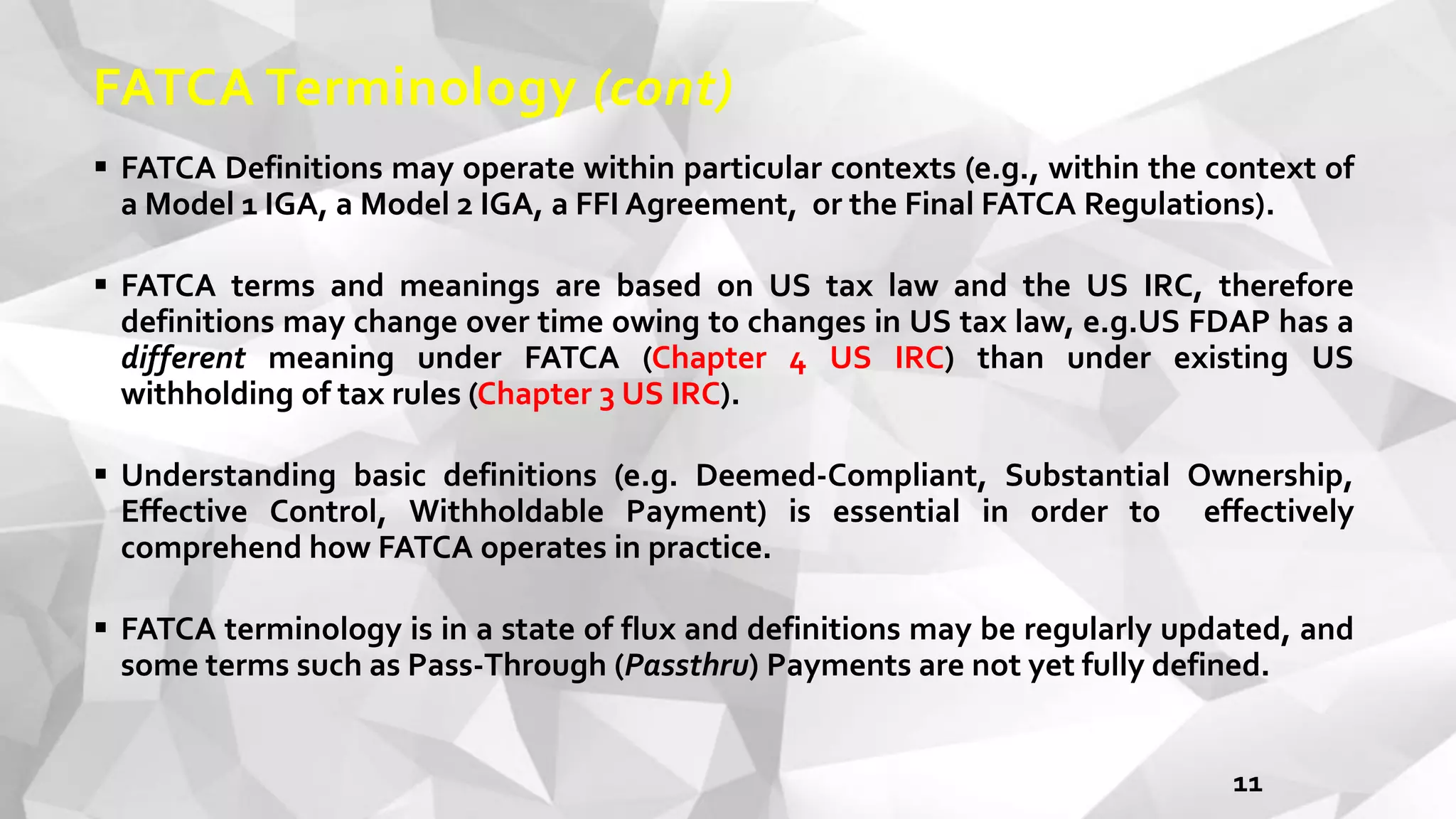
FATCA Terminology (cont)
 FATCA Definitions may operate within particular contexts (e.g., within the context of
a Model 1 IGA, a Model 2 IGA, a FFI Agreement, or the Final FATCA Regulations).
 FATCA terms and meanings are based on US tax law and the US IRC, therefore
definitions may change over time owing to changes in US tax law, e.g.US FDAP has a
different meaning under FATCA (Chapter 4 US IRC) than under existing US
withholding of tax rules (Chapter 3 US IRC).
 Understanding basic definitions (e.g. Deemed-Compliant, Substantial Ownership,
Effective Control, Withholdable Payment) is essential in order to effectively
comprehend how FATCA operates in practice.
 FATCA terminology is in a state of flux and definitions may be regularly updated, and
some terms such as Pass-Through (Passthru) Payments are not yet fully defined.
11
FATCA Aims, Objectives and
Milestones
SECTION 2
12
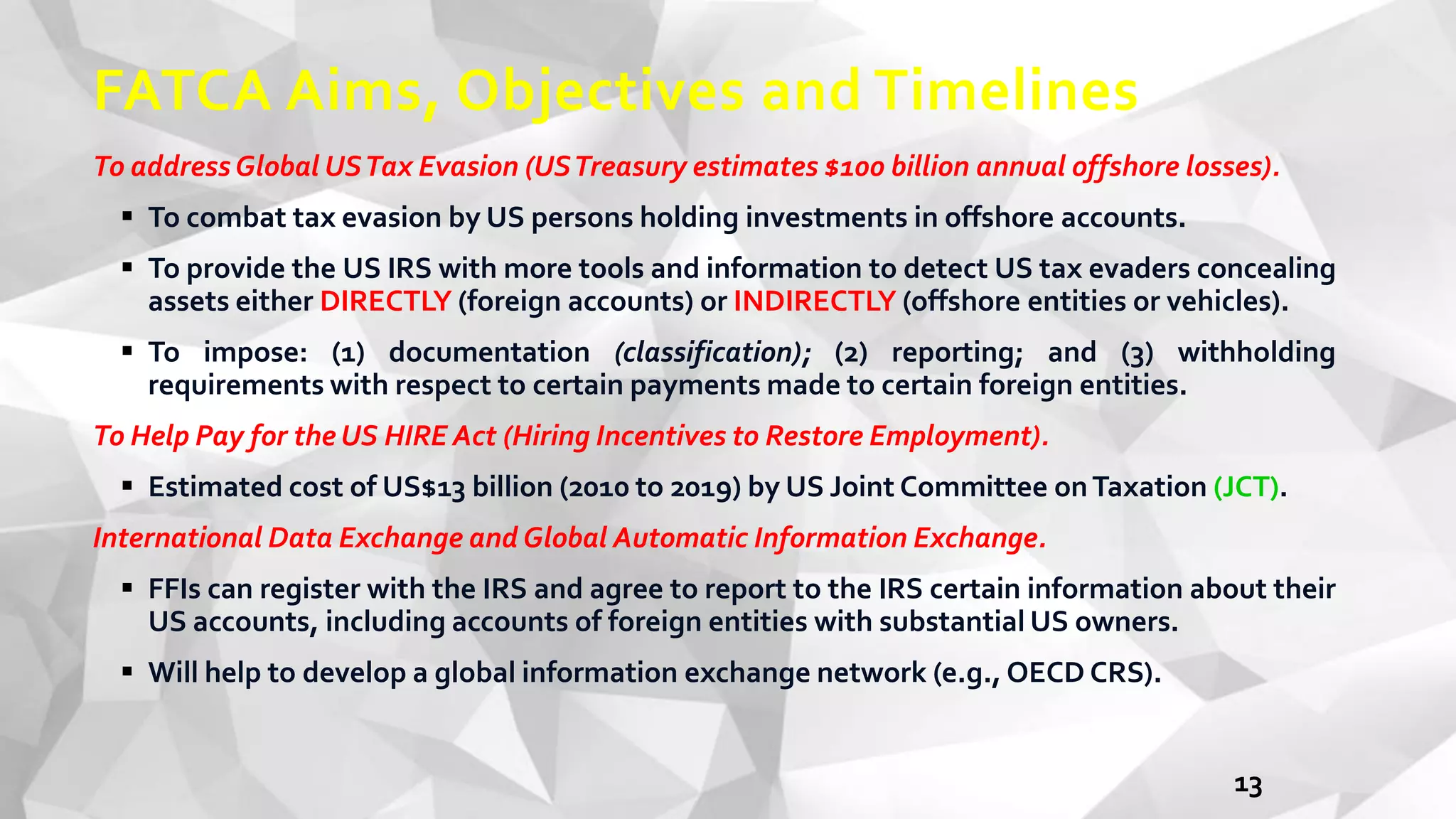
FATCA Aims, Objectives and Timelines
To addressGlobal USTax Evasion (USTreasury estimates $100 billion annual offshore losses).
 To combat tax evasion by US persons holding investments in offshore accounts.
 To provide the US IRS with more tools and information to detect US tax evaders concealing
assets either DIRECTLY (foreign accounts) or INDIRECTLY (offshore entities or vehicles).
 To impose: (1) documentation (classification); (2) reporting; and (3) withholding
requirements with respect to certain payments made to certain foreign entities.
To Help Pay for the US HIRE Act (Hiring Incentives to Restore Employment).
 Estimated cost of US$13 billion (2010 to 2019) by US Joint Committee onTaxation (JCT).
International Data Exchange and Global Automatic Information Exchange.
 FFIs can register with the IRS and agree to report to the IRS certain information about their
US accounts, including accounts of foreign entities with substantial US owners.
 Will help to develop a global information exchange network (e.g., OECD CRS).
13
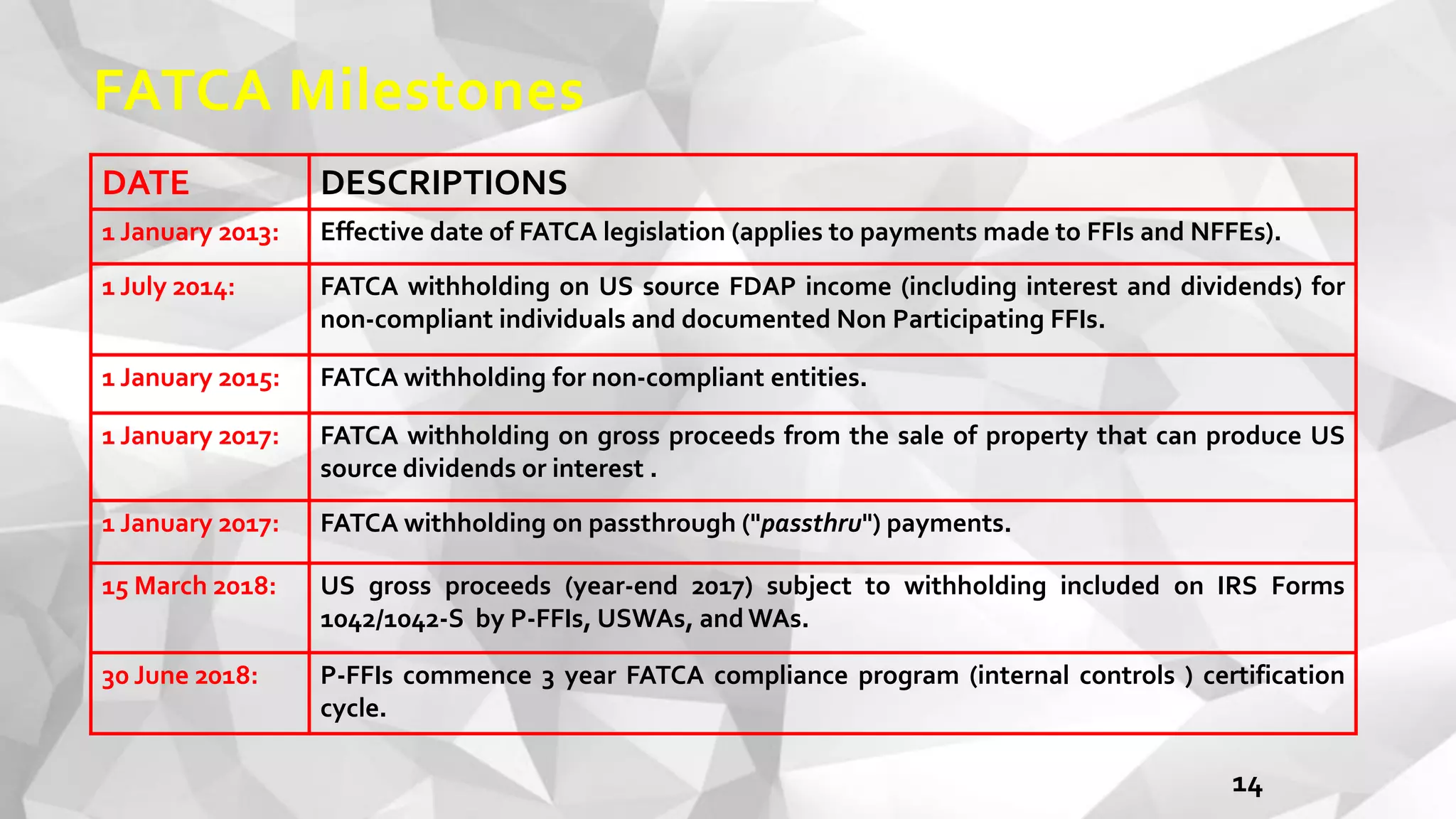
FATCA Milestones
14
DATE DESCRIPTIONS
1 January 2013: Effective date of FATCA legislation (applies to payments made to FFIs and NFFEs).
1 July 2014: FATCA withholding on US source FDAP income (including interest and dividends) for
non-compliant individuals and documented Non Participating FFIs.
1 January 2015: FATCA withholding for non-compliant entities.
1 January 2017: FATCA withholding on gross proceeds from the sale of property that can produce US
source dividends or interest .
1 January 2017: FATCA withholding on passthrough ("passthru") payments.
15 March 2018: US gross proceeds (year-end 2017) subject to withholding included on IRS Forms
1042/1042-S by P-FFIs, USWAs, and WAs.
30 June 2018: P-FFIs commence 3 year FATCA compliance program (internal controls ) certification
cycle.
FATCA Milestones
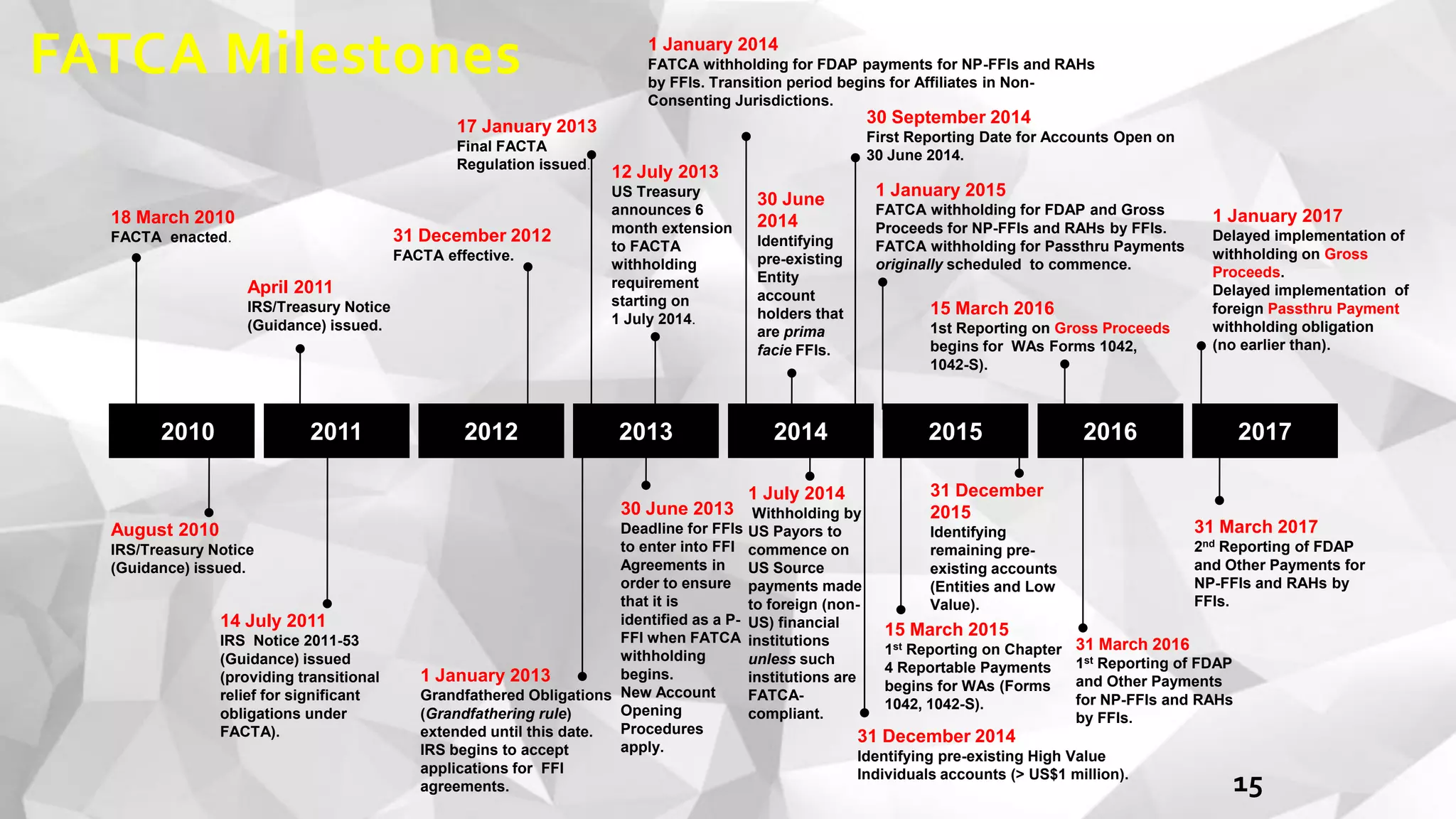
15
2010 2011 2012 2013 2014 2015 2016 2017
18 March 2010
FACTA enacted.
August 2010
IRS/Treasury Notice
(Guidance) issued.
April 2011
IRS/Treasury Notice
(Guidance) issued.
14 July 2011
IRS Notice 2011-53
(Guidance) issued
(providing transitional
relief for significant
obligations under
FACTA).
31 December 2012
FACTA effective.
1 January 2013
Grandfathered Obligations
(Grandfathering rule)
extended until this date.
IRS begins to accept
applications for FFI
agreements.
17 January 2013
Final FACTA
Regulation issued.
30 June 2013
Deadline for FFIs
to enter into FFI
Agreements in
order to ensure
that it is
identified as a P-
FFI when FATCA
withholding
begins.
New Account
Opening
Procedures
apply.
12 July 2013
US Treasury
announces 6
month extension
to FACTA
withholding
requirement
starting on
1 July 2014.
1 January 2014
FATCA withholding for FDAP payments for NP-FFIs and RAHs
by FFIs. Transition period begins for Affiliates in Non-
Consenting Jurisdictions.
1 July 2014
Withholding by
US Payors to
commence on
US Source
payments made
to foreign (non-
US) financial
institutions
unless such
institutions are
FATCA-
compliant.
30 June
2014
Identifying
pre-existing
Entity
account
holders that
are prima
facie FFIs.
30 September 2014
First Reporting Date for Accounts Open on
30 June 2014.
31 December 2014
Identifying pre-existing High Value
Individuals accounts (> US$1 million).
1 January 2015
FATCA withholding for FDAP and Gross
Proceeds for NP-FFIs and RAHs by FFIs.
FATCA withholding for Passthru Payments
originally scheduled to commence.
15 March 2015
1st Reporting on Chapter
4 Reportable Payments
begins for WAs (Forms
1042, 1042-S).
31 December
2015
Identifying
remaining pre-
existing accounts
(Entities and Low
Value).
15 March 2016
1st Reporting on Gross Proceeds
begins for WAs Forms 1042,
1042-S).
31 March 2016
1st Reporting of FDAP
and Other Payments
for NP-FFIs and RAHs
by FFIs.
1 January 2017
Delayed implementation of
withholding on Gross
Proceeds.
Delayed implementation of
foreign Passthru Payment
withholding obligation
(no earlier than).
31 March 2017
2nd Reporting of FDAP
and Other Payments for
NP-FFIs and RAHs by
FFIs.
The Three Pillars of
FATCA (Classification,
Reporting, Withholding)
SECTION 3
16
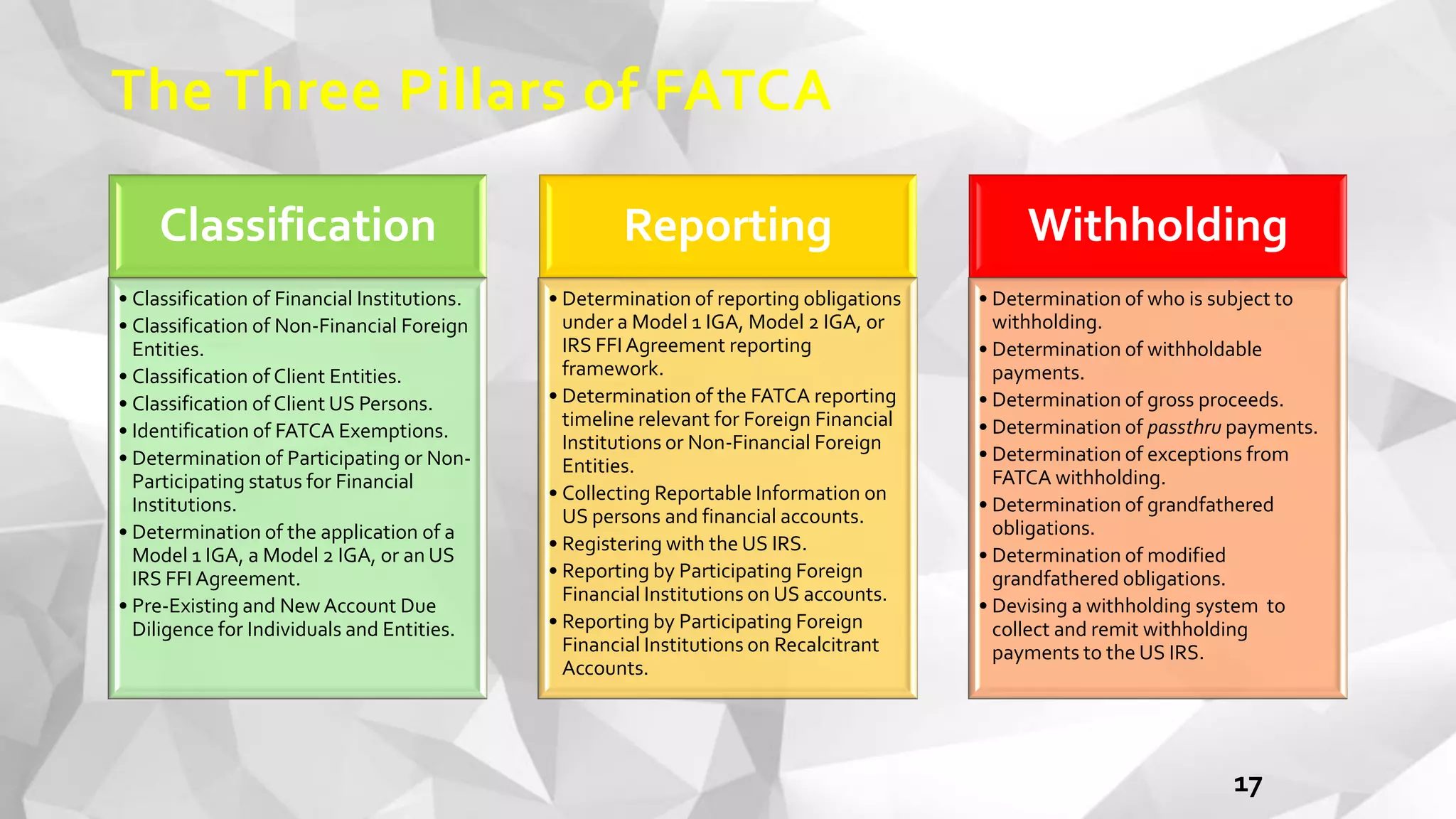
The Three Pillars of FATCA
17
Classification
• Classification of Financial Institutions.
• Classification of Non-Financial Foreign
Entities.
• Classification of Client Entities.
• Classification of Client US Persons.
• Identification of FATCA Exemptions.
• Determination of Participating or Non-
Participating status for Financial
Institutions.
• Determination of the application of a
Model 1 IGA, a Model 2 IGA, or an US
IRS FFI Agreement.
• Pre-Existing and New Account Due
Diligence for Individuals and Entities.
Reporting
• Determination of reporting obligations
under a Model 1 IGA, Model 2 IGA, or
IRS FFI Agreement reporting
framework.
• Determination of the FATCA reporting
timeline relevant for Foreign Financial
Institutions or Non-Financial Foreign
Entities.
• Collecting Reportable Information on
US persons and financial accounts.
• Registering with the US IRS.
• Reporting by Participating Foreign
Financial Institutions on US accounts.
• Reporting by Participating Foreign
Financial Institutions on Recalcitrant
Accounts.
Withholding
• Determination of who is subject to
withholding.
• Determination of withholdable
payments.
• Determination of gross proceeds.
• Determination of passthru payments.
• Determination of exceptions from
FATCA withholding.
• Determination of grandfathered
obligations.
• Determination of modified
grandfathered obligations.
• Devising a withholding system to
collect and remit withholding
payments to the US IRS.
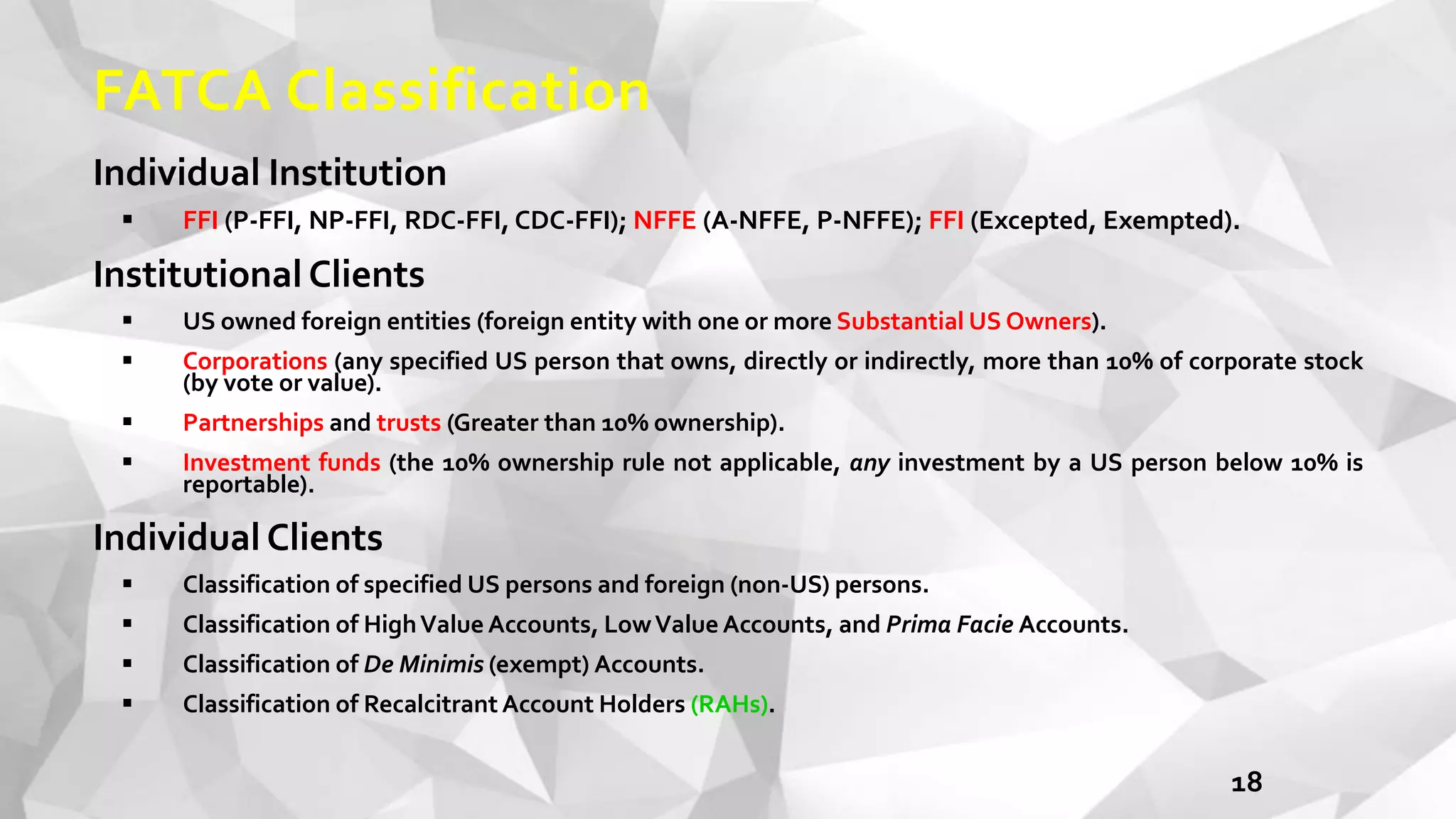
FATCA Classification
Individual Institution
 FFI (P-FFI, NP-FFI, RDC-FFI, CDC-FFI); NFFE (A-NFFE, P-NFFE); FFI (Excepted, Exempted).
Institutional Clients
 US owned foreign entities (foreign entity with one or more Substantial US Owners).
 Corporations (any specified US person that owns, directly or indirectly, more than 10% of corporate stock
(by vote or value).
 Partnerships and trusts (Greater than 10% ownership).
 Investment funds (the 10% ownership rule not applicable, any investment by a US person below 10% is
reportable).
Individual Clients
 Classification of specified US persons and foreign (non-US) persons.
 Classification of HighValue Accounts, LowValue Accounts, and Prima Facie Accounts.
 Classification of De Minimis (exempt) Accounts.
 Classification of Recalcitrant Account Holders (RAHs).
18
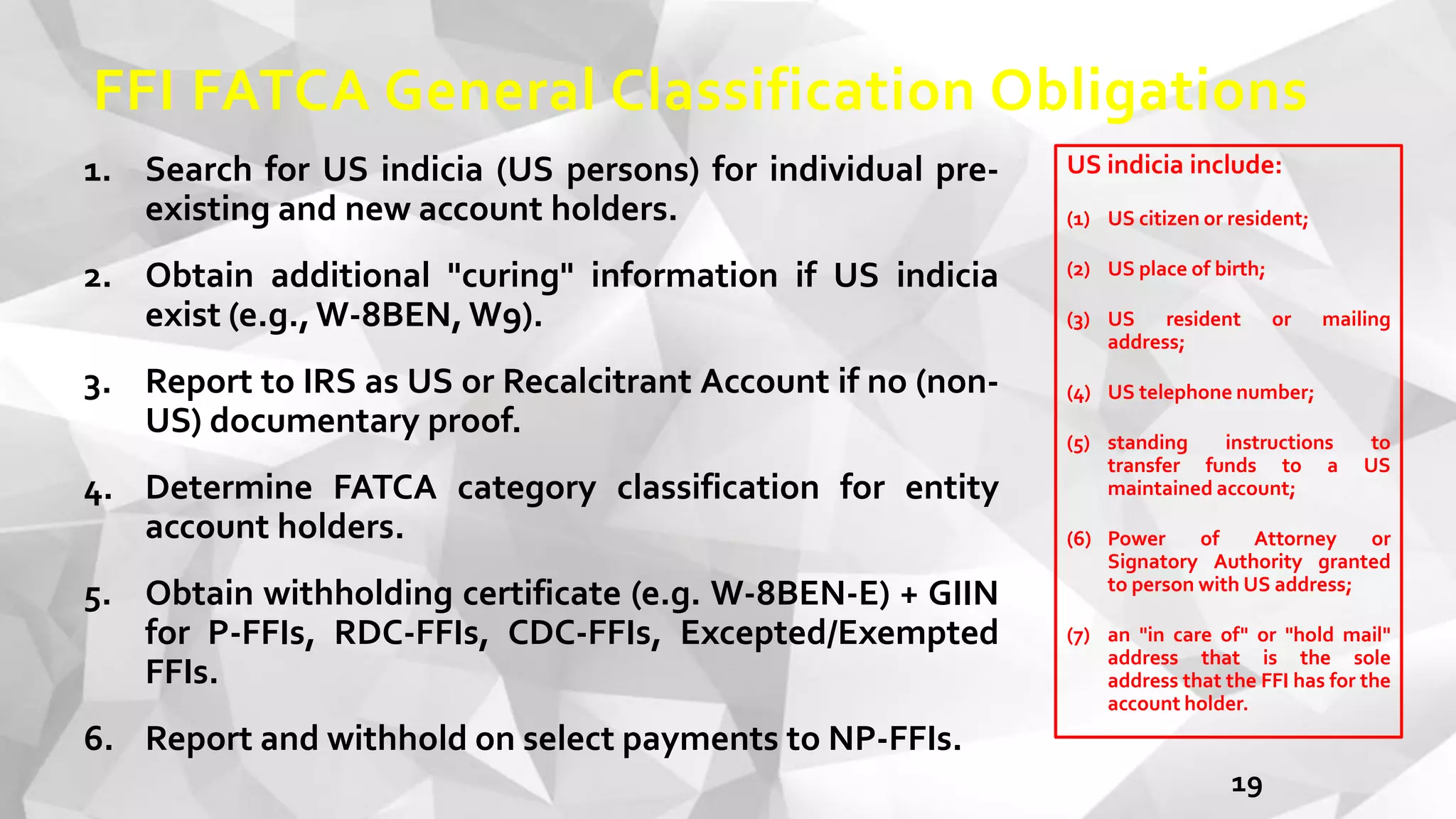
FFI FATCA General Classification Obligations
1. Search for US indicia (US persons) for individual pre-
existing and new account holders.
2. Obtain additional "curing" information if US indicia
exist (e.g.,W-8BEN, W9).
3. Report to IRS as US or Recalcitrant Account if no (non-
US) documentary proof.
4. Determine FATCA category classification for entity
account holders.
5. Obtain withholding certificate (e.g. W-8BEN-E) + GIIN
for P-FFIs, RDC-FFIs, CDC-FFIs, Excepted/Exempted
FFIs.
6. Report and withhold on select payments to NP-FFIs.
19
US indicia include:
(1) US citizen or resident;
(2) US place of birth;
(3) US resident or mailing
address;
(4) US telephone number;
(5) standing instructions to
transfer funds to a US
maintained account;
(6) Power of Attorney or
Signatory Authority granted
to person with US address;
(7) an "in care of" or "hold mail"
address that is the sole
address that the FFI has for the
account holder.
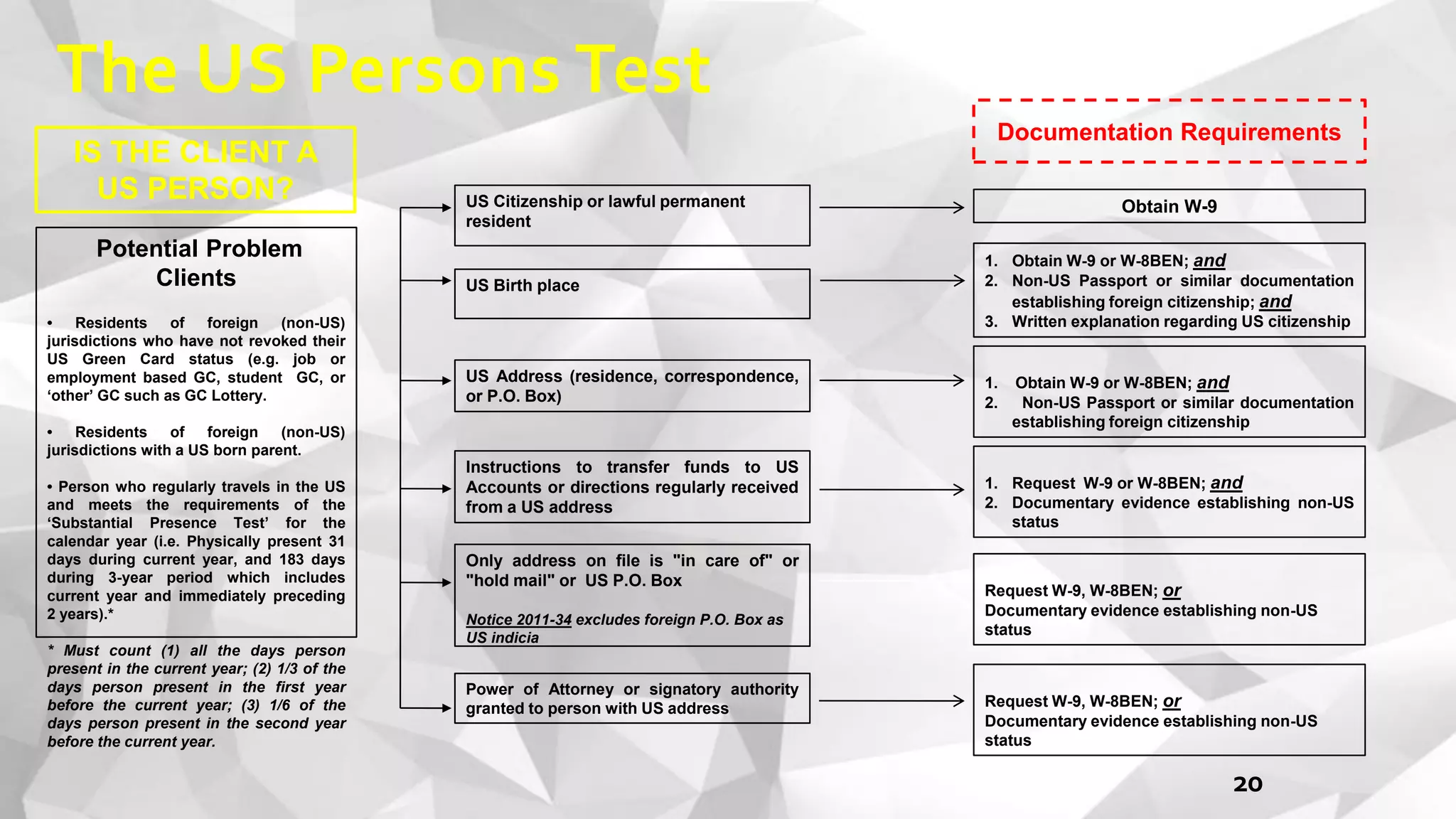
Documentation Requirements
IS THE CLIENT A
US PERSON?
Potential Problem
Clients
• Residents of foreign (non-US)
jurisdictions who have not revoked their
US Green Card status (e.g. job or
employment based GC, student GC, or
‘other’ GC such as GC Lottery.
• Residents of foreign (non-US)
jurisdictions with a US born parent.
• Person who regularly travels in the US
and meets the requirements of the
‘Substantial Presence Test’ for the
calendar year (i.e. Physically present 31
days during current year, and 183 days
during 3-year period which includes
current year and immediately preceding
2 years).*
* Must count (1) all the days person
present in the current year; (2) 1/3 of the
days person present in the first year
before the current year; (3) 1/6 of the
days person present in the second year
before the current year.
US Citizenship or lawful permanent
resident
US Birth place
US Address (residence, correspondence,
or P.O. Box)
Instructions to transfer funds to US
Accounts or directions regularly received
from a US address
Only address on file is "in care of" or
"hold mail" or US P.O. Box
Notice 2011-34 excludes foreign P.O. Box as
US indicia
Power of Attorney or signatory authority
granted to person with US address
Obtain W-9
1. Obtain W-9 or W-8BEN; and
2. Non-US Passport or similar documentation
establishing foreign citizenship; and
3. Written explanation regarding US citizenship
1. Obtain W-9 or W-8BEN; and
2. Non-US Passport or similar documentation
establishing foreign citizenship
1. Request W-9 or W-8BEN; and
2. Documentary evidence establishing non-US
status
Request W-9, W-8BEN; or
Documentary evidence establishing non-US
status
Request W-9, W-8BEN; or
Documentary evidence establishing non-US
status
The US Persons Test
20
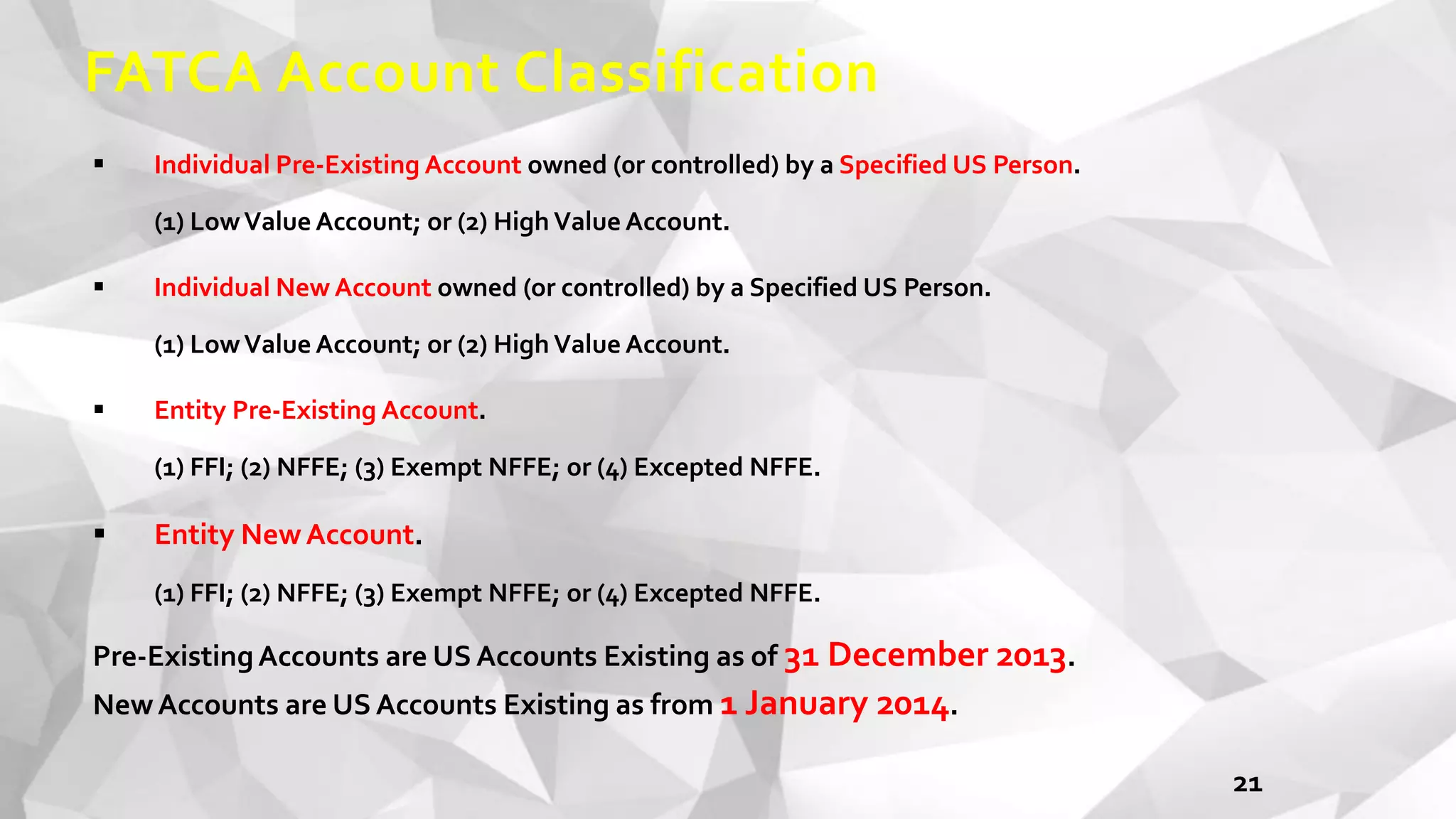
FATCA Account Classification
 Individual Pre-Existing Account owned (0r controlled) by a Specified US Person.
(1) LowValue Account; or (2) High Value Account.
 Individual New Account owned (or controlled) by a Specified US Person.
(1) LowValue Account; or (2) High Value Account.
 Entity Pre-Existing Account.
(1) FFI; (2) NFFE; (3) Exempt NFFE; or (4) Excepted NFFE.
 Entity NewAccount.
(1) FFI; (2) NFFE; (3) Exempt NFFE; or (4) Excepted NFFE.
Pre-ExistingAccounts are US Accounts Existing as of 31 December 2013.
NewAccounts are US Accounts Existing as from 1 January 2014.
21
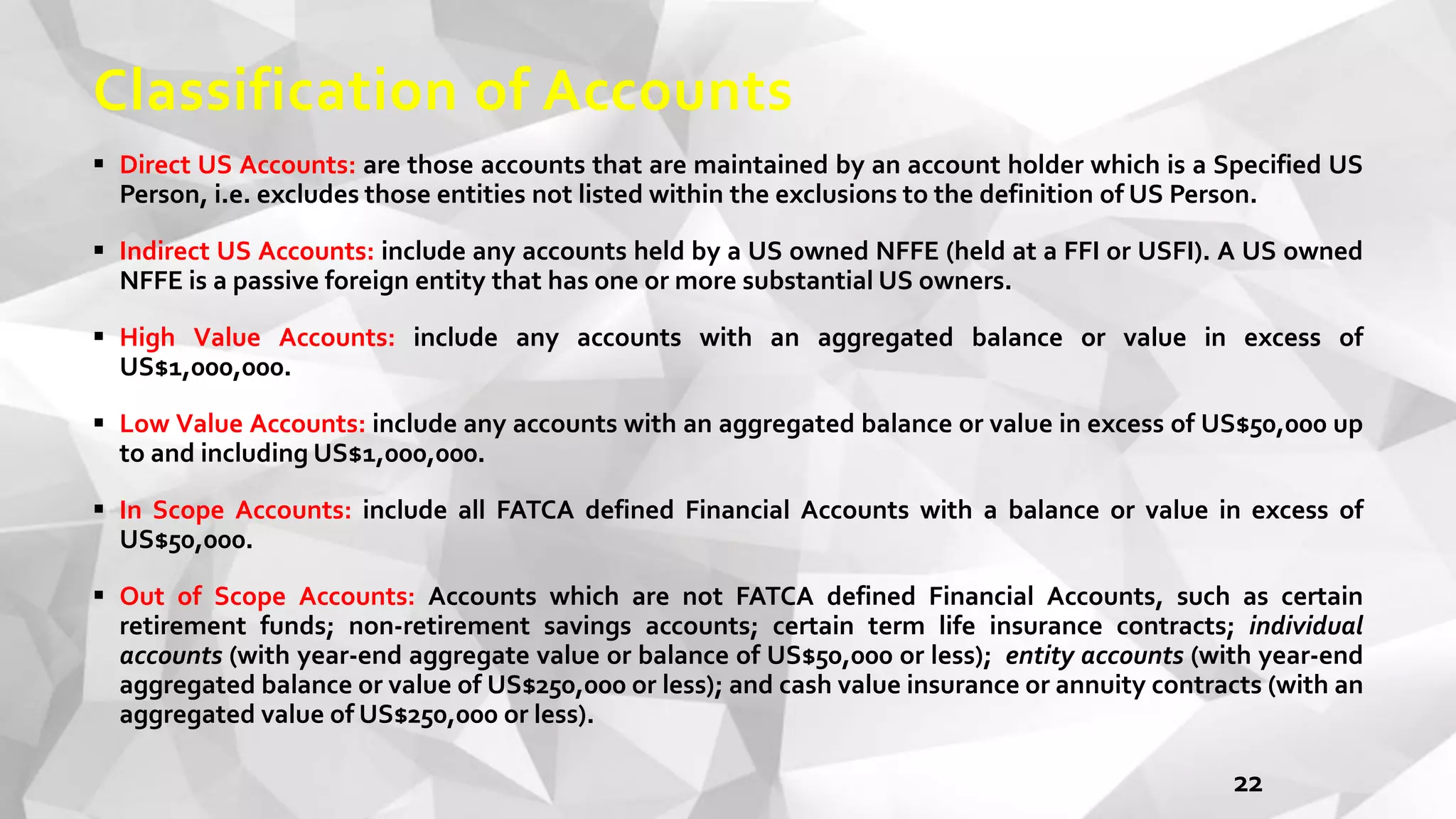
Classification of Accounts
 Direct US Accounts: are those accounts that are maintained by an account holder which is a Specified US
Person, i.e. excludes those entities not listed within the exclusions to the definition of US Person.
 Indirect US Accounts: include any accounts held by a US owned NFFE (held at a FFI or USFI). A US owned
NFFE is a passive foreign entity that has one or more substantial US owners.
 High Value Accounts: include any accounts with an aggregated balance or value in excess of
US$1,000,000.
 Low Value Accounts: include any accounts with an aggregated balance or value in excess of US$50,000 up
to and including US$1,000,000.
 In Scope Accounts: include all FATCA defined Financial Accounts with a balance or value in excess of
US$50,000.
 Out of Scope Accounts: Accounts which are not FATCA defined Financial Accounts, such as certain
retirement funds; non-retirement savings accounts; certain term life insurance contracts; individual
accounts (with year-end aggregate value or balance of US$50,000 or less); entity accounts (with year-end
aggregated balance or value of US$250,000 or less); and cash value insurance or annuity contracts (with an
aggregated value of US$250,000 or less).
22
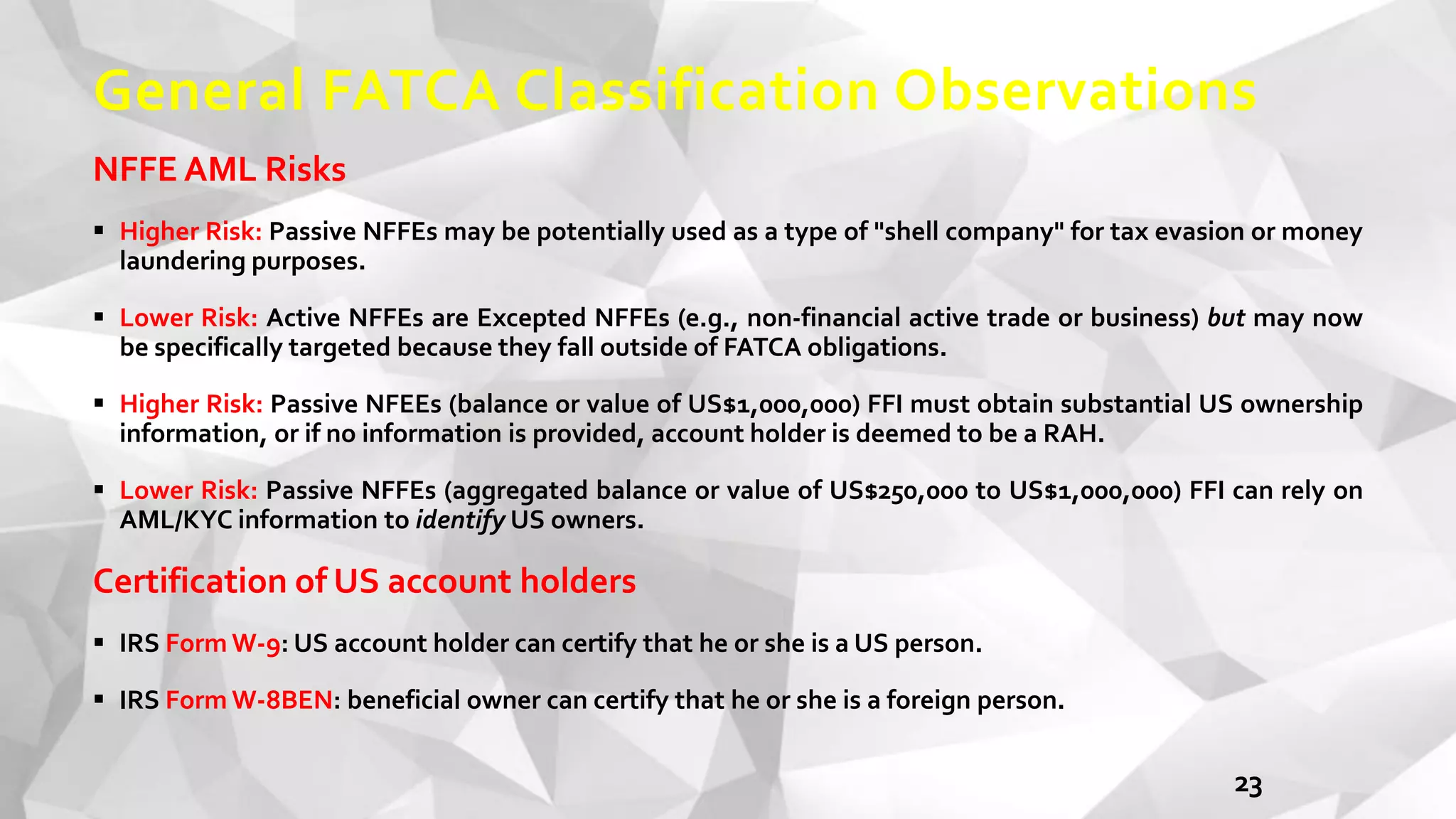
General FATCA Classification Observations
NFFE AML Risks
 Higher Risk: Passive NFFEs may be potentially used as a type of "shell company" for tax evasion or money
laundering purposes.
 Lower Risk: Active NFFEs are Excepted NFFEs (e.g., non-financial active trade or business) but may now
be specifically targeted because they fall outside of FATCA obligations.
 Higher Risk: Passive NFEEs (balance or value of US$1,000,000) FFI must obtain substantial US ownership
information, or if no information is provided, account holder is deemed to be a RAH.
 Lower Risk: Passive NFFEs (aggregated balance or value of US$250,000 to US$1,000,000) FFI can rely on
AML/KYC information to identify US owners.
Certification of US account holders
 IRS Form W-9: US account holder can certify that he or she is a US person.
 IRS Form W-8BEN: beneficial owner can certify that he or she is a foreign person.
23
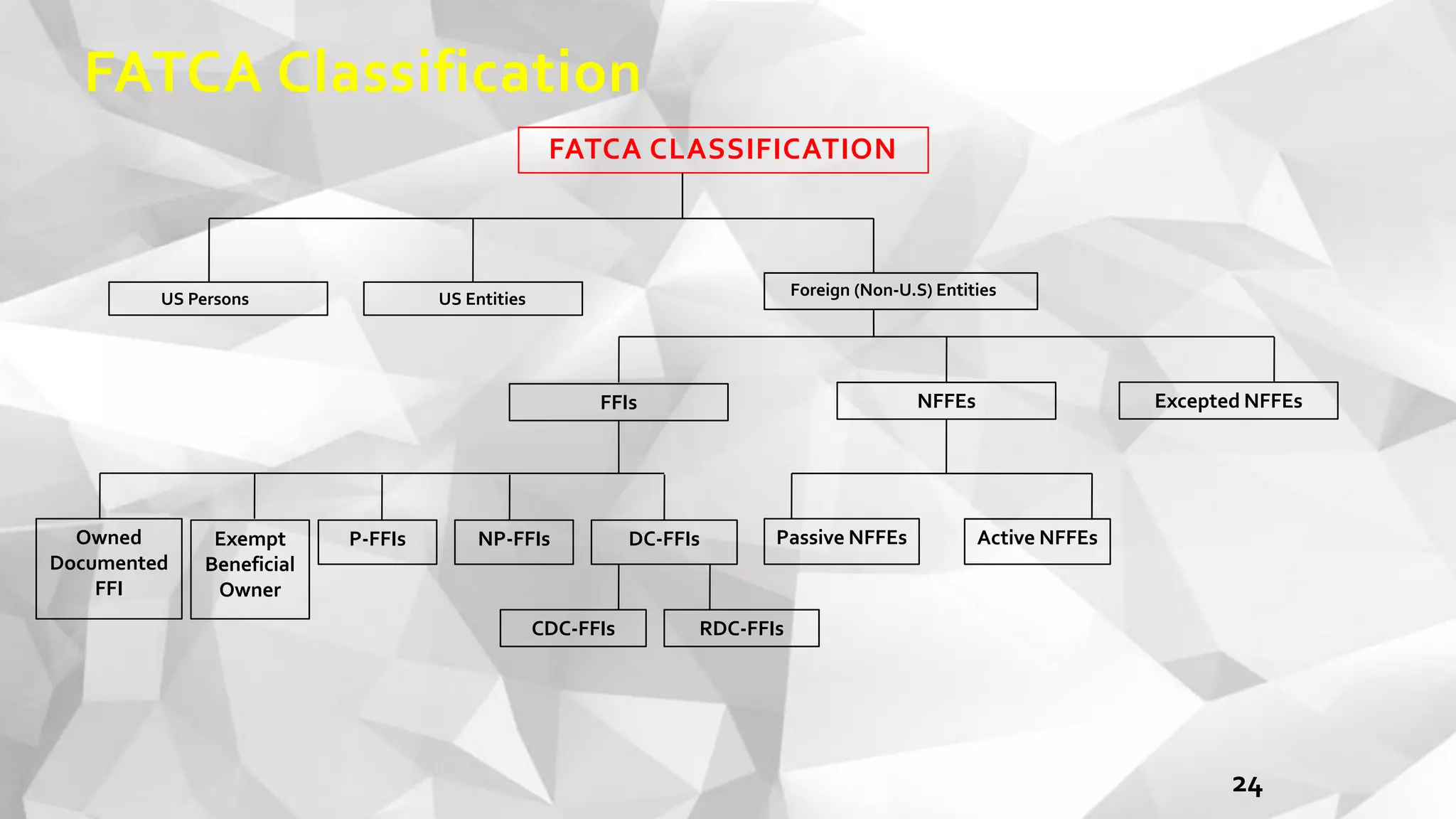
FATCA CLASSIFICATION
US Persons US Entities
Foreign (Non-U.S) Entities
FFIs Excepted NFFEsNFFEs
Active NFFEsPassive NFFEsDC-FFIsNP-FFIsP-FFIs
24
FATCA Classification
RDC-FFIsCDC-FFIs
Owned
Documented
FFI
Exempt
Beneficial
Owner
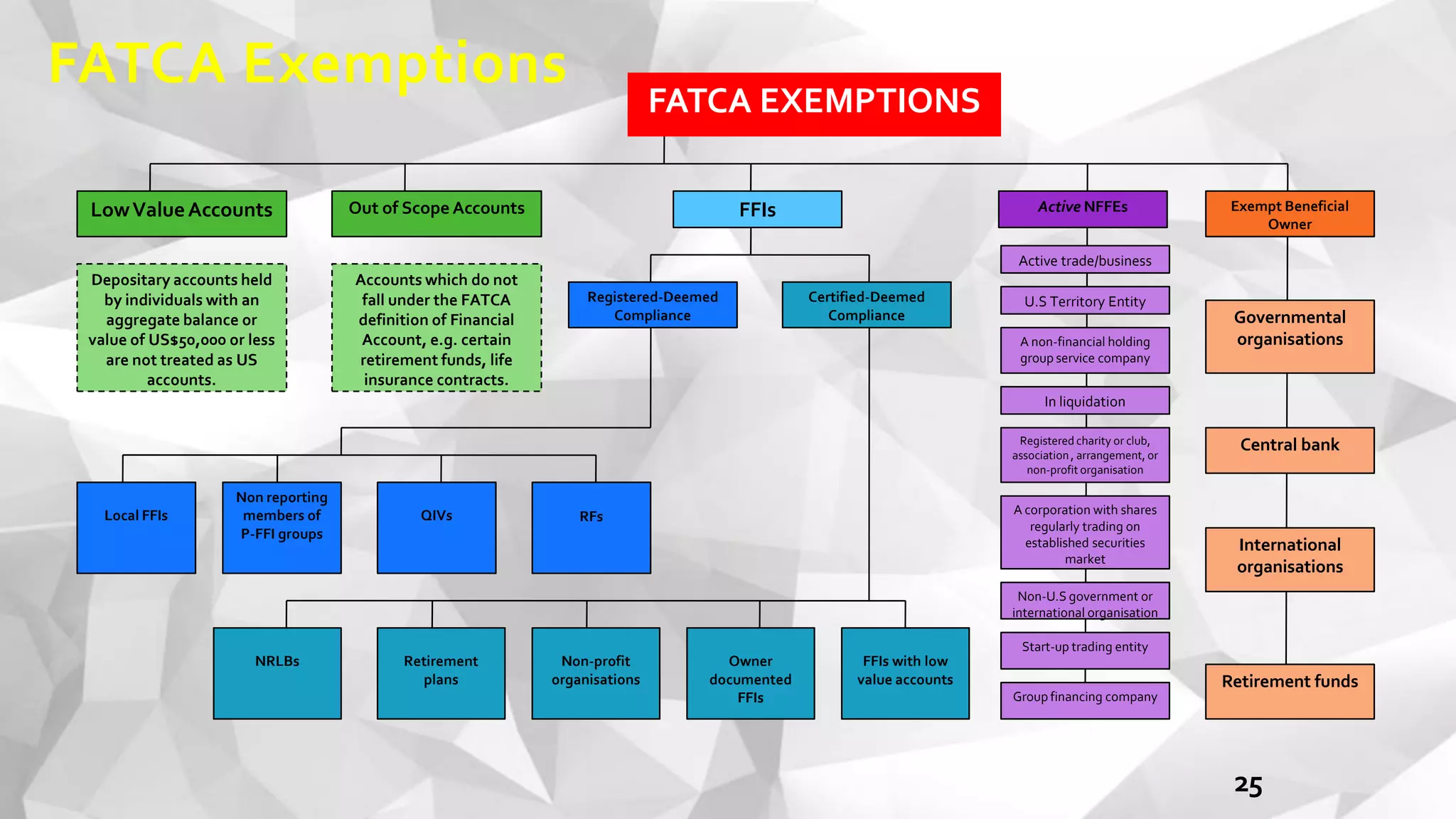
FATCA EXEMPTIONS
FFIs Active NFFEs Exempt Beneficial
Owner
LowValueAccounts
Governmental
organisations
Central bank
International
organisations
Retirement funds
Active trade/business
A non-financial holding
group service company
Registered charity or club,
association, arrangement, or
non-profit organisation
Group financing company
A corporation with shares
regularly trading on
established securities
market
Registered-Deemed
Compliance
Certified-Deemed
Compliance
Local FFIs QIVs
Non reporting
members of
P-FFI groups
RFs
Retirement
plans
Owner
documented
FFIs
Non-profit
organisations
FFIs with low
value accounts
NRLBs
Depositary accounts held
by individuals with an
aggregate balance or
value of US$50,000 or less
are not treated as US
accounts.
25
FATCA Exemptions
Out of Scope Accounts
Accounts which do not
fall under the FATCA
definition of Financial
Account, e.g. certain
retirement funds, life
insurance contracts.
U.S Territory Entity
In liquidation
Non-U.S government or
international organisation
Start-up trading entity
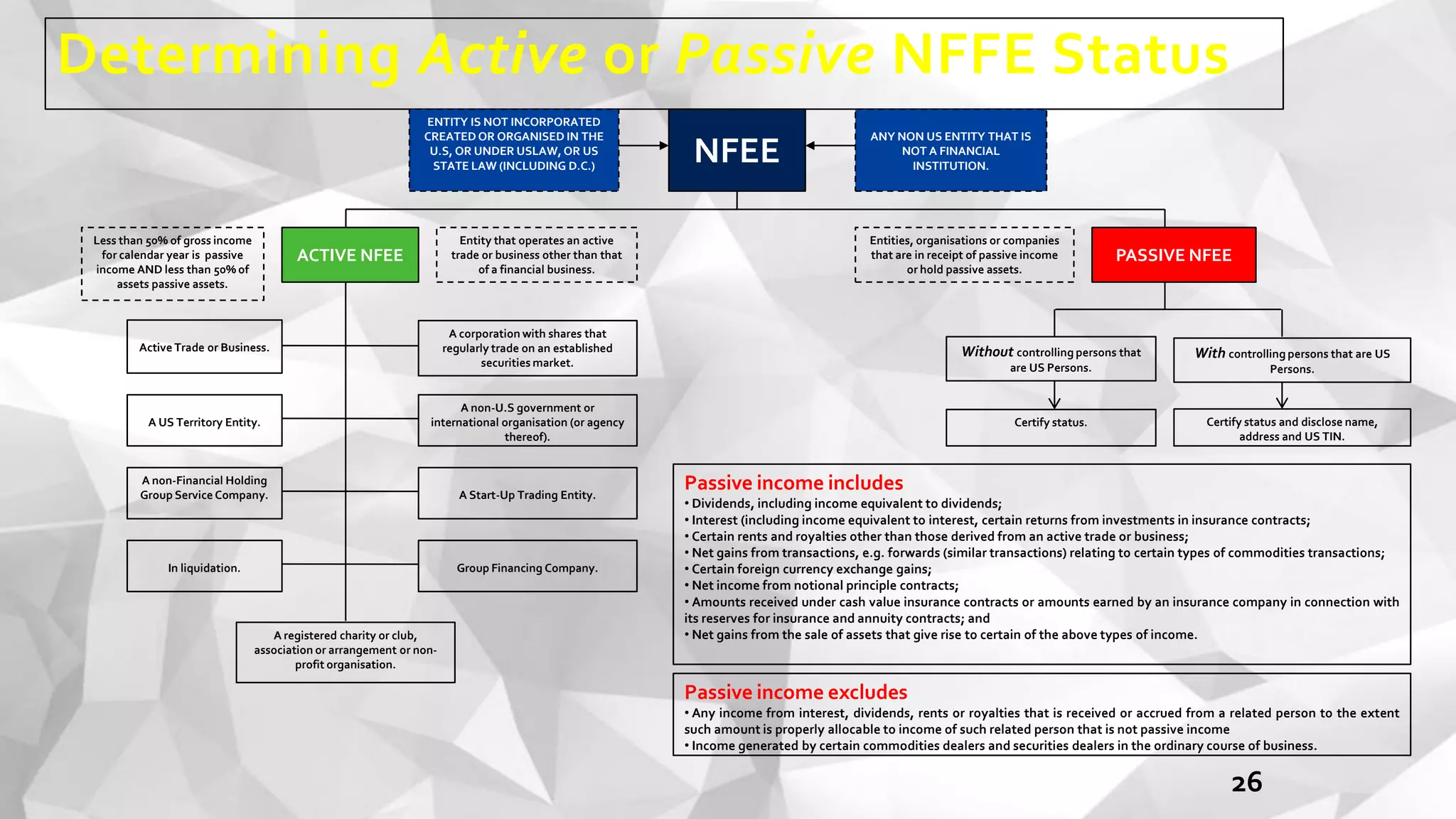
Determining Active or Passive NFFE Status
26
NFEE
ACTIVE NFEE PASSIVE NFEE
ANY NON US ENTITY THAT IS
NOT A FINANCIAL
INSTITUTION.
ENTITY IS NOT INCORPORATED
CREATED OR ORGANISED IN THE
U.S, OR UNDER USLAW, OR US
STATE LAW (INCLUDING D.C.)
A corporation with shares that
regularly trade on an established
securities market.
A non-U.S government or
international organisation (or agency
thereof).
A Start-Up Trading Entity.
Group Financing Company.
A US Territory Entity.
Active Trade or Business.
A non-Financial Holding
Group Service Company.
In liquidation.
A registered charity or club,
association or arrangement or non-
profit organisation.
Without controlling persons that
are US Persons.
Certify status and disclose name,
address and US TIN.
Passive income includes
• Dividends, including income equivalent to dividends;
• Interest (including income equivalent to interest, certain returns from investments in insurance contracts;
• Certain rents and royalties other than those derived from an active trade or business;
• Net gains from transactions, e.g. forwards (similar transactions) relating to certain types of commodities transactions;
• Certain foreign currency exchange gains;
• Net income from notional principle contracts;
• Amounts received under cash value insurance contracts or amounts earned by an insurance company in connection with
its reserves for insurance and annuity contracts; and
• Net gains from the sale of assets that give rise to certain of the above types of income.
Entity that operates an active
trade or business other than that
of a financial business.
Entities, organisations or companies
that are in receipt of passive income
or hold passive assets.
Passive income excludes
• Any income from interest, dividends, rents or royalties that is received or accrued from a related person to the extent
such amount is properly allocable to income of such related person that is not passive income
• Income generated by certain commodities dealers and securities dealers in the ordinary course of business.
With controlling persons that are US
Persons.
Certify status.
Less than 50% of gross income
for calendar year is passive
income AND less than 50% of
assets passive assets.
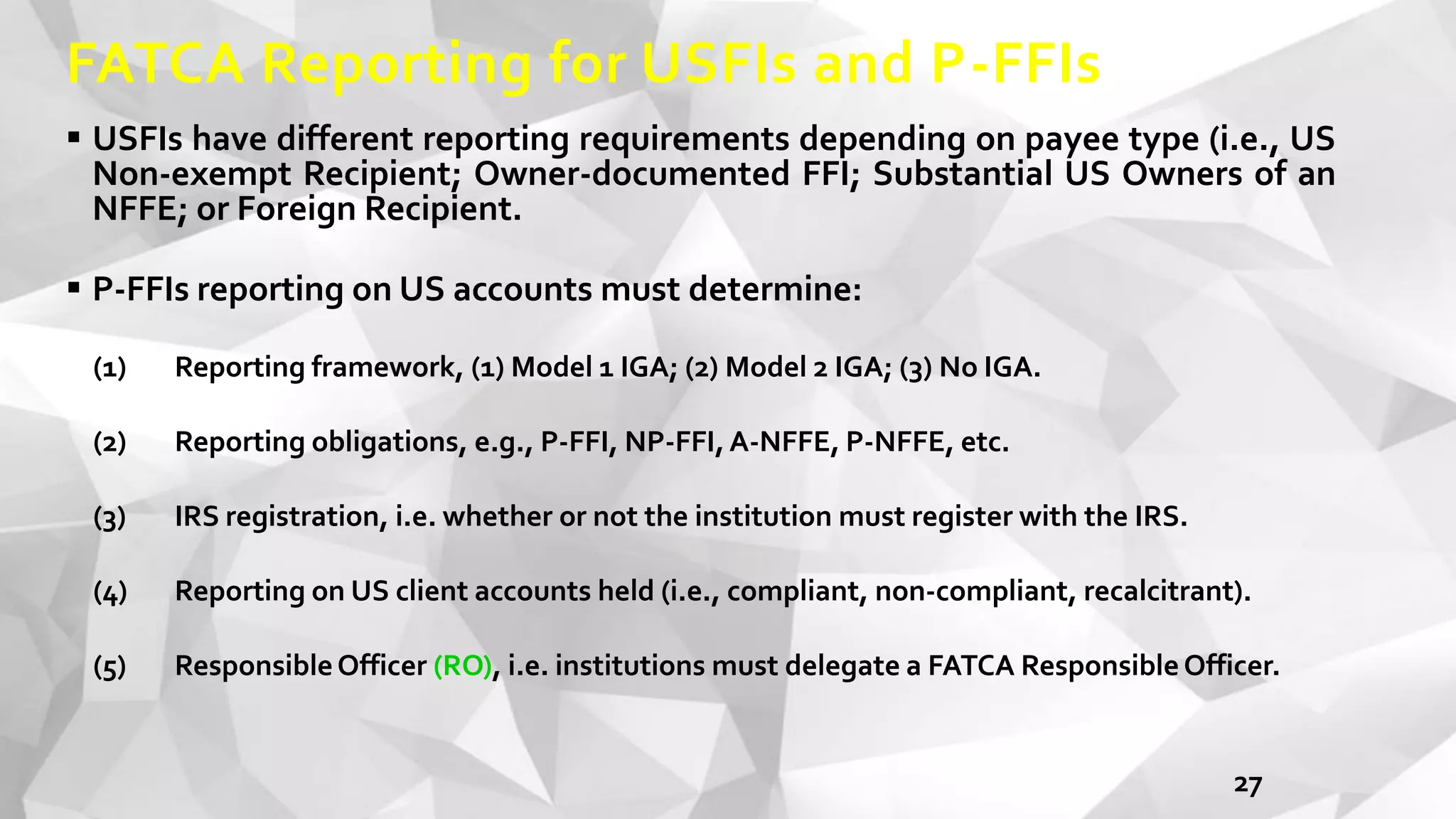
FATCA Reporting for USFIs and P-FFIs
 USFIs have different reporting requirements depending on payee type (i.e., US
Non-exempt Recipient; Owner-documented FFI; Substantial US Owners of an
NFFE; or Foreign Recipient.
 P-FFIs reporting on US accounts must determine:
(1) Reporting framework, (1) Model 1 IGA; (2) Model 2 IGA; (3) No IGA.
(2) Reporting obligations, e.g., P-FFI, NP-FFI,A-NFFE, P-NFFE, etc.
(3) IRS registration, i.e. whether or not the institution must register with the IRS.
(4) Reporting on US client accounts held (i.e., compliant, non-compliant, recalcitrant).
(5) ResponsibleOfficer (RO), i.e. institutions must delegate a FATCA ResponsibleOfficer.
27
FATCA IGAs
FATCA IGA
Model 2 IGAModel 1 IGA
US IRS
US IRS
FATCA Partner
Government
FFI aggregates
Information on US
Accounts and NPFFI’s
Accounts or Obligations
FFI client account
specific information
FFIFFI FFIFFI
July 2012 November 2012
Consent granted Consent not granted
28
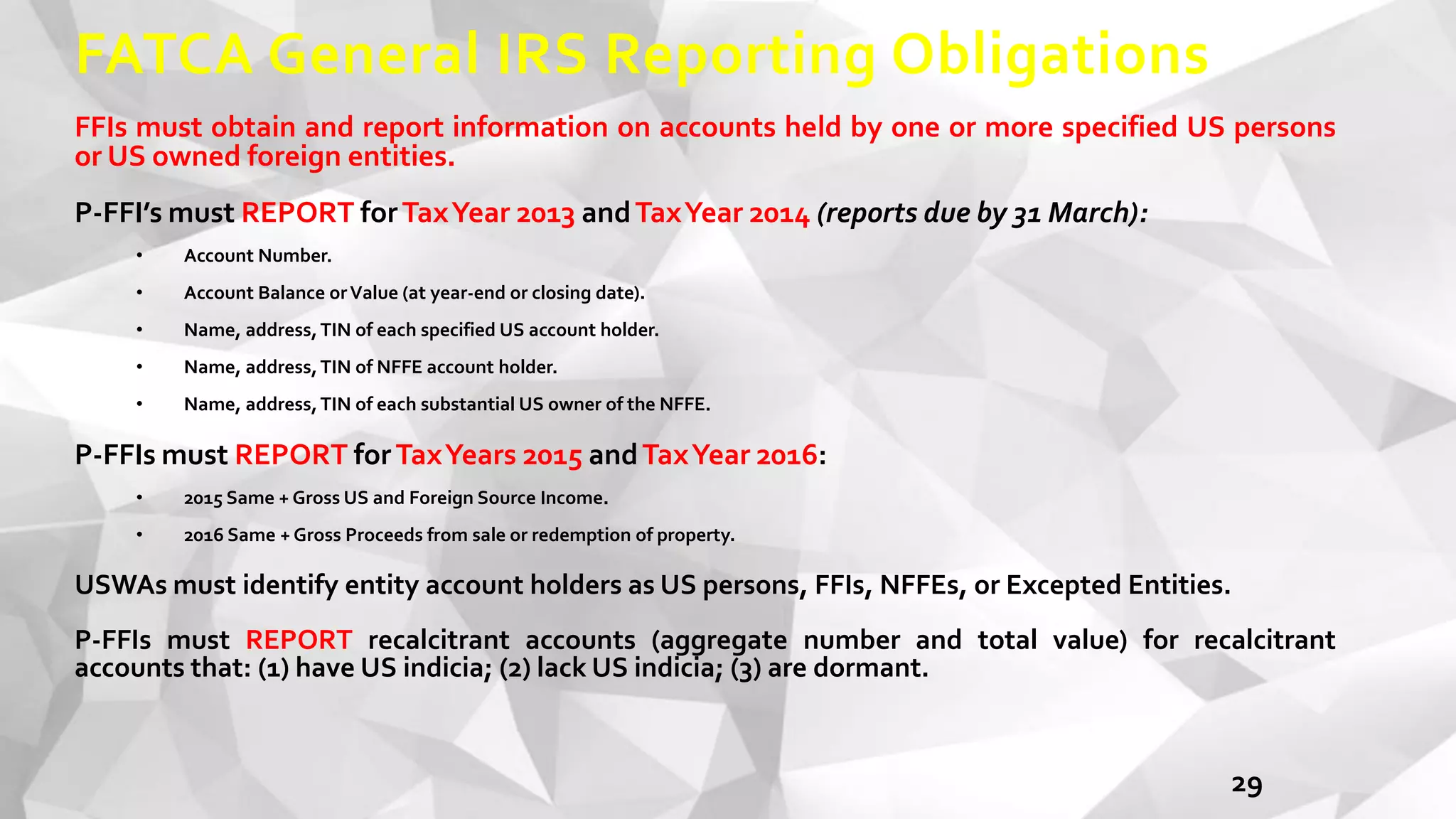
FATCA General IRS Reporting Obligations
FFIs must obtain and report information on accounts held by one or more specified US persons
or US owned foreign entities.
P-FFI’s must REPORT forTaxYear 2013 andTaxYear 2014 (reports due by 31 March):
• Account Number.
• Account Balance orValue (at year-end or closing date).
• Name, address,TIN of each specified US account holder.
• Name, address,TIN of NFFE account holder.
• Name, address,TIN of each substantial US owner of the NFFE.
P-FFIs must REPORT forTaxYears 2015 andTaxYear 2016:
• 2015 Same + Gross US and Foreign Source Income.
• 2016 Same + Gross Proceeds from sale or redemption of property.
USWAs must identify entity account holders as US persons, FFIs, NFFEs, or Excepted Entities.
P-FFIs must REPORT recalcitrant accounts (aggregate number and total value) for recalcitrant
accounts that: (1) have US indicia; (2) lack US indicia; (3) are dormant.
29
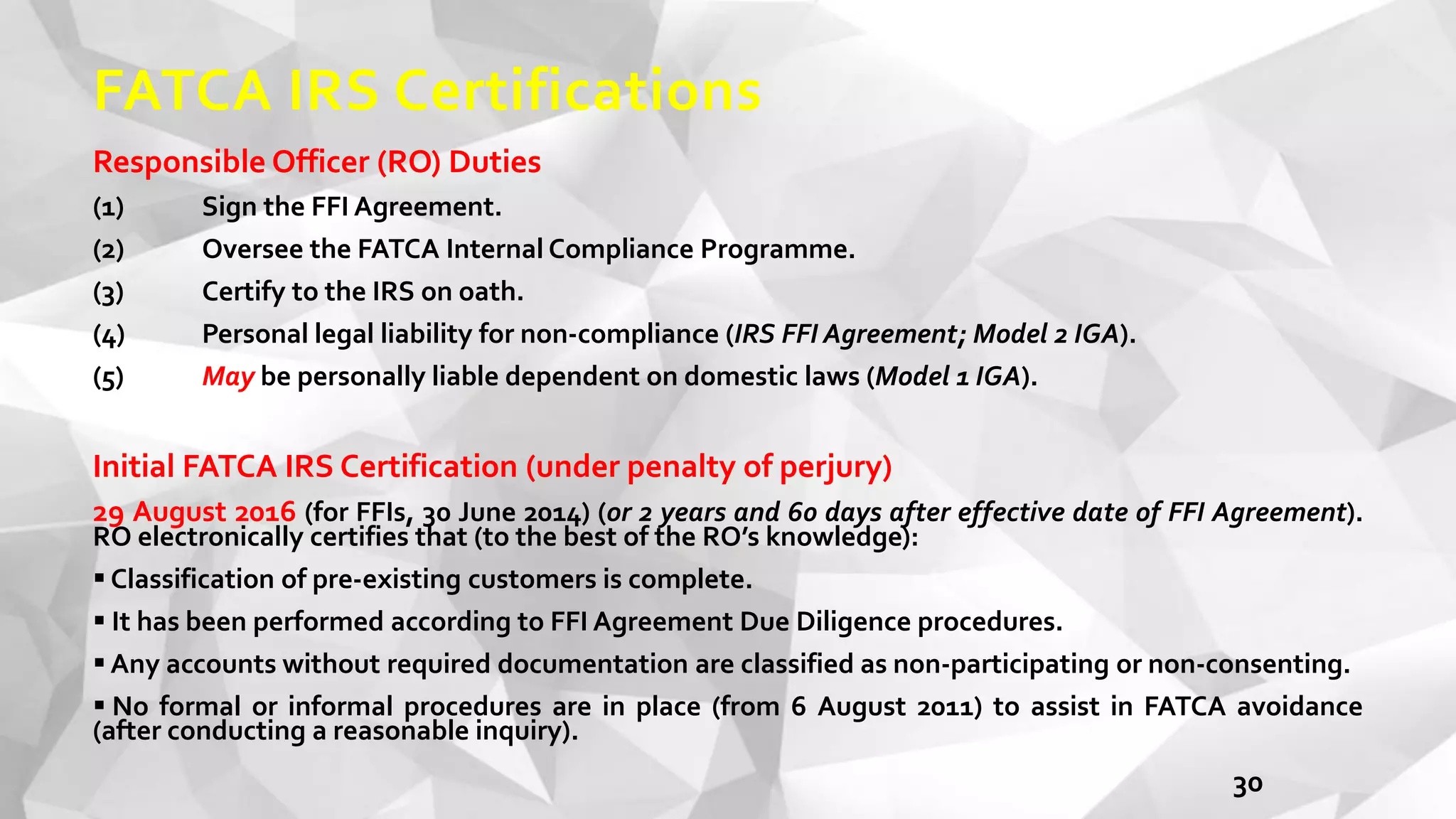
FATCA IRS Certifications
Responsible Officer (RO) Duties
(1) Sign the FFI Agreement.
(2) Oversee the FATCA Internal Compliance Programme.
(3) Certify to the IRS on oath.
(4) Personal legal liability for non-compliance (IRS FFI Agreement; Model 2 IGA).
(5) May be personally liable dependent on domestic laws (Model 1 IGA).
Initial FATCA IRS Certification (under penalty of perjury)
29 August 2016 (for FFIs, 30 June 2014) (or 2 years and 60 days after effective date of FFI Agreement).
RO electronically certifies that (to the best of the RO’s knowledge):
 Classification of pre-existing customers is complete.
 It has been performed according to FFI Agreement Due Diligence procedures.
 Any accounts without required documentation are classified as non-participating or non-consenting.
 No formal or informal procedures are in place (from 6 August 2011) to assist in FATCA avoidance
(after conducting a reasonable inquiry).
30
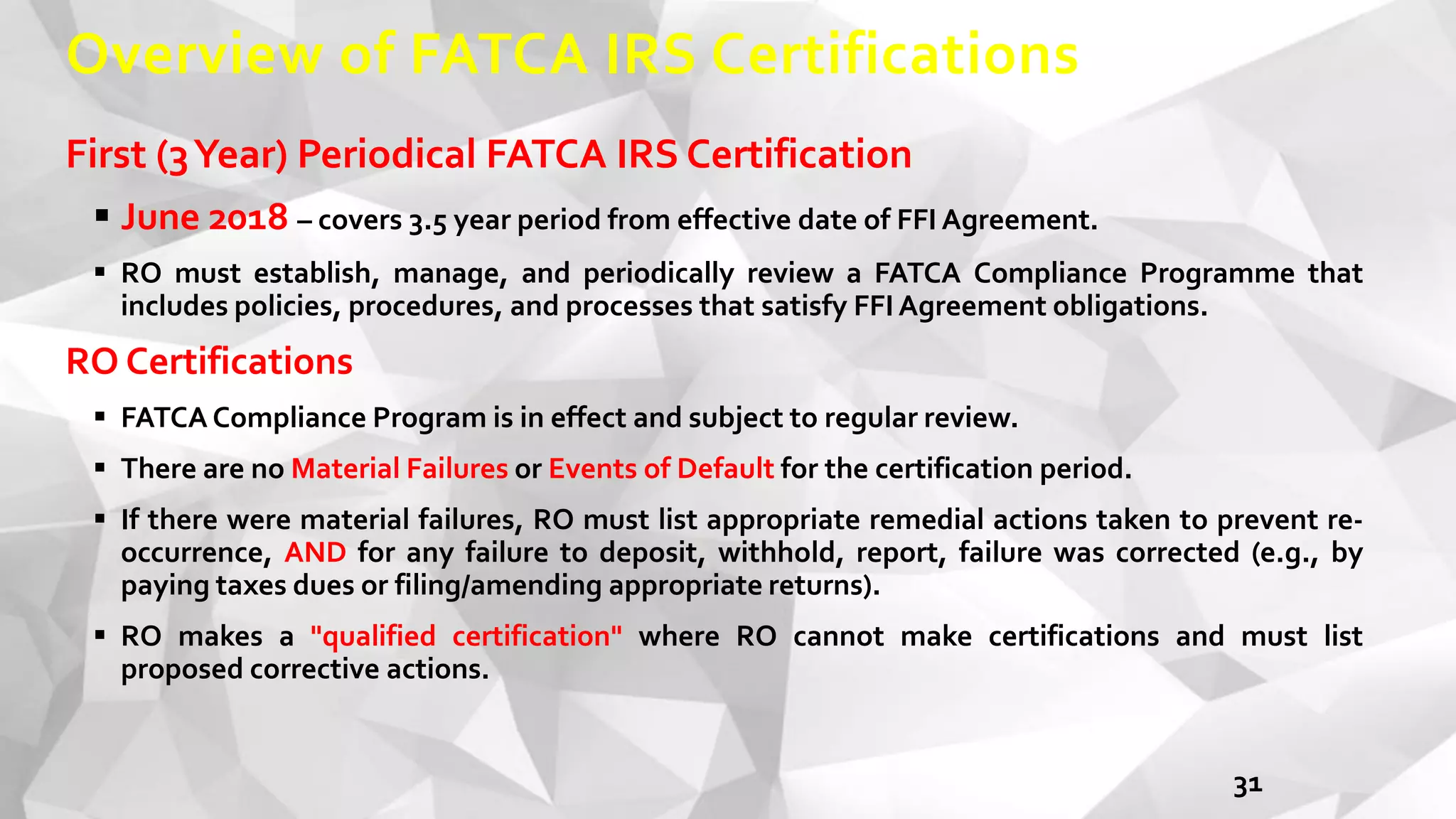
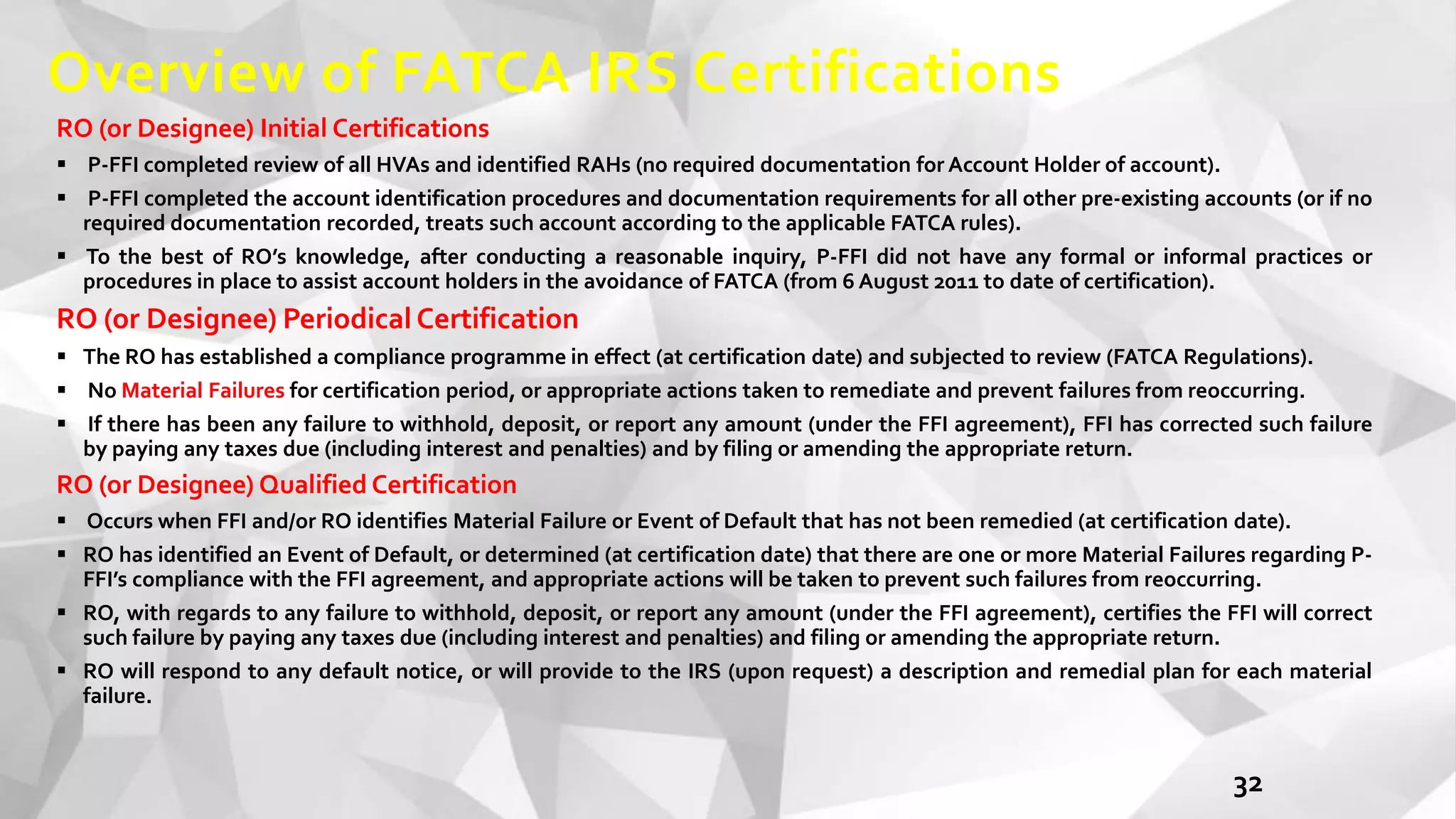
Overview of FATCA IRS Certifications
First (3Year) Periodical FATCA IRS Certification
 June 2018 – covers 3.5 year period from effective date of FFI Agreement.
 RO must establish, manage, and periodically review a FATCA Compliance Programme that
includes policies, procedures, and processes that satisfy FFI Agreement obligations.
RO Certifications
 FATCA Compliance Program is in effect and subject to regular review.
 There are no Material Failures or Events of Default for the certification period.
 If there were material failures, RO must list appropriate remedial actions taken to prevent re-
occurrence, AND for any failure to deposit, withhold, report, failure was corrected (e.g., by
paying taxes dues or filing/amending appropriate returns).
 RO makes a "qualified certification" where RO cannot make certifications and must list
proposed corrective actions.
31
Overview of FATCA IRS Certifications
RO (or Designee) Initial Certifications
 P-FFI completed review of all HVAs and identified RAHs (no required documentation for Account Holder of account).
 P-FFI completed the account identification procedures and documentation requirements for all other pre-existing accounts (or if no
required documentation recorded, treats such account according to the applicable FATCA rules).
 To the best of RO’s knowledge, after conducting a reasonable inquiry, P-FFI did not have any formal or informal practices or
procedures in place to assist account holders in the avoidance of FATCA (from 6 August 2011 to date of certification).
RO (or Designee) Periodical Certification
 The RO has established a compliance programme in effect (at certification date) and subjected to review (FATCA Regulations).
 No Material Failures for certification period, or appropriate actions taken to remediate and prevent failures from reoccurring.
 If there has been any failure to withhold, deposit, or report any amount (under the FFI agreement), FFI has corrected such failure
by paying any taxes due (including interest and penalties) and by filing or amending the appropriate return.
RO (or Designee) Qualified Certification
 Occurs when FFI and/or RO identifies Material Failure or Event of Default that has not been remedied (at certification date).
 RO has identified an Event of Default, or determined (at certification date) that there are one or more Material Failures regarding P-
FFI’s compliance with the FFI agreement, and appropriate actions will be taken to prevent such failures from reoccurring.
 RO, with regards to any failure to withhold, deposit, or report any amount (under the FFI agreement), certifies the FFI will correct
such failure by paying any taxes due (including interest and penalties) and filing or amending the appropriate return.
 RO will respond to any default notice, or will provide to the IRS (upon request) a description and remedial plan for each material
failure.
32
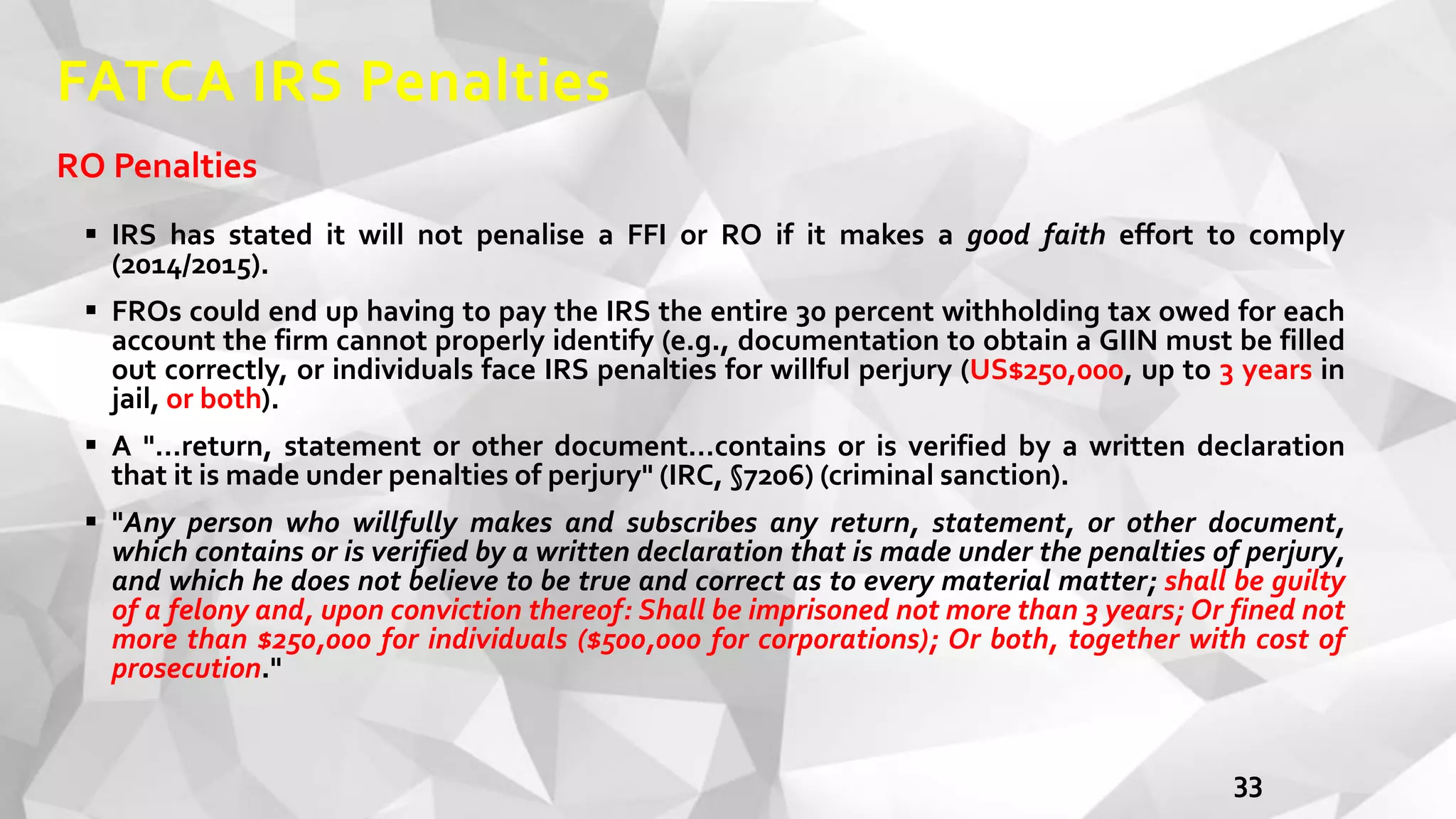
FATCA IRS Penalties
RO Penalties
 IRS has stated it will not penalise a FFI or RO if it makes a good faith effort to comply
(2014/2015).
 FROs could end up having to pay the IRS the entire 30 percent withholding tax owed for each
account the firm cannot properly identify (e.g., documentation to obtain a GIIN must be filled
out correctly, or individuals face IRS penalties for willful perjury (US$250,000, up to 3 years in
jail, or both).
 A "…return, statement or other document…contains or is verified by a written declaration
that it is made under penalties of perjury" (IRC, §7206) (criminal sanction).
 "Any person who willfully makes and subscribes any return, statement, or other document,
which contains or is verified by a written declaration that is made under the penalties of perjury,
and which he does not believe to be true and correct as to every material matter; shall be guilty
of a felony and, upon conviction thereof: Shall be imprisoned not more than 3 years; Or fined not
more than $250,000 for individuals ($500,000 for corporations); Or both, together with cost of
prosecution."
33
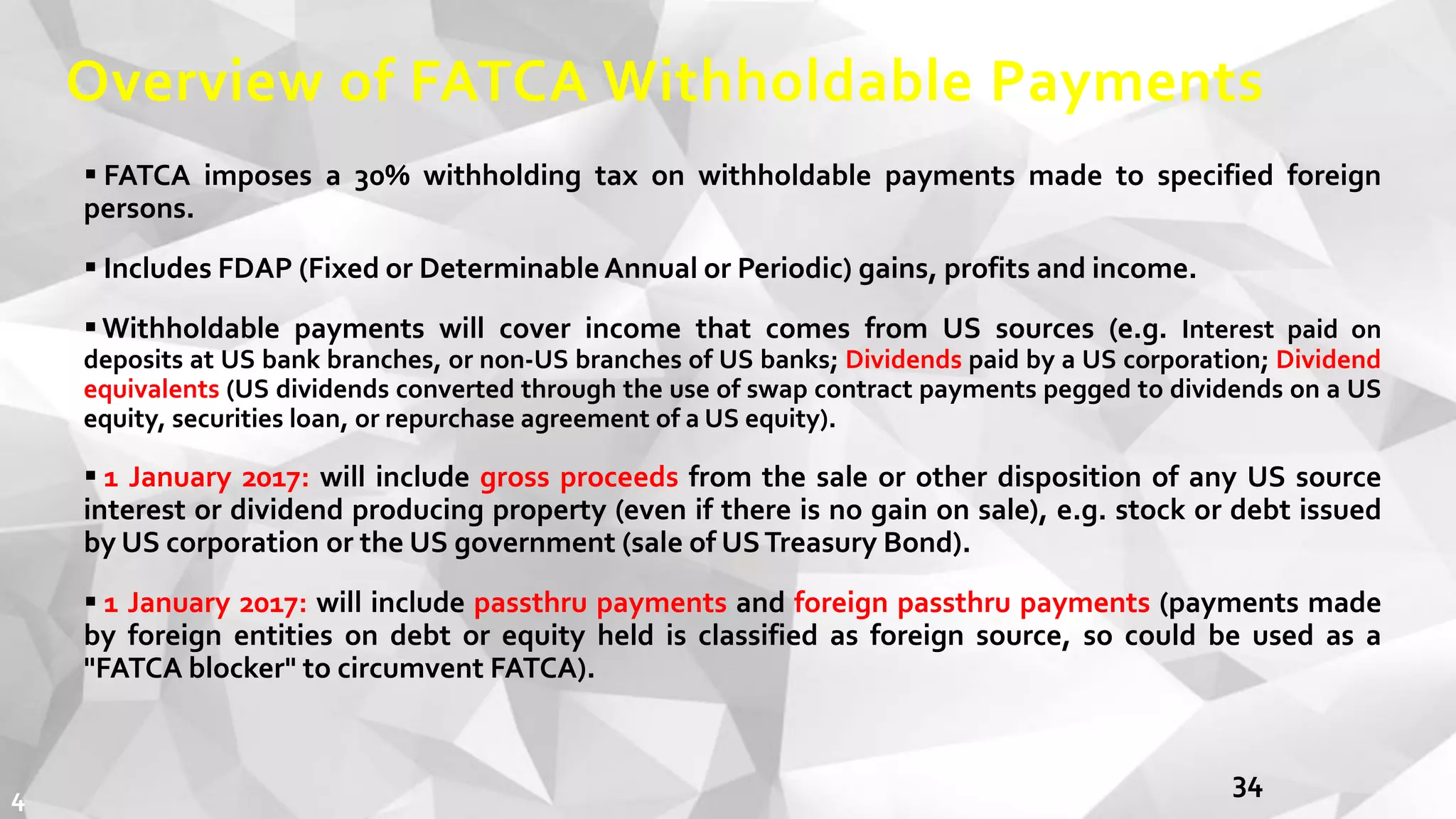
Overview of FATCA Withholdable Payments
 FATCA imposes a 30% withholding tax on withholdable payments made to specified foreign
persons.
 Includes FDAP (Fixed or DeterminableAnnual or Periodic) gains, profits and income.
Withholdable payments will cover income that comes from US sources (e.g. Interest paid on
deposits at US bank branches, or non-US branches of US banks; Dividends paid by a US corporation; Dividend
equivalents (US dividends converted through the use of swap contract payments pegged to dividends on a US
equity, securities loan, or repurchase agreement of a US equity).
 1 January 2017: will include gross proceeds from the sale or other disposition of any US source
interest or dividend producing property (even if there is no gain on sale), e.g. stock or debt issued
by US corporation or the US government (sale of USTreasury Bond).
 1 January 2017: will include passthru payments and foreign passthru payments (payments made
by foreign entities on debt or equity held is classified as foreign source, so could be used as a
"FATCA blocker" to circumvent FATCA).
344
What is a Withholdable Payment?
A withholdable payment is any payment of interests, dividends, rents, salaries,
wages, premiums, annuities, compensations, remunerations, emoluments, and
other Fixed or Determinable Annual or Periodic (FDAP) gains, profits and income.
Requirements
The payment must be from sources within the US (US source income).
From 1 January 2017: To include "gross proceeds" (from the sale or other disposition of any
property of a type which can produce interest or dividends from sources within the US), USWAs,
WAs, P-FFIs must withhold on gross proceeds payments made to recalcitrant individual and
entity accounts.
Not before 1 January 2017: To include "passthru payments" (any withholdable payment or other
payment to the extent attributable to a withholdable payment) applicable to non-US source
income.
If source of payment is unknown, payment must be treated as withholdable payment but can be held in
escrow (up to 1 year) pending determination of character or source of the payment.
35
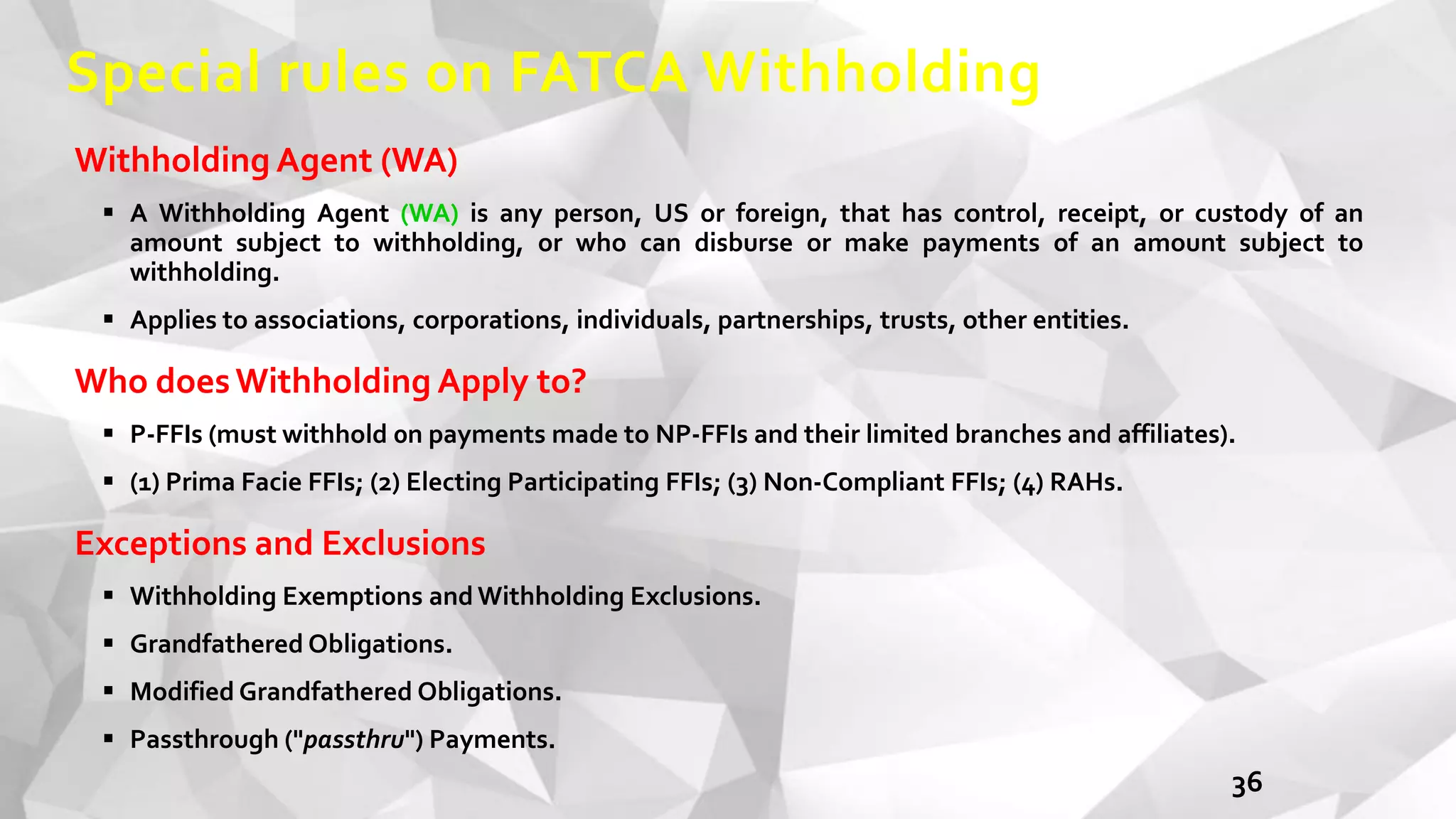
Special rules on FATCA Withholding
Withholding Agent (WA)
 A Withholding Agent (WA) is any person, US or foreign, that has control, receipt, or custody of an
amount subject to withholding, or who can disburse or make payments of an amount subject to
withholding.
 Applies to associations, corporations, individuals, partnerships, trusts, other entities.
Who doesWithholding Apply to?
 P-FFIs (must withhold 0n payments made to NP-FFIs and their limited branches and affiliates).
 (1) Prima Facie FFIs; (2) Electing Participating FFIs; (3) Non-Compliant FFIs; (4) RAHs.
Exceptions and Exclusions
 Withholding Exemptions and Withholding Exclusions.
 Grandfathered Obligations.
 Modified Grandfathered Obligations.
 Passthrough ("passthru") Payments.
36
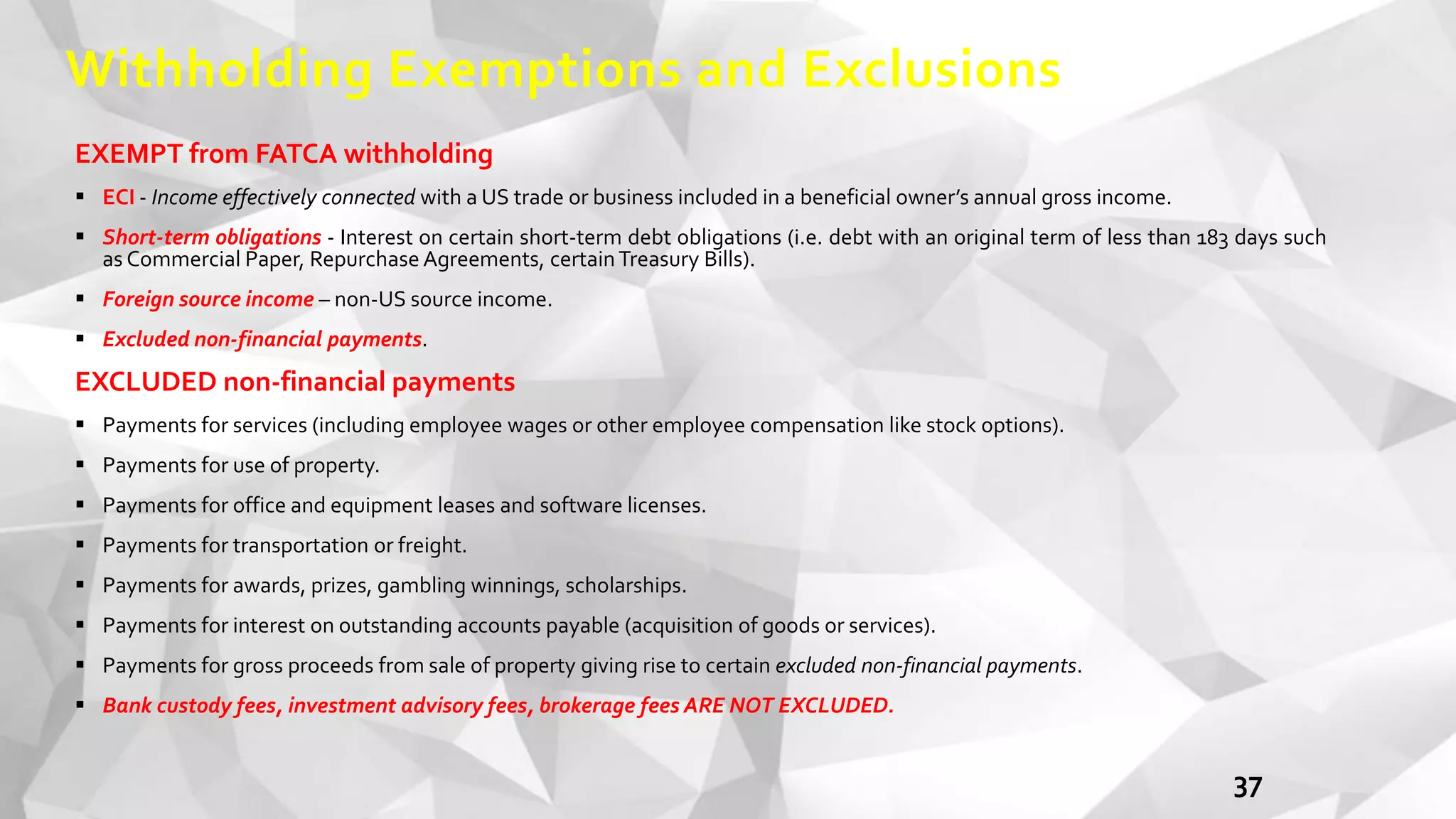
Withholding Exemptions and Exclusions
EXEMPT from FATCA withholding
 ECI - Income effectively connected with a US trade or business included in a beneficial owner’s annual gross income.
 Short-term obligations - Interest on certain short-term debt obligations (i.e. debt with an original term of less than 183 days such
as Commercial Paper, Repurchase Agreements, certainTreasury Bills).
 Foreign source income – non-US source income.
 Excluded non-financial payments.
EXCLUDED non-financial payments
 Payments for services (including employee wages or other employee compensation like stock options).
 Payments for use of property.
 Payments for office and equipment leases and software licenses.
 Payments for transportation or freight.
 Payments for awards, prizes, gambling winnings, scholarships.
 Payments for interest on outstanding accounts payable (acquisition of goods or services).
 Payments for gross proceeds from sale of property giving rise to certain excluded non-financial payments.
 Bank custody fees, investment advisory fees, brokerage fees ARE NOT EXCLUDED.
37
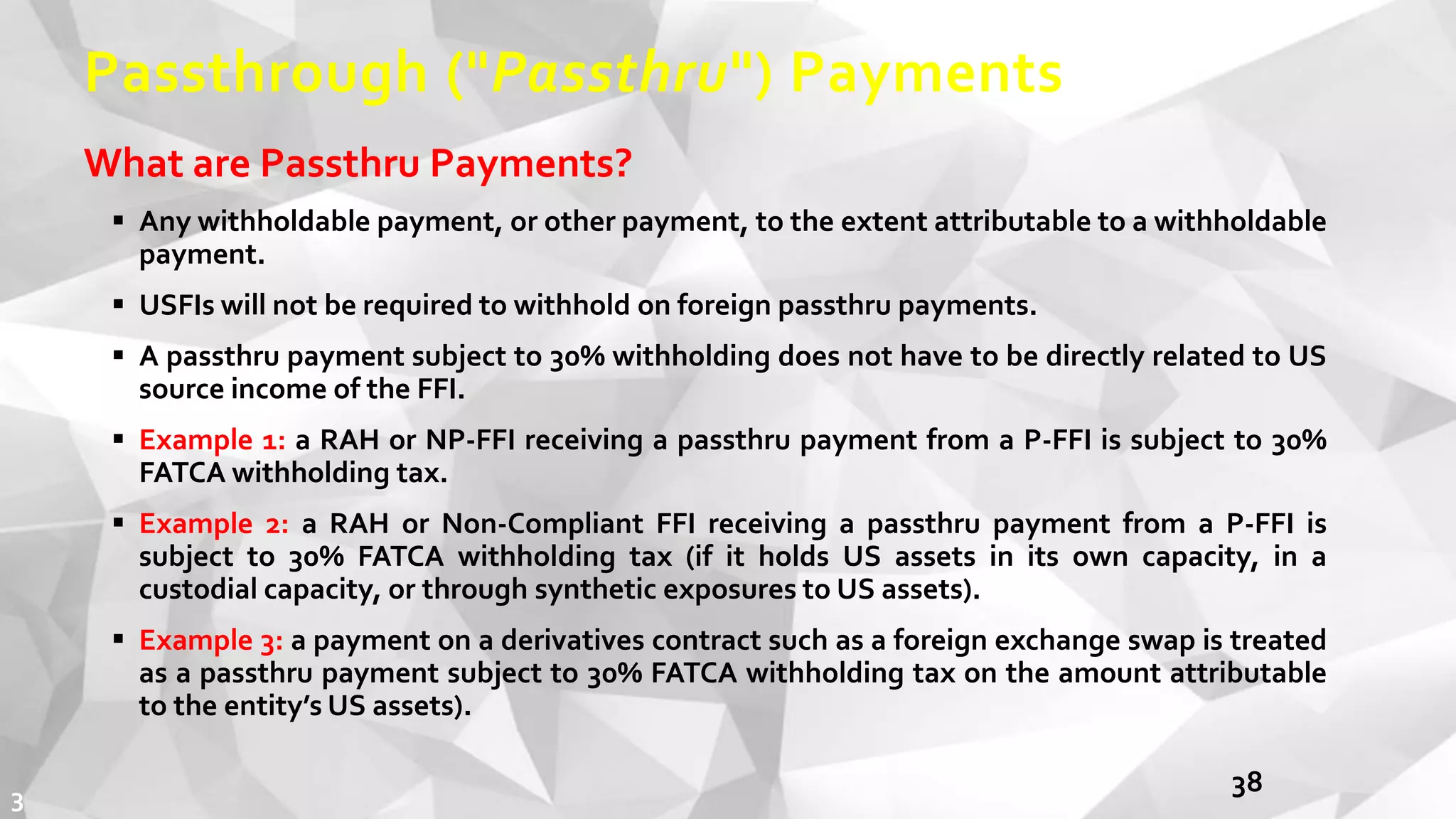
Passthrough ("Passthru") Payments
What are Passthru Payments?
 Any withholdable payment, or other payment, to the extent attributable to a withholdable
payment.
 USFIs will not be required to withhold on foreign passthru payments.
 A passthru payment subject to 30% withholding does not have to be directly related to US
source income of the FFI.
 Example 1: a RAH or NP-FFI receiving a passthru payment from a P-FFI is subject to 30%
FATCA withholding tax.
 Example 2: a RAH or Non-Compliant FFI receiving a passthru payment from a P-FFI is
subject to 30% FATCA withholding tax (if it holds US assets in its own capacity, in a
custodial capacity, or through synthetic exposures to US assets).
 Example 3: a payment on a derivatives contract such as a foreign exchange swap is treated
as a passthru payment subject to 30% FATCA withholding tax on the amount attributable
to the entity’s US assets).
383
Passthrough ("Passthru") Payments
 P-FFIs will not be obliged to trace passthru payments to NP-FFIs or RAHs (tracing method rejected by IRS).
 P-FFIs will be obliged to withhold 30% tax on passthru payments made to NP-FFIs or RAHs.
 This applies even on non-US source payments.
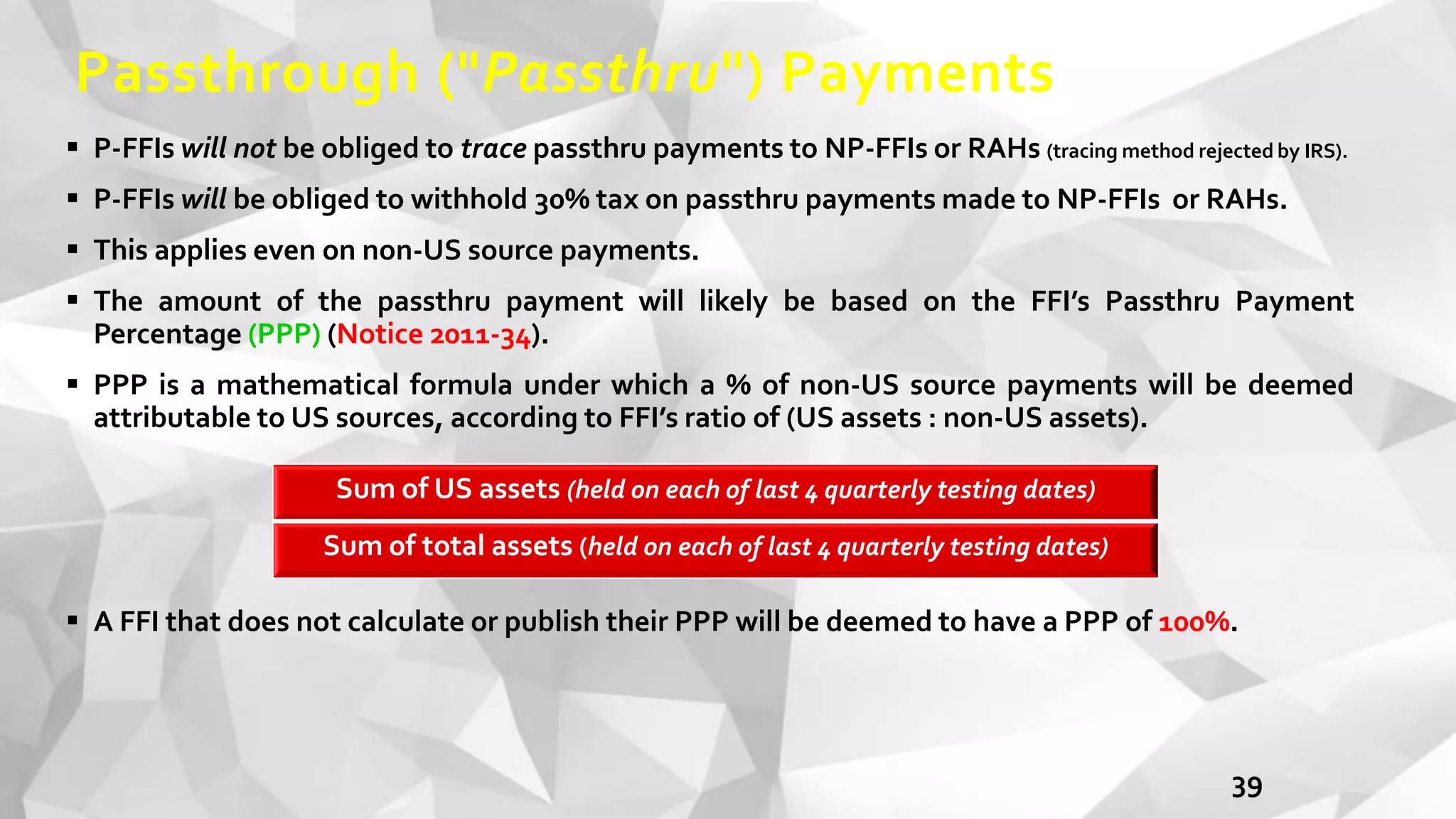
 The amount of the passthru payment will likely be based on the FFI’s Passthru Payment
Percentage (PPP) (Notice 2011-34).
 PPP is a mathematical formula under which a % of non-US source payments will be deemed
attributable to US sources, according to FFI’s ratio of (US assets : non-US assets).
 A FFI that does not calculate or publish their PPP will be deemed to have a PPP of 100%.
39
Sum of US assets (held on each of last 4 quarterly testing dates)
Sum of total assets (held on each of last 4 quarterly testing dates)
40
ABOUT STORM-7 CONSULTING
Storm-7 Consulting are a financial consultancy company that provides premier financial intelligence and
knowledge to leading financial institutions around the world. We deliver premium quality conferences on
cutting-edge legal and financial issues, and strive to provide access to crucial insight by leading experts on the
latest complex regulatory developments.
Address: Level 24/25,The Shard
32 London Bridge Street
London SE1 9SG
Tel: UK + 44 (0)20 7846 0076
Email: client.services@storm-7.com
ABOUTTHE PRESENTER
Rodrigo Zepeda is Co-Founder and Managing Director of Storm-7 Consulting. He is an expert consultant who specialises in
derivatives and financial services law, regulation, and compliance. He holds a LLB degree, a LLM Masters degree in
International and Comparative Business Law, and has passed the New York Bar Examination. He was an Associate (ACSI) of
the Chartered Institute for Securities & Investment from 2004 to 2014 and is now a Chartered Member (MCSI). He is a
Reviewer for the Journal of Financial Regulation and Compliance and has also published widely in leading industry journals
such as the Capco Institute's Journal of Financial Transformation, the Journal of International Banking Law and Regulation, as
well as e-books on derivatives law. Noted publications include "Optimizing Risk Allocation for CCPs under the European
Market Infrastructure Regulation"; "The ISDA Master Agreement 2012: A Missed Opportunity"; "The ISDA Master Agreement:
The Derivatives Risk Management Tool of the 21st Century?"; "To EU, or not to EU: that is the AIFMD question“; and “The
Industrialization Blueprint: Re-Engineering the Future of Banking and Financial Services.”
The Foreign Account Tax
Compliance Act (FATCA)
Regulatory Framework
SESSION 1
TRAINING COURSE
FATCA AND THE OECD COMMON REPORTING STANDARD
2016
Rodrigo Zepeda
ManagingDirector, Storm-7 COnsulting
© Copyright 2016 | Storm-7 Consulting | All Rights Reserved

S7C - The FATCA Regulatory Framework

  • 1.
    The Foreign AccountTax Compliance Act (FATCA) Regulatory Framework SESSION 1 TRAINING COURSE FATCA AND THE OECD COMMON REPORTING STANDARD 2016 Rodrigo Zepeda ManagingDirector, Storm-7 COnsulting © Copyright 2016 | Storm-7 Consulting | All Rights Reserved
  • 2.
    Section 1: FATCA Definitions Section2: FATCA Aims, Objectives and Timelines Section 3: The Three Pillars of FATCA (Classification, Reporting, Withholding)
  • 3.
  • 4.
    FATCA Definitions  FFI:Foreign Financial Institution means a foreign entity that is a financial institution as defined in the United States (US) FATCA Final Regulations. It generally includes any one of five categories of FFI, namely specified: (1) depositary institutions; (2) custodial institutions; (3) investment entities; (4) insurance companies or holding companies of insurance companies that issue cash value insurance or annuity contracts; and (5) holding companies and treasury centres of groups that include another financial entity.  Prima Facie FFI: is an entity that is designated in the WA’s electronic database (searchable) as an account holder, that is a Qualified or Non-Qualified Intermediary, or documented or presumed to be, a foreign account holder, and assigned a set of industry codes indicating that the entity is a type of financial intermediary (for US maintained accounts).  P-FFI: Participating Foreign Financial Institution means an FFI (including a Reporting Model 2 FFI (RM2-FFI)) that has voluntarily agreed to comply with the terms of a Foreign Financial Institution Agreement (FFI Agreement) entered into with the US IRS.  DC-FFI: Deemed-Compliant Foreign Financial Institution means any of three specified types of FFI: (1) Registered Deemed-Compliant FFI (RDC-FFI); (2) Certified Deemed-Compliant FFI (CDC- FFI) ; and (3) Owner-Documented FFI (OD-FFI). 4
  • 5.
    FATCA Definitions (cont) IRS: Internal Revenue Service means a government agency which is a bureau of the US Department of Treasury, and which is the revenue service for the US Federal Government responsible for collecting taxes and administering the US Internal Revenue Code 1986 (IRC) (as amended).  GIIN: Global Intermediary Identification Number means a specified and unique identification number that is assigned to a P-FFI or a RDC-FFI by the US Internal Revenue Service (IRS).  IGA: Intergovernmental Agreement means a partnership agreement based on a Model Intergovernmental Agreement template, between the US and a FATCA Partner Jurisdiction, which allows FFIs in FATCA Partner Jurisdictions to either report information on US account holders: (1) directly to their national tax authorities who will then report to the IRS (Model 1 IGA); or (2) directly to the IRS by entering into a FFIAgreement with the IRS (Model 2 IGA).  NFFE: Non-Financial Foreign Entity means any non-US entity that is not treated as a Financial Institution. NFFEs are sub-classified as either an 'Active NFFE' (A-NFFE) or a 'Passive NFFE' (P- NFFE). 5
  • 6.
    FATCA Definitions (cont) 6 RO: Responsible Officer means an individual who is appointed as the official Responsible Officer of an institution, who is sufficiently authorised to act on behalf of that institution, and will periodically provide certifications to the IRS about the institution's ongoing compliance with its FATCA obligations.  USWAs: United States Withholding Agents means a US or foreign person that has control, receipt, custody, disposal, or payment of any item of income of a foreign person that is subject to withholding on US source income. A withholding agent may be an individual, corporation, partnership, trust, association, or any other entity, including any foreign intermediary, foreign partnership, or US branch of certain foreign banks and insurance companies.  FDAP Income (‘Fixed or Determinable Annual or Periodic’): Income is an acronym for Fixed or Determinable, Annual or Periodic US source passive income. Some of the more common expenses paid by US withholding agents which would result in FDAP income to their vendors and other service providers are interest, royalties, compensation for personal services, rents, pensions or annuities and gains from the sale or exchange of the patents, copyrights and similar intangibles expressly specified in the US Internal Revenue Code 1986 (IRC) (as amended).
  • 7.
    FATCA Definitions (cont) Material Failures: are failures of the P-FFI to fulfil obligations under FFI Agreement if failure arose because of: (1) an error attributable to a failure of P-FFI to implement sufficient controls; or (2) deliberate actions to avoid FFI Agreement obligations by one or more P-FFI employees (or its agent, sponsor, or compliance financial institution).  Events of Default: are when a P-FFI fails to perform material obligations of the FFI Agreement (due diligence, reporting, withholding), or if the IRS determines P-FFI has failed to substantially comply with the FFI Agreement obligations.  Active Non-Financial Foreign Entity is any entity that is not a Foreign Financial Institution, and that has less than 50% of its gross income for the preceding calendar year as Passive Income, and less than 50% of the weighted average percentage of assets held by it, are assets that produce or are held for the production of Passive Income (tested on a quarterly basis).  Passive Non-Foreign Financial Entity: is a Non-Financial Foreign Entity that is not an Active Non-Financial Foreign Entity, or a withholding foreign partnership or withholding foreign trust pursuant to the FATCA Regulations. 7
  • 8.
    FATCA Definitions (cont) 8 Grandfathered Obligations (GOs): generally refers to eligible debt instruments (including interest obligations) classified as debt for US tax purposes and with stated maturities issued on or before 1 July 2014 (including gross proceeds from the disposition of grandfathered obligations).  Obligations that are legally binding and outstanding as of 1 July 2014 that produce or could produce a withholdable payment or foreign passthru payment, as well as the gross proceeds from the disposition of such an obligation. Grandfathered Obligations Excluded  Instruments treated as equity for US tax purposes.  Instruments that lack a stated expiration, term, or maturity date.  Brokerage, custodial, or other similar agreements to hold financial assets for the account of others.  Derivatives (ISDA) Master Agreements that set forth general terms (not individual MA Confirmations).
  • 9.
    FATCA Definitions (cont) 9 GrandfatheredObligations Examples  Examples include: debt instruments; lines of credit; revolving credit agreements (fixed maturity and material terms); term annuity contract; and derivatives transactions. ModifiedGOs  GO’s that are subject to "material modification" will be treated as newly issued on the date of modification and will not benefit from FATCA exemptions any more.  Material modification includes a significant amendment of terms of obligation, such as changes in the underlying obligor or security, timing of payments leading to a material deferral of scheduled payments, the yield (by more than the greater of 5% annual yield or 25 basis points).
  • 10.
    FATCA Terminology FATCA Terminologyrefers to the vocabulary of technical or specialized terms used within the fields of Chapter 4 US IRC taxation and law.  Common terms such as "financial institution" or "gross proceeds" take on specialized meanings. It is essential to understand the full the range of FATCA definitions (e.g., "US Indicia", "Relationship Manager Inquiry", "Recalcitrant Account Holder", "Expanded Affiliate Group"). It is also important to understand the differences between FACTA terminology and Common Reporting Standard terminology.  FATCA references are often interchangeable and changing: (1) e.g., "FATCA Partner Country" may mean a general reference to a US FATCA Partner Country or a specific reference to a particular country; (2) e.g., references to "Reporting Model 1 FFI" may refer to general obligations of a Reporting Model 1 FFI, or to particular obligations of a Reporting Model 1 FFI within a particular country; (3) e.g., the same institution may be referred to as a FFI or a NP-FFI/P-FFI, or may change from Active NFFE to Passive NFFE status, or a NP-FFI may also be a Deemed-Compliant FFI (DC- FFI). 10
  • 11.
    FATCA Terminology (cont) FATCA Definitions may operate within particular contexts (e.g., within the context of a Model 1 IGA, a Model 2 IGA, a FFI Agreement, or the Final FATCA Regulations).  FATCA terms and meanings are based on US tax law and the US IRC, therefore definitions may change over time owing to changes in US tax law, e.g.US FDAP has a different meaning under FATCA (Chapter 4 US IRC) than under existing US withholding of tax rules (Chapter 3 US IRC).  Understanding basic definitions (e.g. Deemed-Compliant, Substantial Ownership, Effective Control, Withholdable Payment) is essential in order to effectively comprehend how FATCA operates in practice.  FATCA terminology is in a state of flux and definitions may be regularly updated, and some terms such as Pass-Through (Passthru) Payments are not yet fully defined. 11
  • 12.
    FATCA Aims, Objectivesand Milestones SECTION 2 12
  • 13.
    FATCA Aims, Objectivesand Timelines To addressGlobal USTax Evasion (USTreasury estimates $100 billion annual offshore losses).  To combat tax evasion by US persons holding investments in offshore accounts.  To provide the US IRS with more tools and information to detect US tax evaders concealing assets either DIRECTLY (foreign accounts) or INDIRECTLY (offshore entities or vehicles).  To impose: (1) documentation (classification); (2) reporting; and (3) withholding requirements with respect to certain payments made to certain foreign entities. To Help Pay for the US HIRE Act (Hiring Incentives to Restore Employment).  Estimated cost of US$13 billion (2010 to 2019) by US Joint Committee onTaxation (JCT). International Data Exchange and Global Automatic Information Exchange.  FFIs can register with the IRS and agree to report to the IRS certain information about their US accounts, including accounts of foreign entities with substantial US owners.  Will help to develop a global information exchange network (e.g., OECD CRS). 13
  • 14.
    FATCA Milestones 14 DATE DESCRIPTIONS 1January 2013: Effective date of FATCA legislation (applies to payments made to FFIs and NFFEs). 1 July 2014: FATCA withholding on US source FDAP income (including interest and dividends) for non-compliant individuals and documented Non Participating FFIs. 1 January 2015: FATCA withholding for non-compliant entities. 1 January 2017: FATCA withholding on gross proceeds from the sale of property that can produce US source dividends or interest . 1 January 2017: FATCA withholding on passthrough ("passthru") payments. 15 March 2018: US gross proceeds (year-end 2017) subject to withholding included on IRS Forms 1042/1042-S by P-FFIs, USWAs, and WAs. 30 June 2018: P-FFIs commence 3 year FATCA compliance program (internal controls ) certification cycle.
  • 15.
    FATCA Milestones 15 2010 20112012 2013 2014 2015 2016 2017 18 March 2010 FACTA enacted. August 2010 IRS/Treasury Notice (Guidance) issued. April 2011 IRS/Treasury Notice (Guidance) issued. 14 July 2011 IRS Notice 2011-53 (Guidance) issued (providing transitional relief for significant obligations under FACTA). 31 December 2012 FACTA effective. 1 January 2013 Grandfathered Obligations (Grandfathering rule) extended until this date. IRS begins to accept applications for FFI agreements. 17 January 2013 Final FACTA Regulation issued. 30 June 2013 Deadline for FFIs to enter into FFI Agreements in order to ensure that it is identified as a P- FFI when FATCA withholding begins. New Account Opening Procedures apply. 12 July 2013 US Treasury announces 6 month extension to FACTA withholding requirement starting on 1 July 2014. 1 January 2014 FATCA withholding for FDAP payments for NP-FFIs and RAHs by FFIs. Transition period begins for Affiliates in Non- Consenting Jurisdictions. 1 July 2014 Withholding by US Payors to commence on US Source payments made to foreign (non- US) financial institutions unless such institutions are FATCA- compliant. 30 June 2014 Identifying pre-existing Entity account holders that are prima facie FFIs. 30 September 2014 First Reporting Date for Accounts Open on 30 June 2014. 31 December 2014 Identifying pre-existing High Value Individuals accounts (> US$1 million). 1 January 2015 FATCA withholding for FDAP and Gross Proceeds for NP-FFIs and RAHs by FFIs. FATCA withholding for Passthru Payments originally scheduled to commence. 15 March 2015 1st Reporting on Chapter 4 Reportable Payments begins for WAs (Forms 1042, 1042-S). 31 December 2015 Identifying remaining pre- existing accounts (Entities and Low Value). 15 March 2016 1st Reporting on Gross Proceeds begins for WAs Forms 1042, 1042-S). 31 March 2016 1st Reporting of FDAP and Other Payments for NP-FFIs and RAHs by FFIs. 1 January 2017 Delayed implementation of withholding on Gross Proceeds. Delayed implementation of foreign Passthru Payment withholding obligation (no earlier than). 31 March 2017 2nd Reporting of FDAP and Other Payments for NP-FFIs and RAHs by FFIs.
  • 16.
    The Three Pillarsof FATCA (Classification, Reporting, Withholding) SECTION 3 16
  • 17.
    The Three Pillarsof FATCA 17 Classification • Classification of Financial Institutions. • Classification of Non-Financial Foreign Entities. • Classification of Client Entities. • Classification of Client US Persons. • Identification of FATCA Exemptions. • Determination of Participating or Non- Participating status for Financial Institutions. • Determination of the application of a Model 1 IGA, a Model 2 IGA, or an US IRS FFI Agreement. • Pre-Existing and New Account Due Diligence for Individuals and Entities. Reporting • Determination of reporting obligations under a Model 1 IGA, Model 2 IGA, or IRS FFI Agreement reporting framework. • Determination of the FATCA reporting timeline relevant for Foreign Financial Institutions or Non-Financial Foreign Entities. • Collecting Reportable Information on US persons and financial accounts. • Registering with the US IRS. • Reporting by Participating Foreign Financial Institutions on US accounts. • Reporting by Participating Foreign Financial Institutions on Recalcitrant Accounts. Withholding • Determination of who is subject to withholding. • Determination of withholdable payments. • Determination of gross proceeds. • Determination of passthru payments. • Determination of exceptions from FATCA withholding. • Determination of grandfathered obligations. • Determination of modified grandfathered obligations. • Devising a withholding system to collect and remit withholding payments to the US IRS.
  • 18.
    FATCA Classification Individual Institution FFI (P-FFI, NP-FFI, RDC-FFI, CDC-FFI); NFFE (A-NFFE, P-NFFE); FFI (Excepted, Exempted). Institutional Clients  US owned foreign entities (foreign entity with one or more Substantial US Owners).  Corporations (any specified US person that owns, directly or indirectly, more than 10% of corporate stock (by vote or value).  Partnerships and trusts (Greater than 10% ownership).  Investment funds (the 10% ownership rule not applicable, any investment by a US person below 10% is reportable). Individual Clients  Classification of specified US persons and foreign (non-US) persons.  Classification of HighValue Accounts, LowValue Accounts, and Prima Facie Accounts.  Classification of De Minimis (exempt) Accounts.  Classification of Recalcitrant Account Holders (RAHs). 18
  • 19.
    FFI FATCA GeneralClassification Obligations 1. Search for US indicia (US persons) for individual pre- existing and new account holders. 2. Obtain additional "curing" information if US indicia exist (e.g.,W-8BEN, W9). 3. Report to IRS as US or Recalcitrant Account if no (non- US) documentary proof. 4. Determine FATCA category classification for entity account holders. 5. Obtain withholding certificate (e.g. W-8BEN-E) + GIIN for P-FFIs, RDC-FFIs, CDC-FFIs, Excepted/Exempted FFIs. 6. Report and withhold on select payments to NP-FFIs. 19 US indicia include: (1) US citizen or resident; (2) US place of birth; (3) US resident or mailing address; (4) US telephone number; (5) standing instructions to transfer funds to a US maintained account; (6) Power of Attorney or Signatory Authority granted to person with US address; (7) an "in care of" or "hold mail" address that is the sole address that the FFI has for the account holder.
  • 20.
    Documentation Requirements IS THECLIENT A US PERSON? Potential Problem Clients • Residents of foreign (non-US) jurisdictions who have not revoked their US Green Card status (e.g. job or employment based GC, student GC, or ‘other’ GC such as GC Lottery. • Residents of foreign (non-US) jurisdictions with a US born parent. • Person who regularly travels in the US and meets the requirements of the ‘Substantial Presence Test’ for the calendar year (i.e. Physically present 31 days during current year, and 183 days during 3-year period which includes current year and immediately preceding 2 years).* * Must count (1) all the days person present in the current year; (2) 1/3 of the days person present in the first year before the current year; (3) 1/6 of the days person present in the second year before the current year. US Citizenship or lawful permanent resident US Birth place US Address (residence, correspondence, or P.O. Box) Instructions to transfer funds to US Accounts or directions regularly received from a US address Only address on file is "in care of" or "hold mail" or US P.O. Box Notice 2011-34 excludes foreign P.O. Box as US indicia Power of Attorney or signatory authority granted to person with US address Obtain W-9 1. Obtain W-9 or W-8BEN; and 2. Non-US Passport or similar documentation establishing foreign citizenship; and 3. Written explanation regarding US citizenship 1. Obtain W-9 or W-8BEN; and 2. Non-US Passport or similar documentation establishing foreign citizenship 1. Request W-9 or W-8BEN; and 2. Documentary evidence establishing non-US status Request W-9, W-8BEN; or Documentary evidence establishing non-US status Request W-9, W-8BEN; or Documentary evidence establishing non-US status The US Persons Test 20
  • 21.
    FATCA Account Classification Individual Pre-Existing Account owned (0r controlled) by a Specified US Person. (1) LowValue Account; or (2) High Value Account.  Individual New Account owned (or controlled) by a Specified US Person. (1) LowValue Account; or (2) High Value Account.  Entity Pre-Existing Account. (1) FFI; (2) NFFE; (3) Exempt NFFE; or (4) Excepted NFFE.  Entity NewAccount. (1) FFI; (2) NFFE; (3) Exempt NFFE; or (4) Excepted NFFE. Pre-ExistingAccounts are US Accounts Existing as of 31 December 2013. NewAccounts are US Accounts Existing as from 1 January 2014. 21
  • 22.
    Classification of Accounts Direct US Accounts: are those accounts that are maintained by an account holder which is a Specified US Person, i.e. excludes those entities not listed within the exclusions to the definition of US Person.  Indirect US Accounts: include any accounts held by a US owned NFFE (held at a FFI or USFI). A US owned NFFE is a passive foreign entity that has one or more substantial US owners.  High Value Accounts: include any accounts with an aggregated balance or value in excess of US$1,000,000.  Low Value Accounts: include any accounts with an aggregated balance or value in excess of US$50,000 up to and including US$1,000,000.  In Scope Accounts: include all FATCA defined Financial Accounts with a balance or value in excess of US$50,000.  Out of Scope Accounts: Accounts which are not FATCA defined Financial Accounts, such as certain retirement funds; non-retirement savings accounts; certain term life insurance contracts; individual accounts (with year-end aggregate value or balance of US$50,000 or less); entity accounts (with year-end aggregated balance or value of US$250,000 or less); and cash value insurance or annuity contracts (with an aggregated value of US$250,000 or less). 22
  • 23.
    General FATCA ClassificationObservations NFFE AML Risks  Higher Risk: Passive NFFEs may be potentially used as a type of "shell company" for tax evasion or money laundering purposes.  Lower Risk: Active NFFEs are Excepted NFFEs (e.g., non-financial active trade or business) but may now be specifically targeted because they fall outside of FATCA obligations.  Higher Risk: Passive NFEEs (balance or value of US$1,000,000) FFI must obtain substantial US ownership information, or if no information is provided, account holder is deemed to be a RAH.  Lower Risk: Passive NFFEs (aggregated balance or value of US$250,000 to US$1,000,000) FFI can rely on AML/KYC information to identify US owners. Certification of US account holders  IRS Form W-9: US account holder can certify that he or she is a US person.  IRS Form W-8BEN: beneficial owner can certify that he or she is a foreign person. 23
  • 24.
    FATCA CLASSIFICATION US PersonsUS Entities Foreign (Non-U.S) Entities FFIs Excepted NFFEsNFFEs Active NFFEsPassive NFFEsDC-FFIsNP-FFIsP-FFIs 24 FATCA Classification RDC-FFIsCDC-FFIs Owned Documented FFI Exempt Beneficial Owner
  • 25.
    FATCA EXEMPTIONS FFIs ActiveNFFEs Exempt Beneficial Owner LowValueAccounts Governmental organisations Central bank International organisations Retirement funds Active trade/business A non-financial holding group service company Registered charity or club, association, arrangement, or non-profit organisation Group financing company A corporation with shares regularly trading on established securities market Registered-Deemed Compliance Certified-Deemed Compliance Local FFIs QIVs Non reporting members of P-FFI groups RFs Retirement plans Owner documented FFIs Non-profit organisations FFIs with low value accounts NRLBs Depositary accounts held by individuals with an aggregate balance or value of US$50,000 or less are not treated as US accounts. 25 FATCA Exemptions Out of Scope Accounts Accounts which do not fall under the FATCA definition of Financial Account, e.g. certain retirement funds, life insurance contracts. U.S Territory Entity In liquidation Non-U.S government or international organisation Start-up trading entity
  • 26.
    Determining Active orPassive NFFE Status 26 NFEE ACTIVE NFEE PASSIVE NFEE ANY NON US ENTITY THAT IS NOT A FINANCIAL INSTITUTION. ENTITY IS NOT INCORPORATED CREATED OR ORGANISED IN THE U.S, OR UNDER USLAW, OR US STATE LAW (INCLUDING D.C.) A corporation with shares that regularly trade on an established securities market. A non-U.S government or international organisation (or agency thereof). A Start-Up Trading Entity. Group Financing Company. A US Territory Entity. Active Trade or Business. A non-Financial Holding Group Service Company. In liquidation. A registered charity or club, association or arrangement or non- profit organisation. Without controlling persons that are US Persons. Certify status and disclose name, address and US TIN. Passive income includes • Dividends, including income equivalent to dividends; • Interest (including income equivalent to interest, certain returns from investments in insurance contracts; • Certain rents and royalties other than those derived from an active trade or business; • Net gains from transactions, e.g. forwards (similar transactions) relating to certain types of commodities transactions; • Certain foreign currency exchange gains; • Net income from notional principle contracts; • Amounts received under cash value insurance contracts or amounts earned by an insurance company in connection with its reserves for insurance and annuity contracts; and • Net gains from the sale of assets that give rise to certain of the above types of income. Entity that operates an active trade or business other than that of a financial business. Entities, organisations or companies that are in receipt of passive income or hold passive assets. Passive income excludes • Any income from interest, dividends, rents or royalties that is received or accrued from a related person to the extent such amount is properly allocable to income of such related person that is not passive income • Income generated by certain commodities dealers and securities dealers in the ordinary course of business. With controlling persons that are US Persons. Certify status. Less than 50% of gross income for calendar year is passive income AND less than 50% of assets passive assets.
  • 27.
    FATCA Reporting forUSFIs and P-FFIs  USFIs have different reporting requirements depending on payee type (i.e., US Non-exempt Recipient; Owner-documented FFI; Substantial US Owners of an NFFE; or Foreign Recipient.  P-FFIs reporting on US accounts must determine: (1) Reporting framework, (1) Model 1 IGA; (2) Model 2 IGA; (3) No IGA. (2) Reporting obligations, e.g., P-FFI, NP-FFI,A-NFFE, P-NFFE, etc. (3) IRS registration, i.e. whether or not the institution must register with the IRS. (4) Reporting on US client accounts held (i.e., compliant, non-compliant, recalcitrant). (5) ResponsibleOfficer (RO), i.e. institutions must delegate a FATCA ResponsibleOfficer. 27
  • 28.
    FATCA IGAs FATCA IGA Model2 IGAModel 1 IGA US IRS US IRS FATCA Partner Government FFI aggregates Information on US Accounts and NPFFI’s Accounts or Obligations FFI client account specific information FFIFFI FFIFFI July 2012 November 2012 Consent granted Consent not granted 28
  • 29.
    FATCA General IRSReporting Obligations FFIs must obtain and report information on accounts held by one or more specified US persons or US owned foreign entities. P-FFI’s must REPORT forTaxYear 2013 andTaxYear 2014 (reports due by 31 March): • Account Number. • Account Balance orValue (at year-end or closing date). • Name, address,TIN of each specified US account holder. • Name, address,TIN of NFFE account holder. • Name, address,TIN of each substantial US owner of the NFFE. P-FFIs must REPORT forTaxYears 2015 andTaxYear 2016: • 2015 Same + Gross US and Foreign Source Income. • 2016 Same + Gross Proceeds from sale or redemption of property. USWAs must identify entity account holders as US persons, FFIs, NFFEs, or Excepted Entities. P-FFIs must REPORT recalcitrant accounts (aggregate number and total value) for recalcitrant accounts that: (1) have US indicia; (2) lack US indicia; (3) are dormant. 29
  • 30.
    FATCA IRS Certifications ResponsibleOfficer (RO) Duties (1) Sign the FFI Agreement. (2) Oversee the FATCA Internal Compliance Programme. (3) Certify to the IRS on oath. (4) Personal legal liability for non-compliance (IRS FFI Agreement; Model 2 IGA). (5) May be personally liable dependent on domestic laws (Model 1 IGA). Initial FATCA IRS Certification (under penalty of perjury) 29 August 2016 (for FFIs, 30 June 2014) (or 2 years and 60 days after effective date of FFI Agreement). RO electronically certifies that (to the best of the RO’s knowledge):  Classification of pre-existing customers is complete.  It has been performed according to FFI Agreement Due Diligence procedures.  Any accounts without required documentation are classified as non-participating or non-consenting.  No formal or informal procedures are in place (from 6 August 2011) to assist in FATCA avoidance (after conducting a reasonable inquiry). 30
  • 31.
    Overview of FATCAIRS Certifications First (3Year) Periodical FATCA IRS Certification  June 2018 – covers 3.5 year period from effective date of FFI Agreement.  RO must establish, manage, and periodically review a FATCA Compliance Programme that includes policies, procedures, and processes that satisfy FFI Agreement obligations. RO Certifications  FATCA Compliance Program is in effect and subject to regular review.  There are no Material Failures or Events of Default for the certification period.  If there were material failures, RO must list appropriate remedial actions taken to prevent re- occurrence, AND for any failure to deposit, withhold, report, failure was corrected (e.g., by paying taxes dues or filing/amending appropriate returns).  RO makes a "qualified certification" where RO cannot make certifications and must list proposed corrective actions. 31
  • 32.
    Overview of FATCAIRS Certifications RO (or Designee) Initial Certifications  P-FFI completed review of all HVAs and identified RAHs (no required documentation for Account Holder of account).  P-FFI completed the account identification procedures and documentation requirements for all other pre-existing accounts (or if no required documentation recorded, treats such account according to the applicable FATCA rules).  To the best of RO’s knowledge, after conducting a reasonable inquiry, P-FFI did not have any formal or informal practices or procedures in place to assist account holders in the avoidance of FATCA (from 6 August 2011 to date of certification). RO (or Designee) Periodical Certification  The RO has established a compliance programme in effect (at certification date) and subjected to review (FATCA Regulations).  No Material Failures for certification period, or appropriate actions taken to remediate and prevent failures from reoccurring.  If there has been any failure to withhold, deposit, or report any amount (under the FFI agreement), FFI has corrected such failure by paying any taxes due (including interest and penalties) and by filing or amending the appropriate return. RO (or Designee) Qualified Certification  Occurs when FFI and/or RO identifies Material Failure or Event of Default that has not been remedied (at certification date).  RO has identified an Event of Default, or determined (at certification date) that there are one or more Material Failures regarding P- FFI’s compliance with the FFI agreement, and appropriate actions will be taken to prevent such failures from reoccurring.  RO, with regards to any failure to withhold, deposit, or report any amount (under the FFI agreement), certifies the FFI will correct such failure by paying any taxes due (including interest and penalties) and filing or amending the appropriate return.  RO will respond to any default notice, or will provide to the IRS (upon request) a description and remedial plan for each material failure. 32
  • 33.
    FATCA IRS Penalties ROPenalties  IRS has stated it will not penalise a FFI or RO if it makes a good faith effort to comply (2014/2015).  FROs could end up having to pay the IRS the entire 30 percent withholding tax owed for each account the firm cannot properly identify (e.g., documentation to obtain a GIIN must be filled out correctly, or individuals face IRS penalties for willful perjury (US$250,000, up to 3 years in jail, or both).  A "…return, statement or other document…contains or is verified by a written declaration that it is made under penalties of perjury" (IRC, §7206) (criminal sanction).  "Any person who willfully makes and subscribes any return, statement, or other document, which contains or is verified by a written declaration that is made under the penalties of perjury, and which he does not believe to be true and correct as to every material matter; shall be guilty of a felony and, upon conviction thereof: Shall be imprisoned not more than 3 years; Or fined not more than $250,000 for individuals ($500,000 for corporations); Or both, together with cost of prosecution." 33
  • 34.
    Overview of FATCAWithholdable Payments  FATCA imposes a 30% withholding tax on withholdable payments made to specified foreign persons.  Includes FDAP (Fixed or DeterminableAnnual or Periodic) gains, profits and income. Withholdable payments will cover income that comes from US sources (e.g. Interest paid on deposits at US bank branches, or non-US branches of US banks; Dividends paid by a US corporation; Dividend equivalents (US dividends converted through the use of swap contract payments pegged to dividends on a US equity, securities loan, or repurchase agreement of a US equity).  1 January 2017: will include gross proceeds from the sale or other disposition of any US source interest or dividend producing property (even if there is no gain on sale), e.g. stock or debt issued by US corporation or the US government (sale of USTreasury Bond).  1 January 2017: will include passthru payments and foreign passthru payments (payments made by foreign entities on debt or equity held is classified as foreign source, so could be used as a "FATCA blocker" to circumvent FATCA). 344
  • 35.
    What is aWithholdable Payment? A withholdable payment is any payment of interests, dividends, rents, salaries, wages, premiums, annuities, compensations, remunerations, emoluments, and other Fixed or Determinable Annual or Periodic (FDAP) gains, profits and income. Requirements The payment must be from sources within the US (US source income). From 1 January 2017: To include "gross proceeds" (from the sale or other disposition of any property of a type which can produce interest or dividends from sources within the US), USWAs, WAs, P-FFIs must withhold on gross proceeds payments made to recalcitrant individual and entity accounts. Not before 1 January 2017: To include "passthru payments" (any withholdable payment or other payment to the extent attributable to a withholdable payment) applicable to non-US source income. If source of payment is unknown, payment must be treated as withholdable payment but can be held in escrow (up to 1 year) pending determination of character or source of the payment. 35
  • 36.
    Special rules onFATCA Withholding Withholding Agent (WA)  A Withholding Agent (WA) is any person, US or foreign, that has control, receipt, or custody of an amount subject to withholding, or who can disburse or make payments of an amount subject to withholding.  Applies to associations, corporations, individuals, partnerships, trusts, other entities. Who doesWithholding Apply to?  P-FFIs (must withhold 0n payments made to NP-FFIs and their limited branches and affiliates).  (1) Prima Facie FFIs; (2) Electing Participating FFIs; (3) Non-Compliant FFIs; (4) RAHs. Exceptions and Exclusions  Withholding Exemptions and Withholding Exclusions.  Grandfathered Obligations.  Modified Grandfathered Obligations.  Passthrough ("passthru") Payments. 36
  • 37.
    Withholding Exemptions andExclusions EXEMPT from FATCA withholding  ECI - Income effectively connected with a US trade or business included in a beneficial owner’s annual gross income.  Short-term obligations - Interest on certain short-term debt obligations (i.e. debt with an original term of less than 183 days such as Commercial Paper, Repurchase Agreements, certainTreasury Bills).  Foreign source income – non-US source income.  Excluded non-financial payments. EXCLUDED non-financial payments  Payments for services (including employee wages or other employee compensation like stock options).  Payments for use of property.  Payments for office and equipment leases and software licenses.  Payments for transportation or freight.  Payments for awards, prizes, gambling winnings, scholarships.  Payments for interest on outstanding accounts payable (acquisition of goods or services).  Payments for gross proceeds from sale of property giving rise to certain excluded non-financial payments.  Bank custody fees, investment advisory fees, brokerage fees ARE NOT EXCLUDED. 37
  • 38.
    Passthrough ("Passthru") Payments Whatare Passthru Payments?  Any withholdable payment, or other payment, to the extent attributable to a withholdable payment.  USFIs will not be required to withhold on foreign passthru payments.  A passthru payment subject to 30% withholding does not have to be directly related to US source income of the FFI.  Example 1: a RAH or NP-FFI receiving a passthru payment from a P-FFI is subject to 30% FATCA withholding tax.  Example 2: a RAH or Non-Compliant FFI receiving a passthru payment from a P-FFI is subject to 30% FATCA withholding tax (if it holds US assets in its own capacity, in a custodial capacity, or through synthetic exposures to US assets).  Example 3: a payment on a derivatives contract such as a foreign exchange swap is treated as a passthru payment subject to 30% FATCA withholding tax on the amount attributable to the entity’s US assets). 383
  • 39.
    Passthrough ("Passthru") Payments P-FFIs will not be obliged to trace passthru payments to NP-FFIs or RAHs (tracing method rejected by IRS).  P-FFIs will be obliged to withhold 30% tax on passthru payments made to NP-FFIs or RAHs.  This applies even on non-US source payments.  The amount of the passthru payment will likely be based on the FFI’s Passthru Payment Percentage (PPP) (Notice 2011-34).  PPP is a mathematical formula under which a % of non-US source payments will be deemed attributable to US sources, according to FFI’s ratio of (US assets : non-US assets).  A FFI that does not calculate or publish their PPP will be deemed to have a PPP of 100%. 39 Sum of US assets (held on each of last 4 quarterly testing dates) Sum of total assets (held on each of last 4 quarterly testing dates)
  • 40.
    40 ABOUT STORM-7 CONSULTING Storm-7Consulting are a financial consultancy company that provides premier financial intelligence and knowledge to leading financial institutions around the world. We deliver premium quality conferences on cutting-edge legal and financial issues, and strive to provide access to crucial insight by leading experts on the latest complex regulatory developments. Address: Level 24/25,The Shard 32 London Bridge Street London SE1 9SG Tel: UK + 44 (0)20 7846 0076 Email: client.services@storm-7.com ABOUTTHE PRESENTER Rodrigo Zepeda is Co-Founder and Managing Director of Storm-7 Consulting. He is an expert consultant who specialises in derivatives and financial services law, regulation, and compliance. He holds a LLB degree, a LLM Masters degree in International and Comparative Business Law, and has passed the New York Bar Examination. He was an Associate (ACSI) of the Chartered Institute for Securities & Investment from 2004 to 2014 and is now a Chartered Member (MCSI). He is a Reviewer for the Journal of Financial Regulation and Compliance and has also published widely in leading industry journals such as the Capco Institute's Journal of Financial Transformation, the Journal of International Banking Law and Regulation, as well as e-books on derivatives law. Noted publications include "Optimizing Risk Allocation for CCPs under the European Market Infrastructure Regulation"; "The ISDA Master Agreement 2012: A Missed Opportunity"; "The ISDA Master Agreement: The Derivatives Risk Management Tool of the 21st Century?"; "To EU, or not to EU: that is the AIFMD question“; and “The Industrialization Blueprint: Re-Engineering the Future of Banking and Financial Services.”
  • 41.
    The Foreign AccountTax Compliance Act (FATCA) Regulatory Framework SESSION 1 TRAINING COURSE FATCA AND THE OECD COMMON REPORTING STANDARD 2016 Rodrigo Zepeda ManagingDirector, Storm-7 COnsulting © Copyright 2016 | Storm-7 Consulting | All Rights Reserved