Public Safety
goes personal
Ericsson ConsumerLab 2016
Ericsson Internal | 2016-06-29 | Page 2
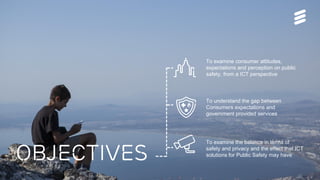
To examine consumer attitudes,
expectations and perception on public
safety, from a ICT perspective
To understand the gap between
Consumers expectations and
government provided services.
To examine the balance in terms of
safety and privacy and the effect that ICT
solutions for Public Safety may have
OBJECTIVES
Ericsson Internal | 2016-06-29 | Page 3
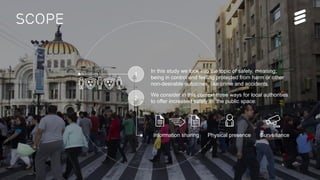
Scope
We consider in this context three ways for local authorities
to offer increased safety in the public space:
In this study we look into the topic of safety, meaning;
being in control and feeling protected from harm or other
non-desirable outcomes, like crime and accidents.
2
Information sharing Physical presence Surveillance
1
Ericsson Internal | 2016-06-29 | Page 4
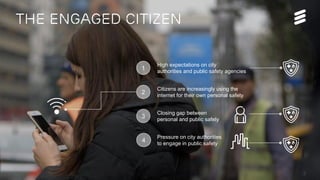
The engaged citizen
High expectations on city
authorities and public safety agencies
1
Citizens are increasingly using the
internet for their own personal safety
2
Closing gap between
personal and public safety
3
4
Pressure on city authorities
to engage in public safety
Ericsson Internal | 2016-06-29 | Page 5
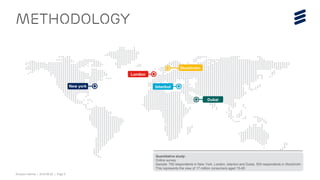
Methodology
IstanbulNew york
London
Stockholm
Dubai
Quantitative study:
Online survey.
Sample: 750 respondents in New York, London, Istanbul and Dubai, 500 respondents in Stockholm
This represents the view of 17 million consumers aged 15-65
Ericsson Internal | 2016-06-29 | Page 6
Key findings
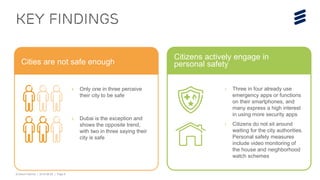
› Only one in three perceive
their city to be safe
› Dubai is the exception and
shows the opposite trend,
with two in three saying their
city is safe
Cities are not safe enough
› Three in four already use
emergency apps or functions
on their smartphones, and
many express a high interest
in using more security apps
› Citizens do not sit around
waiting for the city authorities.
Personal safety measures
include video monitoring of
the house and neighborhood
watch schemes
Citizens actively engage in
personal safety
Ericsson Internal | 2016-06-29 | Page 7
Key findings
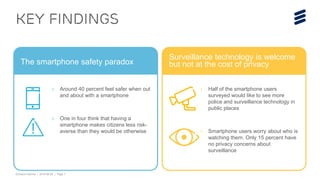
› Half of the smartphone users
surveyed would like to see more
police and surveillance technology in
public places
› Smartphone users worry about who is
watching them. Only 15 percent have
no privacy concerns about
surveillance
Surveillance technology is welcome
but not at the cost of privacy
› Around 40 percent feel safer when out
and about with a smartphone
› One in four think that having a
smartphone makes citizens less risk-
averse than they would be otherwise
The smartphone safety paradox
Ericsson Internal | 2016-06-29 | Page 8
› A majority of people say that their city is, if
not safe, at least not dangerous
› Dubai is on one end where over 70 percent
say their city is safe and Istanbul in the other
end where only 14 percent think their city is
safe
› Even if the situation is not acute, people see
a room for improvement
Mixed feelings
about safety in
in the city
Dubai
Istanbul
London
New York
Stockholm
0% 20% 40% 60% 80% 100%
Safe Neutral Not Safe Source: Ericsson ConsumerLab, Public Safety Goes Personal, 2016
Base: 3,500 smartphone users in Dubai, Istanbul, London, New York and Stockholm
Ericsson Internal | 2016-06-29 | Page 9
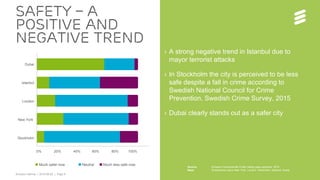
› A strong negative trend in Istanbul due to
mayor terrorist attacks
› In Stockholm the city is perceived to be less
safe despite a fall in crime according to
Swedish National Council for Crime
Prevention, Swedish Crime Survey, 2015
› Dubai clearly stands out as a safer city
Safety – A
positive and
negative trend
Much safer now Neutral Much less safe now
0% 20% 40% 60% 80% 100%
Dubai
Istanbul
London
New York
Stockholm
Source: Ericsson ConsumerLab, Public Safety Goes Personal, 2016
Base: 3,500 smartphone users in Dubai, Istanbul, London, New York and Stockholm
Ericsson Internal | 2016-06-29 | Page 10
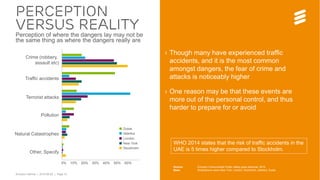
› Though many have experienced traffic
accidents, and it is the most common
amongst dangers, the fear of crime and
attacks is noticeably higher
› One reason may be that these events are
more out of the personal control, and thus
harder to prepare for or avoid
Perception
versus realityPerception of where the dangers lay may not be
the same thing as where the dangers really are
WHO 2014 states that the risk of traffic accidents in the
UAE is 5 times higher compared to Stockholm.
Dubai
Istanbul
London
New York
Stockholm
0% 10% 20% 30% 40% 50% 60%
Crime (robbery,
assault etc)
Traffic accidents
Terrorist attacks
Pollution
Natural Catastrophes
Other, Specify
Source: Ericsson ConsumerLab, Public Safety Goes Personal, 2016
Base: 3,500 smartphone users in Dubai, Istanbul, London, New York and Stockholm
Ericsson Internal | 2016-06-29 | Page 11
0,0%
10,0%
20,0%
30,0%
40,0%
50,0%
60,0%
Currently do Never done but
would like to do
Currently do Never done but
would like to do
Currently do Never done but
would like to do
Currently do Never done but
would like to do
Currently do Never done but
would like to do
Currently do Never done but
would like to do
Collect information about others in
your neighborhood.
Video surveillance/monitoring of
your house or garden
Video surveillance/monitoring of
your street
Partake in neighborhood watches Partake in voluntarily city watches Partake in safety networks,
getting alerts and aiding people in
need
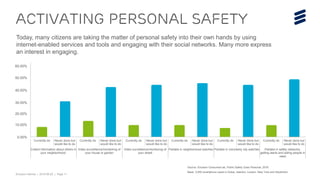
Activating personal safety
Today, many citizens are taking the matter of personal safety into their own hands by using
internet-enabled services and tools and engaging with their social networks. Many more express
an interest in engaging.
60.00%
50.00%
40.00%
30.00%
20.00%
10.00%
0.00%
Source: Ericsson ConsumerLab, Public Safety Goes Personal, 2016
Base: 3,500 smartphone users in Dubai, Istanbul, London, New York and Stockholm
Ericsson Internal | 2016-06-29 | Page 12
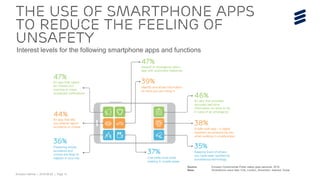
The use of smartphone apps
to reduce the feeling of
unsafety
Interest levels for the following smartphone apps and functions
Source: Ericsson ConsumerLab, Public Safety Goes Personal, 2016
Base: 3,500 smartphone users in Dubai, Istanbul, London, New York and Stockholm
Ericsson Internal | 2016-06-29 | Page 13
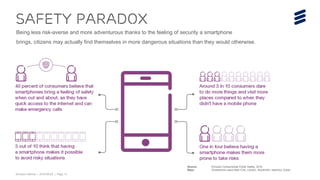
Safety paradox
Being less risk-averse and more adventurous thanks to the feeling of security a smartphone
brings, citizens may actually find themselves in more dangerous situations than they would otherwise.
Source: Ericsson ConsumerLab, Public Safety Goes Personal, 2016
Base: 3,500 smartphone users in Dubai, Istanbul, London, New York and Stockholm
Ericsson Internal | 2016-06-29 | Page 14
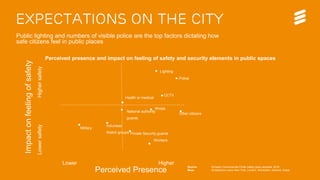
Expectations on the city
Public lighting and numbers of visible police are the top factors dictating how
safe citizens feel in public places
Impactonfeelingofsafety
Perceived Presence
LowersafetyHighersafety
Lower Higher
Police
Lighting
Workers
Military
Volunteer
Watch groups Private Security guards
Other citizens
CCTV
Shops
National authority
guards
Health or medical
Perceived presence and impact on feeling of safety and security elements in public spaces
Source: Ericsson ConsumerLab, Public Safety Goes Personal, 2016
Base: 3,500 smartphone users in Dubai, Istanbul, London, New York and Stockholm
Ericsson Internal | 2016-06-29 | Page 15
› CCTV surveillance is approved in public
places if used for major threats to the safety
such as terrorism and crimes
› The support however plummets when it
comes to other type of usage
› Stockholm stands out as being the most
reluctant to use video monitoring footage
CCTV approved
for major
incidents
0% 10% 20% 30% 40% 50% 60% 70%
Prevent terrorist attacks
Crime investigation
Crime prevention
Accident investigation
Accident prevention
Traffic monitoring
Survey an area in real time
Identify people using automatic
facial recognition
Sharing with all authorities
Research on municipality
development
Made public for anyone to
access
Storing with no particular
purpose
Building personal files on
citizens
Sharing with private
companies for marketing or
sales purposes
Source: Ericsson ConsumerLab, Public Safety Goes Personal, 2016
Base: 3,500 smartphone users in Dubai, Istanbul, London, New York and Stockholm
Ericsson Internal | 2016-06-29 | Page 16
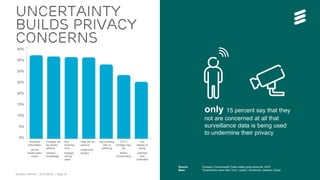
Uncertainty
builds privacy
concerns
only 15 percent say that they
not are concerned at all that
surveillance data is being used
to undermine their privacy
40%
35%
30%
25%
20%
15%
10%
5%
0%
Personal
information
will be
made public
online
Footage will
be stored
without
citizens’
knowledge
Not
knowing
how
footage
will be
used
Data will be
used to
undermine
privacy
Not knowing
who is
watching
CCTV
footage may
be
falsely
incriminating
The
feeling of
being
watched
and
controlled
Source: Ericsson ConsumerLab, Public Safety Goes Personal, 2016
Base: 3,500 smartphone users in Dubai, Istanbul, London, New York and Stockholm
Ericsson Internal | 2016-06-29 | Page 17
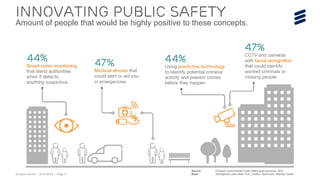
Innovating public safety
Amount of people that would be highly positive to these concepts.
Source: Ericsson Consumerlab Public safety goes personal, 2016
Base: Smartphone users New York, London, Stockholm, Istanbul, DubaiSource: Ericsson ConsumerLab, Public Safety Goes Personal, 2016
Base: 3,500 smartphone users in Dubai, Istanbul, London, New York and Stockholm
Ericsson Internal | 2016-06-29 | Page 18
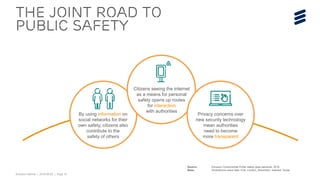
The joint road to
public safety
By using information on
social networks for their
own safety, citizens also
contribute to the
safety of others
Citizens seeing the internet
as a means for personal
safety opens up routes
for interaction
with authorities
Privacy concerns over
new security technology
mean authorities
need to become
more transparent
Source: Ericsson ConsumerLab, Public Safety Goes Personal, 2016
Base: 3,500 smartphone users in Dubai, Istanbul, London, New York and Stockholm
Ericsson Internal | 2016-06-29 | Page 19
public safety goes personal
CITY
SECURITY TECHNOLOGY MAKES US MORE INFORMED AND ALLOW US TO
TAKE SMARTER DECISIONS. CONSUMERS EXPECT THE CITY TO PROVIDE
SMART SERVICES. TECHNOLOGY ENABLE THE SMART CITY.
SMART
TECHNOLOGY
PEOPLE
ConsumerLab: Public safety goes personal - presentation

ConsumerLab: Public safety goes personal - presentation

  • 1.
  • 2.
    Ericsson Internal |2016-06-29 | Page 2 To examine consumer attitudes, expectations and perception on public safety, from a ICT perspective To understand the gap between Consumers expectations and government provided services. To examine the balance in terms of safety and privacy and the effect that ICT solutions for Public Safety may have OBJECTIVES
  • 3.
    Ericsson Internal |2016-06-29 | Page 3 Scope We consider in this context three ways for local authorities to offer increased safety in the public space: In this study we look into the topic of safety, meaning; being in control and feeling protected from harm or other non-desirable outcomes, like crime and accidents. 2 Information sharing Physical presence Surveillance 1
  • 4.
    Ericsson Internal |2016-06-29 | Page 4 The engaged citizen High expectations on city authorities and public safety agencies 1 Citizens are increasingly using the internet for their own personal safety 2 Closing gap between personal and public safety 3 4 Pressure on city authorities to engage in public safety
  • 5.
    Ericsson Internal |2016-06-29 | Page 5 Methodology IstanbulNew york London Stockholm Dubai Quantitative study: Online survey. Sample: 750 respondents in New York, London, Istanbul and Dubai, 500 respondents in Stockholm This represents the view of 17 million consumers aged 15-65
  • 6.
    Ericsson Internal |2016-06-29 | Page 6 Key findings › Only one in three perceive their city to be safe › Dubai is the exception and shows the opposite trend, with two in three saying their city is safe Cities are not safe enough › Three in four already use emergency apps or functions on their smartphones, and many express a high interest in using more security apps › Citizens do not sit around waiting for the city authorities. Personal safety measures include video monitoring of the house and neighborhood watch schemes Citizens actively engage in personal safety
  • 7.
    Ericsson Internal |2016-06-29 | Page 7 Key findings › Half of the smartphone users surveyed would like to see more police and surveillance technology in public places › Smartphone users worry about who is watching them. Only 15 percent have no privacy concerns about surveillance Surveillance technology is welcome but not at the cost of privacy › Around 40 percent feel safer when out and about with a smartphone › One in four think that having a smartphone makes citizens less risk- averse than they would be otherwise The smartphone safety paradox
  • 8.
    Ericsson Internal |2016-06-29 | Page 8 › A majority of people say that their city is, if not safe, at least not dangerous › Dubai is on one end where over 70 percent say their city is safe and Istanbul in the other end where only 14 percent think their city is safe › Even if the situation is not acute, people see a room for improvement Mixed feelings about safety in in the city Dubai Istanbul London New York Stockholm 0% 20% 40% 60% 80% 100% Safe Neutral Not Safe Source: Ericsson ConsumerLab, Public Safety Goes Personal, 2016 Base: 3,500 smartphone users in Dubai, Istanbul, London, New York and Stockholm
  • 9.
    Ericsson Internal |2016-06-29 | Page 9 › A strong negative trend in Istanbul due to mayor terrorist attacks › In Stockholm the city is perceived to be less safe despite a fall in crime according to Swedish National Council for Crime Prevention, Swedish Crime Survey, 2015 › Dubai clearly stands out as a safer city Safety – A positive and negative trend Much safer now Neutral Much less safe now 0% 20% 40% 60% 80% 100% Dubai Istanbul London New York Stockholm Source: Ericsson ConsumerLab, Public Safety Goes Personal, 2016 Base: 3,500 smartphone users in Dubai, Istanbul, London, New York and Stockholm
  • 10.
    Ericsson Internal |2016-06-29 | Page 10 › Though many have experienced traffic accidents, and it is the most common amongst dangers, the fear of crime and attacks is noticeably higher › One reason may be that these events are more out of the personal control, and thus harder to prepare for or avoid Perception versus realityPerception of where the dangers lay may not be the same thing as where the dangers really are WHO 2014 states that the risk of traffic accidents in the UAE is 5 times higher compared to Stockholm. Dubai Istanbul London New York Stockholm 0% 10% 20% 30% 40% 50% 60% Crime (robbery, assault etc) Traffic accidents Terrorist attacks Pollution Natural Catastrophes Other, Specify Source: Ericsson ConsumerLab, Public Safety Goes Personal, 2016 Base: 3,500 smartphone users in Dubai, Istanbul, London, New York and Stockholm
  • 11.
    Ericsson Internal |2016-06-29 | Page 11 0,0% 10,0% 20,0% 30,0% 40,0% 50,0% 60,0% Currently do Never done but would like to do Currently do Never done but would like to do Currently do Never done but would like to do Currently do Never done but would like to do Currently do Never done but would like to do Currently do Never done but would like to do Collect information about others in your neighborhood. Video surveillance/monitoring of your house or garden Video surveillance/monitoring of your street Partake in neighborhood watches Partake in voluntarily city watches Partake in safety networks, getting alerts and aiding people in need Activating personal safety Today, many citizens are taking the matter of personal safety into their own hands by using internet-enabled services and tools and engaging with their social networks. Many more express an interest in engaging. 60.00% 50.00% 40.00% 30.00% 20.00% 10.00% 0.00% Source: Ericsson ConsumerLab, Public Safety Goes Personal, 2016 Base: 3,500 smartphone users in Dubai, Istanbul, London, New York and Stockholm
  • 12.
    Ericsson Internal |2016-06-29 | Page 12 The use of smartphone apps to reduce the feeling of unsafety Interest levels for the following smartphone apps and functions Source: Ericsson ConsumerLab, Public Safety Goes Personal, 2016 Base: 3,500 smartphone users in Dubai, Istanbul, London, New York and Stockholm
  • 13.
    Ericsson Internal |2016-06-29 | Page 13 Safety paradox Being less risk-averse and more adventurous thanks to the feeling of security a smartphone brings, citizens may actually find themselves in more dangerous situations than they would otherwise. Source: Ericsson ConsumerLab, Public Safety Goes Personal, 2016 Base: 3,500 smartphone users in Dubai, Istanbul, London, New York and Stockholm
  • 14.
    Ericsson Internal |2016-06-29 | Page 14 Expectations on the city Public lighting and numbers of visible police are the top factors dictating how safe citizens feel in public places Impactonfeelingofsafety Perceived Presence LowersafetyHighersafety Lower Higher Police Lighting Workers Military Volunteer Watch groups Private Security guards Other citizens CCTV Shops National authority guards Health or medical Perceived presence and impact on feeling of safety and security elements in public spaces Source: Ericsson ConsumerLab, Public Safety Goes Personal, 2016 Base: 3,500 smartphone users in Dubai, Istanbul, London, New York and Stockholm
  • 15.
    Ericsson Internal |2016-06-29 | Page 15 › CCTV surveillance is approved in public places if used for major threats to the safety such as terrorism and crimes › The support however plummets when it comes to other type of usage › Stockholm stands out as being the most reluctant to use video monitoring footage CCTV approved for major incidents 0% 10% 20% 30% 40% 50% 60% 70% Prevent terrorist attacks Crime investigation Crime prevention Accident investigation Accident prevention Traffic monitoring Survey an area in real time Identify people using automatic facial recognition Sharing with all authorities Research on municipality development Made public for anyone to access Storing with no particular purpose Building personal files on citizens Sharing with private companies for marketing or sales purposes Source: Ericsson ConsumerLab, Public Safety Goes Personal, 2016 Base: 3,500 smartphone users in Dubai, Istanbul, London, New York and Stockholm
  • 16.
    Ericsson Internal |2016-06-29 | Page 16 Uncertainty builds privacy concerns only 15 percent say that they not are concerned at all that surveillance data is being used to undermine their privacy 40% 35% 30% 25% 20% 15% 10% 5% 0% Personal information will be made public online Footage will be stored without citizens’ knowledge Not knowing how footage will be used Data will be used to undermine privacy Not knowing who is watching CCTV footage may be falsely incriminating The feeling of being watched and controlled Source: Ericsson ConsumerLab, Public Safety Goes Personal, 2016 Base: 3,500 smartphone users in Dubai, Istanbul, London, New York and Stockholm
  • 17.
    Ericsson Internal |2016-06-29 | Page 17 Innovating public safety Amount of people that would be highly positive to these concepts. Source: Ericsson Consumerlab Public safety goes personal, 2016 Base: Smartphone users New York, London, Stockholm, Istanbul, DubaiSource: Ericsson ConsumerLab, Public Safety Goes Personal, 2016 Base: 3,500 smartphone users in Dubai, Istanbul, London, New York and Stockholm
  • 18.
    Ericsson Internal |2016-06-29 | Page 18 The joint road to public safety By using information on social networks for their own safety, citizens also contribute to the safety of others Citizens seeing the internet as a means for personal safety opens up routes for interaction with authorities Privacy concerns over new security technology mean authorities need to become more transparent Source: Ericsson ConsumerLab, Public Safety Goes Personal, 2016 Base: 3,500 smartphone users in Dubai, Istanbul, London, New York and Stockholm
  • 19.
    Ericsson Internal |2016-06-29 | Page 19 public safety goes personal CITY SECURITY TECHNOLOGY MAKES US MORE INFORMED AND ALLOW US TO TAKE SMARTER DECISIONS. CONSUMERS EXPECT THE CITY TO PROVIDE SMART SERVICES. TECHNOLOGY ENABLE THE SMART CITY. SMART TECHNOLOGY PEOPLE