SHIFTING INTO
OVERDRIVE
AUTOMOTIVE CYBERSECURITY
When an industry
completely reinvents its
products and its ways of
doing business, it’s an
exciting challenge.
When it does so in the
middle of a pandemic, it’s a
heroic effort. The
automotive industry has
grappled with both
scenarios in 2020.
2Copyright © 2020 Accenture. All rights reserved.
Auto companies were already focused on
moving to connected, clean vehicles prior to
COVID-19, but have now found themselves
challenged to retool and reorient to
manufacture life-saving products like
ventilators.
The learned agility that came from their
COVID-19 efforts will likely help auto
companies as they revitalize post-pandemic.
And as they do, they’ll need new cybersecurity
measures to help them protect their new ways
of doing business.
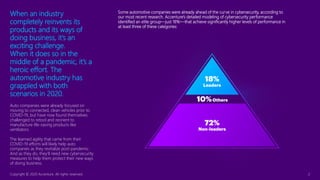
Some automotive companies were already ahead of the curve in cybersecurity, according to
our most recent research. Accenture’s detailed modeling of cybersecurity performance
identified an elite group—just 18%i—that achieve significantly higher levels of performance in
at least three of these categories:
3Copyright © 2020 Accenture. All rights reserved.
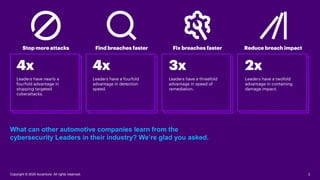
What can other automotive companies learn from the
cybersecurity Leaders in their industry? We’re glad you asked.
Leaders’ investments in innovation are working
4
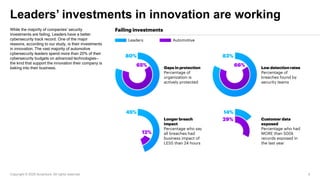
While the majority of companies’ security
investments are failing, Leaders have a better
cybersecurity track record. One of the major
reasons, according to our study, is their investments
in innovation. The vast majority of automotive
cybersecurity leaders spend more than 20% of their
cybersecurity budgets on advanced technologies—
the kind that support the innovation their company is
baking into their business.
Copyright © 2020 Accenture. All rights reserved.
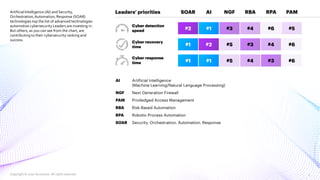
Artificial Intelligence (AI) and Security,
Orchestration,Automation, Response (SOAR)
technologies top the list of advanced technologies
automotive cybersecurity Leaders are investing in.
But others, as you can see from the chart, are
contributing to their cybersecurity ranking and
success.
Copyright © 2020 Accenture. All rights reserved. 5
Regulating vehicle
cybersecurity puts heavy
responsibility
on manufacturers
Currently, there are few legal regulations on
cybersecurity in the automotive sector. In mid-
2020, Regulations (WP.29)—a working party of
the Sustainable Transport Division of the United
Nations Economic Commission for Europe (UN
ECE)—will change that in Europe.
As we write this cybersecurity report, the UN ECE
will issue in late 2020 or early 2021 a regulation
on cybersecurity in connected and autonomous
vehicles. It provides uniform provisions for the
approval of vehicles’ cybersecurity and
cybersecurity management systems (CSMS). The
regulation will also cover software updates and
software update management systems (SUMS).
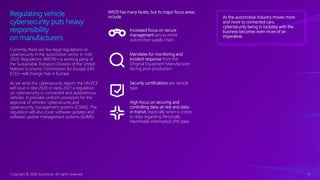
WP.29 has many facets, but its major focus areas
include:
Increased focus on secure
management across entire
automotive supply chain
Mandates for monitoring and
incident response from the
Original Equipment Manufacturer
during post-production
Security certifications per vehicle
type
High focus on securing and
controlling data-at-rest and data-
in-transit, especially when it comes
to data regarding Personally
Identifiable Information (PII) data.
As the automotive industry moves more
and more to connected cars,
cybersecurity being in lockstep with the
business becomes even more of an
imperative.
6Copyright © 2020 Accenture. All rights reserved.
New innovations, new challenges
Two developments open automotive manufacturers up to
increasing cybersecurity challenges.The first is the more
remote method of working due to COVID-19, a method
that may continue for some time.And the second is the
increasing business and technology partnerships
automotive companies are forging as they move from
producing a vehicle that is primarily of their making, to a
vehicle that is a collection of software-based services and
systems.
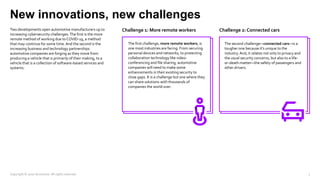
Challenge 1: More remote workers Challenge 2: Connected cars
The first challenge, more remote workers, is
one most industries are facing. From securing
personal devices and networks, to protecting
collaboration technology like video-
conferencing and file sharing, automotive
companies will need to make some
enhancements in their existing security to
close gaps. It is a challenge but one where they
can share solutions with thousands of
companies the world over.
The second challenge—connected cars—is a
tougher one because it’s unique to the
industry.And, it relates not only to privacy and
the usual security concerns, but also to a life-
or-death matter—the safety of passengers and
other drivers.
Copyright © 2020 Accenture. All rights reserved. 7
Gearing up for remote working environments
Some companies, like Accenture, were well-versed in
remote working environments prior toCOVID-19. But
many automotive companies were still in a traditional
office structure.As a result, they have been racing to
accelerate their cybersecurity protections for
employees—who might previously have been
concentrated in several dozen secure locations globally
and are now located in thousands of unsecured home
locations instead.And our survey respondents shared
that the top target for cyberattacks was their corporate
organization—ranging from attacks on intellectual
property to employee information.
Phishing by cyberespionage and cybercriminal groups,
as well as nation-state-sponsored cyberthreats, are
huge risks right now— particularly for companies that
have not had to address at-home protection previously.
Adaptive security, based on zero-trust protocols, is a
wise step for any company that finds itself grappling
with a remote workforce during this time period.
Copyright © 2020 Accenture. All rights reserved. 8
Copyright © 2020 Accenture. All rights reserved.
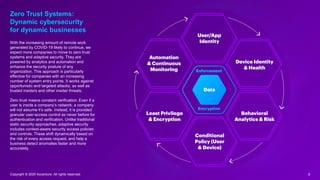
Zero Trust Systems:
Dynamic cybersecurity
for dynamic businesses
With the increasing amount of remote work
generated by COVID-19 likely to continue, we
expect more companies to move to zero trust
systems and adaptive security. They are
powered by analytics and automation and
enhance the security posture of any
organization. This approach is particularly
effective for companies with an increasing
number of system entry points. It works against
opportunistic and targeted attacks, as well as
trusted insiders and other insider threats.
Zero trust means constant verification. Even if a
user is inside a company’s network, a company
will not assume it’s safe. Instead, it is provided
granular user-access control as never before for
authentication and verification. Unlike traditional
static security approaches, adaptive security
includes context-aware security access policies
and controls. These shift dynamically based on
the risk of every access request, and help a
business detect anomalies faster and more
accurately.
9
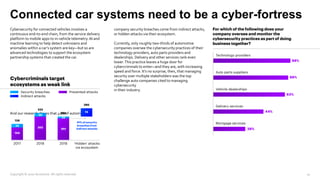
Connected car systems need to be a cyber-fortress
Cybersecurity for connected vehicles involves a
continuous end-to-end chain, from the service delivery
platform to mobile apps to in-vehicle telemetry.AI and
machine learning to help detect unknowns and
anomalies within a car’s system are key—but so are
advanced technologies to support the ecosystem
partnership systems that created the car.
And our research shows that 41% of automotive
company security breaches come from indirect attacks,
or hidden attacks via their ecosystem.
Currently, only roughly two-thirds of automotive
companies oversee the cybersecurity practices of their
technology providers, auto parts providers and
dealerships. Delivery and other services rank even
lower.This practice leaves a huge door for
cybercriminals to enter—and they are, with increasing
speed and force. It’s no surprise, then, that managing
security over multiple stakeholders was the top
challenge auto companies cited to managing
cybersecurity
in their industry.
Copyright © 2020 Accenture. All rights reserved. 10
A cybersecurity strategy fit for innovation
Automotive companies need a cybersecurity foundation
fit for purpose—and that purpose has changed.As
manufacturers invest in emerging technologies and
decouple their core architecture to allow for innovative
collaboration, their cybersecurity strategy needs to
change. Many are handling the basics well, but the
business has moved beyond basic cybersecurity needs.
The sophistication and severity of cyberattacks is
increasing at an alarming rate, significantly impacting
companies across industries.The average cost of
cybercrime for an organization has increased US$1.4
million to US$13.0 million.ii
Now more than ever, as auto companies move from
vehicle manufacturing specialists to technology
ecosystem specialists, their cybersecurity needs become
far more complex and critical.A connected car stems
from a web of interconnected companies with varying
levels of cybersecurity expertise.
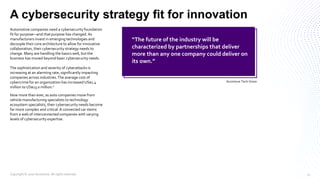
“The future of the industry will be
characterized by partnerships that deliver
more than any one company could deliver on
its own.”
Accenture Tech Vision
Copyright © 2020 Accenture. All rights reserved. 11
Focusing on action in a few key areas can help automotive companies advance their cybersecurity to
better meet the new needs of the business:
Reassess cybersecurity using an end-to-end approach. New regulations are a
bellwether for things to come, holding automotive companies responsible for
secure management of areas like data at rest and data in transit. Cybersecurity
in an intelligent vehicle has become a matter of life or death.
Look beyond traditional boundaries. Auto companies will more and more
have to take cybersecurity standards and enforcement across the ecosystem
and their own distributed operations into their hands to protect their own
interests.
Take a proactive stance with regulators and shared industry intelligence.
Regulators need input from automotive companies to create standards that
protect consumers but are also realistic for manufacturers.
Reaching out to offer assistance and subject matter
expertise helps ensure a public/private partnership
for the mutual good. And industry groups like the
Automotive Information Sharing and Analysis
Center (Auto-ISAC) serve as a global information-
sharing community to address vehicle cyber
security risks. Auto-ISAC operates a central hub for
sharing, tracking and analyzing intelligence about
cyber threats, vulnerabilities and incidents related
to the connected vehicle. The more companies
that actively participate, the better the resources
marshaled against cyber attackers.
As cars become connected products and
consumers begin to clamor for the Next Big Thing
that will transform their riding and driving
experience, the need to protect not only those
consumers, but also their own employees and
business continuity, becomes paramount. The
innovation so very necessary to leapfrog the auto
industry to the next level brings some very serious
potential risks in the cyber realm. Automotive
companies that move now to anticipate and
address those risks set themselves up to move into
their future more rapidly—and more safely.
Copyright © 2020 Accenture. All rights reserved. 12
Contacts
Brian Irwin
Lead – Automotive, North America
Managing Director
brian.irwin@accenture.com
Alberto Meneghini
Automotive, Security
Managing Director
alberto.meneghini@accenture.com
About Accenture
Accenture is a leading global professional services company, providing a broad range of services in strategy and consulting,
interactive, technology and operations, with digital capabilities across all of these services. We combine unmatched experience and
specialized capabilities across more than 40 industries—powered by the world’s largest network of Advanced Technology and
Intelligent Operations centers. With 509,000 people serving clients in more than 120 countries, Accenture brings continuous
innovation to help clients improve their performance and create lasting value across their enterprises. Visit us at www.accenture.com
About About Accenture Security
Accenture Security is a leading provider of end-to-end cybersecurity services, including advanced cyber defense, applied
cybersecurity solutions and managed security operations. We bring security innovation, coupled with global scale and a worldwide
delivery capability through our network of Advanced Technology and Intelligent Operations centers. Helped by our team of highly
skilled professionals, we enable clients to innovate safely, build cyber resilience and grow with confidence. Visit us at
www.accenture.com/security
About About the research
Accenture Research conducted its third annual cybersecurity study with 4,644 security executives in 16 countries. We collected
responses from companies with $US1B+ in revenue, across 24 industries. This report is our analysis of responses from 100+ executives
in the automotive industry.
References
i All data is from Accenture’s Cyber Resilience research, unless otherwise noted.
ii “The Cost of Cybercrime,” Accenture, 2019.
DISCLAIMER: This document is intended for general informational purposes only and does not take into account the reader’s specific circumstances and may not reflect the most current developments.
Accenture disclaims, to the fullest extent permitted by applicable law, any and all liability for the accuracy and completeness of the information in this presentation and for any acts or omissions made
based on such information. Accenture does not provide legal, regulatory, audit, or tax advice. Readers are responsible for obtaining such advice from their own legal counsel or other licensed
professionals.
Copyright © 2020 Accenture. All rights reserved. Accenture,
its logo, and New Applied Now are trademarks of Accenture.

Automotive Cybersecurity: Shifting into Overdrive

  • 1.
  • 2.
    When an industry completelyreinvents its products and its ways of doing business, it’s an exciting challenge. When it does so in the middle of a pandemic, it’s a heroic effort. The automotive industry has grappled with both scenarios in 2020. 2Copyright © 2020 Accenture. All rights reserved. Auto companies were already focused on moving to connected, clean vehicles prior to COVID-19, but have now found themselves challenged to retool and reorient to manufacture life-saving products like ventilators. The learned agility that came from their COVID-19 efforts will likely help auto companies as they revitalize post-pandemic. And as they do, they’ll need new cybersecurity measures to help them protect their new ways of doing business. Some automotive companies were already ahead of the curve in cybersecurity, according to our most recent research. Accenture’s detailed modeling of cybersecurity performance identified an elite group—just 18%i—that achieve significantly higher levels of performance in at least three of these categories:
  • 3.
    3Copyright © 2020Accenture. All rights reserved. What can other automotive companies learn from the cybersecurity Leaders in their industry? We’re glad you asked.
  • 4.
    Leaders’ investments ininnovation are working 4 While the majority of companies’ security investments are failing, Leaders have a better cybersecurity track record. One of the major reasons, according to our study, is their investments in innovation. The vast majority of automotive cybersecurity leaders spend more than 20% of their cybersecurity budgets on advanced technologies— the kind that support the innovation their company is baking into their business. Copyright © 2020 Accenture. All rights reserved.
  • 5.
    Artificial Intelligence (AI)and Security, Orchestration,Automation, Response (SOAR) technologies top the list of advanced technologies automotive cybersecurity Leaders are investing in. But others, as you can see from the chart, are contributing to their cybersecurity ranking and success. Copyright © 2020 Accenture. All rights reserved. 5
  • 6.
    Regulating vehicle cybersecurity putsheavy responsibility on manufacturers Currently, there are few legal regulations on cybersecurity in the automotive sector. In mid- 2020, Regulations (WP.29)—a working party of the Sustainable Transport Division of the United Nations Economic Commission for Europe (UN ECE)—will change that in Europe. As we write this cybersecurity report, the UN ECE will issue in late 2020 or early 2021 a regulation on cybersecurity in connected and autonomous vehicles. It provides uniform provisions for the approval of vehicles’ cybersecurity and cybersecurity management systems (CSMS). The regulation will also cover software updates and software update management systems (SUMS). WP.29 has many facets, but its major focus areas include: Increased focus on secure management across entire automotive supply chain Mandates for monitoring and incident response from the Original Equipment Manufacturer during post-production Security certifications per vehicle type High focus on securing and controlling data-at-rest and data- in-transit, especially when it comes to data regarding Personally Identifiable Information (PII) data. As the automotive industry moves more and more to connected cars, cybersecurity being in lockstep with the business becomes even more of an imperative. 6Copyright © 2020 Accenture. All rights reserved.
  • 7.
    New innovations, newchallenges Two developments open automotive manufacturers up to increasing cybersecurity challenges.The first is the more remote method of working due to COVID-19, a method that may continue for some time.And the second is the increasing business and technology partnerships automotive companies are forging as they move from producing a vehicle that is primarily of their making, to a vehicle that is a collection of software-based services and systems. Challenge 1: More remote workers Challenge 2: Connected cars The first challenge, more remote workers, is one most industries are facing. From securing personal devices and networks, to protecting collaboration technology like video- conferencing and file sharing, automotive companies will need to make some enhancements in their existing security to close gaps. It is a challenge but one where they can share solutions with thousands of companies the world over. The second challenge—connected cars—is a tougher one because it’s unique to the industry.And, it relates not only to privacy and the usual security concerns, but also to a life- or-death matter—the safety of passengers and other drivers. Copyright © 2020 Accenture. All rights reserved. 7
  • 8.
    Gearing up forremote working environments Some companies, like Accenture, were well-versed in remote working environments prior toCOVID-19. But many automotive companies were still in a traditional office structure.As a result, they have been racing to accelerate their cybersecurity protections for employees—who might previously have been concentrated in several dozen secure locations globally and are now located in thousands of unsecured home locations instead.And our survey respondents shared that the top target for cyberattacks was their corporate organization—ranging from attacks on intellectual property to employee information. Phishing by cyberespionage and cybercriminal groups, as well as nation-state-sponsored cyberthreats, are huge risks right now— particularly for companies that have not had to address at-home protection previously. Adaptive security, based on zero-trust protocols, is a wise step for any company that finds itself grappling with a remote workforce during this time period. Copyright © 2020 Accenture. All rights reserved. 8
  • 9.
    Copyright © 2020Accenture. All rights reserved. Zero Trust Systems: Dynamic cybersecurity for dynamic businesses With the increasing amount of remote work generated by COVID-19 likely to continue, we expect more companies to move to zero trust systems and adaptive security. They are powered by analytics and automation and enhance the security posture of any organization. This approach is particularly effective for companies with an increasing number of system entry points. It works against opportunistic and targeted attacks, as well as trusted insiders and other insider threats. Zero trust means constant verification. Even if a user is inside a company’s network, a company will not assume it’s safe. Instead, it is provided granular user-access control as never before for authentication and verification. Unlike traditional static security approaches, adaptive security includes context-aware security access policies and controls. These shift dynamically based on the risk of every access request, and help a business detect anomalies faster and more accurately. 9
  • 10.
    Connected car systemsneed to be a cyber-fortress Cybersecurity for connected vehicles involves a continuous end-to-end chain, from the service delivery platform to mobile apps to in-vehicle telemetry.AI and machine learning to help detect unknowns and anomalies within a car’s system are key—but so are advanced technologies to support the ecosystem partnership systems that created the car. And our research shows that 41% of automotive company security breaches come from indirect attacks, or hidden attacks via their ecosystem. Currently, only roughly two-thirds of automotive companies oversee the cybersecurity practices of their technology providers, auto parts providers and dealerships. Delivery and other services rank even lower.This practice leaves a huge door for cybercriminals to enter—and they are, with increasing speed and force. It’s no surprise, then, that managing security over multiple stakeholders was the top challenge auto companies cited to managing cybersecurity in their industry. Copyright © 2020 Accenture. All rights reserved. 10
  • 11.
    A cybersecurity strategyfit for innovation Automotive companies need a cybersecurity foundation fit for purpose—and that purpose has changed.As manufacturers invest in emerging technologies and decouple their core architecture to allow for innovative collaboration, their cybersecurity strategy needs to change. Many are handling the basics well, but the business has moved beyond basic cybersecurity needs. The sophistication and severity of cyberattacks is increasing at an alarming rate, significantly impacting companies across industries.The average cost of cybercrime for an organization has increased US$1.4 million to US$13.0 million.ii Now more than ever, as auto companies move from vehicle manufacturing specialists to technology ecosystem specialists, their cybersecurity needs become far more complex and critical.A connected car stems from a web of interconnected companies with varying levels of cybersecurity expertise. “The future of the industry will be characterized by partnerships that deliver more than any one company could deliver on its own.” Accenture Tech Vision Copyright © 2020 Accenture. All rights reserved. 11
  • 12.
    Focusing on actionin a few key areas can help automotive companies advance their cybersecurity to better meet the new needs of the business: Reassess cybersecurity using an end-to-end approach. New regulations are a bellwether for things to come, holding automotive companies responsible for secure management of areas like data at rest and data in transit. Cybersecurity in an intelligent vehicle has become a matter of life or death. Look beyond traditional boundaries. Auto companies will more and more have to take cybersecurity standards and enforcement across the ecosystem and their own distributed operations into their hands to protect their own interests. Take a proactive stance with regulators and shared industry intelligence. Regulators need input from automotive companies to create standards that protect consumers but are also realistic for manufacturers. Reaching out to offer assistance and subject matter expertise helps ensure a public/private partnership for the mutual good. And industry groups like the Automotive Information Sharing and Analysis Center (Auto-ISAC) serve as a global information- sharing community to address vehicle cyber security risks. Auto-ISAC operates a central hub for sharing, tracking and analyzing intelligence about cyber threats, vulnerabilities and incidents related to the connected vehicle. The more companies that actively participate, the better the resources marshaled against cyber attackers. As cars become connected products and consumers begin to clamor for the Next Big Thing that will transform their riding and driving experience, the need to protect not only those consumers, but also their own employees and business continuity, becomes paramount. The innovation so very necessary to leapfrog the auto industry to the next level brings some very serious potential risks in the cyber realm. Automotive companies that move now to anticipate and address those risks set themselves up to move into their future more rapidly—and more safely. Copyright © 2020 Accenture. All rights reserved. 12
  • 13.
    Contacts Brian Irwin Lead –Automotive, North America Managing Director brian.irwin@accenture.com Alberto Meneghini Automotive, Security Managing Director alberto.meneghini@accenture.com About Accenture Accenture is a leading global professional services company, providing a broad range of services in strategy and consulting, interactive, technology and operations, with digital capabilities across all of these services. We combine unmatched experience and specialized capabilities across more than 40 industries—powered by the world’s largest network of Advanced Technology and Intelligent Operations centers. With 509,000 people serving clients in more than 120 countries, Accenture brings continuous innovation to help clients improve their performance and create lasting value across their enterprises. Visit us at www.accenture.com About About Accenture Security Accenture Security is a leading provider of end-to-end cybersecurity services, including advanced cyber defense, applied cybersecurity solutions and managed security operations. We bring security innovation, coupled with global scale and a worldwide delivery capability through our network of Advanced Technology and Intelligent Operations centers. Helped by our team of highly skilled professionals, we enable clients to innovate safely, build cyber resilience and grow with confidence. Visit us at www.accenture.com/security About About the research Accenture Research conducted its third annual cybersecurity study with 4,644 security executives in 16 countries. We collected responses from companies with $US1B+ in revenue, across 24 industries. This report is our analysis of responses from 100+ executives in the automotive industry. References i All data is from Accenture’s Cyber Resilience research, unless otherwise noted. ii “The Cost of Cybercrime,” Accenture, 2019. DISCLAIMER: This document is intended for general informational purposes only and does not take into account the reader’s specific circumstances and may not reflect the most current developments. Accenture disclaims, to the fullest extent permitted by applicable law, any and all liability for the accuracy and completeness of the information in this presentation and for any acts or omissions made based on such information. Accenture does not provide legal, regulatory, audit, or tax advice. Readers are responsible for obtaining such advice from their own legal counsel or other licensed professionals. Copyright © 2020 Accenture. All rights reserved. Accenture, its logo, and New Applied Now are trademarks of Accenture.