 Measures profit and assess financial condition
 Measure economic performance
- Provide a point of comparison with previous
performance whether as a whole or per
individual enterprises
 Assist in obtaining loans from banks and
other financial institutions
 Assist in the analysis of new investments
 Meeting with legal requirements
 Regulate daily routine operations
 Operating/Physical Records
- farm sketch map, farm lay-out, records of
inputs, labor, tools, equipment, machinery,
production, marketing, etc.
 Financial Records
- Farm Inventory Record
- Farm Earnings Statement
- Balance Sheet
- Cash Flow Statement
 Is a complete lists of all the assets that the
farm owns and its value at a specific point in
time.
 An inventory should be taken at the beginning
of the accounting year. An inventory taken at
the end of the year will be the beginning
inventory for the next year.
 The farm inventory is the cornerstone for all
farm records and is of necessity, the first
record to be considered by any farmer/ farm
manager the operation of the farm business.
 An inventory includes a list of the real
estate, livestock, equipment, feed, supplies
and growing crops, together with a simple
description.
 Real estate includes land, buildings, fences,
solar driers, water system, electric systems
and other land improvements. Land can be
divided into crop land, permanent pasture,
woods and wasteland. Wasteland includes
spaces like roads, yards and spaces around
the buildings.
 Machinery and equipment include a list of
each different tools and machineries on the
farm. This includes portable brooder houses
for chickens and colony houses for bees.
 Livestock include a detailed list of all classes of
animals. The milk cows are listed by names or
number and are distinguished from the heifers,
calves and bulls. Brood sows and raised market
hogs, beef cows and raised feeders, breeding
ewes and lambs, hens, broilers and other
poultry should be listed separately.
 Feeds and supplies on hand include all feeds,
such as hay, silage, grains, straw and all mill
feeds. Supplies include items such as fertilizers,
lime. Herbicide, pesticides, seeds, posts not
set, woods and other materials.
 To be more useful in a record keeping system,
the inventory must be in monetary value.
 There are two process in taking farm inventory:
physical counting and valuation of assets.
 Physical count consists of listing and describing
each piece of property. Physical units such as
kilograms, tons, heads, etc., are used to record
the quantities of each type of property.
 The inventory valuation is a process which can
be completed using several methods to place a
value on each type of property. The choice of
the valuation methods depends on the type of
property and use to be made of the inventory.
Which ever method is used the concepts of
“conservatism” and “consistency” in valuation
should be kept in mind.
 Conservatism is being cautious against placing
too high a value on any item.
 Consistency stresses the using of the same
valuation method or methods over time.
Specifically, consistency is using the same
method of valuation at the end and at the
beginning of inventories.
 The use of the concepts makes financial
statements directly comparable from year to
year and prevents an over optimistic view of the
firm’ financial condition.
 Net Selling Price or Net Market Price
- used for those items that are primarily held for
sale and for those items bought at the early part
of the accounting year. Any marketing changes
such as transportation, selling commissions and
fees are subtracted to find the net market price.
Ex. Livestock for sale, crops harvested, seeds,
feeder livestock, bonds, stocks and the like.
 Cost or Purchase Price
- used for items which have been purchase
recently an for which cost records are still
available. Ex. Feeds, fertilizer, chemicals,
veterinary products and other supplies.
 Cost or Market Price
- requires valuing an item at both its market
price and its cost which ever is lower. With this
method, no paper profits accrue and losses due to
falling market prices are absorbed immediately.
Ex. Breeding livestock
 Farm Production Cost
- used for items produced in the farm. This cost
is equal to the actual cost of producing the item
but should not include profit or any opportunity
costs associated with the production process.
Ex. Raised livestock and standing crops
 Cost less Accumulated Depreciation
- is appropriate for assets which provide services
to the business over a period of years but loses
value over time because of age, use or
obsolescence. The value in the current time period
is equal to the original cost less accumulated
depreciation from purchase date to the date of
inventory. This value is referred to as the item’s
book value. Ex. Tools, machineries and
equipment’s
 Is the allowance for the wear and tear of
capital items.
 The annual reduction in the value of an asset
due to wear and tear, usage and technical
obsolescence.
CHARACTERISTICS OF ASSET THAT DEPRECIATES
 It has a useful life of more than a year.
 A determinable useful life but not unlimited
life.
 It is used in the business to produce revenue.
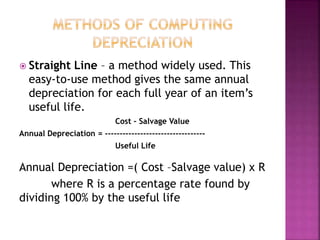
 Straight Line – a method widely used. This
easy-to-use method gives the same annual
depreciation for each full year of an item’s
useful life.
Cost – Salvage Value
Annual Depreciation = ----------------------------------
Useful Life
Annual Depreciation =( Cost –Salvage value) x R
where R is a percentage rate found by
dividing 100% by the useful life
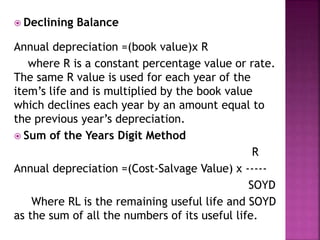
 Declining Balance
Annual depreciation =(book value)x R
where R is a constant percentage value or rate.
The same R value is used for each year of the
item’s life and is multiplied by the book value
which declines each year by an amount equal to
the previous year’s depreciation.
 Sum of the Years Digit Method
R
Annual depreciation =(Cost-Salvage Value) x -----
SOYD
Where RL is the remaining useful life and SOYD
as the sum of all the numbers of its useful life.
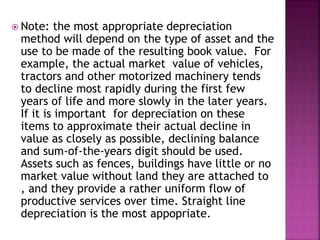
 Note: the most appropriate depreciation
method will depend on the type of asset and the
use to be made of the resulting book value. For
example, the actual market value of vehicles,
tractors and other motorized machinery tends
to decline most rapidly during the first few
years of life and more slowly in the later years.
If it is important for depreciation on these
items to approximate their actual decline in
value as closely as possible, declining balance
and sum-of-the-years digit should be used.
Assets such as fences, buildings have little or no
market value without land they are attached to
, and they provide a rather uniform flow of
productive services over time. Straight line
depreciation is the most appopriate.
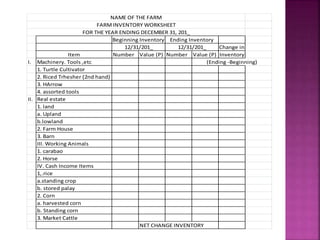
Change in
Item Number Value (P) Number Value (P) Inventory
I. Machinery. Tools ,etc (Ending -Beginning)
1. Turtle Cultivator
2. Riced Trhesher (2nd hand)
3. HArrow
4. assorted tools
II. Real estate
1. land
a. Upland
b.lowland
2. Farm House
3. Barn
III. Working Animals
1. carabao
2. Horse
IV. Cash Income Items
1,.rice
a.standing crop
b. stored palay
2. Corn
a. harvested corn
b. Standing corn
3. Market Cattle
NET CHANGE INVENTORY
NAME OF THE FARM
FARM INVENTORY WORKSHEET
Beginning Inventory Ending Inventory
12/31/201_ 12/31/201_
FOR THE YEAR ENDING DECEMBER 31, 201_
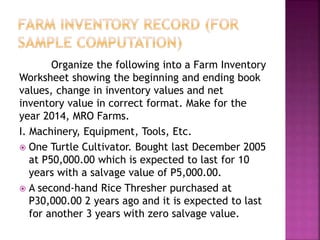
Organize the following into a Farm Inventory
Worksheet showing the beginning and ending book
values, change in inventory values and net
inventory value in correct format. Make for the
year 2014, MRO Farms.
I. Machinery, Equipment, Tools, Etc.
 One Turtle Cultivator. Bought last December 2005
at P50,000.00 which is expected to last for 10
years with a salvage value of P5,000.00.
 A second-hand Rice Thresher purchased at
P30,000.00 2 years ago and it is expected to last
for another 3 years with zero salvage value.
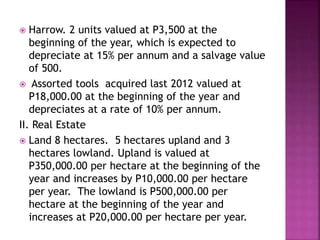
 Harrow. 2 units valued at P3,500 at the
beginning of the year, which is expected to
depreciate at 15% per annum and a salvage value
of 500.
 Assorted tools acquired last 2012 valued at
P18,000.00 at the beginning of the year and
depreciates at a rate of 10% per annum.
II. Real Estate
 Land 8 hectares. 5 hectares upland and 3
hectares lowland. Upland is valued at
P350,000.00 per hectare at the beginning of the
year and increases by P10,000.00 per hectare
per year. The lowland is P500,000.00 per
hectare at the beginning of the year and
increases at P20,000.00 per hectare per year.
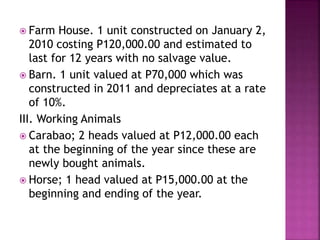
 Farm House. 1 unit constructed on January 2,
2010 costing P120,000.00 and estimated to
last for 12 years with no salvage value.
 Barn. 1 unit valued at P70,000 which was
constructed in 2011 and depreciates at a rate
of 10%.
III. Working Animals
 Carabao; 2 heads valued at P12,000.00 each
at the beginning of the year since these are
newly bought animals.
 Horse; 1 head valued at P15,000.00 at the
beginning and ending of the year.
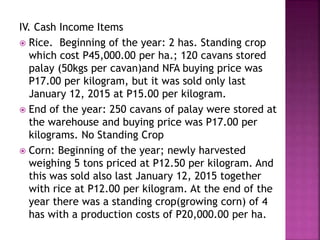
IV. Cash Income Items
 Rice. Beginning of the year: 2 has. Standing crop
which cost P45,000.00 per ha.; 120 cavans stored
palay (50kgs per cavan)and NFA buying price was
P17.00 per kilogram, but it was sold only last
January 12, 2015 at P15.00 per kilogram.
 End of the year: 250 cavans of palay were stored at
the warehouse and buying price was P17.00 per
kilograms. No Standing Crop
 Corn: Beginning of the year; newly harvested
weighing 5 tons priced at P12.50 per kilogram. And
this was sold also last January 12, 2015 together
with rice at P12.00 per kilogram. At the end of the
year there was a standing crop(growing corn) of 4
has with a production costs of P20,000.00 per ha.
 Market Cattle: 5 heads at the beginning of
the year 3 of which are valued at P18,000.00
and 2 at P8,000.00. Last November 30, 2013
the 3 were sold at P20,000.00 each. And at
the end of the year, 3 were left since 1 was
newly bought last December 2012 at
P10,000.00 And the previous 2 were now
valuing at P9,000.00
 It is a systematic organization of everything
“owned and owed” by a business or individual
at a given point in time.
 A balance sheet summarizes the financial
condition of the business at a point in time.
 It as “snapshot” of the financial solvency of a
business and the most commonly requested
document by a lender in reviewing a loan.
 It includes listing of assets and liabilities that
conclude with an estimate of net worth or
owners equity.
 The “balance” in the balance sheet comes from
the requirement that the ledger be balance
through the basic accounting equation: Assets =
Liabilities + Owners Equity
 A balance sheet can be completed any time
during an accounting period.
 One of the advantages of computerized
accounting system is the ease with which an
interim balance sheet can be prepared, such as
might be needed for loan.
 Most balance sheets are prepared at the end of
accounting period, whch is December 31.
 This procedure allows a single balance sheet to
be both at the end-of-the-year statement for
one accounting period and a beginning-of-the –
year statement for the next accounting period.
 For purpose of comparison and analysis, it is
necessary to have a balance sheet available for
both the beginning and end of each year.
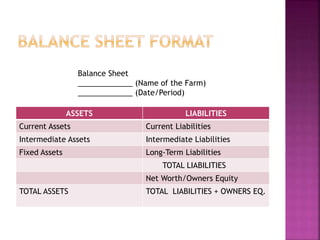
ASSETS LIABILITIES
Current Assets Current Liabilities
Intermediate Assets Intermediate Liabilities
Fixed Assets Long-Term Liabilities
TOTAL LIABILITIES
Net Worth/Owners Equity
TOTAL ASSETS TOTAL LIABILITIES + OWNERS EQ.
Balance Sheet
_____________ (Name of the Farm)
_____________ (Date/Period)
ASSET- anything of value owned by a business.
An asset has value for one or both of two
reasons.
a) It can be sold to generate cash
b) It can be used to produce other goods that in
turn can be sold for cash at some future time.
 Goods that have already been produced, such
as grain and feeder livestock, can be sold
easily and quickly without disrupting future
production activities are considered liquid
assets.
 Assets such as machinery, breeding livestock and
land are owned primarily to produce agricultural
commodities that can be sold to produce cash
income.
 Selling income producing assets to generate cash
would affects the firms ability to produce future
income, so they are less liquid or illiquid.
 Illiquid assets are difficult to sell quickly and
easily at their full market value.
 A Balance sheet normally has assets and
liabilities categorized on the basis of liquidity or
ease with which the assets can be converted to
cash.
 Current Assets – these includes items that will
be liquated. All current assets on hand at the
beginning of the operating cycle are expected to
sold or consumed by the end of the cycle (e.g.
grain held for sale) or are easily converted to
cash (e.g. stocks). Examples: feed in storage,
grains held for sale, fertilizer and seed
inventories, market livestock, market securities,
cash on hand, accounts receivable, checking and
saving deposits and other assets which are
temporary investments of excess or idle cash.
 Intermediate Assets – assets that have expected
useful life of up to 10 years. These are usually
depreciable. Example: tools, machinery,
equipment and breeding livestock.
 Intermediate assets can be liquidated but
generally would require more time to achieve a
fair price and also would have a significant
influence on the business ability to continue its
basic operation. In the sense, that these items
are basically intended to support production
and are not intended for sale. For example,
liquidating the breeding livestock would
certainly have a major impact on livestock
farms.
 Fixed Or Long-term Assets – these are assets
to be used over and over on the farm with an
expected useful life of more than 10 years. If a
major proportion of these assets are liquidated
the business would also be terminated in most
cases. Examples: land, permanent buildings
and other land improvements
 LIABILITIES
- claims against the business
- financial obligation owed to other person or
business
 Current Liabilities
- financial obligations due within the year. This
include accounts payable and debt that is likely to
be paid within a year’s time.
Ex. Supplies payable, Notes payable, Accounts
payable, Accrued expenses (insurance, taxes, rent,
etc), utilities, principal due on loans, Interest
payable, etc.
 Intermediate Liabilities
- financial obligations due more than a year up
to 10 years. This type of debt is used to purchase
assets that are used in the production process and
would include such items as machinery, breeding
livestock and some types of improvements.
Ex. Balance on loan to purchase breeding
livestock, balance on loan to purchase machinery,
intermediate loan for repair of buildings, etc.
 Long-Tern Liabilities
- financial obligations due for than 10 years.
Ex. Mortgage on land, long-term lease contract of
land
Measuring the financial condition at a point
in time is done primarily through:
 Solvency – measures the liabilities relative to
the amount invest in the business or net worth.
 Liquidity – measures the ability of the business
to meet financial obligations as they come due
without disrupting the normal operations of the
business.
Current Asset value
 Current ratio = -----------------------------
Current Liability value
 a value higher than 1.0 is preferred since a value
of one means current liabilities is just equal to
current assets. While there are sufficient current
assets to cover current liabilities there is no
safety margin for price changes and other
factors.
 Working capital = current assets – current liability
 The equation computes what remain in the
business if assets are sold.
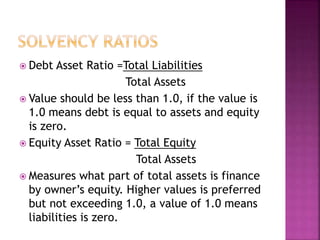
 Debt Asset Ratio =Total Liabilities
Total Assets
 Value should be less than 1.0, if the value is
1.0 means debt is equal to assets and equity
is zero.
 Equity Asset Ratio = Total Equity
Total Assets
 Measures what part of total assets is finance
by owner’s equity. Higher values is preferred
but not exceeding 1.0, a value of 1.0 means
liabilities is zero.
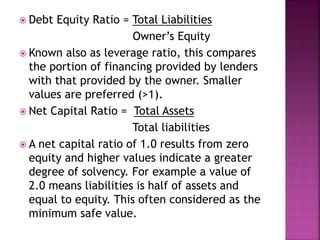
 Debt Equity Ratio = Total Liabilities
Owner’s Equity
 Known also as leverage ratio, this compares
the portion of financing provided by lenders
with that provided by the owner. Smaller
values are preferred (>1).
 Net Capital Ratio = Total Assets
Total liabilities
 A net capital ratio of 1.0 results from zero
equity and higher values indicate a greater
degree of solvency. For example a value of
2.0 means liabilities is half of assets and
equal to equity. This often considered as the
minimum safe value.
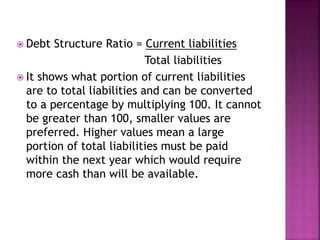
 Debt Structure Ratio = Current liabilities
Total liabilities
 It shows what portion of current liabilities
are to total liabilities and can be converted
to a percentage by multiplying 100. It cannot
be greater than 100, smaller values are
preferred. Higher values mean a large
portion of total liabilities must be paid
within the next year which would require
more cash than will be available.

Farm-Records-and-Accounts-1.pptx

  • 2.
     Measures profitand assess financial condition  Measure economic performance - Provide a point of comparison with previous performance whether as a whole or per individual enterprises  Assist in obtaining loans from banks and other financial institutions  Assist in the analysis of new investments  Meeting with legal requirements  Regulate daily routine operations
  • 3.
     Operating/Physical Records -farm sketch map, farm lay-out, records of inputs, labor, tools, equipment, machinery, production, marketing, etc.  Financial Records - Farm Inventory Record - Farm Earnings Statement - Balance Sheet - Cash Flow Statement
  • 4.
     Is acomplete lists of all the assets that the farm owns and its value at a specific point in time.  An inventory should be taken at the beginning of the accounting year. An inventory taken at the end of the year will be the beginning inventory for the next year.  The farm inventory is the cornerstone for all farm records and is of necessity, the first record to be considered by any farmer/ farm manager the operation of the farm business.
  • 5.
     An inventoryincludes a list of the real estate, livestock, equipment, feed, supplies and growing crops, together with a simple description.  Real estate includes land, buildings, fences, solar driers, water system, electric systems and other land improvements. Land can be divided into crop land, permanent pasture, woods and wasteland. Wasteland includes spaces like roads, yards and spaces around the buildings.  Machinery and equipment include a list of each different tools and machineries on the farm. This includes portable brooder houses for chickens and colony houses for bees.
  • 6.
     Livestock includea detailed list of all classes of animals. The milk cows are listed by names or number and are distinguished from the heifers, calves and bulls. Brood sows and raised market hogs, beef cows and raised feeders, breeding ewes and lambs, hens, broilers and other poultry should be listed separately.  Feeds and supplies on hand include all feeds, such as hay, silage, grains, straw and all mill feeds. Supplies include items such as fertilizers, lime. Herbicide, pesticides, seeds, posts not set, woods and other materials.  To be more useful in a record keeping system, the inventory must be in monetary value.
  • 7.
     There aretwo process in taking farm inventory: physical counting and valuation of assets.  Physical count consists of listing and describing each piece of property. Physical units such as kilograms, tons, heads, etc., are used to record the quantities of each type of property.  The inventory valuation is a process which can be completed using several methods to place a value on each type of property. The choice of the valuation methods depends on the type of property and use to be made of the inventory. Which ever method is used the concepts of “conservatism” and “consistency” in valuation should be kept in mind.
  • 8.
     Conservatism isbeing cautious against placing too high a value on any item.  Consistency stresses the using of the same valuation method or methods over time. Specifically, consistency is using the same method of valuation at the end and at the beginning of inventories.  The use of the concepts makes financial statements directly comparable from year to year and prevents an over optimistic view of the firm’ financial condition.
  • 9.
     Net SellingPrice or Net Market Price - used for those items that are primarily held for sale and for those items bought at the early part of the accounting year. Any marketing changes such as transportation, selling commissions and fees are subtracted to find the net market price. Ex. Livestock for sale, crops harvested, seeds, feeder livestock, bonds, stocks and the like.  Cost or Purchase Price - used for items which have been purchase recently an for which cost records are still available. Ex. Feeds, fertilizer, chemicals, veterinary products and other supplies.
  • 10.
     Cost orMarket Price - requires valuing an item at both its market price and its cost which ever is lower. With this method, no paper profits accrue and losses due to falling market prices are absorbed immediately. Ex. Breeding livestock  Farm Production Cost - used for items produced in the farm. This cost is equal to the actual cost of producing the item but should not include profit or any opportunity costs associated with the production process. Ex. Raised livestock and standing crops
  • 11.
     Cost lessAccumulated Depreciation - is appropriate for assets which provide services to the business over a period of years but loses value over time because of age, use or obsolescence. The value in the current time period is equal to the original cost less accumulated depreciation from purchase date to the date of inventory. This value is referred to as the item’s book value. Ex. Tools, machineries and equipment’s
  • 12.
     Is theallowance for the wear and tear of capital items.  The annual reduction in the value of an asset due to wear and tear, usage and technical obsolescence. CHARACTERISTICS OF ASSET THAT DEPRECIATES  It has a useful life of more than a year.  A determinable useful life but not unlimited life.  It is used in the business to produce revenue.
  • 13.
     Straight Line– a method widely used. This easy-to-use method gives the same annual depreciation for each full year of an item’s useful life. Cost – Salvage Value Annual Depreciation = ---------------------------------- Useful Life Annual Depreciation =( Cost –Salvage value) x R where R is a percentage rate found by dividing 100% by the useful life
  • 14.
     Declining Balance Annualdepreciation =(book value)x R where R is a constant percentage value or rate. The same R value is used for each year of the item’s life and is multiplied by the book value which declines each year by an amount equal to the previous year’s depreciation.  Sum of the Years Digit Method R Annual depreciation =(Cost-Salvage Value) x ----- SOYD Where RL is the remaining useful life and SOYD as the sum of all the numbers of its useful life.
  • 15.
     Note: themost appropriate depreciation method will depend on the type of asset and the use to be made of the resulting book value. For example, the actual market value of vehicles, tractors and other motorized machinery tends to decline most rapidly during the first few years of life and more slowly in the later years. If it is important for depreciation on these items to approximate their actual decline in value as closely as possible, declining balance and sum-of-the-years digit should be used. Assets such as fences, buildings have little or no market value without land they are attached to , and they provide a rather uniform flow of productive services over time. Straight line depreciation is the most appopriate.
  • 16.
    Change in Item NumberValue (P) Number Value (P) Inventory I. Machinery. Tools ,etc (Ending -Beginning) 1. Turtle Cultivator 2. Riced Trhesher (2nd hand) 3. HArrow 4. assorted tools II. Real estate 1. land a. Upland b.lowland 2. Farm House 3. Barn III. Working Animals 1. carabao 2. Horse IV. Cash Income Items 1,.rice a.standing crop b. stored palay 2. Corn a. harvested corn b. Standing corn 3. Market Cattle NET CHANGE INVENTORY NAME OF THE FARM FARM INVENTORY WORKSHEET Beginning Inventory Ending Inventory 12/31/201_ 12/31/201_ FOR THE YEAR ENDING DECEMBER 31, 201_
  • 17.
    Organize the followinginto a Farm Inventory Worksheet showing the beginning and ending book values, change in inventory values and net inventory value in correct format. Make for the year 2014, MRO Farms. I. Machinery, Equipment, Tools, Etc.  One Turtle Cultivator. Bought last December 2005 at P50,000.00 which is expected to last for 10 years with a salvage value of P5,000.00.  A second-hand Rice Thresher purchased at P30,000.00 2 years ago and it is expected to last for another 3 years with zero salvage value.
  • 18.
     Harrow. 2units valued at P3,500 at the beginning of the year, which is expected to depreciate at 15% per annum and a salvage value of 500.  Assorted tools acquired last 2012 valued at P18,000.00 at the beginning of the year and depreciates at a rate of 10% per annum. II. Real Estate  Land 8 hectares. 5 hectares upland and 3 hectares lowland. Upland is valued at P350,000.00 per hectare at the beginning of the year and increases by P10,000.00 per hectare per year. The lowland is P500,000.00 per hectare at the beginning of the year and increases at P20,000.00 per hectare per year.
  • 19.
     Farm House.1 unit constructed on January 2, 2010 costing P120,000.00 and estimated to last for 12 years with no salvage value.  Barn. 1 unit valued at P70,000 which was constructed in 2011 and depreciates at a rate of 10%. III. Working Animals  Carabao; 2 heads valued at P12,000.00 each at the beginning of the year since these are newly bought animals.  Horse; 1 head valued at P15,000.00 at the beginning and ending of the year.
  • 20.
    IV. Cash IncomeItems  Rice. Beginning of the year: 2 has. Standing crop which cost P45,000.00 per ha.; 120 cavans stored palay (50kgs per cavan)and NFA buying price was P17.00 per kilogram, but it was sold only last January 12, 2015 at P15.00 per kilogram.  End of the year: 250 cavans of palay were stored at the warehouse and buying price was P17.00 per kilograms. No Standing Crop  Corn: Beginning of the year; newly harvested weighing 5 tons priced at P12.50 per kilogram. And this was sold also last January 12, 2015 together with rice at P12.00 per kilogram. At the end of the year there was a standing crop(growing corn) of 4 has with a production costs of P20,000.00 per ha.
  • 21.
     Market Cattle:5 heads at the beginning of the year 3 of which are valued at P18,000.00 and 2 at P8,000.00. Last November 30, 2013 the 3 were sold at P20,000.00 each. And at the end of the year, 3 were left since 1 was newly bought last December 2012 at P10,000.00 And the previous 2 were now valuing at P9,000.00
  • 22.
     It isa systematic organization of everything “owned and owed” by a business or individual at a given point in time.  A balance sheet summarizes the financial condition of the business at a point in time.  It as “snapshot” of the financial solvency of a business and the most commonly requested document by a lender in reviewing a loan.  It includes listing of assets and liabilities that conclude with an estimate of net worth or owners equity.  The “balance” in the balance sheet comes from the requirement that the ledger be balance through the basic accounting equation: Assets = Liabilities + Owners Equity
  • 23.
     A balancesheet can be completed any time during an accounting period.  One of the advantages of computerized accounting system is the ease with which an interim balance sheet can be prepared, such as might be needed for loan.  Most balance sheets are prepared at the end of accounting period, whch is December 31.  This procedure allows a single balance sheet to be both at the end-of-the-year statement for one accounting period and a beginning-of-the – year statement for the next accounting period.  For purpose of comparison and analysis, it is necessary to have a balance sheet available for both the beginning and end of each year.
  • 24.
    ASSETS LIABILITIES Current AssetsCurrent Liabilities Intermediate Assets Intermediate Liabilities Fixed Assets Long-Term Liabilities TOTAL LIABILITIES Net Worth/Owners Equity TOTAL ASSETS TOTAL LIABILITIES + OWNERS EQ. Balance Sheet _____________ (Name of the Farm) _____________ (Date/Period)
  • 25.
    ASSET- anything ofvalue owned by a business. An asset has value for one or both of two reasons. a) It can be sold to generate cash b) It can be used to produce other goods that in turn can be sold for cash at some future time.  Goods that have already been produced, such as grain and feeder livestock, can be sold easily and quickly without disrupting future production activities are considered liquid assets.
  • 26.
     Assets suchas machinery, breeding livestock and land are owned primarily to produce agricultural commodities that can be sold to produce cash income.  Selling income producing assets to generate cash would affects the firms ability to produce future income, so they are less liquid or illiquid.  Illiquid assets are difficult to sell quickly and easily at their full market value.  A Balance sheet normally has assets and liabilities categorized on the basis of liquidity or ease with which the assets can be converted to cash.
  • 27.
     Current Assets– these includes items that will be liquated. All current assets on hand at the beginning of the operating cycle are expected to sold or consumed by the end of the cycle (e.g. grain held for sale) or are easily converted to cash (e.g. stocks). Examples: feed in storage, grains held for sale, fertilizer and seed inventories, market livestock, market securities, cash on hand, accounts receivable, checking and saving deposits and other assets which are temporary investments of excess or idle cash.  Intermediate Assets – assets that have expected useful life of up to 10 years. These are usually depreciable. Example: tools, machinery, equipment and breeding livestock.
  • 28.
     Intermediate assetscan be liquidated but generally would require more time to achieve a fair price and also would have a significant influence on the business ability to continue its basic operation. In the sense, that these items are basically intended to support production and are not intended for sale. For example, liquidating the breeding livestock would certainly have a major impact on livestock farms.  Fixed Or Long-term Assets – these are assets to be used over and over on the farm with an expected useful life of more than 10 years. If a major proportion of these assets are liquidated the business would also be terminated in most cases. Examples: land, permanent buildings and other land improvements
  • 29.
     LIABILITIES - claimsagainst the business - financial obligation owed to other person or business  Current Liabilities - financial obligations due within the year. This include accounts payable and debt that is likely to be paid within a year’s time. Ex. Supplies payable, Notes payable, Accounts payable, Accrued expenses (insurance, taxes, rent, etc), utilities, principal due on loans, Interest payable, etc.
  • 30.
     Intermediate Liabilities -financial obligations due more than a year up to 10 years. This type of debt is used to purchase assets that are used in the production process and would include such items as machinery, breeding livestock and some types of improvements. Ex. Balance on loan to purchase breeding livestock, balance on loan to purchase machinery, intermediate loan for repair of buildings, etc.  Long-Tern Liabilities - financial obligations due for than 10 years. Ex. Mortgage on land, long-term lease contract of land
  • 31.
    Measuring the financialcondition at a point in time is done primarily through:  Solvency – measures the liabilities relative to the amount invest in the business or net worth.  Liquidity – measures the ability of the business to meet financial obligations as they come due without disrupting the normal operations of the business.
  • 32.
    Current Asset value Current ratio = ----------------------------- Current Liability value  a value higher than 1.0 is preferred since a value of one means current liabilities is just equal to current assets. While there are sufficient current assets to cover current liabilities there is no safety margin for price changes and other factors.  Working capital = current assets – current liability  The equation computes what remain in the business if assets are sold.
  • 33.
     Debt AssetRatio =Total Liabilities Total Assets  Value should be less than 1.0, if the value is 1.0 means debt is equal to assets and equity is zero.  Equity Asset Ratio = Total Equity Total Assets  Measures what part of total assets is finance by owner’s equity. Higher values is preferred but not exceeding 1.0, a value of 1.0 means liabilities is zero.
  • 34.
     Debt EquityRatio = Total Liabilities Owner’s Equity  Known also as leverage ratio, this compares the portion of financing provided by lenders with that provided by the owner. Smaller values are preferred (>1).  Net Capital Ratio = Total Assets Total liabilities  A net capital ratio of 1.0 results from zero equity and higher values indicate a greater degree of solvency. For example a value of 2.0 means liabilities is half of assets and equal to equity. This often considered as the minimum safe value.
  • 35.
     Debt StructureRatio = Current liabilities Total liabilities  It shows what portion of current liabilities are to total liabilities and can be converted to a percentage by multiplying 100. It cannot be greater than 100, smaller values are preferred. Higher values mean a large portion of total liabilities must be paid within the next year which would require more cash than will be available.

Editor's Notes