Fans & Ventilation
A Practical Guide
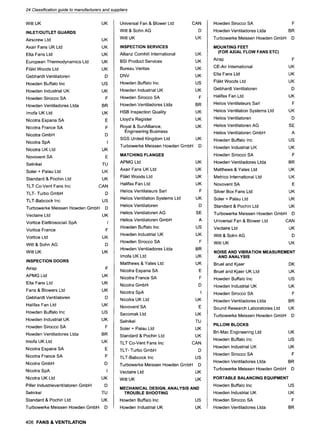
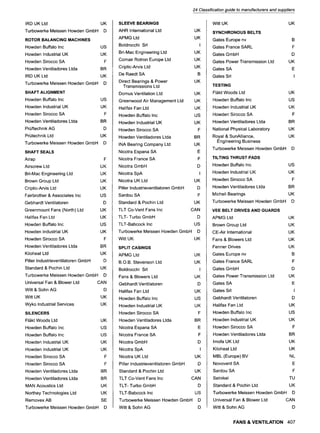
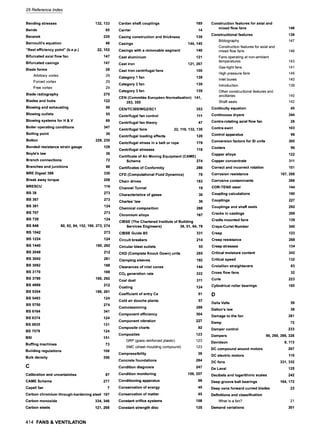
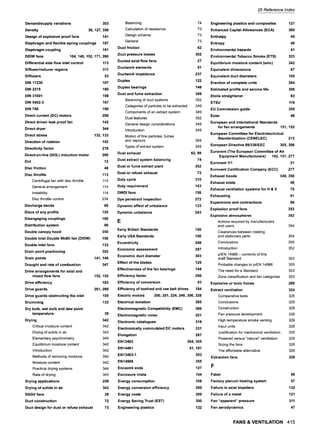
The practical reference book and guide to fans, ventilation and
ancillary equipment with a comprehensive buyers' guide to
worldwide manufacturers and suppliers
W T W (Bill) Cory
First published 2005
The information contained in this publication has been derived from many sources and is believed to be accurate at the time of
publication. Opinions expressed are those of the author and any recommendations contained herein do not necessarily represent the only
methods or procedures appropriate for the situations discussed, but are rather intended to present consensus opinions and practices of
the fan and air movement industry which may be helpful or of interest to those who design, test, install, operate or maintain fan systems.
The publishers therefore disclaim any and all warranties, expressed or implied, regarding the accuracy of the information contained in this
publication and further disclaim any liability for the use or misuse of this information. The publishers do not guarantee, certify or assure
the performance of any fan/air movement system designed, tested, installed, operated or maintained on the basis of the information
contained within this publication.
No responsibility is assumed by the publisher or the author for any injury and/or damage to persons or property as a matter of products
liability, negligence or otherwise, or from any use or operation of any methods, products, instructions or ideas in the material herein.
ISBN 0-08044626-4
A CIP catalogue record for this book is available from the British Library
9Roles & Associates Ltd
Published by Elsevierin associationwith Roles & AssociatesLtd
a',ssnciates
ELSEVIER
Amsterdam Boston Heidelberg London New York Oxford Paris
San Diego San Francisco Singapore Sydney Tokyo
Foreword
The word "fan" covers a wide variety of machines, from small table fans recognised by
everybody to huge industrial fans consuming hundreds or thousands of kilowatts. Fans are very
important to many industries since, for almost all human activities, there is a need to move or
replace air.
The most obvious and well-known use of fans is in ventilation for comfort, which also includes air
conditioning. However this is only a small part of fan applications. A list of such applications is
extensive covering for example: mining, nuclear facilities, wood and paper production, textiles,
computer rooms etc. For each there is a need to consider various aspects such as: correct
design for specific requirements, best possible energy efficiency of the whole system,
environmental influences (noise and vibration), personnel safety and global life-cycle costs.
A practical reference book about fans and ventilation is a welcome aid to all users who want to
know practical information about fan design, selection and application and how these factors
affect performance. The fact that Fans & Ventilation is written by Bill Cory ensures it is of high
quality, and contains a substantial amount of practical and up to date information in this fast
moving field of technology.
Bill Cory is currently Chairman of the Eurovent Working Group 1 "Fans" for many years. He was
also President of AMCA from 2002 to 2003 and the most active member of ISO Technical
Committee 117 "Industrial Fans". The list of the documents and Standards he has prepared, or
participated in the preparation of, is impressive.
We have no hesitation in recommending Fans & Ventilation.
Sule Becirspahic
Director of Operations
Eurovent/Cecomaf
FANS & VENTILATION III
Dedication
This book is dedicated to the memory of my wife
Eleanor Margaret Cory, n~e McHale
She was born on 23 January 1933, we married on 26 July 1958 and she died on 8 November 2004.
Eleanor, not by any means a Dumbo (she passed her School Certificate when this meant something),
sacrificed her career for mine. She gave me two lovely daughters and
was a constant source of encouragement, advice and support.
To use modern parlance- I loved her to bits! Perhaps I should have told her this more often.
About the author
W T W (Bill) Cory, DEng, MSc, CEng, FIMechE, MCIBSE, MIAgrEFRSH, MIIAV
W T W (to his enemies!) or"Biil" (to his friends!) Cory first brought a light to his mother's eye on 4
October 1934. A bouncing 9lb. 5oz., he has been a heavyweight from that time on! The product
of a boat builder's son and a farmer's daughter, he is unsure if it is salt or soil that he has had in
his mouth ever since. He hopes it is one of the two!
Bill's career spans more than 50 years in the ventilation and fan manufacturing industries. He
started his working life with Sturtevant Engineering Company Ltd and then continued with
several companies, assuming positions of increasing responsibility. He joined Keith Blackman
Ltd in 1976, becoming Technical Director in 1979. In 1984, when Woods of Colchester Ltd
absorbed Keith Blackman Ltd, he was appointed Technical Director of the combined company
and was responsible for the whole engineering staff. He retired from the Board of Woods in 1999
at the age of 65, but was retained by the company as a consultant. Members of staff say that
they now see a lot more of him than previously! In 2001 Woods became a part of the Fl~ikt
Woods Group.
Bill received his early technical education at Manchester College of Science and Technology
and Northampton College of Advanced Technology, and the National College of Heating,
Ventilation, Refrigeration and Fan Engineering. He gained a Master of Science degree in
acoustics by distance learning from Heriot-Watt University in 1990 and in 1992 was admitted by
London South Bank University, as its first Doctor of Engineering.
Bill Cory still serves on various AMCA and BSI committees dealing with ventilation and fans. He
also leads the UK delegation to the corresponding ISO and CEN committees. He is a past
member of the Council of the Institution of Mechanical Engineers, and past chairman of its
Eastern Region as well as a past chairman of its Fluid Machinery Committee.
Bill is chairman of a number of technical committees and serves on the boards of various
colleges and is a past president of Colchester Engineering Society. He has long been active in
AMCA, HEVAC and FMA affairs and is a past chairman of FETA's Technical Management
Committee. He was a director of AMCA from 1996 - 2004 and its President in 2002 - 2003 -- the
first non-North American to be so recognised. Recently he has become chairman of Eurovent
Technical Committee WG1-Fans.
Bill Cory has presented over 50 papers to various technical institutions including the Institution
of Mechanical Engineers, Chartered Institution of Building Services Engineers, Institution of
Agricultural Engineers, Institution of Acoustics etc. He has given lectures to universities in
Cagliari, Cairo, Helsinki, Sheffield, South Bank and Southampton. The subjects covered
include fan performance measurement, fan acoustics, tunnel ventilation, condition monitoring,
crop drying, natural ventilation etc.
Personal acknowledgements
This book has been based on a career of 50 years in the air moving industry during which I have
benefited from the many friendships I have made.
Firstly I remember George Henry Gill of The Sturtevant Engineering Company who fired my
enthusiasm for fans and Joseph Dunning, its Works Manager, who made sure I applied myself
to becoming an engineer. I remember also William Osborne of the then National College of HVR
& Fan Engineering who started me on a belated academic career. I learnt much from him which
is incorporated in this book.
Of more recent years I have gained much from discussions with Prof Dr-lng Hans Witt on
explosion proof fans. I am also very grateful to Prof Richard Matthews of London South Bank
University with whom I have collaborated on the design of mixed flow fans and tunnel ventilation.
Dr Ron Mulholland, Chief Engineer of Howden group Technology is a dab hand with the
production of computer-generated illustrations which he has translated from my "back of a fag
packet", dodgy sketches!
I wish also to say a special thank you to Mr Paul Wenden, Product Marketing Director, Fl&kt
Woods Ltd for providing many of the illustrations and who has also permitted me to use much
material given in my papers to learned societies, and which were subsequently published by my
then employer Woods of Colchester (now Fl&kt Woods Ltd).
I thank Mr Steve Barker who produced many of the drawings for Chapters 1, 9 and 11, and a
special thank you to Mrs Pauline Warner, my excellent secretary for many years, who produced
the manuscript for some of the early chapters.
Finally, I would like to thank Ketty and Richard Tomes of Roles & Associates Ltd for their
magnificent work in transforming many of my awful hand-drawn illustrations and editing much of
my badly written manuscript and notes; creating, in my view, a work of art!
FANS & VENTILATION V
Leading edge technology
Engineering services
Application appraisal
Fluid dynamic evaluation
Training
Design services
Acoustic optimisation
Product improvement
System solutions
Efficient solutions
Continuous R&D
Technology leaders
Over 10,000 fans.
.=bmpapst
ebm-papst UK Ltd
Chelmsford BusinessPark
Chefmsford
EssexCM2 5F7
Telephone:01245468555
Facsimile: 01245466336
Email:sales@uk.ebmpapst.com
www.ebmpapst.co.uk
Using this book
Written specifically for fan users, Fans & Ventilation is intended to provide practical information
about the outline design selection and installation of fans and how these affect performance.
Fans & Ventilation is not intended to be a textbook on ventilation and air conditioning; rather it
seeks to address the problems that exist at the interface between fan manufacturers and users.
It is aimed at everyone who has technical problems as well as these wanting to know who
supplies what, and from where.
Fans & Ventilation can be used in a variety of ways depending on the information required. For
specific problems it is probably best used as a reference book. The detailed contents Section at
the front of the book combined with the Reference index, Chapter 25, at the end, will simplify
finding the appropriate topic. The introduction to the start of each Chapter will also provide
valuable guidance. The bibliography Section at the end of many Chapters also provides useful
references and suggestions for further reading.
As a textbook though, Fans & Ventilation may be read from cover to cover to obtain a com-
prehensive understanding of the subject. Of course, individual Chapters may be studied
separately.
Chapter 1 covers the history of fans and details the various generic fan types. The properties of
gases and gas flow are then discussed in the other early Chapters. The book then follows a
logical pattern with Chapters 4 to 10 covering topics such as: performance standards, ducting
systems, and flow regulation, constructional features, fan arrangements and bearings. Chapter
7 also provides useful information on fan materials and the stresses induced in the various parts
of a fan. These stresses can be subject to mathematical analysis and an introduction is given to
the methods used.
Chapters 11 to 13 are devoted to drives, couplings and prime movers. Noise and vibration are
considered extensively as well as quality assurance, installation, fan economics and finally fan
selection considerations, in Chapter 20, which are all clearly aimed at the user
Chapter 21 provides some fan applications illustrating the diversity of fan design and uses,
showing there are many uses for fans outside the traditional areas. It also endeavours to
demonstrate some of the sizing rules and features which should be included.
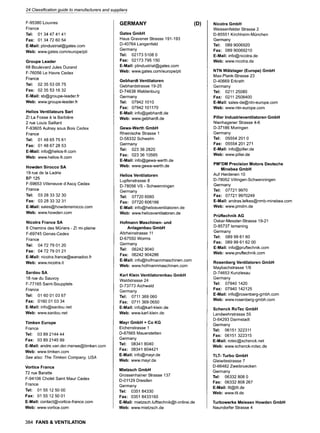
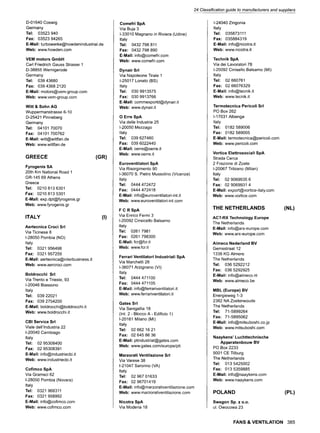
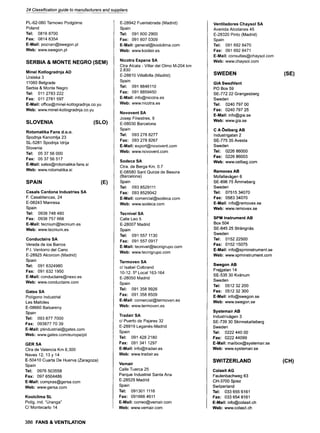
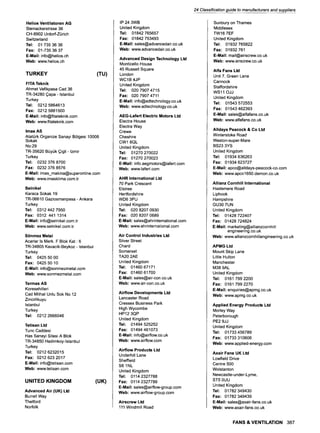
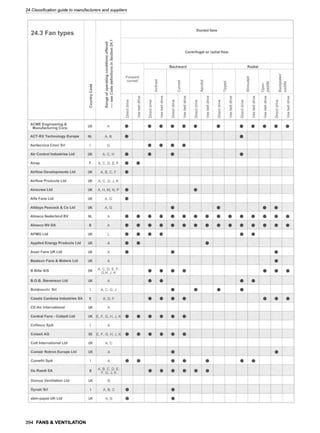
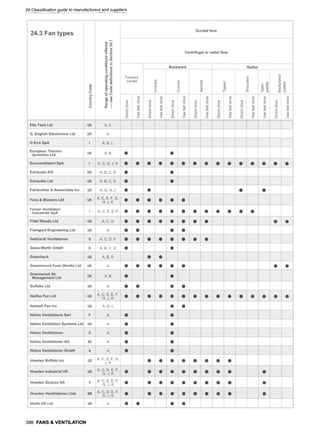
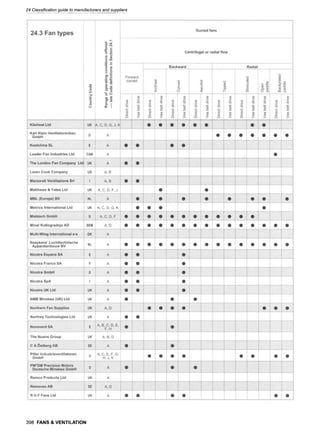
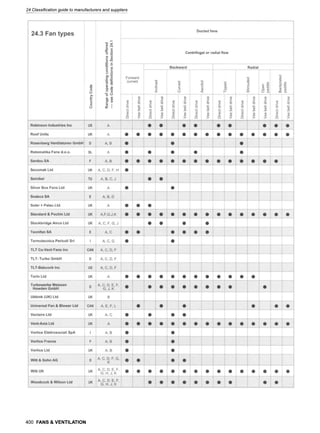
The Classification guide to manufacturers and suppliers, Chapter 24, is an invaluable and
important part of the book. It summarises the various fan types, covering their differing styles,
sizes and basic principles of operation. All definitions are in accordance with ISO 13349:1999
(BS 848-8:1999).
The guide has been categorised in a particular way to impose strict boundary limits on fan types
and the operating conditions available, with the specific aim of simplifying the choice of supplier
from the users' point of view.
The Classification guide includes most fan types, followed by ancillary products and services.
Trade names are comprehensively listed too. It is preceded by the names and addresses and
contact details of all companies appearing in the classification guide, These are listed
alphabetically by country.
It is however strongly recommended that direct contact with the relevant companies is made to
ensure that their details are clarified wherever necessary.
FANS & VENTILATION VII
Introducing the new premium quality standard for bea,
brought to market by the combined "Partner Power" of
The best in bearingtechnolo
-
. . . . .
, . . . ,, _, . . . . ,1 ! . : ' ' - ~ " ": . . . . . ,,p ,,. ,., i .._~,~ ..° . ~, i.
,,.~" . ,/.° .... :- ", _, -:-: :-:.,. :-::i~ :, -.-~.~ :,--~4.=.: ~._~.- :." .:, ;---.'-...': :..... 3 .~_ ,':- .:,-: .... ~_ ,:~< ,,.. ,.,:_.'.:,.z" :::~.-, :".:'
INA and FAG have combined their
innovative bearing capabilities to cre-
ate a unique dimension in
bearing quality.
Branded X-life. this new premium
quality standard represents improve-
ments in product design, product per-
formance and service
life that far exceed current standard
:valuesand expectations.,
"r ''"~:~'- ~ }"-, . - '
• ..,--;. ~,. ., -...; . ..- -:.., -. ._ ... - , .
.~, ~- , . .
5 ~ ::;~,A,:~. ~,_-.,,:,.'~-.--: . . . .
,~lllr., ElgesLargeSpherical PlainBearings
. With up to ei&rht times the
" i life expectancy of
compet¢or products
• Features the Elgoglide
,~ sliding layer providing 50%
h~gher stattc load rating and
25% extended service I~fe
- Radial bearings ~n bore
diameters from 320 mm
and thrust bearings
from 220 mm
,..~~ LinearMotion
= New ball and roller type
profiled rail units
• KUVEB (ball type) now
available in "fult complement"
version for heavy duty
applications and in 'quiet
version for low no~se operation
•, RUE.E (roller type) has been
re-erlgineered to reduce risk
of c-ontam~nation and
,reprove smooth operation
Spherica RollerBearings
• 17% ~ncrease ~n load carrying
capacity
• Nominal rating life raised by
70%
/ . Incorporates latest
developments ,n k,ner-nat~{:s.
material s( ience and
._.~" mar~ufacturing processes
• Available ,n eight d~}feren:
senus from 20 nli~-~l{) B20 mm
outs,de {l~arne~.er.
rings...
INA FAG
f
/=A
All products belonging to the X-life portfolio
feature enhanced characteristics including.
II Increased load-carrying capacity
II High rigidity
II Lower operating temperatures
II Reducednoise levels
Ii Easiermaintenance
To achieve X-life quality. INA and FAG have
developed special materials Including steels,
new lubricants, new machining methods and
improved production processes,which
together provide significantly longer operating
life, improved performance and greater bear-
ing reliability.
With no increase in price over previous ver-
sions, customers also benefit from an
unmatched price-performance ratio
across the full range of sizes in ~1
each product series. Am
.. , I
Engineering support services, including bearing
selection and calculation models, mounting
advice, training and lubrication programmes
form part of the total X-life package and are
assigned the same importance as the products
themselves, ensuring customers receive the
complete X-life "service-surround-system" as
standard.
/
Angular Contact Ball Bearings
• "'Plateau finishing"
reduces surface roughness
of the raceway and
reduces frictional
moment by up to 10%.
w 30% increase in fatigue
limiting load
• Up to 50% longer
service life
INA FAG "Partner Power"
Find out more about these and other X-life
developments by calling 0121 351 3833 or
visit our website at www.ina.co.uk
Forge Lane.Minworth. Sutton Coldfield. West Midlands B76 lAP
Tel:0121 351 3833 Fax:0121 351 7686
E-mail: ina-fag@uk.ina.com Web: www.in&co.uk
T~ne
_ -
u I_.l uT"l
~..,,..., ..,:,~-.'
:, .;°,:f .,,... ~-;.,
....
"I:.
0 '=,-i
OUt-"
.~. r,,:l f~ i r-.
Heat. i n =~
,- Vent. i I ._~.ti n,il
-C,_,nc~ i ±. i c,n i n,i4 ~=,uzz I e
Vent.Axia~
CHANGINGYOURCLIMATES
Fleming Way ° Crawley ° West Sussex ° RH I 0 9YX • Tel: 01293 526062 ° Fax: 01293 560257 ° inf°@vent'axia'c°m ° www.vent-axia.corn
Contents
1 Fan history, types and characteristics
1.1 Introduction
1,2 Ancient history --- "Not our sort of fan"
1.2.1 The advent of mechanical air movement
using "air pumps" and fires
1.2.2 Early mine ventilation fans
1.2.3 The dawn of tunnel ventilation
1.2.4 The first Mersey road tunnel
1.2.5 Mechanical draught
1.2.6 Air conditioning, heating and ventilation
1.2.7 Developments from the 1930s to the 1960s
1.2.8 More recent tunnel ventilation fans
1.2.9 Longitudinal tunnel ventilation by jet fans
1.2.10 The rise of the axial flow fan
1,3 Definitions and classification
1.3.1 Introduction
1.3.2 What is a fan?
1.4 Fan characteristics
1.5 Centrifugal fans
1.5.1 Introduction
1.5.2 Forward curved blades
1.5.3 Deep vane forward curved blades
1.5.4 Shrouded radial blades
1.5.5 Open paddle blades
1.5.6 Backplated paddle impellers
1.5.7 Radial tipped blades
1.5.8 Backward inclined blades
1.5.9 Backward curved blades
1.5.10 Reverse curve blades
1.5.11 Backward aerofoil blades
1.5.12 General comment
1.6 Axial flow fans
1.6.1 Introduction
1.6.2 Ducted axial flow fans
1.6.2.1 Tube axial fan
1.6.2.2 Vane axial fan
(downstream guide vanes - DSGV)
1.6.2.3 Vane axial fan
(upstream guide vanes- USGV)
1.6.2.4 Vane axial fan
(upstream and downstream guide vanes-
U/DSGV)
1.6.2.5 Contra-rotating axial flow fan
1.6.3 Blade forms
3
5
10
11
12
13
15
15
18
20
21
21
21
22
22
22
22
23
23
24
24
24
25
25
26
26
26
26
26
27
27
28
28
28
28
28
1.6.3.1 Free vortex
1.6.3.2 Forced vortex
1.6.3.3 Arbitrary vortex
1.6.4 Other types of axial flow fan
1.6.4.1 Truly reversible flow
1.6.4.2 Fractional solidity
1.6.4.3 High pressure axial fans
1.6.4.4 High efficiency fans
1.6.4.5 Low-pressure axial fans
1.7 Propeller fans
1.7.1 Impeller construction
1.7.2 Impeller positioning
1.7.3 Diaphragm, ring or bell mounting
1.7.4 Performance characteristics
1.8 Mixed flow fans
1.8.1 Why the need - comparison of characteristics
1.8.2 General construction
1.8.3 Performance characteristics
1.8.4 Noise characteristics
1.9 Miscellaneous fans
1.9.1 Cross flow fans
1.9.2 Ring shaped fans
1.10 Bibliography
2 The properties of gases
2.1 Explanation of terms
2.1.1 Introduction
2.1.2 Changes of state
2.1.2.1 Boiling point
2.1.2.2 Melting point
2.1.3 Ideal gases
2.1.4 Density
2.1.5 Pressure
2.2 The gas laws
2.2.1 Boyle's law and Charles' law
2.2.2 Viscosity
2.2.3 Atmospheric air
2.2.4 Water vapour
2.2.5 Dalton's law of partial pressure
2.3 Humidity
2.3.1 Introduction
2.3.2 Relative humidity
2.3.3 Absolute humidity
29
29
29
29
29
29
29
30
30
30
30
30
30
31
31
31
32
32
32
32
32
33
33
35
36
36
36
36
36
36
36
36
36
36
37
37
38
38
38
38
38
39
FANS & VENTILATION Xl
Contents
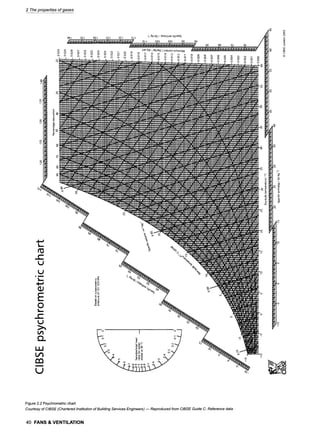
2.3.4 Dry bulb, wet bulb and dew point temperature
2.3.5 Psychrometric charts
2.4 Compressibility
2.4.1 Introduction
2.4.2 Gas data
2.4.3 Acoustic problems
2.5 Hazards
2.5.1 Introduction
2.5.2 Health hazards
2.5.3 Physical hazards
2.5.4 Environmental hazards
2.5.5 Installation hazard assessment
2.6 Bibliography
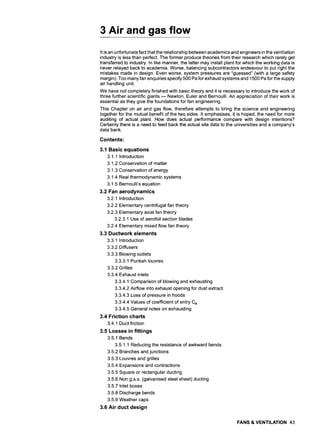
3 Air and gas flow
3.1 Basic equations
3.1.1 Introduction
3.1.2 Conservation of matter
3.1.3 Conservation of energy
3.1.4 Real thermodynamic systems
3.1.5 Bernoulli's equation
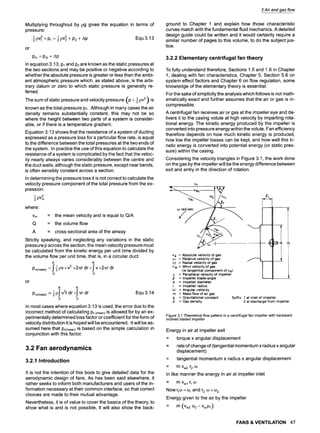
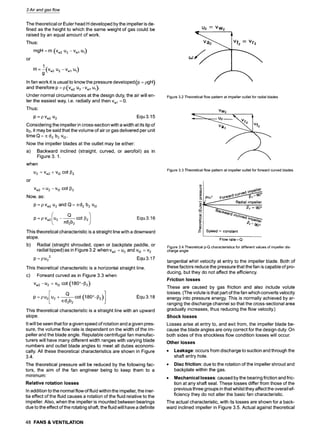
3.2 Fan aerodynamics
3.2.1 Introduction
3.2.2 Elementary centrifugal fan theory
3.2.3 Elementary axial fan theory
3.2.3.1 Use of aerofoil section blades
3.2.4 Elementary mixed flow fan theory
3.3 Ductwork elements
3.3.1 Introduction
3.3.2 Diffusers
3.3.3 Blowing outlets
3.3.3.1 Punkah Iouvres
3.3.2 Grilles
3.3.4 Exhaust inlets
3.3.4.1 Comparison of blowing and exhausting
3.3.4.2 Airflow into exhaust opening for dust extract
3.3.4.3 Loss of pressure in hoods
3.3.4.4 Values of coefficient of entry Ce
3.3.4.5 General notes on exhausting
3.4 Friction charts
3.4.1 Duct friction
3.5 Losses in fittings
3.5.1 Bends
3.5.1.1 Reducing the resistance of awkward bends
3.5.2 Branches and junctions
3.5.3 Louvres and grilles
3,5.4 Expansions and contractions
XII FANS & VENTILATION
39
39
39
39
39
39
39
39
41
41
41
41
41
43
45
45
45
45
45
46
47
47
47
49
50
51
51
51
53
55
56
57
58
59
59
60
61
61
62
62
64
65
65
66
66
66
3.5.5 Square or rectangular ducting 66
3.5.6 Non g.s.s. (galvanised steel sheet) ducting 67
3.5.7 Inlet boxes 67
3.5.8 Discharge bends 68
3.5.9 Weather caps 68
3.6 Air duct design 68
3.6.1 Blowing systems for H & V 69
3.6.1.1 Design schemes 69
3.6.1.2 Duct resistance calculation 69
3.6.1.3 General notes 69
3.6.2 Exhaust ventilation systems for H & V 70
3.6.2.1 Industrial schemes 70
3.6.2.2 Take-off regain 70
3.6.2.3 Effect of change in volume 70
3.7 Balancing 70
3.7.1 Unbalanced system example 70
3.7.2 Balancing scheme 71
3.7.3 Balancing tests 71
3.8 Notes on duct construction 72
3.8.1 Dirt 72
3.8.2 Damp 72
3.8.3 Noise 72
3.8.4 Inlet and discharge of fans 72
3.8.5 Temperature control 72
3.8.6 Branch connections 72
3.8.7 Fire damper 72
3.8.8 Adjustment of damper at outlets 73
3.9 Duct design for dust or refuse exhaust 73
3.9.1 General notes 73
3.9.2 Design scheme 73
3.9.3 Calculation of resistance 73
3.9.4 Balancing of dust extract systems 74
3.10 Bibliography 75
4 Fan performance Standards 77
4.1 Introduction 78
4.1.1 Fan performance 79
4.1.2 The outlet duct 79
4.1.3 ISO conventions 80
4.1.4 Common parts of ducting 81
4.1.5 National Standard comparisons 82
4.1.6 Flow conditioners 83
4.2 Laboratory Standards 84
4.3 Determining the performance of fans in-situ 84
4.3.1 Introduction 84
4.3.2 Performance ratings 84
4.3.3 Measuring stations 84
.......
U
~
°
w
2
E
=
=
I~"
0
m
q=*
,._
s.
C
.
C
O
~
'
6
=
~
~
o
~
=
-
-
u
~=-.-'-'o~="~
"
~
=
~
=
'
-
~
~~
,
~~'
°
_~=oo.
=
o
"
~,
w
.~:
~
~3
O
)
0
ca'
)
z
~
oo.
~.
~
~
~'
>
,~
,
~
~
~".=
,
~
_
<
,_~
=
~
_
o
~-
•
~
=
~
.
'
~
o
.
~
=
o
.~_
,-
~a
.,-
,..
.m
0
.
=
~
m
~-
,~
._._
i
o
o
=
-
i
i
~
~
0
s,,-
~
"
~
..,,
~
;~
,~.,,,
=
.
~
®
,
,
~
_
~
'
o
®
~
=
'
-
-"
~'
,
,
-
-
,,,,,,
"r.-=._'=.
~
8
~
'
E
®
=
~
,
,
,
,
-
.
"
I~
,'--
~
:
.
=
I
-
L
_
o~
-
=
,
-
~
~
"
-
~
~-®-=-
~
o
.
~
0
~
>
,
~
-
~
.
-
~
_
.
~
i
,
-
=
=
.
.
o
.
-
=
'
.
~
=
-
-~
""
~
0
"
~
"-~='
"--
~
=
..:.=
=
"~.,.,
_~
~
o
=
=
©
~
=
-
~
-
~
-
~
..,-'
o
2
=
c5
•
--
.
.
.
.
~
.
_
=
-
~
m
=
e
._
:.~.
:
,,
~
:
=
~
~
o
.s
"~
o
o
~
=
_
:
.
_
~
N
.
:
:
.
=
.
~
_
=
_
=
u
"
"
o
o
~
.
E
-
~
=
o
~
_
_
.
=
®
~
~
:
®
.
-
-
o
..
=.~
=
.
o
-~
o=_
"-
®
I
0
~
'
'
:
'
-
o
~
:
~
"
~
:
o
,
,
o
)
_
>
®
=
O
-
~
,^__.~
m,...,
m
.
.
.
~
0
•
m
o
.~
~,,
~
=
;
~
_
~
o
"
~._..=~->'-''~°o?:®
~
o
:
E
®=x
,-:
"0
.
=
m
e
~
E
,
.
-
.
o
.
~
~
o
~
=
~
°
•
ea
)~
"
~
=
"
=
~
.
LILI
(,~
Ll'.
"
~d'
e
mO
"
=
.
T
a
o
~
.
•
i
c
Ii,,
"~
G)
•
.
dl~
Contents
4.3.4 Flowrate measurements
4.3.5 Pressure measurementS
4.3.6 Power measurements
4.4 Installation category
4.5 Testing recommendations
4.5.1 Laboratory test stands
4.5.2 Field tests
4.5.3 Measuring flowrate
4.5.4 Measuring fan pressure
4.5.5 Measuring air density
4.5.6 Measuring fan speed
4.5.7 Measuring absorbed power
4.5.8 Calibration and uncertainties
4.5.9 Test results
4.6 Fan Laws
4.6.1 Introduction
4.6.2 The concept of fan similarity
4.6.3 Dimensional analysis
4.7 Specific values
4.7.1 Specific speed
4.7.2 Specific diameter
4.7.3 Composite charts
4.8 Bibliography
5 Fans and ducting systems
5.1 Introduction
5,2 Air system components
5.2.1 System inlet
5.2.2 Distribution system
5.2.3 Fan and prime mover
5.2.4 Control apparatus
5.2.5 Conditioning apparatus
5.2.6 System outlet
5.3 System curves
5.4 Multiple fans
5.4.1 Fans in a series
5.4.2 Fans in parallel
5.5 Fan installation mistakes
5.5,1 Incorrect rotation
5.5.2 Wrong handed impellers
5.6 System effect factors
5.6.1 Inlet connections
5.6.1.1 Non-uniform flow
5.6.1.2 Inlet swirl
5.6.1.3 Inlet turning vanes
5.6.1.4 Straighteners
XIV FANS & VENTILATION
84
85
85
85
86
86
86
86
86
86
86
87
87
87
87
87
87
89
92
92
92
92
93
95
96
96
96
96
96
96
96
97
97
99
99
100
100
100
102
102
102
102
103
104
104
5.6.1.5 Enclosures (plenum and cabinet effects)
5.6.1.6 Obstructed inlets
5.6.1.7 Drive guards obstructing the inlet
5.6.2 Outlet connections
5.7 Bibliography
6 Flow regulation
6.1 Introduction
6.2 The need for flowrate control
6.2.1 Constant orifice systems
6.2.2 Parallel path systems
6.2.3 Series path systems
6.2.4 Variable air volume (VAV) systems
6.3 Damper control
6.3.1 Parallel blade dampers
6.3.2 Opposed blade dampers
6.3.3 Single blade swivel dampers
6.3.4 Guillotine dampers
6.4 Variable speed control
6.5 Variable geometry fans
6.5.1 Radial vane inlet control (RVIC)
6.5.2 Semi-circular inlet regulator
6.5.3 Differential side flow inlet control
6.5.4 Disc throttle
6.5.5 Variable pitch-in-motion (VPIM) axial flow fans
6.6 Conclusions
7 Materials and stresses
7.1 Introduction
7.2 Material failure
7.3 Typical metals
7.3.1 Metal structure
7.3.2 Carbon steels
7.3.3 Low-alloy and alloy steels
7.3.4 Cast irons
7.3.4.1 Grey cast iron
7.3.4.2 White cast iron
7.3.4.3 Malleable cast iron
7.3.5 Stainless steels
7.3.6 Non-ferrous metal and alloys
7.3.6.1 Aluminium alloys
7.3.6.2 Copper alloys
7.3.6.3 Magnesium alloys
7.3.6.4 Nickel alloys
7.3.6.5 Titanium alloys
7.3.6.6 Zinc alloys
7.4 Engineering plastics
104
104
105
105
106
107
108
108
108
108
108
109
109
109
110
110
110
110
111
111
113
113
113
115
116
119
121
121
121
121
121
121
121
121
122
122
122
122
122
122
122
122
122
122
122
)


, .~.'
~ .,.~4" ..
. .
.. ..
• , ....,.~
..:.... ...
i--~.:." . .... . .
"" ~.~.'4:"~2~
-:~ ' "
•
. ~ !~".
:-:.'..,-!-::-
:.-. ..._ . ..
~..~:'.:.~.i.-.,:~
." .~ •
..
..~_.~,,..:...~
~...
..-
-...
~...,.,~i..:.....
b ,,,.-.,
:.~:..:.:.~....~,~.
~,.~.........~,..;.~:....,..
,.,~,.,~.,~ ?;.~;~~:::.~-.-.
•...,:...'.!..:... ~ ; .... .... ,~ .,~ .~. :.... . .
,. .-. . .,ii~.;i~ .~~,~.,...,,.,.
" ~, .,- .:.:"i.
:~.!i.~~i__ " """
.
.
.
.
.
. .- ...~-~-'.~,- - :.., '
~-"~.~.,~ .% " :: ~:-7.~.
~
-
'
"
- - -
~
-
.
. ~.-..--:~-~.s
z . . .,......
-..~_~ ".~:,-':~".-~ ~..;.~ ...
~i..-_-,,~i,~
I . ~ ¢ .~- •
~_ "~ .'~'-.~...,-~...,:~'~'!~..~ .- .'" . "'-'*" ....
i, ~ , ~ , -~.
~ ~, "'.':~,.. ,. "- ..
:...
. " .-~.-,.~'- .., ,' : ,...'.'.':.; •:,~ •
, • • .-._
~
.
:
.
~
:
.
.
.
.
.
-
.
'
.
'
.
,
.
.
.
:
.
.
;
:
.
.
~,~÷
• ..... ~.~.~,.::.:i~.,~.,~.~_
THE NEW.
Pow GR,P
. GT3 BELT
" . ,.......
..... ~ ";" ::J ~,~£ i 4 ~ , . : ..
~ ~ - ..
Contemporary machine designs require advanced power transmission solutions. With the next genera-
tion synchronous rubber belt PowerGrip GT3, Gates is one step ahead, providing drive designs not yet
imagined. This technical tour de force transmits up to 30% more power than previous generation belts.
PowerGrip GT3 is available in 2, 3, 5, 8 and 14 MGT pitches and runs on existing drives, requiring no
adaptation of the system. When you think the impossible, think Gates, the perpetual technology leader.
.,
,,
, .,,
x
.,,, •
I':
• -..
¢ 'x;
,,,

•:'"- rye..'.. "
': :..~..,
,:. ,
.,
THE DRIVING FORCE IN POWER
.....,._.
/
,,_. f- --...,,
,.., 
...
TRANSMISSION
GatesPowerTransmLssionLtd-TinwatdDownsRoad- Heathhall- DumfriesDG1 ITS-Tel:01387 24 2021 - Fax 01387.,'2420 l0
E-mall • ptinduslria[@gates corn - Web Sile: www.gales,com/europe/pti.
Toml<ins 'IV
OLOI OCCHI
~ ~ ~ ~o~omOCCHi
V E N T I L A Z I O N E ""," ~ ~ , .,
• ,.
L I ] ~ i i i ~ . i 1 lz 11 i ~ : ~ 1 ~. - ' - ~/, • -
/-i . _ 1
Z~ZZ2~,
...... n,l --i~
BOLDROCCHI s.r.I. - Viale Trento e Trieste, 93 - 20046 Biassono- Milan - ITALY
http://www.boldrocchi.it- mailto" boldrocchi@boldrocchi.it- phone" +39 039 2202.1 - fax" +39 039 2754200
7.4.1 Introduction
7.4.2 Thermoplastics
7.4.3 Thermosets
7.4.4 Composites
7.4.5 Mechanical properties of plastics
7.5 Surface finishes
7.6 Surface protection
7.6.1 Introduction
7.6.2 Painting
7.6.3 Galvanising
7.6.4 Plating
7.6.5 Lining
7.6.6 Coating
7.7 Stressing of centrifugal impeller
7.7.1 Introduction
7.7.2 Sum and difference curves
7.7.3 Discs of any profile
7.7.4 Effect of the blades
7.7.5 Speed limitations
7.7.6 Impellers not made of steel
7.7.7 Stresses in the fan blades
7.7.8 Finite element analysis (FEA)
7.8 Stressing of axial impellers
7.8.1 Introduction
7.8.2 Centrifugal loading effects
7.8.3 Fluctuating forces
7.8.3.1 Finite Element Analysis
7.8.3.2 Photoelastic coating tests
7.8.3.3 Strain gauge techniques
7.8.3.4 Fatigue
7.8.3.5 Fracture mechanics
7.8.3.6 Performance and fluctuating stress curves
7.8.3.7 Conclusions
7,9 Shaft design
7.9.1 Introduction
7.9.2 Stresses due to bending and torsion
7.9.3 Lateral critical speeds
7.9.4 Torsional critical speed
7,10 Fan casings
7,11 Mechanical fitness of a fan at
high temperatures
7.12 Conclusions
7,13 Bibliography
8 Constructional features
8,1 Introduction
122
123
123
123
123
123
123
123
124
124
124
124
124
124
124
125
125
125
127
127
127
128
128
128
128
128
129
129
129
130
131
131
132
132
132
132
132
133
133
133
134
135
137
139
Contents
8.1.1 Cradle mounted fans
(centrifugal - Category 1) 139
8.1.2 Semi-universal cased fans
(centrifugal - Category 2) 139
8.1.3 Fixed discharge cased fans
(centrifugal- Category 3) 140
8.1.3.1 Horizontally split casings 140
8.1.3.2 Casings with a removable segment 140
8.2 Inlet boxes 140
8.3 Other constructional features and ancillaries
140
8.3.1 Inspection doors 140
8.3.2 Drain points 141
8.3.3 Spark minimising features 141
8.3.4 Design of explosion proof fans 141
8.4 Gas-tight fans 141
8.4.1 Tightness of the casing volute 141
8.4.2 Static assemblies 141
8.4.3 Absolute tightness 142
8.4.4 Sealing without joints 142
8.4.5 Gaskets 142
8.5 Shaft seals 142
8.5.1 Near absolute tightness 142
8.5.2 Shaft closing washer 142
8.5.3 Stuffing box 9 142
8.5.4 Labyrinth seals 143
8.5.5 Mechanical seals 143
8.6 Fans operating at non-ambient
temperatures 143
8.6.1 Calculation of the duty requirement 143
8.6.2 Mechanical fitness at high temperature 143
8.6.3 Maintaining the effectiveness of the fan bearings 144
8.6.4 Increased bearing "fits" 144
8.6.5 Casing features 144
8.6.6 Lagging cleats 145
8.6.7 Mechanical fitness at low temperature 145
8.7 High pressure fans 145
8.7.1 Scavenger blades 145
8.7.2 Pressure equalizing holes 146
8.7.3 Duplex bearings 146
8.8 Construction features for axial and
mixed flow fans 146
8.8.1 Features applicable 146
8.8.2 Short and long casings 146
8.8.3 Increased access casings for maintenance 146
8.8.4 Bifurcated casings 147
8.9 Bibliography 147
FANS & VENTILATION XVII
!"'" /
/
/
,/
... ....
::~
.~ ~
:...:..:~
Independently tested
200°C - for 2hrs
300°C - for 2hrs
400°C - for 2hrs
,_,,,,. "- • " . - .2.,.-'~.:.-.,~.
. . . . . . . . . ..
". "'i•.....'!". •• '
~:-~- ~-~,
~ i ~ ~;~,:,~ .,~;,....._~' .... ..
•" 'i o Q '
- z,~ ,.:
CF'I~ O9
VECTRUE INVERTER
~.,.,,e'.~t114"~t..,j,.&• I.I,I~B"A
•,,.~.-..; ',t,A.~ ~ ~
For all powered smoke and heat
exhaust ventilation systems
WEG ElectricMotors(UK) Ltd
28/29 Walkers Road
Manorside IndustrialEstate
NorthMoonsMoat
Redditch
Worcestershire
B98 9HE
01527 596748
Email:sales@wegelectricmotors.co.uk
Web: www.weg.com.br
Transforming energy
into solutions
9 Fan arrangements and designation
of discharge position 149
9,1 Introduction 150
9.2 Designation of centrifugal fans 150
9.2.1 Early USA Standards 150
9.2.2 Early British Standards 150
9.2.3 European and International Standards 151
9.2.4 European and International Standards
for fan arrangements 152
9.3 Designations for axial and mixed flow fans 152
9.3.1 Direction of rotation 152
9.3.2 Designation of motor position 152
9.3.3 Drive arrangements for axial and mixed flow fans 152
9.4 Belt drives (for all types of fan) 152
9.5 Direct drive (for all types of fan) 152
9,6 Coupling drive (for all types of fan) 152
9.7 Single and double inlet centrifugal fans 156
9.8 Other drives 156
9.9 Bibliography 156
10 Fan bearings 157
10,1 Introduction 159
10.1.1 General comments 159
10.1.2 Kinematic pairs 159
10.1.3 Condition monitoring 159
10,2 Theory 160
10.2.1 Bearing materials 160
10.2.2 Lubrication principles
(hydrostatic and hydrodynamic) 160
10.2.3 Reynolds' equation 160
10.3 Plain bearings 161
10.3.1 Sleeve bearings 161
10.3.2 Tilting pad bearings 163
10.3.2.1 General principles 163
10.3.2.2 Tilting pad thrust bearings 163
10.3.2.3 Tilting pad journal bearings 164
10.3.2.4 Load carrying capacity of tilting pad bearings 164
10.3.2.5 Friction losses
10.3.2.6 Cooling
10.4 Anti-friction or rolling element
bearings
10.4.1 Deep-groove ball bearings
10.4.2 Self-aligning ball bearings
10.4.3 Angular-contact ball bearings
10.4.4 Cylindrical roller bearings
10.4.5 Spherical roller bearings
10.4.6 Tapered roller bearings
164
164
164
164
165
165
165
166
166
Contents
10.4.7 Thrust bearings
10.4.8 Other aspects of rolling element bearings
10.4.9 Other features
10.4.10 Bearing dimensions
10.5 Needle rollers
10.5.1 Introduction
10.5.2 Dimensions
10.5.3 Design options
10,6 CARB| toroidal roller bearings
10.6.1 Description
10.6.2 Applicational advantages
10,7 Rolling element bearing lubrication
10.8 Bearing life
10.9 Bearing housings and arrangements
10.9.1 Light duty pillow blocks
10.9.2 Plummer block bearings
10.9.3 Plummer block bearings for oil lubrication
10.9.4 Bearing arrangements using long housing
cartridge assemblies
10.9.5 Spherical roller thrust bearings
10,10 Seals for bearings
10.10.1 Introduction
10.10.2 Shields and seals for bearing races
10.10.3 Standard sealing arrangements for
bearing housings
10,11 Other types of bearing
10.11.1 Water-lubricated bearings
10.11.2 Air-lubricated bearings
10.11.3 Unlubricated bearings
10.11.4 Magnetic bearings
10,12 Bibliography
11 Belt, rope and chain drives
11,1 Introduction
11.2 Advantages and disadvantages
11,3 Theory of belt or rope drives
11.3.1 Centrifugal stress in a belt or rope
11.3.2 Power transmitted by a vee rope or belt
11.4 Vee belt drive Standards
11.4.1 Service factors
11.5 Other types of drive
11.5.1 Flat belts
11.5.2 Toothed belts
11.5.3 Micro-vee belts
11.5.4 Banded belts
11.5.5 Raw-edged vee belts
11.5.6 Chain drives
166
167
167
167
167
167
167
168
168
168
168
169
170
171
171
171
171
172
172
173
173
173
173
174
174
174
174
174
174
177
178
178
178
179
180
180
181
182
182
182
182
182
182
183
FANS & VENTILATIONXlX
i
,h
.... ,.~i'~-
TH IS P!NT COU LD SERIOUSLY
DAMAG E YOU R HOUSE
This is the amount of moisture that the average house generates in an hour
Steam from cooking, washing up, clothes drying, bathrooms, moisture
from your own skin and breath.., it all adds up to a hefty 24 pints of
moisture a day becoming trapped in today's insulated, draught proofed
home.
The consequences of the condensation that forms can be ugly and
expensive - peeling wallpaper, mould, rotting window frames and
damp. And the worst bit? The house dust mite thrives in these moist
conditions and their microscopic droppings can cause asthma, rhinitis,
bronchial and other allergy problems.
The solution? Properly sited ventilation from Vent-Axla.
With a range of over 3,500 products - from the stunning LuminAir, a dual
purpose light and fan for shower areas that is as attractive as it is clever.
to the superslim Silhouette with a discreet 12mm profile from the wall
and the LoWatt energy efficient range that consumes less power than
the clock on your video recorder - there are solutions in every form.
One call to the Vent-Axia help desk can provide you with all the product
and installation advice you need, and with hundreds of stockists
nationwide they can guide you to the supplier closest to you.
mt-/t, a.
The first name In ventilation
For more information please contact us on
01293 530202
www.vent-axia.com
11.5.6.1 Types of chain
11.5.6.2 Standards for chain drives
11.5.7 Drive efficiency
11.6 Installation notes for vee belt drives
11,7 Bibliography
12 Shaft couplings
12.1 Introduction
12.2 Types of coupling
12.3 Misalignment
12,4 Forces and moments
12.5 Service factors
12,6 Speed
12.7 Size and weight
12,8 Environment
12,9 Installation and disassembly
12,10 Service life
12.11 Shaft alignment
12.11.1 General
12.11.2 Methods of alignment
12.11.2.1 Misalignment and reference lines
12.11.2.2 Alignment procedure
12.11.2.3 Choice of measuring method
12.11.3 Determination of shim thickness
183
183
183
184
185
187
188
188
189
190
190
191
191
191
192
192
194
194
194
194
195
195
195
12.11.4 Graphical method of determining shim thickness 196
12.11.5 Optical alignment
12.12 Choice of coupling
12.12.1 Costs
12.12.2 Factors influencing choice
12.13 Guards
13 Prime movers for fans
13,1 Introduction
13,2 General comments
13,3 Power absorbed by the fan
13.3.1 Example of a hot gas fan starting "cold"
13.4 Types of electric motor
13.4.1 Alternating current (AC) motors
13.4.2 3-phase motors
13.4.2.1 Squirrel cage induction motors
13.4.2.2 Wound-rotor induction motors
13.4.2.3 Synchronous induction motors
13.4.2.4 Polyphase AC commutator motors
13.4.3 Single-phase AC motors
13.4.3.1 AC series motors
13.4.3.2 Single-phase shaded pole motors
197
197
197
197
197
199
200
200
201
201
201
202
202
202
202
203
203
204
204
206
Contents
13.4.4 Single-phase repulsion-start induction motors
13.4.5 Direct current (DC) motors
13.4.5.1 Series wound motors
13.4.5.2 Shunt wound motors
13.4.6 "Inside-out" motors
13.5 Starting the fan and motor
Direct-on-line (DOL)induction motor
Star-delta starting induction motor
Auto-transformer starting
Slip-ring motors/stator-rotor starting
13.6 Motor insulation
13.6.1 Temperature classification
13.7 Motor standards
13.7.1 Introduction
13.7.2 Frame nomenclature system
13.8 Standard motors and ratings
13.8.1 Standard motor features
13.8.2 Standard motor ratings
13,9 Protective devices
14 Fan noise
14.1 Introduction
14.1.1 What is noise?
14.1.2 What is sound?
14.1.3 Frequency
14.1.4 Sound power level (SWL)
14.1.5 Sound pressure level (SPL)
14.1.6 Octave bands
14.1.7 How does sound spread?
14.1.8 Sound absorbing or anechoic chambers
14.1.9 Sound reflecting or reverberation chambers
14.1.10 The "real room"
14.1.11 Relationship between sound pressure
and sound power levels
14.1.12 Weighted sound pressure levels
14.2 Empirical rules for determining fan noise
14.3 Noise-producing mechanisms in fans
14.3.1 Aerodynamic
14.3.2 Electromagnetic
14.3.3 Mechanical
14.4 Fan noise measurement
14.5 Acoustic impedance effects
14.6 Fan sound laws
14.7 Generalised fan sound power formula
14.8 Disturbed flow conditions
14.9 Variation in sound power with flowrate
206
206
206
207
208
208
209
210
211
211
212
212
212
212
213
213
213
213
214
215
216
216
216
216
216
216
217
217
218
218
218
218
220
220
221
221
224
225
227
229
231
232
233
233
FANS & VENTILATION XXI
Howden
Robust and reliable fans for demanding
process-critical applications
Improved performance and efficiency of
existing plantthrough refurbishment
in industrial fans a
~IR&GAS
HANOUNG
Contact Howden about your air and
gas handling requirements, and
benefit from Howden's
150 vears experience
blowers
Howden Industrial
,:
,-:
~-,,~,
..
~.97
..... k.r .
m
,"..
~~.......-.~:~2~
,.
" ;.~,~
~ ,~
~ <:
~_, ,,, :,t :: j~:.,~ -~
......%:< , ~,. ~ ~~.: ~-~:r<~=~; __
-..."~,.~,:<~~,
.~;.;,~.:~;,~,~:~.~..=.44 (0)20.899 !!!~
f,
XXII FANS & VENTILATION
14,10 Typical sound ratings
14,11 Installation comments
14,12 Addition of sound levels
14,13 Noise rating (NR) curves
14,14 Conclusions
14,15 Bibliography
15 Fan vibration
15,1 Introduction
15.1.1 Identification
15.1.2 History
15.1.3 Sources of vibration
15.1.4 Definitions of vibration
15.1.5 Vibration measuring parameters
15.2 Mathematical relationships
15.2.1 Simple harmonic motion
15.2.2 Which vibration level to measure
15.3 Units of measurement
15.3.1 Absolute units
15.3.2 Decibels and logarithmic scales
15.3.3 Inter-relationship of units
15.4 Fan response
15.5 Balancing
15.6 Vibration pickups
15.7 Vibration analysers
15.8 Vibration limits
15.8.1 For tests in a manufacturers works
15.8.2 For tests on site
15.8.3 Vibration testing for product development
and quality assessment
15.9 Condition diagnosis
15.9.1 The machine in general
15.9.2 Specific vee belt drive problems
15.9.3 Electric motor problems
15.9.4 The specific problems of bearings
15.9.5 Selection and life of rolling element bearings
15.9.5.1 Bearing parameters
15.9.5.2 Fatigue life
15.9.5.3 The need for early warning techniques
235
235
236
236
237
237
239
240
240
240
240
240
240
240
240
241
242
242
242
242
242
243
244
245
245
245
245
245
247
247
248
249
249
249
249
249
250
15,10 Equipment for predicting bearing failure 250
15.10.1 Spike energy detection
15.10.2 Shock pulse measurements
15.11 Kurtosis monitoring
15.11.1 What is Kurtosis?
15.11.2 The Kurtosis meter
15.11.3 Kurtosis values relative to frequency
250
251
254
254
255
255
Contents
15,11 Conclusions
15,12 Bibliography
16 Ancillary equipment
16,1 Introduction
16,2 Making the fan system safe
16.2.1 Guards
16.2.1.1 Inletand outlet guards
16.2.2.2 Drive guards
16,3 The hidden danger
16,4 Combination baseframes
16,5 Anti-vibration mountings
16,6 Bibliography
17 Quality assurance, inspection and
performance certification
17,1 Introduction
17,2 Physical properties of raw materials
17.2.1 Ultimate tensile strength
17.2.2 Limit of proportionality
17.2.3 Elongation
17.2.4 Reduction in area
17.2.5 Hardness
17.2.6 Impact strength
17.2.7 Fatigue strength
17.2.8 Creep resistance
17.2.9 Limitations
17.3 Heat treatment
17.4 Chemical composition
17,5 Corrosion resistance
17.6 Non-destructive testing
17.6.1 Visual inspection
17.6.2 Radiographic inspection
17.6.2.1 Acceptancecriteria for X-ray examination
17.6.3 Ultrasonic inspection
17.6.4 Dye penetrant inspection
17.6.5 Magnetic particle inspection
17,7 Repair of castings
17,8 Welding
17,9 Performance testing
17.9.1 Aerodynamic testing
17.9.2 Sound testing
17.9.3 Balance and vibration testing
17.9.4 Run tests
17,10 Quality Assurance Standards
and registration
17.10.1 Introduction
257
257
259
260
260
26O
26O
261
261
262
262
263
265
267
267
267
267
267
267
267
267
267
268
268
268
268
268
268
268
269
271
272
272
272
272
272
273
273
273
273
273
274
274
FANS & VENTILATION XXIII
• .
,~i.~-,:U
•..!.,.,
i
FANS UK LIMITED
Tel: 01782 349430 Fax" 01782 349439
sales@ax air-fans, co. uk
XXIV FANS & VENTILATION
17.10.2 History of the early Certificate of Air Moving
Equipment (CAME) Scheme
17.10.3 What is quality?
17.10.4 Quality Assurance
17.10.5 The Quality Department
17.10.6 Quality performance
17.10.7 Quality assessment
17.11 Performance certification and
Standards
17.11.1 Introduction
17.11.2 AMCA International Certified
Ratings Programme
17.11.2.1 Purpose
17.11.2.2 Scope
17.11.2.3 Administration
17.11.2.4 Responsibilities
17.11.2.5 Definitions
17.11.2.6 Procedure for participation
17.11.2.9 Requirements for maintaining the
certified ratings license
17.11.2.10 AMCA Certified Ratings Seal
17.11.2.11 Catalogues and publications
17.11.2.12 Challenge test procedure
17.11.2.1:3 Directory of licensed products
17.11.2.14 Appeals and settlements of disputes
17,11.2.15 Other comments
17.12 AMCA Laboratory Registration
Programme
17.12.1 Purpose
17.12.2 Scope
17.12.3 Definitions
17.12.3.1 The Licence
17.12.4 Procedure
17.12.4.1 Application
17.12.4.2 Witness test
17.12.4.3 Check test
17.12.4.4 License agreement
17.12.5 Reference to AMCA registered laboratory
17.12.5.1 Literature or advertisement
17.12.5.2 Individual test data
17.12.5.3 Other statements
17.12.6 Settlement of disputes
17.12.7 Other comments
274
274
275
275
276
276
277
277
277
277
277
277
277
277
278
278
278
278
279
279
279
279
279
279
279
279
279
279
279
279
279
279
280
28O
28O
280
28O
280
18 Installation, operation and maintenance 281
18.1 General 283
18.1.1 Receiving 283
18.1.2 Handling 283
Contents
18.1.3 Storage
18.2 Installation
18.2.1 Introduction
18.2.2 Concrete foundations
18.2.3 Supporting steelwork
18.2.4 Erection of complete units
18.2.5 Erection of CKD (Complete Knock Down) units
18.3 Making the system safe
18.3.1 Introduction
18.3.2 Noise hazards
18.3.3 Start-up check list
18.3.4 Electrical isolation
18.3.5 Special purpose systems
18.4 Commissioning and start-up
18.4.1 General
18.4.2 Start-up
18.4.3 Precautions and warnings
18.5 Maintenance
18.5.1 Introduction
18.5.2 Routine inspection
18.5.3 Routine maintenance
18.5.4 Bearing lubrication
18.5.4.1 Split roller bearings
18.5.5 Excessive vibration
18.5.6 High motor temperature
18.5.7 High fan bearing temperature
18.6 Major maintenance
18.6.1 Introduction
18.6.2 Semi-universal fans
18.6.3 Fixed discharge fans
18.6.4 Removal of impeller from shaft
18.6.5 Removal of bearings from shaft
18.6.5.1 Spherical roller adapter sleeve bearings
18.6.5.2 Split roller bearings
18.6.6 Refitting of new bearings on to shaft
18.6.6.1 Spherical roller adapter sleeve bearings
18.6.6.2 Split roller bearings
18.6.7 Refitting of impeller on to shaft
18.6.8 Refitting rotating assembly into unit
18.6.8.1 Semi-universal fans
18.6.8.2 Fixed discharge fans
18.6.9 Vee belt drives m installation
18.6.10 Couplings and shaft seals
18.6.11 General notes
18.7 Trouble-shooting
18.8 Spare parts
283
283
283
284
284
284
285
285
285
285
285
285
286
286
286
286
286
287
287
287
287
288
288
289
289
289
289
289
289
289
289
290
290
290
290
29O
290
291
291
291
291
291
292
293
293
293
FANS & VENTILATION XXV
CINCINNATI
USA
FAN CO
• Industrial and OEM Centrifugal Fans
in steel and aluminium.
e Can supply UK voltage motors, single,
three phase, and metric.
Cincinnati Fan is a highly respected and
experienced manufacturer with over 45 years in
the industry. Top quality products at competitive
pricing. We would be pleased to quote on your
fan requirements.
For further information and
UK office details:
E-mail: cfv-uk.att.net
Phone: 01484 305425
AMCA
InternationalMember Web site" www.cincinnatifan.com
XXVl FANS & VENTILATION
LTD
. rs
2 Year Warranty
ATEX Compliant
NEW t Company CD now available
Stainless/Titanium/Mild steel Centrifugal fans
up to 250 m3/sec, 8 kpa Press, 1100°C,
500 kW Drives
Blossom Street Works, Blossom Street,
Ancoats, Manchester M4 6AE
Tel: 0161 236 9314 Fax: 0161 228 0009
e-mail: fa ns@stockbridge-airco.com
web:www.stockb ridge-a irco.com
. . . . . .
Contents
18,9 Bibliography
19 Fan economics
19,1 Economic optimisation
19.1.1 Introduction
19.1.2 The efficiency factor
19.1.3 New and existing plant
19.2 Economic assessment
19.2.1 Investment calculation - new plant
19.2.1.1 Present capitalised value method
19.2.1.2 Annuity method
19.2.2 Investment calculation - existing plant
19.2.2.1 Present capitalised value method
19.2.2.2 Annuity method
19.2.2.3 Pay-off method
19.2.3 Estimated profits and service life
19.2.3.1 Estimated profits
19.2.3.2 Service life
19.5'4 Energy costs
19,3 Important system characteristics
19.3.1 Introduction
19.3.2 Overall fan efficiency
19.3.3 Demand variations
19.3.4 Availability
19.3.5 Air power
19.3.5:1 General
19.3.5.2 Duct pressure losses
19,4 Partial optimisation
19.4.1 Economic duct diameter
19.4.2 Component efficiency
19.4.3 Existing plant
19.5 Other considerations in fixed
output systems
19.5.1 General
19.5.2 Fixed speed motors
19.5.3 Vee belt drives
19.5.4 Electric motor design
19.5.5 Selection of correct motor speed and type
19.6 Whose responsibility?
19.7 The integrity of fan data
19,8 Bibliography
20 Fan selection
20,1 General operating conditions
20.1.1 Introduction
20.1.2 Air/gas properties and operating conditions
20.1.3 The duty cycle
293
295
296
296
296
296
297
297
297
297
298
298
298
300
300
300
300
300
301
301
301
301
301
3O2
302
302
303
303
304
305
305
305
305
3O6
3O6
307
307
307
307
309
310
310
310
310
20.1.4 Flow variations
20.1.5 Fans handling solids
20.2 Mathematical tools
20.2.1 Introduction
20.2.2 Specifying requirements
20.2.3 Fan "apparent" pressure
20.2.4 The early history of fan catalogues
20.2.5 Multi-rating tables
20.2.6 Performance coefficients
20.2.7 R, C and E curves
20.2.8 Background charts and cursors
20.2.9 Electronic catalogues
20.3 Purchasing
20,4 Bibliography
21 Some fan applications
21.1 Fresh air requirements for
human comfort
21.1.1 Indoor air quality
21.1.2 Improving ventilation
21.1.3 A little science!
21.1.4 Air filtration
21.1.5 Conclusions
21.2 Extract ventilation
21.2.1 Introduction
21.2.2 Powered versus "natural" ventilation
21.2.3 Comparative tests
21.2.4 The justification for mechanical ventilation
21.2.5 Fan pressure development
21.2.6 The affordable alternative
21.2.7 Sizing the fans
21.2.7.1 Wall mounted
21.2.7.2 Roof mounted
21.2.8 Construction
21.2.8.1 Cowl and base
21.2.8.2 Motors
21.2.8.3 Mountings
21.2.8.5 Ancillaries
21.2.9 Input units
21.2.10 High temperature smoke venting
21.2.10.1 Extractor fan requirements
21.2.11 Conclusions
21.3 Residential ventilation
21.3.1 The UK situation
21.3.2 The situation elsewhere
21.3.3 Introduction of the new part F
Building Regulations
21.3.4 Air tightness of dwellings
310
311
311
311
311
311
312
312
313
315
315
318
318
318
319
322
322
322
322
323
323
324
324
325
325
326
326
326
328
328
328
328
328
328
328
328
328
329
329
329
330
330
330
330
330
FANS & VENTILATION XXVII
LEADERFAN
.....:;, :-,-;.. ,
www,leaderfan,com
Loader Fan Industries Ltd.
Tel. 416.675.4700 • Fax. 416.675.4:707
Toronto, Ontario, Canada
s
l Division Of Leader Fan Industries Ltd.
Positiue Pressure uentilators
HIUII performance
units auallalllO with
uasolln6 engines or
electric motors.
10", 21", and 24"
blade diameters.
www.lantraxx.com
l Dlglslon of Leader Fan Industries Ltd.
Tel. 416.675.4700 • Fax. 416.675.4707
Toronto, Ontario, Canada
¢ o oper Benefit
ELTA",.-,.
FOR 30 YEARS NOW, ELTA
FANS TECHNOLOGICAL
ADVANCES IN FAN
DESIGN AND
ENGINEERING HAVE PUT
US AT THE FOREFRONT
OF CUSTOMER'S MINDS,
PROVIDING THEM wn'H A
WIDE SPECTRUM OF
PRODUCTS FOR BUILDING
SERVICES APPUCAT1ONS,
AIR COOLERS AND
REFRIGERATION,
Zoooer Feature,,
)elivering Results in..
OFFSHORE AND MARINE,
TO INDUSTRIAL
PROCESSING, TRACTION
AND OTHER SPECIALIST
MARKETS.
ELTA FANS LIMITED
17 Barnes Wallis Road, Segensworth East, Fareham, Hampshire, PO15 5ST, United Kingdom.
Tel: ÷44 (0) 1489 566500 Fax: +44 (0) 1489 566555 E-Mail: saJes@eltafans.co.uk
il ReduceDownTime,(Plannedor Unplanned).
• IncreaseMaintenanceProductivi:y.
• KeepsContaminantsOut.
• Can IncreaseApplicationLife.
• PromotesWorkplace Safety.
• Splitto the ShaftBearing.• SuperiorSealing.
• TrappedPositions. • HostileEnvironments,
Cooper will saveyour businessmoneyand
improve bottom linefinances.Our split roller bearingsare proven in fan
applications throughout the world across a rangeof heavyindustries.
p ER
E
Cooper Customer Service Centres
EJrs~e ~nC So.:" .Ame~c~: 2::::,:.-~e:c, :,:, .n: e- .~.~,:,-":...... :.-.:,':.:, ....:::.:,' _~:'-'-.- -:--- • "-:.".:.: .i.:.......:-.
21.3.5 Air flowrate and air distribution
21.3.6 System controls
21.3.7 Noise
21.3.8 Fan siting
21.3.9 Dwelling characteristics
21.3.10 Ductwork
21.3.11 Duct terminal fittings
21.3.12 Fire precautions
21.3.13 Cleaning and maintenance
21.3.13 Window opening and summer operation
21.3.14 The fan and motor unit
21.3.15 Fan mounting boxes
21.3.16 Heat recovery
21.3.17 Conclusions
21.4 Tunnel ventilation
21.4.1 Introduction
21.4.2 Ventilation and smoke control in metros
21.4.3 Ventilation of mainline rail tunnels
21.4.4 Road tunnel ventilation
21.4.4.1 Dealing with the poisonous gases
21.4.4.2 Control of smoke and hot gases
21.4.5 Ventilation systems
21.4.5.1 Fully transverse system
17.5.5.2 Semi-transverse system
21.4.5.3 Mixed system
21.4.5.4 Longitudinal system
21.4.6 Axial flow fans for vehicular tunnels
21.4.6.1 Flowrate control
21.4.7 Calculation of jet tunnel fan requirements
21.4.7.1 Fresh air requirements
21.4.7.2 Tunnel thrust requirements
21.4.7.3 Entry and exit pressure losses
17.4.7.4 Traffic drag or resistance
21.4.7.5 Ambient conditions
21.4.7.6 Tunnel surface friction
21.4.7.7 Testing for performance
21.4.7.8 "Real" thrust requirements
21.4.7.9 Guidelines for jet tunnel fan selection
21.4.8 Ventilation during construction
21.5 Drying
21.5.1 Introduction
21.5.2 Moisture content
21.5.3 Equilibrium moisture content
21.5.4 Methods of removing moisture
21.5.5 The drying of solids in air
21.5.6 Critical moisture content
21.5.7 Rate of drying
330
330
331
331
331
331
331
331
331
331
331
332
332
332
332
332
332
333
333
334
334
334
334
334
335
335
336
336
337
337
338
339
339
339
339
340
341
341
341
342
342
342
342
342
342
342
343
Contents
21.5.7.1 Example
21.5.8 Elementary psychrometry
21.5.9 Practical drying systems
21.6 Mechanical draught
21.6.1 Introduction
21.6.2 Combustion
21.6.3 Operating advantages
21.6.4 Determining the correct fan duty
21.6.5 Combustion air and flue gases
21.6.5.1 Volumetric flowrates
21.6.5.2 Use of the nomogram
21.7 Dust and fume extraction
21.7.1 Introduction
21.7.2 Types of extract system
21.7.3 Components of an extract system
21.7.4 Categories of particles to be extracted
21.7.5 General design considerations
21.7.6 Motion of fine particles, fumes and vapours
21.7.7 Dust features
21.7.8 Balancing of duct systems
21.8 Explosive atmospheres
21.8.1 Introduction
21.8.2 The need for a Standard
21.8.3 Zone classification and fan categories
21.8.4 prEN 14986 - contents of this draft Standard
343
344
344
345
345
346
347
347
348
348
349
349
349
349
349
349
349
349
352
352
352
352
353
353
353
21.8.5 Clearances between rotating and stationary parts 354
21.8.6 Actions required by manufacturers
and users
21.8.7 Probable changes to prEN 14986
21.8.8 Conclusions
21.9 Pneumatic conveying
21.9.1 Introduction
21.9.2 The basis of a design
21.9.3 Conveying velocities
21.9.3.1 Vertical velocity
21.9.3.2 Horizontal velocity
21.9.4 Pressure losses
21.9.4.1 Pressure loss due to air alone
21.9.4.2 Pressure loss due to the particles
21.9.5 Types of conveying system
21.10 Bibliography
22 Units, conversions, standards and pre-
ferred numbers
22.1 Sl, The International System
of Units
22.1.1 Brief history of unit systems
22.1.2 Method of expressing symbols and numbers
354
355
355
355
355
356
356
356
356
357
357
357
358
358
327
329
329
329
FANS & VENTILATION XXIX
m
m m
n --m
m - -
-- --ACI
AIR CONTROL INDUSTRIES Ltd
The Problem Solvers in
Air Movement Technology
we offer a complete design and
manufacturing service from
individual fans to complete
airknife drying systems
- no problem is too large
or too small
Call us now- 01460 67171
Air Control Industries Ltd
Silver Street, Chard, Somerset, UK, TA20 2AE
www.a i r-con.co.u k
P C A
ENGXNBERS
PCA Engineers Limited is a UK-
based consultancy specialist in
the design and analysis of
turbomachinery and the supply
of engineering software.
• Axial and centrifugal fan
aero-mechanical design
=Turbomachinery design software
=Computational Fluid Dynamics
°Finite Element Analysis
44.1522.530106
www.pcaeng.co.uk
• info@pcaeng.co.uk
W: www.fansystems.co.uk
R ammm= __~ m
m ~ m mpm m m
libra m ~ ~ m mt 4m~
M~ula~Wm d . . . . . . .
amr m m m ram, m m
¢w-,'-~,J~ ¢m¢1¢=lal tmtmand ¢.~,,--,,F,¢,,-,,~-~
r
f
.a
e)
exmmc=k~~ ammm~c~m,mecm¢ fmmNom on m¢mum~.=
S#e: www.okoC).fr Tel. : 33.1.46.20.37.20
E-moN : Up<refillo bop.IV Fox: 33.1,46.20.34.13
XXX FANS & VENTILATION
22.1.3 Multiples of SI units
22.1.4 Derived units
22.1.5 Checking units in equations
22.2 Conversion factors for Sl units
22.2.1 Plane angle
22.2.2 Length
22.2.3 Area
22.2.4 Volume
22.2.5 Time
22.2.6 Linear velocity
22.2.7 Linear acceleration
22.2.8 Angular velocity
22.2.9 Angular acceleration
22.2.10 Mass
22.2.11 Density
22.2.12 Force
22.2.13 Torque
22.2.14 Pressure, stress
22.2.15 Dynamic viscosity
22.2.16 Kinematic viscosity
22.2.17 Energy
22.2.18 Power
330
330
331
331
332
332
333
333
333
333
333
334
334
334
334
334
334
334
334
335
335
335
Contents
22.2.19 Flow
22.2.20 Temperature
22.3 Other conversion factors
22.3.1 Hardness
22.3.2 Material toughness
22.4 Preferred numbers
22.4.1 General
22.4.2 Preferred number series
22.4 Normal quantities and units used
in fan technology
23 Useful fan terms translated
335
336
336
336
337
337
337
338
339
375 -379
24 Guide to Manufacturers and suppliers
24.1 Introduction
24.2 Names and addresses
24.3 Fan types
24.4 Ancillary products and services
24.5 Trade names
25 Reference index
Acknowledgements
Index to advertisers
381
382
383 - 393
394 - 401
402 - 408
409 -412
413 - 422
423
424
FANS & VENTILATION XXXI
WOODCOCK & WILSON
WWW. FAN MAN UFACTU RE RS. COM
Bespoke Design • A TEX • Centrifugal • Axial
Bifurcated • High Pressure Blowers • Servicing
,r ~ . ~ . •
Woodcock & Wilson Limited, Airstream Works, Blackmoorfoot Road, Crosland Hill,
.,#fib C ( ~ Huddersfield' west Y°rkshire' HD4 7AA' United Kingd°m"
Tel: +44 (0) 1484462 777 Fax: +44 (0) 1484462 888
.. L~o,~.,~.. Email: sales@fanmanufacturers.com
Fans & Blowers Ltd ,:'~ ~,
INDUSTRIAL FANS ......
A......._
Designed &
manufactured
in house
www.fansandblowers, com
MLaJN AcousticsLtd
=,, ,
etJr~~la~
lea=~ IN~3
WWW. MAN-ACOUSTICS.COM
Combustion, Process, Environmental
Pressed type fan in kit form for export
Landfill & Natural gas, ATEX zone 1 8, 2
VDI2263 explosion resistant
Stainless steels, Special finishes
Single, two & three stage designs
R & D facility, BS 848 testing
Acoustic treatment
Walrow Industrial Estate. Highbndge
Somerset TA9 4AG UK
Tel: 44 (0) 1278 784004
Fax: 44 (0) 1278 786910
E-mail: lab-sales@ btconnect.com
L
MAN Acousbcs Ltd a ~,ng noesecontrol company
Wdh app4c.atK~nsworl~wKJespeoal:s~ng,n
InKJustnalFan Noisecles~ned to meet and exceed
strict cun'ent noesecontTo4level requ,~ts
SpeoahsJng ,n 0elfvenng bespoke equ:pment+proud,
all ,mcKxlantabddyto I=stento our customer needs
have pco<tucedsome outstand,ng protects
MAN Acoust~s products :r~ude Acoustic ErK::k:)sures.
Soun<JHavens. Test Cells. Eng.neTest Cells, Clean Rooms.
Rectangular and CwcutarS~tencers.and a range of hearT-
duty dampers incJudmngPower Savln<jRa<j,alVane Inlet
Contro~Dampers
MAN Acoustics Lid
Walrow Industnal Estate
Highbndge
Somerset
TA9 4AG
UK
E-ma,l: sales@man-acoust,cs, corn
XXXII FANS & VENTILATION
1 Fan history, types and
characteristics
In an age when political correctness has become the state religion, it is perhaps courting
disaster to tell a joke about our fellow human beings. That it might be interpreted as racist by the
professional do-gooders is doubly worrying. However, as a man of English-Scottish ancestry
and with Welsh-Irish wife I feel impervious to such slings and arrows.
"Excuse me, my good man", said an Englishman lost in the wilds of Ireland. "Can you tell me the
way to Ballykelly?.....If l were you, sir, I wouldn't start from here."
A perfectly correct and helpful answer. It's just the same with the fan world. We shouldn't have
started when and where we did. But the die was already cast and a line from there to the present
day shows us the path we trod. There were numerous setbacks and diversions, but an extension
of that line, shows us the direction to the future. If we have studied that history, we may even
avoid making the same mistakes twice, and will not have to suffer the old "Codger" in the corner
saying "We tried that in 1961 and it didn't work".
To maintain the interest of those who like to classify and define, the Chapter continues with a
description of the various fan types in what is hopefully a logical progression. It describes the
shape of the characteristic curves, but the reader's patience will be rewarded in the Chapters
that follow.
Contents:
1.1 Introduction
1.2 Ancient history - "Not our sort of fan"
1.2.1 The advent of mechanical air movement using "air pumps" and fires
1.2.2 Early mine ventilation fans
1.2.3 The dawn of tunnel ventilation
1.2.4 The first Mersey road tunnel
1.2.5 Mechanical draught
1.2.6 Air conditioning, heating and ventilation
1.2.7 Developments from the 1930s to the 1960s
1.2.8 More recent tunnel ventilation fans
1.2.9 Longitudinal tunnel ventilation by jet fans
1.2.10 The rise of the axial flow fan
1.3 Definitions and classification
1.3.1 Introduction
1.3.2 What is a fan?
1.4 Fan characteristics
1.5 Centrifugal fans
1.5.1 Introduction
1.5.2 Forward curved blades
1.5.3 Deep vane forward curved blades
1.5.4 Shrouded radial blades
1.5.5 Open paddle blades
1.5.6 Backplated paddle blades
1.5.7 Radial tipped blades
1.5.8 Backward inclined blades
1.5.9 Backward curved blades
1.5.10 Reverse curve blades
1.5.11 Backward aerofoil blades
1.5.12 General comment
1.6 Axial flow fans
1.6.1 Introduction
1.6.2.2 Vane axial fan (downstream guide vanes- DSGV)
1.6.2.3 Vane axial fan (upstream guide vanes- USGV)
1.6.2.4 Vane axial fan (upstream and downstream guide vanes - U/DSGV)
FANS & VENTILATION 1
1 Fan history, types and characteristics
1.6.2.5 Contra-rotating axial flow fan
1.6.3 Blade forms
1.6.3.1 Free vortex
1.6.3.2 Forced vortex
1.6.3.3 Arbitrary vortex
1.6.4 Other types of axial flow fan
1.6.4.1 Truly reversible flow
1.6.4.2 Fractional solidity
1.6.4.3 High pressure axial fans
1.6.4.4 High efficiency fans
1.6.4.5 Low-pressure axial fans
1.7 Propeller fans
1.7.1 Impeller construction
1.7.2 Impeller positioning
1.7.3 Diaphragm, ring or bell mounting
1.7.4 Performance characteristics
1.8 Mixed flow fans
1.8.1 Why the need - comparison of characteristics
1.8.2 General construction
1.8.3 Performance characteristics
1.8.4 Noise characteristics
1.9 Miscellaneous fans
1.9.1 Cross flow fans
1.9.2 Ring shaped fans
1.10 Bibliography
2 FANS & VENTILATION
1 Fan history, types and characteristics
1.1 Introduction
It is inevitable that the content of this chapter will reflect the per-
sonal experiences, and indeed preferences, of the author.
Apologies are, therefore, proffered in advance to those compa-
nies whose products are conspicuous by their absence. The
privilege of all historians is to be able to "slant" the investiga-
tions to suit their own individual prejudices - and I am no
exception.
Mechanical fans are a particularly mature product - they have
been around, and running most of the time, since at least the
sixteenth century. Engineers will be the first to acknowledge
that nothing is new, and most of the major design principles had
been established by the early twentieth century. We, who have
followed, have merely improved, tinkered with, or fitted theories
to that which our fathers invented. We are but pygmies, stand-
ing on the shoulders of giants.
To appreciate the present and future developments, it is essen-
tial to know something of the past. Where we have come from
gives us a direction as to where we might go in the future. It may
also help to explain why there are so many different types of
fan. The reasons for their existence are invariably that they met
a customer need. Whilst managing directors may complain that
they have half a million models in their manufacturing range,
the chief engineer may reflect that if he or she were to meet all
the requirements of flowrate, pressure and efficiency in the
presence of hot, erosive and/or corrosive gases then an even
larger range might be desirable.
1.2 Ancient history--"Not our sort of fan"
Few people ever pause to think that fan making is one of the
oldest crafts in the world and that it dates back to the earliest
times of which we have any clear record. The use of fans was
already well established in the earliest Egyptian civilizations.
This is made clear by the ancient bas reliefs in the British Mu-
seum, which depict women carrying feather fans. There is fur-
ther evidence of the fact in the Cairo Museum, where there still
exists the remains of a fan found in the tomb of Amenhotep,
who died as far back as 1700 BC.
The royalty and notabilities of the ancient dynasties undoubt-
edly regarded fans as being one of their necessary accessories
and throughout the centuries fans have continued to be quite
important requisites in civilized life. The early fans, of course,
were mainly carried in the hand by women and used for giving
motion to the air for cooling the face. Originally they were all of
the fixed type, made of feathers or of cloth or paper stretched on
a framework of bamboo. Folding fans originated in Japan and
were exported from there to China.
With the spread of civilization westwards, fans gradually be-
came an accepted feature of social life in Europe. In the days of
the Roman Empire they were a recognised item in bridal outfits.
From Rome, fans spread to other countries, and by the 14th
century they were generally in use in the European courts. By
this time, however, a change had taken place in the purpose for
which fans were used. They were no longer carried solely for
the original purpose of fanning the face. They had become aids
to feminine deportment. They were fashion accessories, used
to accentuate feminine grace and aids to feminine wiles.
Women used them to convey messages to their admirers by
means of a conventional code of signals.
From then onwards, fans continued to be essential items in
feminine equipment on all formal occasions. The centre of
manufacture in the 17th century was Paris. But fans were also
being made, to a considerable extent, in England. The revoca-
tion of the Edict of Nantes drove the French fan makers to this
country, and by the middle of the 17th century, fan making was a
well established trade. In fact, the fan makers sent a petition to
Charles II protesting against the imports of fans from India.
The manufacture of ladies' fans reached its height in the 18th
century. The craft had then become definitely an art. Being es-
sentially feminine, fans lent themselves to extremely artistic
treatment. They were made from ostrich feathers, fine parch-
ment, taffeta, silk or fine lace mounted on ivory as well as on
cane, and embellished with mother-of-pearl and precious met-
als. In the Victoria and Albert Museum and the South
Kensington Museum, in London, there are large numbers of
French, English, German, Italian and Spanish fans. See Figure
1.1.
Figure1.1A beautifulexampleofan 18thcenturyfan
In more recent years, ostrich feather fans have been used not
merely as a feminine accessory but as the sole covering of fan
dancers. Fans of the feminine type had become so firmly estab-
lished in the 17th and 18th centuries as necessary requisites for
women, that The Worshipful Company of Fan Makers was con-
cerned solely with the artistic side of fan making.
1.2.1 The advent of mechanical air movement
using "air pumps" and fires
It has to be recognised that it is pure chance for the same word
to be used for the contrivance behind which an oriental lady
hides her face and the present day rotary machine for delivering
a current of air. Only the Anglo-Saxon creates such confusion.
In Finland another form of confusion is found by the use of the
word "puhallin" (a wind instrument) which covers both a trom-
bone and a propeller fan. Of course, no such difficulty exists
when using the French or German languages as "ventilateur" or
"Ventilator" are more precise in their meaning and are unambig-
uous. All that is necessary is to define whether they are "pow-
ered" or "natural". The ladies with their "~ventail" or "F&cher"
are unlikely to be misunderstood.
The need for having some mechanical means of moving air for
industrial and cooling purposes had been realized for many
centuries. Punkahs were used in India hundreds of years ago.
In its earliest form the punkah consisted of a large swinging flap
covered with wet straw.
The first means of providing a forced draught of air was the bel-
lows. It is believed that bellows of a primitive type were used in
Egypt for assisting the combustion of fires as far back as 400
BC. In India a simple form of bellows made from goat skins was
used for iron smelting in the very early ages.
The origin of the word bellows was blast-baelig - a blow bag. In
the 11th century the first part of the name was dropped and in
the 16th century the word baelig had become first belly, then
bellies, and finally bellows. Bellows were almost the only means
of blowing air until the 17th and 18th centuries, when blowing
machines were developed. These consisted of a piston, cylin-
der and valve for moving air. In 1851, a double-acting blowing
engine of tremendous size was used in Dowlan's Iron Works.
This had a cylinder of 3.7 m diameter, the piston stroke was
FANS & VENTILATION 3
1 Fan history, types and characteristics
Figure 1.2 Georgius Agricola's reference to bellows and crude fans
3.7 m, the machine moved 21 cubic metres of air per second,
and developed a pressure of 30 kPa.
Perhaps the earliest reference to mechanical ventilation was by
Georgius Agricola in his book De Re Metallica, first published in
1556. He described the use of bellows and crude fans (Figure
1.2) in German underground metal mines in a manner which
makes one assume that they were then well established. These
early fans were, of course, made of wood with radial paddle
vanes fitted to a spindle which rotated in a casing. Thus they
were the first centrifugal fans and were rotated by animals, men
or water mills.
It is interesting to observe that Agricola's book was translated
from the Latin in 1912, by Herbert Clark Hoover, President of
the United States of America. These days Presidents and less
than humble engineers have more than enough trouble with
English, let alone a foreign and dead language!
Much of the early history of fans is inextricably linked with that of
mines, but up to about 1860, their ascendancy over other solu-
tions was not, by any means, certain. John Smeaton
(1724-1792) used reciprocating pumps for exhausting the foul
air from coal mines in Northern England. In 1813 John Buddle
(1773-1843) wrote to the Sunderland Society describing the
methods which he had used in the collieries of North East Eng-
land for generating the necessary air currents and thus the pre-
vention of accidents from "firedamp". His exhausting piston
pump had been installed in Hebburn Colliery in 1807.
Figure 1.3 The Struve ventilator
Buddle also stated that "the standard air-course, or current of
air, which I employ in the ventilation of collieries under my care,
abounding in inflammable gas, equals from 5400 to 7200 cubic
feet per minute". Allowing for the factor of exaggeration always
present in any engineer's claims, we may note that 2.55 to 3.4
m3/s (for those too-long metricated) is an exceedingly small
amount and that nowadays flows 100 times as great would be
considered necessary in such mines.
In addition to Smeaton's and Buddle's air pumps, other large
machines working on the same principle were developed and
one of the most successful of these was the Struve ventilator.
William Price Struve of Swansea developed an air pump which
employed circular air pistons shaped like bells or gas holders
(Figure 1.3).
Generally each machine employed two of these which were
moved up and down by means of a steam engine, the lower
edge of this bell dipping into a circular water trough. This ar-
rangement prevented leakage past the pistons. Each piston
works as a double-acting pump. The air from the mine entered
the space above and below the piston by means of a multitude
of inlet valves and opens discharge valves, through which the
exhaust air enters the atmosphere. These ventilators worked
as exhausters and were connected to the top of the upcast
shaft. In some cases ventilating pressures of 1.25kPa were
produced.
The first Struve ventilator was installed at Eaglebush Colliery,
South Wales and began to work in February 1849. The upcast
shaft was 55 metres deep and the quantity of air circulated was
26.5 m3/s at an average pressure of 0.9kPa. About a dozen of
these machines are said to have been installed, the largest of
which was erected by the Rhuabon Company in North Wales,
the pistons of which were 7.6m diameter. The quantity of air
produced by this machine was up to 28.3 m3/s. All these ma-
chines suffered from slow piston speeds. Upkeep to retain their
efficiency proved to be rather excessive, the valves requiring
much maintenance with consequent stoppage of the machine.
The useful effect reported for some of these machines was in
the region of 50%.
. . . . . . . . . . . . .
Figure 1.4 Large reciprocating air pump invented and patented by Nixon
4 FANS & VENTILATION
1 Fan history, types and characteristics
Another type of large reciprocating pump was invented and pat-
ented by Nixon in 1861 (Figure 1.4). The first of these was in-
stalled at Navigation Collieries, Mountain Ash, South Wales;
this was a horizontal machine having two rectangular shaped
wooden pistons, each 9.1m long by 6.7m high, which ran on
small wheels along rails in the wooden cylinders. The stroke of
the pistons was 1.83m and when the machine ran at 6 89
strokes
per minute, it delivered air at the rate of 44 m3/s.
The air enters the machine through flap valves and leaves
through discharge valves. In Nixon's machine it was not possi-
ble to have water seals on the piston and leakage past the pis-
ton was a difficulty. The movement of the pistons was actuated
by a steam engine. Two of these machines were installed in
South Wales. Nixon's ventilator was said to have a useful effect
of about 46% when in good condition. Having a multitude of
small valves, it required careful maintenance if leakage was to
be kept at a minimum.
To overcome the objections of the reciprocating air pumps of
slow piston speed and much valve maintenance, rotary air
pumps were invented and constructed. They consisted of
vertical drums revolving eccentrically within a cylindrical
chamber. By the revolution of the drum in a cylinder housing,
spaces of varying capacity were formed causing the air to enter
from the upcast shaft and by further movement of the drum, the
return air was discharged into the atmosphere.
The Lemielle ventilator, which was extensively used in the
ventilation of Belgian collieries, from about the middle of the
19th century, was one of the most successful of these rotary
machines. Several were exported to England, starting the
ventilation export trade. An example was that installed at Page
Bank Colliery in about the year 1860. The drum was 4.6m
diameter and 9.8m high and worked in a casing 6.9m in
diameter. The useful effect reported by the North of England
Institute Committee on Mechanical Ventilators for this machine
was 23.4%. A further type of rotary air pump was that invented
by Cooke, but very few of this type of ventilator were installed,
and little is known of their design.
Perhaps the most alarming method of mine ventilation was to
place a furnace at the bottom of the upcast shaft. By burning
coal (what else?) a current of airto support the combustion was
induced through the mine (Figures 1.5 and 1.6). The "stack-ef-
fect" of a deep mine meant that the pressure developed was
then greater, and the method could not be used in shallow
mines. Even so, a furnace was only capable of developing
about 750 Pa and Buddle had to use "split ventilation" - dividing
the workings into a number of parallel circuits to reduce the sys-
tem resistance.
Many collieries favoured furnace ventilation around the mid
19th century as both air pumps and fans were considered to be
Figure1.5Earlyexampleoffurnaceat surfaceforventilationofa mine
Figure1.6Earlyexampleoffurnaceundergroundforventilationofa mine
unreliable. Just as mechanical ventilation was improving, a UK
government select committee (1852), with that lateness of re-
port and lack of accuracy that has always characterized politi-
cians, stated that "any system of ventilation depending on com-
plicated machinery is inadvisable, since under any
disarrangement or fracture of its parts the ventilation is
stopped, or becomes less efficient". It took a further 60 years
before the UK Coal Mines Act of 1911 recognised that this prob-
lem could be easily overcome by having a running and standby
fan. The committee also stated "that the two systems which
alone can be considered as rival powers are the furnace and
the steam jet".
Experiments soon proved that steam jets were extremely ineffi-
cient and were incapable of producing the larger flowrates of air
required due to increasing colliery outputs, and the larger
amounts of firedamp (methane) therefore being emitted. Fur-
naces could, however, cope and Nicholas Wood, (the backer
of, and collaborator, with George Stephenson in the early de-
velopment of railways) showed in tests at Hetton Colliery on
13th November 1852, that three furnaces at the bottom of the
upcast shaft circulated 106 m3/s with an underground ventilat-
ing depression of 486 Pa.
Even as late as 1946, Copy Pit and Clifton Colliery near Burnley
had underground ventilating furnaces with chimneys belching
out smoke for no apparent reason. Nobody would have sus-
pected that these chimneys were in fact about 275 m high. The
outlets were known locally as cupolas and can only have sur-
vived for so 10ng as the mines were non-gassy.
1.2.2 Early mine ventilation fans
After the fans employed in German metal mines, described by
Agricola, their use went into decline for almost 250 years. It was
not until 1827 that a mine ventilating fan was re-introduced to a
colliery near Paisley, Scotland. This had a number of inclined
blades fixed to a vertical shaft rotating within a circular casing.
The fan was fitted over the top of the upcast shaft and air was
drawn through it and discharged to atmosphere. It could be ar-
gued that this was the first axial flow fan.
At the same time many mines in France and Germany experi-
mented with fans working on the Archimedean screw principle,
but these failed, not only from a lack of knowledge of the aero-
dynamic theory, but also because the metallurgy of the time did
not permit them to run at the speeds necessary for an accept-
able flowrate and pressure.
Attention therefore turned again to the centrifugal fan. The im-
peller of this was inherently stronger whilst the pressure devel-
oped was augmented by the centrifugal force applied to the air,
in addition to the blade action. Lower rotational speeds, within
FANS & VENTILATION 5
1 Fan history, types and characteristics
the capacity of a typical steam engine, enabled useful duties to
be performed.
In 1849 an open running 6 m diameter radial-bladed centrifugal
fan with vertical shaft was installed at Gelly Gaer Colliery in
South Wales. The engineer responsible for its design was Wil-
liam Brunton (1777-1851 ) who had been trained under Boulton
and James Watt at the Soho Foundry, Birmingham. Not unnatu-
rally the fan was directly driven through a crank from a steam
engine. A model was shown at the Great Exhibition of 1851,
held in Hyde Park, London.
In 1851, James Nasmyth (1808-1890), the inventor of the
steam hammer, read a paper to the British Association at its
meeting in Ipswich. He described a double inlet radial-bladed
centrifugal fan again directly driven by a steam engine. His the-
ory was put into practice in 1854 at Abercarn Colliery, South
Wales. This fan had an impeller diameter of 4.12m and ran at
60 rev/min for a duty of 21.25 m3/s against 125 Pa. Subse-
quently a larger fan of 4.57m diameter running at 80 rev/min
was installed at Skiar Spring Colliery, Elsecar, Yorkshire, UK.
One of the most successful centrifugal fans of the mid 19th cen-
tury was that designed by Theophile Guibal (1814-1888), (Fig-
ure 1.7). The fan, installed at the Jean Bart Colliery, was first de-
scribed in L'histoire generale des Techniques aux R U.F., in
1859. Guibal was born in Toulouse and educated in Paris. At
the time of his invention he was Professor of the Exploitation of
Mines at the University of Mons, Belgium.
Many of the early fan designers had believed that an extract fan
did not require a casing, but that the air should have a free and
unrestricted access to the atmosphere. Guibal was the first to
show that a casing was desirable and to develop the expanding
evasee to slow down the air before discharge. By 1870 nearly
150 of these fans had been installed in Belgium, France and the
United Kingdom with diameters varying from 4.8m to 15.5m
and flowrates from 14 m3/s to 100 m3/s at depressions of 125
Pa to 1500 Pa.
Figure1.8Schiele'simprovedcentrifugalfan
this fan was old fashioned when introduced, as it was open run-
ning, (Figure 1.9).
The impeller, however, had backward curved blades (Figure
1.10) and a tapered shroud so that it was extremely strong and
had a non-overloading power characteristic. Fans of this type
Figure1.9Waddle'sopenrunningfan
Figure1.7Guibal'ssuccessfulcentrifugalfan
In 1863 Christian Schiele of Manchester, England, patented an
improved fan, which was developed in small sizes for blowing
cupolas and in larger sizes for the ventilation of mines. His fan
had a strongly built iron impeller which could rotate at much
higher speeds. The blades were backward inclined and dis-
charged into a gradually increasing volute. The consequences
of these improvements were a much reduced size and capital
cost for a given duty, which made it popular with the accoun-
tants, if no-one else (Figure 1.8).
J. R. Waddle of Llanelli, South Wales, introduced his first fan in
1864 at Bonville's Court Colliery. It replaced a furnace at the
mine which had burnt 10 tonnes of coal per week to produce a
flowrate of 4.72 m3/sagainst 48.5 Pa. The fan was 4.88m diam-
eter and circulated 14.16 m3/s against 436 Pa. To some extent
Figure1.10Cross-sectionsofWaddle'sfan--with backwardcurvedimpeller
blades
6 FANS & VENTILATION
Figure1.11Cross-sectionthroughProfessorSer'sfan
were built in diameters from 3.0 m to 15.5 m. Later examples
from about 1890 were designed for higher peripheral speeds
e.g. 5.5 m diameter at 300 rev/min), permitting a significant re-
duction in size for a given duty. They were widely used through-
out South Wales and the rest of the United Kingdom, including
the mines of Cory's Navigation Collieries, the reason for men-
tioning them here!
Professor Ser of the Ec61e Centrale de Paris designed his first
fan in 1878, the theory being published in the Memoires de la
Soci6t6 des Ingenieurs Civils. Usually constructed in double in-
let form it had 32 forward curved blades either side of the
centreplate. These were of constant width but axially inclined
(Figure 1.11).
The Capell fan was designed around 1883 by the Rev George
Marie Capell, a graduate of Oxford University, and an Anglican
priest. He said "it is now getting known that the life of a small
fan, fast running, if the fan be properly constructed and bal-
anced, is longer than that of the ponderous constructions of
1 Fan history, types and characteristics
past times". In this he was putting into words what was being
practised in France and Germany. His fan (Figure 1.12) was
unique in the design of the impeller which essentially consisted
of two concentric parts each having six backward curved
blades either side of the centreplate. The inner and outer parts
were separated by a drum having six port holes designed to
have a total area equivalent to that of the impeller eyes. The in-
ner part was unshrouded. As a peak efficiency of 70% was
achieved, it may be deduced that the power of prayer exceeds
that of the Mechanics of Fluids!
Rateau's fan (Figures 1.13 and 1.14) of the late 1880s has
sometimes been called the first mixed flow unit. In reality, how-
ever, it is perhaps best described as having compound blading
with a truly axial inlet and centrifugal outlet, working in a com-
plex volute having a gradually increasing cross-section. The
blading was carefully designed for minimum shock losses and
an efficiency of 80% was claimed.
The Guibal, Ser, Capell and Rateau fans were all subject to ex-
haustive practical tests. A detailed report by the Belgian Com-
mission entitled Les Ventilateurs des Mines was published in
the Revue Universelle des Mines, Vol.20, (1892), thus starting
us along that perilous path of standardized methods of test, cer-
tification of performance and contract qualification.
The Mortier diametral Fan (Figure 1.15) was perhaps the first
tangential or cross-flow fan. It was manufactured by Louis
Galland at Chalon-sur-Saone, France. Efficiencies in excess of
70% were indicated by Charles Innes in his book The Fan
(1916), perhaps suggesting that all is not progress. Later ver-
Figure1.14Isometricviewofthe impellerof Rateau'sfan
Figure1.12Cross-sectionthroughthe Capellfan
Figure1.13Cross-sectionsthroughRateau'sfan
Figure1.15The Mortierdiametralfan - perhapsthefirsttangentialor
cross-flowfan?
FANS & VENTILATION 7
1 Fan history, types and characteristics
Figure1.16PelzerDortmundfan cross-sections
development of his dryer, one feature was noted as a stumbling
block to further progress. It relied on the natural draught in-
duced by the furnace chimney.
Positive pressure from a fan was seen as the means of improv-
ing the drying rate. By a process of trial and error, and with an
absence of any scientific instrumentation, he developed the for-
ward curved bladed multivane impeller (Figure 1.18) patented
in 1898. Witnessing the test of a tea drying machine fitted with
one of these fans, a planter friend remarked "Why it's just like
the Sirocco wind that blows off the desert". Sir Samuel
Davidson, as he later became, immediately adopted the word
as his trademark, and the fan was used widely for mine ventila-
tion.
In all fans of the multivane type, in which the blades are axially
long compared with their radial depth, there is a tendency for
the air to "fill" the blade towards the backplate and for the side
closest to the shroud to actually draw in air in a recirculatory
mode. This was noted by Davidson, during his experiments and
many of his early units were provided with an intermediate
shroud to counterbalance the effect. BF Sturtevant, in his ord-
nance fan, provided the blades with cup-shaped indentations
(Figure 1.19). These sought to prevent the air slipping to the
back of the impeller. Perhaps more importantly, the blades were
stiffer and could run at peripheral speeds approaching 503 m/s.
James Keith (1800-1843) started a fine engineering dynasty.
His son George (1822-1912) was Provost, or Mayor, of his
home town, the Royal Burgh of Arbroath, Scotland from
1889-1895. His grandson, also James, was renowned for the
introduction to his workforce, and the world, of the eight hour
working day. The resultant book, A New Chaper in the History of
Labour was a best seller in 1893. To engineers, however, his
important introduction was the Keith fan impeller of 1908 where
Figure1.17Impellerof PelzerDortmundfan
sions incorporated a movable section of scroll for flowrate con-
trol.
The Pelzer Dortmund fan (Figures 1.16 and 1,17) had twelve
curved vanes designed for shock-free entry and with a radial
discharge. It was the first to be manufactured in varying widths
according to the fan flowrate and pressure development re-
quired.
Sam Davidson, who had left the shores of his native Ulster for
the Assam tea plantations in 1864, was perhaps the next nota-
ble name in the fan industry. Dissatisfied with the crude and
slow methods of withering and drying the tea leaf over open
charcoal fires, he developed a cylindrical drying machine. In the
Figure1.19Impellerof B FSturtevant'sordnancefan
Figure1.18Impellerof Davidson'smultivanefan
Figure1.20Cross-sectionthrougha Keithminefantogetherwithimpeller
detail
8 FANS & VENTILATION
1 Fan history, types and characteristics
Figure1.23Rateau'saxialimpellerdesign
Figure1.21Keithminefan duringinstallation
the external diameter was larger at the inlet or shroud side (Fig-
ures 1.20 and 1.21).
The peripheral speed was, therefore, higher here and in conse-
quence the inductive effect was greater. A more even discharge
of air across the blades was claimed whilst the nearly triangular
shape gave great strength to resist centrifugal stresses and ob-
viated the need for supplementary internal stays.
Another approach to the problem was in Waddle's Turbon fan
(Figure 1.22). As with his backward-bladed fan, he adopted a
novel, if not idiosyncratic approach. Instead of the impeller be-
ing built up from a large number of shallow blades of consider-
able axial length, rings were pressed by dies and made to inter-
lock with each other. The corrugated rings were secured
between the backplate and holding rings by means of stay
bolts. The manufacturers claimed great torsional strength, the
possibility of reverse running and that the cellular construction
of the air passages resulted in the air being taken hold of more
effectively. As an afterthought they also claimed that it was "si-
lent running", which must have puzzled those still clinging to the
belief that if it didn't make a noise, it wasn't doing much.
Turbon fans were made in sizes up to 2.54 m diameter which at
300 rev/min produced 1500 Pa fan static pressure and volume
flowrates up to 280 m3/sin double inlet form. The width was var-
ied to suit the flowrate required and peak efficiencies of 75%
were claimed.
Rateau applied his mind to the design of an axial flow fan. To
achieve the high pressures required he developed a high hub to
Figure1.22Waddle'sTurbonfan
Figure1.24Rateau'shorizontalcasedaxialflowfan
Figure1.25Verticalversionof Rateau'saxialflowfan
tip ratio unit (Figure 1.23) with steel vanes fixed to the rim of a
slightly conical hub manufactured from cast iron. Upstream
guide vanes were employed in the horizontal cased version
(Figure 1.24) whilst the vertical version had a spiral admission
chamber giving a contra-rotating entry (Figure 1.25). After the
air left the impeller it was wholly axial and its velocity was de-
creased in a diffuser section.
Whilst all this feverish activity for improving the fan was taking
place, some clung to the methods of the past. Walker Brothers
of Wigan, near Manchester, in the UK, sought to meet the
wishes of the conservative engineers by producing the "Inde-
structible" fan (Figure 1.26). A good name can sell the most
out-of-date product especially when the advertisers extolled
the virtues of its strong construction. Aerodynamically however,
all was not well, as it came complete with an "anti-vibration
shutter", the blades discharging into a V-shaped aperture in the
damper.
FANS & VENTILATION 9
1 Fan history, types and characteristics
Figure1.26Cross-sectionsthroughWalker'sso-called"Indestructible"fan
1.2.3 The dawn of tunnel ventilation
It was a natural progression from mines to tunnels. Many of the
early tunnels were beset with ventilation problems during their
construction. Those experienced by Marc and Isambard Brunel
during their work on the first Thames tunnel are known from our
school history lessons. The need for permanent ventilation did
not become apparent until the 1870s and the use of the already
established manufacturers of mine fans was an obvious
solution.
One of the Great Western Railway of England's pioneering
achievements in the field of civil engineering was the building of
the 4 89
mile long tunnel beneath the River Severn estuary. At
the time of its construction it was the world's longest underwater
and the first to connect two countries - England and Wales.
Work commenced in 1873 and the inaugural goods train ran
through on the 9th January 1886, carrying South Wales coal
bound for the metropolis. Passenger traffic did not commence
until the December, awaiting the construction of some connect-
ing lines, thus proving that the Channel Tunnel is unique in
nothing.
Figure1.27RiverSevernEstuarytunnel
During construction, following the death from inflammation of
the lungs of two men who had been working in one of the head-
ings, a Guibal fan having an impeller diameter of 5.5 m and a
width of 2.1 m was installed. This was fitted to the top of the new
pit shaft at Sudbrook (Figure 1.27). When the tunnel was com-
pleted a larger Guibal fan having an impeller diameter of 12.2m
and a width of 3.7 m was installed for permanent ventilation.
This was steam engine driven, the supply being from three
Lancashire boilers each 2.1 m diameter by 7.9 m long. The
maximum rotational speed of the fan was 60 rev/min, but less
than half this was stated to be sufficient for normal operation.
Whilst the contractor, Thomas A. Walker, claimed that the appli-
ances for ventilating the tunnel had proved to be thoroughly effi-
cient, the inspecting officer, Colonel F. H. Rich noted that "the
means of ventilation are ample, but did not act well when I made
my inspection". Whatever the rights or wrongs, the Guibal fan
did not last and was subsequently replaced by a Walker Inde-
structible fan with a capacity of 27.3 m3/s against 210 Pa fan
static pressure. The characteristic curve (Figure 1.28) shows
that this was not well-matched to the system and an operating
efficiency of less than 40% was achieved. Nevertheless, apart
from conversion of the original steam engine drive to electric
motor, the unit continued to operate in its original form until very
recently. Perhaps the name was well earned after all.
With the steam locomotive as the only proven and practical
form of motive power, the idea of a long sub-aqueous railway
tunnel raised acute problems of ventilation. Hence the first Mer-
sey rail proposal envisaged pneumatic propulsion, a single car-
riage, fitting the bore like a piston, being alternatively sucked
and blown through the tunnel between terminal air-locks.
This Mersey Pneumatic Railway was authorized by an Act of
Parliament June 1866, but it failed to win support so, a more or-
6OO
5O0
g
,,, 400
ft.
o
I EFFICIENCY CHARACTERISTIC
~ sYs~. he.sTancE
- u -- . . . . . ....... POINT ~;0
!................. 0
VOLUPIETRICFLOW qv m~/s
Figure1.28Fancharacteristiccurveforthe Guibalfan
10 FANS & VENTILATION
1 Fan history, types and characteristics
thodox scheme was substituted using condensing locomo-
tives. The name was changed to the Mersey Railway Company
and in 1871 it was authorized to make connections with main
line railways on both banks and formally opened on the 20th
January 1886 by the Prince of Wales.
Despite the use of giant steam-driven ventilating fans of Guibal
design, but manufactured by Black Hawthorn, the tunnel had
the dubious distinction of possessing the foulest atmosphere of
any underground railway. There were two fans 12.2 m diameter
x 3.7 m wide and two fans 9.1 m diameter x 3 m wide. It was
claimed that the total extract was 274 m3/s. It is interesting to
speculate however, that as the fans were effectively in parallel,
unless the smaller fans were operating at 33% greater speed,
there could well have been a mismatch in pressure characteris-
tics. The tunnel had a ruling gradient of 1 in 27, leading to the lo-
comotives having to work very hard. It is scarcely surprising that
as early as 1903 the line was electrified and steam locomotives
banished from the tunnel forever.
Figure 1.29 A Liverpool fan building
1.2.4 The first Mersey road tunnel
Ventilation of road tunnels became of importance with the de-
velopment of the internal combustion engine and the conse-
quent carbon monoxide pollution. The Mersey road tunnel was
conceived in the 1920s as an infrastructure improvement
which, in a time of high unemployment, would give work to
many. It was designed with a state-of-the-art ventilation system
to reduce the carbon monoxide concentration and to maintain
visibility. The fan stations still dominate the Liverpool skyline,
along with the Liver building, and the Anglican and Catholic ca-
thedrals. Many claim that the fan buildings, are, however, of the
greatest architectural merit (Figures 1.29 and 1.30).
SECTION A.A.
i
bJ
,i
..
,/
. . . .
. . . .
FRESH
AIR
INLET
IlL
I
,~LE 0~ FsEr
o s lO ;to ~0
FRESH
AIR
~ INLET
i ,~ r
i $uPR.Y I
Figure 1.30 Section through a Liverpool fan station
FANS & VENTILATION 11
1 Fan history, types and characteristics
Figure1.31Walker's"Indestructible"impeller
Figure1.33The SturtevantGV/Mbackwardcurvedbladedcentrifugalfanwith
temporarysteelcasingfortestpurposes
Figure1.32 Walker's"Indestructible"fan
The nearest fan manufacturers to the tunnel, capable of con-
structing units of an appropriate size were Walker of Wigan and
Sturtevant with a head office in London, but, importantly, a main
works at Denton near Manchester. Each made bids and were
so unlike each other as to cause the tunnel authorities much an-
guish. Walker offered its Indestructible design (Figures 1.31
and 1.32) - what else?
Sturtevant at that time had a French Chief Engineer named
Lebrasseur. He designed a new backward curved bladed cen-
trifugal fan which by appearance was the progenitor of today's
modern fans and which for performance was far in advance of
those currently available (Figures 1.33 and 1.34). The design,
known in Sturtevant parlance as the GV/M was in reality the
Grande Vitesse-Mersey thus showing an early French predilec-
tion for the use of these words. Unable to make up their minds,
the authorities split the contract between the two companies,
but not before the GV/M had proved its efficiency of greater
than 80% on a test tunnel 46 metres long and with a cross-sec-
tion 3.7 m x 3.7 m. The blowing fan tested had a capacity of 82
m3/s.
Thirty fans in total were installed, duplicated to give running and
standby capacity. The total operating supply flowrate was about
1917 m3/s and that for extract 1211 m3/s. It is of interest to note
that the Walker Indestructible fans had impellers about twice
the diameter of the Sturtevant GV/M type, but operated at a
maximum speed of only 62 rev/min. All these fans have been
operating almost continuously since 1934 and in 1994 cele-
brated their 60th anniversary.
Figure1.34The SturtevantGV/Mbackwardcurvedbladedcentrifugalfanwith
finalconcretecasingonsite
1.2.5 Mechanical draught
It had been known for centuries that the output of a blacksmith's
forge could be increased by the use of a bellows. Later small
centrifugal fans were substituted as a labour saving device. As
pressures were relatively high for the flowrate, narrow designs
were developed incorporating cast iron casings. That produced
by Beck and Henkel of Cassel, Germany is shown in Figure
1.35 and is an early example of a unit used not only for forge
blowing but also cupolas producing cast iron. The complexity of
the design must be admired as a high example of the iron
founder's art, and creates a sense of envy for what we cannot
do today- the cost would be enormous.
Another German fan of considerable interest is the Geneste-
Herscher design (Figure 1.36) which gained first prize at the
Paris Exhibition of 1900. We can see that, although of the for-
ward curved bladed centrifugal type, considerable attention
was paid to the form of the inlets whilst the volute had a rectan-
gular cross section uniformly increasing to the outlet.
12 FANS & VENTILATION
1 Fan history, types and characteristics
Figure1.35The Beckand Henckelcentrifugalfan

, ,
N
- - . ! .--.. :,~! ~ - [ ~" .
Figure1.36TheGeneste-Herschercentrifugalfan design
We now come to another giant of the fan world, James Howden.
Starting in 1854 as a consultant to the flourishing shipbuilding
and engineering industry around Glasgow, he soon appreci-
ated the need for improvements to engines and boilers. By
1881 he had developed and sold a range whose efficiency and
output exceeded anything available.
During this period the concept of supplying air to a boiler under
pressure from a fan so that it could also pass through a pre-heat
section, to extract heat from the flue gases, emerged. Trials
were carried out in the winter of 1882/3 and by the following
year had been demonstrated on a refitted ship. Until then,
trans-Atlantic steamers had to augment their driving force with
sails, as with Brunel's Great Eastern, or had to proceed via Ice-
land and/or Newfoundland for refuelling. Now the resultant im-
provement in fuel efficiency and power enabled them to reach
New York non-stop.
From this stage his company developed and the forced draught
business increased to such an extent that it dominated all its ac-
tivities. Boiler making eventually ceased in favour of fans for
their marine forced draught system. By 1926 the system had
been developed to the extent that land-based water tube boil-
ers incorporating air pre-heaters, with forced and induced
draught fans were operating with complete success.
James Keith's company had also manufactured boilers and
naturally followed Howden's example in marine usage. A modi-
fied design of the patented impeller was applied to the forced
ventilation of engine rooms. That for the Lusitania was manu-
factured in 1912 and is shown in Figure 1.37. Is it still at the bot-
tom of the sea?
1.2.6 Air conditioning, heating and ventilation
There is considerable evidence that prehistoric man used fire to
produce heat for his comfort. Native Americans also used open
Figure1.37JamesKeith'spatentedimpeller
fires within their wigwams and allowed the products of combus-
tion to escape through the hole at the apex, at the same time
inducing fresh air.
Medieval Europeans developed fireplaces so that the smoke
could be guided up a chimney, resulting in a stack effect which
improved combustion and provided room ventilation. Of
course, the Romans had done much better 1500 years before
by constructing flues within the walls of their buildings to give
the first central heating.
Public buildings were some of the first to employ a mechanical
system of ventilation. Perhaps as a consequence of the large
amounts of hot air produced, the Houses of Parliament in Lon-
don were provided with a supply and extract system of ventila-
tion as early as 1836. In the unlikely event of heating being nec-
essary, air was drawn through steam coils adjacent to the fan.
The air was also washed with water sprays and cooling could be
achieved by the use of ice.
The more humble beginnings of building ventilation, however,
started with the propeller fan which is believed to have origi-
nated in the United States. Perhaps times were hard, or the
English considered gullible, for Lucius Fisher, Walter Burnham
and James Morgan Blackman, all of Illinois, moved to the
United Kingdom and formed the Blackman Air Propeller Venti-
lating Co. Ltd on 10th September 1883.
A number of propeller fan designs were produced in those early
years, each having completely different blades, apparently
conceived on the basis of "try anything once". All were de-
signed for belt drive, usually from overhead line shafting. By
1891, however, an electrical direct drive version was available.
A prototype produced at the time when the Tottenham factory
closed is shown in Figure 1.38.
Perhaps even more interesting was the patented version pro-
duced by Blackman's engineer Mr Water, which had no sepa-
rate motor either coupled to the spindle or belted to a pulley.
The fan was its own motor, its periphery being the armature, its
frame the field magnets and the commutator occupying the
place of the pulley. Was this the first inside-out motor driven fan,
albeit in a DC form?
This fan was stated to work at "a moderate speed consistent
with sound and economical practice.., and all noise and risk of
vibration is reduced to a minimum". By 1896 Electrical Review
FANS & VENTILATION 13
1Fan history, typesand characteristics
Figure1.38TheBlackmanpropellerfan prototype
was waxing lyrical in its description. The long extract that
follows, is interesting for its language, if nothing else:
Fresh air by electricity
Of the many beneficent purposes to which electricity is ap-
plied, none can be more conducive to the comfort and
health of the community than its use for driving ventilating
fans; and it is with pleasure that we observe the rapidly in-
creasing number of electrically driven fans that are being in-
stalled for the removal of all kinds of disagreeable fumes,
such as the appetising(? ) odours that arise from the kitchen,
and the unhealthy products of gas burners [incandescent
and otherwise]. Enquiries made at the London office of the
Blackman Ventilating Company, (the name had soon been
shortened) and an inspection of some of the installations of
their well-known fans, has convinced us that a wide field is
being opened up, and one that will form a valuable addition
to the central load.
Not only in the larger public buildings such as the Houses of
Parliament, the Stock Exchange, Hotels Cecil, Metronome,
Holborn Restaurant, etc. are electric Blackmans (note the
use of a name- just like Hoover) freely used for ventilating
the dining and smoking rooms, kitchens, and billiard rooms,
but many leading club-houses, hotels and private resi-
dences are thus fitted.
The wood cut (Figure 1.39) shows the electric Blackman
with peripheral motor, as fixed to the upperpart of a window.
A considerable number of these latter are at work, some of
them on windows of the most highly finished rooms in Lon-
don, and the effect is in every way satisfactory.
The stuffiness which was once a characteristic of the apart-
ments on board ship is in many cases a thing of the past-
electric fans are fixed in the dining saloons, drawing fresh
air through them and forcing it away when practicable
through the cooks' galleys, thus preventing the odours of
cooking from penetrating various parts of the vessel, and
preventing many an attack of mal de mer, the sleeping
apartments are also ventilated.
It is interesting to note that Messrs Siemens Brothers have
six Blackman fans, direct coupled to Siemens motors, on
board their cable ship The Faraday, and on its late trip up
the Amazon, although the voyage was a most trying one,
yet not a single case of yellow fever occurred, and the crew
were able to take their meals in the dining saloons, and
sleep in their berths, while on previous similar occasions
they were driven to eat and sleep on deck.
Speaking of ship ventilation reminds us that the Czar of
Russia has followed the example of Her Majesty the Queen
by having his magnificent yacht ventilated in this way.
Early development of heating, ventilation and air conditioning
was held back by the lack of authentic design data. Not only
Figure1.39TheelectricBlackmanwithperipheralmotor
was it impossible to calculate the heating or cooling load, but lit-
tle was known of equipment capacity, so that they could not be
matched.
To proceed beyond the empirical methods, closely guarded by
the few companies in the trade, it was necessary to develop the
scientific principles involved. Thus was born the American So-
ciety of Heating and Ventilating Engineers which had its first an-
nual meeting in 1895. It was followed by the Institution of Heat-
ing and Ventilating Engineers (UK)in 1897. In 1904 the
American Society of Refrigerating Engineers was founded
whilst the Swedish Heating, Ventilating and Sanitary Engineers
Association commenced operations in 1909. All these organi-
zations were active from the start in producing performance
standards and in publishing records of research and
applicational experience.
The expression "air conditioning" is believed to have been first
used by S. W. Cramer who presented a paper on humidity con-
trol of textile mills to the National Cotton Manufacturers Associ-
ation (USA) in 1907. The measurement and control of the mois-
ture content of textiles was known as "conditioning" in the trade,
so that the means of circulating humid air to achieve the desired
textile moisture content was a natural extension.
Air conditioning was recognised as a branch of engineering in
1911 when Dr Willis H. Carrier presented his two papers Ratio-
nal Psychometric Formulae and Air Conditioning Apparatus to
the American Society of Mechanical Engineers. From thereon
the use of fans for the air conditioning and ventilation of build-
ings was rapid. Until that time very large buildings had to have a
"light well" at their centre so that not only could all rooms have
access to natural light, but they could also be ventilated by
opening the windows.
Now architects were released from this consideration. It is
tempting to think that skyscrapers could not have reached their
present size without fans. By the mid 1920s there were many
centrifugal fan manufacturers producing standardized ranges
of forward and backward curved types. Selection by multi-rat-
ing tables was common but it was H F Hagen of the B F
Sturtevant Co. of Massachusetts who was the first to devise an
ingenious graphical method under US Patent No. 1358107.
14 FANS & VENTILATION
1 Fan history, types and characteristics
Figure1.40TheStorkaerofoilbackwardbladedcentrifugalimpeller
1.2.7 Developments from the 1930s to the 1960s
In the late 1930s, Stork Brothers of Hengelo, in the Nether-
lands, introduced its aerofoil backward bladed centrifugal fan
(Figure 1.40) which enabled efficiencies in the high 80s% to be
achieved over a considerable portion of the characteristic. It co-
incidentally produced a reduction in noise levels.
In 1955 tests by Professor Sorensen had shown that the
Schicht fan (Figure 1.41), produced by KKK of Frankenthal-
Pfalz, Germany, could produce efficiencies in excess of 80%.
Static pressure through the impeller remained constant and
was only increased by retardation in the diffuser section. Due to
the accelerated flow velocity, shaped blades were unneces-
sary, and the fan capacity was, therefore, unchanged by depos-
its, rust or erosion. In consequence the fan has been widely
used for induced draught applications, control being by means
of a radial vane inlet damper.
Aerex Ltd evolved a series of axial flow fans for mine ventilation
using an impeller having patented blades of fabricated stain-
less steel, hollow formed to true aerofoil section. The blades
could have their pitch angle changed at the periphery without
entering the hub. Both up and downstream guide vanes were
used. Fans were often arranged for horizontal drive through
vee-belts from a side mounted motor and an integral outlet
bend/diffuser was fitted. Many such fans were supplied to
South Africa for use in gold and coal mines. A typical example
for Wankie Colliery is illustrated in Figure 1.42.
The Axcent mixed flow fan was originally patented by Keith
Blackman Ltd in 1958 (Figure 1.43) and was claimed to com-
bine the advantages of both the axial and centrifugal types.
With its steep pressure/flowrate characteristic and non-over-
loading power curve, its performance was more akin to a two
stage axial fan. Subsequently improved versions have been
produced with fan static efficiencies in excess of 70% and noise
Figure1.41TheSchichtfan
Figure1.42 AnAerexaxialflowfan
Figure1.43AnAxcentmixedflowfan
levels comparable with centrifugal fans. Such fans are widely
used offshore for the ventilation of oil rig platforms in the North
Sea. Their ability to maintain almost constant airflow under
strong contrary winds has been as much valued as their low
mass and compact dimensions.
1.2.8 More recent tunnel ventilation fans
Perhaps the notable feature of more recent tunnels has been
the almost universal use of axial flow fans. The development of
high duty aluminium alloys for the aircraft industry has meant
that the tip speeds necessary for reasonable pressure develop-
ment make the axial fan highly competitive. Flexible in design
and much more compact, it can be installed horizontally, verti-
cally or at any angle such that duct runs can be considerably
simplified.
One of the early users of appreciable numbers of these fans
was London Transport which has over 325 kilometres of tube
railway. Generation of heat arises naturally from the continuous
input of energy from train operation. There is a steady rise in the
temperature of the air over a number of years due to the heat
build up in the clay surrounding the tunnels which has to be cor-
rected by ventilation.
Many fans for this usage were vertically mounted (Figure 1.44)
and driven from a vertical motor through Vee-belts. The fans
had to operate against widely fluctuating system pressures due
to the piston effects of approaching or receding trains. They
were designed with relatively low pitch angled blades to give a
rising pressure characteristic back to zero flow, guarding
against flow reversal. A number of manufacturers supplied
these in sizes around 2.5 m diameter.
Probably the most recent usage of centrifugal fans for tunnel
ventilation in Europe was in the late 60s by the Greater London
Council. Both the Hyde Park Corner and Strand underpasses
FANS & VENTILATION 15
1 Fan history, types and characteristics
Figure1.44Verticallymountedtunnelventilationfan
used backward bladed aerofoil fans. The former incorporated 8
Carter Howden 2.4 m diameter units (Figure 1.45). The Strand
underpass, which was a conversion of the old Kingsway tram
tunnel, used two 1.8 m double inlet double width fans, although
these have subsequently been replaced by axial flow fans.
The first Mersey (Queensway) tunnel had been engineered on
the grand scale and in 1925 no-one would have believed that it
would ever reach vehicular saturation point. During its first year
it handled over 3 million vehicles and by 1959, this had risen to
11 million vehicles. The original ventilation system could no lon-
ger cope and in 1964 additional axial flow fans were installed.
Traffic continued to rise and in 1968 no less than 17 million vehi-
cles were handled with 60,000 in one day.
Planning for a second (Kingsway) tunnel began in 1958 and this
was opened in 1971. Ventilation was by the same upward
semi-transverse system as used in the first tunnel with supply at
the rate of about 0.3m3/s per metre run. The blowing shafts
were offset from the line of the tunnel whilst the adjacent ex-
haust shafts were positioned directly above (Figure 1.45). Ven-
tilating stations were over their respective shafts, behind the
promenade at Seacombe, and on the inland side of Dock Road.
Both stations were surmounted by evasees which whilst not so
meritorious as the ventilating stations of the first tunnel, never-
theless are noteworthy landmarks. They could even be said to
have a 70s-style "pipe of peace" affinity with the Roman Catho-
lic Cathedral, scurrilously known as "Paddy's Wigwam".
Each tunnel tube is ventilated by two supply and two extract
fans, one of each on either side of the river. An additional com-
plete standby fan is linked together with the operating fan on
bogies having traversing drives and carried on rails (Figures
1.46 and 1.47).
In operation, one fan is held in the surface position in line with
the ventilation shaft, whilst its partner rests over a maintenance
pit. In the event of failure, the fans automatically traverse to
bring the standby into operation. Perhaps in imitation of the
original tunnel, the order was split between Aerex and
Davidson.
Each fan is driven through a 90~reduction gearbox coupled to a
low speed induction motor. Fan speed is controlled by carbon
monoxide monitors in the tunnels. Supply fans are 5.2 m diam-
eter and have a duty of about 350 m3/s against 750 Pa at 129
GROUND LINE
J.
RIVER BED
A
1jI~B
----" i iiiiY E
Figure1.45Mersey(Kingsway)tunnelventilationsystem
Figure1.46Mersey(Kingsway)tunnelAerexfan
Figure1.47Mersey(Kingsway)tunnelDavidsonfan
16 FANS & VENTILATION
1
Fan
history,
types
and
characteristics
Figure
1.48
Article
from
the
Australian
Telegraph
Mirror
Harbour
Tunnel
Souvenir,
illustrating
the
novel
approach
taken
Courtesy
of
The
News
Ltd,
Sydney,
Australia
FANS
&
VENTILATION
17
1 Fan history, types and characteristics
rev/min absorbing 306 kW. The extract fans are 6.1 m diameter
and have a duty of about 387 m3/s against 200 Pa at 245
rev/min for a power of 107 kW.
The Ahmed Hamdi tunnel is a 1640 metres long, two lane, two
way road tunnel beneath the Suez Canal at El Shallufa, approx-
imately 10 miles north of Suez, in Egypt. The ventilation is a
fully transverse system supplying air through ducts under the
road and extracting through the false ceiling which forms the
extract duct. A total of 16 two stage fans, 1.9 m diameter, were
installed in two extract and two supply fan chambers. The sys-
tem was designed to reduce the carbon monoxide level to 250
ppm maximum and the diesel smoke level to 20% Westing-
house maximum.
Equipment had to withstand sand and dust storms and an ambi-
ent temperature of 45~ It was also necessary for equipment
to withstand a temperature of 250~ for one hour before break-
down. In the event of a fire, supply fans would be reversed and
all 16 two stage fans would be extracting smoke from the
tunnel.
To cater for the enormous increase in cross harbour traffic over
the famous Sydney Harbour Bridge, Australia, and to relieve
the subsequent heavy congestion on the bridge approach
roads, it was decided that a tunnel should be constructed un-
derneath the natural harbour. A newspaper article from the
Australian TelegraphMirror of 27th August 1992, illustrates the
novel approach taken, see Figure 1.48.
The tunnel is 2.3 km in length. Two of the main requirements
were that the supply fans had to be capable of running in re-
verse in an emergency and all fans be rated for smoke extract.
Each ofthe fans has a duty of 53 to 103 m3/s. (Figure 1.49). The
testing programme was one of the most comprehensive ever,
covering flowrate and pressure, power measurements, sound
levels, bearing vibration, X-raying of all impeller components,
high temperature tests at 200 ~ for 2 hours, impeller strain
gauged for centrifugal and fluctuating stress, and 24 hour run
tests with reversals.
In Hong Kong, a number of tunnels (Eastern Harbour, Junk
Bay, Lion Rock, Tates Cairn, MTR Island Line, etc) have been
built to link the island to the mainland for both road and rail traf-
Figure 1.49 Supply fan for the Sydney Harbour tunnel
tic. Some of these have been characterized by increasing fan
capacity as traffic density has increased.
The Eastern Harbour crossing is but one of many and is a com-
bined road (2.1 km) and rail (6 km) tunnel in one immersed tube
which links Cha Kwo Ling near Kwun Tong on the Kowloon Pen-
insula with Quarry Bay on Hong Kong Island. The equipment
was designed to cover normal tunnel ventilation, dilution and
extraction of smoke and gases in a road tunnel through both
overhead and low level side ducts. Emphasis was placed on the
suitability of fans and associated acoustic treatment material
being capable of working in high temperatures and in a hazard-
ous environment. Fresh air is supplied from ventilation build-
ings located at each end of the tunnel, using 20 2.5 m diameter
axial type fans. During emergency conditions 10, 2.8 m diame-
ter exhaust fans operate to extract smoke. The environment is
maintained by an intelligent computer control system. A total of
some 180 fans in varying sizes are used.
Piston effects from moving trains in the Channel Tunnel cause
the fans to operate over an extensive range of the fan charac-
teristic. This calls for aerodynamic stability from windmilling to
flow reversal, with a continuously rising and power limited fan
characteristic. These criteria apply for both forward and reverse
modes. The axial fans selected for both normal (NVS) and sup-
plementary (SVS) ventilation (Figure 1.50) are hydraulically ac-
tuated with controllable blade pitch in motion. There are four 2
m diameter NVS axial fans having a capacity of 89 m3/s and
four 4 m SVS axial fans (Figure 1.51) each with a capacity of
300 m3/s.
All these fans are aerodynamically stabilized by means of the
Axico anti-stall ring which introduces two chambers, one on ei-
ther side of the impeller, providing stable flow conditions and
continuously rising fan characteristics in both flow directions.
When in the stall region, the separated and highlyturbulent flow
is removed from the main flow annulus and entered into the sta-
bilizing peripheral ring-shaped duct just upstream of the impel-
ler blades.
1.2.9 Longitudinal tunnel ventilation by jet fans
This system of ventilation was first tried in Italy about 40 years
ago. Ventilation cost is greatly influenced by the section length
between access points at which fresh air may be supplied and
polluted air exhausted. Longitudinal ventilation systems with-
out ducts, in which the whole of the required airflow moves
through the tunnel at constant velocity have become increas-
ingly popular. To provide a positive longitudinal pressure differ-
ence, jet fans (Figure 1.52) are suspended from the tunnel roof
and blow in the same direction as the traffic (normally one way)
though they are often capable of reversal according to traffic
density or for emergency smoke ventilation.
The lower fan efficiency can often be more than offset by the re-
duction in the pressure required due to the absence of a ducting
system. Tunnels with lengths exceeding 1 km in length become
increasingly difficult to ventilate by this method, as the tunnel air
velocity becomes excessive. Hybrid systems of longitudinal
and extract ventilation have, therefore, been developed.
Many hundreds of kilometres of road tunnel in Italy have been
ventilated by the longitudinal induction method, including the
Naples Tangenziale, the Lecco-Colico Super Strada around
Lake Como, and the Frejus IV tunnel. The method has also
been used in the UK for tunnels on the M25 London Orbital
Motorway, the A55 North Wales Expressway and the A20, A27
and A38 trunk roads.
Barcelona, the principal commercial city in Spain, staged the
1992 Olympic Games. In order to relieve the current and antici-
pated congestion, the government built a new 12 km express-
way, almost 3 km of which is underground in cut-and-cover tun-
nels.
18 FANS & VENTILATION
1 Fan history, types and characteristics
Figure1.50TheChannelTunnelventilationsystem
Figure1.514.5 mSVS axialflowfansforthe ChannelTunnel
Figure1.52Typicaljet fan
Comprising five tunnels, four single way and one for two way
traffic, ventilation in these tunnels was designed on the longitu-
dinal system, using main and jet fans. The longest tunnel,
Vallvidrera, at 2.5 km includes three shafts, each having a 2.8 m
aerofoil axial flow fan for smoke venting only. A "Galeria" pro-
vides a means of escape and 10 fans of 610 mm diameter, 2
speed, maintain pressure across each door to prevent smoke
passing through. 30 purpose-designed jet fans of 1.6 m diame-
ter and truly reversible (Figure 1.53) are grouped in 5 rows of 3,
Figure1.53Purpose-designedjet fans
15 each at either end of the tunnel. In the 4 remaining shorter
tunnels a total of 710 mm uni-directional jet fans are used.
One of the strategic plans for the regeneration of London's old
docklands area, made redundant by the sea container revolu-
tion, was the provision of the 1.6 km Limehouse Link road. This
is believed to be the most expensive ever constructed on a per
length basis.
A major challenge was to design a ventilation system which
could deal with a disaster such as a 50 MW fire as well as the
pollution caused by very heavy traffic flows. Other factors in-
cluded the effect of noise on nearby residents and traffic control
in the tunnel. The road was designed for a maximum of 1800
vehicles per hour per lane for free flowing traffic and ventilation
is achieved by a system of 128, 710 mm jet fans mounted at in-
tervals across the tunnel roof in groups of four (Figure 1.54).
Air is propelled in the direction of the traffic flow and then ex-
hausted at the portals through grilles in the roof of the tunnel.
From there it is ejected through exhaust chimneys by 8 2.8 m di-
ameter and 4 x 1.5 m diameter axial fans (Figure 3.55) mounted
on the roofs of the service buildings. The ventilation system
was complex because of the road junctions.
Extensive computer modelling studies were carried out in order
to analyse fire and smoke control in the case of fire or accident.
For this exercise, the tunnel ventilation system is divided into
FANS & VENTILATION 19
1 Fan history, types and characteristics
When the late Mr Maurice Woods came to Colchester in 1909,
he had previous experience of operating an electrical generat-
ing station in Hampstead, London. His main interest was in the
design and development of electrical machines and so he set
up his company with premises at the Hythe and a total
workforce of 6 people.
At that time electrical voltages and frequencies throughout the
United Kingdom were far from standardized and there was con-
siderable scope for small manufacturers to provide the many
special machines required. Although the majority of motors
were wound for DC supplies, Mr Woods built up his business
and reputation by competently producing AC single phase ma-
chines for 100v 100Hz, 300v 400Hz and even 105v 77Hz AC. It
was not long before the motors were being applied to ceiling
and propeller fans so that by the 1930s, electrically-driven fans
were the sole product (Figure 1.56).
Figure1.54Jetfansusedinthe LimehouseLinkroad
Figure1.56Earlyproductionof electricallydrivenWoodsfans
In 1947 the first standardized range of axial flow fans were intro-
duced, these having sand cast constant chord, constant pitch
aluminium impellers. It is believed that this range was the first to
be manufactured on a batch production basis.(See Figure
1.57.)
Figure1.55Axialexhaustfansforthe LimehouseLinkroad
six areas and the size of blaze anticipated is equivalent to a me-
dium-size petrol tanker catching light. The level of ventilation
has to be balanced between allowing people to move with
safety and the need to blow the smoke away
1.2.10 The rise of the axial flow fan
When reading the previous sections of this Chapter, it will have
been noted that the years since World War ll have been charac-
terized by the rapid development of axial flow fans. This has
been due in no small part to the efforts of Woods of Colchester
Ltd - now part of the global Fl&kt Woods Group. No other indus-
trialised country manufactures such a high proportion of axial
flow fans (well over 50% of the total). A brief history of this com-
pany therefore seems appropriate.
Figure1.57Firstbatchproductionofaxialflowfans
By 1958, contra-rotating two stage axial flow fans were intro-
duced, using many of the same components but with the sec-
ond stage having opposite handed blades). By this means, the
rotational energy of the air from the first stage was recovered.
Instead of twice the pressure being developed, this was in-
creased to three times. Many applications previously furnished
with centrifugal fans could now be provided with these units
which were more compact, cheaper and had a reduced starting
load on the supply.
The performance of an aeroplane propeller can be changed by
rotating the blades, such that their pitch angle is altered. In
1963 this technology was adapted by Woods, in its first range of
Variable Pitch in Motion fans.
20 FANS & VENTILATION
1.3 Definitions and classification
1.3.1 Introduction
In the early years of fans the design and manufacturing engi-
neers were too busy making the things work to worry overmuch
about definitions and classification. Once they had become es-
tablished, however, these topics proved irresistible to academ-
ics and administrators. They have occupied their minds ever
since.
It was not until 1972 that Eurovent produced its document 1/1
which gave agreed terms and definitions for fans and their com-
ponents. This document was subsequently adopted by ISO and
became ISO 13348. The content of this is described in more
detail in this Chapter and in Chapters 9 and 11.
It should be apparent that classification can sometimes prove
restrictive. Again the analogy with automobiles will indicate
likely difficulties - estate cars had to become "people carriers"
MPVs and stationwagons to sufficiently describe what was
available.
Even the definition of what exactly is a fan has proved difficult
for the industry to accept. The differences between it and a
compressor are still the subject of much argument.
1.3.2 What is a fan?
We have seen from Section 1.2 that fans are built in all shapes
and sizes. They run from the very lowest to high speeds. Their
performances are just as different. Whilst it may be obvious, let
us therefore have a general definition, on which hopefully we
can all agree, of what we are talking about. That enshrined in
Eurovent 1/1 and ISO 13348 is as follows:
"A fan is a rotary-bladed machine which receives mechani-
cal energy and utilizes it by means of one or more impellers
fitted with blades to maintain a continuous flow of air or
other gas passing through it and whose work per unit mass
does not normally exceed 25 kJ/kg."
All very interesting, you may declare. But what exactly does it
mean and why the need for an upper limit to the work per unit
mass? The definition which follows is coloured, of course, by
the texts which the author has read, and by his experiences
over the years:
"A fan is a rotary-bladed machine which delivers a continu-
ous flow of air or gas at some pressure, without materially
changing its density".
The words have been carefully chosen. Our sort of fan is not
something for old-fashioned ladies to hide behind -- thus the
requirement for rotary motion. The flow is continuous into,
through and out of the unit. Thus we can distinguish a fan from a
positive displacement machine with pistons, vanes or lobes
where the flow pulsates. A maximum pressure rise or density
change has to be included to differentiate between fans and
compressors. ASME, in its performance test Code PTC11 says
that the boundary is "rather vague".
AMCA/ASHRAE in Standard 210/51 state that "the scope has
been broadened by eliminating the upper limit of compression
ratio". Nevertheless, a boundary exists somewhere.
ISO/TCl17 has proposed that a maximum absolute pressure
rise of 30% should be adopted. This equates to 30 kPa when
handling standard air. For any others not yet fully metricated,
this is about 120 ins water gauge. However, there are machines
which we would recognise as fans developing pressures up to
240 ins water gauge or 60 kPa. Equally there are machines
recognizable as compressors developing less than 6 kPa.
The prime function of a fan is, therefore, to move relatively large
volumes of air at pressures sufficient to overcome the resis-
1 Fan history, types and characteristics
tance of the systems to which they are attached. A fan's aerody-
namic performance in terms of the pressure it generates as a
function of flowrate, and how efficiently this is done, is what dif-
ferentiates one fan type from another.
For any specific duty of flowrate and pressure rise, an infinite
number of fans of varying types could be offered. Figure 1.58
shows an end elevation of their impellers. Apart from these vari-
ations in impeller design, the units could be of small diameter
running at high rotational speed or conversely larger fans at low
speeds. The selection of an appropriate fan will be influenced
by space availability, driving method, noise limitations, aerody-
namic and mechanical efficiency, mechanical strength and
even, alas, capital cost and lead time. The manufacturer invited
to tender may not have the optimum design within his manufac-
turing programme and this will lead to less than ideal solutions.
I HigherspecificSpsed ~ IncreasingFlowrate i
!higherSpecificdiameter~ !ncreasingPressure I
Figure 1.58 End elevation of impellers showing variation with flowrate and
pressure
It will be noted that Figure 1.58 essentially indicates a continu-
ous range of aerodynamic designs from low flowrate/high pres-
sure through to high flowrate/Iow pressure. There is a continu-
ing increase of inlet area available to the air from the narrow
centrifugal fans through to the propeller fans where the total
swept area is open to the flow. Whilst the main generic types
may be identified as shown in Figure 1.59, there are in fact no
definite boundaries between the types and there are many in-
termediate types which have been designed or are possible.
There is, as has been previously stated, a variety of fan de-
signs, but practically and for the sake of Fans & Ventilation, we
may identify five generically different types (Figure 1.59) char-
acterised by their impellers and the flow through them:
a)
b)
c)
Propeller or axial flow where the effective movement of
the air is straight through the impeller at a constant dis-
tance from its axis. The major component of blade force
on the air is directed axially from the inlet to outlet side, the
resultant pressure rise being due to this blade action.
There is also, of course, a tangential component which is a
reaction to the driving torque and the air, therefore, also
spins around the impeller axis. Suitable for high flowrate to
pressure ratios.
Centrifugal or radial flow where the air enters the impel-
ler axially and, turning a right angle, progresses radially
outward through the blades. As the blade force is tangen-
tial, the air tends to spin with these blades. The centrifugal
force resulting from the spin is thus in line with the radial
flow of the air, and this is the main cause of the rise in pres-
sure. According to the blade inclination or curvature, there
may also be an incremental pressure rise due to the blade
action. Suitable for a low flowrate to pressure ratio.
Mixed or compound flow where the air enters axially but
is discharged at an angle between say 30~and 80~. The
impeller blading extends over the curved part of the flow
FANS & VENTILATION 21
1 Fan history, types and characteristics
Axial
i
Q
Centrifugal
Mixed
Tangential
4 5
1 Fluid 2 Blade 3Casing 4 Inlet 5Outlet
Ring shaped
Figure 1.59 The five main generic fan types
path, the blade force having a component in the discharge
direction as well as the tangential component. The pres-
sure rise is thus due to both blade and centrifugal action.
Intermediate in flowrate and pressure rise between the
centrifugal and axial.
d)
e)
Tangential or cross flow in which a vortex is formed and
maintained by the blade forces and has its axis parallel to
the shaft, near to a point on the impeller circumference.
The outer part of this vortex air is "peeled" off and dis-
charged through an outlet diffuser. Whilst similar in ap-
pearance to a centrifugal impeller, the action is completely
different, an equal volume of air joining the inward flowing
side of the vortex. Thus air has to traverse the blade pas-
sages twice. Suitable for very high flowrates against mini-
mal resistance.
Ring-shaped in which the circulation of air or gas in a
toric casing is helicoidal. The rotation of the impeller,
which contains a number of blades, crates a helicoidal tra-
jectory which is intercepted by one or more blade, depend-
ing on the flowrate. The impeller transfers energy to the air
or gas and is usually used for very low flowrates.
22 FANS & VENTILATION
1.4 Fan characteristics
A fan's performance cannot easily be described by a single fig-
ure. Thus it differs from a motor car, which for many years was
specified by its horsepower, under a known set of conditions
e.g., RAC or DIN etc.
There are two quantities which are of interest to the user- the
volumetric flowrate and the pressure rise. Both quantities vary
over a wide range, but they do have a fixed relationship with
each other. The best way of defining this relationship is to plot a
characteristic curve on graph paper. Ideally it will be plotted at a
fixed rotational speed, although for some direct driven fans an
"inherent-speed" curve may be desirable.
Almost invariably the volumetric flowrate is plotted along the
baseline (the x axis) whilst the fan pressure is plotted as the or-
dinate or y axis. This is the minimum amount of information
which would be given. Other performance characteristics such
as absorbed power, efficiency and noise level can also be
added as further ordinates. Examples of these are shown
against specific blade forms in Section 1.6 and onwards.
The peak efficiency of the fan can always be found at a specific
point or duty on the curve. Where efficiencies are also added as
curve information, this is easily identified as the "best efficiency
point" (b.e.p.). As operation here gives the lowest power con-
sumption of a particular design, it is desirable from an energy
efficiency viewpoint. It usually achieves the added benefit of the
lowest possible noise level for that particular design.
Fans can however be operated at other points on their charac-
teristic curves, where, for example a smaller fan at higher
speed can be selected, albeit at lower efficiency and higher
noise level. These duties will be to the right of the b.e.p. In like
manner a fan, which is oversized, will to the left of b.e.p, when
the fan could be "stalled" with increased noise and vibration and
unsteady flow. In the case of axial fan sit could even result in in-
adequate cooling of the electric motor and/or motor overload-
ing.
1.5 Centrifugal fans
1.5.1 Introduction
Apart from the effects of varying blade widths and inlet areas,
other differences in fan characteristics are attributable to differ-
ences in blade shape. In the Sections which follow, diagrams
are included to show the impeller configuration and typical
characteristic curves are also included.
1.5.2 Forward curved blades
These impellers first became popular at the end of the 19th
Century and almost superseded all other types. A diagram-
matic representation of the impeller is shown in Figure 1.60.
They are considerably smaller for a given duty than all other de-
signs.
Figure 1.60 Forward curved impeller
Flowrate can be as high as 2.5 times that of the same size of
backward-bladed fan. This is now seen to be not necessarily an
advantage since casing losses, which are a function of velocity,
will therefore be about six times a great. Thus even with an im-
peller total efficiency approaching the theoretical optimum of
about 92%, the overall fan total efficiency would still be down to
about 75%.
Such fans are now only used where space is at a premium, as
they will be the most compact. Due to their smaller size they are
usually cheaper, although the differences are much reduced
with the greater possibility for automated manufacture of back-
ward bladed fans. Nevertheless thescope for improvement has
been appreciated and current designs achieve static efficien-
cies of 63% and total efficiencies of 71% at even lower speeds.
It will be noted that the performance curve has discontinuities
due to stall and/or recirculation (see Figure 1.61 ). A large mar-
gin over the absorbed power is necessary where the system re-
sistance cannot be accurately determined, or where it is subject
to variation, to take account of the rising power characteristic.
0.75 '
I o,~~'---------
._o i ~ i >
= 025-
0 .__._.~. i-""
0 1 2 3 4 5 6
Inlet volume flow m~/s
v"
80
7o~
60
.o
50 t-
40
-3 =~
0 E
Figure1.61Forwardcurvedfan --typical characteristiccurves
The impeller has a large number of shallow blades in widths
from 0.25 to 0.5D and runs at lower tip speed for the duty. Struc-
tural considerations have in the past limited the pressure devel-
opment to about 1 kPa, but the narrower widths are now suit-
able for pressures up to 14 kPa.
Apart from low-pressure ventilation requirements, these fans
are widely used for mechanical draught on shell-type boilers, oil
burners, furnace recirculation etc.
1.5.3 Deep vane forward curved blades
These blades are considerably stronger than the conventional
forward curved, being triangulated. They can thus run at higher
speeds developing high pressure. A more detailed impeller
drawing is shown in Figure 1.62, which perhaps explains why
there is some reduction in flowrate. Nevertheless a more stable
pressure/flowrate curve is produced (Figure 1.63) albeit with a
moderate peak efficiency.
1.5.4 Shrouded radial blades
This useful design is represented diagrammatically in Figure
1.64 and can handle free flowing dust-laden air or gas. The im-
pellers have the ability to deal with higher burdens than the
backward inclined type. They are somewhat more efficient (up
to 65% static) than the open paddle and also able to run at
higher rotational speeds and thus develop higher pressures.
The blades are inherently strong, as centrifugal forces have no
1 Fan history, types and characteristics
>
Figure1.62Deepvaneforwardcurvedimpellers
OUTLET VELOCITY
ftimin 500 600 700 800 9001000 2000 3000 4000 5000
' "'" ,' ,' I~,','"<"*"'"','=%;;"*':"?i j~i~ 1h ~; '~i~' i:~' r,,;,i',,;,i" " ," ',' ',' >,' '," '? '," ",' .,,..~l.;,;,, .,,.;,
m~ot.):- _3 4, -~ 7 , , 2O
t05
100
!
_1 95
Iti
90
85
FAN PERFORMANCE ...... , ......... , ,, .... H:!!~!:!~::I!::L{I:'I~~. m
7.0
l,<mli.~;,, ~+~ ~,<,
<.... ~
............. = . . . . ,_,~~! ~!~!~!~! ,
_____..._,,, ,.,
~~::!H::~:~i~:~::H"`:§ (:.......
u f-,~:I}:I,~M,~,'; I ~", ~; ~i ~§ -------;--.- .........~../t~4:::F:V::PMiiil~'~ :100
i ,m I-,'-H-P,-~!Htt-i~~{~'#t.-t/./...t..~| ~'~i|I 80
i|ltll=lill i i t tl l l , l t l f l i l l ~ ~ i k ; ~ -~A.. , -~L~.~L%,L.~CI~C.LI~.I.~IllM.III
,J)?ii:
.....
,,
........ ..........~ ~ m ~ i _ x ~ ~ i ~ ~ 6o
!1t tl Ili1ll ~ " "~.~~".t/"<l
~~l, t.'.,l'iT'r,i
I--H|-~I!I!ll- ~ 7 4 . - . I - ~ 4 ~ 5o
IIi,II!!IIIII!IlII~IIIZIilIIIlIi~ I M I kl , ( l ~ t . Z k ~ " . ~ ~ ~'40 =
IIl]}l:llIlI t; I:i: ~ ~
II!~;'IIIIIII Il II IIJiJ~I~R...~._IL.j_._.LI.._..~./...[I...~..I....L~...I~~
~ H-ii!ttt{tlt:tl 3o
~oi1ii,IIl1Itt
0.6 Pf-{:t-{t7 --:-:-Z~:~~-t/]V:7/~+; :::"f~--V-V{---VF+,o F+++~:-I::~:-/:~:~:,;~
ft~;min4 " 5 6 7 8 9 10 " 20 30 40 10
m~"h 7 8 9 10 20 30 40 50 60
INLET VOLUME QI (xl000)
Figure1.63Deepvaneforwardcurvedfan -- typicalcharacteristiccurves
bending effect. They are also simple and in sizes up to 900 mm
can be easily flanged for rivetting and spot welding.
Blades are largely self-cleaning and are easily cleaned. Such
fans are suitable for moderate free-flowing granular dust bur-
dens.
Figure 1.64 Shrouded radial impellers
FANS & VENTILATION 23
1 Fan history, types and characteristics
It should be noted that the power rises continually towards free
air (zero pressure) and a reasonable margin is necessary over
the absorbed power, unless the system pressure can be accu-
rately assessed. As the impeller has a backplate, wear is con-
centrated on this, but casing wear is correspondingly reduced
compared with the open paddle.
Because of its characteristics, the shrouded radial impeller is
widely used on gas streams having a significant dust burden,
for example induced draught on rotary driers for the quarry and
roadstone industries. A typical characteristic curve is shown in
Figure 1.65.
2.5
2 84
v
e 1.5
.(2_
e-
s
(1.5
01
0
......... 7o~"
~..~--~~ 609 ~
50~
"~~ "~ ~~ iii 309
~'~---.. 2o~
. , 0 _E
1.0 1.5 2.0 2.5
Inlet volume flow m3/s
I
0.5
Figure 1.65 Shrouded radial fan m typical characteristic curves
1.5.5 Open paddle blades
This open paddle blade design is represented diagrammati-
cally in Figure 1.66.
3.5
3
2.5
2
n
._(2
1.5
t-
1
o?
0.5 ,..,.,~--,--
0 ......
0
60m ~,-
. 5o.~ ..-
40... #
rts~ ~-J 20 ._o
~o~
t-
#_
60
45 ~
t,.
30
15 8.
E
m
p
....... ~ s .......
.....3
5 10 15
Inlet volume flow m3/s
Figure 1.67 Open paddle fan m typical characteristic curves
Where the solids are fibrous in character, e.g. wool, paper, or
wood shavings, there is tendency for them to wrap round the
shaft of an open paddle and clog the unit. The backplate obvi-
ates this possibility. All characteristics are generally as the open
paddle, except that the backplate paddle need to run about 3%
faster taking approximately 6% more power for duties in its
optimum range.
1.5.7 Radial tipped blades
The radial tipped blade design is represented diagrammatically
in Figure 1.69.
Figure 1.66 Open paddle impellers
This is the impeller for heavy dust burdens in excess of those
possible with the shrouded radial. Its efficiency is only moder-
ate (up to 60% static) but it is suitable for high temperatures. As
there are no shrouds or backplates, the blades are free to ex-
pand. Standard units may therefore be used with gases up to
350~ but special alloy wheels can be designed for the very
highest temperatures.
It will be seen (Figure 1.67) that the pressure characteristic is
stable over the whole range of flows but that the power rises
continuously with flow. Open paddle fans are manufactured in
various widths, where casing inlet and outlet areas are virtually
equal. The narrower units are also suitable for high pressure
applications such as direct injection pneumatic conveying.
1.5.6 Backplated paddle impellers
These are shown diagrammatically in Figure 1.68.
Figure 1.68 Backplated paddle impellers
This blade form is used as an alternative to the shrouded radial.
Generally there is an increased number of blades and the heel
of these is forward curved to reduce shock losses. The effi-
ciency and flowrate are therefore improved for a given size, but
the characteristics are otherwise similar. Fan static efficiencies
up to 73% are possible.
/
/
,::i
Figure 1.69 Radial tipped impellers
24 FANS & VENTILATION
1 Fan history, types and characteristics
The units are widely used for induced draught on water tube
boilers where low efficiency dust collectors are incorporated.
Dust burdens similar to those of the shrouded radial, in Section
1.5.4 are acceptable.
1.5.8 Backward inclined blades
The impeller of these is represented in Figure 1.70.
Figure 1.70 Backward inclined bladed impeller
1.75
1.5
Y
~ 0.75 .....
E
#.
d 0,5 ......
i"
0,25 -"/
0
0
~ t ......
Ps
0.51 1'.5 2 2.5 3 3.5
Inlet volume flow m3/s
90
80 ~
6o~
50 ~
4o ~
30 ~
4.5
t_
15 (D
=
0 --
4
Figure 1.71 Backward inclined fan -- typical characteristic curves
These may be considered at the "maids of all work". Due to their
simplicity the blades lend themselves to simple methods of
construction, at a moderate price, and they can easily be
flanged for rivetting and spot welding up to size 900 mm. The
design is of the high-speed type making them suitable for direct
connection (Arrangement 4 and 8 for many duties).
Fan static efficiencies up to 80% peak have been achieved with
the medium widths using the very latest aerodynamic knowl-
edge. The wider fans have the additional advantage of a
non-overloading power characteristic so that, with correct mo-
tor selection, the fan may operate over its complete constant
speed pressure-flow curve. In its working range, the curve is
also comparatively steep, so that large variations or errors in
system pressure will have a smaller effect on flow rate. (See
Figure 1.71).
The blades are self-cleaning to a certain degree and are in any
case easy to clean because of their single plate flat form. They
are therefore suitable for free-flowing granular dust burdens or
moisture-laden air. In the absence of special factors, this impel-
ler is the recommended form for all applications including com-
mercial and industrial ventilation systems, low and high velocity
air conditioning, the clean side of collectors in dust extract
systems, fume extraction, etc.
Standard fans are available for operation at gas temperatures
up to 350~ and special units employing high temperature al-
Ioys can be custom-manufactured for gases up to 500~ In
general terms, the narrower the impeller, the fewer the number
of blades and the greater the blade outlet angle. Both these fac-
tors are conducive to the acceptance of higher dust burdens but
counter-balanced to a certain extent by boundary layer effects
and higher abrasive velocities.
1.5.9 Backward curved blades
These impellers are shown in Figure 1.72 and are preferred for
certain applications where there may be disadvantages in the
use of the backward inclined type. Due to the curvature, the
blade angle at inlet can be made steeper for a given outlet an-
gle. This generally enables shock losses to be kept low, whilst
the curvature itself develops a certain degree of lift. It is there-
fore possible to arrange such fans with a pressure curve contin-
ually rising to zero flow.
They can be extremely stable, with none of the "bumps" in their
curves found with other types, and most suitable for operation
Figure 1.72 Backward curved bladed impeller
in parallel on multi-fan plants. With the special blade curvatures
now used, efficiencies exceed 82% static, approaching those
attained by aerofoil bladed fans.
The steeper inlet angle also results in a stronger blade, which
can rotate at higher speeds. This is offset to a large extent, how-
ever, by the need to run at higher speeds for a given duty as
compared with the backward inclined type. They are also more
expensive as, unless complex press tools are used to "stretch"
the metal, the blades cannot be flanged for rivetting or spot
welding and have to be arc welded in position.
The curvature of backward curved blades (concave on the un-
derside of the blades) is inclined to encourage the build-up of
dust. As the impeller in its rotation tends to develop a positive
pressure on the working convex face of the blade and negative
effect on the underside, dust can lodge within the camber. This
becomes more pronounced on the narrowest fans where the
1.75 1oo
1.5
. . . . . . . 60~'-~
4o
r
I " 1.5
0 ...... i Ps ~L
. . . . 0 _E
0 1 2 3 4
Inlet volume flow m3/s
1.25
9
~ 0.7'5
E
~ o.5
0.25
Figure 1.73 Backward curved fan -- typical characteristic curves
FANS & VENTILATION 25
1 Fan history, types and characteristics
camber is substantial and the chord is very much shorter than
the developed blade length. The wider units have less curva-
ture, although the effects are offset by the shallow outlet angles.
Generally backward curved impellers are not so suitable for
high temperature operation, as differential expansion between
blades and shrouds can be severe inducing additional
stresses. Gas temperatures should therefore be limited to
350~ Other advantages are the same as those of the back-
ward include type, including a relatively steep pressure charac-
teristic and non-overloading power curve. (See Figure 1.73).
1.5.10 Reverse curve blades
These blades are backward curved at their tips but forward
curved at the heel (see Figure 1.74). Characteristics are gener-
ally similar to the backward curved type with the same limita-
tions to their use. Shock losses at entry to the blade passages is
reduced however and a slightly higher efficiency maintained
outside the range of the b.e.p.
Figure 1.74 Reverse curve bladed impeller
1.5.11 Backward aerofoil blades
The impeller is shown in Figure 1.75. The blades produce lift
forces, which counteract inter-blade circulation without requir-
ing precise angles. Thus smooth flow conditions are main-
tained over a considerable portion of the characteristic.
Figure 1.75 Backward aerofoil bladed impeller
Pressure losses in the impeller are thus reduced, as are those
in the casing volute. Fan static efficiencies up to 88% have
been achieved and total efficiencies of 91% are possible. An ef-
ficiency of at least 80% can be achieved over 40% of the vol-
ume flowrate at a given speed. It will be appreciated that at low
flows the blades are stalled, resulting in a discontinuity in the
pressure curve, which is not always acknowledged. (Figure
1.76).
Aerofoil should be used on low dust burdens, since particles
penetrating the hollow welded blades can produce imbalance.
Similar problems can arise with free moisture. Although pre-
cautions can be taken, such as solid nosing bars for dust or
foam filling for moisture, the backward inclined is preferred for
26 FANS & VENTILATION
1.5 ,,~ _.~'-~'"~
.......
~" 0.5
0
1.0
..... =.,..,.,----.,-,i.._
I ,
2.0 3.0 4.0
Inlet volume flow m3/s
100
60 "5
50 .o
40 ~
C
30 ~.
4.5
1.5 ~
_E
0
Figure 1.76 Backward aerofoil fan n typical characteristic curves
these applications, (see Section 1.5.8). Erosion of the blade
noses will in any case reduce the efficiency. High temperatures
may require "pressure relief' for the air trapped within the
blades.
Whenever operating costs are of paramount importance, as
when large powers are involved and where there is continuous
operation at high load factor, the aerofoil is to be preferred. In
general the advantages are not significant for fans below size
1000 mm. Aerofoils may also be necessary when increased
duty is required from existing power lines: in many cases the
power saved may allow a smaller motor to be installed so that
the overall cost is the same. in other cases the additional fan
price may be recovered in energy cost differences long before
expiry of the period allowed for amortizing plant costs.
1.5.12 General comment
For all duties, the higher initial cost of backward bladed fans
can usually be recouped many times over during the life of the
unit, as the energy consumption will often be reduced by 25%
compared with forward curved fans. Driving motors will also be
smaller, and as the fans have a non-overloading power charac-
teristic only a small margin is necessary over the absorbed
power.
1.6 Axial flow fans
1.6.1 Introduction
Axial flow fans have developed rapidly since the Second World
War due to the creation of a range of high strength aluminium
alloys. These permit running at the rotational speeds necessary
to produce worthwhile pressure. Axial fans adhere closely to
classical theory and require less "know-how" than centrifugal
fans. They may be placed in three general classifications ac-
cording to how the flow is constrained:
Ducted fan where the air has to flow through a duct thus en-
couraging it to enter and leave the impeller in an almost ax-
ial direction.
Diaphragm or ring mounted fan where the air is trans-
ferred from one relatively large air space to another.
Circulator fan where the impeller rotates freely in an unre-
stricted space. Examples are pedestal or ceiling fans.
1 Fan history, types and characteristics
1.6.2 Ducted axial flow fans
The various components possible in a ducted axial flow fan are
shown in Figure 1.77. Not all the elements are present in a par-
ticular fan and the terminology for the various types is as fol-
lows:
Figure 1.77 Components of a ducted axial flow fan
1.6.2.1 Tube axial fan
The tube axial fan is a fan without guide vanes and comprising
only the impeller and casing. Fairings up and downstream of
the impeller may be fitted. Such fans are usually selected for
pressures up to about 750 Pa. (See Figures 1.78 and 1.79).
Blades may have adjustable pitch at rest to cater for varying
flowrates.
Figure 1.78 Examples of tube axial fans
1.6.2.2 Vane axial fan (downstream guide vanes- DSGV)
This is an axial fan with guide vanes downstream of the impeller
to recapture the rotational energy and thus give a high pressure
development and a higher efficiency. (See Figures 1.80 and
1.81).
/ ,fi ,, ,
• -,,,
kW
L._.... "'..... ~0
Pe~rmance at 8 ~ 16 =, 24 ~ and 32 ~
pitch angle settings
Figure 1.79 Tube axial fans m typical characteristic curves
Downstream guide vane
Figure 1.80 Vane axial fan (DSGV - downstream guide vanes)
0 50.000 !00.000 !'50~00~:~ ~t~' h
1
....... i L.......~
...... i J l t........i .... t. i l L...........L._._._~
WG kP;~. 0 10 2(') 30 40 ,~
4
,. 1:2
"n
3 Z
,to, - - ~.~ ~ C
,
m
't 02
0 20,000 9 40,000 60,000 :80.000
............
~F~nSoundP~,,~etLevel•8 INLET VOLUME - CF.M, ........ FanTotalE|hoencyr ce~
P : ,,,1,,,,,,~,,,,,,i
.....1 1~1 .1 ..........
1 I. ! ........t~ .....i~1~...I ~! ...............
I
A=r Density 0,075 tbs/ft ~ Max Fr~ Oisch~tge 78,000 CFM MI~ Duty 64,000 CFM @ ~5 ms SWG
Figure 1.81 Vane axial fan (DSGV) m typical characteristic curves
FANS & VENTILATION 27
1 Fan history, types and characteristics
1.6.2.3 Vane axial fan (upstream guide vanes- USGV)
This is an axial fan with guide vanes upstream of the impeller.
Pre-rotation of the air in the opposite direction to the impeller ro-
tation means that lift forces, and hence the fan pressure are in-
creased. The impeller removing the swirl pressure develop-
ment can be higher than the corresponding DSGV fan albeit
with a narrowing ofthe flow range. (See Figures 1.82 and 1.83).
Figure 1.82 Vane axial fan - (USGV upstream guide vanes)
Figure 1.84 Contra-rotating axial flow fan
24OO
Pa
200O
1600
1200
800
4OO
- W(seeondsteg~-'~e)~
"~ "
kW ~,, =
.
' 12__
5 10 m~Is 15 20
%
80
70
60
Set at 24 ~first stage pitch angle, 21 ~second stage
Figure 1.85 Contra-rotating axial flow fanm typical characteristic curves
adjusted so that each impeller takes equal power around the
best efficiency point. This automatically secures an output flow
free from swirl.
1.6.3 Blade forms
Whilst the variety of blade forms available for centrifugal fans is
considerable, not nearly the same range is available in axial
flow fans (Figures 1.86).
Figure 1.83 Vane axial fan - (USGV) m typical characteristic curves
1.6.2.4 Vane axial fan (upstream and downstream guide
vanes - U/DSGV)
By careful design the advantages of the two previous designs
can be optimised to give the highest possible efficiency.
1.6.2.5 Contra-rotating axial flow fan
The contra-rotating type which has two separate impellers of
opposite hand arranged in series, invariably with separate mo-
tors rotating in opposite directions. By this means, swirl from the
first impeller is removed by the second impeller. The rotational
energy is recovered and converted into useful static pressure.
Thus instead of twice the single stage fan pressure being devel-
oped, this approaches three times that of a single stage tube
axial fan (See Figures 1.84 and 1.85) Pitch angles are generally
Free vortex blade
Forced vortex blade
Figure 1.86 Axial flow impellers -- variety of blade forms
The blades may be designed to three principles:
1.6.3.1 Free vortex
Each element of the blade performs equal work. A condition of
radial equilibrium exists and the axial velocities over the blades
are virtually constant. The blade chord at the tip is usually re-
duced whilst the twist near the hub can be substantial.
28 FANS & VENTILATION
1.6.3.2 Forced vortex
The work performed by the blades is maximized at their tips
leading to large tip chords when compared with the roots of the
blades.
1.6.3.3 Arbitrary vortex
Intermediate between the two above.
Most axial fans are of an arbitrary vortex design to a greater or
lesser extent. Blades have to be cut away near to their roots so
that they do not interfere with each other. A truly forced vortex
design would require minimum tip gaps between blades and
the casing. Weight would also increase towards the periphery
leading to greater centrifugal stresses.
1.6.4 Other types of axial flow fan
1.6.4.1 Truly reversible flow
Reversal of the direction of rotation of an axial fan reverses the
direction in which the air flows. The performance of guide vane
fans in reverse is extremely poor, but non-guide vane and con-
tra-rotating fans will deliver 60% to 70% of the forward volume
flow when reversed on a given system. The reduction is due to
the fact that the aerofoil sections are operating tail-first and
have their camber (curvature)in the wrong direction.
A truly reversible impeller can be built from standard parts by ro-
tating every other blade through 180~ Half will then be running
nose-first and half tail-first, the volume flow being about 85% of
normal in each direction. A more recent innovation has been to
design blades with two top surfaces (Figure 1.87) when the per-
formance can be over 92% of normal in each direction.
Figure1.87Trulyreversibleflowbladesection
1.6.4.2 Fractional solidity
Impellers can be assembled on a standard hub by omitting
some of the blades. Mechanical balance must, of course, be
preserved, but there is no need for the blades to be evenly
spaced. Peak pressure is reduced and the best efficiency point
(b.e.p.) moves to a lower pressure and volume so that the
speed must be increased for a given duty.
This can be an advantage when the impellers are directly driven
by electric induction motors. Such motors have better efficiency
and lower cost at higher speeds - a point which can be particu-
larly significant with large low speed fans. Figure 1.88 shows
the performance range of fans with 12 left-or-right-handed ad-
justable pitch blades, which could be assembled with 10, 9, 8, 6,
4, 3 or 2 blades, and multi-staged.
1.6.4.3 High pressure axial fans
These are designed with hub diameters between 50% and 70%
of the impeller diameter, compared with 30% to 40% for a gen-
eral-purpose range of competitive cost. Aerodynamically this
reduces the pressure limitation set by the slow-moving roots of
the blades. Mechanically the short blades can be made far
stiffer so that the impeller can be run at higher tip speeds with-
out danger of flutter. The ratio of the annular flow area to the to-
tal blade area decreases, making guide vanes or contra-rota-
tion essential to recover the increased swirl energy. A typical
fan is shown in Figure 1.89. Its performance is shown in Figure
1.90.
1 Fan history, types and characteristics
Efficiencyexceeds75% within the shadedarea A = Peakefficiency
Figure1.88Performancerangeoffansavailable
Figure1.89Typicalhighpressureaxialfan
1.6.4.4 High efficiency fans
When the power absorbed is measured in hundreds of kilo-
watts, every effort is made to achieve high efficiency. Among
FANS & VENTILATION 29
1 Fan history, types and characteristics
4000
3000
Pa
2000
1000
f
f
2 4 6 10 20
m:3/s
. . . . . . , -
....
~~,w~_:
'F,X  .........
t '
12 14 t6 18
80
%T/
70
60
50
kW
4O
30
Figure 1.90Typical high pressure axial fan performance curves
features distinguishing such designs from the general-purpose
types are:
a) Hub diameters of 50% or more to improve the aerody-
namic balance of the design from blade root to tip.
b) Blade form designed specifically for the required duty.
When die forming is not justified, this entails increased la-
bour to provide a good surface finish.
c) Aerofoil-section guide vanes, again designed specifically
for the required duty.
d) Careful streamlining of the annulus passage, and fairing of
bearing supports or other obstructions. This may entail
moving the driving motor right out of the casing, introduc-
ing the necessary transmission elements to the impeller.
e) Space for a long tail fairing following the impeller hub and
guide vanes to maximize fan total pressure by conversion
of annulus velocity pressure.
f) Space for a long gradually expanding diffuser to minimize
outlet velocity pressure, and maximize fan static pressure.
These measures may raise the peak fan total efficiency to 90%,
compared with 80% for a good general-purpose model at opti-
mum duty. Figure 1.91 show the constructional arrangement
and Figure 1.92 shows typical performance curves.
Figure 1.91 High efficiency axial fan -- construction
4000 '-.~.
3200
2400 -480'
"~.~..
1600 -320-
Pa kW
800 -160'
11%
.... ---. 90
',7
,=// ~,
70
-'-"-'--'"I Wi ~,~
40 80 ma/s 120 160 200
Figure 1.92 High efficiency fan -- typical performance curves
30 FANS & VENTILATION
1.6.4.5 Low-pressure axial fans
These are available in very large sizes for volumetric flowrates
from 50 m3/s upwards at fan static pressure from 100 to 200 Pa.
As an example they may be applied singly, discharging from the
top of evaporative cooling towers, or in multiple, circulating air
across extensive banks of heat exchange tubes.
Hubs are small and the blades long and few in number- three,
four or six. Blades were at one time made of timber, but are now
of hollow glass-reinforced polyester or similar. Mouldings or
hollow aerofoil sections from steel or aluminium sheet are more
usual. Guide vanes are unnecessary. (See Figure 1.93.)
Figure 1.93 Low-pressure axial fans
1.7 Propeller fans
1.7.1 Impeller construction
These may be regarded as a special type of axial fan designed
to operate without a casing, the impeller being situated in a hole
in a wall or partition. The fans are simple low cost units with
broad bladed impellers usually formed from sheet metal. The
blades are shaped to operate with an orifice flow pattern, de-
flecting the air with the minimum flow separation or vortex for-
mation. Design techniques make use of flow visualization with
stroboscopically viewed smoke trails.
1.7.2 Impeller positioning
The blade form is usually optimised for pressure differences
across the partition from zero to about 100 Pa. Above the de-
signed pressure the flow pattern changes drastically. The outlet
jet assumes an expanding conical form with reverse circulation
at its core as sketched. Towards zero volume flow, discharge is
radially outwards, and the centrifugal mechanism is now re-
sponsible for pressure development.
Propeller fans are quiet and effective for ventilation purposes,
both supply and exhaust. They are also used for unit heaters
and similar applications where some resistance is encoun-
tered. For these an experimental matching of the fan and the
unit is important since the pressure development and the flow
pattern over the heat exchanger are very dependent on the
blade and orifice plate positions.
1.7.3 Diaphragm, ring or bell mounting
As more of the impeller projects on the outlet side of the orifice,
the free flow volume falls, because the inlet orifice flow no lon-
ger covers all the blade. At the same time the pressure at low
flow rises because more blade is exposed on the outlet side for
centrifugal action. The free flow can be substantially increased
by rounding the orifice edge or fitting a rounded inlet ring. (See
Figure 1.94 for the variants).
1 Fan history, types and characteristics
Figure 1.94 Examples of bellmouth or ring mounting
This is because the vena contracta is expanded and less veloc-
ity pressure is required for a given volume flow. Moderate pres-
sure performance is also helped, but high pressure develop-
ment is impaired. If the rounding is enlarged into a true
bellmouth and a short tunnel formed around the impeller, the
fan becomes in effect an axial fan, and is better served by an
aerofoil section impeller.
1.7.4 Performance characteristics
The impellers of propeller fans are almost invariably mounted
on the shaft of the driving motor. The air flow cools the motor,
which can be totally enclosed to keep out dust. The impeller
power rises rather sharply if the volume flow is drastically re-
stricted, and the motor could be over-heated, particularly if on
the downstream side, where centrifugal flow starves it of cool-
~ ~." !
150 ~"~'~'~ ~ .... 500
,,,
50
L
0,4 0,8 1,2
 Psk ......
',  ....
1,6 2.0 2.4
E
400
rh3ts
Effect on Ps of omitting inlet ring shown thus: - - -
Figure 1.95 Typical performance curves of ring mounted propeller fan
Free flow | Restricted flow
normal projection t " increasedprojection
~8oI ,, ..... ] "~ .050
24o ~ " ~._ . t
,, %17
200Pai . ~  ~,~ ,~ ~'. 40
"~-,~ ""~' '30
120 ~ ~ ~.._.__ ,~, ~k~ 3
W,  '~  kW
80 ~" 2
, 

401  , I
, EX_
0 1 2 3 4 5 6 7 I 3 m3/s
Effects on Ps of increasing downstream projection of impeller shown thus: - -
Figure 1.96 Typical performance curves of plate mounted propeller fan
ing air. However, propeller fans are not often used in systems
where such excessive resistance could arise. Typical perfor-
mance curves are shown in Figures 1.95 and 1.96.
1.8 Mixed flow fans
1.8.1 Why the need - comparison of characteristics
The suitability of a particular type of fan for a duty depends more
on the relationship between the performance parameters than
on their absolute values. This is especially true where there are
limits to the size of the unit, and/or where the maximum speed is
specified. In Section 1.3.2 the concepts of specific speed and
diameter are discussed, and it is noted that there is an area for
mixed flow fans between the two traditional types. This type has
not been commercially available to any extent until recently
For HVAC applications, there is a region for which neither cen-
trifugal nor axial fan is ideal but for which a mixed flow fan can
be designed. For the centrifugal fan to be of an acceptable size
it has to be selected at efficiencies away from its peak; the axial
fan has to have a high hub to tip ratio and/or has to be
multi-staged to achieve the pressure.
Mixed flow fans should not be confused with in-line radials.
Their casing diameter is generally smaller and they run at a
speed intermediate between axials and centrifugals.
1.8.2 General construction
The main elements of a true mixed flow fan are seen by refer-
ence to Figures 1.97 and 1.98, similar to a vee belt driven vane
axial or in-line radial. The major difference is in the impeller,
which is generally of fabricated construction. Both the front
shroud and backplate are at an angle, so that the air follows a
Figure 1.97 Typical belt driven mixed flow fan
Figure 1.98 Cross-section through belt driven mixed flow fan
FANS & VENTILATION 31
1 Fan history, types and characteristics
path somewhere between axial and centrifugal flow. It will be
noted that the casing isjust slightly larger than the impeller out-
side diameter.
1.8.3 Performance characteristics
Performance is intermediate between an axial and centrifugal
of the same impeller diameter. A non-stalling characteristic is
achieved and the power/flowrate curve is non-overloading.
Pressures up to 2 kPa are possible with standard construction.
A typical performance curve is shown in Figure 1.99.
, m---~e
. . . . :: ::i §
~!!i~....~,-.-~
.........
:. ~ ~ .......
~ ..-,~: +
~~ 1 ......
~-i......
~i
~ ~ ....
-~"
i i "
................
~ectOr~vePedetmance q,/ - VOI...UME FLON m3/.~
................. ~...............
L__.~ .................
~..i.......~ ......~ _ ~ , ~ ,~_~S,._~,.~..#.....~...~..~.~.~
F;~N DYNP.MIC PRESSURE
.... ~ ~__.~ ............ ~.... ,, .... ~ . :.,
...................... : ........................ , .......... ~:. .......... , ........... ~ ........... , .................. '.:~. ........... ,. ................
OUTLET VELOC1TY
RIR DENSITY 1.2 kg/m ~ MOMENT OF INE:R~I~ G. I kgm~
...... ..........
~:
.
.
.
.
.
.
.
.
.
.
.
.
.
.
.
.
.
#.:..~,=~:-~~.-/.; .
.
.
.
.
.
.
.
.
.
.
.
.
.
~......~ ...........
........
.,:, .............. :..
Figure 1.99 Typical performance curves m Mixed flow fans
1.8.4 Noise characteristics
The linear sound power level for this fan is intermediate be-
tween an axial and centrifugal if all are selected for best effi-
ciency and the same duty. The centrifugal generally has a fall-
ing noise spectrum with frequency, whilst the axial peaks in the
octave band containing the blade passing frequency. A mixed
flow fan has a noise spectra somewhat similar to the centrifugal
except that there is a marked reduction in the 63 and 125 Hz
bands making silencing more easy.
1.9 Miscellaneous fans
1.9.1 Cross flow fans
The fluid path through the impeller is in a direction essentially at
right angles to its axis both entering and leaving the impeller at
its periphery. The impeller otherwise resembles a multivane for-
ward curved centrifugal but has no side entries. Flow is induced
by a vortex formed within the impeller.
Apart from structural considerations, there are no limitations on
width so that it may be used to give a wide stream from a small
diameter e.g., as in a unit heater. See Figures 1.100 and 1.101.
32 FANS & VENTILATION
f
Figure 1.100 Cross-flow fan
LG: antictockwise rotation
RD:clockwiserotation
Figure 1.101 Rotation of cross flow fans
Bladed Fan Rotor
S~kmc~
Vane
Self P
Gram
Air Out
Inlet Port
/ " ", " AIr out
./ 9
Air In
Inlet
Pipe
Cover
1.5
r162
!
W
Eo.s
a.
n
0
TSO0
T1200
f . I ............... I . J ]
10 20 30 40 50
Flow - m31h
Figure 1.102 Toroidal fan, airflow pattern and performance curve
1 Fan history, typesand characteristics
1.9.2 Ring shaped fans
The circulation of air in the toric casing is helicoidal. Rotation of
the impeller, which has a number of blades, creates this
helicoidal trajectory, which is intercepted by one or more blades
depending on the flowrate.
The impeller transfers its energy to the air or gas in the manner
shown in Figure 1.102 and is best used for very low flows at high
pressure albeit at only a moderate efficiency.
1.10 Bibliography
The Fan Museum, 12 Crooms Hill, Greenwich, London SE10
8ER, UK, Tel: 020 8305 1441
De re Meta//ica, Georgius Agricola, Courier Dover Publications,
Paperback version, 1912, ISBN 0486600068
The Fan: Including the Theory and Practice of Centrifugal and
Axial Fans, Charles H. Innes, Manchester Technical Publish-
ing Co., 1904. vi, 252, [4]pp.
Rational Psychrometric Formulae, Paper by Dr Willis Carrier,
(ASME, 1911).
Apparatus For Treating Air, U.S. Patent No. 808897 issued
January 1906.
ISO/DIS 13348 Industrial fans m Tolerances, methods of con-
version and technical data presentation.
Eurovent 1/1 - 1984 Fan Terminology.
AMCA Standard 210/ASHRAE Standard 51, Laboratory Meth-
ods of Testing Fans for Rating.
ISO/TC 117 Industrial fans: Standardization in the field of fans
used for industrial purposes including the ventilation of build-
ings and mines.
FANS & VENTILATION 33
34 FANS & VENTILATION
This Page Intentionally Left Blank
2 The properties of gases
For all those whose knowledge of physics is sketchy, and who wondered if the gas laws would
ever be useful in their lives - here is the answer. Boyle, Charles and Dalton have centre stage.
Without these you can never completely understand the underlying rules of the fan engineer.
Essential information about those properties of air and other gases which must be known for fan
selection are given in this Chapter. In the case of hazards, guidance is detailed regarding
legislation and safety standards.
Contents:
2.1 Explanation of terms
2.1.1 Introduction
2.1.2 Changes of state
2.1.3 Ideal gases
2.1.4 Density
2.1.5 Pressure
2.2 The gas laws
2.2.1 Boyle's law and Charles' law
2.2.2 Viscosity
2.2.3 Atmospheric air
2.2.4 Water vapour
2.2.5 Dalton's law of partial pressures
2.3 Humidity
2.3.1 Introduction
2.3.2 Relative humidity
2.3.3 Absolute humidity
2.3.4 Dry-bulb, wet-bulb and dew point temperature
2.3.5 Psychrometric charts
2.4 Compressibility
2.4.1 Introduction
2.4.2 Gas data
2.4.3 Acoustic problems
2.5 Hazards
2.5.1 Introduction
2.5.2 Health hazards
2.5.3 Physical hazards
2.5.4 Environmental hazards
2.5.5 Installation hazard assessment
2.6 Bibliography
FANS & VENTILATION 35
2 The properties of gases
2.1 Explanation of terms
2.1.1 Introduction
Gases, together with liquids and solids, are our names for the
various forms in which substances naturally occur. Thus we
speak of the gaseous state, the liquid state and the solid state.
Sometimes we call these the three phases of a substance.
Gases and liquids are often grouped together as fluids. Fluids
differ from solids in that they readily take up the shape of the
container in which they are placed.
A solid body subjected to a small shear force undergoes a small
elastic deformation and returns to its original shape when the
force is removed. When subjected to larger shear force the
shape may be permanently changed due to plastic deforma-
tion.
Afluid, when subjected to an arbitrarily small shear force under-
goes a continuous deformation. This happens regardless of the
inertia of the fluid. For a fluid the magnitude of the shear force
and the speed of deformation are directly related. In a solid
body it is the deformation itself, which is related to the shear
force.
A fluid may be either a liquid or a gas. A gas differs from a liquid
in that it will expand to completely fill the container. A gas at con-
ditions very close to boiling point or in contact with the liquid
state is usually called a vapour. Fluids are compressible; gases
being much more compressible than liquids.
A substance can exist in all three states. A typical example of
this is ice, water and steam. When ice is heated at constant
pressure, the ice converts to water at the melting point and to
steam at the boiling point. If the steam pressure is increased at
constant temperature, the steam converts to water at the satu-
ration (vapour) pressure.
Solid particles can be suspended in a gas. Such a combination,
gas plus particles, is very common in dust control, pneumatic
conveying etc. When the particles distribute themselves evenly
through the gas, we speak of a homogeneous mixture. When
concentration gradients occur, we speak of a heterogeneous
mixture.
Gases display greatly varying properties. For the purposes of
fans and fan systems, the following characteristics of gases
should generally be known:
9 density
9 relative humidity and liquid content
9 viscosity
9 compressibility
9 temperature and changes of state
9 chemical composition and solid content
2.1.2 Changes of state
2.1.2.1 Boiling point
The boiling point is the temperature at which a liquid converts to
vapour or gas at a particular local pressure. The boiling point is
usually stated at the standardised atmospheric pressure,
101.325 kPa. The boiling point of water at this pressure is
100~C. The boiling point of all liquids is heavily dependent upon
pressure.
2.1.2.2 Melting point
The melting point is that temperature at which a substance
changes from the solid to the liquid state and also solidifies from
a liquid to a solid. The melting point in most substances is pres-
sure dependent only to a very limited degree and this is espe-
36 FANS & VENTILATION
cially true of substances, which are normally gases at ambient
conditions e.g., air, nitrogen, oxygen etc.
2.1.3 Ideal gases
A gas consists of a large number of molecules, each of which
has a random motion. These molecules are very small and very
close together with the scale being such that for all practical
purposes a gas can be considered continuous and uniform.
The behaviour of a gas is a function of the average distance be-
tween the molecules, compared to the size of molecule. If the
molecule can be considered small compared to the average
distance between molecules, then the potential energy arising
from the mutual attraction of the molecules may be ignored and
the gas can be considered an ideal or perfect gas. The impor-
tant properties of an ideal gas at rest are density and pressure.
2.1.4 Density
The density of a gas is defined as the total mass of the mole-
cules in a unit volume.
Thus in SI units density is specified in kg/m3.
2.1.5 Pressure
Since the molecules are in continuous motion, they are always
colliding with other molecules or the solid surfaces of their con-
tainer. In a perfect gas, all these collisions are taken to be per-
fectly elastic i.e. when a molecule strikes a solid surface, the
surface experiences a force equal and opposite to the time rate
of change of momentum of the rebounding molecule. This force
causes the gas to exert an overall pressure on the container or
other immersed body.
This force per unit area is defined as the pressure, the units in
the SI system being Pa (Pascals) 1 Pa = 1 N/m2. In a fluid at rest
the pressure acts normally to the solid surface.
2.2 The gas laws
2.2.1 Boyle's law and Charles' law
The kinetic energy of the molecules increases with increasing
temperature. The important effects of this fact are given in
Boyle's law and Charles' law, which state that the volume of a
perfect gas varies inversely with absolute pressure and directly
with absolute temperature, respectively
The total effect is more properly stated by the equation of state:
P=pR T Equ2.1
where:
P
P
R
T
= pressure
= density
= gas constant
= absolute temperature
In the design of the majority of fan systems, the gas may be
considered as incompressible without introducing significant
error. The normal boundary, between the assumption that the
gas is incompressible or that it is compressible, as accepted in
ISO 5801 is for pressures up to 2 kPa. In many calculations,
therefore, the air density may be considered constant and the
absolute pressure is directly proportional to the absolute
temperature.
Since an ideal gas is assumed to be composed of molecules,
which are very small perfect spheres, and the collisions of these
Av
Ay
Figure 2.1 Definition of viscosity
molecules with one another and solid boundaries are assumed
to be elastic, an ideal gas can only exert pressure normal to a
surface. Thus, no frictional force exists in any ideal gas, even if
strong velocity gradients exist. All gases, however, consist of
molecules, which do not behave as elastic spheres, and thus
no gas is truly ideal. Real gases are capable of exerting pres-
sure parallel to the surface of a body, which is moving with re-
spect to the gas. The magnitude of the force parallel to the sur-
face is used to define an important property of real gases -
viscosity. The effects of viscosity on the behaviour of real gases
causes resistance to flow; the resistance is proportional to the
velocity gradients, which exist in the gas.
2.2.2 Viscosity
The absolute viscosity (m)is defined as the shearing stress for
a unit rate of change of velocity. It has the units of Newton-sec
per metre squared in the SI system. The shearing stresses are
proportional to the ratio of absolute viscosity to density, called
kinematic viscosity.
Viscosity (the ability to flow)is a property of fluids (both liquids
and gases) treated under the heading of rheology. The work
rheology derives from the Greek "rheos" meaning flow.
Between two layers of fluid flowing at different speeds, a tan-
gential resistance, a shear stress, is developed because of mo-
lecular effects. We say that the shear stress is caused by the in-
ternal friction of the fluid or conversely that the fluid transmits
shear forces by reason of its internal friction.
A liquid in motion is continuously deformed by the effects of
these shear forces. The magnitude of the stress depends on
the rate of shear deformation and the sluggishness of the liquid,
i.e. the viscosity.
Viscosity is defined for flow in layers, laminar flow, by Newton's
law of viscosity and is illustrated diagrammatically in Figure 2.1.
Av
z = p ~ Equ 2.2
Ay
where:
= shear stress (N/m2)
la
Av
= dynamic viscosity (kg/ms)
= change in viscosity (m/s)
Ay = distance between layers (m)
In viscous flow equations the dynamic viscosity divided by the
density of the liquid is given the symbol v. This parameter is
called kinematic viscosity.
v = E Equ 2.3
P
where:
= kinematic viscosity (m2/s)
= dynamic viscosity (kg/ms)
2 The properties of gases
p = density (kg/m3)
The SI unit for kinematic viscosity is 1 m2/s.
2.2.3 Atmospheric air
Atmospheric air is a mixture of gases, water vapour and impuri-
ties (both solid and gaseous). The proportions of the important
constituents for dry air at sea level are given in Table 2.1. This
table may be considered representative of air at all the altitudes
usually experienced in fan engineering.
Constituent Chemical symbol %by Volume
Nitrogen N2 78.09
Oxygen 02 20.95
Argon Ar 0.93
Carbon dioxide COs 0.03
Also traces ofhelium, hydrogen, krypton, neon, ozone etc.
% by Weight
75.52
23.15
1.28
0.04
Table 2.1 Constituents of atmospheric air
Table 2.1 shows that air is primarily a mixture of nitrogen and
oxygen,(both of which are diatomic gases) with molecular
weight calculated from the average constituents.
For purposes of uniformity, standard air has been defined as air
with a density of 1.2 kg/m3and an absolute viscosity of 18.19 x
10-6Pa.s. This is substantially equivalent to air at a temperature
of 20 ~ 50% relative humidity and a barometric pressure of
101.325 kPa. The ratio of specific heats, (?), is taken to be 1.4,
which is the expected value for a perfect diatomic gas.
The temperature and barometric pressure of atmospheric air
vary widely with weather conditions and geographical location,
most noticeably altitude. In order to simplify design, a standard
atmosphere has been defined. This gives the atmospheric
pressure, temperature and therefore, density with altitude.
(See Table 2.2. )
Altitude
m
Atmospheric
Temperature Gas density
pressure
oC kPa = kg/m3
0 15.00 101.32 1.230
100 14.35 100.13 1.215
i 200 13.70 98.94 1.201
300 13.05 97.77 1.189
400 12.40 96.61 1.177
500 11.76 95.46 1.166
600
700
8OO
900
1000
1100
1200
1300
1400
1500
1600
1700
1800
1900
2000
2100
2200
2300
11.11 94.32 1.155
10.46 93.20 1.145
9.81 92.08 1.134
9.16 90.98 1.123
8.51 89.88 1.112
7.86 88.80 1.102
7.21 87.72 1.091
6.56 86.66 1.080
.4
5.90 85.61 1.069
5.25 84.56 1.058
4.60 85.53 1.047
3.95 82.50 1.037
3.30 81.49 1.026
2.65 80.49 1.016
2.00 79.49 1.006
1.35 78.51 0.996
0.70 77.54 0.986
0.53 76.57 0.976
FANS & VENTILATION 37
2 The properties of gases
Altitude
m
Temperature
~
Atmospheric
pressure
kPa
Gas density
kg/m3
2400 -0.60 75.62 0.967
2500 -1.25 74.68 0.957
2600 -1.90 73.74 0.948
2700 -2.55 72.82 0.938
2800 -3.20 71.91 0.929
2900 -3.85 71.00 0.919
3000 -4.50 70.11 0.909
3100 -5.15 69.23 0.900
3200 -5.80 68.35 0.890
3300 -6.46 67.48 0.880
3400 -7.11 66.62 0.871
3500 -7.76 65.77 0.862
Table 2.2 Standard atmospheric data versus altitude
The density of atmospheric air is also a function of the humidity.
Although the change in density with humidity is not large, it is of-
ten significant and air system designers should be cognizant of
these changes. Remember that increasing humidity lowers the
density since water vapour is lighter than dry air. The density of
saturated air for various barometric and hygrometric conditions
is shown in Table 2.3.
Density of saturated air for various barometric pressures and dry bulb
Dry- temperatures m kglm z
bulb
temp Barometric ~ressure kPa
~
97 98.5 100 101,5 103 104.5
-2.0 1.244981 1.263273 1.282390 1.302927 1.324194 1.340401
-1.0 1.239396 1.258667 1.277753 1.297353 1.319731 1.335505
0.0 1.234260 1.254012 1.272975 1.292141 1.315018 1.330532
1.0 1.229423 1.249325 1.268119 1.287163 1.310140 1.325506
2.0 1.224768 1.244618 1.263236 1.282324 1.305166 1.320447
3.0 1.220207 1.239902 1.258360 1.277553 1.300147 1.315376
4.0 1.215680 1.235188 1.253510 1.272800 1.295123 1.310307
5.0 1.211147 1.230483 1.248697 1.268037 1.290121 1.305254
6.0 1.206587 1.225792 1.243921 1.263247 1.285157 1.300224
7.0 1.201994 1.221119 1.239179 1.258431 1.280239 1.295225
8.0 1.197375 1.216468 1.234459 1.253595 1.275367 1.290260
9.0 1.192743 1.211838 1.229752 1.248752 1.270533 1.285328
!
10.0 1.188116 1.207227 1.225045 1.243920 1.265728 1.280428
11.0 1.183512 1.202631 i 1.220330 1.239113 1.260938 1.275553
12.0 1.178948 1.198047 1.215603 1.234343 1.256148 1.270693
13.0 1.174432 1.193466 1.210866 1.229616 1.251342 1.265837
14.0 1.169963 1.188879 1.206131 1.224925 1.246506 1.260970
.i 15.0 ~ 1.165527 1.184277 1.201420 1.220251 1.241632 1.256073
!
16.0 1.161092 1 179644 1.196770 1.215560 1.236712 1.251125
17.0 1.156606 1 174968 1.192231 1.210795 1.231747 i 1.246101
18.0 1.151991 1 170232 1.187875 1.205877 1.226746 1.240975
k ,,
19.0 1.146325 1 164887 1.182780 1.200987 1.222584 1.237641
20.0 1.141813 1 160033 1.78197 1.196304 1.217665 1.232675
21.0 1.137279 1 155335 1 173591 1.191607 1.212804 1.227740
22.0 1.132735 1 150742 1 168962 1.186898 1.207980 1.222830
23.0 1.128188 1 146207 1 164311 1.182174 1.203177 1.217939
24.0 1.123646 1 141691 1 159639 1.177435 1.198380 1.213061 ,,
25.0 1.119111 1 137164 1 154946 1.172681 1.193576 1.208190
26.0 1.114582 1 132601 1 150234 1.167912 1.188756 1.203320 ,,
27.0 1.110055 1 127983 1 145503 1.163126 1.183912 1.198445
28.0 1.105523 1 123300 1 140754 1.158323 1.179039 1.193559
38 FANS & VENTILATION
Density of saturated air for various barometric pressures and dry bulb
Dry- temperatures kglmz
bulb
temp Barometric pressure kPa
oC
97 98.5 100 101.5 103 104.5
29.0 1.100978 1.118548 1.135988 1.153503 1.174134 1.188656
30.0 1.096404 1.113730 1.131206 1.148664 1.169195 1.183730
31.0 1.091787 1.108856 1.126408 1.143808 1.164226 1.178775
32.0 1.087106 1.103942 1.121596 1.138932 1.159230 1.173786
33.0 1.082339 1.099014 1.116769 1.134037 1.154213 1.168756
34.0 1.077460 1.094100 1.111930 1.129122 1.149185 1.163679
35.0 1.072440 1.089240 1.107079 1.124186 1.144155 1.158549
36.0 1.067247 1.084478 1.102216 1.119229 1.139139 1.153361
37.0 1.061846 1.079865 1.097342 1.114250 1.134151 1.148108
38.0 1.056198 1.075460 1.092459 1.109249 1.129210 1.142784
Table 2.3 Density of saturated air at various temperatures and barometric
pressures
2.2.4 Water vapour
Whilst the gaseous constituents of air may be considered to be
essentially constant, the amount of water vapour contained
within the air can vary enormously. The properties of moist air
are dependent on the relative amounts of water vapour and dry
air. The state of an air-water vapour mixture is completely de-
fined by specifying its "pressure, temperature and humidity.
2.2.5 Dalton's law of partial pressure
Dalton's law states that each component of a gas mixture ex-
erts a pressure that is determined by the volume and tempera-
ture of the mixture regardless of the other constituents in-
volved. The pressure of each of the components is called its
partial pressure.
2.3 Humidity
2.3.1 Introduction
With no water vapour present, the partial pressure of the air
must equal the barometric pressure. When water vapour is
added it exerts a certain pressure regardless of whether or not
the air is present. The saturated condition exists when the ac-
tual vapour pressure is equal to the vapour pressure of the pure
liquid at the same temperature.
Partially saturated air contains vapour that is superheated, that
is the temperature of the mixture and therefore that of the
vapour is higher than the saturation temperature for the existing
vapour pressure.
2.3.2 Relative humidity
The relative humidity (rh) of an air-water vapour mixture is de-
fined as the ratio of the vapour pressure existing compared to
the vapour pressure at saturation for the same dry-bulb temper-
ature. This is also equal to the ratio of the mole fractions under
the same conditions.
rh is usually express as a percentage but occasionally as
decimal (less than unity).
2.3.3 Absolute humidity
Absolute humidity (ah) is the actual weight of water vapour ex-
isting per unit weight of dry air or gas. It is usually expressed in
kg water vapour per kg of dry air.
The humidity of an air-water vapour mixture is frequently ex-
pressed as either % relative humidity or by giving the wet-bulb
depression.
2.3.4 Dry bulb, wet bulb and dew point temperature
Unless otherwise specified, the temperature of an air-water
vapour mixture is that temperature which is indicated by an or-
dinary or dry-bulb thermometer. This dry-bulb temperature is
the temperature of both the air and the water vapour in the mix-
ture. The wet-bulb temperature may be determined by sub-
merging a water-covered bulb in the air-water vapour mixture
until equilibrium is obtained.
The wet-bulb temperature will be lower than the dry-bulb tem-
perature as long as evaporation continues. If no evaporation is
possible, the mixture is saturated and the wet and dry-bulb tem-
peratures for this condition will be identical, the dew point tem-
perature of an air-water vapour mixture is the saturation tem-
perature corresponding to the absolute humidity of the mixture.
The dew point temperature may also be considered as that
temperature at which condensation begins when the mixture is
gradually cooled.
2.3.5 Psychrometric charts
Thermodynamic properties of dry and moist air have been tabu-
lated by a number of authorities including CIBSE (The Char-
tered Institute of Building Services Engineers) in the United
Kingdom. However, a chart presentation of the data is prefera-
ble, especially where this can encompass all the values of hu-
midity from completely dry air, through fractional humidities, to
completely saturated air.
Such charts can be drawn for a number of temperature ranges
but that for normal atmospheric air is shown in Figure 2.2. To
quote CIBSE Guide C:
The chart has been constructed using two fundamental proper-
ties specific enthalpy and moisture content as basic, linear
co-ordinates. Other physical properties are not then shown as
linear scales. The 30 ~ dry bulb line has been constructed at
right angles to lines of constant moisture content and the scale
of specific enthalpy inclined obliquely to the vertical scale of
moisture content. In this way lines of constant dry bulb tempera-
ture are approximately vertical, diverging slightly each side of
30 ~ and the traditional appearance of the chart preserved.
The wet bulb values plotted are those read from a sling, or ven-
tilated, psychrometer but lines of percentage saturation are
plotted instead of relative humidity. Within the comfort zone
there is little practical difference between percentage satura-
tion and relative humidity and, of course, the difference dimin-
ishes as the saturated or dry states are approached.
2.4 Compressibility
2.4.1 Introduction
All gases are compressible but this can generally be neglected
for fan systems where the pressure above atmospheric is less
than 2.5 kPa.
It may be noted for example that water is about 100 times more
elastic than steel and about 0.012 times as elastic as air. Com-
pressibility is very temperature dependant and slightly pressure
dependant. Any values used must related to the operating con-
ditions. Classically, compressibility is expressed in terms of the
bulk modulus defined by the relationship:
1 Equ2.4
Compressibility-
2 The properties of gases
Ap Ar
k =p-- =-- Equ2.5
Ap Av
where:
k = bulk modulus of the gas (N/m2)
p = pressure (Pa)
p = density of the gas (kg/m3)
v = volume of gas (m3)
A = change of magnitude
The change in volume due to a change in pressure can be cal-
culated directly from the definition:
Av= yap Equ2.6
k
where the minus sign indicates that the volume decreases with
increasing pressure.
2.4.2 Gas data
Densities and specific volumes of air and many other common
gases are readily available for a wide range of pressures and
temperatures. However compressibility data for gases other
than dry air may be difficult to obtain. Nevertheless the data for
air may usually be accepted without serious error.
2.4.3 Acoustic problems
Compressibility can also be of importance in acoustic prob-
lems.
The acoustic velocity, or wave speed is directly related to the
bulk modulus and compressibility. If acoustic resonance occurs
in the ductwork the acoustic velocity must be known to effect a
successful cure. Acoustic resonance can be a very serious
problem creating destructive ducting vibrations and large pres-
sure pulsations. The acoustic velocity calculated from the bulk
modulus applies to pure clean gas. If the gas has solid particles,
the acoustic velocity will be greatly reduced from the theoretical
value. Testing may be the only approach to find the true value.
2.5 Hazards
2.5.1 Introduction
The work "hazard" is in common use in the English language
and it must be defined here to show the context in which it is
used hereafter.
Hazard:
A physical situation with a potential for human injury, dam-
age to property, damage to the environment or some combi-
nation of these.
It can be seen from the definition that three distinct types of ef-
fect are considered but in some cases one hazard may lead to
others. Fire, for example, can be a serious health hazard.
A hazardous substance
A substance, which, by virtue of its chemical properties,
constitutes a hazard.
2.5.2 Health hazards
The fan user must consider the effects of the gas and its solid
content, on the health of the operators and employees. Most
countries have legislation limiting the exposure of employees to
substances judged to be hazardous. If the gas to be handled is
FANS & VENTILATION 39
2 The properties of gases
Z:. ::_::::,-: o~,L :sol oo::L ~o: oo
0 " O:
k2
I m
L_
E
0
L_
c-
t~
~J
t~
r
0
9.
un
~ "
%
"~9.~
~o~
~ ~~ ~ go
~
0~~~ o
6 6 7
i ' ": " ' o
x . . ~ ~ ~ .~.... .~.y
~ .
.z::
._v
t~
m
i
Figure 2.2 Psychrometric chart
Courtesy of CIBSE (Chartered Institution of Building Services Engineers) -- Reproduced from CIBSE Guide C: Reference data
40 FANS & VENTILATION
2 The properties of gases
listed in local regulations the fan manufacturer must be in-
formed. The type of health hazard must be specified.
Another health hazard, sometimes not recognised as such, is
noise. Some countries have regulations stipulating the accept-
able noise levels and exposure times. It must be remembered
that the fan duty will largely determine the fan noise. High pres-
sure fans will be noisier than low pressure fans. System resis-
tance should therefore be kept as low as possible.
Some fan types are inherently noisy. Large equipment, in gen-
eral, is noisy. Noise levels can be attenuated by fitting acoustic
enclosures. However, these tend to drastically diminish the
maintainability of the equipment by hindering access. In some
instances, costly acoustic enclosures have been removed at
site and scrapped in order to achieve acceptable access. One
easy solution to this hazard is to declare certain areas "Ear
Protection Zones".
2.5.3 Physical hazards
Physical hazards include fire and explosions as well as corro-
sion and temperature. The degree of risk attached to the haz-
ard is dependant upon the properties of the gas and the solid
content.
The fan equipment itself may pose a physical hazard. Within
the European Union, the Machinery Directive, 89/392/EEC,
and the amending directive 91/368/EEC, which came into force
on 1st January 1993, place the responsibility for safety on the
machine designer. The machine must be designed to be safe in
all aspects:
9 installation
9 commissioning
9 operation
9 maintenance
If the designer is unable to devise a completely safe machine
the areas of concern must be documented and recommended
precautions communicated to the user. Because this is a legal
requirement in all EU countries the machine designer may not
be relieved of the obligations by a third party. A supporting
European 'C' type standard is EN 14461.
2.5.4 Environmental hazards
We are becoming more aware of the limitations of our environ-
ment. The Earth's resources and waste-disposal capabilities
are finite. Stricter limitations will be imposed gradually on the
amount of pollutant which can be released, while the list of pol-
lutants will become longer. The fan user must be aware of the
full consequences of leakage of gas from the fan and installa-
tion.
The environment can be considered in two separate identities:
9 local
9 global
If the site is surrounded or close to a town what risk is likely to
the population, structures or habitat in the event of a failure? In
the global sense, what are the likely cumulative effects of
product leakage?
2.5.5 Installation hazard assessment
The user and system designer are in full possession of all the
relevant available facts regarding the gas and the installation.
Any assumptions made should be passed to the fan manufac-
turer and identified as such. The user must assess the risks at-
tached to all the possible hazards and decide what, if any, leak-
age is acceptable. Gas properties reviewed during the
assessment should include:
Auto ignition point The temperature about which a substance will start
to burn without an ignition source being necessary.
Flash point The lowest temperature at which a gas will burn if an
ignition source is present.
The temperature at which any liquid will boil at
Atmospheric boiling point
atmospheric pressure. 101,325 kPa.
Vapour specific gravity
Specific gravity is the ratio of a vapour's density to air
at standard conditions, atmospheric pressure.
101.325 kPa.
The nature of the hazards will also dictate the type of duct con-
nections to be used. Spigot, flat-face, flanged, raised-face
flanged, ring-type joints. Process upset conditions must be con-
sidered as part of the assessment. Upset conditions which last
for more than one or two hours may have a significant impact on
pump and ancillary equipment selection.
The physical location of the fan, indoor or outdoor, will decide
the behaviour of the leakage once outside the fan. Will any
vapour cloud quickly disperse on a breeze which always blows
over the un-manned site or will a manned enclosed fan house
gradually build up a dangerous concentration of gas? Only the
user can assess these questions and specify the necessary
precautions.
It is the responsibility of the user to define exactly what the fan is
intended to do. It is the responsibility of the fan manufacturer to
supply equipment to meet the required performance.
2.6 Bibliography
CIBSE (The Chartered Institution of Building Services Engi-
neers), 222 Balham High Road, Balham, London, SW12 9BS
UK. Tel: (+44) 020 8675 5211, Fax (+44) 020 8675 5449.
CIBSE Guide C: 2001, ISBN 0750653604.
ISO 5801:1997, Industrial fans w Performance testing using
standardized airways.
The Machinery Directive 89/392/EEC, as amended by Direc-
tives 91/368/EEC, 93/44/EEC and 93/68/EEC. Implemented in
the UK by the Supply of Machinery (Safety) Regulations 1992
and the Supply of Machinery (Safety) (Amendment) Regula-
tions 1994.
FANS & VENTILATION 41
42 FANS & VENTILATION
This Page Intentionally Left Blank
3 Air and gas flow
It is an unfortunate fact that the relationship between academics and engineers in the ventilation
industry is less than perfect. The former produce theories from their research which rarely get
transferred to industry. In like manner, the latter may install plant for which the working data is
never relayed back to academia. Worse, balancing subcontractors endeavour to put right the
mistakes made in design. Even worse, system pressures are "guessed" (with a large safety
margin). Too many fan enquiries specify 500 Pa for exhaust systems and 1500 Pa for the supply
air handling unit.
We have not completely finished with basic theory and it is necessary to introduce the work of
three further scientific giants m Newton, Euler and Bernoulli. An appreciation of their work is
essential as they give the foundations for fan engineering.
This Chapter on air and gas flow, therefore attempts to bring the science and engineering
together for the mutual benefit of the two sides. It emphasises, it is hoped, the need for more
auditing of actual plant. How does actual performance compare with design intentions?
Certainly there is a need to feed back the actual site data to the universities and a company's
data bank.
Contents:
3.1 Basic equations
3.1.1 Introduction
3.1.2 Conservation of matter
3.1.3 Conservation of energy
3.1.4 Real thermodynamic systems
3.1.5 Bernoulli's equation
3.2 Fan aerodynamics
3.2.1 Introduction
3.2.2 Elementary centrifugal fan theory
3.2.3 Elementary axial fan theory
3.2.3.1 Use of aerofoil section blades
3.2.4 Elementary mixed flow fan theory
3.3 Ductwork elements
3.3.1 Introduction
3.3.2 Diffusers
3.3.3 Blowing outlets
3.3.3.1 Punkah Iouvres
3.3.2 Grilles
3.3.4 Exhaust inlets
3.3.4.1 Comparison of blowing and exhausting
3.3.4.2 Airflow into exhaust opening for dust extract
3.3.4.3 Loss of pressure in hoods
3.3.4.4 Values of coefficient of entry Ce
3.3.4.5 General notes on exhausting
3.4 Friction charts
3.4.1 Duct friction
3.5 Losses in fittings
3.5.1 Bends
3.5.1.1 Reducing the resistance of awkward bends
3.5.2 Branches and junctions
3.5.3 Louvres and grilles
3.5.4 Expansions and contractions
3.5.5 Square or rectangular ducting
3.5.6 Non g.s.s. (galvanised steel sheet) ducting
3.5.7 Inlet boxes
3.5.8 Discharge bends
3.5.9 Weather caps
3.6 Air duct design
FANS & VENTILATION 43
3 Air and gas flow
3.6.1 Blowing systems for H & V
3.6.1.1 Design schemes
3.6.1.2 Duct resistance calculation
3.6.1.3 General notes
3.6.2 Exhaust ventilation systems for H & V
3.6.2.1 Industrial schemes
3.6.2.2 Take-off regain
3.6.2.3 Effect of change in volume
3.7 Balancing
3.7.1 Unbalanced system example
3.7.2 Balancing scheme
3.7.3 Balancing tests
3.8 Notes on duct construction
3.8.1 Dirt
3.8.2 Damp
3.8.3 Noise
3.8.4 Inlet and discharge of fans
3.8.5 Temperature control
3.8.6 Branch connections
3.8.7 Fire damper
3.8.8 Adjustment of damper at outlets
3.9 Duct design for dust or refuse exhaust
3.9.1 General notes
3.9.2 Design scheme
3.9.3 Calculation of resistance
3.9.4 Balancing of dust extract systems
3.10 Bibliography
44 FANS & VENTILATION
3.1 Basic equations
3.1.1 Introduction
Fan engineering has, over the years, developed a certain mys-
tique in the development of its "Laws" and basic equations. It
should however be recognised that, as with other specialities,
Newton's Laws of Motion are followed and the subject, in reality,
is merely a branch of Applied Mechanics. Delving into the sub-
ject a little more deeply, we may deduce that the great majority
of design work and of the operation of fans is encompassed by
the Mechanics of Fluids. It is therefore imperative that we un-
derstand some of the basic concepts of air and gas flow and
their applications as outlined in the following Sections.
3.1.2 Conservation of matter
Conservation of matter or the continuity equation is merely a
mathematical statement that, during a flow process, matter is
neither created nor destroyed.
Thus the mass flow in a fluid element (assuming no leakage to
outside) remains constant i.e.,
PlAtVl = P2A2v2 Equ 3.1
where:
pl
1:)2
A1
A2
Vl
v2
= air or gas density at position 1 (kg/m3)
= air or gas density at position 2 (kg/m3)
= cross-sectional area at position 1 (m2)
= cross-sectional area at position 2 (m2)
= air or gas velocity at position 1 (m/s)
= air or gas velocity at position 2 (m/s)
In the particular case of flows where the pressures are less than
about 2.0 kPa, air and many other gases may be treated as if
they were incompressible. Thus pl = p2 i.e., the density of the
air/gas remains constant and
Alv1= A2v2 Equ 3.2
3.1.3 Conservation of energy
The principle of the conservation of energy is encapsulated
within the First Law of Thermodynamics, which states that, in a
non-nuclear process, energy cannot be created or destroyed.
We may also say that when a system undergoes a thermody-
namic process, the net heat supplied is equal to the net work
done. This law is based on the work of Joule, who found by ex-
periment a "mechanical equivalent of heat".
3.1.4 Real thermodynamic systems
In a real system there are inevitably losses such that the con-
version process is less than 100% efficient.
The Second Law of Thermodynamics therefore states that:
It is impossible for a system to produce net work in a ther-
modynamic cycle if it only exchanges heat with sources
/sinks at a single fixed temperature.
This Law is based on a principle proposed by Clausius. He
stated that heat flows unaided from hot to cold but cannot flow,
unassisted, from cold to hot. Lord Kelvin used the proposal to
show that work may be completely transformed into heat. How-
ever, only a proportion of heat could be transformed into work.
If a gas is heated at constant volume there will be no work done
but the energy level of the gas will be increased thus:
3 Air and gas flow
Q : mcv(T2 -!1)
-u,)
where
Q
Equ 3.2
= heat transferred (kJ)
m = mass of gas (kJ)
Cv = specific heat capacity at
constant volume (kJ/kg.k)
T2 = final absolute temperature (k)
T~ = initial absolute temperature (k)
U2 = final specific internal energy (kj/kg)

U~ = initial specific internal energy (kJ/kg)
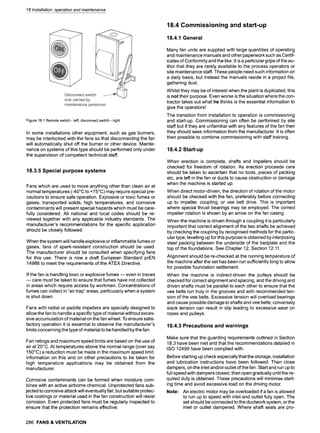
Note: There is no degree symbol associated with the abso-
lute temperature. Absolute temperatures in Kelvin can
be converted to degrees Celsius by subtracting 273.15.
Specific heat capacity is normally abbreviated to specific heat.
It is easy to see that specific internal energy, U1 is equal to the
product Cvand the absolute temperature, internal energy is an
intrinsic property of a gas and is dependent upon the tempera-
ture and pressure. In this case it would have been possible to
use degrees Celsius to obtain the same result.
However it is worthwhile working in absolute temperatures con-
sistently to avoid problems with rations. If a gas is restrained
and applied at constant pressure there will be work done, thus:
Q = mcv(T2 - T1) + W Equ 3.3
= mcp(T2 -'1"1)
=m(h 2 -h,)
so that:
W :m[(h 2 -U2)-(h , -U,)]
also
w
and
h=U+pv
where:
W
Cp
= work done (kJ)
= specific heat capacity at constant
pressure (kJ/(kg.K))
h2 = specific enthalpy (kJ/kg)
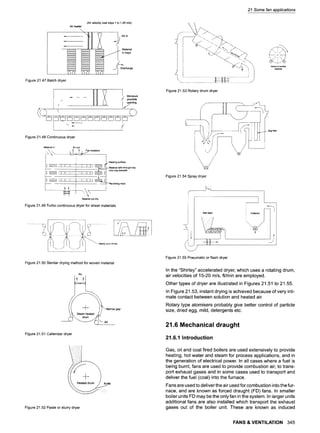
hi = specific enthalpy (kJ/kg)
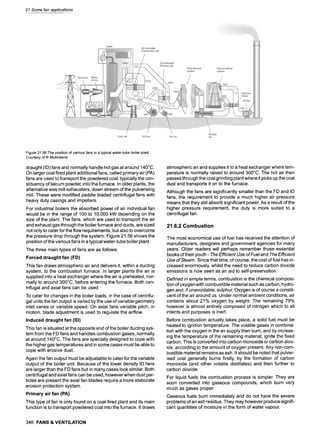
p = absolute gas pressure (kPa)
V2 = final gas volume (m3)
V1 = initial gas volume (m3)
v = gas specific volume (m3/kg)
Absolute pressures are gauge pressures plus 101.325 kPa.
The International Standard Atmosphere, at sea level, is
101.325 kPa. The actual local sea level atmospheric pressure
is not constant and will vary with the weather by +/- 4%. some
locations which experience severe weather conditions may ex-
perience larger variations. The atmospheric pressure will re-
duce at altitudes above sea level.
Enthalpy is an intrinsic property of a gas and is dependent
upon the temperature, pressure and volume. The total
enthalpy in a system, H, is the product of gas mass, m, and the
specific enthalpy, h. Equation 3.3 can be rewritten as shown in
FANS & VENTILATION 45
3 Air and gas flow
equation 3.4 when it is known as the Non-flow energy equation.
U is the product of m and u.
Note: The specific heat capacities, Cv and cp~ are variables
not constants. The values for dry air, not real air, at at-
mospheric pressure and 275 K are 0.7167 and 1.0028;
at 1000 K the values increase to 0.854 and 1.411.
Q = (U 2 -U1) + W Equ 3.4
For heat to be transferred into or out of a system a temperature
differential must exist. The general equation for heat transfer
by conduction is thus:
Q = ka(Th - T~ Equ 3.5
L
where:
q
k
a
Th
Tc
L
= energy transfer (kW)
= thermal conductivity (kWm/(m2K))
= area (m2)
= hot absolute temperature (K)
= cold absolute temperature (K)
= length of conductive path (m)
The thermal conductivity, k, will not be a simple value based on
the boundary material. The conductivity value used must take
account of the inside and outside boundary layer films and, if
necessary, an allowance made for the reduction in conductivity
due to surfaces being coated with deposits or modified by
corrosion.
It will be appreciated that the rate of heat transfer due to con-
duction is proportional to the temperature differential. If the
heat source cools as transfer proceeds it will take an infinite
length of time to transfer all the heat available providing there
are no losses. Energy losses usually occur via convection and
radiation and by heating the system as well as the gas. Perfect
systems are massless; only the mass of the working fluid is
considered.
Entropy is another intrinsic property of gases. Entropy is very
unusual when compared to other gas properties; entropy only
changes when heat transfer occurs. Entropy is not dependent
upon temperature, pressure or volume. A change in entropy is
defined as:
dQ
ds =~ Equ 3.6
T
where
ds = change in entropy (kJ)
dQ = heat transfer (kJ)
T = absolute temperature (K)
The units for specific entropy, s, are kJ/(kg.K). Values of intrin-
sic properties: u~ h~ s; are quoted in gas tables and appear on
the axes of gas charts. It is very important to verify the base
temperature of printed data before starting calculations. Some
gases use 0 ~ and some, like refrigerants, use- 40~
3.1.5 Bernoulli's equation
Consider an elemental tube in which flow is entirely parallel to
the boundaries. For simplicity assume it to have constant
cross-section area of 5a (although it can be shown it is not es-
sential to do so).
The forces on the element may be equated to the rate of
change of momentum. In the direction of flow, the forces are:
due to change in pressure:
pSA- (p + 5p)SA: -SpSA
due to change in height above some datum:
-pg 8s sin 0 8A =-wSHSA
Rate of change of momentum in direction of flow
= p~Av(v + 8v) -p;SAv2 = p~Av,Sv
thus
-SpSA = pSHSA = pSAvSv
and rearranging
5p
vSv + -- + gSH =0
P
which in the limit becomes
dp
vdv + -- + gdH = 0
P
On integration, this gives
v2 + fdp
-- + gH = constant Equ 3.7
2 p
H is measured from any arbitrary datum, and any change of da-
tum results in a change in H and an equal change in the con-
stant of integration. If the air is considered as incompressible,
which is acceptable for fan pressure below about 2.0 kPa, then
equation 3.7 reduces to
v2 p
+ -- + H = constant, known as Total Head Equ 3.8
2g pg
Although strictly only applicable to flow along a stream tube of
an ideal frictionless fluid, equation 3.8 is often used to relate
conditions between two sections in a practical system of flow
through a duct. If the mean total head is measured at the two
sections, it will be found that the value at the downstream sec-
tion is less than that at the upstream section. This is due to re-
sistance to flow between the sections and the difference in
head is known as loss of total head. When making measure-
ment however, it is customary to use gauge pressure, i.e. pres-
sures greater or less than atmospheric pressure.
Considering two sections, subscript 1 referring to the upstream
section and subscript 2 referring to the downstream section,
then
V2 -I- Pat1-t-Pl + H1 = V22+ Pat2-I-P2 + H2 + AH Equ 3.9
2g pg 2g pg
where AH is the loss of total head between the two sections.
This may be rewritten
v2 + Pj_~= v22+P__&2
+ AH+(H2 _H1 Pat1-Pat2] Equ3.10
2g pg 2g pg - -pg
NOW, if Pat represents the atmospheric pressure at a height H
above some datum, and Pat+ SPatat a height H + 5H above the
same datum, and a column of air of cross-section A is consid-
ered,
PstA- (Pat 4- (~Pat)A = pgA(H + 5H) - pgAH
from which
-Spa t = pgSH Equ 3.11
If pg remains constant, then equation 3.8 may be rewritten
Pat1-I-P2 + H2 + H1
Pg
and inserting this in equation 3.10 gives
v___l
2 + P_j_~
= v2 + P
_
_
z
_
2
+ AH Equ 3.12
-t.g pg 2g pg
46 FANS & VENTILATION
Multiplying throughout by pg gives the equation in terms of
pressure:
1pv2 + Pl 1pv2 + P2 + Ap Equ 3.13
or
Ptl = Pt2 + Ap
In equation 3.13, Pl and P2are known as the static pressures at
the two sections and may be positive or negative according to
whether the absolute pressure is greater or less than the ambi-
ent atmospheric pressure which, as stated above, is the arbi-
trary datum or zero to which static pressure is generally re-
ferred.
( -21pV 2 ) is
The sum of static pressure and velocity pressure p +
known as the total pressure PT. Although in many cases the air
density remains substantially constant, this may not be so
where the height between two parts of a system is consider-
able, or if there is a temperature gradient.
Equation 3.13 shows that the resistance of a system of ducting
expressed as a pressure loss for a particular flow rate, is equal
to the difference between the total pressures at the two ends of
the system. In practice the use of this equation to calculate the
resistance of a system is complicated by the fact that the veloc-
ity nearly always varies considerably between the centre and
the duct walls, although the static pressure, except near bends,
is often sensibly constant across a section.
In determining the pressure loss it is not correct to calculate the
velocity pressure component of the total pressure from the ex-
pression
pv2
where:
Vm = the mean velocity and is equal to Q/A
Q = the volume flow
A = cross-sectional area of the airway
Strictly speaking, and neglecting any variations in the static
pressure p across the section, the mean velocity pressure must
be calculated from the kinetic energy per unit time divided by
the volume flow per unit time, that is, in a circular duct:
R R
[ 1 pV X V2 2 dr [
Pv(mean)= ,I -2 x ~r +,1 v x2/1;r dr
0 0
or
R R
_ 1pj" v3r dr +fvr dr Equ 3.14
Pv(mean) - -~
O O
In most cases where equation 3.13 is used, the error due to the
incorrect method of calculating Pv(mean)is allowed for by an ex-
perimentally determined loss factor or coefficient for the form of
velocity distribution it is hoped will be encountered. It will be as-
sumed here that Pv(mean)is based on the simple calculation in
conjunction with this factor.
3.2 Fan aerodynamics
3.2.1 Introduction
It is not the intention of this book to give detailed data for the
aerodynamic design of fans. As has been said elsewhere, it
rather seeks to inform both manufacturers and users of the in-
formation necessary at their common interface, so that correct
choices are made to their mutual advantage.
Nevertheless, it is of value to cover the basics of the theory, to
show what is and is not possible, It will also show the back-
3 Air and gas flow
ground to Chapter 1 and explain how those characteristic
curves match with the fundamental fluid mechanics. A detailed
design guide could be written and it would certainly require a
similar number of pages to this volume, to do the subject jus-
tice.
3.2.2 Elementary centrifugal fan theory
To fully understand therefore, Sections 1.5 and 1.6 in Chapter
1, dealing with fan characteristics, Chapter 5, Section 5.6 on
system effect factors and Chapter 6 on flow regulation, some
knowledge of the elementary theory is essential.
For the sake of simplicity the analysis which follows is not math-
ematically exact and further assumes that the air or gas is in-
compressible.
A centrifugal fan receives air or gas at the impeller eye and de-
livers it to the casing volute at high velocity by imparting rota-
tional energy. The kinetic energy produced by the impeller is
converted into pressure energy within the volute. Fan efficiency
therefore depends on how much kinetic energy is produced,
how low the impeller losses can be kept, and how well this ki-
netic energy is converted into potential energy (or static pres-
sure) within the casing.
Considering the velocity triangles in Figure 3.1, the work done
on the gas by the impeller will be the energy difference between
exit and entry in the direction of rotation.
_ u2 ........
v a = Absolute velocity of gas
Vr = Relative velocity of gas
v w = Whirl velocity of gas
(ie tangential component of Va)
u = Peripheral velocity of impeller
/~ = Impeller blade angle
d = Impeller diameter
r = Impeller radius
o~ = Angular velocity
m = Mass flow of air gas
g = Gravitational constant Suffix 1 at inlet of impeller
P - Gas density 2 at discharge from impeller
Figure 3.1 Theoretical flow pattern in a centrifugal fan impeller with backward
inclined bladed impeller
Energy in air at impeller exit
= torque x angular displacement
= rate of change of (tangential momentum x radius x angular
displacement)
= tangential momentum x radius x angular displacement
= m Vw2 r2 o~
in like manner the energy in air at impeller inlet
= mVwl r1 o)
Now rio) = u1and r2 oo- u2
Energy given to the air by the impeller
= m (Vw2 u2 - VwlUl)
FANS & VENTILATION 47
The theoretical or Euler head H developed by the impeller is de-
fined as the height to which the same weight of gas could be
raised by an equal amount of work.
Thus:
mgH = m (Vw2 u 2 -- Vwl Ul)
or
H = l(vw2 u2 -Vwl u,)
g
In fan work it is usual to know the pressure developed (p = pgH)
and therefore p = p (Vw2 u 2 - vwl Ul).
Under normal circumstances at the design duty, the air will en-
ter the easiest way, i.e. radially and then Vwl = 0.
Thus:
VW2
. . . . .
p = p Vw2 U2 Equ 3.15
Considering the impeller in cross-section with a width at its tip of
b2, it may be said that the volume of air or gas delivered per unit
time Q = = d2 b2 vf2.
Now the impeller blades at the outlet may be either:
a) Backward inclined (straight, curved, or aerofoil) as in
Figure 3.1.
when
U2 -- Vw2 4- Mr2 cot 132
or
Vw2 -- U2 -- Vf2 cot 132
Now, as:
p = p Vw2 u2 and Q = = d2 b2 Vf2
/ ~ /
p = p Vw2 U2 -- ~ cot 132 Equ 3.16
=d2b2
This theoretical characteristic is a straight line with a downward
slope.
b) Radial (straight shrouded, open or backplate paddle, or
radial tipped) as in Figure 3.2 when Vw2 = u2 and vf2 - v2
p =IDU2 2 Equ 3.17
This theoretical characteristic is a horizontal straight line.
c) Forward curved as in Figure 3.3 when
Vw2-u 2 = vf2 cot (180~
Q (180o_132)1
p = p u2 u2 + - - cot Equ 3.18
~d2b 2
This theoretical characteristic is a straight line with an upward
slope.
It will be seen that for a given speed of rotation and a given pres-
sure, the volume flow rate is dependent on the width of the im-
peller and the blade angle. Reputable centrifugal fan manufac-
turers will have many different width ranges with varying blade
numbers and outlet blade angles to meet all duties economi-
cally. All these theoretical characteristics are shown in Figure
3.4.
The theoretical pressure will be reduced by the following fac-
tors, the aim of the fan engineer being to keep them to a
minimum:
Relative rotation losses
In addition to the normal flow of fluid within the impeller, the iner-
tia effect of the fluid causes a rotation of the fluid relative to the
impeller. Also, when the impeller is mounted between bearings
due to the effect of the rotating shaft, the fluid will have a definite
U2 --'~ Vw 2
Vf2- Vr2
f----.
Figure 3.2 Theoretical flow pattern at impeller outlet for radial blades
3 Air and gas flow
Figure 3.3 Theoretical flow pattern at impeller outlet for forward curved blades
I
il pu~ ~ o ~ ~"
~ Radial impeller
r-"-~..__ ....... ~ = 9o~
l Speed = constant
Flow rate-Q
Figure 3.4 Theoretical p-Q characteristics for different values of impeller dis-
charge angle
tangential whirl velocity at entry to the impeller blade. Both of
these factors reduce the pressure that the fan is capable of pro-
ducing, but they do not affect the efficiency.
Friction losses
These are caused by gas friction and also include volute
losses. (The volute is that part of the fan which converts velocity
energy into pressure energy. This is normally achieved by ar-
ranging the discharge channel so that the cross-sectional area
gradually increases, thus reducing the flow velocity)
Shock losses
Losses arise at entry to, and exit from, the impeller blade be-
cause the blade angles are only correct for the design duty. On
both sides of this shockless flow condition losses will occur.
Other losses
9 Leakage: occurs from discharge to suction and through the
shaft entry hole.
9 Disc friction: due to the rotation of the impeller shroud and
backplate within the gas.
9 Mechanical losses: caused by the bearing friction and fric-
tion at any shaft seal. These losses differ from those of the
previous three groups in that whilst they affect the overall ef-
ficiency they do not alter the basic fan characteristic.
The actual characteristic, with its losses are shown for a back-
ward inclined impeller in Figure 3.5. Actual against theoretical
48 FANS & VENTILATION
3 Air and gas flow
C~
I
(b
L
3
E
LL
••ret i
characteristic ~~ii
Speed - constant
Flow rate-Q
Figure3.5 Deviationof actualfan characteristicsfor impellerhavingbackward
inclinedvanes
t3..
I
(b
03
09
0,)
o3
E
LL
Theoretical
Actual
Flow rate-Q
Figure3.6 Characteristicsfor radialbladefan
J
t--
U)
CO
(b
CL
-~ Actual
E
Flow rate-Q
Figure3.7 Characteristicsforforwardcurvedfan
characteristics for radial and forward curved fans are shown in
Figure 3.6 and Figure 3.7 respectively.
Important Note
It must be emphasised that all the above assumes
straight flow into the impeller eye and consideration of
the equations will show that if this is not the case then
the pressure developed will be reduced.
Variable inlet vanes purposely use this fact to impart
swirl in the direction of rotation. This can be progres-
sively increased by closure of the vanes with a corre-
sponding reduction in the pressure developed. There
will of course be some additional friction losses. Further
information is given in Chapter 6, Section 6.5.
More importantly, from the system designer's view-
point, it will be seen that if straight flow into the fan inlet
is not achieved due to poor inlet connections, then the
fan will not develop its test pressure. Insufficient
straight ducting on the fan inlet side, sagging flexible
connections, absence of straighteners in bends, and
too tight bends can all be responsible. Where fans are
mounted in plenum chambers there must be a suffi-
cient distance from the fan inlet(s)to the chamber walls
for the same reason.
Often the system designer is himself short of space. He
may then have to provide less than ideal connections. A
section on system effect factors (Chapter 5, Section
5.4) has therefore been included and this will enable
the designer to make such allowances as are neces-
sary in specifying the fan duty so that the required flow
may be achieved.
3.2.3 Elementary axial fan theory
Figure 3.8 shows an axial flow fan blade section at some partic-
ular radius, with its associated velocity triangles. The air enters
the impeller axially with a velocity v~ = vm~,and leaves with ve-
locity v2.
I axial
direction wl
f VmI =
~../ ~1 ...... .............................
Ul
blad
directionofrotation
V
3= ~ ~
Figure3.8Axialflowbladevelocitytriangles
The shape of the triangles is almost identical with those of a
backward bladed centrifugal fan, but it should be noted that
u1= u2, and Vr~1= vm2.The total pressure developed is given by
the same equation as for a centrifugal fan, namely, pU2Vu2, Vu2
being the rotational component of v2. It should be noted that the
expanded form of Euler's equation no longer includes a forced
vortex component since u~ = u2 at each radius.
The theoretical characteristics may be derived since:
V u -- U -- V m cot 132
p = puv u = pu 2 -puv m cot 132
=pU 2 -pU. 4Q -cot 13
2 Equ 3.19
Where v equals hub to tip ratio D1/D2. The characteristics are
shown in Figure 3.9, and are seen to be very similar to those for
a backward bladed centrifugal fan, apart from the stall point.
It is usual to design a blade to give the same axial velocity and
pressure development at each radius, in which case
c~
t3_
  measured
Volume flow rate
Figure 3.9 Theoretical characteristics of an axial flow impeller
FANS & VENTILATION 49
3 Air and gas flow
p = pcorvu = constant, or rvu = constant. This will be seen to be
the condition for a free vortex and permits radial equilibrium of
forces on the fluid. It is necessary to have increased blade an-
gles at the hub section to achieve the higher values of Vuat the
smaller radius. Departures from free vortex designs have
therefore been made, which limit the blade chord adjacent to
the hub. These develop less pressure in this region and are
known as arbitrary vortex designs.
Alternative forced vortex designs are also available, where
maximum pressure development takes place at the tips of the
blades. For good efficiency the tip gap needs to be kept to an
absolute minimum.
Since the air leaving the impeller has a rotational component of
velocity, Vu, there is a loss of total pressure of
~pv2 Equ 3.20
if the rotational energy is allowed to be dissipated along the duct
system. Downstream guide vanes may be fitted to reduce the
1 pV2"
velocity to Vmand thereby regain static pressure equal to
Even so, many commercial designs are produced without guide
vanes to reduce costs, these being known as Tube Axials. The
resulting loss in efficiency is relatively unimportant at low fan
power.
It is possible to avoid rotational energy loss by having a guide
vane upstream of the impeller which pre-rotates the entering air
in a direction opposite to that of the impeller rotation. The impel-
ler is designed to do sufficient work on the air to remove this ro-
tation (Figure 3.10).
Then,
p = pU2Vu2 -pUlVul = 0 - pUl(-Vul ) = puVul Equ 3.21
and, at the design point,
Vul = Vm cot 131-u
Equ 3.22 - v
Another type, the contra-rotating fan, makes use of air leaving
an impeller with rotation to enter a second impeller rotating in
the opposite direction. This second impeller acts in a similar
manner to that of an upstream guide vane fan, as can be seen
from the velocity triangles, in Figure 3.11. There, the inlet and
outlet velocity triangles for each impeller have been combined
into a single diagram, made possible since Vm and u are the
same in each case. Each impeller develops the same pressure
if u and Vufor each are the same, and the air is discharged axi-
ally, that is:
p = 2puvu Equ 3.23
A similar arrangement, with both impellers running in the same
direction, is possible by using guide vanes between the impel-
lers. Whilst this obviates the need for opposite handed impeller,
a large angular deflection of the air is necessary. Very careful
design of these intermediate guide vanes is required to ensure
that flow separation does not occur.
3.2.3.1 Use of aerofoil section blades
As with centrifugal fans, the air passing through an impeller
constructed with sheet metal blades will not follow the blade
profile very accurately unless the number of blades is infinite.
Since aerofoil data is available, it is possible to predict the per-
formance of an axial flow fan more accurately if blades of aero-
foil profile are used. The velocity triangles for such blades are
shown in Figure 3.12 and are seen to differ from those previ-
ously considered only by the addition of a mean relative velocity
1
vector, woo= -~(wl + w 2) to which the blade section is inclined at
its angle of attack, o~.The mean blade angle is 13,with an effec-
tive blade angle (blade air angle) between vectors of w and u of
~--O~,
50 FANS & VENTILATION
inlet guide
vane )Vl~Vo
j ......... .
blade
dire~ion of rotation
V2 = Vm
~1_~__u . . . . . . . . I
Vml
Figure 3.10 Axial flow blade with upstream guide vane
1st impeller
rotation
2nd impeller
rotation

Figure 3.11 Contra-rotating fan velocity triangles
pUVul = pUV m cot 131-pu 2
V U
= . . . . . . f , ~ -
! vo, i u ,
V0=Vm=V2
Figure 3.12 Use of aerofoil section axial flow blades
The static pressure difference across the impeller may be
found, since
(p, +
P = pUVu = Pu -Pt2 = P2 + ~
: p,-p, +
Static pressure difference,
p,-p, : UVu-{
= puvu+
1
- Vu(U_+ Vu)
where the negative sign refers to the downstream guide vane
impeller, and the positive sign to the upstream guide vane im-
peller.
This pressure difference over the impeller swept area may be
equated to the axial thrust due to the aerodynamic lift forces L
on the blades
FA = Loos(13- or) = (P2 -Pl)" 2=rdr
for an element of blade.
If there are z blades, each of chord c,
1 2 ( 1 )
zc.dr.CL-~rwoo cos (13-o0 =pvu u+-~v u 2=r.dr
and writing blade spacing, s = 2=r/z
and substituting
1 cos(13 o~)
u+ ~v u :woo
or
1 C.CLWo
~ =v u
~s
Vu 10 L C
= ~ - Equ3.25
Woo S
The above simplified blade element theory, whilst adequate for
exploratory design, ignores the effect of drag. To consider more
fully the forces on the aerofoils it is necessary to equate the
thrust force FA, which is due to static pressure rise less any
pressure loss, to the axial force due to the lift and drag.
3.2.4 Elementary mixed flow fan theory
The mathematics of mixed flow fans becomes even more com-
plex than that given in Sections 3.2.2 and 3.2.3, as there are
both axial and centrifugal components to the airflow. In general,
however, it can be said that characteristics similar to the back-
ward bladed centrifugal are achieved. The Euler theory still
"reigns"!
3.3 Ductwork elements
3.3.1 Introduction
In the design of a ductwork system it is the practice to add the
resistance of all the elements in the index leg together, to deter-
mine the total (or static) pressure loss. The fan must develop
this pressure at the design flowrate. The system and fan will
then be in harmony. (See Chapter 4.)
The resistance of duct fittings and straight ducting is invariably
determined from the Guides produced by CIBSE or ASHRAE.
Both bodies have a similar approach and treat the pressure
losses as a function of the local velocity pressure. This function
is usually regarded as a constant and thus the loss becomes:
1
PL = kF x ~ pV2 Equ 3.26
where:
PLf
kF
= pressure loss (Pa)
= constant
= local air density (kg/m3)
(usually taken as standard 1.2)
= local velocity (m/s)
Whilst this may be reasonably true in the normal working range,
it is important to know that kF has a Reynolds Number depend-
ence and that at low Reynolds Numbers kF can increase enor-
3 Air and gas flow
mously, whilst in fully turbulent flow, if ever attained, the value
could be less.
There are very few textbooks which even admit this variation.
The only one of note is Idelchik's Handbook of Hydraulic Resis-
tance which gives a very detailed exposition of the subject and
is noteworthy for its comprehensiveness. Miller's Internal Flow
Systems is also recommended.
It might be thought that the topic is somewhat esoteric, but it is
suggested that with the increasing use of inverters and other
variable flow devices, it is important to know that at high turn-
down ratios, the system resistance curve diverges ever more
from the oft quoted PLoc Q2. Thus power absorbed is not ocfan
speed N3, even if there were no bearing, transmission and con-
trol losses.
In like manner, the loss in straight ducting is usually quoted as
diameter Average Reynolds No Relative Friction
velocity pvd roughness factor
d Re= k
v
m m/s ~ d f
Flow quality
0.1 2.5 16492 0.0015 0.0076 Tr
5 32985 0.0067
10 65970 0.0063
15 98955 0.0059
20 131940 0.0057
0.25 2.5 41231 0.0006 0.006 Tr
5 82463 0.0055
10 164926 0.005
15 247388 0.0048
20 329851 0.0047
0.315 5 103903 0.00048 0.0051 Tr
10 207806 0.0047
15 311710 0.0046
20 415613 0.0045
25 519516 0.0044
0.63 5 207806 0.00024 0.0043 Tr
10 415613 0.0042
15 623419 ! 0.0039
20 831226 0.0038
25 1039032 0.0036
1 5 329851 0.00015 0.0039 Tr
10 659703 0.0037
15 989555 0.0036
20 1319406 0.0035
25 1649258 0.0034
2 10 1319406 0.000075 0.0033 Tr
15 1979109 0.0032
20 2638812 0.0031
25 3298516 0.003
30 3958218 0.00295
2.5 15 2473887 0.00006 0.00295 Tr
20 3298516 0.0029
25 4123144 0.00285
30 4947773 0.0028
40 6597031 0.0028
Table 3.1 Friction factors versus duct size and velocity
Note 1" Values apply to standard air
Note 2: All values are in the transitional range
FANS & VENTILATION 51
3 Air and gas flow
0,025
0,02
0,018
0,016
0,014
0,012
0,01
L..
~ 0,008
r
.o 0,007
L
LL
0,006
0,005
0,004
0,003
0,0025
0,002
' 1 6
i i laminar flow f= ~ ! :,~! : : .: .: .: .= :~ .: .: : ! .; "., :..; i ; i ! :. ! ~ .:.:.:
Critical,,j i .; .= .: ~ .=;..: ! i } .: .::.~ i i ....... i i .......
9 ~-''':.I;II,
L. :'.,'' .....:" :,;i : : ::: .......................................................................
;:: Complete turbulance: rough pipes ~ : : .. 9,:; i .: .: :. ~ ,, !
0,05
9
.-~,-!-,+,+.i
..............
:.~
........
!......
..-'.-,~.--~.+.!-H
...............
!..................
~.--~,,--,',-.-~,.H-,!
.........................
i.......
i...~.--i..!-+ii
.........................
i......
i---,i,-+,i-i,.!-0,04
" ;!!!! ! ,! ! ;.~;!;~ : . : ; ;~;~i i i ~i~';~; i ~i~i 0,03
9
.~...~..~ ............... ; ....... .~. ..... ~....:...:...~...,..o.!ii i i i ;'............................................................................ "....... t...-:-..-..~..;..,..:.: .......................... , ...... ~..... ;'""'":';":'1
~ ~ ~ i i i iii', ; i i ii:iii i i ilil
..~-:,,:: ............. i........ ~,
...... ~..i..4,..~..i.$:~~..~.~..~ .............. ..~....... (.......~...~...H..(..,., ................ ~........ ,.......~..,.r 0,02
i
0,01
: ---.,.!-.,~:-!-., ~ 0,006
..'~ i i i i!!i .
...i,~,:..~ ............... :~..~., '.......~...,~.,..!,.~..,!.,..~.~,,.,
....... 0,004
~ ~ , ;;i;i;; i'~J iiiii i iiiiii ; ii;i;
............. ;'--;---;; ;:; - ' ' -- -- "-- 0,002
9
iii .: ti i ~ i! iii ": i i
.... " ; ~;:!! ! : i . . . . . . . . . . . . .
~:J,i L. ,.:. . ~ ~ -~-~.~ ...... >
. .... ..........................
...... ~ ~ -. .....".'i'
................................. ", OOOl
"'!.'i'~...........
!.....i"c"~' 7 T'~"~'i~ ....... : i . . . . . . . . . . - - :..
....... : : ~-,i i ~ iii~i ;.. :;;::::;;; 0.0006 n,~
.:~.:~ ~ i ~ ~ i~ :ii : : ; :::
I i lil Riveted steel 1-10 i i i i i i~ ii i 0,0002
J i ~i Concrete 0,3-"3 i i ! i :--!~ i ~ ~ i :~ ! ,:'iJi i i i ! ~ ! !
i!~ vvoo~=.w 0,2-1 ! ~ ! !! !!!! ! ~~~'~...~~ ~ ~ ~ !!!T-. ! ~ ! i! ~!i
I...~,.~.~,.iCast iron 0,25 ........ i.........
!......
~-...i.--~...i..i:.-.i
...............
~.........
~ . ~ - . } . i .......
-'-.--~
! : ,, i ~ ! i,! ~ 0,0001
I i:,ii Galvanised steel 0,15 i i ~ i ; i i i i i ~ " ill
I ~ i ! i Asphalted cast iron 0 12 ! ! i ! ! ! ! ! ! S 0,00005
. . . . . : . . . . . . . i . . . . . . . . . " ..... i ::i 0000001'-: i :::
I i i il orwrought iron O,04S i i i ~ i i i~i ~ ~ ~"L
! ; ~ ; Drawn tubing 0 0015 i ; -: .: i :. =. ~ ~ ~ : ~ ~ ,: ~ ~ ; ~ ,, : ,' " :: ~ ~ ~ ~ -: ;~ ;
789 2 3 4 5 6 789 2 3 4 5 6 789 2 3 4 5 6 789 2 3 4 5 6 789 2 3 4 5 6 789
10" 10" 10~ 10 o 10: 10 ~
" 0
v,
O9
~0
t-
r
o
pvd
Reynolds number Re -
l.t
Figure 3.13 Friction factor versus Reynolds number- Moody chart
fL 1
PLs : ~--'~ P v2 Equ 3.27
fL
and -- is taken to be a constant ks
m
where:
= length of straight duct (m)
= mean hydraulic depth (m)
= d for circular cross-sections
4
f = friction factor
Again, as L and m are constants and f is assumed to be con-
stant, the loss is taken to be
1
PLs = ks "~ P v2 Equ 3.28
And thus another problem is created, for f is not a constant but
rather a function of absolute roughness and Reynolds Number.
The Moody chart shown in Figure 3.13 shows that in the transi-
tional and lower zones f: constant, and that again, as flow en-
ters the critical zone there are significant increases in f, then a
sudden drop, before climbing again in the laminar zone.
Referring now to Table 3.1, this covers the range of sizes and
velocities encountered in HVAC practice. Assuming an abso-
lute roughness applicable to g.s.s. (galvanised sheet steel), it
can be seen that in all these cases the flow is transitional. The
relative roughness and friction factor therefore vary enor-
mously as shown. Thus with decreasing flow, and therefore ve-
locity, the reducing velocity pressure is partially offset by the in-
crease in f.
A system resistance curve is likely to be of the form shown in
Figure 3.14 although for most HVAC systems the flow at which
instability occurs is very close to zero flow. For mine ventilation,
where the size of roadways can be considerable and the
d
, Turbulent flow
~ ~ p= Rq 2
? ~ Streamline flow
Velocity
Figure 3.14 A system resistance curve
Reynolds Number is higher, this shape of system resistance
curve has been recognised for at least 50 years. Somewhat
later in Section 3.4.1 it will be shown how the formula has been
tailored to fit the facts by reducing the index of v velocity from 2
down to 1.9 or even less.
Vigilant readers of this text will have detected that the author is
somewhat cynical and he would suggest that it hardly seems
worth the struggle to reach the truth, if there is any! Better to go
back to basics. In this computer age, it should be possible to de-
velop a programme to give the correct f for the velocity, diame-
ter and roughness. Whether the effort is applauded, however,
may still be debatable.
Norman Bolton at NEL, East Kilbride, was responsible for a
programme of work which measured the resistance of suppos-
edly identical ducts and fitting from three different manufactur-
ers. The variation in pressure loss PLwas enormous, thus prov-
ing that quality is everything. It also suggests that so-called
balancing of systems is not enough and that, to use "manage-
ment speak", a full system audit should be carried out.
The results should be fed back into the company design data-
base. Some aspects of ductwork design are rarely mentioned in
52 FANS & VENTILATION
3 Air and gas flow
textbooks 9
The Sections which follow are a mixture of basic fluid
dynamics and practical "nous".
3.3.2 Diffusers
These are attached to the discharge or fan outlet and are used
to improve the fan static pressure of medium to high pressure
fans. They may also be used in a system at the end of the outlet
duct to atmosphere 9
A change from high to low velocity is ac-
companied by a conversion from velocity pressure to static
pressure. There is always a loss in this conversion such that the
total pressure is never the same before and after the diffuser 9
Efficiency of conversion E is never 100%.
E = percentage converted of difference in initial and final
velocity pressures.
True efficiency of conversion in the diffuser itself depends al-
most entirely on the angle of taper 9
If however, the diffusing
taper is followed by a length of straight ducting 4 to 6 diameters
long, then there is some additional conversion after the taper. In
such cases, the overall efficiency, as determined by test, is re-
lated to the angle of the taper and the area ratio.
The included angle of a jet of air which is confined by the walls of
a duct is about 7~ If the taper is more than this then the flow
leaves the walls and dead areas result.
An unconfined jet of air in free space has an included angle of
about 3~, but the jet is spread by the induction of secondary air
so that the actual included angle increases to about 16~ This
can be seen from smoke photographs of air jets, the results be-
ing summarised in Figures 3.15 to 3.17.
The static regain, or increase in static pressure in the larger
duct
Psr = "E(Pv,-Pv2) Equ 3.29
where:
.E = efficiency of conversion expressed
as a decimal
It is generally more convenient to calculate the regain from the
initial velocity pressure, and to make allowance for the differ-
ence by an area term i.e.:
Psr =" E 1- Pv~ Equ 3.30
Figure3.15Shortdiffuserat largeangle
Figure3.16Verylongdiffuserat smallangle
Figure3.17Normaldiffuserfollowedbyduct
where:
Pvl
Pv2
A1
A2
= initial velocity pressure (Pa)
= final velocity pressure (Pa)
= initial cross-sectional area of diffuser (m2)
= final or outlet cross-sectional area of diffuser
(m2)
= efficiency of conversion expressed as a deci-
mal
At 100% theoretical efficiency of conversion:
Psi + Pvl = Ps2 + Pv2
or
so
but
Ps2 = P~I + (Pv, - Pv2)
P~I + Pvl = Psi + (Pvl -Pv2) + Pv2
:0v
because velocity pressure is inversely proportional to area2.
Then
Ps~ + Pv~ = Psi + Pv~ -Pv~ + Pv2
- Psi + Pvl 1- + Pv2
So, the static regain Psror addition to the initial fan static pres-
sure Psi is the term Pvl 1- which is exactly the same as
(Pv, - Pv2).
As the efficiency of conversion is never 100%, the actual regain
will be:
9
Ep~ 1- Equ 3.31
From this a combined factor F may be obtained from the value:
and the regain Psr is then 9
F xp~.
Values of F from experiment are plotted with included angle of
taper and various ratios of A~. Those from the tests of Kratz and
A2
Fellows are the most reliable, see Figures 3.18 - 3.20 9
It is impossible to include factors for every possible design of
diffuser 9
Those given are for circular cross-section diffusers. If
the cross-section is square or rectangular then the efficiency is
somewhat less for a given included angle. It is suggested that
an average reduction of 5% or .05 in. E is a suitable allowance 9
Diffusers for steel plate industrial fan outlets often transform
from rectangular or circular cross-section. Draw the view each
way and estimate the mean included angle. Then use the val-
ues for a circular design. If the design is critical and has to be
passed by a performance test, it is wise to be on the safe side
with the factor.
FANS & VENTILATION 53
3 Air and gas flow
Figure3.18Diffuserefficiencyversusincludedangleand arearatio
Figure3.19Regainin a diffuserfollowedbya duct(Psr = .F• Psi)
In an exhaust system which has a diffuser fitted on the fan dis-
charge direct to atmosphere, any gain due to this must be sub-
tracted from the calculated resistance of the system. A fan to
deal with the required flowrate at this nett resistance is then
selected.
If a diffuser follows immediately after a bend in the system, the
full recovery will not be achieved. It is then prudent to use about
0.7 x .F. With one diameter of straight duct between the bend
and the diffuser use 0.8 x .F. If 5 diameters of ducts are between
the bend and the diffuser then the full values of .F as shown on
the curves may be used.
Air velocity has some effect on efficiency. When this initial ve-
locity is very high e.g. above 37.5 m/s there is some loss in effi-
ciency but no definite data is available.
Figure3.20Regainin an open-endeddiffuser(Psr = .F• Psi)
The loss of pressure in a diffuser due to imperfect conversion
may be calculated bythe same method using (1-.E) for the loss
factor.
Thus
Equ 3.32
It is important to remember that different factors are required for
a discharge direct to atmosphere compared to one with a fol-
lowing duct. One should also note that on forward curved
bladed centrifugal fans, and indeed on many other modern de-
signs using a shield or tongue piece in its outlet, there is already
an allowance for some gain in the catalogue tables or charac-
teristic curves. The listed performance is based upon some
regain by expansion from the nett throat area to the area of duct
equal to the full discharge connection size. (See Figure 3.21. )
The static pressure is based on readings taken at some dis-
tance from the fan outlet and includes this gain. Hence a dif-
fuser cannot add much to the performance. If for reasons of
duct design an expander is used, it is customary to ignore any
possible gain.
There is a practical limit to the final diameter of a diffuser fitted
to a fan outlet if followed by a ducting system. The larger its final
diameter, the more expansive is the ducting which follows. It is
all a question of economics and the life cycle i.e. initial cost ver-
sus running costs. The effect of the diffuser is to reduce the
power absorbed by the fan. This saving must be considered in
Figure3.21 Effectofthroatpieceand diffusiondownstreamto fulloutletduct
area
54 FANS & VENTILATION
relation to the cost of the ventilation system as a whole, includ-
ing the fan, motor and ducting system.
On centrifugal fans for mine ventilation a diffuser is invariably
fitted. It has a taper on one side only. The discharge is direct to
atmosphere, at which point the static pressure above ambient
is zero. Thus the static pressure at the fan outlet is negative and
as much below atmospheric pressure as the velocity at that
point converted into static pressure. A gain in pressure with the
final at atmospheric or zero gauge must start from a negative.
This negative pressure is transferred to the fan inlet and the fan
is selected for the required flowrate at the calculated resistance
of the system less the static regain.
3.3.3 Blowing outlets
When air is discharged from an outlet, the perimeter of the
airstream is slowed down by contact with the surrounding air,
which is induced onto the primary airstream as secondary air.
The jet in consequence expands with distance from the outlet.
As stated previously, an unconfined jet of air in free space has
an included angle of about 3~ but due to the induction of sec-
ondary air, its "spread" is increased to around 14- 16~ Ameri-
can tests on air blasts from circular outlets are shown in Figure
3.22, the results being plotted for the percentage of the initial
velocity on the centre line at distances measured in diameters.
Figure 3.22 Diffuser fitted to a centrifugal mine fan
In the 1950s, Sturtevant Engineering Company made tests on
three blast outlets of virtually the same cross-sectional area:
229 mm diameter
203 mm square
and 254 mm x 165 mm
When plotted on a basis of initial velocity on the centre line
distance m
against the results were virtually on the same
~/outlet area m2
3 Air and gas flow
curve and were in reasonable agreement with the American
tests shown in Figure 3.23.
Hence, provided the long side of the rectangle is not more than
1.5 x the short side, the chart may be used by taking the
cross-sectional area of the square or rectangular outlet and
converting it into the corresponding equal area circular outlet.
Table 3.2 is a numerical equivalent of Figure 3.23.
Percentage of initial centre
line velocity
Distance m
Diameter m
Distance m
Area m2
90 3.0 3.38
80 4.4 4.95
70 6.25 7.05
60 8.5 9.6
50 11.0 12.4
40 14.5 16.4
30 19.0 21.4
20 24.0 27.1
10 31.0 35.0
5 36.0 40.6
Table 3.2 Circular blast outlets
For example:
for 50% of the initial centreline velocity, the distance in metres
from the outlet
= diameter of outlet m x 11
or
= ~/outlet area m 2 X 12.4
Figure 3.23 Circular blast outlets Figure 3.24 Slot outlet equivalents
FANS & VENTILATION 55
3 Air and gas flow
Tests have also shown that the ratio of centreline velocity to av-
erage velocity is about 3.0 irrespective of outlet size, shape or
initial velocity between 10 and 50 diameters from the outlet. In
industrial ventilation, maximum velocity is usually the important
factor from the viewpoint of draughts on persons. More recent
data has suggested that the "blow" is to much greater dis-
tances, but practical experience suggests otherwise. It may be
that this data is based on theory unsupported by actual site
tests.
Narrow slot outlets require a different approach as the rate of
fall in velocity with distance is greater. Figure 3.24 shows the
equivalent diameter in metres against slot length for various
slot widths, and is based on American data.
For example a slot on 762 mm x 76 mm is equivalent in perfor-
mance to a 216 mm circular outlet. Its throw may then be deter-
mined from Figure 3.23 in the normal way. No practical confir-
mation has been made for all the combinations and it would be
wise to restrict its use to slots of less than 76 mm long. Figures
3.25 and 3.26 show tests on a 914 mm x 38 mm slot, which sug-
gest some caution.
Oscar Faber and John Kell used multiple nozzles to introduce
ventilating air from high level in the original ventilation system at
Figure3.25Slotblastoutlet
Figure3.27Faber'stestson roundnozzles
the construction of the Earls Court exhibition main hall in Lon-
don (311500 m3and 23000 people maximum).
The published tests results for which this nozzle scheme was
designed are shown in Figure 3.27. These results are in general
agreement with the practical experience of many engineers.
With Faber's design of nozzle fixed on the end of a short duct
from a main duct, the static pressure required, as measured in
the branch duct is given by:
p (Pa) - 0.535 (vel m/s at nozzle mouth)2 Equ 3.33
At an area ratio of 0.535 the value of K = 1.06. Readers may like
to do the mathematical manipulation to justify the formula.
3.3.3.1 Punkah Iouvres
Another application of nozzles is in the cabin ventilation of ships
where even today, Punkah Iouvres are used. These have the
advantage that they can be swivelled to vary the direction of
blow, to suit the particular preferences of the occupiers (see
Figure 3.28).
Figure3.26914 mmx 38 mmslotshowingthrow Figure3.28Punkahlouvre
56 FANS & VENTILATION
A standard range has been developed over the years in accor-
dance with Table 3.3.
Dia of outlet mm Dia of"ball" mm m~s at125 Pa K
25 50 0.007 1600
37.5 75 0.016 700
50 100 0.028 400
62.5 125 0.049 228
73 150 0.064 175
Table 3.3 Performance details for Punkah louvre range
(
The makers claim that the pressure loss Pa = m3/s xk
3.3.2 Grilles
The length of "throw" from an air supply grille is important in de-
sign to avoid draughts. Throw is usually defined as the distance
from the grille to where the air velocity has fallen to 0.25 m/s.
This velocity should be achieved at not less than 2 to 2.14 m
above the floor. Modern grilles are manufactured to a number of
proprietary designs for which it is best to consult the manufac-
turers for recommendations as to the best type for a particular
application.
One design has multi-deflecting vanes approximately 6 mm
deep x 6 mm centres. These may be set to the required angle at
the manufacturers or may be adjusted on site by bending the
vanes with a special tool. Grilles with straight deflecting vanes
generally produce the maximum throw for a given entering air
velocity, but other types are available which produce a wide
spread of the air with less risk of complaints from draughts.
With deflecting vanes, the air velocity is increased after leaving
the grille. It is obvious from Figure 3.29 that width B is less than
A, becoming more reduced as the angle of deflection is
increased.
Figure 3.29 Reduction of width of issuing airstream with increased angle of de-
flection
3.3.2.1 Sizing of grilles on blowing systems
High level (above 3 m minimum height): The basis of selection
is normally to obviate the noise caused by air impingement on
the vanes. The maximum velocity on the entry side of the grille
will depend on the application and the following maximum val-
ues are suggested:
9 Board rooms, private offices etc 3.5 m/s
9 General offices 5.0 m/s
9 Industrial applications 7.5 m/s
Low level: The basis of selection is to achieve good comfort
conditions for the occupants without noticeable draughts. If the
entering air is at a temperature below that in the room i.e. a
cooling application, then a minimum height of 2 m is suggested.
The maximum velocity on the outlet side of the grille should be:
9 Occupant very near the grille 0.5 m/s
9 Generally with private offices 2.5 m/s
3 Air and gas flow
As stated, "angling" the vanes produces a greater outlet veloc-
ity than that normally on the inlet side. Multiplying the selected
velocity by the appropriate factor in Table 3.4 will provide the
entering air velocity.
Vane angle degrees
Factor
10
0.98
20
0.94
30
0.86
40
0.76
50
0.7
Table 3.4 Factor for the entering air velocity
At the design stage it is usual to assume a mean angle and fac-
tor of around 0.85.
The resistance may be determined as the leaving velocity pres-
sure. Normally it is preferable not to spread the air vertically in
industrial applications (and indeed in some offices with ex-
posed steelwork) as there is a risk of hitting beams at ceiling
height, or of blowing cooled air too rapidly down into the
occupied zone.
Grilles fitted at the top of riser ducts in walls may have several
horizontal deflectors behind the vanes. These may then be set
to assist the air in turning.
3.3.2.2 General notes on blowing outlets
In factory heating with warm air on the overhead plenum sys-
tem, the outlets are typically from 150 mm to 275 mm diameter
at 3 m to 3.8 m above floor level with an average velocity of 5
m/s to 6 m/s (see Figure 3.30). The sophistication of outlet
grilles is rarely merited other than for aesthetic reasons.
Figure 3.30 Typical outlets for factory plenum heating system
For general ventilation of factories, similar outlets may be used.
Common examples are in the ventilation of very hot workrooms
such as those for pressing and finishing of garments, laundry
ironing rooms, etc. Tapered outlets have been used in some in-
stallations (see Figure 3.31). An outlet velocity of 3.75 m/s to 5
m/s has been found satisfactory.
Figure 3.31 Tapered outlets for factory general ventilation
Cold air douche plants are often supplied for applications such
as steel rolling mills, tin-plate rolling and glass furnaces. Here
the operators are subjected to high radiant heat. As well as the
copious quantities of beer which some plants allow, drop ducts
from the main duct are positioned to blow cool air onto the work-
ers! The air does not have to be cooled artificially, but is merely
external atmospheric air. The outlet velocity is usually about
3.75 m/s (see Figure 3.32).
Textile conditioning plants have outlets on drop pipes from the
main duct and are fitted with special diffusing outlets. These are
spaced at intervals to cover the area of the room to be condi-
tioned. Many different designs of outlet are available. Two of the
FANS & VENTILATION 57
3 Air and gas flow
Figure 3.32 Outlets for cold air douche plants
Figure 3.33 Type "C" outlet for textile air conditioning
Figure 3.36 Extract from a point source
The extract volumetric flowrate Q m 3/S - A x v
but A =4~r 2 = 12.57r 2
Q
So v m/s at any radius r = -
12.57r 2
In actual practice the extract is not from a point source and the
flow is not completely the same from all directions. In 1932
Dalla Valle investigated an open ended duct freely suspended
in space, and found that the centre line air flow relationship was:
Q= v (10r2 + A) Equ 3.34
where:
r
A
Hence
= velocity measured on centre line (m/s)
= distance from open end (m)
= area of open ended duct (m2)
Q
v - - - -
10r2 + A
The actual extract is shown in Figure 3.37.
Equ 3.35
Figure 3.34 Type "M" outlet for textile air conditioning
simplest, which have proved satisfactory, are shown in Figure
3.33 and 3.34.
In factories with very high ceilings, the plenum warm air system
is often fitted with drop pipes, or down corners, fixed adjacent to
stanchions. These discharge the warm air nearer to floor level
(see Figure 3.35). The drops may be from 200 mm to 280 mm
diameter splitting into two outlets about 750 mm above the
floor. Velocity should be 3.75 m/s to 5 m/s.
Figure 3.35 Drop pipes for warm air
3.3.4 Exhaust inlets
Consider the case of air exhausted by a very small point source
(Figure 3.36). We can assume a sphere with a surface area of A
m2at any radius r from the point of extract.
Let v = velocity m/s at radius r, assumed to be equal over the
sphere.
Figure 3.37 Actual extract from open ended duct
Laboratory and site tests have confirmed the general correct-
ness of the equation.
To take the example of a circular exhaust opening having the
following dimensions
Face area = 0.093 m2
Velocity = 0.5 m/s
At distance = 0.61 m
then Q =0.5(10 x0.612 + 0.093) =1.907 m3/s
If the same velocity was required at 1.22 m
then Q = 0.5('10 x 1.222 + 0.093"~ = 7.489
 J
It will be noted that Q is proportional to slightly less than the dis-
tance squared.
Note also that the velocity v varies directly as Q irrespective of
the face velocity into the opening.
These points emphasise that when extracting dust, the hood
must be as close as possible to the source of production and
that to increase the velocity at a given distance must involve an
increase in Q. The limitation on Q is of course due to economic
factors. If velocity is insufficient to extract the dust effectively, it
might be thought that a reduction in the size of the opening for a
given volumetric flowrate would increase its "pulling power", but
this is not so.
58 FANS & VENTILATION
3 Air and gas flow
Figure3.38Flatteningofvelocitycontoursat hoodfacecentre
Figure3.41Formationofa venacontracta
The acceleration of the air to this excess velocity requires pres-
sure and is shown as residual static pressure at the point where
the airstream fills the duct at normal velocity. Normal duct ve-
locity in average dust extract systems is from 16 to 23 m/s.
A common method of measurement in the USA is to drill one or
more holes preferably as small as 1.6 mm diameter, free from
burrs on the inside, at one duct diameter from the throat for all
tapered entrances. For open ended or flanged ended open-
ings, the hole is drilled at these duct diameters from the end.
(See Figure 3.42.)
Figure3.39Circularexhaustopenings(DalaValle'stestson 100mmto 400
diameter)
The centreline velocity is a useful guide in practice. In normally
shaped hoods as used in dust collecting, the velocity contours
are flat in the regions opposite the main portion ofthe hood (see
Figure 3.38).
The graphical representation of Dalla Valle's tests is shown in
Figure 3.39.
3.3.4.1 Comparison of blowing and exhausting
It is important to realise the great difference in effect of distance
from the opening when comparing blowing and exhausting. At
31 diameters from the opening, 10% of the initial velocity is still
maintained when blowing, but the distance for this 10% velocity
contour is only 0.8 diameters when exhausting, see Figure
3.40.
Figure3.42Positionsof tappingsforflowmeasurements
Press a rubber tube, connected to a pressure gauge, tightly
against the hole and read the static depression.
Then
Q = 1.29~s x A xC e
at normal temperatures and barometric pressures.
where:
Q
Ps
A
= extract flowrate (m3/s)
= static depression (Pa)
= cross-sectional area of duct at point of mea-
surement (m2)
Ce = coefficient of entry, which varies from 0.6 to
0.98 in commercial work
Ce also varies to some extent with velocity, see Figure 3.43
Q
.'.C e ---
1.29~s x A
1 Q
1.29~/-hs A
Figure3.40Comparisonofvelocitycontourdistancewhenblowingandex-
hausting
3.3.4.2 Airflow into exhaust opening for dust extract
When air enters a duct through a hood having any shape other
than that of a perfect bellmouth, a vena contracta is formed (see
Figure 3.41).
This is a point where unwanted air velocity is attained i.e. veloc-
ity above that needed in the duct to carry away the dust. Figure3.43Measurementof extractflowrate
FANS & VENTILATION 59
3 Air and gas flow
But --
Q is the velocity in the duct after the vena contracta and
A
1.29~v at normal temperature and barometric
equals pres-
sure where Pv is the velocity pressure in the duct.
So,
1 1.29 ~v
1.29 • -
Ce=
or
Ce- P~s
With
PV
Ps
Equ 3.36
= mean velocity pressure in duct after vena
contracta (Pa)
= static side hole depression taken in position
specified to be clear of the vena contracta
Many tests have indicated that on a given extract opening, the
value of Ce increases with velocity, indicating some Reynolds
Number dependence.
3.3.4.3 Loss of pressure in hoods
The loss of pressure in an exhaust inlet is very much dependent
upon its shape. It is mainly due to the contraction of the
airstream which results in an increase in velocity at that point. In
a bell mouthed entrance (Figure 3.44) there is virtually no con-
traction of the entering airstream. To create a flow of say 20 m/s
at A or a velocity pressure of 250 Pa requires a static depres-
sion of 250 Pa in the duct.
Figure 3.44 Bell mouthed inlet
Thus if there are no losses"
PS= PV
When there is a contraction of the entering airstream then:
Ps - Pv+ PL
where:
Pv
PL
or
= velocity pressure in the duct (Pa)
= extra static depression for the increased
velocity (Pa)
PL = Ps --Pv
The value of PLrelative to the velocity pressure in the duct is
Ps-Pv
Pv
But Ce as already shown = P~s
or -,~v-v= Ce~s
or Pv = Ce2ps
Substituting for Pv in the formula for relative PL:
Figure 3.45 Hood losses
PL --
ps-Ce2ps Ps(1-Ce2) 1--Ce2
- - " - _ _
Ce2ps Ce2ps Ce2
Or as a percentage of the velocity pressure in the duct.
100/1-0e2 ] Equ 3.37
PL =
~ )
Ce2
Figure 3.45 shows this in graphical form for values of Ce from
0.6 to 1.0.
In practice, the estimation of this loss is required in the design of
dust extracting plant. It is generally possible to estimate the
value of Ce from some similar known example. In especial
cases a model may be made and checked by a laboratory test.
Typical values of Ce are given in the paragraphs which follow. It
may be appreciated that absolute accuracy in the figure is not
required and is in fact impossible to achieve at the estimation
stage. Results of tests have been given to three decimal places,
but a rounded approximate figure may be all that is necessary.
Note: PLrepresents the mean facing tube reading as usually
taken on the inlet side ducting of the fan. It is the equiv-
alent of the resistance depression up to the point of
60 FANS & VENTILATION
measurement, but must be a mean over the area of
flow.
3.3.4.4 Values of coefficient of entry Ce
Typical values of Ce are shown in Figures 3.46 to 3.52.
3 Air and gas flow
At about 20 m/s in duct. C e is less at lower velocity
Figure 3.46 Cefor plain open ended duct
Figure 3.50 Cefor rectangular hoods ratio 1 : 3
At about 20 m/s in duct. Ce is less at lower velocity
Figure 3.47 Cefor flanged open ended duct
Figure 3.51 C e for rectangular hoods ratio 3 : 4
Figure 3.48 C e for tapered hoods
For average hoods including the obstruction of grinding or buffing wheel take
Ceat. 71
Figure 3.52 Cefor grinding wheel hoods
3.3.4.5 General notes on exhausting
Figure 3.49 C e for square mouthed ducts
Detailed designs for hoods to suit most applications may be
found in the standard design manuals produced by machinery
manufacturers and also in Industrial Ventilation published by
ACGIH|
FANS & VENTILATION 61
3 Air and gas flow
A point to note is that, in all dust extract work, the hood should
be fitted to enclose the source of the dust as much as possible,
whilst in fume extract the hood should be reasonably close to
the area of evolution. These considerations should be clear
from a basic study of air flow into exhaust openings.
In dust extract, the principle is to so design the hood that the
particles are thrown from the point of generation directly into the
throat of the hood. Grinding wheels, as an example, may be re-
volving with a peripheral velocity of 30 m/s.
For grinding wheels the throat velocity (see Figure 3.53) should
be about 5 m/s to 5.5 m/s with a duct velocity from 17.5 m/s to
20 m/s. Normal duct sizes vary from 75 mm to 180 mm diameter
and are generally standardised by manufacturers for their own
types and size of wheels.
Figure 3.53 Grinding wheel hood showing throat and maximum enclosure
Overall system resistances for complete dust extract systems
are typically in the range of 1000 Pa to 1500 Pa although exten-
sive systems may reach higher values.
The cutters on wood working machinery, such as planers and
moulders must be hooded so that the chips are thrown directly
into the throat of the hood.
The air velocity into the opening of the hood around the cutters
may be from 5.5 m/s to 8 m/s. The duct velocity is typically from
20 m/s to 22.5 m/s on chips and from 16 m/s to 17.5 m/s on saw-
dust. The duct connections to each hood range from about 75
mm to 180 mm diameter. System resistances are typically from
1250 Pa to 1500 Pa but for larger more extensive systems,
could be higher.
For extract from spray booths the velocity into the open side of
the enclosure may be from 0.5 m/s to 1 m/s with a general aver-
age of 0.75 m/s to 0.8 m/s.
In fume hoods over appliances the velocity into the actual open-
ing may be as low as 0.25 m/s up to 1 m/s. The duct connection
to the hood may have a velocity of 7.5 m/s to 10 m/s with the
main ducting sized for 12.5 m/s to 15 m/s. Plant overall resis-
tance with fume discharged direct to atmosphere can be as low
as 250 Pa to 325 Pa. However, the addition of fume collection
equipment to give a clean discharge to atmosphere can add
considerably to this figure.
For further information on dust and fume hoods refer to Chapter
21, Section 21.7.
Sizing of extract grilles for HVAC plant
The sizing of extract grilles is very similar to the method de-
scribed for those used for supply air. Again, due to the wide
range available it is recommended that the manufacturer
should be consulted. In general, noise becomes an important
factor and the "throw" does not arise. The maximum velocity of
the entering air is suggested to be as follows:
9 Boardrooms and private offices 3.5 m/s
9 General offices 5.0 m/s
9 Industrial applications 7.5 m/s
The velocity of the air entering the grille is affected by the vane
angle. For straight vane grilles, multiply the selected velocity by
the factor in Table 3.5 to obtain the upstream velocity after the
vanes.
tl Vaneangledegrees
Factor
10
0.98
20
0.94
30
0.86
40
0.76
45
0.71
Table 3.5 Factors for straight vane grilles
For most straight vane grilles it is usual to allow a mean factor of
0.85. The resistance is assumed to be equal to the velocity
pressure at the air entry. Sizing is based on the upstream veloc-
ity (i.e. immediately after the grille).
3.4 Friction charts
Charts have been published in various text books or the guides
of the major institutions and societies which produced results
without the need for tedious calculations. In former times they
gave the frictional resistance in ins.w.g, per 100 ft of straight
duct. Reading from volumetric flowrate in ft3/min across hori-
zontally to the duct diameter line in ins., a vertical line projected
down to the bottom scale gave the friction. The velocity in ft/min
could also be determined.
More recent versions have been converted to the SI units with
flowrates in m3/sec, duct diameters in mm or m, velocities in
m/s and friction in Palm.
All these published charts look very similar, especially if the
same units are used. Before accepting any particular version it
is wise to check at small and large diameters to see what differ-
ences are present. Note especially that there will be areas of
the chart which are close to the stated formula whilst at the ex-
tremities they are less accurate. Some charts show the pre-
ferred areas shaded. That shown as Figure 3.54 is as good as
any.
The author's reaction is that, in an age of computers, it is just as
easy to return to the classical formula, inserting the value of fric-
tional coefficient appropriate to the relative roughness and
Reynolds Number as obtained from the Moody chart in Figure
3.13. Table 3.1 has been compiled for a range of duct sizes and
velocities. It will be noted that for all the velocities encountered
in ventilation systems the flow quality is in the transitional zone
where f is not a constant. The variation of f for both a constant
duct size and a constant velocity is considerable.
3.4.1 Duct friction
The friction loss of straight ducting is not usually the most im-
portant element in determining the resistance of a ventilation
system. Why then has so much effort been expended over the
years in producing equations for its determination?
The classical equation is:
fL 1
Pts = -~- x ~ pV2 Equ 3.38
where:
PLs
f
L
= pressure loss in a straight duct (Pa)
= dimensionless friction factor
= length of straight duct (m)
= hydraulic mean "depth" (m)
= air density (kg/m3)
= mean air velocity (m/s)
The hydraulic mean depth is defined as:
m = A
P
62 FANS & VENTILATION
3 Air and gas flow
E
v
"0
t-
O
0
L_
e-
e-
.~..
0.O1
1oo i --.-,. ~,,
'i, ---,?-
50 --~
Pressure loss per 100 ft run in - in.w.g, at 62~
0,1 1.0
I ............
10
I
I00 000
20
I0
I0 00 0
2-.-'-"
/ i ; ~ f ~ ~ I I~I ,!~i f 1!~! l~ ~< .->' /.L ! k_~ i !;:k>_L~t!! : :L )-.f .....!:.!- N ....
t h ~ " l 7"i:~'777i :'~ i kf I i ~ i l ~ i i ~'kj~,/~-.'i !i i ;!~!...i~!Ii!W ! !~lllt~
.1' 0.:
2'
6
,0.:5-
.Z. {..~ .. !f ! "l; ' ! ]]~ ,; !:~ { ~1! {.,,,~E"ti
i 'f ;; ;;;7] ~ ~>]:] ;J; t '-D.]~ i] 77'_! 7~ ~I-7~ 7i i :7
t ,~ ; { ~ :: :'t:i { -; [ r,,.i: l ifi ;',,.t t ;i. _, 1~171 ~ i;. t . "~' ! !; !:'i ; 4;~.!i! I ~:::l :.~(!....,;!
~'i: i: X ; ; ~:~ {~ ~:.';.'.:i :;;~;;;7.k~ i i I:~ii ..... . l~ X;7 ! A~!__.ZI:~ i' i;:! '~{7i~ L ! 'I ,~;'
I 000
......~
....... ,~ ......,..,i ~ ~-'~I ~ : :x~T, ~k<i , ,~Li i~'~ii~.~, ....... , , i. ~ ~ ;'~i~ ; <.'. ~:!:~:~i~-'~T~, .'. ~ :!
....i 7 -"FN i i:i r i i i !i iiilX ! I.I'A
:i- i. ;~i-I i ;. i:~ i ii VZ' l:i ii-ltl ~ -~i;.~! i: 7 i "t.,<'~i ,: ,~, r r!irT"~i ~i- i :~ ~ i i i ~ =i'.:i; "-,.i7.1i; i ! ;~t l;;7:_~.!r;~} {;l:i; 7[_.!;;1__X]:;7;;!__~:7:7
....
9
-=-
r
"--! i + ! ~ l~=
O"O~
.... ~ i~~i .,..
- ~-TFi~,..;P, "' ~ 7 ~ ~ <
l ....ill i f ~ .....
i i f i i I
0-I" 1,0 10 100
Pressure loss per metre length in N/m 2 for air density 1.2 kg/m 3 (1 mb = 100 N/m 2)
Figure 3.54 Friction loss in straight ducting
FANS &VENTILATION 63
3 Air and gas flow
where:
A=
P=
cross-sectional area of duct (m2)
perimeter of duct (m)
~d2
4
For a circular cross-section A =
diameter of duct
where:
d=
Thus:
A ~d2
m - - _ ~ _ _ m ,
P 4
and
4fL 1
= -- X -- nV 2
PLs d 2 r"
d
"/l:d -- -
4
-- and P = =d
Equ 3.39
Here it should be noted that in American and some German
texts, the pressure loss is defined for a circular duct and their
formula becomes
fL 1
PLs = ~- x~P v2
No difficulty should be encountered provided one realises that
their values of f, the friction factor, are four times the value, to
compensate.
It has frequently been assumed that f is a constant and this
leads to the conclusion that:
PL ~
This is very far from the truth, especially at low velocities. In fact
f ocfn. Re and the relative roughness of the duct. The relation-
ship is best shown on the Moody chart in Figure 3.13. Numer-
ous formulae have been produced to make the necessary cor-
rections to the classical equation, these usually resulting in an
index to v of less than 2 and an index to d of more than one.
As stated earlier, due to the numerous formulae having been
produced, the author will content himself with examples from
the pre-Sl units era.
In the 1930s the then ASHVE (American Society of Heating and
Ventilating Engineers, now ASHRAE), put forward the following
empirical formula for the American market:
0.75fL I v ~,84
PLs = dl.31 xk.4005 )
At about the same time the then IHVE (Institution of Heating
and Ventilating Engineers, now CIBSE), was giving its formula
for the British user as"
0.0001577 L X V1"852
PLs = d1.269
ASHVE gave suitable charts for the coefficient of friction, whilst
this was included within the IHVE equation. In both of these for-
mulae"
PLs = frictional resistance (ins.w.g.)
L = length of straight duct (ft)
d = diameter(ins)
v = mean air velocity (ft/min)
There were some differences in the air density assumed, the
American data being for dry air at 70~ and 29.92 ins Hg baro-
metric pressure whilst the British values were based on the then
standard air at 60 ~ 29.53 ins. Hg and 60% relative humidity.
For "average" sheet metal construction IHVE specified an
addition of 20%.
For any other air density, the pressure loss due to friction at the
same air velocity was obtained by multiplying the "standard"
density value by:
where
p = air density at stated conditions Ib/ft3
It will be noted that in both American and British formulae, the
friction was shown to vary as 1.84 to 1.852 the power of the ve-
locity. Most practical engineers, however, continued to calcu-
late friction losses as varying as the square of velocity. Provided
the changes in velocity on a given system were relatively small
(say less than 10%), the error was negligible and likely to be
less important than variations due to manufacturing tolerances.
Also, the friction loss was taken as directly proportional to air
density, again without serious error.
The fact that the Fan Laws defined similar variations in fan per-
formance was an added advantage. Indeed such assumptions
were in order, because the calculated values can never be
more than estimates, due to the inexact knowledge of construc-
tional roughness, covered, as already noted by a 20% addition.
Normal roughness does not necessarily mean bad workman-
ship, but essential constructional features such as circumfer-
ential joints which at that time were as many as 40 per 100 ft.
Nevertheless, the variations in calculated resistance from the
ASVE 1930s data to the most recent formulae, of more than
30% can never be justified. It has not, however, deterred the re-
searchers, and Loeffler's formula of the 1980s, whilst showing
similarities with the historical formula has increased the velocity
index to about 1.9.
The formulae for galvanised steel ducts with an absolute rough-
ness of:
~;=0.0001524 m (0.0005 ft)
L Q1.921
PL = a D5.06------
~
where"
a--1.717 E-02 (for Sl units)
or
a =3.534 E-09 (for Imperial units)
where:
PL
Q
D
= total pressure loss (Pa or in. wg)
= flow rate (m3/s or cfm)
= duct diameter (m or ft)
(or equivalent diameter of rectangular ducts)
= duct length (m or ft)
To repeat, duct friction is usually a very small item in the overall
resistance of a typical ventilation plant. In a dust extract or wood
refuse collection plant, the frictional resistance is usually much
higher as the air velocity in such systems is also higher.
3.5 Losses in fittings
We have seen that, over a limited working range, the pressure
losses in both straight ducting and fittings are a function of the
velocity pressure. It is therefore possible to equate the two and
to state the loss at fittings in equivalent diameters of straight
duct.
64 FANS & VENTILATION
3 Air and gas flow
3.5.1 Bends
In the case of bends it is important to note that much American
data is categorised on the basis that the radius of a bend is to its
centreline. British practice is usually to give the inside radius.
When looking at data, make sure you are comparing like with
like.
The loss of pressure in a bend following by further straight
ducting is less than if it discharges to atmosphere. In the former
case there is some recovery in the expansion of the airflow to
the full duct diameter. (See Figure 3.55.)
Figure3.55Recoveryin ductaftera bend
It should be noted that the factors are in diameters. For exam-
ple a 355 mm diameter single radius 90~ bend is equivalent in
resistance to 9 diameters of straight duct. Its equivalent length
355
in metres is then • = 32 metres. When dealing with rect-
1000
angular bends, the equivalent is taken on the "way" of the bend
i.e. on dimension W (see Figure 3.56). Two 90~bends of exactly
the same cross-section will have different pressure losses ac-
cording to the "way". One is an easy bend and the other a hard
bend.
The hard bend throws the air to one side as it turns the corner
and so causes higher resistance. This loss can be reduced by
the inclusion of splitters. Figure 3.57 gives equivalent lengths in
diameters for a number of different bends, including those with
splitters.
The equivalent length in diameters is based upon the assump-
tion that one velocity pressure is lost in 55 diameters of ducting.
Or to be precise the equivalent of one velocity pressure is lost in
frictional resistance. Extensive tests have been made on bends
of various designs and their losses measured.
These were then converted into fractions of velocity pressure.
This factor is then independent of velocity over a limited work-
ing range. For example a bend with a resistance of 50 Pa at 10
m/s (velocity pressure 60 Pa) therefore has a loss factor of
0.83. As resistance may be taken as the square of velocity over
this limited range, at 20 m/s the loss would be 200 Pa and the
velocity pressure would be 240 Pa and the loss factor would still
200 .
be-- i.e. 0.83.
240
To repeat, it is convenient in estimating the resistance, or pres-
sure loss of a ducting system to calculate assuming that bends
are equivalent to so many metres of straight ducting.
3.5.1.1 Reducing the resistance of awkward bends
When ducting is to be arranged in large buildings it is often im-
possible to find the space to incorporate bends of a reasonable
radius. It is then possible to insert vanes or splitters to reduce
the pressure loss. See Figures 3.58 to 3.61.
Figure3.58Bendwithsplitters
Figure3.56Easyand hardbends
Figure3.59Detailof splitter
Figure3.60Bendwithaerofoilsectionvanes
Figure3.57Ductresistanceequivalentlengthsfor bends Figure3.61Detailof aerofoilsectionvane
FANS & VENTILATION 65
3 Air and gas flow
The aerofoil section vanes are cast aluminium and are less lia-
ble to be noisy that sheet metal splitters. They also result in a
lower pressure loss i.e.
sheet metal splitters PLb = 0.24 X velocity pressure
aerofoil section vanes PLb = 0.11 X velocity pressure
An alternative design of splitter which encompasses the com-
plete bend may also be used. This effectively divides the bend
into a number of parallel sections for which the dimensions are
known. The loss for these may then be calculated and the high-
est value used. See Figures 3.62 and 3.63.
BIi~ANCH PIPES : CIRCULAR ost SQUARE
| ~ 5 ~ ' -~ 5
................ TAPER THE
t.
ANGLE = A- B
GO" 2. ~ ................................
LO~5. ~,,~ "tO TURNING THE A~ iN SI~OWiNG Pt.ANT$
~MPAC,T OF' mR~C.H Alto ON I'~/&~N ST~EA~k~ ~N E;XHA~T Fg,,.,ANT~,
Figure 3.64 Duct resistance equivalent lengths for branches and junctions
Figure3.62Splitterradiusin radiusedrectangularbends
Figure3.65Ductresistanceequivalentlengthsfor branchesandjunctions
Figure3.63Chartfor determiningpositionof splitters
For example, as shown by the line drawn across the chart in
Figure 3.63, a bend has an inner radius of 50 mm and an outer
radius of 500 mm. If there were 2 splitters, these would be posi-
tioned at radii of 112 mm and 230 mm.
If there were 3 splitters, these would be positioned at radii of 90
mm, 160 mm and 260 mm.
3.5.2 Branches and junctions
These may be treated in the same way as bends and equivalent
lengths calculated or measured from tests. Care must be taken
to ensure that the "way" of the junction is recognised and also to
note the direction of airflow, (i.e. whether blowing or exhaust-
ing) see Figures 3.64 and 3.65.
3.5.3 Louvres and grilles
These are best treated as the loss being a function of velocity
pressure. Typical figures are shown in Figure 3.66. The manu-
facturers will however, have figures obtained from tests and
should be consulted when chosen.
Figure3.66Pressurelossesin Iouvresand grilles
3.5.4 Expansions and contractions
These are best treated by k factors as listed according to the
particular type (see Section 3.3.2 on diffusers). Note that con-
tractions normally have a very low total pressure loss provided
the included angle is less than 45 ~.
PLEC= k x velocity pressure
3.5.5 Square or rectangular ducting
Until recently special tables or charts were not available for the
resistance of square or rectangular ducting. Even now, the few
charts which are do not show all the combinations of width and
depth desirable. Accordingly, an equivalent table may be used
(Table 3.6). This table shows the size of round ducting which is
equivalent in frictional resistance to a square, or any rectangu-
lar duct, when passing the same volumetric flowrate of air. The
air velocity, of course, is not the same.
For example, from Table 3.6 a 535 mm x 280 mm rectangular
duct is equivalent to a 405 mm diameter duct. A405 mm diame-
ter duct is equivalent to a 370 mm square duct.
66 FANS & VENTILATION
Round Square
duct duct
mm dia mm x mm
Rectangular duct-depth mm d
230 ~ 685
Width mm w
155 140 90 75
180 160 115 100 75
205 185 155 125 100 90
230 210 205 155 125 115 100 90 -
255 230 230 180 155 125 115 100 90
305 280 370 265 215 190 165 140 125
355 325 495 355 280 240 215 190 165
405 370 660 470 370 315 280 255 215
455 420 865 620 470 395 345 305 265
510 465 1030 760 585 485 420 355 330
560 510 1245 940 710 585 510 430 380
610 560 1450 1120 840 685 595 520 455
660 605 1270 1015 815 710 610 535
710 650 1485 1180 965 815 710 610
760 700 - - 1370 1120 940 785 710 i
815 745 - - 1525 815
865 795 - - - 915
915 840 . . . . 1015
965 885 . . . . 1575 1295 1170
1015 935 . . . . . 1475 1295
Table 3.6 Equivalent dimensions of round, square and rectangular ducts for
equal friction and flowrate
Note: Sheet metal duct design is always an approximation. In
the smaller sizes the dimensions have therefore been
rounded to the nearest 5 mm. In the larger sizes some
rounding has also been made.
The basis of Table 3.6 is:
Round duct diameter= 1.265 xSl(d-w)3 Equ 3.40
Vd+w
It is usual to design the system in the first instance on the basis
of circular ducting and then to convert it into the equivalent rect-
angular cross-section. In many cases the depth may be kept
constant for constructional reasons e.g. where the ducting is in
a void above a false ceiling.
3.5.6 Non g.s.s. (galvanised steel sheet) ducting
The friction loss in ducting manufactured in other materials is
best obtained from the absolute roughness and relating it to its
size to calculate the relative roughness and hence the friction
factor. Aluminium and PVC ducts will then be seen to have
lower friction. Spiral wound ducting may have a higher friction
depending on the smoothness of the internal surface.
In the past, large ducts in public buildings were often built into
the masonry fabric and finished with glazed tiles. This was
when the pressure loss due to friction was as good as that for
g.s.s. Those days are unlikely to return, but underground air
ducts are still used in applications such as grain drying. In these
cases the approximate "correction factors" given in Table 3.7
may be used.
Surface Average correction factor to g.s.s value
Smooth cement 1.2
Rough concrete 1,4
Good brickwork 1.5
Acoustic lining 1.5
Table 3.7 Correction factors for other materials
3 Air and gas flow
3.5.7 Inlet boxes
The author, during his perhaps too long a career, has come
across many instances where the ductwork manufacturer has
provided an inlet box to the fan, to give side entry. Reference to
Chapter 5, Section 5.6 shows that this leads to a "system effect"
such that the fan no longer gives its rated catalogue perfor-
mance. The fan requires a fully developed symmetrical air ve-
locity profile free from swirl at its inlet.
It is the system designer's responsibility to provide this. Where
an inlet box entry cannot be avoided, it should preferably be or-
Figure 3.67 Fan inlet box losses
Figure 3.68 Spiral inlet box losses
FANS & VENTILATION 67
3 Air and gas flow
dered from the fan manufacturer. The manufacturer will usually
be able to supply a box which is tapered to suit and has an inter-
nal swirl baffle. If having said all this, the ductwork designer still
wishes to be responsible for their supply he should be aware
that simple box pressure losses can be very dependent on their
orientation. Figure 3.67 gives some information of a very ap-
proximate nature m the loss is also very dependent on the fan
design. The spiral design type E should be avoided at all costs
m the volumetric flow is seriously reduced. See Figure 3.68
which is a typical example.
3.5.8 Discharge bends
At the fan discharge, due to centrifugal forces, the air velocity at
the outer extremity of the casing (furthest from centreline) is
higher than that at the other end of the discharge (nearest to
centreline). This is even more so when the fan casing is fitted
with a shield or tongue piece.
Bends fitted directly to the fan outlet flange therefore receive a
distorted air velocity profile, it is always good practice to have at
least 4.5 equivalent diameters of straight duct on the fan outlet
to allow for good diffusion. Where this cannot be accommo-
dated, the bend loss will be greater than normal. The approxi-
mate effect is given in Figure 3.69. More comprehensive infor-
mation is given in Chapter 5, Section 5.6 and AMCA Publication
201.
Figure3.69Dischargebendlosses
3.5.9 Weather caps
These are not nearly so common nowadays. They should how-
ever be fitted at the final discharge to atmosphere where this is
vertically up. The ducting must be protected from the ingress of
rain. In former times, they were known as "Chinamen's hats"- a
descriptive term with no racial connotations!
68 FANS & VENTILATION
Figure3.70Proportionsofweathercaps
The smaller the diameter of this cap, the lower it must be fitted
to the duct end to prevent rain ingress. But the lower it is fixed,
the greater its resistance. The resistance is also affected by the
design of the inverted cone.
Two accepted designs have been tested as shown in Figure
3.70. Design B is American and rather high in the gap. For Brit-
ish weather conditions it should probably be fixed slightly lower,
when the pressure loss should not exceed 0.25 x Pvin the duct.
The static pressure loss for Design A is 1.0 x Pv
The static pressure loss for Design B is 0.2 x Pv
If the velocity is high in the discharge duct to atmosphere, as in
dust collecting systems, a tapered diffuser should be fitted be-
fore the weather cap.
As an example:
Consider a straight duct discharging at 20 m/s i.e. Pv= 240 Pa.
The loss in a cap to Design A would then be 1.0 x Pv= 240 Pa.
Now assume a tapered duct is fitted with an included angle of
say 7~and an area ratio of 1.75 to 1, which is a reasonable de-
sign.
From Figure 3.20 (in Section 3.3.2 on diffusers) with discharge
direct to atmosphere and interpolating to 7~, the static regain is
about 0.5 x Pv = 120 Pa. Resistance of the weather cap is re-
duced due to the lower velocity, which at 1.75 x area of duct
would be about 11.4 m/s with a velocity pressure of 78 Pa,
which would probably offset the frictional resistance of the
length of tapered duct.
In general it may be taken that by the use of a taper with a larger
weather cap, the discharge resistance in such cases can be
eliminated with consequent saving in absorbed power.
3.6 Air duct design
There are two essentially different principles used in the design
of air ducts.
9 Graduated velocity with duct friction per metre maintained
constant
9 Velocity maintained approximately constant
The graduated velocity method is used for ventilating plants
and as duct sizes are reduced in mains and branches, the ve-
locity is also reduced, maintaining friction approximately con-
stant per metre. This results in economy of power consumption
of the fan.
In industrial schemes the initial velocity at fan discharge may be
relatively high, but in public building schemes the duct velocity
is limited by noise, which is an initial factor. Not only must air
noise in ducts be eliminated, but the design of all sections of the
plant must be for low resistance in order that a slow speed,
quiet-running fan can be installed.
The velocity maintained approximately constant method is
used for pneumatic collecting plants as the requirement is to
provide the velocity to keep the particles in suspension through-
out the system. Too high a velocity means excessive resistance
with consequent high power consumption. Too low a velocity
means a risk of choking at bends etc, with consequent com-
plaints. Velocity may be varied slightly in different branches ac-
cording to the ideas of the designer, but in principle the basis is
constant velocity.
3.6.1 Blowing systems for H & V
3.6.1.1 Design schemes
Round piping
,
Make a line diagram, or isometric of proposed run of ducts
with all branches and outlets shown. On this diagram mark
the volumes of air to be delivered by each outlet and the
totals to all branches from main duct.
For general industrial schemes the piping is sized on the
basis of 1.6 Palm. In very extensive layouts i.e. with distri-
bution ducts up to 120 m- 150 m long, it may be increased
to around 3.3 Pa/m.
Initial velocity in the duct system will vary from 10 to 11.5 m/s in
relatively small layouts, up to 18.5 to 21.5 m/s in extensive in-
dustrial systems.
It is important to note that when the system is for a public build-
ing, such velocities cannot be used because of air noise in
ducts and in the noise generated by the fan. When quietness is
essential the maximum air speed in ducts should be kept be-
tween 6 to 8.5 m/s, and for less important cases it may be 8.5 to
11.5 m/s.
General: Subdivide the main duct and branches by tapering
down after air outlets with reasonable compromise. Included
angle of tapers between 2.5~and 10~.
Too many tapers should be avoided, and with small "pops" (say
150 mm din.) 3 may be taken on each section without reduction.
With larger "pops" either a single outlet, or a pair, is usual prac-
tice.
Note that the sizing of the ducts on the basis of construction
friction per metre does not in itself ensure the flow of the calcu-
lated volumes in the various branches. Balancing of resistance
is necessary as described later. Size the duct to the nearest
3 mm in smaller sizes to nearest 6 mm in larger sizes.
Rectangular piping
1. Make a line diagram of system with volumes indicated ex-
actly as in scheme A.
2. Assess the sizes of ducts as round piping
3. Convert these round duct diameters into equivalent rect-
angular by the Equivalent chart, in Table 3.6, which shows
sizes for equal friction at equal volume. One side of rect-
angular duct, such as the depth, is kept constant in many
cases, or at least so far as is reasonable.
General: The size of the fan, and hence its discharge dimen-
sions, are not known at this stage. The initial area of main duct
is not necessarily equal to the fan discharge, but of course
should never be less in area.
If a fan supplies a main duct which immediately branches into
two directions, it is usual to come from the discharge in a rect-
angular duct of same area. Then divide into two with each area
proportional to the respective air volumes. Finally, transform
from these on each side to the area decided in the duct layout
assessment.
An adjustable splitter damper is desirable at the junction as flow
from the fan discharge is generally uneven.
3.6.1.2 Duct resistance calculation
The design basis of friction per metre will be known at this
stage. Prepare a scale layout diagram.
3 Air and gas flow
1. Examine this scale diagram and decide which is the lon-
gest run from fan discharge to remote air outlet. The
equivalent length of this longest run is the actual length in
metres, as measured from the diagram, plus the equiva-
lent length in metres for each bend in this run, plus the
equivalent length of any junction.
Values for bends, junctions etc. are given in this Chapter and
also in CIBSE and ASHRAE guides.
As mentioned in Section 3.5.1, if the piping is rectangular it is
important to note the "way" of each bend and to use correct di-
mension to work out the equivalent length. Ignore any resis-
tance set up by duct tapers.
2. If the total equivalent length of the longest run calculated
in metres is L, then duct frictional resistance is
L x friction Pa/m = Pa
3. If ducts are not in galvanised sheet steel, use the correc-
tion factor as given in Table 3.7.
4. Add an extra 25% of duct resistance only as a margin for
balancing. Do not include resistance of heaters, washers,
coolers, filters etc. in this addition as these should be
known more accurately.
3.6.1.3 General notes
It will be appreciated that when a duct is sized on equal friction
per metre, the velocity is gradually reduced from the fan to the
remote end of the system. Hence it might be expected that
there would be a gain in static pressure due to this reduction.
It is normal to neglect any such gain, and this was advised by
ASHVE. Some engineers allow a regain of half the difference in
initial and final velocity pressure in the longest run of duct. This
is deducted from the calculated frictional resistance.
Actually, as will be shown, the pressure changes in a duct sys-
tem are extremely complicated, and cannot be assessed with
accuracy in commercial work. Experience over years has
shown that the simple method as given will provide a reason-
able approximation to the actual working resistance when
installed.
Before the design is finally approved it is necessary to check
the overall resistance of the plant. This includes duct resistance
(with margin), addition for any special type of air outlet or grille,
fresh air inlet Iouvres, filters, heaters, etc.
If the calculated overall resistance is found to be excessive for
the particular type of system, it would then involve too high a fan
speed. Noise in operation must be considered, and also the
power absorbed by the fan, both of which are related to overall
resistance.
If resistance is too high, then either redesign the ductwork for
lower velocity or increase the area of filters, heaters, etc. to re-
duce their resistance.
Overall resistance values depend upon local conditions and ex-
perience is necessary to judge. Table 3.8 may be used as a
guide noting that these values may currently be viewed as low.
However, in an energy conscious world we should be
endeavouring to reduce system resistance.
Type of system System resistance
Factories:
Heating only 200 Pa to 300 Pa
H & V with washer 300 Pa to 750 Pa
Public buildings:
Ventilation only 100 Pa to 250 Pa
H & V 150 Pa to 300 Pa
H & V with washer 200 Pa to 350 Pa
HVACR with noise control 1000 Pa to 1500 Pa
Table 3.8 Typical static pressure loss in various systems
FANS & VENTILATION 69
3 Air and gas flow
3.6.2 Exhaust ventilation systems for H & V
Velocity increases towards fan.
3.6.2.1 Industrial schemes
Design ducts on equal friction per metre, allowing 12.5 to 15
m/s in duct at fan inlet. Calculate resistance as described and
add 25% margin.
Public buildings
Quietness is the important factor. With ducts connected to fan
inlet box (i.e. without other plant items) design for 6 to 7.5 m/s in
main.
If quietness is vital, keep down to 7.5 m/s in main at fan inlet,
and 2.5 to 4 m/s in branches.
Even at low velocity internal acoustic treatment of ducts may be
necessary.
Figure3.71 Effectsof tapersand outletpops
In Figure 3.71 the flow of air at B is less than at A by the amount
passed through the outlet pop. Hence the velocity at B is less
than at A and so a static pressure regain results. In passing
from B to C there is a fall in static pressure as flow is restricted
by the taper.
Many of these take-off outlets and tapers occur in a duct system
and, as already shown, the effects are neglected in the gener-
ally accepted method of calculating duct resistance. Hence it is
obvious that these gains and losses must cancel approximately
because long experience has shown tat the accepted method is
satisfactory.
Duct tapers
Tests show that at normal velocities, the static loss in a taper is
relatively small but the aggregate of many taper in along main
can be a considerable item in the resistance.
For example, in a long duct on an installation at a textile mill it
was estimated that the tapers represented about 700 Pa. The
IHVE guide at that time gave the loss in a taper as 0.2 x velocity
pressure in the small end, and on this basis the main at the mill
calculated at 840 Pa. In contrast, American sources gave the
loss as 0.04 to 0.05 of the velocity pressure in the small end,
and this caused confusion. In fact, this was the loss in total
pressure.
In a duct taper with included angle up to 10~ the conversion of
velocity is complete and the loss occurs in the duct immediately
after the taper due to slight turbulence at the walls in regaining
the full flow area, see Figure 3.72. Friction loss is negligible.
Figure3.73Staticlossin ducttapers
Tests have shown that the best approximation for practical work
is given by a variable factor multiplied by the difference in veloc-
ity head in the taper. This loss of static pressure becomes
greater in proportion when the differential is very small, as
shown in Figure 3.73.
3.6.2.2 Take-off regain
In the normal design of ducting, the pop or take-off is not fitted
on the taper, but is at the end of the duct before taper. Experi-
ment has shown that the regain of static pressure is very much
higher than would be expected. It varies with velocity to some
extent and is greater when velocity is very low in the duct. The
regain is estimated as a percentage of the difference in velocity
head before and after the take-off.
For practical purposes it is suggested that average values may
be taken at:
90% when ducts are designed at 0.82 Pa/m
82.5% when ducts are designed at 1.63 Pa/m
75% when ducts are designed at 2.45 Pa/m
It is of course risky to overestimate this regain in a commercial
calculation.
3.6.2.3 Effect of change in volume
Whilst small variations in air volume passed through a duct sys-
tem may be calculated as the square, it is not advisable to try
this when the change is very considerable. The change in re-
gain and taper losses from a very underloaded condition to an
overloaded condition might upset the accuracy of this estima-
tion. There will also be a change in Reynolds Number.
Large changes in flow on a given system are unusual, but cases
are known where ducts have been installed to deal with some
future condition in a factory. One must also remember that
some systems with a variable fans speed can cope with a 10 : 1
reduction.
Figure3.72Lossin contractions
Analysis of tests shows that it is not satisfactory to calculate the
static pressure loss from a single factor multiplied by the veloc-
ity pressure in the small end. In some cases this gives results
which are less than the difference in velocity pressure at the
entrance and exit.
3.7 Balancing
Owing to the fall in pressure in the length of the main duct, the
air outlets at the initial end will deliver more air, and those at the
extreme end less air, than the mean if the system is not bal-
anced.
3.7.1 Unbalanced system example
In a blowing system with round piping designed on the percent-
age system there are 2 similar lines of ducts each with 14 out-
lets. No balancing adjustments were provided, and tests were
70 FANS & VENTILATION
made for the air volume flowrate discharged. The results are
given in Table 3.9.
Outlet pop No. Line 1 m3/s Line 2 cfm
1 0.107 0.093
(+ 12% on Mean) (+ 19% on Mean)
2 0.106 0.091
3 0.104 0.089
4 0.103 0.088
5 0.101 0.085
6 0.099 0.083
7 0.098 0.080
8 0.094 0.078
9 0.093 0.077
10 0.091 0.073
11 0.088 0.070
12 0.086 0.067
" i'
13 0.083 0.065
(74% of No 1)
0.079
( -17% on Mean)
(66% of No 1)
0.061
( -22% on Mean)
1.332 1.100
Table 3.9 Variation in flow on a typical unbalanced system
Methods of balancing
In blowing systems the connection of an air outlet pop to the
main is made at 45~, The development of the hole in the main to
attach the pop is of a peculiar shape. Its total length is 1.41 x di-
ameter of pop and is shown in Figure 3.74.
Design balancing is based upon alteration of the length of this
hole, producing restriction as required and gradually adding re-
sistance to the outlets from those at the extreme end of the
main to those near the fan. See Figure 3.75.
3 Air and gas flow
To balance the system, the resistance from A to B must be
equal to that from Ato C. the difference is the friction of the main
between B and C and this must be compensated by adding re-
sistance at B. This has been checked by experiments as will be
seen later.
3.7.2 Balancing scheme
On a line diagram of the duct system with its outlets, mark
the length in metres from the extreme outlet to each of
those before it, in the direction towards the fan, i.e. the ex-
treme outlet is O, and first outlet is the length of main in
metres between it and the extreme outlet.
2. Convert these lengths in metres into diameters of pop. If
the pop is 150 mm diameter or 0.15 m, and length is 21.3
metres for example, this is 142 diameters.
3. From the balancing chart in Figure 3.76, read against
each value in diameters the opening length in percentage
of pop diameter. For example, if 140 diameters, the resis-
tance equivalent is 76.5% of pop diameter.
Figure 3.74 Hole in main duct for branch
Figure 3.75 Restriction to balance resistances
Figure 3.76 Balancing chart
The Table in Figure 3.77 shows three examples worked for a
length of ducting with pops of 150 mm, 250 mm and also of
graduated diameter from 215 mm to 250 mm diameter.
. These lengths of opening are then specified on the work-
ing drawing for ducting as millimetres, and are usually
shown alongside for ducting as millimetres, and are usu-
ally shown alongside the pop in a circle thus: ~)
Work to nearest 5 mm.
3.7.3 Balancing tests
Experiments made some time ago by Sturtevant Engineering
Company Ltd showed that as the main duct static resistance is
increased, equivalent to various lengths of main duct, an ex-
actly similar addition of static resistance had to be inserted into
the branch to maintain flow constraint.
They first set up conditions to represent a branch at the extreme
end of a main. The air velocity was 7.5 m/s in both the main and
the branch. There was no control resistance in the branch.
Conditions were then created to represent the first branch in a
system with the main velocity 20 m/s and the branch velocity
7.5 m/s.
FANS & VENTILATION 71
3 Air and gas flow
_[~ F ~ 7,5 mts _~ B =~ 20 mls
7.5 m/s 7.5 mls
Loss from main to point D or H
estimated at 17.5Pa
No control and checked approximately Control
Figure 3.77 Results of balancing tests
The results can be seen in Figure 3.77
As the air velocity attained the branch value at the entrance to
the branch, this regain must be passed into the main air stream
and is returned in the regain from A to C. The volume flow in the
branch was measured by a Venturi.
3.8 Notes on duct construction
3.8.1 Dirt
Provide cleaning doors (slides in smaller ducts) for all supply
systems, even after a filter. Dirt deposits 30 mm thick have been
found in ducts. Even after good filtration beware of blowing air
directly onto a wall or ceiling, as dirty marks will appear in time.
3.8.2 Damp
If underground ducts are proposed, make enquiries as to the
nature of the ground. Ordinary concrete is not waterproof and is
porous. In heating plants with underground ducts there has
been trouble with attainment of temperature due to evaporation
of moisture in ducts.
Waterproof cement rendering will obviate trouble against nor-
mal drainage:
1 part cement, 3 parts washed sand; mix with soapy water (50 g
soft soap per litre). The free lime in the concrete combines with
the alkali in the soap forming a calcium compound which fills
the pores in the concrete.
3.8.3 Noise
Figure 3.78 Noise from room to room
3.8.4 Inlet and discharge of fans
Transmission of noise to ducts is obviated by rubberised can-
vas connections, 150 mm to 225 mm clear space. Treatment
with shellac after fixing is sometimes advocated.
3.8.5 Temperature control
When temperature control is required it will be necessary to in-
sulate builders' work ducts internally to reduce the lag.
3.8.6 Branch connections
Examples of these are shown in Figure 3.79. ASHRAE advo-
cate method A rather than B.
Beware of drumming of rectangular ducts, particularly the top
surface. Round ducts are free from this trouble.
If rectangular ducts are used they must be very amply stiffened
or "cross-folded".
In public buildings the ducts were formerly made in builders'
works as they were less likely to cause trouble. Square corners
were unavoidable to get into the space provided, but the addi-
tion of vanes reduced the pressure loss.
No sharp edges of any form should be left on which air is blown.
No splitters of light gauge which might vibrate. Edges turned
over to air flow.
Beware of noise from room to room with short connections on a
main duct. See Figure 3.78.
Figure 3.79 Branch connections
3.8.7 Fire damper
When a duct must pass through a fireproof wall, a special
damper has to be fitted
6 mm thick for small ducts,
9 mm thick for large ducts
The fitting of a fire damper is illustrated in Figure 3.80.
72 FANS & VENTILATION
Figure 3.80 Fitting of fire damper
3.8.8 Adjustment of damper at outlets
These may be fitted as slot and slide, or hit and miss slides ad-
justed by poking through the grille. Examples are shown in Fig-
ures 3.81 and 3.82.
Figure 3.81 Duct outlet slide
Figure 3.82 Hit and miss slide
3.9 Duct design for dust or refuse exhaust
Long experience has decided the most suitable diameters of
the connections to exhaust hoods for all the usual machines to
which dust or refuse collection is applied. These standards are
available from machine manufacturers or system designers.
The velocity necessary to provide adequate margin for the sus-
pension of the particles in the airstream is also known for most
types of dust or refuse. Table 3.9 shows some examples.
Machine
Grindingwheeldust
Buffingwheel dust
Sawdust, dry
Wood chips, normalmachines
Wood chips, highspeed machines
Duct velocity mls
23
20
18
20
Wood sand paperingmachines 12/13
Table 3.9 Duct velocities for types of dust or refuse
3 Air and gas flow
The range of air velocity used by engineers is from about 12 to
25 m/sec, but 18 to 23 m/s covers the usual requirements. For
unit collectors or individuals grinding or buffing machines, lower
velocities are common in the short connecting pipes e.g. 18.5
m/s for grinders and 17 m/s for buffing machines.
Many plants are at work successfully which were designed for
constant air velocity in all mains and branches. Some designers
vary the velocity in a system in different branches according to
the types of machines connected. For example, in a wood re-
fuse plant the branches to sawdust-producing machines may
be designed for 18 m/s; with those to chip-producing machines
at 20 to 23 m/s, and with all mains at a nominal 20 m/s. This may
vary slightly in mains due to approximations for duct diameters
to the nearest 5 mm.
3.9.1 General notes
In an extensive woodworking plant, a separate system may be
installed to deal with the saws, as sawdust can be sold. Another
separate system deals with planers and moulders etc., the
chips collected being discharged to a boiler or a refuse
destructor.
Wood sandpapering machines should be handled by a sepa-
rate plant, or as individual units, as this dust is extremely fine
and it requires a textile filter to collect.
Grinding machines and buffing machines should no be con-
nected to the same exhaust plant. Sparks from grinding might
ignite lint from the buffs with risk of fire.
When a woodworking machine has multiple connections, e.g. a
four-cutter or six-cutter moulder, it is important to keep in mind
the effect of it being out of service with blast-gales (dampers) on
connections closed. This might result in too low a velocity in the
main to carry the refuse from other machines still in service on
this section. Actually, when the material is in the main, the mini-
mum carrying velocity is considerably less than those men-
tioned, say 75% of normal, and this allows some latitude. Expe-
rience is the only guide in difficult cases.
3.9.2 Design scheme
On an outline plan of the factory, mark the positions of ma-
chines with their exhaust points and sizes according to the
schedule. Lay out a suitable run for ducting, noting that
branches in an exhaust system enter the main at 30~ or
through patent junctions with almost parallel entry.
From the diameter of connection and selected velocity calcu-
late the flow or obtain this from a manufacturer's data. The di-
ameter of the main is then calculated in its graduated sizes as
branches enter, from selected velocity and total flow at any
given point. Work to the nearest 10 or 5 mm in main sizes. This
alters the selected velocity slightly and the final figure is used
for friction calculation.
3.9.3 Calculation of resistance
.
2.
.
Estimate entry loss at the hood most remote from the fan.
Calculate the approximate equivalent length in metres of
this most remote branch from hood to main. That is, the
length of straight piping plus equivalent length in metres
for bends.
Branch loss at entry to main from B to A for exhaust sys-
tems is less than in blowing. (Figure 3.83.)
Now total up the equivalent length of branch, estimate its
friction loss in mm w.g.~Add entry loss from item 1.
FANS &VENTILATION 73
3 Air and gas flow
3.9.4 Balancing of dust extract systems
Balancing of the system is the adjustment of resistance so that
in the example in Figure 3.85 the resistance from remote hood
at A to the fan inlet at B is approximately equal to the resistance
of the branch near the fan from C to B. If not balanced, C would
exhaust too much air and A too little, as compared with that to
meet designers requirements.
Figure 3.84 Entry of air from a branch
.
.
Measure each length of main between the entry of
branches and allow for any addition from item 5. Neglect
tapers and include as straight duct.
The entry of air from the branch, if at an appreciable angle
to main, causes a loss in the main from C to A due to turbu-
lence, and is shown in Figure 3.84. A summary is given in
Table 3.10. (Note this is in diameters of A and not B.) Esti-
mate this loss at each branch of entry and add to the fric-
tion of the section of main following any given point of
entry.
Diam A
Diam B
I
45 ~ 30~ 15~ I 0~ Parallel junction
Loss in diameters of A
1 7
1 89 6
2 5
2 89 4
3 3
4 1 Neglect
3 1 Neglect
2 89 90 Neglect
2 89 Neglect
1 89 89 Neglect
Table 3.10 Loss in branch in diameters of A (from step 5.)
6. Add values of steps 1,2, 3, 4 and 5 and mark the total on
the diagram at each point of entry. It may be conveniently
shown in a square thus: I~
i i
7. The complete frictional and turbulent resistance of the
suction main is entered at the fan inlet as suction side re-
sistance depression. If velocity pressure is added, it is
then static suction, but most performance tables for fans
are based upon fan static pressure and so this is the figure
required when dealing with the fan speed etc.
Note: The resistance depression to be set up by the fan must
include the separating apparatus. In wood refuse sys-
tems a cyclone separator is used and is always on the
discharge side of the fan. Hence, to the resistance de-
pression on the suction side from step 7, must be
added to the frictional resistance of the discharge duct
with its bends, and the resistance of the cyclone sepa-
rator. The latter will normally have a resistance of 35 to
50 mm.
In dust systems either a cyclone or a textile bag filter may be
used as decided by experience of the particular application.
These may be installed on either suction or discharge side of
the fan. If on the suction side, the resistance depression must
be added to step 7, plus the resistance of the discharge duct on
the fan with its weather cap.
If on the discharge side, then the resistance of the piping, to-
gether with that of the cyclone or bag filter added to step 7, will
represent the fan static pressure.
Figure 3.85 Example of dust extract system balancing
Any artificial resistance put into the circuit must be of such na-
ture that dust, sawdust or woodchips cannot build up on it to
cause a blockage. An orifice in a plate inserted between a pair
of flanges in branch C could be used to impose artificial resis-
tance for balancing, but it would probably build up and cause a
choke.
Experience has shown that when the air is carrying material,
the best restriction is in the form of a conical piece, see Figure
3.86, inserted into the end of a branch where itjoins the main.
Figure 3.86 Internal conical piece for balancing
Material passes easily through this and the desired added re-
sistance is attained by a suitable diameter of the small end of
the cone.
The cone is inserted in the inlet of its patent junction with the
main, and has an included angle of 30~ to 40~ If a relatively
small reduction is required, say 5 mm or less than branch diam-
eter, then the end of the branch itself is closed to the required di-
mension and inserted into its junction with the main.
If the velocity were exactly equal throughout the entire system
this balancing would involve only the question of so much
added resistance. As mentioned, there may be some differ-
ences in velocity in branches and in the main, due to the ideas
of the designer.
So balancing is worked on static suction depression and when
these are equal in the branch and in the main at any given point
of entry, the system is balanced. All branches are, of course,
treated as required. See the formula illustrated in Figure 3.87.
Static Static Static
Initial Increase decrease Final suct!on ~
static due to in static depression
suction ..I. difference _ recovery .-- suction .-- in
depression = in by "- depression "- maln at
in velocity reduction of entry
branch in branch in velocity branch of
and in cone after cone airstream
Nett cone effect
Figure 3.87 Effect of cones in branches
74 FANS & VENTILATION
Figure3.88Velocitypressurein cones
If a cone is inserted in a long length of piping there is consider-
able recovery, as measured by tests. When inserted in the junc-
tion, the air leaving is in a turbulent state, and any recovery is
balanced by a loss. Experience of results on the method of cal-
culation described has indicated that any recovery may be ne-
glected.
The cone inserted in a branch must have the same net effect as
the difference in static depressions. As no recovery is assumed
after the cone, this difference is equal to the increase in velocity
pressure from the branch to the mouth of the cone. If the initial
velocity pressure in the branch is known then the final velocity
pressure at the mouth of the cone has to be vpi + difference in
3 Air and gas flow
depressions. The required diameter of the mouth of the cone to
produce this velocity pressure is given in Figure 3.88.
From the required additional pressure, read across to branch
cone diameter
velocity m/s and then down to value of
duct diameter
3.10 Bibliography
CIBSE (The Chartered Institution of Building Services Engi-
neers), 222 Balham High Road, Balham, London, SW12 9BS,
UK, Tel: (+44) 020 8675 5211, Fax: (+44) 020 8675 5449
Web: www.cibse.org.
ASHRAE (American Society of Heating, Refrigerating and
Air-Conditioning Engineers Inc.), 1791 Tullie Circle, N.E., At-
lanta, GA 30329, USA. Tel: (404)636-8400, Fax: (404)321-
5478 Web: www.ashrae.org, Email:ashrae@ashrae.org.
Handbook of Hydraulic Resistance, I E Idelchik, Begell House
Publishers Inc., 2001 ISBN 1567000746.
Internal Flow Systems (2nd completely revised edition) Edited
by D S Miller, BHR Group Ltd, 1996 ISBN 0947711775.
NEL (National Engineering Laboratory), East Kilbride,
Glasgow, G75 0QU, UK, Tel: 01355 220222 Fax: 01355
272999, Email: info@nel.uk, Web: www.nel.uk.
Heating and air conditioning of buildings, Oscar Faber and
John Kell, IHVE Journal, March 1938, (Work on the construc-
tion of the 12 acre Earls Court Exhibition building in London, in-
volved conducting full- scale tests on the special ventilating jet
nozzles).
Heating and air conditioning of buildings 9thEdition, Faber and
Kell, Edited by P L Martin, 20 December 2001, Butterworth-
Heinemann Ltd, ISBN 075064642X.
Studies in the design of local exhaust hoods, Dalla Valle, J.M.,
& Hatch, T., ASME Transactions, Vol. 54, 1932.
Industrial Ventilation: A Manual of Recommended Practice,
24th Edition, ACGIH| (American Conference of Governmental
Industrial Hygienists), 2001 ISBN: 1882417429.
Simplified Equations for HVAC Duct Friction Factors, J J
Loeffler, ASHRAE Journal.
AMCA 200-95, Air Systems.
AMCA 201-02, Fans and Systems.
AMCA 203-90, Field Performance Measurement of Fan Sys-
tems.
Fan Application Guide 2nd Edition, FMA (HEVAC).
Fan and Ductwork Installation Guide 1st Edition,
FMA (HEVAC).
FANS & VENTILATION 75
76 FANS & VENTILATION
This Page Intentionally Left Blank
4 Fan performance Standards
Until very recently there were more than 12 national Codes for fan testing, incorporating over 70
specific duct arrangements. However, three international Standards, ISO 5801, ISO 5802 and
ISO 13347 for specifying the aerodynamic and noise performance of fans have received con-
siderable attention. As they alone embody the latest agreements within ISO, their virtues have
been extolled in many quarters. Nevertheless, misunderstandings as to their intent and
accuracy are apparent.
This Chapter outlines the reasoning behind the various decisions made, how fan performance
Standards may be compared and corrects current misunderstandings. ISO Standards are
discussed and the differences with previous Standards explained. Shortcomings in the latter
have been identified and are rectified.
Contents:
4.1 Introduction
4.1.1 Fan performance
4.1.2 The outlet duct
4.1.3 ISO conventions
4.1.4 Common parts of ducting
4.1.5 National Standard comparisons
4.1.6 Flow conditioners
4.2 Laboratory Standards
4.3 Determining the performance of fans in-situ
4.3.1 Introduction
4.3.2 Performance ratings
4.3.3 Measuring stations
4.3.4 Flowrate measurements
4.3.5 Pressure measurements
4.3.6 Power measurements
4.4 Installation category
4,5 Testing recommendations
4.5.1 Laboratory test stands
4.5.2 Field tests
4.5.3 Measuring flowrate
4.5.4 Measuring fan pressure
4.5.5 Measuring air density
4.5.6 Measuring fan speed
4.5.7 Measuring absorbed power
4.5.8 Calibration and uncertainties
4.5.9 Test results
4.6 Fan Laws
4.6.1 Introduction
4.6.2 The concept of fan similarity
4.6.3 Dimensional analysis
4.7 Specific values
4.7.1 Specific speed
4.7.2 Specific diameter
4.7.3 Composite charts
4.8 Bibliography
FANS & VENTILATION 77
4 Fan performance Standards
4.1 Introduction
Until the early 1920s, the methods for testing the aerodynamic
performance of industrial fans were legion. It is no exaggeration
to say that these were determined by the various manufactur-
ers according to their own beliefs, prejudices or downright com-
mercial considerations. At about that time, ASHVE (the Ameri-
can Society of Heating & Ventilating Engineers, a forerunner of
ASHRAE - the American society of Heating, Refrigerating and
Air-conditioning Engineers)in the USAand IHVE, (a forerunner
of CIBSE - the Chartered Institution of Building Services Engi-
neers) in the United Kingdom both set up fan standardisation
committees, which produced recommendations for the conduct
of such tests and the calculation methods to be used. Subse-
quently, these recommendations were incorporated into the
appropriate national Standards.
The situation worsened however, as other organisations be-
lieved that they had to issue documents if they were not to be
left out of the "race". It seemed that we had simply exchanged
one set of problems for another, as ever more organisations felt
impelled and qualified to issue their own versions of a fan Stan-
dard. Not only did ASME issue its own Standard in the USA but
the FMA (Fan Manufacturers Association)in the UK, recognis-
ing the deficiencies of the then British Standard, also issued its
own code in 1952. Many other National Standards bodies had
by then joined the game so that by the 1960s proliferation had
made the matter worse than ever.
Into the chaotic situation which existed, ISO stepped with great
confidence. It set up Technical Committee TCl17 in 1963 to
discuss the formulation of an International Standard which
could be agreed to be all the major industrial fan manufacturing
nations. It started off with considerable optimism and after vari-
ous excursions along the way (see Section 4.1.3) eventually
settled into a dull routine where each nation sought to protect its
own Code at the expense of all the others. Eventually, it dawned
that compromise was essential if work was to be completed this
side of the grave!
You may well ask "Why all the fuss?" Does it come as a surprise
to know that not all those national Codes were of the same tech-
nical merit, and serious discrepancies could result? A few years
ago the company for whom the author was then working, car-
ried out a series of tests on one particular fan to various stan-
dards. The supposed differences in performance (see Figures
4.2 and 4.3) were alarming. In fact, of course, nothing should
have changed. If efficiencies had been plotted, then, with an un-
changed fan absorbed power, these should have been propor-
tional to the fan pressure. This latter is very much a convention
(see Section 4.1.3). It should be noted that one of the fans was
a tube axial type with appreciable outlet swirl. How this swirl en-
ergy is treated can have an appreciable effect on the results.
The diffusion at the fan outlet can also be important and how
much velocity pressure is converted into useful static pressure
may be dependent on the length of such ducting.
This is a world which endeavours to preach the value of free
trade. Increasingly, it has had to accept the fact of globalisation.
As a contribution to harmony between nations, it is essential
that valid comparisons can be made between different compa-
nies (and nation's) products. Only if they are all tested to the
same standard test code is this possible.
The fan engineer works under the disadvantage of handling a
fluid, which cannot be seen or directly weighed. If necessary a
pump flow could be determined by catching the water in a
bucket. The engineer does not have the possibility of determin-
ing airflows in that way. Furthermore, in the "real" world, air
travels in three dimensions and is turbulent. If one is making
measurements under actual installation conditions, it is there-
fore desirable to take a great many measurements of velocity
and direction.
This is the thinking behind ANSI/ASME PTC 11-1984, which is
a Code, developed in the USA, for determining performance
under operating conditions of large fan units such as those re-
quired for mechanical draught in central power stations.
it normally requires the use of a calibrated 5 hole pit0t tube
combined with a temperature sensor, as shown in Figure 4.1. A
traverse is taken directly on the fan discharge and the many
measurements of pressure (total and static), direction (pitch
and yaw) and temperature (wet and dry-bulb) are then inte-
grated to obtain the total flow and pressure. This normally re-
quires the aid of a computer to reduce the otherwise tedious
hand calculations.
awan0,e. . . .
pressure p,,J il
J
pressure
General Note: Velocity
U-tubes are shown but pressure
inclinedmanometers or Static
other transducers can be used pressure
Figure 4.1 View of 5 hole Pitot tube
In Australia, the Standard AS 2936-1987 adopted a similar phi-
losophy, but permits the adoption of a simplified 3 or 2 hole yaw
meter. These methods have no devices for straightening the
swirling airflow, but determine the velocity in the actual direction
of flow. Vectoring is then applied to obtain the mean axial flow
velocity and hence the volumetric flowrate.
It should be noted that these methods do not necessarily give
an accurate result for the fan static pressure. Due to diffusion at
the fan outlet, there will be an exchange of kinetic and static en-
ergy such that the maximum pressure may be developed at
least 3 duct diameters from the fan outlet.
Whilst design programmes exist which can closely predict the
performance of a fan, it is nevertheless essential to conduct
tests to confirm them. Even the most advanced design tech-
niques such as CFD (Computational Fluid Dynamics) require
the input of empirically determined correction factors.
Fan tests will be conducted for one or more of the following
reasons:
i) Tests carried out during the development of a product
range to confirm the design programme
ii) Tests carried out to provide selection data for a catalogue
(either paper copy or electronic)
iii) Acceptance tests at the manufacturers' works to confirm
that a unit meets the customer's specification
iv) Acceptance tests on site to confirm that a unit meets the
customer's specification and/or to confirm that the system
resistance is correct or needs modification.
Laboratory tests are essential if the full characteristics of the fan
are to be determined from zero flow (shut-off) to full flow (free
delivery). Field tests are invariably limited to a particular duty
point unless artificial resistance can be inserted into the circuit.
78 FANS & VENTILATION
Until very recently there were more than 12 national Codes for
fan testing, incorporating over 70 specific duct arrangements.
However, three international Standards, ISO 5801, ISO 5802
and ISO 13347 for specifying the aerodynamic and noise per-
formance of fans have received considerable attention. As
they alone embody the latest agreements within ISO, their vir-
tues have been extolled in many quarters. Nevertheless, mis-
understandings as to their intent and accuracy are apparent.
This Chapter outlines the reasoning behind the various deci-
sions made, how performance to other Standards may be com-
pared and corrects current misunderstandings. These ISO
Standards are discussed and the differences with previous
Standards explained. Shortcomings in the latter have been
identified and are rectified.
The aim is to collect, steady and generally organize the flow in a
suitable test airway, and this is achieved in the various labora-
tory test methods. The major national Codes for fan perfor-
mance permitted a fan to be tested in a number of ways. It has
been calculated that there were over 70 distinct test methods in
use. Many ofthe methods incorporated in ISO 5801 were taken
from the American, British and French Standards. Not all of
these are of the same technical merit, and it will come as no sur-
prise that some discrepancies can still result. In a world com-
mitted to free trade as its contribution to harmony between na-
tions, this is a little strange. Some may think that the differences
in measured fan performance are not serious. This is not the
case. It is a cause for joy that ISO 5801 is currently under re-
view resulting, hopefully, in these differences being minimized
and in a reduction of its present 232 pages.
4.1.1 Fan performance
The performance of a fan is affected by the connections made
to its inlet and outlet. Ducting, where fitted, not only has a pres-
sure loss, but can act as an impedance, modifying the flow into
or out of the fan casing. In extreme cases it can prevent the de-
velopment of a full velocity profile. Ideally the flow velocity vec-
tors should be symmetrical and axially aligned (free from yaw)
and without swirl or spin (pre or contra) if the fan is to develop its
design duty.
4.1.2 The outlet duct
In many former test Codes, the outlet duct was simulated in ei-
ther of two ways
i) Using a parallel duct, usually of a similar area to the fan
outlet, for those fan types where the outlet flow permits ac-
ceptable measurements of flow and pressure on the outlet
side, e.g. centrifugal fans.
ii) For other fan types - and, in particular, axial flow fans with-
out guide vanes - a short length of parallel ducting of the
same size and shape as the fan outlet. This means that all
measurements of flow and pressure were made on the in-
let side.
No doubt the majority of tests carried out in accordance with.
these Codes yielded comparable results, but discrepancies
could arise (see Figures 4.2 and 4.3).
In each of the figures the same fan was tested to various Stan-
dards. For the tube axial fan i.e., without discharge guide
vanes, not only is the peak pressure different according to the
Code used, but there were considerable differences in the mea-
sured Fan Static Pressure over the working range of flowrates.
For the centrifugal fan, the conditions at the fan outlet are criti-
cal, especially where a tongue piece is fitted and, as with a
backward-bladed fan, the impeller is towards the back of the fan
casing. The "increase" in performance and efficiency by adding
a straight duct of the same cross-section as the outlet and only
4 Fan performance Standards
Nominal Imp. speed 1425 (rpm)
0.30
0.25
0.20
t~
(1.
~ o.15
0
u. 0.10
...,,
0.05
0.00
0.5 1.0 1.5 2,0 2.5 3.0 3.5 4.0 4.5 5.0
Volume Flow m31s
BS 848 : 1960 CATEGORY D
..... AMCA 210 : 74 & BS 8~ : 1963
...... DIN 24163 : 85
.......... UN17179- 73
Figure4.2 Performanceof 610mmtubeaxialfan to differentnationalCodes
1600
r
1400 ,'-'~;',. ~, r .... ',~
,ooo / 'ii~i' ,,
.... ~,
1 2 3 4
Intake volume flowrate qv m31S
"80
-70
-60
-so
m
-40 ~-
o
,_e
o
-30 E|
-20 ~
Z
"10
USA(~ Amca 210-74 Britain ~,- ........ BS848 : 1980
Q .... BS 8~ plus 2Dstraight France ~ ...... AFNOR NF
Xl 0-200 : 1971
Germany@ .... DIN 24163 : 1978
Figure 4.3 Performance of 630 mm backward inclined centrifugal fan to differ-
ent national Codes
FANS & VENTILATION 79
4 Fan performance Standards
two equivalent diameters long before the circular outlet duct,
will be noted.
The conventions for velocity pressure also differed. In Scandi-
navia and the Low Countries some companies used to present
their data with a discharge loss, which was assessed for the dif-
ferent outlet duct configurations. This loss was referred back to
the velocity in the annulus between the outside and hub/stator
diameters. Essentially the efficiency calculated was an impel-
ler/stator efficiency and did not encompass the overall fan. In
such cases the Fan Total Pressure would be apparently higher.
The discharge loss was calculated for a constant diffuser or
cone efficiency and was the same no matter what the impeller
pitch angle. It comprised a conventional duct velocity pressure
and an impact loss. Apparently, the effects of residual swirl had
been discounted. Where such swirl was present, the discharge
losses would be greater than calculated, and the available
pressure from the complete fan would be reduced.
4.1.3 ISO conventions
The International Standards Organization Committee TCl17
was charged over thirty years ago with the production of a mu-
tually acceptable performance test Code. Many of the Commit-
tee arguments were fierce and some members adopted en-
trenched positions, which they were reluctant to abandon.
With the approach of the true European Common Market on 1st
January 1993, a new sense of urgency developed, for it was in-
tended that any resulting ISO Standard would be adopted as a
CEN Standard by the so-called accelerated PQ procedure.
Great Britain tried to anticipate the outcome of the deliberations
by revising BS 848:Part 1 in a new edition published in 1980.
There were some scares along the way, for at one stage the
French and Belgian delegations were proposing that fan perfor-
mance be reported as mass flowrate kg/s against specific en-
ergy J/kg! Of course, Great Britain was not completely correct
and changes were taking place even at a final meeting in Flor-
ence on 5th May 1993. Nevertheless, agreement was reached
and ISO 5801 was finally published in 1997. It has subse-
quently been adopted in its entirety by Britain, France and Italy
with dual numbering e.g., in the UK it is also BS848 Part 1 :
1997.
A number of the concepts included are new to those not familiar
with BS 848:1980. Attention should be drawn to the following,
which are of major importance:
i) It recognizes that a fan will perform differently according to
how it is installed.
Type A with free inlet and outlet
Type B with free inlet and ducted outlet
Type C with ducted inlet and free outlet
Type D with ducted inlet and outlet
It will be seen that the two alternative connections previously
mentioned have been combined to give the four possible instal-
lation categories (Figure 4.4). In installations of type A, a parti-
tion in which the fan is mounted may support a pressure differ-
ence between the inlet and outlet sides.
ii) It allows considerable flexibility in the methods of measur-
ing flowrate. Where these are based on the devices and
coefficients described in ISO 5167 for orifice plates, noz-
zles and venturi tubes they will have equal validity. In effect
all the devices given in BS 848:Part I: 1980 have been in-
cluded with the addition of other test assemblies such as
the French "caisson-reduit" used with an inlet or outlet ori-
fice and the American (AMCA) multi-venturi chambers.
The coefficients of discharge for the British conical inlets have
again changed. The 1963 version of BS 848 gave values up to
0.975 at high Reynolds numbers. In the 1980 edition this was
80 FANS & VENTILATION
Installation type: B
C
r~ .......
! .......... I
D
Figure 4.4 Fan installation categories
0.99
O.98
~ O.97
= 0.96
=
~ 0.95
0,94
0.93 L
20
(~)c= = 0.03536 log10R% + 0,7779
(~)o~ = 0.02551 log10 Re, + 0.8203
(~o~ = 0.01000 Iog~0Re~ + 0.8870
j.
ss
%,,.
ISO 5801
9
""""',,,," BS 848:1980
.... 9
=" BS 848:1963
_>2 m ~duct
.f: :7 ......
I m ~ duct
_<0.5 m r duct
30 40 60 100 200 300 400 1000
Reynolds number Re d x 10"3
Figure 4.5 Compound flow coefficient of conical inlets
reduced to 0.96. A review of all the data collected by NEL and
others suggested that the value should be diameter related and
that boundary layer effects are present (Figure 4.5). Calibration
of the inlet was always allowed and will continue. For those who
practised this, no changes were therefore necessary.
However it is noteworthy that a number of companies have not
changed the data in their catalogues for many years. With the
various changes in Standards, in some cases dating back to
1952, these cannot be correct.
Pit6t-static tube traverses are permitted without calibration al-
though these are now restricted to cylindrical ducts to minimize
the uncertainty. The four major types - NPL modified ellipsoidal,
CETIAT, AMCA and AVA may all be used at the low angles of
pitch and yaw without correction.
iii) Fan pressure is defined as the difference in stagnation
pressures at fan inlet and outlet, see equation 4.1. Below
about 2.0 kPa this is virtually the same as the previously
defined Fan Total Pressure. For the ventilation and air
conditioning industry, therefore, no problems arise, al-
though it will be noted that there will be less emphasis on
fan static pressure.
PF = Psg2 -- Psgl
i<
Psgx = Px 1+ Max2 Equ 4.1
2
iv) It introduces the concept of "common parts" of the ducting
adjacent to the fan inlet and/or outlet sufficient to ensure
an accurate and consistent determination of fan pressure
no matter what method of flow measurement or control is
used. The dimensions of these parts have been specified
such that the duct area must be closely matched to the fan
Figure 4.6 Common parts for ducting on fan inlet and outlet
inlet/outlet area as relevant, whilst their length is generally
longer than those previously used. (Figure 4.6).
v)
vi)
It specifies the use of a "conditioner" on the outlet of instal-
lation type B or D fans. This is designed to dissipate any
swirl energy, which is not normally available for overcom-
ing the system resistance.
It defines the inlet and outlet areas of the fan as the gross
areas inside the casing at the appropriate plane.
vii) Site testing is considered of sufficient importance to be
transferred to a separate document (ISO 5802). The tra-
versing techniques for a variety of duct cross-sections are
detailed.
ISO considered it illogical and unacceptable for different fan
types of the same installation category to need different test
methods because of the differing outlet flow. Thus the neces-
sity to devise an outlet simulation, which had the combined re-
quirements of conditioning the flow to permit worthwhile mea-
surements without severely hampering the fan by excessive
pressure losses. These losses were likely to be an important
part of the fan pressure determination and would be calculated
on the basis of straight, fully developed flow.
Then arose another requirement for the common part -- to
match its actual increase in pressure loss in the presence of
non-uniform and swirling flow to that corresponding to a long,
straight uniform duct. This was considered a fair requirement,
which would neither unduly penalize nor benefit a fan with such
an outlet flow. Unfortunately politics intervened and some ex-
ceptions to this desirable situation continue to be permitted.
4 Fan performance Standards
Compared with the use of the simulation, or common part, it can
be stated that, in the presence of non-uniform and swirling flow
from the fan outlet:
a) a short length of duct benefits the fan
b) a multi-cell straightener, as used in outlet side testing in
other national Standards, tends to penalize the fan unduly.
4.1.4 Common parts of ducting
Satisfactory measurements of pressure cannot be taken imme-
diately adjacent to the fan inlet or outlet and it is necessary to
establish test stations some distance away, where the flow can
be normalized.
The quantity measured at these stations is the static pressure,
to which is added some conventional velocity pressure to ob-
tain the effective total pressure. Oversized ducts can enhance
fan performance whilst insufficient length can also result in in-
accurate measurements of fan pressures. The common parts
include a duct on the outlet side of the fan, having a length of
five equivalent diameters to the pressure measuring point and
incorporating a standardised flow straightener. Without such
parts, different values of pressure can result according to the
character of the airflow at the fan outlet. The velocity distribu-
tion at this point often contains considerable swirl. Even when
free from swirl it is far from uniform. This results in an excess of
kinetic energy or velocity pressure over the conventional allow-
ance of 892caused by the proportionality of kinetic energy to
the local value of rv3(mass flow x velocity pressure) so that the
excess where v is high exceeds the deficit where v is low.
Now the non-uniformity of the axial velocity components dimin-
ishes as the flow proceeds down the duct and the excess en-
ergy reaches a minimum of a few percent of 892 within a
length equal to two or three duct diameters, but full uniformity is
not reached until about 4.5 diameters, (Figure 4.7). Part of the
original excess is lost, but part is converted into additional static
pressure, the conventional velocity pressure remaining con-
stant. This addition is available for overcoming external resis-
tance, and in order to credit it to the fan, as it should be for type
B and type D installations, it has been determined that the test
station for outlet side pressure measurement should be more
than five duct diameters from the outlet (Figure 4.8).
Axia
velocity i~
distribution
Excess
velocity
pressure
Conventional
velocity
pressure
Fan
static
pressure.
-F
I
~r
I
~". ,~ Gross tOtal pressure
L
1 2 3
D
..... I ! _ ! .......
Figure 4.7 Velocity diffusion downstream of a fan
FANS & VENTILATION 81
4 Fan performance Standards
Country of
Origin
United
Kingdom
Untied States
France
Germany
Italy
Test Coded
BS 848
AMCA 210
AFNOR
NFX10200
DIN 24163
UNI 7179-73P
Date
1980
1963
1985
1971
1986
1985
1973
Ducted Outlet Simulation
ISO common parts
Duct
2D or 3D if test on inlet. Duct +
straightener if tested on outlet
Straightener + diverging duct
Outlet common part including
straightener + diverging duct
Duct
Duct + straightener
Straightener
Etoile (8 radial vanes)
Multi-cell
Croisillon (vanes)
Etoile (18 vanes)
Multi-cell
Figure No.
12-15
Comments
Equates with ISO 5801 within limited
of uncertainty
Fan will "benefit" compared with ISO
5801 if appreciable swirl is present.
Fan will benefit if inlet test method
chosen. May be penalized if outlet
method chosen - especially if velocity
profile is poor and swirl is present.
Pressure may be overstated due to
reduced number of straightener vanes
and also because pressure is not
measured at fan outlet area.
Provided pressure is measured in
common part, will equate with ISO
5801 within limits of uncertainty.
Fan benefits when there is swirl.
Regretfully ISO recommendations
have not been incorporated despite
its recent date.
Outlet tests may be optimistic, due to
increased duct size allowed where
pressure is measured. This is
partially offset by increased
resistance of straightener
Table 4.1 A comparison of national Standards
' [I! ii N
3. [i : IX] ........ 1
,,.D .i Nq
Type C
Type D
Short outlet duct
Outlet diffuser
r
3
r
r
._u
~O
t,e
E
I.L
4
1
Volume flow
)
voru.,e .ow
Figure 4.8 Fan characteristic with outlet swirl
A transition section may be used to accommodate a difference
of area and/or shape but to minimize the effects of any change
in aerodynamic impedance, it is specified that the duct area
shall be within the limits of 5% less and 7% more than the fan
discharge area. The dimensions of the transition are also spec-
ified to give a small valley angle.
4.1.5 National Standard comparisons
Figures 4.9 and 4.10 show the requirements in BS 848:1980
and ISO 5801 for the outlet duct simulation. Bearing in mind the
difficulties concerning fans with non-uniform and swirling flow at
the outlet, the effect of using various national Codes for testing
such fans for installation categories B and D compared with ISO
5801 is shown in Table 4.1.
Common parts on the fan inlet are shorter and the pressure
measurement station need be only three equivalent duct diam-
.~I
70'
--- 60
.<
SO
>..
t.J
L~
u. 46
IJJ
..J
O
F-
ZO
IO
00 2
BS 848 '1980 : 100JG HK3-1/,70 rpm
I
l
l6 t% 10 IZ 14
)
i
J
L,
x
]-
16 IS Z0 ZZ Z4 Z~ ZS
VOLUHE FLOW (m 3/$ }
1,000
900
..-. 800
"-" 700
~ 600
~'"~ 500
400
b--
"~ 300
ZOO....
t00 ,
0
0
4
2 4
1
, ;, j
8 t0 I2 14 16 18. 20 22 24 Z6"
VOWME FLOW (m)ts)
--x- [ + DIFF NON G.V 20
--t- ~[0O[0 NON G.V20
Figure 4.9 Effect of outlet connections on low pitch angle performance
eters from the fan inlet. This reflects the more regularized con-
ditions, which apply on this side. For the same reasons, in an
accelerating flow, a greater deviation in the upper limit of duct
diameter is permitted. The lower limit is set at 5% less area of
82 FANS & VENTILATION
~0L_
30
10
0
0 Z
l .... I
BS B/,E1980:100J6 MK3-1&70rpm
I
I. I l
6 ~ Io
i . . . . .
_L_!I
12 14 16 ItJ ZO 22 24 26 ;~0
V
O
L
U
M
E F
L
O
W(m31s)
1.000
900'
S00
700
"6
6o0
00 2
i
I>(N ,J
,,J.... t ...... L
6 10 12 14 t6 18 20 ~ 24 26 2tt
VOLUME FLOW(regis)
-X- C0DE C NON 5,V 32
-~- C*DIFF NON 5~V 32
-Y- C*2D NONGV32
-O- CODEDNON GV 32
Figure 4.10 Effect of outlet connections on high pitch angle performance
_.J Common A_ Flowmeasurement by
pan L~.
Fan I Venturi-nozzte
t
te .................
I Immersed orifice
I
I Outletorifice
!
1 Pitot-static traverse
inlet sideof
A inlet chamber
Figure 4.11 Principle of the common parts applied to type B test airways
duct to fan inlet. Again the transition angles are specified to
minimize the effects of flow separation. The principle of the
common parts applied to type B test airways is shown in Figure
4.11.
4.1.6 Flow conditioners
The swirl energy at the fan outlet is only recovered in a straight
uniform duct if more than about 100 diameters long. In the
presence of swirl, simple measurements of effective pressure
or volume flow are impossible, and it must, therefore, be re-
moved when tests are to be taken in a duct on the outlet side of
the fan, to give information on performance. An effective flow
4 Fan performance Standards
straightener or conditioner will do this. If it removed just the
swirl energy and no more, the minimum energy convention
would be satisfied. However, the energy actually removed is
very dependent on the combination of swirl pattern and
straightener. Again, the need for an agreed standard outlet
duct will be appreciated.
In practice, a fan with a lot of outlet swirl ought not to be selected
for use with a long straight outlet side duct, because the friction
loss in the latter will be substantially increased. Guide vanes
should be fitted which will remove and recover (instead of re-
moving and destroying) the swirl energy. The flow straightener
will then just ensure that test conditions are satisfactory in the
downstream duct: the relatively small outlet swirl components
from centrifugal, guide-vane axial or contra-rotating fans will be
removed without measurable disturbance to the performance.
The actual design of straighteners to be used in the standard-
ised test ducts is therefore of great importance. It is appropriate
to review the two types which were considered, and which are
also used in ISO 7194.
a)
b)
The AMCA straightener is used only to prevent the growth
of swirl in a normally axial flow, and does not improve
asymmetric velocity distributions. It consists of a nest of
equal cells of square cross-section and has a very
low-pressure loss. Typical use is either side of an auxiliary
booster fan where this is necessary to overcome the resis-
tance of the airway when a complete fan characteristic is
required. It is especially preferred adjacent to a flow-mea-
suring device. This type of straightener is illustrated in Fig-
ure 4.12
The Etoile straightener is again designed to eliminate swirl
and is of little use in the equalization of asymmetric veloc-
ity distributions. The eight radial vanes should be of suffi-
cient thickness to provide adequate strength but should
not exceed 0.007 D4 for pressure loss considerations.
This straightener has a similar pressure drop to the AMCA
straightener, i.e., approximately 0.25 times the approach
velocity pressure, but is also easier to manufacture. More
importantly, it allows the static pressure to equalize radi-
ally as the air flows through it. This is not the case with the
AMCA straightener, which can produce variations in the
iiiiill
L ~ -_
Figure 4.12 AMCA multi-cell straightener
BSlISO Etoile
(Star) 8 Radial blades
AFNOR Croisillon
(cross) 4 Radial b l a d e s ~
Figure 4.13 Etoile and Croisillon straighteners
FANS & VENTILATION 83
4 Fan performance Standards
static pressure across the duct downstream. The Etoile
straightener is therefore preferred in the common duct on
the fan outlet and is shown in Figure 4.13.
It should be noted that well designed centrifugal fans or axial
and mixed flow fans with efficient outlet guide vanes will not be
penalized at design duty by the incorporation of flow condition-
ers in the proposed test ducting. However, an axial flow fan
without outlet guide vanes will be penalized by the 1980 Stan-
dard up to as much as 13 points on peak efficiency and over
20% on pressure. Centrifugal fans with poor outlet velocity pro-
files may also suffer. When operating away from the best effi-
ciency point i.e. "off-design", residual swirl may be present in all
types of axially ducted fans, such that the straightener will
reduce the pressure developed.
4.2 Laboratory Standards
Various other Standards bodies throughout the world have also
published fan test Codes. These are not necessarily of the
same technical merit. In a global economy, where fans of vari-
ous nations and manufacturers compete regularly, this can
present problems where comparisons have to be made. It is al-
most impossible to make such comparisons where technical
catalogues present data from tests to different national Codes.
In 1997 the first international Standard was published -ISO
5801 - and it is strongly recommended that this should be used
in all competitive situations, both in customers, specifications
and for acceptance tests. Even this is not enough. Many alter-
native methods are detailed in the Standard, which may give
slightly different results. Preferably the same method should
also be used for an appropriate installation category (See Sec-
tion 4.4)
4.3 Determining the performance of fans
in-situ
4.3.1 Introduction
The need to revise existing national methods of measuring the
aerodynamic performance of fans under site conditions has
been felt for some time. Hence, early in the life of ISO Technical
Committee TCl17, work commenced on a "stand-alone" docu-
ment. Again the time for preparation has been extremely long,
but compromises have been reached which enabled Standard
ISO 5802 to be published. This is largely an amalgam of the
French AFNOR XI 0-201 for siting of the velocity-area measur-
ing points and BS 848:Part 1:1980 Section 3 relating to pres-
sure, calculation, instrument calibration and uncertainties.
Thus all the commonly encountered airway cross-sections are
addressed together with relevant velocity-area methods.
4.3.2 Performance ratings
Catalogue rating tables and performance curves are produced
from tests carried out according to the procedures specified for
standardised airway conditions. In actual systems, however, it
is rare for fans to be installed exactly reproducing those speci-
fied in the laboratory Standard. It will be remembered that ISO
5801 specifies "common parts" both upstream and down-
stream of the fan. These ensure a fully developed, swirl free
and symmetrical velocity profile presented to the inlet.
The fan is enabled to develop its full potential and also to re-
cover the excess velocity (dynamic) pressure at the fan dis-
charge and convert it into useful static (potential) pressure. At
the same time any useless residual swirl is removed. For these
reasons, it is likely that the site performance will be degraded
when compared with a laboratory test in a standardised airway.
84 FANS & VENTILATION
The magnitude of the difference may be considered as an
indication of the quality of the system design.
4.3.3 Measuring stations
A major problem of testing in the field is the difficulty of finding
suitable locations for making accurate measurements of
flowrate and pressure. Wherever possible, the system de-
signer should consider the provision of a suitable measurement
station before manufacture. If this is not possible then tempo-
rary or permanent alterations to the ducting may be necessary
to improve the accuracy of the test.
9 i_
l"5De_[.......................
1
......................
5 Derain 1
'
i- . 7 I~ -I
mln
Figure4.14Locationof pressuremeasurementplanesfor sitetesting
Most field tests will need to be carried out by some kind of veloc-
ity-area method using either pit6t-static tubes or anemometers.
A traverse plane suitable for the measurements necessary to
determine flowrate (Figure 4.14), would have the following
attributes:
a) the velocity distribution should be uniform throughout the
traverse plane
b) the flow streams should be at right angles to the traverse
plane
c) the cross-sectional shape of the airway in which the tra-
verse plane is located should be regular
d) the cross-sectional shape and area of the airway should
be constant for some distance both upstream and down-
stream of the traverse plane
e) the traverse plane should be located to minimize the ef-
fects of leaks between the traverse plane and the fan.
A location at least five equivalent diameters downstream of the
fan in a long straight uniform cross-section duct would provide
ideal conditions for a pit6t traverse assuming a vane axial or
centrifugal unit. For a tube axial a location upstream would be
preferable to obviate the errors resulting from swirl. In all cases
where the traverse plane has to be close to the fan, an up-
stream location is preferred. This will give a more acceptable
velocity profile from symmetry, fullness and swirl-free points of
view. It will also minimize the effects of leakage. In some instal-
lations with parallel flow paths it may be necessary to use more
than one traverse plane and add their results.
4.3.4 Flowrate measurements
The Standard includes recommendations for the number and
distribution of measurement points in the traverse plane when a
velocity-area method is used. For circular ducts the measuring
points are spread over a minimum of three diameters with at
least three points per radius. The positioning may be to either
Iog-Tchebycheff or log-linear rules (Figure 4.15).
Similar information is given for annular, rectangular (Figure
4.16) and other common regular shapes. Rules are also in-
cluded for duct cross-sections, which do not correspond closely
to any of the standard shapes.
Since the flow at a traverse plane is never absolutely steady,
the velocity pressure measurements indicated by a pitSt-
tube/manometer combination will fluctuate. Each measure-
ment will, therefore, need to be averaged on a time-weighted
Q
Figure 4.15 Siting of measuring points in a circular section with four diameters
and three measuring points per radius
L
f ._=
_o.~r _
I~ o,r ~
o=T I/
I/ 1
1
4--14--lb H
_i .... _i .... .J .... L---L--.LI
J.__J.__J__.L._.L._.LI
l-i---llr--lrl-]-l-F---- Fl o ~,
I-'i"---"-~'l--"-~---" 1
- .... t --r'-I
~0074H
x
Figure 4.16 Rectangular section with six cross-lines and five measuring points
per cross-line
basis. The four designs of pit6t-tube permitted in ISO 5801 are
all considered primary instruments and may be used without
calibration provided they are in good condition. They do not all
have the same insensitivity to pitch and yaw. ISO 3966 and ISO
7194 indicate likely errors for each type under non-normal flow.
The modified ellipsoidal head of the NPL design is preferred as
it is the least sensitive to misalignment.
4.3.5 Pressure measurements
Care must be taken to ensure that static pressure measure-
ments on both the inlet and outlet of the fan are taken relative to
atmospheric pressure or to that existing within a common test
enclosure. Under reasonably uniform flow, free from swirl and
separation, four interconnected wall tappings may be used
(Figures 4.17 and 4.18). As with ISO 5801, Fan Pressure is de-
fined as the difference in stagnation pressures at fan outlet and
inlet. At pressures less than about 2.0 kPa, this is virtually the
same as the previously defined Fan Total Pressure.
2a
min l
]_,ai l
. . . .
D : airway dia.
Figure 4.17 Construction of wall pressure tappings Note: a to be not less than
1.5 mm nor greater than 10 mm and not greater than 0.1 D
4 Fan performance Standards
"~To manometer
Figure 4.18 Tapping connections to obtain to obtain average static pressure in
circular airway (Shown interconnected to single manometer)
4.3.6 Power measurements
The drive shaft power may be determined either directly
through a torque meter or deduced from the electrical power in-
put to the motor terminals and using the summation of losses
method.
4.4 Installation category
The differences in fan performance according to installation
category are as much a function of the fan type and design, as
t.5 .-~.n~" 20
9 E
0,5 ....... l , ...... ~ 1 5 "
s
Q.
..... 0
2 3 4 5 6 7 .... 8
Inlet volume flow m3/s
Figure 4.19 Typical performance curves for a forward curved centrifugal fan to
different installation categories
1,2
t.0
O.B
0.6
8 0.2
t ,6 1.8 2.0 2.2 2A
..... Eo. i
2.6 2.8 3.0 3.2
85
75 ~"
._u
70 ~
6s ~
E
60
55
a.o
2,0 ~
Inlet volume flow m~/s
Figure 4.20 Typical performancecurves for a backward inclined centrifugal fan
to different installation categories
FANS & VENTILATION 85
4 Fan performance Standards
i c
.0
w
u
c
ii
Volumetric flo~te
Figure 4.21 Typical performance curves for a tube axial fan to different installa-
tion categories
of the position of duty point on the particular characteristic
curve. In practice the type B and type D characteristics for most
fan types will be nearly the same at the best efficiency point,
provided the fan is supplied, in its free inlet form, with a properly
shaped entry cone or bellmouth. With the same proviso, type A
performance will coincide with type C.
The essential difference remaining is that between free outlet
and ducted outlet performance, which is significant for fans of
all kinds though it diminishes as the ratio of fan velocity pres-
sure to fan total pressure falls. It will also be affected by tongue
pieces in a centrifugal fan outlet. In the latter, a length of ducting
is desirable to enable some recovery of dynamic pressure to
useful static pressure to be achieved from the distorted velocity
profile.
Typical performance curves for a forward curved centrifugal, a
backward inclined centrifugal and a tube axial fan are shown in
Figures 4.19, 4.20 and 4.21.
4.5 Testing recommendations
4.5.1 Laboratory test stands
Tests for rating should be carried out on a duct system, with flow
and pressure measurement and with instrumentation all meet-
ing the requirements of ISO 5801.
It is not proposed to detail all the alternative set-ups, as there
are a considerable number of these. The Standard totals 232
pages and has given the author many happy (?) hours of read-
ing. Suffice it to say that the requirements are detailed and
must be followed closely. However a typical duct arrangement
is shown in Figure 4.22.
If a fan is provided with its own bearings it should be tested after
a sufficiently extended "run-in" period. The inlet and outlet
should be away from all walls. Free space should be sufficient
to permit air to enter or leave the fan without setting up an un-
measurable resistance. The laboratory should be of sufficient
volume to ensure that it is free from any air currents that could
affect the performance. If it is necessary to discharge the air
into another room, then make-up air will be needed.
, i.
....... ili i i,, ,i,ii,ii,, ~ii] ,,,
Anti-swirl Flow _
Flow device Fan--- straightener Vrtol
. . u r .... . . . . . . . ,
Inlet side common part Outlet side common part
Figure4.22Typicalexampleof astandardisedtestairway
86 FANS& VENTILATION
4.5.2 Field tests
The use of standardised laboratory test stands in the field is
usually impossible. Long lengths of straight ducting to "calm"
the flow are rarely feasible whilst permanently installed flow
measuring devices such as orifice plates, venturis etc., will
have too high a pressure loss. All these lead to higherthan nec-
essary absorbed power.
Whenever the real installation differs from the idealized (and
recommended) laboratory arrangement there will be a loss of
fan performance due to the effects of swirl and/or distorted un-
developed velocity profiles. This is especially true where there
are duct bends directly on the fan inlet and/or outlets. It is rec-
ommended to read AMCA 201 or The Fan and Ductwork Instal-
lation Guide, published by FMA (Fan Manufacturers Associa-
tion). Both of these give information on how to calculate the
magnitude of likely performance reduction.
4.5.3 Measuring flowrate
Fan flowrate can be expressed as either the volumetric flowrate
in m3/sor the mass flowrate in kg/s. If a laboratory test is to
comply with ISO 5801 it is essential that readings are taken at
the prescribed measuring planes and are downstream of any
flow straightening device and at a sufficient distance to ensure
flow calming. Many flow measuring devices are permissible
within the Code e.g. orifice plates, inlet cones, venturi meters,
multi-nozzles etc. All are valid provided the correct coefficients
of discharge are used.
Pitot static tube traverses are permitted, but these are perhaps
more dependent on operator skill. They are however often the
only method possible on site. All types of pitSt head are permit-
ted, but the writer would recommend the NPL modified ellipsoi-
dal type, which is less susceptible to pitch or yaw errors.
4.5.4 Measuring fan pressure
Fan pressure is defined as the stagnation pressure at outlet mi-
nus the stagnation pressure at inlet. Up to about 2.0 kPa this is
virtually the same as Fan Total Pressure. Care should be taken
to ensure that the appropriate value is specified i.e. "total" or
"static". This may depend on the data used for calculating the
system pressure and therefore whether "velocity" pressure is
included.
4.5.5 Measuring air density
Fan performance is a function of the air (or gas) density han-
dled by the fan. It is therefore necessary to take such measure-
ments of wet and dry bulb temperature, barometric pressure
and even perhaps chemical composition so that the density
may be calculated. It should be noted that standard air density
is assumed to be 1.2 kg/m3. This equates to dry air at 20~ and
101.325 kPa or to moist air at 16~ and 100 kPa and 50% RH,
but these properties are not part of the definition.
4.5.6 Measuring fan speed
Rotational speed can be measured by various types of tachom-
eter. A good accuracy is essential as fan performance is very
sensitive to even small variations in speed. The fan laws (see
Section 4.6) show that flowrate varies directly as the speed,
pressure as the square of the speed and absorbed power as
the cube of the speed.
4.5.7 Measuring absorbed power
Various prime movers can be used to drive a fan, but more than
99% are electric motor driven. To obtain good figures for ab-
sorbed power, it is necessary to at least use a calibrated motor
where input volts and amperes can determine the output power.
The so-called two-wattmeter method may also be used. For the
highest accuracy, however, it is essential to use a dynamome-
ter or torque meter.
4.5.8 Calibration and uncertainties
Instruments used for a fan test should be calibrated frequently
and this calibration should be traceable back to National/Inter-
national Standards. There will be uncertainties associated with
any calibration correction and the measured quantities may
have a random error, which may be superimposed on a system-
atic error. If measurements are repeated over a sufficient pe-
riod of time then it may be possible to obtain the magnitude of
the systematic error.
4.5.9 Test results
The results of a fan test should be expressed in terms of volu-
metric flowrate against fan pressure at a constant rotational
speed. Fan absorbed power and fan efficiency may also be
given. Inlet air or gas density is also essential.
A fan characteristic curve may be plotted for either the duty
range or the full curve from SND (fully closed) to FIO (fully
open).
4.6 Fan Laws
4.6.1 Introduction
It may seem like heresy to many fan engineers to question the
validity of the so-called "Fan Laws". They are in fact approxima-
tions albeit, in many well defined situations, very close approxi-
mations. As they are so widely used without query or comment,
it seems appropriate to look at their derivation.
When considering the performance of a series of fans, it is ap-
parent that they can be made in a geometrically similar range of
sizes and that they can be run at an infinite number of rotational
speeds. They can also handle gases or air having varying phys-
ical properties- temperature, humidity, density, viscosity, and
specific heats. For the manufacturer to test under all these
varying conditions would be impossible and it is therefore desir-
able to be able to predict the performance of one fan in a series
from tests made on another, perhaps with a variation also in
speed and gas conditions.
4.6.2 The concept of fan similarity
To develop the Fan Laws requires that we appreciate the con-
cept of similarity and recognize its limitations.
In geometry, we are aware that similar triangles have equal an-
gles and the lengths of sides are in proportion. From this we are
able to develop three complementary types of similarity:
Geometric similarity in which two units have length dimen-
sions in a constant ratio throughout and equivalent angles
are equal.
Kinematic similarity in which the dimension of time is
added to length and all peripheral flow velocities at any
point within a machine are in a constant ratio to the veloci-
ties at corresponding points of the similar unit.
4 Fan performance Standards
9 Dynamic similarity in which acceleration is introduced and
the forces at corresponding points in the two machines also
bear a constant relationship.
Whilst it might be thought that geometric similarity would be
easy to achieve, it should be remembered that if strict adher-
ence is necessary then this would require that metal thick-
nesses would have to be proportional, along with clearances,
weld dimensions, fasteners etc. The exigencies of manufactur-
ing methods and the commercial availability of the required ele-
ments dictate that this cannot be the case.
Surface roughness would also need to be proportional with
size. Sheet metal roughness is almost constant over a range of
thicknesses whilst welding protuberances etc., may well be a
function of operator skill and quality control. Shaft diameters
and the scantlings of impellers and other items are determined
by the mechanical loads imposed such as centrifugal stresses,
critical speeds, and fatigue stresses. This may result in the di-
mensions of such rotating parts diverging from those calculated
by strict geometrical similarity.
Fortunately the effect of these differences is usually small and
can be ignored in all but the most extreme cases. The relative
, Critical dimensions % ,
Impeller
Blade tip diameter + 0.25
,,
Blade heel diameter + 0.25
,,
Blade chord & width • 0.2
Blade profile (deviation from template) • 0.2
Rim inlet diameter - formed • 1.0
Rim inlet diameter - machined • 1.0
,1
, Rim inlet curvature (deviation from template) • 1.0
Peripheral run-out • 1.0
,n,e,
Throat curvature (deviation from template) • 1.0
Inlet/impeller rim clearance when running* • 20.0
Inlet/Impeller setting when running* • 10.0
Housing, inlet box(es), and all accessories • 0.4
* Expressed as a percentage of actual clearances
Table 4.2 Permissible divergences from strict geometrical similarity for a
centrifugal fan
Critical dimensions Pitch design
% %
Impeller Fixed Variable
Blade tip diameter + 0.125
+ 0.25
- 0.25
Hub diameter + 0.375 • 0.125
Blade chord length + 0.1 • 0.1
Blade profile • 0.1 • 0.1
Blade angle of twist + 2.0 ~ • 1.5 ~
Blade angular setting • 0.1 o • 0.5 ~
i Blade tip clearance when running* • 20.0 • 20.0
Casing
Impeller casing • 0.2 • 0.2
Inlet box, inlet bell and discharge casing • 0.4 • 0.4
Angular setting guide vanes • 2.0 ~ • 2.0 ~
Axial setting of guide vanes • 0.2 • 0.2
Accessories • 0.4 • 0.4
,,
i * Expressed as a percentage of actual clearances
Table 4.3 Permissible divergences from strict geometrical similarity for an
axial fan
FANS & VENTILATION 87
4 Fan performance Standards
-• r r ~'"'c"~ ~ _ . _
, N......... A' L BACKPLATE f-----IMPELLER
REMOVALSECTION
FAN
~. itl .Ao,us -I // ~- W,DT. -I! !i ~ ~"L ~ II I SINGLE INLET FAN WITH INLET BOX
RVATuRE INI;D LADEHEELWITH
INLET " ~/~ ~
TH , i//. 
..... , i_ji __j _ll5 i
SPUTTEFI
PLATE SECTION ~ ~ ~ ~ ~/,~ J
~ ~ % ~ ~~~-- IMPELLER
AND
SHAFT EVASE
o~.
~, ~% ~-JJ ,~,-,,~,'
_~'~,~ , /-~ BLADE
PITCH
ANGLE ~ ~ ~ "~~ INLET
CONE ~ F ! NT
BLADE
TIP pBLoD~LE -- ~:::;I~L 'NFLA;T
SOLEPLATE
SECTION "A- A" DOUBLE INLET FORM WITH iNLET BOXES
Figure 4.23 Terminology and critical dimensions for centrifugal fans
L _ ~ . . . . . "1
BLADE
rIPC
L
E
A
R
A
N
C
E
,,I !
_ ~ ................... . . . . , - 1 i
!_ I~ ~ ~:!- [~-~l ..............
~~3 I ,~,
--J- ~ t , ,=~----1P~ ,~------- ~.I1.~: t : .... i ~" .= I IIii
~"D!FFUSER "-- "j
rL BLADE
R
O
O
T
"A" C
L
E
A
R
A
N
C
E ~ 1/ CLEARANCE
l .uB ._...r l ~
-
VIEW IN DIRECTION OF ARROW "A"
Figure 4.24 Terminology and critical dimensions for axial fans
88 FANS & VENTILATION
clearances between different parts of the fan can also vary but
these may be of great importance and should be eliminated by
both careful design and by quality control at the manufacturing
stage.
Figures 4.23 and 4.24 give the terminology and show those di-
mensions which are critical. These, together with Tables 4.2
and 4.3 have been abstracted from AMCA 802. They give rec-
ommendations for maximum divergences of these critical di-
mensions from strict geometrical similarity without invalidating
the "Fan Laws" used in performance prediction, within the
stated uncertainties of the method.
One of the requirements of dynamic similarity is that Reynolds
numbers be equal at all corresponding points in the two fans -
model and predicted. Differing cross-sectional areas within the
impeller blade passages and into and out of the casing, dictate
that Reynolds number vary considerably. It is, therefore, both
customary and convenient to refer to a single arbitrary figure
based on the impeller tip diameter D and the peripheral velocity
at this point ~ND together with the air or gas properties at the
fan inlet- mass density p and viscosity ~.
Thus fan Reynolds number
ReF = P__~ND2
Changes in ReF can be the result of varying N or D or both. By
altering only N, any size effects that might accompany a change
of D can be eliminated. Tests by Phelan suggest that there is a
threshold limit for ReF for each and every fan design below
which increasing deviations from the fan aerodynamic laws oc-
cur.
The approximate threshold limits for various designs are given
in Table 4.4. It will be noted that the lowest limiting value is for
the paddle fan where, due to its simple design, flow is highly tur-
bulent throughout the flow passages. More sophisticated de-
signs have higher threshold values indicating that flow is in the
transitional region, until speeds are reached at which most of
the passages are hydraulically rough. Shock losses follow the
Fan Laws and are independent of Reynolds number but are
less with the increasingly efficient designs.
ReF Threshold
Type of Fan Impeller design
Fan Reynolds number
Centrifugal
Mixed flow
Axial
Radial 0.4 x 10⁶
Forward curved 0.8 x 10⁶
Backward inclined 1.0 x 10⁶
Backward curved 1.5 x 10⁶
Backward aerofoil
Compound curvature
Meridional acceleration
High hub/tip ratio
Low hub/tip ratio
2.0 x 10⁶
2.0 x 10⁶
2.5x 10⁸
2.5x 10⁶
3.0 x 10⁶
Table 4.4 Approximate threshold fan Reynolds numbers for different types of
fan
For dynamic similarity Mach numbers in the test and predicted
fan must be the same, which is unlikely unless they develop the
same pressure. When operating at high pressures, above say
2.0 kPa, the air or gas may no longer be considered incom-
pressible and a compressibility coefficient has to be introduced
into the simplified form of the Fan Laws. This coefficient is a
function of the polytropic exponent n and the absolute pres-
sures at fan inlet and outlet.
The assumption of a polytropic process between the fan con-
nections as defined by total pressures is in itself only an approx-
4 Fan performance Standards
imation of what actually happens inside the fan. It is, however,
adequate for predictive purposes.
To simplify any analysis, it is again convenient to specify a sin-
gle fan Mach number based on the peripheral velocity of the im-
peller blade tips when compared with the speed of sound C as
defined by the air or gas density at the fan inlet. Thus:
~ND ~ND
MaF = ~ = ~R----{-
where
C = speed of sound (m/s)
R = gas constant (287 J/kg.~
t = absolute gas temperature (~
From compressibility effects, variations in MaF produce no de-
viation from the simple fan laws unless they approach a value of
around 0.3.
This value may appear lower than anticipated, but it should be
recognised may well indicate a local value within the blade pas-
sages approaching 1.0. Critical conditions can then develop re-
sulting in a "choking" effect where there is a limitation on the
flowrate. It is not usually a problem unless the blade passage is
highly obstructed. Figure 4.25, also abstracted from AMCA 802
gives allowable variations in MaF.
1.0-
A
Z .9-
0
.7- i jii~
......
. zl
m i j~]
i- .6-
-4--
',.. -- ....,_._ ,
V
o --4---t
0 .1 .2 .3 .4 .5 .6 .7 .8 .9 1.0
TIP SPEED MACH PARAMETER (FULL SIZE FAN)
Figure 4.25 Allowable variations in fan Mach numbers
4.6.3 Dimensional analysis
The capacity of a fan "Q" is dependent on:
Capacity Q (m3/s)
Fan size D (m)
Fan speed N (rev/s)
Gas density p (kg/m 3)
Gas viscosity ~ (Pa.s)
Thus:
Q ocfn (D, N, p, ~)
or
Q oc Da Nb pC~d
If we assign to each of the physical properties detailed above
the fundamental units of mass M, length L and time T we then
have:
L3T1 ocfn (L, T1,ML-3ML-1T1)
or
FANS & VENTILATION 89
4 Fanperformance Standards
L3 T 1 oc L a T b Mc L-3c IVfl L-d T -d
Equating indices we have:
for M 9
0 = c + d
for L'3 = a-3c-d
or a = d-3d + 3
T 9
-1 = -b-d
Thus"
or:
Q oc D 3-2d N 1-d p-d #d
QocND 3 p
or c = -d
ora = d + 3c+ 3
or a = 3-2d
orb = 1-d
/
The formula can be altered to Q ocND 3 xp-- without affect-
ing its validity as x is a constant, and if we note that xND = fan tip
speed u then it will be seen that the term in brackets has the
uD .
form p ~ i.e. some sort of Reynolds number.
P
This is a dimensionless quantity. For reasonable variations in
this fan Reynolds number, its effects will be small. ISO 5801 re-
quires that the test condition is within the range 0.7 to 1.4 times
the fan Reynolds number for the specified duty.
Provided that these limits are met then:
Q oc ND 3 Equ 4.1
It is anticipated that this "Law" would be accurate to at least the
catalogue tolerances of ISO13348. In general if the test fan
Reynolds number is lower than the specified fan Reynolds
number, then the law will be pessimistic, whilst if the test num-
ber is higher than the duty number the results of the calculation
will be optimistic.
At very "high" numbers (test and duty) i.e. above the so-called
threshold number for a particular design (see Table 4.4), the ef-
fects may be ignored but the dangers of predicting the perfor-
mance of a small and/or high-speed fan are apparent. These
effects have been noted as being especially serious with high
efficiency fans, e.g. aerofoil bladed centrifugals.
In like mannerwe can calculate the fan pressure (static or total).
The pressure of a fan p is dependent on the same quantities
and thus :
p ~ fn (D, N, p, p)
or
p oc Da Nb pC #d
Pressure has the dimensions of force (mass x acceleration) per
unit area and using dimensional analysis we have:
ML-1 T-2 oc fn (L, T-1, ML-3, ML-1 T-1)
ML-1 T-2 oc La T-b Mc L-3c Me L-e T-a
or
Equating indices we have"
MI =c+d
L-I = a-3c-d
a =3-3d+d-1
T-2 =-b-d
or
orc= 1-d
or a = 3c + d-1
or a = 2-2d
orb = 2-d
Thus:
Equ4.2
p ~ D TM N 2-d ,o1-d ,ud
or:
90 FANS & VENTILATION
or:
-d
.2~
-d
Again the function in brackets is in the form of the fan Reynolds
number and with the same provisos we may say that:
p ocpN2D 2 Equ 4.3
The fan power absorbed W is proportional to Q x p and there-
fore:
P ocND 3 x pN2D2
or
P ocpN3D 5 Equ 4.4
Note: Capital P is for power whilst small p is for pressure.
It must be emphasised that these simplified laws apply to a spe-
cific duty point of Q, p and P. As P ocQ x p, the efficiency of the
unit will remain unchanged. When the fan is applied to a system
we cannot change the speed N without altering all the quanti-
ties.
Just as fans have laws, which govern their behaviour, so have
systems. The usual fan system consists of a number of fittings
such as bends, grilles, transformation pieces, junctions, etc.
Between these will be lengths of straight pipe or ducting.
The pressure loss in fittings, assuming a constant friction loss
factor K:
oc velocity pressure
oc V2
Q
oc Q2 as v =
cross-sectional area
In like manner the pressure loss in straight ducting
fLv 2
OC~
m
where:
f
L
V
m
= friction factor
= length of duct
= air/gas velocity
= mean hydraulic depth
cross - section area duct
of
Unfortunately the friction factor is never a constant over the
complete fan characteristic. For many ventilation systems we
are in the transitional zone between laminar and fully turbulent
flow. The index for v may be nearer 1.8 even at the design flow
rate. It will fall to 1.0 at zero flow. However, this would upset all
those people who for years have been declaring that, on a given
system, as Q oc v, we may say that the loss in straight ducting
and fittings is also ocQ2. Thus overall p ocQ2 and a system line
may be plotted on the fan characteristic accordingly, see Figure
4.26. This is only strictly correct for flows varying by about 20%
from design (see Chapter 5 and 6).
A change in fan speed alters the point of operation from A to B
i.e. along the system curve. This is because, as previously
shown in the Fan Laws, for a given fan and system Q oc N, p oc
N 2 and therefore p ocQ2 for the fan as well, but only if f remains
constant, or nearly so. It should be repeated that this system
Characteristic
at rotation N~
I Characteristic
~.,~ ~, at rotation N1
p(xQ2
,/ "+-/B
Q
Figure4.26Fanandsystemcharacteristics
law is only valid for speed changes of about 20%. Over this
value the divergence in the value of f becomes too great.
Thus if a fan is applied to a system and its speed is changed
from N1 to N2.
N 2
QocN i.e. Q2=Q1 x Equ4.5
N1
x#N2~2 Equ 4.6
p oc N 2 P2 =P, L~J
x#N2 l~
3 Equ 4.7
P~ P2=P1 [-~-1]
An increase of 10% in fan rotational speed will therefore in-
crease volume flow Q by 10%, pressure developed p by 21%
but power absorbed P by 33%, assuming air/gas density is un-
changed. Unless large motor margins over the absorbed
power are available, therefore, the possibilities of increasing
flow by speed increase are usually limited.
At the same speed and gas density, a fan of a different size, but
geometrically similar, will have a performance as given below:
x(D2/3 equ 4.8
Q oc8 3 i.e. Q2 =Q1 ~.-~-1~)
ID2~2 Equ 4.9
p oc D2 i.e. P2 =Pl x[-~-Ij
~D219 equ 4.10
P oc D5 i.e. P2 =P1 x i-~-1]
In a range of fans to ISO 13351, where the size ratio averages
1.12, the approximate increase per size will therefore be 40%
on capacity, 25% on pressure, and 76% on power.
At the same tip speed and gas density, N1, D2 will equal N2D2
.2/D4/'
now Q2 =Q1 x ~ x
N~ /D~/
but then ~ : D22
O2
Ion/
also p2=p, I-N-~-I] x
Equ 4.11
Equ 4.12
9
" P2 =Pl
and P2=P1 L-~-l] x Equ 4.13
4 Fan performance Standards
Thus ina seriesoffans sized to ISO 13351 (a Renard R20 se-
ries)atconstant tipspeed and gas density,the approximate in-
crease per sizewillbe 25% on both capacityand power forthe
same pressure. The speed willbe reduced by 11%.
In the above analysis,we have assumed that:
9 The airisincompressible -a reasonably accurate assump-
tionat fan pressures up to about 2.0 kPa - and that air / gas
velocity triangles at inlet and outlet retain similarity after a
speed change. As an alternative the change in kpfrom test
conditions to specified duty should not exceed + 0.001.
9 Velocities are substantially below the speed of sound and
there are no Mach number effects
fan tip speed
9 < 025, say (see Figure 4.21)
velocity of sound
9 Changes of Reynolds number are maintained within the lim-
its shown.
9 Relative roughness of fan parts remain unchanged with
variation in size.
If all these effects were included in our dimensional analysis ad-
ditional variables would be introduced and the mathematics
complicated accordingly. The overall fan laws would then
become:
QocND 3 (ReF)a (MaF)b kpC Ad
p ocN2D2 (ReF)e(MaF)Fkpg Ah
P ocN3D 5 (ReF)J(MaF) kkp' A m
where:
ReF fan Reynolds number- ~pND2
TeND
MaF fan Math number-
~Rt
fan tipspeed
velocityof sound
compressibilitycoefficient-
2+2 z(r-1)
2 + (z + 1)(r-I)
where:
z :
yQp
Equ 4.14
Equ 4.15
Equ 4.16
r = absolute pressure ratio across fan
T = ratio of specific heats (1.4 for air)
R = gas constant (287 J/Kg. ~
t = absolute gas temperature (~
A = relative roughness
absolute roughness of component
impeller diameter
The calculation of r is dependent on whether the fan is ducted
on the inlet and/or outlet.
The velocity of sound in air at sea level and 20~ (293~ =
344 m/s.
Care must be taken to use N in rev/s in the calculation of fan
Reynolds and Mach numbers.
FANS &VENTILATION 91
4 Fan performance Standards
Relative roughness should not normally be of interest except
when predicting the performance of a very small fan from tests
on a larger unit, or where impeller scantlings are varied
substantially.
Further information on the above is given in a number of ad-
vanced textbooks, e.g Cranfield Series on Turbomachinery. It
is important to note however that the exponents a, b, c, etc are
peculiar to a given design of fan and probably a given duty
point. Work is being carried out in many research establish-
ments to establish them. Usually they only need to be known
when it is important to achieve the duty within very close toler-
ances i.e. within 2%.
Approximate Reynolds numbers and absolute roughness ef-
fects are typically combined in manufacturers data. Those for a
medium pressure backward inclined centrifugal fan are shown
L-
O
o
o
...
o
(1)
._o
09
O
o
r-
E
1"10
1.08
1..06
1.04
1.02
2000and above
E
..-.---8o0
Left hand J////" I~ighthand
(lowvolume)~ --(high volume)I
efficiencies~W/ efficienciesi
70~6 70 65 60 ~ 50rr45
1-0 ~ ----710 630mm
...... i .............
~1120
. ~ .................... I ~,'1250
Toobtain fan static efficiency or speed
obtain curvevalueand multiply byfactor
egsize2(XX)mm selected at 55%
efficiency on curveand 1500rev/min
Therefore:
Actual efficiency = 55x 1.09 = 60.4%
Actual speed = 1500x 0-969 = 1454rev/min
Figure 4.27 Effects on medium width centrifugal fan with backward inclined im-
peller
87"5
87 f "~''--~ 84 I ......
/
/
/
85.5 LL,
850 1 2
O
,- 86"5
.r
(2_
| 86
3 4 5 6 7 8' 9
Reynolds number • 10=
Figure 4.28 Reynolds number effects on the peak static efficiency of aerofoil
bladed fans
in Figure 4.27. The effect of fan Reynolds numbers on the peak
static efficiency is shown in Figures 4.28.
4.7 Specific values
4.7.1 Specific speed
The specific speed of a fan at a given duty is the speed at which
a geometrically similar or homologous fan would have to run to
give unit flowrate and unit pressure at the same point of rating
(assumed same efficiency) when handling air or gas of unit
density. Thus by manipulating the fan laws
NQ0.5 p0.75
Equ4.17
Ns p0.75 kpO.25
If SI units were used then Ns (and N) should be in rev/s.
4.7.2 Specific diameter
Specific diameter Ds is the impeller diameter of the geometri-
cally similar or homologous fan for which the specific speed has
been calculated.
g s = Dp0"25
0.25QO.5kpO.25 Equ 4.18
P
4.7.3 Composite charts
Reference to Figure 4.29 show that it is possible to plot all of a
manufacturer's product range on a single chart. Specific diam-
eter and efficiency have been plotted against specific speed. It
will be seen that the specific speed at maximum efficiency is a
unique value for a particular design.
5
u~
Lu
U._
~u 2
Q.
u~
MIXED
CENTRIFUGAL
r!,, st F
L
O
W
A ~ q.,s:,

N
A
R
R
O
W..... 4
 ~ or Aerofoil bladed
5 2. Backward inclined
I ~ 5.Pa,~i,
MIXED ,,
CENTR AXIAL
~ ~ FLOW
wIDE PROPELLER
1oo
90
80
7O
>..
60 ~
z
u.l
50 ~
40 <
3o ~
u..
0 1 2 3
SPECIFIC SPEED Ns
FLOW COEFFICIENT ~(p~) =, Q (}- Vo~gmelr~: fto~role m]/e
P - FOrt Dressure Pa
PRESSURE COEFFICIENT "I" (P,~) " P
,o'-u
~ u- mr tm~ee0m
J
o
-'B'0N
POttER COEFF(IENT )~ (lortr162 - ~t_~ 0 " Imll~lot ~tW m
n~"~~176 N - R=latianat ~ revl=
SPECFIC St~ED,N= - ~ ;; - N O'" ~r
s~c~ BAMeTeR.O, ..Cr.)~ . ~_.~.E.P_L"' suoecr~t=
0 '= ,,t - statx:
t - tot=
Figure 4.29 Specific diameter and efficiency against specific speed for a range
of fans
92 FANS & VENTILATION
4 Fan performance Standards
Use of such charts is useful in both the selection and design of
fans. The manufacturer can identify gaps in his range if ade-
quate coverage of all duties is to be achieved.
4.8 Bibliography
ANSI/ASME PTC 11-1984, Fans: Performance Test Codes.
AS 2936-1987, Industrial fans- Determination of performance
characteristics (known as the SAA Fan Test Code) superseded
by: AS ISO 5801-2004 : Industrial fans - Performance testing
using standardized airways identical to ISO 5801:1997.
ISO 13347-1:2004, Industrial fans ~ Determination of fan
sound power levels under standardized laboratory conditions
Part 1: General overview.
BS 848-1:1997, Fans for general purposes. Performance test-
ing using standardized airways.
DIN 24163-3, Fans; performance testing of smafl fans using
standardized test airways.
ISO 7194:1983, Measurement of fluid flow in closed conduits
Velocity-area methods of flow measurement in swirling or
asymmetric flow conditions in circular ducts by means of cur-
rent-meters or Pitot static tubes.
ISO 3966:1977, Measurement of fluid flow in closed conduits
Velocity area method using Pitot static tubes.
The Measurement of Airflow, E. Ower and R.C. Pankhurst,
Pergamon Press, Oxford 1977.
Pressure-probe methods for determining wind speed and flow
direction, D.W. Bryer and R.C. Pankhurst, NPL (National Physi-
cal Laboratory).
AMCA 01, Fans & Systems.
The Fan and Ductwork Installation Guide, UK Fan Manufactur-
ers Association, (HEVAC).
AMCA 203, Field Performance Measurement of Fan Systems.
Axial Flow Fans and. Compressors: Aerodynamic Design and
Performance (Cranfield Series on Turbomachinery Technol-
ogy), A.B. McKenzie, Ashgate Publishing Ltd.
ISO 5801:1997, Industrial Fans--Performance testing using
standardised airways.
/SO 5802:2001, Industrial Fans-- Performance testing in-situ.
A study of the influence of Reynolds Number on the perfor-
mance of centrifugal fans, J.J. Phelan, S.H. Russell and W.C.
Zeluff, ASME Paper No. 78-WA/PTC-1, 1978.
BS7405:1991, Selection and appfication of flowmeters forthe
measurement of fluid flow in closed conduits.
AMCA Publication 802, Industrial process/power generation
fans ~ Establishing performance using laboratory models.
FANS & VENTILATION 93
94 FANS & VENTILATION
This Page Intentionally Left Blank
5 Fans and ducting systems
A theme of this book has been that the fan and its system interact. Performance is not solely the
responsibility of the fan manufacturer or the system designer. Each has his own tasks in
achieving that harmony, when the two are in balance.
Fans and their ducting systems have to be in balance i.e. the system resistance (or back
pressure of a system) and the fan pressure are equal. This normally only occurs at one
volumetric flowrate if the fan characteristic has a negative slope and the system characteristic is
rising.
A system will have a number of components each of which will have a pressure loss which is a
function of the velocity of air or other gas which is flowing through it.
It is essential to realise that the capacity of a fan is not fixed, but is determined to a great extent
by the system which is attached. Hence this concept is continually repeated in many of the
chapters.
This Chapter looks at the problems in more detail and perhaps emphasises the need for
continual dialogue between fan and system engineers. Buying fans through a purchasing
department committed to spending the fewest bucks is fraught with danger.
But ductwork designers appear to know little of system effect factors - an aim of this Chapter is
therefore to rectify that deficiency. Hopefully, it will lead to the reader looking for the other
references given.
Contents:
5.1 Introduction
5.2 Air system components
5.2.1 System inlet
5.2.2 Distribution system
5.2.3 Fan and prime mover
5.2.4 Control apparatus
5.2.5 Conditioning apparatus
5.2.6 System outlet
5.3 System curves
5.4 Multiple fans
5.4.1 Fans in a series
5.4.2 Fans in parallel
5.5 Fan installation mistakes
5.5.1 Incorrect rotation
5.5.2 Wrong handed impellers
5.6 System effect factors
5.6.1 Inlet connections
5.6.1.1 Non-uniform flow
5.6.1.2 Inlet swirl
5.6.1.3 Inlet turning vanes
5.6.1.4 Straighteners
5.6.1.5 Enclosures (plenum and cabinet effects)
5.6.1.6 Obstructed inlets
5.6.1.7 Drive guards obstructing the inlet
5.6.2 Outlet connections
5.7 Bibliography
FANS & VENTILATION 95
5 Fans and ducting systems
5.1 Introduction
Just as fans have laws which govern their behaviour, so too
have their systems. Fan systems can be an assembly of ducts,
filters, coolers, heaters, dampers, Iouvres, terminal devices,
screens etc. Alternatively, it might be a boiler, economiser,
pre-heater chimney stack and associated flues. Yet again, it
could be a dryer, heater and ducting or a dust collector, hoods
and ducting. The variety of systems is virtually endless, but
some of the more popular are described in more detail in
Chapter 21.
Most systems draw air, or some other gas such as flue gas,
from one space and discharge it into another. The means of
producing this air movement in a controlled fashion is by the
use of a fan with its prime mover.
5.2.3 Fan and prime mover
A fan is necessary to produce a pressure difference between
the inlet and outlet of the system such that the required flow of
air or gas is passed. The fan must be correctly designed and se-
lected to produce the requisite flowrate against the specified
pressure differential for satisfactory system operation.
Different fan designs produce different flowrates against differ-
ent system pressures. The absorbed power will be a function of
these two properties and the fan efficiency. Their variation with
time may also affect prime mover selection. For consideration
of the factors involved see Chapter 1, which not only gives typi-
cal characteristic curves but also the history of how these
differences arose.
5.2 Air system components
A typical air system will contain one or more of the following
components:
9 System inlet
9 Distribution system
9 Fan and prime mover
9 Control apparatus
9 Conditioning apparatus
9 System outlet
These are shown in Figure 5.1 taken from AMCA 200-95.
5.2.1 System inlet
An air system will usually include a device such as a louvre, fil-
ter, mesh screen or guard, grille etc., where the air or gas enters
the system. These elements are necessary for personnel
safety as well as to preclude the entry of rain, dust and other un-
wanted materials which we do not wish to collect.
Some of these items may be an architectural feature such that
their appearance may be of more importance than their func-
tional efficiency as they may be visible from the exterior of a
building.
5.2.2 Distribution system
This will be made up of the straight ducting, bends, junctions,
diffusers and reducers. It will be purpose-designed to convey
the air or other gas from the system inlet(s) to the system out-
let(s). In certain cases, enclosed spaces in the structure such
as plenum chambers or other enclosures above ceilings may
be used to confine the flow. Holes in walls may also direct the
air.
5.2.4 Control apparatus
In most air systems it is desirable to regulate or control the
flowrate according to some external requirement. This might be
the variation in ambient conditions through the year, the reduc-
tion of a boiler output, the change of drying capacity according
to stock moisture content etc, etc.
Control and regulation of the flowrate through the system is
usually in response to some monitoring signal such as air ve-
locity, pressure, temperature or humidity. It may also be desir-
able to regulate the flowrate in the individual branches of the
ducting according to whether they are in use or not. Examples
of this would be the individual rooms of a hotel air conditioning
system, the extract points of a wood refuse extract system or
the outlet connections of a multi-boiler induced draught plant,
etc.
Control devices such as dampers function by increasing or de-
creasing their pressure loss and thus reducing or increasing the
flowrate. Variable inlet vanes act on the air or gas entering the
fan to give a controlled amount of pre-swirl. This reduces the
amount of work carried out and thus the pressure developed by
the fan.
In recent years the control of the fan, by varying the rotational
speed of the prime mover, has become ever more popular es-
pecially with the introduction of inverters with induction motors.
Chapter 6 gives a r~sume of the methods used including other
types of variable geometry designs of fan.
5.2.5 Conditioning apparatus
Most ventilation systems are designed to take the air or other
gas from the inlet and change its condition before discharging it
at the outlet. These changes could be:
9 Altering its temperature by passing through a heater or
cooler
FAN MAINDISTRIBUTION
SYSTEM~UCT)
SYSTEM ~=
INLET
. . . . .
LOUVRE
DIFFUSER'~,,~
SYSTEM SYSTEM SYSTEM
O~ OUTLET OUTLET
Figure5.1 Typicalfan system
96 FANS & VENTILATION
9 Altering its humidity by passing through a dryer or washer
9 Altering its solids content by passing through a filter or dust
collector
Many conditioning devices require an outside energy source
such as hot water, or electrical resistance for a heater, or chilled
water for a cooling coil. Other apparatus such as filters or cy-
clonic dust collectors are passive and have no external energy
connection. All such apparatus however has a pressure loss,
increasing the fan pressure requirement and therefore having
an important effect on the fan selection and the absorbed
power.
5.2.6 System outlet
A ventilation system usually terminates with a special compo-
nent at the end of each of the outlets. This component may be a
simple wire mesh screen, a ceiling diffuser or a special grille. In
many cases these may incorporate control devices such as
dampers and/or mixing boxes. In air conditioning, the distribu-
tion requiring careful outlet positioning and diffusers to achieve
the desired air motion and temperature conditions.
5.3 System curves
Just as fans have characteristic curves, so also do systems.
It has been shown that fan performance cannot be adequately
described by single values of flowrate and pressure. Both quan-
tities are variable, but have a fixed relationship with each other.
This relationship, demonstrated in Chapter 1, is best described
graphically in the form of a fan characteristic. Volumetric
flowrate is normally plotted along the base with the fan pres-
sure, absorbed power and efficiency as ordinates. Such char-
acteristic curves are specific to:
a given fan design and size (usually based on impeller di-
ameter)
impeller rotational speed
air/gas conditions (temperature, barometric pressure, hu-
midity, chemical composition and, therefore, gas density)
Chapter 2 showed how to calculate the system pressure
caused by the resistance of a system to the required volumetric
flowrate. The resistance can also be plotted along the base with
the system pressure as ordinate. For a specific system the
pressure for a number of points may be calculated and these
points would be joined be a curve -- the system characteristic.
Again, it is specific to the air/gas conditions. In general, the
more air required to be circulated, the more pressure required.
As noted in Section 5.2, a typical system will comprise a num-
ber of components connected by a ducting system comprising
straight ducting, bends, junctions, etc.
The head loss in metres of fluid flowing in straight ducting:
fL v2
h L = -- x-- Equ 5. I
m 2g
where:
f
L
m
= friction factor
= length of duct (m)
= air/gas velocity (m/s)
= mean hydraulic depth
cross-sectional area
perimeter
For a circular cross-section duct:
2
m
----~-m
m
5 Fans and ducting systems
m =--
~d 2 d
-/i;d - -
4 4
Head loss may be converted to pressure loss for:
or
or
hL = PL = PL
W pg
PL = hL Pg
fL 1
PL =-- x pv 2 Equ 5.2
rn
Note: In some literature, mostly of German or American ori-
gin, PL is defined in terms of circular cross-section
ducting, i.e.
fL 1
PL = -~- x ~ pV2 Equ 5.3
d
As m = - the value of f has to be 4 times larger in this literature,
4'
for in the UK
4fL 1
PL = --d x-2 pV2 Equ 5.4
Q
If we define v = ~, and if we assume that the flow is fully turbu-
lent, then we may also assume that f is a constant, then
PL ~
In like manner, the pressure loss in fittings
1
=k x--pV2
2
Again if we assume fully turbulent flow, k may be taken as a con-
stant and
1
PL oc~ pV2
oc v 2
ocQ 2
Thus overall PL ~ and the system line may be plotted ac-
cordingly.
If we draw both fan characteristic and system characteristic to
the same scales of flowrate and pressure, they may be plotted
on the same grid.
The intersection of the two curves will be the point of fan opera-
tion on that particular system, again assuming the same gas
conditions for each (see Figure 5.2).
Characteristic
at rotation N 2
t Characteristic
at rotation N1
Q
Figure 5.2 Elements in a typical air system
FANS & VENTILATION 97
5 Fans and ducting systems
Note that:
Q
W
P
A
N
W
= flowrate through duct of fitting (m3/s)
= weight of gas per unit volume (kg m/s2)
= density of air or gas (k/m3)
= cross-sectional area of duct (m2)
= fan rotational speed (rev/s or rev/min)
= absorbed fan power (W or kW)
A change in fan speed alters the point of operation from A to B ie
along the system curve. This is because, as shown in the "Fan
Laws", (Chapter 4), for a given fan and system:
QocN
pocN 2
and .'.p ocQ2 for the fan as well.
Thus if a fan is applied to a system and its speed is changed
from N1 to N2 then:
QocN
N2 Equ 5.5
ie Q2 = Q1 x--
N1
p ocN2
ie P2 = P~ N2
Equ 5.6
W ocN3
E0u 7
ie W2 = Wl x N2
An increase of 10% in fan rotational speed will therefore in-
crease volumetric flowrate Q by 10%, pressure developed by
the fan and the system pressure by 21%, but power absorbed
W by 33%, assuming air/gas density is unchanged and that the
friction factor for straight ducting and fittings remains virtually
constant.
Unless large motor margins over the absorbed power are avail-
able, therefore, the possibility of increasing flowrate by a speed
increase are usually limited unless substantial over-design is
incorporated. Speed increase also leads to increased stresses
within the fan impeller (and other parts) also oc N2.
Most importantly, it has been assumed that the friction factor f is
also constant. Whilst this is almost true for small changes in
duct velocity, it is not true for large changes.
Reference to the Moody chart in Chapter 3, Figure 3.13, shows
that this is not the case in the laminar and transitional zones.
Only in the fully turbulent zone is it remotely close to the truth. In
general f increases in all systems from design flow down to near
zero flow where, by definition, the flow is laminar.
Thus PLis not ocQ2 over a wide range of flows and thus:
Q2 sod xN2
N1
x/N2/2
P2~P' L-~-I
,)
x/N2/3
w~w, LE-,)
for a fan and system.
The fan "law" still applies to the fan alone at a near constant fan
efficiency. It does not however apply to the attached system,
over a range of volumetric flowrates greater than say 10%.
Where the fan speed is reduced over a turndown ratio of say
10:1 (e.g. with inverter control), the expected power savings oc
N3will not be achieved as claimed in many catalogues.
Table 3.1 in Chapter 3, shows the Reynolds numbers for a
range of duct sizes and air/gas velocities. The corresponding
friction factor for straight smooth ducting is shown as taken
from the Moody chart, (Chapter 3, Figure 3.13), for typical gal-
vanized sheet steel ducts, f is far from constant and is in fact a
function of Reynolds Number and relative roughness.
It is a similar situation for duct fittings. Whilst the pressure loss
through these is normally assumed to be
PL =kxl Pv2
where k is a constant, it is known that k in fact varies with the
duct Reynolds number.
The supporting experimental evidence for this statement is
sparse, although the work of Idelchik and Miller, is perhaps the
most valuable. Turbulence in a right angled circular bend leads
to dead areas as shown in Figure 5.3, with a resultant value for k
typically as detailed in the graph in Figure 5.4.
"dead"areas SectionI-t
,/•, I outer
V
inner
secondaryflow
Figure5.3 Cross-sectionthrougha rightangledcircularsectionbendshowing
"dead"areas
2.5
1.25
I 0.5
0.25
0.125
0.05
0.025
0.0125
1{

I
mBBb~
10s
Figure5.4 Valuesof k againstReynoldsnumber
It will therefore be appreciated that for a typical system p ocQn
where n < 2. Typically it will be between 1.7 and 1.9. For sys-
tems incorporating absolute filters and little else, n --> 1. For the
flowthrough granular beds such as grain, n will lie between 1.25
and 1.4 according to its variety and moisture content.
There will be very few systems where the flow is fully turbulent
and consequently f ;~a constant.
There will always be a flowrate where there is a change from
transitional to laminar. At this point it is likely that the system
pressure will increase. In all systems the velocity index will
change from around 1.8 down to 1.0 with decreasing flow. Areal
system pressure curve is likely to be as shown in Figure 5.5.
98 FANS & VENTILATION
100
90
80
r
70
40
= 60
(#J
E
o
~ 5o
30
20
10
f
1 _ _
J
/ ...... ....... .
//
5 Fans and ducting systems
//
. , . ~ .
(Ivhere 1! lies ~jr p oc
/
Q2
bet~ een I.; ;3 & 1. )) //
I ~ , , ....
real- L-'-'~ ~/'~-- ass, ]med
/7
/,~///.. . 9 ]
]
0 L-I~ L
20 4o eo ~ 1~o
% Flowrate
Figure 5.5 Real system pressure curve
The transition point will vary from one system to another ac-
cording to the amount of laminar flow present due to low veloci-
ties at filters etc. Only pneumatic conveying plant, dust exhaust
and high velocity air conditioning are likely to have flows which
are fully turbulent. These effects should be recognized espe-
cially when speed control is included. To repeat, fan efficiency
will change and power absorbed will not vary as N3. Power
savings are therefore likely to be somewhat less than claimed
e.g. between N2and N25. At very high turn down ratios, the sav-
ings will be even less.
It will be noted that the index for Q is continually varying and is
not a fixed value. For small plants, the index appears to tend to
smaller values - certainly below the 1.9 or thereabouts quoted
by Loeffler et al.
It will however be concluded that a square law relationship as-
sumed in applying tolerances to performance data as called for
in AMCA 211 and ISO 13348 (catalogue fans)is perfectly valid
for small variations of 3% or even 5% of flowrate.
The curve assumes standard air, and if there is a variation in
temperature and/or barometric pressure along the duct run
then the curve becomes even more complex to calculate. Such
cases are not unknown. Again, it should be emphasised that
much lower indices are to be expected in grain drying, fuel
beds, etc.
5.4 Multiple fans
5.4.1 Fans in a series
As an approximation it may be said that when fans are con-
nected together in series then, at any give volumetric flowrate,
each fan adds its corresponding fan total pressure to the com-
bined output with its corresponding power. In actual practice
there is a slight loss in pressure in the connections between the
stages.
In more exact work it should be noted that the total pressure of
the combination is equal to the sum of the fan total pressures of
the individual units minus the losses in the interconnecting
duct. Thus the fan static pressure of the combination is equal to
the total pressure of the first stage plus the static pressure of the
second stage there being only one velocity pressure lost at the
final outlet. With high pressures compression becomes impor-
tant. The second stage will receive its air at a density increased
by the pressure of the first. Due to this increased density its
pressure development will be correspondingly greater,
together with its absorbed power.
For normal commercial requirements, series operation is in use
mainly for air supply to furnaces, which require a relatively high
pressure at a small air flow. Two stages meet most needs, but a
larger number of stages may be used for applications such as
industrial vacuum cleaning, pneumatic conveying etc.
A test on a Sturtevant 2 stage STI type fan is shown in Figure
5.6 and the results are show in Table 5.1.
Ou.e, t
~ Inlet
U belt drive
No 2 Fan No I Fan
406 mm unshrouded impellers
All tests at 3100 rpm 13.9~ kPa
Figure 5.6 Example of test on Sturtevant 2 stage STI type fan
Item
Fan static
pressure at
discharge Pa
Volumetric
flowrate
m31s
Absorbed
power
Nett kW
3275 0 0.276 -
3139 0.024 0.350 -
No 1 fan alone
2665 0.092 0.667 -
1183 0.211 1.133 -
3338 0 0.350 -
3176 0.024 0.388 -
No 2 fan alone
2740 0.093 0.735 -
1203 0.213 1.156 -
3301 0 0.283 -
No 2 fan with 3089 0.024 0.291 -
inlet bend 2354 0.086 0.623 -
872 0.182 0.940 -
6676 0 0.723 3276
6153 0.033 0.902 3064
Pair of fans as
sketched 4359 0.118 1.670 2018
1318 0.224 2.267 461
Fan static
pressure at
"A" Pa
Table 5.1 Results of test on 2 stage fan
FANS & VENTILATION 99
5 Fans and ducting systems
5.4.2 Fans in parallel
For a given system total pressure the volume delivered by the
combination is the sum of the individual units at the same fan
static pressure. This is only strictly true where the two fans are
connected to a chamber.
If the fans blow directly into a common duct then neglecting
losses, the volume delivered by the combination for a given to-
tal pressure is the sum of the volumes delivered by the individ-
ual fans at the same fan total pressure.
Multivane forward curved bladed fans are not usually suitable
for parallel operation due to the shape of the fan curves. The
stall of low volumetric flowrates means that there may be as
many as three flowrates, where the fan pressure is the same.
Because of the pronounced peak in the pressure/volume
curve, where there is any possibility of large and rapid fluctua-
tion in system resistance, a forward curved fan selected at any
pressure Q above the dotted line (see Figure 5.7) can be unsta-
ble. If, for any reason, the flow drops the point of operation can
move from something normally around B to C where the fan
head is slightly less. The change in volume may have been
small and the system back pressure will have stayed almost un-
altered. Thus the system pressure will be in excess of the fan
pressure causing the flow to decrease rapidly back to A. Since
the back pressure is still above the shut-off pressure a reversal
of flow can occur.
5)
13.
C B
Q ft3/min
Figure 5.7 Characteristic of forward curved fan showing instability
The system is then at a standstill and the system pressure
(which we assume is ocQ2) now drops below the shut-off pres-
sure. Volume flow increases and the operating point moves up
the curve past the equilibrium point. It then comes back and
may tend to overshoot, thus repeating the cycle.
Such behaviour is accentuated at higher pressures, on long
duct runs or when the fan discharges into a chamber of large di-
mensions. The instability is often not found during normal fan
performance tests as these conditions do not then exist.
It will be seen that the practice of selecting over-large fans for a
system to reduce the outlet velocity can be extremely danger-
ous. It may even lead to operating points to the left of the peak
pressure B which should be avoided under all circumstances.
It is usually necessary to operate identical fans together to en-
sure that each does an equal share of the work.
5.5 Fan installation mistakes
There are two possible mistakes when fan impellers are in-
stalled on site:
9 Incorrect rotation m due to the motor wired for running in the
wrong direction
9 Wrong hand m applying to impellers with blades of either
forward or backward type. This may be due to transposed
impellers in a pair of handed fans or to insertion the wrong
100 FANS & VENTILATION
way round of a double inlet impeller or to a wrong handed
impeller sent in error.
5.5.1 Incorrect rotation
This is common particularly for fans with the impeller mounted
directly on the motor shaft extension. In this arrangement, with
ducts fitted on inlet and discharge of fan, it is not easy to see any
rotating part. Observation has to be made on the shaft as seen
down the gap between the motor and the fan. This mistake can
arise when the erector leaves the job before it is wired. Many
people think that if a fan runs in the wrong direction it will "blow
from where it should suck", which is of course not true.
It is important to note that in some installations the reduced flow
due to incorrect rotation is not obvious to the customer. Hence if
the job is wrong and not checked he may not complain but in
time will be dissatisfied with the work. Examples from experi-
ence will illustrate this.
In a sawdust collecting plant a backplated paddle fan handled
1.65 m3/s with incorrect rotation and actually worked in a poor
manner. When corrected the flowrate was 2.41 m3/s. Other
sawdust collecting plants have given similar results. A paddle
bladed centrifugal fan was installed for handling exhaust from
paint spraying booths with a textile bag filter on the discharge. It
was put into operation, with another similar plant, with incorrect
rotation. They worked this way for some time until a visit was
made and the fault noted. The volumetric flowrate was 2.029
m3/s as compared with 3.303 m3/s when corrected, see Figure
5.8.
The only means of checking by the customer was the feel of the
air entering the booths. It was designed for a face velocity of
0.825 m/s but in the wrong fan rotation was about 0.5 m/s. As
0.5 m/s is common for cut-price work, it is easy to see that a
customer might never complain, although not satisfied.
Narrow cast iron centrifugal fans are liable to this mistake. A
225 mm fan on a small job handled 0.035 to 0.038 m3/s in the
wrong rotation and 0.069 m3/s when corrected.
A cast iron fan with forward curved bladed impeller handled
81% of specified flow with power about the same either way
One case is known of a cast iron fan which had been running in
the wrong direction for seven years before it was noticed!
On forward curved multivane fans the wrong rotation is obvious
as the flow is so much reduced and cannot fail to be noticed.
The same applies to wide backward bladed fans, (see Figure
5.9).
Very narrow backward inclined bladed fans installed for blowing
might not be noticed. In Figure 5.10, a 760 mm diameter type
30/25 fan which was designed of duty on 0.66 mSls (140 cfm)
against 7.47 kPa (30 ins. swg) handled about 0.52 m3/s (1100
cfm) at virtually the same power consumption. This is based on
the system resistance following a square law relationship p oc
Q2. The customer is interested in the flowrate handled and not
in the pressure set up, this flow being judged by very rough ob-
servation in many cases.
With wide backward bladed fans a wrong handed impeller, with
rotation correct, cannot fail to be noticed owing to the effect on
power. For example, a double inlet backward curved bladed fan
had its impeller inserted the wrong way by the erector. When
the customer started up after the erector had left, he reported 5
times the normal power with the starter impossible to keep in. It
will be seen that the effect on flow of the wrong hand is very
slight, but the power characteristic is altered completely, be-
cause it has become, in effect, a forward curved impeller. See
Figure 5.11.
5 Fans and ductingsystems
A = Normal
B = Incorrect rotation
. . . .
:
Paddle blade fans
Radial paddle blade
03
cl
._>
n,
. ...,. A
!~ '
 B
I
, , i
O
I
!__ ...i ~"  ~.1.J" Ai
i ~ ----~'""'~ ' ................ "....
' i ", i
........ i ~ ' i ......

i, !
:>
Relative flowrate
Figure 5.8 Paddle bladed fan with correct and incorrect rotation
Muttivane fans
A = Normal
B = Wrong hand runner
C = Normal" incorrect rotation Forward curved impeller
......... ~
........... "..... 9 , I

I,.. i 
~ ~ ,~,,,
.., 
n," "

i'
B /
 / A

ac j'
.. ,11~ ~-" ~.......

.I', B -- "k
.....................
%:::
-C 'S~RVERY iHAL,
~.
n,"
Relative flowrate
Figure 5.9 Forward curved multivane fans
t..
0~
j_' -~
n,
Narrow backwards inclined 9
DIDW
A = Normal
B = Incorrect rotation Narrow backward inclined impeller
" '~ I ' '
3.0. "-................................ ~ : ~ - - - - ~ . -,
e- -~
~
(D ,~.
O~
~2.0 I ..................................... - .-. 2.0=
- . f ~
g
1.0 . . . . . . . j S ................. I:.D
i. I
.~..~..
,,, I~. "~'~ " . _
i: I,...... t ~ _ i
0 500 1000
Flowrate cfm
1500 2000
Figure 5.10 Narrow backward bladed blowing fan with correct/incorrect rota-
tion
Backward curved fans: DIDW
A = Normal
B = Wrong hand runner
C = Normal : incorrect rotation Backward curved impeller
ii . : i ~ . t
"-d,, ' 9
t.
t3 L_
 O
 ,~ o.
::=,
N __
'.I ".

i~ ..- - - 9
03
~D
r 9
r
.
.
.
.
.
.
.
.
.
.
.
.
.
.
I.
.
.
.
.
.
.
.
.
.
.
.
.
.
.
i.
.
.
.
.
.
.
.
.
.
.
.
.
.
...............
,ii d'-I !~
Relative flowrate
Figure 5.11 DIDW backward curved fans with installation errors
FANS & VENTILATION 101
5 Fans and ductingsystems
5.5.2 Wrong handed impellers
Paddle bladed fans can normally be left out of this consider-
ation as if put in the wrong way it means that the spider is in front
of the blades instead of behind. This will reduce flow to some
extent but not seriously.
With forward curved bladed fans a wrong handed impeller with
the rotation correct should not fail to be noticed by its results. It
might just pass, however, as flowrate in average cases could be
down to around 63%, with less power absorbed.
Note: Fans of the backplated paddle type for wood refuse col-
lection usually have greater clearance at the throat of
the casing, and in the wrong rotation will handle rela-
tively more air than normal paddle bladed fans. This is
confirmed by experience.
5.6 System effect factors
It has been known for may years that the ducting adjacent to a
fan can have a considerable effect on the air flowrate. This ap-
plies to both the fan and ductwork itself.
Reference to Chapter 3, shows that a fan will only achieve its
optimum performance when the flow at the inlet is fully devel-
oped with a symmetrical air velocity profile. It must also be free
from swirl. On the fan discharge a similar situation is present.
There is a need for the asymmetric profile at the discharge to
diffuse efficiently and again reach a fully developed state.
In the case of fans with an inline casing, e.g. axial and mixed
flow fans, there is also the possibility of residual swirl, especially
if operating away from the design i.e. best efficiency point. In
the case of tube axial fans, the problem can be especially se-
vere with swirl existing up to almost 100 diameters of ducting.
The only solution is to incorporate a flow straightener, which de-
stroys the swirl, or guide vanes which can recover the swirl
energy.
The system designer should therefore remember that a good
arrangement of the ductwork is one that provides the above
conditions at the inlet and outlet of the fan. It is his responsibility
to make sure that they exist.
Ductwork engineers have been heard suggesting that due al-
lowance should be made for less than perfect connections in
fan catalogues. But how bad should they be? The reduction in
flowrate for some particularly notorious examples has reached
more than 60%. The first attempt in the UK at providing advice
was given in the Fan Manufacturers' Association Fan Applica-
tion Guide of 1975. It has subsequently been translated into
French, German and Italian by Eurovent. This however, was
purely subjective - what was good, bad or indilferent.
In the USA, AMCA published the first edition of Publication 201.
This attempted to give a number of ductwork examples and
quantified the effect as an additional immeasurable pressure
loss. It was based on some experimental evidence back up be
experience. This basis is not strictly correct as it assumes that
the "loss" is proportional to the velocity pressure squared.
Whilst reasonably acceptable in the working range of a fan, it is
less accurate close to the shut-off (static non delivery) or at the
other end of the fan characteristic (free inlet and outlet).
In January 1988 the UK Department of Trade and Industry ap-
proved a grant covering 40% of the cost of a project to establish
by experimental measurement at NEL (National Engineering
Laboratory), the effect of commonly used, fan connected
ductwork fittings on fan aerodynamic performance. These
would be installed in conjunction with a number of different fan
types. The results were subsequently published in abbreviated
form by the FMA in 1993 as its Fan and Ductwork Installation
Guide.
The ductwork designer is strongly recommended to obtain
these publications. They deserve the widest possible reader-
ship.
Hopefully there would not then be so many bad examples to
amuse the cognoscenti.
For the benefit of those anxious to know more immediately, the
following paragraphs are appended. These are based on
AMCA 201 which is much easier to use in practice.
5.6.1 Inlet connections
Swirl and non-uniform flow can be corrected by straightening or
guide vanes. Restricted fan inlets located too close to walls or
obstructions, or restrictions caused by fans inside a cabinet, will
decrease the usable performance of a fan. The clearance effect
is considered a component part of the entire system and the
pressure losses through the cabinet must be considered a sys-
tem effect when determining system characteristics.
Installation type D fans (the Series 28 standard) have been
tested with an inlet cone and parallel connection to simulate the
effect of a duct. Figure 5.12 shows the variations in inlet flow
which will occur. A ducted inlet condition is as (i), the unducted
condition as (iv), and the effect of a bell mouth inlet as (vi). Flow
into a sharp edged duct as shown in (iii) or into an inlet without a
smooth entry as shown in (iv)is similar to flow through a sharp
edged orifice in that a vena contracta is formed. The reduction
in flow area caused by the vena contracta and the following
rapid expansion causes a loss which should be considered a
system effect.
1 !
i) Uniform Flow into fan ii) Uniform flow into iii) Vena contracta at
on a duct system fan with smooth duct inlet reduces
contoured inlet performance
I~
iv)Venacontractaat inlet v)tdeal
smoothentry vi)Bellmouthinlet
reduceseffectivefan to duct producesfullflow
inletarea intofan
Figure5.12Typicalinletconnectionsfor centrifugalfans
Wherever possible fans with open inlet-installation types A or B
should be fitted with bell mouths as (vi) which will enable the
performance as installation types C or D to be realised.
If it is not practical to include such a smooth entry, a converging
taper will substantially diminish the loss of energy and even a
simple flat flange on the end of a duct will reduce the loss to
about one half of the loss through an unflanged entry. The slope
of transition elements should be limited to an included angle of
30~when converging or 15~when diverging. Where there is ad-
ditionally a transformation from rectangular to circular; this an-
gle should be referred to the valley.
5.6.1.1 Non-uniform flow
Non-uniform flow into the inlet is the most common cause of de-
ficient fan performance. An elbow or a 90~duct turn located at
the fan inlet will not allow the air to enter uniformly and will result
in turbulent and uneven flow distribution at the fan impeller. Air
has weight and a moving air stream has momentum and the air
stream therefore resists a change in direction within an elbow
as illustrated.
102 FANS & VENTILATION
Figure5.13Systemseffectsexpressedas velocitypressures.Non-uniform
flow intoafan froma 90~roundsectionelbow,noturningvanes
Figure5.14Systemeffectsexpressedas velocitypressures.Non-uniformflow
intoafan froma rectangularinletduct
5 Fans and ducting systems
The systems effects for elbows of given radius diameter ratios
are given in Figures 5.13 to 5.15. These losses only apply when
the connection is adjacent to the fan inlet and are additional to
the normal loss. In Figure 5.14 the reduction in capacity and
pressure for this type of inlet condition are difficult to tabulate.
The many differences in width and depth of duct influence the
reduction in performance to varying degrees. Such inlets
should therefore be avoided. Capacity losses of 45 % have
been observed. Existing installations can be improved with
guide vanes or the conversion to square or mitred elbows with
guide vanes. In Figure 5.15 the inside area of the square duct
(H x H)is equal to the inside area circumscribed by the fan inlet
spigot. The maximum included angle of any converging ele-
ment of the transition should be 30 ~ and for a diverging ele-
ment 15 o.
Note that when turning vanes are used and there is a reason-
able length of duct between the fan inlet and elbow, the effect on
fan performance is low. If the straight exceeds 6 diameters, the
effect is negligible. Wherever a right angle on the fan inlet is
necessary, it may be preferable to use our own design inlet
boxes which incorporate anti-swirl baffles and for which the
performance is known.
5.6.1.2 Inlet swirl
Another cause of reduced performance is an inlet duct which
produces a vortex in the air stream entering a fan inlet. An ex-
ample of this condition is shown in Figure 5.16.
Figure5.16Lossof performancedueto inletswirl
The ideal inlet duct is one which allows the air to enter axially
and uniformly without swirl in either direction. Swirl in the same
direction as the impeller rotation reduces the pressure-volume
curve by an amount dependent upon the intensity of the vortex.
The effect is similar to the change in the pressure-volume curve
achieved by inlet vanes installed in a fan inlet which induce a
controlled swirl and so vary the volume flow. Contra-swirl at the
inlet will result in a slight increase in the pressure volume curve
but the horsepower will increase substantially.
Figure5.15Systemeffectsof ductsof givenradius/diameterratiosexpressed
as velocitypressures Figure5.17Examplesof ductarrangementswhichcauseinletswirl
FANS & VENTILATION 103
5 Fans and ducting systems
Inlet swirl may arise from a variety of conditions and the cause
is not always obvious. Some common duct connections which
cause inlet swirl are illustrated in Figure 5.17, but since the vari-
ations are many, no factors are given.
Wherever possible these duct connections should be avoided,
but if not, inlet conditions can usually be improved by the use of
turning vanes and splitters.
5.6.1.3 Inlet turning vanes
Where space limitations prevent the use of optimum fan inlet
connections, more uniform flow can be achieved by the use of
turning vanes in the inlet elbow. Many types are available from a
single curved sheet metal vane to multi-bladed aerofoils. (See
Figure 5.18.)
Figure5.18Pre-swirl(left)andcontra-swirl(right)correctedbyuseofturning
vanes
The pressure loss through the vanes must be added to the sys-
tem pressure losses. These are published by the manufacturer,
but the catalogued pressure loss will be based upon uniform air
flow at entry. If the air flow approaching the elbow is non-uni-
form because of a disturbance further up the system, the pres-
sure loss will be higher than published and the effectiveness of
the vanes will be reduced.
5.6.1.4 Straighteners
Airflow straighteners (egg crates) are often used to eliminate or
reduce swirl in a duct. An example of an egg crate straightener
is shown in Figure 5.19.
Figure5.19Exampleof eggcrateairflowstraightener
5.6.1.5 Enclosures (plenum and cabinet effects)
Fans within air handling units, plenums, or next to walls should
be located so that air flows unobstructed into the inlets. Perfor-
Figure5.20Systemeffectsoffanslocatedin commonenclosures
mance is reduced if the distance between the fan inlet and the
enclosure is too restrictive. It is usual to allow one-half of the in-
let diameter between enclosure wall and the fan inlet.
Multiple DIDW fans within a common enclosure should be at
least one impeller diameter apart for optimum performance.
Figure 5.20 shows fans located in an enclosure and lists the
system effects as additional immeasurable velocity pressure.
The way the air stream enters an enclosure relative to the fan
also affects performance. Plenum or enclosure inlets of walls
which are not symmetrical to the fan inlets will cause uneven
flow and swirl. This must be avoided to achieve maximum per-
formance but if not possible, inlet conditions can usually be im-
proved with a splitter sheet to break up the swirl as illustrated in
Figure 5.21.
litter
Jsheet
Figure5.21Useof splittersheetto breakupswirl.Above,enclosureinletnot
symmetricalwithfan inlet:preswirlinduced.Below,flowconditionimproved
witha splittersheet:substantialimprovementwouldbegainedbyrepositioning
inletsymmetrically
5.6.1.6 Obstructed inlets
A reduction in fan performance can be expected when an ob-
struction to air flow is located in the plane of the fan inlet. Struc-
tural members, columns, butterfly valves, blast gates, and
pipes are examples of more common inlet obstructions. Some
accessories such as fan bearings, bearing pedestals, inlet
vanes, inlet dampers, drive guards, and motors may also cause
obstruction. The effects of fan bearings as in Arrangements 3
and 6 are given in Figure 5.22. For these and other examples
refer to the manufacturer as they are not part of AMCA 201.
Inlet obstructions such as bearings and their supports reduce
the performance of a fan. The loss takes the form of reduction of
volume and pressure, the power usually remaining constant.
On single inlet fans Arrangement 3 and DIDW fans Arrange-
ment 6, bearings are mounted near the inlet venturi(s). The free
passage of air into the inlet(s) is thus affected. Wherever possi-
ble Arrangement 1 fans should therefore be selected.
104 FANS & VENTILATION
0.5
j ~ ......
I
110 i.5
Area ratio
Effect of inletbearings and supports
100% = Open inlet
volume
90
% Volume
80
70
% Reduction of
volume on
constant orifice
line due to inlet
obstruction
Free
area c[
Figure 5.22 Loss of performance caused by obstruction by inlet bearings and
supports
A measure of this loss is given in Figure 5.22, the degree of ob-
struction being assessed from the ratio
Minimum free area at plane of bearings
Free area at plane of impeller eye
where the free area is taken to mean the minimum area through
which the air has to pass between the bearing and the wall of
the venturi. The effect on performance is given as a reduction in
volume below that which would be attained by the equivalent
open inlet Arrangement 1 or 4 fan having no bearing obstruc-
tion, then taken as a percentage reduction down a constant
orifice line.
Figure 5.23 gives the compensation necessary in the fan selec-
tion process to attain the required performance when using the
normal open inlet curves. This adjustment can be either by:
To compensate for bearings and supports, increase running speed
by N% after selection on open inlet curve
or
Increase duty volume by N% and pressure as the (volume)2before
selecting fan on open inlet curve
30,
|
0 i
0i
1.0 1.5
0.5
Area ratio
Figure 5.23 Compensation in fan selection required, using open inlet curves
9 Increasing the running speed by N% after the fan has been
selected
9 Increasing the volume by N% and the pressure as the vol-
ume squared before the fan is selected.
The power taken by the fan with inlet bearings will be approxi-
mately the same as a fan with open inlet, at the same speed. It
will thus be necessary to increase the power for a given duty by
N3 % (see Figure 5.23).
5 Fans and ducting systems
5.6.1.7 Drive guards obstructing the inlet
Arrangement 6 fans may require a belt drive guard in the fan in-
let. Depending on design, the guard may be located at the
plane of the inlet, or it may be "stepped out". Depending on the
location of the guard, and on the inlet velocity, the fan perfor-
mance may be significantly affected by this obstruction.
It is desirable that a drive guard in this position has as much
opening as possible to allow maximum flow to the fan inlet.
However, the guard design must comply with applicable Health
& Safety Act requirements.
System effect factors for drive guards situated at the inlet of a
fan may be approximated as 0.4 x inlet velocity pressure where
5 % of the fan inlet area is obstructed increasing to 2.0 x inlet ve-
locity pressure where it is 50%.
5.6.2 Outlet connections
The velocity profile at the outlet of a fan is not uniform, but is
shown in Figure 5.24. The section of straight ducting on the fan
outlet should control the diffusion of the velocity profile, making
this more uniform before discharging into a plenum chamber or
to the atmosphere.
Figure 5.24 Velocity profile at fan outlet (see also Figure 5.25)
Alternatively, where there is a ducting system on the fan outlet,
the straight ducting is necessary to minimise the effects of
bends, etc.
The full effective duct length is dependent on duct velocity and
may be obtained from Figure 5.25.
10~ ,
9 "
8
r [
f j
J
,- 71
6-- ............
/11"
u. 1
J
0
0 5 10 15 20 25 30 35 40
Duct velocity m/s
Figure 5.25 Full effective duct length expressed in equivalent duct diameters
If the duct is rectangular with side dimensions a and b, the
equivalent duct diameter equals ~/4ao.
V :[
The effect of outlet bends depends on their orientation relative
to the fan and also on the ratio of throat area to outlet area is
FANS & VENTILATION 105
5 Fansand ducting systems
Throat area
Outlet area
0.4
0.5
0.63
0.67
0.8
0.88 - 0.89
1.0
Outlet
elbow
position
No outlet ~ 88 1/= Full
effective effective effective effective
duct
duct duct duct 9 duct
1 3.0 2.5 2.0 0.8
5.0 4.0 2.5 1.2 No system
6.0 5.0 3.0 1.5 effect
6.0 5.0 3.0 1.5
1 2.0 1.5 1.2 0.5
3.0 2.2 1.7 0.8 No system
4.0 3.0 2.2 1.0 e~ct
4.0 3.0 2.2 1.0
1.5 1.5 1.0 O.3
2.0 1.5 1.2 i 0.5
1
3.0
2.5
No system
2.2 1.7 0.8 e~ct
2.0 1.5 0.7
0.7 0.5 0.3 0.2
1.0 0.8 0.5
1.5
1.2
0.8
1.2 0.8
1.0 0.7
0.3 No system
0.3 effect
0.3
0.7 0.4 0.2
1.2 1.0 0.7 0.3
1.5 1.5 1.0 0.3
1.5 1.2 0.8 0.3
1 0.7 0.5 0.3 0.2
1.0
No system
effect
0.8 0.5 0.3 No system
1.2 1.0 0.7 0.3 e~ct
1.0 0.8 0.5 0.3
1 1.0 0.8 0.5 0.3
0.7 0.5 0.4 0.2 No system
1.0 0.8 0.5 0.3 effect
1.0 0.8 0.5 0.3
Table 5.2 System effect factors for outlet elbows for SISW fans
Figure 5.26 Outlet duct elbows
shown in Figure 5.26 and Table 5.2 gives the system effect fac-
tors for SISW fans. (For DIDW fans use the appropriate multi-
plier from the following: Elbow Position No 2 x 1.25, Elbow Posi-
tion No 4 x 0.85, Elbow Positions No 1 & No 3 x 1.00.)
The use of an opposed blade damper is recommended when
volume control is required at the fan outlet and there are other
system components, such as coils or branch takeoffs down-
stream of the fan. When the fan discharges into a large plenum
or to free space a parallel blade damper may be satisfactory.
For a centrifugal fan, best air performance will be achieved by
installing the damper with its blades perpendicular to the fan
shaft; however, other considerations may require installation of
the damper with its blades parallel to the fan shaft. Published
106 FANS & VENTILATION
throat area
outlet area
0.4 7.5
0.5 4.8
0.63 3.3
0.67 2.4
0.8 1.9
0.88 1.5
0.89 1.5
1.0 1.2
SP multiplier
Table 5.3 Pressure loss multipliers for volume control dampers
Figure 5.27 Volume control damper installed at fan outlet
Figure 5.28 Branches located too close to fan
pressure losses for control dampers are based upon uniform
approach velocity profiles.
When a damper is installed close to the outlet of a fan the ap-
proach velocity profile is non-uniform and much higher pres-
sure losses through the damper can result, see Figure 5.27.
The multipliers in Table 5.3 should be applied to the damper
manufacturer's catalogued pressure loss when the damper is
installed at the outlet of a centrifugal fan.
Where branches are fitted on the fan outlet, a section of straight
is especially important, see Figure 5.28. Split or duct branches
should not be located close to the fan discharge. A straight sec-
tion of duct will allow for air diffusion.
5.7 Bibliography
AMCA Publication 200-95, Air Systems
Handbook of Hydraulic Resistance, I E Idelchik, Begell House
Publishers Inc., 2001 ISBN 1567000746.
Internal Flow Systems (2nd completely revised edition) Edited
by D S Miller, BHR Group Ltd, 1996 ISBN 0947711775.
Simplified Equations for HVAC Duct Friction Factors, J J
Loeffler, ASHRAE Journal, January 1980.
AMCA 211-05, Certified Ratings Programme- Product Rating
Manual for Fan Air Performance.
ISO/DIS 13348, Industrial fans - Tolerances, methods of con-
version and technical data presentation.
Fan Appfication Guide, 2ndedition, FMA (HEVAC).
Fan and Ductwork Installation Guide I stedition, FMA (HEVAC).
AMCA 201-02, Fans and Systems.
6 Flow regulation
This Chapter reviews a number of the factors affecting the efficient utilisation of energy in fans,
their systems, their prime movers and especially their flowrate controls.
It is useful therefore to re-examine the fundamentals and it is hoped that the resulting
conclusions may be of value to system designers, users and energy managers.
No one method of flow regulation is applicable to all applications. How the system resistance
varies with flow, and whether there is a fixed element, very much determines the choice.
It is important to emphasise that no one method is applicable to all systems. Whilst speed
control of induction motors by inverters is currently the most popular, there are situations where,
because of a fixed element in the system resistance, other methods are more appropriate. This
Chapter gives the necessary information.
Contents:
6.1 Introduction
6.2 The need for flowrate control
6.2.1 Constant orifice systems
6.2.2 Parallel path systems
6.2.3 Series path systems
6.2.4 Variable air volume (VAV) systems
6.3 Damper control
6.3.1 Parallel blade dampers
6.3.2 Opposed blade dampers
6.3.3 Single blade swivel dampers
6.3.4 Guillotine dampers
6.4 Variable speed control
6.5 Variable geometry fans
6.5.1 Radial vane inlet control
6.5.2 Semi-circular inlet regulator
6.5.3 Differential side flow inlet control
6.5.4 Disc throttle
6.5.5 Variable pitch-in-motion (VPIM) axial flow fans
6.6 Conclusions
6.7 Bibliography
FANS & VENTILATION 107
6 Flow regulation
6.1 Introduction
Energy costs rose considerably during the 1970s following a
succession of crises affecting the Middle East oil-producing na-
tions. Despite a temporary respite in the 1980s following a rapid
increase in North Sea oil production, and the discovery of other
sources, this escalation continued in the 1990s. In the 21st cen-
tury there is also now a "green" issue to be faced in the realiza-
tion that continued burning fuels is leading to ever increasing
levels of CO2 in the upper atmosphere. Global warming is now
largely accepted as a possible threat to mankind.
For all these, and many other reasons, the spotlight of effi-
ciency has been directed to the reduction in energy consump-
tion of all types of machinery, but none more so in fluid or
turbo-machinery such as fans, pumps and compressors. Such
concerns need not m indeed should not m be solely altruistic.
The savings in running costs can usually justify a small increase
in first cost, even for the humble fan.
If "carrot" is not enough, however, we have in some areas to
contend with a little "stick". Recent changes to the UK's building
regulations, for example, encourage the installer to design air
conditioning or mechanical ventilation systems to meet defined
energy targets. We even have to contend with a new found en-
thusiasm for "natural" ventilation. Preference will in any case be
given to plants which incorporate efficient means of flowrate
control such that supply and demand can be more closely
matched all times.
This Chapter reviews a number of the factors affecting the effi-
cient utilisation of energy in fans, their systems, their prime
movers and especially their flowrate controls.
All or some of the following strategies should be considered.
a) Ensure that the plant is only in use when required.
b) Use some form of capacity control to match the flow to re-
quirements.
c) Prime movers to be of high efficiency and matched to de-
mand.
d) Keep plant and motors in largest possible units, consistent
with a) and b) above.
e) Reduce system resistance to a minimum.
f) Make no unnecessary energy conversions.
None of these strategies should give rise to any surprise
amongst practising fan engineers. We are, however, in an ad-
vertising age where the advantages of high efficiency motors
and of inverter controls have been trumpeted to the disadvan-
tage of the others. It is useful therefore to re-examine the fun-
damentals and it is hoped the resulting conclusions may be of
value to system designers, users and energy managers.
6.2 The need for flowrate control
Every fan is selected and installed for a given flowrate and sys-
tem pressure, but there will be many occasions when the de-
mand will not be at this design maximum. Boiler induced
draught units will have to cope with gas flows varying according
to the amount of fuel being burned and therefore the boiler out-
put. A fan on a grain drying installation will have to blow through
more crop as the harvest progresses. On a ventilation plant
there may be differences between winter and summer duties
whilst on VAV (variable air volume) systems the fan capacity
and system requirements must be continuously balanced.
For these and many other examples, the fan manufacturer
needs to provide or advise on capacity control systems. Before
considering specific cases, it is necessary to determine how the
system demand may vary as on this will depend not only the
best method of control to use, but also which type of fan is most
suitable. To operate the fan at a higher rate than necessary is
108 FANS& VENTILATION
wasteful in energy. Whilst increasing the initial cost, fan control
systems will usually more than pay for themselves over the life
of the fan.
The manner in which fan demand may vary can be categorised
categorized as follows although combinations of these are also
possible.
6.2.1 Constant orifice systems
In these the plant remains unchanged, but the air flowrate
through it may need to vary. When there are fixed elements
such as straight ducting, bends, takeoffs etc., and the flow is
fully turbulent, then we may apply normal systems resistance
"laws".
Thus system pressure Psoc(flowrate Q)2. If the capacity control
is to maintain its efficiency constant then as fan power
P oc Qxps
P oc QxQ 2
or P oc Q3 Equ 6.1
As fan capacity Q ocN it will be seen that speed variation is the
optimum solution provided that power source efficiency can
also remain constant over the range required. With AC electric
motors, good efficiencies are maintained down to about 50%
power (i.e. 80% fan flowrate).
It should again be noted (see Chapter 5) that whilst a system
may be fully turbulent for the design flowrate and just below this
figure, this will not be the case for high turn down ratios. Inevita-
bly, flow will become laminar as zero is approached. Then
PocQxp
PocQxQ n
or P oc Qn + 1 Equ 6.2
where n varies continuously from just less than 2 at the design
flow down to 1 at zero flow.
Fan speed and efficiency will also vary.
6.2.2 Parallel path systems
Here the airflow may vary, but pressure required remains virtu-
ally constant. Examples which come to mind are mechanical
draught systems where one fan may cater for more than one
boiler. As boilers are shut off or started up according to de-
mand, so the gas flowrate will vary. Provided the common
ductwork is short, however, the pressure drop through each
boiler and therefore through the system will remain unchanged.
If the capacity control is to maintain a constant efficiency then
as
power P ocflowrate Q x fan pressure Ps
i.e. P ocQ Equ 6.3
Similar situations can arise in central extract systems where
dampers in parallel ducting legs may be shut according to
whether a machine is or is not operating and therefore emitting
dust or fumes. With an on-floor grain drying plant, the floor area
to be ventilated will increase as the harvest progresses but at
constant grain depth and drying rate the pressure demand
would remain unchanged.
6.2.3 Series path systems
The airflow needs to remain fairly constant, but pressure re-
quired will vary. For a fan ventilating a tunnel during construc-
tion, the air requirements at the working face will remain con-
stant, depending only on the number of men working and air
required to cool or supply the machinery. The length of ducting
taken to a fresh airsource will, however, increase as the work
progresses. If the fan control is to maintain a constant effi-
ciency then as
power P ~ flowrate Q x fan pressure Ps
i.e. P ocPs
Similar situations can arise in drying plants with bottom venti-
lated bins where pressure will increase with the depth of bed.
6.2.4 Variable air volume (VAV) systems
In a VAV system, as applied to the air conditioning of a building
environment, the airflow rate to each separate room or occu-
pied space is varied both individually and continuously. Thus
the instantaneous cooling demands of a room may be satisfied.
Such a system is shown in Figure 6.1 and consists of a central
unit (1), ducting (2), flow variators (3) and supply air terminals
(4). Each flow variator is controlled by a room thermostat (5)
and demands a constant pressure in the ducting. This is main-
tained by the pressure transducer (6) which controls the fan
flowrate by altering fan speed, inlet guide vane angle, disc throt-
tle position, impeller pitch angle or such other method of flow
variation as installed.
DHoloIo
Pa
1Centralunit
2 Ducting
3 Flowvariators
4 Supply air terminals
5 Room thermostat
6 Pressure transducer
Figure 6.1 Variable air volume (VAV) system
The system pressure required may be divided into three main
parts:
Pa: Pressure loss in the air handling unit, which varies gen-
erally as something less than the square of the fan air
flow (any filters pf may be ocQ) Pa ocQ2
Pb: Frictional pressure loss in the ducts, which varies as
something less than the square of the air flow. Pb oc Q2
Pc: Constant pressure loss across the flow variator. This
can amount to between 10% and 50% of the total pres-
sure loss in the system. Pc = c
Reference to Figure 6.2 shows that the resulting system curve
of "orifice" is far from the usual square law relationship where
Ps oc Q2. When assessing the suitability of the fan we must,
therefore, consider that the resultant
Ps =(Pa +Pb +Pc) ~ +C Equ 6.4
Even this is not the complete truth. For the reasons given in
Chapter 5 and Section 6.2.1
Ps =(Pa +Pb +Pc) ~ -I--C Equ 6.5
It must be emphasised that no type of fan flowrate control is ap-
plicable to all installations. The type selected will depend on the
6 Flow regulation
:3
Q.
E
System curve for a
VAV system .,,4
System curve for ~ / / / / /
a constant orifice J //
system , ~ /
S
s This pressure is
maintained constant
" by the pressure
s
s
.- transducer
s
,, ..,
Pa
'Pc
Air flow Q
Figure 6.2 System pressure in a VAV system
turndown ratio required, how the system resistance varies and
the presence of contaminants or high temperatures. Where the
system has high values of fixed resistance elements, variable
speed solutions will not operate to best advantage. With reduc-
tion in fan speed, the fan may develop insufficient pressure to
satisfy system requirements. Some of the features and advan-
tages/disadvantages of the various designs are detailed in the
following Sections.
6.3 Damper control
The reduced efficiency accepted, dampers offer a low first cost
method of controlling flowrate. They are easily adjusted and
additional space is often minimal as they are inserted in the ex-
isting duct layout. They are manufactured in all types of mate-
rial according to the gas constituents and temperature. They
can be positioned either in the inlet or outlet duct, this being de-
termined by fan type and characteristics.
Since a damper operates by adding resistance to the system or
by "destroying" fan pressure, its only effect upon fan power is to
move the operating point nearer to the closed condition. With
the wider backward bladed fans, this may have little or no effect
on power absorbed as the power characteristic is virtually con-
stant (non-overloading)over the working range. With rising
pressure a characteristic of closed conditions it also means that
the amount of pressure to be dissipated across the damper is
ever increasing. The overall efficiency can then be very low.
For the narrower backward bladed fans and for other blade de-
signs where the power absorbed reduces significantly at lower
flowrates, an outlet damper is a reasonably economical control
situation. With wide forward curved bladed, or multivane fans
where the pressure characteristic is flat or even reducing to
zero flow, the amounts of pressure to be dissipated across the
damper are reduced and the fan/damper combination is rea-
sonably efficient. It can, therefore, be recommended where
system resistance and power absorbed are sufficiently low to
justify the use of the multivane.
6.3.1 Parallel blade dampers
The free area through the damper is not substantially reduced
until the blades have been turned through a considerable an-
gle. The quadrant arm, therefore, has to move through a large
arc for a small reduction in fan capacity. This means that such a
damper may best be installed on systems requiring flows be-
tween 70% and 100% of full capacity. The greater the number
of blades, the more movement is necessary for a given flow re-
FANS & VENTILATION 109
6 Flow regulation
duction. Its sensitivity enables predetermined lever settings to
give good repeatability of flowrate.
It is more readily manufactured for rectangular ducts and thus is
mainly used on the outlet of centrifugal fans. It may, however,
be used on fans fitted with a boxed inlet when a degree of
pre-swirl (and power saving)is achieved. (See Section 6.5.3.)
6.3.2 Opposed blade dampers
These act in the same way as parallel blade dampers, but alter-
nate blades are made to turn in the opposite direction. The free
area through the damper reduces more proportionally with the
blade angle. Flowrate reduction is thus almost directly propor-
tional to the angular movement of the damper control arm.
Again, this type is normally restricted to the rectangular outlets
of centrifugal fans, as the complexity involved in the sealing and
leakage of circular units makes this variant too expensive.
The dampers are also used when it is necessary to maintain an
even distribution of air immediately downstream of the damper,
due to the proximity of branch take-offs etc.
6.3.3 Single blade swivel dampers
These are a very simple form of control similar in operation to
the parallel bladed type. They can be easily manufactured in
circular or rectangular cross-section and thus may be easily po-
sitioned on the inlet or outlet of both centrifugal and axial flow
fans. Although less movement of the damper arm is needed,
sensitivity is also reduced and their use should be restricted to
systems requiring flow regulation between 50% and 100% of
full flowrate.
It should also be noted that at low flow rates considerable dis-
tortion to the velocity profile can result. Under these circum-
stances their use adjacent to the inlet of both axial and centrifu-
gal fans may be detrimental.
6.3.4 Guillotine dampers
These consist of a single plate which can move from one side of
the duct to "cut-off" the airflow. Most widely used for fan isola-
tion, they should only be used for flow regulation after careful
consideration. The velocity profile will be considerably distorted
to one side and damage to the fan can eventually result. Where
a tongue piece is positioned in the outlet of a centrifugal fan, or
where the impeller is asymmetrically placed, special care must
be taken or there may be a zero effect.
Radial inlet vanes are considered later, for whilst they also act
as a damper, their major intention is to promote pre-swirl into
the fan inlet. Thus, they materially affect the fan geometry and
an additional power saving results.
A comparison of the flowrate control for various types of damper
is shown in Figure 6.3. It must be emphasized that this is ap-
proximate only. In fact, it is specific to a particular fan and
ducting system. The general trends however may be taken as
indicative.
6.4 Variable speed control
Where high efficiency fans, such as centrifugal units fitted with
backward inclined, backward curved or aerofoil impellers or
premium efficiency downstream guidevane axial flow fans are
installed on constant orifice or series path systems, then reduc-
tion in flowrate by varying the speed is preferred. In this wayfull
advantage can be taken of the fan characteristic without sacri-
ficing the inherent low energy demand. It should be noted that
speed variation is not usually suitable for parallel path systems
110 FANS& VENTILATION
100
90
80
70
| 50
E
~ 4o
,, /) . /
2O
0 10 20 30 40 50 60 70
Damper opening %
r
/ /2 ,,
tI zl// ~!!i,,," ~i'
.....
80 90 100
0 18 36 45 54 72 90
Blade angle degrees
Single blade Two blade parallel
I II',IIIIIII
Four blade parallel Four blade opposed
Radial vane inlet control
Figure 6.3 Approximate effect of damper blade opening on flowrate (constant
system)
due to the reduction in pressure developed (Ps ocQ2 oc N 2) with
decreasing flow.
Whether speed variation can be used on VAV systems will de-
pend on the fixed element of system resistance due to the flow
variator. Where this is 10% of the total fan pressure at maxi-
mum duty it is acceptable, but at 50% the variation in flowrate
possible will probably be unacceptable.
Suitable prime movers for variable speed include:
9 AC electric induction motors with inverter drive
9 Slip ring and commutator type AC electric motors
9 DC electric motors
Variable vee belt drives with AC electric motors
9 Steam turbine and reciprocating motors
Multi-speed dual wound or pole changing electric motors can
be used when the operating requirements are clearly defined.
For example there may only be specific winter and summer, or
continuous and overload, duties to be met. In conjunction with
damper control, a wider duty variation is possible, and this com-
bination is often a very simple solution to the problem.
Where continuously variable control down to about 50% design
flowrate is required, the economy achieved by slip couplings of
the eddy current, scoop control fluid, or powder type may be in-
dicated. There is the additional advantage of improved starting
by gradually "letting in" the fan inertia. In all such cases close
consultation between system designer, fan manufacturer, and
coupling manufacturer, is necessary to achieve the best results
in energy saving.
A steam turbine drive with a gearbox to give optimum matching
of fan and turbine speeds is usually the most efficient. It is only
considered for industrial applications, however, where a suit-
able steam supply is available.
Table 6.1 below shows typical overall drive efficiencies for a
15 kW input at 88 89 90
and full speed.
Prime mover
and control
L
•ange usage
DC motor with Speed and Speed
AC input torque reduction
through thyristor adjustable over required at full
control range torque
,
Speed Infrequent
adjustable requirements
down to ~ N. for speed
Torque reduction
increases with
decreasing
speed
,
AC motor with
variable vee
rope drive
Torque reduces
substantially
with speed
AC motor with Speed
inverter voltage adjustable
and frequency down to 1/12N.
control in rotor
circuit
AC slip-ring Full speed ~ Minor speed
i
motor with control only i adjustment or
resistance possible down easy starting as
control in rotor to 89
N. control losses
circuit substantial
,
Adjustable over Limited speed
whole range reduction and
with electronic easy starting
equipment and
tachometer
generator
AC motor with
slip coupling
Adjustable over Good speed
whole range but reduction but
requires requires
suitable steam gearbox to
supply match optimum
turbine speeds
,
Typical overall efficiency
f '
88 89 90 N
,
70 86 88 89
70 80 83 85
50 60 77 85
22 45 67 89
20 41 62 82
70 86 88 90
Steam turbine
and gearbox
with variable
supply
Table 6.1 Typical overall drive efficiencies
It is not always realised that centrifugal impellers of backward
bladed design, whilst shown on performance data as having a
smooth continuous characteristic of pressure against flow, of-
ten have a small order discontinuity close to their peak pressure
point. This discontinuity usually increases with impeller width
and is the result of a rotating stall "cell" between adjacent
blades. Manufacturers try to obtain the maximum airflow from a
given casing size by incorporating wide impellers. This results
in the performance being obtained with the smallest space en-
velope.
For a given resultant pressure rise there is a relationship be-
tween the blade inlet and outlet radii. The inlet cone throat di-
ameter is dictated by the blade inlet diameter. Thus there is an
optimum width of impeller for the correct inlet throat area/impel-
ler inlet blade area ratio. An increase in this value will result in
the impeller being susceptible to inlet disturbance and the re-
sultant discharge airflow may contain disturbing pulsations.
These can be difficult to deal with, and the downstream ducting
may become "live" to low frequency vibrations.
The area of instability is shown in Figure 6.4 which also indi-
cates a typical VAV system curve. If speed control is used as a
means of modulation then entry into this unstable area is inevi-
6 Flow regulation
17""~-///" ~ Rotating stall
/
/
/
W /
~ 0 r
L.
2 ~
.,.,'2 !
C
m
Air flowrate Q
Figure 6.4 Instability with speed control of wide backward bladed centrifugal
fan
table. This is often overlooked with the availability of low cost
(but lower efficiency) prime movers.
6.5 Variable geometry fans
The possibilities for varying the fan geometry are limitless.
Many exotic methods have been tried on both centrifugal and
axial flow fans. In all systems, the intention is to vary the in-
let/outlet velocity flow triangles. At inlet, pre- or contra swirl of
varying amounts may be induced by the use of variable angle
radial vane inlet controls. They have been used extensively for
over forty years with backward inclined or aerofoil bladed cen-
trifugal fans where they have proved particularly successful,
and also with axial flow fans where the simplicity of a non-rotat-
ing control has been desired. The operating range at high effi-
ciency with axials is, however, somewhat narrow. Mixed flow
fans are becoming more popular and again this method of con-
trol is widely used.
For axial flow fans, the alteration of impeller blade pitch angle at
rest has been available for many years but over the last two de-
cades the means of varying the pitch angle in motion has ex-
tended from the high technology mine ventilation and mechani-
cal draught installations into the more humble HVAC plant.
This is now seen to be an extremely efficient and versatile form
of control, rivalling the inverter drive on constant orifice sys-
tems. It also gives useful power savings on variable flow/con-
stant pressure and constant flow/variable pressure systems.
Other less popular methods of centrifugal fan control have con-
sisted of variable angle impeller tips and a rotating plate at-
tached to the impeller backplate which can vary its axial posi-
tion and, therefore, the impeller blade width. A cylindrical drum
moving axially over the impeller periphery to achieve the same
result has been more extensively used in North America.
Some of the most popular types are now described in a little
more detail.
6.5.1 Radial vane inlet control (RVIC)
The full pressure development of a fan is achieved only when
the air enters the impeller eye axially and without swirl. If the air
or gas entering the fan is already spinning in the direction of im-
peller rotation, the fan will develop less pressure.
Both flowrate and power absorbed will thus be reduced. It is the
purpose of this control to induce pre-rotation. In effect, it alters
the design pressure/flow characteristic whilst largely maintain-
ing the fan's efficiency. Thus the power consumption can be
considerably reduced with lowering fan capacity.
FANS & VENTILATION 111
6 Flow regulation
Radial vanes are most effective with backward bladed high
flowrate fans where the pressure curve rises considerably
above the duty condition, the power is non-overloading, and the
impeller inlet velocity vectors are of such a magnitude that they
can be materially affected. With other types, especially the for-
ward curved, power savings are not nearly so great and often
only marginal.
The relationship between control arm movement and flowrate
reduction is intermediate between the two previous types.
Such dampers should never be used on direct pneumatic con-
veying or high dust burden extract systems as they require
many parts within the air/gas stream subject to erosion and/or
corrosion.
A typical performance characteristic for a backward aerofoil
centrifugal fan is shown in Figure 6.5. Superimposed are the ef-
fects of the various types of system and thus the energy sav-
ings achieved. It should again be noted that a typical VAV sys-
tem will have a system characteristic intermediate between the
parallel path and constant orifice systems. When the fixed ele-
ment of system resistance is a large proportion of the total, then
the power savings will approach those for parallel paths, whilst
if it is small, then the power saving will be similar to that for a
constant orifice system.
Figure6.6 RVICwithexternaloperatinggear
mally supported by a number of rollers. The actuating levers
are connected to the ring via double links to overcome the great
differences between the paths of the levers and the external
ring.
It is such mechanical problems which have resulted in doubt as
to their reliable operation for VAV systems, especially as the
fans are often of double inlet design necessitating cross linkage
between the two assemblies.
As with speed variation, when considering the use of RVICs as
a means of control, then the resultant area of instability may
lead to problems. In "wider" impeller designs this area can be
large, see Figure 6.7. This has lead some to claim that one
should not consider their use if a flowrate of less than 50% of
design is required. Below this ratio simple damper control
would have to take over, with its resultant inefficiency.
However, by correct impeller/RVIC design selection, the area of
instability can be very small with modulation over the entire VAV
system curve totally stable. Normally a turndown to 20% can be
achieved with a single speed drive motor and this is generally
Figure6.5Typicalperformancecharacteristicsof aerofoilbladedcentrifugal
fan fittedwitha RVIC
The mechanical design of the vanes and particularly the mech-
anism can cause problems because of the need for continuous
maintenance and greasing. This is due to the high friction and
corresponding high operating torque required for the operation
of the actuating mechanism.
This mechanism usually comprises an external ring and a num-
ber of actuating levers, one lever for each vane (see Figure
6.6). The vanes are supported by a larger hollow collar at the
centre to allow the fan shaft to pass through. The ring is nor-
Figure6.7 Instabilitywithradialvaneinletcontrolof backwardbladed
centrifugalfans
112 FANS & VENTILATION
sufficient for VAV system use. By using a two speed fan, opera-
tion down to 10% of design is feasible.
It should be noted that due to the relatively large clearances
necessary at the centre support, zero flow is impossible and
even with complete closure there will be a leakage of up to 8%.
As well as inducing pre-swirl, the RVIC imposes an additional
and increasing resistance as the vanes approach full closure.
This is the explanation for the corresponding reduction in effi-
ciency, as this loss of energy is then attributed to the fan/RVIC
combination. RVICs are very expensive and the price for two
fitted to a double inlet fan can even exceed the price of the bare
fan itself.
Controls incorporating an internal mechanism can be less ex-
pensive (Figure 6.8) but are usually limited to clean dry air appli-
cations.
6 Flow regulation
cheaper to produce, it is only slightly less efficient than the
RVIC.
6.5.3 Differential side flow inlet control
Where a centrifugal fan has to be fitted with an inlet box for side
air entry, the possibility for incorporating a simplified method of
flowrate control is apparent. If the box is fitted with a set of paral-
lel bladed dampers then these can impart pre-swirl (Figures
6.10 and 6.11). Thus a power saving almost as good as a RVIC
can be achieved, (Figure 6.12).
Figure 6.10 Inlet box incorporating side flow control
Figure6.8 RVICwithinternaloperatingmechanism
6.5.2 Semi-circular inlet regulator
First introduced by Davidson & Co of Belfast, this is a very much
simplified device for imparting swirl to the air entering the inlet of
a centrifugal fan. It consists of a split circular plate in which the
top and bottom halves swing in opposite directions (Figure 6.9)
and thereby induce the required circular motion to the incoming
gas stream. Extremely simple in concept and therefore
Figure6.9 Davidsonsemi-circularinletregulator
Figure6.11Flowpathof airwithdifferentialsideflowinletcontrol
6.5.4 Disc throttle
The unit comprises a profiled circular plate supported co-axially
within a centrifugal impeller. It is described in UK Patent
2,119,440B. It is necessary for the inner edges of the blades to
be parallel to the impeller axis so that a close clearance can be
maintained with the periphery of this disc throughout its move-
ment. The plate is carried by an axially extending shaft which
projects outwards through the inlet venturi and is moved axially
by means of an actuator of any convenient kind. The actuator is
FANS & VENTILATION 113
6 Flow regulation
Figure 6.12 "Power absorbed by various types of fan control
Figure 6.13 Cross-sectional arrangement of centrifugal fan with disc throttle for
pneumatic actuation
supported from the fan casing by suitable brackets or rods and
where the travel is particularly long, an additional sliding bear-
ing may be incorporated to support the shaft. A cross-section of
the arrangement is shown in Figure 6.13 and the general layout
is shown in Figure 6.14.
Movement of the rod alters the position of the disc axially with
respect to the impeller's blades and this effectively controls the
flowrate by varying the active width of the blades. The disc
does not rotate and it will be seen that there are, therefore, a
minimum of moving parts. This produces an inexpensive de-
vice, and a high efficiency is maintained for a considerable
turndown. A soft rubber ring can be attached to the outer edge
of the disc so that when the damper is withdrawn up to the
venturi, the inlet flowrate is almost zero.
Conversely, with the plate close to the impeller backplate, the
flow is at a maximum and almost the same as that for a fan with-
out a disc throttle.
This, therefore, permits the control to be used with very wide im-
pellers to achieve the maximum flowrate from a given space en-
velope, without the risk of entering the stall range. Its simplicity
and effectiveness has been optimised with the development of
a special range of impellers having dimensions calculated to
make the best possible use of the disc throttle.
The control offers a substantial energy reduction compared
with conventional dampers. There is also an additional power
saving compared to radial vane inlet controls. With the damper
plate acting on width, operation is unaffected by blade shape
and these may, therefore, take many of the forms commonly
used in centrifugal fans, such as backward inclined, backward
curved, aerofoil, shrouded radial and radial tipped.
Flowrate control is substantially linear over a wide range. Even
forward curved bladed fans may be fitted when an additional
power saving over normal dampers is made, albeit small, in
contradistinction to the radial vane inlet control.
Again, with narrower width high pressure impellers, the power
savings become less but the other advantages outlined remain.
The disc throttle is a competitive solution to many centrifugal
fan flowrate control problems.
As the effective width of the impeller is narrowed, there is still a
small stall point at each setting until at about 1/3 effective width
this can no longer be detected. The unstable area for disc throt-
tle is therefore very unlike the RVIC (see Figure 6.7) and is
shown in Figure 6.15.
o~
13..
(/)
13..
00
Q.
.o_
t'-
0~
ii
Unstableareafor disc throttlecontrol
Air flowrateQ m3ts
Figure 6.14 General arrangement of disc throttle Figure 6.15 Instability with disc throttle of wide centrifugal fans
114 FANS & VENTILATION
6.5.5 Variable pitch-in-motion (VPIM) axial flow
fans
One of the most important parameters in the design of any
turbo machine is the angle which the outer edges of the blades
make with the tangent of the peripheral motion. As this angle is
increased, so the volume flowrate will also increase, and this
applies to axial, mixed flow or centrifugal fans. At the same time
the pressure, which is a function of the swirl, remains substan-
tially constant.
It will, therefore, be seen that if the pitch of the blades of an axial
flow fan could be altered in motion, then an effective method of
volume control would be available. The technology to do this al-
ready existed with the aircraft propeller, albeit where the num-
ber of duty hours was considerably less than the humble venti-
lating fan. Nevertheless, over the last few years, the systems
necessary have been simplified to enable a sufficiently reliable
fan to become available for normal HVAC applications.
As previously stated, only variable pitch axial fans can ade-
quately meet the needs of constant orifice, constant flowrate or
constant pressure systems. The energy savings made have
been amongst the highest achieved, and a reasonably good ef-
ficiency is maintained over a turndown of 4:1. The aerodynamic
performance of such fans is, of course, similar to normal adjust-
able pitch-at-rest axials and a typical characteristic is shown in
Figure 6.16. The centrifugal force on an individual fan blade
can be considerable and is a function of the blade weight and its
rotational speed. For a typical application, this force can be as
much as 600 times the dead weight. These forces are usually
resisted by anti-friction bearings of the ball or roller type. Such
bearings have a lower capacity under the virtually static condi-
tions prevailing, and in the early days failure was not uncom-
6 Flow regulation
mon. With increasing experience, however, the problems have
been overcome.
Levers at the base of each blade convert the equal pitch angle
adjustment into axial movement of a sliding member within the
impeller hub. This may be controlled in a number of ways:
a) By movement of pneumatic bellows against a spring as
shown in Figure 6.17. The bellows are expanded by com-
pressed air through a rotary air seal onto a shaft exten-
sion.
b) By an actuator (either pneumatic or electric) giving axial
movement through levers to the stationary race of a ball
thrust bearing, the revolving race being coupled to the
sliding actuator within the hub.
An alternative pneumatic arrangement is shown in Figures 6.18
and 6.19, with an overall fan assembly shown in Figure 6.20.
Figure6.17Cross-sectionalarrangementof hubmechanismforVPIMaxial
flowfan (compressedairoperation)
Figure6.18Sidewaysviewof alternativeformof pneumaticallyoperatedVPIM
axialflowfan
Figure6.16Characteristiccurvesfor 710 mmdiameterVPIMaxialflowfan at
2950rev/minand handlingstandardair
Figure6.19Cross-sectionof alternativeformof pneumaticallyoperatedVPIM
axialflowfan
FANS & VENTILATION 115
6 Flow regulation
Figure 6.20 General arrangement of VPIM axial flow fan
In all cases, when the fan is running, a force must be applied to
each blade to maintain the required pitch angle or it would ro-
tate to a position near zero pitch angle where the centrifugal
forces on it were in balance. Weights are sometimes attached
to the blade root, at right angles to the blade pitch, to produce a
counterbalancing moment and thus reduce the actuating force
necessary. In the event of compressed air supply failure, the
flowrate will, of course, revert to minimum unless some alterna-
tive is available.
6.6 Conclusions
The advantages of maintaining a good fan efficiency across the
range of operating points are clear- low running costs which
can lead to the additional capital cost being recouped in a very
short period of time - often less than two years. A high efficiency
impeller may not necessarily be more expensive as, with a re-
duction in internal losses, the fan may even be reduced in size
for a specific duty.
In an age of aggressive marketing, care must be taken to read
beyond the advertising "blurb". No form of flowrate control is
applicable to all types of system and the user must distinguish
between the different types of system. Speed control by the use
of inverters with induction motors is not a universal panacea.
Graphs of the type shown in Figures 6.12 and 6.21 are com-
mon, but attention is again drawn to some of the assumptions
made and to the fact that they are only applicable to fully turbu-
lent constant orifice systems, where P oc Q3 oc N3. It must be ap-
preciated that they are approximate and that they refer to spe-
cific items of equipment. The full cubic power saving is never
achieved in practice. The general conclusions are, however,
valid.
In the analysis, the backward bladed fan has an assumed static
efficiency of 80%, whilst for the forward curved and variable
pitch axial, this is 60% both at the design flowrate. The differ-
ences would be smaller if both axials and centrifugals were se-
lected on a total pressure basis as recommended in the fan test
standards ISO 5801/2. Special attention is drawn to the use of
wide backward bladed centrifugal fans with 2 speed (dual
wound 4/6 pole shown) motors and disc throttle dampers. This
is a relatively cheap installation rivalling more sophisticated
methods in its control efficiency.
DC motors with thyristor control surpass all others, but AC mo-
tors with inverter drives are almost as efficient and much more
reliable. Both enable high efficiency centrifugal fans to match
the power savings of variable pitch axial flow fans.
Figure 6.21 Power savings for damper and speed control
Speed control, whilst the preferred method for constant orifice
or fixed systems, and also usable in many constant flow sys-
tems, is not applicable to constant pressure systems.
You would expect a fan manufacturer to say it, but more care
should be devoted to selection of appropriate equipment.
Where comparisons are to be made on the basis of absorbed
power, certification schemes such as those provided by AMCA
and Eurovent become necessary. Performance data needs to
be independently validated.
Remember that:
P(Power input) kW :
where:
Q
Pf
qf
qm
qt
1~c
P
Q xp r
qf Xl~mXqt Xq c
= flowrate (m3/s)
= fan (total) pressure (kPa)
= fan (total) efficiency (decimal)
= motor efficiency (decimal)
= transmission efficiency (decimal)
= control efficiency (decimal)
= input power (kW)
The need to avoid unnecessary energy conversions is obvious,
and direct drive fans should be considered wherever possible.
ETSU, BRESCU and their more recent successors, and oth-
ers can take justifiable pride in the manner in which they
brought to public attention, the reduction in running costs by
changing from normal to high efficiency motors, when a saving
of perhaps 5% can be made. How much greater would be the
savings if the many fans with impeller efficiencies of 50 to 60%
116 FANS & VENTILATION
6 Flow regulation
were changed for units having efficiencies of greater than 75%,
and if appropriate fan regulators were fitted which were
matched to their systems.
There is, of course, one foolproof method of saving power.
Don't leave a fan idling! Switch it offwhen it is not doing any use-
ful work.
A particular example of this technique may be found in some
bulk storage grain drying plants. Here the fan is controlled by a
hygrostat and can only be run when the ambient air has a mois-
ture content below the equilibrium moisture content of the
grain, thus permitting some useful drying to take place without
the need for auxiliary heat.
6.7 Bibliography
Centrifugal fans, UK Patent 2,119,440B, 1983-11-16, W T W
Cory, Patent granted 1985.
ETSU, (Energy Technology Support Unit), set up by the UK
government in 1974. Superceded by Future Energy Solutions
(Part of AEA Technology), PO Box 222, Didcot, OX11 0WZ, UK,
Tel: 0870 1906374, Fax: 0870 1906318.
BRESCU, Building Research Energy Conservation Support
Unit. Replaced by BRESEC (British Research Establishment
Sustainable Energy Centre) in the UK; Tel: 0870 1207799,
e-mail brescuenq@bre.co.uk, www.bre.co.uk.
FANS & VENTILATION 117
118 FANS & VENTILATION
This Page Intentionally Left Blank
7 Materials and stresses
Whilst the fan industry has been characterised throughout this book as "mature", there has
nevertheless been a revolution over the last few years in its use and selection of materials. The
axial flow fan owes its increasing popularity to the availability of lighter materials which have
reduced the centrifugal stresses to acceptable levels. Invented at the beginning of the
nineteenth century, it did not prove a manufacturing success until after the 2nd World War. The
aircraft industry had developed the aluminium alloys which were just what the fan industry
wanted! This has been followed by the increasing use of engineering plastics.
For centrifugal fans pre-galvanised sheet has become an accepted norm for light duty fan
casings, often of lock-formed construction. Aluminium alloys and even plastics have been
introduced for impellers. At the other end of the duty scale, nickel and titanium alloys have
extended the peripheral speeds and hence pressures that fans are able to achieve.
This Chapter does not seek to be a comprehensive textbook on materials. Rather it seeks to
point those interested to the right sources of information. The stresses induced in the various
parts of a fan can be subject to mathematical analysis and an introduction is given to the
methods used. With the advent of specialised computer programmes, however, some readers
may be tempted to think that a knowledge of first principles is unnecessary. It is hoped that these
paragraphs will disabuse them of such thoughts!
Contents:
7.1 Introduction
7.2 Material failure
7.3 Typical metals
7,3.1 Metal structure
7.3.2 Carbon steels
7.3.3 Low-alloy and alloy steels
7.3.4 Cast irons
7.3.4.1 Grey cast iron
7.3.4.2 White cast iron
7.3.4.3 Malleable cast iron
7.3.5 Stainless steels
7.3.6 Non-ferrous metal and alloys
7.3.6.1 Aluminium alloys
7.3.6.2 Copper alloys
7.3.6.3 Magnesium alloys
7.3.6.4 Nickel alloys
7.3.6.5 Titanium alloys
7.3.6.6 Zinc alloys
7.4 Engineering plastics
7.4.1 Introduction
7.4.2 Thermoplastics
7.4.3 Thermosets
7.4.4 Composites
7.4.5 Mechanical properties of plastics
7.5 Surface finishes
7.6 Surface protection
7.6.1 Introduction
7.6.2 Painting
7.6.3 Galvanising
7.6.4 Plating
7.6.5 Lining
7.6.6 Coating
7.7 Stressing of centrifugal impeller
7.7.1 Introduction
7.7.2 Sum and difference curves
FANS & VENTILATION 119
7 Materials and stresses
7.7.3 Discs of any profile
7.7.4 Effect of the blades
7.7.5 Speed limitations
7.7.6 Impellers not made of steel
7.7.7 Stresses in the fan blades
7.7.8 Finite Element Analysis (FEA)
7.8 Stressing of axial impellers
7.8.1 Introduction
7.8.2 Centrifugal loading effects
7.8.3 Fluctuating forces
7.8.3.1 Finite Element Analysis
7.8.3.2 Photoelastic coating tests
7.8.3.3 Strain gauge techniques
7.8.3.4 Fatigue
7.8.3.5 Fracture mechanics
7.8.3.6 Performance and fluctuating stress curves
7.8.3.7 Conclusions
7.9 Shaft design
7.9.1 Introduction
7.9.2 Stresses due to bending and torsion
7.9.3 Lateral critical speeds
7.9.4 Torsional critical speed
7.10 Fan casings
7.11 Mechanical fitness of a fan at high temperatures
7.12 Conclusions
7.13 Bibliography
120 FANS& VENTILATION
7.3.2 Carbon steels
7.1 Introduction
The modern fan consists of many parts which may be made
from a number of materials. The choice of these will be deter-
mined by their cost, ease of manufacture and mechanical at-
tributes. Increasingly, also, appearance may have some effect
- especially where the fan is in the public eye.
Whilst the rotating parts of all fans will be subject to centrifugal
forces, the resultant stresses may determine the thickness or
scantlings of their components.
At the present time 3 material groups are in the ascendant:
9 Sheet steels and cast irons
9 Sheet and cast aluminium alloys
9 Engineering plastics and composites
For the sake of analysis, however, we may make a more coarse
definition of metals or non-metals and these are discussed in
Section 7.3.
7.2 Material failure
Whilst engineers may argue over the way that materials fail, it
has to be recognised that there is no universally accepted defi-
nition of the manner in which this occurs. Figure 7.1 shows the
generally accepted points on the journey to failure.
The initial stage is usually a straight line relationship where
stress is proportional to the extension. The graph then curves
slightly to the yield point, following which there is irreversible
plastic flow. The ultimate tensile strength is the maximum point
at which the crack initiates. There is then a propagation stage
where a crack develops until finally the material breaks.
3
fracturin
4
-.~ .......... damage accumulates .............................................
v~
Extension mm
t Limit of proportionality
2 Yield point
3 Ultimate tensilestress(crack initiates)
4 Crack propagates
5 Material breaks
Figure 7.1 Typical phases of failure of a metal
7.3 Typical metals
7.3.1 Metal structure
All metal are recognised as having a crystalline structure. The
crystals are geometrically regular in shape. The molecules are
attracted to each other by "binding forces" which are non-direc-
tional and encourage these molecules to take up a regular
shape. Whilst all solids have some tendency to become crystal-
line, metals are likely to form the most regular and packed
arrangement.
Where impurities are present, the crystals like to form around
them. The metallurgist tries to improve the strength of the mate-
rial, by controlling the order of the metal crystals and introduc-
ing other elements necessary to improve some particular prop-
erty desired for the alloy.
1.4
Small percentages of carbon are introduced into steel to im-
prove its strength. At the same time this may reduce its
ductibility and weldability. Approximate physical properties are
as shown in Figure 7.2.
1.2
0.2
1.0
(/)
0.8
e..
8
'- 0.6
O
(10
0.4
10'0 2~0 300 460 s;o 6~0 70~ 8c;0 9c;0 10'00
7 Materials and stresses
Ultimate tensile strength N/mm 2
Figure 7.2 Typical strength of steel with varying carbon contents
Typical properties of such steels are shown in Table 7.1
Low carbon Structural Steel Machined
Type steel steel casings part steel
% Carbon 0.1 0.2 0.3 0.4
% Manganese 0.35 1.4 - 0.75
Yield stress N/mm2 220 350 270 480
Ultimate tensile 320 515 490 680
stress N/mm2
Table 7.1 Carbon content versus strength of steels
7.3.3 Low-alloy and alloy steels
Low-alloy steels have small amounts of chromium, magne-
sium, molybdenum and nickel to increase certain physical
properties. Alloy steels have an even larger percentage of
these elements, together with silicon, vanadium and others to
give increased strength and hardness.
7.3.4 Cast irons
These are iron and carbon alloys which have somewhat more
than 2% carbon. They may be subdivided into grey and white
varieties.
7.3.4.1 Grey cast iron
These types have a grey appearance with a structure of ferrite,
pearlite and graphite. The latter exists as either flakes or
spheres. Nodular or spheroidal graphite cast iron is obtained by
adding magnesium which helps the graphite to form spheres.
This material is widely used for the hubs of centrifugal fan im-
pellers.
FANS & VENTILATION 121
7 Materials and stresses
7.3.4.2 White cast iron
This material is hard and brittle due to its structure of cementite
and pearlite. It is difficult to machine and is therefore used for
wear resisting components. In the past it has been used for cast
scroll segments of mill exhausters.
7.3.4.3 Malleable cast iron
These are forms of cast iron which are heat treated to improve
their ductility whilst retaining their high tensile strength. Three
types are usually recognised:
Whiteheart -- which is heated with an iron compound to give a
ferrite outer skin and a ferrite/pearlite core
Blackheart- which is soaked at high temperature to break
down the cementite and then slowly cooled to produce ferrite
and graphite.
Pearlite -- very much the same as Blackheart, but cooled
faster to produce a higher strength
7.3.5 Stainless steels
This term describes a group of steel alloys containing over 11%
chromium. There are four main categories, which in turn may
be subdivided into many different proprietorial and generic
grades.
Austenitic- which contain 17 to 25% chromium combined
with 8 to 20% nickel and/or magnesium and other trace alloying
elements. They are easily weldable due to the low carbon con-
tent and in their raw state are non-magnetic. Magnetism can
however, be induced by heavy working. Good strength is com-
bined with high corrosion resistance.
Ferritic- again have a high chromium content greater than
17% together with medium carbon content and small quantities
of molybdenum and silicon. Good corrosion resistance rather
than high strength and generally non-hardenable. Magnetic.
Martensitic- have a high carbon content up to 2% and a low
chromium content generally around 112%. Difficult to weld.
Magnetic.
Duplex -- grades contain both austenitic and ferritic phases.
High tensile strength at normal temperatures is combined with
good corrosion resistance due to the addition of trace ele-
ments. Weldable, but becomes brittle above 300 ~
7.3.6 Non-ferrous metal and alloys
This term is used for all those metals or alloys which do not con-
tain iron as the base element. Apart from copper they are rarely
used in a pure form and hence the term alloy is often more ap-
propriate. Some typical properties of these alloys are given in
Table 7.2.
Main constituent
Ultimate tensile
strength Nlmm2
Typical alloys
Aluminium 100 to 500 duralumin, silumin
200 to 1100
Copper
Brasses, cupronickels,
aluminium & tin bronzes,
gunmetal
Magnesium 150 to 340
Monel| Inconel|
Nickel 400 to 1200
Hastelloy~, Nimonic~
Titanium 400 to 1500 TiCu, TiAI, TiSn ........
Zinc 260 to 360 A, B, ZA12
Table 7.2 Properties of non-ferrous alloys
7.3.6.1 Aluminium alloys
These are widely used in the fan industry where lightness com-
bined with strength is desired. Whilst pure alurninium is rela-
tively weak, the addition of small quantities of other elements
can increase its strength and hardness enormously. Mechani-
cal properties can also be improved by work hardening.
There are now a very large number of aluminium alloy grades
available in both casting grades and sheet form.
Axial flow fan blades and hubs are frequently cast in grades
such as LM6 and LM31. Readers are referred to relevant Brit-
ish, European and International standards for further
information.
Centrifugal fans can have impellers and casings fabricated
from relevant sheet grades, many of which are weldable. Again
reference to standards is recommended.
The use of silumin, a grade containing about 12% silicon has
especial properties for fans in explosive atmospheres. When
subject to a grinding action, the material tends to fracture, be-
fore frictional deformation and heat can result.
7.3.6.2 Copper alloys
Whilst copper in its pure form may be used for electrical compo-
nents, its alloys are of particular interest to the fan engineer.
Thus brasses may be used as anti-spark features at the bound-
aries between close running, stationary and rotating parts (see
Chapter 8). In this case admiralty brass, which has a small lead
content, is particularly good. It has been widely used in fans for
coal mines and offshore oil rigs. Some authorities, however, re-
strict the use of alloys containing lead and its acceptance
should be verified.
The fans used for the ventilation of oil tanker holds have to be of
intrinsically non-sparking design. In such cases the complete
impeller may be made of aluminium bronze together with po-
tential rubbing parts.
7.3.6.3 Magnesium alloys
Not used to any extent in the fan industry, due to their
flammability. There may however be a use for them in certain
special applications.
7.3.6.4 Nickel alloys
Nickel is commonly alloyed with copper, chromium and iron to
produce a range of materials with high temperature and corro-
sion resistance. The Nimonics| and Hastelloy~ have been ex-
tensively used for high temperature fans (in excess of 500 ~
whilst Monel| has been used for fan shafts, due to its ability to
withstand shock loads (when dampers have to close in mi-
cro-seconds or large "lumps" pass through the fan).
7.3.6.5 Titanium alloys
Titanium may be alloyed with many other elements to produce a
range of materials which are extremely light, strong and resis-
tant to many corrosive gases and vapours. In consequence
they may be used to produce a lightweight impeller which can
rotate at high speed to produce high pressures. Anything is
possible, so long as you can afford it!
7.3.6.6 Zinc alloys
Particularly useful for the production of small die cast parts, due
to the ease of casting. Provided that stresses and shock loads
are not high, then a zinc alloy may be acceptable.
7.4 Engineering plastics
7.4.1 Introduction
The use of plastics in the manufacture of fans has increased
tremendously over the last two decades, especially in small
122 FANS & VENTILATION
7 Materials and stresses
units of all types. There has also been an increase in their use
for the blades of large axial fans up to the very largest sizes.
The plastics used may be divided into three generic types:
9 Thermoplastics
9 Thermosets
9 Composites
As their names imply, thermoplastic polymers can be re-soft-
ened by heating, in contra-distinction to thermosets where they
cannot.
Many practical applications of plastics in the fan industry need
to use composite grades to meet the necessary strength and
durability requirements.
7.4.2 Thermoplastics
These are probably the most widely used group of plastic mate-
rials and include the following:
9 ABS (acrylonitrile butadiene styrene)
9 PVC (polyvinyl chloride)
9 Polyethylene
9 Polyamides (nylons)
9 Polypropylene
9 PTFE (polytetrafluoroethylene)
7.4.3 Therrnosets
Whilst perhaps not used so widely in their solid form, they are
nevertheless recognised as important for surface coatings and
finishes. Examples of thermosets are:
9 Alkyds
9 Epoxies
9 Polyesters
9 Silicones
7.4.4 Composites
These are expected to be the group with the most exciting fu-
ture. Not only has glass fibre been used as a strengthening
agent, but there is now the possibility of using carbon fibres with
even greater strength properties. Grades currently popular are:
9 GRP (glass reinforced plastic)
9 SMC (sheet moulding compound)
But there will be many more to come in the future.
7.4.5 Mechanical properties of plastics
These vary enormously, not only according to type, but also
from one manufacturer to another. It is best to check with the
suppliers of the appropriate grades and ascertain from them
how their figures were obtained and also what supporting test
work they can instance. Table 7.3 is therefore given as typical
only.
One unfortunate property of plastics from a fan manufacturers'
point of view is that even at temperatures just above ambient
they are affected by "creep". Thus they are subject to extension
(time dependent strain) under the most moderate stresses. It is
therefore important to design for a known working life.
Ultimate tensile Modulus of elasticity
Plastic type strength N/mmz kNImm=
Epoxies 80 8
GRP <180 <20
Nylon 60 2
Polyethylene 20 0.6
PTFE 14 0.3
PVC 50 3.5
Table 7.3 Typical mechanical properties of plastics
7.5 Surface finishes
Surface finish is an important aspect of fan appearance at the
present time. Often fans are contained in plant rooms that are
visible to the public.
Surface finish is also important in maintaining the underlying
materials in good condition. There are numerous ways of pro-
tecting the surfaces of a machine.
Important to the successful completion of most surface finish
systems is adequate preparation of the base material to ensure
adhesion for an appropriate coating thickness.
The Swedish Standard SS 055900 has received wide accep-
tance with its Sa grades. These are given in Table 7.4. It is
stated that this Standard is equivalent to ISO 8501-1.
Sa 1
Sa 2
Sa 2 89
Sa 3
Designation Preparation
Light blast cleaning removing the worst
millscale and rust
Blast cleaning to remove the majority of
millscale and rust
Thorough blast cleaning with some
remaining surface staining
Blast cleaning to pure metal with no
remaining surface staining
Table 7.4 Surface preparation grades
7.6 Surface protection
7.6.1 Introduction
To give the basic materials of a fan protection against tempera-
ture, corrosion and erosion or to improve its appearance, it is
important to provide a good surface finish. The possibilities are
endless, but may be considered under five basic headings:
9 painting
9 galvanising
9 plating
9 lining
9 coating
These will now be discussed in a little more detail, although it is
important to emphasise the necessity of discussion with a repu-
table supplier or specialist sub-contractor.
It is unfortunate that everyone seems to believe that he has a
God-given right to specify his own unique finish. Thus the fan
manufacturer may be burdened with non-standard paint sys-
tems or even unusual colours. The consequent increased
workload in just substituting one paint for another has to be
imagined B change of brushes or applicators, cleaning of pipe-
lines etc., etc. Wherever possible, users are recommended to
study Eurovent document 1/9 on the surface treatment of fans.
FANS & VENTILATION 123
7 Materials and stresses
7.6.2 Painting
The number of paints in existence, and the methods by which
they are applied, must total many thousands. Correct surface
preparation, choice of paint system and careful application
must all be right to give satisfactory protection and good ap-
pearance. Paints may be categorised into the following types:
9 primers e.g. zinc phosphate or zinc chromate
9 air drying e.g. alkyd resins, chlorinated rubbers or esters
9 two pack e.g. epoxy or polyurethanes
Some of the types detailed above may be restricted in their use
by local or national ordinances, especially where they are likely
to end up being poured into the drains. There is a trend towards
water-based paints, as apposed to oil or lead bases, for such
reasons.
There are a number of national and international Standards
which are relevant including BS 381, BS 5493 and BS 7079.
7.6.3 Galvanising
This is the term used for the coating of iron and steel compo-
nents with zinc. It is probably a more robust surface than paint in
protecting the underlying metal from corrosion. The initial bright
finish (often enhanced by the inclusion of a small amount of alu-
minium in the molten zinc tank), however, rapidly "dulls" in ser-
vice.
The coating is usually defined by its weight per unit area in ac-
cordance with the grades specified in BS 729. See also ISO
1459 and subsequent revisions. Weights can vary from around
300 to 800 g/m2, the heavier coatings being applicable to
thicker materials, or where the ambient atmosphere is aggres-
sive e.g. an oil refinery close to the sea.
7.6.4 Plating
Perhaps the most commonly recognised plating is that using
chrome. Not only can it give an excellent surface and appear-
ance, but it also gives a measure of protection against many ad-
verse environments. Many plating systems are quite complex
and have a layer of copper beneath the chrome.
Nickel can also be used for electroplating and the relevant stan-
dards for both materials are BS 1224, ISO 1456 and ISO 1458.
7.6.5 Lining
Perhaps more popular in the past than nowadays, is the lining
of industrial fans with thick rubber to all surfaces in contact with
the gas being handled. The lining is applied in sheets up to
about 6 mm thick to the casing of either cast iron or sheet steel.
Impellers also may be lined. These are usually of the open pad-
dle bladed type, although it is possible with shrouded types pro-
vided sufficient clearance is maintained at the interface be-
tween the shroud lip and the fan inlet cone.
There are two main types of rubber used:
9 Natural rubbers for ambient temperatures where the air/gas
is oil-free
9 Synthetic rubbers such as nitryl, butyl or neoprene for gas
temperatures up to 120 ~ and/orwhen fumes are present.
Both natural and synthetic rubbers are available as hard or soft
grades. The hardness scales used are the Shore scale or the
IRHD (International Rubber Hardness Degrees).
Hard rubber or ebonite is 60-80 Shore D scale or 80-100 IRHD.
Soft rubber (India rubber if natural) is 40-80 Shore A scale or
40-80 IRHD. For further information see ISO 7619.
The design of rubber-lined components is especially important
to ensure that there is adhesion (see BS 6374). The procedure
requires that:
9 metal surfaces are shot blasted to Sa 2 89
9 adhesive is applied to all the surfaces to be lined
9 rubber sheets are manually laid with overlapping joints
9 rubber is vulcanised by heating to 120 ~ using steam or hot
water.
Testing of the lined components is essential to ensure their in-
tegrity and the following are commonly specified:
9 Spark testing at 20kV to guarantee continuity
9 Rap testing with a special hammer to check the adhesion
between rubber and metal
9 Hardness testing using a hand-held gauge to measure this
hardness and to ensure that the vulcanising process has
been completed.
Other materials which have been used for thick lining of fans in-
clude many other polymers and organic materials. PVC and
other plastics have also been employed.
7.6.6 Coating
The term coating is used to apply to thin coating perhaps of only
150 pm thick. Typically these are of glass-like appearance and
are baked on. To ensure continuity they require all sharp edges
to be rounded and welds ground smooth over and above the re-
quirements of Sa 3.
7.7 Stressing of centrifugal impeller
7.7.1 Introduction
When designing a centrifugal impeller it is important to be able
to calculate the stresses induced, to ensure the selection of the
correct materials. Such impellers may be considered to com-
prise four elements:
9 shroud
9 backplate
9 blades
9 hub
On the above the shrouded and backplate may be considered
as discs. Centrifugal forces act on these discs, as well as the
blades and hub. The loads imposed by the air/gas on the impel-
ler are invariably small when compared with those due to rota-
tion. The latter, of course, become especially important in high
pressure fans when peripheral speeds are high.
Any element of the disc will have three stresses acting on it,
namely, radial, tangential, and axial. The latter is quite small
and is neglected. Fundamental equations to determine the ra-
dial stress R and the tangential stress T produced in the disc
were derived by Dr. A. Stodola in his book on steam and gas tur-
bines.
These equations are based upon the following assumptions:
a) The disc is symmetrical about a plane perpendicularto the
axis of rotation.
b) The disc thickness varies only slightly, so the slope of the
radial stresses toward the plane of symmetry is negligible.
c) The stresses are uniformly distributed over the cross sec-
tion.
124 FANS& VENTILATION
In applying the basic equations, it is necessary to express the
shape of the profile by some mathematical equation or have the
profile closely approximate it. For very special applications, a
single equation may be used; e.g., the De Laval constant
strength disc. However, for general work the disc is usually di-
vided into a number of sections having some particular shape
such as conical rings, constant thickness rings, hyperbolas,
etc., and then the stresses in these sections are found.
The method using parallel sided, constant thickness "flat"
shrouds or backplates can give especially accurate results and
is described below. It is perhaps one of the important reasons
for using flat shrouds, as well as making blade shapes simpler.
However, because of its simplicity and adaptability to any disc
shape or load condition it has been widely used for all types of
impeller.
7.7.2 Sum and difference curves
The method uses the sum S and the difference D of the tangen-
tial T and radial R stresses, as applied to parallel-sided discs,
i.e
S=T+R
D=T-R
For the special case of a constant thickness disk, Stodola's ba-
sic equations reduce to
P[K 1--U2]
s
p
where:
K1 = 4blE
and
K2
Equ 7.1
Equ7.2
= 8eo2b2
E
= Poisson's ratio, or the ratio of the strian per-
pendicular to a force to the strain in the direc-
tion of the force (o.g for steel)
= density of the material (kg/ma)
= tangential velocity (m/s)
= angular velocity (rad/s)
= modulus of elasticity (N/m2)
b~ & b2= constants depending upon the stress condi-
tions at the bore and rim
For a disc rotating at a given speed, the only variables for any
given radius are K1 and K2. Hence, arbitrary values of K~and K2
may be assumed, and the values of S and D may be plotted
against the tangential velocity u. In this way the chart shown in
Figure 7.3 is obtained.
By means of the chart, the tangential and radial stresses at any
radius in a parallel-sided disc can be found. As K~ and K2 are
constants, any pair of curves which will satisfy the given stress
conditions at the bore and rim will also give the values of S and
D at points between. The correct pair is chosen by trial and er-
ror.
It should be noted that there is a degree of approximation in
these curves which were originally calculated for tangential ve-
locities in ft/s and stresses in Ibf/in2. They have been converted
7 Materials and stresses
to SI units without altering the original shapes- hence the un-
usual scales.
To illustrate, assume a parallel-sided disc rotating, at 5000
r.p.m, has inside and outside diameters of 140 mm and 565
mm. There is no external load at either bore or rim, i.e., the ra-
dial stress is zero at these two radii. The corresponding periph-
eral velocities are 36 and 146 m/s respectively, and the S and D
curves should intersect on both these lines.
By trial it may be seen that the only pair of curves which do this
on Figure 7.3 intersect at approximate stresses 38 N/mm2 at
the bore and at 143 N/mm2at the rim. The values of K1 and K2
used in plotting these two curves were the correct ones for this
particular case. The values of the radial and tangential stress at
any point along the disc can then be found.
S-D
R=~
2
S+D
T--~
2
7.7.3 Discs of any profile
The sum and difference curves may be used for an impeller of
any profile by approximating its shape with a number of con-
stant thickness sections. These imaginary parallel sided sec-
tions will have different widths. In the transition from one section
to the next it is assumed that the radial stress varies inversely
with the thickness and the change in tangential stress equals
the change in the radial stress times the Poisson's ratio for the
material.
7.7.4 Effect of the blades
The impeller blades, because of the centrifugal force acting
upon them, increase the stresses induced in the shroud and the
backplate but since these stresses are not continuous they do
not contribute to their strength. The additional stress due to this
dead load may be cared for by the following procedure through
the use of the sum and difference curves.
a) The vanes are divided into a number of imaginary lengths,
generally extending between the points of transition of the
imaginary parallel-sided rings making up the impeller.
b) The centrifugal force of each length is found from:
Wu 2
F =-- Equ 7.3
r
where:
W
c)
= mass of the length (kg)
u = peripheral velocity of the approximate centre of
gravity of the length (m/s)
r = radius of the approximate centre of gravity of
the length (m)
F = centrifugal force (N)
The additional radial stress R' due to this load may be con-
sidered to act at the outer side of the inner ring of the step.
It equals the total force for all the vanes, zF, divided by the
circumferential area of the outer side of the inner ring, i.e.,
zF
R'=-- Equ 7.4
xt'd
d) After the change in radial stress AR at the step is found,
the additional external radial stress R' is subtracted from it
before the change in the sum and difference curves is
found.
FANS & VENTILATION 125
z
(n
<
I
l
l
z
--!
i
n
r
"
i
0
"11
t
-
CO
0
3
r
O
.
_a:
s
s
r
2
0
3
O~
(n
n
.
r
03
t~
t
~
z
o
~
"1o
o~
r
3
z
3
3
t,o
Tangential
velocity
-
m
e
t
r
e
s
per
s
e
c
o
n
d
O
O
O
O
O
O
O
O
O
O
O
O0
.
.
r,.,O
I"
I.
I:I
o
I
~-I"t-qJ"N~__F.
["I"H"1~
~"Kl~'lq~~~~
~,h,~TH,,.I-,g,I-%I~lq,,~~xi,,-KK~NNNN~N
xl.'~l',~'k'tXl]x
I
I
I~
~!
~
~.1
-I
~
~
~
Ptq~'~l~'NXk'lx~,:LNkkNXN",l,
Xl,.
Xl,.XIN'~h,k~:X~kX~I-
~
I!
!1il
:o
I
_.
!
1
!
llii~l'~~"bl~
-
.
.
.
.
,
~
!~
I
X
:
~
-
~
e
.
,
~
~
:
:
o
.
.
.
.
l
k
i
~

l
k
l
"
"
o
.lll
i
1
....
l
~
'
I"
I
!/
!
~I_
III
...............................................................
I
X
~
~
~
0
0
0
~
O~
C~
.-~
-.~
~
IX3
Ix~
~
CO
O
O
O
hO
O1
f30
-.~
.1~
"
q
O
O
O
O
O
O
O
O
7 Materials and stresses
e) The rest of the procedure is the same as that outlined in
the previous Section.
If the impeller has a shroud and backplate, it may be assumed
that each carries an equal share of the dead load. For wide im-
pellers, this may be nearer to allocating 2/3 to the backplate and
to the shroud.
7.7.5 Speed limitations
Rearrangement of equations 7.3 and 7.4 shows that the maxi-
mum hoop stress in the shroud or backplate fh is:
fh ~ N2(ad2 2 +bdl 2) Equ 7.5
where:
d2 = outside diameter of shroud or backplate
dl = inside diameter of shroud or backplate
N = rotational speed
a & b = constants for a particular design
It will be seen that the smaller d~, the lower this stress. Thus
from a strength point of view, with lower flowrates and higher
fan pressures, the inlet diameter to the impeller shroud should
be reduced.
We should also realise that from an aerodynamic viewpoint, an
oversize impeller inlet may lead to a rapid change from low ve-
locity to high velocity in the blade passages with consequent
losses. Thus the narrowing of the width of standard fans by just
changing the blade and casing width is to be avoided wherever
possible.
7.7.6 Impellers not made of steel
The sum and difference curves plotted as Figure 7.3 are for
steel. For any other material, a new chart could be plotted, but it
would be quite laborious.
An inspection of the equations shows that the only factors in-
volving the material are its density and Poisson's ratio v since
the chart is plotted with assumed values of K1 and K2. Approxi-
mate values of these properties, as taken from handbooks for
common impeller materials are given in Table 7.5.
Material Density p kg/m3 Poisson's ratio v
Steel 7833 0.30
Brass 8719 0.33
Aluminium 2768 0.33
Cast iron 7086 0.27
Bronze 8525 0.35
Table 7.5 Typical densities and Poisson's ratios for common metals
A value of Poisson's ratio of 0.30 may be used for all these ma-
terials without a great error. If this is done the values of S and D
or stress will be directly proportional to the material densities.
i.e. the stress scale is compressed or extended in that ratio.
Thus, an impeller of any common material may be calculated
as if it were made of steel, but the resulting radial and tangential
stresses must be reduced in the ratio of p/7833 where p is the
specific weight of the impeller material.
It will be noted that, whilst aluminium alloys are very much
lighter than steel, their yield stress may not reduce to the same
extent. Thus it is possible to design impellers manufactured
from a suitable aluminium alloy, which can rotate faster and
generate greater fan pressures than the equivalent manufac-
tured in steel.
7.7.7 Stresses in the fan blades
The fan blades may be considered as uniformly distributed
loaded beams with rigid supports (encastr~ ends) at the
backplate and shroud. They are subject to a maximum bending
WL
moment of where W is the total distributed load on the
12
blade, which comprises the centrifugal force and the pressure
difference across the blade. The centrifugal force is by far the
greater and the forces due to the pressure difference may be ig-
nored.
Considering an element of blade width 6, thickness t and length
dl as shown in Figure 7.4 the force normal to the elementdF'will
be:
dF' - dF cos 13- b t d Ipn~O
2 + cosl3 Equ7.6
where:
pr~ = density of blade material (kg/m3)
To achieve a consistent result in SI units, b, t and r will all need
2~N
to be measured in metres, with co= ~ rad/sec and N in
60
rev/min.
The maximum bending moment M:
dF'b
M = - -
12
b2t
= ~ PrnJ r dl cos 13
12
The section modulus Z:
tdl t
Z=
12 2
t2dl
6
Thus the maximum bending stress =
= b2pmco2cos13 N/m2
2t
Equ 7.7
l dF
dF'
I "
f
Figure 7.4 Stresses in an element of a rotating centrifugal fan blade
FANS & VENTILATION 127
7 Materials and stresses
If the blades are welded to the shroud and backplate, the stress
in the weld will be:
f = 2m 032 r LI cos 45 ~for a double fillet weld
where
I = width of the weld (m)
m = mass of the blade (kg)
The strength of a weld is taken to be that at the weld "throat"
i.e. I cos 45 ~x weld length L.
For a riveted impeller, we are interested in the shear stress in
the rivets which will be:
mw2r
fsr ~
Za
where:
m = blade mass (kg)
= number of rivets
= cross-sectional area of a rivet (m2)
7.7.8 Finite element analysis (FEA)
All that has been said so far assumes an impeller with a rela-
tively flat shroud, a constant thickness backplate and simple
blades. Where these do not exist and there is an appreciable
slope to the shroud, complex blade forms and backplates stiff-
ened with cones, the calculations become too complex. In any
case the structure is statically indeterminate.
With the advent of PCs and their ability to handle Finite Element
Analysis programmes, however, the problem has largely "gone
away". It is now possible for junior engineers to obtain accurate
results of stress without really understanding what is happen-
ing.
Back in the 1970s there were valid concerns with the quality of
these programmes. Now, with what seems like limitless com-
puter power, the FEA has been linked to 2D and 3D CAD pack-
ages. Automatic mesh generators have been developed which
take a CAD defined volume and fill it with tetrahedral elements,
thus dividing the impeller into a number of very small elements
as in Figure 7.5.
But beware - all problems have essentially been reduced to that
of a cantilever beam -loads applied at one end and constraints
at the other. Invariably the constraint has been modelled as a
fully encastr~ support- something that is impossible to achieve
in practice.
Note: There are however many good FEA programmes,
which can provide balanced loading and minimal con-
straint. Make sure yours is one of them!
7.8 Stressing of axial impellers
7.8.1 Introduction
Axial flow fan impellers will also be subject to centrifugal forces
and thus the various elements will be "stressed". As in most
cases the blades are "cantilevered" and only supported at the
end adjacent to the hub, fluctuating stresses are more impor-
tant. These are due to aerodynamic forces and vary according
to the duty position on the fan characteristic. Fatigue is there-
fore the important criteria in determining the life to failure.
128 FANS & VENTILATION
Figure 7.5 Detailed finite element mesh for a backward aerofoil impeller
7.8.2 Centrifugal loading effects
True aerofoil blades vary in section along their length. It is pref-
erable for the centroids of each section to lie on a radial line,
when the stress at the blade root will be:
pm032
r~
J A(r).rdr
Ao r1
Equ 7.8
where:
Ao = cross-sectional area of blade root (m2)
AF = cross-section area of any element (m2)
at radius r (often function of r)
The static pressure difference across the blade swept area and
the torque combine to give a bending moment on each blade.
These should be resolved along the blade to give a bending
moment at the blade root normal to a neutral axis for which the
section modulus is least. The section modulus may be found by
drawing an enlarged aerofoil section, dividing it into a number of
strips. A summation of these will give:
I = ,~ dA • y2
Beyond this it is difficult to particularise as each design will be
unique. General equations as for centrifugal fans are not usu-
ally possible.
7.8.3 Fluctuating forces
Apart from out-of-balance, the only readily perceived cause of a
fluctuating force has been due to aerodynamic effects and
these are magnified at unstable parts of the fan characteristic
curve.
In the design of any axial flow impeller, it is therefore necessary
to ascertain the magnitude of not only the centrifugal stresses
that are imposed, but also the fluctuating stresses. The ratio of
these will lead to a determination of the operational life. During
the last fifty years, vast strides have been made in the advance
7 Materials and stresses
of metallurgy, particularly as it relates to the use of non-ferrous
alloys. Many of these were developed for the aircraft industry
and have a considerable increase in tensile strength, but most
importantly, a greater resistance to fatigue.
The use of such new alloys, however, often presents problems
in the methods required in the foundry, heat treatment, forge or
machine shops. If the full advantages are to be obtained, it is
essential that the design engineer is aware of the characteris-
tics of the material being used and how they will be down-rated
according to the manufacturing processes involved.
For complete success a three-stage design and testing
programme is preferable with appropriate iterations as neces-
sary between each of these stages:
9 Finite Element Analysis
9 photo-elastic coating tests
9 strain gauging
7.8.3.1 Finite Element Analysis
As with centrifugal impellers, it is not proposed to give a detailed
description of the methods used for axial machines. Suffice it to
say that such programmes are readily added to CAD systems
and are now considered essential if we are to be aware of the
highest stress points in a blade or hub, examples of which are
shown in Figures 7.6 and 7.7.
Figure 7.7 shows the stress resulting only from the centrifugal
loading and on this must be superimposed the fluctuating
stress caused by aerodynamic and other effects. At the present
time these are not easily susceptible to mathematical evalua-
tion and it is best to deduce them experimentally. Nevertheless,
a fatigue crack will start initially at a point of high stress concen-
tration such as a keyway, toolmark, oil hole, start fillet, inclusion,
change of section or any other "stress raiser". The FEA and
Figure7.6 FEAmeshofahub
CAD programmes assist in the identification of such problem
areas and lead to modifications which will improve the design.
7.8.3.2 Photoelastic coating tests
In any FEA programme assumptions have been made and, for
complete confidence, these should be validated (see Section
7.7.8). Photoelasticity is therefore used to both confirm the
overall stress distribution and to enable the high stress points to
be immediately identified.
When a photoelastic material is subjected to a load and then
viewed with polarised light, coloured patterns are seen which
are directly related to the stresses in the material. The colour
sequence observed starts at black, (zero) and continues
through yellow, red, blue-green, yellow, red, green, yellow, red
green with increasing stress and repeating. The transition be-
tween the red and green colours is known as a "fringe". The
number of fringes increases in proportion to the increase in
stress and is illustrated in Figure 7.8.
Figure7.8 Photoelasticstresspatterns
7.8.3.3 Strain gauge techniques
Whilst photoelastic methods can give quantitative results,
strain gauge techniques are preferred, as these also permit the
measurement of the fluctuating stresses, so important in the
assessment of the fatigue life of the component. High stress
points in an impeller blade or hub, as identified in the Finite Ele-
ment Analysis and confirmed by the photoelastic tests, should
then be fitted with strain gauges.
Stress in a material cannot, of course, be measured directly and
must be computed from other measurable parameters. We,
therefore, use measured strains in conjunction with other prop-
erties of the material to calculate the stress for a given loading.
Bonded resistance strain gauges are normally used (Figure
7.9) these being cemented to the blade, hub or other part as re-
Figure7.7Stresslevelsina hub Figure7.9 Bondedresistancestraingauge
FANS & VENTILATION 129
7 Materials and stresses
r .+65 ...........
630
110
-*iS|
-35
*2S~
.35-=-
100rnm
4
I000~
Figure7.10Straingaugetrace
quired. An initial unstrained gauge resistance is used as a refer-
ence measurement. When the fan is run, a change in resis-
tance will occur which can be equated to the strain. The
variation in the strain, due to fluctuating forces, can be seen on
the trace produced. It is necessary to assess this value as it is
far from constant (Figure 7.10).
7.8.3.4 Fatigue
Failure under low cycle fatigue is rapid. It is easily recognised
and is usually due to the rotational frequency coinciding with the
natural frequency of the component. With a blade, it is common
to "tap" it with a hammer and measure the acoustic emission
and analyse its frequency. It is a simple matter to rectify by local
stiffening. Such failures are especially rapid in the "stall" region.
There will however be many other resonances over the whole
frequency spectrum which can be captured by the acoustic
emission. These resonances become ever closer at increasing
frequencies and lead to high cycle fatigue.
The term fatigue is used to describe the failure of a material un-
der a repeatedly applied stress. The stress required to cause
failure, if it is applied many times, is, of course, much less than
that necessary to break the material in a single "pull".
As previously stated, fatigue causes many of the failures of ax-
ial impeller rotating parts and it is, therefore, necessary to de-
sign against this eventuality. To repeat, in an impeller there will
be a mean stress, due to centrifugal loading, and a fluctuating
stress imposed on this, due to aerodynamic effects.
Experience has shown that for satisfactory correlation with ac-
tual behaviour in service, full size blades and hubs should be
tested in conditions as close as possible to those encountered
during service. Some basic information can however be ob-
tained from simple laboratory tests.
A RoelI-Amsler vibraphore resonant frequency machine can be
used establish the fatigue strength of the aluminium alloys
used. Test samples are cast as shown in Figure 7.11 and these
are then subject to high cycle fatigue at various mean stress
levels an at variously defined numbers of stress reversals (cy-
cles). A tensile test is also carried out on one of the run-out fa-
tigue specimens in order to give a tensile strength value and
thus permit all the data to be plotted on a Goodman diagram
(Figure 7.12). Figures 7.13 and 7.14 give typical impeller and
impeller hub stresses versus LM25-TF fatigue data. LM25-TF
is a heat treated aluminium alloy frequently used for hubs and
clamp-plates. It is interesting (and very informative) to compare
the as cast data with that published for smooth specimens.
Examination of the fracture surfaces of the failed specimens
has shown that in the majority of cases, failure initiates from de-
fects, however minute, in the aluminium casting. It has also
been noted that the larger defects correspond to the lower fa-
tigue lives.
.....
S'20*0.2
5*0
Figure7.11As castspecimenfor fatiguetesting
;[ so
40 . . . . .
~ A~-~oI;t Ooto ~Pub[ished Data [,smooth specimen)
 -"-~ 1
0 .......
0 50 100 150 200 250
Mean Strees b'~Oa)
Figure7.12Goodmandiagramfor LM25-TFcastaluminium
300
= 2 = = B
.J
0
No of Eyries to t-aure
Figure7.13Typicalimpellerhub stressesversusLM25-TFfatiguedata
130 FANS & VENTILATION
7 Materials and stresses
5O
. . . . k
. . . . . . . ~ m
i i 1....
& ..... & 70 N/ram
z MeonStre~
..- ,. ~ ~] 100 N/II~ 2 HC'Ott Strl~ss _
| ~ 130 N/ram2 ~ Sfrmu~
--'~L'J~ I 1 l l
BtOde Natu~ol Freclu~y o 90Hz (Av)
,,,
-_ I I ~
. . . . . .
_ J_.LL _
-- -- --i,'T ~
1~0
~ t,~ ~,~ ~x-# 1~ ~x~ 1~ ~x~ t,~ ~ ~ ~,~ ~
NO of CyCl~= tO failure
Figure 7.14 Typical impeller stresses versus LM25-TF fatigue data
7.8.3.5 Fracture mechanics
This is a relatively new subject which looks at the fracture
toughness of cast materials and their rates of fatigue crack
growth. This type of research has enabled fan manufacturers to
determine design rules which specify acceptable defect sizes
under combinations of steady and fluctuating stress. The tests
are carried out in accordance with BS 6835:1988 and ASTM
E647.
Figure 7.15 is an example of the results obtained from
LM25-TF.
50
i'
s.m=~
L 1o.ol to /.oo
Figure 7.15 Defect size and stress in rim of LM25-TF hub
7.8.3.6 Performance and fluctuating stress curves
It is convenient during the performance (rating) tests of a fan to
also measure the fluctuating stress at various flow rates. From
these tests, some interesting conclusions have been deduced.
Whilst the fluctuating stress generally increases towards the
stall point at that particular impeller blade pitch angle, the maxi-
mum is not necessarily coincident with the stall (Figure 7.16).
Furthermore, whilst different aerofoil shapes may give similar
aerodynamic results, this does not apply to the fluctuating
stress values. For new ranges of metric axial flow fans and also
for large special purpose tunnel ventilation units, manufactur-
ers have developed improved sections (Figure 7.17) which
have reduced fluctuating stress values away from the stall
point.
Note especially, that in reverse rotation high maxima can occur
on the negative slope of the characteristic - what would other-
wise be assumed to be an acceptable operating point for this
condition. Note also that maximum fluctuating stresses gener-
ally increase with increasing pitch angles (Figure 7.18). Truly
reversible sections have also been developed which not only
give virtually the same airflow in each direction (tube axial), but
also have extremely low values of fluctuating stress across the
whole performance characteristic (Figure 7.19).
R
E
V
E
R
S
E W ~ ~ I I I ~ F
O
R
W
A
R
D
R
O
T
A
T
I
O
N ~ R
O
T
A
T
I
O
N
55 1.1
.
'1.1
~ 0,9
40 0,8
~
~" os I~
~o" , o.~
9 I
_ A
~"O l
9 , ~ ~ ~ 0;3
10 , .' k 0.2
~",-'I 0.1
A L A ~L
ilb r
O 1 | l * I l I I ' ! i ! J 11 I I i [ i I .! ! I I . I ~LI. 0
VOLUI~ FLOW ( m3lsec)
Figure 7.16 GSttingen design blades - pressure and fluctuating stress against
flowrate
R
E
V
E
R
S
E F
O
R
W
A
R
D
R
O
T
A
T
I
O
N R
O
T
A
T
I
O
N
l~vod
55. 1.1
i- o
35:.
~25L
~ .
~ zo,.
'15
!
5:
OZ
1.0
0.9
0.8
0.7
~ I
0.5
0.4 ~L
STR-~._
z : i
i I i
VOLU~ FLOW f n~/sec )
0.3
0.2
0.1
,10
Figure 7.17 NARAD design blades - pressure and fluctuating stress against
flowrate
FANS & VENTILATION 131
7 Materials and stresses
~6
==
=
4
1.2
t!,o
I
15
VolumeFlow (m3/s)
Figure 7.18 NARAD design blades- pressure and fluctuating stress against
flowrate with varying pitch angles
D•RE •T•N O• • • • •
Rever=ll~
55 2.2
- ]
l I
2.0 .
[ ,:
~ ,~ .
2s 1.o
~o o.8
. ' _
i 9
0 . . . . . . . . . . . . . 0
VOL~ F
L
O
W( m3/sec )
Figure 7.19 Reversible design blade - pressure and fluctuating stress against
flowrate
7.8.3.7 Conclusions
The techniques described in this Section can act as a powerful
tool for obtaining the same integrity with axial flow fans as has
been achieved over many years with centrifugal fans.
It is essential that a design and testing procedure is adopted
which recognises that a major cause of failure in axial impellers
is due to insufficient knowledge of the fatigue criteria and how
they are affected by casting quality. Close co-operation be-
tween design and production departments is necessary to en-
sure that the stated operating life is achieved. Constant vigi-
lance is, nevertheless, indicated with continual research to
improve knowledge. Reference to Chapter 17, Section 17.6
may be useful for practical solutions and advice.
132 FANS & VENTILATION
7.9 Shaft design
7.9.1 Introduction
The shaft of all types of fan may be treated as a beam carrying
the impellers as point loads if the shaft is long, or as a thickening
of the shaft if it is short. The bearings, especially if self-aligning,
are treated as simple supports. Only in the old-fashioned
sleeve bearings, where the journal might be 3 diameters long,
was it possible to consider them as approaching rigid encastr~
supports.
The shaft must be considered for three different criteria and that
giving the largest diameter must be taken as the basis of the de-
sign:
9 Maximum sheer stress
9 Maximum direct stress
9 Critical speed
In order to carry out these calculations, it will be necessary to fix
the type, size and position of the bearings (see Chapter 10).
Where the fan is driven through vee belts (see Chapter 11) the
belt tension will give an additional load which is used for calcu-
lating stresses. It should not however be used for critical speed
determination as, unlike out-of-balance, it is unidirectional.
7.9.2 Stresses due to bending and torsion
Bending stresses result from the overhang effects of the impel-
ler and from the moment produced by the belt pull in indirect
drive units. Torsion results from the work done by the fan in ro-
tating at the speed necessary to achieve the duty. If the system
resistance is lower or higher than that specified, this will affect
the power absorbed and thus the torque required. It may also
affect the belt pull in indirect drive units and thus the bending
stress.
Max direct stress f is:
/l:ds3
Equ 7.9
Max shear stress q is:
16 ~/M2 + .T.2
q = =ds----
~
Equ7.10
where:
M = maximum bending moment
T = maximum torque
Ds = shaft diameter
All in consistent SI units.
The acceptable stresses will be determined by the shaft mate-
rial, whilst the maximum bending moment and torque are deter-
mined by the arrangement of impeller, bearing centres and belt
pull, etc.
It is essential to allow reasonable factors of safety on the maxi-
mum stresses attained to cater for the effects of unbalance, ad-
ditional accelerating torque at start-up, fatigue, over tightened
vee belts etc.
7.9.3 Lateral critical speeds
As the rotational speed of a fan is increased, it will be seen that
at certain speeds the shaft may vibrate quite violently whereas
at speeds above and below these it will run relatively quietly.
The speeds at which these severe vibrations occur are known
as the critical speeds of the rotating assembly.
If a unit operates at or near a critical speed, large amplitudes of
vibration can be built up. Such a condition results in danger-
ously high stresses, possible rubbing of the impeller eye on the
inlet cone, and large cyclical forces transmitted to the founda-
tions. It is therefore important that there is a margin between the
running and critical speed.
Many textbooks suggest that this margin should be a minimum
of 20%. The author suggests however that for all non-symmet-
rical arrangements, i.e. all single inlet fans, the ratio of critical
speed should be at least 1.5. This ratio is a measure of the shaft
stiffness and determines the dynamic effect of unbalance. For a
given system it can be shown that the eccentricity of the centre
of gravity of the impeller is increased by 80% for a ratio of 1.5
but only 20% when the ratio is 2.5. The disturbing forces, which
have to be resisted by the bearings, bearing supports and ulti-
mately the foundations, increase in proportion to the eccen-
tricities.
Where fans are handling large quantities of foreign matter and
are thus subject to build-up, erosion, corrosion or temperature
distortion, a minimum ratio of--Ncof 1.8 is recommended.
N
For double inlet fans, due to the symmetricity, the ratio for clean
air fans may be reduced to 1.3.
Ratios close to 2 should however be avoided as they may coin-
cide with the second harmonic of critical speed.
It can be shown that all critical speeds are:
ds2 11.5
NOoc~ x Equ 7.11
where:
ds = shaft diameter (m)
m = impeller mass (kg)
I = distance from impeller c.g.
to supporting bearing (m)
The actual values will depend on the fan arrangement, bearing
centres, overhang of impeller etc. This formula is therefore a
simplification but does show which factors are of importance.
It should be noted that perfect balance of an impeller and shaft
is impossible. There is always a residual unbalance however
small. Rotation produces a centrifugal force of the mass centre
which is balanced by the springing action of the shaft.
Below the first critical speed, the centre of gravity (c.g.)of the
impeller and shaft assembly rotates in a circle about the geo-
metrical centre, whereas above the first critical speed the shaft
rotates about the c.g. This leads to extremely smooth running
and is the "norm" for turbo-generators. There are now engi-
neers advocating its use for large fans especially where the im-
peller is between bearings and the blockage effects of the shaft
are severe. It does of course require that the fan rapidly accel-
erates through the critical speed.
The axis of rotation changes at the critical speed from the geo-
metric centre to the centre of gravity. When the shaft rotates at
critical speed the restoring force of the shaft is neutralised and
the action is dynamically unstable, hence large amplitudes of
vibration may occur.
7.9.4 Torsional critical speed
In addition to the lateral critical speeds described in Section
7.9.3 there are torsional critical speeds where two or more ro-
tating masses are connected by a shaft. These must be
avoided for trouble-free running.
As a fan impeller rotates, small torque impulses may develop
and be transmitted to the shaft. They may be caused by slight
7 Materials and stresses
misalignments, the passing of the impeller blades by the casing
cut-off or tongue piece, or by rapid fluctuations in system resis-
tance. If the frequency of these impulses coincides with, or is a
multiple of, the torsional critical speed, then large amplitude os-
cillations may build up and a possible shear fatigue failure oc-
cur.
Most fan installations will have only two masses the fan impeller
and the motor rotor for which the frequency F:
1 _/IpEs(J1
+ J2) Equ 7.12
F
2~ ~ JIJ2L
where:
F
Ip
ds
Es
L
J
m
r
= natural frequency (Hz)
= polar moment of inertia of shaft (m4)
_ ~d 4
32
= shaft diameter (m)
= shear modulus of elasticity (Pa)
= shaft length between masses (m)
= mass moment of inertia = mr2
= mass of impeller or rotor (kg)
= radius of gyration (m)
The formula becomes very much more complex for a stepped
shaft.
7.10 Fan casings
It is the usual practice to strengthen with angle iron or flat bars,
the large areas of metal forming the sides of centrifugal fan cas-
ings. This prevents the "drumming" of the relatively thin sheet.
The areas of sheet metal or plate so formed may be treated as
rectangles of sides a and b subjected to a uniform pressure and
supported around its perimeter. Then the maximum bending
stress f will be:
f = Pa2b2
2t2(a2 +b2) Equ 7.13
where:
t = thickness (m)
p = pressure (Pa)
a&b = dimensions(m)
f = stress (Pa)
The circumferential surfaces and also the casings of axial flow
and other in-line fans may be considered as thin cylinders.
The direct stress will be due to the force p. 2. r. I across the re-
sisting section of area 2. t-I. I being the length of the casing.
Thus the direct stress will be"
f = p.2.r.I _ pr
2.t.I t
Where an electric motor must be supported in an axial flow fan
casing, this will often be suspended by tie rods or brackets, for
which additional load the casing must be designed.
7.11 Mechanical fitness of a fan at high
temperatures
The strength of metals and plastics varies according to their
temperature. When handling air or gas at temperatures other
FANS & VENTILATION 133
7 Materials and stresses
D
"o s E
o
_1
Extension
A. Elastic limit ~ Very
B. Limit of proportionality )~ close
C. Yield stress (extension increases with no increase in load) together
D. Maximum nominal stress
E. Breaking stress
Figure 7.20 Stress/strain relationship for a typical steel
than ambient, the materials of construction may need to be
de-rated from the values normally given in textbooks.
As noted in Chapter 8, Section 8.6.2, all elements of the fan
must be satisfactory. Those within the gas stream are likely to
take up the same temperature, but elements outside may take
up a temperature somewhere between that of the gas stream
and the ambient air around the fan.
It is important to note the stress/strain relationship for the typi-
cal steel used in the fan construction as shown firstly as Figure
7.1 and repeated as Figure 7.20 with more detail. This diagram
is applicable to a given temperature. The general shape This di-
agram is applicable to a given temperature. The general shape
of the relationship between load and extension however re-
mains similar. At increased temperatures, the values of A, B, C,
D and E all reduce together with the value of the extension to
failure
Stress =
load
cross-sectional area
Strain =
extension
original length
In the past, factors of safety were applied to the ultimate stress
(i.e. D)in determining the design stress. Nowadays, with the
common use of Finite Element Analysis, it is frequently the
case that a design stress within the elastic limit or yield is speci-
fied. Account must be taken of any shock Ioadings.
It should be noted that above 400~ creep stresses become im-
portant. At high temperatures under stress it is found that the
ordinary condition of elasticity of metals changes to a state of
viscous flow whereby continuous deformation or creep pro-
ceeds at slow rates. Above about 535~ any stress however
small would cause continuous flow or creep in carbon steels. A
molybdenum content is of value in reducing the rate of creep. It
is therefore necessary to decide a creep rate for reason-
able impeller life.
The choice of steel has to be carefully considered and must be
related to the exact range of working temperatures. Stainless
steel is not always the answer- some grades are weaker at
high temperatures than carbon steels. The reduction in
strength with temperatures of a typical carbon steel is shown in
Figure 17.21, together with the variation in the modulus of elas-
ticity.
Impeller- Forces acting on the impeller are centrifugal
stresses (air forces generally negligible).
Centrifugal force oc(rev/min)2
60-
"E
E 45-
30-
15-
0 50 100 150 200 250 300 350 400 450
Metal temperature ~
- 28000
24000
20000 ~0)
_=
16000 =
"0
0
12000 ~t;
8000
40oo ~.
w
Figure 7.21 Reduction in fan running speed due to gas temperature
Safe rev / minTemp =
/steel strength at temperature
= Safe rev / min20~
c x~/ ste--~st-ren~-h ~ 20-~c-
e.g. at 315~ = 86% of rpm at 20~
Shaft -- Usually the most important factor affecting the shaft is
its critical speed (i.e. whirling takes place).
constant
Critical speed NO=
~/deflection
WL 3
deflection A = -
KEI
All factors are constant except Young's Modulus E which falls
with increasing temperature.
Therefore for the shaft:
Safe rev / mintemp =
= Safe rev / min20~
c • ~/E
/
at temperature
E at 20~C
v
120
100
80
"O
6O
&
N 40
0
20

100 200 30o 400
Metal temperature
Figure 17.22 Reduction in fan speed due to metal temperature
500
Thus all factors may be combined on a single graph as shown in
Figure 17.22. It will be seen that the impeller is usually the most
important item. The drastic fall-off in safe operating speed for a
carbon steel impeller above 400 ~ will be noted.
7.12 Conclusions
The mechanical design of arduous duty fans can be extremely
complex and is best left to the expert. Modern materials are not
always fully documented and their limitations may be found only
through (bitter) experience. Nevertheless, the application of
principles from Strength of Materials and Theory of Machines
can produce acceptable designs.
134 FANS & VENTILATION
7 Materialsand stresses
7.13 Bibliography
LM6 and LM31 ~ included in BS 1490:1988, Specification for
aluminium and a/uminium alloy ingots and castings for genera/
engineering purposes.- Replaced by EN 1559-1:1997.
BS 1471:1972, Specification for wrought a/uminium and a/u-
minium alloys for genera/engineering purposes - drawn tube.
BS 1475:1972, Specification for wrought a/uminium and a/u-
minium alloys for genera/engineering purposes- wire.
BS 1490:1988, Specification for a/uminium and a/uminium alloy
ingots and castings for genera/engineering purposes.
ISO/DIS 3522, A/uminium and a/uminium alloys w Castings
Chemical composition and mechanical properties.
ISO 7722:1985, A/uminium alloy castings produced by gravity,
sand, or chill casting, or by related processes - Genera/condi-
tions for inspection and delivery.
DIN 1725:1998, Aluminium casting alloys.
SS 055900 Edition: 3, Preparation of steel substrates before
application of paints and related products ~ Visual assess-
ment of surface cleanliness ~ Part 1: Rust grades and prepa-
ration grades of uncoated steel substrates and of steel sub-
strates after overall removal of previous coatings. December
1988, SIS, Swedish Standards Institute, SE-118 80 Stockholm
Sweden, Tel +46 8 555 520 10, Fax: +46 8 555 520 11, Email:
sis.sales@sis.se, www.sis.se.
ISO 8501-1:1988, Preparation of stee/ substrates before appli-
cation of paints and related products ~ Visual assessment of
surface cleanliness ~ Part 1: Rust grades and preparation
grades of uncoated steel substrates and of steel substrates af-
ter overall removal of previous coatings.
EUROVENT 1/9 - 2002, Surface treatment for industrial fans.
BS 381 C:1996 Specification for colours for identification, cod-
ing and special purposes.
BS 5493:1977, Code of practice for protective coating of iron
and steel structures against corrosion.
BS 7079-A3:2002, ISO 8501-3:2001, Preparation of steel sub-
strates before application of paints and related products. Visual
assessment of surface cleanliness. Preparation grades of
welds, cut edges and other areas with surface imperfections.
BS 729:1971 Specification for hot dip galvanized coatings on
iron and steel articles.
ISO 1459:1973 Metallic coatings m Protection against corro-
sion by hot dip galvanizing ~ Guiding principles Revised by:
ISO 1461:1999 Hot dip galvanized coatings on fabricated iron
and steel articles ~ Specifications and test methods.
BS 1224:1970 Specification for electroplated coatings of nickel
and chromium.
ISO 1456:2003 Metallic coatings m Electrodeposited coatings
of nickel plus chromium and of copper plus nickel plus chro-
mium.
ISO 1458 :2002 Metallic coatings m Electrodeposited coatings
of nickel.
ISO 7619:1997, Physical testing of rubber. Determination of in-
dentation hardness by means of pocket hardness meters.
BS 6374-1:1985 Lining of equipment with polymeric materials
for the process industries. Specification for lining with sheet
thermoplastics.
Steam and gas turbines, with a supplement on The prospects of
the thermal prime mover Vol 1, Aurel Stodola, New York, P.
Smith, 1945.
BS 6835-1:1998, Method for the determination of the rate of fa-
tigue crack growth in metallic materials. Fatigue crack growth
rates of above 10.8m per cycle.
ASTM E647-00 Standard Test Method for Measurement of Fa-
tigue Crack Growth Rates.
Centrifugal Pumps and Blowers, Austin H Church, Krieger Pub-
lishing Company, (June, 1972) ISBN 0882750089.
Fans: (In SI/Metric Units) William C. Osborne, Elsevier Sci-
ence Ltd, 1977 ISBN 0080217265.
Centrifugal Fan Guide, W. T. W. Cory, Keith Blackman, 1980.
Axial Fan Impeller Integrity:Goodman Diagrams and Real-
Time Radiography, W. T. W Cory, GEC REVIEW, Volume 9,
No.3, 1994, page 154.
FANS & VENTILATION 135
136 FANS & VENTILATION
This Page Intentionally Left Blank
8 Constructional features
Fans have developed over a very long period of time and are therefore considered to be a
"mature" product. As with automobiles, this means that there are remarkable similarities
between the competing products of different manufacturers. Whilst the more cynical amongst
us will put this down to blatant copying, it should also be recognised that once a buyer's
specification is sufficiently detailed and has been established for a length of time, then the
resulting solutions will also be remarkably similar.
Thus, just as all "super minis" in the car world look much the same, so it is with Category 1 fans.
Just as all medium sized saloon cars exhibit considerable similarities, so do Category 2 fans. It is
only with purpose-made fans to Category 3, that real differences become apparent. Of course,
the mass-produced fan can be customised and various extras can be added m just as cars
having alloy wheels, leather seats, air conditioning, satellite navigation, etc, etc.
This Chapter cannot describe all the options which are available. To repeat, the fan industry is a
mature one. Often the options are the sole means of differentiation. Thus they proliferate ad
nauseam. Those that are most popular (or appeal to the author) are described in the next few
pages.
Contents:
8.1 Introduction
8.1.1 Cradle mounted fans (centrifugal - Category 1)
8.1.2 Semi-universal cased fans (centrifugal - Category 2)
8.1.3 Fixed discharge cased fans (centrifugal - Category 3)
8.1.3.1 Horizontally split casings
8.1.3.2 Casings with a removable segment
8.2 Inlet boxes
8.3 Other constructional features and ancillaries
8.3.1 Inspection doors
8.3.2 Drain points
8.3.3 Spark minimising features
8.3.4 Design of explosion proof fans
8.4 Gas-tight fans
8.4.1 Tightness of the casing volute
8.4.2 Static assemblies
8.4.3 Absolute tightness
8.4.4 Sealing without joints
8.4.5 Gaskets
8.5 Shaft seals
8.5.1 Near absolute tightness
8.5.2 Shaft closing washer
8.5.3 Stuffing box
8.5.4 Labyrinth seals
8.5.5 Mechanical seals
8,6 Fans operating at non-ambient temperatures
8.6,1 Calculation of the duty requirement
8.6.2 Mechanical fitness at high temperature
8.6.3 Maintaining the effectiveness of the fan bearings
8.6.4 Increased bearing "fits"
8.6.5 Casing features
8.6.6 Lagging cleats
8.6.7 Mechanical fitness at low temperature
8.7 High pressure fans
8.7.1 Scavenger blades
8.7.2 Pressure equalizing holes
8.7.3 Duplex bearings
8.8 Construction features for axial and mixed flow fans
FANS & VENTILATION 137
8 Constructional features
8.8.1 Features applicable
8.8.2 Short and long casings
8.8.3 Increased access casings for maintenance
8.8.4 Bifurcated casings
8.9 Bibliography
138 FANS & VENTILATION
8 Constructional features
8.1 Introduction
Centrifugal fans can be manufactured to various casing thick-
nesses and with various forms of construction according to us-
age. Thus at one extreme they can be handling clean air whilst
at the othei', air or gas handled can be at a temperature well
above ambient and/or may contain substantial quantities of
moisture and/or solids. It may also be at high pressure such that
Ioadings on the fan casing and the associated ducting system
are much higher than usually expected for a HVAC fan.
Connection to the ducting may be via flexible connections, or
alternatively may be directly connected. In the latter case the
fan has to withstand additional loads due to the dead weight of
these connections. Where gases, or the surrounding ambient
atmosphere, are at a high or low temperature, additional load-
ing can result from the effects of expansion or contraction.
To ensure that the buyer can choose an appropriate form of
construction, and to assist him in either specifying or recognis-
ing what he buys, ISO 13349, Section 5.3 gives a categorisa-
tion which is outlined in Table 8.1. This in no way indicates any
form of grading but reflects current practice. Category 1, (Fig-
ure 8.1) is as valid for low pressure clean air applications as
Category 3 is preferred for heavy industrial usage.
Category
Usage
Air/gas
Casing features
(typical)
1
(see Figure 8.1)
Light HVAC
Clean air
Clean
Lockformed,
spot-welded or
screwed
construction
Cradle or angle
frame mounting
2
(see Figure 8.2)
Heavy HVAC
Light industrial
Light dust or
moisture
Lockformed,
seam welded or
fully welded
construction.
Semi-universal
construction with
bolted on
sideplate
3
(see Figure 8.3)
Heavy industrial
Dirty air/gas
containing
moisture and/or
solids
or
high pressure
or
high power
Fully welded fixed
discharge
Casing thickness <0.0025 D > 0.0025 D > 0.00333 D
Note: D is the impeller nominal diameter in millimetres
Table 8.1 Categorisation according to casing construction and thickness
This categorisation is particularly appropriate for centrifugal
fans, as the great majority of axial flow fans are supplied for
clean air, albeit some handle small amounts of entrained mois-
ture. Nevertheless, there is no specific restriction to centrifu-
gals. The special features detailed in the subsequent Sections
may be limited to specific types of fan, which will be identified
when appropriate. It is often difficult to differentiate between
these special constructional features and the ancillaries de-
scribed in Chapter 16.
A distinction has been made that constructional features are
part of the basic fan as manufactured, whilst ancillaries are
bolt-on "goodies" which may or may not be supplied. Readers
can enjoy themselves looking for the undoubted anomalies
which arise!
8.1.1 Cradle mounted fans
(centrifugal - Category 1)
These are very light duty fans for clean air applications. They
are normally manufactured from pre-galvanized sheet steel
and are either of Iockformed or flanged and spot welded con-
struction. The bearings are usually of the ball race type, grease
packed for life. The casing volute is often supported in a cradle
which can be bolted on to give different angles of discharge.
8.1.2 Semi-universal cased fans
(centrifugal- Category 2)
This is best understood by reference to Figure 8.2. It will be
noted that the casing "snail" consists of a scroll plate seam
welded to the volute sides. Mild steel fabricated sideplates are
bolted on at an outer pitch circle diameter such that they can be
assembled to any of the standard angles of discharge, (see
Chapter 9).
Figure 8.2 Typical Category 2 fan
Figure 8.1 Typical Category 1 fan Figure 8.3 Typical Category 3 fan
FANS & VENTILATION 139
8 Constructional features
8.1.3 Fixed discharge cased fans
(centrifugal- Category 3)
These fans are purpose made for a specific contract and have a
fixed position for the casing outlet flange. They are usually of
sheet steel welded construction and are most common for fans
having impellers greater that 1000 mm diameter, (see Figure
8.3).
8.1.3.1 Horizontally split casings
Because of their size, fixed discharge fans may have to be split
horizontally to facilitate transport and/or site assembly. The
"split" comprises and angle flange terminating each half casing
and these can then be bolted together (see Figure 8.4).
Figure 8.6 DIDWfan with dual inlet boxes
Figure 8.4 Typical largefan with casing split on horizontal centreline
8.1.3.2 Casings with a removable segment
Whilst a horizontally split casing facilitates transport and as-
sembly, it may not be ideal for routine maintenance or for break-
downs. For vertically up (0~ top horizontal (90~ or any angular
(45~, 315~ etc.) discharges, it may require that the discharge
ducting also be disassembled before the impeller/shaft assem-
bly can be removed for maintenance. A removable segment
(see Figure 8.5) overcomes this difficulty. The segment should
be larger across its extremities than the impeller diameter.
1.25D
............................ I
I
/
/
I
f /" "~ ..........
I
-" - 9 9 -- t
j
 /
 /
, , ,
I
View on shaft end
Figure 8.7 Proportions of an inlet box
1~ 0.625
D---~
-q
~___ .~! _ Fan inlet
- and shaft
Internal anti
1~- -~ swirl baffle
0.25D
Cross-section
ening to prevent drumming. Pressure losses in boxed inlets can
be substantial (see Chapter 3, Section 3.5.7) and for this rea-
son are best supplied by the manufacturer as part of the fan.
The proportions of the box and internal anti-swirl baffles are crit-
ical to performance and are very much dependent on the actual
fan design.
They are designed to give minimum pressure loss in the work-
ing range and to ensure an absence of swirl at the impeller en-
try. A typical fan and inlet box is shown in Figure 8.6, whilst the
proportions which have proved satisfactory for many fans are
shown in Figure 8.7.
Figure 8.5 Typical largefan casing with removable segment
8.2 Inlet boxes
Inlet boxes are provided to give air side entry to the fan inlet.
This also permits the bearings to be mounted outside the
airstream. The large flat faces of the box require adequate stiff-
8.3 Other constructional features and an-
cillaries
For more detailed information refer to Chapter 16, and Figure
8.8 may be helpful.
8.3.1 Inspection doors
These permit examination of the fan impeller for material
build-up or erosion. They are usually positioned on the scroll so
that the impeller blades may be readily seen and cleaned. If po-
sitioned at a low level any dust may be easily removed.
Doors may occasionally, and additionally, be positioned on the
volute sides to permit the shroud and/or backplate of the impel-
ler also to be viewed and cleaned.
140 FANS & VENTILATION
Shaftwasher
Rexibleinlet connection avaitabl~
/
Spark minimising features /
Inletflanoe / /
Inspection
Drive
"4 j
Fan outlet available ]
guard
Anti-vibration mounts Rexible outlet connection
Cembinatien base
Figure 8.8 Constructional features and ancillaries for centrifugal fans
The inspection door usually consists of a steel plate positioned
over a rectangular or circular hole in the casing. If positioned on
the scroll, it must of course be rolled to match. Quick release fit-
ting are not recommended - rather the door should be held by
bolts and nuts, requiring a spanner to be used. Too easy a re-
moval could be dangerous when the fan is running. The rotating
impeller will be in close proximity and will be highly dangerous.
It may even be advisable to have an electric interlock with the
power supply, such that when the door is removed, the fan can-
not run.
H• 2,o Detailof joint
s
I1
I~ square as possible
l!
"P" tacks I0 mm long securing brass
lip to steel section
Weld to be carreid out by TiC arrow
process using "Everque" wire
NOTE: Cone welded to throat
Size 23 and above
Figure 8.9 Inlet Venturi cone with anti spark features
T
8 Constructional features
8.3.2 Drain points
Where a fan is handling air contaminated with liquids or va-
pours, it is recommended that a drain point is positioned at the
lowest point of the scroll. This may be screwed to accept piping
or fitted with a closing plug.
8.3.3 Spark minimising features
A non-ferrous rubbing ring is attached to the inlet cone or
Venturi, where the cone is adjacent to the eye of the impeller,
and contact could take place, see Figure 8.9. A non-ferrous
shaft washer is also necessary. These will minimise the possi-
bility of incendiary sparks being produced. Such features are
essential where explosive or inflammable gases or vapours are
bing handled. The material pairings are especially important
and are detailed in prEN14986.
8.3.4 Design of explosion proof fans
The ATEX Directive 94/9/EC of the European Union came into
force at the end of June 2003. This placed obligations on both
users and manufacturers of equipment, such as fans, which
could be the cause of explosions. As a result CEN (Commit6e
Europeen Normalisation) was mandated to produce prEN
14986. Not only does this give detailed recommendations on
the spark minimising features, it also details other requirements
concerning bearing selection, vee belt drives, clearances,
material stresses, etc.
8.4 Gas-tight fans
There are three possible areas where leakage may take place:
9 leakage of welds and seals in the casing
9 leakage at static interfaces such as flanges and joints
9 leakage at shaft seals (dynamic rotating interfaces).
8.4.1 Tightness of the casing volute
An almost absolute casing tightness can only be achieved be-
tween metallic materials when the components, such as the
scroll and volute sides, are correctly and continuously welded
together. This requires close inspection and quality control. It is
normally carried out at the same time as the inspection of split-
ting flanges. The main areas of concern are the inspection door
openings and any removable segments.
8.4.2 Static assemblies
This type of interface has to be capable of disassembly from
time to time. The usual joint comprises plane surfaces. A very
common method is to use an "O" ring of some elastic material
between two flanges as shown in Figure 8.10. Blind holes are
Gask ,s
! i ! '
Section view
Figure 8.10 Common tightening methods for static assemblies
FANS & VENTILATION 141
8 Constructional features
recommended and through holes with nuts and bolts should be
avoided.
8.4.3 Absolute tightness
In practice absolute tightness can never be achieved, and there
will always be some degree of leakage. However, something
approaching zero leakage can be obtained through welding.
The type of assembly shown in Figure 8.11 is difficult to disas-
semble and requires the welds at the periphery of the thin plates
to be broken.
Faninside
Weldin~
~Y////,///~
Plates
Figure 8.11 Welded flange with added plates
The bolting together of two surfaces such as flange faces, only
provides a limited tightness even when the flanges have a high
degree of surface finish and the bolts are "torqued-up" to a sig-
nificant value.
8.4.4 Sealing without joints
In certain cases, it is possible to achieve a reasonable degree
of gas tightness by using a knife edge plane contact as shown in
Figure 8.12. This design requires that the geometry of the con-
tact surfaces is very good and that the surface roughness is
minimal.
Figure 8.12 Knife edge plane contact
The example shown has a knife edge in contact with a plane
surface. One of the two pieces should preferably be much more
ductile than the other. This type of assembly should be re-
stricted to parts less that about 100 mm for the maximum
dimension.
temperature, corrosiveness and erosiveness of the gas being
handled.
8.5 Shaft seals
8.5.1 Near absolute tightness
It is possible to achieve a virtually leak proof fan by employing a
direct driven fan having a flanged end shield motor. Even if gas
escapes through the seal at the shaft extension, it is still con-
tained within a totally enclosed motor housing. This should be
naturally cooled and there is then no shaft seal at the non drive
end.
Other methods may also be used for fans in the gas industry,
see Figure 8.13, which shows a fan arranged with shaft seals
and drive through a coupling.
Figure 8.13 Direct driven leak proof fan for the gas industry
8.5.2 Shaft closing washer
The shaft closing washer described in Section 8.3.3 as part of
the spark minimising features may also be used as a simple
seal. Provided it is made from a soft brass or similar, the hole
can be of exactly the same diameter as the shaft. It will easily
"run in" without causing any damage. Provided the ratio of criti-
cal speed to running speed is high, the shaft deflection is low
and the balance grade better than G 6.3 (preferably G 2.5),
elongation of the hole will be minimal.
8.5.3 Stuffing box
A box is filled with a soft packing, such as greased rope. This
packing is compressed against the shaft by a gland. The gland
is usually split as illustrated in Figure 8.14 and held in place by
swivel bolts.
The gland tightness is critical- too tight and heat will be gener-
ated. There will also be a frictional power loss. If insufficiently
8.4.5 Gaskets
With a sealing gasket, a high level of gas tightness can be
achieved with less than perfect surface quality even on larger
areas. The gasket material must have good elasticity, plasticity
and low permeability. It must also have good resistance to the Figure 8.14 Components of split stuffing box and gland
142 FANS & VENTILATION
8 Constructional features
tightened there will be considerable leakage. Maintenance is
therefore greater than for other types.
8.5.4 Labyrinth seals
These are most commonly used and many variants exist. All
however require a polished shaft, see Figure 8.15. The laby-
rinth ring is in two parts, typically stainless steel or PTFE.
ins,~
I~!~/-- Annular spring
L~/~7-- Carbon ring in
~ 2or3parts
i N
r. ...... .1
!l
Shaft _~:.
Figure8.15Labyrinthseal
/- Labyrinthring
~/~ //in 2parts
_ ~ . Stainless
steel
orP
T
F
E
Faninside
~,~ ,
!
, I~
Figure8.16Labyrinthsealwithannularsprings
Fan inside
/ Buffergas
~ z / ~ - Grease
' ~ ~ Carbonring
: {
t.. 3
Figure8.17Labyrinthsealwithfloatingbushing
Better tightness can be achieved with a floating bushing. The
carbon rings are made in two or three parts which are kept
closely to the shaft with annular springs (Figure 8.16). A floating
bushing as shown in Figure 8.17 can also be used.
8.5.5 Mechanical seals
If the fan operates at a high pressure, ordinary packing may be
unsatisfactory. Some form of mechanical seal must then be
employed. A typical example is shown in Figure 8.18.
In this design a collar is attached to the shaft by a setscrew. The
position of the collar causes the compression springs to exert a
Figure8.18Sectionthrougha mechanicalseal
force through the shaft packing to a seal ring. All the parts de-
scribed above rotate with the shaft. The gland insert is fixed to
the gland which is stationary, and hence rubbing takes place
between this insert and the seal ring. By varying the number of
gaskets between the gland and the box, the best setting for gas
tightness and wear can be decided.
8.6 Fans operating at non-ambient temper-
atures
8.6.1 Calculation of the duty requirement
Whilst not exactly a special feature it is convenient at this point
to say something about the calculation of the required fan per-
formance.
When fans handle air or some other gas, which has a density
differing from the standard 1.2 kg/m 3then performance will vary
in accordance with the Fan Laws (see Chapter 4). Thus at a
constant volumetric flowrate, the pressure developed, the
weight flowrate and the power absorbed will all vary directly with
the density of the air or gas being handled. Fan efficiency re-
mains unchanged.
A fan being essentially a "constant-volume" machine, it is nec-
essary to know how the duty requirement has been calculated.
a) Fan flowrate must always be converted to the actual con-
ditions at the fan inlet. Does the customer require the
same volume or weight flow?
b) It is important to know under what conditions the fan pres-
sure has been calculated. How will this vary with tempera-
ture?
c) Will the fan be required to start on cold air? Is there a need
for dampers to assist?
d) Find outthe maximum temperature reached during opera-
tion - there may be a heat build-up.
An understanding of these rules is important for correct fan se-
lection, determining the correct operating speed where this is
variable and also to determining the power consumption over
the duty cycle.
8.6.2 Mechanical fitness at high temperature
The strength of metals and plastics varies according to their
temperature. When handling air or gas at conditions other than
ambient the materials of construction of the fan will therefore
also vary from the values normally given in textbooks.
It is important to remember that all elements of the fan must be
satisfactory:
a) Impeller
b) Shaft
FANS & VENTILATION 143
8 Constructional features
c) Bearings
d) Casing
Elements within the air or gas stream are likely to take up the
same temperature, but elements outside may take up a temper-
ature somewhere between that of the gas stream and the ambi-
ent air around the fan.
For detailed methods of calculation to determine material suit-
ability refer to Chapter 7.
8.6.3 Maintaining the effectiveness of the fan bear-
ings
It is important that the "temper" of the balls or rollers is main-
tained. Normal greases are likely to break down at tempera-
tures above about 90~ For these two reasons it is essential to
reduce the amount of heat which is transmitted from the gas
stream, along the shaft to the first bearing. There are a number
of ways in which this objective may be achieved.
a) The first and most important method is to add an auxiliary
cooling disc to the shaft between the casing and inner
Figure8.19Beltdrivencentrifugalfanwithaircooledbearings
Figure8.20Fabricatedplugtypefan withinternalshroudedcoppercooling
impeller
144 FANS& VENTILATION
Figure8.21Plugfanfortheglassindustry
b)
c)
d)
bearing. With a simple aluminium bolt-on construction
having six open radial blades this extends the operating
gas temperature from 75 ~ to a maximum of 350 ~ as
heat is dissipated from the shaft and the temperature at
the bearing reduced to less than 90 ~ see Figure 8.19. A
more sophisticated shrouded copper impeller has been
used with d) below for gas temperatures up to 650 ~ This
is just visible through the mesh in Figure 8.20.
At higher temperatures water-cooled sleeve bearings may
be used. The water ensures that the oil lubricant does not
become too thin and also that the white metal babbit does
not melt. (See Chapter 10.)
Spacer couplings which make a heat "break" in the shaft
may also be used above 400 ~ Shaft slots have also
been used.
Insulated "plugs" on the drive side are typically used
above 500 ~ to minimise problems from radiated heat,
(see Figure 8.21).
8.6.4 Increased bearing "fits"
Bearings are manufactured with various grades of clearance
between the rotating elements and the raceways, the normal
clearance being designated CN. Table 8.2 gives typical details
of the grades available, it being noted that C3, C4 and C5 have
clearances greater than normal. Whilst C3 bearings are com-
monly used where the product of bearing size in mm and rota-
tional speed in rev/min exceeds 175 000 to dissipate frictional
heat, C4 or C5 may be necessary with fans handling gases at
up to 650 ~
8.6.5 Casing features
These may require the ability to withstand loads externally ap-
plied at high temperatures due to the expansion of the cus-
tomer's ducting. A preferable alternative is to provide high tem-
perature flexible connections on the fan inlet and outlet and to
ensure that clients separately support their ducting.
The casing itself will expand, growing up from its feet. As the
pedestal will be cooler, this may destroy the clearances be-
tween inlet cone and impeller eye or shaft and shaft entry point.
The growth is a function of temperature and size. Clearances of
inlet cones and at shaft entry may then need to be increased
above about 350~ At temperatures above about 450~ it is
common to support the fan casing near its centreline so that
growth of all parts is radially outwards and clearances are not
affected.
Where oxygen is present in the gases, "scaling" of a mild steel
case will take place above 400~ at increasing rates to 500 ~
where it becomes catastrophic. COR-TEN| steel and other
8 Constructional features
Bore diameter d Radial internal clearance
C2 Normal C3 C4 C5
over incl min max min max min max min max min max
mm ~m
6 0 7 2 13 8 23 -
6 10 0 7 2 13 8 23 14 29 20
10 18 0 9 3 18 11 25 18 33 25
37
45
18 24 0
24 30 1
30 40 1
40 50 1
50 65 1
65 80 1
80 100 1
100 120 2
120 140 2
10 5 20 13 28 20 36 28 48
11 5 20 13 28 23 41 30 53
11 6 20 15 33 28 46 40 64
11 6 23 18 36 30 51 45
15 8 28 23 43 38 61 55
15 10 30 25 51 46 71 65
18 12 36 30 58
20 15 41 36 66
23 18 48 41 81
73
90
105
53 84 75 120
61 97 90 140
71 114 105 160
140 160
160 180
180 200
23 18 53 46 91
25 20 61 53 102
30 25 71 63 117
81 130
91 147
107 163
120
135
150
180
200
230
200 225 4
225 250 4
250 280 4
32 28 82 73 132 120 187
36 31 92 87 152 140 217
39 36 97 97 162 152 237
175
205
255
255
290
320
280 315
315 355
355 400
42 110 110 i 180
50 120 120 200
60 140 140 230
175 260 260
200 290 290
230 330 330
360
405
460
400 450 70
450 500 80
500 560 90
70 160 160 260 260 370 370
80 180 180 290 290 410 410
90 200 200 320 320 460 460
520
570
630
560 630 100
630 710 120
710 800 130
100 220 220 350 350 510 510 700
120 250 250 390 390 560 560 780
130 280 280 440 440 620 620 860
800 900 30 150
900 1 000 40 160
1 000 1 120 40 170
150 310 310 490 490 690 690
160 340 340 540 540 760 760
170 370 370 590 590 840 840
960
1 040
1 120
1 120 1 250 40 180
1 250 1 400 60 210
1 400 1 600 60 230
180 400 400 640
210 440 440 700
230 480 480 770
640 910 910
700 1 000 1 000
770 1 100 1 100
1 220
1 340
1 470
Table 8.2 Typical radial internal clearance of deep groove ball bearings
proprietary grades, which have a copper content, scale at a
slower rate. Information is available from the manufacturer on
the rate for these and many other steels.
As an alternative, the casing may be "aluminised", which effec-
tively eliminates the problem. Above about 570 ~ stainless
steel casings are usually necessary from scaling, strength and
stability considerations.
It should be noted that scaling will not occur if the gases are in-
ert e.g. nitrogen. Flue gases may be inert under conditions of
perfect combustion, i.e. do not contain oxygen in its free form.
8.6.6 Lagging cleats
European legislation now covers the maximum safe tempera-
ture for surfaces which may come into contact with the hands or
other parts of the human body. It may also be desirable for effi-
ciency reasons to limit the amount of heat which may be dissi-
pated from the casing. In these cases, lagging cleats should be
added to assist in the anchoring of insulating materials.
8.6.7 Mechanical fitness at low temperature
There are no real problems with gas temperatures down to
about-30 ~ but allowance must be made for the power in-
crease due to the higher air density. Below-40~ mild steel be-
comes increasingly brittle. It may be necessary to use an alu-
minium impeller or steel with high nickel content. Shafting
should also be of nickel steel whilst bearing plummer blocks
must be cast steel (not cast iron). Grease lubricants should be
checked for suitability- they must not solidify or separate.
8.7 High pressure fans
Casings of high pressure fans need to be of sufficient thickness
and strength to withstand the internal bursting pressure. This is
normally calculated by determining the hoop stress in the scroll
and the bending stress in the volute sides. Another consider-
ation is the thrust load on the fan bearings. In a closed circuit
fan, this can be considerable. There is also the attendant leak-
age at the shaft entry hole. The features detailed in Sections
8.6.1 and 8.6.2 reduce both the thrust and any outward
leakage.
8.7.1 Scavenger blades
These are narrow (usually radial) blades attached to the rear of
the impeller backplate and running in the space between the
volute side and the impeller (see Figure 8.22). Air is induced at
the shaft entry hole and an axial thrust developed in the oppo-
site direction to that of the main impeller. The resultant axial
load at the fan bearing can thereby be reduced to a very low fig-
ure albeit with an increase in absorbed power.
FANS & VENTILATION 145
8 Constructional features
Centdfuaal
Air-tim
Suctio~
press~
Inlet
flow-
guide
:barge
ng
8.8.2 Short and long casings
Tube axial fans may be provided with so-called "short" or "long"
casings.
Short casings are normally used on fans at the entry (Installa-
tion Category B) or at the exit (Installation Category C) of the
ducting system. They can also be used in non-ducted situations
(Installation Category A). Access to the motor and impeller in all
these cases is then easy. See Figure 8.24.
Figure8.22Cross-sectionoffanwithscavengerblades
8.7.2 Pressure equalizing holes
These are small holes in the impeller backplate which allow a
minimum quantity of air to pass through, thereby reducing the
pressure difference between the space behind the impeller and
the suction zone at its inlet, see Figure 8.23. Again the resultant
axial load on the fan bearing is reduced, with a slight reduction
in fan efficiency. Stresses in the fan backplate will increase and
the holes may act as a stress raiser.
Centrifugal ........
impeller ... ," iilili
Air-rio blades ,'"/~ZIlIIIL
Suction / i~;~
Inlet "f
Discharge
casing
j J~" wall
Jj,%~"n'"
Recirculation
../flow, reducing
the staticpressure
/"behind the impeller
J Discharge
pressure
"-L_J
Figure 8.23 Cross-section of fan with equalising holes
8.7.3 Duplex bearings
An alternative solution, without reducing loads, is to fit a duplex
bearing housing. A ball thrust race is contained within the same
bearing housing or plummer block as the radial load bearing.
8.8 Construction features for axial and
mixed flow fans
8.8.1 Features applicable
Many of the features described for centrifugal fans in Sections
8.1 to 8.6 inclusive, are also applicable to axial and mixed flow
fans. Examples which readily come to mind are inspection
doors (with the provisos detailed) and drain points. The latter
may be used where the fan is at the lowest point of the system.
Cooling discs may be used with bifurcated fans (see Section
8.9.4) where the air is above 75 ~ and heat transmitted along
the shaft could otherwise damage the motor.
Scavenger blades and pressure relief holes are not of course
applicable but the reduced pressure development of these fans
make them unnecessary.
Figure8.24Shortcasedaxialflowfan
The terminal box can be on the motor carcase in its normal po-
sition, noting however that there is some blockage to the airflow
where this is along the motor body length. A terminal box on the
motor endshield may be preferable for this reason.
Long casings are normally used on fans contained within a
ducting system which has elements on both the fan inlet and
outlet (Installation Category D). The fan casing will be suffi-
ciently long to encompass the impeller and motor length, nor-
mally terminating in flanges, see Figure 8.25. An external termi-
nal box is fitted, so that electrical wiring can be carried out
without access to the motor, the fan manufacturer providing the
wiring between this box and the motor terminals. This wiring is
normally contained within rigid piping or a flexible conduit. Vane
axial fans with downstream guide vanes and mixed flow fans
are invariably provided with long casings.
Figure8.25Longcasedaxialflowfan
8.8.3 Increased access casings for maintenance
There are a number of variants on this theme which are particu-
larly popular for marine use and for kitchen extraction.
a) A short cased fan is manufactured with an external termi-
nal box. The motor mounting arms are bolted on the inside
of the fan casing, enabling the motor with impeller to be re-
moved for overhaul while the casing remains in situ and
any attached ducting does not need to be disturbed. An
extension duct bolted to one of the fan flanges with a door
146 FANS & VENTILATION
8 Constructionalfeatures
Figure8.26Marinefan withdownstreamductsectionhavinglargeinspection
doors
Figure8.28Truebifurcatedaxialflowfan
Figure8.27Marinefan withswing-out"Maxcess"casing
b)
c)
or doors gives an opening of 180 o for this removal (see
Figure 8.26).
Instead of the extension duct detailed above, a more sim-
ple "inspection" duct can be substituted. This is fitted with
an access door of ample size for inspection, lubrication or
cleaning. On larger sizes the door may be carried on
hinges instead of being bolted on.
For the most arduous duties, the so-called "Maxcess" cas-
ing is preferred. Here the motor and impeller are mounted
on a very large hinged door which can be swung out for ac-
cess and maintenance, without disturbing any associated
ducting. (See Figure 8.27.)
8.8.4 Bifurcated casings
Directly driven axial flow fans have their motors in the
airstream, which can be both an advantage and disadvantage.
Whilst the moving air cools the motor, if there is high tempera-
ture or corrosive elements present, then it is desirable for the
motor to be outside. A bifurcated, or "split" casing is a solution.
This is shown in Figure 8.28. The airstream is diverted either
side of the motor compartment and then rejoins again down-
stream. Thus the motor is open to the cooler or cleaner ambient
Figure8.29Bifurcatedaxialflowfan withone-sidedmotorcompartment
atmosphere. True bifurcated fans can be installed vertically at
high level in chimneys where the wind can blow through the
motor compartment to give excellent cooling.
Avariant on the true bifurcated fan is for the motor compartment
to be only open to atmosphere on one side, see Figure 8.29.
The blockage effect is less but requires a diversion plate to be
fitted to encourage a cooling air path if a TEFV motor, as dis-
cussed in Chapter 13, is fitted.
8.9 Bibliography
ISO 13349:1999, BS 848-8:1999, Fans for general purposes.
Vocabulary and definition of categories.
prEN 14986, Design of fans working in potentially explosive at-
mospheres.
ATEX DIRECTIVE 94/9/EC, equipmentandprotective systems
intended for use in potentially explosive atmospheres.
FANS & VENTILATION 147
148 FANS & VENTILATION
This Page Intentionally Left Blank
9 Fan arrangements and designation
of discharge position
The need for understanding between fan manufacturers and system designers is nowhere more
apparent than in the nomenclature for describing the fan inlet and outlet orientation. The history
of attempts at removing any possible misunderstanding is described with a few words, but the
illustrations are of most importance. Someone once said that one good picture is worth a
thousand words. For once the author was dumbstruck!
Contents:
9,1 Introduction
9.2 Designation of centrifugal fans
9.2.1 Early USA Standards
9.2.2 Early British Standards
9.2.3 European and International Standards
9.2.4 European and International Standards for fan arrangements
9.3 Designations for axial and mixed flow fans
9.3.1 Direction of rotation
9.3.2 Designation of motor position
9.3.3 Drive arrangements for axial and mixed flow fans
9.4 Belt drives (for all types of fan)
9.5 Direct drive (for all types of fan)
9.6 Coupling drive (for all types of fan)
9.7 Single and double inlet centrifugal fans
9.8 Other drives
9.9 Bibliography
FANS & VENTILATION 149
9 Fan arrangements and designation of discharge position
9.1 Introduction
Over the years the need for understanding between manufac-
turers and their customers has determined that an agreed no-
menclature for centrifugal fans and their components was ab-
solutely essential. This applied to both positions of the outlet
flange and the mechanical driving arrangements. Motor posi-
tions for indirect drives also had to be categorised. Whilst indi-
vidual companies often had their own coding, this was not nec-
essarily helpful in a competitive situation. Confusion could arise
e.g., when one manufacturer's Arrangement 1 was designated
Arrangement 3 by another.
9.2 Designation of centrifugal fans
9.2.1 Early USA Standards
Probably the first attempts at an industry wide standard were
made by the US National Association of Fan Manufacturers in
its Bulletin No 105 dating back to the 1930s. This bulletin cov-
ered the designation of the discharge of centrifugal fans, the
position of inlet boxes, the arrangement of fan drives, and the
standard designation of motor positions. The relevant dia-
grams for these designations are shown in Figures 9.1 to 9.4.
It is of interest to note that these standards have been used in
the USA ever since, albeit with a few deletions and additions.
Fig 1 Fig 2 Fig 3 Fig 4
Counter Clockwise Clockwise Clockwise Counter Clockwise
Top Horizontal Top Horizontal Bottom Horizontal Bottom Horizontal
Fig 5 Fig 6 Fig 7 Fig 8
Clockwise Counter Clockwise Counter Clockwise Clockwise
Up Blast Up Blast Down Blast Down Blast
Fig 9 Fig 10 Fig 11 Fig 12
Counter Clockwise Clockwise Clockwise Counter Clockwise
Top Angular Down Top Angular Down Bottom Angular Up Bottom Angular Up
Fig 13 Fig 14 Fig 15
Counter Clockwise Clockwise Clockwise
Top Angular Up Top Angular Up Bottom Angular Down
Figure9.1 Standarddesignationof fan discharge
Fig 16
Counter Clockwise
Bottom Angular Down
No I No 2 No 3
.... !
No 4
Figure9.2 Designationof positionof inlet boxes
Art 1
Arr 4
Arr 3
Art
l'
Arr 2
i.........~!!!!! Arr 8
....... . I
9 I~ Arr 10
FI__E'Ln
Figure9.3 Standardarrangementsof centrifugalfan drive(AMCA- USA)
•
].___Motor
I e.............
Figure9.4 Standarddesignationof motorposition
The NAFM has been succeeded by AMCA International, which
has been influenced to some extent by the subsequent ISO
standards.
9.2.2 Early British Standards
Early efforts at the standardisation of nomenclature for dis-
charge position and arrangements of drive etc were largely
based on these American standards, but with some significant
improvements.
Instead of "clockwise" and "counter-clockwise" for rotation,
"right-hand" and "left-hand" were the designations perhaps on
the basis that a right-hand thread is screwed clockwise to
tighten. The position of the outlet was given an angular desig-
nation starting at 0 for bottom horizontal and proceeding around
the protractor i.e.
45 for bottom angular up
90 for vertical up
135 for top angular up
180 for top horizontal
225 for top angular down
270 for vertical down
315 for bottom angular down
Thus the designations become R0 or L0. R90 or L90 etc. These
were standardised in both FMA 3:1952 and British Standard
150 FANS& VENTILATION
L135 L90 Rg0 R135
L180 L45 R45 R180
- },
L225 / . . . . . . . L0 R0 R225
L270 L315 R315 R270
b. Counter-clockwise a. Clockwise
Viewed from drive side
Figure 9.5 Standard designation of fan discharge (FMA and BSI - UK)
949:1939 and are best shown by reference to Figure 9.5. These
designations were repeated in the 1963 and 1980 editions.
In like manner the designations for motor position were ap-
pended to FMA 3:1952 and BS 848:1963 and 1980. However,
instead of the letters W, X, Y and Z, the letters B, C, D and A re-
spectively were used, see Figure 9.6.
•
i Motor
,~--~
Figure 9.6 Standard designation of motor position (FMA and BS 848:1993)
9.2.3 European and International Standards
With the growing Europeanisation of the fan industry the 1980s
witnessed a demand for a more widespread standard.
Eurovent (The European Committee of Air Equipment Manu-
facturers) responded to this with document 1/1 of 1972. Whilst
the British and American Standards were tabled as working
documents, certain important changes were made in the inter-
ests of acceptability. These were:
Rotation would be identified by the letters LG (signifying
Left, Gauche or Links) and RD (signifying Right, Droite or
Recht). Thus the 3 main European languages were all re-
cognised.
An angular position would be identified by a number show-
ing the degrees, but starting at 0 for vertical up outlet in-
stead of 0 for bottom horizontal.
As in all the preceding standards, these designations were to
be taken when viewed along the axis of the fan on the driveside.
It should here be noted that the driveside was identified as the
side opposite the inlet for a single inlet fan, no matter what was
the actual position of the drive. This was stipulated principally
for those occasions where a single inlet fan had a direct drive
motor fitted in the fan inlet. There are however other rare in-
stances of indirect drive on the inlet side. For double inlet cen-
trifugal fans the direction of rotation is determined when viewed
from the driveside.
These outlet positions are shown in Figure 9.7 and having re-
cently been accorded worldwide recognition in ISO 13349. It
should be noted that intermediate positions may be identified
by an appropriate figure for the angle of the outlet. For the user,
it is necessary to discuss with the manufacturer exactly what is
available, depending on the constructional methods. All angles
from 180~ to 225 ~ may require special constructions at extra
cost.
9 Fan arrangementsand designation of dischargeposition
LG0
LG135
LQ270
LG45
!
,: ; :::::J
LQ180
LQ315
LGgo
j'
LG Counter-olockwtse rotation
RDO RD45
RDt35
RD270
RD180
RD315
RDgO
RDZZ5
RD clockwise rotation
Figure 97 Standard designation of fan discharge (Eurovent and ISO)
The position of component parts of a centrifugal fan with volute
casing are also standardised in Eurovent 1/1"1972 and ISO
13349 figure 20.
Whilst these diagrams indicate the angular position of a motor if
mounted on the fan casing, they do not identify the alternative
positions of a motor for an indirect drive (belt or chain) when at
or near ground level. For these cases both Eurovent and ISO
have adopted the American W, X, Y, and Z positions.
Fan specifiers are encouraged to specify ISO 13349 as this will
obviate all possible ambiguities. However it has to be
recognised that there are still some manufacturers using these
earlier standards, albeit in diminishing numbers. For assistance
in such cases, the following Table 9.1 of equivalents may be of
help.
ISO 13349
Eurovent 111
LG or RD 0
BS 848 1939163/80
FMA
AMCA Int.
99-2404
NAFM
Bulletin 105 and
early AMCA
L or R 90 CCW or CW 0 CCW or CW UB
LG or RD 45 L or R 135 CCW or CW 45 CCW or CW TAU
LG or RD 90 L or R 180 CCW or CW 90 CCW or CW TH
LG or RD 135 L or R 225 CCW or CW 135 CCW or CW TAD
LG or RD 180 L or R 270 CCW or CW 180 CCW or CW DB
LG or RD 225
LG or RD 270
LG or RD 315
L or R 315 CCW or CW 225 CCW or CW BAD
L or R 0 CCW or CW 270 CCW or CW BH
L or R 45 CCW or CW 315 CCW or CW BAU
Table 9.1 Equivalent fan discharge designations
FANS & VENTILATION 151
9 Fan arrangements and designation of discharge position
Key:
CCW = Counter Clockwise
CW = Clockwise
UB = Up Blast
TAU = Top Angular Up
TH = Top Horizontal
TAD = Top Angular Down
DB = Down Blast
BAD = Bottom Angular Down
BH = Bottom Horizontal
BAU = Bottom Angular Up
9.2.4 European and International Standards for fan
arrangements
Until the 1980s the standardisation of fan arrangements was
largely non-existent. Each company continued to use its own
designations. Regrettably a small number still do. At that time
BSI launched work on BS 848 Part 8 and had reached the stage
of a working draft. This included a section on fan arrangements
and these largely followed North American standards as exam-
pled in what had now become AMCA Standard 99-2404. Since
the original NAFM Bulletin No. 105 however, Arrangements 5 &
6, which required flanged (rigid) couplings had become obso-
lete and were no longer included. The BSI draft took advantage
of this fact to use these two numbers for other purposes. Ar-
rangement 5 was therefore proposed for direct drive without a
motor supporting stool or pedestal, the motor being bolted to
the fan casing by its flanged endshield. Arrangement 6 was uti-
lised for the DIDW version of Arrangement 3, which was re-
stricted to SISW fans. There was certain logic in this- twice 3
equals 6!
Meanwhile UNI, the Italian standards organisation had also
produced its standard UNI 7972 which had a very much more
comprehensive range of fan arrangements, again using the
American designations where possible.
At this point in time ISO determined that it would commence
work on a "Vocabulary and definition of categories" which, as
noted, was published as ISO 13349:1999, giving the drive ar-
rangements for centrifugal fans. These are shown in Table 9.2.
9.3 Designations for axial and mixed flow
fans
9.3.1 Direction of rotation
This is not normally of any great concern for the fan user except
when obtaining spare parts. Sometimes, however, it may affect
the magnitude of system effect factors. The manufacturer may
need a code for determining the handing of impeller parts.
ISO 13349 specified that the rotation is determined from the
side opposite the inlet, (see Figure 9.8).
LG:anticlockwiserotation RD: clockwise rotation
Figure 9.8 Direction of rotation of axial and mixed flow fans
152 FANS& VENTILATION
9.3.2 Designation of motor position
These are best determined from Figure 9.9. The codes used in
ISO 13349 are for horizontal and vertical axes.
Horizontal axis
Vertical axis
U
Upwarddischarge
D
Downward discharge
A
Motorupstream
A
-iP-
B
Motor downstream
8
AD
BU
'BD
Figure 9.9 Designation of motor position for axial and mixed flow fans
9.3.3 Drive arrangements for axial and mixed flow
fans
These also have been standardised in ISO 13349 and 99-2404
of 1998. The similarity with the corresponding centrifugal fans
will be recognised.
A description of the driving arrangements is given in Table 9.3. It
will be noted that not all arrangements available for centrifugal
fans are applicable to axial and mixed flow fans.
9.4 Belt drives (for all types of fan)
Variously known as belt or rope drives, these are most com-
monly of vee section. For further information refer to Chapter
11.
Standard arrangements Nos. 1 2 3 6 9 10 11 12 13 14 18
and 19 are all applicable to belt drive of flat, classical or wedge
form. It should be noted that the fan bearing nearest the pulleys
and belts will be subject to a unidirectional radial load. This may
limit the power which can be transmitted unless recourse is
made to layshafts or pulleys between the bearings.
9.5 Direct drive (for all types of fan)
This description is limited to those designs where the fan impel-
ler is directly mounted on the shaft extension of a suitable elec-
tric motor or other prime mover. The motor must be capable of
supporting the weight of the fan impeller and also of resisting
the end thrust produced by the pressure difference across the
impeller. Standard Arrangement Nos. 4 5 15 and 16 are all
applicable.
9.6 Coupling drive (for all types of fan)
This description is applicable to Arrangement Nos. 7 8 and 17.
A flexible coupling permitting limited misalignment is now nor-
mally used. The motor may be removed for maintenance pur-
poses without disturbing the fan alignment. Arrangements 8
and 17 are particularly appropriate for large high powered fans
and there are generally no limitations on the power to be
transmitted.
9 Fan arrangements and designation of discharge position
Arrangement Description Motor posltlon Outline drawing
No. (see Figure 9.4)
, - . . . . . . . . . = . . . . . . . . .
1 Single-inlet fan for belt drive. --
2
Impeller overhung on shaft running in 2 plummer block
bearings supported by a pedestal.
Single-inlet fan for belt drive, i
Impeller overhung on shaft running in bearings supported by
a bracket attached to the fan casing.
Single-inlet fan for belt drive.
Impeller mounted on shaft running in bearings on each side
of casingand supported by the fan casing.
9 9 9
4 Single-inlet fan for direct drive.
Impeller overhung on m0tor shaft. No bearings on fan. Motor
supported by base.
z
5 Single-inlet fan for direct drive. --- ]'
ImpeUeroverhung on motor shaft, t~ll~ ~
No bearings on fan. Motor attached to casing side by its
flanged end-shield.
9
.................................. 9 . . . . . . . . . . . . . . . . . . . . . 9 ..... i
6 Double-inlet fan for belt drive. -- ~
i
Impeller mounted on shaft running in bearings on each side
of casing and supported by the fan casing.
9
Single-inlet fan for coupling drive.
Generally as arrangement 3 but with a base for the driving
motor.
Single:inlet fan for coupling drive.
Generally as arrangement 1 plus an extended base for the
driving motor.
Single-inlet fan for coupling drive.
Generally as arrangement 1 but with the motor mounted on
the outsideof the bearing pedestal.
10 Single-inlet fan for belt drive.
Generally as arrangement 1 but with the drive motor inside
the bearing pedestal.
u
WorZ
Ir ..... 9
Table 9.2 Standard drive arrangements for centrifugal fans
FANS & VENTILATION 153
9 Fan arrangements and designation of discharge position
Arrangement Description Motor position
No. (seeFigure9.4)
Outline drawing
Single-inlet fan for belt drive.
Generally as arrangement 3 but with the fan and motor
supported by a common base frame.
WorZ
(very rarely
XorY)
12 Single-inlet fan for belt drive.
Generally as arrangement 1 but with the fan and motor
supported by a common base frame.
WorZ
(very rarely
X or Y)
13 Single-inlet fan for belt drive.
Generally as arrangement 1 but with the motor fixed
underneath the bearing pedestal.
14 Single-inlet fan for belt drive.
Generally as arrangement 3 but with the motor supported by
the fan scroll.
15 Single-inlet fan for direct drive.
Driving motor in-set within impeller and fan casing.
16 Double-inlet fan for direct drive.
Driving motor in-set within impeller and fan casing.
17 Double-inlet fan for coupling drive.
Generally as arrangement 6 but with a base for the driving
motor.
~J rrl Irl
18 Double-inlet fan for belt drive.
Generally as arrangement 6 but with a fan and motor
supported by common base frame.
WorZ
(very rarely
X or Y)
19 Double-inlet fan for belt drive. - - r L
i I
Generally as arrangement 6 but with the motor supported by l ~ ,
the fan scroll. 1= ~
L
NOTE Arrangements1, 3, 6, 7, 8 and 17 may alsobe providedwith the beadngsmountedon pedestalsfor base set independentof the
fan housing.
Table 9.2 Standarddrivearrangementsfor centrifugalfans (continued)
154 FANS & VENTILATION
9 Fan arrangementsand designation of dischargeposition
Arrangement
No.
Description
For belt drive.
Impeller overhung on shaft running in 2 bearings, suitably
supported.
For belt drive.
Impeller overhung on shaft running between bearings and
supported by fan housing.
For direct drive.
Impeller overhung on driving motor shaft. No bearings on
fan. Ddving motor base-mounted or integrally direct-
connected.
For coupling drive.
Generally as arrangement 3 but with a base for the driving
motor.
8 For coupling drive.
Generally as arrangement 1 plus an extended base for the
driving motor.
_
9 For belt drive.
Generally as arrangement 1 but with a driving motor outside
and supported by the tan casing.
11
12
Motor positton
(seeFigure9.4)
For belt drive.
Generally as arrangement 3 but with fan and driving motor
outside and supported by a common base frame
For belt drive,
Generally as arrangement 1 plus an extended base for the
driving motor.
WorZ
(very rarely
X or Y)
WorZ
(very rarely
X or Y)
Outline drawing
....LL~ "
L. -J
Table 9.3 Drivearrangementsfor axial and mixedflow fans
FANS & VENTILATION 155
9 Fan arrangements and designation of discharge position
9.7 Single and double inlet centrifugal
fans
Standard fans are usually manufactured as Single Inlet Single
Width designated SISW or alternatively SWSI (especially in
Northern America).
Where a large volumetric flowrate is required, a Double Inlet
Double Width fan designated DIDW or alternatively DWDI may
be used. At a given speed for a given diameter approximately
twice the flow can be handled at the same pressure and
efficiency.
For a given flowrate and pressure the DIDW fan will be approxi-
mately 70% of the size at the same efficiency. It will also run
faster, permitting the selection of a cheaper motor.
9.8 Other drives
Around 99% of all fans incorporate electric driving motors.
However petrol or diesel motors are used where electrical sup-
plies are unavailable or perhaps where portability is desirable.
In mechanical draught installations on steam boilers, the avail-
ability of steam has often encouraged the use of steam tur-
bines. These, of course, are not limited to the set speeds of
electric motors on AC supplies.
9.9 Bibliography
BS 848, ISO 13349, Fans for general purposes. Vocabulary
and definition of categories.
UNI 7972:1980, Ventilatori industriali. Classificazione e termi-
nologia.
AMCA 99-2404-03, Drive arrangements for centrifugal fans.
Eurovent 1/1, Fan terminology.
156 FANS & VENTILATION
10 Fan bearings
Many types of bearings can be found on fans, of which rolling element and plain bearings are by
far the most numerous and form the main part of this Chapter. More exotic bearings, for example
air bearings and magnetic bearings, may be used for some very special applications and are
briefly discussed.
Other factors which play an important part in the choice of beadngs include thermal expansion and
heat losses. Any fan when it operates will experience a temperature rise and this can give different
amounts of expansion between the stator and rotor which in turn may impose additional forces on the
bearings or a requirement to design the overall bearing system to compensate for such events. The
load may in some cases contribute to the problem by its own shaft expansion. All bearings have some
frictional losses which appear as heat and may require some bearing cooling. Lubrication plays an
important part in maintaining bearing temperatures at an acceptable level and in some cases cooling
of the lubricant may be essential.
Contents:
10.1 Introduction
10.1.1 General comments
10.1.2 Kinematic pairs
10.1.3 Condition monitoring
10.2 Theory
10.2.1 Bearing materials
10.2.2 Lubrication principles (hydrostatic and hydrodynamic)
10.2.3 Reynolds' equation
10.3 Plain bearings
10.3.1 Sleeve bearings
10.3.2 Tilting pad bearings
10.3.2.1 General principles
10.3.2.2 Tilting pad thrust bearings
10.3.2.3 Tilting pad journal bearings
10.3.2.4 Load carrying capacity of tilting pad bearings
10.3.2.5 Friction losses
10.3.2.6 Cooling
10.4 Anti-friction or rolling element bearings
10.4.1 Deep-groove ball bearings
10.4.2 Self-aligning ball bearings
10.4.3 Angular-contact ball bearings
10.4.4 Cylindrical roller bearings
10.4.5 Spherical roller bearings
10.4.6 Tapered roller bearings
10.4.7 Thrust bearings
10.4.8 Other aspects of rolling element bearings
10.4.9 Other features
10.4.10 Bearing dimensions
10.5 Needle rollers
10.5.1 Introduction
10.5.2 Dimensions
10.5.3 Design options
10.6 CARB| toroidal roller bearings
10.6.1 Description
10.6.2 Applicational advantages
10.7 Rolling element bearing lubrication
10.8 Bearing life
10.9 Bearing housings and arrangements
10.9.1 Light duty pillow blocks
FANS & VENTILATION 157
10 Fan bearings
10.9.2 Plummer block bearings
10.9.3 Plummer block bearings for oil lubrication
10.9.4 Bearing arrangements using long housing cartridge assemblies
10.9.5 Spherical roller thrust bearings
10.10 Seals for bearings
10.10.1 Introduction
10.10.2 Shields and seals for bearing races
10.10.3 Standard sealing arrangements for bearing housings
10.11 Other types of bearing
10.11.1 Water-lubricated bearings
10.11.2 Air-lubricated bearings
10.11.3 Unlubricated bearings
10.11.4 Magnetic bearings
10.12 References
158 FANS & VENTILATION
10.1 Introduction
Wherever there is rotating machinery there will be a need for
bearings i.e. those components whereby forces are transmitted
between solids which are moving relative to each other. It is at
such interfaces that friction takes place, accounting in its turn
for significant amounts of energy to be added to that required
for the air power provided by a fan impeller.
It is also at these interfaces that wear occurs, with a conse-
quential risk of malfunctioning and/or overcoming the effects of
wear, not only on the impeller and stationary parts, but often
more importantly on the fan bearings and shatt.
The change of lubrication from an empirical art to an exact sci-
ence, now dignified with the title "Tribology" grew out of the
studies of Beauchamp Tower. He reported to an Institution of
Mechanical Engineers committee set up in 1879. Osborne
Reynolds, that giant of Victorian engineers, analysed these re-
sults and in 1886 showed that in certain circumstances, the rel-
ative motion and convergent geometry could generate suffi-
cient pressure to overcome the loads applied to a bearing and
prevent the two surfaces from making physical contact.
10.1.1 General comments
There is a wide variety of bearing types used for fans of which
plain and rolling element bearings are by far the most numer-
ous and form the main part of this Chapter. More exotic bear-
ings, for example air bearings and magnetic bearings, may be
used for some very special applications and are briefly dis-
cussed.
Although the bearings essentially support and position the im-
peller, they may be called upon to withstand some of the other
forces imposed by the driven load. The rotor weight will always
act downwards whatever the motor attitude but the forces aris-
ing from the load, where applicable, may be in any direction and
even vary according to the load conditions. The type of bearing
selected will depend upon these conditions in addition to any
limitations imposed by the environment. There is clearly a dif-
ference in the type of bearing used for impellers running hori-
zontally or vertically. Except for some very small fans and fans
intended to run with the shaft in any direction, particular atten-
tion may need to be paid to the choice of bearings.
Other factors which play an important part in the choice of bear-
ings include thermal expansion and heat losses. Any fan, when
it operates, will experience a temperature rise, or indeed may
handle hot gases. This can give different amounts of expansion
between the fan casing and bearing support structure, which in
turn may impose additional forces on the bearings or a require-
ment to design the overall bearing system to compensate for
such events. The fan may in some cases contribute to the prob-
lem by its own shaft expansion. All bearings have some fric-
tional losses which appear as heat and may require some bear-
ing cooling. Lubrication plays an important part in maintaining
bearing temperatures at an acceptable level and insome cases
cooling of the lubricant maybe essential.
The fan attitude, forces from the driven load, air or gas temper-
atures and site ambient conditions all affect the bearing reliabil-
ity and life. In turn the maintenance requirements are deter-
mined by these factors and the type of bearing selected.
Generally the manufacturer will fit bearings suitable for the
specified requirements but customers may have a preference
for a particular bearing type. For example, sometimes rolling el-
ement or plain bearings may be suitable and the customer has
a preference based on his experiences.
This Chapter covers various aspects of bearing selection, bear-
ing housings, operation, lubrication, life and maintenance.
Monitoring bearing performance by means of auxiliary equip-
10 Fan bearings
ment to protect against failure is also discussed in Chapters 15
and 18.
10.1.2 Kinematic pairs
A machine has been defined as "an apparatus for applying me-
chanical power, consisting of a number of interrelated parts,
each having a definite function". The parts in contact, and be-
tween which there is a relative motion, form a "kinematic" pair
consisting of two solid bodies in contact. Lubrication is inevita-
bly necessary for good operation. Often additional elements
are included, for example, the balls or rollers and cage of a typi-
cal bearing race.
Kinematic pairs fall into two categories:
Lower, in which surfaces touch over a fairly large area whilst
sliding, one relative to the other. These would include pistons,
sleeve bearings and screws used for converting rotary to linear
motion or vice versa.
Higher, in which there is only line or point contact between the
surfaces and relative motion may be partly turning and sliding.
Examples include wheels on rails, anti-friction (ball and roller)
bearings, or gears and pinions.
The majority of modern fans are fitted with rolling element bear-
ings. As design has become more advanced, parts have been
expected to rotate at higher speeds leading to higher stress lev-
els. It has become the norm to get "a quart out of a pint pot". In
general this has favoured the increasing adoption of ball/roller,
or anti-friction, bearings.
10.1.3 Condition monitoring
It is inevitable that in every decade there will be a theme to fasci-
nate our political masters. Having survived the "white heat of
the technological revolution" what now? Undoubtedly one of
the contenders is our "business efficiency" and this is recog-
nised as vital if we are to expand, or indeed survive, in an in-
creasingly competitive world.
The use of CNC machinery for production; of computer sys-
tems in the design and accounts departments; and even of so-
phisticated marketing techniques in the sales office, all con-
tinue apace. Only recently has the efficient maintenance of
machinery been recognised as a potential field for extra profit.
Condition monitoring techniques have frequently been intro-
duced but have themselves been monitored for cost effective-
ness. Companies have often wasted money on such systems
but the losses have been ignored. Perhaps maintenance itself
should be more closely investigated instead of being accepted
as an inevitable overhead.
Mechanical methods of condition monitoring are of most inter-
est where the fan has ball/roller bearings (higher pairs), al-
though some can be of use in analysing the special problems of
sleeve bearings. Chemical methods can be of value in all
cases.
The cost of preventative maintenance programmes, involving
periodic stopping, stripping down and re-starting of an installa-
tion, is becoming prohibitive. This is particularly so with capital
intensive or even automatic plant. Various techniques have
therefore been developed to determine the condition of fans
whilst they are running, with the intention that only when there is
an indication of impending damage or malfunctioning due to ex-
cessive wear, will they be stopped. These techniques may be
conveniently grouped under two headings and some examples
are given for each:
Mechanical
9 Vibration analysis m For general monitoring of plant condi-
tion.
FANS & VENTILATION 159
10 Fan bearings
9 Spike energy detection -- Methods for early warning of
bearing failure.
9 Shock pulse measurements -- Methods for early warning
of bearing failure
9 Kurtosis monitoring-- Methods for early warning of bearing
failure
Further information on these techniques as applied to fans is
given in Chapter 15.
Chemical
9 Spectrographic oil analysis programmes (SOAP)
9 Heat detection and thermography
9 Ferrographyor particle analysis
Further information on these techniques as applied to fans is
given in Chapter 18.
10.2 Theory
Once a fan designer has decided whether to use a lower
(sleeve bearings) or a higher (anti-friction bearings) pair then
the following results may be stated:
1) In a lower pair, the two surfaces conform to each other
and contact will be dispersed over the whole of the nomi-
nal area of contact. However, practical surfaces are never
completely smooth and true contact will be restricted to a
limited number of peaks. A rough rule is that the true area
of contact will be only about 0.1% of the nominal area,
whilst the total area of the peaks in contact equals the total
load on the surfaces divided by the "flow stress" of the ma-
terial.
2) In a higher pair, contact is within a narrow zone (usually
an ellipse) in the vicinity of a point (ball bearings) or a line
(roller bearings). Because of this concentration, stress is
high and results in local elastic deformation. The actual
area of contact is determined by the load, the geometrical
shape of the contacting parts and the elasticity of the ma-
terials involved. The mathematical determination of the
contact conditions was first outlined by Hertz in 1886, such
contacts thereafter being described as Hertzian and ac-
cepted as "elastic".
10.2.1 Bearing materials
It is obvious that the considerable differences between sleeve
and ball/roller bearings will lead to completely different materi-
als of construction being chosen.
In the case of sleeve bearings, the journal surface is usually
made of a soft material which will conform readily to the harder
shaft material. It is preferable to select materials which have a
considerable difference in hardness so that the permanent
shape of the bearing is determined by the harder surface.
Thus in a fan bearing, where a unidirectional load is transmitted
from a rotating shaft to a stationary bearing housing, the shaft
would be manufactured from an alloy steel, which would retain
its shape, whilst the bearing housing would be lined with "white"
metal or "babitt", which would take up the shape of the shaft as
shown in Figure 10.1.
In the past the bearing lining would be scraped by hand to con-
form to the shaft. The author, in his apprenticeship days, spent
many happy hours blueing, rolling and scraping! Now, however,
it is usual to machine slightly oversize. Conformity is then
achieved from a light "running-in".
Assuming that the shaft is truly round, the surfaces will rapidly
settle down to close conformity with negligible wear.
160 FANS& VENTILATION
Figure 10.1 Position of bearing lining relative to direction of load
For concentrated contacts, as in anti-friction (bali/roller) bear-
ings, high values of Hertzian stress dictate that very hard mate-
rials be used for all contacting surfaces. Either case-hardened
or through-hardened steel is normally used.
10.2.2 Lubrication principles
(hydrostatic and hydrodynamic)
The differences between sleeve and antifriction bearings are
also most apparent when considering lubrication. When load
and relative sliding velocity are low, lubrication requirements
may be minimal and indeed unnecessary. The only problem is
to dissipate the heat generated, there being no circulated
lubricant to aid the process.
Where loads are substantial, oil, water or even gas may be
forced between the surfaces at sufficient pressure to balance
the external load, and to separate them. This is known as "hy-
drostatic" lubrication.
When the closely conforming surfaces of a lower pair are
slightly modified to produce a wedge-shaped gap filled with lu-
bricant and when the surfaces are rotated, a pumping action will
be generated within the bearing. This is called "hydrodynamic"
lubrication.
Although it had obviously been used within bearings for many
years it was not until Tower described some experiments con-
ducted by him in 1885, that its existence was recognised. Some
journal bearings used by the London Metropolitan Railway had
a plug in a hole in the loaded crown. This was repeatedly
ejected during his oil bath lubrication experiments. As a result
he investigated the oil pressure distribution with the results
shown in Figure 10.2. To preserve the historical flavour, the
original Imperial units have been retained.
10.2.3 Reynolds' equation
The theoretical basis for lubrication was derived by Reynolds in
1886. Despite its age, the equation continues to give accurate
results, except at the extremes of the parameters detailed.
Thus:
5 6p 5 5p U2,, x
,Sx ~x +~ ~z :6 (U1+ +2V
where:
p = pressure
Figure 10.2 Beauchamp Tower's experimental results
Ul&
U2
= tangential velocity of the two surfaces
v = velocity of approach
1"1 = viscosity of the lubricant
h = distance between surfaces
x = measured in the direction of motion
z = measured at right angles to the motion
For hydrodynamic action to be complete, the fluid film must be
sufficiently thick to separate the shaft and bearing journal by an
amount which exceeds the sum of the peaks on the two
surfaces.
The thickness h of the lubricant film is therefore of critical impor-
tance. In any particular case it is determined by the product of
two factors - a hydrodynamic factor in which applied force is
matched against the combined action of viscosity and velocity,
and a geometrical factor dependent on the type of pad.
10.3 Plain bearings
Very small fans may have the simplest of bearings consisting of
a plain sleeve in which the shaft rotates. The sleeve material
may be sintered brass or phosphor bronze impregnated with a
lubricant. If oil is the lubricant, a felt pad may be incorporated as
an oil reservoir. Plastics materials may be used where the pres-
ence of oil is prohibited but these may not be suitable for high
speed. PTFE impregnated bearings are also used on small
fans and provide good performance over a wide operating
range. Graphite sleeves can be used in locations where other
materials are sometimes not suitable.
The shaft and bearings need to be manufactured to tight toler-
ances for optimum performance, the shaft usually being hard-
ened and polished. The bearing sleeve may have a spherical
seating to overcome misalignment and a flange to accommo-
date limited axially loading.
10.3.1 Sleeve bearings
For other than the smallest of fans the above arrangement is
not an acceptable system and rolling bearings are universally
used on most other small and medium size fans. On the largest
fans and some ultra-quiet fans, sleeve bearings with a lubrica-
tion system may be favoured particularly as the life can be su-
perior to that of rolling element bearings. The complexity of
sleeve bearings and sometimes the need for a separate cooling
system make the cost greater than that of rolling element bear-
ings. Sleeve bearings of this type are generally only suitable for
horizontal running.
10 Fan bearings
On some large high speed fans, sleeve bearings may be the
only viable bearing system as rolling element bearings have a
short life and/or insufficient load carrying capacity. As a rough
guide, a peripheral speed of about 8 m/s is required for an oil
film and wedge to form for satisfactory operation. Below this
speed sleeve bearings may not be viable.
A typical sleeve bearing will consist of a plain hard shaft journal
and a soft metal sleeve which is often split on the horizontal
centreline to aid assembly. Lubrication oil is fed into the sleeve
area by means of rings running on the shaft and in grooves in
the sleeve or by means of oil from an integral header tank,
topped up by a disc system. In each case the oil is contained in
a reservoir under the bearing and the rings or disc are
immersed in the oil.
Often the exterior of the housing is provided with fins to help dis-
sipate the heat which has been generated (see Figure 10.3).
Figure 10.3 Air cooled self-aligning, ring-oiled sleeve bearing
FANS & VENTILATION 161
10 Fan bearings
1. Block
2. Cap
3. End Covers
4. Sphere
5. Liner
6. Thrust Washer
7. Oil Inlet
8. Oil Outlet
4 7
/~"'J" ..J jL .
5
/
/
/
,i / 2
~ ~ .J/"/" }
Figure 10.4 Ring-oiled sleeve bearing
1, Block
2, Cap
3. EndCovers
4, Sphere
5, Oil Rings
6, WaterConnections ~
,~,
7. OilFiller
8. Oil Drain
9. Oil Thrower ~ I
3
Figure 10.5 Water cooled sleeve bearing
7
./l
/
)ii
4
5
~ ,.
Because of their special nature, bearings of this type are often
designed and manufactured by the fan company itself. How-
ever, some transmission suppliers have also entered the field,
and typical ring-oiled sleeve bearing plummer blocks are
shown in Figures 10.3, 10.4 and 10.5.
A table of typical applications of sleeve bearings for large fans is
shown in Table 10.1.
'i
: Fan application
,,
CFB
fluidising air
..
Steelworks
B.O.S
..
Boiler
forced draught
,,
Boiler
primary air
,.
! Boiler
gas recirculation
i Boiler
! forced draught
Boiler
induced draught
Steelworks sinter
waste gas
Boiler
induced draught
Lubrication/
cooling
Oil circulation
Oil circulation
Ring oiled
Water cooled
Ring oiled
Water cooled
Ring oiled
Water cooled
Ring oiled
Water cooled
Ring oiled
Water cooled
Oil circulation
Bearing Fan speed Radial
diameter rev/min load N
90 3565
125 1445
125 1485
140 1490
180 743
180 743
200 990
Oil circulation
250 1000
300 740
4000
22000
7000
20000
37000
68000
54000
112600
178000
Thrust
load N
1000
3000
12000
14000
3000
4000
4000
5000
15000
Table 10.1 Typical applications of sleeve bearings for large fans
Courtesyof Howden Group
162 FANS & VENTILATION
In the case of the disc, a lip ensures that oil is picked up and
contained within the outer part of the disc by centrifugal force
action and then a scoop extracts oil from the lip region to top up
the oil chamber above the bearing. The oil reservoir can have
sufficient surface area to ensure the oil temperature is kept
within limits and large bearings will usually have this outer sur-
face provided with cooling fins. In the case of large, high-speed
fans (approximately 2000 kW and above) a separate cooling
fan driven off the main fan shaft and blowing air over the reser-
voir may be required. Alternatively, the oil is pumped through a
separate cooler, or cooling water pipes are incorporated in the
reservoir. On high pressure, high speed fans, even at only mod-
erate power the bearings may be forced lubricated from a
separate oil lubrication system with its own pump.
For the bearing to operate, the oil must form a wedge between
the journal and the sleeve. This oil wedge is not present imme-
diately after start-up and so rubbing between the journal and
sleeve surfaces will occur until sufficient speed is reached. At
start, the shaft journal will tend to climb up the side of the sleeve
and draw oil in to form the wedge. At very low speeds some
wear will take place, but normally a transition speed is quickly
reached with partly metal-to-metal contact and some oil film
present before a full, load-bearing, oil wedge is established.
The wedge is formed because the journal is running eccentric
with respect to the sleeve and so the shaft centreline position
can vary between stationary, start-up and running conditions.
The journal-to-sleeve clearance (normally referred to as "bear-
ing clearance") is small and the different shaft positions can be
accommodated by the shaft system and coupling.
Plain sleeve bearings can exhibit a whirling action within the
bearing whereby the journal, in addition to the normal rotation,
rotates about a centre offset slightly from the geometric centre.
It arises because the journal may try to roll around the inside of
the sleeve. This is often at half the shaft rotational speed, and is
known as "half-speed whirl". It is particularly evident if the jour-
nal bearing is lightly loaded, as may be the case with a verti-
cal-shaft fan - using plain sleeve bearings - this is one reason
why such bearings are rarely used on vertical motors. It may
also occur with narrow high speed centrifugal blowing fans. In
some cases shaft whirling may give rise to unacceptable
vibrations.
Whirling can be overcome by using non-circular sleeves, either
in the form of lobes or wedge shapes as shown by the examples
in Figure 10.6 These shapes may be confined to a limited axial
length at the centre of the bearing, essentially forming shallow
pockets and leading to the name "pocket bearings". Where
wedge shapes are used only one direction of rotation is
possible.
Figure 10.6 Examples of non-circular sleeve shapes
Figure 10.7 shows a schematic diagram of a plain sleeve jour-
nal bearing lubricated by means of a single ring in an oil reser-
voir.
The bearing sleeve is shown as fitting into a spherical seating
which is the usual practice on large bearings of this type. At ei-
ther end of the bearing enclosures, seals - often labyrinth seals
- are embodied. The shaft can slide axially within the bearing
and this end float is typically +5 mm.
Figure 10.7 A schematic diagram of a plain sleeve journal bearing
10 Fan bearings
The manner in which persistent, positive and indestructible
pressure-oil-films are produced and maintained between the
bearing surfaces is clearly shown in Figures 10.8 and 10.9. Fig-
ure 10.8 illustrates the action in a Michell thrust block and Fig-
ure 10.9 shows a similar process taking place in a Michell
journal bearing.
It will be observed that the tapered pressure-oil-film or wedge of
lubricant is self-generated by the mere motion of the shaft or
collar and is not dependent on any extraneous pressure from
an oil pump.
All Micheil bearing pads, whether for thrusts or journals, are so
designed and proportioned that they tilt and float the load on
their own oil films. The stream-like photograph in Figure 10.10
shows how some of the lubricant escapes at the sides of a
Micheli thrust pad leaving the remainder to feed the trailing
edge.
10.3.2 Tilting pad bearings
The ultimate extension of film lubrication my be seen in the tilt-
ing pad bearing, first introduced by the British engineer A.G.M.
Michell, FRS, when working in Melbourne, Australia.
10.3.2.1 General principles
When a well-lubricated journal bearing runs with normal clear-
ance between shaft and bush, a tapered oil film is naturally
formed, the thinnest portion of it being that under the load. As
the shaft turns, oil is drawn in to feed this wedge (some, of
course, being squeezed out at the sides) and an internal oil
pressure is set up in the film exactly balancing the bearing load.
The faster the shaft revolves, the more oil is drawn in and the
thicker and stronger the film becomes.
Moreover the internal film pressure builds up from zero to a
maximum just where it is wanted at the point where the load is
greatest. But only about one-third of a journal half-brass is re-
ally effective. Obviously therefore if each redundant side can be
cut out and replaced by a pad which can help to share the total
load, the bearing will be much more efficient and this is what is
done in the Michell Bearing.
Figure 10.8 Michell thrust pad
Courtesyof Michell Bearings
Figure 10.9 Michell journal pad
Courtesyof Michell Bearings
Figure 10.10 Stream-lines of oil flow in tilting thrust pad
Courtesyof Michell Bearings
It is natural to suppose that, as there is no metallic contact, it is
unnecessary to white-metal the faces of Micheil thrust and jour-
nal pads. The reasons for so doing are because white metal is
the least liable to damage from minute particles of grit and for-
eign matter which occasionally find their way into the lubricating
oils of even the best kept systems; and also during the bound-
ary conditions (or partial lubrication) when starting and
stopping.
10.3.2.2 Tilting pad thrust bearings
The thrust bearing functions on the lines just described. Natu-
rally, flat thrust surfaces cannot adapt themselves (as does a
journal bearing) to create any form of tapered oil film, so Michell
conceived the idea of dividing the thrust carrying surface into a
number of pads, each pad being supported - not by a flat abut-
ment - but by a pivot or step which allows it to tilt slightly. As the
thrust collar revolves in its oil bath, the oil adhering to its surface
is carried round and lifts every pad at its leading edge to admit
the tapered oil film. Thus each of the pads round the thrust col-
lar generates a tapered pressure oil film of a thickness appro-
priate to the load, the speed, and the viscosity of the lubricating
medium.
The position of the pivot, which is the edge of a radial step on
the back of the pad, is of some importance. For maximum effi-
ciency- in other words minimum friction - the pivot is beyond the
centre of the circumferential width of the pad measured from its
leading edge, and these pads are termed "off-set", being right
or left-handed to suit the direction of rotation.
The Michell thrust bearing is a simple single-collar unit capable
of carrying at least 20 times the load per unit area of a flat
multi-collar thrust bearing, with only about one twentieth of the
frictional loss. No subsequent adjustment is required when
once the thrust bearing is installed and the entire absence of
FANS & VENTILATION 163
10 Fan bearings
wear at all speeds, even when overloaded, makes it one of the
most reliable pieces of machinery.
10.3.2.3 Tilting pad journal bearings
It is clear that when effective films are induced at other parts of
the circumference than that just under the load, the carrying ca-
pacity of a journal bearing is correspondingly increased.
As in tilting pad bearings, the same principle of segmental pads
is adopted in Michell journal bearings. The usual pair of solid
brasses gives place to a series of pads, generally six in number,
surrounding the shaft journal. Each pad is free to tilt slightly in its
cylindrical housing and is prevented from cross-winding by suit-
able flanges engaging the machined ends of the housing. Oil is
automatically introduced between each pair of pads from an an-
nulus in the housing and any surplus that is not carried all the
way across escapes naturally at the ends of each pad. As the
shaft revolves, all the pads tilt to admit oil along their leading
edges, and each one thus creates its own characteristic
tapered oil film.
At speed, the shaft thus becomes surrounded by a close-fitting
oil garter, constantly renewing and maintaining itself, which un-
der the severest conditions of load and shock, has never been
known to fail. Loads up to and exceeding 360 kgf/cm 2 of pro-
jected surface have been registered experimentally, and pads,
after many years of hard service, have shown no signs of wear
for the very good reason that metallic rubbing contact has never
occurred.
The load carrying capacity of such bearings is enormously
greater and the friction much less than the best solid brass
types, and they can be made much shorter in consequence.
This is often a matter of supreme importance where space and
weight are restricted.
For ordinary conditions of bath lubrication, journal bearings are
provided with a light collar secured to the shaft in halves and
dipping into an oil well below. Oil is lifted over the top centre by
this revolving collar and the resulting spate of oil guided to the
top of the bearing and into the oil annulus feeding the pads. No
packed end glands are necessary, any surplus oil being pre-
vented from creeping out along the shaft by special oil deflec-
tors fitted at the ends of the bearing. These bearings are en-
tirely self-lubricating and self-contained and can be adapted for
certain duties where automatic functioning for prolonged
periods without attention is a requirement.
10.3.2.4 Load carrying capacity of tilting pad bearings
The load that can be safely carried on the oil films of a tilting pad
bearing depend on its diameter, length, peripheral speed and
oil viscosity. The load carrying capacity also increases with the
revolutions, and loads exceeding 400 kgf/cm2 have been sus-
tained on prolonged tests. These bearings are in successful op-
eration at all speeds ranging from five revolutions per minute,
up to the highest speeds encountered in modern fan
technology.
10.3.2.5 Friction losses
In the foregoing it has been impossible to ignore friction entirely
- there must be friction in every type of bearing. Tilting pad
bearings however are unique in that whatever friction there may
be, it is never metallic friction but simply oil friction. In other
words, the only resistance to relative motion between shaft and
bearing pads is that required to shear the intervening layers of
oil comprising the film. This resistance is a measurable quantity
and can be calculated from the rotational speed, pressure and
oil viscosity. Certain experiments with a bearing loaded to 40
kgf/cm 2gave a coefficient of friction (!~)of 0.0020 against a cal-
culated figure of 0.0022 - near enough for all practical pur-
poses. The coefficient of friction of a good ordinary bearing is
0.036 - about eighteen times as much. The coefficient of friction
in tilting pad bearings ranges from .001 to .005 and varies with
the factors mentioned above. When starting under load, the
friction is naturally considerably greater for the first half revolu-
tion, by which time the oil film is generated.
10.3.2.6 Cooling
The heat generated in a tilting pad bearing is affected more by
speed than load and there are three methods of dissipating the
heat.
1. Air cooling by natural radiation. This covers the major-
ity of applications of moderate speed.
2. Water cooling, which becomes necessary at higher
speeds.
3. Circulated oil, which is required for the highest speeds.
In the first case air cooling is obtained by means of suitable ex-
ternal ribs on the bearing casing.
In the second case the self-contained oil in the bearing casing is
kept cool by means of a water jacket incorporated in the hous-
ing or by water passing through solid drawn coils or tubes in the
oil well.
In the third case the oil is pumped through an external cooler in
the oil circuit.
It should be noted that when circulated oil is used it is not neces-
sary to have a high oil pressure at the pump. All that is required
is sufficient to ensure a free flow through the circuit of the
amount required for cooling. Forced lubrication, as usually un-
derstood, is not necessary, the oil pressure in the films being
generated by the action of the tilting pads.
10.4 Anti-friction or rolling element
bearings
10.4.1 Deep-groove ball bearings
The commonest form of ball bearing is the deep-groove type as
shown in section in Figure 10.11. These are the most popular of
the rolling element types and can operate with both radial and
axial loads and at high speed. For fans where quiet running is
required, deep-groove ball bearings are the first choice with
special "low noise" versions available for silent running. This
only applies to small fans where other sources of noise genera-
tion can also be minimized or eliminated.
Figure10.11Deep-grooveballbearing
The only disadvantage of this type of bearing is its inability to
accept misalignment of the inner and outer rings. At most a mis-
alignment of 10 minutes of arc can be tolerated with some bear-
ings only able to tolerate 2 minutes of arc. If the bearing rings
are misaligned then the life is reduced and the noise level can
increase appreciably.
The clearance is defined as the total distance that one ring can
be moved relative to the other in either the radial direction (ra-
dial internal clearance) or axial direction (axial internal clear-
ance). The interference fits with respect to the shaft and bear-
ing housing, operating loads and thermal effects usually reduce
164 FANS & VENTILATION
10 Fan bearings
Figure 10.12 Self-aligning ball bearing
the clearance (operational clearance), and ideally this should
be virtually zero, otherwise some preload may develop. The ini-
tial clearances usually conform to ISO 5753 being designated
as either C1, C2, C3, C4 or C5 (the lowest numeral being the
lowest clearance) with C3 being the most widely used. Many
suppliers designate normal clearance CN and this is likely to be
between C2 and C3.
Bearings can be supplied with two rows of balls or as matched
pairs for extra load carrying capacity but these arrangements
can tolerate even less misalignment and usually run with an in-
creased noise level.
10.4.2 Self-aligning ball bearings
Self-aligning bearings have two rows of balls with the outer ring
having a spherical race as shown in Figure 10.12. The two rows
of balls are staggered with respect to each other. This type of
bearing can be used where the shaft may suffer misalignment,
either because of errors that could occur due to the method of
assembly or due to shaft deflections. They can be run at high
speed, but not to the same extent as deep-groove ball bear-
ings, and are reasonably quiet in operation. As with
deep-groove ball bearings they are unsuitable if axial displace-
ment takes place with the bearing performance and life suffer-
ing as a consequence. They cannot tolerate any axial load. The
permitted misalignment is generally in the range 1~ to 3~ de-
pending on design and size.
10.4.3 Angular-contact ball bearings
By displacing the ball races in the two rings the bearing can be
optimized to withstand a combined axial and radial load. The
bearing performance is similar to that of deep-groove ball bear-
ings except they are not able to run at quite the same high
speed and the noise level is slightly higher. A section through a
typical angular-contact bearing is shown in Figure 10.13. The
contact angle is as shown in the Figure and this is usually about
40~ Figure 10.14 shows typical bearings with the cage details.
Angular-contact ball bearings cannot tolerate misalignment
and there must be at least a small load on the bearing for satis-
factory operation. A bearing with a contact angle of 40~should
have an axial load greater or equal to the radial load. As with
Figure 10.13 Angular-contact ball bearing
Figure 10.14 Examples of angular-contact ball bearings
Courtesyof ABB Drives
deep-groove ball bearings, angular-contact bearings can be
supplied with two rows of balls to operate with the axial load in
either direction or as matched pairs for increased load capacity.
A version of the angular-contact ball bearing is the four-point
ball bearing which can operate well with axial loads in either di-
rection. In this case both the outer and inner race is in the shape
of a "V" as shown in Figure 10.15.
Figure 10.15 Four-point, angular-contact ball bearing
When the axial load is in excess of the radial load a modified
version of the deep-groove ball bearing can be used as an an-
gular-contact bearing. Known as a duplex bearing, either the
outer or inner ring is split into two separate rings. Figure 10.16
shows an example with the outer ring split.
Figure 10.16 Duplex angular-contact ball bearing
10.4.4 Cylindrical roller bearings
For improved radial load-carrying capacity and greatest bear-
ing stiffness, roller bearings can be used. A typical cylindrical
roller bearing is shown in Figure 10.17. This may have longer
rollers for enhanced load carrying or long small-diameter rollers
(needle bearings)if space is limited. As shown in the figure, the
inner ring has flanges to retain the rollers in position but this
may equally well be on the outer ring.
This type of bearing is ideal for non-location bearings because
axial displacement is possible within set limits. However mis-
alignment is limited to about 3 minutes of arc for most bearings
and 4 minutes of arc for bearings with short length rollers. They
FANS & VENTILATION 165
10 Fan bearings
Figure 10.17 A typical cylindrical roller bearing
can be used at high speed and run reasonably quietly. The two
bearing rings can be separated and this may make assembly
easier in some cases.
10.4.5 Spherical roller bearings
As with ball bearings, if a spherical outer race is provided then
self-aligning properties can be obtained. In this case the rollers
are also required to be spherical and by using two rows - as with
self-aligning ball bearings - a self-aligning bearing with good ra-
dial load carrying and some axial load carrying capability is ob-
tained. The maximum running speeds are not quite as high as
with cylindrical roller bearings and the noise level can be higher.
A typical arrangement is shown in Figure 10.18.
Figure 10.20 Double-row tapered roller bearing
with two rows of rollers tapered in the opposite directions, as
shown in Figure 10.20.
10.4.7 Thrust bearings
Thrust bearing versions of most of the journal bearing types de-
scribed above are available. Figure 10.21 shows a typical thrust
ball bearing orientated to withstand a vertical thrust such as the
weight of a rotor - but this type of bearing, and indeed any jour-
nal or thrust bearing, can be used in any attitude.
To withstand thrust in either direction, two rows of balls are re-
quired as shown in Figure 10.22. This shows the outer rings
held by housing washers with spherical seatings to compen-
sate for misalignment during assembly. The inner ring is at-
tached to the shaft, embodying a suitable shoulder and collar to
withstand the thrust loads.
Figure 10.18 Cylindrical roller bearing
Nevertheless, the all-round capabilities of this bearing make it a
very popular choice for general purpose centrifugal fans.
10.4.6 Tapered roller bearings
The roller equivalent of the angular-contact ball bearing is the
tapered roller bearing with the bearing inner and outer races ta-
pered to a single point on the bearing axis if the surfaces are ex-
tended. This gives optimum running with the angle of the taper
on the outer race determining the amount of axial load com-
pared to the radial load that the bearing can withstand. A typical
tapered bearing arrangement is shown in Figure 10.19.
If a radial load is imposed on the bearing an axial load is in-
duced and this must be counteracted by another bearing; it is
normal therefore to employ two tapered roller bearings at each
end of a shaft system to balance the loads or to use a bearing
Figure 10.21 Thrust ball bearing
Figure 10.22 Double thrust ball bearing
Figure 10.19 Tapered roller bearing
Figure 10.23 Cylindrical-roller thrust bearing
Cylindrical-roller thrust bearings can be used, as shown in Fig-
ure 10.23, but like the thrust ball bearing these cannot accom-
modate any radial forces and offer no location function in the ra-
dial direction. Tapered roller bearings can be used where thrust
and radial loads are present, as shown in Figures 10.19 and
10.20, and high bearing stiffness is required.
For high thrust loads where radial loads are present and mis-
alignment may be a problem, the spherical-roller thrust bearing
is necessary, as shown by Figure 10.24.
166 FANS& VENTILATION
10 Fan bearings
Figure 10.24 Spherical-roller thrust bearing
10.4.8 Other aspects of rolling element bearings
Rolling element bearings are available in versions with various
features that are suitable for particular applications and the
bearing supplier should be consulted for special applications
and hazardous environments. Clearances may need to be
non-standard in some applications (See Chapter 8, Section
8.6.4) and different materials are available for the ball or rollers,
the rings or raceways and the bearing cage.
Carbon chromium through-hardening steel is a common mate-
rial with manganese and molybdenum added on large bearings
to improve the hardening. Equally common is chromium nickel
and manganese-chromium alloys as case-hardening steels
with little difference in performance. These materials are ac-
ceptable up to about 125~ but for higher running temperatures
a special heat treatment and/or special material is required and
advice should be sought from a bearing manufacturer. If corro-
sion resistance is required, stainless steel- typically chromium
or chromium/molybdenum based - can be supplied but with a
reduced bearing load capacity.
The rolling elements are held in place and with the correct spac-
ing by means of a cage. The cage also serves to hold lubricant
and, where bearing rings are separable, hold the rolling ele-
ments together. The cages must present a minimum friction,
withstand the inertia forces and be acceptable in the environ-
ment (the external environment as well as the grease or oil
used for lubrication). The cage must be centred on the rolling
elements or one of the rings.
Cages are made of steel, brass or plastics and for a given type
and size there will be a normal standard cage material. Plastic
cages, for example fibre reinforced polyamide, have a temper-
ature limit, depending upon the lubrication, of between about
80~ and 120~ and are unsuitable at very low temperatures,
below about-40~ Pressed steel cages can be used up to
300~ and are usually used on large size bearings whereas
brass cages can be used up to the same temperature but are
more common on medium and small size bearings. Brass
cages in some environments can suffer from "season cracking"
and steel cages can become corroded in the presence of water.
Experience has shown that the cage design and material can
affect the noise performance.
10.4.9 Other features
Other features which may be available include lubrication holes
in the outer ring and circlip grooves in the outer ring to provide
axial alignment.
Perhaps the most popular feature for fan manufacturers has
been the provision of a tapered bore instead of a cylindrical
bore. This is used with a tapered adaptor sleeve and locking
nut. By this means the bearing may be clamped on to a parallel
shaft without the need for shoulders or complicated fitting pro-
cedures, (see Figure 10.25).
Figure 10.25 Bearings with taper sleeve adaptors fitted to parallel shaft
Courtesy of SKF (UK) Ltd
10.4.10 Bearing dimensions
The main dimension of any rolling element bearing is the bore
size but for a given bore there can be numerous outer diame-
ters and bearing widths. The International Organization for
Standardisation (ISO) has published several "Dimension
Plans" to cover dimensions which are followed by most bearing
suppliers. Publication ISO 15 covers radial bearings, except for
tapered roller bearings which are covered by ISO 355, and
thrust bearings which are covered by ISO 104.
The Dimension Plans are based on a series of outer diameters
for each bore diameter and for each outer diameter there is a
series of widths (or heights in the case of vertical thrust bear-
ings). Each diameter and width series is designated by a nu-
meral. In the case of tapered roller bearings the numerals are
replaced by letters and a numeral is introduced to cover the
contact angle. There are numerous additional numerals and/or
letters to indicate the bearing type and its features and this
complicates the final form of the bearing designation.
10.5 Needle rollers
10.5.1 Introduction
Needle rollers are an extension to normal roller bearings and a
basic part of some manufacturers' product range. They can be
used either on their own as a bearing arrangement or in combi-
nation with components such as cages, drawn outer cups,
outer and inner rings and seals to give a wide range capable of
meeting the technical and economic demands of many different
applications. Whilst not common for fans they are used in cer-
tain applications for high speeds and high radial loads.
10.5.2 Dimensions
Needle rollers may conform to DIN 5402-3, grade G2 or ISO
3096, type B, with flat ends. They are made as standard from
through hardened rolling bearing steel in accordance with DIN
17230. They have a core hardness of at least 670 HV and a pre-
cision machined surface. Standard diameters usually range
from 1 to 6 mm, and the length is generally between 3 and 11
times the diameter.
Needle rollers are grouped in sorts corresponding to tolerance
groups for the diameter measured at the centre of the needle
roller length. The ends of the needle rollers are of a profiled
form, with a curved transition from the longitudinal surface to
the end face. This has the effect of reducing the edge stresses
that would occur at the ends of the roller if it were not in com-
pletely flat contact with the raceway. Needle rollers can be used
for full complement needle roller arrangements, or alternatively
as pins or axles.
FANS & VENTILATION 167
10 Fan bearings
10.5.3 Design options
A full complement needle roller arrangement is one in which the
entire available space between the inner and outer raceway is
filled with needle rollers. This gives a particularly compact bear-
ing arrangement with high load carrying capacity and high rigid-
ity. When needle rollers are used in such an arrangement, they
require a shaft and a housing bore as inner and outer raceways
respectively, both of which must be hardened and ground in or-
der to provide the necessary characteristics. If the raceways
are of sufficient geometrical accuracy, a full complement bear-
ing arrangement will have high runout accuracy and adjustable
radial internal clearance. Such designs are preferably used for
applications involving swivel type motion and high loads.
Figure10.27Sphericalrollerbearing(located)and CARB| toroidalrollerbear-
ingcompensateforangularmisalignment
Courtesyof SKF (UK)Ltd
Figure10.26Needlerollerandcageassembly
Courtesyof INA Bearing CompanyLtd
Needle rollers can be used not only in full complement arrange-
ments but also in assemblies in which the rollers are separated
and guided by a metal or plastic cage (see Figure 10.26). These
are particularly suitable for applications involving high speeds,
since separation of the needle rollers allows faster rotation with-
out generating unacceptable levels of friction and heat. Due to
the relatively narrow crosspieces of the cage, the cage can still
accommodate a large number of needle rollers and these as-
semblies therefore offer high load carrying capacity. As in the
case of the full complement arrangements, a hardened and
ground shaft and housing bore are required as raceways and
high runout accuracy can be achieved if these are of sufficient
geometrical accuracy. Depending on the needle roller sorts and
the shaft and housing tolerances, adjustable radial internal
clearance is possible. Needle roller and cage assemblies are
available in single row design for shaft diameters from 3 to 265
mm and in double row design for shaft diameters from 24 to 95
mm.
10.6 CARB| toroidal roller bearings
One of the most significant advances in fan design in recent
years has been the introduction of the CARB| toroidal roller
bearings. These are particularly appropriate where, as in high
temperature fans, expansion of the shaft takes place.
10.6.1 Description
The CARB| bearing is a single row roller bearing with relatively
long, slightly crowned roller and is used in conjunction with
other types of locating bearings such as ball or spherical rollers
(see Figure 10.27).
The inner and outer ring raceways are correspondingly con-
cave and symmetrical. The outer ring raceway geometry is
based on a torus, hence the term toroidal roller bearing.
This toroidal roller bearing is designed as a non-locating bear-
ing that combines the self-aligning ability of a spherical roller
bearing with the ability to accommodate axial displacement like
a cylindrical or needle roller bearing. Additionally, if required,
the toroidal roller bearing can be made as compact as a needle
roller bearing.
10.6.2 Applicational advantages
An application incorporating a CARB| toroidal roller bearing
provides the following:
Self-aligning capability
The self-aligning capability of the bearing is particularly impor-
tant in applications where there is misalignment as a result of
manufacturing or mounting errors or shaft deflections. To com-
pensate for these conditions, the bearing can accommodate
misalignment up to 0.5 degrees between the bearing rings with-
out any detrimental effects on the bearing or bearing service life
Axial displacement
Previously, only cylindrical and needle roller bearings could ac-
commodate thermal expansion of the shaft within the bearing.
Now the toroidal roller bearing can be added to that list.
The inner and outer rings of the bearing can be displaced, with
respect to each other, up to 10% of the bearing width. By install-
ing the bearing so that one ring is initially displaced with respect
to the other one, it is possible to extend the permissible axial
displacement in one direction. In contrast to cylindrical and
needle roller bearings that require accurate shaft alignment,
this is not needed for toroidal roller bearings, which can also
cope with shaft deflection under load. This provides a solution
to many problem cases.
Long system life
The ability to accommodate misalignment plus axial displace-
ment with virtually no friction enables this type of bearing to pro-
vide benefits to the bearing arrangement and its associated
components
Internal axial displacement is virtually without friction; there
are no internally, induced axial forces, thus operating condi-
tions are considerably improved.
9 The non-locating bearing as well as the locating bearing
only need to support external loads.
9 The bearings run cooler, the lubricant lasts longer and
maintenance intervals can be appreciably extended.
168 FANS& VENTILATION
High load carrying capacity
It is claimed that this toroidal roller bearing can accommodate
very high radial loads. This is due to the optimized design of the
rings combined with the design and number of rollers. It is also
claimed that the large number of long rollers make CARB|
bearings the strongest of all aligning roller bearings.
Also, these bearings can cope with small deformations and ma-
chining errors of the bearing seating. The rings can accommo-
date these small imperfections without the danger of edge
stresses. The high load carrying capacity plus the ability to
compensate for small manufacturing or installation errors pro-
vide opportunities to increase machine productivity and uptime.
Increased performance or downsizing
For bearing arrangements incorporating this toroidal roller
bearing as a non-locating bearing, internally-induced axial
forces are prevented. Together with high load carrying capacity
it is also claimed that:
9 for the same bearing size in the arrangement, performance
can be increased or the service life extended, or
, new machine designs can be made more compact to pro-
vide the same, or even higher performance.
Reduced vibration
Self-aligning ball or spherical roller bearings in the non-locating
position need to be able to slide within the housing seating. This
sliding, however, causes axial vibrations which can reduce
bearing service life considerably. Bearing arrangements that
use CARB| toroidal roller bearings as the non-locating bearing
are stiff because the bearing can be radially and axially located
in the housing and on the shaft. This is possible because ther-
mal expansion of the shaft is accommodated within the bearing.
The stiffness of the bearing arrangement, combined with the
ability of the bearing to accommodate axial movement, sub-
stantially reduces vibrations within the application to increase
service life of the bearing arrangement and related
components.
Full dimensional interchangeability
The boundary dimensions of these toroidal roller bearings are
in accordance with ISO 15:1998. This provides dimensional
interchangeability with self-aligning ball bearings, cylindrical
roller and spherical roller bearings in the same dimension se-
ries. The range also covers wide bearings with low cross-sec-
tions normally associated with needle roller bearings.
10.7 Rolling element bearing lubrication
Rolling element (or anti-friction) bearings need to be lubricated
to prevent inter-metallic contact between the balls or rollers,
raceways and cages. The lubricant however also has the addi-
tional function of protecting the bearing against corrosion or
other sources of environmental wear,
Bearings may be lubricated with grease, oil or in rare cases with
a solid. The best operating temperature for a bearing is ob-
tained when the minimum of lubricant necessary to ensure reli-
able operation is provided. However the lubricants become
contaminated in service and must therefore be replenished or
changed from time to time. The choice of lubricant depends on
the operating temperature range, environmental conditions
and rotational speed.
As previously noted, rolling element bearings are used for the
great majority of fan applications. Wherever possible grease is
used for lubrication as it is more easily retained in the bearings
no matter what the inclination. It also helps to seal the housing
against outside impurities such as dust and water. Lubricating
greases are thickened mineral oils or synthetic fluids. Their
consistency depends on the quantity and type of thickening
agents included. Consistency, miscibility, operating tempera-
10 Fan bearings
ture range and rust inhibiting properties are the important
properties of a good lubricant.
The lubrication interval is dependent on bearing size, rotational
speed, operating temperature and grease type. Figure 10.28 is
applicable to bearing temperatures around 70~ Below this
temperature the intervals are likely to increase, but above this
temperature they will reduce considerably. Reference should
be made to the fan and/or bearing manufacturer for further
information.
For small ball bearings, especially those used in electric mo-
tors, the lubricating interval may be longer than their service
life. They may then be fitted with shields or seals and are sealed
for life.
The amount of grease needed for a charge can be obtained
from the formula
G=K D L Equ 10.1
where:
G
K
D
L
= grease quantity (g)
= constant 0.005
= bearing outside diameter (mm)
= bearing axial length (mm)
The means of relubrication will depend on the frequency neces-
sary. Where convenient, the housing caps can be removed and
fresh grease can then be packed between the rolling elements.
If more frequent relubrication is necessary, grease nipples may
be fitted to the bearing housings and a grease gun used.
In all cases, too much grease will lead to overheating and main-
tenance staff must be encouraged not to lubricate every time
they pass the fan. High-speed fans however, often require fre-
quent greasing. There is then a danger that the used grease will
collect in the bottom of the bearing housings. In this case
grease escape valves should be fitted. These enable excess
grease to be discharged. They permit greasing to be carried out
without having to stop the fan.
C b
1.5. 2.5.
10~_ 2 J;
6. 1.5_
4 . 104.
2 - 8 .
10~ 6
8 : 4 "
6 - 3_
5- 2.5_
4- 2 -
3 ~1.5-
2.5.
25! 10~J
7,5.
5 _ 2.,&l
4 _ 2-
3 _ 1.5-1
2 _ lo'J
1.5. 7.5-1
10_ 5 _
a tf Operating hours
_
i ~, L'L .'~ = : Z,, i [ :~ " :
i .~L,.~-" ~~:,. i  i  "
tr:X i :
--" t ] I i I ii-i ,r ] I ]- _i:
.............. I IZZ:I.
:I:_I]i
l ! ]I]..I..ii]I
~l-I ~:]I] 1
~ [I .i.l.~ .I_I .l:: :I
.... .,, ~ I
....-II- [
lJ.il.:ll.i I I
2 3 4 56789103 2 3 4 56789104 2
102
n r/min
Scale a Radial ball bearings
Scale b Cylindrical roller bearings, needle roller bearing
Scale c Spherical roller bearings, taper roller bearings, thrust ba!! bearings
Figure 10.28 Typical lubrication intervals for rolling element bearings
FANS & VENTILATION 169
10 Fan bearings
Proprietary grease dispensers may also be fitted to the bearing
housings which ensure that the correct amount of grease is dis-
pensed at the appropriate time interval.
Oil lubrication is used not only for most sleeve bearings, but
also for rolling element bearings when the rotational speed is
above the allowable limit for grease. It may be essential where
high operating temperatures make grease unsuitable.
The simplest method of oil lubrication is by use of an oil bath,
but increasing speed raises the bearing temperature, and leads
to oxidation of the oil. To avoid frequent lubricant changes the
oil may be filtered and externally cooled before being
recirculated by means of a pump. Oil jets or mist may be neces-
sary to ensure that the lubricant reaches the parts where fric-
tional heat is generated.
Solvent-refined mineral oils are normally used for oil-lubricated
fan bearings. Additives to improve lubricant film strength or oxi-
dation resistance are only required in extreme circumstances.
Viscosity is one of the most important properties of a lubricating
oil and the requisite value must be maintained at the operating
temperature. It is unwise therefore to change the oil character-
istics without reference to the fan and bearing manufacturers.
10.8 Bearing life
The size of a bearing to be used for a fan application is normally
determined from its known load bearing capacity. This may
need to be modified dependent on a minimum diameter neces-
sary to satisfy shaft critical speed requirement.
In general the basic dynamic load ratings of the bearings will
have been determined by the bearing manufacturer in accor-
dance with the methods specified in ISO 281:1990. The life of a
rolling bearing is defined as the number of revolutions which the
bearing is capable of performing, before any signs of fatigue are
evident on its rings or rolling elements. Such signs might be
flaking or spalling of these elements.
At a constant rotational speed, it is then possible to convert the
number of revolutions into an operating life for
revs to fatigue
Life hours - Equ 10.2
revs /min x60
By experience we know that apparently identical bearings oper-
ating under the same load and ambient conditions will have
varying lives, even if they have been correctly installed and lu-
bricated. Usually we use the so-called L10 (basic rating) life,
which is the life at which a sufficiently large group of these bear-
ings can be expected to have a 10% failure rate. The L10life for
the application should be known and/or agreed between the
parties to a contract.
In general small clean air fans will be designed with bearings
rated to give an L10hlife of 20,000 hours rising to 40,000 hours
for a medium size light industrial fan. Heavy duty public utility
fans are frequently designed for an L10hbearing life of 100,000
operating hours.
The average life of a sufficiently large sample of bearings under
identical load and temperature conditions will be 5 times the L10
life.
It will be noted that an increase in rotational speed results in a
reduction in operating life in hours.
The ISO Standard in fact specifies the basic rating life L10 in
terms of millions of revolutions for a basic dynamic load rating
and the formula which interconnects the various factors is:
(c/~ c E u,0
L10 = or -- = L1
P
where:
El0 = basic rating life, millions of revolutions
170 FANS & VENTILATION
C = basic dynamic load rating N
P = equivalent dynamic bearing load N
p = exponent of the life equation
p = 3 for ball bearings
p = 1%for roller bearings
For fan bearings operating at constant speed it is usual to cal-
culate with a basic rating life expressed in operating hours us-
ing the equation
L10. 1000000 (c/P
= ~ Equ 10.4
60n
or
1000000
L10. = ~ L10 Equ 10.5
60n
where:
L10h = basic rating life (operating hours)
n = rotational speed (r/min)
At elevated bearing temperatures dynamic load carrying ca-
pacity is reduced. This reduction is taken into account by multi-
plying the basic dynamic load rating C by a temperature factor
as shown in Table 10.2.
II Bearingtemperature~
LTemperaturefactor
150
1.00
200
0.90
250
0.75
300
0.60
Table 10.2 Temperature factors
Satisfactory operation of the bearings at elevated temperatures
also depends on whether they have adequate dimensional sta-
bility for the operating temperature, whether the chosen lubri-
cant will retain its lubricating properties and whether the materi-
als of the bearing seals, cages etc., are suitable.
It must be emphasised that this temperature is the temperature
of the bearing race. Usually, unless the bearing is in the air
stream, this is much below the air or gas temperature. Where
the impeller is overhung on the shaft, there is often the possibil-
ity of introducing an auxiliary cooling fan between the casing
side and the inner bearing to reduce the heat transmitted along
the shaft. A"spacer" coupling or slots in the shaft can perform a
similar function.
The radial loads acting on the bearings are simply calculated
using the theory of moments. It is assumed that the fan shaft
acts as a beam resting in rigid, moment-free supports for fixed
bearings, or simple supports if the bearings are contain in
self-aligning housings. (See Chapter 8, Section 8.6.3.)
Whilst the "dead" weight of the impeller, shaft and where appli-
cable, pulleys are known, there are other loads which are vari-
able and have to be estimated. Thus the impeller weight will be
augmented by a fluctuating load due to its residual out-of-bal-
ance. This will have been allowed for at the design stage, but
may increase due to erosion, corrosion, or dust build-up.
Many centrifugal and mixed flow fans are driven through vee
belts, and these are also used to a lesser extent with axial flow
fans. The effective belt pull is dependent on the transmitted
torque and will be an important load in the determination of
bearing radial loads. (See Chapter 11.)
One of the fan bearings will also be subject to an axial load due
to the impeller end thrust. This is a function of the fan pressure,
its distribution between the inlet and outlet ducting, the inlet
area of the fan impeller and the momentum change due to the
flowrate.
10 Fan bearings
If the resultant load is constant in magnitude and direction, the
equivalent dynamic bearing load can be obtained from the gen-
eral equation.
P = XFr + YFa Equ 10.6
where:
P
Fr
Fa
X
Y
= equivalent dynamic bearing load (N)
= actual radial bearing load (N)
= actual axial bearing load (N)
= radial load factor for the bearing
= axial load factor for the bearing
An additional axial load only influences the equivalent dynamic
load P for a single row radial bearing if the ration Fa/Frexceeds a
certain limiting value, but with double row radial bearings even
light axial loads are significant.
Equation 10.6 is also applied for thrust bearings, which can take
both axial and radial loads, e.g., spherical roller thrust bearings.
For thrust bearings, the equation can be simplified, provided
the load acts centrally, viz.
P-F a Equ 10.7
It will be appreciated that axial loads higher than design (due to
excessive system resistance) will adversely affect bearing life.
Double inlet, double width centrifugal fans have essentially bal-
anced end thrusts and their bearings are therefore only subject
to radial loads. Nevertheless a minimum axial load is necessary
to ensure correct "centring" of the bearing, which often results
from the blocking effect of a pulley in one inlet.
The L10hlife is only achieved when the bearings are correctly in-
stalled, correctly lubricated and correctly maintained. If the lu-
bricant is unsuitable for the application and is replenished incor-
rectly in both quantity and frequency then premature failure will
occur. Over-greasing is often more harmful than under-greas-
ing. Corrosion and external wear may also affect the bearings,
and seals must be inspected to confirm that they are preventing
the ingress of contaminants.
10.9 Bearing housings and arrangements
Bearing arrangements for fans may be designed in a variety of
ways dependent on the size, operating conditions and rota-
tional speed. Cost also is a consideration together with the ex-
pected life. The comments and selections which follow are to a
certain extent in ascending order of price and reliability.
10.9.1 Light duty pillow blocks
These are normally recommended for light duty fans having a
shaft diameter of 50 mm or less. Such bearings have a
zinc-coated bore and an extended inner ring with eccentric
locking collar.
In the arrangement shown in Figure 10.29 the fan impeller is
supported by Y-bearings mounted in cast iron housings. As
both Y-bearings are located, the sheet steel sideplates of the
fan must accommodate possible thermal elongation of the
shaft.
As the bearing bore tolerances are to plus limits to permit
mounting on drawn steel shafts (say tolerance h9/IT5) a clear-
ance fit is obtained. This leads to a slightly eccentric operation
with resulting vibration, therefore the use of Y-bearings should
be confined to low or medium speed operation. Relubrication is
not normally required as the bearings are supplied lubricated
for life. However, if necessary, Y-bearings fitted in cast iron
housings can be relubricated.
Figure 10.29 Light duty double inlet, double width (DIDW) centrifugal fan fitted
with pillow blocks and ball bearings
Courtesy of SKF (UK) Ltd
10.9.2 Plummer block bearings
Where silent running is stipulated with relatively high speeds,
self-aligning ball bearings mounted on adapter sleeves are rec-
ommended for light and medium duty fans with shaft diameters
up to and including 110 mm. For heavier duty fans spherical
roller bearings mounted on adapter sleeves, may be neces-
sary. Normally the bearing is mounted in a cast steel plummer
block housing. Various types of seal are available.
Relubrication can be arranged if there is a suitable grease es-
cape arrangement for use with the seal.
Figure 10.25 in Section 10.4.9 shows an arrangement using a
self-aligning bail bearing mounted in an SNA plummer block
housing with grease escape valve, type TAV. The efficiency of
relubrication has been much improved by mounting an extra
V-ring inboard of the V-ring seal washer at the side where
grease is supplied, so that grease can only leave the housing at
the opposite side after passing through the bearing. It should be
noted that grease is usually supplied to these housings on the
side away from the lock nut.
Tolerances
Shaft h9/IT5
Housing
Lubrication
Standard plummer block H8
Plummer block with
grease escape valve H7
A high quality lithium base grease is normally recom-
mended.
10.9.3 Plummer block bearings for oil lubrication
Spherical roller bearings with cylindrical bore and also with ta-
pered bore plus the relevant adapter sleeve, are recommended
for the larger heavy-duty fans. Appropriate housings will be
found for both cylindrical and taper bores, in most bearing man-
ufacturers' catalogues.
Where long relubrication intervals are desirable oil lubrication is
recommended and specially designed plummer block housings
can be used. These have an adequate space for an oil reservoir
and have been developed mainly for high speed fans. They are
equipped with effective labyrinth seals to eliminate oil losses.
For applications where low vibration and silent operation are re-
quired, preference is given to the use of spherical roller bear-
ings with cylindrical bore mounted in series, see Figure 10.30.
Spherical roller bearings with tapered bore mounted on adapter
sleeves are frequently used where easy mounting is required.
FANS & VENTILATION 171
I0 Fan bearings
Figure 10.30 Heavy duty fan with oil lubricated plummer blocks
Courtesy of SKF (UK) Ltd
In this case a different design of housing is available in three
variants:
Tolerances
Shaft end, non-locating bearing - suffix AL
Through shaft, non-locating bearing - suffix BL
Through shaft, locating bearing - suffix BF
Shaft
Cylindrical seatings -
direct mounting m6
Cylindrical seatings -
mountingon sleeves h91IT5
Housing F6
Oillubricationisused.To keepthe bearingtemperatureas
lowas possiblewiththe minimumamountofoil inthe bear-
ing,the oil is liftedfrom the reservoirtoa collectingtrough,
asthe shaft rotates,by a pick-upringwhich hangsloosely
on a sleeve on the shaft and dips into the oil in the lower
half of the housing.The oil then passes throughthe bear-
ing on its way back to the reservoir.
Lubrication
Figure 10.32 Cartridge assembly with single row deep groove ball bearings
Courtesy of SKF (UK)Ltd
Figure 10.33 Hot gas fan fitted with cooling disc, heat shield and grease lubri-
cated bearings
Courtesy of SKF (UK) Ltd
Figure 10.34 High pressure fan fitted with angular contact ball bearings and
roller bearing to take vee belt drive loading
Courtesy of SKF (UK) Ltd
10.9.4 Bearing arrangements using long housing
cartridge assemblies
Deepgrooveballbearings,pairedangularcontact ballbearings
and cylindrical roller bearings have all been used in various
combinations in two bearing cartridge housing assemblies.
Such housings are available from the bearing manufacturers
complete with their shafts, but are also manufactured by the
larger fan manufacturers with special features to suit the
application.
Perhaps the most common combinationof races within a long
housing is for a deep groove ball bearing at the impeller end
and a cylindrical roller bearingat the drive end. (Figure 10.31.)
The ball race “looks after” the end thrust whilst the cylindrical
rollercantakethe radialloadimposedbyavee beltdrive. Itt will
Figure 10.35 Cartridge assembly for heave radial loads (roller bearings) and
ball race for location
Courtesy of SKF (UK) Ltd
be seen that grease or oil lubrication are both possible.
However, many other combinationsare availableas shown in
Figures 10.32to 10.35.
10.9.5 Spherical roller thrust bearings
Sphericalrollerthrust bearingsmay beusedinconjunctionwith
deep grooveall bearings,cylindricalroller bearings andspheri-
cal roller bearings. When high axial forces have to be accom-
Figure 10.31 Two bearing cartridge assembly fitted with ball and roller bear-
ings for grease or oil lubrication
Courtesy of SKF (UK) Ltd
172 FANS & VENTILATION
10.36 Spherical roller thrust bearing for horizontal shaft fan
Courtesy of SKF (UK) Ltd
10.37Sphericalrollerthrustbearingusedforcentrifugalfanwithverticalshafts
Courtesyof SKF (UK) Ltd
modated, it is sometimes necessary to use a thrust bearing for
the support.
Figures 10.36 and 10.37 show respectively a horizontal and a
vertical fan, each fitted with a spherical roller thrust bearing. In
each case, the spherical roller thrust bearing is radially free and
therefore only axially loaded; the housing washer is loaded by
using several springs, equally spaced around the periphery, to
prevent the bearing from separating when the fan is started or
the thrust load reversed.
Tolerances
Shaft
Housing
Deep groove ball bearings
d : 100 mm k5
d > 100 mm k6
Cylindrical roller bearings
d ' 140 mm m5
d > 140 mm n6
Spherical roller bearings
d : 140 mm m6
d > 140 mm n6
Spherical roller thrust bearings
all diameters j6
Deep groove ball bearings
(with O-ring to prevent creeping) H7
Cylindrical roller bearings M7
Spherical roller bearings
(with O-ring to prevent creeping)
Spherical roller thrust bearings
H7
clearance
Lubrication
Circulating oil lubrication is used for the bearings in the
horizontal fan. Oil bath lubrication is preferred for the bear-
ings in the vertical fan. The pumping action of the spheri-
10 Fan bearings
cal roller thrust bearing is utilised to ensure lubrication of
both bearings in this arrangement.
10.10 Seals for bearings
10.10.1 Introduction
Whatever the bearing arrangement or type of bearing used, the
bearings must be sealed to prevent contaminants and moisture
entering the bearing in addition to retaining the lubricant. When
seals are an integral part of a rolling element bearing, the bear-
ing can be greased and sealed for life. However bearings used
on medium and large motors and many small motors have to
withstand load and speed conditions for a life which is outside
the ability of sealed bearings. Hence the seals are generally
part of the bearing housing in all but the smallest motors, be-
cause access for oil lubrication or greasing is required.
10.10.2 Shields and seals for bearing races
Shields and seals may be fitted. A shield does not form a com-
plete seal and is fitted to the non-rotating ring with a small gap
between the shield and the rotating ring, whereas seals are
fixed to one ring and have a low-friction sliding face or fine clear-
ance on to the other ring. Shields and seals may be fitted to one
or both sides of a bearing and serve to keep contaminants out
of the bearing and the lubricant in the bearing. Seals are usually
of a synthetic rubber and thus usually have a temperature limi-
tation of about-40~ to 120~ whereas metallic shields can be
used outside this range. Shielded bearings are only suitable
where water is not present and contamination is very light. It is
more normal for fan bearings, except for very small sizes, to be
fitted into housings with seals as part of the housing.
10.10.3 Standard sealing arrangements for bearing
housings
Fan manufacturers will normally have standard bearing hous-
ings incorporating suitable seals to cover most applications and
the operating conditions of the motor, but if there are particu-
larly harsh operating conditions then special sealing arrange-
ments may be necessary. Seals that form part of the bearing
housing can be of non-rubbing or rubbing types. The non-rub-
bing type has the advantage of very low friction and no wear
and is ideally suited to high speed and high temperature. Rub-
bing seals rely on a rubbing contact with a means of applying a
light contact pressure and can provide a much more reliable
seal than a non-rubbing type, when running and stationary.
However, wear does take place and friction losses are gener-
ated, thus making them normally unsuitable for high peripheral
speeds. If not fitted correctly, rubbing seals can give problems
and contaminants that try to enter the seal can cause damage.
Non-rubbing seals are simply narrow gaps either axially, radi-
ally or a combination of both; the deciding factor being the likely
movement of the shaft relative to the bearing housing. For ex-
ample, a shaft that is likely to move axially either because of
load influences or thermal expansion - but is restrained radially,
would require a radial gap. Labyrinth seals are more effective
than plain gaps and take many forms, examples of which are
shown in Figure 10.38.
The third example of Figure 10.38 requires a split outer ring for
assembly purposes. All the examples can improve the sealing
properties by using a grease within the seal, a water-insoluble
lithium or calcium based grease is recommended. The first ex-
ample can have shallow grooves machined into the shaft adja-
cent to the seal and these grooves may be helical to drive lubri-
cant back into the bearing, but this is only suitable for one
direction of rotation.
FANS & VENTILATION 173
10 Fan bearings
Figure10.38Examplesof labyrinthseals
Another form of labyrinth seal involves washers with integral
spacing flanges which are designed to fit either onto the shaft or
into the bearing housing. By alternately placing the washers
onto the shaft and into the housing a seal is created, the effi-
ciency improving with the number of washers used.
Rubbing lip seals are generally manufactured from a synthetic
type rubber, either of a form that gives a natural pressure from
deflection of the seal or enhanced pressure by using a garter
spring. Sections through typical rubbing seals are illustrated in
Figure 10.39.
Figure10.39Examplesof rubbingseals
The seal material type determines the operating temperature
range, but generally-40~ to 200~ can be achieved without
resorting to expensive special materials. The sealing surface
on the shaft should be ground for best performance. At periph-
eral speeds in excess of about 4 m/s this is essential and at
speeds higher than about 8 m/s the surface should be fine
ground and hardened. As shown in Figure 10.40, the bearing is
assumed to be positioned to the left of the seal and the seal is
most effective at keeping contaminants from the bearing. If it is
more important to keep lubricants in the bearing then the seal
should be reversed.
A simple form of rubbing seal is the V-ring seal as shown in Fig-
ure 10.40. Made from synthetic rubber, it can be stretched over
the shaft and provide enough grip to rotate with it, whilst the
flexible lip rubs on the fixed sealing surface. Considerable mis-
alignment can be permitted at low speeds and the sealing sur-
face need not be exceptionally smooth. If the peripheral speed
exceeds about 7 m/s, axial location is necessary and above
about 12 m/s a steel support ring must be used to prevent the
seal lifting from the shaft. The sealing lip is likely to lift off the
sealing surface and create a small gap at above about 15 m/s
peripheral speed.
An inexpensive seal, but limited to low temperatures and pe-
ripheral speeds below 4 m/s, is the felt insert. This is a simple
felt ring soaked with oil within and located in a suitable retaining
groove. It is an effective seal for grease lubricated bearings.
The seals described above are for the retention of grease or oil
in bearing housings and to prevent moisture or contaminants
entering the bearing. Seals for preventing the egress of con-
taminants or the ingress of air to fan casings are described in
Chapter 7.
Figure10.40V-ringseal
10.11 Other types of bearing
There are several other types of bearing which have been de-
veloped for special applications, unsuited to the more stand-
ardised types of sleeve or rolling element bearings. Because of
their unique features they are only briefly described to give an
indication of what is available should the need arise.
10.11.1 Water-lubricated bearings
Where the fan/motor combination cannot be adequately sealed
against the escape of oil, water has been used as a lubricant.
This can mean a much lower film thickness because of the
lower viscosity of water. However satisfactory bearings for cer-
tain applications have been designed.
10.11.2 Air-lubricated bearings
Air may also be used as a lubricant in sleeve bearings if sup-
plied under pressure. It produces little friction loss but is really
only suitable for small high speed bearings running in excess of
about 6000 rev/min.
10.11.3 Unlubricated bearings
Sleeve bearings may be manufactured with porous bushes im-
pregnated with substances such as PTFE. This produces a
reasonably low coefficient of friction such that they can be used
in small fans where the radial and thrust loads are low and the
rotational speeds are not too high.
10.11.4 Magnetic bearings
Magnetic bearings have been used in large units operating at
high radial loads and high rotational speeds. As there is no
physical contact of lubricant, frictional power losses are virtually
zero. However, power circuits, position sensors and controls
are all needed to keep the shaft central within the housing. Pro-
vided that the fan duty remains fairly constant and, therefore,
that the power absorbed also remains steady, successful bear-
ings can and have been designed. At the present time develop-
ment continues in an endeavour to reduce the very high cost.
10.12 Bibliography
The Friction of Lubricated Journals, carried out for the Institu-
tion of Mechanical Engineers by Beauchamp Tower, first re-
ported in 1883 and 1884.
On the theory of lubrication and its application, to Mr.
Beauchamp Tower's experiments, including an experimental
determination of the viscosity of olive oil, Royal Society, Phil.
Trans., Pt. 1, 1886.
Lubrication its Principles and Practice, A G M Michell, 1950,
Blackie
ISO 5753:1991 Rolling bearings ~ Radial internal clearance
174 FANS& VENTILATION
10 Fan bearings
ISO 15:1998 Rolling bearings~ Radial bearings~ Boundary
dimensions, general plan
ISO 355:1977 Rolling bearings ~ Metric tapered roller bear-
ings ~ Boundary dimensions and series designations
ISO 104:2002 Rolling bearings ~ Thrust bearings ~ Boundary
dimensions, general plan
ISO 3096:1996 Rolling bearings m Needle rollers ~ Dimen-
sions and tolerances
DIN 17230 / ISO 683-17 Ball and roller bearing steels
DIN 5402-3 Rollers for needle roller bearings
ISO 281:1990 Rolling bearings ~ Dynamic load ratings and
rating life
FANS & VENTILATION 175
176 FANS & VENTILATION
This Page Intentionally Left Blank
11 Belt, rope and chain drives
In the interest of energy efficiency, it would be preferable for all fans to be arranged for direct
drive. There are however, many reasons for incorporating an indirect drive through vee belts,
ropes or chains etc. A degree of flexibility can be introduced which will cater for a system
resistance which has been imprecisely calculated or which may vary through the lifetime of the
fan.
These drives may allow the use of standard motors and also enable the manufacturer to cover
the duty envelope with a reduced number of models.
Contents:
11.1 Introduction
11.2 Advantages and disadvantages
11.3 Theory of belt and rope drives
11.3.1 Centrifugal stress in a belt or rope
11.3.2 Power transmitted by a vee rope or belt
11.4 Vee belt Standards
11.4.1 Service factors
11.5 Other types of drive
11.5.1 Flat belts
11.5.2 Toothed belts
11.5.3 Micro-vee belts
11.5.4 Banded belts
11.5.5 Raw-edged vee belts
11.5.6 Chain drives
11.5.6.1 Types of chain
11.5.6.2 Standards for chain drives
11.5.7 Drive efficiency
11.6 Installation notes for vee rope drives
11.7 Bibliography
FANS & VENTILATION 177
11 Belt, rope and chain drives
11.1 Introduction
It might be thought desirable to arrange all fans to be directly
driven, i.e. with the fan impeller mounted directly on the shaft
extension of the driving motor. There are however, a number of
reasons for arranging for an indirect drive through belts, ropes
or chains and suitable pulleys or sprockets.
From a user viewpoint, such drives give a degree of flexibility to
the fan installation, permitting easy changes in the fan speed. If
the system resistance as calculated proves to be incorrect, it is
a relatively simple matter to make a change to the pulleys
and/or belts. Thus a new fan speed to give the required duty
can be arranged. Provided that the fan is mechanically suitable
for any such increases then it is also possible to upgrade the
performance over time. This might be necessary with exten-
sions to a building and its associated HVAC system. In a mine
ventilating plant for example, the duty could be increased as the
mine working lengthened. There are many other reasons for
changing the fan duty and the reader will be able to identify
these for his particular industry.
From a manufacturer's viewpoint, indirectly driven fans enable
him to reduce the number of models, which he has to produce in
order to provide an adequate cover of the duty range at a rea-
sonable efficiency. Theoretically, provided it could be driven
fast enough, one fan model could meet all fan duties, albeit in
many cases at low energy efficiency.
11.2 Advantages and disadvantages
Apart from duty flexibility, there are many other considerations
in the decision as to whether to incorporate a direct or indirect
drive.
To take an extreme case, a requirement to produce a high volu-
metric flowrate at a low pressure will inevitably mean a large di-
ameter fan running at a low speed, if multiple fans cannot be
considered. If direct drive were to be specified, then, with an
AC electric driving motor, this would require a large number of
poles and a large frame size with a correspondingly high pur-
chase price. It might also result in a somewhat lower efficiency
motor with less starting torque available.
Conversely, with a belt or rope drive interposed between the fan
and motor, it is possible to select a much cheaper motor at a
better efficiency with improved starting characteristics. It is also
possible to select fans running at greater than the two pole mo-
tor speed on an AC supply i.e. approximately 3,000 rev/min on
50Hz AC. All these advantages can more than offset the disad-
vantage of the transmission efficiency, which will of course be
less than 100%.
There are many cases in industrial applications where the gas
stream is at a temperature higher than ambient or contains cor-
rosive/erosive/explosive constituents. Any indirect drive may
then permit the driving motor to be positioned away from these
dangers such that with minimal precautions, a relatively stan-
dard machine can be used. A disadvantage of rope and belt
drives is the need for maintenance. Tension in the belt or
rope(s) has to be correctly maintained to ensure that the power
is transmitted without slip. This is especially important in multi-
ple vee belts when each belt has to have an equal tension to en-
sure that it correctly transmits its share of the absorbed power.
In the past matched sets of belts, in regard to length, were spec-
ified. Now, however, the manufacturers are able to guarantee,
by improved manufacturing processes, that nominally identical
ropes are equal in length to within very close tolerances.
11.3 Theory of belt or rope drives
In these drives, the power transmitted depends upon the fric-
tion between the rope or belt and the rim of the pulley (denoted
as sheave in American parlance).
Referring to Figure 11.1 (a), let q be the angle of wrap i.e. the
angle at the pulley centre made by each end of the belt or rope
in contact with the pulley rim. Alternative forms of this rim are
shown in(b) to (d) Figure 11.1.
The so-called vee belt or rope (c) is now by far the most popular,
having benefited from standardization and the resultant mass
production by a number of reputable manufacturers. Circular
cross-section ropes (d) are now rarely used for fan drives, but
the flat belt (a) has shown some signs of a revival. Its reduced
radial thickness compared with vee ropes means that centrifu-
gal forces tending to make the belt(s)leave the pulley are mini-
mized and high belt speeds (and therefore power transmitted)
are possible. It should be noted that whilst the belt is flat, the rim
of the pulleys used with it are in practice slightly "crowned",
since this has been found to help in maintaining the belt cen-
trally on the pulley.
If the tension at one end of the belt is T2 and the tension T1 at
the other end is increased gradually, then the belt will eventually
start to slip bodily around the pulley rim. The value of T1 at
which slip takes place will depend upon the values of T2, q and
the coefficient of friction m between the belt and the rim.
Consider a short length mn of belt, which subtends and angle
dq at the pulley centre.
Let T be the tension on the end m and T+ dT must be due to the
friction between the length mn of the belt and the pulley rim, and
it will depend upon the normal reaction between mn and the rim
and the side of the groove for the sections (c) and (d). Let R be
the radial reaction between the pulley rim and the length mn of
R
1"2 ' ~ T I (b) (c)
(a) ~ R
(e)
Rn ~ Rn
(d)
Figure11.1Diagrammatic
viewofpulleyandbeltsorropes
178 FANS & VENTILATION
belt or rope and let Rn be the normal reaction between each
side of the groove and the side of mn for the sections (c) and (d).
Then for section (b):
~3T= I~R Equ 11.1
and for sections (c) and (d):
6T = 2pRn
But for these sections the radial reaction R is the resultant of the
two normal reactions Rn, so that R = 2Rn sin ~ and, substituting
for an in terms of R,
6T- ~R _I~IR Equ11.2
sin o~
where:
1= ~ = cos ec o~ Equ 11.3
sin cz
It follows, therefore, that the friction between mn and the
grooved rim is the same as that between mn and a flat rim, if the
actual coefficient of friction p is replaced by the virtual value
~l-
sin o~
In the plane or rotation of the pulley the three forces which act
on mn are the tensions T and T + 5T on the ends m and n and
the radial reaction R. Since mn is in equilibrium under this sys-
tem of forces the triangle of forces may be drawn as shown in
(e) of Figure 11.1.
From this triangle, since 60 and 6T are small, R-~T. 60, and sub-
stituting this value of R in equation 11.1:
5T
6T ~ ~T60or -- ~ p60
T
If both sides of this equation are integrated between corre-
sponding limits, then 9
"1"1=pO
9
". IOge-~2
or "1"1= e~~
Equ 11.4
As it stands this equation applied to the flat rim (b), but if pl is
substituted for p, it will apply equally well to the grooved rims (c)
and (d).
It must be emphasized that equation 11.4 gives the limiting ratio
of the tensions T1 and T2when the belt or rope is just about to
slip bodily round the pulley rim. The actual ratio of the tensions
may have a lower value, but cannot have a higher value than
this limiting ratio.
The limiting ratio is very much increased, for given values of
and e, by using a grooved section. For instance if q is 165~and
p is 0.25, the limiting ratio for the flat rim is given by:
0.2511~
"1"1 = e 12 = 2.054
If a vee rope or belt is used with a groove angle of 40 ~ then
0.73111~
0.25 =0.731 and T1 e 12 =8.21
n
1- sin 20~ T2
Similarly, if a rope of circular section is used with a groove angle
of 45~, then
11 Belt, rope and chain drives
0.65311
0.25 =0.653 and T1 e 12 6.56
m
g 1- sin 22.5~ T2
The maximum effective tangential pull exerted by the belt or
rope on the pulley rim is, in each case, given by the difference
between T1 and T2. It may be expressed in terms of the tension
T1 of the tight side, the magnitude of which is, of course, deter-
mined by the cross-section of the belt or rope and the allowable
stress in the material.
For the flat belt under the above conditions the effective tension
for the vee belt or rope belt, T=0.878T1
and for the circular section rope, T=0.848Tl.
It is clear from these figures that the use of a grooved pulley rim
with a suitable vee or circular rope section enables the material
to be employed more efficiently than where a flat rim is used.
So far it has been assumed that the pulley is stationary. If the
pulley is mounted on a shaft, which is supported in bearings,
then the effective tangential force exerted by the belt or rope on
the pulley may be used to transmit powerfrom the belt or rope to
the pulley and thence to the shaft. The power transmitted may
be determined when the effective tension and the speed of the
belt or rope are known. But when the belt or rope is in motion,
the stresses in the material are not simply those which arise
form the power transmitted. There is in addition the centrifugal
stress due to the inertia of the belt or rope as it passes round the
pulley rim. The magnitude of this stress may be determined as
shown in the following section.
11.3.1 Centrifugal stress in a belt or rope
Referring to Figure 11.2, let r be the radius of the pulley, v the
speed of the belt or rope, a the cross-sectional area and w the
weight of the belt or rope per unit length.
The weight of the short length mn which subtends to angle 59 at
the pulley centre, is w.ra6 and the centrifugal force on mn is
given by:
wra9 V2 WV 2
Fc . . . . . . . 80
g r g
This force acts radially outwards and, if the pulley rim is flat, the
only possible way in which it can be resisted is by applying two
forces Toto the ends of mn. The short length of belt is in equilib-
8O
9 I
To
Fo
Figure11.2Centrifugalstressin a beltor rope
FANS & VENTILATION 179
11 Belt, rope and chain drives
rium under these three forces and the triangle of forces may be
drawn. From the triangle of forces To may be expressed in
terms of Fc. Since 80 is small, Fc = To80 and substituting for Fc
from the above equation:
WV 2
-- = 80 = TO 9
80
g
WV 2
.. Tc = -- Equ 11.5
g
The stress per unit area of the belt or rope material due to the in-
ertia is given by:
fc T~ w v2
. . . . . Equ 11.6
a a g
It should be particularly noticed that the centrifugal stress is in-
dependent of the radius of curvature of the path. It has been as-
sumed so far that the rim of the pulley is flat and that the centrif-
ugal inertia force therefore gives rise to a stress in the belt or
rope material which is additional to the stresses caused by the
tensions T1 and T2.
If, however, the pulley rim is grooved as at (c) and (d)in Figure
11.1, it would appear at first sight that the centrifugal force may
be either wholly or partly balanced by the friction between the
sides of the belt or rope and the sides of the groove, in which
case Fc will be either zero or will have a value less than that
given by equation 11.6. But there are two other factors which
have to be taken into account in this connection.
First, if the power transmitted by the belt or rope is such that lim-
iting friction exists in the tangential director i.e. if the belt or rope
is just on the point of slipping bodily round the rim, there can be
no friction force opposed to the centrifugal force. Since this
condition of limiting friction rarely, if ever, exists in practice,
there can be no doubt that the centrifugal stress in that part of
the belt or rope, which is in contact wit the rim, will be less than
the stress calculated from equation 11.6.
Secondly, and more importantly in any actual drive, the part of
the belt or rope between the pulleys is not straight but hangs in a
curve. The free parts of the belt must therefore be subjected to
the centrifugal stress given by equation 11.6. Hence, there is
not justification for the assumption which is sometimes made
that the centrifugal stress in a belt or rope running on a grooved
pulley is less than that in the same belt or rope when running on
a flat pulley.
11.3.2 Power transmitted by a vee rope or belt
The power transmitted by a vee rope or belt may be calculated
from the effective tension Te = T1 - T2 and the belt speed
Power P (watts) per rope
m~-m~ -
Rope speed vb(m/s)
kW x 1000
/1; X dp(nm) X N(rev / min)
1000 60
Equ 11.7
and
p.0cosec~
"1"1=e 2 Equ 11.8
1"2
These tensions and powers are for one rope. By utilizing multi-
ple ropes, the power transmitted is directly proportional to their
number i.e. three ropes will transmit three times the power.
11.4 Vee belt drive Standards
Classical vee belts have been available since 1920 and until the
1970s were manufactured to the various editions of BS 1440.
The later, narrow wedge vee belts introduced around 1960
were covered by BS 3790:1973. More recently both types of
vee belt have been manufactured to BS 3790:1995 and ISO
4184, it being recognised that as the included angle of the
ropes are the same, the width of the belt or rope merely deter-
mines exactly where it sits in the groove and thus defines the ef-
fective pitch angle of the pulley.
Both types of vee belt have a trapezoidal cross-section consist-
ing of a tension member contained within a rubber base and
surrounded by a rubber-impregnated fabric cover. They are
variously known as belts or ropes being a compromise between
each.
To meet the wide range of speeds and powers, various rope
sections have been standardised as shown in Table 11.1.
I I
Type
c~
.o
cn
cn
_m
o
Section
Pitch
width
(mm)
I
Top width
(mm)
Y 5.3 6.5
Z 8.5 10
A 11 13
B 14 17
19 22
27 32 19
8 9.5 8
11 13 10
14 16 14
C
D
SPZ
SPA
SPB
SPC
Height
(mm)
4
6
8
11
14
Angle
(degrees)
40
40
4O
40
40
4O
4O
40
4O
40
Table 11.1 Standardised vee belt sections
An indication of the likely belt section is shown in Figures 11.3
and 11.4. However it is recommended that a reputable manu-
facturer be consulted for the most appropriate selection.
It should also be noted that vee belts continue to be made to
other standards such as the American RMA IP20 and DIN 2215
etc.
Whilst most of the requirements for classical and wedge type
vee belt drives are contained in BS 3790:1995, it should be
noted that the list of ISO Standards in Section 11.7 Bibliogra-
phy, is extensive and also encompasses the specification of
synchronous (toothed or timing) belts as well as some of the
other alternatives mentioned in Section 11.5.
10000
.-~ 6000
9
~ 5000
E 4000
> 3000 9 =
0) I, !
L
v 2000 uY /
~- 1500 A #' 9
/
,-- 1200 # R A
=' 1000 ;" / /
L..
.= / / c ,;
t/J ' 9 9 "
o= 500 / i /
"" 400 - ,
/" /
qD
9 200
100 #
Design power (kW)
Refer to drive
manufacturer
~ ~ 8 80088
o o
,~- r e3 ~1" 143 (D I,,,,
'Y' and 'Z' section belts should be used for design powers
lower than those shown, or when pulley diameters are
smaller that the recommended minimum for A-section belts
Fig 11.3 Selection of classical vee belt cross-section
180 FANS & VENTILATION
A
.E 5000
E 4000
> 3000
"-" 2000
1500
1200
1000
500
400
300
10
200
G)
a.
(/)
100 ,..
SPZ
J Refer to drive
manufacturer
I
f I
/ / i I
9 9 ,,,,
/ j" /
J / /
J J J
...... h'~
J
.' ,, 9 J
f
f SPB f
,/ SPA / /
/ ,,r / sPc
/; / /"
04 r 'ql'LOr 0 0 0 0 0 0 0 0 0
T" r r 'ql' I~ 0 0 O 0
Design power (kW)
Fig 11.4 Selection of wedge belt cross-section
As previously noted, powers beyond the capacity of a single
belt are covered by using multi-grooved pulleys and a matched
set of belts. Since both classical and wedge belts are manufac-
tured from the same materials and have the same included an-
gle, it follows that the tension ratio is not influenced by belt sec-
tion.
British and International Standards effectively assume that # =
0.175, in both cases, i.e. well below the limiting coefficient of
friction and thus if the angle of wrap is 180~ (= radians).
"!"1 = 2.71830.175x=x2.9238
or
T~= 5
or
5
It is repeated that # = 0.175 is a very pessimistic value and was
chosen to give a margin of safety on the frictional grip between
the rope and pulley.
The total running tension, which has to be resisted by the drive
end fan bearing and the nose motor bearing = T1 + T2.
Thus:
T, kv/Z'
where kv is constant or
1.2 T1=kv x0.8 T1
or
1.2
kv =-- = 1.5
0.8
i.e.
T, + = 1.5(T,-
The line of action of this pull will be determined by the number
and section of the belts. A moment will be produced at the bear-
ing and this will be reduced by keeping the pulleys as close as
possible to the bearings.
The tension is that theoretically required for running and is usu-
ally exceeded in practice. Where the tensioning of the drive is
in accordance with the manufacturer's recommendations, the
figure should be multiplied by a safety factor of 1.25. Poor fit-
ting, however, can result in considerable over tensioning when
a factor of 2 is more appropriate.
11 Belt, rope and chain drives
When the pulleys are rotating, the belts tend to leave the pulley
grooves due to the effects of centrifugal force. An additional
tension is therefore given to the belts to overcome this effect.
Thus the static load e on the bearings will be greater than the
running load. It should be especially noted that bearing loads
for correctly tensioned drives are the same for classical and
wedge belts when the belt speed, pulley diameter, and power
are the same.
With wedge belts, however, due to their smaller section and
therefore greater flexibility, it is possible to use smaller pulleys.
This then results in lower belt speeds and correspondingly in-
creased tensions. There has therefore been reluctance by
some users to employ wedge belts. Provided that the minimum
pulley diameters and maximum pulley widths specified in Ta-
bles 11.2 and 11.3 are followed and that drives are correctly ten-
sions, both classical and wedge belts will function satisfactorily
and will give acceptable motor and fan bearing lives.
Motorframe size Min pulleydia(mm) Max pulley width (mm)
D63 50 50
D71 63 50
DD80 75 100
D90S 75 150
D90L 115 100
D100L 160 100
D112M 200 100
D132S 160 160
D132M 215 125
D160M 180 200
D160L 245 160
D180M 260 160
D180L 280 160
D200L 315 200
D225S 355 200
D225M 400 200
Table 11.2 Pulley dimensions for electric motors
Fan Shaft dia(mm) Min pulley dia(mm) Max pulley width (mm)
20 80 100
30 90 100
40 140 125
50 180 140
55 250 160
60 280 160
65 315 160
70 355 170
80 400 " 170
90 450 170
100
125
500 170
630 170
Table 11.3 Pulley dimensions for fan shafts
11.4.1 Service factors
When determining the number of ropes in a multi-vee rope
drive, it is usual to apply a service factor to the calculated power
thus increasing the number of ropes above that theoretically
necessary. This service factor is to take account of the in-
creased loads likely when starting and for more arduous condi-
tions during running (see Table 11.4).
It should be noted that such factors inevitably mean that under
normal running conditions the drive may be over-engineered
and thus of lower efficiency. The problem may be particularly
serious where low power fans may be specified with two belts
FANS & VENTILATION 181
11 Belt, rope and chain drives
when one might be sufficient. The value of low maintenance
has to be weight against lowered energy efficiency. A soft start
electric solution may be an alternative.
Special Cases
For speed increasing drive of:
Speed ratio 1,00- 1,24 multiply
service factor by 1,00
Speed ratio 1,25- 1,74 multiply
service factor by 1,05
Speed ratio 1,75 - 2,49 multiply
service factor by 1,11
Speed ratio 2,50 - 3,49 multiply
service factor by 1,18
i Speed ratio 3,50 and over
i multiply service factor by 1,25
Types of Fan
Blowers, exhausters and fans of
all types up to 7.5kW
Blowers, exhausters and fans of
all types above 7.5kW
Types of prime mover
"Soft" starts
Electric Motors:
AC - Star Delta start
DC - Shunt Wound
Internal Combustion
Engines with 4 or more
cylinders
All prime movers fitted
with Centrifugal ???
"Heavy" starts
Electric Motors:
AC - Direct-on-Line
start
DC - Series &
Compound Wound
Internal Combustion
Engines
With less than 4
cylinders
Prime movers not fitted
with soft Start devices
Hours per day duty
9
10 to > 10 to
<10 >16 <10 >16
16 16
11) 1,1 1,2 1,1 1,2 1,3
1 1,2 1,3 1,2 1,3 1,4
Table 11.4 Service factors
11.5 Other types of drive
Whilst most fan drives have for many years been of the vee
rope type, it should be noted that interest has also recently
been shown in other types.
11.5.1 Flat belts
These have improved tremendously and now incorporate syn-
thetic tension members having great shock absorbing capacity,
strength, suppleness, and dimensional stability.
The high coefficients of friction enable large power to be trans-
mitted, but care must be taken in selection to minimise bearing
loads. Efficiency can be as high as 98%. With the light weight,
centrifugal effects are small and there is not permanent stretch
so that tension adjustment is rare.
11.5.2 Toothed belts
These incorporate optimum grades of neoprene with glass fibre
tension cords and nylon facings giving considerably improved
lives with the new tooth profiles now used. As they do not rely
on friction, tensions are lower and therefore bearing loads are
lower.
Once installed they do not require re-adjustment, but must be
carefully aligned to minimise wear. At start-up under conditions
of rapid acceleration, high transient tensions can result due to
~'~,-~~ .,K"~' T '~,,,. 3
-,e, ~ " ~ /,;~ uelt pitch
I
Figure 11.5 Toothed belt
182 FANS & VENTILATION
the fan inertia and these must be determined to prevent belt
breakage or tooth shear, see Figure 11.5.
11.5.3 Micro-vee belts
These combine the simplicity and flexibility of a single flat belt
with the properties of higher power and higher speed ratios of
vee belts. The belt is constructed with an uninterrupted
strength member of synthetic cord extending across the whole
width of the belt. Unlike vee ropes they do not operate by wedg-
ing action but there is continuous contact between the ribbed
surface of the belt and pulley grooves. Being a single belt, there
are no matching problems and they cannot turn over as a result
of shock loads.
11.5.4 Banded belts
In applications where pulsating or shock loads can cause nor-
mal vee ropes to turn over, twist or whip, then banded belts are
a solution, as shown in Figure 11.6. By joining together a num-
ber of vee ropes with a tie band and thus forming a compromise
between the flat belt and vee ropes, the lateral rigidity is in-
creased sufficiently to resist turn over etc. Also by ensuring that
the underlying ropes enter the pulley grooves in a straight line,
excessive jacket wear is avoided, resulting in a longer life.
Figure 11.6 Cross-section of banded belt and pulley rim
When using banded belts it is important that the correct groove
profile is selected. The groove spacing i.e. dimension "e" is
given in Table 11.5.
Belt section Groove spacing e (mm)
SPZ 12.0
SPA 15.0
SPB 19.0
SPC 25.5
Table 11.5 Spacing of grooves for different belt sections
11.5.5 Raw-edged vee belts
It was noted in Section 11.4 that both classical and wedge type
vee ropes consist of a tension member contained with a rubber
base and surrounded by a fabric cover. Of recent years it has
come to be recognised that the fabric at the sides of the rope
could be deleted without affecting the strength, particularly with
the improved wear properties of modern synthetic rubbers.
This gives a so-called raw edge and leads to greater flexibility in
the belt. Reduced pulley sizes are possible and better wrap is
achieved. Greater drive effficiencies are also attained.
This revolution in drives has led to the Standards being out-
dated, such that the purchaser is strongly recommended to
consult a reputable manufacturer for an up-to-date selection of
any drive. As with all such advances, it may take some time for
the Standards to "catch up".
11.5.6 Chain drives
These are now rarely used for fan drives, due to their limitations
in speed and power. There is also a need for lubrication and
maintenance, beyond that required for vee ropes.
A chain may be regarded as a belt, built up of rigid links, which
are hinged together in order to provide the necessary flexibility
for the wrapping action round the driving and driven sprockets.
These sprockets have projecting teeth, which fit into suitable re-
cesses in the links of the chain and thus enable a positive drive
to be obtained. The pitch of the chain is the distance between a
hinge centre of one link and the corresponding hinge centre of
the adjacent link. The pitch circle diameter of the chain
sprocket is the diameter of the circle on which the hinge centres
lies, when the chain is wrapped round the sprocket.
11.5.6.1 Types of chain
There are two types of chain in common use for transmitting
power, namely:
9 the roller chain
9 the inverted tooth or silent chain.
The roller chain. The construction of this type of chain is
shown in Figure 11.7. The inner plates A are held together by
steel bushes B, through which pass the pins C riveted to the
outer links D. A roller R surrounds each bush B and the teeth of
the sprockets bear on the roller. The rollers turn freely on the
bushes and the bushes turn freely on the pins. All the contact
surfaces are hardened so as to resist wear and are lubricated
so as to reduce friction.
Figure 11.8 (a) shows a simple roller chain, consisting of one
strand only, but duplex and triplex chains, consisting of two or
three strands, may be built up as shown in Figure 11.7 (b), each
pin passing right through the bushes in the two or three strands.
The inverted tooth or silent chain. The construction of this
type of chain is shown in Figure 11.8 (a). It is built up from a se-
ries of flat plates, each of which has two projections or teeth.
The outer faces of the teeth are ground to give an included an-
gle of 60~ or, in some cases, 75~, and they bear against the
working faces of the sprocket teeth. The inner faces of the link
teeth take no part in the drive and are so shaped as to clear the
sprocket teeth. The required width of chain is built up from a
number of these plates arranged alternately and connected to-
gether by hardened steel pins which pass through hardened
steel bushes inserted in the ends of the links.
The pins are riveted over the outside plates. The chain may be
prevented from sliding axially across the face of the sprocket
teeth by outside guide plates without teeth, or by a centre guide
plate without teeth which fits into a recess turned in the
sprocket.
Figure11.7Detailsof rollerchain
11 Belt, rope and chain drives
Figure11.8Detailsof invertedtoothchain
Figure 11.8(b) shows the type of hinge used in the Morse silent
chain. This reduces friction by substituting a hardened steel
rocker on a hardened steel flat pivot for the pin and bush.
When the chain is new, the position which it takes up on the
sprocket is shown in the upper part of Figure 11.9. Each link, as
it enters the sprocket, pivots about the pin on the adjacent link
which is in contact with the sprocket. The working faces of the
link are thus brought gradually into contact with the correspond-
ing faces of the sprocket teeth. A similar action takes place as
each link leaves the sprocket. Hence there is no relative sliding
between the faces of the links and the faces of the sprocket
teeth.
Figure11.9Sprocketandsilentchain
As wear takes place on the pins and bushes, the smooth action
of the chain is not impaired, but the chain rides higher up the
sprocket teeth and the effective pitch circle diameter of the
sprocket is increased, as shown in the lower part of Figure 11.9
11.5.6.2 Standards for chain drives
The Standards for chain drives are not nearly so comprehen-
sive as those for vee belts. However, the ISO standards given
in Section 11.7 Bibliography, are relevant:
11.5.7 Drive efficiency
Many of these alternative drives have been designed to over-
come some of the shortcomings of the standard vee rope drive.
Normal belts suffer from tension decay, resulting in slip and loss
of efficiency. They require frequent adjustment to maintain per-
formance. Being a single member, these alternatives do not
suffer from matching problems. In a multi-belt drive, where
there is a variation in length, however small, the shorter belts
will be under tension and transmitting the power whilst the lon-
ger belts are running slack and contributing little. Effectively the
drive is under-designed and will have a short life.
FANS & VENTILATION 183
11 Belt, rope and chain drives
100
90
e-
.-~ 80
._o
~0
>
.[--
r~ 70
60
0
Rawed)ed
vee ropes
i .....
/ ..
r
1 50 100 1
Toothedbelts
Vee ropes
~0 200 250
Power % of rating
Figure 11.10Efficiencyof toothedand vee beltdrives
lOO
80
9
,- 60
Q.
= 40"-,
,- 30 ~
.- 15
o
o 10
E
N 8
9
- 6
_o 4
> 3
, i
L
2
1.5
1
9 ~ .
o 0 o
! I I I I il I I I.......I II I
Range of drive losses- U III 1
higher fan speeds tend to have higher losses
than lower fan speeds at the same power
I
L_
iii eei
lgi/E!
IiiI/m|
=, ~ =.==' = ~o =,o= o =,o
r . ~1" I~ ,- r ~1" (O I~. U~ 040
Motor power output (kW)
Figure 11.11Estimatedvee beltdrive losses
Drive efficiencies can be maintained over a wider range of pow-
ers and can in any case exceed the 97% possible with vee
ropes. It should here be noted that if a vee drive is either under-
or over-engineered, efficiency will suffer as shown in Figure
11.10.
With very small drives, the difference in power transmitted be-
tween, say, one and two belts or between two and three belts, is
obviously substantial. The chart in Figure 11.11 has been
based on AMCA International data and may be used to esti-
mate the losses in a standard vee belt drive. Such losses will
need to be added to the fan power to determine the power re-
quired from the motor 9
Example 1 Motor power output Pm is determined to be 9.9kW.
From curve drive loss = 5.8%. Drive loss P1 = 0.58 X 9.9 =
0.6kW. Fan power input Pf = 9.9-0.6 = 9.3kW.
Example 2 Fan power input Pf = 0.75 kW. In this case it is nec-
essary to estimate motor power input. Motor power output =
0.88 kW. From curve drive loss = 15%. Drive loss P1 = 0.15
X 0/88 = 0.13. Fan power input = 0.75 + 0.13 = 0.88 kW
which is correct.
11.6 Installation notes for vee belt drives
.
Pulleys should always be fitted so that the effective centre
Of the belt or rope is as near as possible to the motor or fan
bearing.
The load must not in any case be applied beyond the end
of the fan or motor shaft extension.
Figure 11.12Frequentinstallationfaultsfor vee ropedrives
3. TO avoid the danger of imposing excessive stresses, it is
advisable to consult the fan and motor manufacturers for
all drives on shafts above 48mm diameter.
4. It is recommended that only direct coupled drives be used
for motors in sizes D160M and above at 2-pole speeds.
5. Clean all oil and grease from pulley grooves and bores.
6. Remove any burrs or rust.
7. Reduce the centre distance until belts can be placed in the
pulley grooves without forcing.
8. Align the pulleys correctly using a straight edge to ensure
that the pulleys are in line and the shafts parallel. (see Fig-
ure 11.12)
9. Tension the drive using the motor slide rail bolts.
10. Check that the vee belts are correctly tensioned (see Fig-
ure 11.13):
a) Measure the span.
b) Apply a force at right angles to the belt at the centre
of the span.
c) This force should deflect one belt 0.016 mm for ev-
ery millimetre of span length.
Deflection 16 mm
per metreof span
/
Span /
/
/
Figure 11.13Beltdeflectionmeasurement
184 FANS & VENTILATION
11Belt, ropeand chain drives
d) The average value of the force in each belt should
be compared with Table 11.5 and should initially be
tightened to the higher values. If the measured
force falls within the values given in Table 11.5 the
drive tension should be satisfactory. A force below
the lower value indicates under-tensioning. When
starting up, a new drive should be tensioned to the
higher value to allow for stretch during the running in
period. After the drive has been running a few hours
the tension should be re-adjusted to the higher
value. The drive should be re-tensioned at regular
maintenance intervals. Make adequate provision for
tensioning the belts during their life.
Belt section Small pulley
pcd (mm) Belt speed
0 to 10 m/s 10 to 20 mls 20 to 30 mls
SPZ 95 12 to 18 10 to 16 8 to 14
95 18 to 26 16 to 24 14 to 22
SPA 140 22 to 32 18 to 26 15 to 22
140 32 to 48 26 to 40 22 to 34
SPB 250 38 to 56 32 to 50 28 to 42
250 56 to 72 50 to 64 42 to 58
SPC 355 72 to 102 60 to 90 50 to 80
355 102 to 132 90 to 120 80 to 110
Z 50 4 to 6
....
A 75 10 to 15
.
B 125 20 to 30
C 200 40 to 60
D 355 70 to 105
Table 11.5 Correct vee belt tensions: required force N at centre of span for
belt speed
To obtain kgf divide N by 10 to give the approximate value.
Note: These figures are reasonable for most applications but should be
checked with the manufacturer for specific installations.
11.7 Bibliography
BS 1440:1971, Endless V-belt drive sections (withdrawn re-
placed by BS 3790).
BS 3790:1995, Specification for endless wedge belt drives and
endless Vee belt drives.
Rubber Manufacturers of America, RMA IP20 (Classical)
DIN 2215, Classical endless V-belts.
ISO Standards for vee belt drives:
ISO 22:1991, Belt drives- Flat transmission belts and corre-
sponding pulley- Dimensions and tolerances.
ISO 155:1998, Belt drives- Pulleys- Limiting values for adjust-
ment of centres.
ISO 254:1998, Belt drives- Pulleys- Quafity, finish and bal-
ance.
ISO 255:1990, Belt drives- Pulleys for V-belts (system based
on datum width) - Geometrical inspection of grooves.
ISO 1081:1995, Belt drives - V-belts and V-ribbed belts, and
corresponding grooved Bilingual edition.
ISO 1604:1989, Belt drives - Endless wide V-belts, for indus-
trial speed-changers and groove profiles for corresponding pul-
leys.
ISO 1813:1998, Belt drives- V-ribbed belts, joined V-belts and
V-belts including wide section belts and hexagonal belts- Elec-
trical conductivity of antistatic belts: Characteristics and meth-
ods of test.
ISO 2790:1989, Belt drives- Narrow V-belts for the automotive
industry and corresponding pulleys- Dimensions.
ISO 4183:1995 Belt drives- Classical and narrow V-belts-
Grooved pulleys (system based on datum width).
ISO 4184:1992 Belt drives - Classical and narrow V-belts -
Lengths in datum system.
ISO 5288:1982 Synchronous belt drives- Vocabulary Trilin-
gual edition.
ISO 5290:1993 Belt drives- Grooved pulleys forjoined narrow
V-belts- Groove section 9J, 15J, and 25J (effective system).
ISO 5291:1993 Belt drives- Grooved pulleys forjoined classi-
cal V-belts- Groove section AJ, BJ, and DJ (Effective system).
ISO 5292:1995 Belt drives-V-belts and V-ribbed belts- Cal-
culation of power ratings.
ISO 5294:1989, Synchronous belt drives- Pulleys.
ISO 5295:1987, Synchronous belts- Calculation of power rat-
ing and drive centre distance.
ISO 5296-1:1989, Synchronous belt drives- Belts- Part 1.
Pitch codes MXL, XL, L, H, XH and XXH- Metric and inch di-
mensions.
ISO 5296-2-1989, Synchronous belt drives- Belts- Part 2:
Pitch codes MXL and XXL- Metric dimensions.
ISO 8370-1" 1993, Belt drives- Dynamic test to determine pitch
zone location- Part 1" V-belts.
ISO 8370-2:1993, Belt drives- Dynamic test to determine pitch
zone location- Part 2: V-ribbed belts.
ISO 8419:1994, Belt drives- Narrowjoined V-belts- Lengths
in effective system.
ISO 9563:1990, Belt drives- Electrical conductivity of antistatic
endless synchronous belts- Characteristics and test method.
ISO 9608:1994, V-belts- Uniformity of belts- Test method for
determination of centre distance variation.
ISO 9980:1994, Belt drives- Grooved pulleys for V-belts (sys-
tem based on effective width) - Geometrical inspection of
grooves.
ISO 9982:1998, Belt drives- Pulleys and V-ribbed belts for in-
dustrial appfication- PH, PJ, PK, PL and PM profiles: dimen-
sions.
ISO 12046:1995, Synchronous belt drives- Automotive belts-
Determination of physical properties.
ISO 13050:1999, Curvilinear toothed synchronous belt drive
systems.
ISO Standards for chain drives:
ISO 487:1998, Steel roller chain, types S and C, attachments
and sprockets.
ISO 606:1994, Short-pitch transmission precision roller chains
and chain wheels.
ISO 1275:1995, Double-pitch precision roller chains and
sprockets for transmission and conveyors.
ISO 1395:1977, Short pitch transmission precision bush chains
and chain wheels- Amendment 1:1982 to ISO 1395:1977.
ISO 3512:1992, Heavy-duty cranked-link transmission chains.
ISO 4347"1992, Leaf chains, clevises and sheaves.
ISO 6971"1982, Welded steel type cranked link drag chains
and chain wheels.
ISO 6972:1982, Welded steel type cranked link mill chains and
chain wheels.
ISO 10823"1996, Guidance on the selection of roller chain
drives.
FANS & VENTILATION 185
186 FANS & VENTILATION
This Page Intentionally Left Blank
12 Shaft couplings
This Chapter sets out the factors which influence the relationship between shaft couplings and
the fan unit. It includes a short review of the different types of coupling and continues with an
explanation of the various types of misalignment and the forces and moments which are
transmitted. Advice is given on "service factors" with special emphasis on the torque produced
when starting electric motors. Several other factors are dealt with, and as shaft alignment is
considered to be of importance, several different methods are explained. A check-list of
important factors related to couplings is also included.
Contents:
12.1 Introduction
12.2 Types of coupling
12.3 Misalignment
12.4 Forces and moments
12.5 Service factors
12.6 Speed
12.7 Size and weight
12.8 Environment
12.9 Installation and disassembly
12.10 Service life
12.11 Shaft alignment
12.11.1 General
12.11.2 Methods of alignment
12.11.2.2 Alignment procedure
12.11.2.3 Choice of measuring method
12.11.3 Determination of shim thickness
12.11.4 Graphical method of determining shim thickness
12.11.5 Optical alignment
12.12 Choice of coupling
12.12.1 Costs
12.12.2 Factors influencing choice
12.13 Guards
12.14 Bibliography
FANS & VENTILATION 187
12 Shaft couplings
12.1 Introduction
Chapter 9 showed that there are a considerable number of me-
chanical arrangements for fans, both centrifugal and axial flow.
When looking at how the drive is transmitted from the prime
mover to the fan impeller, it can immediately be seen that these
can be resolved into three basic classifications:
9 where the fan impeller is directly mounted on the motor
shaft extension and thus runs at the motor speed.
9 where the fan impeller is mounted on a separate shaft run-
ning in its own bearings and there is an indirect connection
through belts, chains or gears to the prime mover.
9 where the fan impeller is mounted on a separate shaft run-
ning in its own bearing(s) and there is a direct connection
through a shaft coupling to the prime mover.
In this Chapter we are particularly interested in the last cate-
gory. The coupling may be "rigid" or "flexible", transferring
torque between two in-line, or nearly in-line, rotating shafts.
Torque in the two shafts will of course, be equal in magnitude. If
slipping or disengagement is possible however, there may be
variations in speed. In its basic form the coupling is used as a
simple way of joining shafts. Another requirement is to join two
shafts which are not necessarily in perfect alignment with each
other- indeed the author's experience is that they rarely are.
Perfection is not possible in this world and so the coupling must
be capable of accommodating such misalignment. Modern
couplings, between fans and their drivers, must be capable of
rapid disassembly, especially in capital intensive plant where
down-time can affect profitability.
It should be noted that coupling drives are invariably used on
larger fans where the impeller is too heavy for the motor shaft or
where vee belt drive would require lay-shafts and/or too many
belts.
Shaft couplings can perform many different functions and have
varying characteristics. They are usually divided into three
main groups with sub-divisions, namely:
Non-disengaging couplings
9 solid
9 torsionally rigid
9 torsionally flexible
Disengaging couplings
9 clutch with manual over-ride mechanism
9 free-wheeling clutches
Limited torque couplings
9 non-controlled
9 controlled and variable
Some of the requirements for flexible couplings, including defi-
nitions, performance and operating conditions, dimensions of
bores, reference to components as well as an appendix on
alignment are to be found in BS 3170. Friction clutches and
power-take-off assemblies for engines, and their requirements
are included in BS 3092. Process fans to API 610 Standard
may have spacer couplings in accordance with API 671.
For fan applications it is common to use a coupling from the first
group above, although special installations make use of disen-
gaging clutches and limited torque couplings. Thus it is possi-
ble to incorporate centrifugal clutches to reduce starting loads
when using a direct-on-line starting induction motor. Hydrody-
namic clutches can be used for reducing starting loads and
speed regulation. Combinations of brakes and reverse locks
can be used to prevent reverse fan rotation.
Power recovery hydraulic turbines have been used in public
utility and process fans when they have been coupled to the
non-drive end of the fan motor so that the turbine can "unload"
the motor.
The coupling used is a free-wheel type with manual over-ride so
that the fan/motor can start-up before the turbine. Once the tur-
bine runs up, as it tries to rotate faster than the motor, the clutch
locks automatically and power is transmitted.
12.2 Types of coupling
Non-disengaging couplings maintain, after assembly, a more or
less flexible but continuous transmission of the rotational
movement. The connection is only broken for disassembly, re-
pair, etc. Flexible couplings of one form or another, which are
capable of absorbing residual misalignment, are most com-
mon; although solid couplings do have their areas of use, see
Figure 12.1.
Figure12.1Examplesofsolidshaftcouplings
One example is the split muff coupling, the main advantage be-
ing its ease of assembly. It is best used for low speed applica-
tions due to the difficulties in balancing. The sleeve coupling is
mounted and removed by oil-injection; being almost symmetri-
cal, balancing is easy.
In the early days of fan engineering rigid couplings were fre-
quently used, as witness the Keith mine fan in Figure 1.21 in
Chapter 1. However, extremely careful alignment was neces-
sary if additional loads were not to be imposed on the fan or
motor bearings.
It did, however, give the possibility of using only one fan bear-
ing. Reference to Chapter 9, Figure 9.3 show that rigid cou-
plings were used in arrangements 5 and 6 of the NAFM (USA)
Bulletin 105. It is not without significance that these arrange-
ments are now withdrawn. Fitters would nowadays have apo-
plexy if called upon to align three or four bearings!
Torsionally-rigid flexible couplings consist of various types of di-
aphragm and gear couplings, shown in Figure 12.2. Couplings
with a single functional element have the ability to take up angu-
lar and axial misalignment. Couplings with two functioning ele-
ments separated by a fixed "spacer", are also able to cope with
radial misalignment, whereby the magnitude of the radial mis-
alignment is determined by the angular misalignment multiplied
by the distance between the coupling elements.
Torsionally-flexible shaft couplings usually consist of flexible
rubber, plastic or even steel elements, as in Figure 12.3. The
first mentioned coupling elements require somewhat larger
188 FANS & VENTILATION
12 Shaft couplings
Figure12.2Examplesoftorsionally-rigidflexiblecouplings
Figure12.4Shaftcouplingexamples
Rubbersleevecoupling Rubber bush coupling
Figure12.3Examplesoftorsionallyflexiblecouplings
coupling diameters because of their lower load carrying capac-
ity. Single element couplings can accommodate radial mis-
alignment as well as angular and axial. The flexible spring cou-
pling is interesting because it is designed to have a variable
torque/deflection characteristic. Together with dampening pro-
vided by the grease lubricant, the variable torque/deflection
characteristic provides a powerful torsional vibration damp-
ener.
The torsionally-flexible couplings shown can be built with two
working elements and a spacer to allow additional radial mis-
alignment. In order to simplify disassembly and service of some
machines, spacer couplings can be used. An example of these
is shown in Figure 12.4 b.
Removal of the spacer enables the rotating elements to be ser-
viced without necessitating the removal of the whole machine.
A limited end float feature is available for driving or driven ma-
chines not fitted with an axially located bearing as shown in Fig-
ure 12.4 a.
Cardan shaft couplings with rubber end stops as shown in Fig'
ure 12.4 c are also available.
12.3 Misalignment
Three types of movement or deviation can occur between two
shafts, see Figure 12.5, namely:
Radial misalignment, where the shafts are parallel although
not lying on a common centre line.
Figure12.5Typesof misalignment
Axial misalignment, end float, where the shaft centre lines
are in alignment although the axial position is incorrect and
axial movement may be possible.
9 Angular misalignment, where the centre lines of the respec-
tive shafts are not parallel.
The deviations can occur singly or in combinations. Also the in-
dividual deviations can change with operating conditions. Atyp-
ical changing condition is from cold to running temperature con-
ditions. Thermal growth causes machine centre heights to
increase slightly as they warm up.
High temperature fans may be centreline mounted to avoid
thermal growth of the fan casing, and imposing strain on the
connection ductwork. It might also lead to loss of clearance be-
tween the fan inlet cone and the impeller. However, the motor
driving a centreline mounted fan is usually foot-mounted and
may itself have thermal growth. In this situation motors are
mounted low so that the growth expands the centreline height
of the motor into near perfect alignment.
In large machines changes in ambient temperature or sunshine
can affect the alignment. The thermal growth phenomenon can
be further complicated when the drive and non-drive ends of a
machine expand at differing rates. Not only does the radial
alignment change, but also the angular alignment. Accurate
on-line measurement is necessary to check for this condition.
Suppliers of couplings provide information relating to the maxi-
mum permissible deviations, usually stated for each individual
FANS & VENTILATION 189
12 Shaft couplings
IO0
"6 60
= 
~ 4~
 r~oo
 , %,.
 ~
 , 
,, 'i, ,, ,,,
 " I
20 40 60 80 100
Axial deviation as % of max. permissible
Figure 12.6 Permissible angular misalignment as function of axial deviation
and radial misalignment for a particular size of double-diaphragm spacer cou-
pling
type of deviation. It is important to know the maximum permissi-
ble values of combined misalignment, see Figure 12.6, and
how the maximum permitted deviations are influenced by
speed and the torque transmitted.
The service life of both couplings and machines, normally ma-
chine bearings, are influenced by misalignment. Just how
much the life of the machine is affected can only be judged
when information regarding the precise magnitude of the
torque and forces transmitted due to misalignment is known. It
is usual to refer only to the amount of misalignment permitted
for a specific coupling type. But it is the amount of misalignment
tolerated by the machine, Figure 12.7, which should really be
investigated.
4OO
j ,,
25, " """
0
25 50 75
- - - = moments transferred by angular misalignment
w = force transferred by axial deviation
% deviation
Figure 12.7 Relationship between misalignment and transmitted forces/
moments
12.4 Forces and moments
A solid coupling is only designed and constructed to be sub-
jected to torsional power transmission torques and axial forces.
Flexible couplings can be subjected to bending moments as
well as axial and radial forces. The solid coupling does not allow
the shafts to move independently of each other. Torque and ax-
ial movement are transmitted directly from one shaft to the
other. Diaphragm and gear couplings transmit torque directly
but react differently to axial and radial movement.
9 A diaphragm coupling allows the shafts to move axially and
radially, the diaphragms are deformed, and both an axial
force and a radial moment are generated.
9 The double gear coupling also allows axial and radial move-
ment. No axial force is produced, but a radial load is pro-
duced rather than a moment.
A torsionally-flexible coupling produces radial loads rather
than moments.
The rubber ring coupling will produce an axial force when
axial movement takes place, whereas the other types of
coupling will slide to accommodate axial movement.
190 FANS & VENTILATION
12.5 Service factors
When determining the size of flexible and solid couplings, it is
usual to evaluate a so-called "service factor". The cynics
amongst us would suggest that this is a euphemism and should
more correctly be designated a "safety factor". It will cover our
lack of knowledge of all the operating conditions.
Most coupling manufacturers publish nominal ratings for each
of their products, together with lists of service factors for various
applications. User groups also give advice and it is perhaps sig-
nificant that those published by the American Petroleum Insti-
tute in its Standard No 613 are higher than those given by
designers.
Drives with squirrel-cage motors and fans are usually stated by
manufacturers to have a service factor of 1.0. However, it is
wise to remember that where the absorbed power can vary,
then this should be taking into account. Increased power can
result from measurement uncertainties in the original base de-
sign manufacturing variations between nominally identical
units, temperature variations in the gas/air handled, and
whether the system resistance varies or has been incorrectly
calculated (especially important with fans having a rising power
characteristic e.g. forward curved bladed centrifugal fans).
To compare different couplings objectively a method has been
developed which takes into consideration the frequency of
starting, temperature, the moments of inertia of the driving and
driven machine, normal torque and maximum torque.
This method has been presented in the German coupling Stan-
dard DIN 740, which, apart from the method of calculation, also
contains dimensional standards. There are, however, two addi-
tional service factors which should be considered.
The first is the effect that shaft misalignment can have on the
coupling. A factor based on the extent of allowable misalign-
ment expressed as a percentage of the maximum permissible
deviation, should also be given.
The second factor should take into consideration the level of vi-
bration of both the fan and its driver.
Note that for fans, vibrational velocities above 5 mm/sec may
well be permissible. In this respect the reader is referred to ISO
14694 (BS 848 Part 7) for the appropriate grades AN1 to AN4
and their corresponding balance quality grades.
The size of the various factors and their influence on coupling
speed varies with different types, which is why the calculations
and values given in DIN 740 must be used with a certain
amount of caution and always with due regard to the suppliers'
instructions, which must apply.
A very important point in this context, to which too little consider-
ation is given, is the magnitude of the starting torque in the case
of direct-on-line starting of a squirrel-cage induction motor.
Measurements have shown that almost immediately after con-
nection, approximately 0.04 s, a maximum torque is reached
which is between 6-10 times the rated torque and even higher in
some cases. This is a result of the electrical sequence in the ac-
tual motor and the fact that connection of the three phases does
not occur absolutely simultaneously. The actual maximum
torque is therefore much greater than the starting torque
quoted in motor catalogues.
An important factor for coupling calculations is the relationship
between the moments of inertia of the driving and driven ma-
chine. This quotient determines the percentage of torsional mo-
ment which is to be used for the acceleration of the motor and
fan rotors. When starting, the torque passing through the shaft
coupling is:
Mk = Mi/1- JmaJm~~
/ = M'
( 1 - ~ - / +
J
r
n
o Equ 12.1
where:
Mk
Mi
Jmo
Jma
to
t
= coupling torque at start (Nm)
= internal motor torque (air-gap torque) at start
(Nm)
= moment of inertia of motor (kgm2)
= moment of inertia of driven machine (kgm2)
= motor starting time without load (s)
= motor starting time with load (s)
By inserting appropriate figures in equation 12.1 and assuming
that Mi may be 6 to 10 times the rated torque, values for cou-
pling torque at starting may be up to 4 times the rated torque for
4-pole motors and 8 times the rated torque for 6-pole motors.
Care must therefore be taken when sizing couplings for fans
which are started direct-on-line, especially when the fan has a
large inertia.
12.6 Speed
Centrifugal forces increase with speed squared. The material
of the coupling and the permissible peripheral velocities must
be calculated. The maximum peripheral velocity for grey iron,
for example, is 35 m/sec. To avoid vibrational damage it is nec-
essary, for couplings which are not fully machined, to carry out
both static and dynamic balancing at much lower speeds than
those which are fully machined.
The mass of the coupling is often quite small in relation to the
rotating masses in the driving and driven machines. For a fan
unit the relationship of coupling/total rotor weight may be as low
as 0.02. It therefore follows that out-of-balance in the coupling
normally has less effect on bearings and vibration than
out-of-balance in the actual main components. Howeverthe ac-
tual position of the coupling relative to the bearings may change
this.
The following relationship applies
F = m.e. 0)2.10 -3
where:
F
m
Equ 12.2
= out-of-balance force (N)
= out-of-balance mass (kg)
= distance from centre of rotation to centre of
gravity of out-of-balance mass (mm)
= angular velocity (rad/s)
For highly resilient rubber element couplings with a spacer, the
out-of-balance can be further increased by whirling. It is also
important that balancing is carried out using whole keys, half
keys or without keys, depending upon the method of balancing
the attached component.
Example:
A fully-machined coupling can be assumed to have an inherent
degree of balancing, without dynamic balancing, equivalent to
G16 to G40, i.e. approximately 0.08 mm permissible centreline
deviation at 3000 rev/min.
If the concentricity tolerance for the shaft bore in the hub is 0.05
mm, the maximum centreline deviation can therefore be 0.13
mm. This is not abnormal. In many cases the tolerance alone
reaches this value. This centreline deviation generates an
out-of-balance force of about 12 N per kg coupling weight at
3000 rev/min. Acoupling for 50 kW can weigh 10 to 15 kg, which
thus generates a rotational out-of-balance force of 120 to 180
N.
Most couplings have no components which can move radially
to create out-of-balance forces. The gear coupling is different.
12 Shaft couplings
The teeth on the hubs and the spacer must have clearance at
the top and bottom; this allows the spacer to move radially. In
theory, the angle of the teeth flanks should provide a centralis-
ing force to counteract any tendency for the spacer to run ec-
centrically. Problems have been experienced with gear cou-
plings and special attention should be paid to radial clearances
and spacer weight.
The flexible spring coupling has a spring which could move and
run eccentrically. These couplings are usually used on fans run-
ning at speeds which are low enough not to have balance prob-
lems.
12.7 Size and weight
The importance of small size and low weight to achieve as little
a moment of inertia as possible, as well as reducing the
out-of-balance forces, has been mentioned previously
In certain extreme cases light-alloy metal spacers and dia-
phragms are used to reduce weight. Apart from the need to
maintain a small size/transmitted torque ratio, it is also impor-
tant, from the cost and standardisation point of view that the
coupling should be able to accommodate large variations in
shaft diameter. Figure 12.8 shows the normal range of shaft
diameters possible.
Figure 12.8Non-sparkingdiaphragmcoupling
12.8 Environment
Corrosive and abrasive environments affect the service life of
the coupling by causing abnormal wear to the component ele-
ments. Extremes of heat and cold affect the strength and elas-
ticity of the component materials. Oils, chemicals, sunlight and
ozone can completely destroy a rubber element. A coupling
made entirely of metal such as a diaphragm or flexible spring
coupling, for example, is usually the only solution in such cases.
The process industries offer a very poor environment. In the
petrochemical industry for instance, in refineries as well as oil
and gas tankers, for example, it is necessary to use non-spark-
ing couplings.
A non-sparking diaphragm coupling can be manufactured by
making the diaphragm of Monel and the remaining components
of carbon steel or bronze. Non-sparking types are usually used
in conjunction with flameproof electric motors in environments
where there is risk of explosion, either continuously or normally
during operation. Statutory regulations must be observed, see
also EN 14461.
A flexible spring coupling has the important elements housed in
a seal cover and coated with lubricant, in the form of grease.
Environmental changes have little effect on the coupling. In-
stances of spring breakage are rare, but any parts which could
create a spark are fully enclosed, see Figure 12.9.
Another method of overcoming explosion risks, especially on
board ship and with engine drivers, is by means of gas-tight
bulkheads and bulkhead fittings consisting of two mechanical
seals with barrier fluid between them, together with bellows
which absorb misalignments. This type of fitting must be
equipped with non-sparking shaft couplings.
FANS &VENTILATION 191
12 Shaft couplings
Figun
12.9 Installation and disassembly
To maintain maximum operational reliability and to simplify as-
sembly and service it is important that the machines connected
are securely mounted, preferably on a common foundation and
baseplate. Guards must be fitted to rotating parts according to
safety requirements, see Section 12.13.
Alignment of couplings or, more correctly, alignment of the
shafts which the coupling is to connect, should be carried out as
accurately as possible. For fans packaged on baseplates with
their driver and other equipment, provisional alignment should
be achieved by "chocking" the baseplate during levelling. After
grouting, the alignment should be set correctly by adjusting the
shims. A perfect alignment should be considered as an eco-
nomic possibility, since alignment can considerably affect both
service life and maintenance costs. See Section 12.11 with
regard to methods of shaft alignment.
It is normal practice to bolt the fan directly to the baseplate.
Other drive train equipment is shimmed to achieve correct
alignment. In the case of cardan shafts the angular deviation
should be equally distributed between the two joints to avoid
unequal rotational velocities. Furthermore, a universal coupling
should always rotate with a slight amount of angular misalign-
ment to promote lubrication.
The attachment of a coupling half to a shaft usually presents a
dilemma. The hub should be securely attached and preferably
absorb part of the torque, to reduce the load on the key, as well
as being easy to detach. The practice of hub attachment is simi-
lar to that for motor shafts where the fit is usually H7/k6, light
push fit up to 48 mm diameter. A push fit H7/m6 is preferred for
diameters above 55 mm. Some fan manufacturers prefer a
positive interference fit, typically 0.001 mm per mm of shaft di-
ameter. These couplings are heated for mounting and dis-
mounting. Large couplings become unwieldy. Oil injection on
shallow taper shafts, without keys, can be very successful.
The tighter fit is brought about by the fact that the height of the
key is reduced from 12.5% of the diameter at 24 mm diameter
to only 6% at 100 mm shaft diameter. This reduction should
also be compensated for by increasing the length of the hub. In
the case of electric motors the key does not normally extend
right to the end of the shaft, which also increases the strain on
the key. This must also be compensated for by increased hub
length.
Assembly and disassembly of the coupling halves must be car-
ried out carefully to avoid damage to the shaft ends and bear-
ings. This operation could be simplified considerably if motor,
fan and coupling suppliers fitted their equipment with suitable
lugs, etc., to assist the attachment of pullers. For electric mo-
Thread diameter mm
dl d2 d3 d~ t~ t2
+2 mm
0
Shaft
journal
t, diameter
d6
M 3 2,5 3.2 5,3 9 13
M 4 3.3 4,3 6.7 10 14
M 5 4.2 5.3 81 12,5 17
M6 5 6,4 9.6 16 21
M8 6,8 8.4 t2.2 19 25
M 10 8,5 10.5 14,9 22 30
M 12 10,2 13 18.1 28 37.5
M 16 14 17 23 36 45
M 20 17,5 21 28.4 42 53
M 24 21 25 34.2 50 63
2.6 1,8 7-10
3.2 2.1 11-13
4 2.4 14-16
5 2,8 17-21
6 3.3 22-24
7,5 3,8 25-30
9.5 4,4 31-38
12 5,2 39-50
15 6.4 51-85
18 8 86-130
Lk,
Figure 12.10 Tapped assembly hole in electric motor shaft
tors a tapped hole in the end of the shaft, as shown in Figure
12.10 can be supplied at extra cost, and ought to be standard-
ised on all equipment.
Other methods of attaching the coupling halves are shrink fits,
bolted joints or some form of clamping sleeve, Figure 12.11.
Taper bushes are used primarily for vee belt pulleys, but can be
a useful alternative for couplings where space permits. Some
manufacturers offer taper bushes as an alternative to parallel
bores. The hydraulically loaded clamping sleeve shown is a rel-
atively new innovation and is not used extensively in fans.
The resilient elements in the shaft coupling must be easy to pur-
chase, replace or repair. That it must be possible to replace
without disturbing the machines or coupling hubs, goes without
saying.
I
z~
, ~ ~ Clamping
9~ screw
~,,,,;,,,,,,,,~z..,,~-,,,,,,;
....... .. F.////~,~ -- Compressor
nng
~ Sealing
ring
Pressure
medium
Sleeve
L_J
Figure 12.11 Examples of clamping sleeves
12.10 Service life
The life of the coupling is influenced by many factors, which
vary according to the style of construction. One which above all
affects couplings with rubber elements is the surrounding envi-
ronment. The service life of a gear coupling is largely depend-
ent upon regular lubrication using the correct type of lubricant
according to the ambient temperature, etc. Flexible spring cou-
plings are available with special grease which lasts five years,
require almost no routine maintenance, and have no effects on
the environment. Alignment affects the service life of all
couplings irrespective of type or manufacturer.
For certain types of installations it can be desirable to use a cou-
pling that allows a certain amount of emergency drive even in
the event of failure of the flexible element. For other installa-
192 FANS & VENTILATION
12 Shaft coupfings
Shaft coupling type Measuring device
and location
Zero setting and
notation rules**
Parallel
misalignment
mm
Inclination*
mm per 100 mm
measured length
Remarks
Short shaft coupling.
Machined outer
diameter.
Machined on insides
x
Straight edge
D I- w
- " I! Feeler gauge
Misalignment
according to the
figure is positive
i.e. the difference
is measured above
on the motor side.
Measured
directly
as
dimension y
L-
lO0. X
D
Make due
allowance for
bearing end
float in the
machines.
Ra(
Short shaft coupling reel
Requires at least a vail
good surface at
measuring pointer. -~-
Machined on insides O
U gauge
For vertical
location zero set
the dial above.
Measured value is
read after rotating
one haft turn.
r
Y=~
L= 1.0~"x
Make due
allowance for
bearing end
float in the machines.
(Zero set the
dial indicator
underneath if
the pointer is
resting on the
pump half.)
Short shaft coupling.
Good surfaces at the
measuring pointers
Radially =1 ~ t
measured
value r
!
measured"W"
value x
For vertical
location zero set
both dial
indicators in the
position shown,
i.e. for radial
deviation above
and axial deviation
underneath.
The dials are read
after rotating one
half turn
r
y=~-- L-
lO0.x
D
Make due
allowance
for bearing end
float in the machines.
If both dial
gauges are
placed with their
pointers on the pump
half, then zero
setting should
be carried out
from underneath.
Long shaft couplings,
i.e. couplings with a
distance between the
coupling halves.
Good surfaces at the
measuring pointers
Radially measured
,I, .Jl.
value ,='~]r"value
rMf ! 1311 'P
-,coo0,,o
~leferencel
line C
Zero set both dial
gauges from above.
The measurements
rM and rp are read
after rotating one
half turn
rM-r P
4
L rM+ rp
=2.--#:'C'--"100
N~
Measurement
can also be
carried out on
"smooth"
shaft ends.
Long shaft couplings,
i.e. couplings with
distance between the
coupling halves.
Good surfaces at the
measuring pointers
Radially measured
JL j=
v, ue v, ue
r
Refer-
"~ ~ . "Couplinc
ence al b~'~ja pin
lines r c 9-
Zero set both dial
gauges from above.
The measurements rM
and rp are read
after rotating one
half turn.
FM
YM 2
rp
Yp- 2-
L=
ru § rp
2.C .100
Similar to
method IV.
Notice the
position of
the reference
lines for
calculating
angular
misalignment.
Figure 12.12 Shaft alignment methods
FANS & VENTILATION 193
12 Shaft couplings
tions it may be necessary to use a limited torque coupling with
overload protection.
It is important to carry out regular service and alignment checks
according to the manufacturer's instructions, and equally im-
portant that these instructions are placed in the hands of the
personnel concerned. Unfortunately methods or regulations for
assessing the degree of wear are often lacking.
12.11 Shaft alignment
12.11.1 General
Flexible shaft couplings are normally used to transfer torque
between rotating shafts where the shafts are not necessarily in
perfect alignment. It should be noted that a flexible coupling is
not an excuse for poor alignment. Careful alignment is impor-
tant for the purpose of achieving maximum operational reliabil-
ity whilst reducing service and maintenance.
When carrying out alignment, consideration must be given to
relative movements of the respective machines due to thermal
expansion and deformation caused by pipe forces/moments
and setting of baseplates on foundations, etc. In certain cases,
such as electric motors with plain bearings, notice must be
taken of the electric motor's magnetic centre. Alignment should
be carried out at various stages during installation.
When alignment is carried out at cold temperatures, it is neces-
sary to make allowances to compensate for the thermal expan-
sion caused by the difference in temperature to that of the nor-
mal operating temperature of a fan and driver. When possible, a
final check should be made at operating conditions after a few
weeks in service. Alignment checks should then be carried out
at regular intervals. Misalignment, apart from being caused by
any of the previously mentioned loads and deformations, can
depend upon worn bearings and loose holding down bolts. An
increase in vibration levels can often be caused by a change in
alignment.
Within the petrochemical industry and refineries, reports are
frequently made with respect to alignment. The reports note the
alignment prior to and after operation, before removing the fan
or dismantling for repairs. The same procedure is carried out to
check alignment of hot gas fans after warm running.
Correct alignment can be achieved in many ways depending
upon the type of equipment and degree of accuracy required.
Information regarding alignment requirements is usually to be
found in the fan manufacturer's instructions.
Never use the limiting values for the coupling as given by the
coupling manufacturer since they greatly exceed the values for
machines if smooth running and long service life are to be
achieved.
As a guide, a final alignment check should not produce greater
parallel misalignment than 0.05 to 0.1 mm or an angular mis-
alignment exceeding 0.05 to 0.1 mm per 100 mm measured
length. For the definition of misalignment see Section 12.11.2.
Alignment is adjusted by means of brass or stainless steel
shims, usually placed beneath the machine supports.
Baseplates are generally machined so that a minimum number
of shims are always required under the motor. Horizontal ad-
justment is performed by moving the machine sideways on its
mountings. Large machines must have horizontal jacking
screws fitted. Sometimes the fan and driver are fixed after final
adjustment by means of parallel or tapered dowels.
12.11.2 Methods of alignment
In principle, alignment is based upon the determination of the
position of two shafts at two points. Measurement or assess-
194 FANS & VENTILATION
ment can be made by straight edges, feeler gauges and dial in-
dicators for the various radial and axial distances or run-out,
see Figure 12.12. Adjustment is continued until these devia-
tions are zero, or nearly zero.
12.11.2.1 Misalignment and reference lines
Two shafts in a vertical plane, for example, can display two de-
viations from their common centreline, namely parallel mis-
alignment and angular misalignment, see Figure 12.13. The
amount of misalignment at the flexible section of the coupling is
that which is of interest. It is therefore appropriate to use a refer-
ence line which passes through the flexible section. Parallel
and angular misalignments are then referred to this reference
line, Figure 12.14.
.....,,..
- Reference line
Inclination as mm
per 100 mm measured length I Fan shaft
1 ^
. t __
I __ I k, Pmaralll~lnmentmm
. 100 mm measured length I - '
Figure12.13Misalignmentoftwoshaftsinacommonplane
In Figure 12.13 it is important to note that if the reference line
were to be chosen at the intersection point of the two centre
lines of the shafts, point A, then only angular misalignment
would exist. From a practical point of view angular misalign-
ment is best measured as an inclination expressed as mm per
100 mm measured length rather than as an angular
measurement in degrees.
Figure12.14Locationof referencelinesforvarioustypesofcoupling
The position of the reference line depends upon the type of cou-
pling and naturally should always be located in relation to the
flexible section of the coupling. For couplings with spacers and
one or two flexible elements the position of the reference line is
shown in Figure 12.14. Unless otherwise stated by the coupling
manufacturer the permitted misalignment is considered to be
that which is measured from the reference line.
12.11.2.2 Alignment procedure
In the case of a horizontal unit, alignment is best carried out by
first aligning in the vertical plane, followed by transverse align-
ment. For vertical units alignment is measured in two directions
at 90~to each other. For a horizontal unit, alignment is carried
out in the following steps:
1. Align the machines visually and check that the coupling is
not crushed in any way.
2. Attach the measuring device(s) and check that the dial in-
dicator(s) moves freely within the area to be measured.
3. Check possible distortion of the motor mounting or base-
plate by tightening and loosening each, holding down bolt
individually. Shim the motor feet if distortion is present.
4. Set the dial indicator(s) to zero in the position shown in
Figure 12.12.
5. For methods II, III, and IV in Figure 12.12, rotate both
shafts simultaneously through 180~ half revolution, thus
eliminating the influence of run-out between shaft bores
and the outer diameter of a coupling half. The coupling
halves need not then be cylindrical. Determine the mea-
sured values according to Figure 12.12. Note the mea-
sured values with plus or minus signs, see Figure 12.12 for
notation. Determine parallel and angular misalignments.
6. Determine shim thickness according to Section 12.11.3 or
12.11.4 and adjust.
7. Carry out checks according to steps 4 and 5.
8. Carry out transverse alignment in the same manner as in
the vertical plane.
9. Perform final alignment checks in both vertical and trans-
verse directions and record for future reference remaining
parallel or angular misalignments in both vertical and
transverse directions. Also make note of operational con-
ditions at the time of alignment, for example, cold motor
with warm fan.
12.11.2.3 Choice of measuring method
Figure 12.12 shows the five most common measuring meth-
ods. From the point of view of accuracy it is difficult to compen-
sate for manufacturing tolerances between the two halves of
the coupling by using a straight edge and feeler gauge, method
I.
The difference in accuracy between method III and method IV is
determined by the differences in the dimensions D and C re-
spectively. Accuracy increases in both cases as each respec-
tive dimension increases, whereby method III is chosen if D is
larger than C and method IV or V is chosen if C is larger than D.
The choice of method is also determined, apart from accuracy,
by the available measuring surface and by attachment facilities
and space requirements of the measuring devices.
The difference between methods IV and V lies in the location of
the reference lines. Method IV is universally applicable and
suitable for smooth shafts or where it is sufficient to measure
the total parallel misalignment and inclination. In the case of a
coupling with two flexible elements, method V is suitable if the
angular misalignment for each element is first calculated
individually.
Optical methods are also available. Light sources and mirrors
are attached to each coupling half. The units are connected to a
small dedicated portable computer which, when supplied with
information regarding the feet position, will calculate the re-
12 Shaft couplings
spective feet adjustments. Similar optical devices can be at-
tached to machine casings to detect differential expansion
when warming up.
12.11.3 Determination of shim thickness
Using the measured parallel and angular misalignment, the
necessary shim thickness can be calculated directly. The mis-
alignment is expressed as positive or negative, + or-, according
to Figure 12.15, which shows positive misalignment.
Coupling
perInclination100
mmL mm Y..~ IIreferenceline
Necessary/'1tl
shim thickness I
Ut and U2 I
respectively i=
F2 ~[
Cast iron fan
Figure12.15Positivemisalignmentsy and L
The shim thicknesses are calculated from the simple relation-
ship:
U1 = y + L. F~ Equ 12.3
100
U2 = y + L F2 Equ 12.4
100
where:
Ul
U2
Y
L
F1
&F2
Example:
= shim thickness at foot 1 (mm)
= shim thickness at foot 2 (mm)
= signed parallel misalignment (mm)
= inclination expressed as mm per 100 mm mea-
sured length
distance in mm from coupling reference line to
= each respective foot, see Figure 12.15.
The coupling reference line usually passes
through the middle of the coupling.
Indicator reading shows parallel misalignment y = +0.28 mm
and inclination L = -0.06 mm/100 mm.
The distances to the feet are F1 = 300 mm and F2 = 500 mm.
The shim thicknesses required are
3OO
U1=0.28 = -0.06-
100
=0.28-0.18 =0.10 mm
5OO
U2 = + 0.28 -0.06. = 0.28 -0.30 - 0.02 mm
100
Shims of thickness O.1 mm are placed under foot 1. The calcu-
lated value of U2 = -0.02 mm means that 0.02 mm should be re-
moved from foot 2, but can probably be accepted as permissi-
ble misalignment.
Equations 12.3 and 12.4 can also be combined so that parallel
and angular misalignments can be determined in cases where
it is not possible to fit the calculated shim thickness. In which
case:
FANS & VENTILATION 195
12 Shaft couplings
U~+U 2
y = - - Equ 12.5
2
L = U2 -U1 Equ12.6
F~ F~
100 100
where:
y and L are residual misalignments
U~ and U2 respectively (with sign notation) are shim thick-
ness deviations.
For the previous example, when the proposed correction has
been carried out, the residual misalignment is"
0-0.02
y . . . . 0.01 mm
2
L __
-0.02 -0
500 300
100 100
= -0.01 mm / 100 mm
12.11.4 Graphical method of determining shim
thickness
The required shim thickness can also be determined graphi-
cally by drawing the position of the shaft in respect of the mea-
sured values using a greatly enlarged vertical scale, 100:1 for
example, and a reduced horizontal scale, 1:5 or 1:10 for
example.
The method is illustrated by the following example carried out
according to measuring method IV or V in Figure 12.12 with the
various stages:
1. Fit the measuring device according to method IV or V and
take readings rp and rMon the dial gauge.
Example:
dial reading at fan half gives rp = -1.40 mm
dial reading at motor half gives rM = +1.20 mm
2. Determine the dimensions C, F1 and F2. Note that the ref-
erence line in this example has been chosen to pass
through the measuring pointer as shown in Figure 12.16.
*---C
otor Fan
i
,4 F2 l
Reference line
Figure 12.16 Length measurements and location of reference line
Example"
Measured results
C = 180 mm
F1 = 470 mm
F2 = 890 mm
3. Draw up a diagram on squared paper as shown in Figure
12.17. Mark in the dimensions C, F~and F2 on the horizon-
tal scale.
4. Mark half the measured value at the fan half, 0.5 rp, on the
vertical axis furthest to the right. The positive sign for rp
means that the motor shaft lies above the fan shaft and is
marked upwards, whilst a minus sign is marked down-
196 FANS & VENTILATION
.
,
wards. The reading rp = -1.4 mm should thus be marked as
-0.7 mm, i.e. downwards.
Mark half the measured value at the motor half, 0.5 rM, at
distance C. The reading's positive value means that the
motor shaft lies below the fan shaft and should be marked
as a minus value and vice versa for negative readings.
The reading rM= + 1.2 mm should thus be marked as - 0.6
mm, i.e. downwards.
Join both points and extend the line to the motor feet loca-
tions F1 and F2 respectively. The motor shaft shown in the
example lies 0.44 and 0.21 mm too low at the respective
foot locations and should be raised by shims of corre-
sponding thickness, after which transverse alignment is
carried out in the same manner.
The alignment can be checked simply by using the two
measured values and rM and the distance "b" between the
two flexible elements. In the case of couplings with two
flexible elements, only the total angular misalignment of
each element should be calculated. Parallel misalign-
ments are experienced as angular misalignments by the
coupling.
To calculate angular misalignment, the parallel misalignment at
the flexible element must be calculated first, i.e. calculated at
both reference lines. These misalignments are"
r~ a.L
hp =~ Equ 12.7
2 100
hM = rM a.L Equ 12.8
2 100
The angular misalignment in the vertical plane is then deter-
mined from the relationship"
O
C
M= -b
-hP(radians) = 57.3. b-hP
(degrees) Equ 12.9
ocp= F,L_~
(radians) = 57.3. h--~ab
(degrees) Equ 12.10
The angular misalignments in the horizontal plane ~Uand 13P
are calculated in the same way.
E
E
r
i
B 1000
"o
Dial gauge Oiaigauge
Foot Fz Foot F~ nearest motor ~rest fan
I
I i J !§1,0
I 1 i t ~
I I i + o,a
I I i!
I i
............................................... 1 I + 0 ~
l I ' J
I i I I e
I ! i !
.........
t ; i ,o,4 =.
:c
I I a ~ ,.
' !; o
_c
ooo ~ ~ soo 5o0 40o ~ ~oj
_I0,! i i I
- 9 i I o,44 ..... I.. -0,2...
~ ~ C,,.,.o,r,
oo, I ] I i :
'
_
_
=
i
....... I " i I I ~ "
j I -0,4
I I
i I
, j .ois
I
I
.....
FI =470
F2=S90
P
Figure 12.17 Graphical representation of method IV of Figure 12.12, scaled
sketch of motor shaft position
Thereafter, the total angular misalignment, 0, per flexible ele-
ment is calculated from the relationships:
2 _cr..M2 4- ~M2 Equ 12.11
or
(~ 2 =o~2 + 13p2 Equ 12.12
12.11.5 Optical alignment
Recent advances in micro-electronics and laser technology
have allowed optical alignment techniques to become portable
and cost effective. A laser source is mounted on one shaft and
a mirror is mounted on the other. The source module includes a
detector which measures the position of the returned beam.
The shafts are rotated incrementally through 90 and readings
stored. A small control unit, sometimes small enough to be
hand held, which is programmed with the drive geometry calcu-
lates the shim adjustment necessary to achieve good align-
ment. Figure 12.18 shows a typical set up for a small cast iron
fan. Laser alignment can be used for shafts which are 10 m
apart.
Figure 12.18 A typical laser alignment set up
Courtesy of Pruftechnic Ltd
Similar equipment can be attached to fan casings, gearboxes,
motor stators or baseplate pads to monitor movement or de-
flection under operating conditions.
12.12 Choice of coupling
12.12.1 Costs
In general the cost per kW of a coupling is only a fraction of that
of a fan or motor, a fan usually costing at least 30 times that of a
coupling and a 4-pole electric motor at least 20 times. The cost
varies according to the size and the type. The market for cou-
plings is very competitive; the cost difference between manu-
facturers is usually small.
Gear couplings are the most costly. If a spray oil lubrication sys-
tem is required this obviously increases the total cost consider-
ably. Diaphragm and flexible spring couplings, together with
the rubber buffer couplings, are about the same cost. Some of
the rubber ring couplings are surprisingly expensive.
A good way to compare the cost of couplings is to set the price in
relation to the torque and range of shaft end sizes to which the
coupling can be fitted. The same fan shaft can, for example, be
used for a torque range of 1:20 which occasionally means that
the shaft end dimension and not the torque is used when select-
ing the size of a coupling.
12 Shaft couplings
Furthermore, the motor shaft may be larger than the corre-
sponding fan shaft. The motor shaft may be dimensioned for
bending stress to a greater degree than the fan shaft; for exam-
ple a motor is often used for belt drive. This can also mean us-
ing a larger size coupling.
12.12.2 Factors influencing choice
It is important, not least of all from an initial cost point of view but
also cost and space required for spare parts, to establish a via-
ble internal standard by which a small number of type or style
variations can cover the majority of coupling requirements
within a company or plant. The factors reviewed in the
check-list, Table 12.1 should be considered.
Type of coupling
Type of movement
Forces and moments
Operational factors
Speed
Factor Influencing parameters
Size, weight
Environment
Installation and
disassembly
Others
Non-disengaging
Disengaging
Torque limitations
Torsionally rigid
Torsionally flexible
Radial and axial deviation
Angular deviation
Torsional moment
Bending moment
Axial and radial forces
Frequency of starting
Connection frequency
Operating time
Ambient temperature
Moment of inertia
Method of calculation
Balancing
Strength
Throw protection (safety flange)
Shaft bore
Space requirements
Spacer for disassembly
Corrosive
Abrasive
Temperature
Explosive (spark-free, flameproof)
Horizontal and vertical shafts
Alignment
Fit
Attachment facilities etc. for alignment
measuring device.
Replaceable wear elements
Service life
Routine maintenance
Internal standard
Costs
Coupling safeguards
Table 12.1 Check-list for shaft coupling selection
For many centrifugal fans, the diaphragm spacer coupling has
become the standard. These couplings are very reliable and
can easily cope with the loads and speeds encountered in most
situations. For higher speed applications, e.g. fans driven by
steam turbines, the gear coupling is preferred by some users.
Smaller fans operate better with a torsionally flexible coupling;
flexible spring and couplings with rubber cushioning are favour-
ites.
Users who have a large number of fans usually choose a single
coupling manufacturer whenever possible. This philosophy in-
creases the purchasing power of the user while reducing inven-
tory requirements for spares.
12.13 Guards
The fan manufacturer is normally responsible for machine
guards. In the case of standard fans, a distributor may package
the fan with its driver and other equipment and it would become
the distributor's responsibility to supply and fit guards.
FANS & VENTILATION 197
12 Shaftcouplings
Standard guards are generally made of painted steel. Some-
times aluminium is used because it is easier to bend and may
not need painting. When fans are to be installed in a potentially
hazardous environment special motors are used to reduce the
chances of the motor igniting any gas present. A steel coupling
rubbing on a steel guard could cause a spark and is not appro-
priate. Onshore, in these situations, an aluminium or bronze
guard would be fitted. Offshore fans in potentially hazardous
atmospheres have brass guards; the salt laden atmosphere
offshore is not compatible with most aluminium alloys. Alu-
minium and brass guards would be described as "non-spark-
ing" guards.
With high speed couplings the distinction between high and low
speed is subjective. There is a remote chance that the coupling
may fail physically and explode due to the centrifugal force act-
ing on the pieces. It is generally thought that bolting is the
weakness link and may be sheared due to an unforeseen over-
load. If the coupling is not "burst-proof', see Figure 12.19, then
the guard must be capable of retaining any scattered material.
F
I I Il
J
m
Figure12.19Burst-proofdiaphragmcouplingwithspigottedspacer
Within Europe, the safety of machinery in general is covered by
the Machinery Directive which is implemented by EN 292,
Safety of Machinery. The safety of fans is covered by prEN
14461. Guards are specifically regulated by EN 953, Safety of
machinery; general requirements for the design and construc-
tion of guards (fixed, movable).
Other interesting safety Standards worth reviewing include BS
5304, DIN 31001, ANSI B15.1 and OSHA coupling guard re-
quirements.
12.14 Bibliography
ISO 8821:1989, Mechanical vibration - Balancing- Shaft and
fitment key convention.
ISO 5406:1980, The mechanical balancing of flexible rotors.
BS 6861-1:1987, ISO 1940-1:1986, Mechanical vibration. Bal-
ance quality requirements of rigid rotors. Method for determina-
tion of permissible residual unbalance.
VDI 2060 Q40, Dynamic balance of rotating bodies which in-
clude propshafts (for shafts with slight wear).
NFE 90600 (France), Balance Class, Flexible couplings.
ANSI/AGMA 9000-C90 (R2001), Flexible Couplings- Potential
Unbalance Classification.
ANSI/API 671, Special-Purpose Couplings for Petroleum,
Chemical, and Gas Industry Services
ANSI/API 613, Special Purpose Gear Units for Petroleum,
Chemical and Gas Industry Services
DIN 740, Power transmission engineering; flexible shaft cou-
plings; technical delivery conditions
EN292, Safety of Machinery- Principles of Design
Mekanresultat 72003, Shaft couplings, Product information is-
sued by the Swedish Association for Metal Transforming, Me-
chanical and Electro-mechanical Engineering Industries.
Couplings and Shaft Alignment, M Neale, P Needham, R
Horrell, - Professional Engineering Publishing, ISBN
1860581706
ISO12499:1999, Industrial fans - Mechanical safety of fans
-Guarding.
ISO14694:2003, Industrial fans - Specifications for balance
quafity and vibration levels.
prEN 14461, Industrial Fans - Safety requirements.
AMCA 202-1998, Trouble-shooting.
AMCA 240-1996, Laboratory Method of Testing Positive Pres-
sure Ventilators for Rating.
BS EN 953:1998, Safety of machinery. Guards. General re-
quirements for the design and construction of fixed and mov-
able guards.
DIN 31001-1, Safety design of technical products; Safety de-
vices.
OSHA 1910.211, Occupational Safety and Health Standards-
Machinery and Machine Guarding.
198 FANS & VENTILATION
13 Prime movers for fans
The majority of fans are driven by an electric motor, the squirrel cage induction type being the
most popular, except in the smaller sizes. This Chapter points the user to the selection of
appropriate types of prime movers for fans, and also describes starting and running charac-
teristics.
Just as important to the selection of the correct motor type is a knowledge of how the power
absorbed by the fan varies with time, temperature and barometric pressure. The inertia of the
impeller may be significant and will affect both the motor type and its control.
Contents:
13.1 Introduction
13.2 General comments
13.3 Power absorbed by the fan
13.3.1 Example of a hot gas fan starting "cold"
13.4 Types of electric motor
13.4.1 Alternating current (AC) motors
13.4.2 3-phase motors
13.4.2.1 Squirrel cage induction motors
13.4.2.2 Wound-rotor induction motors
13.4.2.3 Synchronous motors
13.4.2.4 Polyphase AC commutator motors
13.4.3 Single-phase AC motors
13.4.3.1 AC series motor
13.4.3.2 Single phase AC capacitor-start, capacitor-run motors
13.4.3.3 Single phase AC capacitor-start, induction-run motors
13.4.3.4 Single-phase AC split phase motors
13.4.3.5 Single-phase shaded pole motors
13.4.4 Single-phase repulsion-start induction motor
13.4.5 Direct current (DC) motors
13.4.5.1 Series wound motors
13.4.5.2 Shunt wound motors
13.4.5.3 DC compound wound motors
13.4.6 "Inside-out" motors
13.5 Starting the fan and motor
13.6 Motor insulation
13.6.1 Temperature classification
13.7 Motor standards
13.7.1 Introduction
13.7.2 Frame nomenclature system
13.8 Standard motors and ratings
13.8.1 Standard motor features
13.8.2 Standard motor ratings
13.9 Protective devices
13.10 Bibliography
FANS & VENTILATION 199
13 Prime movers for fans
13.1 Introduction
The majority of fans are driven by a separate electric motor.
There are some exceptions to this general statement e.g. so
called "inside out" electric motors may incorporate the fan im-
peller within their overall construction. It would then be difficult
to separate the fan impeller from the (rotating) motor stator
without a major de-construction.
Furthermore, fans driven by internal combustion engines are
not unknown in the agricultural and marine industries. The pub-
lic utilities, especially, use fans driven by steam turbines.
The type of fan and the energy sources available can have an
important influence on the choice of driver. Fans can vary from
very slow speeds (e.g. forward curved centrifugals) to very high
speeds (e.g. narrow backward bladed high pressure fans). To
develop any worthwhile pressure, axial fans also need to run at
high peripheral speeds.
The most efficient fan and control systems will be directly
driven, obviating any transmission losses, but this assumes
that the operating conditions can be correctly calculated. As
the demand for energy saving increases, variable speed trans-
missions become ever more popular in a successful fan
system.
For mains-fed motor applications, induction motors and elec-
tronically commutated (EC) motors mainly are used. Switched
reluctance motors have not been used in the past because of
their poor noise behaviour. However, significant improvements
are now being made.
Universal motors are series commutator motors able to work
from AC and DC supply. The commutator and the carbon
brushes produce electrical interference, acoustic noise and
limit motor life expectancy significantly. Therefore, this type of
motor has not been used in a large number of applications.
Squirrel-cage induction motors, as well as EC motors, have
only the bearings as a wearing part. They therefore have a high
lifetime expectancy.
EC motors have some important technical advantages: wide
speed range, easy speed controllability and high efficiency.
However, because of the higher price of mains-fed EC motors,
AC induction motors will remain a considerable part of the
market, where low cost positioning is important.
For higher power, 3-phase induction motors are often used. For
single phase supply, shaded-pole motors and capacitor-run
motors can be utilized. An induction motor with only one phase
winding does not have a rotating magnetic field. The single
winding, fed with AC, simply produces a pulsating flux in the air
gap.
The motor will not start from rest. The start can be achieved by
using the principle of shaded-pole motor or with an auxiliary
winding. The stator of a shaded-pole motor is slotted to receive
the shaded ring which is a single short-circuited turn if thick cop-
per or aluminium. The time variant stator flux induces a voltage
which causes a current in the ring. The phase-lagged magnetic
field of this current produces together with the main flux of the
motor a starting torque.
Capacitor-run or also called permanent split capacitor (PSC)
type induction motors are squirrel-cage induction motors with
two windings. The current in the second ("auxiliary") winding is
supplied from the same single-phase source as the main wind-
ing, but a series capacitor caused to have a phase-lag. In that
way, a rotating magnetic field is generated which makes possi-
ble an adequate starting torque and a higher efficiency.
Single-phase induction motors are robust and reliable; espe-
cially shaded-pole motors are very inexpensive. However,
shaded-pole motors tend to have low power density and poor
efficiency because part of the active pole is permanently
short-circuited. For example, a shaded-pole motor with 10 W
nominal output power only has an efficiency of 24%. Capaci-
tor-run motors are more efficient (35-40% at the same output
power). Further advantages are favourable acoustic behaviour
and a power factor (cos q~)approaching unity (1.0).
13.2 General comments
Fans may be driven by a varied range of machines, as indicated
in Section 13.1.
The most common are:
fixed speed electric motors of the synchronous and induc-
tion types
variable speed electric motors
9 steam turbines
9 internal combustion engines of the petrol, diesel oil or gas
types
If a suitable supply of steam is available, for example where
steam is produced in a power station or is a by-product of an in-
dustrial process, a steam turbine driver may well be the most
appropriate choice. It has the advantage of being easily ad-
justed to a variable speed, resulting in a more efficient method
of providing an output matched to demand.
If a suitable steam supply is not available e.g. domestic or com-
mercial buildings, agriculture etc., etc., then the most reliable
and economical form of driver is invariably an electric motor,
provided of course that an adequate and sufficiently robust
source of electricity is present.
The most reliable type of electric motor is generally accepted to
be the induction design. This rotates at a little below synchro-
nous speed which for a two pole machine running on a 50Hz AC
supply limits the maximum speed to something just less than
3000 rev/min or 3600 rev/min on a 60Hz AC supply.
Some fans may need to operate at speeds in excess of this, in
which case a speed increase belt drive or a step-up gearbox
may be necessary. An alternative is to convert the supply to a
much higher frequency e.g. 400 Hz when much higher speeds
are possible.
The driving motor should in all cases be sized to provide the
power demanded by the fan impeller plus any losses in bear-
ings, vee belt drives etc. As far as the power supply is con-
cerned, it will be necessary to provided for additional losses in
the electric motor itself together with losses in the control gear.
The driver should also be sized to provided the power required
by the fan, its bearings and transmission under all expected op-
erating conditions with a suitable margin to cover:
9 uncertainty or inaccuracy in the definition of the fan duty
9 variation in the fan duty due to changes in air/gas density
deterioration in the fan performance due to erosion, corro-
sion or dust build-up
9 uncertainty in the measured performance
variation between a prototype and a production machine
due to manufacturing tolerances
deterioration in performance of the driver such as gradual
breakdown of electric motor insulation or fouling and ero-
sion of a steam turbine
9 variations in the energy source e.g. power supply voltage or
steam pressure
The likely magnitude of this margin may need to be considered
in detail. A minimum recommendation, which is a reasonable
approximation for most centrifugal fans cases, is given in Table
13.1.
200 FANS & VENTILATION
Impeller type
Width
Narrow Medium Wide
Backward inclined 14% 10% 7%
Backward curved 8% 7% 5%
Aerofoil 8% 6% 5%
Forward curved 20% 17% 15%
Shrouded radial 14% 12% 12%
Radial tipped 16% 14% 12%
Open paddle 14% 12% 12%
Backplate paddle 14% 12% 12%
Table 13.1 Approximate margins to be added to absorbed power
13.3 Power absorbed by the fan
This will be obtained from the duty requirements of air/gas vol-
ume flow, pressure to be developed, and known air/gas condi-
tions at fan inlet. It is also necessary to consider how all these
factors may vary during fan operation.
For example, it is usually difficult to assess accurately the fan
pressure. The system designer often therefore adds a "safety
margin" to his calculated pressure to ensure that he achieves
the design flow. If he can subsequently add in additional resis-
tance by orifice plates or similar to bring the flow back to specifi-
cation then there will be no problem. Alternatively he may be
able to partially close a damper in the system to dissipate the
unwanted pressure. If this is not possible, and the speed can-
not be changed, then the fan will handle more air and this may
affect the power consumption.
With "non-overloading" fans fitted with backward inclined back-
ward curved, or aerofoil, the volume flow against power curve is
relatively flat over the working range, i.e. an increase in capac-
ity with reduced pressure has only a small effect, if any, on the
power absorbed. With impellers having blades radial at the out-
let, i.e. shrouded radial, open paddle, backplate paddle, and ra-
dial tipped, the power increases uniformly with capacity.
The forward curved impeller has a flow versus power curve,
which increases ever more rapidly towards the "free air" or zero
pressure condition. Forthis reason it is suggested that the mar-
gins given in Table 13.1 be added to the fan absorbed power,
simply to cater for the normal inevitable errors in system
resistance calculations.
Where the system resistance is accurately known, or where a
small loss of capacity is acceptable, then it may be possible to
reduce these margins.
It is also important to know if the power absorbed can vary with
time. In a ventilating system with a fan handling "outside" air the
only variation will be that due to a variation of air density with
changing barometric pressure or ambient temperature. Calcu-
lations of both fan duty and system resistance are normally
made under "standard" conditions i.e. with air having a density
of 1.2 kg/m3. Typically this would correspond to dry air at a tem-
perature of 20~ and a barometric pressure of 101.325 kPa. Al-
ternatively air at 16~ temperature, 100 kPa barometric pres-
sure, and 62% relative humidity also has the same density.
Between summer and winter there will be variations in both
temperature and barometric pressure, and these will affect the
air density. Typically temperature could fall to -3~ (270~K) and
barometric pressure could rise to 105kPa. The effect on air
density would then be"
105 273 + 20 3
1.2 x ~ • = 1.35 kg/m
101.325 273 -3
i.e. an increase of 12%.
13 Primemoversfor fans
If such variations in conditions do occur, then the necessary
margin must be allowed. A possible alternative is for the motor
to be "overloaded" for short periods of time. This is not
necessarily a danger, as motor performance (usually
determined by winding temperature) can improve at low
temperatures.
A more important case of varying temperature would be for hot
gas fans where the starting condition could be with ambient air,
but the normal condition is at a reduced gas density. The motor
may have to be rated to cover the higher horsepower, although
where the working temperature is rapidly achieved, the margin
can be minimal. Often in such cases a damper is incorporated
in the system. This is closed either fully or partially on start-up
and opened when the temperature is achieved. The fan motor
need then only be rated to cover the hot gas conditions, pro-
vided the power with damper closure is materially lower. An
example will illustrate the problem.
13.3.1 Example of a hot gas fan starting "cold"
A fan has an absorbed power of 75 kW when handling gas at a
temperature of 325~ It is started on air at 20~ with the
gas-tight damper in the system fully closed. Reference to the
fan characteristic curve shows that the power at zero flow is
35% of that at the rated flow.
Power at start up = 75 x
273+325 35
x~ = 53.4 kW
273+20 100
If the fan had been started on air at 20~ with a fully open
damper, the power would have been:
273+325
75 x = 153.1 kW
273 + 20
The power at zero flow is a function of the fan design. Generally
the narrower the fan, the lower will be the percentage of maxi-
mum. Backward bladed fans have a higher zero flow power
than forward curved, with radial intermediate. If the percentage
was 50% then the power at zero flow would be:
273+325 50
75 x x-- = 76.5 kW
273+20 100
This is higher than the duty power. At intermediate flows, the
power being a greater percentage of maximum, care will need
to be taken to ensure that the temperature has risen sufficiently.
If not, the power absorbed could rise significantly above the
start-up and duty conditions. The motor will need to be rated for
the highest power consumption.
It should be noted especially that many dampers are not com-
pletely gas tight and allow a flow even when fully dosed. This
may typically be of the order of 5% to 10% of the rated flow. The
power under these conditions can be significantly higher than at
zero flow, dependent on the shape of the fan/power character-
istic. Reference to the curves is therefore recommended.
There is also an additional power loss in the transmission, be it
a belt drive or coupling. This is discussed in Chapter 11.
13.4 Types of electric motor
It is not the intention of this Chapter to be a comprehensive
guide to the various types of electric motor. Guide to European
E/ectric Motors, Drives and Contro/s gives a detailed descrip-
tion of the whole electric motor market and the variants avail-
able. Performance characteristics, design features and acces-
sories such as starters are all described.
However a brief resum6 of the most popular types used with
fans is included for completeness.
FANS & VENTILATION 201
13 Prime movers for fans
13.4.1 Alternating current (AC) motors
Motors for alternating current fall into two main groups:
9 induction motors
9 all other types
From the point of view of characteristics, induction motors are
similar to direct current (DC) shunt wound motors and are said
to possess shunt characteristics. They are inherently constant
speed machines, which run at just a little lower than synchro-
nous speed for the supply frequency and the number of poles
on the field of the machine. The difference between the actual
running speed and synchronous speed is known as the "slip". A
further rather important point about induction motors is that al-
though poly-phase machines will start without assistance, sin-
gle-phase induction motors are inherently non-self-starting.
This is the reason for the many different types of single-phase
motor.
The relationship between poles and speeds of alternating cur-
rent motors is given in Table 13.2.
Frequency
No. of
Poles
40 cycles 50 cycles 60 cycles
Speed -r.p.m.
Synchro- Nominal
nous approx.
2 2400 2240
4 1200 1120
6 800 720
8 600 560
10 480 455
12 400 375
14 343 320
16 300 290
Speed -r.p.m. Speed -r.p.m.
Synchro- Nominal
nous approx.
3600 3350
1800 1670
1200 1080
900 830
720 685
600 565
514 480
450 430
Synchro- Nominal
nous approx.
3000 2800
1500 1400
1000 900
750 700
600 570
500 470
430 400
375 360
Table 13.2 Relationship between poles and speeds of alternating current
motors
Apart from synchronous motors (which run exactly at synchro-
nous speed) and induction motors, all other types of AC ma-
chines may be said to possess series characteristics and are
not limited to speeds dependent on the supply frequency
However, the majority of AC fan drives are performed by induc-
tion motors, as they are more reliable and generally require less
attention than other types of AC machines. Invariably they are
also less expensive. Any speed tolerances quoted in this sec-
tion for induction motors assume exact maintenance of supply
frequencies, and since supply systems are often heavily loaded
an additional tolerance of plus or minus 4% may easily arise
from this cause.
13.4.2 3-phase motors
13.4.2.1 Squirrel cage induction motors
These consist of a stator wound normally for 3-phase supply
and with a rotor of squirrel cage construction, (see Figure 13.1).
They are essentially a constant speed drive, but motors spe-
cially designed for fan drives may be arranged to give speed
regulation of up to about 50% of normal speed by means of volt-
age reduction. Pole-changing motors are available giving two
speeds in the ratio of 2 to 1 by re-connection of the stator wind-
ings. Alternatively, multiple-wound stators provide two or occa-
sionally more speeds in any ratio.
This type may be purchased in sizes up to quite large powers.
Low kilowatt machines, up to about 4 kW may generally be
202 FANS & VENTILATION
Starter
3 ph. A.C.
supply
I
Speed
Torque
Figure 13.1 3-phase AC squirrel-cage induction motor
started direct-on-line. For greater powers the following two
main methods are used for starting:
1. The voltage is reduced by means of a resistance or
auto-transformer (usually wound in open delta for econ-
omy). The machine is generally started on light load, as
the starting torque is reduced when the voltage is reduced.
2. Star-delta starting is used quite often on moderate power.
This is achieved by arranging that the motor has the end
connections of each winding brought out to six terminals.
The machine is designed to run normally with its winding
connected in delta, that is, with each winding connected to
the full supply voltage. During the starting period, how-
ever, the windings are connected in star by means of a
special switch, which in effect reduces the voltage across
each winding to about 57% of the supply voltage and con-
sequently reduces the starting current drawn from the
mains to one-third of that for direct starting. When the ma-
chine is running close to full speed the switch is operated
and the machine is delta-connected for running, thus putt-
ing full voltage on each of the windings. There is no radio
interference from this type of machine.
Important note: Induction motors may also be used as vari-
able speed machines by altering the frequency of the AC sup-
ply. This is best achieved by the use of an inverter, a method
which has now received universal acceptance. The method is
discussed more fully in Chapter 5.
Typical characteristics of squirrel-cage induction motors:
kW range 0.25 to 100
Starting torque 150% to 250% of full load torque
Starting current 6 to 8 times full load current
Power factor 0.8 to 0.9
Speed tolerance + 5% for small sizes and low speeds
+ 2% for larger sizes
13.4.2.2 Wound-rotor induction motors
These machines are different from the squirrel cage induction
motor in that the rotor is wound, and the end of the windings
brought out to slip rings. (See Figure 13.2.) They are inherently
speed regulating machines, this being achieved by adding re-
sistance to the rotor circuit via the slip rings. They make excel-
lent fan drives, particularly when volume regulation is required,
the range of speeds obtainable being virtually from standstill to
13 Prime movers for fans
Wound
rotor
Starterand
speed regulator
3 ph. A.C.
supply
Speed Full Spee., ~0~
~e
I
Torque
Figure 13.2 3-phase AC wound-rotor induction motor
full speed of the machine. However, in order to keep the speed
regulator to economical proportions, it is usual to regulate from
full speed down to about 50% of full speed. They are available
in any size, though machines of larger powers are more com-
mon because of the comparatively high expense of the lower
power machine compared with other types of AC motor of
similar horsepower.
In order to limit the current on starting, the machines are usually
arranged to start at the lowest speed position of the speed regu-
lator and interlocks are normally fitted to ensure that this oc-
curs. Starting currents may be kept down to 1.5 times full load
current. There is generally no radio interference from these
machines, but some may be experienced if the slip rings and
collectors are allowed to get into poor condition.
Typical characteristics of wound-rotor induction motors:
kW range
Starting torque *
Starting current *
Power factor
Speed tolerance
*at lowest speed
5 to 1000 and over
150% to 300% of full load torque
1.5 to 3 times full load current
0.7 to 0.9 according to degree Of
speed regulation
+ 2% at full speed
13.4.2.3 Synchronous induction motors
Synchronous motors are rarely used for fan drives, except
where power factor correction is necessary for a large continu-
ous-running fan installation. The leading power factor current
drawn by the synchronous motor compensates for the low
power factor of other installed electrical equipment. Synchro-
nous motors usually have field supplied by AC, while the rotor is
supplied by DC generated by an excitor mounted on the same
shaft, (see Figure 13.3).
They are inherently non-self-starting and must be run up to
speed on light load either by means of an auxiliary motor or, as
is more common by means of a squirrel cage or other windings
constructed in the pole faces of the rotor. In the latter case the
machines are started up under light load as induction motors,
after which the rotor DC supply is switched on and the ma-
chines have sufficient torque to pull themselves into synchro-
nous speed. The windings in the pole faces of the rotor then act
as damping windings to prevent hunting with load fluctuations.
tor
3 ph, A.C.
D.C. / supply
supply
Speed
Motor Torque
/
/ / !
Torque
Figure 13.3 3-phase AC synchronous induction motor
Synchronous motors are also made in very small sizes with per-
manent magnetic rotors, and these are becoming popular for
fan applications.
The DC excitor emits continuous radio interference and provi-
sion for suppression should always be installed.
Typical characteristics of synchronous induction motors
kW range
Starting torque
Starting current
Power factor
15 to 100 and over
50% to 150% of full load torque
2 to 5 times full load current
1.0 to almost anything leading
13.4.2.4 Polyphase AC commutator motors
It is probable that the majority of polyphase commutator motors
are built for specific purposes rather than for general industrial
drives. A well-known type of commutator motor, which has
been used as a fan drive where speed regulation with minimum
loss is required, is the Schrage motor. It comprises a rotor with
a primary winding, connected to the supply by slip rings, and a
low voltage commutator winding in the same slots. The sec-
ondary windings on the stator (one for each phase) are fed from
the commutator by means of brushes whose positions may be
varied simultaneously, giving speed variation above and below
synchronous speed. It has two main advantages. At a given
brush setting it possesses shunt characteristics, i.e. speed var-
ies very little with torque variation. Also, losses due to speed
regulation are low.
Provision should be made for suppression of radio interfer-
ence.
Typical characteristics of the Schrage motor:
kW range
Starting torque*
Starting current*
Power factor
Speed tolerance
3 to 2000
150% of full load torque
1.5 times full load current
0.8 to 1.0
+5%
* When started at lowest speed
FANS & VENTILATION 203
13 Prime movers for fans
Starter
Field A.C.
supply
Armature Q
Speed
I / ~ Motor
Torque
Figure13.4Single-phaseACmotor
13.4.3 Single-phase AC motors
These machines have a single field winding and a wound rotor
with short-circuited brushes. (See Figure 13.4.) The speed and
direction of rotation are dependent on the position of the brush
axis. They are sometimes used for fan drives and are available
in low power sizes. Low-power machines may be started direct
on to the supply, whilst higher-powered machines are arranged
to have the voltage reduced on starting by means of auto-trans-
former, series choke, or series resistance.
In some machines starting and speed regulation are obtained
by moving the position of the brushes. The starting torque is
quite high. The machines emit continuous radio interference,
which should be suppressed.
Typical characteristics of AC range motors:
kW range
Starting torque
Starting current
Power factor
Speed tolerance
0.33 to 7.5
300% to 400% of full load torque
3 to 4 times full load current
0.7 to 0.8
below 0.33 h.p. per 1000 r.p.m + 20%
above 0.33 h.p. per 1000 r.p.m + 15%
13.4.3.1 AC series motors
In fractional kW sizes these machines are invariably known as
universal motors, as they may be run on both alternating or di-
rect current. Their speed torque characteristics are generally
similar to those of DC series motors, but the same machine will
run at a higher speed on DC than on the same voltage AC (see
Figure 13.5).
They are sometimes used for fan drives where speeds in ex-
cess of maximum AC synchronous speeds are required, and
for AC/DC supplies where it is not essential to have the same
speed on both supplies. Alternatively they run on a different
voltage on either supply. Speed regulation on fan loads may be
obtained by means of a series resistance.
At speeds below about 5000 r.p.m, commutation is generally
poor on AC For this reason these machines are usually made
only in fractional power sizes and high speeds. Theyare invari-
~ Series
field
I A'C"
1
supply
Speed
,~

////~~~/
M
o
t
o
r
/  ~, o.c.
/ Toraue
Figure13.5SinglephaseAC(orAC/DC)seriesmotor
ably short-time time rated. Starting is usually direct on line, and
the starting torque is high.
Continuous radio interference is emitted and suppression de-
vices should therefore be fitted.
Typical characteristics of AC series motors:
kW range
Starting torque
Starting current
Power factor
Speed tolerance
0.01 to 0.4
300% to 500% of full load torque
5 to 9 times full load current
0.5 to 0.7
below 0.25 kW per 1000 r.p.m. + 20%
above 0.25 kW per 1000 r.p.m. + 15%
13.4.3.2 Single-phase AC capacitor-start, capacitor-run
motors
These motors have a stator with two windings, the phase of one
of them being practically 90~ (electrical) different from the
II
Runningcapacitor
Rotor
A.C.
supply
f
.pee,I
speed
~ullvol~ge
Reducedspeed
Reducedvoltage
Torque
Figure13.6SinglephaseACcapacitor-start,capacitor-runmotor
204 FANS & VENTILATION
phase of the other. This is achieved by the insertion of a capaci-
tor (condenser) permanently in series with one of the windings.
The rotor is of squirrel cage construction, (see Figure 13.6).
The performance of these machines can be quite high, ap-
proaching that of a true 2-phase motor. The powerfactor is high
and the motor forms an excellent fan drive.
A limited range of speed variation on fan loads only may be ob-
tained with a specially designed machine of this type. By regu-
lating the voltage to the stator by means of an auto-transformer
or series choke, speed reductions of about 50% of nominal
speed may be achieved. Two speeds may be obtained by
means of double winding or pole changing. The machine is nor-
mally made in fractional and low power sizes, although ma-
chines up to 7.5 kW have been produced.
Reversal is quite easily obtained by reversing the connections
of one of the stator windings. In low power sizes the machine is
usually started direct on to the supply. A compromise must be
made by the designer in the choice of capacitor to permit both
starting and running of the machine on a single capacitor, which
gives a lower starting torque than is ideally obtainable. Higher
power machines are usually fitted with an extra capacitor, which
is used during the starting period only, giving additional starting
torque. When the machine is up to running speed this capacitor
is switched out and the machine runs on the remaining capaci-
tor, which has been chosen for optimum performance at run-
ning speed. The machine with two capacitors is not suitable for
speed regulation. Capacitors must be extremely reliable and
are usually of a high quality paper insulated type. In the case of
high power machines it may also be necessary to reduce the
voltage on starting by means of an auto-transformer, series
choke, or series resistance. 'There is no radio interference
from this type of machine.
Typical characteristics of capacitor-start, capacitor-run
motors:
kW range 0.33 to 7.5
Starting torque 200% to 300% of full load torque
(some special permanent capacitor types for fan drives
have only 75%)
Starting current 1.5 to 2.5 times full load current
Power factor 0.95
Speed tolerance + 5% for small sizes and low speeds +
2% for larger sizes
Starting
capacitor
,'1 f
Running
winding
Starting A.C.
winding supply
Rotor
Speed
Torque
Figure13.7SinglephaseACcapacitor-startinductionmotor
13 Prime movers for fans
13.4.3.3 Single-phase AC capacitor-start, induction-run
motors
These are generally similar to capacitor-run motors, but the ca-
pacitor and additional winding are used only for starting, after
which they are cut out at speed by means of a relay or switch,
usually a centrifugal type mounted on the motor shaft, (see Fig-
ure 13.7). They then run, as single-phase induction motors.
The capacitor is usually a short-time-rated electrolytic type.
The motor is normally a constant speed machine. Reversal
may be achieved by reversing the connections of the starting
winding. The starting torque is quite high with correspondingly
high starting current. These motors are less suitable for fan
drives than the capacitor-start, capacitor-run type. They cannot
be regulated, since speed reduction would cause the re-con-
nection of the starting condenser and rapid burn-out of the ma-
chine. They have an inferior efficiency and power factor, while
the high starting torque provided is unnecessary for fan drives.
No continuous radio interference is emitted, but clicking will be
heard when the centrifugal switch operates.
Typical characteristics of capacitor-start, induction-run
motors:
kW range
Starting torque
Starting current
Power factor
Speed tolerance
0.1to 1
200% to 300% of full load torque
3 to 5 times full load current
0.65 to 0.75
+ 5% for small sizes and low speeds
+ 2% for larger sizes
13.4.3.4 Single-phase AC split phase motors
In the case of the two types of motor, just described, a capacitor
is employed to achieve electrical angular displacement be-
tween the magnetic fields of the two windings, producing ap-
proximately two-phase conditions. In the split phase machine
there are again two windings, but the displacement is achieved
either by inserting resistance in series with the starting winding,
or by so constructing the starting winding to give a higher ratio
of resistance to reactance than the main winding, (see Figure
13.8).
Either method creates a displacement of phases between the
fields of each winding sufficient to start the machine. When the
motors have attained normal speed, the starting winding is cut
out by a switch which may be operated manually, by a relay con-
Starting
switch
supply
Rotor
Speed
-'-'••• Motor
Torque
Figure13.8SinglephaseACsplitphasemotor
FANS & VENTILATION 205
13 Prime movers for fans
trolled by the main winding current, or more commonly by a
centrifugal switch mounted on the shaft. The motors then run
as single-phase induction motors. These machines have the
same disadvantage for fan drives as the capacitor-start,
induction-run type.
Two speeds may be obtained by either double winding or pole
changing. Reversal is possible by reversing the connections
the starting winding. They are made only in fractional sizes and
are suitable for low power fan drives. They are started direct on
supply. There will be no continuous radio interference, but
clicks will be heard when the centrifugal switches operates.
Typical characteristics of split phase induction motors:
kW range
Starting torque
Starting current
Power factor
Speed tolerance
0.03 to 0.25
100% to 200% of full load torque
4 to 6 times full load current
0.5 to 0.7
+ 5% for small sizes and low speeds
+ 2% for larger sizes
13.4.3.2 Single-phase shaded pole motors
These are the simplest form of self-starting, single-phase in-
duction motors. They have a squirrel cage rotor and the field is
so constructed as to have an offset short-circuited coil produc-
ing a magnetic field displaced electrically from the main field,
(see Figure 13.9). Compared with other types of single-phase
motor the performance is poor and power factor very low, but
this is counter balanced by cheapness and robustness. As
losses are normally quite high it is generally impossible to
damage the machine by overload.
Shading f,
A.C.
supply
Rotor ~
Speed
f
~" ~, Motor
Torque
Figure 13.9 Single phase AC shaded pole motor
The speed may be regulated on fan loads only from full speed
to 50% of full speed by voltage reduction. The machines are
essentially non-reversing. Their starting torque is very low.
They are a very popular drive for small fans requiring powers
not exceeding 1/50 horsepower and may be started direct on
the supply. There is no radio interference from these motors.
Typical characteristics of shaded pole induction motors:
kW range 0002 to 0.15
Starting torque 50% to 150% of full load torque
Starting current 10.5 to 2 times full load current
Power factor
Speed tolerance
0.4 to 0.6
+ 5% for small sizes and low speeds
13.4.4 Single-phase repulsion-start induction
motors
These machines have a single field winding and are similar to
the repulsion motor in that they have a wound rotor and com-
mutator, (see Figure 13.10). They are started as a repulsion
motor, that is, the brushes are short circuited. When running
speed has been attained a centrifugal switch operates a
short-circuiting ring making contact with all of the commutator
segments. The machines then run as single-phase induction
motors. They may be reversed at rest by altering the brush
position.
Armature
A.C.
supply
Commutator
shorting ring
Speed
=O/ "% Motor
Torque
Figure 13.10 Single phase AC repulsion-start induction motor
Repulsion-start, induction-run motors are not very suitable for
fan drives, as they are essentially constant speed machines,
and the high starting torque is not required. However, they are
sometimes the only available motors in the larger sizes for use
on single-phase supplies. They emit continuous radio interfer-
ence during the starting period, but none when running at
speed as induction motors.
Typical characteristics of repulsion-start induction
motors:
kW range
Starting torque
Starting current
Power factor
Speed tolerance
0.2 to 3.5
300% to 500% of full load torque
4 to 6 times fun load current
0.7 to 0.8
+ 5% for small sizes and low speeds
+ 2% for larger sizes
13.4.5 Direct current (DC) motors
13.4.5.1 Series wound motors
These motors are eminently suitable for use as direct fan drives
as the speed of the motor will adjust itself until the motor output
balances the fan load, (see Figure 13.11). They are quite sim-
ple to speed regulate, but where the full speed power exceeds 1
kW, the regulators tend to be rather bulky and the electrical
losses in the regulator rather high when the fan is being regu-
206 FANS & VENTILATION
13 Prime movers for fans
Starterand
speedregulator
Series
field
D.C.
supply
Armature
Speedregul=or
Shunt
field
D.C.
supply
Speed ~ X Motor
/k ~ ~rque
/ ~ ~Reducedspeed.
Torque
Figure13.11DCserieswoundmotor
lated. Series motors should not be used on indirect fan drives
because if the load is disconnected, for example through belt
failure, the speed will rise to a dangerous level. Reversal may
be obtained by reversing the connections of the armature.
The starting torque of these motors is high. When the machine
is connected directly to the supply the starting current is of the
order of 5 to 8 times full load current. With large motors this may
be higher than the permissible current allowed by the authori-
ties; in that case a controller is used whose function is to limit
the normally high starting current. As the same current passes
through the field and armature, a series resistance will serve to
reduce the rating of the motors on starting and so reduce the
current consumed. This resistance is made variable so that it
can be gradually reduced as the machines gather speed. Con-
trol is generally by hand, but automatic controllers are pro-
duced. The starting current with a controller is usually limited to
1.5 times full load current.
These machines emit continuous radio interference and provi-
sion should always be made for suppression. A tolerance of
plus or minus 10% on speed is normally to be expected from se-
ries wound fan motors, rising to plus or minus 20% for the
fractional powered versions.
13.4.5.2 Shunt wound motors
Shunt wound motors are essentially for constant speed, al-
though speed regulation is possible by adjusting the strength of
the field. In this case the frame would be larger than would be
necessary with a constant speed machine of the same power.
These motors are suitable for a constant speed drive of any
horsepower and may be reversed, if suitably designed, by re-
versing the connections to the armature. The starting torque of
these motors is not as high as that of a series wound motor.
A starter is usually necessary to avoid instability during the
starting period, (see Figure 13.12). This starter is arranged to
limit the starting current to about 1.5 times full load current and
to ensure starting on full field if the motor is of the shunt field
regulating type. The starting resistance in this case is in series
with the armature only while the field receives full supply volt-
age. Starting is usually carried out manually, although auto-
matic starters are available.
Speed
Torque
Figure13.12DCshuntmotor
Radio interference is continuous and provision should always
be made for suppression. Normal tolerances on speed to be
expected in the manufacture of these machines are as follows:
Below 2 kW per 1000 r.p.m, plus or minus 10%
Between 2 & 7.5 kW per 1000 r.p.m, plus or minus 7.5%
Over 7.5 kW per 1000 r.p.m, plus or minus 5%
13.4.5.3 DC compound wound motors
Compound wound motors may be designed to exhibit charac-
teristics ranging from those of the series machine to those of
the shunt machine. When used for fan drives the best type is
probably one, which, whilst exhibiting characteristics similar to
those of a series machine, is sufficiently compounded to pre-
vent dangerously high speeds on light load. Although suitable
for power, they are normally used where drives of 1.5kW or
above are required.
Speed
regulator
Shunt 1 I
~ ~ t l speed
Speed "~~4f~176
"~k f
i
e
l
d
- ~9~e
FUllneto
Torque
Figure13.13 DCcompoundwoundmotor
FANS & VENTILATION 207
13 Prime movers for fans
Speed regulation is usually achieved by reducing the strength
of the shunt field, (see Figure 13.13). As in the case of shunt
motors, the frame for a regulating machine would be larger than
for that of a constant speed machine of the same power. If suit-
ably designed the machine may be reversed by reversing the
connections to the armature.
The method used to start a compound wound DC motor is to
use a variable resistance in series with the armature and series
field. The shunt field is given the full supply voltage and exer-
cises a retarding influence on both speed and current. Starting
gear is generally designed to limit the starting current to about
1 89
times the full load current.
Radio interference is continuous and provision should always
be made for suppression. Normal tolerances on speed to be
expected in the manufacture of these machines are as follows:
Below 2kW per 1000 r.p.m, plus or minus 10%
Between 2 & 7.5 kW per 1000 r.p.m, plus or minus 7.5%
Over 7.5kW per 1000 r.p.m, plus or minus 5%
13.4.6 "Inside-out" motors
Single-phase as well as 3-phase induction motors can be built
as conventional inner rotor motors or as "inside-out" external
rotor motors. For fan application, an external rotor motor, in
which the cowl-shaped rotor revolves around the inner stator
wound with copper wire, is especially advantageous. The short
length of the winding head enables space-saving design and
reduced copper losses. In addition, such motors are very com-
pact because of the bearing system (sintered sleeve bearings
or precision ball bearings)integrated into the stator's interior.
The motor installed inside an impeller results in a fan unit re-
quiring minimum space. The unique integration of the motor
Figure 13.14Comparisonof spacerequiredfor an axialflowfan fittedwithan
"inside-out"and conventionalmotorrespectively
Figure13.15Viewofforwardcurvedcentrifugalfanfittedwith"inside-out"motor
Courtesy of PM~ Precision Motors Deutsche Minebea GmbH
Figure13.16Cross-sectionalviewof "inside-out"motorfittedto forwardcurved
bladedimpeller
Courtesy of PM~ Precision Motors Deutsche Minebea GmbH
and the impeller permits precise balancing which guarantees
low loads to the bearing system. The motor is positioned di-
rectly in the air stream, so the very efficient cooling extends life-
time expectancy.
Figure 13.14 shows the space saving possible for an axial flow
fan, whilst Figures 13.15 and 13.16 show this motor variant ap-
plied to a small forward curved bladed centrifugal fan.
13.5 Starting the fan and motor
During start up, the motor has to accelerate from zero to full
speed. If there were no resistance this would be achieved rap-
idly, but with a fan the "inertia" of the rotating parts resists this
acceleration. Fans, perhaps more than any other application,
have high inertia relative to the power requirements. The power
absorbed by a fan impeller varies as its speed cubed (see
Chapter 4, Section 4.6 on fan laws)i.e.
~ = N~ Equ13.1
where:
Pi = power at any instant
P~00 = power at full speed
Ni = speed at any instant
N~00 = full speed
For vee belt-driven fans there will be additional small power
losses in the bearings and belt (varying directly as the speed),
but for the following analysis, these are ignored.
It is usual for electric motor manufacturers to produce torque
speed curves. It is therefore necessary to calculate the torque
required by the fan.
Now Pi : NiTi and P100: N1001"100
9T,
Equ 13.2
It will be seen that this is a square relationship. We may there-
fore draw a curve of torque versus speed. This starts at the ori-
gin, for when N~ = 0 then T~ = 0. N100and Tlo0 will be the full
speed and corresponding torque taken by the fan under the
stated conditions of gas air density and point of operation
(damper closure etc). In fact, with a fan impeller mounted on a
shaft running in bearings, there will be a small amount of torque
at the instant of starting. This is due to the "stiction" in the bear-
ings and is known as the "break away torque". It is only of any
significance with sleeve bearings and again will be ignored in
the present analysis.
208 FANS & VENTILATION
If the torque developed by the motor were the same as that re-
quired by the fan, then they would be in balance, and the fan
would neither accelerate nor slow down. During the run up pe-
riod, therefore, the excess of motor torque over torque required
is available for accelerating the fan to full speed.
The relationship is:
Tim - tif -- Tia 4-I(:zi Equ 13.3
where:
Tia
Tim
mif
I
(zi
= torque available for acceleration
= torque developed by motor
= torque required by fan
= inertia of rotating parts
= acceleration all at any instant
We may determine the run up time from the following further
analysis:
m = mass of rotating parts (kg)
r = radius of gyration (m)
I = inertia of rotating parts (kg.m2) = mr2
N = rotational speed (rev/min)
t = run up time (S)
T = torque (Nm)
(z = angular acceleration (rad/s2)
P = power (kW)
w = angular velocity (rad/sec)
t~ = 2~N
60
Suffix
f = fan
m = motor
t = total
I = instantaneous
100 = full speed
Now generally:
co 2~N T
t 60t I
also
P 60
T = =-- xl000
T 2=t
Inertia referred to motor shaft:
= It = Im + If Nf
Torque referred to motor shaft:
Tr=T f x Nf
Nrn
Equ 13.4
Equ 13.5
Equ 13.6
2~N x lt ("2/i;a'~ 2 I
t= -- -- ort= x Equ13.7
60 Trn ~,60) P x 1000
This analysis assumes that 100% of the full load motor torque is
available during the run up period.
In fact the torque for acceleration is varying all the time from
zero rev/min to full speed. Figure 13.17 shows this. The for-
mula must therefore be amended by a factor "s which gives the
13 Prime movers for fans
300
o'~. 200
o
--L
u. 100
Torque available for acceleration
t
0 20 40 60 80 100
% Full-load speed
Figure 13.17 Torque available for acceleration
average torque available for acceleration (average of all ordi-
nates taken over very small Increments of speed).
In the examples which follow"f" is approximated for some of the
most popular types of motor and starter. However, there is no
substitute for a detailed analysis when actual fan and motor
torque/speed curves are drawn to scale on the same base.
This will enable "f' to be accurately assessed.
The time allowable for starting is dependent on a number of fac-
tors. Acceleration produces additional stresses in the fan im-
peller and shaft but these are not usually of significance. More
important are the effects of higher motor winding temperatures,
suitability of starter overload relays, and the ability of power
lines to accept the additional current. Usually a time of around
18 seconds is therefore recommended, but this may not be
achieved with very large units. The whole installation must then
be discussed between fan, motor, and starter manufacturers to
achieve the best solution.
To assist in the calculation of these times, it is necessary to
have accurate values of the inertia of both motors and fans.
However, typical values are given in Tables 13.2, 13.3 and 13.4,
which may be used for initial calculations at the project stage.
They should be replaced by actual values, once the fan and
motor manufacturers have been selected.
In most cases the power absorbed by the fan will be within a
small percentage of the motor installed power. Assuming them
to be equal, at this stage of the analysis, we may then plot
curves for the motor and fan. The various types of motor and
starter may now be considered and factors "f" determined to
give approximate run up times:
Direct-on-line (DOL) induction motor
This method of starting is usually employed up to about 7.5 kW,
and for motors of this size the torque/speed characteristic is
generally as shown in Figure. 13.15. As may be seen the avail-
able torque varies from 200% to 0% of the motor full-load
3O0
200
o
4,.,,
-o
_o
w
u_ I00
L -],, ,t
Pu OU O que
~j.Locked motor torq Je
Pull-up torque
0 20 40 60 80 100
% Full-load speed
Figure 13.18 Direct-on-line starting
FANS & VENTILATION 209
13 Prime movers for fans
Frame
size
D63
D71
D80
D90S
Moment of inertia mr2 kgm2
2-Pole
3.63 x 10..4
5.33 x 10⁻⁴
1.14 xl0 -3
1.61 x 10⁻³
4-Pole
3.65 x 10⁻⁴
5.43 x 10⁻⁴
1.56 x 10⁻³
3.43 x 10⁻³
6-Pole
1.61 x 10⁻³
3.40 x 10⁻³
8-Pole
,,
,,
,,
,,
3.40 x 10.3
,,
D90L 1.99 x 10⁻³ 3.93 x 10⁻³ 3.88 x 10.3 3.88 x 10⁻³
,,
D100L 6.43 x 10⁻³ 1.15 x 10⁻² 1.16 x 10⁻² 1.16 x 10⁻²
,,
D112M 7.35 xl0 -3 1.35 x 10⁻² 1.38 x 10⁻² 1.38 x 10.2
D132S 1.90 x 10⁻² 3.10 x 10⁻² 3.35 x 10.2 3.35 x 10.2
i ~ ,,
! D132M 3.38 x 10⁻² 4.15 x 10⁻² 4.15 x 10⁻²
,,
D160M 4.63 x 10⁻² 7.18 x 10⁻² 1.02 x 10⁻¹ 1.02 x 10⁻¹
,,
D160L 5.20 x 10⁻² 8.53 x 10⁻² 1.20 x 10⁴ 1.20 x 10⁴
,,
D180M 6.00 x 10⁻² 9.83 x 10⁻²
,,
D180L 1.52 x 10⁴ 1.99 x 101 1.99 x 10⁻¹
,,
D200L 1.87 x 10-~ 1.88 x 10⁻¹ 3.59 x 10⁻¹ 2.49 x 101
D225S 3.43 x 10⁴ 4.16 x 10⁻¹
D225M 2.04 x 10⁻¹ 3.78 x 10⁻¹ 4.71 x 10⁴ 4.71 x 10⁴
Table 13.3 Typical moments of inertia for TEFV induction motors
Moment of inertia mr2 kgm2
Width
Extra narrow Narrow Medium Wide Extra wide
160 7.19 x 10.3 1.10 x 10⁻²
180 9.61 x 10⁻³ 1.44 x 10.2
200 1.26 x 10.2 2.04 x 10⁻²
224 1.73 x 10.2 2.88 x 10.2
-s 250 2.29 x 10⁻² 2.41 x 10.2 3.38 x 10⁻²
q)
,i.,
=e 280 2.47 x 10⁻² 2.74 x 10⁻² 3.83 x 10⁻²
.~
-o 315 4.15 x 10⁻² 4.28 x 10.2 4.76 x 10 -2 5.01 x 10⁻² 7.26 x 10⁻²
L
e
"~ 355 6.10 X 10⁻² 6.35 X 10⁻² 7.06 X 10⁻² 7.43 X 10⁻² 1.17 X 10⁴
E
400 8.89 x 10⁻² 9.26 x 10.2 1.03 x 10 -1 1.07 x 10⁻¹ 1.69 x 10⁴
E
E 450 1.35 10-1 1.41 x 10⁴ 1.57 x 10⁻¹ 1.74 x 101 2.69 x 10⁻¹
x
._N_ 500 2.31 X 10⁻¹ 2.43 X 10-~ 2.70 X 10⁻¹ 3.00 X 10⁻¹ 4.81 X 10⁻¹
560 4.32 x 10⁻¹ 4.55 x 101 5.04 x 10 -1 5.60 x 10⁴ 9.53 x 10⁴
u.
630 7.18 x 10⁴ 7.64 x 10⁻¹ 8.49 x 10⁻¹ 1.01 1.53
710 1.21 1.29 1.43 1.83 2.78
800 2.49 2.68 2.98 3.21 5.12
900 4.31 4.63 4.67 5.19 7.65
1000 1.39 x 10 1.49 x 10 1.66 x 10 1.74 x 10 2.82 x 10
1120 2.1x 10 2.28 x 10 2.53x 10 2.66x 10 4.71x 10
1250 3.58 x 10 4.01 x 10 7.53 x 10
1400 5.93 x 10 6.43 x 10 1.10 x 10²
1600 1.05 x 10² 1.98 x 10²
1800 1.58 x 10² 2.91 x 10²
2000 2.69 x 10² 4.74 x 10²
Note: 1. These figures are for a range of light duty centrifugal impellers. They
are of the backward inclined typed, spot/plug welded up to size 1900
mm diameter and fully welded above.
2. For other blade types refer to Table 13.5
3. Units are "engineers" i.e. mass kg x radius of gyration 2 m 2
Table 13.4 Typical moments of inertia for a range of centrifugal fans
Impeller type Sizes 160 to 900 Sizes 1120 to 2000
Backward curved 1.00 1.05
Forward curved 1.09 1.18
Shrouded radial 1.05 1.10
Open paddle 1.12 1.12
Aerofoil 1.21 1.16
Table 13.5 Typical multiplier for other blade forms
torque over the run-up period and for this reason it is usual to
assume an average 100% full-load torque available for the
whole period. No correction is therefore necessary to the gen-
eral formula. See Figure 13.18.
Star-delta starting induction motor
Normally used for motors between 7.5 kW and 45 kW this
method reduces the line voltage (and hence current) on starting
to prevent large surge currents. Unfortunately, it also reduces
available torque as may be seen in Figure 13.19. An average
value of torque available is 30% of the full-load value and there-
fore a correction factor of 3.33 may be used.
D
200
o
O
m
::3
u. 100
~, o,O~i
~~ ~
...............
0 20 40 60 ~ !00
% Full-load speed
Figure 13.19 Induction motor characteristics, star-delta starting
Note: Some motors, particularly between 15 kW and 30 kW,
have a torque characteristic with a pronounced "dip"
limiting the speed that may be attained in star. This is
shown in Figure 13.20. Here the fan torque character-
istic cuts the motor torque characteristic at a low speed
and the motor will not accelerate beyond this point.
Changing to delta connection at this speed will mean
the line carrying a very high current for which the ca-
bles, fuses, and overloads must be adequately sized.
300
200
o
"(3
cO
O
_L
m
LL 100
|
Torqueavailablefor acceleration
20 40 6O

8o ........... ioo
% Full-load speed
Figure 13.20 Induction motor characteristics, unsatisfactory torque
It is difficult to generalize in this case, but it may be assumed
that the lowest value of the motor torque occurs at 30% full-load
speed and is approximately 40% full load torque in star. Should
the fan torque at this speed exceed this low value of motor
torque, alternative starting methods should be used.
__ 60 32
Tr = Pf x-- x 1000 x0. Equ 13.8
Nm 2~
860 x Pf
Nrn
The torque absorbed by the fan at 30% motor speed referred to
motor shaft.
210 FANS & VENTILATION
13 Prime movers for fans
Auto-transformer starting
Autotransformer starting again reduces voltage current and
torque, but in a greater number of stages (usually three, but can
be two or four) thereby giving a higher average available
torque. Tappings may be at 40%, 60%, 80% voltage and a cor-
rection factor of two is then used. Figure 13.21 gives typical
characteristics.
300 ..... Pull-out torque
jLocked motor torque 1
= J f
2OO~ . . . . f
_ Full-load torque ~,
"4
o%. 100 ...... , I
Pull-up torque J
6 2o 4o 6o 80 lOO
% Full-load speed
Figure 13.21 Induction motor characteristics, auto-transformer starting
Slip-ring motors/stator-rotor starting
This is one of the most satisfactory methods of fan starting
since by inserting resistance in the rotor circuit, the torque char-
acteristic is arranged such that maximum is available when re-
quired. Figure 13.22 shows a higher torque is available than in
most other cases. The correction factor may be as low as 0.4
although 0.5 is a reasonable figure to use.
300
==
200
O
.,..,
I
_L
u. 100 =
0 20 40 60
% Full-toad speed
80 100
Figure 13.22 Slip-ring motor characteristics, stator-rotor starting
Correct voltage selection is also important, and care should be
taken to ensure that the motor is rated at the line voltage.
For example, a motor wound for 440 volts connected to a 380
volt supply will develop only ~) xl00, i.e. 75% of normal
torque, but more important, in star connection, the torque avail-
able for starting the fan may be as low as 20% of the direct
on-line value.
Summary:
From the above remarks it can be seen that a general formula
may be derived to calculate the run-up time of any AC motor,
i.e."
[ ] Nm equ139
t= Im+lf/Nf ~2 2 RE2
k~) Xp,xloooX
or
] 2
Nf Nm f R2
t= x~ x x 1.097
''t:
Pf 105
where
RE = ratio of the applied voltage to the motor rated
voltage
f = correction factor referred to in the text
Hence, assuming the correct voltage is applied, the approxi-
mate formula for each method of starting may be simplified to:
DOL induction
t=[im+lf /Nf/2] Nr~ 1.1
LN~) _Jx Pf Xl0-- ~ Equ 13.10
Star-delta Induction
t=Eim+lf /Nf~2q Nn~ 3.7
!kNm,) _Jx Pf Xl0--
3- Equ 13.11
Auto-transformer
t=[im+if {m, 12] mn~ 2.2
kNm) d x Pf Xl0----
~ Equ 13.12
Slip ring stator rotor
t=[im+if CNfl2] Nm2 0.55
kNm) _Jx Pf x 105 Equ 13.13
In all cases it is good practice to limit the value of t to about 18
seconds. The value of Pf to insert in the formula is that relating
to the conditions of start up.
It is important to note that these approximate formulae make
the assumption that the fan absorbed power and the motor rat-
ing are almost equal and certainly within 10% of each other. If a
larger motor is installed then this will reduce the starting time.
Strictly speaking a new correction factor should be assessed.
However, an indication of the starting time, likely to result, may
be obtained by the use of the graph in Figure 13.23. Simply by
multiplying the time calculated by the use of equations 13.10 to
13.13 by the factor kT, the reduced time may be calculated.
on ] 1 o~O,~~/~i~" t ,, I
",,
o
~ 200 ... .......... _..,~1
^,: ,~, ~.........
,t............
---q__ ..............~'...... ,t
"~ -, i "~:/ i 1 ~/
= ~- .... t ....... L .O~, torque---s,Z ..................
.~
u. 100
L-------~ t -'~, .~=-r-~-7
"- 1 1 _j
0 20 40 60 80 100
% Full-toad speed
Figure 13.23 Indication of reduction in starting time
Example:
A fan is driven by an induction motor and controlled by a direct
on-line starter. It absorbs 5 kW and is fitted with a 5 89
kW motor.
The run up time calculated from Equation 13.10 is 18 seconds.
If the motor power is increased to 7 89
kW what will be the new
starting time?
Thus:
Pm__ 7.~ -
- 15
P, 5
.'.kT =0.61
.'. trevise d -- 18 x0.61 = 11 seconds
FANS & VENTILATION 211
13 Prime movers for fans
Note: kT has been calculated for a range of typical TEFV
squirrel cage induction motors with direct-on-line start-
ing. The factors are expected to be somewhat smaller,
and the starting times shorter, for induction motors with
autotransformer starting or slip ring motors with
stator-rotor starters.
13.6 Motor insulation
Insulation is an essential part of all motors. Sufficient insulation
must be provided to ensure live conductors within the motor are
insulated from each other and from the motor frame, which is
normally earthed. Different materials combine to form an insu-
lation system, which varies according to the nature and condi-
tion of the component to be insulated. Components include mo-
tor windings, leads, terminals, slip rings, commutators, brushes
and numerous auxiliary devices.
By their nature, insulation materials cannot withstand tempera-
tures as high as most other parts within motors and conse-
quently most performance aspects are usually limited by the in-
sulation system. As elevated temperatures also degrade the
materials used, the life of most motors is determined by the in-
sulation system. Most motor failures occur because of an insu-
lation related problem, whetherthis is due to excessive temper-
atures, vibration damage, supply voltage transients,
contamination or simply expiry of the expected insulation life.
This Section gives background information on the classification
of insulation systems. Manufacturers normally decide the sys-
tem materials and how they are combined and processed to
give a reliable insulation system. However, in some cases
there are alternative generic systems, which may be specified
by the purchaser.
It is also important for the purchaser to understand the supply
system and whether there could be any abnormal conditions
that could affect the insulation integrity. The higher the supply
system voltage, the more important it becomes that the insula-
tion system and its manufacturer's testing programme are
properly specified.
13.6.1 Temperature classification
Insulation materials and insulation systems are classified ac-
cording to the maximum temperature at which they can satis-
factorily operate. Insulation has been progressively improved
to Class E such that modern motors operate at higher tempera-
tures then those manufactured 50 years ago.
The lettering does not follow an alphabetical progression due to
the insertion of additional improved grades with the passing
years.
13.7 Motor standards
13.7.1 Introduction
There has been a gradual process of change from countries
using their own Standards to the adoption of European and In-
ternational Standards to ensure uniformity in the widest interna-
tional meaning. This process is continuing, in particular with the
advent of the European Union and associated legislation.
There are already established standards that are recognized
throughout Europe and beyond. The basis of most Standards
originates with the International Electro technical Commission
(IEC), which are then adopted either as National Standards or
as European Standards. National committees throughout Eu-
rope play a large part in drafting and agreeing the contents of
the standards either through the IEC or the European Commit-
tee for Electro technical Standardization (CENELEC). Coun-
212 FANS & VENTILATION
tries worldwide recognize the work of the IEC and IEC
Publications often form the basis of national standards.
Because of the involvement within Europe of IEC, CENELEC,
CEN and national standard bodies, for example the British
Standards Institution (BSI)in the United Kingdom, there tend to
be standards published with three types of identification sys-
tems (International Standard -IEC, European Standard -
CENELEC and National Standard for what are often the same
basic standard.
The IEC Publication IEC 60034 is a good example of the variety
of designations that can arise from the publication of the many
parts that make up this Standard. The main motor Standard
within Europe is IEC and after national agreement parts of this
standard have become European Standards under CENELEC.
Some parts before agreed by CENELEC were used as the ba-
sis for national standards. In addition parts of IEC 60034 ap-
peared as Harmonization Documents (HD) under CENELEC
control.
The British equivalent of IEC 60034 is British Standard BS 4999
and this itself had many parts when first issued. When re-is-
sued from 1987 onwards, some parts were combined and the
part numbers were adjusted to line up with IEC 60034 part num-
bers where appropriate. But to avoid confusion with the original
part numbers the new part numbers commenced at Part 101
with 100 added to the IEC part number where it applied.
Standards are used wherever possible for the principle motor
dimensions to ensure interchangeability. This applies particu-
larly to the main fixing dimensions and the shaft end. Standard
dimensions are covered by IEC Publications IEC 60072-1
(small and medium size motors) and IEC 60072-2 (medium and
large size motors). These also give standard symbols for each
significant dimension.
British Standard BS 4999:Parts 103 and 141 are related to
these IEC publications and have some additional symbols and
standard dimensions which are included in the figures below
where appropriate. Dimensions are generally based on pre-
ferred numbers but there are some dimensions that are a
carry-over from imperial measurements. The Standards in-
clude tolerances for all dimensions that affect interchange-
ability.
For frame sizes from 56 up to 400 inclusive, standard dimen-
sions uniquely define the motor, but for larger motors this is im-
practical because of a number of design constraints. Standard
dimensions are primarily intended for low voltage induction mo-
tors. For motors of 355 size and above there is a set of pre-
ferred dimensions - the overlap of the 355 and 400 sizes with
standard dimensions allows for special designs and motors
other than induction motors.
There is international agreement on the nomenclature of small
motors from 56 to 400 sizes inclusive. This is extended to cover
larger motors in a modified form with the 355 and 400 sizes in-
cluded when these are not to standard dimensions.
It is still possible to obtain some small motors to imperial dimen-
sions, as specified in British Standard BS 2048:Part 1. The
frame size is based on the shaft centre height multiplied by 16.
For example, a motor with a shaft centre height of 3 in is a 48
frame size. Frame sizes 36, 42, 48, 56 and 66 are available and
should be prefixed with the letter B - this should avoid confusing
the imperial and metric 56 sizes.
For motors below the metric 56 frame size there are no univer-
sal standard dimensions. This covers the majority of small DC
and AC motors. Consequently manufacturers of these motors
have their own frame size conventions and dimensions to suit
their products. However, most base the frame size on the
frame diameter, and where motors are fitted with a square
flange, this is often the flange main dimension.
13 Prime movers for fans
13.7.2 Frame nomenclature system
Small motors, particularly of the induction motor type, are inter-
nationally recognized by the frame nomenclature which gives
the basic enclosure type, the size and method of mounting.
This does not replace the IP, IC and IM codes which give a more
detailed description of the motor, but serves to readily identify
the common types by means of a simple nomenclature.
The system described in IEC Publication IEC 60072-1 consists
of number/letter combinations to denote the centre height for
motors with feet, the shaft diameter and/or the flange size. A
motor with normal feet is designated by the centre height of the
shaft above the base of the feet in millimetres followed by a let-
ter denoting the frame length as either "S" for short, "M" for me-
dium or"L" for long followed by the shaft diameter in millimetres,
for example 112 M 28.
Flange-mounted motors can be of three basic types denoted by
the letters FF for flange with clearance holes on a pitch circle di-
ameter greater than the spigot diameter, FT for flange with
tapped holes but otherwise as FF flanges and FI for flanges with
tapped holes but the pitch circle of the holes inside the spigot di-
ameter.
These letters follow the shaft diameter and are themselves fol-
lowed by the flange fixing-holes pitch-circle diameter in milli-
metres, for example 28 FF 215. In cases where a motor has
both feet and a flange the designation appears as 112 M 28 FF
215, for example.
The basic system outlined in British Standard BS 4999 : Part
103 differs from the IEC Standard and consists of a letter, num-
ber, letter combination of which the meanings are as follows:
a) First letter to indicate the basic enclosure either as "C" for
enclosed ventilated or "D" for totally enclosed. (It should
be noted that the letter "E" has been used to indicate
flameproof enclosures but this is not covered by the stan-
dards. When the system is extended to large motors an
extra letter is often added to indicate a particular variant,
for example "DW" for totally enclosed, water cooled or as a
range identifier, for example "GD" for the manufacturer's
G range of totally enclosed motors.)
b) Number of two or more digits indicating the centre height
of the shaft above the base of the feet of horizontal motors
in millimetres. For flange-mounted motors or others with-
out feet, the same basic frame size retains the same num-
ber. The numbers are from the R20 preferred number
series except for the 132, which is approximately half way
between 125 and 140.
c) First suffix letter to characterize the longitudinal dimension
where more than one length is used, specified as either
"S" for short, "M" for medium or "L" for long. (Some large
motors using the same basic system have had additional
letters added by some manufacturers to indicate a further
length step, for example "MX" as a length between "M" and
"L".).
d) For other than foot-mounted motors an additional letter to
indicate the type of mounting as either "D" for flange, "V"
for skirt, "C" for face flange, "P" for pad or "R" for rod. (The
"P" mounting can usually be used for rod mountingl)
As an example a motor of the 180 size, of an enclosed venti-
lated type, with a medium length and for flange mounting would
be called a C180MD.
13.8 Standard motors and ratings
13.8.1 Standard motor features
There is no IEC publication covering standard ratings associ-
ated with frame sizes, but British Standard BS 5000 9
Part 10
does give ratings against frame size and shaft number gener-
ally from 56 up to 315 sizes depending upon the type of motor.
Although this standard was first published during 1978, and has
been amended more recently, it is still current and forms the ba-
sis for standard ratings for motors within this range.
The motors covered by the Standard are described as "general
purpose induction motors" and meet various parts of British
Standard BS 4999 (this generally therefore meets the IEC pub-
lications on which BS 4999 is based where appropriate). The
motors are suitable for connecting to 3-phase, 415 V, 50 Hz
supplies but by agreement may be wound for any voltage not
exceeding 660 V. Class E, Class B or Class F insulation may be
used with the ambient conditions not exceeding 40~ or 1000
m altitude. BS 5000 : Part 10 should be consulted for full details.
13.8.2 Standard motor ratings
The standard ratings are specified for single-speed motors with
synchronous speeds of 3000, 1500, 1000 or 750 r/min. In most
cases the shaft sizes are the same for all speeds, except for
3000 r/min on some of the larger standard frame sizes.
Table 13.6 gives standard outputs and shaft sizes for totally en-
closed fan-ventilated (TEFC) cage motors where the cooling
system is defined as IC411 and the degree of protection as
IP44. These motors are fitted with either feet or flanges. The
standard allows the same ratings for airstream rated motors
with feet or flanges without specifying the air velocity.
i Output (kW) Shaft No.
i Synchronous speed (rlmin)
Frame No.
1500 or
3000 1500 1000 750 3000
less
D56 0.09 & 0.12 0.06 & 0.09 - - 9
. . . .
D63 0.18 & 0.25 0.12 & 0.18 - 11
D71 / 0.37 & 0.55 0.25 & 0.37 - - ~ 14 14
. . . . .
[
D80 1.1 0.75 0.55 - 19 19
. . . . .
i
D90S 1.5 1.1 0.75 0.37 24 24
. . . . . .
D90L 2.2 1.5 1.1 0.55 24 24
. . . . . L
D100L 3 2.2 & 3 1.5 0.75 & 1.1 28 28
D112M 4 4 2.2 1.5 28 28
,l D132S 5.5 & 7.5 5.5 3 2.2 38 38
, , , , ,
i
D132M - 7.5 4 & 5.5 3 38 38
i
D160M 11 & 15 11 7.5 4 & 5.5 42 42
' [ . . . . .
D160L 18.5 15 11 7.5 42 42
D180M 22 18.5 - 48 48
. . . . . .
D180L - 22 15 11 48 48
' i . . . .
D200L 30 & 37 30 18.5 &22 15 55 55
D225S - 37 - 18.5 55 60
D225M 45 45 30 22 55 60
D250M 55 55 37 30 60 65
r
D280S 75 75 45 37 65 75
D28CM 90 90 55 45 65 75
D315S 110 110 75 55 65 80
D315M 132 i 132 90 75 65 80
L
.....
Table 13.6 Standard outputs and shaft numbers for totally enclosed
fan-ventilated (TEFC) cage motors
In the case of airstream rated motors with pad or mountings
classified as IC418, the ratings are as given in Table 13.7 with
the average air velocity at least the value given by Table 13.8
when measured 50mm radially from mounting pads.
FANS & VENTILATION 213
13 Prime movers for fans
Output (kW) Shaft No.
Frame Synchronous speed (r/min)
No.
3000 1500 1000 750 3000 1500 or less
D80 1.1 0.75 0.55 19 19
Dg0L 1.5&2.2 1.01&1.5 0.75&1.1 0.37&0.55 24 24
D100L 3 2.2 & 3 1.5 0.75 & 1.1 28 28
D112M 4 4 2.2 1.5 28 28
D132M 5.5 & 7.5 55 & 75 3, 4 & 5.5 2.2 & 3 38 38
D160L 11, 15& 11&15 7.5& 11 4, 5.5 & 7.5 42 42
18.5
D180L 22 18.5 & 22 15 11 48 48
D200L 30 & 37 30 18.5 & 22 15 55 55
D225M 45 37 & 45 30 18.5 & 22 55 60
D250M 55 55 37 30 60 65
Table 13.7 Standard outputs and shaft numbers for pad or rod mounted cage
motors
The standard ratings for enclosed ventilated cage motors are
given in Table 13.9. These motors have a cooling system clas-
sified as IC01 and a degree of protection classified as IP22.
Average air velocity (m/s)
Frame No. Synchronous speed (dmin)
3000 1500 1000 750
D80 10 7.5 6.5 5
Dg0 12.5 9 7.5 6
D100 15 10 8 7
Dl12 16.5 11 9 7.5
D132 18 12 9.5 8
D160 19 12.5 10.5 8.5
D180 20 13.5 11 9
D200 21 14 11.5 9.5
D225 22 14.5 12 10
D250 23 15 12.5 10.5
Table 13.8 Average air velocity for cooling totally enclosed airstream rated
motors
Output (kW) Shaft No.
Frame No. Synchronous speed (r/min)
3000 1500 1000 750
C160M 11, 15 11 7.5 5.5
C160L 18.5 & 22 15& 18.5 11 7.5
C180M 30 22 15 11
C180L 47 30 18.5 15
C200M 45 37 22 18.5
C200L 55 45 30 22
C225M 75 55 37 30
C250S 90 75 45 37
C250M 110 90 55 45
C280S - 110 75 55
C280M 132 132 90 75
C315S 160 160 110 90
C315M 200 200 132 110
3000 < 1500
48 48
55 55
60 60
60 65
65 75
65 80
70 90
Table 13.9 Standard outputs and shaft numbers for enclosed ventilated cage
motors
It should be noted that the air velocities specified in Table 13.8
are in many cases extremely low for low hub-to-tip ratio axial
flow fans which have a high flowrate. In consequence the air
velocities flowing over the motor will be considerable greater
than those given in the Table. The power produced can there-
fore be appreciably greater, without exceeding safe tempera-
ture rises in the windings or the motor surfaces. Fan motors
may therefore take advantage of this situation provided that the
nose motor bearing can accommodate both the increased
torque requirement and also the radial and thrust loads im-
posed by the fan impeller.
This has lead the major fan manufacturers, some of whom
manufacture their own electric motors, to develop machines
specifically appropriate to the application. Such solutions are
especially the case in the smaller frame sizes where quantity
requirements make such motors economically viable.
13.9 Protective devices
When electric fan motors are connected to the public supply,
protective devices are required for two main purposes. In the
first place it is necessary to ensure that a breakdown in the insu-
lation of the motor, its control gear or connecting wiring, shall
not cause overheating of the supply cables or interruption of the
supply to the whole premises. Fuses perform this function ef-
fectively and economically for small and moderate power cir-
cuits, while circuit breakers are employed for high power appli-
cations. These devices must be kept for their proper function of
interrupting instantaneously the heavy rush of current which
flows into an earth or short-circuit before it has time to open the
main breakers further back; otherwise the power interruption
will spread beyond the particular motor or controller which is
faulty.
In the second place it is desirable to limit the amount of dam-
age, which may be done to a fan motor by accidental overloads
or minor faults. This is largely an economic matter, and it would
be clearly unsound to load a small fan motor of low first cost with
the comparatively heavy cost of fully protective control gear,
when the chance of breakdown is in any case small. Moreover,
fan motors are inherently unlikely to encounter overloads, ex-
cept with the forward curved centrifugal fan. Nevertheless it is
sound practice to instal starters with overload protection when
the power exceeds about 0.33 kW.
13.10 Bibliography
Guide to European Electric Motors, Drives and Controls,
Dr. David Searle, ISBN 860583393.
IEC 60034-1 Ed. 11.0 b:2004, Rotating electrical machines-
Part 1: Rating and performance.
IEC 60072-1 Ed. 6.0 b:1991, Dimensions and output series for
rotating electrical machines - Part 1: Frame numbers 56 to 400
and flange numbers 55 to 1080.
IEC 60072-2 Ed. 1.0 b:1990, Dimensions and output series for
rotating electrical machines - Part 2: Frame numbers 355 to
1000 and flange numbers 1180 to 2360.
BS 4999-103:2004, General requirements for rotating electrical
machines. Specification for symbols.
BS 4999-141:2004, General requirements for rotating electrical
machines. Specification for standard dimensions.
BS 2048-1 :1961, Specification for dimensions of fractional
horse-power motors. Dimensions of motors for general use.
BS 5000-10:1978, Rotating electrical machines of particular
types or for particular appfications. General purpose induction
motors.
214 FANS & VENTILATION
14 Fan noise
The principle source of noise in any air moving system is the main fan. Rules for determining fan
noise and noise-producing mechanisms are covered as well as a review of the sound laws. If the
ducting resistance has been incorrectly assessed, the fan noise can be significantly affected.
This Chapter points out some of the pitfalls in the selection of ductwork of the ventilation system
which contribute to the addition of unforeseen noise.
Contents:
14.1 Introduction
14.1.1 What is noise?
14.1.2 What is sound?
14.1.3 Frequency
14.1.4 Sound power level (SWI_)
14.1.5 Sound pressure level (SPL)
14.1.6 Octave bands
14.1.7 How does sound spread?
14.1.8 Sound absorbing or anechoic chambers
14.1.9 Sound reflecting or reverberation chambers
14.1.10 The "real room"
14.1.11 Relationship between sound pressure and sound power levels
14.1.12 Weighted sound pressure levels
14. 2 Empirical rules for determining fan noise
14.3 Noise-producing mechanisms in fans
14.3.1 Aerodynamic
14.3.2 Electromagnetic
14.3.3 Mechanical
14.4 Fan noise measurement
14.5 Acoustic impedance effects
14.6 Fan sound laws
14.7 Generalised fan sound power formula
14.8 Disturbed flow conditions
14.9 Variation in sound power with flowrate
14.10 Typical sound ratings
14.11 Installation comments
14.12 Addition of sound levels
14.13 Noise rating (NR) curves
14.14 Conclusions
14.15 Bibliography
FANS & VENTILATION 215
14 Fan noise
14.1 Introduction
A prime source of noise in any air moving system is the main
fan. It has the ability to direct its duct-borne noise to the farthest
corners of any occupied space and can be a major irritant. The
problem can, of course, be magnified by the addition of system
generated noise. To the humble fan engineer, it seems remark-
able from a noise point-of-view, therefore, that so little apparent
attention is given, in the design of a ventilation system, to the
correct selection of the fan. To this must be added the often less
than ideal ductwork connections to the fan, which can result in
an additional unforeseen noise.
It is the intention of this Chapter to point out some of the pitfalls
and to suggest that the requisite information be obtained from a
reputable manufacturer at the earliest possible time. Unfortu-
nately this is not always possible, as the fan supplier will only be
chosen late in the building programme when much of the de-
sign has been "frozen". It would be beneficial, however, to con-
duct a feasibility study using results obtained from experiments
beforehand.
The user's primary aim is to ensure that the fan will satisfactorily
perform its duty. That is to say, it will handle the required volume
flowrate at the system pressure and for the stated power. Even
more important, however, is what nuisance will be caused, by
its noise, to operators of the plant, to neighbours, or to inhabit-
ants of the conditioned area. So many misconceptions,
half-truths, and errors have been propagated in the field of
acoustics, that one might imagine it had replaced alchemy as
the "black art" of 20th century man.
This Chapter is not intended to be a textbook of noise measure-
ment, and those who wish to know more are referred to the ref-
erences in Section 14.15. However, in order to give meaningful
information, it is worth reminding the user of some of the terms
employed and their values and underlying concepts.
14.1.1 What is noise?
Noise may simply be defined as:
Sound undesired by the recipient.
14.1.2 What is sound?
Sound may be defined as any pressure variation in a medium -
usually air- that can be converted into vibrations by the human
eardrum, causing signals to be sent to the brain. As with all
other sensations, the result can be pleasant or unpleasant.
14.1.3 Frequency
To vibrate the eardrum it is necessary for the pressure varia-
tions in the medium to occur rapidly. The number of variations
per second is called the frequency of the sound, measured in
cycles per second or Hertz. The human ear can detect sounds
from about 20 Hz to 20,000 Hz - the lowest and highest sounds
respectively. As a guide, the lowest note on a piano has a fre-
quency of 27.5 Hz, whilst the highest note is at 4186 Hz.
14.1.4 Sound power level (SWL)
The noisiness of a fan can be expressed in terms of its sound
power (the number of watts of power it converts into noise). It is
unusual to do this, however, as the range of values found in
practice would be very large. Fan noise can be measured by its
sound power level, a ratio which logarithmically compares its
sound power with a reference power, the Pico Watt (10 -12
watts). The unit of sound power level is the decibel.
Sound power level may be defined as:
216 FANS& VENTILATION
SWL = 10 log---
W
Wo
Equ 14.1
where"
SWL = sound power level in decibels (re 10-12watts)
W = sound power of the noise generating equip-
ment (watts)
Wo = reference power (re 10-12watts)
Table 14.1 shows how the logarithmic scale compresses the
wide range of possible sound powers to sound power levels
having a practical range of 30 dBW to 200 dBW.
Sound Power
(Watts)
40 000 000
Sound power level
dBW
196
Source
Saturn rocket
100 000 170 Ramjet
10 000 160 Turbo jet engine 3200 kg thrust
1 000 150 4 propeller airliner
100 140
10 130 Full orchestra
1 120 Large chipping hammer
0.1 110 Blaring radio
0.01 100 Car on motorway
0.001 90 10 kW ventilating fan
0.0001 80 Voice - shouting
0.00001 70 Voice - conversational level
0.0OO001 60
0.0000001 50
0.00000001 40
0.000000001 30 Voice - very soft whisper
Table 14.1 Sound powers expressed as sound power levels
14.1.5 Sound pressure level (SPL)
The sound power level of a fan is comparable to the power out-
put of a heater. Both measure the energy (in one case m noise
energy, the other- heat energy) fed into the environment sur-
rounding them. However, neither the sound power level nor the
power output will tell us the effect on a human being in the sur-
rounding space.
In the case of a heater, the engineer, by considering the volume
of the surroundings, the materials of the room, and what other
heat sources are present, can determine the resulting tempera-
ture at any point. In a similar way, the acoustic engineer, by
considering very similar criteria, can calculate the sound pres-
sure level at any point. (Remember, it is sound pressure that vi-
brates the eardrum membrane and determines how we hear a
noise.)
Sound pressure levels are also measured on a logarithmic
scale but the unit is the decibel re 2 x 10.5 Fa. There is another
advantage in using the decibel scale. Because the ear is sensi-
tive to noise in a logarithmic fashion, the decibel scale more
nearly represents how we respond to a noise.
SPL =20 log p Equ 14.2
Po
where:
SPL = sound pressure level in decibels
(re 2 x 10.5 Fa)
= sound pressure of the noise (Pa)
Sound
pressure Pa
Po = reference pressure (= 2 xl0 -5 Pa)
It should be realised that in specifying a sound pressure level,
the distance from a noise source is implied or stated. In Table
14.2 the position of the observer relative to the source is indi-
cated.
200.0 140
63.0
20.0
6.3
2.0
0.63
0.2
0.063
0.02
0.0063
0.002
0.00063
0.0002
0.00002
Sound
pressure level
dB
30 m from military aircraft at take-off
130
120
110
100
60
50
40
30
20
Typical environment
Sound
source
Pneumatic chipping and riveting (operator's
position)
Boiler shop (maximum levels)
Automatic punch press (operator's position)
Automatic latheshop
Construction site- pneumatic drilling
Kerbside of busy street
Loud radio(in averagedomestic room)
Restaurant
Conversational speech at 1 m
Whispered conversation at 2 m
Background in TV and recording studios
Normal threshold of hearing
Table 14.2 The position of the observer relative to the source
Note: The engineer must clearly distinguish and understand
the difference between sound power level and sound
pressure level. He must also appreciate that dB re 10-12
watts and dB re 2 x 10⁻⁵ Pa are different units.
It is impossible to measure directly the sound power level of a
fan. However, the manufacturer can calculate this level after
measuring the sound pressure levels in each octave band with
the fan working in an accepted standard acoustic test rig.
What he cannot do is unequivocally state what sound pressure
levels will result from the use of the fan. This can only be done if
details of the way the fan is to be used, together with details of
the environment it is serving, are known and a detailed acoustic
analysis is carried out.
14.1.6 Octave bands
Noise usually consists of a mixture of notes of different frequen-
cies, and because these different frequencies have different
characteristics a single sound power level is not sufficient in it-
self to describe the intensity and quality of a noise.
Noise is therefore split up into octave bands (bands of fre-
quency in which the upper frequency is twice that of the lowest)
and a sound pressure level is quoted for each of the bands. The
octave band frequencies universally recommended have
mid-frequencies of 63, 125, 250, 500, 1000, 2000, 4000, and
8000 Hz.
It is now becoming an increasing requirement for data at 31.5
Hz and 16000 Hz to also be included, although for a number of
reasons the former is exceedingly difficult to measure with any
degree of certainty.
The noisiness of a fan is specified by a number of sound power
levels (in decibels re 10-12watts), each corresponding to an oc-
tave band of frequencies. For research and other purposes it is
also possible to measure the noise in more precise bands e.g.
octave or at so-called discrete frequencies.
As with sound power levels, sound pressure levels must be
quoted for each octave band if a complete picture of the effect
of the noise on the human ear is required.
14.1.7 How does sound spread?
The effect of a sound source such as a fan on its environment
can be likened to dropping a pebble into a pond. Ripples will
spread out uniformly in all directions and will decrease in height
as they move from the point where the pebble was dropped.
Normally the ripples will be circular in shape unless affected by
some barrier. See Figure 14.1
14 Fan noise
Reflected Incident
9 //
Absorbed ; I Transmitted
Figure 14.1 Sound in a free field (above) and sound incident on a surface (be-
low)
It is just the same with a sound source in air. When the distance
doubles, the amplitude of the sound halves, and this is a reduc-
tion of 6 dB, for using equation 14.2:
Reduction = 20 log P
_
_
&
2
= 20 log 2 = 6 dB
Pl
But the power of the sound source and therefore the SWL is un-
changed.
To summarise, if you move from one metre from the source to
two metres, the SPL will drop by 6 dB. If you move to four
metres it will drop by 12 dB, eight metres by 18 dB, and so on.
But this is only true if there are no objects in the path of the
sound, which can reflect, or block.
Ideal conditions where the sound can spread unhindered are
termed "free field". If there is an object in the way, some of the
sound will be reflected, some absorbed, and some transmitted
right through. How much is reflected, absorbed, or transmitted
depends on the properties of the object, its size, and the partic-
ular wavelength of the sound. Generally speaking an object
must be larger than one wavelength to have an effect.
Wavelength = Speed of sound ~ 340 / s
Frequency Hz
For example
Sound of 8K Hz 9
wavelength 340 = -
340
8x1000
= 0.425 m
Sound of 63 Hz: wavelength -
340
63
-5.4 m
Hence for a high frequency noise even a very small object will
disturb the sound field and absorb or isolate it. But low fre-
quency noise, whilst less objectionable, is more difficult to
block.
FANS & VENTILATION 217
14 Fan noise
14.1.8 Sound absorbing or anechoic chambers
If we wished to make measurements in a free field without any
reflections, then the top of a very tall but small cross-section
flagpole in the middle of the Sahara desert (after it had been
raked flat) would probably be ideal. Obviously there are difficul-
ties and an anechoic room is a reasonable alternative. Here the
walls, ceiling and floor are covered in a highly sound absorptive
material to eliminate any reflections. Thus the SPL in any
direction may be measured. See Figure 14.2.
>
f> Sound ~<
> source <
> ~,. / <
<
> <
>
<
Figure 14.2 Sound in an anechoic chamber
14.1.9 Sound reflecting or reverberation chambers
This is the opposite of the anechoic chamber. All surfaces are
made as hard as possible to reflect the noise and all the walls
are made at an angle to each other so that there are no parallel
surfaces. Thus the sound energy is uniform throughout the
room and a "diffuse field" exists. It is therefore possible to mea-
sure the SWL, but the SPL measurements in any direction will
be meaningless due to the many reflections. Such rooms, see
Figure 14.3, are cheaper to build than anechoic chambers and
are therefore very popular.
Figure 14.3 Sound in reverberation chamber
14.1.10 The "real room"
In practice we usually wish to make measurements in a room
that is neither anechoic nor reverberant, but somewhere in be-
tween. It is then difficult to find a suitable position for measuring
the noise from a particular source.
When determining noise from a single fan, several errors are
possible. If you measure too closely, the SPL may vary consid-
erably with a small change in position when the distance is less
than the wavelength of the lowest frequency emitted or less
than twice the greatest dimension of the fan, whichever is the
greater. This is termed the "near field" and should be avoided.
Other errors arise if measurements are made too far from the
fan. Reflections from walls and other objects may be as strong
as the direct sound. Readings will be impossible in this rever-
berant field. A free field may exist between the reverberant and
near field and can be found by seeing ifthe level drops 6 dB for a
doubling in distance from the fan. It is here that measurements
218 FANS & VENTILATION
Reflections
t sound
_. T- .~.
Sound level dB i
i
L.. 2 x fan dia. .._ {
]- one wavelength v Reverberant ,
q, Free field ~ ~ fie!d ...._~
] i
J
' Distance from
sound source i
(log. scale) i
Figure 14.4 Fan in a "real room"
should be made. Sometimes, however, conditions are so re-
verberant or the room so small, that a free field will not be
present. A fan in a "real room" is shown diagrammatically in Fig-
ure 14.4.
14.1.11 Relationship between sound pressure and
sound power levels
The relationship between SPL and SWL is given as:
SPL=SWL+101~ Q~ R~]
-- + Equ 14.3
4~r 2
where"
SPL = sound pressure level dB (re 2 x 10⁻⁵ Pa)
SWL = sound power level dBW (re 10-12W)
r = distance from the source (m)
Qe = directivity factor of the source in the direction
of r
Rc = So~
room constant- av (m2)
1- O~av
S = total surface are of the room (m2)
O~av = average absorption coefficient in the room
The first term, within, the brackets is the "direct" sound, whilst
the second term is "reflected" sound.
The value of the average absorption coefficient O~av
can be cal-
culated.
If we have an area S, of material in the room having an absorp-
tion coefficient oq, and area $2 with absorption coefficient 0~2,
1 (SlO~14-S20~ 4- S30~ 3 4- etc)
and so on, O~av=~ 2
o~not only varies with the material, but also differs according to
the frequency of the noise. It is therefore necessary to calculate
the SPL from the SWL in each frequency. Some typical values
of absorption coefficient o~can be found in Table 14.3.
For special proprietary acoustic materials and all other surface
finishes, refer to the manufacturers.
Material
Brickwork
Breezeblock
Concrete
Glazed tiles
Plaster
Rubber floor tiles
Hertz
63 125 250 500 1000 2000 4000 8000
.05 .05 .04 .02 .04 .05 .05 .05
.1 .2 .45 .6 .4 .45 .4 .4
.01 .01 .01 .02 .02 .02 .03 .03
0.05 0.05 0.05 0.05 0.05 0.05 0.05 0.05
.04 .04 .05 .06 .08 .04 .06 .05
.05 .05 .05 .1 .1 .05 .05 .05
Table 14.3 Typical values of absorption coefficient
The surface area of a sphere equals 4~r2. Thus if the fan is in
the geometric centre of the room, its sound will be equally dis-
persed over a sphere. If the fan is at the centre of the floor, the
sound will be radiated over a half sphere for which the surface
are is 2~r2. This is half the previous surface area and thus in-
verse of the proportion of the sphere's surface area. This is
known as the directivity factor Qe.
The directivity factor can thus be assessed for all likely fan posi-
tions. See Figure 14.5 and Table 14.4.
Figure 14.5 Fan source at different positions in a "real room"
14 Fan noise
Position of source Directivity factor Q~
Near centre of room 1
At centre of floor 2
Centre of edge between floor and wall 4
Corner between two walls and floor 8
Table 14.4 Values of the directivity factor, assuming fan source in a large
room
Certain fan manufacturers will quote the sound pressure level
of their units at a specified distance- usually 1.5 m or 3 impeller
diameters under "free field conditions" and assuming spherical
propagation. These would exist if the fan was suspended in
space and there were no adjacent floor or walls to either absorb
or reflect the noise.
Using the formula in equation 14.3
Qe = 1 and Rc ~ oo
Thus:
SPL =SWL + 10 log 4-~-- =SWL-10 log 4~r 2
4~r 2
and
if r = 1.5 then SPL = SWL- 14.5 dB
Other manufacturers calculate for "hemispherical" propagation
under the same free field conditions, i.e. it is assumed that the
fan is mounted on a hard reflecting floor. Qe then equals 2.
Thus:
SPL=SWL+101og 2 =SWL-101og2=r 2
4=r 2
and
if r = 1.5 then SPL = SWL- 11.5 dB
For three diameters, knowing the impeller diameter in metres,
the difference in both cases may be calculated. See Figure
14.6.
Whilst these figures may be used as a basis for comparison be-
tween different units calculated in the same manner, it must be
realised that the SPLs measured on site with a meter may be ei-
ther above or below these values. The actual result is as much
a function of the room as of the fan characteristics. The analogy
of an electric fire in a room with or without heat losses should be
remembered.
The internal areas of modern commercial and industrial build-
ings have hard boundary surfaces, which cause a high propor-
tion of sound energy incident upon them to be reflected and a
- 24
iii,lil
-20 k .~
_,~ .........
o, iiii
-t21
-t0!
i/T ~
-8 L~i!
./Z
[' [
o ~
|
,I
Impeller diameter (mm)
t
fn
_ ,I j
i 84
/
Figure 14.6 Conversion from sound power level to sound pressure level
FANS & VENTILATION 219
14 Fan noise
high reverberant sound pressure level to be built up. When this
occurs, the sound pressure level readings indicated on a sound
meter are independent of the distance from the noise source.
Understanding the difference between sound power level and
sound pressure level is important, but the engineer must also
know how acceptable levels of sound pressure can be
specified.
It is inconvenient to quote a series of sound values for each ap-
plication. Efforts therefore have been made to express noise
intensity and quality in one single number. The ear reacts differ-
ently according to frequency. All these single figure indices
mathematically weight the sound pressure level values at each
octave band according to the ear's response at that frequency.
To obtain basic sound pressure level, re 2 x 10⁻⁵ Pa under free
field conditions, assuming spherical propagation, measured at
3 fan diameters distance or 1.5 m (whichever is the greater)
from impeller centre, deduct the value indicated by fan diame-
ter from the sound power level (re 10-12watts).
14.1.12 Weighted sound pressure levels
A, B, C, and D noise levels are an attempt to produce single
number and sound pressure indices. To obtain them, different
values are subtracted from the sound pressure levels in each of
the frequency bands, subtracting most from those bands which
affect the ear least. The results are then added logarithmically
to produce an overall single number sound level. The graphs
(see Figures 14.7 to 14.10), show the different weightings em-
ployed. The resulting noise levels are known respectively as
dBA, dBB, dBC, and dBD.
+10
dB
...---.
0 __ j~-~ "~
i.-
/
/-
/
/
-10
-20
-30
-40
-50
li
a
i i
/
/
o ~ o 0 3 o g . . . . 8 o o o . . . . . .
" qDO0 r 0 ~s ~'- 8 ~t~ 0 0 0 0 0
Hz
Figure 14.7 Weighted sound pressure curve A
+10
dB
-10
-20
-30
-40
-50
/i
/
/
.... ~......------- . _ ~ ...,.... ~"""~,~.~
.,%
J 1 | i |
II III
Hz
Figure 14.8 Weighted sound pressure curve B
dB
+10
-I0
..........~ ................. ~............. ~ = [ ,
I
.Z ~ ~'~. ~.
iron
-20 . . . . . . . . . . . . . . . . . . . . . . . .
-30 r
-40 .......... I
-50
o ~, o 0 o o ~ oo~,,o._ o o o o~ ~,~ o~ ooo~176176
o~
r ~--T- r C
O Lr ~ 0 0 0 ~'- 0 O 0 LO 0
~" r ~0 t.t) r 0 r 0
Hz
Figure 14.9 Weighted sound pressure curve C
dB
-10
-20
-30
-40 .......
/llllmmllmmnlll
4 9 = a i
..........................~i,.-
' j ~ , r .....
j r
j/
-50
+10


,,~ ,-,. ~0o8~ ooo=._ g gg g ~ oo ooo~176176
o~
r ~ - ~ - (~I r r ~r) r O ~-- O C) 0 t43 O
Hz
Figure 14.10 Weighted sound pressure curve D
Theoretically dBA values apply up to levels of 55 dB only, dBB
for levels between 55-85 dB only and dBC for higher levels only.
dBD is reserved for special noise, e.g., aircraft. However dBA is
now used almost exclusively whatever the level. Engineers
should check what weighting curves have been used by manu-
facturers and, if necessary convert them to a common base be-
fore comparisons are made.
A, B, C and D weightings are useful for making initial assess-
ments (inexpensive sound level meters are available which
measure directly on these scales). Unfortunately too much in-
formation is lost in combining all the data into one figure for it to
be of use for calculation and design work. Most noise control
depends on frequency analysis.
14.2 Empirical rules for determining fan
noise
The desire to have a simple rule by which the noise output of a
fan could be deduced from its operational duty is apparent. An
early attempt was made by Beranek, Kamperman and Alien,
when the following relationship was proposed:
PWL = 100+ 10log HP dB re 10-13 W Equ 14.4
where:
PWL = overall acoustic power level of noise transmit-
ted along ducts fitted to the inlet and outlet of
fan operating at or near its peak efficiency
HP --- nameplate horsepower of the driving motor
220 FANS & VENTILATION
At that time the Americans were using a different base refer-
ence level and if updated for present day units, the above for-
mula becomes
PWL = 91.3 + 10 log kW dB re 10-12 W Equ 14.5
which looks far less attractive and could well have been a deter-
rent to its use!
It will be appreciated that this formula was of necessity approxi-
mate only, and was based on a series of fans tested at pres-
sures up to about 500 Pa. Subsequently, with the steady in-
crease in system pressures up to 2500 Pa in many cases, a
revised formula was suggested:
PWL=100+101ogHP+101ogpdBre10 -13W Equ14.7
where"
p = pressure (ins. w.g.)
Again in modern units this becomes:
PWL =67.3+ 10 log kW+ 10 log pdB re10-12 W Equ 14.8
where:
p = pressure (Pa)
Bearing in mind that there can be a considerable difference be-
tween absorbed and nameplate power (especially in the case
of forward curved centrifugal fans), it was also suggested that
the former be inserted in the formula.
A further manipulation of the power term is possible for:
Q• =kW
10•
where:
Q = m3/s
p = Pa
q = fan efficiency %
then
PWL = 57.3 + log Q + 20 log p - 10 log q% dB re 10-12 W
Equ 14.9
This formula gives the total noise. Assuming that inlet and out-
let noise are equal, then these would each, of course, be 3 dB
less.
And there the exercise should end, for one has to say that for
very large fans and for fans at pressures above 1000 Pa, the
uncertainty when compared with actual noise tests can be as
much +15 dB using any of these formulae, even when the fan
has been selected at its peak efficiency. This is hardly surpris-
ing for whilst some fan ranges which were current in 1955 are
still available, research over the past thirty years or so has
meant that we now have a very much better idea of the noise
generating mechanisms within fans.
Research into the cut-off and volute design of centrifugal units
has, in itself, led to improvements of over 10 dB whilst in axial
fans, the importance of tip clearance, impeller-casing concen-
tricity, rotor-stator gap, and rotor-stator vane numbers, have all
been the subject of important work.
It might be said that use of empirical formulae, such as those
above, has by experience given results similar to manufactur-
ers' claims. This does not necessarily confirm their correctness
m indeed it may simply show that that particular manufacturer
does not have noise measuring facilities, and therefore, uses
the self-same formulae.
Noise measuring equipment and laboratories are extremely ex-
pensive. It is a matter of regret that only a few of the major man-
ufacturers have invested in such facilities and that many of the
14 Fan noise
others continue to use such empirical formulae. The alternative
is to sub-contract such sound testing to one of the many inde-
pendent laboratories now capable of this.
14.3 Noise-producing mechanisms in fans
There are three principal noise generating agencies at work in
the production of a fan's total acoustic output. These may be
summarised as follows:
9 Aerodynamic
9 Electromagnetic
9 Mechanical
In most industrial fans, the order given is indicative of their rela-
tive importance, although for units at the extremities of the size
range, mechanical noise becomes an increasing hazard. Elec-
tromagnetic noise, as would emanate from an electric motor, is
often masked by the aerodynamic noise, especially where, as
with a direct driven axial flow fan, this driving unit is contained
within the casing and, therefore, the moving airstream. It can,
however, be of great importance in slow speed machines
driven, for example, by 6 to 12 pole motors which are inherently
more noisy. In these cases, the electromagnetic contribution
may be of a higher magnitude than the aerodynamic signature,
especially in the lower frequency domain.
For centrifugal fans, where the motor is usually outside the
airstream, electromagnetic noise will not contribute to the in-
duct sound power level. It may, however, mask the breakout
noise from the fan casing and ducting system. Many electric
motors used with such fans are of the totally enclosed fan venti-
lated type, and in these the cooling fan may itself be the domi-
nant noise source in the free field around the unit.
14.3.1 Aerodynamic
There are three recognised ways in which acoustic energy may
be derived from the kinetic energy produced by a fan impeller in
its action on the airstream (Figure 14.11). They are, in de-
scending order of radiation efficiency:
Monopole source: The most efficient generating mechanism
in which the conversion from kinetic to acoustic energy is
achieved by forcing the gas within a fixed region of space to
fluctuate. This may be visualized as a uniformly radially pulsat-
ing sphere surrounded by a perfectly homogeneous material of
infinite extent, such that no end reflections occur.
Dipole source: This is thought to be the predominant sound
generating mechanism in low speed turbo machinery such as
MONOPOLE DIPOLE
OUAORU POLE /
,i
........ "- ~ |-- Jr"
Figure14.11Differentsoundpowersources
FANS & VENTILATION 221
14 Fan noise
fans. Energy conversion requires the momentum within a fixed
region of space to fluctuate, the process being equivalent to a
uniformly pulsating sphere oscillating in the x-direction as a
rigid body. Alternatively, it may be thought of as two adjacent
monopoles where one is at its maximum dimension, when the
other is at a minimum. Thus the dipole is vibrating along one
axis. This accounts for the directional nature of the sound gen-
erated, the normal particle velocity on the sphere surface being
a function of its polar location.
Quadrupole source: This is the least efficient energy conver-
sion mechanism in which sound is generated aerodynamically,
with no motion of solid boundaries, as in the mixing region of a
jet exhaust. Within a fixed region of space, there is no change
of either mass or momentum.
Energy conversion is achieved by forcing the rates of momen-
tum flux across fixed surfaces to vary. Momentum flux is the
rate at which momentum in the xi direction is being transported
in the xj direction, with corresponding velocities vi, vj. A
quadrupole source may be modelled as a double dipole, both
oscillating along the same axis. It exhibits complex
directionality.
The acoustic pressure generated by these different sources
may be deduced as follows:
~
A monopole oc-
16M (t)
r at
~ sirs p 6M (t)]
Adipoleoc~xx r ' 6t
A quadrupole oc 5--~. 6xj r' v~,vj,p, ,
where"
M(t)
rsp
x
At
= rate of addition of mass from the neighbour-
hood of the source to its surroundings
= polar distance to the observer
= radius of the sphere
= direction of oscillation
= momentum flux velocity
= characteristic dimension
= ambient density of the air or gas
= air or gas viscosity
= temperature change across the region
Generally the dissipation of acoustic energy into heat by viscos-
ity and heat conduction, is negligible over distances of less than
say 100m, in which case the viscosity and temperature defect
terms in the quadrupole equation may be neglected.
The equations detailed above may be applied to single
sources, but within the acoustic field of a fan, the degree of radi-
ation will depend also on the level of phase cancellation be-
tween adjacent sources. Indeed, this whole question of phase
difference is seen as the way forward in the reduction of fan
noise. It is leading to the introduction of scimitar-shaped
blades, angular cut-off pieces and other devices.
It was Lighthill who first applied dimensional analysis to the
acoustic power radiated by the different sources of sound pres-
sure and derived the proportionality relationships with respect
to velocity. The writer has, however, extended these identities
in the final column by recognising that, in a homologous series
of fans, all velocities will be proportional to the impeller tip ve-
locity, i.e.
222 FANS & VENTILATION
v oc~DN Equ 14.10
where:
D
N
Thus
= characteristic dimension, is recognised as the
impeller tip diameter (m)
= impeller rotational speed (rev/sec)
for a fluctuating mass or monopole the generated sound power
o c -
PD2 v4 ocpD6 N4
C C
for a fluctuating force or dipole the generated sound power
pD2 v6 pD8 N6
C3 C3
for turbulent mixing or quadrupole the generated sound power
pD2 v8 pD10 N8
O C - - O C ~
C5 C5
Now we know that the air power P, i.e. the power absorbed by
the fan impeller
P ocpD5N3 x fn (ReF)
We may therefore state that:
Sound Power Wn
ocp DN ocPMaF x fo (ReF) for a Monopole Equ 14.11
C
Ecl 3
ocP -- ocPMaF3 x fn (ReF) for a Dipole Equ 14.12
ocPMaF5 x fn (ReF) for a Quadrupole Equ 14.13
~DN
as, by the re-introduction of =, we can recognise that
c
Mach number related to the impeller tip speed, i.e. MaF.
is the
In high speed fans this can approach 0.3. The Reynolds num-
ber function has the effect of reducing these indices.
We can also see that in a homologous series of fans, the gener-
ated sound power Wn oc D,~N,where K must lie between 6 and 10
whilst t is some number between 4 and 8.
Overall sound power radiation for any homologous series of
fans will have a sound power/rotational velocity relationship,
which depends on the relative contributions of the three
sources. However, it is not simply a matter of how an acoustic
mechanism varies with a typical speed, but rather how the flow
conditions related to that acoustic mechanism vary with speed.
Whilst a considerable amount of work has been done in at-
tempting to define a consistent relationship between fan rota-
tional speed and the generated sound power, unless strict simi-
larity is ensured, or design variations accounted for, the
empirically derived equations may give rise to considerable er-
ror. Consequently, results from various researchers differ and
the exponents have been variously quoted between 6 to 8 for k
and 4 to 6 for L. It should be noted here that the Beranek formula
and its extrapolations assume t = 5 as power absorbed oc Qp
and Q ocv, p ocv2and the pressure term has a coefficient of 20.
The first theoretical study of noise from rotating machinery was
probably that of Gutin in 1936. His basic equation assumed a
steady state where the blade loading distribution was inde-
pendent of time. Here an element of gas within the area swept
by the rotor was considered to receive an impulse periodically
with the passing of a blade. The impulses were treated as a se-
14 Fan noise
ries of dipole sources distributed throughout the swept area,
and of constant strength at any radius. The dipole source am-
plitudes were obtained from the thrust and torque loading con-
ditions, the fundamental frequency of the noise generated be-
ing zN, where z is the blade number and N is the rotational
frequency (revs/sec). The resultant sound field can be ana-
lysed into a series containing the fundamental frequency and its
integer harmonics. It is assumed that the acoustic pressure
satisfies the homogeneous wave equation:
(~2
C 2 (~2 p = 0 Equ 14.14
P
8t 2 8x
The fluid surrounding the blade surfaces must, therefore, have
velocities which are low compared to the speed of sound, such
that acoustic waves can travel radially from their source, this
may not be the case and it is then necessary to consider the
fluid as a perfect acoustic medium containing quadrupole
sound sources of Tij = pvi, Vj -I- Pij - 02 (~ij.
As previously stated, the last two terms in this stress tensor
may usually be ignored as the quadrupole strength density be-
comes equal to the "fluctuating Reynolds Stress" of the gas
around the blades.
It is, therefore, possible to itemise the source components of
the whole radiation field such that sound produced by a fan may
be regarded as generated by monopole sources related to vol-
ume displacement, dipoles distributed over the machine sur-
faces and quadrupoles of strength density Tij distributed
throughout the surrounding gas.
Lighthill's acoustic analogy was to regard density variations
within the gas as being driven by a source distribution
52P _C 2
K = -~ v2p
for the general case of an unbounded fluid, but in the real world,
solid boundaries are present. Modifications to the theory are,
therefore, necessary to take account of reflections at these sur-
faces and also for an uneven quadrupole distribution as these
may only exist external to the blades. These have been consid-
ered by Curie and John E Ffowcs Williams who have taken into
account surface force distributions and moving boundaries.
Practically, sources of aerodynamic noise within a fan may be
grouped under the following headings:
9 thickness noise due to the passage of blades through the air
- a quadrupole source
9 torque and thrust noise - quadrupole sources
9 rotation noise due to the blades passing a fixed point e.g.
cut-off- a dipole source
9 vortex shedding due to flow separation from the blades - a
dipole source with some Reynolds number dependence
9 air turbulence noise due to shear forces when the blades
are stalled - a quadrupole source
9 interference noise due to contact between turbulent wakes
and obstructions
9 pulsation noise - where at high system pressures the
flowrate regularly varies and a pitched tone is produced a
the frequency of the pulses - a monopole source.
An overall assessment of the aerodynamic generating mecha-
nisms has been made by Neise and these are shown in Figure
14.12.
It will be noted that both pure tones (discrete frequencies) and
broadband (random) noise is produced. Rotating blades dis-
place a mass of gas periodically and generate sinusoidal pres-
sure fluctuations in the adjacent field so that thickness noise is
found in all but the very highest pressure fans, the acoustic radi-
ation efficiency is low and thickness noise is not, therefore, of
great importance.
Often a fan will operate in a duct system where the approaching
airstream is not fully developed. The velocity profile may be
"peaky", contain swirl, or indeed be axially distorted. Thus its
impeller will be subjected to unsteady fluid forces, since both
the magnitude of these velocities and their angle of attach will
change with angular position.
Tyler and Sofrim have shown that the phase velocity of these
unsteady blade forces may be much higher than the relevant
impeller peripheral speed, and even be greater than the speed
of sound. Their acoustic radiation efficiency will thus be very
high and tonal noise will be produced at blade passing fre-
quency and its harmonics. The usual cause of such noise will
be the presence of bends or transformation pieces adjacent to
the fan inlet. Even sagging flexible connections can be a prob-
lem. In the fan design itself, upstream guide vanes or motor
supports can cause wakes before the impeller and again result
in unsteady blade forces.
The most important source of noise in a well-designed fan and
duct system is due to vortex shedding from the backs of the im-
peller blades. This is a dipole source and is usually broadband,
although instances of discrete frequency have also been noted.
Thus the noise generated in such fans Wn ocv6 ocDSN6.
The spectral shape of the noise from a fan varies according to
its design. In very general terms, an axial flow fan may have
FANNOISE
discrete- broadband
I .... ,,,,'............ t
MONOPOLE DIPOLE
bladethicknessnoise bladeforces
discrete discrete+ broadband
t
....... : ! i
STEADYROTATINGFORCES
(GUTtNnoise
discrete)
..........
9 I
QUADRUPOLE
turbulancenoise
broadband
UNSTEADYROTATINGFORCES
discrete+ broadband
1 !
i ....... l:]:]i i:::]i...................
:::iii]]] ] i ..........
:::::::::::::::::::::::
::::::::::::::::::::::::I:::::::::: t
NON-UNiFORM "SECONDARY
I VORTEX TURBULENT
UNIFORM NON-UNIFORM
STATIONARY STATIONARY UNSTEADY FLOWS l SHEDDING BOUNDARY
t
FLOW FLOW FLOW I LAYER
continuous dis~ete i narrow-band+
broadband
discrete discrete broadband broadband I broadband
Fig. 14.12Summaryof aerodynamicfan noisegenerationmechanisms
FANS & VENTILATION 223
14 Fan noise
high noise in the octave band containing the blade passing fre-
quency, zN (Blade number x rev/sec) with a declination of
around 2 dB per octave on either side. The peak at blade pass-
ing frequency can exceed the general spectral level by 4 to 10
dB, being especially severe where the impeller is eccentric in its
casing. There may also be additional tones generated at inter-
active frequencies determined by (blades + vanes), (blades-
vanes) etc., the strength of these being dependent on the gap
Blade No.
between them, and the ratio
Vane No."
Furthermore, much recent testing of axial flow fans has shown
high noise levels in the 31.5 Hz and 63 Hz bands.
Perhaps there has been too much extrapolation of idealised
spectra in the past. It should be remembered that in the 1950s
and 1960s, measurement of noise below the 125 Hz octave
was next to impossible with the state of instrumentation and
knowledge at that time.
A centrifugal fan will have a spectrum with its peak towards the
lower frequencies. The declination is of the order of 3 to 7dB
per octave band dependent on blade shape, but this general
statement requires a host of provisos. In backward-bladed
fans, the blade passing tone and its harmonics may be of espe-
cial importance. With the flat inclined type, they are easily iden-
tified above the general broadband background. With back-
ward-curved blades, they are not so pronounced, and are
lowest with backward aerofoil designs.
Sound waves produced by a source within a duct will also un-
dergo reflection, interference and decay according to the fre-
quency of the emitted wave. Centrifugal fans usually run at
lower Mach numbers than axial fans and the predominant
tones have wavelengths larger than characteristic impeller or
duct dimensions. The overall radiated sound power may be
greatly affected by reflection properties of the casing and
ductwork. This can lead to some distortion of the sound power
and directivity pattern, especially at low frequencies.
Whilst an uncased centrifugal impeller usually gives a flat fre-
quency spectrum, the addition of a case leads to enhancement
of the noise at well defined frequencies, related to the casing
geometry. Flowrate variations do not significantly affect the
overall shape of the cased spectra, although the magnitude, in
particular frequency bands, can vary.
It is clear, therefore, that the overall radiated sound power can
be quite different from the generated power. The casing may
act as a Helmholtz resonator and a major casing dimension
may relate to the wavelength of some important frequency.
Overall, this can mean a reduction in the speed and size indices
500ram FAN - iN DUCT LwclB re t0"t~ WATTS
.... , ' ' ' J m.......
9 !
'"' I I
F '
' I I f J ' r
.....:
I tMPELLER TO GutDIE v/~IE "~I~ActNG i # !~ f ' " "~~,," '
ti3 i if . . . .
L _ J J ~ 9r ~ _
I-- 107
105 . . . . . . . . . . . . . . . . . . . . . . . . . . . . . . --
l i e Mae;~ M~ M Max Md M
,o, ~ , ....,-l',<~'~ I I,I,~ i .]~o-I-
' -........ ~ ! 1~o-2;'1o i 9e,e 1~.3 I g8,2 14,, 14.ee/5.~5/
1500 1600 1700 1800 1900 2000 2100 2200 2300 2400 2500 2600 2700 2800 2900 3000 3100-3200
ROTATIONAL SPEED- rpm
Figure 14.13 Sound power levels for a mixed flow fan at a range of rotational
speed
over most of the fan performance envelope with sudden in-
creases at identifiable speeds (Figure 14.13).
In the example shown, the first peak was seen to be where the
blade passing frequency coincided with the duct cut off fre-
quency (change from plane wave propagation to more complex
modes). The second peak occurred where impeller resonance
coincided with the second harmonic of blade passing
frequency.
14.3.2 Electromagnetic
Whilst a very small number of fans may be driven by prime mov-
ers such as steam turbines or petrol engines, the vast majority
m in excess of 98% m are driven by electric motors. With axial
flow fans, it is common for the fan impeller to be mounted di-
rectly on the motor shaft extension. Centrifugal fans, may, of
course, be vee belt drive or directly driven either through a flexi-
ble coupling with or without an intermediate gearbox (this is
common in the UK on large mine ventilation fans).
Again with the majority of fans, electric motors are of the totally
enclosed squirrel cage induction type suitable for a three phase
supply. Single phase motors are usually limited to fractional
horsepower outputs.
The induction motor is extremely reliable and robust. In nearly
all cases it may be considered symmetrical both mechanically
and electrically. The windings are balanced between phases
and slots. Care is taken to ensure that the rotor runs in the cor-
rect position axially within the stator field, and that the airgap
between the rotor and stator is the same at all axial and radial
positions. However, especially with direct driven fans, there will
be an end thrust due to the impeller action and this will "try" to
take the rotor out of the magnetic field, being resisted by the
magnetic forces and also such devices as wave washers in the
bearing housings.
Skewing of rotor slots is often resorted to, to improve starting
performance, and has also been considered as a means of re-
ducing magnetic noise. This, however, has been the subject of
much debate. Certainly an axial thrust is generated which may
lead to increased noise emission.
Many fans are driven by 2 pole motors running at approximately
49 rev/sec on a 50 Hz or 59 rev/sec on a 60 Hz AC supply. If the
rotor does not run in the centre of the stator, or if the stator core
presents an unequal reluctance path, then a homopolar flux is
generated which tries to circulate through the core, along the
shaft returning via the end cover plates and frame. This causes
noise and vibration at twice line frequency
The heart of an induction motor is its laminated iron core and
the stator and rotor windings. As the core is in no way con-
nected to the power supply nor is power directly removed from
it, it can be considered as passive. It is, however, the path of
minimum resistance for the flux generated by the magneto
motive force (mmf) set up by the stator winding, which itself is
the path of least resistance for the input current.
Magnetic noise is produced by vibration of the laminations, its
form being complex and taking place about all axes.
The problems of producing a low noise electric motor are se-
vere. Yang has "de-mystified" the subject to a very large extent
and shown that the noise emitted by a motor depends not only
on the electromagnetic forces but also on the response to those
forces by the motor carcase, and end- shields and to their radi-
ating characteristics. He has also shown the value of parallel
path winding.
The rotor must be concentric with the stator bore, and this re-
quires that the bearing and end-shield location and stator pack
tolerances all be closely controlled during manufacture. Bear-
ing housings and end-shields need to be sufficiently rigid to
224 FANS & VENTILATION
avoid distortion during assembly. If the motor casing is of fabri-
cated construction, stress-relieving is desirable before the final
machining operation. In general terms, the greater the size of
iron core per kilowatt of output at a given speed, the lower will
be the level of magnetic vibration and noise.
Other features that have an effect are:
9 core material, size and geometry,
9 natural frequency of the core, core-to-frame fit and
core-pack axial pressure,
9 lamination insulation and burr height, number of stator
slots, type and fit of stator coils,
9 type and fit of slot wedges, pitch of coils, connection of coils
and coil groups,
9 impregnation, number of rotor slots, air-gap length and
frame stiffness.
In summary, the power supplied to a three-phase stator winding
sets up a rotating magnetic field. This induces an opposing cur-
rent in the rotor winding and thus another magnetic field. Inter-
action of these two fields produces a tangential force. As the ro-
tor shaft is only restrained by its bearings, it has to rotate.
Viewed from a fixed point on the rotor, the air-gap performance
around a rotor with R slots will have R cycles of variation. Simi-
larly, a stator with S slots will produce S cycles of variation. As
the power to the stator has a frequency f, Hz, and as the winding
is distributed around the stator in slots, the stator will produce
vibrations, and therefore noise, proportional to field strength
squared, related to the supply frequency, winding pitch and
number of slots per pole-pitch.
Harmonics will also be present and, together with all the inter-
active frequencies, a very complex situation results. The rotat-
ing magnetic field of the stator produces low frequency vibra-
tion and noise, whereas rotor slot performance variation and its
reactions with supply frequency lead to higher frequencies.
These may be calculated from"
(R x fl) - 2fL, HZ Equ 14.15
Rxf 1, HZ Equ 14.16
(S xfl)+2f L Equ 14.17
where
fL = line frequency
f~ = rotational frequency
When R > S, equation 14.15 is usually of more importance. If
S > R, equation 14.17 predominates. Again, many harmonics
will be present.
At the design stage, the stator-rotor slot combination can be
chosen to minimise vibration. To achieve this, the number of vi-
bration nodes should be as high as possible
number of nodes = (2R- 2S) + 2P Equ 14.18
where:
P = number of poles
Nevertheless, the "magic" combinations of stator/rotor slot
numbers should be viewed with suspicion at the very least.
Forces in the air-gap between rotor and stator tend to pull these
together and produce vibration at double the line frequency.
Normally, this vibration is small, except in 2-pole motors, and if
the air-gap varies, or if the tightness of stator laminations or
winding in the stator varies. The second and third harmonics
may also be important.
14 Fan noise
In general, slip frequency (= fL - fl HZ) will not in itself be impor-
tant, as it will be of very low frequency. Its interaction with higher
frequencies can, however, produce pulsations.
If the rotor is severely unbalanced, the high spot will come
closer to the stator than other points. As it passes the stator
poles, a greater pull is exerted and the vibration occurs at dou-
ble the slip frequency on a 2-pole motor. The magnitude of the
readings in this frequency can indicate whether the problem is
simply due to the lack of balance, a change in the air-gap, worn
journals, broken rotor bars, etc.
If a resonance condition exists within the motor at the line fre-
quency, large vibrations can be produced. More often this is a
result of an unbalanced magnetic pull and can be overcome by
changing stator connections.
With suspected electrical sources of noise and/or vibration, a
simple check is to switch off the motor, when they should "die",
This is the opposite to mechanical sources, which will gradually
decay with decreasing fan speed. The translation of vibration
into noise will depend on the constructional stability of the motor
and, therefore, the "radiation efficiency" of vibrating surfaces.
From all the above, it will be appreciated that the prediction of
motor noise at the design stage is nearly impossible and that
similarity rules to interpolate/extrapolate the measured noise
from one frame-size to another, do not exist. It is fortunate for
the motor designer (and unfortunate for the fan engineer) that
except in the case of low synchronous speed motors (6 or more
poles) the fan noise often masks the motor noise.
Care must, however, be exercised with all motors subject to
variable speed control through inverters. The electrical wave-
form may be distorted sufficiently from the ideal sinusoidal
shape, that the motor noise may increase with reduced speed
such that it dominates the fan noise.
14.3.3 Mechanical
Sources of noise under this heading are legion. Those of most
importance to the fan designer are, however, restricted to a
small number and may be categorised as follows:
9 Bearings
9 Couplings
9 Gearboxes
9 Vee belt drives
9 Component vibration
Bearings
Bearings used in fans are of two main types:
9 plain
9 rolling element.
Plain bearings, whilst used to a great degree in the past on slow
speed centrifugal fans, are not now nearly so popular in ventila-
tion applications. Of recent years, therefore, their use has been
confined to the larger, special purpose fans where their ability to
handle high journal and thrust loads is desirable. This may re-
quire tilting load pads and/or forced lubrication.
Except for the very lightest loads when porous lead impreg-
nated or PTFE bushes may be used, plain bearings are oil lubri-
cated to minimise sliding friction. The performance of the bear-
ing, in fact, depends on maintaining an oil film between the shaft
and journal under the load and temperature conditions im-
posed. Where the fan is handling hot gases, a water jacket may
be included within the housing to take away the heat transmit-
ted along the shaft and in turn, to the oil (which would otherwise
lose its lubricant properties).
FANS & VENTILATION 225
14 Fan noise
Variations in the surface finish of shaft and journal and the
means of circulating the lubricant are, therefore, the only cause
of any noise emitted and these bearings do not usually contrib-
ute to the fan noise signature, being effectively masked by other
components.
The more popular bearings in fan use are rolling element, or
"antifriction" types, as they require considerably less mainte-
nance, have reduced "stiction" at start-up, and are less re-
stricted in the attitude at which they can operate. Grease lubri-
cation is particularly favoured and in many cases, the race can
be sealed-for-life.
A rolling element bearing consists of four sets of working com-
ponents as compared with the one in a plain bearing, these be-
ing:
9 outer race
9 inner race
9 elements (balls or rollers - cylindrical, taper or spherical)
9 cage for maintaining the relative positions of the elements.
The operation is a combination of rolling and sliding contact.
Rolling element bearings are considered to have point (ball) or
line (roller) contact between the raceways and the elements. In
reality, these conditions cannot exist where a load is applied,
since the smallest force would induce an infinite stress. Defor-
mation, therefore, takes place and this leads to the emission of
noise. The contact is over an area sufficiently large to result in a
stress value that can be accepted by the bearing materials. To
ensure that the stress is within the elastic limit, and to keep the
contact area to a minimum, the steels used are hardened. High
stresses, nevertheless, result so that under normal use, the
major cause of failure is fatigue, which leads to flaking of the
raceway and elements and a marked increase in noise.
It has been shown by Glew that the noise emitted by a rolling el-
ement bearing is a direct function of its internal clearances. Un-
fortunately, many users are now requesting C3 increased clear-
ance bearings as these are less susceptible to misalignment
and, therefore, require lower skill levels by maintenance staff
during replacement.
Where loading and application permit, ball bearings should be
preferred to roller. An initial preload on the outer race of the
bearing by a spring waved washer will also control bearing
clearances (Figure 14.14).
Tapered roller thrust bearings in vertical motors have been
shown to increase the noise of a 450 kW 2 pole machine by
10dB in the 2 kHz octave band, compared to the same machine
Spring waved
washer
Axial 1
clearance ?LI r___~~~l1
washer Axial clearance here is greater than
spring material thickness plus
anticipated rotor shaft expansion
Figure14.14Controlofbearingclearances
226 FANS & VENTILATION
running horizontally and fitted with ball/cylindrical roller bear-
ings.
Bearings are often incorrectly installed which can lead to an in-
crease in their noise emission. Even the very smallest misalign-
ment (well within acceptable manufacturing tolerances) can be
detected. Less frequently, flaws may be present on the ele-
ments and these usually result in an increase in the high fre-
quency noise. These faults may be detected from a vibrational
frequency analysis:
Flaw in outer raceway or variation in stiffness around housing
nl d 1
f2 = fl x~ 1---COSDA ,Hz Equ 14.19
Flaw in inner raceway
n[ d 1
f3 = fl x~ 1+--COSDA ,Hz
Flaw in ball or roller
DE 1
f4 = f~ x 1-D-~-cos 2 A ,Hz Equ 14.21
Irregularity in cage or rough spot on ball/roller
1E d 1
f5=flx~ 1---COSDA,Hz
Equ 14.20
Equ 14.22
where
n
d
D
A
fl
= number of balls or rollers
= diameter of balls or rollers
= pitch circle diameter of race
= angle of contact of ball/rollers
= fundamental frequency (equivalent to N
rev/sec)
It should be noted that such vibrations are attenuated before
being transmitted to the rest of the fan and emitted as noise.
They are therefore best recognised by vibrational velocity read-
ings on the bearing housing. Severe misalignment of a race will
sometimes result in vibration at a frequency of n x fl Hz, even
when the bearing itself is satisfactory.
In summary, modern ball and roller bearings are manufactured
to a high standard and with correct installation/lubrication they
are unlikely to increase the fan noise. Where the noise does in-
crease, it is more often the fault of vibration due to imbalance,
misalignment or use at speeds/loads/temperatures in excess
of those recommended by the manufacturers. When faults are
present, noise levels at the relevant frequencies may be as
much as 7 dB greater than the readings of a good bearing.
Great care should be taken in the selection of shaft and housing
limits. An interference fit of the bearing to the shaft and a small
clearance between the outer raceway and the bearing housing
are preferable. Bearing end caps should be of a substantial de-
sign, incorporating a sufficient number of setscrews or bolts,
but differing from the number of balls or rollers.
The demand for high quality and low price necessitates quan-
tity production of all anti-friction bearings. Machine designers
are required to select from a standard range, the items that
most closely meet their requirements covering: dimensional
and speed properties, frictional drag and heat generated, noise
output, deflection under load, rate of wear and lubrication and
life in relation to load.
Of these, the life is probably of most importance, especially at
the normal speeds and loads of these fans. Correct selection
for life usually ensures that performance under the other
headings is also acceptable.
14 Fan noise
Couplings
Couplings are not a dominant source of noise, Where misalign-
ment is severe, they can lead to the vibration of adjacent parts
and this, in turn, leads to an emission of noise dependent on the
radiation efficiency of the material and its geometry.
Where torsional oscillation is present, the interaction of the cou-
pling elements may also lead to noise dependent on the materi-
als involved and the amount of deformation which takes place.
Gearboxes
Gearboxes are only incorporated in special purpose units such
as the fans for the main ventilation of coalmines. By this means,
cheaper, higher speed motors can be used to direct drive the
fan at the relatively low speed required. Pinion changes can
also be made where development of the mine tunnels dictates
an increase in duty. Vee belt drives are usually impractical due
to the very high powers involved up to about 2500 kW.
Even gears with a perfect involute form emit noise due to de-
flection of the teeth under load, and more importantly, the sud-
den changes in deflection as the load is shared and changed
between differing numbers of teeth. Noise is, therefore, emitted
at the meshing frequency and its harmonics. Where the gear-
box contains more than two pinions to give the necessary
speed reduction, side band frequency noise will be generated
at the sums, differences and products of the fundamental
frequencies.
Vee belt drives
These are not a source of noise except in so far as windage
may be a problem with the larger spoked pulleys. Unless there
are faults such as unbalance or misalignment, they can, there-
fore, be ignored in this analysis.
They are, of course, an extremely popular form of power trans-
mission with centrifugal fans up to about 300kW as they enable
the fan speed to be matched to the duty requirements and also
have a good resistance to shock and vibration. Sometimes, be-
cause they may be seen to whip and flutter, especially when the
belts are unmatched for length, they are incorrectly identified as
a source of noise.
Vibration from faults in pulleys and belts may be transmitted by
adjacent flat metal surfaces where these are of sufficient size.
Belt faults are identified at multiples of belt speed. The relevant
frequencies are:
1, 2, 3 or 4 x pulley diameter
belt length x ~ x fp Hz Equ 14.23
where"
fp = pulley rev/sec
Likely faults are pieces broken off, hard or soft spots etc.
Faults in pulleys, such as chipped grooves etc., will be identified
at the speed of the relevant pulley fpHz.
Component vibration
Vibration can be a source of noise subject to certain conditions.
Usually such vibration is itself due to some fault within the fan
such as imbalance, misalignment, looseness, increased clear-
ances, etc. Every component will have a natural frequency at
which it likes to resonate. This will be "resisted" by the effects of
inertia, stiffness and damping. Aerodynamic forces can excite
casing panels.
Basically, any semi-rigid flat sheet surface in the fan such as the
casing side plates or bearing pedestals, can act as a noise radi-
ator where its size is equal to or greater than the wavelength of
the vibration frequency transmitted to it. Its efficiency as a noise
producer will be inversely proportional to the self-damping
properties of the material used.
C
As wavelength 7, ---
f
where:
C = the speed of sound (m/s)
f = frequency (Hz)
It follows that sound at 100 Hz could be transmitted by an un-
supported panel of 3.4 m width, this reducing to 340 mm at 1
kHz. The need for stiffening and adequate metal thicknesses is,
therefore, apparent.
Airborne noise will be emitted from any resonant point, whether
an efficient radiator or not, where the excitation frequency coin-
cides with the natural frequency of the element at that point, or
with one of its modes as defined by its resonant frequencies.
It will be seen that component noise should not be a problem in
a well-manufactured and designed fan. Where a fan has to op-
erate at a range of speeds, however, it may be subject to reso-
nance in some component. Often the energy in this resonance
will be insufficient to cause failure, but may lead to an unfore-
seen increase in noise.
It might be thought that mechanical and electrical sources of
noise would be masked in all cases by those of aerodynamic or-
igin. There are, however, a number of examples where this is
not the case.
To isolate non-aerodynamic sources is difficult. The usual
method is to replace the fan impeller by a solid disc of the same
weight, so that bearing loads and drive losses are the same.
This method does not, however, reproduce any end thrust ef-
fects, nor is the electric motor under load. End thrust may be
re-introduced by tilting the assembly as shown in Figure 14.15.
With the addition of a belt dynamometer, the motor will be
loaded, when its noise level will increase by up to 5 dB. Inciden-
tally, we have found with electric motors that a change in core
length has reduced overall fan noise by 3 dB linear.
Rope dynamometer Vee belt drive
. _ . Bearings Pedestal
. . . .  ",x "Ck V ~ ~.,f~-.,~-~: Electric motor
kqulvalent
XJ"~f"   ~.~" I it'---Rolled steel
r ill channeiframe
/ - -: ::-iilii--iTi~7
Equivalent radial load/'. / / 2 / / /-/ 7" 7'"""/-
Figure 14.15 Assembly for measuring mechanical and electrical noise
14.4 Fan noise measurement
For many years it has been known that the aerodynamic perfor-
mance of a fan is dependent on the ductwork connections at-
tached to the fan inlet and/or outlet. If the fan is to develop its
maximum pressure capability, then air must be presented to its
inlet as a symmetrical and substantially fully developed velocity
profile. In like manner, outlet ducting should permit the recovery
of excess kinetic energy in the uneven velocity pressure at the
discharge plane and its conversion to useful static pressure
further along this duct.
The form of the inlet connection can have a significant bearing
on the aerodynamic and acoustic performance, according to
how the fan is ducted. Thus, a spigot may be ideal for a unit at-
tached to its system via a flexible connection. If, however, the
FANS & VENTILATION 227
14 Fan noise
Figure14.16Arrangementoftestductingfor measurementon in-ductandfreefieldsoundpowerlevels
fan is unducted, and drawing its air from free space, the spigot
will lead to the formation of a "vena contracta" with correspond-
ing reduction in fan pressure and flow and an increase in noise.
In such a case a bellmouth at entry will render any losses
negligible.
It is only of recent years that these performance differences
have been recognised in test standards and four installation
categories defined in ISO 5801.
Code A: free inlet - free outlet
Code B free inlet - ducted outlet
Code C: ducted inlet - free outlet
Code D: ducted inlet - ducted outlet
ISO 13347 and ISO 5136 have determined parallel test meth-
ods for noise, the ducting arrangements being shown in Figure
14.16. In similar manner, fan sound levels used to be consid-
ered a fixed quantity (Figure 14.17) dependent only on the posi-
tion of the operating point on the fan's aerodynamic character-
istic. Inlet and outlet sound power levels in open spaces around
the fan inlet/outlet were calculated according to classical for-
mulae using end reflection corrections. Research in the 1970s
~
=
0
c ~
......
Q
Axial fan
o
r o.'-
~o~
.=
e-
Ir
Q
Propeller fan

......
Q Q
Forward- Backward-
curved curved
multi-vane centrifugal
Figure14.17Typicalshapeof soundpowerlevelcharacteristics
by Baade suggested that this approach was no longer valid but
it is only recently that differences in fan sound power levels, ac-
cording to how a unit is ducted, have even begun to be recog-
nised by industry.
We now have considerable experimental evidence to support
the theory that the sound generated and radiated or transmitted
by a fan, is dependent on the acoustic loading at its inlet or out-
let. Hence the cross-sectional area, length and geometry of any
ducting will all have an effect on the sound power levels mea-
sured.
For each of the installation categories specified above, there
will, therefore, be a definitive inlet and outlet sound power. An
example of thesedifferences is shown in Figure 14.18 for a
mixed flow fan.
Additionally, noise will be radiated from the fan casing, to which
will be added the noise from any external motor and transmis-
sion. It will thus be seen that there are a number of noise levels
that may be specified for any particular flow and rotational
speed.
But even this is not the end of the story, for Bolton in 1986 also
showed that outlet in-duct sound power levels measured in an
anechoically terminated duct, changed when the open ended
inlet duct was altered in length (Figure 14.19).
Not all researchers (see Bibliography, Section 14.15) in the field
are convinced that the differences in these various levels are in-
capable of resolution. Whilst sound power spectra in the plan
wave mode, determined by in-duct tests are invariably higher
than those obtained under free field or reverberant room condi-
tions, it is claimed that the differences can be attributed to the
reflection of the sound waves at the fan inlet/outlet when the
duct is removed.
Tests, however, have produced results where the differences
cannot be explained by end reflections, alone. The change in
acoustic loading on the inlet side due to removal of the
anechoic duct leads to a reduced total (i.e. logarithmic addition
of inlet and outlet) sound power output of the fan. Such an effect
is not thought to be present on the outlet side.
Conversely, in the frequency range of higher order modes,
in-duct sound power levels have been shown to be lower than
those measured under free field conditions. It is thought by
some that this may be explained by inaccuracies in the terms
for "modal correction" and "flow velocity correction" contained
in the standards.
228 FANS & VENTILATION
14 Fan noise
CAT A . INLET OUTLET
110[ ................................................ "::~t 110T .................................................... "1
100 ...................... ......................... m~: 1001" .................... ............................ ~:'=1
90 ~ 90 ................................................
Lu
.J 80 ............... : ".~-,....... 74.9..................
~: m ~oo. 7~.4 7 0 9 ~ - - ~ 70.9 i I 1
" tt: tt : t:Nt:lttt tt
~0 70 .....B.7;7.. ~ .........
(z. 60 o..
(:3 C}
z Z
,0'~ ,, ,, =., _.... '~
o. . . . . 111II1111to
9
CAT B FREQUENCY Hz FREQUENCY Hz
~0! ................................................... ] ~0r ....................................................
100 ............................................... =~t ~ 100~ ................................................ ~.1
~' ~o .................................... ~t ~, 9o T ~=~
84., .............. , 1"..... "~';.; ........... "i~.; ......................... "'r]
~l~=m"~ ..... .~,.0",,.,'":S.';i"; ......... rll . ~,~::,~-r~:._:;....:~---;,,.0..
. .. ...................
,,., m
tllr ,
,o llllI1;i;llllflll I;I1:rl/111111 i IIir/lltll:lllirl;l;[l,l;l[1; 1t
=
G ,.- o~ . . . ~ ,-. o~ . . . .
CAT C FREQUENCY Hz
110~ ...... ......................................... ""i~t
100 ....................... ~.......................
13
ua
u.l " 68.0
o
z Otltl-lt
O
03
9
-: o.i ,d r
CAT D FREQUENCY Hz
,-- ~ ,,r =o
FREQUENCY Hz
1~ ............................ ....................... i
T 79.~ 77.s ~0.7 79.3 7~ 9 r~
80 72.6 ~173,3......... ';~~72.3......... II:
t:#!tl:lll]ltt]tl
FREQUENCY Hz
i10
100
9O
7O
!o
so
~o
................................................ ~ ~ '~176 ~1
............... ~.~ ............................ ..- 901- ..................... .~,~- ..................... '""rt
. . . . . . . . . . . . . :.:-- ;,~:~; ..............
,0 IIIII1]II.III:HIJ
9 N ,ot:lIll!llllllIlll
,-: r ,d r ,-: r ,d r
FREQUENCY Hz FREQUENCY Hz
Figure 14.18 Inlet and outlet sound power differences for a 315 mm mixed flow fan at 2850 rev/min and max efficiency (0.53 to 0.54 m3/s)
14.5 Acoustic impedance effects
An alternative and/or parallel explanation for some of the differ-
ences in sound level which have been noted, is the acoustic im-
pedance of the ductwork configuration. Until recently, there
were severe practical difficulties in making impedance mea-
surements but these have been reduced with recent advances
in digital frequency analysis and correlation techniques.
Whereas it was previously necessary to investigate the stand-
ing wave patterns by a microphone traverse along the duct for
each discrete frequency of interest, it is now possible to use
phase-matched condenser microphones for simultaneous
measurement of sound pressure levels at a known separation.
The signals may then be processed through a Fast Fourier
Transform (FFT) twin channel frequency analyzer to derive im-
pedances from the cross-spectral density function (see Bibliog-
raphy, Section 14.15)or by a transfer function method.
The specific acoustic impedance i may be defined as the ratio
of acoustic pressure p to acoustic particle velocity u and in air is
equal to pC.
In a duct, however, this is not a particularly helpful concept and
the acoustic impedance l is used, defined as the ratio of acous-
tic pressure p to the acoustic volume velocity q.
With plane wave propagation along a duct of cross-sectional
area A and with no reflected waves, then
I= p= p --i Equ14.24
q Au A
Where reflected waves are present, the pressure and volume
velocities are the sum of incident and reflected pressures and
the difference between forward and reflected velocities respec-
tively so that the ratio of p is generally complex. Knowing the
u
impedance at a point together with either the acoustic pressure
or volume velocity, it is possible to calculate the unknown pa-
rameters.
Whilst the main applications of these acoustic impedance con-
cepts have been in reactive silencer design, an impedance
model of a ducted fan as been given by Baade where it is con-
sidered as a dipole source of noise with internal impedance IF.
Acoustic loads of impedance IL~and ILoare coupled to the end
of straight inlet and outlet ducting respectively. Acoustic imped-
ances seen by the fan impeller are li and Io. The volume veloci-
ties qi and qo are equal in magnitude but of opposite sign and
are related to the dipole source strength by equation:
FANS & VENTILATION 229
14 Fan noise
9oI : t '1-"
L ', '",",, /
I".. v  ",.' ',' ', ,',-'
I -. -4 ..-*,
~I , I ",,'" "',,,-" 't,,t',
I
,o1,, ,, . . . . . . . . . . . . .
63 125 200 500 1000 2000 4000
Frequency - Hz
Inlet
100
'To
_,t
E
o 80
i,
1 i 0 ! , . i . ' = . . . . . . ,
~ 6 D 6D ..i.-----7-
t h
70 ~/ , = , I , = | , , I I , i , l I 1 = | 1
63 125 200 500 1000 2000 4000
Frequency - Hz
Outlet
Figure 14,19 Mixed flow fan noise at inlet and outlet under various test config-
urations
Ap
qi = - - = -qo Equ 14.25
+IF +1o
By manipulation of these terms and noting that the acoustic
power flow Wo - qo2RIol
Ap2Ro
0 + + io)
Baade deduced that:
p2RI ILo+jtank' 1
1+ jlLo tan klo
W~ ILi+jtank~ +IF+ ~-o+jtanklo 1
1+ j Iu tan kii 1+ j ILOtan klo
Equ 14.26
It will be noted that the sound power in the discharge duct is a
function not only of the outlet duct length and outlet terminating
load, but also of the inlet duct length and inlet terminating load.
Bolton and Margetts have also looked at the influence of chang-
ing duct configurations on the noise generated and concluded
that, there was no way of estimating the inlet or outlet sound
power for one particular installation category from tests carried
out on another. Tests are, therefore, necessary in all four cate-
gories from which it may be possible to identify those fan de-
signs that are installation sensitive.
It will also be noted that it should be possible in a fully ducted sit-
uation (Installation category D) to position the fan for the mini-
mum noise at a desired observer location. Figure 14.20 shows
the differences for a bifurcated for the same aerodynamic duty
230 FANS & VENTILATION
but with vary distribution of the resistance on the fan inlet and
outlet.
For any meaningful comparisons to be made between noise
tests and fans in a homologous range, and also to compare
sound power levels of fans of different types, it must be accu-
rate and repeatable. They must provide information that can be
used by a system designer for noise management and, where
necessary, attenuation. To do this, it is necessary that they are
conducted under a similar ducting configuration and if at all
possible, under a similar distribution of inlet to outlet ducting re-
sistance.
To repeat, the ducting acts as an acoustical impedance. The
noise output at inlet and outlet not only varies according to the
point on the fan characteristic. It also varies according to how it
is ducted and the distribution of this ducting. We thus have at
least eight different noise levels (four installation categories to
be measured for inlet and outlet noise). If we add to these the
"breakout" noise levels, then a further four levels can be
expected.
Backward
! In-line Bifurcated
Mixed flow i Mixed flow Axial curved
radial axial centrifugal
Frequency Duct configuration
Hz
Type B - Type B - Type B - Type B - Type B -
Type D
Type C Type C Type C Type C Type C
dBW dBW dBW dBW dBW dBW
50 5.0 17.0 -1.9 7.1 -0.4 -4.0
63 8.5 9.9 -2.1 i 1.9 1.8 0.8
80 6.0 12.3 -2.9 -5.3 -1.1 2.1
100 8.0 5.2 -7.8 -5.2 -1.7 4.4
125 9.5 8.0 -10.7 -9.3 -11.3 4.7
160 9.0 16.3 -1.6 ~ -16.2 -10.7 4.1
200 5.5 5.3 -4.8 -4.0 -3.4 -2.7
250 4.0 4.8 -4.2 0.7 -2.0 0.5
315 6.5 6.6 -4.2 -6.1 -0.5 3.9
400 7.0 9.6 0.1 -5.0 -0.2 3.0
500 7.0 8.4 3.5 -3.3 0 5.1
630 5.5 3.1 4.8 -2.6 -2.1 5.0
800 5.0 1.5 1.5 -1.8 -2.2 4.9
1000 2.5 -0.7 -0.7 -3.2 -1.8 5.3
1250 -2.5 -3.7 -0.6 -4.3 -2.3 3.6
1600 1.0 i 2.4 -0.8 -3.3 -2.5 3.3
2000 2.0 4.7 -1.7 -3.7 -2.7 3.0
2500 0 3.0 -2.6 -3.7 -3.0 1.8
' ' r
3150 -4.5 1.2 -3.3 -4.7 -3.7 2.2
4000 -2.5 3.2 -3.6 -5.7 -3.4 2.5
Total 4.6 6.8 -2.1 -2.9 -3.7 i -0.9
Table 14.5 Difference between outlet and inlet sound power levels for various
fan types each at their design flowrate expressed as (outlet - inlet) in sound
power level re 1012 watts
Some representative differences for different fan types are
shown in Table 14.5. And still our misery is not ended! The ac-
tual type of microphone head used can affect the results (un-
less correction factors are included in the measurement code)
see Figure 14.21.
ISO 5136 gives these correction factors, for the different types
of shield identified, according to the flow velocity and modal ef-
fects. The turbulence screen is recommended for the highest
velocities, but a foam ball is adequate for the velocities experi-
enced in normal HVAC applications.
14 Fan noise
ALL INLET OUTLET
UPSTREAM 1201............... ' .............................. ~1 120"r ............................................ ~.1
001"9"7"2
I[-__" '
~~176 .........................................H ~ ~ ............................................
"'=J 80 ............. "~.............. _~:" 8090 , e~.2 so.3 ... 1
~o =o ~0
zo oo
IftI:ttIIttIttItFtltfIttti:Ittl
oo 50 . . . . . . 0050-
~.- (Xl . 9 . CO s.- ~ , , .
ALL ,- ~ ,~ 05 ,- c~ ,r oo
DOWNSTREAM FREQUENCY Hz FREQUENCY Hz
=~,,o ; ..................................... , =~ .0~:1 ........................................
9 100 91,5 84 5 86 4 87,4 : I:
g.0 ...............! :
', t
00 ,= '0iftl:ittttt[ttlttt[tttttt !
,o
g o so
co 50 co
9
Y, UPSTREAM g ~ c~ g g g 8 5 ,..: ~ ~ g 8 N g g 23
9 c.,i ,~ ~ ~ ,,- c~ ~ o . .
,r- ~ C"M ~ r
V4DOWNSTREAM FREQUENCY Hz FREQUENCY Hz
120T ............................................ ~.,~. 120~ .............................................. ~'~.
110'I" ............................................. " ~: 1101- ............................................. ':"
~ ~,~:; : li ~ ~oo~,.-,_... ,,o :!.
100 ........... ............. ,.............. -J
83.9 856 86.4 87.3 t ~ ~ 84,8 87,8 86,0
o f llll FHT1 rli FI 1~:n~~176 9
ootltl.ltl.lttl,ltl.lttl.ltl.l.ltl.ltl: ~ 00
o so ........................................................................
i "
,- ,.,, ~ g g g g
'/~UPSTREAM ~ "- ,--: c~ ,~ 05
DOWNSTREAM FREQUENCY Hz FREQUENCY-Hz
~~ ............................................ ~1
~2o"i
~oo, ........................ ::................... t4 ~ ~oo~ ........................................ t-.i
t.U , 9t 9 1,4 90.7 IJ
u.. .-.. ,,o.o 80 " :";"
~o~~ ~Oo~t,o
,o, :ITIITII11TITIITII1tIITtFi:;:I1
o ~ 1 7 6 ~ ~176
co 50 5
. . 0
~ ~ ~ .,- ~ .,~ ~
FREQUENCY Hz FREQUENCY Hz
Figure 14.20 Variations in sound power levels for 610 mm bifurcated axial flow fan
110
100
_J
LU
~ 90,
U.I
0 80
Q.
1:1
Z
D 70
o
ff3
60
~§
31 63 125 250500 1K 2K 4K 8K
THIRD OCTAVE BAND FREQUENCY (Hz)
FAN SPEEDS 1110 rpm. AIR SPEEDS 14.9m/sec.
ix ........ • GRID ONLY
O ...... O FOAM BALL
,~- ,--~ NOSECONE
+ - " + TURBuLENCE ScREEN
Figure 14.21 Variations in measured sound power levels for a mixed flow fan
according to microphone shield used
14.6 Fan sound laws
Not withstanding the analysis of sound sources, in Section
14.3, and how they vary with rotational speed and diameter, it is
felt that a simplified approach may prove useful when carrying
out predictive calculations.
Just as we can calculate the air performance of a given size of
fan at a given speed, from tests on another size at another
speed, in a range of similar units, so it is desirable to be able to
establish similar scaling laws for the acoustic performance. It is
understood that such laws would be subject to the same limita-
tions as those for air flow, i.e. strict geometric proportionality
with respect to all air passages and impellers, applicable only to
corresponding points of operation (equal fan efficiencies) and
valid only for a specified range of fan Reynolds numbers.
The great majority of fans operate in the turbulent gas flow re-
gime and thus generate fluctuating forces which are received
by the ear as noise. If the fluctuation is regular, a fixed pitch
"note" is produced, but if the process is random, then broad
band noise results.
As the noise output of a fan dBW is expressed in watts, i.e. a
power, it can be expected that the noise will bear some fixed re-
FANS & VENTILATION 231
14 Fan noise
lationship to the impeller power. There will also probably be
Mach number and Reynolds number effects.
We therefore say that the fan sound power level dBW ocfan im-
peller power x fl (Ma) x f2 (Re).
Now for standard air conditions:
Impeller power oc N3D5
Mach number ocTip speed oc ND
Reynolds number oc Tip speed x diameter oc ND2
Therefore in the general case"
Fan SWL oc N3D 5 x(ND) a x~'ND 2 ~b Equ 14.27
 J
Whilst we may call this a "fan sound law" it must be appreciated
that it can vary widely and is not nearly so accurate as the fan
aerodynamic laws given in Chapter 4.
Considering firstly Mach number effects, the noise produced
will increase with the velocities involved and according to the
source of noise:
For a monopole source a = 1
For a dipole source a = 3
For a quadrupole source a = 5
Reynolds number effects are more difficult to identify but for
straightforward boundary layer separation one would expect a
negative and fractional index, i.e. 0 > b > -1.
Such effects will depend on absolute velocities through the im-
peller, thicknesses, clearances, number of blades, blade angle,
etc. It seems reasonable to suggest therefore that there will be
NQ05
some interdependence with fan specific speed Ns = p0Z~ and
that the lower Ns the nearer b will approach -1
14.7 Generalised fan sound power formula
From Section 14.6, assuming that dipole sources predominate,
and that the Reynolds number exponent has an average value
of-0.5, we may state fan sound power level"
ocfan power x (Mach number)3 x (Reynolds number)-~
oc N3D 5 x N3D 3 x-0.5 D-l,
or fan sound power level SWL oc N5.5Dz.
This of course is an average of the extreme variations which
could occur but is unlikely to lead to drastic errors for small vari-
ations in speed and diameter.
Converting to a logarithmic decibel scale we may say in the
general case:
fan sound power level SWL (dBW re 10-12watts)
- X + 55 log N2 D2
- -- + 70 log Equ 14.28
NI D1
where:
N1
N2
D1
D2
= constant for a particular design of fan operat-
ing at a particular point on its characteristic
= original fan speed (rev/min)
= final fan speed (rev/min)
= model fan diameter (m or mm)
= final fan diameter (m or mm)
This holds good over reasonable ranges of speed and size if
the inherent inaccuracies and tolerances of the British Stan-
dard are recognised.
232 FANS & VENTILATION
Example 1:
Suppose a fan 500 mm diameter operating at 1100 rev/min has
a sound power level of 76 dBW. What will this increase to at
1350 rev/min?
1350
Increase = 55 log = 4.89 dBW
1100
i.e. the new sound power level will be 81 dBW approximately
(no greater accuracy is justified).
In like manner we may calculate the sound power level of a 630
mm diameter fan at 1100 rev/min in the same geometric series.
63__00: 7.03 dBW
Increase = 70 log 500
i.e. the new sound power level will be 83 dBW to nearest 1 dBW.
To assist the fan and system designer, these calculations may
be plotted on a Nomogram (Figure 14.22). For ease in the ma-
nipulation of the figures they can be related to a datum for a
1000 mm diameter fan at 1000 rev/min.
Thus if we have the base figure X for a 1000 mm diameter fan at
1000 rev/min at a certain point on its characteristic, A the incre-
ment to be added for any other size or speed in the same fan
range can be obtained.
Connect the point on rev/min scale to point on size scale.
Where this intercepts/k scale is the amount to be added to the X
value. (The effects of variation in air density may usually be ig-
nored, being of the order of 1 dB or less.)
Example 2:
For the given design of fan, X has a value of 95.5 dBW. What
will be the fan sound power level of a 500 mm fan at 1100
rev/min in the same series?
Joining 500 on the size scale to 1100 the increment is -19.5 dB.
Thus fan sound power level = 95.5 -19.5 = 76 dBW
Sizemm
1800
1600--
1400--
1250M
1120
1000--
900w
800--
710~
630~
560--
500--
450
400--
355
3t5
280--
250---
224~
200--
180--
160--
t,dB,
60~ ~-
.,2 .
20- ~
__
10 Z
E
-50--_:--
Rev/Min
3500
--3000
250O
-2oo0
1500
.~--1000
-700
L
--600
L
--500
-400
-300
-~-250
Figure 14.22 Sound level nomogram
In reverse manner, knowing the sound power level of a particu-
lar fan at a particular speed, we can calculate X.
Example 3:
A 710 mm fan at 1800 rev/min has a sound power level of 99
dBW.
Increment A = +3.5 dB
.. X + A = 99 dBW or X = 95.5 dBW.
14.8 Disturbed flow conditions
To achieve catalogue performance in respect of flowrate and
developed pressure, it is essential that the velocity profile of the
air presented to the fan is fully developed, symmetrical and free
from swirl. It is also essential to have a sufficiently straight duct
on the discharge to permit the recovery of velocity pressure and
its conversion into useful static pressure.
Similar considerations are also applicable to any noise ratings.
One of the main noise sources has been observed to be due to
turbulence and non-uniform inflow. Figure 14.23 shows outlet
sound spectra for a specific fan fitted with different bends at
varying distances from its inlet. Objects downstream of a fan
will affect the noise generated by causing a non-uniform flow.
This will in turn result in non-steady loading of the blades. The
effect, however, is usually less severe than that for obstructions
upstream.
~,o
~90
o
LL
7(]
+.
A Radiusbend at412m
a Mitred bend at 8.2m
63 125 250 5001000200040008000
Octave band frequency - Hz Overall
e (63-8000)
Figure14.23Effectof upstreambendon axialfan noiseat outlet
14.9 Variation in sound power with
flowrate
At a constant fan speed, the sound power generated will be de-
pendent on the system resistance against which the fan has to
operate. It is, therefore, of importance to ensure that this has
been correctly calculated.
The change in noise at constant fan speed for some typical de-
signs was shown in Figure 14.17. Differences up to 15 dB are
common and will occur quite sharply if the characteristic con-
tains a marked stall point.
In recent years, variable air volume systems have become of
great importance and are recognised as an energy efficient so-
lution to the whole question of air conditioning. It is rare for a
building to continuously require the design flowrate determined
by temperature, occupancy, solar heat gain, relative humidity or
other criteria. Some percentage of the maximum flowrate must,
therefore, be delivered by the fan.
A distribution curve (Figure 14.24) can be constructed and this
indicates the percentage running time against percentage flow.
14 Fan noise
LU 15
t.-
(.9
Z
W
0
j 5
t--
~ 0
I. L.....
, I,
i ,
l[ II,
20 40 : 60 80 100
% DESIGNFLOWRATE
Figure14.24Typicalfan operatingloadprofile
How this affects the noise produced, depends on the method
used.
a) Simple damper control: in this case the fan simply works
along its characteristic. Noise will generally increase ac-
cording to fan design as previously stated.
b) Speed control: noise may be expected to reduce with de-
creasing fan speed according to the relationship
PWL 2 -PWL 1= 10a log N2
log N1
where:
Note:
= exponent between 3.5 and 7.5 with an average
value of say 5.5.
Because of resonances and phenomena still the sub-
ject of analysis, the variation may not be continuous. It
is also likely to vary at different points along the fan
characteristic.
There can be "peaks" on the graph (see Figure 14.13). It should
also be remembered that this curve does not take account of
motor noise. Where the motor is contained within the fan duct,
as with a typical direct driven axial flow fan, thereduction in
noise may be less. With certain types of inverter control the
electrical waveform may be sufficiently distorted to increase the
motor noise at reduced speed. Figure 14.25 shows the overall
effect.
Caution should still be used when controlling by inverter on
lightweight fans, or where fans are mounted on flimsy struc-
tures and in any installation where the fan is run in an open envi-
ronment. In these situations the torque characteristics suited to
fans should always be utilised, (V ocf2). The fan type will also af-
fect the amount of noise radiated into the system, and if possi-
ble indirect drive should be considered for critical applications.
It is likely that with careful application of damping materials and
the design of fan hardware to suit the problems of general in-
verter drives, a reduction in the resultant noise level could be
ii!
!ii~/
woo-
>
J
~ 90"
0
80,
NOISE LEVELS ARE IN-DUCT OUTLET L~AiN 710ram
DUCTWORK re: 2 • t0 "~N/m2
CENTRIFUGAL FAN
100-
w
>
LJ~
~J
0
A E
~o
..........
F .........~~-~..............~ - ~
AXIAL FLOW FAN
C ~""'f/ A-MAX STARTING TORQUE
- *'/ B -'HIGH' STARTING TORQUE
i/ C- MINS
T
A
R
T
I
N
GT
O
R
Q
U
E
D/" D, GENERATED
StNUSOIDAL SUPPLY
.............
~
..........................
i~=-.................
~T-- ~ ~ -
Figure 14.25Variationin fan noiselevelswithspeedaccordingto motortype
and controlmethod
FANS & VENTILATION 233
14 Fan noise
expected. However, this can result in considerable increase in bE
initial fan cost, and may make the option of inverter control less -~-
attractive.
Fan
Some inverters are available that have a fundamental switching only
frequency in the ultrasonic range, and these noise problems
Full
can then be eliminated, open
c) Inlet vane control: this type of control may be used with 8o%
mixed flow fans, with a noise penalty of up to 10dB at small
opening angles (see Table 14.6). It should not be used 6o%
with axial fans where the noise penalties are severe (Table 40%
14.7) With centrifugal fans, the effect on noise down to
about 50% design flow is small, but below this figure insta-
bility can be a problem with the wider high flow designs,
such that noise will increase (Table 14.8).
Flow
rate
m31s
4.85
4.85
4.51
4.2
3.90
20% 2.30
Closed 0
Fan
pres-
sure Pa Tot 63 125 250 500
790 107 104 1O0 96 92
In duct PWL dB re 104z W
lk 2k
93 87
790 107 104 100 96 92 93
683 105 103 99 95 92 93
592 103 100 96 92 90 91
520 100 95 95 92 88 89
4k 8k
82 74
82 74
82 74
80 72
78 70
178 100 91 97 92 86 88 82 77 69
0 99 91 97 91 87 88 82 77 69
Table 14.9 Typical noise levels of centrifugal fan with disc throttle control
Vane Flowrate
Angle m3/s
Full 2.4
open
80 ~ 2.37
70 ~ 2.3
60~ 2.17 356
50~ 2.05 320
40 ~ 1.89 277
30~ 1.67 221
20~ 1.39 154
10~ 0.76 56
i[ Closed 0 6
Fan In duct PWL dB re 1042W
pressure
Pa Tot 63 125 250 500 lk 2k
410 91 84 79 83 86 83 80
405 92 85 80 84 87 84 80
382 94 88 82 86 88 85 80
96 91 85 87 89 86
97 94 87 89 90 87
99 96 89 90 90 87
100 98 91 90 90 86
98 96 90 89 88 84
100 98 92 89 87 85
101 98 96 92 91 88
81
81
81
80
79
80
84
4k 8k
75 67
75 67
75 67
76 67
76 67
75 67
75 67
74 67
76 69
81 74
Table 14.6 Typical noise levels of mixed flow fan with inlet vane control
Vane
Angle
Fan
only
Full
open
79~
67~
56~
45 ~
34~
23 ~
11 ~
Closed
Flow
rate
m~/s
24.1
23.5
22.8
2 .8
21 6
1! 2
1'4
__
1, 9
1; 1
Fan
pres-
sure
Pa
Tot
105
122
122
123
122
120
118
117
117
116
63
93
98
98
):
)t
0
0
0
0
0
In duct PWL dB re 10 "12 W
125
90
100
100
101
102
103
104
104
102
101
250
96
122
122
119
118
118
118
116
116
115
.__
500 I k 2k
94 94 92
110 108 101
115 111 10~
117
116
112
109
107
107
106
111 101
109 10s
106 10s
106 i 0s
105 99
105 98
104 97
4k
98
tl
8k
t
95
96
94
92
90
87
86
85
84
83
Table 14.7 Typical noise levels of axial flow fan with inlet vane control
II I Fan In duct PWL dB re 1042 W
Flow
Vane rate pres-
Angle m3/s sure Tot }3 125 250 500 lk 2k 4k 8k
Pa
Fan 4.85 790 107 104 100 96 92 93 87 82 74
only
Full 4.73 751 107 105 101 97 93 94 88 83 75
open
77~ 4.37 641 106 103 100 97 93 94 88 83 75
60 ~ 4.12 570 106 102 100 97 93 94 88 83 75
54 ~ 3.90 520 106 102 100 97 94 95 89 84 76
24~ 2.30 178 107 103 101 98 95 96 90 86 78
CIosedl 0.34 4 108 104 102 i 99 96 97 91 88 80
I 1
d) Disc throttle control: this patented control for centrifugal
fans (UK number 2, 119, 44OB) varies the flow by narrow-
ing the effective blade width and a monotonic reduction in
noise with decreasing flowrate is achieved (see Table
14.9). The reductions are especially noteworthy at low fre-
quencies where other controls are ineffective.
e) Variable pitch in motion axial fans: noise reduces with
decreasing flow throughout the whole range of perfor-
mance and no discontinuities or distortions are apparent
(Figure 14.26). This graph also shows the differences in
FANCODE: 100JG40A-4-9 REV./MIN: 1470 Hz:50
CORRECTION TO D TYPE OUTLET TOTAL SOUND POWER LEVEL dB
f TOTAL 63 125 250 500 lk 2k 4k 8k
A0 -6 -10 -17 -9 -18 -18 -20 -22 -25
B0 -4 -8 -16 -9 -17 -19 -17 -24 -31
CO -10 -17 -23 -16 -19 -18 -16 -27 -33
DO 0 -7 -12 -2 -15 -20 -20 -30 -35
A! -8 -12 -19 -10 -20 -20 -18 -23 -29
BI -10 -28 -20 -15 -22 -20 -15 -21 -24
CI -11 -21 -26 -15 -26 -20 -17 -26 -30
DI -5 -10 -19 -7 -12 -13 -19 -27 -33
~lmin. 0 20000 40000
/ = , a 9 , i , 1 l i ' | . , = ~ mm inch
m3/hr" 0 ' 50(~ " wg
P1 = .2kg/m3 Pm = 1-202kg/m3 TYPE 8.D
1000 0O 4
~ ~ X I~T ''~
- 
0 9
03
. . . . k- - L..- '~":' +
200 2(;
n
0 2 4 8 8 0 12 + 8 18 20 22 2.
rr~q - i , ,......~.....+
........~......, , , '~ , ', , , ', PRESSURE
v---- 10 20 50 100 RECOVERY
[[~ ...................., ! ', = 9
10 '20 5~ ' ::'
......
'.......
1C)0 -' Pa
= 25+ ~! .......
+ ~. . . . . . . .
~. .
.
.
.
.
.
.
.
.
.i.
U.l --.+-~ ............ ,,............. .,..
20 . . . . . . . . . '. . . . ~-~ "" 32~ -
uJ 15 7,~28o:
t~ ......
0 ............ ;" ............... : .......... ,::.:z'~% ~ . . ~ 24~ .............................
, 5 ~ ~ i!:!'.... | l !
....... ............ ...........
~'~ .... { ............
:I:::;::---F---+
0 2 4 6 8 10 12 14 16 18 20 22 24 26 28
MIN P/A:-40 qv-VOLUME FLOW m3/s
Table 14.8 Typical noise levels of centrifugal fan with inlet vane control
Figure 14.26 Variations in sound power levels according to installation
category for an axial flow fan
234 FANS & VENTILATION
spectra for both inlet and outlet noise according to ducting
configuration.
14.10 Typical sound ratings
From the Section above, it will be seen that it is virtually impos-
sible to determine the sound power of a fan for a specific duty,
without knowing the characteristics of the particular design to
be used.
Nevertheless, it is appreciated that a demand will still exist for
some predictive measurement. In an attempt to meet this de-
mand, Figure 14.27 has therefore been produced. Again, it is
assumed that the fan has been selected to operate at its best
efficiency point and is handling air of standard density.
PWL is the level of sound power transmitted along a duct at-
tached to the fan inlet or outlet (this in itself may be +3 dB).
LP is derived from the fan total pressure and Lp from the volu-
metric flowrate.
PWL =Lp + Lq dBW re 10 -12 W Equ 14.29
The air duty has been used rather than the size, speed or me-
chanical power input so that fans of differing type or efficiency
may be compared. On the diagram in Figure 14.27, straight
lines have been drawn through 84 dBW, 250 Pa at slopes corre-
sponding to PWL oc N3.5to Nz.5where N is the fan speed.
The area bounded by the dashed lines covers the range within
which Lp may be expected to lie. Axial and forward curved cen-
trifugal fans will be located around the middle of the band, whilst
backward curved and mixed flow designs will be in the lower
half. The lowest values will be found from aerofoil bladed cen-
trifugal fans. At very high pressures radial tipped blades often
VOLUMEFLOWFACTORLqdB
-t0 0 +t0 +20
~:':"
....... If' .' I: ;', ,',', I 'I' ',.':~:I::::"" " J"" 'If ......' ,' .''1, : ,'",,,,
0,1 0.2 0.5 1 2 5 10 20 50 100
VOLUMEFLOWQm3/s
rn
"13
rr
o~
LU
rr
er
0.
i
/
/
, /
t
!
i/ s~@
, /A
! ,// f I
100 200 360 500 700 1K
9
I ! " j ;
. //i.
~' 7/ i
9"/,:
~ / / i / " / ~ " " "
,'./2'
?z ,
:
t
PWL=Lp+Lq
1
i
! ,
J .
2K 3K 5K 7K 10K
FANToTALPRESSUREPa
Figure 14.27 Sound power level and fan duty
14 Fan noise
have to be used for strength considerations. These are not so
quiet and hence the power limit line has been curved upwards.
It will be noted that this graph shows a much wider spread be-
tween the best and worse fans than previously thought.
14.11 Installation comments
1. In an installation where the fan and system are entirely
within the space being considered (Figure 14.28), such as
might be encountered in process work, local dust control
systems, furnace cooling cycles, etc, the total sound is ra-
diated to the space and the SWL values represent the total
noise. If duct systems are installed on the fan discharge
and inlet and the separate terminations are considered far
apart, they should be calculated as separate sources.
Each source can be considered as approximately 3 dB
less than the total SWL of the fan, if separate data for inlet
and outlet noise is not available.
.
The amount of sound radiated from the fan casing is gen-
erally well below the fan inlet and outlet sound levels. It
may however be required when calculating noise levels in
plantrooms. If there is considerable absorption in the
ductwork or system, the radiation could be a factor in the
near field which is absorbed by insulating the fan.
Where the fan discharge (or inlet) has been ducted or con-
nects directly to the outside space and the sound radiated
through this section of the ductwork is not a factor in the
determination of the sound pressure level in the space
(Figure 14.29), the sound radiating from the non-ducted
opening of the fan is one-half of the total sound. For duct-
ed fans, this is the total sound power level SWL minus 3
dBW.
Floor mounted fan
Figure 14.28 Installation m fan and system within space
Floor mounted fan
Figure 14.29 Installation m fan discharge directed to outside space
1~Outsidestack
outside I
Figure 14.30 Installation m fan connected to adjacent space
~~~,OccupiE
.space~
Floor mounted fan
Figure 14.31 Installation m inlet and outlet ducted from room
FANS & VENTILATION 235
14 Fan noise
Where the fan is connected to an adjacent space and
sound is transmitted through the ductwork to the occupied
space (Figure 14.30), the sound power level radiated from
the inlet is used to calculate the resulting sound pressure
level in the occupied space and is approximately equal to
the total SWL values minus 3 dBW.
. Where both inlet and outlet are ducted from the room,
(Figure 14.31), it should be noted that SWL values may
not specifically cover sound radiated from the fan housing.
This is not a serious shortcoming since the housing radia-
tion will not be the primary source of sound.
In most cases there are two other sources of sound that will pre-
dominate. One is the flexible connection used in most fan in-
stallations to isolate the fan vibration from the ductwork. Usually
this is relatively light flexible material and becomes a source of
sound far more important than that radiated from the fan. Sec-
ondly, the ductwork is, in most cases, of lighter construction
than the fan housing and more sound will be transmitted
through the duct walls than through the fan casing.
Depending on the fan size and casing thickness, and based on
experience with installations of this kind, it is recommended that
the total sound power level be reduced by up to 20 dBW to esti-
mate the sound level in the fan house. In installations where
special isolation points (special flexible connections) and heavy
ductwork are used, there can be a reduction of up to 35 dBW in
the occupied space.
14.12 Addition of sound levels
If the noise levels of two machines, such as a fan and its driving
motor or two fans, have been measured individually and you
want to know how much noise the machines will make when op-
erating together, the two sound levels must be added.
However, when using dBW one cannot add the sound levels di-
rectly as the scale is logarithmic and:
E SWL1 --sWL21
dBWTota j - 10 log 10 ~o + 10 ~o Equ 14.30
Figure 14.32 will assist in this calculation, the procedure being
as follows:
1. Measure the levels of machine 1 and machine 2.
2. Find the difference between these levels.
3. From the bottom of the chart with this difference, intersect
the curve, obtaining increment on the vertical axis.
4. Add the value indicated at the vertical axis to the level of
the noisiest machine. This gives the sum of the noise lev-
els of the two machines.
r /
-. ! L/Z
//'~ -a 1
5 10 15
(SWLz - SWL~) dBw
Figure 14.32 Calculation of combined sound level for fan and motor
Example:
1. Fan = 95 dBW
Motor = 92 dBW
2. Difference = 3 dB
3. Correction (from chart) = 1.7 dBW
4. Total noise = 95 + 1.7 = 96.7 dB
14.13 Noise rating (NR) curves
It is apparent that the combination of a single figure index such
as dBA, with more information on the shape of the frequency
content would be useful. Noise rating curves (NR)were evolved
by ISO to meet this need, largely replacing the very similar NC
curves which did not follow mathematical laws and were there-
fore more difficult to handle on a computer. Nevertheless, such
curves continue to proliferate and we now have PNC curves
and who knows what else.
NR curves consist of a family of octave band spectra, with each
curve marked with its own NR rating number. The octave band
spectrum of the noise being analysed is plotted on the same
grid and the NR rating of that noise corresponds to the highest
NR curve touched by the noise spectrum.
Figure 14.33 shows a set of NR curves and Table 14.10 gives
recommended levels for various environments. The spectrum
of a noise with an NR rating of 35 is also shown on the grid.
NR ratings are particularly suitable for selecting and assessing
suitable background noise levels for ventilating and air condi-
tioning systems.
Warning: NR curves assume SPLs in the environment and are
not directly applicable to fans without knowing the room charac-
130 ~ ..........
~ ~ - ~ ~ ~
~ ~ ~ ~ ...._....~
.
.
.
.
.
. 2----- ........,....................... -i ............................ 110
80  i', -,~"~. ~ ......
! -W---a5
= .,,, .~, 80 .~
'- O
"~ 60 X 65
o x,X4 00
.o ~ 55
-g
0 40 45
20
10
63
35
30
25
20
i 15
I 10
125 250 550 1000 2000 4000 8000
Octave band mid-frequencies -- Hz
Figure 14.33 Noise rating (NR) curves
236 FANS & VENTILATION
14 Fan noise
teristics, distances from sound sources to point of measure-
ment, etc. They are best calculated by acoustic specialists
knowing the fan SWL levels.
Environment
Concert halls, opera halls, studios for sound reproduction, live
theatres (> 500 seats)
Bedrooms in private homes, live theatres (< 500 seats), cathedrals
and large churches, television studios, large conference and lecture
rooms (> 50 people)
'1
Living rooms in private homes, board rooms, top management
offices, conference and lecture rooms (20-50 people),
multi-purpose halls, churches (medium and small), libraries,
bedrooms in hotels etc., banqueting rooms, operating theatres,
cinemas, hospital private rooms, large courtrooms
Public rooms in hotels, etc., ballrooms, hospital open wards, middle
management and small offices, small conference and lecture
rooms, (< 20 people), school classrooms, small courtrooms,
museums, libraries, banking halls, small restaurants, cocktail bars,
quality shops
Toilets and washrooms, large open offices, drawing offices,
reception areas (offices), halls, corridors, lobbies in hotels,
hospitals, etc., laboratories, recreation rooms, post offices, large
restaurants, bars and night clubs, department stores, shops,
gymnasia
Kitchens in hotels, hospitals, etc., laundry rooms, computer rooms,
accounting machine rooms, cafeteria, canteens, supermarkets,
swimming pools, covered garages in hotels, offices, etc., bowling
alleys
NR criterion
35
NR50 and above
NR50 will generally be regarded as very noisy by sedentary workers.
Higher noise levels than NR50 will be justified in certain manufacturing areas.
Table 14.10 Recommended noise rating (NR)levels
14.14 Conclusions
The use of empirical "laws" to determine fan noise can be
fraught with danger. Even the use of so-called "fan sound laws",
when applied to test data can lead to serious error. In all possi-
ble cases, reference should be made to actual tests, and re-
sults taken from as near as possible to the same size, speed
and installation category.
If the flowrate varies, care should be taken in selecting an ap-
propriate method. The sound output may increase if the ducting
resistance has been incorrectly assessed and the fan does not
operate at the correct point on its characteristic. Ductwork im-
pedance can determine the fan noise, particularly at low fre-
quencies. The need for good inlet and outlet connections
cannot be understated.
14.15 Bibliography
Jouma/ of the Acoustica/ Society of America, 1955. Beranek,
Kamperman and Alien.
On Sound Generated Aerodynamically, M J Lighthill, I. Pro-
ceeding of the Royal Society of London, A211: 564-587, 1952.
Uber das Scholifield einer Rotierenden Luftschraube, L Gutin,
Physik. Zeits. SowjetUnion, 9:57-71, 1936.
The Influence of Sofid Boundaries upon Aerodynamic Sound,
N Curie, Proceedings of the Royal Society, 1955.
Theory relating to noise of rotating machinery, J E Ffowcs Wil-
liams and D L Hawkings, Journal of Sound and Vibration, Vol-
ume 10, Issue 1, July 1969.
Fan Noise - Generation Mechanisms and Control Methods,
W Neise, Proceedings Inter-noise, 1988.
Axial Flow Compressor Noise Studies, J M Tyler and TG
Sofrim, Society of Automotive Engineers Transactions, 1962.
Low Noise Electric Motors, S J Yang, Oxford University Press,
1981.
The Origins and Control of Induction Motor Noise, C N Glew,
Paper 3 Industrial Motors Symposium, GEC Ltd, 1977.
Effects of Acoustic Loading on Axial Flow Fan Noise Genera-
tion, P Baade, Noise Control Engineering, 1977.
A New Fan Noise Measurement Standard BS848: Part 2: 1985,
A N Bolton, Proceedings of the Air Movement and Distribution
Conference, Purdue University, Indiana, 1986.
Experimental Comparison of Standardised Sound Power Mea-
surement Procedures for Fans, W Neise, F Holste and G
Hoppe, Proceedings Inter-noise, 1988.
Experimental Determination of Acoustic Properties using
a-two-microphone random excitation technique, A F Seybert
and D F Ross, Journal of Acoustics Society of America, 1977.
Transfer Function Method of Measuring Induct Acoustic Prop-
erties, J Y Chung and D A Blaser, Journal of Acoustics Society
of America, 1980.
Transfer Function Method of Measuring Induct Acoustics Prop-
erties, A N Bolton and E J Margetts, Paper C124184 Confer-
ence on Installation Effects in Ducted Fan Systems,
(l.Mech.E.), 1984.
ISO 5136:2003, Acoustics - Determination of sound power ra-
diated into a duct by fans and other air moving devices- In-duct
method.
ISO 13347-1:2004, Parts 1 to 4, Industrial fans - Determination
of fan sound power levels under standardized laboratory condi-
tions.
Woods Practical Guide to Noise Control, I. Charland, Woods of
Colchester Ltd.
FANS & VENTILATION 237
SCH ENCK
Balancing and beyond - for better products
" Horizontal and Vertical Balancing Machines
for all applications
[] Diagnostic Systems for electric motors
and complete assemblies
[] Contract balancing service and field
balancing at 8 locations throughout Europe
[] Practice oriented training programme
[] Used balancing machines
www.schenck-rotec
Schenck RoTec GmbH
Balancing and Diagnostic Systems
64273 Darmstadt
Tel.:+49 (0) 6151/32-2311
Fax.:+49 (0) 6151/32-2315
eMail: rotec@schenck.net
.corn
238 FANS & VENTILATION
15 Fan vibration
Noise may be regarded as the transmission of pressure waves through a fluid, usually air (and
less usually through some other gas) on its way to the human (or some other animal) ear.
Vibration may be seen as a similar phenomenon, but transmitted through a solid to some other
part of the recipient's anatomy.
This is a fast moving subject in which the electronics industry has become much involved. There
have been numerous amalgamations of the companies concerned, whilst new ones have
started up. There is however, one certainty for the author- all his descriptive material will be long
out of date by the time this book is published! Modern instruments are remarkable in their
versatility and ability to capture data for analysis and diagnosis. They are very much in the "black
box" category, but the earlier instruments did have the capacity for displaying everything - so
you thought you understood what was going on!
Contents:
15.1 Introduction
15.1.1 Identification
15.1.2 History
15.1.3 Sources of vibration
15.1.4 Definitions of vibration
15.1.5 Vibration measuring parameters
15.2 Mathematical relationships
15.2.1 Simple harmonic motion
15.2.2 Which vibration level to measure
15.3 Units of measurement
15.3.1 Absolute units
15.3.2 Decibels and logarithmic scales
15.3.3 Inter-relationship of units
15.4 Fan response
15.5 Balancing
15.6 Vibration pickups
15.7 Vibration analysers
15.8 Vibration limits
15.8.1 For tests in a manufacturer's works
15.8.2 For tests on site
15.8.3 Vibration testing for product development and quality assessment
15.9 Condition diagnosis
15.9.1 The machine in general
15.9.2 Specific vee belt drive problems
15.9.3 Electric motor problems
15.9.4 The specific problems of bearings
15.9.5 Selection and life of rolling element bearings
15.9.5.1 Bearing parameters
15.9.5.2 Fatigue life
15.9.5.3 The need for early warning techniques
15.10 Equipment for predicting bearing failure
15.10.1 Spike energy detection
15.10.2 Shock pulse measurements
15.11 Kurtosis monitoring
15.11.1 What is Kurtosis?
15.11.2 The Kurtosis meter
15.11.3 Kurtosis value relative to frequency
15.12 Conclusions
15.13 Bibliography
FANS & VENTILATION 239
15 Fan vibration
15.1 Introduction
When describing the performance of a fan, the customer is ac-
customed to specifying the volumetric flowrate, the fan pres-
sure and even the noise. These are met with the supplier's re-
sponse of a fan size and model, a fan speed and motor
requirements.
Just as fan noise has been added to the specification over the
past 20 years, so vibration is now recognised as an important
parameter. It gives an indication of how well the fan has been
designed and manufactured and can also provide advanced
warning of possible operational problems. The measured re-
sults may be useful in determining the adequacy or otherwise of
concrete foundations, or the necessary stiffness of supporting
structures.
It will be realised that this chapter follows on logically from
Chapter 14. Noise may be regarded as the transmission of
pressure waves through a fluid, usually air (and less usually
through some other gas) on its wayto the human (or some other
animal) ear. It can however be transmitted through a liquid,
such as water, and this is used in submarine detection and for
communication between whales and other sea mammals. In
this progression, Vibration may be seen as a similar phenome-
non, but transmitted through a solid.
Vibration measurements may be required for a number of rea-
sons of which the following are but examples:
9 design/development evaluations
9 in-situ testing
9 as baseline information for condition monitoring pro-
grammes
to inform the designers of foundations, supporting struc-
tures, ducting systems etc., of the residual vibration which
will be transmitted into their part of the system
9 as a quality assessment at the final inspection stage.
15.1.1 Identification
Perhaps the most important cause of vibration is unbalance.
Reference is made to the relevant Standards and recommen-
dations made as to an acceptable grade. Fan unbalance mani-
fests itself as a periodic vibration characterised by a sine wave.
The so-called simple harmonic motion.
With the necessary instruments three properties can be directly
measured:
9 displacement,
9 velocity,
9 acceleration.
The importance of each is discussed and the relationship
between them shown. The keys to the identification of the
cause of a vibration are in its frequency and velocity- NOT nec-
essarily its amplitude except below about 10Hz. It is therefore of
value to obtain a vibration signature and the analysis of this will
lead to possible sources of trouble being identified. Unbalance,
misalignment, eccentricity, looseness, aerodynamic forces,
bearing and electric motor problems are all discussed and the
troublesome frequencies identified. Particular attention is de-
voted to bearing defects and the concepts of shock pulse, spike
energy and Kurtosis factor are introduced and the meters for
their measurement described.
15.1.2 History
From the very early years of fan manufacture the problems of
vibration and its reduction or isolation have given engineers
240 FANS & VENTILATION
many happy (?) hours of listening and analysing. The absence
of vibration came to be seen as a sign of a fan's health. Per-
haps this was why the old-timers used a stethoscope to hear
the odd rumblings coming from the bearingst
Over the last decade or so a completely new science has
emerged for accurately measuring and identifying the causes
of vibration in our modern highly stressed, high speed fans. Us-
ing transducers to convert the vibrations into electric signals,
these could be amplified, integrated, filtered and metered.
15.1.3 Sources of vibration
It is virtually impossible to avoid all vibration as this arises from
the dynamic effects of out-of-balance, misalignment, clear-
ances, rubbing or rolling contacts, the additive effects of toler-
ances etc. Sometimes the vibrations from these sources may
be small, but excite the resonant frequencies of the stationary
parts such as casings or bearing pedestals. Where the fan is di-
rectly driven by an electric motor, electromagnetic disturbances
will also exist, these producing further vibrations.
15.1.4 Definitions of vibration
Vibration may be defined as the periodic motion in alternately
opposite directions about a reference equilibrium position. The
number of complete motion cycles which take place during unit
time is called the frequency. This frequency may also be mea-
sured in cycles/minute which is useful for a direct comparison
with the fan revs/minute. In recent years, however, the SI unit
has come into prominence and frequency is usually now given
in Hertz (Hz) equivalent to cycles/second.
The motion could consist of a single frequency as with a tuning
fork. With a fan however there are likely to be several motions
taking place simultaneously at different frequencies. These
various motions can be identified by frequency analysis - or the
plotting of a graph showing vibration level against frequency
15.1.5 Vibration measuring parameters
There are three properties of a vibrating element which can be
measured. Each is of value and may be recorded according to
the application:
a)
b)
c)
Displacement, or the size of the movement is of impor-
tance where running clearances have to be maintained for
efficient performance or where contact between stationary
and rotating surfaces could take place. Most weight is
given to low frequency components.
Velocity, which is directly proportional to a given energy
level and therefore where low and high frequencies are
equally weighted. The disturbing effects on people and
other equipment are by experience related to velocity
Acceleration, which is a measure of the forces and
stresses set up within the fan and motor, or between these
and the foundations. Weighted towards the higher fre-
quencies and therefore should be used where such com-
ponents exist.
15.2 Mathematical relationships
15.2.1 Simple harmonic motion
The three parameters described above are mathematically
connected in the case of a simple harmonic or sinusoidal vibra-
tion such as that produced by out-of-balance.
The displacement "e" is proportional to sin et where o~tis an an-
gle which goes through 360~in one vibratory cycle. Angular ve-
15 Fan vibration
Iocity (or circular frequency) cois equal to 2~f where f is the fre-
2~N
quency in Hertz, or for balance problems where N
60
equals r/min.
The other properties are also sine waves, the velocity "v" hav-
ing a 90~ phase lead (one quarter or a cycle with respect to
time) whilst acceleration "a" is advanced by half a cycle i.e. a
180~ phase lead. This is shown in the equations below:
Displacement e = epeak sin cot
Velocity v= e0ea,sin/ t+; /
Acceleration a = co2epeakSin(cot+ ~)
These three parameters are illustrated in Figure 15.1 whist Ta-
ble 15.1 gives their values with respect to epeak.
1.
2 4
3
/B
/
0 /,5 90 135 180 225 2?0 ]15 360
Time.......
Eycte Angle
Figure 15.1 Sinusoidal vibration
Point in cycle
No. Radians Degrees
1 0 0
2 0.25~ 45
3 0.5~ 90
4 0.75~ 135
5 ~ 180
6 1.25~ 225
7 1.5~ 270
8 1.75~ 315
9 2~ 360
Dis-
placement
1.71 x epeak
epeak
0.71 x epeak
0
-0.71 x epeak
-epeak
-0.71 x epeak
0
Velocity
03epeak
0.71 x 03epeak
0
-0.71 x 03epeak
-03epeak
-0.71 x 03epeak
0
0.71 x 03epeak
03epeak
Acceleration
-0.71 x 0)2 eoeak
_032epeak
-0.71 x 032 epeak
0
032 epeak
-0.71 x 032 epeak
-0.71 x 032 eoeak
0
Table 15.1 Values of parameters expressed as function of peak displacement
15.2.2 Which vibration level to measure
It will be seen that all these quantities vary with time. For analyt-
ical purposes it is desirable to reduce them to single figures and
those for displacement are shown in Figure 15.2.
. . . . i
TAverage RMS
t~Level Level
Peak-toLl /  Time ~......
Peak / /
Level
Sinusoidal wave
, .Peak Level Average
.......
t .... t.. Level
Peak-to-Peak Level
Complex wave
Figure 15.2 Relationship between various vibration levels
The peak-to-peak value indicates the total excursion of the
wave and is useful in calculating maximum stress values or de-
termining mechanical clearances.
The root-mean-square value is probably the most important
measure because it takes account of the cycle time and gives
an amplitude value which is directly related to the energy con-
tent and therefore the destructive capabilities of the vibration.
For sine wave vibrations e.g. out of balance erms X ~ = epeak.
Peak and average values may also be calculated but have a
limited value.
1 i e2(t)dt
em0
liedt
eav =m0
Velocities and accelerations are given in similar terms and the
root-mean-square velocity is especially important as it is used
in ISO 2954-1975 as the measure of vibration severity in the
range 600 to 12000 r/min (10 to 200 Hz).
Again for a sinusoidal vibration:
Vmas X~/2 = Vpeak
It must be emphasized that the relationships connecting
root-mean-square and peak values only apply to sine waves.
Vibrations arising from certain other sources e.g. rough rolling
element bearings or air turbulence may not follow this form.
Consequently the equivalents in Table 15.1 will not hold and the
acceleration values especially may be much higher.
Where sine wave conditions do exist, by taking time-average
measurements the effects of phase may be ignored and:
a v P
Displacement e . . . . . / vdt
4~2f 2 2~f =I
a
Velocity v = -- = j"adt
2=f
Acceleration a = 2=fv
FANS & VENTILATION 241
15 Fan vibration
The values of e, v or a may be either root-mean-square or peak
as applicable.
15.3 Units of measurement
15.3.1 Absolute units
All these parameters may be measured in either metric or Im-
perial units. The latter are still used in the USA and hence are
commonly available in this country because of the wide avail-
ability of American instrumentation. Those commonly used are
shown in Table 15.2. Reference may also be made to Chapter
22 Units and Conversions, for further guidance.
Property SI = Metric Imperial = US
Displacement I~m = 0.001mm thous = mils = 0.001 in
Velocity mm/s In/s
Acceleration m/s2 g's (lg = 32.17ft/s 2)
Frequency Hz = cyc/sec cyc/min
Table 15.2 Units used in vibration measurement
15.3.2 Decibels and logarithmic scales
Frequency is almost invariably plotted logarithmically to keep
the scale length down to a reasonable size. It results in the
lower frequency part being expanded whilst the high frequency
part is compressed. A constant percentage resolution is ob-
tained over the whole chart.
In like manner logarithmic scales may be used for plotting vibra-
tion velocities and accelerations. As the absolute values can
vary enormously, and to enable vibration levels to be easily
compared, decibel scales are often used. From our knowledge
of noise levels it is appreciated that the decibel (dB) is the ratio
of one level with respect to a reference level. It therefore has no
dimensions. To obtain absolute values the reference level must
be known.
It is an unfortunate fact that there are two commonly used sets
of reference levels- marine/defence and those recommended
in ISO 1683. These are set out in Table 15.3.
For the same absolute values ISO levels will therefore be 20dB
higher than marine/defence levels. In the fan industry it is be-
lieved that the latter are almost universal perhaps because the
values for a fan's vibration closely align with the figures ob-
tained for the Noise Power Level in dBW ref 10:12 watt. We all
get a little worried using values above 120 AdB!
Property Definition ISO Marine/Defence
Acceleration La = 20 log A Ao = 10-6 m/s2 Ao = 10-5 m/s2
LaoJ
[ 1vdB
Velocity Lv = 20 log v Vo = 10-9 m/s vo = 10-8 m/s
LVo I
Table 15.3 Vibration definitions for decibel scales
15.3.3 Inter-relationship of units
From Section 15.2.1, it can be seen that there is a relationship
between any measured quantity such as displacement, velocity
or acceleration for a single frequency event.
This can also be extended to the logarithmic scales noting the
appropriate reference levels.
Again, it should strictly be for a single frequency simple har-
monic motion. However, where one property such as unbal-
242 FANS & VENTILATION
um mils
500-
10
5
100-
50-
10-
5.
Quality
Judgement
VD12056
Unsatisfactory
Just
v
r
Satisfactory
t-
,1 E
e~
mm/s in/s dB 'g'
-10 .50
tSO2372 9
: 170-4
8S4675 ~5 .J
,00, 16~176
o
tr .oi.,
io~O'5 !
I t "~176 50.
,0.1
B E t 11o
i 9
9 o,l-r-~176 i ~176176
t ;L0,c0' i ~176176176
.~ so, 0.0000s
0,01 0,(005 i
I 0.005I 40- ,0.00001
.0.000005 1
RPM
Hz (cpm)
10000
5000
t000
500
I00
Figure 15.3 Machine vibration nomogram for converting absolute parameters
into decibel values
ance, dominates all others, it can be applied to more complex
wave forms, without undue error.
The nomogram in Figure 15.3 is a simple way of carrying out
these conversions.
15.4 Fan response
The fan and its parts may be likened to a spring-mass system.
An understanding of this fact is useful in resolving many vibra-
tional problems. It is also of importance in revealing the causes
of resonance.
Every fan will have three basic properties:
a) Mass "m" measured in kg or Ibf.sec2/in. The force due to
the mass of the system is an inertia force or a measure of
the tendency of the body to remain at rest.
b) Damping "C" is the damping force per unit velocity of a
system. It is a measure of the slowing down of vibrations
and is given in N.sec/mm or Ibf.sec/in.
c) Stiffness "k" is a measure of the force required to deflect
part of the fan through unit distance. Measured in N/mm
or Ibf./in.
The combined effects of these restraining forces determine
how a fan will respond to a given vibratory force e.g. unbalance.
Thus we may state that:
Cdep
md2ep + + kep IV~(o2r sin (cot ~) Equ 15 1
dt dt
= MJe sin (cot- ~)
or
s,nt+Ce0os,n/t+;/+
= IV~(o2rsin (cot- ~) = Mco2e sin (cot- ~)
Equ 15.2
where:
ep
M
Mu
= displacement of centre of gravity from centre
of rotation
= displacement of part due to vibratory force
= mass of rotating parts
= mass of residual unbalance
= distance of unbalance from rotating centre
15 Fan vibration
= phase angle between exciting force and actual
vibration
or
Inertia force + Damping force + Stiffness force = Vibratory force
It will be seen that the three restraining forces are not working
together and that the inertia and stiffness forces are 180 ~out of
phase and tending to cancel each other out. At the frequency
where they are equal "resonance" occurs, and there is only the
damping (which is 90 ~out of phase) to keep the system vibra-
tions down.
All fans together with their supporting bases consist of a num-
ber of different spring-mass systems each having its own natu-
ral frequency possible with various degrees of freedom and a
different resonant frequency for each. So far we have only con-
sidered unbalance as the exciting force, but there will be nu-
merous other sources such that resonance can be a common
problem.
15.5 Balancing
Balancing is the process of improving the distribution of mass in
an impeller so that it can rotate in its bearings without producing
unbalanced centrifugal forces. Perfection is impossible and
even after balancing there will be residual unbalance, its magni-
tude being dependent on the machinery available and the qual-
ity necessary for the application.
Fan application category Balance quality grade for
rigid rotors/impeller
BV -1 G 16
BV -2 G 16
BV-3 G 6.3
BV -4 G 2.5
BV-5 G 1
Table 15.4 Balance quality grades
Application
Residential
HVAC &
agricultural
Industrial
process & power
penetration etc.
Transportation &
marine
Transit/tunnel
Petrochemical
process
Computer chip
manufacture
Examples
Ceiling fans, attic fans,
window AC
Building ventilation and air
conditioning; commercial
systems
Baghouse, scrubber, mine,
conveying, boilers,
combustion air, pollution
control, wind tunnels
Locomotive, trucks,
automobiles
Subway emergency
ventilation, tunnel fans,
garage ventilation
Tunnel jet fans
Hazardous gases, process
fans
Clean rooms
Driver power kW
limits
<0.15
>0.15
<3.7
>3.7
< 300
> 300
<15
>15
< 75
> 75
< 37
> 37
Fan application
category BV
BV-1
BV-2
BV-2
BV-3
BV-3
See ISO 10816-3
BV-3
BV-4
BV-3
BV-4
BV-4
BV-3
BV-4
BV-5
Note 1
Note 2
This standard is limited to fans below approximately 300kW. For fans above
this power refer to ISO 10816-3. However, commercially available standard
electric motor may be rated at up to 355 kW (following an R20 series as
specified in ISO 10816-1). Such fans will be accepted in accordance with
this standard.
This table does not apply to the large diameter (typically 2.8 m to 12.5 m di-
ameter) lightweight low speed axial flow fans used in air cooled heat ex-
changes, cooling towers, etc. The balance quality requirements for these
fans shall be G16 and the fan application category shall be BV-3.
Table 15.5 Fan application categories
The relevant grades are specified in ISO 14694 :2003. Recom-
mendations are given for various types of fan impeller to avoid
gross deficiencies or unattainable requirements. If the balance
quality grades shown in Table 15.4 are adopted according to
the fan application categories shown in Table 15.5 then satis-
factory running due to this cause should result. There may
however be vibration resulting from other faults. Large fans for
public utilities are included with ISO 10816-3.
An unbalanced impeller will create forces at its bearings and
foundations and the complete fan will vibrate. At any given
speed the effects depend on the proportions and mass distribu-
tion of the impeller as well as the stiffness of the bearing sup-
ports. In the past residual unbalance has been resisted by mas-
sive supports. Now, it is recognised that a preferable solution is
to reduce this unbalance so that unnecessary weight need not
be added to the bearing pedestal.
For narrow impellers (width less then 20% of diameter) the
static unbalance is of primary importance. Two unbalances (in
different planes)in the same direction usually cause a greater
disturbance than two equal unbalances in opposite directions.
With wider impellers (width up to 50% of diameter) couple ef-
fects become of importance.
Static unbalance, sometimes called force or kinetic unbal-
ance, can be detected by placing the impeller on parallel knife
edges. The heavy side will swing to the bottom. Correction
weight can be added or removed as required and the part is
considered statically balanced when it does not rotate on knife
edges regardless of the position in which it is placed (see Fig-
ure 15.4).
Figure 15.4 Static unbalance
Dynamic unbalance is a condition created by a heavy spot at
each end of the impeller but on opposite sides of the centreline.
Unlike static unbalance, dynamic unbalance cannot be de-
tected by placing on knife edges. It becomes apparent when the
impeller is rotated and can only be corrected by making balance
corrections in two planes (see Figure 15.5).
An impeller which is dynamically balanced is also in static bal-
ance. Thus there is no need for the two operations where a dy-
namic balancer is used, despite the many specifications calling
for both.
In general, the greater the impeller mass, the greater the per-
missible unbalance. It is therefore possible to relate the resid-
ual unbalance U to the impeller mass m. The specific unbal-
Figure 15.5 Dynamic unbalance
FANS & VENTILATION 243
15 Fan vibration
U ,
ance e =- =s equivalent to the displacement of the centre of
m
gravity where this coincides with the plane of the static unbal-
ance.
Practical experience shows that e varies inversely with the
speed N over the range 100 to 30000 rev/m in for a given bal-
ance quality.
It has also been found experimentally that eN = constant (see
Figure 15.6).
Figure15.7Cross-sectionof a velocitypickup
by springs of low stiffness remains stationary in space. Thus
the conductor is moving through a magnetic field and a voltage
is therefore induced. The voltage generated is directly propor-
tional to the velocity.
Piezoelectric accelerometer
This consists of a mass rigidly attached to certain crystal or ce-
ramic elements which when compressed or extended produce
an electrical charge (see Figure 15.8).
The voltage generated by the element is proportional to the
force applied and since the mass of the accelerometer is a con-
stant, is proportional to the acceleration. As acceleration is a
Figure15.6 Balancequalitygradesto ISO 14694and ISO 1940
Example: For an impeller of 40 kg mass the recommended
value e = 20 ~m is found from the graph for a maximum service
speed of 3000 rev/min. If this is of the DIDW pattern and the
centre of gravity is located within the mid third of the distance
between the bearings, then one half the recommended permis-
sible residual unbalance should be taken for each correction
plane, i.e., 400 g.mm.
The balancing machine used must be capable of determining
the magnitude of the unbalance forces: in other words, it must
be objective, it is insufficient for the machine to be subjective in
approach, relying on the centring of a "spot" on, a screen.
15.6 Vibration pickups
From the information given so far it will be appreciated that ex-
actly how the vibration is measured and the equipment used
becomes of prime importance. The actual "pickup" or trans-
ducer is a sensing device which converts the mechanical vibra-
tion into electrical energy. Several types exist as follows:
Seismic velocity pickup
This consists of a coil ofwire supported by springs in a magnetic
field created by a permanent magnet which is part of the case.
For details of the construction see Figure 15.7.
When it is held against or attached to a vibrating machine, the
permanent magnet, being attached to the case follows the vi-
bratory motion. The coil of wire or conductor being supported Figure15.8Constructionof accelerometers
244 FANS & VENTILATION
15 Fan vibration
function of frequency squared they are most sensitive to high
frequency vibration.
15.7 Vibration analysers
It is not the intention of this Chapter to be a technical manual of
vibration measuring equipment. Suffice it to say that just as the
voltages generated are a function of the property being mea-
sured, so the analyser to which they are attached by cable, can
reconvert the signals backs to velocity or acceleration. Further-
more, due to the mathematical relationships which exist, the
addition of an integrator in the circuitry allows the other vibration
properties to be obtained.
Low and high pass filters are included, and these can be ad-
justed to limit the frequency range to that of interest for exami-
nation, whilst linear to logarithmic converters enable the signal
to be displayed correctly. Output sockets are also provided so
that a complete vibration signature over the full frequency spec-
trum can be obtained and displayed on a chart recorder,
oscilloscope or tape recorder.
ISO 14695 gives full information on the mounting of fans, mea-
suring equipment and the positioning of transducers.
It will have been realized from Section 15.4, that vibrations
measured at the fan bearings may only provide an indication of
vibratory stresses or motions within the fan. They do not neces-
sarily give evidence of the actual vibratory stresses or motions
of critical parts, nor do they ensure that excessive local vibra-
tory stresses may not occur within the fan itself due to some
internal resonance.
15.8 Vibration limits
15.8.1 For tests in a manufacturers works
The acceptable vibration limits for complete and assembled
fans in accordance with ISO 14694 are given in Table 15.6.
These are r.m.s, velocity values filtered to the fan rotational fre-
quency and to be taken at the design duty.
Fan application category
r.m.s, velocity mm/s
Rigidly mounted Flexibly mounted
BV-1 9.0 11.2
BV-2 3.5 5.6
BV-3 2.8
BV-4 1.8
BV-5 1.4
3.5
2.8
1.8
Table 15.6 Vibration limits for the manufacturer's works tests
15.8.2 For tests on site
The in-situ vibration level of any fan is not the sole responsibility
of the manufacturer. Apart from the design and balance quality,
it also depends on installation factors such as the mass and
stiffness of foundations for supporting structures.
application
Category
BV-1
BV-2
BV-3
BV-4
BV-5
Rigidly mounted
r.m.s velocity mm/s
Start-up Alarm Shut-down
10 10.6 *
5,6 9.0 *
4.5 7.1 9.0
2.8 4.5 7.1
1.8 4.0 5.6
* To be determined from historical data
Flexibly mounted
r.m.s velocity mmls
Start-up Alarm Shut-down
11.2 14.0 *
9.0 14.0 *
6.3 11.8 12.5
4.5 7.1 11.2
2.8 5.6 7.1
Table 15.7 Vibration limits for in-situ tests
The vibration levels give in Table 15.7 are guidelines for accept-
able operation and are for filter-out measurements taken on the
bearing housings. Newly commissioned fans should be at or
below the start-up level increasing with time, as wear and tear
take place, until it reaches the "alarm" level. Remedial action
should then take place.
15.8.3 Vibration testing for product development
and quality assessment
Just as measurement of displacements will give most weight to
low frequencies, so acceleration measurements will weight the
level towards the higher frequency components. Velocity mea-
surements are intermediate and most fans have a reasonably
flat velocity spectrum.
Fans produced for higher pressures and flowrates - greater
speeds and stresses - may be required for more critical appli-
cations. With direct drive units, especially at 2-pole speeds,
high frequency vibrations will be generated by the bearings and
also by the many electromagnetic forces.
Nevertheless, a quick method of vibration testing for production
purposes is considered essential. It may be that for initial ac-
ceptance/rejection, acceleration decibel readings in the usual
frequency octave bands can be a quality tool. The method of
mounting the accelerometer to the measuring point is of para-
mount importance in obtaining accurate and repeatable results.
Bad mounting can drastically reduce the frequency range of the
accelerometer. Whilst a threaded stud onto a flat machined sur-
face is an ideal fixing, this is very seldom possible. An interme-
diate holding block for adhesive fixing may therefore be used,
this being stuck in position with Araldite| or Loctite| The de-
sign of such a block is shown in Figure 15.9. It will be seen that
the tapped holes for the accelerometer are in three planes.
Thus it is possible to obtain, readings in the horizontal, vertical
and axial directions.
Accelerometer positions may be standardised as shown in Fig-
ure 15.10. As the absolute readings may be very low, it is es-
sential for the fan to be soft-mounted and an "A" frame assem-
Dimensions in mm
1 - Hole No. 10- 32 UNF ~--~ ~~--~
2 B 9.5 Deep C/SK -~_~ i
90~to 5.5 dia.
2 - Holes No. 10 - 32 UNF - ~ ~ ~ -~----~":t
2 B tap through CISK | |
90~to 5.5 dia. both ends 19 t 8 x 45~
.. on all edges
5 Grooves 8 X 90~ .............
j ~
15.9 Vibration limits
FANS & VENTILATION 245
15 Fan vibration
| 2 r
-:................
........... . .(~2
| Ductflange - Motorend
~2 Ductflange - Motorend
| Supportbracket
@2Fan case- Inletflange
Figure 15.10Accelerometerpositionfor slingtesting
bly with rubber cords and nylon slings in accordance with ISO
14695 should be used as shown in Figure 15.11 and Figure
15.12. Whilst not absolute in its accuracy, it would enable con-
sistent readings to be taken and comparability to be
established. The low natural frequency of the ropes ensures
that the fan is completely isolated from any outside influences.
The first 20 fans of a given type should be tested and readings
taken at the prescribed accelerometer positions. All these fans
have to be assessed as satisfactory according to the normal
subjective inspection then current. In this case the acceptance
level AdB in each octave band may be set at 85% pass i.e. the
acceptance level is set at the fourth highest reading obtained
for all units in all directions. It must be appreciated that these
levels will be unique to a particular design of fan at a particular
speed. Those for some typical small machines are shown in
Table 15.8.
Readings must be taken in all three directions and be within the
acceptance level set down. No differentiation is made between
horizontal, vertical or axial measurements. Such acceptance
levels are constantly under review. Each fan should be logged
and trends noted. The intention should be to gradually reduce
the acceptance levels.
Recent improvements in balancing procedures (compound
Figure15.12Vibrationteston 34" axialflowfan
2-pole speeds, < Hz for all others, can be significantly reduced.
For large Category 2 and 3 fans about 1250 mm diameter, it is
Fan size mm Speed Power
and type rlmin kW
180Axial 3500 0.3
800Axial 1180 22.5
315
Centrifugal
3500 1.5
900
Centrifugal
1180 10.0 91
AdB re 10 s mls z in each Octave band Hz
<45 63
79 86
82 91
86 97
125 250 500 lk 2k 4k >5.6k
90 102 102 117 108 107 104
98 109 113 111 110 108 98
102 105 109 111 109 111 112
95 100 98 98 104 103 96 91
balancing of fan impeller and motor rotor/shaft to quality grade Table 15.8 Typicalvibrationacceptancestandardsfor smallCategory3 or
G 1) has indicated that levels in the appropriate band - 63 Hz for marinefans
R
U
B
B
E
RC
O
R
D
S I
i'Zi ,
,
,
~
L
~
S
;
C
O
R
O
......
IL",,I~L,,S 1
F
O
R.~IO%I~XT~NSk~.ti
~-~%s ! ._ 3
~
-
0
" ..,
',~, 30 I zz-38 1 [1 f.~LINDAPTOR"
S.ACK~E | / i ! ~ RsJ ! i
3,~, ~,S I 3~ 55 I ,zalll=~-.
-~'~ CLAMPOR SIMILAR ~ ~ ....:-~-;::'". ~-" "~
,, ,o I ~ I , y- y !
j% r,'~' I ~- 2,~o 'i .'}"I'I ~ ,~ T ~ Jr I
~
w ~ S
T
A
N
D
A
R
DP
A
T
T ~ - ~ 12 ~FB ~
J " ~ '
" "
~
" : " "" !
,~" ~l THIMBLES ~" x ~ " .~. ............. " i LG
l ~'"'-]R ~ ~ ~ ~ / ll;i 2- IN No.NYLON ROPES ~" ~ "'~ ....... ""'~~ ~I ~ ~ ii~i~ ~I
.
~
o ! ~ ~ ~ '! i ,..~ ! ~L,.- 11~II T
H
I
M
B
L
E
SF
O
RS
L
I
N
G
I
N
(
~ ~ , ~, ~.~-,,DIAR
D
.B
A
R
.........~ ! t i ] ~ ~]
/",, i ,/X"": / i !};|.,1 B l
........ 1310LBS AXIAL
FF:N
581LB
SC
E
N
T
R
I
F
U
G
A
LF
A
N
Figure 15.11Assemblyfor vibrationtestingof axialand centrifugalfans
246 FANS & VENTILATION
15 Fan vibration
impractical to suspend the unit due to the weight and physical
dimensions involved.
Furthermore, it is desirable to obtain as much information as
possible, with a view to determining the source of all vibrations.
Such fans therefore should be bolted down on a rigid founda-
tion block. Complete discrete frequency analyses of displace-
ment, velocity and acceleration should be taken at each fan
bearing together with motor bearings where applicable. It may
also be necessary to take readings at other particular points of
interest e.g. shaft seals, fan feet etc.
To enable objective assessments to be finalized and for accep-
tance standards to be set, a manufacturer will need to make
routine tests. The combinations of fan size, speed, blade form,
duty, specific width etc., lead to many permutations. Repeat-
able tests will take a long time. Nevertheless the velocity stan-
dards set in Table 15.5 can be followed and fans must meet
these before despatch.
15.9 Condition diagnosis
Units which fail to meet acceptable criteria should be given a
complete frequency analysis. This applies to all weights and
speeds of machine. Again readings should be taken at the vari-
ous positions. A typical frequency analysis is shown in Figure
15.13.
So far we have discussed vibration in a general sense and indi-
cated permissible overall limits. For important and/or arduous
applications however, we need to be able to identify the causes
of vibration and their likely effects on the machine which could
be catastrophic in the event of a total breakdown.
The keys to the identification of the cause of a vibration are in its
magnitude and frequency over most of the spectrum. Below
about 10Hz displacement will be of primary importance, whilst
above about l kHz, acceleration is paramount. Over the re-
mainder of the range, velocity measurements will be sufficient.
Different causes of vibration occur at different frequencies. For
example, a faulty ball bearing would cause high frequency vi-
bration at many times the rotational frequency whilst unbalance
or misalignment produce vibration at the rotating speed fre-
quency. To rely on an overall or linear response reading of vi-
bration velocity could lead one to ignore a developing problem.
To obtain the installation's "vibration signature", a pick-up is
used, which can either be handheld or more rigidly attached,
feeding a meter giving a visual display. For analysis some type
of tunable frequency analyser is necessary together with a stro-
boscopic light. The strobe permits rapid tuning to rotational
speed when it "views" the rotating element and apparently sees
a stationary image. From the analyser an X-Y recorder can be
fed to show the magnitude of the vibration in narrow frequency
bands right across the spectrum which the analyser can iden-
tify. By fixing the probe in either the vertical, horizontal or axial
modes, different traces can be obtained which will inform the
operator as to possible sources of vibration. Any "peaks" in the
reading at specified frequencies will indicate the onset of cer-
tain troubles.
It is to these discrete frequencies we now look. Remember vi-
bration severity is a quality judgement whilst frequency will indi-
cate the cause. An increase in the severity of a particular fre-
quency during inspection, commissioning or operation may
indicate the onset of a particular problem. By referring to the ini-
tial signature and specifying that the particular frequency level
should not increase by more than a predetermined amount, it is
possible to construct planned maintenance procedures.
In the comments which follow fl, is defined as rotational fre-
quency and equals (rev/min - 60) Hz.
15.9.1 The machine in general
Unbalance As the heavy spot would give a "pulse" to the
pick-up once every revolution, unbalance will be identified by
ImIIIIIi'I
FAN VIBRATION SIGNATURE
II 1 I I l~rI
I I I I I I I I I I
mill mmmimmmmmmmmmmmimmi iimmnmmmmmmmmmmmmmmmmiiimmmmmimmmmii IImmmmmmmmI IImII
Immm immmmmmmmImmmmimmmmimmmmImlimmmmimimmimmmmmmmlmimmimlimmmmmimmmmimmmI ImmIl
IIIIIIIIIIIIIIIIIIIIIIIIIIIIIIIIIIIIIIIIIIIIIiIIIIIIIiiIIIImiiI:IiIIIIIIIIiiIII
IImnnmIIIIIIIIFl~l- r 171iiiimmiiiimiIiiIIiiimiiimIimmiiiiiiIiIiiiiiiiiiiiIiiIIiiii
Iimmmmmmmmmmmi i I I[.ITTIIIIIIIIIIIIIIIIIIIIIIIIIIIIIIIIIIIIIIIIIIIIIIIIIIIIIIIIII
iiimimiiiiiiiiiiIii iiiimiiiimiimiiiiiiiiIimmmiimmiiiiimmlmiiiiiiiiiiiiiiimmiil
IIIIIIIIIIIIIIIIIII~IIIIIIIIIIIIIIIIIIIIIIIIIIIIIIIIIIIIIIIIIIIIIIIIIIIIIIIIIIII
~IIIIIIIIIIIIIIIII~I~II 9
IIIII 9
~IIIIIIIIIIIIIIIIIIn~IIIIIIII~II~IIIII~I!I~IIII~IIIIIIIIIII~II~IIIIIIIIIIIIIIIIII
•I 9149149
iinmnmiIiiimmiiimtammil immmmiI~, imiIiiIIiitliiiiiiiIil IIIIIIIIIIIIIIIIIIIIIIIIIIIII
iiiimiiiIIimiiiiIiiii~iiiiii ~ IiIIIIII~IILIImm~mmIIt~ IIIIIIIIIIIIIIIIIIIIIIIIIIIIl
II ummmIIIIIiIII~IIUII~Z~II~I~mImIIm~IIIMII~mmmI~ II~iimmm'IIIiImIImiIIiIIiiIIiIiIIIIIl
.'--_--~m--_
I ' I - ~ - ' m ~ - - - - ~ I ~ ~ I I ~ I I I - m m I I m ~ m m ~ m I ~ ~ ~ I ~ I I I ~ ~ I I ~ I ~ k I I I I ' - ~ - I I ~ :
IIIIIIIIIIIIIII[]IIIIIIII 9
IIIIIIIIIIIIIIIIIIIIIIIIIIIIIIIIII~IIIIIIIIIiiIIIiIiIIIIIIIIIIIIIIIIIIIIIIIII
IIIIIIIIIIIIIIIIIIIIIIIIIIIIIIIIIIIIIIIIIIIIIIIIIIIIIIIIIIIIIIIIIIIIIIIIIIIIII
IIIIIIIIIIIIIIIIIIIIIIIIIIIIII 9
I[]IIIIIIIIIIIIIIIIIIIIIIIIIiIiIIiiIIiIiIIIIIIIIIIIIIIIIIIIIIIIIIIIIIIIiiIIiIIl
IIIIIIIIIIIIIIIIIIIII IIIIIIIIIIIIIIII IIIIIIIIIiIiIIIIIIIIiIIIIiiIiiIIIIiIIiIII
IIIIIIIIIIiIIIIIIIIIIIIIII IIIIIIIIIII IIIIIIIIIIIIIIIIIIIIIIIIIIIIIIIIIIIIIIIII
IIIIIIIIIIIIIIIIIIIIIIIIIIIIIIIIIIIIIIIIIIIIIIIIIIIIIIIIIIIIiIIIIIIIIIIIIIIIII
IIIIIIIIIIiIIIIIIIIIIIIIII IiIIIIiIIIiiIiiIIIIIIIIIiIIIIIIIIIIIIIIIIIIIIIIIIIII
IIIIIIIIIIIIIIIIIIIIIIIIIIIIIIIIIIIII IIIIIIIIIIIIIIIIiIIIIIIIIIIIIIIIIIIIIIIII
IIII IIIiIIIIIIIIIIIIIIIIIIIIIIIIIIIII IIIIIIIIIiiIIIIIIIIIIIIIIIiiiIIIIIIIIIIII
IIIIIIIIIIIIIIIIIIIIIIIIIIIIIIIIIIIII
IIIIIIIIIIIIIIIIIII~IIIIIIIIIIIIIIIIII IIIIIIIIIIIIIIIIIIIIIIIIIiIIIIIIIIIIIIIII
i l l I l i l l i g i l l i I B H H g l I D I g U i D i I i l g l e l i m B i i B l I ! i i l i i l l l l B i m l l n i l l i I i I i l l l i l i l l i l l l l
= ~- i i i i i l i i i l i l l n l g i l l l , l l n l l i g l g a l U l i n i R i i i l l l i i i g g l i i l i l l ! l l l i i i i i l n i i l l l U a I i l n i i
= mmlm mmm i m mmm imm mImmmmm mi
> ~ mmi mmmmmnmmmmmmimmmimm)mmi 82 m mimnnmi,iimmiiimim m , ) i .I_I!LB~ I
I I
? ! ' i ) i i . i, i .~ !:i:i~ i i:3~:i
I
i : :i . i ~ " i I !1 " ] - ! " '.
~ I ~ i, : " - i .... :iil . :: . )_i)! . . . . i- .....i......
~-!--~-~
7. ~ " i i i ~ i i . . . . " ...............
i
..............
__. ....
~: i::i-:i.::
.....
j ....
. , '~ ,~. 'r: "1
500 6 8 !K 2K 3K 4K 5K 6 8 10K 20K 30K 40K 50K 6 8 100K 2O0K 300K 400K 500K
i MACHINE ,~L5 0 /~../7 [ ............ I~VEL I--I ACCEL r~N/C I M.......... tC~l~JV EN~ ) ~'~At~/A/~
I
| MACHINELOCATION C Z / -- -- f
/AMPLiTIJOE~
iDATASHEETNO
[' "~uPP~176176 ........ ~ I
Figure15.13Typicalvibrationsignatureforfanfittedwith2-pole440volt3-phase60 HzACmotorandrunningat 3550rev/min
FANS & VENTILATION 247
15 Fan vibration
high readings in the horizontal and vertical directions at the ro-
tational frequency, i.e. f~Hz. This is the most common cause of
vibration.
High readings at commissioning can indicate residual unbal-
ance in manufacture or "sag" if the rotating element has not
been turned over regularly during storage on site. The build up
of dust on a rotor, erosion or corrosion will also lead to increas-
ing figures. Scaling at high temperature (above 400~ or soak-
ing in heat whilst stationary are other possible causes.
Misalignment This is almost as common as unbalance despite
the use of self-aligning bearings, which should still be lined up
as well as possible. Flexible couplings can be out of line both by
height and angle. A bent shaft produces angular misalignment.
Radial and axial forces are always produced, the size of such
forces, and therefore the vibration which results being propor-
tional to this misalignment.
As previously stated, the axial readings are usually 50% or
more of the radial readings and again the frequency is normally
f~ Hz. When the misalignment is severe however vibration at
2f~Hz and even 3f~Hz may be experienced. Misalignment can
also occur where a machine has been distorted by tightening
down onto foundations which themselves are not level. With
sleeve bearings this will produce vibration according to the
amount of residual unbalance, but with ball or roller bearings an
axial vibration would be produced even if the unit were "per-
fectly" balanced, which is physically impossible.
Another very common fault is when pulleys and ropes of vee
belt drives are not correctly aligned. This results not only in de-
structive vibration, but also leads to rapid wear of belts and pro-
duction of frictional heat through to shafts and bearings.
Eccentricity An example of this could be where an impeller
centre with excessive bore is "pushed over" by a taper key. The
centre of rotation does not then coincide with the geometric
centre. As far as the impeller is concerned, this leads to more
mass being on one side of the rotational centre than the other,
i.e. unbalance.
It can therefore be corrected by rebalancing provided that the
rebalancing takes place in its own shaft and bearings and that
with ball/roller bearings the position of the inner race on the
shaft also does not change. The predominant frequency is of
course flHz. Where a fan is gear driven, eccentricity can pro-
duce reaction forces between pinions because of the cam-line
action.
The largest vibration will occur along a line joining the centres of
the two pinions at a frequency equal to (pinion rev/min - 60) Hz
of the one which is eccentric. It will look as if it is unbalanced but
cannot be corrected by re-balancing. A similar situation can
arise with vee belt pulleys which are eccentric. The largest vi-
bration will be in the direction of belt tension at a frequency of
(pulley rev/min + 60) Hz of the eccentric pulley. Again re-bal-
ancing cannot cure.
Looseness Common forms are loose foundation bolts and ex-
cessive bearing clearances. It will not be manifest unless there
is some exciting force such as unbalance or misalignment to
encourage it. Only small forces are necessary however to ex-
cite the looseness and produce large vibrations. Although
rebalancing or realignment may therefore assist, extreme ac-
curacy would be necessary which may be impossible to
achieve. It is essential to tackle the problem at its source.
To determine the characteristic frequency of looseness, let us
consider an unbalanced rotor fitted to a shaft running in a bear-
ing with loose holding down bolts. When the heavy spot is
downward, the bearing will be forced against its pedestal.
When the heavy spot is upward it will lift the bearing whilst at po-
sitions 90~away, the force will neither lift nor hold down, and the
bearing will drop against the pedestal due to weight alone.
Thus there are two applied forces each revolution of the shaft
248 FANS & VENTILATION
and the vibration frequency is 2fl Hz. This is the characteristic
frequency of looseness.
Resonance The section on fan response (Section 15.4),
showed that every object has a natural frequency at which it
"likes" to vibrate. Should the forcing frequency coincide with the
natural frequency of a part, then resonance will occur. To over-
come the problem with a vee belt-driven unit is simple, a small
change in rev/min will normally suffice. With a direct drive unit
stiffening or a change in the design may be indicated, although
unlikely.
Many of these problems can only be identified at the commis-
sioning stage or during service. Figure 15.14 shows a techni-
cian taking readings on site.
Figure 15.14 Site testing with hand-held vibration analyser
Courtesy of Schenck RoTec GmbH
15.9.2 Specific vee belt drive problems
Many of the problems found in impellers will also be present in
vee belt drives. Often the balancing of pulleys has been over-
looked and must be specified when ordering. Misalignment has
already been mentioned.
In Chapter 14 a number of problems were identified, which
could result in additional noise. However as these problems
were essentially mechanical in origin, they are also manifest as
vibration.
Such drives have good resistance to shock and vibration but
may be blamed for causing trouble as they can be readily seen
to whip and flutter especially when the belts are unmatched.
Belts are often changed unnecessarily when the fault is really
that of unbalance, misalignment etc. Nevertheless, the impor-
tance of using matched sets of belts cannot be emphasised
enough.
Vibration from faults in the belts themselves occur at multiples
of belt speed. The relevant frequencies are:
1, 2, 3 or 4 x pulley diameter
belt length x fp Hz Equ 15.3
where
fp = pulley rev / min
60
Likely faults are pieces broken off, hard or soft spots etc.
Faults in pulleys, such as chipped grooves etc., will be identified
at the speed of the relevant pulley fp Hz.
15.9.3 Electric motor problems
Most electric motor vibrational problems are mechanical in ori-
gin e.g. unbalance, misalignment, bolting down to foundations
which are not level, loose foundation bolts, faulty bearings etc.
Previously described frequencies are therefore applicable us-
ing, of course, the motor rev/min where this differs from the ma-
chine rev/min. Again the noise sources identified in Chapter 14
will also be identified as vibration.
With induction motors, forces act in the air gap between rotor
and stator tending to pull these together and produce vibration
at 2 x line frequency Hz. Normally such vibration is small except
in 2-pole motors, but if the air gap varies, or if the tightness of
stator laminations or winding in the stator vary, then this vibra-
tion will increase considerably. The second and third harmon-
ics may also be important.
Generally,
line frequency
slip frequency = 2 x - fm Hz Equ 15.4
no.of poles
where
fm z
motor rev / min
60
This will not in itself be important as it will be of very low fre-
quency. However, its interaction with higher frequencies can
produce pulsations.
If the rotor is severely unbalanced, the high spot will come
closer to the stator than other points. As it passes the stator
poles more pull is exerted. Thus vibration occurs at 2 x slip fre-
quency on a 2-pole motor, 4 x on a 4-pole motor and so on. The
magnitude of those readings in these frequencies can indicate
whether the problem is simply due to the lack of balance,
change in the air gap, worn journals, broken rotor bars etc.
Vibrations may be produced at a frequency equal to no. of rotor
bars x f~ Hz and at no. of stator slots x f~ Hz. Vibrations at inter-
active frequencies may also be important.
If a resonance condition exists within the motor at line fre-
quency, then large vibrations can be produced. More often
however this is the fault of an unbalanced magnetic pull and
can be cured by changing stator connections.
With all suspected electrical sources of vibration, the simple
check is to switch off the motor when they should "die".
15.9.4 The specific problems of bearings
Sleeve bearings Problems with these generally result from ex-
cessive clearance, wiping, erosion of the journal surfaces (e.g.
builders' dust on site entering the bearings before start up),
looseness of the white metal, inadequate lubrication (poor
maintenance), lubrication with an incorrect grade of oil, or
chemical corrosion.
Characteristic frequencies are fl Hz, 2fl Hz or random, for the
reasons already given. It will be appreciated that some of these
problems are prevalent under modern conditions, becoming
especially important on high speed fans, and have encouraged
the trend to ball and roller bearings.
Ball and roller bearings Races which have flaws on the balls,
rollers or raceways will not only cause additional noise but also
high frequency vibration identified in Chapter 14 but repeated
here as follows:
Flaw in outer raceway or variation in stiffness around the hous-
ing"
15 Fan vibration
ned J
f2=flx~ 1---cosA Hz
D
Flaw in inner raceway:
E d 1
f3 =1:1x I+--cosA Hz
D
Flaw in ball or roller:
DI d2 1
f4 = fl x-~ 1-D-~COS 2 A Hz
Irregularity in cage or rough spot on ball/roller:
'I d 1
f5=flx~ 1---cosA Hz
D
where:
n
d
D
A
= number of balls or rollers
= diameter of balls or rollers
Equ 15.5
Equ 15.6
Equ 15.7
Equ 15.8
= pitch circle diameter of race
= angle of contact of ball/roller
Such vibrations are not easily transmitted to the rest of the fan
(except where there are large flat mounting surfaces) and will
therefore be recognised by velocity readings on the bearing
housing.
Severe misalignment of a race will sometimes result in a fre-
quency at n x fl Hz, even when the bearing itself is satisfactory.
15.9.5 Selection and life of rolling element bearings
15.9.5.1 Bearing parameters
Modern ball and roller bearings are a precision made item. With
correct selection, installation and lubrication, premature failure
is unlikely. When this does happen it has usually been caused
by machine out-of-balance, misalignment or use at speeds/
loads/temperatures in excess of those recommended by the
manufacturers.
The demand for high quality and low price, necessitates quan-
tity production of all anti-friction bearings. Machine designers
then have to select from a standard range the items which most
closely meet their requirements as to:
9 Dimensional and speed properties
9 Frictional drag and heat generated
9 Noise output
9 Deflection under load
9 Rate of wear and lubrication
9 Life in relation to load
Of these, the life is of most importance, especially at moderate
speeds and loads. Correct selection for life will usually ensure
that performance under the other headings is acceptable.
15.9.5.2 Fatigue life
Earlier in Fans & Ventilation, we considered a rolling element
bearing to have point or line contact between the raceways and
the ball or roller. In reality these conditions cannot exist where a
load is applied since the smallest force would induce an infinite
stress. Deformation therefore takes place and the contact is
over an area sufficiently large to result in a stress value which
can be accepted by the bearing materials.
To ensure that the stress is within the elastic limit, and to keep
the contact area to a minimum, the steels used are through
hardened. Accordingly high stresses still result, and the major
cause of failure becomes metal fatigue.
FANS & VENTILATION 249
15 Fan vibration
The time at which the first fatigue crater appears cannot be
measured precisely. A batch of apparently identical bearings
run under the same conditions of speed, load, lubrication and
temperature will fail at different times. By using a statistical ap-
proach and analysing data accumulated over the years, it is
possible for the manufacturer to quote the probability that a
bearing running under the specified conditions will last for a
given period of time, but this cannot be predicted with certainty.
The calculation of bearing life has now been made the subject
of a Standard, namely ISO 281. The L10life in hours or running
is defined as that at which 10% of a group of apparently identi-
cal bearings can be expected to have failed by rolling fatigue.
Being a statistical forecast, the result will be more accurate, the
greater the numbers tried. Conversely 90% of all bearings can
be expected to exceed their L10 lives, whilst the average life
should be five times as great.
15.9.5.3 The need for early warning techniques
With such a wide spread of hours to failure, it has become desir-
able to monitor bearings, so that we may predict their lives
much more accurately. When a bearing does fail, the damage
to associated machine parts, and the production losses, are of-
ten far in excess of the actual cost of replacement.
The characteristic of fatigue failure is to increase the very high
frequency vibrations at between 2.5 kHz and 80 kHz. Whilst
these will always be present at a low level in nominally perfect
bearings, they may be expected to increase by a factor of many
hundreds before the onset of complete failure. During this time,
the vibrations at the lower frequencies related to rotation and its
multiples may not increase very much or may be attributed to
other causes. Many vibration analyzers have a maximum
cut-off frequency of about 1 kHz and by the time they are able to
detect a significant increase in this vibration level, failure due to
fatigue may be imminent.
Other techniques have therefore been developed, and these all
monitor the high frequency vibrations in some form or another.
It is to these methods which we now turn, describing the fea-
tures and advantages of each. It is left to you to detect by
inference or omission their respective disadvantages!
15.10 Equipment for predicting bearing
failure
15.10.1 Spike energy detection
What is spike energy?
Normal vibration analysers which measure displacement, ve-
locity and acceleration over a frequency range of 10Hz to 1 kHz
have now become available with an additional readout of "spike
energy". This is defined as the ultrasonic microsecond-range
pulses caused by impacts between bearing elements which
have microscopic flaws.
Special circuits have been designed to detect this pulse ampli-
tude, the rate of occurrence of the pulses and the amplitude of
the high frequency broad band vibratory energy associated
with bearing defects. These three parameters- pulse ampli-
tude, pulse rate and high frequency random vibratory energy--
are electronically combined in the single quantity g-SE. This is
recognised as a measurement of bearing condition and has the
units of acceleration but in the ultrasonic frequency range.
Early spike energy meters
An example of an early spike energy meter is shown in Figure
15.15. The meter had a cable input from a transducer with
hand-held probe or a more permanent magnetic pick-up, this
being applied to the bearing housing with a light, steady pres-
sure so that it did not chatter. To establish a programme for
checking the condition of anti-friction bearings, a comparison
250 FANS & VENTILATION
Figure 15.15 Early spike energy meter
technique was used. Thus the g-SE levels of similar machines
were measured and those which diverged from the average
were identified. A close watch was kept on any such bearings
as being a source of potential trouble. The method led to the
quick establishment of criteria for determining whether a bear-
ing was good or bad.
It should be noted that g-SE is dependent on rotational speed
rev/min. A doubling in speed would result in the spike energy
measurement doubling for the same bearing condition. From a
vibration severity standpoint it should, however, be remem-
bered that low speed bearings can usually tolerate more dam-
age than high speed bearings since the former will tend to dete-
riorate more slowly. With single machines, measurements had
to be taken periodically and any trends noted.
An unchanged level of g-SE over a period of time would indi-
cate a good bearing, but any significant upward trend would sig-
nal imminent failure. General experience over the range of 600
to 3600 rev/min and using the 9 inch hand-held probe shown,
g-SE value of over 0.5 usually indicated a defective bearing.
This value was used with caution as it might have been depend-
ent on bearing type and mounting.
Apart from bearings, there are other sources of spike energy.
Incipient gear defects, rubbing of seals or guards are all possi-
ble causes. Where these elements are close to the bearings,
100
80
6O
40
30
,.. 20
m
~ 10
.E 6
C
.2 4
~ a
~ 0.8
~ 0.6
~ 0.4
a. 0.3
uJ 0.2
o~
r
0.1
0.08
0.06
0.04
0.03
0.02
0.01
Shaft revlmin
Figure 15.16 Rolling element g-SE severity chart
15 Fan vibration
additional readings should be taken to avoid misinterpreting the
data.
The meter was best used with spike energy severity charts, as
shown in Figure 15.16. These led to the establishment of g-SE
severity criteria for a given machine and its bearings. No spe-
cific severity levels such as smooth, good etc. were given, since
they were dependent on the machine, its bearing type(s),
speed and loads. Some case histories have nevertheless been
plotted to indicate the resultant range.
Present day spike energy meters
These are now produced by Rockwell Automation Ltd who of-
fers products for the fan site engineer. Figure 15.17 shows
these instruments, remarkable for their reduced size when
compared with Figure 15.15.
One is a small lightweight portable data collector/analyser that
monitors the condition of equipment found in many process in-
dustries. It is easy to use and has features normally associated
with bulky real time analysers. It also uses the latest advances
in analogue and digital electronics and screen technology to
provide speedy and accurate and both unlimited and reliable
data collection.
Another is a Windows-based, 2-channel data collector and sig-
nal analyser. It enables easy condition monitoring of equipment
including vibration information. Bearing assessment is also
available which integrates with other information systems and
software.
Figure15.17Datacollectoranddatacollector/analyser
Courtesy of Rockwell Automation Ltd
15.10.2 Shock pulse measurements
Theory
This method detects development of a mechanical shockwave
caused by the impact between two bodies. As an example, con-
sider a ball dropping onto a bar as shown in Figure 15.18.
At the moment of impact, or initial phase 1, no detectable defor-
mation of the material has yet taken place. An infinitely large
particle acceleration therefore results, its magnitude being
solely dependent on the impact velocity v. The result is unaf-
fected by the sizes of the two bodies or by any mechanical vi-
bration present. Two compression waves are set up, that in the
bar propagating ultrasonically in all directions, whilst the other
travels through the ball. The magnitude of the wavefront is an
indirect measure of the impact velocity v.
During the second phase of impact 2, the ball and bar surfaces
deform, the energy deflecting the bar and setting up vibrations.
This is the motion detected during normal vibration analysis.
It must be emphasized that the shock pulse method is con-
cerned solely with phase 1 by detecting and measuring the
magnitude of a mechanical impact from the resultant compres-
sion wavefront. A piezoelectric accelerometer is used, which is
Q
i,
I ,I
T
I v
I
L
v
| --A---
2
,t
VV I- -.
A = f(v)
Figure15.18Illustrationofshockpulsemechanismduringimpact
not influenced by background vibration or noise. This trans-
ducer is tuned mechanically and electrically to have a
resonance of 32 kHz. The compression wavefront or shock
pulse sets up a dampened oscillation in the transducer at its
resonant frequency. This also is shown in Figure 15.18 as the
dampened transient electrical output caused by the impact.
The peak amplitude of this oscillation (A) is therefore directly
proportional to the impact velocity v.
As the transient is well defined, and decays at a constant rate, it
is possible to filter out electronically all the normal vibration sig-
nals. The measurement and analysis of its maximum value is
the basis for determining the condition of rolling element bear-
ings.
Testing anti-friction bearings
As previously stated, the running surface of a bearing will al-
ways have a degree of roughness, from microscopic flaws or in-
dentations which will increase as it approaches failure. When
the bearing rotates these surface irregularities or fatigue crat-
ers will cause mechanical impacts between the rolling elements
and thus become a shock pulse generator. The magnitude of
the shock pulses is dependent on the surface condition and the
peripheral velocity of the bearing (ocrev/min x size). As the
shock pulses increase with age it is possible to follow the prog-
ress of a bearing's condition from installation, through the vari-
ous stages of deterioration to ultimate failure.
Shock pulses generated by a typical bearing will increase by a
factor of up to 1000 times from when it is new to when it is re-
placed. To simplify the readout of such a large range, figures in
decibels (dB) are used. It should be remembered that the deci-
bel is by definition a ratio on a logarithmic scale. Apart from
noise, it can and is used for a number of other purposes e.g. ac-
celeration values. In the present case the intensity of the shock
pulses generated by the bearing is measured in dBsv (decibel
shock value) and the scale thus compressed to 60 dB sv, i.e.
1000
20 log-
1
Readings expressed in dB sv refer to the total or absolute value
of the shock pulses.
Empirical testing has shown, as expected, that even a new,
properly installed and properly lubricated bearing will generate
shock pulses. This initial value or dBi is primarily dependent on
rotational speed rev/min and bore diameter mm (see Figure
15.19).
As the bearing ages and deteriorates the dBsvtotal shock pulse
value increases. This increase is defined as its dBN or normal-
ized value i.e. dBN = dBsv - dBi.
FANS & VENTILATION 251
15 Fan vibration
Figure 15.19 Initial value of dB~ - Relationship with bore and speed
Figure 15.20 shows the relationship between bearing condition
and percentage bearing life.
Zone dBN value Bearing condition
Green Less than 20 Good operation
Yellow 20 to 35 Caution
Table 15.9 Bearing operating zones
By experience the dBN scale has been divided into three zones
as shown in Table 15.9.
Periodic measurements should be taken and, in the early days
were plotted on the chart shown in Figure 15.21. Decisions can
then be made as to when bearings should be changed.
It is worthy of note that over the years, since the author bought
his first shock pulse meter, with the increasing miniaturization,
many of the functions and calculations are now performed
within the instrument itself in the most recent versions. How-
ever this explanation of the earlier versions is given as it most
readily describes the theory and workings of shock pulse.
An early shock pulse meter
The early portable meter was hand-held and battery-powered
as shown in Figure 15.22. Before any readings were taken the
bore diameter mm and speed rev/min were dialled into the me-
ter by aligning their values on the respective scales. The dB~of
the bearing was then automatically subtracted from the trans-
Figure 15.20 Relationship between bearing condition and percentage life Figure 15.22 Early shock pulse meter
Figure 15.21 Chart for plotting shock pulse dB measurements
252 FANS & VENTILATION
15
Fan
vibration
Figure
15.23
Evaluation
flowchart
showing
examples
of
individual
shock
pulse
measurements
F
A
N
S
&
V
E
N
T
I
L
A
T
I
O
N
253
15 Fan vibration
ducer output which measured dBsv. This additional amount
was, of course, the dBN and a direct indicator of bearing condi-
tion.
The transducer signals were compared within the meter to a
manually set threshold level, which could be adjusted by rotat-
ing the large outer dial relative to the large black stationary ar-
row. Starting with a dial setting of 0 dBN1 a continuous tone,
generated by the instrument, was heard from the built in
speaker and external earphones. As the dial was turned to
higher scale values, a point would be located where the tone
was intermittent. This dBN reading was defined as the bearing's
carpet value dBc. By continuing to turn the scale to higher read-
ings, the tones became more and more intermittent, until they
finally disappeared. This value of dBNwas defined as dBM maxi-
mum or peak, and indicated the bearing condition.
Amplitude distribution
During bearing operation, not only peak shocks appeared, but
a number of differing amplitudes and rates of occurrence. The
relationship between shock amplitude read on the dBN scale
and rate or number per unit time gave the amplitude distribution
of the bearing shocks. Again the distribution was assessed by
listening to the built in speaker on the meter or the external ear-
phones.
Figure 15.23 is an evaluation flow chart where every individual
shock pulse measured at the meter was represented by a verti-
cal line whose height corresponded to the shock amplitude
dBN. Bearing condition, installation, fit, alignment and lubrica-
tion were all assessed by measurements of maximum and car-
pet values. Additional comments in explanation of some of the
items in the flowchart are:
a) Good bearing, properly installed, properly lubricated
In a good bearing, the shocks are mainly caused by the rolling
contact on normal surface roughness, which means that there
will be a low shock noise carpet and random shocks with
slightly higher value. The carpet value should be under 10dBN
and the peak value under 20dBN.
b) Damaged bearing
When the bearing raceways or rolling elements are damaged,
high peak amplitude shocks will appear.
Through coincidence between different damages in different
running surfaces, these shocks will appear randomly. Often,
the carpet value will be below 20dBN. However if the bearing is
badly damaged, the overall surface roughness will increase
and so will the carpet value. Usually however there is a large dif-
ference between the peak and carpet values.
c) Improper installation or lack of lubricant
These are operating condition problems. If the bearing is im-
properly installed (out-of-round or pinched housing, too tight or
loose a fit) the internal load in the bearing will increase locally
and thereby the shocks caused by the rolling motion will also in-
crease even if the bearing is not yet damaged on its running
surfaces. It is characteristic of this type of problem that the peak
and carpet values are relatively close together.
A bearing running with insufficient lubricant has a shock pattern
similar to an improperly installed bearing. The lack of lubricant
will increase the carpet value. Lack of lubricant will normally
only appear in greased bearings. Therefore, greasing the bear-
ing is recommended when an increase in carpet value is no-
ticed. The carpet value should decrease after lubrication.
d) Mechanical rubbing
Mechanical rubbing near the bearing between a rotating and
stationary part (for example, rubbing between the bearing seal
and shaft) will cause rhythmic shock bursts at a certain dBN
level. They are easy to identify because of their repetitive na-
ture.
e) Machine cycle load shocks
If a bearing is exposed to a cyclic shock load, a measurable
shock signal may appear in the bearing. These shocks will ap-
pear with a rhythm related to the machine working cycle and are
therefore simple to determine and isolate. They will be very re-
petitive but the peak and carpet values of the bearing can usu-
ally. be determined.
Pinion damage in a gear box can also generate a shock pattern
similar to the above load shocks. These shocks will appear with
a rhythm related to the speed of the shaft involved. Moreover, it
is typical for pinion damage to generate the same repetitive
shock pattern on all the bearings involved.
Present day shock pulse meters
These too have changed considerably from the early meters.
One of the meters is produced by SPM Instruments AB and is a
portable, multi-functional instrument for bearing and lubrication
condition monitoring, vibration analysis. It includes corrective
maintenance features such as balancing and alignment, see
Figure 15.24.
Figure 15.24 Portable machine condition analyser
Courtesy of SPM Instrument AB
15.11 Kurtosis monitoring
The Kurtosis meter as applied to vibration measurement was
originally manufactured by CML Systems under licence from
the then British Steel Corporation. Both companies have long
been subsumed within larger industrial enterprises - CML by
Rockwell Automation and British Steel by the Corus Group.
At the present time therefore the Kurtosis meter is not available.
Because of its potential for producing a result which was not
wholly dependent on trending, this is of some regret to the au-
thor. He therefore felt that the following descriptive material de-
served a permanent record:
15.11.1 What is Kurtosis?
It should firstly be recognised that Kurtosis is a statistical pa-
rameter widely used in the analysis of distribution curves. If we
have a number of measurements to plot, the value which oc-
curs most frequently is called the mode. In a normal distribu-
tion, a symmetrical bell-shaped curve can be drawn having its
peak at the mode. Originally derived by Gauss, it is often called
the Gaussian curve. The Kurtosis value 132 is defined in the
equations below:
13
2 = l x f_+~(x- ,x)4P(x)dx Equ 15.9
e4
where"
x = measurement
x = mean value ofx
254 FANS & VENTILATION
P(x)
zero mean signal
As an alternative we may say:
i~2 = ~4
~1,2
where
~4
2
= probability ofx
= standard deviation or Root Mean Square for a
Equ 15.10
= the fourth moment of the measurement distri-
bution density function
= the second moment (variance) of the measure-
ment distribution density function
The Kurtosis value of the normal or Gaussian distribution is 3.
This level is used as a reference to judge the "peakiness" of the
distribution curve. Greater than 3 would be more peaky than
Gaussian whilst less than 3 would indicate a flatter curve.
As mentioned before this work was introduced by ISVR (Insti-
tute of Sound and Vibration Research) at Southampton Univer-
sity whilst carrying out an investigative contract for the former
British Steel Corporation. Kurtosis, when applied to the moni-
toring of bearing condition, is protected by Patent Specification
1536 306 owned by the former British Steel Corporation and its
successors.
Using the statistical theory outlined above, it was decided that
peak acceleration values of vibration should be obtained over a
frequency spectrum of 2.5 kHz to 80 kHz. Inserting these mea-
surements in the formulae, it could be anticipated that the
Kurtosis factor for a good bearing would equal 3. A deviation of
more than + 8% from this figure would indicate the presence of
damage.
Further research showed that if Kurtosis measurements were
taken in discrete frequency bands and used in conjunction with
overall velocity and/or acceleration measurements of vibration,
then a more detailed assessment could be made, together with
a trend analysis.
It should be remembered that the system does not rely on ob-
taining an absolute vibration measurement. The process of ob-
taining a Kurtosis reading is a statistical one based upon accel-
eration distribution. Thus although the variation in trans-
missibility of the vibration signals over the frequency band will
produce a wide dynamic range of signals, the Kurtosis value will
hardly be affected.
15.11.2 The Kurtosis meter
In its commercial form the instrument was known as the K me-
ter. It consisted of a battery powered portable instrument with its
own inbuilt microcomputer, together with a transducer (acceler-
ometer) and input cable. The batteries could be re-charged
from the mains. A carrying case was also provided and the
whole equipment is as shown in Figure 15.25.
Vibration signals were monitored either by using a probe fitted
into the end of the transducer, or preferably by mounting the
transducer using its hand nut to secure it to a stud fitted to the
bearing housing under investigation. If the probe was used,
then it had to be firmly held, and applied to a point on the ma-
chine adjacent to the bearing race. The position selected
should preferably have given the highest acceleration values of
vibration in g RMS. The location should have been marked for
future repeatability.
Grips could also be used where a hand probe might be danger-
ous but sensitivity could have been reduced. Nevertheless, the
meter adjusted itself to suit the strength of the vibration signal
available and the operator did not have to range the instrument.
15 Fan vibration
Figure 15.25 Early bearing damage detector for Kurtosis measurements
The method was also virtually unaffected by bearing size, a
speed change or increase in bearing load.
15.11.3 Kurtosis values relative to frequency
The various stages of damage to a bearing are shown in Figure
15.26 together with the effect on the acceleration and Kurtosis
value in each frequency band. It will be seen that these change
significantly. The relative shape of the graphs will be true for a
given amount of damage no matter where the bearing is in-
stalled. These curve shapes can be recognised by the micro-
computer within the meter and thus the degree of damage can
be indicated on the display.
The meter was operated in three different modes:
9 Assessment
9 Analysis
9 Enveloping
Assessment
This was the most simple, and for many cases did suffice. Hav-
ing fixed the transducer to the bearing housing and switched on
the instrument, a battery check took place. The display panel I
indicated if this was satisfactory or not, and whether re-charg-
ing was necessary. When the panel indicated "READY" the
bearing condition - LOW SPEED (less than 1000 rev/min) or
HIGH SPEED (greater than 1000 rev/min) was pressed. Even
this was not critical, as selection of the wrong button simply ex-
tended the time taken to analyse the data and display the re-
sults.
The meter in the meantime responded with "BUSY LS" (low
speed) or "BUSY HS" (high speed) whilst the data signals from
the transducer were gathered and the calculations carried out.
If the data was unstable, or if the accelerometer was detached
from the machine then "ERROR" appeared on the display, and
the bearing condition button had to be pressed again. Once the
instrument had accepted the data and carried out its internal
calculations, it indicated bearing condition directly as "GOOD",
"LODAMAGE" (indicating early damage of the bearing) or
"HIDAMAGE" (indicating a serious condition and imminent fail-
ure).
FANS & VENTILATION 255
15 Fan vibration
Now
Incipient damage
Intermediate damage
Extensive damage
~ - time
Forcing waveforms
loG___
i l 9 9 =
9 A
! 9 9 v 9
9 r T 1'- 9 9
Damage
component
Combined damage
and background
Force spectra
Figure 15.26 Diagram showing value changes with increased bearing damage
Bearing details K1 K2 K3 K4 K5 G1
1 Pump Speed rev/minlDate
bearing I
1500 17/10
No. 4
Assessment
Good
2 Speed revtmin IDate
|
150o 1
to111
I
Assessment
Speed rev/minlDate
1500 19t12
Assessment
Early
Speed rev/minIDate
1500 11511
n
Assessment
Advanced
Speed1500
rev/minIDate12/2
Assessment
Advanced
-1
,/ ,/ ,/ ,/ ,/ 5.12
,/ ,/ ,/ ,/ ,/
5.0 4.7 4.8 4.6 4.6 8.7
3.7 3.8 4.2 4.8 5.2 11.2
,/ q 3.7 4.2 5.1 4.3
Forfurtherinterpretationof results Ifno datamarl(*
and operational details see K meter If K = < 3.5 mark ~/
model 4100 handbook
1 l 9 ! ...... ~........ 1
--I~f --t~f
Combined forcing
and structural
response
Acceleration spectrum Kurtosis
G2 G3 G4 G5
-1 -2 -2 -3
6.24 7.92 2.98 3.1
V
mrn/sec
RMS
2.1
Z3
-1 -1 -2 -3
9.1 2.1 3.8 4.6 2.2
-1 -2 -2
1.5 7.1 6.1 2.7 2.5
-1 -2
6.1 1.1 2.1 4.2 3.2
Figure 15.27 Typical Kurtosis result sheet
Analysis
In the assessment mode, whilst data was collected in five dis-
crete frequency bands, the evaluation was automatically car-
ried out to arrive at the final assessment. For analysis, the more
proficient operator could use the switches at the right of the me-
ter.
Switch "f BAND 1-5", which selected the required frequency
band"
Band Frequency range kHz
1 2-5 to 5
2 5 to 10
3 10 to 20
4 20 to 40
5 40 to 80
and the "KgVE" switch, which selected either:
K- Kurtosis value
g - RMS acceleration
V- Velocity RMS mm/sec
E - enveloping function
Both switches had a stepping function, for example the display
might have shown:
03.87 KB3 which indicated a Kurtosis value of 3.87 in fre-
quency band 3. By pressing the KgVE button the display
could change to:
12.67 g B3 showing an acceleration level of 12.67g in fre-
quency band 3.
If a bearing was in a "GOOD" state, it suggested that gRMS val-
ues were recorded for all frequency bands. When the bearing
entered the "LODAMAGE" condition both gRMS and K should
have been taken. A trend in the readings then showed the prog-
ress of damage, see Figure 15.27. g values increased whilst K
factors will probably "peaked" at higher frequencies. By using
this technique an experienced operator could predict the time
to failure and thus the number of useful hours left in the bearing.
Enveloping
This was a facility used with an external analyser and provided
an operator with the ability to identify damage repetition rate
256 FANS & VENTILATION
15 Fan vibration
and thus that relating to machine speed. The resulting spec-
trum analysis showed whether the vibration signal was random
in phase and amplitude or whether there was a repetitive wave-
form present.
The meter, once it had provided an assessment, stored indefi-
nitely all the readings in its memory, and the last assessment,
until power was switched off, the batteries run down or the
speed buttons were pressed.
15.11 Conclusions
The intelligent use of condition monitoring techniques can as-
sist greatly in the determination of necessary maintenance and
the replacement of rolling element bearings. Systems are now
available which have proved successful in giving warning of im-
pending fatigue failure. Whilst often viewed with suspicion by
the more conservative amongst us, it is believed that they will
become widely accepted in the future. Only where there is the
danger of imminent damage or malfunction should it be
necessary to stop machinery.
15.12 Bibliography
Mechanical Vibration and Shock Measurements and Fre-
quency Analysis, BrL~el& Kjaer Ltd.
Preventative Maintenance Programme Handbook and Vibra-
tion Measurement/Vibration Analysis Instruction Manual-IRD
Mechanalysis.
The Shock Pulse Method for Determining the Condition of
Anti-Friction Bearings- SPM Instrument AB.
The Kurtosis Method of Bearing Damage Detection- Environ-
mental Equipments Ltd.
ISO 10816-1:1995 Mechanical vibration - Evaluation of ma-
chine vibration by measurements on non-rotating parts - Part 1:
General guidelines.
ISO 10816-3:1998, Mechanical vibration - Evaluation of ma-
chine vibration by measurements on non-rotating parts - Part 3:
Industrial machines with nominal power above 15 kW and nom-
inal speeds between 120 r/min and 15 000 r/min when mea-
sured in situ.
ISO 14694:2003, Industrial fans - Specifications for balance
quality and vibration levels.
ISO 14695:2003, Industrial fans - Method of measurement of
fan vibration.
ISO 1940-1:2003, Mechanical vibration - Balance quafity re-
quirements for rotors in a constant (rigid) state - Part 1: Specifi-
cation and verification of balance tolerances.
ISO 281:1990 Rolling bearings - Dynamic load ratings and rat-
ing life.
ISO 2954-1975, Mechanical vibration in rotating machinery.
Requirements for instruments for measuring vibration severity.
ISVR (Institute of Sound and Vibration Research), University
Road, Highfield, Southampton S017 1BJ UK Tel: +44 (0)23
8059 2294 Fax: +44 (0)23 8059 3190 www.isvr.soton.ac.uk
FANS & VENTILATION 257
258 FANS & VENTILATION
This Page Intentionally Left Blank
16 Ancillary equipment
A number of ancillaries are available for fans and some of these are described in this Chapter.
Whilst flexible connections, matching flanges and guards are obvious additions, the list is
virtually endless and, indeed, seems to be growing by the day. There is also some competition
between those manufacturers who provide at least some of these "appurtenances" and
specialist suppliers for items such as dampers.
With the increasing importance of issues such as noise and vibration, the demand for
attenuators and anti vibration mountings has increased. The problems of adequate
maintenance have also become important leading to continuous monitoring of bearings and to
automatic greasing systems, etc.
In HVACR, tunnel ventilation and grain drying applications, automation proceeds apace.
Instruments are now being added to ensure that the fan is only activated when it can do useful
work.
The moral is obvious - don't just read this Chapter for information on ancillaries. You may well
find the information for a particular instrument in Chapters 8, 14, 15 or even 21.
Contents:
16.1 Introduction
16.2 Making the fan system safe
16.2.1 Guards
16.2.1.1 Inlet and outlet guards
16.2.2.2 Drive guards
16.3 The hidden danger
16.4 Combination baseframes
16.5 Anti-vibration mountings
16.6 Bibliography
FANS & VENTILATION 259
16Ancillary equipment
16.1 Introduction
In addition to the special features detailed in Chapter 8, fans
may also be furnished with ancillaries, which enable a working
fan set to be self-sufficient. In American parlance, these ancil-
lary pieces are known as "appurtenances". Exactly what differ-
entiates a special feature from an ancillary may be the subject
of debate e.g. bolted-on upstream guide vanes on an axial flow
fan are designed to provide contra-rotation to the airstream and
thus increase pressure development. In like manner diffusers
fitted to the discharge side of all types of fan convert high veloc-
ity pressures into useful static pressure.
There are, however, a number of bolted-on ancillaries for which
there can be no doubt. Many of these such as:
9 flexible connections
9 matching flanges
9 guards
9 dampers (back draught and controllable)
9 noise attenuators
can be fitted to both the inlet and outlet and are shown in Figure
16.1 for centrifugal fans, but similar "extras" are also available
for axial and mixed flow fans.
16.2 Making the fan system safe
Improper installation, use or maintenance can make fan units a
danger. The following Sections are intended to assist in the
safe installation and use of fans and to inform operating and
maintenance personnel of the dangers inherent in all rotating
machinery and especially those used in air or gas movement.
Often only the fan is supplied by a manufacturer.
The customer/user must therefore consider how the rest of the
system - motors, drives, starters, etc, may affect fan operation.
Installation and maintenance must be carried out by experi-
enced and trained persons, as discussed in Chapter 18. As well
as the manufacturer's own instructions, it is important that all
national and local government requirements are complied with.
In the United Kingdom, the Health and Safety at Work Act 1974
should be followed.
16.2.1 Guards
All fans have moving parts which may require guarding. It is a
fact of life that two danger areas are the fan inlet and outlet. Per-
fect guarding would require these to be blanked off completely-
but then there would be no air/gas flow. Fan guards have to be
designed to reduce the fan's performance as little as possible
whilst giving a good measure of safety. This requires that they
do not deflect when leant against.
In areas accessible only to experienced and trained personnel,
a standard industrial-type guard may be adequate. This will
prevent the entry of thrown or dropped objects with the mini-
mum restriction of airflow.
Where the fan is accessible to untrained personnel or the gen-
eral public maximum safety guards should be used, even for
DIDW fans, at the cost of some loss of performance. Fans lo-
cated less than 2 metres above the floor require special consid-
eration. Even roof-mounted equipment will require guards
when access is possible, for example, by climbing children.
For full information on this subject the customer/user should re-
fer to ISO 12499 and AMCA 410.
16.2.1.1 Inlet and outlet guards
These are not necessary for an Installation Category D fan, pro-
vided that access to the ducting cannot be made whilst the fan
is in operation (Figure 16.2). With the same proviso, an inlet
Figure16.2Fanprotectedbyductwork
Figure16.1Ancillariesavailablewithcentrifugalfans
260 FANS & VENTILATION
16Ancillary equipment
Figure 16.3 Inlet and outlet guards (Installation Category A)
Figure 16.5 Typical example of an Arrangement 1 (belt driven) fan. (A com-
bined guard covering the bearings and shaft, and cooling disc if fitted, should
be provided.)
* Important: Partial guards should only be used where restricted access
makes the use of a full guard impossible, and never unless the partial guard
can be combined with existing stationary structure to form a complete guard.
Figure 16.4 Ducting at outlet, guard at inlet (Installation Category C)
guard must be provided for a Category A or B fan whilst an out-
let guard must be provided for a Category A or C fan.
The intention with all inlet or outlet guards is to prevent finger or
arm contact with the internal moving parts. The distance from
the guard to the moving part will determine the mesh size. Thus
a backward bladed centrifugal fan, which has a relatively long
inlet cone, can have an inlet guard with a more open mesh than
say an axial flow fan, where the guard is closer to the impeller.
The illustrations Figures 16.2 to 16.4 are self-explanatory. The
customer should advise the manufacturer how the fan is to be
installed and the guards which he requires.
16.2.2.2 Drive guards
Fans may be driven directly from the motor shaft or through a
belt drive. In every case where the bearing assembly, rotating
shaft, sheaves, or belts are exposed, a suitable guard should
be provided, (see Figures 16.5 and 16.6). Most centrifugal fan
manufacturers include a combined shaft (and cooling disc if fit-
ted) guard as standard, but it is as well to check.
Customers often prefer to provide their own motors, drives, and
drive guards on indirect driven fans. They should in all cases
follow the recommendations of BS 5304:1975 and BS
3042:1992, or other relevant local standards.
In restricted access areas, one-sided guards of expanded
metal may be acceptable. Readily accessible locations will re-
quire maximum protection guards, and in many cases a fully
enclosed sheet metal guard. The loss of fan performance on
DIDW fans must be weighed against the degree of safety pro-
vided. Where the customer/user is in any doubt, he should pur-
chase the complete assembly of fan, drive, motor, guarding,
and combination baseplate from the fan manufacturer who can
provide a fully engineered system to meet any specified stan-
dards. For indoor applications a wire mesh drive guard will be
perfectly satisfactory, but for outdoor applications, a totally en-
closed weatherproof driveguard will be necessary, probably
manufactured from sheet steel.
Figure 16.6 Typical example of an Arrangement 8 (coupling drive) fan.
(A combined guard covering the cooling disc, bearings and shaft should be
provided.)
16.3 The hidden danger
Whilst not strictly part of the fan supply, and therefore not sug-
gesting any specific ancillaries, there are what might be termed
the "hidden dangers" of fan systems. The following features
which may be necessary in the ductwork system are
suggested:
As well as the normal dangers of rotating machinery, some
fans (e.g. paddle-bladed), present an additional hazard in
their ability to suck in loose material as well as air. Solid ob-
jects can pass through the fan and be discharged by the im-
peller as potentially dangerous projectiles. They can cause
serious damage to the fan itself, if not allowed for in the de-
sign.
Intakes to ductwork should whenever possible be screened
to prevent the accidental or deliberate entrance of solid ob-
jects. For example, on a sawdust handling system an intake
screen should be provided which will allow the entry of saw-
dust but prevent the entry of large pieces of wood.
FANS &VENTILATION 261
16Ancillary equipment
Figure16.7Accessdoorin ductandspecimenintakescreen
Access doors to a duct system should never be opened with
the fan running.
On the downstream (or pressure) side of the system, re-
leasing the door with the system in operation could result in
explosive opening. On the upstream (or suction) side the in-
flow may be sufficient to suck in tools and clothing, etc, and
even cause a man to lose his balance. Where quick-release
handles are provided on access doors, at least one positive
bolt should be installed to prevent accidental opening.
When a fan is being started for the first time, a complete in-
spection should be made of all the ductwork and the fan in-
terior to make certain that no foreign materials have been
left, which could be sucked into or blown through the
ductwork, (see Figure 16.7).
16.4 Combination baseframes
A rigid base which allows the fan, motor and drives to be trans-
ported and installed as a complete unit is often desirable. It en-
sures that the various items are correctly aligned and that vee
belt drives are correctly tensioned. When anti-vibration mount-
ings are fitted below the baseframe it becomes essential to en-
sure that both fan and motor vibrate as one and that belt tension
is maintained by fixing their relative positions. (It would be help-
ful to refer to Chapter 8, Figure 8.8.)
Baseframes are of many varieties but the following are the most
popular:
a) Fabricated from rolled steel channels welded or bolted to-
gether as appropriate. A heavy duty construction, which
gives the desired mass when used with anti-vibration
mountings, (see Figure 16.8).
Figure16.9Fanseton sheetsteelfabricatedbaseframe
b) Sheet steel fabrication of appropriate depth to give rigidity,
usually constructed from parts produced by a turret punch
or a laser (see Figure 16.9).
c) Angled fabrication from slotted square section (see again
Figure 16.1 ) designed to give reduced drive centres and
an overall reduced "footprint".
16.5 Anti-vibration mountings
Anti-vibration mounts come in a number of different forms.
These most commonly used to reduce the vibration of a fan unit
to its foundations are:
9 Rubber or neoprene in shear
9 High deflection steel springs
Figure16.10Rubberin shearanti-vibrationmountings
Figure16.8Fanset on rolledsteelchannelbaseframe Figure16.11Springtypeanti-vibrationmountings
262 FANS & VENTILATION
Rubber in shear mounts are generally used for deflections up to
about 12.5 mm. This means that their natural frequency is
higher then spring mounts, which are to be preferred for units
operating at relatively low rotational speeds. The latter also
have the advantage of maintaining their linear stiffness over a
wide range of operating conditions and are impervious to humid
or oily environments.
Examples of the two types are shown in Figures 16.10 and
16.11.
16.6 Bibliography
ISO 12499:1999, Industria/ fans - Mechanica/ safety of fans -
Guarding.
16Ancillary equipment
Health and Safety at Work -Act 1974, .London HMSO, re-
printed 1991, ISSN: ISBN 0105437743.
AMCA 410-96, Recommended Safety Practices For Users and
Installers of Industrial and Commercial Fans.
BS 5304:1988, Code of practice for safety of machinery
PD 5304:2000, Safe use of machinery
BS 3042:1992, IEC 61032:1990, Testprobes to verify protec-
tion by enclosures.
FANS & VENTILATION 263
264 FANS & VENTILATION
This Page Intentionally Left Blank
17 Quality assurance, inspection and
performance certification
This Chapter details the requirements for the inspection of the base materials and components
used in the manufacture of fans.
Knowledge of the particular Standards to which they are produced is particularly important
especially at a time when national standards are being replaced by European standards.
Apart from aluminium alloys, where relevant grades are well defined, many non-ferrous metals
and non-metal materials are purchased against trade names. It then becomes important to
assess the quality reputation of the supplier and to determine whether he possesses a Quality
Assessment such as ISO 9001.
This Chapter also describes the various inspection functions and the tests possible to confirm
functionality. It defines what documentation the purchaser may expect to receive with the fan
and also what additional information he may request if he wishes to carry out his own inspection.
Guidelines are given for purchaser quality requirements.
When fans are "designed to order" and have to meet the purchaser's specification, the whole
question of quality becomes of major importance. In these instances it is recommended that the
quality plan is produced and agreed before the signing of any contract. Non-compliance
procedures should be included and tolerances on performance, dimensions, manufacturing
defects etc., should all be defined.
It should be especially recognised that a balance has to be maintained between the customer's
aspirations and the price he is prepared to pay. The extent of control that is required ultimately
depends upon the confidence which the customer has in a particular supplier, the trust which he
is prepared to give, any legal requirements which may exist and any requirements laid down by
insurance companies.
Contents:
17.1 Introduction
17.2 Physical properties of raw materials
17.2.1 Ultimate tensile strength
17.2.2 Limit of proportionality
17.2.3 Elongation
17.2.4 Reduction in area
17.2.5 Hardness
17.2.6 Impact strength
17.2.7 Fatigue strength
17.2.8 Creep resistance
17.2.9 Limitations
17.3 Heat treatment
17.4 Chemical composition
17.5 Corrosion resistance
17.6 Non-destructive testing
17.6.1 Visual inspection
17.6.2 Radiographic inspection
17.6.2.1 Acceptance criteria for X-ray examination
17.6.3 Ultrasonic inspection
17.6.4 Dye penetrant inspection
17.6.5 Magnetic particle inspection
17.7 Repair of castings
17.8 Welding
17.9 Performance testing
17.9.1 Aerodynamic testing
17.9.2 Sound testing
17.9.3 Balance and vibration testing
FANS & VENTILATION 265
17 Quality assurance, inspection and performance certification
17.9.4 Run tests
17.10 Quality Assurance Standards and registration
17.10.1 Introduction
17.10.2 History of the early Certificate of Air Moving Equipment (CAME) Scheme
17.10.3 What is quality?
17.10.4 Quality Assurance
17.10.5 The Quality Department
17.10.6 Quality performance
17.10.7 Quality assessment
17.11 Performance certification and Standards
17.11.1 Introduction
17.11.2 AMCA International Certified Ratings Programme
17.11.2.1 Purpose
17.11.2.2 Scope
17.11.2.3 Administration
17.11.2.4 Responsibilities
17.11.2.5 Definitions
17.11.2.6 Procedure for participation
17.11.2.9 Requirements for maintaining the certified ratings license
17.11.2.10 AMCA Certified Ratings Seal
17.11.2.11 Catalogues and publications
17.11.2.12 Challenge test procedure
17.11.2.13 Directory of licensed products
17.11.2.14 Appeals and settlements of disputes
17.11.2.15 Other comments
17.12 AMCA Laboratory Registration Programme
17.12.1 Purpose
17.12.2 Scope
17.12.3 Definitions
17.12.3.1 The Licence
17.12.4 Procedure
17.12.4.1 Application
17.12.4.2 Witness test
17.12.4.3 Check test
17.12.4.4 License agreement
17.12.5 Reference to AMCA registered laboratory
17.12.5.1 Literature or advertisement
17.12.5.2 Individual test data
17.12.5.3 Other statements
17.12.6 Settlement of disputes
17.12.7 Other comments
17.13 Bibliography
266 FANS & VENTILATION
17.1 Introduction
The fan industry has a claim to being "mature". Its products
have been around for up to 150 years. During this time much
expertise has been built up by the long surviving companies.
However, over the last 30 years, we have witnessed major up-
heaval and old established companies with excellent products
have succumbed to the machinations of administrators without
the same level of financial expertise. Small companies have
been formed to fill the gap, but whilst their prices may be attrac-
tive, this is often because they do not have the necessary sup-
porting structure to validate the design of their products.
Inspection of all components should be carried out by the man-
ufacturer as a matter of course. The degree of inspection will be
dependant upon the criticality of the component, its nature and
its function. It may also be dependant on the batch size and
whether "sampling" is appropriate. Mass-produced parts do not
normally require the same degree of inspection as a small num-
ber of specially made parts. With batch production it may be
sufficient to check the "first off" to ascertain that production has
been correctly set up and then sample occasionally to check
adherence.
The basic fan assembly stage having been completed, a final
dimensional check should be carried out. Components not hav-
ing the necessary fit or clearance should be readily apparent.
17.2 Physical properties of raw materials
The majority of fans have their components manufactured from
materials supplied by others, Thus many casings and impellers
will be fabricated from sheet steel, but have cast iron or steel
hubs, die cast aluminium blades, plastic casings and/or impel-
lers, etc. Even stainless steel or nickel chrome alloys may be
appropriate in applications where the air or gas contains corro-
sive elements or is at high temperature.
Most fans have their major components manufactured from
sheet steel whilst other components may be of cast iron or ma-
chined from an alloy steel. Iron ore is the basis of all these mate-
rials and can be converted into iron by these methods:
9 blast furnace,
9 sintering or pelletised/blastfurnace,
9 direct reduction.
In a blast furnace, iron ore reacts with hot coke to produce pig
iron. The sintering or pelletising process prior to the blast fur-
nace operation is added to allow blending of iron ores and also
to control the size of the blast furnace feed. Sintering or
pelletising improves the blast furnace operation and reduces
energy consumption. Direct reduction produces sponge iron
from iron ore pellets by using natural gas. Most iron is produced
from sintered iron ore and coke. The steel maker controls the
sintering process to produce a consistent iron quality.
Modern blast furnaces are fitted with many instruments and, to-
gether with computer modelling, enable in-process control. Iron
is taken from the blast furnace as finished material for iron
foundries. Iron is transferred to the oxygen steel process for
conversion to various grades of steel. Iron from direct reduction
plants is mixed with scrap steel in an electric arc furnace to pro-
duce various grades of steel.
Standard tests are applied, solely to assess compliance with
the published specifications. Some materials are characterized
only by their physical properties or chemical composition, oth-
ers by both. Grey cast iron is specified by its physical proper-
ties. Some low grades of carbon steel are specified by their
chemical composition, no physical properties are necessary.
Most materials are described by both.
17 Quality assurance, inspection and performance certification
For the physical properties defined in Section 17.2, standard
test pieces are stretched in a machine which simultaneously
measures the increase in length and the applied load. There
are several different test piece sizes which give slightly different
results. One standard test piece is very small, this fits a ma-
chine called a Hounsfield Tensometer. Very small test pieces
are useful when samples must be taken from castings or
finished parts.
The various tests undertaken are now outlined.
17.2.1 Ultimate tensile strength
The strength of the material when it fractures. See Chapter 7,
for typical values.
17.2.2 Limit of proportionality
The strength of the material when the relationship between
stress and strain ceases to be linear. In low carbon steel this is
classified as the yield point, the onset of plastic deformation,
the material does not return to its original length when the load
is removed. Most designs do not stress materials beyond the
limit of proportionality.
17.2.3 Elongation
How much the material has increased in length when it frac-
tured. Different test pieces have different gauge lengths, each
gauge length gives a slightly different result. Good elongation
properties, 15 to 20%, are required for complex components
which are highly stressed. Good elongation indicates ductility.
Ductility is necessary so that components can deform very
slightly to spread the load. A good cast iron may be 4%.
17.2.4 Reduction in area
Ductile materials "thin" slightly as they are stretched. When the
material fractures, the cross-sectional area of the fracture is
less than the original test piece. Reduction in area is reported in
most American standards but not used very much in Europe.
17.2.5 Hardness
The ability of the material to withstand surface indentation. No
special test piece is required, raw material and finished parts
can be tested. Several scales of hardness are used; Brinell
Hardness Number, Vickers Pyramid Hardness and Rockwell.
Approximate conversions are available between scales (see
Chapter 23). In carbon steels, the hardness is directly related to
the strength.
17.2.6 Impact strength
The ability of the material to withstand shock or impact. A spe-
cial test piece is required to fit the test machine. Most materials
lose impact strength as the temperature reduces. Depending
upon the material, impact properties should be checked when
operating below 0 ~ Two different tests are used which give
different results, very approximate conversions are available.
Charpy and Izod are the most popular. A benchmark for off-
shore equipment is 27 J at the design temperature. It is normal
to check three test pieces.
17.2.7 Fatigue strength
All the tests defined so far can be performed fairly quickly; "test
the pieces today, get the results tomorrow". Fatigue is very dif-
FANS & VENTILATION 267
17 Quafity assurance, inspection and performance certification
ferent. A special test piece is either subjected to repeated ten-
sile loads or repeated bending loads.
For repeated tensile loads, the test piece experiences cyclic
loads from 0 to + value. A bending test piece is loaded from
-value to +value. To find the endurance limit the test piece must
not fail. A test piece may appear satisfactory if it lasts five million
cycles. If the machine runs at 3000 r/min this will take 1667 min-
utes, i.e. 28 hours. Of course, it will not be possible to guess the
correct stress so several tests must be run.
Testing for fatigue in clean air is the most simple. However,
these results may not be applicable to the actual fan environ-
ment. Valid conclusions may only be drawn by conducting the
tests in air/gas containing the actual contaminants.
It s not common for fatigue strength of materials to be checked
on a contractual basis. Such tests would take too long to reach
any valid conclusions. It should be especially noted that the fa-
tigue strength of aluminium products continues to fall with the
number of stress reversals. The asymptotic curve assumed in
may specifications just does not exist.
Most centrifugal fan designs are not based on fatigue but axial
fan blades are cantilevered. An important factor in their design
is therefore due to fluctuating stresses and hence fatigue fail-
ure. The manufacturer should state if the life of the blades, or
any other component is limited by running at the rated condi-
tions, or indeed any other likely situation, such as running in
reverse.
17.2.8 Creep resistance
Creep is the permanent distortion of the material after being
subjected to a stress for a long period of time. This is not many a
problem in fans, although those built of GRP, PVC, PTFE or
other engineering plastic, may suffer at any temperature. It
must however be considered for fans operating at gas/air tem-
peratures above about 400 ~ Creep testing is similar to fa-
tigue testing but creep tests can last for years. Published re-
search data is therefore often used when necessary.
17.2.9 Limitations
Many mechanical properties of a material are dependent on its
grain direction. Unless specified otherwise all these values re-
late to the longitudinal direction. Properties in the transverse di-
rection or the through direction may well be lower, dependent
on the physical treatment of the material and its grain structure.
17.3 Heat treatment
Many materials require heat treatment to achieve the correct
condition or strength. Carbon steels are hardened and tem-
pered to achieve high strength, usually at the expense of ductil-
ity. Austenitic stainless steels are stress-relieved, softened or
solution-annealed to modify the physical or chemical proper-
ties. The final condition is usually confirmed by taking hardness
readings. When components are heat treated to achieve spe-
cific physical properties a test piece is heat treated as well. The
necessary physical tests are conducted on the test piece.
The customer may request a certificate detailing the duration of
the heat treatment and the temperature achieved at specified
intervals. If necessary a continuous trace of the temperatures
may be provided.
17.4 Chemical composition
When a metallic material is produced as a raw material, its
chemical composition is checked. When cast iron is converted
to carbon steel in the oxygen process, all the relevant elements
are weighed before being put into the converter. Before the
268 FANS& VENTILATION
steel is poured, the chemical composition is checked. When the
steel is poured a sample is cast. The sample is analysed and its
chemical properties are the properties of the melt. Certificates
will show the name of the steelmaker and the melt, cast or heat
number.
The chemical composition may show elements which are not
required by the specification. Low carbon steels may show
traces of nickel, chromium and molybdenum. The trace ele-
ments are a welcome addition because they tend to enhance
the physical properties of the material. Impurities such as sul-
phur and phosphorous, will be shown very accurately. The
chemical composition of specific components, when neces-
sary, can be traced back to the original melt.
On rare occasions, a sample will be taken from a component
and analysed. Modem techniques only require very small sam-
ples. It is possible to analyse material without destroying it. Two
devices are available which can analyse material without re-
moval from the component. Neither method can detect carbon.
However sufficient accuracy is present to differentiate between
304 and 316 stainless steel.
17.5 Corrosion resistance
Corrosion resistance of materials is judged from published re-
search. A few manufacturers carry out long term research on
corrosion to develop materials to cope with specific problems. If
a fan user wishes to handle a new gas of which previously no
fan manufacturer has had experience, the user should conduct
basic corrosion testing.
17.6 Non-destructive testing
Raw material, raw castings and completely finished compo-
nents can be examined physically to determine the quality of
certain aspects of the material. This type of examination falls
into two categories:
9 surface inspection,
9 interior inspection.
Surface inspection looks for discontinuities in the surface which
could be detrimental to the service life of the component.
Cracks in the surface create stress raisers which can lead to fa-
tigue failures. Pinholes in the surface may indicate porosity.
Internal examinations can show the integrity of the material and
identify any impurities, inclusions or voids in critical locations.
Impurities, inclusions and voids detract from the cross-sec-
tional area available for stressing and create stress raisers. Po-
rosity can lead to problems of leakage.
When flaws are detected it has to be decided whether the flaw is
serious, if it can be repaired or whether it should be repaired.
Some national standards, particularly pressure vessel stan-
dards, have categories for defects. The manufacturer's re-
quirements may be more or less stringent than published stan-
dards. If the flaw is in raw material, a casting or piece of plate, it
may be more cost-effective to scrap it rather than expend more
time and money on repairs. If the flaw is in a semi-finished piece
there may be more incentive to repair. If the flaw is in a finished
component there may be compelling financial reasons for a
repair.
17.6.1 Visual inspection
Sand cast axial impeller blades and hubs for all types of fan may
be made by pouring molten metal into a prepared mould and al-
lowing it to solidify. Following shake-out from the mould and
clean-up, many such casting will be heat treated and machined.
During this process certain surface and subsurface imperfec-
tions may become evident.
17 Quality assurance, inspection and performance certification
Surface imperfections in sand castings can vary in the level of
importance from significant to superficial. Surface imperfec-
tions in their approximate order of importance based on the im-
perfection type and its effect on casting serviceability are now
discussed:
a) Cracks in castings appear as tight, linear separations in
the material that are continuous or intermittent. Cracks
may be jagged or straight. Cracks are not acceptable.
b) Surface hot tears are likely to be found at tight curvatures
in the casting or where there is an abrupt change in casting
thickness. Hot tears are not acceptable.
c) Surface shrinkage is occasionally visible on the cast sur-
face where a riser has been removed or on a machined
surface.
d) Surface and subsurface porosity or pin-holes in castings
are formed as a result of gas formation during solidifica-
tion. Sub-surface gas inclusions or porosity are evaluated
by the radiographer if the casting is radiographic quality.
Surface porosity is often the result of moisture in a sand
mould which has not been pre-heated properly
Generally, surface porosity in castings is not considered
harmful if it is 0.8 mm diameter or less and not concen-
trated. In such cases, it is customary to explore grind 10%
of the indications and accept the condition if the porosity is
shallow and no subsurface pockets are opened. Porosity
in castings is considered unacceptable when it is concen-
Fans.pdf
Fans.pdf
Fans.pdf
Fans.pdf
Fans.pdf
Fans.pdf
Fans.pdf
Fans.pdf
Fans.pdf
Fans.pdf
Fans.pdf
Fans.pdf
Fans.pdf
Fans.pdf
Fans.pdf
Fans.pdf
Fans.pdf
Fans.pdf
Fans.pdf
Fans.pdf
Fans.pdf
Fans.pdf
Fans.pdf
Fans.pdf
Fans.pdf
Fans.pdf
Fans.pdf
Fans.pdf
Fans.pdf
Fans.pdf
Fans.pdf
Fans.pdf
Fans.pdf
Fans.pdf
Fans.pdf
Fans.pdf
Fans.pdf
Fans.pdf
Fans.pdf
Fans.pdf
Fans.pdf
Fans.pdf
Fans.pdf
Fans.pdf
Fans.pdf
Fans.pdf
Fans.pdf
Fans.pdf
Fans.pdf
Fans.pdf
Fans.pdf
Fans.pdf
Fans.pdf
Fans.pdf
Fans.pdf
Fans.pdf
Fans.pdf
Fans.pdf
Fans.pdf
Fans.pdf
Fans.pdf
Fans.pdf
Fans.pdf
Fans.pdf
Fans.pdf
Fans.pdf
Fans.pdf
Fans.pdf
Fans.pdf
Fans.pdf
Fans.pdf
Fans.pdf
Fans.pdf
Fans.pdf
Fans.pdf
Fans.pdf
Fans.pdf
Fans.pdf
Fans.pdf
Fans.pdf
Fans.pdf
Fans.pdf
Fans.pdf
Fans.pdf
Fans.pdf
Fans.pdf
Fans.pdf
Fans.pdf
Fans.pdf
Fans.pdf
Fans.pdf
Fans.pdf
Fans.pdf
Fans.pdf
Fans.pdf
Fans.pdf
Fans.pdf
Fans.pdf
Fans.pdf
Fans.pdf
Fans.pdf
Fans.pdf
Fans.pdf
Fans.pdf
Fans.pdf
Fans.pdf
Fans.pdf
Fans.pdf
Fans.pdf
Fans.pdf
Fans.pdf
Fans.pdf
Fans.pdf
Fans.pdf
Fans.pdf
Fans.pdf
Fans.pdf
Fans.pdf
Fans.pdf
Fans.pdf
Fans.pdf
Fans.pdf
Fans.pdf
Fans.pdf
Fans.pdf
Fans.pdf
Fans.pdf
Fans.pdf
Fans.pdf
Fans.pdf
Fans.pdf
Fans.pdf
Fans.pdf
Fans.pdf
Fans.pdf
Fans.pdf
Fans.pdf
Fans.pdf
Fans.pdf
Fans.pdf
Fans.pdf
Fans.pdf
Fans.pdf
Fans.pdf
Fans.pdf
Fans.pdf
Fans.pdf
Fans.pdf
Fans.pdf
Fans.pdf
Fans.pdf
Fans.pdf
Fans.pdf
Fans.pdf
Fans.pdf

Fans.pdf

  • 2.
    Fans & Ventilation APractical Guide The practical reference book and guide to fans, ventilation and ancillary equipment with a comprehensive buyers' guide to worldwide manufacturers and suppliers W T W (Bill) Cory First published 2005 The information contained in this publication has been derived from many sources and is believed to be accurate at the time of publication. Opinions expressed are those of the author and any recommendations contained herein do not necessarily represent the only methods or procedures appropriate for the situations discussed, but are rather intended to present consensus opinions and practices of the fan and air movement industry which may be helpful or of interest to those who design, test, install, operate or maintain fan systems. The publishers therefore disclaim any and all warranties, expressed or implied, regarding the accuracy of the information contained in this publication and further disclaim any liability for the use or misuse of this information. The publishers do not guarantee, certify or assure the performance of any fan/air movement system designed, tested, installed, operated or maintained on the basis of the information contained within this publication. No responsibility is assumed by the publisher or the author for any injury and/or damage to persons or property as a matter of products liability, negligence or otherwise, or from any use or operation of any methods, products, instructions or ideas in the material herein. ISBN 0-08044626-4 A CIP catalogue record for this book is available from the British Library 9Roles & Associates Ltd Published by Elsevierin associationwith Roles & AssociatesLtd a',ssnciates ELSEVIER Amsterdam Boston Heidelberg London New York Oxford Paris San Diego San Francisco Singapore Sydney Tokyo
  • 4.
    Foreword The word "fan"covers a wide variety of machines, from small table fans recognised by everybody to huge industrial fans consuming hundreds or thousands of kilowatts. Fans are very important to many industries since, for almost all human activities, there is a need to move or replace air. The most obvious and well-known use of fans is in ventilation for comfort, which also includes air conditioning. However this is only a small part of fan applications. A list of such applications is extensive covering for example: mining, nuclear facilities, wood and paper production, textiles, computer rooms etc. For each there is a need to consider various aspects such as: correct design for specific requirements, best possible energy efficiency of the whole system, environmental influences (noise and vibration), personnel safety and global life-cycle costs. A practical reference book about fans and ventilation is a welcome aid to all users who want to know practical information about fan design, selection and application and how these factors affect performance. The fact that Fans & Ventilation is written by Bill Cory ensures it is of high quality, and contains a substantial amount of practical and up to date information in this fast moving field of technology. Bill Cory is currently Chairman of the Eurovent Working Group 1 "Fans" for many years. He was also President of AMCA from 2002 to 2003 and the most active member of ISO Technical Committee 117 "Industrial Fans". The list of the documents and Standards he has prepared, or participated in the preparation of, is impressive. We have no hesitation in recommending Fans & Ventilation. Sule Becirspahic Director of Operations Eurovent/Cecomaf FANS & VENTILATION III
  • 5.
    Dedication This book isdedicated to the memory of my wife Eleanor Margaret Cory, n~e McHale She was born on 23 January 1933, we married on 26 July 1958 and she died on 8 November 2004. Eleanor, not by any means a Dumbo (she passed her School Certificate when this meant something), sacrificed her career for mine. She gave me two lovely daughters and was a constant source of encouragement, advice and support. To use modern parlance- I loved her to bits! Perhaps I should have told her this more often.
  • 6.
    About the author WT W (Bill) Cory, DEng, MSc, CEng, FIMechE, MCIBSE, MIAgrEFRSH, MIIAV W T W (to his enemies!) or"Biil" (to his friends!) Cory first brought a light to his mother's eye on 4 October 1934. A bouncing 9lb. 5oz., he has been a heavyweight from that time on! The product of a boat builder's son and a farmer's daughter, he is unsure if it is salt or soil that he has had in his mouth ever since. He hopes it is one of the two! Bill's career spans more than 50 years in the ventilation and fan manufacturing industries. He started his working life with Sturtevant Engineering Company Ltd and then continued with several companies, assuming positions of increasing responsibility. He joined Keith Blackman Ltd in 1976, becoming Technical Director in 1979. In 1984, when Woods of Colchester Ltd absorbed Keith Blackman Ltd, he was appointed Technical Director of the combined company and was responsible for the whole engineering staff. He retired from the Board of Woods in 1999 at the age of 65, but was retained by the company as a consultant. Members of staff say that they now see a lot more of him than previously! In 2001 Woods became a part of the Fl~ikt Woods Group. Bill received his early technical education at Manchester College of Science and Technology and Northampton College of Advanced Technology, and the National College of Heating, Ventilation, Refrigeration and Fan Engineering. He gained a Master of Science degree in acoustics by distance learning from Heriot-Watt University in 1990 and in 1992 was admitted by London South Bank University, as its first Doctor of Engineering. Bill Cory still serves on various AMCA and BSI committees dealing with ventilation and fans. He also leads the UK delegation to the corresponding ISO and CEN committees. He is a past member of the Council of the Institution of Mechanical Engineers, and past chairman of its Eastern Region as well as a past chairman of its Fluid Machinery Committee. Bill is chairman of a number of technical committees and serves on the boards of various colleges and is a past president of Colchester Engineering Society. He has long been active in AMCA, HEVAC and FMA affairs and is a past chairman of FETA's Technical Management Committee. He was a director of AMCA from 1996 - 2004 and its President in 2002 - 2003 -- the first non-North American to be so recognised. Recently he has become chairman of Eurovent Technical Committee WG1-Fans. Bill Cory has presented over 50 papers to various technical institutions including the Institution of Mechanical Engineers, Chartered Institution of Building Services Engineers, Institution of Agricultural Engineers, Institution of Acoustics etc. He has given lectures to universities in Cagliari, Cairo, Helsinki, Sheffield, South Bank and Southampton. The subjects covered include fan performance measurement, fan acoustics, tunnel ventilation, condition monitoring, crop drying, natural ventilation etc. Personal acknowledgements This book has been based on a career of 50 years in the air moving industry during which I have benefited from the many friendships I have made. Firstly I remember George Henry Gill of The Sturtevant Engineering Company who fired my enthusiasm for fans and Joseph Dunning, its Works Manager, who made sure I applied myself to becoming an engineer. I remember also William Osborne of the then National College of HVR & Fan Engineering who started me on a belated academic career. I learnt much from him which is incorporated in this book. Of more recent years I have gained much from discussions with Prof Dr-lng Hans Witt on explosion proof fans. I am also very grateful to Prof Richard Matthews of London South Bank University with whom I have collaborated on the design of mixed flow fans and tunnel ventilation. Dr Ron Mulholland, Chief Engineer of Howden group Technology is a dab hand with the production of computer-generated illustrations which he has translated from my "back of a fag packet", dodgy sketches! I wish also to say a special thank you to Mr Paul Wenden, Product Marketing Director, Fl&kt Woods Ltd for providing many of the illustrations and who has also permitted me to use much material given in my papers to learned societies, and which were subsequently published by my then employer Woods of Colchester (now Fl&kt Woods Ltd). I thank Mr Steve Barker who produced many of the drawings for Chapters 1, 9 and 11, and a special thank you to Mrs Pauline Warner, my excellent secretary for many years, who produced the manuscript for some of the early chapters. Finally, I would like to thank Ketty and Richard Tomes of Roles & Associates Ltd for their magnificent work in transforming many of my awful hand-drawn illustrations and editing much of my badly written manuscript and notes; creating, in my view, a work of art! FANS & VENTILATION V
  • 7.
    Leading edge technology Engineeringservices Application appraisal Fluid dynamic evaluation Training Design services Acoustic optimisation Product improvement System solutions Efficient solutions Continuous R&D Technology leaders Over 10,000 fans. .=bmpapst ebm-papst UK Ltd Chelmsford BusinessPark Chefmsford EssexCM2 5F7 Telephone:01245468555 Facsimile: 01245466336 Email:sales@uk.ebmpapst.com www.ebmpapst.co.uk
  • 8.
    Using this book Writtenspecifically for fan users, Fans & Ventilation is intended to provide practical information about the outline design selection and installation of fans and how these affect performance. Fans & Ventilation is not intended to be a textbook on ventilation and air conditioning; rather it seeks to address the problems that exist at the interface between fan manufacturers and users. It is aimed at everyone who has technical problems as well as these wanting to know who supplies what, and from where. Fans & Ventilation can be used in a variety of ways depending on the information required. For specific problems it is probably best used as a reference book. The detailed contents Section at the front of the book combined with the Reference index, Chapter 25, at the end, will simplify finding the appropriate topic. The introduction to the start of each Chapter will also provide valuable guidance. The bibliography Section at the end of many Chapters also provides useful references and suggestions for further reading. As a textbook though, Fans & Ventilation may be read from cover to cover to obtain a com- prehensive understanding of the subject. Of course, individual Chapters may be studied separately. Chapter 1 covers the history of fans and details the various generic fan types. The properties of gases and gas flow are then discussed in the other early Chapters. The book then follows a logical pattern with Chapters 4 to 10 covering topics such as: performance standards, ducting systems, and flow regulation, constructional features, fan arrangements and bearings. Chapter 7 also provides useful information on fan materials and the stresses induced in the various parts of a fan. These stresses can be subject to mathematical analysis and an introduction is given to the methods used. Chapters 11 to 13 are devoted to drives, couplings and prime movers. Noise and vibration are considered extensively as well as quality assurance, installation, fan economics and finally fan selection considerations, in Chapter 20, which are all clearly aimed at the user Chapter 21 provides some fan applications illustrating the diversity of fan design and uses, showing there are many uses for fans outside the traditional areas. It also endeavours to demonstrate some of the sizing rules and features which should be included. The Classification guide to manufacturers and suppliers, Chapter 24, is an invaluable and important part of the book. It summarises the various fan types, covering their differing styles, sizes and basic principles of operation. All definitions are in accordance with ISO 13349:1999 (BS 848-8:1999). The guide has been categorised in a particular way to impose strict boundary limits on fan types and the operating conditions available, with the specific aim of simplifying the choice of supplier from the users' point of view. The Classification guide includes most fan types, followed by ancillary products and services. Trade names are comprehensively listed too. It is preceded by the names and addresses and contact details of all companies appearing in the classification guide, These are listed alphabetically by country. It is however strongly recommended that direct contact with the relevant companies is made to ensure that their details are clarified wherever necessary. FANS & VENTILATION VII
  • 9.
    Introducing the newpremium quality standard for bea, brought to market by the combined "Partner Power" of The best in bearingtechnolo - . . . . . , . . . ,, _, . . . . ,1 ! . : ' ' - ~ " ": . . . . . ,,p ,,. ,., i .._~,~ ..° . ~, i. ,,.~" . ,/.° .... :- ", _, -:-: :-:.,. :-::i~ :, -.-~.~ :,--~4.=.: ~._~.- :." .:, ;---.'-...': :..... 3 .~_ ,':- .:,-: .... ~_ ,:~< ,,.. ,.,:_.'.:,.z" :::~.-, :".:' INA and FAG have combined their innovative bearing capabilities to cre- ate a unique dimension in bearing quality. Branded X-life. this new premium quality standard represents improve- ments in product design, product per- formance and service life that far exceed current standard :valuesand expectations., "r ''"~:~'- ~ }"-, . - ' • ..,--;. ~,. ., -...; . ..- -:.., -. ._ ... - , . .~, ~- , . . 5 ~ ::;~,A,:~. ~,_-.,,:,.'~-.--: . . . . ,~lllr., ElgesLargeSpherical PlainBearings . With up to ei&rht times the " i life expectancy of compet¢or products • Features the Elgoglide ,~ sliding layer providing 50% h~gher stattc load rating and 25% extended service I~fe - Radial bearings ~n bore diameters from 320 mm and thrust bearings from 220 mm ,..~~ LinearMotion = New ball and roller type profiled rail units • KUVEB (ball type) now available in "fult complement" version for heavy duty applications and in 'quiet version for low no~se operation •, RUE.E (roller type) has been re-erlgineered to reduce risk of c-ontam~nation and ,reprove smooth operation Spherica RollerBearings • 17% ~ncrease ~n load carrying capacity • Nominal rating life raised by 70% / . Incorporates latest developments ,n k,ner-nat~{:s. material s( ience and ._.~" mar~ufacturing processes • Available ,n eight d~}feren: senus from 20 nli~-~l{) B20 mm outs,de {l~arne~.er.
  • 10.
    rings... INA FAG f /=A All productsbelonging to the X-life portfolio feature enhanced characteristics including. II Increased load-carrying capacity II High rigidity II Lower operating temperatures II Reducednoise levels Ii Easiermaintenance To achieve X-life quality. INA and FAG have developed special materials Including steels, new lubricants, new machining methods and improved production processes,which together provide significantly longer operating life, improved performance and greater bear- ing reliability. With no increase in price over previous ver- sions, customers also benefit from an unmatched price-performance ratio across the full range of sizes in ~1 each product series. Am .. , I Engineering support services, including bearing selection and calculation models, mounting advice, training and lubrication programmes form part of the total X-life package and are assigned the same importance as the products themselves, ensuring customers receive the complete X-life "service-surround-system" as standard. / Angular Contact Ball Bearings • "'Plateau finishing" reduces surface roughness of the raceway and reduces frictional moment by up to 10%. w 30% increase in fatigue limiting load • Up to 50% longer service life INA FAG "Partner Power" Find out more about these and other X-life developments by calling 0121 351 3833 or visit our website at www.ina.co.uk Forge Lane.Minworth. Sutton Coldfield. West Midlands B76 lAP Tel:0121 351 3833 Fax:0121 351 7686 E-mail: ina-fag@uk.ina.com Web: www.in&co.uk
  • 11.
    T~ne _ - u I_.luT"l ~..,,..., ..,:,~-.' :, .;°,:f .,,... ~-;., .... "I:. 0 '=,-i OUt-" .~. r,,:l f~ i r-. Heat. i n =~ ,- Vent. i I ._~.ti n,il -C,_,nc~ i ±. i c,n i n,i4 ~=,uzz I e Vent.Axia~ CHANGINGYOURCLIMATES Fleming Way ° Crawley ° West Sussex ° RH I 0 9YX • Tel: 01293 526062 ° Fax: 01293 560257 ° inf°@vent'axia'c°m ° www.vent-axia.corn
  • 12.
    Contents 1 Fan history,types and characteristics 1.1 Introduction 1,2 Ancient history --- "Not our sort of fan" 1.2.1 The advent of mechanical air movement using "air pumps" and fires 1.2.2 Early mine ventilation fans 1.2.3 The dawn of tunnel ventilation 1.2.4 The first Mersey road tunnel 1.2.5 Mechanical draught 1.2.6 Air conditioning, heating and ventilation 1.2.7 Developments from the 1930s to the 1960s 1.2.8 More recent tunnel ventilation fans 1.2.9 Longitudinal tunnel ventilation by jet fans 1.2.10 The rise of the axial flow fan 1,3 Definitions and classification 1.3.1 Introduction 1.3.2 What is a fan? 1.4 Fan characteristics 1.5 Centrifugal fans 1.5.1 Introduction 1.5.2 Forward curved blades 1.5.3 Deep vane forward curved blades 1.5.4 Shrouded radial blades 1.5.5 Open paddle blades 1.5.6 Backplated paddle impellers 1.5.7 Radial tipped blades 1.5.8 Backward inclined blades 1.5.9 Backward curved blades 1.5.10 Reverse curve blades 1.5.11 Backward aerofoil blades 1.5.12 General comment 1.6 Axial flow fans 1.6.1 Introduction 1.6.2 Ducted axial flow fans 1.6.2.1 Tube axial fan 1.6.2.2 Vane axial fan (downstream guide vanes - DSGV) 1.6.2.3 Vane axial fan (upstream guide vanes- USGV) 1.6.2.4 Vane axial fan (upstream and downstream guide vanes- U/DSGV) 1.6.2.5 Contra-rotating axial flow fan 1.6.3 Blade forms 3 5 10 11 12 13 15 15 18 20 21 21 21 22 22 22 22 23 23 24 24 24 25 25 26 26 26 26 26 27 27 28 28 28 28 28 1.6.3.1 Free vortex 1.6.3.2 Forced vortex 1.6.3.3 Arbitrary vortex 1.6.4 Other types of axial flow fan 1.6.4.1 Truly reversible flow 1.6.4.2 Fractional solidity 1.6.4.3 High pressure axial fans 1.6.4.4 High efficiency fans 1.6.4.5 Low-pressure axial fans 1.7 Propeller fans 1.7.1 Impeller construction 1.7.2 Impeller positioning 1.7.3 Diaphragm, ring or bell mounting 1.7.4 Performance characteristics 1.8 Mixed flow fans 1.8.1 Why the need - comparison of characteristics 1.8.2 General construction 1.8.3 Performance characteristics 1.8.4 Noise characteristics 1.9 Miscellaneous fans 1.9.1 Cross flow fans 1.9.2 Ring shaped fans 1.10 Bibliography 2 The properties of gases 2.1 Explanation of terms 2.1.1 Introduction 2.1.2 Changes of state 2.1.2.1 Boiling point 2.1.2.2 Melting point 2.1.3 Ideal gases 2.1.4 Density 2.1.5 Pressure 2.2 The gas laws 2.2.1 Boyle's law and Charles' law 2.2.2 Viscosity 2.2.3 Atmospheric air 2.2.4 Water vapour 2.2.5 Dalton's law of partial pressure 2.3 Humidity 2.3.1 Introduction 2.3.2 Relative humidity 2.3.3 Absolute humidity 29 29 29 29 29 29 29 30 30 30 30 30 30 31 31 31 32 32 32 32 32 33 33 35 36 36 36 36 36 36 36 36 36 36 37 37 38 38 38 38 38 39 FANS & VENTILATION Xl
  • 13.
    Contents 2.3.4 Dry bulb,wet bulb and dew point temperature 2.3.5 Psychrometric charts 2.4 Compressibility 2.4.1 Introduction 2.4.2 Gas data 2.4.3 Acoustic problems 2.5 Hazards 2.5.1 Introduction 2.5.2 Health hazards 2.5.3 Physical hazards 2.5.4 Environmental hazards 2.5.5 Installation hazard assessment 2.6 Bibliography 3 Air and gas flow 3.1 Basic equations 3.1.1 Introduction 3.1.2 Conservation of matter 3.1.3 Conservation of energy 3.1.4 Real thermodynamic systems 3.1.5 Bernoulli's equation 3.2 Fan aerodynamics 3.2.1 Introduction 3.2.2 Elementary centrifugal fan theory 3.2.3 Elementary axial fan theory 3.2.3.1 Use of aerofoil section blades 3.2.4 Elementary mixed flow fan theory 3.3 Ductwork elements 3.3.1 Introduction 3.3.2 Diffusers 3.3.3 Blowing outlets 3.3.3.1 Punkah Iouvres 3.3.2 Grilles 3.3.4 Exhaust inlets 3.3.4.1 Comparison of blowing and exhausting 3.3.4.2 Airflow into exhaust opening for dust extract 3.3.4.3 Loss of pressure in hoods 3.3.4.4 Values of coefficient of entry Ce 3.3.4.5 General notes on exhausting 3.4 Friction charts 3.4.1 Duct friction 3.5 Losses in fittings 3.5.1 Bends 3.5.1.1 Reducing the resistance of awkward bends 3.5.2 Branches and junctions 3.5.3 Louvres and grilles 3,5.4 Expansions and contractions XII FANS & VENTILATION 39 39 39 39 39 39 39 39 41 41 41 41 41 43 45 45 45 45 45 46 47 47 47 49 50 51 51 51 53 55 56 57 58 59 59 60 61 61 62 62 64 65 65 66 66 66 3.5.5 Square or rectangular ducting 66 3.5.6 Non g.s.s. (galvanised steel sheet) ducting 67 3.5.7 Inlet boxes 67 3.5.8 Discharge bends 68 3.5.9 Weather caps 68 3.6 Air duct design 68 3.6.1 Blowing systems for H & V 69 3.6.1.1 Design schemes 69 3.6.1.2 Duct resistance calculation 69 3.6.1.3 General notes 69 3.6.2 Exhaust ventilation systems for H & V 70 3.6.2.1 Industrial schemes 70 3.6.2.2 Take-off regain 70 3.6.2.3 Effect of change in volume 70 3.7 Balancing 70 3.7.1 Unbalanced system example 70 3.7.2 Balancing scheme 71 3.7.3 Balancing tests 71 3.8 Notes on duct construction 72 3.8.1 Dirt 72 3.8.2 Damp 72 3.8.3 Noise 72 3.8.4 Inlet and discharge of fans 72 3.8.5 Temperature control 72 3.8.6 Branch connections 72 3.8.7 Fire damper 72 3.8.8 Adjustment of damper at outlets 73 3.9 Duct design for dust or refuse exhaust 73 3.9.1 General notes 73 3.9.2 Design scheme 73 3.9.3 Calculation of resistance 73 3.9.4 Balancing of dust extract systems 74 3.10 Bibliography 75 4 Fan performance Standards 77 4.1 Introduction 78 4.1.1 Fan performance 79 4.1.2 The outlet duct 79 4.1.3 ISO conventions 80 4.1.4 Common parts of ducting 81 4.1.5 National Standard comparisons 82 4.1.6 Flow conditioners 83 4.2 Laboratory Standards 84 4.3 Determining the performance of fans in-situ 84 4.3.1 Introduction 84 4.3.2 Performance ratings 84 4.3.3 Measuring stations 84
  • 14.
    ....... U ~ ° w 2 E = = I~" 0 m q=* ,._ s. C . C O ~ ' 6 = ~ ~ o ~ = - - u ~=-.-'-'o~="~ " ~ = ~ = ' - ~ ~~ , ~~' ° _~=oo. = o " ~, w .~: ~ ~3 O ) 0 ca' ) z ~ oo. ~. ~ ~ ~' > ,~ , ~ ~ ~".= , ~ _ < ,_~ = ~ _ o ~- • ~ = ~ . ' ~ o . ~ = o .~_ ,- ~a .,- ,.. .m 0 . = ~ m ~- ,~ ._._ i o o = - i i ~ ~ 0 s,,- ~ " ~ ..,, ~ ;~ ,~.,,, = . ~ ® , , ~ _ ~ ' o ® ~ = ' - -" ~' , , - - ,,,,,, "r.-=._'=. ~ 8 ~ ' E ® = ~ , , , , - . " I~ ,'-- ~ : . = I - L _ o~ - = , - ~ ~ " - ~ ~-®-=- ~ o . ~ 0 ~ > , ~ - ~ . - ~ _ . ~ i , - = = . . o . - = ' . ~ = - -~ "" ~ 0 " ~ "-~=' "-- ~ = ..:.= = "~.,., _~ ~ o = = © ~ = - ~ - ~ - ~ ..,-' o 2 = c5 • -- . . . . ~ . _ = - ~ m = e ._ :.~. : ,, ~ : = ~ ~ o .s "~ o o ~ = _ : . _ ~ N . : : . = . ~ _ = _ = u " " o o ~ . E - ~ = o ~ _ _ . = ® ~ ~ : ® . - - o .. =.~ = . o -~ o=_ "- ® I 0 ~ ' ' : ' - o ~ : ~ " ~ : o , , o ) _ > ® = O - ~ ,^__.~ m,..., m . . . ~ 0 • m o .~ ~,, ~ = ; ~ _ ~ o " ~._..=~->'-''~°o?:® ~ o : E ®=x ,-: "0 . = m e ~ E , . - . o . ~ ~ o ~ = ~ ° • ea )~ " ~ = " = ~ . LILI (,~ Ll'. " ~d' e mO " = . T a o ~ . • i c Ii,, "~ G) • . dl~
  • 15.
    Contents 4.3.4 Flowrate measurements 4.3.5Pressure measurementS 4.3.6 Power measurements 4.4 Installation category 4.5 Testing recommendations 4.5.1 Laboratory test stands 4.5.2 Field tests 4.5.3 Measuring flowrate 4.5.4 Measuring fan pressure 4.5.5 Measuring air density 4.5.6 Measuring fan speed 4.5.7 Measuring absorbed power 4.5.8 Calibration and uncertainties 4.5.9 Test results 4.6 Fan Laws 4.6.1 Introduction 4.6.2 The concept of fan similarity 4.6.3 Dimensional analysis 4.7 Specific values 4.7.1 Specific speed 4.7.2 Specific diameter 4.7.3 Composite charts 4.8 Bibliography 5 Fans and ducting systems 5.1 Introduction 5,2 Air system components 5.2.1 System inlet 5.2.2 Distribution system 5.2.3 Fan and prime mover 5.2.4 Control apparatus 5.2.5 Conditioning apparatus 5.2.6 System outlet 5.3 System curves 5.4 Multiple fans 5.4.1 Fans in a series 5.4.2 Fans in parallel 5.5 Fan installation mistakes 5.5,1 Incorrect rotation 5.5.2 Wrong handed impellers 5.6 System effect factors 5.6.1 Inlet connections 5.6.1.1 Non-uniform flow 5.6.1.2 Inlet swirl 5.6.1.3 Inlet turning vanes 5.6.1.4 Straighteners XIV FANS & VENTILATION 84 85 85 85 86 86 86 86 86 86 86 87 87 87 87 87 87 89 92 92 92 92 93 95 96 96 96 96 96 96 96 97 97 99 99 100 100 100 102 102 102 102 103 104 104 5.6.1.5 Enclosures (plenum and cabinet effects) 5.6.1.6 Obstructed inlets 5.6.1.7 Drive guards obstructing the inlet 5.6.2 Outlet connections 5.7 Bibliography 6 Flow regulation 6.1 Introduction 6.2 The need for flowrate control 6.2.1 Constant orifice systems 6.2.2 Parallel path systems 6.2.3 Series path systems 6.2.4 Variable air volume (VAV) systems 6.3 Damper control 6.3.1 Parallel blade dampers 6.3.2 Opposed blade dampers 6.3.3 Single blade swivel dampers 6.3.4 Guillotine dampers 6.4 Variable speed control 6.5 Variable geometry fans 6.5.1 Radial vane inlet control (RVIC) 6.5.2 Semi-circular inlet regulator 6.5.3 Differential side flow inlet control 6.5.4 Disc throttle 6.5.5 Variable pitch-in-motion (VPIM) axial flow fans 6.6 Conclusions 7 Materials and stresses 7.1 Introduction 7.2 Material failure 7.3 Typical metals 7.3.1 Metal structure 7.3.2 Carbon steels 7.3.3 Low-alloy and alloy steels 7.3.4 Cast irons 7.3.4.1 Grey cast iron 7.3.4.2 White cast iron 7.3.4.3 Malleable cast iron 7.3.5 Stainless steels 7.3.6 Non-ferrous metal and alloys 7.3.6.1 Aluminium alloys 7.3.6.2 Copper alloys 7.3.6.3 Magnesium alloys 7.3.6.4 Nickel alloys 7.3.6.5 Titanium alloys 7.3.6.6 Zinc alloys 7.4 Engineering plastics 104 104 105 105 106 107 108 108 108 108 108 109 109 109 110 110 110 110 111 111 113 113 113 115 116 119 121 121 121 121 121 121 121 121 122 122 122 122 122 122 122 122 122 122 122
  • 16.
    ) , .~.' ~ .,.~4".. . . .. .. • , ....,.~ ..:.... ... i--~.:." . .... . . "" ~.~.'4:"~2~ -:~ ' " • . ~ !~". :-:.'..,-!-::- :.-. ..._ . .. ~..~:'.:.~.i.-.,:~ ." .~ • .. ..~_.~,,..:...~ ~... ..- -... ~...,.,~i..:..... b ,,,.-., :.~:..:.:.~....~,~. ~,.~.........~,..;.~:....,.. ,.,~,.,~.,~ ?;.~;~~:::.~-.-. •...,:...'.!..:... ~ ; .... .... ,~ .,~ .~. :.... . . ,. .-. . .,ii~.;i~ .~~,~.,...,,.,. " ~, .,- .:.:"i. :~.!i.~~i__ " """ . . . . . . .- ...~-~-'.~,- - :.., ' ~-"~.~.,~ .% " :: ~:-7.~. ~ - ' " - - - ~ - . . ~.-..--:~-~.s z . . .,...... -..~_~ ".~:,-':~".-~ ~..;.~ ... ~i..-_-,,~i,~ I . ~ ¢ .~- • ~_ "~ .'~'-.~...,-~...,:~'~'!~..~ .- .'" . "'-'*" .... i, ~ , ~ , -~. ~ ~, "'.':~,.. ,. "- .. :... . " .-~.-,.~'- .., ,' : ,...'.'.':.; •:,~ • , • • .-._ ~ . : . ~ : . . . . . - . ' . ' . , . . . : . . ; : . . ~,~÷ • ..... ~.~.~,.::.:i~.,~.,~.~_ THE NEW. Pow GR,P . GT3 BELT " . ,....... ..... ~ ";" ::J ~,~£ i 4 ~ , . : .. ~ ~ - .. Contemporary machine designs require advanced power transmission solutions. With the next genera- tion synchronous rubber belt PowerGrip GT3, Gates is one step ahead, providing drive designs not yet imagined. This technical tour de force transmits up to 30% more power than previous generation belts. PowerGrip GT3 is available in 2, 3, 5, 8 and 14 MGT pitches and runs on existing drives, requiring no adaptation of the system. When you think the impossible, think Gates, the perpetual technology leader. ., ,, , .,, x .,,, • I': • -.. ¢ 'x; ,,, •:'"- rye..'.. " ': :..~.., ,:. , ., THE DRIVING FORCE IN POWER .....,._. / ,,_. f- --...,, ,.., ... TRANSMISSION GatesPowerTransmLssionLtd-TinwatdDownsRoad- Heathhall- DumfriesDG1 ITS-Tel:01387 24 2021 - Fax 01387.,'2420 l0 E-mall • ptinduslria[@gates corn - Web Sile: www.gales,com/europe/pti. Toml<ins 'IV
  • 17.
    OLOI OCCHI ~ ~~ ~o~omOCCHi V E N T I L A Z I O N E ""," ~ ~ , ., • ,. L I ] ~ i i i ~ . i 1 lz 11 i ~ : ~ 1 ~. - ' - ~/, • - /-i . _ 1 Z~ZZ2~, ...... n,l --i~ BOLDROCCHI s.r.I. - Viale Trento e Trieste, 93 - 20046 Biassono- Milan - ITALY http://www.boldrocchi.it- mailto" boldrocchi@boldrocchi.it- phone" +39 039 2202.1 - fax" +39 039 2754200
  • 18.
    7.4.1 Introduction 7.4.2 Thermoplastics 7.4.3Thermosets 7.4.4 Composites 7.4.5 Mechanical properties of plastics 7.5 Surface finishes 7.6 Surface protection 7.6.1 Introduction 7.6.2 Painting 7.6.3 Galvanising 7.6.4 Plating 7.6.5 Lining 7.6.6 Coating 7.7 Stressing of centrifugal impeller 7.7.1 Introduction 7.7.2 Sum and difference curves 7.7.3 Discs of any profile 7.7.4 Effect of the blades 7.7.5 Speed limitations 7.7.6 Impellers not made of steel 7.7.7 Stresses in the fan blades 7.7.8 Finite element analysis (FEA) 7.8 Stressing of axial impellers 7.8.1 Introduction 7.8.2 Centrifugal loading effects 7.8.3 Fluctuating forces 7.8.3.1 Finite Element Analysis 7.8.3.2 Photoelastic coating tests 7.8.3.3 Strain gauge techniques 7.8.3.4 Fatigue 7.8.3.5 Fracture mechanics 7.8.3.6 Performance and fluctuating stress curves 7.8.3.7 Conclusions 7,9 Shaft design 7.9.1 Introduction 7.9.2 Stresses due to bending and torsion 7.9.3 Lateral critical speeds 7.9.4 Torsional critical speed 7,10 Fan casings 7,11 Mechanical fitness of a fan at high temperatures 7.12 Conclusions 7,13 Bibliography 8 Constructional features 8,1 Introduction 122 123 123 123 123 123 123 123 124 124 124 124 124 124 124 125 125 125 127 127 127 128 128 128 128 128 129 129 129 130 131 131 132 132 132 132 132 133 133 133 134 135 137 139 Contents 8.1.1 Cradle mounted fans (centrifugal - Category 1) 139 8.1.2 Semi-universal cased fans (centrifugal - Category 2) 139 8.1.3 Fixed discharge cased fans (centrifugal- Category 3) 140 8.1.3.1 Horizontally split casings 140 8.1.3.2 Casings with a removable segment 140 8.2 Inlet boxes 140 8.3 Other constructional features and ancillaries 140 8.3.1 Inspection doors 140 8.3.2 Drain points 141 8.3.3 Spark minimising features 141 8.3.4 Design of explosion proof fans 141 8.4 Gas-tight fans 141 8.4.1 Tightness of the casing volute 141 8.4.2 Static assemblies 141 8.4.3 Absolute tightness 142 8.4.4 Sealing without joints 142 8.4.5 Gaskets 142 8.5 Shaft seals 142 8.5.1 Near absolute tightness 142 8.5.2 Shaft closing washer 142 8.5.3 Stuffing box 9 142 8.5.4 Labyrinth seals 143 8.5.5 Mechanical seals 143 8.6 Fans operating at non-ambient temperatures 143 8.6.1 Calculation of the duty requirement 143 8.6.2 Mechanical fitness at high temperature 143 8.6.3 Maintaining the effectiveness of the fan bearings 144 8.6.4 Increased bearing "fits" 144 8.6.5 Casing features 144 8.6.6 Lagging cleats 145 8.6.7 Mechanical fitness at low temperature 145 8.7 High pressure fans 145 8.7.1 Scavenger blades 145 8.7.2 Pressure equalizing holes 146 8.7.3 Duplex bearings 146 8.8 Construction features for axial and mixed flow fans 146 8.8.1 Features applicable 146 8.8.2 Short and long casings 146 8.8.3 Increased access casings for maintenance 146 8.8.4 Bifurcated casings 147 8.9 Bibliography 147 FANS & VENTILATION XVII
  • 19.
    !"'" / / / ,/ ... .... ::~ .~~ :...:..:~ Independently tested 200°C - for 2hrs 300°C - for 2hrs 400°C - for 2hrs ,_,,,,. "- • " . - .2.,.-'~.:.-.,~. . . . . . . . . . .. ". "'i•.....'!". •• ' ~:-~- ~-~, ~ i ~ ~;~,:,~ .,~;,....._~' .... .. •" 'i o Q ' - z,~ ,.: CF'I~ O9 VECTRUE INVERTER ~.,.,,e'.~t114"~t..,j,.&• I.I,I~B"A •,,.~.-..; ',t,A.~ ~ ~ For all powered smoke and heat exhaust ventilation systems WEG ElectricMotors(UK) Ltd 28/29 Walkers Road Manorside IndustrialEstate NorthMoonsMoat Redditch Worcestershire B98 9HE 01527 596748 Email:sales@wegelectricmotors.co.uk Web: www.weg.com.br Transforming energy into solutions
  • 20.
    9 Fan arrangementsand designation of discharge position 149 9,1 Introduction 150 9.2 Designation of centrifugal fans 150 9.2.1 Early USA Standards 150 9.2.2 Early British Standards 150 9.2.3 European and International Standards 151 9.2.4 European and International Standards for fan arrangements 152 9.3 Designations for axial and mixed flow fans 152 9.3.1 Direction of rotation 152 9.3.2 Designation of motor position 152 9.3.3 Drive arrangements for axial and mixed flow fans 152 9.4 Belt drives (for all types of fan) 152 9.5 Direct drive (for all types of fan) 152 9,6 Coupling drive (for all types of fan) 152 9.7 Single and double inlet centrifugal fans 156 9.8 Other drives 156 9.9 Bibliography 156 10 Fan bearings 157 10,1 Introduction 159 10.1.1 General comments 159 10.1.2 Kinematic pairs 159 10.1.3 Condition monitoring 159 10,2 Theory 160 10.2.1 Bearing materials 160 10.2.2 Lubrication principles (hydrostatic and hydrodynamic) 160 10.2.3 Reynolds' equation 160 10.3 Plain bearings 161 10.3.1 Sleeve bearings 161 10.3.2 Tilting pad bearings 163 10.3.2.1 General principles 163 10.3.2.2 Tilting pad thrust bearings 163 10.3.2.3 Tilting pad journal bearings 164 10.3.2.4 Load carrying capacity of tilting pad bearings 164 10.3.2.5 Friction losses 10.3.2.6 Cooling 10.4 Anti-friction or rolling element bearings 10.4.1 Deep-groove ball bearings 10.4.2 Self-aligning ball bearings 10.4.3 Angular-contact ball bearings 10.4.4 Cylindrical roller bearings 10.4.5 Spherical roller bearings 10.4.6 Tapered roller bearings 164 164 164 164 165 165 165 166 166 Contents 10.4.7 Thrust bearings 10.4.8 Other aspects of rolling element bearings 10.4.9 Other features 10.4.10 Bearing dimensions 10.5 Needle rollers 10.5.1 Introduction 10.5.2 Dimensions 10.5.3 Design options 10,6 CARB| toroidal roller bearings 10.6.1 Description 10.6.2 Applicational advantages 10,7 Rolling element bearing lubrication 10.8 Bearing life 10.9 Bearing housings and arrangements 10.9.1 Light duty pillow blocks 10.9.2 Plummer block bearings 10.9.3 Plummer block bearings for oil lubrication 10.9.4 Bearing arrangements using long housing cartridge assemblies 10.9.5 Spherical roller thrust bearings 10,10 Seals for bearings 10.10.1 Introduction 10.10.2 Shields and seals for bearing races 10.10.3 Standard sealing arrangements for bearing housings 10,11 Other types of bearing 10.11.1 Water-lubricated bearings 10.11.2 Air-lubricated bearings 10.11.3 Unlubricated bearings 10.11.4 Magnetic bearings 10,12 Bibliography 11 Belt, rope and chain drives 11,1 Introduction 11.2 Advantages and disadvantages 11,3 Theory of belt or rope drives 11.3.1 Centrifugal stress in a belt or rope 11.3.2 Power transmitted by a vee rope or belt 11.4 Vee belt drive Standards 11.4.1 Service factors 11.5 Other types of drive 11.5.1 Flat belts 11.5.2 Toothed belts 11.5.3 Micro-vee belts 11.5.4 Banded belts 11.5.5 Raw-edged vee belts 11.5.6 Chain drives 166 167 167 167 167 167 167 168 168 168 168 169 170 171 171 171 171 172 172 173 173 173 173 174 174 174 174 174 174 177 178 178 178 179 180 180 181 182 182 182 182 182 182 183 FANS & VENTILATIONXlX
  • 21.
    i ,h .... ,.~i'~- TH ISP!NT COU LD SERIOUSLY DAMAG E YOU R HOUSE This is the amount of moisture that the average house generates in an hour Steam from cooking, washing up, clothes drying, bathrooms, moisture from your own skin and breath.., it all adds up to a hefty 24 pints of moisture a day becoming trapped in today's insulated, draught proofed home. The consequences of the condensation that forms can be ugly and expensive - peeling wallpaper, mould, rotting window frames and damp. And the worst bit? The house dust mite thrives in these moist conditions and their microscopic droppings can cause asthma, rhinitis, bronchial and other allergy problems. The solution? Properly sited ventilation from Vent-Axla. With a range of over 3,500 products - from the stunning LuminAir, a dual purpose light and fan for shower areas that is as attractive as it is clever. to the superslim Silhouette with a discreet 12mm profile from the wall and the LoWatt energy efficient range that consumes less power than the clock on your video recorder - there are solutions in every form. One call to the Vent-Axia help desk can provide you with all the product and installation advice you need, and with hundreds of stockists nationwide they can guide you to the supplier closest to you. mt-/t, a. The first name In ventilation For more information please contact us on 01293 530202 www.vent-axia.com
  • 22.
    11.5.6.1 Types ofchain 11.5.6.2 Standards for chain drives 11.5.7 Drive efficiency 11.6 Installation notes for vee belt drives 11,7 Bibliography 12 Shaft couplings 12.1 Introduction 12.2 Types of coupling 12.3 Misalignment 12,4 Forces and moments 12.5 Service factors 12,6 Speed 12.7 Size and weight 12,8 Environment 12,9 Installation and disassembly 12,10 Service life 12.11 Shaft alignment 12.11.1 General 12.11.2 Methods of alignment 12.11.2.1 Misalignment and reference lines 12.11.2.2 Alignment procedure 12.11.2.3 Choice of measuring method 12.11.3 Determination of shim thickness 183 183 183 184 185 187 188 188 189 190 190 191 191 191 192 192 194 194 194 194 195 195 195 12.11.4 Graphical method of determining shim thickness 196 12.11.5 Optical alignment 12.12 Choice of coupling 12.12.1 Costs 12.12.2 Factors influencing choice 12.13 Guards 13 Prime movers for fans 13,1 Introduction 13,2 General comments 13,3 Power absorbed by the fan 13.3.1 Example of a hot gas fan starting "cold" 13.4 Types of electric motor 13.4.1 Alternating current (AC) motors 13.4.2 3-phase motors 13.4.2.1 Squirrel cage induction motors 13.4.2.2 Wound-rotor induction motors 13.4.2.3 Synchronous induction motors 13.4.2.4 Polyphase AC commutator motors 13.4.3 Single-phase AC motors 13.4.3.1 AC series motors 13.4.3.2 Single-phase shaded pole motors 197 197 197 197 197 199 200 200 201 201 201 202 202 202 202 203 203 204 204 206 Contents 13.4.4 Single-phase repulsion-start induction motors 13.4.5 Direct current (DC) motors 13.4.5.1 Series wound motors 13.4.5.2 Shunt wound motors 13.4.6 "Inside-out" motors 13.5 Starting the fan and motor Direct-on-line (DOL)induction motor Star-delta starting induction motor Auto-transformer starting Slip-ring motors/stator-rotor starting 13.6 Motor insulation 13.6.1 Temperature classification 13.7 Motor standards 13.7.1 Introduction 13.7.2 Frame nomenclature system 13.8 Standard motors and ratings 13.8.1 Standard motor features 13.8.2 Standard motor ratings 13,9 Protective devices 14 Fan noise 14.1 Introduction 14.1.1 What is noise? 14.1.2 What is sound? 14.1.3 Frequency 14.1.4 Sound power level (SWL) 14.1.5 Sound pressure level (SPL) 14.1.6 Octave bands 14.1.7 How does sound spread? 14.1.8 Sound absorbing or anechoic chambers 14.1.9 Sound reflecting or reverberation chambers 14.1.10 The "real room" 14.1.11 Relationship between sound pressure and sound power levels 14.1.12 Weighted sound pressure levels 14.2 Empirical rules for determining fan noise 14.3 Noise-producing mechanisms in fans 14.3.1 Aerodynamic 14.3.2 Electromagnetic 14.3.3 Mechanical 14.4 Fan noise measurement 14.5 Acoustic impedance effects 14.6 Fan sound laws 14.7 Generalised fan sound power formula 14.8 Disturbed flow conditions 14.9 Variation in sound power with flowrate 206 206 206 207 208 208 209 210 211 211 212 212 212 212 213 213 213 213 214 215 216 216 216 216 216 216 217 217 218 218 218 218 220 220 221 221 224 225 227 229 231 232 233 233 FANS & VENTILATION XXI
  • 23.
    Howden Robust and reliablefans for demanding process-critical applications Improved performance and efficiency of existing plantthrough refurbishment in industrial fans a ~IR&GAS HANOUNG Contact Howden about your air and gas handling requirements, and benefit from Howden's 150 vears experience blowers Howden Industrial ,: ,-: ~-,,~, .. ~.97 ..... k.r . m ,".. ~~.......-.~:~2~ ,. " ;.~,~ ~ ,~ ~ <: ~_, ,,, :,t :: j~:.,~ -~ ......%:< , ~,. ~ ~~.: ~-~:r<~=~; __ -..."~,.~,:<~~, .~;.;,~.:~;,~,~:~.~..=.44 (0)20.899 !!!~ f, XXII FANS & VENTILATION
  • 24.
    14,10 Typical soundratings 14,11 Installation comments 14,12 Addition of sound levels 14,13 Noise rating (NR) curves 14,14 Conclusions 14,15 Bibliography 15 Fan vibration 15,1 Introduction 15.1.1 Identification 15.1.2 History 15.1.3 Sources of vibration 15.1.4 Definitions of vibration 15.1.5 Vibration measuring parameters 15.2 Mathematical relationships 15.2.1 Simple harmonic motion 15.2.2 Which vibration level to measure 15.3 Units of measurement 15.3.1 Absolute units 15.3.2 Decibels and logarithmic scales 15.3.3 Inter-relationship of units 15.4 Fan response 15.5 Balancing 15.6 Vibration pickups 15.7 Vibration analysers 15.8 Vibration limits 15.8.1 For tests in a manufacturers works 15.8.2 For tests on site 15.8.3 Vibration testing for product development and quality assessment 15.9 Condition diagnosis 15.9.1 The machine in general 15.9.2 Specific vee belt drive problems 15.9.3 Electric motor problems 15.9.4 The specific problems of bearings 15.9.5 Selection and life of rolling element bearings 15.9.5.1 Bearing parameters 15.9.5.2 Fatigue life 15.9.5.3 The need for early warning techniques 235 235 236 236 237 237 239 240 240 240 240 240 240 240 240 241 242 242 242 242 242 243 244 245 245 245 245 245 247 247 248 249 249 249 249 249 250 15,10 Equipment for predicting bearing failure 250 15.10.1 Spike energy detection 15.10.2 Shock pulse measurements 15.11 Kurtosis monitoring 15.11.1 What is Kurtosis? 15.11.2 The Kurtosis meter 15.11.3 Kurtosis values relative to frequency 250 251 254 254 255 255 Contents 15,11 Conclusions 15,12 Bibliography 16 Ancillary equipment 16,1 Introduction 16,2 Making the fan system safe 16.2.1 Guards 16.2.1.1 Inletand outlet guards 16.2.2.2 Drive guards 16,3 The hidden danger 16,4 Combination baseframes 16,5 Anti-vibration mountings 16,6 Bibliography 17 Quality assurance, inspection and performance certification 17,1 Introduction 17,2 Physical properties of raw materials 17.2.1 Ultimate tensile strength 17.2.2 Limit of proportionality 17.2.3 Elongation 17.2.4 Reduction in area 17.2.5 Hardness 17.2.6 Impact strength 17.2.7 Fatigue strength 17.2.8 Creep resistance 17.2.9 Limitations 17.3 Heat treatment 17.4 Chemical composition 17,5 Corrosion resistance 17.6 Non-destructive testing 17.6.1 Visual inspection 17.6.2 Radiographic inspection 17.6.2.1 Acceptancecriteria for X-ray examination 17.6.3 Ultrasonic inspection 17.6.4 Dye penetrant inspection 17.6.5 Magnetic particle inspection 17,7 Repair of castings 17,8 Welding 17,9 Performance testing 17.9.1 Aerodynamic testing 17.9.2 Sound testing 17.9.3 Balance and vibration testing 17.9.4 Run tests 17,10 Quality Assurance Standards and registration 17.10.1 Introduction 257 257 259 260 260 26O 26O 261 261 262 262 263 265 267 267 267 267 267 267 267 267 267 268 268 268 268 268 268 268 269 271 272 272 272 272 272 273 273 273 273 273 274 274 FANS & VENTILATION XXIII
  • 25.
    • . ,~i.~-,:U •..!.,., i FANS UKLIMITED Tel: 01782 349430 Fax" 01782 349439 sales@ax air-fans, co. uk XXIV FANS & VENTILATION
  • 26.
    17.10.2 History ofthe early Certificate of Air Moving Equipment (CAME) Scheme 17.10.3 What is quality? 17.10.4 Quality Assurance 17.10.5 The Quality Department 17.10.6 Quality performance 17.10.7 Quality assessment 17.11 Performance certification and Standards 17.11.1 Introduction 17.11.2 AMCA International Certified Ratings Programme 17.11.2.1 Purpose 17.11.2.2 Scope 17.11.2.3 Administration 17.11.2.4 Responsibilities 17.11.2.5 Definitions 17.11.2.6 Procedure for participation 17.11.2.9 Requirements for maintaining the certified ratings license 17.11.2.10 AMCA Certified Ratings Seal 17.11.2.11 Catalogues and publications 17.11.2.12 Challenge test procedure 17.11.2.1:3 Directory of licensed products 17.11.2.14 Appeals and settlements of disputes 17,11.2.15 Other comments 17.12 AMCA Laboratory Registration Programme 17.12.1 Purpose 17.12.2 Scope 17.12.3 Definitions 17.12.3.1 The Licence 17.12.4 Procedure 17.12.4.1 Application 17.12.4.2 Witness test 17.12.4.3 Check test 17.12.4.4 License agreement 17.12.5 Reference to AMCA registered laboratory 17.12.5.1 Literature or advertisement 17.12.5.2 Individual test data 17.12.5.3 Other statements 17.12.6 Settlement of disputes 17.12.7 Other comments 274 274 275 275 276 276 277 277 277 277 277 277 277 277 278 278 278 278 279 279 279 279 279 279 279 279 279 279 279 279 279 279 280 28O 28O 280 28O 280 18 Installation, operation and maintenance 281 18.1 General 283 18.1.1 Receiving 283 18.1.2 Handling 283 Contents 18.1.3 Storage 18.2 Installation 18.2.1 Introduction 18.2.2 Concrete foundations 18.2.3 Supporting steelwork 18.2.4 Erection of complete units 18.2.5 Erection of CKD (Complete Knock Down) units 18.3 Making the system safe 18.3.1 Introduction 18.3.2 Noise hazards 18.3.3 Start-up check list 18.3.4 Electrical isolation 18.3.5 Special purpose systems 18.4 Commissioning and start-up 18.4.1 General 18.4.2 Start-up 18.4.3 Precautions and warnings 18.5 Maintenance 18.5.1 Introduction 18.5.2 Routine inspection 18.5.3 Routine maintenance 18.5.4 Bearing lubrication 18.5.4.1 Split roller bearings 18.5.5 Excessive vibration 18.5.6 High motor temperature 18.5.7 High fan bearing temperature 18.6 Major maintenance 18.6.1 Introduction 18.6.2 Semi-universal fans 18.6.3 Fixed discharge fans 18.6.4 Removal of impeller from shaft 18.6.5 Removal of bearings from shaft 18.6.5.1 Spherical roller adapter sleeve bearings 18.6.5.2 Split roller bearings 18.6.6 Refitting of new bearings on to shaft 18.6.6.1 Spherical roller adapter sleeve bearings 18.6.6.2 Split roller bearings 18.6.7 Refitting of impeller on to shaft 18.6.8 Refitting rotating assembly into unit 18.6.8.1 Semi-universal fans 18.6.8.2 Fixed discharge fans 18.6.9 Vee belt drives m installation 18.6.10 Couplings and shaft seals 18.6.11 General notes 18.7 Trouble-shooting 18.8 Spare parts 283 283 283 284 284 284 285 285 285 285 285 285 286 286 286 286 286 287 287 287 287 288 288 289 289 289 289 289 289 289 289 290 290 290 290 29O 290 291 291 291 291 291 292 293 293 293 FANS & VENTILATION XXV
  • 27.
    CINCINNATI USA FAN CO • Industrialand OEM Centrifugal Fans in steel and aluminium. e Can supply UK voltage motors, single, three phase, and metric. Cincinnati Fan is a highly respected and experienced manufacturer with over 45 years in the industry. Top quality products at competitive pricing. We would be pleased to quote on your fan requirements. For further information and UK office details: E-mail: cfv-uk.att.net Phone: 01484 305425 AMCA InternationalMember Web site" www.cincinnatifan.com XXVl FANS & VENTILATION LTD . rs 2 Year Warranty ATEX Compliant NEW t Company CD now available Stainless/Titanium/Mild steel Centrifugal fans up to 250 m3/sec, 8 kpa Press, 1100°C, 500 kW Drives Blossom Street Works, Blossom Street, Ancoats, Manchester M4 6AE Tel: 0161 236 9314 Fax: 0161 228 0009 e-mail: fa ns@stockbridge-airco.com web:www.stockb ridge-a irco.com . . . . . .
  • 28.
    Contents 18,9 Bibliography 19 Faneconomics 19,1 Economic optimisation 19.1.1 Introduction 19.1.2 The efficiency factor 19.1.3 New and existing plant 19.2 Economic assessment 19.2.1 Investment calculation - new plant 19.2.1.1 Present capitalised value method 19.2.1.2 Annuity method 19.2.2 Investment calculation - existing plant 19.2.2.1 Present capitalised value method 19.2.2.2 Annuity method 19.2.2.3 Pay-off method 19.2.3 Estimated profits and service life 19.2.3.1 Estimated profits 19.2.3.2 Service life 19.5'4 Energy costs 19,3 Important system characteristics 19.3.1 Introduction 19.3.2 Overall fan efficiency 19.3.3 Demand variations 19.3.4 Availability 19.3.5 Air power 19.3.5:1 General 19.3.5.2 Duct pressure losses 19,4 Partial optimisation 19.4.1 Economic duct diameter 19.4.2 Component efficiency 19.4.3 Existing plant 19.5 Other considerations in fixed output systems 19.5.1 General 19.5.2 Fixed speed motors 19.5.3 Vee belt drives 19.5.4 Electric motor design 19.5.5 Selection of correct motor speed and type 19.6 Whose responsibility? 19.7 The integrity of fan data 19,8 Bibliography 20 Fan selection 20,1 General operating conditions 20.1.1 Introduction 20.1.2 Air/gas properties and operating conditions 20.1.3 The duty cycle 293 295 296 296 296 296 297 297 297 297 298 298 298 300 300 300 300 300 301 301 301 301 301 3O2 302 302 303 303 304 305 305 305 305 3O6 3O6 307 307 307 307 309 310 310 310 310 20.1.4 Flow variations 20.1.5 Fans handling solids 20.2 Mathematical tools 20.2.1 Introduction 20.2.2 Specifying requirements 20.2.3 Fan "apparent" pressure 20.2.4 The early history of fan catalogues 20.2.5 Multi-rating tables 20.2.6 Performance coefficients 20.2.7 R, C and E curves 20.2.8 Background charts and cursors 20.2.9 Electronic catalogues 20.3 Purchasing 20,4 Bibliography 21 Some fan applications 21.1 Fresh air requirements for human comfort 21.1.1 Indoor air quality 21.1.2 Improving ventilation 21.1.3 A little science! 21.1.4 Air filtration 21.1.5 Conclusions 21.2 Extract ventilation 21.2.1 Introduction 21.2.2 Powered versus "natural" ventilation 21.2.3 Comparative tests 21.2.4 The justification for mechanical ventilation 21.2.5 Fan pressure development 21.2.6 The affordable alternative 21.2.7 Sizing the fans 21.2.7.1 Wall mounted 21.2.7.2 Roof mounted 21.2.8 Construction 21.2.8.1 Cowl and base 21.2.8.2 Motors 21.2.8.3 Mountings 21.2.8.5 Ancillaries 21.2.9 Input units 21.2.10 High temperature smoke venting 21.2.10.1 Extractor fan requirements 21.2.11 Conclusions 21.3 Residential ventilation 21.3.1 The UK situation 21.3.2 The situation elsewhere 21.3.3 Introduction of the new part F Building Regulations 21.3.4 Air tightness of dwellings 310 311 311 311 311 311 312 312 313 315 315 318 318 318 319 322 322 322 322 323 323 324 324 325 325 326 326 326 328 328 328 328 328 328 328 328 328 329 329 329 330 330 330 330 330 FANS & VENTILATION XXVII
  • 29.
    LEADERFAN .....:;, :-,-;.. , www,leaderfan,com LoaderFan Industries Ltd. Tel. 416.675.4700 • Fax. 416.675.4:707 Toronto, Ontario, Canada s l Division Of Leader Fan Industries Ltd. Positiue Pressure uentilators HIUII performance units auallalllO with uasolln6 engines or electric motors. 10", 21", and 24" blade diameters. www.lantraxx.com l Dlglslon of Leader Fan Industries Ltd. Tel. 416.675.4700 • Fax. 416.675.4707 Toronto, Ontario, Canada ¢ o oper Benefit ELTA",.-,. FOR 30 YEARS NOW, ELTA FANS TECHNOLOGICAL ADVANCES IN FAN DESIGN AND ENGINEERING HAVE PUT US AT THE FOREFRONT OF CUSTOMER'S MINDS, PROVIDING THEM wn'H A WIDE SPECTRUM OF PRODUCTS FOR BUILDING SERVICES APPUCAT1ONS, AIR COOLERS AND REFRIGERATION, Zoooer Feature,, )elivering Results in.. OFFSHORE AND MARINE, TO INDUSTRIAL PROCESSING, TRACTION AND OTHER SPECIALIST MARKETS. ELTA FANS LIMITED 17 Barnes Wallis Road, Segensworth East, Fareham, Hampshire, PO15 5ST, United Kingdom. Tel: ÷44 (0) 1489 566500 Fax: +44 (0) 1489 566555 E-Mail: saJes@eltafans.co.uk il ReduceDownTime,(Plannedor Unplanned). • IncreaseMaintenanceProductivi:y. • KeepsContaminantsOut. • Can IncreaseApplicationLife. • PromotesWorkplace Safety. • Splitto the ShaftBearing.• SuperiorSealing. • TrappedPositions. • HostileEnvironments, Cooper will saveyour businessmoneyand improve bottom linefinances.Our split roller bearingsare proven in fan applications throughout the world across a rangeof heavyindustries. p ER E Cooper Customer Service Centres EJrs~e ~nC So.:" .Ame~c~: 2::::,:.-~e:c, :,:, .n: e- .~.~,:,-":...... :.-.:,':.:, ....:::.:,' _~:'-'-.- -:--- • "-:.".:.: .i.:.......:-.
  • 30.
    21.3.5 Air flowrateand air distribution 21.3.6 System controls 21.3.7 Noise 21.3.8 Fan siting 21.3.9 Dwelling characteristics 21.3.10 Ductwork 21.3.11 Duct terminal fittings 21.3.12 Fire precautions 21.3.13 Cleaning and maintenance 21.3.13 Window opening and summer operation 21.3.14 The fan and motor unit 21.3.15 Fan mounting boxes 21.3.16 Heat recovery 21.3.17 Conclusions 21.4 Tunnel ventilation 21.4.1 Introduction 21.4.2 Ventilation and smoke control in metros 21.4.3 Ventilation of mainline rail tunnels 21.4.4 Road tunnel ventilation 21.4.4.1 Dealing with the poisonous gases 21.4.4.2 Control of smoke and hot gases 21.4.5 Ventilation systems 21.4.5.1 Fully transverse system 17.5.5.2 Semi-transverse system 21.4.5.3 Mixed system 21.4.5.4 Longitudinal system 21.4.6 Axial flow fans for vehicular tunnels 21.4.6.1 Flowrate control 21.4.7 Calculation of jet tunnel fan requirements 21.4.7.1 Fresh air requirements 21.4.7.2 Tunnel thrust requirements 21.4.7.3 Entry and exit pressure losses 17.4.7.4 Traffic drag or resistance 21.4.7.5 Ambient conditions 21.4.7.6 Tunnel surface friction 21.4.7.7 Testing for performance 21.4.7.8 "Real" thrust requirements 21.4.7.9 Guidelines for jet tunnel fan selection 21.4.8 Ventilation during construction 21.5 Drying 21.5.1 Introduction 21.5.2 Moisture content 21.5.3 Equilibrium moisture content 21.5.4 Methods of removing moisture 21.5.5 The drying of solids in air 21.5.6 Critical moisture content 21.5.7 Rate of drying 330 330 331 331 331 331 331 331 331 331 331 332 332 332 332 332 332 333 333 334 334 334 334 334 335 335 336 336 337 337 338 339 339 339 339 340 341 341 341 342 342 342 342 342 342 342 343 Contents 21.5.7.1 Example 21.5.8 Elementary psychrometry 21.5.9 Practical drying systems 21.6 Mechanical draught 21.6.1 Introduction 21.6.2 Combustion 21.6.3 Operating advantages 21.6.4 Determining the correct fan duty 21.6.5 Combustion air and flue gases 21.6.5.1 Volumetric flowrates 21.6.5.2 Use of the nomogram 21.7 Dust and fume extraction 21.7.1 Introduction 21.7.2 Types of extract system 21.7.3 Components of an extract system 21.7.4 Categories of particles to be extracted 21.7.5 General design considerations 21.7.6 Motion of fine particles, fumes and vapours 21.7.7 Dust features 21.7.8 Balancing of duct systems 21.8 Explosive atmospheres 21.8.1 Introduction 21.8.2 The need for a Standard 21.8.3 Zone classification and fan categories 21.8.4 prEN 14986 - contents of this draft Standard 343 344 344 345 345 346 347 347 348 348 349 349 349 349 349 349 349 349 352 352 352 352 353 353 353 21.8.5 Clearances between rotating and stationary parts 354 21.8.6 Actions required by manufacturers and users 21.8.7 Probable changes to prEN 14986 21.8.8 Conclusions 21.9 Pneumatic conveying 21.9.1 Introduction 21.9.2 The basis of a design 21.9.3 Conveying velocities 21.9.3.1 Vertical velocity 21.9.3.2 Horizontal velocity 21.9.4 Pressure losses 21.9.4.1 Pressure loss due to air alone 21.9.4.2 Pressure loss due to the particles 21.9.5 Types of conveying system 21.10 Bibliography 22 Units, conversions, standards and pre- ferred numbers 22.1 Sl, The International System of Units 22.1.1 Brief history of unit systems 22.1.2 Method of expressing symbols and numbers 354 355 355 355 355 356 356 356 356 357 357 357 358 358 327 329 329 329 FANS & VENTILATION XXIX
  • 31.
    m m m n --m m- - -- --ACI AIR CONTROL INDUSTRIES Ltd The Problem Solvers in Air Movement Technology we offer a complete design and manufacturing service from individual fans to complete airknife drying systems - no problem is too large or too small Call us now- 01460 67171 Air Control Industries Ltd Silver Street, Chard, Somerset, UK, TA20 2AE www.a i r-con.co.u k P C A ENGXNBERS PCA Engineers Limited is a UK- based consultancy specialist in the design and analysis of turbomachinery and the supply of engineering software. • Axial and centrifugal fan aero-mechanical design =Turbomachinery design software =Computational Fluid Dynamics °Finite Element Analysis 44.1522.530106 www.pcaeng.co.uk • info@pcaeng.co.uk W: www.fansystems.co.uk R ammm= __~ m m ~ m mpm m m libra m ~ ~ m mt 4m~ M~ula~Wm d . . . . . . . amr m m m ram, m m ¢w-,'-~,J~ ¢m¢1¢=lal tmtmand ¢.~,,--,,F,¢,,-,,~-~ r f .a e) exmmc=k~~ ammm~c~m,mecm¢ fmmNom on m¢mum~.= S#e: www.okoC).fr Tel. : 33.1.46.20.37.20 E-moN : Up<refillo bop.IV Fox: 33.1,46.20.34.13 XXX FANS & VENTILATION
  • 32.
    22.1.3 Multiples ofSI units 22.1.4 Derived units 22.1.5 Checking units in equations 22.2 Conversion factors for Sl units 22.2.1 Plane angle 22.2.2 Length 22.2.3 Area 22.2.4 Volume 22.2.5 Time 22.2.6 Linear velocity 22.2.7 Linear acceleration 22.2.8 Angular velocity 22.2.9 Angular acceleration 22.2.10 Mass 22.2.11 Density 22.2.12 Force 22.2.13 Torque 22.2.14 Pressure, stress 22.2.15 Dynamic viscosity 22.2.16 Kinematic viscosity 22.2.17 Energy 22.2.18 Power 330 330 331 331 332 332 333 333 333 333 333 334 334 334 334 334 334 334 334 335 335 335 Contents 22.2.19 Flow 22.2.20 Temperature 22.3 Other conversion factors 22.3.1 Hardness 22.3.2 Material toughness 22.4 Preferred numbers 22.4.1 General 22.4.2 Preferred number series 22.4 Normal quantities and units used in fan technology 23 Useful fan terms translated 335 336 336 336 337 337 337 338 339 375 -379 24 Guide to Manufacturers and suppliers 24.1 Introduction 24.2 Names and addresses 24.3 Fan types 24.4 Ancillary products and services 24.5 Trade names 25 Reference index Acknowledgements Index to advertisers 381 382 383 - 393 394 - 401 402 - 408 409 -412 413 - 422 423 424 FANS & VENTILATION XXXI
  • 33.
    WOODCOCK & WILSON WWW.FAN MAN UFACTU RE RS. COM Bespoke Design • A TEX • Centrifugal • Axial Bifurcated • High Pressure Blowers • Servicing ,r ~ . ~ . • Woodcock & Wilson Limited, Airstream Works, Blackmoorfoot Road, Crosland Hill, .,#fib C ( ~ Huddersfield' west Y°rkshire' HD4 7AA' United Kingd°m" Tel: +44 (0) 1484462 777 Fax: +44 (0) 1484462 888 .. L~o,~.,~.. Email: sales@fanmanufacturers.com Fans & Blowers Ltd ,:'~ ~, INDUSTRIAL FANS ...... A......._ Designed & manufactured in house www.fansandblowers, com MLaJN AcousticsLtd =,, , etJr~~la~ lea=~ IN~3 WWW. MAN-ACOUSTICS.COM Combustion, Process, Environmental Pressed type fan in kit form for export Landfill & Natural gas, ATEX zone 1 8, 2 VDI2263 explosion resistant Stainless steels, Special finishes Single, two & three stage designs R & D facility, BS 848 testing Acoustic treatment Walrow Industrial Estate. Highbndge Somerset TA9 4AG UK Tel: 44 (0) 1278 784004 Fax: 44 (0) 1278 786910 E-mail: lab-sales@ btconnect.com L MAN Acousbcs Ltd a ~,ng noesecontrol company Wdh app4c.atK~nsworl~wKJespeoal:s~ng,n InKJustnalFan Noisecles~ned to meet and exceed strict cun'ent noesecontTo4level requ,~ts SpeoahsJng ,n 0elfvenng bespoke equ:pment+proud, all ,mcKxlantabddyto I=stento our customer needs have pco<tucedsome outstand,ng protects MAN Acoust~s products :r~ude Acoustic ErK::k:)sures. Soun<JHavens. Test Cells. Eng.neTest Cells, Clean Rooms. Rectangular and CwcutarS~tencers.and a range of hearT- duty dampers incJudmngPower Savln<jRa<j,alVane Inlet Contro~Dampers MAN Acoustics Lid Walrow Industnal Estate Highbndge Somerset TA9 4AG UK E-ma,l: sales@man-acoust,cs, corn XXXII FANS & VENTILATION
  • 34.
    1 Fan history,types and characteristics In an age when political correctness has become the state religion, it is perhaps courting disaster to tell a joke about our fellow human beings. That it might be interpreted as racist by the professional do-gooders is doubly worrying. However, as a man of English-Scottish ancestry and with Welsh-Irish wife I feel impervious to such slings and arrows. "Excuse me, my good man", said an Englishman lost in the wilds of Ireland. "Can you tell me the way to Ballykelly?.....If l were you, sir, I wouldn't start from here." A perfectly correct and helpful answer. It's just the same with the fan world. We shouldn't have started when and where we did. But the die was already cast and a line from there to the present day shows us the path we trod. There were numerous setbacks and diversions, but an extension of that line, shows us the direction to the future. If we have studied that history, we may even avoid making the same mistakes twice, and will not have to suffer the old "Codger" in the corner saying "We tried that in 1961 and it didn't work". To maintain the interest of those who like to classify and define, the Chapter continues with a description of the various fan types in what is hopefully a logical progression. It describes the shape of the characteristic curves, but the reader's patience will be rewarded in the Chapters that follow. Contents: 1.1 Introduction 1.2 Ancient history - "Not our sort of fan" 1.2.1 The advent of mechanical air movement using "air pumps" and fires 1.2.2 Early mine ventilation fans 1.2.3 The dawn of tunnel ventilation 1.2.4 The first Mersey road tunnel 1.2.5 Mechanical draught 1.2.6 Air conditioning, heating and ventilation 1.2.7 Developments from the 1930s to the 1960s 1.2.8 More recent tunnel ventilation fans 1.2.9 Longitudinal tunnel ventilation by jet fans 1.2.10 The rise of the axial flow fan 1.3 Definitions and classification 1.3.1 Introduction 1.3.2 What is a fan? 1.4 Fan characteristics 1.5 Centrifugal fans 1.5.1 Introduction 1.5.2 Forward curved blades 1.5.3 Deep vane forward curved blades 1.5.4 Shrouded radial blades 1.5.5 Open paddle blades 1.5.6 Backplated paddle blades 1.5.7 Radial tipped blades 1.5.8 Backward inclined blades 1.5.9 Backward curved blades 1.5.10 Reverse curve blades 1.5.11 Backward aerofoil blades 1.5.12 General comment 1.6 Axial flow fans 1.6.1 Introduction 1.6.2.2 Vane axial fan (downstream guide vanes- DSGV) 1.6.2.3 Vane axial fan (upstream guide vanes- USGV) 1.6.2.4 Vane axial fan (upstream and downstream guide vanes - U/DSGV) FANS & VENTILATION 1
  • 35.
    1 Fan history,types and characteristics 1.6.2.5 Contra-rotating axial flow fan 1.6.3 Blade forms 1.6.3.1 Free vortex 1.6.3.2 Forced vortex 1.6.3.3 Arbitrary vortex 1.6.4 Other types of axial flow fan 1.6.4.1 Truly reversible flow 1.6.4.2 Fractional solidity 1.6.4.3 High pressure axial fans 1.6.4.4 High efficiency fans 1.6.4.5 Low-pressure axial fans 1.7 Propeller fans 1.7.1 Impeller construction 1.7.2 Impeller positioning 1.7.3 Diaphragm, ring or bell mounting 1.7.4 Performance characteristics 1.8 Mixed flow fans 1.8.1 Why the need - comparison of characteristics 1.8.2 General construction 1.8.3 Performance characteristics 1.8.4 Noise characteristics 1.9 Miscellaneous fans 1.9.1 Cross flow fans 1.9.2 Ring shaped fans 1.10 Bibliography 2 FANS & VENTILATION
  • 36.
    1 Fan history,types and characteristics 1.1 Introduction It is inevitable that the content of this chapter will reflect the per- sonal experiences, and indeed preferences, of the author. Apologies are, therefore, proffered in advance to those compa- nies whose products are conspicuous by their absence. The privilege of all historians is to be able to "slant" the investiga- tions to suit their own individual prejudices - and I am no exception. Mechanical fans are a particularly mature product - they have been around, and running most of the time, since at least the sixteenth century. Engineers will be the first to acknowledge that nothing is new, and most of the major design principles had been established by the early twentieth century. We, who have followed, have merely improved, tinkered with, or fitted theories to that which our fathers invented. We are but pygmies, stand- ing on the shoulders of giants. To appreciate the present and future developments, it is essen- tial to know something of the past. Where we have come from gives us a direction as to where we might go in the future. It may also help to explain why there are so many different types of fan. The reasons for their existence are invariably that they met a customer need. Whilst managing directors may complain that they have half a million models in their manufacturing range, the chief engineer may reflect that if he or she were to meet all the requirements of flowrate, pressure and efficiency in the presence of hot, erosive and/or corrosive gases then an even larger range might be desirable. 1.2 Ancient history--"Not our sort of fan" Few people ever pause to think that fan making is one of the oldest crafts in the world and that it dates back to the earliest times of which we have any clear record. The use of fans was already well established in the earliest Egyptian civilizations. This is made clear by the ancient bas reliefs in the British Mu- seum, which depict women carrying feather fans. There is fur- ther evidence of the fact in the Cairo Museum, where there still exists the remains of a fan found in the tomb of Amenhotep, who died as far back as 1700 BC. The royalty and notabilities of the ancient dynasties undoubt- edly regarded fans as being one of their necessary accessories and throughout the centuries fans have continued to be quite important requisites in civilized life. The early fans, of course, were mainly carried in the hand by women and used for giving motion to the air for cooling the face. Originally they were all of the fixed type, made of feathers or of cloth or paper stretched on a framework of bamboo. Folding fans originated in Japan and were exported from there to China. With the spread of civilization westwards, fans gradually be- came an accepted feature of social life in Europe. In the days of the Roman Empire they were a recognised item in bridal outfits. From Rome, fans spread to other countries, and by the 14th century they were generally in use in the European courts. By this time, however, a change had taken place in the purpose for which fans were used. They were no longer carried solely for the original purpose of fanning the face. They had become aids to feminine deportment. They were fashion accessories, used to accentuate feminine grace and aids to feminine wiles. Women used them to convey messages to their admirers by means of a conventional code of signals. From then onwards, fans continued to be essential items in feminine equipment on all formal occasions. The centre of manufacture in the 17th century was Paris. But fans were also being made, to a considerable extent, in England. The revoca- tion of the Edict of Nantes drove the French fan makers to this country, and by the middle of the 17th century, fan making was a well established trade. In fact, the fan makers sent a petition to Charles II protesting against the imports of fans from India. The manufacture of ladies' fans reached its height in the 18th century. The craft had then become definitely an art. Being es- sentially feminine, fans lent themselves to extremely artistic treatment. They were made from ostrich feathers, fine parch- ment, taffeta, silk or fine lace mounted on ivory as well as on cane, and embellished with mother-of-pearl and precious met- als. In the Victoria and Albert Museum and the South Kensington Museum, in London, there are large numbers of French, English, German, Italian and Spanish fans. See Figure 1.1. Figure1.1A beautifulexampleofan 18thcenturyfan In more recent years, ostrich feather fans have been used not merely as a feminine accessory but as the sole covering of fan dancers. Fans of the feminine type had become so firmly estab- lished in the 17th and 18th centuries as necessary requisites for women, that The Worshipful Company of Fan Makers was con- cerned solely with the artistic side of fan making. 1.2.1 The advent of mechanical air movement using "air pumps" and fires It has to be recognised that it is pure chance for the same word to be used for the contrivance behind which an oriental lady hides her face and the present day rotary machine for delivering a current of air. Only the Anglo-Saxon creates such confusion. In Finland another form of confusion is found by the use of the word "puhallin" (a wind instrument) which covers both a trom- bone and a propeller fan. Of course, no such difficulty exists when using the French or German languages as "ventilateur" or "Ventilator" are more precise in their meaning and are unambig- uous. All that is necessary is to define whether they are "pow- ered" or "natural". The ladies with their "~ventail" or "F&cher" are unlikely to be misunderstood. The need for having some mechanical means of moving air for industrial and cooling purposes had been realized for many centuries. Punkahs were used in India hundreds of years ago. In its earliest form the punkah consisted of a large swinging flap covered with wet straw. The first means of providing a forced draught of air was the bel- lows. It is believed that bellows of a primitive type were used in Egypt for assisting the combustion of fires as far back as 400 BC. In India a simple form of bellows made from goat skins was used for iron smelting in the very early ages. The origin of the word bellows was blast-baelig - a blow bag. In the 11th century the first part of the name was dropped and in the 16th century the word baelig had become first belly, then bellies, and finally bellows. Bellows were almost the only means of blowing air until the 17th and 18th centuries, when blowing machines were developed. These consisted of a piston, cylin- der and valve for moving air. In 1851, a double-acting blowing engine of tremendous size was used in Dowlan's Iron Works. This had a cylinder of 3.7 m diameter, the piston stroke was FANS & VENTILATION 3
  • 37.
    1 Fan history,types and characteristics Figure 1.2 Georgius Agricola's reference to bellows and crude fans 3.7 m, the machine moved 21 cubic metres of air per second, and developed a pressure of 30 kPa. Perhaps the earliest reference to mechanical ventilation was by Georgius Agricola in his book De Re Metallica, first published in 1556. He described the use of bellows and crude fans (Figure 1.2) in German underground metal mines in a manner which makes one assume that they were then well established. These early fans were, of course, made of wood with radial paddle vanes fitted to a spindle which rotated in a casing. Thus they were the first centrifugal fans and were rotated by animals, men or water mills. It is interesting to observe that Agricola's book was translated from the Latin in 1912, by Herbert Clark Hoover, President of the United States of America. These days Presidents and less than humble engineers have more than enough trouble with English, let alone a foreign and dead language! Much of the early history of fans is inextricably linked with that of mines, but up to about 1860, their ascendancy over other solu- tions was not, by any means, certain. John Smeaton (1724-1792) used reciprocating pumps for exhausting the foul air from coal mines in Northern England. In 1813 John Buddle (1773-1843) wrote to the Sunderland Society describing the methods which he had used in the collieries of North East Eng- land for generating the necessary air currents and thus the pre- vention of accidents from "firedamp". His exhausting piston pump had been installed in Hebburn Colliery in 1807. Figure 1.3 The Struve ventilator Buddle also stated that "the standard air-course, or current of air, which I employ in the ventilation of collieries under my care, abounding in inflammable gas, equals from 5400 to 7200 cubic feet per minute". Allowing for the factor of exaggeration always present in any engineer's claims, we may note that 2.55 to 3.4 m3/s (for those too-long metricated) is an exceedingly small amount and that nowadays flows 100 times as great would be considered necessary in such mines. In addition to Smeaton's and Buddle's air pumps, other large machines working on the same principle were developed and one of the most successful of these was the Struve ventilator. William Price Struve of Swansea developed an air pump which employed circular air pistons shaped like bells or gas holders (Figure 1.3). Generally each machine employed two of these which were moved up and down by means of a steam engine, the lower edge of this bell dipping into a circular water trough. This ar- rangement prevented leakage past the pistons. Each piston works as a double-acting pump. The air from the mine entered the space above and below the piston by means of a multitude of inlet valves and opens discharge valves, through which the exhaust air enters the atmosphere. These ventilators worked as exhausters and were connected to the top of the upcast shaft. In some cases ventilating pressures of 1.25kPa were produced. The first Struve ventilator was installed at Eaglebush Colliery, South Wales and began to work in February 1849. The upcast shaft was 55 metres deep and the quantity of air circulated was 26.5 m3/s at an average pressure of 0.9kPa. About a dozen of these machines are said to have been installed, the largest of which was erected by the Rhuabon Company in North Wales, the pistons of which were 7.6m diameter. The quantity of air produced by this machine was up to 28.3 m3/s. All these ma- chines suffered from slow piston speeds. Upkeep to retain their efficiency proved to be rather excessive, the valves requiring much maintenance with consequent stoppage of the machine. The useful effect reported for some of these machines was in the region of 50%. . . . . . . . . . . . . . Figure 1.4 Large reciprocating air pump invented and patented by Nixon 4 FANS & VENTILATION
  • 38.
    1 Fan history,types and characteristics Another type of large reciprocating pump was invented and pat- ented by Nixon in 1861 (Figure 1.4). The first of these was in- stalled at Navigation Collieries, Mountain Ash, South Wales; this was a horizontal machine having two rectangular shaped wooden pistons, each 9.1m long by 6.7m high, which ran on small wheels along rails in the wooden cylinders. The stroke of the pistons was 1.83m and when the machine ran at 6 89 strokes per minute, it delivered air at the rate of 44 m3/s. The air enters the machine through flap valves and leaves through discharge valves. In Nixon's machine it was not possi- ble to have water seals on the piston and leakage past the pis- ton was a difficulty. The movement of the pistons was actuated by a steam engine. Two of these machines were installed in South Wales. Nixon's ventilator was said to have a useful effect of about 46% when in good condition. Having a multitude of small valves, it required careful maintenance if leakage was to be kept at a minimum. To overcome the objections of the reciprocating air pumps of slow piston speed and much valve maintenance, rotary air pumps were invented and constructed. They consisted of vertical drums revolving eccentrically within a cylindrical chamber. By the revolution of the drum in a cylinder housing, spaces of varying capacity were formed causing the air to enter from the upcast shaft and by further movement of the drum, the return air was discharged into the atmosphere. The Lemielle ventilator, which was extensively used in the ventilation of Belgian collieries, from about the middle of the 19th century, was one of the most successful of these rotary machines. Several were exported to England, starting the ventilation export trade. An example was that installed at Page Bank Colliery in about the year 1860. The drum was 4.6m diameter and 9.8m high and worked in a casing 6.9m in diameter. The useful effect reported by the North of England Institute Committee on Mechanical Ventilators for this machine was 23.4%. A further type of rotary air pump was that invented by Cooke, but very few of this type of ventilator were installed, and little is known of their design. Perhaps the most alarming method of mine ventilation was to place a furnace at the bottom of the upcast shaft. By burning coal (what else?) a current of airto support the combustion was induced through the mine (Figures 1.5 and 1.6). The "stack-ef- fect" of a deep mine meant that the pressure developed was then greater, and the method could not be used in shallow mines. Even so, a furnace was only capable of developing about 750 Pa and Buddle had to use "split ventilation" - dividing the workings into a number of parallel circuits to reduce the sys- tem resistance. Many collieries favoured furnace ventilation around the mid 19th century as both air pumps and fans were considered to be Figure1.5Earlyexampleoffurnaceat surfaceforventilationofa mine Figure1.6Earlyexampleoffurnaceundergroundforventilationofa mine unreliable. Just as mechanical ventilation was improving, a UK government select committee (1852), with that lateness of re- port and lack of accuracy that has always characterized politi- cians, stated that "any system of ventilation depending on com- plicated machinery is inadvisable, since under any disarrangement or fracture of its parts the ventilation is stopped, or becomes less efficient". It took a further 60 years before the UK Coal Mines Act of 1911 recognised that this prob- lem could be easily overcome by having a running and standby fan. The committee also stated "that the two systems which alone can be considered as rival powers are the furnace and the steam jet". Experiments soon proved that steam jets were extremely ineffi- cient and were incapable of producing the larger flowrates of air required due to increasing colliery outputs, and the larger amounts of firedamp (methane) therefore being emitted. Fur- naces could, however, cope and Nicholas Wood, (the backer of, and collaborator, with George Stephenson in the early de- velopment of railways) showed in tests at Hetton Colliery on 13th November 1852, that three furnaces at the bottom of the upcast shaft circulated 106 m3/s with an underground ventilat- ing depression of 486 Pa. Even as late as 1946, Copy Pit and Clifton Colliery near Burnley had underground ventilating furnaces with chimneys belching out smoke for no apparent reason. Nobody would have sus- pected that these chimneys were in fact about 275 m high. The outlets were known locally as cupolas and can only have sur- vived for so 10ng as the mines were non-gassy. 1.2.2 Early mine ventilation fans After the fans employed in German metal mines, described by Agricola, their use went into decline for almost 250 years. It was not until 1827 that a mine ventilating fan was re-introduced to a colliery near Paisley, Scotland. This had a number of inclined blades fixed to a vertical shaft rotating within a circular casing. The fan was fitted over the top of the upcast shaft and air was drawn through it and discharged to atmosphere. It could be ar- gued that this was the first axial flow fan. At the same time many mines in France and Germany experi- mented with fans working on the Archimedean screw principle, but these failed, not only from a lack of knowledge of the aero- dynamic theory, but also because the metallurgy of the time did not permit them to run at the speeds necessary for an accept- able flowrate and pressure. Attention therefore turned again to the centrifugal fan. The im- peller of this was inherently stronger whilst the pressure devel- oped was augmented by the centrifugal force applied to the air, in addition to the blade action. Lower rotational speeds, within FANS & VENTILATION 5
  • 39.
    1 Fan history,types and characteristics the capacity of a typical steam engine, enabled useful duties to be performed. In 1849 an open running 6 m diameter radial-bladed centrifugal fan with vertical shaft was installed at Gelly Gaer Colliery in South Wales. The engineer responsible for its design was Wil- liam Brunton (1777-1851 ) who had been trained under Boulton and James Watt at the Soho Foundry, Birmingham. Not unnatu- rally the fan was directly driven through a crank from a steam engine. A model was shown at the Great Exhibition of 1851, held in Hyde Park, London. In 1851, James Nasmyth (1808-1890), the inventor of the steam hammer, read a paper to the British Association at its meeting in Ipswich. He described a double inlet radial-bladed centrifugal fan again directly driven by a steam engine. His the- ory was put into practice in 1854 at Abercarn Colliery, South Wales. This fan had an impeller diameter of 4.12m and ran at 60 rev/min for a duty of 21.25 m3/s against 125 Pa. Subse- quently a larger fan of 4.57m diameter running at 80 rev/min was installed at Skiar Spring Colliery, Elsecar, Yorkshire, UK. One of the most successful centrifugal fans of the mid 19th cen- tury was that designed by Theophile Guibal (1814-1888), (Fig- ure 1.7). The fan, installed at the Jean Bart Colliery, was first de- scribed in L'histoire generale des Techniques aux R U.F., in 1859. Guibal was born in Toulouse and educated in Paris. At the time of his invention he was Professor of the Exploitation of Mines at the University of Mons, Belgium. Many of the early fan designers had believed that an extract fan did not require a casing, but that the air should have a free and unrestricted access to the atmosphere. Guibal was the first to show that a casing was desirable and to develop the expanding evasee to slow down the air before discharge. By 1870 nearly 150 of these fans had been installed in Belgium, France and the United Kingdom with diameters varying from 4.8m to 15.5m and flowrates from 14 m3/s to 100 m3/s at depressions of 125 Pa to 1500 Pa. Figure1.8Schiele'simprovedcentrifugalfan this fan was old fashioned when introduced, as it was open run- ning, (Figure 1.9). The impeller, however, had backward curved blades (Figure 1.10) and a tapered shroud so that it was extremely strong and had a non-overloading power characteristic. Fans of this type Figure1.9Waddle'sopenrunningfan Figure1.7Guibal'ssuccessfulcentrifugalfan In 1863 Christian Schiele of Manchester, England, patented an improved fan, which was developed in small sizes for blowing cupolas and in larger sizes for the ventilation of mines. His fan had a strongly built iron impeller which could rotate at much higher speeds. The blades were backward inclined and dis- charged into a gradually increasing volute. The consequences of these improvements were a much reduced size and capital cost for a given duty, which made it popular with the accoun- tants, if no-one else (Figure 1.8). J. R. Waddle of Llanelli, South Wales, introduced his first fan in 1864 at Bonville's Court Colliery. It replaced a furnace at the mine which had burnt 10 tonnes of coal per week to produce a flowrate of 4.72 m3/sagainst 48.5 Pa. The fan was 4.88m diam- eter and circulated 14.16 m3/s against 436 Pa. To some extent Figure1.10Cross-sectionsofWaddle'sfan--with backwardcurvedimpeller blades 6 FANS & VENTILATION
  • 40.
    Figure1.11Cross-sectionthroughProfessorSer'sfan were built indiameters from 3.0 m to 15.5 m. Later examples from about 1890 were designed for higher peripheral speeds e.g. 5.5 m diameter at 300 rev/min), permitting a significant re- duction in size for a given duty. They were widely used through- out South Wales and the rest of the United Kingdom, including the mines of Cory's Navigation Collieries, the reason for men- tioning them here! Professor Ser of the Ec61e Centrale de Paris designed his first fan in 1878, the theory being published in the Memoires de la Soci6t6 des Ingenieurs Civils. Usually constructed in double in- let form it had 32 forward curved blades either side of the centreplate. These were of constant width but axially inclined (Figure 1.11). The Capell fan was designed around 1883 by the Rev George Marie Capell, a graduate of Oxford University, and an Anglican priest. He said "it is now getting known that the life of a small fan, fast running, if the fan be properly constructed and bal- anced, is longer than that of the ponderous constructions of 1 Fan history, types and characteristics past times". In this he was putting into words what was being practised in France and Germany. His fan (Figure 1.12) was unique in the design of the impeller which essentially consisted of two concentric parts each having six backward curved blades either side of the centreplate. The inner and outer parts were separated by a drum having six port holes designed to have a total area equivalent to that of the impeller eyes. The in- ner part was unshrouded. As a peak efficiency of 70% was achieved, it may be deduced that the power of prayer exceeds that of the Mechanics of Fluids! Rateau's fan (Figures 1.13 and 1.14) of the late 1880s has sometimes been called the first mixed flow unit. In reality, how- ever, it is perhaps best described as having compound blading with a truly axial inlet and centrifugal outlet, working in a com- plex volute having a gradually increasing cross-section. The blading was carefully designed for minimum shock losses and an efficiency of 80% was claimed. The Guibal, Ser, Capell and Rateau fans were all subject to ex- haustive practical tests. A detailed report by the Belgian Com- mission entitled Les Ventilateurs des Mines was published in the Revue Universelle des Mines, Vol.20, (1892), thus starting us along that perilous path of standardized methods of test, cer- tification of performance and contract qualification. The Mortier diametral Fan (Figure 1.15) was perhaps the first tangential or cross-flow fan. It was manufactured by Louis Galland at Chalon-sur-Saone, France. Efficiencies in excess of 70% were indicated by Charles Innes in his book The Fan (1916), perhaps suggesting that all is not progress. Later ver- Figure1.14Isometricviewofthe impellerof Rateau'sfan Figure1.12Cross-sectionthroughthe Capellfan Figure1.13Cross-sectionsthroughRateau'sfan Figure1.15The Mortierdiametralfan - perhapsthefirsttangentialor cross-flowfan? FANS & VENTILATION 7
  • 41.
    1 Fan history,types and characteristics Figure1.16PelzerDortmundfan cross-sections development of his dryer, one feature was noted as a stumbling block to further progress. It relied on the natural draught in- duced by the furnace chimney. Positive pressure from a fan was seen as the means of improv- ing the drying rate. By a process of trial and error, and with an absence of any scientific instrumentation, he developed the for- ward curved bladed multivane impeller (Figure 1.18) patented in 1898. Witnessing the test of a tea drying machine fitted with one of these fans, a planter friend remarked "Why it's just like the Sirocco wind that blows off the desert". Sir Samuel Davidson, as he later became, immediately adopted the word as his trademark, and the fan was used widely for mine ventila- tion. In all fans of the multivane type, in which the blades are axially long compared with their radial depth, there is a tendency for the air to "fill" the blade towards the backplate and for the side closest to the shroud to actually draw in air in a recirculatory mode. This was noted by Davidson, during his experiments and many of his early units were provided with an intermediate shroud to counterbalance the effect. BF Sturtevant, in his ord- nance fan, provided the blades with cup-shaped indentations (Figure 1.19). These sought to prevent the air slipping to the back of the impeller. Perhaps more importantly, the blades were stiffer and could run at peripheral speeds approaching 503 m/s. James Keith (1800-1843) started a fine engineering dynasty. His son George (1822-1912) was Provost, or Mayor, of his home town, the Royal Burgh of Arbroath, Scotland from 1889-1895. His grandson, also James, was renowned for the introduction to his workforce, and the world, of the eight hour working day. The resultant book, A New Chaper in the History of Labour was a best seller in 1893. To engineers, however, his important introduction was the Keith fan impeller of 1908 where Figure1.17Impellerof PelzerDortmundfan sions incorporated a movable section of scroll for flowrate con- trol. The Pelzer Dortmund fan (Figures 1.16 and 1,17) had twelve curved vanes designed for shock-free entry and with a radial discharge. It was the first to be manufactured in varying widths according to the fan flowrate and pressure development re- quired. Sam Davidson, who had left the shores of his native Ulster for the Assam tea plantations in 1864, was perhaps the next nota- ble name in the fan industry. Dissatisfied with the crude and slow methods of withering and drying the tea leaf over open charcoal fires, he developed a cylindrical drying machine. In the Figure1.19Impellerof B FSturtevant'sordnancefan Figure1.18Impellerof Davidson'smultivanefan Figure1.20Cross-sectionthrougha Keithminefantogetherwithimpeller detail 8 FANS & VENTILATION
  • 42.
    1 Fan history,types and characteristics Figure1.23Rateau'saxialimpellerdesign Figure1.21Keithminefan duringinstallation the external diameter was larger at the inlet or shroud side (Fig- ures 1.20 and 1.21). The peripheral speed was, therefore, higher here and in conse- quence the inductive effect was greater. A more even discharge of air across the blades was claimed whilst the nearly triangular shape gave great strength to resist centrifugal stresses and ob- viated the need for supplementary internal stays. Another approach to the problem was in Waddle's Turbon fan (Figure 1.22). As with his backward-bladed fan, he adopted a novel, if not idiosyncratic approach. Instead of the impeller be- ing built up from a large number of shallow blades of consider- able axial length, rings were pressed by dies and made to inter- lock with each other. The corrugated rings were secured between the backplate and holding rings by means of stay bolts. The manufacturers claimed great torsional strength, the possibility of reverse running and that the cellular construction of the air passages resulted in the air being taken hold of more effectively. As an afterthought they also claimed that it was "si- lent running", which must have puzzled those still clinging to the belief that if it didn't make a noise, it wasn't doing much. Turbon fans were made in sizes up to 2.54 m diameter which at 300 rev/min produced 1500 Pa fan static pressure and volume flowrates up to 280 m3/sin double inlet form. The width was var- ied to suit the flowrate required and peak efficiencies of 75% were claimed. Rateau applied his mind to the design of an axial flow fan. To achieve the high pressures required he developed a high hub to Figure1.22Waddle'sTurbonfan Figure1.24Rateau'shorizontalcasedaxialflowfan Figure1.25Verticalversionof Rateau'saxialflowfan tip ratio unit (Figure 1.23) with steel vanes fixed to the rim of a slightly conical hub manufactured from cast iron. Upstream guide vanes were employed in the horizontal cased version (Figure 1.24) whilst the vertical version had a spiral admission chamber giving a contra-rotating entry (Figure 1.25). After the air left the impeller it was wholly axial and its velocity was de- creased in a diffuser section. Whilst all this feverish activity for improving the fan was taking place, some clung to the methods of the past. Walker Brothers of Wigan, near Manchester, in the UK, sought to meet the wishes of the conservative engineers by producing the "Inde- structible" fan (Figure 1.26). A good name can sell the most out-of-date product especially when the advertisers extolled the virtues of its strong construction. Aerodynamically however, all was not well, as it came complete with an "anti-vibration shutter", the blades discharging into a V-shaped aperture in the damper. FANS & VENTILATION 9
  • 43.
    1 Fan history,types and characteristics Figure1.26Cross-sectionsthroughWalker'sso-called"Indestructible"fan 1.2.3 The dawn of tunnel ventilation It was a natural progression from mines to tunnels. Many of the early tunnels were beset with ventilation problems during their construction. Those experienced by Marc and Isambard Brunel during their work on the first Thames tunnel are known from our school history lessons. The need for permanent ventilation did not become apparent until the 1870s and the use of the already established manufacturers of mine fans was an obvious solution. One of the Great Western Railway of England's pioneering achievements in the field of civil engineering was the building of the 4 89 mile long tunnel beneath the River Severn estuary. At the time of its construction it was the world's longest underwater and the first to connect two countries - England and Wales. Work commenced in 1873 and the inaugural goods train ran through on the 9th January 1886, carrying South Wales coal bound for the metropolis. Passenger traffic did not commence until the December, awaiting the construction of some connect- ing lines, thus proving that the Channel Tunnel is unique in nothing. Figure1.27RiverSevernEstuarytunnel During construction, following the death from inflammation of the lungs of two men who had been working in one of the head- ings, a Guibal fan having an impeller diameter of 5.5 m and a width of 2.1 m was installed. This was fitted to the top of the new pit shaft at Sudbrook (Figure 1.27). When the tunnel was com- pleted a larger Guibal fan having an impeller diameter of 12.2m and a width of 3.7 m was installed for permanent ventilation. This was steam engine driven, the supply being from three Lancashire boilers each 2.1 m diameter by 7.9 m long. The maximum rotational speed of the fan was 60 rev/min, but less than half this was stated to be sufficient for normal operation. Whilst the contractor, Thomas A. Walker, claimed that the appli- ances for ventilating the tunnel had proved to be thoroughly effi- cient, the inspecting officer, Colonel F. H. Rich noted that "the means of ventilation are ample, but did not act well when I made my inspection". Whatever the rights or wrongs, the Guibal fan did not last and was subsequently replaced by a Walker Inde- structible fan with a capacity of 27.3 m3/s against 210 Pa fan static pressure. The characteristic curve (Figure 1.28) shows that this was not well-matched to the system and an operating efficiency of less than 40% was achieved. Nevertheless, apart from conversion of the original steam engine drive to electric motor, the unit continued to operate in its original form until very recently. Perhaps the name was well earned after all. With the steam locomotive as the only proven and practical form of motive power, the idea of a long sub-aqueous railway tunnel raised acute problems of ventilation. Hence the first Mer- sey rail proposal envisaged pneumatic propulsion, a single car- riage, fitting the bore like a piston, being alternatively sucked and blown through the tunnel between terminal air-locks. This Mersey Pneumatic Railway was authorized by an Act of Parliament June 1866, but it failed to win support so, a more or- 6OO 5O0 g ,,, 400 ft. o I EFFICIENCY CHARACTERISTIC ~ sYs~. he.sTancE - u -- . . . . . ....... POINT ~;0 !................. 0 VOLUPIETRICFLOW qv m~/s Figure1.28Fancharacteristiccurveforthe Guibalfan 10 FANS & VENTILATION
  • 44.
    1 Fan history,types and characteristics thodox scheme was substituted using condensing locomo- tives. The name was changed to the Mersey Railway Company and in 1871 it was authorized to make connections with main line railways on both banks and formally opened on the 20th January 1886 by the Prince of Wales. Despite the use of giant steam-driven ventilating fans of Guibal design, but manufactured by Black Hawthorn, the tunnel had the dubious distinction of possessing the foulest atmosphere of any underground railway. There were two fans 12.2 m diameter x 3.7 m wide and two fans 9.1 m diameter x 3 m wide. It was claimed that the total extract was 274 m3/s. It is interesting to speculate however, that as the fans were effectively in parallel, unless the smaller fans were operating at 33% greater speed, there could well have been a mismatch in pressure characteris- tics. The tunnel had a ruling gradient of 1 in 27, leading to the lo- comotives having to work very hard. It is scarcely surprising that as early as 1903 the line was electrified and steam locomotives banished from the tunnel forever. Figure 1.29 A Liverpool fan building 1.2.4 The first Mersey road tunnel Ventilation of road tunnels became of importance with the de- velopment of the internal combustion engine and the conse- quent carbon monoxide pollution. The Mersey road tunnel was conceived in the 1920s as an infrastructure improvement which, in a time of high unemployment, would give work to many. It was designed with a state-of-the-art ventilation system to reduce the carbon monoxide concentration and to maintain visibility. The fan stations still dominate the Liverpool skyline, along with the Liver building, and the Anglican and Catholic ca- thedrals. Many claim that the fan buildings, are, however, of the greatest architectural merit (Figures 1.29 and 1.30). SECTION A.A. i bJ ,i .. ,/ . . . . . . . . FRESH AIR INLET IlL I ,~LE 0~ FsEr o s lO ;to ~0 FRESH AIR ~ INLET i ,~ r i $uPR.Y I Figure 1.30 Section through a Liverpool fan station FANS & VENTILATION 11
  • 45.
    1 Fan history,types and characteristics Figure1.31Walker's"Indestructible"impeller Figure1.33The SturtevantGV/Mbackwardcurvedbladedcentrifugalfanwith temporarysteelcasingfortestpurposes Figure1.32 Walker's"Indestructible"fan The nearest fan manufacturers to the tunnel, capable of con- structing units of an appropriate size were Walker of Wigan and Sturtevant with a head office in London, but, importantly, a main works at Denton near Manchester. Each made bids and were so unlike each other as to cause the tunnel authorities much an- guish. Walker offered its Indestructible design (Figures 1.31 and 1.32) - what else? Sturtevant at that time had a French Chief Engineer named Lebrasseur. He designed a new backward curved bladed cen- trifugal fan which by appearance was the progenitor of today's modern fans and which for performance was far in advance of those currently available (Figures 1.33 and 1.34). The design, known in Sturtevant parlance as the GV/M was in reality the Grande Vitesse-Mersey thus showing an early French predilec- tion for the use of these words. Unable to make up their minds, the authorities split the contract between the two companies, but not before the GV/M had proved its efficiency of greater than 80% on a test tunnel 46 metres long and with a cross-sec- tion 3.7 m x 3.7 m. The blowing fan tested had a capacity of 82 m3/s. Thirty fans in total were installed, duplicated to give running and standby capacity. The total operating supply flowrate was about 1917 m3/s and that for extract 1211 m3/s. It is of interest to note that the Walker Indestructible fans had impellers about twice the diameter of the Sturtevant GV/M type, but operated at a maximum speed of only 62 rev/min. All these fans have been operating almost continuously since 1934 and in 1994 cele- brated their 60th anniversary. Figure1.34The SturtevantGV/Mbackwardcurvedbladedcentrifugalfanwith finalconcretecasingonsite 1.2.5 Mechanical draught It had been known for centuries that the output of a blacksmith's forge could be increased by the use of a bellows. Later small centrifugal fans were substituted as a labour saving device. As pressures were relatively high for the flowrate, narrow designs were developed incorporating cast iron casings. That produced by Beck and Henkel of Cassel, Germany is shown in Figure 1.35 and is an early example of a unit used not only for forge blowing but also cupolas producing cast iron. The complexity of the design must be admired as a high example of the iron founder's art, and creates a sense of envy for what we cannot do today- the cost would be enormous. Another German fan of considerable interest is the Geneste- Herscher design (Figure 1.36) which gained first prize at the Paris Exhibition of 1900. We can see that, although of the for- ward curved bladed centrifugal type, considerable attention was paid to the form of the inlets whilst the volute had a rectan- gular cross section uniformly increasing to the outlet. 12 FANS & VENTILATION
  • 46.
    1 Fan history,types and characteristics Figure1.35The Beckand Henckelcentrifugalfan , , N - - . ! .--.. :,~! ~ - [ ~" . Figure1.36TheGeneste-Herschercentrifugalfan design We now come to another giant of the fan world, James Howden. Starting in 1854 as a consultant to the flourishing shipbuilding and engineering industry around Glasgow, he soon appreci- ated the need for improvements to engines and boilers. By 1881 he had developed and sold a range whose efficiency and output exceeded anything available. During this period the concept of supplying air to a boiler under pressure from a fan so that it could also pass through a pre-heat section, to extract heat from the flue gases, emerged. Trials were carried out in the winter of 1882/3 and by the following year had been demonstrated on a refitted ship. Until then, trans-Atlantic steamers had to augment their driving force with sails, as with Brunel's Great Eastern, or had to proceed via Ice- land and/or Newfoundland for refuelling. Now the resultant im- provement in fuel efficiency and power enabled them to reach New York non-stop. From this stage his company developed and the forced draught business increased to such an extent that it dominated all its ac- tivities. Boiler making eventually ceased in favour of fans for their marine forced draught system. By 1926 the system had been developed to the extent that land-based water tube boil- ers incorporating air pre-heaters, with forced and induced draught fans were operating with complete success. James Keith's company had also manufactured boilers and naturally followed Howden's example in marine usage. A modi- fied design of the patented impeller was applied to the forced ventilation of engine rooms. That for the Lusitania was manu- factured in 1912 and is shown in Figure 1.37. Is it still at the bot- tom of the sea? 1.2.6 Air conditioning, heating and ventilation There is considerable evidence that prehistoric man used fire to produce heat for his comfort. Native Americans also used open Figure1.37JamesKeith'spatentedimpeller fires within their wigwams and allowed the products of combus- tion to escape through the hole at the apex, at the same time inducing fresh air. Medieval Europeans developed fireplaces so that the smoke could be guided up a chimney, resulting in a stack effect which improved combustion and provided room ventilation. Of course, the Romans had done much better 1500 years before by constructing flues within the walls of their buildings to give the first central heating. Public buildings were some of the first to employ a mechanical system of ventilation. Perhaps as a consequence of the large amounts of hot air produced, the Houses of Parliament in Lon- don were provided with a supply and extract system of ventila- tion as early as 1836. In the unlikely event of heating being nec- essary, air was drawn through steam coils adjacent to the fan. The air was also washed with water sprays and cooling could be achieved by the use of ice. The more humble beginnings of building ventilation, however, started with the propeller fan which is believed to have origi- nated in the United States. Perhaps times were hard, or the English considered gullible, for Lucius Fisher, Walter Burnham and James Morgan Blackman, all of Illinois, moved to the United Kingdom and formed the Blackman Air Propeller Venti- lating Co. Ltd on 10th September 1883. A number of propeller fan designs were produced in those early years, each having completely different blades, apparently conceived on the basis of "try anything once". All were de- signed for belt drive, usually from overhead line shafting. By 1891, however, an electrical direct drive version was available. A prototype produced at the time when the Tottenham factory closed is shown in Figure 1.38. Perhaps even more interesting was the patented version pro- duced by Blackman's engineer Mr Water, which had no sepa- rate motor either coupled to the spindle or belted to a pulley. The fan was its own motor, its periphery being the armature, its frame the field magnets and the commutator occupying the place of the pulley. Was this the first inside-out motor driven fan, albeit in a DC form? This fan was stated to work at "a moderate speed consistent with sound and economical practice.., and all noise and risk of vibration is reduced to a minimum". By 1896 Electrical Review FANS & VENTILATION 13
  • 47.
    1Fan history, typesandcharacteristics Figure1.38TheBlackmanpropellerfan prototype was waxing lyrical in its description. The long extract that follows, is interesting for its language, if nothing else: Fresh air by electricity Of the many beneficent purposes to which electricity is ap- plied, none can be more conducive to the comfort and health of the community than its use for driving ventilating fans; and it is with pleasure that we observe the rapidly in- creasing number of electrically driven fans that are being in- stalled for the removal of all kinds of disagreeable fumes, such as the appetising(? ) odours that arise from the kitchen, and the unhealthy products of gas burners [incandescent and otherwise]. Enquiries made at the London office of the Blackman Ventilating Company, (the name had soon been shortened) and an inspection of some of the installations of their well-known fans, has convinced us that a wide field is being opened up, and one that will form a valuable addition to the central load. Not only in the larger public buildings such as the Houses of Parliament, the Stock Exchange, Hotels Cecil, Metronome, Holborn Restaurant, etc. are electric Blackmans (note the use of a name- just like Hoover) freely used for ventilating the dining and smoking rooms, kitchens, and billiard rooms, but many leading club-houses, hotels and private resi- dences are thus fitted. The wood cut (Figure 1.39) shows the electric Blackman with peripheral motor, as fixed to the upperpart of a window. A considerable number of these latter are at work, some of them on windows of the most highly finished rooms in Lon- don, and the effect is in every way satisfactory. The stuffiness which was once a characteristic of the apart- ments on board ship is in many cases a thing of the past- electric fans are fixed in the dining saloons, drawing fresh air through them and forcing it away when practicable through the cooks' galleys, thus preventing the odours of cooking from penetrating various parts of the vessel, and preventing many an attack of mal de mer, the sleeping apartments are also ventilated. It is interesting to note that Messrs Siemens Brothers have six Blackman fans, direct coupled to Siemens motors, on board their cable ship The Faraday, and on its late trip up the Amazon, although the voyage was a most trying one, yet not a single case of yellow fever occurred, and the crew were able to take their meals in the dining saloons, and sleep in their berths, while on previous similar occasions they were driven to eat and sleep on deck. Speaking of ship ventilation reminds us that the Czar of Russia has followed the example of Her Majesty the Queen by having his magnificent yacht ventilated in this way. Early development of heating, ventilation and air conditioning was held back by the lack of authentic design data. Not only Figure1.39TheelectricBlackmanwithperipheralmotor was it impossible to calculate the heating or cooling load, but lit- tle was known of equipment capacity, so that they could not be matched. To proceed beyond the empirical methods, closely guarded by the few companies in the trade, it was necessary to develop the scientific principles involved. Thus was born the American So- ciety of Heating and Ventilating Engineers which had its first an- nual meeting in 1895. It was followed by the Institution of Heat- ing and Ventilating Engineers (UK)in 1897. In 1904 the American Society of Refrigerating Engineers was founded whilst the Swedish Heating, Ventilating and Sanitary Engineers Association commenced operations in 1909. All these organi- zations were active from the start in producing performance standards and in publishing records of research and applicational experience. The expression "air conditioning" is believed to have been first used by S. W. Cramer who presented a paper on humidity con- trol of textile mills to the National Cotton Manufacturers Associ- ation (USA) in 1907. The measurement and control of the mois- ture content of textiles was known as "conditioning" in the trade, so that the means of circulating humid air to achieve the desired textile moisture content was a natural extension. Air conditioning was recognised as a branch of engineering in 1911 when Dr Willis H. Carrier presented his two papers Ratio- nal Psychometric Formulae and Air Conditioning Apparatus to the American Society of Mechanical Engineers. From thereon the use of fans for the air conditioning and ventilation of build- ings was rapid. Until that time very large buildings had to have a "light well" at their centre so that not only could all rooms have access to natural light, but they could also be ventilated by opening the windows. Now architects were released from this consideration. It is tempting to think that skyscrapers could not have reached their present size without fans. By the mid 1920s there were many centrifugal fan manufacturers producing standardized ranges of forward and backward curved types. Selection by multi-rat- ing tables was common but it was H F Hagen of the B F Sturtevant Co. of Massachusetts who was the first to devise an ingenious graphical method under US Patent No. 1358107. 14 FANS & VENTILATION
  • 48.
    1 Fan history,types and characteristics Figure1.40TheStorkaerofoilbackwardbladedcentrifugalimpeller 1.2.7 Developments from the 1930s to the 1960s In the late 1930s, Stork Brothers of Hengelo, in the Nether- lands, introduced its aerofoil backward bladed centrifugal fan (Figure 1.40) which enabled efficiencies in the high 80s% to be achieved over a considerable portion of the characteristic. It co- incidentally produced a reduction in noise levels. In 1955 tests by Professor Sorensen had shown that the Schicht fan (Figure 1.41), produced by KKK of Frankenthal- Pfalz, Germany, could produce efficiencies in excess of 80%. Static pressure through the impeller remained constant and was only increased by retardation in the diffuser section. Due to the accelerated flow velocity, shaped blades were unneces- sary, and the fan capacity was, therefore, unchanged by depos- its, rust or erosion. In consequence the fan has been widely used for induced draught applications, control being by means of a radial vane inlet damper. Aerex Ltd evolved a series of axial flow fans for mine ventilation using an impeller having patented blades of fabricated stain- less steel, hollow formed to true aerofoil section. The blades could have their pitch angle changed at the periphery without entering the hub. Both up and downstream guide vanes were used. Fans were often arranged for horizontal drive through vee-belts from a side mounted motor and an integral outlet bend/diffuser was fitted. Many such fans were supplied to South Africa for use in gold and coal mines. A typical example for Wankie Colliery is illustrated in Figure 1.42. The Axcent mixed flow fan was originally patented by Keith Blackman Ltd in 1958 (Figure 1.43) and was claimed to com- bine the advantages of both the axial and centrifugal types. With its steep pressure/flowrate characteristic and non-over- loading power curve, its performance was more akin to a two stage axial fan. Subsequently improved versions have been produced with fan static efficiencies in excess of 70% and noise Figure1.41TheSchichtfan Figure1.42 AnAerexaxialflowfan Figure1.43AnAxcentmixedflowfan levels comparable with centrifugal fans. Such fans are widely used offshore for the ventilation of oil rig platforms in the North Sea. Their ability to maintain almost constant airflow under strong contrary winds has been as much valued as their low mass and compact dimensions. 1.2.8 More recent tunnel ventilation fans Perhaps the notable feature of more recent tunnels has been the almost universal use of axial flow fans. The development of high duty aluminium alloys for the aircraft industry has meant that the tip speeds necessary for reasonable pressure develop- ment make the axial fan highly competitive. Flexible in design and much more compact, it can be installed horizontally, verti- cally or at any angle such that duct runs can be considerably simplified. One of the early users of appreciable numbers of these fans was London Transport which has over 325 kilometres of tube railway. Generation of heat arises naturally from the continuous input of energy from train operation. There is a steady rise in the temperature of the air over a number of years due to the heat build up in the clay surrounding the tunnels which has to be cor- rected by ventilation. Many fans for this usage were vertically mounted (Figure 1.44) and driven from a vertical motor through Vee-belts. The fans had to operate against widely fluctuating system pressures due to the piston effects of approaching or receding trains. They were designed with relatively low pitch angled blades to give a rising pressure characteristic back to zero flow, guarding against flow reversal. A number of manufacturers supplied these in sizes around 2.5 m diameter. Probably the most recent usage of centrifugal fans for tunnel ventilation in Europe was in the late 60s by the Greater London Council. Both the Hyde Park Corner and Strand underpasses FANS & VENTILATION 15
  • 49.
    1 Fan history,types and characteristics Figure1.44Verticallymountedtunnelventilationfan used backward bladed aerofoil fans. The former incorporated 8 Carter Howden 2.4 m diameter units (Figure 1.45). The Strand underpass, which was a conversion of the old Kingsway tram tunnel, used two 1.8 m double inlet double width fans, although these have subsequently been replaced by axial flow fans. The first Mersey (Queensway) tunnel had been engineered on the grand scale and in 1925 no-one would have believed that it would ever reach vehicular saturation point. During its first year it handled over 3 million vehicles and by 1959, this had risen to 11 million vehicles. The original ventilation system could no lon- ger cope and in 1964 additional axial flow fans were installed. Traffic continued to rise and in 1968 no less than 17 million vehi- cles were handled with 60,000 in one day. Planning for a second (Kingsway) tunnel began in 1958 and this was opened in 1971. Ventilation was by the same upward semi-transverse system as used in the first tunnel with supply at the rate of about 0.3m3/s per metre run. The blowing shafts were offset from the line of the tunnel whilst the adjacent ex- haust shafts were positioned directly above (Figure 1.45). Ven- tilating stations were over their respective shafts, behind the promenade at Seacombe, and on the inland side of Dock Road. Both stations were surmounted by evasees which whilst not so meritorious as the ventilating stations of the first tunnel, never- theless are noteworthy landmarks. They could even be said to have a 70s-style "pipe of peace" affinity with the Roman Catho- lic Cathedral, scurrilously known as "Paddy's Wigwam". Each tunnel tube is ventilated by two supply and two extract fans, one of each on either side of the river. An additional com- plete standby fan is linked together with the operating fan on bogies having traversing drives and carried on rails (Figures 1.46 and 1.47). In operation, one fan is held in the surface position in line with the ventilation shaft, whilst its partner rests over a maintenance pit. In the event of failure, the fans automatically traverse to bring the standby into operation. Perhaps in imitation of the original tunnel, the order was split between Aerex and Davidson. Each fan is driven through a 90~reduction gearbox coupled to a low speed induction motor. Fan speed is controlled by carbon monoxide monitors in the tunnels. Supply fans are 5.2 m diam- eter and have a duty of about 350 m3/s against 750 Pa at 129 GROUND LINE J. RIVER BED A 1jI~B ----" i iiiiY E Figure1.45Mersey(Kingsway)tunnelventilationsystem Figure1.46Mersey(Kingsway)tunnelAerexfan Figure1.47Mersey(Kingsway)tunnelDavidsonfan 16 FANS & VENTILATION
  • 50.
  • 51.
    1 Fan history,types and characteristics rev/min absorbing 306 kW. The extract fans are 6.1 m diameter and have a duty of about 387 m3/s against 200 Pa at 245 rev/min for a power of 107 kW. The Ahmed Hamdi tunnel is a 1640 metres long, two lane, two way road tunnel beneath the Suez Canal at El Shallufa, approx- imately 10 miles north of Suez, in Egypt. The ventilation is a fully transverse system supplying air through ducts under the road and extracting through the false ceiling which forms the extract duct. A total of 16 two stage fans, 1.9 m diameter, were installed in two extract and two supply fan chambers. The sys- tem was designed to reduce the carbon monoxide level to 250 ppm maximum and the diesel smoke level to 20% Westing- house maximum. Equipment had to withstand sand and dust storms and an ambi- ent temperature of 45~ It was also necessary for equipment to withstand a temperature of 250~ for one hour before break- down. In the event of a fire, supply fans would be reversed and all 16 two stage fans would be extracting smoke from the tunnel. To cater for the enormous increase in cross harbour traffic over the famous Sydney Harbour Bridge, Australia, and to relieve the subsequent heavy congestion on the bridge approach roads, it was decided that a tunnel should be constructed un- derneath the natural harbour. A newspaper article from the Australian TelegraphMirror of 27th August 1992, illustrates the novel approach taken, see Figure 1.48. The tunnel is 2.3 km in length. Two of the main requirements were that the supply fans had to be capable of running in re- verse in an emergency and all fans be rated for smoke extract. Each ofthe fans has a duty of 53 to 103 m3/s. (Figure 1.49). The testing programme was one of the most comprehensive ever, covering flowrate and pressure, power measurements, sound levels, bearing vibration, X-raying of all impeller components, high temperature tests at 200 ~ for 2 hours, impeller strain gauged for centrifugal and fluctuating stress, and 24 hour run tests with reversals. In Hong Kong, a number of tunnels (Eastern Harbour, Junk Bay, Lion Rock, Tates Cairn, MTR Island Line, etc) have been built to link the island to the mainland for both road and rail traf- Figure 1.49 Supply fan for the Sydney Harbour tunnel tic. Some of these have been characterized by increasing fan capacity as traffic density has increased. The Eastern Harbour crossing is but one of many and is a com- bined road (2.1 km) and rail (6 km) tunnel in one immersed tube which links Cha Kwo Ling near Kwun Tong on the Kowloon Pen- insula with Quarry Bay on Hong Kong Island. The equipment was designed to cover normal tunnel ventilation, dilution and extraction of smoke and gases in a road tunnel through both overhead and low level side ducts. Emphasis was placed on the suitability of fans and associated acoustic treatment material being capable of working in high temperatures and in a hazard- ous environment. Fresh air is supplied from ventilation build- ings located at each end of the tunnel, using 20 2.5 m diameter axial type fans. During emergency conditions 10, 2.8 m diame- ter exhaust fans operate to extract smoke. The environment is maintained by an intelligent computer control system. A total of some 180 fans in varying sizes are used. Piston effects from moving trains in the Channel Tunnel cause the fans to operate over an extensive range of the fan charac- teristic. This calls for aerodynamic stability from windmilling to flow reversal, with a continuously rising and power limited fan characteristic. These criteria apply for both forward and reverse modes. The axial fans selected for both normal (NVS) and sup- plementary (SVS) ventilation (Figure 1.50) are hydraulically ac- tuated with controllable blade pitch in motion. There are four 2 m diameter NVS axial fans having a capacity of 89 m3/s and four 4 m SVS axial fans (Figure 1.51) each with a capacity of 300 m3/s. All these fans are aerodynamically stabilized by means of the Axico anti-stall ring which introduces two chambers, one on ei- ther side of the impeller, providing stable flow conditions and continuously rising fan characteristics in both flow directions. When in the stall region, the separated and highlyturbulent flow is removed from the main flow annulus and entered into the sta- bilizing peripheral ring-shaped duct just upstream of the impel- ler blades. 1.2.9 Longitudinal tunnel ventilation by jet fans This system of ventilation was first tried in Italy about 40 years ago. Ventilation cost is greatly influenced by the section length between access points at which fresh air may be supplied and polluted air exhausted. Longitudinal ventilation systems with- out ducts, in which the whole of the required airflow moves through the tunnel at constant velocity have become increas- ingly popular. To provide a positive longitudinal pressure differ- ence, jet fans (Figure 1.52) are suspended from the tunnel roof and blow in the same direction as the traffic (normally one way) though they are often capable of reversal according to traffic density or for emergency smoke ventilation. The lower fan efficiency can often be more than offset by the re- duction in the pressure required due to the absence of a ducting system. Tunnels with lengths exceeding 1 km in length become increasingly difficult to ventilate by this method, as the tunnel air velocity becomes excessive. Hybrid systems of longitudinal and extract ventilation have, therefore, been developed. Many hundreds of kilometres of road tunnel in Italy have been ventilated by the longitudinal induction method, including the Naples Tangenziale, the Lecco-Colico Super Strada around Lake Como, and the Frejus IV tunnel. The method has also been used in the UK for tunnels on the M25 London Orbital Motorway, the A55 North Wales Expressway and the A20, A27 and A38 trunk roads. Barcelona, the principal commercial city in Spain, staged the 1992 Olympic Games. In order to relieve the current and antici- pated congestion, the government built a new 12 km express- way, almost 3 km of which is underground in cut-and-cover tun- nels. 18 FANS & VENTILATION
  • 52.
    1 Fan history,types and characteristics Figure1.50TheChannelTunnelventilationsystem Figure1.514.5 mSVS axialflowfansforthe ChannelTunnel Figure1.52Typicaljet fan Comprising five tunnels, four single way and one for two way traffic, ventilation in these tunnels was designed on the longitu- dinal system, using main and jet fans. The longest tunnel, Vallvidrera, at 2.5 km includes three shafts, each having a 2.8 m aerofoil axial flow fan for smoke venting only. A "Galeria" pro- vides a means of escape and 10 fans of 610 mm diameter, 2 speed, maintain pressure across each door to prevent smoke passing through. 30 purpose-designed jet fans of 1.6 m diame- ter and truly reversible (Figure 1.53) are grouped in 5 rows of 3, Figure1.53Purpose-designedjet fans 15 each at either end of the tunnel. In the 4 remaining shorter tunnels a total of 710 mm uni-directional jet fans are used. One of the strategic plans for the regeneration of London's old docklands area, made redundant by the sea container revolu- tion, was the provision of the 1.6 km Limehouse Link road. This is believed to be the most expensive ever constructed on a per length basis. A major challenge was to design a ventilation system which could deal with a disaster such as a 50 MW fire as well as the pollution caused by very heavy traffic flows. Other factors in- cluded the effect of noise on nearby residents and traffic control in the tunnel. The road was designed for a maximum of 1800 vehicles per hour per lane for free flowing traffic and ventilation is achieved by a system of 128, 710 mm jet fans mounted at in- tervals across the tunnel roof in groups of four (Figure 1.54). Air is propelled in the direction of the traffic flow and then ex- hausted at the portals through grilles in the roof of the tunnel. From there it is ejected through exhaust chimneys by 8 2.8 m di- ameter and 4 x 1.5 m diameter axial fans (Figure 3.55) mounted on the roofs of the service buildings. The ventilation system was complex because of the road junctions. Extensive computer modelling studies were carried out in order to analyse fire and smoke control in the case of fire or accident. For this exercise, the tunnel ventilation system is divided into FANS & VENTILATION 19
  • 53.
    1 Fan history,types and characteristics When the late Mr Maurice Woods came to Colchester in 1909, he had previous experience of operating an electrical generat- ing station in Hampstead, London. His main interest was in the design and development of electrical machines and so he set up his company with premises at the Hythe and a total workforce of 6 people. At that time electrical voltages and frequencies throughout the United Kingdom were far from standardized and there was con- siderable scope for small manufacturers to provide the many special machines required. Although the majority of motors were wound for DC supplies, Mr Woods built up his business and reputation by competently producing AC single phase ma- chines for 100v 100Hz, 300v 400Hz and even 105v 77Hz AC. It was not long before the motors were being applied to ceiling and propeller fans so that by the 1930s, electrically-driven fans were the sole product (Figure 1.56). Figure1.54Jetfansusedinthe LimehouseLinkroad Figure1.56Earlyproductionof electricallydrivenWoodsfans In 1947 the first standardized range of axial flow fans were intro- duced, these having sand cast constant chord, constant pitch aluminium impellers. It is believed that this range was the first to be manufactured on a batch production basis.(See Figure 1.57.) Figure1.55Axialexhaustfansforthe LimehouseLinkroad six areas and the size of blaze anticipated is equivalent to a me- dium-size petrol tanker catching light. The level of ventilation has to be balanced between allowing people to move with safety and the need to blow the smoke away 1.2.10 The rise of the axial flow fan When reading the previous sections of this Chapter, it will have been noted that the years since World War ll have been charac- terized by the rapid development of axial flow fans. This has been due in no small part to the efforts of Woods of Colchester Ltd - now part of the global Fl&kt Woods Group. No other indus- trialised country manufactures such a high proportion of axial flow fans (well over 50% of the total). A brief history of this com- pany therefore seems appropriate. Figure1.57Firstbatchproductionofaxialflowfans By 1958, contra-rotating two stage axial flow fans were intro- duced, using many of the same components but with the sec- ond stage having opposite handed blades). By this means, the rotational energy of the air from the first stage was recovered. Instead of twice the pressure being developed, this was in- creased to three times. Many applications previously furnished with centrifugal fans could now be provided with these units which were more compact, cheaper and had a reduced starting load on the supply. The performance of an aeroplane propeller can be changed by rotating the blades, such that their pitch angle is altered. In 1963 this technology was adapted by Woods, in its first range of Variable Pitch in Motion fans. 20 FANS & VENTILATION
  • 54.
    1.3 Definitions andclassification 1.3.1 Introduction In the early years of fans the design and manufacturing engi- neers were too busy making the things work to worry overmuch about definitions and classification. Once they had become es- tablished, however, these topics proved irresistible to academ- ics and administrators. They have occupied their minds ever since. It was not until 1972 that Eurovent produced its document 1/1 which gave agreed terms and definitions for fans and their com- ponents. This document was subsequently adopted by ISO and became ISO 13348. The content of this is described in more detail in this Chapter and in Chapters 9 and 11. It should be apparent that classification can sometimes prove restrictive. Again the analogy with automobiles will indicate likely difficulties - estate cars had to become "people carriers" MPVs and stationwagons to sufficiently describe what was available. Even the definition of what exactly is a fan has proved difficult for the industry to accept. The differences between it and a compressor are still the subject of much argument. 1.3.2 What is a fan? We have seen from Section 1.2 that fans are built in all shapes and sizes. They run from the very lowest to high speeds. Their performances are just as different. Whilst it may be obvious, let us therefore have a general definition, on which hopefully we can all agree, of what we are talking about. That enshrined in Eurovent 1/1 and ISO 13348 is as follows: "A fan is a rotary-bladed machine which receives mechani- cal energy and utilizes it by means of one or more impellers fitted with blades to maintain a continuous flow of air or other gas passing through it and whose work per unit mass does not normally exceed 25 kJ/kg." All very interesting, you may declare. But what exactly does it mean and why the need for an upper limit to the work per unit mass? The definition which follows is coloured, of course, by the texts which the author has read, and by his experiences over the years: "A fan is a rotary-bladed machine which delivers a continu- ous flow of air or gas at some pressure, without materially changing its density". The words have been carefully chosen. Our sort of fan is not something for old-fashioned ladies to hide behind -- thus the requirement for rotary motion. The flow is continuous into, through and out of the unit. Thus we can distinguish a fan from a positive displacement machine with pistons, vanes or lobes where the flow pulsates. A maximum pressure rise or density change has to be included to differentiate between fans and compressors. ASME, in its performance test Code PTC11 says that the boundary is "rather vague". AMCA/ASHRAE in Standard 210/51 state that "the scope has been broadened by eliminating the upper limit of compression ratio". Nevertheless, a boundary exists somewhere. ISO/TCl17 has proposed that a maximum absolute pressure rise of 30% should be adopted. This equates to 30 kPa when handling standard air. For any others not yet fully metricated, this is about 120 ins water gauge. However, there are machines which we would recognise as fans developing pressures up to 240 ins water gauge or 60 kPa. Equally there are machines recognizable as compressors developing less than 6 kPa. The prime function of a fan is, therefore, to move relatively large volumes of air at pressures sufficient to overcome the resis- 1 Fan history, types and characteristics tance of the systems to which they are attached. A fan's aerody- namic performance in terms of the pressure it generates as a function of flowrate, and how efficiently this is done, is what dif- ferentiates one fan type from another. For any specific duty of flowrate and pressure rise, an infinite number of fans of varying types could be offered. Figure 1.58 shows an end elevation of their impellers. Apart from these vari- ations in impeller design, the units could be of small diameter running at high rotational speed or conversely larger fans at low speeds. The selection of an appropriate fan will be influenced by space availability, driving method, noise limitations, aerody- namic and mechanical efficiency, mechanical strength and even, alas, capital cost and lead time. The manufacturer invited to tender may not have the optimum design within his manufac- turing programme and this will lead to less than ideal solutions. I HigherspecificSpsed ~ IncreasingFlowrate i !higherSpecificdiameter~ !ncreasingPressure I Figure 1.58 End elevation of impellers showing variation with flowrate and pressure It will be noted that Figure 1.58 essentially indicates a continu- ous range of aerodynamic designs from low flowrate/high pres- sure through to high flowrate/Iow pressure. There is a continu- ing increase of inlet area available to the air from the narrow centrifugal fans through to the propeller fans where the total swept area is open to the flow. Whilst the main generic types may be identified as shown in Figure 1.59, there are in fact no definite boundaries between the types and there are many in- termediate types which have been designed or are possible. There is, as has been previously stated, a variety of fan de- signs, but practically and for the sake of Fans & Ventilation, we may identify five generically different types (Figure 1.59) char- acterised by their impellers and the flow through them: a) b) c) Propeller or axial flow where the effective movement of the air is straight through the impeller at a constant dis- tance from its axis. The major component of blade force on the air is directed axially from the inlet to outlet side, the resultant pressure rise being due to this blade action. There is also, of course, a tangential component which is a reaction to the driving torque and the air, therefore, also spins around the impeller axis. Suitable for high flowrate to pressure ratios. Centrifugal or radial flow where the air enters the impel- ler axially and, turning a right angle, progresses radially outward through the blades. As the blade force is tangen- tial, the air tends to spin with these blades. The centrifugal force resulting from the spin is thus in line with the radial flow of the air, and this is the main cause of the rise in pres- sure. According to the blade inclination or curvature, there may also be an incremental pressure rise due to the blade action. Suitable for a low flowrate to pressure ratio. Mixed or compound flow where the air enters axially but is discharged at an angle between say 30~and 80~. The impeller blading extends over the curved part of the flow FANS & VENTILATION 21
  • 55.
    1 Fan history,types and characteristics Axial i Q Centrifugal Mixed Tangential 4 5 1 Fluid 2 Blade 3Casing 4 Inlet 5Outlet Ring shaped Figure 1.59 The five main generic fan types path, the blade force having a component in the discharge direction as well as the tangential component. The pres- sure rise is thus due to both blade and centrifugal action. Intermediate in flowrate and pressure rise between the centrifugal and axial. d) e) Tangential or cross flow in which a vortex is formed and maintained by the blade forces and has its axis parallel to the shaft, near to a point on the impeller circumference. The outer part of this vortex air is "peeled" off and dis- charged through an outlet diffuser. Whilst similar in ap- pearance to a centrifugal impeller, the action is completely different, an equal volume of air joining the inward flowing side of the vortex. Thus air has to traverse the blade pas- sages twice. Suitable for very high flowrates against mini- mal resistance. Ring-shaped in which the circulation of air or gas in a toric casing is helicoidal. The rotation of the impeller, which contains a number of blades, crates a helicoidal tra- jectory which is intercepted by one or more blade, depend- ing on the flowrate. The impeller transfers energy to the air or gas and is usually used for very low flowrates. 22 FANS & VENTILATION 1.4 Fan characteristics A fan's performance cannot easily be described by a single fig- ure. Thus it differs from a motor car, which for many years was specified by its horsepower, under a known set of conditions e.g., RAC or DIN etc. There are two quantities which are of interest to the user- the volumetric flowrate and the pressure rise. Both quantities vary over a wide range, but they do have a fixed relationship with each other. The best way of defining this relationship is to plot a characteristic curve on graph paper. Ideally it will be plotted at a fixed rotational speed, although for some direct driven fans an "inherent-speed" curve may be desirable. Almost invariably the volumetric flowrate is plotted along the baseline (the x axis) whilst the fan pressure is plotted as the or- dinate or y axis. This is the minimum amount of information which would be given. Other performance characteristics such as absorbed power, efficiency and noise level can also be added as further ordinates. Examples of these are shown against specific blade forms in Section 1.6 and onwards. The peak efficiency of the fan can always be found at a specific point or duty on the curve. Where efficiencies are also added as curve information, this is easily identified as the "best efficiency point" (b.e.p.). As operation here gives the lowest power con- sumption of a particular design, it is desirable from an energy efficiency viewpoint. It usually achieves the added benefit of the lowest possible noise level for that particular design. Fans can however be operated at other points on their charac- teristic curves, where, for example a smaller fan at higher speed can be selected, albeit at lower efficiency and higher noise level. These duties will be to the right of the b.e.p. In like manner a fan, which is oversized, will to the left of b.e.p, when the fan could be "stalled" with increased noise and vibration and unsteady flow. In the case of axial fan sit could even result in in- adequate cooling of the electric motor and/or motor overload- ing. 1.5 Centrifugal fans 1.5.1 Introduction Apart from the effects of varying blade widths and inlet areas, other differences in fan characteristics are attributable to differ- ences in blade shape. In the Sections which follow, diagrams are included to show the impeller configuration and typical characteristic curves are also included. 1.5.2 Forward curved blades These impellers first became popular at the end of the 19th Century and almost superseded all other types. A diagram- matic representation of the impeller is shown in Figure 1.60. They are considerably smaller for a given duty than all other de- signs. Figure 1.60 Forward curved impeller
  • 56.
    Flowrate can beas high as 2.5 times that of the same size of backward-bladed fan. This is now seen to be not necessarily an advantage since casing losses, which are a function of velocity, will therefore be about six times a great. Thus even with an im- peller total efficiency approaching the theoretical optimum of about 92%, the overall fan total efficiency would still be down to about 75%. Such fans are now only used where space is at a premium, as they will be the most compact. Due to their smaller size they are usually cheaper, although the differences are much reduced with the greater possibility for automated manufacture of back- ward bladed fans. Nevertheless thescope for improvement has been appreciated and current designs achieve static efficien- cies of 63% and total efficiencies of 71% at even lower speeds. It will be noted that the performance curve has discontinuities due to stall and/or recirculation (see Figure 1.61 ). A large mar- gin over the absorbed power is necessary where the system re- sistance cannot be accurately determined, or where it is subject to variation, to take account of the rising power characteristic. 0.75 ' I o,~~'--------- ._o i ~ i > = 025- 0 .__._.~. i-"" 0 1 2 3 4 5 6 Inlet volume flow m~/s v" 80 7o~ 60 .o 50 t- 40 -3 =~ 0 E Figure1.61Forwardcurvedfan --typical characteristiccurves The impeller has a large number of shallow blades in widths from 0.25 to 0.5D and runs at lower tip speed for the duty. Struc- tural considerations have in the past limited the pressure devel- opment to about 1 kPa, but the narrower widths are now suit- able for pressures up to 14 kPa. Apart from low-pressure ventilation requirements, these fans are widely used for mechanical draught on shell-type boilers, oil burners, furnace recirculation etc. 1.5.3 Deep vane forward curved blades These blades are considerably stronger than the conventional forward curved, being triangulated. They can thus run at higher speeds developing high pressure. A more detailed impeller drawing is shown in Figure 1.62, which perhaps explains why there is some reduction in flowrate. Nevertheless a more stable pressure/flowrate curve is produced (Figure 1.63) albeit with a moderate peak efficiency. 1.5.4 Shrouded radial blades This useful design is represented diagrammatically in Figure 1.64 and can handle free flowing dust-laden air or gas. The im- pellers have the ability to deal with higher burdens than the backward inclined type. They are somewhat more efficient (up to 65% static) than the open paddle and also able to run at higher rotational speeds and thus develop higher pressures. The blades are inherently strong, as centrifugal forces have no 1 Fan history, types and characteristics > Figure1.62Deepvaneforwardcurvedimpellers OUTLET VELOCITY ftimin 500 600 700 800 9001000 2000 3000 4000 5000 ' "'" ,' ,' I~,','"<"*"'"','=%;;"*':"?i j~i~ 1h ~; '~i~' i:~' r,,;,i',,;,i" " ," ',' ',' >,' '," '? '," ",' .,,..~l.;,;,, .,,.;, m~ot.):- _3 4, -~ 7 , , 2O t05 100 ! _1 95 Iti 90 85 FAN PERFORMANCE ...... , ......... , ,, .... H:!!~!:!~::I!::L{I:'I~~. m 7.0 l,<mli.~;,, ~+~ ~,<, <.... ~ ............. = . . . . ,_,~~! ~!~!~!~! , _____..._,,, ,., ~~::!H::~:~i~:~::H"`:§ (:....... u f-,~:I}:I,~M,~,'; I ~", ~; ~i ~§ -------;--.- .........~../t~4:::F:V::PMiiil~'~ :100 i ,m I-,'-H-P,-~!Htt-i~~{~'#t.-t/./...t..~| ~'~i|I 80 i|ltll=lill i i t tl l l , l t l f l i l l ~ ~ i k ; ~ -~A.. , -~L~.~L%,L.~CI~C.LI~.I.~IllM.III ,J)?ii: ..... ,, ........ ..........~ ~ m ~ i _ x ~ ~ i ~ ~ 6o !1t tl Ili1ll ~ " "~.~~".t/"<l ~~l, t.'.,l'iT'r,i I--H|-~I!I!ll- ~ 7 4 . - . I - ~ 4 ~ 5o IIi,II!!IIIII!IlII~IIIZIilIIIlIi~ I M I kl , ( l ~ t . Z k ~ " . ~ ~ ~'40 = IIl]}l:llIlI t; I:i: ~ ~ II!~;'IIIIIII Il II IIJiJ~I~R...~._IL.j_._.LI.._..~./...[I...~..I....L~...I~~ ~ H-ii!ttt{tlt:tl 3o ~oi1ii,IIl1Itt 0.6 Pf-{:t-{t7 --:-:-Z~:~~-t/]V:7/~+; :::"f~--V-V{---VF+,o F+++~:-I::~:-/:~:~:,;~ ft~;min4 " 5 6 7 8 9 10 " 20 30 40 10 m~"h 7 8 9 10 20 30 40 50 60 INLET VOLUME QI (xl000) Figure1.63Deepvaneforwardcurvedfan -- typicalcharacteristiccurves bending effect. They are also simple and in sizes up to 900 mm can be easily flanged for rivetting and spot welding. Blades are largely self-cleaning and are easily cleaned. Such fans are suitable for moderate free-flowing granular dust bur- dens. Figure 1.64 Shrouded radial impellers FANS & VENTILATION 23
  • 57.
    1 Fan history,types and characteristics It should be noted that the power rises continually towards free air (zero pressure) and a reasonable margin is necessary over the absorbed power, unless the system pressure can be accu- rately assessed. As the impeller has a backplate, wear is con- centrated on this, but casing wear is correspondingly reduced compared with the open paddle. Because of its characteristics, the shrouded radial impeller is widely used on gas streams having a significant dust burden, for example induced draught on rotary driers for the quarry and roadstone industries. A typical characteristic curve is shown in Figure 1.65. 2.5 2 84 v e 1.5 .(2_ e- s (1.5 01 0 ......... 7o~" ~..~--~~ 609 ~ 50~ "~~ "~ ~~ iii 309 ~'~---.. 2o~ . , 0 _E 1.0 1.5 2.0 2.5 Inlet volume flow m3/s I 0.5 Figure 1.65 Shrouded radial fan m typical characteristic curves 1.5.5 Open paddle blades This open paddle blade design is represented diagrammati- cally in Figure 1.66. 3.5 3 2.5 2 n ._(2 1.5 t- 1 o? 0.5 ,..,.,~--,-- 0 ...... 0 60m ~,- . 5o.~ ..- 40... # rts~ ~-J 20 ._o ~o~ t- #_ 60 45 ~ t,. 30 15 8. E m p ....... ~ s ....... .....3 5 10 15 Inlet volume flow m3/s Figure 1.67 Open paddle fan m typical characteristic curves Where the solids are fibrous in character, e.g. wool, paper, or wood shavings, there is tendency for them to wrap round the shaft of an open paddle and clog the unit. The backplate obvi- ates this possibility. All characteristics are generally as the open paddle, except that the backplate paddle need to run about 3% faster taking approximately 6% more power for duties in its optimum range. 1.5.7 Radial tipped blades The radial tipped blade design is represented diagrammatically in Figure 1.69. Figure 1.66 Open paddle impellers This is the impeller for heavy dust burdens in excess of those possible with the shrouded radial. Its efficiency is only moder- ate (up to 60% static) but it is suitable for high temperatures. As there are no shrouds or backplates, the blades are free to ex- pand. Standard units may therefore be used with gases up to 350~ but special alloy wheels can be designed for the very highest temperatures. It will be seen (Figure 1.67) that the pressure characteristic is stable over the whole range of flows but that the power rises continuously with flow. Open paddle fans are manufactured in various widths, where casing inlet and outlet areas are virtually equal. The narrower units are also suitable for high pressure applications such as direct injection pneumatic conveying. 1.5.6 Backplated paddle impellers These are shown diagrammatically in Figure 1.68. Figure 1.68 Backplated paddle impellers This blade form is used as an alternative to the shrouded radial. Generally there is an increased number of blades and the heel of these is forward curved to reduce shock losses. The effi- ciency and flowrate are therefore improved for a given size, but the characteristics are otherwise similar. Fan static efficiencies up to 73% are possible. / / ,::i Figure 1.69 Radial tipped impellers 24 FANS & VENTILATION
  • 58.
    1 Fan history,types and characteristics The units are widely used for induced draught on water tube boilers where low efficiency dust collectors are incorporated. Dust burdens similar to those of the shrouded radial, in Section 1.5.4 are acceptable. 1.5.8 Backward inclined blades The impeller of these is represented in Figure 1.70. Figure 1.70 Backward inclined bladed impeller 1.75 1.5 Y ~ 0.75 ..... E #. d 0,5 ...... i" 0,25 -"/ 0 0 ~ t ...... Ps 0.51 1'.5 2 2.5 3 3.5 Inlet volume flow m3/s 90 80 ~ 6o~ 50 ~ 4o ~ 30 ~ 4.5 t_ 15 (D = 0 -- 4 Figure 1.71 Backward inclined fan -- typical characteristic curves These may be considered at the "maids of all work". Due to their simplicity the blades lend themselves to simple methods of construction, at a moderate price, and they can easily be flanged for rivetting and spot welding up to size 900 mm. The design is of the high-speed type making them suitable for direct connection (Arrangement 4 and 8 for many duties). Fan static efficiencies up to 80% peak have been achieved with the medium widths using the very latest aerodynamic knowl- edge. The wider fans have the additional advantage of a non-overloading power characteristic so that, with correct mo- tor selection, the fan may operate over its complete constant speed pressure-flow curve. In its working range, the curve is also comparatively steep, so that large variations or errors in system pressure will have a smaller effect on flow rate. (See Figure 1.71). The blades are self-cleaning to a certain degree and are in any case easy to clean because of their single plate flat form. They are therefore suitable for free-flowing granular dust burdens or moisture-laden air. In the absence of special factors, this impel- ler is the recommended form for all applications including com- mercial and industrial ventilation systems, low and high velocity air conditioning, the clean side of collectors in dust extract systems, fume extraction, etc. Standard fans are available for operation at gas temperatures up to 350~ and special units employing high temperature al- Ioys can be custom-manufactured for gases up to 500~ In general terms, the narrower the impeller, the fewer the number of blades and the greater the blade outlet angle. Both these fac- tors are conducive to the acceptance of higher dust burdens but counter-balanced to a certain extent by boundary layer effects and higher abrasive velocities. 1.5.9 Backward curved blades These impellers are shown in Figure 1.72 and are preferred for certain applications where there may be disadvantages in the use of the backward inclined type. Due to the curvature, the blade angle at inlet can be made steeper for a given outlet an- gle. This generally enables shock losses to be kept low, whilst the curvature itself develops a certain degree of lift. It is there- fore possible to arrange such fans with a pressure curve contin- ually rising to zero flow. They can be extremely stable, with none of the "bumps" in their curves found with other types, and most suitable for operation Figure 1.72 Backward curved bladed impeller in parallel on multi-fan plants. With the special blade curvatures now used, efficiencies exceed 82% static, approaching those attained by aerofoil bladed fans. The steeper inlet angle also results in a stronger blade, which can rotate at higher speeds. This is offset to a large extent, how- ever, by the need to run at higher speeds for a given duty as compared with the backward inclined type. They are also more expensive as, unless complex press tools are used to "stretch" the metal, the blades cannot be flanged for rivetting or spot welding and have to be arc welded in position. The curvature of backward curved blades (concave on the un- derside of the blades) is inclined to encourage the build-up of dust. As the impeller in its rotation tends to develop a positive pressure on the working convex face of the blade and negative effect on the underside, dust can lodge within the camber. This becomes more pronounced on the narrowest fans where the 1.75 1oo 1.5 . . . . . . . 60~'-~ 4o r I " 1.5 0 ...... i Ps ~L . . . . 0 _E 0 1 2 3 4 Inlet volume flow m3/s 1.25 9 ~ 0.7'5 E ~ o.5 0.25 Figure 1.73 Backward curved fan -- typical characteristic curves FANS & VENTILATION 25
  • 59.
    1 Fan history,types and characteristics camber is substantial and the chord is very much shorter than the developed blade length. The wider units have less curva- ture, although the effects are offset by the shallow outlet angles. Generally backward curved impellers are not so suitable for high temperature operation, as differential expansion between blades and shrouds can be severe inducing additional stresses. Gas temperatures should therefore be limited to 350~ Other advantages are the same as those of the back- ward include type, including a relatively steep pressure charac- teristic and non-overloading power curve. (See Figure 1.73). 1.5.10 Reverse curve blades These blades are backward curved at their tips but forward curved at the heel (see Figure 1.74). Characteristics are gener- ally similar to the backward curved type with the same limita- tions to their use. Shock losses at entry to the blade passages is reduced however and a slightly higher efficiency maintained outside the range of the b.e.p. Figure 1.74 Reverse curve bladed impeller 1.5.11 Backward aerofoil blades The impeller is shown in Figure 1.75. The blades produce lift forces, which counteract inter-blade circulation without requir- ing precise angles. Thus smooth flow conditions are main- tained over a considerable portion of the characteristic. Figure 1.75 Backward aerofoil bladed impeller Pressure losses in the impeller are thus reduced, as are those in the casing volute. Fan static efficiencies up to 88% have been achieved and total efficiencies of 91% are possible. An ef- ficiency of at least 80% can be achieved over 40% of the vol- ume flowrate at a given speed. It will be appreciated that at low flows the blades are stalled, resulting in a discontinuity in the pressure curve, which is not always acknowledged. (Figure 1.76). Aerofoil should be used on low dust burdens, since particles penetrating the hollow welded blades can produce imbalance. Similar problems can arise with free moisture. Although pre- cautions can be taken, such as solid nosing bars for dust or foam filling for moisture, the backward inclined is preferred for 26 FANS & VENTILATION 1.5 ,,~ _.~'-~'"~ ....... ~" 0.5 0 1.0 ..... =.,..,.,----.,-,i.._ I , 2.0 3.0 4.0 Inlet volume flow m3/s 100 60 "5 50 .o 40 ~ C 30 ~. 4.5 1.5 ~ _E 0 Figure 1.76 Backward aerofoil fan n typical characteristic curves these applications, (see Section 1.5.8). Erosion of the blade noses will in any case reduce the efficiency. High temperatures may require "pressure relief' for the air trapped within the blades. Whenever operating costs are of paramount importance, as when large powers are involved and where there is continuous operation at high load factor, the aerofoil is to be preferred. In general the advantages are not significant for fans below size 1000 mm. Aerofoils may also be necessary when increased duty is required from existing power lines: in many cases the power saved may allow a smaller motor to be installed so that the overall cost is the same. in other cases the additional fan price may be recovered in energy cost differences long before expiry of the period allowed for amortizing plant costs. 1.5.12 General comment For all duties, the higher initial cost of backward bladed fans can usually be recouped many times over during the life of the unit, as the energy consumption will often be reduced by 25% compared with forward curved fans. Driving motors will also be smaller, and as the fans have a non-overloading power charac- teristic only a small margin is necessary over the absorbed power. 1.6 Axial flow fans 1.6.1 Introduction Axial flow fans have developed rapidly since the Second World War due to the creation of a range of high strength aluminium alloys. These permit running at the rotational speeds necessary to produce worthwhile pressure. Axial fans adhere closely to classical theory and require less "know-how" than centrifugal fans. They may be placed in three general classifications ac- cording to how the flow is constrained: Ducted fan where the air has to flow through a duct thus en- couraging it to enter and leave the impeller in an almost ax- ial direction. Diaphragm or ring mounted fan where the air is trans- ferred from one relatively large air space to another. Circulator fan where the impeller rotates freely in an unre- stricted space. Examples are pedestal or ceiling fans.
  • 60.
    1 Fan history,types and characteristics 1.6.2 Ducted axial flow fans The various components possible in a ducted axial flow fan are shown in Figure 1.77. Not all the elements are present in a par- ticular fan and the terminology for the various types is as fol- lows: Figure 1.77 Components of a ducted axial flow fan 1.6.2.1 Tube axial fan The tube axial fan is a fan without guide vanes and comprising only the impeller and casing. Fairings up and downstream of the impeller may be fitted. Such fans are usually selected for pressures up to about 750 Pa. (See Figures 1.78 and 1.79). Blades may have adjustable pitch at rest to cater for varying flowrates. Figure 1.78 Examples of tube axial fans 1.6.2.2 Vane axial fan (downstream guide vanes- DSGV) This is an axial fan with guide vanes downstream of the impeller to recapture the rotational energy and thus give a high pressure development and a higher efficiency. (See Figures 1.80 and 1.81). / ,fi ,, , • -,,, kW L._.... "'..... ~0 Pe~rmance at 8 ~ 16 =, 24 ~ and 32 ~ pitch angle settings Figure 1.79 Tube axial fans m typical characteristic curves Downstream guide vane Figure 1.80 Vane axial fan (DSGV - downstream guide vanes) 0 50.000 !00.000 !'50~00~:~ ~t~' h 1 ....... i L.......~ ...... i J l t........i .... t. i l L...........L._._._~ WG kP;~. 0 10 2(') 30 40 ,~ 4 ,. 1:2 "n 3 Z ,to, - - ~.~ ~ C , m 't 02 0 20,000 9 40,000 60,000 :80.000 ............ ~F~nSoundP~,,~etLevel•8 INLET VOLUME - CF.M, ........ FanTotalE|hoencyr ce~ P : ,,,1,,,,,,~,,,,,,i .....1 1~1 .1 .......... 1 I. ! ........t~ .....i~1~...I ~! ............... I A=r Density 0,075 tbs/ft ~ Max Fr~ Oisch~tge 78,000 CFM MI~ Duty 64,000 CFM @ ~5 ms SWG Figure 1.81 Vane axial fan (DSGV) m typical characteristic curves FANS & VENTILATION 27
  • 61.
    1 Fan history,types and characteristics 1.6.2.3 Vane axial fan (upstream guide vanes- USGV) This is an axial fan with guide vanes upstream of the impeller. Pre-rotation of the air in the opposite direction to the impeller ro- tation means that lift forces, and hence the fan pressure are in- creased. The impeller removing the swirl pressure develop- ment can be higher than the corresponding DSGV fan albeit with a narrowing ofthe flow range. (See Figures 1.82 and 1.83). Figure 1.82 Vane axial fan - (USGV upstream guide vanes) Figure 1.84 Contra-rotating axial flow fan 24OO Pa 200O 1600 1200 800 4OO - W(seeondsteg~-'~e)~ "~ " kW ~,, = . ' 12__ 5 10 m~Is 15 20 % 80 70 60 Set at 24 ~first stage pitch angle, 21 ~second stage Figure 1.85 Contra-rotating axial flow fanm typical characteristic curves adjusted so that each impeller takes equal power around the best efficiency point. This automatically secures an output flow free from swirl. 1.6.3 Blade forms Whilst the variety of blade forms available for centrifugal fans is considerable, not nearly the same range is available in axial flow fans (Figures 1.86). Figure 1.83 Vane axial fan - (USGV) m typical characteristic curves 1.6.2.4 Vane axial fan (upstream and downstream guide vanes - U/DSGV) By careful design the advantages of the two previous designs can be optimised to give the highest possible efficiency. 1.6.2.5 Contra-rotating axial flow fan The contra-rotating type which has two separate impellers of opposite hand arranged in series, invariably with separate mo- tors rotating in opposite directions. By this means, swirl from the first impeller is removed by the second impeller. The rotational energy is recovered and converted into useful static pressure. Thus instead of twice the single stage fan pressure being devel- oped, this approaches three times that of a single stage tube axial fan (See Figures 1.84 and 1.85) Pitch angles are generally Free vortex blade Forced vortex blade Figure 1.86 Axial flow impellers -- variety of blade forms The blades may be designed to three principles: 1.6.3.1 Free vortex Each element of the blade performs equal work. A condition of radial equilibrium exists and the axial velocities over the blades are virtually constant. The blade chord at the tip is usually re- duced whilst the twist near the hub can be substantial. 28 FANS & VENTILATION
  • 62.
    1.6.3.2 Forced vortex Thework performed by the blades is maximized at their tips leading to large tip chords when compared with the roots of the blades. 1.6.3.3 Arbitrary vortex Intermediate between the two above. Most axial fans are of an arbitrary vortex design to a greater or lesser extent. Blades have to be cut away near to their roots so that they do not interfere with each other. A truly forced vortex design would require minimum tip gaps between blades and the casing. Weight would also increase towards the periphery leading to greater centrifugal stresses. 1.6.4 Other types of axial flow fan 1.6.4.1 Truly reversible flow Reversal of the direction of rotation of an axial fan reverses the direction in which the air flows. The performance of guide vane fans in reverse is extremely poor, but non-guide vane and con- tra-rotating fans will deliver 60% to 70% of the forward volume flow when reversed on a given system. The reduction is due to the fact that the aerofoil sections are operating tail-first and have their camber (curvature)in the wrong direction. A truly reversible impeller can be built from standard parts by ro- tating every other blade through 180~ Half will then be running nose-first and half tail-first, the volume flow being about 85% of normal in each direction. A more recent innovation has been to design blades with two top surfaces (Figure 1.87) when the per- formance can be over 92% of normal in each direction. Figure1.87Trulyreversibleflowbladesection 1.6.4.2 Fractional solidity Impellers can be assembled on a standard hub by omitting some of the blades. Mechanical balance must, of course, be preserved, but there is no need for the blades to be evenly spaced. Peak pressure is reduced and the best efficiency point (b.e.p.) moves to a lower pressure and volume so that the speed must be increased for a given duty. This can be an advantage when the impellers are directly driven by electric induction motors. Such motors have better efficiency and lower cost at higher speeds - a point which can be particu- larly significant with large low speed fans. Figure 1.88 shows the performance range of fans with 12 left-or-right-handed ad- justable pitch blades, which could be assembled with 10, 9, 8, 6, 4, 3 or 2 blades, and multi-staged. 1.6.4.3 High pressure axial fans These are designed with hub diameters between 50% and 70% of the impeller diameter, compared with 30% to 40% for a gen- eral-purpose range of competitive cost. Aerodynamically this reduces the pressure limitation set by the slow-moving roots of the blades. Mechanically the short blades can be made far stiffer so that the impeller can be run at higher tip speeds with- out danger of flutter. The ratio of the annular flow area to the to- tal blade area decreases, making guide vanes or contra-rota- tion essential to recover the increased swirl energy. A typical fan is shown in Figure 1.89. Its performance is shown in Figure 1.90. 1 Fan history, types and characteristics Efficiencyexceeds75% within the shadedarea A = Peakefficiency Figure1.88Performancerangeoffansavailable Figure1.89Typicalhighpressureaxialfan 1.6.4.4 High efficiency fans When the power absorbed is measured in hundreds of kilo- watts, every effort is made to achieve high efficiency. Among FANS & VENTILATION 29
  • 63.
    1 Fan history,types and characteristics 4000 3000 Pa 2000 1000 f f 2 4 6 10 20 m:3/s . . . . . . , - .... ~~,w~_: 'F,X ......... t ' 12 14 t6 18 80 %T/ 70 60 50 kW 4O 30 Figure 1.90Typical high pressure axial fan performance curves features distinguishing such designs from the general-purpose types are: a) Hub diameters of 50% or more to improve the aerody- namic balance of the design from blade root to tip. b) Blade form designed specifically for the required duty. When die forming is not justified, this entails increased la- bour to provide a good surface finish. c) Aerofoil-section guide vanes, again designed specifically for the required duty. d) Careful streamlining of the annulus passage, and fairing of bearing supports or other obstructions. This may entail moving the driving motor right out of the casing, introduc- ing the necessary transmission elements to the impeller. e) Space for a long tail fairing following the impeller hub and guide vanes to maximize fan total pressure by conversion of annulus velocity pressure. f) Space for a long gradually expanding diffuser to minimize outlet velocity pressure, and maximize fan static pressure. These measures may raise the peak fan total efficiency to 90%, compared with 80% for a good general-purpose model at opti- mum duty. Figure 1.91 show the constructional arrangement and Figure 1.92 shows typical performance curves. Figure 1.91 High efficiency axial fan -- construction 4000 '-.~. 3200 2400 -480' "~.~.. 1600 -320- Pa kW 800 -160' 11% .... ---. 90 ',7 ,=// ~, 70 -'-"-'--'"I Wi ~,~ 40 80 ma/s 120 160 200 Figure 1.92 High efficiency fan -- typical performance curves 30 FANS & VENTILATION 1.6.4.5 Low-pressure axial fans These are available in very large sizes for volumetric flowrates from 50 m3/s upwards at fan static pressure from 100 to 200 Pa. As an example they may be applied singly, discharging from the top of evaporative cooling towers, or in multiple, circulating air across extensive banks of heat exchange tubes. Hubs are small and the blades long and few in number- three, four or six. Blades were at one time made of timber, but are now of hollow glass-reinforced polyester or similar. Mouldings or hollow aerofoil sections from steel or aluminium sheet are more usual. Guide vanes are unnecessary. (See Figure 1.93.) Figure 1.93 Low-pressure axial fans 1.7 Propeller fans 1.7.1 Impeller construction These may be regarded as a special type of axial fan designed to operate without a casing, the impeller being situated in a hole in a wall or partition. The fans are simple low cost units with broad bladed impellers usually formed from sheet metal. The blades are shaped to operate with an orifice flow pattern, de- flecting the air with the minimum flow separation or vortex for- mation. Design techniques make use of flow visualization with stroboscopically viewed smoke trails. 1.7.2 Impeller positioning The blade form is usually optimised for pressure differences across the partition from zero to about 100 Pa. Above the de- signed pressure the flow pattern changes drastically. The outlet jet assumes an expanding conical form with reverse circulation at its core as sketched. Towards zero volume flow, discharge is radially outwards, and the centrifugal mechanism is now re- sponsible for pressure development. Propeller fans are quiet and effective for ventilation purposes, both supply and exhaust. They are also used for unit heaters and similar applications where some resistance is encoun- tered. For these an experimental matching of the fan and the unit is important since the pressure development and the flow pattern over the heat exchanger are very dependent on the blade and orifice plate positions. 1.7.3 Diaphragm, ring or bell mounting As more of the impeller projects on the outlet side of the orifice, the free flow volume falls, because the inlet orifice flow no lon- ger covers all the blade. At the same time the pressure at low flow rises because more blade is exposed on the outlet side for centrifugal action. The free flow can be substantially increased by rounding the orifice edge or fitting a rounded inlet ring. (See Figure 1.94 for the variants).
  • 64.
    1 Fan history,types and characteristics Figure 1.94 Examples of bellmouth or ring mounting This is because the vena contracta is expanded and less veloc- ity pressure is required for a given volume flow. Moderate pres- sure performance is also helped, but high pressure develop- ment is impaired. If the rounding is enlarged into a true bellmouth and a short tunnel formed around the impeller, the fan becomes in effect an axial fan, and is better served by an aerofoil section impeller. 1.7.4 Performance characteristics The impellers of propeller fans are almost invariably mounted on the shaft of the driving motor. The air flow cools the motor, which can be totally enclosed to keep out dust. The impeller power rises rather sharply if the volume flow is drastically re- stricted, and the motor could be over-heated, particularly if on the downstream side, where centrifugal flow starves it of cool- ~ ~." ! 150 ~"~'~'~ ~ .... 500 ,,, 50 L 0,4 0,8 1,2 Psk ...... ', .... 1,6 2.0 2.4 E 400 rh3ts Effect on Ps of omitting inlet ring shown thus: - - - Figure 1.95 Typical performance curves of ring mounted propeller fan Free flow | Restricted flow normal projection t " increasedprojection ~8oI ,, ..... ] "~ .050 24o ~ " ~._ . t ,, %17 200Pai . ~ ~,~ ,~ ~'. 40 "~-,~ ""~' '30 120 ~ ~ ~.._.__ ,~, ~k~ 3 W, '~ kW 80 ~" 2 , 401 , I , EX_ 0 1 2 3 4 5 6 7 I 3 m3/s Effects on Ps of increasing downstream projection of impeller shown thus: - - Figure 1.96 Typical performance curves of plate mounted propeller fan ing air. However, propeller fans are not often used in systems where such excessive resistance could arise. Typical perfor- mance curves are shown in Figures 1.95 and 1.96. 1.8 Mixed flow fans 1.8.1 Why the need - comparison of characteristics The suitability of a particular type of fan for a duty depends more on the relationship between the performance parameters than on their absolute values. This is especially true where there are limits to the size of the unit, and/or where the maximum speed is specified. In Section 1.3.2 the concepts of specific speed and diameter are discussed, and it is noted that there is an area for mixed flow fans between the two traditional types. This type has not been commercially available to any extent until recently For HVAC applications, there is a region for which neither cen- trifugal nor axial fan is ideal but for which a mixed flow fan can be designed. For the centrifugal fan to be of an acceptable size it has to be selected at efficiencies away from its peak; the axial fan has to have a high hub to tip ratio and/or has to be multi-staged to achieve the pressure. Mixed flow fans should not be confused with in-line radials. Their casing diameter is generally smaller and they run at a speed intermediate between axials and centrifugals. 1.8.2 General construction The main elements of a true mixed flow fan are seen by refer- ence to Figures 1.97 and 1.98, similar to a vee belt driven vane axial or in-line radial. The major difference is in the impeller, which is generally of fabricated construction. Both the front shroud and backplate are at an angle, so that the air follows a Figure 1.97 Typical belt driven mixed flow fan Figure 1.98 Cross-section through belt driven mixed flow fan FANS & VENTILATION 31
  • 65.
    1 Fan history,types and characteristics path somewhere between axial and centrifugal flow. It will be noted that the casing isjust slightly larger than the impeller out- side diameter. 1.8.3 Performance characteristics Performance is intermediate between an axial and centrifugal of the same impeller diameter. A non-stalling characteristic is achieved and the power/flowrate curve is non-overloading. Pressures up to 2 kPa are possible with standard construction. A typical performance curve is shown in Figure 1.99. , m---~e . . . . :: ::i § ~!!i~....~,-.-~ ......... :. ~ ~ ....... ~ ..-,~: + ~~ 1 ...... ~-i...... ~i ~ ~ .... -~" i i " ................ ~ectOr~vePedetmance q,/ - VOI...UME FLON m3/.~ ................. ~............... L__.~ ................. ~..i.......~ ......~ _ ~ , ~ ,~_~S,._~,.~..#.....~...~..~.~.~ F;~N DYNP.MIC PRESSURE .... ~ ~__.~ ............ ~.... ,, .... ~ . :., ...................... : ........................ , .......... ~:. .......... , ........... ~ ........... , .................. '.:~. ........... ,. ................ OUTLET VELOC1TY RIR DENSITY 1.2 kg/m ~ MOMENT OF INE:R~I~ G. I kgm~ ...... .......... ~: . . . . . . . . . . . . . . . . . #.:..~,=~:-~~.-/.; . . . . . . . . . . . . . . ~......~ ........... ........ .,:, .............. :.. Figure 1.99 Typical performance curves m Mixed flow fans 1.8.4 Noise characteristics The linear sound power level for this fan is intermediate be- tween an axial and centrifugal if all are selected for best effi- ciency and the same duty. The centrifugal generally has a fall- ing noise spectrum with frequency, whilst the axial peaks in the octave band containing the blade passing frequency. A mixed flow fan has a noise spectra somewhat similar to the centrifugal except that there is a marked reduction in the 63 and 125 Hz bands making silencing more easy. 1.9 Miscellaneous fans 1.9.1 Cross flow fans The fluid path through the impeller is in a direction essentially at right angles to its axis both entering and leaving the impeller at its periphery. The impeller otherwise resembles a multivane for- ward curved centrifugal but has no side entries. Flow is induced by a vortex formed within the impeller. Apart from structural considerations, there are no limitations on width so that it may be used to give a wide stream from a small diameter e.g., as in a unit heater. See Figures 1.100 and 1.101. 32 FANS & VENTILATION f Figure 1.100 Cross-flow fan LG: antictockwise rotation RD:clockwiserotation Figure 1.101 Rotation of cross flow fans Bladed Fan Rotor S~kmc~ Vane Self P Gram Air Out Inlet Port / " ", " AIr out ./ 9 Air In Inlet Pipe Cover 1.5 r162 ! W Eo.s a. n 0 TSO0 T1200 f . I ............... I . J ] 10 20 30 40 50 Flow - m31h Figure 1.102 Toroidal fan, airflow pattern and performance curve
  • 66.
    1 Fan history,typesand characteristics 1.9.2 Ring shaped fans The circulation of air in the toric casing is helicoidal. Rotation of the impeller, which has a number of blades, creates this helicoidal trajectory, which is intercepted by one or more blades depending on the flowrate. The impeller transfers its energy to the air or gas in the manner shown in Figure 1.102 and is best used for very low flows at high pressure albeit at only a moderate efficiency. 1.10 Bibliography The Fan Museum, 12 Crooms Hill, Greenwich, London SE10 8ER, UK, Tel: 020 8305 1441 De re Meta//ica, Georgius Agricola, Courier Dover Publications, Paperback version, 1912, ISBN 0486600068 The Fan: Including the Theory and Practice of Centrifugal and Axial Fans, Charles H. Innes, Manchester Technical Publish- ing Co., 1904. vi, 252, [4]pp. Rational Psychrometric Formulae, Paper by Dr Willis Carrier, (ASME, 1911). Apparatus For Treating Air, U.S. Patent No. 808897 issued January 1906. ISO/DIS 13348 Industrial fans m Tolerances, methods of con- version and technical data presentation. Eurovent 1/1 - 1984 Fan Terminology. AMCA Standard 210/ASHRAE Standard 51, Laboratory Meth- ods of Testing Fans for Rating. ISO/TC 117 Industrial fans: Standardization in the field of fans used for industrial purposes including the ventilation of build- ings and mines. FANS & VENTILATION 33
  • 67.
    34 FANS &VENTILATION This Page Intentionally Left Blank
  • 68.
    2 The propertiesof gases For all those whose knowledge of physics is sketchy, and who wondered if the gas laws would ever be useful in their lives - here is the answer. Boyle, Charles and Dalton have centre stage. Without these you can never completely understand the underlying rules of the fan engineer. Essential information about those properties of air and other gases which must be known for fan selection are given in this Chapter. In the case of hazards, guidance is detailed regarding legislation and safety standards. Contents: 2.1 Explanation of terms 2.1.1 Introduction 2.1.2 Changes of state 2.1.3 Ideal gases 2.1.4 Density 2.1.5 Pressure 2.2 The gas laws 2.2.1 Boyle's law and Charles' law 2.2.2 Viscosity 2.2.3 Atmospheric air 2.2.4 Water vapour 2.2.5 Dalton's law of partial pressures 2.3 Humidity 2.3.1 Introduction 2.3.2 Relative humidity 2.3.3 Absolute humidity 2.3.4 Dry-bulb, wet-bulb and dew point temperature 2.3.5 Psychrometric charts 2.4 Compressibility 2.4.1 Introduction 2.4.2 Gas data 2.4.3 Acoustic problems 2.5 Hazards 2.5.1 Introduction 2.5.2 Health hazards 2.5.3 Physical hazards 2.5.4 Environmental hazards 2.5.5 Installation hazard assessment 2.6 Bibliography FANS & VENTILATION 35
  • 69.
    2 The propertiesof gases 2.1 Explanation of terms 2.1.1 Introduction Gases, together with liquids and solids, are our names for the various forms in which substances naturally occur. Thus we speak of the gaseous state, the liquid state and the solid state. Sometimes we call these the three phases of a substance. Gases and liquids are often grouped together as fluids. Fluids differ from solids in that they readily take up the shape of the container in which they are placed. A solid body subjected to a small shear force undergoes a small elastic deformation and returns to its original shape when the force is removed. When subjected to larger shear force the shape may be permanently changed due to plastic deforma- tion. Afluid, when subjected to an arbitrarily small shear force under- goes a continuous deformation. This happens regardless of the inertia of the fluid. For a fluid the magnitude of the shear force and the speed of deformation are directly related. In a solid body it is the deformation itself, which is related to the shear force. A fluid may be either a liquid or a gas. A gas differs from a liquid in that it will expand to completely fill the container. A gas at con- ditions very close to boiling point or in contact with the liquid state is usually called a vapour. Fluids are compressible; gases being much more compressible than liquids. A substance can exist in all three states. A typical example of this is ice, water and steam. When ice is heated at constant pressure, the ice converts to water at the melting point and to steam at the boiling point. If the steam pressure is increased at constant temperature, the steam converts to water at the satu- ration (vapour) pressure. Solid particles can be suspended in a gas. Such a combination, gas plus particles, is very common in dust control, pneumatic conveying etc. When the particles distribute themselves evenly through the gas, we speak of a homogeneous mixture. When concentration gradients occur, we speak of a heterogeneous mixture. Gases display greatly varying properties. For the purposes of fans and fan systems, the following characteristics of gases should generally be known: 9 density 9 relative humidity and liquid content 9 viscosity 9 compressibility 9 temperature and changes of state 9 chemical composition and solid content 2.1.2 Changes of state 2.1.2.1 Boiling point The boiling point is the temperature at which a liquid converts to vapour or gas at a particular local pressure. The boiling point is usually stated at the standardised atmospheric pressure, 101.325 kPa. The boiling point of water at this pressure is 100~C. The boiling point of all liquids is heavily dependent upon pressure. 2.1.2.2 Melting point The melting point is that temperature at which a substance changes from the solid to the liquid state and also solidifies from a liquid to a solid. The melting point in most substances is pres- sure dependent only to a very limited degree and this is espe- 36 FANS & VENTILATION cially true of substances, which are normally gases at ambient conditions e.g., air, nitrogen, oxygen etc. 2.1.3 Ideal gases A gas consists of a large number of molecules, each of which has a random motion. These molecules are very small and very close together with the scale being such that for all practical purposes a gas can be considered continuous and uniform. The behaviour of a gas is a function of the average distance be- tween the molecules, compared to the size of molecule. If the molecule can be considered small compared to the average distance between molecules, then the potential energy arising from the mutual attraction of the molecules may be ignored and the gas can be considered an ideal or perfect gas. The impor- tant properties of an ideal gas at rest are density and pressure. 2.1.4 Density The density of a gas is defined as the total mass of the mole- cules in a unit volume. Thus in SI units density is specified in kg/m3. 2.1.5 Pressure Since the molecules are in continuous motion, they are always colliding with other molecules or the solid surfaces of their con- tainer. In a perfect gas, all these collisions are taken to be per- fectly elastic i.e. when a molecule strikes a solid surface, the surface experiences a force equal and opposite to the time rate of change of momentum of the rebounding molecule. This force causes the gas to exert an overall pressure on the container or other immersed body. This force per unit area is defined as the pressure, the units in the SI system being Pa (Pascals) 1 Pa = 1 N/m2. In a fluid at rest the pressure acts normally to the solid surface. 2.2 The gas laws 2.2.1 Boyle's law and Charles' law The kinetic energy of the molecules increases with increasing temperature. The important effects of this fact are given in Boyle's law and Charles' law, which state that the volume of a perfect gas varies inversely with absolute pressure and directly with absolute temperature, respectively The total effect is more properly stated by the equation of state: P=pR T Equ2.1 where: P P R T = pressure = density = gas constant = absolute temperature In the design of the majority of fan systems, the gas may be considered as incompressible without introducing significant error. The normal boundary, between the assumption that the gas is incompressible or that it is compressible, as accepted in ISO 5801 is for pressures up to 2 kPa. In many calculations, therefore, the air density may be considered constant and the absolute pressure is directly proportional to the absolute temperature. Since an ideal gas is assumed to be composed of molecules, which are very small perfect spheres, and the collisions of these
  • 70.
    Av Ay Figure 2.1 Definitionof viscosity molecules with one another and solid boundaries are assumed to be elastic, an ideal gas can only exert pressure normal to a surface. Thus, no frictional force exists in any ideal gas, even if strong velocity gradients exist. All gases, however, consist of molecules, which do not behave as elastic spheres, and thus no gas is truly ideal. Real gases are capable of exerting pres- sure parallel to the surface of a body, which is moving with re- spect to the gas. The magnitude of the force parallel to the sur- face is used to define an important property of real gases - viscosity. The effects of viscosity on the behaviour of real gases causes resistance to flow; the resistance is proportional to the velocity gradients, which exist in the gas. 2.2.2 Viscosity The absolute viscosity (m)is defined as the shearing stress for a unit rate of change of velocity. It has the units of Newton-sec per metre squared in the SI system. The shearing stresses are proportional to the ratio of absolute viscosity to density, called kinematic viscosity. Viscosity (the ability to flow)is a property of fluids (both liquids and gases) treated under the heading of rheology. The work rheology derives from the Greek "rheos" meaning flow. Between two layers of fluid flowing at different speeds, a tan- gential resistance, a shear stress, is developed because of mo- lecular effects. We say that the shear stress is caused by the in- ternal friction of the fluid or conversely that the fluid transmits shear forces by reason of its internal friction. A liquid in motion is continuously deformed by the effects of these shear forces. The magnitude of the stress depends on the rate of shear deformation and the sluggishness of the liquid, i.e. the viscosity. Viscosity is defined for flow in layers, laminar flow, by Newton's law of viscosity and is illustrated diagrammatically in Figure 2.1. Av z = p ~ Equ 2.2 Ay where: = shear stress (N/m2) la Av = dynamic viscosity (kg/ms) = change in viscosity (m/s) Ay = distance between layers (m) In viscous flow equations the dynamic viscosity divided by the density of the liquid is given the symbol v. This parameter is called kinematic viscosity. v = E Equ 2.3 P where: = kinematic viscosity (m2/s) = dynamic viscosity (kg/ms) 2 The properties of gases p = density (kg/m3) The SI unit for kinematic viscosity is 1 m2/s. 2.2.3 Atmospheric air Atmospheric air is a mixture of gases, water vapour and impuri- ties (both solid and gaseous). The proportions of the important constituents for dry air at sea level are given in Table 2.1. This table may be considered representative of air at all the altitudes usually experienced in fan engineering. Constituent Chemical symbol %by Volume Nitrogen N2 78.09 Oxygen 02 20.95 Argon Ar 0.93 Carbon dioxide COs 0.03 Also traces ofhelium, hydrogen, krypton, neon, ozone etc. % by Weight 75.52 23.15 1.28 0.04 Table 2.1 Constituents of atmospheric air Table 2.1 shows that air is primarily a mixture of nitrogen and oxygen,(both of which are diatomic gases) with molecular weight calculated from the average constituents. For purposes of uniformity, standard air has been defined as air with a density of 1.2 kg/m3and an absolute viscosity of 18.19 x 10⁻⁶Pa.s. This is substantially equivalent to air at a temperature of 20 ~ 50% relative humidity and a barometric pressure of 101.325 kPa. The ratio of specific heats, (?), is taken to be 1.4, which is the expected value for a perfect diatomic gas. The temperature and barometric pressure of atmospheric air vary widely with weather conditions and geographical location, most noticeably altitude. In order to simplify design, a standard atmosphere has been defined. This gives the atmospheric pressure, temperature and therefore, density with altitude. (See Table 2.2. ) Altitude m Atmospheric Temperature Gas density pressure oC kPa = kg/m3 0 15.00 101.32 1.230 100 14.35 100.13 1.215 i 200 13.70 98.94 1.201 300 13.05 97.77 1.189 400 12.40 96.61 1.177 500 11.76 95.46 1.166 600 700 8OO 900 1000 1100 1200 1300 1400 1500 1600 1700 1800 1900 2000 2100 2200 2300 11.11 94.32 1.155 10.46 93.20 1.145 9.81 92.08 1.134 9.16 90.98 1.123 8.51 89.88 1.112 7.86 88.80 1.102 7.21 87.72 1.091 6.56 86.66 1.080 .4 5.90 85.61 1.069 5.25 84.56 1.058 4.60 85.53 1.047 3.95 82.50 1.037 3.30 81.49 1.026 2.65 80.49 1.016 2.00 79.49 1.006 1.35 78.51 0.996 0.70 77.54 0.986 0.53 76.57 0.976 FANS & VENTILATION 37
  • 71.
    2 The propertiesof gases Altitude m Temperature ~ Atmospheric pressure kPa Gas density kg/m3 2400 -0.60 75.62 0.967 2500 -1.25 74.68 0.957 2600 -1.90 73.74 0.948 2700 -2.55 72.82 0.938 2800 -3.20 71.91 0.929 2900 -3.85 71.00 0.919 3000 -4.50 70.11 0.909 3100 -5.15 69.23 0.900 3200 -5.80 68.35 0.890 3300 -6.46 67.48 0.880 3400 -7.11 66.62 0.871 3500 -7.76 65.77 0.862 Table 2.2 Standard atmospheric data versus altitude The density of atmospheric air is also a function of the humidity. Although the change in density with humidity is not large, it is of- ten significant and air system designers should be cognizant of these changes. Remember that increasing humidity lowers the density since water vapour is lighter than dry air. The density of saturated air for various barometric and hygrometric conditions is shown in Table 2.3. Density of saturated air for various barometric pressures and dry bulb Dry- temperatures m kglm z bulb temp Barometric ~ressure kPa ~ 97 98.5 100 101,5 103 104.5 -2.0 1.244981 1.263273 1.282390 1.302927 1.324194 1.340401 -1.0 1.239396 1.258667 1.277753 1.297353 1.319731 1.335505 0.0 1.234260 1.254012 1.272975 1.292141 1.315018 1.330532 1.0 1.229423 1.249325 1.268119 1.287163 1.310140 1.325506 2.0 1.224768 1.244618 1.263236 1.282324 1.305166 1.320447 3.0 1.220207 1.239902 1.258360 1.277553 1.300147 1.315376 4.0 1.215680 1.235188 1.253510 1.272800 1.295123 1.310307 5.0 1.211147 1.230483 1.248697 1.268037 1.290121 1.305254 6.0 1.206587 1.225792 1.243921 1.263247 1.285157 1.300224 7.0 1.201994 1.221119 1.239179 1.258431 1.280239 1.295225 8.0 1.197375 1.216468 1.234459 1.253595 1.275367 1.290260 9.0 1.192743 1.211838 1.229752 1.248752 1.270533 1.285328 ! 10.0 1.188116 1.207227 1.225045 1.243920 1.265728 1.280428 11.0 1.183512 1.202631 i 1.220330 1.239113 1.260938 1.275553 12.0 1.178948 1.198047 1.215603 1.234343 1.256148 1.270693 13.0 1.174432 1.193466 1.210866 1.229616 1.251342 1.265837 14.0 1.169963 1.188879 1.206131 1.224925 1.246506 1.260970 .i 15.0 ~ 1.165527 1.184277 1.201420 1.220251 1.241632 1.256073 ! 16.0 1.161092 1 179644 1.196770 1.215560 1.236712 1.251125 17.0 1.156606 1 174968 1.192231 1.210795 1.231747 i 1.246101 18.0 1.151991 1 170232 1.187875 1.205877 1.226746 1.240975 k ,, 19.0 1.146325 1 164887 1.182780 1.200987 1.222584 1.237641 20.0 1.141813 1 160033 1.78197 1.196304 1.217665 1.232675 21.0 1.137279 1 155335 1 173591 1.191607 1.212804 1.227740 22.0 1.132735 1 150742 1 168962 1.186898 1.207980 1.222830 23.0 1.128188 1 146207 1 164311 1.182174 1.203177 1.217939 24.0 1.123646 1 141691 1 159639 1.177435 1.198380 1.213061 ,, 25.0 1.119111 1 137164 1 154946 1.172681 1.193576 1.208190 26.0 1.114582 1 132601 1 150234 1.167912 1.188756 1.203320 ,, 27.0 1.110055 1 127983 1 145503 1.163126 1.183912 1.198445 28.0 1.105523 1 123300 1 140754 1.158323 1.179039 1.193559 38 FANS & VENTILATION Density of saturated air for various barometric pressures and dry bulb Dry- temperatures kglmz bulb temp Barometric pressure kPa oC 97 98.5 100 101.5 103 104.5 29.0 1.100978 1.118548 1.135988 1.153503 1.174134 1.188656 30.0 1.096404 1.113730 1.131206 1.148664 1.169195 1.183730 31.0 1.091787 1.108856 1.126408 1.143808 1.164226 1.178775 32.0 1.087106 1.103942 1.121596 1.138932 1.159230 1.173786 33.0 1.082339 1.099014 1.116769 1.134037 1.154213 1.168756 34.0 1.077460 1.094100 1.111930 1.129122 1.149185 1.163679 35.0 1.072440 1.089240 1.107079 1.124186 1.144155 1.158549 36.0 1.067247 1.084478 1.102216 1.119229 1.139139 1.153361 37.0 1.061846 1.079865 1.097342 1.114250 1.134151 1.148108 38.0 1.056198 1.075460 1.092459 1.109249 1.129210 1.142784 Table 2.3 Density of saturated air at various temperatures and barometric pressures 2.2.4 Water vapour Whilst the gaseous constituents of air may be considered to be essentially constant, the amount of water vapour contained within the air can vary enormously. The properties of moist air are dependent on the relative amounts of water vapour and dry air. The state of an air-water vapour mixture is completely de- fined by specifying its "pressure, temperature and humidity. 2.2.5 Dalton's law of partial pressure Dalton's law states that each component of a gas mixture ex- erts a pressure that is determined by the volume and tempera- ture of the mixture regardless of the other constituents in- volved. The pressure of each of the components is called its partial pressure. 2.3 Humidity 2.3.1 Introduction With no water vapour present, the partial pressure of the air must equal the barometric pressure. When water vapour is added it exerts a certain pressure regardless of whether or not the air is present. The saturated condition exists when the ac- tual vapour pressure is equal to the vapour pressure of the pure liquid at the same temperature. Partially saturated air contains vapour that is superheated, that is the temperature of the mixture and therefore that of the vapour is higher than the saturation temperature for the existing vapour pressure. 2.3.2 Relative humidity The relative humidity (rh) of an air-water vapour mixture is de- fined as the ratio of the vapour pressure existing compared to the vapour pressure at saturation for the same dry-bulb temper- ature. This is also equal to the ratio of the mole fractions under the same conditions. rh is usually express as a percentage but occasionally as decimal (less than unity). 2.3.3 Absolute humidity Absolute humidity (ah) is the actual weight of water vapour ex- isting per unit weight of dry air or gas. It is usually expressed in kg water vapour per kg of dry air.
  • 72.
    The humidity ofan air-water vapour mixture is frequently ex- pressed as either % relative humidity or by giving the wet-bulb depression. 2.3.4 Dry bulb, wet bulb and dew point temperature Unless otherwise specified, the temperature of an air-water vapour mixture is that temperature which is indicated by an or- dinary or dry-bulb thermometer. This dry-bulb temperature is the temperature of both the air and the water vapour in the mix- ture. The wet-bulb temperature may be determined by sub- merging a water-covered bulb in the air-water vapour mixture until equilibrium is obtained. The wet-bulb temperature will be lower than the dry-bulb tem- perature as long as evaporation continues. If no evaporation is possible, the mixture is saturated and the wet and dry-bulb tem- peratures for this condition will be identical, the dew point tem- perature of an air-water vapour mixture is the saturation tem- perature corresponding to the absolute humidity of the mixture. The dew point temperature may also be considered as that temperature at which condensation begins when the mixture is gradually cooled. 2.3.5 Psychrometric charts Thermodynamic properties of dry and moist air have been tabu- lated by a number of authorities including CIBSE (The Char- tered Institute of Building Services Engineers) in the United Kingdom. However, a chart presentation of the data is prefera- ble, especially where this can encompass all the values of hu- midity from completely dry air, through fractional humidities, to completely saturated air. Such charts can be drawn for a number of temperature ranges but that for normal atmospheric air is shown in Figure 2.2. To quote CIBSE Guide C: The chart has been constructed using two fundamental proper- ties specific enthalpy and moisture content as basic, linear co-ordinates. Other physical properties are not then shown as linear scales. The 30 ~ dry bulb line has been constructed at right angles to lines of constant moisture content and the scale of specific enthalpy inclined obliquely to the vertical scale of moisture content. In this way lines of constant dry bulb tempera- ture are approximately vertical, diverging slightly each side of 30 ~ and the traditional appearance of the chart preserved. The wet bulb values plotted are those read from a sling, or ven- tilated, psychrometer but lines of percentage saturation are plotted instead of relative humidity. Within the comfort zone there is little practical difference between percentage satura- tion and relative humidity and, of course, the difference dimin- ishes as the saturated or dry states are approached. 2.4 Compressibility 2.4.1 Introduction All gases are compressible but this can generally be neglected for fan systems where the pressure above atmospheric is less than 2.5 kPa. It may be noted for example that water is about 100 times more elastic than steel and about 0.012 times as elastic as air. Com- pressibility is very temperature dependant and slightly pressure dependant. Any values used must related to the operating con- ditions. Classically, compressibility is expressed in terms of the bulk modulus defined by the relationship: 1 Equ2.4 Compressibility- 2 The properties of gases Ap Ar k =p-- =-- Equ2.5 Ap Av where: k = bulk modulus of the gas (N/m2) p = pressure (Pa) p = density of the gas (kg/m3) v = volume of gas (m3) A = change of magnitude The change in volume due to a change in pressure can be cal- culated directly from the definition: Av= yap Equ2.6 k where the minus sign indicates that the volume decreases with increasing pressure. 2.4.2 Gas data Densities and specific volumes of air and many other common gases are readily available for a wide range of pressures and temperatures. However compressibility data for gases other than dry air may be difficult to obtain. Nevertheless the data for air may usually be accepted without serious error. 2.4.3 Acoustic problems Compressibility can also be of importance in acoustic prob- lems. The acoustic velocity, or wave speed is directly related to the bulk modulus and compressibility. If acoustic resonance occurs in the ductwork the acoustic velocity must be known to effect a successful cure. Acoustic resonance can be a very serious problem creating destructive ducting vibrations and large pres- sure pulsations. The acoustic velocity calculated from the bulk modulus applies to pure clean gas. If the gas has solid particles, the acoustic velocity will be greatly reduced from the theoretical value. Testing may be the only approach to find the true value. 2.5 Hazards 2.5.1 Introduction The work "hazard" is in common use in the English language and it must be defined here to show the context in which it is used hereafter. Hazard: A physical situation with a potential for human injury, dam- age to property, damage to the environment or some combi- nation of these. It can be seen from the definition that three distinct types of ef- fect are considered but in some cases one hazard may lead to others. Fire, for example, can be a serious health hazard. A hazardous substance A substance, which, by virtue of its chemical properties, constitutes a hazard. 2.5.2 Health hazards The fan user must consider the effects of the gas and its solid content, on the health of the operators and employees. Most countries have legislation limiting the exposure of employees to substances judged to be hazardous. If the gas to be handled is FANS & VENTILATION 39
  • 73.
    2 The propertiesof gases Z:. ::_::::,-: o~,L :sol oo::L ~o: oo 0 " O: k2 I m L_ E 0 L_ c- t~ ~J t~ r 0 9. un ~ " % "~9.~ ~o~ ~ ~~ ~ go ~ 0~~~ o 6 6 7 i ' ": " ' o x . . ~ ~ ~ .~.... .~.y ~ . .z:: ._v t~ m i Figure 2.2 Psychrometric chart Courtesy of CIBSE (Chartered Institution of Building Services Engineers) -- Reproduced from CIBSE Guide C: Reference data 40 FANS & VENTILATION
  • 74.
    2 The propertiesof gases listed in local regulations the fan manufacturer must be in- formed. The type of health hazard must be specified. Another health hazard, sometimes not recognised as such, is noise. Some countries have regulations stipulating the accept- able noise levels and exposure times. It must be remembered that the fan duty will largely determine the fan noise. High pres- sure fans will be noisier than low pressure fans. System resis- tance should therefore be kept as low as possible. Some fan types are inherently noisy. Large equipment, in gen- eral, is noisy. Noise levels can be attenuated by fitting acoustic enclosures. However, these tend to drastically diminish the maintainability of the equipment by hindering access. In some instances, costly acoustic enclosures have been removed at site and scrapped in order to achieve acceptable access. One easy solution to this hazard is to declare certain areas "Ear Protection Zones". 2.5.3 Physical hazards Physical hazards include fire and explosions as well as corro- sion and temperature. The degree of risk attached to the haz- ard is dependant upon the properties of the gas and the solid content. The fan equipment itself may pose a physical hazard. Within the European Union, the Machinery Directive, 89/392/EEC, and the amending directive 91/368/EEC, which came into force on 1st January 1993, place the responsibility for safety on the machine designer. The machine must be designed to be safe in all aspects: 9 installation 9 commissioning 9 operation 9 maintenance If the designer is unable to devise a completely safe machine the areas of concern must be documented and recommended precautions communicated to the user. Because this is a legal requirement in all EU countries the machine designer may not be relieved of the obligations by a third party. A supporting European 'C' type standard is EN 14461. 2.5.4 Environmental hazards We are becoming more aware of the limitations of our environ- ment. The Earth's resources and waste-disposal capabilities are finite. Stricter limitations will be imposed gradually on the amount of pollutant which can be released, while the list of pol- lutants will become longer. The fan user must be aware of the full consequences of leakage of gas from the fan and installa- tion. The environment can be considered in two separate identities: 9 local 9 global If the site is surrounded or close to a town what risk is likely to the population, structures or habitat in the event of a failure? In the global sense, what are the likely cumulative effects of product leakage? 2.5.5 Installation hazard assessment The user and system designer are in full possession of all the relevant available facts regarding the gas and the installation. Any assumptions made should be passed to the fan manufac- turer and identified as such. The user must assess the risks at- tached to all the possible hazards and decide what, if any, leak- age is acceptable. Gas properties reviewed during the assessment should include: Auto ignition point The temperature about which a substance will start to burn without an ignition source being necessary. Flash point The lowest temperature at which a gas will burn if an ignition source is present. The temperature at which any liquid will boil at Atmospheric boiling point atmospheric pressure. 101,325 kPa. Vapour specific gravity Specific gravity is the ratio of a vapour's density to air at standard conditions, atmospheric pressure. 101.325 kPa. The nature of the hazards will also dictate the type of duct con- nections to be used. Spigot, flat-face, flanged, raised-face flanged, ring-type joints. Process upset conditions must be con- sidered as part of the assessment. Upset conditions which last for more than one or two hours may have a significant impact on pump and ancillary equipment selection. The physical location of the fan, indoor or outdoor, will decide the behaviour of the leakage once outside the fan. Will any vapour cloud quickly disperse on a breeze which always blows over the un-manned site or will a manned enclosed fan house gradually build up a dangerous concentration of gas? Only the user can assess these questions and specify the necessary precautions. It is the responsibility of the user to define exactly what the fan is intended to do. It is the responsibility of the fan manufacturer to supply equipment to meet the required performance. 2.6 Bibliography CIBSE (The Chartered Institution of Building Services Engi- neers), 222 Balham High Road, Balham, London, SW12 9BS UK. Tel: (+44) 020 8675 5211, Fax (+44) 020 8675 5449. CIBSE Guide C: 2001, ISBN 0750653604. ISO 5801:1997, Industrial fans w Performance testing using standardized airways. The Machinery Directive 89/392/EEC, as amended by Direc- tives 91/368/EEC, 93/44/EEC and 93/68/EEC. Implemented in the UK by the Supply of Machinery (Safety) Regulations 1992 and the Supply of Machinery (Safety) (Amendment) Regula- tions 1994. FANS & VENTILATION 41
  • 75.
    42 FANS &VENTILATION This Page Intentionally Left Blank
  • 76.
    3 Air andgas flow It is an unfortunate fact that the relationship between academics and engineers in the ventilation industry is less than perfect. The former produce theories from their research which rarely get transferred to industry. In like manner, the latter may install plant for which the working data is never relayed back to academia. Worse, balancing subcontractors endeavour to put right the mistakes made in design. Even worse, system pressures are "guessed" (with a large safety margin). Too many fan enquiries specify 500 Pa for exhaust systems and 1500 Pa for the supply air handling unit. We have not completely finished with basic theory and it is necessary to introduce the work of three further scientific giants m Newton, Euler and Bernoulli. An appreciation of their work is essential as they give the foundations for fan engineering. This Chapter on air and gas flow, therefore attempts to bring the science and engineering together for the mutual benefit of the two sides. It emphasises, it is hoped, the need for more auditing of actual plant. How does actual performance compare with design intentions? Certainly there is a need to feed back the actual site data to the universities and a company's data bank. Contents: 3.1 Basic equations 3.1.1 Introduction 3.1.2 Conservation of matter 3.1.3 Conservation of energy 3.1.4 Real thermodynamic systems 3.1.5 Bernoulli's equation 3.2 Fan aerodynamics 3.2.1 Introduction 3.2.2 Elementary centrifugal fan theory 3.2.3 Elementary axial fan theory 3.2.3.1 Use of aerofoil section blades 3.2.4 Elementary mixed flow fan theory 3.3 Ductwork elements 3.3.1 Introduction 3.3.2 Diffusers 3.3.3 Blowing outlets 3.3.3.1 Punkah Iouvres 3.3.2 Grilles 3.3.4 Exhaust inlets 3.3.4.1 Comparison of blowing and exhausting 3.3.4.2 Airflow into exhaust opening for dust extract 3.3.4.3 Loss of pressure in hoods 3.3.4.4 Values of coefficient of entry Ce 3.3.4.5 General notes on exhausting 3.4 Friction charts 3.4.1 Duct friction 3.5 Losses in fittings 3.5.1 Bends 3.5.1.1 Reducing the resistance of awkward bends 3.5.2 Branches and junctions 3.5.3 Louvres and grilles 3.5.4 Expansions and contractions 3.5.5 Square or rectangular ducting 3.5.6 Non g.s.s. (galvanised steel sheet) ducting 3.5.7 Inlet boxes 3.5.8 Discharge bends 3.5.9 Weather caps 3.6 Air duct design FANS & VENTILATION 43
  • 77.
    3 Air andgas flow 3.6.1 Blowing systems for H & V 3.6.1.1 Design schemes 3.6.1.2 Duct resistance calculation 3.6.1.3 General notes 3.6.2 Exhaust ventilation systems for H & V 3.6.2.1 Industrial schemes 3.6.2.2 Take-off regain 3.6.2.3 Effect of change in volume 3.7 Balancing 3.7.1 Unbalanced system example 3.7.2 Balancing scheme 3.7.3 Balancing tests 3.8 Notes on duct construction 3.8.1 Dirt 3.8.2 Damp 3.8.3 Noise 3.8.4 Inlet and discharge of fans 3.8.5 Temperature control 3.8.6 Branch connections 3.8.7 Fire damper 3.8.8 Adjustment of damper at outlets 3.9 Duct design for dust or refuse exhaust 3.9.1 General notes 3.9.2 Design scheme 3.9.3 Calculation of resistance 3.9.4 Balancing of dust extract systems 3.10 Bibliography 44 FANS & VENTILATION
  • 78.
    3.1 Basic equations 3.1.1Introduction Fan engineering has, over the years, developed a certain mys- tique in the development of its "Laws" and basic equations. It should however be recognised that, as with other specialities, Newton's Laws of Motion are followed and the subject, in reality, is merely a branch of Applied Mechanics. Delving into the sub- ject a little more deeply, we may deduce that the great majority of design work and of the operation of fans is encompassed by the Mechanics of Fluids. It is therefore imperative that we un- derstand some of the basic concepts of air and gas flow and their applications as outlined in the following Sections. 3.1.2 Conservation of matter Conservation of matter or the continuity equation is merely a mathematical statement that, during a flow process, matter is neither created nor destroyed. Thus the mass flow in a fluid element (assuming no leakage to outside) remains constant i.e., PlAtVl = P2A2v2 Equ 3.1 where: pl 1:)2 A1 A2 Vl v2 = air or gas density at position 1 (kg/m3) = air or gas density at position 2 (kg/m3) = cross-sectional area at position 1 (m2) = cross-sectional area at position 2 (m2) = air or gas velocity at position 1 (m/s) = air or gas velocity at position 2 (m/s) In the particular case of flows where the pressures are less than about 2.0 kPa, air and many other gases may be treated as if they were incompressible. Thus pl = p2 i.e., the density of the air/gas remains constant and Alv1= A2v2 Equ 3.2 3.1.3 Conservation of energy The principle of the conservation of energy is encapsulated within the First Law of Thermodynamics, which states that, in a non-nuclear process, energy cannot be created or destroyed. We may also say that when a system undergoes a thermody- namic process, the net heat supplied is equal to the net work done. This law is based on the work of Joule, who found by ex- periment a "mechanical equivalent of heat". 3.1.4 Real thermodynamic systems In a real system there are inevitably losses such that the con- version process is less than 100% efficient. The Second Law of Thermodynamics therefore states that: It is impossible for a system to produce net work in a ther- modynamic cycle if it only exchanges heat with sources /sinks at a single fixed temperature. This Law is based on a principle proposed by Clausius. He stated that heat flows unaided from hot to cold but cannot flow, unassisted, from cold to hot. Lord Kelvin used the proposal to show that work may be completely transformed into heat. How- ever, only a proportion of heat could be transformed into work. If a gas is heated at constant volume there will be no work done but the energy level of the gas will be increased thus: 3 Air and gas flow Q : mcv(T2 -!1) -u,) where Q Equ 3.2 = heat transferred (kJ) m = mass of gas (kJ) Cv = specific heat capacity at constant volume (kJ/kg.k) T2 = final absolute temperature (k) T~ = initial absolute temperature (k) U2 = final specific internal energy (kj/kg) U~ = initial specific internal energy (kJ/kg) Note: There is no degree symbol associated with the abso- lute temperature. Absolute temperatures in Kelvin can be converted to degrees Celsius by subtracting 273.15. Specific heat capacity is normally abbreviated to specific heat. It is easy to see that specific internal energy, U1 is equal to the product Cvand the absolute temperature, internal energy is an intrinsic property of a gas and is dependent upon the tempera- ture and pressure. In this case it would have been possible to use degrees Celsius to obtain the same result. However it is worthwhile working in absolute temperatures con- sistently to avoid problems with rations. If a gas is restrained and applied at constant pressure there will be work done, thus: Q = mcv(T2 - T1) + W Equ 3.3 = mcp(T2 -'1"1) =m(h 2 -h,) so that: W :m[(h 2 -U2)-(h , -U,)] also w and h=U+pv where: W Cp = work done (kJ) = specific heat capacity at constant pressure (kJ/(kg.K)) h2 = specific enthalpy (kJ/kg) hi = specific enthalpy (kJ/kg) p = absolute gas pressure (kPa) V2 = final gas volume (m3) V1 = initial gas volume (m3) v = gas specific volume (m3/kg) Absolute pressures are gauge pressures plus 101.325 kPa. The International Standard Atmosphere, at sea level, is 101.325 kPa. The actual local sea level atmospheric pressure is not constant and will vary with the weather by +/- 4%. some locations which experience severe weather conditions may ex- perience larger variations. The atmospheric pressure will re- duce at altitudes above sea level. Enthalpy is an intrinsic property of a gas and is dependent upon the temperature, pressure and volume. The total enthalpy in a system, H, is the product of gas mass, m, and the specific enthalpy, h. Equation 3.3 can be rewritten as shown in FANS & VENTILATION 45
  • 79.
    3 Air andgas flow equation 3.4 when it is known as the Non-flow energy equation. U is the product of m and u. Note: The specific heat capacities, Cv and cp~ are variables not constants. The values for dry air, not real air, at at- mospheric pressure and 275 K are 0.7167 and 1.0028; at 1000 K the values increase to 0.854 and 1.411. Q = (U 2 -U1) + W Equ 3.4 For heat to be transferred into or out of a system a temperature differential must exist. The general equation for heat transfer by conduction is thus: Q = ka(Th - T~ Equ 3.5 L where: q k a Th Tc L = energy transfer (kW) = thermal conductivity (kWm/(m2K)) = area (m2) = hot absolute temperature (K) = cold absolute temperature (K) = length of conductive path (m) The thermal conductivity, k, will not be a simple value based on the boundary material. The conductivity value used must take account of the inside and outside boundary layer films and, if necessary, an allowance made for the reduction in conductivity due to surfaces being coated with deposits or modified by corrosion. It will be appreciated that the rate of heat transfer due to con- duction is proportional to the temperature differential. If the heat source cools as transfer proceeds it will take an infinite length of time to transfer all the heat available providing there are no losses. Energy losses usually occur via convection and radiation and by heating the system as well as the gas. Perfect systems are massless; only the mass of the working fluid is considered. Entropy is another intrinsic property of gases. Entropy is very unusual when compared to other gas properties; entropy only changes when heat transfer occurs. Entropy is not dependent upon temperature, pressure or volume. A change in entropy is defined as: dQ ds =~ Equ 3.6 T where ds = change in entropy (kJ) dQ = heat transfer (kJ) T = absolute temperature (K) The units for specific entropy, s, are kJ/(kg.K). Values of intrin- sic properties: u~ h~ s; are quoted in gas tables and appear on the axes of gas charts. It is very important to verify the base temperature of printed data before starting calculations. Some gases use 0 ~ and some, like refrigerants, use- 40~ 3.1.5 Bernoulli's equation Consider an elemental tube in which flow is entirely parallel to the boundaries. For simplicity assume it to have constant cross-section area of 5a (although it can be shown it is not es- sential to do so). The forces on the element may be equated to the rate of change of momentum. In the direction of flow, the forces are: due to change in pressure: pSA- (p + 5p)SA: -SpSA due to change in height above some datum: -pg 8s sin 0 8A =-wSHSA Rate of change of momentum in direction of flow = p~Av(v + 8v) -p;SAv2 = p~Av,Sv thus -SpSA = pSHSA = pSAvSv and rearranging 5p vSv + -- + gSH =0 P which in the limit becomes dp vdv + -- + gdH = 0 P On integration, this gives v2 + fdp -- + gH = constant Equ 3.7 2 p H is measured from any arbitrary datum, and any change of da- tum results in a change in H and an equal change in the con- stant of integration. If the air is considered as incompressible, which is acceptable for fan pressure below about 2.0 kPa, then equation 3.7 reduces to v2 p + -- + H = constant, known as Total Head Equ 3.8 2g pg Although strictly only applicable to flow along a stream tube of an ideal frictionless fluid, equation 3.8 is often used to relate conditions between two sections in a practical system of flow through a duct. If the mean total head is measured at the two sections, it will be found that the value at the downstream sec- tion is less than that at the upstream section. This is due to re- sistance to flow between the sections and the difference in head is known as loss of total head. When making measure- ment however, it is customary to use gauge pressure, i.e. pres- sures greater or less than atmospheric pressure. Considering two sections, subscript 1 referring to the upstream section and subscript 2 referring to the downstream section, then V2 -I- Pat1-t-Pl + H1 = V22+ Pat2-I-P2 + H2 + AH Equ 3.9 2g pg 2g pg where AH is the loss of total head between the two sections. This may be rewritten v2 + Pj_~= v22+P__&2 + AH+(H2 _H1 Pat1-Pat2] Equ3.10 2g pg 2g pg - -pg NOW, if Pat represents the atmospheric pressure at a height H above some datum, and Pat+ SPatat a height H + 5H above the same datum, and a column of air of cross-section A is consid- ered, PstA- (Pat 4- (~Pat)A = pgA(H + 5H) - pgAH from which -Spa t = pgSH Equ 3.11 If pg remains constant, then equation 3.8 may be rewritten Pat1-I-P2 + H2 + H1 Pg and inserting this in equation 3.10 gives v___l 2 + P_j_~ = v2 + P _ _ z _ 2 + AH Equ 3.12 -t.g pg 2g pg 46 FANS & VENTILATION
  • 80.
    Multiplying throughout bypg gives the equation in terms of pressure: 1pv2 + Pl 1pv2 + P2 + Ap Equ 3.13 or Ptl = Pt2 + Ap In equation 3.13, Pl and P2are known as the static pressures at the two sections and may be positive or negative according to whether the absolute pressure is greater or less than the ambi- ent atmospheric pressure which, as stated above, is the arbi- trary datum or zero to which static pressure is generally re- ferred. ( -21pV 2 ) is The sum of static pressure and velocity pressure p + known as the total pressure PT. Although in many cases the air density remains substantially constant, this may not be so where the height between two parts of a system is consider- able, or if there is a temperature gradient. Equation 3.13 shows that the resistance of a system of ducting expressed as a pressure loss for a particular flow rate, is equal to the difference between the total pressures at the two ends of the system. In practice the use of this equation to calculate the resistance of a system is complicated by the fact that the veloc- ity nearly always varies considerably between the centre and the duct walls, although the static pressure, except near bends, is often sensibly constant across a section. In determining the pressure loss it is not correct to calculate the velocity pressure component of the total pressure from the ex- pression pv2 where: Vm = the mean velocity and is equal to Q/A Q = the volume flow A = cross-sectional area of the airway Strictly speaking, and neglecting any variations in the static pressure p across the section, the mean velocity pressure must be calculated from the kinetic energy per unit time divided by the volume flow per unit time, that is, in a circular duct: R R [ 1 pV X V2 2 dr [ Pv(mean)= ,I -2 x ~r +,1 v x2/1;r dr 0 0 or R R _ 1pj" v3r dr +fvr dr Equ 3.14 Pv(mean) - -~ O O In most cases where equation 3.13 is used, the error due to the incorrect method of calculating Pv(mean)is allowed for by an ex- perimentally determined loss factor or coefficient for the form of velocity distribution it is hoped will be encountered. It will be as- sumed here that Pv(mean)is based on the simple calculation in conjunction with this factor. 3.2 Fan aerodynamics 3.2.1 Introduction It is not the intention of this book to give detailed data for the aerodynamic design of fans. As has been said elsewhere, it rather seeks to inform both manufacturers and users of the in- formation necessary at their common interface, so that correct choices are made to their mutual advantage. Nevertheless, it is of value to cover the basics of the theory, to show what is and is not possible, It will also show the back- 3 Air and gas flow ground to Chapter 1 and explain how those characteristic curves match with the fundamental fluid mechanics. A detailed design guide could be written and it would certainly require a similar number of pages to this volume, to do the subject jus- tice. 3.2.2 Elementary centrifugal fan theory To fully understand therefore, Sections 1.5 and 1.6 in Chapter 1, dealing with fan characteristics, Chapter 5, Section 5.6 on system effect factors and Chapter 6 on flow regulation, some knowledge of the elementary theory is essential. For the sake of simplicity the analysis which follows is not math- ematically exact and further assumes that the air or gas is in- compressible. A centrifugal fan receives air or gas at the impeller eye and de- livers it to the casing volute at high velocity by imparting rota- tional energy. The kinetic energy produced by the impeller is converted into pressure energy within the volute. Fan efficiency therefore depends on how much kinetic energy is produced, how low the impeller losses can be kept, and how well this ki- netic energy is converted into potential energy (or static pres- sure) within the casing. Considering the velocity triangles in Figure 3.1, the work done on the gas by the impeller will be the energy difference between exit and entry in the direction of rotation. _ u2 ........ v a = Absolute velocity of gas Vr = Relative velocity of gas v w = Whirl velocity of gas (ie tangential component of Va) u = Peripheral velocity of impeller /~ = Impeller blade angle d = Impeller diameter r = Impeller radius o~ = Angular velocity m = Mass flow of air gas g = Gravitational constant Suffix 1 at inlet of impeller P - Gas density 2 at discharge from impeller Figure 3.1 Theoretical flow pattern in a centrifugal fan impeller with backward inclined bladed impeller Energy in air at impeller exit = torque x angular displacement = rate of change of (tangential momentum x radius x angular displacement) = tangential momentum x radius x angular displacement = m Vw2 r2 o~ in like manner the energy in air at impeller inlet = mVwl r1 o) Now rio) = u1and r2 oo- u2 Energy given to the air by the impeller = m (Vw2 u2 - VwlUl) FANS & VENTILATION 47
  • 81.
    The theoretical orEuler head H developed by the impeller is de- fined as the height to which the same weight of gas could be raised by an equal amount of work. Thus: mgH = m (Vw2 u 2 -- Vwl Ul) or H = l(vw2 u2 -Vwl u,) g In fan work it is usual to know the pressure developed (p = pgH) and therefore p = p (Vw2 u 2 - vwl Ul). Under normal circumstances at the design duty, the air will en- ter the easiest way, i.e. radially and then Vwl = 0. Thus: VW2 . . . . . p = p Vw2 U2 Equ 3.15 Considering the impeller in cross-section with a width at its tip of b2, it may be said that the volume of air or gas delivered per unit time Q = = d2 b2 vf2. Now the impeller blades at the outlet may be either: a) Backward inclined (straight, curved, or aerofoil) as in Figure 3.1. when U2 -- Vw2 4- Mr2 cot 132 or Vw2 -- U2 -- Vf2 cot 132 Now, as: p = p Vw2 u2 and Q = = d2 b2 Vf2 / ~ / p = p Vw2 U2 -- ~ cot 132 Equ 3.16 =d2b2 This theoretical characteristic is a straight line with a downward slope. b) Radial (straight shrouded, open or backplate paddle, or radial tipped) as in Figure 3.2 when Vw2 = u2 and vf2 - v2 p =IDU2 2 Equ 3.17 This theoretical characteristic is a horizontal straight line. c) Forward curved as in Figure 3.3 when Vw2-u 2 = vf2 cot (180~ Q (180o_132)1 p = p u2 u2 + - - cot Equ 3.18 ~d2b 2 This theoretical characteristic is a straight line with an upward slope. It will be seen that for a given speed of rotation and a given pres- sure, the volume flow rate is dependent on the width of the im- peller and the blade angle. Reputable centrifugal fan manufac- turers will have many different width ranges with varying blade numbers and outlet blade angles to meet all duties economi- cally. All these theoretical characteristics are shown in Figure 3.4. The theoretical pressure will be reduced by the following fac- tors, the aim of the fan engineer being to keep them to a minimum: Relative rotation losses In addition to the normal flow of fluid within the impeller, the iner- tia effect of the fluid causes a rotation of the fluid relative to the impeller. Also, when the impeller is mounted between bearings due to the effect of the rotating shaft, the fluid will have a definite U2 --'~ Vw 2 Vf2- Vr2 f----. Figure 3.2 Theoretical flow pattern at impeller outlet for radial blades 3 Air and gas flow Figure 3.3 Theoretical flow pattern at impeller outlet for forward curved blades I il pu~ ~ o ~ ~" ~ Radial impeller r-"-~..__ ....... ~ = 9o~ l Speed = constant Flow rate-Q Figure 3.4 Theoretical p-Q characteristics for different values of impeller dis- charge angle tangential whirl velocity at entry to the impeller blade. Both of these factors reduce the pressure that the fan is capable of pro- ducing, but they do not affect the efficiency. Friction losses These are caused by gas friction and also include volute losses. (The volute is that part of the fan which converts velocity energy into pressure energy. This is normally achieved by ar- ranging the discharge channel so that the cross-sectional area gradually increases, thus reducing the flow velocity) Shock losses Losses arise at entry to, and exit from, the impeller blade be- cause the blade angles are only correct for the design duty. On both sides of this shockless flow condition losses will occur. Other losses 9 Leakage: occurs from discharge to suction and through the shaft entry hole. 9 Disc friction: due to the rotation of the impeller shroud and backplate within the gas. 9 Mechanical losses: caused by the bearing friction and fric- tion at any shaft seal. These losses differ from those of the previous three groups in that whilst they affect the overall ef- ficiency they do not alter the basic fan characteristic. The actual characteristic, with its losses are shown for a back- ward inclined impeller in Figure 3.5. Actual against theoretical 48 FANS & VENTILATION
  • 82.
    3 Air andgas flow C~ I (b L 3 E LL ••ret i characteristic ~~ii Speed - constant Flow rate-Q Figure3.5 Deviationof actualfan characteristicsfor impellerhavingbackward inclinedvanes t3.. I (b 03 09 0,) o3 E LL Theoretical Actual Flow rate-Q Figure3.6 Characteristicsfor radialbladefan J t-- U) CO (b CL -~ Actual E Flow rate-Q Figure3.7 Characteristicsforforwardcurvedfan characteristics for radial and forward curved fans are shown in Figure 3.6 and Figure 3.7 respectively. Important Note It must be emphasised that all the above assumes straight flow into the impeller eye and consideration of the equations will show that if this is not the case then the pressure developed will be reduced. Variable inlet vanes purposely use this fact to impart swirl in the direction of rotation. This can be progres- sively increased by closure of the vanes with a corre- sponding reduction in the pressure developed. There will of course be some additional friction losses. Further information is given in Chapter 6, Section 6.5. More importantly, from the system designer's view- point, it will be seen that if straight flow into the fan inlet is not achieved due to poor inlet connections, then the fan will not develop its test pressure. Insufficient straight ducting on the fan inlet side, sagging flexible connections, absence of straighteners in bends, and too tight bends can all be responsible. Where fans are mounted in plenum chambers there must be a suffi- cient distance from the fan inlet(s)to the chamber walls for the same reason. Often the system designer is himself short of space. He may then have to provide less than ideal connections. A section on system effect factors (Chapter 5, Section 5.4) has therefore been included and this will enable the designer to make such allowances as are neces- sary in specifying the fan duty so that the required flow may be achieved. 3.2.3 Elementary axial fan theory Figure 3.8 shows an axial flow fan blade section at some partic- ular radius, with its associated velocity triangles. The air enters the impeller axially with a velocity v~ = vm~,and leaves with ve- locity v2. I axial direction wl f VmI = ~../ ~1 ...... ............................. Ul blad directionofrotation V 3= ~ ~ Figure3.8Axialflowbladevelocitytriangles The shape of the triangles is almost identical with those of a backward bladed centrifugal fan, but it should be noted that u1= u2, and Vr~1= vm2.The total pressure developed is given by the same equation as for a centrifugal fan, namely, pU2Vu2, Vu2 being the rotational component of v2. It should be noted that the expanded form of Euler's equation no longer includes a forced vortex component since u~ = u2 at each radius. The theoretical characteristics may be derived since: V u -- U -- V m cot 132 p = puv u = pu 2 -puv m cot 132 =pU 2 -pU. 4Q -cot 13 2 Equ 3.19 Where v equals hub to tip ratio D1/D2. The characteristics are shown in Figure 3.9, and are seen to be very similar to those for a backward bladed centrifugal fan, apart from the stall point. It is usual to design a blade to give the same axial velocity and pressure development at each radius, in which case c~ t3_ measured Volume flow rate Figure 3.9 Theoretical characteristics of an axial flow impeller FANS & VENTILATION 49
  • 83.
    3 Air andgas flow p = pcorvu = constant, or rvu = constant. This will be seen to be the condition for a free vortex and permits radial equilibrium of forces on the fluid. It is necessary to have increased blade an- gles at the hub section to achieve the higher values of Vuat the smaller radius. Departures from free vortex designs have therefore been made, which limit the blade chord adjacent to the hub. These develop less pressure in this region and are known as arbitrary vortex designs. Alternative forced vortex designs are also available, where maximum pressure development takes place at the tips of the blades. For good efficiency the tip gap needs to be kept to an absolute minimum. Since the air leaving the impeller has a rotational component of velocity, Vu, there is a loss of total pressure of ~pv2 Equ 3.20 if the rotational energy is allowed to be dissipated along the duct system. Downstream guide vanes may be fitted to reduce the 1 pV2" velocity to Vmand thereby regain static pressure equal to Even so, many commercial designs are produced without guide vanes to reduce costs, these being known as Tube Axials. The resulting loss in efficiency is relatively unimportant at low fan power. It is possible to avoid rotational energy loss by having a guide vane upstream of the impeller which pre-rotates the entering air in a direction opposite to that of the impeller rotation. The impel- ler is designed to do sufficient work on the air to remove this ro- tation (Figure 3.10). Then, p = pU2Vu2 -pUlVul = 0 - pUl(-Vul ) = puVul Equ 3.21 and, at the design point, Vul = Vm cot 131-u Equ 3.22 - v Another type, the contra-rotating fan, makes use of air leaving an impeller with rotation to enter a second impeller rotating in the opposite direction. This second impeller acts in a similar manner to that of an upstream guide vane fan, as can be seen from the velocity triangles, in Figure 3.11. There, the inlet and outlet velocity triangles for each impeller have been combined into a single diagram, made possible since Vm and u are the same in each case. Each impeller develops the same pressure if u and Vufor each are the same, and the air is discharged axi- ally, that is: p = 2puvu Equ 3.23 A similar arrangement, with both impellers running in the same direction, is possible by using guide vanes between the impel- lers. Whilst this obviates the need for opposite handed impeller, a large angular deflection of the air is necessary. Very careful design of these intermediate guide vanes is required to ensure that flow separation does not occur. 3.2.3.1 Use of aerofoil section blades As with centrifugal fans, the air passing through an impeller constructed with sheet metal blades will not follow the blade profile very accurately unless the number of blades is infinite. Since aerofoil data is available, it is possible to predict the per- formance of an axial flow fan more accurately if blades of aero- foil profile are used. The velocity triangles for such blades are shown in Figure 3.12 and are seen to differ from those previ- ously considered only by the addition of a mean relative velocity 1 vector, woo= -~(wl + w 2) to which the blade section is inclined at its angle of attack, o~.The mean blade angle is 13,with an effec- tive blade angle (blade air angle) between vectors of w and u of ~--O~, 50 FANS & VENTILATION inlet guide vane )Vl~Vo j ......... . blade dire~ion of rotation V2 = Vm ~1_~__u . . . . . . . . I Vml Figure 3.10 Axial flow blade with upstream guide vane 1st impeller rotation 2nd impeller rotation Figure 3.11 Contra-rotating fan velocity triangles pUVul = pUV m cot 131-pu 2 V U = . . . . . . f , ~ - ! vo, i u , V0=Vm=V2 Figure 3.12 Use of aerofoil section axial flow blades The static pressure difference across the impeller may be found, since (p, + P = pUVu = Pu -Pt2 = P2 + ~ : p,-p, + Static pressure difference, p,-p, : UVu-{ = puvu+ 1 - Vu(U_+ Vu)
  • 84.
    where the negativesign refers to the downstream guide vane impeller, and the positive sign to the upstream guide vane im- peller. This pressure difference over the impeller swept area may be equated to the axial thrust due to the aerodynamic lift forces L on the blades FA = Loos(13- or) = (P2 -Pl)" 2=rdr for an element of blade. If there are z blades, each of chord c, 1 2 ( 1 ) zc.dr.CL-~rwoo cos (13-o0 =pvu u+-~v u 2=r.dr and writing blade spacing, s = 2=r/z and substituting 1 cos(13 o~) u+ ~v u :woo or 1 C.CLWo ~ =v u ~s Vu 10 L C = ~ - Equ3.25 Woo S The above simplified blade element theory, whilst adequate for exploratory design, ignores the effect of drag. To consider more fully the forces on the aerofoils it is necessary to equate the thrust force FA, which is due to static pressure rise less any pressure loss, to the axial force due to the lift and drag. 3.2.4 Elementary mixed flow fan theory The mathematics of mixed flow fans becomes even more com- plex than that given in Sections 3.2.2 and 3.2.3, as there are both axial and centrifugal components to the airflow. In general, however, it can be said that characteristics similar to the back- ward bladed centrifugal are achieved. The Euler theory still "reigns"! 3.3 Ductwork elements 3.3.1 Introduction In the design of a ductwork system it is the practice to add the resistance of all the elements in the index leg together, to deter- mine the total (or static) pressure loss. The fan must develop this pressure at the design flowrate. The system and fan will then be in harmony. (See Chapter 4.) The resistance of duct fittings and straight ducting is invariably determined from the Guides produced by CIBSE or ASHRAE. Both bodies have a similar approach and treat the pressure losses as a function of the local velocity pressure. This function is usually regarded as a constant and thus the loss becomes: 1 PL = kF x ~ pV2 Equ 3.26 where: PLf kF = pressure loss (Pa) = constant = local air density (kg/m3) (usually taken as standard 1.2) = local velocity (m/s) Whilst this may be reasonably true in the normal working range, it is important to know that kF has a Reynolds Number depend- ence and that at low Reynolds Numbers kF can increase enor- 3 Air and gas flow mously, whilst in fully turbulent flow, if ever attained, the value could be less. There are very few textbooks which even admit this variation. The only one of note is Idelchik's Handbook of Hydraulic Resis- tance which gives a very detailed exposition of the subject and is noteworthy for its comprehensiveness. Miller's Internal Flow Systems is also recommended. It might be thought that the topic is somewhat esoteric, but it is suggested that with the increasing use of inverters and other variable flow devices, it is important to know that at high turn- down ratios, the system resistance curve diverges ever more from the oft quoted PLoc Q2. Thus power absorbed is not ocfan speed N3, even if there were no bearing, transmission and con- trol losses. In like manner, the loss in straight ducting is usually quoted as diameter Average Reynolds No Relative Friction velocity pvd roughness factor d Re= k v m m/s ~ d f Flow quality 0.1 2.5 16492 0.0015 0.0076 Tr 5 32985 0.0067 10 65970 0.0063 15 98955 0.0059 20 131940 0.0057 0.25 2.5 41231 0.0006 0.006 Tr 5 82463 0.0055 10 164926 0.005 15 247388 0.0048 20 329851 0.0047 0.315 5 103903 0.00048 0.0051 Tr 10 207806 0.0047 15 311710 0.0046 20 415613 0.0045 25 519516 0.0044 0.63 5 207806 0.00024 0.0043 Tr 10 415613 0.0042 15 623419 ! 0.0039 20 831226 0.0038 25 1039032 0.0036 1 5 329851 0.00015 0.0039 Tr 10 659703 0.0037 15 989555 0.0036 20 1319406 0.0035 25 1649258 0.0034 2 10 1319406 0.000075 0.0033 Tr 15 1979109 0.0032 20 2638812 0.0031 25 3298516 0.003 30 3958218 0.00295 2.5 15 2473887 0.00006 0.00295 Tr 20 3298516 0.0029 25 4123144 0.00285 30 4947773 0.0028 40 6597031 0.0028 Table 3.1 Friction factors versus duct size and velocity Note 1" Values apply to standard air Note 2: All values are in the transitional range FANS & VENTILATION 51
  • 85.
    3 Air andgas flow 0,025 0,02 0,018 0,016 0,014 0,012 0,01 L.. ~ 0,008 r .o 0,007 L LL 0,006 0,005 0,004 0,003 0,0025 0,002 ' 1 6 i i laminar flow f= ~ ! :,~! : : .: .: .: .= :~ .: .: : ! .; "., :..; i ; i ! :. ! ~ .:.:.: Critical,,j i .; .= .: ~ .=;..: ! i } .: .::.~ i i ....... i i ....... 9 ~-''':.I;II, L. :'.,'' .....:" :,;i : : ::: ....................................................................... ;:: Complete turbulance: rough pipes ~ : : .. 9,:; i .: .: :. ~ ,, ! 0,05 9 .-~,-!-,+,+.i .............. :.~ ........ !...... ..-'.-,~.--~.+.!-H ............... !.................. ~.--~,,--,',-.-~,.H-,! ......................... i....... i...~.--i..!-+ii ......................... i...... i---,i,-+,i-i,.!-0,04 " ;!!!! ! ,! ! ;.~;!;~ : . : ; ;~;~i i i ~i~';~; i ~i~i 0,03 9 .~...~..~ ............... ; ....... .~. ..... ~....:...:...~...,..o.!ii i i i ;'............................................................................ "....... t...-:-..-..~..;..,..:.: .......................... , ...... ~..... ;'""'":';":'1 ~ ~ ~ i i i iii', ; i i ii:iii i i ilil ..~-:,,:: ............. i........ ~, ...... ~..i..4,..~..i.$:~~..~.~..~ .............. ..~....... (.......~...~...H..(..,., ................ ~........ ,.......~..,.r 0,02 i 0,01 : ---.,.!-.,~:-!-., ~ 0,006 ..'~ i i i i!!i . ...i,~,:..~ ............... :~..~., '.......~...,~.,..!,.~..,!.,..~.~,,., ....... 0,004 ~ ~ , ;;i;i;; i'~J iiiii i iiiiii ; ii;i; ............. ;'--;---;; ;:; - ' ' -- -- "-- 0,002 9 iii .: ti i ~ i! iii ": i i .... " ; ~;:!! ! : i . . . . . . . . . . . . . ~:J,i L. ,.:. . ~ ~ -~-~.~ ...... > . .... .......................... ...... ~ ~ -. .....".'i' ................................. ", OOOl "'!.'i'~........... !.....i"c"~' 7 T'~"~'i~ ....... : i . . . . . . . . . . - - :.. ....... : : ~-,i i ~ iii~i ;.. :;;::::;;; 0.0006 n,~ .:~.:~ ~ i ~ ~ i~ :ii : : ; ::: I i lil Riveted steel 1-10 i i i i i i~ ii i 0,0002 J i ~i Concrete 0,3-"3 i i ! i :--!~ i ~ ~ i :~ ! ,:'iJi i i i ! ~ ! ! i!~ vvoo~=.w 0,2-1 ! ~ ! !! !!!! ! ~~~'~...~~ ~ ~ ~ !!!T-. ! ~ ! i! ~!i I...~,.~.~,.iCast iron 0,25 ........ i......... !...... ~-...i.--~...i..i:.-.i ............... ~......... ~ . ~ - . } . i ....... -'-.--~ ! : ,, i ~ ! i,! ~ 0,0001 I i:,ii Galvanised steel 0,15 i i ~ i ; i i i i i ~ " ill I ~ i ! i Asphalted cast iron 0 12 ! ! i ! ! ! ! ! ! S 0,00005 . . . . . : . . . . . . . i . . . . . . . . . " ..... i ::i 0000001'-: i ::: I i i il orwrought iron O,04S i i i ~ i i i~i ~ ~ ~"L ! ; ~ ; Drawn tubing 0 0015 i ; -: .: i :. =. ~ ~ ~ : ~ ~ ,: ~ ~ ; ~ ,, : ,' " :: ~ ~ ~ ~ -: ;~ ; 789 2 3 4 5 6 789 2 3 4 5 6 789 2 3 4 5 6 789 2 3 4 5 6 789 2 3 4 5 6 789 10" 10" 10~ 10 o 10: 10 ~ " 0 v, O9 ~0 t- r o pvd Reynolds number Re - l.t Figure 3.13 Friction factor versus Reynolds number- Moody chart fL 1 PLs : ~--'~ P v2 Equ 3.27 fL and -- is taken to be a constant ks m where: = length of straight duct (m) = mean hydraulic depth (m) = d for circular cross-sections 4 f = friction factor Again, as L and m are constants and f is assumed to be con- stant, the loss is taken to be 1 PLs = ks "~ P v2 Equ 3.28 And thus another problem is created, for f is not a constant but rather a function of absolute roughness and Reynolds Number. The Moody chart shown in Figure 3.13 shows that in the transi- tional and lower zones f: constant, and that again, as flow en- ters the critical zone there are significant increases in f, then a sudden drop, before climbing again in the laminar zone. Referring now to Table 3.1, this covers the range of sizes and velocities encountered in HVAC practice. Assuming an abso- lute roughness applicable to g.s.s. (galvanised sheet steel), it can be seen that in all these cases the flow is transitional. The relative roughness and friction factor therefore vary enor- mously as shown. Thus with decreasing flow, and therefore ve- locity, the reducing velocity pressure is partially offset by the in- crease in f. A system resistance curve is likely to be of the form shown in Figure 3.14 although for most HVAC systems the flow at which instability occurs is very close to zero flow. For mine ventilation, where the size of roadways can be considerable and the d , Turbulent flow ~ ~ p= Rq 2 ? ~ Streamline flow Velocity Figure 3.14 A system resistance curve Reynolds Number is higher, this shape of system resistance curve has been recognised for at least 50 years. Somewhat later in Section 3.4.1 it will be shown how the formula has been tailored to fit the facts by reducing the index of v velocity from 2 down to 1.9 or even less. Vigilant readers of this text will have detected that the author is somewhat cynical and he would suggest that it hardly seems worth the struggle to reach the truth, if there is any! Better to go back to basics. In this computer age, it should be possible to de- velop a programme to give the correct f for the velocity, diame- ter and roughness. Whether the effort is applauded, however, may still be debatable. Norman Bolton at NEL, East Kilbride, was responsible for a programme of work which measured the resistance of suppos- edly identical ducts and fitting from three different manufactur- ers. The variation in pressure loss PLwas enormous, thus prov- ing that quality is everything. It also suggests that so-called balancing of systems is not enough and that, to use "manage- ment speak", a full system audit should be carried out. The results should be fed back into the company design data- base. Some aspects of ductwork design are rarely mentioned in 52 FANS & VENTILATION
  • 86.
    3 Air andgas flow textbooks 9 The Sections which follow are a mixture of basic fluid dynamics and practical "nous". 3.3.2 Diffusers These are attached to the discharge or fan outlet and are used to improve the fan static pressure of medium to high pressure fans. They may also be used in a system at the end of the outlet duct to atmosphere 9 A change from high to low velocity is ac- companied by a conversion from velocity pressure to static pressure. There is always a loss in this conversion such that the total pressure is never the same before and after the diffuser 9 Efficiency of conversion E is never 100%. E = percentage converted of difference in initial and final velocity pressures. True efficiency of conversion in the diffuser itself depends al- most entirely on the angle of taper 9 If however, the diffusing taper is followed by a length of straight ducting 4 to 6 diameters long, then there is some additional conversion after the taper. In such cases, the overall efficiency, as determined by test, is re- lated to the angle of the taper and the area ratio. The included angle of a jet of air which is confined by the walls of a duct is about 7~ If the taper is more than this then the flow leaves the walls and dead areas result. An unconfined jet of air in free space has an included angle of about 3~, but the jet is spread by the induction of secondary air so that the actual included angle increases to about 16~ This can be seen from smoke photographs of air jets, the results be- ing summarised in Figures 3.15 to 3.17. The static regain, or increase in static pressure in the larger duct Psr = "E(Pv,-Pv2) Equ 3.29 where: .E = efficiency of conversion expressed as a decimal It is generally more convenient to calculate the regain from the initial velocity pressure, and to make allowance for the differ- ence by an area term i.e.: Psr =" E 1- Pv~ Equ 3.30 Figure3.15Shortdiffuserat largeangle Figure3.16Verylongdiffuserat smallangle Figure3.17Normaldiffuserfollowedbyduct where: Pvl Pv2 A1 A2 = initial velocity pressure (Pa) = final velocity pressure (Pa) = initial cross-sectional area of diffuser (m2) = final or outlet cross-sectional area of diffuser (m2) = efficiency of conversion expressed as a deci- mal At 100% theoretical efficiency of conversion: Psi + Pvl = Ps2 + Pv2 or so but Ps2 = P~I + (Pv, - Pv2) P~I + Pvl = Psi + (Pvl -Pv2) + Pv2 :0v because velocity pressure is inversely proportional to area2. Then Ps~ + Pv~ = Psi + Pv~ -Pv~ + Pv2 - Psi + Pvl 1- + Pv2 So, the static regain Psror addition to the initial fan static pres- sure Psi is the term Pvl 1- which is exactly the same as (Pv, - Pv2). As the efficiency of conversion is never 100%, the actual regain will be: 9 Ep~ 1- Equ 3.31 From this a combined factor F may be obtained from the value: and the regain Psr is then 9 F xp~. Values of F from experiment are plotted with included angle of taper and various ratios of A~. Those from the tests of Kratz and A2 Fellows are the most reliable, see Figures 3.18 - 3.20 9 It is impossible to include factors for every possible design of diffuser 9 Those given are for circular cross-section diffusers. If the cross-section is square or rectangular then the efficiency is somewhat less for a given included angle. It is suggested that an average reduction of 5% or .05 in. E is a suitable allowance 9 Diffusers for steel plate industrial fan outlets often transform from rectangular or circular cross-section. Draw the view each way and estimate the mean included angle. Then use the val- ues for a circular design. If the design is critical and has to be passed by a performance test, it is wise to be on the safe side with the factor. FANS & VENTILATION 53
  • 87.
    3 Air andgas flow Figure3.18Diffuserefficiencyversusincludedangleand arearatio Figure3.19Regainin a diffuserfollowedbya duct(Psr = .F• Psi) In an exhaust system which has a diffuser fitted on the fan dis- charge direct to atmosphere, any gain due to this must be sub- tracted from the calculated resistance of the system. A fan to deal with the required flowrate at this nett resistance is then selected. If a diffuser follows immediately after a bend in the system, the full recovery will not be achieved. It is then prudent to use about 0.7 x .F. With one diameter of straight duct between the bend and the diffuser use 0.8 x .F. If 5 diameters of ducts are between the bend and the diffuser then the full values of .F as shown on the curves may be used. Air velocity has some effect on efficiency. When this initial ve- locity is very high e.g. above 37.5 m/s there is some loss in effi- ciency but no definite data is available. Figure3.20Regainin an open-endeddiffuser(Psr = .F• Psi) The loss of pressure in a diffuser due to imperfect conversion may be calculated bythe same method using (1-.E) for the loss factor. Thus Equ 3.32 It is important to remember that different factors are required for a discharge direct to atmosphere compared to one with a fol- lowing duct. One should also note that on forward curved bladed centrifugal fans, and indeed on many other modern de- signs using a shield or tongue piece in its outlet, there is already an allowance for some gain in the catalogue tables or charac- teristic curves. The listed performance is based upon some regain by expansion from the nett throat area to the area of duct equal to the full discharge connection size. (See Figure 3.21. ) The static pressure is based on readings taken at some dis- tance from the fan outlet and includes this gain. Hence a dif- fuser cannot add much to the performance. If for reasons of duct design an expander is used, it is customary to ignore any possible gain. There is a practical limit to the final diameter of a diffuser fitted to a fan outlet if followed by a ducting system. The larger its final diameter, the more expansive is the ducting which follows. It is all a question of economics and the life cycle i.e. initial cost ver- sus running costs. The effect of the diffuser is to reduce the power absorbed by the fan. This saving must be considered in Figure3.21 Effectofthroatpieceand diffusiondownstreamto fulloutletduct area 54 FANS & VENTILATION
  • 88.
    relation to thecost of the ventilation system as a whole, includ- ing the fan, motor and ducting system. On centrifugal fans for mine ventilation a diffuser is invariably fitted. It has a taper on one side only. The discharge is direct to atmosphere, at which point the static pressure above ambient is zero. Thus the static pressure at the fan outlet is negative and as much below atmospheric pressure as the velocity at that point converted into static pressure. A gain in pressure with the final at atmospheric or zero gauge must start from a negative. This negative pressure is transferred to the fan inlet and the fan is selected for the required flowrate at the calculated resistance of the system less the static regain. 3.3.3 Blowing outlets When air is discharged from an outlet, the perimeter of the airstream is slowed down by contact with the surrounding air, which is induced onto the primary airstream as secondary air. The jet in consequence expands with distance from the outlet. As stated previously, an unconfined jet of air in free space has an included angle of about 3~ but due to the induction of sec- ondary air, its "spread" is increased to around 14- 16~ Ameri- can tests on air blasts from circular outlets are shown in Figure 3.22, the results being plotted for the percentage of the initial velocity on the centre line at distances measured in diameters. Figure 3.22 Diffuser fitted to a centrifugal mine fan In the 1950s, Sturtevant Engineering Company made tests on three blast outlets of virtually the same cross-sectional area: 229 mm diameter 203 mm square and 254 mm x 165 mm When plotted on a basis of initial velocity on the centre line distance m against the results were virtually on the same ~/outlet area m2 3 Air and gas flow curve and were in reasonable agreement with the American tests shown in Figure 3.23. Hence, provided the long side of the rectangle is not more than 1.5 x the short side, the chart may be used by taking the cross-sectional area of the square or rectangular outlet and converting it into the corresponding equal area circular outlet. Table 3.2 is a numerical equivalent of Figure 3.23. Percentage of initial centre line velocity Distance m Diameter m Distance m Area m2 90 3.0 3.38 80 4.4 4.95 70 6.25 7.05 60 8.5 9.6 50 11.0 12.4 40 14.5 16.4 30 19.0 21.4 20 24.0 27.1 10 31.0 35.0 5 36.0 40.6 Table 3.2 Circular blast outlets For example: for 50% of the initial centreline velocity, the distance in metres from the outlet = diameter of outlet m x 11 or = ~/outlet area m 2 X 12.4 Figure 3.23 Circular blast outlets Figure 3.24 Slot outlet equivalents FANS & VENTILATION 55
  • 89.
    3 Air andgas flow Tests have also shown that the ratio of centreline velocity to av- erage velocity is about 3.0 irrespective of outlet size, shape or initial velocity between 10 and 50 diameters from the outlet. In industrial ventilation, maximum velocity is usually the important factor from the viewpoint of draughts on persons. More recent data has suggested that the "blow" is to much greater dis- tances, but practical experience suggests otherwise. It may be that this data is based on theory unsupported by actual site tests. Narrow slot outlets require a different approach as the rate of fall in velocity with distance is greater. Figure 3.24 shows the equivalent diameter in metres against slot length for various slot widths, and is based on American data. For example a slot on 762 mm x 76 mm is equivalent in perfor- mance to a 216 mm circular outlet. Its throw may then be deter- mined from Figure 3.23 in the normal way. No practical confir- mation has been made for all the combinations and it would be wise to restrict its use to slots of less than 76 mm long. Figures 3.25 and 3.26 show tests on a 914 mm x 38 mm slot, which sug- gest some caution. Oscar Faber and John Kell used multiple nozzles to introduce ventilating air from high level in the original ventilation system at Figure3.25Slotblastoutlet Figure3.27Faber'stestson roundnozzles the construction of the Earls Court exhibition main hall in Lon- don (311500 m3and 23000 people maximum). The published tests results for which this nozzle scheme was designed are shown in Figure 3.27. These results are in general agreement with the practical experience of many engineers. With Faber's design of nozzle fixed on the end of a short duct from a main duct, the static pressure required, as measured in the branch duct is given by: p (Pa) - 0.535 (vel m/s at nozzle mouth)2 Equ 3.33 At an area ratio of 0.535 the value of K = 1.06. Readers may like to do the mathematical manipulation to justify the formula. 3.3.3.1 Punkah Iouvres Another application of nozzles is in the cabin ventilation of ships where even today, Punkah Iouvres are used. These have the advantage that they can be swivelled to vary the direction of blow, to suit the particular preferences of the occupiers (see Figure 3.28). Figure3.26914 mmx 38 mmslotshowingthrow Figure3.28Punkahlouvre 56 FANS & VENTILATION
  • 90.
    A standard rangehas been developed over the years in accor- dance with Table 3.3. Dia of outlet mm Dia of"ball" mm m~s at125 Pa K 25 50 0.007 1600 37.5 75 0.016 700 50 100 0.028 400 62.5 125 0.049 228 73 150 0.064 175 Table 3.3 Performance details for Punkah louvre range ( The makers claim that the pressure loss Pa = m3/s xk 3.3.2 Grilles The length of "throw" from an air supply grille is important in de- sign to avoid draughts. Throw is usually defined as the distance from the grille to where the air velocity has fallen to 0.25 m/s. This velocity should be achieved at not less than 2 to 2.14 m above the floor. Modern grilles are manufactured to a number of proprietary designs for which it is best to consult the manufac- turers for recommendations as to the best type for a particular application. One design has multi-deflecting vanes approximately 6 mm deep x 6 mm centres. These may be set to the required angle at the manufacturers or may be adjusted on site by bending the vanes with a special tool. Grilles with straight deflecting vanes generally produce the maximum throw for a given entering air velocity, but other types are available which produce a wide spread of the air with less risk of complaints from draughts. With deflecting vanes, the air velocity is increased after leaving the grille. It is obvious from Figure 3.29 that width B is less than A, becoming more reduced as the angle of deflection is increased. Figure 3.29 Reduction of width of issuing airstream with increased angle of de- flection 3.3.2.1 Sizing of grilles on blowing systems High level (above 3 m minimum height): The basis of selection is normally to obviate the noise caused by air impingement on the vanes. The maximum velocity on the entry side of the grille will depend on the application and the following maximum val- ues are suggested: 9 Board rooms, private offices etc 3.5 m/s 9 General offices 5.0 m/s 9 Industrial applications 7.5 m/s Low level: The basis of selection is to achieve good comfort conditions for the occupants without noticeable draughts. If the entering air is at a temperature below that in the room i.e. a cooling application, then a minimum height of 2 m is suggested. The maximum velocity on the outlet side of the grille should be: 9 Occupant very near the grille 0.5 m/s 9 Generally with private offices 2.5 m/s 3 Air and gas flow As stated, "angling" the vanes produces a greater outlet veloc- ity than that normally on the inlet side. Multiplying the selected velocity by the appropriate factor in Table 3.4 will provide the entering air velocity. Vane angle degrees Factor 10 0.98 20 0.94 30 0.86 40 0.76 50 0.7 Table 3.4 Factor for the entering air velocity At the design stage it is usual to assume a mean angle and fac- tor of around 0.85. The resistance may be determined as the leaving velocity pres- sure. Normally it is preferable not to spread the air vertically in industrial applications (and indeed in some offices with ex- posed steelwork) as there is a risk of hitting beams at ceiling height, or of blowing cooled air too rapidly down into the occupied zone. Grilles fitted at the top of riser ducts in walls may have several horizontal deflectors behind the vanes. These may then be set to assist the air in turning. 3.3.2.2 General notes on blowing outlets In factory heating with warm air on the overhead plenum sys- tem, the outlets are typically from 150 mm to 275 mm diameter at 3 m to 3.8 m above floor level with an average velocity of 5 m/s to 6 m/s (see Figure 3.30). The sophistication of outlet grilles is rarely merited other than for aesthetic reasons. Figure 3.30 Typical outlets for factory plenum heating system For general ventilation of factories, similar outlets may be used. Common examples are in the ventilation of very hot workrooms such as those for pressing and finishing of garments, laundry ironing rooms, etc. Tapered outlets have been used in some in- stallations (see Figure 3.31). An outlet velocity of 3.75 m/s to 5 m/s has been found satisfactory. Figure 3.31 Tapered outlets for factory general ventilation Cold air douche plants are often supplied for applications such as steel rolling mills, tin-plate rolling and glass furnaces. Here the operators are subjected to high radiant heat. As well as the copious quantities of beer which some plants allow, drop ducts from the main duct are positioned to blow cool air onto the work- ers! The air does not have to be cooled artificially, but is merely external atmospheric air. The outlet velocity is usually about 3.75 m/s (see Figure 3.32). Textile conditioning plants have outlets on drop pipes from the main duct and are fitted with special diffusing outlets. These are spaced at intervals to cover the area of the room to be condi- tioned. Many different designs of outlet are available. Two of the FANS & VENTILATION 57
  • 91.
    3 Air andgas flow Figure 3.32 Outlets for cold air douche plants Figure 3.33 Type "C" outlet for textile air conditioning Figure 3.36 Extract from a point source The extract volumetric flowrate Q m 3/S - A x v but A =4~r 2 = 12.57r 2 Q So v m/s at any radius r = - 12.57r 2 In actual practice the extract is not from a point source and the flow is not completely the same from all directions. In 1932 Dalla Valle investigated an open ended duct freely suspended in space, and found that the centre line air flow relationship was: Q= v (10r2 + A) Equ 3.34 where: r A Hence = velocity measured on centre line (m/s) = distance from open end (m) = area of open ended duct (m2) Q v - - - - 10r2 + A The actual extract is shown in Figure 3.37. Equ 3.35 Figure 3.34 Type "M" outlet for textile air conditioning simplest, which have proved satisfactory, are shown in Figure 3.33 and 3.34. In factories with very high ceilings, the plenum warm air system is often fitted with drop pipes, or down corners, fixed adjacent to stanchions. These discharge the warm air nearer to floor level (see Figure 3.35). The drops may be from 200 mm to 280 mm diameter splitting into two outlets about 750 mm above the floor. Velocity should be 3.75 m/s to 5 m/s. Figure 3.35 Drop pipes for warm air 3.3.4 Exhaust inlets Consider the case of air exhausted by a very small point source (Figure 3.36). We can assume a sphere with a surface area of A m2at any radius r from the point of extract. Let v = velocity m/s at radius r, assumed to be equal over the sphere. Figure 3.37 Actual extract from open ended duct Laboratory and site tests have confirmed the general correct- ness of the equation. To take the example of a circular exhaust opening having the following dimensions Face area = 0.093 m2 Velocity = 0.5 m/s At distance = 0.61 m then Q =0.5(10 x0.612 + 0.093) =1.907 m3/s If the same velocity was required at 1.22 m then Q = 0.5('10 x 1.222 + 0.093"~ = 7.489 J It will be noted that Q is proportional to slightly less than the dis- tance squared. Note also that the velocity v varies directly as Q irrespective of the face velocity into the opening. These points emphasise that when extracting dust, the hood must be as close as possible to the source of production and that to increase the velocity at a given distance must involve an increase in Q. The limitation on Q is of course due to economic factors. If velocity is insufficient to extract the dust effectively, it might be thought that a reduction in the size of the opening for a given volumetric flowrate would increase its "pulling power", but this is not so. 58 FANS & VENTILATION
  • 92.
    3 Air andgas flow Figure3.38Flatteningofvelocitycontoursat hoodfacecentre Figure3.41Formationofa venacontracta The acceleration of the air to this excess velocity requires pres- sure and is shown as residual static pressure at the point where the airstream fills the duct at normal velocity. Normal duct ve- locity in average dust extract systems is from 16 to 23 m/s. A common method of measurement in the USA is to drill one or more holes preferably as small as 1.6 mm diameter, free from burrs on the inside, at one duct diameter from the throat for all tapered entrances. For open ended or flanged ended open- ings, the hole is drilled at these duct diameters from the end. (See Figure 3.42.) Figure3.39Circularexhaustopenings(DalaValle'stestson 100mmto 400 diameter) The centreline velocity is a useful guide in practice. In normally shaped hoods as used in dust collecting, the velocity contours are flat in the regions opposite the main portion ofthe hood (see Figure 3.38). The graphical representation of Dalla Valle's tests is shown in Figure 3.39. 3.3.4.1 Comparison of blowing and exhausting It is important to realise the great difference in effect of distance from the opening when comparing blowing and exhausting. At 31 diameters from the opening, 10% of the initial velocity is still maintained when blowing, but the distance for this 10% velocity contour is only 0.8 diameters when exhausting, see Figure 3.40. Figure3.42Positionsof tappingsforflowmeasurements Press a rubber tube, connected to a pressure gauge, tightly against the hole and read the static depression. Then Q = 1.29~s x A xC e at normal temperatures and barometric pressures. where: Q Ps A = extract flowrate (m3/s) = static depression (Pa) = cross-sectional area of duct at point of mea- surement (m2) Ce = coefficient of entry, which varies from 0.6 to 0.98 in commercial work Ce also varies to some extent with velocity, see Figure 3.43 Q .'.C e --- 1.29~s x A 1 Q 1.29~/-hs A Figure3.40Comparisonofvelocitycontourdistancewhenblowingandex- hausting 3.3.4.2 Airflow into exhaust opening for dust extract When air enters a duct through a hood having any shape other than that of a perfect bellmouth, a vena contracta is formed (see Figure 3.41). This is a point where unwanted air velocity is attained i.e. veloc- ity above that needed in the duct to carry away the dust. Figure3.43Measurementof extractflowrate FANS & VENTILATION 59
  • 93.
    3 Air andgas flow But -- Q is the velocity in the duct after the vena contracta and A 1.29~v at normal temperature and barometric equals pres- sure where Pv is the velocity pressure in the duct. So, 1 1.29 ~v 1.29 • - Ce= or Ce- P~s With PV Ps Equ 3.36 = mean velocity pressure in duct after vena contracta (Pa) = static side hole depression taken in position specified to be clear of the vena contracta Many tests have indicated that on a given extract opening, the value of Ce increases with velocity, indicating some Reynolds Number dependence. 3.3.4.3 Loss of pressure in hoods The loss of pressure in an exhaust inlet is very much dependent upon its shape. It is mainly due to the contraction of the airstream which results in an increase in velocity at that point. In a bell mouthed entrance (Figure 3.44) there is virtually no con- traction of the entering airstream. To create a flow of say 20 m/s at A or a velocity pressure of 250 Pa requires a static depres- sion of 250 Pa in the duct. Figure 3.44 Bell mouthed inlet Thus if there are no losses" PS= PV When there is a contraction of the entering airstream then: Ps - Pv+ PL where: Pv PL or = velocity pressure in the duct (Pa) = extra static depression for the increased velocity (Pa) PL = Ps --Pv The value of PLrelative to the velocity pressure in the duct is Ps-Pv Pv But Ce as already shown = P~s or -,~v-v= Ce~s or Pv = Ce2ps Substituting for Pv in the formula for relative PL: Figure 3.45 Hood losses PL -- ps-Ce2ps Ps(1-Ce2) 1--Ce2 - - " - _ _ Ce2ps Ce2ps Ce2 Or as a percentage of the velocity pressure in the duct. 100/1-0e2 ] Equ 3.37 PL = ~ ) Ce2 Figure 3.45 shows this in graphical form for values of Ce from 0.6 to 1.0. In practice, the estimation of this loss is required in the design of dust extracting plant. It is generally possible to estimate the value of Ce from some similar known example. In especial cases a model may be made and checked by a laboratory test. Typical values of Ce are given in the paragraphs which follow. It may be appreciated that absolute accuracy in the figure is not required and is in fact impossible to achieve at the estimation stage. Results of tests have been given to three decimal places, but a rounded approximate figure may be all that is necessary. Note: PLrepresents the mean facing tube reading as usually taken on the inlet side ducting of the fan. It is the equiv- alent of the resistance depression up to the point of 60 FANS & VENTILATION
  • 94.
    measurement, but mustbe a mean over the area of flow. 3.3.4.4 Values of coefficient of entry Ce Typical values of Ce are shown in Figures 3.46 to 3.52. 3 Air and gas flow At about 20 m/s in duct. C e is less at lower velocity Figure 3.46 Cefor plain open ended duct Figure 3.50 Cefor rectangular hoods ratio 1 : 3 At about 20 m/s in duct. Ce is less at lower velocity Figure 3.47 Cefor flanged open ended duct Figure 3.51 C e for rectangular hoods ratio 3 : 4 Figure 3.48 C e for tapered hoods For average hoods including the obstruction of grinding or buffing wheel take Ceat. 71 Figure 3.52 Cefor grinding wheel hoods 3.3.4.5 General notes on exhausting Figure 3.49 C e for square mouthed ducts Detailed designs for hoods to suit most applications may be found in the standard design manuals produced by machinery manufacturers and also in Industrial Ventilation published by ACGIH| FANS & VENTILATION 61
  • 95.
    3 Air andgas flow A point to note is that, in all dust extract work, the hood should be fitted to enclose the source of the dust as much as possible, whilst in fume extract the hood should be reasonably close to the area of evolution. These considerations should be clear from a basic study of air flow into exhaust openings. In dust extract, the principle is to so design the hood that the particles are thrown from the point of generation directly into the throat of the hood. Grinding wheels, as an example, may be re- volving with a peripheral velocity of 30 m/s. For grinding wheels the throat velocity (see Figure 3.53) should be about 5 m/s to 5.5 m/s with a duct velocity from 17.5 m/s to 20 m/s. Normal duct sizes vary from 75 mm to 180 mm diameter and are generally standardised by manufacturers for their own types and size of wheels. Figure 3.53 Grinding wheel hood showing throat and maximum enclosure Overall system resistances for complete dust extract systems are typically in the range of 1000 Pa to 1500 Pa although exten- sive systems may reach higher values. The cutters on wood working machinery, such as planers and moulders must be hooded so that the chips are thrown directly into the throat of the hood. The air velocity into the opening of the hood around the cutters may be from 5.5 m/s to 8 m/s. The duct velocity is typically from 20 m/s to 22.5 m/s on chips and from 16 m/s to 17.5 m/s on saw- dust. The duct connections to each hood range from about 75 mm to 180 mm diameter. System resistances are typically from 1250 Pa to 1500 Pa but for larger more extensive systems, could be higher. For extract from spray booths the velocity into the open side of the enclosure may be from 0.5 m/s to 1 m/s with a general aver- age of 0.75 m/s to 0.8 m/s. In fume hoods over appliances the velocity into the actual open- ing may be as low as 0.25 m/s up to 1 m/s. The duct connection to the hood may have a velocity of 7.5 m/s to 10 m/s with the main ducting sized for 12.5 m/s to 15 m/s. Plant overall resis- tance with fume discharged direct to atmosphere can be as low as 250 Pa to 325 Pa. However, the addition of fume collection equipment to give a clean discharge to atmosphere can add considerably to this figure. For further information on dust and fume hoods refer to Chapter 21, Section 21.7. Sizing of extract grilles for HVAC plant The sizing of extract grilles is very similar to the method de- scribed for those used for supply air. Again, due to the wide range available it is recommended that the manufacturer should be consulted. In general, noise becomes an important factor and the "throw" does not arise. The maximum velocity of the entering air is suggested to be as follows: 9 Boardrooms and private offices 3.5 m/s 9 General offices 5.0 m/s 9 Industrial applications 7.5 m/s The velocity of the air entering the grille is affected by the vane angle. For straight vane grilles, multiply the selected velocity by the factor in Table 3.5 to obtain the upstream velocity after the vanes. tl Vaneangledegrees Factor 10 0.98 20 0.94 30 0.86 40 0.76 45 0.71 Table 3.5 Factors for straight vane grilles For most straight vane grilles it is usual to allow a mean factor of 0.85. The resistance is assumed to be equal to the velocity pressure at the air entry. Sizing is based on the upstream veloc- ity (i.e. immediately after the grille). 3.4 Friction charts Charts have been published in various text books or the guides of the major institutions and societies which produced results without the need for tedious calculations. In former times they gave the frictional resistance in ins.w.g, per 100 ft of straight duct. Reading from volumetric flowrate in ft3/min across hori- zontally to the duct diameter line in ins., a vertical line projected down to the bottom scale gave the friction. The velocity in ft/min could also be determined. More recent versions have been converted to the SI units with flowrates in m3/sec, duct diameters in mm or m, velocities in m/s and friction in Palm. All these published charts look very similar, especially if the same units are used. Before accepting any particular version it is wise to check at small and large diameters to see what differ- ences are present. Note especially that there will be areas of the chart which are close to the stated formula whilst at the ex- tremities they are less accurate. Some charts show the pre- ferred areas shaded. That shown as Figure 3.54 is as good as any. The author's reaction is that, in an age of computers, it is just as easy to return to the classical formula, inserting the value of fric- tional coefficient appropriate to the relative roughness and Reynolds Number as obtained from the Moody chart in Figure 3.13. Table 3.1 has been compiled for a range of duct sizes and velocities. It will be noted that for all the velocities encountered in ventilation systems the flow quality is in the transitional zone where f is not a constant. The variation of f for both a constant duct size and a constant velocity is considerable. 3.4.1 Duct friction The friction loss of straight ducting is not usually the most im- portant element in determining the resistance of a ventilation system. Why then has so much effort been expended over the years in producing equations for its determination? The classical equation is: fL 1 Pts = -~- x ~ pV2 Equ 3.38 where: PLs f L = pressure loss in a straight duct (Pa) = dimensionless friction factor = length of straight duct (m) = hydraulic mean "depth" (m) = air density (kg/m3) = mean air velocity (m/s) The hydraulic mean depth is defined as: m = A P 62 FANS & VENTILATION
  • 96.
    3 Air andgas flow E v "0 t- O 0 L_ e- e- .~.. 0.O1 1oo i --.-,. ~,, 'i, ---,?- 50 --~ Pressure loss per 100 ft run in - in.w.g, at 62~ 0,1 1.0 I ............ 10 I I00 000 20 I0 I0 00 0 2-.-'-" / i ; ~ f ~ ~ I I~I ,!~i f 1!~! l~ ~< .->' /.L ! k_~ i !;:k>_L~t!! : :L )-.f .....!:.!- N .... t h ~ " l 7"i:~'777i :'~ i kf I i ~ i l ~ i i ~'kj~,/~-.'i !i i ;!~!...i~!Ii!W ! !~lllt~ .1' 0.: 2' 6 ,0.:5- .Z. {..~ .. !f ! "l; ' ! ]]~ ,; !:~ { ~1! {.,,,~E"ti i 'f ;; ;;;7] ~ ~>]:] ;J; t '-D.]~ i] 77'_! 7~ ~I-7~ 7i i :7 t ,~ ; { ~ :: :'t:i { -; [ r,,.i: l ifi ;',,.t t ;i. _, 1~171 ~ i;. t . "~' ! !; !:'i ; 4;~.!i! I ~:::l :.~(!....,;! ~'i: i: X ; ; ~:~ {~ ~:.';.'.:i :;;~;;;7.k~ i i I:~ii ..... . l~ X;7 ! A~!__.ZI:~ i' i;:! '~{7i~ L ! 'I ,~;' I 000 ......~ ....... ,~ ......,..,i ~ ~-'~I ~ : :x~T, ~k<i , ,~Li i~'~ii~.~, ....... , , i. ~ ~ ;'~i~ ; <.'. ~:!:~:~i~-'~T~, .'. ~ :! ....i 7 -"FN i i:i r i i i !i iiilX ! I.I'A :i- i. ;~i-I i ;. i:~ i ii VZ' l:i ii-ltl ~ -~i;.~! i: 7 i "t.,<'~i ,: ,~, r r!irT"~i ~i- i :~ ~ i i i ~ =i'.:i; "-,.i7.1i; i ! ;~t l;;7:_~.!r;~} {;l:i; 7[_.!;;1__X]:;7;;!__~:7:7 .... 9 -=- r "--! i + ! ~ l~= O"O~ .... ~ i~~i .,.. - ~-TFi~,..;P, "' ~ 7 ~ ~ < l ....ill i f ~ ..... i i f i i I 0-I" 1,0 10 100 Pressure loss per metre length in N/m 2 for air density 1.2 kg/m 3 (1 mb = 100 N/m 2) Figure 3.54 Friction loss in straight ducting FANS &VENTILATION 63
  • 97.
    3 Air andgas flow where: A= P= cross-sectional area of duct (m2) perimeter of duct (m) ~d2 4 For a circular cross-section A = diameter of duct where: d= Thus: A ~d2 m - - _ ~ _ _ m , P 4 and 4fL 1 = -- X -- nV 2 PLs d 2 r" d "/l:d -- - 4 -- and P = =d Equ 3.39 Here it should be noted that in American and some German texts, the pressure loss is defined for a circular duct and their formula becomes fL 1 PLs = ~- x~P v2 No difficulty should be encountered provided one realises that their values of f, the friction factor, are four times the value, to compensate. It has frequently been assumed that f is a constant and this leads to the conclusion that: PL ~ This is very far from the truth, especially at low velocities. In fact f ocfn. Re and the relative roughness of the duct. The relation- ship is best shown on the Moody chart in Figure 3.13. Numer- ous formulae have been produced to make the necessary cor- rections to the classical equation, these usually resulting in an index to v of less than 2 and an index to d of more than one. As stated earlier, due to the numerous formulae having been produced, the author will content himself with examples from the pre-Sl units era. In the 1930s the then ASHVE (American Society of Heating and Ventilating Engineers, now ASHRAE), put forward the following empirical formula for the American market: 0.75fL I v ~,84 PLs = dl.31 xk.4005 ) At about the same time the then IHVE (Institution of Heating and Ventilating Engineers, now CIBSE), was giving its formula for the British user as" 0.0001577 L X V1"852 PLs = d1.269 ASHVE gave suitable charts for the coefficient of friction, whilst this was included within the IHVE equation. In both of these for- mulae" PLs = frictional resistance (ins.w.g.) L = length of straight duct (ft) d = diameter(ins) v = mean air velocity (ft/min) There were some differences in the air density assumed, the American data being for dry air at 70~ and 29.92 ins Hg baro- metric pressure whilst the British values were based on the then standard air at 60 ~ 29.53 ins. Hg and 60% relative humidity. For "average" sheet metal construction IHVE specified an addition of 20%. For any other air density, the pressure loss due to friction at the same air velocity was obtained by multiplying the "standard" density value by: where p = air density at stated conditions Ib/ft3 It will be noted that in both American and British formulae, the friction was shown to vary as 1.84 to 1.852 the power of the ve- locity. Most practical engineers, however, continued to calcu- late friction losses as varying as the square of velocity. Provided the changes in velocity on a given system were relatively small (say less than 10%), the error was negligible and likely to be less important than variations due to manufacturing tolerances. Also, the friction loss was taken as directly proportional to air density, again without serious error. The fact that the Fan Laws defined similar variations in fan per- formance was an added advantage. Indeed such assumptions were in order, because the calculated values can never be more than estimates, due to the inexact knowledge of construc- tional roughness, covered, as already noted by a 20% addition. Normal roughness does not necessarily mean bad workman- ship, but essential constructional features such as circumfer- ential joints which at that time were as many as 40 per 100 ft. Nevertheless, the variations in calculated resistance from the ASVE 1930s data to the most recent formulae, of more than 30% can never be justified. It has not, however, deterred the re- searchers, and Loeffler's formula of the 1980s, whilst showing similarities with the historical formula has increased the velocity index to about 1.9. The formulae for galvanised steel ducts with an absolute rough- ness of: ~;=0.0001524 m (0.0005 ft) L Q1.921 PL = a D5.06------ ~ where" a--1.717 E-02 (for Sl units) or a =3.534 E-09 (for Imperial units) where: PL Q D = total pressure loss (Pa or in. wg) = flow rate (m3/s or cfm) = duct diameter (m or ft) (or equivalent diameter of rectangular ducts) = duct length (m or ft) To repeat, duct friction is usually a very small item in the overall resistance of a typical ventilation plant. In a dust extract or wood refuse collection plant, the frictional resistance is usually much higher as the air velocity in such systems is also higher. 3.5 Losses in fittings We have seen that, over a limited working range, the pressure losses in both straight ducting and fittings are a function of the velocity pressure. It is therefore possible to equate the two and to state the loss at fittings in equivalent diameters of straight duct. 64 FANS & VENTILATION
  • 98.
    3 Air andgas flow 3.5.1 Bends In the case of bends it is important to note that much American data is categorised on the basis that the radius of a bend is to its centreline. British practice is usually to give the inside radius. When looking at data, make sure you are comparing like with like. The loss of pressure in a bend following by further straight ducting is less than if it discharges to atmosphere. In the former case there is some recovery in the expansion of the airflow to the full duct diameter. (See Figure 3.55.) Figure3.55Recoveryin ductaftera bend It should be noted that the factors are in diameters. For exam- ple a 355 mm diameter single radius 90~ bend is equivalent in resistance to 9 diameters of straight duct. Its equivalent length 355 in metres is then • = 32 metres. When dealing with rect- 1000 angular bends, the equivalent is taken on the "way" of the bend i.e. on dimension W (see Figure 3.56). Two 90~bends of exactly the same cross-section will have different pressure losses ac- cording to the "way". One is an easy bend and the other a hard bend. The hard bend throws the air to one side as it turns the corner and so causes higher resistance. This loss can be reduced by the inclusion of splitters. Figure 3.57 gives equivalent lengths in diameters for a number of different bends, including those with splitters. The equivalent length in diameters is based upon the assump- tion that one velocity pressure is lost in 55 diameters of ducting. Or to be precise the equivalent of one velocity pressure is lost in frictional resistance. Extensive tests have been made on bends of various designs and their losses measured. These were then converted into fractions of velocity pressure. This factor is then independent of velocity over a limited work- ing range. For example a bend with a resistance of 50 Pa at 10 m/s (velocity pressure 60 Pa) therefore has a loss factor of 0.83. As resistance may be taken as the square of velocity over this limited range, at 20 m/s the loss would be 200 Pa and the velocity pressure would be 240 Pa and the loss factor would still 200 . be-- i.e. 0.83. 240 To repeat, it is convenient in estimating the resistance, or pres- sure loss of a ducting system to calculate assuming that bends are equivalent to so many metres of straight ducting. 3.5.1.1 Reducing the resistance of awkward bends When ducting is to be arranged in large buildings it is often im- possible to find the space to incorporate bends of a reasonable radius. It is then possible to insert vanes or splitters to reduce the pressure loss. See Figures 3.58 to 3.61. Figure3.58Bendwithsplitters Figure3.56Easyand hardbends Figure3.59Detailof splitter Figure3.60Bendwithaerofoilsectionvanes Figure3.57Ductresistanceequivalentlengthsfor bends Figure3.61Detailof aerofoilsectionvane FANS & VENTILATION 65
  • 99.
    3 Air andgas flow The aerofoil section vanes are cast aluminium and are less lia- ble to be noisy that sheet metal splitters. They also result in a lower pressure loss i.e. sheet metal splitters PLb = 0.24 X velocity pressure aerofoil section vanes PLb = 0.11 X velocity pressure An alternative design of splitter which encompasses the com- plete bend may also be used. This effectively divides the bend into a number of parallel sections for which the dimensions are known. The loss for these may then be calculated and the high- est value used. See Figures 3.62 and 3.63. BIi~ANCH PIPES : CIRCULAR ost SQUARE | ~ 5 ~ ' -~ 5 ................ TAPER THE t. ANGLE = A- B GO" 2. ~ ................................ LO~5. ~,,~ "tO TURNING THE A~ iN SI~OWiNG Pt.ANT$ ~MPAC,T OF' mR~C.H Alto ON I'~/&~N ST~EA~k~ ~N E;XHA~T Fg,,.,ANT~, Figure 3.64 Duct resistance equivalent lengths for branches and junctions Figure3.62Splitterradiusin radiusedrectangularbends Figure3.65Ductresistanceequivalentlengthsfor branchesandjunctions Figure3.63Chartfor determiningpositionof splitters For example, as shown by the line drawn across the chart in Figure 3.63, a bend has an inner radius of 50 mm and an outer radius of 500 mm. If there were 2 splitters, these would be posi- tioned at radii of 112 mm and 230 mm. If there were 3 splitters, these would be positioned at radii of 90 mm, 160 mm and 260 mm. 3.5.2 Branches and junctions These may be treated in the same way as bends and equivalent lengths calculated or measured from tests. Care must be taken to ensure that the "way" of the junction is recognised and also to note the direction of airflow, (i.e. whether blowing or exhaust- ing) see Figures 3.64 and 3.65. 3.5.3 Louvres and grilles These are best treated as the loss being a function of velocity pressure. Typical figures are shown in Figure 3.66. The manu- facturers will however, have figures obtained from tests and should be consulted when chosen. Figure3.66Pressurelossesin Iouvresand grilles 3.5.4 Expansions and contractions These are best treated by k factors as listed according to the particular type (see Section 3.3.2 on diffusers). Note that con- tractions normally have a very low total pressure loss provided the included angle is less than 45 ~. PLEC= k x velocity pressure 3.5.5 Square or rectangular ducting Until recently special tables or charts were not available for the resistance of square or rectangular ducting. Even now, the few charts which are do not show all the combinations of width and depth desirable. Accordingly, an equivalent table may be used (Table 3.6). This table shows the size of round ducting which is equivalent in frictional resistance to a square, or any rectangu- lar duct, when passing the same volumetric flowrate of air. The air velocity, of course, is not the same. For example, from Table 3.6 a 535 mm x 280 mm rectangular duct is equivalent to a 405 mm diameter duct. A405 mm diame- ter duct is equivalent to a 370 mm square duct. 66 FANS & VENTILATION
  • 100.
    Round Square duct duct mmdia mm x mm Rectangular duct-depth mm d 230 ~ 685 Width mm w 155 140 90 75 180 160 115 100 75 205 185 155 125 100 90 230 210 205 155 125 115 100 90 - 255 230 230 180 155 125 115 100 90 305 280 370 265 215 190 165 140 125 355 325 495 355 280 240 215 190 165 405 370 660 470 370 315 280 255 215 455 420 865 620 470 395 345 305 265 510 465 1030 760 585 485 420 355 330 560 510 1245 940 710 585 510 430 380 610 560 1450 1120 840 685 595 520 455 660 605 1270 1015 815 710 610 535 710 650 1485 1180 965 815 710 610 760 700 - - 1370 1120 940 785 710 i 815 745 - - 1525 815 865 795 - - - 915 915 840 . . . . 1015 965 885 . . . . 1575 1295 1170 1015 935 . . . . . 1475 1295 Table 3.6 Equivalent dimensions of round, square and rectangular ducts for equal friction and flowrate Note: Sheet metal duct design is always an approximation. In the smaller sizes the dimensions have therefore been rounded to the nearest 5 mm. In the larger sizes some rounding has also been made. The basis of Table 3.6 is: Round duct diameter= 1.265 xSl(d-w)3 Equ 3.40 Vd+w It is usual to design the system in the first instance on the basis of circular ducting and then to convert it into the equivalent rect- angular cross-section. In many cases the depth may be kept constant for constructional reasons e.g. where the ducting is in a void above a false ceiling. 3.5.6 Non g.s.s. (galvanised steel sheet) ducting The friction loss in ducting manufactured in other materials is best obtained from the absolute roughness and relating it to its size to calculate the relative roughness and hence the friction factor. Aluminium and PVC ducts will then be seen to have lower friction. Spiral wound ducting may have a higher friction depending on the smoothness of the internal surface. In the past, large ducts in public buildings were often built into the masonry fabric and finished with glazed tiles. This was when the pressure loss due to friction was as good as that for g.s.s. Those days are unlikely to return, but underground air ducts are still used in applications such as grain drying. In these cases the approximate "correction factors" given in Table 3.7 may be used. Surface Average correction factor to g.s.s value Smooth cement 1.2 Rough concrete 1,4 Good brickwork 1.5 Acoustic lining 1.5 Table 3.7 Correction factors for other materials 3 Air and gas flow 3.5.7 Inlet boxes The author, during his perhaps too long a career, has come across many instances where the ductwork manufacturer has provided an inlet box to the fan, to give side entry. Reference to Chapter 5, Section 5.6 shows that this leads to a "system effect" such that the fan no longer gives its rated catalogue perfor- mance. The fan requires a fully developed symmetrical air ve- locity profile free from swirl at its inlet. It is the system designer's responsibility to provide this. Where an inlet box entry cannot be avoided, it should preferably be or- Figure 3.67 Fan inlet box losses Figure 3.68 Spiral inlet box losses FANS & VENTILATION 67
  • 101.
    3 Air andgas flow dered from the fan manufacturer. The manufacturer will usually be able to supply a box which is tapered to suit and has an inter- nal swirl baffle. If having said all this, the ductwork designer still wishes to be responsible for their supply he should be aware that simple box pressure losses can be very dependent on their orientation. Figure 3.67 gives some information of a very ap- proximate nature m the loss is also very dependent on the fan design. The spiral design type E should be avoided at all costs m the volumetric flow is seriously reduced. See Figure 3.68 which is a typical example. 3.5.8 Discharge bends At the fan discharge, due to centrifugal forces, the air velocity at the outer extremity of the casing (furthest from centreline) is higher than that at the other end of the discharge (nearest to centreline). This is even more so when the fan casing is fitted with a shield or tongue piece. Bends fitted directly to the fan outlet flange therefore receive a distorted air velocity profile, it is always good practice to have at least 4.5 equivalent diameters of straight duct on the fan outlet to allow for good diffusion. Where this cannot be accommo- dated, the bend loss will be greater than normal. The approxi- mate effect is given in Figure 3.69. More comprehensive infor- mation is given in Chapter 5, Section 5.6 and AMCA Publication 201. Figure3.69Dischargebendlosses 3.5.9 Weather caps These are not nearly so common nowadays. They should how- ever be fitted at the final discharge to atmosphere where this is vertically up. The ducting must be protected from the ingress of rain. In former times, they were known as "Chinamen's hats"- a descriptive term with no racial connotations! 68 FANS & VENTILATION Figure3.70Proportionsofweathercaps The smaller the diameter of this cap, the lower it must be fitted to the duct end to prevent rain ingress. But the lower it is fixed, the greater its resistance. The resistance is also affected by the design of the inverted cone. Two accepted designs have been tested as shown in Figure 3.70. Design B is American and rather high in the gap. For Brit- ish weather conditions it should probably be fixed slightly lower, when the pressure loss should not exceed 0.25 x Pvin the duct. The static pressure loss for Design A is 1.0 x Pv The static pressure loss for Design B is 0.2 x Pv If the velocity is high in the discharge duct to atmosphere, as in dust collecting systems, a tapered diffuser should be fitted be- fore the weather cap. As an example: Consider a straight duct discharging at 20 m/s i.e. Pv= 240 Pa. The loss in a cap to Design A would then be 1.0 x Pv= 240 Pa. Now assume a tapered duct is fitted with an included angle of say 7~and an area ratio of 1.75 to 1, which is a reasonable de- sign. From Figure 3.20 (in Section 3.3.2 on diffusers) with discharge direct to atmosphere and interpolating to 7~, the static regain is about 0.5 x Pv = 120 Pa. Resistance of the weather cap is re- duced due to the lower velocity, which at 1.75 x area of duct would be about 11.4 m/s with a velocity pressure of 78 Pa, which would probably offset the frictional resistance of the length of tapered duct. In general it may be taken that by the use of a taper with a larger weather cap, the discharge resistance in such cases can be eliminated with consequent saving in absorbed power. 3.6 Air duct design There are two essentially different principles used in the design of air ducts. 9 Graduated velocity with duct friction per metre maintained constant 9 Velocity maintained approximately constant The graduated velocity method is used for ventilating plants and as duct sizes are reduced in mains and branches, the ve- locity is also reduced, maintaining friction approximately con- stant per metre. This results in economy of power consumption of the fan. In industrial schemes the initial velocity at fan discharge may be relatively high, but in public building schemes the duct velocity is limited by noise, which is an initial factor. Not only must air noise in ducts be eliminated, but the design of all sections of the plant must be for low resistance in order that a slow speed, quiet-running fan can be installed. The velocity maintained approximately constant method is used for pneumatic collecting plants as the requirement is to provide the velocity to keep the particles in suspension through-
  • 102.
    out the system.Too high a velocity means excessive resistance with consequent high power consumption. Too low a velocity means a risk of choking at bends etc, with consequent com- plaints. Velocity may be varied slightly in different branches ac- cording to the ideas of the designer, but in principle the basis is constant velocity. 3.6.1 Blowing systems for H & V 3.6.1.1 Design schemes Round piping , Make a line diagram, or isometric of proposed run of ducts with all branches and outlets shown. On this diagram mark the volumes of air to be delivered by each outlet and the totals to all branches from main duct. For general industrial schemes the piping is sized on the basis of 1.6 Palm. In very extensive layouts i.e. with distri- bution ducts up to 120 m- 150 m long, it may be increased to around 3.3 Pa/m. Initial velocity in the duct system will vary from 10 to 11.5 m/s in relatively small layouts, up to 18.5 to 21.5 m/s in extensive in- dustrial systems. It is important to note that when the system is for a public build- ing, such velocities cannot be used because of air noise in ducts and in the noise generated by the fan. When quietness is essential the maximum air speed in ducts should be kept be- tween 6 to 8.5 m/s, and for less important cases it may be 8.5 to 11.5 m/s. General: Subdivide the main duct and branches by tapering down after air outlets with reasonable compromise. Included angle of tapers between 2.5~and 10~. Too many tapers should be avoided, and with small "pops" (say 150 mm din.) 3 may be taken on each section without reduction. With larger "pops" either a single outlet, or a pair, is usual prac- tice. Note that the sizing of the ducts on the basis of construction friction per metre does not in itself ensure the flow of the calcu- lated volumes in the various branches. Balancing of resistance is necessary as described later. Size the duct to the nearest 3 mm in smaller sizes to nearest 6 mm in larger sizes. Rectangular piping 1. Make a line diagram of system with volumes indicated ex- actly as in scheme A. 2. Assess the sizes of ducts as round piping 3. Convert these round duct diameters into equivalent rect- angular by the Equivalent chart, in Table 3.6, which shows sizes for equal friction at equal volume. One side of rect- angular duct, such as the depth, is kept constant in many cases, or at least so far as is reasonable. General: The size of the fan, and hence its discharge dimen- sions, are not known at this stage. The initial area of main duct is not necessarily equal to the fan discharge, but of course should never be less in area. If a fan supplies a main duct which immediately branches into two directions, it is usual to come from the discharge in a rect- angular duct of same area. Then divide into two with each area proportional to the respective air volumes. Finally, transform from these on each side to the area decided in the duct layout assessment. An adjustable splitter damper is desirable at the junction as flow from the fan discharge is generally uneven. 3.6.1.2 Duct resistance calculation The design basis of friction per metre will be known at this stage. Prepare a scale layout diagram. 3 Air and gas flow 1. Examine this scale diagram and decide which is the lon- gest run from fan discharge to remote air outlet. The equivalent length of this longest run is the actual length in metres, as measured from the diagram, plus the equiva- lent length in metres for each bend in this run, plus the equivalent length of any junction. Values for bends, junctions etc. are given in this Chapter and also in CIBSE and ASHRAE guides. As mentioned in Section 3.5.1, if the piping is rectangular it is important to note the "way" of each bend and to use correct di- mension to work out the equivalent length. Ignore any resis- tance set up by duct tapers. 2. If the total equivalent length of the longest run calculated in metres is L, then duct frictional resistance is L x friction Pa/m = Pa 3. If ducts are not in galvanised sheet steel, use the correc- tion factor as given in Table 3.7. 4. Add an extra 25% of duct resistance only as a margin for balancing. Do not include resistance of heaters, washers, coolers, filters etc. in this addition as these should be known more accurately. 3.6.1.3 General notes It will be appreciated that when a duct is sized on equal friction per metre, the velocity is gradually reduced from the fan to the remote end of the system. Hence it might be expected that there would be a gain in static pressure due to this reduction. It is normal to neglect any such gain, and this was advised by ASHVE. Some engineers allow a regain of half the difference in initial and final velocity pressure in the longest run of duct. This is deducted from the calculated frictional resistance. Actually, as will be shown, the pressure changes in a duct sys- tem are extremely complicated, and cannot be assessed with accuracy in commercial work. Experience over years has shown that the simple method as given will provide a reason- able approximation to the actual working resistance when installed. Before the design is finally approved it is necessary to check the overall resistance of the plant. This includes duct resistance (with margin), addition for any special type of air outlet or grille, fresh air inlet Iouvres, filters, heaters, etc. If the calculated overall resistance is found to be excessive for the particular type of system, it would then involve too high a fan speed. Noise in operation must be considered, and also the power absorbed by the fan, both of which are related to overall resistance. If resistance is too high, then either redesign the ductwork for lower velocity or increase the area of filters, heaters, etc. to re- duce their resistance. Overall resistance values depend upon local conditions and ex- perience is necessary to judge. Table 3.8 may be used as a guide noting that these values may currently be viewed as low. However, in an energy conscious world we should be endeavouring to reduce system resistance. Type of system System resistance Factories: Heating only 200 Pa to 300 Pa H & V with washer 300 Pa to 750 Pa Public buildings: Ventilation only 100 Pa to 250 Pa H & V 150 Pa to 300 Pa H & V with washer 200 Pa to 350 Pa HVACR with noise control 1000 Pa to 1500 Pa Table 3.8 Typical static pressure loss in various systems FANS & VENTILATION 69
  • 103.
    3 Air andgas flow 3.6.2 Exhaust ventilation systems for H & V Velocity increases towards fan. 3.6.2.1 Industrial schemes Design ducts on equal friction per metre, allowing 12.5 to 15 m/s in duct at fan inlet. Calculate resistance as described and add 25% margin. Public buildings Quietness is the important factor. With ducts connected to fan inlet box (i.e. without other plant items) design for 6 to 7.5 m/s in main. If quietness is vital, keep down to 7.5 m/s in main at fan inlet, and 2.5 to 4 m/s in branches. Even at low velocity internal acoustic treatment of ducts may be necessary. Figure3.71 Effectsof tapersand outletpops In Figure 3.71 the flow of air at B is less than at A by the amount passed through the outlet pop. Hence the velocity at B is less than at A and so a static pressure regain results. In passing from B to C there is a fall in static pressure as flow is restricted by the taper. Many of these take-off outlets and tapers occur in a duct system and, as already shown, the effects are neglected in the gener- ally accepted method of calculating duct resistance. Hence it is obvious that these gains and losses must cancel approximately because long experience has shown tat the accepted method is satisfactory. Duct tapers Tests show that at normal velocities, the static loss in a taper is relatively small but the aggregate of many taper in along main can be a considerable item in the resistance. For example, in a long duct on an installation at a textile mill it was estimated that the tapers represented about 700 Pa. The IHVE guide at that time gave the loss in a taper as 0.2 x velocity pressure in the small end, and on this basis the main at the mill calculated at 840 Pa. In contrast, American sources gave the loss as 0.04 to 0.05 of the velocity pressure in the small end, and this caused confusion. In fact, this was the loss in total pressure. In a duct taper with included angle up to 10~ the conversion of velocity is complete and the loss occurs in the duct immediately after the taper due to slight turbulence at the walls in regaining the full flow area, see Figure 3.72. Friction loss is negligible. Figure3.73Staticlossin ducttapers Tests have shown that the best approximation for practical work is given by a variable factor multiplied by the difference in veloc- ity head in the taper. This loss of static pressure becomes greater in proportion when the differential is very small, as shown in Figure 3.73. 3.6.2.2 Take-off regain In the normal design of ducting, the pop or take-off is not fitted on the taper, but is at the end of the duct before taper. Experi- ment has shown that the regain of static pressure is very much higher than would be expected. It varies with velocity to some extent and is greater when velocity is very low in the duct. The regain is estimated as a percentage of the difference in velocity head before and after the take-off. For practical purposes it is suggested that average values may be taken at: 90% when ducts are designed at 0.82 Pa/m 82.5% when ducts are designed at 1.63 Pa/m 75% when ducts are designed at 2.45 Pa/m It is of course risky to overestimate this regain in a commercial calculation. 3.6.2.3 Effect of change in volume Whilst small variations in air volume passed through a duct sys- tem may be calculated as the square, it is not advisable to try this when the change is very considerable. The change in re- gain and taper losses from a very underloaded condition to an overloaded condition might upset the accuracy of this estima- tion. There will also be a change in Reynolds Number. Large changes in flow on a given system are unusual, but cases are known where ducts have been installed to deal with some future condition in a factory. One must also remember that some systems with a variable fans speed can cope with a 10 : 1 reduction. Figure3.72Lossin contractions Analysis of tests shows that it is not satisfactory to calculate the static pressure loss from a single factor multiplied by the veloc- ity pressure in the small end. In some cases this gives results which are less than the difference in velocity pressure at the entrance and exit. 3.7 Balancing Owing to the fall in pressure in the length of the main duct, the air outlets at the initial end will deliver more air, and those at the extreme end less air, than the mean if the system is not bal- anced. 3.7.1 Unbalanced system example In a blowing system with round piping designed on the percent- age system there are 2 similar lines of ducts each with 14 out- lets. No balancing adjustments were provided, and tests were 70 FANS & VENTILATION
  • 104.
    made for theair volume flowrate discharged. The results are given in Table 3.9. Outlet pop No. Line 1 m3/s Line 2 cfm 1 0.107 0.093 (+ 12% on Mean) (+ 19% on Mean) 2 0.106 0.091 3 0.104 0.089 4 0.103 0.088 5 0.101 0.085 6 0.099 0.083 7 0.098 0.080 8 0.094 0.078 9 0.093 0.077 10 0.091 0.073 11 0.088 0.070 12 0.086 0.067 " i' 13 0.083 0.065 (74% of No 1) 0.079 ( -17% on Mean) (66% of No 1) 0.061 ( -22% on Mean) 1.332 1.100 Table 3.9 Variation in flow on a typical unbalanced system Methods of balancing In blowing systems the connection of an air outlet pop to the main is made at 45~, The development of the hole in the main to attach the pop is of a peculiar shape. Its total length is 1.41 x di- ameter of pop and is shown in Figure 3.74. Design balancing is based upon alteration of the length of this hole, producing restriction as required and gradually adding re- sistance to the outlets from those at the extreme end of the main to those near the fan. See Figure 3.75. 3 Air and gas flow To balance the system, the resistance from A to B must be equal to that from Ato C. the difference is the friction of the main between B and C and this must be compensated by adding re- sistance at B. This has been checked by experiments as will be seen later. 3.7.2 Balancing scheme On a line diagram of the duct system with its outlets, mark the length in metres from the extreme outlet to each of those before it, in the direction towards the fan, i.e. the ex- treme outlet is O, and first outlet is the length of main in metres between it and the extreme outlet. 2. Convert these lengths in metres into diameters of pop. If the pop is 150 mm diameter or 0.15 m, and length is 21.3 metres for example, this is 142 diameters. 3. From the balancing chart in Figure 3.76, read against each value in diameters the opening length in percentage of pop diameter. For example, if 140 diameters, the resis- tance equivalent is 76.5% of pop diameter. Figure 3.74 Hole in main duct for branch Figure 3.75 Restriction to balance resistances Figure 3.76 Balancing chart The Table in Figure 3.77 shows three examples worked for a length of ducting with pops of 150 mm, 250 mm and also of graduated diameter from 215 mm to 250 mm diameter. . These lengths of opening are then specified on the work- ing drawing for ducting as millimetres, and are usually shown alongside for ducting as millimetres, and are usu- ally shown alongside the pop in a circle thus: ~) Work to nearest 5 mm. 3.7.3 Balancing tests Experiments made some time ago by Sturtevant Engineering Company Ltd showed that as the main duct static resistance is increased, equivalent to various lengths of main duct, an ex- actly similar addition of static resistance had to be inserted into the branch to maintain flow constraint. They first set up conditions to represent a branch at the extreme end of a main. The air velocity was 7.5 m/s in both the main and the branch. There was no control resistance in the branch. Conditions were then created to represent the first branch in a system with the main velocity 20 m/s and the branch velocity 7.5 m/s. FANS & VENTILATION 71
  • 105.
    3 Air andgas flow _[~ F ~ 7,5 mts _~ B =~ 20 mls 7.5 m/s 7.5 mls Loss from main to point D or H estimated at 17.5Pa No control and checked approximately Control Figure 3.77 Results of balancing tests The results can be seen in Figure 3.77 As the air velocity attained the branch value at the entrance to the branch, this regain must be passed into the main air stream and is returned in the regain from A to C. The volume flow in the branch was measured by a Venturi. 3.8 Notes on duct construction 3.8.1 Dirt Provide cleaning doors (slides in smaller ducts) for all supply systems, even after a filter. Dirt deposits 30 mm thick have been found in ducts. Even after good filtration beware of blowing air directly onto a wall or ceiling, as dirty marks will appear in time. 3.8.2 Damp If underground ducts are proposed, make enquiries as to the nature of the ground. Ordinary concrete is not waterproof and is porous. In heating plants with underground ducts there has been trouble with attainment of temperature due to evaporation of moisture in ducts. Waterproof cement rendering will obviate trouble against nor- mal drainage: 1 part cement, 3 parts washed sand; mix with soapy water (50 g soft soap per litre). The free lime in the concrete combines with the alkali in the soap forming a calcium compound which fills the pores in the concrete. 3.8.3 Noise Figure 3.78 Noise from room to room 3.8.4 Inlet and discharge of fans Transmission of noise to ducts is obviated by rubberised can- vas connections, 150 mm to 225 mm clear space. Treatment with shellac after fixing is sometimes advocated. 3.8.5 Temperature control When temperature control is required it will be necessary to in- sulate builders' work ducts internally to reduce the lag. 3.8.6 Branch connections Examples of these are shown in Figure 3.79. ASHRAE advo- cate method A rather than B. Beware of drumming of rectangular ducts, particularly the top surface. Round ducts are free from this trouble. If rectangular ducts are used they must be very amply stiffened or "cross-folded". In public buildings the ducts were formerly made in builders' works as they were less likely to cause trouble. Square corners were unavoidable to get into the space provided, but the addi- tion of vanes reduced the pressure loss. No sharp edges of any form should be left on which air is blown. No splitters of light gauge which might vibrate. Edges turned over to air flow. Beware of noise from room to room with short connections on a main duct. See Figure 3.78. Figure 3.79 Branch connections 3.8.7 Fire damper When a duct must pass through a fireproof wall, a special damper has to be fitted 6 mm thick for small ducts, 9 mm thick for large ducts The fitting of a fire damper is illustrated in Figure 3.80. 72 FANS & VENTILATION
  • 106.
    Figure 3.80 Fittingof fire damper 3.8.8 Adjustment of damper at outlets These may be fitted as slot and slide, or hit and miss slides ad- justed by poking through the grille. Examples are shown in Fig- ures 3.81 and 3.82. Figure 3.81 Duct outlet slide Figure 3.82 Hit and miss slide 3.9 Duct design for dust or refuse exhaust Long experience has decided the most suitable diameters of the connections to exhaust hoods for all the usual machines to which dust or refuse collection is applied. These standards are available from machine manufacturers or system designers. The velocity necessary to provide adequate margin for the sus- pension of the particles in the airstream is also known for most types of dust or refuse. Table 3.9 shows some examples. Machine Grindingwheeldust Buffingwheel dust Sawdust, dry Wood chips, normalmachines Wood chips, highspeed machines Duct velocity mls 23 20 18 20 Wood sand paperingmachines 12/13 Table 3.9 Duct velocities for types of dust or refuse 3 Air and gas flow The range of air velocity used by engineers is from about 12 to 25 m/sec, but 18 to 23 m/s covers the usual requirements. For unit collectors or individuals grinding or buffing machines, lower velocities are common in the short connecting pipes e.g. 18.5 m/s for grinders and 17 m/s for buffing machines. Many plants are at work successfully which were designed for constant air velocity in all mains and branches. Some designers vary the velocity in a system in different branches according to the types of machines connected. For example, in a wood re- fuse plant the branches to sawdust-producing machines may be designed for 18 m/s; with those to chip-producing machines at 20 to 23 m/s, and with all mains at a nominal 20 m/s. This may vary slightly in mains due to approximations for duct diameters to the nearest 5 mm. 3.9.1 General notes In an extensive woodworking plant, a separate system may be installed to deal with the saws, as sawdust can be sold. Another separate system deals with planers and moulders etc., the chips collected being discharged to a boiler or a refuse destructor. Wood sandpapering machines should be handled by a sepa- rate plant, or as individual units, as this dust is extremely fine and it requires a textile filter to collect. Grinding machines and buffing machines should no be con- nected to the same exhaust plant. Sparks from grinding might ignite lint from the buffs with risk of fire. When a woodworking machine has multiple connections, e.g. a four-cutter or six-cutter moulder, it is important to keep in mind the effect of it being out of service with blast-gales (dampers) on connections closed. This might result in too low a velocity in the main to carry the refuse from other machines still in service on this section. Actually, when the material is in the main, the mini- mum carrying velocity is considerably less than those men- tioned, say 75% of normal, and this allows some latitude. Expe- rience is the only guide in difficult cases. 3.9.2 Design scheme On an outline plan of the factory, mark the positions of ma- chines with their exhaust points and sizes according to the schedule. Lay out a suitable run for ducting, noting that branches in an exhaust system enter the main at 30~ or through patent junctions with almost parallel entry. From the diameter of connection and selected velocity calcu- late the flow or obtain this from a manufacturer's data. The di- ameter of the main is then calculated in its graduated sizes as branches enter, from selected velocity and total flow at any given point. Work to the nearest 10 or 5 mm in main sizes. This alters the selected velocity slightly and the final figure is used for friction calculation. 3.9.3 Calculation of resistance . 2. . Estimate entry loss at the hood most remote from the fan. Calculate the approximate equivalent length in metres of this most remote branch from hood to main. That is, the length of straight piping plus equivalent length in metres for bends. Branch loss at entry to main from B to A for exhaust sys- tems is less than in blowing. (Figure 3.83.) Now total up the equivalent length of branch, estimate its friction loss in mm w.g.~Add entry loss from item 1. FANS &VENTILATION 73
  • 107.
    3 Air andgas flow 3.9.4 Balancing of dust extract systems Balancing of the system is the adjustment of resistance so that in the example in Figure 3.85 the resistance from remote hood at A to the fan inlet at B is approximately equal to the resistance of the branch near the fan from C to B. If not balanced, C would exhaust too much air and A too little, as compared with that to meet designers requirements. Figure 3.84 Entry of air from a branch . . Measure each length of main between the entry of branches and allow for any addition from item 5. Neglect tapers and include as straight duct. The entry of air from the branch, if at an appreciable angle to main, causes a loss in the main from C to A due to turbu- lence, and is shown in Figure 3.84. A summary is given in Table 3.10. (Note this is in diameters of A and not B.) Esti- mate this loss at each branch of entry and add to the fric- tion of the section of main following any given point of entry. Diam A Diam B I 45 ~ 30~ 15~ I 0~ Parallel junction Loss in diameters of A 1 7 1 89 6 2 5 2 89 4 3 3 4 1 Neglect 3 1 Neglect 2 89 90 Neglect 2 89 Neglect 1 89 89 Neglect Table 3.10 Loss in branch in diameters of A (from step 5.) 6. Add values of steps 1,2, 3, 4 and 5 and mark the total on the diagram at each point of entry. It may be conveniently shown in a square thus: I~ i i 7. The complete frictional and turbulent resistance of the suction main is entered at the fan inlet as suction side re- sistance depression. If velocity pressure is added, it is then static suction, but most performance tables for fans are based upon fan static pressure and so this is the figure required when dealing with the fan speed etc. Note: The resistance depression to be set up by the fan must include the separating apparatus. In wood refuse sys- tems a cyclone separator is used and is always on the discharge side of the fan. Hence, to the resistance de- pression on the suction side from step 7, must be added to the frictional resistance of the discharge duct with its bends, and the resistance of the cyclone sepa- rator. The latter will normally have a resistance of 35 to 50 mm. In dust systems either a cyclone or a textile bag filter may be used as decided by experience of the particular application. These may be installed on either suction or discharge side of the fan. If on the suction side, the resistance depression must be added to step 7, plus the resistance of the discharge duct on the fan with its weather cap. If on the discharge side, then the resistance of the piping, to- gether with that of the cyclone or bag filter added to step 7, will represent the fan static pressure. Figure 3.85 Example of dust extract system balancing Any artificial resistance put into the circuit must be of such na- ture that dust, sawdust or woodchips cannot build up on it to cause a blockage. An orifice in a plate inserted between a pair of flanges in branch C could be used to impose artificial resis- tance for balancing, but it would probably build up and cause a choke. Experience has shown that when the air is carrying material, the best restriction is in the form of a conical piece, see Figure 3.86, inserted into the end of a branch where itjoins the main. Figure 3.86 Internal conical piece for balancing Material passes easily through this and the desired added re- sistance is attained by a suitable diameter of the small end of the cone. The cone is inserted in the inlet of its patent junction with the main, and has an included angle of 30~ to 40~ If a relatively small reduction is required, say 5 mm or less than branch diam- eter, then the end of the branch itself is closed to the required di- mension and inserted into its junction with the main. If the velocity were exactly equal throughout the entire system this balancing would involve only the question of so much added resistance. As mentioned, there may be some differ- ences in velocity in branches and in the main, due to the ideas of the designer. So balancing is worked on static suction depression and when these are equal in the branch and in the main at any given point of entry, the system is balanced. All branches are, of course, treated as required. See the formula illustrated in Figure 3.87. Static Static Static Initial Increase decrease Final suct!on ~ static due to in static depression suction ..I. difference _ recovery .-- suction .-- in depression = in by "- depression "- maln at in velocity reduction of entry branch in branch in velocity branch of and in cone after cone airstream Nett cone effect Figure 3.87 Effect of cones in branches 74 FANS & VENTILATION
  • 108.
    Figure3.88Velocitypressurein cones If acone is inserted in a long length of piping there is consider- able recovery, as measured by tests. When inserted in the junc- tion, the air leaving is in a turbulent state, and any recovery is balanced by a loss. Experience of results on the method of cal- culation described has indicated that any recovery may be ne- glected. The cone inserted in a branch must have the same net effect as the difference in static depressions. As no recovery is assumed after the cone, this difference is equal to the increase in velocity pressure from the branch to the mouth of the cone. If the initial velocity pressure in the branch is known then the final velocity pressure at the mouth of the cone has to be vpi + difference in 3 Air and gas flow depressions. The required diameter of the mouth of the cone to produce this velocity pressure is given in Figure 3.88. From the required additional pressure, read across to branch cone diameter velocity m/s and then down to value of duct diameter 3.10 Bibliography CIBSE (The Chartered Institution of Building Services Engi- neers), 222 Balham High Road, Balham, London, SW12 9BS, UK, Tel: (+44) 020 8675 5211, Fax: (+44) 020 8675 5449 Web: www.cibse.org. ASHRAE (American Society of Heating, Refrigerating and Air-Conditioning Engineers Inc.), 1791 Tullie Circle, N.E., At- lanta, GA 30329, USA. Tel: (404)636-8400, Fax: (404)321- 5478 Web: www.ashrae.org, Email:ashrae@ashrae.org. Handbook of Hydraulic Resistance, I E Idelchik, Begell House Publishers Inc., 2001 ISBN 1567000746. Internal Flow Systems (2nd completely revised edition) Edited by D S Miller, BHR Group Ltd, 1996 ISBN 0947711775. NEL (National Engineering Laboratory), East Kilbride, Glasgow, G75 0QU, UK, Tel: 01355 220222 Fax: 01355 272999, Email: info@nel.uk, Web: www.nel.uk. Heating and air conditioning of buildings, Oscar Faber and John Kell, IHVE Journal, March 1938, (Work on the construc- tion of the 12 acre Earls Court Exhibition building in London, in- volved conducting full- scale tests on the special ventilating jet nozzles). Heating and air conditioning of buildings 9thEdition, Faber and Kell, Edited by P L Martin, 20 December 2001, Butterworth- Heinemann Ltd, ISBN 075064642X. Studies in the design of local exhaust hoods, Dalla Valle, J.M., & Hatch, T., ASME Transactions, Vol. 54, 1932. Industrial Ventilation: A Manual of Recommended Practice, 24th Edition, ACGIH| (American Conference of Governmental Industrial Hygienists), 2001 ISBN: 1882417429. Simplified Equations for HVAC Duct Friction Factors, J J Loeffler, ASHRAE Journal. AMCA 200-95, Air Systems. AMCA 201-02, Fans and Systems. AMCA 203-90, Field Performance Measurement of Fan Sys- tems. Fan Application Guide 2nd Edition, FMA (HEVAC). Fan and Ductwork Installation Guide 1st Edition, FMA (HEVAC). FANS & VENTILATION 75
  • 109.
    76 FANS &VENTILATION This Page Intentionally Left Blank
  • 110.
    4 Fan performanceStandards Until very recently there were more than 12 national Codes for fan testing, incorporating over 70 specific duct arrangements. However, three international Standards, ISO 5801, ISO 5802 and ISO 13347 for specifying the aerodynamic and noise performance of fans have received con- siderable attention. As they alone embody the latest agreements within ISO, their virtues have been extolled in many quarters. Nevertheless, misunderstandings as to their intent and accuracy are apparent. This Chapter outlines the reasoning behind the various decisions made, how fan performance Standards may be compared and corrects current misunderstandings. ISO Standards are discussed and the differences with previous Standards explained. Shortcomings in the latter have been identified and are rectified. Contents: 4.1 Introduction 4.1.1 Fan performance 4.1.2 The outlet duct 4.1.3 ISO conventions 4.1.4 Common parts of ducting 4.1.5 National Standard comparisons 4.1.6 Flow conditioners 4.2 Laboratory Standards 4.3 Determining the performance of fans in-situ 4.3.1 Introduction 4.3.2 Performance ratings 4.3.3 Measuring stations 4.3.4 Flowrate measurements 4.3.5 Pressure measurements 4.3.6 Power measurements 4.4 Installation category 4,5 Testing recommendations 4.5.1 Laboratory test stands 4.5.2 Field tests 4.5.3 Measuring flowrate 4.5.4 Measuring fan pressure 4.5.5 Measuring air density 4.5.6 Measuring fan speed 4.5.7 Measuring absorbed power 4.5.8 Calibration and uncertainties 4.5.9 Test results 4.6 Fan Laws 4.6.1 Introduction 4.6.2 The concept of fan similarity 4.6.3 Dimensional analysis 4.7 Specific values 4.7.1 Specific speed 4.7.2 Specific diameter 4.7.3 Composite charts 4.8 Bibliography FANS & VENTILATION 77
  • 111.
    4 Fan performanceStandards 4.1 Introduction Until the early 1920s, the methods for testing the aerodynamic performance of industrial fans were legion. It is no exaggeration to say that these were determined by the various manufactur- ers according to their own beliefs, prejudices or downright com- mercial considerations. At about that time, ASHVE (the Ameri- can Society of Heating & Ventilating Engineers, a forerunner of ASHRAE - the American society of Heating, Refrigerating and Air-conditioning Engineers)in the USAand IHVE, (a forerunner of CIBSE - the Chartered Institution of Building Services Engi- neers) in the United Kingdom both set up fan standardisation committees, which produced recommendations for the conduct of such tests and the calculation methods to be used. Subse- quently, these recommendations were incorporated into the appropriate national Standards. The situation worsened however, as other organisations be- lieved that they had to issue documents if they were not to be left out of the "race". It seemed that we had simply exchanged one set of problems for another, as ever more organisations felt impelled and qualified to issue their own versions of a fan Stan- dard. Not only did ASME issue its own Standard in the USA but the FMA (Fan Manufacturers Association)in the UK, recognis- ing the deficiencies of the then British Standard, also issued its own code in 1952. Many other National Standards bodies had by then joined the game so that by the 1960s proliferation had made the matter worse than ever. Into the chaotic situation which existed, ISO stepped with great confidence. It set up Technical Committee TCl17 in 1963 to discuss the formulation of an International Standard which could be agreed to be all the major industrial fan manufacturing nations. It started off with considerable optimism and after vari- ous excursions along the way (see Section 4.1.3) eventually settled into a dull routine where each nation sought to protect its own Code at the expense of all the others. Eventually, it dawned that compromise was essential if work was to be completed this side of the grave! You may well ask "Why all the fuss?" Does it come as a surprise to know that not all those national Codes were of the same tech- nical merit, and serious discrepancies could result? A few years ago the company for whom the author was then working, car- ried out a series of tests on one particular fan to various stan- dards. The supposed differences in performance (see Figures 4.2 and 4.3) were alarming. In fact, of course, nothing should have changed. If efficiencies had been plotted, then, with an un- changed fan absorbed power, these should have been propor- tional to the fan pressure. This latter is very much a convention (see Section 4.1.3). It should be noted that one of the fans was a tube axial type with appreciable outlet swirl. How this swirl en- ergy is treated can have an appreciable effect on the results. The diffusion at the fan outlet can also be important and how much velocity pressure is converted into useful static pressure may be dependent on the length of such ducting. This is a world which endeavours to preach the value of free trade. Increasingly, it has had to accept the fact of globalisation. As a contribution to harmony between nations, it is essential that valid comparisons can be made between different compa- nies (and nation's) products. Only if they are all tested to the same standard test code is this possible. The fan engineer works under the disadvantage of handling a fluid, which cannot be seen or directly weighed. If necessary a pump flow could be determined by catching the water in a bucket. The engineer does not have the possibility of determin- ing airflows in that way. Furthermore, in the "real" world, air travels in three dimensions and is turbulent. If one is making measurements under actual installation conditions, it is there- fore desirable to take a great many measurements of velocity and direction. This is the thinking behind ANSI/ASME PTC 11-1984, which is a Code, developed in the USA, for determining performance under operating conditions of large fan units such as those re- quired for mechanical draught in central power stations. it normally requires the use of a calibrated 5 hole pit0t tube combined with a temperature sensor, as shown in Figure 4.1. A traverse is taken directly on the fan discharge and the many measurements of pressure (total and static), direction (pitch and yaw) and temperature (wet and dry-bulb) are then inte- grated to obtain the total flow and pressure. This normally re- quires the aid of a computer to reduce the otherwise tedious hand calculations. awan0,e. . . . pressure p,,J il J pressure General Note: Velocity U-tubes are shown but pressure inclinedmanometers or Static other transducers can be used pressure Figure 4.1 View of 5 hole Pitot tube In Australia, the Standard AS 2936-1987 adopted a similar phi- losophy, but permits the adoption of a simplified 3 or 2 hole yaw meter. These methods have no devices for straightening the swirling airflow, but determine the velocity in the actual direction of flow. Vectoring is then applied to obtain the mean axial flow velocity and hence the volumetric flowrate. It should be noted that these methods do not necessarily give an accurate result for the fan static pressure. Due to diffusion at the fan outlet, there will be an exchange of kinetic and static en- ergy such that the maximum pressure may be developed at least 3 duct diameters from the fan outlet. Whilst design programmes exist which can closely predict the performance of a fan, it is nevertheless essential to conduct tests to confirm them. Even the most advanced design tech- niques such as CFD (Computational Fluid Dynamics) require the input of empirically determined correction factors. Fan tests will be conducted for one or more of the following reasons: i) Tests carried out during the development of a product range to confirm the design programme ii) Tests carried out to provide selection data for a catalogue (either paper copy or electronic) iii) Acceptance tests at the manufacturers' works to confirm that a unit meets the customer's specification iv) Acceptance tests on site to confirm that a unit meets the customer's specification and/or to confirm that the system resistance is correct or needs modification. Laboratory tests are essential if the full characteristics of the fan are to be determined from zero flow (shut-off) to full flow (free delivery). Field tests are invariably limited to a particular duty point unless artificial resistance can be inserted into the circuit. 78 FANS & VENTILATION
  • 112.
    Until very recentlythere were more than 12 national Codes for fan testing, incorporating over 70 specific duct arrangements. However, three international Standards, ISO 5801, ISO 5802 and ISO 13347 for specifying the aerodynamic and noise per- formance of fans have received considerable attention. As they alone embody the latest agreements within ISO, their vir- tues have been extolled in many quarters. Nevertheless, mis- understandings as to their intent and accuracy are apparent. This Chapter outlines the reasoning behind the various deci- sions made, how performance to other Standards may be com- pared and corrects current misunderstandings. These ISO Standards are discussed and the differences with previous Standards explained. Shortcomings in the latter have been identified and are rectified. The aim is to collect, steady and generally organize the flow in a suitable test airway, and this is achieved in the various labora- tory test methods. The major national Codes for fan perfor- mance permitted a fan to be tested in a number of ways. It has been calculated that there were over 70 distinct test methods in use. Many ofthe methods incorporated in ISO 5801 were taken from the American, British and French Standards. Not all of these are of the same technical merit, and it will come as no sur- prise that some discrepancies can still result. In a world com- mitted to free trade as its contribution to harmony between na- tions, this is a little strange. Some may think that the differences in measured fan performance are not serious. This is not the case. It is a cause for joy that ISO 5801 is currently under re- view resulting, hopefully, in these differences being minimized and in a reduction of its present 232 pages. 4.1.1 Fan performance The performance of a fan is affected by the connections made to its inlet and outlet. Ducting, where fitted, not only has a pres- sure loss, but can act as an impedance, modifying the flow into or out of the fan casing. In extreme cases it can prevent the de- velopment of a full velocity profile. Ideally the flow velocity vec- tors should be symmetrical and axially aligned (free from yaw) and without swirl or spin (pre or contra) if the fan is to develop its design duty. 4.1.2 The outlet duct In many former test Codes, the outlet duct was simulated in ei- ther of two ways i) Using a parallel duct, usually of a similar area to the fan outlet, for those fan types where the outlet flow permits ac- ceptable measurements of flow and pressure on the outlet side, e.g. centrifugal fans. ii) For other fan types - and, in particular, axial flow fans with- out guide vanes - a short length of parallel ducting of the same size and shape as the fan outlet. This means that all measurements of flow and pressure were made on the in- let side. No doubt the majority of tests carried out in accordance with. these Codes yielded comparable results, but discrepancies could arise (see Figures 4.2 and 4.3). In each of the figures the same fan was tested to various Stan- dards. For the tube axial fan i.e., without discharge guide vanes, not only is the peak pressure different according to the Code used, but there were considerable differences in the mea- sured Fan Static Pressure over the working range of flowrates. For the centrifugal fan, the conditions at the fan outlet are criti- cal, especially where a tongue piece is fitted and, as with a backward-bladed fan, the impeller is towards the back of the fan casing. The "increase" in performance and efficiency by adding a straight duct of the same cross-section as the outlet and only 4 Fan performance Standards Nominal Imp. speed 1425 (rpm) 0.30 0.25 0.20 t~ (1. ~ o.15 0 u. 0.10 ...,, 0.05 0.00 0.5 1.0 1.5 2,0 2.5 3.0 3.5 4.0 4.5 5.0 Volume Flow m31s BS 848 : 1960 CATEGORY D ..... AMCA 210 : 74 & BS 8~ : 1963 ...... DIN 24163 : 85 .......... UN17179- 73 Figure4.2 Performanceof 610mmtubeaxialfan to differentnationalCodes 1600 r 1400 ,'-'~;',. ~, r .... ',~ ,ooo / 'ii~i' ,, .... ~, 1 2 3 4 Intake volume flowrate qv m31S "80 -70 -60 -so m -40 ~- o ,_e o -30 E| -20 ~ Z "10 USA(~ Amca 210-74 Britain ~,- ........ BS848 : 1980 Q .... BS 8~ plus 2Dstraight France ~ ...... AFNOR NF Xl 0-200 : 1971 Germany@ .... DIN 24163 : 1978 Figure 4.3 Performance of 630 mm backward inclined centrifugal fan to differ- ent national Codes FANS & VENTILATION 79
  • 113.
    4 Fan performanceStandards two equivalent diameters long before the circular outlet duct, will be noted. The conventions for velocity pressure also differed. In Scandi- navia and the Low Countries some companies used to present their data with a discharge loss, which was assessed for the dif- ferent outlet duct configurations. This loss was referred back to the velocity in the annulus between the outside and hub/stator diameters. Essentially the efficiency calculated was an impel- ler/stator efficiency and did not encompass the overall fan. In such cases the Fan Total Pressure would be apparently higher. The discharge loss was calculated for a constant diffuser or cone efficiency and was the same no matter what the impeller pitch angle. It comprised a conventional duct velocity pressure and an impact loss. Apparently, the effects of residual swirl had been discounted. Where such swirl was present, the discharge losses would be greater than calculated, and the available pressure from the complete fan would be reduced. 4.1.3 ISO conventions The International Standards Organization Committee TCl17 was charged over thirty years ago with the production of a mu- tually acceptable performance test Code. Many of the Commit- tee arguments were fierce and some members adopted en- trenched positions, which they were reluctant to abandon. With the approach of the true European Common Market on 1st January 1993, a new sense of urgency developed, for it was in- tended that any resulting ISO Standard would be adopted as a CEN Standard by the so-called accelerated PQ procedure. Great Britain tried to anticipate the outcome of the deliberations by revising BS 848:Part 1 in a new edition published in 1980. There were some scares along the way, for at one stage the French and Belgian delegations were proposing that fan perfor- mance be reported as mass flowrate kg/s against specific en- ergy J/kg! Of course, Great Britain was not completely correct and changes were taking place even at a final meeting in Flor- ence on 5th May 1993. Nevertheless, agreement was reached and ISO 5801 was finally published in 1997. It has subse- quently been adopted in its entirety by Britain, France and Italy with dual numbering e.g., in the UK it is also BS848 Part 1 : 1997. A number of the concepts included are new to those not familiar with BS 848:1980. Attention should be drawn to the following, which are of major importance: i) It recognizes that a fan will perform differently according to how it is installed. Type A with free inlet and outlet Type B with free inlet and ducted outlet Type C with ducted inlet and free outlet Type D with ducted inlet and outlet It will be seen that the two alternative connections previously mentioned have been combined to give the four possible instal- lation categories (Figure 4.4). In installations of type A, a parti- tion in which the fan is mounted may support a pressure differ- ence between the inlet and outlet sides. ii) It allows considerable flexibility in the methods of measur- ing flowrate. Where these are based on the devices and coefficients described in ISO 5167 for orifice plates, noz- zles and venturi tubes they will have equal validity. In effect all the devices given in BS 848:Part I: 1980 have been in- cluded with the addition of other test assemblies such as the French "caisson-reduit" used with an inlet or outlet ori- fice and the American (AMCA) multi-venturi chambers. The coefficients of discharge for the British conical inlets have again changed. The 1963 version of BS 848 gave values up to 0.975 at high Reynolds numbers. In the 1980 edition this was 80 FANS & VENTILATION Installation type: B C r~ ....... ! .......... I D Figure 4.4 Fan installation categories 0.99 O.98 ~ O.97 = 0.96 = ~ 0.95 0,94 0.93 L 20 (~)c= = 0.03536 log10R% + 0,7779 (~)o~ = 0.02551 log10 Re, + 0.8203 (~o~ = 0.01000 Iog~0Re~ + 0.8870 j. ss %,,. ISO 5801 9 """"',,,," BS 848:1980 .... 9 =" BS 848:1963 _>2 m ~duct .f: :7 ...... I m ~ duct _<0.5 m r duct 30 40 60 100 200 300 400 1000 Reynolds number Re d x 10"3 Figure 4.5 Compound flow coefficient of conical inlets reduced to 0.96. A review of all the data collected by NEL and others suggested that the value should be diameter related and that boundary layer effects are present (Figure 4.5). Calibration of the inlet was always allowed and will continue. For those who practised this, no changes were therefore necessary. However it is noteworthy that a number of companies have not changed the data in their catalogues for many years. With the various changes in Standards, in some cases dating back to 1952, these cannot be correct. Pit6t-static tube traverses are permitted without calibration al- though these are now restricted to cylindrical ducts to minimize the uncertainty. The four major types - NPL modified ellipsoidal, CETIAT, AMCA and AVA may all be used at the low angles of pitch and yaw without correction. iii) Fan pressure is defined as the difference in stagnation pressures at fan inlet and outlet, see equation 4.1. Below about 2.0 kPa this is virtually the same as the previously defined Fan Total Pressure. For the ventilation and air conditioning industry, therefore, no problems arise, al- though it will be noted that there will be less emphasis on fan static pressure. PF = Psg2 -- Psgl i< Psgx = Px 1+ Max2 Equ 4.1 2 iv) It introduces the concept of "common parts" of the ducting adjacent to the fan inlet and/or outlet sufficient to ensure an accurate and consistent determination of fan pressure no matter what method of flow measurement or control is used. The dimensions of these parts have been specified such that the duct area must be closely matched to the fan
  • 114.
    Figure 4.6 Commonparts for ducting on fan inlet and outlet inlet/outlet area as relevant, whilst their length is generally longer than those previously used. (Figure 4.6). v) vi) It specifies the use of a "conditioner" on the outlet of instal- lation type B or D fans. This is designed to dissipate any swirl energy, which is not normally available for overcom- ing the system resistance. It defines the inlet and outlet areas of the fan as the gross areas inside the casing at the appropriate plane. vii) Site testing is considered of sufficient importance to be transferred to a separate document (ISO 5802). The tra- versing techniques for a variety of duct cross-sections are detailed. ISO considered it illogical and unacceptable for different fan types of the same installation category to need different test methods because of the differing outlet flow. Thus the neces- sity to devise an outlet simulation, which had the combined re- quirements of conditioning the flow to permit worthwhile mea- surements without severely hampering the fan by excessive pressure losses. These losses were likely to be an important part of the fan pressure determination and would be calculated on the basis of straight, fully developed flow. Then arose another requirement for the common part -- to match its actual increase in pressure loss in the presence of non-uniform and swirling flow to that corresponding to a long, straight uniform duct. This was considered a fair requirement, which would neither unduly penalize nor benefit a fan with such an outlet flow. Unfortunately politics intervened and some ex- ceptions to this desirable situation continue to be permitted. 4 Fan performance Standards Compared with the use of the simulation, or common part, it can be stated that, in the presence of non-uniform and swirling flow from the fan outlet: a) a short length of duct benefits the fan b) a multi-cell straightener, as used in outlet side testing in other national Standards, tends to penalize the fan unduly. 4.1.4 Common parts of ducting Satisfactory measurements of pressure cannot be taken imme- diately adjacent to the fan inlet or outlet and it is necessary to establish test stations some distance away, where the flow can be normalized. The quantity measured at these stations is the static pressure, to which is added some conventional velocity pressure to ob- tain the effective total pressure. Oversized ducts can enhance fan performance whilst insufficient length can also result in in- accurate measurements of fan pressures. The common parts include a duct on the outlet side of the fan, having a length of five equivalent diameters to the pressure measuring point and incorporating a standardised flow straightener. Without such parts, different values of pressure can result according to the character of the airflow at the fan outlet. The velocity distribu- tion at this point often contains considerable swirl. Even when free from swirl it is far from uniform. This results in an excess of kinetic energy or velocity pressure over the conventional allow- ance of 892caused by the proportionality of kinetic energy to the local value of rv3(mass flow x velocity pressure) so that the excess where v is high exceeds the deficit where v is low. Now the non-uniformity of the axial velocity components dimin- ishes as the flow proceeds down the duct and the excess en- ergy reaches a minimum of a few percent of 892 within a length equal to two or three duct diameters, but full uniformity is not reached until about 4.5 diameters, (Figure 4.7). Part of the original excess is lost, but part is converted into additional static pressure, the conventional velocity pressure remaining con- stant. This addition is available for overcoming external resis- tance, and in order to credit it to the fan, as it should be for type B and type D installations, it has been determined that the test station for outlet side pressure measurement should be more than five duct diameters from the outlet (Figure 4.8). Axia velocity i~ distribution Excess velocity pressure Conventional velocity pressure Fan static pressure. -F I ~r I ~". ,~ Gross tOtal pressure L 1 2 3 D ..... I ! _ ! ....... Figure 4.7 Velocity diffusion downstream of a fan FANS & VENTILATION 81
  • 115.
    4 Fan performanceStandards Country of Origin United Kingdom Untied States France Germany Italy Test Coded BS 848 AMCA 210 AFNOR NFX10200 DIN 24163 UNI 7179-73P Date 1980 1963 1985 1971 1986 1985 1973 Ducted Outlet Simulation ISO common parts Duct 2D or 3D if test on inlet. Duct + straightener if tested on outlet Straightener + diverging duct Outlet common part including straightener + diverging duct Duct Duct + straightener Straightener Etoile (8 radial vanes) Multi-cell Croisillon (vanes) Etoile (18 vanes) Multi-cell Figure No. 12-15 Comments Equates with ISO 5801 within limited of uncertainty Fan will "benefit" compared with ISO 5801 if appreciable swirl is present. Fan will benefit if inlet test method chosen. May be penalized if outlet method chosen - especially if velocity profile is poor and swirl is present. Pressure may be overstated due to reduced number of straightener vanes and also because pressure is not measured at fan outlet area. Provided pressure is measured in common part, will equate with ISO 5801 within limits of uncertainty. Fan benefits when there is swirl. Regretfully ISO recommendations have not been incorporated despite its recent date. Outlet tests may be optimistic, due to increased duct size allowed where pressure is measured. This is partially offset by increased resistance of straightener Table 4.1 A comparison of national Standards ' [I! ii N 3. [i : IX] ........ 1 ,,.D .i Nq Type C Type D Short outlet duct Outlet diffuser r 3 r r ._u ~O t,e E I.L 4 1 Volume flow ) voru.,e .ow Figure 4.8 Fan characteristic with outlet swirl A transition section may be used to accommodate a difference of area and/or shape but to minimize the effects of any change in aerodynamic impedance, it is specified that the duct area shall be within the limits of 5% less and 7% more than the fan discharge area. The dimensions of the transition are also spec- ified to give a small valley angle. 4.1.5 National Standard comparisons Figures 4.9 and 4.10 show the requirements in BS 848:1980 and ISO 5801 for the outlet duct simulation. Bearing in mind the difficulties concerning fans with non-uniform and swirling flow at the outlet, the effect of using various national Codes for testing such fans for installation categories B and D compared with ISO 5801 is shown in Table 4.1. Common parts on the fan inlet are shorter and the pressure measurement station need be only three equivalent duct diam- .~I 70' --- 60 .< SO >.. t.J L~ u. 46 IJJ ..J O F- ZO IO 00 2 BS 848 '1980 : 100JG HK3-1/,70 rpm I l l6 t% 10 IZ 14 ) i J L, x ]- 16 IS Z0 ZZ Z4 Z~ ZS VOLUHE FLOW (m 3/$ } 1,000 900 ..-. 800 "-" 700 ~ 600 ~'"~ 500 400 b-- "~ 300 ZOO.... t00 , 0 0 4 2 4 1 , ;, j 8 t0 I2 14 16 18. 20 22 24 Z6" VOWME FLOW (m)ts) --x- [ + DIFF NON G.V 20 --t- ~[0O[0 NON G.V20 Figure 4.9 Effect of outlet connections on low pitch angle performance eters from the fan inlet. This reflects the more regularized con- ditions, which apply on this side. For the same reasons, in an accelerating flow, a greater deviation in the upper limit of duct diameter is permitted. The lower limit is set at 5% less area of 82 FANS & VENTILATION
  • 116.
    ~0L_ 30 10 0 0 Z l ....I BS B/,E1980:100J6 MK3-1&70rpm I I. I l 6 ~ Io i . . . . . _L_!I 12 14 16 ItJ ZO 22 24 26 ;~0 V O L U M E F L O W(m31s) 1.000 900' S00 700 "6 6o0 00 2 i I>(N ,J ,,J.... t ...... L 6 10 12 14 t6 18 20 ~ 24 26 2tt VOLUME FLOW(regis) -X- C0DE C NON 5,V 32 -~- C*DIFF NON 5~V 32 -Y- C*2D NONGV32 -O- CODEDNON GV 32 Figure 4.10 Effect of outlet connections on high pitch angle performance _.J Common A_ Flowmeasurement by pan L~. Fan I Venturi-nozzte t te ................. I Immersed orifice I I Outletorifice ! 1 Pitot-static traverse inlet sideof A inlet chamber Figure 4.11 Principle of the common parts applied to type B test airways duct to fan inlet. Again the transition angles are specified to minimize the effects of flow separation. The principle of the common parts applied to type B test airways is shown in Figure 4.11. 4.1.6 Flow conditioners The swirl energy at the fan outlet is only recovered in a straight uniform duct if more than about 100 diameters long. In the presence of swirl, simple measurements of effective pressure or volume flow are impossible, and it must, therefore, be re- moved when tests are to be taken in a duct on the outlet side of the fan, to give information on performance. An effective flow 4 Fan performance Standards straightener or conditioner will do this. If it removed just the swirl energy and no more, the minimum energy convention would be satisfied. However, the energy actually removed is very dependent on the combination of swirl pattern and straightener. Again, the need for an agreed standard outlet duct will be appreciated. In practice, a fan with a lot of outlet swirl ought not to be selected for use with a long straight outlet side duct, because the friction loss in the latter will be substantially increased. Guide vanes should be fitted which will remove and recover (instead of re- moving and destroying) the swirl energy. The flow straightener will then just ensure that test conditions are satisfactory in the downstream duct: the relatively small outlet swirl components from centrifugal, guide-vane axial or contra-rotating fans will be removed without measurable disturbance to the performance. The actual design of straighteners to be used in the standard- ised test ducts is therefore of great importance. It is appropriate to review the two types which were considered, and which are also used in ISO 7194. a) b) The AMCA straightener is used only to prevent the growth of swirl in a normally axial flow, and does not improve asymmetric velocity distributions. It consists of a nest of equal cells of square cross-section and has a very low-pressure loss. Typical use is either side of an auxiliary booster fan where this is necessary to overcome the resis- tance of the airway when a complete fan characteristic is required. It is especially preferred adjacent to a flow-mea- suring device. This type of straightener is illustrated in Fig- ure 4.12 The Etoile straightener is again designed to eliminate swirl and is of little use in the equalization of asymmetric veloc- ity distributions. The eight radial vanes should be of suffi- cient thickness to provide adequate strength but should not exceed 0.007 D4 for pressure loss considerations. This straightener has a similar pressure drop to the AMCA straightener, i.e., approximately 0.25 times the approach velocity pressure, but is also easier to manufacture. More importantly, it allows the static pressure to equalize radi- ally as the air flows through it. This is not the case with the AMCA straightener, which can produce variations in the iiiiill L ~ -_ Figure 4.12 AMCA multi-cell straightener BSlISO Etoile (Star) 8 Radial blades AFNOR Croisillon (cross) 4 Radial b l a d e s ~ Figure 4.13 Etoile and Croisillon straighteners FANS & VENTILATION 83
  • 117.
    4 Fan performanceStandards static pressure across the duct downstream. The Etoile straightener is therefore preferred in the common duct on the fan outlet and is shown in Figure 4.13. It should be noted that well designed centrifugal fans or axial and mixed flow fans with efficient outlet guide vanes will not be penalized at design duty by the incorporation of flow condition- ers in the proposed test ducting. However, an axial flow fan without outlet guide vanes will be penalized by the 1980 Stan- dard up to as much as 13 points on peak efficiency and over 20% on pressure. Centrifugal fans with poor outlet velocity pro- files may also suffer. When operating away from the best effi- ciency point i.e. "off-design", residual swirl may be present in all types of axially ducted fans, such that the straightener will reduce the pressure developed. 4.2 Laboratory Standards Various other Standards bodies throughout the world have also published fan test Codes. These are not necessarily of the same technical merit. In a global economy, where fans of vari- ous nations and manufacturers compete regularly, this can present problems where comparisons have to be made. It is al- most impossible to make such comparisons where technical catalogues present data from tests to different national Codes. In 1997 the first international Standard was published -ISO 5801 - and it is strongly recommended that this should be used in all competitive situations, both in customers, specifications and for acceptance tests. Even this is not enough. Many alter- native methods are detailed in the Standard, which may give slightly different results. Preferably the same method should also be used for an appropriate installation category (See Sec- tion 4.4) 4.3 Determining the performance of fans in-situ 4.3.1 Introduction The need to revise existing national methods of measuring the aerodynamic performance of fans under site conditions has been felt for some time. Hence, early in the life of ISO Technical Committee TCl17, work commenced on a "stand-alone" docu- ment. Again the time for preparation has been extremely long, but compromises have been reached which enabled Standard ISO 5802 to be published. This is largely an amalgam of the French AFNOR XI 0-201 for siting of the velocity-area measur- ing points and BS 848:Part 1:1980 Section 3 relating to pres- sure, calculation, instrument calibration and uncertainties. Thus all the commonly encountered airway cross-sections are addressed together with relevant velocity-area methods. 4.3.2 Performance ratings Catalogue rating tables and performance curves are produced from tests carried out according to the procedures specified for standardised airway conditions. In actual systems, however, it is rare for fans to be installed exactly reproducing those speci- fied in the laboratory Standard. It will be remembered that ISO 5801 specifies "common parts" both upstream and down- stream of the fan. These ensure a fully developed, swirl free and symmetrical velocity profile presented to the inlet. The fan is enabled to develop its full potential and also to re- cover the excess velocity (dynamic) pressure at the fan dis- charge and convert it into useful static (potential) pressure. At the same time any useless residual swirl is removed. For these reasons, it is likely that the site performance will be degraded when compared with a laboratory test in a standardised airway. 84 FANS & VENTILATION The magnitude of the difference may be considered as an indication of the quality of the system design. 4.3.3 Measuring stations A major problem of testing in the field is the difficulty of finding suitable locations for making accurate measurements of flowrate and pressure. Wherever possible, the system de- signer should consider the provision of a suitable measurement station before manufacture. If this is not possible then tempo- rary or permanent alterations to the ducting may be necessary to improve the accuracy of the test. 9 i_ l"5De_[....................... 1 ...................... 5 Derain 1 ' i- . 7 I~ -I mln Figure4.14Locationof pressuremeasurementplanesfor sitetesting Most field tests will need to be carried out by some kind of veloc- ity-area method using either pit6t-static tubes or anemometers. A traverse plane suitable for the measurements necessary to determine flowrate (Figure 4.14), would have the following attributes: a) the velocity distribution should be uniform throughout the traverse plane b) the flow streams should be at right angles to the traverse plane c) the cross-sectional shape of the airway in which the tra- verse plane is located should be regular d) the cross-sectional shape and area of the airway should be constant for some distance both upstream and down- stream of the traverse plane e) the traverse plane should be located to minimize the ef- fects of leaks between the traverse plane and the fan. A location at least five equivalent diameters downstream of the fan in a long straight uniform cross-section duct would provide ideal conditions for a pit6t traverse assuming a vane axial or centrifugal unit. For a tube axial a location upstream would be preferable to obviate the errors resulting from swirl. In all cases where the traverse plane has to be close to the fan, an up- stream location is preferred. This will give a more acceptable velocity profile from symmetry, fullness and swirl-free points of view. It will also minimize the effects of leakage. In some instal- lations with parallel flow paths it may be necessary to use more than one traverse plane and add their results. 4.3.4 Flowrate measurements The Standard includes recommendations for the number and distribution of measurement points in the traverse plane when a velocity-area method is used. For circular ducts the measuring points are spread over a minimum of three diameters with at least three points per radius. The positioning may be to either Iog-Tchebycheff or log-linear rules (Figure 4.15). Similar information is given for annular, rectangular (Figure 4.16) and other common regular shapes. Rules are also in- cluded for duct cross-sections, which do not correspond closely to any of the standard shapes. Since the flow at a traverse plane is never absolutely steady, the velocity pressure measurements indicated by a pitSt- tube/manometer combination will fluctuate. Each measure- ment will, therefore, need to be averaged on a time-weighted
  • 118.
    Q Figure 4.15 Sitingof measuring points in a circular section with four diameters and three measuring points per radius L f ._= _o.~r _ I~ o,r ~ o=T I/ I/ 1 1 4--14--lb H _i .... _i .... .J .... L---L--.LI J.__J.__J__.L._.L._.LI l-i---llr--lrl-]-l-F---- Fl o ~, I-'i"---"-~'l--"-~---" 1 - .... t --r'-I ~0074H x Figure 4.16 Rectangular section with six cross-lines and five measuring points per cross-line basis. The four designs of pit6t-tube permitted in ISO 5801 are all considered primary instruments and may be used without calibration provided they are in good condition. They do not all have the same insensitivity to pitch and yaw. ISO 3966 and ISO 7194 indicate likely errors for each type under non-normal flow. The modified ellipsoidal head of the NPL design is preferred as it is the least sensitive to misalignment. 4.3.5 Pressure measurements Care must be taken to ensure that static pressure measure- ments on both the inlet and outlet of the fan are taken relative to atmospheric pressure or to that existing within a common test enclosure. Under reasonably uniform flow, free from swirl and separation, four interconnected wall tappings may be used (Figures 4.17 and 4.18). As with ISO 5801, Fan Pressure is de- fined as the difference in stagnation pressures at fan outlet and inlet. At pressures less than about 2.0 kPa, this is virtually the same as the previously defined Fan Total Pressure. 2a min l ]_,ai l . . . . D : airway dia. Figure 4.17 Construction of wall pressure tappings Note: a to be not less than 1.5 mm nor greater than 10 mm and not greater than 0.1 D 4 Fan performance Standards "~To manometer Figure 4.18 Tapping connections to obtain to obtain average static pressure in circular airway (Shown interconnected to single manometer) 4.3.6 Power measurements The drive shaft power may be determined either directly through a torque meter or deduced from the electrical power in- put to the motor terminals and using the summation of losses method. 4.4 Installation category The differences in fan performance according to installation category are as much a function of the fan type and design, as t.5 .-~.n~" 20 9 E 0,5 ....... l , ...... ~ 1 5 " s Q. ..... 0 2 3 4 5 6 7 .... 8 Inlet volume flow m3/s Figure 4.19 Typical performance curves for a forward curved centrifugal fan to different installation categories 1,2 t.0 O.B 0.6 8 0.2 t ,6 1.8 2.0 2.2 2A ..... Eo. i 2.6 2.8 3.0 3.2 85 75 ~" ._u 70 ~ 6s ~ E 60 55 a.o 2,0 ~ Inlet volume flow m~/s Figure 4.20 Typical performancecurves for a backward inclined centrifugal fan to different installation categories FANS & VENTILATION 85
  • 119.
    4 Fan performanceStandards i c .0 w u c ii Volumetric flo~te Figure 4.21 Typical performance curves for a tube axial fan to different installa- tion categories of the position of duty point on the particular characteristic curve. In practice the type B and type D characteristics for most fan types will be nearly the same at the best efficiency point, provided the fan is supplied, in its free inlet form, with a properly shaped entry cone or bellmouth. With the same proviso, type A performance will coincide with type C. The essential difference remaining is that between free outlet and ducted outlet performance, which is significant for fans of all kinds though it diminishes as the ratio of fan velocity pres- sure to fan total pressure falls. It will also be affected by tongue pieces in a centrifugal fan outlet. In the latter, a length of ducting is desirable to enable some recovery of dynamic pressure to useful static pressure to be achieved from the distorted velocity profile. Typical performance curves for a forward curved centrifugal, a backward inclined centrifugal and a tube axial fan are shown in Figures 4.19, 4.20 and 4.21. 4.5 Testing recommendations 4.5.1 Laboratory test stands Tests for rating should be carried out on a duct system, with flow and pressure measurement and with instrumentation all meet- ing the requirements of ISO 5801. It is not proposed to detail all the alternative set-ups, as there are a considerable number of these. The Standard totals 232 pages and has given the author many happy (?) hours of read- ing. Suffice it to say that the requirements are detailed and must be followed closely. However a typical duct arrangement is shown in Figure 4.22. If a fan is provided with its own bearings it should be tested after a sufficiently extended "run-in" period. The inlet and outlet should be away from all walls. Free space should be sufficient to permit air to enter or leave the fan without setting up an un- measurable resistance. The laboratory should be of sufficient volume to ensure that it is free from any air currents that could affect the performance. If it is necessary to discharge the air into another room, then make-up air will be needed. , i. ....... ili i i,, ,i,ii,ii,, ~ii] ,,, Anti-swirl Flow _ Flow device Fan--- straightener Vrtol . . u r .... . . . . . . . , Inlet side common part Outlet side common part Figure4.22Typicalexampleof astandardisedtestairway 86 FANS& VENTILATION 4.5.2 Field tests The use of standardised laboratory test stands in the field is usually impossible. Long lengths of straight ducting to "calm" the flow are rarely feasible whilst permanently installed flow measuring devices such as orifice plates, venturis etc., will have too high a pressure loss. All these lead to higherthan nec- essary absorbed power. Whenever the real installation differs from the idealized (and recommended) laboratory arrangement there will be a loss of fan performance due to the effects of swirl and/or distorted un- developed velocity profiles. This is especially true where there are duct bends directly on the fan inlet and/or outlets. It is rec- ommended to read AMCA 201 or The Fan and Ductwork Instal- lation Guide, published by FMA (Fan Manufacturers Associa- tion). Both of these give information on how to calculate the magnitude of likely performance reduction. 4.5.3 Measuring flowrate Fan flowrate can be expressed as either the volumetric flowrate in m3/sor the mass flowrate in kg/s. If a laboratory test is to comply with ISO 5801 it is essential that readings are taken at the prescribed measuring planes and are downstream of any flow straightening device and at a sufficient distance to ensure flow calming. Many flow measuring devices are permissible within the Code e.g. orifice plates, inlet cones, venturi meters, multi-nozzles etc. All are valid provided the correct coefficients of discharge are used. Pitot static tube traverses are permitted, but these are perhaps more dependent on operator skill. They are however often the only method possible on site. All types of pitSt head are permit- ted, but the writer would recommend the NPL modified ellipsoi- dal type, which is less susceptible to pitch or yaw errors. 4.5.4 Measuring fan pressure Fan pressure is defined as the stagnation pressure at outlet mi- nus the stagnation pressure at inlet. Up to about 2.0 kPa this is virtually the same as Fan Total Pressure. Care should be taken to ensure that the appropriate value is specified i.e. "total" or "static". This may depend on the data used for calculating the system pressure and therefore whether "velocity" pressure is included. 4.5.5 Measuring air density Fan performance is a function of the air (or gas) density han- dled by the fan. It is therefore necessary to take such measure- ments of wet and dry bulb temperature, barometric pressure and even perhaps chemical composition so that the density may be calculated. It should be noted that standard air density is assumed to be 1.2 kg/m3. This equates to dry air at 20~ and 101.325 kPa or to moist air at 16~ and 100 kPa and 50% RH, but these properties are not part of the definition. 4.5.6 Measuring fan speed Rotational speed can be measured by various types of tachom- eter. A good accuracy is essential as fan performance is very sensitive to even small variations in speed. The fan laws (see Section 4.6) show that flowrate varies directly as the speed, pressure as the square of the speed and absorbed power as the cube of the speed.
  • 120.
    4.5.7 Measuring absorbedpower Various prime movers can be used to drive a fan, but more than 99% are electric motor driven. To obtain good figures for ab- sorbed power, it is necessary to at least use a calibrated motor where input volts and amperes can determine the output power. The so-called two-wattmeter method may also be used. For the highest accuracy, however, it is essential to use a dynamome- ter or torque meter. 4.5.8 Calibration and uncertainties Instruments used for a fan test should be calibrated frequently and this calibration should be traceable back to National/Inter- national Standards. There will be uncertainties associated with any calibration correction and the measured quantities may have a random error, which may be superimposed on a system- atic error. If measurements are repeated over a sufficient pe- riod of time then it may be possible to obtain the magnitude of the systematic error. 4.5.9 Test results The results of a fan test should be expressed in terms of volu- metric flowrate against fan pressure at a constant rotational speed. Fan absorbed power and fan efficiency may also be given. Inlet air or gas density is also essential. A fan characteristic curve may be plotted for either the duty range or the full curve from SND (fully closed) to FIO (fully open). 4.6 Fan Laws 4.6.1 Introduction It may seem like heresy to many fan engineers to question the validity of the so-called "Fan Laws". They are in fact approxima- tions albeit, in many well defined situations, very close approxi- mations. As they are so widely used without query or comment, it seems appropriate to look at their derivation. When considering the performance of a series of fans, it is ap- parent that they can be made in a geometrically similar range of sizes and that they can be run at an infinite number of rotational speeds. They can also handle gases or air having varying phys- ical properties- temperature, humidity, density, viscosity, and specific heats. For the manufacturer to test under all these varying conditions would be impossible and it is therefore desir- able to be able to predict the performance of one fan in a series from tests made on another, perhaps with a variation also in speed and gas conditions. 4.6.2 The concept of fan similarity To develop the Fan Laws requires that we appreciate the con- cept of similarity and recognize its limitations. In geometry, we are aware that similar triangles have equal an- gles and the lengths of sides are in proportion. From this we are able to develop three complementary types of similarity: Geometric similarity in which two units have length dimen- sions in a constant ratio throughout and equivalent angles are equal. Kinematic similarity in which the dimension of time is added to length and all peripheral flow velocities at any point within a machine are in a constant ratio to the veloci- ties at corresponding points of the similar unit. 4 Fan performance Standards 9 Dynamic similarity in which acceleration is introduced and the forces at corresponding points in the two machines also bear a constant relationship. Whilst it might be thought that geometric similarity would be easy to achieve, it should be remembered that if strict adher- ence is necessary then this would require that metal thick- nesses would have to be proportional, along with clearances, weld dimensions, fasteners etc. The exigencies of manufactur- ing methods and the commercial availability of the required ele- ments dictate that this cannot be the case. Surface roughness would also need to be proportional with size. Sheet metal roughness is almost constant over a range of thicknesses whilst welding protuberances etc., may well be a function of operator skill and quality control. Shaft diameters and the scantlings of impellers and other items are determined by the mechanical loads imposed such as centrifugal stresses, critical speeds, and fatigue stresses. This may result in the di- mensions of such rotating parts diverging from those calculated by strict geometrical similarity. Fortunately the effect of these differences is usually small and can be ignored in all but the most extreme cases. The relative , Critical dimensions % , Impeller Blade tip diameter + 0.25 ,, Blade heel diameter + 0.25 ,, Blade chord & width • 0.2 Blade profile (deviation from template) • 0.2 Rim inlet diameter - formed • 1.0 Rim inlet diameter - machined • 1.0 ,1 , Rim inlet curvature (deviation from template) • 1.0 Peripheral run-out • 1.0 ,n,e, Throat curvature (deviation from template) • 1.0 Inlet/impeller rim clearance when running* • 20.0 Inlet/Impeller setting when running* • 10.0 Housing, inlet box(es), and all accessories • 0.4 * Expressed as a percentage of actual clearances Table 4.2 Permissible divergences from strict geometrical similarity for a centrifugal fan Critical dimensions Pitch design % % Impeller Fixed Variable Blade tip diameter + 0.125 + 0.25 - 0.25 Hub diameter + 0.375 • 0.125 Blade chord length + 0.1 • 0.1 Blade profile • 0.1 • 0.1 Blade angle of twist + 2.0 ~ • 1.5 ~ Blade angular setting • 0.1 o • 0.5 ~ i Blade tip clearance when running* • 20.0 • 20.0 Casing Impeller casing • 0.2 • 0.2 Inlet box, inlet bell and discharge casing • 0.4 • 0.4 Angular setting guide vanes • 2.0 ~ • 2.0 ~ Axial setting of guide vanes • 0.2 • 0.2 Accessories • 0.4 • 0.4 ,, i * Expressed as a percentage of actual clearances Table 4.3 Permissible divergences from strict geometrical similarity for an axial fan FANS & VENTILATION 87
  • 121.
    4 Fan performanceStandards -• r r ~'"'c"~ ~ _ . _ , N......... A' L BACKPLATE f-----IMPELLER REMOVALSECTION FAN ~. itl .Ao,us -I // ~- W,DT. -I! !i ~ ~"L ~ II I SINGLE INLET FAN WITH INLET BOX RVATuRE INI;D LADEHEELWITH INLET " ~/~ ~ TH , i//. ..... , i_ji __j _ll5 i SPUTTEFI PLATE SECTION ~ ~ ~ ~ ~/,~ J ~ ~ % ~ ~~~-- IMPELLER AND SHAFT EVASE o~. ~, ~% ~-JJ ,~,-,,~,' _~'~,~ , /-~ BLADE PITCH ANGLE ~ ~ ~ "~~ INLET CONE ~ F ! NT BLADE TIP pBLoD~LE -- ~:::;I~L 'NFLA;T SOLEPLATE SECTION "A- A" DOUBLE INLET FORM WITH iNLET BOXES Figure 4.23 Terminology and critical dimensions for centrifugal fans L _ ~ . . . . . "1 BLADE rIPC L E A R A N C E ,,I ! _ ~ ................... . . . . , - 1 i !_ I~ ~ ~:!- [~-~l .............. ~~3 I ,~, --J- ~ t , ,=~----1P~ ,~------- ~.I1.~: t : .... i ~" .= I IIii ~"D!FFUSER "-- "j rL BLADE R O O T "A" C L E A R A N C E ~ 1/ CLEARANCE l .uB ._...r l ~ - VIEW IN DIRECTION OF ARROW "A" Figure 4.24 Terminology and critical dimensions for axial fans 88 FANS & VENTILATION
  • 122.
    clearances between differentparts of the fan can also vary but these may be of great importance and should be eliminated by both careful design and by quality control at the manufacturing stage. Figures 4.23 and 4.24 give the terminology and show those di- mensions which are critical. These, together with Tables 4.2 and 4.3 have been abstracted from AMCA 802. They give rec- ommendations for maximum divergences of these critical di- mensions from strict geometrical similarity without invalidating the "Fan Laws" used in performance prediction, within the stated uncertainties of the method. One of the requirements of dynamic similarity is that Reynolds numbers be equal at all corresponding points in the two fans - model and predicted. Differing cross-sectional areas within the impeller blade passages and into and out of the casing, dictate that Reynolds number vary considerably. It is, therefore, both customary and convenient to refer to a single arbitrary figure based on the impeller tip diameter D and the peripheral velocity at this point ~ND together with the air or gas properties at the fan inlet- mass density p and viscosity ~. Thus fan Reynolds number ReF = P__~ND2 Changes in ReF can be the result of varying N or D or both. By altering only N, any size effects that might accompany a change of D can be eliminated. Tests by Phelan suggest that there is a threshold limit for ReF for each and every fan design below which increasing deviations from the fan aerodynamic laws oc- cur. The approximate threshold limits for various designs are given in Table 4.4. It will be noted that the lowest limiting value is for the paddle fan where, due to its simple design, flow is highly tur- bulent throughout the flow passages. More sophisticated de- signs have higher threshold values indicating that flow is in the transitional region, until speeds are reached at which most of the passages are hydraulically rough. Shock losses follow the Fan Laws and are independent of Reynolds number but are less with the increasingly efficient designs. ReF Threshold Type of Fan Impeller design Fan Reynolds number Centrifugal Mixed flow Axial Radial 0.4 x 10⁶ Forward curved 0.8 x 10⁶ Backward inclined 1.0 x 10⁶ Backward curved 1.5 x 10⁶ Backward aerofoil Compound curvature Meridional acceleration High hub/tip ratio Low hub/tip ratio 2.0 x 10⁶ 2.0 x 10⁶ 2.5x 10⁸ 2.5x 10⁶ 3.0 x 10⁶ Table 4.4 Approximate threshold fan Reynolds numbers for different types of fan For dynamic similarity Mach numbers in the test and predicted fan must be the same, which is unlikely unless they develop the same pressure. When operating at high pressures, above say 2.0 kPa, the air or gas may no longer be considered incom- pressible and a compressibility coefficient has to be introduced into the simplified form of the Fan Laws. This coefficient is a function of the polytropic exponent n and the absolute pres- sures at fan inlet and outlet. The assumption of a polytropic process between the fan con- nections as defined by total pressures is in itself only an approx- 4 Fan performance Standards imation of what actually happens inside the fan. It is, however, adequate for predictive purposes. To simplify any analysis, it is again convenient to specify a sin- gle fan Mach number based on the peripheral velocity of the im- peller blade tips when compared with the speed of sound C as defined by the air or gas density at the fan inlet. Thus: ~ND ~ND MaF = ~ = ~R----{- where C = speed of sound (m/s) R = gas constant (287 J/kg.~ t = absolute gas temperature (~ From compressibility effects, variations in MaF produce no de- viation from the simple fan laws unless they approach a value of around 0.3. This value may appear lower than anticipated, but it should be recognised may well indicate a local value within the blade pas- sages approaching 1.0. Critical conditions can then develop re- sulting in a "choking" effect where there is a limitation on the flowrate. It is not usually a problem unless the blade passage is highly obstructed. Figure 4.25, also abstracted from AMCA 802 gives allowable variations in MaF. 1.0- A Z .9- 0 .7- i jii~ ...... . zl m i j~] i- .6- -4-- ',.. -- ....,_._ , V o --4---t 0 .1 .2 .3 .4 .5 .6 .7 .8 .9 1.0 TIP SPEED MACH PARAMETER (FULL SIZE FAN) Figure 4.25 Allowable variations in fan Mach numbers 4.6.3 Dimensional analysis The capacity of a fan "Q" is dependent on: Capacity Q (m3/s) Fan size D (m) Fan speed N (rev/s) Gas density p (kg/m 3) Gas viscosity ~ (Pa.s) Thus: Q ocfn (D, N, p, ~) or Q oc Da Nb pC~d If we assign to each of the physical properties detailed above the fundamental units of mass M, length L and time T we then have: L3T1 ocfn (L, T1,ML-3ML-1T1) or FANS & VENTILATION 89
  • 123.
    4 Fanperformance Standards L3T 1 oc L a T b Mc L-3c IVfl L-d T -d Equating indices we have: for M 9 0 = c + d for L'3 = a-3c-d or a = d-3d + 3 T 9 -1 = -b-d Thus" or: Q oc D 3-2d N 1-d p-d #d QocND 3 p or c = -d ora = d + 3c+ 3 or a = 3-2d orb = 1-d / The formula can be altered to Q ocND 3 xp-- without affect- ing its validity as x is a constant, and if we note that xND = fan tip speed u then it will be seen that the term in brackets has the uD . form p ~ i.e. some sort of Reynolds number. P This is a dimensionless quantity. For reasonable variations in this fan Reynolds number, its effects will be small. ISO 5801 re- quires that the test condition is within the range 0.7 to 1.4 times the fan Reynolds number for the specified duty. Provided that these limits are met then: Q oc ND 3 Equ 4.1 It is anticipated that this "Law" would be accurate to at least the catalogue tolerances of ISO13348. In general if the test fan Reynolds number is lower than the specified fan Reynolds number, then the law will be pessimistic, whilst if the test num- ber is higher than the duty number the results of the calculation will be optimistic. At very "high" numbers (test and duty) i.e. above the so-called threshold number for a particular design (see Table 4.4), the ef- fects may be ignored but the dangers of predicting the perfor- mance of a small and/or high-speed fan are apparent. These effects have been noted as being especially serious with high efficiency fans, e.g. aerofoil bladed centrifugals. In like mannerwe can calculate the fan pressure (static or total). The pressure of a fan p is dependent on the same quantities and thus : p ~ fn (D, N, p, p) or p oc Da Nb pC #d Pressure has the dimensions of force (mass x acceleration) per unit area and using dimensional analysis we have: ML-1 T-2 oc fn (L, T-1, ML-3, ML-1 T-1) ML-1 T-2 oc La T-b Mc L-3c Me L-e T-a or Equating indices we have" MI =c+d L-I = a-3c-d a =3-3d+d-1 T-2 =-b-d or orc= 1-d or a = 3c + d-1 or a = 2-2d orb = 2-d Thus: Equ4.2 p ~ D TM N 2-d ,o1-d ,ud or: 90 FANS & VENTILATION or: -d .2~ -d Again the function in brackets is in the form of the fan Reynolds number and with the same provisos we may say that: p ocpN2D 2 Equ 4.3 The fan power absorbed W is proportional to Q x p and there- fore: P ocND 3 x pN2D2 or P ocpN3D 5 Equ 4.4 Note: Capital P is for power whilst small p is for pressure. It must be emphasised that these simplified laws apply to a spe- cific duty point of Q, p and P. As P ocQ x p, the efficiency of the unit will remain unchanged. When the fan is applied to a system we cannot change the speed N without altering all the quanti- ties. Just as fans have laws, which govern their behaviour, so have systems. The usual fan system consists of a number of fittings such as bends, grilles, transformation pieces, junctions, etc. Between these will be lengths of straight pipe or ducting. The pressure loss in fittings, assuming a constant friction loss factor K: oc velocity pressure oc V2 Q oc Q2 as v = cross-sectional area In like manner the pressure loss in straight ducting fLv 2 OC~ m where: f L V m = friction factor = length of duct = air/gas velocity = mean hydraulic depth cross - section area duct of Unfortunately the friction factor is never a constant over the complete fan characteristic. For many ventilation systems we are in the transitional zone between laminar and fully turbulent flow. The index for v may be nearer 1.8 even at the design flow rate. It will fall to 1.0 at zero flow. However, this would upset all those people who for years have been declaring that, on a given system, as Q oc v, we may say that the loss in straight ducting and fittings is also ocQ2. Thus overall p ocQ2 and a system line may be plotted on the fan characteristic accordingly, see Figure 4.26. This is only strictly correct for flows varying by about 20% from design (see Chapter 5 and 6). A change in fan speed alters the point of operation from A to B i.e. along the system curve. This is because, as previously shown in the Fan Laws, for a given fan and system Q oc N, p oc N 2 and therefore p ocQ2 for the fan as well, but only if f remains constant, or nearly so. It should be repeated that this system
  • 124.
    Characteristic at rotation N~ ICharacteristic ~.,~ ~, at rotation N1 p(xQ2 ,/ "+-/B Q Figure4.26Fanandsystemcharacteristics law is only valid for speed changes of about 20%. Over this value the divergence in the value of f becomes too great. Thus if a fan is applied to a system and its speed is changed from N1 to N2. N 2 QocN i.e. Q2=Q1 x Equ4.5 N1 x#N2~2 Equ 4.6 p oc N 2 P2 =P, L~J x#N2 l~ 3 Equ 4.7 P~ P2=P1 [-~-1] An increase of 10% in fan rotational speed will therefore in- crease volume flow Q by 10%, pressure developed p by 21% but power absorbed P by 33%, assuming air/gas density is un- changed. Unless large motor margins over the absorbed power are available, therefore, the possibilities of increasing flow by speed increase are usually limited. At the same speed and gas density, a fan of a different size, but geometrically similar, will have a performance as given below: x(D2/3 equ 4.8 Q oc8 3 i.e. Q2 =Q1 ~.-~-1~) ID2~2 Equ 4.9 p oc D2 i.e. P2 =Pl x[-~-Ij ~D219 equ 4.10 P oc D5 i.e. P2 =P1 x i-~-1] In a range of fans to ISO 13351, where the size ratio averages 1.12, the approximate increase per size will therefore be 40% on capacity, 25% on pressure, and 76% on power. At the same tip speed and gas density, N1, D2 will equal N2D2 .2/D4/' now Q2 =Q1 x ~ x N~ /D~/ but then ~ : D22 O2 Ion/ also p2=p, I-N-~-I] x Equ 4.11 Equ 4.12 9 " P2 =Pl and P2=P1 L-~-l] x Equ 4.13 4 Fan performance Standards Thus ina seriesoffans sized to ISO 13351 (a Renard R20 se- ries)atconstant tipspeed and gas density,the approximate in- crease per sizewillbe 25% on both capacityand power forthe same pressure. The speed willbe reduced by 11%. In the above analysis,we have assumed that: 9 The airisincompressible -a reasonably accurate assump- tionat fan pressures up to about 2.0 kPa - and that air / gas velocity triangles at inlet and outlet retain similarity after a speed change. As an alternative the change in kpfrom test conditions to specified duty should not exceed + 0.001. 9 Velocities are substantially below the speed of sound and there are no Mach number effects fan tip speed 9 < 025, say (see Figure 4.21) velocity of sound 9 Changes of Reynolds number are maintained within the lim- its shown. 9 Relative roughness of fan parts remain unchanged with variation in size. If all these effects were included in our dimensional analysis ad- ditional variables would be introduced and the mathematics complicated accordingly. The overall fan laws would then become: QocND 3 (ReF)a (MaF)b kpC Ad p ocN2D2 (ReF)e(MaF)Fkpg Ah P ocN3D 5 (ReF)J(MaF) kkp' A m where: ReF fan Reynolds number- ~pND2 TeND MaF fan Math number- ~Rt fan tipspeed velocityof sound compressibilitycoefficient- 2+2 z(r-1) 2 + (z + 1)(r-I) where: z : yQp Equ 4.14 Equ 4.15 Equ 4.16 r = absolute pressure ratio across fan T = ratio of specific heats (1.4 for air) R = gas constant (287 J/Kg. ~ t = absolute gas temperature (~ A = relative roughness absolute roughness of component impeller diameter The calculation of r is dependent on whether the fan is ducted on the inlet and/or outlet. The velocity of sound in air at sea level and 20~ (293~ = 344 m/s. Care must be taken to use N in rev/s in the calculation of fan Reynolds and Mach numbers. FANS &VENTILATION 91
  • 125.
    4 Fan performanceStandards Relative roughness should not normally be of interest except when predicting the performance of a very small fan from tests on a larger unit, or where impeller scantlings are varied substantially. Further information on the above is given in a number of ad- vanced textbooks, e.g Cranfield Series on Turbomachinery. It is important to note however that the exponents a, b, c, etc are peculiar to a given design of fan and probably a given duty point. Work is being carried out in many research establish- ments to establish them. Usually they only need to be known when it is important to achieve the duty within very close toler- ances i.e. within 2%. Approximate Reynolds numbers and absolute roughness ef- fects are typically combined in manufacturers data. Those for a medium pressure backward inclined centrifugal fan are shown L- O o o ... o (1) ._o 09 O o r- E 1"10 1.08 1..06 1.04 1.02 2000and above E ..-.---8o0 Left hand J////" I~ighthand (lowvolume)~ --(high volume)I efficiencies~W/ efficienciesi 70~6 70 65 60 ~ 50rr45 1-0 ~ ----710 630mm ...... i ............. ~1120 . ~ .................... I ~,'1250 Toobtain fan static efficiency or speed obtain curvevalueand multiply byfactor egsize2(XX)mm selected at 55% efficiency on curveand 1500rev/min Therefore: Actual efficiency = 55x 1.09 = 60.4% Actual speed = 1500x 0-969 = 1454rev/min Figure 4.27 Effects on medium width centrifugal fan with backward inclined im- peller 87"5 87 f "~''--~ 84 I ...... / / / 85.5 LL, 850 1 2 O ,- 86"5 .r (2_ | 86 3 4 5 6 7 8' 9 Reynolds number • 10= Figure 4.28 Reynolds number effects on the peak static efficiency of aerofoil bladed fans in Figure 4.27. The effect of fan Reynolds numbers on the peak static efficiency is shown in Figures 4.28. 4.7 Specific values 4.7.1 Specific speed The specific speed of a fan at a given duty is the speed at which a geometrically similar or homologous fan would have to run to give unit flowrate and unit pressure at the same point of rating (assumed same efficiency) when handling air or gas of unit density. Thus by manipulating the fan laws NQ0.5 p0.75 Equ4.17 Ns p0.75 kpO.25 If SI units were used then Ns (and N) should be in rev/s. 4.7.2 Specific diameter Specific diameter Ds is the impeller diameter of the geometri- cally similar or homologous fan for which the specific speed has been calculated. g s = Dp0"25 0.25QO.5kpO.25 Equ 4.18 P 4.7.3 Composite charts Reference to Figure 4.29 show that it is possible to plot all of a manufacturer's product range on a single chart. Specific diam- eter and efficiency have been plotted against specific speed. It will be seen that the specific speed at maximum efficiency is a unique value for a particular design. 5 u~ Lu U._ ~u 2 Q. u~ MIXED CENTRIFUGAL r!,, st F L O W A ~ q.,s:, N A R R O W..... 4 ~ or Aerofoil bladed 5 2. Backward inclined I ~ 5.Pa,~i, MIXED ,, CENTR AXIAL ~ ~ FLOW wIDE PROPELLER 1oo 90 80 7O >.. 60 ~ z u.l 50 ~ 40 < 3o ~ u.. 0 1 2 3 SPECIFIC SPEED Ns FLOW COEFFICIENT ~(p~) =, Q (}- Vo~gmelr~: fto~role m]/e P - FOrt Dressure Pa PRESSURE COEFFICIENT "I" (P,~) " P ,o'-u ~ u- mr tm~ee0m J o -'B'0N POttER COEFF(IENT )~ (lortr162 - ~t_~ 0 " Imll~lot ~tW m n~"~~176 N - R=latianat ~ revl= SPECFIC St~ED,N= - ~ ;; - N O'" ~r s~c~ BAMeTeR.O, ..Cr.)~ . ~_.~.E.P_L"' suoecr~t= 0 '= ,,t - statx: t - tot= Figure 4.29 Specific diameter and efficiency against specific speed for a range of fans 92 FANS & VENTILATION
  • 126.
    4 Fan performanceStandards Use of such charts is useful in both the selection and design of fans. The manufacturer can identify gaps in his range if ade- quate coverage of all duties is to be achieved. 4.8 Bibliography ANSI/ASME PTC 11-1984, Fans: Performance Test Codes. AS 2936-1987, Industrial fans- Determination of performance characteristics (known as the SAA Fan Test Code) superseded by: AS ISO 5801-2004 : Industrial fans - Performance testing using standardized airways identical to ISO 5801:1997. ISO 13347-1:2004, Industrial fans ~ Determination of fan sound power levels under standardized laboratory conditions Part 1: General overview. BS 848-1:1997, Fans for general purposes. Performance test- ing using standardized airways. DIN 24163-3, Fans; performance testing of smafl fans using standardized test airways. ISO 7194:1983, Measurement of fluid flow in closed conduits Velocity-area methods of flow measurement in swirling or asymmetric flow conditions in circular ducts by means of cur- rent-meters or Pitot static tubes. ISO 3966:1977, Measurement of fluid flow in closed conduits Velocity area method using Pitot static tubes. The Measurement of Airflow, E. Ower and R.C. Pankhurst, Pergamon Press, Oxford 1977. Pressure-probe methods for determining wind speed and flow direction, D.W. Bryer and R.C. Pankhurst, NPL (National Physi- cal Laboratory). AMCA 01, Fans & Systems. The Fan and Ductwork Installation Guide, UK Fan Manufactur- ers Association, (HEVAC). AMCA 203, Field Performance Measurement of Fan Systems. Axial Flow Fans and. Compressors: Aerodynamic Design and Performance (Cranfield Series on Turbomachinery Technol- ogy), A.B. McKenzie, Ashgate Publishing Ltd. ISO 5801:1997, Industrial Fans--Performance testing using standardised airways. /SO 5802:2001, Industrial Fans-- Performance testing in-situ. A study of the influence of Reynolds Number on the perfor- mance of centrifugal fans, J.J. Phelan, S.H. Russell and W.C. Zeluff, ASME Paper No. 78-WA/PTC-1, 1978. BS7405:1991, Selection and appfication of flowmeters forthe measurement of fluid flow in closed conduits. AMCA Publication 802, Industrial process/power generation fans ~ Establishing performance using laboratory models. FANS & VENTILATION 93
  • 127.
    94 FANS &VENTILATION This Page Intentionally Left Blank
  • 128.
    5 Fans andducting systems A theme of this book has been that the fan and its system interact. Performance is not solely the responsibility of the fan manufacturer or the system designer. Each has his own tasks in achieving that harmony, when the two are in balance. Fans and their ducting systems have to be in balance i.e. the system resistance (or back pressure of a system) and the fan pressure are equal. This normally only occurs at one volumetric flowrate if the fan characteristic has a negative slope and the system characteristic is rising. A system will have a number of components each of which will have a pressure loss which is a function of the velocity of air or other gas which is flowing through it. It is essential to realise that the capacity of a fan is not fixed, but is determined to a great extent by the system which is attached. Hence this concept is continually repeated in many of the chapters. This Chapter looks at the problems in more detail and perhaps emphasises the need for continual dialogue between fan and system engineers. Buying fans through a purchasing department committed to spending the fewest bucks is fraught with danger. But ductwork designers appear to know little of system effect factors - an aim of this Chapter is therefore to rectify that deficiency. Hopefully, it will lead to the reader looking for the other references given. Contents: 5.1 Introduction 5.2 Air system components 5.2.1 System inlet 5.2.2 Distribution system 5.2.3 Fan and prime mover 5.2.4 Control apparatus 5.2.5 Conditioning apparatus 5.2.6 System outlet 5.3 System curves 5.4 Multiple fans 5.4.1 Fans in a series 5.4.2 Fans in parallel 5.5 Fan installation mistakes 5.5.1 Incorrect rotation 5.5.2 Wrong handed impellers 5.6 System effect factors 5.6.1 Inlet connections 5.6.1.1 Non-uniform flow 5.6.1.2 Inlet swirl 5.6.1.3 Inlet turning vanes 5.6.1.4 Straighteners 5.6.1.5 Enclosures (plenum and cabinet effects) 5.6.1.6 Obstructed inlets 5.6.1.7 Drive guards obstructing the inlet 5.6.2 Outlet connections 5.7 Bibliography FANS & VENTILATION 95
  • 129.
    5 Fans andducting systems 5.1 Introduction Just as fans have laws which govern their behaviour, so too have their systems. Fan systems can be an assembly of ducts, filters, coolers, heaters, dampers, Iouvres, terminal devices, screens etc. Alternatively, it might be a boiler, economiser, pre-heater chimney stack and associated flues. Yet again, it could be a dryer, heater and ducting or a dust collector, hoods and ducting. The variety of systems is virtually endless, but some of the more popular are described in more detail in Chapter 21. Most systems draw air, or some other gas such as flue gas, from one space and discharge it into another. The means of producing this air movement in a controlled fashion is by the use of a fan with its prime mover. 5.2.3 Fan and prime mover A fan is necessary to produce a pressure difference between the inlet and outlet of the system such that the required flow of air or gas is passed. The fan must be correctly designed and se- lected to produce the requisite flowrate against the specified pressure differential for satisfactory system operation. Different fan designs produce different flowrates against differ- ent system pressures. The absorbed power will be a function of these two properties and the fan efficiency. Their variation with time may also affect prime mover selection. For consideration of the factors involved see Chapter 1, which not only gives typi- cal characteristic curves but also the history of how these differences arose. 5.2 Air system components A typical air system will contain one or more of the following components: 9 System inlet 9 Distribution system 9 Fan and prime mover 9 Control apparatus 9 Conditioning apparatus 9 System outlet These are shown in Figure 5.1 taken from AMCA 200-95. 5.2.1 System inlet An air system will usually include a device such as a louvre, fil- ter, mesh screen or guard, grille etc., where the air or gas enters the system. These elements are necessary for personnel safety as well as to preclude the entry of rain, dust and other un- wanted materials which we do not wish to collect. Some of these items may be an architectural feature such that their appearance may be of more importance than their func- tional efficiency as they may be visible from the exterior of a building. 5.2.2 Distribution system This will be made up of the straight ducting, bends, junctions, diffusers and reducers. It will be purpose-designed to convey the air or other gas from the system inlet(s) to the system out- let(s). In certain cases, enclosed spaces in the structure such as plenum chambers or other enclosures above ceilings may be used to confine the flow. Holes in walls may also direct the air. 5.2.4 Control apparatus In most air systems it is desirable to regulate or control the flowrate according to some external requirement. This might be the variation in ambient conditions through the year, the reduc- tion of a boiler output, the change of drying capacity according to stock moisture content etc, etc. Control and regulation of the flowrate through the system is usually in response to some monitoring signal such as air ve- locity, pressure, temperature or humidity. It may also be desir- able to regulate the flowrate in the individual branches of the ducting according to whether they are in use or not. Examples of this would be the individual rooms of a hotel air conditioning system, the extract points of a wood refuse extract system or the outlet connections of a multi-boiler induced draught plant, etc. Control devices such as dampers function by increasing or de- creasing their pressure loss and thus reducing or increasing the flowrate. Variable inlet vanes act on the air or gas entering the fan to give a controlled amount of pre-swirl. This reduces the amount of work carried out and thus the pressure developed by the fan. In recent years the control of the fan, by varying the rotational speed of the prime mover, has become ever more popular es- pecially with the introduction of inverters with induction motors. Chapter 6 gives a r~sume of the methods used including other types of variable geometry designs of fan. 5.2.5 Conditioning apparatus Most ventilation systems are designed to take the air or other gas from the inlet and change its condition before discharging it at the outlet. These changes could be: 9 Altering its temperature by passing through a heater or cooler FAN MAINDISTRIBUTION SYSTEM~UCT) SYSTEM ~= INLET . . . . . LOUVRE DIFFUSER'~,,~ SYSTEM SYSTEM SYSTEM O~ OUTLET OUTLET Figure5.1 Typicalfan system 96 FANS & VENTILATION
  • 130.
    9 Altering itshumidity by passing through a dryer or washer 9 Altering its solids content by passing through a filter or dust collector Many conditioning devices require an outside energy source such as hot water, or electrical resistance for a heater, or chilled water for a cooling coil. Other apparatus such as filters or cy- clonic dust collectors are passive and have no external energy connection. All such apparatus however has a pressure loss, increasing the fan pressure requirement and therefore having an important effect on the fan selection and the absorbed power. 5.2.6 System outlet A ventilation system usually terminates with a special compo- nent at the end of each of the outlets. This component may be a simple wire mesh screen, a ceiling diffuser or a special grille. In many cases these may incorporate control devices such as dampers and/or mixing boxes. In air conditioning, the distribu- tion requiring careful outlet positioning and diffusers to achieve the desired air motion and temperature conditions. 5.3 System curves Just as fans have characteristic curves, so also do systems. It has been shown that fan performance cannot be adequately described by single values of flowrate and pressure. Both quan- tities are variable, but have a fixed relationship with each other. This relationship, demonstrated in Chapter 1, is best described graphically in the form of a fan characteristic. Volumetric flowrate is normally plotted along the base with the fan pres- sure, absorbed power and efficiency as ordinates. Such char- acteristic curves are specific to: a given fan design and size (usually based on impeller di- ameter) impeller rotational speed air/gas conditions (temperature, barometric pressure, hu- midity, chemical composition and, therefore, gas density) Chapter 2 showed how to calculate the system pressure caused by the resistance of a system to the required volumetric flowrate. The resistance can also be plotted along the base with the system pressure as ordinate. For a specific system the pressure for a number of points may be calculated and these points would be joined be a curve -- the system characteristic. Again, it is specific to the air/gas conditions. In general, the more air required to be circulated, the more pressure required. As noted in Section 5.2, a typical system will comprise a num- ber of components connected by a ducting system comprising straight ducting, bends, junctions, etc. The head loss in metres of fluid flowing in straight ducting: fL v2 h L = -- x-- Equ 5. I m 2g where: f L m = friction factor = length of duct (m) = air/gas velocity (m/s) = mean hydraulic depth cross-sectional area perimeter For a circular cross-section duct: 2 m ----~-m m 5 Fans and ducting systems m =-- ~d 2 d -/i;d - - 4 4 Head loss may be converted to pressure loss for: or or hL = PL = PL W pg PL = hL Pg fL 1 PL =-- x pv 2 Equ 5.2 rn Note: In some literature, mostly of German or American ori- gin, PL is defined in terms of circular cross-section ducting, i.e. fL 1 PL = -~- x ~ pV2 Equ 5.3 d As m = - the value of f has to be 4 times larger in this literature, 4' for in the UK 4fL 1 PL = --d x-2 pV2 Equ 5.4 Q If we define v = ~, and if we assume that the flow is fully turbu- lent, then we may also assume that f is a constant, then PL ~ In like manner, the pressure loss in fittings 1 =k x--pV2 2 Again if we assume fully turbulent flow, k may be taken as a con- stant and 1 PL oc~ pV2 oc v 2 ocQ 2 Thus overall PL ~ and the system line may be plotted ac- cordingly. If we draw both fan characteristic and system characteristic to the same scales of flowrate and pressure, they may be plotted on the same grid. The intersection of the two curves will be the point of fan opera- tion on that particular system, again assuming the same gas conditions for each (see Figure 5.2). Characteristic at rotation N 2 t Characteristic at rotation N1 Q Figure 5.2 Elements in a typical air system FANS & VENTILATION 97
  • 131.
    5 Fans andducting systems Note that: Q W P A N W = flowrate through duct of fitting (m3/s) = weight of gas per unit volume (kg m/s2) = density of air or gas (k/m3) = cross-sectional area of duct (m2) = fan rotational speed (rev/s or rev/min) = absorbed fan power (W or kW) A change in fan speed alters the point of operation from A to B ie along the system curve. This is because, as shown in the "Fan Laws", (Chapter 4), for a given fan and system: QocN pocN 2 and .'.p ocQ2 for the fan as well. Thus if a fan is applied to a system and its speed is changed from N1 to N2 then: QocN N2 Equ 5.5 ie Q2 = Q1 x-- N1 p ocN2 ie P2 = P~ N2 Equ 5.6 W ocN3 E0u 7 ie W2 = Wl x N2 An increase of 10% in fan rotational speed will therefore in- crease volumetric flowrate Q by 10%, pressure developed by the fan and the system pressure by 21%, but power absorbed W by 33%, assuming air/gas density is unchanged and that the friction factor for straight ducting and fittings remains virtually constant. Unless large motor margins over the absorbed power are avail- able, therefore, the possibility of increasing flowrate by a speed increase are usually limited unless substantial over-design is incorporated. Speed increase also leads to increased stresses within the fan impeller (and other parts) also oc N2. Most importantly, it has been assumed that the friction factor f is also constant. Whilst this is almost true for small changes in duct velocity, it is not true for large changes. Reference to the Moody chart in Chapter 3, Figure 3.13, shows that this is not the case in the laminar and transitional zones. Only in the fully turbulent zone is it remotely close to the truth. In general f increases in all systems from design flow down to near zero flow where, by definition, the flow is laminar. Thus PLis not ocQ2 over a wide range of flows and thus: Q2 sod xN2 N1 x/N2/2 P2~P' L-~-I ,) x/N2/3 w~w, LE-,) for a fan and system. The fan "law" still applies to the fan alone at a near constant fan efficiency. It does not however apply to the attached system, over a range of volumetric flowrates greater than say 10%. Where the fan speed is reduced over a turndown ratio of say 10:1 (e.g. with inverter control), the expected power savings oc N3will not be achieved as claimed in many catalogues. Table 3.1 in Chapter 3, shows the Reynolds numbers for a range of duct sizes and air/gas velocities. The corresponding friction factor for straight smooth ducting is shown as taken from the Moody chart, (Chapter 3, Figure 3.13), for typical gal- vanized sheet steel ducts, f is far from constant and is in fact a function of Reynolds Number and relative roughness. It is a similar situation for duct fittings. Whilst the pressure loss through these is normally assumed to be PL =kxl Pv2 where k is a constant, it is known that k in fact varies with the duct Reynolds number. The supporting experimental evidence for this statement is sparse, although the work of Idelchik and Miller, is perhaps the most valuable. Turbulence in a right angled circular bend leads to dead areas as shown in Figure 5.3, with a resultant value for k typically as detailed in the graph in Figure 5.4. "dead"areas SectionI-t ,/•, I outer V inner secondaryflow Figure5.3 Cross-sectionthrougha rightangledcircularsectionbendshowing "dead"areas 2.5 1.25 I 0.5 0.25 0.125 0.05 0.025 0.0125 1{ I mBBb~ 10s Figure5.4 Valuesof k againstReynoldsnumber It will therefore be appreciated that for a typical system p ocQn where n < 2. Typically it will be between 1.7 and 1.9. For sys- tems incorporating absolute filters and little else, n --> 1. For the flowthrough granular beds such as grain, n will lie between 1.25 and 1.4 according to its variety and moisture content. There will be very few systems where the flow is fully turbulent and consequently f ;~a constant. There will always be a flowrate where there is a change from transitional to laminar. At this point it is likely that the system pressure will increase. In all systems the velocity index will change from around 1.8 down to 1.0 with decreasing flow. Areal system pressure curve is likely to be as shown in Figure 5.5. 98 FANS & VENTILATION
  • 132.
    100 90 80 r 70 40 = 60 (#J E o ~ 5o 30 20 10 f 1_ _ J / ...... ....... . // 5 Fans and ducting systems // . , . ~ . (Ivhere 1! lies ~jr p oc / Q2 bet~ een I.; ;3 & 1. )) // I ~ , , .... real- L-'-'~ ~/'~-- ass, ]med /7 /,~///.. . 9 ] ] 0 L-I~ L 20 4o eo ~ 1~o % Flowrate Figure 5.5 Real system pressure curve The transition point will vary from one system to another ac- cording to the amount of laminar flow present due to low veloci- ties at filters etc. Only pneumatic conveying plant, dust exhaust and high velocity air conditioning are likely to have flows which are fully turbulent. These effects should be recognized espe- cially when speed control is included. To repeat, fan efficiency will change and power absorbed will not vary as N3. Power savings are therefore likely to be somewhat less than claimed e.g. between N2and N25. At very high turn down ratios, the sav- ings will be even less. It will be noted that the index for Q is continually varying and is not a fixed value. For small plants, the index appears to tend to smaller values - certainly below the 1.9 or thereabouts quoted by Loeffler et al. It will however be concluded that a square law relationship as- sumed in applying tolerances to performance data as called for in AMCA 211 and ISO 13348 (catalogue fans)is perfectly valid for small variations of 3% or even 5% of flowrate. The curve assumes standard air, and if there is a variation in temperature and/or barometric pressure along the duct run then the curve becomes even more complex to calculate. Such cases are not unknown. Again, it should be emphasised that much lower indices are to be expected in grain drying, fuel beds, etc. 5.4 Multiple fans 5.4.1 Fans in a series As an approximation it may be said that when fans are con- nected together in series then, at any give volumetric flowrate, each fan adds its corresponding fan total pressure to the com- bined output with its corresponding power. In actual practice there is a slight loss in pressure in the connections between the stages. In more exact work it should be noted that the total pressure of the combination is equal to the sum of the fan total pressures of the individual units minus the losses in the interconnecting duct. Thus the fan static pressure of the combination is equal to the total pressure of the first stage plus the static pressure of the second stage there being only one velocity pressure lost at the final outlet. With high pressures compression becomes impor- tant. The second stage will receive its air at a density increased by the pressure of the first. Due to this increased density its pressure development will be correspondingly greater, together with its absorbed power. For normal commercial requirements, series operation is in use mainly for air supply to furnaces, which require a relatively high pressure at a small air flow. Two stages meet most needs, but a larger number of stages may be used for applications such as industrial vacuum cleaning, pneumatic conveying etc. A test on a Sturtevant 2 stage STI type fan is shown in Figure 5.6 and the results are show in Table 5.1. Ou.e, t ~ Inlet U belt drive No 2 Fan No I Fan 406 mm unshrouded impellers All tests at 3100 rpm 13.9~ kPa Figure 5.6 Example of test on Sturtevant 2 stage STI type fan Item Fan static pressure at discharge Pa Volumetric flowrate m31s Absorbed power Nett kW 3275 0 0.276 - 3139 0.024 0.350 - No 1 fan alone 2665 0.092 0.667 - 1183 0.211 1.133 - 3338 0 0.350 - 3176 0.024 0.388 - No 2 fan alone 2740 0.093 0.735 - 1203 0.213 1.156 - 3301 0 0.283 - No 2 fan with 3089 0.024 0.291 - inlet bend 2354 0.086 0.623 - 872 0.182 0.940 - 6676 0 0.723 3276 6153 0.033 0.902 3064 Pair of fans as sketched 4359 0.118 1.670 2018 1318 0.224 2.267 461 Fan static pressure at "A" Pa Table 5.1 Results of test on 2 stage fan FANS & VENTILATION 99
  • 133.
    5 Fans andducting systems 5.4.2 Fans in parallel For a given system total pressure the volume delivered by the combination is the sum of the individual units at the same fan static pressure. This is only strictly true where the two fans are connected to a chamber. If the fans blow directly into a common duct then neglecting losses, the volume delivered by the combination for a given to- tal pressure is the sum of the volumes delivered by the individ- ual fans at the same fan total pressure. Multivane forward curved bladed fans are not usually suitable for parallel operation due to the shape of the fan curves. The stall of low volumetric flowrates means that there may be as many as three flowrates, where the fan pressure is the same. Because of the pronounced peak in the pressure/volume curve, where there is any possibility of large and rapid fluctua- tion in system resistance, a forward curved fan selected at any pressure Q above the dotted line (see Figure 5.7) can be unsta- ble. If, for any reason, the flow drops the point of operation can move from something normally around B to C where the fan head is slightly less. The change in volume may have been small and the system back pressure will have stayed almost un- altered. Thus the system pressure will be in excess of the fan pressure causing the flow to decrease rapidly back to A. Since the back pressure is still above the shut-off pressure a reversal of flow can occur. 5) 13. C B Q ft3/min Figure 5.7 Characteristic of forward curved fan showing instability The system is then at a standstill and the system pressure (which we assume is ocQ2) now drops below the shut-off pres- sure. Volume flow increases and the operating point moves up the curve past the equilibrium point. It then comes back and may tend to overshoot, thus repeating the cycle. Such behaviour is accentuated at higher pressures, on long duct runs or when the fan discharges into a chamber of large di- mensions. The instability is often not found during normal fan performance tests as these conditions do not then exist. It will be seen that the practice of selecting over-large fans for a system to reduce the outlet velocity can be extremely danger- ous. It may even lead to operating points to the left of the peak pressure B which should be avoided under all circumstances. It is usually necessary to operate identical fans together to en- sure that each does an equal share of the work. 5.5 Fan installation mistakes There are two possible mistakes when fan impellers are in- stalled on site: 9 Incorrect rotation m due to the motor wired for running in the wrong direction 9 Wrong hand m applying to impellers with blades of either forward or backward type. This may be due to transposed impellers in a pair of handed fans or to insertion the wrong 100 FANS & VENTILATION way round of a double inlet impeller or to a wrong handed impeller sent in error. 5.5.1 Incorrect rotation This is common particularly for fans with the impeller mounted directly on the motor shaft extension. In this arrangement, with ducts fitted on inlet and discharge of fan, it is not easy to see any rotating part. Observation has to be made on the shaft as seen down the gap between the motor and the fan. This mistake can arise when the erector leaves the job before it is wired. Many people think that if a fan runs in the wrong direction it will "blow from where it should suck", which is of course not true. It is important to note that in some installations the reduced flow due to incorrect rotation is not obvious to the customer. Hence if the job is wrong and not checked he may not complain but in time will be dissatisfied with the work. Examples from experi- ence will illustrate this. In a sawdust collecting plant a backplated paddle fan handled 1.65 m3/s with incorrect rotation and actually worked in a poor manner. When corrected the flowrate was 2.41 m3/s. Other sawdust collecting plants have given similar results. A paddle bladed centrifugal fan was installed for handling exhaust from paint spraying booths with a textile bag filter on the discharge. It was put into operation, with another similar plant, with incorrect rotation. They worked this way for some time until a visit was made and the fault noted. The volumetric flowrate was 2.029 m3/s as compared with 3.303 m3/s when corrected, see Figure 5.8. The only means of checking by the customer was the feel of the air entering the booths. It was designed for a face velocity of 0.825 m/s but in the wrong fan rotation was about 0.5 m/s. As 0.5 m/s is common for cut-price work, it is easy to see that a customer might never complain, although not satisfied. Narrow cast iron centrifugal fans are liable to this mistake. A 225 mm fan on a small job handled 0.035 to 0.038 m3/s in the wrong rotation and 0.069 m3/s when corrected. A cast iron fan with forward curved bladed impeller handled 81% of specified flow with power about the same either way One case is known of a cast iron fan which had been running in the wrong direction for seven years before it was noticed! On forward curved multivane fans the wrong rotation is obvious as the flow is so much reduced and cannot fail to be noticed. The same applies to wide backward bladed fans, (see Figure 5.9). Very narrow backward inclined bladed fans installed for blowing might not be noticed. In Figure 5.10, a 760 mm diameter type 30/25 fan which was designed of duty on 0.66 mSls (140 cfm) against 7.47 kPa (30 ins. swg) handled about 0.52 m3/s (1100 cfm) at virtually the same power consumption. This is based on the system resistance following a square law relationship p oc Q2. The customer is interested in the flowrate handled and not in the pressure set up, this flow being judged by very rough ob- servation in many cases. With wide backward bladed fans a wrong handed impeller, with rotation correct, cannot fail to be noticed owing to the effect on power. For example, a double inlet backward curved bladed fan had its impeller inserted the wrong way by the erector. When the customer started up after the erector had left, he reported 5 times the normal power with the starter impossible to keep in. It will be seen that the effect on flow of the wrong hand is very slight, but the power characteristic is altered completely, be- cause it has become, in effect, a forward curved impeller. See Figure 5.11.
  • 134.
    5 Fans andductingsystems A = Normal B = Incorrect rotation . . . . : Paddle blade fans Radial paddle blade 03 cl ._> n, . ...,. A !~ ' B I , , i O I !__ ...i ~" ~.1.J" Ai i ~ ----~'""'~ ' ................ ".... ' i ", i ........ i ~ ' i ...... i, ! :> Relative flowrate Figure 5.8 Paddle bladed fan with correct and incorrect rotation Muttivane fans A = Normal B = Wrong hand runner C = Normal" incorrect rotation Forward curved impeller ......... ~ ........... "..... 9 , I I,.. i ~ ~ ,~,,, .., n," " i' B / / A ac j' .. ,11~ ~-" ~....... .I', B -- "k ..................... %::: -C 'S~RVERY iHAL, ~. n," Relative flowrate Figure 5.9 Forward curved multivane fans t.. 0~ j_' -~ n, Narrow backwards inclined 9 DIDW A = Normal B = Incorrect rotation Narrow backward inclined impeller " '~ I ' ' 3.0. "-................................ ~ : ~ - - - - ~ . -, e- -~ ~ (D ,~. O~ ~2.0 I ..................................... - .-. 2.0= - . f ~ g 1.0 . . . . . . . j S ................. I:.D i. I .~..~.. ,,, I~. "~'~ " . _ i: I,...... t ~ _ i 0 500 1000 Flowrate cfm 1500 2000 Figure 5.10 Narrow backward bladed blowing fan with correct/incorrect rota- tion Backward curved fans: DIDW A = Normal B = Wrong hand runner C = Normal : incorrect rotation Backward curved impeller ii . : i ~ . t "-d,, ' 9 t. t3 L_ O ,~ o. ::=, N __ '.I ". i~ ..- - - 9 03 ~D r 9 r . . . . . . . . . . . . . . I. . . . . . . . . . . . . . . i. . . . . . . . . . . . . . ............... ,ii d'-I !~ Relative flowrate Figure 5.11 DIDW backward curved fans with installation errors FANS & VENTILATION 101
  • 135.
    5 Fans andductingsystems 5.5.2 Wrong handed impellers Paddle bladed fans can normally be left out of this consider- ation as if put in the wrong way it means that the spider is in front of the blades instead of behind. This will reduce flow to some extent but not seriously. With forward curved bladed fans a wrong handed impeller with the rotation correct should not fail to be noticed by its results. It might just pass, however, as flowrate in average cases could be down to around 63%, with less power absorbed. Note: Fans of the backplated paddle type for wood refuse col- lection usually have greater clearance at the throat of the casing, and in the wrong rotation will handle rela- tively more air than normal paddle bladed fans. This is confirmed by experience. 5.6 System effect factors It has been known for may years that the ducting adjacent to a fan can have a considerable effect on the air flowrate. This ap- plies to both the fan and ductwork itself. Reference to Chapter 3, shows that a fan will only achieve its optimum performance when the flow at the inlet is fully devel- oped with a symmetrical air velocity profile. It must also be free from swirl. On the fan discharge a similar situation is present. There is a need for the asymmetric profile at the discharge to diffuse efficiently and again reach a fully developed state. In the case of fans with an inline casing, e.g. axial and mixed flow fans, there is also the possibility of residual swirl, especially if operating away from the design i.e. best efficiency point. In the case of tube axial fans, the problem can be especially se- vere with swirl existing up to almost 100 diameters of ducting. The only solution is to incorporate a flow straightener, which de- stroys the swirl, or guide vanes which can recover the swirl energy. The system designer should therefore remember that a good arrangement of the ductwork is one that provides the above conditions at the inlet and outlet of the fan. It is his responsibility to make sure that they exist. Ductwork engineers have been heard suggesting that due al- lowance should be made for less than perfect connections in fan catalogues. But how bad should they be? The reduction in flowrate for some particularly notorious examples has reached more than 60%. The first attempt in the UK at providing advice was given in the Fan Manufacturers' Association Fan Applica- tion Guide of 1975. It has subsequently been translated into French, German and Italian by Eurovent. This however, was purely subjective - what was good, bad or indilferent. In the USA, AMCA published the first edition of Publication 201. This attempted to give a number of ductwork examples and quantified the effect as an additional immeasurable pressure loss. It was based on some experimental evidence back up be experience. This basis is not strictly correct as it assumes that the "loss" is proportional to the velocity pressure squared. Whilst reasonably acceptable in the working range of a fan, it is less accurate close to the shut-off (static non delivery) or at the other end of the fan characteristic (free inlet and outlet). In January 1988 the UK Department of Trade and Industry ap- proved a grant covering 40% of the cost of a project to establish by experimental measurement at NEL (National Engineering Laboratory), the effect of commonly used, fan connected ductwork fittings on fan aerodynamic performance. These would be installed in conjunction with a number of different fan types. The results were subsequently published in abbreviated form by the FMA in 1993 as its Fan and Ductwork Installation Guide. The ductwork designer is strongly recommended to obtain these publications. They deserve the widest possible reader- ship. Hopefully there would not then be so many bad examples to amuse the cognoscenti. For the benefit of those anxious to know more immediately, the following paragraphs are appended. These are based on AMCA 201 which is much easier to use in practice. 5.6.1 Inlet connections Swirl and non-uniform flow can be corrected by straightening or guide vanes. Restricted fan inlets located too close to walls or obstructions, or restrictions caused by fans inside a cabinet, will decrease the usable performance of a fan. The clearance effect is considered a component part of the entire system and the pressure losses through the cabinet must be considered a sys- tem effect when determining system characteristics. Installation type D fans (the Series 28 standard) have been tested with an inlet cone and parallel connection to simulate the effect of a duct. Figure 5.12 shows the variations in inlet flow which will occur. A ducted inlet condition is as (i), the unducted condition as (iv), and the effect of a bell mouth inlet as (vi). Flow into a sharp edged duct as shown in (iii) or into an inlet without a smooth entry as shown in (iv)is similar to flow through a sharp edged orifice in that a vena contracta is formed. The reduction in flow area caused by the vena contracta and the following rapid expansion causes a loss which should be considered a system effect. 1 ! i) Uniform Flow into fan ii) Uniform flow into iii) Vena contracta at on a duct system fan with smooth duct inlet reduces contoured inlet performance I~ iv)Venacontractaat inlet v)tdeal smoothentry vi)Bellmouthinlet reduceseffectivefan to duct producesfullflow inletarea intofan Figure5.12Typicalinletconnectionsfor centrifugalfans Wherever possible fans with open inlet-installation types A or B should be fitted with bell mouths as (vi) which will enable the performance as installation types C or D to be realised. If it is not practical to include such a smooth entry, a converging taper will substantially diminish the loss of energy and even a simple flat flange on the end of a duct will reduce the loss to about one half of the loss through an unflanged entry. The slope of transition elements should be limited to an included angle of 30~when converging or 15~when diverging. Where there is ad- ditionally a transformation from rectangular to circular; this an- gle should be referred to the valley. 5.6.1.1 Non-uniform flow Non-uniform flow into the inlet is the most common cause of de- ficient fan performance. An elbow or a 90~duct turn located at the fan inlet will not allow the air to enter uniformly and will result in turbulent and uneven flow distribution at the fan impeller. Air has weight and a moving air stream has momentum and the air stream therefore resists a change in direction within an elbow as illustrated. 102 FANS & VENTILATION
  • 136.
    Figure5.13Systemseffectsexpressedas velocitypressures.Non-uniform flow intoafanfroma 90~roundsectionelbow,noturningvanes Figure5.14Systemeffectsexpressedas velocitypressures.Non-uniformflow intoafan froma rectangularinletduct 5 Fans and ducting systems The systems effects for elbows of given radius diameter ratios are given in Figures 5.13 to 5.15. These losses only apply when the connection is adjacent to the fan inlet and are additional to the normal loss. In Figure 5.14 the reduction in capacity and pressure for this type of inlet condition are difficult to tabulate. The many differences in width and depth of duct influence the reduction in performance to varying degrees. Such inlets should therefore be avoided. Capacity losses of 45 % have been observed. Existing installations can be improved with guide vanes or the conversion to square or mitred elbows with guide vanes. In Figure 5.15 the inside area of the square duct (H x H)is equal to the inside area circumscribed by the fan inlet spigot. The maximum included angle of any converging ele- ment of the transition should be 30 ~ and for a diverging ele- ment 15 o. Note that when turning vanes are used and there is a reason- able length of duct between the fan inlet and elbow, the effect on fan performance is low. If the straight exceeds 6 diameters, the effect is negligible. Wherever a right angle on the fan inlet is necessary, it may be preferable to use our own design inlet boxes which incorporate anti-swirl baffles and for which the performance is known. 5.6.1.2 Inlet swirl Another cause of reduced performance is an inlet duct which produces a vortex in the air stream entering a fan inlet. An ex- ample of this condition is shown in Figure 5.16. Figure5.16Lossof performancedueto inletswirl The ideal inlet duct is one which allows the air to enter axially and uniformly without swirl in either direction. Swirl in the same direction as the impeller rotation reduces the pressure-volume curve by an amount dependent upon the intensity of the vortex. The effect is similar to the change in the pressure-volume curve achieved by inlet vanes installed in a fan inlet which induce a controlled swirl and so vary the volume flow. Contra-swirl at the inlet will result in a slight increase in the pressure volume curve but the horsepower will increase substantially. Figure5.15Systemeffectsof ductsof givenradius/diameterratiosexpressed as velocitypressures Figure5.17Examplesof ductarrangementswhichcauseinletswirl FANS & VENTILATION 103
  • 137.
    5 Fans andducting systems Inlet swirl may arise from a variety of conditions and the cause is not always obvious. Some common duct connections which cause inlet swirl are illustrated in Figure 5.17, but since the vari- ations are many, no factors are given. Wherever possible these duct connections should be avoided, but if not, inlet conditions can usually be improved by the use of turning vanes and splitters. 5.6.1.3 Inlet turning vanes Where space limitations prevent the use of optimum fan inlet connections, more uniform flow can be achieved by the use of turning vanes in the inlet elbow. Many types are available from a single curved sheet metal vane to multi-bladed aerofoils. (See Figure 5.18.) Figure5.18Pre-swirl(left)andcontra-swirl(right)correctedbyuseofturning vanes The pressure loss through the vanes must be added to the sys- tem pressure losses. These are published by the manufacturer, but the catalogued pressure loss will be based upon uniform air flow at entry. If the air flow approaching the elbow is non-uni- form because of a disturbance further up the system, the pres- sure loss will be higher than published and the effectiveness of the vanes will be reduced. 5.6.1.4 Straighteners Airflow straighteners (egg crates) are often used to eliminate or reduce swirl in a duct. An example of an egg crate straightener is shown in Figure 5.19. Figure5.19Exampleof eggcrateairflowstraightener 5.6.1.5 Enclosures (plenum and cabinet effects) Fans within air handling units, plenums, or next to walls should be located so that air flows unobstructed into the inlets. Perfor- Figure5.20Systemeffectsoffanslocatedin commonenclosures mance is reduced if the distance between the fan inlet and the enclosure is too restrictive. It is usual to allow one-half of the in- let diameter between enclosure wall and the fan inlet. Multiple DIDW fans within a common enclosure should be at least one impeller diameter apart for optimum performance. Figure 5.20 shows fans located in an enclosure and lists the system effects as additional immeasurable velocity pressure. The way the air stream enters an enclosure relative to the fan also affects performance. Plenum or enclosure inlets of walls which are not symmetrical to the fan inlets will cause uneven flow and swirl. This must be avoided to achieve maximum per- formance but if not possible, inlet conditions can usually be im- proved with a splitter sheet to break up the swirl as illustrated in Figure 5.21. litter Jsheet Figure5.21Useof splittersheetto breakupswirl.Above,enclosureinletnot symmetricalwithfan inlet:preswirlinduced.Below,flowconditionimproved witha splittersheet:substantialimprovementwouldbegainedbyrepositioning inletsymmetrically 5.6.1.6 Obstructed inlets A reduction in fan performance can be expected when an ob- struction to air flow is located in the plane of the fan inlet. Struc- tural members, columns, butterfly valves, blast gates, and pipes are examples of more common inlet obstructions. Some accessories such as fan bearings, bearing pedestals, inlet vanes, inlet dampers, drive guards, and motors may also cause obstruction. The effects of fan bearings as in Arrangements 3 and 6 are given in Figure 5.22. For these and other examples refer to the manufacturer as they are not part of AMCA 201. Inlet obstructions such as bearings and their supports reduce the performance of a fan. The loss takes the form of reduction of volume and pressure, the power usually remaining constant. On single inlet fans Arrangement 3 and DIDW fans Arrange- ment 6, bearings are mounted near the inlet venturi(s). The free passage of air into the inlet(s) is thus affected. Wherever possi- ble Arrangement 1 fans should therefore be selected. 104 FANS & VENTILATION
  • 138.
    0.5 j ~ ...... I 110i.5 Area ratio Effect of inletbearings and supports 100% = Open inlet volume 90 % Volume 80 70 % Reduction of volume on constant orifice line due to inlet obstruction Free area c[ Figure 5.22 Loss of performance caused by obstruction by inlet bearings and supports A measure of this loss is given in Figure 5.22, the degree of ob- struction being assessed from the ratio Minimum free area at plane of bearings Free area at plane of impeller eye where the free area is taken to mean the minimum area through which the air has to pass between the bearing and the wall of the venturi. The effect on performance is given as a reduction in volume below that which would be attained by the equivalent open inlet Arrangement 1 or 4 fan having no bearing obstruc- tion, then taken as a percentage reduction down a constant orifice line. Figure 5.23 gives the compensation necessary in the fan selec- tion process to attain the required performance when using the normal open inlet curves. This adjustment can be either by: To compensate for bearings and supports, increase running speed by N% after selection on open inlet curve or Increase duty volume by N% and pressure as the (volume)2before selecting fan on open inlet curve 30, | 0 i 0i 1.0 1.5 0.5 Area ratio Figure 5.23 Compensation in fan selection required, using open inlet curves 9 Increasing the running speed by N% after the fan has been selected 9 Increasing the volume by N% and the pressure as the vol- ume squared before the fan is selected. The power taken by the fan with inlet bearings will be approxi- mately the same as a fan with open inlet, at the same speed. It will thus be necessary to increase the power for a given duty by N3 % (see Figure 5.23). 5 Fans and ducting systems 5.6.1.7 Drive guards obstructing the inlet Arrangement 6 fans may require a belt drive guard in the fan in- let. Depending on design, the guard may be located at the plane of the inlet, or it may be "stepped out". Depending on the location of the guard, and on the inlet velocity, the fan perfor- mance may be significantly affected by this obstruction. It is desirable that a drive guard in this position has as much opening as possible to allow maximum flow to the fan inlet. However, the guard design must comply with applicable Health & Safety Act requirements. System effect factors for drive guards situated at the inlet of a fan may be approximated as 0.4 x inlet velocity pressure where 5 % of the fan inlet area is obstructed increasing to 2.0 x inlet ve- locity pressure where it is 50%. 5.6.2 Outlet connections The velocity profile at the outlet of a fan is not uniform, but is shown in Figure 5.24. The section of straight ducting on the fan outlet should control the diffusion of the velocity profile, making this more uniform before discharging into a plenum chamber or to the atmosphere. Figure 5.24 Velocity profile at fan outlet (see also Figure 5.25) Alternatively, where there is a ducting system on the fan outlet, the straight ducting is necessary to minimise the effects of bends, etc. The full effective duct length is dependent on duct velocity and may be obtained from Figure 5.25. 10~ , 9 " 8 r [ f j J ,- 71 6-- ............ /11" u. 1 J 0 0 5 10 15 20 25 30 35 40 Duct velocity m/s Figure 5.25 Full effective duct length expressed in equivalent duct diameters If the duct is rectangular with side dimensions a and b, the equivalent duct diameter equals ~/4ao. V :[ The effect of outlet bends depends on their orientation relative to the fan and also on the ratio of throat area to outlet area is FANS & VENTILATION 105
  • 139.
    5 Fansand ductingsystems Throat area Outlet area 0.4 0.5 0.63 0.67 0.8 0.88 - 0.89 1.0 Outlet elbow position No outlet ~ 88 1/= Full effective effective effective effective duct duct duct duct 9 duct 1 3.0 2.5 2.0 0.8 5.0 4.0 2.5 1.2 No system 6.0 5.0 3.0 1.5 effect 6.0 5.0 3.0 1.5 1 2.0 1.5 1.2 0.5 3.0 2.2 1.7 0.8 No system 4.0 3.0 2.2 1.0 e~ct 4.0 3.0 2.2 1.0 1.5 1.5 1.0 O.3 2.0 1.5 1.2 i 0.5 1 3.0 2.5 No system 2.2 1.7 0.8 e~ct 2.0 1.5 0.7 0.7 0.5 0.3 0.2 1.0 0.8 0.5 1.5 1.2 0.8 1.2 0.8 1.0 0.7 0.3 No system 0.3 effect 0.3 0.7 0.4 0.2 1.2 1.0 0.7 0.3 1.5 1.5 1.0 0.3 1.5 1.2 0.8 0.3 1 0.7 0.5 0.3 0.2 1.0 No system effect 0.8 0.5 0.3 No system 1.2 1.0 0.7 0.3 e~ct 1.0 0.8 0.5 0.3 1 1.0 0.8 0.5 0.3 0.7 0.5 0.4 0.2 No system 1.0 0.8 0.5 0.3 effect 1.0 0.8 0.5 0.3 Table 5.2 System effect factors for outlet elbows for SISW fans Figure 5.26 Outlet duct elbows shown in Figure 5.26 and Table 5.2 gives the system effect fac- tors for SISW fans. (For DIDW fans use the appropriate multi- plier from the following: Elbow Position No 2 x 1.25, Elbow Posi- tion No 4 x 0.85, Elbow Positions No 1 & No 3 x 1.00.) The use of an opposed blade damper is recommended when volume control is required at the fan outlet and there are other system components, such as coils or branch takeoffs down- stream of the fan. When the fan discharges into a large plenum or to free space a parallel blade damper may be satisfactory. For a centrifugal fan, best air performance will be achieved by installing the damper with its blades perpendicular to the fan shaft; however, other considerations may require installation of the damper with its blades parallel to the fan shaft. Published 106 FANS & VENTILATION throat area outlet area 0.4 7.5 0.5 4.8 0.63 3.3 0.67 2.4 0.8 1.9 0.88 1.5 0.89 1.5 1.0 1.2 SP multiplier Table 5.3 Pressure loss multipliers for volume control dampers Figure 5.27 Volume control damper installed at fan outlet Figure 5.28 Branches located too close to fan pressure losses for control dampers are based upon uniform approach velocity profiles. When a damper is installed close to the outlet of a fan the ap- proach velocity profile is non-uniform and much higher pres- sure losses through the damper can result, see Figure 5.27. The multipliers in Table 5.3 should be applied to the damper manufacturer's catalogued pressure loss when the damper is installed at the outlet of a centrifugal fan. Where branches are fitted on the fan outlet, a section of straight is especially important, see Figure 5.28. Split or duct branches should not be located close to the fan discharge. A straight sec- tion of duct will allow for air diffusion. 5.7 Bibliography AMCA Publication 200-95, Air Systems Handbook of Hydraulic Resistance, I E Idelchik, Begell House Publishers Inc., 2001 ISBN 1567000746. Internal Flow Systems (2nd completely revised edition) Edited by D S Miller, BHR Group Ltd, 1996 ISBN 0947711775. Simplified Equations for HVAC Duct Friction Factors, J J Loeffler, ASHRAE Journal, January 1980. AMCA 211-05, Certified Ratings Programme- Product Rating Manual for Fan Air Performance. ISO/DIS 13348, Industrial fans - Tolerances, methods of con- version and technical data presentation. Fan Appfication Guide, 2ndedition, FMA (HEVAC). Fan and Ductwork Installation Guide I stedition, FMA (HEVAC). AMCA 201-02, Fans and Systems.
  • 140.
    6 Flow regulation ThisChapter reviews a number of the factors affecting the efficient utilisation of energy in fans, their systems, their prime movers and especially their flowrate controls. It is useful therefore to re-examine the fundamentals and it is hoped that the resulting conclusions may be of value to system designers, users and energy managers. No one method of flow regulation is applicable to all applications. How the system resistance varies with flow, and whether there is a fixed element, very much determines the choice. It is important to emphasise that no one method is applicable to all systems. Whilst speed control of induction motors by inverters is currently the most popular, there are situations where, because of a fixed element in the system resistance, other methods are more appropriate. This Chapter gives the necessary information. Contents: 6.1 Introduction 6.2 The need for flowrate control 6.2.1 Constant orifice systems 6.2.2 Parallel path systems 6.2.3 Series path systems 6.2.4 Variable air volume (VAV) systems 6.3 Damper control 6.3.1 Parallel blade dampers 6.3.2 Opposed blade dampers 6.3.3 Single blade swivel dampers 6.3.4 Guillotine dampers 6.4 Variable speed control 6.5 Variable geometry fans 6.5.1 Radial vane inlet control 6.5.2 Semi-circular inlet regulator 6.5.3 Differential side flow inlet control 6.5.4 Disc throttle 6.5.5 Variable pitch-in-motion (VPIM) axial flow fans 6.6 Conclusions 6.7 Bibliography FANS & VENTILATION 107
  • 141.
    6 Flow regulation 6.1Introduction Energy costs rose considerably during the 1970s following a succession of crises affecting the Middle East oil-producing na- tions. Despite a temporary respite in the 1980s following a rapid increase in North Sea oil production, and the discovery of other sources, this escalation continued in the 1990s. In the 21st cen- tury there is also now a "green" issue to be faced in the realiza- tion that continued burning fuels is leading to ever increasing levels of CO2 in the upper atmosphere. Global warming is now largely accepted as a possible threat to mankind. For all these, and many other reasons, the spotlight of effi- ciency has been directed to the reduction in energy consump- tion of all types of machinery, but none more so in fluid or turbo-machinery such as fans, pumps and compressors. Such concerns need not m indeed should not m be solely altruistic. The savings in running costs can usually justify a small increase in first cost, even for the humble fan. If "carrot" is not enough, however, we have in some areas to contend with a little "stick". Recent changes to the UK's building regulations, for example, encourage the installer to design air conditioning or mechanical ventilation systems to meet defined energy targets. We even have to contend with a new found en- thusiasm for "natural" ventilation. Preference will in any case be given to plants which incorporate efficient means of flowrate control such that supply and demand can be more closely matched all times. This Chapter reviews a number of the factors affecting the effi- cient utilisation of energy in fans, their systems, their prime movers and especially their flowrate controls. All or some of the following strategies should be considered. a) Ensure that the plant is only in use when required. b) Use some form of capacity control to match the flow to re- quirements. c) Prime movers to be of high efficiency and matched to de- mand. d) Keep plant and motors in largest possible units, consistent with a) and b) above. e) Reduce system resistance to a minimum. f) Make no unnecessary energy conversions. None of these strategies should give rise to any surprise amongst practising fan engineers. We are, however, in an ad- vertising age where the advantages of high efficiency motors and of inverter controls have been trumpeted to the disadvan- tage of the others. It is useful therefore to re-examine the fun- damentals and it is hoped the resulting conclusions may be of value to system designers, users and energy managers. 6.2 The need for flowrate control Every fan is selected and installed for a given flowrate and sys- tem pressure, but there will be many occasions when the de- mand will not be at this design maximum. Boiler induced draught units will have to cope with gas flows varying according to the amount of fuel being burned and therefore the boiler out- put. A fan on a grain drying installation will have to blow through more crop as the harvest progresses. On a ventilation plant there may be differences between winter and summer duties whilst on VAV (variable air volume) systems the fan capacity and system requirements must be continuously balanced. For these and many other examples, the fan manufacturer needs to provide or advise on capacity control systems. Before considering specific cases, it is necessary to determine how the system demand may vary as on this will depend not only the best method of control to use, but also which type of fan is most suitable. To operate the fan at a higher rate than necessary is 108 FANS& VENTILATION wasteful in energy. Whilst increasing the initial cost, fan control systems will usually more than pay for themselves over the life of the fan. The manner in which fan demand may vary can be categorised categorized as follows although combinations of these are also possible. 6.2.1 Constant orifice systems In these the plant remains unchanged, but the air flowrate through it may need to vary. When there are fixed elements such as straight ducting, bends, takeoffs etc., and the flow is fully turbulent, then we may apply normal systems resistance "laws". Thus system pressure Psoc(flowrate Q)2. If the capacity control is to maintain its efficiency constant then as fan power P oc Qxps P oc QxQ 2 or P oc Q3 Equ 6.1 As fan capacity Q ocN it will be seen that speed variation is the optimum solution provided that power source efficiency can also remain constant over the range required. With AC electric motors, good efficiencies are maintained down to about 50% power (i.e. 80% fan flowrate). It should again be noted (see Chapter 5) that whilst a system may be fully turbulent for the design flowrate and just below this figure, this will not be the case for high turn down ratios. Inevita- bly, flow will become laminar as zero is approached. Then PocQxp PocQxQ n or P oc Qn + 1 Equ 6.2 where n varies continuously from just less than 2 at the design flow down to 1 at zero flow. Fan speed and efficiency will also vary. 6.2.2 Parallel path systems Here the airflow may vary, but pressure required remains virtu- ally constant. Examples which come to mind are mechanical draught systems where one fan may cater for more than one boiler. As boilers are shut off or started up according to de- mand, so the gas flowrate will vary. Provided the common ductwork is short, however, the pressure drop through each boiler and therefore through the system will remain unchanged. If the capacity control is to maintain a constant efficiency then as power P ocflowrate Q x fan pressure Ps i.e. P ocQ Equ 6.3 Similar situations can arise in central extract systems where dampers in parallel ducting legs may be shut according to whether a machine is or is not operating and therefore emitting dust or fumes. With an on-floor grain drying plant, the floor area to be ventilated will increase as the harvest progresses but at constant grain depth and drying rate the pressure demand would remain unchanged. 6.2.3 Series path systems The airflow needs to remain fairly constant, but pressure re- quired will vary. For a fan ventilating a tunnel during construc-
  • 142.
    tion, the airrequirements at the working face will remain con- stant, depending only on the number of men working and air required to cool or supply the machinery. The length of ducting taken to a fresh airsource will, however, increase as the work progresses. If the fan control is to maintain a constant effi- ciency then as power P ~ flowrate Q x fan pressure Ps i.e. P ocPs Similar situations can arise in drying plants with bottom venti- lated bins where pressure will increase with the depth of bed. 6.2.4 Variable air volume (VAV) systems In a VAV system, as applied to the air conditioning of a building environment, the airflow rate to each separate room or occu- pied space is varied both individually and continuously. Thus the instantaneous cooling demands of a room may be satisfied. Such a system is shown in Figure 6.1 and consists of a central unit (1), ducting (2), flow variators (3) and supply air terminals (4). Each flow variator is controlled by a room thermostat (5) and demands a constant pressure in the ducting. This is main- tained by the pressure transducer (6) which controls the fan flowrate by altering fan speed, inlet guide vane angle, disc throt- tle position, impeller pitch angle or such other method of flow variation as installed. DHoloIo Pa 1Centralunit 2 Ducting 3 Flowvariators 4 Supply air terminals 5 Room thermostat 6 Pressure transducer Figure 6.1 Variable air volume (VAV) system The system pressure required may be divided into three main parts: Pa: Pressure loss in the air handling unit, which varies gen- erally as something less than the square of the fan air flow (any filters pf may be ocQ) Pa ocQ2 Pb: Frictional pressure loss in the ducts, which varies as something less than the square of the air flow. Pb oc Q2 Pc: Constant pressure loss across the flow variator. This can amount to between 10% and 50% of the total pres- sure loss in the system. Pc = c Reference to Figure 6.2 shows that the resulting system curve of "orifice" is far from the usual square law relationship where Ps oc Q2. When assessing the suitability of the fan we must, therefore, consider that the resultant Ps =(Pa +Pb +Pc) ~ +C Equ 6.4 Even this is not the complete truth. For the reasons given in Chapter 5 and Section 6.2.1 Ps =(Pa +Pb +Pc) ~ -I--C Equ 6.5 It must be emphasised that no type of fan flowrate control is ap- plicable to all installations. The type selected will depend on the 6 Flow regulation :3 Q. E System curve for a VAV system .,,4 System curve for ~ / / / / / a constant orifice J // system , ~ / S s This pressure is maintained constant " by the pressure s s .- transducer s ,, .., Pa 'Pc Air flow Q Figure 6.2 System pressure in a VAV system turndown ratio required, how the system resistance varies and the presence of contaminants or high temperatures. Where the system has high values of fixed resistance elements, variable speed solutions will not operate to best advantage. With reduc- tion in fan speed, the fan may develop insufficient pressure to satisfy system requirements. Some of the features and advan- tages/disadvantages of the various designs are detailed in the following Sections. 6.3 Damper control The reduced efficiency accepted, dampers offer a low first cost method of controlling flowrate. They are easily adjusted and additional space is often minimal as they are inserted in the ex- isting duct layout. They are manufactured in all types of mate- rial according to the gas constituents and temperature. They can be positioned either in the inlet or outlet duct, this being de- termined by fan type and characteristics. Since a damper operates by adding resistance to the system or by "destroying" fan pressure, its only effect upon fan power is to move the operating point nearer to the closed condition. With the wider backward bladed fans, this may have little or no effect on power absorbed as the power characteristic is virtually con- stant (non-overloading)over the working range. With rising pressure a characteristic of closed conditions it also means that the amount of pressure to be dissipated across the damper is ever increasing. The overall efficiency can then be very low. For the narrower backward bladed fans and for other blade de- signs where the power absorbed reduces significantly at lower flowrates, an outlet damper is a reasonably economical control situation. With wide forward curved bladed, or multivane fans where the pressure characteristic is flat or even reducing to zero flow, the amounts of pressure to be dissipated across the damper are reduced and the fan/damper combination is rea- sonably efficient. It can, therefore, be recommended where system resistance and power absorbed are sufficiently low to justify the use of the multivane. 6.3.1 Parallel blade dampers The free area through the damper is not substantially reduced until the blades have been turned through a considerable an- gle. The quadrant arm, therefore, has to move through a large arc for a small reduction in fan capacity. This means that such a damper may best be installed on systems requiring flows be- tween 70% and 100% of full capacity. The greater the number of blades, the more movement is necessary for a given flow re- FANS & VENTILATION 109
  • 143.
    6 Flow regulation duction.Its sensitivity enables predetermined lever settings to give good repeatability of flowrate. It is more readily manufactured for rectangular ducts and thus is mainly used on the outlet of centrifugal fans. It may, however, be used on fans fitted with a boxed inlet when a degree of pre-swirl (and power saving)is achieved. (See Section 6.5.3.) 6.3.2 Opposed blade dampers These act in the same way as parallel blade dampers, but alter- nate blades are made to turn in the opposite direction. The free area through the damper reduces more proportionally with the blade angle. Flowrate reduction is thus almost directly propor- tional to the angular movement of the damper control arm. Again, this type is normally restricted to the rectangular outlets of centrifugal fans, as the complexity involved in the sealing and leakage of circular units makes this variant too expensive. The dampers are also used when it is necessary to maintain an even distribution of air immediately downstream of the damper, due to the proximity of branch take-offs etc. 6.3.3 Single blade swivel dampers These are a very simple form of control similar in operation to the parallel bladed type. They can be easily manufactured in circular or rectangular cross-section and thus may be easily po- sitioned on the inlet or outlet of both centrifugal and axial flow fans. Although less movement of the damper arm is needed, sensitivity is also reduced and their use should be restricted to systems requiring flow regulation between 50% and 100% of full flowrate. It should also be noted that at low flow rates considerable dis- tortion to the velocity profile can result. Under these circum- stances their use adjacent to the inlet of both axial and centrifu- gal fans may be detrimental. 6.3.4 Guillotine dampers These consist of a single plate which can move from one side of the duct to "cut-off" the airflow. Most widely used for fan isola- tion, they should only be used for flow regulation after careful consideration. The velocity profile will be considerably distorted to one side and damage to the fan can eventually result. Where a tongue piece is positioned in the outlet of a centrifugal fan, or where the impeller is asymmetrically placed, special care must be taken or there may be a zero effect. Radial inlet vanes are considered later, for whilst they also act as a damper, their major intention is to promote pre-swirl into the fan inlet. Thus, they materially affect the fan geometry and an additional power saving results. A comparison of the flowrate control for various types of damper is shown in Figure 6.3. It must be emphasized that this is ap- proximate only. In fact, it is specific to a particular fan and ducting system. The general trends however may be taken as indicative. 6.4 Variable speed control Where high efficiency fans, such as centrifugal units fitted with backward inclined, backward curved or aerofoil impellers or premium efficiency downstream guidevane axial flow fans are installed on constant orifice or series path systems, then reduc- tion in flowrate by varying the speed is preferred. In this wayfull advantage can be taken of the fan characteristic without sacri- ficing the inherent low energy demand. It should be noted that speed variation is not usually suitable for parallel path systems 110 FANS& VENTILATION 100 90 80 70 | 50 E ~ 4o ,, /) . / 2O 0 10 20 30 40 50 60 70 Damper opening % r / /2 ,, tI zl// ~!!i,,," ~i' ..... 80 90 100 0 18 36 45 54 72 90 Blade angle degrees Single blade Two blade parallel I II',IIIIIII Four blade parallel Four blade opposed Radial vane inlet control Figure 6.3 Approximate effect of damper blade opening on flowrate (constant system) due to the reduction in pressure developed (Ps ocQ2 oc N 2) with decreasing flow. Whether speed variation can be used on VAV systems will de- pend on the fixed element of system resistance due to the flow variator. Where this is 10% of the total fan pressure at maxi- mum duty it is acceptable, but at 50% the variation in flowrate possible will probably be unacceptable. Suitable prime movers for variable speed include: 9 AC electric induction motors with inverter drive 9 Slip ring and commutator type AC electric motors 9 DC electric motors Variable vee belt drives with AC electric motors 9 Steam turbine and reciprocating motors Multi-speed dual wound or pole changing electric motors can be used when the operating requirements are clearly defined. For example there may only be specific winter and summer, or continuous and overload, duties to be met. In conjunction with damper control, a wider duty variation is possible, and this com- bination is often a very simple solution to the problem. Where continuously variable control down to about 50% design flowrate is required, the economy achieved by slip couplings of
  • 144.
    the eddy current,scoop control fluid, or powder type may be in- dicated. There is the additional advantage of improved starting by gradually "letting in" the fan inertia. In all such cases close consultation between system designer, fan manufacturer, and coupling manufacturer, is necessary to achieve the best results in energy saving. A steam turbine drive with a gearbox to give optimum matching of fan and turbine speeds is usually the most efficient. It is only considered for industrial applications, however, where a suit- able steam supply is available. Table 6.1 below shows typical overall drive efficiencies for a 15 kW input at 88 89 90 and full speed. Prime mover and control L •ange usage DC motor with Speed and Speed AC input torque reduction through thyristor adjustable over required at full control range torque , Speed Infrequent adjustable requirements down to ~ N. for speed Torque reduction increases with decreasing speed , AC motor with variable vee rope drive Torque reduces substantially with speed AC motor with Speed inverter voltage adjustable and frequency down to 1/12N. control in rotor circuit AC slip-ring Full speed ~ Minor speed i motor with control only i adjustment or resistance possible down easy starting as control in rotor to 89 N. control losses circuit substantial , Adjustable over Limited speed whole range reduction and with electronic easy starting equipment and tachometer generator AC motor with slip coupling Adjustable over Good speed whole range but reduction but requires requires suitable steam gearbox to supply match optimum turbine speeds , Typical overall efficiency f ' 88 89 90 N , 70 86 88 89 70 80 83 85 50 60 77 85 22 45 67 89 20 41 62 82 70 86 88 90 Steam turbine and gearbox with variable supply Table 6.1 Typical overall drive efficiencies It is not always realised that centrifugal impellers of backward bladed design, whilst shown on performance data as having a smooth continuous characteristic of pressure against flow, of- ten have a small order discontinuity close to their peak pressure point. This discontinuity usually increases with impeller width and is the result of a rotating stall "cell" between adjacent blades. Manufacturers try to obtain the maximum airflow from a given casing size by incorporating wide impellers. This results in the performance being obtained with the smallest space en- velope. For a given resultant pressure rise there is a relationship be- tween the blade inlet and outlet radii. The inlet cone throat di- ameter is dictated by the blade inlet diameter. Thus there is an optimum width of impeller for the correct inlet throat area/impel- ler inlet blade area ratio. An increase in this value will result in the impeller being susceptible to inlet disturbance and the re- sultant discharge airflow may contain disturbing pulsations. These can be difficult to deal with, and the downstream ducting may become "live" to low frequency vibrations. The area of instability is shown in Figure 6.4 which also indi- cates a typical VAV system curve. If speed control is used as a means of modulation then entry into this unstable area is inevi- 6 Flow regulation 17""~-///" ~ Rotating stall / / / W / ~ 0 r L. 2 ~ .,.,'2 ! C m Air flowrate Q Figure 6.4 Instability with speed control of wide backward bladed centrifugal fan table. This is often overlooked with the availability of low cost (but lower efficiency) prime movers. 6.5 Variable geometry fans The possibilities for varying the fan geometry are limitless. Many exotic methods have been tried on both centrifugal and axial flow fans. In all systems, the intention is to vary the in- let/outlet velocity flow triangles. At inlet, pre- or contra swirl of varying amounts may be induced by the use of variable angle radial vane inlet controls. They have been used extensively for over forty years with backward inclined or aerofoil bladed cen- trifugal fans where they have proved particularly successful, and also with axial flow fans where the simplicity of a non-rotat- ing control has been desired. The operating range at high effi- ciency with axials is, however, somewhat narrow. Mixed flow fans are becoming more popular and again this method of con- trol is widely used. For axial flow fans, the alteration of impeller blade pitch angle at rest has been available for many years but over the last two de- cades the means of varying the pitch angle in motion has ex- tended from the high technology mine ventilation and mechani- cal draught installations into the more humble HVAC plant. This is now seen to be an extremely efficient and versatile form of control, rivalling the inverter drive on constant orifice sys- tems. It also gives useful power savings on variable flow/con- stant pressure and constant flow/variable pressure systems. Other less popular methods of centrifugal fan control have con- sisted of variable angle impeller tips and a rotating plate at- tached to the impeller backplate which can vary its axial posi- tion and, therefore, the impeller blade width. A cylindrical drum moving axially over the impeller periphery to achieve the same result has been more extensively used in North America. Some of the most popular types are now described in a little more detail. 6.5.1 Radial vane inlet control (RVIC) The full pressure development of a fan is achieved only when the air enters the impeller eye axially and without swirl. If the air or gas entering the fan is already spinning in the direction of im- peller rotation, the fan will develop less pressure. Both flowrate and power absorbed will thus be reduced. It is the purpose of this control to induce pre-rotation. In effect, it alters the design pressure/flow characteristic whilst largely maintain- ing the fan's efficiency. Thus the power consumption can be considerably reduced with lowering fan capacity. FANS & VENTILATION 111
  • 145.
    6 Flow regulation Radialvanes are most effective with backward bladed high flowrate fans where the pressure curve rises considerably above the duty condition, the power is non-overloading, and the impeller inlet velocity vectors are of such a magnitude that they can be materially affected. With other types, especially the for- ward curved, power savings are not nearly so great and often only marginal. The relationship between control arm movement and flowrate reduction is intermediate between the two previous types. Such dampers should never be used on direct pneumatic con- veying or high dust burden extract systems as they require many parts within the air/gas stream subject to erosion and/or corrosion. A typical performance characteristic for a backward aerofoil centrifugal fan is shown in Figure 6.5. Superimposed are the ef- fects of the various types of system and thus the energy sav- ings achieved. It should again be noted that a typical VAV sys- tem will have a system characteristic intermediate between the parallel path and constant orifice systems. When the fixed ele- ment of system resistance is a large proportion of the total, then the power savings will approach those for parallel paths, whilst if it is small, then the power saving will be similar to that for a constant orifice system. Figure6.6 RVICwithexternaloperatinggear mally supported by a number of rollers. The actuating levers are connected to the ring via double links to overcome the great differences between the paths of the levers and the external ring. It is such mechanical problems which have resulted in doubt as to their reliable operation for VAV systems, especially as the fans are often of double inlet design necessitating cross linkage between the two assemblies. As with speed variation, when considering the use of RVICs as a means of control, then the resultant area of instability may lead to problems. In "wider" impeller designs this area can be large, see Figure 6.7. This has lead some to claim that one should not consider their use if a flowrate of less than 50% of design is required. Below this ratio simple damper control would have to take over, with its resultant inefficiency. However, by correct impeller/RVIC design selection, the area of instability can be very small with modulation over the entire VAV system curve totally stable. Normally a turndown to 20% can be achieved with a single speed drive motor and this is generally Figure6.5Typicalperformancecharacteristicsof aerofoilbladedcentrifugal fan fittedwitha RVIC The mechanical design of the vanes and particularly the mech- anism can cause problems because of the need for continuous maintenance and greasing. This is due to the high friction and corresponding high operating torque required for the operation of the actuating mechanism. This mechanism usually comprises an external ring and a num- ber of actuating levers, one lever for each vane (see Figure 6.6). The vanes are supported by a larger hollow collar at the centre to allow the fan shaft to pass through. The ring is nor- Figure6.7 Instabilitywithradialvaneinletcontrolof backwardbladed centrifugalfans 112 FANS & VENTILATION
  • 146.
    sufficient for VAVsystem use. By using a two speed fan, opera- tion down to 10% of design is feasible. It should be noted that due to the relatively large clearances necessary at the centre support, zero flow is impossible and even with complete closure there will be a leakage of up to 8%. As well as inducing pre-swirl, the RVIC imposes an additional and increasing resistance as the vanes approach full closure. This is the explanation for the corresponding reduction in effi- ciency, as this loss of energy is then attributed to the fan/RVIC combination. RVICs are very expensive and the price for two fitted to a double inlet fan can even exceed the price of the bare fan itself. Controls incorporating an internal mechanism can be less ex- pensive (Figure 6.8) but are usually limited to clean dry air appli- cations. 6 Flow regulation cheaper to produce, it is only slightly less efficient than the RVIC. 6.5.3 Differential side flow inlet control Where a centrifugal fan has to be fitted with an inlet box for side air entry, the possibility for incorporating a simplified method of flowrate control is apparent. If the box is fitted with a set of paral- lel bladed dampers then these can impart pre-swirl (Figures 6.10 and 6.11). Thus a power saving almost as good as a RVIC can be achieved, (Figure 6.12). Figure 6.10 Inlet box incorporating side flow control Figure6.8 RVICwithinternaloperatingmechanism 6.5.2 Semi-circular inlet regulator First introduced by Davidson & Co of Belfast, this is a very much simplified device for imparting swirl to the air entering the inlet of a centrifugal fan. It consists of a split circular plate in which the top and bottom halves swing in opposite directions (Figure 6.9) and thereby induce the required circular motion to the incoming gas stream. Extremely simple in concept and therefore Figure6.9 Davidsonsemi-circularinletregulator Figure6.11Flowpathof airwithdifferentialsideflowinletcontrol 6.5.4 Disc throttle The unit comprises a profiled circular plate supported co-axially within a centrifugal impeller. It is described in UK Patent 2,119,440B. It is necessary for the inner edges of the blades to be parallel to the impeller axis so that a close clearance can be maintained with the periphery of this disc throughout its move- ment. The plate is carried by an axially extending shaft which projects outwards through the inlet venturi and is moved axially by means of an actuator of any convenient kind. The actuator is FANS & VENTILATION 113
  • 147.
    6 Flow regulation Figure6.12 "Power absorbed by various types of fan control Figure 6.13 Cross-sectional arrangement of centrifugal fan with disc throttle for pneumatic actuation supported from the fan casing by suitable brackets or rods and where the travel is particularly long, an additional sliding bear- ing may be incorporated to support the shaft. A cross-section of the arrangement is shown in Figure 6.13 and the general layout is shown in Figure 6.14. Movement of the rod alters the position of the disc axially with respect to the impeller's blades and this effectively controls the flowrate by varying the active width of the blades. The disc does not rotate and it will be seen that there are, therefore, a minimum of moving parts. This produces an inexpensive de- vice, and a high efficiency is maintained for a considerable turndown. A soft rubber ring can be attached to the outer edge of the disc so that when the damper is withdrawn up to the venturi, the inlet flowrate is almost zero. Conversely, with the plate close to the impeller backplate, the flow is at a maximum and almost the same as that for a fan with- out a disc throttle. This, therefore, permits the control to be used with very wide im- pellers to achieve the maximum flowrate from a given space en- velope, without the risk of entering the stall range. Its simplicity and effectiveness has been optimised with the development of a special range of impellers having dimensions calculated to make the best possible use of the disc throttle. The control offers a substantial energy reduction compared with conventional dampers. There is also an additional power saving compared to radial vane inlet controls. With the damper plate acting on width, operation is unaffected by blade shape and these may, therefore, take many of the forms commonly used in centrifugal fans, such as backward inclined, backward curved, aerofoil, shrouded radial and radial tipped. Flowrate control is substantially linear over a wide range. Even forward curved bladed fans may be fitted when an additional power saving over normal dampers is made, albeit small, in contradistinction to the radial vane inlet control. Again, with narrower width high pressure impellers, the power savings become less but the other advantages outlined remain. The disc throttle is a competitive solution to many centrifugal fan flowrate control problems. As the effective width of the impeller is narrowed, there is still a small stall point at each setting until at about 1/3 effective width this can no longer be detected. The unstable area for disc throt- tle is therefore very unlike the RVIC (see Figure 6.7) and is shown in Figure 6.15. o~ 13.. (/) 13.. 00 Q. .o_ t'- 0~ ii Unstableareafor disc throttlecontrol Air flowrateQ m3ts Figure 6.14 General arrangement of disc throttle Figure 6.15 Instability with disc throttle of wide centrifugal fans 114 FANS & VENTILATION
  • 148.
    6.5.5 Variable pitch-in-motion(VPIM) axial flow fans One of the most important parameters in the design of any turbo machine is the angle which the outer edges of the blades make with the tangent of the peripheral motion. As this angle is increased, so the volume flowrate will also increase, and this applies to axial, mixed flow or centrifugal fans. At the same time the pressure, which is a function of the swirl, remains substan- tially constant. It will, therefore, be seen that if the pitch of the blades of an axial flow fan could be altered in motion, then an effective method of volume control would be available. The technology to do this al- ready existed with the aircraft propeller, albeit where the num- ber of duty hours was considerably less than the humble venti- lating fan. Nevertheless, over the last few years, the systems necessary have been simplified to enable a sufficiently reliable fan to become available for normal HVAC applications. As previously stated, only variable pitch axial fans can ade- quately meet the needs of constant orifice, constant flowrate or constant pressure systems. The energy savings made have been amongst the highest achieved, and a reasonably good ef- ficiency is maintained over a turndown of 4:1. The aerodynamic performance of such fans is, of course, similar to normal adjust- able pitch-at-rest axials and a typical characteristic is shown in Figure 6.16. The centrifugal force on an individual fan blade can be considerable and is a function of the blade weight and its rotational speed. For a typical application, this force can be as much as 600 times the dead weight. These forces are usually resisted by anti-friction bearings of the ball or roller type. Such bearings have a lower capacity under the virtually static condi- tions prevailing, and in the early days failure was not uncom- 6 Flow regulation mon. With increasing experience, however, the problems have been overcome. Levers at the base of each blade convert the equal pitch angle adjustment into axial movement of a sliding member within the impeller hub. This may be controlled in a number of ways: a) By movement of pneumatic bellows against a spring as shown in Figure 6.17. The bellows are expanded by com- pressed air through a rotary air seal onto a shaft exten- sion. b) By an actuator (either pneumatic or electric) giving axial movement through levers to the stationary race of a ball thrust bearing, the revolving race being coupled to the sliding actuator within the hub. An alternative pneumatic arrangement is shown in Figures 6.18 and 6.19, with an overall fan assembly shown in Figure 6.20. Figure6.17Cross-sectionalarrangementof hubmechanismforVPIMaxial flowfan (compressedairoperation) Figure6.18Sidewaysviewof alternativeformof pneumaticallyoperatedVPIM axialflowfan Figure6.16Characteristiccurvesfor 710 mmdiameterVPIMaxialflowfan at 2950rev/minand handlingstandardair Figure6.19Cross-sectionof alternativeformof pneumaticallyoperatedVPIM axialflowfan FANS & VENTILATION 115
  • 149.
    6 Flow regulation Figure6.20 General arrangement of VPIM axial flow fan In all cases, when the fan is running, a force must be applied to each blade to maintain the required pitch angle or it would ro- tate to a position near zero pitch angle where the centrifugal forces on it were in balance. Weights are sometimes attached to the blade root, at right angles to the blade pitch, to produce a counterbalancing moment and thus reduce the actuating force necessary. In the event of compressed air supply failure, the flowrate will, of course, revert to minimum unless some alterna- tive is available. 6.6 Conclusions The advantages of maintaining a good fan efficiency across the range of operating points are clear- low running costs which can lead to the additional capital cost being recouped in a very short period of time - often less than two years. A high efficiency impeller may not necessarily be more expensive as, with a re- duction in internal losses, the fan may even be reduced in size for a specific duty. In an age of aggressive marketing, care must be taken to read beyond the advertising "blurb". No form of flowrate control is applicable to all types of system and the user must distinguish between the different types of system. Speed control by the use of inverters with induction motors is not a universal panacea. Graphs of the type shown in Figures 6.12 and 6.21 are com- mon, but attention is again drawn to some of the assumptions made and to the fact that they are only applicable to fully turbu- lent constant orifice systems, where P oc Q3 oc N3. It must be ap- preciated that they are approximate and that they refer to spe- cific items of equipment. The full cubic power saving is never achieved in practice. The general conclusions are, however, valid. In the analysis, the backward bladed fan has an assumed static efficiency of 80%, whilst for the forward curved and variable pitch axial, this is 60% both at the design flowrate. The differ- ences would be smaller if both axials and centrifugals were se- lected on a total pressure basis as recommended in the fan test standards ISO 5801/2. Special attention is drawn to the use of wide backward bladed centrifugal fans with 2 speed (dual wound 4/6 pole shown) motors and disc throttle dampers. This is a relatively cheap installation rivalling more sophisticated methods in its control efficiency. DC motors with thyristor control surpass all others, but AC mo- tors with inverter drives are almost as efficient and much more reliable. Both enable high efficiency centrifugal fans to match the power savings of variable pitch axial flow fans. Figure 6.21 Power savings for damper and speed control Speed control, whilst the preferred method for constant orifice or fixed systems, and also usable in many constant flow sys- tems, is not applicable to constant pressure systems. You would expect a fan manufacturer to say it, but more care should be devoted to selection of appropriate equipment. Where comparisons are to be made on the basis of absorbed power, certification schemes such as those provided by AMCA and Eurovent become necessary. Performance data needs to be independently validated. Remember that: P(Power input) kW : where: Q Pf qf qm qt 1~c P Q xp r qf Xl~mXqt Xq c = flowrate (m3/s) = fan (total) pressure (kPa) = fan (total) efficiency (decimal) = motor efficiency (decimal) = transmission efficiency (decimal) = control efficiency (decimal) = input power (kW) The need to avoid unnecessary energy conversions is obvious, and direct drive fans should be considered wherever possible. ETSU, BRESCU and their more recent successors, and oth- ers can take justifiable pride in the manner in which they brought to public attention, the reduction in running costs by changing from normal to high efficiency motors, when a saving of perhaps 5% can be made. How much greater would be the savings if the many fans with impeller efficiencies of 50 to 60% 116 FANS & VENTILATION
  • 150.
    6 Flow regulation werechanged for units having efficiencies of greater than 75%, and if appropriate fan regulators were fitted which were matched to their systems. There is, of course, one foolproof method of saving power. Don't leave a fan idling! Switch it offwhen it is not doing any use- ful work. A particular example of this technique may be found in some bulk storage grain drying plants. Here the fan is controlled by a hygrostat and can only be run when the ambient air has a mois- ture content below the equilibrium moisture content of the grain, thus permitting some useful drying to take place without the need for auxiliary heat. 6.7 Bibliography Centrifugal fans, UK Patent 2,119,440B, 1983-11-16, W T W Cory, Patent granted 1985. ETSU, (Energy Technology Support Unit), set up by the UK government in 1974. Superceded by Future Energy Solutions (Part of AEA Technology), PO Box 222, Didcot, OX11 0WZ, UK, Tel: 0870 1906374, Fax: 0870 1906318. BRESCU, Building Research Energy Conservation Support Unit. Replaced by BRESEC (British Research Establishment Sustainable Energy Centre) in the UK; Tel: 0870 1207799, e-mail brescuenq@bre.co.uk, www.bre.co.uk. FANS & VENTILATION 117
  • 151.
    118 FANS &VENTILATION This Page Intentionally Left Blank
  • 152.
    7 Materials andstresses Whilst the fan industry has been characterised throughout this book as "mature", there has nevertheless been a revolution over the last few years in its use and selection of materials. The axial flow fan owes its increasing popularity to the availability of lighter materials which have reduced the centrifugal stresses to acceptable levels. Invented at the beginning of the nineteenth century, it did not prove a manufacturing success until after the 2nd World War. The aircraft industry had developed the aluminium alloys which were just what the fan industry wanted! This has been followed by the increasing use of engineering plastics. For centrifugal fans pre-galvanised sheet has become an accepted norm for light duty fan casings, often of lock-formed construction. Aluminium alloys and even plastics have been introduced for impellers. At the other end of the duty scale, nickel and titanium alloys have extended the peripheral speeds and hence pressures that fans are able to achieve. This Chapter does not seek to be a comprehensive textbook on materials. Rather it seeks to point those interested to the right sources of information. The stresses induced in the various parts of a fan can be subject to mathematical analysis and an introduction is given to the methods used. With the advent of specialised computer programmes, however, some readers may be tempted to think that a knowledge of first principles is unnecessary. It is hoped that these paragraphs will disabuse them of such thoughts! Contents: 7.1 Introduction 7.2 Material failure 7.3 Typical metals 7,3.1 Metal structure 7.3.2 Carbon steels 7.3.3 Low-alloy and alloy steels 7.3.4 Cast irons 7.3.4.1 Grey cast iron 7.3.4.2 White cast iron 7.3.4.3 Malleable cast iron 7.3.5 Stainless steels 7.3.6 Non-ferrous metal and alloys 7.3.6.1 Aluminium alloys 7.3.6.2 Copper alloys 7.3.6.3 Magnesium alloys 7.3.6.4 Nickel alloys 7.3.6.5 Titanium alloys 7.3.6.6 Zinc alloys 7.4 Engineering plastics 7.4.1 Introduction 7.4.2 Thermoplastics 7.4.3 Thermosets 7.4.4 Composites 7.4.5 Mechanical properties of plastics 7.5 Surface finishes 7.6 Surface protection 7.6.1 Introduction 7.6.2 Painting 7.6.3 Galvanising 7.6.4 Plating 7.6.5 Lining 7.6.6 Coating 7.7 Stressing of centrifugal impeller 7.7.1 Introduction 7.7.2 Sum and difference curves FANS & VENTILATION 119
  • 153.
    7 Materials andstresses 7.7.3 Discs of any profile 7.7.4 Effect of the blades 7.7.5 Speed limitations 7.7.6 Impellers not made of steel 7.7.7 Stresses in the fan blades 7.7.8 Finite Element Analysis (FEA) 7.8 Stressing of axial impellers 7.8.1 Introduction 7.8.2 Centrifugal loading effects 7.8.3 Fluctuating forces 7.8.3.1 Finite Element Analysis 7.8.3.2 Photoelastic coating tests 7.8.3.3 Strain gauge techniques 7.8.3.4 Fatigue 7.8.3.5 Fracture mechanics 7.8.3.6 Performance and fluctuating stress curves 7.8.3.7 Conclusions 7.9 Shaft design 7.9.1 Introduction 7.9.2 Stresses due to bending and torsion 7.9.3 Lateral critical speeds 7.9.4 Torsional critical speed 7.10 Fan casings 7.11 Mechanical fitness of a fan at high temperatures 7.12 Conclusions 7.13 Bibliography 120 FANS& VENTILATION
  • 154.
    7.3.2 Carbon steels 7.1Introduction The modern fan consists of many parts which may be made from a number of materials. The choice of these will be deter- mined by their cost, ease of manufacture and mechanical at- tributes. Increasingly, also, appearance may have some effect - especially where the fan is in the public eye. Whilst the rotating parts of all fans will be subject to centrifugal forces, the resultant stresses may determine the thickness or scantlings of their components. At the present time 3 material groups are in the ascendant: 9 Sheet steels and cast irons 9 Sheet and cast aluminium alloys 9 Engineering plastics and composites For the sake of analysis, however, we may make a more coarse definition of metals or non-metals and these are discussed in Section 7.3. 7.2 Material failure Whilst engineers may argue over the way that materials fail, it has to be recognised that there is no universally accepted defi- nition of the manner in which this occurs. Figure 7.1 shows the generally accepted points on the journey to failure. The initial stage is usually a straight line relationship where stress is proportional to the extension. The graph then curves slightly to the yield point, following which there is irreversible plastic flow. The ultimate tensile strength is the maximum point at which the crack initiates. There is then a propagation stage where a crack develops until finally the material breaks. 3 fracturin 4 -.~ .......... damage accumulates ............................................. v~ Extension mm t Limit of proportionality 2 Yield point 3 Ultimate tensilestress(crack initiates) 4 Crack propagates 5 Material breaks Figure 7.1 Typical phases of failure of a metal 7.3 Typical metals 7.3.1 Metal structure All metal are recognised as having a crystalline structure. The crystals are geometrically regular in shape. The molecules are attracted to each other by "binding forces" which are non-direc- tional and encourage these molecules to take up a regular shape. Whilst all solids have some tendency to become crystal- line, metals are likely to form the most regular and packed arrangement. Where impurities are present, the crystals like to form around them. The metallurgist tries to improve the strength of the mate- rial, by controlling the order of the metal crystals and introduc- ing other elements necessary to improve some particular prop- erty desired for the alloy. 1.4 Small percentages of carbon are introduced into steel to im- prove its strength. At the same time this may reduce its ductibility and weldability. Approximate physical properties are as shown in Figure 7.2. 1.2 0.2 1.0 (/) 0.8 e.. 8 '- 0.6 O (10 0.4 10'0 2~0 300 460 s;o 6~0 70~ 8c;0 9c;0 10'00 7 Materials and stresses Ultimate tensile strength N/mm 2 Figure 7.2 Typical strength of steel with varying carbon contents Typical properties of such steels are shown in Table 7.1 Low carbon Structural Steel Machined Type steel steel casings part steel % Carbon 0.1 0.2 0.3 0.4 % Manganese 0.35 1.4 - 0.75 Yield stress N/mm2 220 350 270 480 Ultimate tensile 320 515 490 680 stress N/mm2 Table 7.1 Carbon content versus strength of steels 7.3.3 Low-alloy and alloy steels Low-alloy steels have small amounts of chromium, magne- sium, molybdenum and nickel to increase certain physical properties. Alloy steels have an even larger percentage of these elements, together with silicon, vanadium and others to give increased strength and hardness. 7.3.4 Cast irons These are iron and carbon alloys which have somewhat more than 2% carbon. They may be subdivided into grey and white varieties. 7.3.4.1 Grey cast iron These types have a grey appearance with a structure of ferrite, pearlite and graphite. The latter exists as either flakes or spheres. Nodular or spheroidal graphite cast iron is obtained by adding magnesium which helps the graphite to form spheres. This material is widely used for the hubs of centrifugal fan im- pellers. FANS & VENTILATION 121
  • 155.
    7 Materials andstresses 7.3.4.2 White cast iron This material is hard and brittle due to its structure of cementite and pearlite. It is difficult to machine and is therefore used for wear resisting components. In the past it has been used for cast scroll segments of mill exhausters. 7.3.4.3 Malleable cast iron These are forms of cast iron which are heat treated to improve their ductility whilst retaining their high tensile strength. Three types are usually recognised: Whiteheart -- which is heated with an iron compound to give a ferrite outer skin and a ferrite/pearlite core Blackheart- which is soaked at high temperature to break down the cementite and then slowly cooled to produce ferrite and graphite. Pearlite -- very much the same as Blackheart, but cooled faster to produce a higher strength 7.3.5 Stainless steels This term describes a group of steel alloys containing over 11% chromium. There are four main categories, which in turn may be subdivided into many different proprietorial and generic grades. Austenitic- which contain 17 to 25% chromium combined with 8 to 20% nickel and/or magnesium and other trace alloying elements. They are easily weldable due to the low carbon con- tent and in their raw state are non-magnetic. Magnetism can however, be induced by heavy working. Good strength is com- bined with high corrosion resistance. Ferritic- again have a high chromium content greater than 17% together with medium carbon content and small quantities of molybdenum and silicon. Good corrosion resistance rather than high strength and generally non-hardenable. Magnetic. Martensitic- have a high carbon content up to 2% and a low chromium content generally around 112%. Difficult to weld. Magnetic. Duplex -- grades contain both austenitic and ferritic phases. High tensile strength at normal temperatures is combined with good corrosion resistance due to the addition of trace ele- ments. Weldable, but becomes brittle above 300 ~ 7.3.6 Non-ferrous metal and alloys This term is used for all those metals or alloys which do not con- tain iron as the base element. Apart from copper they are rarely used in a pure form and hence the term alloy is often more ap- propriate. Some typical properties of these alloys are given in Table 7.2. Main constituent Ultimate tensile strength Nlmm2 Typical alloys Aluminium 100 to 500 duralumin, silumin 200 to 1100 Copper Brasses, cupronickels, aluminium & tin bronzes, gunmetal Magnesium 150 to 340 Monel| Inconel| Nickel 400 to 1200 Hastelloy~, Nimonic~ Titanium 400 to 1500 TiCu, TiAI, TiSn ........ Zinc 260 to 360 A, B, ZA12 Table 7.2 Properties of non-ferrous alloys 7.3.6.1 Aluminium alloys These are widely used in the fan industry where lightness com- bined with strength is desired. Whilst pure alurninium is rela- tively weak, the addition of small quantities of other elements can increase its strength and hardness enormously. Mechani- cal properties can also be improved by work hardening. There are now a very large number of aluminium alloy grades available in both casting grades and sheet form. Axial flow fan blades and hubs are frequently cast in grades such as LM6 and LM31. Readers are referred to relevant Brit- ish, European and International standards for further information. Centrifugal fans can have impellers and casings fabricated from relevant sheet grades, many of which are weldable. Again reference to standards is recommended. The use of silumin, a grade containing about 12% silicon has especial properties for fans in explosive atmospheres. When subject to a grinding action, the material tends to fracture, be- fore frictional deformation and heat can result. 7.3.6.2 Copper alloys Whilst copper in its pure form may be used for electrical compo- nents, its alloys are of particular interest to the fan engineer. Thus brasses may be used as anti-spark features at the bound- aries between close running, stationary and rotating parts (see Chapter 8). In this case admiralty brass, which has a small lead content, is particularly good. It has been widely used in fans for coal mines and offshore oil rigs. Some authorities, however, re- strict the use of alloys containing lead and its acceptance should be verified. The fans used for the ventilation of oil tanker holds have to be of intrinsically non-sparking design. In such cases the complete impeller may be made of aluminium bronze together with po- tential rubbing parts. 7.3.6.3 Magnesium alloys Not used to any extent in the fan industry, due to their flammability. There may however be a use for them in certain special applications. 7.3.6.4 Nickel alloys Nickel is commonly alloyed with copper, chromium and iron to produce a range of materials with high temperature and corro- sion resistance. The Nimonics| and Hastelloy~ have been ex- tensively used for high temperature fans (in excess of 500 ~ whilst Monel| has been used for fan shafts, due to its ability to withstand shock loads (when dampers have to close in mi- cro-seconds or large "lumps" pass through the fan). 7.3.6.5 Titanium alloys Titanium may be alloyed with many other elements to produce a range of materials which are extremely light, strong and resis- tant to many corrosive gases and vapours. In consequence they may be used to produce a lightweight impeller which can rotate at high speed to produce high pressures. Anything is possible, so long as you can afford it! 7.3.6.6 Zinc alloys Particularly useful for the production of small die cast parts, due to the ease of casting. Provided that stresses and shock loads are not high, then a zinc alloy may be acceptable. 7.4 Engineering plastics 7.4.1 Introduction The use of plastics in the manufacture of fans has increased tremendously over the last two decades, especially in small 122 FANS & VENTILATION
  • 156.
    7 Materials andstresses units of all types. There has also been an increase in their use for the blades of large axial fans up to the very largest sizes. The plastics used may be divided into three generic types: 9 Thermoplastics 9 Thermosets 9 Composites As their names imply, thermoplastic polymers can be re-soft- ened by heating, in contra-distinction to thermosets where they cannot. Many practical applications of plastics in the fan industry need to use composite grades to meet the necessary strength and durability requirements. 7.4.2 Thermoplastics These are probably the most widely used group of plastic mate- rials and include the following: 9 ABS (acrylonitrile butadiene styrene) 9 PVC (polyvinyl chloride) 9 Polyethylene 9 Polyamides (nylons) 9 Polypropylene 9 PTFE (polytetrafluoroethylene) 7.4.3 Therrnosets Whilst perhaps not used so widely in their solid form, they are nevertheless recognised as important for surface coatings and finishes. Examples of thermosets are: 9 Alkyds 9 Epoxies 9 Polyesters 9 Silicones 7.4.4 Composites These are expected to be the group with the most exciting fu- ture. Not only has glass fibre been used as a strengthening agent, but there is now the possibility of using carbon fibres with even greater strength properties. Grades currently popular are: 9 GRP (glass reinforced plastic) 9 SMC (sheet moulding compound) But there will be many more to come in the future. 7.4.5 Mechanical properties of plastics These vary enormously, not only according to type, but also from one manufacturer to another. It is best to check with the suppliers of the appropriate grades and ascertain from them how their figures were obtained and also what supporting test work they can instance. Table 7.3 is therefore given as typical only. One unfortunate property of plastics from a fan manufacturers' point of view is that even at temperatures just above ambient they are affected by "creep". Thus they are subject to extension (time dependent strain) under the most moderate stresses. It is therefore important to design for a known working life. Ultimate tensile Modulus of elasticity Plastic type strength N/mmz kNImm= Epoxies 80 8 GRP <180 <20 Nylon 60 2 Polyethylene 20 0.6 PTFE 14 0.3 PVC 50 3.5 Table 7.3 Typical mechanical properties of plastics 7.5 Surface finishes Surface finish is an important aspect of fan appearance at the present time. Often fans are contained in plant rooms that are visible to the public. Surface finish is also important in maintaining the underlying materials in good condition. There are numerous ways of pro- tecting the surfaces of a machine. Important to the successful completion of most surface finish systems is adequate preparation of the base material to ensure adhesion for an appropriate coating thickness. The Swedish Standard SS 055900 has received wide accep- tance with its Sa grades. These are given in Table 7.4. It is stated that this Standard is equivalent to ISO 8501-1. Sa 1 Sa 2 Sa 2 89 Sa 3 Designation Preparation Light blast cleaning removing the worst millscale and rust Blast cleaning to remove the majority of millscale and rust Thorough blast cleaning with some remaining surface staining Blast cleaning to pure metal with no remaining surface staining Table 7.4 Surface preparation grades 7.6 Surface protection 7.6.1 Introduction To give the basic materials of a fan protection against tempera- ture, corrosion and erosion or to improve its appearance, it is important to provide a good surface finish. The possibilities are endless, but may be considered under five basic headings: 9 painting 9 galvanising 9 plating 9 lining 9 coating These will now be discussed in a little more detail, although it is important to emphasise the necessity of discussion with a repu- table supplier or specialist sub-contractor. It is unfortunate that everyone seems to believe that he has a God-given right to specify his own unique finish. Thus the fan manufacturer may be burdened with non-standard paint sys- tems or even unusual colours. The consequent increased workload in just substituting one paint for another has to be imagined B change of brushes or applicators, cleaning of pipe- lines etc., etc. Wherever possible, users are recommended to study Eurovent document 1/9 on the surface treatment of fans. FANS & VENTILATION 123
  • 157.
    7 Materials andstresses 7.6.2 Painting The number of paints in existence, and the methods by which they are applied, must total many thousands. Correct surface preparation, choice of paint system and careful application must all be right to give satisfactory protection and good ap- pearance. Paints may be categorised into the following types: 9 primers e.g. zinc phosphate or zinc chromate 9 air drying e.g. alkyd resins, chlorinated rubbers or esters 9 two pack e.g. epoxy or polyurethanes Some of the types detailed above may be restricted in their use by local or national ordinances, especially where they are likely to end up being poured into the drains. There is a trend towards water-based paints, as apposed to oil or lead bases, for such reasons. There are a number of national and international Standards which are relevant including BS 381, BS 5493 and BS 7079. 7.6.3 Galvanising This is the term used for the coating of iron and steel compo- nents with zinc. It is probably a more robust surface than paint in protecting the underlying metal from corrosion. The initial bright finish (often enhanced by the inclusion of a small amount of alu- minium in the molten zinc tank), however, rapidly "dulls" in ser- vice. The coating is usually defined by its weight per unit area in ac- cordance with the grades specified in BS 729. See also ISO 1459 and subsequent revisions. Weights can vary from around 300 to 800 g/m2, the heavier coatings being applicable to thicker materials, or where the ambient atmosphere is aggres- sive e.g. an oil refinery close to the sea. 7.6.4 Plating Perhaps the most commonly recognised plating is that using chrome. Not only can it give an excellent surface and appear- ance, but it also gives a measure of protection against many ad- verse environments. Many plating systems are quite complex and have a layer of copper beneath the chrome. Nickel can also be used for electroplating and the relevant stan- dards for both materials are BS 1224, ISO 1456 and ISO 1458. 7.6.5 Lining Perhaps more popular in the past than nowadays, is the lining of industrial fans with thick rubber to all surfaces in contact with the gas being handled. The lining is applied in sheets up to about 6 mm thick to the casing of either cast iron or sheet steel. Impellers also may be lined. These are usually of the open pad- dle bladed type, although it is possible with shrouded types pro- vided sufficient clearance is maintained at the interface be- tween the shroud lip and the fan inlet cone. There are two main types of rubber used: 9 Natural rubbers for ambient temperatures where the air/gas is oil-free 9 Synthetic rubbers such as nitryl, butyl or neoprene for gas temperatures up to 120 ~ and/orwhen fumes are present. Both natural and synthetic rubbers are available as hard or soft grades. The hardness scales used are the Shore scale or the IRHD (International Rubber Hardness Degrees). Hard rubber or ebonite is 60-80 Shore D scale or 80-100 IRHD. Soft rubber (India rubber if natural) is 40-80 Shore A scale or 40-80 IRHD. For further information see ISO 7619. The design of rubber-lined components is especially important to ensure that there is adhesion (see BS 6374). The procedure requires that: 9 metal surfaces are shot blasted to Sa 2 89 9 adhesive is applied to all the surfaces to be lined 9 rubber sheets are manually laid with overlapping joints 9 rubber is vulcanised by heating to 120 ~ using steam or hot water. Testing of the lined components is essential to ensure their in- tegrity and the following are commonly specified: 9 Spark testing at 20kV to guarantee continuity 9 Rap testing with a special hammer to check the adhesion between rubber and metal 9 Hardness testing using a hand-held gauge to measure this hardness and to ensure that the vulcanising process has been completed. Other materials which have been used for thick lining of fans in- clude many other polymers and organic materials. PVC and other plastics have also been employed. 7.6.6 Coating The term coating is used to apply to thin coating perhaps of only 150 pm thick. Typically these are of glass-like appearance and are baked on. To ensure continuity they require all sharp edges to be rounded and welds ground smooth over and above the re- quirements of Sa 3. 7.7 Stressing of centrifugal impeller 7.7.1 Introduction When designing a centrifugal impeller it is important to be able to calculate the stresses induced, to ensure the selection of the correct materials. Such impellers may be considered to com- prise four elements: 9 shroud 9 backplate 9 blades 9 hub On the above the shrouded and backplate may be considered as discs. Centrifugal forces act on these discs, as well as the blades and hub. The loads imposed by the air/gas on the impel- ler are invariably small when compared with those due to rota- tion. The latter, of course, become especially important in high pressure fans when peripheral speeds are high. Any element of the disc will have three stresses acting on it, namely, radial, tangential, and axial. The latter is quite small and is neglected. Fundamental equations to determine the ra- dial stress R and the tangential stress T produced in the disc were derived by Dr. A. Stodola in his book on steam and gas tur- bines. These equations are based upon the following assumptions: a) The disc is symmetrical about a plane perpendicularto the axis of rotation. b) The disc thickness varies only slightly, so the slope of the radial stresses toward the plane of symmetry is negligible. c) The stresses are uniformly distributed over the cross sec- tion. 124 FANS& VENTILATION
  • 158.
    In applying thebasic equations, it is necessary to express the shape of the profile by some mathematical equation or have the profile closely approximate it. For very special applications, a single equation may be used; e.g., the De Laval constant strength disc. However, for general work the disc is usually di- vided into a number of sections having some particular shape such as conical rings, constant thickness rings, hyperbolas, etc., and then the stresses in these sections are found. The method using parallel sided, constant thickness "flat" shrouds or backplates can give especially accurate results and is described below. It is perhaps one of the important reasons for using flat shrouds, as well as making blade shapes simpler. However, because of its simplicity and adaptability to any disc shape or load condition it has been widely used for all types of impeller. 7.7.2 Sum and difference curves The method uses the sum S and the difference D of the tangen- tial T and radial R stresses, as applied to parallel-sided discs, i.e S=T+R D=T-R For the special case of a constant thickness disk, Stodola's ba- sic equations reduce to P[K 1--U2] s p where: K1 = 4blE and K2 Equ 7.1 Equ7.2 = 8eo2b2 E = Poisson's ratio, or the ratio of the strian per- pendicular to a force to the strain in the direc- tion of the force (o.g for steel) = density of the material (kg/ma) = tangential velocity (m/s) = angular velocity (rad/s) = modulus of elasticity (N/m2) b~ & b2= constants depending upon the stress condi- tions at the bore and rim For a disc rotating at a given speed, the only variables for any given radius are K1 and K2. Hence, arbitrary values of K~and K2 may be assumed, and the values of S and D may be plotted against the tangential velocity u. In this way the chart shown in Figure 7.3 is obtained. By means of the chart, the tangential and radial stresses at any radius in a parallel-sided disc can be found. As K~ and K2 are constants, any pair of curves which will satisfy the given stress conditions at the bore and rim will also give the values of S and D at points between. The correct pair is chosen by trial and er- ror. It should be noted that there is a degree of approximation in these curves which were originally calculated for tangential ve- locities in ft/s and stresses in Ibf/in2. They have been converted 7 Materials and stresses to SI units without altering the original shapes- hence the un- usual scales. To illustrate, assume a parallel-sided disc rotating, at 5000 r.p.m, has inside and outside diameters of 140 mm and 565 mm. There is no external load at either bore or rim, i.e., the ra- dial stress is zero at these two radii. The corresponding periph- eral velocities are 36 and 146 m/s respectively, and the S and D curves should intersect on both these lines. By trial it may be seen that the only pair of curves which do this on Figure 7.3 intersect at approximate stresses 38 N/mm2 at the bore and at 143 N/mm2at the rim. The values of K1 and K2 used in plotting these two curves were the correct ones for this particular case. The values of the radial and tangential stress at any point along the disc can then be found. S-D R=~ 2 S+D T--~ 2 7.7.3 Discs of any profile The sum and difference curves may be used for an impeller of any profile by approximating its shape with a number of con- stant thickness sections. These imaginary parallel sided sec- tions will have different widths. In the transition from one section to the next it is assumed that the radial stress varies inversely with the thickness and the change in tangential stress equals the change in the radial stress times the Poisson's ratio for the material. 7.7.4 Effect of the blades The impeller blades, because of the centrifugal force acting upon them, increase the stresses induced in the shroud and the backplate but since these stresses are not continuous they do not contribute to their strength. The additional stress due to this dead load may be cared for by the following procedure through the use of the sum and difference curves. a) The vanes are divided into a number of imaginary lengths, generally extending between the points of transition of the imaginary parallel-sided rings making up the impeller. b) The centrifugal force of each length is found from: Wu 2 F =-- Equ 7.3 r where: W c) = mass of the length (kg) u = peripheral velocity of the approximate centre of gravity of the length (m/s) r = radius of the approximate centre of gravity of the length (m) F = centrifugal force (N) The additional radial stress R' due to this load may be con- sidered to act at the outer side of the inner ring of the step. It equals the total force for all the vanes, zF, divided by the circumferential area of the outer side of the inner ring, i.e., zF R'=-- Equ 7.4 xt'd d) After the change in radial stress AR at the step is found, the additional external radial stress R' is subtracted from it before the change in the sum and difference curves is found. FANS & VENTILATION 125
  • 159.
  • 160.
    7 Materials andstresses e) The rest of the procedure is the same as that outlined in the previous Section. If the impeller has a shroud and backplate, it may be assumed that each carries an equal share of the dead load. For wide im- pellers, this may be nearer to allocating 2/3 to the backplate and to the shroud. 7.7.5 Speed limitations Rearrangement of equations 7.3 and 7.4 shows that the maxi- mum hoop stress in the shroud or backplate fh is: fh ~ N2(ad2 2 +bdl 2) Equ 7.5 where: d2 = outside diameter of shroud or backplate dl = inside diameter of shroud or backplate N = rotational speed a & b = constants for a particular design It will be seen that the smaller d~, the lower this stress. Thus from a strength point of view, with lower flowrates and higher fan pressures, the inlet diameter to the impeller shroud should be reduced. We should also realise that from an aerodynamic viewpoint, an oversize impeller inlet may lead to a rapid change from low ve- locity to high velocity in the blade passages with consequent losses. Thus the narrowing of the width of standard fans by just changing the blade and casing width is to be avoided wherever possible. 7.7.6 Impellers not made of steel The sum and difference curves plotted as Figure 7.3 are for steel. For any other material, a new chart could be plotted, but it would be quite laborious. An inspection of the equations shows that the only factors in- volving the material are its density and Poisson's ratio v since the chart is plotted with assumed values of K1 and K2. Approxi- mate values of these properties, as taken from handbooks for common impeller materials are given in Table 7.5. Material Density p kg/m3 Poisson's ratio v Steel 7833 0.30 Brass 8719 0.33 Aluminium 2768 0.33 Cast iron 7086 0.27 Bronze 8525 0.35 Table 7.5 Typical densities and Poisson's ratios for common metals A value of Poisson's ratio of 0.30 may be used for all these ma- terials without a great error. If this is done the values of S and D or stress will be directly proportional to the material densities. i.e. the stress scale is compressed or extended in that ratio. Thus, an impeller of any common material may be calculated as if it were made of steel, but the resulting radial and tangential stresses must be reduced in the ratio of p/7833 where p is the specific weight of the impeller material. It will be noted that, whilst aluminium alloys are very much lighter than steel, their yield stress may not reduce to the same extent. Thus it is possible to design impellers manufactured from a suitable aluminium alloy, which can rotate faster and generate greater fan pressures than the equivalent manufac- tured in steel. 7.7.7 Stresses in the fan blades The fan blades may be considered as uniformly distributed loaded beams with rigid supports (encastr~ ends) at the backplate and shroud. They are subject to a maximum bending WL moment of where W is the total distributed load on the 12 blade, which comprises the centrifugal force and the pressure difference across the blade. The centrifugal force is by far the greater and the forces due to the pressure difference may be ig- nored. Considering an element of blade width 6, thickness t and length dl as shown in Figure 7.4 the force normal to the elementdF'will be: dF' - dF cos 13- b t d Ipn~O 2 + cosl3 Equ7.6 where: pr~ = density of blade material (kg/m3) To achieve a consistent result in SI units, b, t and r will all need 2~N to be measured in metres, with co= ~ rad/sec and N in 60 rev/min. The maximum bending moment M: dF'b M = - - 12 b2t = ~ PrnJ r dl cos 13 12 The section modulus Z: tdl t Z= 12 2 t2dl 6 Thus the maximum bending stress = = b2pmco2cos13 N/m2 2t Equ 7.7 l dF dF' I " f Figure 7.4 Stresses in an element of a rotating centrifugal fan blade FANS & VENTILATION 127
  • 161.
    7 Materials andstresses If the blades are welded to the shroud and backplate, the stress in the weld will be: f = 2m 032 r LI cos 45 ~for a double fillet weld where I = width of the weld (m) m = mass of the blade (kg) The strength of a weld is taken to be that at the weld "throat" i.e. I cos 45 ~x weld length L. For a riveted impeller, we are interested in the shear stress in the rivets which will be: mw2r fsr ~ Za where: m = blade mass (kg) = number of rivets = cross-sectional area of a rivet (m2) 7.7.8 Finite element analysis (FEA) All that has been said so far assumes an impeller with a rela- tively flat shroud, a constant thickness backplate and simple blades. Where these do not exist and there is an appreciable slope to the shroud, complex blade forms and backplates stiff- ened with cones, the calculations become too complex. In any case the structure is statically indeterminate. With the advent of PCs and their ability to handle Finite Element Analysis programmes, however, the problem has largely "gone away". It is now possible for junior engineers to obtain accurate results of stress without really understanding what is happen- ing. Back in the 1970s there were valid concerns with the quality of these programmes. Now, with what seems like limitless com- puter power, the FEA has been linked to 2D and 3D CAD pack- ages. Automatic mesh generators have been developed which take a CAD defined volume and fill it with tetrahedral elements, thus dividing the impeller into a number of very small elements as in Figure 7.5. But beware - all problems have essentially been reduced to that of a cantilever beam -loads applied at one end and constraints at the other. Invariably the constraint has been modelled as a fully encastr~ support- something that is impossible to achieve in practice. Note: There are however many good FEA programmes, which can provide balanced loading and minimal con- straint. Make sure yours is one of them! 7.8 Stressing of axial impellers 7.8.1 Introduction Axial flow fan impellers will also be subject to centrifugal forces and thus the various elements will be "stressed". As in most cases the blades are "cantilevered" and only supported at the end adjacent to the hub, fluctuating stresses are more impor- tant. These are due to aerodynamic forces and vary according to the duty position on the fan characteristic. Fatigue is there- fore the important criteria in determining the life to failure. 128 FANS & VENTILATION Figure 7.5 Detailed finite element mesh for a backward aerofoil impeller 7.8.2 Centrifugal loading effects True aerofoil blades vary in section along their length. It is pref- erable for the centroids of each section to lie on a radial line, when the stress at the blade root will be: pm032 r~ J A(r).rdr Ao r1 Equ 7.8 where: Ao = cross-sectional area of blade root (m2) AF = cross-section area of any element (m2) at radius r (often function of r) The static pressure difference across the blade swept area and the torque combine to give a bending moment on each blade. These should be resolved along the blade to give a bending moment at the blade root normal to a neutral axis for which the section modulus is least. The section modulus may be found by drawing an enlarged aerofoil section, dividing it into a number of strips. A summation of these will give: I = ,~ dA • y2 Beyond this it is difficult to particularise as each design will be unique. General equations as for centrifugal fans are not usu- ally possible. 7.8.3 Fluctuating forces Apart from out-of-balance, the only readily perceived cause of a fluctuating force has been due to aerodynamic effects and these are magnified at unstable parts of the fan characteristic curve. In the design of any axial flow impeller, it is therefore necessary to ascertain the magnitude of not only the centrifugal stresses that are imposed, but also the fluctuating stresses. The ratio of these will lead to a determination of the operational life. During the last fifty years, vast strides have been made in the advance
  • 162.
    7 Materials andstresses of metallurgy, particularly as it relates to the use of non-ferrous alloys. Many of these were developed for the aircraft industry and have a considerable increase in tensile strength, but most importantly, a greater resistance to fatigue. The use of such new alloys, however, often presents problems in the methods required in the foundry, heat treatment, forge or machine shops. If the full advantages are to be obtained, it is essential that the design engineer is aware of the characteris- tics of the material being used and how they will be down-rated according to the manufacturing processes involved. For complete success a three-stage design and testing programme is preferable with appropriate iterations as neces- sary between each of these stages: 9 Finite Element Analysis 9 photo-elastic coating tests 9 strain gauging 7.8.3.1 Finite Element Analysis As with centrifugal impellers, it is not proposed to give a detailed description of the methods used for axial machines. Suffice it to say that such programmes are readily added to CAD systems and are now considered essential if we are to be aware of the highest stress points in a blade or hub, examples of which are shown in Figures 7.6 and 7.7. Figure 7.7 shows the stress resulting only from the centrifugal loading and on this must be superimposed the fluctuating stress caused by aerodynamic and other effects. At the present time these are not easily susceptible to mathematical evalua- tion and it is best to deduce them experimentally. Nevertheless, a fatigue crack will start initially at a point of high stress concen- tration such as a keyway, toolmark, oil hole, start fillet, inclusion, change of section or any other "stress raiser". The FEA and Figure7.6 FEAmeshofahub CAD programmes assist in the identification of such problem areas and lead to modifications which will improve the design. 7.8.3.2 Photoelastic coating tests In any FEA programme assumptions have been made and, for complete confidence, these should be validated (see Section 7.7.8). Photoelasticity is therefore used to both confirm the overall stress distribution and to enable the high stress points to be immediately identified. When a photoelastic material is subjected to a load and then viewed with polarised light, coloured patterns are seen which are directly related to the stresses in the material. The colour sequence observed starts at black, (zero) and continues through yellow, red, blue-green, yellow, red, green, yellow, red green with increasing stress and repeating. The transition be- tween the red and green colours is known as a "fringe". The number of fringes increases in proportion to the increase in stress and is illustrated in Figure 7.8. Figure7.8 Photoelasticstresspatterns 7.8.3.3 Strain gauge techniques Whilst photoelastic methods can give quantitative results, strain gauge techniques are preferred, as these also permit the measurement of the fluctuating stresses, so important in the assessment of the fatigue life of the component. High stress points in an impeller blade or hub, as identified in the Finite Ele- ment Analysis and confirmed by the photoelastic tests, should then be fitted with strain gauges. Stress in a material cannot, of course, be measured directly and must be computed from other measurable parameters. We, therefore, use measured strains in conjunction with other prop- erties of the material to calculate the stress for a given loading. Bonded resistance strain gauges are normally used (Figure 7.9) these being cemented to the blade, hub or other part as re- Figure7.7Stresslevelsina hub Figure7.9 Bondedresistancestraingauge FANS & VENTILATION 129
  • 163.
    7 Materials andstresses r .+65 ........... 630 110 -*iS| -35 *2S~ .35-=- 100rnm 4 I000~ Figure7.10Straingaugetrace quired. An initial unstrained gauge resistance is used as a refer- ence measurement. When the fan is run, a change in resis- tance will occur which can be equated to the strain. The variation in the strain, due to fluctuating forces, can be seen on the trace produced. It is necessary to assess this value as it is far from constant (Figure 7.10). 7.8.3.4 Fatigue Failure under low cycle fatigue is rapid. It is easily recognised and is usually due to the rotational frequency coinciding with the natural frequency of the component. With a blade, it is common to "tap" it with a hammer and measure the acoustic emission and analyse its frequency. It is a simple matter to rectify by local stiffening. Such failures are especially rapid in the "stall" region. There will however be many other resonances over the whole frequency spectrum which can be captured by the acoustic emission. These resonances become ever closer at increasing frequencies and lead to high cycle fatigue. The term fatigue is used to describe the failure of a material un- der a repeatedly applied stress. The stress required to cause failure, if it is applied many times, is, of course, much less than that necessary to break the material in a single "pull". As previously stated, fatigue causes many of the failures of ax- ial impeller rotating parts and it is, therefore, necessary to de- sign against this eventuality. To repeat, in an impeller there will be a mean stress, due to centrifugal loading, and a fluctuating stress imposed on this, due to aerodynamic effects. Experience has shown that for satisfactory correlation with ac- tual behaviour in service, full size blades and hubs should be tested in conditions as close as possible to those encountered during service. Some basic information can however be ob- tained from simple laboratory tests. A RoelI-Amsler vibraphore resonant frequency machine can be used establish the fatigue strength of the aluminium alloys used. Test samples are cast as shown in Figure 7.11 and these are then subject to high cycle fatigue at various mean stress levels an at variously defined numbers of stress reversals (cy- cles). A tensile test is also carried out on one of the run-out fa- tigue specimens in order to give a tensile strength value and thus permit all the data to be plotted on a Goodman diagram (Figure 7.12). Figures 7.13 and 7.14 give typical impeller and impeller hub stresses versus LM25-TF fatigue data. LM25-TF is a heat treated aluminium alloy frequently used for hubs and clamp-plates. It is interesting (and very informative) to compare the as cast data with that published for smooth specimens. Examination of the fracture surfaces of the failed specimens has shown that in the majority of cases, failure initiates from de- fects, however minute, in the aluminium casting. It has also been noted that the larger defects correspond to the lower fa- tigue lives. ..... S'20*0.2 5*0 Figure7.11As castspecimenfor fatiguetesting ;[ so 40 . . . . . ~ A~-~oI;t Ooto ~Pub[ished Data [,smooth specimen) -"-~ 1 0 ....... 0 50 100 150 200 250 Mean Strees b'~Oa) Figure7.12Goodmandiagramfor LM25-TFcastaluminium 300 = 2 = = B .J 0 No of Eyries to t-aure Figure7.13Typicalimpellerhub stressesversusLM25-TFfatiguedata 130 FANS & VENTILATION
  • 164.
    7 Materials andstresses 5O . . . . k . . . . . . . ~ m i i 1.... & ..... & 70 N/ram z MeonStre~ ..- ,. ~ ~] 100 N/II~ 2 HC'Ott Strl~ss _ | ~ 130 N/ram2 ~ Sfrmu~ --'~L'J~ I 1 l l BtOde Natu~ol Freclu~y o 90Hz (Av) ,,, -_ I I ~ . . . . . . _ J_.LL _ -- -- --i,'T ~ 1~0 ~ t,~ ~,~ ~x-# 1~ ~x~ 1~ ~x~ t,~ ~ ~ ~,~ ~ NO of CyCl~= tO failure Figure 7.14 Typical impeller stresses versus LM25-TF fatigue data 7.8.3.5 Fracture mechanics This is a relatively new subject which looks at the fracture toughness of cast materials and their rates of fatigue crack growth. This type of research has enabled fan manufacturers to determine design rules which specify acceptable defect sizes under combinations of steady and fluctuating stress. The tests are carried out in accordance with BS 6835:1988 and ASTM E647. Figure 7.15 is an example of the results obtained from LM25-TF. 50 i' s.m=~ L 1o.ol to /.oo Figure 7.15 Defect size and stress in rim of LM25-TF hub 7.8.3.6 Performance and fluctuating stress curves It is convenient during the performance (rating) tests of a fan to also measure the fluctuating stress at various flow rates. From these tests, some interesting conclusions have been deduced. Whilst the fluctuating stress generally increases towards the stall point at that particular impeller blade pitch angle, the maxi- mum is not necessarily coincident with the stall (Figure 7.16). Furthermore, whilst different aerofoil shapes may give similar aerodynamic results, this does not apply to the fluctuating stress values. For new ranges of metric axial flow fans and also for large special purpose tunnel ventilation units, manufactur- ers have developed improved sections (Figure 7.17) which have reduced fluctuating stress values away from the stall point. Note especially, that in reverse rotation high maxima can occur on the negative slope of the characteristic - what would other- wise be assumed to be an acceptable operating point for this condition. Note also that maximum fluctuating stresses gener- ally increase with increasing pitch angles (Figure 7.18). Truly reversible sections have also been developed which not only give virtually the same airflow in each direction (tube axial), but also have extremely low values of fluctuating stress across the whole performance characteristic (Figure 7.19). R E V E R S E W ~ ~ I I I ~ F O R W A R D R O T A T I O N ~ R O T A T I O N 55 1.1 . '1.1 ~ 0,9 40 0,8 ~ ~" os I~ ~o" , o.~ 9 I _ A ~"O l 9 , ~ ~ ~ 0;3 10 , .' k 0.2 ~",-'I 0.1 A L A ~L ilb r O 1 | l * I l I I ' ! i ! J 11 I I i [ i I .! ! I I . I ~LI. 0 VOLUI~ FLOW ( m3lsec) Figure 7.16 GSttingen design blades - pressure and fluctuating stress against flowrate R E V E R S E F O R W A R D R O T A T I O N R O T A T I O N l~vod 55. 1.1 i- o 35:. ~25L ~ . ~ zo,. '15 ! 5: OZ 1.0 0.9 0.8 0.7 ~ I 0.5 0.4 ~L STR-~._ z : i i I i VOLU~ FLOW f n~/sec ) 0.3 0.2 0.1 ,10 Figure 7.17 NARAD design blades - pressure and fluctuating stress against flowrate FANS & VENTILATION 131
  • 165.
    7 Materials andstresses ~6 == = 4 1.2 t!,o I 15 VolumeFlow (m3/s) Figure 7.18 NARAD design blades- pressure and fluctuating stress against flowrate with varying pitch angles D•RE •T•N O• • • • • Rever=ll~ 55 2.2 - ] l I 2.0 . [ ,: ~ ,~ . 2s 1.o ~o o.8 . ' _ i 9 0 . . . . . . . . . . . . . 0 VOL~ F L O W( m3/sec ) Figure 7.19 Reversible design blade - pressure and fluctuating stress against flowrate 7.8.3.7 Conclusions The techniques described in this Section can act as a powerful tool for obtaining the same integrity with axial flow fans as has been achieved over many years with centrifugal fans. It is essential that a design and testing procedure is adopted which recognises that a major cause of failure in axial impellers is due to insufficient knowledge of the fatigue criteria and how they are affected by casting quality. Close co-operation be- tween design and production departments is necessary to en- sure that the stated operating life is achieved. Constant vigi- lance is, nevertheless, indicated with continual research to improve knowledge. Reference to Chapter 17, Section 17.6 may be useful for practical solutions and advice. 132 FANS & VENTILATION 7.9 Shaft design 7.9.1 Introduction The shaft of all types of fan may be treated as a beam carrying the impellers as point loads if the shaft is long, or as a thickening of the shaft if it is short. The bearings, especially if self-aligning, are treated as simple supports. Only in the old-fashioned sleeve bearings, where the journal might be 3 diameters long, was it possible to consider them as approaching rigid encastr~ supports. The shaft must be considered for three different criteria and that giving the largest diameter must be taken as the basis of the de- sign: 9 Maximum sheer stress 9 Maximum direct stress 9 Critical speed In order to carry out these calculations, it will be necessary to fix the type, size and position of the bearings (see Chapter 10). Where the fan is driven through vee belts (see Chapter 11) the belt tension will give an additional load which is used for calcu- lating stresses. It should not however be used for critical speed determination as, unlike out-of-balance, it is unidirectional. 7.9.2 Stresses due to bending and torsion Bending stresses result from the overhang effects of the impel- ler and from the moment produced by the belt pull in indirect drive units. Torsion results from the work done by the fan in ro- tating at the speed necessary to achieve the duty. If the system resistance is lower or higher than that specified, this will affect the power absorbed and thus the torque required. It may also affect the belt pull in indirect drive units and thus the bending stress. Max direct stress f is: /l:ds3 Equ 7.9 Max shear stress q is: 16 ~/M2 + .T.2 q = =ds---- ~ Equ7.10 where: M = maximum bending moment T = maximum torque Ds = shaft diameter All in consistent SI units. The acceptable stresses will be determined by the shaft mate- rial, whilst the maximum bending moment and torque are deter- mined by the arrangement of impeller, bearing centres and belt pull, etc. It is essential to allow reasonable factors of safety on the maxi- mum stresses attained to cater for the effects of unbalance, ad- ditional accelerating torque at start-up, fatigue, over tightened vee belts etc. 7.9.3 Lateral critical speeds As the rotational speed of a fan is increased, it will be seen that at certain speeds the shaft may vibrate quite violently whereas at speeds above and below these it will run relatively quietly. The speeds at which these severe vibrations occur are known as the critical speeds of the rotating assembly.
  • 166.
    If a unitoperates at or near a critical speed, large amplitudes of vibration can be built up. Such a condition results in danger- ously high stresses, possible rubbing of the impeller eye on the inlet cone, and large cyclical forces transmitted to the founda- tions. It is therefore important that there is a margin between the running and critical speed. Many textbooks suggest that this margin should be a minimum of 20%. The author suggests however that for all non-symmet- rical arrangements, i.e. all single inlet fans, the ratio of critical speed should be at least 1.5. This ratio is a measure of the shaft stiffness and determines the dynamic effect of unbalance. For a given system it can be shown that the eccentricity of the centre of gravity of the impeller is increased by 80% for a ratio of 1.5 but only 20% when the ratio is 2.5. The disturbing forces, which have to be resisted by the bearings, bearing supports and ulti- mately the foundations, increase in proportion to the eccen- tricities. Where fans are handling large quantities of foreign matter and are thus subject to build-up, erosion, corrosion or temperature distortion, a minimum ratio of--Ncof 1.8 is recommended. N For double inlet fans, due to the symmetricity, the ratio for clean air fans may be reduced to 1.3. Ratios close to 2 should however be avoided as they may coin- cide with the second harmonic of critical speed. It can be shown that all critical speeds are: ds2 11.5 NOoc~ x Equ 7.11 where: ds = shaft diameter (m) m = impeller mass (kg) I = distance from impeller c.g. to supporting bearing (m) The actual values will depend on the fan arrangement, bearing centres, overhang of impeller etc. This formula is therefore a simplification but does show which factors are of importance. It should be noted that perfect balance of an impeller and shaft is impossible. There is always a residual unbalance however small. Rotation produces a centrifugal force of the mass centre which is balanced by the springing action of the shaft. Below the first critical speed, the centre of gravity (c.g.)of the impeller and shaft assembly rotates in a circle about the geo- metrical centre, whereas above the first critical speed the shaft rotates about the c.g. This leads to extremely smooth running and is the "norm" for turbo-generators. There are now engi- neers advocating its use for large fans especially where the im- peller is between bearings and the blockage effects of the shaft are severe. It does of course require that the fan rapidly accel- erates through the critical speed. The axis of rotation changes at the critical speed from the geo- metric centre to the centre of gravity. When the shaft rotates at critical speed the restoring force of the shaft is neutralised and the action is dynamically unstable, hence large amplitudes of vibration may occur. 7.9.4 Torsional critical speed In addition to the lateral critical speeds described in Section 7.9.3 there are torsional critical speeds where two or more ro- tating masses are connected by a shaft. These must be avoided for trouble-free running. As a fan impeller rotates, small torque impulses may develop and be transmitted to the shaft. They may be caused by slight 7 Materials and stresses misalignments, the passing of the impeller blades by the casing cut-off or tongue piece, or by rapid fluctuations in system resis- tance. If the frequency of these impulses coincides with, or is a multiple of, the torsional critical speed, then large amplitude os- cillations may build up and a possible shear fatigue failure oc- cur. Most fan installations will have only two masses the fan impeller and the motor rotor for which the frequency F: 1 _/IpEs(J1 + J2) Equ 7.12 F 2~ ~ JIJ2L where: F Ip ds Es L J m r = natural frequency (Hz) = polar moment of inertia of shaft (m4) _ ~d 4 32 = shaft diameter (m) = shear modulus of elasticity (Pa) = shaft length between masses (m) = mass moment of inertia = mr2 = mass of impeller or rotor (kg) = radius of gyration (m) The formula becomes very much more complex for a stepped shaft. 7.10 Fan casings It is the usual practice to strengthen with angle iron or flat bars, the large areas of metal forming the sides of centrifugal fan cas- ings. This prevents the "drumming" of the relatively thin sheet. The areas of sheet metal or plate so formed may be treated as rectangles of sides a and b subjected to a uniform pressure and supported around its perimeter. Then the maximum bending stress f will be: f = Pa2b2 2t2(a2 +b2) Equ 7.13 where: t = thickness (m) p = pressure (Pa) a&b = dimensions(m) f = stress (Pa) The circumferential surfaces and also the casings of axial flow and other in-line fans may be considered as thin cylinders. The direct stress will be due to the force p. 2. r. I across the re- sisting section of area 2. t-I. I being the length of the casing. Thus the direct stress will be" f = p.2.r.I _ pr 2.t.I t Where an electric motor must be supported in an axial flow fan casing, this will often be suspended by tie rods or brackets, for which additional load the casing must be designed. 7.11 Mechanical fitness of a fan at high temperatures The strength of metals and plastics varies according to their temperature. When handling air or gas at temperatures other FANS & VENTILATION 133
  • 167.
    7 Materials andstresses D "o s E o _1 Extension A. Elastic limit ~ Very B. Limit of proportionality )~ close C. Yield stress (extension increases with no increase in load) together D. Maximum nominal stress E. Breaking stress Figure 7.20 Stress/strain relationship for a typical steel than ambient, the materials of construction may need to be de-rated from the values normally given in textbooks. As noted in Chapter 8, Section 8.6.2, all elements of the fan must be satisfactory. Those within the gas stream are likely to take up the same temperature, but elements outside may take up a temperature somewhere between that of the gas stream and the ambient air around the fan. It is important to note the stress/strain relationship for the typi- cal steel used in the fan construction as shown firstly as Figure 7.1 and repeated as Figure 7.20 with more detail. This diagram is applicable to a given temperature. The general shape This di- agram is applicable to a given temperature. The general shape of the relationship between load and extension however re- mains similar. At increased temperatures, the values of A, B, C, D and E all reduce together with the value of the extension to failure Stress = load cross-sectional area Strain = extension original length In the past, factors of safety were applied to the ultimate stress (i.e. D)in determining the design stress. Nowadays, with the common use of Finite Element Analysis, it is frequently the case that a design stress within the elastic limit or yield is speci- fied. Account must be taken of any shock Ioadings. It should be noted that above 400~ creep stresses become im- portant. At high temperatures under stress it is found that the ordinary condition of elasticity of metals changes to a state of viscous flow whereby continuous deformation or creep pro- ceeds at slow rates. Above about 535~ any stress however small would cause continuous flow or creep in carbon steels. A molybdenum content is of value in reducing the rate of creep. It is therefore necessary to decide a creep rate for reason- able impeller life. The choice of steel has to be carefully considered and must be related to the exact range of working temperatures. Stainless steel is not always the answer- some grades are weaker at high temperatures than carbon steels. The reduction in strength with temperatures of a typical carbon steel is shown in Figure 17.21, together with the variation in the modulus of elas- ticity. Impeller- Forces acting on the impeller are centrifugal stresses (air forces generally negligible). Centrifugal force oc(rev/min)2 60- "E E 45- 30- 15- 0 50 100 150 200 250 300 350 400 450 Metal temperature ~ - 28000 24000 20000 ~0) _= 16000 = "0 0 12000 ~t; 8000 40oo ~. w Figure 7.21 Reduction in fan running speed due to gas temperature Safe rev / minTemp = /steel strength at temperature = Safe rev / min20~ c x~/ ste--~st-ren~-h ~ 20-~c- e.g. at 315~ = 86% of rpm at 20~ Shaft -- Usually the most important factor affecting the shaft is its critical speed (i.e. whirling takes place). constant Critical speed NO= ~/deflection WL 3 deflection A = - KEI All factors are constant except Young's Modulus E which falls with increasing temperature. Therefore for the shaft: Safe rev / mintemp = = Safe rev / min20~ c • ~/E / at temperature E at 20~C v 120 100 80 "O 6O & N 40 0 20 100 200 30o 400 Metal temperature Figure 17.22 Reduction in fan speed due to metal temperature 500 Thus all factors may be combined on a single graph as shown in Figure 17.22. It will be seen that the impeller is usually the most important item. The drastic fall-off in safe operating speed for a carbon steel impeller above 400 ~ will be noted. 7.12 Conclusions The mechanical design of arduous duty fans can be extremely complex and is best left to the expert. Modern materials are not always fully documented and their limitations may be found only through (bitter) experience. Nevertheless, the application of principles from Strength of Materials and Theory of Machines can produce acceptable designs. 134 FANS & VENTILATION
  • 168.
    7 Materialsand stresses 7.13Bibliography LM6 and LM31 ~ included in BS 1490:1988, Specification for aluminium and a/uminium alloy ingots and castings for genera/ engineering purposes.- Replaced by EN 1559-1:1997. BS 1471:1972, Specification for wrought a/uminium and a/u- minium alloys for genera/engineering purposes - drawn tube. BS 1475:1972, Specification for wrought a/uminium and a/u- minium alloys for genera/engineering purposes- wire. BS 1490:1988, Specification for a/uminium and a/uminium alloy ingots and castings for genera/engineering purposes. ISO/DIS 3522, A/uminium and a/uminium alloys w Castings Chemical composition and mechanical properties. ISO 7722:1985, A/uminium alloy castings produced by gravity, sand, or chill casting, or by related processes - Genera/condi- tions for inspection and delivery. DIN 1725:1998, Aluminium casting alloys. SS 055900 Edition: 3, Preparation of steel substrates before application of paints and related products ~ Visual assess- ment of surface cleanliness ~ Part 1: Rust grades and prepa- ration grades of uncoated steel substrates and of steel sub- strates after overall removal of previous coatings. December 1988, SIS, Swedish Standards Institute, SE-118 80 Stockholm Sweden, Tel +46 8 555 520 10, Fax: +46 8 555 520 11, Email: sis.sales@sis.se, www.sis.se. ISO 8501-1:1988, Preparation of stee/ substrates before appli- cation of paints and related products ~ Visual assessment of surface cleanliness ~ Part 1: Rust grades and preparation grades of uncoated steel substrates and of steel substrates af- ter overall removal of previous coatings. EUROVENT 1/9 - 2002, Surface treatment for industrial fans. BS 381 C:1996 Specification for colours for identification, cod- ing and special purposes. BS 5493:1977, Code of practice for protective coating of iron and steel structures against corrosion. BS 7079-A3:2002, ISO 8501-3:2001, Preparation of steel sub- strates before application of paints and related products. Visual assessment of surface cleanliness. Preparation grades of welds, cut edges and other areas with surface imperfections. BS 729:1971 Specification for hot dip galvanized coatings on iron and steel articles. ISO 1459:1973 Metallic coatings m Protection against corro- sion by hot dip galvanizing ~ Guiding principles Revised by: ISO 1461:1999 Hot dip galvanized coatings on fabricated iron and steel articles ~ Specifications and test methods. BS 1224:1970 Specification for electroplated coatings of nickel and chromium. ISO 1456:2003 Metallic coatings m Electrodeposited coatings of nickel plus chromium and of copper plus nickel plus chro- mium. ISO 1458 :2002 Metallic coatings m Electrodeposited coatings of nickel. ISO 7619:1997, Physical testing of rubber. Determination of in- dentation hardness by means of pocket hardness meters. BS 6374-1:1985 Lining of equipment with polymeric materials for the process industries. Specification for lining with sheet thermoplastics. Steam and gas turbines, with a supplement on The prospects of the thermal prime mover Vol 1, Aurel Stodola, New York, P. Smith, 1945. BS 6835-1:1998, Method for the determination of the rate of fa- tigue crack growth in metallic materials. Fatigue crack growth rates of above 10.8m per cycle. ASTM E647-00 Standard Test Method for Measurement of Fa- tigue Crack Growth Rates. Centrifugal Pumps and Blowers, Austin H Church, Krieger Pub- lishing Company, (June, 1972) ISBN 0882750089. Fans: (In SI/Metric Units) William C. Osborne, Elsevier Sci- ence Ltd, 1977 ISBN 0080217265. Centrifugal Fan Guide, W. T. W. Cory, Keith Blackman, 1980. Axial Fan Impeller Integrity:Goodman Diagrams and Real- Time Radiography, W. T. W Cory, GEC REVIEW, Volume 9, No.3, 1994, page 154. FANS & VENTILATION 135
  • 169.
    136 FANS &VENTILATION This Page Intentionally Left Blank
  • 170.
    8 Constructional features Fanshave developed over a very long period of time and are therefore considered to be a "mature" product. As with automobiles, this means that there are remarkable similarities between the competing products of different manufacturers. Whilst the more cynical amongst us will put this down to blatant copying, it should also be recognised that once a buyer's specification is sufficiently detailed and has been established for a length of time, then the resulting solutions will also be remarkably similar. Thus, just as all "super minis" in the car world look much the same, so it is with Category 1 fans. Just as all medium sized saloon cars exhibit considerable similarities, so do Category 2 fans. It is only with purpose-made fans to Category 3, that real differences become apparent. Of course, the mass-produced fan can be customised and various extras can be added m just as cars having alloy wheels, leather seats, air conditioning, satellite navigation, etc, etc. This Chapter cannot describe all the options which are available. To repeat, the fan industry is a mature one. Often the options are the sole means of differentiation. Thus they proliferate ad nauseam. Those that are most popular (or appeal to the author) are described in the next few pages. Contents: 8.1 Introduction 8.1.1 Cradle mounted fans (centrifugal - Category 1) 8.1.2 Semi-universal cased fans (centrifugal - Category 2) 8.1.3 Fixed discharge cased fans (centrifugal - Category 3) 8.1.3.1 Horizontally split casings 8.1.3.2 Casings with a removable segment 8.2 Inlet boxes 8.3 Other constructional features and ancillaries 8.3.1 Inspection doors 8.3.2 Drain points 8.3.3 Spark minimising features 8.3.4 Design of explosion proof fans 8.4 Gas-tight fans 8.4.1 Tightness of the casing volute 8.4.2 Static assemblies 8.4.3 Absolute tightness 8.4.4 Sealing without joints 8.4.5 Gaskets 8.5 Shaft seals 8.5.1 Near absolute tightness 8.5.2 Shaft closing washer 8.5.3 Stuffing box 8.5.4 Labyrinth seals 8.5.5 Mechanical seals 8,6 Fans operating at non-ambient temperatures 8.6,1 Calculation of the duty requirement 8.6.2 Mechanical fitness at high temperature 8.6.3 Maintaining the effectiveness of the fan bearings 8.6.4 Increased bearing "fits" 8.6.5 Casing features 8.6.6 Lagging cleats 8.6.7 Mechanical fitness at low temperature 8.7 High pressure fans 8.7.1 Scavenger blades 8.7.2 Pressure equalizing holes 8.7.3 Duplex bearings 8.8 Construction features for axial and mixed flow fans FANS & VENTILATION 137
  • 171.
    8 Constructional features 8.8.1Features applicable 8.8.2 Short and long casings 8.8.3 Increased access casings for maintenance 8.8.4 Bifurcated casings 8.9 Bibliography 138 FANS & VENTILATION
  • 172.
    8 Constructional features 8.1Introduction Centrifugal fans can be manufactured to various casing thick- nesses and with various forms of construction according to us- age. Thus at one extreme they can be handling clean air whilst at the othei', air or gas handled can be at a temperature well above ambient and/or may contain substantial quantities of moisture and/or solids. It may also be at high pressure such that Ioadings on the fan casing and the associated ducting system are much higher than usually expected for a HVAC fan. Connection to the ducting may be via flexible connections, or alternatively may be directly connected. In the latter case the fan has to withstand additional loads due to the dead weight of these connections. Where gases, or the surrounding ambient atmosphere, are at a high or low temperature, additional load- ing can result from the effects of expansion or contraction. To ensure that the buyer can choose an appropriate form of construction, and to assist him in either specifying or recognis- ing what he buys, ISO 13349, Section 5.3 gives a categorisa- tion which is outlined in Table 8.1. This in no way indicates any form of grading but reflects current practice. Category 1, (Fig- ure 8.1) is as valid for low pressure clean air applications as Category 3 is preferred for heavy industrial usage. Category Usage Air/gas Casing features (typical) 1 (see Figure 8.1) Light HVAC Clean air Clean Lockformed, spot-welded or screwed construction Cradle or angle frame mounting 2 (see Figure 8.2) Heavy HVAC Light industrial Light dust or moisture Lockformed, seam welded or fully welded construction. Semi-universal construction with bolted on sideplate 3 (see Figure 8.3) Heavy industrial Dirty air/gas containing moisture and/or solids or high pressure or high power Fully welded fixed discharge Casing thickness <0.0025 D > 0.0025 D > 0.00333 D Note: D is the impeller nominal diameter in millimetres Table 8.1 Categorisation according to casing construction and thickness This categorisation is particularly appropriate for centrifugal fans, as the great majority of axial flow fans are supplied for clean air, albeit some handle small amounts of entrained mois- ture. Nevertheless, there is no specific restriction to centrifu- gals. The special features detailed in the subsequent Sections may be limited to specific types of fan, which will be identified when appropriate. It is often difficult to differentiate between these special constructional features and the ancillaries de- scribed in Chapter 16. A distinction has been made that constructional features are part of the basic fan as manufactured, whilst ancillaries are bolt-on "goodies" which may or may not be supplied. Readers can enjoy themselves looking for the undoubted anomalies which arise! 8.1.1 Cradle mounted fans (centrifugal - Category 1) These are very light duty fans for clean air applications. They are normally manufactured from pre-galvanized sheet steel and are either of Iockformed or flanged and spot welded con- struction. The bearings are usually of the ball race type, grease packed for life. The casing volute is often supported in a cradle which can be bolted on to give different angles of discharge. 8.1.2 Semi-universal cased fans (centrifugal- Category 2) This is best understood by reference to Figure 8.2. It will be noted that the casing "snail" consists of a scroll plate seam welded to the volute sides. Mild steel fabricated sideplates are bolted on at an outer pitch circle diameter such that they can be assembled to any of the standard angles of discharge, (see Chapter 9). Figure 8.2 Typical Category 2 fan Figure 8.1 Typical Category 1 fan Figure 8.3 Typical Category 3 fan FANS & VENTILATION 139
  • 173.
    8 Constructional features 8.1.3Fixed discharge cased fans (centrifugal- Category 3) These fans are purpose made for a specific contract and have a fixed position for the casing outlet flange. They are usually of sheet steel welded construction and are most common for fans having impellers greater that 1000 mm diameter, (see Figure 8.3). 8.1.3.1 Horizontally split casings Because of their size, fixed discharge fans may have to be split horizontally to facilitate transport and/or site assembly. The "split" comprises and angle flange terminating each half casing and these can then be bolted together (see Figure 8.4). Figure 8.6 DIDWfan with dual inlet boxes Figure 8.4 Typical largefan with casing split on horizontal centreline 8.1.3.2 Casings with a removable segment Whilst a horizontally split casing facilitates transport and as- sembly, it may not be ideal for routine maintenance or for break- downs. For vertically up (0~ top horizontal (90~ or any angular (45~, 315~ etc.) discharges, it may require that the discharge ducting also be disassembled before the impeller/shaft assem- bly can be removed for maintenance. A removable segment (see Figure 8.5) overcomes this difficulty. The segment should be larger across its extremities than the impeller diameter. 1.25D ............................ I I / / I f /" "~ .......... I -" - 9 9 -- t j / / , , , I View on shaft end Figure 8.7 Proportions of an inlet box 1~ 0.625 D---~ -q ~___ .~! _ Fan inlet - and shaft Internal anti 1~- -~ swirl baffle 0.25D Cross-section ening to prevent drumming. Pressure losses in boxed inlets can be substantial (see Chapter 3, Section 3.5.7) and for this rea- son are best supplied by the manufacturer as part of the fan. The proportions of the box and internal anti-swirl baffles are crit- ical to performance and are very much dependent on the actual fan design. They are designed to give minimum pressure loss in the work- ing range and to ensure an absence of swirl at the impeller en- try. A typical fan and inlet box is shown in Figure 8.6, whilst the proportions which have proved satisfactory for many fans are shown in Figure 8.7. Figure 8.5 Typical largefan casing with removable segment 8.2 Inlet boxes Inlet boxes are provided to give air side entry to the fan inlet. This also permits the bearings to be mounted outside the airstream. The large flat faces of the box require adequate stiff- 8.3 Other constructional features and an- cillaries For more detailed information refer to Chapter 16, and Figure 8.8 may be helpful. 8.3.1 Inspection doors These permit examination of the fan impeller for material build-up or erosion. They are usually positioned on the scroll so that the impeller blades may be readily seen and cleaned. If po- sitioned at a low level any dust may be easily removed. Doors may occasionally, and additionally, be positioned on the volute sides to permit the shroud and/or backplate of the impel- ler also to be viewed and cleaned. 140 FANS & VENTILATION
  • 174.
    Shaftwasher Rexibleinlet connection avaitabl~ / Sparkminimising features / Inletflanoe / / Inspection Drive "4 j Fan outlet available ] guard Anti-vibration mounts Rexible outlet connection Cembinatien base Figure 8.8 Constructional features and ancillaries for centrifugal fans The inspection door usually consists of a steel plate positioned over a rectangular or circular hole in the casing. If positioned on the scroll, it must of course be rolled to match. Quick release fit- ting are not recommended - rather the door should be held by bolts and nuts, requiring a spanner to be used. Too easy a re- moval could be dangerous when the fan is running. The rotating impeller will be in close proximity and will be highly dangerous. It may even be advisable to have an electric interlock with the power supply, such that when the door is removed, the fan can- not run. H• 2,o Detailof joint s I1 I~ square as possible l! "P" tacks I0 mm long securing brass lip to steel section Weld to be carreid out by TiC arrow process using "Everque" wire NOTE: Cone welded to throat Size 23 and above Figure 8.9 Inlet Venturi cone with anti spark features T 8 Constructional features 8.3.2 Drain points Where a fan is handling air contaminated with liquids or va- pours, it is recommended that a drain point is positioned at the lowest point of the scroll. This may be screwed to accept piping or fitted with a closing plug. 8.3.3 Spark minimising features A non-ferrous rubbing ring is attached to the inlet cone or Venturi, where the cone is adjacent to the eye of the impeller, and contact could take place, see Figure 8.9. A non-ferrous shaft washer is also necessary. These will minimise the possi- bility of incendiary sparks being produced. Such features are essential where explosive or inflammable gases or vapours are bing handled. The material pairings are especially important and are detailed in prEN14986. 8.3.4 Design of explosion proof fans The ATEX Directive 94/9/EC of the European Union came into force at the end of June 2003. This placed obligations on both users and manufacturers of equipment, such as fans, which could be the cause of explosions. As a result CEN (Commit6e Europeen Normalisation) was mandated to produce prEN 14986. Not only does this give detailed recommendations on the spark minimising features, it also details other requirements concerning bearing selection, vee belt drives, clearances, material stresses, etc. 8.4 Gas-tight fans There are three possible areas where leakage may take place: 9 leakage of welds and seals in the casing 9 leakage at static interfaces such as flanges and joints 9 leakage at shaft seals (dynamic rotating interfaces). 8.4.1 Tightness of the casing volute An almost absolute casing tightness can only be achieved be- tween metallic materials when the components, such as the scroll and volute sides, are correctly and continuously welded together. This requires close inspection and quality control. It is normally carried out at the same time as the inspection of split- ting flanges. The main areas of concern are the inspection door openings and any removable segments. 8.4.2 Static assemblies This type of interface has to be capable of disassembly from time to time. The usual joint comprises plane surfaces. A very common method is to use an "O" ring of some elastic material between two flanges as shown in Figure 8.10. Blind holes are Gask ,s ! i ! ' Section view Figure 8.10 Common tightening methods for static assemblies FANS & VENTILATION 141
  • 175.
    8 Constructional features recommendedand through holes with nuts and bolts should be avoided. 8.4.3 Absolute tightness In practice absolute tightness can never be achieved, and there will always be some degree of leakage. However, something approaching zero leakage can be obtained through welding. The type of assembly shown in Figure 8.11 is difficult to disas- semble and requires the welds at the periphery of the thin plates to be broken. Faninside Weldin~ ~Y////,///~ Plates Figure 8.11 Welded flange with added plates The bolting together of two surfaces such as flange faces, only provides a limited tightness even when the flanges have a high degree of surface finish and the bolts are "torqued-up" to a sig- nificant value. 8.4.4 Sealing without joints In certain cases, it is possible to achieve a reasonable degree of gas tightness by using a knife edge plane contact as shown in Figure 8.12. This design requires that the geometry of the con- tact surfaces is very good and that the surface roughness is minimal. Figure 8.12 Knife edge plane contact The example shown has a knife edge in contact with a plane surface. One of the two pieces should preferably be much more ductile than the other. This type of assembly should be re- stricted to parts less that about 100 mm for the maximum dimension. temperature, corrosiveness and erosiveness of the gas being handled. 8.5 Shaft seals 8.5.1 Near absolute tightness It is possible to achieve a virtually leak proof fan by employing a direct driven fan having a flanged end shield motor. Even if gas escapes through the seal at the shaft extension, it is still con- tained within a totally enclosed motor housing. This should be naturally cooled and there is then no shaft seal at the non drive end. Other methods may also be used for fans in the gas industry, see Figure 8.13, which shows a fan arranged with shaft seals and drive through a coupling. Figure 8.13 Direct driven leak proof fan for the gas industry 8.5.2 Shaft closing washer The shaft closing washer described in Section 8.3.3 as part of the spark minimising features may also be used as a simple seal. Provided it is made from a soft brass or similar, the hole can be of exactly the same diameter as the shaft. It will easily "run in" without causing any damage. Provided the ratio of criti- cal speed to running speed is high, the shaft deflection is low and the balance grade better than G 6.3 (preferably G 2.5), elongation of the hole will be minimal. 8.5.3 Stuffing box A box is filled with a soft packing, such as greased rope. This packing is compressed against the shaft by a gland. The gland is usually split as illustrated in Figure 8.14 and held in place by swivel bolts. The gland tightness is critical- too tight and heat will be gener- ated. There will also be a frictional power loss. If insufficiently 8.4.5 Gaskets With a sealing gasket, a high level of gas tightness can be achieved with less than perfect surface quality even on larger areas. The gasket material must have good elasticity, plasticity and low permeability. It must also have good resistance to the Figure 8.14 Components of split stuffing box and gland 142 FANS & VENTILATION
  • 176.
    8 Constructional features tightenedthere will be considerable leakage. Maintenance is therefore greater than for other types. 8.5.4 Labyrinth seals These are most commonly used and many variants exist. All however require a polished shaft, see Figure 8.15. The laby- rinth ring is in two parts, typically stainless steel or PTFE. ins,~ I~!~/-- Annular spring L~/~7-- Carbon ring in ~ 2or3parts i N r. ...... .1 !l Shaft _~:. Figure8.15Labyrinthseal /- Labyrinthring ~/~ //in 2parts _ ~ . Stainless steel orP T F E Faninside ~,~ , ! , I~ Figure8.16Labyrinthsealwithannularsprings Fan inside / Buffergas ~ z / ~ - Grease ' ~ ~ Carbonring : { t.. 3 Figure8.17Labyrinthsealwithfloatingbushing Better tightness can be achieved with a floating bushing. The carbon rings are made in two or three parts which are kept closely to the shaft with annular springs (Figure 8.16). A floating bushing as shown in Figure 8.17 can also be used. 8.5.5 Mechanical seals If the fan operates at a high pressure, ordinary packing may be unsatisfactory. Some form of mechanical seal must then be employed. A typical example is shown in Figure 8.18. In this design a collar is attached to the shaft by a setscrew. The position of the collar causes the compression springs to exert a Figure8.18Sectionthrougha mechanicalseal force through the shaft packing to a seal ring. All the parts de- scribed above rotate with the shaft. The gland insert is fixed to the gland which is stationary, and hence rubbing takes place between this insert and the seal ring. By varying the number of gaskets between the gland and the box, the best setting for gas tightness and wear can be decided. 8.6 Fans operating at non-ambient temper- atures 8.6.1 Calculation of the duty requirement Whilst not exactly a special feature it is convenient at this point to say something about the calculation of the required fan per- formance. When fans handle air or some other gas, which has a density differing from the standard 1.2 kg/m 3then performance will vary in accordance with the Fan Laws (see Chapter 4). Thus at a constant volumetric flowrate, the pressure developed, the weight flowrate and the power absorbed will all vary directly with the density of the air or gas being handled. Fan efficiency re- mains unchanged. A fan being essentially a "constant-volume" machine, it is nec- essary to know how the duty requirement has been calculated. a) Fan flowrate must always be converted to the actual con- ditions at the fan inlet. Does the customer require the same volume or weight flow? b) It is important to know under what conditions the fan pres- sure has been calculated. How will this vary with tempera- ture? c) Will the fan be required to start on cold air? Is there a need for dampers to assist? d) Find outthe maximum temperature reached during opera- tion - there may be a heat build-up. An understanding of these rules is important for correct fan se- lection, determining the correct operating speed where this is variable and also to determining the power consumption over the duty cycle. 8.6.2 Mechanical fitness at high temperature The strength of metals and plastics varies according to their temperature. When handling air or gas at conditions other than ambient the materials of construction of the fan will therefore also vary from the values normally given in textbooks. It is important to remember that all elements of the fan must be satisfactory: a) Impeller b) Shaft FANS & VENTILATION 143
  • 177.
    8 Constructional features c)Bearings d) Casing Elements within the air or gas stream are likely to take up the same temperature, but elements outside may take up a temper- ature somewhere between that of the gas stream and the ambi- ent air around the fan. For detailed methods of calculation to determine material suit- ability refer to Chapter 7. 8.6.3 Maintaining the effectiveness of the fan bear- ings It is important that the "temper" of the balls or rollers is main- tained. Normal greases are likely to break down at tempera- tures above about 90~ For these two reasons it is essential to reduce the amount of heat which is transmitted from the gas stream, along the shaft to the first bearing. There are a number of ways in which this objective may be achieved. a) The first and most important method is to add an auxiliary cooling disc to the shaft between the casing and inner Figure8.19Beltdrivencentrifugalfanwithaircooledbearings Figure8.20Fabricatedplugtypefan withinternalshroudedcoppercooling impeller 144 FANS& VENTILATION Figure8.21Plugfanfortheglassindustry b) c) d) bearing. With a simple aluminium bolt-on construction having six open radial blades this extends the operating gas temperature from 75 ~ to a maximum of 350 ~ as heat is dissipated from the shaft and the temperature at the bearing reduced to less than 90 ~ see Figure 8.19. A more sophisticated shrouded copper impeller has been used with d) below for gas temperatures up to 650 ~ This is just visible through the mesh in Figure 8.20. At higher temperatures water-cooled sleeve bearings may be used. The water ensures that the oil lubricant does not become too thin and also that the white metal babbit does not melt. (See Chapter 10.) Spacer couplings which make a heat "break" in the shaft may also be used above 400 ~ Shaft slots have also been used. Insulated "plugs" on the drive side are typically used above 500 ~ to minimise problems from radiated heat, (see Figure 8.21). 8.6.4 Increased bearing "fits" Bearings are manufactured with various grades of clearance between the rotating elements and the raceways, the normal clearance being designated CN. Table 8.2 gives typical details of the grades available, it being noted that C3, C4 and C5 have clearances greater than normal. Whilst C3 bearings are com- monly used where the product of bearing size in mm and rota- tional speed in rev/min exceeds 175 000 to dissipate frictional heat, C4 or C5 may be necessary with fans handling gases at up to 650 ~ 8.6.5 Casing features These may require the ability to withstand loads externally ap- plied at high temperatures due to the expansion of the cus- tomer's ducting. A preferable alternative is to provide high tem- perature flexible connections on the fan inlet and outlet and to ensure that clients separately support their ducting. The casing itself will expand, growing up from its feet. As the pedestal will be cooler, this may destroy the clearances be- tween inlet cone and impeller eye or shaft and shaft entry point. The growth is a function of temperature and size. Clearances of inlet cones and at shaft entry may then need to be increased above about 350~ At temperatures above about 450~ it is common to support the fan casing near its centreline so that growth of all parts is radially outwards and clearances are not affected. Where oxygen is present in the gases, "scaling" of a mild steel case will take place above 400~ at increasing rates to 500 ~ where it becomes catastrophic. COR-TEN| steel and other
  • 178.
    8 Constructional features Borediameter d Radial internal clearance C2 Normal C3 C4 C5 over incl min max min max min max min max min max mm ~m 6 0 7 2 13 8 23 - 6 10 0 7 2 13 8 23 14 29 20 10 18 0 9 3 18 11 25 18 33 25 37 45 18 24 0 24 30 1 30 40 1 40 50 1 50 65 1 65 80 1 80 100 1 100 120 2 120 140 2 10 5 20 13 28 20 36 28 48 11 5 20 13 28 23 41 30 53 11 6 20 15 33 28 46 40 64 11 6 23 18 36 30 51 45 15 8 28 23 43 38 61 55 15 10 30 25 51 46 71 65 18 12 36 30 58 20 15 41 36 66 23 18 48 41 81 73 90 105 53 84 75 120 61 97 90 140 71 114 105 160 140 160 160 180 180 200 23 18 53 46 91 25 20 61 53 102 30 25 71 63 117 81 130 91 147 107 163 120 135 150 180 200 230 200 225 4 225 250 4 250 280 4 32 28 82 73 132 120 187 36 31 92 87 152 140 217 39 36 97 97 162 152 237 175 205 255 255 290 320 280 315 315 355 355 400 42 110 110 i 180 50 120 120 200 60 140 140 230 175 260 260 200 290 290 230 330 330 360 405 460 400 450 70 450 500 80 500 560 90 70 160 160 260 260 370 370 80 180 180 290 290 410 410 90 200 200 320 320 460 460 520 570 630 560 630 100 630 710 120 710 800 130 100 220 220 350 350 510 510 700 120 250 250 390 390 560 560 780 130 280 280 440 440 620 620 860 800 900 30 150 900 1 000 40 160 1 000 1 120 40 170 150 310 310 490 490 690 690 160 340 340 540 540 760 760 170 370 370 590 590 840 840 960 1 040 1 120 1 120 1 250 40 180 1 250 1 400 60 210 1 400 1 600 60 230 180 400 400 640 210 440 440 700 230 480 480 770 640 910 910 700 1 000 1 000 770 1 100 1 100 1 220 1 340 1 470 Table 8.2 Typical radial internal clearance of deep groove ball bearings proprietary grades, which have a copper content, scale at a slower rate. Information is available from the manufacturer on the rate for these and many other steels. As an alternative, the casing may be "aluminised", which effec- tively eliminates the problem. Above about 570 ~ stainless steel casings are usually necessary from scaling, strength and stability considerations. It should be noted that scaling will not occur if the gases are in- ert e.g. nitrogen. Flue gases may be inert under conditions of perfect combustion, i.e. do not contain oxygen in its free form. 8.6.6 Lagging cleats European legislation now covers the maximum safe tempera- ture for surfaces which may come into contact with the hands or other parts of the human body. It may also be desirable for effi- ciency reasons to limit the amount of heat which may be dissi- pated from the casing. In these cases, lagging cleats should be added to assist in the anchoring of insulating materials. 8.6.7 Mechanical fitness at low temperature There are no real problems with gas temperatures down to about-30 ~ but allowance must be made for the power in- crease due to the higher air density. Below-40~ mild steel be- comes increasingly brittle. It may be necessary to use an alu- minium impeller or steel with high nickel content. Shafting should also be of nickel steel whilst bearing plummer blocks must be cast steel (not cast iron). Grease lubricants should be checked for suitability- they must not solidify or separate. 8.7 High pressure fans Casings of high pressure fans need to be of sufficient thickness and strength to withstand the internal bursting pressure. This is normally calculated by determining the hoop stress in the scroll and the bending stress in the volute sides. Another consider- ation is the thrust load on the fan bearings. In a closed circuit fan, this can be considerable. There is also the attendant leak- age at the shaft entry hole. The features detailed in Sections 8.6.1 and 8.6.2 reduce both the thrust and any outward leakage. 8.7.1 Scavenger blades These are narrow (usually radial) blades attached to the rear of the impeller backplate and running in the space between the volute side and the impeller (see Figure 8.22). Air is induced at the shaft entry hole and an axial thrust developed in the oppo- site direction to that of the main impeller. The resultant axial load at the fan bearing can thereby be reduced to a very low fig- ure albeit with an increase in absorbed power. FANS & VENTILATION 145
  • 179.
    8 Constructional features Centdfuaal Air-tim Suctio~ press~ Inlet flow- guide :barge ng 8.8.2Short and long casings Tube axial fans may be provided with so-called "short" or "long" casings. Short casings are normally used on fans at the entry (Installa- tion Category B) or at the exit (Installation Category C) of the ducting system. They can also be used in non-ducted situations (Installation Category A). Access to the motor and impeller in all these cases is then easy. See Figure 8.24. Figure8.22Cross-sectionoffanwithscavengerblades 8.7.2 Pressure equalizing holes These are small holes in the impeller backplate which allow a minimum quantity of air to pass through, thereby reducing the pressure difference between the space behind the impeller and the suction zone at its inlet, see Figure 8.23. Again the resultant axial load on the fan bearing is reduced, with a slight reduction in fan efficiency. Stresses in the fan backplate will increase and the holes may act as a stress raiser. Centrifugal ........ impeller ... ," iilili Air-rio blades ,'"/~ZIlIIIL Suction / i~;~ Inlet "f Discharge casing j J~" wall Jj,%~"n'" Recirculation ../flow, reducing the staticpressure /"behind the impeller J Discharge pressure "-L_J Figure 8.23 Cross-section of fan with equalising holes 8.7.3 Duplex bearings An alternative solution, without reducing loads, is to fit a duplex bearing housing. A ball thrust race is contained within the same bearing housing or plummer block as the radial load bearing. 8.8 Construction features for axial and mixed flow fans 8.8.1 Features applicable Many of the features described for centrifugal fans in Sections 8.1 to 8.6 inclusive, are also applicable to axial and mixed flow fans. Examples which readily come to mind are inspection doors (with the provisos detailed) and drain points. The latter may be used where the fan is at the lowest point of the system. Cooling discs may be used with bifurcated fans (see Section 8.9.4) where the air is above 75 ~ and heat transmitted along the shaft could otherwise damage the motor. Scavenger blades and pressure relief holes are not of course applicable but the reduced pressure development of these fans make them unnecessary. Figure8.24Shortcasedaxialflowfan The terminal box can be on the motor carcase in its normal po- sition, noting however that there is some blockage to the airflow where this is along the motor body length. A terminal box on the motor endshield may be preferable for this reason. Long casings are normally used on fans contained within a ducting system which has elements on both the fan inlet and outlet (Installation Category D). The fan casing will be suffi- ciently long to encompass the impeller and motor length, nor- mally terminating in flanges, see Figure 8.25. An external termi- nal box is fitted, so that electrical wiring can be carried out without access to the motor, the fan manufacturer providing the wiring between this box and the motor terminals. This wiring is normally contained within rigid piping or a flexible conduit. Vane axial fans with downstream guide vanes and mixed flow fans are invariably provided with long casings. Figure8.25Longcasedaxialflowfan 8.8.3 Increased access casings for maintenance There are a number of variants on this theme which are particu- larly popular for marine use and for kitchen extraction. a) A short cased fan is manufactured with an external termi- nal box. The motor mounting arms are bolted on the inside of the fan casing, enabling the motor with impeller to be re- moved for overhaul while the casing remains in situ and any attached ducting does not need to be disturbed. An extension duct bolted to one of the fan flanges with a door 146 FANS & VENTILATION
  • 180.
    8 Constructionalfeatures Figure8.26Marinefan withdownstreamductsectionhavinglargeinspection doors Figure8.28Truebifurcatedaxialflowfan Figure8.27Marinefanwithswing-out"Maxcess"casing b) c) or doors gives an opening of 180 o for this removal (see Figure 8.26). Instead of the extension duct detailed above, a more sim- ple "inspection" duct can be substituted. This is fitted with an access door of ample size for inspection, lubrication or cleaning. On larger sizes the door may be carried on hinges instead of being bolted on. For the most arduous duties, the so-called "Maxcess" cas- ing is preferred. Here the motor and impeller are mounted on a very large hinged door which can be swung out for ac- cess and maintenance, without disturbing any associated ducting. (See Figure 8.27.) 8.8.4 Bifurcated casings Directly driven axial flow fans have their motors in the airstream, which can be both an advantage and disadvantage. Whilst the moving air cools the motor, if there is high tempera- ture or corrosive elements present, then it is desirable for the motor to be outside. A bifurcated, or "split" casing is a solution. This is shown in Figure 8.28. The airstream is diverted either side of the motor compartment and then rejoins again down- stream. Thus the motor is open to the cooler or cleaner ambient Figure8.29Bifurcatedaxialflowfan withone-sidedmotorcompartment atmosphere. True bifurcated fans can be installed vertically at high level in chimneys where the wind can blow through the motor compartment to give excellent cooling. Avariant on the true bifurcated fan is for the motor compartment to be only open to atmosphere on one side, see Figure 8.29. The blockage effect is less but requires a diversion plate to be fitted to encourage a cooling air path if a TEFV motor, as dis- cussed in Chapter 13, is fitted. 8.9 Bibliography ISO 13349:1999, BS 848-8:1999, Fans for general purposes. Vocabulary and definition of categories. prEN 14986, Design of fans working in potentially explosive at- mospheres. ATEX DIRECTIVE 94/9/EC, equipmentandprotective systems intended for use in potentially explosive atmospheres. FANS & VENTILATION 147
  • 181.
    148 FANS &VENTILATION This Page Intentionally Left Blank
  • 182.
    9 Fan arrangementsand designation of discharge position The need for understanding between fan manufacturers and system designers is nowhere more apparent than in the nomenclature for describing the fan inlet and outlet orientation. The history of attempts at removing any possible misunderstanding is described with a few words, but the illustrations are of most importance. Someone once said that one good picture is worth a thousand words. For once the author was dumbstruck! Contents: 9,1 Introduction 9.2 Designation of centrifugal fans 9.2.1 Early USA Standards 9.2.2 Early British Standards 9.2.3 European and International Standards 9.2.4 European and International Standards for fan arrangements 9.3 Designations for axial and mixed flow fans 9.3.1 Direction of rotation 9.3.2 Designation of motor position 9.3.3 Drive arrangements for axial and mixed flow fans 9.4 Belt drives (for all types of fan) 9.5 Direct drive (for all types of fan) 9.6 Coupling drive (for all types of fan) 9.7 Single and double inlet centrifugal fans 9.8 Other drives 9.9 Bibliography FANS & VENTILATION 149
  • 183.
    9 Fan arrangementsand designation of discharge position 9.1 Introduction Over the years the need for understanding between manufac- turers and their customers has determined that an agreed no- menclature for centrifugal fans and their components was ab- solutely essential. This applied to both positions of the outlet flange and the mechanical driving arrangements. Motor posi- tions for indirect drives also had to be categorised. Whilst indi- vidual companies often had their own coding, this was not nec- essarily helpful in a competitive situation. Confusion could arise e.g., when one manufacturer's Arrangement 1 was designated Arrangement 3 by another. 9.2 Designation of centrifugal fans 9.2.1 Early USA Standards Probably the first attempts at an industry wide standard were made by the US National Association of Fan Manufacturers in its Bulletin No 105 dating back to the 1930s. This bulletin cov- ered the designation of the discharge of centrifugal fans, the position of inlet boxes, the arrangement of fan drives, and the standard designation of motor positions. The relevant dia- grams for these designations are shown in Figures 9.1 to 9.4. It is of interest to note that these standards have been used in the USA ever since, albeit with a few deletions and additions. Fig 1 Fig 2 Fig 3 Fig 4 Counter Clockwise Clockwise Clockwise Counter Clockwise Top Horizontal Top Horizontal Bottom Horizontal Bottom Horizontal Fig 5 Fig 6 Fig 7 Fig 8 Clockwise Counter Clockwise Counter Clockwise Clockwise Up Blast Up Blast Down Blast Down Blast Fig 9 Fig 10 Fig 11 Fig 12 Counter Clockwise Clockwise Clockwise Counter Clockwise Top Angular Down Top Angular Down Bottom Angular Up Bottom Angular Up Fig 13 Fig 14 Fig 15 Counter Clockwise Clockwise Clockwise Top Angular Up Top Angular Up Bottom Angular Down Figure9.1 Standarddesignationof fan discharge Fig 16 Counter Clockwise Bottom Angular Down No I No 2 No 3 .... ! No 4 Figure9.2 Designationof positionof inlet boxes Art 1 Arr 4 Arr 3 Art l' Arr 2 i.........~!!!!! Arr 8 ....... . I 9 I~ Arr 10 FI__E'Ln Figure9.3 Standardarrangementsof centrifugalfan drive(AMCA- USA) • ].___Motor I e............. Figure9.4 Standarddesignationof motorposition The NAFM has been succeeded by AMCA International, which has been influenced to some extent by the subsequent ISO standards. 9.2.2 Early British Standards Early efforts at the standardisation of nomenclature for dis- charge position and arrangements of drive etc were largely based on these American standards, but with some significant improvements. Instead of "clockwise" and "counter-clockwise" for rotation, "right-hand" and "left-hand" were the designations perhaps on the basis that a right-hand thread is screwed clockwise to tighten. The position of the outlet was given an angular desig- nation starting at 0 for bottom horizontal and proceeding around the protractor i.e. 45 for bottom angular up 90 for vertical up 135 for top angular up 180 for top horizontal 225 for top angular down 270 for vertical down 315 for bottom angular down Thus the designations become R0 or L0. R90 or L90 etc. These were standardised in both FMA 3:1952 and British Standard 150 FANS& VENTILATION
  • 184.
    L135 L90 Rg0R135 L180 L45 R45 R180 - }, L225 / . . . . . . . L0 R0 R225 L270 L315 R315 R270 b. Counter-clockwise a. Clockwise Viewed from drive side Figure 9.5 Standard designation of fan discharge (FMA and BSI - UK) 949:1939 and are best shown by reference to Figure 9.5. These designations were repeated in the 1963 and 1980 editions. In like manner the designations for motor position were ap- pended to FMA 3:1952 and BS 848:1963 and 1980. However, instead of the letters W, X, Y and Z, the letters B, C, D and A re- spectively were used, see Figure 9.6. • i Motor ,~--~ Figure 9.6 Standard designation of motor position (FMA and BS 848:1993) 9.2.3 European and International Standards With the growing Europeanisation of the fan industry the 1980s witnessed a demand for a more widespread standard. Eurovent (The European Committee of Air Equipment Manu- facturers) responded to this with document 1/1 of 1972. Whilst the British and American Standards were tabled as working documents, certain important changes were made in the inter- ests of acceptability. These were: Rotation would be identified by the letters LG (signifying Left, Gauche or Links) and RD (signifying Right, Droite or Recht). Thus the 3 main European languages were all re- cognised. An angular position would be identified by a number show- ing the degrees, but starting at 0 for vertical up outlet in- stead of 0 for bottom horizontal. As in all the preceding standards, these designations were to be taken when viewed along the axis of the fan on the driveside. It should here be noted that the driveside was identified as the side opposite the inlet for a single inlet fan, no matter what was the actual position of the drive. This was stipulated principally for those occasions where a single inlet fan had a direct drive motor fitted in the fan inlet. There are however other rare in- stances of indirect drive on the inlet side. For double inlet cen- trifugal fans the direction of rotation is determined when viewed from the driveside. These outlet positions are shown in Figure 9.7 and having re- cently been accorded worldwide recognition in ISO 13349. It should be noted that intermediate positions may be identified by an appropriate figure for the angle of the outlet. For the user, it is necessary to discuss with the manufacturer exactly what is available, depending on the constructional methods. All angles from 180~ to 225 ~ may require special constructions at extra cost. 9 Fan arrangementsand designation of dischargeposition LG0 LG135 LQ270 LG45 ! ,: ; :::::J LQ180 LQ315 LGgo j' LG Counter-olockwtse rotation RDO RD45 RDt35 RD270 RD180 RD315 RDgO RDZZ5 RD clockwise rotation Figure 97 Standard designation of fan discharge (Eurovent and ISO) The position of component parts of a centrifugal fan with volute casing are also standardised in Eurovent 1/1"1972 and ISO 13349 figure 20. Whilst these diagrams indicate the angular position of a motor if mounted on the fan casing, they do not identify the alternative positions of a motor for an indirect drive (belt or chain) when at or near ground level. For these cases both Eurovent and ISO have adopted the American W, X, Y, and Z positions. Fan specifiers are encouraged to specify ISO 13349 as this will obviate all possible ambiguities. However it has to be recognised that there are still some manufacturers using these earlier standards, albeit in diminishing numbers. For assistance in such cases, the following Table 9.1 of equivalents may be of help. ISO 13349 Eurovent 111 LG or RD 0 BS 848 1939163/80 FMA AMCA Int. 99-2404 NAFM Bulletin 105 and early AMCA L or R 90 CCW or CW 0 CCW or CW UB LG or RD 45 L or R 135 CCW or CW 45 CCW or CW TAU LG or RD 90 L or R 180 CCW or CW 90 CCW or CW TH LG or RD 135 L or R 225 CCW or CW 135 CCW or CW TAD LG or RD 180 L or R 270 CCW or CW 180 CCW or CW DB LG or RD 225 LG or RD 270 LG or RD 315 L or R 315 CCW or CW 225 CCW or CW BAD L or R 0 CCW or CW 270 CCW or CW BH L or R 45 CCW or CW 315 CCW or CW BAU Table 9.1 Equivalent fan discharge designations FANS & VENTILATION 151
  • 185.
    9 Fan arrangementsand designation of discharge position Key: CCW = Counter Clockwise CW = Clockwise UB = Up Blast TAU = Top Angular Up TH = Top Horizontal TAD = Top Angular Down DB = Down Blast BAD = Bottom Angular Down BH = Bottom Horizontal BAU = Bottom Angular Up 9.2.4 European and International Standards for fan arrangements Until the 1980s the standardisation of fan arrangements was largely non-existent. Each company continued to use its own designations. Regrettably a small number still do. At that time BSI launched work on BS 848 Part 8 and had reached the stage of a working draft. This included a section on fan arrangements and these largely followed North American standards as exam- pled in what had now become AMCA Standard 99-2404. Since the original NAFM Bulletin No. 105 however, Arrangements 5 & 6, which required flanged (rigid) couplings had become obso- lete and were no longer included. The BSI draft took advantage of this fact to use these two numbers for other purposes. Ar- rangement 5 was therefore proposed for direct drive without a motor supporting stool or pedestal, the motor being bolted to the fan casing by its flanged endshield. Arrangement 6 was uti- lised for the DIDW version of Arrangement 3, which was re- stricted to SISW fans. There was certain logic in this- twice 3 equals 6! Meanwhile UNI, the Italian standards organisation had also produced its standard UNI 7972 which had a very much more comprehensive range of fan arrangements, again using the American designations where possible. At this point in time ISO determined that it would commence work on a "Vocabulary and definition of categories" which, as noted, was published as ISO 13349:1999, giving the drive ar- rangements for centrifugal fans. These are shown in Table 9.2. 9.3 Designations for axial and mixed flow fans 9.3.1 Direction of rotation This is not normally of any great concern for the fan user except when obtaining spare parts. Sometimes, however, it may affect the magnitude of system effect factors. The manufacturer may need a code for determining the handing of impeller parts. ISO 13349 specified that the rotation is determined from the side opposite the inlet, (see Figure 9.8). LG:anticlockwiserotation RD: clockwise rotation Figure 9.8 Direction of rotation of axial and mixed flow fans 152 FANS& VENTILATION 9.3.2 Designation of motor position These are best determined from Figure 9.9. The codes used in ISO 13349 are for horizontal and vertical axes. Horizontal axis Vertical axis U Upwarddischarge D Downward discharge A Motorupstream A -iP- B Motor downstream 8 AD BU 'BD Figure 9.9 Designation of motor position for axial and mixed flow fans 9.3.3 Drive arrangements for axial and mixed flow fans These also have been standardised in ISO 13349 and 99-2404 of 1998. The similarity with the corresponding centrifugal fans will be recognised. A description of the driving arrangements is given in Table 9.3. It will be noted that not all arrangements available for centrifugal fans are applicable to axial and mixed flow fans. 9.4 Belt drives (for all types of fan) Variously known as belt or rope drives, these are most com- monly of vee section. For further information refer to Chapter 11. Standard arrangements Nos. 1 2 3 6 9 10 11 12 13 14 18 and 19 are all applicable to belt drive of flat, classical or wedge form. It should be noted that the fan bearing nearest the pulleys and belts will be subject to a unidirectional radial load. This may limit the power which can be transmitted unless recourse is made to layshafts or pulleys between the bearings. 9.5 Direct drive (for all types of fan) This description is limited to those designs where the fan impel- ler is directly mounted on the shaft extension of a suitable elec- tric motor or other prime mover. The motor must be capable of supporting the weight of the fan impeller and also of resisting the end thrust produced by the pressure difference across the impeller. Standard Arrangement Nos. 4 5 15 and 16 are all applicable. 9.6 Coupling drive (for all types of fan) This description is applicable to Arrangement Nos. 7 8 and 17. A flexible coupling permitting limited misalignment is now nor- mally used. The motor may be removed for maintenance pur- poses without disturbing the fan alignment. Arrangements 8 and 17 are particularly appropriate for large high powered fans and there are generally no limitations on the power to be transmitted.
  • 186.
    9 Fan arrangementsand designation of discharge position Arrangement Description Motor posltlon Outline drawing No. (see Figure 9.4) , - . . . . . . . . . = . . . . . . . . . 1 Single-inlet fan for belt drive. -- 2 Impeller overhung on shaft running in 2 plummer block bearings supported by a pedestal. Single-inlet fan for belt drive, i Impeller overhung on shaft running in bearings supported by a bracket attached to the fan casing. Single-inlet fan for belt drive. Impeller mounted on shaft running in bearings on each side of casingand supported by the fan casing. 9 9 9 4 Single-inlet fan for direct drive. Impeller overhung on m0tor shaft. No bearings on fan. Motor supported by base. z 5 Single-inlet fan for direct drive. --- ]' ImpeUeroverhung on motor shaft, t~ll~ ~ No bearings on fan. Motor attached to casing side by its flanged end-shield. 9 .................................. 9 . . . . . . . . . . . . . . . . . . . . . 9 ..... i 6 Double-inlet fan for belt drive. -- ~ i Impeller mounted on shaft running in bearings on each side of casing and supported by the fan casing. 9 Single-inlet fan for coupling drive. Generally as arrangement 3 but with a base for the driving motor. Single:inlet fan for coupling drive. Generally as arrangement 1 plus an extended base for the driving motor. Single-inlet fan for coupling drive. Generally as arrangement 1 but with the motor mounted on the outsideof the bearing pedestal. 10 Single-inlet fan for belt drive. Generally as arrangement 1 but with the drive motor inside the bearing pedestal. u WorZ Ir ..... 9 Table 9.2 Standard drive arrangements for centrifugal fans FANS & VENTILATION 153
  • 187.
    9 Fan arrangementsand designation of discharge position Arrangement Description Motor position No. (seeFigure9.4) Outline drawing Single-inlet fan for belt drive. Generally as arrangement 3 but with the fan and motor supported by a common base frame. WorZ (very rarely XorY) 12 Single-inlet fan for belt drive. Generally as arrangement 1 but with the fan and motor supported by a common base frame. WorZ (very rarely X or Y) 13 Single-inlet fan for belt drive. Generally as arrangement 1 but with the motor fixed underneath the bearing pedestal. 14 Single-inlet fan for belt drive. Generally as arrangement 3 but with the motor supported by the fan scroll. 15 Single-inlet fan for direct drive. Driving motor in-set within impeller and fan casing. 16 Double-inlet fan for direct drive. Driving motor in-set within impeller and fan casing. 17 Double-inlet fan for coupling drive. Generally as arrangement 6 but with a base for the driving motor. ~J rrl Irl 18 Double-inlet fan for belt drive. Generally as arrangement 6 but with a fan and motor supported by common base frame. WorZ (very rarely X or Y) 19 Double-inlet fan for belt drive. - - r L i I Generally as arrangement 6 but with the motor supported by l ~ , the fan scroll. 1= ~ L NOTE Arrangements1, 3, 6, 7, 8 and 17 may alsobe providedwith the beadngsmountedon pedestalsfor base set independentof the fan housing. Table 9.2 Standarddrivearrangementsfor centrifugalfans (continued) 154 FANS & VENTILATION
  • 188.
    9 Fan arrangementsanddesignation of dischargeposition Arrangement No. Description For belt drive. Impeller overhung on shaft running in 2 bearings, suitably supported. For belt drive. Impeller overhung on shaft running between bearings and supported by fan housing. For direct drive. Impeller overhung on driving motor shaft. No bearings on fan. Ddving motor base-mounted or integrally direct- connected. For coupling drive. Generally as arrangement 3 but with a base for the driving motor. 8 For coupling drive. Generally as arrangement 1 plus an extended base for the driving motor. _ 9 For belt drive. Generally as arrangement 1 but with a driving motor outside and supported by the tan casing. 11 12 Motor positton (seeFigure9.4) For belt drive. Generally as arrangement 3 but with fan and driving motor outside and supported by a common base frame For belt drive, Generally as arrangement 1 plus an extended base for the driving motor. WorZ (very rarely X or Y) WorZ (very rarely X or Y) Outline drawing ....LL~ " L. -J Table 9.3 Drivearrangementsfor axial and mixedflow fans FANS & VENTILATION 155
  • 189.
    9 Fan arrangementsand designation of discharge position 9.7 Single and double inlet centrifugal fans Standard fans are usually manufactured as Single Inlet Single Width designated SISW or alternatively SWSI (especially in Northern America). Where a large volumetric flowrate is required, a Double Inlet Double Width fan designated DIDW or alternatively DWDI may be used. At a given speed for a given diameter approximately twice the flow can be handled at the same pressure and efficiency. For a given flowrate and pressure the DIDW fan will be approxi- mately 70% of the size at the same efficiency. It will also run faster, permitting the selection of a cheaper motor. 9.8 Other drives Around 99% of all fans incorporate electric driving motors. However petrol or diesel motors are used where electrical sup- plies are unavailable or perhaps where portability is desirable. In mechanical draught installations on steam boilers, the avail- ability of steam has often encouraged the use of steam tur- bines. These, of course, are not limited to the set speeds of electric motors on AC supplies. 9.9 Bibliography BS 848, ISO 13349, Fans for general purposes. Vocabulary and definition of categories. UNI 7972:1980, Ventilatori industriali. Classificazione e termi- nologia. AMCA 99-2404-03, Drive arrangements for centrifugal fans. Eurovent 1/1, Fan terminology. 156 FANS & VENTILATION
  • 190.
    10 Fan bearings Manytypes of bearings can be found on fans, of which rolling element and plain bearings are by far the most numerous and form the main part of this Chapter. More exotic bearings, for example air bearings and magnetic bearings, may be used for some very special applications and are briefly discussed. Other factors which play an important part in the choice of beadngs include thermal expansion and heat losses. Any fan when it operates will experience a temperature rise and this can give different amounts of expansion between the stator and rotor which in turn may impose additional forces on the bearings or a requirement to design the overall bearing system to compensate for such events. The load may in some cases contribute to the problem by its own shaft expansion. All bearings have some frictional losses which appear as heat and may require some bearing cooling. Lubrication plays an important part in maintaining bearing temperatures at an acceptable level and in some cases cooling of the lubricant may be essential. Contents: 10.1 Introduction 10.1.1 General comments 10.1.2 Kinematic pairs 10.1.3 Condition monitoring 10.2 Theory 10.2.1 Bearing materials 10.2.2 Lubrication principles (hydrostatic and hydrodynamic) 10.2.3 Reynolds' equation 10.3 Plain bearings 10.3.1 Sleeve bearings 10.3.2 Tilting pad bearings 10.3.2.1 General principles 10.3.2.2 Tilting pad thrust bearings 10.3.2.3 Tilting pad journal bearings 10.3.2.4 Load carrying capacity of tilting pad bearings 10.3.2.5 Friction losses 10.3.2.6 Cooling 10.4 Anti-friction or rolling element bearings 10.4.1 Deep-groove ball bearings 10.4.2 Self-aligning ball bearings 10.4.3 Angular-contact ball bearings 10.4.4 Cylindrical roller bearings 10.4.5 Spherical roller bearings 10.4.6 Tapered roller bearings 10.4.7 Thrust bearings 10.4.8 Other aspects of rolling element bearings 10.4.9 Other features 10.4.10 Bearing dimensions 10.5 Needle rollers 10.5.1 Introduction 10.5.2 Dimensions 10.5.3 Design options 10.6 CARB| toroidal roller bearings 10.6.1 Description 10.6.2 Applicational advantages 10.7 Rolling element bearing lubrication 10.8 Bearing life 10.9 Bearing housings and arrangements 10.9.1 Light duty pillow blocks FANS & VENTILATION 157
  • 191.
    10 Fan bearings 10.9.2Plummer block bearings 10.9.3 Plummer block bearings for oil lubrication 10.9.4 Bearing arrangements using long housing cartridge assemblies 10.9.5 Spherical roller thrust bearings 10.10 Seals for bearings 10.10.1 Introduction 10.10.2 Shields and seals for bearing races 10.10.3 Standard sealing arrangements for bearing housings 10.11 Other types of bearing 10.11.1 Water-lubricated bearings 10.11.2 Air-lubricated bearings 10.11.3 Unlubricated bearings 10.11.4 Magnetic bearings 10.12 References 158 FANS & VENTILATION
  • 192.
    10.1 Introduction Wherever thereis rotating machinery there will be a need for bearings i.e. those components whereby forces are transmitted between solids which are moving relative to each other. It is at such interfaces that friction takes place, accounting in its turn for significant amounts of energy to be added to that required for the air power provided by a fan impeller. It is also at these interfaces that wear occurs, with a conse- quential risk of malfunctioning and/or overcoming the effects of wear, not only on the impeller and stationary parts, but often more importantly on the fan bearings and shatt. The change of lubrication from an empirical art to an exact sci- ence, now dignified with the title "Tribology" grew out of the studies of Beauchamp Tower. He reported to an Institution of Mechanical Engineers committee set up in 1879. Osborne Reynolds, that giant of Victorian engineers, analysed these re- sults and in 1886 showed that in certain circumstances, the rel- ative motion and convergent geometry could generate suffi- cient pressure to overcome the loads applied to a bearing and prevent the two surfaces from making physical contact. 10.1.1 General comments There is a wide variety of bearing types used for fans of which plain and rolling element bearings are by far the most numer- ous and form the main part of this Chapter. More exotic bear- ings, for example air bearings and magnetic bearings, may be used for some very special applications and are briefly dis- cussed. Although the bearings essentially support and position the im- peller, they may be called upon to withstand some of the other forces imposed by the driven load. The rotor weight will always act downwards whatever the motor attitude but the forces aris- ing from the load, where applicable, may be in any direction and even vary according to the load conditions. The type of bearing selected will depend upon these conditions in addition to any limitations imposed by the environment. There is clearly a dif- ference in the type of bearing used for impellers running hori- zontally or vertically. Except for some very small fans and fans intended to run with the shaft in any direction, particular atten- tion may need to be paid to the choice of bearings. Other factors which play an important part in the choice of bear- ings include thermal expansion and heat losses. Any fan, when it operates, will experience a temperature rise, or indeed may handle hot gases. This can give different amounts of expansion between the fan casing and bearing support structure, which in turn may impose additional forces on the bearings or a require- ment to design the overall bearing system to compensate for such events. The fan may in some cases contribute to the prob- lem by its own shaft expansion. All bearings have some fric- tional losses which appear as heat and may require some bear- ing cooling. Lubrication plays an important part in maintaining bearing temperatures at an acceptable level and insome cases cooling of the lubricant maybe essential. The fan attitude, forces from the driven load, air or gas temper- atures and site ambient conditions all affect the bearing reliabil- ity and life. In turn the maintenance requirements are deter- mined by these factors and the type of bearing selected. Generally the manufacturer will fit bearings suitable for the specified requirements but customers may have a preference for a particular bearing type. For example, sometimes rolling el- ement or plain bearings may be suitable and the customer has a preference based on his experiences. This Chapter covers various aspects of bearing selection, bear- ing housings, operation, lubrication, life and maintenance. Monitoring bearing performance by means of auxiliary equip- 10 Fan bearings ment to protect against failure is also discussed in Chapters 15 and 18. 10.1.2 Kinematic pairs A machine has been defined as "an apparatus for applying me- chanical power, consisting of a number of interrelated parts, each having a definite function". The parts in contact, and be- tween which there is a relative motion, form a "kinematic" pair consisting of two solid bodies in contact. Lubrication is inevita- bly necessary for good operation. Often additional elements are included, for example, the balls or rollers and cage of a typi- cal bearing race. Kinematic pairs fall into two categories: Lower, in which surfaces touch over a fairly large area whilst sliding, one relative to the other. These would include pistons, sleeve bearings and screws used for converting rotary to linear motion or vice versa. Higher, in which there is only line or point contact between the surfaces and relative motion may be partly turning and sliding. Examples include wheels on rails, anti-friction (ball and roller) bearings, or gears and pinions. The majority of modern fans are fitted with rolling element bear- ings. As design has become more advanced, parts have been expected to rotate at higher speeds leading to higher stress lev- els. It has become the norm to get "a quart out of a pint pot". In general this has favoured the increasing adoption of ball/roller, or anti-friction, bearings. 10.1.3 Condition monitoring It is inevitable that in every decade there will be a theme to fasci- nate our political masters. Having survived the "white heat of the technological revolution" what now? Undoubtedly one of the contenders is our "business efficiency" and this is recog- nised as vital if we are to expand, or indeed survive, in an in- creasingly competitive world. The use of CNC machinery for production; of computer sys- tems in the design and accounts departments; and even of so- phisticated marketing techniques in the sales office, all con- tinue apace. Only recently has the efficient maintenance of machinery been recognised as a potential field for extra profit. Condition monitoring techniques have frequently been intro- duced but have themselves been monitored for cost effective- ness. Companies have often wasted money on such systems but the losses have been ignored. Perhaps maintenance itself should be more closely investigated instead of being accepted as an inevitable overhead. Mechanical methods of condition monitoring are of most inter- est where the fan has ball/roller bearings (higher pairs), al- though some can be of use in analysing the special problems of sleeve bearings. Chemical methods can be of value in all cases. The cost of preventative maintenance programmes, involving periodic stopping, stripping down and re-starting of an installa- tion, is becoming prohibitive. This is particularly so with capital intensive or even automatic plant. Various techniques have therefore been developed to determine the condition of fans whilst they are running, with the intention that only when there is an indication of impending damage or malfunctioning due to ex- cessive wear, will they be stopped. These techniques may be conveniently grouped under two headings and some examples are given for each: Mechanical 9 Vibration analysis m For general monitoring of plant condi- tion. FANS & VENTILATION 159
  • 193.
    10 Fan bearings 9Spike energy detection -- Methods for early warning of bearing failure. 9 Shock pulse measurements -- Methods for early warning of bearing failure 9 Kurtosis monitoring-- Methods for early warning of bearing failure Further information on these techniques as applied to fans is given in Chapter 15. Chemical 9 Spectrographic oil analysis programmes (SOAP) 9 Heat detection and thermography 9 Ferrographyor particle analysis Further information on these techniques as applied to fans is given in Chapter 18. 10.2 Theory Once a fan designer has decided whether to use a lower (sleeve bearings) or a higher (anti-friction bearings) pair then the following results may be stated: 1) In a lower pair, the two surfaces conform to each other and contact will be dispersed over the whole of the nomi- nal area of contact. However, practical surfaces are never completely smooth and true contact will be restricted to a limited number of peaks. A rough rule is that the true area of contact will be only about 0.1% of the nominal area, whilst the total area of the peaks in contact equals the total load on the surfaces divided by the "flow stress" of the ma- terial. 2) In a higher pair, contact is within a narrow zone (usually an ellipse) in the vicinity of a point (ball bearings) or a line (roller bearings). Because of this concentration, stress is high and results in local elastic deformation. The actual area of contact is determined by the load, the geometrical shape of the contacting parts and the elasticity of the ma- terials involved. The mathematical determination of the contact conditions was first outlined by Hertz in 1886, such contacts thereafter being described as Hertzian and ac- cepted as "elastic". 10.2.1 Bearing materials It is obvious that the considerable differences between sleeve and ball/roller bearings will lead to completely different materi- als of construction being chosen. In the case of sleeve bearings, the journal surface is usually made of a soft material which will conform readily to the harder shaft material. It is preferable to select materials which have a considerable difference in hardness so that the permanent shape of the bearing is determined by the harder surface. Thus in a fan bearing, where a unidirectional load is transmitted from a rotating shaft to a stationary bearing housing, the shaft would be manufactured from an alloy steel, which would retain its shape, whilst the bearing housing would be lined with "white" metal or "babitt", which would take up the shape of the shaft as shown in Figure 10.1. In the past the bearing lining would be scraped by hand to con- form to the shaft. The author, in his apprenticeship days, spent many happy hours blueing, rolling and scraping! Now, however, it is usual to machine slightly oversize. Conformity is then achieved from a light "running-in". Assuming that the shaft is truly round, the surfaces will rapidly settle down to close conformity with negligible wear. 160 FANS& VENTILATION Figure 10.1 Position of bearing lining relative to direction of load For concentrated contacts, as in anti-friction (bali/roller) bear- ings, high values of Hertzian stress dictate that very hard mate- rials be used for all contacting surfaces. Either case-hardened or through-hardened steel is normally used. 10.2.2 Lubrication principles (hydrostatic and hydrodynamic) The differences between sleeve and antifriction bearings are also most apparent when considering lubrication. When load and relative sliding velocity are low, lubrication requirements may be minimal and indeed unnecessary. The only problem is to dissipate the heat generated, there being no circulated lubricant to aid the process. Where loads are substantial, oil, water or even gas may be forced between the surfaces at sufficient pressure to balance the external load, and to separate them. This is known as "hy- drostatic" lubrication. When the closely conforming surfaces of a lower pair are slightly modified to produce a wedge-shaped gap filled with lu- bricant and when the surfaces are rotated, a pumping action will be generated within the bearing. This is called "hydrodynamic" lubrication. Although it had obviously been used within bearings for many years it was not until Tower described some experiments con- ducted by him in 1885, that its existence was recognised. Some journal bearings used by the London Metropolitan Railway had a plug in a hole in the loaded crown. This was repeatedly ejected during his oil bath lubrication experiments. As a result he investigated the oil pressure distribution with the results shown in Figure 10.2. To preserve the historical flavour, the original Imperial units have been retained. 10.2.3 Reynolds' equation The theoretical basis for lubrication was derived by Reynolds in 1886. Despite its age, the equation continues to give accurate results, except at the extremes of the parameters detailed. Thus: 5 6p 5 5p U2,, x ,Sx ~x +~ ~z :6 (U1+ +2V where: p = pressure
  • 194.
    Figure 10.2 BeauchampTower's experimental results Ul& U2 = tangential velocity of the two surfaces v = velocity of approach 1"1 = viscosity of the lubricant h = distance between surfaces x = measured in the direction of motion z = measured at right angles to the motion For hydrodynamic action to be complete, the fluid film must be sufficiently thick to separate the shaft and bearing journal by an amount which exceeds the sum of the peaks on the two surfaces. The thickness h of the lubricant film is therefore of critical impor- tance. In any particular case it is determined by the product of two factors - a hydrodynamic factor in which applied force is matched against the combined action of viscosity and velocity, and a geometrical factor dependent on the type of pad. 10.3 Plain bearings Very small fans may have the simplest of bearings consisting of a plain sleeve in which the shaft rotates. The sleeve material may be sintered brass or phosphor bronze impregnated with a lubricant. If oil is the lubricant, a felt pad may be incorporated as an oil reservoir. Plastics materials may be used where the pres- ence of oil is prohibited but these may not be suitable for high speed. PTFE impregnated bearings are also used on small fans and provide good performance over a wide operating range. Graphite sleeves can be used in locations where other materials are sometimes not suitable. The shaft and bearings need to be manufactured to tight toler- ances for optimum performance, the shaft usually being hard- ened and polished. The bearing sleeve may have a spherical seating to overcome misalignment and a flange to accommo- date limited axially loading. 10.3.1 Sleeve bearings For other than the smallest of fans the above arrangement is not an acceptable system and rolling bearings are universally used on most other small and medium size fans. On the largest fans and some ultra-quiet fans, sleeve bearings with a lubrica- tion system may be favoured particularly as the life can be su- perior to that of rolling element bearings. The complexity of sleeve bearings and sometimes the need for a separate cooling system make the cost greater than that of rolling element bear- ings. Sleeve bearings of this type are generally only suitable for horizontal running. 10 Fan bearings On some large high speed fans, sleeve bearings may be the only viable bearing system as rolling element bearings have a short life and/or insufficient load carrying capacity. As a rough guide, a peripheral speed of about 8 m/s is required for an oil film and wedge to form for satisfactory operation. Below this speed sleeve bearings may not be viable. A typical sleeve bearing will consist of a plain hard shaft journal and a soft metal sleeve which is often split on the horizontal centreline to aid assembly. Lubrication oil is fed into the sleeve area by means of rings running on the shaft and in grooves in the sleeve or by means of oil from an integral header tank, topped up by a disc system. In each case the oil is contained in a reservoir under the bearing and the rings or disc are immersed in the oil. Often the exterior of the housing is provided with fins to help dis- sipate the heat which has been generated (see Figure 10.3). Figure 10.3 Air cooled self-aligning, ring-oiled sleeve bearing FANS & VENTILATION 161
  • 195.
    10 Fan bearings 1.Block 2. Cap 3. End Covers 4. Sphere 5. Liner 6. Thrust Washer 7. Oil Inlet 8. Oil Outlet 4 7 /~"'J" ..J jL . 5 / / / ,i / 2 ~ ~ .J/"/" } Figure 10.4 Ring-oiled sleeve bearing 1, Block 2, Cap 3. EndCovers 4, Sphere 5, Oil Rings 6, WaterConnections ~ ,~, 7. OilFiller 8. Oil Drain 9. Oil Thrower ~ I 3 Figure 10.5 Water cooled sleeve bearing 7 ./l / )ii 4 5 ~ ,. Because of their special nature, bearings of this type are often designed and manufactured by the fan company itself. How- ever, some transmission suppliers have also entered the field, and typical ring-oiled sleeve bearing plummer blocks are shown in Figures 10.3, 10.4 and 10.5. A table of typical applications of sleeve bearings for large fans is shown in Table 10.1. 'i : Fan application ,, CFB fluidising air .. Steelworks B.O.S .. Boiler forced draught ,, Boiler primary air ,. ! Boiler gas recirculation i Boiler ! forced draught Boiler induced draught Steelworks sinter waste gas Boiler induced draught Lubrication/ cooling Oil circulation Oil circulation Ring oiled Water cooled Ring oiled Water cooled Ring oiled Water cooled Ring oiled Water cooled Ring oiled Water cooled Oil circulation Bearing Fan speed Radial diameter rev/min load N 90 3565 125 1445 125 1485 140 1490 180 743 180 743 200 990 Oil circulation 250 1000 300 740 4000 22000 7000 20000 37000 68000 54000 112600 178000 Thrust load N 1000 3000 12000 14000 3000 4000 4000 5000 15000 Table 10.1 Typical applications of sleeve bearings for large fans Courtesyof Howden Group 162 FANS & VENTILATION In the case of the disc, a lip ensures that oil is picked up and contained within the outer part of the disc by centrifugal force action and then a scoop extracts oil from the lip region to top up the oil chamber above the bearing. The oil reservoir can have sufficient surface area to ensure the oil temperature is kept within limits and large bearings will usually have this outer sur- face provided with cooling fins. In the case of large, high-speed fans (approximately 2000 kW and above) a separate cooling fan driven off the main fan shaft and blowing air over the reser- voir may be required. Alternatively, the oil is pumped through a separate cooler, or cooling water pipes are incorporated in the reservoir. On high pressure, high speed fans, even at only mod- erate power the bearings may be forced lubricated from a separate oil lubrication system with its own pump. For the bearing to operate, the oil must form a wedge between the journal and the sleeve. This oil wedge is not present imme- diately after start-up and so rubbing between the journal and sleeve surfaces will occur until sufficient speed is reached. At start, the shaft journal will tend to climb up the side of the sleeve and draw oil in to form the wedge. At very low speeds some wear will take place, but normally a transition speed is quickly reached with partly metal-to-metal contact and some oil film present before a full, load-bearing, oil wedge is established. The wedge is formed because the journal is running eccentric with respect to the sleeve and so the shaft centreline position can vary between stationary, start-up and running conditions. The journal-to-sleeve clearance (normally referred to as "bear- ing clearance") is small and the different shaft positions can be accommodated by the shaft system and coupling. Plain sleeve bearings can exhibit a whirling action within the bearing whereby the journal, in addition to the normal rotation, rotates about a centre offset slightly from the geometric centre. It arises because the journal may try to roll around the inside of the sleeve. This is often at half the shaft rotational speed, and is known as "half-speed whirl". It is particularly evident if the jour- nal bearing is lightly loaded, as may be the case with a verti- cal-shaft fan - using plain sleeve bearings - this is one reason why such bearings are rarely used on vertical motors. It may also occur with narrow high speed centrifugal blowing fans. In some cases shaft whirling may give rise to unacceptable vibrations. Whirling can be overcome by using non-circular sleeves, either in the form of lobes or wedge shapes as shown by the examples in Figure 10.6 These shapes may be confined to a limited axial length at the centre of the bearing, essentially forming shallow pockets and leading to the name "pocket bearings". Where wedge shapes are used only one direction of rotation is possible. Figure 10.6 Examples of non-circular sleeve shapes Figure 10.7 shows a schematic diagram of a plain sleeve jour- nal bearing lubricated by means of a single ring in an oil reser- voir. The bearing sleeve is shown as fitting into a spherical seating which is the usual practice on large bearings of this type. At ei- ther end of the bearing enclosures, seals - often labyrinth seals - are embodied. The shaft can slide axially within the bearing and this end float is typically +5 mm.
  • 196.
    Figure 10.7 Aschematic diagram of a plain sleeve journal bearing 10 Fan bearings The manner in which persistent, positive and indestructible pressure-oil-films are produced and maintained between the bearing surfaces is clearly shown in Figures 10.8 and 10.9. Fig- ure 10.8 illustrates the action in a Michell thrust block and Fig- ure 10.9 shows a similar process taking place in a Michell journal bearing. It will be observed that the tapered pressure-oil-film or wedge of lubricant is self-generated by the mere motion of the shaft or collar and is not dependent on any extraneous pressure from an oil pump. All Micheil bearing pads, whether for thrusts or journals, are so designed and proportioned that they tilt and float the load on their own oil films. The stream-like photograph in Figure 10.10 shows how some of the lubricant escapes at the sides of a Micheli thrust pad leaving the remainder to feed the trailing edge. 10.3.2 Tilting pad bearings The ultimate extension of film lubrication my be seen in the tilt- ing pad bearing, first introduced by the British engineer A.G.M. Michell, FRS, when working in Melbourne, Australia. 10.3.2.1 General principles When a well-lubricated journal bearing runs with normal clear- ance between shaft and bush, a tapered oil film is naturally formed, the thinnest portion of it being that under the load. As the shaft turns, oil is drawn in to feed this wedge (some, of course, being squeezed out at the sides) and an internal oil pressure is set up in the film exactly balancing the bearing load. The faster the shaft revolves, the more oil is drawn in and the thicker and stronger the film becomes. Moreover the internal film pressure builds up from zero to a maximum just where it is wanted at the point where the load is greatest. But only about one-third of a journal half-brass is re- ally effective. Obviously therefore if each redundant side can be cut out and replaced by a pad which can help to share the total load, the bearing will be much more efficient and this is what is done in the Michell Bearing. Figure 10.8 Michell thrust pad Courtesyof Michell Bearings Figure 10.9 Michell journal pad Courtesyof Michell Bearings Figure 10.10 Stream-lines of oil flow in tilting thrust pad Courtesyof Michell Bearings It is natural to suppose that, as there is no metallic contact, it is unnecessary to white-metal the faces of Micheil thrust and jour- nal pads. The reasons for so doing are because white metal is the least liable to damage from minute particles of grit and for- eign matter which occasionally find their way into the lubricating oils of even the best kept systems; and also during the bound- ary conditions (or partial lubrication) when starting and stopping. 10.3.2.2 Tilting pad thrust bearings The thrust bearing functions on the lines just described. Natu- rally, flat thrust surfaces cannot adapt themselves (as does a journal bearing) to create any form of tapered oil film, so Michell conceived the idea of dividing the thrust carrying surface into a number of pads, each pad being supported - not by a flat abut- ment - but by a pivot or step which allows it to tilt slightly. As the thrust collar revolves in its oil bath, the oil adhering to its surface is carried round and lifts every pad at its leading edge to admit the tapered oil film. Thus each of the pads round the thrust col- lar generates a tapered pressure oil film of a thickness appro- priate to the load, the speed, and the viscosity of the lubricating medium. The position of the pivot, which is the edge of a radial step on the back of the pad, is of some importance. For maximum effi- ciency- in other words minimum friction - the pivot is beyond the centre of the circumferential width of the pad measured from its leading edge, and these pads are termed "off-set", being right or left-handed to suit the direction of rotation. The Michell thrust bearing is a simple single-collar unit capable of carrying at least 20 times the load per unit area of a flat multi-collar thrust bearing, with only about one twentieth of the frictional loss. No subsequent adjustment is required when once the thrust bearing is installed and the entire absence of FANS & VENTILATION 163
  • 197.
    10 Fan bearings wearat all speeds, even when overloaded, makes it one of the most reliable pieces of machinery. 10.3.2.3 Tilting pad journal bearings It is clear that when effective films are induced at other parts of the circumference than that just under the load, the carrying ca- pacity of a journal bearing is correspondingly increased. As in tilting pad bearings, the same principle of segmental pads is adopted in Michell journal bearings. The usual pair of solid brasses gives place to a series of pads, generally six in number, surrounding the shaft journal. Each pad is free to tilt slightly in its cylindrical housing and is prevented from cross-winding by suit- able flanges engaging the machined ends of the housing. Oil is automatically introduced between each pair of pads from an an- nulus in the housing and any surplus that is not carried all the way across escapes naturally at the ends of each pad. As the shaft revolves, all the pads tilt to admit oil along their leading edges, and each one thus creates its own characteristic tapered oil film. At speed, the shaft thus becomes surrounded by a close-fitting oil garter, constantly renewing and maintaining itself, which un- der the severest conditions of load and shock, has never been known to fail. Loads up to and exceeding 360 kgf/cm 2 of pro- jected surface have been registered experimentally, and pads, after many years of hard service, have shown no signs of wear for the very good reason that metallic rubbing contact has never occurred. The load carrying capacity of such bearings is enormously greater and the friction much less than the best solid brass types, and they can be made much shorter in consequence. This is often a matter of supreme importance where space and weight are restricted. For ordinary conditions of bath lubrication, journal bearings are provided with a light collar secured to the shaft in halves and dipping into an oil well below. Oil is lifted over the top centre by this revolving collar and the resulting spate of oil guided to the top of the bearing and into the oil annulus feeding the pads. No packed end glands are necessary, any surplus oil being pre- vented from creeping out along the shaft by special oil deflec- tors fitted at the ends of the bearing. These bearings are en- tirely self-lubricating and self-contained and can be adapted for certain duties where automatic functioning for prolonged periods without attention is a requirement. 10.3.2.4 Load carrying capacity of tilting pad bearings The load that can be safely carried on the oil films of a tilting pad bearing depend on its diameter, length, peripheral speed and oil viscosity. The load carrying capacity also increases with the revolutions, and loads exceeding 400 kgf/cm2 have been sus- tained on prolonged tests. These bearings are in successful op- eration at all speeds ranging from five revolutions per minute, up to the highest speeds encountered in modern fan technology. 10.3.2.5 Friction losses In the foregoing it has been impossible to ignore friction entirely - there must be friction in every type of bearing. Tilting pad bearings however are unique in that whatever friction there may be, it is never metallic friction but simply oil friction. In other words, the only resistance to relative motion between shaft and bearing pads is that required to shear the intervening layers of oil comprising the film. This resistance is a measurable quantity and can be calculated from the rotational speed, pressure and oil viscosity. Certain experiments with a bearing loaded to 40 kgf/cm 2gave a coefficient of friction (!~)of 0.0020 against a cal- culated figure of 0.0022 - near enough for all practical pur- poses. The coefficient of friction of a good ordinary bearing is 0.036 - about eighteen times as much. The coefficient of friction in tilting pad bearings ranges from .001 to .005 and varies with the factors mentioned above. When starting under load, the friction is naturally considerably greater for the first half revolu- tion, by which time the oil film is generated. 10.3.2.6 Cooling The heat generated in a tilting pad bearing is affected more by speed than load and there are three methods of dissipating the heat. 1. Air cooling by natural radiation. This covers the major- ity of applications of moderate speed. 2. Water cooling, which becomes necessary at higher speeds. 3. Circulated oil, which is required for the highest speeds. In the first case air cooling is obtained by means of suitable ex- ternal ribs on the bearing casing. In the second case the self-contained oil in the bearing casing is kept cool by means of a water jacket incorporated in the hous- ing or by water passing through solid drawn coils or tubes in the oil well. In the third case the oil is pumped through an external cooler in the oil circuit. It should be noted that when circulated oil is used it is not neces- sary to have a high oil pressure at the pump. All that is required is sufficient to ensure a free flow through the circuit of the amount required for cooling. Forced lubrication, as usually un- derstood, is not necessary, the oil pressure in the films being generated by the action of the tilting pads. 10.4 Anti-friction or rolling element bearings 10.4.1 Deep-groove ball bearings The commonest form of ball bearing is the deep-groove type as shown in section in Figure 10.11. These are the most popular of the rolling element types and can operate with both radial and axial loads and at high speed. For fans where quiet running is required, deep-groove ball bearings are the first choice with special "low noise" versions available for silent running. This only applies to small fans where other sources of noise genera- tion can also be minimized or eliminated. Figure10.11Deep-grooveballbearing The only disadvantage of this type of bearing is its inability to accept misalignment of the inner and outer rings. At most a mis- alignment of 10 minutes of arc can be tolerated with some bear- ings only able to tolerate 2 minutes of arc. If the bearing rings are misaligned then the life is reduced and the noise level can increase appreciably. The clearance is defined as the total distance that one ring can be moved relative to the other in either the radial direction (ra- dial internal clearance) or axial direction (axial internal clear- ance). The interference fits with respect to the shaft and bear- ing housing, operating loads and thermal effects usually reduce 164 FANS & VENTILATION
  • 198.
    10 Fan bearings Figure10.12 Self-aligning ball bearing the clearance (operational clearance), and ideally this should be virtually zero, otherwise some preload may develop. The ini- tial clearances usually conform to ISO 5753 being designated as either C1, C2, C3, C4 or C5 (the lowest numeral being the lowest clearance) with C3 being the most widely used. Many suppliers designate normal clearance CN and this is likely to be between C2 and C3. Bearings can be supplied with two rows of balls or as matched pairs for extra load carrying capacity but these arrangements can tolerate even less misalignment and usually run with an in- creased noise level. 10.4.2 Self-aligning ball bearings Self-aligning bearings have two rows of balls with the outer ring having a spherical race as shown in Figure 10.12. The two rows of balls are staggered with respect to each other. This type of bearing can be used where the shaft may suffer misalignment, either because of errors that could occur due to the method of assembly or due to shaft deflections. They can be run at high speed, but not to the same extent as deep-groove ball bear- ings, and are reasonably quiet in operation. As with deep-groove ball bearings they are unsuitable if axial displace- ment takes place with the bearing performance and life suffer- ing as a consequence. They cannot tolerate any axial load. The permitted misalignment is generally in the range 1~ to 3~ de- pending on design and size. 10.4.3 Angular-contact ball bearings By displacing the ball races in the two rings the bearing can be optimized to withstand a combined axial and radial load. The bearing performance is similar to that of deep-groove ball bear- ings except they are not able to run at quite the same high speed and the noise level is slightly higher. A section through a typical angular-contact bearing is shown in Figure 10.13. The contact angle is as shown in the Figure and this is usually about 40~ Figure 10.14 shows typical bearings with the cage details. Angular-contact ball bearings cannot tolerate misalignment and there must be at least a small load on the bearing for satis- factory operation. A bearing with a contact angle of 40~should have an axial load greater or equal to the radial load. As with Figure 10.13 Angular-contact ball bearing Figure 10.14 Examples of angular-contact ball bearings Courtesyof ABB Drives deep-groove ball bearings, angular-contact bearings can be supplied with two rows of balls to operate with the axial load in either direction or as matched pairs for increased load capacity. A version of the angular-contact ball bearing is the four-point ball bearing which can operate well with axial loads in either di- rection. In this case both the outer and inner race is in the shape of a "V" as shown in Figure 10.15. Figure 10.15 Four-point, angular-contact ball bearing When the axial load is in excess of the radial load a modified version of the deep-groove ball bearing can be used as an an- gular-contact bearing. Known as a duplex bearing, either the outer or inner ring is split into two separate rings. Figure 10.16 shows an example with the outer ring split. Figure 10.16 Duplex angular-contact ball bearing 10.4.4 Cylindrical roller bearings For improved radial load-carrying capacity and greatest bear- ing stiffness, roller bearings can be used. A typical cylindrical roller bearing is shown in Figure 10.17. This may have longer rollers for enhanced load carrying or long small-diameter rollers (needle bearings)if space is limited. As shown in the figure, the inner ring has flanges to retain the rollers in position but this may equally well be on the outer ring. This type of bearing is ideal for non-location bearings because axial displacement is possible within set limits. However mis- alignment is limited to about 3 minutes of arc for most bearings and 4 minutes of arc for bearings with short length rollers. They FANS & VENTILATION 165
  • 199.
    10 Fan bearings Figure10.17 A typical cylindrical roller bearing can be used at high speed and run reasonably quietly. The two bearing rings can be separated and this may make assembly easier in some cases. 10.4.5 Spherical roller bearings As with ball bearings, if a spherical outer race is provided then self-aligning properties can be obtained. In this case the rollers are also required to be spherical and by using two rows - as with self-aligning ball bearings - a self-aligning bearing with good ra- dial load carrying and some axial load carrying capability is ob- tained. The maximum running speeds are not quite as high as with cylindrical roller bearings and the noise level can be higher. A typical arrangement is shown in Figure 10.18. Figure 10.20 Double-row tapered roller bearing with two rows of rollers tapered in the opposite directions, as shown in Figure 10.20. 10.4.7 Thrust bearings Thrust bearing versions of most of the journal bearing types de- scribed above are available. Figure 10.21 shows a typical thrust ball bearing orientated to withstand a vertical thrust such as the weight of a rotor - but this type of bearing, and indeed any jour- nal or thrust bearing, can be used in any attitude. To withstand thrust in either direction, two rows of balls are re- quired as shown in Figure 10.22. This shows the outer rings held by housing washers with spherical seatings to compen- sate for misalignment during assembly. The inner ring is at- tached to the shaft, embodying a suitable shoulder and collar to withstand the thrust loads. Figure 10.18 Cylindrical roller bearing Nevertheless, the all-round capabilities of this bearing make it a very popular choice for general purpose centrifugal fans. 10.4.6 Tapered roller bearings The roller equivalent of the angular-contact ball bearing is the tapered roller bearing with the bearing inner and outer races ta- pered to a single point on the bearing axis if the surfaces are ex- tended. This gives optimum running with the angle of the taper on the outer race determining the amount of axial load com- pared to the radial load that the bearing can withstand. A typical tapered bearing arrangement is shown in Figure 10.19. If a radial load is imposed on the bearing an axial load is in- duced and this must be counteracted by another bearing; it is normal therefore to employ two tapered roller bearings at each end of a shaft system to balance the loads or to use a bearing Figure 10.21 Thrust ball bearing Figure 10.22 Double thrust ball bearing Figure 10.19 Tapered roller bearing Figure 10.23 Cylindrical-roller thrust bearing Cylindrical-roller thrust bearings can be used, as shown in Fig- ure 10.23, but like the thrust ball bearing these cannot accom- modate any radial forces and offer no location function in the ra- dial direction. Tapered roller bearings can be used where thrust and radial loads are present, as shown in Figures 10.19 and 10.20, and high bearing stiffness is required. For high thrust loads where radial loads are present and mis- alignment may be a problem, the spherical-roller thrust bearing is necessary, as shown by Figure 10.24. 166 FANS& VENTILATION
  • 200.
    10 Fan bearings Figure10.24 Spherical-roller thrust bearing 10.4.8 Other aspects of rolling element bearings Rolling element bearings are available in versions with various features that are suitable for particular applications and the bearing supplier should be consulted for special applications and hazardous environments. Clearances may need to be non-standard in some applications (See Chapter 8, Section 8.6.4) and different materials are available for the ball or rollers, the rings or raceways and the bearing cage. Carbon chromium through-hardening steel is a common mate- rial with manganese and molybdenum added on large bearings to improve the hardening. Equally common is chromium nickel and manganese-chromium alloys as case-hardening steels with little difference in performance. These materials are ac- ceptable up to about 125~ but for higher running temperatures a special heat treatment and/or special material is required and advice should be sought from a bearing manufacturer. If corro- sion resistance is required, stainless steel- typically chromium or chromium/molybdenum based - can be supplied but with a reduced bearing load capacity. The rolling elements are held in place and with the correct spac- ing by means of a cage. The cage also serves to hold lubricant and, where bearing rings are separable, hold the rolling ele- ments together. The cages must present a minimum friction, withstand the inertia forces and be acceptable in the environ- ment (the external environment as well as the grease or oil used for lubrication). The cage must be centred on the rolling elements or one of the rings. Cages are made of steel, brass or plastics and for a given type and size there will be a normal standard cage material. Plastic cages, for example fibre reinforced polyamide, have a temper- ature limit, depending upon the lubrication, of between about 80~ and 120~ and are unsuitable at very low temperatures, below about-40~ Pressed steel cages can be used up to 300~ and are usually used on large size bearings whereas brass cages can be used up to the same temperature but are more common on medium and small size bearings. Brass cages in some environments can suffer from "season cracking" and steel cages can become corroded in the presence of water. Experience has shown that the cage design and material can affect the noise performance. 10.4.9 Other features Other features which may be available include lubrication holes in the outer ring and circlip grooves in the outer ring to provide axial alignment. Perhaps the most popular feature for fan manufacturers has been the provision of a tapered bore instead of a cylindrical bore. This is used with a tapered adaptor sleeve and locking nut. By this means the bearing may be clamped on to a parallel shaft without the need for shoulders or complicated fitting pro- cedures, (see Figure 10.25). Figure 10.25 Bearings with taper sleeve adaptors fitted to parallel shaft Courtesy of SKF (UK) Ltd 10.4.10 Bearing dimensions The main dimension of any rolling element bearing is the bore size but for a given bore there can be numerous outer diame- ters and bearing widths. The International Organization for Standardisation (ISO) has published several "Dimension Plans" to cover dimensions which are followed by most bearing suppliers. Publication ISO 15 covers radial bearings, except for tapered roller bearings which are covered by ISO 355, and thrust bearings which are covered by ISO 104. The Dimension Plans are based on a series of outer diameters for each bore diameter and for each outer diameter there is a series of widths (or heights in the case of vertical thrust bear- ings). Each diameter and width series is designated by a nu- meral. In the case of tapered roller bearings the numerals are replaced by letters and a numeral is introduced to cover the contact angle. There are numerous additional numerals and/or letters to indicate the bearing type and its features and this complicates the final form of the bearing designation. 10.5 Needle rollers 10.5.1 Introduction Needle rollers are an extension to normal roller bearings and a basic part of some manufacturers' product range. They can be used either on their own as a bearing arrangement or in combi- nation with components such as cages, drawn outer cups, outer and inner rings and seals to give a wide range capable of meeting the technical and economic demands of many different applications. Whilst not common for fans they are used in cer- tain applications for high speeds and high radial loads. 10.5.2 Dimensions Needle rollers may conform to DIN 5402-3, grade G2 or ISO 3096, type B, with flat ends. They are made as standard from through hardened rolling bearing steel in accordance with DIN 17230. They have a core hardness of at least 670 HV and a pre- cision machined surface. Standard diameters usually range from 1 to 6 mm, and the length is generally between 3 and 11 times the diameter. Needle rollers are grouped in sorts corresponding to tolerance groups for the diameter measured at the centre of the needle roller length. The ends of the needle rollers are of a profiled form, with a curved transition from the longitudinal surface to the end face. This has the effect of reducing the edge stresses that would occur at the ends of the roller if it were not in com- pletely flat contact with the raceway. Needle rollers can be used for full complement needle roller arrangements, or alternatively as pins or axles. FANS & VENTILATION 167
  • 201.
    10 Fan bearings 10.5.3Design options A full complement needle roller arrangement is one in which the entire available space between the inner and outer raceway is filled with needle rollers. This gives a particularly compact bear- ing arrangement with high load carrying capacity and high rigid- ity. When needle rollers are used in such an arrangement, they require a shaft and a housing bore as inner and outer raceways respectively, both of which must be hardened and ground in or- der to provide the necessary characteristics. If the raceways are of sufficient geometrical accuracy, a full complement bear- ing arrangement will have high runout accuracy and adjustable radial internal clearance. Such designs are preferably used for applications involving swivel type motion and high loads. Figure10.27Sphericalrollerbearing(located)and CARB| toroidalrollerbear- ingcompensateforangularmisalignment Courtesyof SKF (UK)Ltd Figure10.26Needlerollerandcageassembly Courtesyof INA Bearing CompanyLtd Needle rollers can be used not only in full complement arrange- ments but also in assemblies in which the rollers are separated and guided by a metal or plastic cage (see Figure 10.26). These are particularly suitable for applications involving high speeds, since separation of the needle rollers allows faster rotation with- out generating unacceptable levels of friction and heat. Due to the relatively narrow crosspieces of the cage, the cage can still accommodate a large number of needle rollers and these as- semblies therefore offer high load carrying capacity. As in the case of the full complement arrangements, a hardened and ground shaft and housing bore are required as raceways and high runout accuracy can be achieved if these are of sufficient geometrical accuracy. Depending on the needle roller sorts and the shaft and housing tolerances, adjustable radial internal clearance is possible. Needle roller and cage assemblies are available in single row design for shaft diameters from 3 to 265 mm and in double row design for shaft diameters from 24 to 95 mm. 10.6 CARB| toroidal roller bearings One of the most significant advances in fan design in recent years has been the introduction of the CARB| toroidal roller bearings. These are particularly appropriate where, as in high temperature fans, expansion of the shaft takes place. 10.6.1 Description The CARB| bearing is a single row roller bearing with relatively long, slightly crowned roller and is used in conjunction with other types of locating bearings such as ball or spherical rollers (see Figure 10.27). The inner and outer ring raceways are correspondingly con- cave and symmetrical. The outer ring raceway geometry is based on a torus, hence the term toroidal roller bearing. This toroidal roller bearing is designed as a non-locating bear- ing that combines the self-aligning ability of a spherical roller bearing with the ability to accommodate axial displacement like a cylindrical or needle roller bearing. Additionally, if required, the toroidal roller bearing can be made as compact as a needle roller bearing. 10.6.2 Applicational advantages An application incorporating a CARB| toroidal roller bearing provides the following: Self-aligning capability The self-aligning capability of the bearing is particularly impor- tant in applications where there is misalignment as a result of manufacturing or mounting errors or shaft deflections. To com- pensate for these conditions, the bearing can accommodate misalignment up to 0.5 degrees between the bearing rings with- out any detrimental effects on the bearing or bearing service life Axial displacement Previously, only cylindrical and needle roller bearings could ac- commodate thermal expansion of the shaft within the bearing. Now the toroidal roller bearing can be added to that list. The inner and outer rings of the bearing can be displaced, with respect to each other, up to 10% of the bearing width. By install- ing the bearing so that one ring is initially displaced with respect to the other one, it is possible to extend the permissible axial displacement in one direction. In contrast to cylindrical and needle roller bearings that require accurate shaft alignment, this is not needed for toroidal roller bearings, which can also cope with shaft deflection under load. This provides a solution to many problem cases. Long system life The ability to accommodate misalignment plus axial displace- ment with virtually no friction enables this type of bearing to pro- vide benefits to the bearing arrangement and its associated components Internal axial displacement is virtually without friction; there are no internally, induced axial forces, thus operating condi- tions are considerably improved. 9 The non-locating bearing as well as the locating bearing only need to support external loads. 9 The bearings run cooler, the lubricant lasts longer and maintenance intervals can be appreciably extended. 168 FANS& VENTILATION
  • 202.
    High load carryingcapacity It is claimed that this toroidal roller bearing can accommodate very high radial loads. This is due to the optimized design of the rings combined with the design and number of rollers. It is also claimed that the large number of long rollers make CARB| bearings the strongest of all aligning roller bearings. Also, these bearings can cope with small deformations and ma- chining errors of the bearing seating. The rings can accommo- date these small imperfections without the danger of edge stresses. The high load carrying capacity plus the ability to compensate for small manufacturing or installation errors pro- vide opportunities to increase machine productivity and uptime. Increased performance or downsizing For bearing arrangements incorporating this toroidal roller bearing as a non-locating bearing, internally-induced axial forces are prevented. Together with high load carrying capacity it is also claimed that: 9 for the same bearing size in the arrangement, performance can be increased or the service life extended, or , new machine designs can be made more compact to pro- vide the same, or even higher performance. Reduced vibration Self-aligning ball or spherical roller bearings in the non-locating position need to be able to slide within the housing seating. This sliding, however, causes axial vibrations which can reduce bearing service life considerably. Bearing arrangements that use CARB| toroidal roller bearings as the non-locating bearing are stiff because the bearing can be radially and axially located in the housing and on the shaft. This is possible because ther- mal expansion of the shaft is accommodated within the bearing. The stiffness of the bearing arrangement, combined with the ability of the bearing to accommodate axial movement, sub- stantially reduces vibrations within the application to increase service life of the bearing arrangement and related components. Full dimensional interchangeability The boundary dimensions of these toroidal roller bearings are in accordance with ISO 15:1998. This provides dimensional interchangeability with self-aligning ball bearings, cylindrical roller and spherical roller bearings in the same dimension se- ries. The range also covers wide bearings with low cross-sec- tions normally associated with needle roller bearings. 10.7 Rolling element bearing lubrication Rolling element (or anti-friction) bearings need to be lubricated to prevent inter-metallic contact between the balls or rollers, raceways and cages. The lubricant however also has the addi- tional function of protecting the bearing against corrosion or other sources of environmental wear, Bearings may be lubricated with grease, oil or in rare cases with a solid. The best operating temperature for a bearing is ob- tained when the minimum of lubricant necessary to ensure reli- able operation is provided. However the lubricants become contaminated in service and must therefore be replenished or changed from time to time. The choice of lubricant depends on the operating temperature range, environmental conditions and rotational speed. As previously noted, rolling element bearings are used for the great majority of fan applications. Wherever possible grease is used for lubrication as it is more easily retained in the bearings no matter what the inclination. It also helps to seal the housing against outside impurities such as dust and water. Lubricating greases are thickened mineral oils or synthetic fluids. Their consistency depends on the quantity and type of thickening agents included. Consistency, miscibility, operating tempera- 10 Fan bearings ture range and rust inhibiting properties are the important properties of a good lubricant. The lubrication interval is dependent on bearing size, rotational speed, operating temperature and grease type. Figure 10.28 is applicable to bearing temperatures around 70~ Below this temperature the intervals are likely to increase, but above this temperature they will reduce considerably. Reference should be made to the fan and/or bearing manufacturer for further information. For small ball bearings, especially those used in electric mo- tors, the lubricating interval may be longer than their service life. They may then be fitted with shields or seals and are sealed for life. The amount of grease needed for a charge can be obtained from the formula G=K D L Equ 10.1 where: G K D L = grease quantity (g) = constant 0.005 = bearing outside diameter (mm) = bearing axial length (mm) The means of relubrication will depend on the frequency neces- sary. Where convenient, the housing caps can be removed and fresh grease can then be packed between the rolling elements. If more frequent relubrication is necessary, grease nipples may be fitted to the bearing housings and a grease gun used. In all cases, too much grease will lead to overheating and main- tenance staff must be encouraged not to lubricate every time they pass the fan. High-speed fans however, often require fre- quent greasing. There is then a danger that the used grease will collect in the bottom of the bearing housings. In this case grease escape valves should be fitted. These enable excess grease to be discharged. They permit greasing to be carried out without having to stop the fan. C b 1.5. 2.5. 10~_ 2 J; 6. 1.5_ 4 . 104. 2 - 8 . 10~ 6 8 : 4 " 6 - 3_ 5- 2.5_ 4- 2 - 3 ~1.5- 2.5. 25! 10~J 7,5. 5 _ 2.,&l 4 _ 2- 3 _ 1.5-1 2 _ lo'J 1.5. 7.5-1 10_ 5 _ a tf Operating hours _ i ~, L'L .'~ = : Z,, i [ :~ " : i .~L,.~-" ~~:,. i i " tr:X i : --" t ] I i I ii-i ,r ] I ]- _i: .............. I IZZ:I. :I:_I]i l ! ]I]..I..ii]I ~l-I ~:]I] 1 ~ [I .i.l.~ .I_I .l:: :I .... .,, ~ I ....-II- [ lJ.il.:ll.i I I 2 3 4 56789103 2 3 4 56789104 2 102 n r/min Scale a Radial ball bearings Scale b Cylindrical roller bearings, needle roller bearing Scale c Spherical roller bearings, taper roller bearings, thrust ba!! bearings Figure 10.28 Typical lubrication intervals for rolling element bearings FANS & VENTILATION 169
  • 203.
    10 Fan bearings Proprietarygrease dispensers may also be fitted to the bearing housings which ensure that the correct amount of grease is dis- pensed at the appropriate time interval. Oil lubrication is used not only for most sleeve bearings, but also for rolling element bearings when the rotational speed is above the allowable limit for grease. It may be essential where high operating temperatures make grease unsuitable. The simplest method of oil lubrication is by use of an oil bath, but increasing speed raises the bearing temperature, and leads to oxidation of the oil. To avoid frequent lubricant changes the oil may be filtered and externally cooled before being recirculated by means of a pump. Oil jets or mist may be neces- sary to ensure that the lubricant reaches the parts where fric- tional heat is generated. Solvent-refined mineral oils are normally used for oil-lubricated fan bearings. Additives to improve lubricant film strength or oxi- dation resistance are only required in extreme circumstances. Viscosity is one of the most important properties of a lubricating oil and the requisite value must be maintained at the operating temperature. It is unwise therefore to change the oil character- istics without reference to the fan and bearing manufacturers. 10.8 Bearing life The size of a bearing to be used for a fan application is normally determined from its known load bearing capacity. This may need to be modified dependent on a minimum diameter neces- sary to satisfy shaft critical speed requirement. In general the basic dynamic load ratings of the bearings will have been determined by the bearing manufacturer in accor- dance with the methods specified in ISO 281:1990. The life of a rolling bearing is defined as the number of revolutions which the bearing is capable of performing, before any signs of fatigue are evident on its rings or rolling elements. Such signs might be flaking or spalling of these elements. At a constant rotational speed, it is then possible to convert the number of revolutions into an operating life for revs to fatigue Life hours - Equ 10.2 revs /min x60 By experience we know that apparently identical bearings oper- ating under the same load and ambient conditions will have varying lives, even if they have been correctly installed and lu- bricated. Usually we use the so-called L10 (basic rating) life, which is the life at which a sufficiently large group of these bear- ings can be expected to have a 10% failure rate. The L10life for the application should be known and/or agreed between the parties to a contract. In general small clean air fans will be designed with bearings rated to give an L10hlife of 20,000 hours rising to 40,000 hours for a medium size light industrial fan. Heavy duty public utility fans are frequently designed for an L10hbearing life of 100,000 operating hours. The average life of a sufficiently large sample of bearings under identical load and temperature conditions will be 5 times the L10 life. It will be noted that an increase in rotational speed results in a reduction in operating life in hours. The ISO Standard in fact specifies the basic rating life L10 in terms of millions of revolutions for a basic dynamic load rating and the formula which interconnects the various factors is: (c/~ c E u,0 L10 = or -- = L1 P where: El0 = basic rating life, millions of revolutions 170 FANS & VENTILATION C = basic dynamic load rating N P = equivalent dynamic bearing load N p = exponent of the life equation p = 3 for ball bearings p = 1%for roller bearings For fan bearings operating at constant speed it is usual to cal- culate with a basic rating life expressed in operating hours us- ing the equation L10. 1000000 (c/P = ~ Equ 10.4 60n or 1000000 L10. = ~ L10 Equ 10.5 60n where: L10h = basic rating life (operating hours) n = rotational speed (r/min) At elevated bearing temperatures dynamic load carrying ca- pacity is reduced. This reduction is taken into account by multi- plying the basic dynamic load rating C by a temperature factor as shown in Table 10.2. II Bearingtemperature~ LTemperaturefactor 150 1.00 200 0.90 250 0.75 300 0.60 Table 10.2 Temperature factors Satisfactory operation of the bearings at elevated temperatures also depends on whether they have adequate dimensional sta- bility for the operating temperature, whether the chosen lubri- cant will retain its lubricating properties and whether the materi- als of the bearing seals, cages etc., are suitable. It must be emphasised that this temperature is the temperature of the bearing race. Usually, unless the bearing is in the air stream, this is much below the air or gas temperature. Where the impeller is overhung on the shaft, there is often the possibil- ity of introducing an auxiliary cooling fan between the casing side and the inner bearing to reduce the heat transmitted along the shaft. A"spacer" coupling or slots in the shaft can perform a similar function. The radial loads acting on the bearings are simply calculated using the theory of moments. It is assumed that the fan shaft acts as a beam resting in rigid, moment-free supports for fixed bearings, or simple supports if the bearings are contain in self-aligning housings. (See Chapter 8, Section 8.6.3.) Whilst the "dead" weight of the impeller, shaft and where appli- cable, pulleys are known, there are other loads which are vari- able and have to be estimated. Thus the impeller weight will be augmented by a fluctuating load due to its residual out-of-bal- ance. This will have been allowed for at the design stage, but may increase due to erosion, corrosion, or dust build-up. Many centrifugal and mixed flow fans are driven through vee belts, and these are also used to a lesser extent with axial flow fans. The effective belt pull is dependent on the transmitted torque and will be an important load in the determination of bearing radial loads. (See Chapter 11.) One of the fan bearings will also be subject to an axial load due to the impeller end thrust. This is a function of the fan pressure, its distribution between the inlet and outlet ducting, the inlet area of the fan impeller and the momentum change due to the flowrate.
  • 204.
    10 Fan bearings Ifthe resultant load is constant in magnitude and direction, the equivalent dynamic bearing load can be obtained from the gen- eral equation. P = XFr + YFa Equ 10.6 where: P Fr Fa X Y = equivalent dynamic bearing load (N) = actual radial bearing load (N) = actual axial bearing load (N) = radial load factor for the bearing = axial load factor for the bearing An additional axial load only influences the equivalent dynamic load P for a single row radial bearing if the ration Fa/Frexceeds a certain limiting value, but with double row radial bearings even light axial loads are significant. Equation 10.6 is also applied for thrust bearings, which can take both axial and radial loads, e.g., spherical roller thrust bearings. For thrust bearings, the equation can be simplified, provided the load acts centrally, viz. P-F a Equ 10.7 It will be appreciated that axial loads higher than design (due to excessive system resistance) will adversely affect bearing life. Double inlet, double width centrifugal fans have essentially bal- anced end thrusts and their bearings are therefore only subject to radial loads. Nevertheless a minimum axial load is necessary to ensure correct "centring" of the bearing, which often results from the blocking effect of a pulley in one inlet. The L10hlife is only achieved when the bearings are correctly in- stalled, correctly lubricated and correctly maintained. If the lu- bricant is unsuitable for the application and is replenished incor- rectly in both quantity and frequency then premature failure will occur. Over-greasing is often more harmful than under-greas- ing. Corrosion and external wear may also affect the bearings, and seals must be inspected to confirm that they are preventing the ingress of contaminants. 10.9 Bearing housings and arrangements Bearing arrangements for fans may be designed in a variety of ways dependent on the size, operating conditions and rota- tional speed. Cost also is a consideration together with the ex- pected life. The comments and selections which follow are to a certain extent in ascending order of price and reliability. 10.9.1 Light duty pillow blocks These are normally recommended for light duty fans having a shaft diameter of 50 mm or less. Such bearings have a zinc-coated bore and an extended inner ring with eccentric locking collar. In the arrangement shown in Figure 10.29 the fan impeller is supported by Y-bearings mounted in cast iron housings. As both Y-bearings are located, the sheet steel sideplates of the fan must accommodate possible thermal elongation of the shaft. As the bearing bore tolerances are to plus limits to permit mounting on drawn steel shafts (say tolerance h9/IT5) a clear- ance fit is obtained. This leads to a slightly eccentric operation with resulting vibration, therefore the use of Y-bearings should be confined to low or medium speed operation. Relubrication is not normally required as the bearings are supplied lubricated for life. However, if necessary, Y-bearings fitted in cast iron housings can be relubricated. Figure 10.29 Light duty double inlet, double width (DIDW) centrifugal fan fitted with pillow blocks and ball bearings Courtesy of SKF (UK) Ltd 10.9.2 Plummer block bearings Where silent running is stipulated with relatively high speeds, self-aligning ball bearings mounted on adapter sleeves are rec- ommended for light and medium duty fans with shaft diameters up to and including 110 mm. For heavier duty fans spherical roller bearings mounted on adapter sleeves, may be neces- sary. Normally the bearing is mounted in a cast steel plummer block housing. Various types of seal are available. Relubrication can be arranged if there is a suitable grease es- cape arrangement for use with the seal. Figure 10.25 in Section 10.4.9 shows an arrangement using a self-aligning bail bearing mounted in an SNA plummer block housing with grease escape valve, type TAV. The efficiency of relubrication has been much improved by mounting an extra V-ring inboard of the V-ring seal washer at the side where grease is supplied, so that grease can only leave the housing at the opposite side after passing through the bearing. It should be noted that grease is usually supplied to these housings on the side away from the lock nut. Tolerances Shaft h9/IT5 Housing Lubrication Standard plummer block H8 Plummer block with grease escape valve H7 A high quality lithium base grease is normally recom- mended. 10.9.3 Plummer block bearings for oil lubrication Spherical roller bearings with cylindrical bore and also with ta- pered bore plus the relevant adapter sleeve, are recommended for the larger heavy-duty fans. Appropriate housings will be found for both cylindrical and taper bores, in most bearing man- ufacturers' catalogues. Where long relubrication intervals are desirable oil lubrication is recommended and specially designed plummer block housings can be used. These have an adequate space for an oil reservoir and have been developed mainly for high speed fans. They are equipped with effective labyrinth seals to eliminate oil losses. For applications where low vibration and silent operation are re- quired, preference is given to the use of spherical roller bear- ings with cylindrical bore mounted in series, see Figure 10.30. Spherical roller bearings with tapered bore mounted on adapter sleeves are frequently used where easy mounting is required. FANS & VENTILATION 171
  • 205.
    I0 Fan bearings Figure10.30 Heavy duty fan with oil lubricated plummer blocks Courtesy of SKF (UK) Ltd In this case a different design of housing is available in three variants: Tolerances Shaft end, non-locating bearing - suffix AL Through shaft, non-locating bearing - suffix BL Through shaft, locating bearing - suffix BF Shaft Cylindrical seatings - direct mounting m6 Cylindrical seatings - mountingon sleeves h91IT5 Housing F6 Oillubricationisused.To keepthe bearingtemperatureas lowas possiblewiththe minimumamountofoil inthe bear- ing,the oil is liftedfrom the reservoirtoa collectingtrough, asthe shaft rotates,by a pick-upringwhich hangsloosely on a sleeve on the shaft and dips into the oil in the lower half of the housing.The oil then passes throughthe bear- ing on its way back to the reservoir. Lubrication Figure 10.32 Cartridge assembly with single row deep groove ball bearings Courtesy of SKF (UK)Ltd Figure 10.33 Hot gas fan fitted with cooling disc, heat shield and grease lubri- cated bearings Courtesy of SKF (UK) Ltd Figure 10.34 High pressure fan fitted with angular contact ball bearings and roller bearing to take vee belt drive loading Courtesy of SKF (UK) Ltd 10.9.4 Bearing arrangements using long housing cartridge assemblies Deepgrooveballbearings,pairedangularcontact ballbearings and cylindrical roller bearings have all been used in various combinations in two bearing cartridge housing assemblies. Such housings are available from the bearing manufacturers complete with their shafts, but are also manufactured by the larger fan manufacturers with special features to suit the application. Perhaps the most common combinationof races within a long housing is for a deep groove ball bearing at the impeller end and a cylindrical roller bearingat the drive end. (Figure 10.31.) The ball race “looks after” the end thrust whilst the cylindrical rollercantakethe radialloadimposedbyavee beltdrive. Itt will Figure 10.35 Cartridge assembly for heave radial loads (roller bearings) and ball race for location Courtesy of SKF (UK) Ltd be seen that grease or oil lubrication are both possible. However, many other combinationsare availableas shown in Figures 10.32to 10.35. 10.9.5 Spherical roller thrust bearings Sphericalrollerthrust bearingsmay beusedinconjunctionwith deep grooveall bearings,cylindricalroller bearings andspheri- cal roller bearings. When high axial forces have to be accom- Figure 10.31 Two bearing cartridge assembly fitted with ball and roller bear- ings for grease or oil lubrication Courtesy of SKF (UK) Ltd 172 FANS & VENTILATION
  • 206.
    10.36 Spherical rollerthrust bearing for horizontal shaft fan Courtesy of SKF (UK) Ltd 10.37Sphericalrollerthrustbearingusedforcentrifugalfanwithverticalshafts Courtesyof SKF (UK) Ltd modated, it is sometimes necessary to use a thrust bearing for the support. Figures 10.36 and 10.37 show respectively a horizontal and a vertical fan, each fitted with a spherical roller thrust bearing. In each case, the spherical roller thrust bearing is radially free and therefore only axially loaded; the housing washer is loaded by using several springs, equally spaced around the periphery, to prevent the bearing from separating when the fan is started or the thrust load reversed. Tolerances Shaft Housing Deep groove ball bearings d : 100 mm k5 d > 100 mm k6 Cylindrical roller bearings d ' 140 mm m5 d > 140 mm n6 Spherical roller bearings d : 140 mm m6 d > 140 mm n6 Spherical roller thrust bearings all diameters j6 Deep groove ball bearings (with O-ring to prevent creeping) H7 Cylindrical roller bearings M7 Spherical roller bearings (with O-ring to prevent creeping) Spherical roller thrust bearings H7 clearance Lubrication Circulating oil lubrication is used for the bearings in the horizontal fan. Oil bath lubrication is preferred for the bear- ings in the vertical fan. The pumping action of the spheri- 10 Fan bearings cal roller thrust bearing is utilised to ensure lubrication of both bearings in this arrangement. 10.10 Seals for bearings 10.10.1 Introduction Whatever the bearing arrangement or type of bearing used, the bearings must be sealed to prevent contaminants and moisture entering the bearing in addition to retaining the lubricant. When seals are an integral part of a rolling element bearing, the bear- ing can be greased and sealed for life. However bearings used on medium and large motors and many small motors have to withstand load and speed conditions for a life which is outside the ability of sealed bearings. Hence the seals are generally part of the bearing housing in all but the smallest motors, be- cause access for oil lubrication or greasing is required. 10.10.2 Shields and seals for bearing races Shields and seals may be fitted. A shield does not form a com- plete seal and is fitted to the non-rotating ring with a small gap between the shield and the rotating ring, whereas seals are fixed to one ring and have a low-friction sliding face or fine clear- ance on to the other ring. Shields and seals may be fitted to one or both sides of a bearing and serve to keep contaminants out of the bearing and the lubricant in the bearing. Seals are usually of a synthetic rubber and thus usually have a temperature limi- tation of about-40~ to 120~ whereas metallic shields can be used outside this range. Shielded bearings are only suitable where water is not present and contamination is very light. It is more normal for fan bearings, except for very small sizes, to be fitted into housings with seals as part of the housing. 10.10.3 Standard sealing arrangements for bearing housings Fan manufacturers will normally have standard bearing hous- ings incorporating suitable seals to cover most applications and the operating conditions of the motor, but if there are particu- larly harsh operating conditions then special sealing arrange- ments may be necessary. Seals that form part of the bearing housing can be of non-rubbing or rubbing types. The non-rub- bing type has the advantage of very low friction and no wear and is ideally suited to high speed and high temperature. Rub- bing seals rely on a rubbing contact with a means of applying a light contact pressure and can provide a much more reliable seal than a non-rubbing type, when running and stationary. However, wear does take place and friction losses are gener- ated, thus making them normally unsuitable for high peripheral speeds. If not fitted correctly, rubbing seals can give problems and contaminants that try to enter the seal can cause damage. Non-rubbing seals are simply narrow gaps either axially, radi- ally or a combination of both; the deciding factor being the likely movement of the shaft relative to the bearing housing. For ex- ample, a shaft that is likely to move axially either because of load influences or thermal expansion - but is restrained radially, would require a radial gap. Labyrinth seals are more effective than plain gaps and take many forms, examples of which are shown in Figure 10.38. The third example of Figure 10.38 requires a split outer ring for assembly purposes. All the examples can improve the sealing properties by using a grease within the seal, a water-insoluble lithium or calcium based grease is recommended. The first ex- ample can have shallow grooves machined into the shaft adja- cent to the seal and these grooves may be helical to drive lubri- cant back into the bearing, but this is only suitable for one direction of rotation. FANS & VENTILATION 173
  • 207.
    10 Fan bearings Figure10.38Examplesoflabyrinthseals Another form of labyrinth seal involves washers with integral spacing flanges which are designed to fit either onto the shaft or into the bearing housing. By alternately placing the washers onto the shaft and into the housing a seal is created, the effi- ciency improving with the number of washers used. Rubbing lip seals are generally manufactured from a synthetic type rubber, either of a form that gives a natural pressure from deflection of the seal or enhanced pressure by using a garter spring. Sections through typical rubbing seals are illustrated in Figure 10.39. Figure10.39Examplesof rubbingseals The seal material type determines the operating temperature range, but generally-40~ to 200~ can be achieved without resorting to expensive special materials. The sealing surface on the shaft should be ground for best performance. At periph- eral speeds in excess of about 4 m/s this is essential and at speeds higher than about 8 m/s the surface should be fine ground and hardened. As shown in Figure 10.40, the bearing is assumed to be positioned to the left of the seal and the seal is most effective at keeping contaminants from the bearing. If it is more important to keep lubricants in the bearing then the seal should be reversed. A simple form of rubbing seal is the V-ring seal as shown in Fig- ure 10.40. Made from synthetic rubber, it can be stretched over the shaft and provide enough grip to rotate with it, whilst the flexible lip rubs on the fixed sealing surface. Considerable mis- alignment can be permitted at low speeds and the sealing sur- face need not be exceptionally smooth. If the peripheral speed exceeds about 7 m/s, axial location is necessary and above about 12 m/s a steel support ring must be used to prevent the seal lifting from the shaft. The sealing lip is likely to lift off the sealing surface and create a small gap at above about 15 m/s peripheral speed. An inexpensive seal, but limited to low temperatures and pe- ripheral speeds below 4 m/s, is the felt insert. This is a simple felt ring soaked with oil within and located in a suitable retaining groove. It is an effective seal for grease lubricated bearings. The seals described above are for the retention of grease or oil in bearing housings and to prevent moisture or contaminants entering the bearing. Seals for preventing the egress of con- taminants or the ingress of air to fan casings are described in Chapter 7. Figure10.40V-ringseal 10.11 Other types of bearing There are several other types of bearing which have been de- veloped for special applications, unsuited to the more stand- ardised types of sleeve or rolling element bearings. Because of their unique features they are only briefly described to give an indication of what is available should the need arise. 10.11.1 Water-lubricated bearings Where the fan/motor combination cannot be adequately sealed against the escape of oil, water has been used as a lubricant. This can mean a much lower film thickness because of the lower viscosity of water. However satisfactory bearings for cer- tain applications have been designed. 10.11.2 Air-lubricated bearings Air may also be used as a lubricant in sleeve bearings if sup- plied under pressure. It produces little friction loss but is really only suitable for small high speed bearings running in excess of about 6000 rev/min. 10.11.3 Unlubricated bearings Sleeve bearings may be manufactured with porous bushes im- pregnated with substances such as PTFE. This produces a reasonably low coefficient of friction such that they can be used in small fans where the radial and thrust loads are low and the rotational speeds are not too high. 10.11.4 Magnetic bearings Magnetic bearings have been used in large units operating at high radial loads and high rotational speeds. As there is no physical contact of lubricant, frictional power losses are virtually zero. However, power circuits, position sensors and controls are all needed to keep the shaft central within the housing. Pro- vided that the fan duty remains fairly constant and, therefore, that the power absorbed also remains steady, successful bear- ings can and have been designed. At the present time develop- ment continues in an endeavour to reduce the very high cost. 10.12 Bibliography The Friction of Lubricated Journals, carried out for the Institu- tion of Mechanical Engineers by Beauchamp Tower, first re- ported in 1883 and 1884. On the theory of lubrication and its application, to Mr. Beauchamp Tower's experiments, including an experimental determination of the viscosity of olive oil, Royal Society, Phil. Trans., Pt. 1, 1886. Lubrication its Principles and Practice, A G M Michell, 1950, Blackie ISO 5753:1991 Rolling bearings ~ Radial internal clearance 174 FANS& VENTILATION
  • 208.
    10 Fan bearings ISO15:1998 Rolling bearings~ Radial bearings~ Boundary dimensions, general plan ISO 355:1977 Rolling bearings ~ Metric tapered roller bear- ings ~ Boundary dimensions and series designations ISO 104:2002 Rolling bearings ~ Thrust bearings ~ Boundary dimensions, general plan ISO 3096:1996 Rolling bearings m Needle rollers ~ Dimen- sions and tolerances DIN 17230 / ISO 683-17 Ball and roller bearing steels DIN 5402-3 Rollers for needle roller bearings ISO 281:1990 Rolling bearings ~ Dynamic load ratings and rating life FANS & VENTILATION 175
  • 209.
    176 FANS &VENTILATION This Page Intentionally Left Blank
  • 210.
    11 Belt, ropeand chain drives In the interest of energy efficiency, it would be preferable for all fans to be arranged for direct drive. There are however, many reasons for incorporating an indirect drive through vee belts, ropes or chains etc. A degree of flexibility can be introduced which will cater for a system resistance which has been imprecisely calculated or which may vary through the lifetime of the fan. These drives may allow the use of standard motors and also enable the manufacturer to cover the duty envelope with a reduced number of models. Contents: 11.1 Introduction 11.2 Advantages and disadvantages 11.3 Theory of belt and rope drives 11.3.1 Centrifugal stress in a belt or rope 11.3.2 Power transmitted by a vee rope or belt 11.4 Vee belt Standards 11.4.1 Service factors 11.5 Other types of drive 11.5.1 Flat belts 11.5.2 Toothed belts 11.5.3 Micro-vee belts 11.5.4 Banded belts 11.5.5 Raw-edged vee belts 11.5.6 Chain drives 11.5.6.1 Types of chain 11.5.6.2 Standards for chain drives 11.5.7 Drive efficiency 11.6 Installation notes for vee rope drives 11.7 Bibliography FANS & VENTILATION 177
  • 211.
    11 Belt, ropeand chain drives 11.1 Introduction It might be thought desirable to arrange all fans to be directly driven, i.e. with the fan impeller mounted directly on the shaft extension of the driving motor. There are however, a number of reasons for arranging for an indirect drive through belts, ropes or chains and suitable pulleys or sprockets. From a user viewpoint, such drives give a degree of flexibility to the fan installation, permitting easy changes in the fan speed. If the system resistance as calculated proves to be incorrect, it is a relatively simple matter to make a change to the pulleys and/or belts. Thus a new fan speed to give the required duty can be arranged. Provided that the fan is mechanically suitable for any such increases then it is also possible to upgrade the performance over time. This might be necessary with exten- sions to a building and its associated HVAC system. In a mine ventilating plant for example, the duty could be increased as the mine working lengthened. There are many other reasons for changing the fan duty and the reader will be able to identify these for his particular industry. From a manufacturer's viewpoint, indirectly driven fans enable him to reduce the number of models, which he has to produce in order to provide an adequate cover of the duty range at a rea- sonable efficiency. Theoretically, provided it could be driven fast enough, one fan model could meet all fan duties, albeit in many cases at low energy efficiency. 11.2 Advantages and disadvantages Apart from duty flexibility, there are many other considerations in the decision as to whether to incorporate a direct or indirect drive. To take an extreme case, a requirement to produce a high volu- metric flowrate at a low pressure will inevitably mean a large di- ameter fan running at a low speed, if multiple fans cannot be considered. If direct drive were to be specified, then, with an AC electric driving motor, this would require a large number of poles and a large frame size with a correspondingly high pur- chase price. It might also result in a somewhat lower efficiency motor with less starting torque available. Conversely, with a belt or rope drive interposed between the fan and motor, it is possible to select a much cheaper motor at a better efficiency with improved starting characteristics. It is also possible to select fans running at greater than the two pole mo- tor speed on an AC supply i.e. approximately 3,000 rev/min on 50Hz AC. All these advantages can more than offset the disad- vantage of the transmission efficiency, which will of course be less than 100%. There are many cases in industrial applications where the gas stream is at a temperature higher than ambient or contains cor- rosive/erosive/explosive constituents. Any indirect drive may then permit the driving motor to be positioned away from these dangers such that with minimal precautions, a relatively stan- dard machine can be used. A disadvantage of rope and belt drives is the need for maintenance. Tension in the belt or rope(s) has to be correctly maintained to ensure that the power is transmitted without slip. This is especially important in multi- ple vee belts when each belt has to have an equal tension to en- sure that it correctly transmits its share of the absorbed power. In the past matched sets of belts, in regard to length, were spec- ified. Now, however, the manufacturers are able to guarantee, by improved manufacturing processes, that nominally identical ropes are equal in length to within very close tolerances. 11.3 Theory of belt or rope drives In these drives, the power transmitted depends upon the fric- tion between the rope or belt and the rim of the pulley (denoted as sheave in American parlance). Referring to Figure 11.1 (a), let q be the angle of wrap i.e. the angle at the pulley centre made by each end of the belt or rope in contact with the pulley rim. Alternative forms of this rim are shown in(b) to (d) Figure 11.1. The so-called vee belt or rope (c) is now by far the most popular, having benefited from standardization and the resultant mass production by a number of reputable manufacturers. Circular cross-section ropes (d) are now rarely used for fan drives, but the flat belt (a) has shown some signs of a revival. Its reduced radial thickness compared with vee ropes means that centrifu- gal forces tending to make the belt(s)leave the pulley are mini- mized and high belt speeds (and therefore power transmitted) are possible. It should be noted that whilst the belt is flat, the rim of the pulleys used with it are in practice slightly "crowned", since this has been found to help in maintaining the belt cen- trally on the pulley. If the tension at one end of the belt is T2 and the tension T1 at the other end is increased gradually, then the belt will eventually start to slip bodily around the pulley rim. The value of T1 at which slip takes place will depend upon the values of T2, q and the coefficient of friction m between the belt and the rim. Consider a short length mn of belt, which subtends and angle dq at the pulley centre. Let T be the tension on the end m and T+ dT must be due to the friction between the length mn of the belt and the pulley rim, and it will depend upon the normal reaction between mn and the rim and the side of the groove for the sections (c) and (d). Let R be the radial reaction between the pulley rim and the length mn of R 1"2 ' ~ T I (b) (c) (a) ~ R (e) Rn ~ Rn (d) Figure11.1Diagrammatic viewofpulleyandbeltsorropes 178 FANS & VENTILATION
  • 212.
    belt or ropeand let Rn be the normal reaction between each side of the groove and the side of mn for the sections (c) and (d). Then for section (b): ~3T= I~R Equ 11.1 and for sections (c) and (d): 6T = 2pRn But for these sections the radial reaction R is the resultant of the two normal reactions Rn, so that R = 2Rn sin ~ and, substituting for an in terms of R, 6T- ~R _I~IR Equ11.2 sin o~ where: 1= ~ = cos ec o~ Equ 11.3 sin cz It follows, therefore, that the friction between mn and the grooved rim is the same as that between mn and a flat rim, if the actual coefficient of friction p is replaced by the virtual value ~l- sin o~ In the plane or rotation of the pulley the three forces which act on mn are the tensions T and T + 5T on the ends m and n and the radial reaction R. Since mn is in equilibrium under this sys- tem of forces the triangle of forces may be drawn as shown in (e) of Figure 11.1. From this triangle, since 60 and 6T are small, R-~T. 60, and sub- stituting this value of R in equation 11.1: 5T 6T ~ ~T60or -- ~ p60 T If both sides of this equation are integrated between corre- sponding limits, then 9 "1"1=pO 9 ". IOge-~2 or "1"1= e~~ Equ 11.4 As it stands this equation applied to the flat rim (b), but if pl is substituted for p, it will apply equally well to the grooved rims (c) and (d). It must be emphasized that equation 11.4 gives the limiting ratio of the tensions T1 and T2when the belt or rope is just about to slip bodily round the pulley rim. The actual ratio of the tensions may have a lower value, but cannot have a higher value than this limiting ratio. The limiting ratio is very much increased, for given values of and e, by using a grooved section. For instance if q is 165~and p is 0.25, the limiting ratio for the flat rim is given by: 0.2511~ "1"1 = e 12 = 2.054 If a vee rope or belt is used with a groove angle of 40 ~ then 0.73111~ 0.25 =0.731 and T1 e 12 =8.21 n 1- sin 20~ T2 Similarly, if a rope of circular section is used with a groove angle of 45~, then 11 Belt, rope and chain drives 0.65311 0.25 =0.653 and T1 e 12 6.56 m g 1- sin 22.5~ T2 The maximum effective tangential pull exerted by the belt or rope on the pulley rim is, in each case, given by the difference between T1 and T2. It may be expressed in terms of the tension T1 of the tight side, the magnitude of which is, of course, deter- mined by the cross-section of the belt or rope and the allowable stress in the material. For the flat belt under the above conditions the effective tension for the vee belt or rope belt, T=0.878T1 and for the circular section rope, T=0.848Tl. It is clear from these figures that the use of a grooved pulley rim with a suitable vee or circular rope section enables the material to be employed more efficiently than where a flat rim is used. So far it has been assumed that the pulley is stationary. If the pulley is mounted on a shaft, which is supported in bearings, then the effective tangential force exerted by the belt or rope on the pulley may be used to transmit powerfrom the belt or rope to the pulley and thence to the shaft. The power transmitted may be determined when the effective tension and the speed of the belt or rope are known. But when the belt or rope is in motion, the stresses in the material are not simply those which arise form the power transmitted. There is in addition the centrifugal stress due to the inertia of the belt or rope as it passes round the pulley rim. The magnitude of this stress may be determined as shown in the following section. 11.3.1 Centrifugal stress in a belt or rope Referring to Figure 11.2, let r be the radius of the pulley, v the speed of the belt or rope, a the cross-sectional area and w the weight of the belt or rope per unit length. The weight of the short length mn which subtends to angle 59 at the pulley centre, is w.ra6 and the centrifugal force on mn is given by: wra9 V2 WV 2 Fc . . . . . . . 80 g r g This force acts radially outwards and, if the pulley rim is flat, the only possible way in which it can be resisted is by applying two forces Toto the ends of mn. The short length of belt is in equilib- 8O 9 I To Fo Figure11.2Centrifugalstressin a beltor rope FANS & VENTILATION 179
  • 213.
    11 Belt, ropeand chain drives rium under these three forces and the triangle of forces may be drawn. From the triangle of forces To may be expressed in terms of Fc. Since 80 is small, Fc = To80 and substituting for Fc from the above equation: WV 2 -- = 80 = TO 9 80 g WV 2 .. Tc = -- Equ 11.5 g The stress per unit area of the belt or rope material due to the in- ertia is given by: fc T~ w v2 . . . . . Equ 11.6 a a g It should be particularly noticed that the centrifugal stress is in- dependent of the radius of curvature of the path. It has been as- sumed so far that the rim of the pulley is flat and that the centrif- ugal inertia force therefore gives rise to a stress in the belt or rope material which is additional to the stresses caused by the tensions T1 and T2. If, however, the pulley rim is grooved as at (c) and (d)in Figure 11.1, it would appear at first sight that the centrifugal force may be either wholly or partly balanced by the friction between the sides of the belt or rope and the sides of the groove, in which case Fc will be either zero or will have a value less than that given by equation 11.6. But there are two other factors which have to be taken into account in this connection. First, if the power transmitted by the belt or rope is such that lim- iting friction exists in the tangential director i.e. if the belt or rope is just on the point of slipping bodily round the rim, there can be no friction force opposed to the centrifugal force. Since this condition of limiting friction rarely, if ever, exists in practice, there can be no doubt that the centrifugal stress in that part of the belt or rope, which is in contact wit the rim, will be less than the stress calculated from equation 11.6. Secondly, and more importantly in any actual drive, the part of the belt or rope between the pulleys is not straight but hangs in a curve. The free parts of the belt must therefore be subjected to the centrifugal stress given by equation 11.6. Hence, there is not justification for the assumption which is sometimes made that the centrifugal stress in a belt or rope running on a grooved pulley is less than that in the same belt or rope when running on a flat pulley. 11.3.2 Power transmitted by a vee rope or belt The power transmitted by a vee rope or belt may be calculated from the effective tension Te = T1 - T2 and the belt speed Power P (watts) per rope m~-m~ - Rope speed vb(m/s) kW x 1000 /1; X dp(nm) X N(rev / min) 1000 60 Equ 11.7 and p.0cosec~ "1"1=e 2 Equ 11.8 1"2 These tensions and powers are for one rope. By utilizing multi- ple ropes, the power transmitted is directly proportional to their number i.e. three ropes will transmit three times the power. 11.4 Vee belt drive Standards Classical vee belts have been available since 1920 and until the 1970s were manufactured to the various editions of BS 1440. The later, narrow wedge vee belts introduced around 1960 were covered by BS 3790:1973. More recently both types of vee belt have been manufactured to BS 3790:1995 and ISO 4184, it being recognised that as the included angle of the ropes are the same, the width of the belt or rope merely deter- mines exactly where it sits in the groove and thus defines the ef- fective pitch angle of the pulley. Both types of vee belt have a trapezoidal cross-section consist- ing of a tension member contained within a rubber base and surrounded by a rubber-impregnated fabric cover. They are variously known as belts or ropes being a compromise between each. To meet the wide range of speeds and powers, various rope sections have been standardised as shown in Table 11.1. I I Type c~ .o cn cn _m o Section Pitch width (mm) I Top width (mm) Y 5.3 6.5 Z 8.5 10 A 11 13 B 14 17 19 22 27 32 19 8 9.5 8 11 13 10 14 16 14 C D SPZ SPA SPB SPC Height (mm) 4 6 8 11 14 Angle (degrees) 40 40 4O 40 40 4O 4O 40 4O 40 Table 11.1 Standardised vee belt sections An indication of the likely belt section is shown in Figures 11.3 and 11.4. However it is recommended that a reputable manu- facturer be consulted for the most appropriate selection. It should also be noted that vee belts continue to be made to other standards such as the American RMA IP20 and DIN 2215 etc. Whilst most of the requirements for classical and wedge type vee belt drives are contained in BS 3790:1995, it should be noted that the list of ISO Standards in Section 11.7 Bibliogra- phy, is extensive and also encompasses the specification of synchronous (toothed or timing) belts as well as some of the other alternatives mentioned in Section 11.5. 10000 .-~ 6000 9 ~ 5000 E 4000 > 3000 9 = 0) I, ! L v 2000 uY / ~- 1500 A #' 9 / ,-- 1200 # R A =' 1000 ;" / / L.. .= / / c ,; t/J ' 9 9 " o= 500 / i / "" 400 - , /" / qD 9 200 100 # Design power (kW) Refer to drive manufacturer ~ ~ 8 80088 o o ,~- r e3 ~1" 143 (D I,,,, 'Y' and 'Z' section belts should be used for design powers lower than those shown, or when pulley diameters are smaller that the recommended minimum for A-section belts Fig 11.3 Selection of classical vee belt cross-section 180 FANS & VENTILATION
  • 214.
    A .E 5000 E 4000 >3000 "-" 2000 1500 1200 1000 500 400 300 10 200 G) a. (/) 100 ,.. SPZ J Refer to drive manufacturer I f I / / i I 9 9 ,,,, / j" / J / / J J J ...... h'~ J .' ,, 9 J f f SPB f ,/ SPA / / / ,,r / sPc /; / /" 04 r 'ql'LOr 0 0 0 0 0 0 0 0 0 T" r r 'ql' I~ 0 0 O 0 Design power (kW) Fig 11.4 Selection of wedge belt cross-section As previously noted, powers beyond the capacity of a single belt are covered by using multi-grooved pulleys and a matched set of belts. Since both classical and wedge belts are manufac- tured from the same materials and have the same included an- gle, it follows that the tension ratio is not influenced by belt sec- tion. British and International Standards effectively assume that # = 0.175, in both cases, i.e. well below the limiting coefficient of friction and thus if the angle of wrap is 180~ (= radians). "!"1 = 2.71830.175x=x2.9238 or T~= 5 or 5 It is repeated that # = 0.175 is a very pessimistic value and was chosen to give a margin of safety on the frictional grip between the rope and pulley. The total running tension, which has to be resisted by the drive end fan bearing and the nose motor bearing = T1 + T2. Thus: T, kv/Z' where kv is constant or 1.2 T1=kv x0.8 T1 or 1.2 kv =-- = 1.5 0.8 i.e. T, + = 1.5(T,- The line of action of this pull will be determined by the number and section of the belts. A moment will be produced at the bear- ing and this will be reduced by keeping the pulleys as close as possible to the bearings. The tension is that theoretically required for running and is usu- ally exceeded in practice. Where the tensioning of the drive is in accordance with the manufacturer's recommendations, the figure should be multiplied by a safety factor of 1.25. Poor fit- ting, however, can result in considerable over tensioning when a factor of 2 is more appropriate. 11 Belt, rope and chain drives When the pulleys are rotating, the belts tend to leave the pulley grooves due to the effects of centrifugal force. An additional tension is therefore given to the belts to overcome this effect. Thus the static load e on the bearings will be greater than the running load. It should be especially noted that bearing loads for correctly tensioned drives are the same for classical and wedge belts when the belt speed, pulley diameter, and power are the same. With wedge belts, however, due to their smaller section and therefore greater flexibility, it is possible to use smaller pulleys. This then results in lower belt speeds and correspondingly in- creased tensions. There has therefore been reluctance by some users to employ wedge belts. Provided that the minimum pulley diameters and maximum pulley widths specified in Ta- bles 11.2 and 11.3 are followed and that drives are correctly ten- sions, both classical and wedge belts will function satisfactorily and will give acceptable motor and fan bearing lives. Motorframe size Min pulleydia(mm) Max pulley width (mm) D63 50 50 D71 63 50 DD80 75 100 D90S 75 150 D90L 115 100 D100L 160 100 D112M 200 100 D132S 160 160 D132M 215 125 D160M 180 200 D160L 245 160 D180M 260 160 D180L 280 160 D200L 315 200 D225S 355 200 D225M 400 200 Table 11.2 Pulley dimensions for electric motors Fan Shaft dia(mm) Min pulley dia(mm) Max pulley width (mm) 20 80 100 30 90 100 40 140 125 50 180 140 55 250 160 60 280 160 65 315 160 70 355 170 80 400 " 170 90 450 170 100 125 500 170 630 170 Table 11.3 Pulley dimensions for fan shafts 11.4.1 Service factors When determining the number of ropes in a multi-vee rope drive, it is usual to apply a service factor to the calculated power thus increasing the number of ropes above that theoretically necessary. This service factor is to take account of the in- creased loads likely when starting and for more arduous condi- tions during running (see Table 11.4). It should be noted that such factors inevitably mean that under normal running conditions the drive may be over-engineered and thus of lower efficiency. The problem may be particularly serious where low power fans may be specified with two belts FANS & VENTILATION 181
  • 215.
    11 Belt, ropeand chain drives when one might be sufficient. The value of low maintenance has to be weight against lowered energy efficiency. A soft start electric solution may be an alternative. Special Cases For speed increasing drive of: Speed ratio 1,00- 1,24 multiply service factor by 1,00 Speed ratio 1,25- 1,74 multiply service factor by 1,05 Speed ratio 1,75 - 2,49 multiply service factor by 1,11 Speed ratio 2,50 - 3,49 multiply service factor by 1,18 i Speed ratio 3,50 and over i multiply service factor by 1,25 Types of Fan Blowers, exhausters and fans of all types up to 7.5kW Blowers, exhausters and fans of all types above 7.5kW Types of prime mover "Soft" starts Electric Motors: AC - Star Delta start DC - Shunt Wound Internal Combustion Engines with 4 or more cylinders All prime movers fitted with Centrifugal ??? "Heavy" starts Electric Motors: AC - Direct-on-Line start DC - Series & Compound Wound Internal Combustion Engines With less than 4 cylinders Prime movers not fitted with soft Start devices Hours per day duty 9 10 to > 10 to <10 >16 <10 >16 16 16 11) 1,1 1,2 1,1 1,2 1,3 1 1,2 1,3 1,2 1,3 1,4 Table 11.4 Service factors 11.5 Other types of drive Whilst most fan drives have for many years been of the vee rope type, it should be noted that interest has also recently been shown in other types. 11.5.1 Flat belts These have improved tremendously and now incorporate syn- thetic tension members having great shock absorbing capacity, strength, suppleness, and dimensional stability. The high coefficients of friction enable large power to be trans- mitted, but care must be taken in selection to minimise bearing loads. Efficiency can be as high as 98%. With the light weight, centrifugal effects are small and there is not permanent stretch so that tension adjustment is rare. 11.5.2 Toothed belts These incorporate optimum grades of neoprene with glass fibre tension cords and nylon facings giving considerably improved lives with the new tooth profiles now used. As they do not rely on friction, tensions are lower and therefore bearing loads are lower. Once installed they do not require re-adjustment, but must be carefully aligned to minimise wear. At start-up under conditions of rapid acceleration, high transient tensions can result due to ~'~,-~~ .,K"~' T '~,,,. 3 -,e, ~ " ~ /,;~ uelt pitch I Figure 11.5 Toothed belt 182 FANS & VENTILATION the fan inertia and these must be determined to prevent belt breakage or tooth shear, see Figure 11.5. 11.5.3 Micro-vee belts These combine the simplicity and flexibility of a single flat belt with the properties of higher power and higher speed ratios of vee belts. The belt is constructed with an uninterrupted strength member of synthetic cord extending across the whole width of the belt. Unlike vee ropes they do not operate by wedg- ing action but there is continuous contact between the ribbed surface of the belt and pulley grooves. Being a single belt, there are no matching problems and they cannot turn over as a result of shock loads. 11.5.4 Banded belts In applications where pulsating or shock loads can cause nor- mal vee ropes to turn over, twist or whip, then banded belts are a solution, as shown in Figure 11.6. By joining together a num- ber of vee ropes with a tie band and thus forming a compromise between the flat belt and vee ropes, the lateral rigidity is in- creased sufficiently to resist turn over etc. Also by ensuring that the underlying ropes enter the pulley grooves in a straight line, excessive jacket wear is avoided, resulting in a longer life. Figure 11.6 Cross-section of banded belt and pulley rim When using banded belts it is important that the correct groove profile is selected. The groove spacing i.e. dimension "e" is given in Table 11.5. Belt section Groove spacing e (mm) SPZ 12.0 SPA 15.0 SPB 19.0 SPC 25.5 Table 11.5 Spacing of grooves for different belt sections 11.5.5 Raw-edged vee belts It was noted in Section 11.4 that both classical and wedge type vee ropes consist of a tension member contained with a rubber base and surrounded by a fabric cover. Of recent years it has come to be recognised that the fabric at the sides of the rope could be deleted without affecting the strength, particularly with the improved wear properties of modern synthetic rubbers. This gives a so-called raw edge and leads to greater flexibility in the belt. Reduced pulley sizes are possible and better wrap is achieved. Greater drive effficiencies are also attained. This revolution in drives has led to the Standards being out- dated, such that the purchaser is strongly recommended to consult a reputable manufacturer for an up-to-date selection of any drive. As with all such advances, it may take some time for the Standards to "catch up".
  • 216.
    11.5.6 Chain drives Theseare now rarely used for fan drives, due to their limitations in speed and power. There is also a need for lubrication and maintenance, beyond that required for vee ropes. A chain may be regarded as a belt, built up of rigid links, which are hinged together in order to provide the necessary flexibility for the wrapping action round the driving and driven sprockets. These sprockets have projecting teeth, which fit into suitable re- cesses in the links of the chain and thus enable a positive drive to be obtained. The pitch of the chain is the distance between a hinge centre of one link and the corresponding hinge centre of the adjacent link. The pitch circle diameter of the chain sprocket is the diameter of the circle on which the hinge centres lies, when the chain is wrapped round the sprocket. 11.5.6.1 Types of chain There are two types of chain in common use for transmitting power, namely: 9 the roller chain 9 the inverted tooth or silent chain. The roller chain. The construction of this type of chain is shown in Figure 11.7. The inner plates A are held together by steel bushes B, through which pass the pins C riveted to the outer links D. A roller R surrounds each bush B and the teeth of the sprockets bear on the roller. The rollers turn freely on the bushes and the bushes turn freely on the pins. All the contact surfaces are hardened so as to resist wear and are lubricated so as to reduce friction. Figure 11.8 (a) shows a simple roller chain, consisting of one strand only, but duplex and triplex chains, consisting of two or three strands, may be built up as shown in Figure 11.7 (b), each pin passing right through the bushes in the two or three strands. The inverted tooth or silent chain. The construction of this type of chain is shown in Figure 11.8 (a). It is built up from a se- ries of flat plates, each of which has two projections or teeth. The outer faces of the teeth are ground to give an included an- gle of 60~ or, in some cases, 75~, and they bear against the working faces of the sprocket teeth. The inner faces of the link teeth take no part in the drive and are so shaped as to clear the sprocket teeth. The required width of chain is built up from a number of these plates arranged alternately and connected to- gether by hardened steel pins which pass through hardened steel bushes inserted in the ends of the links. The pins are riveted over the outside plates. The chain may be prevented from sliding axially across the face of the sprocket teeth by outside guide plates without teeth, or by a centre guide plate without teeth which fits into a recess turned in the sprocket. Figure11.7Detailsof rollerchain 11 Belt, rope and chain drives Figure11.8Detailsof invertedtoothchain Figure 11.8(b) shows the type of hinge used in the Morse silent chain. This reduces friction by substituting a hardened steel rocker on a hardened steel flat pivot for the pin and bush. When the chain is new, the position which it takes up on the sprocket is shown in the upper part of Figure 11.9. Each link, as it enters the sprocket, pivots about the pin on the adjacent link which is in contact with the sprocket. The working faces of the link are thus brought gradually into contact with the correspond- ing faces of the sprocket teeth. A similar action takes place as each link leaves the sprocket. Hence there is no relative sliding between the faces of the links and the faces of the sprocket teeth. Figure11.9Sprocketandsilentchain As wear takes place on the pins and bushes, the smooth action of the chain is not impaired, but the chain rides higher up the sprocket teeth and the effective pitch circle diameter of the sprocket is increased, as shown in the lower part of Figure 11.9 11.5.6.2 Standards for chain drives The Standards for chain drives are not nearly so comprehen- sive as those for vee belts. However, the ISO standards given in Section 11.7 Bibliography, are relevant: 11.5.7 Drive efficiency Many of these alternative drives have been designed to over- come some of the shortcomings of the standard vee rope drive. Normal belts suffer from tension decay, resulting in slip and loss of efficiency. They require frequent adjustment to maintain per- formance. Being a single member, these alternatives do not suffer from matching problems. In a multi-belt drive, where there is a variation in length, however small, the shorter belts will be under tension and transmitting the power whilst the lon- ger belts are running slack and contributing little. Effectively the drive is under-designed and will have a short life. FANS & VENTILATION 183
  • 217.
    11 Belt, ropeand chain drives 100 90 e- .-~ 80 ._o ~0 > .[-- r~ 70 60 0 Rawed)ed vee ropes i ..... / .. r 1 50 100 1 Toothedbelts Vee ropes ~0 200 250 Power % of rating Figure 11.10Efficiencyof toothedand vee beltdrives lOO 80 9 ,- 60 Q. = 40"-, ,- 30 ~ .- 15 o o 10 E N 8 9 - 6 _o 4 > 3 , i L 2 1.5 1 9 ~ . o 0 o ! I I I I il I I I.......I II I Range of drive losses- U III 1 higher fan speeds tend to have higher losses than lower fan speeds at the same power I L_ iii eei lgi/E! IiiI/m| =, ~ =.==' = ~o =,o= o =,o r . ~1" I~ ,- r ~1" (O I~. U~ 040 Motor power output (kW) Figure 11.11Estimatedvee beltdrive losses Drive efficiencies can be maintained over a wider range of pow- ers and can in any case exceed the 97% possible with vee ropes. It should here be noted that if a vee drive is either under- or over-engineered, efficiency will suffer as shown in Figure 11.10. With very small drives, the difference in power transmitted be- tween, say, one and two belts or between two and three belts, is obviously substantial. The chart in Figure 11.11 has been based on AMCA International data and may be used to esti- mate the losses in a standard vee belt drive. Such losses will need to be added to the fan power to determine the power re- quired from the motor 9 Example 1 Motor power output Pm is determined to be 9.9kW. From curve drive loss = 5.8%. Drive loss P1 = 0.58 X 9.9 = 0.6kW. Fan power input Pf = 9.9-0.6 = 9.3kW. Example 2 Fan power input Pf = 0.75 kW. In this case it is nec- essary to estimate motor power input. Motor power output = 0.88 kW. From curve drive loss = 15%. Drive loss P1 = 0.15 X 0/88 = 0.13. Fan power input = 0.75 + 0.13 = 0.88 kW which is correct. 11.6 Installation notes for vee belt drives . Pulleys should always be fitted so that the effective centre Of the belt or rope is as near as possible to the motor or fan bearing. The load must not in any case be applied beyond the end of the fan or motor shaft extension. Figure 11.12Frequentinstallationfaultsfor vee ropedrives 3. TO avoid the danger of imposing excessive stresses, it is advisable to consult the fan and motor manufacturers for all drives on shafts above 48mm diameter. 4. It is recommended that only direct coupled drives be used for motors in sizes D160M and above at 2-pole speeds. 5. Clean all oil and grease from pulley grooves and bores. 6. Remove any burrs or rust. 7. Reduce the centre distance until belts can be placed in the pulley grooves without forcing. 8. Align the pulleys correctly using a straight edge to ensure that the pulleys are in line and the shafts parallel. (see Fig- ure 11.12) 9. Tension the drive using the motor slide rail bolts. 10. Check that the vee belts are correctly tensioned (see Fig- ure 11.13): a) Measure the span. b) Apply a force at right angles to the belt at the centre of the span. c) This force should deflect one belt 0.016 mm for ev- ery millimetre of span length. Deflection 16 mm per metreof span / Span / / / Figure 11.13Beltdeflectionmeasurement 184 FANS & VENTILATION
  • 218.
    11Belt, ropeand chaindrives d) The average value of the force in each belt should be compared with Table 11.5 and should initially be tightened to the higher values. If the measured force falls within the values given in Table 11.5 the drive tension should be satisfactory. A force below the lower value indicates under-tensioning. When starting up, a new drive should be tensioned to the higher value to allow for stretch during the running in period. After the drive has been running a few hours the tension should be re-adjusted to the higher value. The drive should be re-tensioned at regular maintenance intervals. Make adequate provision for tensioning the belts during their life. Belt section Small pulley pcd (mm) Belt speed 0 to 10 m/s 10 to 20 mls 20 to 30 mls SPZ 95 12 to 18 10 to 16 8 to 14 95 18 to 26 16 to 24 14 to 22 SPA 140 22 to 32 18 to 26 15 to 22 140 32 to 48 26 to 40 22 to 34 SPB 250 38 to 56 32 to 50 28 to 42 250 56 to 72 50 to 64 42 to 58 SPC 355 72 to 102 60 to 90 50 to 80 355 102 to 132 90 to 120 80 to 110 Z 50 4 to 6 .... A 75 10 to 15 . B 125 20 to 30 C 200 40 to 60 D 355 70 to 105 Table 11.5 Correct vee belt tensions: required force N at centre of span for belt speed To obtain kgf divide N by 10 to give the approximate value. Note: These figures are reasonable for most applications but should be checked with the manufacturer for specific installations. 11.7 Bibliography BS 1440:1971, Endless V-belt drive sections (withdrawn re- placed by BS 3790). BS 3790:1995, Specification for endless wedge belt drives and endless Vee belt drives. Rubber Manufacturers of America, RMA IP20 (Classical) DIN 2215, Classical endless V-belts. ISO Standards for vee belt drives: ISO 22:1991, Belt drives- Flat transmission belts and corre- sponding pulley- Dimensions and tolerances. ISO 155:1998, Belt drives- Pulleys- Limiting values for adjust- ment of centres. ISO 254:1998, Belt drives- Pulleys- Quafity, finish and bal- ance. ISO 255:1990, Belt drives- Pulleys for V-belts (system based on datum width) - Geometrical inspection of grooves. ISO 1081:1995, Belt drives - V-belts and V-ribbed belts, and corresponding grooved Bilingual edition. ISO 1604:1989, Belt drives - Endless wide V-belts, for indus- trial speed-changers and groove profiles for corresponding pul- leys. ISO 1813:1998, Belt drives- V-ribbed belts, joined V-belts and V-belts including wide section belts and hexagonal belts- Elec- trical conductivity of antistatic belts: Characteristics and meth- ods of test. ISO 2790:1989, Belt drives- Narrow V-belts for the automotive industry and corresponding pulleys- Dimensions. ISO 4183:1995 Belt drives- Classical and narrow V-belts- Grooved pulleys (system based on datum width). ISO 4184:1992 Belt drives - Classical and narrow V-belts - Lengths in datum system. ISO 5288:1982 Synchronous belt drives- Vocabulary Trilin- gual edition. ISO 5290:1993 Belt drives- Grooved pulleys forjoined narrow V-belts- Groove section 9J, 15J, and 25J (effective system). ISO 5291:1993 Belt drives- Grooved pulleys forjoined classi- cal V-belts- Groove section AJ, BJ, and DJ (Effective system). ISO 5292:1995 Belt drives-V-belts and V-ribbed belts- Cal- culation of power ratings. ISO 5294:1989, Synchronous belt drives- Pulleys. ISO 5295:1987, Synchronous belts- Calculation of power rat- ing and drive centre distance. ISO 5296-1:1989, Synchronous belt drives- Belts- Part 1. Pitch codes MXL, XL, L, H, XH and XXH- Metric and inch di- mensions. ISO 5296-2-1989, Synchronous belt drives- Belts- Part 2: Pitch codes MXL and XXL- Metric dimensions. ISO 8370-1" 1993, Belt drives- Dynamic test to determine pitch zone location- Part 1" V-belts. ISO 8370-2:1993, Belt drives- Dynamic test to determine pitch zone location- Part 2: V-ribbed belts. ISO 8419:1994, Belt drives- Narrowjoined V-belts- Lengths in effective system. ISO 9563:1990, Belt drives- Electrical conductivity of antistatic endless synchronous belts- Characteristics and test method. ISO 9608:1994, V-belts- Uniformity of belts- Test method for determination of centre distance variation. ISO 9980:1994, Belt drives- Grooved pulleys for V-belts (sys- tem based on effective width) - Geometrical inspection of grooves. ISO 9982:1998, Belt drives- Pulleys and V-ribbed belts for in- dustrial appfication- PH, PJ, PK, PL and PM profiles: dimen- sions. ISO 12046:1995, Synchronous belt drives- Automotive belts- Determination of physical properties. ISO 13050:1999, Curvilinear toothed synchronous belt drive systems. ISO Standards for chain drives: ISO 487:1998, Steel roller chain, types S and C, attachments and sprockets. ISO 606:1994, Short-pitch transmission precision roller chains and chain wheels. ISO 1275:1995, Double-pitch precision roller chains and sprockets for transmission and conveyors. ISO 1395:1977, Short pitch transmission precision bush chains and chain wheels- Amendment 1:1982 to ISO 1395:1977. ISO 3512:1992, Heavy-duty cranked-link transmission chains. ISO 4347"1992, Leaf chains, clevises and sheaves. ISO 6971"1982, Welded steel type cranked link drag chains and chain wheels. ISO 6972:1982, Welded steel type cranked link mill chains and chain wheels. ISO 10823"1996, Guidance on the selection of roller chain drives. FANS & VENTILATION 185
  • 219.
    186 FANS &VENTILATION This Page Intentionally Left Blank
  • 220.
    12 Shaft couplings ThisChapter sets out the factors which influence the relationship between shaft couplings and the fan unit. It includes a short review of the different types of coupling and continues with an explanation of the various types of misalignment and the forces and moments which are transmitted. Advice is given on "service factors" with special emphasis on the torque produced when starting electric motors. Several other factors are dealt with, and as shaft alignment is considered to be of importance, several different methods are explained. A check-list of important factors related to couplings is also included. Contents: 12.1 Introduction 12.2 Types of coupling 12.3 Misalignment 12.4 Forces and moments 12.5 Service factors 12.6 Speed 12.7 Size and weight 12.8 Environment 12.9 Installation and disassembly 12.10 Service life 12.11 Shaft alignment 12.11.1 General 12.11.2 Methods of alignment 12.11.2.2 Alignment procedure 12.11.2.3 Choice of measuring method 12.11.3 Determination of shim thickness 12.11.4 Graphical method of determining shim thickness 12.11.5 Optical alignment 12.12 Choice of coupling 12.12.1 Costs 12.12.2 Factors influencing choice 12.13 Guards 12.14 Bibliography FANS & VENTILATION 187
  • 221.
    12 Shaft couplings 12.1Introduction Chapter 9 showed that there are a considerable number of me- chanical arrangements for fans, both centrifugal and axial flow. When looking at how the drive is transmitted from the prime mover to the fan impeller, it can immediately be seen that these can be resolved into three basic classifications: 9 where the fan impeller is directly mounted on the motor shaft extension and thus runs at the motor speed. 9 where the fan impeller is mounted on a separate shaft run- ning in its own bearings and there is an indirect connection through belts, chains or gears to the prime mover. 9 where the fan impeller is mounted on a separate shaft run- ning in its own bearing(s) and there is a direct connection through a shaft coupling to the prime mover. In this Chapter we are particularly interested in the last cate- gory. The coupling may be "rigid" or "flexible", transferring torque between two in-line, or nearly in-line, rotating shafts. Torque in the two shafts will of course, be equal in magnitude. If slipping or disengagement is possible however, there may be variations in speed. In its basic form the coupling is used as a simple way of joining shafts. Another requirement is to join two shafts which are not necessarily in perfect alignment with each other- indeed the author's experience is that they rarely are. Perfection is not possible in this world and so the coupling must be capable of accommodating such misalignment. Modern couplings, between fans and their drivers, must be capable of rapid disassembly, especially in capital intensive plant where down-time can affect profitability. It should be noted that coupling drives are invariably used on larger fans where the impeller is too heavy for the motor shaft or where vee belt drive would require lay-shafts and/or too many belts. Shaft couplings can perform many different functions and have varying characteristics. They are usually divided into three main groups with sub-divisions, namely: Non-disengaging couplings 9 solid 9 torsionally rigid 9 torsionally flexible Disengaging couplings 9 clutch with manual over-ride mechanism 9 free-wheeling clutches Limited torque couplings 9 non-controlled 9 controlled and variable Some of the requirements for flexible couplings, including defi- nitions, performance and operating conditions, dimensions of bores, reference to components as well as an appendix on alignment are to be found in BS 3170. Friction clutches and power-take-off assemblies for engines, and their requirements are included in BS 3092. Process fans to API 610 Standard may have spacer couplings in accordance with API 671. For fan applications it is common to use a coupling from the first group above, although special installations make use of disen- gaging clutches and limited torque couplings. Thus it is possi- ble to incorporate centrifugal clutches to reduce starting loads when using a direct-on-line starting induction motor. Hydrody- namic clutches can be used for reducing starting loads and speed regulation. Combinations of brakes and reverse locks can be used to prevent reverse fan rotation. Power recovery hydraulic turbines have been used in public utility and process fans when they have been coupled to the non-drive end of the fan motor so that the turbine can "unload" the motor. The coupling used is a free-wheel type with manual over-ride so that the fan/motor can start-up before the turbine. Once the tur- bine runs up, as it tries to rotate faster than the motor, the clutch locks automatically and power is transmitted. 12.2 Types of coupling Non-disengaging couplings maintain, after assembly, a more or less flexible but continuous transmission of the rotational movement. The connection is only broken for disassembly, re- pair, etc. Flexible couplings of one form or another, which are capable of absorbing residual misalignment, are most com- mon; although solid couplings do have their areas of use, see Figure 12.1. Figure12.1Examplesofsolidshaftcouplings One example is the split muff coupling, the main advantage be- ing its ease of assembly. It is best used for low speed applica- tions due to the difficulties in balancing. The sleeve coupling is mounted and removed by oil-injection; being almost symmetri- cal, balancing is easy. In the early days of fan engineering rigid couplings were fre- quently used, as witness the Keith mine fan in Figure 1.21 in Chapter 1. However, extremely careful alignment was neces- sary if additional loads were not to be imposed on the fan or motor bearings. It did, however, give the possibility of using only one fan bear- ing. Reference to Chapter 9, Figure 9.3 show that rigid cou- plings were used in arrangements 5 and 6 of the NAFM (USA) Bulletin 105. It is not without significance that these arrange- ments are now withdrawn. Fitters would nowadays have apo- plexy if called upon to align three or four bearings! Torsionally-rigid flexible couplings consist of various types of di- aphragm and gear couplings, shown in Figure 12.2. Couplings with a single functional element have the ability to take up angu- lar and axial misalignment. Couplings with two functioning ele- ments separated by a fixed "spacer", are also able to cope with radial misalignment, whereby the magnitude of the radial mis- alignment is determined by the angular misalignment multiplied by the distance between the coupling elements. Torsionally-flexible shaft couplings usually consist of flexible rubber, plastic or even steel elements, as in Figure 12.3. The first mentioned coupling elements require somewhat larger 188 FANS & VENTILATION
  • 222.
    12 Shaft couplings Figure12.2Examplesoftorsionally-rigidflexiblecouplings Figure12.4Shaftcouplingexamples RubbersleevecouplingRubber bush coupling Figure12.3Examplesoftorsionallyflexiblecouplings coupling diameters because of their lower load carrying capac- ity. Single element couplings can accommodate radial mis- alignment as well as angular and axial. The flexible spring cou- pling is interesting because it is designed to have a variable torque/deflection characteristic. Together with dampening pro- vided by the grease lubricant, the variable torque/deflection characteristic provides a powerful torsional vibration damp- ener. The torsionally-flexible couplings shown can be built with two working elements and a spacer to allow additional radial mis- alignment. In order to simplify disassembly and service of some machines, spacer couplings can be used. An example of these is shown in Figure 12.4 b. Removal of the spacer enables the rotating elements to be ser- viced without necessitating the removal of the whole machine. A limited end float feature is available for driving or driven ma- chines not fitted with an axially located bearing as shown in Fig- ure 12.4 a. Cardan shaft couplings with rubber end stops as shown in Fig' ure 12.4 c are also available. 12.3 Misalignment Three types of movement or deviation can occur between two shafts, see Figure 12.5, namely: Radial misalignment, where the shafts are parallel although not lying on a common centre line. Figure12.5Typesof misalignment Axial misalignment, end float, where the shaft centre lines are in alignment although the axial position is incorrect and axial movement may be possible. 9 Angular misalignment, where the centre lines of the respec- tive shafts are not parallel. The deviations can occur singly or in combinations. Also the in- dividual deviations can change with operating conditions. Atyp- ical changing condition is from cold to running temperature con- ditions. Thermal growth causes machine centre heights to increase slightly as they warm up. High temperature fans may be centreline mounted to avoid thermal growth of the fan casing, and imposing strain on the connection ductwork. It might also lead to loss of clearance be- tween the fan inlet cone and the impeller. However, the motor driving a centreline mounted fan is usually foot-mounted and may itself have thermal growth. In this situation motors are mounted low so that the growth expands the centreline height of the motor into near perfect alignment. In large machines changes in ambient temperature or sunshine can affect the alignment. The thermal growth phenomenon can be further complicated when the drive and non-drive ends of a machine expand at differing rates. Not only does the radial alignment change, but also the angular alignment. Accurate on-line measurement is necessary to check for this condition. Suppliers of couplings provide information relating to the maxi- mum permissible deviations, usually stated for each individual FANS & VENTILATION 189
  • 223.
    12 Shaft couplings IO0 "660 = ~ 4~ r~oo , %,. ~ , ,, 'i, ,, ,,, " I 20 40 60 80 100 Axial deviation as % of max. permissible Figure 12.6 Permissible angular misalignment as function of axial deviation and radial misalignment for a particular size of double-diaphragm spacer cou- pling type of deviation. It is important to know the maximum permissi- ble values of combined misalignment, see Figure 12.6, and how the maximum permitted deviations are influenced by speed and the torque transmitted. The service life of both couplings and machines, normally ma- chine bearings, are influenced by misalignment. Just how much the life of the machine is affected can only be judged when information regarding the precise magnitude of the torque and forces transmitted due to misalignment is known. It is usual to refer only to the amount of misalignment permitted for a specific coupling type. But it is the amount of misalignment tolerated by the machine, Figure 12.7, which should really be investigated. 4OO j ,, 25, " """ 0 25 50 75 - - - = moments transferred by angular misalignment w = force transferred by axial deviation % deviation Figure 12.7 Relationship between misalignment and transmitted forces/ moments 12.4 Forces and moments A solid coupling is only designed and constructed to be sub- jected to torsional power transmission torques and axial forces. Flexible couplings can be subjected to bending moments as well as axial and radial forces. The solid coupling does not allow the shafts to move independently of each other. Torque and ax- ial movement are transmitted directly from one shaft to the other. Diaphragm and gear couplings transmit torque directly but react differently to axial and radial movement. 9 A diaphragm coupling allows the shafts to move axially and radially, the diaphragms are deformed, and both an axial force and a radial moment are generated. 9 The double gear coupling also allows axial and radial move- ment. No axial force is produced, but a radial load is pro- duced rather than a moment. A torsionally-flexible coupling produces radial loads rather than moments. The rubber ring coupling will produce an axial force when axial movement takes place, whereas the other types of coupling will slide to accommodate axial movement. 190 FANS & VENTILATION 12.5 Service factors When determining the size of flexible and solid couplings, it is usual to evaluate a so-called "service factor". The cynics amongst us would suggest that this is a euphemism and should more correctly be designated a "safety factor". It will cover our lack of knowledge of all the operating conditions. Most coupling manufacturers publish nominal ratings for each of their products, together with lists of service factors for various applications. User groups also give advice and it is perhaps sig- nificant that those published by the American Petroleum Insti- tute in its Standard No 613 are higher than those given by designers. Drives with squirrel-cage motors and fans are usually stated by manufacturers to have a service factor of 1.0. However, it is wise to remember that where the absorbed power can vary, then this should be taking into account. Increased power can result from measurement uncertainties in the original base de- sign manufacturing variations between nominally identical units, temperature variations in the gas/air handled, and whether the system resistance varies or has been incorrectly calculated (especially important with fans having a rising power characteristic e.g. forward curved bladed centrifugal fans). To compare different couplings objectively a method has been developed which takes into consideration the frequency of starting, temperature, the moments of inertia of the driving and driven machine, normal torque and maximum torque. This method has been presented in the German coupling Stan- dard DIN 740, which, apart from the method of calculation, also contains dimensional standards. There are, however, two addi- tional service factors which should be considered. The first is the effect that shaft misalignment can have on the coupling. A factor based on the extent of allowable misalign- ment expressed as a percentage of the maximum permissible deviation, should also be given. The second factor should take into consideration the level of vi- bration of both the fan and its driver. Note that for fans, vibrational velocities above 5 mm/sec may well be permissible. In this respect the reader is referred to ISO 14694 (BS 848 Part 7) for the appropriate grades AN1 to AN4 and their corresponding balance quality grades. The size of the various factors and their influence on coupling speed varies with different types, which is why the calculations and values given in DIN 740 must be used with a certain amount of caution and always with due regard to the suppliers' instructions, which must apply. A very important point in this context, to which too little consider- ation is given, is the magnitude of the starting torque in the case of direct-on-line starting of a squirrel-cage induction motor. Measurements have shown that almost immediately after con- nection, approximately 0.04 s, a maximum torque is reached which is between 6-10 times the rated torque and even higher in some cases. This is a result of the electrical sequence in the ac- tual motor and the fact that connection of the three phases does not occur absolutely simultaneously. The actual maximum torque is therefore much greater than the starting torque quoted in motor catalogues. An important factor for coupling calculations is the relationship between the moments of inertia of the driving and driven ma- chine. This quotient determines the percentage of torsional mo- ment which is to be used for the acceleration of the motor and fan rotors. When starting, the torque passing through the shaft coupling is: Mk = Mi/1- JmaJm~~ / = M' ( 1 - ~ - / + J r n o Equ 12.1
  • 224.
    where: Mk Mi Jmo Jma to t = coupling torqueat start (Nm) = internal motor torque (air-gap torque) at start (Nm) = moment of inertia of motor (kgm2) = moment of inertia of driven machine (kgm2) = motor starting time without load (s) = motor starting time with load (s) By inserting appropriate figures in equation 12.1 and assuming that Mi may be 6 to 10 times the rated torque, values for cou- pling torque at starting may be up to 4 times the rated torque for 4-pole motors and 8 times the rated torque for 6-pole motors. Care must therefore be taken when sizing couplings for fans which are started direct-on-line, especially when the fan has a large inertia. 12.6 Speed Centrifugal forces increase with speed squared. The material of the coupling and the permissible peripheral velocities must be calculated. The maximum peripheral velocity for grey iron, for example, is 35 m/sec. To avoid vibrational damage it is nec- essary, for couplings which are not fully machined, to carry out both static and dynamic balancing at much lower speeds than those which are fully machined. The mass of the coupling is often quite small in relation to the rotating masses in the driving and driven machines. For a fan unit the relationship of coupling/total rotor weight may be as low as 0.02. It therefore follows that out-of-balance in the coupling normally has less effect on bearings and vibration than out-of-balance in the actual main components. Howeverthe ac- tual position of the coupling relative to the bearings may change this. The following relationship applies F = m.e. 0)2.10 -3 where: F m Equ 12.2 = out-of-balance force (N) = out-of-balance mass (kg) = distance from centre of rotation to centre of gravity of out-of-balance mass (mm) = angular velocity (rad/s) For highly resilient rubber element couplings with a spacer, the out-of-balance can be further increased by whirling. It is also important that balancing is carried out using whole keys, half keys or without keys, depending upon the method of balancing the attached component. Example: A fully-machined coupling can be assumed to have an inherent degree of balancing, without dynamic balancing, equivalent to G16 to G40, i.e. approximately 0.08 mm permissible centreline deviation at 3000 rev/min. If the concentricity tolerance for the shaft bore in the hub is 0.05 mm, the maximum centreline deviation can therefore be 0.13 mm. This is not abnormal. In many cases the tolerance alone reaches this value. This centreline deviation generates an out-of-balance force of about 12 N per kg coupling weight at 3000 rev/min. Acoupling for 50 kW can weigh 10 to 15 kg, which thus generates a rotational out-of-balance force of 120 to 180 N. Most couplings have no components which can move radially to create out-of-balance forces. The gear coupling is different. 12 Shaft couplings The teeth on the hubs and the spacer must have clearance at the top and bottom; this allows the spacer to move radially. In theory, the angle of the teeth flanks should provide a centralis- ing force to counteract any tendency for the spacer to run ec- centrically. Problems have been experienced with gear cou- plings and special attention should be paid to radial clearances and spacer weight. The flexible spring coupling has a spring which could move and run eccentrically. These couplings are usually used on fans run- ning at speeds which are low enough not to have balance prob- lems. 12.7 Size and weight The importance of small size and low weight to achieve as little a moment of inertia as possible, as well as reducing the out-of-balance forces, has been mentioned previously In certain extreme cases light-alloy metal spacers and dia- phragms are used to reduce weight. Apart from the need to maintain a small size/transmitted torque ratio, it is also impor- tant, from the cost and standardisation point of view that the coupling should be able to accommodate large variations in shaft diameter. Figure 12.8 shows the normal range of shaft diameters possible. Figure 12.8Non-sparkingdiaphragmcoupling 12.8 Environment Corrosive and abrasive environments affect the service life of the coupling by causing abnormal wear to the component ele- ments. Extremes of heat and cold affect the strength and elas- ticity of the component materials. Oils, chemicals, sunlight and ozone can completely destroy a rubber element. A coupling made entirely of metal such as a diaphragm or flexible spring coupling, for example, is usually the only solution in such cases. The process industries offer a very poor environment. In the petrochemical industry for instance, in refineries as well as oil and gas tankers, for example, it is necessary to use non-spark- ing couplings. A non-sparking diaphragm coupling can be manufactured by making the diaphragm of Monel and the remaining components of carbon steel or bronze. Non-sparking types are usually used in conjunction with flameproof electric motors in environments where there is risk of explosion, either continuously or normally during operation. Statutory regulations must be observed, see also EN 14461. A flexible spring coupling has the important elements housed in a seal cover and coated with lubricant, in the form of grease. Environmental changes have little effect on the coupling. In- stances of spring breakage are rare, but any parts which could create a spark are fully enclosed, see Figure 12.9. Another method of overcoming explosion risks, especially on board ship and with engine drivers, is by means of gas-tight bulkheads and bulkhead fittings consisting of two mechanical seals with barrier fluid between them, together with bellows which absorb misalignments. This type of fitting must be equipped with non-sparking shaft couplings. FANS &VENTILATION 191
  • 225.
    12 Shaft couplings Figun 12.9Installation and disassembly To maintain maximum operational reliability and to simplify as- sembly and service it is important that the machines connected are securely mounted, preferably on a common foundation and baseplate. Guards must be fitted to rotating parts according to safety requirements, see Section 12.13. Alignment of couplings or, more correctly, alignment of the shafts which the coupling is to connect, should be carried out as accurately as possible. For fans packaged on baseplates with their driver and other equipment, provisional alignment should be achieved by "chocking" the baseplate during levelling. After grouting, the alignment should be set correctly by adjusting the shims. A perfect alignment should be considered as an eco- nomic possibility, since alignment can considerably affect both service life and maintenance costs. See Section 12.11 with regard to methods of shaft alignment. It is normal practice to bolt the fan directly to the baseplate. Other drive train equipment is shimmed to achieve correct alignment. In the case of cardan shafts the angular deviation should be equally distributed between the two joints to avoid unequal rotational velocities. Furthermore, a universal coupling should always rotate with a slight amount of angular misalign- ment to promote lubrication. The attachment of a coupling half to a shaft usually presents a dilemma. The hub should be securely attached and preferably absorb part of the torque, to reduce the load on the key, as well as being easy to detach. The practice of hub attachment is simi- lar to that for motor shafts where the fit is usually H7/k6, light push fit up to 48 mm diameter. A push fit H7/m6 is preferred for diameters above 55 mm. Some fan manufacturers prefer a positive interference fit, typically 0.001 mm per mm of shaft di- ameter. These couplings are heated for mounting and dis- mounting. Large couplings become unwieldy. Oil injection on shallow taper shafts, without keys, can be very successful. The tighter fit is brought about by the fact that the height of the key is reduced from 12.5% of the diameter at 24 mm diameter to only 6% at 100 mm shaft diameter. This reduction should also be compensated for by increasing the length of the hub. In the case of electric motors the key does not normally extend right to the end of the shaft, which also increases the strain on the key. This must also be compensated for by increased hub length. Assembly and disassembly of the coupling halves must be car- ried out carefully to avoid damage to the shaft ends and bear- ings. This operation could be simplified considerably if motor, fan and coupling suppliers fitted their equipment with suitable lugs, etc., to assist the attachment of pullers. For electric mo- Thread diameter mm dl d2 d3 d~ t~ t2 +2 mm 0 Shaft journal t, diameter d6 M 3 2,5 3.2 5,3 9 13 M 4 3.3 4,3 6.7 10 14 M 5 4.2 5.3 81 12,5 17 M6 5 6,4 9.6 16 21 M8 6,8 8.4 t2.2 19 25 M 10 8,5 10.5 14,9 22 30 M 12 10,2 13 18.1 28 37.5 M 16 14 17 23 36 45 M 20 17,5 21 28.4 42 53 M 24 21 25 34.2 50 63 2.6 1,8 7-10 3.2 2.1 11-13 4 2.4 14-16 5 2,8 17-21 6 3.3 22-24 7,5 3,8 25-30 9.5 4,4 31-38 12 5,2 39-50 15 6.4 51-85 18 8 86-130 Lk, Figure 12.10 Tapped assembly hole in electric motor shaft tors a tapped hole in the end of the shaft, as shown in Figure 12.10 can be supplied at extra cost, and ought to be standard- ised on all equipment. Other methods of attaching the coupling halves are shrink fits, bolted joints or some form of clamping sleeve, Figure 12.11. Taper bushes are used primarily for vee belt pulleys, but can be a useful alternative for couplings where space permits. Some manufacturers offer taper bushes as an alternative to parallel bores. The hydraulically loaded clamping sleeve shown is a rel- atively new innovation and is not used extensively in fans. The resilient elements in the shaft coupling must be easy to pur- chase, replace or repair. That it must be possible to replace without disturbing the machines or coupling hubs, goes without saying. I z~ , ~ ~ Clamping 9~ screw ~,,,,;,,,,,,,,~z..,,~-,,,,,,; ....... .. F.////~,~ -- Compressor nng ~ Sealing ring Pressure medium Sleeve L_J Figure 12.11 Examples of clamping sleeves 12.10 Service life The life of the coupling is influenced by many factors, which vary according to the style of construction. One which above all affects couplings with rubber elements is the surrounding envi- ronment. The service life of a gear coupling is largely depend- ent upon regular lubrication using the correct type of lubricant according to the ambient temperature, etc. Flexible spring cou- plings are available with special grease which lasts five years, require almost no routine maintenance, and have no effects on the environment. Alignment affects the service life of all couplings irrespective of type or manufacturer. For certain types of installations it can be desirable to use a cou- pling that allows a certain amount of emergency drive even in the event of failure of the flexible element. For other installa- 192 FANS & VENTILATION
  • 226.
    12 Shaft coupfings Shaftcoupling type Measuring device and location Zero setting and notation rules** Parallel misalignment mm Inclination* mm per 100 mm measured length Remarks Short shaft coupling. Machined outer diameter. Machined on insides x Straight edge D I- w - " I! Feeler gauge Misalignment according to the figure is positive i.e. the difference is measured above on the motor side. Measured directly as dimension y L- lO0. X D Make due allowance for bearing end float in the machines. Ra( Short shaft coupling reel Requires at least a vail good surface at measuring pointer. -~- Machined on insides O U gauge For vertical location zero set the dial above. Measured value is read after rotating one haft turn. r Y=~ L= 1.0~"x Make due allowance for bearing end float in the machines. (Zero set the dial indicator underneath if the pointer is resting on the pump half.) Short shaft coupling. Good surfaces at the measuring pointers Radially =1 ~ t measured value r ! measured"W" value x For vertical location zero set both dial indicators in the position shown, i.e. for radial deviation above and axial deviation underneath. The dials are read after rotating one half turn r y=~-- L- lO0.x D Make due allowance for bearing end float in the machines. If both dial gauges are placed with their pointers on the pump half, then zero setting should be carried out from underneath. Long shaft couplings, i.e. couplings with a distance between the coupling halves. Good surfaces at the measuring pointers Radially measured ,I, .Jl. value ,='~]r"value rMf ! 1311 'P -,coo0,,o ~leferencel line C Zero set both dial gauges from above. The measurements rM and rp are read after rotating one half turn rM-r P 4 L rM+ rp =2.--#:'C'--"100 N~ Measurement can also be carried out on "smooth" shaft ends. Long shaft couplings, i.e. couplings with distance between the coupling halves. Good surfaces at the measuring pointers Radially measured JL j= v, ue v, ue r Refer- "~ ~ . "Couplinc ence al b~'~ja pin lines r c 9- Zero set both dial gauges from above. The measurements rM and rp are read after rotating one half turn. FM YM 2 rp Yp- 2- L= ru § rp 2.C .100 Similar to method IV. Notice the position of the reference lines for calculating angular misalignment. Figure 12.12 Shaft alignment methods FANS & VENTILATION 193
  • 227.
    12 Shaft couplings tionsit may be necessary to use a limited torque coupling with overload protection. It is important to carry out regular service and alignment checks according to the manufacturer's instructions, and equally im- portant that these instructions are placed in the hands of the personnel concerned. Unfortunately methods or regulations for assessing the degree of wear are often lacking. 12.11 Shaft alignment 12.11.1 General Flexible shaft couplings are normally used to transfer torque between rotating shafts where the shafts are not necessarily in perfect alignment. It should be noted that a flexible coupling is not an excuse for poor alignment. Careful alignment is impor- tant for the purpose of achieving maximum operational reliabil- ity whilst reducing service and maintenance. When carrying out alignment, consideration must be given to relative movements of the respective machines due to thermal expansion and deformation caused by pipe forces/moments and setting of baseplates on foundations, etc. In certain cases, such as electric motors with plain bearings, notice must be taken of the electric motor's magnetic centre. Alignment should be carried out at various stages during installation. When alignment is carried out at cold temperatures, it is neces- sary to make allowances to compensate for the thermal expan- sion caused by the difference in temperature to that of the nor- mal operating temperature of a fan and driver. When possible, a final check should be made at operating conditions after a few weeks in service. Alignment checks should then be carried out at regular intervals. Misalignment, apart from being caused by any of the previously mentioned loads and deformations, can depend upon worn bearings and loose holding down bolts. An increase in vibration levels can often be caused by a change in alignment. Within the petrochemical industry and refineries, reports are frequently made with respect to alignment. The reports note the alignment prior to and after operation, before removing the fan or dismantling for repairs. The same procedure is carried out to check alignment of hot gas fans after warm running. Correct alignment can be achieved in many ways depending upon the type of equipment and degree of accuracy required. Information regarding alignment requirements is usually to be found in the fan manufacturer's instructions. Never use the limiting values for the coupling as given by the coupling manufacturer since they greatly exceed the values for machines if smooth running and long service life are to be achieved. As a guide, a final alignment check should not produce greater parallel misalignment than 0.05 to 0.1 mm or an angular mis- alignment exceeding 0.05 to 0.1 mm per 100 mm measured length. For the definition of misalignment see Section 12.11.2. Alignment is adjusted by means of brass or stainless steel shims, usually placed beneath the machine supports. Baseplates are generally machined so that a minimum number of shims are always required under the motor. Horizontal ad- justment is performed by moving the machine sideways on its mountings. Large machines must have horizontal jacking screws fitted. Sometimes the fan and driver are fixed after final adjustment by means of parallel or tapered dowels. 12.11.2 Methods of alignment In principle, alignment is based upon the determination of the position of two shafts at two points. Measurement or assess- 194 FANS & VENTILATION ment can be made by straight edges, feeler gauges and dial in- dicators for the various radial and axial distances or run-out, see Figure 12.12. Adjustment is continued until these devia- tions are zero, or nearly zero. 12.11.2.1 Misalignment and reference lines Two shafts in a vertical plane, for example, can display two de- viations from their common centreline, namely parallel mis- alignment and angular misalignment, see Figure 12.13. The amount of misalignment at the flexible section of the coupling is that which is of interest. It is therefore appropriate to use a refer- ence line which passes through the flexible section. Parallel and angular misalignments are then referred to this reference line, Figure 12.14. .....,,.. - Reference line Inclination as mm per 100 mm measured length I Fan shaft 1 ^ . t __ I __ I k, Pmaralll~lnmentmm . 100 mm measured length I - ' Figure12.13Misalignmentoftwoshaftsinacommonplane In Figure 12.13 it is important to note that if the reference line were to be chosen at the intersection point of the two centre lines of the shafts, point A, then only angular misalignment would exist. From a practical point of view angular misalign- ment is best measured as an inclination expressed as mm per 100 mm measured length rather than as an angular measurement in degrees. Figure12.14Locationof referencelinesforvarioustypesofcoupling
  • 228.
    The position ofthe reference line depends upon the type of cou- pling and naturally should always be located in relation to the flexible section of the coupling. For couplings with spacers and one or two flexible elements the position of the reference line is shown in Figure 12.14. Unless otherwise stated by the coupling manufacturer the permitted misalignment is considered to be that which is measured from the reference line. 12.11.2.2 Alignment procedure In the case of a horizontal unit, alignment is best carried out by first aligning in the vertical plane, followed by transverse align- ment. For vertical units alignment is measured in two directions at 90~to each other. For a horizontal unit, alignment is carried out in the following steps: 1. Align the machines visually and check that the coupling is not crushed in any way. 2. Attach the measuring device(s) and check that the dial in- dicator(s) moves freely within the area to be measured. 3. Check possible distortion of the motor mounting or base- plate by tightening and loosening each, holding down bolt individually. Shim the motor feet if distortion is present. 4. Set the dial indicator(s) to zero in the position shown in Figure 12.12. 5. For methods II, III, and IV in Figure 12.12, rotate both shafts simultaneously through 180~ half revolution, thus eliminating the influence of run-out between shaft bores and the outer diameter of a coupling half. The coupling halves need not then be cylindrical. Determine the mea- sured values according to Figure 12.12. Note the mea- sured values with plus or minus signs, see Figure 12.12 for notation. Determine parallel and angular misalignments. 6. Determine shim thickness according to Section 12.11.3 or 12.11.4 and adjust. 7. Carry out checks according to steps 4 and 5. 8. Carry out transverse alignment in the same manner as in the vertical plane. 9. Perform final alignment checks in both vertical and trans- verse directions and record for future reference remaining parallel or angular misalignments in both vertical and transverse directions. Also make note of operational con- ditions at the time of alignment, for example, cold motor with warm fan. 12.11.2.3 Choice of measuring method Figure 12.12 shows the five most common measuring meth- ods. From the point of view of accuracy it is difficult to compen- sate for manufacturing tolerances between the two halves of the coupling by using a straight edge and feeler gauge, method I. The difference in accuracy between method III and method IV is determined by the differences in the dimensions D and C re- spectively. Accuracy increases in both cases as each respec- tive dimension increases, whereby method III is chosen if D is larger than C and method IV or V is chosen if C is larger than D. The choice of method is also determined, apart from accuracy, by the available measuring surface and by attachment facilities and space requirements of the measuring devices. The difference between methods IV and V lies in the location of the reference lines. Method IV is universally applicable and suitable for smooth shafts or where it is sufficient to measure the total parallel misalignment and inclination. In the case of a coupling with two flexible elements, method V is suitable if the angular misalignment for each element is first calculated individually. Optical methods are also available. Light sources and mirrors are attached to each coupling half. The units are connected to a small dedicated portable computer which, when supplied with information regarding the feet position, will calculate the re- 12 Shaft couplings spective feet adjustments. Similar optical devices can be at- tached to machine casings to detect differential expansion when warming up. 12.11.3 Determination of shim thickness Using the measured parallel and angular misalignment, the necessary shim thickness can be calculated directly. The mis- alignment is expressed as positive or negative, + or-, according to Figure 12.15, which shows positive misalignment. Coupling perInclination100 mmL mm Y..~ IIreferenceline Necessary/'1tl shim thickness I Ut and U2 I respectively i= F2 ~[ Cast iron fan Figure12.15Positivemisalignmentsy and L The shim thicknesses are calculated from the simple relation- ship: U1 = y + L. F~ Equ 12.3 100 U2 = y + L F2 Equ 12.4 100 where: Ul U2 Y L F1 &F2 Example: = shim thickness at foot 1 (mm) = shim thickness at foot 2 (mm) = signed parallel misalignment (mm) = inclination expressed as mm per 100 mm mea- sured length distance in mm from coupling reference line to = each respective foot, see Figure 12.15. The coupling reference line usually passes through the middle of the coupling. Indicator reading shows parallel misalignment y = +0.28 mm and inclination L = -0.06 mm/100 mm. The distances to the feet are F1 = 300 mm and F2 = 500 mm. The shim thicknesses required are 3OO U1=0.28 = -0.06- 100 =0.28-0.18 =0.10 mm 5OO U2 = + 0.28 -0.06. = 0.28 -0.30 - 0.02 mm 100 Shims of thickness O.1 mm are placed under foot 1. The calcu- lated value of U2 = -0.02 mm means that 0.02 mm should be re- moved from foot 2, but can probably be accepted as permissi- ble misalignment. Equations 12.3 and 12.4 can also be combined so that parallel and angular misalignments can be determined in cases where it is not possible to fit the calculated shim thickness. In which case: FANS & VENTILATION 195
  • 229.
    12 Shaft couplings U~+U2 y = - - Equ 12.5 2 L = U2 -U1 Equ12.6 F~ F~ 100 100 where: y and L are residual misalignments U~ and U2 respectively (with sign notation) are shim thick- ness deviations. For the previous example, when the proposed correction has been carried out, the residual misalignment is" 0-0.02 y . . . . 0.01 mm 2 L __ -0.02 -0 500 300 100 100 = -0.01 mm / 100 mm 12.11.4 Graphical method of determining shim thickness The required shim thickness can also be determined graphi- cally by drawing the position of the shaft in respect of the mea- sured values using a greatly enlarged vertical scale, 100:1 for example, and a reduced horizontal scale, 1:5 or 1:10 for example. The method is illustrated by the following example carried out according to measuring method IV or V in Figure 12.12 with the various stages: 1. Fit the measuring device according to method IV or V and take readings rp and rMon the dial gauge. Example: dial reading at fan half gives rp = -1.40 mm dial reading at motor half gives rM = +1.20 mm 2. Determine the dimensions C, F1 and F2. Note that the ref- erence line in this example has been chosen to pass through the measuring pointer as shown in Figure 12.16. *---C otor Fan i ,4 F2 l Reference line Figure 12.16 Length measurements and location of reference line Example" Measured results C = 180 mm F1 = 470 mm F2 = 890 mm 3. Draw up a diagram on squared paper as shown in Figure 12.17. Mark in the dimensions C, F~and F2 on the horizon- tal scale. 4. Mark half the measured value at the fan half, 0.5 rp, on the vertical axis furthest to the right. The positive sign for rp means that the motor shaft lies above the fan shaft and is marked upwards, whilst a minus sign is marked down- 196 FANS & VENTILATION . , wards. The reading rp = -1.4 mm should thus be marked as -0.7 mm, i.e. downwards. Mark half the measured value at the motor half, 0.5 rM, at distance C. The reading's positive value means that the motor shaft lies below the fan shaft and should be marked as a minus value and vice versa for negative readings. The reading rM= + 1.2 mm should thus be marked as - 0.6 mm, i.e. downwards. Join both points and extend the line to the motor feet loca- tions F1 and F2 respectively. The motor shaft shown in the example lies 0.44 and 0.21 mm too low at the respective foot locations and should be raised by shims of corre- sponding thickness, after which transverse alignment is carried out in the same manner. The alignment can be checked simply by using the two measured values and rM and the distance "b" between the two flexible elements. In the case of couplings with two flexible elements, only the total angular misalignment of each element should be calculated. Parallel misalign- ments are experienced as angular misalignments by the coupling. To calculate angular misalignment, the parallel misalignment at the flexible element must be calculated first, i.e. calculated at both reference lines. These misalignments are" r~ a.L hp =~ Equ 12.7 2 100 hM = rM a.L Equ 12.8 2 100 The angular misalignment in the vertical plane is then deter- mined from the relationship" O C M= -b -hP(radians) = 57.3. b-hP (degrees) Equ 12.9 ocp= F,L_~ (radians) = 57.3. h--~ab (degrees) Equ 12.10 The angular misalignments in the horizontal plane ~Uand 13P are calculated in the same way. E E r i B 1000 "o Dial gauge Oiaigauge Foot Fz Foot F~ nearest motor ~rest fan I I i J !§1,0 I 1 i t ~ I I i + o,a I I i! I i ............................................... 1 I + 0 ~ l I ' J I i I I e I ! i ! ......... t ; i ,o,4 =. :c I I a ~ ,. ' !; o _c ooo ~ ~ soo 5o0 40o ~ ~oj _I0,! i i I - 9 i I o,44 ..... I.. -0,2... ~ ~ C,,.,.o,r, oo, I ] I i : ' _ _ = i ....... I " i I I ~ " j I -0,4 I I i I , j .ois I I ..... FI =470 F2=S90 P Figure 12.17 Graphical representation of method IV of Figure 12.12, scaled sketch of motor shaft position
  • 230.
    Thereafter, the totalangular misalignment, 0, per flexible ele- ment is calculated from the relationships: 2 _cr..M2 4- ~M2 Equ 12.11 or (~ 2 =o~2 + 13p2 Equ 12.12 12.11.5 Optical alignment Recent advances in micro-electronics and laser technology have allowed optical alignment techniques to become portable and cost effective. A laser source is mounted on one shaft and a mirror is mounted on the other. The source module includes a detector which measures the position of the returned beam. The shafts are rotated incrementally through 90 and readings stored. A small control unit, sometimes small enough to be hand held, which is programmed with the drive geometry calcu- lates the shim adjustment necessary to achieve good align- ment. Figure 12.18 shows a typical set up for a small cast iron fan. Laser alignment can be used for shafts which are 10 m apart. Figure 12.18 A typical laser alignment set up Courtesy of Pruftechnic Ltd Similar equipment can be attached to fan casings, gearboxes, motor stators or baseplate pads to monitor movement or de- flection under operating conditions. 12.12 Choice of coupling 12.12.1 Costs In general the cost per kW of a coupling is only a fraction of that of a fan or motor, a fan usually costing at least 30 times that of a coupling and a 4-pole electric motor at least 20 times. The cost varies according to the size and the type. The market for cou- plings is very competitive; the cost difference between manu- facturers is usually small. Gear couplings are the most costly. If a spray oil lubrication sys- tem is required this obviously increases the total cost consider- ably. Diaphragm and flexible spring couplings, together with the rubber buffer couplings, are about the same cost. Some of the rubber ring couplings are surprisingly expensive. A good way to compare the cost of couplings is to set the price in relation to the torque and range of shaft end sizes to which the coupling can be fitted. The same fan shaft can, for example, be used for a torque range of 1:20 which occasionally means that the shaft end dimension and not the torque is used when select- ing the size of a coupling. 12 Shaft couplings Furthermore, the motor shaft may be larger than the corre- sponding fan shaft. The motor shaft may be dimensioned for bending stress to a greater degree than the fan shaft; for exam- ple a motor is often used for belt drive. This can also mean us- ing a larger size coupling. 12.12.2 Factors influencing choice It is important, not least of all from an initial cost point of view but also cost and space required for spare parts, to establish a via- ble internal standard by which a small number of type or style variations can cover the majority of coupling requirements within a company or plant. The factors reviewed in the check-list, Table 12.1 should be considered. Type of coupling Type of movement Forces and moments Operational factors Speed Factor Influencing parameters Size, weight Environment Installation and disassembly Others Non-disengaging Disengaging Torque limitations Torsionally rigid Torsionally flexible Radial and axial deviation Angular deviation Torsional moment Bending moment Axial and radial forces Frequency of starting Connection frequency Operating time Ambient temperature Moment of inertia Method of calculation Balancing Strength Throw protection (safety flange) Shaft bore Space requirements Spacer for disassembly Corrosive Abrasive Temperature Explosive (spark-free, flameproof) Horizontal and vertical shafts Alignment Fit Attachment facilities etc. for alignment measuring device. Replaceable wear elements Service life Routine maintenance Internal standard Costs Coupling safeguards Table 12.1 Check-list for shaft coupling selection For many centrifugal fans, the diaphragm spacer coupling has become the standard. These couplings are very reliable and can easily cope with the loads and speeds encountered in most situations. For higher speed applications, e.g. fans driven by steam turbines, the gear coupling is preferred by some users. Smaller fans operate better with a torsionally flexible coupling; flexible spring and couplings with rubber cushioning are favour- ites. Users who have a large number of fans usually choose a single coupling manufacturer whenever possible. This philosophy in- creases the purchasing power of the user while reducing inven- tory requirements for spares. 12.13 Guards The fan manufacturer is normally responsible for machine guards. In the case of standard fans, a distributor may package the fan with its driver and other equipment and it would become the distributor's responsibility to supply and fit guards. FANS & VENTILATION 197
  • 231.
    12 Shaftcouplings Standard guardsare generally made of painted steel. Some- times aluminium is used because it is easier to bend and may not need painting. When fans are to be installed in a potentially hazardous environment special motors are used to reduce the chances of the motor igniting any gas present. A steel coupling rubbing on a steel guard could cause a spark and is not appro- priate. Onshore, in these situations, an aluminium or bronze guard would be fitted. Offshore fans in potentially hazardous atmospheres have brass guards; the salt laden atmosphere offshore is not compatible with most aluminium alloys. Alu- minium and brass guards would be described as "non-spark- ing" guards. With high speed couplings the distinction between high and low speed is subjective. There is a remote chance that the coupling may fail physically and explode due to the centrifugal force act- ing on the pieces. It is generally thought that bolting is the weakness link and may be sheared due to an unforeseen over- load. If the coupling is not "burst-proof', see Figure 12.19, then the guard must be capable of retaining any scattered material. F I I Il J m Figure12.19Burst-proofdiaphragmcouplingwithspigottedspacer Within Europe, the safety of machinery in general is covered by the Machinery Directive which is implemented by EN 292, Safety of Machinery. The safety of fans is covered by prEN 14461. Guards are specifically regulated by EN 953, Safety of machinery; general requirements for the design and construc- tion of guards (fixed, movable). Other interesting safety Standards worth reviewing include BS 5304, DIN 31001, ANSI B15.1 and OSHA coupling guard re- quirements. 12.14 Bibliography ISO 8821:1989, Mechanical vibration - Balancing- Shaft and fitment key convention. ISO 5406:1980, The mechanical balancing of flexible rotors. BS 6861-1:1987, ISO 1940-1:1986, Mechanical vibration. Bal- ance quality requirements of rigid rotors. Method for determina- tion of permissible residual unbalance. VDI 2060 Q40, Dynamic balance of rotating bodies which in- clude propshafts (for shafts with slight wear). NFE 90600 (France), Balance Class, Flexible couplings. ANSI/AGMA 9000-C90 (R2001), Flexible Couplings- Potential Unbalance Classification. ANSI/API 671, Special-Purpose Couplings for Petroleum, Chemical, and Gas Industry Services ANSI/API 613, Special Purpose Gear Units for Petroleum, Chemical and Gas Industry Services DIN 740, Power transmission engineering; flexible shaft cou- plings; technical delivery conditions EN292, Safety of Machinery- Principles of Design Mekanresultat 72003, Shaft couplings, Product information is- sued by the Swedish Association for Metal Transforming, Me- chanical and Electro-mechanical Engineering Industries. Couplings and Shaft Alignment, M Neale, P Needham, R Horrell, - Professional Engineering Publishing, ISBN 1860581706 ISO12499:1999, Industrial fans - Mechanical safety of fans -Guarding. ISO14694:2003, Industrial fans - Specifications for balance quafity and vibration levels. prEN 14461, Industrial Fans - Safety requirements. AMCA 202-1998, Trouble-shooting. AMCA 240-1996, Laboratory Method of Testing Positive Pres- sure Ventilators for Rating. BS EN 953:1998, Safety of machinery. Guards. General re- quirements for the design and construction of fixed and mov- able guards. DIN 31001-1, Safety design of technical products; Safety de- vices. OSHA 1910.211, Occupational Safety and Health Standards- Machinery and Machine Guarding. 198 FANS & VENTILATION
  • 232.
    13 Prime moversfor fans The majority of fans are driven by an electric motor, the squirrel cage induction type being the most popular, except in the smaller sizes. This Chapter points the user to the selection of appropriate types of prime movers for fans, and also describes starting and running charac- teristics. Just as important to the selection of the correct motor type is a knowledge of how the power absorbed by the fan varies with time, temperature and barometric pressure. The inertia of the impeller may be significant and will affect both the motor type and its control. Contents: 13.1 Introduction 13.2 General comments 13.3 Power absorbed by the fan 13.3.1 Example of a hot gas fan starting "cold" 13.4 Types of electric motor 13.4.1 Alternating current (AC) motors 13.4.2 3-phase motors 13.4.2.1 Squirrel cage induction motors 13.4.2.2 Wound-rotor induction motors 13.4.2.3 Synchronous motors 13.4.2.4 Polyphase AC commutator motors 13.4.3 Single-phase AC motors 13.4.3.1 AC series motor 13.4.3.2 Single phase AC capacitor-start, capacitor-run motors 13.4.3.3 Single phase AC capacitor-start, induction-run motors 13.4.3.4 Single-phase AC split phase motors 13.4.3.5 Single-phase shaded pole motors 13.4.4 Single-phase repulsion-start induction motor 13.4.5 Direct current (DC) motors 13.4.5.1 Series wound motors 13.4.5.2 Shunt wound motors 13.4.5.3 DC compound wound motors 13.4.6 "Inside-out" motors 13.5 Starting the fan and motor 13.6 Motor insulation 13.6.1 Temperature classification 13.7 Motor standards 13.7.1 Introduction 13.7.2 Frame nomenclature system 13.8 Standard motors and ratings 13.8.1 Standard motor features 13.8.2 Standard motor ratings 13.9 Protective devices 13.10 Bibliography FANS & VENTILATION 199
  • 233.
    13 Prime moversfor fans 13.1 Introduction The majority of fans are driven by a separate electric motor. There are some exceptions to this general statement e.g. so called "inside out" electric motors may incorporate the fan im- peller within their overall construction. It would then be difficult to separate the fan impeller from the (rotating) motor stator without a major de-construction. Furthermore, fans driven by internal combustion engines are not unknown in the agricultural and marine industries. The pub- lic utilities, especially, use fans driven by steam turbines. The type of fan and the energy sources available can have an important influence on the choice of driver. Fans can vary from very slow speeds (e.g. forward curved centrifugals) to very high speeds (e.g. narrow backward bladed high pressure fans). To develop any worthwhile pressure, axial fans also need to run at high peripheral speeds. The most efficient fan and control systems will be directly driven, obviating any transmission losses, but this assumes that the operating conditions can be correctly calculated. As the demand for energy saving increases, variable speed trans- missions become ever more popular in a successful fan system. For mains-fed motor applications, induction motors and elec- tronically commutated (EC) motors mainly are used. Switched reluctance motors have not been used in the past because of their poor noise behaviour. However, significant improvements are now being made. Universal motors are series commutator motors able to work from AC and DC supply. The commutator and the carbon brushes produce electrical interference, acoustic noise and limit motor life expectancy significantly. Therefore, this type of motor has not been used in a large number of applications. Squirrel-cage induction motors, as well as EC motors, have only the bearings as a wearing part. They therefore have a high lifetime expectancy. EC motors have some important technical advantages: wide speed range, easy speed controllability and high efficiency. However, because of the higher price of mains-fed EC motors, AC induction motors will remain a considerable part of the market, where low cost positioning is important. For higher power, 3-phase induction motors are often used. For single phase supply, shaded-pole motors and capacitor-run motors can be utilized. An induction motor with only one phase winding does not have a rotating magnetic field. The single winding, fed with AC, simply produces a pulsating flux in the air gap. The motor will not start from rest. The start can be achieved by using the principle of shaded-pole motor or with an auxiliary winding. The stator of a shaded-pole motor is slotted to receive the shaded ring which is a single short-circuited turn if thick cop- per or aluminium. The time variant stator flux induces a voltage which causes a current in the ring. The phase-lagged magnetic field of this current produces together with the main flux of the motor a starting torque. Capacitor-run or also called permanent split capacitor (PSC) type induction motors are squirrel-cage induction motors with two windings. The current in the second ("auxiliary") winding is supplied from the same single-phase source as the main wind- ing, but a series capacitor caused to have a phase-lag. In that way, a rotating magnetic field is generated which makes possi- ble an adequate starting torque and a higher efficiency. Single-phase induction motors are robust and reliable; espe- cially shaded-pole motors are very inexpensive. However, shaded-pole motors tend to have low power density and poor efficiency because part of the active pole is permanently short-circuited. For example, a shaded-pole motor with 10 W nominal output power only has an efficiency of 24%. Capaci- tor-run motors are more efficient (35-40% at the same output power). Further advantages are favourable acoustic behaviour and a power factor (cos q~)approaching unity (1.0). 13.2 General comments Fans may be driven by a varied range of machines, as indicated in Section 13.1. The most common are: fixed speed electric motors of the synchronous and induc- tion types variable speed electric motors 9 steam turbines 9 internal combustion engines of the petrol, diesel oil or gas types If a suitable supply of steam is available, for example where steam is produced in a power station or is a by-product of an in- dustrial process, a steam turbine driver may well be the most appropriate choice. It has the advantage of being easily ad- justed to a variable speed, resulting in a more efficient method of providing an output matched to demand. If a suitable steam supply is not available e.g. domestic or com- mercial buildings, agriculture etc., etc., then the most reliable and economical form of driver is invariably an electric motor, provided of course that an adequate and sufficiently robust source of electricity is present. The most reliable type of electric motor is generally accepted to be the induction design. This rotates at a little below synchro- nous speed which for a two pole machine running on a 50Hz AC supply limits the maximum speed to something just less than 3000 rev/min or 3600 rev/min on a 60Hz AC supply. Some fans may need to operate at speeds in excess of this, in which case a speed increase belt drive or a step-up gearbox may be necessary. An alternative is to convert the supply to a much higher frequency e.g. 400 Hz when much higher speeds are possible. The driving motor should in all cases be sized to provide the power demanded by the fan impeller plus any losses in bear- ings, vee belt drives etc. As far as the power supply is con- cerned, it will be necessary to provided for additional losses in the electric motor itself together with losses in the control gear. The driver should also be sized to provided the power required by the fan, its bearings and transmission under all expected op- erating conditions with a suitable margin to cover: 9 uncertainty or inaccuracy in the definition of the fan duty 9 variation in the fan duty due to changes in air/gas density deterioration in the fan performance due to erosion, corro- sion or dust build-up 9 uncertainty in the measured performance variation between a prototype and a production machine due to manufacturing tolerances deterioration in performance of the driver such as gradual breakdown of electric motor insulation or fouling and ero- sion of a steam turbine 9 variations in the energy source e.g. power supply voltage or steam pressure The likely magnitude of this margin may need to be considered in detail. A minimum recommendation, which is a reasonable approximation for most centrifugal fans cases, is given in Table 13.1. 200 FANS & VENTILATION
  • 234.
    Impeller type Width Narrow MediumWide Backward inclined 14% 10% 7% Backward curved 8% 7% 5% Aerofoil 8% 6% 5% Forward curved 20% 17% 15% Shrouded radial 14% 12% 12% Radial tipped 16% 14% 12% Open paddle 14% 12% 12% Backplate paddle 14% 12% 12% Table 13.1 Approximate margins to be added to absorbed power 13.3 Power absorbed by the fan This will be obtained from the duty requirements of air/gas vol- ume flow, pressure to be developed, and known air/gas condi- tions at fan inlet. It is also necessary to consider how all these factors may vary during fan operation. For example, it is usually difficult to assess accurately the fan pressure. The system designer often therefore adds a "safety margin" to his calculated pressure to ensure that he achieves the design flow. If he can subsequently add in additional resis- tance by orifice plates or similar to bring the flow back to specifi- cation then there will be no problem. Alternatively he may be able to partially close a damper in the system to dissipate the unwanted pressure. If this is not possible, and the speed can- not be changed, then the fan will handle more air and this may affect the power consumption. With "non-overloading" fans fitted with backward inclined back- ward curved, or aerofoil, the volume flow against power curve is relatively flat over the working range, i.e. an increase in capac- ity with reduced pressure has only a small effect, if any, on the power absorbed. With impellers having blades radial at the out- let, i.e. shrouded radial, open paddle, backplate paddle, and ra- dial tipped, the power increases uniformly with capacity. The forward curved impeller has a flow versus power curve, which increases ever more rapidly towards the "free air" or zero pressure condition. Forthis reason it is suggested that the mar- gins given in Table 13.1 be added to the fan absorbed power, simply to cater for the normal inevitable errors in system resistance calculations. Where the system resistance is accurately known, or where a small loss of capacity is acceptable, then it may be possible to reduce these margins. It is also important to know if the power absorbed can vary with time. In a ventilating system with a fan handling "outside" air the only variation will be that due to a variation of air density with changing barometric pressure or ambient temperature. Calcu- lations of both fan duty and system resistance are normally made under "standard" conditions i.e. with air having a density of 1.2 kg/m3. Typically this would correspond to dry air at a tem- perature of 20~ and a barometric pressure of 101.325 kPa. Al- ternatively air at 16~ temperature, 100 kPa barometric pres- sure, and 62% relative humidity also has the same density. Between summer and winter there will be variations in both temperature and barometric pressure, and these will affect the air density. Typically temperature could fall to -3~ (270~K) and barometric pressure could rise to 105kPa. The effect on air density would then be" 105 273 + 20 3 1.2 x ~ • = 1.35 kg/m 101.325 273 -3 i.e. an increase of 12%. 13 Primemoversfor fans If such variations in conditions do occur, then the necessary margin must be allowed. A possible alternative is for the motor to be "overloaded" for short periods of time. This is not necessarily a danger, as motor performance (usually determined by winding temperature) can improve at low temperatures. A more important case of varying temperature would be for hot gas fans where the starting condition could be with ambient air, but the normal condition is at a reduced gas density. The motor may have to be rated to cover the higher horsepower, although where the working temperature is rapidly achieved, the margin can be minimal. Often in such cases a damper is incorporated in the system. This is closed either fully or partially on start-up and opened when the temperature is achieved. The fan motor need then only be rated to cover the hot gas conditions, pro- vided the power with damper closure is materially lower. An example will illustrate the problem. 13.3.1 Example of a hot gas fan starting "cold" A fan has an absorbed power of 75 kW when handling gas at a temperature of 325~ It is started on air at 20~ with the gas-tight damper in the system fully closed. Reference to the fan characteristic curve shows that the power at zero flow is 35% of that at the rated flow. Power at start up = 75 x 273+325 35 x~ = 53.4 kW 273+20 100 If the fan had been started on air at 20~ with a fully open damper, the power would have been: 273+325 75 x = 153.1 kW 273 + 20 The power at zero flow is a function of the fan design. Generally the narrower the fan, the lower will be the percentage of maxi- mum. Backward bladed fans have a higher zero flow power than forward curved, with radial intermediate. If the percentage was 50% then the power at zero flow would be: 273+325 50 75 x x-- = 76.5 kW 273+20 100 This is higher than the duty power. At intermediate flows, the power being a greater percentage of maximum, care will need to be taken to ensure that the temperature has risen sufficiently. If not, the power absorbed could rise significantly above the start-up and duty conditions. The motor will need to be rated for the highest power consumption. It should be noted especially that many dampers are not com- pletely gas tight and allow a flow even when fully dosed. This may typically be of the order of 5% to 10% of the rated flow. The power under these conditions can be significantly higher than at zero flow, dependent on the shape of the fan/power character- istic. Reference to the curves is therefore recommended. There is also an additional power loss in the transmission, be it a belt drive or coupling. This is discussed in Chapter 11. 13.4 Types of electric motor It is not the intention of this Chapter to be a comprehensive guide to the various types of electric motor. Guide to European E/ectric Motors, Drives and Contro/s gives a detailed descrip- tion of the whole electric motor market and the variants avail- able. Performance characteristics, design features and acces- sories such as starters are all described. However a brief resum6 of the most popular types used with fans is included for completeness. FANS & VENTILATION 201
  • 235.
    13 Prime moversfor fans 13.4.1 Alternating current (AC) motors Motors for alternating current fall into two main groups: 9 induction motors 9 all other types From the point of view of characteristics, induction motors are similar to direct current (DC) shunt wound motors and are said to possess shunt characteristics. They are inherently constant speed machines, which run at just a little lower than synchro- nous speed for the supply frequency and the number of poles on the field of the machine. The difference between the actual running speed and synchronous speed is known as the "slip". A further rather important point about induction motors is that al- though poly-phase machines will start without assistance, sin- gle-phase induction motors are inherently non-self-starting. This is the reason for the many different types of single-phase motor. The relationship between poles and speeds of alternating cur- rent motors is given in Table 13.2. Frequency No. of Poles 40 cycles 50 cycles 60 cycles Speed -r.p.m. Synchro- Nominal nous approx. 2 2400 2240 4 1200 1120 6 800 720 8 600 560 10 480 455 12 400 375 14 343 320 16 300 290 Speed -r.p.m. Speed -r.p.m. Synchro- Nominal nous approx. 3600 3350 1800 1670 1200 1080 900 830 720 685 600 565 514 480 450 430 Synchro- Nominal nous approx. 3000 2800 1500 1400 1000 900 750 700 600 570 500 470 430 400 375 360 Table 13.2 Relationship between poles and speeds of alternating current motors Apart from synchronous motors (which run exactly at synchro- nous speed) and induction motors, all other types of AC ma- chines may be said to possess series characteristics and are not limited to speeds dependent on the supply frequency However, the majority of AC fan drives are performed by induc- tion motors, as they are more reliable and generally require less attention than other types of AC machines. Invariably they are also less expensive. Any speed tolerances quoted in this sec- tion for induction motors assume exact maintenance of supply frequencies, and since supply systems are often heavily loaded an additional tolerance of plus or minus 4% may easily arise from this cause. 13.4.2 3-phase motors 13.4.2.1 Squirrel cage induction motors These consist of a stator wound normally for 3-phase supply and with a rotor of squirrel cage construction, (see Figure 13.1). They are essentially a constant speed drive, but motors spe- cially designed for fan drives may be arranged to give speed regulation of up to about 50% of normal speed by means of volt- age reduction. Pole-changing motors are available giving two speeds in the ratio of 2 to 1 by re-connection of the stator wind- ings. Alternatively, multiple-wound stators provide two or occa- sionally more speeds in any ratio. This type may be purchased in sizes up to quite large powers. Low kilowatt machines, up to about 4 kW may generally be 202 FANS & VENTILATION Starter 3 ph. A.C. supply I Speed Torque Figure 13.1 3-phase AC squirrel-cage induction motor started direct-on-line. For greater powers the following two main methods are used for starting: 1. The voltage is reduced by means of a resistance or auto-transformer (usually wound in open delta for econ- omy). The machine is generally started on light load, as the starting torque is reduced when the voltage is reduced. 2. Star-delta starting is used quite often on moderate power. This is achieved by arranging that the motor has the end connections of each winding brought out to six terminals. The machine is designed to run normally with its winding connected in delta, that is, with each winding connected to the full supply voltage. During the starting period, how- ever, the windings are connected in star by means of a special switch, which in effect reduces the voltage across each winding to about 57% of the supply voltage and con- sequently reduces the starting current drawn from the mains to one-third of that for direct starting. When the ma- chine is running close to full speed the switch is operated and the machine is delta-connected for running, thus putt- ing full voltage on each of the windings. There is no radio interference from this type of machine. Important note: Induction motors may also be used as vari- able speed machines by altering the frequency of the AC sup- ply. This is best achieved by the use of an inverter, a method which has now received universal acceptance. The method is discussed more fully in Chapter 5. Typical characteristics of squirrel-cage induction motors: kW range 0.25 to 100 Starting torque 150% to 250% of full load torque Starting current 6 to 8 times full load current Power factor 0.8 to 0.9 Speed tolerance + 5% for small sizes and low speeds + 2% for larger sizes 13.4.2.2 Wound-rotor induction motors These machines are different from the squirrel cage induction motor in that the rotor is wound, and the end of the windings brought out to slip rings. (See Figure 13.2.) They are inherently speed regulating machines, this being achieved by adding re- sistance to the rotor circuit via the slip rings. They make excel- lent fan drives, particularly when volume regulation is required, the range of speeds obtainable being virtually from standstill to
  • 236.
    13 Prime moversfor fans Wound rotor Starterand speed regulator 3 ph. A.C. supply Speed Full Spee., ~0~ ~e I Torque Figure 13.2 3-phase AC wound-rotor induction motor full speed of the machine. However, in order to keep the speed regulator to economical proportions, it is usual to regulate from full speed down to about 50% of full speed. They are available in any size, though machines of larger powers are more com- mon because of the comparatively high expense of the lower power machine compared with other types of AC motor of similar horsepower. In order to limit the current on starting, the machines are usually arranged to start at the lowest speed position of the speed regu- lator and interlocks are normally fitted to ensure that this oc- curs. Starting currents may be kept down to 1.5 times full load current. There is generally no radio interference from these machines, but some may be experienced if the slip rings and collectors are allowed to get into poor condition. Typical characteristics of wound-rotor induction motors: kW range Starting torque * Starting current * Power factor Speed tolerance *at lowest speed 5 to 1000 and over 150% to 300% of full load torque 1.5 to 3 times full load current 0.7 to 0.9 according to degree Of speed regulation + 2% at full speed 13.4.2.3 Synchronous induction motors Synchronous motors are rarely used for fan drives, except where power factor correction is necessary for a large continu- ous-running fan installation. The leading power factor current drawn by the synchronous motor compensates for the low power factor of other installed electrical equipment. Synchro- nous motors usually have field supplied by AC, while the rotor is supplied by DC generated by an excitor mounted on the same shaft, (see Figure 13.3). They are inherently non-self-starting and must be run up to speed on light load either by means of an auxiliary motor or, as is more common by means of a squirrel cage or other windings constructed in the pole faces of the rotor. In the latter case the machines are started up under light load as induction motors, after which the rotor DC supply is switched on and the ma- chines have sufficient torque to pull themselves into synchro- nous speed. The windings in the pole faces of the rotor then act as damping windings to prevent hunting with load fluctuations. tor 3 ph, A.C. D.C. / supply supply Speed Motor Torque / / / ! Torque Figure 13.3 3-phase AC synchronous induction motor Synchronous motors are also made in very small sizes with per- manent magnetic rotors, and these are becoming popular for fan applications. The DC excitor emits continuous radio interference and provi- sion for suppression should always be installed. Typical characteristics of synchronous induction motors kW range Starting torque Starting current Power factor 15 to 100 and over 50% to 150% of full load torque 2 to 5 times full load current 1.0 to almost anything leading 13.4.2.4 Polyphase AC commutator motors It is probable that the majority of polyphase commutator motors are built for specific purposes rather than for general industrial drives. A well-known type of commutator motor, which has been used as a fan drive where speed regulation with minimum loss is required, is the Schrage motor. It comprises a rotor with a primary winding, connected to the supply by slip rings, and a low voltage commutator winding in the same slots. The sec- ondary windings on the stator (one for each phase) are fed from the commutator by means of brushes whose positions may be varied simultaneously, giving speed variation above and below synchronous speed. It has two main advantages. At a given brush setting it possesses shunt characteristics, i.e. speed var- ies very little with torque variation. Also, losses due to speed regulation are low. Provision should be made for suppression of radio interfer- ence. Typical characteristics of the Schrage motor: kW range Starting torque* Starting current* Power factor Speed tolerance 3 to 2000 150% of full load torque 1.5 times full load current 0.8 to 1.0 +5% * When started at lowest speed FANS & VENTILATION 203
  • 237.
    13 Prime moversfor fans Starter Field A.C. supply Armature Q Speed I / ~ Motor Torque Figure13.4Single-phaseACmotor 13.4.3 Single-phase AC motors These machines have a single field winding and a wound rotor with short-circuited brushes. (See Figure 13.4.) The speed and direction of rotation are dependent on the position of the brush axis. They are sometimes used for fan drives and are available in low power sizes. Low-power machines may be started direct on to the supply, whilst higher-powered machines are arranged to have the voltage reduced on starting by means of auto-trans- former, series choke, or series resistance. In some machines starting and speed regulation are obtained by moving the position of the brushes. The starting torque is quite high. The machines emit continuous radio interference, which should be suppressed. Typical characteristics of AC range motors: kW range Starting torque Starting current Power factor Speed tolerance 0.33 to 7.5 300% to 400% of full load torque 3 to 4 times full load current 0.7 to 0.8 below 0.33 h.p. per 1000 r.p.m + 20% above 0.33 h.p. per 1000 r.p.m + 15% 13.4.3.1 AC series motors In fractional kW sizes these machines are invariably known as universal motors, as they may be run on both alternating or di- rect current. Their speed torque characteristics are generally similar to those of DC series motors, but the same machine will run at a higher speed on DC than on the same voltage AC (see Figure 13.5). They are sometimes used for fan drives where speeds in ex- cess of maximum AC synchronous speeds are required, and for AC/DC supplies where it is not essential to have the same speed on both supplies. Alternatively they run on a different voltage on either supply. Speed regulation on fan loads may be obtained by means of a series resistance. At speeds below about 5000 r.p.m, commutation is generally poor on AC For this reason these machines are usually made only in fractional power sizes and high speeds. Theyare invari- ~ Series field I A'C" 1 supply Speed ,~ ////~~~/ M o t o r / ~, o.c. / Toraue Figure13.5SinglephaseAC(orAC/DC)seriesmotor ably short-time time rated. Starting is usually direct on line, and the starting torque is high. Continuous radio interference is emitted and suppression de- vices should therefore be fitted. Typical characteristics of AC series motors: kW range Starting torque Starting current Power factor Speed tolerance 0.01 to 0.4 300% to 500% of full load torque 5 to 9 times full load current 0.5 to 0.7 below 0.25 kW per 1000 r.p.m. + 20% above 0.25 kW per 1000 r.p.m. + 15% 13.4.3.2 Single-phase AC capacitor-start, capacitor-run motors These motors have a stator with two windings, the phase of one of them being practically 90~ (electrical) different from the II Runningcapacitor Rotor A.C. supply f .pee,I speed ~ullvol~ge Reducedspeed Reducedvoltage Torque Figure13.6SinglephaseACcapacitor-start,capacitor-runmotor 204 FANS & VENTILATION
  • 238.
    phase of theother. This is achieved by the insertion of a capaci- tor (condenser) permanently in series with one of the windings. The rotor is of squirrel cage construction, (see Figure 13.6). The performance of these machines can be quite high, ap- proaching that of a true 2-phase motor. The powerfactor is high and the motor forms an excellent fan drive. A limited range of speed variation on fan loads only may be ob- tained with a specially designed machine of this type. By regu- lating the voltage to the stator by means of an auto-transformer or series choke, speed reductions of about 50% of nominal speed may be achieved. Two speeds may be obtained by means of double winding or pole changing. The machine is nor- mally made in fractional and low power sizes, although ma- chines up to 7.5 kW have been produced. Reversal is quite easily obtained by reversing the connections of one of the stator windings. In low power sizes the machine is usually started direct on to the supply. A compromise must be made by the designer in the choice of capacitor to permit both starting and running of the machine on a single capacitor, which gives a lower starting torque than is ideally obtainable. Higher power machines are usually fitted with an extra capacitor, which is used during the starting period only, giving additional starting torque. When the machine is up to running speed this capacitor is switched out and the machine runs on the remaining capaci- tor, which has been chosen for optimum performance at run- ning speed. The machine with two capacitors is not suitable for speed regulation. Capacitors must be extremely reliable and are usually of a high quality paper insulated type. In the case of high power machines it may also be necessary to reduce the voltage on starting by means of an auto-transformer, series choke, or series resistance. 'There is no radio interference from this type of machine. Typical characteristics of capacitor-start, capacitor-run motors: kW range 0.33 to 7.5 Starting torque 200% to 300% of full load torque (some special permanent capacitor types for fan drives have only 75%) Starting current 1.5 to 2.5 times full load current Power factor 0.95 Speed tolerance + 5% for small sizes and low speeds + 2% for larger sizes Starting capacitor ,'1 f Running winding Starting A.C. winding supply Rotor Speed Torque Figure13.7SinglephaseACcapacitor-startinductionmotor 13 Prime movers for fans 13.4.3.3 Single-phase AC capacitor-start, induction-run motors These are generally similar to capacitor-run motors, but the ca- pacitor and additional winding are used only for starting, after which they are cut out at speed by means of a relay or switch, usually a centrifugal type mounted on the motor shaft, (see Fig- ure 13.7). They then run, as single-phase induction motors. The capacitor is usually a short-time-rated electrolytic type. The motor is normally a constant speed machine. Reversal may be achieved by reversing the connections of the starting winding. The starting torque is quite high with correspondingly high starting current. These motors are less suitable for fan drives than the capacitor-start, capacitor-run type. They cannot be regulated, since speed reduction would cause the re-con- nection of the starting condenser and rapid burn-out of the ma- chine. They have an inferior efficiency and power factor, while the high starting torque provided is unnecessary for fan drives. No continuous radio interference is emitted, but clicking will be heard when the centrifugal switch operates. Typical characteristics of capacitor-start, induction-run motors: kW range Starting torque Starting current Power factor Speed tolerance 0.1to 1 200% to 300% of full load torque 3 to 5 times full load current 0.65 to 0.75 + 5% for small sizes and low speeds + 2% for larger sizes 13.4.3.4 Single-phase AC split phase motors In the case of the two types of motor, just described, a capacitor is employed to achieve electrical angular displacement be- tween the magnetic fields of the two windings, producing ap- proximately two-phase conditions. In the split phase machine there are again two windings, but the displacement is achieved either by inserting resistance in series with the starting winding, or by so constructing the starting winding to give a higher ratio of resistance to reactance than the main winding, (see Figure 13.8). Either method creates a displacement of phases between the fields of each winding sufficient to start the machine. When the motors have attained normal speed, the starting winding is cut out by a switch which may be operated manually, by a relay con- Starting switch supply Rotor Speed -'-'••• Motor Torque Figure13.8SinglephaseACsplitphasemotor FANS & VENTILATION 205
  • 239.
    13 Prime moversfor fans trolled by the main winding current, or more commonly by a centrifugal switch mounted on the shaft. The motors then run as single-phase induction motors. These machines have the same disadvantage for fan drives as the capacitor-start, induction-run type. Two speeds may be obtained by either double winding or pole changing. Reversal is possible by reversing the connections the starting winding. They are made only in fractional sizes and are suitable for low power fan drives. They are started direct on supply. There will be no continuous radio interference, but clicks will be heard when the centrifugal switches operates. Typical characteristics of split phase induction motors: kW range Starting torque Starting current Power factor Speed tolerance 0.03 to 0.25 100% to 200% of full load torque 4 to 6 times full load current 0.5 to 0.7 + 5% for small sizes and low speeds + 2% for larger sizes 13.4.3.2 Single-phase shaded pole motors These are the simplest form of self-starting, single-phase in- duction motors. They have a squirrel cage rotor and the field is so constructed as to have an offset short-circuited coil produc- ing a magnetic field displaced electrically from the main field, (see Figure 13.9). Compared with other types of single-phase motor the performance is poor and power factor very low, but this is counter balanced by cheapness and robustness. As losses are normally quite high it is generally impossible to damage the machine by overload. Shading f, A.C. supply Rotor ~ Speed f ~" ~, Motor Torque Figure 13.9 Single phase AC shaded pole motor The speed may be regulated on fan loads only from full speed to 50% of full speed by voltage reduction. The machines are essentially non-reversing. Their starting torque is very low. They are a very popular drive for small fans requiring powers not exceeding 1/50 horsepower and may be started direct on the supply. There is no radio interference from these motors. Typical characteristics of shaded pole induction motors: kW range 0002 to 0.15 Starting torque 50% to 150% of full load torque Starting current 10.5 to 2 times full load current Power factor Speed tolerance 0.4 to 0.6 + 5% for small sizes and low speeds 13.4.4 Single-phase repulsion-start induction motors These machines have a single field winding and are similar to the repulsion motor in that they have a wound rotor and com- mutator, (see Figure 13.10). They are started as a repulsion motor, that is, the brushes are short circuited. When running speed has been attained a centrifugal switch operates a short-circuiting ring making contact with all of the commutator segments. The machines then run as single-phase induction motors. They may be reversed at rest by altering the brush position. Armature A.C. supply Commutator shorting ring Speed =O/ "% Motor Torque Figure 13.10 Single phase AC repulsion-start induction motor Repulsion-start, induction-run motors are not very suitable for fan drives, as they are essentially constant speed machines, and the high starting torque is not required. However, they are sometimes the only available motors in the larger sizes for use on single-phase supplies. They emit continuous radio interfer- ence during the starting period, but none when running at speed as induction motors. Typical characteristics of repulsion-start induction motors: kW range Starting torque Starting current Power factor Speed tolerance 0.2 to 3.5 300% to 500% of full load torque 4 to 6 times fun load current 0.7 to 0.8 + 5% for small sizes and low speeds + 2% for larger sizes 13.4.5 Direct current (DC) motors 13.4.5.1 Series wound motors These motors are eminently suitable for use as direct fan drives as the speed of the motor will adjust itself until the motor output balances the fan load, (see Figure 13.11). They are quite sim- ple to speed regulate, but where the full speed power exceeds 1 kW, the regulators tend to be rather bulky and the electrical losses in the regulator rather high when the fan is being regu- 206 FANS & VENTILATION
  • 240.
    13 Prime moversfor fans Starterand speedregulator Series field D.C. supply Armature Speedregul=or Shunt field D.C. supply Speed ~ X Motor /k ~ ~rque / ~ ~Reducedspeed. Torque Figure13.11DCserieswoundmotor lated. Series motors should not be used on indirect fan drives because if the load is disconnected, for example through belt failure, the speed will rise to a dangerous level. Reversal may be obtained by reversing the connections of the armature. The starting torque of these motors is high. When the machine is connected directly to the supply the starting current is of the order of 5 to 8 times full load current. With large motors this may be higher than the permissible current allowed by the authori- ties; in that case a controller is used whose function is to limit the normally high starting current. As the same current passes through the field and armature, a series resistance will serve to reduce the rating of the motors on starting and so reduce the current consumed. This resistance is made variable so that it can be gradually reduced as the machines gather speed. Con- trol is generally by hand, but automatic controllers are pro- duced. The starting current with a controller is usually limited to 1.5 times full load current. These machines emit continuous radio interference and provi- sion should always be made for suppression. A tolerance of plus or minus 10% on speed is normally to be expected from se- ries wound fan motors, rising to plus or minus 20% for the fractional powered versions. 13.4.5.2 Shunt wound motors Shunt wound motors are essentially for constant speed, al- though speed regulation is possible by adjusting the strength of the field. In this case the frame would be larger than would be necessary with a constant speed machine of the same power. These motors are suitable for a constant speed drive of any horsepower and may be reversed, if suitably designed, by re- versing the connections to the armature. The starting torque of these motors is not as high as that of a series wound motor. A starter is usually necessary to avoid instability during the starting period, (see Figure 13.12). This starter is arranged to limit the starting current to about 1.5 times full load current and to ensure starting on full field if the motor is of the shunt field regulating type. The starting resistance in this case is in series with the armature only while the field receives full supply volt- age. Starting is usually carried out manually, although auto- matic starters are available. Speed Torque Figure13.12DCshuntmotor Radio interference is continuous and provision should always be made for suppression. Normal tolerances on speed to be expected in the manufacture of these machines are as follows: Below 2 kW per 1000 r.p.m, plus or minus 10% Between 2 & 7.5 kW per 1000 r.p.m, plus or minus 7.5% Over 7.5 kW per 1000 r.p.m, plus or minus 5% 13.4.5.3 DC compound wound motors Compound wound motors may be designed to exhibit charac- teristics ranging from those of the series machine to those of the shunt machine. When used for fan drives the best type is probably one, which, whilst exhibiting characteristics similar to those of a series machine, is sufficiently compounded to pre- vent dangerously high speeds on light load. Although suitable for power, they are normally used where drives of 1.5kW or above are required. Speed regulator Shunt 1 I ~ ~ t l speed Speed "~~4f~176 "~k f i e l d - ~9~e FUllneto Torque Figure13.13 DCcompoundwoundmotor FANS & VENTILATION 207
  • 241.
    13 Prime moversfor fans Speed regulation is usually achieved by reducing the strength of the shunt field, (see Figure 13.13). As in the case of shunt motors, the frame for a regulating machine would be larger than for that of a constant speed machine of the same power. If suit- ably designed the machine may be reversed by reversing the connections to the armature. The method used to start a compound wound DC motor is to use a variable resistance in series with the armature and series field. The shunt field is given the full supply voltage and exer- cises a retarding influence on both speed and current. Starting gear is generally designed to limit the starting current to about 1 89 times the full load current. Radio interference is continuous and provision should always be made for suppression. Normal tolerances on speed to be expected in the manufacture of these machines are as follows: Below 2kW per 1000 r.p.m, plus or minus 10% Between 2 & 7.5 kW per 1000 r.p.m, plus or minus 7.5% Over 7.5kW per 1000 r.p.m, plus or minus 5% 13.4.6 "Inside-out" motors Single-phase as well as 3-phase induction motors can be built as conventional inner rotor motors or as "inside-out" external rotor motors. For fan application, an external rotor motor, in which the cowl-shaped rotor revolves around the inner stator wound with copper wire, is especially advantageous. The short length of the winding head enables space-saving design and reduced copper losses. In addition, such motors are very com- pact because of the bearing system (sintered sleeve bearings or precision ball bearings)integrated into the stator's interior. The motor installed inside an impeller results in a fan unit re- quiring minimum space. The unique integration of the motor Figure 13.14Comparisonof spacerequiredfor an axialflowfan fittedwithan "inside-out"and conventionalmotorrespectively Figure13.15Viewofforwardcurvedcentrifugalfanfittedwith"inside-out"motor Courtesy of PM~ Precision Motors Deutsche Minebea GmbH Figure13.16Cross-sectionalviewof "inside-out"motorfittedto forwardcurved bladedimpeller Courtesy of PM~ Precision Motors Deutsche Minebea GmbH and the impeller permits precise balancing which guarantees low loads to the bearing system. The motor is positioned di- rectly in the air stream, so the very efficient cooling extends life- time expectancy. Figure 13.14 shows the space saving possible for an axial flow fan, whilst Figures 13.15 and 13.16 show this motor variant ap- plied to a small forward curved bladed centrifugal fan. 13.5 Starting the fan and motor During start up, the motor has to accelerate from zero to full speed. If there were no resistance this would be achieved rap- idly, but with a fan the "inertia" of the rotating parts resists this acceleration. Fans, perhaps more than any other application, have high inertia relative to the power requirements. The power absorbed by a fan impeller varies as its speed cubed (see Chapter 4, Section 4.6 on fan laws)i.e. ~ = N~ Equ13.1 where: Pi = power at any instant P~00 = power at full speed Ni = speed at any instant N~00 = full speed For vee belt-driven fans there will be additional small power losses in the bearings and belt (varying directly as the speed), but for the following analysis, these are ignored. It is usual for electric motor manufacturers to produce torque speed curves. It is therefore necessary to calculate the torque required by the fan. Now Pi : NiTi and P100: N1001"100 9T, Equ 13.2 It will be seen that this is a square relationship. We may there- fore draw a curve of torque versus speed. This starts at the ori- gin, for when N~ = 0 then T~ = 0. N100and Tlo0 will be the full speed and corresponding torque taken by the fan under the stated conditions of gas air density and point of operation (damper closure etc). In fact, with a fan impeller mounted on a shaft running in bearings, there will be a small amount of torque at the instant of starting. This is due to the "stiction" in the bear- ings and is known as the "break away torque". It is only of any significance with sleeve bearings and again will be ignored in the present analysis. 208 FANS & VENTILATION
  • 242.
    If the torquedeveloped by the motor were the same as that re- quired by the fan, then they would be in balance, and the fan would neither accelerate nor slow down. During the run up pe- riod, therefore, the excess of motor torque over torque required is available for accelerating the fan to full speed. The relationship is: Tim - tif -- Tia 4-I(:zi Equ 13.3 where: Tia Tim mif I (zi = torque available for acceleration = torque developed by motor = torque required by fan = inertia of rotating parts = acceleration all at any instant We may determine the run up time from the following further analysis: m = mass of rotating parts (kg) r = radius of gyration (m) I = inertia of rotating parts (kg.m2) = mr2 N = rotational speed (rev/min) t = run up time (S) T = torque (Nm) (z = angular acceleration (rad/s2) P = power (kW) w = angular velocity (rad/sec) t~ = 2~N 60 Suffix f = fan m = motor t = total I = instantaneous 100 = full speed Now generally: co 2~N T t 60t I also P 60 T = =-- xl000 T 2=t Inertia referred to motor shaft: = It = Im + If Nf Torque referred to motor shaft: Tr=T f x Nf Nrn Equ 13.4 Equ 13.5 Equ 13.6 2~N x lt ("2/i;a'~ 2 I t= -- -- ort= x Equ13.7 60 Trn ~,60) P x 1000 This analysis assumes that 100% of the full load motor torque is available during the run up period. In fact the torque for acceleration is varying all the time from zero rev/min to full speed. Figure 13.17 shows this. The for- mula must therefore be amended by a factor "s which gives the 13 Prime movers for fans 300 o'~. 200 o --L u. 100 Torque available for acceleration t 0 20 40 60 80 100 % Full-load speed Figure 13.17 Torque available for acceleration average torque available for acceleration (average of all ordi- nates taken over very small Increments of speed). In the examples which follow"f" is approximated for some of the most popular types of motor and starter. However, there is no substitute for a detailed analysis when actual fan and motor torque/speed curves are drawn to scale on the same base. This will enable "f' to be accurately assessed. The time allowable for starting is dependent on a number of fac- tors. Acceleration produces additional stresses in the fan im- peller and shaft but these are not usually of significance. More important are the effects of higher motor winding temperatures, suitability of starter overload relays, and the ability of power lines to accept the additional current. Usually a time of around 18 seconds is therefore recommended, but this may not be achieved with very large units. The whole installation must then be discussed between fan, motor, and starter manufacturers to achieve the best solution. To assist in the calculation of these times, it is necessary to have accurate values of the inertia of both motors and fans. However, typical values are given in Tables 13.2, 13.3 and 13.4, which may be used for initial calculations at the project stage. They should be replaced by actual values, once the fan and motor manufacturers have been selected. In most cases the power absorbed by the fan will be within a small percentage of the motor installed power. Assuming them to be equal, at this stage of the analysis, we may then plot curves for the motor and fan. The various types of motor and starter may now be considered and factors "f" determined to give approximate run up times: Direct-on-line (DOL) induction motor This method of starting is usually employed up to about 7.5 kW, and for motors of this size the torque/speed characteristic is generally as shown in Figure. 13.15. As may be seen the avail- able torque varies from 200% to 0% of the motor full-load 3O0 200 o 4,.,, -o _o w u_ I00 L -],, ,t Pu OU O que ~j.Locked motor torq Je Pull-up torque 0 20 40 60 80 100 % Full-load speed Figure 13.18 Direct-on-line starting FANS & VENTILATION 209
  • 243.
    13 Prime moversfor fans Frame size D63 D71 D80 D90S Moment of inertia mr2 kgm2 2-Pole 3.63 x 10..4 5.33 x 10⁻⁴ 1.14 xl0 -3 1.61 x 10⁻³ 4-Pole 3.65 x 10⁻⁴ 5.43 x 10⁻⁴ 1.56 x 10⁻³ 3.43 x 10⁻³ 6-Pole 1.61 x 10⁻³ 3.40 x 10⁻³ 8-Pole ,, ,, ,, ,, 3.40 x 10.3 ,, D90L 1.99 x 10⁻³ 3.93 x 10⁻³ 3.88 x 10.3 3.88 x 10⁻³ ,, D100L 6.43 x 10⁻³ 1.15 x 10⁻² 1.16 x 10⁻² 1.16 x 10⁻² ,, D112M 7.35 xl0 -3 1.35 x 10⁻² 1.38 x 10⁻² 1.38 x 10.2 D132S 1.90 x 10⁻² 3.10 x 10⁻² 3.35 x 10.2 3.35 x 10.2 i ~ ,, ! D132M 3.38 x 10⁻² 4.15 x 10⁻² 4.15 x 10⁻² ,, D160M 4.63 x 10⁻² 7.18 x 10⁻² 1.02 x 10⁻¹ 1.02 x 10⁻¹ ,, D160L 5.20 x 10⁻² 8.53 x 10⁻² 1.20 x 10⁴ 1.20 x 10⁴ ,, D180M 6.00 x 10⁻² 9.83 x 10⁻² ,, D180L 1.52 x 10⁴ 1.99 x 101 1.99 x 10⁻¹ ,, D200L 1.87 x 10-~ 1.88 x 10⁻¹ 3.59 x 10⁻¹ 2.49 x 101 D225S 3.43 x 10⁴ 4.16 x 10⁻¹ D225M 2.04 x 10⁻¹ 3.78 x 10⁻¹ 4.71 x 10⁴ 4.71 x 10⁴ Table 13.3 Typical moments of inertia for TEFV induction motors Moment of inertia mr2 kgm2 Width Extra narrow Narrow Medium Wide Extra wide 160 7.19 x 10.3 1.10 x 10⁻² 180 9.61 x 10⁻³ 1.44 x 10.2 200 1.26 x 10.2 2.04 x 10⁻² 224 1.73 x 10.2 2.88 x 10.2 -s 250 2.29 x 10⁻² 2.41 x 10.2 3.38 x 10⁻² q) ,i., =e 280 2.47 x 10⁻² 2.74 x 10⁻² 3.83 x 10⁻² .~ -o 315 4.15 x 10⁻² 4.28 x 10.2 4.76 x 10 -2 5.01 x 10⁻² 7.26 x 10⁻² L e "~ 355 6.10 X 10⁻² 6.35 X 10⁻² 7.06 X 10⁻² 7.43 X 10⁻² 1.17 X 10⁴ E 400 8.89 x 10⁻² 9.26 x 10.2 1.03 x 10 -1 1.07 x 10⁻¹ 1.69 x 10⁴ E E 450 1.35 10-1 1.41 x 10⁴ 1.57 x 10⁻¹ 1.74 x 101 2.69 x 10⁻¹ x ._N_ 500 2.31 X 10⁻¹ 2.43 X 10-~ 2.70 X 10⁻¹ 3.00 X 10⁻¹ 4.81 X 10⁻¹ 560 4.32 x 10⁻¹ 4.55 x 101 5.04 x 10 -1 5.60 x 10⁴ 9.53 x 10⁴ u. 630 7.18 x 10⁴ 7.64 x 10⁻¹ 8.49 x 10⁻¹ 1.01 1.53 710 1.21 1.29 1.43 1.83 2.78 800 2.49 2.68 2.98 3.21 5.12 900 4.31 4.63 4.67 5.19 7.65 1000 1.39 x 10 1.49 x 10 1.66 x 10 1.74 x 10 2.82 x 10 1120 2.1x 10 2.28 x 10 2.53x 10 2.66x 10 4.71x 10 1250 3.58 x 10 4.01 x 10 7.53 x 10 1400 5.93 x 10 6.43 x 10 1.10 x 10² 1600 1.05 x 10² 1.98 x 10² 1800 1.58 x 10² 2.91 x 10² 2000 2.69 x 10² 4.74 x 10² Note: 1. These figures are for a range of light duty centrifugal impellers. They are of the backward inclined typed, spot/plug welded up to size 1900 mm diameter and fully welded above. 2. For other blade types refer to Table 13.5 3. Units are "engineers" i.e. mass kg x radius of gyration 2 m 2 Table 13.4 Typical moments of inertia for a range of centrifugal fans Impeller type Sizes 160 to 900 Sizes 1120 to 2000 Backward curved 1.00 1.05 Forward curved 1.09 1.18 Shrouded radial 1.05 1.10 Open paddle 1.12 1.12 Aerofoil 1.21 1.16 Table 13.5 Typical multiplier for other blade forms torque over the run-up period and for this reason it is usual to assume an average 100% full-load torque available for the whole period. No correction is therefore necessary to the gen- eral formula. See Figure 13.18. Star-delta starting induction motor Normally used for motors between 7.5 kW and 45 kW this method reduces the line voltage (and hence current) on starting to prevent large surge currents. Unfortunately, it also reduces available torque as may be seen in Figure 13.19. An average value of torque available is 30% of the full-load value and there- fore a correction factor of 3.33 may be used. D 200 o O m ::3 u. 100 ~, o,O~i ~~ ~ ............... 0 20 40 60 ~ !00 % Full-load speed Figure 13.19 Induction motor characteristics, star-delta starting Note: Some motors, particularly between 15 kW and 30 kW, have a torque characteristic with a pronounced "dip" limiting the speed that may be attained in star. This is shown in Figure 13.20. Here the fan torque character- istic cuts the motor torque characteristic at a low speed and the motor will not accelerate beyond this point. Changing to delta connection at this speed will mean the line carrying a very high current for which the ca- bles, fuses, and overloads must be adequately sized. 300 200 o "(3 cO O _L m LL 100 | Torqueavailablefor acceleration 20 40 6O 8o ........... ioo % Full-load speed Figure 13.20 Induction motor characteristics, unsatisfactory torque It is difficult to generalize in this case, but it may be assumed that the lowest value of the motor torque occurs at 30% full-load speed and is approximately 40% full load torque in star. Should the fan torque at this speed exceed this low value of motor torque, alternative starting methods should be used. __ 60 32 Tr = Pf x-- x 1000 x0. Equ 13.8 Nm 2~ 860 x Pf Nrn The torque absorbed by the fan at 30% motor speed referred to motor shaft. 210 FANS & VENTILATION
  • 244.
    13 Prime moversfor fans Auto-transformer starting Autotransformer starting again reduces voltage current and torque, but in a greater number of stages (usually three, but can be two or four) thereby giving a higher average available torque. Tappings may be at 40%, 60%, 80% voltage and a cor- rection factor of two is then used. Figure 13.21 gives typical characteristics. 300 ..... Pull-out torque jLocked motor torque 1 = J f 2OO~ . . . . f _ Full-load torque ~, "4 o%. 100 ...... , I Pull-up torque J 6 2o 4o 6o 80 lOO % Full-load speed Figure 13.21 Induction motor characteristics, auto-transformer starting Slip-ring motors/stator-rotor starting This is one of the most satisfactory methods of fan starting since by inserting resistance in the rotor circuit, the torque char- acteristic is arranged such that maximum is available when re- quired. Figure 13.22 shows a higher torque is available than in most other cases. The correction factor may be as low as 0.4 although 0.5 is a reasonable figure to use. 300 == 200 O .,.., I _L u. 100 = 0 20 40 60 % Full-toad speed 80 100 Figure 13.22 Slip-ring motor characteristics, stator-rotor starting Correct voltage selection is also important, and care should be taken to ensure that the motor is rated at the line voltage. For example, a motor wound for 440 volts connected to a 380 volt supply will develop only ~) xl00, i.e. 75% of normal torque, but more important, in star connection, the torque avail- able for starting the fan may be as low as 20% of the direct on-line value. Summary: From the above remarks it can be seen that a general formula may be derived to calculate the run-up time of any AC motor, i.e." [ ] Nm equ139 t= Im+lf/Nf ~2 2 RE2 k~) Xp,xloooX or ] 2 Nf Nm f R2 t= x~ x x 1.097 ''t: Pf 105 where RE = ratio of the applied voltage to the motor rated voltage f = correction factor referred to in the text Hence, assuming the correct voltage is applied, the approxi- mate formula for each method of starting may be simplified to: DOL induction t=[im+lf /Nf/2] Nr~ 1.1 LN~) _Jx Pf Xl0-- ~ Equ 13.10 Star-delta Induction t=Eim+lf /Nf~2q Nn~ 3.7 !kNm,) _Jx Pf Xl0-- 3- Equ 13.11 Auto-transformer t=[im+if {m, 12] mn~ 2.2 kNm) d x Pf Xl0---- ~ Equ 13.12 Slip ring stator rotor t=[im+if CNfl2] Nm2 0.55 kNm) _Jx Pf x 105 Equ 13.13 In all cases it is good practice to limit the value of t to about 18 seconds. The value of Pf to insert in the formula is that relating to the conditions of start up. It is important to note that these approximate formulae make the assumption that the fan absorbed power and the motor rat- ing are almost equal and certainly within 10% of each other. If a larger motor is installed then this will reduce the starting time. Strictly speaking a new correction factor should be assessed. However, an indication of the starting time, likely to result, may be obtained by the use of the graph in Figure 13.23. Simply by multiplying the time calculated by the use of equations 13.10 to 13.13 by the factor kT, the reduced time may be calculated. on ] 1 o~O,~~/~i~" t ,, I ",, o ~ 200 ... .......... _..,~1 ^,: ,~, ~......... ,t............ ---q__ ..............~'...... ,t "~ -, i "~:/ i 1 ~/ = ~- .... t ....... L .O~, torque---s,Z .................. .~ u. 100 L-------~ t -'~, .~=-r-~-7 "- 1 1 _j 0 20 40 60 80 100 % Full-toad speed Figure 13.23 Indication of reduction in starting time Example: A fan is driven by an induction motor and controlled by a direct on-line starter. It absorbs 5 kW and is fitted with a 5 89 kW motor. The run up time calculated from Equation 13.10 is 18 seconds. If the motor power is increased to 7 89 kW what will be the new starting time? Thus: Pm__ 7.~ - - 15 P, 5 .'.kT =0.61 .'. trevise d -- 18 x0.61 = 11 seconds FANS & VENTILATION 211
  • 245.
    13 Prime moversfor fans Note: kT has been calculated for a range of typical TEFV squirrel cage induction motors with direct-on-line start- ing. The factors are expected to be somewhat smaller, and the starting times shorter, for induction motors with autotransformer starting or slip ring motors with stator-rotor starters. 13.6 Motor insulation Insulation is an essential part of all motors. Sufficient insulation must be provided to ensure live conductors within the motor are insulated from each other and from the motor frame, which is normally earthed. Different materials combine to form an insu- lation system, which varies according to the nature and condi- tion of the component to be insulated. Components include mo- tor windings, leads, terminals, slip rings, commutators, brushes and numerous auxiliary devices. By their nature, insulation materials cannot withstand tempera- tures as high as most other parts within motors and conse- quently most performance aspects are usually limited by the in- sulation system. As elevated temperatures also degrade the materials used, the life of most motors is determined by the in- sulation system. Most motor failures occur because of an insu- lation related problem, whetherthis is due to excessive temper- atures, vibration damage, supply voltage transients, contamination or simply expiry of the expected insulation life. This Section gives background information on the classification of insulation systems. Manufacturers normally decide the sys- tem materials and how they are combined and processed to give a reliable insulation system. However, in some cases there are alternative generic systems, which may be specified by the purchaser. It is also important for the purchaser to understand the supply system and whether there could be any abnormal conditions that could affect the insulation integrity. The higher the supply system voltage, the more important it becomes that the insula- tion system and its manufacturer's testing programme are properly specified. 13.6.1 Temperature classification Insulation materials and insulation systems are classified ac- cording to the maximum temperature at which they can satis- factorily operate. Insulation has been progressively improved to Class E such that modern motors operate at higher tempera- tures then those manufactured 50 years ago. The lettering does not follow an alphabetical progression due to the insertion of additional improved grades with the passing years. 13.7 Motor standards 13.7.1 Introduction There has been a gradual process of change from countries using their own Standards to the adoption of European and In- ternational Standards to ensure uniformity in the widest interna- tional meaning. This process is continuing, in particular with the advent of the European Union and associated legislation. There are already established standards that are recognized throughout Europe and beyond. The basis of most Standards originates with the International Electro technical Commission (IEC), which are then adopted either as National Standards or as European Standards. National committees throughout Eu- rope play a large part in drafting and agreeing the contents of the standards either through the IEC or the European Commit- tee for Electro technical Standardization (CENELEC). Coun- 212 FANS & VENTILATION tries worldwide recognize the work of the IEC and IEC Publications often form the basis of national standards. Because of the involvement within Europe of IEC, CENELEC, CEN and national standard bodies, for example the British Standards Institution (BSI)in the United Kingdom, there tend to be standards published with three types of identification sys- tems (International Standard -IEC, European Standard - CENELEC and National Standard for what are often the same basic standard. The IEC Publication IEC 60034 is a good example of the variety of designations that can arise from the publication of the many parts that make up this Standard. The main motor Standard within Europe is IEC and after national agreement parts of this standard have become European Standards under CENELEC. Some parts before agreed by CENELEC were used as the ba- sis for national standards. In addition parts of IEC 60034 ap- peared as Harmonization Documents (HD) under CENELEC control. The British equivalent of IEC 60034 is British Standard BS 4999 and this itself had many parts when first issued. When re-is- sued from 1987 onwards, some parts were combined and the part numbers were adjusted to line up with IEC 60034 part num- bers where appropriate. But to avoid confusion with the original part numbers the new part numbers commenced at Part 101 with 100 added to the IEC part number where it applied. Standards are used wherever possible for the principle motor dimensions to ensure interchangeability. This applies particu- larly to the main fixing dimensions and the shaft end. Standard dimensions are covered by IEC Publications IEC 60072-1 (small and medium size motors) and IEC 60072-2 (medium and large size motors). These also give standard symbols for each significant dimension. British Standard BS 4999:Parts 103 and 141 are related to these IEC publications and have some additional symbols and standard dimensions which are included in the figures below where appropriate. Dimensions are generally based on pre- ferred numbers but there are some dimensions that are a carry-over from imperial measurements. The Standards in- clude tolerances for all dimensions that affect interchange- ability. For frame sizes from 56 up to 400 inclusive, standard dimen- sions uniquely define the motor, but for larger motors this is im- practical because of a number of design constraints. Standard dimensions are primarily intended for low voltage induction mo- tors. For motors of 355 size and above there is a set of pre- ferred dimensions - the overlap of the 355 and 400 sizes with standard dimensions allows for special designs and motors other than induction motors. There is international agreement on the nomenclature of small motors from 56 to 400 sizes inclusive. This is extended to cover larger motors in a modified form with the 355 and 400 sizes in- cluded when these are not to standard dimensions. It is still possible to obtain some small motors to imperial dimen- sions, as specified in British Standard BS 2048:Part 1. The frame size is based on the shaft centre height multiplied by 16. For example, a motor with a shaft centre height of 3 in is a 48 frame size. Frame sizes 36, 42, 48, 56 and 66 are available and should be prefixed with the letter B - this should avoid confusing the imperial and metric 56 sizes. For motors below the metric 56 frame size there are no univer- sal standard dimensions. This covers the majority of small DC and AC motors. Consequently manufacturers of these motors have their own frame size conventions and dimensions to suit their products. However, most base the frame size on the frame diameter, and where motors are fitted with a square flange, this is often the flange main dimension.
  • 246.
    13 Prime moversfor fans 13.7.2 Frame nomenclature system Small motors, particularly of the induction motor type, are inter- nationally recognized by the frame nomenclature which gives the basic enclosure type, the size and method of mounting. This does not replace the IP, IC and IM codes which give a more detailed description of the motor, but serves to readily identify the common types by means of a simple nomenclature. The system described in IEC Publication IEC 60072-1 consists of number/letter combinations to denote the centre height for motors with feet, the shaft diameter and/or the flange size. A motor with normal feet is designated by the centre height of the shaft above the base of the feet in millimetres followed by a let- ter denoting the frame length as either "S" for short, "M" for me- dium or"L" for long followed by the shaft diameter in millimetres, for example 112 M 28. Flange-mounted motors can be of three basic types denoted by the letters FF for flange with clearance holes on a pitch circle di- ameter greater than the spigot diameter, FT for flange with tapped holes but otherwise as FF flanges and FI for flanges with tapped holes but the pitch circle of the holes inside the spigot di- ameter. These letters follow the shaft diameter and are themselves fol- lowed by the flange fixing-holes pitch-circle diameter in milli- metres, for example 28 FF 215. In cases where a motor has both feet and a flange the designation appears as 112 M 28 FF 215, for example. The basic system outlined in British Standard BS 4999 : Part 103 differs from the IEC Standard and consists of a letter, num- ber, letter combination of which the meanings are as follows: a) First letter to indicate the basic enclosure either as "C" for enclosed ventilated or "D" for totally enclosed. (It should be noted that the letter "E" has been used to indicate flameproof enclosures but this is not covered by the stan- dards. When the system is extended to large motors an extra letter is often added to indicate a particular variant, for example "DW" for totally enclosed, water cooled or as a range identifier, for example "GD" for the manufacturer's G range of totally enclosed motors.) b) Number of two or more digits indicating the centre height of the shaft above the base of the feet of horizontal motors in millimetres. For flange-mounted motors or others with- out feet, the same basic frame size retains the same num- ber. The numbers are from the R20 preferred number series except for the 132, which is approximately half way between 125 and 140. c) First suffix letter to characterize the longitudinal dimension where more than one length is used, specified as either "S" for short, "M" for medium or "L" for long. (Some large motors using the same basic system have had additional letters added by some manufacturers to indicate a further length step, for example "MX" as a length between "M" and "L".). d) For other than foot-mounted motors an additional letter to indicate the type of mounting as either "D" for flange, "V" for skirt, "C" for face flange, "P" for pad or "R" for rod. (The "P" mounting can usually be used for rod mountingl) As an example a motor of the 180 size, of an enclosed venti- lated type, with a medium length and for flange mounting would be called a C180MD. 13.8 Standard motors and ratings 13.8.1 Standard motor features There is no IEC publication covering standard ratings associ- ated with frame sizes, but British Standard BS 5000 9 Part 10 does give ratings against frame size and shaft number gener- ally from 56 up to 315 sizes depending upon the type of motor. Although this standard was first published during 1978, and has been amended more recently, it is still current and forms the ba- sis for standard ratings for motors within this range. The motors covered by the Standard are described as "general purpose induction motors" and meet various parts of British Standard BS 4999 (this generally therefore meets the IEC pub- lications on which BS 4999 is based where appropriate). The motors are suitable for connecting to 3-phase, 415 V, 50 Hz supplies but by agreement may be wound for any voltage not exceeding 660 V. Class E, Class B or Class F insulation may be used with the ambient conditions not exceeding 40~ or 1000 m altitude. BS 5000 : Part 10 should be consulted for full details. 13.8.2 Standard motor ratings The standard ratings are specified for single-speed motors with synchronous speeds of 3000, 1500, 1000 or 750 r/min. In most cases the shaft sizes are the same for all speeds, except for 3000 r/min on some of the larger standard frame sizes. Table 13.6 gives standard outputs and shaft sizes for totally en- closed fan-ventilated (TEFC) cage motors where the cooling system is defined as IC411 and the degree of protection as IP44. These motors are fitted with either feet or flanges. The standard allows the same ratings for airstream rated motors with feet or flanges without specifying the air velocity. i Output (kW) Shaft No. i Synchronous speed (rlmin) Frame No. 1500 or 3000 1500 1000 750 3000 less D56 0.09 & 0.12 0.06 & 0.09 - - 9 . . . . D63 0.18 & 0.25 0.12 & 0.18 - 11 D71 / 0.37 & 0.55 0.25 & 0.37 - - ~ 14 14 . . . . . [ D80 1.1 0.75 0.55 - 19 19 . . . . . i D90S 1.5 1.1 0.75 0.37 24 24 . . . . . . D90L 2.2 1.5 1.1 0.55 24 24 . . . . . L D100L 3 2.2 & 3 1.5 0.75 & 1.1 28 28 D112M 4 4 2.2 1.5 28 28 ,l D132S 5.5 & 7.5 5.5 3 2.2 38 38 , , , , , i D132M - 7.5 4 & 5.5 3 38 38 i D160M 11 & 15 11 7.5 4 & 5.5 42 42 ' [ . . . . . D160L 18.5 15 11 7.5 42 42 D180M 22 18.5 - 48 48 . . . . . . D180L - 22 15 11 48 48 ' i . . . . D200L 30 & 37 30 18.5 &22 15 55 55 D225S - 37 - 18.5 55 60 D225M 45 45 30 22 55 60 D250M 55 55 37 30 60 65 r D280S 75 75 45 37 65 75 D28CM 90 90 55 45 65 75 D315S 110 110 75 55 65 80 D315M 132 i 132 90 75 65 80 L ..... Table 13.6 Standard outputs and shaft numbers for totally enclosed fan-ventilated (TEFC) cage motors In the case of airstream rated motors with pad or mountings classified as IC418, the ratings are as given in Table 13.7 with the average air velocity at least the value given by Table 13.8 when measured 50mm radially from mounting pads. FANS & VENTILATION 213
  • 247.
    13 Prime moversfor fans Output (kW) Shaft No. Frame Synchronous speed (r/min) No. 3000 1500 1000 750 3000 1500 or less D80 1.1 0.75 0.55 19 19 Dg0L 1.5&2.2 1.01&1.5 0.75&1.1 0.37&0.55 24 24 D100L 3 2.2 & 3 1.5 0.75 & 1.1 28 28 D112M 4 4 2.2 1.5 28 28 D132M 5.5 & 7.5 55 & 75 3, 4 & 5.5 2.2 & 3 38 38 D160L 11, 15& 11&15 7.5& 11 4, 5.5 & 7.5 42 42 18.5 D180L 22 18.5 & 22 15 11 48 48 D200L 30 & 37 30 18.5 & 22 15 55 55 D225M 45 37 & 45 30 18.5 & 22 55 60 D250M 55 55 37 30 60 65 Table 13.7 Standard outputs and shaft numbers for pad or rod mounted cage motors The standard ratings for enclosed ventilated cage motors are given in Table 13.9. These motors have a cooling system clas- sified as IC01 and a degree of protection classified as IP22. Average air velocity (m/s) Frame No. Synchronous speed (dmin) 3000 1500 1000 750 D80 10 7.5 6.5 5 Dg0 12.5 9 7.5 6 D100 15 10 8 7 Dl12 16.5 11 9 7.5 D132 18 12 9.5 8 D160 19 12.5 10.5 8.5 D180 20 13.5 11 9 D200 21 14 11.5 9.5 D225 22 14.5 12 10 D250 23 15 12.5 10.5 Table 13.8 Average air velocity for cooling totally enclosed airstream rated motors Output (kW) Shaft No. Frame No. Synchronous speed (r/min) 3000 1500 1000 750 C160M 11, 15 11 7.5 5.5 C160L 18.5 & 22 15& 18.5 11 7.5 C180M 30 22 15 11 C180L 47 30 18.5 15 C200M 45 37 22 18.5 C200L 55 45 30 22 C225M 75 55 37 30 C250S 90 75 45 37 C250M 110 90 55 45 C280S - 110 75 55 C280M 132 132 90 75 C315S 160 160 110 90 C315M 200 200 132 110 3000 < 1500 48 48 55 55 60 60 60 65 65 75 65 80 70 90 Table 13.9 Standard outputs and shaft numbers for enclosed ventilated cage motors It should be noted that the air velocities specified in Table 13.8 are in many cases extremely low for low hub-to-tip ratio axial flow fans which have a high flowrate. In consequence the air velocities flowing over the motor will be considerable greater than those given in the Table. The power produced can there- fore be appreciably greater, without exceeding safe tempera- ture rises in the windings or the motor surfaces. Fan motors may therefore take advantage of this situation provided that the nose motor bearing can accommodate both the increased torque requirement and also the radial and thrust loads im- posed by the fan impeller. This has lead the major fan manufacturers, some of whom manufacture their own electric motors, to develop machines specifically appropriate to the application. Such solutions are especially the case in the smaller frame sizes where quantity requirements make such motors economically viable. 13.9 Protective devices When electric fan motors are connected to the public supply, protective devices are required for two main purposes. In the first place it is necessary to ensure that a breakdown in the insu- lation of the motor, its control gear or connecting wiring, shall not cause overheating of the supply cables or interruption of the supply to the whole premises. Fuses perform this function ef- fectively and economically for small and moderate power cir- cuits, while circuit breakers are employed for high power appli- cations. These devices must be kept for their proper function of interrupting instantaneously the heavy rush of current which flows into an earth or short-circuit before it has time to open the main breakers further back; otherwise the power interruption will spread beyond the particular motor or controller which is faulty. In the second place it is desirable to limit the amount of dam- age, which may be done to a fan motor by accidental overloads or minor faults. This is largely an economic matter, and it would be clearly unsound to load a small fan motor of low first cost with the comparatively heavy cost of fully protective control gear, when the chance of breakdown is in any case small. Moreover, fan motors are inherently unlikely to encounter overloads, ex- cept with the forward curved centrifugal fan. Nevertheless it is sound practice to instal starters with overload protection when the power exceeds about 0.33 kW. 13.10 Bibliography Guide to European Electric Motors, Drives and Controls, Dr. David Searle, ISBN 860583393. IEC 60034-1 Ed. 11.0 b:2004, Rotating electrical machines- Part 1: Rating and performance. IEC 60072-1 Ed. 6.0 b:1991, Dimensions and output series for rotating electrical machines - Part 1: Frame numbers 56 to 400 and flange numbers 55 to 1080. IEC 60072-2 Ed. 1.0 b:1990, Dimensions and output series for rotating electrical machines - Part 2: Frame numbers 355 to 1000 and flange numbers 1180 to 2360. BS 4999-103:2004, General requirements for rotating electrical machines. Specification for symbols. BS 4999-141:2004, General requirements for rotating electrical machines. Specification for standard dimensions. BS 2048-1 :1961, Specification for dimensions of fractional horse-power motors. Dimensions of motors for general use. BS 5000-10:1978, Rotating electrical machines of particular types or for particular appfications. General purpose induction motors. 214 FANS & VENTILATION
  • 248.
    14 Fan noise Theprinciple source of noise in any air moving system is the main fan. Rules for determining fan noise and noise-producing mechanisms are covered as well as a review of the sound laws. If the ducting resistance has been incorrectly assessed, the fan noise can be significantly affected. This Chapter points out some of the pitfalls in the selection of ductwork of the ventilation system which contribute to the addition of unforeseen noise. Contents: 14.1 Introduction 14.1.1 What is noise? 14.1.2 What is sound? 14.1.3 Frequency 14.1.4 Sound power level (SWI_) 14.1.5 Sound pressure level (SPL) 14.1.6 Octave bands 14.1.7 How does sound spread? 14.1.8 Sound absorbing or anechoic chambers 14.1.9 Sound reflecting or reverberation chambers 14.1.10 The "real room" 14.1.11 Relationship between sound pressure and sound power levels 14.1.12 Weighted sound pressure levels 14. 2 Empirical rules for determining fan noise 14.3 Noise-producing mechanisms in fans 14.3.1 Aerodynamic 14.3.2 Electromagnetic 14.3.3 Mechanical 14.4 Fan noise measurement 14.5 Acoustic impedance effects 14.6 Fan sound laws 14.7 Generalised fan sound power formula 14.8 Disturbed flow conditions 14.9 Variation in sound power with flowrate 14.10 Typical sound ratings 14.11 Installation comments 14.12 Addition of sound levels 14.13 Noise rating (NR) curves 14.14 Conclusions 14.15 Bibliography FANS & VENTILATION 215
  • 249.
    14 Fan noise 14.1Introduction A prime source of noise in any air moving system is the main fan. It has the ability to direct its duct-borne noise to the farthest corners of any occupied space and can be a major irritant. The problem can, of course, be magnified by the addition of system generated noise. To the humble fan engineer, it seems remark- able from a noise point-of-view, therefore, that so little apparent attention is given, in the design of a ventilation system, to the correct selection of the fan. To this must be added the often less than ideal ductwork connections to the fan, which can result in an additional unforeseen noise. It is the intention of this Chapter to point out some of the pitfalls and to suggest that the requisite information be obtained from a reputable manufacturer at the earliest possible time. Unfortu- nately this is not always possible, as the fan supplier will only be chosen late in the building programme when much of the de- sign has been "frozen". It would be beneficial, however, to con- duct a feasibility study using results obtained from experiments beforehand. The user's primary aim is to ensure that the fan will satisfactorily perform its duty. That is to say, it will handle the required volume flowrate at the system pressure and for the stated power. Even more important, however, is what nuisance will be caused, by its noise, to operators of the plant, to neighbours, or to inhabit- ants of the conditioned area. So many misconceptions, half-truths, and errors have been propagated in the field of acoustics, that one might imagine it had replaced alchemy as the "black art" of 20th century man. This Chapter is not intended to be a textbook of noise measure- ment, and those who wish to know more are referred to the ref- erences in Section 14.15. However, in order to give meaningful information, it is worth reminding the user of some of the terms employed and their values and underlying concepts. 14.1.1 What is noise? Noise may simply be defined as: Sound undesired by the recipient. 14.1.2 What is sound? Sound may be defined as any pressure variation in a medium - usually air- that can be converted into vibrations by the human eardrum, causing signals to be sent to the brain. As with all other sensations, the result can be pleasant or unpleasant. 14.1.3 Frequency To vibrate the eardrum it is necessary for the pressure varia- tions in the medium to occur rapidly. The number of variations per second is called the frequency of the sound, measured in cycles per second or Hertz. The human ear can detect sounds from about 20 Hz to 20,000 Hz - the lowest and highest sounds respectively. As a guide, the lowest note on a piano has a fre- quency of 27.5 Hz, whilst the highest note is at 4186 Hz. 14.1.4 Sound power level (SWL) The noisiness of a fan can be expressed in terms of its sound power (the number of watts of power it converts into noise). It is unusual to do this, however, as the range of values found in practice would be very large. Fan noise can be measured by its sound power level, a ratio which logarithmically compares its sound power with a reference power, the Pico Watt (10 -12 watts). The unit of sound power level is the decibel. Sound power level may be defined as: 216 FANS& VENTILATION SWL = 10 log--- W Wo Equ 14.1 where" SWL = sound power level in decibels (re 10-12watts) W = sound power of the noise generating equip- ment (watts) Wo = reference power (re 10-12watts) Table 14.1 shows how the logarithmic scale compresses the wide range of possible sound powers to sound power levels having a practical range of 30 dBW to 200 dBW. Sound Power (Watts) 40 000 000 Sound power level dBW 196 Source Saturn rocket 100 000 170 Ramjet 10 000 160 Turbo jet engine 3200 kg thrust 1 000 150 4 propeller airliner 100 140 10 130 Full orchestra 1 120 Large chipping hammer 0.1 110 Blaring radio 0.01 100 Car on motorway 0.001 90 10 kW ventilating fan 0.0001 80 Voice - shouting 0.00001 70 Voice - conversational level 0.0OO001 60 0.0000001 50 0.00000001 40 0.000000001 30 Voice - very soft whisper Table 14.1 Sound powers expressed as sound power levels 14.1.5 Sound pressure level (SPL) The sound power level of a fan is comparable to the power out- put of a heater. Both measure the energy (in one case m noise energy, the other- heat energy) fed into the environment sur- rounding them. However, neither the sound power level nor the power output will tell us the effect on a human being in the sur- rounding space. In the case of a heater, the engineer, by considering the volume of the surroundings, the materials of the room, and what other heat sources are present, can determine the resulting tempera- ture at any point. In a similar way, the acoustic engineer, by considering very similar criteria, can calculate the sound pres- sure level at any point. (Remember, it is sound pressure that vi- brates the eardrum membrane and determines how we hear a noise.) Sound pressure levels are also measured on a logarithmic scale but the unit is the decibel re 2 x 10.5 Fa. There is another advantage in using the decibel scale. Because the ear is sensi- tive to noise in a logarithmic fashion, the decibel scale more nearly represents how we respond to a noise. SPL =20 log p Equ 14.2 Po where: SPL = sound pressure level in decibels (re 2 x 10.5 Fa) = sound pressure of the noise (Pa)
  • 250.
    Sound pressure Pa Po =reference pressure (= 2 xl0 -5 Pa) It should be realised that in specifying a sound pressure level, the distance from a noise source is implied or stated. In Table 14.2 the position of the observer relative to the source is indi- cated. 200.0 140 63.0 20.0 6.3 2.0 0.63 0.2 0.063 0.02 0.0063 0.002 0.00063 0.0002 0.00002 Sound pressure level dB 30 m from military aircraft at take-off 130 120 110 100 60 50 40 30 20 Typical environment Sound source Pneumatic chipping and riveting (operator's position) Boiler shop (maximum levels) Automatic punch press (operator's position) Automatic latheshop Construction site- pneumatic drilling Kerbside of busy street Loud radio(in averagedomestic room) Restaurant Conversational speech at 1 m Whispered conversation at 2 m Background in TV and recording studios Normal threshold of hearing Table 14.2 The position of the observer relative to the source Note: The engineer must clearly distinguish and understand the difference between sound power level and sound pressure level. He must also appreciate that dB re 10-12 watts and dB re 2 x 10⁻⁵ Pa are different units. It is impossible to measure directly the sound power level of a fan. However, the manufacturer can calculate this level after measuring the sound pressure levels in each octave band with the fan working in an accepted standard acoustic test rig. What he cannot do is unequivocally state what sound pressure levels will result from the use of the fan. This can only be done if details of the way the fan is to be used, together with details of the environment it is serving, are known and a detailed acoustic analysis is carried out. 14.1.6 Octave bands Noise usually consists of a mixture of notes of different frequen- cies, and because these different frequencies have different characteristics a single sound power level is not sufficient in it- self to describe the intensity and quality of a noise. Noise is therefore split up into octave bands (bands of fre- quency in which the upper frequency is twice that of the lowest) and a sound pressure level is quoted for each of the bands. The octave band frequencies universally recommended have mid-frequencies of 63, 125, 250, 500, 1000, 2000, 4000, and 8000 Hz. It is now becoming an increasing requirement for data at 31.5 Hz and 16000 Hz to also be included, although for a number of reasons the former is exceedingly difficult to measure with any degree of certainty. The noisiness of a fan is specified by a number of sound power levels (in decibels re 10-12watts), each corresponding to an oc- tave band of frequencies. For research and other purposes it is also possible to measure the noise in more precise bands e.g. octave or at so-called discrete frequencies. As with sound power levels, sound pressure levels must be quoted for each octave band if a complete picture of the effect of the noise on the human ear is required. 14.1.7 How does sound spread? The effect of a sound source such as a fan on its environment can be likened to dropping a pebble into a pond. Ripples will spread out uniformly in all directions and will decrease in height as they move from the point where the pebble was dropped. Normally the ripples will be circular in shape unless affected by some barrier. See Figure 14.1 14 Fan noise Reflected Incident 9 // Absorbed ; I Transmitted Figure 14.1 Sound in a free field (above) and sound incident on a surface (be- low) It is just the same with a sound source in air. When the distance doubles, the amplitude of the sound halves, and this is a reduc- tion of 6 dB, for using equation 14.2: Reduction = 20 log P _ _ & 2 = 20 log 2 = 6 dB Pl But the power of the sound source and therefore the SWL is un- changed. To summarise, if you move from one metre from the source to two metres, the SPL will drop by 6 dB. If you move to four metres it will drop by 12 dB, eight metres by 18 dB, and so on. But this is only true if there are no objects in the path of the sound, which can reflect, or block. Ideal conditions where the sound can spread unhindered are termed "free field". If there is an object in the way, some of the sound will be reflected, some absorbed, and some transmitted right through. How much is reflected, absorbed, or transmitted depends on the properties of the object, its size, and the partic- ular wavelength of the sound. Generally speaking an object must be larger than one wavelength to have an effect. Wavelength = Speed of sound ~ 340 / s Frequency Hz For example Sound of 8K Hz 9 wavelength 340 = - 340 8x1000 = 0.425 m Sound of 63 Hz: wavelength - 340 63 -5.4 m Hence for a high frequency noise even a very small object will disturb the sound field and absorb or isolate it. But low fre- quency noise, whilst less objectionable, is more difficult to block. FANS & VENTILATION 217
  • 251.
    14 Fan noise 14.1.8Sound absorbing or anechoic chambers If we wished to make measurements in a free field without any reflections, then the top of a very tall but small cross-section flagpole in the middle of the Sahara desert (after it had been raked flat) would probably be ideal. Obviously there are difficul- ties and an anechoic room is a reasonable alternative. Here the walls, ceiling and floor are covered in a highly sound absorptive material to eliminate any reflections. Thus the SPL in any direction may be measured. See Figure 14.2. > f> Sound ~< > source < > ~,. / < < > < > < Figure 14.2 Sound in an anechoic chamber 14.1.9 Sound reflecting or reverberation chambers This is the opposite of the anechoic chamber. All surfaces are made as hard as possible to reflect the noise and all the walls are made at an angle to each other so that there are no parallel surfaces. Thus the sound energy is uniform throughout the room and a "diffuse field" exists. It is therefore possible to mea- sure the SWL, but the SPL measurements in any direction will be meaningless due to the many reflections. Such rooms, see Figure 14.3, are cheaper to build than anechoic chambers and are therefore very popular. Figure 14.3 Sound in reverberation chamber 14.1.10 The "real room" In practice we usually wish to make measurements in a room that is neither anechoic nor reverberant, but somewhere in be- tween. It is then difficult to find a suitable position for measuring the noise from a particular source. When determining noise from a single fan, several errors are possible. If you measure too closely, the SPL may vary consid- erably with a small change in position when the distance is less than the wavelength of the lowest frequency emitted or less than twice the greatest dimension of the fan, whichever is the greater. This is termed the "near field" and should be avoided. Other errors arise if measurements are made too far from the fan. Reflections from walls and other objects may be as strong as the direct sound. Readings will be impossible in this rever- berant field. A free field may exist between the reverberant and near field and can be found by seeing ifthe level drops 6 dB for a doubling in distance from the fan. It is here that measurements 218 FANS & VENTILATION Reflections t sound _. T- .~. Sound level dB i i L.. 2 x fan dia. .._ { ]- one wavelength v Reverberant , q, Free field ~ ~ fie!d ...._~ ] i J ' Distance from sound source i (log. scale) i Figure 14.4 Fan in a "real room" should be made. Sometimes, however, conditions are so re- verberant or the room so small, that a free field will not be present. A fan in a "real room" is shown diagrammatically in Fig- ure 14.4. 14.1.11 Relationship between sound pressure and sound power levels The relationship between SPL and SWL is given as: SPL=SWL+101~ Q~ R~] -- + Equ 14.3 4~r 2 where" SPL = sound pressure level dB (re 2 x 10⁻⁵ Pa) SWL = sound power level dBW (re 10-12W) r = distance from the source (m) Qe = directivity factor of the source in the direction of r Rc = So~ room constant- av (m2) 1- O~av S = total surface are of the room (m2) O~av = average absorption coefficient in the room The first term, within, the brackets is the "direct" sound, whilst the second term is "reflected" sound. The value of the average absorption coefficient O~av can be cal- culated. If we have an area S, of material in the room having an absorp- tion coefficient oq, and area $2 with absorption coefficient 0~2, 1 (SlO~14-S20~ 4- S30~ 3 4- etc) and so on, O~av=~ 2 o~not only varies with the material, but also differs according to the frequency of the noise. It is therefore necessary to calculate the SPL from the SWL in each frequency. Some typical values of absorption coefficient o~can be found in Table 14.3.
  • 252.
    For special proprietaryacoustic materials and all other surface finishes, refer to the manufacturers. Material Brickwork Breezeblock Concrete Glazed tiles Plaster Rubber floor tiles Hertz 63 125 250 500 1000 2000 4000 8000 .05 .05 .04 .02 .04 .05 .05 .05 .1 .2 .45 .6 .4 .45 .4 .4 .01 .01 .01 .02 .02 .02 .03 .03 0.05 0.05 0.05 0.05 0.05 0.05 0.05 0.05 .04 .04 .05 .06 .08 .04 .06 .05 .05 .05 .05 .1 .1 .05 .05 .05 Table 14.3 Typical values of absorption coefficient The surface area of a sphere equals 4~r2. Thus if the fan is in the geometric centre of the room, its sound will be equally dis- persed over a sphere. If the fan is at the centre of the floor, the sound will be radiated over a half sphere for which the surface are is 2~r2. This is half the previous surface area and thus in- verse of the proportion of the sphere's surface area. This is known as the directivity factor Qe. The directivity factor can thus be assessed for all likely fan posi- tions. See Figure 14.5 and Table 14.4. Figure 14.5 Fan source at different positions in a "real room" 14 Fan noise Position of source Directivity factor Q~ Near centre of room 1 At centre of floor 2 Centre of edge between floor and wall 4 Corner between two walls and floor 8 Table 14.4 Values of the directivity factor, assuming fan source in a large room Certain fan manufacturers will quote the sound pressure level of their units at a specified distance- usually 1.5 m or 3 impeller diameters under "free field conditions" and assuming spherical propagation. These would exist if the fan was suspended in space and there were no adjacent floor or walls to either absorb or reflect the noise. Using the formula in equation 14.3 Qe = 1 and Rc ~ oo Thus: SPL =SWL + 10 log 4-~-- =SWL-10 log 4~r 2 4~r 2 and if r = 1.5 then SPL = SWL- 14.5 dB Other manufacturers calculate for "hemispherical" propagation under the same free field conditions, i.e. it is assumed that the fan is mounted on a hard reflecting floor. Qe then equals 2. Thus: SPL=SWL+101og 2 =SWL-101og2=r 2 4=r 2 and if r = 1.5 then SPL = SWL- 11.5 dB For three diameters, knowing the impeller diameter in metres, the difference in both cases may be calculated. See Figure 14.6. Whilst these figures may be used as a basis for comparison be- tween different units calculated in the same manner, it must be realised that the SPLs measured on site with a meter may be ei- ther above or below these values. The actual result is as much a function of the room as of the fan characteristics. The analogy of an electric fire in a room with or without heat losses should be remembered. The internal areas of modern commercial and industrial build- ings have hard boundary surfaces, which cause a high propor- tion of sound energy incident upon them to be reflected and a - 24 iii,lil -20 k .~ _,~ ......... o, iiii -t21 -t0! i/T ~ -8 L~i! ./Z [' [ o ~ | ,I Impeller diameter (mm) t fn _ ,I j i 84 / Figure 14.6 Conversion from sound power level to sound pressure level FANS & VENTILATION 219
  • 253.
    14 Fan noise highreverberant sound pressure level to be built up. When this occurs, the sound pressure level readings indicated on a sound meter are independent of the distance from the noise source. Understanding the difference between sound power level and sound pressure level is important, but the engineer must also know how acceptable levels of sound pressure can be specified. It is inconvenient to quote a series of sound values for each ap- plication. Efforts therefore have been made to express noise intensity and quality in one single number. The ear reacts differ- ently according to frequency. All these single figure indices mathematically weight the sound pressure level values at each octave band according to the ear's response at that frequency. To obtain basic sound pressure level, re 2 x 10⁻⁵ Pa under free field conditions, assuming spherical propagation, measured at 3 fan diameters distance or 1.5 m (whichever is the greater) from impeller centre, deduct the value indicated by fan diame- ter from the sound power level (re 10-12watts). 14.1.12 Weighted sound pressure levels A, B, C, and D noise levels are an attempt to produce single number and sound pressure indices. To obtain them, different values are subtracted from the sound pressure levels in each of the frequency bands, subtracting most from those bands which affect the ear least. The results are then added logarithmically to produce an overall single number sound level. The graphs (see Figures 14.7 to 14.10), show the different weightings em- ployed. The resulting noise levels are known respectively as dBA, dBB, dBC, and dBD. +10 dB ...---. 0 __ j~-~ "~ i.- / /- / / -10 -20 -30 -40 -50 li a i i / / o ~ o 0 3 o g . . . . 8 o o o . . . . . . " qDO0 r 0 ~s ~'- 8 ~t~ 0 0 0 0 0 Hz Figure 14.7 Weighted sound pressure curve A +10 dB -10 -20 -30 -40 -50 /i / / .... ~......------- . _ ~ ...,.... ~"""~,~.~ .,% J 1 | i | II III Hz Figure 14.8 Weighted sound pressure curve B dB +10 -I0 ..........~ ................. ~............. ~ = [ , I .Z ~ ~'~. ~. iron -20 . . . . . . . . . . . . . . . . . . . . . . . . -30 r -40 .......... I -50 o ~, o 0 o o ~ oo~,,o._ o o o o~ ~,~ o~ ooo~176176 o~ r ~--T- r C O Lr ~ 0 0 0 ~'- 0 O 0 LO 0 ~" r ~0 t.t) r 0 r 0 Hz Figure 14.9 Weighted sound pressure curve C dB -10 -20 -30 -40 ....... /llllmmllmmnlll 4 9 = a i ..........................~i,.- ' j ~ , r ..... j r j/ -50 +10 ,,~ ,-,. ~0o8~ ooo=._ g gg g ~ oo ooo~176176 o~ r ~ - ~ - (~I r r ~r) r O ~-- O C) 0 t43 O Hz Figure 14.10 Weighted sound pressure curve D Theoretically dBA values apply up to levels of 55 dB only, dBB for levels between 55-85 dB only and dBC for higher levels only. dBD is reserved for special noise, e.g., aircraft. However dBA is now used almost exclusively whatever the level. Engineers should check what weighting curves have been used by manu- facturers and, if necessary convert them to a common base be- fore comparisons are made. A, B, C and D weightings are useful for making initial assess- ments (inexpensive sound level meters are available which measure directly on these scales). Unfortunately too much in- formation is lost in combining all the data into one figure for it to be of use for calculation and design work. Most noise control depends on frequency analysis. 14.2 Empirical rules for determining fan noise The desire to have a simple rule by which the noise output of a fan could be deduced from its operational duty is apparent. An early attempt was made by Beranek, Kamperman and Alien, when the following relationship was proposed: PWL = 100+ 10log HP dB re 10-13 W Equ 14.4 where: PWL = overall acoustic power level of noise transmit- ted along ducts fitted to the inlet and outlet of fan operating at or near its peak efficiency HP --- nameplate horsepower of the driving motor 220 FANS & VENTILATION
  • 254.
    At that timethe Americans were using a different base refer- ence level and if updated for present day units, the above for- mula becomes PWL = 91.3 + 10 log kW dB re 10-12 W Equ 14.5 which looks far less attractive and could well have been a deter- rent to its use! It will be appreciated that this formula was of necessity approxi- mate only, and was based on a series of fans tested at pres- sures up to about 500 Pa. Subsequently, with the steady in- crease in system pressures up to 2500 Pa in many cases, a revised formula was suggested: PWL=100+101ogHP+101ogpdBre10 -13W Equ14.7 where" p = pressure (ins. w.g.) Again in modern units this becomes: PWL =67.3+ 10 log kW+ 10 log pdB re10-12 W Equ 14.8 where: p = pressure (Pa) Bearing in mind that there can be a considerable difference be- tween absorbed and nameplate power (especially in the case of forward curved centrifugal fans), it was also suggested that the former be inserted in the formula. A further manipulation of the power term is possible for: Q• =kW 10• where: Q = m3/s p = Pa q = fan efficiency % then PWL = 57.3 + log Q + 20 log p - 10 log q% dB re 10-12 W Equ 14.9 This formula gives the total noise. Assuming that inlet and out- let noise are equal, then these would each, of course, be 3 dB less. And there the exercise should end, for one has to say that for very large fans and for fans at pressures above 1000 Pa, the uncertainty when compared with actual noise tests can be as much +15 dB using any of these formulae, even when the fan has been selected at its peak efficiency. This is hardly surpris- ing for whilst some fan ranges which were current in 1955 are still available, research over the past thirty years or so has meant that we now have a very much better idea of the noise generating mechanisms within fans. Research into the cut-off and volute design of centrifugal units has, in itself, led to improvements of over 10 dB whilst in axial fans, the importance of tip clearance, impeller-casing concen- tricity, rotor-stator gap, and rotor-stator vane numbers, have all been the subject of important work. It might be said that use of empirical formulae, such as those above, has by experience given results similar to manufactur- ers' claims. This does not necessarily confirm their correctness m indeed it may simply show that that particular manufacturer does not have noise measuring facilities, and therefore, uses the self-same formulae. Noise measuring equipment and laboratories are extremely ex- pensive. It is a matter of regret that only a few of the major man- ufacturers have invested in such facilities and that many of the 14 Fan noise others continue to use such empirical formulae. The alternative is to sub-contract such sound testing to one of the many inde- pendent laboratories now capable of this. 14.3 Noise-producing mechanisms in fans There are three principal noise generating agencies at work in the production of a fan's total acoustic output. These may be summarised as follows: 9 Aerodynamic 9 Electromagnetic 9 Mechanical In most industrial fans, the order given is indicative of their rela- tive importance, although for units at the extremities of the size range, mechanical noise becomes an increasing hazard. Elec- tromagnetic noise, as would emanate from an electric motor, is often masked by the aerodynamic noise, especially where, as with a direct driven axial flow fan, this driving unit is contained within the casing and, therefore, the moving airstream. It can, however, be of great importance in slow speed machines driven, for example, by 6 to 12 pole motors which are inherently more noisy. In these cases, the electromagnetic contribution may be of a higher magnitude than the aerodynamic signature, especially in the lower frequency domain. For centrifugal fans, where the motor is usually outside the airstream, electromagnetic noise will not contribute to the in- duct sound power level. It may, however, mask the breakout noise from the fan casing and ducting system. Many electric motors used with such fans are of the totally enclosed fan venti- lated type, and in these the cooling fan may itself be the domi- nant noise source in the free field around the unit. 14.3.1 Aerodynamic There are three recognised ways in which acoustic energy may be derived from the kinetic energy produced by a fan impeller in its action on the airstream (Figure 14.11). They are, in de- scending order of radiation efficiency: Monopole source: The most efficient generating mechanism in which the conversion from kinetic to acoustic energy is achieved by forcing the gas within a fixed region of space to fluctuate. This may be visualized as a uniformly radially pulsat- ing sphere surrounded by a perfectly homogeneous material of infinite extent, such that no end reflections occur. Dipole source: This is thought to be the predominant sound generating mechanism in low speed turbo machinery such as MONOPOLE DIPOLE OUAORU POLE / ,i ........ "- ~ |-- Jr" Figure14.11Differentsoundpowersources FANS & VENTILATION 221
  • 255.
    14 Fan noise fans.Energy conversion requires the momentum within a fixed region of space to fluctuate, the process being equivalent to a uniformly pulsating sphere oscillating in the x-direction as a rigid body. Alternatively, it may be thought of as two adjacent monopoles where one is at its maximum dimension, when the other is at a minimum. Thus the dipole is vibrating along one axis. This accounts for the directional nature of the sound gen- erated, the normal particle velocity on the sphere surface being a function of its polar location. Quadrupole source: This is the least efficient energy conver- sion mechanism in which sound is generated aerodynamically, with no motion of solid boundaries, as in the mixing region of a jet exhaust. Within a fixed region of space, there is no change of either mass or momentum. Energy conversion is achieved by forcing the rates of momen- tum flux across fixed surfaces to vary. Momentum flux is the rate at which momentum in the xi direction is being transported in the xj direction, with corresponding velocities vi, vj. A quadrupole source may be modelled as a double dipole, both oscillating along the same axis. It exhibits complex directionality. The acoustic pressure generated by these different sources may be deduced as follows: ~ A monopole oc- 16M (t) r at ~ sirs p 6M (t)] Adipoleoc~xx r ' 6t A quadrupole oc 5--~. 6xj r' v~,vj,p, , where" M(t) rsp x At = rate of addition of mass from the neighbour- hood of the source to its surroundings = polar distance to the observer = radius of the sphere = direction of oscillation = momentum flux velocity = characteristic dimension = ambient density of the air or gas = air or gas viscosity = temperature change across the region Generally the dissipation of acoustic energy into heat by viscos- ity and heat conduction, is negligible over distances of less than say 100m, in which case the viscosity and temperature defect terms in the quadrupole equation may be neglected. The equations detailed above may be applied to single sources, but within the acoustic field of a fan, the degree of radi- ation will depend also on the level of phase cancellation be- tween adjacent sources. Indeed, this whole question of phase difference is seen as the way forward in the reduction of fan noise. It is leading to the introduction of scimitar-shaped blades, angular cut-off pieces and other devices. It was Lighthill who first applied dimensional analysis to the acoustic power radiated by the different sources of sound pres- sure and derived the proportionality relationships with respect to velocity. The writer has, however, extended these identities in the final column by recognising that, in a homologous series of fans, all velocities will be proportional to the impeller tip ve- locity, i.e. 222 FANS & VENTILATION v oc~DN Equ 14.10 where: D N Thus = characteristic dimension, is recognised as the impeller tip diameter (m) = impeller rotational speed (rev/sec) for a fluctuating mass or monopole the generated sound power o c - PD2 v4 ocpD6 N4 C C for a fluctuating force or dipole the generated sound power pD2 v6 pD8 N6 C3 C3 for turbulent mixing or quadrupole the generated sound power pD2 v8 pD10 N8 O C - - O C ~ C5 C5 Now we know that the air power P, i.e. the power absorbed by the fan impeller P ocpD5N3 x fn (ReF) We may therefore state that: Sound Power Wn ocp DN ocPMaF x fo (ReF) for a Monopole Equ 14.11 C Ecl 3 ocP -- ocPMaF3 x fn (ReF) for a Dipole Equ 14.12 ocPMaF5 x fn (ReF) for a Quadrupole Equ 14.13 ~DN as, by the re-introduction of =, we can recognise that c Mach number related to the impeller tip speed, i.e. MaF. is the In high speed fans this can approach 0.3. The Reynolds num- ber function has the effect of reducing these indices. We can also see that in a homologous series of fans, the gener- ated sound power Wn oc D,~N,where K must lie between 6 and 10 whilst t is some number between 4 and 8. Overall sound power radiation for any homologous series of fans will have a sound power/rotational velocity relationship, which depends on the relative contributions of the three sources. However, it is not simply a matter of how an acoustic mechanism varies with a typical speed, but rather how the flow conditions related to that acoustic mechanism vary with speed. Whilst a considerable amount of work has been done in at- tempting to define a consistent relationship between fan rota- tional speed and the generated sound power, unless strict simi- larity is ensured, or design variations accounted for, the empirically derived equations may give rise to considerable er- ror. Consequently, results from various researchers differ and the exponents have been variously quoted between 6 to 8 for k and 4 to 6 for L. It should be noted here that the Beranek formula and its extrapolations assume t = 5 as power absorbed oc Qp and Q ocv, p ocv2and the pressure term has a coefficient of 20. The first theoretical study of noise from rotating machinery was probably that of Gutin in 1936. His basic equation assumed a steady state where the blade loading distribution was inde- pendent of time. Here an element of gas within the area swept by the rotor was considered to receive an impulse periodically with the passing of a blade. The impulses were treated as a se-
  • 256.
    14 Fan noise riesof dipole sources distributed throughout the swept area, and of constant strength at any radius. The dipole source am- plitudes were obtained from the thrust and torque loading con- ditions, the fundamental frequency of the noise generated be- ing zN, where z is the blade number and N is the rotational frequency (revs/sec). The resultant sound field can be ana- lysed into a series containing the fundamental frequency and its integer harmonics. It is assumed that the acoustic pressure satisfies the homogeneous wave equation: (~2 C 2 (~2 p = 0 Equ 14.14 P 8t 2 8x The fluid surrounding the blade surfaces must, therefore, have velocities which are low compared to the speed of sound, such that acoustic waves can travel radially from their source, this may not be the case and it is then necessary to consider the fluid as a perfect acoustic medium containing quadrupole sound sources of Tij = pvi, Vj -I- Pij - 02 (~ij. As previously stated, the last two terms in this stress tensor may usually be ignored as the quadrupole strength density be- comes equal to the "fluctuating Reynolds Stress" of the gas around the blades. It is, therefore, possible to itemise the source components of the whole radiation field such that sound produced by a fan may be regarded as generated by monopole sources related to vol- ume displacement, dipoles distributed over the machine sur- faces and quadrupoles of strength density Tij distributed throughout the surrounding gas. Lighthill's acoustic analogy was to regard density variations within the gas as being driven by a source distribution 52P _C 2 K = -~ v2p for the general case of an unbounded fluid, but in the real world, solid boundaries are present. Modifications to the theory are, therefore, necessary to take account of reflections at these sur- faces and also for an uneven quadrupole distribution as these may only exist external to the blades. These have been consid- ered by Curie and John E Ffowcs Williams who have taken into account surface force distributions and moving boundaries. Practically, sources of aerodynamic noise within a fan may be grouped under the following headings: 9 thickness noise due to the passage of blades through the air - a quadrupole source 9 torque and thrust noise - quadrupole sources 9 rotation noise due to the blades passing a fixed point e.g. cut-off- a dipole source 9 vortex shedding due to flow separation from the blades - a dipole source with some Reynolds number dependence 9 air turbulence noise due to shear forces when the blades are stalled - a quadrupole source 9 interference noise due to contact between turbulent wakes and obstructions 9 pulsation noise - where at high system pressures the flowrate regularly varies and a pitched tone is produced a the frequency of the pulses - a monopole source. An overall assessment of the aerodynamic generating mecha- nisms has been made by Neise and these are shown in Figure 14.12. It will be noted that both pure tones (discrete frequencies) and broadband (random) noise is produced. Rotating blades dis- place a mass of gas periodically and generate sinusoidal pres- sure fluctuations in the adjacent field so that thickness noise is found in all but the very highest pressure fans, the acoustic radi- ation efficiency is low and thickness noise is not, therefore, of great importance. Often a fan will operate in a duct system where the approaching airstream is not fully developed. The velocity profile may be "peaky", contain swirl, or indeed be axially distorted. Thus its impeller will be subjected to unsteady fluid forces, since both the magnitude of these velocities and their angle of attach will change with angular position. Tyler and Sofrim have shown that the phase velocity of these unsteady blade forces may be much higher than the relevant impeller peripheral speed, and even be greater than the speed of sound. Their acoustic radiation efficiency will thus be very high and tonal noise will be produced at blade passing fre- quency and its harmonics. The usual cause of such noise will be the presence of bends or transformation pieces adjacent to the fan inlet. Even sagging flexible connections can be a prob- lem. In the fan design itself, upstream guide vanes or motor supports can cause wakes before the impeller and again result in unsteady blade forces. The most important source of noise in a well-designed fan and duct system is due to vortex shedding from the backs of the im- peller blades. This is a dipole source and is usually broadband, although instances of discrete frequency have also been noted. Thus the noise generated in such fans Wn ocv6 ocDSN6. The spectral shape of the noise from a fan varies according to its design. In very general terms, an axial flow fan may have FANNOISE discrete- broadband I .... ,,,,'............ t MONOPOLE DIPOLE bladethicknessnoise bladeforces discrete discrete+ broadband t ....... : ! i STEADYROTATINGFORCES (GUTtNnoise discrete) .......... 9 I QUADRUPOLE turbulancenoise broadband UNSTEADYROTATINGFORCES discrete+ broadband 1 ! i ....... l:]:]i i:::]i................... :::iii]]] ] i .......... ::::::::::::::::::::::: ::::::::::::::::::::::::I:::::::::: t NON-UNiFORM "SECONDARY I VORTEX TURBULENT UNIFORM NON-UNIFORM STATIONARY STATIONARY UNSTEADY FLOWS l SHEDDING BOUNDARY t FLOW FLOW FLOW I LAYER continuous dis~ete i narrow-band+ broadband discrete discrete broadband broadband I broadband Fig. 14.12Summaryof aerodynamicfan noisegenerationmechanisms FANS & VENTILATION 223
  • 257.
    14 Fan noise highnoise in the octave band containing the blade passing fre- quency, zN (Blade number x rev/sec) with a declination of around 2 dB per octave on either side. The peak at blade pass- ing frequency can exceed the general spectral level by 4 to 10 dB, being especially severe where the impeller is eccentric in its casing. There may also be additional tones generated at inter- active frequencies determined by (blades + vanes), (blades- vanes) etc., the strength of these being dependent on the gap Blade No. between them, and the ratio Vane No." Furthermore, much recent testing of axial flow fans has shown high noise levels in the 31.5 Hz and 63 Hz bands. Perhaps there has been too much extrapolation of idealised spectra in the past. It should be remembered that in the 1950s and 1960s, measurement of noise below the 125 Hz octave was next to impossible with the state of instrumentation and knowledge at that time. A centrifugal fan will have a spectrum with its peak towards the lower frequencies. The declination is of the order of 3 to 7dB per octave band dependent on blade shape, but this general statement requires a host of provisos. In backward-bladed fans, the blade passing tone and its harmonics may be of espe- cial importance. With the flat inclined type, they are easily iden- tified above the general broadband background. With back- ward-curved blades, they are not so pronounced, and are lowest with backward aerofoil designs. Sound waves produced by a source within a duct will also un- dergo reflection, interference and decay according to the fre- quency of the emitted wave. Centrifugal fans usually run at lower Mach numbers than axial fans and the predominant tones have wavelengths larger than characteristic impeller or duct dimensions. The overall radiated sound power may be greatly affected by reflection properties of the casing and ductwork. This can lead to some distortion of the sound power and directivity pattern, especially at low frequencies. Whilst an uncased centrifugal impeller usually gives a flat fre- quency spectrum, the addition of a case leads to enhancement of the noise at well defined frequencies, related to the casing geometry. Flowrate variations do not significantly affect the overall shape of the cased spectra, although the magnitude, in particular frequency bands, can vary. It is clear, therefore, that the overall radiated sound power can be quite different from the generated power. The casing may act as a Helmholtz resonator and a major casing dimension may relate to the wavelength of some important frequency. Overall, this can mean a reduction in the speed and size indices 500ram FAN - iN DUCT LwclB re t0"t~ WATTS .... , ' ' ' J m....... 9 ! '"' I I F ' ' I I f J ' r .....: I tMPELLER TO GutDIE v/~IE "~I~ActNG i # !~ f ' " "~~,," ' ti3 i if . . . . L _ J J ~ 9r ~ _ I-- 107 105 . . . . . . . . . . . . . . . . . . . . . . . . . . . . . . -- l i e Mae;~ M~ M Max Md M ,o, ~ , ....,-l',<~'~ I I,I,~ i .]~o-I- ' -........ ~ ! 1~o-2;'1o i 9e,e 1~.3 I g8,2 14,, 14.ee/5.~5/ 1500 1600 1700 1800 1900 2000 2100 2200 2300 2400 2500 2600 2700 2800 2900 3000 3100-3200 ROTATIONAL SPEED- rpm Figure 14.13 Sound power levels for a mixed flow fan at a range of rotational speed over most of the fan performance envelope with sudden in- creases at identifiable speeds (Figure 14.13). In the example shown, the first peak was seen to be where the blade passing frequency coincided with the duct cut off fre- quency (change from plane wave propagation to more complex modes). The second peak occurred where impeller resonance coincided with the second harmonic of blade passing frequency. 14.3.2 Electromagnetic Whilst a very small number of fans may be driven by prime mov- ers such as steam turbines or petrol engines, the vast majority m in excess of 98% m are driven by electric motors. With axial flow fans, it is common for the fan impeller to be mounted di- rectly on the motor shaft extension. Centrifugal fans, may, of course, be vee belt drive or directly driven either through a flexi- ble coupling with or without an intermediate gearbox (this is common in the UK on large mine ventilation fans). Again with the majority of fans, electric motors are of the totally enclosed squirrel cage induction type suitable for a three phase supply. Single phase motors are usually limited to fractional horsepower outputs. The induction motor is extremely reliable and robust. In nearly all cases it may be considered symmetrical both mechanically and electrically. The windings are balanced between phases and slots. Care is taken to ensure that the rotor runs in the cor- rect position axially within the stator field, and that the airgap between the rotor and stator is the same at all axial and radial positions. However, especially with direct driven fans, there will be an end thrust due to the impeller action and this will "try" to take the rotor out of the magnetic field, being resisted by the magnetic forces and also such devices as wave washers in the bearing housings. Skewing of rotor slots is often resorted to, to improve starting performance, and has also been considered as a means of re- ducing magnetic noise. This, however, has been the subject of much debate. Certainly an axial thrust is generated which may lead to increased noise emission. Many fans are driven by 2 pole motors running at approximately 49 rev/sec on a 50 Hz or 59 rev/sec on a 60 Hz AC supply. If the rotor does not run in the centre of the stator, or if the stator core presents an unequal reluctance path, then a homopolar flux is generated which tries to circulate through the core, along the shaft returning via the end cover plates and frame. This causes noise and vibration at twice line frequency The heart of an induction motor is its laminated iron core and the stator and rotor windings. As the core is in no way con- nected to the power supply nor is power directly removed from it, it can be considered as passive. It is, however, the path of minimum resistance for the flux generated by the magneto motive force (mmf) set up by the stator winding, which itself is the path of least resistance for the input current. Magnetic noise is produced by vibration of the laminations, its form being complex and taking place about all axes. The problems of producing a low noise electric motor are se- vere. Yang has "de-mystified" the subject to a very large extent and shown that the noise emitted by a motor depends not only on the electromagnetic forces but also on the response to those forces by the motor carcase, and end- shields and to their radi- ating characteristics. He has also shown the value of parallel path winding. The rotor must be concentric with the stator bore, and this re- quires that the bearing and end-shield location and stator pack tolerances all be closely controlled during manufacture. Bear- ing housings and end-shields need to be sufficiently rigid to 224 FANS & VENTILATION
  • 258.
    avoid distortion duringassembly. If the motor casing is of fabri- cated construction, stress-relieving is desirable before the final machining operation. In general terms, the greater the size of iron core per kilowatt of output at a given speed, the lower will be the level of magnetic vibration and noise. Other features that have an effect are: 9 core material, size and geometry, 9 natural frequency of the core, core-to-frame fit and core-pack axial pressure, 9 lamination insulation and burr height, number of stator slots, type and fit of stator coils, 9 type and fit of slot wedges, pitch of coils, connection of coils and coil groups, 9 impregnation, number of rotor slots, air-gap length and frame stiffness. In summary, the power supplied to a three-phase stator winding sets up a rotating magnetic field. This induces an opposing cur- rent in the rotor winding and thus another magnetic field. Inter- action of these two fields produces a tangential force. As the ro- tor shaft is only restrained by its bearings, it has to rotate. Viewed from a fixed point on the rotor, the air-gap performance around a rotor with R slots will have R cycles of variation. Simi- larly, a stator with S slots will produce S cycles of variation. As the power to the stator has a frequency f, Hz, and as the winding is distributed around the stator in slots, the stator will produce vibrations, and therefore noise, proportional to field strength squared, related to the supply frequency, winding pitch and number of slots per pole-pitch. Harmonics will also be present and, together with all the inter- active frequencies, a very complex situation results. The rotat- ing magnetic field of the stator produces low frequency vibra- tion and noise, whereas rotor slot performance variation and its reactions with supply frequency lead to higher frequencies. These may be calculated from" (R x fl) - 2fL, HZ Equ 14.15 Rxf 1, HZ Equ 14.16 (S xfl)+2f L Equ 14.17 where fL = line frequency f~ = rotational frequency When R > S, equation 14.15 is usually of more importance. If S > R, equation 14.17 predominates. Again, many harmonics will be present. At the design stage, the stator-rotor slot combination can be chosen to minimise vibration. To achieve this, the number of vi- bration nodes should be as high as possible number of nodes = (2R- 2S) + 2P Equ 14.18 where: P = number of poles Nevertheless, the "magic" combinations of stator/rotor slot numbers should be viewed with suspicion at the very least. Forces in the air-gap between rotor and stator tend to pull these together and produce vibration at double the line frequency. Normally, this vibration is small, except in 2-pole motors, and if the air-gap varies, or if the tightness of stator laminations or winding in the stator varies. The second and third harmonics may also be important. 14 Fan noise In general, slip frequency (= fL - fl HZ) will not in itself be impor- tant, as it will be of very low frequency. Its interaction with higher frequencies can, however, produce pulsations. If the rotor is severely unbalanced, the high spot will come closer to the stator than other points. As it passes the stator poles, a greater pull is exerted and the vibration occurs at dou- ble the slip frequency on a 2-pole motor. The magnitude of the readings in this frequency can indicate whether the problem is simply due to the lack of balance, a change in the air-gap, worn journals, broken rotor bars, etc. If a resonance condition exists within the motor at the line fre- quency, large vibrations can be produced. More often this is a result of an unbalanced magnetic pull and can be overcome by changing stator connections. With suspected electrical sources of noise and/or vibration, a simple check is to switch off the motor, when they should "die", This is the opposite to mechanical sources, which will gradually decay with decreasing fan speed. The translation of vibration into noise will depend on the constructional stability of the motor and, therefore, the "radiation efficiency" of vibrating surfaces. From all the above, it will be appreciated that the prediction of motor noise at the design stage is nearly impossible and that similarity rules to interpolate/extrapolate the measured noise from one frame-size to another, do not exist. It is fortunate for the motor designer (and unfortunate for the fan engineer) that except in the case of low synchronous speed motors (6 or more poles) the fan noise often masks the motor noise. Care must, however, be exercised with all motors subject to variable speed control through inverters. The electrical wave- form may be distorted sufficiently from the ideal sinusoidal shape, that the motor noise may increase with reduced speed such that it dominates the fan noise. 14.3.3 Mechanical Sources of noise under this heading are legion. Those of most importance to the fan designer are, however, restricted to a small number and may be categorised as follows: 9 Bearings 9 Couplings 9 Gearboxes 9 Vee belt drives 9 Component vibration Bearings Bearings used in fans are of two main types: 9 plain 9 rolling element. Plain bearings, whilst used to a great degree in the past on slow speed centrifugal fans, are not now nearly so popular in ventila- tion applications. Of recent years, therefore, their use has been confined to the larger, special purpose fans where their ability to handle high journal and thrust loads is desirable. This may re- quire tilting load pads and/or forced lubrication. Except for the very lightest loads when porous lead impreg- nated or PTFE bushes may be used, plain bearings are oil lubri- cated to minimise sliding friction. The performance of the bear- ing, in fact, depends on maintaining an oil film between the shaft and journal under the load and temperature conditions im- posed. Where the fan is handling hot gases, a water jacket may be included within the housing to take away the heat transmit- ted along the shaft and in turn, to the oil (which would otherwise lose its lubricant properties). FANS & VENTILATION 225
  • 259.
    14 Fan noise Variationsin the surface finish of shaft and journal and the means of circulating the lubricant are, therefore, the only cause of any noise emitted and these bearings do not usually contrib- ute to the fan noise signature, being effectively masked by other components. The more popular bearings in fan use are rolling element, or "antifriction" types, as they require considerably less mainte- nance, have reduced "stiction" at start-up, and are less re- stricted in the attitude at which they can operate. Grease lubri- cation is particularly favoured and in many cases, the race can be sealed-for-life. A rolling element bearing consists of four sets of working com- ponents as compared with the one in a plain bearing, these be- ing: 9 outer race 9 inner race 9 elements (balls or rollers - cylindrical, taper or spherical) 9 cage for maintaining the relative positions of the elements. The operation is a combination of rolling and sliding contact. Rolling element bearings are considered to have point (ball) or line (roller) contact between the raceways and the elements. In reality, these conditions cannot exist where a load is applied, since the smallest force would induce an infinite stress. Defor- mation, therefore, takes place and this leads to the emission of noise. The contact is over an area sufficiently large to result in a stress value that can be accepted by the bearing materials. To ensure that the stress is within the elastic limit, and to keep the contact area to a minimum, the steels used are hardened. High stresses, nevertheless, result so that under normal use, the major cause of failure is fatigue, which leads to flaking of the raceway and elements and a marked increase in noise. It has been shown by Glew that the noise emitted by a rolling el- ement bearing is a direct function of its internal clearances. Un- fortunately, many users are now requesting C3 increased clear- ance bearings as these are less susceptible to misalignment and, therefore, require lower skill levels by maintenance staff during replacement. Where loading and application permit, ball bearings should be preferred to roller. An initial preload on the outer race of the bearing by a spring waved washer will also control bearing clearances (Figure 14.14). Tapered roller thrust bearings in vertical motors have been shown to increase the noise of a 450 kW 2 pole machine by 10dB in the 2 kHz octave band, compared to the same machine Spring waved washer Axial 1 clearance ?LI r___~~~l1 washer Axial clearance here is greater than spring material thickness plus anticipated rotor shaft expansion Figure14.14Controlofbearingclearances 226 FANS & VENTILATION running horizontally and fitted with ball/cylindrical roller bear- ings. Bearings are often incorrectly installed which can lead to an in- crease in their noise emission. Even the very smallest misalign- ment (well within acceptable manufacturing tolerances) can be detected. Less frequently, flaws may be present on the ele- ments and these usually result in an increase in the high fre- quency noise. These faults may be detected from a vibrational frequency analysis: Flaw in outer raceway or variation in stiffness around housing nl d 1 f2 = fl x~ 1---COSDA ,Hz Equ 14.19 Flaw in inner raceway n[ d 1 f3 = fl x~ 1+--COSDA ,Hz Flaw in ball or roller DE 1 f4 = f~ x 1-D-~-cos 2 A ,Hz Equ 14.21 Irregularity in cage or rough spot on ball/roller 1E d 1 f5=flx~ 1---COSDA,Hz Equ 14.20 Equ 14.22 where n d D A fl = number of balls or rollers = diameter of balls or rollers = pitch circle diameter of race = angle of contact of ball/rollers = fundamental frequency (equivalent to N rev/sec) It should be noted that such vibrations are attenuated before being transmitted to the rest of the fan and emitted as noise. They are therefore best recognised by vibrational velocity read- ings on the bearing housing. Severe misalignment of a race will sometimes result in vibration at a frequency of n x fl Hz, even when the bearing itself is satisfactory. In summary, modern ball and roller bearings are manufactured to a high standard and with correct installation/lubrication they are unlikely to increase the fan noise. Where the noise does in- crease, it is more often the fault of vibration due to imbalance, misalignment or use at speeds/loads/temperatures in excess of those recommended by the manufacturers. When faults are present, noise levels at the relevant frequencies may be as much as 7 dB greater than the readings of a good bearing. Great care should be taken in the selection of shaft and housing limits. An interference fit of the bearing to the shaft and a small clearance between the outer raceway and the bearing housing are preferable. Bearing end caps should be of a substantial de- sign, incorporating a sufficient number of setscrews or bolts, but differing from the number of balls or rollers. The demand for high quality and low price necessitates quan- tity production of all anti-friction bearings. Machine designers are required to select from a standard range, the items that most closely meet their requirements covering: dimensional and speed properties, frictional drag and heat generated, noise output, deflection under load, rate of wear and lubrication and life in relation to load. Of these, the life is probably of most importance, especially at the normal speeds and loads of these fans. Correct selection for life usually ensures that performance under the other headings is also acceptable.
  • 260.
    14 Fan noise Couplings Couplingsare not a dominant source of noise, Where misalign- ment is severe, they can lead to the vibration of adjacent parts and this, in turn, leads to an emission of noise dependent on the radiation efficiency of the material and its geometry. Where torsional oscillation is present, the interaction of the cou- pling elements may also lead to noise dependent on the materi- als involved and the amount of deformation which takes place. Gearboxes Gearboxes are only incorporated in special purpose units such as the fans for the main ventilation of coalmines. By this means, cheaper, higher speed motors can be used to direct drive the fan at the relatively low speed required. Pinion changes can also be made where development of the mine tunnels dictates an increase in duty. Vee belt drives are usually impractical due to the very high powers involved up to about 2500 kW. Even gears with a perfect involute form emit noise due to de- flection of the teeth under load, and more importantly, the sud- den changes in deflection as the load is shared and changed between differing numbers of teeth. Noise is, therefore, emitted at the meshing frequency and its harmonics. Where the gear- box contains more than two pinions to give the necessary speed reduction, side band frequency noise will be generated at the sums, differences and products of the fundamental frequencies. Vee belt drives These are not a source of noise except in so far as windage may be a problem with the larger spoked pulleys. Unless there are faults such as unbalance or misalignment, they can, there- fore, be ignored in this analysis. They are, of course, an extremely popular form of power trans- mission with centrifugal fans up to about 300kW as they enable the fan speed to be matched to the duty requirements and also have a good resistance to shock and vibration. Sometimes, be- cause they may be seen to whip and flutter, especially when the belts are unmatched for length, they are incorrectly identified as a source of noise. Vibration from faults in pulleys and belts may be transmitted by adjacent flat metal surfaces where these are of sufficient size. Belt faults are identified at multiples of belt speed. The relevant frequencies are: 1, 2, 3 or 4 x pulley diameter belt length x ~ x fp Hz Equ 14.23 where" fp = pulley rev/sec Likely faults are pieces broken off, hard or soft spots etc. Faults in pulleys, such as chipped grooves etc., will be identified at the speed of the relevant pulley fpHz. Component vibration Vibration can be a source of noise subject to certain conditions. Usually such vibration is itself due to some fault within the fan such as imbalance, misalignment, looseness, increased clear- ances, etc. Every component will have a natural frequency at which it likes to resonate. This will be "resisted" by the effects of inertia, stiffness and damping. Aerodynamic forces can excite casing panels. Basically, any semi-rigid flat sheet surface in the fan such as the casing side plates or bearing pedestals, can act as a noise radi- ator where its size is equal to or greater than the wavelength of the vibration frequency transmitted to it. Its efficiency as a noise producer will be inversely proportional to the self-damping properties of the material used. C As wavelength 7, --- f where: C = the speed of sound (m/s) f = frequency (Hz) It follows that sound at 100 Hz could be transmitted by an un- supported panel of 3.4 m width, this reducing to 340 mm at 1 kHz. The need for stiffening and adequate metal thicknesses is, therefore, apparent. Airborne noise will be emitted from any resonant point, whether an efficient radiator or not, where the excitation frequency coin- cides with the natural frequency of the element at that point, or with one of its modes as defined by its resonant frequencies. It will be seen that component noise should not be a problem in a well-manufactured and designed fan. Where a fan has to op- erate at a range of speeds, however, it may be subject to reso- nance in some component. Often the energy in this resonance will be insufficient to cause failure, but may lead to an unfore- seen increase in noise. It might be thought that mechanical and electrical sources of noise would be masked in all cases by those of aerodynamic or- igin. There are, however, a number of examples where this is not the case. To isolate non-aerodynamic sources is difficult. The usual method is to replace the fan impeller by a solid disc of the same weight, so that bearing loads and drive losses are the same. This method does not, however, reproduce any end thrust ef- fects, nor is the electric motor under load. End thrust may be re-introduced by tilting the assembly as shown in Figure 14.15. With the addition of a belt dynamometer, the motor will be loaded, when its noise level will increase by up to 5 dB. Inciden- tally, we have found with electric motors that a change in core length has reduced overall fan noise by 3 dB linear. Rope dynamometer Vee belt drive . _ . Bearings Pedestal . . . . ",x "Ck V ~ ~.,f~-.,~-~: Electric motor kqulvalent XJ"~f" ~.~" I it'---Rolled steel r ill channeiframe / - -: ::-iilii--iTi~7 Equivalent radial load/'. / / 2 / / /-/ 7" 7'"""/- Figure 14.15 Assembly for measuring mechanical and electrical noise 14.4 Fan noise measurement For many years it has been known that the aerodynamic perfor- mance of a fan is dependent on the ductwork connections at- tached to the fan inlet and/or outlet. If the fan is to develop its maximum pressure capability, then air must be presented to its inlet as a symmetrical and substantially fully developed velocity profile. In like manner, outlet ducting should permit the recovery of excess kinetic energy in the uneven velocity pressure at the discharge plane and its conversion to useful static pressure further along this duct. The form of the inlet connection can have a significant bearing on the aerodynamic and acoustic performance, according to how the fan is ducted. Thus, a spigot may be ideal for a unit at- tached to its system via a flexible connection. If, however, the FANS & VENTILATION 227
  • 261.
    14 Fan noise Figure14.16Arrangementoftestductingformeasurementon in-ductandfreefieldsoundpowerlevels fan is unducted, and drawing its air from free space, the spigot will lead to the formation of a "vena contracta" with correspond- ing reduction in fan pressure and flow and an increase in noise. In such a case a bellmouth at entry will render any losses negligible. It is only of recent years that these performance differences have been recognised in test standards and four installation categories defined in ISO 5801. Code A: free inlet - free outlet Code B free inlet - ducted outlet Code C: ducted inlet - free outlet Code D: ducted inlet - ducted outlet ISO 13347 and ISO 5136 have determined parallel test meth- ods for noise, the ducting arrangements being shown in Figure 14.16. In similar manner, fan sound levels used to be consid- ered a fixed quantity (Figure 14.17) dependent only on the posi- tion of the operating point on the fan's aerodynamic character- istic. Inlet and outlet sound power levels in open spaces around the fan inlet/outlet were calculated according to classical for- mulae using end reflection corrections. Research in the 1970s ~ = 0 c ~ ...... Q Axial fan o r o.'- ~o~ .= e- Ir Q Propeller fan ...... Q Q Forward- Backward- curved curved multi-vane centrifugal Figure14.17Typicalshapeof soundpowerlevelcharacteristics by Baade suggested that this approach was no longer valid but it is only recently that differences in fan sound power levels, ac- cording to how a unit is ducted, have even begun to be recog- nised by industry. We now have considerable experimental evidence to support the theory that the sound generated and radiated or transmitted by a fan, is dependent on the acoustic loading at its inlet or out- let. Hence the cross-sectional area, length and geometry of any ducting will all have an effect on the sound power levels mea- sured. For each of the installation categories specified above, there will, therefore, be a definitive inlet and outlet sound power. An example of thesedifferences is shown in Figure 14.18 for a mixed flow fan. Additionally, noise will be radiated from the fan casing, to which will be added the noise from any external motor and transmis- sion. It will thus be seen that there are a number of noise levels that may be specified for any particular flow and rotational speed. But even this is not the end of the story, for Bolton in 1986 also showed that outlet in-duct sound power levels measured in an anechoically terminated duct, changed when the open ended inlet duct was altered in length (Figure 14.19). Not all researchers (see Bibliography, Section 14.15) in the field are convinced that the differences in these various levels are in- capable of resolution. Whilst sound power spectra in the plan wave mode, determined by in-duct tests are invariably higher than those obtained under free field or reverberant room condi- tions, it is claimed that the differences can be attributed to the reflection of the sound waves at the fan inlet/outlet when the duct is removed. Tests, however, have produced results where the differences cannot be explained by end reflections, alone. The change in acoustic loading on the inlet side due to removal of the anechoic duct leads to a reduced total (i.e. logarithmic addition of inlet and outlet) sound power output of the fan. Such an effect is not thought to be present on the outlet side. Conversely, in the frequency range of higher order modes, in-duct sound power levels have been shown to be lower than those measured under free field conditions. It is thought by some that this may be explained by inaccuracies in the terms for "modal correction" and "flow velocity correction" contained in the standards. 228 FANS & VENTILATION
  • 262.
    14 Fan noise CATA . INLET OUTLET 110[ ................................................ "::~t 110T .................................................... "1 100 ...................... ......................... m~: 1001" .................... ............................ ~:'=1 90 ~ 90 ................................................ Lu .J 80 ............... : ".~-,....... 74.9.................. ~: m ~oo. 7~.4 7 0 9 ~ - - ~ 70.9 i I 1 " tt: tt : t:Nt:lttt tt ~0 70 .....B.7;7.. ~ ......... (z. 60 o.. (:3 C} z Z ,0'~ ,, ,, =., _.... '~ o. . . . . 111II1111to 9 CAT B FREQUENCY Hz FREQUENCY Hz ~0! ................................................... ] ~0r .................................................... 100 ............................................... =~t ~ 100~ ................................................ ~.1 ~' ~o .................................... ~t ~, 9o T ~=~ 84., .............. , 1"..... "~';.; ........... "i~.; ......................... "'r] ~l~=m"~ ..... .~,.0",,.,'":S.';i"; ......... rll . ~,~::,~-r~:._:;....:~---;,,.0.. . .. ................... ,,., m tllr , ,o llllI1;i;llllflll I;I1:rl/111111 i IIir/lltll:lllirl;l;[l,l;l[1; 1t = G ,.- o~ . . . ~ ,-. o~ . . . . CAT C FREQUENCY Hz 110~ ...... ......................................... ""i~t 100 ....................... ~....................... 13 ua u.l " 68.0 o z Otltl-lt O 03 9 -: o.i ,d r CAT D FREQUENCY Hz ,-- ~ ,,r =o FREQUENCY Hz 1~ ............................ ....................... i T 79.~ 77.s ~0.7 79.3 7~ 9 r~ 80 72.6 ~173,3......... ';~~72.3......... II: t:#!tl:lll]ltt]tl FREQUENCY Hz i10 100 9O 7O !o so ~o ................................................ ~ ~ '~176 ~1 ............... ~.~ ............................ ..- 901- ..................... .~,~- ..................... '""rt . . . . . . . . . . . . . :.:-- ;,~:~; .............. ,0 IIIII1]II.III:HIJ 9 N ,ot:lIll!llllllIlll ,-: r ,d r ,-: r ,d r FREQUENCY Hz FREQUENCY Hz Figure 14.18 Inlet and outlet sound power differences for a 315 mm mixed flow fan at 2850 rev/min and max efficiency (0.53 to 0.54 m3/s) 14.5 Acoustic impedance effects An alternative and/or parallel explanation for some of the differ- ences in sound level which have been noted, is the acoustic im- pedance of the ductwork configuration. Until recently, there were severe practical difficulties in making impedance mea- surements but these have been reduced with recent advances in digital frequency analysis and correlation techniques. Whereas it was previously necessary to investigate the stand- ing wave patterns by a microphone traverse along the duct for each discrete frequency of interest, it is now possible to use phase-matched condenser microphones for simultaneous measurement of sound pressure levels at a known separation. The signals may then be processed through a Fast Fourier Transform (FFT) twin channel frequency analyzer to derive im- pedances from the cross-spectral density function (see Bibliog- raphy, Section 14.15)or by a transfer function method. The specific acoustic impedance i may be defined as the ratio of acoustic pressure p to acoustic particle velocity u and in air is equal to pC. In a duct, however, this is not a particularly helpful concept and the acoustic impedance l is used, defined as the ratio of acous- tic pressure p to the acoustic volume velocity q. With plane wave propagation along a duct of cross-sectional area A and with no reflected waves, then I= p= p --i Equ14.24 q Au A Where reflected waves are present, the pressure and volume velocities are the sum of incident and reflected pressures and the difference between forward and reflected velocities respec- tively so that the ratio of p is generally complex. Knowing the u impedance at a point together with either the acoustic pressure or volume velocity, it is possible to calculate the unknown pa- rameters. Whilst the main applications of these acoustic impedance con- cepts have been in reactive silencer design, an impedance model of a ducted fan as been given by Baade where it is con- sidered as a dipole source of noise with internal impedance IF. Acoustic loads of impedance IL~and ILoare coupled to the end of straight inlet and outlet ducting respectively. Acoustic imped- ances seen by the fan impeller are li and Io. The volume veloci- ties qi and qo are equal in magnitude but of opposite sign and are related to the dipole source strength by equation: FANS & VENTILATION 229
  • 263.
    14 Fan noise 9oI: t '1-" L ', '",",, / I".. v ",.' ',' ', ,',-' I -. -4 ..-*, ~I , I ",,'" "',,,-" 't,,t', I ,o1,, ,, . . . . . . . . . . . . . 63 125 200 500 1000 2000 4000 Frequency - Hz Inlet 100 'To _,t E o 80 i, 1 i 0 ! , . i . ' = . . . . . . , ~ 6 D 6D ..i.-----7- t h 70 ~/ , = , I , = | , , I I , i , l I 1 = | 1 63 125 200 500 1000 2000 4000 Frequency - Hz Outlet Figure 14,19 Mixed flow fan noise at inlet and outlet under various test config- urations Ap qi = - - = -qo Equ 14.25 +IF +1o By manipulation of these terms and noting that the acoustic power flow Wo - qo2RIol Ap2Ro 0 + + io) Baade deduced that: p2RI ILo+jtank' 1 1+ jlLo tan klo W~ ILi+jtank~ +IF+ ~-o+jtanklo 1 1+ j Iu tan kii 1+ j ILOtan klo Equ 14.26 It will be noted that the sound power in the discharge duct is a function not only of the outlet duct length and outlet terminating load, but also of the inlet duct length and inlet terminating load. Bolton and Margetts have also looked at the influence of chang- ing duct configurations on the noise generated and concluded that, there was no way of estimating the inlet or outlet sound power for one particular installation category from tests carried out on another. Tests are, therefore, necessary in all four cate- gories from which it may be possible to identify those fan de- signs that are installation sensitive. It will also be noted that it should be possible in a fully ducted sit- uation (Installation category D) to position the fan for the mini- mum noise at a desired observer location. Figure 14.20 shows the differences for a bifurcated for the same aerodynamic duty 230 FANS & VENTILATION but with vary distribution of the resistance on the fan inlet and outlet. For any meaningful comparisons to be made between noise tests and fans in a homologous range, and also to compare sound power levels of fans of different types, it must be accu- rate and repeatable. They must provide information that can be used by a system designer for noise management and, where necessary, attenuation. To do this, it is necessary that they are conducted under a similar ducting configuration and if at all possible, under a similar distribution of inlet to outlet ducting re- sistance. To repeat, the ducting acts as an acoustical impedance. The noise output at inlet and outlet not only varies according to the point on the fan characteristic. It also varies according to how it is ducted and the distribution of this ducting. We thus have at least eight different noise levels (four installation categories to be measured for inlet and outlet noise). If we add to these the "breakout" noise levels, then a further four levels can be expected. Backward ! In-line Bifurcated Mixed flow i Mixed flow Axial curved radial axial centrifugal Frequency Duct configuration Hz Type B - Type B - Type B - Type B - Type B - Type D Type C Type C Type C Type C Type C dBW dBW dBW dBW dBW dBW 50 5.0 17.0 -1.9 7.1 -0.4 -4.0 63 8.5 9.9 -2.1 i 1.9 1.8 0.8 80 6.0 12.3 -2.9 -5.3 -1.1 2.1 100 8.0 5.2 -7.8 -5.2 -1.7 4.4 125 9.5 8.0 -10.7 -9.3 -11.3 4.7 160 9.0 16.3 -1.6 ~ -16.2 -10.7 4.1 200 5.5 5.3 -4.8 -4.0 -3.4 -2.7 250 4.0 4.8 -4.2 0.7 -2.0 0.5 315 6.5 6.6 -4.2 -6.1 -0.5 3.9 400 7.0 9.6 0.1 -5.0 -0.2 3.0 500 7.0 8.4 3.5 -3.3 0 5.1 630 5.5 3.1 4.8 -2.6 -2.1 5.0 800 5.0 1.5 1.5 -1.8 -2.2 4.9 1000 2.5 -0.7 -0.7 -3.2 -1.8 5.3 1250 -2.5 -3.7 -0.6 -4.3 -2.3 3.6 1600 1.0 i 2.4 -0.8 -3.3 -2.5 3.3 2000 2.0 4.7 -1.7 -3.7 -2.7 3.0 2500 0 3.0 -2.6 -3.7 -3.0 1.8 ' ' r 3150 -4.5 1.2 -3.3 -4.7 -3.7 2.2 4000 -2.5 3.2 -3.6 -5.7 -3.4 2.5 Total 4.6 6.8 -2.1 -2.9 -3.7 i -0.9 Table 14.5 Difference between outlet and inlet sound power levels for various fan types each at their design flowrate expressed as (outlet - inlet) in sound power level re 1012 watts Some representative differences for different fan types are shown in Table 14.5. And still our misery is not ended! The ac- tual type of microphone head used can affect the results (un- less correction factors are included in the measurement code) see Figure 14.21. ISO 5136 gives these correction factors, for the different types of shield identified, according to the flow velocity and modal ef- fects. The turbulence screen is recommended for the highest velocities, but a foam ball is adequate for the velocities experi- enced in normal HVAC applications.
  • 264.
    14 Fan noise ALLINLET OUTLET UPSTREAM 1201............... ' .............................. ~1 120"r ............................................ ~.1 001"9"7"2 I[-__" ' ~~176 .........................................H ~ ~ ............................................ "'=J 80 ............. "~.............. _~:" 8090 , e~.2 so.3 ... 1 ~o =o ~0 zo oo IftI:ttIIttIttItFtltfIttti:Ittl oo 50 . . . . . . 0050- ~.- (Xl . 9 . CO s.- ~ , , . ALL ,- ~ ,~ 05 ,- c~ ,r oo DOWNSTREAM FREQUENCY Hz FREQUENCY Hz =~,,o ; ..................................... , =~ .0~:1 ........................................ 9 100 91,5 84 5 86 4 87,4 : I: g.0 ...............! : ', t 00 ,= '0iftl:ittttt[ttlttt[tttttt ! ,o g o so co 50 co 9 Y, UPSTREAM g ~ c~ g g g 8 5 ,..: ~ ~ g 8 N g g 23 9 c.,i ,~ ~ ~ ,,- c~ ~ o . . ,r- ~ C"M ~ r V4DOWNSTREAM FREQUENCY Hz FREQUENCY Hz 120T ............................................ ~.,~. 120~ .............................................. ~'~. 110'I" ............................................. " ~: 1101- ............................................. ':" ~ ~,~:; : li ~ ~oo~,.-,_... ,,o :!. 100 ........... ............. ,.............. -J 83.9 856 86.4 87.3 t ~ ~ 84,8 87,8 86,0 o f llll FHT1 rli FI 1~:n~~176 9 ootltl.ltl.lttl,ltl.lttl.ltl.l.ltl.ltl: ~ 00 o so ........................................................................ i " ,- ,.,, ~ g g g g '/~UPSTREAM ~ "- ,--: c~ ,~ 05 DOWNSTREAM FREQUENCY Hz FREQUENCY-Hz ~~ ............................................ ~1 ~2o"i ~oo, ........................ ::................... t4 ~ ~oo~ ........................................ t-.i t.U , 9t 9 1,4 90.7 IJ u.. .-.. ,,o.o 80 " :";" ~o~~ ~Oo~t,o ,o, :ITIITII11TITIITII1tIITtFi:;:I1 o ~ 1 7 6 ~ ~176 co 50 5 . . 0 ~ ~ ~ .,- ~ .,~ ~ FREQUENCY Hz FREQUENCY Hz Figure 14.20 Variations in sound power levels for 610 mm bifurcated axial flow fan 110 100 _J LU ~ 90, U.I 0 80 Q. 1:1 Z D 70 o ff3 60 ~§ 31 63 125 250500 1K 2K 4K 8K THIRD OCTAVE BAND FREQUENCY (Hz) FAN SPEEDS 1110 rpm. AIR SPEEDS 14.9m/sec. ix ........ • GRID ONLY O ...... O FOAM BALL ,~- ,--~ NOSECONE + - " + TURBuLENCE ScREEN Figure 14.21 Variations in measured sound power levels for a mixed flow fan according to microphone shield used 14.6 Fan sound laws Not withstanding the analysis of sound sources, in Section 14.3, and how they vary with rotational speed and diameter, it is felt that a simplified approach may prove useful when carrying out predictive calculations. Just as we can calculate the air performance of a given size of fan at a given speed, from tests on another size at another speed, in a range of similar units, so it is desirable to be able to establish similar scaling laws for the acoustic performance. It is understood that such laws would be subject to the same limita- tions as those for air flow, i.e. strict geometric proportionality with respect to all air passages and impellers, applicable only to corresponding points of operation (equal fan efficiencies) and valid only for a specified range of fan Reynolds numbers. The great majority of fans operate in the turbulent gas flow re- gime and thus generate fluctuating forces which are received by the ear as noise. If the fluctuation is regular, a fixed pitch "note" is produced, but if the process is random, then broad band noise results. As the noise output of a fan dBW is expressed in watts, i.e. a power, it can be expected that the noise will bear some fixed re- FANS & VENTILATION 231
  • 265.
    14 Fan noise lationshipto the impeller power. There will also probably be Mach number and Reynolds number effects. We therefore say that the fan sound power level dBW ocfan im- peller power x fl (Ma) x f2 (Re). Now for standard air conditions: Impeller power oc N3D5 Mach number ocTip speed oc ND Reynolds number oc Tip speed x diameter oc ND2 Therefore in the general case" Fan SWL oc N3D 5 x(ND) a x~'ND 2 ~b Equ 14.27 J Whilst we may call this a "fan sound law" it must be appreciated that it can vary widely and is not nearly so accurate as the fan aerodynamic laws given in Chapter 4. Considering firstly Mach number effects, the noise produced will increase with the velocities involved and according to the source of noise: For a monopole source a = 1 For a dipole source a = 3 For a quadrupole source a = 5 Reynolds number effects are more difficult to identify but for straightforward boundary layer separation one would expect a negative and fractional index, i.e. 0 > b > -1. Such effects will depend on absolute velocities through the im- peller, thicknesses, clearances, number of blades, blade angle, etc. It seems reasonable to suggest therefore that there will be NQ05 some interdependence with fan specific speed Ns = p0Z~ and that the lower Ns the nearer b will approach -1 14.7 Generalised fan sound power formula From Section 14.6, assuming that dipole sources predominate, and that the Reynolds number exponent has an average value of-0.5, we may state fan sound power level" ocfan power x (Mach number)3 x (Reynolds number)-~ oc N3D 5 x N3D 3 x-0.5 D-l, or fan sound power level SWL oc N5.5Dz. This of course is an average of the extreme variations which could occur but is unlikely to lead to drastic errors for small vari- ations in speed and diameter. Converting to a logarithmic decibel scale we may say in the general case: fan sound power level SWL (dBW re 10-12watts) - X + 55 log N2 D2 - -- + 70 log Equ 14.28 NI D1 where: N1 N2 D1 D2 = constant for a particular design of fan operat- ing at a particular point on its characteristic = original fan speed (rev/min) = final fan speed (rev/min) = model fan diameter (m or mm) = final fan diameter (m or mm) This holds good over reasonable ranges of speed and size if the inherent inaccuracies and tolerances of the British Stan- dard are recognised. 232 FANS & VENTILATION Example 1: Suppose a fan 500 mm diameter operating at 1100 rev/min has a sound power level of 76 dBW. What will this increase to at 1350 rev/min? 1350 Increase = 55 log = 4.89 dBW 1100 i.e. the new sound power level will be 81 dBW approximately (no greater accuracy is justified). In like manner we may calculate the sound power level of a 630 mm diameter fan at 1100 rev/min in the same geometric series. 63__00: 7.03 dBW Increase = 70 log 500 i.e. the new sound power level will be 83 dBW to nearest 1 dBW. To assist the fan and system designer, these calculations may be plotted on a Nomogram (Figure 14.22). For ease in the ma- nipulation of the figures they can be related to a datum for a 1000 mm diameter fan at 1000 rev/min. Thus if we have the base figure X for a 1000 mm diameter fan at 1000 rev/min at a certain point on its characteristic, A the incre- ment to be added for any other size or speed in the same fan range can be obtained. Connect the point on rev/min scale to point on size scale. Where this intercepts/k scale is the amount to be added to the X value. (The effects of variation in air density may usually be ig- nored, being of the order of 1 dB or less.) Example 2: For the given design of fan, X has a value of 95.5 dBW. What will be the fan sound power level of a 500 mm fan at 1100 rev/min in the same series? Joining 500 on the size scale to 1100 the increment is -19.5 dB. Thus fan sound power level = 95.5 -19.5 = 76 dBW Sizemm 1800 1600-- 1400-- 1250M 1120 1000-- 900w 800-- 710~ 630~ 560-- 500-- 450 400-- 355 3t5 280-- 250--- 224~ 200-- 180-- 160-- t,dB, 60~ ~- .,2 . 20- ~ __ 10 Z E -50--_:-- Rev/Min 3500 --3000 250O -2oo0 1500 .~--1000 -700 L --600 L --500 -400 -300 -~-250 Figure 14.22 Sound level nomogram
  • 266.
    In reverse manner,knowing the sound power level of a particu- lar fan at a particular speed, we can calculate X. Example 3: A 710 mm fan at 1800 rev/min has a sound power level of 99 dBW. Increment A = +3.5 dB .. X + A = 99 dBW or X = 95.5 dBW. 14.8 Disturbed flow conditions To achieve catalogue performance in respect of flowrate and developed pressure, it is essential that the velocity profile of the air presented to the fan is fully developed, symmetrical and free from swirl. It is also essential to have a sufficiently straight duct on the discharge to permit the recovery of velocity pressure and its conversion into useful static pressure. Similar considerations are also applicable to any noise ratings. One of the main noise sources has been observed to be due to turbulence and non-uniform inflow. Figure 14.23 shows outlet sound spectra for a specific fan fitted with different bends at varying distances from its inlet. Objects downstream of a fan will affect the noise generated by causing a non-uniform flow. This will in turn result in non-steady loading of the blades. The effect, however, is usually less severe than that for obstructions upstream. ~,o ~90 o LL 7(] +. A Radiusbend at412m a Mitred bend at 8.2m 63 125 250 5001000200040008000 Octave band frequency - Hz Overall e (63-8000) Figure14.23Effectof upstreambendon axialfan noiseat outlet 14.9 Variation in sound power with flowrate At a constant fan speed, the sound power generated will be de- pendent on the system resistance against which the fan has to operate. It is, therefore, of importance to ensure that this has been correctly calculated. The change in noise at constant fan speed for some typical de- signs was shown in Figure 14.17. Differences up to 15 dB are common and will occur quite sharply if the characteristic con- tains a marked stall point. In recent years, variable air volume systems have become of great importance and are recognised as an energy efficient so- lution to the whole question of air conditioning. It is rare for a building to continuously require the design flowrate determined by temperature, occupancy, solar heat gain, relative humidity or other criteria. Some percentage of the maximum flowrate must, therefore, be delivered by the fan. A distribution curve (Figure 14.24) can be constructed and this indicates the percentage running time against percentage flow. 14 Fan noise LU 15 t.- (.9 Z W 0 j 5 t-- ~ 0 I. L..... , I, i , l[ II, 20 40 : 60 80 100 % DESIGNFLOWRATE Figure14.24Typicalfan operatingloadprofile How this affects the noise produced, depends on the method used. a) Simple damper control: in this case the fan simply works along its characteristic. Noise will generally increase ac- cording to fan design as previously stated. b) Speed control: noise may be expected to reduce with de- creasing fan speed according to the relationship PWL 2 -PWL 1= 10a log N2 log N1 where: Note: = exponent between 3.5 and 7.5 with an average value of say 5.5. Because of resonances and phenomena still the sub- ject of analysis, the variation may not be continuous. It is also likely to vary at different points along the fan characteristic. There can be "peaks" on the graph (see Figure 14.13). It should also be remembered that this curve does not take account of motor noise. Where the motor is contained within the fan duct, as with a typical direct driven axial flow fan, thereduction in noise may be less. With certain types of inverter control the electrical waveform may be sufficiently distorted to increase the motor noise at reduced speed. Figure 14.25 shows the overall effect. Caution should still be used when controlling by inverter on lightweight fans, or where fans are mounted on flimsy struc- tures and in any installation where the fan is run in an open envi- ronment. In these situations the torque characteristics suited to fans should always be utilised, (V ocf2). The fan type will also af- fect the amount of noise radiated into the system, and if possi- ble indirect drive should be considered for critical applications. It is likely that with careful application of damping materials and the design of fan hardware to suit the problems of general in- verter drives, a reduction in the resultant noise level could be ii! !ii~/ woo- > J ~ 90" 0 80, NOISE LEVELS ARE IN-DUCT OUTLET L~AiN 710ram DUCTWORK re: 2 • t0 "~N/m2 CENTRIFUGAL FAN 100- w > LJ~ ~J 0 A E ~o .......... F .........~~-~..............~ - ~ AXIAL FLOW FAN C ~""'f/ A-MAX STARTING TORQUE - *'/ B -'HIGH' STARTING TORQUE i/ C- MINS T A R T I N GT O R Q U E D/" D, GENERATED StNUSOIDAL SUPPLY ............. ~ .......................... i~=-................. ~T-- ~ ~ - Figure 14.25Variationin fan noiselevelswithspeedaccordingto motortype and controlmethod FANS & VENTILATION 233
  • 267.
    14 Fan noise expected.However, this can result in considerable increase in bE initial fan cost, and may make the option of inverter control less -~- attractive. Fan Some inverters are available that have a fundamental switching only frequency in the ultrasonic range, and these noise problems Full can then be eliminated, open c) Inlet vane control: this type of control may be used with 8o% mixed flow fans, with a noise penalty of up to 10dB at small opening angles (see Table 14.6). It should not be used 6o% with axial fans where the noise penalties are severe (Table 40% 14.7) With centrifugal fans, the effect on noise down to about 50% design flow is small, but below this figure insta- bility can be a problem with the wider high flow designs, such that noise will increase (Table 14.8). Flow rate m31s 4.85 4.85 4.51 4.2 3.90 20% 2.30 Closed 0 Fan pres- sure Pa Tot 63 125 250 500 790 107 104 1O0 96 92 In duct PWL dB re 104z W lk 2k 93 87 790 107 104 100 96 92 93 683 105 103 99 95 92 93 592 103 100 96 92 90 91 520 100 95 95 92 88 89 4k 8k 82 74 82 74 82 74 80 72 78 70 178 100 91 97 92 86 88 82 77 69 0 99 91 97 91 87 88 82 77 69 Table 14.9 Typical noise levels of centrifugal fan with disc throttle control Vane Flowrate Angle m3/s Full 2.4 open 80 ~ 2.37 70 ~ 2.3 60~ 2.17 356 50~ 2.05 320 40 ~ 1.89 277 30~ 1.67 221 20~ 1.39 154 10~ 0.76 56 i[ Closed 0 6 Fan In duct PWL dB re 1042W pressure Pa Tot 63 125 250 500 lk 2k 410 91 84 79 83 86 83 80 405 92 85 80 84 87 84 80 382 94 88 82 86 88 85 80 96 91 85 87 89 86 97 94 87 89 90 87 99 96 89 90 90 87 100 98 91 90 90 86 98 96 90 89 88 84 100 98 92 89 87 85 101 98 96 92 91 88 81 81 81 80 79 80 84 4k 8k 75 67 75 67 75 67 76 67 76 67 75 67 75 67 74 67 76 69 81 74 Table 14.6 Typical noise levels of mixed flow fan with inlet vane control Vane Angle Fan only Full open 79~ 67~ 56~ 45 ~ 34~ 23 ~ 11 ~ Closed Flow rate m~/s 24.1 23.5 22.8 2 .8 21 6 1! 2 1'4 __ 1, 9 1; 1 Fan pres- sure Pa Tot 105 122 122 123 122 120 118 117 117 116 63 93 98 98 ): )t 0 0 0 0 0 In duct PWL dB re 10 "12 W 125 90 100 100 101 102 103 104 104 102 101 250 96 122 122 119 118 118 118 116 116 115 .__ 500 I k 2k 94 94 92 110 108 101 115 111 10~ 117 116 112 109 107 107 106 111 101 109 10s 106 10s 106 i 0s 105 99 105 98 104 97 4k 98 tl 8k t 95 96 94 92 90 87 86 85 84 83 Table 14.7 Typical noise levels of axial flow fan with inlet vane control II I Fan In duct PWL dB re 1042 W Flow Vane rate pres- Angle m3/s sure Tot }3 125 250 500 lk 2k 4k 8k Pa Fan 4.85 790 107 104 100 96 92 93 87 82 74 only Full 4.73 751 107 105 101 97 93 94 88 83 75 open 77~ 4.37 641 106 103 100 97 93 94 88 83 75 60 ~ 4.12 570 106 102 100 97 93 94 88 83 75 54 ~ 3.90 520 106 102 100 97 94 95 89 84 76 24~ 2.30 178 107 103 101 98 95 96 90 86 78 CIosedl 0.34 4 108 104 102 i 99 96 97 91 88 80 I 1 d) Disc throttle control: this patented control for centrifugal fans (UK number 2, 119, 44OB) varies the flow by narrow- ing the effective blade width and a monotonic reduction in noise with decreasing flowrate is achieved (see Table 14.9). The reductions are especially noteworthy at low fre- quencies where other controls are ineffective. e) Variable pitch in motion axial fans: noise reduces with decreasing flow throughout the whole range of perfor- mance and no discontinuities or distortions are apparent (Figure 14.26). This graph also shows the differences in FANCODE: 100JG40A-4-9 REV./MIN: 1470 Hz:50 CORRECTION TO D TYPE OUTLET TOTAL SOUND POWER LEVEL dB f TOTAL 63 125 250 500 lk 2k 4k 8k A0 -6 -10 -17 -9 -18 -18 -20 -22 -25 B0 -4 -8 -16 -9 -17 -19 -17 -24 -31 CO -10 -17 -23 -16 -19 -18 -16 -27 -33 DO 0 -7 -12 -2 -15 -20 -20 -30 -35 A! -8 -12 -19 -10 -20 -20 -18 -23 -29 BI -10 -28 -20 -15 -22 -20 -15 -21 -24 CI -11 -21 -26 -15 -26 -20 -17 -26 -30 DI -5 -10 -19 -7 -12 -13 -19 -27 -33 ~lmin. 0 20000 40000 / = , a 9 , i , 1 l i ' | . , = ~ mm inch m3/hr" 0 ' 50(~ " wg P1 = .2kg/m3 Pm = 1-202kg/m3 TYPE 8.D 1000 0O 4 ~ ~ X I~T ''~ - 0 9 03 . . . . k- - L..- '~":' + 200 2(; n 0 2 4 8 8 0 12 + 8 18 20 22 2. rr~q - i , ,......~.....+ ........~......, , , '~ , ', , , ', PRESSURE v---- 10 20 50 100 RECOVERY [[~ ...................., ! ', = 9 10 '20 5~ ' ::' ...... '....... 1C)0 -' Pa = 25+ ~! ....... + ~. . . . . . . . ~. . . . . . . . . . .i. U.l --.+-~ ............ ,,............. .,.. 20 . . . . . . . . . '. . . . ~-~ "" 32~ - uJ 15 7,~28o: t~ ...... 0 ............ ;" ............... : .......... ,::.:z'~% ~ . . ~ 24~ ............................. , 5 ~ ~ i!:!'.... | l ! ....... ............ ........... ~'~ .... { ............ :I:::;::---F---+ 0 2 4 6 8 10 12 14 16 18 20 22 24 26 28 MIN P/A:-40 qv-VOLUME FLOW m3/s Table 14.8 Typical noise levels of centrifugal fan with inlet vane control Figure 14.26 Variations in sound power levels according to installation category for an axial flow fan 234 FANS & VENTILATION
  • 268.
    spectra for bothinlet and outlet noise according to ducting configuration. 14.10 Typical sound ratings From the Section above, it will be seen that it is virtually impos- sible to determine the sound power of a fan for a specific duty, without knowing the characteristics of the particular design to be used. Nevertheless, it is appreciated that a demand will still exist for some predictive measurement. In an attempt to meet this de- mand, Figure 14.27 has therefore been produced. Again, it is assumed that the fan has been selected to operate at its best efficiency point and is handling air of standard density. PWL is the level of sound power transmitted along a duct at- tached to the fan inlet or outlet (this in itself may be +3 dB). LP is derived from the fan total pressure and Lp from the volu- metric flowrate. PWL =Lp + Lq dBW re 10 -12 W Equ 14.29 The air duty has been used rather than the size, speed or me- chanical power input so that fans of differing type or efficiency may be compared. On the diagram in Figure 14.27, straight lines have been drawn through 84 dBW, 250 Pa at slopes corre- sponding to PWL oc N3.5to Nz.5where N is the fan speed. The area bounded by the dashed lines covers the range within which Lp may be expected to lie. Axial and forward curved cen- trifugal fans will be located around the middle of the band, whilst backward curved and mixed flow designs will be in the lower half. The lowest values will be found from aerofoil bladed cen- trifugal fans. At very high pressures radial tipped blades often VOLUMEFLOWFACTORLqdB -t0 0 +t0 +20 ~:':" ....... If' .' I: ;', ,',', I 'I' ',.':~:I::::"" " J"" 'If ......' ,' .''1, : ,'",,,, 0,1 0.2 0.5 1 2 5 10 20 50 100 VOLUMEFLOWQm3/s rn "13 rr o~ LU rr er 0. i / / , / t ! i/ s~@ , /A ! ,// f I 100 200 360 500 700 1K 9 I ! " j ; . //i. ~' 7/ i 9"/,: ~ / / i / " / ~ " " " ,'./2' ?z , : t PWL=Lp+Lq 1 i ! , J . 2K 3K 5K 7K 10K FANToTALPRESSUREPa Figure 14.27 Sound power level and fan duty 14 Fan noise have to be used for strength considerations. These are not so quiet and hence the power limit line has been curved upwards. It will be noted that this graph shows a much wider spread be- tween the best and worse fans than previously thought. 14.11 Installation comments 1. In an installation where the fan and system are entirely within the space being considered (Figure 14.28), such as might be encountered in process work, local dust control systems, furnace cooling cycles, etc, the total sound is ra- diated to the space and the SWL values represent the total noise. If duct systems are installed on the fan discharge and inlet and the separate terminations are considered far apart, they should be calculated as separate sources. Each source can be considered as approximately 3 dB less than the total SWL of the fan, if separate data for inlet and outlet noise is not available. . The amount of sound radiated from the fan casing is gen- erally well below the fan inlet and outlet sound levels. It may however be required when calculating noise levels in plantrooms. If there is considerable absorption in the ductwork or system, the radiation could be a factor in the near field which is absorbed by insulating the fan. Where the fan discharge (or inlet) has been ducted or con- nects directly to the outside space and the sound radiated through this section of the ductwork is not a factor in the determination of the sound pressure level in the space (Figure 14.29), the sound radiating from the non-ducted opening of the fan is one-half of the total sound. For duct- ed fans, this is the total sound power level SWL minus 3 dBW. Floor mounted fan Figure 14.28 Installation m fan and system within space Floor mounted fan Figure 14.29 Installation m fan discharge directed to outside space 1~Outsidestack outside I Figure 14.30 Installation m fan connected to adjacent space ~~~,OccupiE .space~ Floor mounted fan Figure 14.31 Installation m inlet and outlet ducted from room FANS & VENTILATION 235
  • 269.
    14 Fan noise Wherethe fan is connected to an adjacent space and sound is transmitted through the ductwork to the occupied space (Figure 14.30), the sound power level radiated from the inlet is used to calculate the resulting sound pressure level in the occupied space and is approximately equal to the total SWL values minus 3 dBW. . Where both inlet and outlet are ducted from the room, (Figure 14.31), it should be noted that SWL values may not specifically cover sound radiated from the fan housing. This is not a serious shortcoming since the housing radia- tion will not be the primary source of sound. In most cases there are two other sources of sound that will pre- dominate. One is the flexible connection used in most fan in- stallations to isolate the fan vibration from the ductwork. Usually this is relatively light flexible material and becomes a source of sound far more important than that radiated from the fan. Sec- ondly, the ductwork is, in most cases, of lighter construction than the fan housing and more sound will be transmitted through the duct walls than through the fan casing. Depending on the fan size and casing thickness, and based on experience with installations of this kind, it is recommended that the total sound power level be reduced by up to 20 dBW to esti- mate the sound level in the fan house. In installations where special isolation points (special flexible connections) and heavy ductwork are used, there can be a reduction of up to 35 dBW in the occupied space. 14.12 Addition of sound levels If the noise levels of two machines, such as a fan and its driving motor or two fans, have been measured individually and you want to know how much noise the machines will make when op- erating together, the two sound levels must be added. However, when using dBW one cannot add the sound levels di- rectly as the scale is logarithmic and: E SWL1 --sWL21 dBWTota j - 10 log 10 ~o + 10 ~o Equ 14.30 Figure 14.32 will assist in this calculation, the procedure being as follows: 1. Measure the levels of machine 1 and machine 2. 2. Find the difference between these levels. 3. From the bottom of the chart with this difference, intersect the curve, obtaining increment on the vertical axis. 4. Add the value indicated at the vertical axis to the level of the noisiest machine. This gives the sum of the noise lev- els of the two machines. r / -. ! L/Z //'~ -a 1 5 10 15 (SWLz - SWL~) dBw Figure 14.32 Calculation of combined sound level for fan and motor Example: 1. Fan = 95 dBW Motor = 92 dBW 2. Difference = 3 dB 3. Correction (from chart) = 1.7 dBW 4. Total noise = 95 + 1.7 = 96.7 dB 14.13 Noise rating (NR) curves It is apparent that the combination of a single figure index such as dBA, with more information on the shape of the frequency content would be useful. Noise rating curves (NR)were evolved by ISO to meet this need, largely replacing the very similar NC curves which did not follow mathematical laws and were there- fore more difficult to handle on a computer. Nevertheless, such curves continue to proliferate and we now have PNC curves and who knows what else. NR curves consist of a family of octave band spectra, with each curve marked with its own NR rating number. The octave band spectrum of the noise being analysed is plotted on the same grid and the NR rating of that noise corresponds to the highest NR curve touched by the noise spectrum. Figure 14.33 shows a set of NR curves and Table 14.10 gives recommended levels for various environments. The spectrum of a noise with an NR rating of 35 is also shown on the grid. NR ratings are particularly suitable for selecting and assessing suitable background noise levels for ventilating and air condi- tioning systems. Warning: NR curves assume SPLs in the environment and are not directly applicable to fans without knowing the room charac- 130 ~ .......... ~ ~ - ~ ~ ~ ~ ~ ~ ~ ...._....~ . . . . . . 2----- ........,....................... -i ............................ 110 80 i', -,~"~. ~ ...... ! -W---a5 = .,,, .~, 80 .~ '- O "~ 60 X 65 o x,X4 00 .o ~ 55 -g 0 40 45 20 10 63 35 30 25 20 i 15 I 10 125 250 550 1000 2000 4000 8000 Octave band mid-frequencies -- Hz Figure 14.33 Noise rating (NR) curves 236 FANS & VENTILATION
  • 270.
    14 Fan noise teristics,distances from sound sources to point of measure- ment, etc. They are best calculated by acoustic specialists knowing the fan SWL levels. Environment Concert halls, opera halls, studios for sound reproduction, live theatres (> 500 seats) Bedrooms in private homes, live theatres (< 500 seats), cathedrals and large churches, television studios, large conference and lecture rooms (> 50 people) '1 Living rooms in private homes, board rooms, top management offices, conference and lecture rooms (20-50 people), multi-purpose halls, churches (medium and small), libraries, bedrooms in hotels etc., banqueting rooms, operating theatres, cinemas, hospital private rooms, large courtrooms Public rooms in hotels, etc., ballrooms, hospital open wards, middle management and small offices, small conference and lecture rooms, (< 20 people), school classrooms, small courtrooms, museums, libraries, banking halls, small restaurants, cocktail bars, quality shops Toilets and washrooms, large open offices, drawing offices, reception areas (offices), halls, corridors, lobbies in hotels, hospitals, etc., laboratories, recreation rooms, post offices, large restaurants, bars and night clubs, department stores, shops, gymnasia Kitchens in hotels, hospitals, etc., laundry rooms, computer rooms, accounting machine rooms, cafeteria, canteens, supermarkets, swimming pools, covered garages in hotels, offices, etc., bowling alleys NR criterion 35 NR50 and above NR50 will generally be regarded as very noisy by sedentary workers. Higher noise levels than NR50 will be justified in certain manufacturing areas. Table 14.10 Recommended noise rating (NR)levels 14.14 Conclusions The use of empirical "laws" to determine fan noise can be fraught with danger. Even the use of so-called "fan sound laws", when applied to test data can lead to serious error. In all possi- ble cases, reference should be made to actual tests, and re- sults taken from as near as possible to the same size, speed and installation category. If the flowrate varies, care should be taken in selecting an ap- propriate method. The sound output may increase if the ducting resistance has been incorrectly assessed and the fan does not operate at the correct point on its characteristic. Ductwork im- pedance can determine the fan noise, particularly at low fre- quencies. The need for good inlet and outlet connections cannot be understated. 14.15 Bibliography Jouma/ of the Acoustica/ Society of America, 1955. Beranek, Kamperman and Alien. On Sound Generated Aerodynamically, M J Lighthill, I. Pro- ceeding of the Royal Society of London, A211: 564-587, 1952. Uber das Scholifield einer Rotierenden Luftschraube, L Gutin, Physik. Zeits. SowjetUnion, 9:57-71, 1936. The Influence of Sofid Boundaries upon Aerodynamic Sound, N Curie, Proceedings of the Royal Society, 1955. Theory relating to noise of rotating machinery, J E Ffowcs Wil- liams and D L Hawkings, Journal of Sound and Vibration, Vol- ume 10, Issue 1, July 1969. Fan Noise - Generation Mechanisms and Control Methods, W Neise, Proceedings Inter-noise, 1988. Axial Flow Compressor Noise Studies, J M Tyler and TG Sofrim, Society of Automotive Engineers Transactions, 1962. Low Noise Electric Motors, S J Yang, Oxford University Press, 1981. The Origins and Control of Induction Motor Noise, C N Glew, Paper 3 Industrial Motors Symposium, GEC Ltd, 1977. Effects of Acoustic Loading on Axial Flow Fan Noise Genera- tion, P Baade, Noise Control Engineering, 1977. A New Fan Noise Measurement Standard BS848: Part 2: 1985, A N Bolton, Proceedings of the Air Movement and Distribution Conference, Purdue University, Indiana, 1986. Experimental Comparison of Standardised Sound Power Mea- surement Procedures for Fans, W Neise, F Holste and G Hoppe, Proceedings Inter-noise, 1988. Experimental Determination of Acoustic Properties using a-two-microphone random excitation technique, A F Seybert and D F Ross, Journal of Acoustics Society of America, 1977. Transfer Function Method of Measuring Induct Acoustic Prop- erties, J Y Chung and D A Blaser, Journal of Acoustics Society of America, 1980. Transfer Function Method of Measuring Induct Acoustics Prop- erties, A N Bolton and E J Margetts, Paper C124184 Confer- ence on Installation Effects in Ducted Fan Systems, (l.Mech.E.), 1984. ISO 5136:2003, Acoustics - Determination of sound power ra- diated into a duct by fans and other air moving devices- In-duct method. ISO 13347-1:2004, Parts 1 to 4, Industrial fans - Determination of fan sound power levels under standardized laboratory condi- tions. Woods Practical Guide to Noise Control, I. Charland, Woods of Colchester Ltd. FANS & VENTILATION 237
  • 271.
    SCH ENCK Balancing andbeyond - for better products " Horizontal and Vertical Balancing Machines for all applications [] Diagnostic Systems for electric motors and complete assemblies [] Contract balancing service and field balancing at 8 locations throughout Europe [] Practice oriented training programme [] Used balancing machines www.schenck-rotec Schenck RoTec GmbH Balancing and Diagnostic Systems 64273 Darmstadt Tel.:+49 (0) 6151/32-2311 Fax.:+49 (0) 6151/32-2315 eMail: rotec@schenck.net .corn 238 FANS & VENTILATION
  • 272.
    15 Fan vibration Noisemay be regarded as the transmission of pressure waves through a fluid, usually air (and less usually through some other gas) on its way to the human (or some other animal) ear. Vibration may be seen as a similar phenomenon, but transmitted through a solid to some other part of the recipient's anatomy. This is a fast moving subject in which the electronics industry has become much involved. There have been numerous amalgamations of the companies concerned, whilst new ones have started up. There is however, one certainty for the author- all his descriptive material will be long out of date by the time this book is published! Modern instruments are remarkable in their versatility and ability to capture data for analysis and diagnosis. They are very much in the "black box" category, but the earlier instruments did have the capacity for displaying everything - so you thought you understood what was going on! Contents: 15.1 Introduction 15.1.1 Identification 15.1.2 History 15.1.3 Sources of vibration 15.1.4 Definitions of vibration 15.1.5 Vibration measuring parameters 15.2 Mathematical relationships 15.2.1 Simple harmonic motion 15.2.2 Which vibration level to measure 15.3 Units of measurement 15.3.1 Absolute units 15.3.2 Decibels and logarithmic scales 15.3.3 Inter-relationship of units 15.4 Fan response 15.5 Balancing 15.6 Vibration pickups 15.7 Vibration analysers 15.8 Vibration limits 15.8.1 For tests in a manufacturer's works 15.8.2 For tests on site 15.8.3 Vibration testing for product development and quality assessment 15.9 Condition diagnosis 15.9.1 The machine in general 15.9.2 Specific vee belt drive problems 15.9.3 Electric motor problems 15.9.4 The specific problems of bearings 15.9.5 Selection and life of rolling element bearings 15.9.5.1 Bearing parameters 15.9.5.2 Fatigue life 15.9.5.3 The need for early warning techniques 15.10 Equipment for predicting bearing failure 15.10.1 Spike energy detection 15.10.2 Shock pulse measurements 15.11 Kurtosis monitoring 15.11.1 What is Kurtosis? 15.11.2 The Kurtosis meter 15.11.3 Kurtosis value relative to frequency 15.12 Conclusions 15.13 Bibliography FANS & VENTILATION 239
  • 273.
    15 Fan vibration 15.1Introduction When describing the performance of a fan, the customer is ac- customed to specifying the volumetric flowrate, the fan pres- sure and even the noise. These are met with the supplier's re- sponse of a fan size and model, a fan speed and motor requirements. Just as fan noise has been added to the specification over the past 20 years, so vibration is now recognised as an important parameter. It gives an indication of how well the fan has been designed and manufactured and can also provide advanced warning of possible operational problems. The measured re- sults may be useful in determining the adequacy or otherwise of concrete foundations, or the necessary stiffness of supporting structures. It will be realised that this chapter follows on logically from Chapter 14. Noise may be regarded as the transmission of pressure waves through a fluid, usually air (and less usually through some other gas) on its wayto the human (or some other animal) ear. It can however be transmitted through a liquid, such as water, and this is used in submarine detection and for communication between whales and other sea mammals. In this progression, Vibration may be seen as a similar phenome- non, but transmitted through a solid. Vibration measurements may be required for a number of rea- sons of which the following are but examples: 9 design/development evaluations 9 in-situ testing 9 as baseline information for condition monitoring pro- grammes to inform the designers of foundations, supporting struc- tures, ducting systems etc., of the residual vibration which will be transmitted into their part of the system 9 as a quality assessment at the final inspection stage. 15.1.1 Identification Perhaps the most important cause of vibration is unbalance. Reference is made to the relevant Standards and recommen- dations made as to an acceptable grade. Fan unbalance mani- fests itself as a periodic vibration characterised by a sine wave. The so-called simple harmonic motion. With the necessary instruments three properties can be directly measured: 9 displacement, 9 velocity, 9 acceleration. The importance of each is discussed and the relationship between them shown. The keys to the identification of the cause of a vibration are in its frequency and velocity- NOT nec- essarily its amplitude except below about 10Hz. It is therefore of value to obtain a vibration signature and the analysis of this will lead to possible sources of trouble being identified. Unbalance, misalignment, eccentricity, looseness, aerodynamic forces, bearing and electric motor problems are all discussed and the troublesome frequencies identified. Particular attention is de- voted to bearing defects and the concepts of shock pulse, spike energy and Kurtosis factor are introduced and the meters for their measurement described. 15.1.2 History From the very early years of fan manufacture the problems of vibration and its reduction or isolation have given engineers 240 FANS & VENTILATION many happy (?) hours of listening and analysing. The absence of vibration came to be seen as a sign of a fan's health. Per- haps this was why the old-timers used a stethoscope to hear the odd rumblings coming from the bearingst Over the last decade or so a completely new science has emerged for accurately measuring and identifying the causes of vibration in our modern highly stressed, high speed fans. Us- ing transducers to convert the vibrations into electric signals, these could be amplified, integrated, filtered and metered. 15.1.3 Sources of vibration It is virtually impossible to avoid all vibration as this arises from the dynamic effects of out-of-balance, misalignment, clear- ances, rubbing or rolling contacts, the additive effects of toler- ances etc. Sometimes the vibrations from these sources may be small, but excite the resonant frequencies of the stationary parts such as casings or bearing pedestals. Where the fan is di- rectly driven by an electric motor, electromagnetic disturbances will also exist, these producing further vibrations. 15.1.4 Definitions of vibration Vibration may be defined as the periodic motion in alternately opposite directions about a reference equilibrium position. The number of complete motion cycles which take place during unit time is called the frequency. This frequency may also be mea- sured in cycles/minute which is useful for a direct comparison with the fan revs/minute. In recent years, however, the SI unit has come into prominence and frequency is usually now given in Hertz (Hz) equivalent to cycles/second. The motion could consist of a single frequency as with a tuning fork. With a fan however there are likely to be several motions taking place simultaneously at different frequencies. These various motions can be identified by frequency analysis - or the plotting of a graph showing vibration level against frequency 15.1.5 Vibration measuring parameters There are three properties of a vibrating element which can be measured. Each is of value and may be recorded according to the application: a) b) c) Displacement, or the size of the movement is of impor- tance where running clearances have to be maintained for efficient performance or where contact between stationary and rotating surfaces could take place. Most weight is given to low frequency components. Velocity, which is directly proportional to a given energy level and therefore where low and high frequencies are equally weighted. The disturbing effects on people and other equipment are by experience related to velocity Acceleration, which is a measure of the forces and stresses set up within the fan and motor, or between these and the foundations. Weighted towards the higher fre- quencies and therefore should be used where such com- ponents exist. 15.2 Mathematical relationships 15.2.1 Simple harmonic motion The three parameters described above are mathematically connected in the case of a simple harmonic or sinusoidal vibra- tion such as that produced by out-of-balance. The displacement "e" is proportional to sin et where o~tis an an- gle which goes through 360~in one vibratory cycle. Angular ve-
  • 274.
    15 Fan vibration Iocity(or circular frequency) cois equal to 2~f where f is the fre- 2~N quency in Hertz, or for balance problems where N 60 equals r/min. The other properties are also sine waves, the velocity "v" hav- ing a 90~ phase lead (one quarter or a cycle with respect to time) whilst acceleration "a" is advanced by half a cycle i.e. a 180~ phase lead. This is shown in the equations below: Displacement e = epeak sin cot Velocity v= e0ea,sin/ t+; / Acceleration a = co2epeakSin(cot+ ~) These three parameters are illustrated in Figure 15.1 whist Ta- ble 15.1 gives their values with respect to epeak. 1. 2 4 3 /B / 0 /,5 90 135 180 225 2?0 ]15 360 Time....... Eycte Angle Figure 15.1 Sinusoidal vibration Point in cycle No. Radians Degrees 1 0 0 2 0.25~ 45 3 0.5~ 90 4 0.75~ 135 5 ~ 180 6 1.25~ 225 7 1.5~ 270 8 1.75~ 315 9 2~ 360 Dis- placement 1.71 x epeak epeak 0.71 x epeak 0 -0.71 x epeak -epeak -0.71 x epeak 0 Velocity 03epeak 0.71 x 03epeak 0 -0.71 x 03epeak -03epeak -0.71 x 03epeak 0 0.71 x 03epeak 03epeak Acceleration -0.71 x 0)2 eoeak _032epeak -0.71 x 032 epeak 0 032 epeak -0.71 x 032 epeak -0.71 x 032 eoeak 0 Table 15.1 Values of parameters expressed as function of peak displacement 15.2.2 Which vibration level to measure It will be seen that all these quantities vary with time. For analyt- ical purposes it is desirable to reduce them to single figures and those for displacement are shown in Figure 15.2. . . . . i TAverage RMS t~Level Level Peak-toLl / Time ~...... Peak / / Level Sinusoidal wave , .Peak Level Average ....... t .... t.. Level Peak-to-Peak Level Complex wave Figure 15.2 Relationship between various vibration levels The peak-to-peak value indicates the total excursion of the wave and is useful in calculating maximum stress values or de- termining mechanical clearances. The root-mean-square value is probably the most important measure because it takes account of the cycle time and gives an amplitude value which is directly related to the energy con- tent and therefore the destructive capabilities of the vibration. For sine wave vibrations e.g. out of balance erms X ~ = epeak. Peak and average values may also be calculated but have a limited value. 1 i e2(t)dt em0 liedt eav =m0 Velocities and accelerations are given in similar terms and the root-mean-square velocity is especially important as it is used in ISO 2954-1975 as the measure of vibration severity in the range 600 to 12000 r/min (10 to 200 Hz). Again for a sinusoidal vibration: Vmas X~/2 = Vpeak It must be emphasized that the relationships connecting root-mean-square and peak values only apply to sine waves. Vibrations arising from certain other sources e.g. rough rolling element bearings or air turbulence may not follow this form. Consequently the equivalents in Table 15.1 will not hold and the acceleration values especially may be much higher. Where sine wave conditions do exist, by taking time-average measurements the effects of phase may be ignored and: a v P Displacement e . . . . . / vdt 4~2f 2 2~f =I a Velocity v = -- = j"adt 2=f Acceleration a = 2=fv FANS & VENTILATION 241
  • 275.
    15 Fan vibration Thevalues of e, v or a may be either root-mean-square or peak as applicable. 15.3 Units of measurement 15.3.1 Absolute units All these parameters may be measured in either metric or Im- perial units. The latter are still used in the USA and hence are commonly available in this country because of the wide avail- ability of American instrumentation. Those commonly used are shown in Table 15.2. Reference may also be made to Chapter 22 Units and Conversions, for further guidance. Property SI = Metric Imperial = US Displacement I~m = 0.001mm thous = mils = 0.001 in Velocity mm/s In/s Acceleration m/s2 g's (lg = 32.17ft/s 2) Frequency Hz = cyc/sec cyc/min Table 15.2 Units used in vibration measurement 15.3.2 Decibels and logarithmic scales Frequency is almost invariably plotted logarithmically to keep the scale length down to a reasonable size. It results in the lower frequency part being expanded whilst the high frequency part is compressed. A constant percentage resolution is ob- tained over the whole chart. In like manner logarithmic scales may be used for plotting vibra- tion velocities and accelerations. As the absolute values can vary enormously, and to enable vibration levels to be easily compared, decibel scales are often used. From our knowledge of noise levels it is appreciated that the decibel (dB) is the ratio of one level with respect to a reference level. It therefore has no dimensions. To obtain absolute values the reference level must be known. It is an unfortunate fact that there are two commonly used sets of reference levels- marine/defence and those recommended in ISO 1683. These are set out in Table 15.3. For the same absolute values ISO levels will therefore be 20dB higher than marine/defence levels. In the fan industry it is be- lieved that the latter are almost universal perhaps because the values for a fan's vibration closely align with the figures ob- tained for the Noise Power Level in dBW ref 10:12 watt. We all get a little worried using values above 120 AdB! Property Definition ISO Marine/Defence Acceleration La = 20 log A Ao = 10-6 m/s2 Ao = 10-5 m/s2 LaoJ [ 1vdB Velocity Lv = 20 log v Vo = 10-9 m/s vo = 10-8 m/s LVo I Table 15.3 Vibration definitions for decibel scales 15.3.3 Inter-relationship of units From Section 15.2.1, it can be seen that there is a relationship between any measured quantity such as displacement, velocity or acceleration for a single frequency event. This can also be extended to the logarithmic scales noting the appropriate reference levels. Again, it should strictly be for a single frequency simple har- monic motion. However, where one property such as unbal- 242 FANS & VENTILATION um mils 500- 10 5 100- 50- 10- 5. Quality Judgement VD12056 Unsatisfactory Just v r Satisfactory t- ,1 E e~ mm/s in/s dB 'g' -10 .50 tSO2372 9 : 170-4 8S4675 ~5 .J ,00, 16~176 o tr .oi., io~O'5 ! I t "~176 50. ,0.1 B E t 11o i 9 9 o,l-r-~176 i ~176176 t ;L0,c0' i ~176176176 .~ so, 0.0000s 0,01 0,(005 i I 0.005I 40- ,0.00001 .0.000005 1 RPM Hz (cpm) 10000 5000 t000 500 I00 Figure 15.3 Machine vibration nomogram for converting absolute parameters into decibel values ance, dominates all others, it can be applied to more complex wave forms, without undue error. The nomogram in Figure 15.3 is a simple way of carrying out these conversions. 15.4 Fan response The fan and its parts may be likened to a spring-mass system. An understanding of this fact is useful in resolving many vibra- tional problems. It is also of importance in revealing the causes of resonance. Every fan will have three basic properties: a) Mass "m" measured in kg or Ibf.sec2/in. The force due to the mass of the system is an inertia force or a measure of the tendency of the body to remain at rest. b) Damping "C" is the damping force per unit velocity of a system. It is a measure of the slowing down of vibrations and is given in N.sec/mm or Ibf.sec/in. c) Stiffness "k" is a measure of the force required to deflect part of the fan through unit distance. Measured in N/mm or Ibf./in. The combined effects of these restraining forces determine how a fan will respond to a given vibratory force e.g. unbalance. Thus we may state that: Cdep md2ep + + kep IV~(o2r sin (cot ~) Equ 15 1 dt dt = MJe sin (cot- ~) or s,nt+Ce0os,n/t+;/+ = IV~(o2rsin (cot- ~) = Mco2e sin (cot- ~) Equ 15.2 where: ep M Mu = displacement of centre of gravity from centre of rotation = displacement of part due to vibratory force = mass of rotating parts = mass of residual unbalance = distance of unbalance from rotating centre
  • 276.
    15 Fan vibration =phase angle between exciting force and actual vibration or Inertia force + Damping force + Stiffness force = Vibratory force It will be seen that the three restraining forces are not working together and that the inertia and stiffness forces are 180 ~out of phase and tending to cancel each other out. At the frequency where they are equal "resonance" occurs, and there is only the damping (which is 90 ~out of phase) to keep the system vibra- tions down. All fans together with their supporting bases consist of a num- ber of different spring-mass systems each having its own natu- ral frequency possible with various degrees of freedom and a different resonant frequency for each. So far we have only con- sidered unbalance as the exciting force, but there will be nu- merous other sources such that resonance can be a common problem. 15.5 Balancing Balancing is the process of improving the distribution of mass in an impeller so that it can rotate in its bearings without producing unbalanced centrifugal forces. Perfection is impossible and even after balancing there will be residual unbalance, its magni- tude being dependent on the machinery available and the qual- ity necessary for the application. Fan application category Balance quality grade for rigid rotors/impeller BV -1 G 16 BV -2 G 16 BV-3 G 6.3 BV -4 G 2.5 BV-5 G 1 Table 15.4 Balance quality grades Application Residential HVAC & agricultural Industrial process & power penetration etc. Transportation & marine Transit/tunnel Petrochemical process Computer chip manufacture Examples Ceiling fans, attic fans, window AC Building ventilation and air conditioning; commercial systems Baghouse, scrubber, mine, conveying, boilers, combustion air, pollution control, wind tunnels Locomotive, trucks, automobiles Subway emergency ventilation, tunnel fans, garage ventilation Tunnel jet fans Hazardous gases, process fans Clean rooms Driver power kW limits <0.15 >0.15 <3.7 >3.7 < 300 > 300 <15 >15 < 75 > 75 < 37 > 37 Fan application category BV BV-1 BV-2 BV-2 BV-3 BV-3 See ISO 10816-3 BV-3 BV-4 BV-3 BV-4 BV-4 BV-3 BV-4 BV-5 Note 1 Note 2 This standard is limited to fans below approximately 300kW. For fans above this power refer to ISO 10816-3. However, commercially available standard electric motor may be rated at up to 355 kW (following an R20 series as specified in ISO 10816-1). Such fans will be accepted in accordance with this standard. This table does not apply to the large diameter (typically 2.8 m to 12.5 m di- ameter) lightweight low speed axial flow fans used in air cooled heat ex- changes, cooling towers, etc. The balance quality requirements for these fans shall be G16 and the fan application category shall be BV-3. Table 15.5 Fan application categories The relevant grades are specified in ISO 14694 :2003. Recom- mendations are given for various types of fan impeller to avoid gross deficiencies or unattainable requirements. If the balance quality grades shown in Table 15.4 are adopted according to the fan application categories shown in Table 15.5 then satis- factory running due to this cause should result. There may however be vibration resulting from other faults. Large fans for public utilities are included with ISO 10816-3. An unbalanced impeller will create forces at its bearings and foundations and the complete fan will vibrate. At any given speed the effects depend on the proportions and mass distribu- tion of the impeller as well as the stiffness of the bearing sup- ports. In the past residual unbalance has been resisted by mas- sive supports. Now, it is recognised that a preferable solution is to reduce this unbalance so that unnecessary weight need not be added to the bearing pedestal. For narrow impellers (width less then 20% of diameter) the static unbalance is of primary importance. Two unbalances (in different planes)in the same direction usually cause a greater disturbance than two equal unbalances in opposite directions. With wider impellers (width up to 50% of diameter) couple ef- fects become of importance. Static unbalance, sometimes called force or kinetic unbal- ance, can be detected by placing the impeller on parallel knife edges. The heavy side will swing to the bottom. Correction weight can be added or removed as required and the part is considered statically balanced when it does not rotate on knife edges regardless of the position in which it is placed (see Fig- ure 15.4). Figure 15.4 Static unbalance Dynamic unbalance is a condition created by a heavy spot at each end of the impeller but on opposite sides of the centreline. Unlike static unbalance, dynamic unbalance cannot be de- tected by placing on knife edges. It becomes apparent when the impeller is rotated and can only be corrected by making balance corrections in two planes (see Figure 15.5). An impeller which is dynamically balanced is also in static bal- ance. Thus there is no need for the two operations where a dy- namic balancer is used, despite the many specifications calling for both. In general, the greater the impeller mass, the greater the per- missible unbalance. It is therefore possible to relate the resid- ual unbalance U to the impeller mass m. The specific unbal- Figure 15.5 Dynamic unbalance FANS & VENTILATION 243
  • 277.
    15 Fan vibration U, ance e =- =s equivalent to the displacement of the centre of m gravity where this coincides with the plane of the static unbal- ance. Practical experience shows that e varies inversely with the speed N over the range 100 to 30000 rev/m in for a given bal- ance quality. It has also been found experimentally that eN = constant (see Figure 15.6). Figure15.7Cross-sectionof a velocitypickup by springs of low stiffness remains stationary in space. Thus the conductor is moving through a magnetic field and a voltage is therefore induced. The voltage generated is directly propor- tional to the velocity. Piezoelectric accelerometer This consists of a mass rigidly attached to certain crystal or ce- ramic elements which when compressed or extended produce an electrical charge (see Figure 15.8). The voltage generated by the element is proportional to the force applied and since the mass of the accelerometer is a con- stant, is proportional to the acceleration. As acceleration is a Figure15.6 Balancequalitygradesto ISO 14694and ISO 1940 Example: For an impeller of 40 kg mass the recommended value e = 20 ~m is found from the graph for a maximum service speed of 3000 rev/min. If this is of the DIDW pattern and the centre of gravity is located within the mid third of the distance between the bearings, then one half the recommended permis- sible residual unbalance should be taken for each correction plane, i.e., 400 g.mm. The balancing machine used must be capable of determining the magnitude of the unbalance forces: in other words, it must be objective, it is insufficient for the machine to be subjective in approach, relying on the centring of a "spot" on, a screen. 15.6 Vibration pickups From the information given so far it will be appreciated that ex- actly how the vibration is measured and the equipment used becomes of prime importance. The actual "pickup" or trans- ducer is a sensing device which converts the mechanical vibra- tion into electrical energy. Several types exist as follows: Seismic velocity pickup This consists of a coil ofwire supported by springs in a magnetic field created by a permanent magnet which is part of the case. For details of the construction see Figure 15.7. When it is held against or attached to a vibrating machine, the permanent magnet, being attached to the case follows the vi- bratory motion. The coil of wire or conductor being supported Figure15.8Constructionof accelerometers 244 FANS & VENTILATION
  • 278.
    15 Fan vibration functionof frequency squared they are most sensitive to high frequency vibration. 15.7 Vibration analysers It is not the intention of this Chapter to be a technical manual of vibration measuring equipment. Suffice it to say that just as the voltages generated are a function of the property being mea- sured, so the analyser to which they are attached by cable, can reconvert the signals backs to velocity or acceleration. Further- more, due to the mathematical relationships which exist, the addition of an integrator in the circuitry allows the other vibration properties to be obtained. Low and high pass filters are included, and these can be ad- justed to limit the frequency range to that of interest for exami- nation, whilst linear to logarithmic converters enable the signal to be displayed correctly. Output sockets are also provided so that a complete vibration signature over the full frequency spec- trum can be obtained and displayed on a chart recorder, oscilloscope or tape recorder. ISO 14695 gives full information on the mounting of fans, mea- suring equipment and the positioning of transducers. It will have been realized from Section 15.4, that vibrations measured at the fan bearings may only provide an indication of vibratory stresses or motions within the fan. They do not neces- sarily give evidence of the actual vibratory stresses or motions of critical parts, nor do they ensure that excessive local vibra- tory stresses may not occur within the fan itself due to some internal resonance. 15.8 Vibration limits 15.8.1 For tests in a manufacturers works The acceptable vibration limits for complete and assembled fans in accordance with ISO 14694 are given in Table 15.6. These are r.m.s, velocity values filtered to the fan rotational fre- quency and to be taken at the design duty. Fan application category r.m.s, velocity mm/s Rigidly mounted Flexibly mounted BV-1 9.0 11.2 BV-2 3.5 5.6 BV-3 2.8 BV-4 1.8 BV-5 1.4 3.5 2.8 1.8 Table 15.6 Vibration limits for the manufacturer's works tests 15.8.2 For tests on site The in-situ vibration level of any fan is not the sole responsibility of the manufacturer. Apart from the design and balance quality, it also depends on installation factors such as the mass and stiffness of foundations for supporting structures. application Category BV-1 BV-2 BV-3 BV-4 BV-5 Rigidly mounted r.m.s velocity mm/s Start-up Alarm Shut-down 10 10.6 * 5,6 9.0 * 4.5 7.1 9.0 2.8 4.5 7.1 1.8 4.0 5.6 * To be determined from historical data Flexibly mounted r.m.s velocity mmls Start-up Alarm Shut-down 11.2 14.0 * 9.0 14.0 * 6.3 11.8 12.5 4.5 7.1 11.2 2.8 5.6 7.1 Table 15.7 Vibration limits for in-situ tests The vibration levels give in Table 15.7 are guidelines for accept- able operation and are for filter-out measurements taken on the bearing housings. Newly commissioned fans should be at or below the start-up level increasing with time, as wear and tear take place, until it reaches the "alarm" level. Remedial action should then take place. 15.8.3 Vibration testing for product development and quality assessment Just as measurement of displacements will give most weight to low frequencies, so acceleration measurements will weight the level towards the higher frequency components. Velocity mea- surements are intermediate and most fans have a reasonably flat velocity spectrum. Fans produced for higher pressures and flowrates - greater speeds and stresses - may be required for more critical appli- cations. With direct drive units, especially at 2-pole speeds, high frequency vibrations will be generated by the bearings and also by the many electromagnetic forces. Nevertheless, a quick method of vibration testing for production purposes is considered essential. It may be that for initial ac- ceptance/rejection, acceleration decibel readings in the usual frequency octave bands can be a quality tool. The method of mounting the accelerometer to the measuring point is of para- mount importance in obtaining accurate and repeatable results. Bad mounting can drastically reduce the frequency range of the accelerometer. Whilst a threaded stud onto a flat machined sur- face is an ideal fixing, this is very seldom possible. An interme- diate holding block for adhesive fixing may therefore be used, this being stuck in position with Araldite| or Loctite| The de- sign of such a block is shown in Figure 15.9. It will be seen that the tapped holes for the accelerometer are in three planes. Thus it is possible to obtain, readings in the horizontal, vertical and axial directions. Accelerometer positions may be standardised as shown in Fig- ure 15.10. As the absolute readings may be very low, it is es- sential for the fan to be soft-mounted and an "A" frame assem- Dimensions in mm 1 - Hole No. 10- 32 UNF ~--~ ~~--~ 2 B 9.5 Deep C/SK -~_~ i 90~to 5.5 dia. 2 - Holes No. 10 - 32 UNF - ~ ~ ~ -~----~":t 2 B tap through CISK | | 90~to 5.5 dia. both ends 19 t 8 x 45~ .. on all edges 5 Grooves 8 X 90~ ............. j ~ 15.9 Vibration limits FANS & VENTILATION 245
  • 279.
    15 Fan vibration |2 r -:................ ........... . .(~2 | Ductflange - Motorend ~2 Ductflange - Motorend | Supportbracket @2Fan case- Inletflange Figure 15.10Accelerometerpositionfor slingtesting bly with rubber cords and nylon slings in accordance with ISO 14695 should be used as shown in Figure 15.11 and Figure 15.12. Whilst not absolute in its accuracy, it would enable con- sistent readings to be taken and comparability to be established. The low natural frequency of the ropes ensures that the fan is completely isolated from any outside influences. The first 20 fans of a given type should be tested and readings taken at the prescribed accelerometer positions. All these fans have to be assessed as satisfactory according to the normal subjective inspection then current. In this case the acceptance level AdB in each octave band may be set at 85% pass i.e. the acceptance level is set at the fourth highest reading obtained for all units in all directions. It must be appreciated that these levels will be unique to a particular design of fan at a particular speed. Those for some typical small machines are shown in Table 15.8. Readings must be taken in all three directions and be within the acceptance level set down. No differentiation is made between horizontal, vertical or axial measurements. Such acceptance levels are constantly under review. Each fan should be logged and trends noted. The intention should be to gradually reduce the acceptance levels. Recent improvements in balancing procedures (compound Figure15.12Vibrationteston 34" axialflowfan 2-pole speeds, < Hz for all others, can be significantly reduced. For large Category 2 and 3 fans about 1250 mm diameter, it is Fan size mm Speed Power and type rlmin kW 180Axial 3500 0.3 800Axial 1180 22.5 315 Centrifugal 3500 1.5 900 Centrifugal 1180 10.0 91 AdB re 10 s mls z in each Octave band Hz <45 63 79 86 82 91 86 97 125 250 500 lk 2k 4k >5.6k 90 102 102 117 108 107 104 98 109 113 111 110 108 98 102 105 109 111 109 111 112 95 100 98 98 104 103 96 91 balancing of fan impeller and motor rotor/shaft to quality grade Table 15.8 Typicalvibrationacceptancestandardsfor smallCategory3 or G 1) has indicated that levels in the appropriate band - 63 Hz for marinefans R U B B E RC O R D S I i'Zi , , , ~ L ~ S ; C O R O ...... IL",,I~L,,S 1 F O R.~IO%I~XT~NSk~.ti ~-~%s ! ._ 3 ~ - 0 " .., ',~, 30 I zz-38 1 [1 f.~LINDAPTOR" S.ACK~E | / i ! ~ RsJ ! i 3,~, ~,S I 3~ 55 I ,zalll=~-. -~'~ CLAMPOR SIMILAR ~ ~ ....:-~-;::'". ~-" "~ ,, ,o I ~ I , y- y ! j% r,'~' I ~- 2,~o 'i .'}"I'I ~ ,~ T ~ Jr I ~ w ~ S T A N D A R DP A T T ~ - ~ 12 ~FB ~ J " ~ ' " " ~ " : " "" ! ,~" ~l THIMBLES ~" x ~ " .~. ............. " i LG l ~'"'-]R ~ ~ ~ ~ / ll;i 2- IN No.NYLON ROPES ~" ~ "'~ ....... ""'~~ ~I ~ ~ ii~i~ ~I . ~ o ! ~ ~ ~ '! i ,..~ ! ~L,.- 11~II T H I M B L E SF O RS L I N G I N ( ~ ~ , ~, ~.~-,,DIAR D .B A R .........~ ! t i ] ~ ~] /",, i ,/X"": / i !};|.,1 B l ........ 1310LBS AXIAL FF:N 581LB SC E N T R I F U G A LF A N Figure 15.11Assemblyfor vibrationtestingof axialand centrifugalfans 246 FANS & VENTILATION
  • 280.
    15 Fan vibration impracticalto suspend the unit due to the weight and physical dimensions involved. Furthermore, it is desirable to obtain as much information as possible, with a view to determining the source of all vibrations. Such fans therefore should be bolted down on a rigid founda- tion block. Complete discrete frequency analyses of displace- ment, velocity and acceleration should be taken at each fan bearing together with motor bearings where applicable. It may also be necessary to take readings at other particular points of interest e.g. shaft seals, fan feet etc. To enable objective assessments to be finalized and for accep- tance standards to be set, a manufacturer will need to make routine tests. The combinations of fan size, speed, blade form, duty, specific width etc., lead to many permutations. Repeat- able tests will take a long time. Nevertheless the velocity stan- dards set in Table 15.5 can be followed and fans must meet these before despatch. 15.9 Condition diagnosis Units which fail to meet acceptable criteria should be given a complete frequency analysis. This applies to all weights and speeds of machine. Again readings should be taken at the vari- ous positions. A typical frequency analysis is shown in Figure 15.13. So far we have discussed vibration in a general sense and indi- cated permissible overall limits. For important and/or arduous applications however, we need to be able to identify the causes of vibration and their likely effects on the machine which could be catastrophic in the event of a total breakdown. The keys to the identification of the cause of a vibration are in its magnitude and frequency over most of the spectrum. Below about 10Hz displacement will be of primary importance, whilst above about l kHz, acceleration is paramount. Over the re- mainder of the range, velocity measurements will be sufficient. Different causes of vibration occur at different frequencies. For example, a faulty ball bearing would cause high frequency vi- bration at many times the rotational frequency whilst unbalance or misalignment produce vibration at the rotating speed fre- quency. To rely on an overall or linear response reading of vi- bration velocity could lead one to ignore a developing problem. To obtain the installation's "vibration signature", a pick-up is used, which can either be handheld or more rigidly attached, feeding a meter giving a visual display. For analysis some type of tunable frequency analyser is necessary together with a stro- boscopic light. The strobe permits rapid tuning to rotational speed when it "views" the rotating element and apparently sees a stationary image. From the analyser an X-Y recorder can be fed to show the magnitude of the vibration in narrow frequency bands right across the spectrum which the analyser can iden- tify. By fixing the probe in either the vertical, horizontal or axial modes, different traces can be obtained which will inform the operator as to possible sources of vibration. Any "peaks" in the reading at specified frequencies will indicate the onset of cer- tain troubles. It is to these discrete frequencies we now look. Remember vi- bration severity is a quality judgement whilst frequency will indi- cate the cause. An increase in the severity of a particular fre- quency during inspection, commissioning or operation may indicate the onset of a particular problem. By referring to the ini- tial signature and specifying that the particular frequency level should not increase by more than a predetermined amount, it is possible to construct planned maintenance procedures. In the comments which follow fl, is defined as rotational fre- quency and equals (rev/min - 60) Hz. 15.9.1 The machine in general Unbalance As the heavy spot would give a "pulse" to the pick-up once every revolution, unbalance will be identified by ImIIIIIi'I FAN VIBRATION SIGNATURE II 1 I I l~rI I I I I I I I I I I mill mmmimmmmmmmmmmmimmi iimmnmmmmmmmmmmmmmmmmiiimmmmmimmmmii IImmmmmmmmI IImII Immm immmmmmmmImmmmimmmmimmmmImlimmmmimimmimmmmmmmlmimmimlimmmmmimmmmimmmI ImmIl IIIIIIIIIIIIIIIIIIIIIIIIIIIIIIIIIIIIIIIIIIIIIiIIIIIIIiiIIIImiiI:IiIIIIIIIIiiIII IImnnmIIIIIIIIFl~l- r 171iiiimmiiiimiIiiIIiiimiiimIimmiiiiiiIiIiiiiiiiiiiiIiiIIiiii Iimmmmmmmmmmmi i I I[.ITTIIIIIIIIIIIIIIIIIIIIIIIIIIIIIIIIIIIIIIIIIIIIIIIIIIIIIIIIII iiimimiiiiiiiiiiIii iiiimiiiimiimiiiiiiiiIimmmiimmiiiiimmlmiiiiiiiiiiiiiiimmiil IIIIIIIIIIIIIIIIIII~IIIIIIIIIIIIIIIIIIIIIIIIIIIIIIIIIIIIIIIIIIIIIIIIIIIIIIIIIIII ~IIIIIIIIIIIIIIIII~I~II 9 IIIII 9 ~IIIIIIIIIIIIIIIIIIn~IIIIIIII~II~IIIII~I!I~IIII~IIIIIIIIIII~II~IIIIIIIIIIIIIIIIII •I 9149149 iinmnmiIiiimmiiimtammil immmmiI~, imiIiiIIiitliiiiiiiIil IIIIIIIIIIIIIIIIIIIIIIIIIIIII iiiimiiiIIimiiiiIiiii~iiiiii ~ IiIIIIII~IILIImm~mmIIt~ IIIIIIIIIIIIIIIIIIIIIIIIIIIIl II ummmIIIIIiIII~IIUII~Z~II~I~mImIIm~IIIMII~mmmI~ II~iimmm'IIIiImIImiIIiIIiiIIiIiIIIIIl .'--_--~m--_ I ' I - ~ - ' m ~ - - - - ~ I ~ ~ I I ~ I I I - m m I I m ~ m m ~ m I ~ ~ ~ I ~ I I I ~ ~ I I ~ I ~ k I I I I ' - ~ - I I ~ : IIIIIIIIIIIIIII[]IIIIIIII 9 IIIIIIIIIIIIIIIIIIIIIIIIIIIIIIIIII~IIIIIIIIIiiIIIiIiIIIIIIIIIIIIIIIIIIIIIIIII IIIIIIIIIIIIIIIIIIIIIIIIIIIIIIIIIIIIIIIIIIIIIIIIIIIIIIIIIIIIIIIIIIIIIIIIIIIIII IIIIIIIIIIIIIIIIIIIIIIIIIIIIIIIIIIIIIIIIIIIIIIIIIIIIIIIIIIIIIIIIIIIIIIIIIIIIII IIIIIIIIIIIIIIIIIIIIIIIIIIIIII 9 I[]IIIIIIIIIIIIIIIIIIIIIIIIIiIiIIiiIIiIiIIIIIIIIIIIIIIIIIIIIIIIIIIIIIIIiiIIiIIl IIIIIIIIIIIIIIIIIIIII IIIIIIIIIIIIIIII IIIIIIIIIiIiIIIIIIIIiIIIIiiIiiIIIIiIIiIII IIIIIIIIIIiIIIIIIIIIIIIIII IIIIIIIIIII IIIIIIIIIIIIIIIIIIIIIIIIIIIIIIIIIIIIIIIII IIIIIIIIIIIIIIIIIIIIIIIIIIIIIIIIIIIIIIIIIIIIIIIIIIIIIIIIIIIIiIIIIIIIIIIIIIIIII IIIIIIIIIIiIIIIIIIIIIIIIII IiIIIIiIIIiiIiiIIIIIIIIIiIIIIIIIIIIIIIIIIIIIIIIIIIII IIIIIIIIIIIIIIIIIIIIIIIIIIIIIIIIIIIII IIIIIIIIIIIIIIIIiIIIIIIIIIIIIIIIIIIIIIIII IIII IIIiIIIIIIIIIIIIIIIIIIIIIIIIIIIII IIIIIIIIIiiIIIIIIIIIIIIIIIiiiIIIIIIIIIIII IIIIIIIIIIIIIIIIIIIIIIIIIIIIIIIIIIIII IIIIIIIIIIIIIIIIIII~IIIIIIIIIIIIIIIIII IIIIIIIIIIIIIIIIIIIIIIIIIiIIIIIIIIIIIIIII i l l I l i l l i g i l l i I B H H g l I D I g U i D i I i l g l e l i m B i i B l I ! i i l i i l l l l B i m l l n i l l i I i I i l l l i l i l l i l l l l = ~- i i i i i l i i i l i l l n l g i l l l , l l n l l i g l g a l U l i n i R i i i l l l i i i g g l i i l i l l ! l l l i i i i i l n i i l l l U a I i l n i i = mmlm mmm i m mmm imm mImmmmm mi > ~ mmi mmmmmnmmmmmmimmmimm)mmi 82 m mimnnmi,iimmiiimim m , ) i .I_I!LB~ I I I ? ! ' i ) i i . i, i .~ !:i:i~ i i:3~:i I i : :i . i ~ " i I !1 " ] - ! " '. ~ I ~ i, : " - i .... :iil . :: . )_i)! . . . . i- .....i...... ~-!--~-~ 7. ~ " i i i ~ i i . . . . " ............... i .............. __. .... ~: i::i-:i.:: ..... j .... . , '~ ,~. 'r: "1 500 6 8 !K 2K 3K 4K 5K 6 8 10K 20K 30K 40K 50K 6 8 100K 2O0K 300K 400K 500K i MACHINE ,~L5 0 /~../7 [ ............ I~VEL I--I ACCEL r~N/C I M.......... tC~l~JV EN~ ) ~'~At~/A/~ I | MACHINELOCATION C Z / -- -- f /AMPLiTIJOE~ iDATASHEETNO [' "~uPP~176176 ........ ~ I Figure15.13Typicalvibrationsignatureforfanfittedwith2-pole440volt3-phase60 HzACmotorandrunningat 3550rev/min FANS & VENTILATION 247
  • 281.
    15 Fan vibration highreadings in the horizontal and vertical directions at the ro- tational frequency, i.e. f~Hz. This is the most common cause of vibration. High readings at commissioning can indicate residual unbal- ance in manufacture or "sag" if the rotating element has not been turned over regularly during storage on site. The build up of dust on a rotor, erosion or corrosion will also lead to increas- ing figures. Scaling at high temperature (above 400~ or soak- ing in heat whilst stationary are other possible causes. Misalignment This is almost as common as unbalance despite the use of self-aligning bearings, which should still be lined up as well as possible. Flexible couplings can be out of line both by height and angle. A bent shaft produces angular misalignment. Radial and axial forces are always produced, the size of such forces, and therefore the vibration which results being propor- tional to this misalignment. As previously stated, the axial readings are usually 50% or more of the radial readings and again the frequency is normally f~ Hz. When the misalignment is severe however vibration at 2f~Hz and even 3f~Hz may be experienced. Misalignment can also occur where a machine has been distorted by tightening down onto foundations which themselves are not level. With sleeve bearings this will produce vibration according to the amount of residual unbalance, but with ball or roller bearings an axial vibration would be produced even if the unit were "per- fectly" balanced, which is physically impossible. Another very common fault is when pulleys and ropes of vee belt drives are not correctly aligned. This results not only in de- structive vibration, but also leads to rapid wear of belts and pro- duction of frictional heat through to shafts and bearings. Eccentricity An example of this could be where an impeller centre with excessive bore is "pushed over" by a taper key. The centre of rotation does not then coincide with the geometric centre. As far as the impeller is concerned, this leads to more mass being on one side of the rotational centre than the other, i.e. unbalance. It can therefore be corrected by rebalancing provided that the rebalancing takes place in its own shaft and bearings and that with ball/roller bearings the position of the inner race on the shaft also does not change. The predominant frequency is of course flHz. Where a fan is gear driven, eccentricity can pro- duce reaction forces between pinions because of the cam-line action. The largest vibration will occur along a line joining the centres of the two pinions at a frequency equal to (pinion rev/min - 60) Hz of the one which is eccentric. It will look as if it is unbalanced but cannot be corrected by re-balancing. A similar situation can arise with vee belt pulleys which are eccentric. The largest vi- bration will be in the direction of belt tension at a frequency of (pulley rev/min + 60) Hz of the eccentric pulley. Again re-bal- ancing cannot cure. Looseness Common forms are loose foundation bolts and ex- cessive bearing clearances. It will not be manifest unless there is some exciting force such as unbalance or misalignment to encourage it. Only small forces are necessary however to ex- cite the looseness and produce large vibrations. Although rebalancing or realignment may therefore assist, extreme ac- curacy would be necessary which may be impossible to achieve. It is essential to tackle the problem at its source. To determine the characteristic frequency of looseness, let us consider an unbalanced rotor fitted to a shaft running in a bear- ing with loose holding down bolts. When the heavy spot is downward, the bearing will be forced against its pedestal. When the heavy spot is upward it will lift the bearing whilst at po- sitions 90~away, the force will neither lift nor hold down, and the bearing will drop against the pedestal due to weight alone. Thus there are two applied forces each revolution of the shaft 248 FANS & VENTILATION and the vibration frequency is 2fl Hz. This is the characteristic frequency of looseness. Resonance The section on fan response (Section 15.4), showed that every object has a natural frequency at which it "likes" to vibrate. Should the forcing frequency coincide with the natural frequency of a part, then resonance will occur. To over- come the problem with a vee belt-driven unit is simple, a small change in rev/min will normally suffice. With a direct drive unit stiffening or a change in the design may be indicated, although unlikely. Many of these problems can only be identified at the commis- sioning stage or during service. Figure 15.14 shows a techni- cian taking readings on site. Figure 15.14 Site testing with hand-held vibration analyser Courtesy of Schenck RoTec GmbH 15.9.2 Specific vee belt drive problems Many of the problems found in impellers will also be present in vee belt drives. Often the balancing of pulleys has been over- looked and must be specified when ordering. Misalignment has already been mentioned. In Chapter 14 a number of problems were identified, which could result in additional noise. However as these problems were essentially mechanical in origin, they are also manifest as vibration. Such drives have good resistance to shock and vibration but may be blamed for causing trouble as they can be readily seen to whip and flutter especially when the belts are unmatched. Belts are often changed unnecessarily when the fault is really that of unbalance, misalignment etc. Nevertheless, the impor- tance of using matched sets of belts cannot be emphasised enough. Vibration from faults in the belts themselves occur at multiples of belt speed. The relevant frequencies are: 1, 2, 3 or 4 x pulley diameter belt length x fp Hz Equ 15.3 where fp = pulley rev / min 60 Likely faults are pieces broken off, hard or soft spots etc.
  • 282.
    Faults in pulleys,such as chipped grooves etc., will be identified at the speed of the relevant pulley fp Hz. 15.9.3 Electric motor problems Most electric motor vibrational problems are mechanical in ori- gin e.g. unbalance, misalignment, bolting down to foundations which are not level, loose foundation bolts, faulty bearings etc. Previously described frequencies are therefore applicable us- ing, of course, the motor rev/min where this differs from the ma- chine rev/min. Again the noise sources identified in Chapter 14 will also be identified as vibration. With induction motors, forces act in the air gap between rotor and stator tending to pull these together and produce vibration at 2 x line frequency Hz. Normally such vibration is small except in 2-pole motors, but if the air gap varies, or if the tightness of stator laminations or winding in the stator vary, then this vibra- tion will increase considerably. The second and third harmon- ics may also be important. Generally, line frequency slip frequency = 2 x - fm Hz Equ 15.4 no.of poles where fm z motor rev / min 60 This will not in itself be important as it will be of very low fre- quency. However, its interaction with higher frequencies can produce pulsations. If the rotor is severely unbalanced, the high spot will come closer to the stator than other points. As it passes the stator poles more pull is exerted. Thus vibration occurs at 2 x slip fre- quency on a 2-pole motor, 4 x on a 4-pole motor and so on. The magnitude of those readings in these frequencies can indicate whether the problem is simply due to the lack of balance, change in the air gap, worn journals, broken rotor bars etc. Vibrations may be produced at a frequency equal to no. of rotor bars x f~ Hz and at no. of stator slots x f~ Hz. Vibrations at inter- active frequencies may also be important. If a resonance condition exists within the motor at line fre- quency, then large vibrations can be produced. More often however this is the fault of an unbalanced magnetic pull and can be cured by changing stator connections. With all suspected electrical sources of vibration, the simple check is to switch off the motor when they should "die". 15.9.4 The specific problems of bearings Sleeve bearings Problems with these generally result from ex- cessive clearance, wiping, erosion of the journal surfaces (e.g. builders' dust on site entering the bearings before start up), looseness of the white metal, inadequate lubrication (poor maintenance), lubrication with an incorrect grade of oil, or chemical corrosion. Characteristic frequencies are fl Hz, 2fl Hz or random, for the reasons already given. It will be appreciated that some of these problems are prevalent under modern conditions, becoming especially important on high speed fans, and have encouraged the trend to ball and roller bearings. Ball and roller bearings Races which have flaws on the balls, rollers or raceways will not only cause additional noise but also high frequency vibration identified in Chapter 14 but repeated here as follows: Flaw in outer raceway or variation in stiffness around the hous- ing" 15 Fan vibration ned J f2=flx~ 1---cosA Hz D Flaw in inner raceway: E d 1 f3 =1:1x I+--cosA Hz D Flaw in ball or roller: DI d2 1 f4 = fl x-~ 1-D-~COS 2 A Hz Irregularity in cage or rough spot on ball/roller: 'I d 1 f5=flx~ 1---cosA Hz D where: n d D A = number of balls or rollers = diameter of balls or rollers Equ 15.5 Equ 15.6 Equ 15.7 Equ 15.8 = pitch circle diameter of race = angle of contact of ball/roller Such vibrations are not easily transmitted to the rest of the fan (except where there are large flat mounting surfaces) and will therefore be recognised by velocity readings on the bearing housing. Severe misalignment of a race will sometimes result in a fre- quency at n x fl Hz, even when the bearing itself is satisfactory. 15.9.5 Selection and life of rolling element bearings 15.9.5.1 Bearing parameters Modern ball and roller bearings are a precision made item. With correct selection, installation and lubrication, premature failure is unlikely. When this does happen it has usually been caused by machine out-of-balance, misalignment or use at speeds/ loads/temperatures in excess of those recommended by the manufacturers. The demand for high quality and low price, necessitates quan- tity production of all anti-friction bearings. Machine designers then have to select from a standard range the items which most closely meet their requirements as to: 9 Dimensional and speed properties 9 Frictional drag and heat generated 9 Noise output 9 Deflection under load 9 Rate of wear and lubrication 9 Life in relation to load Of these, the life is of most importance, especially at moderate speeds and loads. Correct selection for life will usually ensure that performance under the other headings is acceptable. 15.9.5.2 Fatigue life Earlier in Fans & Ventilation, we considered a rolling element bearing to have point or line contact between the raceways and the ball or roller. In reality these conditions cannot exist where a load is applied since the smallest force would induce an infinite stress. Deformation therefore takes place and the contact is over an area sufficiently large to result in a stress value which can be accepted by the bearing materials. To ensure that the stress is within the elastic limit, and to keep the contact area to a minimum, the steels used are through hardened. Accordingly high stresses still result, and the major cause of failure becomes metal fatigue. FANS & VENTILATION 249
  • 283.
    15 Fan vibration Thetime at which the first fatigue crater appears cannot be measured precisely. A batch of apparently identical bearings run under the same conditions of speed, load, lubrication and temperature will fail at different times. By using a statistical ap- proach and analysing data accumulated over the years, it is possible for the manufacturer to quote the probability that a bearing running under the specified conditions will last for a given period of time, but this cannot be predicted with certainty. The calculation of bearing life has now been made the subject of a Standard, namely ISO 281. The L10life in hours or running is defined as that at which 10% of a group of apparently identi- cal bearings can be expected to have failed by rolling fatigue. Being a statistical forecast, the result will be more accurate, the greater the numbers tried. Conversely 90% of all bearings can be expected to exceed their L10 lives, whilst the average life should be five times as great. 15.9.5.3 The need for early warning techniques With such a wide spread of hours to failure, it has become desir- able to monitor bearings, so that we may predict their lives much more accurately. When a bearing does fail, the damage to associated machine parts, and the production losses, are of- ten far in excess of the actual cost of replacement. The characteristic of fatigue failure is to increase the very high frequency vibrations at between 2.5 kHz and 80 kHz. Whilst these will always be present at a low level in nominally perfect bearings, they may be expected to increase by a factor of many hundreds before the onset of complete failure. During this time, the vibrations at the lower frequencies related to rotation and its multiples may not increase very much or may be attributed to other causes. Many vibration analyzers have a maximum cut-off frequency of about 1 kHz and by the time they are able to detect a significant increase in this vibration level, failure due to fatigue may be imminent. Other techniques have therefore been developed, and these all monitor the high frequency vibrations in some form or another. It is to these methods which we now turn, describing the fea- tures and advantages of each. It is left to you to detect by inference or omission their respective disadvantages! 15.10 Equipment for predicting bearing failure 15.10.1 Spike energy detection What is spike energy? Normal vibration analysers which measure displacement, ve- locity and acceleration over a frequency range of 10Hz to 1 kHz have now become available with an additional readout of "spike energy". This is defined as the ultrasonic microsecond-range pulses caused by impacts between bearing elements which have microscopic flaws. Special circuits have been designed to detect this pulse ampli- tude, the rate of occurrence of the pulses and the amplitude of the high frequency broad band vibratory energy associated with bearing defects. These three parameters- pulse ampli- tude, pulse rate and high frequency random vibratory energy-- are electronically combined in the single quantity g-SE. This is recognised as a measurement of bearing condition and has the units of acceleration but in the ultrasonic frequency range. Early spike energy meters An example of an early spike energy meter is shown in Figure 15.15. The meter had a cable input from a transducer with hand-held probe or a more permanent magnetic pick-up, this being applied to the bearing housing with a light, steady pres- sure so that it did not chatter. To establish a programme for checking the condition of anti-friction bearings, a comparison 250 FANS & VENTILATION Figure 15.15 Early spike energy meter technique was used. Thus the g-SE levels of similar machines were measured and those which diverged from the average were identified. A close watch was kept on any such bearings as being a source of potential trouble. The method led to the quick establishment of criteria for determining whether a bear- ing was good or bad. It should be noted that g-SE is dependent on rotational speed rev/min. A doubling in speed would result in the spike energy measurement doubling for the same bearing condition. From a vibration severity standpoint it should, however, be remem- bered that low speed bearings can usually tolerate more dam- age than high speed bearings since the former will tend to dete- riorate more slowly. With single machines, measurements had to be taken periodically and any trends noted. An unchanged level of g-SE over a period of time would indi- cate a good bearing, but any significant upward trend would sig- nal imminent failure. General experience over the range of 600 to 3600 rev/min and using the 9 inch hand-held probe shown, g-SE value of over 0.5 usually indicated a defective bearing. This value was used with caution as it might have been depend- ent on bearing type and mounting. Apart from bearings, there are other sources of spike energy. Incipient gear defects, rubbing of seals or guards are all possi- ble causes. Where these elements are close to the bearings, 100 80 6O 40 30 ,.. 20 m ~ 10 .E 6 C .2 4 ~ a ~ 0.8 ~ 0.6 ~ 0.4 a. 0.3 uJ 0.2 o~ r 0.1 0.08 0.06 0.04 0.03 0.02 0.01 Shaft revlmin Figure 15.16 Rolling element g-SE severity chart
  • 284.
    15 Fan vibration additionalreadings should be taken to avoid misinterpreting the data. The meter was best used with spike energy severity charts, as shown in Figure 15.16. These led to the establishment of g-SE severity criteria for a given machine and its bearings. No spe- cific severity levels such as smooth, good etc. were given, since they were dependent on the machine, its bearing type(s), speed and loads. Some case histories have nevertheless been plotted to indicate the resultant range. Present day spike energy meters These are now produced by Rockwell Automation Ltd who of- fers products for the fan site engineer. Figure 15.17 shows these instruments, remarkable for their reduced size when compared with Figure 15.15. One is a small lightweight portable data collector/analyser that monitors the condition of equipment found in many process in- dustries. It is easy to use and has features normally associated with bulky real time analysers. It also uses the latest advances in analogue and digital electronics and screen technology to provide speedy and accurate and both unlimited and reliable data collection. Another is a Windows-based, 2-channel data collector and sig- nal analyser. It enables easy condition monitoring of equipment including vibration information. Bearing assessment is also available which integrates with other information systems and software. Figure15.17Datacollectoranddatacollector/analyser Courtesy of Rockwell Automation Ltd 15.10.2 Shock pulse measurements Theory This method detects development of a mechanical shockwave caused by the impact between two bodies. As an example, con- sider a ball dropping onto a bar as shown in Figure 15.18. At the moment of impact, or initial phase 1, no detectable defor- mation of the material has yet taken place. An infinitely large particle acceleration therefore results, its magnitude being solely dependent on the impact velocity v. The result is unaf- fected by the sizes of the two bodies or by any mechanical vi- bration present. Two compression waves are set up, that in the bar propagating ultrasonically in all directions, whilst the other travels through the ball. The magnitude of the wavefront is an indirect measure of the impact velocity v. During the second phase of impact 2, the ball and bar surfaces deform, the energy deflecting the bar and setting up vibrations. This is the motion detected during normal vibration analysis. It must be emphasized that the shock pulse method is con- cerned solely with phase 1 by detecting and measuring the magnitude of a mechanical impact from the resultant compres- sion wavefront. A piezoelectric accelerometer is used, which is Q i, I ,I T I v I L v | --A--- 2 ,t VV I- -. A = f(v) Figure15.18Illustrationofshockpulsemechanismduringimpact not influenced by background vibration or noise. This trans- ducer is tuned mechanically and electrically to have a resonance of 32 kHz. The compression wavefront or shock pulse sets up a dampened oscillation in the transducer at its resonant frequency. This also is shown in Figure 15.18 as the dampened transient electrical output caused by the impact. The peak amplitude of this oscillation (A) is therefore directly proportional to the impact velocity v. As the transient is well defined, and decays at a constant rate, it is possible to filter out electronically all the normal vibration sig- nals. The measurement and analysis of its maximum value is the basis for determining the condition of rolling element bear- ings. Testing anti-friction bearings As previously stated, the running surface of a bearing will al- ways have a degree of roughness, from microscopic flaws or in- dentations which will increase as it approaches failure. When the bearing rotates these surface irregularities or fatigue crat- ers will cause mechanical impacts between the rolling elements and thus become a shock pulse generator. The magnitude of the shock pulses is dependent on the surface condition and the peripheral velocity of the bearing (ocrev/min x size). As the shock pulses increase with age it is possible to follow the prog- ress of a bearing's condition from installation, through the vari- ous stages of deterioration to ultimate failure. Shock pulses generated by a typical bearing will increase by a factor of up to 1000 times from when it is new to when it is re- placed. To simplify the readout of such a large range, figures in decibels (dB) are used. It should be remembered that the deci- bel is by definition a ratio on a logarithmic scale. Apart from noise, it can and is used for a number of other purposes e.g. ac- celeration values. In the present case the intensity of the shock pulses generated by the bearing is measured in dBsv (decibel shock value) and the scale thus compressed to 60 dB sv, i.e. 1000 20 log- 1 Readings expressed in dB sv refer to the total or absolute value of the shock pulses. Empirical testing has shown, as expected, that even a new, properly installed and properly lubricated bearing will generate shock pulses. This initial value or dBi is primarily dependent on rotational speed rev/min and bore diameter mm (see Figure 15.19). As the bearing ages and deteriorates the dBsvtotal shock pulse value increases. This increase is defined as its dBN or normal- ized value i.e. dBN = dBsv - dBi. FANS & VENTILATION 251
  • 285.
    15 Fan vibration Figure15.19 Initial value of dB~ - Relationship with bore and speed Figure 15.20 shows the relationship between bearing condition and percentage bearing life. Zone dBN value Bearing condition Green Less than 20 Good operation Yellow 20 to 35 Caution Table 15.9 Bearing operating zones By experience the dBN scale has been divided into three zones as shown in Table 15.9. Periodic measurements should be taken and, in the early days were plotted on the chart shown in Figure 15.21. Decisions can then be made as to when bearings should be changed. It is worthy of note that over the years, since the author bought his first shock pulse meter, with the increasing miniaturization, many of the functions and calculations are now performed within the instrument itself in the most recent versions. How- ever this explanation of the earlier versions is given as it most readily describes the theory and workings of shock pulse. An early shock pulse meter The early portable meter was hand-held and battery-powered as shown in Figure 15.22. Before any readings were taken the bore diameter mm and speed rev/min were dialled into the me- ter by aligning their values on the respective scales. The dB~of the bearing was then automatically subtracted from the trans- Figure 15.20 Relationship between bearing condition and percentage life Figure 15.22 Early shock pulse meter Figure 15.21 Chart for plotting shock pulse dB measurements 252 FANS & VENTILATION
  • 286.
  • 287.
    15 Fan vibration duceroutput which measured dBsv. This additional amount was, of course, the dBN and a direct indicator of bearing condi- tion. The transducer signals were compared within the meter to a manually set threshold level, which could be adjusted by rotat- ing the large outer dial relative to the large black stationary ar- row. Starting with a dial setting of 0 dBN1 a continuous tone, generated by the instrument, was heard from the built in speaker and external earphones. As the dial was turned to higher scale values, a point would be located where the tone was intermittent. This dBN reading was defined as the bearing's carpet value dBc. By continuing to turn the scale to higher read- ings, the tones became more and more intermittent, until they finally disappeared. This value of dBNwas defined as dBM maxi- mum or peak, and indicated the bearing condition. Amplitude distribution During bearing operation, not only peak shocks appeared, but a number of differing amplitudes and rates of occurrence. The relationship between shock amplitude read on the dBN scale and rate or number per unit time gave the amplitude distribution of the bearing shocks. Again the distribution was assessed by listening to the built in speaker on the meter or the external ear- phones. Figure 15.23 is an evaluation flow chart where every individual shock pulse measured at the meter was represented by a verti- cal line whose height corresponded to the shock amplitude dBN. Bearing condition, installation, fit, alignment and lubrica- tion were all assessed by measurements of maximum and car- pet values. Additional comments in explanation of some of the items in the flowchart are: a) Good bearing, properly installed, properly lubricated In a good bearing, the shocks are mainly caused by the rolling contact on normal surface roughness, which means that there will be a low shock noise carpet and random shocks with slightly higher value. The carpet value should be under 10dBN and the peak value under 20dBN. b) Damaged bearing When the bearing raceways or rolling elements are damaged, high peak amplitude shocks will appear. Through coincidence between different damages in different running surfaces, these shocks will appear randomly. Often, the carpet value will be below 20dBN. However if the bearing is badly damaged, the overall surface roughness will increase and so will the carpet value. Usually however there is a large dif- ference between the peak and carpet values. c) Improper installation or lack of lubricant These are operating condition problems. If the bearing is im- properly installed (out-of-round or pinched housing, too tight or loose a fit) the internal load in the bearing will increase locally and thereby the shocks caused by the rolling motion will also in- crease even if the bearing is not yet damaged on its running surfaces. It is characteristic of this type of problem that the peak and carpet values are relatively close together. A bearing running with insufficient lubricant has a shock pattern similar to an improperly installed bearing. The lack of lubricant will increase the carpet value. Lack of lubricant will normally only appear in greased bearings. Therefore, greasing the bear- ing is recommended when an increase in carpet value is no- ticed. The carpet value should decrease after lubrication. d) Mechanical rubbing Mechanical rubbing near the bearing between a rotating and stationary part (for example, rubbing between the bearing seal and shaft) will cause rhythmic shock bursts at a certain dBN level. They are easy to identify because of their repetitive na- ture. e) Machine cycle load shocks If a bearing is exposed to a cyclic shock load, a measurable shock signal may appear in the bearing. These shocks will ap- pear with a rhythm related to the machine working cycle and are therefore simple to determine and isolate. They will be very re- petitive but the peak and carpet values of the bearing can usu- ally. be determined. Pinion damage in a gear box can also generate a shock pattern similar to the above load shocks. These shocks will appear with a rhythm related to the speed of the shaft involved. Moreover, it is typical for pinion damage to generate the same repetitive shock pattern on all the bearings involved. Present day shock pulse meters These too have changed considerably from the early meters. One of the meters is produced by SPM Instruments AB and is a portable, multi-functional instrument for bearing and lubrication condition monitoring, vibration analysis. It includes corrective maintenance features such as balancing and alignment, see Figure 15.24. Figure 15.24 Portable machine condition analyser Courtesy of SPM Instrument AB 15.11 Kurtosis monitoring The Kurtosis meter as applied to vibration measurement was originally manufactured by CML Systems under licence from the then British Steel Corporation. Both companies have long been subsumed within larger industrial enterprises - CML by Rockwell Automation and British Steel by the Corus Group. At the present time therefore the Kurtosis meter is not available. Because of its potential for producing a result which was not wholly dependent on trending, this is of some regret to the au- thor. He therefore felt that the following descriptive material de- served a permanent record: 15.11.1 What is Kurtosis? It should firstly be recognised that Kurtosis is a statistical pa- rameter widely used in the analysis of distribution curves. If we have a number of measurements to plot, the value which oc- curs most frequently is called the mode. In a normal distribu- tion, a symmetrical bell-shaped curve can be drawn having its peak at the mode. Originally derived by Gauss, it is often called the Gaussian curve. The Kurtosis value 132 is defined in the equations below: 13 2 = l x f_+~(x- ,x)4P(x)dx Equ 15.9 e4 where" x = measurement x = mean value ofx 254 FANS & VENTILATION
  • 288.
    P(x) zero mean signal Asan alternative we may say: i~2 = ~4 ~1,2 where ~4 2 = probability ofx = standard deviation or Root Mean Square for a Equ 15.10 = the fourth moment of the measurement distri- bution density function = the second moment (variance) of the measure- ment distribution density function The Kurtosis value of the normal or Gaussian distribution is 3. This level is used as a reference to judge the "peakiness" of the distribution curve. Greater than 3 would be more peaky than Gaussian whilst less than 3 would indicate a flatter curve. As mentioned before this work was introduced by ISVR (Insti- tute of Sound and Vibration Research) at Southampton Univer- sity whilst carrying out an investigative contract for the former British Steel Corporation. Kurtosis, when applied to the moni- toring of bearing condition, is protected by Patent Specification 1536 306 owned by the former British Steel Corporation and its successors. Using the statistical theory outlined above, it was decided that peak acceleration values of vibration should be obtained over a frequency spectrum of 2.5 kHz to 80 kHz. Inserting these mea- surements in the formulae, it could be anticipated that the Kurtosis factor for a good bearing would equal 3. A deviation of more than + 8% from this figure would indicate the presence of damage. Further research showed that if Kurtosis measurements were taken in discrete frequency bands and used in conjunction with overall velocity and/or acceleration measurements of vibration, then a more detailed assessment could be made, together with a trend analysis. It should be remembered that the system does not rely on ob- taining an absolute vibration measurement. The process of ob- taining a Kurtosis reading is a statistical one based upon accel- eration distribution. Thus although the variation in trans- missibility of the vibration signals over the frequency band will produce a wide dynamic range of signals, the Kurtosis value will hardly be affected. 15.11.2 The Kurtosis meter In its commercial form the instrument was known as the K me- ter. It consisted of a battery powered portable instrument with its own inbuilt microcomputer, together with a transducer (acceler- ometer) and input cable. The batteries could be re-charged from the mains. A carrying case was also provided and the whole equipment is as shown in Figure 15.25. Vibration signals were monitored either by using a probe fitted into the end of the transducer, or preferably by mounting the transducer using its hand nut to secure it to a stud fitted to the bearing housing under investigation. If the probe was used, then it had to be firmly held, and applied to a point on the ma- chine adjacent to the bearing race. The position selected should preferably have given the highest acceleration values of vibration in g RMS. The location should have been marked for future repeatability. Grips could also be used where a hand probe might be danger- ous but sensitivity could have been reduced. Nevertheless, the meter adjusted itself to suit the strength of the vibration signal available and the operator did not have to range the instrument. 15 Fan vibration Figure 15.25 Early bearing damage detector for Kurtosis measurements The method was also virtually unaffected by bearing size, a speed change or increase in bearing load. 15.11.3 Kurtosis values relative to frequency The various stages of damage to a bearing are shown in Figure 15.26 together with the effect on the acceleration and Kurtosis value in each frequency band. It will be seen that these change significantly. The relative shape of the graphs will be true for a given amount of damage no matter where the bearing is in- stalled. These curve shapes can be recognised by the micro- computer within the meter and thus the degree of damage can be indicated on the display. The meter was operated in three different modes: 9 Assessment 9 Analysis 9 Enveloping Assessment This was the most simple, and for many cases did suffice. Hav- ing fixed the transducer to the bearing housing and switched on the instrument, a battery check took place. The display panel I indicated if this was satisfactory or not, and whether re-charg- ing was necessary. When the panel indicated "READY" the bearing condition - LOW SPEED (less than 1000 rev/min) or HIGH SPEED (greater than 1000 rev/min) was pressed. Even this was not critical, as selection of the wrong button simply ex- tended the time taken to analyse the data and display the re- sults. The meter in the meantime responded with "BUSY LS" (low speed) or "BUSY HS" (high speed) whilst the data signals from the transducer were gathered and the calculations carried out. If the data was unstable, or if the accelerometer was detached from the machine then "ERROR" appeared on the display, and the bearing condition button had to be pressed again. Once the instrument had accepted the data and carried out its internal calculations, it indicated bearing condition directly as "GOOD", "LODAMAGE" (indicating early damage of the bearing) or "HIDAMAGE" (indicating a serious condition and imminent fail- ure). FANS & VENTILATION 255
  • 289.
    15 Fan vibration Now Incipientdamage Intermediate damage Extensive damage ~ - time Forcing waveforms loG___ i l 9 9 = 9 A ! 9 9 v 9 9 r T 1'- 9 9 Damage component Combined damage and background Force spectra Figure 15.26 Diagram showing value changes with increased bearing damage Bearing details K1 K2 K3 K4 K5 G1 1 Pump Speed rev/minlDate bearing I 1500 17/10 No. 4 Assessment Good 2 Speed revtmin IDate | 150o 1 to111 I Assessment Speed rev/minlDate 1500 19t12 Assessment Early Speed rev/minIDate 1500 11511 n Assessment Advanced Speed1500 rev/minIDate12/2 Assessment Advanced -1 ,/ ,/ ,/ ,/ ,/ 5.12 ,/ ,/ ,/ ,/ ,/ 5.0 4.7 4.8 4.6 4.6 8.7 3.7 3.8 4.2 4.8 5.2 11.2 ,/ q 3.7 4.2 5.1 4.3 Forfurtherinterpretationof results Ifno datamarl(* and operational details see K meter If K = < 3.5 mark ~/ model 4100 handbook 1 l 9 ! ...... ~........ 1 --I~f --t~f Combined forcing and structural response Acceleration spectrum Kurtosis G2 G3 G4 G5 -1 -2 -2 -3 6.24 7.92 2.98 3.1 V mrn/sec RMS 2.1 Z3 -1 -1 -2 -3 9.1 2.1 3.8 4.6 2.2 -1 -2 -2 1.5 7.1 6.1 2.7 2.5 -1 -2 6.1 1.1 2.1 4.2 3.2 Figure 15.27 Typical Kurtosis result sheet Analysis In the assessment mode, whilst data was collected in five dis- crete frequency bands, the evaluation was automatically car- ried out to arrive at the final assessment. For analysis, the more proficient operator could use the switches at the right of the me- ter. Switch "f BAND 1-5", which selected the required frequency band" Band Frequency range kHz 1 2-5 to 5 2 5 to 10 3 10 to 20 4 20 to 40 5 40 to 80 and the "KgVE" switch, which selected either: K- Kurtosis value g - RMS acceleration V- Velocity RMS mm/sec E - enveloping function Both switches had a stepping function, for example the display might have shown: 03.87 KB3 which indicated a Kurtosis value of 3.87 in fre- quency band 3. By pressing the KgVE button the display could change to: 12.67 g B3 showing an acceleration level of 12.67g in fre- quency band 3. If a bearing was in a "GOOD" state, it suggested that gRMS val- ues were recorded for all frequency bands. When the bearing entered the "LODAMAGE" condition both gRMS and K should have been taken. A trend in the readings then showed the prog- ress of damage, see Figure 15.27. g values increased whilst K factors will probably "peaked" at higher frequencies. By using this technique an experienced operator could predict the time to failure and thus the number of useful hours left in the bearing. Enveloping This was a facility used with an external analyser and provided an operator with the ability to identify damage repetition rate 256 FANS & VENTILATION
  • 290.
    15 Fan vibration andthus that relating to machine speed. The resulting spec- trum analysis showed whether the vibration signal was random in phase and amplitude or whether there was a repetitive wave- form present. The meter, once it had provided an assessment, stored indefi- nitely all the readings in its memory, and the last assessment, until power was switched off, the batteries run down or the speed buttons were pressed. 15.11 Conclusions The intelligent use of condition monitoring techniques can as- sist greatly in the determination of necessary maintenance and the replacement of rolling element bearings. Systems are now available which have proved successful in giving warning of im- pending fatigue failure. Whilst often viewed with suspicion by the more conservative amongst us, it is believed that they will become widely accepted in the future. Only where there is the danger of imminent damage or malfunction should it be necessary to stop machinery. 15.12 Bibliography Mechanical Vibration and Shock Measurements and Fre- quency Analysis, BrL~el& Kjaer Ltd. Preventative Maintenance Programme Handbook and Vibra- tion Measurement/Vibration Analysis Instruction Manual-IRD Mechanalysis. The Shock Pulse Method for Determining the Condition of Anti-Friction Bearings- SPM Instrument AB. The Kurtosis Method of Bearing Damage Detection- Environ- mental Equipments Ltd. ISO 10816-1:1995 Mechanical vibration - Evaluation of ma- chine vibration by measurements on non-rotating parts - Part 1: General guidelines. ISO 10816-3:1998, Mechanical vibration - Evaluation of ma- chine vibration by measurements on non-rotating parts - Part 3: Industrial machines with nominal power above 15 kW and nom- inal speeds between 120 r/min and 15 000 r/min when mea- sured in situ. ISO 14694:2003, Industrial fans - Specifications for balance quality and vibration levels. ISO 14695:2003, Industrial fans - Method of measurement of fan vibration. ISO 1940-1:2003, Mechanical vibration - Balance quafity re- quirements for rotors in a constant (rigid) state - Part 1: Specifi- cation and verification of balance tolerances. ISO 281:1990 Rolling bearings - Dynamic load ratings and rat- ing life. ISO 2954-1975, Mechanical vibration in rotating machinery. Requirements for instruments for measuring vibration severity. ISVR (Institute of Sound and Vibration Research), University Road, Highfield, Southampton S017 1BJ UK Tel: +44 (0)23 8059 2294 Fax: +44 (0)23 8059 3190 www.isvr.soton.ac.uk FANS & VENTILATION 257
  • 291.
    258 FANS &VENTILATION This Page Intentionally Left Blank
  • 292.
    16 Ancillary equipment Anumber of ancillaries are available for fans and some of these are described in this Chapter. Whilst flexible connections, matching flanges and guards are obvious additions, the list is virtually endless and, indeed, seems to be growing by the day. There is also some competition between those manufacturers who provide at least some of these "appurtenances" and specialist suppliers for items such as dampers. With the increasing importance of issues such as noise and vibration, the demand for attenuators and anti vibration mountings has increased. The problems of adequate maintenance have also become important leading to continuous monitoring of bearings and to automatic greasing systems, etc. In HVACR, tunnel ventilation and grain drying applications, automation proceeds apace. Instruments are now being added to ensure that the fan is only activated when it can do useful work. The moral is obvious - don't just read this Chapter for information on ancillaries. You may well find the information for a particular instrument in Chapters 8, 14, 15 or even 21. Contents: 16.1 Introduction 16.2 Making the fan system safe 16.2.1 Guards 16.2.1.1 Inlet and outlet guards 16.2.2.2 Drive guards 16.3 The hidden danger 16.4 Combination baseframes 16.5 Anti-vibration mountings 16.6 Bibliography FANS & VENTILATION 259
  • 293.
    16Ancillary equipment 16.1 Introduction Inaddition to the special features detailed in Chapter 8, fans may also be furnished with ancillaries, which enable a working fan set to be self-sufficient. In American parlance, these ancil- lary pieces are known as "appurtenances". Exactly what differ- entiates a special feature from an ancillary may be the subject of debate e.g. bolted-on upstream guide vanes on an axial flow fan are designed to provide contra-rotation to the airstream and thus increase pressure development. In like manner diffusers fitted to the discharge side of all types of fan convert high veloc- ity pressures into useful static pressure. There are, however, a number of bolted-on ancillaries for which there can be no doubt. Many of these such as: 9 flexible connections 9 matching flanges 9 guards 9 dampers (back draught and controllable) 9 noise attenuators can be fitted to both the inlet and outlet and are shown in Figure 16.1 for centrifugal fans, but similar "extras" are also available for axial and mixed flow fans. 16.2 Making the fan system safe Improper installation, use or maintenance can make fan units a danger. The following Sections are intended to assist in the safe installation and use of fans and to inform operating and maintenance personnel of the dangers inherent in all rotating machinery and especially those used in air or gas movement. Often only the fan is supplied by a manufacturer. The customer/user must therefore consider how the rest of the system - motors, drives, starters, etc, may affect fan operation. Installation and maintenance must be carried out by experi- enced and trained persons, as discussed in Chapter 18. As well as the manufacturer's own instructions, it is important that all national and local government requirements are complied with. In the United Kingdom, the Health and Safety at Work Act 1974 should be followed. 16.2.1 Guards All fans have moving parts which may require guarding. It is a fact of life that two danger areas are the fan inlet and outlet. Per- fect guarding would require these to be blanked off completely- but then there would be no air/gas flow. Fan guards have to be designed to reduce the fan's performance as little as possible whilst giving a good measure of safety. This requires that they do not deflect when leant against. In areas accessible only to experienced and trained personnel, a standard industrial-type guard may be adequate. This will prevent the entry of thrown or dropped objects with the mini- mum restriction of airflow. Where the fan is accessible to untrained personnel or the gen- eral public maximum safety guards should be used, even for DIDW fans, at the cost of some loss of performance. Fans lo- cated less than 2 metres above the floor require special consid- eration. Even roof-mounted equipment will require guards when access is possible, for example, by climbing children. For full information on this subject the customer/user should re- fer to ISO 12499 and AMCA 410. 16.2.1.1 Inlet and outlet guards These are not necessary for an Installation Category D fan, pro- vided that access to the ducting cannot be made whilst the fan is in operation (Figure 16.2). With the same proviso, an inlet Figure16.2Fanprotectedbyductwork Figure16.1Ancillariesavailablewithcentrifugalfans 260 FANS & VENTILATION
  • 294.
    16Ancillary equipment Figure 16.3Inlet and outlet guards (Installation Category A) Figure 16.5 Typical example of an Arrangement 1 (belt driven) fan. (A com- bined guard covering the bearings and shaft, and cooling disc if fitted, should be provided.) * Important: Partial guards should only be used where restricted access makes the use of a full guard impossible, and never unless the partial guard can be combined with existing stationary structure to form a complete guard. Figure 16.4 Ducting at outlet, guard at inlet (Installation Category C) guard must be provided for a Category A or B fan whilst an out- let guard must be provided for a Category A or C fan. The intention with all inlet or outlet guards is to prevent finger or arm contact with the internal moving parts. The distance from the guard to the moving part will determine the mesh size. Thus a backward bladed centrifugal fan, which has a relatively long inlet cone, can have an inlet guard with a more open mesh than say an axial flow fan, where the guard is closer to the impeller. The illustrations Figures 16.2 to 16.4 are self-explanatory. The customer should advise the manufacturer how the fan is to be installed and the guards which he requires. 16.2.2.2 Drive guards Fans may be driven directly from the motor shaft or through a belt drive. In every case where the bearing assembly, rotating shaft, sheaves, or belts are exposed, a suitable guard should be provided, (see Figures 16.5 and 16.6). Most centrifugal fan manufacturers include a combined shaft (and cooling disc if fit- ted) guard as standard, but it is as well to check. Customers often prefer to provide their own motors, drives, and drive guards on indirect driven fans. They should in all cases follow the recommendations of BS 5304:1975 and BS 3042:1992, or other relevant local standards. In restricted access areas, one-sided guards of expanded metal may be acceptable. Readily accessible locations will re- quire maximum protection guards, and in many cases a fully enclosed sheet metal guard. The loss of fan performance on DIDW fans must be weighed against the degree of safety pro- vided. Where the customer/user is in any doubt, he should pur- chase the complete assembly of fan, drive, motor, guarding, and combination baseplate from the fan manufacturer who can provide a fully engineered system to meet any specified stan- dards. For indoor applications a wire mesh drive guard will be perfectly satisfactory, but for outdoor applications, a totally en- closed weatherproof driveguard will be necessary, probably manufactured from sheet steel. Figure 16.6 Typical example of an Arrangement 8 (coupling drive) fan. (A combined guard covering the cooling disc, bearings and shaft should be provided.) 16.3 The hidden danger Whilst not strictly part of the fan supply, and therefore not sug- gesting any specific ancillaries, there are what might be termed the "hidden dangers" of fan systems. The following features which may be necessary in the ductwork system are suggested: As well as the normal dangers of rotating machinery, some fans (e.g. paddle-bladed), present an additional hazard in their ability to suck in loose material as well as air. Solid ob- jects can pass through the fan and be discharged by the im- peller as potentially dangerous projectiles. They can cause serious damage to the fan itself, if not allowed for in the de- sign. Intakes to ductwork should whenever possible be screened to prevent the accidental or deliberate entrance of solid ob- jects. For example, on a sawdust handling system an intake screen should be provided which will allow the entry of saw- dust but prevent the entry of large pieces of wood. FANS &VENTILATION 261
  • 295.
    16Ancillary equipment Figure16.7Accessdoorin ductandspecimenintakescreen Accessdoors to a duct system should never be opened with the fan running. On the downstream (or pressure) side of the system, re- leasing the door with the system in operation could result in explosive opening. On the upstream (or suction) side the in- flow may be sufficient to suck in tools and clothing, etc, and even cause a man to lose his balance. Where quick-release handles are provided on access doors, at least one positive bolt should be installed to prevent accidental opening. When a fan is being started for the first time, a complete in- spection should be made of all the ductwork and the fan in- terior to make certain that no foreign materials have been left, which could be sucked into or blown through the ductwork, (see Figure 16.7). 16.4 Combination baseframes A rigid base which allows the fan, motor and drives to be trans- ported and installed as a complete unit is often desirable. It en- sures that the various items are correctly aligned and that vee belt drives are correctly tensioned. When anti-vibration mount- ings are fitted below the baseframe it becomes essential to en- sure that both fan and motor vibrate as one and that belt tension is maintained by fixing their relative positions. (It would be help- ful to refer to Chapter 8, Figure 8.8.) Baseframes are of many varieties but the following are the most popular: a) Fabricated from rolled steel channels welded or bolted to- gether as appropriate. A heavy duty construction, which gives the desired mass when used with anti-vibration mountings, (see Figure 16.8). Figure16.9Fanseton sheetsteelfabricatedbaseframe b) Sheet steel fabrication of appropriate depth to give rigidity, usually constructed from parts produced by a turret punch or a laser (see Figure 16.9). c) Angled fabrication from slotted square section (see again Figure 16.1 ) designed to give reduced drive centres and an overall reduced "footprint". 16.5 Anti-vibration mountings Anti-vibration mounts come in a number of different forms. These most commonly used to reduce the vibration of a fan unit to its foundations are: 9 Rubber or neoprene in shear 9 High deflection steel springs Figure16.10Rubberin shearanti-vibrationmountings Figure16.8Fanset on rolledsteelchannelbaseframe Figure16.11Springtypeanti-vibrationmountings 262 FANS & VENTILATION
  • 296.
    Rubber in shearmounts are generally used for deflections up to about 12.5 mm. This means that their natural frequency is higher then spring mounts, which are to be preferred for units operating at relatively low rotational speeds. The latter also have the advantage of maintaining their linear stiffness over a wide range of operating conditions and are impervious to humid or oily environments. Examples of the two types are shown in Figures 16.10 and 16.11. 16.6 Bibliography ISO 12499:1999, Industria/ fans - Mechanica/ safety of fans - Guarding. 16Ancillary equipment Health and Safety at Work -Act 1974, .London HMSO, re- printed 1991, ISSN: ISBN 0105437743. AMCA 410-96, Recommended Safety Practices For Users and Installers of Industrial and Commercial Fans. BS 5304:1988, Code of practice for safety of machinery PD 5304:2000, Safe use of machinery BS 3042:1992, IEC 61032:1990, Testprobes to verify protec- tion by enclosures. FANS & VENTILATION 263
  • 297.
    264 FANS &VENTILATION This Page Intentionally Left Blank
  • 298.
    17 Quality assurance,inspection and performance certification This Chapter details the requirements for the inspection of the base materials and components used in the manufacture of fans. Knowledge of the particular Standards to which they are produced is particularly important especially at a time when national standards are being replaced by European standards. Apart from aluminium alloys, where relevant grades are well defined, many non-ferrous metals and non-metal materials are purchased against trade names. It then becomes important to assess the quality reputation of the supplier and to determine whether he possesses a Quality Assessment such as ISO 9001. This Chapter also describes the various inspection functions and the tests possible to confirm functionality. It defines what documentation the purchaser may expect to receive with the fan and also what additional information he may request if he wishes to carry out his own inspection. Guidelines are given for purchaser quality requirements. When fans are "designed to order" and have to meet the purchaser's specification, the whole question of quality becomes of major importance. In these instances it is recommended that the quality plan is produced and agreed before the signing of any contract. Non-compliance procedures should be included and tolerances on performance, dimensions, manufacturing defects etc., should all be defined. It should be especially recognised that a balance has to be maintained between the customer's aspirations and the price he is prepared to pay. The extent of control that is required ultimately depends upon the confidence which the customer has in a particular supplier, the trust which he is prepared to give, any legal requirements which may exist and any requirements laid down by insurance companies. Contents: 17.1 Introduction 17.2 Physical properties of raw materials 17.2.1 Ultimate tensile strength 17.2.2 Limit of proportionality 17.2.3 Elongation 17.2.4 Reduction in area 17.2.5 Hardness 17.2.6 Impact strength 17.2.7 Fatigue strength 17.2.8 Creep resistance 17.2.9 Limitations 17.3 Heat treatment 17.4 Chemical composition 17.5 Corrosion resistance 17.6 Non-destructive testing 17.6.1 Visual inspection 17.6.2 Radiographic inspection 17.6.2.1 Acceptance criteria for X-ray examination 17.6.3 Ultrasonic inspection 17.6.4 Dye penetrant inspection 17.6.5 Magnetic particle inspection 17.7 Repair of castings 17.8 Welding 17.9 Performance testing 17.9.1 Aerodynamic testing 17.9.2 Sound testing 17.9.3 Balance and vibration testing FANS & VENTILATION 265
  • 299.
    17 Quality assurance,inspection and performance certification 17.9.4 Run tests 17.10 Quality Assurance Standards and registration 17.10.1 Introduction 17.10.2 History of the early Certificate of Air Moving Equipment (CAME) Scheme 17.10.3 What is quality? 17.10.4 Quality Assurance 17.10.5 The Quality Department 17.10.6 Quality performance 17.10.7 Quality assessment 17.11 Performance certification and Standards 17.11.1 Introduction 17.11.2 AMCA International Certified Ratings Programme 17.11.2.1 Purpose 17.11.2.2 Scope 17.11.2.3 Administration 17.11.2.4 Responsibilities 17.11.2.5 Definitions 17.11.2.6 Procedure for participation 17.11.2.9 Requirements for maintaining the certified ratings license 17.11.2.10 AMCA Certified Ratings Seal 17.11.2.11 Catalogues and publications 17.11.2.12 Challenge test procedure 17.11.2.13 Directory of licensed products 17.11.2.14 Appeals and settlements of disputes 17.11.2.15 Other comments 17.12 AMCA Laboratory Registration Programme 17.12.1 Purpose 17.12.2 Scope 17.12.3 Definitions 17.12.3.1 The Licence 17.12.4 Procedure 17.12.4.1 Application 17.12.4.2 Witness test 17.12.4.3 Check test 17.12.4.4 License agreement 17.12.5 Reference to AMCA registered laboratory 17.12.5.1 Literature or advertisement 17.12.5.2 Individual test data 17.12.5.3 Other statements 17.12.6 Settlement of disputes 17.12.7 Other comments 17.13 Bibliography 266 FANS & VENTILATION
  • 300.
    17.1 Introduction The fanindustry has a claim to being "mature". Its products have been around for up to 150 years. During this time much expertise has been built up by the long surviving companies. However, over the last 30 years, we have witnessed major up- heaval and old established companies with excellent products have succumbed to the machinations of administrators without the same level of financial expertise. Small companies have been formed to fill the gap, but whilst their prices may be attrac- tive, this is often because they do not have the necessary sup- porting structure to validate the design of their products. Inspection of all components should be carried out by the man- ufacturer as a matter of course. The degree of inspection will be dependant upon the criticality of the component, its nature and its function. It may also be dependant on the batch size and whether "sampling" is appropriate. Mass-produced parts do not normally require the same degree of inspection as a small num- ber of specially made parts. With batch production it may be sufficient to check the "first off" to ascertain that production has been correctly set up and then sample occasionally to check adherence. The basic fan assembly stage having been completed, a final dimensional check should be carried out. Components not hav- ing the necessary fit or clearance should be readily apparent. 17.2 Physical properties of raw materials The majority of fans have their components manufactured from materials supplied by others, Thus many casings and impellers will be fabricated from sheet steel, but have cast iron or steel hubs, die cast aluminium blades, plastic casings and/or impel- lers, etc. Even stainless steel or nickel chrome alloys may be appropriate in applications where the air or gas contains corro- sive elements or is at high temperature. Most fans have their major components manufactured from sheet steel whilst other components may be of cast iron or ma- chined from an alloy steel. Iron ore is the basis of all these mate- rials and can be converted into iron by these methods: 9 blast furnace, 9 sintering or pelletised/blastfurnace, 9 direct reduction. In a blast furnace, iron ore reacts with hot coke to produce pig iron. The sintering or pelletising process prior to the blast fur- nace operation is added to allow blending of iron ores and also to control the size of the blast furnace feed. Sintering or pelletising improves the blast furnace operation and reduces energy consumption. Direct reduction produces sponge iron from iron ore pellets by using natural gas. Most iron is produced from sintered iron ore and coke. The steel maker controls the sintering process to produce a consistent iron quality. Modern blast furnaces are fitted with many instruments and, to- gether with computer modelling, enable in-process control. Iron is taken from the blast furnace as finished material for iron foundries. Iron is transferred to the oxygen steel process for conversion to various grades of steel. Iron from direct reduction plants is mixed with scrap steel in an electric arc furnace to pro- duce various grades of steel. Standard tests are applied, solely to assess compliance with the published specifications. Some materials are characterized only by their physical properties or chemical composition, oth- ers by both. Grey cast iron is specified by its physical proper- ties. Some low grades of carbon steel are specified by their chemical composition, no physical properties are necessary. Most materials are described by both. 17 Quality assurance, inspection and performance certification For the physical properties defined in Section 17.2, standard test pieces are stretched in a machine which simultaneously measures the increase in length and the applied load. There are several different test piece sizes which give slightly different results. One standard test piece is very small, this fits a ma- chine called a Hounsfield Tensometer. Very small test pieces are useful when samples must be taken from castings or finished parts. The various tests undertaken are now outlined. 17.2.1 Ultimate tensile strength The strength of the material when it fractures. See Chapter 7, for typical values. 17.2.2 Limit of proportionality The strength of the material when the relationship between stress and strain ceases to be linear. In low carbon steel this is classified as the yield point, the onset of plastic deformation, the material does not return to its original length when the load is removed. Most designs do not stress materials beyond the limit of proportionality. 17.2.3 Elongation How much the material has increased in length when it frac- tured. Different test pieces have different gauge lengths, each gauge length gives a slightly different result. Good elongation properties, 15 to 20%, are required for complex components which are highly stressed. Good elongation indicates ductility. Ductility is necessary so that components can deform very slightly to spread the load. A good cast iron may be 4%. 17.2.4 Reduction in area Ductile materials "thin" slightly as they are stretched. When the material fractures, the cross-sectional area of the fracture is less than the original test piece. Reduction in area is reported in most American standards but not used very much in Europe. 17.2.5 Hardness The ability of the material to withstand surface indentation. No special test piece is required, raw material and finished parts can be tested. Several scales of hardness are used; Brinell Hardness Number, Vickers Pyramid Hardness and Rockwell. Approximate conversions are available between scales (see Chapter 23). In carbon steels, the hardness is directly related to the strength. 17.2.6 Impact strength The ability of the material to withstand shock or impact. A spe- cial test piece is required to fit the test machine. Most materials lose impact strength as the temperature reduces. Depending upon the material, impact properties should be checked when operating below 0 ~ Two different tests are used which give different results, very approximate conversions are available. Charpy and Izod are the most popular. A benchmark for off- shore equipment is 27 J at the design temperature. It is normal to check three test pieces. 17.2.7 Fatigue strength All the tests defined so far can be performed fairly quickly; "test the pieces today, get the results tomorrow". Fatigue is very dif- FANS & VENTILATION 267
  • 301.
    17 Quafity assurance,inspection and performance certification ferent. A special test piece is either subjected to repeated ten- sile loads or repeated bending loads. For repeated tensile loads, the test piece experiences cyclic loads from 0 to + value. A bending test piece is loaded from -value to +value. To find the endurance limit the test piece must not fail. A test piece may appear satisfactory if it lasts five million cycles. If the machine runs at 3000 r/min this will take 1667 min- utes, i.e. 28 hours. Of course, it will not be possible to guess the correct stress so several tests must be run. Testing for fatigue in clean air is the most simple. However, these results may not be applicable to the actual fan environ- ment. Valid conclusions may only be drawn by conducting the tests in air/gas containing the actual contaminants. It s not common for fatigue strength of materials to be checked on a contractual basis. Such tests would take too long to reach any valid conclusions. It should be especially noted that the fa- tigue strength of aluminium products continues to fall with the number of stress reversals. The asymptotic curve assumed in may specifications just does not exist. Most centrifugal fan designs are not based on fatigue but axial fan blades are cantilevered. An important factor in their design is therefore due to fluctuating stresses and hence fatigue fail- ure. The manufacturer should state if the life of the blades, or any other component is limited by running at the rated condi- tions, or indeed any other likely situation, such as running in reverse. 17.2.8 Creep resistance Creep is the permanent distortion of the material after being subjected to a stress for a long period of time. This is not many a problem in fans, although those built of GRP, PVC, PTFE or other engineering plastic, may suffer at any temperature. It must however be considered for fans operating at gas/air tem- peratures above about 400 ~ Creep testing is similar to fa- tigue testing but creep tests can last for years. Published re- search data is therefore often used when necessary. 17.2.9 Limitations Many mechanical properties of a material are dependent on its grain direction. Unless specified otherwise all these values re- late to the longitudinal direction. Properties in the transverse di- rection or the through direction may well be lower, dependent on the physical treatment of the material and its grain structure. 17.3 Heat treatment Many materials require heat treatment to achieve the correct condition or strength. Carbon steels are hardened and tem- pered to achieve high strength, usually at the expense of ductil- ity. Austenitic stainless steels are stress-relieved, softened or solution-annealed to modify the physical or chemical proper- ties. The final condition is usually confirmed by taking hardness readings. When components are heat treated to achieve spe- cific physical properties a test piece is heat treated as well. The necessary physical tests are conducted on the test piece. The customer may request a certificate detailing the duration of the heat treatment and the temperature achieved at specified intervals. If necessary a continuous trace of the temperatures may be provided. 17.4 Chemical composition When a metallic material is produced as a raw material, its chemical composition is checked. When cast iron is converted to carbon steel in the oxygen process, all the relevant elements are weighed before being put into the converter. Before the 268 FANS& VENTILATION steel is poured, the chemical composition is checked. When the steel is poured a sample is cast. The sample is analysed and its chemical properties are the properties of the melt. Certificates will show the name of the steelmaker and the melt, cast or heat number. The chemical composition may show elements which are not required by the specification. Low carbon steels may show traces of nickel, chromium and molybdenum. The trace ele- ments are a welcome addition because they tend to enhance the physical properties of the material. Impurities such as sul- phur and phosphorous, will be shown very accurately. The chemical composition of specific components, when neces- sary, can be traced back to the original melt. On rare occasions, a sample will be taken from a component and analysed. Modem techniques only require very small sam- ples. It is possible to analyse material without destroying it. Two devices are available which can analyse material without re- moval from the component. Neither method can detect carbon. However sufficient accuracy is present to differentiate between 304 and 316 stainless steel. 17.5 Corrosion resistance Corrosion resistance of materials is judged from published re- search. A few manufacturers carry out long term research on corrosion to develop materials to cope with specific problems. If a fan user wishes to handle a new gas of which previously no fan manufacturer has had experience, the user should conduct basic corrosion testing. 17.6 Non-destructive testing Raw material, raw castings and completely finished compo- nents can be examined physically to determine the quality of certain aspects of the material. This type of examination falls into two categories: 9 surface inspection, 9 interior inspection. Surface inspection looks for discontinuities in the surface which could be detrimental to the service life of the component. Cracks in the surface create stress raisers which can lead to fa- tigue failures. Pinholes in the surface may indicate porosity. Internal examinations can show the integrity of the material and identify any impurities, inclusions or voids in critical locations. Impurities, inclusions and voids detract from the cross-sec- tional area available for stressing and create stress raisers. Po- rosity can lead to problems of leakage. When flaws are detected it has to be decided whether the flaw is serious, if it can be repaired or whether it should be repaired. Some national standards, particularly pressure vessel stan- dards, have categories for defects. The manufacturer's re- quirements may be more or less stringent than published stan- dards. If the flaw is in raw material, a casting or piece of plate, it may be more cost-effective to scrap it rather than expend more time and money on repairs. If the flaw is in a semi-finished piece there may be more incentive to repair. If the flaw is in a finished component there may be compelling financial reasons for a repair. 17.6.1 Visual inspection Sand cast axial impeller blades and hubs for all types of fan may be made by pouring molten metal into a prepared mould and al- lowing it to solidify. Following shake-out from the mould and clean-up, many such casting will be heat treated and machined. During this process certain surface and subsurface imperfec- tions may become evident.
  • 302.
    17 Quality assurance,inspection and performance certification Surface imperfections in sand castings can vary in the level of importance from significant to superficial. Surface imperfec- tions in their approximate order of importance based on the im- perfection type and its effect on casting serviceability are now discussed: a) Cracks in castings appear as tight, linear separations in the material that are continuous or intermittent. Cracks may be jagged or straight. Cracks are not acceptable. b) Surface hot tears are likely to be found at tight curvatures in the casting or where there is an abrupt change in casting thickness. Hot tears are not acceptable. c) Surface shrinkage is occasionally visible on the cast sur- face where a riser has been removed or on a machined surface. d) Surface and subsurface porosity or pin-holes in castings are formed as a result of gas formation during solidifica- tion. Sub-surface gas inclusions or porosity are evaluated by the radiographer if the casting is radiographic quality. Surface porosity is often the result of moisture in a sand mould which has not been pre-heated properly Generally, surface porosity in castings is not considered harmful if it is 0.8 mm diameter or less and not concen- trated. In such cases, it is customary to explore grind 10% of the indications and accept the condition if the porosity is shallow and no subsurface pockets are opened. Porosity in castings is considered unacceptable when it is concen-