Family and Life Cycle
Presented by
Joy Christie P. Suresca
Objectives
After one and half hour of discussion my
colleageus will be able to:
• Differentiate the family therapy from individual
psychotherapy
• Know the kinds of intervention in family crisis
• Enumerate and define different approaches of
family therapy
Family
• Are groups of individual that interact,
support, and influence each other in
performing basic functions.
• They are an integral part of the society,
bound together by intense and long-
lasting ties of past experience, social
roles, mutual support, and expectations.
System
is a set of interacting or
interdependent components forming
an integrated whole
Family as a System
In the early 1950’s , the
psychotherapist began to look not
only at the individual with problems,
but also at the pattern of
relationships that correspond with
the family problems.
Family Crisis
A crisis occurs when individuals or
families encounter stressful
situations and normal coping
mechanisms fail to resolve the
disruption (Caplan, 1964)
5 Interpersonal Requisite For Maintenance
of Well Being or Health in Individuals and
Families
• Love
• Support
• Impulse control
• Feel part of the group
• Personal achievemnt and
recognition
Healthy families take care of the
needs of their members and support
each other during crisis (Caplan, 1964)
Adaptive Qualities of Healthy
Family
• Strong parental leadership
qualities
• Effective communication
patterns
• Clear boundaries and roles
• Flexibility
Healthy Functioning Families
• No single member dominates or
control another
• Family members participates in
activites together
• Children are allowed to
express opinions
• Family members adapt to the
changes
( Goldenberg & Goldenberg, 1995)
In a culturally diverse families
functioning may have different ways.
Culture and traditions give families a
sense of stability and support from which
members draw comfort. Guidance and a
means of coping with the problems of life
(Andrews & Boyle, 2002)
Crisis intervention
is a useful strategy in which families
and children can find relief from
overwhelming circumstances
Family Crisis Intervention
Advantages
• Enhances self-awareness
• Clarifies the roles of
members in sustaining it
• Develops fresh coping
skills
• Gains a sense of competency
to manage the situation.
Langsley & Kaplan (1968)
Family therapy
is a method of treatment in which
family members gain insight into
problems, improve communication,
improve functioning of individual
members as well as the family as a
whole .
Family therapy
• Major goal is to facilitate positive
change in the family
• Other goals are
– fostering open communication of
thoughts and feeling
– promoting optimal functioning
interdependent roles
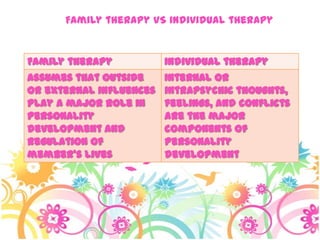
Family therapy VS individual therapy
Family therapy Individual therapy
Assumes that outside
or external influences
play a major role in
personality
development and
regulation of
member’s lives
Internal or
intrapsychic thoughts,
feelings, and conflicts
are the major
components of
personality
development
Approaches to Family therapy
Jones (1980) describes seven orientations
or approaches to family therapy
• Integrative Approach
• Psychoanalytic Approach
• Bowen Approach
• Structural Approach
• Interactional or Strategic
Approach*
• Social Network or Systematic
Approach*
• Behaviorist Approach*
Integrative Approach
• Nathan Ackerman
• Grandfather of family
therapy
• Focused on family values
• A problem arises when
interpersonal conflict is
internalized by the client
and it becomes an
Overall goal: Remove pathogenic or intrapersonal
conflict and promote more healthy relationships
within the family (Jones, 1980)
Psychoanalytic Approach
• Family members are
affected by each member’s
psychological make-up
• Problem arises when there
is an internalization or
introjection of parental
figures
Goal: Guide the family members who exhibit
pathology into clarifying old misunderstandings
and misinterpretations between themselves and
parent s and members of the family of origin and
establishing an adult to adult relationship(Jones,
1980)
Bowen Approach
• Consist of both emotional and
relational systems.
• Individuals behavior is a response to the
functioning of the family system as a
whole (Bowen, 1978)
• Differentiation of self-concept
• Focuses on guiding one or more family
members to become a more solid,
defined self in the face of emotional
forces created by marriage, children,
or the family of origin
Goal: To gain the clarity and conviction to carry
through one’s own positions, such as a parent, spouse,
or dependent child (Titleman, 1998)
Structural Approach
• Salvador Munuchin
• Family as a system of
individuals
• problem arises if family
boundaries become enmeshed
or disengaged and can’t cope
with change
• The therapy is short term and
action oriented with the focus
on changing family organization
and social context
Goal: Develop clear boundaries for individual
members and changing the family’s structural pattern
Interactional or Strategic Approach
• Virginia Satir & Jay Haley
• Communication theory
• The therapist studies the interactions
between and among family members,
recognizing that change in one family
member occurs in relation to change in
another family member.
• Deals with interpersonal relationships
among all family members and focuses
on why the family is in therapy and
what changes each member expects
Goal: Homeostasis among family members
Social Network or Systematic Approach
• Healing comes from social relationship
• Problem arises when the family loses its
ability to recover quickly from change
• This used but is not clearly defined
• Bringing several people together as a
social network who have similar ideals
and goals
Emphasizes the natural healing powers
of the family
Behaviorist Approach
• Individual learns that she or he obtain
satisfaction or rewards from certain
responses of other individuals.
• Problem arises when maladaptive
behavior is learned and reinforced by
the family
• TO GAIN ATTENTION!!
• This approach is direct and clearly
stated in bringing change
Goal: Behavorial change by positive
reinforcement
Stages of Family Therapy
• The Initial Interview
• The intervention or
working phase
• Termination phase
The Initial Interview
• Engagement stage
• Assessment stage
• Exploration stage
• Good setting stage
• Termination stage
Family Assessment Guide
I. Construct of a family genogram
II. Description of the family in
relation to the community,
focusingon ethnicity, socioeconomic
class, educational level and
religion
III. Description of presenting
problems, focusing on each family
member’s perception of the
identified problem
IV. Identification of communication
patterns focusing on who speaks to
whom, tone of voice, emotional
climate and manner by which
emotions are expressed
Family Assessment Guide
V.Identification of roles of family
members as supportive, antagonistic,
critical scapegoat, rescuer, or
victim.Are there family coalitions,
pairings,triangles, splits?
VI. Developmental history of the
family in general and of
presenting problems
VII.Family’s expectations of therapy
Family Assessment Guide
The Intervention or Working
Phase
• The goal of the intervention
phase is to help the family
accept and adjust to change
• Occurs once a week
• The therapist role is to
clarify and interpret
communication as well as
to offer suggestion and
guidance
12 family strengths by Otto
(1963)
1. Provide for the physical, emotional
and spiritual needs of each family
members
2. Be sensitive to the needs of family
members
3. Communicate feelings, emotions,
beliefs and value effectively
4. Provide support, security and
encouragement to enhance creativity
and independence
12 family strengths by Otto
(1963)
5. Initiate and maintain growth-
producing relationships within and
without family system
6. Maintain and create constructive and
responsible community relationships in
the neighborhood, school, town, and
local and state governments.
7. Grow with and through children
12 family strengths by Otto
(1963)
8. Help one’s self and accept help when
appropriate
9. Perform family roles flexible
10. Show mutual respect for the
individuation and independence of each
family member
11. Uses crisis as a means of growth
12. Have aconcern for family unity and
loyalty and for cooperation among
The Termination
Phase
• If the family has
achieved the goals
and identified
specific problems
have been resolved
then its time to
initiate the
termination phase
The Family Life Cycle
• Duvall’s theory, 1977
• The family is a developing system
that must progress in the proper
manner for healthy child
development
• These family developmental tasks
refer to growth and reponsibilities
achieved by a family and by
individual developmental
requisites
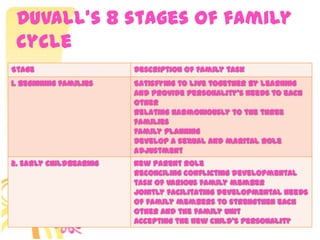
Duvall’s 8 stages of family
cycle
Stage Description of Family task
1. Beginning families Satisfying to live together by learning
and provide personality’s needs to each
other
Relating harmoniously to the three
families
Family planning
Develop a sexual and marital role
adjustment
2. Early Childbearing New parent role
Reconciling conflicting developmental
task of various family member
Jointly facilitating developmental needs
of family members to strengthen each
other and the family unit
Accepting the new child's personality
• Lorem ipsum dolor sit amet,
consectetuer adipiscing elit.
Vivamus et magna. Fusce sed sem
sed magna suscipit egestas.
• Lorem ipsum dolor sit amet,
consectetuer adipiscing elit.
Vivamus et magna. Fusce sed sem
sed magna suscipit egestas.
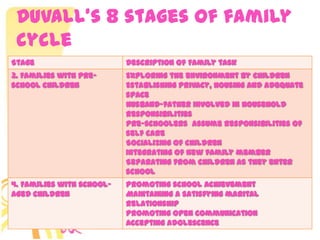
Stage Description of Family task
3. Families with pre-
school children
Exploring the environment by children
Establishing privacy, housing and adequate
space
Husband-father involved in household
responsibilities
Pre-schoolers assume responsibilities of
self care
Socializing of children
Integrating of new family member
Separating from children as they enter
school
4. Families with school-
aged children
Promoting school achievement
Maintaining a satisfying marital
relationship
Promoting open communication
Accepting adolescence
Duvall’s 8 stages of family
cycle
• Lorem ipsum dolor sit amet,
consectetuer adipiscing elit.
Vivamus et magna. Fusce sed sem
sed magna suscipit egestas.
• Lorem ipsum dolor sit amet,
consectetuer adipiscing elit.
Vivamus et magna. Fusce sed sem
sed magna suscipit egestas.
Stage Description of Family task
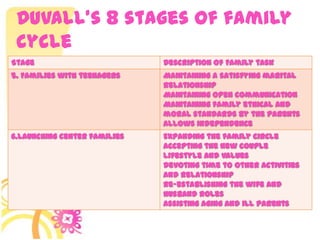
5. Families with teenagers Maintaining a satisfying marital
relationship
Maintaining open communication
Maintaining family ethical and
moral standards by the parents
Allows independence
6.Launching center families Expanding the family circle
Accepting the new couple
lifestyle and values
Devoting time to other activities
and relationship
Re-establishing the wife and
husband roles
Assisting aging and ill parents
Duvall’s 8 stages of family
cycle
• Lorem ipsum dolor sit amet,
consectetuer adipiscing elit.
Vivamus et magna. Fusce sed sem
sed magna suscipit egestas.
• Lorem ipsum dolor sit amet,
consectetuer adipiscing elit.
Vivamus et magna. Fusce sed sem
sed magna suscipit egestas.
Stage Description of Family task
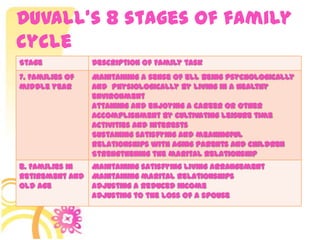
7. Families of
middle year
Maintaining a sense of ell being psychologically
and physiologically by living in a healthy
environment
Attaining and enjoying a career or other
accomplishment by cultivating leisure time
activities and interests
Sustaining satisfying and meaningful
relationships with aging parents and children
Strengthening the marital relationship
8. Families in
retirement and
old age
Maintaining satisfying living arrangement
Maintaining marital relationships
Adjusting a reduced income
Adjusting to the loss of a spouse
Duvall’s 8 stages of family
cycle
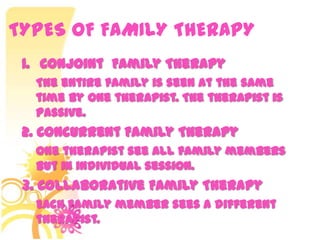
TYPES OF FAMILY THERAPY
1. Conjoint Family Therapy
The entire family is seen at the same
time by one therapist. The therapist is
passive.
2. Concurrent Family Therapy
One therapist see all family members
but in individual session.
3. Collaborative Family Therapy
Each family member sees a different
therapist.
TYPES OF FAMILY THERAPY
3. Multisystematic Therapy
Was developed for juvenile offenders and
their families.
a) Treatment is delivered in the person’s
home, school, or other community
locations
b) Therapist are available for
consultation 24 hours a day 7 days a
week
c) Caseloads of therapist are kept
intentionally low
Family Therapy

Family Therapy

  • 1.
    Family and LifeCycle Presented by Joy Christie P. Suresca
  • 2.
    Objectives After one andhalf hour of discussion my colleageus will be able to: • Differentiate the family therapy from individual psychotherapy • Know the kinds of intervention in family crisis • Enumerate and define different approaches of family therapy
  • 4.
    Family • Are groupsof individual that interact, support, and influence each other in performing basic functions. • They are an integral part of the society, bound together by intense and long- lasting ties of past experience, social roles, mutual support, and expectations.
  • 5.
    System is a setof interacting or interdependent components forming an integrated whole
  • 6.
    Family as aSystem In the early 1950’s , the psychotherapist began to look not only at the individual with problems, but also at the pattern of relationships that correspond with the family problems.
  • 7.
    Family Crisis A crisisoccurs when individuals or families encounter stressful situations and normal coping mechanisms fail to resolve the disruption (Caplan, 1964)
  • 8.
    5 Interpersonal RequisiteFor Maintenance of Well Being or Health in Individuals and Families • Love • Support • Impulse control • Feel part of the group • Personal achievemnt and recognition
  • 9.
    Healthy families takecare of the needs of their members and support each other during crisis (Caplan, 1964)
  • 10.
    Adaptive Qualities ofHealthy Family • Strong parental leadership qualities • Effective communication patterns • Clear boundaries and roles • Flexibility
  • 11.
    Healthy Functioning Families •No single member dominates or control another • Family members participates in activites together • Children are allowed to express opinions • Family members adapt to the changes ( Goldenberg & Goldenberg, 1995)
  • 12.
    In a culturallydiverse families functioning may have different ways. Culture and traditions give families a sense of stability and support from which members draw comfort. Guidance and a means of coping with the problems of life (Andrews & Boyle, 2002)
  • 13.
    Crisis intervention is auseful strategy in which families and children can find relief from overwhelming circumstances
  • 14.
    Family Crisis Intervention Advantages •Enhances self-awareness • Clarifies the roles of members in sustaining it • Develops fresh coping skills • Gains a sense of competency to manage the situation. Langsley & Kaplan (1968)
  • 15.
    Family therapy is amethod of treatment in which family members gain insight into problems, improve communication, improve functioning of individual members as well as the family as a whole .
  • 16.
    Family therapy • Majorgoal is to facilitate positive change in the family • Other goals are – fostering open communication of thoughts and feeling – promoting optimal functioning interdependent roles
  • 17.
    Family therapy VSindividual therapy Family therapy Individual therapy Assumes that outside or external influences play a major role in personality development and regulation of member’s lives Internal or intrapsychic thoughts, feelings, and conflicts are the major components of personality development
  • 18.
    Approaches to Familytherapy Jones (1980) describes seven orientations or approaches to family therapy • Integrative Approach • Psychoanalytic Approach • Bowen Approach • Structural Approach • Interactional or Strategic Approach* • Social Network or Systematic Approach* • Behaviorist Approach*
  • 19.
    Integrative Approach • NathanAckerman • Grandfather of family therapy • Focused on family values • A problem arises when interpersonal conflict is internalized by the client and it becomes an Overall goal: Remove pathogenic or intrapersonal conflict and promote more healthy relationships within the family (Jones, 1980)
  • 20.
    Psychoanalytic Approach • Familymembers are affected by each member’s psychological make-up • Problem arises when there is an internalization or introjection of parental figures Goal: Guide the family members who exhibit pathology into clarifying old misunderstandings and misinterpretations between themselves and parent s and members of the family of origin and establishing an adult to adult relationship(Jones, 1980)
  • 21.
    Bowen Approach • Consistof both emotional and relational systems. • Individuals behavior is a response to the functioning of the family system as a whole (Bowen, 1978) • Differentiation of self-concept • Focuses on guiding one or more family members to become a more solid, defined self in the face of emotional forces created by marriage, children, or the family of origin Goal: To gain the clarity and conviction to carry through one’s own positions, such as a parent, spouse, or dependent child (Titleman, 1998)
  • 22.
    Structural Approach • SalvadorMunuchin • Family as a system of individuals • problem arises if family boundaries become enmeshed or disengaged and can’t cope with change • The therapy is short term and action oriented with the focus on changing family organization and social context Goal: Develop clear boundaries for individual members and changing the family’s structural pattern
  • 23.
    Interactional or StrategicApproach • Virginia Satir & Jay Haley • Communication theory • The therapist studies the interactions between and among family members, recognizing that change in one family member occurs in relation to change in another family member. • Deals with interpersonal relationships among all family members and focuses on why the family is in therapy and what changes each member expects Goal: Homeostasis among family members
  • 24.
    Social Network orSystematic Approach • Healing comes from social relationship • Problem arises when the family loses its ability to recover quickly from change • This used but is not clearly defined • Bringing several people together as a social network who have similar ideals and goals Emphasizes the natural healing powers of the family
  • 25.
    Behaviorist Approach • Individuallearns that she or he obtain satisfaction or rewards from certain responses of other individuals. • Problem arises when maladaptive behavior is learned and reinforced by the family • TO GAIN ATTENTION!! • This approach is direct and clearly stated in bringing change Goal: Behavorial change by positive reinforcement
  • 26.
    Stages of FamilyTherapy • The Initial Interview • The intervention or working phase • Termination phase
  • 27.
    The Initial Interview •Engagement stage • Assessment stage • Exploration stage • Good setting stage • Termination stage
  • 28.
    Family Assessment Guide I.Construct of a family genogram II. Description of the family in relation to the community, focusingon ethnicity, socioeconomic class, educational level and religion III. Description of presenting problems, focusing on each family member’s perception of the identified problem
  • 29.
    IV. Identification ofcommunication patterns focusing on who speaks to whom, tone of voice, emotional climate and manner by which emotions are expressed Family Assessment Guide
  • 30.
    V.Identification of rolesof family members as supportive, antagonistic, critical scapegoat, rescuer, or victim.Are there family coalitions, pairings,triangles, splits? VI. Developmental history of the family in general and of presenting problems VII.Family’s expectations of therapy Family Assessment Guide
  • 31.
    The Intervention orWorking Phase • The goal of the intervention phase is to help the family accept and adjust to change • Occurs once a week • The therapist role is to clarify and interpret communication as well as to offer suggestion and guidance
  • 32.
    12 family strengthsby Otto (1963) 1. Provide for the physical, emotional and spiritual needs of each family members 2. Be sensitive to the needs of family members 3. Communicate feelings, emotions, beliefs and value effectively 4. Provide support, security and encouragement to enhance creativity and independence
  • 33.
    12 family strengthsby Otto (1963) 5. Initiate and maintain growth- producing relationships within and without family system 6. Maintain and create constructive and responsible community relationships in the neighborhood, school, town, and local and state governments. 7. Grow with and through children
  • 34.
    12 family strengthsby Otto (1963) 8. Help one’s self and accept help when appropriate 9. Perform family roles flexible 10. Show mutual respect for the individuation and independence of each family member 11. Uses crisis as a means of growth 12. Have aconcern for family unity and loyalty and for cooperation among
  • 35.
    The Termination Phase • Ifthe family has achieved the goals and identified specific problems have been resolved then its time to initiate the termination phase
  • 36.
    The Family LifeCycle • Duvall’s theory, 1977 • The family is a developing system that must progress in the proper manner for healthy child development • These family developmental tasks refer to growth and reponsibilities achieved by a family and by individual developmental requisites
  • 37.
    Duvall’s 8 stagesof family cycle Stage Description of Family task 1. Beginning families Satisfying to live together by learning and provide personality’s needs to each other Relating harmoniously to the three families Family planning Develop a sexual and marital role adjustment 2. Early Childbearing New parent role Reconciling conflicting developmental task of various family member Jointly facilitating developmental needs of family members to strengthen each other and the family unit Accepting the new child's personality
  • 38.
    • Lorem ipsumdolor sit amet, consectetuer adipiscing elit. Vivamus et magna. Fusce sed sem sed magna suscipit egestas. • Lorem ipsum dolor sit amet, consectetuer adipiscing elit. Vivamus et magna. Fusce sed sem sed magna suscipit egestas. Stage Description of Family task 3. Families with pre- school children Exploring the environment by children Establishing privacy, housing and adequate space Husband-father involved in household responsibilities Pre-schoolers assume responsibilities of self care Socializing of children Integrating of new family member Separating from children as they enter school 4. Families with school- aged children Promoting school achievement Maintaining a satisfying marital relationship Promoting open communication Accepting adolescence Duvall’s 8 stages of family cycle
  • 39.
    • Lorem ipsumdolor sit amet, consectetuer adipiscing elit. Vivamus et magna. Fusce sed sem sed magna suscipit egestas. • Lorem ipsum dolor sit amet, consectetuer adipiscing elit. Vivamus et magna. Fusce sed sem sed magna suscipit egestas. Stage Description of Family task 5. Families with teenagers Maintaining a satisfying marital relationship Maintaining open communication Maintaining family ethical and moral standards by the parents Allows independence 6.Launching center families Expanding the family circle Accepting the new couple lifestyle and values Devoting time to other activities and relationship Re-establishing the wife and husband roles Assisting aging and ill parents Duvall’s 8 stages of family cycle
  • 40.
    • Lorem ipsumdolor sit amet, consectetuer adipiscing elit. Vivamus et magna. Fusce sed sem sed magna suscipit egestas. • Lorem ipsum dolor sit amet, consectetuer adipiscing elit. Vivamus et magna. Fusce sed sem sed magna suscipit egestas. Stage Description of Family task 7. Families of middle year Maintaining a sense of ell being psychologically and physiologically by living in a healthy environment Attaining and enjoying a career or other accomplishment by cultivating leisure time activities and interests Sustaining satisfying and meaningful relationships with aging parents and children Strengthening the marital relationship 8. Families in retirement and old age Maintaining satisfying living arrangement Maintaining marital relationships Adjusting a reduced income Adjusting to the loss of a spouse Duvall’s 8 stages of family cycle
  • 41.
    TYPES OF FAMILYTHERAPY 1. Conjoint Family Therapy The entire family is seen at the same time by one therapist. The therapist is passive. 2. Concurrent Family Therapy One therapist see all family members but in individual session. 3. Collaborative Family Therapy Each family member sees a different therapist.
  • 42.
    TYPES OF FAMILYTHERAPY 3. Multisystematic Therapy Was developed for juvenile offenders and their families. a) Treatment is delivered in the person’s home, school, or other community locations b) Therapist are available for consultation 24 hours a day 7 days a week c) Caseloads of therapist are kept intentionally low

Editor's Notes

  • #7 These psychotherapies included Murray Bowen, Nathan Ackerman, Salvador Minuchin, Jay Haley and Virginia Satir.They begin to change their approach from treating and to include family to help increase therapeutic effectivenessThese changes was on the belief that until the pattern of the family was changed, the individual behaviour would remain fixed.So this approach correspond with another method that viewing family as a system of relationships such as that between brother and sister or mother and daughter.Each member of the family must able to communicate in a productive and healthy way with others in the system.
  • #8 Additionally, families in crisis experience impaired or ineffectual interactional patterns, which generates disruptive coping responses.
  • #16 This is useful when the family system does not perform its basic functions adequately.Issues such as Dysfunction or the acting out as a child Marital conflict or intergenerational relationship problems that can be improved through family therapy
  • #17 The therapist must function as a role model, demonstrating how to deal with conflictsThe therapist also helps family members take a realistic view of their relationships with one another and overall effect of their behavior on each other.
  • #37 An understanding of these stages provides the nurse with guidelines for analyzing family growth and health promotion needs and the ability to provide therapeutic intervention when conflict arises.