FAMILY
PLANNING
Contents:
• Why family planning?
• Contraceptive usage and unmet need of FP
• National Population Policy 2000
• Fertility trend in India
• Definition of family planning
• The welfare concept
• Family planning methods
• National Family Planning Program
• Situational analysis of Nuh (Mewat)
• References
*
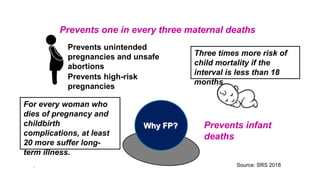
Prevents one in every three maternal deaths
Why FP?
Prevents unintended
pregnancies and unsafe
abortions
Prevents high-risk
pregnancies
For every woman who
dies of pregnancy and
childbirth
complications, at least
20 more suffer long-
term illness.
Three times more risk of
child mortality if the
interval is less than 18
months
Prevents infant
deaths
Source: SRS 2018
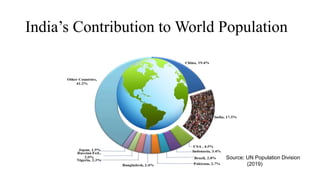
India’s Contribution to World Population
Source: UN Population Division
(2019)
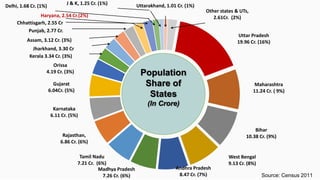
Uttar Pradesh
19.96 Cr. (16%)
Maharashtra
11.24 Cr. ( 9%)
Bihar
10.38 Cr. (9%)
West Bengal
9.13 Cr. (8%)
Andhra Pradesh
8.47 Cr. (7%)
Madhya Pradesh
7.26 Cr. (6%)
Tamil Nadu
7.21 Cr. (6%)
Rajasthan,
6.86 Cr. (6%)
Karnataka
6.11 Cr. (5%)
Gujarat
6.04Cr. (5%)
Orissa
4.19 Cr. (3%)
Kerala 3.34 Cr. (3%)
Jharkhand, 3.30 Cr
Assam, 3.12 Cr. (3%)
Punjab, 2.77 Cr.
Chhattisgarh, 2.55 Cr
Haryana, 2.54 Cr.(2%)
Delhi, 1.68 Cr. (1%)
J & K, 1.25 Cr. (1%) Uttarakhand, 1.01 Cr. (1%)
Other states & UTs,
2.61Cr. (2%)
Population
Share of
States
(In Crore)
Source: Census 2011
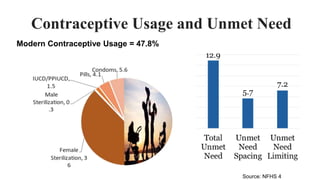
Contraceptive Usage and Unmet Need
Modern Contraceptive Usage = 47.8%
Source: NFHS 4
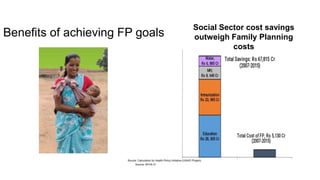
Benefits of achieving FP goals
Social Sector cost savings
outweigh Family Planning
costs
Source: NFHS IV
Source: Calculation by Health Policy Initiative (USAID Project)
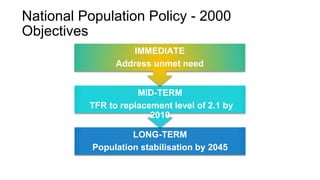
LONG-TERM
Population stabilisation by 2045
MID-TERM
TFR to replacement level of 2.1 by
2010
IMMEDIATE
Address unmet need
National Population Policy - 2000
Objectives
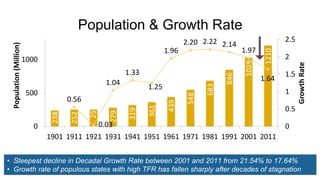
Population & Growth Rate
238
252
251
279
319
361
439
548
683
846
1029
1210
0.56
0.03
1.04
1.33
1.25
1.96
2.20 2.22 2.14
1.97
1.64
0
0.5
1
1.5
2
2.5
0
500
1000
1901 1911 1921 1931 1941 1951 1961 1971 1981 1991 2001 2011
Growth
Rate
Population
(Million)
• Steepest decline in Decadal Growth Rate between 2001 and 2011 from 21.54% to 17.64%
• Growth rate of populous states with high TFR has fallen sharply after decades of stagnation
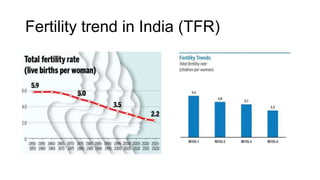
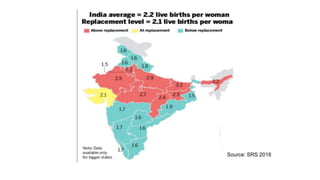
Fertility trend in India (TFR)
Source: SRS 2018
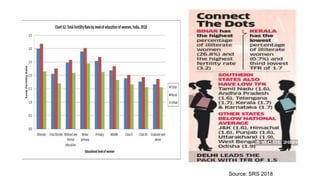
Source: SRS 2018
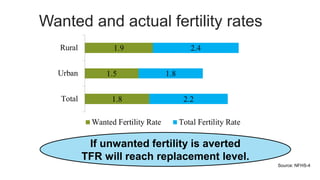
Wanted and actual fertility rates
Source: NFHS-4
If unwanted fertility is averted
TFR will reach replacement level.
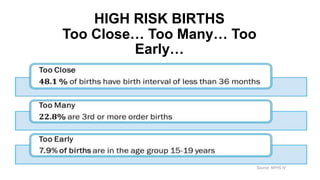
HIGH RISK BIRTHS
Too Close… Too Many… Too
Early…
Source: NFHS IV
Definition
As per WHO, family planning is a way of thinking and living that is
adopted voluntarily, upon the basis of knowledge, attitude and
responsible decision by individuals and couples in order to promote the
health and welfare of family group and thus contribute effectively to
the social development of country.
Objectives
The use of a range of methods of a fertility regulation to help
individuals or couples attain certain objectives:
avoid unwanted birth.
bring about wanted birth.
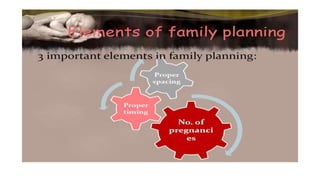
Produce a change in the no. of children born.
Regulate the intervals between pregnancies.
Control time at which birth occur.
The welfare concept
• Till 1977, the concept was Family Planning. It was associated with
numerous misconceptions.
• In 1977, the concept of family welfare came which is very
comprehensive and is related to quality of life.
• The family welfare programme aims to improve the quality of life of
the people.
Eligible couple
• “Eligible couple” refers to a currently married couple wherein the
wife is in the reproductive age, i.e. 15-45 years. There will be 150-
180 such couples per 1000 population in India.
• “Target couple” is the couple with 2-3 living children and are in need
of family planning services.
Couple protection rate (CPR)
• Percent of eligible couples effectively protected against childbirth by
one or the other approved methods of family planning.
Barrier methods :
Condoms (male and female)
Spermicidal
Sponge
Diaphragm
Cervical cap
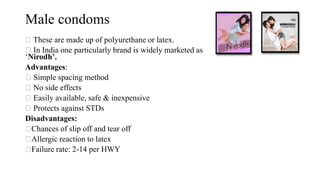
Male condoms
These are made up of polyurethane or latex.
In India one particularly brand is widely marketed as
‘Nirodh’.
Advantages:
Simple spacing method
No side effects
Easily available, safe & inexpensive
Protects against STDs
Disadvantages:
Chances of slip off and tear off
Allergic reaction to latex
Failure rate: 2-14 per HWY
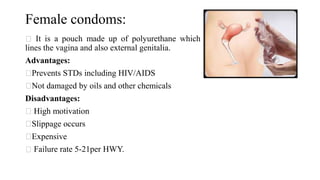
Female condoms:
It is a pouch made up of polyurethane which
lines the vagina and also external genitalia.
Advantages:
Prevents STDs including HIV/AIDS
Not damaged by oils and other chemicals
Disadvantages:
High motivation
Slippage occurs
Expensive
Failure rate 5-21per HWY.
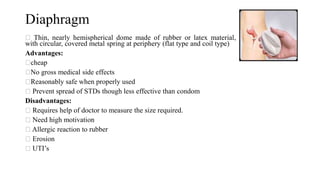
Diaphragm
Thin, nearly hemispherical dome made of rubber or latex material,
with circular, covered metal spring at periphery (flat type and coil type)
Advantages:
cheap
No gross medical side effects
Reasonably safe when properly used
Prevent spread of STDs though less effective than condom
Disadvantages:
Requires help of doctor to measure the size required.
Need high motivation
Allergic reaction to rubber
Erosion
UTI’s
Spermicides
Available as vaginal foams ,gels ,creams ,tablets and suppositories.
Contain surfactant like nonoxynol 9,benzalkonium chloride.
Advantages:
No instructions by doctors or nurses
Easily available and easy to use
No gross medical side effects
Disadvantages
Failure rate : 6-21 per HWY
Can increase spread of HIV infection by irritating vaginal and cervical
mucosa
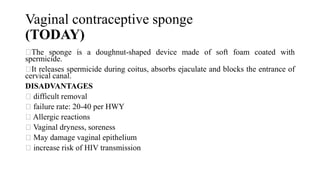
Vaginal contraceptive sponge
(TODAY)
The sponge is a doughnut-shaped device made of soft foam coated with
spermicide.
It releases spermicide during coitus, absorbs ejaculate and blocks the entrance of
cervical canal.
DISADVANTAGES
difficult removal
failure rate: 20-40 per HWY
Allergic reactions
Vaginal dryness, soreness
May damage vaginal epithelium
increase risk of HIV transmission
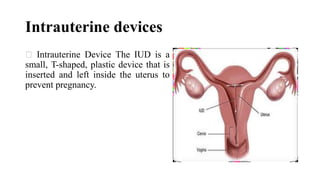
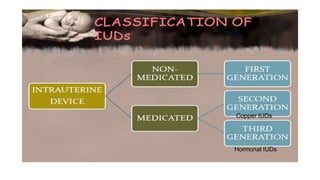
Intrauterine devices
Intrauterine Device The IUD is a
small, T-shaped, plastic device that is
inserted and left inside the uterus to
prevent pregnancy.
Copper IUDs
Hormonal IUDs
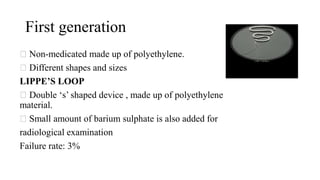
First generation
Non-medicated made up of polyethylene.
Different shapes and sizes
LIPPE’S LOOP
Double ‘s’ shaped device , made up of polyethylene
material.
Small amount of barium sulphate is also added for
radiological examination
Failure rate: 3%
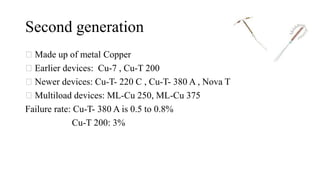
Second generation
Made up of metal Copper
Earlier devices: Cu-7 , Cu-T 200
Newer devices: Cu-T- 220 C , Cu-T- 380 A , Nova T
Multiload devices: ML-Cu 250, ML-Cu 375
Failure rate: Cu-T- 380 A is 0.5 to 0.8%
Cu-T 200: 3%
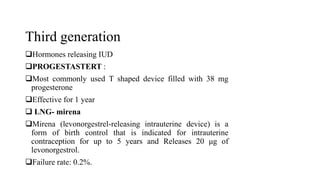
Third generation
Hormones releasing IUD
PROGESTASTERT :
Most commonly used T shaped device filled with 38 mg
progesterone
Effective for 1 year
 LNG- mirena
Mirena (levonorgestrel-releasing intrauterine device) is a
form of birth control that is indicated for intrauterine
contraception for up to 5 years and Releases 20 μg of
levonorgestrol.
Failure rate: 0.2%.
SIDE EFFECTS
Intermenstrual bleeding
and spotting
Abdominal/pelvic pain
Ovarian cysts
Headache/migraine
depressed/altered
mood.
ADVANTAGES OF IUD
Safe
effective , Reversible
Long action, Inexpensive
DISADVANTAGES
Heavy bleeding and pain
Pelvic inflammatory diseases
Ectopic pregnancy
Expulsion
However, third gen. IUD decreases blood
loss and may cause amenorrhoea.
CONTRAINDICATION
History of PID
Abnormal shaped uterus
pregnancy
Menorrhagia
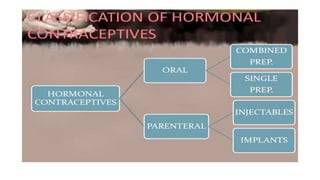
Combined oral contraceptive pills
Mala–N 21+7 iron tab, Mala –D 21+7 iron tab.
Composition: Levonorgestrel (150mcg),
Ethinyl estradiol (30mcg)
Contraindications :
Absolute:
Circulatory diseases
Severe HTN
Angina, ischemic heart dis.
Liver disease
Tumors
Pregnancy
breast cancer, breast feeding.
Relative:
Age>40 yrs.
Smoker, history of jaundice
Diabetes
Benefits
Contraceptive benefits:
Protection against unwanted
pregnancy
Convenient to use.
Non-contraceptives benefits:
Regulation of menstrual cycle
Reduction of dysmenorrhea
Protection against PID,fibroids,
ovarian cysts.
Side effects
Dizziness
Nausea
Weight gain
Headache
Breast tenderness
vaginal infection
Depression
increase blood clotting
Progesterone only pills
Also known as “minipill”.
Causing plug of mucus in the neck of cervix block the entry of the
sperm. Example: levonorgesrol 75 μg, desogestrel 75 μg
Advantages
No side effect on breast feeding or lactation
May be prescribed in patient having diabetes, HTN , smoking etc.
Reduce risk of pid
Disadvantages
Acne, mastalgia, headache
Depot contraceptives
These are more suitable for women who do not want to get pregnant
again or for few years.
These are:
Contraceptive injections
Implants
Patches
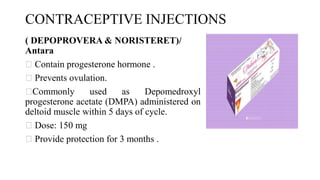
CONTRACEPTIVE INJECTIONS
( DEPOPROVERA & NORISTERET)/
Antara
Contain progesterone hormone .
Prevents ovulation.
Commonly used as Depomedroxyl
progesterone acetate (DMPA) administered on
deltoid muscle within 5 days of cycle.
Dose: 150 mg
Provide protection for 3 months .
Contraceptive implants
NORPLANT – II
It is a small device placed under the skin
Contains progesterone hormone .
Inhibits ovulation.
Lasts for 3 years.
Two rods of 4cm long. Each rod containing 75 mg of levonorgestrel
releases 50 mcg per day.
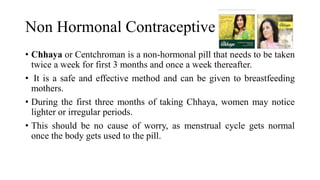
Non Hormonal Contraceptive
• Chhaya or Centchroman is a non-hormonal pill that needs to be taken
twice a week for first 3 months and once a week thereafter.
• It is a safe and effective method and can be given to breastfeeding
mothers.
• During the first three months of taking Chhaya, women may notice
lighter or irregular periods.
• This should be no cause of worry, as menstrual cycle gets normal
once the body gets used to the pill.
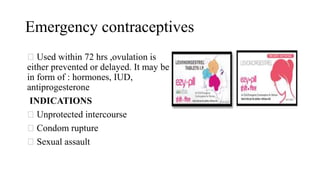
Emergency contraceptives
Used within 72 hrs ,ovulation is
either prevented or delayed. It may be
in form of : hormones, IUD,
antiprogesterone
INDICATIONS
Unprotected intercourse
Condom rupture
Sexual assault
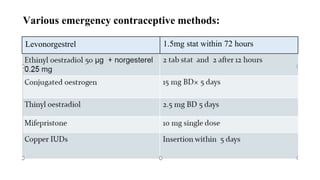
Levonorgestrel 1.5mg stat within 72 hours
Various emergency contraceptive methods:
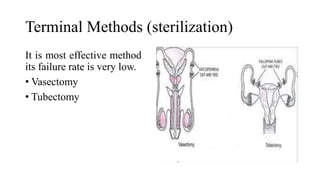
Terminal Methods (sterilization)
It is most effective method
its failure rate is very low.
• Vasectomy
• Tubectomy
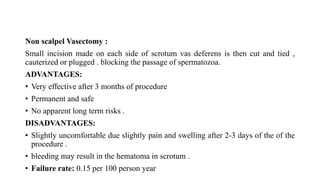
Non scalpel Vasectomy :
Small incision made on each side of scrotum vas deferens is then cut and tied ,
cauterized or plugged . blocking the passage of spermatozoa.
ADVANTAGES:
• Very effective after 3 months of procedure
• Permanent and safe
• No apparent long term risks .
DISADVANTAGES:
• Slightly uncomfortable due slightly pain and swelling after 2-3 days of the of the
procedure .
• bleeding may result in the hematoma in scrotum .
• Failure rate: 0.15 per 100 person year
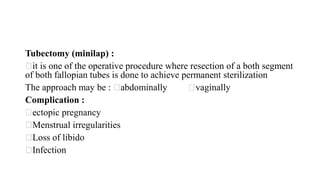
Tubectomy (minilap) :
it is one of the operative procedure where resection of a both segment
of both fallopian tubes is done to achieve permanent sterilization
The approach may be : abdominally vaginally
Complication :
ectopic pregnancy
Menstrual irregularities
Loss of libido
Infection
National Family Planning
Program
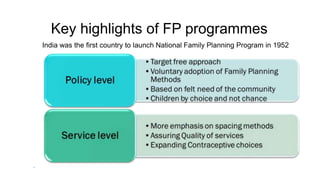
Key highlights of FP programmes
*
India was the first country to launch National Family Planning Program in 1952
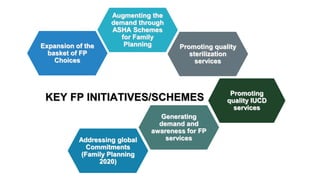
Expansion of the
basket of FP
Choices
Augmenting the
demand through
ASHA Schemes
for Family
Planning Promoting quality
sterilization
services
Promoting
quality IUCD
services
Generating
demand and
awareness for FP
services
Addressing global
Commitments
(Family Planning
2020)
KEY FP INITIATIVES/SCHEMES
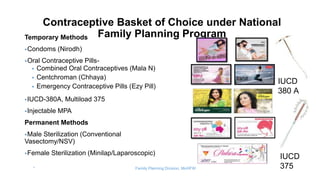
Contraceptive Basket of Choice under National
Family Planning Program
Temporary Methods
•Condoms (Nirodh)
•Oral Contraceptive Pills-
• Combined Oral Contraceptives (Mala N)
• Centchroman (Chhaya)
• Emergency Contraceptive Pills (Ezy Pill)
•IUCD-380A, Multiload 375
•Injectable MPA
Permanent Methods
•Male Sterilization (Conventional
Vasectomy/NSV)
•Female Sterilization (Minilap/Laparoscopic)
* Family Planning Division, MoHFW
IUCD
380 A
IUCD
375
Expansion of the basket of FP Choices
Introduction of new contraceptive choices-
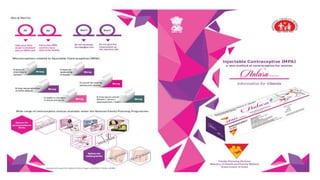
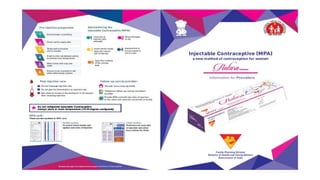
▪ Injectable Contraceptive (Antara Program)
▪ Centchroman (Chhaya)
▪ Progesterone only Pills- under pilot
Introduction of new device-
▪ Multiload IUCD 375 (effective for five years) was introduced in program in
2012-13.
Introduction of new method-
▪ Post partum IUCD was introduced in the program in 2010-11 and has provided
post partum women an effective spacing option.
Augmenting the demand through ASHA
Schemes for Family Planning
•Home Delivery of Contraceptives
•Ensuring Spacing at Birth
•Pregnancy Testing Kits-
•Pregnancy Testing Kits are now a part of ASHA kits so as
to ensure early management of pregnancy
Promoting quality sterilization services
•Sterilization Compensation Scheme-The compensation package has been
enhanced in 2014 for 11 high focus high TFR states
• Higher package for post partum sterilization and male sterilization
• Higher package for MPV districts
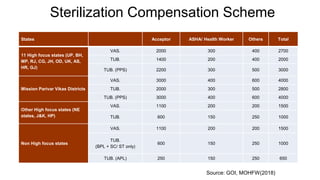
Sterilization Compensation Scheme
States Acceptor ASHA/ Health Worker Others Total
11 High focus states (UP, BH,
MP, RJ, CG, JH, OD, UK, AS,
HR, GJ)
VAS. 2000 300 400 2700
TUB. 1400 200 400 2000
TUB. (PPS) 2200 300 500 3000
Mission Parivar Vikas Districts
VAS. 3000 400 600 4000
TUB. 2000 300 500 2800
TUB. (PPS) 3000 400 600 4000
Other High focus states (NE
states, J&K, HP)
VAS. 1100 200 200 1500
TUB. 600 150 250 1000
Non High focus states
VAS. 1100 200 200 1500
TUB.
(BPL + SC/ ST only)
600 150 250 1000
TUB. (APL) 250 150 250 650
Source: GOI, MOHFW(2018)
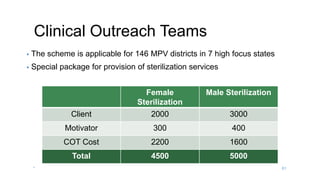
Clinical Outreach Teams
• The scheme is applicable for 146 MPV districts in 7 high focus states
• Special package for provision of sterilization services
Female
Sterilization
Male Sterilization
Client 2000 3000
Motivator 300 400
COT Cost 2200 1600
Total 4500 5000
* 61
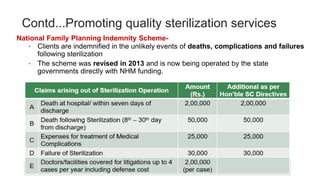
Contd...Promoting quality sterilization services
National Family Planning Indemnity Scheme-
• Clients are indemnified in the unlikely events of deaths, complications and failures
following sterilization
• The scheme was revised in 2013 and is now being operated by the state
governments directly with NHM funding.
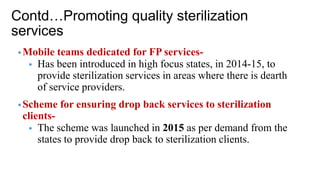
Contd…Promoting quality sterilization
services
•Mobile teams dedicated for FP services-
• Has been introduced in high focus states, in 2014-15, to
provide sterilization services in areas where there is dearth
of service providers.
•Scheme for ensuring drop back services to sterilization
clients-
• The scheme was launched in 2015 as per demand from the
states to provide drop back to sterilization clients.
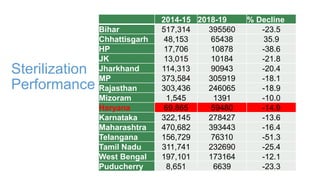
Sterilization
Performance
2014-15 2018-19 % Decline
Bihar 517,314 395560 -23.5
Chhattisgarh 48,153 65438 35.9
HP 17,706 10878 -38.6
JK 13,015 10184 -21.8
Jharkhand 114,313 90943 -20.4
MP 373,584 305919 -18.1
Rajasthan 303,436 246065 -18.9
Mizoram 1,545 1391 -10.0
Haryana 69,865 59480 -14.9
Karnataka 322,145 278427 -13.6
Maharashtra 470,682 393443 -16.4
Telangana 156,729 76310 -51.3
Tamil Nadu 311,741 232690 -25.4
West Bengal 197,101 173164 -12.1
Puducherry 8,651 6639 -23.3
Promoting quality IUCD services
• Interval IUCD:
• Can be provided in all public health facilities by a trained provider in OPD
• PPIUCD (Post partum IUCD):
• Inserted within 48 hours after delivery in facilities conducting deliveries
• PAIUCD (Post abortion IUCD):
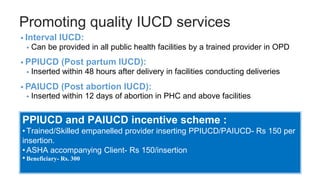
• Inserted within 12 days of abortion in PHC and above facilities
PPIUCD and PAIUCD incentive scheme :
•Trained/Skilled empanelled provider inserting PPIUCD/PAIUCD- Rs 150 per
insertion.
•ASHA accompanying Client- Rs 150/insertion
•Beneficiary- Rs. 300
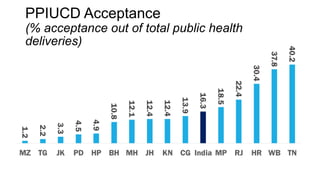
PPIUCD Acceptance
(% acceptance out of total public health
deliveries)
•Increasing provider’s base for providing IUCD services-
• Task shifting was introduced for utilizing the army of doctors
qualified in ISM (Ayurveda, Unani, Siddha and Homeopathy)
for the provision of IUCD services after undergoing a
structured training, at peripheral public health facilities.
Generating demand and awareness for FP
services
• Improved counseling through RMNCH Counselors
• Celebration of World Population Day & fortnight (July 11 – July 24)
• Population stabilisation fortnight has helped to break the seasonal trend of sterilization services
in the northern states of India.
• It is being held in all blocks, districts and states of India since 2009 and the event is observed
over a month long period, split into:
• June 27 to July 10: “Dampati Sampark Pakhwada” or “Mobilisation Fortnight”
• July 11 to July 24: or “Jansankhya Sthirtha Pakhwada” or “Population Stabilisation
Fortnight”
• Celebration of Vasectomy fortnight (21st November to 4th December)
• The objective is to improve male participation in Family Planning
New Initiatives under Family Planning
•Mission Parivar Vikas
•Unified Software for FP logistics
•Expansion of Contraceptive basket of choices
•New Contraceptive Packaging
•New FP media campaign
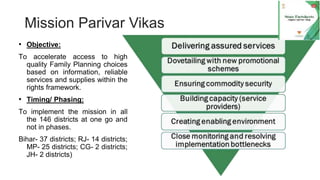
Mission Parivar Vikas
• Objective:
To accelerate access to high
quality Family Planning choices
based on information, reliable
services and supplies within the
rights framework.
• Timing/ Phasing:
To implement the mission in all
the 146 districts at one go and
not in phases.
Bihar- 37 districts; RJ- 14 districts;
MP- 25 districts; CG- 2 districts;
JH- 2 districts)
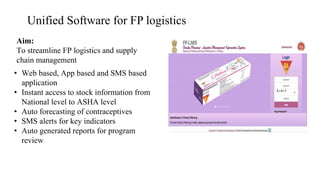
Unified Software for FP logistics
Aim:
To streamline FP logistics and supply
chain management
• Web based, App based and SMS based
application
• Instant access to stock information from
National level to ASHA level
• Auto forecasting of contraceptives
• SMS alerts for key indicators
• Auto generated reports for program
review
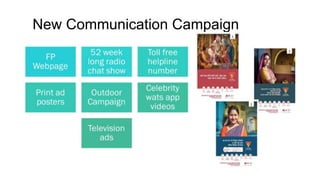
New Communication Campaign
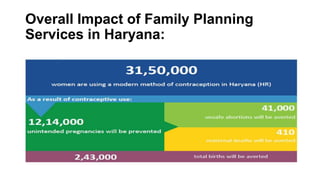
Overall Impact of Family Planning
Services in Haryana:
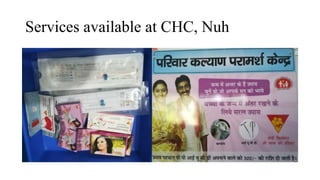
Services available at CHC, Nuh
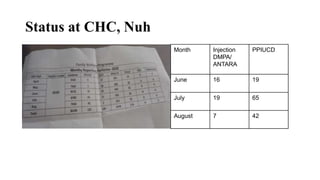
Status at CHC, Nuh
Month Injection
DMPA/
ANTARA
PPIUCD
June 16 19
July 19 65
August 7 42
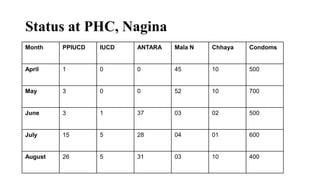
Status at PHC, Nagina
Month PPIUCD IUCD ANTARA Mala N Chhaya Condoms
April 1 0 0 45 10 500
May 3 0 0 52 10 700
June 3 1 37 03 02 500
July 15 5 28 04 01 600
August 26 5 31 03 10 400
References:
1. Park K. Preventive and Social Medicine. 25th Edition. India: M/s
Banarsidas Bhanot Publishers; 2019.
2. National Family Health Survey (NFHS- 4) ( 2015-16).
3. Sample Registration System (SRS- 2018).
4. Health Policy Initiative (USAID Project).
5. UN Population Division (2019).
6. National Health Portal ( MOHFW).
Its all about making the right
choice at the right time.
Responsible Us for a
Responsible Future!
Thank You…

Family planning methods and modern contraceptives by Dr. Sonam Aggarwal

  • 1.
  • 2.
    Contents: • Why familyplanning? • Contraceptive usage and unmet need of FP • National Population Policy 2000 • Fertility trend in India • Definition of family planning • The welfare concept • Family planning methods • National Family Planning Program • Situational analysis of Nuh (Mewat) • References
  • 3.
    * Prevents one inevery three maternal deaths Why FP? Prevents unintended pregnancies and unsafe abortions Prevents high-risk pregnancies For every woman who dies of pregnancy and childbirth complications, at least 20 more suffer long- term illness. Three times more risk of child mortality if the interval is less than 18 months Prevents infant deaths Source: SRS 2018
  • 4.
    India’s Contribution toWorld Population Source: UN Population Division (2019)
  • 5.
    Uttar Pradesh 19.96 Cr.(16%) Maharashtra 11.24 Cr. ( 9%) Bihar 10.38 Cr. (9%) West Bengal 9.13 Cr. (8%) Andhra Pradesh 8.47 Cr. (7%) Madhya Pradesh 7.26 Cr. (6%) Tamil Nadu 7.21 Cr. (6%) Rajasthan, 6.86 Cr. (6%) Karnataka 6.11 Cr. (5%) Gujarat 6.04Cr. (5%) Orissa 4.19 Cr. (3%) Kerala 3.34 Cr. (3%) Jharkhand, 3.30 Cr Assam, 3.12 Cr. (3%) Punjab, 2.77 Cr. Chhattisgarh, 2.55 Cr Haryana, 2.54 Cr.(2%) Delhi, 1.68 Cr. (1%) J & K, 1.25 Cr. (1%) Uttarakhand, 1.01 Cr. (1%) Other states & UTs, 2.61Cr. (2%) Population Share of States (In Crore) Source: Census 2011
  • 6.
    Contraceptive Usage andUnmet Need Modern Contraceptive Usage = 47.8% Source: NFHS 4
  • 7.
    Benefits of achievingFP goals Social Sector cost savings outweigh Family Planning costs Source: NFHS IV Source: Calculation by Health Policy Initiative (USAID Project)
  • 8.
    LONG-TERM Population stabilisation by2045 MID-TERM TFR to replacement level of 2.1 by 2010 IMMEDIATE Address unmet need National Population Policy - 2000 Objectives
  • 9.
    Population & GrowthRate 238 252 251 279 319 361 439 548 683 846 1029 1210 0.56 0.03 1.04 1.33 1.25 1.96 2.20 2.22 2.14 1.97 1.64 0 0.5 1 1.5 2 2.5 0 500 1000 1901 1911 1921 1931 1941 1951 1961 1971 1981 1991 2001 2011 Growth Rate Population (Million) • Steepest decline in Decadal Growth Rate between 2001 and 2011 from 21.54% to 17.64% • Growth rate of populous states with high TFR has fallen sharply after decades of stagnation
  • 10.
    Fertility trend inIndia (TFR)
  • 11.
  • 12.
  • 13.
    Wanted and actualfertility rates Source: NFHS-4 If unwanted fertility is averted TFR will reach replacement level.
  • 14.
    HIGH RISK BIRTHS TooClose… Too Many… Too Early… Source: NFHS IV
  • 15.
    Definition As per WHO,family planning is a way of thinking and living that is adopted voluntarily, upon the basis of knowledge, attitude and responsible decision by individuals and couples in order to promote the health and welfare of family group and thus contribute effectively to the social development of country.
  • 16.
    Objectives The use ofa range of methods of a fertility regulation to help individuals or couples attain certain objectives: avoid unwanted birth. bring about wanted birth. Produce a change in the no. of children born. Regulate the intervals between pregnancies. Control time at which birth occur.
  • 18.
    The welfare concept •Till 1977, the concept was Family Planning. It was associated with numerous misconceptions. • In 1977, the concept of family welfare came which is very comprehensive and is related to quality of life. • The family welfare programme aims to improve the quality of life of the people.
  • 19.
    Eligible couple • “Eligiblecouple” refers to a currently married couple wherein the wife is in the reproductive age, i.e. 15-45 years. There will be 150- 180 such couples per 1000 population in India. • “Target couple” is the couple with 2-3 living children and are in need of family planning services.
  • 20.
    Couple protection rate(CPR) • Percent of eligible couples effectively protected against childbirth by one or the other approved methods of family planning.
  • 23.
    Barrier methods : Condoms(male and female) Spermicidal Sponge Diaphragm Cervical cap
  • 24.
    Male condoms These aremade up of polyurethane or latex. In India one particularly brand is widely marketed as ‘Nirodh’. Advantages: Simple spacing method No side effects Easily available, safe & inexpensive Protects against STDs Disadvantages: Chances of slip off and tear off Allergic reaction to latex Failure rate: 2-14 per HWY
  • 25.
    Female condoms: It isa pouch made up of polyurethane which lines the vagina and also external genitalia. Advantages: Prevents STDs including HIV/AIDS Not damaged by oils and other chemicals Disadvantages: High motivation Slippage occurs Expensive Failure rate 5-21per HWY.
  • 26.
    Diaphragm Thin, nearly hemisphericaldome made of rubber or latex material, with circular, covered metal spring at periphery (flat type and coil type) Advantages: cheap No gross medical side effects Reasonably safe when properly used Prevent spread of STDs though less effective than condom Disadvantages: Requires help of doctor to measure the size required. Need high motivation Allergic reaction to rubber Erosion UTI’s
  • 27.
    Spermicides Available as vaginalfoams ,gels ,creams ,tablets and suppositories. Contain surfactant like nonoxynol 9,benzalkonium chloride. Advantages: No instructions by doctors or nurses Easily available and easy to use No gross medical side effects Disadvantages Failure rate : 6-21 per HWY Can increase spread of HIV infection by irritating vaginal and cervical mucosa
  • 28.
    Vaginal contraceptive sponge (TODAY) Thesponge is a doughnut-shaped device made of soft foam coated with spermicide. It releases spermicide during coitus, absorbs ejaculate and blocks the entrance of cervical canal. DISADVANTAGES difficult removal failure rate: 20-40 per HWY Allergic reactions Vaginal dryness, soreness May damage vaginal epithelium increase risk of HIV transmission
  • 29.
    Intrauterine devices Intrauterine DeviceThe IUD is a small, T-shaped, plastic device that is inserted and left inside the uterus to prevent pregnancy.
  • 30.
  • 31.
    First generation Non-medicated madeup of polyethylene. Different shapes and sizes LIPPE’S LOOP Double ‘s’ shaped device , made up of polyethylene material. Small amount of barium sulphate is also added for radiological examination Failure rate: 3%
  • 32.
    Second generation Made upof metal Copper Earlier devices: Cu-7 , Cu-T 200 Newer devices: Cu-T- 220 C , Cu-T- 380 A , Nova T Multiload devices: ML-Cu 250, ML-Cu 375 Failure rate: Cu-T- 380 A is 0.5 to 0.8% Cu-T 200: 3%
  • 33.
    Third generation Hormones releasingIUD PROGESTASTERT : Most commonly used T shaped device filled with 38 mg progesterone Effective for 1 year  LNG- mirena Mirena (levonorgestrel-releasing intrauterine device) is a form of birth control that is indicated for intrauterine contraception for up to 5 years and Releases 20 μg of levonorgestrol. Failure rate: 0.2%.
  • 34.
    SIDE EFFECTS Intermenstrual bleeding andspotting Abdominal/pelvic pain Ovarian cysts Headache/migraine depressed/altered mood. ADVANTAGES OF IUD Safe effective , Reversible Long action, Inexpensive DISADVANTAGES Heavy bleeding and pain Pelvic inflammatory diseases Ectopic pregnancy Expulsion However, third gen. IUD decreases blood loss and may cause amenorrhoea.
  • 35.
    CONTRAINDICATION History of PID Abnormalshaped uterus pregnancy Menorrhagia
  • 37.
    Combined oral contraceptivepills Mala–N 21+7 iron tab, Mala –D 21+7 iron tab. Composition: Levonorgestrel (150mcg), Ethinyl estradiol (30mcg) Contraindications : Absolute: Circulatory diseases Severe HTN Angina, ischemic heart dis. Liver disease Tumors Pregnancy breast cancer, breast feeding. Relative: Age>40 yrs. Smoker, history of jaundice Diabetes
  • 38.
    Benefits Contraceptive benefits: Protection againstunwanted pregnancy Convenient to use. Non-contraceptives benefits: Regulation of menstrual cycle Reduction of dysmenorrhea Protection against PID,fibroids, ovarian cysts. Side effects Dizziness Nausea Weight gain Headache Breast tenderness vaginal infection Depression increase blood clotting
  • 39.
    Progesterone only pills Alsoknown as “minipill”. Causing plug of mucus in the neck of cervix block the entry of the sperm. Example: levonorgesrol 75 μg, desogestrel 75 μg Advantages No side effect on breast feeding or lactation May be prescribed in patient having diabetes, HTN , smoking etc. Reduce risk of pid Disadvantages Acne, mastalgia, headache
  • 40.
    Depot contraceptives These aremore suitable for women who do not want to get pregnant again or for few years. These are: Contraceptive injections Implants Patches
  • 41.
    CONTRACEPTIVE INJECTIONS ( DEPOPROVERA& NORISTERET)/ Antara Contain progesterone hormone . Prevents ovulation. Commonly used as Depomedroxyl progesterone acetate (DMPA) administered on deltoid muscle within 5 days of cycle. Dose: 150 mg Provide protection for 3 months .
  • 46.
    Contraceptive implants NORPLANT –II It is a small device placed under the skin Contains progesterone hormone . Inhibits ovulation. Lasts for 3 years. Two rods of 4cm long. Each rod containing 75 mg of levonorgestrel releases 50 mcg per day.
  • 47.
    Non Hormonal Contraceptive •Chhaya or Centchroman is a non-hormonal pill that needs to be taken twice a week for first 3 months and once a week thereafter. • It is a safe and effective method and can be given to breastfeeding mothers. • During the first three months of taking Chhaya, women may notice lighter or irregular periods. • This should be no cause of worry, as menstrual cycle gets normal once the body gets used to the pill.
  • 48.
    Emergency contraceptives Used within72 hrs ,ovulation is either prevented or delayed. It may be in form of : hormones, IUD, antiprogesterone INDICATIONS Unprotected intercourse Condom rupture Sexual assault
  • 49.
    Levonorgestrel 1.5mg statwithin 72 hours Various emergency contraceptive methods:
  • 50.
    Terminal Methods (sterilization) Itis most effective method its failure rate is very low. • Vasectomy • Tubectomy
  • 51.
    Non scalpel Vasectomy: Small incision made on each side of scrotum vas deferens is then cut and tied , cauterized or plugged . blocking the passage of spermatozoa. ADVANTAGES: • Very effective after 3 months of procedure • Permanent and safe • No apparent long term risks . DISADVANTAGES: • Slightly uncomfortable due slightly pain and swelling after 2-3 days of the of the procedure . • bleeding may result in the hematoma in scrotum . • Failure rate: 0.15 per 100 person year
  • 52.
    Tubectomy (minilap) : itis one of the operative procedure where resection of a both segment of both fallopian tubes is done to achieve permanent sterilization The approach may be : abdominally vaginally Complication : ectopic pregnancy Menstrual irregularities Loss of libido Infection
  • 53.
  • 54.
    Key highlights ofFP programmes * India was the first country to launch National Family Planning Program in 1952
  • 55.
    Expansion of the basketof FP Choices Augmenting the demand through ASHA Schemes for Family Planning Promoting quality sterilization services Promoting quality IUCD services Generating demand and awareness for FP services Addressing global Commitments (Family Planning 2020) KEY FP INITIATIVES/SCHEMES
  • 56.
    Contraceptive Basket ofChoice under National Family Planning Program Temporary Methods •Condoms (Nirodh) •Oral Contraceptive Pills- • Combined Oral Contraceptives (Mala N) • Centchroman (Chhaya) • Emergency Contraceptive Pills (Ezy Pill) •IUCD-380A, Multiload 375 •Injectable MPA Permanent Methods •Male Sterilization (Conventional Vasectomy/NSV) •Female Sterilization (Minilap/Laparoscopic) * Family Planning Division, MoHFW IUCD 380 A IUCD 375
  • 57.
    Expansion of thebasket of FP Choices Introduction of new contraceptive choices- ▪ Injectable Contraceptive (Antara Program) ▪ Centchroman (Chhaya) ▪ Progesterone only Pills- under pilot Introduction of new device- ▪ Multiload IUCD 375 (effective for five years) was introduced in program in 2012-13. Introduction of new method- ▪ Post partum IUCD was introduced in the program in 2010-11 and has provided post partum women an effective spacing option.
  • 58.
    Augmenting the demandthrough ASHA Schemes for Family Planning •Home Delivery of Contraceptives •Ensuring Spacing at Birth •Pregnancy Testing Kits- •Pregnancy Testing Kits are now a part of ASHA kits so as to ensure early management of pregnancy
  • 59.
    Promoting quality sterilizationservices •Sterilization Compensation Scheme-The compensation package has been enhanced in 2014 for 11 high focus high TFR states • Higher package for post partum sterilization and male sterilization • Higher package for MPV districts
  • 60.
    Sterilization Compensation Scheme StatesAcceptor ASHA/ Health Worker Others Total 11 High focus states (UP, BH, MP, RJ, CG, JH, OD, UK, AS, HR, GJ) VAS. 2000 300 400 2700 TUB. 1400 200 400 2000 TUB. (PPS) 2200 300 500 3000 Mission Parivar Vikas Districts VAS. 3000 400 600 4000 TUB. 2000 300 500 2800 TUB. (PPS) 3000 400 600 4000 Other High focus states (NE states, J&K, HP) VAS. 1100 200 200 1500 TUB. 600 150 250 1000 Non High focus states VAS. 1100 200 200 1500 TUB. (BPL + SC/ ST only) 600 150 250 1000 TUB. (APL) 250 150 250 650 Source: GOI, MOHFW(2018)
  • 61.
    Clinical Outreach Teams •The scheme is applicable for 146 MPV districts in 7 high focus states • Special package for provision of sterilization services Female Sterilization Male Sterilization Client 2000 3000 Motivator 300 400 COT Cost 2200 1600 Total 4500 5000 * 61
  • 62.
    Contd...Promoting quality sterilizationservices National Family Planning Indemnity Scheme- • Clients are indemnified in the unlikely events of deaths, complications and failures following sterilization • The scheme was revised in 2013 and is now being operated by the state governments directly with NHM funding.
  • 63.
    Contd…Promoting quality sterilization services •Mobileteams dedicated for FP services- • Has been introduced in high focus states, in 2014-15, to provide sterilization services in areas where there is dearth of service providers. •Scheme for ensuring drop back services to sterilization clients- • The scheme was launched in 2015 as per demand from the states to provide drop back to sterilization clients.
  • 64.
    Sterilization Performance 2014-15 2018-19 %Decline Bihar 517,314 395560 -23.5 Chhattisgarh 48,153 65438 35.9 HP 17,706 10878 -38.6 JK 13,015 10184 -21.8 Jharkhand 114,313 90943 -20.4 MP 373,584 305919 -18.1 Rajasthan 303,436 246065 -18.9 Mizoram 1,545 1391 -10.0 Haryana 69,865 59480 -14.9 Karnataka 322,145 278427 -13.6 Maharashtra 470,682 393443 -16.4 Telangana 156,729 76310 -51.3 Tamil Nadu 311,741 232690 -25.4 West Bengal 197,101 173164 -12.1 Puducherry 8,651 6639 -23.3
  • 65.
    Promoting quality IUCDservices • Interval IUCD: • Can be provided in all public health facilities by a trained provider in OPD • PPIUCD (Post partum IUCD): • Inserted within 48 hours after delivery in facilities conducting deliveries • PAIUCD (Post abortion IUCD): • Inserted within 12 days of abortion in PHC and above facilities PPIUCD and PAIUCD incentive scheme : •Trained/Skilled empanelled provider inserting PPIUCD/PAIUCD- Rs 150 per insertion. •ASHA accompanying Client- Rs 150/insertion •Beneficiary- Rs. 300
  • 66.
    PPIUCD Acceptance (% acceptanceout of total public health deliveries)
  • 67.
    •Increasing provider’s basefor providing IUCD services- • Task shifting was introduced for utilizing the army of doctors qualified in ISM (Ayurveda, Unani, Siddha and Homeopathy) for the provision of IUCD services after undergoing a structured training, at peripheral public health facilities.
  • 68.
    Generating demand andawareness for FP services • Improved counseling through RMNCH Counselors • Celebration of World Population Day & fortnight (July 11 – July 24) • Population stabilisation fortnight has helped to break the seasonal trend of sterilization services in the northern states of India. • It is being held in all blocks, districts and states of India since 2009 and the event is observed over a month long period, split into: • June 27 to July 10: “Dampati Sampark Pakhwada” or “Mobilisation Fortnight” • July 11 to July 24: or “Jansankhya Sthirtha Pakhwada” or “Population Stabilisation Fortnight” • Celebration of Vasectomy fortnight (21st November to 4th December) • The objective is to improve male participation in Family Planning
  • 69.
    New Initiatives underFamily Planning •Mission Parivar Vikas •Unified Software for FP logistics •Expansion of Contraceptive basket of choices •New Contraceptive Packaging •New FP media campaign
  • 70.
    Mission Parivar Vikas •Objective: To accelerate access to high quality Family Planning choices based on information, reliable services and supplies within the rights framework. • Timing/ Phasing: To implement the mission in all the 146 districts at one go and not in phases. Bihar- 37 districts; RJ- 14 districts; MP- 25 districts; CG- 2 districts; JH- 2 districts)
  • 71.
    Unified Software forFP logistics Aim: To streamline FP logistics and supply chain management • Web based, App based and SMS based application • Instant access to stock information from National level to ASHA level • Auto forecasting of contraceptives • SMS alerts for key indicators • Auto generated reports for program review
  • 72.
  • 73.
    Overall Impact ofFamily Planning Services in Haryana:
  • 74.
  • 75.
    Status at CHC,Nuh Month Injection DMPA/ ANTARA PPIUCD June 16 19 July 19 65 August 7 42
  • 76.
    Status at PHC,Nagina Month PPIUCD IUCD ANTARA Mala N Chhaya Condoms April 1 0 0 45 10 500 May 3 0 0 52 10 700 June 3 1 37 03 02 500 July 15 5 28 04 01 600 August 26 5 31 03 10 400
  • 77.
    References: 1. Park K.Preventive and Social Medicine. 25th Edition. India: M/s Banarsidas Bhanot Publishers; 2019. 2. National Family Health Survey (NFHS- 4) ( 2015-16). 3. Sample Registration System (SRS- 2018). 4. Health Policy Initiative (USAID Project). 5. UN Population Division (2019). 6. National Health Portal ( MOHFW).
  • 78.
    Its all aboutmaking the right choice at the right time. Responsible Us for a Responsible Future! Thank You…