

HELP! I’M 
OVERWHELMED! 
Time Management for Busy 
Students 
Brought to you by the Learning Center
WHAT DO WE KNOW? 
 Students are concerned about: 
 Finding a balance between work, home, and school 
 High stakes 
 Intense pace
WHAT ARE YOUR COMMITMENTS? 
 Class hours per week 
 Plus study for your classes, assignments 
 Plus work 
 Plus family 
 Plus time for yourself
GOOD TIME MANAGEMENT IS A 
PROCESS 
 3-step process: 
1. Prioritize activities 
2. Follow a To-do list and Calendar 
1. Project/Goal/Task 
3. Practice, Practice, Practice
IDENTIFY COMMON BLACK HOLES
ESTABLISHING PRIORITIES 
 Often think big picture – two, five, ten years (Long-term Goals) 
 Identify Short-term Goals 
 DAPPS rule 
 Think about daily priorities or tasks 
 How much study time? 
 How much work? 
 How much family time? 
 How much time for yourself? 
 What do you need to get done?
HTTPS://WWW.YOUTUBE.COM/WA 
TCH?V=UOXUP9CY07M
USING A CALENDAR 
 Create a master monthly calendar 
 Include big picture items 
 Work schedule 
 Class meetings 
 Exams and other significant due dates
WHERE DOES TIME GO? 
 Now move to a weekly time table 
 Start with understanding where your time goes 
 One week = 168 hours
WHEN TIME GETS SLIM 
 Just say ‘no’ 
 Take a break 
 Expect the unexpected 
 Combat procrastination
CONCLUDING WORDS 
 Balance commitments, as time is precious 
 Finish what you start 
 Acknowledge your many roles 
 Do not try to be a perfectionist 
 Identify short-term & long-term goals 
 Goals in line with your spending time 
 Identify time wasters 
 Overcome procrastination 
 “Eat a frog” & “Move big rocks” 
 Resources 
 Control time, do not let it control you
FINAL QUOTE…. 
I always wanted to be somebody, but now I realize I should 
have been more specific. 
Lily Tomlin

Time Management for Busy Students - HACC 2014

  • 1.
    HELP! I’M OVERWHELMED! Time Management for Busy Students Brought to you by the Learning Center
  • 2.
    WHAT DO WEKNOW?  Students are concerned about:  Finding a balance between work, home, and school  High stakes  Intense pace
  • 3.
    WHAT ARE YOURCOMMITMENTS?  Class hours per week  Plus study for your classes, assignments  Plus work  Plus family  Plus time for yourself
  • 4.
    GOOD TIME MANAGEMENTIS A PROCESS  3-step process: 1. Prioritize activities 2. Follow a To-do list and Calendar 1. Project/Goal/Task 3. Practice, Practice, Practice
  • 5.
  • 6.
    ESTABLISHING PRIORITIES Often think big picture – two, five, ten years (Long-term Goals)  Identify Short-term Goals  DAPPS rule  Think about daily priorities or tasks  How much study time?  How much work?  How much family time?  How much time for yourself?  What do you need to get done?
  • 7.
  • 8.
    USING A CALENDAR  Create a master monthly calendar  Include big picture items  Work schedule  Class meetings  Exams and other significant due dates
  • 9.
    WHERE DOES TIMEGO?  Now move to a weekly time table  Start with understanding where your time goes  One week = 168 hours
  • 10.
    WHEN TIME GETSSLIM  Just say ‘no’  Take a break  Expect the unexpected  Combat procrastination
  • 11.
    CONCLUDING WORDS Balance commitments, as time is precious  Finish what you start  Acknowledge your many roles  Do not try to be a perfectionist  Identify short-term & long-term goals  Goals in line with your spending time  Identify time wasters  Overcome procrastination  “Eat a frog” & “Move big rocks”  Resources  Control time, do not let it control you
  • 12.
    FINAL QUOTE…. Ialways wanted to be somebody, but now I realize I should have been more specific. Lily Tomlin

Editor's Notes

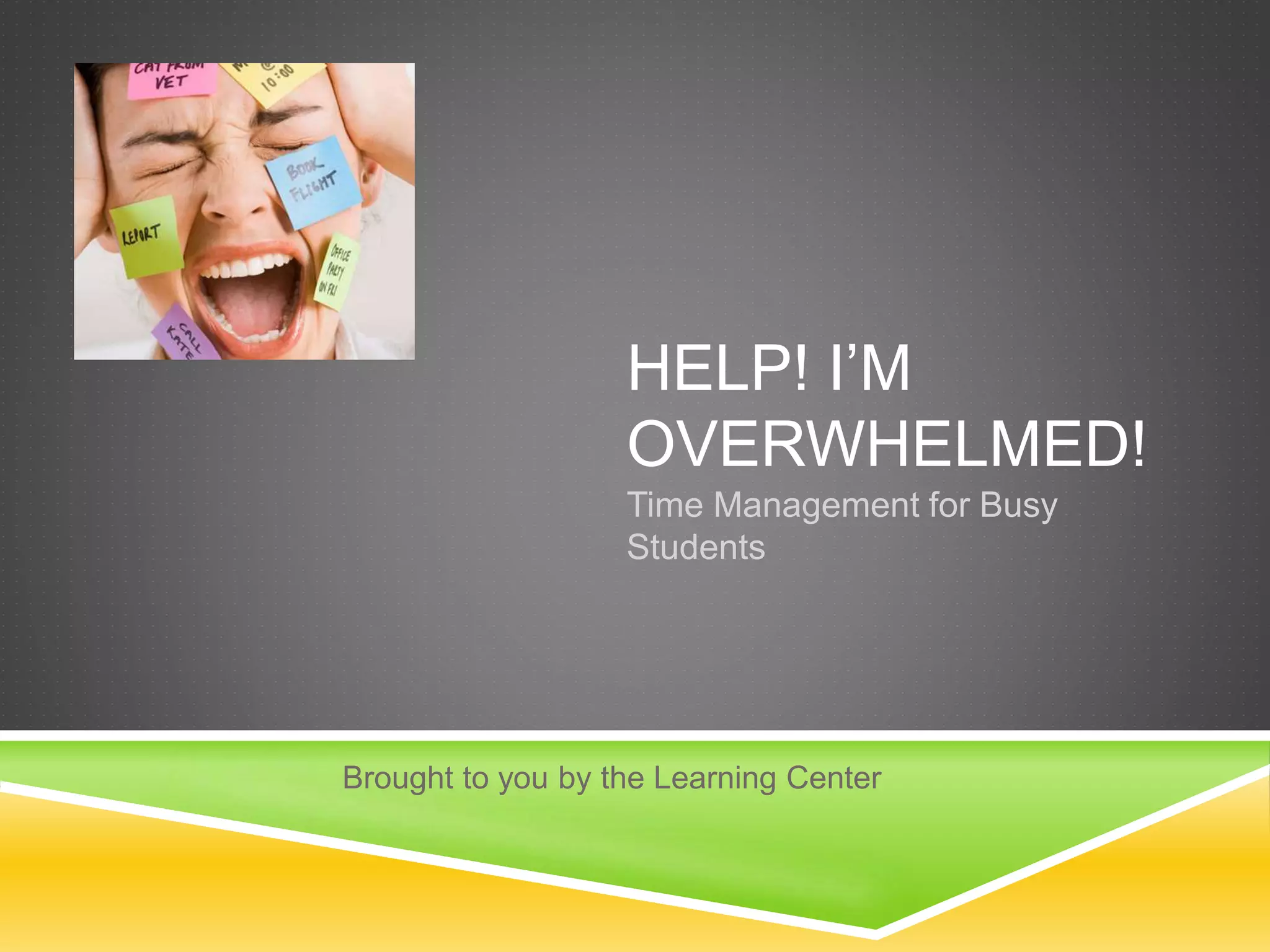
  • #2 Have you started to feel like this since you started college? I hope not!! Aren’t you glad that you are here today, we are doing this today to prevent you from feeling like this!! I never realized how important time was until I started college. We will be looking at some useful TM skills that will be beneficial to you. And you probably already have some good TM skills. Would love to hear from you too. So let’s share what we know.
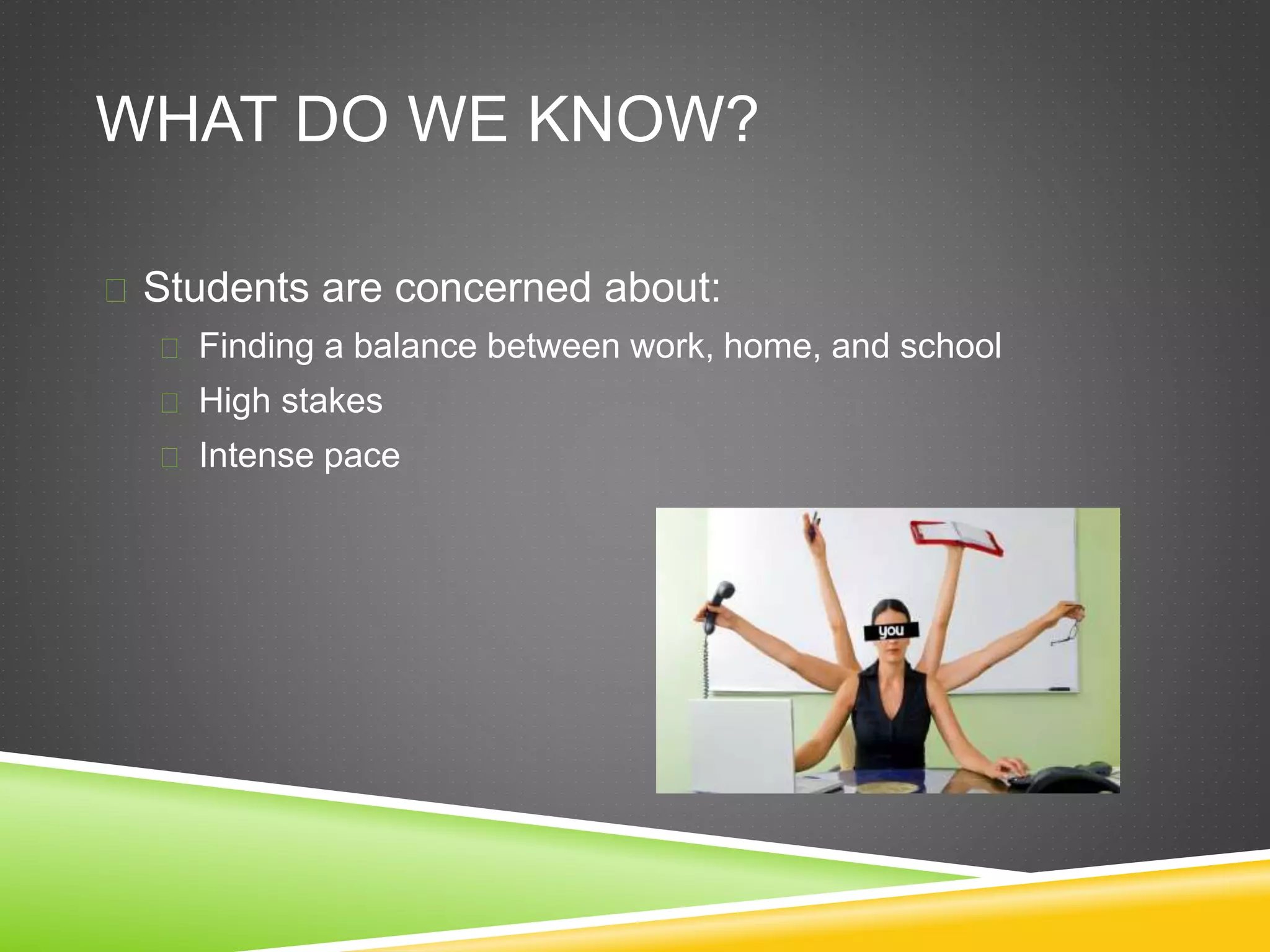
  • #3 How many things do we all juggle every day? High stakes is normally used with testing (high stakes testing). I think that it is important in college not just because of the testing. What is at stake here? (Success) High stakes- it is critical that we do well in college. Why??? The stakes are high when livelihoods, happiness, and goals are to be achieved. I bet everyone has realized by now that the pace of college is intense, whether you are coming directly from HS or coming to college after taking time off. College has a culture of its own, where students are assumed to be adults and you have a lot of freedom. So, you need to learn to manage your own time.
  • #4 Q. What are some of your commitments besides college? The traditional guideline for a week’s studying is two hours for each hour of class time. Importance of “Me” time!! Make your free time as important as your doctor’s visit. It is a necessity and great way to deal with stress. For your mental, physical, & psychological need, you just need to stop sometimes.
  • #5 1. You must identify your major goals and objectives. You must not wait for New Years to set goals; goals should be a continuously created as you think of them and revised as needed. We will talk about priorities later in the session today. To-do List & Calendar: Create a To-do list that actually gets done. Lets start by talking about what is the best part of a To-do list? (checking things off as they get done) What are some of the things that would go on a To-do list? (Task/Goal/Project) Project- Big undertaking (Paint your house, construct a deck) Goal- Can be achieved through repetitive tasks (Learn French, Save $5,000)- it is a vision you have, can have short-term or long-term goals Task- Something that is repetitive (Break it up- say a 500 words essay) If TM looks so easy, then why do we struggle with it??? (Procrastination, Black holes!!)
  • #6 What are Black holes? (anything but empty space; a great amount of matter packed into a very small area; creates a gravitational field so strong that nothing, not even light can escape) Eg.- “My desk has become a Black Hole” (nothing ever seems to be get done). It is important to find those black holes. Do the 1st handout (fairly quick, abt 3 mins) Now that you have identified your Black Holes and brought the things that might be in your way, lets move on to setting priorities.
  • #7 Always start out w/ the big picture; where do you see yourself in 2, 5, or 10 yrs? Ident. what you want to accomplish in this time. Eg. As a student- Associates degree, Bachelors degree, & so on. Then identify your short-term goals that will help you accomplish your long-term goals. This process can be done daily or weekly throughout your program. And it should because it makes the abstract concrete, helps you focus and feel successful. DAPPS- Dated (else, dreams; short-term- within a few mths; long-term- 1-10 years; if not met, gives us an opportunity to reevaluate), Achievable (challenging, but realistic), Personal (yours, no pressure), Positive (focuses energy on what you do want rather than what you don’t- translate a –ve goal into a +ve goal; I do not want to fail a class Earn a grade of B or better), Specific (very specific & measurable- work harder, do better are not very specific)
  • #9 If you have a family, post this for others to see! If you see a busy week coming, what can you do? (let your family members know about it; backup plan)
  • #10 Here’s a 2nd handout to get us started: Where does time go? (fill at home) Then, move them into the time-table, 3rd handout and have them fill in the hours. They should be prompted to consider the best time of day for studying….. If everything is that easy to do, why do we need time management? What do we typically do???
  • #11 For the e-break: remind them to plan time for FB, texts, etc., or at least time away. Keep that stuff out of sight when studying Use Tech: online shopping and appointments, texts, etc. Think about why we procrastinate?
  • #12 Two metaphors: Eat a Frog- You wake up in the morning and eat a live frog, you can go through the day knowing that the worst thing that can possibly happen to you that day has already passed. The day can only get better! The idea is to tackle the biggest, hardest, and least appealing task first thing every day. Move Big Rocks- Wisdom of the pickle jar…fill the jar with rocks, then pebbles, & then gravel & sand…it slides right into the cracks. On the contrary, if you fill the jar with sand first & then try to put rocks, there is no room. Make sure that your important work gets done first, before you fill up your time with trivial stuff.
  • #13 Else, it is like shooting with no target. Aim high, but know where you are going!!