Avoiding Plagiarism 
When And How to Document Sources? 
Brought to you by the Learning Center
What is Plagiarism? 
 The use of another’s ideas or words without properly 
acknowledging the source 
 Intentional 
 Accidental
Consequences of Plagiarism 
 Zero or failing grade on assignment 
 Failing grade in course 
 Academic probation 
 Academic suspension 
 Expulsion 
 Termination of employment 
 Loss of professional reputation 
 Loss of income
How do I Avoid Plagiarizing? 
 Document, document, document! 
 Leave ample time to complete the paper 
 Use note cards 
 Take careful notes 
 Create a user account when possible 
 Email citations and articles to yourself
What do I Document? 
 Unique words or phrases 
 Paraphrases or ideas 
 Information from an interview 
 Charts, diagrams, illustrations or photos 
 Ideas from a conversation or email
Is there Anything I don’t 
Document? 
 Your experiences, observations, or insights 
 Your experimental or survey results 
 Generally accepted facts 
 Common knowledge
Common Knowledge is 
 Information easily found in at least five other sources 
 Information generally known to your reader
Plagiarized? 
Real Case Studies
Important Notes 
 Try to introduce your source with your text. 
 According to Jones (2010)… 
 Jones (2010) cites a number of studies…. 
 The findings support the work of Jones (2010)…. 
 Your ideas and opinions should drive your writing. 
 Even if you don’t quote specific words or phrases, you must 
cite your source within your writing.
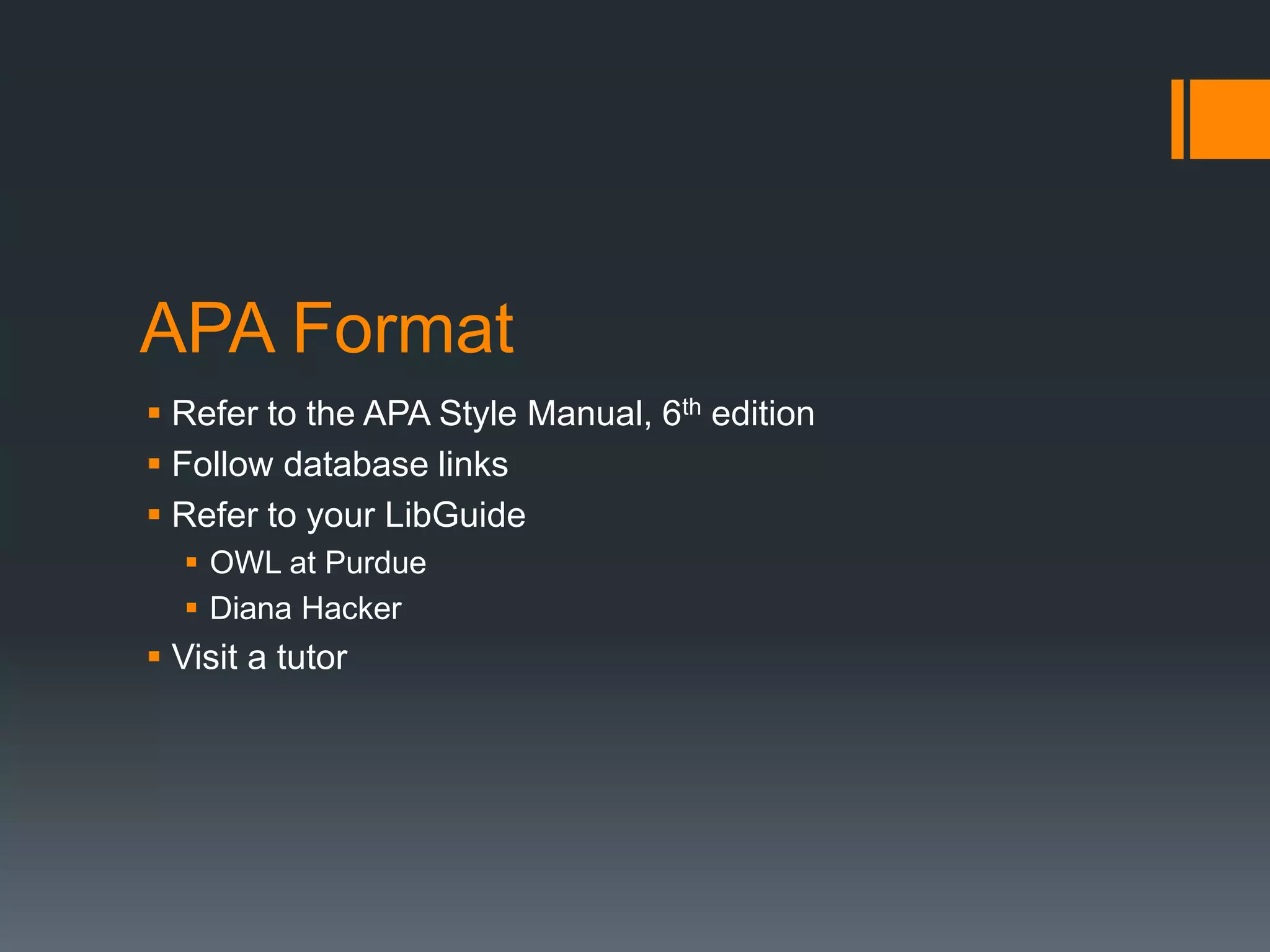
APA Format 
 Refer to the APA Style Manual, 6th edition 
 Follow database links 
 Refer to your LibGuide 
 OWL at Purdue 
 Diana Hacker 
 Visit a tutor
References 
Berndt, T. J. (2002). Friendship quality and social development. Current Directions in Psychological 
Science, 11, 7-10. 
Calfee, R. C., & Valencia, R. R. (1991). APA guide to preparing manuscripts for journal publication. 
Washington, DC: American Psychological Association. 
Harlow, H. F. (1983). Fundamentals for preparing psychology journal articles. Journal of 
Comparative and Physiological Psychology, 55, 893-896. 
Henry, W. A., III. (1990, April 9). Making the grade in today's schools. Time, 135, 28-31. 
Schultz, S. (2005, December 28). Calls made to strengthen state energy policies. The Country Today, pp. 
1A, 2A. 
Examples from Purdue Owl website

Avoiding Plagiarism APA Case Studies BIOL 103 HACC

  • 1.
    Avoiding Plagiarism WhenAnd How to Document Sources? Brought to you by the Learning Center
  • 2.
    What is Plagiarism?  The use of another’s ideas or words without properly acknowledging the source  Intentional  Accidental
  • 3.
    Consequences of Plagiarism  Zero or failing grade on assignment  Failing grade in course  Academic probation  Academic suspension  Expulsion  Termination of employment  Loss of professional reputation  Loss of income
  • 4.
    How do IAvoid Plagiarizing?  Document, document, document!  Leave ample time to complete the paper  Use note cards  Take careful notes  Create a user account when possible  Email citations and articles to yourself
  • 5.
    What do IDocument?  Unique words or phrases  Paraphrases or ideas  Information from an interview  Charts, diagrams, illustrations or photos  Ideas from a conversation or email
  • 6.
    Is there AnythingI don’t Document?  Your experiences, observations, or insights  Your experimental or survey results  Generally accepted facts  Common knowledge
  • 7.
    Common Knowledge is  Information easily found in at least five other sources  Information generally known to your reader
  • 8.
  • 9.
    Important Notes Try to introduce your source with your text.  According to Jones (2010)…  Jones (2010) cites a number of studies….  The findings support the work of Jones (2010)….  Your ideas and opinions should drive your writing.  Even if you don’t quote specific words or phrases, you must cite your source within your writing.
  • 10.
    APA Format Refer to the APA Style Manual, 6th edition  Follow database links  Refer to your LibGuide  OWL at Purdue  Diana Hacker  Visit a tutor
  • 11.
    References Berndt, T.J. (2002). Friendship quality and social development. Current Directions in Psychological Science, 11, 7-10. Calfee, R. C., & Valencia, R. R. (1991). APA guide to preparing manuscripts for journal publication. Washington, DC: American Psychological Association. Harlow, H. F. (1983). Fundamentals for preparing psychology journal articles. Journal of Comparative and Physiological Psychology, 55, 893-896. Henry, W. A., III. (1990, April 9). Making the grade in today's schools. Time, 135, 28-31. Schultz, S. (2005, December 28). Calls made to strengthen state energy policies. The Country Today, pp. 1A, 2A. Examples from Purdue Owl website