International Research Journal of Engineering and Technology (IRJET) e-ISSN: 2395-0056
Volume: 10 Issue: 01 | Jan 2023 www.irjet.net p-ISSN: 2395-0072
© 2022, IRJET | Impact Factor value: 7.529 | ISO 9001:2008 Certified Journal | Page 848
Fake Product Identification using Blockchain Technology
G. Neeraj1, D. Rahul2, P. Anurag3, V. Pranav4
1 Graduate, Dept. of Computer Science Engineering, Matrusri Engineering College, Telangana, India
2Graduate, Dept. of Electronics and Communication Engineering, Sreenidhi Institute of Science and Technology,
Telangana, India
3Graduate, Dept. of Computer Science Engineering, Matrusri Engineering College, Telangana, India
4Graduate, Dept. of Computer Science Engineering, Matrusri Engineering College, Telangana, India
---------------------------------------------------------------------***---------------------------------------------------------------------
Abstract - Counterfeit products havebeen quicklyexpanding
in recent years, as we all know. Counterfeiting is a global
problem that affects social and economic growth worldwide,
accounting for 3.3% of global commerce, according to OECD
figures. These items are sometimes referredtoas"firstcopies,"
and they can be marketed in place of original products. We
have various online purchasing platforms such as Flipkart,
Amazon, and others where customers buy things, which are
then sent by the manufacturer and delivered to the consumer.
However, many third parties are engaged in the process
between manufacturing and delivery, such as warehouses.
Because these third parties are engaged, unlawful product
tampering may occur, resulting in losses for both the
corporation and the customer. Theprimarygoalofthisproject
is to identify counterfeit items and ensure efficient product
delivery processes. Counterfeiting may be dangerous in some
businesses, such as the medical industry, thus identifying
counterfeit items and stopping themfrombeingsoldiscritical.
A blockchain is a decentralized ledger that records allpeer-to-
peer transactions. Participants can confirm transactions
without the requirement for a centralized authority usingthis
technology. Fund transfers, trade settlement, voting, and a
variety of other challenges are all possible uses. We are
attempting to introduce this immutable technologytoidentify
counterfeit products in this project. QR codes are also used to
store hash codes and determine their authenticity.
Key Words: Blockchain, QR codes, Fake Products,
Tamper, Ledger
1. INTRODUCTION
Fake products have a significantdetrimental influenceon the
market for both consumers and sellers. The sellers fail to
provide the goods as per the buyers' expectations, and the
consumers begin to suspect the company's quality and
standards, resulting in poor marketing of the brand whose
counterfeit items are being distributed in the market. The
most dangerous aspect of counterfeit items is that they may
be extremely detrimental to users. Because fake or
counterfeit items are not limited to any single area of the
market, we must recognize these products and find a
strategy to keep them out of the market. When we examine
dominating sectors like pharmaceuticals and food supplies,
these items may be quite risky. To address such issues, we
must retain data that is freely available to customers,
allowing them to check product details and establish a level
of trust in the product's legitimacy. Counterfeit items must
be identified in the supply chain since, in thepharmaceutical
industry, if this is not done, the customermaybeputatgrave
risk.
To avoid this, we are employing blockchain technology,
which is immutable and decentralized and may be very
useful in detecting fake products. If a third party is involved
in tampering with the data, we can easily identify it using
this technology. We also implemented a QR code that the
consumer scans to evaluate if the product is genuine or
counterfeit.
1.1 Blockchain:
A blockchain is a continual record, known as a block, that is
cryptographically linked together. A cryptographic hash of
the preceding block, a timestamp, and transaction data are
all included in each block. The timestamp verifies that the
transaction data existed at the moment the block was
released, allowing the hash to be calculated. Because each
block contains information about the one before it, they
create a chain, with each new block strengthening the
preceding ones.
As a result, blockchains areresistanttodata tamperingsince
the data in any one block, once recorded, cannot be changed
retrospectively without affecting all subsequent blocks.
International Research Journal of Engineering and Technology (IRJET) e-ISSN: 2395-0056
Volume: 10 Issue: 01 | Jan 2023 www.irjet.net p-ISSN: 2395-0072
© 2022, IRJET | Impact Factor value: 7.529 | ISO 9001:2008 Certified Journal | Page 849
2. METHODOLOGY
This project is primarily separated into two modules:
1) Manufacturer
2)Consumer/user
After logging in, the manufacturer will input product data
such as product id, name, and company name. The
information entered by the manufacturer is saved in blocks.
The SHA-256 algorithm is used to generate the hash code
when this information is included. This hash code is used to
generate a QR code, which is printed on the merchandise.
The user will receive this QR code after purchasing the
product, which he may scan with a web camera ora QR-code
scanner that was previously imported.
If the hash code within the blockchain and the hash code
generated after scanning is the same, the product is
considered to be original, and the consumer will be
presented with product data otherwise, it detects that the
product is counterfeit.
This way, we'll know where the product was tampered with
and who was accountable.
Fig.1 System Architecture Diagram
We have implemented our project using python, Tkinter as
UI, MySQL database and XAMPP local server.
We have implemented blockchain using the following steps:
 The information will be saved in the JSON format,
which is characterised by its simplicity both in
terms of its implementation and its readability. A
block is used to store the data, and inside that block
are numerous copies of the data. Every minute,
many blocks are added, and to distinguish onefrom
the other, we will use fingerprinting to distinguish
between them.
 This process is carried out using hash, and the
SHA256 hashing method will be used in particular
for this purpose. Every block will have its unique
hash, as well as the hash of the function that came
before it, making it impossible for the data to be
manipulated.
 Current block hash will be the previoushashfor the
next block and so on this way blocks are connected
to form a chain
Fig.2 Chaining of Blocks in Blockchain
 Proof of work method is included, making it way
more difficult to perform operationstocreatea new
block and add it to the chain. This indicates that
anybody who edits a prior block will need to repeat
the work associated with that block as well as the
work associated with all of the blocks that follow it.
We can restrict it furthermore by increasing the
difficulty associated with creating blocks.
List of important libraries imported:
Libraries required for UI:
from Tkinter import message box
from tkinter import *
from tkinter import simpledialog
import tkinter
from tkinter import filedialog
from tkinter.filedialog
import askopenfilename
Importing blockchain and block files:
from Block import *
from Blockchain import *
International Research Journal of Engineering and Technology (IRJET) e-ISSN: 2395-0056
Volume: 10 Issue: 01 | Jan 2023 www.irjet.net p-ISSN: 2395-0072
© 2022, IRJET | Impact Factor value: 7.529 | ISO 9001:2008 Certified Journal | Page 850
Importing SHA-256 for hashing:
from hashlib import sha256
Importing functions related to QR-code:
import qrcode
import qrtools
3. RESULTS:
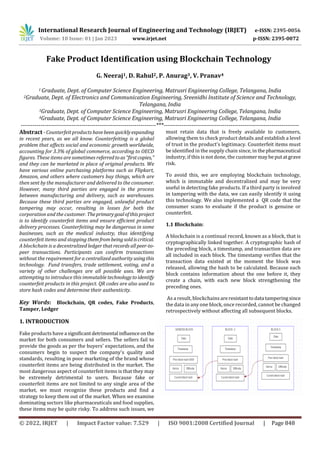
Fig.3 Output Module
This is the main module, where u get two modules included.
i.e., Admin module and user module
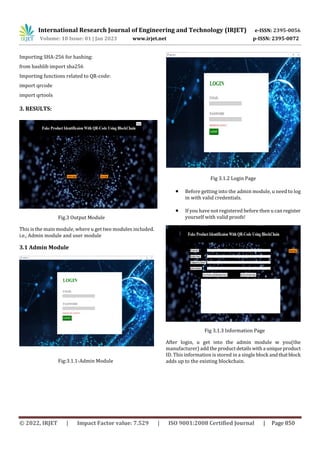
3.1 Admin Module
Fig:3.1.1-Admin Module
Fig 3.1.2 Login Page
 Before getting into the admin module, u need to log
in with valid credentials.
 If you have not registered before then u canregister
yourself with valid proofs!
Fig 3.1.3 Information Page
After login, u get into the admin module w you(the
manufacturer) add the productdetailswitha uniqueproduct
ID. This information is stored in a single block andthatblock
adds up to the existing blockchain.
International Research Journal of Engineering and Technology (IRJET) e-ISSN: 2395-0056
Volume: 10 Issue: 01 | Jan 2023 www.irjet.net p-ISSN: 2395-0072
© 2022, IRJET | Impact Factor value: 7.529 | ISO 9001:2008 Certified Journal | Page 851
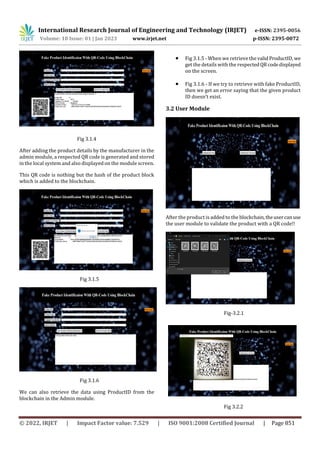
Fig 3.1.4
After adding the product details by the manufacturer in the
admin module, a respected QR code is generated and stored
in the local system and also displayed on the module screen.
This QR code is nothing but the hash of the product block
which is added to the blockchain.
Fig 3.1.5
Fig 3.1.6
We can also retrieve the data using ProductID from the
blockchain in the Admin module.
 Fig 3.1.5 - When we retrieve the validProductID, we
get the details with the respectedQRcodedisplayed
on the screen.
 Fig 3.1.6 - If we try to retrieve with fake ProductID,
then we get an error saying that the given product
ID doesn’t exist.
3.2 User Module
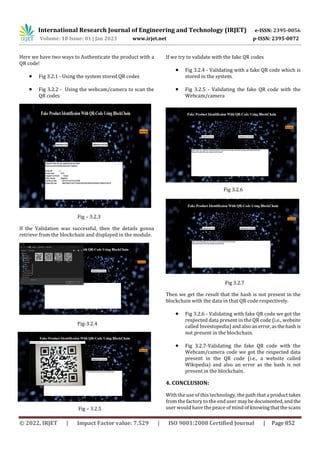
After the product is added to the blockchain, theusercan use
the user module to validate the product with a QR code!!
Fig-3.2.1
Fig 3.2.2
International Research Journal of Engineering and Technology (IRJET) e-ISSN: 2395-0056
Volume: 10 Issue: 01 | Jan 2023 www.irjet.net p-ISSN: 2395-0072
© 2022, IRJET | Impact Factor value: 7.529 | ISO 9001:2008 Certified Journal | Page 852
Here we have two ways to Authenticate the product with a
QR code!
 Fig 3.2.1 - Using the system stored QR codes
 Fig 3.2.2 - Using the webcam/camera to scan the
QR codes
Fig – 3.2.3
If the Validation was successful, then the details gonna
retrieve from the blockchain and displayed in the module.
Fig-3.2.4
Fig – 3.2.5
If we try to validate with the fake QR codes
 Fig 3.2.4 - Validating with a fake QR code which is
stored in the system.
 Fig 3.2.5 - Validating the fake QR code with the
Webcam/camera
Fig 3.2.6
Fig 3.2.7
Then we get the result that the hash is not present in the
blockchain with the data in that QR code respectively.
 Fig 3.2.6 - Validating with fake QR code we got the
respected data present in the QR code (i.e., website
called Investopedia) and also anerror,asthehashis
not present in the blockchain.
 Fig 3.2.7-Validating the fake QR code with the
Webcam/camera code we got the respected data
present in the QR code (i.e., a website called
Wikipedia) and also an error as the hash is not
present in the blockchain.
4. CONCLUSION:
With the use of this technology, the path that a producttakes
from the factory to the end user maybedocumented,andthe
user would have the peace of mind of knowingthatthescans
International Research Journal of Engineering and Technology (IRJET) e-ISSN: 2395-0056
Volume: 10 Issue: 01 | Jan 2023 www.irjet.net p-ISSN: 2395-0072
© 2022, IRJET | Impact Factor value: 7.529 | ISO 9001:2008 Certified Journal | Page 853
were not falsified. The manufacturer can demonstrate that
their product is genuine and is also in a position to trace the
course of the product. The configuration is simple to build
and uses fewer references to keep running. It is very
important to implement this product in health-related
markets to prevent fraudsters from producing harmful
products that can be harmful.
5. REFERENCES:
[1] Satoshi Nakamoto, ―Bitcoin: A Peer-to-Peer Electronic
Cash System‖, 2008
[2] Hyperledger, ―Hyperledger Blockchain Performance
Metrics‖, V1.01, October 2018
[3] R.C. Merkle, "Protocols for public key cryptosystems," In
Proc. 1980 Symposium on Security and Privacy, IEEE
Computer Society, pages 122-133, April 1980.
[4] Armin Ronacher, ―Flask Docs‖,
http://flask.pocoo.org/docs/‖
[5] G. Wood, ‗‗Ethereum: A securedecentralisedgeneralized
transaction ledger,‘‘ Tech. Rep., 2014.
[6] OECD (2016), Illicit Trade: Converging Criminal
Networks, OECD Reviews of Risk Management Policies,
OECDPublishing,Paris,https://doi.org/10.1787/978926425
1847-en.
[7] M. Castro and B. Liskov, ‗‗Practical byzantine fault
tolerance and proactive recovery,‘‘ ACM Trans. Comput.
Syst., vol. 20, no. 4, pp. 398–461, Nov. 2002.
[8] Clement, E. Wong, L. Alvisi, M. Dahlin, and M. Marchetti,
‗‗Making byzantine fault tolerantsystemstoleratebyzantine
faults,‘‘ in Proc. 6th USENIX Symp. Netw. Syst. Design
Implement., 2009, pp. 153–168.
[9] Cachin, ‗‗Architecture of the hyper ledger blockchain
fabric,‘‘ Tech. Rep., Jul. 2016.
[10] S. Underwood, ―Blockchain Beyond Bitcoin‖, in
Communications of the ACM, vol. 59, no. 11, p. 15-17, 2016.
[11] Deloitte, Israel: A Hotspot for Blockchain Innovation,
2016.[Online].Available:
https://www2.deloitte.com/content/dam/
Deloitte/il/Documents/financial-
services/israel_a_hotspot_for_blockchain_innovation_
feb2016_1.1.pdf. [Accessed: 2.11.2016].
[12] G. Greenspan and M. Zehavi, Will Provenance Be the
Blockchain‘s Break Out Use Case in 2016?7.1.2016.[Online].
Available: http://www.coindesk.com/ provenance-
blockchain-tech-app/. [Accessed: 12.12.2016].
[13] Counterfeit medicines. QA counterfeit. World Health
Organization (WHO) 2009. Available from:
http://www.who.int/medicines/
services/counterfeit/faqs/QACounterfeit-october2009.pdf
[last cited on 2010 Jun 12].
BIOGRAPHIES
G . Neeraj is a Computer Science
Graduate student from Matrusri
Engineering College. After
Graduation, he is working as
Machine Learning Engineer at
Quantiphi, Bengaluru, India
Pittala Anurag Sharma is a
Computer Science Graduate
student from MatrusriEngineering
College. After Graduation, he is
working at HSBC as a Software
Engineer, in Pune, India.
Pranav Vuppala is a Computer
Science Graduate student from
Matrusri Engineering College.
After Graduation, He is working as
an Assistant Graduate System
engineer trainee at Tata
consultancy services, Hyderabad,
India.
Deevanapalli Rahul is an
Electronics and Communication
Engineering Graduate Student
from Sreenidhi InstituteofScience
and Technology, Hyderabad,
Telangana.

Fake Product Identification using Blockchain Technology

  • 1.
    International Research Journalof Engineering and Technology (IRJET) e-ISSN: 2395-0056 Volume: 10 Issue: 01 | Jan 2023 www.irjet.net p-ISSN: 2395-0072 © 2022, IRJET | Impact Factor value: 7.529 | ISO 9001:2008 Certified Journal | Page 848 Fake Product Identification using Blockchain Technology G. Neeraj1, D. Rahul2, P. Anurag3, V. Pranav4 1 Graduate, Dept. of Computer Science Engineering, Matrusri Engineering College, Telangana, India 2Graduate, Dept. of Electronics and Communication Engineering, Sreenidhi Institute of Science and Technology, Telangana, India 3Graduate, Dept. of Computer Science Engineering, Matrusri Engineering College, Telangana, India 4Graduate, Dept. of Computer Science Engineering, Matrusri Engineering College, Telangana, India ---------------------------------------------------------------------***--------------------------------------------------------------------- Abstract - Counterfeit products havebeen quicklyexpanding in recent years, as we all know. Counterfeiting is a global problem that affects social and economic growth worldwide, accounting for 3.3% of global commerce, according to OECD figures. These items are sometimes referredtoas"firstcopies," and they can be marketed in place of original products. We have various online purchasing platforms such as Flipkart, Amazon, and others where customers buy things, which are then sent by the manufacturer and delivered to the consumer. However, many third parties are engaged in the process between manufacturing and delivery, such as warehouses. Because these third parties are engaged, unlawful product tampering may occur, resulting in losses for both the corporation and the customer. Theprimarygoalofthisproject is to identify counterfeit items and ensure efficient product delivery processes. Counterfeiting may be dangerous in some businesses, such as the medical industry, thus identifying counterfeit items and stopping themfrombeingsoldiscritical. A blockchain is a decentralized ledger that records allpeer-to- peer transactions. Participants can confirm transactions without the requirement for a centralized authority usingthis technology. Fund transfers, trade settlement, voting, and a variety of other challenges are all possible uses. We are attempting to introduce this immutable technologytoidentify counterfeit products in this project. QR codes are also used to store hash codes and determine their authenticity. Key Words: Blockchain, QR codes, Fake Products, Tamper, Ledger 1. INTRODUCTION Fake products have a significantdetrimental influenceon the market for both consumers and sellers. The sellers fail to provide the goods as per the buyers' expectations, and the consumers begin to suspect the company's quality and standards, resulting in poor marketing of the brand whose counterfeit items are being distributed in the market. The most dangerous aspect of counterfeit items is that they may be extremely detrimental to users. Because fake or counterfeit items are not limited to any single area of the market, we must recognize these products and find a strategy to keep them out of the market. When we examine dominating sectors like pharmaceuticals and food supplies, these items may be quite risky. To address such issues, we must retain data that is freely available to customers, allowing them to check product details and establish a level of trust in the product's legitimacy. Counterfeit items must be identified in the supply chain since, in thepharmaceutical industry, if this is not done, the customermaybeputatgrave risk. To avoid this, we are employing blockchain technology, which is immutable and decentralized and may be very useful in detecting fake products. If a third party is involved in tampering with the data, we can easily identify it using this technology. We also implemented a QR code that the consumer scans to evaluate if the product is genuine or counterfeit. 1.1 Blockchain: A blockchain is a continual record, known as a block, that is cryptographically linked together. A cryptographic hash of the preceding block, a timestamp, and transaction data are all included in each block. The timestamp verifies that the transaction data existed at the moment the block was released, allowing the hash to be calculated. Because each block contains information about the one before it, they create a chain, with each new block strengthening the preceding ones. As a result, blockchains areresistanttodata tamperingsince the data in any one block, once recorded, cannot be changed retrospectively without affecting all subsequent blocks.
  • 2.
    International Research Journalof Engineering and Technology (IRJET) e-ISSN: 2395-0056 Volume: 10 Issue: 01 | Jan 2023 www.irjet.net p-ISSN: 2395-0072 © 2022, IRJET | Impact Factor value: 7.529 | ISO 9001:2008 Certified Journal | Page 849 2. METHODOLOGY This project is primarily separated into two modules: 1) Manufacturer 2)Consumer/user After logging in, the manufacturer will input product data such as product id, name, and company name. The information entered by the manufacturer is saved in blocks. The SHA-256 algorithm is used to generate the hash code when this information is included. This hash code is used to generate a QR code, which is printed on the merchandise. The user will receive this QR code after purchasing the product, which he may scan with a web camera ora QR-code scanner that was previously imported. If the hash code within the blockchain and the hash code generated after scanning is the same, the product is considered to be original, and the consumer will be presented with product data otherwise, it detects that the product is counterfeit. This way, we'll know where the product was tampered with and who was accountable. Fig.1 System Architecture Diagram We have implemented our project using python, Tkinter as UI, MySQL database and XAMPP local server. We have implemented blockchain using the following steps:  The information will be saved in the JSON format, which is characterised by its simplicity both in terms of its implementation and its readability. A block is used to store the data, and inside that block are numerous copies of the data. Every minute, many blocks are added, and to distinguish onefrom the other, we will use fingerprinting to distinguish between them.  This process is carried out using hash, and the SHA256 hashing method will be used in particular for this purpose. Every block will have its unique hash, as well as the hash of the function that came before it, making it impossible for the data to be manipulated.  Current block hash will be the previoushashfor the next block and so on this way blocks are connected to form a chain Fig.2 Chaining of Blocks in Blockchain  Proof of work method is included, making it way more difficult to perform operationstocreatea new block and add it to the chain. This indicates that anybody who edits a prior block will need to repeat the work associated with that block as well as the work associated with all of the blocks that follow it. We can restrict it furthermore by increasing the difficulty associated with creating blocks. List of important libraries imported: Libraries required for UI: from Tkinter import message box from tkinter import * from tkinter import simpledialog import tkinter from tkinter import filedialog from tkinter.filedialog import askopenfilename Importing blockchain and block files: from Block import * from Blockchain import *
  • 3.
    International Research Journalof Engineering and Technology (IRJET) e-ISSN: 2395-0056 Volume: 10 Issue: 01 | Jan 2023 www.irjet.net p-ISSN: 2395-0072 © 2022, IRJET | Impact Factor value: 7.529 | ISO 9001:2008 Certified Journal | Page 850 Importing SHA-256 for hashing: from hashlib import sha256 Importing functions related to QR-code: import qrcode import qrtools 3. RESULTS: Fig.3 Output Module This is the main module, where u get two modules included. i.e., Admin module and user module 3.1 Admin Module Fig:3.1.1-Admin Module Fig 3.1.2 Login Page  Before getting into the admin module, u need to log in with valid credentials.  If you have not registered before then u canregister yourself with valid proofs! Fig 3.1.3 Information Page After login, u get into the admin module w you(the manufacturer) add the productdetailswitha uniqueproduct ID. This information is stored in a single block andthatblock adds up to the existing blockchain.
  • 4.
    International Research Journalof Engineering and Technology (IRJET) e-ISSN: 2395-0056 Volume: 10 Issue: 01 | Jan 2023 www.irjet.net p-ISSN: 2395-0072 © 2022, IRJET | Impact Factor value: 7.529 | ISO 9001:2008 Certified Journal | Page 851 Fig 3.1.4 After adding the product details by the manufacturer in the admin module, a respected QR code is generated and stored in the local system and also displayed on the module screen. This QR code is nothing but the hash of the product block which is added to the blockchain. Fig 3.1.5 Fig 3.1.6 We can also retrieve the data using ProductID from the blockchain in the Admin module.  Fig 3.1.5 - When we retrieve the validProductID, we get the details with the respectedQRcodedisplayed on the screen.  Fig 3.1.6 - If we try to retrieve with fake ProductID, then we get an error saying that the given product ID doesn’t exist. 3.2 User Module After the product is added to the blockchain, theusercan use the user module to validate the product with a QR code!! Fig-3.2.1 Fig 3.2.2
  • 5.
    International Research Journalof Engineering and Technology (IRJET) e-ISSN: 2395-0056 Volume: 10 Issue: 01 | Jan 2023 www.irjet.net p-ISSN: 2395-0072 © 2022, IRJET | Impact Factor value: 7.529 | ISO 9001:2008 Certified Journal | Page 852 Here we have two ways to Authenticate the product with a QR code!  Fig 3.2.1 - Using the system stored QR codes  Fig 3.2.2 - Using the webcam/camera to scan the QR codes Fig – 3.2.3 If the Validation was successful, then the details gonna retrieve from the blockchain and displayed in the module. Fig-3.2.4 Fig – 3.2.5 If we try to validate with the fake QR codes  Fig 3.2.4 - Validating with a fake QR code which is stored in the system.  Fig 3.2.5 - Validating the fake QR code with the Webcam/camera Fig 3.2.6 Fig 3.2.7 Then we get the result that the hash is not present in the blockchain with the data in that QR code respectively.  Fig 3.2.6 - Validating with fake QR code we got the respected data present in the QR code (i.e., website called Investopedia) and also anerror,asthehashis not present in the blockchain.  Fig 3.2.7-Validating the fake QR code with the Webcam/camera code we got the respected data present in the QR code (i.e., a website called Wikipedia) and also an error as the hash is not present in the blockchain. 4. CONCLUSION: With the use of this technology, the path that a producttakes from the factory to the end user maybedocumented,andthe user would have the peace of mind of knowingthatthescans
  • 6.
    International Research Journalof Engineering and Technology (IRJET) e-ISSN: 2395-0056 Volume: 10 Issue: 01 | Jan 2023 www.irjet.net p-ISSN: 2395-0072 © 2022, IRJET | Impact Factor value: 7.529 | ISO 9001:2008 Certified Journal | Page 853 were not falsified. The manufacturer can demonstrate that their product is genuine and is also in a position to trace the course of the product. The configuration is simple to build and uses fewer references to keep running. It is very important to implement this product in health-related markets to prevent fraudsters from producing harmful products that can be harmful. 5. REFERENCES: [1] Satoshi Nakamoto, ―Bitcoin: A Peer-to-Peer Electronic Cash System‖, 2008 [2] Hyperledger, ―Hyperledger Blockchain Performance Metrics‖, V1.01, October 2018 [3] R.C. Merkle, "Protocols for public key cryptosystems," In Proc. 1980 Symposium on Security and Privacy, IEEE Computer Society, pages 122-133, April 1980. [4] Armin Ronacher, ―Flask Docs‖, http://flask.pocoo.org/docs/‖ [5] G. Wood, ‗‗Ethereum: A securedecentralisedgeneralized transaction ledger,‘‘ Tech. Rep., 2014. [6] OECD (2016), Illicit Trade: Converging Criminal Networks, OECD Reviews of Risk Management Policies, OECDPublishing,Paris,https://doi.org/10.1787/978926425 1847-en. [7] M. Castro and B. Liskov, ‗‗Practical byzantine fault tolerance and proactive recovery,‘‘ ACM Trans. Comput. Syst., vol. 20, no. 4, pp. 398–461, Nov. 2002. [8] Clement, E. Wong, L. Alvisi, M. Dahlin, and M. Marchetti, ‗‗Making byzantine fault tolerantsystemstoleratebyzantine faults,‘‘ in Proc. 6th USENIX Symp. Netw. Syst. Design Implement., 2009, pp. 153–168. [9] Cachin, ‗‗Architecture of the hyper ledger blockchain fabric,‘‘ Tech. Rep., Jul. 2016. [10] S. Underwood, ―Blockchain Beyond Bitcoin‖, in Communications of the ACM, vol. 59, no. 11, p. 15-17, 2016. [11] Deloitte, Israel: A Hotspot for Blockchain Innovation, 2016.[Online].Available: https://www2.deloitte.com/content/dam/ Deloitte/il/Documents/financial- services/israel_a_hotspot_for_blockchain_innovation_ feb2016_1.1.pdf. [Accessed: 2.11.2016]. [12] G. Greenspan and M. Zehavi, Will Provenance Be the Blockchain‘s Break Out Use Case in 2016?7.1.2016.[Online]. Available: http://www.coindesk.com/ provenance- blockchain-tech-app/. [Accessed: 12.12.2016]. [13] Counterfeit medicines. QA counterfeit. World Health Organization (WHO) 2009. Available from: http://www.who.int/medicines/ services/counterfeit/faqs/QACounterfeit-october2009.pdf [last cited on 2010 Jun 12]. BIOGRAPHIES G . Neeraj is a Computer Science Graduate student from Matrusri Engineering College. After Graduation, he is working as Machine Learning Engineer at Quantiphi, Bengaluru, India Pittala Anurag Sharma is a Computer Science Graduate student from MatrusriEngineering College. After Graduation, he is working at HSBC as a Software Engineer, in Pune, India. Pranav Vuppala is a Computer Science Graduate student from Matrusri Engineering College. After Graduation, He is working as an Assistant Graduate System engineer trainee at Tata consultancy services, Hyderabad, India. Deevanapalli Rahul is an Electronics and Communication Engineering Graduate Student from Sreenidhi InstituteofScience and Technology, Hyderabad, Telangana.